AB 266: Medical marijuana.
- Session Year: 2015-2016
- House: Assembly
- Latest Version Date: 2015-10-09
(1)Existing law, the Compassionate Use Act of 1996, an initiative measure enacted by the approval of Proposition 215 at the November 5, 1996, statewide general election, authorizes the use of marijuana for medical purposes. Existing law enacted by the Legislature requires the establishment of a program for the issuance of identification cards to qualified patients so that they may lawfully use marijuana for medical purposes, and requires the establishment of guidelines for the lawful cultivation of marijuana grown for medical use. Existing law provides for the licensure of various professions by boards or bureaus within the Department of Consumer Affairs. Existing law, the Sherman Food, Drug, and Cosmetic Law, provides for the regulation of food, drugs, devices, and cosmetics, as specified. A violation of that law is a crime.
This bill, among other things, would enact the Medical Marijuana Regulation and Safety Act for the licensure and regulation of medical marijuana and would establish within the Department of Consumer Affairs the Bureau of Medical Marijuana Regulation, under the supervision and control of the Director of Consumer Affairs. The bill would require the director to administer and enforce the provisions of the act.
This bill would also require the Board of Equalization, in consultation with the Department of Food and Agriculture, to adopt a system for reporting the movement of commercial cannabis and cannabis products.
This bill would impose certain fines and civil penalties for specified violations of the act, and would require moneys collected as a result of these fines and civil penalties to be deposited into the Medical Cannabis Fines and Penalties Account.
(2)Under existing law, certain persons with identification cards, who associate within the state in order collectively or cooperatively to cultivate marijuana for medical purposes, are not solely on the basis of that fact subject to specified state criminal sanctions.
This bill would repeal these provisions upon the issuance of licenses by licensing authorities pursuant to the Medical Marijuana Regulation and Safety Act, as specified, and would instead provide that actions of licensees with the relevant local permits, in accordance with the act and applicable local ordinances, are not offenses subject to arrest, prosecution, or other sanction under state law.
(3)This bill would provide that its provisions are severable.
(4)Existing constitutional provisions require that a statute that limits the right of access to the meetings of public bodies or the writings of public officials and agencies be adopted with findings demonstrating the interest protected by the limitation and the need for protecting that interest.
This bill would make legislative findings to that effect.
(5)The California Constitution requires the state to reimburse local agencies and school districts for certain costs mandated by the state. Statutory provisions establish procedures for making that reimbursement. This bill would provide that, if the Commission on State Mandates determines that the bill contains costs mandated by the state, reimbursement for those costs shall be made pursuant to these statutory provisions.
(6)The bill would provide that it shall become operative only if SB 643 and AB 243 of the 201516 Regular Session are also enacted and become operative.
(1)Existing law, the Compassionate Use Act of 1996, an initiative measure enacted by the approval of Proposition 215 at the November 5, 1996, statewide general election, authorizes the use of marijuana for medical purposes. Existing law enacted by the Legislature requires the establishment of a program for the issuance of identification cards to qualified patients so that they may lawfully use marijuana for medical purposes, and requires the establishment of guidelines for the lawful cultivation of marijuana grown for medical use. Existing law provides for the licensure of various professions by boards or bureaus within the Department of Consumer Affairs. Existing law, the Sherman Food, Drug, and Cosmetic Law, provides for the regulation of food, drugs, devices, and cosmetics, as specified. A violation of that law is a crime.
This bill, among other things, would enact the Medical Marijuana Regulation and Safety Act for the licensure and regulation of medical marijuana and would establish within the Department of Consumer Affairs the Bureau of Medical Marijuana Regulation, under the supervision and control of the Director of Consumer Affairs. The bill would require the director to administer and enforce the provisions of the act.
This bill would also require the Board of Equalization, in consultation with the Department of Food and Agriculture, to adopt a system for reporting the movement of commercial cannabis and cannabis products.
This bill would impose certain fines and civil penalties for specified violations of the act, and would require moneys collected as a result of these fines and civil penalties to be deposited into the Medical Cannabis Fines and Penalties Account.
(2)Under existing law, certain persons with identification cards, who associate within the state in order collectively or cooperatively to cultivate marijuana for medical purposes, are not solely on the basis of that fact subject to specified state criminal sanctions.
This bill would repeal these provisions upon the issuance of licenses by licensing authorities pursuant to the Medical Marijuana Regulation and Safety Act, as specified, and would instead provide that actions of licensees with the relevant local permits, in accordance with the act and applicable local ordinances, are not offenses subject to arrest, prosecution, or other sanction under state law.
(3)This bill would provide that its provisions are severable.
(4)Existing constitutional provisions require that a statute that limits the right of access to the meetings of public bodies or the writings of public officials and agencies be adopted with findings demonstrating the interest protected by the limitation and the need for protecting that interest.
This bill would make legislative findings to that effect.
(5)The California Constitution requires the state to reimburse local agencies and school districts for certain costs mandated by the state. Statutory provisions establish procedures for making that reimbursement. This bill would provide that, if the Commission on State Mandates determines that the bill contains costs
mandated by the state, reimbursement for those costs shall be made pursuant to these statutory provisions.
(6)The bill would provide that it shall become operative only if SB 643 and AB 243 of the 201516 Regular Session are also enacted and become operative.
Existing law, the Compassionate Use Act of 1996, an initiative measure enacted by the approval of Proposition 215 at the November 6, 1996, statewide general election, authorizes the use of marijuana for medical purposes. Existing law requires the Medical Board of California to prioritize its investigative and prosecutorial resources to ensure that the most harmful physicians and surgeons are identified and disciplined expeditiously, and provides a list of allegations that shall be prioritized.
This bill would add repeatedly recommending excessive cannabis to patients for medical purposes, and repeatedly recommending cannabis to patients without a good faith examination and a medical reason, to the list of prioritized allegations.
This bill would become operative only if SB 643 of the 201516 Regular Session is enacted and becomes operative.
Existing law, the Compassionate Use Act of 1996, an initiative measure enacted by the approval of Proposition 215 at the November 6, 1996, statewide general election, authorizes the use of marijuana for medical purposes. Existing law enacted by the Legislature requires the establishment of a program for the issuance of identification cards to qualified patients so that they may lawfully use marijuana for medical purposes, and requires the establishment of guidelines for the lawful cultivation of marijuana grown for medical use. Existing law provides for the licensure of various professions by the Department of Consumer Affairs. Existing law, the Sherman Food, Drug, and Cosmetic Law, provides for the regulation of food, drugs, devices, and cosmetics, as specified. A violation of that law is a crime. Existing law requires the Medical Board of California to prioritize its investigative and prosecutorial resources to ensure that the most harmful physicians and surgeons are identified and disciplined expeditiously, and provides a list of allegations that shall be prioritized.
This bill would add repeatedly recommending excessive cannabis to patients for medical purposes, and repeatedly recommending cannabis to patients without a good faith examination and a medical reason, to the list of prioritized allegations.
This bill, contingent on the enactment of SB 643, would state the intent of the Legislature to enact legislation that would enact a comprehensive regulatory framework for medical marijuana in the state. would become operative only if SB 643 of the 201516 Regular Session is enacted and becomes operative.
(1)Existing law, the Compassionate Use Act of 1996, an initiative measure enacted by the approval of Proposition 215 at the November 6, 1996, statewide general election, authorizes the use of marijuana for medical purposes. Existing law enacted by the Legislature requires the establishment of a program for the issuance of identification cards to qualified patients so that they may lawfully use marijuana for medical purposes, and requires the establishment of guidelines for the lawful cultivation of marijuana grown for medical use. Existing law provides for the licensure of various professions by the Department of Consumer Affairs. Existing law, the Sherman Food, Drug, and Cosmetic Law, provides for the regulation of food, drugs, devices, and cosmetics, as specified. A violation of that law is a crime.
This bill, contingent on the enactment of SB 643, would state the intent of the Legislature to enact legislation that would enact a comprehensive regulatory framework for medical marijuana in the state.
This bill would enact the Medical Cannabis Regulation and Control Act and would establish within the office of the Governor, the Governors Office of Medical Cannabis Regulation to coordinate and provide oversight of the licensing and regulation of various commercial cannabis activities, as defined. The bill would establish the Division of Medical Cannabis Regulation within the State Board of Equalization, for the licensure and regulation of medical cannabis dispensaries and transporters. The bill would establish the Division of Medical Cannabis Manufacturing and Testing within the State Department of Public Health for the licensing and regulation of medical cannabis manufacturers and certified testing laboratories. The bill would also require the Division of Medical Cannabis Manufacturing and Testing to set specified standards for edible cannabis products. The bill would also establish the Division of Medical Cannabis Cultivation within the Department of Food and Agriculture for the licensure and regulation of medical cannabis cultivators. The bill would set forth the duties of these various divisions. The bill would require the office, by April 1, 2016, to convene a task force to advise the office on the development of standards for the regulation of medical cannabis.
This bill would provide for the enforcement of the provisions of the act and of local ordinances relating to medical cannabis by the state and local governments and would require the office, by January 1, 2017, to develop an enforcement framework that clarifies the enforcement roles of the state and local governments. The bill would specify that it does not supersede the provisions of Measure D, approved by the voters of the City of Los Angeles on the May 21, 2013, ballot and would require the State Board of Equalization to enter into a memorandum of understanding with the City of Los Angeles to establish specified protocols, including tracking medical cannabis to and from the City of Los Angeles. The bill would exempt facilities engaged in commercial cannabis activity within the City of Los Angeles from the licensing requirements and would give the city full power and authority to enforce prescribed standards and regulations.
This bill would require, before a business granted a state license commences operation, that the business also obtain a license or permit from the local jurisdiction and would authorize the local jurisdiction to regulate commercial cannabis activity in specified ways. The bill would provide for provisional licensure to engage in commercial cannabis activity, as specified, until the state license application is either granted or denied or until July 1, 2017.
This bill would, by January 1, 2017, require the Division of Labor Standards and Enforcement to develop a certification program for cannabis employees. The bill would require, by January 1, 2019, that all persons who perform work as cannabis employees be certified or participating in an apprenticeship program, as provided.
This bill would establish the Medical Cannabis Regulation Fund and various accounts within that fund for the collection of fines and fees imposed on the licensees conducting commercial cannabis activities.
(2)Existing law establishes the Division of Apprenticeship Standards, which audits and regulates apprenticeship programs for various trades, including electricians.
This bill would require the division to investigate, approve, or reject applications for apprenticeship employees of a licensed cultivation site or a licensed dispensing facility, as defined.
(3)Existing law, the Medical Practice Act, provides for the licensure and regulation of physicians and surgeons by the Medical Board of California. Existing law requires the board to prioritize investigations and prosecutions of physicians and surgeons representing the greatest threat of harm, as specified. Existing law identifies the cases that are to be given priority, which include cases of repeated acts of excessively prescribing, furnishing, or administering controlled substances without a good faith prior examination of the patient. Existing law sets forth the conduct that would constitute unprofessional conduct for a physician and surgeon, including, but not limited to, prescribing certain drugs without an appropriate examination or medical indication. Existing law provides that a violation of the Medical Practice Act is a crime.
This bill would require the board to consult with the Center for Medicinal Cannabis Research on developing and adopting medical guidelines for the appropriate administration and use of marijuana.
The bill would also make it a misdemeanor for a physician and surgeon who recommends marijuana to a patient for a medical purpose to accept, solicit, or offer any remuneration from or to a licensed dispensing facility in which the physician and surgeon or his or her immediate family has a financial interest. By creating a new crime, the bill would impose a state-mandated local program.
This bill would specify that recommending marijuana to patients without an appropriate prior examination and a medical indication is unprofessional conduct. The bill would provide that specified acts of recommending marijuana for medical purposes without a good faith examination are among the types of cases that should be given priority for investigation and prosecution by the board, as described above. The bill would further prohibit a physician and surgeon from recommending medical marijuana to a patient unless that person is the patients attending physician, as defined. Because a violation of that provision would be a crime, the bill would impose a state-mandated local program.
(4)Existing law exempts qualified patients, persons with valid identification cards, and the designated primary caregivers of qualified patients and persons with identification cards from certain crimes, including possession of concentrated cannabis and marijuana, cultivation of marijuana, and possession of marijuana for sale.
This bill, commencing 180 days after the Governors Office of Medical Cannabis Regulation posts a notice on its Internet Web site that the licensing authorities have commenced issuing provisional licenses, would repeal those provisions.
(5)Existing law authorizes the legislative body of a city or county to impose various taxes, including a transactions and use tax at a rate of 0.25%, or a multiple thereof, if approved by the required vote of the legislative body and the required vote of qualified voters, and limits the combined rate of transactions and use taxes within a city or county to 2%.
This bill would authorize a county to impose a tax on the privilege of cultivating, dispensing, producing, processing, preparing, storing, providing, donating, selling, or distributing medical cannabis or medical cannabis products. The bill would authorize the tax to be imposed for either general or specific governmental purposes. The bill would require a tax imposed pursuant to this authority to be subject to any applicable voter approval requirement.
(6)Existing law establishes the Department of Motor Vehicles and the Department of the California Highway Patrol. Existing law also prohibits and establishes standards for driving under the influence of alcohol.
This bill would require the Department of Motor Vehicles, in consultation with the Department of the California Highway Patrol, to prepare and submit a report that identifies best practices for the identification, detection, and apprehension of drivers operating a vehicle unsafely due to medical cannabis impairment.
(7)Existing law regulates the labor practices of agricultural employers. Existing law establishes the Occupational Safety and Health Standards Board within the Department of Industrial Relations to adopt, amend, and repeal occupational safety and health standards and establishes the Division of Occupational Safety and Health to enforce those standards.
This bill would include licensed cultivation sites in the definition of agricultural employer. The bill would require the division to convene an advisory committee to evaluate whether there is a need to develop industry-specific regulations relating to facilities issued a conditional license.
(8)This bill would provide that its provisions are severable.
(9)Existing constitutional provisions require that a statute that limits the right of access to the meetings of public bodies or the writings of public officials and agencies be adopted with findings demonstrating the interest protected by the limitation and the need for protecting that interest.
This bill would make legislative findings to that effect.
(10)The California Constitution requires the state to reimburse local agencies and school districts for certain costs mandated by the state. Statutory provisions establish procedures for making that reimbursement.
This bill would provide that with regard to certain mandates no reimbursement is required by this act for a specified reason.
With regard to any other mandates, this bill would provide that, if the Commission on State Mandates determines that the bill contains costs so mandated by the state, reimbursement for those costs shall be made pursuant to the statutory provisions noted above.
(1)Existing law, the Compassionate Use Act of 1996, an initiative measure enacted by the approval of Proposition 215 at the November 6, 1996, statewide general election, authorizes the use of marijuana for medical purposes. Existing law enacted by the Legislature requires the establishment of a program for the issuance of identification cards to qualified patients so that they may lawfully use marijuana for medical purposes, and requires the establishment of guidelines for the lawful cultivation of marijuana grown for medical use. Existing law provides for the licensure of various professions by the Department of Consumer Affairs. Existing law, the Sherman Food, Drug, and Cosmetic Law, provides for the regulation of food, drugs, devices, and cosmetics, as specified. A violation of that law is a crime.
This bill would enact the Medical Cannabis Regulation and Control Act and would establish within the office of the Governor, the Governors Office of Medical Cannabis Regulation to coordinate and provide oversight of the licensing and regulation of various commercial cannabis activities, as defined. The bill would establish the Division of Medical Cannabis Regulation within the State Board of Equalization, for the licensure and regulation of medical cannabis dispensaries and transporters. The bill would establish the Division of Medical Cannabis Manufacturing and Testing within the State Department of Public Health for the licensing and regulation of medical cannabis manufacturers and certified testing laboratories. The bill would also require the Division of Medical Cannabis Manufacturing and Testing to set specified standards for edible cannabis products. The bill would also establish the Division of Medical Cannabis Cultivation within the Department of Food and Agriculture for the licensure and regulation of medical cannabis cultivators. The bill would set forth the duties of these various divisions. The bill would require the office, by April 1, 2016, to convene a task force to advise the office on the development of standards for the regulation of medical cannabis.
This bill would provide for the enforcement of the provisions of the act and of local ordinances relating to medical cannabis by the state and local governments and would require the office, by January 1, 2017, to develop an enforcement framework that clarifies the enforcement roles of the state and local governments. The bill would specify that it does not supersede the provisions of Measure D, approved by the voters of the City of Los Angeles on the May 21, 2013, ballot and would require the State Board of Equalization to enter into a memorandum of understanding with the City of Los Angeles to establish specified protocols, including tracking medical cannabis to and from the City of Los Angeles. The bill would exempt facilities engaged in commercial cannabis activity within the City of Los Angeles from the licensing requirements and would give the city full power and authority to enforce prescribed standards and regulations.
This bill would require, before a business granted a state license commences operation, that the business also obtain a license or permit from the local jurisdiction and would authorize the local jurisdiction to regulate commercial cannabis activity in specified ways. The bill would provide for provisional licensure to engage in commercial cannabis activity, as specified, until the state license application is either granted or denied or until July 1, 2017.
This bill would, by January 1, 2017, require the Division of Labor Standards and Enforcement to develop a certification program for cannabis employees. The bill would require, by January 1, 2019, that all persons who perform work as cannabis employees be certified or participating in an apprenticeship program, as provided.
This bill would establish the Medical Cannabis Regulation Fund and various accounts within that fund for the collection of fines and fees imposed on the licensees conducting commercial cannabis activities.
(2)Existing law establishes the Division of Apprenticeship Standards, which audits and regulates apprenticeship programs for various trades, including electricians.
This bill would require the division to investigate, approve, or reject applications for apprenticeship employees of a licensed cultivation site or a licensed dispensing facility, as defined.
(3)Existing law, the Medical Practice Act, provides for the licensure and regulation of physicians and surgeons by the Medical Board of California. Existing law requires the board to prioritize investigations and prosecutions of physicians and surgeons representing the greatest threat of harm, as specified. Existing law identifies the cases that are to be given priority, which include cases of repeated acts of excessively prescribing, furnishing, or administering controlled substances without a good faith prior examination of the patient. Existing law sets forth the conduct that would constitute unprofessional conduct for a physician and surgeon, including, but not limited to, prescribing certain drugs without an appropriate examination or medical indication. Existing law provides that a violation of the Medical Practice Act is a crime.
This bill would require the board to consult with the Center for Medicinal Cannabis Research on developing and adopting medical guidelines for the appropriate administration and use of marijuana.
The bill would also make it a misdemeanor for a physician and surgeon who recommends marijuana to a patient for a medical purpose to accept, solicit, or offer any remuneration from or to a licensed dispensing facility in which the physician and surgeon or his or her immediate family has a financial interest. By creating a new crime, the bill would impose a state-mandated local program.
This bill would specify that recommending marijuana to patients without an appropriate prior examination and a medical indication is unprofessional conduct. The bill would provide that specified acts of recommending marijuana for medical purposes without a good faith examination are among the types of cases that should be given priority for investigation and prosecution by the board, as described above. The bill would further prohibit a physician and surgeon from recommending medical marijuana to a patient unless that person is the patients attending physician, as defined. Because a violation of that provision would be a crime, the bill would impose a state-mandated local program.
(4)Existing law exempts qualified patients, persons with valid identification cards, and the designated primary caregivers of qualified patients and persons with identification cards from certain crimes, including possession of concentrated cannabis and marijuana, cultivation of marijuana, and possession of marijuana for sale.
This bill, commencing 180 days after the Governors Office of Medical Cannabis Regulation posts a notice on its Internet Web site that the licensing authorities have commenced issuing provisional licenses, would repeal those provisions.
(5)Existing law authorizes the legislative body of a city or county to impose various taxes, including a transactions and use tax at a rate of 0.25%, or a multiple thereof, if approved by the required vote of the legislative body and the required vote of qualified voters, and limits the combined rate of transactions and use taxes within a city or county to 2%.
This bill would authorize a county to impose a tax on the privilege of cultivating, dispensing, producing, processing, preparing, storing, providing, donating, selling, or distributing medical cannabis or medical cannabis products. The bill would authorize the tax to be imposed for either general or specific governmental purposes. The bill would require a tax imposed pursuant to this authority to be subject to any applicable voter approval requirement.
(5)
(6)Existing law establishes the Department of Motor Vehicles and the Department of the California Highway Patrol. Existing law also prohibits and establishes standards for driving under the influence of alcohol.
This bill would require the Department of Motor Vehicles, in consultation with the Department of the California Highway Patrol, to establish protocols to determine whether a driver is operating a vehicle under the influence of cannabis, and to develop protocols setting forth best practices to assist law enforcement agencies. prepare and submit a report that identifies best practices for the identification, detection, and apprehension of drivers operating a vehicle unsafely due to medical cannabis impairment.
(6)
(7)Existing law regulates the labor practices of agricultural employers. Existing law establishes the Occupational Safety and Health Standards Board within the Department of Industrial Relations to adopt, amend, and repeal occupational safety and health standards and establishes the Division of Occupational Safety and Health to enforce those standards.
This bill would include licensed cultivation sites in the definition of agricultural employer. The bill would require the division to convene an advisory committee to evaluate whether there is a need to develop industry-specific regulations relating to facilities issued a conditional license.
(7)
(8)This bill would provide that its provisions are severable.
(8)
(9)Existing constitutional provisions require that a statute that limits the right of access to the meetings of public bodies or the writings of public officials and agencies be adopted with findings demonstrating the interest protected by the limitation and the need for protecting that interest.
This bill would make legislative findings to that effect.
(9)
(10)The California Constitution requires the state to reimburse local agencies and school districts for certain costs mandated by the state. Statutory provisions establish procedures for making that reimbursement.
This bill would provide that with regard to certain mandates no reimbursement is required by this act for a specified reason.
With regard to any other mandates, this bill would provide that, if the Commission on State Mandates determines that the bill contains costs so mandated by the state, reimbursement for those costs shall be made pursuant to the statutory provisions noted above.
(1)Existing law, the Compassionate Use Act of 1996, an initiative measure enacted by the approval of Proposition 215 at the November 6, 1996, statewide general election, authorizes the use of marijuana for medical purposes. Existing law enacted by the Legislature requires the establishment of a program for the issuance of identification cards to qualified patients so that they may lawfully use marijuana for medical purposes, and requires the establishment of guidelines for the lawful cultivation of marijuana grown for medical use. Existing law provides for the licensure of various professions by the Department of Consumer Affairs. Existing law, the Sherman Food, Drug, and Cosmetic Law, provides for the regulation of food, drugs, devices, and cosmetics, as specified. A violation of that law is a crime.
This bill would enact the Medical Cannabis Regulation and Control Act and would establish within the office of the Governor, the Governors Office of Medical Cannabis Regulation to coordinate and provide oversight of the licensing and regulation of various commercial cannabis activities, as defined. The bill would establish the Division of Medical Cannabis Regulation within the State Board of Equalization, for the licensure and regulation of medical cannabis dispensaries and transporters. The bill would establish the Division of Medical Cannabis Manufacturing and Testing within the State Department of Public Health for the licensing and regulation of medical cannabis manufacturers and certified testing laboratories. The bill would also require the Division of Medical Cannabis Manufacturing and Testing to set specified standards for edible cannabis products. The bill would also establish the Division of Medical Cannabis Cultivation within the Department of Food and Agriculture for the licensure and regulation of medical cannabis cultivators. The bill would set forth the duties of these various divisions. The bill would require the office, by April 1, 2016, to convene a task force to advise the office on the development of standards for the regulation of medical cannabis.
This bill would provide for the enforcement of the provisions of the act and of local ordinances relating to medical cannabis by the state and local governments and would require the office, by January 1, 2017, to develop an enforcement framework that clarifies the enforcement roles of the state and local governments. The bill would provide that the director of the office and other prescribed persons employed by licensing and law enforcement authorities are peace officers for purposes of enforcing the provisions of this act. The bill would specify that it does not supersede the provisions of Measure D, approved by the voters of the City of Los Angeles on the May 21, 2013, ballot and would require the State Board of Equalization to enter into a memorandum of understanding with the City of Los Angeles to establish specified protocols, including tracking medical cannabis to and from the City of Los Angeles. The bill would exempt facilities engaged in commercial cannabis activity within the City of Los Angeles from the licensing requirements and would give the city full power and authority to enforce prescribed standards and regulations.
This bill would require, before a business granted a state license commences operation, that the business also obtain a license or permit from the local jurisdiction and would authorize the local jurisdiction to regulate commercial cannabis activity in specified ways. The bill would provide for provisional licensure to engage in commercial cannabis activity, as specified, until the state license application is either granted or denied or until July 1, 2017.
This bill would, by January 1, 2017, require the Division of Labor Standards and Enforcement to develop a certification program for cannabis employees. The bill would require, by January 1, 2019, that all persons who perform work as cannabis employees be certified or participating in an apprenticeship program, as provided.
This bill would establish the Medical Cannabis Regulation Fund and various accounts within that fund for the collection of fines and fees imposed on the licensees conducting commercial cannabis activities.
(2)Existing law establishes the Division of Apprenticeship Standards, which audits and regulates apprenticeship programs for various trades, including electricians.
This bill would require the division to investigate, approve, or reject applications for apprenticeship employees of a licensed cultivation site or a licensed dispensing facility, as defined.
(3)Existing law, the Medical Practice Act, provides for the licensure and regulation of physicians and surgeons by the Medical Board of California. Existing law requires the board to prioritize investigations and prosecutions of physicians and surgeons representing the greatest threat of harm, as specified. Existing law identifies the cases that are to be given priority, which include cases of repeated acts of excessively prescribing, furnishing, or administering controlled substances without a good faith prior examination of the patient. Existing law sets forth the conduct that would constitute unprofessional conduct for a physician and surgeon, including, but not limited to, prescribing certain drugs without an appropriate examination or medical indication. Existing law provides that a violation of the Medical Practice Act is a crime.
This bill would require the board to consult with the Center for Medicinal Cannabis Research on developing and adopting medical guidelines for the appropriate administration and use of marijuana.
The bill would also make it a misdemeanor for a physician and surgeon who recommends marijuana to a patient for a medical purpose to accept, solicit, or offer any remuneration from or to a licensed dispensing facility in which the physician and surgeon or his or her immediate family has a financial interest. By creating a new crime, the bill would impose a state-mandated local program.
This bill would specify that recommending marijuana to patients without an appropriate prior examination and a medical indication is unprofessional conduct. The bill would provide that specified acts of recommending marijuana for medical purposes without a good faith examination are among the types of cases that should be given priority for investigation and prosecution by the board, as described above. The bill would further prohibit a physician and surgeon from recommending medical marijuana to a patient unless that person is the patients attending physician, as defined. Because a violation of that provision would be a crime, the bill would impose a state-mandated local program.
(4)Existing law exempts qualified patients, persons with valid identification cards, and the designated primary caregivers of qualified patients and persons with identification cards from certain crimes, including possession of concentrated cannabis and marijuana, cultivation of marijuana, and possession of marijuana for sale.
This bill, commencing 180 days after the Governors Office of Medical Cannabis Regulation posts a notice on its Internet Web site that the licensing authorities have commenced issuing provisional licenses, would repeal those provisions.
(5)Existing law establishes the Department of the California Highway Patrol. Existing law also prohibits and establishes standards for driving under the influence of alcohol.
This bill would require the Department of the California Highway Patrol to establish protocols to determine whether a driver is operating a vehicle under the influence of cannabis, and to develop protocols setting forth best practices to assist law enforcement agencies.
(6)Existing law regulates the labor practices of agricultural employers. Existing law establishes the Occupational Safety and Health Standards Board within the Department of Industrial Relations to adopt, amend, and repeal occupational safety and health standards and establishes the Division of Occupational Safety and Health to enforce those standards.
This bill would include licensed cultivation sites in the definition of agricultural employer. The bill would require the division to convene an advisory committee to evaluate whether there is a need to develop industry-specific regulations relating to facilities issued a conditional license.
(7)This bill would provide that its provisions are severable.
(8)Existing constitutional provisions require that a statute that limits the right of access to the meetings of public bodies or the writings of public officials and agencies be adopted with findings demonstrating the interest protected by the limitation and the need for protecting that interest.
This bill would make legislative findings to that effect.
(9)The California Constitution requires the state to reimburse local agencies and school districts for certain costs mandated by the state. Statutory provisions establish procedures for making that reimbursement.
This bill would provide that with regard to certain mandates no reimbursement is required by this act for a specified reason.
With regard to any other mandates, this bill would provide that, if the Commission on State Mandates determines that the bill contains costs so mandated by the state, reimbursement for those costs shall be made pursuant to the statutory provisions noted above.
(1)Existing law, the Compassionate Use Act of 1996, an initiative measure enacted by the approval of Proposition 215 at the November 6, 1996, statewide general election, authorizes the use of marijuana for medical purposes. Existing law enacted by the Legislature requires the establishment of a program for the issuance of identification cards to qualified patients so that they may lawfully use marijuana for medical purposes, and requires the establishment of guidelines for the lawful cultivation of marijuana grown for medical use. Existing law provides for the licensure of various professions by the Department of Consumer Affairs. Existing law, the Sherman Food, Drug, and Cosmetic Law, provides for the regulation of food, drugs, devices, and cosmetics, as specified. A violation of that law is a crime.
This bill would enact the Medical Cannabis Regulation and Control Act and would establish within the office of the Governor, the Governors Office of Marijuana Medical Cannabis Regulation to coordinate and provide oversight of the licensing and regulation of various commercial cannabis activities, as defined. The bill would establish the Division of Medical Cannabis Regulation, which is established Regulation within the State Board of Equalization, for the licensure and regulation of medical cannabis dispensaries and transporters. The bill would establish the Division of Medical Cannabis Manufacturing and Testing within the State Department of Public Health for the licensing and regulation of medical cannabis manufacturers and certified testing laboratories. The bill would also require the Division of Medical Cannabis Manufacturing and Testing to set specified standards for edible cannabis products. The bill would also establish the Division of Medical Cannabis Cultivation within the Department of Food and Agriculture for the licensure and regulation of medical cannabis cultivators. The bill would set forth the duties of these various divisions. The bill would require the office, by March April 1, 2016, to convene a task force to advise the office on the development of standards for the regulation of medical cannabis.
This bill would provide for the enforcement of the provisions of the act and of local ordinances relating to medical cannabis by the state and local governments and would require the office, by January 1, 2017, to develop an enforcement framework that clarifies the enforcement roles of the state and local governments. The bill would provide that the director of the office and other prescribed persons employed by licensing and law enforcement authorities are peace officers for purposes of enforcing the provisions of this act. The bill would specify that it does not supersede the provisions of Measure D, approved by the voters of the City of Los Angeles on the May 21, 2013, ballot. ballot and would require the State Board of Equalization to enter into a memorandum of understanding with the City of Los Angeles to establish specified protocols, including tracking medical cannabis to and from the City of Los Angeles. The bill would exempt facilities engaged in commercial cannabis activity within the City of Los Angeles from the licensing requirements and would give the city full power and authority to enforce prescribed standards and regulations.
This bill would require, before a business granted a state license commences operation, that the business also obtain a license or permit from the local jurisdiction and would authorize the local jurisdiction to regulate commercial cannabis activity in specified ways. The bill would provide for provisional licensure to engage in commercial cannabis activity, as specified, until the state license application is either granted or denied or until July 1, 2017.
This bill would, by January 1, 2017, require the Division of Labor Standards and Enforcement to develop a certification program for cannabis employees. The bill would require, by January 1, 2019, that all persons who perform work as cannabis employees be certified or participating in an apprenticeship program, as provided.
This bill would establish the Medical Cannabis Regulation Fund and various accounts within that fund for the collection of fines and fees imposed on the licensees conducting commercial cannabis activities.
(2)Existing law establishes the Division of Apprenticeship Standards, which audits and regulates apprenticeship programs for various trades, including electricians.
This bill would require the division to investigate, approve, or reject applications for apprenticeship employees of a licensed cultivation site or a licensed dispensing facility, as defined.
(3)Existing law, the Medical Practice Act, provides for the licensure and regulation of physicians and surgeons by the Medical Board of California. Existing law requires the board to prioritize investigations and prosecutions of physicians and surgeons representing the greatest threat of harm, as specified. Existing law identifies the cases that are to be given priority, which include cases of repeated acts of excessively prescribing, furnishing, or administering controlled substances without a good faith prior examination of the patient. Existing law sets forth the conduct that would constitute unprofessional conduct for a physician and surgeon, including, but not limited to, prescribing certain drugs without an appropriate examination or medical indication. Existing law provides that a violation of the Medical Practice Act is a crime.
This bill would require the board to consult with the Center for Medicinal Cannabis Research on developing and adopting medical guidelines for the appropriate administration and use of marijuana.
The bill would also make it a misdemeanor for a physician and surgeon who recommends marijuana to a patient for a medical purpose to accept, solicit, or offer any remuneration from or to a licensed dispensing facility in which the physician and surgeon or his or her immediate family has a financial interest. By creating a new crime, the bill would impose a state-mandated local program.
This bill would specify that recommending marijuana to patients without an appropriate prior examination and a medical indication is unprofessional conduct. The bill would provide that specified acts of recommending marijuana for medical purposes without a good faith examination are among the types of cases that should be given priority for investigation and prosecution by the board, as described above. The bill would further prohibit a physician and surgeon from recommending medical marijuana to a patient unless that person is the patients attending physician, as defined. Because a violation of that provision would be a crime, the bill would impose a state-mandated local program.
(4)Existing law authorizes the legislative body of a city or county to impose various taxes, including a transactions and use tax at a rate of 0.25%, or a multiple thereof, if approved by the required vote of the legislative body and the required vote of qualified voters, and limits the combined rate of transactions and use taxes within a city or county to 2%.
This bill would authorize the board of supervisors of a county to impose a tax on the privilege of cultivating, dispensing, producing, processing, preparing, storing, providing, donating, selling, or distributing marijuana or products containing marijuana. The bill would authorize the tax to be imposed for either general or specific governmental purposes. The bill would require a tax imposed pursuant to this authority to be subject to any applicable voter approval requirement.
(5)
(4)Existing law exempts qualified patients, persons with valid identification cards, and the designated primary caregivers of qualified patients and persons with identification cards from certain crimes, including possession of concentrated cannabis and marijuana, cultivation of marijuana, and possession of marijuana for sale.
This bill, commencing 180 days after the Division of Medical Cannabis Regulation within the State Board of Equalization Governors Office of Medical Cannabis Regulation posts a notice on its Internet Web site that the licensing authorities have commenced issuing provisional licenses, would repeal those provisions.
(6)
(5)Existing law establishes the Department of the California Highway Patrol. Existing law also prohibits and establishes standards for driving under the influence of alcohol.
This bill would require the Department of the California Highway Patrol to establish protocols to determine whether a driver is operating a vehicle under the influence of cannabis, and to develop protocols setting forth best practices to assist law enforcement agencies.
(7)
(6)Existing law regulates the labor practices of agricultural employers. Existing law establishes the Occupational Safety and Health Standards Board within the Department of Industrial Relations to adopt, amend, and repeal occupational safety and health standards and establishes the Division of Occupational Safety and Health to enforce those standards.
This bill would include licensed cultivation sites in the definition of agricultural employer. The bill would require the division to convene an advisory committee to evaluate whether there is a need to develop industry-specific regulations relating to facilities issued a conditional license.
(8)
(7)This bill would provide that its provisions are severable.
(9)
(8)Existing constitutional provisions require that a statute that limits the right of access to the meetings of public bodies or the writings of public officials and agencies be adopted with findings demonstrating the interest protected by the limitation and the need for protecting that interest.
This bill would make legislative findings to that effect.
(10)
(9)The California Constitution requires the state to reimburse local agencies and school districts for certain costs mandated by the state. Statutory provisions establish procedures for making that reimbursement.
This bill would provide that with regard to certain mandates no reimbursement is required by this act for a specified reason.
With regard to any other mandates, this bill would provide that, if the Commission on State Mandates determines that the bill contains costs so mandated by the state, reimbursement for those costs shall be made pursuant to the statutory provisions noted above.
(1)Existing law, the Compassionate Use Act of 1996, an initiative measure enacted by the approval of Proposition 215 at the November 6, 1996, statewide general election, authorizes the use of marijuana for medical purposes. Existing law enacted by the Legislature requires the establishment of a program for the issuance of identification cards to qualified patients so that they may lawfully use marijuana for medical purposes, and requires the establishment of guidelines for the lawful cultivation of marijuana grown for medical use. Existing law provides for the licensure of various professions by the Department of Consumer Affairs. Existing law, the Sherman Food, Drug, and Cosmetic Law, provides for the regulation of food, drugs, devices, and cosmetics, as specified. A violation of that law is a crime.
This bill would establish within the Department of Consumer Affairs a Bureau of Medical Marijuana Regulation, under the supervision and control of the Chief of the Bureau of Medical Marijuana Regulation, and would require the bureau to license and regulate dispensing facilities, cultivation sites, transporters, and manufacturers of medical marijuana and medical marijuana products, subject to local ordinances. The bill would require a background check of applicants for licensure, as defined, to be administered by the Department of Justice, and submission of a statement signed by an applicant, under penalty of perjury, that the information on his or her application is true, thereby creating a crime and imposing a state-mandated local program. Violation of the provisions related to applying for a conditional license would be punishable by a civil fine of up to $35,000 for each individual violation, or as otherwise specified.
The bill would make conditional licenses subject to the restrictions of the local jurisdiction in which the facility operates or proposes to operate. The bill would set forth provisions related to the transportation, testing, and distribution of medical marijuana. The bill would prohibit the distribution of any form of advertising for physician recommendations for medical marijuana, unless the advertisement bears a specified notice and requires that the advertisement meet specified requirements and not be fraudulent, deceitful, or misleading.
The bill would require the State Department of Public Health to promulgate standards for the certification of testing laboratories to perform random sample testing of all medical marijuana products, including standards for onsite testing.
The bill would establish a system of certification for cannabis employees. The bill would require the Division of Labor Standards Enforcement to maintain and enforce minimum standards of competency and training and to certify cannabis employees.
The bill would establish the Medical Marijuana Regulation Fund and would require the deposit of specified fees collected pursuant to this act into the fund. The bill would continuously appropriate moneys from the fund to the bureau for the purposes of administering this act, thereby making an appropriation. The bill would also establish the Special Account for Environmental Enforcement within the Medical Marijuana Fund. This account would contain money from fees assessed against licensed cultivation facilities and would be continuously appropriated for the enforcement of environmental regulations relating to licensed cultivation sites. The bill would require the deposit of penalty moneys collected pursuant to this bill into the General Fund.
The bill would provide that it shall not supersede provisions of Measure D, as approved by the voters of the City of Los Angeles, as specified.
The bill would require the bureau, in consultation with local governments, to develop an enforcement framework that clarifies the enforcement roles of state and local governments, as specified, and would authorize a city, county, or city and county to administer and enforce these provisions. The bill would require the bureau to establish quality assurance protocols by July 1, 2017, to ensure uniform testing standards of medical marijuana, and would require licensees to comply with these provisions. The bill would further set forth provisions regulating edible medical marijuana products, as specified. By adding these provisions to the Sherman Food, Drug, and Cosmetic Law, a violation of which is a crime, the bill would impose a state-mandated local program.
This bill would enact the Medical Cannabis Regulation and Control Act and would establish within the office of the Governor, the Governors Office of Marijuana Regulation to coordinate and provide oversight of the licensing and regulation of various commercial cannabis activities, as defined. The bill would establish the Division of Medical Cannabis Regulation, which is established within the State Board of Equalization, for the licensure and regulation of medical cannabis dispensaries and transporters. The bill would establish the Division of Medical Cannabis Manufacturing and Testing within the State Department of Public Health for the licensing and regulation of medical cannabis manufacturers and certified testing laboratories. The bill would also require the Division of Medical Cannabis Manufacturing and Testing to set specified standards for edible cannabis products. The bill would also establish the Division of Medical Cannabis Cultivation within the Department of Food and Agriculture for the licensure and regulation of medical cannabis cultivators. The bill would set forth the duties of these various divisions. The bill would require the office, by March 1, 2016, to convene a task force to advise the office on the development of standards for the regulation of medical cannabis.
This bill would provide for the enforcement of the provisions of the act and of local ordinances relating to medical cannabis by the state and local governments and would require the office to develop an enforcement framework that clarifies the enforcement roles of the state and local governments. The bill would provide that the director of the office and other prescribed persons employed by licensing and law enforcement authorities are peace officers for purposes of enforcing the provisions of this act. The bill would specify that it does not supersede the provisions of Measure D, approved by the voters of the City of Los Angeles on the May 21, 2013, ballot.
This bill would require, before a business granted a state license commences operation, that the business also obtain a license or permit from the local jurisdiction and would authorize the local jurisdiction to regulate commercial cannabis activity in specified ways. The bill would provide for provisional licensure to engage in commercial cannabis activity, as specified, until the state license application is either granted or denied or until July 1, 2017.
This bill would, by January 1, 2017, require the Division of Labor Standards and Enforcement to develop a certification program for cannabis employees. The bill would require, by January 1, 2019, that all persons who perform work as cannabis employees be certified or participating in an apprenticeship program, as provided.
This bill would establish the Medical Cannabis Regulation Fund and various accounts within that fund for the collection of fines and fees imposed on the licensees conducting commercial cannabis activities.
(2)Existing law establishes the Division of Apprenticeship Standards, which audits and regulates apprenticeship programs for various trades, including electricians.
This bill would require the division to investigate, approve, or reject applications for apprenticeship employees of a licensed cultivation site or a licensed dispensing facility, as defined.
(3)Existing law, the Medical Practice Act, provides for the licensure and regulation of physicians and surgeons by the Medical Board of California. Existing law requires the board to prioritize investigations and prosecutions of physicians and surgeons representing the greatest threat of harm, as specified. Existing law identifies the cases that are to be given priority, which include cases of repeated acts of excessively prescribing, furnishing, or administering controlled substances without a good faith prior examination of the patient. Existing law sets forth the conduct that would constitute unprofessional conduct for a physician and surgeon, including, but not limited to, prescribing certain drugs without an appropriate examination or medical indication. Existing law provides that a violation of the Medical Practice Act is a crime.
This bill would require the board to consult with the Center for Medicinal Cannabis Research on developing and adopting medical guidelines for the appropriate administration and use of marijuana.
The bill would also make it a misdemeanor for a physician and surgeon who recommends marijuana to a patient for a medical purpose to accept, solicit, or offer any remuneration from or to a licensed dispensing facility in which the physician and surgeon or his or her immediate family has a financial interest. By creating a new crime, the bill would impose a state-mandated local program.
The
This bill would specify that recommending marijuana to patients without an appropriate prior examination and a medical indication is unprofessional conduct. The bill would provide that specified acts of recommending marijuana for medical purposes without a good faith examination are among the types of cases that should be given priority for investigation and prosecution by the board, as described above. The bill would further prohibit a physician and surgeon from recommending medical marijuana to a patient unless that person is the patients attending physician, as defined. Because a violation of that provision would be a crime, the bill would impose a state-mandated local program.
(4)Existing law authorizes the legislative body of a city or county to impose various taxes, including a transactions and use tax at a rate of 0.25%, or a multiple thereof, if approved by the required vote of the legislative body and the required vote of qualified voters, and limits the combined rate of transactions and use taxes within a city or county to 2%.
This bill would authorize the board of supervisors of a county to impose a tax on the privilege of cultivating, dispensing, producing, processing, preparing, storing, providing, donating, selling, or distributing marijuana or products containing marijuana. The bill would authorize the tax to be imposed for either general or specific governmental purposes. The bill would require a tax imposed pursuant to this authority to be subject to any applicable voter approval requirement.
(5)Existing law exempts qualified patients, persons with valid identification cards, and the designated primary caregivers of qualified patients and persons with identification cards from certain crimes, including possession of concentrated cannabis and marijuana, cultivation of marijuana, and possession of marijuana for sale.
This bill, commencing January 1, 2018, would also exempt from those crimes an employee, officer, or board member of a licensed cultivation site or a licensed dispensing facility, except as specified.
This bill, commencing 180 days after the Division of Medical Cannabis Regulation within the State Board of Equalization posts a notice on its Internet Web site that the licensing authorities have commenced issuing provisional licenses, would repeal those provisions.
(6)Existing law establishes the Department of the California Highway Patrol. Existing law also prohibits and establishes standards for driving under the influence of alcohol.
This bill would require the Department of the California Highway Patrol to establish protocols to determine whether a driver is operating a vehicle under the influence of cannabis, and to develop protocols setting forth best practices to assist law enforcement agencies.
(6)
(7)Existing law regulates the labor practices of agricultural employers. Existing law establishes the Occupational Safety and Health Standards Board within the Department of Industrial Relations to adopt, amend, and repeal occupational safety and health standards and establishes the Division of Occupational Safety and Health to enforce those standards.
This bill would include licensed cultivation sites in the definition of agricultural employer. The bill would require the division to convene an advisory committee to evaluate whether there is a need to develop industry-specific regulations relating to facilities issued a conditional license.
(7)
(8)This bill would provide that its provisions are severable.
(8)
(9)Existing constitutional provisions require that a statute that limits the right of access to the meetings of public bodies or the writings of public officials and agencies be adopted with findings demonstrating the interest protected by the limitation and the need for protecting that interest.
This bill would make legislative findings to that effect.
(9)The California Constitution requires the state to reimburse local agencies and school districts for certain costs mandated by the state. Statutory provisions establish procedures for making that reimbursement.
This bill would provide that no reimbursement is required by this act for a specified reason.
(10)The California Constitution requires the state to reimburse local agencies and school districts for certain costs mandated by the state. Statutory provisions establish procedures for making that reimbursement.
This bill would provide that with regard to certain mandates no reimbursement is required by this act for a specified reason.
With regard to any other mandates, this bill would provide that, if the Commission on State Mandates determines that the bill contains costs so mandated by the state, reimbursement for those costs shall be made pursuant to the statutory provisions noted above.
(1)Existing law, the Compassionate Use Act of 1996, an initiative measure enacted by the approval of Proposition 215 at the November 6, 1996, statewide general election, authorizes the use of marijuana for medical purposes. Existing law enacted by the Legislature requires the establishment of a program for the issuance of identification cards to qualified patients so that they may lawfully use marijuana for medical purposes, and requires the establishment of guidelines for the lawful cultivation of marijuana grown for medical use. Existing law provides for the licensure of various professions by the Department of Consumer Affairs. Existing law, the Sherman Food, Drug, and Cosmetic Law, provides for the regulation of food, drugs, devices, and cosmetics, as specified. A violation of that law is a crime.
This bill would establish within the Department of Consumer Affairs a Bureau of Medical Marijuana Regulation, under the supervision and control of the Chief of the Bureau of Medical Marijuana Regulation, and would require the bureau to license and regulate dispensing facilities, cultivation sites, transporters, and manufacturers of medical marijuana and medical marijuana products, subject to local ordinances. The bill would require a background check of applicants for licensure, as defined, to be administered by the Department of Justice, and submission of a statement signed by an applicant, under penalty of perjury, that the information on his or her application is true, thereby creating a crime and imposing a state-mandated local program. Violation of the provisions related to applying for a conditional license would be punishable by a civil fine of up to $35,000 for each individual violation, or as otherwise specified.
The bill would make conditional licenses subject to the restrictions of the local jurisdiction in which the facility operates or proposes to operate. The bill would set forth provisions related to the transportation, testing, and distribution of medical marijuana. The bill would prohibit the distribution of any form of advertising for physician recommendations for medical marijuana, unless the advertisement bears a specified notice and requires that the advertisement meet specified requirements and not be fraudulent, deceitful, or misleading.
The bill would require the State Department of Public Health to promulgate standards for the certification of testing laboratories to perform random sample testing of all medical marijuana products, including standards for onsite testing.
The bill would establish a system of certification for cannabis employees. The bill would require the Division of Labor Standards Enforcement to maintain and enforce minimum standards of competency and training and to certify cannabis employees.
The bill would establish the Medical Marijuana Regulation Fund and would require the deposit of specified fees collected pursuant to this act into the fund. The bill would continuously appropriate moneys from the fund to the bureau for the purposes of administering this act, thereby making an appropriation. The bill would also establish the Special Account for Environmental Enforcement within the Medical Marijuana Fund. This account would contain money from fees assessed against licensed cultivation facilities and would be continuously appropriated for the enforcement of environmental regulations relating to licensed cultivation sites. The bill would require the deposit of penalty moneys collected pursuant to this bill into the General Fund.
The bill would provide that it shall not supersede provisions of Measure D, as approved by the voters of the City of Los Angeles, as specified.
The bill would require the bureau, in consultation with local governments, to develop an enforcement framework that clarifies the enforcement roles of state and local governments, as specified, and would authorize a city, county, or city and county to administer and enforce these provisions. The bill would require the bureau to establish quality assurance protocols by July 1, 2017, to ensure uniform testing standards of medical marijuana, and would require licensees to comply with these provisions. The bill would further set forth provisions regulating edible medical marijuana products, as specified. By adding these provisions to the Sherman Food, Drug, and Cosmetic Law, a violation of which is a crime, the bill would impose a state-mandated local program.
(2)Existing law establishes the Division of Apprenticeship Standards, which audits and regulates apprenticeship programs for various trades, including electricians.
This bill would require the division to investigate, approve, or reject applications for apprenticeship employees of a licensed cultivation site or a licensed dispensing facility, as defined.
(3)Existing law, the Medical Practice Act, provides for the licensure and regulation of physicians and surgeons by the Medical Board of California. Existing law requires the board to prioritize investigations and prosecutions of physicians and surgeons representing the greatest threat of harm, as specified. Existing law identifies the cases that are to be given priority, which include cases of repeated acts of excessively prescribing, furnishing, or administering controlled substances without a good faith prior examination of the patient. Existing law provides that a violation of the Medical Practice Act is a crime.
This bill would require the board to consult with the Center for Medicinal Cannabis Research on developing and adopting medical guidelines for the appropriate administration and use of marijuana.
The bill would also make it a misdemeanor for a physician and surgeon who recommends marijuana to a patient for a medical purpose to accept, solicit, or offer any remuneration from or to a licensed dispensing facility in which the physician and surgeon or his or her immediate family has a financial interest. By creating a new crime, the bill would impose a state-mandated local program.
The bill would provide that specified acts of recommending marijuana for medical purposes without a good faith examination are among the types of cases that should be given priority for investigation and prosecution by the board, as described above. The bill would further prohibit a physician and surgeon from recommending medical marijuana to a patient unless that person is the patients attending physician, as defined. Because a violation of that provision would be a crime, the bill would impose a state-mandated local program.
(4)Existing law authorizes the legislative body of a city or county to impose various taxes, including a transactions and use tax at a rate of 0.25%, or a multiple thereof, if approved by the required vote of the legislative body and the required vote of qualified voters, and limits the combined rate of transactions and use taxes within a city or county to 2%.
This bill would authorize the board of supervisors of a county to impose a tax on the privilege of cultivating, dispensing, producing, processing, preparing, storing, providing, donating, selling, or distributing marijuana or products containing marijuana. The bill would authorize the tax to be imposed for either general or specific governmental purposes. The bill would require a tax imposed pursuant to this authority to be subject to any applicable voter approval requirement.
(5)Existing law exempts qualified patients, persons with valid identification cards, and the designated primary caregivers of qualified patients and persons with identification cards from certain crimes, including possession of concentrated cannabis and marijuana, cultivation of marijuana, and possession of marijuana for sale.
This bill, commencing January 1, 2018, would also exempt from those crimes an employee, officer, or board member of a licensed cultivation site or a licensed dispensing facility, except as specified.
(6)Existing law regulates the labor practices of agricultural employers. Existing law establishes the Occupational Safety and Health Standards Board within the Department of Industrial Relations to adopt, amend, and repeal occupational safety and health standards and establishes the Division of Occupational Safety and Health to enforce those standards.
This bill would include licensed cultivation sites in the definition of agricultural employer. The bill would require the division to convene an advisory committee to evaluate whether there is a need to develop industry-specific regulations relating to facilities issued a conditional license.
(7)This bill would provide that its provisions are severable.
(8)Existing constitutional provisions require that a statute that limits the right of access to the meetings of public bodies or the writings of public officials and agencies be adopted with findings demonstrating the interest protected by the limitation and the need for protecting that interest.
This bill would make legislative findings to that effect.
(9)The California Constitution requires the state to reimburse local agencies and school districts for certain costs mandated by the state. Statutory provisions establish procedures for making that reimbursement.
This bill would provide that no reimbursement is required by this act for a specified reason.
(1)Existing law, the Compassionate Use Act of 1996, an initiative measure enacted by the approval of Proposition 215 at the November 6, 1996, statewide general election, authorizes the use of marijuana for medical purposes. Existing law enacted by the Legislature requires the establishment of a program for the issuance of identification cards to qualified patients so that they may lawfully use marijuana for medical purposes, and requires the establishment of guidelines for the lawful cultivation of marijuana grown for medical use. Existing law provides for the licensure of various professions by the Department of Consumer Affairs. Existing law, the Sherman Food, Drug, and Cosmetic Law, provides for the regulation of food, drugs, devices, and cosmetics, as specified. A violation of that law is a crime.
This bill would establish within the Department of Consumer Affairs a Bureau of Medical Marijuana Regulation, under the supervision and control of the Chief of the Bureau of Medical Marijuana Regulation, and would require the bureau to license and regulate dispensing facilities, cultivation sites, transporters, and manufacturers of medical marijuana and medical marijuana products, subject to local ordinances. The bill would require a background check of applicants for licensure, as defined, to be administered by the Department of Justice, and submission of a statement signed by an applicant, under penalty of perjury, that the information on his or her application is true, thereby creating a crime and imposing a state-mandated local program. Violation of the provisions related to applying for a conditional license would be punishable by a civil fine of up to $35,000 for each individual violation, or as otherwise specified.
The bill would make conditional licenses subject to the restrictions of the local jurisdiction in which the facility operates or proposes to operate. The bill would set forth provisions related to the transportation, testing, and distribution of medical marijuana. The bill would prohibit the distribution of any form of advertising for physician recommendations for medical marijuana, unless the advertisement bears a specified notice and requires that the advertisement meet specified requirements and not be fraudulent, deceitful, or misleading.
The bill would require the State Department of Public Health to promulgate standards for the certification of testing laboratories to perform random sample testing of all medical marijuana products, including standards for onsite testing.
The bill would establish a system, including apprenticeship and certification, system of certification for cannabis employees. The bill would require the Division of Labor Standards Enforcement to maintain and enforce minimum standards of competency and training and to certify cannabis employees. The bill would require the division to establish a cannabis curriculum certification committee to establish educational curriculum standards and to oversee educational providers of cannabis curriculum. The bill would require the Division of Occupational Health and Safety to develop industry-specific regulations for facilities issued a conditional license and would specify that those regulations govern agreements between a facility with more than 20 employees issued a conditional license and labor.
The bill would establish the Medical Marijuana Regulation Fund and would require the deposit of specified fees collected pursuant to this act into the fund. The bill would continuously appropriate moneys from the fund to the bureau for the purposes of administering this act, thereby making an appropriation. The bill would also establish the Special Account for Environmental Enforcement within the Medical Marijuana Fund. This account would contain money from fees assessed against licensed cultivation facilities and would be continuously appropriated for the enforcement of environmental regulations relating to licensed cultivation sites. The bill would require the deposit of penalty moneys collected pursuant to this bill into the General Fund.
The bill would provide that it shall not supersede provisions of Measure D, as approved by the voters of the City of Los Angeles, as specified.
The bill would require the bureau, in consultation with local governments, to develop an enforcement framework that clarifies the enforcement roles of state and local governments, as specified, and would authorize a city, county, or city and county to administer and enforce these provisions. The bill would require the bureau to establish quality assurance protocols by July 1, 2017, to ensure uniform testing standards of medical marijuana, and would require licensees to comply with these provisions. The bill would further set forth provisions regulating edible medical marijuana products, as specified. By adding these provisions to the Sherman Food, Drug, and Cosmetic Law, a violation of which is a crime, the bill would impose a state-mandated local program.
(2)Existing law establishes the Division of Apprenticeship Standards, which audits and regulates apprenticeship programs for various trades, including electricians.
This bill would require the division to investigate, approve, or reject applications for apprenticeship employees of a licensed cultivation site or a licensed dispensing facility, as defined.
(3)Existing law, the Medical Practice Act, provides for the licensure and regulation of physicians and surgeons by the Medical Board of California. Existing law requires the board to prioritize investigations and prosecutions of physicians and surgeons representing the greatest threat of harm, as specified. Existing law identifies the cases that are to be given priority, which include cases of repeated acts of excessively prescribing, furnishing, or administering controlled substances without a good faith prior examination of the patient. Existing law provides that a violation of the Medical Practice Act is a crime.
This bill would require the board to consult with the Center for Medicinal Cannabis Research on developing and adopting medical guidelines for the appropriate administration and use of marijuana.
The bill would also make it a misdemeanor for a physician and surgeon who recommends marijuana to a patient for a medical purpose to accept, solicit, or offer any remuneration from or to a licensed dispensing facility in which the physician and surgeon or his or her immediate family has a financial interest. By creating a new crime, the bill would impose a state-mandated local program.
The bill would provide that specified acts of recommending marijuana for medical purposes without a good faith examination are among the types of cases that should be given priority for investigation and prosecution by the board, as described above. The bill would further prohibit a physician and surgeon from recommending medical marijuana to a patient unless that person is the patients attending physician, as defined. Because a violation of that provision would be a crime, the bill would impose a state-mandated local program.
(4)Existing law authorizes the legislative body of a city or county to impose various taxes, including a transactions and use tax at a rate of 0.25%, or a multiple thereof, if approved by the required vote of the legislative body and the required vote of qualified voters, and limits the combined rate of transactions and use taxes within a city or county to 2%.
This bill would authorize the board of supervisors of a county to impose a tax on the privilege of cultivating, dispensing, producing, processing, preparing, storing, providing, donating, selling, or distributing marijuana or products containing marijuana. The bill would authorize the tax to be imposed for either general or specific governmental purposes. The bill would require a tax imposed pursuant to this authority to be subject to any applicable voter approval requirement.
(5)Existing law exempts qualified patients, persons with valid identification cards, and the designated primary caregivers of qualified patients and persons with identification cards from certain crimes, including possession of concentrated cannabis and marijuana, cultivation of marijuana, and possession of marijuana for sale.
This bill bill, commencing January 1, 2018, would also exempt from those crimes an employee, officer, or board member of a licensed cultivation site or a licensed dispensing facility, except as specified.
(6)Existing law regulates the labor practices of agricultural employers. Existing law establishes the Occupational Safety and Health Standards Board within the Department of Industrial Relations to adopt, amend, and repeal occupational safety and health standards and establishes the Division of Occupational Safety and Health to enforce those standards.
This bill would include licensed cultivation sites and licensed dispensing facilities in the definition of agricultural employer. The bill would require the division to convene an advisory committee to evaluate whether there is a need to develop industry-specific regulations relating to facilities issued a conditional license.
(7)This bill would provide that its provisions are severable.
(8)Existing constitutional provisions require that a statute that limits the right of access to the meetings of public bodies or the writings of public officials and agencies be adopted with findings demonstrating the interest protected by the limitation and the need for protecting that interest.
This bill would make legislative findings to that effect.
(9)The California Constitution requires the state to reimburse local agencies and school districts for certain costs mandated by the state. Statutory provisions establish procedures for making that reimbursement.
This bill would provide that no reimbursement is required by this act for a specified reason.
(1)Existing law, the Compassionate Use Act of 1996, an initiative measure enacted by the approval of Proposition 215 at the November 6, 1996, statewide general election, authorizes the use of marijuana for medical purposes. Existing law enacted by the Legislature requires the establishment of a program for the issuance of identification cards to qualified patients so that they may lawfully use marijuana for medical purposes, and requires the establishment of guidelines for the lawful cultivation of marijuana grown for medical use. Existing law provides for the licensure of various professions by the Department of Consumer Affairs. Existing law, the Sherman Food, Drug, and Cosmetic Law, provides for the regulation of food, drugs, devices, and cosmetics, as specified. A violation of that law is a crime.
This bill would establish within the Department of Consumer Affairs a Bureau of Medical Marijuana Regulation, under the supervision and control of the Chief of the Bureau of Medical Marijuana Regulation, and would require the bureau to license and regulate dispensing facilities, cultivation sites, transporters, and manufacturers of medical marijuana and medical marijuana products, subject to local ordinances. The bill would require a background check of applicants for licensure, as defined, to be administered by the Department of Justice, and submission of a statement signed by an applicant, under penalty of perjury, that the information on his or her application is true, thereby creating a crime and imposing a state-mandated local program. Violation of the provisions related to applying for a conditional license would be punishable by a civil fine of up to $35,000 for each individual violation, or as otherwise specified.
The bill would make conditional licenses subject to the restrictions of the local jurisdiction in which the facility operates or proposes to operate. The bill would set forth provisions related to the transportation, testing, and distribution of medical marijuana. The bill would prohibit the distribution of any form of advertising for physician recommendations for medical marijuana, unless the advertisement bears a specified notice and requires that the advertisement meet specified requirements and not be fraudulent, deceitful, or misleading.
The bill would require the State Department of Public Health to promulgate standards for the certification of testing laboratories to perform random sample testing of all medical marijuana products, including standards for onsite testing.
The bill would establish a system, including apprenticeship and certification, for cannabis employees. The bill would require the Division of Labor Standards Enforcement to maintain and enforce minimum standards of competency and training and to certify cannabis employees. The bill would require the division to establish a cannabis curriculum certification committee to establish educational curriculum standards and to oversee educational providers of cannabis curriculum. The bill would require the Division of Occupational Health and Safety to develop industry-specific regulations for facilities issued a conditional license and would specify that those regulations govern agreements between a facility with more than 20 employees issued a conditional license and labor.
The bill would establish the Medical Marijuana Regulation Fund and would require the deposit of specified fees collected pursuant to this act into the fund. The bill would continuously appropriate moneys from the fund to the bureau for the purposes of administering this act, thereby making an appropriation. The bill would also establish the Special Account for Environmental Enforcement within the Medical Marijuana Fund. This account would contain money from fees assessed against licensed cultivation facilities and would be continuously appropriated for the enforcement of environmental regulations relating to licensed cultivation sites. The bill would require the deposit of penalty moneys collected pursuant to this bill into the General Fund.
The bill would provide that it shall not supersede provisions of Measure D, as approved by the voters of the City of Los Angeles, as specified.
The bill would authorize a city, county, or city and county to administer and enforce these provisions. The bill would require the bureau to establish quality assurance protocols by July 1, 2017, to ensure uniform testing standards of medical marijuana, and would require licensees to comply with these provisions. The bill would further set forth provisions regulating edible medical marijuana products, as specified. By adding these provisions to the Sherman Food, Drug, and Cosmetic Law, a violation of which is a crime, the bill would impose a state-mandated local program.
(2)Existing law establishes the Division of Apprenticeship Standards, which audits and regulates apprenticeship programs for various trades, including electricians.
This bill would require the division to investigate, approve, or reject applications for apprenticeship employees of a licensed cultivation site or a licensed dispensing facility, as defined.
(3)Existing law, the Medical Practice Act, provides for the licensure and regulation of physicians and surgeons by the Medical Board of California. Existing law requires the board to prioritize investigations and prosecutions of physicians and surgeons representing the greatest threat of harm, as specified. Existing law identifies the cases that are to be given priority, which include cases of repeated acts of excessively prescribing, furnishing, or administering controlled substances without a good faith prior examination of the patient. Existing law provides that a violation of the Medical Practice Act is a crime.
This bill would require the board to consult with the Center for Medicinal Cannabis Research on developing and adopting medical guidelines for the appropriate administration and use of marijuana.
The bill would also make it a misdemeanor for a physician and surgeon who recommends marijuana to a patient for a medical purpose to accept, solicit, or offer any remuneration from or to a licensed dispensing facility in which the physician and surgeon or his or her immediate family has a financial interest. By creating a new crime, the bill would impose a state-mandated local program.
The bill would provide that specified acts of recommending marijuana for medical purposes without a good faith examination are among the types of cases that should be given priority for investigation and prosecution by the board, as described above. The bill would further prohibit a physician and surgeon from recommending medical marijuana to a patient unless that person is the patients attending physician, as defined. Because a violation of that provision would be a crime, the bill would impose a state-mandated local program.
(4)Existing law authorizes the legislative body of a city or county to impose various taxes, including a transactions and use tax at a rate of 0.25%, or a multiple thereof, if approved by the required vote of the legislative body and the required vote of qualified voters, and limits the combined rate of transactions and use taxes within a city or county to 2%.
This bill would authorize the board of supervisors of a county to impose a tax on the privilege of cultivating, dispensing, producing, processing, preparing, storing, providing, donating, selling, or distributing marijuana or products containing marijuana. The bill would authorize the tax to be imposed for either general or specific governmental purposes. The bill would require a tax imposed pursuant to this authority to be subject to any applicable voter approval requirement.
(5)Existing law exempts qualified patients, persons with valid identification cards, and the designated primary caregivers of qualified patients and persons with identification cards from certain crimes, including possession of concentrated cannabis and marijuana, cultivation of marijuana, and possession of marijuana for sale.
This bill would also exempt from those crimes an employee, officer, or board member of a licensed cultivation site or a licensed dispensing facility, except as specified.
(6)Existing law regulates the labor practices of agricultural employers.
This bill would include licensed cultivation sites and licensed dispensing facilities in the definition of agricultural employer.
(7)This bill would provide that its provisions are severable.
(8)Existing constitutional provisions require that a statute that limits the right of access to the meetings of public bodies or the writings of public officials and agencies be adopted with findings demonstrating the interest protected by the limitation and the need for protecting that interest.
This bill would make legislative findings to that effect.
(9)The California Constitution requires the state to reimburse local agencies and school districts for certain costs mandated by the state. Statutory provisions establish procedures for making that reimbursement.
This bill would provide that no reimbursement is required by this act for a specified reason.
(1)Existing law, the Compassionate Use Act of 1996, an initiative measure enacted by the approval of Proposition 215 at the November 6, 1996, statewide general election, authorizes the use of marijuana for medical purposes. Existing law enacted by the Legislature requires the establishment of a program for the issuance of identification cards to qualified patients so that they may lawfully use marijuana for medical purposes, and requires the establishment of guidelines for the lawful cultivation of marijuana grown for medical use. Existing law provides for the licensure of various professions by the Department of Consumer Affairs. Existing law, the Sherman Food, Drug, and Cosmetic Law, provides for the regulation of food, drugs, devices, and cosmetics, as specified. A violation of that law is a crime.
This bill would establish within the Department of Consumer Affairs a Bureau of Medical Marijuana Regulation, under the supervision and control of the Chief of the Bureau of Medical Marijuana Regulation, and would require the bureau to license and regulate dispensing facilities, cultivation sites, transporters, and manufacturers of medical marijuana and medical marijuana products, subject to local ordinances. The bill would require a background check of applicants for licensure, as defined, to be administered by the Department of Justice, and submission of a statement signed by an applicant, under penalty of perjury, that the information on his or her application is true, thereby creating a crime and imposing a state-mandated local program. Violation of the provisions related to applying for a conditional license would be punishable by a civil fine of up to $35,000 for each individual violation, or as otherwise specified.
The bill would make conditional licenses subject to the restrictions of the local jurisdiction in which the facility operates or proposes to operate. The bill would set forth provisions related to the transportation, testing, and distribution of medical marijuana. The bill would prohibit the distribution of any form of advertising for physician recommendations for medical marijuana, unless the advertisement bears a specified notice and requires that the advertisement meet specified requirements and not be fraudulent, deceitful, or misleading.
The bill would establish a system, including apprenticeship and certification, for cannabis employees. The bill would require the Division of Labor Standards Enforcement to maintain and enforce minimum standards of competency and training and to certify cannabis employees. The bill would require the division to establish a cannabis curriculum certification committee to establish educational curriculum standards and to oversee educational providers of cannabis curriculum. The bill would require the Division of Occupational Health and Safety to develop industry-specific regulations for facilities issued a conditional license and would specify that those regulations govern agreements between a facility issued a conditional license and labor.
The bill would establish the Medical Marijuana Regulation Fund and would require the deposit of specified fees collected pursuant to this act into the fund. The bill would continuously appropriate moneys from the fund to the bureau for the purposes of administering this act, thereby making an appropriation. The bill would also establish the Special Account for Environmental Enforcement within the Medical Marijuana Fund. This account would contain money from fees assessed against licensed cultivation facilities and would be continuously appropriated for the enforcement of environmental regulations relating to licensed cultivation sites. The bill would require the deposit of penalty moneys collected pursuant to this bill into the General Fund.
The bill would provide that it shall not supersede provisions of Measure D, as approved by the voters of the City of Los Angeles, as specified.
The bill would authorize a city, county, or city and county to administer and enforce these provisions. The bill would require the bureau to establish quality assurance protocols by July 1, 2017, to ensure uniform testing standards of medical marijuana, and would require licensees to comply with these provisions. The bill would further set forth provisions regulating edible medical marijuana products, as specified. By adding these provisions to the Sherman Food, Drug, and Cosmetic Law, a violation of which is a crime, the bill would impose a state-mandated local program.
(2)Existing law establishes the Division of Apprenticeship Standards, which audits and regulates apprenticeship programs for various trades, including electricians.
This bill would require the division to investigate, approve, or reject applications for apprenticeship employees of a licensed cultivation site or a licensed dispensing facility, as defined.
(3)Existing law, the Medical Practice Act, provides for the licensure and regulation of physicians and surgeons by the Medical Board of California. Existing law requires the board to prioritize investigations and prosecutions of physicians and surgeons representing the greatest threat of harm, as specified. Existing law identifies the cases that are to be given priority, which include cases of repeated acts of excessively prescribing, furnishing, or administering controlled substances without a good faith prior examination of the patient. Existing law provides that a violation of the Medical Practice Act is a crime.
This bill would require the board to consult with the Center for Medicinal Cannabis Research on developing and adopting medical guidelines for the appropriate administration and use of marijuana.
The bill would also make it a misdemeanor for a physician and surgeon who recommends marijuana to a patient for a medical purpose to accept, solicit, or offer any remuneration from or to a licensed dispensing facility in which the physician and surgeon or his or her immediate family has a financial interest. By creating a new crime, the bill would impose a state-mandated local program.
The bill would provide that specified acts of recommending marijuana for medical purposes without a good faith examination are among the types of cases that should be given priority for investigation and prosecution by the board, as described above. The bill would further prohibit a physician and surgeon from recommending medical marijuana to a patient unless that person is the patients attending physician, as defined. Because a violation of that provision would be a crime, the bill would impose a state-mandated local program.
(4)Existing law authorizes the legislative body of a city or county to impose various taxes, including a transactions and use tax at a rate of 0.25%, or a multiple thereof, if approved by the required vote of the legislative body and the required vote of qualified voters, and limits the combined rate of transactions and use taxes within a city or county to 2%.
This bill would authorize the board of supervisors of a county to impose a tax on the privilege of cultivating, dispensing, producing, processing, preparing, storing, providing, donating, selling, or distributing marijuana or products containing marijuana. The bill would authorize the tax to be imposed for either general or specific governmental purposes. The bill would require a tax imposed pursuant to this authority to be subject to any applicable voter approval requirement.
(5)Existing law exempts qualified patients, persons with valid identification cards, and the designated primary caregivers of qualified patients and persons with identification cards from certain crimes, including possession of concentrated cannabis and marijuana, cultivation of marijuana, and possession of marijuana for sale.
This bill would also exempt from those crimes an employee, officer, or board member of a licensed cultivation site or a licensed dispensing facility, except as specified.
(6)Existing law regulates the labor practices of agricultural employers.
This bill would include licensed cultivation sites and licensed dispensing facilities in the definition of agricultural employer.
(7)This bill would provide that its provisions are severable.
(8)Existing constitutional provisions require that a statute that limits the right of access to the meetings of public bodies or the writings of public officials and agencies be adopted with findings demonstrating the interest protected by the limitation and the need for protecting that interest.
This bill would make legislative findings to that effect.
(9)The California Constitution requires the state to reimburse local agencies and school districts for certain costs mandated by the state. Statutory provisions establish procedures for making that reimbursement.
This bill would provide that no reimbursement is required by this act for a specified reason.
(a)Each entity specified in subdivisions (c), (d), and (e) shall provide on the Internet information regarding the status of every license issued by that entity in accordance with the California Public Records Act (Chapter 3.5 (commencing with Section 6250) of Division 7 of Title 1 of the Government Code) and the Information Practices Act of 1977 (Chapter 1 (commencing with Section 1798) of Title 1.8 of Part 4 of Division 3 of the Civil Code). The public information to be provided on the Internet shall include information on suspensions and revocations of licenses issued by the entity and other related enforcement action, including accusations filed pursuant to the Administrative Procedure Act (Chapter 3.5 (commencing with Section 11340) of Part 1 of Division 3 of Title 2 of the Government Code) taken by the entity relative to persons, businesses, or facilities subject to licensure or regulation by the entity. The information may not include personal information, including home telephone number, date of birth, or social security number. Each entity shall disclose a licensees address of record. However, each entity shall allow a licensee to provide a post office box number or other alternate address, instead of his or her home address, as the address of record. This section shall not preclude an entity from also requiring a licensee, who has provided a post office box number or other alternative mailing address as his or her address of record, to provide a physical business address or residence address only for the entitys internal administrative use and not for disclosure as the licensees address of record or disclosure on the Internet.
(b)In providing information on the Internet, each entity specified in subdivisions (c) and (d) shall comply with the Department of Consumer Affairs guidelines for access to public records.
(c)Each of the following entities within the Department of Consumer Affairs shall comply with the requirements of this section:
(1)The Board for Professional Engineers, Land Surveyors, and Geologists shall disclose information on its registrants and licensees.
(2)The Bureau of Automotive Repair shall disclose information on its licensees, including auto repair dealers, smog stations, lamp and brake stations, smog check technicians, and smog inspection certification stations.
(3)The Bureau of Electronic and Appliance Repair, Home Furnishings, and Thermal Insulation shall disclose information on its licensees and registrants, including major appliance repair dealers, combination dealers (electronic and appliance), electronic repair dealers, service contract sellers, and service contract administrators.
(4)The Cemetery and Funeral Bureau shall disclose information on its licensees, including cemetery brokers, cemetery salespersons, cemetery managers, crematory managers, cemetery authorities, crematories, cremated remains disposers, embalmers, funeral establishments, and funeral directors.
(5)The Professional Fiduciaries Bureau shall disclose information on its licensees.
(6)The Contractors State License Board shall disclose information on its licensees and registrants in accordance with Chapter 9 (commencing with Section 7000) of Division 3. In addition to information related to licenses as specified in subdivision (a), the board shall also disclose information provided to the board by the Labor Commissioner pursuant to Section 98.9 of the Labor Code.
(7)The Bureau for Private Postsecondary Education shall disclose information on private postsecondary institutions under its jurisdiction, including disclosure of notices to comply issued pursuant to Section 94935 of the Education Code.
(8)The California Board of Accountancy shall disclose information on its licensees and registrants.
(9)The California Architects Board shall disclose information on its licensees, including architects and landscape architects.
(10)The State Athletic Commission shall disclose information on its licensees and registrants.
(11)The State Board of Barbering and Cosmetology shall disclose information on its licensees.
(12)The State Board of Guide Dogs for the Blind shall disclose information on its licensees and registrants.
(13)The Acupuncture Board shall disclose information on its licensees.
(14)The Board of Behavioral Sciences shall disclose information on its licensees, including licensed marriage and family therapists, licensed clinical social workers, licensed educational psychologists, and licensed professional clinical counselors.
(15)The Dental Board of California shall disclose information on its licensees.
(16)The State Board of Optometry shall disclose information regarding certificates of registration to practice optometry, statements of licensure, optometric corporation registrations, branch office licenses, and fictitious name permits of its licensees.
(17)The Board of Psychology shall disclose information on its licensees, including psychologists, psychological assistants, and registered psychologists.
(d)The State Board of Chiropractic Examiners shall disclose information on its licensees.
(e)The Structural Pest Control Board shall disclose information on its licensees, including applicators, field representatives, and operators in the areas of fumigation, general pest and wood destroying pests and organisms, and wood roof cleaning and treatment.
(f)The Bureau of Medical Marijuana Regulation shall disclose information on its licensees.
(g)Internet for the purposes of this section has the meaning set forth in paragraph (6) of subdivision (f) of Section 17538.
SEC. 2.Section 101 of the Business and Professions Code is amended to read:101.The department is comprised of the following:
(a)The Dental Board of California.
(b)The Medical Board of California.
(c)The State Board of Optometry.
(d)The California State Board of Pharmacy.
(e)The Veterinary Medical Board.
(f)The California Board of Accountancy.
(g)The California Architects Board.
(h)The Bureau of Barbering and Cosmetology.
(i)The Board for Professional Engineers and Land Surveyors.
(j)The Contractors State License Board.
(k)The Bureau for Private Postsecondary Education.
(l)The Bureau of Electronic and Appliance Repair, Home Furnishings, and Thermal Insulation.
(m)The Board of Registered Nursing.
(n)The Board of Behavioral Sciences.
(o)The State Athletic Commission.
(p)The Cemetery and Funeral Bureau.
(q)The State Board of Guide Dogs for the Blind.
(r)The Bureau of Security and Investigative Services.
(s)The Court Reporters Board of California.
(t)The Board of Vocational Nursing and Psychiatric Technicians.
(u)The Landscape Architects Technical Committee.
(v)The Division of Investigation.
(w)The Bureau of Automotive Repair.
(x)The Respiratory Care Board of California.
(y)The Acupuncture Board.
(z)The Board of Psychology.
(aa)The California Board of Podiatric Medicine.
(ab)The Physical Therapy Board of California.
(ac)The Arbitration Review Program.
(ad)The Physician Assistant Committee.
(ae)The Speech-Language Pathology and Audiology Board.
(af)The California Board of Occupational Therapy.
(ag)The Osteopathic Medical Board of California.
(ah)The Naturopathic Medicine Committee.
(ai)The Dental Hygiene Committee of California.
(aj)The Professional Fiduciaries Bureau.
(ak)The State Board of Chiropractic Examiners.
(al)The Bureau of Real Estate.
(am)The Bureau of Real Estate Appraisers.
(an)The Structural Pest Control Board.
(ao)The Bureau of Medical Marijuana Regulation.
(ap)Any other boards, offices, or officers subject to its jurisdiction by law.
SEC. 3.Section 205.1 is added to the Business and Professions Code, to read:205.1.Notwithstanding subdivision (a) of Section 205, the Medical Marijuana Regulation and Safety Act Fund is a special fund within the Professions and Vocations Fund, and is subject to subdivision (b) of Section 205.
SEC. 4.Chapter 3.5 (commencing with Section 19300) is added to Division 8 of the Business and Professions Code, to read:3.5.Medical Marijuana Regulation and Safety act1.Definitions19300.This act shall be known and may be cited as the Medical Marijuana Regulation and Safety Act.
19300.5.For purposes of this chapter, the following definitions shall apply:
(a)Accrediting body means a nonprofit organization that requires conformance to ISO/IEC 17025 requirements and is a signatory to the International Laboratory Accreditation Cooperation Mutual Recognition Arrangement for Testing.
(b)Applicant, for purposes of Article 4 (commencing with Section 19319), means the following:
(1)Owner or owners of a proposed facility, including all persons or entities having ownership interest other than a security interest, lien, or encumbrance on property that will be used by the facility.
(2)If the owner is an entity, owner includes within the entity each person participating in the direction, control, or management of, or having a financial interest in, the proposed facility.
(3)If the applicant is a publicly traded company, owner means the chief executive officer or any person or entity with an aggregate ownership interest of 5 percent or more.
(c)Batch means a specific quantity of medical cannabis or medical cannabis products that is intended to have uniform character and quality, within specified limits, and is produced according to a single manufacturing order during the same cycle of manufacture.
(d)Bureau means the Bureau of Medical Marijuana Regulation within the Department of Consumer Affairs.
(e)Cannabinoid or phytocannabinoid means a chemical compound that is unique to and derived from cannabis.
(f)Cannabis means all parts of the plant Cannabis sativa Linnaeus, Cannabis indica, or Cannabis ruderalis, whether growing or not; the seeds thereof; the resin, whether crude or purified, extracted from any part of the plant; and every compound, manufacture, salt, derivative, mixture, or preparation of the plant, its seeds, or resin. Cannabis also means the separated resin, whether crude or purified, obtained from marijuana. Cannabis also means marijuana as defined by Section 11018 of the Health and Safety Code as enacted by Chapter 1407 of the Statutes of 1972. Cannabis does not include the mature stalks of the plant, fiber produced from the stalks, oil or cake made from the seeds of the plant, any other compound, manufacture, salt, derivative, mixture, or preparation of the mature stalks (except the resin extracted therefrom), fiber, oil, or cake, or the sterilized seed of the plant which is incapable of germination. For the purpose of this chapter, cannabis does not mean industrial hemp as defined by Section 81000 of the Food and Agricultural Code or Section 11018.5 of the Health and Safety Code.
(g)Cannabis concentrate means manufactured cannabis that has undergone a process to concentrate the cannabinoid active ingredient, thereby increasing the products potency. An edible medical cannabis product is not considered food, as defined by Section 109935 of the Health and Safety Code, or a drug, as defined by Section 109925 of the Health and Safety Code.
(h)Caregiver or primary caregiver has the same meaning as that term is defined in Section 11362.7 of the Health and Safety Code.
(i)Certificate of accreditation means a certificate issued by an accrediting body to a licensed testing laboratory, entity, or site to be registered in the state.
(j)Chief means Chief of the Bureau of Medical Marijuana Regulation within the Department of Consumer Affairs.
(k)Commercial cannabis activity includes cultivation, possession, manufacture, processing, storing, laboratory testing, labeling, transporting, distribution, or sale of medical cannabis or a medical cannabis product, except as set forth in Section 19319, related to qualifying patients and primary caregivers.
(l)Cultivation means any activity involving the planting, growing, harvesting, drying, curing, grading, or trimming of cannabis.
(m)Delivery means the commercial transfer of medical cannabis or medical cannabis products from a dispensary, up to an amount determined by the bureau to a primary caregiver or qualified patient as defined in Section 11362.7 of the Health and Safety Code, or a testing laboratory. Delivery also includes the use by a dispensary of any technology platform owned and controlled by the dispensary, or independently licensed under this chapter, that enables qualified patients or primary caregivers to arrange for or facilitate the commercial transfer by a licensed dispensary of medical cannabis or medical cannabis products.
(n)Dispensary means a facility where medical cannabis, medical cannabis products, or devices for the use of medical cannabis or medical cannabis products are offered, either individually or in any combination, for retail sale, including an establishment that delivers, pursuant to express authorization by local ordinance, medical cannabis and medical cannabis products as part of a retail sale.
(o)Dispensing means any activity involving the retail sale of medical cannabis or medical cannabis products from a dispensary.
(p)Distribution means the procurement, sale, and transport of medical cannabis and medical cannabis products between entities licensed pursuant to this chapter.
(q)Distributor means a person licensed under this chapter to engage in the business of purchasing medical cannabis from a licensed cultivator, or medical cannabis products from a licensed manufacturer, for sale to a licensed dispensary.
(r)Dried flower means all dead medical cannabis that has been harvested, dried, cured, or otherwise processed, excluding leaves and stems.
(s)Edible cannabis product means manufactured cannabis that is intended to be used, in whole or in part, for human consumption, including, but not limited to, chewing gum. An edible medical cannabis product is not considered food as defined by Section 109935 of the Health and Safety Code or a drug as defined by Section 109925 of the Health and Safety Code.
(t)Fund means the Medical Marijuana Regulation and Safety Act Fund established pursuant to Section 19351.
(u)Identification program means the universal identification certificate program for commercial medical cannabis activity authorized by this chapter.
(v)Labor peace agreement means an agreement between a licensee and a bona fide labor organization that, at a minimum, protects the states proprietary interests by prohibiting labor organizations and members from engaging in picketing, work stoppages, boycotts, and any other economic interference with the applicants business. This agreement means that the applicant has agreed not to disrupt efforts by the bona fide labor organization to communicate with, and attempt to organize and represent, the applicants employees. The agreement shall provide a bona fide labor organization access at reasonable times to areas in which the applicants employees work, for the purpose of meeting with employees to discuss their right to representation, employment rights under state law, and terms and conditions of employment. This type of agreement shall not mandate a particular method of election or certification of the bona fide labor organization.
(w)Licensing authority means the state agency responsible for the issuance, renewal, or reinstatement of the license, or the state agency authorized to take disciplinary action against the license.
(x)Cultivation site means a facility where medical cannabis is planted, grown, harvested, dried, cured, graded, or trimmed, or that does all or any combination of those activities, that holds a valid state license pursuant to this chapter, and that holds a valid local license or permit.
(y)Manufacturer means a person that conducts the production, preparation, propagation, or compounding of manufactured medical cannabis, as described in subdivision (ae), or medical cannabis products either directly or indirectly or by extraction methods, or independently by means of chemical synthesis or by a combination of extraction and chemical synthesis at a fixed location that packages or repackages medical cannabis or medical cannabis products or labels or relabels its container, that holds a valid state license pursuant to this chapter, and that holds a valid local license or permit.
(z)Testing laboratory means a facility, entity, or site in the state that offers or performs tests of medical cannabis or medical cannabis products and that is both of the following:
(1)Accredited by an accrediting body that is independent from all other persons involved in the medical cannabis industry in the state.
(2)Registered with the State Department of Public Health.
(aa)Transporter means a person issued a state license by the bureau to transport medical cannabis or medical cannabis products in an amount above a threshold determined by the bureau between facilities that have been issued a state license pursuant to this chapter.
(ab)Licensee means a person issued a state license under this chapter to engage in commercial cannabis activity.
(ac)Live plants means living medical cannabis flowers and plants, including seeds, immature plants, and vegetative stage plants.
(ad)Lot means a batch, or a specifically identified portion of a batch, having uniform character and quality within specified limits. In the case of medical cannabis or a medical cannabis product produced by a continuous process, lot means a specifically identified amount produced in a unit of time or a quantity in a manner that ensures its having uniform character and quality within specified limits.
(ae)Manufactured cannabis means raw cannabis that has undergone a process whereby the raw agricultural product has been transformed into a concentrate, an edible product, or a topical product.
(af)Manufacturing site means a location that produces, prepares, propagates, or compounds manufactured medical cannabis or medical cannabis products, directly or indirectly, by extraction methods, independently by means of chemical synthesis, or by a combination of extraction and chemical synthesis, and is owned and operated by a licensee for these activities.
(ag)Medical cannabis, medical cannabis product, or cannabis product means a product containing cannabis, including, but not limited to, concentrates and extractions, intended to be sold for use by medical cannabis patients in California pursuant to the Compassionate Use Act of 1996 (Proposition 215), found at Section 11362.5 of the Health and Safety Code. For the purposes of this chapter, medical cannabis does not include industrial hemp as defined by Section 81000 of the Food and Agricultural Code or Section 11018.5 of the Health and Safety Code.
(ah)Nursery means a licensee that produces only clones, immature plants, seeds, and other agricultural products used specifically for the planting, propagation, and cultivation of medical cannabis.
(ai)Permit, local license, or local permit means an official document granted by a local jurisdiction that specifically authorizes a person to conduct commercial cannabis activity in the local jurisdiction.
(aj)Person means an individual, firm, partnership, joint venture, association, corporation, limited liability company, estate, trust, business trust, receiver, syndicate, or any other group or combination acting as a unit and includes the plural as well as the singular number.
(ak)State license, license, or registration means a state license issued pursuant to this chapter.
(al)Topical cannabis means a product intended for external use. A topical cannabis product is not considered a drug as defined by Section 109925 of the Health and Safety Code.
(am)Transport means the transfer of medical cannabis or medical cannabis products from the permitted business location of one licensee to the permitted business location of another licensee, for the purposes of conducting commercial cannabis activity authorized pursuant to this chapter.
19300.7.License classifications pursuant to this chapter are as follows:
(a)Type 1 = Cultivation; Specialty outdoor; Small.
(b)Type 1A = Cultivation; Specialty indoor; Small.
(c)Type 1B = Cultivation; Specialty mixed-light; Small.
(d)Type 2 = Cultivation; Outdoor; Small.
(e)Type 2A = Cultivation; Indoor; Small.
(f)Type 2B = Cultivation; Mixed-light; Small.
(g)Type 3 = Cultivation; Outdoor; Medium.
(h)Type 3A = Cultivation; Indoor; Medium.
(i)Type 3B = Cultivation; Mixed-light; Medium.
(j)Type 4 = Cultivation; Nursery.
(k)Type 6 = Manufacturer 1.
(l)Type 7 = Manufacturer 2.
(m)Type 8 = Testing.
(n)Type 10 = Dispensary; General.
(o)Type 10A = Dispensary; No more than three retail sites.
(p)Type 11 = Distribution.
(q)Type 12 = Transporter.
2.Administration19302.There is in the Department of Consumer Affairs the Bureau of Medical Marijuana Regulation, under the supervision and control of the director. The director shall administer and enforce the provisions of this chapter.
19303.Protection of the public shall be the highest priority for the bureau in exercising its licensing, regulatory, and disciplinary functions under this chapter. Whenever the protection of the public is inconsistent with other interests sought to be promoted, the protection of the public shall be paramount.
19304.The bureau shall make and prescribe reasonable rules as may be necessary or proper to carry out the purposes and intent of this chapter and to enable it to exercise the powers and duties conferred upon it by this chapter, not inconsistent with any statute of this state, including particularly this chapter and Chapter 3.5 (commencing with Section 11340) of Part 1 of Division 3 of Title 2 of the Government Code. For the performance of its duties, the bureau has the power conferred by Sections 11180 to 11191, inclusive, of the Government Code.
19305.Notice of any action of the licensing authority required by this chapter to be given may be signed and given by the director or an authorized employee of the department and may be made personally or in the manner prescribed by Section 1013 of the Code of Civil Procedure.
19306.(a)The bureau may convene an advisory committee to advise the bureau and licensing authorities on the development of standards and regulations pursuant to this chapter, including best practices and guidelines to ensure qualified patients have adequate access to medical cannabis and medical cannabis products. The advisory committee members shall be determined by the chief.
(b)The advisory committee members may include, but not be limited to, representatives of the medical marijuana industry, representatives of medical marijuana cultivators, appropriate local and state agencies, appropriate local and state law enforcement, physicians, environmental and public health experts, and medical marijuana patient advocates.
19307.A licensing authority may make or cause to be made such investigation as it deems necessary to carry out its duties under this chapter.
19308.For any hearing held pursuant to this chapter, the director, or a licensing authority, may delegate the power to hear and decide to an administrative law judge. Any hearing before an administrative law judge shall be pursuant to the procedures, rules, and limitations prescribed in Chapter 5 (commencing with Section 11500) of Part 1 of Division 3 of Title 2 of the Government Code.
19309.In any hearing before a licensing authority pursuant to this chapter, the licensing authority may pay any person appearing as a witness at the hearing at the request of the licensing authority pursuant to a subpoena, his or her actual, necessary, and reasonable travel, food, and lodging expenses, not to exceed the amount authorized for state employees.
19310.The department may on its own motion at any time before a penalty assessment is placed into effect and without any further proceedings, review the penalty, but such review shall be limited to its reduction.
3.Enforcement19311.Grounds for disciplinary action include:
(a)Failure to comply with the provisions of this chapter or any rule or regulation adopted pursuant to this chapter.
(b)Conduct that constitutes grounds for denial of licensure pursuant to Chapter 3 (commencing with Section 490) of Division 1.5.
(c)Any other grounds contained in regulations adopted by a licensing authority pursuant to this chapter.
(d)Failure to comply with any state law, except as provided for in this chapter or other California law.
19312.Each licensing authority may suspend or revoke licenses, after proper notice and hearing to the licensee, if the licensee is found to have committed any of the acts or omissions constituting grounds for disciplinary action. The disciplinary proceedings under this chapter shall be conducted in accordance with Chapter 5 (commencing with Section 11500) of Part 1 of Division 3 of Title 2 of the Government Code, and the director of each licensing authority shall have all the powers granted therein.
19313.Each licensing authority may take disciplinary action against a licensee for any violation of this chapter when the violation was committed by the licensees agent or employee while acting on behalf of the licensee or engaged in commercial cannabis activity.
19313.5.Upon suspension or revocation of a license, the licensing authority shall inform the bureau. The bureau shall then inform all other licensing authorities and the Department of Food and Agriculture.
19314.All accusations against licensees shall be filed by the licensing authority within five years after the performance of the act or omission alleged as the ground for disciplinary action; provided, however, that the foregoing provision shall not constitute a defense to an accusation alleging fraud or misrepresentation as a ground for disciplinary action. The cause for disciplinary action in such case shall not be deemed to have accrued until discovery, by the licensing authority, of the facts constituting the fraud or misrepresentation, and, in such case, the accusation shall be filed within five years after such discovery.
19315.(a)Nothing in this chapter shall be interpreted to supersede or limit existing local authority for law enforcement activity, enforcement of local zoning requirements or local ordinances, or enforcement of local permit or licensing requirements.
(b)Nothing in this chapter shall be interpreted to require the Department of Consumer Affairs to undertake local law enforcement responsibilities, enforce local zoning requirements, or enforce local licensing requirements.
(c)Nothing in this chapter shall be interpreted to supersede or limit state agencies from exercising their existing enforcement authority under the Fish and Game Code, the Water Code, the Food and Agricultural Code, or the Health and Safety Code.
19316.(a)Pursuant to Section 7 of Article XI of the California Constitution, a city, county, or city and county may adopt ordinances that establish additional standards, requirements, and regulations for local licenses and permits for commercial cannabis activity. Any standards, requirements, and regulations regarding health and safety, testing, security, and worker protections established by the state shall be the minimum standards for all licensees statewide.
(b)For facilities issued a state license that are located within the incorporated area of a city, the city shall have full power and authority to enforce this chapter and the regulations promulgated by the bureau or any licensing authority, if delegated by the state. Notwithstanding Sections 101375, 101400, and 101405 of the Health and Safety Code or any contract entered into pursuant thereto, or any other law, the city shall further assume complete responsibility for any regulatory function relating to those licensees within the city limits that would otherwise be performed by the county or any county officer or employee, including a county health officer, without liability, cost, or expense to the county.
(c)Nothing in this chapter, or any regulations promulgated thereunder, shall be deemed to limit the authority or remedies of a city, county, or city and county under any provision of law, including, but not limited to, Section 7 of Article XI of the California Constitution.
19317.(a)The actions of a licensee, its employees, and its agents that are (1) permitted pursuant to both a state license and a license or permit issued by the local jurisdiction following the requirements of the applicable local ordinances, and (2) conducted in accordance with the requirements of this chapter and regulations adopted pursuant to this chapter, are not unlawful under state law and shall not be an offense subject to arrest, prosecution, or other sanction under state law, or be subject to a civil fine or be a basis for seizure or forfeiture of assets under state law.
(b)The actions of a person who, in good faith, allows his or her property to be used by a licensee, its employees, and its agents, as permitted pursuant to both a state license and a local license or permit following the requirements of the applicable local ordinances, are not unlawful under state law and shall not be an offense subject to arrest, prosecution, or other sanction under state law, or be subject to a civil fine or be a basis for seizure or forfeiture of assets under state law.
19318.(a)A person engaging in commercial cannabis activity without a license required by this chapter shall be subject to civil penalties of up to twice the amount of the license fee for each violation, and the court may order the destruction of medical cannabis associated with that violation in accordance with Section 11479 of the Health and Safety Code. Each day of operation shall constitute a separate violation of this section. All civil penalties imposed and collected pursuant to this section by a licensing authority shall be deposited into the Medical Cannabis Fines and Penalties Account established pursuant to Section 19351.
(b)If an action for civil penalties is brought against a licensee pursuant to this chapter by the Attorney General on behalf of the people, the penalty collected shall be deposited into the Medical Cannabis Fines and Penalties Account established pursuant to Section 19351. If the action is brought by a district attorney or county counsel, the penalty collected shall be paid to the treasurer of the county in which the judgment was entered. If the action is brought by a city attorney or city prosecutor, the penalty collected shall be paid to the treasurer of the city or city and county in which the judgment was entered. If the action is brought by a city attorney and is adjudicated in a superior court located in the unincorporated area or another city in the same county, the penalty shall be paid one-half to the treasurer of the city in which the complaining attorney has jurisdiction and one-half to the treasurer of the county in which the judgment is entered.
(c)Notwithstanding subdivision (a), criminal penalties shall continue to apply to an unlicensed person engaging in commercial cannabis activity in violation of this chapter, including, but not limited to, those individuals covered under Section 11362.7 of the Health and Safety Code.
4.Licensing19320.(a)Licensing authorities administering this chapter may issue state licenses only to qualified applicants engaging in commercial cannabis activity pursuant to this chapter. Upon the date of implementation of regulations by the licensing authority, no person shall engage in commercial cannabis activity without possessing both a state license and a local permit, license, or other authorization. A licensee shall not commence activity under the authority of a state license until the applicant has obtained, in addition to the state license, a license or permit from the local jurisdiction in which he or she proposes to operate, following the requirements of the applicable local ordinance.
(b)Revocation of a local license, permit, or other authorization shall terminate the ability of a medical cannabis business to operate within that local jurisdiction until the local jurisdiction reinstates or reissues the local license, permit, or other required authorization. Local authorities shall notify the bureau upon revocation of a local license. The bureau shall inform relevant licensing authorities.
(c)Revocation of a state license shall terminate the ability of a medical cannabis licensee to operate within California until the licensing authority reinstates or reissues the state license. Each licensee shall obtain a separate license for each location where it engages in commercial medical cannabis activity. However, transporters only need to obtain licenses for each physical location where the licensee conducts business while not in transport, or any equipment that is not currently transporting medical cannabis or medical cannabis products, permanently resides.
(d)In addition to the provisions of this chapter, local jurisdictions retain the power to assess fees and taxes, as applicable, on facilities that are licensed pursuant to this chapter and the business activities of those licensees.
(e)Nothing in this chapter shall be construed to supersede or limit state agencies, including the State Water Resources Control Board and Department of Fish and Wildlife, from establishing fees to support their medical cannabis regulatory programs.
19321.(a)The Department of Consumer Affairs, the Department of Food and Agriculture, and the State Department of Public Health shall promulgate regulations for implementation of their respective responsibilities in the administration of this chapter.
(b)A license issued pursuant to this section shall be valid for 12 months from the date of issuance. The license shall be renewed annually. Each licensing authority shall establish procedures for the renewal of a license.
(c)Notwithstanding subdivision (a) of Section 19320, a facility or entity that is operating in compliance with local zoning ordinances and other state and local requirements on or before January 1, 2018, may continue its operations until its application for licensure is approved or denied pursuant to this chapter. In issuing licenses, the licensing authority shall prioritize any facility or entity that can demonstrate to the authoritys satisfaction that it was in operation and in good standing with the local jurisdiction by January 1, 2016.
(d)Issuance of a state license or a determination of compliance with local law by the licensing authority shall in no way limit the ability of the City of Los Angeles to prosecute any person or entity for a violation of, or otherwise enforce, Proposition D, approved by the voters of the City of Los Angeles on the May 21, 2013, ballot for the city, or the citys zoning laws. Nor may issuance of a license or determination of compliance with local law by the licensing authority be deemed to establish, or be relied upon, in determining satisfaction with the immunity requirements of Proposition D or local zoning law, in court or in any other context or forum.
5.Medical Marijuana Regulation19326.(a)A person other than a licensed transporter shall not transport medical cannabis or medical cannabis products from one licensee to another licensee, unless otherwise specified in this chapter.
(b)All licensees holding cultivation or manufacturing licenses shall send all medical cannabis and medical cannabis products cultivated or manufactured to a distributor, as defined in Section 19300.5, for quality assurance and inspection by the Type 11 licensee and for a batch testing by a Type 8 licensee prior to distribution to a dispensary. Those licensees holding a Type 10A license in addition to a cultivation license or a manufacturing license shall send all medical cannabis and medical cannabis products to a Type 11 licensee for presale inspection and for a batch testing by a Type 8 licensee prior to dispensing any product. The licensing authority shall fine a licensee who violates this subdivision in an amount determined by the licensing authority to be reasonable.
(c)(1)Upon receipt of medical cannabis or medical cannabis products by a holder of a cultivation or manufacturing license, the Type 11 licensee shall first inspect the product to ensure the identity and quantity of the product and then ensure a random sample of the medical cannabis or medical cannabis product is tested by a Type 8 licensee prior to distributing the batch of medical cannabis or medical cannabis products.
(2)Upon issuance of a certificate of analysis by the Type 8 licensee that the product is fit for manufacturing or retail, all medical cannabis and medical cannabis products shall undergo a quality assurance review by the Type 11 licensee prior to distribution to ensure the quantity and content of the medical cannabis or medical cannabis product, and for tracking and taxation purposes by the state. Licensed cultivators and manufacturers shall package or seal all medical cannabis and medical cannabis products in tamper-evident packaging and use a unique identifier, as prescribed by the Department of Food and Agriculture, for the purpose of identifying and tracking medical cannabis or medical cannabis products. Medical cannabis and medical cannabis products shall be labeled as required by Section 19347. All packaging and sealing shall be completed prior to medical cannabis or medical cannabis products being transported or delivered to a licensee, qualified patient, or caregiver.
(3)This section does not limit the ability of licensed cultivators, manufacturers, and dispensaries to directly enter into contracts with one another indicating the price and quantity of medical cannabis or medical cannabis products to be distributed. However, a Type 11 licensee responsible for executing the contract is authorized to collect a fee for the services rendered, including, but not limited to, costs incurred by a Type 8 licensee, as well as applicable state or local taxes and fees.
(d)Medical cannabis and medical cannabis products shall be tested by a registered testing laboratory, prior to retail sale or dispensing, as follows:
(1)Medical cannabis from dried flower shall, at a minimum, be tested for concentration, pesticides, mold, and other contaminants.
(2)Medical cannabis extracts shall, at a minimum, be tested for concentration and purity of the product.
(3)This chapter shall not prohibit a licensee from performing on-site testing for the purposes of quality assurance of the product in conjunction with reasonable business operations. On-site testing by the licensee shall not be certified by the State Department of Public Health.
(e)All commercial cannabis activity shall be conducted between licensees, when these are available.
19327.(a)A licensee shall keep accurate records of commercial cannabis activity.
(b)All records related to commercial cannabis activity as defined by the licensing authorities shall be maintained for a minimum of seven years.
(c)The bureau may examine the books and records of a licensee and inspect the premises of a licensee as the licensing authority or a state or local agency deems necessary to perform its duties under this chapter. All inspections shall be conducted during standard business hours of the licensed facility or at any other reasonable time.
(d)Licensees shall keep records identified by the licensing authorities on the premises of the location licensed. The licensing authorities may make any examination of the records of any licensee. Licensees shall also provide and deliver copies of documents to the licensing agency upon request.
(e)A licensee or its agent, or employee, that refuses, impedes, obstructs, or interferes with an inspection of the premises or records of the licensee pursuant to this section has engaged in a violation of this chapter.
(f)If a licensee or an employee of a licensee fails to maintain or provide the records required pursuant to this section, the licensee shall be subject to a citation and fine of thirty thousand dollars ($30,000) per individual violation.
19328.(a)A licensee may only hold a state license in up to two separate license categories, as follows:
(1)Type 1, 1A, 1B, 2, 2A, or 2B licensees may also hold either a Type 6 or 7 state license.
(2)Type 6 or 7 licensees, or a combination thereof, may also hold either a Type 1, 1A, 1B, 2, 2A, or 2B state license.
(3)Type 6 or 7 licensees, or a combination thereof, may also hold a Type 10A state license.
(4)Type 10A licensees may also hold either a Type 6 or 7 state license, or a combination thereof.
(5)Type 1, 1A, 1B, 2, 2A, or 2B licensees, or a combination thereof, may also hold a Type 10A state license.
(6)Type 10A licensees may apply for Type 1, 1A, 1B, 2, 2A, or 2B state license, or a combination thereof.
(7)Type 11 licensees shall apply for a Type 12 state license, but shall not apply for any other type of state license.
(8)Type 12 licensees may apply for a Type 11 state license.
(9)A Type 10A licensee may apply for a Type 6 or 7 state license and hold a 1, 1A, 1B, 2, 2A, 2B, 3, 3A, 3B, 4 or combination thereof if, under the 1, 1A, 1B, 2, 2A, 2B, 3, 3A, 3B, 4 or combination of licenses thereof, no more than four acres of total canopy size of cultivation by the licensee is occurring throughout the state during the period that the respective licenses are valid. All cultivation pursuant to this section shall comply with local ordinances. This paragraph shall become inoperative on January 1, 2026.
(b)Except as provided in subdivision (a), a person or entity that holds a state license is prohibited from licensure for any other activity authorized under this chapter, and is prohibited from holding an ownership interest in real property, personal property, or other assets associated with or used in any other license category.
(c)(1)In a jurisdiction that adopted a local ordinance, prior to July 1, 2015, allowing or requiring qualified businesses to cultivate, manufacture, and dispense medical cannabis or medical cannabis products, with all commercial cannabis activity being conducted by a single qualified business, upon licensure that business shall not be subject to subdivision (a) if it meets all of the following conditions:
(A)The business was cultivating, manufacturing, and dispensing medical cannabis or medical cannabis products on July 1, 2015, and has continuously done so since that date.
(B)The business has been in full compliance with all applicable local ordinances at all times prior to licensure.
(C)The business is registered with the State Board of Equalization.
(2)A business licensed pursuant to paragraph (1) is not required to conduct all cultivation or manufacturing within the bounds of a local jurisdiction, but all cultivation and manufacturing shall have commenced prior to July 1, 2015, and have been in full compliance with applicable local ordinances.
(d)This section shall remain in effect only until January 1, 2026, and as of that date is repealed.
19329.A licensee shall not also be licensed as a retailer of alcoholic beverages pursuant to Division 9 (commencing with Section 23000).
19330.This chapter and Article 2 (commencing with Section 11357) and Article 2.5 (commencing with Section 11362.7) of Chapter 6 of Division 10 of the Health and Safety Code shall not interfere with an employers rights and obligations to maintain a drug and alcohol free workplace or require an employer to permit or accommodate the use, consumption, possession, transfer, display, transportation, sale, or growth of cannabis in the workplace or affect the ability of employers to have policies prohibiting the use of cannabis by employees and prospective employees, or prevent employers from complying with state or federal law.
7.Licensed Distributors, Dispensaries, and Transporters19334.(a)State licenses to be issued by the Department of Consumer Affairs are as follows:
(1)Dispensary, as defined in this chapter. This license shall allow for delivery pursuant to Section 19340.
(2)Distributor, for the distribution of medical cannabis and medical cannabis products from manufacturer to dispensary. A Type 11 licensee shall hold a Type 12, or transporter, license and register each location where product is stored for the purposes of distribution. A Type 11 licensee shall not hold a license in a cultivation, manufacturing, dispensing, or testing license category and shall not own, or have an ownership interest in, a facility licensed in those categories other than a security interest, lien, or encumbrance on property that is used by a licensee. A Type 11 licensee shall be bonded and insured at a minimum level established by the licensing authority.
(3)Transport, for transporters of medical cannabis or medical cannabis products between licensees. A Type 12 licensee shall be bonded and insured at a minimum level established by the licensing authority.
(4)Special dispensary status for dispensers who have no more than three licensed dispensary facilities. This license shall allow for delivery where expressly authorized by local ordinance.
(b)The bureau shall establish minimum security requirements for the commercial transportation and delivery of medical cannabis and products.
(c)A licensed dispensary shall implement sufficient security measures to both deter and prevent unauthorized entrance into areas containing medical cannabis or medical cannabis products and theft of medical cannabis or medical cannabis products at the dispensary. These security measures shall include, but not be limited to, all of the following:
(1)Preventing individuals from remaining on the premises of the dispensary if they are not engaging in activity expressly related to the operations of the dispensary.
(2)Establishing limited access areas accessible only to authorized dispensary personnel.
(3)Storing all finished medical cannabis and medical cannabis products in a secured and locked room, safe, or vault, and in a manner as to prevent diversion, theft, and loss, except for limited amounts of cannabis used for display purposes, samples, or immediate sale.
(d)A dispensary shall notify the licensing authority and the appropriate law enforcement authorities within 24 hours after discovering any of the following:
(1)Significant discrepancies identified during inventory. The level of significance shall be determined by the bureau.
(2)Diversion, theft, loss, or any criminal activity involving the dispensary or any agent or employee of the dispensary.
(3)The loss or unauthorized alteration of records related to cannabis, registered qualifying patients, primary caregivers, or dispensary employees or agents.
(4)Any other breach of security.
9.Delivery19340.(a)Deliveries, as defined in this chapter, can only be made by a dispensary and in a city, county, or city and county that does not explicitly prohibit it by local ordinance.
(b)Upon approval of the licensing authority, a licensed dispensary that delivers medical cannabis or medical cannabis products shall comply with both of the following:
(1)The city, county, or city and county in which the licensed dispensary is located, and in which each delivery is made, do not explicitly by ordinance prohibit delivery, as defined in Section 19300.5.
(2)All employees of a dispensary delivering medical cannabis or medical cannabis products shall carry a copy of the dispensarys current license authorizing those services with them during deliveries and the employees government-issued identification, and shall present that license and identification upon request to state and local law enforcement, employees of regulatory authorities, and other state and local agencies enforcing this chapter.
(c)A county shall have the authority to impose a tax, pursuant to Article 11 (commencing with Section 19348), on each delivery transaction completed by a licensee.
(d)During delivery, the licensee shall maintain a physical copy of the delivery request and shall make it available upon request of the licensing authority and law enforcement officers. The delivery request documentation shall comply with state and federal law regarding the protection of confidential medical information.
(e)The qualified patient or primary caregiver requesting the delivery shall maintain a copy of the delivery request and shall make it available, upon request, to the licensing authority and law enforcement officers.
(f)A local jurisdiction shall not prevent carriage of medical cannabis or medical cannabis products on public roads by a licensee acting in compliance with this chapter.
10.Licensed Manufacturers and Licensed Laboratories19341.The State Department of Public Health shall promulgate regulations governing the licensing of cannabis manufacturers and testing laboratories. Licenses to be issued are as follows:
(a)Manufacturing level 1, for manufacturing sites that produce medical cannabis products using nonvolatile solvents.
(b)Manufacturing level 2, for manufacturing sites that produce medical cannabis products using volatile solvents. The State Department of Public Health shall limit the number of licenses of this type.
(c)Testing, for testing of medical cannabis and medical cannabis products. Testing licensees shall have their facilities licensed according to regulations set forth by the division. A testing licensee shall not hold a license in another license category of this chapter and shall not own or have ownership interest in a facility licensed pursuant to this chapter.
19342.(a)For the purposes of testing medical cannabis or medical cannabis products, licensees shall use a licensed testing laboratory that has adopted a standard operating procedure using methods consistent with general requirements for the competence of testing and calibration activities, including sampling, using standard methods established by the International Organization for Standardization, specifically ISO/IEC 17020 and ISO/IEC 17025 to test medical cannabis and medical cannabis products that are approved by an accrediting body that is a signatory to the International Laboratory Accreditation Cooperation Mutual Recognition Arrangement.
(b)An agent of a licensed testing laboratory shall obtain samples according to a statistically valid sampling method for each lot.
(c)A licensed testing laboratory shall analyze samples according to either of the following:
(1)The most current version of the cannabis inflorescence monograph published by the American Herbal Pharmacopoeia.
(2)Scientifically valid methodology that is demonstrably equal or superior to paragraph (1), in the opinion of the accrediting body.
(d)If a test result falls outside the specifications authorized by law or regulation, the licensed testing laboratory shall follow a standard operating procedure to confirm or refute the original result.
(e)A licensed testing laboratory shall destroy the remains of the sample of medical cannabis or medical cannabis product upon completion of the analysis.
19343.A licensed testing laboratory shall not handle, test, or analyze medical cannabis or medical cannabis products unless the licensed testing laboratory meets all of the following:
(a)Is registered by the State Department of Public Health.
(b)Is independent from all other persons and entities involved in the medical cannabis industry.
(c)Follows the methodologies, ranges, and parameters that are contained in the scope of the accreditation for testing medical cannabis or medical cannabis products. The testing lab shall also comply with any other requirements specified by the State Department of Public Health.
(d)Notifies the State Department of Public Health within one business day after the receipt of notice of any kind that its accreditation has been denied, suspended, or revoked.
(e)Has established standard operating procedures that provide for adequate chain of custody controls for samples transferred to the licensed testing laboratory for testing.
19344.(a)A licensed testing laboratory shall issue a certificate of analysis for each lot, with supporting data, to report both of the following:
(1)Whether the chemical profile of the lot conforms to the specifications of the lot for compounds, including, but not limited to, all of the following:
(A)Tetrahydrocannabinol (THC).
(B)Tetrahydrocannabinolic Acid (THCA).
(C)Cannabidiol (CBD).
(D)Cannabidiolic Acid (CBDA).
(E)The terpenes described in the most current version of the cannabis inflorescence monograph published by the American Herbal Pharmacopoeia.
(F)Cannabigerol (CBG).
(G)Cannabinol (CBN).
(H)Any other compounds required by the State Department of Public Health.
(2)That the presence of contaminants does not exceed the levels that are the lesser of either the most current version of the American Herbal Pharmacopoeia monograph or the State Department of Public Health. For purposes of this paragraph, contaminants includes, but is not limited to, all of the following:
(A)Residual solvent or processing chemicals.
(B)Foreign material, including, but not limited to, hair, insects, or similar or related adulterant.
(C)Microbiological impurity, including total aerobic microbial count, total yeast mold count, P. aeruginosa, aspergillus spp., s. aureus, aflatoxin B1, B2, G1, or G2, or ochratoxin A.
(D)Whether the batch is within specification for odor and appearance.
(b)Residual levels of volatile organic compounds shall be below the lesser of either the specifications set by the United States Pharmacopeia (U.S.P. Chapter 467) or those set by the State Department of Public Health.
19345.(a)Except as provided in this chapter, a licensed testing laboratory shall not acquire or receive medical cannabis or medical cannabis products except from a licensed facility in accordance with this chapter, and shall not distribute, sell, deliver, transfer, transport, or dispense medical cannabis or medical cannabis products, from which the medical cannabis or medical cannabis products were acquired or received. All transfer or transportation shall be performed pursuant to a specified chain of custody protocol.
(b)A licensed testing laboratory may receive and test samples of medical cannabis or medical cannabis products from a qualified patient or primary caregiver only if he or she presents his or her valid recommendation for cannabis for medical purposes from a physician. A licensed testing laboratory shall not certify samples from a qualified patient or caregiver for resale or transfer to another party or licensee. All tests performed by a licensed testing laboratory for a qualified patient or caregiver shall be recorded with the name of the qualified patient or caregiver and the amount of medical cannabis or medical cannabis product received.
(c)The State Department of Public Health shall develop procedures to ensure that testing of cannabis occurs prior to delivery to dispensaries or any other business, specify how often licensees shall test cannabis and that the cost of testing shall be borne by the licensed cultivators, and require destruction of harvested batches whose testing samples indicate noncompliance with health and safety standards promulgated by the State Department of Public Health, unless remedial measures can bring the cannabis into compliance with quality assurance standards as promulgated by the State Department of Public Health.
(d)The State Department of Public Health shall establish a licensing fee, and laboratories shall pay a fee to be licensed. Licensing fees shall not exceed the reasonable regulatory cost of the licensing activities.
19347.(a)Prior to delivery or sale at a dispensary, medical cannabis products shall be labeled and in a tamper-evident package. Labels and packages of medical cannabis products shall meet the following requirements:
(1)Medical cannabis packages and labels shall not be made to be attractive to children.
(2)All medical cannabis product labels shall include the following information, prominently displayed and in a clear and legible font:
(A)Manufacture date and source.
(B)The statement SCHEDULE I CONTROLLED SUBSTANCE.
(C)The statement KEEP OUT OF REACH OF CHILDREN AND ANIMALS in bold print.
(D)The statement FOR MEDICAL USE ONLY.
(E)The statement THE INTOXICATING EFFECTS OF THIS PRODUCT MAY BE DELAYED BY UP TO TWO HOURS.
(F)The statement THIS PRODUCT MAY IMPAIR THE ABILITY TO DRIVE OR OPERATE MACHINERY. PLEASE USE EXTREME CAUTION.
(G)For packages containing only dried flower, the net weight of medical cannabis in the package.
(H)A warning if nuts or other known allergens are used.
(I)List of pharmacologically active ingredients, including, but not limited to, tetrahydrocannabinol (THC), cannabidiol (CBD), and other cannabinoid content, the THC and other cannabinoid amount in milligrams per serving, servings per package, and the THC and other cannabinoid amount in milligrams for the package total.
(J)Clear indication, in bold type, that the product contains medical cannabis.
(K)Identification of the source and date of cultivation and manufacture.
(L)Any other requirement set by the bureau.
(M)Information associated with the unique identifier issued by the Department of Food and Agriculture pursuant to Section 11362.777 of the Health and Safety Code.
(b)Only generic food names may be used to describe edible medical cannabis products.
14.Reporting19353.Beginning on March 1, 2023, and on or before March 1 of each following year, each licensing authority shall prepare and submit to the Legislature an annual report on the authoritys activities and post the report on the authoritys Internet Web site. The report shall include, but not be limited to, the following information for the previous fiscal year:
(a)The amount of funds allocated and spent by the licensing authority for medical cannabis licensing, enforcement, and administration.
(b)The number of state licenses issued, renewed, denied, suspended, and revoked, by state license category.
(c)The average time for processing state license applications, by state license category.
(d)The number and type of enforcement activities conducted by the licensing authorities and by local law enforcement agencies in conjunction with the licensing authorities or the bureau.
(e)The number, type, and amount of penalties, fines, and other disciplinary actions taken by the licensing authorities.
19354.The bureau shall contract with the California Marijuana Research Program, known as the Center for Medicinal Cannabis Research, authorized pursuant to Section 11362.9 of the Health and Safety Code, to develop a study that identifies the impact that cannabis has on motor skills.
15.Privacy19355.(a)Information identifying the names of patients, their medical conditions, or the names of their primary caregivers received and contained in records kept by the office or licensing authorities for the purposes of administering this chapter are confidential and shall not be disclosed pursuant to the California Public Records Act (Chapter 3.5 (commencing with Section 6250) of Division 7 of Title 1 of the Government Code), except as necessary for authorized employees of the State of California or any city, county, or city and county to perform official duties pursuant to this chapter, or a local ordinance.
(b)Information identifying the names of patients, their medical conditions, or the names of their primary caregivers received and contained in records kept by the bureau for the purposes of administering this chapter shall be maintained in accordance with Chapter 1 (commencing with Section 123100) of Part 1 of Division 106 of the Health and Safety Code, Part 2.6 (commencing with Section 56) of Division 1 of the Civil Code, and other state and federal laws relating to confidential patient information.
(c)Nothing in this section precludes the following:
(1)Employees of the bureau or any licensing authorities notifying state or local agencies about information submitted to the agency that the employee suspects is falsified or fraudulent.
(2)Notifications from the bureau or any licensing authorities to state or local agencies about apparent violations of this chapter or applicable local ordinance.
(3)Verification of requests by state or local agencies to confirm licenses and certificates issued by the regulatory authorities or other state agency.
(4)Provision of information requested pursuant to a court order or subpoena issued by a court or an administrative agency or local governing body authorized by law to issue subpoenas.
(d)Information shall not be disclosed by any state or local agency beyond what is necessary to achieve the goals of a specific investigation, notification, or the parameters of a specific court order or subpoena.
SEC. 5.Section 9147.7 of the Government Code is amended to read:9147.7.(a)For the purpose of this section, eligible agency means any agency, authority, board, bureau, commission, conservancy, council, department, division, or office of state government, however denominated, excluding an agency that is constitutionally created or an agency related to postsecondary education, for which a date for repeal has been established by statute on or after January 1, 2011.
(b)The Joint Sunset Review Committee is hereby created to identify and eliminate waste, duplication, and inefficiency in government agencies. The purpose of the committee is to conduct a comprehensive analysis over 15 years, and on a periodic basis thereafter, of every eligible agency to determine if the agency is still necessary and cost effective.
(c)Each eligible agency scheduled for repeal shall submit to the committee, on or before December 1 prior to the year it is set to be repealed, a complete agency report covering the entire period since last reviewed, including, but not limited to, the following:
(1)The purpose and necessity of the agency.
(2)A description of the agency budget, priorities, and job descriptions of employees of the agency.
(3)Any programs and projects under the direction of the agency.
(4)Measures of the success or failures of the agency and justifications for the metrics used to evaluate successes and failures.
(5)Any recommendations of the agency for changes or reorganization in order to better fulfill its purpose.
(d)The committee shall take public testimony and evaluate the eligible agency prior to the date the agency is scheduled to be repealed. An eligible agency shall be eliminated unless the Legislature enacts a law to extend, consolidate, or reorganize the eligible agency. No eligible agency shall be extended in perpetuity unless specifically exempted from the provisions of this section. The committee may recommend that the Legislature extend the statutory sunset date for no more than one year to allow the committee more time to evaluate the eligible agency.
(e)The committee shall be comprised of 10 members of the Legislature. The Senate Committee on Rules shall appoint five members of the Senate to the committee, not more than three of whom shall be members of the same political party. The Speaker of the Assembly shall appoint five members of the Assembly to the committee, not more than three of whom shall be members of the same political party. Members shall be appointed within 15 days after the commencement of the regular session. Each member of the committee who is appointed by the Senate Committee on Rules or the Speaker of the Assembly shall serve during that committee members term of office or until that committee member no longer is a Member of the Senate or the Assembly, whichever is applicable. A vacancy on the committee shall be filled in the same manner as the original appointment. Three Assembly Members and three Senators who are members of the committee shall constitute a quorum for the conduct of committee business. Members of the committee shall receive no compensation for their work with the committee.
(f)The committee shall meet not later than 30 days after the first day of the regular session to choose a chairperson and to establish the schedule for eligible agency review provided for in the statutes governing the eligible agencies. The chairperson of the committee shall alternate every two years between a Member of the Senate and a Member of the Assembly, and the vice chairperson of the committee shall be a member of the opposite house as the chairperson.
(g)This section shall not be construed to change the existing jurisdiction of the budget or policy committees of the Legislature.
(h)This section shall not apply to the Bureau of Medical Marijuana Regulation.
SEC. 6.Section 11362.775 of the Health and Safety Code is amended to read:11362.775.(a)Subject to subdivision (b), qualified patients, persons with valid identification cards, and the designated primary caregivers of qualified patients and persons with identification cards, who associate within the State of California in order collectively or cooperatively to cultivate cannabis for medical purposes, shall not solely on the basis of that fact be subject to state criminal sanctions under Section 11357, 11358, 11359, 11360, 11366, 11366.5, or 11570.
(b)This section shall remain in effect only until one year after the Bureau of Medical Marijuana Regulation posts a notice on its Internet Web site that the licensing authorities have commenced issuing licenses pursuant to the Medical Marijuana Regulation and Safety Act (Chapter 3.5 (commencing with Section 19300) of Division 8 of the Business and Professions Code), and is repealed upon issuance of licenses.
SEC. 7.Section 147.5 is added to the Labor Code, to read:147.5.(a)By January 1, 2017, the Division of Occupational Safety and Health shall convene an advisory committee to evaluate whether there is a need to develop industry-specific regulations related to the activities of facilities issued a license pursuant to Chapter 3.5 (commencing with Section 19300) of Division 8 of the Business and Professions Code.
(b)By July 1, 2017, the advisory committee shall present to the board its findings and recommendations for consideration by the board. By July 1, 2017, the board shall render a decision regarding the adoption of industry-specific regulations pursuant to this section.
SEC. 8.Section 31020 is added to the Revenue and Taxation Code, to read:31020.The board, in consultation with the Department of Food and Agriculture, shall adopt a system for reporting the movement of commercial cannabis and cannabis products throughout the distribution chain. The system shall not be duplicative of the electronic database administered by the Department of Food and Agriculture specified in Section 19335 of the Business and Professions Code. The system shall also employ secure packaging and be capable of providing information to the board. This system shall capture, at a minimum, all of the following:
(a)The amount of tax due by the designated entity.
(b)The name, address, and license number of the designated entity that remitted the tax.
(c)The name, address, and license number of the succeeding entity receiving the product.
(d)The transaction date.
(e)Any other information deemed necessary by the board for the taxation and regulation of marijuana and marijuana products.
SEC. 9.The provisions of this act are severable. If any provision of this act or its application is held invalid, that invalidity shall not affect other provisions or applications that can be given effect without the invalid provision or application.
SEC. 10.The Legislature finds and declares that Section 4 of this act, which adds Section 19355 to the Business and Professions Code, thereby imposes a limitation on the publics right of access to the meetings of public bodies or the writings of public officials and agencies within the meaning of Section 3 of Article I of the California Constitution. Pursuant to that constitutional provision, the Legislature makes the following findings to demonstrate the interest protected by this limitation and the need for protecting that interest:
The limitation imposed under this act is necessary for purposes of compliance with the federal Health Insurance Portability and Accountability Act of 1996 (42 U.S.C. Sec. 1320d et seq.), the Confidentiality of Medical Information Act (Part 2.6 (commencing with Section 56) of Division 1 of the Civil Code), and the Insurance Information and Privacy Protection Act (Article 6.6 (commencing with Section 791) of Part 2 of Division 1 of the Insurance Code).
SEC. 11.If the Commission on State Mandates determines that this act contains costs mandated by the state, reimbursement to local agencies and school districts for those costs shall be made pursuant to Part 7 (commencing with Section 17500) of Division 4 of Title 2 of the Government Code.
SEC. 12.This act shall become operative only if Senate Bill 643 and Assembly Bill 243 of the 201516 Regular Session are also enacted and become operative.
(a)Each entity specified in subdivisions (c), (d), and (e) shall provide on the Internet information regarding the status of every license issued by that entity in accordance with the California Public Records Act (Chapter 3.5 (commencing with Section 6250) of Division 7 of Title 1 of the Government Code) and the Information Practices Act of 1977 (Chapter 1 (commencing with Section 1798) of Title 1.8 of Part 4 of Division 3 of the Civil Code). The public information to be provided on the Internet shall include information on suspensions and revocations of licenses issued by the entity and other related enforcement action, including accusations filed pursuant to the Administrative Procedure Act (Chapter 3.5 (commencing with Section 11340) of Part 1 of Division 3 of Title 2 of the Government Code) taken by the entity relative to persons, businesses, or facilities subject to licensure or regulation by the entity. The information may not include personal information, including home telephone number, date of birth, or social security number. Each entity shall disclose a licensees address of record. However, each entity shall allow a licensee to provide a post office box number or other alternate address, instead of his or her home address, as the address of record. This section shall not preclude an entity from also requiring a licensee, who has provided a post office box number or other alternative mailing address as his or her address of record, to provide a physical business address or residence address only for the entitys internal administrative use and not for disclosure as the licensees address of record or disclosure on the Internet.
(b)In providing information on the Internet, each entity specified in subdivisions (c) and (d) shall comply with the Department of Consumer Affairs guidelines for access to public records.
(c)Each of the following entities within the Department of Consumer Affairs shall comply with the requirements of this section:
(1)The Board for Professional Engineers, Land Surveyors, and Geologists shall disclose information on its registrants and licensees.
(2)The Bureau of Automotive Repair shall disclose information on its licensees, including auto repair dealers, smog stations, lamp and brake stations, smog check technicians, and smog inspection certification stations.
(3)The Bureau of Electronic and Appliance Repair, Home Furnishings, and Thermal Insulation shall disclose information on its licensees and registrants, including major appliance repair dealers, combination dealers (electronic and appliance), electronic repair dealers, service contract sellers, and service contract administrators.
(4)The Cemetery and Funeral Bureau shall disclose information on its licensees, including cemetery brokers, cemetery salespersons, cemetery managers, crematory managers, cemetery authorities, crematories, cremated remains disposers, embalmers, funeral establishments, and funeral directors.
(5)The Professional Fiduciaries Bureau shall disclose information on its licensees.
(6)The Contractors State License Board shall disclose information on its licensees and registrants in accordance with Chapter 9 (commencing with Section 7000) of Division 3. In addition to information related to licenses as specified in subdivision (a), the board shall also disclose information provided to the board by the Labor Commissioner pursuant to Section 98.9 of the Labor Code.
(7)The Bureau for Private Postsecondary Education shall disclose information on private postsecondary institutions under its jurisdiction, including disclosure of notices to comply issued pursuant to Section 94935 of the Education Code.
(8)The California Board of Accountancy shall disclose information on its licensees and registrants.
(9)The California Architects Board shall disclose information on its licensees, including architects and landscape architects.
(10)The State Athletic Commission shall disclose information on its licensees and registrants.
(11)The State Board of Barbering and Cosmetology shall disclose information on its licensees.
(12)The State Board of Guide Dogs for the Blind shall disclose information on its licensees and registrants.
(13)The Acupuncture Board shall disclose information on its licensees.
(14)The Board of Behavioral Sciences shall disclose information on its licensees, including licensed marriage and family therapists, licensed clinical social workers, licensed educational psychologists, and licensed professional clinical counselors.
(15)The Dental Board of California shall disclose information on its licensees.
(16)The State Board of Optometry shall disclose information regarding certificates of registration to practice optometry, statements of licensure, optometric corporation registrations, branch office licenses, and fictitious name permits of its licensees.
(17)The Board of Psychology shall disclose information on its licensees, including psychologists, psychological assistants, and registered psychologists.
(d)The State Board of Chiropractic Examiners shall disclose information on its licensees.
(e)The Structural Pest Control Board shall disclose information on its licensees, including applicators, field representatives, and operators in the areas of fumigation, general pest and wood destroying pests and organisms, and wood roof cleaning and treatment.
(f)The Bureau of Medical Marijuana Regulation shall disclose information on its licensees.
(f)
(g)Internet for the purposes of this section has the meaning set forth in paragraph (6) of subdivision (f) of Section 17538.
SEC. 2.Section 101 of the Business and Professions Code is amended to read:101.The department is comprised of the following:
(a)The Dental Board of California.
(b)The Medical Board of California.
(c)The State Board of Optometry.
(d)The California State Board of Pharmacy.
(e)The Veterinary Medical Board.
(f)The California Board of Accountancy.
(g)The California Architects Board.
(h)The Bureau of Barbering and Cosmetology.
(i)The Board for Professional Engineers and Land Surveyors.
(j)The Contractors State License Board.
(k)The Bureau for Private Postsecondary Education.
(l)The Bureau of Electronic and Appliance Repair, Home Furnishings, and Thermal Insulation.
(m)The Board of Registered Nursing.
(n)The Board of Behavioral Sciences.
(o)The State Athletic Commission.
(p)The Cemetery and Funeral Bureau.
(q)The State Board of Guide Dogs for the Blind.
(r)The Bureau of Security and Investigative Services.
(s)The Court Reporters Board of California.
(t)The Board of Vocational Nursing and Psychiatric Technicians.
(u)The Landscape Architects Technical Committee.
(v)The Division of Investigation.
(w)The Bureau of Automotive Repair.
(x)The Respiratory Care Board of California.
(y)The Acupuncture Board.
(z)The Board of Psychology.
(aa)The California Board of Podiatric Medicine.
(ab)The Physical Therapy Board of California.
(ac)The Arbitration Review Program.
(ad)The Physician Assistant Committee.
(ae)The Speech-Language Pathology and Audiology Board.
(af)The California Board of Occupational Therapy.
(ag)The Osteopathic Medical Board of California.
(ah)The Naturopathic Medicine Committee.
(ai)The Dental Hygiene Committee of California.
(aj)The Professional Fiduciaries Bureau.
(ak)The State Board of Chiropractic Examiners.
(al)The Bureau of Real Estate.
(am)The Bureau of Real Estate Appraisers.
(an)The Structural Pest Control Board.
(ao)The Bureau of Medical Marijuana Regulation.
(ao)
(ap)Any other boards, offices, or officers subject to its jurisdiction by law.
SEC. 3.Section 205.1 is added to the Business and Professions Code, to read:205.1.Notwithstanding subdivision (a) of Section 205, the Medical Marijuana Regulation and Safety Act Fund is a special fund within the Professions and Vocations Fund, and is subject to subdivision (b) of Section 205.
SEC. 4.Chapter 3.5 (commencing with Section 19300) is added to Division 8 of the Business and Professions Code, to read:3.5.Medical Marijuana Regulation and Safety act1.Definitions19300.This act shall be known and may be cited as the Medical Marijuana Regulation and Safety Act.
19300.5.For purposes of this chapter, the following definitions shall apply:
(a)Accrediting body means a nonprofit organization that requires conformance to ISO/IEC 17025 requirements and is a signatory to the International Laboratory Accreditation Cooperation Mutual Recognition Arrangement for Testing.
(b)Applicant, for purposes of Article 4 (commencing with Section 19319), means the following:
(1)Owner or owners of a proposed facility, including all persons or entities having ownership interest other than a security interest, lien, or encumbrance on property that will be used by the facility.
(2)If the owner is an entity, owner includes within the entity each person participating in the direction, control, or management of, or having a financial interest in, the proposed facility.
(3)If the applicant is a publicly traded company, owner means the chief executive officer or any person or entity with an aggregate ownership interest of 5 percent or more.
(c)Batch means a specific quantity of medical cannabis or medical cannabis products that is intended to have uniform character and quality, within specified limits, and is produced according to a single manufacturing order during the same cycle of manufacture.
(d)Bureau means the Bureau of Medical Marijuana Regulation within the Department of Consumer Affairs.
(e)Cannabinoid or phytocannabinoid means a chemical compound that is unique to and derived from cannabis.
(f)Cannabis means all parts of the plant Cannabis sativa Linnaeus., Cannabis indica, or Cannabis ruderalis, whether growing or not; the seeds thereof; the resin, whether crude or purified, extracted from any part of the plant; and every compound, manufacture, salt, derivative, mixture, or preparation of the plant, its seeds, or resin. Cannabis also means the separated resin, whether crude or purified, obtained from marijuana. Cannabis also means marijuana as defined by Section 11018 of the Health and Safety Code as enacted by Chapter 1407 of the Statutes of 1972. Cannabis does not include the mature stalks of the plant, fiber produced from the stalks, oil or cake made from the seeds of the plant, any other compound, manufacture, salt, derivative, mixture, or preparation of the mature stalks (except the resin extracted therefrom), fiber, oil, or cake, or the sterilized seed of the plant which is incapable of germination. For the purpose of this chapter, cannabis does not mean industrial hemp as defined by Section 81000 of the Food and Agricultural Code or Section 11018.5 of the Health and Safety Code.
(g)Cannabis concentrate means manufactured cannabis that has undergone a process to concentrate the cannabinoid active ingredient, thereby increasing the products potency. An edible medical cannabis product is not considered food, as defined by Section 109935 of the Health and Safety Code, or a drug, as defined by Section 109925 of the Health and Safety Code.
(h)Caregiver or primary caregiver has the same meaning as that term is defined in Section 11362.7 of the Health and Safety Code.
(i)Certificate of accreditation means a certificate issued by an accrediting body to a licensed testing laboratory, entity, or site to be registered in the state.
(j)Chief means Chief of the Bureau of Medical Marijuana Regulation within the Department of Consumer Affairs.
(k)Commercial cannabis activity includes cultivation, possession, manufacture, processing, storing, laboratory testing, labeling, transporting, distribution, or sale of medical cannabis or a medical cannabis product, except as set forth in Section 19319, related to qualifying patients and primary caregivers.
(l)Cultivation means any activity involving the planting, growing, harvesting, drying, curing, grading, or trimming of cannabis.
(m)Delivery means the commercial transfer of medical cannabis or medical cannabis products from a dispensary, up to an amount determined by the bureau to a primary caregiver or qualified patient as defined in Section 11362.7 of the Health and Safety Code, or a testing laboratory. Delivery also includes the use by a dispensary of any technology platform owned and controlled by the dispensary, or independently licensed under this chapter, that enables qualified patients or primary caregivers to arrange for or facilitate the commercial transfer by a licensed dispensary of medical cannabis or medical cannabis products.
(n)Dispensary means a facility where medical cannabis, medical cannabis products, or devices for the use of medical cannabis or medical cannabis products are offered, either individually or in any combination, for retail sale, including an establishment that delivers, pursuant to express authorization by local ordinance, medical cannabis and medical cannabis products as part of a retail sale.
(o)Dispensing means any activity involving the retail sale of medical cannabis or medical cannabis products from a dispensary.
(p)Distribution means the procurement, sale, and transport of medical cannabis and medical cannabis products between entities licensed pursuant to this chapter.
(q)Distributor means a person licensed under this chapter to engage in the business of purchasing medical cannabis from a licensed cultivator, or medical cannabis products from a licensed manufacturer, for sale to a licensed dispensary.
(r)Dried flower means all dead medical cannabis that has been harvested, dried, cured, or otherwise processed, excluding leaves and stems.
(s)Edible cannabis product means manufactured cannabis that is intended to be used, in whole or in part, for human consumption, including, but not limited to, chewing gum. An edible medical cannabis product is not considered food as defined by Section 109935 of the Health and Safety Code or a drug as defined by Section 109925 of the Health and Safety Code.
(t)Fund means the Medical Marijuana Regulation and Safety Act Fund established pursuant to Section 19351.
(u)Identification program means the universal identification certificate program for commercial medical cannabis activity authorized by this chapter.
(v)Labor peace agreement means an agreement between a licensee and a bona fide labor organization that, at a minimum, protects the states proprietary interests by prohibiting labor organizations and members from engaging in picketing, work stoppages, boycotts, and any other economic interference with the applicants business. This agreement means that the applicant has agreed not to disrupt efforts by the bona fide labor organization to communicate with, and attempt to organize and represent, the applicants employees. The agreement shall provide a bona fide labor organization access at reasonable times to areas in which the applicants employees work, for the purpose of meeting with employees to discuss their right to representation, employment rights under state law, and terms and conditions of employment. This type of agreement shall not mandate a particular method of election or certification of the bona fide labor organization.
(w)Licensing authority means the state agency responsible for the issuance, renewal, or reinstatement of the license, or the state agency authorized to take disciplinary action against the license.
(x)Cultivation site means a facility where medical cannabis is planted, grown, harvested, dried, cured, graded, or trimmed, or that does all or any combination of those activities, that holds a valid state license pursuant to this chapter, and that holds a valid local license or permit.
(y)Manufacturer means a person that conducts the production, preparation, propagation, or compounding of manufactured medical cannabis, as described in subdivision (ae), or medical cannabis products either directly or indirectly or by extraction methods, or independently by means of chemical synthesis or by a combination of extraction and chemical synthesis at a fixed location that packages or repackages medical cannabis or medical cannabis products or labels or relabels its container, that holds a valid state license pursuant to this chapter, and that holds a valid local license or permit.
(z)Testing laboratory means a facility, entity, or site in the state that offers or performs tests of medical cannabis or medical cannabis products and that is both of the following:
(1)Accredited by an accrediting body that is independent from all other persons involved in the medical cannabis industry in the state.
(2)Registered with the State Department of Public Health.
(aa)Transporter means a person issued a state license by the bureau to transport medical cannabis or medical cannabis products in an amount above a threshold determined by the bureau between facilities that have been issued a state license pursuant to this chapter.
(ab)Licensee means a person issued a state license under this chapter to engage in commercial cannabis activity.
(ac)Live plants means living medical cannabis flowers and plants, including seeds, immature plants, and vegetative stage plants.
(ad)Lot means a batch, or a specifically identified portion of a batch, having uniform character and quality within specified limits. In the case of medical cannabis or a medical cannabis product produced by a continuous process, lot means a specifically identified amount produced in a unit of time or a quantity in a manner that ensures its having uniform character and quality within specified limits.
(ae)Manufactured cannabis means raw cannabis that has undergone a process whereby the raw agricultural product has been transformed into a concentrate, an edible product, or a topical product.
(af)Manufacturing site means a location that produces, prepares, propagates, or compounds manufactured medical cannabis or medical cannabis products, directly or indirectly, by extraction methods, independently by means of chemical synthesis, or by a combination of extraction and chemical synthesis, and is owned and operated by a licensee for these activities.
(ag)Medical cannabis, medical cannabis product, or cannabis product means a product containing cannabis, including, but not limited to, concentrates and extractions, intended to be sold for use by medical cannabis patients in California pursuant to the Compassionate Use Act of 1996 (Proposition 215), found at Section 11362.5 of the Health and Safety Code. For the purposes of this chapter, medical cannabis does not include industrial hemp as defined by Section 81000 of the Food and Agricultural Code or Section 11018.5 of the Health and Safety Code.
(ah)Nursery means a licensee that produces only clones, immature plants, seeds, and other agricultural products used specifically for the planting, propagation, and cultivation of medical cannabis.
(ai)Permit, local license, or local permit means an official document granted by a local jurisdiction that specifically authorizes a person to conduct commercial cannabis activity in the local jurisdiction.
(aj)Person means an individual, firm, partnership, joint venture, association, corporation, limited liability company, estate, trust, business trust, receiver, syndicate, or any other group or combination acting as a unit and includes the plural as well as the singular number.
(ak)State license, license, or registration means a state license issued pursuant to this chapter.
(al)Topical cannabis means a product intended for external use. A topical cannabis product is not considered a drug as defined by Section 109925 of the Health and Safety Code.
(am)Transport means the transfer of medical cannabis or medical cannabis products from the permitted business location of one licensee to the permitted business location of another licensee, for the purposes of conducting commercial cannabis activity authorized pursuant to this chapter.
19300.7.License classifications pursuant to this chapter are as follows:
(a)Type 1 = Cultivation; Specialty outdoor; Small.
(b)Type 1A = Cultivation; Specialty indoor; Small.
(c)Type 1B = Cultivation; Specialty mixed-light; Small.
(d)Type 2 = Cultivation; Outdoor; Small.
(e)Type 2A = Cultivation; Indoor; Small.
(f)Type 2B = Cultivation; Mixed-light; Small.
(g)Type 3 = Cultivation; Outdoor; Medium.
(h)Type 3A = Cultivation; Indoor; Medium.
(i)Type 3B = Cultivation; Mixed-light; Medium.
(j)Type 4 = Cultivation; Nursery.
(k)Type 6 = Manufacturer 1.
(l)Type 7 = Manufacturer 2.
(m)Type 8 = Testing.
(n)Type 10 = Dispensary; General.
(o)Type 10A = Dispensary; No more than three retail sites.
(p)Type 11 = Distribution.
(q)Type 12 = Transporter.
2.Administration19302.There is in the Department of Consumer Affairs the Bureau of Medical Marijuana Regulation, under the supervision and control of the director. The director shall administer and enforce the provisions of this chapter.
19303.Protection of the public shall be the highest priority for the bureau in exercising its licensing, regulatory, and disciplinary functions under this chapter. Whenever the protection of the public is inconsistent with other interests sought to be promoted, the protection of the public shall be paramount.
19304.The bureau shall make and prescribe reasonable rules as may be necessary or proper to carry out the purposes and intent of this chapter and to enable it to exercise the powers and duties conferred upon it by this chapter, not inconsistent with any statute of this state, including particularly this chapter and Chapter 3.5 (commencing with Section 11340) of Part 1 of Division 3 of Title 2 of the Government Code. For the performance of its duties, the bureau has the power conferred by Sections 11180 to 11191, inclusive, of the Government Code.
19305.Notice of any action of the licensing authority required by this chapter to be given may be signed and given by the director or an authorized employee of the department and may be made personally or in the manner prescribed by Section 1013 of the Code of Civil Procedure.
19306.(a)The bureau may convene an advisory committee to advise the bureau and licensing authorities on the development of standards and regulations pursuant to this chapter, including best practices and guidelines to ensure qualified patients have adequate access to medical cannabis and medical cannabis products. The advisory committee members shall be determined by the chief.
(b)The advisory committee members may include, but not be limited to, representatives of the medical marijuana industry, representatives of medical marijuana cultivators, appropriate local and state agencies, appropriate local and state law enforcement, physicians, environmental and public health experts, and medical marijuana patient advocates.
19307.A licensing authority may make or cause to be made such investigation as it deems necessary to carry out its duties under this chapter.
19308.For any hearing held pursuant to this chapter, the director, or a licensing authority, may delegate the power to hear and decide to an administrative law judge. Any hearing before an administrative law judge shall be pursuant to the procedures, rules, and limitations prescribed in Chapter 5 (commencing with Section 11500) of Part 1 of Division 3 of Title 2 of the Government Code.
19309.In any hearing before a licensing authority pursuant to this chapter, the licensing authority may pay any person appearing as a witness at the hearing at the request of the licensing authority pursuant to a subpoena, his or her actual, necessary, and reasonable travel, food, and lodging expenses, not to exceed the amount authorized for state employees.
19310.The department may on its own motion at any time before a penalty assessment is placed into effect and without any further proceedings, review the penalty, but such review shall be limited to its reduction.
3.Enforcement19311.Grounds for disciplinary action include:
(a)Failure to comply with the provisions of this chapter or any rule or regulation adopted pursuant to this chapter.
(b)Conduct that constitutes grounds for denial of licensure pursuant to Chapter 3 (commencing with Section 490) of Division 1.5.
(c)Any other grounds contained in regulations adopted by a licensing authority pursuant to this chapter.
(d)Failure to comply with any state law, except as provided for in this chapter or other California law.
19312.Each licensing authority may suspend or revoke licenses, after proper notice and hearing to the licensee, if the licensee is found to have committed any of the acts or omissions constituting grounds for disciplinary action. The disciplinary proceedings under this chapter shall be conducted in accordance with Chapter 5 (commencing with Section 11500) of Part 1 of Division 3 of Title 2 of the Government Code, and the director of each licensing authority shall have all the powers granted therein.
19313.Each licensing authority may take disciplinary action against a licensee for any violation of this chapter when the violation was committed by the licensees agent or employee while acting on behalf of the licensee or engaged in commercial cannabis activity.
19313.5.Upon suspension or revocation of a license, the licensing authority shall inform the bureau. The bureau shall then inform all other licensing authorities and the Department of Food and Agriculture.
19314.All accusations against licensees shall be filed by the licensing authority within five years after the performance of the act or omission alleged as the ground for disciplinary action; provided, however, that the foregoing provision shall not constitute a defense to an accusation alleging fraud or misrepresentation as a ground for disciplinary action. The cause for disciplinary action in such case shall not be deemed to have accrued until discovery, by the licensing authority, of the facts constituting the fraud or misrepresentation, and, in such case, the accusation shall be filed within five years after such discovery.
19315.(a)Nothing in this chapter shall be interpreted to supersede or limit existing local authority for law enforcement activity, enforcement of local zoning requirements or local ordinances, or enforcement of local permit or licensing requirements.
(b)Nothing in this chapter shall be interpreted to require the Department of Consumer Affairs to undertake local law enforcement responsibilities, enforce local zoning requirements, or enforce local licensing requirements.
(c)Nothing in this chapter shall be interpreted to supersede or limit state agencies from exercising their existing enforcement authority under the Fish and Game Code, the Water Code, the Food and Agricultural Code, or the Health and Safety Code.
19316.(a)Pursuant to Section 7 of Article XI of the California Constitution, a city, county, or city and county may adopt ordinances that establish additional standards, requirements, and regulations for local licenses and permits for commercial cannabis activity. Any standards, requirements, and regulations regarding health and safety, testing, security, and worker protections established by the state shall be the minimum standards for all licensees statewide.
(b)For facilities issued a state license that are located within the incorporated area of a city, the city shall have full power and authority to enforce this chapter and the regulations promulgated by the bureau or any licensing authority, if delegated by the state. Notwithstanding Sections 101375, 101400, and 101405 of the Health and Safety Code or any contract entered into pursuant thereto, or any other law, the city shall further assume complete responsibility for any regulatory function relating to those licensees within the city limits that would otherwise be performed by the county or any county officer or employee, including a county health officer, without liability, cost, or expense to the county.
(c)Nothing in this chapter, or any regulations promulgated thereunder, shall be deemed to limit the authority or remedies of a city, county, or city and county under any provision of law, including, but not limited to, Section 7 of Article XI of the California Constitution.
19317.(a)The actions of a licensee, its employees, and its agents that are (1) permitted pursuant to both a state license and a license or permit issued by the local jurisdiction following the requirements of the applicable local ordinances, and (2) conducted in accordance with the requirements of this chapter and regulations adopted pursuant to this chapter, are not unlawful under state law and shall not be an offense subject to arrest, prosecution, or other sanction under state law, or be subject to a civil fine or be a basis for seizure or forfeiture of assets under state law.
(b)The actions of a person who, in good faith, allows his or her property to be used by a licensee, its employees, and its agents, as permitted pursuant to both a state license and a local license or permit following the requirements of the applicable local ordinances, are not unlawful under state law and shall not be an offense subject to arrest, prosecution, or other sanction under state law, or be subject to a civil fine or be a basis for seizure or forfeiture of assets under state law.
19318.(a)A person engaging in commercial cannabis activity without a license required by this chapter shall be subject to civil penalties of up to twice the amount of the license fee for each violation, and the court may order the destruction of medical cannabis associated with that violation in accordance with Section 11479 of the Health and Safety Code. Each day of operation shall constitute a separate violation of this section. All civil penalties imposed and collected pursuant to this section by a licensing authority shall be deposited into the Medical Cannabis Fines and Penalties Account established pursuant to Section 19351.
(b)If an action for civil penalties is brought against a licensee pursuant to this chapter by the Attorney General on behalf of the people, the penalty collected shall be deposited into the Medical Cannabis Fines and Penalties Account established pursuant to Section 19351. If the action is brought by a district attorney or county counsel, the penalty collected shall be paid to the treasurer of the county in which the judgment was entered. If the action is brought by a city attorney or city prosecutor, the penalty collected shall be paid to the treasurer of the city or city and county in which the judgment was entered. If the action is brought by a city attorney and is adjudicated in a superior court located in the unincorporated area or another city in the same county, the penalty shall be paid one-half to the treasurer of the city in which the complaining attorney has jurisdiction and one-half to the treasurer of the county in which the judgment is entered.
(c)Notwithstanding subdivision (a), criminal penalties shall continue to apply to an unlicensed person engaging in commercial cannabis activity in violation of this chapter, including, but not limited to, those individuals covered under Section 11362.7 of the Health and Safety Code.
4.Licensing19320.(a)Licensing authorities administering this chapter may issue state licenses only to qualified applicants engaging in commercial cannabis activity pursuant to this chapter. Upon the date of implementation of regulations by the licensing authority, no person shall engage in commercial cannabis activity without possessing both a state license and a local permit, license, or other authorization. A licensee shall not commence activity under the authority of a state license until the applicant has obtained, in addition to the state license, a license or permit from the local jurisdiction in which he or she proposes to operate, following the requirements of the applicable local ordinance.
(b)Revocation of a local license, permit, or other authorization shall terminate the ability of a medical cannabis business to operate within that local jurisdiction until the local jurisdiction reinstates or reissues the local license, permit, or other required authorization. Local authorities shall notify the bureau upon revocation of a local license. The bureau shall inform relevant licensing authorities.
(c)Revocation of a state license shall terminate the ability of a medical cannabis licensee to operate within California until the licensing authority reinstates or reissues the state license. Each licensee shall obtain a separate license for each location where it engages in commercial medical cannabis activity. However, transporters only need to obtain licenses for each physical location where the licensee conducts business while not in transport, or any equipment that is not currently transporting medical cannabis or medical cannabis products, permanently resides.
(d)In addition to the provisions of this chapter, local jurisdictions retain the power to assess fees and taxes, as applicable, on facilities that are licensed pursuant to this chapter and the business activities of those licensees.
(e)Nothing in this chapter shall be construed to supersede or limit state agencies, including the State Water Resources Control Board and Department of Fish and Wildlife, from establishing fees to support their medical cannabis regulatory programs.
19321.(a)The Department of Consumer Affairs, the Department of Food and Agriculture, and the State Department of Public Health shall promulgate regulations for implementation of their respective responsibilities in the administration of this chapter.
(b)A license issued pursuant to this section shall be valid for 12 months from the date of issuance. The license shall be renewed annually. Each licensing authority shall establish procedures for the renewal of a license.
(c)Notwithstanding subdivision (a) of Section 19320, a facility or entity that is operating in compliance with local zoning ordinances and other state and local requirements on or before January 1, 2018, may continue its operations until its application for licensure is approved or denied pursuant to this chapter. In issuing licenses, the licensing authority shall prioritize any facility or entity that can demonstrate to the authoritys satisfaction that it was in operation and in good standing with the local jurisdiction by January 1, 2016.
(d)Issuance of a state license or a determination of compliance with local law by the licensing authority shall in no way limit the ability of the City of Los Angeles to prosecute any person or entity for a violation of, or otherwise enforce, Proposition D, approved by the voters of the City of Los Angeles on the May 21, 2013, ballot for the city, or the citys zoning laws. Nor may issuance of a license or determination of compliance with local law by the licensing authority be deemed to establish, or be relied upon, in determining satisfaction with the immunity requirements of Proposition D or local zoning law, in court or in any other context or forum.
5.Medical Marijuana Regulation19326.(a)A person other than a licensed transporter shall not transport medical cannabis or medical cannabis products from one licensee to another licensee, unless otherwise specified in this chapter.
(b)All licensees holding cultivation or manufacturing licenses shall send all medical cannabis and medical cannabis products cultivated or manufactured to a distributor, as defined in Section 19300.5, for quality assurance and inspection by the Type 11 licensee and for a batch testing by a Type 8 licensee prior to distribution to a dispensary. Those licensees holding a Type 10A license in addition to a cultivation license or a manufacturing license shall send all medical cannabis and medical cannabis products to a Type 11 licensee for presale inspection and for a batch testing by a Type 8 licensee prior to dispensing any product. The licensing authority shall fine a licensee who violates this subdivision in an amount determined by the licensing authority to be reasonable.
(c)(1)Upon receipt of medical cannabis or medical cannabis products by a holder of a cultivation or manufacturing license, the Type 11 licensee shall first inspect the product to ensure the identity and quantity of the product and then ensure a random sample of the medical cannabis or medical cannabis product is tested by a Type 8 licensee prior to distributing the batch of medical cannabis or medical cannabis products.
(2)Upon issuance of a certificate of analysis by the Type 8 licensee that the product is fit for manufacturing or retail, all medical cannabis and medical cannabis products shall undergo a quality assurance review by the Type 11 licensee prior to distribution to ensure the quantity and content of the medical cannabis or medical cannabis product, and for tracking and taxation purposes by the state. Licensed cultivators and manufacturers shall package or seal all medical cannabis and medical cannabis products in tamper-evident packaging and use a unique identifier, as prescribed by the Department of Food and Agriculture, for the purpose of identifying and tracking medical cannabis or medical cannabis products. Medical cannabis and medical cannabis products shall be labeled as required by Section 19347. All packaging and sealing shall be completed prior to medical cannabis or medical cannabis products being transported or delivered to a licensee, qualified patient, or caregiver.
(3)This section does not limit the ability of licensed cultivators, manufacturers, and dispensaries to directly enter into contracts with one another indicating the price and quantity of medical cannabis or medical cannabis products to be distributed. However, a Type 11 licensee responsible for executing the contract is authorized to collect a fee for the services rendered, including, but not limited to, costs incurred by a Type 8 licensee, as well as applicable state or local taxes and fees.
(d)Medical cannabis and medical cannabis products shall be tested by a registered testing laboratory, prior to retail sale or dispensing, as follows:
(1)Medical cannabis from dried flower shall, at a minimum, be tested for concentration, pesticides, mold, and other contaminants.
(2)Medical cannabis extracts shall, at a minimum, be tested for concentration and purity of the product.
(3)This chapter shall not prohibit a licensee from performing on-site testing for the purposes of quality assurance of the product in conjunction with reasonable business operations. On-site testing by the licensee shall not be certified by the State Department of Public Health.
(e)All commercial cannabis activity shall be conducted between licensees, when these are available.
19327.(a)A licensee shall keep accurate records of commercial cannabis activity.
(b)All records related to commercial cannabis activity as defined by the licensing authorities shall be maintained for a minimum of seven years.
(c)The bureau may examine the books and records of a licensee and inspect the premises of a licensee as the licensing authority or a state or local agency deems necessary to perform its duties under this chapter. All inspections shall be conducted during standard business hours of the licensed facility or at any other reasonable time.
(d)Licensees shall keep records identified by the licensing authorities on the premises of the location licensed. The licensing authorities may make any examination of the records of any licensee. Licensees shall also provide and deliver copies of documents to the licensing agency upon request.
(e)A licensee or its agent, or employee, that refuses, impedes, obstructs, or interferes with an inspection of the premises or records of the licensee pursuant to this section has engaged in a violation of this chapter.
(f)If a licensee or an employee of a licensee fails to maintain or provide the records required pursuant to this section, the licensee shall be subject to a citation and fine of thirty thousand dollars ($30,000) per individual violation.
19328.(a)A licensee may only hold a state license in up to two separate license categories, as follows:
(1)Type 1, 1A, 1B, 2, 2A, or 2B licensees may also hold either a Type 6 or 7 state license.
(2)Type 6 or 7 licensees, or a combination thereof, may also hold either a Type 1, 1A, 1B, 2, 2A, or 2B state license.
(3)Type 6 or 7 licensees, or a combination thereof, may also hold a Type 10A state license.
(4)Type 10A licensees may also hold either a Type 6 or 7 state license, or a combination thereof.
(5)Type 1, 1A, 1B, 2, 2A, or 2B licensees, or a combination thereof, may also hold a Type 10A state license.
(6)Type 10A licensees may apply for Type 1, 1A, 1B, 2, 2A, or 2B state license, or a combination thereof.
(7)Type 11 licensees shall apply for a Type 12 state license, but shall not apply for any other type of state license.
(8)Type 12 licensees may apply for a Type 11 state license.
(9)A Type 10A licensee may apply for a Type 6 or 7 state license and hold a 1, 1A, 1B, 2, 2A, 2B, 3, 3A, 3B, 4 or combination thereof if, under the 1, 1A, 1B, 2, 2A, 2B, 3, 3A, 3B, 4 or combination of licenses thereof, no more than four acres of total canopy size of cultivation by the licensee is occurring throughout the state during the period that the respective licenses are valid. All cultivation pursuant to this section shall comply with local ordinances. This paragraph shall become inoperative on January 1, 2026.
(b)Except as provided in subdivision (a), a person or entity that holds a state license is prohibited from licensure for any other activity authorized under this chapter, and is prohibited from holding an ownership interest in real property, personal property, or other assets associated with or used in any other license category.
(c)(1)In a jurisdiction that adopted a local ordinance, prior to July 1, 2015, allowing or requiring qualified businesses to cultivate, manufacture, and dispense medical cannabis or medical cannabis products, with all commercial cannabis activity being conducted by a single qualified business, upon licensure that business shall not be subject to subdivision (a) if it meets all of the following conditions:
(A)The business was cultivating, manufacturing, and dispensing medical cannabis or medical cannabis products on July 1, 2015, and has continuously done so since that date.
(B)The business has been in full compliance with all applicable local ordinances at all times prior to licensure.
(C)The business is registered with the State Board of Equalization.
(2)A business licensed pursuant to paragraph (1) is not required to conduct all cultivation or manufacturing within the bounds of a local jurisdiction, but all cultivation and manufacturing shall have commenced prior to July 1, 2015, and have been in full compliance with applicable local ordinances.
(d)This section shall remain in effect only until January 1, 2026, and as of that date is repealed.
19329.A licensee shall not also be licensed as a retailer of alcoholic beverages pursuant to Division 9 (commencing with Section 23000).
19330.This chapter and Article 2 (commencing with Section 11357) and Article 2.5 (commencing with Section 11362.7) of Chapter 6 of Division 10 of the Health and Safety Code shall not interfere with an employers rights and obligations to maintain a drug and alcohol free workplace or require an employer to permit or accommodate the use, consumption, possession, transfer, display, transportation, sale, or growth of cannabis in the workplace or affect the ability of employers to have policies prohibiting the use of cannabis by employees and prospective employees, or prevent employers from complying with state or federal law.
7.Licensed Distributors, Dispensaries, and Transporters19334.(a)State licenses to be issued by the Department of Consumer Affairs are as follows:
(1)Dispensary, as defined in this chapter. This license shall allow for delivery pursuant to Section 19340.
(2)Distributor, for the distribution of medical cannabis and medical cannabis products from manufacturer to dispensary. A Type 11 licensee shall hold a Type 12, or transporter, license and register each location where product is stored for the purposes of distribution. A Type 11 licensee shall not hold a license in a cultivation, manufacturing, dispensing, or testing license category and shall not own, or have an ownership interest in, a facility licensed in those categories other than a security interest, lien, or encumbrance on property that is used by a licensee. A Type 11 licensee shall be bonded and insured at a minimum level established by the licensing authority.
(3)Transport, for transporters of medical cannabis or medical cannabis products between licensees. A Type 12 licensee shall be bonded and insured at a minimum level established by the licensing authority.
(4)Special dispensary status for dispensers who have no more than three licensed dispensary facilities. This license shall allow for delivery where expressly authorized by local ordinance.
(b)The bureau shall establish minimum security requirements for the commercial transportation and delivery of medical cannabis and products.
(c)A licensed dispensary shall implement sufficient security measures to both deter and prevent unauthorized entrance into areas containing medical cannabis or medical cannabis products and theft of medical cannabis or medical cannabis products at the dispensary. These security measures shall include, but not be limited to, all of the following:
(1)Preventing individuals from remaining on the premises of the dispensary if they are not engaging in activity expressly related to the operations of the dispensary.
(2)Establishing limited access areas accessible only to authorized dispensary personnel.
(3)Storing all finished medical cannabis and medical cannabis products in a secured and locked room, safe, or vault, and in a manner as to prevent diversion, theft, and loss, except for limited amounts of cannabis used for display purposes, samples, or immediate sale.
(d)A dispensary shall notify the licensing authority and the appropriate law enforcement authorities within 24 hours after discovering any of the following:
(1)Significant discrepancies identified during inventory. The level of significance shall be determined by the bureau.
(2)Diversion, theft, loss, or any criminal activity involving the dispensary or any agent or employee of the dispensary.
(3)The loss or unauthorized alteration of records related to cannabis, registered qualifying patients, primary caregivers, or dispensary employees or agents.
(4)Any other breach of security.
9.Delivery19340.(a)Deliveries, as defined in this chapter, can only be made by a dispensary and in a city, county, or city and county that does not explicitly prohibit it by local ordinance.
(b)Upon approval of the licensing authority, a licensed dispensary that delivers medical cannabis or medical cannabis products shall comply with both of the following:
(1)The city, county, or city and county in which the licensed dispensary is located, and in which each delivery is made, do not explicitly by ordinance prohibit delivery, as defined in Section 19300.5.
(2)All employees of a dispensary delivering medical cannabis or medical cannabis products shall carry a copy of the dispensarys current license authorizing those services with them during deliveries and the employees government-issued identification, and shall present that license and identification upon request to state and local law enforcement, employees of regulatory authorities, and other state and local agencies enforcing this chapter.
(c)A county shall have the authority to impose a tax, pursuant to Article 11 (commencing with Section 19348), on each delivery transaction completed by a licensee.
(d)During delivery, the licensee shall maintain a physical copy of the delivery request and shall make it available upon request of the licensing authority and law enforcement officers. The delivery request documentation shall comply with state and federal law regarding the protection of confidential medical information.
(e)The qualified patient or primary caregiver requesting the delivery shall maintain a copy of the delivery request and shall make it available, upon request, to the licensing authority and law enforcement officers.
(f)A local jurisdiction shall not prevent carriage of medical cannabis or medical cannabis products on public roads by a licensee acting in compliance with this chapter.
10.Licensed Manufacturers and Licensed Laboratories19341.The State Department of Public Health shall promulgate regulations governing the licensing of cannabis manufacturers and testing laboratories. Licenses to be issued are as follows:
(a)Manufacturing level 1, for manufacturing sites that produce medical cannabis products using nonvolatile solvents.
(b)Manufacturing level 2, for manufacturing sites that produce medical cannabis products using volatile solvents. The State Department of Public Health shall limit the number of licenses of this type.
(c)Testing, for testing of medical cannabis and medical cannabis products. Testing licensees shall have their facilities licensed according to regulations set forth by the division. A testing licensee shall not hold a license in another license category of this chapter and shall not own or have ownership interest in a facility licensed pursuant to this chapter.
19342.(a)For the purposes of testing medical cannabis or medical cannabis products, licensees shall use a licensed testing laboratory that has adopted a standard operating procedure using methods consistent with general requirements for the competence of testing and calibration activities, including sampling, using standard methods established by the International Organization for Standardization, specifically ISO/IEC 17020 and ISO/IEC 17025 to test medical cannabis and medical cannabis products that are approved by an accrediting body that is a signatory to the International Laboratory Accreditation Cooperation Mutual Recognition Arrangement.
(b)An agent of a licensed testing laboratory shall obtain samples according to a statistically valid sampling method for each lot.
(c)A licensed testing laboratory shall analyze samples according to either of the following:
(1)The most current version of the cannabis inflorescence monograph published by the American Herbal Pharmacopoeia.
(2)Scientifically valid methodology that is demonstrably equal or superior to paragraph (1), in the opinion of the accrediting body.
(d)If a test result falls outside the specifications authorized by law or regulation, the licensed testing laboratory shall follow a standard operating procedure to confirm or refute the original result.
(e)A licensed testing laboratory shall destroy the remains of the sample of medical cannabis or medical cannabis product upon completion of the analysis.
19343.A licensed testing laboratory shall not handle, test, or analyze medical cannabis or medical cannabis products unless the licensed testing laboratory meets all of the following:
(a)Is registered by the State Department of Public Health.
(b)Is independent from all other persons and entities involved in the medical cannabis industry.
(c)Follows the methodologies, ranges, and parameters that are contained in the scope of the accreditation for testing medical cannabis or medical cannabis products. The testing lab shall also comply with any other requirements specified by the State Department of Public Health.
(d)Notifies the State Department of Public Health within one business day after the receipt of notice of any kind that its accreditation has been denied, suspended, or revoked.
(e)Has established standard operating procedures that provide for adequate chain of custody controls for samples transferred to the licensed testing laboratory for testing.
19344.(a)A licensed testing laboratory shall issue a certificate of analysis for each lot, with supporting data, to report both of the following:
(1)Whether the chemical profile of the lot conforms to the specifications of the lot for compounds, including, but not limited to, all of the following:
(A)Tetrahydrocannabinol (THC).
(B)Tetrahydrocannabinolic Acid (THCA).
(C)Cannabidiol (CBD).
(D)Cannabidiolic Acid (CBDA).
(E)The terpenes described in the most current version of the cannabis inflorescence monograph published by the American Herbal Pharmacopoeia.
(F)Cannabigerol (CBG).
(G)Cannabinol (CBN).
(H)Any other compounds required by the State Department of Public Health.
(2)That the presence of contaminants does not exceed the levels that are the lesser of either the most current version of the American Herbal Pharmacopoeia monograph or the State Department of Public Health. For purposes of this paragraph, contaminants includes, but is not limited to, all of the following:
(A)Residual solvent or processing chemicals.
(B)Foreign material, including, but not limited to, hair, insects, or similar or related adulterant.
(C)Microbiological impurity, including total aerobic microbial count, total yeast mold count, P. aeruginosa, aspergillus spp., s. aureus, aflatoxin B1, B2, G1, or G2, or ochratoxin A.
(D)Whether the batch is within specification for odor and appearance.
(b)Residual levels of volatile organic compounds shall be below the lesser of either the specifications set by the United States Pharmacopeia (U.S.P. Chapter 467) or those set by the State Department of Public Health.
19345.(a)Except as provided in this chapter, a licensed testing laboratory shall not acquire or receive medical cannabis or medical cannabis products except from a licensed facility in accordance with this chapter, and shall not distribute, sell, deliver, transfer, transport, or dispense medical cannabis or medical cannabis products, from which the medical cannabis or medical cannabis products were acquired or received. All transfer or transportation shall be performed pursuant to a specified chain of custody protocol.
(b)A licensed testing laboratory may receive and test samples of medical cannabis or medical cannabis products from a qualified patient or primary caregiver only if he or she presents his or her valid recommendation for cannabis for medical purposes from a physician. A licensed testing laboratory shall not certify samples from a qualified patient or caregiver for resale or transfer to another party or licensee. All tests performed by a licensed testing laboratory for a qualified patient or caregiver shall be recorded with the name of the qualified patient or caregiver and the amount of medical cannabis or medical cannabis product received.
(c)The State Department of Public Health shall develop procedures to ensure that testing of cannabis occurs prior to delivery to dispensaries or any other business, specify how often licensees shall test cannabis and that the cost of testing shall be borne by the licensed cultivators, and require destruction of harvested batches whose testing samples indicate noncompliance with health and safety standards promulgated by the State Department of Public Health, unless remedial measures can bring the cannabis into compliance with quality assurance standards as promulgated by the State Department of Public Health.
(d)The State Department of Public Health shall establish a licensing fee, and laboratories shall pay a fee to be licensed. Licensing fees shall not exceed the reasonable regulatory cost of the licensing activities.
19347.(a)Prior to delivery or sale at a dispensary, medical cannabis products shall be labeled and in a tamper-evident package. Labels and packages of medical cannabis products shall meet the following requirements:
(1)Medical cannabis packages and labels shall not be made to be attractive to children.
(2)All medical cannabis product labels shall include the following information, prominently displayed and in a clear and legible font:
(A)Manufacture date and source.
(B)The statement SCHEDULE I CONTROLLED SUBSTANCE.
(C)The statement KEEP OUT OF REACH OF CHILDREN AND ANIMALS in bold print.
(D)The statement FOR MEDICAL USE ONLY.
(E)The statement THE INTOXICATING EFFECTS OF THIS PRODUCT MAY BE DELAYED BY UP TO TWO HOURS.
(F)The statement THIS PRODUCT MAY IMPAIR THE ABILITY TO DRIVE OR OPERATE MACHINERY. PLEASE USE EXTREME CAUTION.
(G)For packages containing only dried flower, the net weight of medical cannabis in the package.
(H)A warning if nuts or other known allergens are used.
(I)List of pharmacologically active ingredients, including, but not limited to, tetrahydrocannabinol (THC), cannabidiol (CBD), and other cannabinoid content, the THC and other cannabinoid amount in milligrams per serving, servings per package, and the THC and other cannabinoid amount in milligrams for the package total.
(J)Clear indication, in bold type, that the product contains medical cannabis.
(K)Identification of the source and date of cultivation and manufacture.
(L)Any other requirement set by the bureau.
(M)Information associated with the unique identifier issued by the Department of Food and Agriculture pursuant to Section 11362.777 of the Health and Safety Code.
(b)Only generic food names may be used to describe edible medical cannabis products.
14.Reporting19353.Beginning on March 1, 2023, and on or before March 1 of each following year, each licensing authority shall prepare and submit to the Legislature an annual report on the authoritys activities and post the report on the authoritys Internet Web site. The report shall include, but not be limited to, the following information for the previous fiscal year:
(a)The amount of funds allocated and spent by the licensing authority for medical cannabis licensing, enforcement, and administration.
(b)The number of state licenses issued, renewed, denied, suspended, and revoked, by state license category.
(c)The average time for processing state license applications, by state license category.
(d)The number and type of enforcement activities conducted by the licensing authorities and by local law enforcement agencies in conjunction with the licensing authorities or the bureau.
(e)The number, type, and amount of penalties, fines, and other disciplinary actions taken by the licensing authorities.
19354.The bureau shall contract with the California Marijuana Research Program, known as the Center for Medicinal Cannabis Research, authorized pursuant to Section 11362.9 of the Health and Safety Code, to develop a study that identifies the impact that cannabis has on motor skills.
15.Privacy19355.(a)Information identifying the names of patients, their medical conditions, or the names of their primary caregivers received and contained in records kept by the office or licensing authorities for the purposes of administering this chapter are confidential and shall not be disclosed pursuant to the California Public Records Act (Chapter 3.5 (commencing with Section 6250) of Division 7 of Title 1 of the Government Code), except as necessary for authorized employees of the State of California or any city, county, or city and county to perform official duties pursuant to this chapter, or a local ordinance.
(b)Information identifying the names of patients, their medical conditions, or the names of their primary caregivers received and contained in records kept by the bureau for the purposes of administering this chapter shall be maintained in accordance with Chapter 1 (commencing with Section 123100) of Part 1 of Division 106 of the Health and Safety Code, Part 2.6 (commencing with Section 56) of Division 1 of the Civil Code, and other state and federal laws relating to confidential patient information.
(c)Nothing in this section precludes the following:
(1)Employees of the bureau or any licensing authorities notifying state or local agencies about information submitted to the agency that the employee suspects is falsified or fraudulent.
(2)Notifications from the bureau or any licensing authorities to state or local agencies about apparent violations of this chapter or applicable local ordinance.
(3)Verification of requests by state or local agencies to confirm licenses and certificates issued by the regulatory authorities or other state agency.
(4)Provision of information requested pursuant to a court order or subpoena issued by a court or an administrative agency or local governing body authorized by law to issue subpoenas.
(d)Information shall not be disclosed by any state or local agency beyond what is necessary to achieve the goals of a specific investigation, notification, or the parameters of a specific court order or subpoena.
SEC. 5.Section 9147.7 of the Government Code is amended to read:9147.7.(a)For the purpose of this section, eligible agency means any agency, authority, board, bureau, commission, conservancy, council, department, division, or office of state government, however denominated, excluding an agency that is constitutionally created or an agency related to postsecondary education, for which a date for repeal has been established by statute on or after January 1, 2011.
(b)The Joint Sunset Review Committee is hereby created to identify and eliminate waste, duplication, and inefficiency in government agencies. The purpose of the committee is to conduct a comprehensive analysis over 15 years, and on a periodic basis thereafter, of every eligible agency to determine if the agency is still necessary and cost effective.
(c)Each eligible agency scheduled for repeal shall submit to the committee, on or before December 1 prior to the year it is set to be repealed, a complete agency report covering the entire period since last reviewed, including, but not limited to, the following:
(1)The purpose and necessity of the agency.
(2)A description of the agency budget, priorities, and job descriptions of employees of the agency.
(3)Any programs and projects under the direction of the agency.
(4)Measures of the success or failures of the agency and justifications for the metrics used to evaluate successes and failures.
(5)Any recommendations of the agency for changes or reorganization in order to better fulfill its purpose.
(d)The committee shall take public testimony and evaluate the eligible agency prior to the date the agency is scheduled to be repealed. An eligible agency shall be eliminated unless the Legislature enacts a law to extend, consolidate, or reorganize the eligible agency. No eligible agency shall be extended in perpetuity unless specifically exempted from the provisions of this section. The committee may recommend that the Legislature extend the statutory sunset date for no more than one year to allow the committee more time to evaluate the eligible agency.
(e)The committee shall be comprised of 10 members of the Legislature. The Senate Committee on Rules shall appoint five members of the Senate to the committee, not more than three of whom shall be members of the same political party. The Speaker of the Assembly shall appoint five members of the Assembly to the committee, not more than three of whom shall be members of the same political party. Members shall be appointed within 15 days after the commencement of the regular session. Each member of the committee who is appointed by the Senate Committee on Rules or the Speaker of the Assembly shall serve during that committee members term of office or until that committee member no longer is a Member of the Senate or the Assembly, whichever is applicable. A vacancy on the committee shall be filled in the same manner as the original appointment. Three Assembly Members and three Senators who are members of the committee shall constitute a quorum for the conduct of committee business. Members of the committee shall receive no compensation for their work with the committee.
(f)The committee shall meet not later than 30 days after the first day of the regular session to choose a chairperson and to establish the schedule for eligible agency review provided for in the statutes governing the eligible agencies. The chairperson of the committee shall alternate every two years between a Member of the Senate and a Member of the Assembly, and the vice chairperson of the committee shall be a member of the opposite house as the chairperson.
(g)This section shall not be construed to change the existing jurisdiction of the budget or policy committees of the Legislature.
(h)This section shall not apply to the Bureau of Medical Marijuana Regulation.
SEC. 6.Section 11362.775 of the Health and Safety Code is amended to read:11362.775.Qualified (a)Subject to subdivision (b), qualified patients, persons with valid identification cards, and the designated primary caregivers of qualified patients and persons with identification cards, who associate within the State of California in order collectively or cooperatively to cultivate marijuana cannabis for medical purposes, shall not solely on the basis of that fact be subject to state criminal sanctions under Section 11357, 11358, 11359, 11360, 11366, 11366.5, or 11570.
(b)This section shall remain in effect only until one year after the Bureau of Medical Marijuana Regulation posts a notice on its Internet Web site that the licensing authorities have commenced issuing licenses pursuant to the Medical Marijuana Regulation and Safety Act (Chapter 3.5 (commencing with Section 19300) of Division 8 of the Business and Professions Code), and is repealed upon issuance of licenses.
SEC. 7.Section 147.5 is added to the Labor Code, to read:147.5.(a)By January 1, 2017, the Division of Occupational Safety and Health shall convene an advisory committee to evaluate whether there is a need to develop industry-specific regulations related to the activities of facilities issued a license pursuant to Chapter 3.5 (commencing with Section 19300) of Division 8 of the Business and Professions Code.
(b)By July 1, 2017, the advisory committee shall present to the board its findings and recommendations for consideration by the board. By July 1, 2017, the board shall render a decision regarding the adoption of industry-specific regulations pursuant to this section.
SEC. 8.Section 31020 is added to the Revenue and Taxation Code, to read:31020.The board, in consultation with the Department of Food and Agriculture, shall adopt a system for reporting the movement of commercial cannabis and cannabis products throughout the distribution chain. The system shall not be duplicative of the electronic database administered by the Department of Food and Agriculture specified in Section 19335 of the Business and Professions Code. The system shall also employ secure packaging and be capable of providing information to the board. This system shall capture, at a minimum, all of the following:
(a)The amount of tax due by the designated entity.
(b)The name, address, and license number of the designated entity that remitted the tax.
(c)The name, address, and license number of the succeeding entity receiving the product.
(d)The transaction date.
(e)Any other information deemed necessary by the board for the taxation and regulation of marijuana and marijuana products.
SEC. 9.The provisions of this act are severable. If any provision of this act or its application is held invalid, that invalidity shall not affect other provisions or applications that can be given effect without the invalid provision or application.
SEC. 10.The Legislature finds and declares that Section 4 of this act, which adds Section 19355 to the Business and Professions Code, thereby imposes a limitation on the publics right of access to the meetings of public bodies or the writings of public officials and agencies within the meaning of Section 3 of Article I of the California Constitution. Pursuant to that constitutional provision, the Legislature makes the following findings to demonstrate the interest protected by this limitation and the need for protecting that interest:
The limitation imposed under this act is necessary for purposes of compliance with the federal Health Insurance Portability and Accountability Act of 1996 (42 U.S.C. Sec. 1320d et seq.), the Confidentiality of Medical Information Act (Part 2.6 (commencing with Section 56) of Division 1 of the Civil Code), and the Insurance Information and Privacy Protection Act (Article 6.6 (commencing with Section 791) of Part 2 of Division 1 of the Insurance Code).
SEC. 11.If the Commission on State Mandates determines that this act contains costs mandated by the state, reimbursement to local agencies and school districts for those costs shall be made pursuant to Part 7 (commencing with Section 17500) of Division 4 of Title 2 of the Government Code.
SEC. 12.This act shall become operative only if Senate Bill 643 and Assembly Bill 243 of the 201516 Regular Session are also enacted and become operative.
SECTION 1.Section 2220.05 of the Business and Professions Code is amended to read:2220.05.(a)In order to ensure that its resources are maximized for the protection of the public, the Medical Board of California shall prioritize its investigative and prosecutorial resources to ensure that physicians and surgeons representing the greatest threat of harm are identified and disciplined expeditiously. Cases involving any of the following allegations shall be handled on a priority basis, as follows, with the highest priority being given to cases in the first paragraph:
(1)Gross negligence, incompetence, or repeated negligent acts that involve death or serious bodily injury to one or more patients, such that the physician and surgeon represents a danger to the public.
(2)Drug or alcohol abuse by a physician and surgeon involving death or serious bodily injury to a patient.
(3)Repeated acts of clearly excessive prescribing, furnishing, or administering of controlled substances, or repeated acts of prescribing, dispensing, or furnishing of controlled substances without a good faith prior examination of the patient and medical reason therefor. However, in no event shall a physician and surgeon prescribing, furnishing, or administering controlled substances for intractable pain consistent with lawful prescribing, including, but not limited to, Sections 725, 2241.5, and 2241.6 of this code and Sections 11159.2 and 124961 of the Health and Safety Code, be prosecuted for excessive prescribing and prompt review of the applicability of these provisions shall be made in any complaint that may implicate these provisions.
(4)Repeated acts of clearly excessive recommending of cannabis to patients for medical purposes, or repeated acts of recommending cannabis to patients for medical purposes without a good faith prior examination of the patient and a medical reason for the recommendation.
(5)Sexual misconduct with one or more patients during a course of treatment or an examination.
(6)Practicing medicine while under the influence of drugs or alcohol.
(b)The board may by regulation prioritize cases involving an allegation of conduct that is not described in subdivision (a). Those cases prioritized by regulation shall not be assigned a priority equal to or higher than the priorities established in subdivision (a).
(c)The Medical Board of California shall indicate in its annual report mandated by Section 2312 the number of temporary restraining orders, interim suspension orders, and disciplinary actions that are taken in each priority category specified in subdivisions (a) and (b).
SEC. 2.This measure shall become operative only if Senate Bill 643 of the 201516 Regular Session is enacted and becomes operative.
(a)In order to ensure that its resources are maximized for the protection of the public, the Medical Board of California shall prioritize its investigative and prosecutorial resources to ensure that physicians and surgeons representing the greatest threat of harm are identified and disciplined expeditiously. Cases involving any of the following allegations shall be handled on a priority basis, as follows, with the highest priority being given to cases in the first paragraph:
(1)Gross negligence, incompetence, or repeated negligent acts that involve death or serious bodily injury to one or more patients, such that the physician and surgeon represents a danger to the public.
(2)Drug or alcohol abuse by a physician and surgeon involving death or serious bodily injury to a patient.
(3)Repeated acts of clearly excessive prescribing, furnishing, or administering of controlled substances, or repeated acts of prescribing, dispensing, or furnishing of controlled substances without a good faith prior examination of the patient and medical reason therefor. However, in no event shall a physician and surgeon prescribing, furnishing, or administering controlled substances for intractable pain consistent with lawful prescribing, including, but not limited to, Sections 725, 2241.5, and 2241.6 of this code and Sections 11159.2 and 124961 of the Health and Safety Code, be prosecuted for excessive prescribing and prompt review of the applicability of these provisions shall be made in any complaint that may implicate these provisions.
(4)Repeated acts of clearly excessive recommending of cannabis to patients for medical purposes, or repeated acts of recommending cannabis to patients for medical purposes without a good faith prior examination of the patient and a medical reason for the recommendation.
(4)
(5)Sexual misconduct with one or more patients during a course of treatment or an examination.
(5)
(6)Practicing medicine while under the influence of drugs or alcohol.
(b)The board may by regulation prioritize cases involving an allegation of conduct that is not described in subdivision (a). Those cases prioritized by regulation shall not be assigned a priority equal to or higher than the priorities established in subdivision (a).
(c)The Medical Board of California shall indicate in its annual report mandated by Section 2312 the number of temporary restraining orders, interim suspension orders, and disciplinary actions that are taken in each priority category specified in subdivisions (a) and (b).
SECTION 1.It is the intent of the Legislature to enact legislation that would enact a comprehensive regulatory framework for medical marijuana in the state.
SEC. 2.This measure shall become operative only if Senate Bill 643 of the 201516 Regular Session is enacted and becomes operative.
It is the intent of the Legislature to enact legislation that would enact a comprehensive regulatory framework for medical marijuana in the state.
SEC. 2.This measure shall become operative only if Senate Bill 643 of the 201516 Regular Session is enacted and becomes operative.
All matter omitted in this version of the bill appears in the bill as amended in the Senate, August 17, 2015. (JR11)The Legislature finds and declares all of the following:
(a)The people of California enacted the Compassionate Use Act of 1996 to ensure that seriously ill Californians have access to cannabis for medical purposes. The Compassionate Use Act of 1996 urged the state and federal governments to implement a plan to provide for the safe and affordable distribution of medical cannabis to all patients in medical need of the drug.
(b)Federal enforcement authorities have recognized that in states that have authorized cannabis use and have enacted strong and effective regulatory and enforcement systems to control the cultivation, distribution, sale, and possession of cannabis, conduct in compliance with those regulatory and enforcement systems is less likely to threaten federal priorities, and, thus, less likely to require federal enforcement intervention (See: Memorandum For All United States AttorneysGuidance Regarding Marijuana Enforcement, by James M. Cole, Deputy Attorney General, August 29, 2013).
(c)Greater certainty and minimum statewide standards are urgently needed regarding the obligations of medical cannabis facilities, and for the imposition and enforcement of regulations to prevent unlawful cultivation and the diversion of cannabis to nonmedical use.
(d)The purpose of this act is to establish for California a robust medical cannabis regulatory and enforcement system to ensure that conduct in compliance with Californias medical cannabis laws does not threaten the federal priorities as set forth in the James M. Cole memorandum, and, therefore, does not require federal enforcement intervention.
(e)The California Constitution grants cities and counties the authority to make and enforce, within their borders, all local police, sanitary, and other ordinances and regulations not in conflict with the general laws. This inherent local police power includes broad authority to determine, for purposes of public health, safety, and welfare, the appropriate uses of land within the local jurisdictions borders. The police power, therefore, allows each city and county to determine whether or not a medical cannabis dispensary or other facility that makes medical cannabis available may operate within its borders. This authority has been upheld by City of Riverside v. Inland Empire Patients Health and Wellness Center, Inc. (2013) 56 Cal.4th 729, and County of Los Angeles v. Hill (2011) 192 Cal.App.4th 861. Nothing in this act shall diminish, erode, or modify that authority.
(f)If a city or county determines that a dispensary or other facility that makes medical cannabis available may operate within its borders, then there is a need for the state to license these dispensaries and other facilities for the purpose of adopting and enforcing protocols for security standards at dispensaries and in the transportation of medical cannabis, as well as health and safety standards to ensure patient safety. This licensing requirement is not intended in any way nor shall it be construed to preempt local ordinances, regulations, or enforcement actions regarding the sale and use of medical cannabis, including, but not limited to, security, signage, lighting, and inspections.
(g)To the extent that this act does not conflict with or violate Section 11362.5 of the Health and Safety Code, nothing in this act or Article 2 (commencing with Section 11357) or Article 2.5 (commencing with Section 11362.7) of Chapter 6 of Division 10 of the Health and Safety Code is intended to preempt any local ordinance regulating or banning the cultivation, processing, manufacturing, testing, transportation, distribution, provision, donation, or sale of medical cannabis, or to otherwise prevent or limit a city, county, or city and county from adopting or enforcing a zoning ordinance or other law, ordinance, or regulation that bans or regulates the location, operation, or establishment of any individual or other person that cultivates, processes, possesses, stores, manufactures, tests, transports, distributes, provides, donates, or sells cannabis.
(h)Nothing in this act is intended to interfere with an employers rights and obligations to maintain a drug and alcohol free workplace or to require an employer to permit or accommodate the use, consumption, possession, transfer, display, transportation, sale, or growth of cannabis in the workplace, or to affect the ability of employers to have policies prohibiting the use of cannabis by employees and prospective employees, or otherwise complying with state and federal law.
(i)Nothing in this act shall be construed to promote or facilitate the nonmedical, recreational possession, sale, or use of cannabis.
(j)Nothing in this act shall have a diminishing effect on the protections granted to a patient or primary caregiver pursuant to the Compassionate Use Act of 1996.
SEC. 2.Section 2220.05 of the Business and Professions Code is amended to read:2220.05.(a)In order to ensure that its resources are maximized for the protection of the public, the Medical Board of California shall prioritize its investigative and prosecutorial resources to ensure that physicians and surgeons representing the greatest threat of harm are identified and disciplined expeditiously. Cases involving any of the following allegations shall be handled on a priority basis, as follows, with the highest priority being given to cases in the first paragraph:
(1)Gross negligence, incompetence, or repeated negligent acts that involve death or serious bodily injury to one or more patients, such that the physician and surgeon represents a danger to the public.
(2)Drug or alcohol abuse by a physician and surgeon involving death or serious bodily injury to a patient.
(3)Repeated acts of clearly excessive prescribing, furnishing, or administering of controlled substances, or repeated acts of prescribing, dispensing, or furnishing of controlled substances, or recommending cannabis to patients for medical purposes without a good faith prior examination of the patient and medical reason therefor. However, in no event shall a physician and surgeon prescribing, furnishing, or administering controlled substances for intractable pain consistent with lawful prescribing, including, but not limited to, Sections 725, 2241.5, and 2241.6 of this code and Sections 11159.2 and 124961 of the Health and Safety Code, be prosecuted for excessive prescribing and prompt review of the applicability of these provisions shall be made in any complaint that may implicate these provisions.
(4)Repeated acts of clearly excessive recommending of cannabis to patients for medical purposes, or repeated acts of recommending cannabis to patients for medical purposes without a good faith prior examination of the patient and a medical reason for the recommendation.
(4)
(5)Sexual misconduct with one or more patients during a course of treatment or an examination.
(5)
(6)Practicing medicine while under the influence of drugs or alcohol.
(b)The board may by regulation prioritize cases involving an allegation of conduct that is not described in subdivision (a). Those cases prioritized by regulation shall not be assigned a priority equal to or higher than the priorities established in subdivision (a).
(c)The Medical Board of California shall indicate in its annual report mandated by Section 2312 the number of temporary restraining orders, interim suspension orders, and disciplinary actions that are taken in each priority category specified in subdivisions (a) and (b).
SEC. 3.Section 2242 of the Business and Professions Code is amended to read:2242.(a)Prescribing, dispensing, or furnishing dangerous drugs as defined in Section 4022 without an appropriate prior examination and a medical indication, constitutes unprofessional conduct. Recommending medical cannabis to a patient for a medical purpose without an appropriate prior examination and a medical indication constitutes unprofessional conduct.
(b)No licensee shall be found to have committed unprofessional conduct within the meaning of this section if, at the time the drugs were prescribed, dispensed, or furnished, any of the following applies:
(1)The licensee was a designated physician and surgeon or podiatrist serving in the absence of the patients physician and surgeon or podiatrist, as the case may be, and if the drugs were prescribed, dispensed, or furnished only as necessary to maintain the patient until the return of his or her practitioner, but in any case no longer than 72 hours.
(2)The licensee transmitted the order for the drugs to a registered nurse or to a licensed vocational nurse in an inpatient facility, and if both of the following conditions exist:
(A)The practitioner had consulted with the registered nurse or licensed vocational nurse who had reviewed the patients records.
(B)The practitioner was designated as the practitioner to serve in the absence of the patients physician and surgeon or podiatrist, as the case may be.
(3)The licensee was a designated practitioner serving in the absence of the patients physician and surgeon or podiatrist, as the case may be, and was in possession of or had utilized the patients records and ordered the renewal of a medically indicated prescription for an amount not exceeding the original prescription in strength or amount or for more than one refill.
(4)The licensee was acting in accordance with Section 120582 of the Health and Safety Code.
SEC. 4.Section 2264 of the Business and Professions Code is amended to read:2264.(a)The employing, directly or indirectly, the aiding, or the abetting of any unlicensed person or any suspended, revoked, or unlicensed practitioner to engage in the practice of medicine or any other mode of treating the sick or afflicted which requires a license to practice constitutes unprofessional conduct.
(b)Employment by, or other agreement with, a mandatory commercial licensee acting pursuant to the Medical Cannabis Regulation and Control Act or a dispensary to provide recommendations for medical cannabis constitutes unprofessional conduct.
SEC. 5.SEC. 3.Article 25 (commencing with Section 2525) is added to Chapter 5 of Division 2 of the Business and Professions Code, to read:25.Recommending Medical Cannabis2525.(a)It is unlawful for a physician and surgeon who recommends cannabis to a patient for a medical purpose to accept, solicit, or offer any form of remuneration from or to a facility issued a state license pursuant to Chapter 3.5 (commencing with Section 19300) of Division 8, if the physician and surgeon or his or her immediate family have a financial interest in that facility.
(b)For the purposes of this section, financial interest shall have the same meaning as in Section 650.01.
(c)A violation of this section shall be a misdemeanor.
2525.1.The Medical Board of California shall consult with the California Marijuana Research Program, known as the Center for Medicinal Cannabis Research, authorized pursuant to Section 11362.9 of the Health and Safety Code, on developing and adopting medical guidelines for the appropriate administration and use of medical cannabis.
2525.2.A physician and surgeon shall not recommend medical cannabis to a patient, unless that person is the patients attending physician, as defined by subdivision (a) of Section 11362.7 of the Health and Safety Code.
2525.3.Recommending medical cannabis to a patient for a medical purpose without an appropriate prior examination and a medical indication constitutes unprofessional conduct.
2525.4.Employment by, or other agreement with, a licensee acting pursuant to the Medical Cannabis Regulation and Control Act (Chapter 3.5 (commencing with Section 19300) of Division 8) or a dispensary to provide recommendation for medical cannabis constitutes unprofessional conduct.
SEC. 6.SEC. 4.Chapter 3.5 (commencing with Section 19300) is added to Division 8 of the Business and Professions Code, to read:3.5.Medical Cannabis1.Definitions19300.For purposes of this chapter, the following definitions shall apply:
(a)Accrediting body means a nonprofit impartial organization that requires conformance to ISO/IEC 17025 requirements and is a signatory to the International Laboratory Accreditation Cooperation Mutual Recognition Arrangement for Testing.
(b)Act means this chapter.
(c)Batch means a specific quantity of medical cannabis or medical cannabis products that is intended to have uniform character and quality, within specified limits, and is produced according to a single manufacturing order during the same cycle of manufacture.
(a)
(d)Cannabinoid means a chemical compound that is unique to and derived from cannabis, also known as phytocannabinoid.
(b)
(e)Cannabis means all parts of the plant Cannabis sativa L., Cannabis indica, or Cannabis ruderalis, whether growing or not; the seeds thereof; the resin, whether crude or purified, extracted from any part of the plant; and every compound, manufacture, salt, derivative, mixture, or preparation of the plant, its seeds, or resin. Cannabis does not include the mature stalks of the plant, fiber produced from the stalks, oil or cake made from the seeds of the plant, any other compound, manufacture, salt, derivative, mixture, or preparation of the mature stalks (except the resin extracted therefrom), fiber, oil, or cake, or the sterilized seed of the plant which is incapable of germination. Cannabis also means the separated resin, whether crude or purified, obtained from marijuana. Without limiting the definition, cannabis also means marijuana as defined by Section 11018 of the Health and Safety Code as enacted by Chapter 1407 of the Statutes of 1972.
(c)
(f)Cannabis concentrate means manufactured cannabis that has undergone a process to concentrate the cannabinoid active ingredient, thereby increasing the products potency.
(d)
(g)Caregiver or primary caregiver has the same meaning as that term is defined in Section 11362.7 of the Health and Safety Code.
(e)Certified testing laboratory means a laboratory that is certified by the State Department of Public Health to perform random sample testing of medical cannabis pursuant to the certification standards for these facilities promulgated by the department.
(h)Certificate of accreditation means a certificate issued by an accrediting body for a licensed testing laboratory, entity, or site to be registered in the state.
(f)
(i)Commercial cannabis activity means any cultivation, possession, manufacture, processing, storing, laboratory testing, labeling, transporting, distribution, or sale of medical cannabis or a medical cannabis product, or any technology platform that enables qualified patients or primary caregivers to arrange for or facilitate any of the above-described functions with a third party, except as set forth in Section 19316.
(g)
(j)Cultivation means any activity involving the planting, growing, harvesting, drying, processing, curing, grading, or trimming of cannabis.
(h)
(k)Delivery means the commercial transfer of medical cannabis or medical cannabis products from a dispensary, up to an amount determined by the State Board of Equalization, to a primary caregiver or qualified patient, as defined in Section 11362.7 of the Health and Safety Code, a testing laboratory, or to an event or location where it will be used solely for promotional purposes. Delivery also includes the use by a dispensary of a third party or any technology platform that enables qualified patients or primary caregivers to arrange for or facilitate the commercial transfer of medical cannabis or medical cannabis products.
(i)Delivery service means a person issued a state license by the State Board of Equalization pursuant to this chapter and a local license or permit, to deliver medical cannabis or medical cannabis products, up to an amount determined by the department, to patients, testing laboratories, or to events or locations where it will be used solely for promotional purposes. A delivery service shall not be required to obtain a transporter license.
(j)
(l)Director means the director of the Office of Medical Cannabis Regulation.
(k)
(m)Dispensary means a physical retail establishment operating from a fixed location, including mobile deliveries that are expressly authorized by local ordinance originating from the location, that makes retail sales of medical cannabis or medical cannabis products.
(l)
(n)Dispensing means any activity involving the retail sale of medical cannabis or medical cannabis products from a dispensary.
(m)
(o)Distribution means the first procurement, sale, and transport of medical cannabis in this state. Distribution does not include the sale of cannabis from a cultivator to a distributor. and medical cannabis products purchased and sold between licensed entities.
(n)
(p)Distributor means a person who is engaged in the business of purchasing medical cannabis in this state from a licensed cultivator and who then distributes the medical cannabis to a manufacturer or dispensary. or medical cannabis products from a licensed manufacturer in order to distribute to other licensees.
(o)
(q)Dried flower means all dead medical cannabis that has been harvested, dried, cured, or otherwise processed, excluding leaves and stems.
(p)
(r)Edible cannabis product means manufactured cannabis that is intended to be used, in whole or in part, for human consumption, including, but not limited to, chewing gum.
(q)
(s)Fund means the Medical Cannabis Regulation Fund established pursuant to Section 19361.
(r)
(t)Identification program means the universal identification certificate program for licensees.
(u)Immature plant means a nonflowering live plant that is no taller than eight inches and no wider than eight inches.
(s)
(v)Labor peace agreement means an agreement between a licensee and a bona fide labor organization that, at a minimum, protects the states proprietary interests by prohibiting labor organizations and members from engaging in picketing, work stoppages, boycotts, and any other economic interference with the applicants business. This agreement means that the applicant has agreed not to disrupt efforts by the bona fide labor organization to communicate with, and attempt to organize and represent, the applicants employees. The agreement shall provide a bona fide labor organization access at reasonable times to areas in which the applicants employees work, for the purpose of meeting with employees to discuss their right to representation, employment rights under state law, and terms and conditions of employment. This type of agreement shall not mandate a particular method of election or certification of the bona fide labor organization.
(t)
(w)Licensed cultivation site means a person that plants, grows, cultivates, harvests, dries, or processes facility where medical cannabis, cannabis is planted, grown, cultivated, harvested, dried, cured, graded, or trimmed, or that does all or any combination of those activities, and that is issued a state license pursuant to this chapter and a local license or permit.
(u)
(x)Licensed dispensing facility means a person that provides facility where medical cannabis, medical cannabis products, or devices for the use of medical cannabis or medical cannabis products, products are provided, either individually or in any combination, and that is issued a state license pursuant to this chapter and a local license or permit.
(v)
(y)Licensed manufacturer means a person that conducts the production, preparation, propagation, compounding, or processing or compounding of medical cannabis or medical cannabis products, either directly or indirectly or by extraction processes, methods, or independently by means of chemical synthesis or by a combination of extraction and chemical synthesis, and includes a location that packages or repackages medical cannabis or medical cannabis products or labeling or relabeling of labels or relabels its container, and that has been issued both a local license or permit and a state license pursuant to this chapter.
(z)Licensed testing laboratory means a facility, entity, or site in the state that offers or performs tests of medical cannabis or medical cannabis products, and that is both of the following:
(1)Accredited as operating to ISO standard 17025 by an accrediting body that is independent from all other persons involved in the medical cannabis industry in the state.
(2)Registered with the State Department of Public Health.
(w)
(aa)Licensed transporter means a person issued a state license by the State Board of Equalization to transport medical cannabis or medical cannabis products above a limit in an amount above a threshold determined by the board State Board of Equalization between facilities that have been issued a state license or to dispensing facilities in the City of Los Angeles pursuant to this chapter.
(x)
(ab)Licensee means a person issued a state license under this chapter to engage in commercial cannabis activity.
(y)
(ac)Licensing authority means the state agency responsible for granting and renewing state licenses and regulating the relevant licensees. For licensed cultivators, the licensing authority is the Division of Medical Cannabis Cultivation in the Department of Food and Agriculture. For dispensaries and transporters, the licensing authority is the Division of Medical Cannabis Regulation within the State Board of Equalization. For licensed manufacturers and certified testing laboratories, the licensing authority is the Division of Medical Cannabis Manufacturing and Testing within the State Department of Public Health.
(z)
(ad)Live plants means living medical cannabis flowers and plants, including seeds, immature plants, and vegetative stage plants.
(ae)Lot means a batch, or a specifically identified portion of a batch, having uniform character and quality within specified limits. In the case of medical cannabis or a medical cannabis product produced by a continuous process, lot means a specifically identified amount produced in a unit of time or a quantity in a manner that ensures its having uniform character and quality within specified limits.
(aa)
(af)Manufactured cannabis means raw cannabis that has undergone a process whereby the raw agricultural product has been transformed into a concentrate, an edible product, or a topical product.
(ab)
(ag)Manufacturing site means a location that produces, prepares, propagates, compounds, or processes or compounds medical cannabis or medical cannabis products, directly or indirectly, by extraction processes, methods, independently by means of chemical synthesis, or by a combination of extraction and chemical synthesis, and is owned and operated by a licensee for these activities pursuant to this chapter. activities.
(ac)
(ah)Medical cannabis, medical cannabis product, or cannabis product means a product containing cannabis, including, but not limited to, concentrates and extractions, intended to be sold for use by medical cannabis patients in California pursuant to the Compassionate Use Act of 1996 (Proposition 215).
(ad)
(ai)Nursery means a licensee that produces only clones, immature plants, seeds, and other agricultural products used specifically for the planting, propagation, and cultivation of medical cannabis.
(ae)
(aj)Office means the Governors Office of Medical Cannabis Regulation.
(af)
(ak)Permit, local license, or local permit means an official document granted by a local jurisdiction that specifically authorizes a person to conduct commercial cannabis activity in the local jurisdiction.
(ag)
(al)Person means an individual, firm, partnership, joint venture, association, corporation, limited liability company, estate, trust, business trust, receiver, syndicate, or any other group or combination acting as a unit and includes the plural as well as the singular number.
(am)Pesticide has the same meaning as defined in Section 12753 of the Food and Agricultural Code.
(ah)
(an)State license or license means a state license issued pursuant to this chapter.
(ai)
(ao)Topical cannabis means a product intended for external use.
(aj)
(ap)Transport means the transfer of medical cannabis or medical cannabis products from the permitted business location of one licensee to the permitted business location of another licensee, or to dispensing facilities in the City of Los Angeles, for the purposes of conducting commercial cannabis activity authorized by licensees pursuant to this chapter.
2.Administration19301.This chapter shall be known, and may be cited, as the Medical Cannabis Regulation and Control Act.
19302.(a)There is hereby created within the office of the Governor, the Governors Office of Medical Cannabis Regulation, under the supervision and control of the Director of the Office of Medical Cannabis Regulation, who shall be appointed by the Governor, subject to Senate confirmation. The Governor shall appoint the director at a salary to be fixed and determined by the director with the approval of the Director of Finance. The director shall receive the salary provided for by Chapter 6 (commencing with Section 11550) of Part 1 of Division 3 of Title 2 of the Government Code.
(b)The director shall be the appointing power of all employees within the office, and all heads of divisions, bureaus, and other employees in the office shall be responsible to the director for the proper carrying out of the duties and responsibilities of their respective positions.
(c)In developing a regulatory framework pursuant to this chapter, the director shall consult with state agencies possessing expertise in licensure and enforcement, including, but not limited to, the Department of Alcoholic Beverage Control and the Department of Consumer Affairs.
(d)On or before January 1, 2017, the office shall, in consultation with local governments, develop an enforcement framework that clarifies the enforcement roles of the state and local governments consistent with this chapter.
(d)
(e)The office shall have overall executive authority and responsibility for implementation of all aspects of medical cannabis regulation pursuant to this chapter.
(e)
(f)The office shall coordinate and provide oversight of all activities described in this chapter. The office shall lead all state and local authorities regarding the tracking of medical cannabis, medical cannabis products, and licensees pursuant to this chapter. All departments and divisions specified in Section 19304 shall report directly to the office. Any information technology systems created to store and process data related to commercial cannabis licensing shall be integrated, and all licensing data shall be immediately available to each licensing authority and to the office.
19303.The office shall maintain a registry of all permit holders and shall maintain a record of all state licenses and commercial cannabis activity of the permit holder throughout the length of licensure and for a minimum of seven years following the expiration of each license. The office shall make limited licensee information available to a licensee so that it may verify whether it is engaging in commercial cannabis activities with a properly licensed entity.
19304.The following entities shall report to, and be directly accountable to, the office for their respective designated responsibilities within the regulatory and enforcement framework, as follows:
(a)The Division of Medical Cannabis Regulation, which is established within the State Board of Equalization, shall do all of the following:
(1)Be administered by a person who is hired by the State Board of Equalization, and who shall serve in accordance with the State Civil Service Act (Part 2 (commencing with Section 18500) of Division 5 of Title 2 of the Government Code).
(2)Administer this chapter, as it pertains to commercial cannabis activity relating to dispensaries and transporters.
(b)The Division of Medical Cannabis Manufacturing and Testing, which is established within the State Department of Public Health, shall do all of the following:
(1)Be administered by a person who is appointed by the State Department of Public Health, and who shall serve in accordance with the State Civil Service Act (Part 2 (commencing with Section 18500) of Division 5 of Title 2 of the Government Code).
(2)Administer this chapter, as it pertains to manufacturing, testing, and certification licensing of testing laboratories for medical cannabis and medical cannabis products.
(c)The Division of Medical Cannabis Cultivation, which is established within the Department of Food and Agriculture, shall do all of the following:
(1)Be administered by a person who is appointed by the Department of Food and Agriculture, and who shall serve in accordance with the State Civil Service Act (Part 2 (commencing with Section 18500) of Division 5 of Title 2 of the Government Code).
(2)Administer this chapter as it pertains to cultivation of medical cannabis.
(d)The California Environmental Protection Agency and the California Natural Resources Agency shall coordinate and direct the following entities in the discharge of their designated regulatory responsibilities:
(1)The State Water Resources Control Board shall promulgate regulations related to discharge into waterways, and diversion therefrom, resulting from cannabis cultivation.
(2)The Department of Fish and Wildlife shall promulgate regulations of cultivation activities for the protection of any species affected by cultivation activity, and regulations for any cultivation-related development, including alteration of waterways.
(3)The Department of Pesticide Regulation shall promulgate regulations consistent with Division 6 (commencing with Section 11401) of the Food and Agricultural Code.
(e)The Department of Justice shall conduct the following activities:
(1)Perform criminal background checks of applicants for licensure.
(2)Develop uniform security standards for dispensaries and all phases of transport covered by this chapter.
(3)Provide supplemental enforcement on an as-needed basis at the request of the office.
19305.(a)The office and licensing authorities shall have the authority necessary for the implementation of this chapter, including, but not limited to, all of the following:
(1)Establishing rules or regulations necessary to carry out the purposes and intent of this chapter and to enable the office and licensing authorities to exercise the powers and perform the duties conferred by this chapter and in accordance with Chapter 3.5 (commencing with Section 11340) of Part 1 of Division 3 of Title 2 of the Government Code. These rules and regulations shall not limit the authority of a city, county, or city and county specified in Article 3 (commencing with Section 19307), or specified in Section 7 of Article XI of the California Constitution, or any other law. For the performance of its duties, the office has the powers set forth in Article 2 (commencing with Section 11180) of Chapter 2 of Part 1 of Division 3 of Title 2 of the Government Code. The office shall review all regulations and guidance promulgated by licensing authorities in the administration of this chapter to ensure no duplication, overlap, or conflict, or promulgation of inconsistent regulations occur between licensing authorities. The office may require the licensing authorities to resubmit regulations to the Office of Administrative Law, as it deems necessary.
(2)Prescribing, adopting, and enforcing emergency regulations as necessary to implement this chapter. Emergency regulations prescribed, adopted, or enforced pursuant to this section shall be adopted in accordance with Chapter 3.5 (commencing with Section 11340) of Part 1 of Division 3 of Title 2 of the Government Code. For purposes of that chapter, including Section 11349.6 of the Government Code, the adoption of the regulation is an emergency and shall be considered by the Office of Administrative Law as necessary for the immediate preservation of the public peace, health and safety, and general welfare.
(3)Issuing state licenses to persons for the cultivation, distribution, manufacture, transportation, and retail sale of medical cannabis and medical cannabis products within the state.
(4)Setting application, licensing, Establishing procedures and associated fees for the application for issuance of and renewal fees for of state licenses issued pursuant to this chapter. licenses.
(5)Establishing standards for commercial cannabis activity.
(6)Establishing procedures for the issuance, renewal, suspension, denial, and revocation of state licenses.
(7)Imposing a penalty authorized by this chapter or any a rule or regulation adopted pursuant to this chapter.
(8)Taking action with respect to Approval or denial of an application for a state license in accordance with procedures established pursuant to this chapter.
(9)Overseeing the operation of the Medical Cannabis Regulation Fund, established pursuant to Section 19361.
(10)Consulting with other state or local agencies, departments, representatives of the medical cannabis community, or public or private entities for the purposes of establishing statewide standards and regulations.
(b)Protection of the publics health and safety shall be the highest priority for the office and the licensing authorities in exercising the licensing, regulatory, and disciplinary functions pursuant to this chapter. Whenever the protection of the publics health and safety is inconsistent with other interests sought to be promoted, the protection of the publics health and safety shall be paramount.
19306.(a)The office, by April 1, 2016, shall convene a task force, which shall advise the office on the development of standards pursuant to this chapter. The task force shall be responsible for recommending to the office the appropriate roles of each state entity as it pertains to this chapter, and shall recommend guidelines on communication and information sharing between state entities, and with local agencies, for implementation of this chapter. Notwithstanding Section 10231.5 of the Government Code, the task force shall submit a report on these standards, determinations, and guidelines for implementation of this chapter to the Legislature and state entities affected by this chapter by August 1, 2016. The report submitted to the Legislature shall be submitted in compliance with Section 9795 of the Government Code.
(b)The task force shall be comprised of 15 21 members, each of whom shall be appointed to a two-year term, as follows:
(1)Four Five members to be appointed by the Governor, as follows:
(A)A member representing counties.
(B)A member representing cities.
(C)A member representing local law enforcement.
(D)A member representing state law enforcement.
(E)A member representing medical cannabis distributors.
(2)Three Five members to be appointed by the Speaker of the Assembly, as follows:
(A)A member representing labor.
(B)A member representing the medical cannabis industry. product manufacturers.
(C)A member with public health expertise.
(D)A member with environmental expertise.
(E)A member representing medical cannabis testing laboratories.
(3)Three Five members to be appointed by the Senate Committee on Rules, as follows:
(A)A member representing qualified medical cannabis patients and caregivers.
(B)A member with environmental expertise.
(C)
(B)A member representing physicians. This member shall have a minimum of two years experience recommending medical cannabis to qualified patients.
(C)A member representing medical cannabis cultivators.
(D)A member representing medical cannabis dispensaries.
(E)A member representing an entity focused on the protection of minors.
(4)The director or chief of each of the following state agencies, or his or her designee:
(A)The Department of Food and Agriculture.
(B)State Department of Public Health.
(C)State Board of Equalization.
(D)Department of Justice.
(E)Department of the California Highway Patrol.
(F)The California Environmental Protection Agency.
(c)Task force members shall serve on a voluntary basis and shall be responsible for costs associated with their participation in the task force. The licensing authorities shall not be responsible for travel costs incurred by task force members or otherwise compensating task force members for costs associated with their participation in the task force.
(d)Each member shall only have one vote in determinations of the task force.
(e)The office shall not be responsible for any costs associated with the task force.
19306.5.(a)The task force established in Section 19306 shall work with representatives of medical cannabis patient groups and physicians and shall, on or before July 1, 2016, establish best practices and guidelines to ensure qualified patients have adequate access to medical cannabis and medical cannabis products. These best practices and guidelines shall be sent in a report to the Legislature and to all local authorities that have implemented local ordinances that ban exempt individuals of this chapter from engaging in cultivation or possession of medical cannabis or medical cannabis products within their jurisdictions.
(b)The report shall be submitted in compliance with Section 9795 of the Government Code.
(c)This section shall remain in effect only until January 1, 2017, and as of that date is repealed, unless a later enacted statute, that is enacted before January 1, 2017, deletes or extends that date.
3.Enforcement and Local Control19307.(a)Each licensing authority shall work in conjunction with local agencies for the purposes of implementing, administering, and enforcing this chapter, and any regulations adopted pursuant to this chapter and taking appropriate action against licensees and others who fail to comply with this chapter or the regulations adopted pursuant to this chapter.
(b)Peace officers, as defined in Chapter 4.5 (commencing with Section 830) of Title 3 of Part 2 of the Penal Code, may, in enforcing this chapter, visit and inspect the premises of a licensee pursuant to subdivision (f) of Section 19326.
(c)Peace officers of the Department of the California Highway Patrol, members of the University of California and California State University police departments, and peace officers of the Department of Parks and Recreation, as defined in subdivisions (a), (b), (c), and (f) of Section 830.2 of the Penal Code, may, in enforcing this chapter, visit and inspect the premises of a licensee pursuant to subdivision (f) of Section 19326.
19308.(a)By January 1, 2017, the office shall, in consultation with local governments, develop an enforcement framework that clarifies the enforcement roles of the state and local governments consistent with this chapter. Local agencies are authorized to may enforce any state statutory or regulatory standard.
(b)A state agency is not required by this section to enforce a city, county, city and county, or local law, ordinance, rule, or regulation regarding the site or operation of a facility or transporter issued a state license.
19309.(a)For facilities issued a state license that are located within the incorporated area of a city, the city shall have full power and authority to enforce this chapter and the rules, regulations, and standards regulations promulgated by the office or any licensing authority. Notwithstanding Sections 101375, 101400, and 101405 of the Health and Safety Code or any contract entered into pursuant thereto, or any other law, the city shall further assume complete responsibility for any regulatory function relating to those licensees within the city limits that would otherwise be performed by the county or any county officer or employee, including a county health officer, without liability, cost, or expense to the county.
(b)For licensed facilities located within the unincorporated area of a county, the county shall have full power and authority to enforce this chapter and the rules, regulations, and standards regulations promulgated by the office or any licensing authority.
(c)State agencies shall collaborate with local agencies to enforce state standards and regulations to the extent that it is within the scope of other statutory responsibilities of local agencies and to the extent that resources for this enforcement are available and appropriated by the local governing body to the local agencies.
(d)Pursuant to Section 7 of Article XI of the California Constitution, a city, county, or city and county may adopt ordinances that establish additional standards, requirements, and regulations for local licenses and permits for commercial cannabis activity. For all conflicts between the state and local standards, requirements, and regulations regarding health and safety, testing, security, and worker protections, the state shall preempt local ordinances.
(e)Nothing in this chapter, or any regulations promulgated thereunder, shall be deemed to limit the authority or remedies of a city, county, or city and county under any provision of law, including, but not limited to, Section 7 of Article XI of the California Constitution.
19310.(a)The director of a licensing authority or a district attorney, county counsel, city attorney, or city prosecutor may bring an action in the name of the people of the State of California to enjoin a violation or the threatened violation of any provision of this chapter, including, but not limited to, a licensees failure to correct objectionable conditions following notice or as a result of a rule promulgated pursuant to this chapter, and to assess and recover civil penalties in accordance with this chapter. The action shall be brought in the county in which the violation occurred or is threatened to occur. A proceeding for injunctive relief brought pursuant to this chapter shall conform to the requirements of Chapter 3 (commencing with Section 525) of Title 7 of Part 2 of the Code of Civil Procedure.
(b)A state or local agency shall immediately notify the office and the appropriate licensing authority of violations or arrests made for violations over which the licensing authority has jurisdiction that involve a licensee or licensed premises. Notice shall be given within 10 days of the violation or arrest. The office or licensing authority shall promptly investigate as to whether grounds exist for suspension or revocation of the state license.
(c)This chapter shall not be construed to limit a state or local agencys ability to investigate unlawful activity in relation to a state license.
(d)Nothing in this chapter shall prevent a city or other local governing body from taking action as specified in Section 19315 of this code or Section 11362.83 of the Health and Safety Code.
(e)The office shall establish and oversee procedures to provide any relevant state and local agencies, including all licensing authorities, upon their request, with 24-hour access to information to verify a state license, track transportation manifests, and track the inventories of facilities issued a state license. This record shall allow These procedures shall include, but not be limited to, the authorization of state and local law enforcement, agencies, and licensing entities to verify a state license and provide summary information on licensees consisting of the name of the licensee, the date the license was issued, the status of the license, and the licensees mailing address.
19312.(a)This chapter shall in no way supersede the provisions of Measure D, approved by the voters of the City of Los Angeles on the May 21, 2013, ballot for the city, which provides potential limited immunity to medical cannabis businesses as defined by Measure D consistent with the terms of the measure and local ordinances. Notwithstanding the provisions of this part, cannabis businesses within the City of Los Angeles shall continue to be subject to Measure D and any and all other applicable ordinances and regulations of the City of Los Angeles.
(b)It is the intent of the Legislature to recognize the unique circumstances of the City of Los Angeles with respect to Measure D and associated rules related to commercial cannabis activity. In light of these unique circumstances, the provisions of Sections 19319 and 19338 19318.5 and 19337.1 shall apply in the City of Los Angeles.
(c)The State Board of Equalization shall enter into a memorandum of understanding with the appropriate department or departments of the City of Los Angeles to establish protocols for the following:
(1)Tracking businesses granted immunity pursuant to Measure D, as approved by the voters of the City of Los Angeles at the May 21, 2013, general election. entities with a business tax registration certificate of class L050, medical marijuana collective, or its successor classification.
(2)Tracking medical cannabis and medical cannabis products to and from the City of Los Angeles.
(3)Allowing for the legal transfer of medical cannabis and medical cannabis products from outside the jurisdiction of the City of Los Angeles to within the city by licensees conducting commercial cannabis activities outside of the city.
19313.(a)The actions of a licensee or provisional licensee, its employees, and its agents, that are permitted pursuant to both a state license or provisional license and a license or permit issued by the local jurisdiction following the requirements of the applicable local ordinances, and that are conducted in accordance with the requirements of this chapter and regulations adopted pursuant to this chapter, are not unlawful under state law and shall not be an offense subject to arrest, prosecution, or other sanction under state law or be subject to a civil fine or be a basis for seizure or forfeiture of assets under state law.
(b)The actions of a person who, in good faith and upon investigation, allows his or her property to be used by a licensee or provisional licensee, its employees, and its agents, as permitted pursuant to both a state license and a local license or permit issued by the local jurisdiction following the requirements of the applicable local ordinances, are not unlawful under state law and shall not be an offense subject to arrest, prosecution, or other sanction under state law, or be subject to a civil fine or be a basis for seizure or forfeiture of assets under state law.
(c)Conduct that is within the scope of a license issued pursuant to this chapter and permitted by local ordinance but not fully in compliance with this chapter shall be subject to the enforcement provisions of this chapter and shall not be subject to the penal provisions of state law generally prohibiting cannabis-related activity, unless and until the license is revoked.
(d)This section shall not be deemed to limit the authority or remedies of a city, county, or city and county under any provision of law, including, without limitation, Section 7 of Article XI of the California Constitution.
19314.(a)A person engaging in commercial cannabis activity without a license required by this chapter shall be subject to civil penalties of up to twice the amount of the license fee for each violation, and the office, licensing authority, or court may order the destruction of medical cannabis associated with that violation. Each day of operation shall constitute a separate violation of this section. All civil penalties imposed and collected pursuant to this section shall be deposited into the Medical Cannabis Fines and Penalties Account established pursuant to Section 19361. A day of operation is defined to mean any period of time within a 24-hour period. This section shall not apply to unlicensed facilities in the City of Los Angeles.
(b)If an action for civil penalties is brought against a licensee pursuant to this chapter by the Attorney General, the penalty collected shall be deposited into the General Fund. If the action is brought by a district attorney or county counsel, the penalty collected shall be paid to the treasurer of the county in which the judgment was entered. If the action is brought by a city attorney or city prosecutor, the penalty collected shall be paid to the treasurer of the city or city and county in which the judgment was entered. If the action is brought by a city attorney and is adjudicated in a superior court located in the unincorporated area or another city in the same county, the penalty shall be paid one-half to the treasurer of the city in which the complaining attorney has jurisdiction and one-half to the treasurer of the county in which the judgment is entered.
(c)Notwithstanding subdivision (a), criminal penalties shall continue to apply to an unlicensed person or entity engaging in commercial cannabis activity in violation of this chapter, including, but not limited to, those individuals covered under Section 11362.7 of the Health and Safety Code.
19315.(a)To the extent that this chapter does not interfere with or violate Section 11362.5 of the Health and Safety Code, this chapter does not, nor do Article 2 (commencing with Section 11357) and Article 2.5 (commencing with Section 11362.7) of Chapter 6 of Division 10 of the Health and Safety Code, prevent a city, county, or city and county from doing any of the following:
(1)Adopting local ordinances, whether consistent or inconsistent with this chapter, that do the following:
(A)Regulate the location, operation, or establishment of a licensee or a person that cultivates, processes, possesses, stores, manufactures, tests, transports, distributes, or sells medical cannabis or medical cannabis products.
(B)Prohibit commercial cannabis activity within their jurisdiction.
(2)Providing for the administrative, civil, or criminal enforcement of the ordinances described in paragraph (1).
(3)Establishing a fee for the operation within its jurisdiction of any of the following:
(A)A licensee.
(B)Another person that cultivates, processes, possesses, stores, manufactures, tests, transports, distributes, or sells medical cannabis or medical cannabis products.
(C)A person exempt from licensure pursuant to this chapter.(4)Enacting and enforcing other laws or ordinances pursuant to the authority granted by Section 7 of Article XI of the California Constitution.
(b)To the extent that this chapter does not interfere with or violate Section 11362.5 of the Health and Safety Code, nothing in this chapter or in Article 2 (commencing with Section 11357) or Article 2.5 (commencing with Section 11362.7) of Chapter 6 of Division 10 of the Health and Safety Code, shall prevent a city, county, or city and county from adopting or enforcing a zoning ordinance or other law, ordinance, or regulation that bans or regulates the location, operation, or establishment of a licensee or other person that engages in commercial cannabis activity.
4.Licensure19316.(a)This chapter shall not apply to, and shall have no diminishing effect on the protections granted to, a patient or a primary caregiver pursuant to the Compassionate Use Act of 1996.
(b)(1) A qualified patient who cultivates, possesses, stores, manufactures, or transports cannabis exclusively for his or her personal medical use but who does not provide, donate, sell, or distribute cannabis to any other person is not, thereby, engaged in commercial cannabis activity and is, therefore, exempt from the licensure requirements of this chapter.
(2)A primary caregiver who cultivates, possesses, stores, manufactures, transports, donates, or provides cannabis exclusively for the personal medical purposes of no more than five specified qualified patients for whom he or she is the primary caregiver within the meaning of Section 11362.7 of the Health and Safety Code but who does not receive remuneration for these activities except for compensation in full compliance with subdivision (c) of Section 11362.765 of the Health and Safety Code is not engaged in commercial cannabis activity and is, therefore, exempt from the licensure requirements of this chapter.
(c)To the extent that this chapter does not interfere with or violate Section 11362.5 of the Health and Safety Code, exemption from the license requirements of this chapter shall not limit or prevent a city, county, or city and county from regulating or banning the cultivation, storage, manufacture, transport, provision, or other activity by the exempt person, or impair the enforcement of that regulation or ban.
19317.To the extent that this chapter does not interfere with or violate Section 11362.5 of the Health and Safety Code, the state shall have the right and authority to conduct state licensure activities and to regulate commercial cannabis activity pursuant to this chapter. Local governments have the right and authority to regulate commercial cannabis activity within their jurisdiction, including granting or refusing to grant permits pursuant to local ordinances. In the exercise of these rights and powers, the state and each of its agencies, and all local agencies, are hereby deemed not to be engaged in activities requiring licensure under this chapter.
19318.(a)Licensing authorities may issue state licenses only to qualified applicants engaging in commercial cannabis activity pursuant to this chapter. Except as specified in Section 19318.5, beginning January 1, 2018, upon the date of implementation of regulations by the licensing authorities, no person shall engage in commercial cannabis activity without possessing both a state license and a local permit, license, or other authorization. For purposes of this section, state license includes a provisional license issued pursuant to Article 6 (commencing with Section 19330).
(b)Local permits shall be determined by local ordinances. Licensing authorities issuing state licenses shall have sole authority to revoke a state license. Local agencies issuing local permits shall have sole authority to revoke a local permit.
(c)Each applicant for a state license shall provide notice to every affected local jurisdiction at the same time the state application is filed. The office shall confirm with the applicant a list of each affected local jurisdictions, including those jurisdictions affected by potential deliveries by the applicant.
(d)The issuance of a state license shall not, in and of itself, authorize the recipient to begin business operations. The state license shall certify, at a minimum, that the applicant has paid the state licensing fee, successfully passed a criminal background check, and met state residency requirements.
(e)Even if a state license has been granted pursuant to this chapter, a facility shall not operate in a local jurisdiction that prohibits the establishment of that type of business. A facility shall not commence activity under the authority of a state license until the applicant has obtained, in addition to the state license, a license or permit from the local jurisdiction in which he or she proposes to operate, following the requirements of the applicable local ordinances.
(f)If a local government agency notifies the office or a licensing authority and provides evidence that a licensee or applicant within its jurisdiction is in violation of local ordinances relating to commercial cannabis activities, the licensing authority shall schedule a hearing within 20 days, pursuant to Section 19323, to determine whether the evidence is sufficient to constitute grounds for the revocation of the license within 20 working days pursuant to Section 19323. license.
(g)Revocation of a state license or local license or permit shall terminate the ability of a medical cannabis business to operate within California until the licensing authority or local jurisdiction reinstates or reissues the state license or local license or permit.
19318.5.(a)A licensing authority shall not issue a state license to an applicant who proposes to operate within the City of Los Angeles, regardless of the activity for which the license is sought.
(b)A medical cannabis business, as defined by Measure D, within the City of Los Angeles shall comply with all standards and regulations applicable to the commercial cannabis activity or activities engaged in by that medical cannabis business with respect to all of the following:
(1)Standards, to be defined by the Division of Medical Cannabis Manufacturing and Testing, for the production, labeling, and manufacture of medical cannabis and medical cannabis products, in accordance with Article 7 (commencing with Section 19332) and Article 10 (commencing with Section 19342).
(2)Standards regarding the application of pesticides, in accordance with Article 7 (commencing with Section 19332).
(3)Regulations to be promulgated by the State Board of Equalization, in accordance with Article 8 (commencing with Section 19334), governing dispensing facilities and transporters to the extent that those regulations relate to health and safety standards, environmental standards, worker protections, or security requirements.
(4)Security measures regarding transported medical cannabis, cannabis or medical cannabis products, in accordance with Section 19337.
(5)Standards to be promulgated by the Division of Medical Cannabis Manufacturing and Testing regarding health and safety, in accordance with Article 10 (commencing with Section 19342).
(c)The City of Los Angeles shall have the full power, authority, and discretion to enforce all standards and regulations required by this section.
19319.(a)A licensing authority shall promulgate regulations for implementation and of its respective responsibilities in the enforcement of this chapter, including, but not limited to, all of the following:
(1)A description of the various specific forms of commercial cannabis activity to be authorized by the various types of licenses.
(2)Procedures for the issuance, renewal, suspension, denial, and revocation of a state license and establishing related fines and penalties to be assessed against licensees for violation of this chapter.
(3)Procedures for appeal of fines and the appeal of denial, suspension, or revocation of a state license.
(4)Application, licensing, and renewal forms and fees. All fees shall be established on a scaled basis, depending on the size or tier of the license.
(5)Time periods, not to exceed 90 days, by which the licensing authority shall approve or deny an application for a state license. The failure of the licensing authority to act upon an application for licensure within the time prescribed shall not be deemed approval of the application.
(6)Qualifications for licensees.
(7)Security requirements, including, but not limited to, procedures for limiting access to facilities to prevent diversion of product to nonmedical use, and for the screening of employees. All screening processes shall adhere to guidance and best practices established by the United States Equal Employment Opportunity Commission, including, but not limited to, those on hiring practices relating to the consideration of arrest and conviction records in employment decisions under Title VII of the Civil Rights Act of 1964. Employers shall not ask applicants about arrests or convictions on job applications and, if and when employers make those inquiries, the inquiries shall be limited to convictions for which exclusion would be job related for the position in question and consistent with business necessity or for the purposes of compliance with the federal Commercial Motor Vehicle Safety Act of 1986 (49 U.S.C. 2701 et seq.).
(8)Requirements to ensure that all licensees and certified licensed testing laboratories conform with applicable standards equivalent to state statutory environmental, agricultural, consumer protection, and food and product safety requirements. These standards shall be in addition, and not limited, to any other state and local requirements.
(9)Develop procedures to ensure each licensee holds and maintains a sellers permit required pursuant to Part 1 (commencing with Section 6001) of Division 2 of the Revenue and Taxation Code.
(10)Establish procedures and protocols for identifying, managing, and disposing of contaminated, adulterated, deteriorated, or excess product.
(11)Establish advertising, marketing, signage, and labeling requirements and restrictions.
(12)Establish procedures for the suspension, revocation, or surrender of a state license.
(b)Each state license application approved by the respective licensing authority pursuant to this chapter is separate and distinct.
(c)
(b)A state license application approved by a licensing authority pursuant to this chapter shall be valid for a period not to exceed one year from the date of approval unless revoked or suspended earlier than that date pursuant to this chapter or the rules or regulations adopted pursuant to this chapter.
(d)
(c)Each licensing authority may adopt regulations for additional licenses for commercial cannabis activity within its statutory jurisdiction pursuant to this chapter, as deemed necessary.
(e)
(d)Each state license application approved by a licensing authority shall be reported to the office within 24 hours of its approval.
(f)
(e)A licensing authority shall not issue a state license unless the applicant has met all of the requirements of this chapter.
(g)The regulations shall not limit the authority of a city, county, or city and county pursuant to Section 7 of Article XI of the California Constitution or any other law. The regulations shall do all of the following:
(1)Establish procedures for approval, renewal, or denial of applications for state licensure for each and every aspect of commercial cannabis activity, including, but not limited to, cultivation, possession, manufacture, processing, storing, laboratory testing, labeling, transporting, distribution, and sale of cannabis.
(2)Establish applicant qualifications.
(3)Establish state licensee employee qualifications, including, but not limited to, training and screening requirements. All screening processes shall adhere to guidance and best practices established by the United States Equal Employment Opportunity Commission, including, but not limited to, those relating to hiring practices on the consideration of arrest and conviction records in employment decisions under Title VII of the Civil Rights Act of 1964.
(4)Establish state licensee security requirements, including, but not limited to, procedures to limit access to facilities and to prevent diversion of product to nonmedical use.
(5)Establish procedures and protocols for identifying, managing, and disposing of contaminated, adulterated, deteriorated, or excess product.
(6)Establish advertising, marketing, signage, and labeling requirements and restrictions.
(7)Establish procedures for the suspension, revocation, or surrender of a state license, and establishing related fines and penalties to be assessed against licensees for violations of this chapter.
19320.(a)An applicant for a state license shall do all of the following:
(1)Pay the fee or fees required by this chapter for each state license for which an application is submitted.
(2)Register with the licensing authority on forms prescribed by the licensing authority. The forms shall contain sufficient information to identify the licensee, including all of the following:
(A)Name of the owner or owners of a proposed facility, including all persons or entities having an ownership interest other than a security interest, lien, or encumbrance on property that will be used by the applicant.
(B)The name, address, and date of birth of each principal officer and board member.
(C)The address and telephone number of the proposed facility.
(3)Provide a description, in writing, of the scope of business of the proposed facility.
(4)Provide evidence that the applicant and owner have been legal full-time residents of the state for not less than three years. For purposes of this paragraph, applicant means the owner or owners of a proposed facility, including all persons or entities having an ownership interest other than a security interest, lien, or encumbrance on property that will be used by the facility.
(5)Provide detailed operating procedures, in writing, for the proposed facility, which shall include, but not be limited to, procedures for facility and operational security, prevention of diversion, employee screening, storage of medical cannabis, cannabis and medical cannabis products, personnel policies, and recordkeeping procedures. All screening processes shall adhere to guidance and best practices established by the United States Equal Employment Opportunity Commission, including, but not limited to, those relating to hiring practices on the consideration of arrest and conviction records in employment decisions under Title VII of the Civil Rights Act of 1964.
(6)Submit the applicants fingerprint images as follows:
(A)For purposes of this paragraph, applicant means the owner or owners of a proposed facility, including all persons or entities having an ownership interest other than a security interest, lien, or encumbrance on property that will be used by the facility. If the owner is an entity, fingerprints shall be submitted for each person participating in the direction, control, or management of, or having a financial interest in, the proposed facility.
(B)The applicant shall electronically submit to the Department of Justice fingerprint images and related information required by the Department of Justice for the purpose of obtaining information as to the existence and content of a record of state or federal convictions and arrests, and information as to the existence and content of a record of state or federal convictions and arrests for which the Department of Justice establishes that the person is free on bail or on his or her own recognizance, pending trial or appeal.
(C)The Department of Justice shall provide a response to the licensing authority pursuant to paragraph (1) of subdivision (p) of Section 11105 of the Penal Code.
(D)The licensing authority shall request from the Department of Justice subsequent notification service, as provided pursuant to Section 11105.2 of the Penal Code, for applicants.
(E)The Department of Justice shall charge the applicant a fee sufficient to cover the reasonable cost of processing the requests described in this paragraph.
(7)Provide documentation issued by the local jurisdiction in which the proposed business is operating or will operate certifying that the applicant is or will be in compliance with all local ordinances and regulations.
(8)Provide evidence of the legal right to occupy and use an established location.
(9)If the proposed facility is a cultivator or a dispensary, provide evidence that the proposed facility is located beyond at least a 600 foot radius from a school, as required by Section 11362.768 of the Health and Safety Code.
(10)Provide a statement, signed by the applicant under penalty of perjury, that the information provided is true. complete, true, and accurate.
(11)(A)For an applicant with 20 or more employees, provide a statement that the applicant will enter into, or demonstrate that it has already entered into, and abide by the terms of a labor peace agreement.
(B)For the purposes of this paragraph, employee does not include a supervisor.
(C)For purposes of this paragraph, supervisor means an individual having authority, in the interest of the licensee, to hire, transfer, suspend, lay off, recall, promote, discharge, assign, reward, or discipline other employees, or responsibility to direct them or to adjust their grievances, or effectively to recommend such action, if, in connection with the foregoing, the exercise of that authority is not of a merely routine or clerical nature, but requires the use of independent judgment.
(D)Provide the applicants sellers permit number issued pursuant to Part 1 (commencing with Section 6001) of Division 2 of the Revenue and Taxation Code, or indicate that the applicant is currently applying for a sellers permit.
(12)Provide any other information required by the licensing authority.
(13)For an applicant seeking a cultivation license, provide a statement declaring the applicant is an agricultural employer, as defined in the Alatorre-Zenovich-Dunlap-Berman Agricultural Labor Relations Act of 1975 (Part 3.5 (commencing with Section 1140) of Division 2 of the Labor Code), to the extent not prohibited by law.
(14)For an applicant seeking a cultivator, distributor, or dispensary license, provide a notarized statement from the owner of real property or their agent where the cultivation, distribution, manufacturing, or dispensing commercial medical cannabis activities will occur, as proof to demonstrate the landowner has acknowledged and consented to permit cultivation, distribution, or dispensary activities to be conducted on the property by the tenant applicant.
(15)For an applicant seeking licensure as a testing laboratory, register with the State Department of Public Health by submitting all of the following:
(A)A completed independent laboratory registration form, as established by the State Department of Public Health.
(B)A copy of the certificate of accreditation accompanied by the scope of accreditation.
(C)The name, address, date of birth, and social security number of each licensed testing laboratory employee and a copy of the application form completed by each licensed testing laboratory employee.
(b)Each location and each discrete use of a single location shall require a separate state license. Each application for a state license is separate and distinct, and the licensing authority may charge a separate fee for each.
(c)For applicants seeking a state license to cultivate, distribute, or manufacture, the application shall also include a detailed description of the operating procedures for all of the following, as applicable:
(1)Cultivation.
(2)Extraction and infusion methods.
(3)The transportation process.
(4)Inventory procedures.
(5)Quality control procedures.
19321.(a)Upon receipt of an application for licensure and the applicable fee, each licensing authority shall make a thorough investigation to determine whether the applicant and the premises for which a state license is applied qualify for the state license and whether this chapter has been complied with, and shall investigate all relevant matters connected therewith that may affect the public welfare and morals.
(b)A licensing authority shall deny an application if either the applicant or the premises for which a state license is applied do not qualify for licensure under this chapter.
(c)A licensing authority may place reasonable conditions upon licensure if grounds exist for denial of the state license, and the licensing authority finds those grounds may be removed by the imposition of those conditions. However, the limitations set forth in paragraphs (6), (15), and (18) of subdivision (d) shall not be waived.
(d)Each A licensing authority shall deny the application for licensure or renewal, or suspend or revoke a state license, if any of the following conditions apply:
(1)An entity making or authorizing in any manner or by any means a written or oral statement that is untrue or misleading and that is known, or that by exercise of reasonable care should be known, to be untrue or misleading.
(2)Conduct that constitutes fraud.
(3)Conduct constituting gross negligence.
(2)Conduct involving dishonesty, fraud, deceit, or gross negligence with the intent to substantially benefit himself, herself, or another, or to substantially injure another.
(4)
(3)Failure to comply with the provisions of this chapter or any rule or regulation adopted pursuant to this chapter.
(5)
(4)Conduct that constitutes grounds for denial of licensure pursuant to Chapter 2 (commencing with Section 480) of Division 1.5.
(6)
(5)Local agencies have notified the licensing authority or the office and provided evidence that a licensee or applicant within its jurisdiction is in violation of local ordinances relating to medical commercial cannabis activities.
(7)
(6)The applicant fails to meet the requirements of this chapter or any regulation adopted pursuant to this chapter or any applicable city, county, or city and county ordinance or regulation. If a local government adopts an ordinance or resolution authorizing medical cannabis to be cultivated, manufactured, stored, distributed, or sold within its jurisdiction, it may submit to the office documentation detailing their renewal requirements. Failure to submit an ordinance or resolution to the office shall not impair the enforceability of the ordinance or resolution. Ordinances or resolutions that are not submitted pursuant to this subdivision shall not be considered in denial of licensure pursuant to this chapter.
(8)
(7)Granting or continuation of a state license would be contrary to the publics safety.
(9)
(8)The applicant holding or seeking a state license has been convicted of a misdemeanor involving moral turpitude, excluding misdemeanors involving marijuana. possession of a controlled substance.
(10)
(9)The application has failed to state with sufficient specificity the jurisdiction and location at which the applicant proposes to establish operations.
(11)
(10)The applicant, or any of its officers, directors, or owners, is under 21 years of age.
(12)
(11)The applicant fails to provide notarized written proof that the owner of real property or landlord has acknowledged and consented to its tenants proposed cultivation or dispensing of medical cannabis or medical cannabis products.
(13)
(12)The applicant has failed to provide information requested.
(14)The applicant, or any of its officers, directors, or owners, has been convicted of a felony criminal conviction for the possession for sale, sale, manufacture, transportation, or cultivation of a controlled substance, including a narcotic drug classified in Schedule II, III, IV, or V, but excluding marijuana, for drug trafficking involving a minor, felonies subject to enhancements Section 11370.4 or 11379.8 of the Health and Safety Code, a violent felony, as specified in subdivision (c) of Section 667.5 of the Penal Code, a serious felony as specified in subdivision (c) of Section 1192.7 of the Penal Code, a felony offense involving fraud or deceit, or any other felony that, in the licensing authoritys determination, would impair the applicants ability to appropriately operate as a state licensee. The licensing authority may, at its discretion, issue a state license to an applicant that has obtained a certificate of rehabilitation pursuant to Section 4852.13 of the Penal Code. It is the intent of the Legislature to further determine the suitability of applicants for licensure with prior felonies specific to cannabis.
(13)Unless otherwise provided by this paragraph, the applicant or any of its officers, directors, or owners, has been convicted of a crime or act that is substantially related to the qualifications, functions, or duties of the business or profession for which the application is made. For purposes of this section, a conviction means a plea or verdict of guilty or a conviction following a plea of nolo contendere. An action that a licensing authority is permitted to take following the establishment of a conviction, including, but not limited to, the issuance, renewal, suspension, and revocation of a license for commercial cannabis activity pursuant to this chapter, shall be held in abeyance until after the time for appeal has elapsed, or the judgment of conviction has been affirmed on appeal. Action may be taken when an order granting probation is made suspending the imposition of sentence, irrespective of a subsequent order under the provisions of Section 1203.4, 1203.4a, or 1203.41 of the Penal Code.
(A)An applicant shall not be denied a state license if the denial is solely based on any of the following:
(i)The applicant has been convicted of transporting a controlled substance pursuant to Section 11352 or 11379 of the Health and Safety Code prior to January 1, 2014, and the facts underlying the conviction establish that the applicant did not transport the controlled substance with the intent to sell or the intent to aid and abet the commission of, or conspiracy to commit, a crime of transportation of the controlled substance.
(ii)The applicant has been convicted of a felony that would not be subject to criminal prosecution pursuant to Section 11362.5 or 11362.775 of the Health and Safety Code.
(iii)The applicant had a conviction that was subsequently dismissed under the provisions of Section 1203.4, 1203.4a, or 1203.41 of the Penal Code.
(B)An applicant shall not be denied a state license under either of the following conditions:
(i)The applicant has obtained a certificate of rehabilitation pursuant to Chapter 3.5 (commencing with Section 4852.01) of Title 6 of Part 3 of the Penal Code, for a crime or act that is substantially related to the qualifications, functions, or duties of the business or profession for which the application is made.
(ii)The applicant has been convicted of a misdemeanor, and he or she has met all of the applicable requirements of the criteria for rehabilitation developed by the licensing authority to evaluate the rehabilitation of a person when considering the denial of license.
(C)If the applicant has been convicted for a crime or act that is substantially related to the qualifications, functions, or duties of the business or profession for which the application is made, the licensing authority shall conduct a thorough investigation of the nature of the crime, conviction, circumstances, and evidence of rehabilitation of the applicant, and evaluate the suitability of the applicant to be issued a state license based on the evidence found through the investigation. In the evaluation, public protection shall take priority over rehabilitation and, where evidence of rehabilitation and public protection are in conflict, public protection shall take precedence.
(15)
(14)The applicant, or any of its officers, directors, or owners, is a licensed physician making patient recommendations for medical cannabis.
(15)The applicant or any of its officers, directors, or owners has been subject to fines or penalties for cultivation or production of a controlled substance on public or private lands pursuant to Section 12025 of the Fish and Game Code.
(16)
(16)The applicant, or any of its officers, directors, or owners, has been sanctioned by a licensing authority, the office, or a city, county, or a city and county for unlicensed commercial medical cannabis activities or has had a license revoked under this chapter in the previous three years.
(17)The applicant, or any of its officers, directors, or owners, has been subject to fines or penalty for cultivation or production of a controlled substance on public or private lands pursuant to Section 12025 of the Fish and Game Code.
(18)
(17)The proposed commercial medical cannabis activity will violate any applicable local law or ordinance.
(19)
(18)The applicant has had 20 employees or more in the past year and failed to enter into a labor peace agreement.
(20)
(19)The applicant or the owner is unable to establish that he or she has been a resident of the state for not less than three years.
(21)
(20)Failure to obtain and maintain a valid sellers permit requires required pursuant to Part 1 (commencing with Section 6001) of the Revenue and Taxation Code.
(21)There are pending state or local administrative actions, judicial proceedings, or other actions initiated against the applicant, by a city, county, or city and county under an applicable local ordinance, or who has been determined through those proceedings to have violated a local ordinance related to commercial cannabis activity, or that knowingly provides false or fraudulent information on an application for licensure.
(e)Applicants shall be notified of a denied application in writing via personal service or mail addressed to the address of the applicant or licensee set forth in the application. The denial letter shall contain the detailed reasons for which the application was denied. The applicant shall have the right to appeal the denial and be given a hearing within 30 days of the appeal. On appeal, the decision shall be upheld unless the applicant demonstrates that the applicant is in fact eligible for licensure and the application is in compliance with this chapter.
19322.(a)A licensing authority may refuse to issue, reinstate, or renew a state license, or may suspend a state license for failure of a licensee to resolve all outstanding final liabilities, including, but not limited to, taxes, additions to tax, penalties, interest, and fees that have been assessed by the State Board of Equalization.
(1)Until the final liabilities covered by this section are satisfied, a person named on a state license that has been suspended pursuant to this section shall be prohibited from serving in any capacity that is subject to licensure pursuant to this chapter, but may act as a nonsupervising employee.
(2)All state licenses issued with the same personnel of record that have been assessed an outstanding liability covered by this section shall be suspended until the debt has been satisfied or until the indebted personnel of record disassociate themselves from the licensee.
(b)The refusal to issue a state license or the suspension of a state license as provided by this section shall occur only if the licensing authority has mailed a notice, prior to the refusal or suspension, that indicates that the state license will be refused or suspended by a date certain. This preliminary notice shall be mailed to the licensee at least 60 days before the date certain.
(c)This section shall not apply to any outstanding final liability if the licensee has entered into an installment payment agreement for that liability with the State Board of Equalization and is in compliance with the terms of that agreement.
19323.(a)Provided the applicant has not committed an act or crime constituting grounds for the denial of licensure under Section 19321, a licensing authority may issue a state license and send a proof of issuance to the applicant.
(b)A licensing authority shall, by regulation, prescribe conditions upon which a person whose state license has previously been denied, suspended, or revoked, may be issued a state license.
19324.The office may adopt regulations to limit the number of state licenses issued pursuant to this chapter upon a finding that the otherwise unrestricted issuance of state licenses is dangerous to the publics health and safety.
5.Regulation of Medical Cannabis19325.(a)Except as provided in Section 11362.5 of the Health and Safety Code and Section 19316, a person shall not sell, distribute, provide, or donate medical cannabis or medical cannabis products to a patient or caregiver other than at a licensed dispensing facility or through delivery from a licensed dispensing facility.
(b)Except as provided in Section 11362.5 of, and Article 2.5 (commencing with Section 11362.7) of Chapter 6 of Division 10 of, the Health and Safety Code and Section 19316, a person shall not cultivate medical cannabis other than at a licensed cultivation site.
(c)Except as provided in Section 11362.5 of, and Article 2.5 (commencing with Section 11362.7) of Chapter 6 of Division 10 of, the Health and Safety Code and Section 19316, a person other than a licensed manufacturer shall not manufacture or process medical cannabis or medical cannabis products.
(d)A person other than a licensed transporter shall not transport medical cannabis or medical cannabis products from one facility issued a state license to another, unless otherwise specified in this chapter.
(e)All licensees holding cultivation or manufacturing licenses shall send all medical cannabis and medical cannabis products cultivated or manufactured to a licensed processor for processing and testing prior to retail or sale of medical cannabis or medical cannabis products or to a dispensary, qualified patient, or caregiver, according to the allowances by their license. Type 11 licensee for quality assurance and inspection by the Type 11 licensee and for a batch testing by a Type 8 licensee prior to distribution to a dispensary. Those licensees holding a Type 10A license in addition to a cultivation license or a manufacturing license shall send all medical cannabis and medical cannabis products to a licensed processor Type 11 licensee for presale inspection and for a batch testing by a Type 8 licensee prior to dispensing any product. Medical cannabis and medical cannabis products shall not be returned to a cultivation or manufacturing licensee unless that licensee is also a licensed dispensary. The licensing authority shall fine a licensee who violates this subdivision in an amount determined by the licensing authority to be reasonable.
(f)(1)Upon receipt of medical cannabis or medical cannabis products by a holder of a cultivation or manufacturing license, the Type 11 licensee shall first inspect the product to ensure the identity and quantity of the product and then send ensure a random sample of the medical cannabis or medical cannabis product to be is tested by a Type 8 licensee prior to distributing the batch of medical cannabis or medical cannabis products.
(2)Upon certification issuance of a certificate of analysis by the Type 8 licensee that the product is fit for manufacturing or retail, all medical cannabis and medical cannabis products shall be processed by a certified processor prior to retail or dispensing to undergo a quality assurance review by the Type 11 licensee prior to distribution to ensure the quantity and content of the medical cannabis or medical cannabis product, and for tracking and taxation purposes by the state. Licensed processors cultivators and manufacturers shall package or seal all medical cannabis and medical cannabis products in tamper-evident packaging and use a unique identifier, such as a batch and lot number or bar code, to identify and track the medical cannabis or medical cannabis products. Medical cannabis and medical cannabis products shall be labeled as required by Section 19346. All packaging and sealing shall be completed prior to any medical cannabis or medical cannabis products being transported or delivered to a licensee, qualified patient, or caregiver.
(3)This section does not limit the ability of licensed cultivators, manufacturers, and dispensaries to directly enter into contracts with one another indicating the price and quantity of medical cannabis or medical cannabis products to be distributed. However, a Type 11 licensee responsible for executing the contract is authorized to collect a fee for the services rendered, including, but not limited to, costs incurred by a Type 8 licensee, as well as applicable state or local taxes and fees.
(g)Medical cannabis and medical cannabis products shall be tested by a certified licensed testing laboratory, prior to retail sale or dispensing, as follows:
(1)Medical cannabis from dried flower shall, at a minimum, be tested for potency, pesticides, mold, rodenticide, and other contaminants.
(2)Medical cannabis extracts shall, at a minimum, be tested for potency and purity of the product.
(3)This chapter shall not prohibit a licensee from performing on-site testing for the purposes of quality assurance of the product in conjunction with reasonable business operations. On-site testing by the licensee shall not be certified by the Division of Medical Cannabis Manufacturing and Testing.
(h)For purposes of this section, license includes a provisional license issued pursuant to Section 19330.
(i)This section shall become operative on July 1, 2017.
19326.(a)A licensee shall not cultivate, process, store, manufacture, transport, or sell medical cannabis or medical cannabis products in the state unless accurate records are kept at the licensed premises of the growing, processing, storing, manufacturing, transporting, or selling by the licensee.
(b)A licensee shall keep, at the licensed premises, accurate records of the specific commercial cannabis activity conducted by the licensee. The records shall include, at a minimum, all of the following for each batch and lot of product:
(1)The name and, address, and license number of the supplier.
(2)The dates on which the product was received.
(3)The amounts, form, and batch and lot number.
(4)The location of the cultivation site.
(5)The name of the employee who received the product.
(6)Records demonstrating compliance by the licensee with state and federal rules and regulations regarding reporting and taxation of income received.
(7)Receipts for all expenditures incurred by the licensee and banking records, if any, for all funds obtained or expended in the performance of any activity under the authority of the state license.
(8)For licensed testing laboratories, a record of test methods and test results, including graphs, charts, or spectra from laboratory instrumentation.
(c)Records shall be kept for a minimum of seven years following approval of a state license.
(d)The office, the local enforcement agency designated in accordance with Section 19309, and any other appropriate state or local agency may examine the books and records of a state licensee and may visit and inspect the premises of a state licensee, as the office or state or local agency deems necessary to perform its duties under this chapter. All inspections shall be conducted during standard business hours of the licensed facility or at any other reasonable time. Licensees or employees or representatives of licensees are prohibited from refusing, impeding, or interfering with an inspection pursuant to this chapter or local ordinance. A violation shall be a misdemeanor punishable by up to one year in county jail and a fine up to five thousand dollars ($5,000) or by civil penalties of up to five thousand dollars ($5,000).
(e)Books or records requested by the office or an appropriate state or local agency shall be provided by the licensee no later than five business days after the request is made. made available upon request.
(f)The office, the local enforcement agency designated pursuant to Section 19309, or any other state or local agency may enter and inspect the premises of a facility issued a state license between the hours of 8 a.m. and 8 p.m. on any day that the facility is open, or at any reasonable time, to ensure compliance and enforcement of the provisions of this chapter or a local ordinance.
(g)If a licensee or an employee of a licensee refuses, impedes, obstructs, or interferes with an inspection pursuant to this section, the state license may be summarily suspended and the licensing authority shall directly commence proceedings for the revocation of the state license.
(h)If a licensee or an employee of a licensee fails to maintain or provide the books and records required pursuant to this section, the licensee shall be subject to a civil fine of fifteen thousand dollars ($15,000) per individual violation.
(i)All cultivator, distributor, and dispensing licensees shall be subject to inspection, as specified by the licensing authority, in order to ensure compliance with this chapter, including, but not limited to, maintaining proper documentation at each site or facility.
19327.(a)A licensee may only hold a state license in up to two separate license categories, as follows:
(1)Type 1, 1A, 1B, 2, and 2A, and 2B licensees, or a combination thereof, may apply for a Type 6 or 7 state license, or a combination thereof.
(2)Type 6 and 7 licensees, or a combination thereof, may apply for a Type 1, 1A, 1B, 2, 2A, and 2B state license, or a combination thereof.
(3)Type 6 and 7 licensees, or a combination thereof, may apply for a Type 10A state license.
(4)Type 10A licensees may apply for a Type 6 and 7 state license, or a combination thereof.
(5)Type 1, 1A, 1B, 2, 2A, and 2B licensees, or a combination thereof, may apply for a Type 10A state license.
(6)Type 10A licensees, may apply for Type 1, 1A, 1B, 2, 2A, and 2B state license, or a combination thereof.
(7)Type 11 licensees may apply for a Type 12 state license.
(8)Type 12 licensees may apply for a Type 11 state license.
(b)Except as provided in subdivision (a), a person or entity that holds a state license is prohibited from licensure for any other activity authorized under this chapter, and is prohibited from holding an ownership interest in real property, personal property, or other assets associated or used in any other license category.
(c)A licensee conducting commercial cannabis activity in a jurisdiction that, prior to January 1, 2016, imposed a local ordinance requiring a qualified businesses or individuals to cultivate, manufacture, and dispense medical cannabis or medical cannabis products, with all commercial cannabis activity being conducted by a single licensee, may maintain their current categories of licensure.
(c)(1)In a jurisdiction that adopted a local ordinance, prior to July 1, 2015, allowing or requiring qualified businesses to cultivate, manufacture, and dispense medical cannabis or medical cannabis products, with all commercial cannabis activity being conducted by a single qualified business, upon licensure that business shall not be subject to subdivision (a) if it meets all of the following conditions:
(A)The business was cultivating, manufacturing, and dispensing medical cannabis or medical cannabis products on July 1, 2015, and has continuously done so since that date.
(B)The business has been in full compliance with all applicable local ordinances.
(C)The business is registered with the State Board of Equalization.
(2)A business licensed pursuant to paragraph (1) is not required to conduct all cultivation or manufacturing within the bounds of a local jurisdiction, but all cultivation and manufacturing shall have commenced prior to July 1, 2015, and have been in full compliance with applicable local ordinances.
(3)A business licensed pursuant to paragraph (1) shall not be issued a state license or local licenses or permits for commercial cannabis activity after July 1, 2015, unless it complies with the requirements in subdivision (a).
(d)A licensee shall not hold a cultivation license for an area totaling more than one acre of canopy size, except as provided in subdivision (c). For the purposes of this section, a plant count allowed by an individuals license shall count towards the maximum allowable canopy size pursuant to this section.
19327.2.A licensee shall not also be licensed as a retailer of alcoholic beverages pursuant to Division 9 (commencing with Section 23000).
19328.Each licensing authority shall make recommendations to the Legislature pertaining to the establishment of an appeals and judicial review process for persons aggrieved by a final decision of the licensing authority.
19329.This chapter and Article 2 (commencing with Section 11357) and Article 2.5 (commencing with Section 11362.7) of Chapter 6 of Division 10 of the Health and Safety Code shall not interfere with an employers rights and obligations to maintain a drug and alcohol free workplace or require an employer to permit or accommodate the use, consumption, possession, transfer, display, transportation, sale, or growth of cannabis in the workplace or affect the ability of employers to have policies prohibiting the use of cannabis by employees and prospective employees, or prevent employers from complying with state or federal law.
6.Provisional Licensing19330.(a)Each licensing authority shall, as soon as practicable following January 1, 2016, allow a qualified applicant for licensure to apply for, receive, and renew a provisional license to engage in commercial cannabis activity so as to ensure an adequate supply of medical cannabis upon full implementation of this chapter. The provisional license shall have a scheduled expiration date, as determined by the licensing authority.
(b)Each licensing authority shall establish appropriate fees not to exceed the reasonable regulatory costs to the licensing authority for the issuance and renewal of a provisional license under its jurisdiction.
(c)Each licensing authority shall, if the applicant meets all the requirements in this section, issue a provisional license to individuals and entities that the licensing authority determines were, during the three months prior to March 1, 2016, regularly cultivating, processing, manufacturing, transporting, or distributing medical cannabis or medical cannabis products collectively or cooperatively in full compliance with any applicable local ordinance, and to continue to do so until the licensees application for a state license has been approved or denied under this chapter, but no later than 90 days after the licensing authority begins accepting applications for regular state licenses. The licensing authority may consult with relevant local agencies in making a determination on whether a provisional license applicant is in compliance with applicable ordinances. Priority for provisional licensure shall be given to those businesses in compliance with local ordinances prior to September July 1, 2015.
(d)To qualify for a provisional license, an applicant shall disclose to the appropriate licensing authority all of the following information in writing:
(1)The names, addresses, and dates of birth of each principal officer, owner, or board member.
(2)The common street address and assessors parcel number of the property at which the licensee conducts activity under the authority of the license.
(3)The common street address and assessors parcel number of the property at which cultivation activity was or is to be conducted.
(4)For the three months prior to March 1, 2016, the quantity of cannabis cultivated, processed, manufactured, tested, transported, or sold at a location, and the quantity expected to be cultivated, processed, manufactured, tested, transported, or sold from March 1, 2016, to September 1, 2016, inclusive. The licensee shall make its records of current activity, and activity for the three months prior to March 1, 2016, available to the licensing authority upon request.
(5)For an applicant seeking a state license to cultivate, distribute, or dispense medical cannabis, cannabis or medical cannabis products, a notarized statement from the owner of real property or landlord where the licensed activities will occur, as proof to demonstrate the landowner has acknowledged and consented to permit the proposed activities to be conducted on the property by the tenant applicant.
(6)For an applicant seeking a license as a testing laboratory, the applicant shall submit all of the following:
(A)A completed independent laboratory registration form, as established by the State Department of Public Health.
(B)A copy of the contract with the accrediting body that the licensee is applying to become accredited with, accompanied by a copy of the proposed scope of the accreditation, or evidence that the licensed testing laboratory has been accredited by, an accrediting body in another jurisdiction.
(C)The name, address, date of birth, and social security number of each licensed testing laboratory employee and a copy of the application form completed by each licensed testing laboratory employee.
(e)Upon receipt of the application materials and fee, if the applicant meets all the requirements of this section and if the applicant has not committed any act or crime constituting grounds for the denial of licensure, the licensing authority shall issue or renew a provisional license and send a proof of issuance or renewal to the applicant.
(f)Notwithstanding any other provision of this section, a licensing authority shall not issue or renew a provisional license to an individual or entity, or for a premises, against whom there are pending state or local administrative actions or judicial proceedings or other actions initiated by a city, county, or city and county under an applicable local ordinance, or who has been determined through those proceedings to have violated a local ordinance related to cannabis activity, or that knowingly provides false or fraudulent information on an application for licensure.
(g)Except as provided in subdivisions (h) and (i), a licensing authority shall not issue or renew a provisional license to an applicant or entity, or any of its officers, directors, or owners, who has been convicted, as defined as a plea or verdict of guilty or a conviction following a plea of nolo contendere, of any of the following:
(1)A felony conviction for the possession for sale, sale, manufacture, transportation, or cultivation of a controlled substance.
(2)A violent felony, as specified in subdivision (c) of Section 667.5 of the Penal Code.
(3)A serious felony, as specified in subdivision (c) of Section 1192.7 of the Penal Code.
(4)A felony offense involving fraud, deceit, or embezzlement.
(5)Any other felony that, in the licensing authoritys determination, would impair the applicants ability to appropriately operate as a provisional licensee.
(h)An applicant shall not be denied a provisional license based on a conviction for an offense listed in subdivision (g) in any of the following instances:
(1)The only basis for denial under subdivision (g) is that the applicant has been convicted of transporting a controlled substance pursuant to Section 11352 or 11379 of the Health and Safety Code prior to January 1, 2014, and the facts underlying the conviction establish that the applicant did not transport the controlled substance with the intent to sell or the intent to aid and abet the commission of, or conspiracy to commit, the crime of transportation of the controlled substance.
(2)The applicant has been convicted of a felony that would not be subject to criminal prosecution pursuant to Section 11362.5 or 11362.775 of the Health and Safety Code.
(3)The applicant has obtained a certificate of rehabilitation under Chapter 3.5 (commencing with Section 4852.01) of Title 6 of Part 3 of the Penal Code, or the conviction was subsequently dismissed under the provisions of Section 1203.4, 1203.4a, or 1203.41 of the Penal Code.
(i)The licensing authority shall give priority review to applicants who have been in operation for five years prior to the first date that applications are taken for provisional licenses, have not been convicted of a felony, and have been in full compliance with the local ordinances in the jurisdiction in which the applicant proposes to operate.
(g)
(j)A provisional licensee shall comply with all standards and requirements applicable to a licensee under this chapter, including, but not limited to, the production, recordkeeping, security, and transportation requirements and standards.
(h)
(k)Beginning July 1, 2017, all commercial cannabis activity shall be conducted between licensees of commercial cannabis activity. licensees. If the licensing authority has not promulgated its respective regulations by that date, the licensing authority shall provide an extension for all provisional licenses for applicants abiding by the provisions of this chapter.
(i)
(l)A provisional license issued pursuant to this section shall automatically terminate upon a licensing agencys issuance of a regular state license.
7.Licensed Cultivation Sites19331.The Legislature finds and declares all of the following:
(a)The United States Environmental Protection Agency has not established appropriate pesticide tolerances for, or permitted the registration and lawful use of, pesticides on cannabis crops intended for human consumption pursuant to the Federal Insecticide, Fungicide, and Rodenticide Act (7 U.S.C. 136 et seq.).
(b)The use of pesticides is not adequately regulated due to the omissions in federal law, and cannabis cultivated in California for California patients can and often does contain pesticide residues.
(c)Lawful California medical cannabis growers and caregivers urge the Department of Pesticide Regulation to provide guidance, in absence of federal guidance, on whether the pesticides currently used at most cannabis cultivation sites are actually safe for use on cannabis intended for human consumption.
19332.(a)The Division of Medical Cannabis Cultivation in the Department of Food and Agriculture shall promulgate regulations governing the licensing of cultivation sites. For purposes of this chapter, the Secretary of the Department of Food and Agriculture shall declare medical cannabis to be an agricultural product. The division shall, in consultation with the State Department of Public Health and the Department of Pesticide Regulation, develop standards for the production and labeling of all edible medical cannabis products, standards for the use of pesticides and rodenticides in cultivation, and maximum tolerances for pesticides, rodenticides, pesticides and other foreign object residue in harvested cannabis.
(b)The Department of Food and Agriculture shall have the authority necessary for the implementation of this chapter. Department regulations shall do all of the following:
(1)Provide that weighing or measuring devices used in connection with the sale or distribution of medical cannabis are required to meet standards equivalent to Division 5 (commencing with Section 12001).
(2)Require that indoor and outdoor cannabis cultivation by licensees is conducted in accordance with state and local laws and best practices related to land conversion, grading, electricity usage, water usage, agricultural discharges, and similar matters.
(3)Establish cultivation protocols ensuring the quality, availability, and safety of the medical cannabis crop, including both indoor and outdoor cultivation standards and regulations regarding carbon offsets for indoor cultivation.
(c)The Department of Pesticide Regulation shall promulgate regulations that require that the application of pesticides or other pest control in connection with the indoor or outdoor cultivation of medical cannabis meets standards equivalent to Division 6 (commencing with Section 11401) of the Food and Agricultural Code and its implementing regulations.
(d)State licenses to be issued by the Division of Medical Cannabis Cultivation are as follows:
(1)Type 1, or specialty outdoor, for outdoor cultivation using no artificial lighting of less than 5,000 square feet of total canopy size on one premises, or up to 50 mature plants on noncontiguous plots.
(2)Type 1A, or specialty indoor, for indoor cultivation using exclusively artificial lighting of less than 5,000 square feet of total canopy size on one premises.
(3)Type 1B, or specialty mixed-light, for cultivation using a combination of natural and supplemental artificial lighting at a maximum threshold to be determined by the licensing authority, of less than 5,000 square feet of total canopy size on one premises.
(3)
(4)Type 2, or small outdoor, for outdoor cultivation using no artificial lighting between 5,001 and 10,000 square feet of total canopy size on one premises.
(4)
(5)Type 2A, or small indoor, for indoor cultivation using exclusively artificial lighting between 5,001 and 10,000 square feet of total canopy size on one premises.
(6)Type 2B, or small mixed-light, for cultivation using a combination of natural and supplemental artificial lighting at a maximum threshold to be determined by the licensing authority, between 5,001 and 10,000 square feet of total canopy size on one premises.
(5)
(7)Type 3, or outdoor, for outdoor cultivation using no artificial lighting between 10,001 and 44,000 square feet of total canopy size on one premises. The Division of Medical Cannabis Cultivation shall limit the number of licenses allowed of this type.
(8)Type 3A, or indoor, for indoor cultivation using exclusively artificial lighting between 10,001 and 22,000 square feet of total canopy size on one premises. The Division of Medical Cannabis Cultivation shall limit the number of licenses allowed of this type.
(9)Type 3B, or mixed-light, for cultivation using a combination of natural and supplemental artificial lighting at a maximum threshold to be determined by the licensing authority, between 10,001 and 22,000 square feet of total canopy size on one premises. The Division of Medical Cannabis Cultivation shall limit the number of licenses allowed of this type.
(6)
(10)Type 4, or nursery, for cultivation of medical cannabis solely as a nursery. Type 4 licensees may transport live plants.
(e)All license fees collected by the division pursuant to this chapter shall be deposited into the Medical Cannabis Cultivation Fees Account, which is hereby established within the fund. All moneys within this account are available upon appropriation by the Legislature to the division solely for the purposes of fully funding and administering this chapter, including, but not limited to, the costs incurred by the division for its administrative expenses and costs and the costs of regulation.
(f)
(e)It is the intent of the Legislature to establish appropriate protocols for the collection of the specific location of cultivation sites.
19333.An employee engaged in commercial cannabis cultivation activity shall be subject to Wage Order 4-2001 of the Industrial Welfare Commission.
8.Licensed Distributors, Dispensaries, and Transporters19334.(a)The State Board of Equalization shall promulgate regulations governing the licensing and regulation of distributors, dispensing facilities, and transporters. State enforcement shall be conducted in coordination with local authorities.
(b)By March 1, 31, 2016, the State Board of Equalization shall submit a request for proposal to the public regarding a tracking program for medical cannabis and medical cannabis products as part of the anti-diversion effort. The State Board of Equalization shall choose a supplier and begin full implementation of the program prior to the issuance of state licenses pursuant to this chapter.
(c)State licenses to be issued by the State Board of Equalization are as follows:
(1)Type 10, or dispensary, for the retail of medical cannabis or medical cannabis products. This license shall allow for delivery where expressly authorized by local ordinance, pursuant to subdivision (b) of Section 19340.
(2)Type 10A or special dispensary status, for dispensers who have no more than three licensed dispensary facilities. This license shall allow for delivery where expressly authorized by local ordinance, pursuant to subdivision (b) of Section 19340.
(3)Type 11, or distributor, for the processing and certification of the content of all medical cannabis or medical cannabis products that are transported or delivered by and distribution licensees. A Type 11 licensee shall hold a Type 12, or transporter, license and register each facility location where product is stored for the purposes of distribution. A Type 11 licensee shall not hold a license in any other a cultivation, manufacturing, dispensing, or testing license category and shall not own, or have an ownership interest in, a facility licensed pursuant to this chapter in those categories other than a security interest, lien, or encumbrance on property that is used by a licensee. A Type 11 licensee shall be bonded and insured at a minimum level established by the licensing authority.
(4)Type 12, or transport, for transporters of medical cannabis or medical cannabis products. A Type 12 licensee shall be bonded and insured at a minimum level established by the licensing authority.
(d)The State Board of Equalization shall adopt regulations establishing the following statewide minimum thresholds for additional transportation security requirements, as developed by the task force and office:
(1)Minimum additional security requirements for the transportation of medical cannabis and medical cannabis products, based on total retail value, weight of medical cannabis, and weight of medical cannabis products, for an entity licensed pursuant to Section 19332 or 19342 or paragraph (1) or (2) of subdivision (c) of Section 19334.
(2)Minimum additional security requirements for the delivery of medical cannabis and medical cannabis products, based on total retail value, weight of medical cannabis, and weight of medical cannabis products, for an entity licensed pursuant to paragraph (1) or (2) of subdivision (c) of Section 19334, where expressly authorized by local ordinance, pursuant to subdivision (b) of Section 19340.
19334.5.(a)The State Board of Equalization shall adopt a medical cannabis and medical cannabis products track and trace process for reporting the movement of cannabis items throughout the distribution chain that also employs secure packaging and that is capable of providing information that captures, at a minimum, all of the following:
(1)The licensee receiving the product.
(2)The transaction date.
(3)Any other information deemed necessary by the State Board of Equalization for the taxation and regulation of medical cannabis and medical cannabis products.
(b)The State Board of Equalization shall receive initial funding for subdivision (b) of Section 19334 and this section pursuant to subdivision (d) of Section 19361.
19335.(a)The provisions of Chapter 4 (commencing with Section 55121) of Part 30 of Division 2 of the Revenue and Taxation Code shall apply with respect to the State Board of Equalizations collection of the fees, civil fines, and penalties imposed pursuant to this chapter.
(b)The provisions of Chapter 8 (commencing with Section 55381) of Part 30 of Division 2 of the Revenue and Taxation Code shall apply with respect to the disclosure of information under this chapter.
9.Licensed Transporters19336.(a)A licensee authorized to transport, or transport and deliver, medical cannabis and medical cannabis products shall do so only as set forth in this chapter.
(b)Prior to transporting or delivering medical cannabis or medical cannabis products, a licensee authorized to transport or deliver medical cannabis or medical cannabis products shall do both of the following:
(1)Complete an electronic shipping manifest as prescribed by the licensing authority. All delivery shipping manifests shall not identify the qualified patient or primary caregiver by name or address.
(2)Securely transmit the manifest to the licensing authority and the licensee that will receive the medical cannabis product, as applicable. product.
(c)During transportation or delivery, transportation, the licensed transporter shall maintain a physical copy of the shipping manifest and make it available upon request to agents of the licensing authority, local law enforcement officers, or any other designated enforcement agency.
(d)The licensee receiving the shipment shall maintain each electronic shipping manifest and shall make it available upon request to agents of the licensing authority, local law enforcement officers, or any other designated enforcement agency.
(e)Upon receipt of the transported shipment, a licensee shall submit to the licensing agency a record verifying receipt of the shipment and the details of the shipment.
(f)When a licensing authority has knowledge that a licensee has transported, or arranged for or facilitated the transport of, medical cannabis or medical cannabis products in violation of this article, the licensing authority shall summarily suspend that state license and shall, without delay, commence proceedings for revocation of the state license in accordance with this chapter.
19336.5.An entity licensed pursuant to Section 19332, 19334, 19332 or 19342 or paragraph (1) or (2) of subdivision (c) of Section 19334 may transport between licensees medical cannabis or medical cannabis products with a total retail value, weight of medical cannabis, and weight of medical cannabis products, in an amount below the statewide threshold, which shall be adopted by regulation by the licensing authority after review by the task force and the office. minimum set pursuant to subdivision (d) of Section 19334.
19337.(a)Transported and delivered medical cannabis or medical cannabis products shall be transported only in a storage compartment that is securely affixed to the interior of the transporting vehicle and that is not visible from outside the vehicle. This requirement shall only not apply to licensees transporting medical cannabis or medical cannabis products with a total retail value of at least an amount equal to a statewide monetary threshold, which shall be adopted by regulation by the licensing authority after review by the task force and the office. in an amount below the statewide minimum set pursuant to subdivision (d) of Section 19334.
(b)Except as provided in Section 19340, a A vehicle transporting medical cannabis or medical cannabis products shall travel only directly between licensed facilities, unless otherwise authorized under its license. All transport and deliveries shall be conducted between 8:00 a.m. and 8:00 p.m. Transportation and delivery of shipments do does not have to be completed in a single day.
(c)All transport or delivery vehicles shall be staffed with a minimum of two direct employees of the licensee. At least one employee shall remain with the vehicle at all times when the vehicle contains medical cannabis or medical cannabis products. This requirement shall only not apply to licensees transporting medical cannabis or medical cannabis products with a total retail value of at least an amount equal to a statewide monetary threshold, which shall be adopted by regulation by the licensing authority after review by the task force and the office. below the statewide minimum set pursuant to subdivision (d) of Section 19334.
(d)Each transport or delivery team member shall possess documentation of licensing and a government-issued identification card at all times when transporting or delivering medical cannabis or medical cannabis products and shall produce it upon the request of agents of any licensing authority or a law enforcement official.
(e)This section shall be enforced by the Department of the California Highway Patrol in collaboration with state and local agencies.
19337.1.Notwithstanding Section 19337, a licensed transporter may transport medical cannabis products to an unlicensed dispensing facility within the City of Los Angeles, provided the following requirements are met:
(a)The licensed transporter shall comply with subdivisions (b) and (c) of Section 19336, except that, in complying with paragraph (2) of subdivision (b), the licensed transporter shall securely transmit the manifest to the licensing authority and the unlicensed dispensing facility that will receive the medical cannabis products.
(b)The licensed transporter shall record and maintain, in both physical and electronic format, the following information with respect to the delivery transportation of medical cannabis products to the unlicensed dispensing facility:
(1)The date and time of delivery. arrival at the destination.
(2)The address of delivery. the destination.
(3)The name and state license number of the individual who completed the delivery. shipment.
(4)The name and the state license number of the individual at the facility who received the delivery. shipment.
(5)The name of the owner or operator of the facility.
(6)The name of the facility, as including the name reflected on any signage.
(7)The quantity, or weight, and variety of all medical cannabis products delivered. received.
(8)The source of all medical cannabis delivered. received.
(9)The monetary amount charged and received for all medical cannabis products delivered. received.
(c)The recorded information specified in subdivision (b) shall be transmitted within five days to the City of Los Angeles, in a manner to be determined and specified by the City of Los Angeles.
(d)The records required by this section shall be maintained and made available in accordance with the provisions of Section 19326.
19338.(a)The licensing authority State Board of Equalization shall develop a database containing the electronic shipping manifests, which shall include, but not be limited to, the following information:
(1)The quantity, or weight, and variety of products shipped.
(2)The estimated times of departure and arrival.
(3)The quantity, or weight, and variety of products received.
(4)The actual time of arrival.
(5)A categorization of the product.
(6)The license number issued by the State Board of Equalization.
(b)The database shall be designed to flag irregularities for a licensing authority to investigate. An authorized enforcement authority Licensing authorities and state and local agencies may, at any time, inspect shipments and request documentation for current inventory.
19339.(a)This chapter shall not be construed to authorize or permit a licensee to transport or deliver, or cause to be transported or delivered, cannabis or cannabis products outside the state, unless authorized by federal law.
(b)A local jurisdiction shall not prevent transportation of medical cannabis or medical cannabis products on public roads by a licensee transporting medical cannabis or medical cannabis products that acts in compliance with this chapter.
(c)A local jurisdiction shall not prevent delivery of medical cannabis or medical cannabis products on public roads by a licensee that acts in compliance with this chapter and applicable local ordinances.
19339.5.Notwithstanding any other law or the wage orders of the Industrial Welfare Commission, a driver employed to transport medical cannabis or medical cannabis products shall be entitled to overtime pay pursuant to Section 510 of the Labor Code.
9.5.Delivery19340.(a)All mobile, vehicular, and technology platforms that enable qualified patients or primary caregivers to arrange for any of the above-described functions with a third party deliveries, as defined in Section 19300, are prohibited, except as authorized by this chapter and local ordinance. Deliveries may only be made by an appropriately licensed dispensary.
(b)Upon approval of the licensing authority, a licensee licensed dispensary authorized to provide delivery services deliver medical cannabis or medical cannabis products shall comply with both of the following:
(1)The city, county, or city and county in which the premises of the licensee licensed dispensary is located, and in which each delivery is made, must shall specifically and by ordinance permit delivery service by ordinance referring to this section. delivery, as defined in Section 19300.
(2)All employees delivering medical cannabis or medical cannabis products must shall carry a current license authorizing those services with them during deliveries, deliveries and a government-issued identification, and must shall present that license and identification upon request to state and local law enforcement, employees of regulatory authorities, and other state and local agencies enforcing this chapter.
(3)Delivery of medical cannabis or medical cannabis products pursuant to this section shall comply with subdivisions (c) and (d) of Section 19336 and subdivisions (a), (c), and (d) of Section 19337.
(c)A county shall have the authority to impose a tax, pursuant to Section 19355, on each delivery transaction completed by a licensee.
(d)Whenever a licensing authority has knowledge that a licensee has transported or delivered, or arranged or facilitated the transport or delivery of, medical cannabis or medical cannabis products in violation of this chapter, article, the licensing authority shall summarily suspend that facilitys license and shall without delay commence proceedings for the revocation of the license in accordance with this chapter.
(e)All license fees collected by the licensing authority pursuant to this chapter shall be deposited into the Medical Cannabis Retail Fees Account, which is hereby established within the fund. All moneys within the Medical Cannabis Retail Fees Account are available upon appropriation to the State Board of Equalization, solely for the purposes of fully funding and administering this chapter, including, but not limited to, the costs incurred by the board for its administrative expenses and costs and the costs of regulation.
(e)During delivery, the licensee shall maintain a physical copy of the delivery request and shall make it available upon request to agents of the licensing authority, local law enforcement officers, or any other designated enforcement agency. The delivery request documentation shall comply with state and federal law regarding the protection of confidential medical information.
(f)The patient or qualified caregiver requesting the delivery shall maintain a copy of the delivery request and shall make it available, upon request, to agents of the licensing authority, local law enforcement officers, or any other designated enforcement agency.
(g)Medical cannabis or medical cannabis products shall be delivered only in a storage compartment that is securely affixed to the interior of the vehicle and that is not visible from outside the vehicle. This subdivision shall not apply to licensees delivering medical cannabis or medical cannabis products below the statewide minimum set pursuant to subdivision (d) of Section 19334.
(h)All delivery vehicles shall be staffed with a minimum of two direct employees of the licensee. At least one employee shall remain with the vehicle at all times when the vehicle contains medical cannabis or medical cannabis products. This subdivision shall not apply to licensees delivering medical cannabis or medical cannabis products below the statewide minimum set pursuant to subdivision (d) of Section 19334.
(i)This section shall not be construed to authorize or permit a licensee to deliver, or cause to be delivered, cannabis or cannabis products outside the state, unless authorized by federal law.
(j)A local jurisdiction shall not prevent delivery of medical cannabis or medical cannabis products on public roads by a licensee acting in compliance with this chapter and applicable local ordinances.
19341.Notwithstanding any other law or the wage orders of the Industrial Welfare Commission, a driver employed to transport medical cannabis or medical cannabis products shall be entitled to overtime pay pursuant to Section 510 of the Labor Code.
10.Licensed Manufacturers and Certified Licensed Laboratories19342.(a)The Division of Medical Cannabis Manufacturing and Testing within the State Department of Public Health shall promulgate regulations governing the licensing of cannabis manufacturers.
(b)Licenses to be issued by the division are as follows:
(1)Type 6, or manufacturing level 1, for manufacturing sites that produce medical cannabis products using nonvolatile solvents.
(2)Type 7, or manufacturing level 2, for manufacturing sites that produce medical cannabis products using volatile solvents. The division shall limit the number of licenses of this type.
(3)Type 8, or testing, for testing of medical cannabis and medical cannabis products. Type 8 licensees shall have their facilities certified licensed according to regulations set forth by the division. A Type 8 licensee shall not hold a license in another license category of this chapter and shall not own or have ownership interest in a facility licensed pursuant to this chapter.
(c)All license fees collected by the division pursuant to this chapter shall be deposited into the Medical Cannabis Manufacturing Fees Account, which is hereby established within the fund. All moneys within the Medical Cannabis Manufacturing Fees Account are available upon appropriation by the Legislature to the division, solely for the purposes of fully funding and administering this chapter, including, but not limited to, the costs incurred by the division for its administrative expenses and costs and the costs of regulation.
19343.(a)The State Department of Public Health shall promulgate standards for certification of testing laboratories to perform random sample testing of all medical cannabis and medical cannabis products, including standards for onsite testing.
(b)Certification of testing laboratories shall be consistent with general requirements for the competence of testing and calibration activities, including sampling, using standard methods established by the International Organization for Standardization, specifically ISO/IEC 17020 and ISO/IEC 17025.
(c)These requirements shall apply to all entities, including third-party laboratories, engaged in the testing of medical cannabis pursuant to this chapter.
19343.(a)For the purposes of testing medical cannabis or medical cannabis products, licensees shall use a licensed testing laboratory that has adopted a standard operating procedure using methods consistent with general requirements for the competence of testing and calibration activities, including sampling, using standard methods established by the International Organization for Standardization, specifically ISO/IEC 17020 and ISO/IEC 17025 to test medical cannabis and medical cannabis products that are approved by an accrediting body that is a signatory to the International Laboratory Accreditation Cooperation Mutual Recognition Arrangement.
(b)An agent of a licensed testing laboratory shall obtain samples according to a statistically valid sampling method for each lot.
(c)A licensed testing laboratory shall analyze samples according to either of the following:
(1)The most current version of the cannabis inflorescence monograph published by the American Herbal Pharmacopoeia.
(2)Scientifically valid methodology that is demonstrably equal or superior to paragraph (1), in the opinion of the accrediting body.
(d)If a test result falls outside the specifications authorized by law or regulation, the licensed testing laboratory shall follow a standard operating procedure to confirm or refute the original result.
(e)A licensed testing laboratory shall destroy the remains of the sample of medical cannabis or medical cannabis product upon completion of the analysis.
19343.2.A licensed testing laboratory shall do all of the following:
(a)Follow the methodologies, ranges, and parameters that are contained in the scope of the accreditation for testing medical cannabis or medical cannabis products.
(b)Require each licensed testing laboratory employee to complete and execute an application for employment on a form provided by the Division of Medical Cannabis Manufacturing and Testing.
(c)Establish and follow written procedures for verifying the experience and education of employees.
(d)Submit the registration information for each licensed testing laboratory employee within 15 days of the employee being hired.
(e)Upon termination of the association of the registered licensed testing laboratory employee with the licensed testing laboratory, do all of the following:
(1)Obtain keys or other entry devices from the terminated employee.
(2)Ensure the terminated employee can no longer gain access to the laboratory premises.
(3)Within one business day of the termination of the employee, notify the Division of Medical Cannabis Manufacturing and Testing of the termination.
(f)Notify the Division of Medical Cannabis Manufacturing and Testing within one business day after the receipt of notice of any kind that its accreditation has been denied, suspended, or revoked.
19343.5.A licensed testing laboratory shall not handle, test, or analyze medical cannabis or medical cannabis products unless the licensed testing laboratory meets all of the following:
(a)Is registered by the Division of Medical Cannabis Manufacturing and Testing.
(b)Is independent from all other persons and entities involved in the medical cannabis industry.
(c)Is accredited by an accrediting body or has a provisional license from the Division of Medical Cannabis Manufacturing and Testing.
(d)Has established standard operating procedures that provide for adequate chain of custody controls for samples transferred to the licensed testing laboratory for testing.
19343.7.(a)A licensed testing laboratory shall issue a certificate of analysis for each lot, with supporting data, to report both of the following:
(1)Whether the chemical profile of the lot conforms to the specifications of the lot for compounds, including, but not limited to, all of the following:
(A)Tetrahydrocannabinol (THC).
(B)Tetrahydrocannabinolic Acid (THCA).
(C)Cannabidiol (CBD).
(D)Cannabidiolic Acid (CBDA).
(E)The terpenes described in the most current version of the cannabis inflorescence monograph published by the American Herbal Pharmacopoeia.
(F)Cannabigerol (CBG).
(G)Cannabinol (CBN).
(H)Any other compounds required by the Division of Medical Cannabis Manufacturing and Testing.
(2)That the presence of contaminants does not exceed the levels that are the lesser of either the most current version of the American Herbal Pharmacopoeia monograph or the Division of Medical Cannabis Manufacturing and Testing. For purposes of this paragraph, contaminants includes, but is not limited to, all of the following:
(A)Residual solvent or processing chemicals.
(B)Foreign material, including, but not limited to, hair, insects, or similar or related adulterant.
(C)Microbiological impurity, including total aerobic microbial count, total yeast mold count, P.aeruginosa, aspergillus spp., s. aureus, aflatoxin B1, B2, G1, or G2, or ochratoxin A.
(D)Whether the batch is within specification for odor and appearance.
(b)Residual levels of volatile organic compounds shall be below the lesser of either the specifications set by the United States Pharmacopeia (U.S.P. Chapter 467) or those set by the Division of Medical Cannabis Manufacturing and Testing.
19344.(a)A laboratory certified by the department to perform random sample testing of medical cannabis or medical cannabis products Except as provided in this chapter, a licensed testing laboratory shall not acquire or receive medical cannabis or medical cannabis products except from a licensed facility or an unlicensed facility in the City of Los Angeles in accordance with this chapter, and shall not distribute, sell, deliver, transfer, transport, or dispense medical cannabis or medical cannabis products except to the licensed facility or unlicensed facility in the City of Los Angeles, from which the medical cannabis or medical cannabis products were acquired or received. All transfer or transportation shall be performed pursuant to a specified chain of custody protocol.
(b)A licensed testing laboratory may receive and test samples of medical cannabis or medical cannabis products from a qualified patient or primary caregiver only if he or she presents his or her valid recommendation for cannabis for medical purposes from a physician. A licensed testing laboratory shall not certify samples from a qualified patient or caregiver for resale or transfer to another party or licensee. All tests performed by a licensed testing laboratory for a qualified patient or caregiver shall be recorded with the name of the qualified patient or caregiver and the amount of medical cannabis or medical cannabis product received.
(b)
(c)The department Division of Medical Cannabis Manufacturing and Testing shall develop procedures to ensure that testing of cannabis occurs prior to delivery to dispensaries or any other business, and specify how often licensees shall test cannabis, that the cost of testing shall be borne by the licensed cultivators, and requiring destruction of harvested batches whose testing samples indicate noncompliance with health and safety standards promulgated by the department, Division of Medical Cannabis Manufacturing and Testing, unless remedial measures can bring the cannabis into compliance with quality assurance standards as promulgated by the department. Division of Medical Cannabis Manufacturing and Testing.
(c)
(d)The department Division of Medical Cannabis Manufacturing and Testing shall establish a certification licensing fee, and laboratories shall pay a fee to be certified. Certification licensed. Licensing fees shall not exceed the reasonable regulatory cost of the certification licensing activities.
(d)All certification fees collected by the department pursuant to this chapter shall be deposited into the Medical Cannabis Testing Fees Account, which is hereby established within the fund. All moneys in the Medical Cannabis Testing Fees Account shall be available to the division upon appropriation of the Legislature solely for the purpose of fully funding administration of this chapter, including, but not limited to, the costs incurred by the division for the administrative expenses and costs and the costs of regulation.
19345.(a)The Division of Medical Cannabis Manufacturing and Testing within the State Department of Public Health shall promulgate the following standards:
(1)Health and safety standards applicable to all medical cannabis, and medical cannabis products, including maximum potency standards for medical cannabis products.
(2)Standards for licensed manufacturers of medical cannabis and medical cannabis products, including, but not limited to, edible products.
(b)At a minimum, the standards required by this section shall do all of the following:
(1)Prescribe sanitation standards equivalent to the California Retail Food Code (Part 7 (commencing with Section 113700) of Division 104 of the Health and Safety Code) for food preparation, storage, handling, and sale of edible medical cannabis products. For purposes of this chapter, edible medical cannabis products are deemed to be unadulterated food products.
(2)Require that edible medical cannabis products produced, distributed, provided, donated, or sold by licensees shall be limited to nonpotentially hazardous food, as established by the State Department of Public Health pursuant to Section 114365.5 of the Health and Safety Code.
(3)Require that facilities in which edible medical cannabis products are prepared shall be constructed in accordance with applicable building standards, health and safety standards, and other state laws.
(4)Require that all edible medical cannabis products shall be packaged at the original point of preparation.
(c)No person shall engage in the manufacture, packing, or holding of processed food containing edible cannabis unless the person has a valid registration from the department Division of Medical Cannabis Manufacturing and Testing pursuant to Section 110460 of the Health and Safety Code. Health and safety standards prescribed by this section or promulgated through regulation may be enforced by local environmental health departments.
19346.(a)Prior to sale or distribution at a licensed dispensing facility or an unlicensed dispensing facility in the City of Los Angeles, medical cannabis products shall be labeled and in a tamper-evident package. Labels and packages of medical cannabis products shall meet the following requirements:
(1)Medical cannabis packages and labels shall not be made to be attractive to children.
(2)All medical cannabis product labels shall include the following information, prominently displayed and in a clear and legible font:
(A)Manufacture date and source.
(B)The statement KEEP OUT OF REACH OF CHILDREN AND ANIMALS in bold print.
(C)The statement FOR MEDICAL USE ONLY.
(D)The statement THE INTOXICATING EFFECTS OF THIS PRODUCT MAY BE DELAYED BY UP TO TWO HOURS.
(E)The statement THIS PRODUCT MAY IMPAIR THE ABILITY TO DRIVE OR OPERATE MACHINERY. PLEASE USE EXTREME CAUTION.
(E)
(F)For packages containing only dried cannabis, flower, the net weight of medical cannabis in the package.
(F)
(G)A warning if nuts or other known allergens are used.
(G)
(H)List of pharmacologically active ingredients, including, but not limited to, tetrahydrocannabinol (THC), cannabidiol (CBD), and other cannabinoid content, the THC and other cannabinoid amount in milligrams per serving, servings per package, and the THC and other cannabinoid amount in milligrams for the package total.
(H)
(I)Clear indication, in bold type, that the product contains medical cannabis.
(I)
(J)Identification of the source and date of cultivation and manufacture.
(J)
(K)The date of sale.
(K)
(L)Any other requirement set by the department. licensing authority.
(b)Only generic food names may be used to describe edible medical cannabis products.
11.Cannabis Employee Certification and Apprenticeship19350.This article applies only to cultivation sites and dispensaries.
19351.The Division of Labor Standards Enforcement shall do all of the following:
(a)Maintain minimum standards for the competency and training of employees of a licensed cultivator or dispensary through a system of testing and certification.
(b)Maintain an advisory committee and panels as necessary to carry out its functions under this article. There shall be employer representation on the committee and panels.
(c)Adopt regulations as determined to be necessary to implement this article.
(d)Issue certification cards to employees certified pursuant to this article.
(e)Establish registration fees in an amount reasonably necessary to implement this article, not to exceed twenty-five dollars ($25) for the initial registration. There shall be no fee for annual renewal of registration. Fees collected for cultivation sites and dispensaries shall be placed into the Medical Cannabis Cultivation Fee Account and the Medical Cannabis Retail Fee Account, respectively.
19352.(a)By January 1, 2017, the Division of Labor Standards Enforcement shall develop a certification program for cannabis employees. Commencing January 1, 2019, except as provided in subdivision (c), certification shall be required of all persons who perform work as cannabis employees.
(b)Individuals desiring to be certified shall submit an application for certification and examination.
(c)(1)Certification is not required for registered apprentices working as cannabis employees as part of a state-approved apprenticeship program. An apprentice who is within one year of completion of his or her term of apprenticeship shall be permitted to take the certification examination and, upon passing the examination, shall be certified immediately upon completion of the term of apprenticeship.
(2)Commencing January 1, 2019, an uncertified person may perform work for which certification is otherwise required in order to acquire the necessary on-the-job experience for certification provided that the person shall be under the direct supervision of a cannabis employee certified pursuant to this section who is responsible for supervising no more than one uncertified person.
(3)The Division of Labor Standards Enforcement may develop additional criteria governing this subdivision.
19353.(a)The following shall constitute additional grounds for disciplinary proceedings, including suspension or revocation of the license issued pursuant to this chapter:
(1)The licensee willfully employs one or more uncertified persons to perform work as cannabis employees in violation of this article.
(2)The licensee willfully fails to provide adequate supervision of uncertified workers.
(3)The licensee willfully fails to provide adequate supervision of apprentices.
(b)The Labor Commissioner shall maintain a process for referring cases to the appropriate licensing authority when it has been determined that a violation of this section has likely occurred. The Labor Commissioner shall have a memorandum of understanding with the regulatory authorities in furtherance of this section.
(c)Upon receipt of a referral by the Labor Commissioner alleging a violation under this section, the appropriate licensing authority shall open an investigation. Disciplinary action against the licensee shall be initiated within 60 days of the receipt of the referral. The licensing authority may initiate disciplinary action against a licensee upon his or her own investigation, the filing of a complaint, or a finding that results from a referral from the Labor Commissioner alleging a violation under this section. Failure of the employer or employee to provide evidence of certification or apprentice status shall create a rebuttable presumption of violation of this section.
(d)This section shall become operative on January 1, 2019.
12.Taxation19355.The office and other state agencies may assist state taxation authorities in the development of uniform policies for the state taxation of state licensees.
19356.It is the intent of the Legislature to grant authority to the board of supervisors of a county to impose appropriate taxes on facilities licensed pursuant to this chapter.
19355.(a)(1)A county may impose a tax on the privilege of cultivating, dispensing, producing, processing, preparing, storing, providing, donating, selling, or distributing medical cannabis or medical cannabis products by a licensee operating pursuant to Chapter 3.5 (commencing with Section 19300) of Division 8 of the Business and Professions Code.
(2)The board of supervisors shall specify in the ordinance proposing the tax the activities subject to the tax, the applicable rate or rates, the method of apportionment, if necessary, and the manner of collection of the tax. The tax may be imposed for general governmental purposes or for purposes specified in the ordinance by the board of supervisors.
(3)In addition to any other method of collection authorized by law, the board of supervisors may provide for the collection of the tax imposed pursuant to this section in the same manner, and subject to the same penalties and priority of lien, as other charges and taxes fixed and collected by the county. A tax imposed pursuant to this section is a tax and not a fee or special assessment. The board of supervisors shall specify whether the tax applies throughout the entire county or within the unincorporated area of the county.
(4)The tax authorized by this section may be imposed upon any or all of the activities set forth in paragraph (1), as specified in the ordinance, regardless of whether the activity is undertaken individually, collectively, or cooperatively, and regardless of whether the activity is for compensation or gratuitous, as determined by the board of supervisors.
(b)A tax imposed pursuant to this section shall be subject to applicable voter approval requirements imposed by law.
(c)For purposes of this section, cannabis has the same meaning as set forth in Section 19300.
(d)This section is declaratory of existing law and does not limit or prohibit the levy or collection of any other fee, charge, or tax, or a license or service fee or charge upon, or related to, the activities set forth in subdivision (a) as otherwise provided by law. This section shall not be construed as a limitation upon the taxing authority of a county as provided by law.
(e)This section shall not be construed to authorize a county to impose a sales or use tax in addition to the sales and use tax imposed under an ordinance conforming to the provisions of Sections 7202 and 7203 of the Revenue and Taxation Code.
13.Funding19360.Each licensing authority shall establish a scale of application, licensing, and renewal fees, based upon the cost of enforcing this chapter, as follows:
(a)Each licensing authority shall charge each licensee a licensure or and renewal fee. fee, as applicable. The licensure or and renewal fee shall be calculated to cover the costs of administering this chapter. The licensure fee may vary depending upon the varying costs associated with administering the various regulatory requirements of this chapter as they relate to the nature and scope of the different licensure activities, including, but not limited to, the track and trace program required pursuant to Section 19334.5, but shall not exceed the reasonable regulatory costs to the licensing authority.
(b)The total fees assessed pursuant to this chapter, including, but not limited to, provisional license fees set forth in Section 19330, shall be set at an amount that will fairly and proportionately generate sufficient total revenue to fully cover the total costs of administering this chapter.
(c)All license fees shall be set on a scaled basis by the licensing authority, dependant dependent on the size of the business.
(d)The licensing authority shall deposit all fees collected in a fee account specific to that licensing authority, to be established in the Medical Cannabis Regulation Fund. Moneys in the licensing authority fee accounts shall be used, upon appropriation of the Legislature, by the designated licensing authority for the administration of this chapter.
19361.(a)The Medical Cannabis Regulation Fund is hereby established within the State Treasury. Notwithstanding Section 16305.7 of the Government Code, the fund shall include any interest and dividends earned on the moneys in the fund.
(b)Except as otherwise provided, all moneys collected pursuant to this chapter as a result of fines or penalties imposed under this chapter shall be deposited directly into the Medical Cannabis Fines and Penalties Account, which is hereby established within the fund, and shall be available, upon appropriation by the Legislature to the office, for the purposes of funding the enforcement grant program pursuant to subdivision (c).
(c)(1)The office shall establish a grant program to allocate moneys from the Medical Cannabis Fines and Penalties Account to state and local entities for the following purposes:
(A)To assist with medical cannabis regulation and the enforcement of this chapter and other state and local laws applicable to cannabis activities.
(B)For allocation to state and local agencies and law enforcement to remedy the environmental impacts of cannabis cultivation.
(2)The costs of the grant program under this subdivision shall, upon appropriation by the Legislature, be paid for with moneys in the Medical Cannabis Fines and Penalties Account.
(3)The grant program established by this subdivision shall only be implemented after the loan specified in subdivision (d) is repaid.
(d)(1)Funds for the establishment and support of the regulatory activities pursuant to this chapter may shall be advanced as a General Fund or special fund loan, and shall be repaid by the initial proceeds from fees collected pursuant to this chapter or any rule or regulation adopted pursuant to this chapter, by January 1, 2022. Should the initial proceeds from fees not be sufficient to repay the loan, moneys from the Medical Cannabis Fines and Penalties Account shall be made available to the office, by appropriation of the Legislature, to repay the loan.
(2)Funds advanced pursuant to this subdivision shall be appropriated to the office, which shall distribute the moneys to the appropriate licensing authorities, as necessary to implement the provisions of this chapter.
14.Reporting19363.On or before March 1 of each year, the director shall prepare and submit to the Legislature an annual report on the offices activities and post the report on the office's Internet Web site. The report shall include, but not be limited to, the following information for the previous fiscal year:
(a)The amount of funds allocated and spent by the office and licensing authorities for medical cannabis licensing, enforcement, and administration.
(b)The number of state licenses issued, renewed, denied, suspended, and revoked, by state license category.
(c)The average time for processing state license applications, by state license category.
(d)The number and type of enforcement activities conducted by the licensing authorities and by local law enforcement agencies in conjunction with the licensing authorities or the office.
(e)The number, type, and amount of penalties, fines, and other disciplinary actions taken by the licensing authorities.
15.Privacy19365.(a)Information identifying the names of patients, their medical conditions, or the names of their primary caregivers received and contained in records kept by the office or licensing authorities for the purposes of administering this chapter are confidential and shall not be disclosed pursuant to the California Public Records Act (Chapter 3.5 (commencing with Section 6250) of Division 7 of Title 1 of the Government Code), except as necessary for authorized employees of the State of California or any city, county, or city and county to perform official duties pursuant to this chapter, or a local ordinance.
(b)Nothing in this section precludes the following:
(1)Employees of any of the office or licensing authorities notifying state or local agencies about information submitted to the agency that the employee suspects is falsified or fraudulent.
(2)Notifications from any of the office or licensing authorities to state or local agencies about apparent violations of this chapter or applicable local ordinance.
(3)Verification of requests by state or local agencies to confirm licenses and certificates issued by the regulatory authorities or other state agency.
(4)Provision of information requested pursuant to a court order or subpoena issued by a court or an administrative agency or local governing body authorized by law to issue subpoenas.
(c)Information shall not be disclosed by any state or local agency beyond what is necessary to achieve the goals of a specific investigation, notification, or the parameters of a specific court order or subpoena.
SEC. 5.Section 11552 of the Government Code is amended to read:11552.(a)Effective January 1, 1988, an annual salary of eighty-five thousand four hundred two dollars ($85,402) shall be paid to each of the following:
(1)Commissioner of Business Oversight.
(2)Director of Transportation.
(3)Real Estate Commissioner.
(4)Director of Social Services.
(5)Director of Water Resources.
(6)Director of General Services.
(7)Director of Motor Vehicles.
(8)Executive Officer of the Franchise Tax Board.
(9)Director of Employment Development.
(10)Director of Alcoholic Beverage Control.
(11)Director of Housing and Community Development.
(12)Director of Alcohol and Drug Programs.
(13)Director of Statewide Health Planning and Development.
(14)Director of the Department of Human Resources.
(15)Director of Health Care Services.
(16)Director of State Hospitals.
(17)Director of Developmental Services.
(18)State Public Defender.
(19)Director of the California State Lottery.
(20)Director of Fish and Wildlife.
(21)Director of Parks and Recreation.
(22)Director of Rehabilitation.
(23)Director of the Office of Administrative Law.
(24)Director of Consumer Affairs.
(25)Director of Forestry and Fire Protection.
(26)The Inspector General pursuant to Section 6125 of the Penal Code.
(27)Director of Child Support Services.
(28)Director of Industrial Relations.
(29)Director of Toxic Substances Control.
(30)Director of Pesticide Regulation.
(31)Director of Managed Health Care.
(32)Director of Environmental Health Hazard Assessment.
(33)Director of California Bay-Delta Authority.
(34)Director of California Conservation Corps.
(35)Director of Technology.
(36)Director of Emergency Services.
(37)Director of the Office of Medical Cannabis Regulation.
(b)The annual compensation provided by this section shall be increased in any fiscal year in which a general salary increase is provided for state employees. The amount of the increase provided by this section shall be comparable to, but shall not exceed, the percentage of the general salary increases provided for state employees during that fiscal year.
SEC. 7.SEC. 6.Section 11362.775 of the Health and Safety Code is amended to read:11362.775.(a)Subject to subdivision (b), qualified patients, persons with valid identification cards, and the designated primary caregivers of qualified patients and persons with identification cards, who associate within the State of California in order to collectively or cooperatively cultivate cannabis for medical purposes, shall not solely on the basis of that fact be subject to state criminal sanctions under Section 11357, 11358, 11359, 11360, 11366, 11366.5, or 11570.
(b)This section shall remain in effect only until 180 days after the Governors Office of Medical Cannabis Regulation posts a notice on its Internet Web site that the licensing authorities have commenced issuing provisional licenses pursuant to the Medical Cannabis Regulation and Control Act (Chapter 3.5 (commencing with Section 19300) of Division 8 of the Business and Professions Code), and as of that date is repealed.
SEC. 8.SEC. 7.Section 147.5 is added to the Labor Code, to read:147.5.(a)By January 1, 2017, the Division of Occupational Safety and Health shall convene an advisory committee to evaluate whether there is a need to develop industry-specific regulations related to the activities of facilities issued a license pursuant to Chapter 3.5 (commencing with Section 19300) of Division 8 of the Business and Professions Code.
(b)By July 1, 2017, the advisory committee shall present to the board its findings and recommendations for consideration by the board. By July 1, 2017, the board shall render a decision regarding the adoption of industry-specific regulations pursuant to this section.
SEC. 9.SEC. 8.Section 3094 is added to the Labor Code, to read:3094.The Division of Apprenticeship Standards shall investigate, approve, or reject applications for apprenticeship programs for employees of a licensee subject to Article 11 (commencing with Section 19350) of Chapter 3.5 of Division 8 of the Business and Professions Code. The Division of Apprenticeship Standards shall adopt regulations necessary to implement and regulate the establishment of the apprenticeship programs described in this section.
SEC. 10.Section 2402.5 is added to the Vehicle Code, to read:2402.5.The Department of the California Highway Patrol shall establish protocols to determine whether a driver is operating a vehicle under the influence of cannabis, and shall develop protocols setting forth best practices to assist law enforcement agencies. The costs to the Department of the California Highway Patrol of implementing this subdivision shall, upon appropriation by the Legislature, be paid for with appropriations from moneys in the Fines and Penalties Account of the Medical Cannabis Regulation Fund.
SEC. 9.Section 2402.5 is added to the Vehicle Code, to read:2402.5.(a)The Department of Motor Vehicles, in consultation with the Department of the California Highway Patrol, shall prepare a report to the Governors Office of Medical Cannabis Regulation, the Senate, and the Assembly that identifies best practices for the identification, detection, and apprehension of drivers operating a vehicle unsafely due to medical cannabis impairment.
(b)It is the intent of the Legislature that the Department of Motor Vehicles use various resources, including, but not limited to, peer-reviewed research and drug recognition experts to prepare the report.
(c)The report shall include, but not be limited to, an identification of roadside tests that enhance the ability of law enforcement officers to detect cannabis impairment and specific indicators that correlate performance on roadside testing with the inability of a driver to safely operate a motor vehicle.
(d)Publication of the report shall not occur until the Department of the California Highway Patrol concurs with its findings.
(e)The Department of Motor Vehicles and the Department of the California Highway Patrol may contract for consultation services necessary to complete the report and receive reimbursement for the costs of consultation services from the Medical Cannabis Regulation Fund.
(f)The report required pursuant to this section shall be submitted in compliance with Section 9795 of the Government Code.
SEC. 11.SEC. 10.The provisions of this act are severable. If any provision of this act or its application is held invalid, that invalidity shall not affect other provisions or applications that can be given effect without the invalid provision or application.
SEC. 12.SEC. 11.The Legislature finds and declares that Section 6 of this act, which adds Chapter 3.5 (commencing with Section 19300) to Division 8 of the Business and Professions Code, imposes a limitation on the publics right of access to the meetings of public bodies or the writings of public officials and agencies within the meaning of Section 3 of Article I of the California Constitution. Pursuant to that constitutional provision, the Legislature makes the following findings to demonstrate the interest protected by this limitation and the need for protecting that interest:
It is necessary to maintain the confidentiality of patient and physician information provided to the regulatory authorities in order to protect the private medical information of patients who use medical cannabis and to preserve the essential confidentiality of the physician and patient relationship.
SEC. 13.SEC. 12.No reimbursement is required by this act pursuant to Section 6 of Article XIIIB of the California Constitution for certain costs that may be incurred by a local agency or school district because, in that regard, this act creates a new crime or infraction, eliminates a crime or infraction, or changes the penalty for a crime or infraction, within the meaning of Section 17556 of the Government Code, or changes the definition of a crime within the meaning of Section 6 of Article XIIIB of the California Constitution.
However, if the Commission on State Mandates determines that this act contains other costs mandated by the state, reimbursement to local agencies and school districts for those costs shall be made pursuant to Part 7 (commencing with Section 17500) of Division 4 of Title 2 of the Government Code.
The Legislature finds and declares all of the following:
(a)The people of California enacted the Compassionate Use Act of 1996 to ensure that seriously ill Californians have access to cannabis for medical purposes. The Compassionate Use Act of 1996 urged the state and federal governments to implement a plan to provide for the safe and affordable distribution of medical cannabis to all patients in medical need of the drug.
(b)Federal enforcement authorities have recognized that in states that have authorized cannabis use and have enacted strong and effective regulatory and enforcement systems to control the cultivation, distribution, sale, and possession of cannabis, conduct in compliance with those regulatory and enforcement systems is less likely to threaten federal priorities, and, thus, less likely to require federal enforcement intervention (See: Memorandum For All United States AttorneysGuidance Regarding Marijuana Enforcement, by James M. Cole, Deputy Attorney General, August 29, 2013).
(c)Greater certainty and minimum statewide standards are urgently needed regarding the obligations of medical cannabis facilities, and for the imposition and enforcement of regulations to prevent unlawful cultivation and the diversion of cannabis to nonmedical use.
(d)The purpose of this act is to establish for California a robust medical cannabis regulatory and enforcement system to ensure that conduct in compliance with Californias medical cannabis laws does not threaten the federal priorities as set forth in the James M. Cole memorandum, and, therefore, does not require federal enforcement intervention.
(e)The California Constitution grants cities and counties the authority to make and enforce, within their borders, all local police, sanitary, and other ordinances and regulations not in conflict with the general laws. This inherent local police power includes broad authority to determine, for purposes of public health, safety, and welfare, the appropriate uses of land within the local jurisdictions borders. The police power, therefore, allows each city and county to determine whether or not a medical cannabis dispensary or other facility that makes medical cannabis available may operate within its borders. This authority has been upheld by City of Riverside v. Inland Empire Patients Health and Wellness Center, Inc. (2013) 56 Cal.4th 729, and County of Los Angeles v. Hill (2011) 192 Cal.App.4th 861. Nothing in this act shall diminish, erode, or modify that authority.
(f)If a city or county determines that a dispensary or other facility that makes medical cannabis available may operate within its borders, then there is a need for the state to license these dispensaries and other facilities for the purpose of adopting and enforcing protocols for security standards at dispensaries and in the transportation of medical cannabis, as well as health and safety standards to ensure patient safety. This licensing requirement is not intended in any way nor shall it be construed to preempt local ordinances, regulations, or enforcement actions regarding the sale and use of medical cannabis, including, but not limited to, security, signage, lighting, and inspections.
(g)Nothing To the extent that this act does not conflict with or violate Section 11362.5 of the Health and Safety Code, nothing in this act or Article 2 (commencing with Section 11357) or Article 2.5 (commencing with Section 11362.7) of Chapter 6 of Division 10 of the Health and Safety Code is intended to preempt any local ordinance regulating or banning the cultivation, processing, manufacturing, testing, transportation, distribution, provision, donation, or sale of medical cannabis, or to otherwise prevent or limit a city, county, or city and county from adopting or enforcing a zoning ordinance or other law, ordinance, or regulation that bans or regulates the location, operation, or establishment of any individual or other person that cultivates, processes, possesses, stores, manufactures, tests, transports, distributes, provides, donates, or sells cannabis.
(h)Nothing in this act is intended to interfere with an employers rights and obligations to maintain a drug and alcohol free workplace or to require an employer to permit or accommodate the use, consumption, possession, transfer, display, transportation, sale, or growth of cannabis in the workplace, or to affect the ability of employers to have policies prohibiting the use of cannabis by employees and prospective employees, or otherwise complying with state and federal law.
(i)Nothing in this act shall be construed to promote or facilitate the nonmedical, recreational possession, sale, or use of cannabis.
(j)Nothing in this act shall have a diminishing effect on the protections granted to a patient or primary caregiver pursuant to the Compassionate Use Act of 1996.
SEC. 2.Section 2220.05 of the Business and Professions Code is amended to read:2220.05.(a)In order to ensure that its resources are maximized for the protection of the public, the Medical Board of California shall prioritize its investigative and prosecutorial resources to ensure that physicians and surgeons representing the greatest threat of harm are identified and disciplined expeditiously. Cases involving any of the following allegations shall be handled on a priority basis, as follows, with the highest priority being given to cases in the first paragraph:
(1)Gross negligence, incompetence, or repeated negligent acts that involve death or serious bodily injury to one or more patients, such that the physician and surgeon represents a danger to the public.
(2)Drug or alcohol abuse by a physician and surgeon involving death or serious bodily injury to a patient.
(3)Repeated acts of clearly excessive prescribing, furnishing, or administering of controlled substances, or repeated acts of prescribing, dispensing, or furnishing of controlled substances, or recommending cannabis to patients for medical purposes without a good faith prior examination of the patient and medical reason therefor. However, in no event shall a physician and surgeon prescribing, furnishing, or administering controlled substances for intractable pain consistent with lawful prescribing, including, but not limited to, Sections 725, 2241.5, and 2241.6 of this code and Sections 11159.2 and 124961 of the Health and Safety Code, be prosecuted for excessive prescribing and prompt review of the applicability of these provisions shall be made in any complaint that may implicate these provisions.
(4)Sexual misconduct with one or more patients during a course of treatment or an examination.
(5)Practicing medicine while under the influence of drugs or alcohol.
(b)The board may by regulation prioritize cases involving an allegation of conduct that is not described in subdivision (a). Those cases prioritized by regulation shall not be assigned a priority equal to or higher than the priorities established in subdivision (a).
(c)The Medical Board of California shall indicate in its annual report mandated by Section 2312 the number of temporary restraining orders, interim suspension orders, and disciplinary actions that are taken in each priority category specified in subdivisions (a) and (b).
SEC. 3.Section 2242 of the Business and Professions Code is amended to read:2242.(a)Prescribing, dispensing, or furnishing dangerous drugs as defined in Section 4022 without an appropriate prior examination and a medical indication, constitutes unprofessional conduct. Recommending medical cannabis to a patient for a medical purpose without an appropriate prior examination and a medical indication constitutes unprofessional conduct.
(b)No licensee shall be found to have committed unprofessional conduct within the meaning of this section if, at the time the drugs were prescribed, dispensed, or furnished, any of the following applies:
(1)The licensee was a designated physician and surgeon or podiatrist serving in the absence of the patients physician and surgeon or podiatrist, as the case may be, and if the drugs were prescribed, dispensed, or furnished only as necessary to maintain the patient until the return of his or her practitioner, but in any case no longer than 72 hours.
(2)The licensee transmitted the order for the drugs to a registered nurse or to a licensed vocational nurse in an inpatient facility, and if both of the following conditions exist:
(A)The practitioner had consulted with the registered nurse or licensed vocational nurse who had reviewed the patients records.
(B)The practitioner was designated as the practitioner to serve in the absence of the patients physician and surgeon or podiatrist, as the case may be.
(3)The licensee was a designated practitioner serving in the absence of the patients physician and surgeon or podiatrist, as the case may be, and was in possession of or had utilized the patients records and ordered the renewal of a medically indicated prescription for an amount not exceeding the original prescription in strength or amount or for more than one refill.
(4)The licensee was acting in accordance with Section 120582 of the Health and Safety Code.
SEC. 4.Section 2264 of the Business and Professions Code is amended to read:2264.(a)The employing, directly or indirectly, the aiding, or the abetting of any unlicensed person or any suspended, revoked, or unlicensed practitioner to engage in the practice of medicine or any other mode of treating the sick or afflicted which requires a license to practice constitutes unprofessional conduct.
(b)Employment by, or other agreement with, a mandatory commercial licensee acting pursuant to the Medical Cannabis Regulation and Control Act or a dispensary to provide recommendations for medical cannabis constitutes unprofessional conduct.
SEC. 5.Article 25 (commencing with Section 2525) is added to Chapter 5 of Division 2 of the Business and Professions Code, to read:25.Recommending Medical Cannabis2525.(a)It is unlawful for a physician and surgeon who recommends cannabis to a patient for a medical purpose to accept, solicit, or offer any form of remuneration from or to a facility issued a state license pursuant to Chapter 3.5 (commencing with Section 19300) of Division 8, if the physician and surgeon or his or her immediate family have a financial interest in that facility.
(b)For the purposes of this section, financial interest shall have the same meaning as in Section 650.01.
(c)A violation of this section shall be a misdemeanor.
2525.1.The Medical Board of California shall consult with the California Marijuana Research Program, known as the Center for Medicinal Cannabis Research, authorized pursuant to Section 11362.9 of the Health and Safety Code, on developing and adopting medical guidelines for the appropriate administration and use of medical cannabis.
2525.2.A physician and surgeon shall not recommend medical cannabis to a patient, unless that person is the patients attending physician, as defined by subdivision (a) of Section 11362.7 of the Health and Safety Code.
SEC. 6.Chapter 3.5 (commencing with Section 19300) is added to Division 8 of the Business and Professions Code, to read:3.5.Medical Cannabis1.Definitions19300.For purposes of this chapter, the following definitions shall apply:
(a)Cannabinoid means a chemical compound that is unique to and derived from cannabis, also known as phytocannabinoid.
(b)Cannabis means all parts of the plant Cannabis sativa L., Cannabis indica, or Cannabis ruderalis, whether growing or not; the seeds thereof; the resin, whether crude or purified, extracted from any part of the plant; and every compound, manufacture, salt, derivative, mixture, or preparation of the plant, its seeds, or resin. Cannabis does not include the mature stalks of the plant, fiber produced from the stalks, oil or cake made from the seeds of the plant, any other compound, manufacture, salt, derivative, mixture, or preparation of the mature stalks (except the resin extracted therefrom), fiber, oil, or cake, or the sterilized seed of the plant which is incapable of germination. Cannabis also means the separated resin, whether crude or purified, obtained from marijuana. Without limiting the definition, cannabis also means marijuana as defined by Section 11018 of the Health and Safety Code as enacted by Chapter 1407 of the Statutes of 1972.
(c)Cannabis concentrate means manufactured cannabis that has undergone a process to concentrate the cannabinoid active ingredient, thereby increasing the products potency.
(d)Caregiver or primary caregiver has the same meaning as that term is defined in Section 11362.7 of the Health and Safety Code.
(e)Certified testing laboratory means a laboratory that is certified by the State Department of Public Health to perform random sample testing of medical cannabis pursuant to the certification standards for these facilities promulgated by the department.
(f)Commercial cannabis activity means any cultivation, possession, manufacture, processing, storing, laboratory testing, labeling, transporting, distribution, or sale of cannabis or cannabis product, or any technology platform that enables qualified patients or primary caregivers to arrange for or facilitate any of the above-described functions with a third party, except as set forth in Section 19316.
(g)Cultivation means any activity involving the planting, growing, harvesting, drying, processing, or trimming of cannabis.
(h)Delivery means the commercial transfer of medical cannabis or medical cannabis products from a dispensary to a primary caregiver or qualified patient, as defined in Section 11362.7 of the Health and Safety Code.
(i)Delivery service means a person issued a state license by the State Board of Equalization pursuant to this chapter and a local license or permit, to deliver medical cannabis or medical cannabis products, up to an amount determined by the department, to patients, testing laboratories, or to events or locations where it will be used solely for promotional purposes. A delivery service shall not be required to obtain a transporter license.
(j)Director means the director of the Office of Medical Cannabis Regulation.
(k)Dispensary means a physical retail establishment operating from a fixed location, including mobile deliveries that are expressly authorized by local ordinance originating from the location, that makes retail sales of medical cannabis or medical cannabis products.
(l)Dispensing means any activity involving the retail sale of medical cannabis or medical cannabis products from a dispensary.
(m)Distribution means the first sale of cannabis in this state. Distribution does not include the sale of cannabis from a cultivator to a distributor.
(n)Distributor means a person who is engaged in the business of purchasing medical cannabis in this state from a licensed cultivator and who then distributes the medical cannabis to a manufacturer or dispensary.
(o)Dried flower means all dead medical cannabis that has been harvested, dried, cured, or otherwise processed, excluding leaves and stems.
(p)Edible cannabis product means manufactured cannabis that is intended to be used, in whole or in part, for human consumption, including, but not limited to, chewing gum.
(q)Fund means the Medical Cannabis Regulation Fund established pursuant to Section 19361.
(r)Identification program means the universal identification certificate program for licensees.
(s)Labor peace agreement means an agreement between a licensee and a bona fide labor organization that, at a minimum, protects the states proprietary interests by prohibiting labor organizations and members from engaging in picketing, work stoppages, boycotts, and any other economic interference with the applicants business. This agreement means that the applicant has agreed not to disrupt efforts by the bona fide labor organization to communicate with, and attempt to organize and represent, the applicants employees. The agreement shall provide a bona fide labor organization access at reasonable times to areas in which the applicants employees work, for the purpose of meeting with employees to discuss their right to representation, employment rights under state law, and terms and conditions of employment. This type of agreement shall not mandate a particular method of election or certification of the bona fide labor organization.
(t)Licensed cultivation site means a person that plants, grows, cultivates, harvests, dries, or processes medical cannabis, or that does all or any combination of those activities, and that is issued a state license pursuant to this chapter and a local license or permit.
(u)Licensed dispensing facility means a person that provides medical cannabis, medical cannabis products, or devices for the use of medical cannabis or medical cannabis products, either individually or in any combination, that is issued a state license pursuant to this chapter and a local license or permit.
(v)Licensed manufacturer means a person that conducts the production, preparation, propagation, compounding, or processing of medical cannabis or medical cannabis products, either directly or indirectly or by extraction processes, or independently by means of chemical synthesis or by a combination of extraction and chemical synthesis, and includes a location that packages or repackages medical cannabis or medical cannabis products or labeling or relabeling of its container, and that has been issued both a local license or permit and a state license pursuant to this chapter.
(w)Licensed transporter means a person issued a state license by the Board of Equalization to transport medical cannabis or medical cannabis products above a limit determined by the board between facilities that have been issued a state license or to dispensing facilities in the City of Los Angeles pursuant to this chapter.
(x)Licensee means a person issued a state license under this chapter to engage in commercial cannabis activity.
(y)Licensing authority means the state agency responsible for granting and renewing state licenses and regulating the relevant licensees. For licensed cultivators, the licensing authority is the Division of Medical Cannabis Cultivation in the Department of Food and Agriculture. For dispensaries and transporters, the licensing authority is the Division of Medical Cannabis Regulation within the State Board of Equalization. For licensed manufacturers and certified testing laboratories, the licensing authority is the Division of Medical Cannabis Manufacturing and Testing within the State Department of Public Health.
(z)Live plants means living medical cannabis flowers and plants, including seeds, immature plants, and vegetative stage plants.
(aa)Manufactured cannabis means raw cannabis that has undergone a process whereby the raw agricultural product has been transformed into a concentrate, an edible product, or a topical product.
(ab)Manufacturing site means a location that produces, prepares, propagates, compounds, or processes medical cannabis or medical cannabis products, directly or indirectly, by extraction processes, independently by means of chemical synthesis, or by a combination of extraction and chemical synthesis, and is owned and operated by a licensee for these activities pursuant to this chapter.
(ac)Medical cannabis, medical cannabis product, or cannabis product means a product containing cannabis, including, but not limited to, concentrates and extractions, intended to be sold for use by medical cannabis patients in California pursuant to the Compassionate Use Act of 1996 (Proposition 215).
(ad)Nursery means a licensee that produces only clones, immature plants, seeds, and other agricultural products used specifically for the planting, propagation, and cultivation of medical cannabis.
(ae)Office means the Governors Office of Medical Cannabis Regulation.
(af)Permit, local license, or local permit means an official document granted by a local jurisdiction that specifically authorizes a person to conduct commercial cannabis activity in the local jurisdiction.
(ag)Person means an individual, firm, partnership, joint venture, association, corporation, limited liability company, estate, trust, business trust, receiver, syndicate, or any other group or combination acting as a unit and includes the plural as well as the singular number.
(ah)State license or license means a state license issued pursuant to this chapter.
(ai)Topical cannabis means a product intended for external use.
(aj)Transport means the transfer of medical cannabis or medical cannabis products from the permitted business location of one licensee to the permitted business location of another licensee, or to dispensing facilities in the City of Los Angeles, for the purposes of conducting commercial cannabis activity authorized by licensees pursuant to this chapter.
2.Administration19301.This chapter shall be known, and may be cited, as the Medical Cannabis Regulation and Control Act.
19302.(a)There is hereby created within the office of the Governor, the Governors Office of Medical Cannabis Regulation, under the supervision and control of the Director of the Office of Medical Cannabis Regulation, who shall be appointed by the Governor, subject to Senate confirmation. The Governor shall appoint the director at a salary to be fixed and determined by the director with the approval of the Director of Finance.
(b)The director shall be the appointing power of all employees within the office, and all heads of divisions, bureaus, and other employees in the office shall be responsible to the director for the proper carrying out of the duties and responsibilities of their respective positions.
(c)In developing a regulatory framework pursuant to this chapter, the director shall consult with state agencies possessing expertise in licensure and enforcement, including, but not limited to, the Department of Alcoholic Beverage Control and the Department of Consumer Affairs.
(d)The office shall have overall executive authority and responsibility for implementation of all aspects of cannabis regulation pursuant to this chapter.
(e)The office shall coordinate and provide oversight of all activities described in this chapter. The office shall lead all state and local authorities regarding the tracking of medical cannabis, medical cannabis products, and licensees pursuant to this chapter. All departments and divisions specified in Section 19304 shall report directly to the office. Any information technology systems created to store and process data related to commercial cannabis licensing shall be integrated, and all licensing data shall be immediately available to each licensing authority and to the office.
19303.The office shall maintain a registry of all permit holders and shall maintain a record of all state licenses and commercial cannabis activity of the permit holder throughout the length of licensure and for a minimum of seven years following the expiration of each license. The office shall make limited licensee information available to a licensee so that it may verify whether it is engaging in commercial cannabis activities with a properly licensed entity.
19304.(a)The following entities shall report to and be directly accountable to the office for their respective designated responsibilities within the regulatory and enforcement framework, as follows:
(1)
(a)The Division of Medical Cannabis Regulation, which is established within the State Board of Equalization, shall do all of the following:
(A)
(1)Be administered by a person who is appointed hired by the Governor, subject to Senate confirmation. State Board of Equalization, and who shall serve in accordance with the State Civil Service Act (Part 2 (commencing with Section 18500) of Division 5 of Title 2 of the Government Code).
(B)
(2)Administer this chapter, as it pertains to commercial cannabis activity relating to dispensaries and transporters.
(2)
(b)The Division of Medical Cannabis Manufacturing and Testing, which is established within the State Department of Public Health, shall do all of the following:
(A)
(1)Be administered by a person who is appointed by the Governor, subject to Senate confirmation. State Department of Public Health, and who shall serve in accordance with the State Civil Service Act (Part 2 (commencing with Section 18500) of Division 5 of Title 2 of the Government Code).
(B)
(2)Administer this chapter, as it pertains to manufacturing, testing, and certification of testing laboratories for medical cannabis and medical cannabis products.
(3)
(c)The Division of Medical Cannabis Cultivation, which is established within the Department of Food and Agriculture, shall do all of the following:
(A)
(1)Be administered by a person who is appointed by the Governor, subject to Senate confirmation. Department of Food and Agriculture, and who shall serve in accordance with the State Civil Service Act (Part 2 (commencing with Section 18500) of Division 5 of Title 2 of the Government Code).
(B)
(2)Administer this chapter as it pertains to cultivation of medical cannabis.
(4)
(d)The California Environmental Protection Agency and the California Natural Resources Agency shall coordinate and direct the following entities in the discharge of their designated regulatory responsibilities:
(A)
(1)The State Water Resources Control Board shall promulgate regulations related to discharge into waterways, and diversion therefrom, resulting from cannabis cultivation.
(B)
(2)The Department of Fish and Wildlife shall promulgate regulations for the protection of any species affected by cultivation activity, and regulations for any cultivation-related development, including alteration of waterways.
(3)The Department of Pesticide Regulation shall promulgate regulations consistent with Division 6 (commencing with Section 11401) of the Food and Agricultural Code.
(5)
(e)The Department of Justice shall conduct the following activities:
(A)
(1)Perform criminal background checks of applicants for licensure.
(B)
(2)Develop uniform security standards for dispensaries and all phases of transport covered by this chapter.
(C)
(3)Provide supplemental enforcement on an as-needed basis at the request of the office.
19305.(a)The office and licensing authorities shall have the authority necessary for the implementation of this chapter, including, but not limited to, all of the following:
(1)Establishing rules or regulations necessary to carry out the purposes and intent of this chapter and to enable the office and licensing authorities to exercise the powers and perform the duties conferred by this chapter and in accordance with Chapter 3.5 (commencing with Section 11340) of Part 1 of Division 3 of Title 2 of the Government Code. These rules and regulations shall not limit the authority of a city, county, or city and county specified in Article 3 (commencing with Section 19307), or specified in Section 7 of Article XI of the California Constitution, or any other law. For the performance of its duties, the office has the powers set forth in Article 2 (commencing with Section 11180) of Chapter 2 of Part 1 of Division 3 of Title 2 of the Government Code. The office shall review all regulations and guidance promulgated by licensing authorities in the administration of this chapter to ensure no duplication, overlap, or inconsistent regulations occur between licensing authorities.
(2)Prescribing, adopting, and enforcing emergency regulations as necessary to implement this chapter. Emergency regulations prescribed, adopted, or enforced pursuant to this section shall be adopted in accordance with Chapter 3.5 (commencing with Section 11340) of Part 1 of Division 3 of Title 2 of the Government Code. For purposes of that chapter, including Section 11349.6 of the Government Code, the adoption of the regulation is an emergency and shall be considered by the Office of Administrative Law as necessary for the immediate preservation of the public peace, health and safety, and general welfare.
(3)Issuing state licenses to persons for the cultivation, distribution, manufacture, transportation, and retail sale of medical cannabis within the state.
(4)Setting application, licensing, and renewal fees for state licenses issued pursuant to this chapter.
(5)Establishing standards for commercial cannabis activity.
(6)Establishing procedures for the issuance, renewal, suspension, denial, and revocation of state licenses.
(7)Imposing a penalty authorized by this chapter or any rule or regulation adopted pursuant to this chapter.
(8)Taking action with respect to an application for a state license in accordance with procedures established pursuant to this chapter.
(9)Overseeing the operation of the Medical Cannabis Regulation Fund, established pursuant to Section 19361.
(10)Consulting with other state or local agencies, departments, representatives of the medical cannabis community, or public or private entities for the purposes of establishing statewide standards and regulations.
(b)Protection of the publics health and safety shall be the highest priority for the office and the licensing authorities in exercising the licensing, regulatory, and disciplinary functions pursuant to this chapter. Whenever the protection of the publics health and safety is inconsistent with other interests sought to be promoted, the protection of the publics health and safety shall be paramount.
19306.(a)The office, by April 1, 2016, shall convene a task force, which shall advise the office on the development of standards pursuant to this chapter. The task force shall be responsible for recommending to the office the appropriate roles of each state entity as it pertains to this chapter, and shall recommend guidelines on communication and information sharing between state entities, and with local agencies, for implementation of this chapter. Notwithstanding Section 10231.5 of the Government Code, the task force shall submit a report on these standards, determinations, and guidelines for implementation of this chapter to the Legislature and state entities affected by this chapter by August 1, 2016. The report submitted to the Legislature shall be submitted in compliance with Section 9795 of the Government Code.
(b)The task force shall be comprised of 15 members, each of whom shall serve be appointed to a two-year term, as follows:
(1)Four members to be appointed by the Governor, as follows:
(A)A member representing counties.
(B)A member representing cities.
(C)A member representing local law enforcement.
(D)A member representing state law enforcement.
(2)Three members to be appointed by the Speaker of the Assembly, as follows:
(A)A member representing labor.
(B)A member representing the medical cannabis industry.
(C)A member with public health expertise.
(3)Three members to be appointed by the Senate, Senate Committee on Rules, as follows:
(A)A member representing qualified medical cannabis patients and caregivers.
(B)A member with environmental expertise.
(C)A member representing physicians. This member shall have a minimum of two years experience recommending medical cannabis to qualified patients.
(4)The director or chief of each of the following state agencies, or his or her designee:
(A)The Department of Food and Agriculture.
(B)State Department of Public Health.
(C)State Board of Equalization.
(D)Department of Justice.
(E)Department of the California Highway Patrol.
(c)Task force members shall serve on a voluntary basis and shall be responsible for costs associated with their participation in the task force. The licensing authorities shall not be responsible for travel costs incurred by task force members or otherwise compensating task force members for costs associated with their participation in the task force.
(d)Each member shall only have one vote in determinations of the task force.
19306.5.(a)The task force established in Section 19306 shall work with representatives of medical cannabis patient groups and physicians and shall, on or before July 1, 2016, establish best practices and guidelines to ensure qualified patients have adequate access to medical cannabis and medical cannabis products. These best practices and guidelines shall be sent in a report to the Legislature and to all local authorities that have implemented local ordinances that ban exempt individuals of this chapter from engaging in cultivation or possession of medical cannabis or medical cannabis products within their jurisdictions.
(b)The report shall be submitted in compliance with Section 9795 of the Government Code.
(c)This section shall remain in effect only until January 1, 2017, and as of that date is repealed, unless a later enacted statute, that is enacted before January 1, 2017, deletes or extends that date.
3.Enforcement and Local Control19307.(a)Each licensing authority shall work in conjunction with local agencies for the purposes of implementing, administering, and enforcing this chapter, and any regulations adopted pursuant to this chapter and taking appropriate action against licensees and others who fail to comply with this chapter or the regulations adopted pursuant to this chapter.
(b)Except for persons employed by the State Board of Equalization, the director and the persons employed by the licensing authorities for the administration and enforcement of this chapter are, for purposes of this chapter, peace officers in the enforcement of the penal provisions of this chapter, the regulations adopted pursuant to this chapter, and any other penal provisions of law prohibiting or regulating the cultivation, processing, storing, manufacturing, testing, transporting, or selling of medical cannabis. These persons may, while acting as peace officers, enforce any penal provisions of state law applicable to this chapter while in the course of their employment.
(c)The regulatory directors, persons employed by the licensing authorities for the administration and enforcement of this chapter, peace officers listed in Section 830.1 of the Penal Code, persons listed in Section 830.11 of the Penal Code, and officers listed in Section 830.6 of the Penal Code, while acting in the course and scope of their employment as peace officers,
(b)Peace officers may, in enforcing this chapter, visit and inspect the premises of a licensee pursuant to subdivision (f) of Section 19326.
(d)
(c)Peace officers of the Department of the California Highway Patrol, members of the University of California and California State University police departments, and peace officers of the Department of Parks and Recreation, as defined in subdivisions (a), (b), (c), and (f) of Section 830.2 of the Penal Code, may, in enforcing this chapter, visit and inspect the premises of a licensee pursuant to subdivision (f) of Section 19326.
19308.(a)By January 1, 2017, the office shall, in consultation with local governments, develop an enforcement framework that clarifies the enforcement roles of the state and local governments consistent with this chapter. Local agencies are authorized to enforce any state statutory or regulatory standard.
(b)A state agency is not required by this section to enforce a city, county, city and county, or local law, ordinance, rule, or regulation regarding the site or operation of a facility or transporter issued a state license.
19309.(a)For facilities issued a state license that are located within the incorporated area of a city, the city shall have full power and authority to enforce this chapter and the rules, regulations, and standards promulgated by the office. Notwithstanding Sections 101375, 101400, and 101405 of the Health and Safety Code or any contract entered into pursuant thereto, or any other law, the city shall further assume complete responsibility for any regulatory function relating to those licensees within the city limits that would otherwise be performed by the county or any county officer or employee, including a county health officer, without liability, cost, or expense to the county.
(b)For licensed facilities located within the unincorporated area of a county, the county shall have full power and authority to enforce this chapter and the rules, regulations, and standards promulgated by the office.
(c)All standards and regulations promulgated pursuant to this chapter shall be the minimum standards and regulations for obtaining and maintaining a state license. State agencies shall collaborate with local agencies to enforce state standards and regulations to the extent that it is within the scope of other statutory responsibilities of local agencies and to the extent that resources for this enforcement are available and appropriated by the local governing body to the local agencies. This section shall not limit any other state or local requirements.
(d)Pursuant to Section 7 of Article XI of the California Constitution, a city, county, or city and county may adopt ordinances that establish additional standards, requirements, and regulations for local licenses and permits for commercial cannabis activity. For all conflicts between the state and local standards, requirements, and regulations regarding health and safety, testing, security, and worker protections, the state shall preempt local ordinances.
(e)Nothing in this chapter, or any regulations promulgated thereunder, shall be deemed to limit the authority or remedies of a city, county, or city and county under any provision of law, including, but not limited to, Section 7 of Article XI of the California Constitution.
19310.(a)The director of a licensing authority or a district attorney, county counsel, city attorney, or city prosecutor may bring an action in the name of the people of the State of California to enjoin a violation or the threatened violation of any provision of this chapter, including, but not limited to, a licensees failure to correct objectionable conditions following notice or as a result of a rule promulgated pursuant to this chapter, and to assess and recover civil penalties in accordance with this chapter. The action shall be brought in the county in which the violation occurred or is threatened to occur. A proceeding for injunctive relief brought pursuant to this chapter shall conform to the requirements of Chapter 3 (commencing with Section 525) of Title 7 of Part 2 of the Code of Civil Procedure.
(b)A state or local agency shall immediately notify the office and the appropriate licensing authority of violations or arrests made for violations over which the licensing authority has jurisdiction that involve a licensee or licensed premises. Notice shall be given within 10 days of the violation or arrest. The office or licensing authority shall promptly investigate as to whether grounds exist for suspension or revocation of the state license.
(c)This chapter shall not be construed to limit a state or local agencys ability to investigate unlawful activity in relation to a state license.
(d)Nothing in this chapter shall prevent a city or other local governing body from taking action as specified in Section 19315 of this code or Section 11362.83 of the Health and Safety Code.
(e)The office shall establish procedures to provide any relevant state and local agencies, including all licensing authorities, upon their request, with 24-hour access to information to verify a state license, track transportation manifests, and track the inventories of facilities issued a state license. This record shall allow state and local law enforcement, agencies, and licensing entities to verify a state license and provide summary information on licensees consisting of the name of the licensee, the date the license was issued, the status of the license, and the licensees mailing address.
19312.(a)This chapter shall in no way supersede the provisions of Measure D, approved by the voters of the City of Los Angeles on the May 21, 2013, ballot for the city, which provides potential limited immunity to medical cannabis businesses as defined by Measure D consistent with the terms of the measure and local ordinances. Notwithstanding the provisions of this part, cannabis businesses within the City of Los Angeles shall continue to be subject to Measure D and any and all other applicable ordinances and regulations of the City of Los Angeles.
(b)It is the intent of the Legislature to recognize the unique circumstances of the City of Los Angeles with respect to Measure D and associated rules related to commercial cannabis activity. In light of these unique circumstances, the provisions of Sections 19319 and 19338 shall apply in the City of Los Angeles.
(c)The State Board of Equalization shall enter into a memorandum of understanding with the City of Los Angeles to establish protocols for the following:
(1)Tracking businesses granted immunity pursuant to Measure D, as approved by the voters of the City of Los Angeles at the May 21, 2013, general election.
(2)Tracking medical cannabis and medical cannabis products to and from the City of Los Angeles.
(3)Allowing for the legal transfer of medical cannabis and medical cannabis products from outside the jurisdiction of the City of Los Angeles to within the city by licensees conducting commercial cannabis activities outside of the city.
19313.(a)The actions of a licensee or provisional licensee, its employees, and its agents, that are permitted pursuant to both a state license or provisional license and a license or permit issued by the local jurisdiction following the requirements of the applicable local ordinances, and that are conducted in accordance with the requirements of this chapter and regulations adopted pursuant to this chapter, are not unlawful under state law and shall not be an offense subject to arrest, prosecution, or other sanction under state law or be subject to a civil fine or be a basis for seizure or forfeiture of assets under state law.
(b)The actions of a person who, in good faith and upon investigation, allows his or her property to be used by a licensee or provisional licensee, its employees, and its agents, as permitted pursuant to both a state license and a license or permit issued by the local jurisdiction following the requirements of the applicable local ordinances, are not unlawful under state law and shall not be an offense subject to arrest, prosecution, or other sanction under state law, or be subject to a civil fine or be a basis for seizure or forfeiture of assets under state law.
(c)Conduct that is within the scope of a license issued pursuant to this chapter and permitted by local ordinance but not fully in compliance with this chapter shall be subject to the enforcement provisions of this chapter and shall not be subject to the penal provisions of state law generally prohibiting cannabis-related activity, unless and until the license is revoked.
(d)This section shall not be deemed to limit the authority or remedies of a city, county, or city and county under any provision of law, including, without limitation, Section 7 of Article XI of the California Constitution.
19314.(a)A person engaging in commercial cannabis activity without a license required by this chapter shall be subject to civil penalties of up to twice the amount of the license fee for each violation, and the office, licensing authority, or court may order the destruction of medical cannabis associated with that violation. Each day of operation shall constitute a separate violation of this section. All civil penalties imposed and collected pursuant to this section shall be deposited into the Medical Cannabis Fines and Penalties Account established pursuant to Section 19361. A day of operation is defined to mean any period of time within a 24-hour period. This section shall not apply to unlicensed facilities in the City of Los Angeles.
(b)If an action for civil penalties is brought by the Attorney General, the penalty collected shall be deposited into the General Fund. If the action is brought by a district attorney or county counsel, the penalty collected shall be paid to the treasurer of the county in which the judgment was entered. If the action is brought by a city attorney or city prosecutor, the penalty collected shall be paid to the treasurer of the city in which the judgment was entered.
(c)Notwithstanding subdivision (a), criminal penalties shall continue to apply to an unlicensed person or entity engaging in commercial cannabis activity in violation of this chapter, including, but not limited to, those individuals covered under Section 11362.7 of the Health and Safety Code.
19315.(a)This To the extent that this chapter does not interfere with or violate Section 11362.5 of the Health and Safety Code, this chapter does not, nor do Article 2 (commencing with Section 11357) and Article 2.5 (commencing with Section 11362.7) of Chapter 6 of Division 10 of the Health and Safety Code, prevent a city, county, or city and county from doing any of the following:
(1)Adopting local ordinances, whether consistent or inconsistent with this chapter, that do the following:
(A)Regulate the location, operation, or establishment of a licensee or a person that cultivates, processes, possesses, stores, manufactures, tests, transports, distributes, or sells medical cannabis.
(B)Prohibit commercial cannabis activity within their jurisdiction.
(2)Providing for the administrative, civil, or criminal enforcement of the ordinances described in paragraph (1).
(3)Establishing a fee for the operation within its jurisdiction of any of the following:
(A)A licensee.
(B)Another person that cultivates, processes, possesses, stores, manufactures, tests, transports, distributes, or sells medical cannabis or medical cannabis products.
(C)A person exempt from licensure pursuant to this chapter.(4)Enacting and enforcing other laws or ordinances pursuant to the authority granted by Section 7 of Article XI of the California Constitution.
(b)Nothing To the extent that this chapter does not interfere with or violate Section 11362.5 of the Health and Safety Code, nothing in this chapter or in Article 2 (commencing with Section 11357) or Article 2.5 (commencing with Section 11362.7) of Chapter 6 of Division 10 of the Health and Safety Code, shall prevent a city, county, or city and county from adopting or enforcing a zoning ordinance or other law, ordinance, or regulation that bans or regulates the location, operation, or establishment of a licensee or other person that engages in commercial cannabis activity.
4.Licensure19316.(a)This chapter shall not apply to, and shall have no diminishing effect on the protections granted to, a patient or a primary caregiver pursuant to the Compassionate Use Act of 1996.
(b)(1) A qualified patient who cultivates, possesses, stores, manufactures, or transports cannabis exclusively for his or her personal medical use but who does not provide, donate, sell, or distribute cannabis to any other person is not, thereby, engaged in commercial cannabis activity and is, therefore, exempt from the licensure requirements of this chapter.
(2)A primary caregiver who cultivates, possesses, stores, manufactures, transports, donates, or provides cannabis exclusively for the personal medical purposes of no more than five specified qualified patients for whom he or she is the primary caregiver within the meaning of Section 11362.7 of the Health and Safety Code but who does not receive remuneration for these activities except for compensation in full compliance with subdivision (c) of Section 11362.765 of the Health and Safety Code is not engaged in commercial cannabis activity and is, therefore, exempt from the licensure requirements of this chapter.
(c)Exemption To the extent that this chapter does not interfere with or violate Section 11362.5 of the Health and Safety Code, exemption from the license requirements of this chapter shall not limit or prevent a city, county, or city and county from regulating or banning the cultivation, storage, manufacture, transport, provision, or other activity by the exempt person, or impair the enforcement of that regulation or ban.
19317.The To the extent that this chapter does not interfere with or violate Section 11362.5 of the Health and Safety Code, the state shall have the right and authority to conduct state licensure activities and to regulate commercial cannabis activity pursuant to this chapter. Local governments have the right and authority to regulate commercial cannabis activity within their jurisdiction, including granting or refusing to grant permits pursuant to local ordinances. In the exercise of these rights and powers, the state and each of its agencies, and all local agencies, are hereby deemed not to be engaged in activities requiring licensure under this chapter.
19318.(a)Licensing authorities may issue state licenses only to qualified applicants engaging in commercial cannabis activity pursuant to this chapter. Except as specified in Section 19318.1, 19318.5, beginning January 1, 2018, no person shall engage in commercial cannabis activity without possessing both a state license and a local permit. permit, license, or other authorization. For purposes of this section, state license includes a provisional license issued pursuant to Article 6 (commencing with Section 19330).
(b)Local permits shall be determined by local ordinances. Licensing authorities issuing state licenses shall have sole authority to revoke a state license. Local agencies issuing local permits shall have sole authority to revoke a local permit.
(c)Each applicant for a state license shall provide notice to every affected local jurisdiction at the same time the state application is filed. The office shall confirm with the applicant a list of each affected local jurisdictions, including those jurisdictions affected by potential deliveries by the applicant.
(d)The issuance of a state license shall not, in and of itself, authorize the recipient to begin business operations. The state license shall certify, at a minimum, that the applicant has paid the state licensing fee, successfully passed a criminal background check, and met state residency requirements.
(e)Even if a state license has been granted pursuant to this chapter, a facility shall not operate in a local jurisdiction that prohibits the establishment of that type of business. A facility shall not commence activity under the authority of a state license until the applicant has obtained, in addition to the state license, a license or permit from the local jurisdiction in which he or she proposes to operate, following the requirements of the applicable local ordinances.
(f)If a local government agency notifies the office or a licensing authority and provides evidence that a licensee or applicant within its jurisdiction is in violation of local ordinances relating to commercial cannabis activities, the licensing authority shall schedule a hearing to determine whether the evidence is sufficient to constitute grounds for the revocation of the license within 20 working days. days pursuant to Section 19323.
(g)Revocation of a state license or local license or permit shall terminate the ability of a medical cannabis business to operate within California. California until the licensing authority or local jurisdiction reinstates or reissues the state license or local license or permit.
19318.5.(a)A licensing authority shall not issue a license to an applicant who proposes to operate within the City of Los Angeles, regardless of the activity for which the license is sought.
(b)A medical cannabis business, as defined by Measure D, within the City of Los Angeles shall comply with all standards and regulations applicable to the commercial cannabis activity or activities engaged in by that medical cannabis business with respect to all of the following:
(1)Standards for the production, labeling, and manufacture of medical cannabis and medical cannabis products, in accordance with Article 7 (commencing with Section 19332) and Article 10 (commencing with Section 19342).
(2)Standards regarding the application of pesticides, in accordance with Article 7 (commencing with Section 19332).
(3)Regulations to be promulgated by the State Board of Equalization, in accordance with Article 8 (commencing with Section 19334), governing dispensing facilities and transporters to the extent that those regulations relate to health and safety standards, environmental standards, worker protections, or security requirements.
(4)Security measures regarding transported medical cannabis, in accordance with Section 19337.
(5)Standards to be promulgated by the Division of Medical Cannabis Manufacturing and Testing regarding health and safety, in accordance with Article 10 (commencing with Section 19342).
(c)The City of Los Angeles shall have the full power, authority, and discretion to enforce all standards and regulations required by this section.
19319.(a)A licensing authority shall promulgate regulations for implementation and enforcement of this chapter, including, but not limited to, all of the following:
(1)A description of the various specific forms of commercial cannabis activity to be authorized by the various types of licenses.
(2)Procedures for the issuance, renewal, suspension, denial, and revocation of a state license.
(3)Procedures for appeal of fines and the appeal of denial, suspension, or revocation of a state license.
(4)Application, licensing, and renewal forms and fees. All fees shall be established on a scaled basis, depending on the size or tier of the license.
(5)Time periods, not to exceed 90 days, by which the licensing authority shall approve or deny an application for a state license. The failure of the licensing authority to act upon an application for licensure within the time prescribed shall not be deemed approval of the application.
(6)Qualifications for licensees.
(7)Security requirements, including, but not limited to, procedures for limiting access to facilities and for the screening of employees. All screening processes shall adhere to guidance and best practices established by the United States Equal Employment Opportunity Commission, including, but not limited to, those on hiring practices relating to the consideration of arrest and conviction records in employment decisions under Title VII of the Civil Rights Act of 1964.
(8)Requirements to ensure that all licensees and certified testing laboratories conform with applicable standards equivalent to state statutory environmental, agricultural, consumer protection, and food and product safety requirements. These standards shall be in addition, and not limited, to any other state and local requirements.
(9)Develop procedures to ensure each licensee holds and maintains a sellers permit required pursuant to Part 1 (commencing with Section 6001) of Division 2 of the Revenue and Taxation Code.
(b)Each state license application approved by the respective licensing authority pursuant to this chapter is separate and distinct.
(c)A state license application approved by a licensing authority pursuant to this chapter shall be valid for a period not to exceed one year from the date of approval unless revoked or suspended earlier than that date pursuant to this chapter or the rules or regulations adopted pursuant to this chapter.
(d)Each licensing authority may adopt regulations for additional licenses for cannabis activity within its statutory jurisdiction pursuant to this chapter, as deemed necessary.
(e)Each state license application approved by a licensing authority shall be reported to the office within 24 hours of its approval.
(f)A licensing authority shall not issue a state license unless the applicant has met all of the requirements of this chapter.
(g)The regulations shall not limit the authority of a city, county, or city and county pursuant to Section 7 of Article XI of the California Constitution or any other law. The regulations shall do all of the following:
(1)Establish procedures for approval, renewal, or denial of applications for state licensure for each and every aspect of commercial cannabis activity, including, but not limited to, cultivation, possession, manufacture, processing, storing, laboratory testing, labeling, transporting, distribution, and sale of cannabis.
(2)Establish applicant qualifications.
(3)Establish state licensee employee qualifications, including, but not limited to, training and screening requirements. All screening processes shall adhere to guidance and best practices established by the United States Equal Employment Opportunity Commission, including, but not limited to, those relating to hiring practices on the consideration of arrest and conviction records in employment decisions under Title VII of the Civil Rights Act of 1964.
(4)Establish state licensee security requirements, including, but not limited to, procedures to limit access to facilities and to prevent diversion of product to nonmedical use.
(5)Establish procedures and protocols for identifying, managing, and disposing of contaminated, adulterated, deteriorated, or excess product.
(6)Establish advertising, marketing, signage, and labeling requirements and restrictions.
(7)Establish procedures for the suspension, revocation, or surrender of a state license, and establishing related fines and penalties to be assessed against licensees for violations of this chapter.
19320.(a)An applicant for a state license shall do all of the following:
(1)Pay the fee or fees required by this chapter for each state license for which an application is submitted.
(2)Register with the licensing authority on forms prescribed by the licensing authority. The forms shall contain sufficient information to identify the licensee, including all of the following:
(A)Name of the owner or owners of a proposed facility, including all persons or entities having an ownership interest other than a security interest, lien, or encumbrance on property that will be used by the applicant.
(B)The name, address, and date of birth of each principal officer and board member.
(C)The address and telephone number of the proposed facility.
(3)Provide a description, in writing, of the scope of business of the proposed facility.
(4)Provide evidence that the applicant and owner have been legal full-time residents of the state for not less than four three years. For purposes of this paragraph, applicant means the owner or owners of a proposed facility, including all persons or entities having an ownership interest other than a security interest, lien, or encumbrance on property that will be used by the facility.
(5)Provide detailed operating procedures, in writing, for the proposed facility, which shall include, but not be limited to, procedures for facility and operational security, prevention of diversion, employee screening, storage of medical cannabis, personnel policies, and recordkeeping procedures. All screening processes shall adhere to guidance and best practices established by the United States Equal Employment Opportunity Commission, including, but not limited to, those relating to hiring practices on the consideration of arrest and conviction records in employment decisions under Title VII of the Civil Rights Act of 1964.
(6)Submit the applicants fingerprint images as follows:
(A)For purposes of this paragraph, applicant means the owner or owners of a proposed facility, including all persons or entities having an ownership interest other than a security interest, lien, or encumbrance on property that will be used by the facility. If the owner is an entity, fingerprints shall be submitted for each person participating in the direction, control, or management of, or having a financial interest in, the proposed facility.
(B)The applicant shall electronically submit to the Department of Justice fingerprint images and related information required by the Department of Justice for the purpose of obtaining information as to the existence and content of a record of state or federal convictions and arrests, and information as to the existence and content of a record of state or federal convictions and arrests for which the Department of Justice establishes that the person is free on bail or on his or her own recognizance, pending trial or appeal.
(C)The Department of Justice shall provide a response to the licensing authority pursuant to paragraph (1) of subdivision (p) of Section 11105 of the Penal Code.
(D)The licensing authority shall request from the Department of Justice subsequent notification service, as provided pursuant to Section 11105.2 of the Penal Code, for applicants.
(E)The Department of Justice shall charge the applicant a fee sufficient to cover the reasonable cost of processing the requests described in this paragraph.
(7)Provide documentation issued by the local jurisdiction in which the proposed business is operating or will operate certifying that the applicant is or will be in compliance with all local ordinances and regulations.
(8)Provide evidence of the legal right to occupy and use an established location.
(9)If the proposed facility is a cultivator or a dispensary, provide evidence that the proposed facility is located beyond at least a 600 foot radius from a school, as required by Section 11362.768 of the Health and Safety Code.
(10)Provide a statement, signed by the applicant under penalty of perjury, that the information provided is true.
(11)(A)For an applicant with 20 or more employees, provide a statement that the applicant will enter into, or demonstrate that it has already entered into, and abide by the terms of a labor peace agreement.
(B)For the purposes of this paragraph, employee does not include a supervisor.
(C)For purposes of this paragraph, supervisor means an individual having authority, in the interest of the licensee, to hire, transfer, suspend, lay off, recall, promote, discharge, assign, reward, or discipline other employees, or responsibility to direct them or to adjust their grievances, or effectively to recommend such action, if, in connection with the foregoing, the exercise of that authority is not of a merely routine or clerical nature, but requires the use of independent judgment.
(D)Provide the applicants sellers permit number issued pursuant to Part 1 (commencing with Section 6001) of Division 2 of the Revenue and Taxation Code, or indicate that the applicant is currently applying for a sellers permit.
(12)Provide any other information required by the licensing authority.
(13)For an applicant seeking a cultivation license, provide a statement declaring the applicant is an agricultural employer, as defined in the Alatorre-Zenovich-Dunlap-Berman Agricultural Labor Relations Act of 1975 (Part 3.5 (commencing with Section 1140) of Division 2 of the Labor Code), to the extent not prohibited by law.
(14)For an applicant seeking a cultivator, distributor, or dispensary license, provide a notarized statement from the owner of real property or their agent where the cultivation, distribution, manufacturing, or dispensing commercial medical cannabis activities will occur, as proof to demonstrate the landowner has acknowledged and consented to permit cultivation, distribution, or dispensary activities to be conducted on the property by the tenant applicant.
(b)Each location and each discrete use of a single location shall require a separate state license. Each application for a state license is separate and distinct, and the licensing authority may charge a separate fee for each.
(c)For applicants seeking a state license to cultivate, distribute, or manufacture, the application shall also include a detailed description of the operating procedures for all of the following, as applicable:
(1)Cultivation.
(2)Extraction and infusion methods.
(3)The transportation process.
(4)Inventory procedures.
(5)Quality control procedures.
19321.(a)Upon receipt of an application for licensure and the applicable fee, each licensing authority shall make a thorough investigation to determine whether the applicant and the premises for which a state license is applied qualify for the state license and whether this chapter has been complied with, and shall investigate all matters connected therewith that may affect the public welfare and morals.
(b)A licensing authority shall deny an application if either the applicant or the premises for which a state license is applied do not qualify for licensure under this chapter.
(c)A licensing authority may place reasonable conditions upon licensure if grounds exist for denial of the state license, and the licensing authority finds those grounds may be removed by the imposition of those conditions. However, the limitations set forth in paragraphs (15) (6), (15), and (18) of subdivision (d) shall not be waived.
(d)Each licensing authority may shall deny the application for licensure or renewal, or suspend or revoke a state license, if any of the following conditions apply:
(1)An entity making or authorizing in any manner or by any means a written or oral statement that is untrue or misleading and that is known, or that by exercise of reasonable care should be known, to be untrue or misleading.
(2)Conduct that constitutes fraud.
(3)Conduct constituting gross negligence.
(4)Failure to comply with the provisions of this chapter or any rule or regulation adopted pursuant to this chapter.
(5)Conduct that constitutes grounds for denial of licensure pursuant to Chapter 2 (commencing with Section 480) of Division 1.5.
(6)Local agencies have notified the licensing authority or the office and provided evidence that a licensee or applicant within its jurisdiction is in violation of local ordinances relating to medical cannabis activities.
(7)The applicant fails to meet the requirements of this chapter or any regulation adopted pursuant to this chapter or any applicable city, county, or city and county ordinance or regulation. If a local government adopts an ordinance or resolution authorizing medical cannabis to be cultivated, manufactured, stored, distributed, or sold within its jurisdiction, it may submit to the office documentation detailing their renewal requirements. Failure to submit an ordinance or resolution to the office shall not impair the enforceability of the ordinance or resolution. Ordinances or resolutions that are not submitted pursuant to this subdivision shall not be considered in denial of licensure pursuant to this chapter.
(8)Granting or continuation of a state license would be contrary to the publics safety.
(9)The applicant holding or seeking a state license has been convicted of a misdemeanor involving moral turpitude, excluding misdemeanors involving marijuana.
(10)The application has failed to state with sufficient specificity the jurisdiction and location at which the applicant proposes to establish operations.
(11)The applicant, or any of its officers, directors, or owners, is under 21 years of age.
(12)The applicant fails to provide notarized written proof that the owner of real property or landlord has acknowledged and consented to its tenants proposed cultivation or dispensing of medical cannabis or medical cannabis products.
(13)The applicant has failed to provide information requested.
(14)The applicant, or any of its officers, directors, or owners, has been convicted of a felony criminal conviction for the possession for sale, sale, manufacture, transportation, or cultivation of a controlled substance, including a narcotic drug classified in Schedule II, III, IV, or V, but excluding marijuana, for drug trafficking involving a minor, felonies subject to enhancements Section 11370.4 or 11379.8 of the Health and Safety Code, a violent felony, as specified in subdivision (c) of Section 667.5 of the Penal Code, a serious felony as specified in subdivision (c) of Section 1192.7 of the Penal Code, a felony offense involving fraud or deceit, or any other felony that, in the licensing authoritys determination, would impair the applicants ability to appropriately operate as a state licensee. The licensing authority may, at its discretion, issue a state license to an applicant that has obtained a certificate of rehabilitation pursuant to Section 4852.13 of the Penal Code. It is the intent of the Legislature to further determine the suitability of applicants for licensure with prior felonies specific to cannabis.
(15)The applicant, or any of its officers, directors, or owners, is a licensed physician making patient recommendations for medical cannabis.
(16)The applicant, or any of its officers, directors, or owners, has been sanctioned by a licensing authority, the office, or a city, county, or a city and county for unlicensed commercial medical cannabis activities or has had a license revoked under this chapter in the previous three years.
(17)The applicant, or any of its officers, directors, or owners, has been subject to fines or penalty for cultivation or production of a controlled substance on public or private lands pursuant to Section 12025 of the Fish and Game Code.
(18)The proposed commercial medical cannabis activity will violate any applicable local law or ordinance.
(19)The applicant has had 20 employees or more in the past year and failed to enter into a labor peace agreement.
(20)The applicant or the owner is unable to establish that he or she has been a resident of the state for not less than four three years.
(21)Failure to obtain and maintain a valid sellers permit requires pursuant to Part 1 (commencing with Section 6001) of the Revenue and Taxation Code.
(e)Applicants shall be notified of a denied application in writing via personal service or mail addressed to the address of the applicant or licensee set forth in the application. The denial letter shall contain the detailed reasons for which the application was denied. The applicant shall have the right to appeal the denial and be given a hearing within 30 days of the appeal. On appeal, the decision shall be upheld unless the applicant demonstrates that the applicant is in fact eligible for licensure and the application is in compliance with this chapter.
19322.(a)A licensing authority may refuse to issue, reinstate, or renew a state license, or may suspend a state license for failure of a licensee to resolve all outstanding final liabilities, including, but not limited to, taxes, additions to tax, penalties, interest, and fees that have been assessed by the State Board of Equalization.
(1)Until the final liabilities covered by this section are satisfied, a person named on a state license that has been suspended pursuant to this section shall be prohibited from serving in any capacity that is subject to licensure pursuant to this chapter, but may act as a nonsupervising employee.
(2)All state licenses issued with the same personnel of record that have been assessed an outstanding liability covered by this section shall be suspended until the debt has been satisfied or until the indebted personnel of record disassociate themselves from the licensee.
(b)The refusal to issue a state license or the suspension of a state license as provided by this section shall occur only if the licensing authority has mailed a notice, prior to the refusal or suspension, that indicates that the state license will be refused or suspended by a date certain. This preliminary notice shall be mailed to the licensee at least 60 days before the date certain.
(c)This section shall not apply to any outstanding final liability if the licensee has entered into an installment payment agreement for that liability with the State Board of Equalization and is in compliance with the terms of that agreement.
19323.(a)Provided the applicant has not committed an act or crime constituting grounds for the denial of licensure under Section 19321, a licensing authority may issue a state license and send a proof of issuance to the applicant.
(b)A licensing authority shall, by regulation, prescribe conditions upon which a person whose state license has previously been denied, suspended, or revoked, may be issued a state license.
19324.The office may adopt regulations to limit the number of state licenses issued pursuant to this chapter upon a finding that the otherwise unrestricted issuance of state licenses is dangerous to the publics health and safety.
5.Regulation of Medical Cannabis19325.(a)Except as provided in Section 11362.5 of the Health and Safety Code and Section 19316, a person shall not sell, distribute, provide, or donate medical cannabis or medical cannabis products to a patient or caregiver other than at a licensed dispensing facility or through delivery from a licensed dispensing facility.
(b)Except as provided in Section 11362.5 of, and Article 2.5 (commencing with Section 11362.7) of Chapter 6 of Division 10 of, the Health and Safety Code and Section 19316, a person shall not cultivate medical cannabis other than at a licensed cultivation site.
(c)Except as provided in Section 11362.5 of, and Article 2.5 (commencing with Section 11362.7) of Chapter 6 of Division 10 of, the Health and Safety Code and Section 19316, a person other than a licensed manufacturer shall not manufacture or process medical cannabis or medical cannabis products.
(d)A person other than a licensed transporter shall not transport medical cannabis from one facility issued a state license to another, unless otherwise specified in this chapter.
(e)All licensees holding cultivation or manufacturing licenses shall send all medical cannabis and medical cannabis products cultivated or manufactured to a licensed processor for processing and testing prior to retail or sale of medical cannabis or medical cannabis products or to a dispensary, qualified patient, or caregiver, according to the allowances by their license. Those licensees holding a Type 10A license in addition to a cultivation license shall send all medical cannabis to a licensed processor prior to dispensing any product. Medical cannabis and medical cannabis products shall not be returned to a cultivation or manufacturing licensee unless that licensee is also a licensed dispensary. The licensing authority shall fine a licensee who violates this subdivision in an amount determined by the licensing authority to be reasonable.
(f)(1)Upon receipt of medical cannabis or medical cannabis products by a holder of a cultivation or manufacturing license, the Type 11 licensee shall first inspect the product to ensure the identity and quantity of the product and then send the medical cannabis or medical cannabis product to be tested by a Type 8 licensee.
(2)Upon certification by the Type 8 licensee that the product is fit for manufacturing or retail, all medical cannabis and medical cannabis products shall be processed by a certified processor prior to retail or dispensing to ensure the quantity and content of the medical cannabis or medical cannabis product, and for tracking and taxation purposes by the state. Licensed processors shall package or seal all medical cannabis and medical cannabis products in tamper-evident packaging and use a unique identifier, such as a batch and lot number or bar code, to identify and track the medical cannabis or medical cannabis products. All packaging and sealing shall be completed prior to any medical cannabis or medical cannabis products being transported or delivered to a licensee, qualified patient, or caregiver.
(g)Medical cannabis and medical cannabis products shall be tested by a certified testing laboratory, prior to retail sale or dispensing, as follows:
(1)Medical cannabis from dried flower shall, at a minimum, be tested for potency, pesticides, mold, rodenticide, and other contaminants.
(2)Medical cannabis extracts shall, at a minimum, be tested for potency and purity of the product.
(3)This chapter shall not prohibit a licensee from performing on-site testing for the purposes of quality assurance of the product in conjunction with reasonable business operations. On-site testing by the licensee shall not be certified by the Division of Medical Cannabis Manufacturing and Testing.
(h)For purposes of this section, license includes a provisional license issued pursuant to Section 19330.
(i)This section shall become operative on July 1, 2017.
19326.(a)A licensee shall not cultivate, process, store, manufacture, transport, or sell medical cannabis in the state unless accurate records are kept at the licensed premises of the growing, processing, storing, manufacturing, transporting, or selling by the licensee.
(b)A licensee shall keep, at the licensed premises, accurate records of the specific commercial cannabis activity conducted by the licensee. The records shall include, at a minimum, all of the following for each batch of product:
(1)The name and address of the supplier.
(2)The dates on which the product was received.
(3)The amounts, form, and batch and lot number.
(4)The location of the cultivation site.
(5)The name of the employee who received the product.
(6)Records demonstrating compliance by the licensee with state and federal rules and regulations regarding reporting and taxation of income received.
(7)Receipts for all expenditures incurred by the licensee and banking records, if any, for all funds obtained or expended in the performance of any activity under the authority of the state license.
(c)Records shall be kept for a minimum of seven years following approval of a state license.
(d)The office, the local enforcement agency designated in accordance with Section 19309, and any other appropriate state or local agency may examine the books and records of a state licensee and may visit and inspect the premises of a state licensee, as the office or state or local agency deems necessary to perform its duties under this chapter. All inspections shall be conducted during standard business hours of the licensed facility. Licensees or employees or representatives of licensees are prohibited from refusing, impeding, or interfering with an inspection pursuant to this chapter or local ordinance. A violation shall be a misdemeanor punishable by up to one year in county jail and a fine up to five thousand dollars ($5,000) or by civil penalties of up to five thousand dollars ($5,000).
(e)Books or records requested by the office or an appropriate state or local agency shall be provided by the licensee no later than five business days after the request is made.
(f)The office, the local enforcement agency designated pursuant to Section 19309, or any other state or local agency may enter and inspect the premises of a facility issued a state license between the hours of 8 a.m. and 8 p.m. on any day that the facility is open, or at any reasonable time, to ensure compliance and enforcement of the provisions of this chapter or a local ordinance.
(g)If a licensee or an employee of a licensee refuses, impedes, obstructs, or interferes with an inspection pursuant to this section, the state license may be summarily suspended and the licensing authority shall directly commence proceedings for the revocation of the state license.
(h)If a licensee or an employee of a licensee fails to maintain or provide the books and records required pursuant to this section, the licensee shall be subject to a civil fine of fifteen thousand dollars ($15,000) per individual violation.
(i)All cultivator, distributor, and dispensing licensees shall be subject to inspection, as specified by the licensing authority, in order to ensure compliance with this chapter, including, but not limited to, maintaining proper documentation at each site or facility.
19327.(a)A licensee may only hold a state license in up to two separate license categories, as follows:
(1)Type 1, 1A, 2, and 2A licensees, or a combination thereof, may apply for a Type 6 or 7 state license, or a combination thereof.
(2)Type 6 and 7 licensees, or a combination thereof, may apply for a Type 1, 1A, 2, 2A state license, or a combination thereof.
(3)Type 6 and 7 licensees, or a combination thereof, may apply for a Type 10A state license.
(4)Type 10A licensees may apply for a Type 6 and 7 state license, or a combination thereof.
(5)Type 1, 1A, 2, 2A licensees, or a combination thereof, may apply for a Type 10A state license.
(6)Type 10A licensees, may apply for Type 1, 1A, 2, 2A state license, or a combination thereof.
(b)Except as provided in subdivision (a), a person or entity that holds a state license is prohibited from licensure for any other activity authorized under this chapter, and is prohibited from holding an ownership interest in real property, personal property, or other assets associated or used in any other license category.
(c)A licensee conducting commercial cannabis activity in a jurisdiction that, prior to January 1, 2016, imposed a local ordinance requiring a qualified businesses or individuals to cultivate, manufacture, and dispense medical cannabis or medical cannabis products, with all commercial cannabis activity being conducted by a single licensee, may maintain their current categories of licensure.
19327.2.A licensee with a Type 10 or Type 10A state license shall not also be licensed as a retailer of alcoholic beverages pursuant to Division 9 (commencing with Section 23000).
19328.Each licensing authority shall make recommendations to the Legislature pertaining to the establishment of an appeals and judicial review process for persons aggrieved by a final decision of the licensing authority.
19329.This chapter and Article 2 (commencing with Section 11357) and Article 2.5 (commencing with Section 11362.7) of Chapter 6 of Division 10 of the Health and Safety Code shall not interfere with an employers rights and obligations to maintain a drug and alcohol free workplace or require an employer to permit or accommodate the use, consumption, possession, transfer, display, transportation, sale, or growth of cannabis in the workplace or affect the ability of employers to have policies prohibiting the use of cannabis by employees and prospective employees, or prevent employers from complying with state or federal law.
6.Provisional Licensing19330.(a)Each licensing authority shall, as soon as practicable following January 1, 2016, allow a qualified applicant for licensure to apply for, receive, and renew a provisional license to engage in commercial cannabis activity so as to ensure an adequate supply of medical cannabis upon full implementation of this chapter. The provisional license shall have a scheduled expiration date, as determined by the licensing authority.
(b)Each licensing authority shall establish appropriate fees not to exceed the reasonable regulatory costs to the licensing authority for the issuance and renewal of a provisional license under its jurisdiction.
(c)Each licensing authority shall, if the applicant meets all the requirements in this section, issue a provisional license to individuals and entities that the licensing authority determines were, during the three months prior to March 1, 2016, regularly cultivating, processing, manufacturing, transporting, or distributing medical cannabis collectively or cooperatively in full compliance with any applicable local ordinance, and to continue to do so until the licensees application for a state license has been approved or denied under this chapter, but no later than 90 days after the licensing authority begins accepting applications for regular state licenses. The licensing authority may consult with relevant local agencies in making a determination on whether a provisional license applicant is in compliance with applicable ordinances. Priority for provisional licensure shall be given to those businesses in compliance with local ordinances prior to September 1, 2015.
(d)To qualify for a provisional license, an applicant shall disclose to the appropriate licensing authority all of the following information in writing:
(1)The names, addresses, and dates of birth of each principal officer, owner, or board member.
(2)The common street address and assessors parcel number of the property at which the licensee conducts activity under the authority of the license.
(3)The common street address and assessors parcel number of the property at which cultivation activity was or is to be conducted.
(4)For the three months prior to March 1, 2016, the quantity of cannabis cultivated, processed, manufactured, tested, transported, or sold at a location, and the quantity expected to be cultivated, processed, manufactured, tested, transported, or sold from March 1, 2016, to September 1, 2016, inclusive. The licensee shall make its records of current activity, and activity for the three months prior to March 1, 2016, available to the licensing authority upon request.
(5)For an applicant seeking a license to cultivate, distribute, or dispense medical cannabis, a notarized statement from the owner of real property or landlord where the licensed activities will occur, as proof to demonstrate the landowner has acknowledged and consented to permit the proposed activities to be conducted on the property by the tenant applicant.
(e)Upon receipt of the application materials and fee, if the applicant meets all the requirements of this section and if the applicant has not committed any act or crime constituting grounds for the denial of licensure, the licensing authority shall issue or renew a provisional license and send a proof of issuance or renewal to the applicant.
(f)Notwithstanding any other provision of this section, a licensing authority shall not issue or renew a provisional license to an individual or entity, or for a premises, against whom there are pending state or local administrative or judicial proceedings or actions initiated by a city, county, or city and county under an applicable local ordinance, or who has been determined through those proceedings to have violated a local ordinance related to cannabis activity, or that knowingly provides false or fraudulent information on an application for licensure.
(g)A provisional licensee shall comply with all standards and requirements applicable to a licensee under this chapter, including, but not limited to, the production, recordkeeping, security, and transportation requirements and standards.
(h)Beginning July 1, 2017, all commercial cannabis activity shall be conducted between licensees of commercial cannabis activity. If the licensing authority has not promulgated its respective regulations by that date, the licensing authority shall provide an extension for all provisional licenses for applicants abiding by the provisions of this chapter.
(i)A provisional license issued pursuant to this section shall automatically terminate upon a licensing agencys issuance of a regular state license.
7.Licensed Cultivation Sites19332.(a)The Division of Medical Cannabis Cultivation in the Department of Food and Agriculture shall promulgate regulations governing the licensing of cultivation sites. For purposes of this chapter, the Secretary of the Department of Food and Agriculture shall declare medical cannabis to be an agricultural product. The department shall division shall, in consultation with the State Department of Public Health and the Department of Pesticide Regulation, develop standards for the production and labeling of all edible medical cannabis products, standards for the use of pesticides and rodenticides in cultivation, and, in consultation with the State Department of Public Health, and maximum tolerances for pesticides, rodenticides, and other foreign object residue in harvested cannabis.
(b)The Department of Food and Agriculture shall have the authority necessary for the implementation of this chapter. Department regulations shall do all of the following:
(1)Provide that weighing or measuring devices used in connection with the sale or distribution of medical cannabis are required to meet standards equivalent to Division 5 (commencing with Section 12001).
(2)Require that the application of pesticides or other pest control in connection with the indoor or outdoor cultivation of medical cannabis shall meet standards equivalent to Division 6 (commencing with Section 11401) of the Food and Agricultural Code and its implementing regulations.
(3)
(2)Require that indoor and outdoor cannabis cultivation by licensees is conducted in accordance with state and local laws and best practices related to land conversion, grading, electricity usage, water usage, agricultural discharges, and similar matters.
(c)The Department of Pesticide Regulation shall promulgate regulations that require that the application of pesticides or other pest control in connection with the indoor or outdoor cultivation of medical cannabis meets standards equivalent to Division 6 (commencing with Section 11401) of the Food and Agricultural Code and its implementing regulations.
(c)
(d)State licenses to be issued by the Division of Medical Cannabis Cultivation are as follows:
(1)Type 1, or specialty outdoor, for outdoor cultivation of less than 5,000 square feet of total canopy size on one premises.
(2)Type 1A, or specialty indoor, for indoor cultivation of less than 5,000 square feet of total canopy size on one premises.
(3)Type 2, or small outdoor, for outdoor cultivation between 5,001 and 10,000 square feet of total canopy size on one premises.
(4)Type 2A, or small indoor, for indoor cultivation between 5,001 and 10,000 square feet of total canopy size on one premises.
(5)Type 3, or outdoor, for outdoor cultivation between 10,001 and 44,000 square feet of total canopy size on one premises. The Division of Medical Cannabis Cultivation shall limit the number of licenses allowed of this type.
(6)Type 4, or nursery, for cultivation of medical cannabis solely as a nursery. Type 4 licensees may transport live plants.
(d)
(e)All license fees collected by the division pursuant to this chapter shall be deposited into the Medical Cannabis Cultivation Fees Account, which is hereby established within the fund. All moneys within this account are available upon appropriation by the Legislature to the division solely for the purposes of fully funding and administering this chapter, including, but not limited to, the costs incurred by the division for its administrative expenses and costs and the costs of regulation.
(e)
(f)It is the intent of the Legislature to establish appropriate protocols for the collection of the specific location of cultivation sites.
19333.An employee engaged in commercial cannabis cultivation activity shall be subject to Wage Order 4-2001 of the Industrial Welfare Commission.
8.Licensed Distributors, Dispensaries, and Transporters19334.(a)The State Board of Equalization shall promulgate regulations governing the licensing and regulation of distributors, dispensing facilities, and transporters. State enforcement shall be conducted in coordination with local authorities.
(b)By March 1, 2016, the State Board of Equalization shall submit a request for proposal to the public regarding a tracking program for medical cannabis and medical cannabis products as part of the anti-diversion effort. The State Board of Equalization shall choose a supplier and begin full implementation of the program prior to the issuance of state licenses pursuant to this chapter.
(b)
(c)State licenses to be issued by the State Board of Equalization are as follows:
(1)Type 10, or dispensary, for the retail of medical cannabis or medical cannabis products. This license shall allow for delivery upon local approval. where expressly authorized by local ordinance, pursuant to subdivision (b) of Section 19340.
(2)Type 10A or special dispensary status, for dispensers who have no more than three licensed dispensary facilities. This license shall allow for delivery with local approval. where expressly authorized by local ordinance, pursuant to subdivision (b) of Section 19340.
(3)Type 11, or distributor, for the processing and certification of the content of all medical cannabis or medical cannabis products that are transported or delivered by licensees. A Type 11 licensee shall not hold a license in any other license category and shall not own, or have an ownership interest in, a facility licensed pursuant to this chapter other than a security interest, lien, or encumbrance on property that is used by a licensee.
(4)Type 12, or transport, for transporters of medical cannabis or medical cannabis products.
19334.5.(a)The State Board of Equalization shall adopt a medical cannabis and medical cannabis products track and trace process for reporting the movement of cannabis items throughout the distribution chain that also employs secure packaging and that is capable of providing information that captures, at a minimum, all of the following:
(1)The licensee receiving the product.
(2)The transaction date.
(3)Any other information deemed necessary by the State Board of Equalization for the taxation and regulation of medical cannabis and medical cannabis products.
(b)It is the intent of the Legislature, in subsequent legislation, to adequately fund the medical cannabis and medical cannabis products track and trace process.
(b)The State Board of Equalization shall receive initial funding for subdivision (b) of Section 19334 and this section pursuant to subdivision (d) of Section 19361.
19335.(a)The provisions of Chapter 4 (commencing with Section 55121) of Part 30 of Division 2 of the Revenue and Taxation Code shall apply with respect to the State Board of Equalizations collection of the fees, civil fines, and penalties imposed pursuant to this chapter.
(b)The provisions of Chapter 8 (commencing with Section 55381) of Part 30 of Division 2 of the Revenue and Taxation Code shall apply with respect to the disclosure of information under this chapter.
9.Licensed Transporters19336.(a)A licensee authorized to transport, or transport and deliver, medical cannabis and medical cannabis products shall do so only as set forth in this chapter.
(b)Prior to transporting or delivering medical cannabis or medical cannabis products, a licensee authorized to transport or deliver medical cannabis or medical cannabis products shall do both of the following:
(1)Complete an electronic shipping manifest as prescribed by the licensing authority. All delivery shipping manifests shall not identify the qualified patient or primary caregiver by name or address.
(2)Securely transmit the manifest to the licensing authority and the licensee that will receive the medical cannabis product, as applicable.
(c)During transportation or delivery, the licensed transporter shall maintain a physical copy of the shipping manifest and make it available upon request to agents of the licensing authority, local law enforcement officers, or any other designated enforcement agency.
(d)The licensee receiving the shipment shall maintain each electronic shipping manifest and shall make it available upon request to agents of the licensing authority, local law enforcement officers, or any other designated enforcement agency.
(e)Upon receipt of the transported shipment, a licensee shall submit to the licensing agency a record verifying receipt of the shipment and the details of the shipment.
19336.5.An entity licensed pursuant to Section 19332, 19334, or 19342 may transport between licensees medical cannabis or medical cannabis products with a total retail value less than the value, weight of medical cannabis, and weight of medical cannabis products, below the statewide monetary threshold, which shall be adopted by regulation by the licensing authority after review by the task force and the office.
19337.(a)Transported and delivered medical cannabis or medical cannabis products shall be transported only in a storage compartment that is securely affixed to the interior of the transporting vehicle and that is not visible from outside the vehicle. This requirement shall only apply to licensees transporting medical cannabis or medical cannabis products with a total retail value of at least an amount equal to a statewide monetary threshold, which shall be adopted by regulation by the licensing authority after review by the task force and the office.
(b)Except as provided in Section 19340, a vehicle transporting medical cannabis or medical cannabis products shall travel only directly between licensed facilities, unless otherwise authorized under its license. All transport and deliveries shall be conducted between 8:00 a.m. and 8:00 p.m. Transportation and delivery of shipments do not have to be completed in a single day.
(c)All transport or delivery vehicles shall be staffed with a minimum of two direct employees of the licensee. At least one employee shall remain with the vehicle at all times when the vehicle contains medical cannabis. This requirement shall only apply to licensees transporting medical cannabis or medical cannabis products with a total retail value of at least an amount equal to a statewide monetary threshold, which shall be adopted by regulation by the licensing authority after review by the task force and the office.
(d)Each transport or delivery team member shall possess documentation of licensing and a government-issued identification card at all times when transporting or delivering medical cannabis and shall produce it upon the request of agents of any licensing authority or a law enforcement official.
(e)This section shall be enforced by the Department of the California Highway Patrol in collaboration with local agencies.
19337.1.Notwithstanding Section 19337, a licensed transporter may transport medical cannabis products to an unlicensed dispensing facility within the City of Los Angeles, provided the following requirements are met:
(a)The licensed transporter shall comply with subdivisions (b) and (c) of Section 19336, except that, in complying with paragraph (2) of subdivision (b), the licensed transporter shall securely transmit the manifest to the licensing authority and the unlicensed dispensing facility that will receive the medical cannabis products.
(b)The licensed transporter shall record and maintain, in both physical and electronic format, the following information with respect to the delivery of medical cannabis products to the unlicensed dispensing facility:
(1)The date of delivery.
(2)The address of delivery.
(3)The name of the individual who completed the delivery.
(4)The name of the individual at the facility who received the delivery.
(5)The name of the owner or operator of the facility.
(6)The name of the facility, as reflected on any signage.
(7)The quantity, or weight, and variety of all medical cannabis products delivered.
(8)The source of all medical cannabis delivered.
(9)The monetary amount charged and received for all medical cannabis products delivered.
(c)The recorded information specified in subdivision (b) shall be transmitted within five days to the City of Los Angeles, in a manner to be determined and specified by the City of Los Angeles.
(d)The records required by this section shall be maintained and made available in accordance with the provisions of Section 19326.
19338.(a)The licensing authority shall develop a database containing the electronic shipping manifests, which shall include, but not be limited to, the following information:
(1)The quantity, or weight, and variety of products shipped.
(2)The estimated times of departure and arrival.
(3)The quantity, or weight, and variety of products received.
(4)The actual time of arrival.
(5)A categorization of the product.
(b)The database shall be designed to flag irregularities for a licensing authority to investigate. An authorized enforcement authority may, at any time, inspect shipments and request documentation for current inventory.
19339.(a)This chapter shall not be construed to authorize or permit a licensee to transport or deliver, or cause to be transported or delivered, cannabis or cannabis products outside the state, unless authorized by federal law.
(b)A local jurisdiction shall not prevent transportation of medical cannabis or medical cannabis products on public roads by a licensee transporting medical cannabis or medical cannabis products that acts in compliance with this chapter.
(c)A local jurisdiction shall not prevent delivery of medical cannabis or medical cannabis products on public roads by a licensee that acts in compliance with this chapter and applicable local ordinances.
19340.(a)All mobile, vehicular, and technology platforms that enable qualified patients or primary caregivers to arrange for any of the above-described functions with a third party are prohibited, except as authorized by this chapter. chapter and local ordinance.
(b)Upon approval of the licensing authority, a licensee authorized to provide delivery services shall abide by comply with the following:
(1)The city, county, or city and county in which the premises of the licensee is located, and in which each delivery is made, must specifically permit delivery service by ordinance referring to this section.
(2)All employees delivering medical cannabis or medical cannabis products must carry a current license authorizing those services with them during deliveries, and must present that license upon request to state and local law enforcement, employees of regulatory authorities, and other state and local agencies enforcing this chapter.
(3)Delivery of medical cannabis or medical cannabis products pursuant to this section shall comply with subdivision (c) subdivisions (c) and (d) of Section 19336 and subdivisions (a), (c), and (d) of Section 19337.
(c)A county shall have the authority to impose a tax, pursuant to Section 19355, on each delivery transaction completed by a licensee.
(d)Whenever a licensing authority has knowledge that a licensee has transported or delivered, or arranged or facilitated the transport or delivery of, medical cannabis or medical cannabis products in violation of this chapter, the licensing authority shall summarily suspend that facilitys license and shall without delay commence proceedings for the revocation of the license in accordance with this chapter.
(e)All license fees collected by the licensing authority pursuant to this chapter shall be deposited into the Medical Cannabis Retail Fees Account, which is hereby established within the fund. All moneys within the Medical Cannabis Retail Fees Account are available upon appropriation to the State Board of Equalization, solely for the purposes of fully funding and administering this chapter, including, but not limited to, the costs incurred by the board for its administrative expenses and costs and the costs of regulation.
19341.Notwithstanding any other law or the wage orders of the Industrial Welfare Commission, a driver employed to transport medical cannabis or medical cannabis products shall be entitled to overtime pay pursuant to Section 510 of the Labor Code.
10.Licensed Manufacturers and Certified Laboratories19342.(a)The Division of Medical Cannabis Manufacturing and Testing within the State Department of Public Health shall promulgate regulations governing the licensing of cannabis manufacturers.
(b)Licenses to be issued by the division are as follows:
(1)Type 6, or manufacturing level 1, for manufacturing sites that produce medical cannabis products using nonvolatile solvents.
(2)Type 7, or manufacturing level 2, for manufacturing sites that produce medical cannabis products using volatile solvents. The division shall limit the number of licenses of this type.
(3)Type 8, or testing, for testing of medical cannabis and medical cannabis products. Type 8 licensees shall have their facilities certified according to regulations set forth by the division. A Type 8 licensee shall not hold a license in another license category of this chapter and shall not own or have ownership interest in a facility licensed pursuant to this chapter, other than a security interest, lien, or encumbrance on property that will be used by the licensee. chapter.
(c)All license fees collected by the division pursuant to this chapter shall be deposited into the Medical Cannabis Manufacturing Fees Account, which is hereby established within the fund. All moneys within the Medical Cannabis Manufacturing Fees Account are available upon appropriation by the Legislature to the division, solely for the purposes of fully funding and administering this chapter, including, but not limited to, the costs incurred by the division for its administrative expenses and costs and the costs of regulation.
19343.(a)The State Department of Public Health shall promulgate standards for certification of testing laboratories to perform random sample testing of all medical cannabis and medical cannabis products, including standards for onsite testing.
(b)Certification of testing laboratories shall be consistent with general requirements for the competence of testing and calibration activities, including sampling, using standard methods established by the International Organization for Standardization, specifically ISO/IEC 17020 and ISO/IEC 17025.
(c)These requirements shall apply to all entities, including third-party laboratories, engaged in the testing of medical cannabis pursuant to this chapter.
19344.(a)A laboratory certified by the department to perform random sample testing of medical cannabis or medical cannabis products shall not acquire or receive medical cannabis or medical cannabis products except from a licensed facility in accordance with this chapter, and shall not distribute, sell, deliver, transfer, transport, or dispense medical cannabis or medical cannabis products except to the licensed facility from which the medical cannabis or medical cannabis products were acquired or received. All transfer or transportation shall be performed pursuant to a specified chain of custody protocol.
(b)The department shall develop procedures to ensure that testing of cannabis occurs prior to delivery to dispensaries or any other business, and specify how often licensees shall test cannabis, that the cost of testing shall be borne by the licensed cultivators, and requiring destruction of harvested batches whose testing samples indicate noncompliance with health and safety standards promulgated by the department, unless remedial measures can bring the cannabis into compliance with quality assurance standards as promulgated by the department.
(c)The department shall establish a certification fee, and laboratories shall pay a fee to be certified. Certification fees shall not exceed the reasonable regulatory cost of the certification activities.
(d)All certification fees collected by the department pursuant to this chapter shall be deposited into the Medical Cannabis Testing Fees Account, which is hereby established within the fund. All moneys in the Medical Cannabis Testing Fees Account shall be available to the division upon appropriation of the Legislature solely for the purpose of fully funding administration of this chapter, including, but not limited to, the costs incurred by the division for the administrative expenses and costs and the costs of regulation.
19345.(a)The Division of Medical Cannabis Manufacturing and Testing within the State Department of Public Health shall promulgate the following standards:
(1)Health and safety standards applicable to all medical cannabis, and medical cannabis products, including maximum potency standards for medical cannabis products.
(2)Standards for licensed manufacturers of medical cannabis and medical cannabis products, including, but not limited to, edible products.
(b)At a minimum, the standards required by this section shall do all of the following:
(1)Prescribe sanitation standards equivalent to the California Retail Food Code (Part 7 (commencing with Section 113700) of Division 104 of the Health and Safety Code) for food preparation, storage, handling, and sale of edible medical cannabis products. For purposes of this chapter, edible medical cannabis products are deemed to be unadulterated food products.
(2)Require that edible medical cannabis products produced, distributed, provided, donated, or sold by licensees shall be limited to nonpotentially hazardous food, as established by the State Department of Public Health pursuant to Section 114365.5 of the Health and Safety Code.
(3)Require that facilities in which edible medical cannabis products are prepared shall be constructed in accordance with applicable building standards, health and safety standards, and other state laws.
(4)Require that all edible medical cannabis products shall be packaged at the original point of preparation.
(c)No person shall engage in the manufacture, packing, or holding of processed food containing edible cannabis unless the person has a valid registration from the department pursuant to Section 110460 of the Health and Safety Code. Health and safety standards prescribed by this section or promulgated through regulation may be enforced by local environmental health departments.
19346.(a)Prior to sale or distribution at a licensed dispensing facility or an unlicensed dispensing facility in the City of Los Angeles, medical cannabis products shall be labeled and in a tamper-evident package. Labels and packages of medical cannabis products shall meet the following requirements:
(1)Medical cannabis packages and labels shall not be made to be attractive to children.
(2)All medical cannabis product labels shall include the following information, prominently displayed and in a clear and legible font:
(A)Manufacture date and source.
(B)The statement KEEP OUT OF REACH OF CHILDREN AND ANIMALS in bold print.
(C)The statement FOR MEDICAL USE ONLY.
(D)The statement THE INTOXICATING EFFECTS OF THIS PRODUCT MAY BE DELAYED BY UP TO TWO HOURS.
(E)For packages containing only dried cannabis, the net weight of medical cannabis in the package.
(F)A warning if nuts or other known allergens are used.
(G)List of pharmacologically active ingredients, including, but not limited to, tetrahydrocannabinol (THC), cannabidiol (CBD), and other cannabinoid content, the THC and other cannabinoid amount in milligrams per serving, servings per package, and the THC and other cannabinoid amount in milligrams for the package total.
(H)Clear indication, in bold type, that the product contains medical cannabis.
(I)Identification of the source and date of cultivation and manufacture.
(J)The date of sale.
(K)Any other requirement set by the department.
(b)Only generic food names may be used to describe edible medical cannabis products.
11.Cannabis Employee Certification and Apprenticeship19350.This article applies only to cultivation sites and dispensaries.
19351.The Division of Labor Standards Enforcement shall do all of the following:
(a)Maintain minimum standards for the competency and training of employees of a licensed cultivator or dispensary through a system of testing and certification.
(b)Maintain an advisory committee and panels as necessary to carry out its functions under this article. There shall be employer representation on the committee and panels.
(c)Adopt regulations as determined to be necessary to implement this article.
(d)Issue certification cards to employees certified pursuant to this article.
(e)Establish registration fees in an amount reasonably necessary to implement this article, not to exceed twenty-five dollars ($25) for the initial registration. There shall be no fee for annual renewal of registration. Fees collected for cultivation sites and dispensaries shall be placed into the Medical Cannabis Cultivation Fee Account and the Medical Cannabis Retail Fee Account, respectively.
19352.(a)By January 1, 2017, the Division of Labor Standards Enforcement shall develop a certification program for cannabis employees. Commencing January 1, 2019, except as provided in subdivision (c), certification shall be required of all persons who perform work as cannabis employees.
(b)Individuals desiring to be certified shall submit an application for certification and examination.
(c)(1)Certification is not required for registered apprentices working as cannabis employees as part of a state-approved apprenticeship program. An apprentice who is within one year of completion of his or her term of apprenticeship shall be permitted to take the certification examination and, upon passing the examination, shall be certified immediately upon completion of the term of apprenticeship.
(2)Commencing January 1, 2019, an uncertified person may perform work for which certification is otherwise required in order to acquire the necessary on-the-job experience for certification provided that the person shall be under the direct supervision of a cannabis employee certified pursuant to this section who is responsible for supervising no more than one uncertified person.
(3)The Division of Labor Standards Enforcement may develop additional criteria governing this subdivision.
19353.(a)The following shall constitute additional grounds for disciplinary proceedings, including suspension or revocation of the license issued pursuant to this chapter:
(1)The licensee willfully employs one or more uncertified persons to perform work as cannabis employees in violation of this article.
(2)The licensee willfully fails to provide adequate supervision of uncertified workers.
(3)The licensee willfully fails to provide adequate supervision of apprentices.
(b)The Labor Commissioner shall maintain a process for referring cases to the appropriate licensing authority when it has been determined that a violation of this section has likely occurred. The Labor Commissioner shall have a memorandum of understanding with the regulatory authorities in furtherance of this section.
(c)Upon receipt of a referral by the Labor Commissioner alleging a violation under this section, the appropriate licensing authority shall open an investigation. Disciplinary action against the licensee shall be initiated within 60 days of the receipt of the referral. The licensing authority may initiate disciplinary action against a licensee upon his or her own investigation, the filing of a complaint, or a finding that results from a referral from the Labor Commissioner alleging a violation under this section. Failure of the employer or employee to provide evidence of certification or apprentice status shall create a rebuttable presumption of violation of this section.
(d)This section shall become operative on January 1, 2019.
12.Taxation19355.The office and other state agencies may assist state taxation authorities in the development of uniform policies for the state taxation of state licensees.
19356.It is the intent of the Legislature to grant authority to the board of supervisors of a county to impose appropriate taxes on facilities licensed pursuant to this chapter.
13.Funding19360.Each licensing authority shall establish a scale of application, licensing, and renewal fees, based upon the cost of enforcing this chapter, as follows:
(a)Each licensing authority shall charge each licensee a licensure or renewal fee. The licensure or renewal fee shall be calculated to cover the costs of administering this chapter. The licensure fee may vary depending upon the varying costs associated with administering the various regulatory requirements of this chapter as they relate to the nature and scope of the different licensure activities, including, but not limited to, the track and trace program required pursuant to Section 19334.5, but shall not exceed the reasonable regulatory costs to the licensing authority.
(b)The total fees assessed pursuant to this chapter, including, but not limited to, provisional license fees set forth in Section 19330, shall be set at an amount that will fairly and proportionately generate sufficient total revenue to fully cover the total costs of administering this chapter.
(c)All license fees shall be set on a scaled basis by the licensing authority, dependant on the size of the business.
19361.(a)The Medical Cannabis Regulation Fund is hereby established within the State Treasury. Notwithstanding Section 16305.7 of the Government Code, the fund shall include any interest and dividends earned on the moneys in the fund.
(b)Except as otherwise provided, all moneys collected pursuant to this chapter as a result of fines or penalties imposed under this chapter shall be deposited directly into the Medical Cannabis Fines and Penalties Account, which is hereby established within the fund, and shall be available, upon appropriation by the Legislature to the office, for the purposes of funding the enforcement grant program pursuant to subdivision (c).
(c)(1)The office shall establish a grant program to allocate moneys from the Medical Cannabis Fines and Penalties Account to state and local entities for the following purposes:
(A)To assist with medical cannabis regulation and the enforcement of this chapter and other state and local laws applicable to cannabis activities.
(B)For allocation to state and local agencies and law enforcement to remedy the environmental impacts of cannabis cultivation.
(2)The costs of the grant program under this subdivision shall, upon appropriation by the Legislature, be paid for with moneys in the Medical Cannabis Fines and Penalties Account.
(d)(1)Funds for the establishment and support of the regulatory activities pursuant to this chapter may be advanced as a General Fund or special fund loan, and shall be repaid by the initial proceeds from fees collected pursuant to this chapter or any rule or regulation adopted pursuant to this chapter, by January 1, 2022.
(2)Funds advanced pursuant to this subdivision shall be appropriated to the office, which shall distribute the moneys to the appropriate licensing authorities, as necessary to implement the provisions of this chapter.
14.Reporting19363.On or before March 1 of each year, the director shall prepare and submit to the Legislature an annual report on the offices activities and post the report on the office's Internet Web site. The report shall include, but not be limited to, the following information for the previous fiscal year:
(a)The amount of funds allocated and spent by the office and licensing authorities for medical cannabis licensing, enforcement, and administration.
(b)The number of state licenses issued, renewed, denied, suspended, and revoked, by state license category.
(c)The average time for processing state license applications, by state license category.
(d)The number and type of enforcement activities conducted by the licensing authorities and by local law enforcement agencies in conjunction with the licensing authorities or the office.
(e)The number, type, and amount of penalties, fines, and other disciplinary actions taken by the licensing authorities.
15.Privacy19365.(a)Information identifying the names of patients, their medical conditions, or the names of their primary caregivers received and contained in records kept by the office or licensing authorities for the purposes of administering this chapter are confidential and shall not be disclosed pursuant to the California Public Records Act (Chapter 3.5 (commencing with Section 6250) of Division 7 of Title 1 of the Government Code), except as necessary for authorized employees of the State of California or any city, county, or city and county to perform official duties pursuant to this chapter, or a local ordinance.
(b)Nothing in this section precludes the following:
(1)Employees of any of the office or licensing authorities notifying state or local agencies about information submitted to the agency that the employee suspects is falsified or fraudulent.
(2)Notifications from any of the office or licensing authorities to state or local agencies about apparent violations of this chapter or applicable local ordinance.
(3)Verification of requests by state or local agencies to confirm licenses and certificates issued by the regulatory authorities or other state agency.
(4)Provision of information requested pursuant to a court order or subpoena issued by a court or an administrative agency or local governing body authorized by law to issue subpoenas.
(c)Information shall not be disclosed by any state or local agency beyond what is necessary to achieve the goals of a specific investigation, notification, or the parameters of a specific court order or subpoena.
SEC. 7.Section 11362.775 of the Health and Safety Code is amended to read:11362.775.(a)Subject to subdivision (b), qualified patients, persons with valid identification cards, and the designated primary caregivers of qualified patients and persons with identification cards, who associate within the State of California in order to collectively or cooperatively cultivate cannabis for medical purposes, shall not solely on the basis of that fact be subject to state criminal sanctions under Section 11357, 11358, 11359, 11360, 11366, 11366.5, or 11570.
(b)This section shall remain in effect only until 180 days after the Governors Office of Medical Cannabis Regulation posts a notice on its Internet Web site that the licensing authorities have commenced issuing provisional licenses pursuant to the Medical Cannabis Regulation and Control Act (Chapter 3.5 (commencing with Section 19300) of Division 8 of the Business and Professions Code), and as of that date is repealed.
SEC. 8.Section 147.5 is added to the Labor Code, to read:147.5.(a)By January 1, 2017, the Division of Occupational Safety and Health shall convene an advisory committee to evaluate whether there is a need to develop industry-specific regulations related to the activities of facilities issued a license pursuant to Chapter 3.5 (commencing with Section 19300) of Division 8 of the Business and Professions Code.
(b)By July 1, 2017, the advisory committee shall present to the board its findings and recommendations for consideration by the board. By July 1, 2017, the board shall render a decision regarding the adoption of industry-specific regulations pursuant to this section.
SEC. 9.Section 3094 is added to the Labor Code, to read:3094.The Division of Apprenticeship Standards shall investigate, approve, or reject applications for apprenticeship programs for employees of a licensee subject to Article 11 (commencing with Section 19350) of Chapter 3.5 of Division 8 of the Business and Professions Code. The Division of Apprenticeship Standards shall adopt regulations necessary to implement and regulate the establishment of the apprenticeship programs described in this section.
SEC. 10.Section 2402.5 is added to the Vehicle Code, to read:2402.5.The Department of the California Highway Patrol shall establish protocols to determine whether a driver is operating a vehicle under the influence of cannabis, and shall develop protocols setting forth best practices to assist law enforcement agencies. The costs to the Department of the California Highway Patrol of implementing this subdivision shall, upon appropriation by the Legislature, be paid for with appropriations from moneys in the Fines and Penalties Account of the Medical Cannabis Regulation Fund.
SEC. 11.The provisions of this act are severable. If any provision of this act or its application is held invalid, that invalidity shall not affect other provisions or applications that can be given effect without the invalid provision or application.
SEC. 12.The Legislature finds and declares that Section 6 of this act, which adds Chapter 3.5 (commencing with Section 19300) to Division 8 of the Business and Professions Code, imposes a limitation on the publics right of access to the meetings of public bodies or the writings of public officials and agencies within the meaning of Section 3 of Article I of the California Constitution. Pursuant to that constitutional provision, the Legislature makes the following findings to demonstrate the interest protected by this limitation and the need for protecting that interest:
It is necessary to maintain the confidentiality of patient and physician information provided to the regulatory authorities in order to protect the private medical information of patients who use medical cannabis and to preserve the essential confidentiality of the physician and patient relationship.
SEC. 13.No reimbursement is required by this act pursuant to Section 6 of Article XIIIB of the California Constitution for certain costs that may be incurred by a local agency or school district because, in that regard, this act creates a new crime or infraction, eliminates a crime or infraction, or changes the penalty for a crime or infraction, within the meaning of Section 17556 of the Government Code, or changes the definition of a crime within the meaning of Section 6 of Article XIIIB of the California Constitution.
However, if the Commission on State Mandates determines that this act contains other costs mandated by the state, reimbursement to local agencies and school districts for those costs shall be made pursuant to Part 7 (commencing with Section 17500) of Division 4 of Title 2 of the Government Code.
The Legislature finds and declares all of the following:
(a)The people of California enacted the Compassionate Use Act of 1996 to ensure that seriously ill Californians have access to cannabis for medical purposes. The Compassionate Use Act of 1996 urged the state and federal governments to implement a plan to provide for the safe and affordable distribution of medical cannabis to all patients in medical need of the drug.
(b)Federal enforcement authorities have recognized that in states that have authorized cannabis use and have enacted strong and effective regulatory and enforcement systems to control the cultivation, distribution, sale, and possession of cannabis, conduct in compliance with those regulatory and enforcement systems is less likely to threaten federal priorities, and, thus, less likely to require federal enforcement intervention (See: Memorandum For All United States AttorneysGuidance Regarding Marijuana Enforcement, by James M. Cole, Deputy Attorney General, August 29, 2013).
(c)Greater certainty and minimum statewide standards are urgently needed regarding the obligations of medical cannabis facilities, and for the imposition and enforcement of regulations to prevent unlawful cultivation and the diversion of cannabis to nonmedical use.
(d)The purpose of this act is to establish for California a robust medical cannabis regulatory and enforcement system to ensure that conduct in compliance with Californias medical cannabis laws does not threaten the federal priorities as set forth in the James M. Cole memorandum, and, therefore, does not require federal enforcement intervention.
(e)The California Constitution grants cities and counties the authority to make and enforce, within their borders, all local police, sanitary, and other ordinances and regulations not in conflict with the general laws. This inherent local police power includes broad authority to determine, for purposes of public health, safety, and welfare, the appropriate uses of land within the local jurisdictions borders. The police power, therefore, allows each city and county to determine whether or not a medical cannabis dispensary or other facility that makes medical cannabis available may operate within its borders. This authority has been upheld by City of Riverside v. Inland Empire Patients Health and Wellness Center, Inc. (2013) 56 Cal.4th 729, and County of Los Angeles v. Hill (2011) 192 Cal.App.4th 861. Nothing in this act shall diminish, erode, or modify that authority.
(f)If a city or county determines that a dispensary or other facility that makes medical cannabis available may operate within its borders, then there is a need for the state to license these dispensaries and other facilities for the purpose of adopting and enforcing protocols for security standards at dispensaries and in the transportation of medical cannabis, as well as health and safety standards to ensure patient safety. This licensing requirement is not intended in any way nor shall it be construed to preempt local ordinances, regulations, or enforcement actions regarding the sale and use of medical cannabis, including, but not limited to, security, signage, lighting, and inspections.
(g)Nothing in this act or Article 2 (commencing with Section 11357) or Article 2.5 (commencing with Section 11362.7) of Chapter 6 of Division 10 of the Health and Safety Code is intended to preempt any local ordinance regulating or banning the cultivation, processing, manufacturing, testing, transportation, distribution, provision, donation, or sale of medical cannabis, or to otherwise prevent or limit a city, county, or city and county from adopting or enforcing a zoning ordinance or other law, ordinance, or regulation that bans or regulates the location, operation, or establishment of any individual or other person that cultivates, processes, possesses, stores, manufactures, tests, transports, distributes, provides, donates, or sells cannabis.
(h)Nothing in this act is intended to interfere with an employers rights and obligations to maintain a drug and alcohol free workplace or to require an employer to permit or accommodate the use, consumption, possession, transfer, display, transportation, sale, or growth of cannabis in the workplace, or to affect the ability of employers to have policies restricting prohibiting the use of cannabis by employees and prospective employees, or otherwise complying with state and federal law.
(i)Nothing in this act shall be construed to promote or facilitate the nonmedical, recreational possession, sale, or use of cannabis.
(j)Nothing in this act shall have a diminishing effect on the rights and protections granted to a patient or primary caregiver pursuant to the Compassionate Use Act of 1996.
SEC. 2.Section 2220.05 of the Business and Professions Code is amended to read:2220.05.(a)In order to ensure that its resources are maximized for the protection of the public, the Medical Board of California shall prioritize its investigative and prosecutorial resources to ensure that physicians and surgeons representing the greatest threat of harm are identified and disciplined expeditiously. Cases involving any of the following allegations shall be handled on a priority basis, as follows, with the highest priority being given to cases in the first paragraph:
(1)Gross negligence, incompetence, or repeated negligent acts that involve death or serious bodily injury to one or more patients, such that the physician and surgeon represents a danger to the public.
(2)Drug or alcohol abuse by a physician and surgeon involving death or serious bodily injury to a patient.
(3)Repeated acts of clearly excessive prescribing, furnishing, or administering of controlled substances, or repeated acts of prescribing, dispensing, or furnishing of controlled substances, or recommending cannabis to patients for medical purposes without a good faith prior examination of the patient and medical reason therefor. However, in no event shall a physician and surgeon prescribing, furnishing, or administering controlled substances for intractable pain consistent with lawful prescribing, including, but not limited to, Sections 725, 2241.5, and 2241.6 of this code and Sections 11159.2 and 124961 of the Health and Safety Code, be prosecuted for excessive prescribing and prompt review of the applicability of these provisions shall be made in any complaint that may implicate these provisions.
(4)Sexual misconduct with one or more patients during a course of treatment or an examination.
(5)Practicing medicine while under the influence of drugs or alcohol.
(b)The board may by regulation prioritize cases involving an allegation of conduct that is not described in subdivision (a). Those cases prioritized by regulation shall not be assigned a priority equal to or higher than the priorities established in subdivision (a).
(c)The Medical Board of California shall indicate in its annual report mandated by Section 2312 the number of temporary restraining orders, interim suspension orders, and disciplinary actions that are taken in each priority category specified in subdivisions (a) and (b).
SEC. 3.Section 2242 of the Business and Professions Code is amended to read:2242.(a)Prescribing, dispensing, or furnishing dangerous drugs as defined in Section 4022 without an appropriate prior examination and a medical indication, constitutes unprofessional conduct. Prescribing or recommending Recommending medical cannabis to a patient for a medical purpose without an appropriate prior examination and a medical indication constitutes unprofessional conduct.
(b)No licensee shall be found to have committed unprofessional conduct within the meaning of this section if, at the time the drugs were prescribed, dispensed, or furnished, any of the following applies:
(1)The licensee was a designated physician and surgeon or podiatrist serving in the absence of the patients physician and surgeon or podiatrist, as the case may be, and if the drugs were prescribed, dispensed, or furnished only as necessary to maintain the patient until the return of his or her practitioner, but in any case no longer than 72 hours.
(2)The licensee transmitted the order for the drugs to a registered nurse or to a licensed vocational nurse in an inpatient facility, and if both of the following conditions exist:
(A)The practitioner had consulted with the registered nurse or licensed vocational nurse who had reviewed the patients records.
(B)The practitioner was designated as the practitioner to serve in the absence of the patients physician and surgeon or podiatrist, as the case may be.
(3)The licensee was a designated practitioner serving in the absence of the patients physician and surgeon or podiatrist, as the case may be, and was in possession of or had utilized the patients records and ordered the renewal of a medically indicated prescription for an amount not exceeding the original prescription in strength or amount or for more than one refill.
(4)The licensee was acting in accordance with Section 120582 of the Health and Safety Code.
SEC. 4.Section 2264 of the Business and Professions Code is amended to read:2264.(a)The employing, directly or indirectly, the aiding, or the abetting of any unlicensed person or any suspended, revoked, or unlicensed practitioner to engage in the practice of medicine or any other mode of treating the sick or afflicted which requires a license to practice constitutes unprofessional conduct.
(b) Employment by, or other agreement with, a mandatory commercial licensee acting pursuant to the Medical Cannabis Regulation and Control Act or a dispensary to provide recommendations for medical cannabis constitutes unprofessional conduct.
SEC. 5.Article 25 (commencing with Section 2525) is added to Chapter 5 of Division 2 of the Business and Professions Code, to read:25.Recommending Medical Cannabis2525.(a)It is unlawful for a physician and surgeon who recommends cannabis to a patient for a medical purpose to accept, solicit, or offer any form of remuneration from or to a facility issued a conditional state license pursuant to Chapter 3.5 (commencing with Section 19300) of Division 8, if the physician and surgeon or his or her immediate family have a financial interest in that facility.
(b)For the purposes of this section, financial interest shall have the same meaning as in Section 650.01.
(c)A violation of this section shall be a misdemeanor.
2525.1.The Medical Board of California shall consult with the California Marijuana Research Program, known as the Center for Medicinal Cannabis Research, authorized pursuant to Section 11362.9 of the Health and Safety Code, on developing and adopting medical guidelines for the appropriate administration and use of medical cannabis.
2525.2.A physician and surgeon shall not recommend medical cannabis to a patient, unless that person is the patients attending physician, as defined by subdivision (a) of Section 11362.7 of the Health and Safety Code.
SEC. 6.Chapter 3.5 (commencing with Section 19300) is added to Division 8 of the Business and Professions Code, to read:3.5.Medical Cannabis1.Definitions19300.For purposes of this chapter, the following definitions shall apply:
(a)Cannabinoid means a chemical compound that is unique to and derived from cannabis, also known as phytocannabinoid.
(b)Cannabis means all parts of the plant Cannabis sativa L., Cannabis indica, or Cannabis ruderalis, whether growing or not; the seeds thereof; the resin, whether crude or purified, extracted from any part of the plant; and every compound, manufacture, salt, derivative, mixture, or preparation of the plant, its seeds, or resin. Cannabis does not include the mature stalks of the plant, fiber produced from the stalks, oil or cake made from the seeds of the plant, any other compound, manufacture, salt, derivative, mixture, or preparation of the mature stalks (except the resin extracted therefrom), fiber, oil, or cake, or the sterilized seed of the plant which is incapable of germination. Cannabis also means the separated resin, whether crude or purified, obtained from marijuana. Without limiting the definition, cannabis also means marijuana as defined by Section 11018 of the Health and Safety Code as enacted by Chapter 1407 of the Statutes of 1972.
(c)Cannabis concentrate means manufactured cannabis that has undergone a process to concentrate the cannabinoid active ingredient, thereby increasing the products potency.
(d)Caregiver or primary caregiver has the same meaning as that term is defined in Section 11362.7 of the Health and Safety Code.
(d)
(e)Certified testing laboratory means a laboratory that is certified by the State Department of Public Health to perform random sample testing of medical cannabis pursuant to the certification standards for these facilities promulgated by the department.
(e)
(f)Commercial cannabis activity means any cultivation, possession, manufacture, processing, storing, laboratory testing, labeling, transporting, distribution, or sale of cannabis or cannabis product, or any Internet platform that facilitates any of these functions for the purpose of selling medical cannabis or medical cannabis products to qualified patients or caregivers, technology platform that enables qualified patients or primary caregivers to arrange for or facilitate any of the above-described functions with a third party, except as set forth in Section 19316.
(f)
(g)Cultivation means any activity involving the planting, growing, harvesting, drying, processing, or trimming of cannabis.
(g)
(h)Delivery means the commercial transfer of medical cannabis or medical cannabis products from a dispensary to a primary caregiver or qualified patient, as defined in Section 11362.7 of the Health and Safety Code.
(h)
(i)Delivery service means a person issued a state license by the State Department of Public Health Board of Equalization pursuant to this chapter and a local license or permit, to deliver medical cannabis or medical cannabis products, up to an amount determined by the department, to patients, testing laboratories, or to events or locations where it will be used solely for promotional purposes. A delivery service shall not be required to obtain a transporter license.
(i)
(j)Director means the director of the Office of Marijuana Medical Cannabis Regulation.
(j)
(k)Dispensary means a nonmobile, nonvehicular, non-Internet-based retail location that distributes medical cannabis or medical cannabis products and is owned and operated by a licensee for these activities pursuant to this chapter. physical retail establishment operating from a fixed location, including mobile deliveries originating from the location, that makes retail sales of medical cannabis or medical cannabis products.
(k)
(l)Dispensing means any activity involving the retail sale of medical cannabis or medical cannabis products from a dispensary.
(m)Distribution means the first sale of cannabis in this state. Distribution does not include the sale of cannabis from a cultivator to a distributor.
(n)Distributor means a person who is engaged in the business of purchasing medical cannabis in this state from a licensed cultivator and who then distributes the medical cannabis to a manufacturer or dispensary.
(l)
(o)Dried flower means all dead medical cannabis that has been harvested, dried, cured, or otherwise processed. processed, excluding leaves and stems.
(m)
(p)Edible cannabis product means manufactured cannabis that is intended to be used, in whole or in part, for human consumption, including, but not limited to, chewing gum.
(n)
(q)Fund means the Medical Cannabis Regulation Fund established pursuant to Section 19361.
(o)
(r)Identification program means the universal identification certificate program for licensees.
(p)
(s)Labor peace agreement means an agreement between a licensee and a bona fide labor organization that, at a minimum, protects the states proprietary interests by prohibiting labor organizations and members from engaging in picketing, work stoppages, boycotts, and any other economic interference with the applicants business. This agreement means that the applicant has agreed not to disrupt efforts by the bona fide labor organization to communicate with, and attempt to organize and represent, the applicants employees. The agreement shall provide a bona fide labor organization access at reasonable times to areas in which the applicants employees work, for the purpose of meeting with employees to discuss their right to representation, employment rights under state law, and terms and conditions of employment. This type of agreement shall not mandate a particular method of election or certification of the bona fide labor organization.
(q)
(t)Licensed cultivation site means a person that plants, grows, cultivates, harvests, dries, or processes medical cannabis, or that does all or any combination of those activities, and that is issued a state license pursuant to this chapter and a local license or permit.
(r)
(u)Licensed dispensing facility means a person that provides medical cannabis, medical cannabis products, or devices for the use of medical cannabis or medical cannabis products, either individually or in any combination, that is issued a state license pursuant to this chapter and a local license or permit.
(s)
(v)Licensed manufacturer means a person that conducts the production, preparation, propagation, compounding, or processing of medical cannabis or medical cannabis products, either directly or indirectly or by extraction processes, or independently by means of chemical synthesis or by a combination of extraction and chemical synthesis, and includes a location that packages or repackages medical cannabis or medical cannabis products or labeling or relabeling of its container, and that has been issued both a local license or permit and a state license pursuant to this part. chapter.
(t)
(w)Licensed transporter means a person issued a state license by the Board of Equalization to transport medical cannabis or medical cannabis products above a limit determined by the board to and from between facilities that have been issued a state license or to dispensing facilities in the City of Los Angeles pursuant to this chapter.
(u)
(x)Licensee means a person issued a state license under this chapter to engage in commercial cannabis activity.
(v)
(y)Licensing authority means the state agency responsible for granting and renewing state licenses and regulating the relevant licensees. For licensed cultivators, the licensing authority is the Division of Medical Cannabis Cultivation in the Department of Food and Agriculture. For dispensaries and transporters, the licensing authority is the Division of Medical Cannabis Regulation within the State Board of Equalization. For licensed manufacturers and certified testing laboratories, the licensing authority is the Division of Medical Cannabis Manufacturing and Testing within the State Department of Public Health.
(w)
(z)Live plants means living medical cannabis flowers and plants, including seeds, immature plants, and vegetative stage plants.
(x)
(aa)Manufactured cannabis means raw cannabis that has undergone a process whereby the raw agricultural product has been transformed into a concentrate, an edible product, or a topical product.
(ab)Manufacturing site means a location that produces, prepares, propagates, compounds, or processes medical cannabis or medical cannabis products, directly or indirectly, by extraction processes, independently by means of chemical synthesis, or by a combination of extraction and chemical synthesis, and is owned and operated by a licensee for these activities pursuant to this chapter.
(y)
(ac)Medical cannabis, medical cannabis product, or cannabis product means a product containing cannabis, including, but not limited to, concentrates and extractions, intended to be sold for use by medical cannabis patients in California pursuant to the Compassionate Use Act of 1996 (Proposition 215).
(z)
(ad)Nursery means a licensee that produces only clones, immature plants, seeds, and other agricultural products used specifically for the planting, propagation, and cultivation of medical cannabis.
(aa)
(ae)Office means the Governors Office of Marijuana Medical Cannabis Regulation.
(ab)
(af)Permit, local license, or local permit means an official document granted by a local jurisdiction that specifically authorizes a person to conduct commercial cannabis activity in the local jurisdiction.
(ac)
(ag)Person means an individual, firm, partnership, joint venture, association, corporation, limited liability company, estate, trust, business trust, receiver, syndicate, or any other group or combination acting as a unit and includes the plural as well as the singular number.
(ad)
(ah)State license or license means a state license issued pursuant to this chapter.
(ae)
(ai)Topical cannabis means a manufactured product intended for external use.
(af)
(aj)Transport means the commercial transfer of medical cannabis or medical cannabis products from the permitted business location of one licensee to the permitted business location of another licensee, or to dispensing facilities in the City of Los Angeles, for the purposes of conducting commercial cannabis activity authorized by licensees pursuant to this chapter.
2.Administration19301.This chapter shall be known, and may be cited, as the Medical Cannabis Regulation and Control Act.
19302.(a)There is hereby created within the office of the Governor, the Governors Office of Marijuana Medical Cannabis Regulation, under the supervision and control of the Director of the Office of Marijuana Medical Cannabis Regulation, who shall be appointed by the Governor. Governor, subject to Senate confirmation. The Governor shall appoint the director at a salary to be fixed and determined by the director with the approval of the Director of Finance. The director shall serve in accordance with the State Civil Service Act (Part 2 (commencing with Section 18500) of Division 5 of Title 2 of the Government Code).
(b)The director shall be the appointing power of all employees within the office, and all heads of divisions, bureaus, and other employees in the office shall be responsible to the director for the proper carrying out of the duties and responsibilities of their respective positions.
(c)In developing a regulatory framework pursuant to this chapter, the director shall consult with state agencies possessing expertise in licensure and enforcement, including, but not limited to, the Department of Alcoholic Beverage Control and the Department of Consumer Affairs.
(d)The office shall have overall executive authority and responsibility for implementation of all aspects of cannabis regulation pursuant to this chapter.
(e)The office shall coordinate and provide oversight of all activities described in this chapter. The office shall lead all state and local authorities regarding the tracking of medical cannabis, medical cannabis products, and licensees pursuant to this chapter. All departments and divisions specified in Section 19304 shall report directly to the office. Any information technology systems created to store and process data related to commercial cannabis licensing shall be integrated, and all licensing data shall be immediately available to each licensing authority and to the office.
19303.The office shall maintain a registry of all permit holders and shall maintain a record of all state licenses and commercial cannabis activity of the permit holder throughout the length of licensure and for a minimum of seven years following the expiration of each license. The office shall make limited licensee information available to a licensee so that it may verify whether it is engaging in commercial cannabis activities with a properly licensed entity.
19304.(a)The following entities shall report to and be directly accountable to the office for their respective designated responsibilities within the regulatory and enforcement framework, as follows:
(1)The Division of Medical Cannabis Regulation, which is established within the State Board of Equalization, shall do all of the following:
(A)Be administered by a person who is appointed by the State Board of Equalization. Governor, subject to Senate confirmation.
(B)Administer this chapter, as it pertains to commercial cannabis activity relating to dispensaries and transporters.
(2)The Division of Medical Cannabis Manufacturing and Testing, which is established within the State Department of Public Health, shall do all of the following:
(A)Be administered by a person who is appointed by the Governor. Governor, subject to Senate confirmation.
(B)Administer this chapter, as it pertains to manufacturing, testing, and certification of testing laboratories for medical cannabis and medical cannabis products.
(3)The Division of Medical Cannabis Cultivation, which is established within the Department of Food and Agriculture, shall do all of the following:
(A)Be administered by a person who is appointed by the Governor. Governor, subject to Senate confirmation.
(B)Administer this chapter as it pertains to cultivation of medical cannabis.
(4)The California Environmental Protection Agency and the California Natural Resources Agency shall coordinate and direct the following entities in the discharge of their designated regulatory responsibilities:
(A)The State Water Resources Control Board shall promulgate regulations related to discharge into waterways, and diversion therefrom, resulting from cannabis cultivation.
(B)The Department of Fish and Wildlife shall promulgate regulations for the protection of any species affected by cultivation activity, and regulations for any cultivation-related development, including alteration of waterways.
(5)The Department of Justice shall conduct the following activities:
(A)Perform criminal background checks of applicants for licensure.
(B)Develop uniform security standards for dispensaries and all phases of transport covered by this chapter.
(C)Provide supplemental enforcement on an as-needed basis at the request of the office.
19305.(a)The office and licensing authorities shall have the authority necessary for the implementation of this chapter, including, but not limited to, all of the following:
(1)Establishing rules or regulations necessary to carry out the purposes and intent of this chapter and to enable the office and licensing authorities to exercise the powers and perform the duties conferred by this chapter and in accordance with Chapter 3.5 (commencing with Section 11340) of Part 1 of Division 3 of Title 2 of the Government Code. These rules and regulations shall not limit the authority of a city, county, or city and county specified in Article 3 (commencing with Section 19307), or specified in Section 7 of Article XI of the California Constitution, or any other law. For the performance of its duties, the office has the powers set forth in Article 2 (commencing with Section 11180) of Chapter 2 of Part 1 of Division 3 of Title 2 of the Government Code. The office shall review all regulations and guidance promulgated by licensing authorities in the administration of this chapter to ensure no duplication, overlap, or inconsistent regulations occur between licensing authorities.
(2)Prescribing, adopting, and enforcing emergency regulations as necessary to implement this chapter. Emergency regulations prescribed, adopted, or enforced pursuant to this section shall be adopted in accordance with Chapter 3.5 (commencing with Section 11340) of Part 1 of Division 3 of Title 2 of the Government Code. For purposes of that chapter, including Section 11349.6 of the Government Code, the adoption of the regulation is an emergency and shall be considered by the Office of Administrative Law as necessary for the immediate preservation of the public peace, health and safety, and general welfare.
(2)
(3)Issuing state licenses to persons for the cultivation, distribution, manufacture, transportation, and retail sale of medical cannabis within the state.
(3)
(4)Setting application, licensing, and renewal fees for state licenses issued pursuant to this chapter.
(4)
(5)Establishing standards for commercial cannabis activity.
(5)
(6)Establishing procedures for the issuance, renewal, suspension, denial, and revocation of state licenses.
(6)
(7)Imposing a penalty authorized by this chapter or any rule or regulation adopted pursuant to this chapter.
(7)
(8)Taking action with respect to an application for a state license in accordance with procedures established pursuant to this chapter.
(8)
(9)Overseeing the operation of the Medical Cannabis Regulation Fund, established pursuant to Section 19361.
(9)
(10)Consulting with other state or local agencies, departments, representatives of the medical cannabis community, or public or private entities for the purposes of establishing statewide standards and regulations.
(b)Protection of the public publics health and safety shall be the highest priority for the office and the licensing authorities in exercising the licensing, regulatory, and disciplinary functions pursuant to this chapter. Whenever the protection of the public publics health and safety is inconsistent with other interests sought to be promoted, the protection of the public publics health and safety shall be paramount.
19306.(a)The office, by March April 1, 2016, shall convene a task force, which shall advise the office on the development of standards pursuant to this chapter. The task force shall be responsible for recommending to the office the appropriate roles of each state entity as it pertains to this chapter, and shall recommend guidelines on communication and information sharing between state entities, and with local agencies, for implementation of this chapter. Notwithstanding Section 10231.5 of the Government Code, the task force shall submit a report on these standards, determinations, and guidelines for implementation of this chapter to the Legislature and state entities affected by this chapter by August 1, 2016. The report submitted to the Legislature shall be submitted in compliance with Section 9795 of the Government Code.
(b)The task force shall be comprised of representatives of medical cannabis consumer advocates, environmental experts, public health experts, medical cannabis industry representatives, related regulatory authorities, labor, and law enforcement. The task force may also be comprised of representatives of the State Board of Equalization and Attorney General, and other state agencies, as deemed appropriate. The task force shall have a minimum of nine members, with one-third of the members appointed by the California State Assembly, one-third of the members appointed by the California State Senate, and one-third of the members appointed by the Governor. If there is an unequal divide between these three entities, the Governor shall make appointments for the difference. 15 members, each of whom shall serve a two-year term, as follows:
(1)Four members to be appointed by the Governor, as follows:
(A)A member representing counties.
(B)A member representing cities.
(C)A member representing local law enforcement.
(D)A member representing state law enforcement.
(2)Three members to be appointed by the Assembly, as follows:
(A)A member representing labor.
(B)A member representing the medical cannabis industry.
(C)A member with public health expertise.
(3)Three members to be appointed by the Senate, as follows:
(A)A member representing qualified medical cannabis patients and caregivers.
(B)A member with environmental expertise.
(C)A member representing physicians. This member shall have a minimum of two years experience recommending medical cannabis to qualified patients.
(4)The director or chief of each of the following state agencies, or his or her designee:
(A)The Department of Food and Agriculture.
(B)State Department of Public Health.
(C)State Board of Equalization.
(D)Department of Justice.
(E)Department of the California Highway Patrol.
(c)Task force members shall serve on a voluntary basis and shall be responsible for costs associated with their participation in the task force. The licensing authorities shall not be responsible for travel costs incurred by task force members or otherwise compensating task force members for costs associated with their participation in the task force.
(d)Each member shall only have one vote in determinations of the task force.
3.Enforcement and Local Control19307.(a)Each licensing authority shall work in conjunction with law enforcement local agencies for the purposes of implementing, administering, and enforcing this chapter, and any regulations adopted pursuant to this chapter and taking appropriate action against licensees and others who fail to comply with this chapter or the regulations adopted pursuant to this chapter.
(b)The Except for persons employed by the State Board of Equalization, the director and the persons employed by the licensing authorities for the administration and enforcement of this chapter are, for purposes of this chapter, peace officers in the enforcement of the penal provisions of this chapter, the regulations adopted pursuant to this chapter, and any other penal provisions of law prohibiting or regulating the cultivation, processing, storing, manufacturing, testing, transporting, or selling of medical cannabis. These persons may, while acting as peace officers, enforce any penal provisions of state law applicable to this chapter while in the course of their employment.
(c)The regulatory directors, persons employed by the licensing authorities for the administration and enforcement of this chapter, peace officers listed in Section 830.1 of the Penal Code, persons listed in Section 830.11 of the Penal Code, and officers listed in Section 830.6 of the Penal Code, while acting in the course and scope of their employment as peace officers, may, in enforcing this chapter, visit and inspect the premises of a licensee at any time during which the licensee is acting pursuant to the state license. pursuant to subdivision (f) of Section 19326.
(d)Peace officers of the Department of the California Highway Patrol, members of the University of California and California State University police departments, and peace officers of the Department of Parks and Recreation, as defined in subdivisions (a), (b), (c), and (f) of Section 830.2 of the Penal Code, may, in enforcing this chapter, visit and inspect the premises of a licensee at any time during which the licensee is acting pursuant to the state license. pursuant to subdivision (f) of Section 19326.
19308.(a)The By January 1, 2017, the office shall, in consultation with local governments, develop an enforcement framework that clarifies the enforcement roles of the state and local governments. governments consistent with this chapter. Local agencies are authorized to enforce any state statutory or regulatory standard.
(b)A state agency is not required by this section to enforce a city, county, city and county, or local law, ordinance, rule, or regulation regarding the site or operation of a facility or transporter issued a state license.
19309.(a)For facilities issued a state license that are located within the incorporated area of a city, the city shall have full power and authority to enforce this chapter and the rules, regulations, and standards promulgated by the office. The Notwithstanding Sections 101375, 101400, and 101405 of the Health and Safety Code or any contract entered into pursuant thereto, or any other law, the city shall further assume complete responsibility for any regulatory function relating to those licensees within the city limits that would otherwise be performed by the county or any county officer or employee, including a county health officer, without liability, cost, or expense to the county.
(b)For licensed facilities located within the unincorporated area of a county, the county shall have full power and authority to enforce this chapter and the rules, regulations, and standards promulgated by the office.
(c)It is the intent of the Legislature in enacting this chapter to provide for the statewide regulation of the commercial cannabis activity and the enforcement of laws relating to commercial cannabis activities without preempting city, county, or city and county ordinances regulating or banning these activities. This chapter is an exercise of the police powers of the state for the protection of the safety, welfare, health, peace, and morals of the people of the state.
(c)All standards and regulations promulgated pursuant to this chapter shall be the minimum standards and regulations for obtaining and maintaining a state license. State agencies shall collaborate with local agencies to enforce state standards and regulations to the extent that it is within the scope of other statutory responsibilities of local agencies and to the extent that resources for this enforcement are available to the local agencies. This section shall not limit any other state or local requirements.
(d)Pursuant to Section 7 of Article XI of the California Constitution, a city, county, or city and county may adopt ordinances that establish additional standards, requirements, and regulations for local licenses and permits for commercial cannabis activity. For all conflicts between the state and local standards, requirements, and regulations regarding health and safety, testing, security, and worker protections, the state shall preempt local ordinances.
(d)
(e)Nothing in this chapter, or any regulations promulgated thereunder, shall be deemed to limit the authority or remedies of a city, county, or city and county under any provision of law, including, but not limited to, Section 7 of Article XI of the California Constitution.
19310.(a)The director of a licensing authority or a district attorney, county counsel, city attorney, or city prosecutor may bring an action in the name of the people of the State of California to enjoin a violation or the threatened violation of any provision of this chapter, including, but not limited to, a licensees failure to correct objectionable conditions following notice or as a result of a rule promulgated pursuant to this chapter, and to assess and recover civil penalties in accordance with this chapter. The action shall be brought in the county in which the violation occurred or is threatened to occur. A proceeding for injunctive relief brought pursuant to this chapter shall conform to the requirements of Chapter 3 (commencing with Section 525) of Title 7 of Part 2 of the Code of Civil Procedure.
(b)A state or local agency shall immediately notify the office and the appropriate licensing authority of violations or arrests made for violations over which the licensing authority has jurisdiction that involve a licensee or licensed premises. Notice shall be given within 10 days of the violation or arrest. The office or licensing authority shall promptly investigate as to whether grounds exist for suspension or revocation of the state license.
(c)This chapter shall not be construed to limit a law enforcement state or local agencys ability to investigate unlawful activity in relation to a state license.
(d)Nothing in this chapter shall prevent a city or other local governing body from taking action as specified in Section 19315 of this code or Section 11362.83 of the Health and Safety Code.
(e)The office shall establish procedures to provide any relevant state and local law enforcement, local agencies, including all licensing authorities, upon their request, with 24-hour access to information to verify a state license, track transportation manifests, and track the inventories of facilities issued a state license. This record shall allow state and local law enforcement enforcement, agencies, and licensing entities to verify a state license and provide summary information on licensees consisting of the name of the licensee, the date the license was issued, the status of the license, and the licensees mailing address.
19311.(a)Licensing authorities and any relevant local agency may examine the books and records of a licensee and may visit and inspect the premises of a licensee as the licensing authority or local agency deems necessary to perform their duties under this chapter or local ordinance.
(b)If the licensee or any employee of the licensee refuses, impedes, obstructs, or interferes with an inspection pursuant to this chapter or local ordinance, or if the licensee fails to maintain or provide the books and records required by this chapter, the license may be summarily suspended and the licensing authority shall commence proceedings for the revocation of the state license in accordance with this chapter.
(c)All cultivation and dispensing licensees shall be subject to an annual audit, as specified by the licensing authority, in order to ensure proper documentation is kept at each facility. The reasonable costs of the audit shall be paid for by the licensee.
19312.(a)This chapter shall in no way supersede the provisions of Measure D, approved by the voters of the City of Los Angeles on the May 21, 2013, ballot for the city, which granted provides potential limited immunity to medical cannabis businesses and dispensaries qualified immunity consistent with the as defined by Measure D consistent with the terms of the measure and local ordinances. Notwithstanding the provisions of this part, cannabis businesses and dispensaries subject to the provisions of Measure D and its qualified immunity shall continue to be subject to the within the City of Los Angeles shall continue to be subject to Measure D and any and all other applicable ordinances and regulations of the City of Los Angeles.
(b)It is the intent of the Legislature to recognize the unique circumstances of the City of Los Angeles with respect to Measure D and associated rules related to commercial cannabis activity. In light of these unique circumstances, the provisions of Sections 19319 and 19338 shall apply in the City of Los Angeles.
(c)The State Board of Equalization shall enter into a memorandum of understanding with the City of Los Angeles to establish protocols for the following:
(1)Tracking businesses granted immunity pursuant to Measure D, as approved by the voters of the City of Los Angeles at the May 21, 2013, general election.
(2)Tracking medical cannabis and medical cannabis products to and from the City of Los Angeles.
(3)Allowing for the legal transfer of medical cannabis and medical cannabis products from outside the jurisdiction of the City of Los Angeles to within the city by licensees conducting commercial cannabis activities outside of the city.
19313.(a)The actions of a licensee or provisional licensee, its employees, and its agents, that are permitted pursuant to both a state license or provisional license and a license or permit issued by the local jurisdiction following the requirements of the applicable local ordinances, and that are conducted in accordance with the requirements of this chapter and regulations adopted pursuant to this chapter, are not unlawful under state law and shall not be an offense subject to arrest, prosecution, or other sanction under state law or be subject to a civil fine or be a basis for seizure or forfeiture of assets under state law.
(b)The actions of a person who, in good faith and upon investigation, allows his or her property to be used by a licensee or provisional licensee, its employees, and its agents, as permitted pursuant to both a state license and a license or permit issued by the local jurisdiction following the requirements of the applicable local ordinances, are not unlawful under state law and shall not be an offense subject to arrest, prosecution, or other sanction under state law, or be subject to a civil fine or be a basis for seizure or forfeiture of assets under state law.
(c)Conduct that is within the scope of a license issued pursuant to this chapter and permitted by local ordinance but not fully in compliance with this chapter shall be subject to the enforcement provisions of this chapter and shall not be subject to the penal provisions of state law generally prohibiting cannabis-related activity, unless and until the license is revoked.
(d)This section shall not be deemed to limit the authority or remedies of a city, county, or city and county under any provision of law, including, without limitation, Section 7 of Article XI of the California Constitution.
19314.(a)A person engaging in commercial cannabis activity and operating an unlicensed facility, building, structure, vehicle, mobile unit, or location in violation of without a license required by this chapter shall be subject to civil penalties of up to twice the amount of the license fee for each violation, and the office, licensing authority, or court may order the destruction of medical cannabis associated with that violation. Each day of operation shall constitute a separate violation of this section. All civil penalties imposed and collected pursuant to this section shall be deposited into the Medical Cannabis Fines and Penalties Account established pursuant to Section 19361. A day of operation is defined to mean any period of time within a 24-hour period. This section shall not apply to unlicensed facilities in the City of Los Angeles.
(b)If an action for civil penalties is brought by the Attorney General, the penalty collected shall be deposited into the General Fund. If the action is brought by a district attorney or county counsel, the penalty collected shall be paid to the treasurer of the county in which the judgment was entered. If the action is brought by a city attorney or city prosecutor, the penalty collected shall be paid to the treasurer of the city in which the judgment was entered.
(c)Notwithstanding subdivision (a), criminal penalties shall continue to apply to an unlicensed person or entity engaging in commercial cannabis activity in violation of this chapter, including, but not limited to, those individuals covered under Section 11362.7 of the Health and Safety Code.
19315.(a)This chapter does not, nor do Article 2 (commencing with Section 11357) and Article 2.5 (commencing with Section 11362.7) of Chapter 6 of Division 10 of the Health and Safety Code, prevent a city, county, or city and county from doing any of the following:
(1)Adopting local ordinances, whether consistent or inconsistent with this chapter, that do the following:
(A)Regulate the location, operation, or establishment of a licensee or a person that cultivates, processes, possesses, stores, manufactures, tests, transports, distributes, or sells medical cannabis.
(B)Prohibit commercial cannabis activity within their jurisdiction.
(2)Providing for the administrative, civil, or criminal enforcement of the ordinances described in paragraph (1).
(3)Establishing a fee or tax for the operation of a licensee within its jurisdiction. within its jurisdiction of any of the following:
(A)A licensee.
(B)Another person that cultivates, processes, possesses, stores, manufactures, tests, transports, distributes, or sells medical cannabis or medical cannabis products.
(C)A person exempt from licensure pursuant to this chapter.
(4)Enacting and enforcing other laws or ordinances pursuant to the authority granted by Section 7 of Article XI of the California Constitution.
(b)Nothing in this chapter or in Article 2 (commencing with Section 11357) or Article 2.5 (commencing with Section 11362.7) of Chapter 6 of Division 10 of the Health and Safety Code, shall prevent a city, county, or city and county from adopting or enforcing a zoning ordinance or other law, ordinance, or regulation that bans or regulates the location, operation, or establishment of a licensee or other person that engages in commercial cannabis activity.
4.Licensure19316.(a)This chapter shall not apply to, and shall have no diminishing effect on the protections granted to, a patient or a primary caregiver pursuant to the Compassionate Use Act of 1996.
(b)(1) A qualified patient who cultivates, possesses, stores, manufactures, or transports cannabis exclusively for his or her personal medical use but who does not provide, donate, sell, or distribute cannabis to any other person is not, thereby, engaged in commercial cannabis activity and is, therefore, exempt from the licensure requirements of this chapter.
(2)A primary caregiver who cultivates, possesses, stores, manufactures, transports, donates, or provides cannabis exclusively for the personal medical purposes of no more than five specified qualified patients for whom he or she is the primary caregiver within the meaning of Section 11362.7 of the Health and Safety Code but who does not receive remuneration for these activities except for compensation in full compliance with subdivision (c) of Section 11362.765 of the Health and Safety Code is not engaged in commercial cannabis activity and is, therefore, exempt from the licensure requirements of this chapter.
(c)Exemption from the license requirements of this chapter shall not limit or prevent a city, county, or city and county from regulating or banning the cultivation, storage, manufacture, transport, provision, or other activity by the exempt person, or impair the enforcement of that regulation or ban.
19317.The state shall have the right and authority to conduct state licensure activities and to regulate commercial cannabis activity pursuant to this chapter. Local governments have the right and authority to grant permits and regulate commercial cannabis activity within their jurisdiction jurisdiction, including granting or refusing to grant permits pursuant to local ordinances. In the exercise of these rights and powers, the state and each of its agencies, and all local agencies, are hereby deemed not to be engaged in activities requiring licensure under this chapter.
19318.(a)Licensing authorities shall may issue state licenses only to qualified applicants engaging in commercial cannabis activity pursuant to this chapter. Beginning Except as specified in Section 19318.1, beginning January 1, 2018, no person shall engage in commercial cannabis activity without possessing a state license and a local permit. For purposes of this section, state license includes a provisional license issued pursuant to Article 6 (commencing with Section 19330).
(b)Local permits shall be determined by local ordinances. Licensing authorities issuing state licenses shall have sole authority to revoke a state license. Local agencies issuing local permits shall have sole authority to revoke a local permit.
(c)Each applicant for a state license shall provide notice to every affected local jurisdiction at the same time the state application is filed. The office shall confirm with the applicant a list of each affected local jurisdictions, including those jurisdictions affected by potential deliveries by the applicant.
(c)
(d)The issuance of a state license shall not, in and of itself, authorize the recipient to begin business operations. The state license shall certify, at a minimum, that the applicant has paid the state licensing fee, successfully passed a criminal background check, and met state residency requirements.
(d)
(e)Even if a state license has been granted pursuant to this chapter, a facility shall not operate in a local jurisdiction that prohibits the establishment of that type of business. A facility shall not commence activity under the authority of a state license until the applicant has obtained, in addition to the state license, a license or permit from the local jurisdiction in which he or she proposes to operate, following the requirements of the applicable local ordinances.
(e)
(f)If a local government agency notifies the office or a licensing authority and provides evidence that a licensee or applicant within its jurisdiction is in violation of local ordinances relating to commercial cannabis activities, the licensing authority shall revoke the state license schedule a hearing to determine whether the evidence is sufficient to constitute grounds for the revocation of the license within 20 working days.
(f)
(g)Revocation of either a state license or local license or permit shall terminate the ability of a medical cannabis business to operate within California.
19318.5.(a)A licensing authority shall not issue a license to an applicant who proposes to operate within the City of Los Angeles, regardless of the activity for which the license is sought.
(b)A medical cannabis business, as defined by Measure D, within the City of Los Angeles shall comply with all standards and regulations applicable to the commercial cannabis activity or activities engaged in by that medical cannabis business with respect to all of the following:
(1)Standards for the production, labeling, and manufacture of medical cannabis and medical cannabis products, in accordance with Article 7 (commencing with Section 19332) and Article 10 (commencing with Section 19342).
(2)Standards regarding the application of pesticides, in accordance with Article 7 (commencing with Section 19332).
(3)Regulations to be promulgated by the State Board of Equalization, in accordance with Article 8 (commencing with Section 19334), governing dispensing facilities and transporters to the extent that those regulations relate to health and safety standards, environmental standards, worker protections, or security requirements.
(4)Security measures regarding transported medical cannabis, in accordance with Section 19337.
(5)Standards to be promulgated by the Division of Medical Cannabis Manufacturing and Testing regarding health and safety, in accordance with Article 10 (commencing with Section 19342).
(c)The City of Los Angeles shall have the full power, authority, and discretion to enforce all standards and regulations required by this section.
19319.(a)On or before July 1, 2017, a A licensing authority shall promulgate regulations for implementation and enforcement of this chapter, including, but not limited to, all of the following:
(1)A description of the various specific forms of commercial cannabis activity to be authorized by the various types of licenses.
(2)Procedures for the issuance, renewal, suspension, denial, and revocation of a state license.
(3)Procedures for appeal of fines and the appeal of denial, suspension, or revocation of a state license.
(4)Application, licensing, and renewal forms and fees. All fees shall be established on a scaled basis, depending on the size or tier of the license.
(5)Time periods, not to exceed 90 days, by which the licensing authority shall approve or deny an application for a state license. The failure of the licensing authority to act upon an application for licensure within the time prescribed shall not be deemed approval of the application.
(6)Qualifications for licensees.
(7)Security requirements, including, but not limited to, procedures for limiting access to facilities and for the screening of employees. All screening processes shall adhere to guidance and best practices established by the United States Equal Employment Opportunity Commission, including, but not limited to, those on hiring practices relating to the consideration of arrest and conviction records in employment decisions under Title VII of the Civil Rights Act of 1964.
(8)Requirements to ensure that all licensees and certified testing laboratories conform with applicable standards equivalent to state statutory environmental, agricultural, consumer protection, and food and product safety requirements. These standards shall be in addition, and not limited, to any other state and local requirements.
(9)Develop procedures to ensure each licensee holds and maintains a sellers permit required pursuant to Part 1 (commencing with Section 6001) of Division 2 of the Revenue and Taxation Code.
(b)Each state license application approved by the respective licensing authority pursuant to this chapter is separate and distinct.
(c)A state license application approved by a licensing authority pursuant to this chapter shall be valid for a period not to exceed one year from the date of approval unless revoked or suspended earlier than that date pursuant to this chapter or the rules or regulations adopted pursuant to this chapter.
(d)Each licensing authority may adopt regulations for additional licenses for cannabis activity within its statutory jurisdiction pursuant to this chapter, as deemed necessary.
(e)Each state license application approved by a licensing authority shall be reported to the office within 24 hours of its approval.
(f)A licensing authority shall not issue a state license unless the applicant has met all of the requirements of this chapter.
(g)Each licensing authority shall adopt regulations as needed to implement the relevant licensing program within one year following the establishment of provisional licenses, pursuant to Section 19330. The regulations shall not limit the authority of a city, county, or city and county pursuant to Section 7 of Article XI of the California Constitution or any other law. The regulations shall do all of the following:
(1)Establish procedures for approval, renewal, or denial of applications for state licensure for each and every aspect of commercial cannabis activity, including, but not limited to, cultivation, possession, manufacture, processing, storing, laboratory testing, labeling, transporting, distribution, and sale of cannabis.
(2)Establish applicant qualifications.
(3)Establish state licensee employee qualifications, including, but not limited to, training and screening requirements. All screening processes shall adhere to guidance and best practices established by the United States Equal Employment Opportunity Commission, including, but not limited to, those relating to hiring practices on the consideration of arrest and conviction records in employment decisions under Title VII of the Civil Rights Act of 1964.
(4)Establish state licensee security requirements, including, but not limited to, procedures to limit access to facilities and to prevent diversion of product to nonmedical use.
(5)Establish procedures and protocols for identifying, managing, and disposing of contaminated, adulterated, deteriorated, or excess product.
(6)Establish advertising, marketing, signage, and labeling requirements and restrictions.
(7)Establish procedures for the suspension, revocation, or surrender of a state license, and establishing related fines and penalties to be assessed against licensees for violations of this chapter.
19320.(a)An applicant for a state license shall do all of the following:
(1)Pay the fee or fees required by this chapter for each state license for which an application is submitted.
(2)Register with the licensing authority on forms prescribed by the licensing authority. The forms shall contain sufficient information to identify the licensee, including all of the following:
(A)Name of the owner or owners of a proposed facility, including all persons or entities having an ownership interest other than a security interest, lien, or encumbrance on property that will be used by the applicant.
(B)The name, address, and date of birth of each principal officer and board member.
(C)The address and telephone number of the proposed facility.
(3)In the case of a dispensary, provide the name and address of each licensed cultivation site and licensed manufacturer from which the dispensary will acquire or obtain medical cannabis or medical cannabis products.
(4)
(3)Provide a description, in writing, of the scope of business of the proposed facility.
(5)
(4)Provide evidence that the applicant and owner have been legal full-time residents of the state for not less than two four years. For purposes of this paragraph, applicant means the owner or owners of a proposed facility, including all persons or entities having an ownership interest other than a security interest, lien, or encumbrance on property that will be used by the facility.
(6)
(5)Provide detailed operating procedures, in writing, for the proposed facility, which shall include, but not be limited to, procedures for facility and operational security, prevention of diversion, employee screening, storage of medical cannabis, personnel policies, and recordkeeping procedures. All screening processes shall adhere to guidance and best practices established by the United States Equal Employment Opportunity Commission, including, but not limited to, those relating to hiring practices on the consideration of arrest and conviction records in employment decisions under Title VII of the Civil Rights Act of 1964.
(7)
(6)Submit the applicants fingerprint images as follows:
(A)For purposes of this paragraph, applicant means the owner or owners of a proposed facility, including all persons or entities having an ownership interest other than a security interest, lien, or encumbrance on property that will be used by the facility. If the owner is an entity, fingerprints shall be submitted for each person participating in the direction, control, or management of, or having a financial interest in, the proposed facility.
(B)The applicant shall electronically submit to the Department of Justice fingerprint images and related information required by the Department of Justice for the purpose of obtaining information as to the existence and content of a record of state or federal convictions and arrests, and information as to the existence and content of a record of state or federal convictions and arrests for which the Department of Justice establishes that the person is free on bail or on his or her own recognizance, pending trial or appeal.
(C)The Department of Justice shall provide a response to the licensing authority pursuant to paragraph (1) of subdivision (p) of Section 11105 of the Penal Code.
(D)The licensing authority shall request from the Department of Justice subsequent notification service, as provided pursuant to Section 11105.2 of the Penal Code, for applicants.
(E)The Department of Justice shall charge the applicant a fee sufficient to cover the reasonable cost of processing the requests described in this paragraph.
(8)If applicable, provide
(7)Provide documentation issued by the local jurisdiction in which the proposed business is operating or will operate certifying that the applicant is or will be in compliance with all local ordinances and regulations, including, but not limited to, an entity granted immunity under Measure D, approved by the voters of the City of Los Angeles at the May 21, 2013, general election. regulations.
(9)
(8)Provide evidence of the legal right to occupy and use an established location, including that, if the proposed facility is a cultivator or a dispensary, that the proposed facility is located beyond at least a 600-foot radius from a school, or, if applicable, an immunity from prosecution for that occupancy or use pursuant to Measure D, approved by the voters of the City of Los Angeles at the May 21, 2013, general election. location.
(9)If the proposed facility is a cultivator or a dispensary, provide evidence that the proposed facility is located beyond at least a 600 foot radius from a school, as required by Section 11362.768 of the Health and Safety Code.
(10)Provide a statement, signed by the applicant under penalty of perjury, that the information provided is true.
(11)(A)For an applicant with 20 or more employees, provide a statement that the applicant will enter into, or demonstrate that it has already entered into, and abide by the terms of a labor peace agreement.
(B)For the purposes of this paragraph, employee does not include a supervisor.
(C)For purposes of this paragraph, supervisor means an individual having authority, in the interest of the licensee, to hire, transfer, suspend, lay off, recall, promote, discharge, assign, reward, or discipline other employees, or responsibility to direct them or to adjust their grievances, or effectively to recommend such action, if, in connection with the foregoing, the exercise of that authority is not of a merely routine or clerical nature, but requires the use of independent judgment.
(D)Provide the applicants sellers permit number issued pursuant to Part 1 (commencing with Section 6001) of Division 2 of the Revenue and Taxation Code, or indicate that the applicant is currently applying for a sellers permit.
(12)Provide any other information required by the licensing authority.
(13)For an applicant seeking a cultivation license, provide a statement declaring the applicant is an agricultural employer, as defined in the Alatorre-Zenovich-Dunlap-Berman Agricultural Labor Relations Act of 1975 (Part 3.5 (commencing with Section 1140) of Division 2 of the Labor Code), to the extent not prohibited by law.
(14)For an applicant seeking a cultivation cultivator, distributor, or dispensary license, provide a notarized statement from the owner of real property or landlord their agent where the cultivation, distribution, manufacturing, or dispensing commercial medical cannabis activities will occur, as proof to demonstrate the landowner has acknowledged and consented to permit cultivation, distribution, or dispensary activities to be conducted on the property by the tenant applicant.
(b)Each location and each discrete use of a single location shall require a separate state license. Each application for a state license is separate and distinct, and the licensing authority may charge a separate fee for each.
(c)For applicants seeking a state license to cultivate and cultivate, distribute, or manufacture, the application shall also include a detailed description of the operating procedures for all of the following, as applicable:
(1)Cultivation.
(2)Extraction and infusion methods.
(3)The transportation process.
(4)Inventory procedures.
(5)Quality control procedures.
19321.(a)Upon receipt of an application for licensure and the applicable fee, each licensing authority shall make a thorough investigation to determine whether the applicant and the premises for which a state license is applied qualify for the state license and whether this chapter has been complied with, and shall investigate all matters connected therewith that may affect the public welfare and morals.
(b)A licensing authority shall deny an application if either the applicant or the premises for which a state license is applied do not qualify for licensure under this chapter.
(c)A licensing authority may place reasonable conditions upon licensure if grounds exist for denial of the state license, and the licensing authority finds those grounds may be removed by the imposition of those conditions. However, the limitations set forth in paragraph paragraphs (15) and (18) of subdivision (d) shall not be waived.
(d)Each licensing authority shall may deny the application for licensure or renewal, or suspend or revoke a state license, if any of the following conditions apply:
(1)An entity making or authorizing in any manner or by any means a written or oral statement that is untrue or misleading and that is known, or that by exercise of reasonable care should be known, to be untrue or misleading.
(2)Conduct that constitutes fraud.
(3)Conduct constituting gross negligence.
(4)Failure to comply with the provisions of this chapter or any rule or regulation adopted pursuant to this chapter.
(5)Conduct that constitutes grounds for denial of licensure pursuant to Chapter 2 (commencing with Section 480) of Division 1.5.
(6)Local agencies have notified the licensing authority or the office and provided evidence that a licensee or applicant within its jurisdiction is in violation of local ordinances relating to medical cannabis activities.
(7)The applicant fails to meet the requirements of this chapter or any regulation adopted pursuant to this chapter or any applicable city, county, or city and county ordinance or regulation. If a local government adopts an ordinance or resolution authorizing medical cannabis to be cultivated, manufactured, stored, distributed, or sold within its jurisdiction, it shall may submit to the office documentation detailing their renewal requirements. Failure to submit an ordinance or resolution to the office shall not impair the enforceability of the ordinance or resolution. Ordinances or resolutions that are not submitted pursuant to this subdivision shall not be considered in denial of licensure pursuant to this chapter.
(8)Granting or continuation of a state license would be contrary to the public welfare or morals. publics safety.
(9)The applicant holding or seeking a state license has violated any law prohibiting conduct been convicted of a misdemeanor involving moral turpitude. turpitude, excluding misdemeanors involving marijuana.
(10)The application has failed to state with sufficient specificity the jurisdiction and location at which the applicant proposes to establish operations.
(11)The applicant, or any of its officers, directors, or owners, is under 21 years of age.
(12)The applicant fails to provide notarized written proof that the owner of real property or landlord has acknowledged and consented to its tenants proposed cultivation or dispensing of medical cannabis or medical cannabis products.
(13)The applicant has failed to provide information requested.
(14)The applicant, or any of its officers, directors, or owners, has been convicted of a felony criminal conviction for the possession for sale, sale, manufacture, transportation, or cultivation of a controlled substance, including a narcotic drug classified in Schedule II, III, IV, or V, but excluding marijuana, for drug trafficking involving a minor, felonies subject to enhancements Section 11370.4 or 11379.8 of the Health and Safety Code, a violent felony, as specified in subdivision (c) of Section 667.5 of the Penal Code, a serious felony as specified in subdivision (c) of Section 1192.7 of the Penal Code, a felony offense involving fraud or deceit, or any other felony that, in the licensing authoritys determination, would impair the applicants ability to appropriately operate as a state licensee. The licensing authority may, at its discretion, issue a state license to an applicant that has obtained a certificate of rehabilitation pursuant to Section 4852.13 of the Penal Code.
(15)The applicant, or any of its officers, directors, or owners, is a licensed physician making patient recommendations for medical cannabis.
(16)The applicant, or any of its officers, directors, or owners, has been sanctioned by a licensing authority, the office, or a city, county, or a city and county for unlicensed commercial medical cannabis activities or has had a license revoked under this chapter in the previous three years.
(17)The applicant, or any of its officers, directors, or owners, has been subject to fines or penalty for cultivation or production of a controlled substance on public or private lands pursuant to Section 12025 of the Fish and Game Code.
(18)The proposed commercial medical cannabis activity will violate any applicable local law or ordinance.
(19)The applicant has had 20 employees or more in the past year and failed to enter into a labor peace agreement.
(20)The applicant or the owner is unable to establish that he or she has been a resident of the state for not less than 2 four years.
(21)Failure to obtain and maintain a valid sellers permit requires pursuant to Part 1 (commencing with Section 6001) of the Revenue and Taxation Code.
(e)Applicants shall be notified of a denied application in writing via personal service or mail addressed to the address of the applicant or licensee set forth in the application. The denial letter shall contain the detailed reasons for which the application was denied. The applicant shall have the right to appeal the denial and be given a hearing within 30 days of the appeal. On appeal, the decision shall be upheld unless the applicant demonstrates that the applicant is in fact eligible for licensure and the application is in compliance with this chapter.
19322.(a)A licensing authority may refuse to issue, reinstate, or renew a state license, or may suspend a state license for failure of a licensee to resolve all outstanding final liabilities, including, but not limited to, taxes, additions to tax, penalties, interest, and fees that have been assessed by the State Board of Equalization.
(1)Until the final liabilities covered by this section are satisfied, a person named on a state license that has been suspended pursuant to this section shall be prohibited from serving in any capacity that is subject to licensure pursuant to this chapter, but may act as a nonsupervising employee.
(2)All state licenses issued with the same personnel of record that have been assessed an outstanding liability covered by this section shall be suspended until the debt has been satisfied or until the indebted personnel of record disassociate themselves from the licensee.
(b)The refusal to issue a state license or the suspension of a state license as provided by this section shall occur only if the licensing authority has mailed a notice, prior to the refusal or suspension, that indicates that the state license will be refused or suspended by a date certain. This preliminary notice shall be mailed to the licensee at least 60 days before the date certain.
(c)This section shall not apply to any outstanding final liability if the licensee has entered into an installment payment agreement for that liability with the State Board of Equalization and is in compliance with the terms of that agreement.
19323.(a)Provided the applicant has not committed an act or crime constituting grounds for the denial of licensure under Section 19321, a licensing authority may issue a state license and send a proof of issuance to the applicant.
(b)A licensing authority shall, by regulation, prescribe conditions upon which a person whose state license has previously been denied, suspended, or revoked, may be issued a state license.
19324.The office may adopt regulations to limit the number of state licenses issued pursuant to this chapter upon a finding that the otherwise unrestricted issuance of state licenses is dangerous to the public publics health and safety.
5.Regulation of Medical Cannabis19325.(a)Except as provided in Section 11362.5 of, and Article 2.5 (commencing with Section 11362.7) of Chapter 6 of Division 10 of, of the Health and Safety Code and Section 19316, a person shall not sell, distribute, provide, or donate medical cannabis or medical cannabis products to a patient or caregiver other than at a licensed dispensing facility or through delivery from a licensed dispensing facility.
(b)Except as provided in Section 11362.5 of, and Article 2.5 (commencing with Section 11362.7) of Chapter 6 of Division 10 of, the Health and Safety Code and Section 19316, a person shall not grow cultivate medical cannabis other than at a licensed cultivation site.
(c)Except as provided in Section 11362.5 of, and Article 2.5 (commencing with Section 11362.7) of Chapter 6 of Division 10 of, the Health and Safety Code, Code and Section 19316, a person other than a licensed manufacturer shall not manufacture or process medical cannabis or medical cannabis products.
(d)A person other than a licensed transporter shall not transport medical cannabis from one facility issued a state license to another. another, unless otherwise specified in this chapter.
(e)A licensed manufacturer may obtain medical cannabis from a licensed cultivator and may furnish medical cannabis products to a licensed dispensary.
(e)All licensees holding cultivation or manufacturing licenses shall send all medical cannabis and medical cannabis products cultivated or manufactured to a licensed processor for processing and testing prior to retail or sale of medical cannabis or medical cannabis products or to a dispensary, qualified patient, or caregiver, according to the allowances by their license. Those licensees holding a Type 10A license in addition to a cultivation license shall send all medical cannabis to a licensed processor prior to dispensing any product. Medical cannabis and medical cannabis products shall not be returned to a cultivation or manufacturing licensee unless that licensee is also a licensed dispensary. The licensing authority shall fine a licensee who violates this subdivision in an amount determined by the licensing authority to be reasonable.
(f)(1)Upon receipt of medical cannabis or medical cannabis products by a holder of a cultivation or manufacturing license, the Type 11 licensee shall first inspect the product to ensure the identity and quantity of the product and then send the medical cannabis or medical cannabis product to be tested by a Type 8 licensee.
(2)Upon certification by the Type 8 licensee that the product is fit for manufacturing or retail, all medical cannabis and medical cannabis products shall be processed by a certified processor prior to retail or dispensing to ensure the quantity and content of the medical cannabis or medical cannabis product, and for tracking and taxation purposes by the state. Licensed processors shall package or seal all medical cannabis and medical cannabis products in tamper-evident packaging and use a unique identifier, such as a batch and lot number or bar code, to identify and track the medical cannabis or medical cannabis products. All packaging and sealing shall be completed prior to any medical cannabis or medical cannabis products being transported or delivered to a licensee, qualified patient, or caregiver.
(f)
(g)Medical cannabis and medical cannabis products shall be tested by a certified testing laboratory. laboratory, prior to retail sale or dispensing, as follows:
(1)Medical cannabis from dried flower shall, at a minimum, be tested for potency, pesticides, mold, and other contaminants.
(2)Medical cannabis extracts shall, at a minimum, be tested for potency and purity of the product.
(3)This chapter shall not prohibit a licensee from performing on-site testing for the purposes of quality assurance of the product in conjunction with reasonable business operations. On-site testing by the licensee shall not be certified by the Division of Medical Cannabis Manufacturing and Testing.
(g)
(h)For purposes of this section, license includes a provisional license issued pursuant to Section 19330.
(h)
(i)This section shall become operative on July 1, 2017.
19326.(a)A licensee shall not cultivate, process, store, manufacture, transport, or sell medical cannabis in the state unless accurate records are kept at the licensed premises of the growing, processing, storing, manufacturing, transporting, or selling by the licensee.
(b)A licensee shall keep, at the licensed premises, accurate records of the specific commercial cannabis activity conducted by the licensee. The records shall include, at a minimum, all of the following for each batch of product:
(1)The name and address of the supplier.
(2)The dates on which the product was received.
(3)The amounts, form, and batch and lot number.
(4)The location of the cultivation site.
(5)The name of the employee who received the product.
(6)Records demonstrating compliance by the licensee with state and federal rules and regulations regarding reporting and taxation of income received.
(7)Receipts for all expenditures incurred by the licensee and banking records, if any, for all funds obtained or expended in the performance of any activity under the authority of the state license.
(c)Records shall be kept for a minimum of seven years. years following approval of a state license.
(d)The office, the local enforcement agency designated in accordance with Section 19309, and an any other appropriate state or local agency may examine the books and records of a state licensee and may visit and inspect the premises of a state licensee, as the office or state or local agency deems necessary to perform its duties under this chapter. All inspections shall be conducted during standard business hours of the licensed facility.
(e)Books or records requested by the office or an appropriate state or local agency shall be provided by the licensee no later than five business days after the request is made.
(f)The office office, the local enforcement agency designated pursuant to Section 19309, or a any other state or local agency may enter and inspect the premises of a facility issued a state license between the hours of 8 a.m. and 8 p.m. on any day that the facility is open, or at any reasonable time, to ensure compliance and enforcement of the provisions of this chapter or a local ordinance.
(g)If a licensee or an employee of a licensee refuses, impedes, obstructs, or interferes with an inspection pursuant to this section, the state license may be summarily suspended and the licensing authority shall directly commence proceedings for the revocation of the state license.
(h)If a licensee or an employee of a licensee fails to maintain or provide the books and records required pursuant to this section, the licensee shall be subject to a civil fine of fifteen thousand dollars ($15,000) per individual violation.
(i)All cultivation cultivator, distributor, and dispensing licensees shall be subject to an annual audit, inspection, as specified by the licensing authority, in order to ensure proper documentation is kept at each site or facility. The reasonable costs of the audit shall be paid for by the licensee. compliance with this chapter, including, but not limited to, maintaining proper documentation at each site or facility.
19327.(a)A licensee may only hold a state license in up to two separate license categories, as follows:
(1)Type 1, 1A, and 5 licensees may apply for type 6A, 6B, 7A, and 7B licenses or type 10, 11, and 12 licenses.
(2)Type 6A, 6B, 7A, and 7B licensees may apply for type 1, 1A, and 5 licenses or type 10, 10D, 11, 11D, 12, and 12D licenses.
(3)Type 10, 11, and 12 licensees may apply for type 1, 1A, and 5 licenses or type 6A, 6B, 7A, and 7B licenses.
(4)Type 10D, 11D, and 12D licensees may apply for type 6A, 6B, 7A, and 7B licenses.
(b)Types 2, 2A, 3, 3A, 4, and 8 licensees shall not hold licenses in any other category.
(c)Type 9 licensees may apply only for one additional license from either the cultivation, manufacturing, or dispensing category.
(d)It is the intent of the Legislature to further develop which licensees may hold more than one license type.
19327.(a)A licensee may only hold a state license in up to two separate license categories, as follows:
(1)Type 1, 1A, 2, and 2A licensees, or a combination thereof, may apply for a Type 6 or 7 state license, or a combination thereof.
(2)Type 6 and 7 licensees, or a combination thereof, may apply for a Type 1, 1A, 2, 2A state license, or a combination thereof.
(3)Type 6 and 7 licensees, or a combination thereof, may apply for a Type 10A state license.
(4)Type 10A licensees may apply for a Type 6 and 7 state license, or a combination thereof.
(5)Type 1, 1A, 2, 2A licensees, or a combination thereof, may apply for a Type 10A state license.
(6)Type 10A licensees, may apply for Type 1, 1A, 2, 2A state license, or a combination thereof.
(b)Except as provided in subdivision (a), a person or entity that holds a state license is prohibited from licensure for any other activity authorized under this chapter, and is prohibited from holding an ownership interest in real property, personal property, or other assets associated or used in any other license category.
(c)A licensee conducting commercial cannabis activity in a jurisdiction that, prior to January 1, 2016, imposed a local ordinance requiring a qualified businesses or individuals to cultivate, manufacture, and dispense medical cannabis or medical cannabis products, with all commercial cannabis activity being conducted by a single licensee, may maintain their current categories of licensure.
19327.2.A licensee with a Type 10 or Type 10A state license shall not also be licensed as a retailer of alcoholic beverages pursuant to Division 9 (commencing with Section 23000).
19328.Each licensing authority shall make recommendations to the Legislature pertaining to the establishment of an appeals and judicial review process for persons aggrieved by a final decision of the licensing authority.
19329.This chapter and Article 2 (commencing with Section 11357) and Article 2.5 (commencing with Section 11362.7) of Chapter 6 of Division 10 of the Health and Safety Code do not shall not interfere with an employers rights and obligations to maintain a drug and alcohol free workplace or require an employer to permit or accommodate the use, consumption, possession, transfer, display, transportation, sale, or growth of cannabis in the workplace or affect the ability of employers to have policies restricting prohibiting the use of cannabis by employees and prospective employees, or prevent employers from complying with state or federal law.
6.Provisional Licensing19330.(a)Each licensing authority shall, as soon as practicable following January 1, 2016, allow a qualified applicant for licensure to apply for and for, receive, and renew a provisional license to engage in commercial cannabis activity so as to ensure an adequate supply of medical cannabis upon full implementation of this chapter. The provisional license shall have a scheduled expiration date, as determined by the licensing authority.
(b)Each licensing authority shall establish appropriate fees not to exceed the reasonable regulatory costs to the licensing authority for the issuance and renewal of a provisional license under its jurisdiction.
(c)Each licensing authority shall, if the applicant meets all the requirements in this section, issue a provisional license to individuals and entities that the licensing authority determines were, during the three months prior to January March 1, 2016, regularly cultivating, processing, manufacturing, transporting, or distributing medical cannabis collectively or cooperatively in full compliance with any applicable local ordinance, and to continue to do so until the licensees application for a state license has been approved or denied under this chapter, but no later than 90 days after the licensing authority begins accepting applications for regular state licenses. The licensing authority may consult with relevant local agencies in making a determination on whether a provisional license applicant is in compliance with applicable ordinances. Priority for provisional licensure shall be given to those businesses in compliance with local ordinances prior to September 1, 2015.
(d)To qualify for a provisional license, an applicant shall disclose to the appropriate licensing authority all of the following information in writing:
(1)The names, addresses, and dates of birth of each principal officer, owner, or board member.
(2)The common street address and assessors parcel number of the property at which the licensee conducts activity under the authority of the license.
(3)The common street address and assessors parcel number of the property at which cultivation activity was or is to be conducted.
(4)For the three months prior to January March 1, 2016, the quantity of cannabis cultivated, processed, manufactured, tested, transported, or sold at a location, and the quantity expected to be cultivated, processed, manufactured, tested, transported, or sold from January March 1, 2016, to July September 1, 2016, inclusive. The licensee shall make its records of current activity, and activity for the three months prior to January March 1, 2016, available to the licensing authority upon request.
(5)For an applicant seeking a cultivation or dispensary license, license to cultivate, distribute, or dispense medical cannabis, a notarized statement from the owner of real property or landlord where the cultivation or dispensing of commercial cannabis licensed activities will occur, as proof to demonstrate the landowner has acknowledged and consented to permit cultivation or dispensary the proposed activities to be conducted on the property by the tenant applicant.
(e)Upon receipt of the application materials and fee, if the applicant meets all the requirements of this section and if the applicant has not committed any act or crime constituting grounds for the denial of licensure, the licensing authority shall issue or renew a provisional license and send a proof of issuance or renewal to the applicant.
(f)Notwithstanding any other provision of this section, a licensing authority shall not issue or renew a provisional license to an individual or entity, or for a premises, against whom there are pending state or local administrative or judicial proceedings or actions initiated by a city, county, or city and county under an applicable local ordinance, or who has been determined through those proceedings to have violated a local ordinance related to cannabis activity, or that knowingly provides false or fraudulent information on an application for licensure.
(g)Entities that are provided immunity under Measure D, approved by the voters of the City of Los Angeles at the May 21, 2013, general election, shall be considered the equivalent of entities that are registered, permitted, or licensed as a medical cannabis business, dispensary, or other entity involved in providing medical cannabis to patients under a local ordinance and shall be considered in compliance with a local ordinance for the purposes of this section.
(h)
(g)A provisional licensee shall comply with all standards and requirements applicable to a licensee under this chapter, including, but not limited to, the production, recordkeeping, security, and transportation requirements and standards.
(i)
(h)Beginning July 1, 2017, all commercial cannabis activity shall be conducted between licensees of commercial cannabis activity. If the licensing authority has not promulgated its respective regulations by that date, the licensing authority shall provide an extension for all provisional licenses for applicants abiding by the provisions of this chapter.
(i)A provisional license issued pursuant to this section shall automatically terminate upon a licensing agencys issuance of a regular state license.
7.Licensed Cultivation Sites19332.(a)The Division of Medical Cannabis Cultivation in the Department of Food and Agriculture shall promulgate regulations governing the licensing of cultivation sites. For purposes of this chapter, the Secretary of the Department of Food and Agriculture shall declare medical cannabis to be an agricultural product. The department shall develop standards for the production and labeling of all edible medical cannabis products, standards for the use of pesticides and rodenticides in cultivation, and, in consultation with the State Department of Public Health, maximum tolerances for pesticides, rodenticides, and other foreign object residue in harvested cannabis.
(b)The Department of Food and Agriculture shall have the authority necessary for the implementation of this chapter. Department regulations shall do all of the following:
(1)Provide that weighing or measuring devices used in connection with the sale or distribution of medical cannabis are required to meet standards analogous equivalent to Division 5 (commencing with Section 12001).
(2)Require that the application of pesticides or other pest control in connection with the indoor or outdoor cultivation of medical cannabis shall meet standards analogous equivalent to Division 6 (commencing with Section 11401) of the Food and Agricultural Code and its implementing regulations.
(3)Require that indoor and outdoor cannabis cultivation by licensees is conducted in accordance with state and local laws and best practices related to land conversion, grading, electricity usage, water usage, agricultural discharges, and similar matters.
(c)State licenses to be issued by the Division of Medical Cannabis Cultivation are as follows:
(1)Type 1, or specialty outdoor, for outdoor cultivation of less than 5,000 square feet of total area canopy size on one property. Maximum of 50 mature plants on the property. premises.
(2)Type 1A, or specialty indoor, for indoor cultivation of less than 5,000 square feet of total area canopy size on one property. Maximum of 50 mature plants on the property. premises.
(3)Type 2, or small outdoor, for outdoor cultivation between 5,001 and 10,000 square feet of total area canopy size on one property. Maximum of 99 mature plants on the property. premises.
(4)Type 2A, or small indoor, for indoor cultivation between 5,001 and 10,000 square feet of total area canopy size on one property. Maximum of 99 mature plants on the property. premises.
(5)Type 3, or medium outdoor, outdoor, for outdoor cultivation between 10,001 and 30,000 44,000 square feet of total area canopy size on one property. Maximum of 299 mature plants on the property. premises. The Division of Medical Cannabis Cultivation shall limit the number of licenses allowed of this type.
(6)Type 3A, or medium indoor, for indoor cultivation between 10,001 and 30,000 square feet of total area on one property. Maximum of 299 mature plants on the property. The Division of Medical Cannabis Cultivation shall limit the number of licenses allowed of this type.
(7)Type 4, or large outdoor, for outdoor cultivation greater than 30,001 square feet of total area on one property. Maximum of 500 mature plants on the property. The Division of Medical Cannabis Cultivation shall limit the number of licenses allowed of this type.
(8)
(6)Type 5, 4, or nursery, for cultivation of medical cannabis solely as a nursery. Type 5 4 licensees may transport live plants.
(d)All license fees collected by the division pursuant to this chapter shall be deposited into the Medical Cannabis Cultivation Fees Account, which is hereby established within the fund. All moneys within this account are available upon appropriation by the Legislature to the division solely for the purposes of fully funding and administering this chapter, including, but not limited to, the costs incurred by the division for its administrative expenses and costs and the costs of regulation.
(e)It is the intent of the Legislature to establish appropriate protocols for the collection of the specific location of cultivation sites.
19333.An employee engaged in commercial cannabis cultivation activity shall be subject to Wage Order 4-2001 of the Industrial Welfare Commission.
8.Licensed Dispensing Facilities Distributors, Dispensaries, and Transporters19334.(a)The State Board of Equalization shall promulgate regulations governing the licensing and regulation of wholesalers, distributors, dispensing facilities, and transporters. State enforcement shall be conducted in coordination with local authorities.
(b)By March 1, 2016, the State Board of Equalization shall submit a request for proposal to the public regarding a tracking program for medical cannabis and medical cannabis products as part of the anti-diversion effort. The State Board of Equalization shall choose a supplier and begin full implementation of the program prior to the issuance of state licenses pursuant to this chapter.
(b)State licenses to be issued by the State Board of Equalization are as follows:
(1)Type 9, or wholesale, for the storage of medical cannabis or medical cannabis products. Maximum storage shall be two pounds of dried flower or 200 individual units per medical cannabis product.
(2)
(1)Type 10, or small dispensary, for dispensaries with 1-50 employees, including management. dispensary, for the retail of medical cannabis or medical cannabis products. This license shall allow for delivery upon local approval.
(3)Type 10D, or small dispensary-delivery, for dispensaries with the same restrictions as Type 10; also allows for delivery.
(2)Type 10A or special dispensary status, for dispensers who have no more than three licensed dispensary facilities. This license shall allow for delivery with local approval.
(4)
(3)Type 11, or medium dispensary, for dispensaries with 51-100 employees, including management. distributor, for the processing and certification of the content of all medical cannabis or medical cannabis products that are transported or delivered by licensees. A Type 11 licensee shall not hold a license in any other license category and shall not own, or have an ownership interest in, a facility licensed pursuant to this chapter other than a security interest, lien, or encumbrance on property that is used by a licensee.
(5)Type 11D, or medium dispensary-delivery, for dispensaries with the same restrictions as Type 11; also allows for delivery.
(6)
(4)Type 12, or large dispensary, for dispensaries with 100 employees or more, including management. transport, for transporters of medical cannabis or medical cannabis products.
(7)Type 12D, or large dispensary-delivery, for dispensaries with the same restrictions as Type 12; also allows for delivery.
(8)Type 13, or transport, for transporters of medical cannabis and medical cannabis products.
19334.5.(a)The State Board of Equalization shall adopt a medical cannabis and medical cannabis products track and trace process for reporting the movement of cannabis items throughout the distribution chain that also employs secure packaging and that is capable of providing information that captures, at a minimum, all of the following:
(1)The licensee receiving the product.
(2)The transaction date.
(3)Any other information deemed necessary by the State Board of Equalization for the taxation and regulation of medical cannabis and medical cannabis products.
(b)It is the intent of the Legislature, in subsequent legislation, to adequately fund the medical cannabis and medical cannabis products track and trace process.
19335.(a)The provisions of Chapter 4 (commencing with Section 55121) of Part 30 of Division 2 of the Revenue and Taxation Code shall apply with respect to the State Board of Equalizations collection of the fees, civil fines, and penalties imposed pursuant to this chapter.
(b)The provisions of Chapter 8 (commencing with Section 55381) of Part 30 of Division 2 of the Revenue and Taxation Code shall apply with respect to the disclosure of information under this chapter.
9.Licensed Transporters19336.(a)A licensee authorized to transport, or transport and deliver, medical cannabis and medical cannabis products shall do so only as set forth in this chapter.
(b)Prior to transporting or delivering medical cannabis or medical cannabis products, a licensee authorized to transport or deliver medical cannabis or medical cannabis products shall do both of the following:
(1)Complete an electronic shipping manifest as prescribed by the licensing authority. All delivery shipping manifests shall not identify the qualified patient or primary caregiver by name or address.
(2)Securely transmit the manifest to the licensing authority and the licensee that will receive the medical cannabis product, as applicable.
(c)During transportation or delivery, the licensed transporter shall maintain a physical copy of the shipping manifest and make it available upon request to agents of the licensing authority, local law enforcement officers, or any other designated enforcement agency.
(d)The licensee receiving the shipment shall maintain each electronic shipping manifest and shall make it available upon request to agents of the licensing authority, local law enforcement officers, or any other designated enforcement agency.
(e)Upon receipt of the transported shipment, a licensee shall submit to the licensing agency a record verifying receipt of the shipment and the details of the shipment.
19336.5.An entity licensed pursuant to Section 19332, 19334, or 19342 may transport between licensees medical cannabis or medical cannabis products with a total retail value less than the statewide monetary threshold, which shall be adopted by regulation by the licensing authority after review by the task force and the office.
19337.(a)Transported and delivered medical cannabis or medical cannabis products shall be transported only in a storage compartment that is securely affixed to the interior of the transporting vehicle and that is not visible from outside the vehicle. This requirement shall only apply to licensees transporting medical cannabis or medical cannabis products with a total retail value of at least an amount equal to a statewide monetary threshold, which shall be adopted by regulation by the licensing authority after review by the task force and the office.
(b)A Except as provided in Section 19340, a vehicle transporting medical cannabis or medical cannabis products shall travel only directly between licensed facilities, unless otherwise authorized under its license. All transport and deliveries shall be conducted between 8:00 a.m. and 8:00 p.m. Transportation and delivery of shipments do not have to be completed in a single day.
(c)All transport or delivery vehicles shall be staffed with a minimum of two direct employees of the licensee. At least one employee shall remain with the vehicle at all times when the vehicle contains medical cannabis. This requirement shall only apply to licensees transporting medical cannabis or medical cannabis products with a total retail value of at least an amount equal to a statewide monetary threshold, which shall be adopted by regulation by the licensing authority after review by the task force and the office.
(d)Each transport or delivery team member shall possess documentation of licensing and a government-issued identification card at all times when transporting or delivering medical cannabis and shall produce it upon the request of agents of any regulatory licensing authority or a law enforcement official.
(e)This section shall be enforced by the Department of the California Highway Patrol in collaboration with local agencies.
19337.1.Notwithstanding Section 19337, a licensed transporter may transport medical cannabis products to an unlicensed dispensing facility within the City of Los Angeles, provided the following requirements are met:
(a)The licensed transporter shall comply with subdivisions (b) and (c) of Section 19336, except that, in complying with paragraph (2) of subdivision (b), the licensed transporter shall securely transmit the manifest to the licensing authority and the unlicensed dispensing facility that will receive the medical cannabis products.
(b)The licensed transporter shall record and maintain, in both physical and electronic format, the following information with respect to the delivery of medical cannabis products to the unlicensed dispensing facility:
(1)The date of delivery.
(2)The address of delivery.
(3)The name of the individual who completed the delivery.
(4)The name of the individual at the facility who received the delivery.
(5)The name of the owner or operator of the facility.
(6)The name of the facility, as reflected on any signage.
(7)The quantity, or weight, and variety of all medical cannabis products delivered.
(8)The source of all medical cannabis delivered.
(9)The monetary amount charged and received for all medical cannabis products delivered.
(c)The recorded information specified in subdivision (b) shall be transmitted within five days to the City of Los Angeles, in a manner to be determined and specified by the City of Los Angeles.
(d)The records required by this section shall be maintained and made available in accordance with the provisions of Section 19326.
19338.(a)The licensing authority shall develop a database containing the electronic shipping manifests, which shall include, but not be limited to, the following information:
(1)The quantity, or weight, and variety of products shipped.
(2)The estimated times of departure and arrival.
(3)The quantity, or weight, and variety of products received.
(4)The actual time of arrival.
(5)A categorization of the product.
(b)The database shall be designed to flag irregularities for a regulatory licensing authority to investigate. An authorized enforcement authority may, at any time, inspect shipments and request documentation for current inventory.
19339.(a)This chapter shall not be construed to authorize or permit a licensee to transport or deliver, or cause to be transported or delivered, cannabis or cannabis products outside the state, unless authorized by federal law.
(b)A local jurisdiction shall not prevent transportation of medical cannabis or medical cannabis products on public roads by a licensee transporting medical cannabis or medical cannabis products that acts in compliance with this chapter and applicable local ordinances. chapter.
(c)A local jurisdiction shall not prevent delivery of medical cannabis or medical cannabis products on public roads by a licensee that acts in compliance with this chapter and applicable local ordinances.
19340.(a)All mobile, vehicular, and Internet-based delivery services technology platforms that enable qualified patients or primary caregivers to arrange for any of the above-described functions with a third party are prohibited, except as authorized by this chapter.
(b)Upon approval of the licensing authority, a licensee authorized to provide delivery services shall abide by the following:
(1)The city, county, or city and county in which the premises of the licensee is located, and in which each delivery is made, must specifically permit delivery service by ordinance referring to this section.
(2)All employees delivering medical cannabis or medical cannabis products must carry a current license authorizing those services with them during deliveries, and must present that license upon request to state and local law enforcement, employees of regulatory authorities, and other state and local agencies enforcing this chapter.
(3)Delivery of medical cannabis or medical cannabis products pursuant to this section shall comply with subdivision (c) of Section 19336 and subdivisions (a), (c), and (d) of Section 19337.
(c)A city, county, or city and county shall have the authority to impose a tax, pursuant to Section 19355, on each delivery transaction completed by a licensee.
(d)Whenever a licensing authority has knowledge that a licensee has transported or delivered, or arranged or facilitated the transport or delivery of, medical cannabis or medical cannabis products in violation of this chapter, the licensing authority shall summarily suspend that facilitys license and shall without delay commence proceedings for the revocation of the license in accordance with this chapter.
(e)All license fees collected by the licensing authority pursuant to this chapter shall be deposited into the Medical Cannabis Retail Fees Account, which is hereby established within the fund. All moneys within the Medical Cannabis Retail Fees Account are available upon appropriation to the State Board of Equalization, solely for the purposes of fully funding and administering this chapter, including, but not limited to, the costs incurred by the board for its administrative expenses and costs and the costs of regulation.
19341.Notwithstanding any other law or the wage orders of the Industrial Welfare Commission, a driver employed to transport medical cannabis or medical cannabis products shall be entitled to overtime pay pursuant to Section 510 of the Labor Code.
10.Licensed Manufacturers and Certified Laboratories19342.(a)The Division of Medical Cannabis Manufacturing and Testing within the State Department of Public Health shall promulgate regulations governing the licensing of cannabis manufacturers.
(b)Licenses to be issued by the division are as follows:
(1)Type 6A, or small manufacturing level 1, for manufacturing sites that use a maximum of XXX pounds of medical cannabis each year to produce medical cannabis products, using nonvolatile solvents.
(2)Type 6B, or small manufacturing level 2, for manufacturing sites that use a maximum of XXX pounds of medical cannabis each year to produce medical cannabis products, using volatile solvents.
(3)Type 7A, or large manufacturing level 1, for manufacturing sites that use a maximum of XXX pounds of medical cannabis each year to produce medical cannabis products, using nonvolatile solvents. The division shall limit the number of licenses of this type.
(4)Type 7B, or large manufacturing level 2, for manufacturing sites that use a maximum of XXX pounds of medical cannabis each year to produce medical cannabis products, using volatile solvents. The division shall limit the number of licenses of this type.
(1)Type 6, or manufacturing level 1, for manufacturing sites that produce medical cannabis products using nonvolatile solvents.
(2)Type 7, or manufacturing level 2, for manufacturing sites that produce medical cannabis products using volatile solvents. The division shall limit the number of licenses of this type.
(5)
(3)Type 8, or testing, for testing of medical cannabis and medical cannabis products. Type 8 licensees shall have their facilities certified according to regulations set forth by the division. A Type 8 licensee shall not hold a license in another license category of this chapter and shall not own or have ownership interest in a facility licensed pursuant to this chapter, other than a security interest, lien, or encumbrance on property that will be used by the licensee.
(c)All license fees collected by the division pursuant to this chapter shall be deposited into the Medical Cannabis Manufacturing and Testing Fees Account, which is hereby established within the fund. All moneys within the Medical Cannabis Manufacturing and Testing Fees Account are available upon appropriation by the Legislature to the division, solely for the purposes of fully funding and administering this chapter, including, but not limited to, the costs incurred by the division for its administrative expenses and costs and the costs of regulation.
19343.(a)The State Department of Public Health shall promulgate standards for certification of testing laboratories to perform random sample testing of all medical cannabis and medical cannabis products, including standards for onsite testing.
(b)Certification of testing laboratories shall be consistent with general requirements for the competence of testing and calibration activities, including sampling, using standard methods established by the International Organization for Standardization, specifically ISO/IEC 17020 and ISO/IEC 17025.
(c)These requirements shall apply to all entities, including third-party laboratories, engaged in the testing of medical cannabis pursuant to this chapter.
19344.(a)A laboratory certified by the department to perform random sample testing of medical cannabis or medical cannabis products shall not acquire, process, possess, store, transfer, transport, or dispense medical cannabis for any purpose other than those authorized by Article 2.5 (commencing with Section 11362.7) of Chapter 6 of Division 10 of the Health and Safety Code. acquire or receive medical cannabis or medical cannabis products except from a licensed facility in accordance with this chapter, and shall not distribute, sell, deliver, transfer, transport, or dispense medical cannabis or medical cannabis products except to the licensed facility from which the medical cannabis or medical cannabis products were acquired or received. All transfer or transportation shall be performed pursuant to a specified chain of custody protocol.
(b)A laboratory certified by the department to perform random sample testing of medical cannabis products shall not acquire, process, possess, store, transfer, transport, or dispense medical cannabis plants or medical cannabis products except through a patient, primary caregiver, or a facility issued a state license. All transfer or transportation shall be performed pursuant to a specified chain of custody protocol.
(c)
(b)The department shall develop procedures to ensure that testing of cannabis occurs prior to delivery to dispensaries or any other business, and specify how often licensees shall test cannabis, that the cost of testing shall be borne by the licensed cultivators, and requiring destruction of harvested batches whose testing samples indicate noncompliance with health and safety standards promulgated by the department, unless remedial measures can bring the cannabis into compliance with quality assurance standards as promulgated by the department.
(d)
(c)The department shall establish a certification fee, and laboratories shall pay a fee to be certified. Certification fees shall not exceed the reasonable regulatory cost of the certification activities.
(e)
(d)All certification fees collected by the department pursuant to this chapter shall be deposited into the Medical Cannabis Manufacturing and Testing Fees Account, which is hereby established within the fund. All moneys in the Medical Cannabis Testing Fees Account shall be available to the division upon appropriation of the Legislature solely for the purpose of fully funding administration of this chapter, including, but not limited to, the costs incurred by the division for the administrative expenses and costs and the costs of regulation.
19345.(a)The Division of Medical Cannabis Manufacturing and Testing within the State Department of Public Health shall promulgate the following standards:
(1)Health and safety standards applicable to all medical cannabis, and medical cannabis products, including maximum potency standards. standards for medical cannabis products.
(2)Standards for licensed manufacturers of medical cannabis and medical cannabis products, including, but not limited to, edible products.
(b)At a minimum, the standards required by this section shall do all of the following:
(1)Prescribe sanitation standards analogous equivalent to the California Retail Food Code (Part 7 (commencing with Section 113700) of Division 104 of the Health and Safety Code) for food preparation, storage, handling, and sale of edible medical cannabis products. For purposes of this chapter, edible medical cannabis products are deemed to be unadulterated food products.
(2)Require that edible medical cannabis products produced, distributed, provided, donated, or sold by licensees shall be limited to nonpotentially hazardous food, as established by the State Department of Public Health pursuant to Section 114365.5 of the Health and Safety Code.
(3)Require that facilities in which edible medical cannabis products are prepared shall be constructed in accordance with applicable building standards, health and safety standards, and other state laws.
(4)Require that all edible medical cannabis products shall be packaged at the original point of preparation.
(c)No person shall engage in the manufacture, packing, or holding of processed food containing edible cannabis unless the person has a valid registration from the department pursuant to Section 110460 of the Health and Safety Code. Health and safety standards prescribed by this section or promulgated through regulation may be enforced by local environmental health departments.
19346.(a)Prior to sale or distribution at a licensed dispensing facility, edible facility or an unlicensed dispensing facility in the City of Los Angeles, medical cannabis products shall be labeled and in a tamper-evident package. Labels and packages of edible medical cannabis products shall meet the following requirements:
(1)Edible medical Medical cannabis packages and labels shall not be made to be attractive to children.
(2)All edible medical cannabis product labels shall include the following information, prominently displayed and in a clear and legible font:
(A)Manufacture date and source.
(B)The statement KEEP OUT OF REACH OF CHILDREN AND ANIMALS in bold print.
(C)The statement FOR MEDICAL USE ONLY.
(D)The statement THE INTOXICATING EFFECTS OF THIS PRODUCT MAY BE DELAYED BY UP TO TWO HOURS.
(E)Net For packages containing only dried cannabis, the net weight of medical cannabis in the package.
(F)A warning if nuts or other known allergens are used and the total weight, in ounces or grams, of medical cannabis in the package. used.
(G)List of pharmacologically active ingredients, including, but not limited to, tetrahydrocannabinol (THC) and cannabidiol (CBD) cannabinoid content, the THC cannabinoid amount in milligrams per serving, servings per package, and the THC cannabinoid amount in milligrams for the package total.
(H)Clear indication, in bold type, that the product contains medical cannabis.
(I)Identification of the source and date of cultivation and manufacture.
(J)The name and location of the licensed dispensing facility providing the product.
(K)
(J)The date of sale.
(L)
(K)Any other requirement set by the department.
(b)Only generic food names may be used to describe edible medical cannabis products.
11.Cannabis Employee Certification and Apprenticeship19350.This article applies only to cultivation sites and dispensaries.
19351.The Division of Labor Standards Enforcement shall do all of the following:
(a)Maintain minimum standards for the competency and training of employees of a licensed cultivator or dispensary through a system of testing and certification.
(b)Maintain an advisory committee and panels as necessary to carry out its functions under this article. There shall be employer representation on the committee and panels.
(c)Adopt regulations as determined to be necessary to implement this article.
(d)Issue certification cards to employees certified pursuant to this article.
(e)Establish registration fees in an amount reasonably necessary to implement this article, not to exceed twenty-five dollars ($25) for the initial registration. There shall be no fee for annual renewal of registration. Fees collected for cultivation sites and dispensaries shall be placed into the Medical Cannabis Cultivation Fee Account and the Medical Cannabis Retail Fee Account, respectively.
19352.(a)By January 1, 2017, the Division of Labor Standards Enforcement shall develop a certification program for cannabis employees. Commencing January 1, 2019, except as provided in subdivision (c), certification shall be required of all persons who perform work as cannabis employees.
(b)Individuals desiring to be certified shall submit an application for certification and examination.
(c)(1)Certification is not required for registered apprentices working as cannabis employees as part of a state-approved apprenticeship program. An apprentice who is within one year of completion of his or her term of apprenticeship shall be permitted to take the certification examination and, upon passing the examination, shall be certified immediately upon completion of the term of apprenticeship.
(2)Commencing January 1, 2019, an uncertified person may perform work for which certification is otherwise required in order to acquire the necessary on-the-job experience for certification provided that the person shall be under the direct supervision of a cannabis employee certified pursuant to this section who is responsible for supervising no more than one uncertified person.
(3)The Division of Labor Standards Enforcement may develop additional criteria governing this subdivision.
19353.(a)The following shall constitute additional grounds for disciplinary proceedings, including suspension or revocation of the license issued pursuant to this chapter:
(1)The licensee willfully employs one or more uncertified persons to perform work as cannabis employees in violation of this article.
(2)The licensee willfully fails to provide adequate supervision of uncertified workers.
(3)The licensee willfully fails to provide adequate supervision of apprentices.
(b)The Labor Commissioner shall maintain a process for referring cases to the appropriate regulatory licensing authority when it has been determined that a violation of this section has likely occurred. The Labor Commissioner shall have a memorandum of understanding with the regulatory authorities in furtherance of this section.
(c)Upon receipt of a referral by the Labor Commissioner alleging a violation under this section, the appropriate licensing authority shall open an investigation. Disciplinary action against the licensee shall be initiated within 60 days of the receipt of the referral. The licensing authority may initiate disciplinary action against a licensee upon his or her own investigation, the filing of a complaint, or a finding that results from a referral from the Labor Commissioner alleging a violation under this section. Failure of the employer or employee to provide evidence of certification or apprentice status shall create a rebuttable presumption of violation of this section.
(d)This section shall become operative on January 1, 2019.
12.Taxation19355.The office and other state agencies may assist state taxation authorities in the development of uniform policies for the state taxation of state licensees.
19356.(a)(1) In addition to any authority otherwise provided by law, the board of supervisors of a county may impose, by ordinance, a tax on the privilege of cultivating, dispensing, producing, processing, preparing, storing, providing, donating, selling, or distributing cannabis by a licensee operating pursuant to this chapter. The tax may be imposed for general governmental purposes or for purposes specified in the ordinance by the board of supervisors.
(2)The board of supervisors shall specify in the ordinance proposing the tax the activities subject to the tax, the applicable rate or rates, the method of apportionment, and the manner of collection of the tax. A tax imposed pursuant to this section is a tax and not a fee or special assessment, and the tax is not required to be apportioned on the basis of benefit to any person or property or be applied uniformly to all taxpayers or all real property.
(3)A tax imposed by a county pursuant to this section by a county may include a transactions and use tax imposed solely for cannabis or cannabis products, which shall otherwise conform to Part 1.6 (commencing with Section 7251) of Division 2 of the Revenue and Taxation Code. Notwithstanding Section 7251.1 of the Revenue and Taxation Code, the tax may be imposed at any rate specified by the board of supervisors, and the tax rate authorized by this section shall not be considered for purposes of the combined tax rate limitation established by that section.
(4)The tax authorized by this section may be imposed upon any or all of the activities set forth in paragraph (1), regardless of whether the activity is undertaken individually, collectively, or cooperatively, and regardless of whether the activity is for compensation or gratuitously, as determined by the board of supervisors.
(5)The board of supervisors shall specify whether the tax applies throughout the entire county or within the unincorporated area of the county.
(b)In addition to any other method of collection authorized by law, the board of supervisors may provide for the collection of the tax imposed pursuant to this section in the same manner, and subject to the same penalties and priority of lien, as other charges and taxes fixed and collected by the county.
(c)Any tax imposed pursuant to this section shall be subject to applicable voter approval requirements imposed by any other law.
(d)For purposes of this section, cannabis shall have the same meanings as the definition set forth in Section 19300.
(e)This section does not limit or prohibit the levy or collection or any other fee, charge, or tax, or any license or service fee or charge upon, or related to, the activities set forth in subdivision (a), as otherwise provided by law. This section shall not be construed as a limitation upon the taxing authority of any county as provided by other law.
19356.It is the intent of the Legislature to grant authority to the board of supervisors of a county to impose appropriate taxes on facilities licensed pursuant to this chapter.
13.Funding19360.Each licensing authority shall establish a scale of application, licensing, and renewal fees, based upon the cost of enforcing this chapter, as follows:
(a)Each licensing authority shall charge each licensee a licensure or renewal fee. The licensure or renewal fee shall be calculated to cover the costs of administering this chapter. The licensure fee may vary depending upon the varying costs associated with administering the various regulatory requirements of this chapter as they relate to the nature and scope of the different licensure activities, but shall not exceed the reasonable regulatory costs to the licensing authority.
(b)The total fees assessed pursuant to this chapter, including, but not limited to, provisional license fees set forth in Section 19330, shall be set at an amount that will fairly and proportionately generate sufficient total revenue to fully cover the total costs of administering this chapter.
(c)All license fees shall be set on a scaled basis by the licensing authority, dependant on the size of the business.
19361.(a)The Medical Cannabis Regulation Fund is hereby established within the State Treasury. Notwithstanding Section 16305.7 of the Government Code, the fund shall include any interest and dividends earned on the moneys in the fund.
(b)Except as otherwise provided, all moneys collected pursuant to this chapter as a result of fines or penalties imposed under this chapter shall be deposited directly into the Medical Cannabis Fines and Penalties Account, which is hereby established within the fund, and shall be available, upon appropriation by the Legislature to the office, for the purposes of funding the enforcement grant program pursuant to subdivision (c).
(c)(1)The office shall establish a grant program to allocate moneys from the Medical Cannabis Fines and Penalties Account to state and local entities for the following purposes:
(A)To assist with medical cannabis regulation and the enforcement of this chapter and other state and local laws applicable to cannabis activities.
(B)For allocation to state and local agencies and law enforcement to remedy the environmental impacts of cannabis cultivation.
(2)The costs of the grant program under this subdivision shall, upon appropriation by the Legislature, be paid for with moneys in the Medical Cannabis Fines and Penalties Account.
(d)(1)Funds for the establishment and support of the regulatory activities pursuant to this chapter may be advanced as a General Fund or special fund loan, and shall be repaid by the initial proceeds from fees collected pursuant to this chapter or any rule or regulation adopted pursuant to this chapter, by January 1, 2022.
(2)Funds advanced pursuant to this subdivision shall be appropriated to the office, which shall distribute the moneys to the appropriate licensing authorities, as necessary to implement the provisions of this chapter.
14.Reporting19363.On or before March 1 of each year, the director shall prepare and submit to the Legislature an annual report on the offices activities and post the report on the office's Internet Web site. The report shall include, but not be limited to, the following information for the previous fiscal year:
(a)The amount of funds allocated and spent by the office and licensing authorities for medical cannabis licensing, enforcement, and administration.
(b)The number of state licenses issued, renewed, denied, suspended, and revoked, by state license category.
(c)The average time for processing state license applications, by state license category.
(d)The number and type of enforcement activities conducted by the licensing authorities and by local law enforcement agencies in conjunction with the licensing authorities or the office.
(e)The number, type, and amount of penalties, fines, and other disciplinary actions taken by the licensing authorities.
15.Privacy19365.(a)Information identifying the names of patients, their medical conditions, or the names of their primary caregivers received and contained in records kept by the office or licensing authorities for the purposes of administering this chapter are confidential and shall not be disclosed pursuant to the California Public Records Act (Chapter 3.5 (commencing with Section 6250) of Division 7 of Title 1 of the Government Code), except as necessary for authorized employees of the State of California or any city, county, or city and county to perform official duties pursuant to this chapter, or a local ordinance.
(b)Nothing in this section precludes the following:
(1)Employees of any of the office or licensing authorities notifying state or local agencies about information submitted to the agency that the employee suspects is falsified or fraudulent.
(2)Notifications from any of the office or licensing authorities to state or local agencies about apparent violations of this chapter or applicable local ordinance.
(3)Verification of requests by state or local agencies to confirm licenses and certificates issued by the regulatory authorities or other state agency.
(4)Provision of information requested pursuant to a court order or subpoena issued by a court or an administrative agency or local governing body authorized by law to issue subpoenas.
(c)Information shall not be disclosed by any state or local agency beyond what is necessary to achieve the goals of a specific investigation, notification, or the parameters of a specific court order or subpoena.
SEC. 7.Section 11362.775 of the Health and Safety Code is amended to read:11362.775.(a)Subject to subdivision (b), qualified patients, persons with valid identification cards, and the designated primary caregivers of qualified patients and persons with identification cards, who associate within the State of California in order to collectively or cooperatively cultivate cannabis for medical purposes, shall not solely on the basis of that fact be subject to state criminal sanctions under Section 11357, 11358, 11359, 11360, 11366, 11366.5, or 11570.
(b)This section shall remain in effect only until 180 days after the Division of Medical Cannabis Regulation within the State Board of Equalization Governors Office of Medical Cannabis Regulation posts a notice on its Internet Web site that the licensing authorities have commenced issuing provisional licenses pursuant to the Medical Cannabis Regulation and Control Act (Chapter 3.5 (commencing with Section 19300) of Division 8 of the Business and Professions Code), and as of that date is repealed.
SEC. 8.Section 147.5 is added to the Labor Code, to read:147.5.(a)By January 1, 2017, the Division of Occupational Safety and Health shall convene an advisory committee to evaluate whether there is a need to develop industry-specific regulations related to the activities of facilities issued a license pursuant to Chapter 3.5 (commencing with Section 19300) of Division 8 of the Business and Professions Code.
(b)By July 1, 2017, the advisory committee shall present to the board its findings and recommendations for consideration by the board. By July 1, 2017, the board shall render a decision regarding the adoption of industry-specific regulations pursuant to this section.
SEC. 9.Section 3094 is added to the Labor Code, to read:3094.The Division of Apprenticeship Standards shall investigate, approve, or reject applications for apprenticeship programs for employees of a licensee subject to Article 11 (commencing with Section 19350) of Chapter 3.5 of Division 8 of the Business and Professions Code. The Division of Apprenticeship Standards shall adopt regulations necessary to implement and regulate the establishment of the apprenticeship programs described in this section.
SEC. 10.Section 2402.5 is added to the Vehicle Code, to read:2402.5.The Department of the California Highway Patrol shall establish protocols to determine whether a driver is operating a vehicle under the influence of cannabis, and shall develop protocols setting forth best practices to assist law enforcement agencies. The costs to the Department of the California Highway Patrol of implementing this subdivision shall, upon appropriation by the Legislature, be paid for with appropriations from moneys in the Fines and Penalties Account of the Medical Cannabis Regulation Fund.
SEC. 11.The provisions of this act are severable. If any provision of this act or its application is held invalid, that invalidity shall not affect other provisions or applications that can be given effect without the invalid provision or application.
SEC. 12.The Legislature finds and declares that Section 6 of this act, which adds Chapter 3.5 (commencing with Section 19300) to Division 8 of the Business and Professions Code, imposes a limitation on the publics right of access to the meetings of public bodies or the writings of public officials and agencies within the meaning of Section 3 of Article I of the California Constitution. Pursuant to that constitutional provision, the Legislature makes the following findings to demonstrate the interest protected by this limitation and the need for protecting that interest:
It is necessary to maintain the confidentiality of patient and physician information provided to the regulatory authorities in order to protect the private medical information of patients who use medical cannabis and to preserve the essential confidentiality of the physician and patient relationship.
SEC. 13.No reimbursement is required by this act pursuant to Section 6 of Article XIIIB of the California Constitution for certain costs that may be incurred by a local agency or school district because, in that regard, this act creates a new crime or infraction, eliminates a crime or infraction, or changes the penalty for a crime or infraction, within the meaning of Section 17556 of the Government Code, or changes the definition of a crime within the meaning of Section 6 of Article XIIIB of the California Constitution.
However, if the Commission on State Mandates determines that this act contains other costs mandated by the state, reimbursement to local agencies and school districts for those costs shall be made pursuant to Part 7 (commencing with Section 17500) of Division 4 of Title 2 of the Government Code.
The Legislature finds and declares all of the following:
(a)The people of California enacted the Compassionate Use Act of 1996 to ensure that seriously ill Californians have access to cannabis for medical purposes. The Compassionate Use Act of 1996 urged the state and federal governments to implement a plan to provide for the safe and affordable distribution of medical cannabis to all patients in medical need of the drug.
(b)Federal enforcement authorities have recognized that in states that have authorized cannabis use and have enacted strong and effective regulatory and enforcement systems to control the cultivation, distribution, sale, and possession of cannabis, conduct in compliance with those regulatory and enforcement systems is less likely to threaten federal priorities, and, thus, less likely to require federal enforcement intervention (See: Memorandum For All United States AttorneysGuidance Regarding Marijuana Enforcement, by James M. Cole, Deputy Attorney General, August 29, 2013).
(c)Greater certainty and minimum statewide standards are urgently needed regarding the obligations of medical cannabis facilities, and for the imposition and enforcement of regulations to prevent unlawful cultivation and the diversion of cannabis to nonmedical use.
(d)The purpose of this act is to establish for California a robust medical cannabis regulatory and enforcement system to ensure that conduct in compliance with Californias medical cannabis laws does not threaten the federal priorities as set forth in the James M. Cole memorandum, and, therefore, does not require federal enforcement intervention.
(e)The California Constitution grants cities and counties the authority to make and enforce, within their borders, all local police, sanitary, and other ordinances and regulations not in conflict with the general laws. This inherent local police power includes broad authority to determine, for purposes of public health, safety, and welfare, the appropriate uses of land within the local jurisdictions borders. The police power, therefore, allows each city and county to determine whether or not a medical cannabis dispensary or other facility that makes medical cannabis available may operate within its borders. This authority has been upheld by City of Riverside v. Inland Empire Patients Health and Wellness Center, Inc. (2013) 56 Cal.4th 729, and County of Los Angeles v. Hill (2011) 192 Cal.App.4th 861. Nothing in this act shall diminish, erode, or modify that authority.
(f)If a city or county determines that a dispensary or other facility that makes medical cannabis available may operate within its borders, then there is a need for the state to license these dispensaries and other facilities for the purpose of adopting and enforcing protocols for security standards at dispensaries and in the transportation of medical cannabis, as well as health and safety standards to ensure patient safety. This licensing requirement is not intended in any way nor shall it be construed to preempt local ordinances, regulations, or enforcement actions regarding the sale and use of medical cannabis, including, but not limited to, security, signage, lighting, and inspections.
(g)Nothing in this act or Article 2 (commencing with Section 11357) or Article 2.5 (commencing with Section 11362.7) of Chapter 6 of Division 10 of the Health and Safety Code is intended to preempt any local ordinance regulating or banning the cultivation, processing, manufacturing, testing, transportation, distribution, provision, donation, or sale of medical cannabis, or to otherwise prevent or limit a city, county, or city and county from adopting or enforcing a zoning ordinance or other law, ordinance, or regulation that bans or regulates the location, operation, or establishment of any individual or other person that cultivates, processes, possesses, stores, manufactures, tests, transports, distributes, provides, donates, or sells cannabis.
(h)Nothing in this act is intended to require an employer to permit or accommodate the use, consumption, possession, transfer, display, transportation, sale, or growth of cannabis in the workplace, or to affect the ability of employers to have policies restricting the use of cannabis by employees, or otherwise complying with federal law.
(i)Nothing in this act shall be construed to promote or facilitate the nonmedical, recreational possession, sale, or use of cannabis.
(j)Nothing in this act shall have a diminishing effect on the rights and protections granted to a patient or primary caregiver pursuant to the Compassionate Use Act of 1996.
SEC. 2.Section 2220.05 of the Business and Professions Code is amended to read:2220.05.(a)In order to ensure that its resources are maximized for the protection of the public, the Medical Board of California shall prioritize its investigative and prosecutorial resources to ensure that physicians and surgeons representing the greatest threat of harm are identified and disciplined expeditiously. Cases involving any of the following allegations shall be handled on a priority basis, as follows, with the highest priority being given to cases in the first paragraph:
(1)Gross negligence, incompetence, or repeated negligent acts that involve death or serious bodily injury to one or more patients, such that the physician and surgeon represents a danger to the public.
(2)Drug or alcohol abuse by a physician and surgeon involving death or serious bodily injury to a patient.
(3)Repeated acts of clearly excessive prescribing, furnishing, or administering of controlled substances, or repeated acts of prescribing, dispensing, or furnishing of controlled substances, or recommending cannabis to patients for medical purposes without a good faith prior examination of the patient and medical reason therefor. However, in no event shall a physician and surgeon prescribing, furnishing, or administering controlled substances for intractable pain consistent with lawful prescribing, including, but not limited to, Sections 725, 2241.5, and 2241.6 of this code and Sections 11159.2 and 124961 of the Health and Safety Code, be prosecuted for excessive prescribing and prompt review of the applicability of these provisions shall be made in any complaint that may implicate these provisions.
(4)Sexual misconduct with one or more patients during a course of treatment or an examination.
(5)Practicing medicine while under the influence of drugs or alcohol.
(b)The board may by regulation prioritize cases involving an allegation of conduct that is not described in subdivision (a). Those cases prioritized by regulation shall not be assigned a priority equal to or higher than the priorities established in subdivision (a).
(c)The Medical Board of California shall indicate in its annual report mandated by Section 2312 the number of temporary restraining orders, interim suspension orders, and disciplinary actions that are taken in each priority category specified in subdivisions (a) and (b).
SEC. 3.Section 2242 of the Business and Professions Code is amended to read:2242.(a)Prescribing, dispensing, or furnishing dangerous drugs as defined in Section 4022 without an appropriate prior examination and a medical indication, constitutes unprofessional conduct. Prescribing or recommending medical cannabis to a patient for a medical purpose without an appropriate prior examination and a medical indication constitutes unprofessional conduct.
(b)No licensee shall be found to have committed unprofessional conduct within the meaning of this section if, at the time the drugs were prescribed, dispensed, or furnished, any of the following applies:
(1)The licensee was a designated physician and surgeon or podiatrist serving in the absence of the patients physician and surgeon or podiatrist, as the case may be, and if the drugs were prescribed, dispensed, or furnished only as necessary to maintain the patient until the return of his or her practitioner, but in any case no longer than 72 hours.
(2)The licensee transmitted the order for the drugs to a registered nurse or to a licensed vocational nurse in an inpatient facility, and if both of the following conditions exist:
(A)The practitioner had consulted with the registered nurse or licensed vocational nurse who had reviewed the patients records.
(B)The practitioner was designated as the practitioner to serve in the absence of the patients physician and surgeon or podiatrist, as the case may be.
(3)The licensee was a designated practitioner serving in the absence of the patients physician and surgeon or podiatrist, as the case may be, and was in possession of or had utilized the patients records and ordered the renewal of a medically indicated prescription for an amount not exceeding the original prescription in strength or amount or for more than one refill.
(4)The licensee was acting in accordance with Section 120582 of the Health and Safety Code.
SEC. 4.Section 2264 of the Business and Professions Code is amended to read:2264.(a)The employing, directly or indirectly, the aiding, or the abetting of any unlicensed person or any suspended, revoked, or unlicensed practitioner to engage in the practice of medicine or any other mode of treating the sick or afflicted which requires a license to practice constitutes unprofessional conduct.
(b) Employment by, or other agreement with, a mandatory commercial licensee acting pursuant to the Medical Cannabis Regulation and Control Act or a dispensary to provide recommendations for medical cannabis constitutes unprofessional conduct.
SEC. 5.Article 25 (commencing with Section 2525) is added to Chapter 5 of Division 2 of the Business and Professions Code, to read:25.Recommending Medical Cannabis2525.(a)It is unlawful for a physician and surgeon who recommends cannabis to a patient for a medical purpose to accept, solicit, or offer any form of remuneration from or to a facility issued a conditional license pursuant to Chapter 3.5 (commencing with Section 19300) of Division 8, if the physician and surgeon or his or her immediate family have a financial interest in that facility.
(b)For the purposes of this section, financial interest shall have the same meaning as in Section 650.01.
(c)A violation of this section shall be a misdemeanor.
2525.1.The Medical Board of California shall consult with the California Marijuana Research Program, known as the Center for Medicinal Cannabis Research, authorized pursuant to Section 11362.9 of the Health and Safety Code, on developing and adopting medical guidelines for the appropriate administration and use of medical cannabis.
2525.2.A physician and surgeon shall not recommend medical cannabis to a patient, unless that person is the patients attending physician, as defined by subdivision (a) of Section 11362.7 of the Health and Safety Code.
SEC. 6.Chapter 3.5 (commencing with Section 19300) is added to Division 8 of the Business and Professions Code, to read:3.5.Medical Cannabis1.Definitions19300.For purposes of this chapter, the following definitions shall apply:
(a)Cannabinoid means a chemical compound that is unique to and derived from cannabis, also known as phytocannabinoid.
(b)Cannabis means all parts of the plant Cannabis sativa L., Cannabis indica, or Cannabis ruderalis, whether growing or not; the seeds thereof; the resin, whether crude or purified, extracted from any part of the plant; and every compound, manufacture, salt, derivative, mixture, or preparation of the plant, its seeds, or resin. Cannabis does not include the mature stalks of the plant, fiber produced from the stalks, oil or cake made from the seeds of the plant, any other compound, manufacture, salt, derivative, mixture, or preparation of the mature stalks (except the resin extracted therefrom), fiber, oil, or cake, or the sterilized seed of the plant which is incapable of germination. Cannabis also means marijuana as defined by Section 11018 of the Health and Safety Code as enacted by Chapter 1407 of the Statutes of 1972.
(c)Cannabis concentrate means manufactured cannabis that has undergone a process to concentrate the cannabinoid active ingredient, thereby increasing the products potency.
(d)Certified testing laboratory means a laboratory that is certified by the State Department of Public Health to perform random sample testing of medical cannabis pursuant to the certification standards for these facilities promulgated by the department.
(e)Commercial cannabis activity means any cultivation, possession, manufacture, processing, storing, laboratory testing, labeling, transporting, distribution, or sale of cannabis or cannabis product, or any Internet platform that facilitates any of these functions for the purpose of selling medical cannabis or medical cannabis products to qualified patients or caregivers, except as set forth in Section 19316.
(f)Cultivation means any activity involving the planting, growing, harvesting, drying, processing, or trimming of cannabis.
(g)Delivery means the commercial transfer of medical cannabis or medical cannabis products from a dispensary to a primary caregiver or qualified patient, as defined in Section 11362.7 of the Health and Safety Code.
(h)Delivery service means a person issued a state license by the State Department of Public Health pursuant to this chapter and a local license or permit, to deliver medical cannabis or medical cannabis products, up to an amount determined by the department, to patients, testing laboratories, or to events or locations where it will be used solely for promotional purposes. A delivery service shall not be required to obtain a transporter license.
(i)Director means the director of the Office of Marijuana Regulation.
(j)Dispensary means a nonmobile, nonvehicular, non-Internet-based retail location that distributes medical cannabis or medical cannabis products and is owned and operated by a licensee for these activities pursuant to this chapter.
(k)Dispensing means any activity involving the retail sale of medical cannabis or medical cannabis products from a dispensary.
(l)Dried flower means all dead medical cannabis that has been harvested, dried, cured, or otherwise processed.
(m)Edible cannabis product means manufactured cannabis that is intended to be used, in whole or in part, for human consumption, including, but not limited to, chewing gum.
(n)Fund means the Medical Cannabis Regulation Fund established pursuant to Section 19361.
(o)Identification program means the universal identification certificate program for licensees.
(p)Labor peace agreement means an agreement between a licensee and a bona fide labor organization that, at a minimum, protects the states proprietary interests by prohibiting labor organizations and members from engaging in picketing, work stoppages, boycotts, and any other economic interference with the applicants business. This agreement means that the applicant has agreed not to disrupt efforts by the bona fide labor organization to communicate with, and attempt to organize and represent, the applicants employees. The agreement shall provide a bona fide labor organization access at reasonable times to areas in which the applicants employees work, for the purpose of meeting with employees to discuss their right to representation, employment rights under state law, and terms and conditions of employment. This type of agreement shall not mandate a particular method of election or certification of the bona fide labor organization.
(q)Licensed cultivation site means a person that plants, grows, cultivates, harvests, dries, or processes medical cannabis, or that does all or any combination of those activities, and that is issued a state license pursuant to this chapter and a local license or permit.
(r)Licensed dispensing facility means a person that provides medical cannabis, medical cannabis products, or devices for the use of medical cannabis or medical cannabis products, either individually or in any combination, that is issued a state license pursuant to this chapter and a local license or permit.
(s)Licensed manufacturer means a person that conducts the production, preparation, propagation, compounding, or processing of medical cannabis or medical cannabis products, either directly or indirectly or by extraction processes, or independently by means of chemical synthesis or by a combination of extraction and chemical synthesis, and includes a location that packages or repackages medical cannabis or medical cannabis products or labeling or relabeling of its container, and that has been issued a state license pursuant to this part.
(t)Licensed transporter means a person issued a state license by the Board of Equalization to transport medical cannabis or medical cannabis products above a limit determined by the board to and from facilities that have been issued a state license pursuant to this chapter.
(u)Licensee means a person issued a state license under this chapter to engage in commercial cannabis activity.
(v)Licensing authority means the state agency responsible for granting and renewing state licenses and regulating the relevant licensees. For licensed cultivators, the licensing authority is the Division of Medical Cannabis Cultivation in the Department of Food and Agriculture. For dispensaries and transporters, the licensing authority is the State Board of Equalization. For licensed manufacturers and certified testing laboratories, the licensing authority is the Division of Medical Cannabis Manufacturing and Testing within the State Department of Public Health.
(w)Live plants means living medical cannabis flowers and plants, including seeds, immature plants, and vegetative stage plants.
(x)Manufactured cannabis means raw cannabis that has undergone a process whereby the raw agricultural product has been transformed into a concentrate, an edible product, or a topical product.
(y)Medical cannabis, medical cannabis product, or cannabis product means a product containing cannabis, including, but not limited to, concentrates and extractions, intended to be sold for use by medical cannabis patients in California pursuant to the Compassionate Use Act of 1996 (Proposition 215).
(z)Nursery means a licensee that produces only clones, immature plants, seeds, and other agricultural products used specifically for the planting, propagation, and cultivation of medical cannabis.
(aa)Office means the Office of Marijuana Regulation.
(ab)Permit, local license, or local permit means an official document granted by a local jurisdiction that authorizes a person to conduct commercial cannabis activity in the local jurisdiction.
(ac)Person means an individual, firm, partnership, joint venture, association, corporation, limited liability company, estate, trust, business trust, receiver, syndicate, or any other group or combination acting as a unit and includes the plural as well as the singular number.
(ad)State license or license means a state license issued pursuant to this chapter.
(ae)Topical cannabis means a manufactured product intended for external use.
(af)Transport means the commercial transfer of medical cannabis or medical cannabis products from the business location of one licensee to another licensee, for the purposes of conducting commercial cannabis activity authorized by licensees pursuant to this chapter.
2.Administration19301.This chapter shall be known, and may be cited, as the Medical Cannabis Regulation and Control Act.
19302.(a)There is hereby created within the office of the Governor, the Governors Office of Marijuana Regulation, under the supervision and control of the Director of the Office of Marijuana Regulation, who shall be appointed by the Governor. The Governor shall appoint the director at a salary to be fixed and determined by the director with the approval of the Director of Finance. The director shall serve in accordance with the State Civil Service Act (Part 2 (commencing with Section 18500) of Division 5 of Title 2 of the Government Code).
(b)The director shall be the appointing power of all employees within the office, and all heads of divisions, bureaus, and other employees in the office shall be responsible to the director for the proper carrying out of the duties and responsibilities of their respective positions.
(c)In developing a regulatory framework pursuant to this chapter, the director shall consult with state agencies possessing expertise in licensure and enforcement, including, but not limited to, the Department of Alcoholic Beverage Control and the Department of Consumer Affairs.
(d)The office shall have overall executive authority and responsibility for implementation of all aspects of cannabis regulation pursuant to this chapter.
(e)The office shall coordinate and provide oversight of all activities described in this chapter. The office shall lead all state and local authorities regarding the tracking of medical cannabis, medical cannabis products, and licensees pursuant to this chapter. All departments and divisions specified in Section 19304 shall report directly to the office. Any information technology systems created to store and process data related to commercial cannabis licensing shall be integrated, and all licensing data shall be immediately available to each licensing authority and to the office.
19303.The office shall maintain a registry of all permit holders and shall maintain a record of all state licenses and commercial cannabis activity of the permit holder throughout the length of licensure and for a minimum of seven years following the expiration of each license. The office shall make limited licensee information available to a licensee so that it may verify whether it is engaging in commercial cannabis activities with a properly licensed entity.
19304.(a)The following entities shall report to and be directly accountable to the office for their respective designated responsibilities within the regulatory and enforcement framework, as follows:
(1)The Division of Medical Cannabis Regulation, which is established within the State Board of Equalization, shall do all of the following:
(A)Be administered by a person who is appointed by the State Board of Equalization.
(B)Administer this chapter, as it pertains to commercial cannabis activity relating to dispensaries and transporters.
(2)The Division of Medical Cannabis Manufacturing and Testing, which is established within the State Department of Public Health, shall do all of the following:
(A)Be administered by a person who is appointed by the Governor.
(B)Administer this chapter, as it pertains to manufacturing, testing, and certification of testing laboratories for medical cannabis and medical cannabis products.
(3)The Division of Medical Cannabis Cultivation, which is established within the Department of Food and Agriculture, shall do all of the following:
(A)Be administered by a person who is appointed by the Governor.
(B)Administer this chapter as it pertains to cultivation of medical cannabis.
(4)The California Environmental Protection Agency and the California Natural Resources Agency shall coordinate and direct the following entities in the discharge of their designated regulatory responsibilities:
(A)The State Water Resources Control Board shall promulgate regulations related to discharge into waterways, and diversion therefrom, resulting from cannabis cultivation.
(B)The Department of Fish and Wildlife shall promulgate regulations for the protection of any species affected by cultivation activity, and regulations for any cultivation-related development, including alteration of waterways.
(5)The Department of Justice shall conduct the following activities:
(A)Perform criminal background checks of applicants for licensure.
(B)Develop uniform security standards for dispensaries and all phases of transport covered by this chapter.
(C)Provide supplemental enforcement on an as-needed basis at the request of the office.
19305.(a)The office and licensing authorities shall have the authority necessary for the implementation of this chapter, including, but not limited to, all of the following:
(1)Establishing rules or regulations necessary to carry out the purposes and intent of this chapter and to enable the office and licensing authorities to exercise the powers and perform the duties conferred by this chapter and in accordance with Chapter 3.5 (commencing with Section 11340) of Part 1 of Division 3 of Title 2 of the Government Code. These rules and regulations shall not limit the authority of a city, county, or city and county specified in Article 3 (commencing with Section 19307), or specified in Section 7 of Article XI of the California Constitution, or any other law. For the performance of its duties, the office has the powers set forth in Article 2 (commencing with Section 11180) of Chapter 2 of Part 1 of Division 3 of Title 2 of the Government Code. The office shall review all regulations and guidance promulgated by licensing authorities in the administration of this chapter to ensure no duplication, overlap, or inconsistent regulations occur between licensing authorities.
(2)Issuing state licenses to persons for the cultivation, manufacture, transportation, and sale of medical cannabis within the state.
(3)Setting application, licensing, and renewal fees for state licenses issued pursuant to this chapter.
(4)Establishing standards for commercial cannabis activity.
(5)Establishing procedures for the issuance, renewal, suspension, denial, and revocation of state licenses.
(6)Imposing a penalty authorized by this chapter or any rule or regulation adopted pursuant to this chapter.
(7)Taking action with respect to an application for a state license in accordance with procedures established pursuant to this chapter.
(8)Overseeing the operation of the Medical Cannabis Regulation Fund, established pursuant to Section 19361.
(9)Consulting with other state or local agencies, departments, representatives of the medical cannabis community, or public or private entities for the purposes of establishing statewide standards and regulations.
(b)Protection of the public shall be the highest priority for the office and the licensing authorities in exercising the licensing, regulatory, and disciplinary functions pursuant to this chapter. Whenever the protection of the public is inconsistent with other interests sought to be promoted, the protection of the public shall be paramount.
19306.(a)The office, by March 1, 2016, shall convene a task force, which shall advise the office on the development of standards pursuant to this chapter. The task force shall be responsible for recommending to the office the appropriate roles of each state entity as it pertains to this chapter, and shall recommend guidelines on communication and information sharing between state entities, and with local agencies, for implementation of this chapter. Notwithstanding Section 10231.5 of the Government Code, the task force shall submit a report on these standards, determinations, and guidelines for implementation of this chapter to the Legislature and state entities affected by this chapter by August 1, 2016. The report submitted to the Legislature shall be submitted in compliance with Section 9795 of the Government Code.
(b)The task force shall be comprised of representatives of medical cannabis consumer advocates, environmental experts, public health experts, medical cannabis industry representatives, related regulatory authorities, labor, and law enforcement. The task force may also be comprised of representatives of the State Board of Equalization and Attorney General, and other state agencies, as deemed appropriate. The task force shall have a minimum of nine members, with one-third of the members appointed by the California State Assembly, one-third of the members appointed by the California State Senate, and one-third of the members appointed by the Governor. If there is an unequal divide between these three entities, the Governor shall make appointments for the difference.
(c)Task force members shall serve on a voluntary basis and shall be responsible for costs associated with their participation in the task force. The licensing authorities shall not be responsible for travel costs incurred by task force members or otherwise compensating task force members for costs associated with their participation in the task force.
3.Enforcement and Local Control19307.(a)Each licensing authority shall work in conjunction with law enforcement agencies for the purposes of implementing, administering, and enforcing this chapter, and any regulations adopted pursuant to this chapter and taking appropriate action against licensees and others who fail to comply with this chapter or the regulations adopted pursuant to this chapter.
(b)The director and the persons employed by the licensing authorities for the administration and enforcement of this chapter are, for purposes of this chapter, peace officers in the enforcement of the penal provisions of this chapter, the regulations adopted pursuant to this chapter, and any other penal provisions of law prohibiting or regulating the cultivation, processing, storing, manufacturing, testing, transporting, or selling of medical cannabis. These persons may, while acting as peace officers, enforce any penal provisions of state law while in the course of their employment.
(c)The regulatory directors, persons employed by the licensing authorities for the administration and enforcement of this chapter, peace officers listed in Section 830.1 of the Penal Code, and officers listed in Section 830.6 of the Penal Code, while acting in the course and scope of their employment as peace officers, may, in enforcing this chapter, visit and inspect the premises of a licensee at any time during which the licensee is acting pursuant to the state license.
(d)Peace officers of the Department of the California Highway Patrol, members of the University of California and California State University police departments, and peace officers of the Department of Parks and Recreation, as defined in subdivisions (a), (b), (c), and (f) of Section 830.2 of the Penal Code, may, in enforcing this chapter, visit and inspect the premises of a licensee at any time during which the licensee is acting pursuant to the state license.
19308.(a)The office shall, in consultation with local governments, develop an enforcement framework that clarifies the enforcement roles of the state and local governments. Local agencies are authorized to enforce any state statutory or regulatory standard.
(b)A state agency is not required by this section to enforce a city, county, city and county, or local law, ordinance, rule, or regulation regarding the site or operation of a facility or transporter issued a state license.
19309.(a)For facilities issued a state license that are located within the incorporated area of a city, the city shall have full power and authority to enforce this chapter and the rules, regulations, and standards promulgated by the office. The city shall further assume complete responsibility for any regulatory function relating to those licensees within the city limits that would otherwise be performed by the county or any county officer or employee, without liability, cost, or expense to the county.
(b)For licensed facilities located within the unincorporated area of a county, the county shall have full power and authority to enforce this chapter and the rules, regulations, and standards promulgated by the office.
(c)It is the intent of the Legislature in enacting this chapter to provide for the statewide regulation of the commercial cannabis activity and the enforcement of laws relating to commercial cannabis activities without preempting city, county, or city and county ordinances regulating or banning these activities. This chapter is an exercise of the police powers of the state for the protection of the safety, welfare, health, peace, and morals of the people of the state.
(d)Nothing in this chapter, or any regulations promulgated thereunder, shall be deemed to limit the authority or remedies of a city, county, or city and county under any provision of law, including, but not limited to, Section 7 of Article XI of the California Constitution.
19310.(a)The director of a licensing authority or a district attorney, county counsel, city attorney, or city prosecutor may bring an action in the name of the people of the State of California to enjoin a violation or the threatened violation of any provision of this chapter, including, but not limited to, a licensees failure to correct objectionable conditions following notice or as a result of a rule promulgated pursuant to this chapter, and to assess and recover civil penalties in accordance with this chapter. The action shall be brought in the county in which the violation occurred or is threatened to occur. A proceeding for injunctive relief brought pursuant to this chapter shall conform to the requirements of Chapter 3 (commencing with Section 525) of Title 7 of Part 2 of the Code of Civil Procedure.
(b)A state or local agency shall immediately notify the office and the appropriate licensing authority of violations or arrests made for violations over which the licensing authority has jurisdiction that involve a licensee or licensed premises. Notice shall be given within 10 days of the violation or arrest. The office or licensing authority shall promptly investigate as to whether grounds exist for suspension or revocation of the state license.
(c)This chapter shall not be construed to limit a law enforcement agencys ability to investigate unlawful activity in relation to a state license.
(d)Nothing in this chapter shall prevent a city or other local governing body from taking action as specified in Section 11362.83 of the Health and Safety Code.
(e)The office shall establish procedures to provide state and local law enforcement, upon their request, with 24-hour access to information to verify a state license, track transportation manifests, and track the inventories of facilities issued a state license. This record shall allow state and local law enforcement to verify a state license and provide summary information on licensees consisting of the name of the licensee, the date the license was issued, the status of the license, and the licensees mailing address.
19311.(a)Licensing authorities and any relevant local agency may examine the books and records of a licensee and may visit and inspect the premises of a licensee as the licensing authority or local agency deems necessary to perform their duties under this chapter or local ordinance.
(b)If the licensee or any employee of the licensee refuses, impedes, obstructs, or interferes with an inspection pursuant to this chapter or local ordinance, or if the licensee fails to maintain or provide the books and records required by this chapter, the license may be summarily suspended and the licensing authority shall commence proceedings for the revocation of the state license in accordance with this chapter.
(c)All cultivation and dispensing licensees shall be subject to an annual audit, as specified by the licensing authority, in order to ensure proper documentation is kept at each facility. The reasonable costs of the audit shall be paid for by the licensee.
19312.(a)This chapter shall in no way supersede the provisions of Measure D, approved by the voters of the City of Los Angeles on the May 21, 2013, ballot for the city, which granted medical cannabis businesses and dispensaries qualified immunity consistent with the terms of the measure and local ordinances. Notwithstanding the provisions of this part, cannabis businesses and dispensaries subject to the provisions of Measure D and its qualified immunity shall continue to be subject to the ordinances and regulations of the City of Los Angeles.
(b)It is the intent of the Legislature to recognize the unique circumstances of the City of Los Angeles with respect to Measure D and associated rules related to commercial cannabis activity.
19313.(a)The actions of a licensee or provisional licensee, its employees, and its agents, that are permitted pursuant to both a state license or provisional license and a license or permit issued by the local jurisdiction following the requirements of the applicable local ordinances, and that are conducted in accordance with the requirements of this chapter and regulations adopted pursuant to this chapter, are not unlawful under state law and shall not be an offense subject to arrest, prosecution, or other sanction under state law or be subject to a civil fine or be a basis for seizure or forfeiture of assets under state law.
(b)The actions of a person who, in good faith and upon investigation, allows his or her property to be used by a licensee or provisional licensee, its employees, and its agents, as permitted pursuant to both a state license and a license or permit issued by the local jurisdiction following the requirements of the applicable local ordinances, are not unlawful under state law and shall not be an offense subject to arrest, prosecution, or other sanction under state law, or be subject to a civil fine or be a basis for seizure or forfeiture of assets under state law.
(c)Conduct that is within the scope of a license issued pursuant to this chapter and permitted by local ordinance but not fully in compliance with this chapter shall be subject to the enforcement provisions of this chapter and shall not be subject to the penal provisions of state law generally prohibiting cannabis-related activity, unless and until the license is revoked.
(d)This section shall not be deemed to limit the authority or remedies of a city, county, or city and county under any provision of law, including, without limitation, Section 7 of Article XI of the California Constitution.
19314.(a)A person engaging in commercial cannabis activity and operating an unlicensed facility, building, structure, vehicle, mobile unit, or location in violation of this chapter shall be subject to civil penalties of up to twice the amount of the license fee for each violation, and the office, licensing authority, or court may order the destruction of medical cannabis associated with that violation. Each day of operation shall constitute a separate violation of this section. All civil penalties imposed and collected pursuant to this section shall be deposited into the Medical Cannabis Fines and Penalties Account established pursuant to Section 19361.
(b)If an action for civil penalties is brought by the Attorney General, the penalty collected shall be deposited into the General Fund. If the action is brought by a district attorney or county counsel, the penalty collected shall be paid to the treasurer of the county in which the judgment was entered. If the action is brought by a city attorney or city prosecutor, the penalty collected shall be paid to the treasurer of the city in which the judgment was entered.
19315.(a)This chapter does not, nor do Article 2 (commencing with Section 11357) and Article 2.5 (commencing with Section 11362.7) of Chapter 6 of Division 10 of the Health and Safety Code, prevent a city, county, or city and county from doing any of the following:
(1)Adopting local ordinances inconsistent with this chapter that do the following:
(A)Regulate the location, operation, or establishment of a licensee or a person that cultivates, processes, possesses, stores, manufactures, tests, transports, distributes, or sells medical cannabis.
(B)Prohibit commercial cannabis activity within their jurisdiction.
(2)Providing for the administrative, civil, or criminal enforcement of the ordinances described in paragraph (1).
(3)Establishing a fee or tax for the operation of a licensee within its jurisdiction.
(4)Enacting and enforcing other laws or ordinances pursuant to the authority granted by Section 7 of Article XI of the California Constitution.
(b)Nothing in this chapter or in Article 2 (commencing with Section 11357) or Article 2.5 (commencing with Section 11362.7) of Chapter 6 of Division 10 of the Health and Safety Code, shall prevent a city, county, or city and county from adopting or enforcing a zoning ordinance or other law, ordinance, or regulation that bans or regulates the location, operation, or establishment of a licensee or other person that engages in commercial cannabis activity.
4.Licensure19316.(a)This chapter shall not apply to, and shall have no diminishing effect on the protections granted to, a patient or a primary caregiver pursuant to the Compassionate Use Act of 1996.
(b)(1) A patient who cultivates, possesses, stores, manufactures, or transports cannabis exclusively for his or her personal medical use but who does not provide, donate, sell, or distribute cannabis to any other person is not, thereby, engaged in commercial cannabis activity and is, therefore, exempt from the licensure requirements of this chapter.
(2)A primary caregiver who cultivates, possesses, stores, manufactures, transports, donates, or provides cannabis exclusively for the personal medical purposes of no more than five specified qualified patients for whom he or she is the primary caregiver within the meaning of Section 11362.7 of the Health and Safety Code but who does not receive remuneration for these activities except for compensation in full compliance with subdivision (c) of Section 11362.765 of the Health and Safety Code is not engaged in commercial cannabis activity and is, therefore, exempt from the licensure requirements of this chapter.
(c)Exemption from the license requirements of this chapter shall not limit or prevent a city, county, or city and county from regulating or banning the cultivation, storage, manufacture, transport, provision, or other activity by the exempt person, or impair the enforcement of that regulation or ban.
19317.The state shall have the right and authority to conduct state licensure activities and to regulate commercial cannabis activity pursuant to this chapter. Local governments have the right and authority to grant permits and regulate commercial cannabis activity within their jurisdiction pursuant to local ordinances. In the exercise of these rights and powers, the state and each of its agencies, and all local agencies, are hereby deemed not to be engaged in activities requiring licensure under this chapter.
19318.(a)Licensing authorities shall issue state licenses to qualified applicants engaging in commercial cannabis activity pursuant to this chapter. Beginning January 1, 2018, no person shall engage in commercial cannabis activity without possessing a state license and a local permit. For purposes of this section, state license includes a provisional license issued pursuant to Article 6 (commencing with Section 19330).
(b)Local permits shall be determined by local ordinances. Licensing authorities issuing state licenses shall have sole authority to revoke a state license. Local agencies issuing local permits shall have sole authority to revoke a local permit.
(c)The issuance of a state license shall not, in and of itself, authorize the recipient to begin business operations. The state license shall certify, at a minimum, that the applicant has paid the state licensing fee, successfully passed a criminal background check, and met state residency requirements.
(d)Even if a state license has been granted pursuant to this chapter, a facility shall not operate in a local jurisdiction that prohibits the establishment of that type of business. A facility shall not commence activity under the authority of a state license until the applicant has obtained, in addition to the state license, a license or permit from the local jurisdiction in which he or she proposes to operate, following the requirements of the applicable local ordinances.
(e)If a local government agency notifies the office or a licensing authority and provides evidence that a licensee or applicant within its jurisdiction is in violation of local ordinances relating to commercial cannabis activities, the licensing authority shall revoke the state license within 20 working days.
(f)Revocation of either a state or local license shall terminate the ability of a medical cannabis business to operate within California.
19319.(a)On or before July 1, 2017, a licensing authority shall promulgate regulations for implementation and enforcement of this chapter, including, but not limited to, all of the following:
(1)A description of the various specific forms of commercial cannabis activity to be authorized by the various types of licenses.
(2)Procedures for the issuance, renewal, suspension, denial, and revocation of a state license.
(3)Procedures for appeal of fines and the appeal of denial, suspension, or revocation of a state license.
(4)Application, licensing, and renewal forms and fees.
(5)Time periods, not to exceed 90 days, by which the licensing authority shall approve or deny an application for a state license. The failure of the licensing authority to act upon an application for licensure within the time prescribed shall not be deemed approval of the application.
(6)Qualifications for licensees.
(7)Security requirements, including, but not limited to, procedures for limiting access to facilities and for the screening of employees.
(8)Requirements to ensure that all licensees and certified testing laboratories conform with applicable standards equivalent to state statutory environmental, agricultural, consumer protection, and food and product safety requirements. These standards shall be in addition, and not limited, to any other state and local requirements.
(b)Each state license application approved by the respective licensing authority pursuant to this chapter is separate and distinct.
(c)A state license application approved by a licensing authority pursuant to this chapter shall be valid for a period not to exceed one year from the date of approval unless revoked or suspended earlier than that date pursuant to this chapter or the rules or regulations adopted pursuant to this chapter.
(d)Each licensing authority may adopt regulations for additional licenses for cannabis activity within its statutory jurisdiction pursuant to this chapter, as deemed necessary.
(e)Each state license application approved by a licensing authority shall be reported to the office within 24 hours of its approval.
(f)A licensing authority shall not issue a state license unless the applicant has met all of the requirements of this chapter.
(g)Each licensing authority shall adopt regulations as needed to implement the relevant licensing program within one year following the establishment of provisional licenses, pursuant to Section 19330. The regulations shall not limit the authority of a city, county, or city and county pursuant to Section 7 of Article XI of the California Constitution or any other law. The regulations shall do all of the following:
(1)Establish procedures for approval or denial of applications for state licensure for each and every aspect of commercial cannabis activity, including, but not limited to, cultivation, possession, manufacture, processing, storing, laboratory testing, labeling, transporting, distribution, and sale of cannabis.
(2)Establish applicant qualifications.
(3)Establish state licensee employee qualifications, including, but not limited to, training and screening requirements.
(4)Establish state licensee security requirements, including, but not limited to, procedures to limit access to facilities and to prevent diversion of product to nonmedical use.
(5)Establish procedures and protocols for identifying, managing, and disposing of contaminated, adulterated, deteriorated, or excess product.
(6)Establish advertising, marketing, signage, and labeling requirements and restrictions.
(7)Establish procedures for the suspension, revocation, or surrender of a state license, and establishing related fines and penalties to be assessed against licensees for violations of this chapter.
19320.(a)An applicant for a state license shall do all of the following:
(1)Pay the fee or fees required by this chapter for each state license for which an application is submitted.
(2)Register with the licensing authority on forms prescribed by the licensing authority. The forms shall contain sufficient information to identify the licensee, including all of the following:
(A)Name of the owner or owners of a proposed facility, including all persons or entities having an ownership interest other than a security interest, lien, or encumbrance on property that will be used by the applicant.
(B)The name, address, and date of birth of each principal officer and board member.
(C)The address and telephone number of the proposed facility.
(3)In the case of a dispensary, provide the name and address of each licensed cultivation site and licensed manufacturer from which the dispensary will acquire or obtain medical cannabis or medical cannabis products.
(4)Provide a description, in writing, of the scope of business of the proposed facility.
(5)Provide evidence that the applicant and owner have been legal full-time residents of the state for not less than two years.
(6)Provide detailed operating procedures, in writing, for the proposed facility, which shall include, but not be limited to, procedures for facility and operational security, prevention of diversion, employee screening, storage of medical cannabis, personnel policies, and recordkeeping procedures.
(7)Submit the applicants fingerprint images as follows:
(A)For purposes of this paragraph, applicant means the owner or owners of a proposed facility, including all persons or entities having an ownership interest other than a security interest, lien, or encumbrance on property that will be used by the facility. If the owner is an entity, fingerprints shall be submitted for each person participating in the direction, control, or management of, or having a financial interest in, the proposed facility.
(B)The applicant shall electronically submit to the Department of Justice fingerprint images and related information required by the Department of Justice for the purpose of obtaining information as to the existence and content of a record of state or federal convictions and arrests, and information as to the existence and content of a record of state or federal convictions and arrests for which the Department of Justice establishes that the person is free on bail or on his or her own recognizance, pending trial or appeal.
(C)The Department of Justice shall provide a response to the licensing authority pursuant to paragraph (1) of subdivision (p) of Section 11105 of the Penal Code.
(D)The licensing authority shall request from the Department of Justice subsequent notification service, as provided pursuant to Section 11105.2 of the Penal Code, for applicants.
(E)The Department of Justice shall charge the applicant a fee sufficient to cover the reasonable cost of processing the requests described in this paragraph.
(8)If applicable, provide documentation that the applicant will be in compliance with all local ordinances and regulations, including, but not limited to, an entity granted immunity under Measure D, approved by the voters of the City of Los Angeles at the May 21, 2013, general election.
(9)Provide evidence of the legal right to occupy and use an established location, including that, if the proposed facility is a cultivator or a dispensary, that the proposed facility is located beyond at least a 600-foot radius from a school, or, if applicable, an immunity from prosecution for that occupancy or use pursuant to Measure D, approved by the voters of the City of Los Angeles at the May 21, 2013, general election.
(10)Provide a statement, signed by the applicant under penalty of perjury, that the information provided is true.
(11)(A)For an applicant with 20 or more employees, provide a statement that the applicant will enter into, or demonstrate that it has already entered into, and abide by the terms of a labor peace agreement.
(B)For the purposes of this paragraph, employee does not include a supervisor.
(C)For purposes of this paragraph, supervisor means an individual having authority, in the interest of the licensee, to hire, transfer, suspend, lay off, recall, promote, discharge, assign, reward, or discipline other employees, or responsibility to direct them or to adjust their grievances, or effectively to recommend such action, if, in connection with the foregoing, the exercise of that authority is not of a merely routine or clerical nature, but requires the use of independent judgment.
(12)Provide any other information required by the licensing authority.
(13)For an applicant seeking a cultivation license, provide a statement declaring the applicant is an agricultural employer, as defined in the Alatorre-Zenovich-Dunlap-Berman Agricultural Labor Relations Act of 1975 (Part 3.5 (commencing with Section 1140) of Division 2 of the Labor Code), to the extent not prohibited by law.
(14)For an applicant seeking a cultivation or dispensary license, provide a notarized statement from the owner of real property or landlord where the cultivation or dispensing commercial medical cannabis activities will occur, as proof to demonstrate the landowner has acknowledged and consented to permit cultivation or dispensary activities to be conducted on the property by the tenant applicant.
(b)Each location and each discrete use of a single location shall require a separate state license. Each application for a state license is separate and distinct, and the licensing authority may charge a separate fee for each.
(c)For applicants seeking a state license to cultivate and manufacture, the application shall also include a detailed description of the operating procedures for all of the following, as applicable:
(1)Cultivation.
(2)Extraction and infusion methods.
(3)The transportation process.
(4)Inventory procedures.
(5)Quality control procedures.
19321.(a)Upon receipt of an application for licensure and the applicable fee, each licensing authority shall make a thorough investigation to determine whether the applicant and the premises for which a state license is applied qualify for the state license and whether this chapter has been complied with, and shall investigate all matters connected therewith that may affect the public welfare and morals.
(b)A licensing authority shall deny an application if either the applicant or the premises for which a state license is applied do not qualify for licensure under this chapter.
(c)A licensing authority may place reasonable conditions upon licensure if grounds exist for denial of the state license, and the licensing authority finds those grounds may be removed by the imposition of those conditions. However, the limitations set forth in paragraph (15) of subdivision (d) shall not be waived.
(d)Each licensing authority shall deny the application for licensure or renewal, or suspend or revoke a state license, if any of the following conditions apply:
(1)An entity making or authorizing in any manner or by any means a written or oral statement that is untrue or misleading and that is known, or that by exercise of reasonable care should be known, to be untrue or misleading.
(2)Conduct that constitutes fraud.
(3)Conduct constituting gross negligence.
(4)Failure to comply with the provisions of this chapter or any rule or regulation adopted pursuant to this chapter.
(5)Conduct that constitutes grounds for denial of licensure pursuant to Chapter 2 (commencing with Section 480) of Division 1.5.
(6)Local agencies have notified the licensing authority or the office and provided evidence that a licensee or applicant within its jurisdiction is in violation of local ordinances relating to medical cannabis activities.
(7)The applicant fails to meet the requirements of this chapter or any regulation adopted pursuant to this chapter or any applicable city, county, or city and county ordinance or regulation. If a local government adopts an ordinance or resolution authorizing medical cannabis to be cultivated, manufactured, stored, distributed, or sold within its jurisdiction, it shall submit to the office documentation detailing their renewal requirements.
(8)Granting or continuation of a state license would be contrary to the public welfare or morals.
(9)The applicant holding or seeking a state license has violated any law prohibiting conduct involving moral turpitude.
(10)The application has failed to state with sufficient specificity the jurisdiction and location at which the applicant proposes to establish operations.
(11)The applicant, or any of its officers, directors, or owners, is under 21 years of age.
(12)The applicant fails to provide notarized written proof that the owner of real property or landlord has acknowledged and consented to its tenants proposed cultivation or dispensing of medical cannabis or medical cannabis products.
(13)The applicant has failed to provide information requested.
(14)The applicant, or any of its officers, directors, or owners, has been convicted of a felony criminal conviction for drug trafficking involving a minor, felonies subject to enhancements Section 11370.4 or 11379.8 of the Health and Safety Code, a violent felony, as specified in subdivision (c) of Section 667.5 of the Penal Code, a serious felony as specified in subdivision (c) of Section 1192.7 of the Penal Code, a felony offense involving fraud or deceit, or any other felony that, in the licensing authoritys determination, would impair the applicants ability to appropriately operate as a state licensee. The licensing authority may, at its discretion, issue a state license to an applicant that has obtained a certificate of rehabilitation pursuant to Section 4852.13 of the Penal Code.
(15)The applicant, or any of its officers, directors, or owners, is a licensed physician making patient recommendations for medical cannabis.
(16)The applicant, or any of its officers, directors, or owners, has been sanctioned by a licensing authority, the office, or a city, county, or a city and county for unlicensed commercial medical cannabis activities or has had a license revoked under this chapter in the previous three years.
(17)The applicant, or any of its officers, directors, or owners, has been subject to fines or penalty for cultivation or production of a controlled substance on public or private lands pursuant to Section 12025 of the Fish and Game Code.
(18)The proposed commercial medical cannabis activity will violate any applicable local law or ordinance.
(19)The applicant has had 20 employees or more in the past year and failed to enter into a labor peace agreement.
(20)The applicant or the owner is unable to establish that he or she has been a resident of the state for not less than 2 years.
(e)Applicants shall be notified of a denied application in writing via personal service or mail addressed to the address of the applicant or licensee set forth in the application. The denial letter shall contain the detailed reasons for which the application was denied. The applicant shall have the right to appeal the denial and be given a hearing within 30 days of the appeal. On appeal, the decision shall be upheld unless the applicant demonstrates that the applicant is in fact eligible for licensure and the application is in compliance with this chapter.
19323.(a)Provided the applicant has not committed an act or crime constituting grounds for the denial of licensure under Section 19321, a licensing authority may issue a state license and send a proof of issuance to the applicant.
(b)A licensing authority shall, by regulation, prescribe conditions upon which a person whose state license has previously been denied, suspended, or revoked, may be issued a state license.
19324.The office may adopt regulations to limit the number of state licenses issued pursuant to this chapter upon a finding that the otherwise unrestricted issuance of state licenses is dangerous to the public health and safety.
5.Regulation of Medical Cannabis19325.(a)Except as provided in Section 11362.5 of, and Article 2.5 (commencing with Section 11362.7) of Chapter 6 of Division 10 of, the Health and Safety Code, a person shall not sell medical cannabis to a patient or caregiver other than at a licensed dispensing facility or through delivery from a licensed dispensing facility.
(b)Except as provided in Section 11362.5 of, and Article 2.5 (commencing with Section 11362.7) of Chapter 6 of Division 10 of, the Health and Safety Code, a person shall not grow medical cannabis other than at a licensed cultivation site.
(c)Except as provided in Section 11362.5 of, and Article 2.5 (commencing with Section 11362.7) of Chapter 6 of Division 10 of, the Health and Safety Code, a person other than a licensed manufacturer shall not manufacture medical cannabis or medical cannabis products.
(d)A person other than a licensed transporter shall not transport medical cannabis from one facility issued a state license to another.
(e)A licensed manufacturer may obtain medical cannabis from a licensed cultivator and may furnish medical cannabis products to a licensed dispensary.
(f)Medical cannabis and medical cannabis products shall be tested by a certified testing laboratory.
(g)For purposes of this section, license includes a provisional license issued pursuant to Section 19330.
(h)This section shall become operative on July 1, 2017.
19326.(a)A licensee shall not cultivate, process, store, manufacture, transport, or sell medical cannabis in the state unless accurate records are kept at the licensed premises of the growing, processing, storing, manufacturing, transporting, or selling by the licensee.
(b)A licensee shall keep, at the licensed premises, accurate records of the specific commercial cannabis activity conducted by the licensee. The records shall include, at a minimum, all of the following for each batch of product:
(1)The name and address of the supplier.
(2)The dates on which the product was received.
(3)The amounts, form, and batch and lot number.
(4)The location of the cultivation site.
(5)The name of the employee who received the product.
(6)Records demonstrating compliance by the licensee with state and federal rules and regulations regarding reporting and taxation of income received.
(7)Receipts for all expenditures incurred by the licensee and banking records, if any, for all funds obtained or expended in the performance of any activity under the authority of the state license.
(c)Records shall be kept for a minimum of seven years.
(d)The office and an appropriate state or local agency may examine the books and records of a state licensee and may visit and inspect the premises of a state licensee, as the office or state or local agency deems necessary to perform its duties under this chapter.
(e)Books or records requested by the office or an appropriate state or local agency shall be provided by the licensee no later than five business days after the request is made.
(f)The office or a state or local agency may enter and inspect the premises of a facility issued a state license between the hours of 8 a.m. and 8 p.m. on any day that the facility is open, or at any reasonable time, to ensure compliance and enforcement of the provisions of this chapter or a local ordinance.
(g)If a licensee or an employee of a licensee refuses, impedes, obstructs, or interferes with an inspection pursuant to this section, the state license may be summarily suspended and the licensing authority shall directly commence proceedings for the revocation of the state license.
(h)If a licensee or an employee of a licensee fails to maintain or provide the books and records required pursuant to this section, the licensee shall be subject to a civil fine of fifteen thousand dollars ($15,000) per individual violation.
(i)All cultivation and dispensing licensees shall be subject to an annual audit, as specified by the licensing authority, in order to ensure proper documentation is kept at each site or facility. The reasonable costs of the audit shall be paid for by the licensee.
19327.(a)A licensee may only hold a state license in up to two separate license categories, as follows:
(1)Type 1, 1A, and 5 licensees may apply for type 6A, 6B, 7A, and 7B licenses or type 10, 11, and 12 licenses.
(2)Type 6A, 6B, 7A, and 7B licensees may apply for type 1, 1A, and 5 licenses or type 10, 10D, 11, 11D, 12, and 12D licenses.
(3)Type 10, 11, and 12 licensees may apply for type 1, 1A, and 5 licenses or type 6A, 6B, 7A, and 7B licenses.
(4)Type 10D, 11D, and 12D licensees may apply for type 6A, 6B, 7A, and 7B licenses.
(b)Types 2, 2A, 3, 3A, 4, and 8 licensees shall not hold licenses in any other category.
(c)Type 9 licensees may apply only for one additional license from either the cultivation, manufacturing, or dispensing category.
(d)It is the intent of the Legislature to further develop which licensees may hold more than one license type.
19328.Each licensing authority shall make recommendations to the Legislature pertaining to the establishment of an appeals and judicial review process for persons aggrieved by a final decision of the licensing authority.
19329.This chapter and Article 2 (commencing with Section 11357) and Article 2.5 (commencing with Section 11362.7) of Chapter 6 of Division 10 of the Health and Safety Code do not require an employer to permit or accommodate the use, consumption, possession, transfer, display, transportation, sale, or growth of cannabis in the workplace or affect the ability of employers to have policies restricting the use of cannabis by employees, or prevent employers from complying with federal law.
6.Provisional Licensing19330.(a)Each licensing authority shall, as soon as practicable following January 1, 2016, allow a qualified applicant for licensure to apply for and receive a provisional license to engage in commercial cannabis activity so as to ensure an adequate supply of medical cannabis upon full implementation of this chapter.
(b)Each licensing authority shall establish appropriate fees not to exceed the reasonable regulatory costs to the licensing authority for the issuance of a provisional license under its jurisdiction.
(c)Each licensing authority shall, if the applicant meets all the requirements in this section, issue a provisional license to individuals and entities that the licensing authority determines were, during the three months prior to January 1, 2016, regularly cultivating, processing, manufacturing, transporting, or distributing medical cannabis collectively or cooperatively in full compliance with any applicable local ordinance, and to continue to do so until the licensees application for a state license has been approved or denied under this chapter, but no later than 90 days after the licensing authority begins accepting applications for regular state licenses. The licensing authority may consult with relevant local agencies in making a determination on whether a provisional license applicant is in compliance with applicable ordinances.
(d)To qualify for a provisional license, an applicant shall disclose to the appropriate licensing authority all of the following information in writing:
(1)The names, addresses, and dates of birth of each principal officer, owner, or board member.
(2)The common street address and assessors parcel number of the property at which the licensee conducts activity under the authority of the license.
(3)The common street address and assessors parcel number of the property at which cultivation activity was or is to be conducted.
(4)For the three months prior to January 1, 2016, the quantity of cannabis cultivated, processed, manufactured, tested, transported, or sold at a location, and the quantity expected to be cultivated, processed, manufactured, tested, transported, or sold from January 1, 2016, to July 1, 2016, inclusive. The licensee shall make its records of current activity, and activity for the three months prior to January 1, 2016, available to the licensing authority upon request.
(5)For an applicant seeking a cultivation or dispensary license, a notarized statement from the owner of real property or landlord where the cultivation or dispensing of commercial cannabis activities will occur, as proof to demonstrate the landowner has acknowledged and consented to permit cultivation or dispensary activities to be conducted on the property by the tenant applicant.
(e)Upon receipt of the application materials and fee, if the applicant meets all the requirements of this section and if the applicant has not committed any act or crime constituting grounds for the denial of licensure, the licensing authority shall issue a provisional license and send a proof of issuance to the applicant.
(f)Notwithstanding any other provision of this section, a licensing authority shall not issue a provisional license to an individual or entity, or for a premises, against whom there are pending state or local administrative or judicial proceedings or actions initiated by a city, county, or city and county under an applicable local ordinance, or who has been determined through those proceedings to have violated a local ordinance related to cannabis activity, or that knowingly provides false or fraudulent information on an application for licensure.
(g)Entities that are provided immunity under Measure D, approved by the voters of the City of Los Angeles at the May 21, 2013, general election, shall be considered the equivalent of entities that are registered, permitted, or licensed as a medical cannabis business, dispensary, or other entity involved in providing medical cannabis to patients under a local ordinance and shall be considered in compliance with a local ordinance for the purposes of this section.
(h)A provisional licensee shall comply with all standards and requirements applicable to a licensee under this chapter, including, but not limited to, the production, recordkeeping, security, and transportation requirements and standards.
(i)Beginning July 1, 2017, all commercial cannabis activity shall be conducted between licensees of commercial cannabis activity. If the licensing authority has not promulgated its respective regulations by that date, the licensing authority shall provide an extension for all provisional licenses for applicants abiding by the provisions of this chapter.
7.Licensed Cultivation Sites19332.(a)The Division of Medical Cannabis Cultivation in the Department of Food and Agriculture shall promulgate regulations governing the licensing of cultivation sites. For purposes of this chapter, the Secretary of the Department of Food and Agriculture shall declare medical cannabis to be an agricultural product. The department shall develop standards for the production and labeling of all edible medical cannabis products, standards for the use of pesticides and rodenticides in cultivation, and, in consultation with the State Department of Public Health, maximum tolerances for pesticides, rodenticides, and other foreign object residue in harvested cannabis.
(b)The Department of Food and Agriculture shall have the authority necessary for the implementation of this chapter. Department regulations shall do all of the following:
(1)Provide that weighing or measuring devices used in connection with the sale or distribution of medical cannabis are required to meet standards analogous to Division 5 (commencing with Section 12001).
(2)Require that the application of pesticides or other pest control in connection with the indoor or outdoor cultivation of medical cannabis shall meet standards analogous to Division 6 (commencing with Section 11401) of the Food and Agricultural Code and its implementing regulations.
(3)Require that indoor and outdoor cannabis cultivation by licensees is conducted in accordance with state and local laws and best practices related to land conversion, grading, electricity usage, water usage, agricultural discharges, and similar matters.
(c)State licenses to be issued by the Division of Medical Cannabis Cultivation are as follows:
(1)Type 1, or specialty outdoor, for outdoor cultivation of less than 5,000 square feet of total area on one property. Maximum of 50 mature plants on the property.
(2)Type 1A, or specialty indoor, for indoor cultivation of less than 5,000 square feet of total area on one property. Maximum of 50 mature plants on the property.
(3)Type 2, or small outdoor, for outdoor cultivation between 5,001 and 10,000 square feet of total area on one property. Maximum of 99 mature plants on the property.
(4)Type 2A, or small indoor, for indoor cultivation between 5,001 and 10,000 square feet of total area on one property. Maximum of 99 mature plants on the property.
(5)Type 3, or medium outdoor, for outdoor cultivation between 10,001 and 30,000 square feet of total area on one property. Maximum of 299 mature plants on the property. The Division of Medical Cannabis Cultivation shall limit the number of licenses allowed of this type.
(6)Type 3A, or medium indoor, for indoor cultivation between 10,001 and 30,000 square feet of total area on one property. Maximum of 299 mature plants on the property. The Division of Medical Cannabis Cultivation shall limit the number of licenses allowed of this type.
(7)Type 4, or large outdoor, for outdoor cultivation greater than 30,001 square feet of total area on one property. Maximum of 500 mature plants on the property. The Division of Medical Cannabis Cultivation shall limit the number of licenses allowed of this type.
(8)Type 5, or nursery, for cultivation of medical cannabis solely as a nursery. Type 5 licensees may transport live plants.
(d)All license fees collected by the division pursuant to this chapter shall be deposited into the Medical Cannabis Cultivation Fees Account, which is hereby established within the fund. All moneys within this account are available upon appropriation by the Legislature to the division solely for the purposes of fully funding and administering this chapter, including, but not limited to, the costs incurred by the division for its administrative expenses and costs and the costs of regulation.
(e)It is the intent of the Legislature to establish appropriate protocols for the collection of the specific location of cultivation sites.
8.Licensed Dispensing Facilities19334.(a)The State Board of Equalization shall promulgate regulations governing the licensing and regulation of wholesalers, dispensing facilities, and transporters. State enforcement shall be conducted in coordination with local authorities.
(b)State licenses to be issued by the State Board of Equalization are as follows:
(1)Type 9, or wholesale, for the storage of medical cannabis or medical cannabis products. Maximum storage shall be two pounds of dried flower or 200 individual units per medical cannabis product.
(2)Type 10, or small dispensary, for dispensaries with 1-50 employees, including management.
(3)Type 10D, or small dispensary-delivery, for dispensaries with the same restrictions as Type 10; also allows for delivery.
(4)Type 11, or medium dispensary, for dispensaries with 51-100 employees, including management.
(5)Type 11D, or medium dispensary-delivery, for dispensaries with the same restrictions as Type 11; also allows for delivery.
(6)Type 12, or large dispensary, for dispensaries with 100 employees or more, including management.
(7)Type 12D, or large dispensary-delivery, for dispensaries with the same restrictions as Type 12; also allows for delivery.
(8)Type 13, or transport, for transporters of medical cannabis and medical cannabis products.
9.Licensed Transporters19336.(a)A licensee authorized to transport, or transport and deliver, medical cannabis and medical cannabis products shall do so only as set forth in this chapter.
(b)Prior to transporting or delivering medical cannabis or medical cannabis products, a licensee authorized to transport or deliver medical cannabis or medical cannabis products shall do both of the following:
(1)Complete an electronic shipping manifest as prescribed by the licensing authority. All delivery shipping manifests shall not identify the qualified patient or primary caregiver by name or address.
(2)Securely transmit the manifest to the licensing authority and the licensee that will receive the medical cannabis product, as applicable.
(c)During transportation or delivery, the licensed transporter shall maintain a physical copy of the shipping manifest and make it available upon request to agents of the licensing authority, local law enforcement officers, or any other designated enforcement agency.
(d)The licensee receiving the shipment shall maintain each electronic shipping manifest and shall make it available upon request to agents of the licensing authority, local law enforcement officers, or any other designated enforcement agency.
(e)Upon receipt of the transported shipment, a licensee shall submit to the licensing agency a record verifying receipt of the shipment and the details of the shipment.
19337.(a)Transported and delivered medical cannabis or medical cannabis products shall be transported only in a storage compartment that is securely affixed to the interior of the transporting vehicle and that is not visible from outside the vehicle. This requirement shall only apply to licensees transporting medical cannabis or medical cannabis products with a total retail value of at least an amount equal to a statewide monetary threshold, which shall be adopted by regulation by the licensing authority after review by the task force and the office.
(b)A vehicle transporting medical cannabis or medical cannabis products shall travel only directly between licensed facilities, unless otherwise authorized under its license.
(c)All transport or delivery vehicles shall be staffed with a minimum of two employees. At least one employee shall remain with the vehicle at all times when the vehicle contains medical cannabis. This requirement shall only apply to licensees transporting medical cannabis or medical cannabis products with a total retail value of at least an amount equal to a statewide monetary threshold, which shall be adopted by regulation by the licensing authority after review by the task force and the office.
(d)Each transport or delivery team member shall possess documentation of licensing and a government-issued identification card at all times when transporting or delivering medical cannabis and shall produce it upon the request of agents of any regulatory authority or a law enforcement official.
19338.(a)The licensing authority shall develop a database containing the electronic shipping manifests, which shall include, but not be limited to, the following information:
(1)The quantity, or weight, and variety of products shipped.
(2)The estimated times of departure and arrival.
(3)The quantity, or weight, and variety of products received.
(4)The actual time of arrival.
(5)A categorization of the product.
(b)The database shall be designed to flag irregularities for a regulatory authority to investigate. An authorized enforcement authority may, at any time, inspect shipments and request documentation for current inventory.
19339.(a)This chapter shall not be construed to authorize or permit a licensee to transport or deliver, or cause to be transported or delivered, cannabis or cannabis products outside the state, unless authorized by federal law.
(b)A local jurisdiction shall not prevent transportation of medical cannabis or medical cannabis products on public roads by a licensee transporting medical cannabis or medical cannabis products that acts in compliance with this chapter and applicable local ordinances.
19340.(a)All mobile, vehicular, and Internet-based delivery services are prohibited except as authorized by this chapter.
(b)Upon approval of the licensing authority, a licensee authorized to provide delivery services shall abide by the following:
(1)The city, county, or city and county in which the premises of the licensee is located, and in which each delivery is made, must specifically permit delivery service by ordinance referring to this section.
(2)All employees delivering medical cannabis or medical cannabis products must carry a current license authorizing those services with them during deliveries, and must present that license upon request to state and local law enforcement, employees of regulatory authorities, and other state and local agencies enforcing this chapter.
(c)A city, county, or city and county shall have the authority to impose a tax, pursuant to Section 19355, on each delivery transaction completed by a licensee.
(d)Whenever a licensing authority has knowledge that a licensee has transported or delivered, or arranged or facilitated the transport or delivery of, medical cannabis or medical cannabis products in violation of this chapter, the licensing authority shall summarily suspend that facilitys license and shall without delay commence proceedings for the revocation of the license in accordance with this chapter.
(e)All license fees collected by the licensing authority pursuant to this chapter shall be deposited into the Medical Cannabis Retail Fees Account, which is hereby established within the fund. All moneys within the Medical Cannabis Retail Fees Account are available upon appropriation to the State Board of Equalization, solely for the purposes of fully funding and administering this chapter, including, but not limited to, the costs incurred by the board for its administrative expenses and costs and the costs of regulation.
10.Licensed Manufacturers and Certified Laboratories19342.(a)The Division of Medical Cannabis Manufacturing and Testing within the State Department of Public Health shall promulgate regulations governing the licensing of cannabis manufacturers.
(b)Licenses to be issued by the division are as follows:
(1)Type 6A, or small manufacturing level 1, for manufacturing sites that use a maximum of XXX pounds of medical cannabis each year to produce medical cannabis products, using nonvolatile solvents.
(2)Type 6B, or small manufacturing level 2, for manufacturing sites that use a maximum of XXX pounds of medical cannabis each year to produce medical cannabis products, using volatile solvents.
(3)Type 7A, or large manufacturing level 1, for manufacturing sites that use a maximum of XXX pounds of medical cannabis each year to produce medical cannabis products, using nonvolatile solvents. The division shall limit the number of licenses of this type.
(4)Type 7B, or large manufacturing level 2, for manufacturing sites that use a maximum of XXX pounds of medical cannabis each year to produce medical cannabis products, using volatile solvents. The division shall limit the number of licenses of this type.
(5)Type 8, or testing, for testing of medical cannabis and medical cannabis products. Type 8 licensees shall have their facilities certified according to regulations set forth by the division.
(c)All license fees collected by the division pursuant to this chapter shall be deposited into the Medical Cannabis Manufacturing and Testing Fees Account, which is hereby established within the fund. All moneys within the Medical Cannabis Manufacturing and Testing Fees Account are available upon appropriation by the Legislature to the division, solely for the purposes of fully funding and administering this chapter, including, but not limited to, the costs incurred by the division for its administrative expenses and costs and the costs of regulation.
19343.(a)The State Department of Public Health shall promulgate standards for certification of testing laboratories to perform random sample testing of all medical cannabis products, including standards for onsite testing.
(b)Certification of testing laboratories shall be consistent with general requirements for the competence of testing and calibration activities, including sampling, using standard methods established by the International Organization for Standardization, specifically ISO/IEC 17020 and ISO/IEC 17025.
(c)These requirements shall apply to all entities, including third-party laboratories, engaged in the testing of medical cannabis pursuant to this chapter.
19344.(a)A laboratory certified by the department to perform random sample testing of medical cannabis products shall not acquire, process, possess, store, transfer, transport, or dispense medical cannabis for any purpose other than those authorized by Article 2.5 (commencing with Section 11362.7) of Chapter 6 of Division 10 of the Health and Safety Code. All transfer or transportation shall be performed pursuant to a specified chain of custody protocol.
(b)A laboratory certified by the department to perform random sample testing of medical cannabis products shall not acquire, process, possess, store, transfer, transport, or dispense medical cannabis plants or medical cannabis products except through a patient, primary caregiver, or a facility issued a state license. All transfer or transportation shall be performed pursuant to a specified chain of custody protocol.
(c)The department shall develop procedures to ensure that testing of cannabis occurs prior to delivery to dispensaries or any other business, and specify how often licensees shall test cannabis, that the cost of testing shall be borne by the licensed cultivators, and requiring destruction of harvested batches whose testing samples indicate noncompliance with health and safety standards promulgated by the department, unless remedial measures can bring the cannabis into compliance with quality assurance standards as promulgated by the department.
(d)The department shall establish a certification fee, and laboratories shall pay a fee to be certified. Certification fees shall not exceed the reasonable regulatory cost of the certification activities.
(e)All certification fees collected by the department pursuant to this chapter shall be deposited into the Medical Cannabis Manufacturing and Testing Fees Account, which is hereby established within the fund.
19345.(a)The Division of Medical Cannabis Manufacturing and Testing within the State Department of Public Health shall promulgate the following standards:
(1)Health and safety standards applicable to all medical cannabis, and medical cannabis products, including maximum potency standards.
(2)Standards for licensed manufacturers of medical cannabis and medical cannabis products, including, but not limited to, edible products.
(b)At a minimum, the standards required by this section shall do all of the following:
(1)Prescribe sanitation standards analogous to the California Retail Food Code (Part 7 (commencing with Section 113700) of Division 104 of the Health and Safety Code) for food preparation, storage, handling, and sale of edible medical cannabis products. For purposes of this chapter, edible medical cannabis products are deemed to be unadulterated food products.
(2)Require that edible medical cannabis products produced, distributed, provided, donated, or sold by licensees shall be limited to nonpotentially hazardous food, as established by the State Department of Public Health pursuant to Section 114365.5 of the Health and Safety Code.
(3)Require that facilities in which edible medical cannabis products are prepared shall be constructed in accordance with applicable building standards, health and safety standards, and other state laws.
(4)Require that all edible medical cannabis products shall be packaged at the original point of preparation.
(c)No person shall engage in the manufacture, packing, or holding of processed food containing edible cannabis unless the person has a valid registration from the department pursuant to Section 110460 of the Health and Safety Code. Health and safety standards prescribed by this section or promulgated through regulation may be enforced by local environmental health departments.
19346.(a)Prior to sale or distribution at a licensed dispensing facility, edible medical cannabis products shall be labeled and in a tamper-evident package. Labels and packages of edible medical cannabis products shall meet the following requirements:
(1)Edible medical cannabis packages and labels shall not be made to be attractive to children.
(2)All edible medical cannabis product labels shall include the following information, prominently displayed and in a clear and legible font:
(A)Manufacture date and source.
(B)The statement KEEP OUT OF REACH OF CHILDREN AND ANIMALS in bold print.
(C)The statement FOR MEDICAL USE ONLY.
(D)The statement THE INTOXICATING EFFECTS OF THIS PRODUCT MAY BE DELAYED BY UP TO TWO HOURS.
(E)Net weight of medical cannabis in the package.
(F)A warning if nuts or other known allergens are used and the total weight, in ounces or grams, of medical cannabis in the package.
(G)List of pharmacologically active ingredients, including, but not limited to, tetrahydrocannabinol (THC) and cannabidiol (CBD) content, the THC amount in milligrams per serving, servings per package, and the THC amount in milligrams for the package total.
(H)Clear indication, in bold type, that the product contains medical cannabis.
(I)Identification of the source and date of cultivation and manufacture.
(J)The name and location of the licensed dispensing facility providing the product.
(K)The date of sale.
(L)Any other requirement set by the department.
(b)Only generic food names may be used to describe edible medical cannabis products.
11.Cannabis Employee Certification and Apprenticeship19350.This article applies only to cultivation sites and dispensaries.
19351.The Division of Labor Standards Enforcement shall do all of the following:
(a)Maintain minimum standards for the competency and training of employees of a licensed cultivator or dispensary through a system of testing and certification.
(b)Maintain an advisory committee and panels as necessary to carry out its functions under this article. There shall be employer representation on the committee and panels.
(c)Adopt regulations as determined to be necessary to implement this article.
(d)Issue certification cards to employees certified pursuant to this article.
(e)Establish registration fees in an amount reasonably necessary to implement this article, not to exceed twenty-five dollars ($25) for the initial registration. There shall be no fee for annual renewal of registration. Fees collected for cultivation sites and dispensaries shall be placed into the Medical Cannabis Cultivation Fee Account and the Medical Cannabis Retail Fee Account, respectively.
19352.(a)By January 1, 2017, the Division of Labor Standards Enforcement shall develop a certification program for cannabis employees. Commencing January 1, 2019, except as provided in subdivision (c), certification shall be required of all persons who perform work as cannabis employees.
(b)Individuals desiring to be certified shall submit an application for certification and examination.
(c)(1)Certification is not required for registered apprentices working as cannabis employees as part of a state-approved apprenticeship program. An apprentice who is within one year of completion of his or her term of apprenticeship shall be permitted to take the certification examination and, upon passing the examination, shall be certified immediately upon completion of the term of apprenticeship.
(2)Commencing January 1, 2019, an uncertified person may perform work for which certification is otherwise required in order to acquire the necessary on-the-job experience for certification provided that the person shall be under the direct supervision of a cannabis employee certified pursuant to this section who is responsible for supervising no more than one uncertified person.
(3)The Division of Labor Standards Enforcement may develop additional criteria governing this subdivision.
19353.(a)The following shall constitute additional grounds for disciplinary proceedings, including suspension or revocation of the license issued pursuant to this chapter:
(1)The licensee willfully employs one or more uncertified persons to perform work as cannabis employees in violation of this article.
(2)The licensee willfully fails to provide adequate supervision of uncertified workers.
(3)The licensee willfully fails to provide adequate supervision of apprentices.
(b)The Labor Commissioner shall maintain a process for referring cases to the appropriate regulatory authority when it has been determined that a violation of this section has likely occurred. The Labor Commissioner shall have a memorandum of understanding with the regulatory authorities in furtherance of this section.
(c)Upon receipt of a referral by the Labor Commissioner alleging a violation under this section, the appropriate licensing authority shall open an investigation. Disciplinary action against the licensee shall be initiated within 60 days of the receipt of the referral. The licensing authority may initiate disciplinary action against a licensee upon his or her own investigation, the filing of a complaint, or a finding that results from a referral from the Labor Commissioner alleging a violation under this section. Failure of the employer or employee to provide evidence of certification or apprentice status shall create a rebuttable presumption of violation of this section.
(d)This section shall become operative on January 1, 2019.
12.Taxation19355.The office and other state agencies may assist state taxation authorities in the development of uniform policies for the state taxation of state licensees.
19356.(a)(1) In addition to any authority otherwise provided by law, the board of supervisors of a county may impose, by ordinance, a tax on the privilege of cultivating, dispensing, producing, processing, preparing, storing, providing, donating, selling, or distributing cannabis by a licensee operating pursuant to this chapter. The tax may be imposed for general governmental purposes or for purposes specified in the ordinance by the board of supervisors.
(2)The board of supervisors shall specify in the ordinance proposing the tax the activities subject to the tax, the applicable rate or rates, the method of apportionment, and the manner of collection of the tax. A tax imposed pursuant to this section is a tax and not a fee or special assessment, and the tax is not required to be apportioned on the basis of benefit to any person or property or be applied uniformly to all taxpayers or all real property.
(3)A tax imposed by a county pursuant to this section by a county may include a transactions and use tax imposed solely for cannabis or cannabis products, which shall otherwise conform to Part 1.6 (commencing with Section 7251) of Division 2 of the Revenue and Taxation Code. Notwithstanding Section 7251.1 of the Revenue and Taxation Code, the tax may be imposed at any rate specified by the board of supervisors, and the tax rate authorized by this section shall not be considered for purposes of the combined tax rate limitation established by that section.
(4)The tax authorized by this section may be imposed upon any or all of the activities set forth in paragraph (1), regardless of whether the activity is undertaken individually, collectively, or cooperatively, and regardless of whether the activity is for compensation or gratuitously, as determined by the board of supervisors.
(5)The board of supervisors shall specify whether the tax applies throughout the entire county or within the unincorporated area of the county.
(b)In addition to any other method of collection authorized by law, the board of supervisors may provide for the collection of the tax imposed pursuant to this section in the same manner, and subject to the same penalties and priority of lien, as other charges and taxes fixed and collected by the county.
(c)Any tax imposed pursuant to this section shall be subject to applicable voter approval requirements imposed by any other law.
(d)For purposes of this section, cannabis shall have the same meanings as the definition set forth in Section 19300.
(e)This section does not limit or prohibit the levy or collection or any other fee, charge, or tax, or any license or service fee or charge upon, or related to, the activities set forth in subdivision (a), as otherwise provided by law. This section shall not be construed as a limitation upon the taxing authority of any county as provided by other law.
13.Funding19360.Each licensing authority shall establish a scale of application, licensing, and renewal fees, based upon the cost of enforcing this chapter, as follows:
(a)Each licensing authority shall charge each licensee a licensure or renewal fee. The licensure or renewal fee shall be calculated to cover the costs of administering this chapter. The licensure fee may vary depending upon the varying costs associated with administering the various regulatory requirements of this chapter as they relate to the nature and scope of the different licensure activities, but shall not exceed the reasonable regulatory costs to the licensing authority.
(b)The total fees assessed pursuant to this chapter, including, but not limited to, provisional license fees set forth in Section 19330, shall be set at an amount that will fairly and proportionately generate sufficient total revenue to fully cover the total costs of administering this chapter.
19361.(a)The Medical Cannabis Regulation Fund is hereby established within the State Treasury. Notwithstanding Section 16305.7 of the Government Code, the fund shall include any interest and dividends earned on the moneys in the fund.
(b)Except as otherwise provided, all moneys collected pursuant to this chapter as a result of fines or penalties imposed under this chapter shall be deposited directly into the Medical Cannabis Fines and Penalties Account, which is hereby established within the fund, and shall be available, upon appropriation by the Legislature to the office, for the purposes of funding the enforcement grant program pursuant to subdivision (c).
(c)(1)The office shall establish a grant program to allocate moneys from the Medical Cannabis Fines and Penalties Account to state and local entities for the following purposes:
(A)To assist with medical cannabis regulation and the enforcement of this chapter and other state and local laws applicable to cannabis activities.
(B)For allocation to state and local agencies and law enforcement to remedy the environmental impacts of cannabis cultivation.
(2)The costs of the grant program under this subdivision shall, upon appropriation by the Legislature, be paid for with moneys in the Medical Cannabis Fines and Penalties Account.
(d)Funds for the establishment and support of the regulatory activities pursuant to this chapter may be advanced as a General Fund or special fund loan, and shall be repaid by the initial proceeds from fees collected pursuant to this chapter or any rule or regulation adopted pursuant to this chapter, by January 1, 2022.
14.Reporting19363.On or before March 1 of each year, the director shall prepare and submit to the Legislature an annual report on the offices activities and post the report on the office's Internet Web site. The report shall include, but not be limited to, the following information for the previous fiscal year:
(a)The amount of funds allocated and spent by the office and licensing authorities for medical cannabis licensing, enforcement, and administration.
(b)The number of state licenses issued, renewed, denied, suspended, and revoked, by state license category.
(c)The average time for processing state license applications, by state license category.
(d)The number and type of enforcement activities conducted by the licensing authorities and by local law enforcement agencies in conjunction with the licensing authorities or the office.
(e)The number, type, and amount of penalties, fines, and other disciplinary actions taken by the licensing authorities.
15.Privacy19365.(a)Information identifying the names of patients, their medical conditions, or the names of their primary caregivers received and contained in records kept by the office or licensing authorities for the purposes of administering this chapter are confidential and shall not be disclosed pursuant to the California Public Records Act (Chapter 3.5 (commencing with Section 6250) of Division 7 of Title 1 of the Government Code), except as necessary for authorized employees of the State of California or any city, county, or city and county to perform official duties pursuant to this chapter, or a local ordinance.
(b)Nothing in this section precludes the following:
(1)Employees of any of the office or licensing authorities notifying state or local agencies about information submitted to the agency that the employee suspects is falsified or fraudulent.
(2)Notifications from any of the office or licensing authorities to state or local agencies about apparent violations of this chapter or applicable local ordinance.
(3)Verification of requests by state or local agencies to confirm licenses and certificates issued by the regulatory authorities or other state agency.
(4)Provision of information requested pursuant to a court order or subpoena issued by a court or an administrative agency or local governing body authorized by law to issue subpoenas.
(c)Information shall not be disclosed by any state or local agency beyond what is necessary to achieve the goals of a specific investigation, notification, or the parameters of a specific court order or subpoena.
SEC. 7.Section 11362.775 of the Health and Safety Code is amended to read:11362.775.Qualified (a)Subject to subdivision (b), qualified patients, persons with valid identification cards, and the designated primary caregivers of qualified patients and persons with identification cards, who associate within the State of California in order to collectively or cooperatively to cultivate marijuana cannabis for medical purposes, shall not solely on the basis of that fact be subject to state criminal sanctions under Section 11357, 11358, 11359, 11360, 11366, 11366.5, or 11570.
(b)This section shall remain in effect only until 180 days after the Division of Medical Cannabis Regulation within the State Board of Equalization posts a notice on its Internet Web site that the licensing authorities have commenced issuing provisional licenses pursuant to the Medical Cannabis Regulation and Control Act (Chapter 3.5 (commencing with Section 19300) of Division 8 of the Business and Professions Code), and as of that date is repealed.
SEC. 8.Section 147.5 is added to the Labor Code, to read:147.5.(a)By January 1, 2017, the Division of Occupational Safety and Health shall convene an advisory committee to evaluate whether there is a need to develop industry-specific regulations related to the activities of facilities issued a license pursuant to Chapter 3.5 (commencing with Section 19300) of Division 8 of the Business and Professions Code.
(b)By July 1, 2017, the advisory committee shall present to the board its findings and recommendations for consideration by the board. By July 1, 2017, the board shall render a decision regarding the adoption of industry-specific regulations pursuant to this section.
SEC. 9.Section 3094 is added to the Labor Code, to read:3094.The Division of Apprenticeship Standards shall investigate, approve, or reject applications for apprenticeship programs for employees of a licensee subject to Article 11 (commencing with Section 19350) of Chapter 3.5 of Division 8 of the Business and Professions Code. The Division of Apprenticeship Standards shall adopt regulations necessary to implement and regulate the establishment of the apprenticeship programs described in this section.
SEC. 10.Section 2402.5 is added to the Vehicle Code, to read:2402.5.The Department of the California Highway Patrol shall establish protocols to determine whether a driver is operating a vehicle under the influence of cannabis, and shall develop protocols setting forth best practices to assist law enforcement agencies. The costs to the Department of the California Highway Patrol of implementing this subdivision shall, upon appropriation by the Legislature, be paid for with appropriations from moneys in the Fines and Penalties Account of the Medical Cannabis Regulation Fund.
SEC. 11.The provisions of this act are severable. If any provision of this act or its application is held invalid, that invalidity shall not affect other provisions or applications that can be given effect without the invalid provision or application.
SEC. 12.The Legislature finds and declares that Section 6 of this act, which adds Chapter 3.5 (commencing with Section 19300) to Division 8 of the Business and Professions Code, imposes a limitation on the publics right of access to the meetings of public bodies or the writings of public officials and agencies within the meaning of Section 3 of Article I of the California Constitution. Pursuant to that constitutional provision, the Legislature makes the following findings to demonstrate the interest protected by this limitation and the need for protecting that interest:
It is necessary to maintain the confidentiality of patient and physician information provided to the regulatory authorities in order to protect the private medical information of patients who use medical cannabis and to preserve the essential confidentiality of the physician and patient relationship.
SEC. 13.No reimbursement is required by this act pursuant to Section 6 of Article XIIIB of the California Constitution for certain costs that may be incurred by a local agency or school district because, in that regard, this act creates a new crime or infraction, eliminates a crime or infraction, or changes the penalty for a crime or infraction, within the meaning of Section 17556 of the Government Code, or changes the definition of a crime within the meaning of Section 6 of Article XIIIB of the California Constitution.
However, if the Commission on State Mandates determines that this act contains other costs mandated by the state, reimbursement to local agencies and school districts for those costs shall be made pursuant to Part 7 (commencing with Section 17500) of Division 4 of Title 2 of the Government Code.
All matter omitted in this version of the bill appears in the bill as amended in the Assembly, May 11, 2015. (JR11)The Legislature finds and declares all of the following:
(a)In 1996, the people of the State of California enacted the Compassionate Use Act of 1996, codified in Section 11362.5 of the Health and Safety Code. The people of the State of California declared that their purpose in enacting the measure was, among other things, to ensure that seriously ill Californians have the right to obtain and use marijuana for medical purposes where that medical use is deemed appropriate and has been recommended by a physician who has determined that the persons health would benefit from the use of marijuana in the treatment of cancer, anorexia, AIDS, chronic pain, spasticity, glaucoma, arthritis, migraine, or any other illness for which marijuana provides relief.
(b)The Compassionate Use Act of 1996 called on state government to implement a plan for the safe and affordable distribution of marijuana to all patients in medical need of marijuana, while ensuring that nothing in that act would be construed to condone the diversion of marijuana for nonmedical purposes.
(c)In 2003, the Legislature enacted the Medical Marijuana Program Act (MMPA), codified in Article 2.5 (commencing with Section 11362.7) of Chapter 6 of Division 10 of the Health and Safety Code.
(d)Greater certainty and minimum statewide standards are urgently needed regarding the obligations of medical marijuana facilities, and for the imposition and enforcement of regulations to prevent unlawful cultivation and the diversion of marijuana to nonmedical use.
(e)Despite the passage of the Compassionate Use Act of 1996 and the MMPA, because of the lack of an effective statewide system for regulating and controlling medical marijuana, cities, counties and local law enforcement officials have been confronted with uncertainty about the legality of some medical marijuana cultivation and distribution activities. The current state of affairs makes law enforcement difficult and endangers patient safety because of an inability to monitor the supply of medical marijuana in the state and the lack of quality control, testing, and labeling requirements.
(f)The California Constitution grants cities and counties the authority to make and enforce, within their borders, all local police, sanitary, and other ordinances and regulations not in conflict with the general laws. This inherent local police power includes broad authority to determine, for purposes of public health, safety, and welfare, the appropriate uses of land within the local jurisdictions borders. The police power, therefore, allows each city and county to determine whether or not a medical marijuana dispensary or other facility that makes medical marijuana available may operate within its borders. This authority has been upheld by City of Riverside v. Inland Empire Patients Health and Wellness Center, Inc. (2013) 56 Cal.4th 729 and County of Los Angeles v. Hill (2011) 192 Cal.App.4th 861. Nothing in this act shall diminish, erode, or modify that authority.
(g)If a city or county determines that a dispensary or other facility that makes medical marijuana available may operate within its borders, then there is a need for the state to license these dispensaries and other facilities for the purpose of adopting and enforcing protocols for security standards at dispensaries and in the transportation of medical marijuana, as well as health and safety standards to ensure patient safety. This licensing requirement is not intended in any way nor shall it be construed to preempt local ordinances, regulations, or enforcement actions regarding the sale and use of medical marijuana, including, but not limited to, security, signage, lighting, and inspections.
(h)All of the following are necessary to uphold important state goals:
(1)Strict provisions to prevent the potential diversion of marijuana for recreational use.
(2)Audits to accurately track the volume of both product movement and sales.
(3)An effective means of restricting nonmedical access to medical marijuana by minors.
(i)Nothing in this act shall be construed to promote or facilitate the nonmedical, recreational possession, sale, or use of marijuana.
(j)Nothing in this act shall have a diminishing effect on the rights and protections granted to a patient or primary caregiver pursuant to the Compassionate Use Act of 1996.
SEC. 2.Section 2220.05 of the Business and Professions Code is amended to read:2220.05.(a)In order to ensure that its resources are maximized for the protection of the public, the Medical Board of California shall prioritize its investigative and prosecutorial resources to ensure that physicians and surgeons representing the greatest threat of harm are identified and disciplined expeditiously. Cases involving any of the following allegations shall be handled on a priority basis, as follows, with the highest priority being given to cases in the first paragraph:
(1)Gross negligence, incompetence, or repeated negligent acts that involve death or serious bodily injury to one or more patients, such that the physician and surgeon represents a danger to the public.
(2)Drug or alcohol abuse by a physician and surgeon involving death or serious bodily injury to a patient.
(3)Repeated acts of clearly excessive prescribing, furnishing, or administering of controlled substances, or repeated acts of prescribing, dispensing, or furnishing of controlled substances, or recommending marijuana to patients for medical purposes, without a good faith prior examination of the patient and medical reason therefor. However, in no event shall a physician and surgeon prescribing, furnishing, or administering controlled substances for intractable pain consistent with lawful prescribing, including, but not limited to, Sections 725, 2241.5, and 2241.6 of this code and Sections 11159.2 and 124961 of the Health and Safety Code, be prosecuted for excessive prescribing and prompt review of the applicability of these provisions shall be made in any complaint that may implicate these provisions.
(4)Sexual misconduct with one or more patients during a course of treatment or an examination.
(5)Practicing medicine while under the influence of drugs or alcohol.
(b)The board may by regulation prioritize cases involving an allegation of conduct that is not described in subdivision (a). Those cases prioritized by regulation shall not be assigned a priority equal to or higher than the priorities established in subdivision (a).
(c)The Medical Board of California shall indicate in its annual report mandated by Section 2312 the number of temporary restraining orders, interim suspension orders, and disciplinary actions that are taken in each priority category specified in subdivisions (a) and (b).
SEC. 3.Article 25 (commencing with Section 2525) is added to Chapter 5 of Division 2 of the Business and Professions Code, to read:25.Recommending Medical Marijuana2525.(a)It is unlawful for a physician and surgeon who recommends marijuana to a patient for a medical purpose to accept, solicit, or offer any form of remuneration from or to a facility issued a conditional license pursuant to Part 5 (commencing with Section 18100) of Division 7, if the physician and surgeon or his or her immediate family have a financial interest in that facility.
(b)For the purposes of this section, financial interest shall have the same meaning as in Section 650.01.
(c)A violation of this section shall be a misdemeanor.
2525.1.The Medical Board of California shall consult with the California Marijuana Research Program, known as the Center for Medicinal Cannabis Research, authorized pursuant to Section 11362.9 of the Health and Safety Code, on developing and adopting medical guidelines for the appropriate administration and use of medical marijuana.
2525.2.A physician and surgeon shall not recommend medical marijuana to a patient, unless that person is the patients attending physician, as defined by subdivision (a) of Section 11362.7 of the Health and Safety Code.
2525.3.An examination conducted by the physician and surgeon involving the use of telehealth as defined in Section 2290.5 of the Business and Professions Code, shall comply with applicable federal and state laws and regulations, including compliance with the regulations promulgated pursuant to the Health Insurance Portability and Accountability Act of 1996, found in Parts 160 and 164 of Title 45 of the Code of Federal Regulations.
SEC. 4.Part 5 (commencing with Section 18100) is added to Division 7 of the Business and Professions Code, to read:5.Medical Marijuana1.General Provisions18100.For purposes of this part, the following definitions shall apply:
(a)Bureau means the Bureau of Medical Marijuana Regulation in the Department of Consumer Affairs.
(b)Certified testing laboratory means a laboratory that is certified by the bureau State Department of Public Health to perform random sample testing of medical marijuana pursuant to the certification standards for these facilities promulgated by the bureau.
(c)Chief means the Chief of the Bureau of Medical Marijuana Regulation.
(d)Delivery service means an individual or entity issued a conditional license by the bureau pursuant to this part and a local license or permit, as specified in subdivision (c) of Section 18110, to deliver medical marijuana or medical marijuana products, up to an amount determined by the bureau, to patients, testing laboratories, or to events or locations where it will be used solely for promotional purposes. A delivery service shall not be required to obtain a transporter license.
(e)Department means the Department of Consumer Affairs.
(f)Director means the Director of Consumer Affairs.
(g)Dispensary means a distribution operation that provides medical marijuana or medical marijuana derived products to patients and caregivers.
(h)Edible marijuana product means medical marijuana or medical marijuana-derived product that is ingested or meant to be ingested through the mouth and into the digestive system.
(i)Fund means the Medical Marijuana Regulation Fund established pursuant to Section 18118.
(j)Labor peace agreement means an agreement between an entity and a bona fide labor organization that, at a minimum, protects the states proprietary interests by prohibiting labor organizations and members from engaging in picketing, work stoppages, boycotts, and any other economic interference with the applicants business. The agreement means that the applicant has agreed not to disrupt efforts by the bona fide labor organization to communicate with, and attempt to organize and represent, the applicants employees.
(k)Licensed cultivation site means a facility that plants, grows, cultivates, harvests, dries, or processes medical marijuana, or that does all or any combination of those activities, and that is issued a conditional license pursuant to this part and a local license or permit, as required by subdivision (c) of Section 18110.
(l)Licensed dispensing facility means a dispensary or other facility that provides medical marijuana, medical marijuana products, or devices for the use of medical marijuana or medical marijuana products, either individually or in any combination, that is issued a conditional license pursuant to this part and a local license or permit, as required by subdivision (c) of Section 18110.
(m)Licensed manufacturer means a person who extracts, prepares, derives, produces, compounds, or repackages medical marijuana or medical marijuana products into consumable and nonconsumable forms, or that does all or any combination of those activities, and that is issued a conditional license pursuant to this part and a local license or permit, as required by subdivision (c) of Section 18110.
(n)Licensed transporter means an individual or entity issued a conditional license by the bureau to transport medical marijuana or medical marijuana products above a limit determined by the bureau to and from facilities that have been issued conditional licenses pursuant to this part.
(o)Marijuana means all parts of the plant Cannabis sativa, cannabis indica, or cannabis ruderalis, whether growing or not; the seeds thereof; the resin, whether crude or purified, extracted from any part of the plant; and every compound, manufacture, salt, derivative, mixture, or preparation of the plant, its seeds, or resin. Marijuana does not include the mature stalks of the plant, fiber produced from the stalks, oil or cake made from the seeds of the plant, any other compound, manufacture, salt, derivative, mixture, or preparation of the mature stalks (except the resin extracted therefrom), fiber, oil, or cake, or the sterilized seed of the plant which is incapable of germination. Marijuana also means marijuana, as defined by Section 11018 of the Health and Safety Code.
18101.(a)There is hereby created in the Department of Consumer Affairs the Bureau of Medical Marijuana Regulation, under the supervision and control of the Chief of the Bureau of Medical Marijuana Regulation.
(b)Protection of the public shall be the highest priority for the bureau in exercising its licensing, regulatory, and disciplinary functions. Whenever the protection of the public is inconsistent with other interests sought to be promoted, the protection of the public shall be paramount.
(c)The bureau shall have the authority to issue conditional licenses for the cultivation, manufacture, transportation, storage, distribution, and sale of medical marijuana within the state and to collect fees in connection with these actions. The bureau shall have the authority to create other licenses in order to protect patient health and the public and to facilitate the regulation of medical marijuana.
(d)The Governor shall appoint the chief at a salary to be fixed and determined by the director with the approval of the Director of Finance. The chief shall serve in accordance with the State Civil Service Act (Part 2 (commencing with Section 18500) of Division 5 of Title 2 of the Government Code).
(e)The duty of enforcing and administering this part shall be vested in the chief, who is responsible to the director. The chief may adopt and enforce those rules and regulations that he or she determines are reasonably necessary to carry out the purposes of this part and declaring the policy of the bureau, including a system for the issuance of citations for violations of this part, as specified in Section 18127.
(f)The chief, as necessary to carry out the provisions of this part, and in accordance with the State Civil Service Act (Part 2 (commencing with Section 18500) of Division 5 of Title 2 of the Government Code), may appoint and fix the compensation of personnel, including, but not limited to, clerical, inspection, investigation, and auditing personnel, as well as an assistant chief. These personnel shall perform their respective duties under the supervision and the direction of the chief.
(g)Every power granted to, or duty imposed upon, the chief under this part may be exercised or performed in the name of the chief by a deputy or assistant chief, subject to conditions and limitations that the chief prescribes.
(h)The bureau shall exercise its authority pursuant to this part consistent with Section 1 of the act that added this section and consistent with the provisions of this part.
18102.Funds for the establishment and support of the bureau shall be advanced as a loan by the department and shall be repaid by the initial proceeds from fees collected pursuant to this part or any rule or regulation adopted pursuant to this part.
18103.The bureau shall have the authority necessary for the implementation of this part, including, but not limited to, all of the following:
(a)Establishing rules or regulations necessary to carry out the purposes and intent of this part and to enable the bureau to exercise the powers and perform the duties conferred upon it by this part and in accordance with Chapter 3.5 (commencing with Section 11340) of Part 1 of Division 3 of Title 2 of the Government Code. These rules and regulations shall not limit the authority of a city, county, or city and county specified in Section 18128, or specified in Section 7 of Article XI of the California Constitution, or any other law. For the performance of its duties, the bureau has the powers as set forth in Article 2 (commencing with Section 11180) of Chapter 2 of Part 1 of Division 3 of Title 2 of the Government Code.
(b)Issuing conditional licenses to persons for the cultivation, manufacture, transportation, storage, distribution, and sale of medical marijuana within the state.
(c)Setting application, licensing, and renewal fees for conditional licenses issued pursuant to Section 18117.
(d)Establishing standards for the cultivation, manufacturing, transportation, storage, testing, distribution, provision, donation, and sale of medical marijuana and medical marijuana products.
(e)Establishing procedures for the issuance, renewal, suspension, denial, and revocation of conditional licenses.
(f)Imposing a penalty authorized by this part or any rule or regulation adopted pursuant to this part.
(g)Taking action with respect to an application for a conditional license in accordance with procedures established pursuant to this part.
(h)Overseeing the operation of the Medical Marijuana Regulation Fund and the Special Account for Environmental Enforcement, established pursuant to Section 18118.
(i)Consulting with other state or local agencies, departments, representatives of the medical marijuana community, or public or private entities for the purposes of establishing statewide standards and regulations. The bureau shall, at a minimum, consult with the State Department of Public Health and the Department of Food and Agriculture when developing these standards.
18104.(a)On or before July 1, 2017, the bureau shall promulgate regulations for implementation and enforcement of this part, including, but not limited to, all of the following:
(1)Procedures for the issuance, renewal, suspension, denial, and revocation of conditional licenses.
(2)Procedures for appeal of fines and the appeal of denial, suspension, or revocation of conditional licenses.
(3)Application, licensing, and renewal forms and fees.
(4)A time period in which the bureau shall approve or deny an application for a conditional license pursuant to this part.
(5)Qualifications for licensees.
(6)Requirements to ensure that all licensees and certified testing laboratories conform with standards equivalent to state statutory environmental, agricultural, consumer protection, and food and product safety requirements. These standards shall be in addition to, and not limited to, any other state and local requirements. At a minimum, these standards shall do all of the following:
(A)Prescribe sanitation standards analogous to the California Retail Food Code (Part 7 (commencing with Section 113700) of Division 104 of the Health and Safety Code) for food preparation, storage, handling, and sale of edible medical marijuana products.
(B)Require that edible medical marijuana products produced, distributed, provided, donated, or sold by licensees shall be limited to nonpotentially hazardous food, as established by the State Department of Public Health pursuant to Section 114365.5.
(C)Require that facilities in which edible medical marijuana products are prepared shall be constructed in accordance with applicable building standards, health and safety standards, and other state laws.
(D)Provide that weighing or measuring devices used in connection with the sale or distribution of medical marijuana are required to meet standards analogous to Division 5 (commencing with Section 12001).
(E)Require that the application of pesticides or other pest control in connection with the indoor or outdoor cultivation of medical marijuana shall meet standards analogous to Division 6 (commencing with Section 11401) of the Food and Agricultural Code and its implementing regulations.
(F)Require that indoor and outdoor marijuana cultivation by licensees is conducted in accordance with state and local laws and best practices related to land conversion, grading, electricity usage, water usage, agricultural discharges, and similar matters.
(7)Develop procedures to ensure that testing of marijuana occurs prior to delivery to dispensaries or any other business, and specify that the cost of testing shall be borne by the licensed cultivators, how often licensees shall test marijuana, and requiring destruction of harvested batches whose testing samples indicate noncompliance with health and safety standards promulgated by the bureau, unless remedial measures can bring the marijuana into compliance with quality assurance standards as promulgated by the bureau.
(8)Establish minimum standards for quality assurance protocols implemented by each licensed facility pursuant to Section 18138.
(b)On or before July 1, 2017, the bureau shall also promulgate regulations for minimum statewide health and safety standards and quality assurance standards associated with the cultivation, transport, storage, manufacture, and sale of all medical marijuana produced in this state. Consistent with Section 18126, local agencies shall have primary responsibility for enforcement of these standards in accordance with bureau regulations.
(c)The bureau shall not issue a conditional license unless the applicant has met all of the requirements of this part, including the requirements of subdivision (d) of Section 18110.
18104.5.(a)The State Department of Public Health shall promulgate standards for certification of testing laboratories to perform random sample testing of all medical marijuana products, including standards for onsite testing.
(b)Certification of testing laboratories shall be consistent with general requirements for the competence of testing and calibration activities, including sampling, using standard methods established by the International Organization for Standardization, specifically ISO/IEC 17020 and ISO/IEC 17025.
(c)These requirements shall apply to all entities, including third-party laboratories, engaged in the testing of medical marijuana pursuant to this part.
18105.The chief shall keep a complete record of all facilities issued a conditional license. The bureau shall, upon request, provide summary information on licensees consisting of the name of the licensee, the date the license was issued, the status of the license, and the licenseess mailing address.
18106.The bureau shall establish procedures to provide state and local law enforcement, upon their request, with 24-hour access to information to verify a conditional license, track transportation manifests, and track the inventories of facilities issued a conditional license.
18107.This part shall in no way supersede the provisions of Measure D, approved by the voters of the City of Los Angeles on the May 21, 2013, ballot for the city, which granted medical marijuana businesses and dispensaries qualified immunity consistent with the terms of the measure and local ordinances. Notwithstanding the provisions of this part, marijuana businesses and dispensaries subject to the provisions of Measure D and its qualified immunity shall continue to be subject to the ordinances and regulations of the City of Los Angeles.
2.Conditional Licenses18108.The following persons are exempt from the requirement of licensure under this part:
(a)A patient who cultivates, possesses, stores, manufactures, or transports marijuana exclusively for his or her personal medical use and who does not sell, distribute, donate, or provide marijuana to any other person or entity.
(b)A primary caregiver who cultivates, possesses, stores, manufactures, transports, or provides marijuana exclusively for the personal medical purposes to no more than five specified qualified patients for whom he or she is the primary caregiver within the meaning of Section 11362.7 of the Health and Safety Code and who does not receive remuneration for these activities, except for compensation in full compliance with subdivision (c) of Section 11362.765 of the Health and Safety Code. Nothing in this section shall permit primary caregivers to organize themselves as cooperatives or collectives of caregivers.
18109.(a)Except as provided in Section 11362.5 of, and Article 2.5 (commencing with Section 11362.7) of Chapter 6 of Division 10 of, the Health and Safety Code, a person shall not sell or provide medical marijuana to a patient or caregiver other than at a licensed dispensing facility or through delivery from a licensed dispensing facility.
(b)Except as provided in Section 11362.5 of, and Article 2.5 (commencing with Section 11362.7) of Chapter 6 of Division 10 of, the Health and Safety Code, a person shall not grow medical marijuana other than at a licensed cultivation site.
(c)Except as provided in Section 11362.5 of, and Article 2.5 (commencing with Section 11362.7) of Chapter 6 of Division 10 of, the Health and Safety Code, a person shall not manufacture medical marijuana or medical marijuana products other than a licensed manufacturer.
(d)A person shall not transport medical marijuana from one facility issued a conditional license to another, other than a licensed transporter.
(e)A licensed manufacturer may obtain medical marijuana from a licensed cultivator and may furnish medical marijuana products to a licensed dispensary.
(f)To meet the requirements of Article 8 (commencing with Section 111658) of Chapter 6 of Part 5 of Division 104 of the Health and Safety Code, medical marijuana and medical marijuana products shall be tested by a certified testing laboratory.
(g)This section shall become operative on July 1, 2017.
18110.(a)Beginning July 1, 2017, the bureau shall provide for and shall issue conditional licenses. Conditional licenses shall be required for all activity authorized under this chapter, including, but not limited to, cultivation, storage, transport, and dispensing of medical marijuana. A license issued pursuant to this chapter is subject to compliance with all local ordinances and regulations determined to be applicable by the local government of the jurisdiction in which the licensee operates.
(b)The issuance of a conditional license shall not, in and of itself, authorize the recipient to begin business operations. The conditional license shall certify, at a minimum, that the applicant has paid the state conditional licensing fee, successfully passed a criminal background check, and met the state residency requirements.
(c) A facility shall not commence activity under the authority of a conditional license until the applicant has obtained, in addition to the conditional license, a license or permit from the local jurisdiction in which he or she proposes to operate, following the requirements of the applicable local ordinances.
(d)An applicant for a conditional license shall do all following:
(1)Pay the fee or fees required by this part for each license being applied for.
(2)Register with the bureau on forms prescribed by the chief. The forms shall contain sufficient information to identify the licensee, including all of the following:
(A)Name of the owner or owners of a proposed facility, including all persons or entities having an ownership interest other than a security interest, lien, or encumbrance on property that will be used by the applicant.
(B)The name, address, and date of birth of each principal officer and board member.
(C)The address and telephone number of the proposed facility.
(D)In the case of a cultivation site, the GPS coordinates of the site.
(E)In the case of a dispensary, the name and address of each licensed cultivation site and licensed manufacturer from which the dispensary will acquire or obtain medical marijuana or medical marijuana products.
(3)Describe, in writing, the scope of business of the proposed facility.
(4)Provide evidence that the applicant and owner have been legal full-time residents of the state for not less than 12 months.
(5)Provide detailed operating procedures, in writing, for the proposed facility, which shall include, but not be limited to, procedures for facility and operational security, prevention of diversion, employee screening, storage of medical marijuana, personnel policies, and recordkeeping procedures.
(6)Provide the applicants fingerprint images. For purposes of this paragraph, applicant means the owner or owners of a proposed facility, including all persons or entities having an ownership interest other than a security interest, lien, or encumbrance on property that will be used by the facility. If the owner is an entity, fingerprints shall be submitted for each person participating in the direction, control, or management of, or having a financial interest in, the proposed facility.
(A)The applicant shall electronically submit to the Department of Justice fingerprint images and related information required by the Department of Justice for the purpose of obtaining information as to the existence and content of a record of state or federal convictions and arrests, and information as to the existence and content of a record of state or federal convictions and arrests for which the Department of Justice establishes that the person is free on bail, or on his or her own recognizance, pending trial or appeal.
(B)The Department of Justice shall provide a response to the bureau pursuant to paragraph (1) of subdivision (p) of Section 11105 of the Penal Code.
(C)The bureau shall request from the Department of Justice subsequent notification service, as provided pursuant to Section 11105.2 of the Penal Code, for persons described in subparagraph (A).
(D)The Department of Justice shall charge the applicant a fee sufficient to cover the reasonable cost of processing the requests described in this paragraph.
(7)Identify all local ordinances applicable to the operation of the proposed facility, and provide evidence that the proposed facility is a permitted use at the proposed location under local zoning and other ordinances.
(8)Provide a statement, signed by the applicant under penalty of perjury, that the information provided is true.
(9)For an applicant with 20 or more employees, provide a statement that the applicant will enter into, or demonstrate that it has already entered into, and abide by the terms of a labor peace agreement, as defined in Section 18100. The bureau may consult with the Division of Labor Standards and Enforcement to ensure that the labor peace agreement meets the requirements of Section 18100.
(10)Provide any other information required by the bureau.
(e)Each location and each discrete use of a single location shall require a conditional license. Each application for a conditional license is separate and distinct, and the bureau may charge a separate fee for each.
(f)A conditional license issued pursuant to this section shall be valid for 12 months after the date of issuance. The bureau shall establish procedures for the renewal of a conditional license.
(g)A conditional license issued pursuant to this section shall be restricted as follows:
(1)A single licensee shall not hold both a license for the cultivation of marijuana and a license for the dispensing of marijuana unless the cultivation site is restricted to 1,000 square feet in area.
(2)The holder of a license for transport of marijuana may not hold any other category of license.
(3)The holder of a certification for a testing laboratory may not combine that certificate with any category of license.
(4)Persons or entities that own testing laboratories are prohibited from licensure for any activity authorized under this chapter, and are prohibited from holding an ownership interest in any real property, personal property, or other assets associated or used in any license category.
18111.(a)Upon receipt of the application materials and fee required in Section 18110, the bureau, provided the applicant has not committed an act or crime constituting grounds for the denial of licensure under Section 18112, may issue the conditional license and send a proof of issuance to the applicant.
(b)The chief shall, by regulation, prescribe conditions upon which a person whose conditional license has previously been denied, suspended, or revoked, may be issued a conditional license.
18112.(a)An application for a conditional license shall be denied and a conditional license shall be suspended or revoked for a past felony conviction for the possession for sale, sale, manufacture, transportation, or cultivation of a controlled substance, a felony criminal conviction for drug trafficking, a felony conviction for embezzlement, a felony conviction involving fraud or deceit, or any violent or serious felony conviction pursuant to subdivision (c) of Section 667.5 of, or subdivision (c) of Section 1192.7 of, the Penal Code. The bureau, at its discretion, may issue a license to an applicant that would be otherwise denied pursuant to this subdivision if the applicant has obtained a certificate of rehabilitation, pursuant to Section 4852.13 of the Penal Code.
(b)The chief, upon his or her determination, may deny, suspend, or revoke a conditional license when a conditional licensee, applicant, or employee, partner, officer, or member of an entity conditionally licensed does any of the following:
(1)Making or authorizing in any manner or by any means a written or oral statement that is untrue or misleading and that is known, or that by exercise of reasonable care should be known, to be untrue or misleading.
(2)Any other conduct that constitutes fraud.
(3)Conduct constituting gross negligence.
(4)Failure to comply with the provisions of this part, Article 8 (commencing with Section 111658) of Chapter 6 of Part 5 of Division 104 of the Health and Safety Code, or any rule or regulation adopted pursuant to this part.
(5)Conduct that constitutes grounds for denial of licensure pursuant to Chapter 2 (commencing with Section 480) of Division 1.5.
(6)Violation of any applicable local ordinance.
18113.(a)Upon denying, suspending, or revoking a conditional license, the chief shall notify the applicant or licensee, in writing, by personal service or mail addressed to the address of the applicant or licensee set forth in the application. The applicant or licensee shall be given a hearing within 30 days thereafter if he or she files with the bureau a written request for hearing. Otherwise, the denial, suspension, or revocation is deemed affirmed.
(b)All proceedings to deny, suspend, or revoke a conditional license shall be conducted pursuant to Chapter 5 (commencing with Section 11500) of Part 1 of Division 3 of Title 2 of the Government Code.
18114.An application for or renewal of a license shall not be approved if the bureau determines any of the following:
(a)The applicant fails to meet the requirements of this part or any regulation adopted pursuant to this part or any applicable city, county, or city and county ordinance or regulation. If a local government adopts an ordinance or resolution authorizing medical marijuana to be cultivated, manufactured, stored, distributed, or sold within its jurisdiction, it shall submit to the bureau documentation detailing their renewal requirements.
(b)The applicant, or any of its officers, directors, owners, members, or shareholders, is a minor.
(c)The applicant has knowingly answered a question or request for information falsely on the application form or failed to provide information requested.
(d)The applicant, or any of its officers, directors, owners, members, or shareholders has been sanctioned by the bureau, a city, county, or city and county, for medical marijuana activities conducted in violation of this part or any applicable local ordinance or has had a conditional license or local license or permit revoked in the previous five years.
(e)The proposed cultivation, processing, possession, storage, manufacturing, testing, transporting, distribution, provision, or sale of medical marijuana will violate any applicable local law or ordinance.
(f)The applicant or the owner is unable to establish that he or she has been a resident of the state for not less than 12 months.
18115.In addition to the provisions of this part, a conditional license shall be subject to the restrictions of the local jurisdiction in which the facility operates or proposes to operate. Even if a conditional license has been granted pursuant to this part, a facility shall not operate in a local jurisdiction that prohibits the establishment of that type of business.
18116.The bureau may adopt regulations to limit the number of conditional licenses issued pursuant to this part upon a finding that the otherwise unrestricted issuance of conditional licenses is dangerous to the public health and safety.
3.Fees18117.(a)The conditional licensing fee shall be established by the bureau at a level sufficient to fund the reasonable costs of all of the following:
(1)Administrative costs incurred by the bureau in overseeing the conditional licensing program, establishing health and safety standards, and certifying the required testing laboratories.
(2)Costs incurred by the bureau or the Department of Justice for enforcement of the provisions of this part.
(3)Costs incurred by law enforcement and other public safety entities for enforcing the provisions of this part in their jurisdiction.
(b)In addition to the conditional licensing fee required pursuant to subdivision (a), a licensed cultivation site shall be assessed a fee in a sufficient amount to cover the reasonable regulatory costs to the state of enforcing the environmental impact provisions relating to those cultivation facilities. This fee shall be paid in addition to any other fees charged by the bureau or any local agency. This fee shall be distributed, as necessary and in proportion to its regulatory function, between the following agencies responsible for enforcing the regulations relating to the environmental impact of licensed cultivation sites:
(1)The State Water Resources Control Board.
(2)The Department of Fish and Wildlife.
(3)The Department of Forestry and Fire Protection.
(4)The Department of Pesticide Regulation.
(5)The Department of Food and Agriculture.
(c)The bureau may establish a separate schedule of licensing fees for application to nonprofit entities if the entitys nonprofit status is verified by an independent audit or by confirmation of the entitys 501(c)(3) status under the federal Internal Revenue Code.
18118.(a)The Medical Marijuana Regulation Fund is hereby established within the State Treasury. Notwithstanding Section 16305.7 of the Government Code, the fund shall include any interest and dividends earned on the money in the fund.
(b)Except as provided in subdivision (c), all fees collected pursuant to this part shall be deposited into the Medical Marijuana Regulation Fund. Notwithstanding Section 13340 of the Government Code, all moneys within the fund are hereby continuously appropriated, without regard to fiscal year, to the bureau solely for the purposes of fully funding and administering this part, including, but not limited to, the costs incurred by the bureau for its administrative expenses.
(c)The Special Account for Environmental Enforcement is hereby established as an account within the Medical Marijuana Regulation Fund. Notwithstanding Section 16305.7 of the Government Code, the account shall include any interest and dividends earned on the money in the account. All fees collected pursuant to subdivision (b) of Section 18117 shall be deposited in this account. Notwithstanding Section 13340 of the Government Code, all moneys within the fund are hereby continuously appropriated, without regard to fiscal year, to the bureau for distribution to the entities listed in subdivision (b) of Section 18117 to be used to enforce the environmental regulation of licensed cultivation sites.
(d)All moneys collected as a result of penalties imposed under this part shall be deposited directly into the General Fund, to be available upon appropriation.
(e)The bureau may establish and administer a grant program to allocate moneys from the Medical Marijuana Regulation Fund to state and local entities for the purpose of assisting with medical marijuana regulation and the enforcement of this part and other state and local laws applicable to licensees.
18119.(a)A facility issued a conditional license shall not acquire, cultivate, process, possess, store, manufacture, distribute, sell, deliver, transfer, transport, or dispense medical marijuana for any purpose other than those authorized by Article 2.5 (commencing with Section 11362.7) of Chapter 6 of Division 10 of the Health and Safety Code.
(b)A licensed dispensing facility shall not acquire, cultivate, process, possess, store, manufacture, distribute, sell, deliver, transfer, transport, or dispense medical marijuana plants or medical marijuana products except through a licensed cultivation site or a licensed manufacturer.
4.Transportation of Medical Marijuana18120.(a)A licensed transporter shall ship medical marijuana only to facilities issued a conditional license and only in response to a request for a specific quantity and variety from those facilities.
(b)Prior to transporting medical marijuana products, a licensed transporter shall do both of the following:
(1)Complete a shipping manifest using a form prescribed by the bureau.
(2)Securely transmit a copy of the manifest to the licensee that will receive the medical marijuana product, and to the bureau, prior to transport.
(c)The licensed transporter making the shipment and the licensee receiving the shipment shall maintain each shipping manifest and make it available to local code enforcement officers, any other locally designated enforcement entity, and the bureau upon request.
18121.(a)Transported medical marijuana products shall:
(1)Be transported only in a locked, safe, and secure storage compartment that is securely affixed to the interior of the transporting vehicle.
(2)Not be visible from outside the vehicle.
(b)A vehicle transporting medical marijuana products shall travel directly from one licensed facility to another licensed facility authorized to receive the shipment.
18122.(a)All transport vehicles shall be staffed with a minimum of two employees. At least one transport team member shall remain with the vehicle at all times when the vehicle contains medical marijuana.
(b)Each transport team member shall have access to a secure form of communication by which each member can communicate with personnel at the licensed facility at all times when the vehicle contains medical marijuana.
(c)Each transport team member shall possess documentation of licensing and a government-issued identification card at all times when transporting or delivering medical marijuana and shall produce it to any representative of the bureau or law enforcement upon request.
(d)This part shall not be construed to authorize or permit a licensee to transport, or cause to be transported, medical marijuana or medical marijuana products outside the state.
(e)This section shall only apply to a licensed transporter.
18123.A local jurisdiction shall not prevent transportation through or to a facility issued a conditional license, by a conditionally licensed transporter who acts in compliance with this part.
5.Enforcement18124.(a)The bureau shall, in consultation with local governments, develop an enforcement framework that clarifies the enforcement roles of the state and local governments, designating local governments with primary enforcement responsibility, maximizes the capabilities and resources of local enforcement agencies, and ensures that there is communication and collaboration between the bureau, relevant state agencies, and local governments to enhance and streamline enforcement efforts.
(b)A state agency is not required by this section to enforce a city, county, city and county, or local law, ordinance, rule, or regulation regarding the site or operation of a facility or transporter issued a conditional license.
18125.The bureau may assist state taxation authorities in the development of uniform policies for the state taxation of licensees.
18126.(a)For facilities issued a conditional license that are located within the incorporated area of a city, the city shall have full power and authority to enforce this part and Article 8 (commencing with Section 111658) of Chapter 6 of Part 5 of Division 104 of the Health and Safety Code and the rules, regulations, and standards promulgated by the bureau. The city shall further assume complete responsibility for any regulatory function relating to those licensees within the city limits that would otherwise be performed by the county or any county officer or employee, without liability, cost, or expense to the county.
(b)For licensed facilities located within the unincorporated area of a county, the county shall have full power and authority to enforce this part and Article 8 (commencing with Section 111658) of Chapter 6 of Part 5 of Division 104 of the Health and Safety Code and the rules, regulations, and standards promulgated by the bureau.
18127.(a)A willful violation of Section 18110, including an attempt to falsify information on an application or to otherwise defraud or mislead a state or local agency in the course of the application process, shall be punishable by a civil fine of up to thirty-five thousand dollars ($35,000) for each individual violation.
(b)A technical violation of Section 18110 shall, at the bureaus discretion, be punishable by a civil fine of up to ten thousand dollars ($10,000) for each individual violation.
18128.A district attorney, county counsel, city attorney, or city prosecutor may bring an action to enjoin a violation or the threatened violation of any provision of this part, including, but not limited to, a licensees failure to correct objectionable conditions following notice or as a result of a rule promulgated pursuant to this part. The action shall be brought in the county in which the violation occurred or is threatened to occur. A proceeding brought pursuant to this part shall conform to the requirements of Chapter 3 (commencing with Section 525) of Title 7 of Part 2 of the Code of Civil Procedure. Nothing in this section shall diminish the authority of a local government to take requisite enforcement actions pertaining to its own ordinances or regulations.
18129.Nothing in this part shall prevent a city or other local governing body from taking action as specified in Section 11362.83 of the Health and Safety Code.
18130.This part shall not be construed to limit a law enforcement agencys ability to investigate unlawful activity in relation to a facility issued a conditional license.
6.Cannabis Employees18131.The Division of Labor Standards Enforcement shall do all of the following:
(a)Maintain minimum standards for the competency and training of employees of a licensed cultivation site or a licensed dispensing facility, as defined in subdivisions (i) and (j) of Section 18100, through a system of testing and certification.
(b)Maintain an advisory committee and panels as necessary to carry out its functions under this section. There shall be employer representation on the committee and panels.
(c)Establish and collect certification fees not to exceed the reasonable cost to the division in issuing certifications.
(d)Adopt regulations necessary to implement this chapter.
(e)Issue certification cards to employees who have been certified pursuant to this chapter.
(f)The division shall establish registration fees in an amount reasonably necessary to implement this section, not to exceed twenty-five dollars ($25) for the initial registration. There shall not be a fee for the annual renewal of registration. Fees shall be placed in the Cannabis Certification Fund, established pursuant to Section 18135.
18132.(a)Except as provided in subdivision (c), persons who perform work as cannabis employees shall be certified by the division.
(b)Individuals desiring to be certified shall submit an application for certification and examination that includes an employment history report from the Social Security Administration. The individual may redact his or her social security number from the employment history report before it is submitted.
(c)(1)Certification is not required for registered apprentices working as cannabis employees as part of an apprenticeship program approved under an approved apprenticeship program. An apprentice who is within one year of completion of his or her term of apprenticeship shall be permitted to take the certification examination and, upon passing the examination, shall be certified immediately upon completion of the term of apprenticeship.
(2)An uncertified person may perform work for which certification is otherwise required in order to acquire the necessary on-the-job experience for certification, if the person is under the direct supervision of a cannabis employee certified pursuant to Section 18131 who is responsible for supervising no more than one uncertified person. The Division of Labor Standards Enforcement may develop additional criteria governing this paragraph.
(d)The following shall constitute additional grounds for disciplinary proceedings, including suspension or revocation of the conditional license issued pursuant to Chapter 2 (commencing with Section 18108):
(1)The licensed cultivation site or licensed dispensing facility willfully employs one or more uncertified persons to perform work as cannabis employees in violation of this section.
(2)The licensed cultivation site or licensed dispensing facility willfully fails to provide adequate supervision of uncertified workers.
(3)The licensed cultivation site or licensed dispensing facility willfully fails to provide adequate supervision of apprentices performing work pursuant to paragraph (1) of subdivision (c).
(e)The Labor Commissioner shall maintain a process for referring cases to the bureau when it has been determined that a violation of this section has likely occurred. The Labor Commissioner shall have a memorandum of understanding with the bureau in furtherance of this section.
(f)Upon receipt of a referral by the Labor Commissioner alleging a violation under this section, the bureau shall open an investigation. Disciplinary action against the licensee shall be initiated within 60 days of the receipt of the referral. The bureau may initiate disciplinary action against a licensee upon his or her own investigation, the filing of a complaint, or a finding that results from a referral from the Labor Commissioner alleging a violation under this section. Failure of the employer or employee to provide evidence of certification or apprentice status shall create a rebuttable presumption of violation of this provision.
18135.The Cannabis Certification Fund is established as a special account in the State Treasury. Proceeds of the fund may be expended by the division, upon appropriation by the Legislature, for the costs of validating and certifying cannabis employees, as provided by this chapter, and shall not be used for any other purpose.
7.Regulation of Medical Marijuana18136.(a)A person shall not distribute any form of advertising for physician recommendations for medical marijuana in California unless the advertisement bears the following notice to consumers:
NOTICE TO CONSUMERS: The Compassionate Use Act of 1996 ensures that seriously ill Californians have the right to obtain and use marijuana for medical purposes where medical use is deemed appropriate and has been recommended by a physician who has determined that the persons health would benefit from the use of medical marijuana. Physicians are licensed and regulated by the Medical Board of California and arrive at the decision to make this recommendation in accordance with accepted standards of medical responsibility.
(b)Advertising for physician recommendations for medical marijuana shall meet all requirements of Section 651. Price advertising shall not be fraudulent, deceitful, or misleading, including statements or advertisements of bait, discounts, premiums, gifts, or statements of a similar nature.
18137.(a)A conditionally licensed facility shall implement sufficient security measures to both deter and prevent unauthorized entrance into areas containing medical marijuana or medical marijuana products and theft of medical marijuana at those licensed facilities. These security measures shall, in addition to any requirements imposed by local ordinance, include, but not be limited to, all of the following:
(1)Preventing individuals from remaining on the premises of the facility if they are not engaging in activity expressly related to the operations of the facility.
(2)Establishing limited access areas accessible only to authorized facility personnel, in compliance with all local building and fire codes.
(3)Storing all finished medical marijuana in a secured and locked room, safe, or vault, and in a manner as to prevent diversion, theft, and loss.
(b)A conditionally licensed facility shall notify appropriate law enforcement authorities within 24 hours after discovering any of the following:
(1)Discrepancies identified during inventory.
(2)Diversion, theft, loss, or any criminal activity involving the facility or a facility agent.
(3)The loss or unauthorized alteration of records related to marijuana, registered qualifying patients, personal caregivers, or facility agents.
(4)Any other breach of security.
(c)A licensed cultivation site shall weigh, inventory, and account for on video, each shipment of medical marijuana that exceeds a threshold amount set by the bureau that is to be transported to an individual licensed dispensing facility prior to its leaving its origination location. Within eight hours after arrival at the destination, the licensed dispensing facility shall reweigh, reinventory, and account for on video, all transported medical marijuana that was subject to these provisions at the licensed cultivation site.
18138.(a)The bureau shall require an annual audit, in a form specified by the bureau, of all conditionally licensed facilities. The reasonable costs of the audit shall be paid for by the licensee.
(b)Completed audit reports shall also be submitted by the licensee to local code enforcement offices, or the appropriate locally designated enforcement entity, within 30 days of the completion of the audit.
(c)It is the responsibility of each conditionally licensed facility to develop a robust quality assurance protocol in accordance with the regulations issued by the bureau that, at a minimum, includes all of the provisions of this part.
18139.(a)A laboratory certified by the bureau to perform random sample testing of medical marijuana products shall not acquire, process, possess, store, transfer, transport, or dispense medical marijuana for any purpose other than those authorized by Article 2.5 (commencing with Section 11362.7) of Chapter 6 of Division 10 of the Health and Safety Code. All transfer or transportation shall be performed pursuant to a specified chain of custody protocol.
(b)A laboratory certified by the bureau to perform random sample testing of medical marijuana products shall not acquire, process, possess, store, transfer, transport, or dispense medical marijuana plants or medical marijuana products except through a patient, primary caregiver, or a facility issued a conditional license. All transfer or transportation shall be performed pursuant to a specified chain of custody protocol.
18140.(a)Information identifying the names of patients, their medical conditions, or the names of their primary caregivers received and contained in records kept by the bureau for the purposes of administering this part are confidential and exempt from the California Public Records Act (Chapter 3.5 (commencing with Section 6250) of Division 7 of Title 1 of the Government Code) and are not subject to disclosure to an individual or private entity, except as necessary for authorized employees of the state to perform official duties pursuant to this part.
(b)(1)Nothing in this section shall preclude any of the following:
(A)Bureau employees notifying state or local agencies about information submitted to the bureau that the employee suspects is falsified or fraudulent.
(B)Notifications from the bureau to state or local agencies of apparent violations of this part or an applicable local ordinance.
(C)Verification of requests by state or local agencies to confirm licenses and certificates issued by the bureau or other state agency.
(D)Providing information requested pursuant to a court order or subpoena issued by a court, an administrative agency, or local governing body authorized by law to issue subpoenas.
(2)Information shall not be disclosed beyond what is necessary to achieve the goals of a specific investigation or notification or the parameters of a specific court order or subpoena.
18141.(a)The actions of a licensee, its employees, and its agents, that are permitted pursuant to both a conditional license and a license or permit issued by the local jurisdiction following the requirements of the applicable local ordinances, and that are conducted in accordance with the requirements of this part and regulations adopted pursuant to this part, are not unlawful under state law and shall not be an offense subject to arrest or prosecution under state law.
(b)The actions of a person who, in good faith and upon investigation, allows his or her property to be used by a licensee, its employees, and its agents, as permitted pursuant to both a conditional license and a license or permit issued by the local jurisdiction following the requirements of the applicable local ordinances, are not unlawful under state law and shall not be an offense subject to arrest or prosecution under state law.
(c)This section shall not be deemed to limit the authority or remedies of a city, county, or city and county under any provision of law, including, without limitation, Section 7 of Article XI of the California Constitution.
18142.(a)A licensee shall not cultivate, process, store, manufacture, transport, or sell medical marijuana in the state unless accurate records are kept at the licensed premises of the growing, processing, storing, manufacturing, transporting, or selling by the licensee in the state. These records shall include the name and address of the supplier of marijuana received or possessed by the licensee, the location at which the marijuana was cultivated, the amount of marijuana received, the form in which it is received, the name of the employee receiving it, and the date of receipt. These records shall also include receipts for all expenditures incurred by the licensee and banking records, if any, for all funds obtained or expended in the performance of any activity under the authority of the conditional license. A licensee who has a conditional license for more than one premises may keep all records at one of the conditionally licensed premises. Required records shall be kept for a period of seven years from the date of the transaction.
(b)The bureau and an appropriate state or local agency may examine the books and records of a conditional licensee and may visit and inspect the premises of a conditional licensee, as the bureau or state or local agency deems necessary to perform its duties under this part.
(c)Books or records requested by the bureau or an appropriate state or local agency shall be provided by the conditional licensee no later than five business days after the request is made.
(d)The bureau or a state or local agency may enter and inspect the premises of a facility issued a conditional license between the hours of 8 a.m. and 8 p.m. on any day that the facility is open, or at any reasonable time, to ensure compliance and enforcement of the provisions of this part or a local ordinance.
(e)If a licensee or an employee of a licensee refuses, impedes, obstructs, or interferes with an inspection pursuant to subdivision (d), the conditional license may be summarily suspended and the bureau shall directly commence proceedings for the revocation of the conditional license.
(f)If a licensee or an employee of a licensee fails to maintain or provide the books and records required pursuant to this section, the licensee shall be subject to a civil fine of fifteen thousand dollars ($15,000) per individual violation.
SEC. 5.Section 23028 is added to the Government Code, to read:23028.(a)(1)In addition to any authority otherwise provided by law, the board of supervisors of any county may impose, by ordinance, a tax on the privilege of cultivating, dispensing, producing, processing, preparing, storing, providing, donating, selling, or distributing marijuana by a licensee operating pursuant to Chapter 18 (commencing with Section 26000) of Division 9 of the Business and Professions Code. The tax may be imposed for general governmental purposes or for purposes specified in the ordinance by the board of supervisors.
(2)The board of supervisors shall specify in the ordinance proposing the tax the activities subject to the tax, the applicable rate or rates, the method of apportionment, and the manner of collection of the tax. A tax imposed pursuant to this section is a tax and not a fee or special assessment, and the tax is not required to be apportioned on the basis of benefit to any person or property or be applied uniformly to all taxpayers or all real property.
(3)A tax imposed by a county pursuant to this section by a county may include a transactions and use tax imposed solely for marijuana or marijuana products, which shall otherwise conform to Part 1.6 (commencing with Section 7251) of Division 2 of the Revenue and Taxation Code. Notwithstanding Section 7251.1 of the Revenue and Taxation Code, the tax may be imposed at any rate specified by the board of supervisors, and the tax rate authorized by this section shall not be considered for purposes of the combined tax rate limitation established by that section.
(4)The tax authorized by this section may be imposed upon any or all of the activities set forth in paragraph (1), regardless of whether the activity is undertaken individually, collectively, or cooperatively, and regardless of whether the activity is for compensation or gratuitously, as determined by the board of supervisors.
(5)The board of supervisors shall specify whether the tax applies throughout the entire county or within the unincorporated area of the county.
(b)In addition to any other method of collection authorized by law, the board of supervisors may provide for the collection of the tax imposed pursuant to this section in the same manner, and subject to the same penalties and priority of lien, as other charges and taxes fixed and collected by the county.
(c)Any tax imposed pursuant to this section shall be subject to applicable voter approval requirements imposed by any other law.
(d)For purposes of this section, marijuana shall have the same meanings set forth in Section 18100 of the Business and Professions Code.
(e)This section does not limit or prohibit the levy or collection or any other fee, charge, or tax, or any license or service fee or charge upon, or related to, the activities set forth in subdivision (a) as otherwise provided by law. This section shall not be construed as a limitation upon the taxing authority of any county as provided by other law.
SEC. 6.Section 11362.775 of the Health and Safety Code is amended to read:11362.775.(a)Qualified patients, persons with valid identification cards, and the designated primary caregivers of qualified patients and persons with identification cards, who cultivate marijuana for medical purposes, shall not solely on the basis of that fact be subject to state criminal sanctions under Section 11357, 11358, 11359, 11360, 11366, 11366.5, or 11570.
(b)An individual employee, officer, or board member of a facility issued a conditional license pursuant to Part 5 (commencing with Section 18100) of Division 7 of the Business and Professions Code shall not be subject to state criminal sanctions under Section 11357, 11358, 11359, 11360, 11366, 11366.5, or 11570 and any successor statutes, based solely on holding a conditional license, for the possession, cultivation, processing, packaging, storage, transportation, sale, or distribution of medical marijuana to a facility holding a conditional license pursuant to Part 5 (commencing with Section 18100) of Division 7 of the Business and Professions Code or directly to a qualified patient, a person with a valid identification card, or the designated primary caregiver of a qualified patient or person with a valid identification card, within the state, unless the information contained on the licensing paperwork is false or falsified, the license has been obtained by means of fraud, or the person is otherwise in violation of Part 5 (commencing with Section 18100) of Division 7 of the Business and Professions Code.
(c)This section shall not diminish the protections of Section 18141 of the Business and Professions Code.
(d)This section shall become operative on January 1, 2018.
SEC. 7.Article 8 (commencing with Section 111658) is added to Chapter 6 of Part 5 of Division 104 of the Health and Safety Code, to read:8.Medical Marijuana111658.For purposes of this article, the following definitions shall apply:
(a)Bureau means the Bureau of Medical Marijuana Regulations in the Department of Consumer Affairs.
(b)Certified testing laboratory means a laboratory that is certified by the bureau to perform random sample testing of medical marijuana for patients, primary caregivers, and facilities issued conditional licenses pursuant to Part 5 (commencing with Section 18100) of Division 7 of the Business and Professions Code, pursuant to the certification standards for those facilities promulgated by the department.
(c)Edible medical marijuana product means medical marijuana or a medical marijuana-derived product that is ingested or meant to be ingested through the mouth and into the digestive system.
(d)Marijuana means all parts of the plant Cannabis sativa L. sativa, cannabis indica, or cannabis ruderalis, whether growing or not; the seeds thereof; the resin, whether crude or purified, extracted from any part of the plant; and every compound, manufacture, salt, derivative, mixture, or preparation of the plant, its seeds, or resin. Marijuana does not include the mature stalks of the plant, fiber produced from the stalks, oil or cake made from the seeds of the plant, any other compound, manufacture, salt, derivative, mixture, or preparation of the mature stalks (except the resin extracted therefrom), fiber, oil, or cake, or the sterilized seed of the plant which is incapable of germination. Marijuana also means marijuana, as defined by Section 11018.
(e)Representative samples means samples taken from each batch or shipment of medical marijuana received from a licensed cultivation site or any other source if intended for sale.
111659.The bureau, by July 1, 2017, shall accomplish both of the following:
(a)Establish quality assurance protocols to ensure uniform testing standards for all medical marijuana sold via dispensaries or other facilities, or cultivated or manufactured by facilities, that are issued a conditional license pursuant to Part 5 (commencing with Section 18100) of Division 7 of the Business and Professions Code.
(b)In consultation with outside entities at its discretion, develop a list of certified testing laboratories that can perform uniform testing in compliance with this article, and post that list on its Internet Web site.
111660.(a)A facility issued a conditional license pursuant to Part 5 (commencing with Section 18100) of Division 7 of the Business and Professions Code shall bear the responsibility for contracting with certified testing laboratories for regular, random sample testing of representative samples of all medical marijuana cultivated or intended for sale or distribution, and shall bear the cost of that testing.
(b)A facility issued a conditional license pursuant to Part 5 (commencing with Section 18100) of Division 7 of the Business and Professions Code shall maintain records of testing reports for seven years, either on site in a digital format or at a secure off-site location in either digital or paper format. These facilities shall provide results of test reports to local code enforcement officers, any other locally designated enforcement entity, and the bureau upon request.
111661.Quality assurance protocols shall be required between all licensed cultivation sites, licensed manufacturers, and licensed dispensing facilities to guarantee safe and reliable medicinal marijuana delivery to all patients. These quality assurance protocols shall include both of the following:
(a)Providing supplier information to dispensaries in order for recall procedures to be implemented, if and when necessary.
(b)Safety testing of all medical marijuana prior to packaging for sale and patient exposure to identify and eliminate microbiological contaminants and chemical residue.
111662.For purposes of this article, edible medical marijuana products are deemed to be unadulterated food products. In addition to the quality assurance standards provided in Section 111661, all edible medical marijuana products shall comply with the following requirements:
(a)Baked edible medical marijuana products, including, but not limited to, brownies, bars, cookies, and cakes, tinctures, and other edible medical marijuana products that do not require refrigeration or hot holding may be manufactured, sold, or otherwise distributed at facilities issued a conditional license pursuant to Part 5 (commencing with Section 18100) of Division 7 of the Business and Professions Code.
(b)A facility issued a conditional license pursuant to Part 5 (commencing with Section 18100) of Division 7 of the Business and Professions Code shall have an owner or employee who has successfully passed an approved and accredited food safety certification examination as specified in Sections 113947.1, 113947.2, and 113947.3 prior to selling, manufacturing, or distributing edible medical marijuana products requiring refrigeration or hot holding.
(c)Individuals manufacturing or selling edible medical marijuana products shall thoroughly wash their hands before commencing production and before handling finished edible medical marijuana products.
(d)All edible medical marijuana products sold for direct consumption and infused with marijuana concentrate shall be individually wrapped at the original point of preparation.
(e)Products containing tetrahydrocannabinol (THC) shall be prepared in compliance with maximum potency standards for THC and THC concentrates set forth in the bureaus regulations.
(f)Prior to sale or distribution at a licensed dispensing facility, edible medical marijuana products shall be labeled and in a tamper evident package. Labels and packages of edible medical marijuana products shall meet the following requirements:
(1)Edible medical marijuana packages and labels shall not be made to be attractive to children.
(2)All edible medical marijuana product labels shall include the following information, prominently displayed and in a clear and legible font:
(A)Manufacture date and source.
(B)The statement KEEP OUT OF REACH OF CHILDREN AND ANIMALS in bold print.
(C)The statement FOR MEDICAL USE ONLY.
(D)The statement THE INTOXICATING EFFECTS OF THIS PRODUCT MAY BE DELAYED BY UP TO TWO HOURS.
(E)Net weight of medical marijuana in package.
(F)A warning if nuts or other known allergens are used and the total weight, in ounces or grams, of medical marijuana in the package.
(G)List of pharmacologically active ingredients, including, but not limited to, tetrahydrocannabinol (THC) and cannabidiol (CBD) content, the THC amount in milligrams per serving, servings per package, and the THC amount in milligrams for the package total.
(H)Clear indication, in bold type, that the product contains medical marijuana.
(I)Identification of the source and date of cultivation and manufacture.
(J)The name and location of the licensed dispensary providing the product.
(K)The date of sale.
(L)Any other requirement set by the bureau.
(g)Only generic food names may be used to describe edible medical marijuana products.
SEC. 8.Section 147.5 is added to the Labor Code, to read:147.5.(a)By January 1, 2017, the Division of Occupational Safety and Health in the Department of Industrial Relations shall convene an advisory committee to evaluate whether there is a need to develop industry-specific regulations related to the activities of facilities issued a conditional license pursuant to Part 5 (commencing with Section 18100) of Division 7 of the Business and Professions Code.
(b)By July 1, 2017, the advisory committee shall present its findings and recommendations for consideration to the board. No later than July 1, 2017, the board shall render a decision regarding the adoption of industry-specific regulations.
SEC. 9.Section 1155.7 of the Labor Code is amended to read:1155.7.(a)Nothing in this chapter shall be construed to apply or be applicable to a labor organization in its representation of workers who are not agricultural employees. Any such labor organization shall continue to be governed in its intrastate activities for nonagricultural workers by Section 923 and applicable judicial precedents.
(b)To the extent not prohibited by law and for purposes of this chapter, agricultural employer includes a licensed cultivation site, as defined in Section 18100 of the Business and Professions Code.
SEC. 10.Section 3094 is added to the Labor Code, to read:3094.The Division of Apprenticeship Standards shall investigate, approve, or reject applications for apprenticeship programs for employees of a licensed cultivation site or a licensed dispensing facility, as defined in subdivisions (i) and (j) of Section 18100 of the Business and Professions Code. The Division of Apprenticeship Standards shall have the authority to issue rules necessary to implement and regulate the establishment of the apprenticeship programs described in this section.
SEC. 11.The provisions of this act are severable. If any provision of this act or its application is held invalid, that invalidity shall not affect other provisions or applications that can be given effect without the invalid provision or application.
SEC. 12.The Legislature finds and declares that Section 4 of this act imposes a limitation on the publics right of access to the meetings of public bodies or the writings of public officials and agencies within the meaning of Section 3 of Article I of the California Constitution. Pursuant to that constitutional provision, the Legislature makes the following findings to demonstrate the interest protected by this limitation and the need for protecting that interest:
The limitation imposed under this act is necessary for purposes of compliance with the federal Health Insurance Portability and Accountability Act of 1996 (42 U.S.C. Sec. 1320d et seq.), the Confidentiality of Medical Information Act (Part 2.6 (commencing with Section 56) of Division 1 of the Civil Code), and the Insurance Information and Privacy Protection Act (Article 6.6 (commencing with Section 791) of Part 2 of Division 1 of the Insurance Code).
SEC. 13.No reimbursement is required by this act pursuant to Section 6 of Article XIIIB of the California Constitution because the only costs that may be incurred by a local agency or school district will be incurred because this act creates a new crime or infraction, eliminates a crime or infraction, or changes the penalty for a crime or infraction, within the meaning of Section 17556 of the Government Code, or changes the definition of a crime within the meaning of Section 6 of Article XIIIB of the California Constitution.
The Legislature finds and declares all of the following:
(a)In 1996, the people of the State of California enacted the Compassionate Use Act of 1996, codified in Section 11362.5 of the Health and Safety Code. The people of the State of California declared that their purpose in enacting the measure was, among other things, to ensure that seriously ill Californians have the right to obtain and use marijuana for medical purposes where that medical use is deemed appropriate and has been recommended by a physician who has determined that the persons health would benefit from the use of marijuana in the treatment of cancer, anorexia, AIDS, chronic pain, spasticity, glaucoma, arthritis, migraine, or any other illness for which marijuana provides relief.
(b)The Compassionate Use Act of 1996 called on state government to implement a plan for the safe and affordable distribution of marijuana to all patients in medical need of marijuana, while ensuring that nothing in that act would be construed to condone the diversion of marijuana for nonmedical purposes.
(c)In 2003, the Legislature enacted the Medical Marijuana Program Act (MMPA), codified in Article 2.5 (commencing with Section 11362.7) of Chapter 6 of Division 10 of the Health and Safety Code.
(d)Greater certainty and minimum statewide standards are urgently needed regarding the obligations of medical marijuana facilities, and for the imposition and enforcement of regulations to prevent unlawful cultivation and the diversion of marijuana to nonmedical use.
(e)Despite the passage of the Compassionate Use Act of 1996 and the MMPA, because of the lack of an effective statewide system for regulating and controlling medical marijuana, cities, counties and local law enforcement officials have been confronted with uncertainty about the legality of some medical marijuana cultivation and distribution activities. The current state of affairs makes law enforcement difficult and endangers patient safety because of an inability to monitor the supply of medical marijuana in the state and the lack of quality control, testing, and labeling requirements.
(f)The California Constitution grants cities and counties the authority to make and enforce, within their borders, all local police, sanitary, and other ordinances and regulations not in conflict with the general laws. This inherent local police power includes broad authority to determine, for purposes of public health, safety, and welfare, the appropriate uses of land within the local jurisdictions borders. The police power, therefore, allows each city and county to determine whether or not a medical marijuana dispensary or other facility that makes medical marijuana available may operate within its borders. This authority has been upheld by City of Riverside v. Inland Empire Patients Health and Wellness Center, Inc. (2013) 56 Cal.4th 729 and County of Los Angeles v. Hill (2011) 192 Cal.App.4th 861. Nothing in this act shall diminish, erode, or modify that authority.
(g)If a city or county determines that a dispensary or other facility that makes medical marijuana available may operate within its borders, then there is a need for the state to license these dispensaries and other facilities for the purpose of adopting and enforcing protocols for security standards at dispensaries and in the transportation of medical marijuana, as well as health and safety standards to ensure patient safety. This licensing requirement is not intended in any way nor shall it be construed to preempt local ordinances, regulations, or enforcement actions regarding the sale and use of medical marijuana, including, but not limited to, security, signage, lighting, and inspections.
(h)All of the following are necessary to uphold important state goals:
(1)Strict provisions to prevent the potential diversion of marijuana for recreational use.
(2)Audits to accurately track the volume of both product movement and sales.
(3)An effective means of restricting nonmedical access to medical marijuana by minors.
(i)Nothing in this act shall be construed to promote or facilitate the nonmedical, recreational possession, sale, or use of marijuana.
(j)Nothing in this act shall have a diminishing effect on the rights and protections granted to a patient or primary caregiver pursuant to the Compassionate Use Act of 1996.
SEC. 2.Section 2220.05 of the Business and Professions Code is amended to read:2220.05.(a)In order to ensure that its resources are maximized for the protection of the public, the Medical Board of California shall prioritize its investigative and prosecutorial resources to ensure that physicians and surgeons representing the greatest threat of harm are identified and disciplined expeditiously. Cases involving any of the following allegations shall be handled on a priority basis, as follows, with the highest priority being given to cases in the first paragraph:
(1)Gross negligence, incompetence, or repeated negligent acts that involve death or serious bodily injury to one or more patients, such that the physician and surgeon represents a danger to the public.
(2)Drug or alcohol abuse by a physician and surgeon involving death or serious bodily injury to a patient.
(3)Repeated acts of clearly excessive prescribing, furnishing, or administering of controlled substances, or repeated acts of prescribing, dispensing, or furnishing of controlled substances, or recommending marijuana to patients for medical purposes, without a good faith prior examination of the patient and medical reason therefor. However, in no event shall a physician and surgeon prescribing, furnishing, or administering controlled substances for intractable pain consistent with lawful prescribing, including, but not limited to, Sections 725, 2241.5, and 2241.6 of this code and Sections 11159.2 and 124961 of the Health and Safety Code, be prosecuted for excessive prescribing and prompt review of the applicability of these provisions shall be made in any complaint that may implicate these provisions.
(4)Sexual misconduct with one or more patients during a course of treatment or an examination.
(5)Practicing medicine while under the influence of drugs or alcohol.
(b)The board may by regulation prioritize cases involving an allegation of conduct that is not described in subdivision (a). Those cases prioritized by regulation shall not be assigned a priority equal to or higher than the priorities established in subdivision (a).
(c)The Medical Board of California shall indicate in its annual report mandated by Section 2312 the number of temporary restraining orders, interim suspension orders, and disciplinary actions that are taken in each priority category specified in subdivisions (a) and (b).
SEC. 3.Article 25 (commencing with Section 2525) is added to Chapter 5 of Division 2 of the Business and Professions Code, to read:25.Recommending Medical Marijuana2525.(a)It is unlawful for a physician and surgeon who recommends marijuana to a patient for a medical purpose to accept, solicit, or offer any form of remuneration from or to a facility issued a conditional license pursuant to Part 5 (commencing with Section 18100) of Division 7, if the physician and surgeon or his or her immediate family have a financial interest in that facility.
(b)For the purposes of this section, financial interest shall have the same meaning as in Section 650.01.
(c)A violation of this section shall be a misdemeanor.
2525.1.The Medical Board of California shall consult with the California Marijuana Research Program, known as the Center for Medicinal Cannabis Research, authorized pursuant to Section 11362.9 of the Health and Safety Code, on developing and adopting medical guidelines for the appropriate administration and use of medical marijuana.
2525.2.A physician and surgeon shall not recommend medical marijuana to a patient, unless that person is the patients attending physician, as defined by subdivision (a) of Section 11362.7 of the Health and Safety Code.
2525.3.An examination conducted by the physician and surgeon involving the use of telehealth as defined in Section 2290.5 of the Business and Professions Code, shall comply with applicable federal and state laws and regulations, including compliance with the regulations promulgated pursuant to the Health Insurance Portability and Accountability Act of 1996, found in Parts 160 and 164 of Title 45 of the Code of Federal Regulations.
SEC. 4.Part 5 (commencing with Section 18100) is added to Division 7 of the Business and Professions Code, to read:5.Medical Marijuana1.General Provisions18100.For purposes of this part, the following definitions shall apply:
(a)Bureau means the Bureau of Medical Marijuana Regulation in the Department of Consumer Affairs.
(b)Certified testing laboratory means a laboratory that is certified by the bureau to perform random sample testing of medical marijuana pursuant to the certification standards for these facilities promulgated by the bureau.
(c)Chief means the Chief of the Bureau of Medical Marijuana Regulation.
(d)Delivery service means an individual or entity issued a conditional license by the bureau pursuant to this part and a local license or permit, as specified in subdivision (c) of Section 18110, to deliver medical marijuana or medical marijuana products, up to an amount determined by the bureau, to patients, testing laboratories, or to events or locations where it will be used solely for promotional purposes. A delivery service shall not be required to obtain a transporter license.
(d)
(e)Department means the Department of Consumer Affairs.
(e)
(f)Director means the Director of Consumer Affairs.
(f)
(g)Dispensary means a distribution operation that provides medical marijuana or medical marijuana derived products to patients and caregivers.
(h)Edible marijuana product means medical marijuana or medical marijuana-derived product that is ingested or meant to be ingested through the mouth and into the digestive system.
(g)
(i)Fund means the Medical Marijuana Regulation Fund established pursuant to Section 18118.
(h)
(j)Labor peace agreement means an agreement between an entity and a bona fide labor organization that, at a minimum, protects the states proprietary interests by prohibiting labor organizations and members from engaging in picketing, work stoppages, boycotts, and any other economic interference with the applicants business. The agreement means that the applicant has agreed not to disrupt efforts by the bona fide labor organization to communicate with, and attempt to organize and represent, the applicants employees.
(i)
(k)Licensed cultivation site means a facility that plants, grows, cultivates, harvests, dries, or processes medical marijuana, or that does all or any combination of those activities, and that is issued a conditional license pursuant to this part and a local license or permit, as required by subdivision (c) of Section 18110.
(j)
(l)Licensed dispensing facility means a dispensary or other facility that provides medical marijuana, medical marijuana products, or devices for the use of medical marijuana or medical marijuana products, either individually or in any combination, that is issued a conditional license pursuant to this part and a local license or permit, as required by subdivision (c) of Section 18110.
(k)
(m)Licensed manufacturer means a person who extracts, prepares, derives, produces, compounds, or repackages medical marijuana or medical marijuana products into consumable and nonconsumable forms, or that does all or any combination of those activities, and that is issued a conditional license pursuant to this part and a local license or permit, as required by subdivision (c) of Section 18110.
(l)
(n)Licensed transporter means an individual or entity issued a conditional license by the bureau to transport medical marijuana or medical marijuana products above a limit determined by the bureau to and from facilities that have been issued conditional licenses pursuant to this part.
(m)
(o)Marijuana means all parts of the plant Cannabis sativa, cannabis indica, or cannabis ruderalis, whether growing or not; the seeds thereof; the resin, whether crude or purified, extracted from any part of the plant; and every compound, manufacture, salt, derivative, mixture, or preparation of the plant, its seeds, or resin. Marijuana does not include the mature stalks of the plant, fiber produced from the stalks, oil or cake made from the seeds of the plant, any other compound, manufacture, salt, derivative, mixture, or preparation of the mature stalks (except the resin extracted therefrom), fiber, oil, or cake, or the sterilized seed of the plant which is incapable of germination. Marijuana also means marijuana, as defined by Section 11018 of the Health and Safety Code.
18101.(a)There is hereby created in the Department of Consumer Affairs the Bureau of Medical Marijuana Regulation, under the supervision and control of the Chief of the Bureau of Medical Marijuana Regulation.
(b)Protection of the public shall be the highest priority for the bureau in exercising its licensing, regulatory, and disciplinary functions. Whenever the protection of the public is inconsistent with other interests sought to be promoted, the protection of the public shall be paramount.
(c)The bureau shall have the authority to issue conditional licenses for the cultivation, manufacture, transportation, storage, distribution, and sale of medical marijuana within the state and to collect fees in connection with these actions. The bureau shall have the authority to create other licenses in order to protect patient health and the public and to facilitate the regulation of medical marijuana.
(d)The Governor shall appoint the chief at a salary to be fixed and determined by the director with the approval of the Director of Finance. The chief shall serve in accordance with the State Civil Service Act (Part 2 (commencing with Section 18500) of Division 5 of Title 2 of the Government Code).
(e)The duty of enforcing and administering this part shall be vested in the chief, who is responsible to the director. The chief may adopt and enforce those rules and regulations that he or she determines are reasonably necessary to carry out the purposes of this part and declaring the policy of the bureau, including a system for the issuance of citations for violations of this part, as specified in Section 18126. 18127.
(f)The chief, as necessary to carry out the provisions of this part, and in accordance with the State Civil Service Act (Part 2 (commencing with Section 18500) of Division 5 of Title 2 of the Government Code), may appoint and fix the compensation of personnel, including, but not limited to, clerical, inspection, investigation, and auditing personnel, as well as an assistant chief. These personnel shall perform their respective duties under the supervision and the direction of the chief.
(g)Every power granted to, or duty imposed upon, the chief under this part may be exercised or performed in the name of the chief by a deputy or assistant chief, subject to conditions and limitations that the chief prescribes.
(h)The bureau shall exercise its authority pursuant to this part consistent with Section 1 of the act that added this section and consistent with the provisions of this part.
18102.Funds for the establishment and support of the bureau shall be advanced as a loan by the department and shall be repaid by the initial proceeds from fees collected pursuant to this part or any rule or regulation adopted pursuant to this part.
18103.The bureau shall have the authority necessary for the implementation of this part, including, but not limited to, all of the following:
(a)Establishing rules or regulations necessary to carry out the purposes and intent of this part and to enable the bureau to exercise the powers and perform the duties conferred upon it by this part and in accordance with Chapter 3.5 (commencing with Section 11340) of Part 1 of Division 3 of Title 2 of the Government Code. These rules and regulations shall not limit the authority of a city, county, or city and county specified in Section 18128, or specified in Section 7 of Article XI of the California Constitution, or any other law. For the performance of its duties, the bureau has the powers as set forth in Article 2 (commencing with Section 11180) of Chapter 2 of Part 1 of Division 3 of Title 2 of the Government Code.
(b)Issuing conditional licenses to persons for the cultivation, manufacture, transportation, storage, distribution, and sale of medical marijuana within the state.
(c)Setting application, licensing, and renewal fees for conditional licenses issued pursuant to Section 18117.
(d)Establishing standards for the cultivation, manufacturing, transportation, storage, testing, distribution, provision, donation, and sale of medical marijuana and medical marijuana products.
(e)Establishing procedures for the issuance, renewal, suspension, denial, and revocation of conditional licenses.
(f)Imposing a penalty authorized by this part or any rule or regulation adopted pursuant to this part.
(g)Taking action with respect to an application for a conditional license in accordance with procedures established pursuant to this part.
(h)Overseeing the operation of the Medical Marijuana Regulation Fund and the Special Account for Environmental Enforcement, established pursuant to Section 18118.
(i)Consulting with other state or local agencies, departments, representatives of the medical marijuana community, or public or private entities for the purposes of establishing statewide standards and regulations. The bureau shall, at a minimum, consult with the State Department of Public Health and the Department of Food and Agriculture when developing these standards.
(j)Certifying laboratories to perform testing of medical marijuana.
18104.(a)On or before July 1, 2017, the bureau shall promulgate regulations for implementation and enforcement of this part, including, but not limited to, all of the following:
(1)Procedures for the issuance, renewal, suspension, denial, and revocation of conditional licenses.
(2)Procedures for appeal of fines and the appeal of denial, suspension, or revocation of conditional licenses.
(3)Application, licensing, and renewal forms and fees.
(4)A time period in which the bureau shall approve or deny an application for a conditional license pursuant to this part.
(5)Qualifications for licensees.
(6)Requirements to ensure that all licensees and certified testing laboratories conform with standards equivalent to state statutory environmental, agricultural, consumer protection, and food and product safety requirements. These standards shall be in addition to, and not limited to, any other state and local requirements. At a minimum, these standards shall do all of the following:
(A)Prescribe sanitation standards analogous to the California Retail Food Code (Part 7 (commencing with Section 113700) of Division 104 of the Health and Safety Code) for food preparation, storage, handling, and sale of edible medical marijuana products.
(B)Require that edible medical marijuana products produced, distributed, provided, donated, or sold by licensees shall be limited to nonpotentially hazardous food, as established by the State Department of Public Health pursuant to Section 114365.5.
(C)Require that facilities in which edible medical marijuana products are prepared shall be constructed in accordance with applicable building standards, health and safety standards, and other state laws.
(D)Provide that weighing or measuring devices used in connection with the sale or distribution of medical marijuana are required to meet standards analogous to Division 5 (commencing with Section 12001).
(E)Require that the application of pesticides or other pest control in connection with the indoor or outdoor cultivation of medical marijuana shall meet standards analogous to Division 6 (commencing with Section 11401) of the Food and Agricultural Code and its implementing regulations.
(F)Require that indoor and outdoor marijuana cultivation by licensees is conducted in accordance with state and local laws and best practices related to land conversion, grading, electricity usage, water usage, agricultural discharges, and similar matters.
(7)Develop procedures to ensure that testing of marijuana occurs prior to delivery to dispensaries or any other business, and specify that the cost of testing shall be borne by the licensed cultivators, how often licensees shall test marijuana, and requiring destruction of harvested batches whose testing samples indicate noncompliance with health and safety standards promulgated by the bureau, unless remedial measures can bring the marijuana into compliance with quality assurance standards as promulgated by the bureau.
(8)Establish minimum standards for quality assurance protocols implemented by each licensed facility pursuant to Section 18138.
(b)On or before July 1, 2017, the bureau shall also promulgate regulations for minimum statewide health and safety standards and quality assurance standards associated with the cultivation, transport, storage, manufacture, and sale of all medical marijuana produced in this state. Consistent with Section 18126, local agencies shall have primary responsibility for enforcement of these standards in accordance with bureau regulations.
(c)The bureau shall not issue a conditional license unless the applicant has met all of the requirements of this part, including the requirements of paragraph (4) of subdivision (d) of Section 18110.
18104.5.(a)The State Department of Public Health shall promulgate standards for certification of testing laboratories to perform random sample testing of all medical marijuana products, including standards for onsite testing.
(b)Certification of testing laboratories shall be consistent with general requirements for the competence of testing and calibration activities, including sampling, using standard methods established by the International Organization for Standardization, specifically ISO/IEC 17025. 17020 and ISO/IEC 17025.
(c)These requirements shall apply to all entities, including third-party laboratories, engaged in the testing of medical marijuana pursuant to this part.
18105.The chief shall keep a complete record of all facilities issued a conditional license. The bureau shall, upon request, provide summary information on licensees consisting of the name of the licensee, the date the license was issued, the status of the license, and the licenseess mailing address.
18106.The bureau shall establish procedures to provide state and local law enforcement, upon their request, with 24-hour access to information to verify a conditional license, track transportation manifests, and track the inventories of facilities issued a conditional license.
18107.This part shall in no way supersede the provisions of Measure D, approved by the voters of the City of Los Angeles on the May 21, 2013, ballot for the city, which granted medical marijuana businesses and dispensaries qualified immunity consistent with the terms of the measure and local ordinances. Notwithstanding the provisions of this part, marijuana businesses and dispensaries subject to the provisions of Measure D and its qualified immunity shall continue to be subject to the ordinances and regulations of the City of Los Angeles.
2.Conditional Licenses18108.The following persons are exempt from the requirement of licensure under this part:
(a)A patient who cultivates, possesses, stores, manufactures, or transports marijuana exclusively for his or her personal medical use and who does not sell, distribute, donate, or provide marijuana to any other person or entity.
(b)A primary caregiver who cultivates, possesses, stores, manufactures, transports, or provides marijuana exclusively for the personal medical purposes to no more than five specified qualified patients for whom he or she is the primary caregiver within the meaning of Section 11362.7 of the Health and Safety Code and who does not receive remuneration for these activities, except for compensation in full compliance with subdivision (c) of Section 11362.765 of the Health and Safety Code. Nothing in this section shall permit primary caregivers to organize themselves as cooperatives or collectives of caregivers.
18109.(a)Except as provided in Section 11362.5 of, and Article 2.5 (commencing with Section 11362.7) of Chapter 6 of Division 10 of, the Health and Safety Code, a person shall not sell or provide medical marijuana to a patient or caregiver other than at a licensed dispensing facility or through delivery from a licensed dispensing facility.
(b)Except as provided in Section 11362.5 of, and Article 2.5 (commencing with Section 11362.7) of Chapter 6 of Division 10 of, the Health and Safety Code, a person shall not grow medical marijuana other than at a licensed cultivation site.
(c)Except as provided in Section 11362.5 of, and Article 2.5 (commencing with Section 11362.7) of Chapter 6 of Division 10 of, the Health and Safety Code, a person shall not manufacture medical marijuana or medical marijuana products other than a licensed manufacturer.
(d)A person shall not transport medical marijuana from one facility issued a conditional license to another, other than a licensed transporter.
(e)A licensed manufacturer may obtain medical marijuana from a licensed cultivator and may furnish medical marijuana products to a licensed dispensary.
(f)To meet the requirements of Article 8 (commencing with Section 111658) of Chapter 6 of Part 5 of Division 104 of the Health and Safety Code, medical marijuana and medical marijuana products shall be tested by a certified testing laboratory.
(g)This section shall become operative on July 1, 2017.
18110.(a)Beginning July 1, 2017, the bureau shall provide for and shall issue conditional licenses. Conditional licenses shall be required for all activity authorized under this chapter, including, but not limited to, cultivation, storage, transport, and dispensing of medical marijuana. A license issued pursuant to this chapter is subject to compliance with all local ordinances and regulations determined to be applicable by the local government of the jurisdiction in which the licensee operates.
(b)The issuance of a conditional license shall not, in and of itself, authorize the recipient to begin business operations. The conditional license shall certify, at a minimum, that the applicant has paid the state conditional licensing fee, successfully passed a criminal background check, and met the state residency requirements.
(c) A licenced facility shall not commence activity under the authority of a conditional license until the applicant has obtained, in addition to the conditional license, a license or permit from the local jurisdiction in which he or she proposes to operate, following the requirements of the applicable local ordinances.
(d)An applicant for a conditional license shall do all following:
(1)Pay the fee or fees required by this part for each license being applied for.
(2)Register with the bureau on forms prescribed by the chief. The forms shall contain sufficient information to identify the licensee, including all of the following:
(A)Name of the owner or owners of a proposed facility, including all persons or entities having an ownership interest other than a security interest, lien, or encumbrance on property that will be used by the applicant.
(B)The name, address, and date of birth of each principal officer and board member.
(C)The address and telephone number of the proposed facility.
(D)In the case of a cultivation site, the GPS coordinates of the site.
(E)In the case of a dispensary, the name and address of each licensed cultivation site and licensed manufacturer from which the dispensary will acquire or obtain medical marijuana or medical marijuana products.
(3)Describe, in writing, the scope of business of the proposed facility.
(4)Provide evidence that the applicant and owner have been legal full-time residents of the state for not less than 12 months.
(5)Provide detailed operating procedures, in writing, for the proposed facility, which shall include, but not be limited to, procedures for facility and operational security, prevention of diversion, employee screening, storage of medical marijuana, personnel policies, and recordkeeping procedures.
(6)Provide the applicants fingerprint images. For purposes of this paragraph, applicant means the owner or owners of a proposed facility, including all persons or entities having an ownership interest other than a security interest, lien, or encumbrance on property that will be used by the facility. If the owner is an entity, fingerprints shall be submitted for each person participating in the direction, control, or management of, or having a financial interest in, the proposed facility.
(A)The applicant shall electronically submit to the Department of Justice fingerprint images and related information required by the Department of Justice for the purpose of obtaining information as to the existence and content of a record of state or federal convictions and arrests, and information as to the existence and content of a record of state or federal convictions and arrests for which the Department of Justice establishes that the person is free on bail, or on his or her own recognizance, pending trial or appeal.
(B)The Department of Justice shall provide a response to the bureau pursuant to paragraph (1) of subdivision (p) of Section 11105 of the Penal Code.
(C)The bureau shall request from the Department of Justice subsequent notification service, as provided pursuant to Section 11105.2 of the Penal Code, for persons described in subparagraph (A).
(D)The Department of Justice shall charge the applicant a fee sufficient to cover the reasonable cost of processing the requests described in this paragraph.
(7)Identify all local ordinances applicable to the operation of the proposed facility, and provide evidence that the proposed facility is a permitted use at the proposed location under local zoning and other ordinances.
(8)Provide a statement, signed by the applicant under penalty of perjury, that the information provided is true.
(9)For an applicant with 20 or more employees, provide a statement that the applicant will enter into, or demonstrate that it has already entered into, and abide by the terms of a labor peace agreement, as defined in Section 18100. The bureau may consult with the Division of Labor Standards and Enforcement to ensure that the labor peace agreement meets the requirements of Section 18100.
(9)
(10)Provide any other information required by the bureau.
(e)Each location and each discrete use of a single location shall require a conditional license. Each application for a conditional license is separate and distinct, and the bureau may charge a separate fee for each.
(f)A conditional license issued pursuant to this section shall be valid for 12 months after the date of issuance. The bureau shall establish procedures for the renewal of a conditional license.
(g)A conditional license issued pursuant to this section shall be restricted as follows:
(1)A single licensee shall not hold both a license for the cultivation of marijuana and a license for the dispensing of marijuana unless the cultivation site is restricted to 1,000 square feet in area.
(2)The holder of a license for transport of marijuana may not hold any other category of license.
(3)The holder of a certification for a testing laboratory may not combine that certificate with any category of license.
(4)Persons or entities that own testing laboratories are prohibited from licensure for any activity authorized under this chapter, and are prohibited from holding an ownership interest in any real property, personal property, or other assets associated or used in any license category.
18111.(a)Upon receipt of the application materials and fee required in Section 18110, the bureau, provided the applicant has not committed an act or crime constituting grounds for the denial of licensure under Section 18112, may issue the conditional license and send a proof of issuance to the applicant.
(b)The chief shall, by regulation, prescribe conditions upon which a person whose conditional license has previously been denied, suspended, or revoked, may be issued a conditional license.
18112.(a)An application for a conditional license shall be denied and a conditional license shall be suspended or revoked for a past felony conviction for the possession for sale, sale, manufacture, transportation, or cultivation of a controlled substance, a felony criminal conviction for drug trafficking, a felony conviction for embezzlement, a felony conviction involving fraud or deceit, or any violent or serious felony conviction pursuant to subdivision (c) of Section 667.5 of, or subdivision (c) of Section 1192.7 of, the Penal Code. The bureau, at its discretion, may issue a license to an applicant that would be otherwise denied pursuant to this subdivision if the applicant has obtained a certificate of rehabilitation, pursuant to Section 4852.13 of the Penal Code.
(b)The chief, upon his or her determination, may deny, suspend, or revoke a conditional license when a conditional licensee, applicant, or employee, partner, officer, or member of an entity conditionally licensed does any of the following:
(1)Making or authorizing in any manner or by any means a written or oral statement that is untrue or misleading and that is known, or that by exercise of reasonable care should be known, to be untrue or misleading.
(2)Any other conduct that constitutes fraud.
(3)Conduct constituting gross negligence.
(4)Failure to comply with the provisions of this part, Article 8 (commencing with Section 111658) of Chapter 6 of Part 5 of Division 104 of the Health and Safety Code, or any rule or regulation adopted pursuant to this part.
(5)Conduct that constitutes grounds for denial of licensure pursuant to Chapter 2 (commencing with Section 480) of Division 1.5.
(6)Violation of any applicable local ordinance.
18113.(a)Upon denying, suspending, or revoking a conditional license, the chief shall notify the applicant or licensee, in writing, by personal service or mail addressed to the address of the applicant or licensee set forth in the application. The applicant or licensee shall be given a hearing within 30 days thereafter if he or she files with the bureau a written request for hearing. Otherwise, the denial, suspension, or revocation is deemed affirmed.
(b)All proceedings to deny, suspend, or revoke a conditional license shall be conducted pursuant to Chapter 5 (commencing with Section 11500) of Part 1 of Division 3 of Title 2 of the Government Code.
18114.An application for or renewal of a license shall not be approved if the bureau determines any of the following:
(a)The applicant fails to meet the requirements of this part or any regulation adopted pursuant to this part or any applicable city, county, or city and county ordinance or regulation. If a local government adopts an ordinance or resolution authorizing medical marijuana to be cultivated, manufactured, stored, distributed, or sold within its jurisdiction, it shall submit to the bureau documentation detailing their renewal requirements.
(b)The applicant, or any of its officers, directors, owners, members, or shareholders, is a minor.
(c)The applicant has knowingly answered a question or request for information falsely on the application form or failed to provide information requested.
(d)The applicant, or any of its officers, directors, owners, members, or shareholders has been sanctioned by the bureau, a city, county, or city and county, for medical marijuana activities conducted in violation of this part or any applicable local ordinance or has had a conditional license or local license or permit revoked in the previous five years.
(e)The proposed cultivation, processing, possession, storage, manufacturing, testing, transporting, distribution, provision, or sale of medical marijuana will violate any applicable local law or ordinance.
(f)The applicant or the owner is unable to establish that he or she has been a resident of the state for not less than 12 months.
18115.In addition to the provisions of this part, a conditional license shall be subject to the restrictions of the local jurisdiction in which the facility operates or proposes to operate. Even if a conditional license has been granted pursuant to this part, a facility shall not operate in a local jurisdiction that prohibits the establishment of that type of business.
18116.The bureau may adopt regulations to limit the number of conditional licenses issued pursuant to this part upon a finding that the otherwise unrestricted issuance of conditional licenses is dangerous to the public health and safety.
3.Fees18117.(a)The conditional licensing fee shall be established by the bureau at a level sufficient to fund the reasonable costs of all of the following:
(1)Administrative costs incurred by the bureau in overseeing the conditional licensing program, establishing health and safety standards, and certifying the required testing laboratories.
(2)Costs incurred by the bureau or the Department of Justice for enforcement of the provisions of this part.
(3)Costs incurred by law enforcement and other public safety entities for enforcing the provisions of this part in their jurisdiction.
(b)In addition to the conditional licensing fee required pursuant to subdivision (a), a cultivation facility licensed cultivation site shall be assessed a fee in a sufficient amount to cover the reasonable regulatory costs to the state of enforcing the environmental impact provisions relating to those cultivation facilities. This fee shall be paid in addition to any other fees charged by the bureau or any local agency. This fee shall be distributed, as necessary and in proportion to its regulatory function, between the following agencies responsible for enforcing the regulations relating to the environmental impact of licensed cultivation sites:
(1)The State Water Resources Control Board.
(2)The Department of Fish and Wildlife.
(3)The Department of Forestry and Fire Protection.
(4)The Department of Pesticide Regulation.
(5)The Department of Food and Agriculture.
(c)The bureau may establish a separate schedule of licensing fees for application to nonprofit entities if the entitys nonprofit status is verified by an independent audit or by confirmation of the entitys 501(c)(3) status under the federal Internal Revenue Code.
18118.(a)The Medical Marijuana Regulation Fund is hereby established within the State Treasury. Notwithstanding Section 16305.7 of the Government Code, the fund shall include any interest and dividends earned on the money in the fund.
(b)Except as provided in subdivision (c), all fees collected pursuant to this part shall be deposited into the Medical Marijuana Regulation Fund. Notwithstanding Section 13340 of the Government Code, all moneys within the fund are hereby continuously appropriated, without regard to fiscal year, to the bureau solely for the purposes of fully funding and administering this part, including, but not limited to, the costs incurred by the bureau for its administrative expenses.
(c)The Special Account for Environmental Enforcement is hereby established as an account within the Medical Marijuana Regulation Fund. Notwithstanding Section 16305.7 of the Government Code, the account shall include any interest and dividends earned on the money in the account. All fees collected pursuant to subdivision (b) of Section 18112 18117 shall be deposited in this account. Notwithstanding Section 13340 of the Government Code, all moneys within the fund are hereby continuously appropriated, without regard to fiscal year, to the bureau for distribution to the entities listed in subdivision (b) of Section 18117 to be used to enforce the environmental regulation of licensed cultivation sites.
(d)All moneys collected as a result of penalties imposed under this part shall be deposited directly into the General Fund, to be available upon appropriation.
(e)The bureau may establish and administer a grant program to allocate moneys from the Medical Marijuana Regulation Fund to state and local entities for the purpose of assisting with medical marijuana regulation and the enforcement of this part and other state and local laws applicable to licensees.
18119.(a)A facility issued a conditional license shall not acquire, cultivate, process, possess, store, manufacture, distribute, sell, deliver, transfer, transport, or dispense medical marijuana for any purpose other than those authorized by Article 2.5 (commencing with Section 11362.7) of Chapter 6 of Division 10 of the Health and Safety Code.
(b)A licensed dispensing facility shall not acquire, cultivate, process, possess, store, manufacture, distribute, sell, deliver, transfer, transport, or dispense medical marijuana plants or medical marijuana products except through a licensed cultivation site or a licensed manufacturer.
4.Transportation of Medical Marijuana18120.(a)A licensed transporter shall ship medical marijuana only to facilities issued a conditional license and only in response to a request for a specific quantity and variety from those facilities.
(b)Prior to transporting medical marijuana products, a licensed transporter shall do both of the following:
(1)Complete a shipping manifest using a form prescribed by the bureau.
(2)Securely transmit a copy of the manifest to the licensee that will receive the medical marijuana product, and to the bureau, prior to transport.
(c)The licensed transporter making the shipment and the licensee receiving the shipment shall maintain each shipping manifest and make it available to local code enforcement officers, any other locally designated enforcement entity, and the bureau upon request.
18121.(a)Transported medical marijuana products shall:
(1)Be transported only in a locked, safe, and secure storage compartment that is securely affixed to the interior of the transporting vehicle.
(2)Not be visible from outside the vehicle.
(b)A vehicle transporting medical marijuana products shall travel directly from one licensed facility to another licensed facility authorized to receive the shipment.
18122.(a)All transport vehicles shall be staffed with a minimum of two employees. At least one transport team member shall remain with the vehicle at all times when the vehicle contains medical marijuana.
(b)Each transport team member shall have access to a secure form of communication by which each member can communicate with personnel at the licensed facility at all times when the vehicle contains medical marijuana.
(c)Each transport team member shall possess documentation of licensing and a government-issued identification card at all times when transporting or delivering medical marijuana and shall produce it to any representative of the bureau or law enforcement upon request.
(d)This part shall not be construed to authorize or permit a licensee to transport, or cause to be transported, medical marijuana or medical marijuana products outside the state.
(e)This section shall only apply to a licensed transporter.
18123.A local jurisdiction shall not prevent transportation through or to a facility issued a conditional license, by a conditionally licensed transporter who acts in compliance with this part.
5.Enforcement18124.A (a)The bureau shall, in consultation with local governments, develop an enforcement framework that clarifies the enforcement roles of the state and local governments, designating local governments with primary enforcement responsibility, maximizes the capabilities and resources of local enforcement agencies, and ensures that there is communication and collaboration between the bureau, relevant state agencies, and local governments to enhance and streamline enforcement efforts.
(b)A state agency is not required by this section to enforce a city, county, city and county, or local law, ordinance, rule, or regulation regarding the site or operation of a facility or transporter issued a conditional license.
18125.The bureau may assist state taxation authorities in the development of uniform policies for the state taxation of licensees.
18126.(a)For facilities issued a conditional license that are located within the incorporated area of a city, the city shall have full power and authority to enforce this part and Article 8 (commencing with Section 111658) of Chapter 6 of Part 5 of Division 104 of the Health and Safety Code and the rules, regulations, and standards promulgated by the bureau. The city shall further assume complete responsibility for any regulatory function relating to those licensees within the city limits that would otherwise be performed by the county or any county officer or employee, without liability, cost, or expense to the county.
(b)For licensed facilities located within the unincorporated area of a county, the county shall have full power and authority to enforce this part and Article 8 (commencing with Section 111658) of Chapter 6 of Part 5 of Division 104 of the Health and Safety Code and the rules, regulations, and standards promulgated by the bureau.
18127.(a)A willful violation of Section 18110, including an attempt to falsify information on an application or to otherwise defraud or mislead a state or local agency in the course of the application process, shall be punishable by a civil fine of up to thirty-five thousand dollars ($35,000) for each individual violation.
(b)A technical violation of Section 18110 shall, at the bureaus discretion, be punishable by a civil fine of up to ten thousand dollars ($10,000) for each individual violation.
18128.A district attorney, county counsel, city attorney, or city prosecutor may bring an action to enjoin a violation or the threatened violation of any provision of this part, including, but not limited to, a licensees failure to correct objectionable conditions following notice or as a result of a rule promulgated pursuant to this part. The action shall be brought in the county in which the violation occurred or is threatened to occur. A proceeding brought pursuant to this part shall conform to the requirements of Chapter 3 (commencing with Section 525) of Title 7 of Part 2 of the Code of Civil Procedure. Nothing in this section shall diminish the authority of a local government to take requisite enforcement actions pertaining to its own ordinances or regulations.
18129.Nothing in this part shall prevent a city or other local governing body from taking action as specified in Section 11362.83 of the Health and Safety Code.
18130.This part shall not be construed to limit a law enforcement agencys ability to investigate unlawful activity in relation to a facility issued a conditional license.
6.Cannabis Employees18131.(a)The Division of Labor Standards Enforcement shall do all of the following:
(1)
(a)Maintain minimum standards for the competency and training of employees of a licensed cultivation site or a licensed dispensing facility, as defined in subdivisions (i) and (j) of Section 18100, through a system of testing and certification.
(2)
(b)Maintain an advisory committee and panels as necessary to carry out its functions under this section. There shall be employer representation on the committee and panels.
(3)
(c)Establish and collect certification fees not to exceed the reasonable cost to the division in issuing certifications.
(4)
(d)Adopt regulations necessary to implement this chapter.
(5)
(e)Issue certification cards to employees who have been certified pursuant to this chapter.
(6)Maintain a cannabis certification curriculum committee made up of representatives of the State Department of Education, the California Community Colleges, and the division. The committee shall do all of the following:
(A)Establish written educational curriculum standards for enrollees in training programs. Curriculum shall include appropriate standards for the sale, processing, and cultivation of medical marijuana including standards for dispensing, growing, harvesting, packaging, labeling, preparing, transporting, delivering, testing, storage, and preventing diversion of medical marijuana and related products, including edible medical marijuana products.
(B)If an educational providers curriculum meets the written educational curriculum standards established in accordance with subparagraph (A), designate that curriculum as an approved curriculum of classroom instruction.
(C)At the committees discretion, review the approved curriculum of classroom instruction of any designated educational provider. The committee may withdraw its approval of the curriculum if the educational provider does not continue to meet the established written educational curriculum standards.
(D)Require each designated educational provider to submit an annual notice to the committee stating whether the educational provider is continuing to offer the approved curriculum of classroom instruction and whether material changes have been made to the curriculum since its approval.
(b)There shall be no discrimination in favor of, or against, a person based on membership or nonmembership in a union.
(c)For purposes of this chapter, the following definitions apply:
(1)Cannabis employee means an employee of a licensed cultivation site or a licensed dispensing facility, as defined in subdivisions (i) and (j) of Section 18100.
(2)Committee means the cannabis curriculum certification committee established pursuant to paragraph (6) of subdivision (a).
(3)Division means the Division of Labor Standards and Enforcement.
(f)The division shall establish registration fees in an amount reasonably necessary to implement this section, not to exceed twenty-five dollars ($25) for the initial registration. There shall not be a fee for the annual renewal of registration. Fees shall be placed in the Cannabis Certification Fund, established pursuant to Section 18135.
18132.(a)Except as provided in subdivision (c), persons who perform work as cannabis employees shall be certified by the division.
(b)Individuals desiring to be certified shall submit an application for certification and examination that includes an employment history report from the Social Security Administration. The individual may redact his or her social security number from the employment history report before it is submitted.
(c)(1)Certification is not required for registered apprentices working as cannabis employees as part of an apprenticeship program approved under a federal Office of Apprenticeship program or a state an approved apprenticeship program authorized by the federal Office of Apprenticeship. program. An apprentice who is within one year of completion of his or her term of apprenticeship shall be permitted to take the certification examination and, upon passing the examination, shall be certified immediately upon completion of the term of apprenticeship.
(2)Certification is not required for any person employed pursuant to Section 18134.
(2)An uncertified person may perform work for which certification is otherwise required in order to acquire the necessary on-the-job experience for certification, if the person is under the direct supervision of a cannabis employee certified pursuant to Section 18131 who is responsible for supervising no more than one uncertified person. The Division of Labor Standards Enforcement may develop additional criteria governing this paragraph.
(d)The following shall constitute additional grounds for disciplinary proceedings, including suspension or revocation of the conditional license issued pursuant to this part: Chapter 2 (commencing with Section 18108):
(1)The licensed cultivation site or licensed dispensing facility willfully employs one or more uncertified persons to perform work as cannabis employees in violation of this section or Section 18134. section.
(2)The licensed cultivation site or licensed dispensing facility willfully fails to provide adequate supervision of uncertified workers required by paragraph (3) of subdivision (a) of Section 18134. workers.
(3)The licensed cultivation site or licensed dispensing facility willfully fails to provide adequate supervision of apprentices performing work pursuant to paragraph (1) of subdivision (c).
(e)The Labor Commissioner shall maintain a process for referring cases to the bureau when it has been determined that a violation of this section has likely occurred. The Labor Commissioner shall have a memorandum of understanding with the bureau in furtherance of this section.
(f)Upon receipt of a referral by the Labor Commissioner alleging a violation under this section, the bureau shall open an investigation. Disciplinary action against the licensee shall be initiated within 60 days of the receipt of the referral. The bureau may initiate disciplinary action against a licensee upon his or her own investigation, the filing of a complaint, or a finding that results from a referral from the Labor Commissioner alleging a violation under this section. Failure of the employer or employee to provide evidence of certification or apprentice status shall create a rebuttable presumption of violation of this provision.
18133.The division shall do all of the following:
(a)Make information about cannabis employee certification available in languages other than English to the extent the division finds it appropriate.
(b)Provide for the administration of certification tests in Spanish and, to the extent practicable, other languages spoken by a substantial number of applicants, except when the ability to understand warning signs, instructions, and certain other information in English is necessary for safety, cultivation, and dispensing.
(c)Ensure, in conjunction with the California Apprenticeship Council, that all cannabis apprenticeship programs that impose minimum formal education requirements as a condition of entry provide for reasonable alternative means of satisfying those requirements.
(d)Ensure, in conjunction with the California Apprenticeship Council, that all cannabis apprenticeship programs have adopted reasonable procedures for granting credit toward a term of apprenticeship for other vocational training and on-the-job training experience.
18134.(a)An uncertified person may perform work for which certification is otherwise required in order to acquire the necessary on-the-job experience for certification if all of the following requirements are met:
(1)The person is registered with the division. A list of current registrants shall be maintained by the division and made available to the public upon request.
(2)The person either has completed or is enrolled in an approved curriculum of classroom instruction.
(3)The employer attests that the person shall be under the direct supervision of a cannabis employee certified pursuant to Section 18131 who is responsible for supervising no more than one uncertified person. An employer who is found by the division to have failed to provide adequate supervision may be barred by the division from employing uncertified individuals in the future.
(b)For purposes of this section, an approved curriculum of classroom instruction means a curriculum of classroom instruction approved by the committee and provided under the jurisdiction of the State Department of Education, the Board of Governors of the California Community Colleges, or the Bureau for Private Postsecondary and Vocational Education.
(c)The committee may grant approval to an educational provider that presently offers only a partial curriculum if the educational provider intends in the future to offer, or to cooperate with other educational providers to offer, a complete curriculum for the type of certification involved. The committee may require an educational provider receiving approval for a partial curriculum to periodically renew its approval with the committee until a complete curriculum is offered and approved.
(d)An educational provider that receives approval for a partial curriculum shall disclose in all communications to students and to the public that the educational provider has only received approval for a partial curriculum and shall not make any representations that the provider offers a complete approved curriculum of classroom instruction.
(e)For purposes of this section, a person is enrolled in an approved curriculum of classroom instruction if the person is attending classes on a full-time or part-time basis toward the completion of an approved curriculum.
(f)Registration under this section shall be renewed annually and the registrant shall provide to the division certification of the classwork completed and on-the-job experience acquired since the prior registration.
(g)For purposes of verifying the information provided by a person registered with the division, an educational provider shall provide an approved curriculum of classroom instruction, and shall, upon the divisions request, provide the division with information regarding the enrollment status and instruction completed by an individual registered. By registering with the division in accordance with this section, the individual consents to the release of this information.
(h)The division shall establish registration fees in an amount reasonably necessary to implement this section, not to exceed twenty-five dollars ($25) for the initial registration. There shall be no fee for annual renewal of registration. Fees shall be placed in the Cannabis Certification Fund, established pursuant to Section 18135.
(i)Notwithstanding any other law, an uncertified person who has completed an approved curriculum of classroom instruction and is currently registered with the division may take the certification examination. The person shall be certified upon passing the examination and satisfactorily completing the requisite number of on-the-job hours required for certification. A person who passes the examination prior to completing the requisite hours of on-the-job experience shall continue to comply with subdivision (f).
18135.The Cannabis Certification Fund is established as a special account in the State Treasury. Proceeds of the fund may be expended by the division, upon appropriation by the Legislature, for the costs of validating and certifying cannabis employees, as provided by this chapter, and shall not be used for any other purpose.
7.Regulation of Medical Marijuana18136.(a)A person shall not distribute any form of advertising for physician recommendations for medical marijuana in California unless the advertisement bears the following notice to consumers:
NOTICE TO CONSUMERS: The Compassionate Use Act of 1996 ensures that seriously ill Californians have the right to obtain and use marijuana for medical purposes where medical use is deemed appropriate and has been recommended by a physician who has determined that the persons health would benefit from the use of medical marijuana. Physicians are licensed and regulated by the Medical Board of California and arrive at the decision to make this recommendation in accordance with accepted standards of medical responsibility.
(b)Advertising for physician recommendations for medical marijuana shall meet all requirements of Section 651. Price advertising shall not be fraudulent, deceitful, or misleading, including statements or advertisements of bait, discounts, premiums, gifts, or statements of a similar nature.
18137.(a)A conditionally licensed facility shall implement sufficient security measures to both deter and prevent unauthorized entrance into areas containing medical marijuana or medical marijuana products and theft of medical marijuana at those licensed facilities. These security measures shall, in addition to any requirements imposed by local ordinance, include, but not be limited to, all of the following:
(1)Preventing individuals from remaining on the premises of the facility if they are not engaging in activity expressly related to the operations of the facility.
(2)Establishing limited access areas accessible only to authorized facility personnel, in compliance with all local building and fire codes.
(3)Storing all finished medical marijuana in a secured and locked room, safe, or vault, and in a manner as to prevent diversion, theft, and loss.
(b)A conditionally licensed facility shall notify appropriate law enforcement authorities within 24 hours after discovering any of the following:
(1)Discrepancies identified during inventory.
(2)Diversion, theft, loss, or any criminal activity involving the facility or a facility agent.
(3)The loss or unauthorized alteration of records related to marijuana, registered qualifying patients, personal caregivers, or facility agents.
(4)Any other breach of security.
(c)A licensed cultivation site shall weigh, inventory, and account for on video, all each shipment of medical marijuana that exceeds a threshold amount set by the bureau that is to be transported to an individual licensed dispensing facility prior to its leaving its origination location. Within eight hours after arrival at the destination, the licensed dispensing facility shall reweigh, reinventory, and account for on video, all transported medical marijuana that was subject to these provisions at the licensed cultivation site.
18138.(a)The bureau shall require an annual audit of all conditionally licensed facilities. The reasonable costs of the audit shall be paid for by the licensee.
(b)Completed audit reports shall also be submitted by the licensee to local code enforcement offices, or the appropriate locally designated enforcement entity, within 30 days of the completion of the audit.
(c)It is the responsibility of each conditionally licensed facility to develop a robust quality assurance protocol in accordance with the regulations issued by the bureau that, at a minimum, includes all of the provisions of this part.
18139.(a)A laboratory certified by the bureau to perform random sample testing of medical marijuana products shall not acquire, process, possess, store, transfer, transport, or dispense medical marijuana for any purpose other than those authorized by Article 2.5 (commencing with Section 11362.7) of Chapter 6 of Division 10 of the Health and Safety Code. All transfer or transportation shall be performed pursuant to a specified chain of custody protocol.
(b)A laboratory certified by the bureau to perform random sample testing of medical marijuana products shall not acquire, process, possess, store, transfer, transport, or dispense medical marijuana plants or medical marijuana products except through a patient, primary caregiver, or a facility issued a conditional license. All transfer or transportation shall be performed pursuant to a specified chain of custody protocol.
18140.(a)Information identifying the names of patients, their medical conditions, or the names of their primary caregivers received and contained in records kept by the bureau for the purposes of administering this part are confidential and exempt from the California Public Records Act (Chapter 3.5 (commencing with Section 6250) of Division 7 of Title 1 of the Government Code) and are not subject to disclosure to an individual or private entity, except as necessary for authorized employees of the state to perform official duties pursuant to this part.
(b)(1)Nothing in this section shall preclude any of the following:
(A)Bureau employees notifying state or local agencies about information submitted to the bureau that the employee suspects is falsified or fraudulent.
(B)Notifications from the bureau to state or local agencies of apparent violations of this part or an applicable local ordinance.
(C)Verification of requests by state or local agencies to confirm licenses and certificates issued by the bureau or other state agency.
(D)Providing information requested pursuant to a court order or subpoena issued by a court, an administrative agency, or local governing body authorized by law to issue subpoenas.
(2)Information shall not be disclosed beyond what is necessary to achieve the goals of a specific investigation or notification or the parameters of a specific court order or subpoena.
18141.(a)The actions of a licensee, its employees, and its agents, that are permitted pursuant to both a conditional license and a license or permit issued by the local jurisdiction following the requirements of the applicable local ordinances, and that are conducted in accordance with the requirements of this part and regulations adopted pursuant to this part, are not unlawful under state law and shall not be an offense subject to arrest or prosecution under state law.
(b)The actions of a person who, in good faith and upon investigation, allows his or her property to be used by a licensee, its employees, and its agents, as permitted pursuant to both a conditional license and a license or permit issued by the local jurisdiction following the requirements of the applicable local ordinances, are not unlawful under state law and shall not be an offense subject to arrest or prosecution under state law.
(c)This section shall not be deemed to limit the authority or remedies of a city, county, or city and county under any provision of law, including, without limitation, Section 7 of Article XI of the California Constitution.
18142.(a)A licensee shall not cultivate, process, store, manufacture, transport, or sell medical marijuana in the state unless accurate records are kept at the licensed premises of the growing, processing, storing, manufacturing, transporting, or selling by the licensee in the state. These records shall include the name and address of the supplier of marijuana received or possessed by the licensee, the location at which the marijuana was cultivated, the amount of marijuana received, the form in which it is received, the name of the employee receiving it, and the date of receipt. These records shall also include receipts for all expenditures incurred by the licensee and banking records, if any, for all funds obtained or expended in the performance of any activity under the authority of the conditional license. A licensee who has a conditional license for more than one premises may keep all records at one of the conditionally licensed premises. Required records shall be kept for a period of seven years from the date of the transaction.
(b)The bureau and an appropriate state or local agency may examine the books and records of a conditional licensee and may visit and inspect the premises of a conditional licensee, as the bureau or state or local agency deems necessary to perform its duties under this part.
(c)Books or records requested by the bureau or an appropriate state or local agency shall be provided by the conditional licensee no later than five business days after the request is made.
(d)The bureau or a state or local agency may enter and inspect the premises of a facility issued a conditional license between the hours of 8 a.m. and 8 p.m. on any day that the facility is open, or at any reasonable time, to ensure compliance and enforcement of the provisions of this part or a local ordinance.
(e)If a licensee or an employee of a licensee refuses, impedes, obstructs, or interferes with an inspection pursuant to subdivision (d), the conditional license may be summarily suspended and the bureau shall directly commence proceedings for the revocation of the conditional license.
(f)If a licensee or an employee of a licensee fails to maintain or provide the books and records required pursuant to this section, the licensee shall be subject to a civil fine of fifteen thousand dollars ($15,000) per individual violation.
SEC. 5.Section 23028 is added to the Government Code, to read:23028.(a)(1)In addition to any authority otherwise provided by law, the board of supervisors of any county may impose, by ordinance, a tax on the privilege of cultivating, dispensing, producing, processing, preparing, storing, providing, donating, selling, or distributing marijuana by a licensee operating pursuant to Chapter 18 (commencing with Section 26000) of Division 9 of the Business and Professions Code. The tax may be imposed for general governmental purposes or for purposes specified in the ordinance by the board of supervisors.
(2)The board of supervisors shall specify in the ordinance proposing the tax the activities subject to the tax, the applicable rate or rates, the method of apportionment, and the manner of collection of the tax. A tax imposed pursuant to this section is a tax and not a fee or special assessment, and the tax is not required to be apportioned on the basis of benefit to any person or property or be applied uniformly to all taxpayers or all real property.
(3)A tax imposed by a county pursuant to this section by a county may include a transactions and use tax imposed solely for marijuana or marijuana products, which shall otherwise conform to Part 1.6 (commencing with Section 7251) of Division 2 of the Revenue and Taxation Code. Notwithstanding Section 7251.1 of the Revenue and Taxation Code, the tax may be imposed at any rate specified by the board of supervisors, and the tax rate authorized by this section shall not be considered for purposes of the combined tax rate limitation established by that section.
(4)The tax authorized by this section may be imposed upon any or all of the activities set forth in paragraph (1), regardless of whether the activity is undertaken individually, collectively, or cooperatively, and regardless of whether the activity is for compensation or gratuitously, as determined by the board of supervisors.
(5)The board of supervisors shall specify whether the tax applies throughout the entire county or within the unincorporated area of the county.
(b)In addition to any other method of collection authorized by law, the board of supervisors may provide for the collection of the tax imposed pursuant to this section in the same manner, and subject to the same penalties and priority of lien, as other charges and taxes fixed and collected by the county.
(c)Any tax imposed pursuant to this section shall be subject to applicable voter approval requirements imposed by any other law.
(d)For purposes of this section, marijuana shall have the same meanings set forth in Section 18100 of the Business and Professions Code.
(e)This section does not limit or prohibit the levy or collection or any other fee, charge, or tax, or any license or service fee or charge upon, or related to, the activities set forth in subdivision (a) as otherwise provided by law. This section shall not be construed as a limitation upon the taxing authority of any county as provided by other law.
SEC. 6.Section 11362.775 of the Health and Safety Code is amended to read:11362.775.(a)Qualified patients, persons with valid identification cards, and the designated primary caregivers of qualified patients and persons with identification cards, who cultivate marijuana for medical purposes, shall not solely on the basis of that fact be subject to state criminal sanctions under Section 11357, 11358, 11359, 11360, 11366, 11366.5, or 11570.
(b)An individual employee, officer, or board member of a facility issued a conditional license pursuant to Part 5 (commencing with Section 18100) of Division 7 of the Business and Professions Code shall not be subject to state criminal sanctions under Section 11357, 11358, 11359, 11360, 11366, 11366.5, or 11570 and any successor statutes, based solely on holding a conditional license, for the possession, cultivation, processing, packaging, storage, transportation, sale, or distribution of medical marijuana to a facility holding a conditional license pursuant to Part 5 (commencing with Section 18100) of Division 7 of the Business and Professions Code or directly to a qualified patient, a person with a valid identification card, or the designated primary caregiver of a qualified patient or person with a valid identification card, within the state, unless the information contained on the licensing paperwork is false or falsified, the license has been obtained by means of fraud, or the person is otherwise in violation of Part 5 (commencing with Section 18100) of Division 7 of the Business and Professions Code.
(c)This section shall not diminish the protections of Section 18141 of the Business and Professions Code.
(d)This section shall become operative on January 1, 2018.
SEC. 7.Article 8 (commencing with Section 111658) is added to Chapter 6 of Part 5 of Division 104 of the Health and Safety Code, to read:8.Medical Marijuana111658.For purposes of this article, the following definitions shall apply:
(a)Bureau means the Bureau of Medical Marijuana Regulations in the Department of Consumer Affairs.
(b)Certified testing laboratories laboratory means a laboratory that is certified by the bureau to perform random sample testing of medical marijuana for patients, primary caregivers, and facilities issued conditional licenses pursuant to Part 5 (commencing with Section 18100) of Division 7 of the Business and Professions Code, pursuant to the certification standards for those facilities promulgated by the bureau. department.
(c)Edible medical marijuana product means medical marijuana or a medical marijuana-derived product that is ingested or meant to be ingested through the mouth and into the digestive system.
(d)Marijuana means all parts of the plant Cannabis sativa L. sativa, cannabis indica, or cannabis ruderalis, whether growing or not; the seeds thereof; the resin, whether crude or purified, extracted from any part of the plant; and every compound, manufacture, salt, derivative, mixture, or preparation of the plant, its seeds, or resin. Marijuana does not include the mature stalks of the plant, fiber produced from the stalks, oil or cake made from the seeds of the plant, any other compound, manufacture, salt, derivative, mixture, or preparation of the mature stalks (except the resin extracted therefrom), fiber, oil, or cake, or the sterilized seed of the plant which is incapable of germination. Marijuana also means marijuana, as defined by Section 11018.
(e)Labor peace agreement means an agreement between an entity and a bona fide labor organization that, at a minimum, protects the states proprietary interests by prohibiting labor organizations and members from engaging in picketing, work stoppages, boycotts, and any other economic interference with the applicants business. This agreement means that the applicant has agreed not to disrupt efforts by the bona fide labor organization to communicate with, and attempt to organize and represent, the applicants employees.
(f)
(e)Representative samples means samples taken from each batch or shipment of medical marijuana received from a licensed cultivation site or any other source if intended for sale.
111659.The bureau, by July 1, 2017, shall accomplish both of the following:
(a)Establish quality assurance protocols to ensure uniform testing standards for all medical marijuana sold via dispensaries or other facilities, or cultivated or manufactured by facilities, that are issued a conditional license pursuant to Part 5 (commencing with Section 18100) of Division 7 of the Business and Professions Code.
(b)In consultation with outside entities at its discretion, develop a list of certified testing laboratories that can perform uniform testing in compliance with this article, and post that list on its Internet Web site.
111660.(a)A facility issued a conditional license pursuant to Part 5 (commencing with Section 18100) of Division 7 of the Business and Professions Code shall bear the responsibility for contracting with certified testing laboratories for regular, random sample testing of representative samples of all medical marijuana cultivated or intended for sale or distribution, and shall bear the cost of that testing.
(b)A facility issued a conditional license pursuant to Part 5 (commencing with Section 18100) of Division 7 of the Business and Professions Code shall maintain records of testing reports for seven years, either on site in a digital format or at a secure off-site location in either digital or paper format. These facilities shall provide results of test reports to local code enforcement officers, any other locally designated enforcement entity, and the bureau upon request.
111661.Quality assurance protocols shall be required between all licensed cultivation sites, licensed manufacturers, and licensed dispensing facilities to guarantee safe and reliable medicinal marijuana delivery to all patients. These quality assurance protocols shall include: include both of the following:
(a)Providing supplier information to dispensaries in order for recall procedures to be implemented, if and when necessary.
(b)Safety testing of all medical marijuana prior to packaging for sale and patient exposure to identify and eliminate microbiological contaminants and chemical residue.
(c)Labeling of all medical marijuana and medical marijuana products that shall, at a minimum, include the following:
(1)List of pharmacologically active ingredients, including, but not limited to, tetrahydrocannabinol (THC) and cannabidiol (CBD) content, clear recommended dosage, and the size or volume of the recommended dose.
(2)Clear indication, in bold font, that the product contains medical marijuana.
(3)The statement FOR MEDICAL USE ONLY. KEEP OUT OF REACH OF CHILDREN AND ANIMALS in bold print.
(4)Identification of the source and date of cultivation and manufacture.
(5)The name and location of the dispensary providing the product.
(6)The date of sale.
(7)Any other requirements set by the bureau.
111662.For purposes of this article, edible medical marijuana products are deemed to be unadulterated food products. In addition to the quality assurance standards provided in Section 111661, all edible medical marijuana products shall comply with the following requirements:
(a)Baked edible medical marijuana products, including, but not limited to, brownies, bars, cookies, and cakes, tinctures, and other edible medical marijuana products that do not require refrigeration or hot holding may be manufactured, sold, or otherwise distributed at facilities issued a conditional license pursuant to Part 5 (commencing with Section 18100) of Division 7 of the Business and Professions Code.
(b)A facility issued a conditional license pursuant to Part 5 (commencing with Section 18100) of Division 7 of the Business and Professions Code shall have an owner or employee who has successfully passed an approved and accredited food safety certification examination as specified in Sections 113947.1, 113947.2, and 113947.3 prior to selling, manufacturing, or distributing edible medical marijuana products requiring refrigeration or hot holding.
(c)Individuals manufacturing or selling edible medical marijuana products shall thoroughly wash their hands before commencing production and before handling finished edible medical marijuana products.
(d)All edible medical marijuana products sold for direct consumption and infused with marijuana concentrate shall be individually wrapped at the original point of preparation. The products shall be packaged in a fashion that does not exceed a single dosage for one individual.
(e)Products containing tetrahydrocannabinol (THC) shall be prepared in compliance with maximum potency standards for THC and THC concentrates set forth in the bureaus regulations.
(f)Prior to sale or distribution at a licensed dispensing facility, edible medical marijuana products shall be labeled and in an opaque and a tamper evident package. Labels and packages of edible medical marijuana products shall meet the following requirements:
(1)Edible medical marijuana packages and labels shall not be made to be attractive to children.
(2)All edible medical marijuana product labels shall include the following information, prominently displayed and in a clear and legible font:
(A)Manufacture date and source.
(B)The statement KEEP OUT OF REACH OF CHILDREN AND ANIMALS in bold print.
(C)The statement FOR MEDICAL USE ONLY.
(D)The statement THE INTOXICATING EFFECTS OF THIS PRODUCT MAY BE DELAYED BY UP TO TWO HOURS.
(D)
(E)Net weight of medical marijuana in package.
(E)
(F)A warning if nuts or other known allergens are used and shall include the total weight, in ounces or grams, of medical marijuana in the package.
(F)
(G)List of pharmacologically active ingredients, including, but not limited to, tetrahydrocannabinol (THC) and cannabidiol (CBD) content, clear recommended dosage, and the size or volume of recommended dose. the THC amount in milligrams per serving, servings per package, and the THC amount in milligrams for the package total.
(H)Clear indication, in bold type, that the product contains medical marijuana.
(I)Identification of the source and date of cultivation and manufacture.
(J)The name and location of the licensed dispensary providing the product.
(K)The date of sale.
(G)
(L)Any other requirement set by the bureau.
(g)Photos or images of food are not allowed on edible medical marijuana product packages or labels.
(h)
(g)Only generic food names may be used to describe edible medical marijuana products.
SEC. 8.Section 147.5 is added to the Labor Code, to read:147.5.(a)By January 1, 2017, the Division of Occupational Safety and Health in the Department of Industrial Relations shall convene an advisory committee to evaluate whether there is a need to develop industry-specific regulations related to the activities of facilities issued a conditional license pursuant to Part 5 (commencing with Section 18100) of Division 7 of the Business and Professions Code.
(b)By July 1, 2017, the advisory committee shall present its findings and recommendations for consideration to the board. No later than July 1, 2017, the board shall render a decision regarding the adoption of industry-specific regulations.
SEC. 8.SEC. 9.Section 1155.7 of the Labor Code is amended to read:1155.7.(a)Nothing in this chapter shall be construed to apply or be applicable to a labor organization in its representation of workers who are not agricultural employees. Any such labor organization shall continue to be governed in its intrastate activities for nonagricultural workers by Section 923 and applicable judicial precedents.
(b)To the extent not prohibited by law and for purposes of this chapter, agricultural employer includes a licensed cultivation site or a licensed dispensing facility, site, as defined in subdivisions (i) and (j) of Section 18100 of the Business and Professions Code.
SEC. 9.Section 1158.5 is added to the Labor Code, to read:1158.5.(a)The Division of Occupational Safety and Health in the Department of Industrial Relations shall develop industry-specific regulations related to the activities of facilities issued a conditional license pursuant to Part 5 (commencing with Section 18100) of Division 7 of the Business and Professions Code, including provisions for the establishment of labor peace agreements and an apprenticeship program to ensure professional standards among industry employees.
(b)The regulations shall govern agreements between a facility with more than 20 employees issued a conditional license and a bona fide labor organization prohibiting labor organizations and members from engaging in picketing, work stoppages, boycotts, and other economic interference with the licensees business. The regulations shall also govern agreements whereby the licensee with more than 20 employees has agreed not to disrupt efforts by the bona fide labor organization to communicate with, and attempt to organize and represent, the licensees employees.
SEC. 10.Section 3094 is added to the Labor Code, to read:3094.The Division of Apprenticeship Standards shall investigate, approve, or reject applications for apprenticeship programs for employees of a licensed cultivation site or a licensed dispensing facility, as defined in subdivisions (i) and (j) of Section 18100 of the Business and Professions Code. The Division of Apprenticeship Standards shall have the authority to issue rules necessary to implement and regulate the establishment of the apprenticeship programs described in this section.
SEC. 11.The provisions of this act are severable. If any provision of this act or its application is held invalid, that invalidity shall not affect other provisions or applications that can be given effect without the invalid provision or application.
SEC. 12.The Legislature finds and declares that Section 4 of this act imposes a limitation on the publics right of access to the meetings of public bodies or the writings of public officials and agencies within the meaning of Section 3 of Article I of the California Constitution. Pursuant to that constitutional provision, the Legislature makes the following findings to demonstrate the interest protected by this limitation and the need for protecting that interest:
The limitation imposed under this act is necessary for purposes of compliance with the federal Health Insurance Portability and Accountability Act of 1996 (42 U.S.C. Sec. 1320d et seq.), the Confidentiality of Medical Information Act (Part 2.6 (commencing with Section 56) of Division 1 of the Civil Code), and the Insurance Information and Privacy Protection Act (Article 6.6 (commencing with Section 791) of Part 2 of Division 1 of the Insurance Code).
SEC. 13.No reimbursement is required by this act pursuant to Section 6 of Article XIIIB of the California Constitution because the only costs that may be incurred by a local agency or school district will be incurred because this act creates a new crime or infraction, eliminates a crime or infraction, or changes the penalty for a crime or infraction, within the meaning of Section 17556 of the Government Code, or changes the definition of a crime within the meaning of Section 6 of Article XIIIB of the California Constitution.
The Legislature finds and declares all of the following:
(a)In 1996, the people of the State of California enacted the Compassionate Use Act of 1996, codified in Section 11362.5 of the Health and Safety Code. The people of the State of California declared that their purpose in enacting the measure was, among other things, to ensure that seriously ill Californians have the right to obtain and use marijuana for medical purposes where that medical use is deemed appropriate and has been recommended by a physician who has determined that the persons health would benefit from the use of marijuana in the treatment of cancer, anorexia, AIDS, chronic pain, spasticity, glaucoma, arthritis, migraine, or any other illness for which marijuana provides relief.
(b)The Compassionate Use Act of 1996 called on state government to implement a plan for the safe and affordable distribution of marijuana to all patients in medical need of marijuana, while ensuring that nothing in that act would be construed to condone the diversion of marijuana for nonmedical purposes.
(c)In 2003, the Legislature enacted the Medical Marijuana Program Act (MMPA), codified in Article 2.5 (commencing with Section 11362.7) of Chapter 6 of Division 10 of the Health and Safety Code.
(d)Greater certainty and minimum statewide standards are urgently needed regarding the obligations of medical marijuana facilities, and for the imposition and enforcement of regulations to prevent unlawful cultivation and the diversion of marijuana to nonmedical use.
(e)Despite the passage of the Compassionate Use Act of 1996 and the MMPA, because of the lack of an effective statewide system for regulating and controlling medical marijuana, cities, counties and local law enforcement officials have been confronted with uncertainty about the legality of some medical marijuana cultivation and distribution activities. The current state of affairs makes law enforcement difficult and endangers patient safety because of an inability to monitor the supply of medical marijuana in the state and the lack of quality control, testing, and labeling requirements.
(f)The California Constitution grants cities and counties the authority to make and enforce, within their borders, all local police, sanitary, and other ordinances and regulations not in conflict with the general laws. This inherent local police power includes broad authority to determine, for purposes of public health, safety, and welfare, the appropriate uses of land within the local jurisdictions borders. The police power, therefore, allows each city and county to determine whether or not a medical marijuana dispensary or other facility that makes medical marijuana available may operate within its borders. This authority has been upheld by City of Riverside v. Inland Empire Patients Health and Wellness Center, Inc. (2013) 56 Cal.4th 729 and County of Los Angeles v. Hill (2011) 192 Cal.App.4th 861. Nothing in this act shall diminish, erode, or modify that authority.
(g)If a city or county determines that a dispensary or other facility that makes medical marijuana available may operate within its borders, then there is a need for the state to license these dispensaries and other facilities for the purpose of adopting and enforcing protocols for security standards at dispensaries and in the transportation of medical marijuana, as well as health and safety standards to ensure patient safety. This licensing requirement is not intended in any way nor shall it be construed to preempt local ordinances, regulations, or enforcement actions regarding the sale and use of medical marijuana, including, but not limited to, security, signage, lighting, and inspections.
(h)All of the following are necessary to uphold important state goals:
(1)Strict provisions to prevent the potential diversion of marijuana for recreational use.
(2)Audits to accurately track the volume of both product movement and sales.
(3)An effective means of restricting nonmedical access to medical marijuana by minors.
(i)Nothing in this act shall be construed to promote or facilitate the nonmedical, recreational possession, sale, or use of marijuana.
(j)Nothing in this act shall have a diminishing effect on the rights and protections granted to a patient or primary caregiver pursuant to the Compassionate Use Act of 1996.
SEC. 2.Section 2220.05 of the Business and Professions Code is amended to read:2220.05.(a)In order to ensure that its resources are maximized for the protection of the public, the Medical Board of California shall prioritize its investigative and prosecutorial resources to ensure that physicians and surgeons representing the greatest threat of harm are identified and disciplined expeditiously. Cases involving any of the following allegations shall be handled on a priority basis, as follows, with the highest priority being given to cases in the first paragraph:
(1)Gross negligence, incompetence, or repeated negligent acts that involve death or serious bodily injury to one or more patients, such that the physician and surgeon represents a danger to the public.
(2)Drug or alcohol abuse by a physician and surgeon involving death or serious bodily injury to a patient.
(3)Repeated acts of clearly excessive prescribing, furnishing, or administering of controlled substances, or repeated acts of prescribing, dispensing, or furnishing of controlled substances, or recommending marijuana to patients for medical purposes, without a good faith prior examination of the patient and medical reason therefor. However, in no event shall a physician and surgeon prescribing, furnishing, or administering controlled substances for intractable pain consistent with lawful prescribing, including, but not limited to, Sections 725, 2241.5, and 2241.6 of this code and Sections 11159.2 and 124961 of the Health and Safety Code, be prosecuted for excessive prescribing and prompt review of the applicability of these provisions shall be made in any complaint that may implicate these provisions.
(4)Sexual misconduct with one or more patients during a course of treatment or an examination.
(5)Practicing medicine while under the influence of drugs or alcohol.
(b)The board may by regulation prioritize cases involving an allegation of conduct that is not described in subdivision (a). Those cases prioritized by regulation shall not be assigned a priority equal to or higher than the priorities established in subdivision (a).
(c)The Medical Board of California shall indicate in its annual report mandated by Section 2312 the number of temporary restraining orders, interim suspension orders, and disciplinary actions that are taken in each priority category specified in subdivisions (a) and (b).
SEC. 3.Article 25 (commencing with Section 2525) is added to Chapter 5 of Division 2 of the Business and Professions Code, to read:25.Recommending Medical Marijuana2525.(a)It is unlawful for a physician and surgeon who recommends marijuana to a patient for a medical purpose to accept, solicit, or offer any form of remuneration from or to a facility issued a conditional license pursuant to Part 5 (commencing with Section 18100) of Division 7, if the physician and surgeon or his or her immediate family have a financial interest in that facility.
(b)For the purposes of this section, financial interest shall have the same meaning as in Section 650.01.
(c)A violation of this section shall be a misdemeanor.
2525.1.The Medical Board of California shall consult with the California Marijuana Research Program, known as the Center for Medicinal Cannabis Research, authorized pursuant to Section 11362.9 of the Health and Safety Code, on developing and adopting medical guidelines for the appropriate administration and use of medical marijuana.
2525.2.A physician and surgeon shall not recommend medical marijuana to a patient, unless that person is the patients attending physician, as defined by subdivision (a) of Section 11362.7 of the Health and Safety Code.
2525.3.An examination conducted by the physician and surgeon involving the use of telehealth as defined in Section 2290.5 of the Business and Professions Code, shall comply with applicable federal and state laws and regulations, including compliance with the regulations promulgated pursuant to the Health Insurance Portability and Accountability Act of 1996, found at in Parts 160 and 164 of Title 45 of the Code of Federal Regulations.
SEC. 4.Part 5 (commencing with Section 18100) is added to Division 7 of the Business and Professions Code, to read:5.Medical Marijuana1.General Provisions18100.For purposes of this part, the following definitions shall apply:
(a)Bureau means the Bureau of Medical Marijuana Regulation in the Department of Consumer Affairs.
(b)Certified testing laboratory means a laboratory that is certified by the bureau to perform random sample testing of medical marijuana pursuant to the certification standards for these facilities promulgated by the bureau.
(c)Chief means the Chief of the Bureau of Medical Marijuana Regulation.
(d)Department means the Department of Consumer Affairs.
(e)Director means the Director of Consumer Affairs.
(f)Dispensary means a distribution operation that provides medical marijuana or medical marijuana derived products to patients and caregivers.
(g)Fund means the Medical Marijuana Regulation Fund established pursuant to Section 18118.
(h)Labor peace agreement means an agreement between an entity and a bona fide labor organization that, at a minimum, protects the states proprietary interests by prohibiting labor organizations and members from engaging in picketing, work stoppages, boycotts, and any other economic interference with the applicants business. The agreement means that the applicant has agreed not to disrupt efforts by the bona fide labor organization to communicate with, and attempt to organize and represent, the applicants employees.
(i)Licensed cultivation site means a facility that plants, grows, cultivates, harvests, dries, or processes medical marijuana, or that does all or any combination of those activities, and that is issued a conditional license pursuant to this part.
(j)Licensed dispensing facility means a dispensary or other facility that provides medical marijuana, medical marijuana products, or devices for the use of medical marijuana or medical marijuana products, either individually or in any combination, that is issued a conditional license pursuant to this part.
(k)Licensed manufacturer means a person who extracts, prepares, derives, produces, compounds, or repackages medical marijuana or medical marijuana products into consumable and nonconsumable forms, or that does all or any combination of those activities, and that is issued a conditional license pursuant to this part.
(l)Licensed transporter means an individual or entity issued a conditional license by the bureau to transport medical marijuana to and from facilities that have been issued conditional licenses pursuant to this part.
(m)Marijuana means all parts of the plant Cannabis sativa, cannabis indica, or cannabis ruderalis, whether growing or not; the seeds thereof; the resin, whether crude or purified, extracted from any part of the plant; and every compound, manufacture, salt, derivative, mixture, or preparation of the plant, its seeds, or resin. Marijuana does not include the mature stalks of the plant, fiber produced from the stalks, oil or cake made from the seeds of the plant, any other compound, manufacture, salt, derivative, mixture, or preparation of the mature stalks (except the resin extracted therefrom), fiber, oil, or cake, or the sterilized seed of the plant which is incapable of germination. Marijuana also means marijuana, as defined by Section 11018 of the Health and Safety Code.
18101.(a)There is hereby created in the Department of Consumer Affairs the Bureau of Medical Marijuana Regulation, under the supervision and control of the Chief of the Bureau of Medical Marijuana Regulation.
(b)Protection of the public shall be the highest priority for the bureau in exercising its licensing, regulatory, and disciplinary functions. Whenever the protection of the public is inconsistent with other interests sought to be promoted, the protection of the public shall be paramount.
(c)The bureau shall have the authority to issue conditional licenses for the cultivation, manufacture, transportation, storage, distribution, and sale of medical marijuana within the state and to collect fees in connection with these actions. The bureau shall have the authority to create other licenses in order to protect patient health and the public and to facilitate the regulation of medical marijuana.
(d)The Governor shall appoint the chief at a salary to be fixed and determined by the director with the approval of the Director of Finance. The chief shall serve in accordance with the State Civil Service Act (Part 2 (commencing with Section 18500) of Division 5 of Title 2 of the Government Code).
(e)The duty of enforcing and administering this part shall be vested in the chief, who is responsible to the director. The chief may adopt and enforce those rules and regulations that he or she determines are reasonably necessary to carry out the purposes of this part and declaring the policy of the bureau, including a system for the issuance of citations for violations of this part, as specified in Section 18126.
(f)The chief, as necessary to carry out the provisions of this part, and in accordance with the State Civil Service Act (Part 2 (commencing with Section 18500) of Division 5 of Title 2 of the Government Code), may appoint and fix the compensation of personnel, including, but not limited to, clerical, inspection, investigation, and auditing personnel, as well as an assistant chief. These personnel shall perform their respective duties under the supervision and the direction of the chief.
(g)Every power granted to, or duty imposed upon, the chief under this part may be exercised or performed in the name of the chief by a deputy or assistant chief, subject to conditions and limitations that the chief prescribes.
(h)The bureau shall exercise its authority pursuant to this part consistent with Section 1 of the act that added this section and consistent with the provisions of this part.
18102.Funds for the establishment and support of the bureau shall be advanced as a loan by the department and shall be repaid by the initial proceeds from fees collected pursuant to this part or any rule or regulation adopted pursuant to this part.
18103.The bureau shall have the authority necessary for the implementation of this part, including, but not limited to, all of the following:
(a)Establishing rules or regulations necessary to carry out the purposes and intent of this part and to enable the bureau to exercise the powers and perform the duties conferred upon it by this part and in accordance with Chapter 3.5 (commencing with Section 11340) of Part 1 of Division 3 of Title 2 of the Government Code. These rules and regulations shall not limit the authority of a city, county, or city and county specified in Section 18128, or specified in Section 7 of Article XI of the California Constitution, or any other law. For the performance of its duties, the bureau has the powers as set forth in Article 2 (commencing with Section 11180) of Chapter 2 of Part 1 of Division 3 of Title 2 of the Government Code.
(b)Issuing conditional licenses to persons for the cultivation, manufacture, transportation, storage, distribution, and sale of medical marijuana within the state.
(c)Setting application, licensing, and renewal fees for conditional licenses issued pursuant to Section 18117.
(d)Establishing standards for the cultivation, manufacturing, transportation, storage, distribution, provision, donation, and sale of medical marijuana and medical marijuana products.
(e)Establishing procedures for the issuance, renewal, suspension, denial, and revocation of conditional licenses.
(f)Imposing a penalty authorized by this part or any rule or regulation adopted pursuant to this part.
(g)Taking action with respect to an application for a conditional license in accordance with procedures established pursuant to this part.
(h)Overseeing the operation of the Medical Marijuana Regulation Fund and the Special Account for Environmental Enforcement, established pursuant to Section 18118.
(i)Consulting with other state or local agencies, departments, representatives of the medical marijuana community, or public or private entities for the purposes of establishing statewide standards and regulations.
(j)Certifying laboratories to perform testing of medical marijuana.
18104.(a)On or before July 1, 2017, the bureau shall promulgate regulations for implementation and enforcement of this part, including, but not limited to, all of the following:
(1)Procedures for the issuance, renewal, suspension, denial, and revocation of conditional licenses.
(2)Procedures for appeal of fines and the appeal of denial, suspension, or revocation of conditional licenses.
(3)Application, licensing, and renewal forms and fees.
(4)A time period in which the bureau shall approve or deny an application for a conditional license pursuant to this part.
(5)Qualifications for licensees.
(6)Standards for certification of testing laboratories to perform random sample testing of all medical marijuana products, including standards for onsite testing.
(A)Certification of testing laboratories shall be consistent with general requirements for the competence of testing and calibration activities, including sampling, using standard methods established by the International Organization for Standardization, specifically ISO/IEC 17025.
(B)These requirements shall apply to all entities, including third-party laboratories, engaged in the testing of medical marijuana pursuant to this part.
(7)
(6)Requirements to ensure conformance with standards analogous that all licensees and certified testing laboratories conform with standards equivalent to state statutory environmental, agricultural, consumer protection, and food and product safety requirements. These standards shall be in addition to, and not limited to, any other state and local requirements. At a minimum, these standards shall do all of the following:
(A)Prescribe sanitation standards analogous to the California Retail Food Code (Part 7 (commencing with Section 113700) of Division 104 of the Health and Safety Code) for food preparation, storage, handling, and sale of edible medical marijuana products.
(B)Require that edible medical marijuana products produced, distributed, provided, donated, or sold by licensees shall be limited to nonpotentially hazardous food, as established by the State Department of Public Health pursuant to Section 114365.5.
(C)Require that facilities in which edible medical marijuana products are prepared shall be constructed in accordance with applicable building standards, health and safety standards, and other state laws.
(D)Provide that weighing or measuring devices used in connection with the sale or distribution of medical marijuana are required to meet standards analogous to Division 5 (commencing with Section 12001).
(E)Require that the application of pesticides or other pest control in connection with the indoor or outdoor cultivation of medical marijuana shall meet standards analogous to Division 6 (commencing with Section 11401) of the Food and Agricultural Code and its implementing regulations.
(F)Require that indoor and outdoor marijuana cultivation by licensees is conducted in accordance with state and local laws and best practices related to land conversion, grading, electricity usage, water usage, agricultural discharges, and similar matters.
(7)Develop procedures to ensure that testing of marijuana occurs prior to delivery to dispensaries or any other business, and requiring destruction of harvested batches whose testing samples indicate noncompliance with health and safety standards promulgated by the bureau, unless remedial measures can bring the marijuana into compliance with quality assurance standards as promulgated by the bureau.
(8)Establish minimum standards for quality assurance protocols implemented by each licensed facility pursuant to Section 18138.
(b)On or before July 1, 2017, the bureau shall also promulgate regulations for minimum statewide health and safety standards and quality assurance standards associated with the cultivation, transport, storage, manufacture, and sale of all medical marijuana produced in this state. Consistent with Section 18126, local agencies shall have primary responsibility for enforcement of these standards in accordance with bureau regulations.
(c)The bureau shall not issue a conditional license unless the applicant has met all of the requirements of this part, including the requirements of paragraph (4) of subdivision (d) of Section 18110.
18104.5.(a)The State Department of Public Health shall promulgate standards for certification of testing laboratories to perform random sample testing of all medical marijuana products, including standards for onsite testing.
(b)Certification of testing laboratories shall be consistent with general requirements for the competence of testing and calibration activities, including sampling, using standard methods established by the International Organization for Standardization, specifically ISO/IEC 17025.
(c)These requirements shall apply to all entities, including third-party laboratories, engaged in the testing of medical marijuana pursuant to this part.
18105.The chief shall keep a complete record of all facilities issued a conditional license. This record shall be made available on the bureaus Internet Web site. The bureau shall, upon request, provide summary information on licensees consisting of the name of the licensee, the date the license was issued, the status of the license, and the licenseess mailing address.
18106.The bureau shall establish procedures to provide state and local law enforcement, upon their request, with 24-hour access to information to verify a conditional license, track transportation manifests, and track the inventories of facilities issued a conditional license.
18107.This part shall in no way supersede the provisions of Measure D, approved by the voters of the City of Los Angeles on the May 21, 2013, ballot for the city, which granted medical marijuana businesses and dispensaries qualified immunity consistent with the terms of the measure and local ordinances. Notwithstanding the provisions of this part, marijuana businesses and dispensaries subject to the provisions of Measure D and its qualified immunity shall continue to be subject to the ordinances and regulations of the City of Los Angeles.
2.Conditional Licenses18108.The following persons are exempt from the requirement of licensure under this part:
(a)A patient who cultivates, possesses, stores, manufactures, or transports marijuana exclusively for his or her personal medical use and who does not sell, distribute, donate, or provide marijuana to any other person or entity.
(b)A primary caregiver who cultivates, possesses, stores, manufactures, transports, or provides marijuana exclusively for the personal medical purposes to no more than five specified qualified patients for whom he or she is the primary caregiver within the meaning of Section 11362.7 of the Health and Safety Code and who does not receive remuneration for these activities, except for compensation in full compliance with subdivision (c) of Section 11362.765 of the Health and Safety Code. Nothing in this section shall permit primary caregivers to organize themselves as cooperatives or collectives of caregivers.
18109.(a)Except as provided in Section 11362.5 of, and Article 2.5 (commencing with Section 11362.7) of Chapter 6 of Division 10 of, the Health and Safety Code, a person shall not sell or provide medical marijuana to a patient or caregiver other than at a licensed dispensing facility or through delivery from a licensed dispensing facility.
(b)Except as provided in Section 11362.5 of, and Article 2.5 (commencing with Section 11362.7) of Chapter 6 of Division 10 of, the Health and Safety Code, a person shall not grow medical marijuana other than at a licensed cultivation site.
(c)Except as provided in Section 11362.5 of, and Article 2.5 (commencing with Section 11362.7) of Chapter 6 of Division 10 of, the Health and Safety Code, a person shall not manufacture medical marijuana or medical marijuana products other than a licensed manufacturer.
(d)A person shall not transport medical marijuana from one facility issued a conditional license to another, other than a licensed transporter.
(e)A licensed manufacturer may obtain medical marijuana from a licensed cultivator and may furnish medical marijuana products to a licensed dispensary.
(f)To meet the requirements of Article 8 (commencing with Section 111658) of Chapter 6 of Part 5 of Division 104 of the Health and Safety Code, medical marijuana and medical marijuana products shall be tested by a certified testing laboratory.
(g)This section shall become operative on July 1, 2017.
18110.(a)Beginning July 1, 2017, the bureau shall provide for and shall issue conditional licenses. Conditional licenses shall be issued required for all activity authorized under this chapter, including, but not limited to, cultivation, storage, transport, and dispensing of medical marijuana. A license issued pursuant to this chapter is subject to compliance with all local ordinances and regulations determined to be applicable by the local government of the jurisdiction in which the licensee operates.
(b)The issuance of a conditional license shall not, in and of itself, authorize the recipient to begin business operations. The conditional license shall certify, at a minimum, that the applicant has paid the state conditional licensing fee, successfully passed a criminal background check, and met the state residency requirements.
(c)In order to begin business operations pursuant to this chapter, an applicant shall, in addition to the conditional license, obtain A licenced facility shall not commence activity under the authority of a conditional license until the applicant has obtained, in addition to the conditional license, a license or permit from the local jurisdiction in which he or she proposes to operate, following the requirements of the applicable local ordinances.
(d)An applicant for a conditional license shall do all following:
(1)Pay the fee or fees required by this part for each license being applied for.
(2)Register with the bureau on forms prescribed by the chief. The forms shall contain sufficient information to identify the licensee, including all of the following:
(A)Name of the owner or owners of a proposed facility, including all persons or entities having an ownership interest other than a security interest, lien, or encumbrance on property that will be used by the applicant.
(B)The name, address, and date of birth of each principal officer and board member.
(C)The address and telephone number of the proposed facility.
(D)In the case of a cultivation site, the GPS coordinates of the site.
(E)In the case of a dispensary, the name and address of each licensed cultivation site and licensed manufacturer from which the dispensary will acquire or obtain medical marijuana or medical marijuana products.
(3)Describe, in writing, the scope of business of the proposed facility.
(4)Provide evidence that the applicant and owner have been legal full-time residents of the state for not less than 12 months.
(5)Provide detailed operating procedures, in writing, for the proposed facility, which shall include, but not be limited to, procedures for facility and operational security, prevention of diversion, employee screening, storage of medical marijuana, personnel policies, and recordkeeping procedures.
(6)Provide the applicants fingerprint images. For purposes of this paragraph, applicant means the owner or owners of a proposed facility, including all persons or entities having an ownership interest other than a security interest, lien, or encumbrance on property that will be used by the facility. If the owner is an entity, fingerprints shall be submitted for each person participating in the direction, control, or management of, or having a financial interest in, the proposed facility.
(A)The applicant shall electronically submit to the Department of Justice fingerprint images and related information required by the Department of Justice for the purpose of obtaining information as to the existence and content of a record of state or federal convictions and arrests, and information as to the existence and content of a record of state or federal convictions and arrests for which the Department of Justice establishes that the person is free on bail, or on his or her own recognizance, pending trial or appeal.
(B)The Department of Justice shall provide a response to the bureau pursuant to paragraph (1) of subdivision (p) of Section 11105 of the Penal Code.
(C)The bureau shall request from the Department of Justice subsequent notification service, as provided pursuant to Section 11105.2 of the Penal Code, for persons described in subparagraph (A).
(D)The Department of Justice shall charge the applicant a fee sufficient to cover the reasonable cost of processing the requests described in this paragraph.
(7)Identify all local ordinances applicable to the operation of the proposed facility, and provide evidence that the proposed facility is a permitted use at the proposed location under local zoning and other ordinances.
(7)
(8)Provide a statement, signed by the applicant under penalty of perjury, that the information provided is true.
(8)
(9)Provide any other information required by the bureau.
(e)Each location and each discrete use of a single location shall require a conditional license. Each application for a conditional license is separate and distinct, and the bureau may charge a separate fee for each.
(f)A conditional license issued pursuant to this section shall be valid for 12 months after the date of issuance. The bureau shall establish procedures for the renewal of a conditional license.
(g)A conditional license issued pursuant to this section shall be restricted as follows:
(1)A single licensee shall not hold both a license for the cultivation of marijuana and a license for the dispensing of marijuana unless the cultivation site is restricted to 1,000 square feet in area.
(2)The holder of a license for transport of marijuana may not hold any other category of license.
(3)The holder of a certification for a testing laboratory may not combine that certificate with any category of license.
(4)Persons or entities that own testing laboratories are prohibited from licensure for any activity authorized under this chapter, and are prohibited from holding an ownership interest in any real property, personal property, or other assets associated or used in any license category.
18111.(a)Upon receipt of the application materials and fee required in Section 18110, the bureau, provided the applicant has not committed an act or crime constituting grounds for the denial of licensure under Section 18112, may issue the conditional license and send a proof of issuance to the applicant.
(b)The chief shall, by regulation, prescribe conditions upon which a person whose conditional license has previously been denied, suspended, or revoked, may be issued a conditional license.
18112.(a)An application for a conditional license shall be denied and a conditional license shall be suspended or revoked for a past felony conviction for the possession for sale, sale, manufacture, transportation, or cultivation of a controlled substance, a felony criminal conviction for drug trafficking, a felony conviction for embezzlement, a felony conviction involving fraud or deceit, or any violent or serious felony conviction pursuant to subdivision (c) of Section 667.5 of, or subdivision (c) of Section 1192.7 of, the Penal Code. The bureau, at its discretion, may issue a license to an applicant that would be otherwise denied pursuant to this subdivision if the applicant has obtained a certificate of rehabilitation, pursuant to Section 4852.13 of the Penal Code.
(b)The chief, upon his or her determination, may deny, suspend, or revoke a conditional license when a conditional licensee, applicant, or employee, partner, officer, or member of an entity conditionally licensed does any of the following:
(1)Making or authorizing in any manner or by any means a written or oral statement that is untrue or misleading and that is known, or that by exercise of reasonable care should be known, to be untrue or misleading.
(2)Any other conduct that constitutes fraud.
(3)Conduct constituting gross negligence.
(4)Failure to comply with the provisions of this part, Article 8 (commencing with Section 111658) of Chapter 6 of Part 5 of Division 104 of the Health and Safety Code, or any rule or regulation adopted pursuant to this part.
(5)Conduct that constitutes grounds for denial of licensure pursuant to Chapter 2 (commencing with Section 480) of Division 1.5.
(6)Violation of any applicable local ordinance.
18113.(a)Upon denying, suspending, or revoking a conditional license, the chief shall notify the applicant or licensee, in writing, by personal service or mail addressed to the address of the applicant or licensee set forth in the application. The applicant or licensee shall be given a hearing within 30 days thereafter if he or she files with the bureau a written request for hearing. Otherwise, the denial, suspension, or revocation is deemed affirmed.
(b)All proceedings to deny, suspend, or revoke a conditional license shall be conducted pursuant to Chapter 5 (commencing with Section 11500) of Part 1 of Division 3 of Title 2 of the Government Code.
18114.An application for or renewal of a license shall not be approved if the bureau determines any of the following:
(a)The applicant fails to meet the requirements of this part or any regulation adopted pursuant to this part or any applicable city, county, or city and county ordinance or regulation. If a local government adopts an ordinance or resolution authorizing medical marijuana to be cultivated, manufactured, stored, distributed, or sold within its jurisdiction, it shall submit to the bureau documentation detailing their renewal requirements.
(b)The applicant, or any of its officers, directors, owners, members, or shareholders, is a minor.
(c)The applicant has knowingly answered a question or request for information falsely on the application form or failed to provide information requested.
(d)The applicant, or any of its officers, directors, owners, members, or shareholders has been sanctioned by the bureau, a city, county, or city and county, for medical marijuana activities conducted in violation of this part or any applicable local ordinance or has had a license revoked in the previous five years.
(e)The proposed cultivation, processing, possession, storage, manufacturing, testing, transporting, distribution, provision, or sale of medical marijuana will violate any applicable local law or ordinance.
(f)The applicant or the owner is unable to establish that he or she has been a resident of the state for not less than 12 months.
18115.In addition to the provisions of this part, a conditional license shall be subject to the restrictions of the local jurisdiction in which the facility operates or proposes to operate. Even if a conditional license has been granted pursuant to this part, a facility shall not operate in a local jurisdiction that prohibits the establishment of that type of business.
18116.The bureau may adopt regulations to limit the number of conditional licenses issued pursuant to this part upon a finding that the otherwise unrestricted issuance of conditional licenses is dangerous to the public health and safety.
3.Fees18117.(a)The conditional licensing fee shall be established by the bureau at a level sufficient to fund the reasonable costs of all of the following:
(1)Administrative costs incurred by the bureau in overseeing the conditional licensing program, establishing health and safety standards, and certifying the required testing laboratories.
(2)Costs incurred by the bureau or the Department of Justice for enforcement of the provisions of this part.
(3)Costs incurred by law enforcement and other public safety entities for enforcing the provisions of this part in their jurisdiction.
(b)In addition to the conditional licensing fee required pursuant to subdivision (a), a cultivation facility shall be assessed a fee in a sufficient amount to cover the reasonable regulatory costs to the state of enforcing the environmental impact provisions relating to those cultivation facilities. This fee shall be paid in addition to any other fees charged by the bureau or any local agency. This fee shall be distributed, as necessary and in proportion to its regulatory function, between the following agencies responsible for enforcing the regulations relating to the environmental impact of licensed cultivation sites:
(1)The State Water Board.
(2)The Department of Fish and Wildlife.
(3)The Department of Forestry and Fire Protection.
(4)The Department of Pesticide Regulation.
(5)The Department of Food and Agriculture.
(c)The bureau may establish a separate schedule of licensing fees for application to nonprofit entities if the entitys nonprofit status is verified by an audit.
18118.(a)The Medical Marijuana Regulation Fund is hereby established within the State Treasury. Notwithstanding Section 16305.7 of the Government Code, the fund shall include any interest and dividends earned on the money in the fund.
(b)Except as provided in subdivision (c), all fees collected pursuant to this part shall be deposited into the Medical Marijuana Regulation Fund. Notwithstanding Section 13340 of the Government Code, all moneys within the fund are hereby continuously appropriated, without regard to fiscal year, to the bureau solely for the purposes of fully funding and administering this part, including, but not limited to, the costs incurred by the bureau for its administrative expenses.
(c)The Special Account for Environmental Enforcement is hereby established as an account within the Medical Marijuana Regulation Fund. Notwithstanding Section 16305.7 of the Government Code, the account shall include any interest and dividends earned on the money in the account. All fees collected pursuant to subdivision (b) of Section 18112 shall be deposited in this account. Notwithstanding Section 13340 of the Government Code, all moneys within the fund are hereby continuously appropriated, without regard to fiscal year, to the bureau for distribution to the entities listed in subdivision (b) of Section 18117 to be used to enforce the environmental regulation of licensed cultivation sites.
(d)All moneys collected as a result of penalties imposed under this part shall be deposited directly into the General Fund, to be available upon appropriation.
(e)The bureau may establish and administer a grant program to allocate moneys from the Medical Marijuana Regulation Fund to state and local entities for the purpose of assisting with medical marijuana regulation and the enforcement of this part and other state and local laws applicable to licensees.
18119.(a)A facility issued a conditional license shall not acquire, cultivate, process, possess, store, manufacture, distribute, sell, deliver, transfer, transport, or dispense medical marijuana for any purpose other than those authorized by Article 2.5 (commencing with Section 11362.7) of Chapter 6 of Division 10 of the Health and Safety Code.
(b)A licensed dispensing facility shall not acquire, cultivate, process, possess, store, manufacture, distribute, sell, deliver, transfer, transport, or dispense medical marijuana plants or medical marijuana products except through a licensed cultivation site or a licensed manufacturer.
4.Transportation of Medical Marijuana18120.(a)A licensed transporter shall ship only to facilities issued a conditional license and only in response to a request for a specific quantity and variety from those facilities.
(b)Prior to transporting medical marijuana products, a licensed transporter shall do both of the following:
(1)Complete a shipping manifest using a form prescribed by the bureau.
(2)Securely transmit a copy of the manifest to the licensee that will receive the medical marijuana product, and to the bureau, prior to transport.
(c)The licensed transporter making the shipment and the licensee receiving the shipment shall maintain each shipping manifest and make it available to local code enforcement officers, any other locally designated enforcement entity, and the bureau upon request.
18121.(a)Transported medical marijuana products shall:
(1)Be transported only in a locked, safe, and secure storage compartment that is securely affixed to the interior of the transporting vehicle.
(2)Not be visible from outside the vehicle.
(b)A vehicle transporting medical marijuana products shall travel directly from one licensed facility to another licensed facility authorized to receive the shipment.
18122.(a)All transport vehicles shall be staffed with a minimum of two employees. At least one transport team member shall remain with the vehicle at all times when the vehicle contains medical marijuana.
(b)Each transport team member shall have access to a secure form of communication by which each member can communicate with personnel at the licensed facility at all times when the vehicle contains medical marijuana.
(c)Each transport team member shall possess documentation of licensing and a government-issued identification card at all times when transporting or delivering medical marijuana and shall produce it to any representative of the bureau or law enforcement upon request.
(d)This part shall not be construed to authorize or permit a licensee to transport, or cause to be transported, medical marijuana or medical marijuana products outside the state.
18123.A local jurisdiction shall not prevent transportation through or to a facility issued a conditional license, by a conditionally licensed transporter who acts in compliance with this part.
5.Enforcement18124.A state agency is not required by this section to enforce a city, county, city and county, or local law, ordinance, rule, or regulation regarding the site or operation of a facility issued a conditional license.
18125.The bureau may assist state taxation authorities in the development of uniform policies for the state taxation of licensees.
18126.(a)For facilities issued a conditional license that are located within the incorporated area of a city, the city shall have full power and authority to enforce this part and Article 8 (commencing with Section 111658) of Chapter 6 of Part 5 of Division 104 of the Health and Safety Code and the rules, regulations, and standards promulgated by the bureau. The city shall further assume complete responsibility for any regulatory function relating to those licensees within the city limits that would otherwise be performed by the county or any county officer or employee, without liability, cost, or expense to the county.
(b)For licensed facilities located within the unincorporated area of a county, the county shall have full power and authority to enforce this part and Article 8 (commencing with Section 111658) of Chapter 6 of Part 5 of Division 104 of the Health and Safety Code and the rules, regulations, and standards promulgated by the bureau.
18127.(a)A willful violation of Section 18110, including an attempt to falsify information on an application or to otherwise defraud or mislead a state or local agency in the course of the application process, shall be punishable by a civil fine of up to thirty-five thousand dollars ($35,000) for each individual violation.
(b)A technical violation of Section 18110 shall, at the bureaus discretion, be punishable by a civil fine of up to ten thousand dollars ($10,000) for each individual violation.
18128.A district attorney, county counsel, city attorney, or city prosecutor may bring an action to enjoin a violation or the threatened violation of any provision of this part, including, but not limited to, a licensees failure to correct objectionable conditions following notice or as a result of a rule promulgated pursuant to this part. The action shall be brought in the county in which the violation occurred or is threatened to occur. A proceeding brought pursuant to this part shall conform to the requirements of Chapter 3 (commencing with Section 525) of Title 7 of Part 2 of the Code of Civil Procedure. Nothing in this section shall diminish the authority of a local government to take requisite enforcement actions pertaining to its own ordinances or regulations.
18129.Nothing in this part shall prevent a city or other local governing body from taking action as specified in Section 11362.83 of the Health and Safety Code.
18130.This part shall not be construed to limit a law enforcement agencys ability to investigate unlawful activity in relation to a facility issued a conditional license.
6.Cannabis Employees18131.(a)The Division of Labor Standards Enforcement shall do all of the following:
(1)Maintain minimum standards for the competency and training of employees of a licensed cultivation site or a licensed dispensing facility, as defined in subdivisions (i) and (j) of Section 18100, through a system of testing and certification.
(2)Maintain an advisory committee and panels as necessary to carry out its functions under this section. There shall be employer representation on the committee and panels.
(3)Establish and collect certification fees not to exceed the reasonable cost to the division in issuing certifications.
(4)Adopt regulations necessary to implement this chapter.
(5)Issue certification cards to employees who have been certified pursuant to this chapter.
(6)Maintain a cannabis certification curriculum committee made up of representatives of the State Department of Education, the California Community Colleges, and the division. The committee shall do all of the following:
(A)Establish written educational curriculum standards for enrollees in training programs. Curriculum shall include appropriate standards for the sale, processing, and cultivation of medical marijuana including standards for dispensing, growing, harvesting, packaging, labeling, preparing, transporting, delivering, testing, storage, and preventing diversion of medical marijuana and related products, including edible medical marijuana products.
(B)If an educational providers curriculum meets the written educational curriculum standards established in accordance with subparagraph (A), designate that curriculum as an approved curriculum of classroom instruction.
(C)At the committees discretion, review the approved curriculum of classroom instruction of any designated educational provider. The committee may withdraw its approval of the curriculum if the educational provider does not continue to meet the established written educational curriculum standards.
(D)Require each designated educational provider to submit an annual notice to the committee stating whether the educational provider is continuing to offer the approved curriculum of classroom instruction and whether material changes have been made to the curriculum since its approval.
(b)There shall be no discrimination in favor of, or against, a person based on membership or nonmembership in a union.
(c)For purposes of this chapter, the following definitions apply:
(1)Cannabis employee means an employee of a licensed cultivation site or a licensed dispensing facility, as defined in subdivisions (i) and (j) of Section 18100.
(2)Committee means the cannabis curriculum certification committee established pursuant to paragraph (6) of subdivision (a).
(3)Division means the Division of Labor Standards and Enforcement.
18132.(a)Except as provided in subdivision (c), persons who perform work as cannabis employees shall be certified by the division.
(b)Individuals desiring to be certified shall submit an application for certification and examination that includes an employment history report from the Social Security Administration. The individual may redact his or her social security number from the employment history report before it is submitted.
(c)(1)Certification is not required for registered apprentices working as cannabis employees as part of an apprenticeship program approved under a federal Office of Apprenticeship program or a state apprenticeship program authorized by the federal Office of Apprenticeship. An apprentice who is within one year of completion of his or her term of apprenticeship shall be permitted to take the certification examination and, upon passing the examination, shall be certified immediately upon completion of the term of apprenticeship.
(2)Certification is not required for any person employed pursuant to Section 18134.
(d)The following shall constitute additional grounds for disciplinary proceedings, including suspension or revocation of the conditional license issued pursuant to this part:
(1)The licensed cultivation site or licensed dispensing facility willfully employs one or more uncertified persons to perform work as cannabis employees in violation of this section or Section 18134.
(2)The licensed cultivation site or licensed dispensing facility willfully fails to provide adequate supervision of uncertified workers required by paragraph (3) of subdivision (a) of Section 18134.
(3)The licensed cultivation site or licensed dispensing facility willfully fails to provide adequate supervision of apprentices performing work pursuant to subdivision (c).
(e)The Labor Commissioner shall maintain a process for referring cases to the bureau when it has been determined that a violation of this section has likely occurred. The Labor Commissioner shall have a memorandum of understanding with the bureau in furtherance of this section.
(f)Upon receipt of a referral by the Labor Commissioner alleging a violation under this section, the bureau shall open an investigation. Disciplinary action against the licensee shall be initiated within 60 days of the receipt of the referral. The bureau may initiate disciplinary action against a licensee upon his or her own investigation, the filing of a complaint, or a finding that results from a referral from the Labor Commissioner alleging a violation under this section. Failure of the employer or employee to provide evidence of certification or apprentice status shall create a rebuttable presumption of violation of this provision.
18133.The division shall do all of the following:
(a)Make information about cannabis employee certification available in languages other than English to the extent the division finds it appropriate.
(b)Provide for the administration of certification tests in Spanish and, to the extent practicable, other languages spoken by a substantial number of applicants, except when the ability to understand warning signs, instructions, and certain other information in English is necessary for safety, cultivation, and dispensing.
(c)Ensure, in conjunction with the California Apprenticeship Council, that all cannabis apprenticeship programs that impose minimum formal education requirements as a condition of entry provide for reasonable alternative means of satisfying those requirements.
(d)Ensure, in conjunction with the California Apprenticeship Council, that all cannabis apprenticeship programs have adopted reasonable procedures for granting credit toward a term of apprenticeship for other vocational training and on-the-job training experience.
18134.(a)An uncertified person may perform work for which certification is otherwise required in order to acquire the necessary on-the-job experience for certification if all of the following requirements are met:
(1)The person is registered with the division. A list of current registrants shall be maintained by the division and made available to the public upon request.
(2)The person either has completed or is enrolled in an approved curriculum of classroom instruction.
(3)The employer attests that the person shall be under the direct supervision of a cannabis employee certified pursuant to Section 18131 who is responsible for supervising no more than one uncertified person. An employer who is found by the division to have failed to provide adequate supervision may be barred by the division from employing uncertified individuals in the future.
(b)For purposes of this section, an approved curriculum of classroom instruction means a curriculum of classroom instruction approved by the committee and provided under the jurisdiction of the State Department of Education, the Board of Governors of the California Community Colleges, or the Bureau for Private Postsecondary and Vocational Education.
(c)The committee may grant approval to an educational provider that presently offers only a partial curriculum if the educational provider intends in the future to offer, or to cooperate with other educational providers to offer, a complete curriculum for the type of certification involved. The committee may require an educational provider receiving approval for a partial curriculum to periodically renew its approval with the committee until a complete curriculum is offered and approved.
(d)An educational provider that receives approval for a partial curriculum shall disclose in all communications to students and to the public that the educational provider has only received approval for a partial curriculum and shall not make any representations that the provider offers a complete approved curriculum of classroom instruction.
(e)For purposes of this section, a person is enrolled in an approved curriculum of classroom instruction if the person is attending classes on a full-time or part-time basis toward the completion of an approved curriculum.
(f)Registration under this section shall be renewed annually and the registrant shall provide to the division certification of the classwork completed and on-the-job experience acquired since the prior registration.
(g)For purposes of verifying the information provided by a person registered with the division, an educational provider shall provide an approved curriculum of classroom instruction, and shall, upon the divisions request, provide the division with information regarding the enrollment status and instruction completed by an individual registered. By registering with the division in accordance with this section, the individual consents to the release of this information.
(h)The division shall establish registration fees in an amount reasonably necessary to implement this section, not to exceed twenty-five dollars ($25) for the initial registration. There shall be no fee for annual renewal of registration. Fees shall be placed in the Cannabis Certification Fund, established pursuant to Section 18135.
(i)Notwithstanding any other law, an uncertified person who has completed an approved curriculum of classroom instruction and is currently registered with the division may take the certification examination. The person shall be certified upon passing the examination and satisfactorily completing the requisite number of on-the-job hours required for certification. A person who passes the examination prior to completing the requisite hours of on-the-job experience shall continue to comply with subdivision (f).
18135.The Cannabis Certification Fund is established as a special account in the State Treasury. Proceeds of the fund may be expended by the division, upon appropriation by the Legislature, for the costs of validating and certifying cannabis employees, as provided by this chapter, and shall not be used for any other purpose.
7.Regulation of Medical Marijuana18136.(a)A person shall not distribute any form of advertising for physician recommendations for medical marijuana in California unless the advertisement bears the following notice to consumers:
NOTICE TO CONSUMERS: The Compassionate Use Act of 1996 ensures that seriously ill Californians have the right to obtain and use marijuana for medical purposes where medical use is deemed appropriate and has been recommended by a physician who has determined that the persons health would benefit from the use of medical marijuana. Physicians are licensed and regulated by the Medical Board of California and arrive at the decision to make this recommendation in accordance with accepted standards of medical responsibility.
(b)Advertising for physician recommendations for medical marijuana shall meet all requirements of Section 651. Price advertising shall not be fraudulent, deceitful, or misleading, including statements or advertisements of bait, discounts, premiums, gifts, or statements of a similar nature.
18137.(a)A facility issued a conditional license conditionally licensed facility shall implement sufficient security measures to both deter and prevent unauthorized entrance into areas containing medical marijuana or medical marijuana products and theft of medical marijuana at those licensed facilities. These security measures shall, in addition to any requirements imposed by local ordinance, include, but not be limited to, all of the following:
(1)Preventing individuals from remaining on the premises of the facility if they are not engaging in activity expressly related to the operations of the facility.
(2)Establishing limited access areas accessible only to authorized facility personnel, in compliance with all local building and fire codes.
(3)Storing all finished medical marijuana in a secured and locked room, safe, or vault, and in a manner as to prevent diversion, theft, and loss.
(b)A facility issued a conditional license conditionally licensed facility shall notify appropriate law enforcement authorities within 24 hours after discovering any of the following:
(1)Discrepancies identified during inventory.
(2)Diversion, theft, loss, or any criminal activity involving the facility or a facility agent.
(3)The loss or unauthorized alteration of records related to marijuana, registered qualifying patients, personal caregivers, or facility agents.
(4)Any other breach of security.
(c)A licensed cultivation site shall weigh, inventory, and account for on video, all medical marijuana to be transported prior to its leaving its origination location. Within eight hours after arrival at the destination, the licensed dispensing facility shall reweigh, reinventory, and account for on video, all transported marijuana.
18138.(a)The bureau shall require an annual audit of all facilities issued a conditional license to cultivate, manufacture, process, transport, store, or sell medical marijuana conditionally licensed facilities. The reasonable costs of the audit shall be paid for by the licensee.
(b)Completed audit reports shall also be submitted by the licensee to local code enforcement offices, or the appropriate locally designated enforcement entity, within 30 days of the completion of the audit.
(c)It is the responsibility of each facility issued a conditional license conditionally licensed facility to develop a robust quality assurance protocol that in accordance with the regulations issued by the bureau that, at a minimum, includes all of the provisions of this part.
18139.(a)A laboratory certified by the bureau to perform random sample testing of medical marijuana products shall not acquire, process, possess, store, transfer, transport, or dispense medical marijuana for any purpose other than those authorized by Article 2.5 (commencing with Section 11362.7) of Chapter 6 of Division 10 of the Health and Safety Code. All transfer or transportation shall be performed pursuant to a specified chain of custody protocol.
(b)A laboratory certified by the bureau to perform random sample testing of medical marijuana products shall not acquire, process, possess, store, transfer, transport, or dispense medical marijuana plants or medical marijuana products except through a patient, primary caregiver, or a facility issued a conditional license. All transfer or transportation shall be performed pursuant to a specified chain of custody protocol.
18140.(a)Information identifying the names of patients, their medical conditions, or the names of their primary caregivers received and contained in records kept by the bureau for the purposes of administering this part are confidential and exempt from the California Public Records Act (Chapter 3.5 (commencing with Section 6250) of Division 7 of Title 1 of the Government Code) and are not subject to disclosure to an individual or private entity, except as necessary for authorized employees of the state to perform official duties pursuant to this part.
(b)(1)Nothing in this section shall preclude any of the following:
(A)Bureau employees notifying state or local agencies about information submitted to the bureau that the employee suspects is falsified or fraudulent.
(B)Notifications from the bureau to state or local agencies of apparent violations of this part or an applicable local ordinance.
(C)Verification of requests by state or local agencies to confirm licenses and certificates issued by the bureau or other state agency.
(D)Providing information requested pursuant to a court order or subpoena issued by a court, an administrative agency, or local governing body authorized by law to issue subpoenas.
(2)Information shall not be disclosed beyond what is necessary to achieve the goals of a specific investigation or notification or the parameters of a specific court order or subpoena.
18141.(a)The actions of a licensee, its employees, and its agents, that are permitted pursuant to both a conditional license and a license or permit issued by the local jurisdiction following the requirements of the applicable local ordinances, and that are conducted in accordance with the requirements of this part and regulations adopted pursuant to this part, are not unlawful under state law and shall not be an offense subject to arrest or prosecution under state law.
(b)The actions of a person who, in good faith and upon investigation, allows his or her property to be used by a licensee, its employees, and its agents, as permitted pursuant to both a conditional license and a license or permit issued by the local jurisdiction following the requirements of the applicable local ordinances, are not unlawful under state law and shall not be an offense subject to arrest or prosecution under state law.
(c)This section shall not be deemed to limit the authority or remedies of a city, county, or city and county under any provision of law, including, without limitation, Section 7 of Article XI of the California Constitution.
18142.(a)A licensee shall not cultivate, process, store, manufacture, transport, or sell medical marijuana in the state unless accurate records are kept at the licensed premises of the growing, processing, storing, manufacturing, transporting, or selling by the licensee in the state. These records shall include the name and address of the supplier of marijuana received or possessed by the licensee, the location at which the marijuana was cultivated, the amount of marijuana received, the form in which it is received, the name of the employee receiving it, and the date of receipt. These records shall also include receipts for all expenditures incurred by the licensee and banking records, if any, for all funds obtained or expended in the performance of any activity under the authority of the conditional license. A licensee who has a conditional license for more than one premises may keep all records at one of the conditionally licensed premises. Required records shall be kept for a period of seven years from the date of the transaction.
(b)The bureau and an appropriate state or local agency may examine the books and records of a conditional licensee and may visit and inspect the premises of a conditional licensee, as the bureau or state or local agency deems necessary to perform its duties under this part.
(c)Books or records requested by the bureau or an appropriate state or local agency shall be provided by the conditional licensee no later than five business days after the request is made.
(d)The bureau or a state or local agency may enter and inspect the premises of a facility issued a conditional license between the hours of 8 a.m. and 8 p.m. on any day that the facility is open, or at any reasonable time, to ensure compliance and enforcement of the provisions of this part or a local ordinance.
(e)If a licensee or an employee of a licensee refuses, impedes, obstructs, or interferes with an inspection pursuant to subdivision (d), the conditional license may be summarily suspended and the bureau shall directly commence proceedings for the revocation of the conditional license.
(f)If a licensee or an employee of a licensee fails to maintain or provide the books and records required pursuant to this section, the licensee shall be subject to a civil fine of fifteen thousand dollars ($15,000) per individual violation.
SEC. 5.Section 23028 is added to the Government Code, to read:23028.(a)(1)In addition to any authority otherwise provided by law, the board of supervisors of any county may impose, by ordinance, a tax on the privilege of cultivating, dispensing, producing, processing, preparing, storing, providing, donating, selling, or distributing marijuana by a licensee operating pursuant to Chapter 18 (commencing with Section 26000) of Division 9 of the Business and Professions Code. The tax may be imposed for general governmental purposes or for purposes specified in the ordinance by the board of supervisors.
(2)The board of supervisors shall specify in the ordinance proposing the tax the activities subject to the tax, the applicable rate or rates, the method of apportionment, and the manner of collection of the tax. A tax imposed pursuant to this section is a tax and not a fee or special assessment, and the tax is not required to be apportioned on the basis of benefit to any person or property or be applied uniformly to all taxpayers or all real property.
(3)A tax imposed by a county pursuant to this section by a county may include a transactions and use tax imposed solely for marijuana or marijuana products, which shall otherwise conform to Part 1.6 (commencing with Section 7251) of Division 2 of the Revenue and Taxation Code. Notwithstanding Section 7251.1 of the Revenue and Taxation Code, the tax may be imposed at any rate specified by the board of supervisors, and the tax rate authorized by this section shall not be considered for purposes of the combined tax rate limitation established by that section.
(4)The tax authorized by this section may be imposed upon any or all of the activities set forth in paragraph (1), regardless of whether the activity is undertaken individually, collectively, or cooperatively, and regardless of whether the activity is for compensation or gratuitously, as determined by the board of supervisors.
(5)The board of supervisors shall specify whether the tax applies throughout the entire county or within the unincorporated area of the county.
(b)In addition to any other method of collection authorized by law, the board of supervisors may provide for the collection of the tax imposed pursuant to this section in the same manner, and subject to the same penalties and priority of lien, as other charges and taxes fixed and collected by the county.
(c)Any tax imposed pursuant to this section shall be subject to applicable voter approval requirements imposed by any other law.
(d)For purposes of this section, marijuana shall have the same meanings set forth in Section 18100 of the Business and Professions Code.
(e)This section does not limit or prohibit the levy or collection or any other fee, charge, or tax, or any license or service fee or charge upon, or related to, the activities set forth in subdivision (a) as otherwise provided by law. This section shall not be construed as a limitation upon the taxing authority of any county as provided by other law.
SEC. 6.Section 11362.775 of the Health and Safety Code is amended to read:11362.775.(a)Qualified patients, persons with valid identification cards, and the designated primary caregivers of qualified patients and persons with identification cards, who cultivate marijuana for medical purposes, shall not solely on the basis of that fact be subject to state criminal sanctions under Section 11357, 11358, 11359, 11360, 11366, 11366.5, or 11570.
(b)An individual employee, officer, or board member of a facility issued a conditional license pursuant to Part 5 (commencing with Section 18100) of Division 7 of the Business and Professions Code shall not be subject to state criminal sanctions under Section 11357, 11358, 11359, 11360, 11366, 11366.5, or 11570 and any successor statutes, based solely on holding a conditional license, for the possession, cultivation, processing, packaging, storage, transportation, sale, or distribution of medical marijuana to a facility holding a conditional license pursuant to Part 5 (commencing with Section 18100) of Division 7 of the Business and Professions Code or directly to a qualified patient, a person with a valid identification card, or the designated primary caregiver of a qualified patient or person with a valid identification card, within the state, unless the information contained on the licensing paperwork is false or falsified, the license has been obtained by means of fraud, or the person is otherwise in violation of Part 5 (commencing with Section 18100) of Division 7 of the Business and Professions Code.
(c)This section shall not diminish the protections of Section 18141 of the Business and Professions Code.
SEC. 7.Article 8 (commencing with Section 111658) is added to Chapter 6 of Part 5 of Division 104 of the Health and Safety Code, to read:8.Medical Marijuana111658.For purpose purposes of this article, the following definitions shall apply:
(a)Bureau means the Bureau of Medical Marijuana Regulations in the Department of Consumer Affairs.
(b)Certified testing laboratories means a laboratory that is certified by the bureau to perform random sample testing of medical marijuana for patients, primary caregivers, and facilities issued conditional licenses pursuant to Part 5 (commencing with Section 18100) of Division 7 of the Business and Professions Code, pursuant to the certification standards for those facilities promulgated by the bureau.
(c)Edible medical marijuana product means medical marijuana or a medical marijuana-derived product that is ingested or meant to be ingested through the mouth and into the digestive system.
(d)Marijuana means all parts of the plant Cannabis sativa L. sativa, cannabis indica, or cannabis ruderalis, whether growing or not; the seeds thereof; the resin, whether crude or purified, extracted from any part of the plant; and every compound, manufacture, salt, derivative, mixture, or preparation of the plant, its seeds, or resin. Marijuana does not include the mature stalks of the plant, fiber produced from the stalks, oil or cake made from the seeds of the plant, any other compound, manufacture, salt, derivative, mixture, or preparation of the mature stalks (except the resin extracted therefrom), fiber, oil, or cake, or the sterilized seed of the plant which is incapable of germination. Marijuana also means marijuana, as defined by Section 11018.
(e)Labor peace agreement means an agreement between an entity and a bona fide labor organization that, at a minimum, protects the states proprietary interests by prohibiting labor organizations and members from engaging in picketing, work stoppages, boycotts, and any other economic interference with the applicants business. This agreement means that the applicant has agreed not to disrupt efforts by the bona fide labor organization to communicate with, and attempt to organize and represent, the applicants employees.
(f)Representative samples means samples taken from each batch or shipment of medical marijuana received from a licensed cultivation site or any other source if intended for sale.
111659.The bureau, by July 1, 2017, shall accomplish both of the following:
(a)Establish quality assurance protocols to ensure uniform testing standards for all medical marijuana sold via dispensaries or other facilities, or cultivated or manufactured by facilities, that are issued a conditional license pursuant to Part 5 (commencing with Section 18100) of Division 7 of the Business and Professions Code.
(b)In consultation with outside entities at its discretion, develop a list of certified testing laboratories that can perform uniform testing in compliance with this article, and post that list on its Internet Web site.
111660.(a)A facility issued a conditional license pursuant to Part 5 (commencing with Section 18100) of Division 7 of the Business and Professions Code shall bear the responsibility for contracting with certified testing laboratories for regular, systematic random sample testing of representative samples of all medical marijuana cultivated or intended for sale or distribution, and shall bear the cost of that testing.
(b)A facility issued a conditional license pursuant to Part 5 (commencing with Section 18100) of Division 7 of the Business and Professions Code shall maintain records of testing reports for seven years, either on site in a digital format or at a secure off-site location in either digital or paper format. These facilities shall provide results of test reports to local code enforcement officers, any other locally designated enforcement entity, and the bureau upon request.
111661.Quality assurance protocols shall be required between all licensed cultivation sites, licensed manufacturers, and licensed dispensing facilities to guarantee safe and reliable medicinal marijuana delivery to all patients. These quality assurance protocols shall include:
(a)Providing supplier information to dispensaries in order for recall procedures to be implemented, if and when necessary.
(b)Safety testing of all medical marijuana prior to packaging for sale and patient exposure to identify and eliminate microbiological contaminants and chemical residue.
(c)Labeling of all medical marijuana and medical marijuana products that shall, at a minimum, include the following:
(1)List of pharmacologically active ingredients, including, but not limited to, tetrahydrocannabinol (THC) and cannabidiol (CBD) content, clear recommended dosage, and the size or volume of the recommended dose.
(2)Clear indication, in bold font, that the product contains medical marijuana.
(3)The statement FOR MEDICAL USE ONLY. KEEP OUT OF REACH OF CHILDREN AND ANIMALS in bold print.
(4)Identification of the source and date of cultivation and manufacture.
(5)The name and location of the dispensary providing the product.
(6)The date of sale.
(7)Any other requirements set by the bureau.
111662.For purposes of this article, edible medical marijuana products are deemed to be unadulterated food products. In addition to the quality assurance standards provided in Section 111661, all edible medical marijuana products shall comply with the following requirements:
(a)Baked edible medical marijuana products, including, but not limited to, brownies, bars, cookies, and cakes, tinctures, and other edible medical marijuana products that do not require refrigeration or hot holding may be manufactured, sold, or otherwise distributed at facilities issued a conditional license pursuant to Part 5 (commencing with Section 18100) of Division 7 of the Business and Professions Code.
(b)A facility issued a conditional license pursuant to Part 5 (commencing with Section 18100) of Division 7 of the Business and Professions Code shall have an owner or employee who has successfully passed an approved and accredited food safety certification examination as specified in Sections 113947.1, 113947.2, and 113947.3 prior to selling, manufacturing, or distributing edible medical marijuana products requiring refrigeration or hot holding.
(c)Individuals manufacturing or selling edible medical marijuana products shall thoroughly wash their hands before commencing production and before handling finished edible medical marijuana products.
(d)All edible medical marijuana products sold for direct consumption and infused with marijuana concentrate shall be individually wrapped at the original point of preparation. The products shall be packaged in a fashion that does not exceed a single dosage for one individual.
(e)Products containing tetrahydrocannabinol (THC) shall be prepared in compliance with maximum potency standards for THC and THC concentrates set forth in the bureaus regulations.
(f)Prior to sale or distribution at a licensed dispensing facility, edible medical marijuana products shall be labeled and in an opaque and tamper evident package. Labels and packages of edible medical marijuana products shall meet the following requirements:
(1)Edible medical marijuana packages and labels shall not be made to be attractive to children.
(2)All edible medical marijuana product labels shall include the following information, prominently displayed and in a clear and legible font:
(A)Manufacture date and source.
(B)The statement KEEP OUT OF REACH OF CHILDREN AND ANIMALS in bold print.
(C)The statement FOR MEDICAL USE ONLY.
(D)Net weight of medical marijuana in package.
(E)A warning if nuts or other known allergens are used and shall include the total weight, in ounces or grams, of medical marijuana in the package.
(F)List of pharmacologically active ingredients, including, but not limited to, tetrahydrocannabinol (THC) and cannabidiol (CBD) content, clear recommended dosage, and the size or volume of recommended dose.
(G)Any other requirement set by the bureau.
(g)Photos or images of food are not allowed on edible medical marijuana product packages or labels.
(h)Only generic food names may be used to describe edible medical marijuana products.
SEC. 8.Section 1155.7 of the Labor Code is amended to read:1155.7.(a)Nothing in this chapter shall be construed to apply or be applicable to a labor organization in its representation of workers who are not agricultural employees. Any such labor organization shall continue to be governed in its intrastate activities for nonagricultural workers by Section 923 and applicable judicial precedents.
(b)To the extent not prohibited by law and for purposes of this chapter, agricultural employer includes a licensed cultivation site or a licensed dispensing facility, as defined in subdivisions (i) and (j) of Section 18100 of the Business and Professions Code.
SEC. 9.Section 1158.5 is added to the Labor Code, to read:1158.5.(a)The Division of Occupational Safety and Health in the Department of Industrial Relations shall develop industry-specific regulations related to the activities of facilities issued a conditional license pursuant to Part 5 (commencing with Section 18100) of Division 7 of the Business and Professions Code, including provisions for the establishment of labor peace agreements and an apprenticeship program to ensure professional standards among industry employees.
(b)The regulations shall govern agreements between a facility with more than 20 employees issued a conditional license and a bona fide labor organization prohibiting labor organizations and members from engaging in picketing, work stoppages, boycotts, and other economic interference with the licensees business. The regulations shall also govern agreements whereby the licensee with more than 20 employees has agreed not to disrupt efforts by the bona fide labor organization to communicate with, and attempt to organize and represent, the licensees employees.
SEC. 10.Section 3094 is added to the Labor Code, to read:3094.The Division of Apprenticeship Standards shall investigate, approve, or reject applications for apprenticeship programs for employees of a licensed cultivation site or a licensed dispensing facility, as defined in subdivisions (i) and (j) of Section 18100 of the Business and Professions Code. The Division of Apprenticeship Standards shall have the authority to issue rules necessary to implement and regulate the establishment of the apprenticeship programs described in this section.
SEC. 11.The provisions of this act are severable. If any provision of this act or its application is held invalid, that invalidity shall not affect other provisions or applications that can be given effect without the invalid provision or application.
SEC. 12.The Legislature finds and declares that Section 4 of this act imposes a limitation on the publics right of access to the meetings of public bodies or the writings of public officials and agencies within the meaning of Section 3 of Article I of the California Constitution. Pursuant to that constitutional provision, the Legislature makes the following findings to demonstrate the interest protected by this limitation and the need for protecting that interest:
The limitation imposed under this act is necessary for purposes of compliance with the federal Health Insurance Portability and Accountability Act of 1996 (42 U.S.C. Sec. 1320d et seq.), the Confidentiality of Medical Information Act (Part 2.6 (commencing with Section 56) of Division 1 of the Civil Code), and the Insurance Information and Privacy Protection Act (Article 6.6 (commencing with Section 791) of Part 2 of Division 1 of the Insurance Code).
SEC. 13.No reimbursement is required by this act pursuant to Section 6 of Article XIIIB of the California Constitution because the only costs that may be incurred by a local agency or school district will be incurred because this act creates a new crime or infraction, eliminates a crime or infraction, or changes the penalty for a crime or infraction, within the meaning of Section 17556 of the Government Code, or changes the definition of a crime within the meaning of Section 6 of Article XIIIB of the California Constitution.
The Legislature finds and declares all of the following:
(a)In 1996, the people of the State of California enacted the Compassionate Use Act of 1996, codified in Section 11362.5 of the Health and Safety Code. The people of the State of California declared that their purpose in enacting the measure was, among other things, to ensure that seriously ill Californians have the right to obtain and use marijuana for medical purposes where that medical use is deemed appropriate and has been recommended by a physician who has determined that the persons health would benefit from the use of marijuana in the treatment of cancer, anorexia, AIDS, chronic pain, spasticity, glaucoma, arthritis, migraine, or any other illness for which marijuana provides relief.
(b)The Compassionate Use Act of 1996 called on state government to implement a plan for the safe and affordable distribution of marijuana to all patients in medical need of marijuana, while ensuring that nothing in that act would be construed to condone the diversion of marijuana for nonmedical purposes.
(c)In 2003, the Legislature enacted the Medical Marijuana Program Act (MMPA), codified in Article 2.5 (commencing with Section 11362.7) of Chapter 6 of Division 10 of the Health and Safety Code.
(d)Greater certainty and minimum statewide standards are urgently needed regarding the obligations of medical marijuana facilities, and for the imposition and enforcement of regulations to prevent unlawful cultivation and the diversion of marijuana to nonmedical use.
(e)Despite the passage of the Compassionate Use Act of 1996 and the MMPA, because of the lack of an effective statewide system for regulating and controlling medical marijuana, cities, counties and local law enforcement officials have been confronted with uncertainty about the legality of some medical marijuana cultivation and distribution activities. The current state of affairs makes law enforcement difficult and endangers patient safety because of an inability to monitor the supply of medical marijuana in the state and the lack of quality control, testing, and labeling requirements.
(f)The California Constitution grants cities and counties the authority to make and enforce, within their borders, all local police, sanitary, and other ordinances and regulations not in conflict with the general laws. This inherent local police power includes broad authority to determine, for purposes of public health, safety, and welfare, the appropriate uses of land within the local jurisdictions borders. The police power, therefore, allows each city and county to determine whether or not a medical marijuana dispensary or other facility that makes medical marijuana available may operate within its borders. This authority has been upheld by City of Riverside v. Inland Empire Patients Health and Wellness Center, Inc. (2013) 56 Cal.4th 729 and County of Los Angeles v. Hill (2011) 192 Cal.App.4th 861. Nothing in this act shall diminish, erode, or modify that authority.
(g)If a city or county determines that a dispensary or other facility that makes medical marijuana available may operate within its borders, then there is a need for the state to license these dispensaries and other facilities for the purpose of adopting and enforcing protocols for security standards at dispensaries and in the transportation of medical marijuana, as well as health and safety standards to ensure patient safety. This licensing requirement is not intended in any way nor shall it be construed to preempt local ordinances, regulations, or enforcement actions regarding the sale and use of medical marijuana, including, but not limited to, security, signage, lighting, and inspections.
(h)All of the following are necessary to uphold important state goals:
(1)Strict provisions to prevent the potential diversion of marijuana for recreational use.
(2)Audits to accurately track the volume of both product movement and sales.
(3)An effective means of restricting nonmedical access to medical marijuana by minors.
(i)Nothing in this act shall be construed to promote or facilitate the nonmedical, recreational possession, sale, or use of marijuana.
(j)Nothing in this act shall have a diminishing effect on the rights and protections granted to a patient or primary caregiver pursuant to the Compassionate Use Act of 1996.
SEC. 2.Section 2220.05 of the Business and Professions Code is amended to read:2220.05.(a)In order to ensure that its resources are maximized for the protection of the public, the Medical Board of California shall prioritize its investigative and prosecutorial resources to ensure that physicians and surgeons representing the greatest threat of harm are identified and disciplined expeditiously. Cases involving any of the following allegations shall be handled on a priority basis, as follows, with the highest priority being given to cases in the first paragraph:
(1)Gross negligence, incompetence, or repeated negligent acts that involve death or serious bodily injury to one or more patients, such that the physician and surgeon represents a danger to the public.
(2)Drug or alcohol abuse by a physician and surgeon involving death or serious bodily injury to a patient.
(3)Repeated acts of clearly excessive prescribing, furnishing, or administering of controlled substances, or repeated acts of prescribing, dispensing, or furnishing of controlled substances substances, or recommending marijuana to patients for medical purposes, without a good faith prior examination of the patient and medical reason therefor. However, in no event shall a physician and surgeon prescribing, furnishing, or administering controlled substances for intractable pain consistent with lawful prescribing, including, but not limited to, Sections 725, 2241.5, and 2241.6 of this code and Sections 11159.2 and 124961 of the Health and Safety Code, be prosecuted for excessive prescribing and prompt review of the applicability of these provisions shall be made in any complaint that may implicate these provisions.
(4)Sexual misconduct with one or more patients during a course of treatment or an examination.
(5)Practicing medicine while under the influence of drugs or alcohol.
(b)The board may by regulation prioritize cases involving an allegation of conduct that is not described in subdivision (a). Those cases prioritized by regulation shall not be assigned a priority equal to or higher than the priorities established in subdivision (a).
(c)The Medical Board of California shall indicate in its annual report mandated by Section 2312 the number of temporary restraining orders, interim suspension orders, and disciplinary actions that are taken in each priority category specified in subdivisions (a) and (b).
SEC. 3.Article 25 (commencing with Section 2525) is added to Chapter 5 of Division 2 of the Business and Professions Code, to read:25.Recommending Medical Marijuana2525.(a)It is unlawful for a physician and surgeon who recommends marijuana to a patient for a medical purpose to accept, solicit, or offer any form of remuneration from or to a facility issued a conditional license pursuant to Part 5 (commencing with Section 18100) of Division 7, if the physician and surgeon or his or her immediate family have a financial interest in that facility.
(b)For the purposes of this section, financial interest shall have the same meaning as in Section 650.01.
(c)A violation of this section shall be a misdemeanor.
2525.1.The Medical Board of California shall consult with the California Marijuana Research Program, known as the Center for Medicinal Cannabis Research, authorized pursuant to Section 11362.9 of the Health and Safety Code, on developing and adopting medical guidelines for the appropriate administration and use of medical marijuana.
2525.2.A physician and surgeon shall not recommend medical marijuana to a patient, unless that person is the patients attending physician, as defined by subdivision (a) of Section 11362.7 of the Health and Safety Code.
2525.3.An examination conducted by the physician and surgeon involving the use of telehealth as defined in Section 2290.5 of the Business and Professions Code, shall comply with applicable federal and state laws and regulations, including compliance with the regulations promulgated pursuant to the Health Insurance Portability and Accountability Act of 1996, found at Parts 160 and 164 of Title 45 of the Code of Federal Regulations.
SEC. 4.Part 5 (commencing with Section 18100) is added to Division 7 of the Business and Professions Code, to read:5.Medical Marijuana1.General Provisions18100.For purposes of this part, the following definitions shall apply:
(a)Bureau means the Bureau of Medical Marijuana Regulation in the Department of Consumer Affairs.
(b)Certified testing laboratory means a laboratory that is certified by the bureau to perform random sample testing of medical marijuana pursuant to the certification standards for these facilities promulgated by the bureau.
(c)Chief means the Chief of the Bureau of Medical Marijuana Regulation.
(d)Department means the Department of Consumer Affairs.
(e)Director means the Director of Consumer Affairs.
(f)Dispensary means a distribution operation that provides medical marijuana or medical marijuana derived products to patients and caregivers.
(g)Fund means the Medical Marijuana Regulation Fund established pursuant to Section 18118.
(h)Labor peace agreement means an agreement between an entity and a bona fide labor organization that, at a minimum, protects the states proprietary interests by prohibiting labor organizations and members from engaging in picketing, work stoppages, boycotts, and any other economic interference with the applicants business. The agreement means that the applicant has agreed not to disrupt efforts by the bona fide labor organization to communicate with, and attempt to organize and represent, the applicants employees.
(i)Licensed cultivation site means a facility that plants, grows, cultivates, harvests, dries, or processes medical marijuana and that is issued a conditional license pursuant to this part.
(j)Licensed dispensing facility means a dispensary or other facility that provides medical marijuana, medical marijuana products, or devices for the use of medical marijuana or medical marijuana products that is issued a conditional license pursuant to this part.
(k)Licensed manufacturer means a person who extracts, prepares, derives, produces, compounds, or repackages medical marijuana or medical marijuana products into consumable and nonconsumable forms and that is issued a conditional license pursuant to this part.
(l)Licensed transporter means an individual or entity issued a conditional license by the bureau to transport medical marijuana to and from facilities that have been issued conditional licenses pursuant to this part.
(m)Marijuana means all parts of the plant Cannabis sativa, cannabis indica, or cannabis ruderalis, whether growing or not; the seeds thereof; the resin, whether crude or purified, extracted from any part of the plant; and every compound, manufacture, salt, derivative, mixture, or preparation of the plant, its seeds, or resin. Marijuana does not include the mature stalks of the plant, fiber produced from the stalks, oil or cake made from the seeds of the plant, any other compound, manufacture, salt, derivative, mixture, or preparation of the mature stalks (except the resin extracted therefrom), fiber, oil, or cake, or the sterilized seed of the plant which is incapable of germination. Marijuana also means marijuana, as defined by Section 11018 of the Health and Safety Code.
18101.(a)There is hereby created in the Department of Consumer Affairs the Bureau of Medical Marijuana Regulation, under the supervision and control of the Chief of the Bureau of Medical Marijuana Regulation.
(b)Protection of the public shall be the highest priority for the bureau in exercising its licensing, regulatory, and disciplinary functions. Whenever the protection of the public is inconsistent with other interests sought to be promoted, the protection of the public shall be paramount.
(c)The bureau shall have the authority to issue conditional licenses for the cultivation, manufacture, transportation, storage, distribution, and sale of medical marijuana within the state and to collect fees in connection with these actions. The bureau shall have the authority to create other licenses in order to protect patient health and the public and to facilitate the regulation of medical marijuana.
(d)The Governor shall appoint the chief at a salary to be fixed and determined by the director with the approval of the Director of Finance. The chief shall serve in accordance with the State Civil Service Act (Part 2 (commencing with Section 18500) of Division 5 of Title 2 of the Government Code).
(e)The duty of enforcing and administering this part shall be vested in the chief, who is responsible to the director. The chief may adopt and enforce those rules and regulations that he or she determines are reasonably necessary to carry out the purposes of this part and declaring the policy of the bureau, including a system for the issuance of citations for violations of this part, as specified in Section 18126.
(f)The chief, as necessary to carry out the provisions of this part, and in accordance with the State Civil Service Act (Part 2 (commencing with Section 18500) of Division 5 of Title 2 of the Government Code), may appoint and fix the compensation of personnel, including, but not limited to, clerical, inspection, investigation, and auditing personnel, as well as an assistant chief. These personnel shall perform their respective duties under the supervision and the direction of the chief.
(g)Every power granted to, or duty imposed upon, the chief under this part may be exercised or performed in the name of the chief by a deputy or assistant chief, subject to conditions and limitations that the chief prescribes.
(h)The bureau shall exercise its authority pursuant to this part consistent with Section 1 of the act that added this section and consistent with the provisions of this part.
18102.Funds for the establishment and support of the bureau shall be advanced as a loan by the department and shall be repaid by the initial proceeds from fees collected pursuant to this part or any rule or regulation adopted pursuant to this part.
18103.The bureau shall have the authority necessary for the implementation of this part, including, but not limited to, all of the following:
(a)Establishing rules or regulations necessary to carry out the purposes and intent of this part and to enable the bureau to exercise the powers and perform the duties conferred upon it by this part and in accordance with Chapter 3.5 (commencing with Section 11340) of Part 1 of Division 3 of Title 2 of the Government Code. For the performance of its duties, the bureau has the powers as set forth in Article 2 (commencing with Section 11180) of Chapter 2 of Part 1 of Division 3 of Title 2 of the Government Code.
(b)Issuing conditional licenses to persons for the cultivation, manufacture, transportation, storage, distribution, and sale of medical marijuana within the state.
(c)Setting application, licensing, and renewal fees for conditional licenses issued pursuant to Section 18117.
(d)Establishing standards for the cultivation, manufacturing, transportation, storage, distribution, provision, donation, and sale of medical marijuana and medical marijuana products.
(e)Establishing procedures for the issuance, renewal, suspension, denial, and revocation of conditional licenses.
(f)Imposing a penalty authorized by this part or any rule or regulation adopted pursuant to this part.
(g)Taking action with respect to an application for a conditional license in accordance with procedures established pursuant to this part.
(h)Overseeing the operation of the Medical Marijuana Regulation Fund and the Special Account for Environmental Enforcement, established pursuant to Section 18118.
(i)Consulting with other state or local agencies, departments, representatives of the medical marijuana community, or public or private entities for the purposes of establishing statewide standards and regulations.
(j)Certifying laboratories to perform testing of medical marijuana.
18104.(a)On or before July 1, 2017, the bureau shall promulgate regulations for implementation and enforcement of this part, including, but not limited to, all of the following:
(1)Procedures for the issuance, renewal, suspension, denial, and revocation of conditional licenses.
(2)Procedures for appeal of fines and the appeal of denial, suspension, or revocation of conditional licenses.
(3)Application, licensing, and renewal forms and fees.
(4)A time period in which the bureau shall approve or deny an application for a conditional license pursuant to this part.
(5)Qualifications for licensees.
(6)Standards for certification of testing laboratories to perform random sample testing of all medical marijuana products, including standards for onsite testing.
(A)Certification of testing laboratories shall be consistent with general requirements for the competence of testing and calibration activities, including sampling, using standard methods established by the International Organization for Standardization, specifically ISO/IEC 17025.
(B)These requirements shall apply to all entities, including third-party laboratories, engaged in the testing of medical marijuana pursuant to this part.
(7)Requirements to ensure conformance with standards analogous to state statutory environmental, agricultural, consumer protection, and food and product safety requirements. At a minimum, these standards shall do all of the following:
(A)Prescribe sanitation standards analogous to the California Retail Food Code (Part 7 (commencing with Section 113700) of Division 104 of the Health and Safety Code) for food preparation, storage, handling, and sale of edible medical marijuana products.
(B)Require that edible medical marijuana products produced, distributed, provided, donated, or sold by licensees shall be limited to nonpotentially hazardous food, as established by the State Department of Public Health pursuant to Section 114365.5.
(C)Require that facilities in which edible medical marijuana products are prepared shall be constructed in accordance with applicable building standards, health and safety standards, and other state laws.
(D)Provide that weighing or measuring devices used in connection with the sale or distribution of medical marijuana are required to meet standards analogous to Division 5 (commencing with Section 12001).
(E)Require that the application of pesticides or other pest control in connection with the indoor or outdoor cultivation of medical marijuana shall meet standards analogous to Division 6 (commencing with Section 11401) of the Food and Agricultural Code and its implementing regulations.
(b)On or before July 1, 2017, the bureau shall also promulgate regulations for minimum statewide health and safety standards and quality assurance standards associated with the cultivation, transport, storage, manufacture, and sale of all medical marijuana produced in this state. Consistent with Section 18126, local agencies shall have primary responsibility for enforcement of these standards in accordance with bureau regulations.
(c)The bureau shall not issue a conditional license unless the applicant has met all of the requirements of this part, including the requirements of paragraph (4) of subdivision (d) of Section 18110.
18105.The chief shall keep a complete record of all facilities issued a conditional license. This record shall be made available on the bureaus Internet Web site.
18106.The bureau shall establish procedures to provide state and local law enforcement, upon their request, with 24-hour access to information to verify a conditional license, track transportation manifests, and track the inventories of facilities issued a conditional license.
18107.This part shall in no way supersede the provisions of Measure D, approved by the voters of the City of Los Angeles on the May 21, 2013, ballot for the city, which granted medical marijuana businesses and dispensaries qualified immunity consistent with the terms of the measure and local ordinances. Notwithstanding the provisions of this part, marijuana businesses and dispensaries subject to the provisions of Measure D and its qualified immunity shall continue to be subject to the ordinances and regulations of the City of Los Angeles.
2.Conditional Licenses18108.The following persons are exempt from the requirement of licensure under this part:
(a)A patient who cultivates, possesses, stores, manufactures, or transports marijuana exclusively for his or her personal medical use and who does not sell, distribute, donate, or provide marijuana to any other person or entity.
(b)A primary caregiver who cultivates, possesses, stores, manufactures, transports, or provides marijuana exclusively for the personal medical purposes to no more than five specified qualified patients for whom he or she is the primary caregiver within the meaning of Section 11362.7 of the Health and Safety Code and who does not receive remuneration for these activities, except for compensation in full compliance with subdivision (c) of Section 11362.765 of the Health and Safety Code. Nothing in this section shall permit primary caregivers to organize themselves as cooperatives or collectives of caregivers.
18109.(a)Except as provided in Section 11362.5 of, and Article 2.5 (commencing with Section 11362.7) of Chapter 6 of Division 10 of, the Health and Safety Code, a person shall not sell or provide medical marijuana to a patient or caregiver other than at a licensed dispensing facility or through delivery from a licensed dispensing facility.
(b)Except as provided in Section 11362.5 of, and Article 2.5 (commencing with Section 11362.7) of Chapter 6 of Division 10 of, the Health and Safety Code, a person shall not grow medical marijuana other than at a licensed cultivation site.
(c)Except as provided in Section 11362.5 of, and Article 2.5 (commencing with Section 11362.7) of Chapter 6 of Division 10 of, the Health and Safety Code, a person shall not manufacture medical marijuana or medical marijuana products other than a licensed manufacturer.
(d)A person shall not transport medical marijuana from one facility issued a conditional license to another, other than a licensed transporter.
(e)A licensed manufacturer may obtain medical marijuana from a licensed cultivator and may furnish medical marijuana products to a licensed dispensary.
(f)To meet the requirements of Article 8 (commencing with Section 111658) of Chapter 6 of Part 5 of Division 104 of the Health and Safety Code, medical marijuana and medical marijuana products shall be tested by a certified testing laboratory.
18110.(a)Beginning July 1, 2017, the bureau shall provide for and shall issue conditional licenses. Conditional licenses shall be issued for all activity authorized under this chapter, including, but not limited to, cultivation, storage, transport, and dispensing of medical marijuana.
(b)The issuance of a conditional license shall not, in and of itself, authorize the recipient to begin business operations. The conditional license shall certify, at a minimum, that the applicant has paid the state conditional licensing fee, successfully passed a criminal background check, and met the state residency requirements.
(c)In order to begin business operations pursuant to this chapter, an applicant shall, in addition to the conditional license, obtain a license or permit from the local jurisdiction in which he or she proposes to operate, following the requirements of the applicable local ordinances.
(d)An applicant for a conditional license shall do all following:
(1)Pay the fee or fees required by this part for each license being applied for.
(2)Register with the bureau on forms prescribed by the chief. The forms shall contain sufficient information to identify the licensee, including all of the following:
(A)Name of the owner or owners of a proposed facility, including all persons or entities having an ownership interest other than a security interest, lien, or encumbrance on property that will be used by the applicant.
(B)The name, address, and date of birth of each principal officer and board member.
(C)The address and telephone number of the proposed facility.
(D)In the case of a cultivation site, the GPS coordinates of the site.
(3)Describe, in writing, the scope of business of the proposed facility.
(4)Provide evidence that the applicant and owner have been legal full-time residents of the state for not less than 12 months.
(5)Provide detailed operating procedures, in writing, for the proposed facility, which shall include, but not be limited to, procedures for facility and operational security, prevention of diversion, employee screening, storage of medical marijuana, personnel policies, and recordkeeping procedures.
(6)Provide the applicants fingerprint images. For purposes of this paragraph, applicant means the owner or owners of a proposed facility, including all persons or entities having an ownership interest other than a security interest, lien, or encumbrance on property that will be used by the facility.
(A)The applicant shall electronically submit to the Department of Justice fingerprint images and related information required by the Department of Justice for the purpose of obtaining information as to the existence and content of a record of state or federal convictions and arrests, and information as to the existence and content of a record of state or federal convictions and arrests for which the Department of Justice establishes that the person is free on bail, or on his or her own recognizance, pending trial or appeal.
(B)The Department of Justice shall provide a response to the bureau pursuant to paragraph (1) of subdivision (p) of Section 11105 of the Penal Code.
(C)The bureau shall request from the Department of Justice subsequent notification service, as provided pursuant to Section 11105.2 of the Penal Code, for persons described in subparagraph (A).
(D)The Department of Justice shall charge the applicant a fee sufficient to cover the reasonable cost of processing the requests described in this paragraph.
(7)Provide a statement, signed by the applicant under penalty of perjury, that the information provided is true.
(8)Provide any other information required by the bureau.
(e)Each location and each discrete use of a single location shall require a conditional license. Each application for a conditional license is separate and distinct, and the bureau may charge a separate fee for each.
(f)A conditional license issued pursuant to this section shall be valid for 12 months after the date of issuance. The bureau shall establish procedures for the renewal of a conditional license.
18111.(a)Upon receipt of the application materials and fee required in Section 18110, the bureau, provided the applicant has not committed an act or crime constituting grounds for the denial of licensure under Section 18112, may issue the conditional license and send a proof of issuance to the applicant.
(b)The chief shall, by regulation, prescribe conditions upon which a person whose conditional license has previously been denied, suspended, or revoked, may be issued a conditional license.
18112.(a)An application for a conditional license shall be denied and a conditional license shall be suspended or revoked for a past felony conviction for the possession for sale, sale, manufacture, transportation, or cultivation of a controlled substance, a felony criminal conviction for drug trafficking, a felony conviction for embezzlement, a felony conviction involving fraud or deceit, or any violent or serious felony conviction pursuant to subdivision (c) of Section 667.5 of, or subdivision (c) of Section 1192.7 of, the Penal Code. The bureau, at its discretion, may issue a license to an applicant that would be otherwise denied pursuant to this subdivision if the applicant has obtained a certificate of rehabilitation, pursuant to Section 4852.13 of the Penal Code.
(b)The chief, upon his or her determination, may deny, suspend, or revoke a conditional license when a conditional licensee, applicant, or employee, partner, officer, or member of an entity conditionally licensed does any of the following:
(1)Making or authorizing in any manner or by any means a written or oral statement that is untrue or misleading and that is known, or that by exercise of reasonable care should be known, to be untrue or misleading.
(2)Any other conduct that constitutes fraud.
(3)Conduct constituting gross negligence.
(4)Failure to comply with the provisions of this part, Article 8 (commencing with Section 111658) of Chapter 6 of Part 5 of Division 104 of the Health and Safety Code, or any rule or regulation adopted pursuant to this part.
(5)Conduct that constitutes grounds for denial of licensure pursuant to Chapter 2 (commencing with Section 480) of Division 1.5.
18113.(a)Upon denying, suspending, or revoking a conditional license, the chief shall notify the applicant or licensee, in writing, by personal service or mail addressed to the address of the applicant or licensee set forth in the application. The applicant or licensee shall be given a hearing within 30 days thereafter if he or she files with the bureau a written request for hearing. Otherwise, the denial, suspension, or revocation is deemed affirmed.
(b)All proceedings to deny, suspend, or revoke a conditional license shall be conducted pursuant to Chapter 5 (commencing with Section 11500) of Part 1 of Division 3 of Title 2 of the Government Code.
18114.An application for or renewal of a license shall not be approved if the bureau determines any of the following:
(a)The applicant fails to meet the requirements of this part or any regulation adopted pursuant to this part or any applicable city, county, or city and county ordinance or regulation. If a local government adopts an ordinance or resolution authorizing medical marijuana to be cultivated, manufactured, stored, distributed, or sold within its jurisdiction, it shall submit to the bureau documentation detailing their renewal requirements.
(b)The applicant, or any of its officers, directors, owners, members, or shareholders, is a minor.
(c)The applicant has knowingly answered a question or request for information falsely on the application form or failed to provide information requested.
(d)The applicant, or any of its officers, directors, owners, members, or shareholders has been sanctioned by the bureau, a city, county, or city and county, for medical marijuana activities conducted in violation of this part or any applicable local ordinance or has had a license revoked in the previous five years.
(e)The proposed cultivation, processing, possession, storage, manufacturing, testing, transporting, distribution, provision, or sale of medical marijuana will violate any applicable local law or ordinance.
(f)The applicant or the owner is unable to establish that he or she has been a resident of the state for not less than 12 months.
18115.In addition to the provisions of this part, a conditional license shall be subject to the restrictions of the local jurisdiction in which the facility operates or proposes to operate. Even if a conditional license has been granted pursuant to this part, a facility shall not operate in a local jurisdiction that prohibits the establishment of that type of business.
18116.The bureau may adopt regulations to limit the number of conditional licenses issued pursuant to this part upon a finding that the otherwise unrestricted issuance of conditional licenses is dangerous to the public health and safety.
3.Fees18117.(a)The conditional licensing fee shall be established by the bureau at a level sufficient to fund the reasonable costs of all of the following:
(1)Administrative costs incurred by the bureau in overseeing the conditional licensing program, establishing health and safety standards, and certifying the required testing laboratories.
(2)Costs incurred by the bureau or the Department of Justice for enforcement of the provisions of this part.
(3)Costs incurred by law enforcement and other public safety entities for enforcing the provisions of this part in their jurisdiction.
(b)In addition to the conditional licensing fee required pursuant to subdivision (a), a cultivation facility shall be assessed a fee in a sufficient amount to cover the reasonable regulatory costs of enforcing the environmental impact provisions relating to those cultivation facilities. This fee shall be distributed, as necessary and in proportion to its regulatory function, between the following agencies responsible for enforcing the regulations relating to the environmental impact of licensed cultivation sites:
(1)The State Water Board.
(2)The Department of Fish and Wildlife.
(3)The Department of Forestry and Fire Protection.
(4)The Department of Pesticide Regulation.
(5)The Department of Food and Agriculture.
18118.(a)The Medical Marijuana Regulation Fund is hereby established within the State Treasury. Notwithstanding Section 16305.7 of the Government Code, the fund shall include any interest and dividends earned on the money in the fund.
(b)Except as provided in subdivision (c), all fees collected pursuant to this part shall be deposited into the Medical Marijuana Regulation Fund. Notwithstanding Section 13340 of the Government Code, all moneys within the fund are hereby continuously appropriated, without regard to fiscal year, to the bureau solely for the purposes of fully funding and administering this part, including, but not limited to, the costs incurred by the bureau for its administrative expenses.
(c)The Special Account for Environmental Enforcement is hereby established as an account within the Medical Marijuana Regulation Fund. Notwithstanding Section 16305.7 of the Government Code, the account shall include any interest and dividends earned on the money in the account. All fees collected pursuant to subdivision (b) of Section 18112 shall be deposited in this account. Notwithstanding Section 13340 of the Government Code, all moneys within the fund are hereby continuously appropriated, without regard to fiscal year, to the bureau for distribution to the entities listed in subdivision (b) of Section 18117 to be used to enforce the environmental regulation of licensed cultivation sites.
(d)All moneys collected as a result of penalties imposed under this part shall be deposited directly into the General Fund, to be available upon appropriation.
(e)The bureau may establish and administer a grant program to allocate moneys from the Medical Marijuana Regulation Fund to state and local entities for the purpose of assisting with medical marijuana regulation and the enforcement of this part and other state and local laws applicable to licensees.
18119.(a)A facility issued a conditional license shall not acquire, cultivate, process, possess, store, manufacture, distribute, sell, deliver, transfer, transport, or dispense medical marijuana for any purpose other than those authorized by Article 2.5 (commencing with Section 11362.7) of Chapter 6 of Division 10 of the Health and Safety Code.
(b)A licensed dispensing facility shall not acquire, cultivate, process, possess, store, manufacture, distribute, sell, deliver, transfer, transport, or dispense medical marijuana plants or medical marijuana products except through a licensed cultivation site or a licensed manufacturer.
4.Transportation of Medical Marijuana18120.(a)A licensed transporter shall ship only to facilities issued a conditional license and only in response to a request for a specific quantity and variety from those facilities.
(b)Prior to transporting medical marijuana products, a licensed transporter shall do both of the following:
(1)Complete a shipping manifest using a form prescribed by the bureau.
(2)Securely transmit a copy of the manifest to the licensee that will receive the medical marijuana product, and to the bureau, prior to transport.
(c)The licensed transporter making the shipment and the licensee receiving the shipment shall maintain each shipping manifest and make it available to local code enforcement officers, any other locally designated enforcement entity, and the bureau upon request.
18121.(a)Transported medical marijuana products shall:
(1)Be transported only in a locked, safe, and secure storage compartment that is securely affixed to the interior of the transporting vehicle.
(2)Not be visible from outside the vehicle.
(b)A vehicle transporting medical marijuana products shall travel directly from one licensed facility to another licensed facility authorized to receive the shipment.
18122.(a)All transport vehicles shall be staffed with a minimum of two employees. At least one transport team member shall remain with the vehicle at all times when the vehicle contains medical marijuana.
(b)Each transport team member shall have access to a secure form of communication by which each member can communicate with personnel at the licensed facility at all times when the vehicle contains medical marijuana.
(c)Each transport team member shall possess documentation of licensing and a government-issued identification card at all times when transporting or delivering medical marijuana and shall produce it to any representative of the bureau or law enforcement upon request.
(d)This part shall not be construed to authorize or permit a licensee to transport, or cause to be transported, medical marijuana or medical marijuana products outside the state.
18123.A local jurisdiction shall not prevent transportation through or to a facility issued a conditional license, by a conditionally licensed transporter who acts in compliance with this part.
5.Enforcement18124.A state agency is not required by this section to enforce a city, county, city and county, or local law, ordinance, rule, or regulation regarding the site or operation of a facility issued a conditional license.
18125.The bureau may assist state taxation authorities in the development of uniform policies for the state taxation of licensees.
18126.(a)For facilities issued a conditional license that are located within the incorporated area of a city, the city shall have full power and authority to enforce this part and Article 8 (commencing with Section 111658) of Chapter 6 of Part 5 of Division 104 of the Health and Safety Code and the rules, regulations, and standards promulgated by the bureau. The city shall further assume complete responsibility for any regulatory function relating to those licensees within the city limits that would otherwise be performed by the county or any county officer or employee, without liability, cost, or expense to the county.
(b)For licensed facilities located within the unincorporated area of a county, the county shall have full power and authority to enforce this part and Article 8 (commencing with Section 111658) of Chapter 6 of Part 5 of Division 104 of the Health and Safety Code and the rules, regulations, and standards promulgated by the bureau.
18127.(a)A willful violation of Section 18110, including an attempt to falsify information on an application or to otherwise defraud or mislead a state or local agency in the course of the application process, shall be punishable by a civil fine of up to thirty-five thousand dollars ($35,000) for each individual violation.
(b)A technical violation of Section 18110 shall, at the bureaus discretion, be punishable by a civil fine of up to ten thousand dollars ($10,000) for each individual violation.
18128.A district attorney, county counsel, city attorney, or city prosecutor may bring an action to enjoin a violation or the threatened violation of any provision of this part, including, but not limited to, a licensees failure to correct objectionable conditions following notice or as a result of a rule promulgated pursuant to this part. The action shall be brought in the county in which the violation occurred or is threatened to occur. A proceeding brought pursuant to this part shall conform to the requirements of Chapter 3 (commencing with Section 525) of Title 7 of Part 2 of the Code of Civil Procedure. Nothing in this section shall diminish the authority of a local government to take requisite enforcement actions pertaining to its own ordinances or regulations.
18129.Nothing in this part shall prevent a city or other local governing body from taking action as specified in Section 11362.83 of the Health and Safety Code.
18130.This part shall not be construed to limit a law enforcement agencys ability to investigate unlawful activity in relation to a facility issued a conditional license.
6.Cannabis Employees18131.(a)The Division of Labor Standards Enforcement shall do all of the following:
(1)Maintain minimum standards for the competency and training of employees of a licensed cultivation site or a licensed dispensing facility, as defined in subdivisions (i) and (j) of Section 18100, through a system of testing and certification.
(2)Maintain an advisory committee and panels as necessary to carry out its functions under this section. There shall be employer representation on the committee and panels.
(3)Establish and collect certification fees not to exceed the reasonable cost to the division in issuing certifications.
(4)Adopt regulations necessary to implement this chapter.
(5)Issue certification cards to employees who have been certified pursuant to this chapter.
(6)Maintain a cannabis certification curriculum committee made up of representatives of the State Department of Education, the California Community Colleges, and the division. The committee shall do all of the following:
(A)Establish written educational curriculum standards for enrollees in training programs. Curriculum shall include appropriate standards for the sale, processing, and cultivation of medical marijuana including standards for dispensing, growing, harvesting, packaging, labeling, preparing, transporting, delivering, testing, storage, and preventing diversion of medical marijuana and related products, including edible medical marijuana products.
(B)If an educational providers curriculum meets the written educational curriculum standards established in accordance with subparagraph (A), designate that curriculum as an approved curriculum of classroom instruction.
(C)At the committees discretion, review the approved curriculum of classroom instruction of any designated educational provider. The committee may withdraw its approval of the curriculum if the educational provider does not continue to meet the established written educational curriculum standards.
(D)Require each designated educational provider to submit an annual notice to the committee stating whether the educational provider is continuing to offer the approved curriculum of classroom instruction and whether material changes have been made to the curriculum since its approval.
(b)There shall be no discrimination in favor of, or against, a person based on membership or nonmembership in a union.
(c)For purposes of this chapter, the following definitions apply:
(1)Cannabis employee means an employee of a licensed cultivation site or a licensed dispensing facility, as defined in subdivisions (i) and (j) of Section 18100.
(2)Committee means the cannabis curriculum certification committee established pursuant to paragraph (6) of subdivision (a).
(3)Division means the Division of Labor Standards and Enforcement.
18132.(a)Except as provided in subdivision (c), persons who perform work as cannabis employees shall be certified by the division.
(b)Individuals desiring to be certified shall submit an application for certification and examination that includes an employment history report from the Social Security Administration. The individual may redact his or her social security number from the employment history report before it is submitted.
(c)(1)Certification is not required for registered apprentices working as cannabis employees as part of an apprenticeship program approved under a federal Office of Apprenticeship program or a state apprenticeship program authorized by the federal Office of Apprenticeship. An apprentice who is within one year of completion of his or her term of apprenticeship shall be permitted to take the certification examination and, upon passing the examination, shall be certified immediately upon completion of the term of apprenticeship.
(2)Certification is not required for any person employed pursuant to Section 18134.
(d)The following shall constitute additional grounds for disciplinary proceedings, including suspension or revocation of the conditional license issued pursuant to this part:
(1)The licensed cultivation site or licensed dispensing facility willfully employs one or more uncertified persons to perform work as cannabis employees in violation of this section or Section 18134.
(2)The licensed cultivation site or licensed dispensing facility willfully fails to provide adequate supervision of uncertified workers required by paragraph (3) of subdivision (a) of Section 18134.
(3)The licensed cultivation site or licensed dispensing facility willfully fails to provide adequate supervision of apprentices performing work pursuant to subdivision (c).
(e)The Labor Commissioner shall maintain a process for referring cases to the bureau when it has been determined that a violation of this section has likely occurred. The Labor Commissioner shall have a memorandum of understanding with the bureau in furtherance of this section.
(f)Upon receipt of a referral by the Labor Commissioner alleging a violation under this section, the bureau shall open an investigation. Disciplinary action against the licensee shall be initiated within 60 days of the receipt of the referral. The bureau may initiate disciplinary action against a licensee upon his or her own investigation, the filing of a complaint, or a finding that results from a referral from the Labor Commissioner alleging a violation under this section. Failure of the employer or employee to provide evidence of certification or apprentice status shall create a rebuttable presumption of violation of this provision.
18133.The division shall do all of the following:
(a)Make information about cannabis employee certification available in languages other than English to the extent the division finds it appropriate.
(b)Provide for the administration of certification tests in Spanish and, to the extent practicable, other languages spoken by a substantial number of applicants, except when the ability to understand warning signs, instructions, and certain other information in English is necessary for safety, cultivation, and dispensing.
(c)Ensure, in conjunction with the California Apprenticeship Council, that all cannabis apprenticeship programs that impose minimum formal education requirements as a condition of entry provide for reasonable alternative means of satisfying those requirements.
(d)Ensure, in conjunction with the California Apprenticeship Council, that all cannabis apprenticeship programs have adopted reasonable procedures for granting credit toward a term of apprenticeship for other vocational training and on-the-job training experience.
18134.(a)An uncertified person may perform work for which certification is otherwise required in order to acquire the necessary on-the-job experience for certification if all of the following requirements are met:
(1)The person is registered with the division. A list of current registrants shall be maintained by the division and made available to the public upon request.
(2)The person either has completed or is enrolled in an approved curriculum of classroom instruction.
(3)The employer attests that the person shall be under the direct supervision of a cannabis employee certified pursuant to Section 18131 who is responsible for supervising no more than one uncertified person. An employer who is found by the division to have failed to provide adequate supervision may be barred by the division from employing uncertified individuals in the future.
(b)For purposes of this section, an approved curriculum of classroom instruction means a curriculum of classroom instruction approved by the committee and provided under the jurisdiction of the State Department of Education, the Board of Governors of the California Community Colleges, or the Bureau for Private Postsecondary and Vocational Education.
(c)The committee may grant approval to an educational provider that presently offers only a partial curriculum if the educational provider intends in the future to offer, or to cooperate with other educational providers to offer, a complete curriculum for the type of certification involved. The committee may require an educational provider receiving approval for a partial curriculum to periodically renew its approval with the committee until a complete curriculum is offered and approved.
(d)An educational provider that receives approval for a partial curriculum shall disclose in all communications to students and to the public that the educational provider has only received approval for a partial curriculum and shall not make any representations that the provider offers a complete approved curriculum of classroom instruction.
(e)For purposes of this section, a person is enrolled in an approved curriculum of classroom instruction if the person is attending classes on a full-time or part-time basis toward the completion of an approved curriculum.
(f)Registration under this section shall be renewed annually and the registrant shall provide to the division certification of the classwork completed and on-the-job experience acquired since the prior registration.
(g)For purposes of verifying the information provided by a person registered with the division, an educational provider shall provide an approved curriculum of classroom instruction, and shall, upon the divisions request, provide the division with information regarding the enrollment status and instruction completed by an individual registered. By registering with the division in accordance with this section, the individual consents to the release of this information.
(h)The division shall establish registration fees in an amount reasonably necessary to implement this section, not to exceed twenty-five dollars ($25) for the initial registration. There shall be no fee for annual renewal of registration. Fees shall be placed in the Cannabis Certification Fund, established pursuant to Section 18135.
(i)Notwithstanding any other law, an uncertified person who has completed an approved curriculum of classroom instruction and is currently registered with the division may take the certification examination. The person shall be certified upon passing the examination and satisfactorily completing the requisite number of on-the-job hours required for certification. A person who passes the examination prior to completing the requisite hours of on-the-job experience shall continue to comply with subdivision (f).
18135.The Cannabis Certification Fund is established as a special account in the State Treasury. Proceeds of the fund may be expended by the division, upon appropriation by the Legislature, for the costs of validating and certifying cannabis employees, as provided by this chapter, and shall not be used for any other purpose.
7.Regulation of Medical Marijuana18136.(a)A person shall not distribute any form of advertising for physician recommendations for medical marijuana in California unless the advertisement bears the following notice to consumers:
NOTICE TO CONSUMERS: The Compassionate Use Act of 1996 ensures that seriously ill Californians have the right to obtain and use marijuana for medical purposes where medical use is deemed appropriate and has been recommended by a physician who has determined that the persons health would benefit from the use of medical marijuana. Physicians are licensed and regulated by the Medical Board of California and arrive at the decision to make this recommendation in accordance with accepted standards of medical responsibility.
(b)Advertising for physician recommendations for medical marijuana shall meet all requirements of Section 651. Price advertising shall not be fraudulent, deceitful, or misleading, including statements or advertisements of bait, discounts, premiums, gifts, or statements of a similar nature.
18137.(a)A facility issued a conditional license shall implement sufficient security measures to both deter and prevent unauthorized entrance into areas containing marijuana and theft of marijuana at those facilities. These security measures shall include, but not be limited to, all of the following:
(1)Preventing individuals from remaining on the premises of the facility if they are not engaging in activity expressly related to the operations of the facility.
(2)Establishing limited access areas accessible only to authorized facility personnel.
(3)Storing all finished marijuana in a secured and locked room, safe, or vault, and in a manner as to prevent diversion, theft, and loss.
(b)A facility issued a conditional license shall notify appropriate law enforcement authorities within 24 hours after discovering any of the following:
(1)Discrepancies identified during inventory.
(2)Diversion, theft, loss, or any criminal activity involving the facility or a facility agent.
(3)The loss or unauthorized alteration of records related to marijuana, registered qualifying patients, personal caregivers, or facility agents.
(4)Any other breach of security.
(c)A licensed cultivation site shall weigh, inventory, and account for on video, all medical marijuana to be transported prior to its leaving its origination location. Within eight hours after arrival at the destination, the licensed dispensing facility shall reweigh, reinventory, and account for on video, all transported marijuana.
18138.(a)The bureau shall require an annual audit of all facilities issued a conditional license to cultivate, manufacture, process, transport, store, or sell medical marijuana. The reasonable costs of the audit shall be paid for by the licensee.
(b)Completed audit reports shall also be submitted by the licensee to local code enforcement offices, or the appropriate locally designated enforcement entity, within 30 days of the completion of the audit.
(c)It is the responsibility of each facility issued a conditional license to develop a robust quality assurance protocol that includes all of the provisions of this part.
18139.(a)A laboratory certified by the bureau to perform random sample testing of medical marijuana products shall not acquire, process, possess, store, transfer, transport, or dispense medical marijuana for any purpose other than those authorized by Article 2.5 (commencing with Section 11362.7) of Chapter 6 of Division 10 of the Health and Safety Code. All transfer or transportation shall be performed pursuant to a specified chain of custody protocol.
(b)A laboratory certified by the bureau to perform random sample testing of medical marijuana products shall not acquire, process, possess, store, transfer, transport, or dispense medical marijuana plants or medical marijuana products except through a patient, primary caregiver, or a facility issued a conditional license. All transfer or transportation shall be performed pursuant to a specified chain of custody protocol.
18140.(a)Information identifying the names of patients, their medical conditions, or the names of their primary caregivers received and contained in records kept by the bureau for the purposes of administering this part are confidential and exempt from the California Public Records Act (Chapter 3.5 (commencing with Section 6250) of Division 7 of Title 1 of the Government Code) and are not subject to disclosure to an individual or private entity, except as necessary for authorized employees of the state to perform official duties pursuant to this part.
(b)(1)Nothing in this section shall preclude any of the following:
(A)Bureau employees notifying state or local agencies about information submitted to the bureau that the employee suspects is falsified or fraudulent.
(B)Notifications from the bureau to state or local agencies of apparent violations of this part or an applicable local ordinance.
(C)Verification of requests by state or local agencies to confirm licenses and certificates issued by the bureau or other state agency.
(D)Providing information requested pursuant to a court order or subpoena issued by a court, an administrative agency, or local governing body authorized by law to issue subpoenas.
(2)Information shall not be disclosed beyond what is necessary to achieve the goals of a specific investigation or notification or the parameters of a specific court order or subpoena.
18141.(a)The actions of a licensee, its employees, and its agents, that are permitted pursuant to a conditional license and that are conducted in accordance with the requirements of this part and regulations adopted pursuant to this part, are not unlawful under state law and shall not be an offense subject to arrest or prosecution.
(b)The actions of a person who, in good faith and upon investigation, allows his or her property to be used by a licensee, its employees, and its agents, as permitted pursuant to a conditional license, are not unlawful under state law and shall not be an offense subject to arrest or prosecution.
(c)This section shall not be deemed to limit the authority or remedies of a city, county, or city and county under any provision of law, including, without limitation, Section 7 of Article XI of the California Constitution.
18142.(a)A licensee shall not cultivate, process, store, manufacture, transport, or sell medical marijuana in the state unless accurate records are kept at the licensed premises of the growing, processing, storing, manufacturing, transporting, or selling by the licensee in the state. These records shall include the name and address of the supplier of marijuana received or possessed by the licensee, the location at which the marijuana was cultivated, the amount of marijuana received, the form in which it is received, the name of the employee receiving it, and the date of receipt. These records shall also include receipts for all expenditures incurred by the licensee and banking records, if any, for all funds obtained or expended in the performance of any activity under the authority of the conditional license. A licensee who has a conditional license for more than one premises may keep all records at one of the conditionally licensed premises. Required records shall be kept for a period of seven years from the date of the transaction.
(b)The bureau and an appropriate state or local agency may examine the books and records of a conditional licensee and may visit and inspect the premises of a conditional licensee, as the bureau or state or local agency deems necessary to perform its duties under this part.
(c)Books or records requested by the bureau or an appropriate state or local agency shall be provided by the conditional licensee no later than five business days after the request is made.
(d)The bureau or a state or local agency may enter and inspect the premises of a facility issued a conditional license between the hours of 8 a.m. and 8 p.m. on any day that the facility is open, or at any reasonable time, to ensure compliance and enforcement of the provisions of this part or a local ordinance.
(e)If a licensee or an employee of a licensee refuses, impedes, obstructs, or interferes with an inspection pursuant to subdivision (d), the conditional license may be summarily suspended and the bureau shall directly commence proceedings for the revocation of the conditional license.
(f)If a licensee or an employee of a licensee fails to maintain or provide the books and records required pursuant to this section, the licensee shall be subject to a civil fine of fifteen thousand dollars ($15,000) per individual violation.
SEC. 5.Section 23028 is added to the Government Code, to read:23028.(a)(1)In addition to any authority otherwise provided by law, the board of supervisors of any county may impose, by ordinance, a tax on the privilege of cultivating, dispensing, producing, processing, preparing, storing, providing, donating, selling, or distributing marijuana by a licensee operating pursuant to Chapter 18 (commencing with Section 26000) of Division 9 of the Business and Professions Code. The tax may be imposed for general governmental purposes or for purposes specified in the ordinance by the board of supervisors.
(2)The board of supervisors shall specify in the ordinance proposing the tax the activities subject to the tax, the applicable rate or rates, the method of apportionment, and the manner of collection of the tax. A tax imposed pursuant to this section is a tax and not a fee or special assessment, and the tax is not required to be apportioned on the basis of benefit to any person or property or be applied uniformly to all taxpayers or all real property.
(3)A tax imposed by a county pursuant to this section by a county may include a transactions and use tax imposed solely for marijuana or marijuana products, which shall otherwise conform to Part 1.6 (commencing with Section 7251) of Division 2 of the Revenue and Taxation Code. Notwithstanding Section 7251.1 of the Revenue and Taxation Code, the tax may be imposed at any rate specified by the board of supervisors, and the tax rate authorized by this section shall not be considered for purposes of the combined tax rate limitation established by that section.
(4)The tax authorized by this section may be imposed upon any or all of the activities set forth in paragraph (1), regardless of whether the activity is undertaken individually, collectively, or cooperatively, and regardless of whether the activity is for compensation or gratuitously, as determined by the board of supervisors.
(5)The board of supervisors shall specify whether the tax applies throughout the entire county or within the unincorporated area of the county.
(b)In addition to any other method of collection authorized by law, the board of supervisors may provide for the collection of the tax imposed pursuant to this section in the same manner, and subject to the same penalties and priority of lien, as other charges and taxes fixed and collected by the county.
(c)Any tax imposed pursuant to this section shall be subject to applicable voter approval requirements imposed by any other law.
(d)For purposes of this section, marijuana shall have the meanings set forth in Section 18100 of the Business and Professions Code.
(e)This section does not limit or prohibit the levy or collection or any other fee, charge, or tax, or any license or service fee or charge upon, or related to, the activities set forth in subdivision (a) as otherwise provided by law. This section shall not be construed as a limitation upon the taxing authority of any county as provided by other law.
SEC. 6.Section 11362.775 of the Health and Safety Code is amended to read:11362.775.(a)Qualified patients, persons with valid identification cards, and the designated primary caregivers of qualified patients and persons with identification cards, who associate within the State of California in order collectively or cooperatively to cultivate marijuana for medical purposes, shall not solely on the basis of that fact be subject to state criminal sanctions under Section 11357, 11358, 11359, 11360, 11366, 11366.5, or 11570.
(b)An individual employee, officer, or board member of a facility issued a conditional license pursuant to Part 5 (commencing with Section 18100) of Division 7 of the Business and Professions Code shall not be subject to state criminal sanctions under Section 11357, 11358, 11359, 11360, 11366, 11366.5, or 11570 and any successor statutes, based solely on holding a conditional license, for the possession, cultivation, processing, packaging, storage, transportation, sale, or distribution of medical marijuana to a facility holding a conditional license pursuant to Part 5 (commencing with Section 18100) of Division 7 of the Business and Professions Code or directly to a qualified patient, a person with a valid identification card, or the designated primary caregiver of a qualified patient or person with a valid identification card, within the state, unless the information contained on the licensing paperwork is false or falsified, the license has been obtained by means of fraud, or the person is otherwise in violation of Part 5 (commencing with Section 18100) of Division 7 of the Business and Professions Code.
(c)This section shall not diminish the protections of Section 18141 of the Business and Professions Code.
SEC. 7.Article 8 (commencing with Section 111658) is added to Chapter 6 of Part 5 of Division 104 of the Health and Safety Code, to read:8.Medical Marijuana111658.For purpose of this article, the following definitions shall apply:
(a)Bureau means the Bureau of Medical Marijuana Regulations in the Department of Consumer Affairs.
(b)Certified testing laboratories means a laboratory that is certified by the bureau to perform random sample testing of medical marijuana for patients, primary caregivers, and facilities issued conditional licenses pursuant to Part 5 (commencing with Section 18100) of Division 7 of the Business and Professions Code, pursuant to the certification standards for those facilities promulgated by the bureau.
(c)Edible medical marijuana product means medical marijuana or a medical marijuana-derived product that is ingested or meant to be ingested through the mouth and into the digestive system.
(d)Marijuana means all parts of the plant Cannabis sativa L. sativa, cannabis indica, or cannabis ruderalis, whether growing or not; the seeds thereof; the resin, whether crude or purified, extracted from any part of the plant; and every compound, manufacture, salt, derivative, mixture, or preparation of the plant, its seeds, or resin. Marijuana does not include the mature stalks of the plant, fiber produced from the stalks, oil or cake made from the seeds of the plant, any other compound, manufacture, salt, derivative, mixture, or preparation of the mature stalks (except the resin extracted therefrom), fiber, oil, or cake, or the sterilized seed of the plant which is incapable of germination. Marijuana also means marijuana, as defined by Section 11018.
(e)Labor peace agreement means an agreement between an entity and a bona fide labor organization that, at a minimum, protects the states proprietary interests by prohibiting labor organizations and members from engaging in picketing, work stoppages, boycotts, and any other economic interference with the applicants business. This agreement means that the applicant has agreed not to disrupt efforts by the bona fide labor organization to communicate with, and attempt to organize and represent, the applicants employees.
(f)Representative samples means samples taken from each batch or shipment of medical marijuana received from a licensed cultivation site or any other source if intended for sale.
111659.The bureau, by July 1, 2017, shall accomplish both of the following:
(a)Establish quality assurance protocols to ensure uniform testing standards for all medical marijuana sold via dispensaries or other facilities, or cultivated or manufactured by facilities, that are issued a conditional license pursuant to Part 5 (commencing with Section 18100) of Division 7 of the Business and Professions Code.
(b)In consultation with outside entities at its discretion, develop a list of certified testing laboratories that can perform uniform testing in compliance with this article, and post that list on its Internet Web site.
111660.(a)A facility issued a conditional license pursuant to Part 5 (commencing with Section 18100) of Division 7 of the Business and Professions Code shall bear the responsibility for contracting with certified testing laboratories for regular, systematic testing of representative samples of all medical marijuana cultivated or intended for sale or distribution, and shall bear the cost of that testing.
(b)A facility issued a conditional license pursuant to Part 5 (commencing with Section 18100) of Division 7 of the Business and Professions Code shall maintain records of testing reports for seven years, either on site in a digital format or at a secure off-site location in either digital or paper format. These facilities shall provide results of test reports to local code enforcement officers, any other locally designated enforcement entity, and the bureau upon request.
111661.Quality assurance protocols shall be required between all licensed cultivation sites, licensed manufacturers, and licensed dispensing facilities to guarantee safe and reliable medicinal marijuana delivery to all patients. These quality assurance protocols shall include:
(a)Providing supplier information to dispensaries in order for recall procedures to be implemented, if and when necessary.
(b)Safety testing of all medical marijuana prior to packaging for sale and patient exposure to identify and eliminate microbiological contaminants and chemical residue.
(c)Labeling of all medical marijuana and medical marijuana products that shall, at a minimum, include the following:
(1)List of pharmacologically active ingredients, including, but not limited to, tetrahydrocannabinol (THC) and cannabidiol (CBD) content, clear recommended dosage, and the size or volume of the recommended dose.
(2)Clear indication, in bold font, that the product contains medical marijuana.
(3)The statement FOR MEDICAL USE ONLY. KEEP OUT OF REACH OF CHILDREN AND ANIMALS in bold print.
(4)Identification of the source and date of cultivation and manufacture.
(5)The name and location of the dispensary providing the product.
(6)The date of sale.
(7)Any other requirements set by the bureau.
111662.For purposes of this article, edible medical marijuana products are deemed to be unadulterated food products. In addition to the quality assurance standards provided in Section 111661, all edible medical marijuana products shall comply with the following requirements:
(a)Baked edible medical marijuana products, including, but not limited to, brownies, bars, cookies, and cakes, tinctures, and other edible medical marijuana products that do not require refrigeration or hot holding may be manufactured, sold, or otherwise distributed at facilities issued a conditional license pursuant to Part 5 (commencing with Section 18100) of Division 7 of the Business and Professions Code.
(b)A facility issued a conditional license pursuant to Part 5 (commencing with Section 18100) of Division 7 of the Business and Professions Code shall have an owner or employee who has successfully passed an approved and accredited food safety certification examination as specified in Sections 113947.1, 113947.2, and 113947.3 prior to selling, manufacturing, or distributing edible medical marijuana products requiring refrigeration or hot holding.
(c)Individuals manufacturing or selling edible medical marijuana products shall thoroughly wash their hands before commencing production and before handling finished edible medical marijuana products.
(d)All edible medical marijuana products sold for direct consumption and infused with marijuana concentrate shall be individually wrapped at the original point of preparation. The products shall be packaged in a fashion that does not exceed a single dosage for one individual.
(e)Products containing tetrahydrocannabinol (THC) shall be prepared in compliance with maximum potency standards for THC and THC concentrates set forth in the bureaus regulations.
(f)Prior to sale or distribution at a licensed dispensing facility, edible medical marijuana products shall be labeled and in an opaque and tamper evident package. Labels and packages of edible medical marijuana products shall meet the following requirements:
(1)Edible medical marijuana packages and labels shall not be made to be attractive to children.
(2)All edible medical marijuana product labels shall include the following information, prominently displayed and in a clear and legible font:
(A)Manufacture date and source.
(B)The statement KEEP OUT OF REACH OF CHILDREN AND ANIMALS in bold print.
(C)The statement FOR MEDICAL USE ONLY.
(D)Net weight of medical marijuana in package.
(E)A warning if nuts or other known allergens are used and shall include the total weight, in ounces or grams, of medical marijuana in the package.
(F)List of pharmacologically active ingredients, including, but not limited to, tetrahydrocannabinol (THC) and cannabidiol (CBD) content, clear recommended dosage, and the size or volume of recommended dose.
(G)Any other requirement set by the bureau.
(g)Photos or images of food are not allowed on edible medical marijuana product packages or labels.
(h)Only generic food names may be used to describe edible medical marijuana products.
SEC. 8.Section 1155.7 of the Labor Code is amended to read:1155.7.(a)Nothing in this chapter shall be construed to apply or be applicable to any a labor organization in its representation of workers who are not agricultural employees. Any such labor organization shall continue to be governed in its intrastate activities for nonagricultural workers by Section 923 and applicable judicial precedents.
(b)To the extent not prohibited by law and for purposes of this chapter, agricultural employer includes a licensed cultivation site or a licensed dispensing facility, as defined in subdivisions (i) and (j) of Section 18100 of the Business and Professions Code.
SEC. 9.Section 1158.5 is added to the Labor Code, to read:1158.5.(a)The Division of Occupational Safety and Health in the Department of Industrial Relations shall develop industry-specific regulations related to the activities of facilities issued a conditional license pursuant to Part 5 (commencing with Section 18100) of Division 7 of the Business and Professions Code, including provisions for the establishment of labor peace agreements and an apprenticeship program to ensure professional standards among industry employees.
(b)The regulations shall govern agreements between a facility issued a conditional license and a bona fide labor organization prohibiting labor organizations and members from engaging in picketing, work stoppages, boycotts, and other economic interference with the licensees business. The regulations shall also govern agreements whereby the licensee has agreed not to disrupt efforts by the bona fide labor organization to communicate with, and attempt to organize and represent, the licensees employees.
SEC. 10.Section 3094 is added to the Labor Code, to read:3094.The Division of Apprenticeship Standards shall investigate, approve, or reject applications for apprenticeship programs for employees of a licensed cultivation site or a licensed dispensing facility, as defined in subdivisions (i) and (j) of Section 18100 of the Business and Professions Code. The Division of Apprenticeship Standards shall have the authority to issue rules necessary to implement and regulate the establishment of the apprenticeship programs described in this section.
SEC. 11.The provisions of this act are severable. If any provision of this act or its application is held invalid, that invalidity shall not affect other provisions or applications that can be given effect without the invalid provision or application.
SEC. 12.The Legislature finds and declares that Section 4 of this act imposes a limitation on the publics right of access to the meetings of public bodies or the writings of public officials and agencies within the meaning of Section 3 of Article I of the California Constitution. Pursuant to that constitutional provision, the Legislature makes the following findings to demonstrate the interest protected by this limitation and the need for protecting that interest:
The limitation imposed under this act is necessary for purposes of compliance with the federal Health Insurance Portability and Accountability Act of 1996 (42 U.S.C. Sec. 1320d et seq.), the Confidentiality of Medical Information Act (Part 2.6 (commencing with Section 56) of Division 1 of the Civil Code), and the Insurance Information and Privacy Protection Act (Article 6.6 (commencing with Section 791) of Part 2 of Division 1 of the Insurance Code).
SEC. 13.No reimbursement is required by this act pursuant to Section 6 of Article XIIIB of the California Constitution because the only costs that may be incurred by a local agency or school district will be incurred because this act creates a new crime or infraction, eliminates a crime or infraction, or changes the penalty for a crime or infraction, within the meaning of Section 17556 of the Government Code, or changes the definition of a crime within the meaning of Section 6 of Article XIIIB of the California Constitution.
|
Date
|
Status
|
|---|---|
| Oct 9, 2015 | Chaptered by Secretary of State - Chapter 689, Statutes of 2015. |
| Oct 9, 2015 | Approved by the Governor. |
| Sep 23, 2015 | Enrolled and presented to the Governor at 4 p.m. |
| Sep 11, 2015 | Read third time. Passed. Ordered to the Assembly. (Ayes 30. Noes 9. Page 2765.). |
| Sep 11, 2015 | (Ayes 24. Noes 11. Page 2749.) |
| Sep 11, 2015 | Senate Rule 29.3(b) suspended. (Ayes 23. Noes 8. Page 2744.) |
| Sep 11, 2015 | (Ayes 23. Noes 8. Page 2743.) |
| Sep 11, 2015 | (Ayes 24. Noes 3. Page 2737.) |
| Sep 11, 2015 | Senate amendments concurred in. To Engrossing and Enrolling. (Ayes 59. Noes 14. Page 3208.). |
| Sep 11, 2015 | Assembly Rule 63 suspended. (Page 3194.) |
| Sep 11, 2015 | Senate amendments concurred in. To Engrossing and Enrolling. (Ayes 59. Noes 14.). |
| Sep 11, 2015 | Senate amendments concurred in. To Engrossing and Enrolling. |
| Sep 11, 2015 | Assembly Rule 63 suspended. |
| Sep 11, 2015 | (Ayes 24. Noes 3.) |
| Sep 11, 2015 | Re-referred to Com. on RLS. |
| Sep 11, 2015 | In Assembly. Concurrence in Senate amendments pending. |
| Sep 11, 2015 | Read third time. Passed. Ordered to the Assembly. |
| Sep 11, 2015 | Ordered to third reading. |
| Sep 11, 2015 | (Ayes 24. Noes 11.) |
| Sep 11, 2015 | Withdrawn from committee. |
| Sep 11, 2015 | From committee chair, with author's amendments: Amend, and re-refer to committee. Read second time, amended, and re-referred to Com. on RLS. |
| Sep 11, 2015 | Senate Rule 29.3(b) suspended. (Ayes 23. Noes 8.) |
| Sep 8, 2015 | Re-referred to Com. on RLS. |
| Sep 8, 2015 | Read second time. Ordered to third reading. |
| Sep 4, 2015 | Read third time and amended. Ordered to second reading. |
| Sep 1, 2015 | Read second time and amended. Ordered to third reading. |
| Aug 31, 2015 | From committee: Amend, and do pass as amended. (Ayes 5. Noes 0.) (August 27). |
| Aug 17, 2015 | In committee: Referred to APPR. suspense file. |
| Aug 17, 2015 | From committee chair, with author's amendments: Amend, and re-refer to committee. Read second time, amended, and re-referred to Com. on APPR. |
| Jul 16, 2015 | From committee: Do pass and re-refer to Com. on APPR. (Ayes 8. Noes 1.) (July 15). Re-referred to Com. on APPR. |
| Jul 15, 2015 | From committee: Do pass and re-refer to Com. on HEALTH. (Ayes 4. Noes 0.) (July 15). Re-referred to Com. on HEALTH. |
| Jul 13, 2015 | From committee chair, with author's amendments: Amend, and re-refer to committee. Read second time, amended, and re-referred to Com. on GOV. & F. |
| Jul 8, 2015 | In committee: Set, first hearing. Hearing canceled at the request of author. |
| Jul 8, 2015 | Re-referred to Coms. on GOV. & F. and HEALTH. |
| Jul 8, 2015 | Withdrawn from committee. |
| Jun 30, 2015 | From committee chair, with author's amendments: Amend, and re-refer to committee. Read second time, amended, and re-referred to Com. on HEALTH. |
| Jun 18, 2015 | Referred to Coms. on HEALTH and GOV. & F. |
| Jun 4, 2015 | In Senate. Read first time. To Com. on RLS. for assignment. |
| Jun 4, 2015 | Read third time. Passed. Ordered to the Senate. (Ayes 62. Noes 8. Page 1923.) |
| Jun 4, 2015 | Read third time. Passed. Ordered to the Senate. |
| Jun 3, 2015 | Read second time. Ordered to third reading. |
| Jun 2, 2015 | Read second time and amended. Ordered returned to second reading. |
| Jun 1, 2015 | From committee: Amend, and do pass as amended. (Ayes 12. Noes 0.) (May 28). |
| May 20, 2015 | In committee: Set, first hearing. Referred to APPR. suspense file. |
| May 20, 2015 | In committee: Set, first hearing. Referred to suspense file. |
| May 12, 2015 | Re-referred to Com. on APPR. |
| May 11, 2015 | From committee chair, with author's amendments: Amend, and re-refer to Com. on APPR. Read second time and amended. |
| May 6, 2015 | Re-referred to Com. on APPR. |
| May 5, 2015 | Read second time and amended. |
| May 4, 2015 | From committee: Amend, and do pass as amended and re-refer to Com. on APPR. (Ayes 13. Noes 0.) (April 28). |
| Apr 21, 2015 | In committee: Hearing postponed by committee. |
| Apr 20, 2015 | Re-referred to Com. on B. & P. pursuant to Assembly Rule 96. |
| Apr 15, 2015 | Re-referred to Com. on B. & P. |
| Apr 14, 2015 | From committee chair, with author's amendments: Amend, and re-refer to Com. on B. & P. Read second time and amended. |
| Apr 9, 2015 | In committee: Hearing postponed by committee. |
| Mar 9, 2015 | Referred to Coms. on B. & P. and L. & E. |
| Feb 11, 2015 | From printer. May be heard in committee March 13. |
| Feb 10, 2015 | Read first time. To print. |
|
Date
|
Description
|
Location
|
Votes
|
|
|---|---|---|---|---|
| Sep 11, 2015 | AB 266 BONTA Concurrence in Senate Amendments | Assembly Floor |
Passed |
|
| Sep 11, 2015 | Assembly 3rd Reading (Supplemental File 3) AB266 Bonta By McGuire | Senate Floor |
Passed |
|
| Aug 27, 2015 | Do pass as amended | Senate Standing Committee on Appropriations |
Passed |
|
| Aug 17, 2015 | Placed on suspense file | Senate Standing Committee on Appropriations |
Passed |
|
| Jul 15, 2015 | Do pass, but first be re-referred to the Committee on [Health] | Senate Standing Committee on Governance and Finance |
Passed |
|
| Jul 15, 2015 | Do pass, but first be re-referred to the Committee on [Appropriations] | Senate Standing Committee on Health |
Passed |
|
| Jun 4, 2015 | AB 266 BONTA Assembly Third Reading | Assembly Floor |
Passed |
|
| May 28, 2015 | Do pass as amended. | Assembly Standing Committee on Appropriations |
Passed |
|
| Apr 28, 2015 | Do pass as amended and be re-referred to the Committee on [Appropriations] | Assembly Standing Committee on Business and Professions |
Passed |
This list shows positions taken on this bill by organizations on the date displayed, which is linked to the original source.
Positions by individuals are not included.
AB 266
Page 5
|
Office of Senate Floor Analyses (916) 651-1520 Fax: (916) 327-4478 |
THIRD READING
Bill No: AB 266
Author: Bonta (D), Cooley (D), Jones-Sawyer (D), and Lackey (R), et al.
Amended: 9/4/15 in Senate
SENATE HEALTH COMMITTEE: 8-1, 7/15/15
AYES: Hernandez, Hall, Mitchell, Monning, Nielsen, Pan, Roth, Wolk
NOES: Nguyen
SENATE GOVERNANCE & FIN. COMMITTEE: 4-0, 7/15/15
AYES: Hertzberg, Beall, Hernandez, Moorlach
NO VOTE RECORDED: Nguyen, Lara, Pavley
SENATE APPROPRIATIONS COMMITTEE: 5-0, 8/27/15
AYES: Lara, Beall, Hill, Leyva, Mendoza
NO VOTE RECORDED: Bates, Nielsen
ASSEMBLY FLOOR: 62-8, 6/4/15 - See last page for vote
DIGEST: This bill states the Legislature’s intent to enact legislation that would enact a comprehensive regulatory framework for medical marijuana in the state, makes the enactment of the bill contingent on the enactment of SB 643 (McGuire) and adds repeated acts of excessive recommending of cannabis to patients to the list of types of cases the Medical Board of California (MBC) shall prioritize its investigative and prosecutorial resources for.
Senate Floor Amendments of 9/4/15 add repeated acts of clearly excessive recommending of cannabis to patients for medical purposes, or repeated acts of recommending cannabis to patients for medical purposes without a good faith prior examination of the patient and a medical reason for the recommendation, to the list of types of cases the MBC shall prioritize its investigative and prosecutorial resources for in order to ensure that physicians and surgeons representing the greatest threat of harm are identified and disciplined expeditiously.
Existing law:
Licenses and regulates physicians and surgeons under the Medical Practice Act (Act) by the MBC within the DCA. (BPC § 2000 et seq.)
Provides that the MBC shall take action against a physician who is charged with unprofessional conduct, as specified. (BPC § 2234)
Requires the MBC to prioritize its investigative and prosecutorial resources to ensure that physicians representing the greatest threat of harm are identified and disciplined expeditiously and includes in that prioritization list: “Repeated acts of clearly excessive prescribing, furnishing, or administering of controlled substances, or repeated acts of prescribing, dispensing, or furnishing of controlled substances without a good faith prior examination of the patient and medical reason therefor.” (BPC § 2220.05)
Provides that, notwithstanding any other provision of law, no physician in California shall be punished, or denied any right or privilege, for having recommended marijuana to a patient for medical purposes. (HSC § 11362.5 (c))
Prohibits, under the Compassionate Use Act of 1996 (CUA), an initiative measure, prosecution for the possession or cultivation of marijuana of a patient or a patient's primary caregiver who possesses or cultivates marijuana for the personal medical purposes of the patient upon the written or oral recommendation or approval of a physician. (Health and Safety Code (HSC) § 11362.5)
Declares that the purposes of the CUA are:
To ensure that seriously ill Californians have the right to obtain and use marijuana for medical purposes where that medical use is deemed appropriate and has been recommended by a physician who has determined that the person's health would benefit from the use of marijuana in the treatment of cancer, anorexia, AIDS, chronic pain, spasticity, glaucoma, arthritis, migraine, or any other illness for which marijuana provides relief.
To ensure that patients and their primary caregivers who obtain and use marijuana for medical purposes upon the recommendation of a physician, are not subject to criminal prosecution or sanction.
To encourage the Federal and State governments to implement a plan to provide for the safe and affordable distribution of marijuana to all patients in medical need of marijuana. (HSC § 11362.5 (b)(1)(A) to (C))
Establishes the Medical Marijuana Program Act, which exempts qualified patients who hold an identification card issued pursuant to the Medical Marijuana Program and the caregivers of those persons, from certain state criminal sanctions related to the possession, cultivation, transportation, processing, or use of limited amounts of marijuana, as specified. (HSC § 11362.7 et seq.)
Requires the California Department of Public Health to establish and maintain a voluntary program for qualified patients to apply for identification cards, and county health departments to issue identification cards to qualified patients and their caregivers. Provides that persons with valid identification cards shall not be subject to arrest for possession, transportation, delivery, or cultivation of marijuana, absent evidence of fraud. (HSC §§11362.71 (a), (b) and (e))
Makes it a misdemeanor offense to, among other things, fraudulently represent a medical condition or provide any material misinformation to a physician, health department designee, or to law enforcement, for the purpose or falsely obtaining an identification card; fraudulently use any person's identification card in order to acquire, possess, cultivate, transport, use, produce, or distribute marijuana; counterfeit, tamper with, or fraudulently produce an identification card; breach any confidentiality requirements pertaining to an identification card program.
(HSC § 11362.81)
Lists marijuana as a hallucinogenic substance in Schedule I of the California Uniform Controlled Substances Act. (HSC § 11054 (d))
This bill:
States the Legislature’s intent to enact legislation that would enact a comprehensive regulatory framework for medical marijuana in the state.
Makes the enactment of the bill contingent on the enactment of SB 643 (McGuire).
Adds repeated acts of clearly excessive recommending of cannabis to patients for medical purposes, or repeated acts of recommending cannabis to patients for medical purposes without a good faith prior examination of the patient and a medical reason for the recommendation, to the list of types of cases the MBC shall prioritize its investigative and prosecutorial resources for in order to ensure that physicians and surgeons representing the greatest threat of harm are identified and disciplined expeditiously.
Background
The Compassionate Use Act and SB 420. In 1996, voters approved Proposition 215, known as the Compassionate Use Act of 1996. The CUA allowed patients and primary caregivers to obtain and use medical marijuana, as recommended by a physician and prohibited physicians from being punished or denied any right or privilege for making a medical marijuana recommendation to a patient. In 2003, SB 420 (Vasconcellos, Chapter 875) allowed patients and primary caregivers to collectively and cooperatively cultivate medical marijuana and established a medical marijuana card program for patients to use on a voluntary basis. However, since the passage of Proposition 215 and SB 420, the state has not adopted a framework to provide for appropriate licensure and regulation of medical marijuana. In addition, despite the CUA and SB 420, marijuana is still illegal under state and federal law.
FISCAL EFFECT: Appropriation: No Fiscal Com.: Yes Local: No
None received
None received
ASSEMBLY FLOOR: 62-8, 6/4/15
AYES: Achadjian, Alejo, Baker, Bloom, Bonilla, Bonta, Brown, Burke, Chang, Chau, Chiu, Chu, Cooley, Dababneh, Daly, Dodd, Eggman, Cristina Garcia, Eduardo Garcia, Gipson, Gomez, Gonzalez, Gordon, Gray, Grove, Hadley, Roger Hernández, Holden, Jones-Sawyer, Lackey, Levine, Linder, Lopez, Low, Maienschein, Mathis, Mayes, McCarty, Medina, Melendez, Mullin, Nazarian, O'Donnell, Olsen, Patterson, Perea, Quirk, Rendon, Rodriguez, Salas, Santiago, Steinorth, Mark Stone, Thurmond, Ting, Wagner, Waldron, Weber, Wilk, Williams, Wood, Atkins
NOES: Travis Allen, Bigelow, Brough, Chávez, Cooper, Gallagher, Gatto, Irwin
NO VOTE RECORDED: Calderon, Campos, Dahle, Frazier, Beth Gaines, Harper, Jones, Kim, Obernolte, Ridley-Thomas
Prepared by: Sarah Mason / B., P. & E.D. / (916) 651-4104
9/11/15 13:42:22
**** END ****
AB 266
Page 6
|
Office of Senate Floor Analyses (916) 651-1520 Fax: (916) 327-4478 |
THIRD READING
Bill No: AB 266
Author: Bonta (D), Cooley (D), Jones-Sawyer (D), and Lackey (R), et al.
Amended: 9/11/15 in Senate
SENATE HEALTH COMMITTEE: 8-1, 7/15/15
AYES: Hernandez, Hall, Mitchell, Monning, Nielsen, Pan, Roth, Wolk
NOES: Nguyen
SENATE GOVERNANCE & FIN. COMMITTEE: 4-0, 7/15/15
AYES: Hertzberg, Beall, Hernandez, Moorlach
NO VOTE RECORDED: Nguyen, Lara, Pavley
SENATE APPROPRIATIONS COMMITTEE: 5-0, 8/27/15
AYES: Lara, Beall, Hill, Leyva, Mendoza
NO VOTE RECORDED: Bates, Nielsen
ASSEMBLY FLOOR: 62-8, 6/4/15 - See last page for vote
SUBJECT: Medical Board of California: cannabis
DIGEST: This bill establishes a licensing and regulatory framework for medical marijuana under the Medical Marijuana Regulation and Safety Act (MMRS Act) and establishes the Bureau of Medical Marijuana Regulation (Bureau) within the Department of Consumer Affairs (DCA).
Existing law:
Prohibits criminal prosecution, pursuant to the Compassionate Use Act (CUA) of 1996, also known as Proposition 215, of a qualified patient with specified illnesses or a patient’s primary caregiver for the possession or cultivation of medical marijuana/cannabis (MM) upon the written or oral recommendation or approval of an attending physician. Encourages federal and state governments to implement a plan to provide for the safe and affordable distribution of MM to those who need it. Specifies that existing law related to MM is not to be construed to supersede legislation prohibiting conduct that endangers others or to condone the diversion of MM for nonmedical purposes.
Requires the Department of Public Health (DPH) to establish and maintain a voluntary Medical Marijuana Program (MMP) by which patients can apply for medical marijuana identification cards (MMICs) when deemed appropriate by his or her attending physician. Requires county health departments to issue MMICs, as specified, to patients and primary caregivers who voluntarily register for the MMP. Specifies that MMICs are valid for one year and may be renewed annually. Requires DPH to develop a system by which state and local law enforcement officers can immediately verify the MMIC’s validity. Prohibits state or local law enforcement officers from refusing to accept MMICs unless there is reasonable cause to believe that the MMIC is being used fraudulently or its information is false or fraudulent.
Makes it a misdemeanor offense to, among other things, fraudulently represent a medical condition or provide any material misinformation to a physician, health department designee, or to law enforcement, for the purpose of falsely obtaining MMICs; fraudulently use any person’s MMIC in order to acquire, possess, cultivate, transport, use, produce, or distribute MM; counterfeit, tamper with, or fraudulently produce MMICs; and breach any confidentiality requirements pertaining to the MMIC program.
Prohibits anything in the MMP from preventing a city or other local governing body from adopting local ordinances that regulate the location, operation, or establishment of a MM cooperative or collective, or prohibiting one from operating within its borders; enforcing local ordinances for civil or criminal purposes; or enacting other laws consistent with the MMP.
This bill:
Administration
Establishes the Bureau of Medical Marijuana Regulation within DCA and confers upon the department the sole authority to create, issue, renew, discipline, suspend, or revoke licenses for the transportation, storage unrelated to manufacturing activities, distribution, and sale of MM within the state and to collect fees in connection with activities the Bureau regulates.
Requires the public’s health and safety to be the highest priority for the Bureau in exercising licensing, regulatory, and disciplinary functions.
Allows the Bureau to convene an advisory committee to advise the Bureau and licensing authorities on the development of standards and regulations, including best practices and guidelines to ensure qualified patients have adequate access to MM and MM products.
Requires DPH to promulgate regulations governing the licensing of MM manufacturers and testing laboratories.
Enforcement
Specifies that grounds for disciplinary action include: failure to comply with provisions in this bill or any rule or regulation adopted regarding MM, conduct that constitutes grounds for denial of licensure, other grounds contained in regulations adopted by licensing authorities, and failure to comply with state law.
Allows licensing authorities to take disciplinary action against a licensee for any violation of any provision in this bill. Requires a licensing authority to inform the Bureau upon suspension or revocation of a license.
Requires all persons engaging in commercial MM activity without a license to be subject to civil penalties of up to twice the amount of the license fee for each violation.
Licensure
Requires DCA, DPH, and the Department of Food and Agriculture (DFA) to promulgate regulations for implementation of their respective responsibilities in the administration of the MMRS Act.
Allows licensing authorities to issue state licenses only to qualified applicants engaging in commercial MM activity.
Prohibits a person from engaging in commercial MM activity without possessing both a state license and a local license, permit, or other authorization.
Specifies that revocation of a local license, permit, or other authorization and/or revocation of a state license shall terminate a licensee’s ability to operate within the state until the local jurisdiction or licensing authority reinstates or reissues the state or local license, permit, or other authorization.
Repeals existing statute allowing qualified patients and designated primary caregivers to collectively or cooperatively cultivate MM for medical purposes one year after the Bureau posts on its Internet Web site that licensing authorities have commenced issuing licenses pursuant to the MMRS Act.
Regulation of MM
Prohibits a person, other than a licensed transporter, to transport MM or MM products from one licensee to another licensee, unless otherwise specified.
Requires all licensees holding cultivation or manufacturing licenses to send all MM and MM products to a licensed processor for processing and testing.
Requires licensed cultivators and manufacturers to package and seal all MM and MM products in tamper-evident packaging and use a unique identifier, as prescribed by DFA, for the purpose of identifying and tracking MM and MM products.
Prohibits MM packages and labels from being made to be attractive to children. Requires MM product labels to include, but not limited to, the following statements: “Keep out of reach of children and animals”; “For medical use only”; “The intoxicating effects of this product may be delayed by up to two hours”; and warnings if nuts or other known allergens are used.
Requires MM and MM products to be tested by a registered testing laboratory prior to retail sale or dispensing, as specified.
Allows the Bureau to examine the books and records of a licensee and inspect the premises of a licensee as the licensing authority or a state agency deems necessary to perform its duties.
Makes it a violation for a licensee or its agent, or employee, to refuse, impede, obstruct, or interfere with an inspection of the premise or records of the licensee.
Prohibits an MM licensee from also being licensed as a retailer of alcoholic beverages.
Reporting
Requires, beginning March 1, 2023, and on or before March 1 of each following year, each licensing authority to prepare and submit to the Legislature an annual report on the authority’s activities and post it on its Internet Web site to include, but not be limited to:
The amount of funds allocated and spent by the licensing authority for MM licensing, enforcement, and administration;
The number of state licenses issued, renewed, denied, suspended, and revoked, by state license category;
The average time for processing state license applications, by state license category;
The number and type of enforcement activities conducted by the licensing authorities and by local law enforcement agencies in conjunction with the licensing authorities or the Bureau; and
The number, type, and amount of penalties, fines, and other disciplinary actions taken by the licensing authorities.
Requires the Bureau to contract with the California Marijuana Research Program, known as the Center for Medicinal Cannabis Research, to develop a study that identifies the impact that MM has on motor skills.
Privacy
Deems as confidential any information identifying the names of qualified patients, their medical conditions, or the names of their primary caregivers received and contained in records kept by the Bureau or licensing authorities for the purposes of administering provisions of this bill, and prohibits disclosure pursuant to the California Public Records Act.
FISCAL EFFECT: Appropriation: No Fiscal Com.: Yes Local: No
This version of the bill has not been analyzed by a fiscal committee.
AYES: Achadjian, Alejo, Baker, Bloom, Bonilla, Bonta, Brown, Burke, Chang, Chau, Chiu, Chu, Cooley, Dababneh, Daly, Dodd, Eggman, Cristina Garcia, Eduardo Garcia, Gipson, Gomez, Gonzalez, Gordon, Gray, Grove, Hadley, Roger Hernández, Holden, Jones-Sawyer, Lackey, Levine, Linder, Lopez, Low, Maienschein, Mathis, Mayes, McCarty, Medina, Melendez, Mullin, Nazarian, O'Donnell, Olsen, Patterson, Perea, Quirk, Rendon, Rodriguez, Salas, Santiago, Steinorth, Mark Stone, Thurmond, Ting, Wagner, Waldron, Weber, Wilk, Williams, Wood, Atkins
NOES: Travis Allen, Bigelow, Brough, Chávez, Cooper, Gallagher, Gatto, Irwin
NO VOTE RECORDED: Calderon, Campos, Dahle, Frazier, Beth Gaines, Harper, Jones, Kim, Obernolte, Ridley-Thomas
Prepared by: Reyes Diaz / HEALTH /
9/11/15 18:58:34
**** END ****
AB 266
Page 6
(Without Reference to File)
CONCURRENCE IN SENATE AMENDMENTS
AB 266
(Bonta, et al.)
As Amended September 11, 2015
Majority vote
ASSEMBLY: |
62-8 |
(June 4, 2015) |
SENATE: |
|
(September 11, 2015) |
(vote not available)
Original Committee Reference: B. & P.
SUMMARY: Establishes a comprehensive licensing and regulatory framework for the cultivation, manufacture, transportation, storage, distribution, and sale of medical marijuana (MM) to be administered by the Department of Consumer Affairs (DCA), Department of Food and Agriculture (CDFA), and Department of Public Health (DPH), as specified.
The Senate amendments:
Administration
Enact the Medial Marijuana Regulation and Safety Act (Act), and establishes the Bureau of Medical Marijuana Regulation (Bureau) within the DCA and confers upon the department the sole authority to create, issue, renew, discipline, suspend, or revoke licenses for the transportation, storage unrelated to manufacturing activities, distribution, and sale of MM within the state and to collect fees in connection with activities the Bureau regulates.
Allows the Bureau to convene an advisory committee to advise the Bureau and licensing authorities on the development of standards and regulations, including best practices and guidelines to ensure qualified patients have adequate access to MM and MM products.
Requires DCA, CDPH, and the CDFA to promulgate regulations for implementation of their respective responsibilities in the administration of the Act.
Enforcement
Specify that grounds for disciplinary action include: failure to comply with provisions in this bill or any rule or regulation adopted regarding MM, conduct that constitutes grounds for denial of licensure, other grounds contained in regulations adopted by licensing authorities, and failure to comply with state law.
Allow licensing authorities to take disciplinary action against a licensee for any violation of any provision in this bill. Require a licensing authority to inform the Bureau upon suspension or revocation of a license.
Provide that nothing shall be interpreted to supersede or limit existing local authority for law enforcement activity, enforcement of local zoning requirements or local ordinances, or enforcement of local permit or licensing requirements, or to require the DCA to undertake local law enforcement responsibilities, local zoning requirements, or local licensing requirements.
Authorize a city, county, or city and county to adopt ordinances that establish additional standards for local licenses and permits for commercial cannabis activity.
Provide that for facilities issued a state licensed located within the incorporate area of a city, that the city shall have full power and authority to enforce these provisions, if so delegated by the State.
Provide that the city shall further assume responsibility for any regulatory function relating to those licensees within the city limits that would otherwise be performed by the county, or any county officer or employee, including a county health officer, without liability, cost, or expense to the county.
Provide that the actions of a licensee, that are permitted pursuant to both a state license and a license or permit issued by a local jurisdiction and conducted in accordance with the requirements of the Act are not unlawful under state law, as specified.
Require all persons engaging in commercial MM activity without a license to be subject to civil penalties of up to twice the amount of the license fee for each violation.
Licensure
Require the DCA to issue state licenses for dispensaries, distributors, transporters, and special dispensary status, as specified.
Prohibit a person from engaging in commercial cannabis activity without possessing both a state license and a local permit or other authorization upon the date of implementation of regulations by the licensing authority.
Specify that revocation of a local license, permit, or other authorization and revocation of a state license shall terminate a licensee’s ability to operate within the state until the local jurisdiction or licensing authority reinstates or reissues the state or local license, permit, or other authorization.
Provide that a facility or entity that is operating in compliance with local zoning ordinances and other state and local requirements on or before January 1, 2018, may continue its operations until its application for licensure is approved or denied.
Provide that issuance of a state license or determination of compliance with local law by a licensing authority shall in no way limit the ability of the City of Los Angeles to prosecute any person or entity for a violation of, or be deemed to establish satisfying the immunity requirements of Proposition D, approved by the voters of the City of Los Angeles on May 21, 2013, ballot for the city, or local zoning laws.
Until January 1, 2026, prohibits a licensee from holding more than one license except as follows:
A licensee may hold a small cultivation license and a manufacturer license;
A licensee may hold a manufacturer license and a dispensary license, limited to three retail sites;
A licensee may hold a small cultivation license and a dispensary license, limited to three retail sites;
A licensee may hold a distribution license and a transporter license, if so authorized.
A dispensary licensee, limited to three retail sites, may apply for a manufacturer license and hold a cultivation license if it is not cultivating more than four acres.
Until January 1, 2026, exempt from the above licensing restrictions business that were authorized by a local jurisdiction, prior to July 1, 2015, to engage in multiple cannabis activities, as specified.
Repeal existing statute allowing qualified patients and designated primary caregivers to collectively or cooperatively cultivate MM for medical purposes one year after the Bureau posts on its Internet Web site that licensing authorities have commenced issuing licenses pursuant to the Act.
Health and Safety Provisions
Require all licensees holding cultivation or manufacturing licensees to send all medical cannabis and medical cannabis products to a distributor for quality assurance and inspection by the distribution licensee and for batch testing by a testing licensee prior to distribution to a dispensary.
Require a licensee holding a dispensary license, in addition to a cultivation or manufacturing license, to send all medical cannabis or medical cannabis products to a distribution licensee for presale inspection and for a batch testing by a testing licensee prior to dispensing any product.
Require all medical cannabis and medical cannabis products, upon issuance of a certificate of analysis by a testing licensee, to undergo a quality assurance review by a distribution licensee prior to distribution, to ensure the quantity and content of the medical cannabis or medical cannabis product, and for tracking and taxing purposes by the state.
Require all licensed cultivators and manufacturers to package all medical cannabis and medical cannabis products in tamper-evident packaging and to use a unique identifier to identify and track the product, and requires the product to be labeled as specified.
Require the DPH to promulgate regulations governing the licensing of MM manufacturers and testing laboratories.
Require medical cannabis products to be labeled and in tamper-evident packages, and prohibits MM packages and labels from being made to be attractive to children. Requires MM product labels to include, but not be limited to, the following statements: "Keep out of reach of children and animals"; "For medical use only"; "The intoxicating effects of this product may be delayed by up to two hours"; and warnings if nuts or other known allergens are used.
Require the Bureau to establish minimum security requirements for the commercial transportation and delivery of medical cannabis and products, and require a licensed dispensary to implement security measures to deter and prevent unauthorized entrance into areas containing, or theft of, medical cannabis or medical cannabis products. Require a dispensary to notify the licensing authority and appropriate law enforcement authorities within 24 hours after discovering, among other things, breaches of security.
Other
Require, beginning March 1, 2023, and on or before March 1 of each following year, each licensing authority to prepare and submit to the Legislature an annual report on the authority's activities and post it on its Internet Web site, as specified.
Require the Bureau to contract with the California Marijuana Research Program, known as the Center for Medicinal Cannabis Research, to develop a study that identifies the impact that MM has on motor skills.
By January 1, 2017, require the Division of Occupational Safety and Health to convene an advisory committee to evaluate whether there is a need to develop industry-specific regulations related to the activities of licensed facilities.
Require the State Board of Equalization, in consultation with CDFA, to adopt a system for reporting the movement of commercial cannabis and cannabis products through the distribution chain, as specified.
Provide that the provisions of this bill are severable of any provision or its application is held invalid.
Make the bill operative only if AB 243 (Wood) and SB 643 (McGuire) of the current legislative session is enacted and takes effect on or before January 1, 2016.
FISCAL EFFECT: Unknown. This bill is keyed fiscal by the Legislative Counsel.
COMMENTS:
Purpose. This bill is author sponsored. According to the author, "After nearly 20 years of access to medical marijuana without a reasonable framework for distribution, it is time for us to take a serious look at putting such a framework into place, whether voters are called upon to decide on legislation in 2016 or not. Periodic litigation and the lack of uniform health and safety standards are just two examples of how the status quo has not served the general public or patients with bona fide medical needs well."
This bill is drafted to work in conjunction with AB 243 (Wood) and SB 643 (McGuire) of the current legislative session, and is contingent upon the enactment of both of those bills.
The Compassionate Use Act (CUA) and SB 420 (Vasconcellos), Chapter 875, Statutes of 2003. In 1996, voters approved the CUA, which allowed patients and primary caregivers to obtain and use medical marijuana, as recommended by a physician, and prohibited physicians from being punished or denied any right or privilege for making a medical marijuana recommendation to a patient. In 2003, SB 420 (Vasconcellos), Chapter 875, Statutes of 2003, established the Medical Marijuana Program (MMP), which allowed patients and primary caregivers to collectively and cooperatively cultivate medical marijuana, and established a medical marijuana card program for patients to use on a voluntary basis. However, since the passage of Proposition 215 (1996) and SB 420, the state has not adopted a framework to provide for appropriate licensure and regulation of medical marijuana. As a result, in the nearly 20 years since the passage of Proposition 215, there has been an explosion of medical marijuana collectives and cooperatives that are largely left to the enforcement of local governments, resulting in the creation of a patchwork of local regulations for these industries and with little statewide involvement.
The California Attorney General's Compassionate Use Guidelines. SB 420 required the California Attorney General to "… develop and adopt appropriate guidelines to ensure the security and non-diversion of marijuana grown for medical use by patients qualified under the Compassionate Use Act of 1996." In 2008, the Attorney General issued guidelines to: 1) ensure that marijuana grown for medical purposes remains secure and does not find its way to non-patients or illicit markets, 2) help law enforcement agencies perform their duties effectively and in accordance with California law, and 3) help patients and primary caregivers understand how they may cultivate, transport, possess, and use medical marijuana under California law. According to a 2011 letter, after a series of meeting with stakeholders to assess whether to clarify the 2008 guidelines to stop the exploitation of California's medical marijuana laws by gangs, criminal enterprises, and others, the Attorney General decided to postpone the issuance of new guidelines because of pending litigation and to urge the Legislature to amend the law to establish clear rules governing access to medical marijuana.
California Supreme Court Affirms Local Control Over Medical Cannabis. By exempting qualified patients and caregivers from prosecution for using or from collectively or cooperatively cultivating medical marijuana, the CUA and the MMP essentially authorized the cultivation and use of medical marijuana. These laws have triggered the growth of medical marijuana dispensaries in many localities, and in response, local governments have sought to exercise their police powers to regulate or ban activities relating to medical marijuana. After numerous court cases and years of uncertainty relating to the ability of local governments to control medical marijuana activities, particularly relating to the ability to control the zoning, operation, and existence of medical marijuana dispensaries, the California Supreme Court (Court), in City of Riverside v. Inland Empire Patients (2013) 56 Cal. 4th 729, held that California's medical marijuana statutes do not preempt a local ban on facilities that distribute medical marijuana. The Court held that nothing in the CUA or the MMP expressly or impliedly limited the inherent authority of a local jurisdiction, by its own ordinances, to regulate the use of its land, including the authority to provide that facilities for the distribution of medical marijuana will not be permitted to operate within its borders.
Federal Controlled Substances Act. Despite the CUA and SB 420, marijuana is still illegal under state and federal law. Under California law, marijuana is listed as a hallucinogenic substance in Schedule I of the California Uniform Controlled Substances Act. Yet, the CUA prohibits prosecution for obtaining, distributing, or using marijuana for medical purposes. However, under the federal Controlled Substances Act, it is unlawful for any person to manufacture, distribute, dispense or possess a controlled substance, including marijuana, whether or not it is for a medical purpose. As a result, patients, caregivers, and dispensary operators, who engage in activities relating to medical marijuana, may still vulnerable to federal arrest and prosecution.
United States Department of Justice (USDOJ) Guidance Regarding Marijuana Enforcement. On August 29, 2013, the USDOJ issued a memorandum that updated its guidance to all United States Attorneys in light of state ballot initiatives to legalize under state law the possession of small amounts of marijuana and provide for the regulation of marijuana production, processing, and sale. While the memorandum noted that illegal distribution and sale of marijuana is a serious crime, it also noted that USDOJ is committed to using its limited investigative and prosecutorial resources to address the most significant threats. According to the USDOJ, "In jurisdictions that have enacted laws legalizing marijuana in some form and that have also implemented strong and effective regulatory and enforcement systems to control the cultivation, distribution, sale, and possession of marijuana, conduct in compliance with those laws and regulations is less likely to threaten the federal priorities set forth above… In those circumstances, consistent with the traditional allocation of federal-state efforts in this area, enforcement of state law by state and local law enforcement and regulatory bodies should remain the primary means of addressing marijuana-related activity."
Medical Cannabis Industry in California. According to the author's Sunrise Questionnaire, submitted to the Assembly Business and Professions Committee pursuant to Government Code Section 9148 et seq., there are multiple occupational groups interested in state regulation, representing a growing marijuana industry. Because marijuana remains federally prohibited, it is not recognized by the federal government as having any medicinal value. United States Attorneys with jurisdiction over California and neighboring states remain capable of launching enforcement actions at any time. In addition, many California jurisdictions, roughly estimated by the League of California Cities at 50% pending completion of a statewide survey, ban the cultivation and sale of medical marijuana altogether. As a result, while some local governments have established comprehensive licensing and regulatory schemes, many practitioners in this industry are part of an underground economy that is unregulated, unlicensed, and untaxed.
According to the author, there is significant public demand for uniform standards in the field of health and safety, and many local jurisdictions would like to see a uniform state regulatory structure, and have refused to allow cultivation or sale of marijuana within their boundaries in the absence of such a structure. There is also widespread public demand for marijuana cultivation standards that mirror established agricultural standards and that will alleviate environmental degradation. According to the author, without regulation, harm to consumers is very likely given that no health and safety standards exist for marijuana, so there are none to be enforced.
Analysis Prepared by: Eunie Linden / B. & P. / (916) 319-3301 FN: 0002445
AB 266
Page 5
|
Office of Senate Floor Analyses (916) 651-1520 Fax: (916) 327-4478 |
THIRD READING
Bill No: AB 266
Amended: 9/1/15 in Senate
SENATE HEALTH COMMITTEE: 8-1, 7/15/15
AYES: Hernandez, Hall, Mitchell, Monning, Nielsen, Pan, Roth, Wolk
NOES: Nguyen
SENATE GOVERNANCE & FIN. COMMITTEE: 4-0, 7/15/15
AYES: Hertzberg, Beall, Hernandez, Moorlach
NO VOTE RECORDED: Nguyen, Lara, Pavley
SENATE APPROPRIATIONS COMMITTEE: 5-0, 8/27/15
AYES: Lara, Beall, Hill, Leyva, Mendoza
NO VOTE RECORDED: Bates, Nielsen
ASSEMBLY FLOOR: 62-8, 6/4/15 - See last page for vote
DIGEST: This bill specifies that it is the intent of the Legislature to enact legislation that would enact a comprehensive regulatory framework for medical marijuana in the state.
Existing law:
Requires the Medical Board of California (MBC) within the Department of Consumer Affairs (DCA) to license, certify, and regulate physician and surgeons (physician) under the Medical Practice Act. Requires the MBC to take action against a physician who is charged with unprofessional conduct, as specified. Requires the MBC to prioritize its investigative and prosecutorial resources to ensure that physicians representing the greatest threat of harm are identified and disciplined expeditiously, including those with repeated acts of excessive prescribing, furnishing, or administering of controlled substances, or repeated acts of prescribing, dispensing, or furnishing of controlled substances without a good faith prior examination of the patient and medical reason therefor.
Prohibits physicians from being punished or denied any right or privilege for having recommended medical marijuana/medical cannabis (MM) to a patient.
Specifies that prescribing, dispensing, or furnishing dangerous drugs without an appropriate prior examination and a medical indication, by a physician, constitutes unprofessional conduct.
Specifies that the employing, directly or indirectly, the aiding, or the abetting of any unlicensed person or any suspended, revoked, or unlicensed practitioner to engage in the practice of medicine or any other mode of treating the sick or afflicted, which requires a license to practice, constitutes unprofessional conduct.
Prohibits criminal prosecution, pursuant to the Compassionate Use Act (CUA) of 1996, also known as Proposition 215, of a “qualified patient,” as defined, with specified illnesses or a patient’s “primary caregiver,” as defined, for the possession or cultivation of MM upon the written or oral recommendation or approval of an “attending physician,” as defined. Encourages federal and state governments to implement a plan to provide for the safe and affordable distribution of MM to those who need it. Specifies that existing law related to MM is not to be construed to supersede legislation prohibiting conduct that endangers others or to condone the diversion of MM for nonmedical purposes.
Defines “qualified patient” as a person who is entitled to the protections in the CUA but who does not have a MM identification card (MMIC). Defines “primary caregiver” as an individual designated by a qualified patient who has consistently assumed responsibility for the housing, health, or safety of that person. Defines “attending physician” as an individual who possesses a license in good standing to practice medicine or osteopathy issued by the MBC or the Osteopathic Medical Board of California and who has taken responsibility for an aspect of the medical care, treatment, diagnosis, counseling, or referral of a patient and who has conducted an appropriate medical examination, as specified, and determines if MM is appropriate.
Prohibits qualified patients and primary caregivers with MMICs who associate within the state in order to, among other activities, possess, cultivate, process, and transport MM collectively or cooperatively from, solely on that basis, being subject to state criminal sanctions under state laws that prohibit those activities otherwise.
Requires the Department of Public Health (DPH) to establish and maintain a voluntary Medical Marijuana Program (MMP) by which patients can apply for MMICs when deemed appropriate by his or her attending physician. Requires county health departments to issue MMICs, as specified, to patients and primary caregivers who voluntarily register for the MMP. Specifies that MMICs are valid for one year and may be renewed annually. Requires DPH to develop a system by which state and local law enforcement officers can immediately verify the MMIC’s validity. Prohibits state or local law enforcement officers from refusing to accept MMICs unless there is reasonable cause to believe that the MMIC is being used fraudulently or its information is false or fraudulent.
Makes it a misdemeanor offense to, among other things, fraudulently represent a medical condition or provide any material misinformation to a physician, health department designee, or to law enforcement, for the purpose of falsely obtaining MMICs; fraudulently use any person’s MMIC in order to acquire, possess, cultivate, transport, use, produce, or distribute MM; counterfeit, tamper with, or fraudulently produce MMICs; and breach any confidentiality requirements pertaining to the MMIC program.
Requires a person who seeks an MMIC to pay a fee and provide to the county health department a name, proof of residency, written physician's recommendation, physician's name and contact information, the primary caregiver's name and duties, and the qualified patient's and primary caregiver's government-issued photo ID.
Prohibits anything in the MMP from preventing a city or other local governing body from adopting local ordinances that regulate the location, operation, or establishment of a MM cooperative or collective, or prohibiting one from operating within its borders; enforcing local ordinances for civil or criminal purposes; or enacting other laws consistent with the MMP.
Designates marijuana as a hallucinogenic substance in Schedule I of the California Uniform Controlled Substances Act.
States legislative intent for the state to commission objective scientific research by the University of California (UC), and if the Regents of the UC accept the responsibility, the UC is required to create the California Marijuana Research Program (CMRP) to develop and conduct studies intended to ascertain the general medical safety and efficacy of MM and to develop guidelines for the appropriate administration and use of MM; requires the CMRP to use a peer review process, as specified, to guard against funding research that is biased; requires the CMRP to report to the Legislature, as specified; and requires the President of the UC to appoint a multidisciplinary Scientific Advisory Council to provide policy guidance.
This bill:
Specifies that it is the intent of the Legislature to enact legislation that would enact a comprehensive regulatory framework for medical marijuana in the state.
Specifies that this bill will become operative only if Senate Bill 643 (McGuire) of the 2015-16 Regular Session is enacted and becomes operative.
FISCAL EFFECT: Appropriation: No Fiscal Com.: Yes Local: Yes
ASSEMBLY FLOOR: 62-8, 6/4/15
AYES: Achadjian, Alejo, Baker, Bloom, Bonilla, Bonta, Brown, Burke, Chang, Chau, Chiu, Chu, Cooley, Dababneh, Daly, Dodd, Eggman, Cristina Garcia, Eduardo Garcia, Gipson, Gomez, Gonzalez, Gordon, Gray, Grove, Hadley, Roger Hernández, Holden, Jones-Sawyer, Lackey, Levine, Linder, Lopez, Low, Maienschein, Mathis, Mayes, McCarty, Medina, Melendez, Mullin, Nazarian, O'Donnell, Olsen, Patterson, Perea, Quirk, Rendon, Rodriguez, Salas, Santiago, Steinorth, Mark Stone, Thurmond, Ting, Wagner, Waldron, Weber, Wilk, Williams, Wood, Atkins
NOES: Travis Allen, Bigelow, Brough, Chávez, Cooper, Gallagher, Gatto, Irwin
NO VOTE RECORDED: Calderon, Campos, Dahle, Frazier, Beth Gaines, Harper, Jones, Kim, Obernolte, Ridley-Thomas
Prepared by: Reyes Diaz / HEALTH /
9/1/15 20:22:38
**** END ****
AB 266 (Bonta) Page 6 of 6
SENATE COMMITTEE ON APPROPRIATIONS
Senator Ricardo Lara, Chair
2015 - 2016 Regular Session
AB 266 (Bonta) - Medical cannabis.
|
|
Version: August 17, 2015 |
Policy Vote: HEALTH 8 - 1, GOV. & F. 4 - 0 |
Urgency: No |
Mandate: Yes |
Hearing Date: August 17, 2015 |
Consultant: Brendan McCarthy |
This bill meets the criteria for referral to the Suspense File.
Bill Summary:
AB 266 would create a state and local licensing and regulatory structure for the regulation of medical cannabis in the state. The bill would establish a new Office of Medical Cannabis Regulation within the Office of the Governor to oversee state regulatory efforts and would also require several other state agencies to assume licensing and regulatory responsibilities.
Fiscal Impact:
The bill creates a very complicated and extensive licensing and regulatory framework for medical cannabis in the state. The overall costs to implement the licensing and regulatory requirements in the state are not fully known, but are likely to be substantial. In total, overall state costs are likely to be over $20 million per year. Those costs will depend, in part, on the number of medical cannabis businesses that seek licensure from the state. The bill authorizes all the licensing entitites to establish fees sufficient to cover the costs of licensing and enforcement of the requirements of the bill. The bill authorizes a loan from the General Fund to pay for the initial costs to set up the various licensing programs.
Ongoing costs, likely in the millions to tens of millions per year, for the operation of the new Office of Medical Cannabis Regulation (General Fund and special fund). The new Office is given overall responsibility for coordinating and implementing the requirements of the bill. However, the bill also delegates the direct licensing authority to several other state agencies. The scope of the cost to operate the new Office will vary significantly depending on how actively engaged the Office is in the licensing and regulatory duties authorized under the bill, or whether the Office largely allows the other licensing entities to take responsibility for their licensing and regulatory activities and acts more as an oversight office.
Ongoing costs, likely in the millions to tens of millions per year, for the Department of Food and Agriculture to license and regulate cultivation activity (General Fund and special fund).
Unknown costs, likely in the millions to low tens of millions per year for the Board of Equalization to license distributors, dispensing facilities, and transported (General Fund and special fund).
One-time costs of $8 million and ongoing costs of $6 million per year for the Department of Public Health to perform required licensing and enforcement actions relating to testing laboratories and medical cannabis products that would be
regulated as food products (General Fund and special fund).
Unknown costs for the Department of Justice to conduct criminal background checks of licensees (special fund). Under current practice, applicants for a criminal background check are required to pay the $65 cost to conduct a criminal background check using fingerprint databases.
Ongoing costs of about $1 million per year for the Department of Industrial Relations to develop and implement a certification process for employees of the medical cannabis industry (General Fund and special fund).
Unknown costs for the California Highway Patrol to enforce statutory and regulatory requirements for the transportation of medical cannabis (General Fund and special fund). The bill is not clear whether the California Highway Patrol is given overall statutory authority to enforce those requirement (as it is generally for requirements of the Penal Code and Motor Vehicle Code) or whether the bill intends the Highway Patrol to take an active oversight role.
One-time costs of $200,000 for the California Highway Patrol to contract for research to assist in developing protocols for determining when a driver is under the influence of cannabis (General Fund and special fund).
Unknown costs for enforcement of the bill’s requirements by local governments (local funds and special funds). The bill requires both the new state and local governments to take responsibility for enforcement activity. How those responsibilities will be divided between levels of government and how much funding the state will make available to local governments for enforcement activity is unknown at this time. Because local governments have the legal authority under the bill to prohibit the operation of medical marijuana facilities in their jurisdictions, local governments can essentially opt out of the enforcement responsibilities required under the bill. Thus the state is not likely to be required to reimburse local governments for enforcement costs.
Background:
Under the Compassionate Use Act of 1996 (Proposition 215, a voter approved initiative measure), state law prohibits the criminal prosecution of a patient with specified illnesses or a caregiver for possession or cultivation of marijuana upon the recommendation of a physician.
Under current law, the Department of Public Health operates a program under which individuals can apply for an identification card for the use of medical marijuana.
Under current practice, there is no state licensing or regulation of medical marijuana cultivation or dispensing. At the local level, oversight and regulation is limited and varies by city and county. Some cities or counties have prohibited the operation of commercial medical marijuana operations while others have enacted outright bans on medical marijuana, including personal possession and use. In 2013, the voters in the City of Los Angeles passed Measure D which authorizes a limited number of existing medical marijuana dispensaries to remain open if they had been in continuous operation since 2007 and had been registered with the City.
Proposed Law:
AB 266 would create a state and local licensing and regulatory structure for the regulation of medical cannabis in the state. The bill would establish a new Office of Medical Cannabis Regulation within the Office of the Governor to oversee state regulatory efforts and would also require several other state agencies to assume licensing and regulatory responsibilities.
Specific provisions of the bill would:
Create a new Office of Medical Cannabis Regulation within the Office of the Governor with overall authority for implementation of medical cannabis regulation;
Establish a new Division of Medical Cannabis Regulation within the Board of Equalization to administer requirements relating to dispensaries and transportation;
Establish a new Division of Medical Cannabis Manufacture and Testing within the Department of Public Health to administer requirements for certification of testing laboratories;
Establish a new Division of Medical Cannabis Cultivation within the Department of Food and Agriculture to administer requirements for cultivation;
Require the California Environmental Protection Agency and the Natural Resources Agency to coordinate the various state agencies that have regulatory responsibilities that impact cultivation;
Require the Department of Justice to perform criminal background checks on applicants for licensure;
Authorize the Office of Medical Cannabis Regulation and other state licensing authorities to enforce the provisions of the bill;
Require the establishment of a taskforce to recommend appropriate roles for state entities and local governments for enforcement of the bill’s requirements;
Prohibit physicians who prescribe medical marijuana from receiving compensation from licensed medical marijuana facilities;
Prohibit a physician from prescribing medical marijuana, unless the physician is the patient’s attending physician;
Require each licensing authority to work with local agencies to implement and enforce the provisions of the bill;
Authorize peace officers, including specified state peace officers, to enforce the provisions of the bill;
Require the Office of Medical Cannabis Regulation to develop an enforcement framework that clarifies the enforcement responsibilities of state agencies and local governments;
Authorize local governments to enforce the provisions of the bill;
Specify that cannabis businesses operating within the City of Los Angeles will continue to be subject to Measure D and are only required to meet specified requirements of the bill (excluding the requirement to be licensed by the state);
Specify that local governments may continue to adopt ordinances to regulate or prohibit commercial cannabis activity;
Require the California Highway Patrol to establish protocols to determine whether a driver is under the influence of medical cannabis;
Require the Department of Food and Agriculture to license cultivators;
Require the Board of Equalization to license dispensaries and transporters;
Require the Department of Public Health to license manufacturers and testing laboratories;
Establish a provisional licensing program, under which all licensing authorities shall issue provisional license to qualifying entities that were in business prior to March 2016;
Require the provisional licensing system to remain in place until licensing entities have adopted licensing regulations;
Beginning in July 2017, require all commercial cannabis activity to be conducted between licensed entities;
Beginning in 2018, prohibit a person from engaging in commercial cannabis activity without both a state license and a local permit;
Prohibit the issuance of a state license to an applicant who proposes to operate in the City of Los Angeles (this does not prohibit such an applicant from conducting business as allowed under Measure D);
Repeal existing law authorizing collective cultivation of medical cannabis, once the state has certified that licensing authorities have begun issuing conditional licenses;
Require all licensed cultivators or manufacturers to send all medical cannabis and related products to a licensed processor for processing, testing, and tracking prior to retail sale;
Require the Department of Industrial Relations to develop standards for competency and training of employees in the medical cannabis industry and require the development of a mandatory certification process for employees;
Authorize each licensing authority to charge a fee to recover all the costs of administering the requirement of the bill;
Authorize the Office to create a grant program, funded with penalty revenues, for allocation to state and local agencies for enforcement activities;
Authorize a loan from the General Fund to support the initial activities authorized under the bill, to be repaid from licensing fees.
Related Legislation:
SB 643 (McGuire) would establish a licensing and regulatory framework for medical marijuana, to be administered by a new Office within the Business, Consumer Services and Housing Agency and enforced by the state or local governments. That bill is pending in the Assembly Appropriations Committee.
AB 243 (Wood) would establish a tax on the cultivation of medical marijuana and the allowable uses of the proceeds, create the Division of Medical Cannabis Cultivation within the Department of Food and Agriculture that would license cultivation and implement a unique identification program for marijuana cultivated in California, and require regional water quality boards to address waste discharges of marijuana cultivation including specified issues. That bill is pending in this committee.
SB 1262 (Correa, 2014) was similar to this bill. That bill was held in the Assembly Appropriations Committee.
Staff Comments:
The recently adopted amendments make a variety of changes to provisions of the bill relating to implementation of the bill in the City of Los Angeles, licensure of individuals with prior criminal convictions, standards for testing medical cannabis, licensing of cultivation operations, grandfathering of existing operations that are vertically integrated, and make a variety of technical amendments.
As drafted, the bill creates a diffuse organizational structure for licensing and regulating medical cannabis operations in the state. The bill establishes a new Office of Medical Cannabis Regulation with “overall executive authority and responsibility for implementation of all aspects of cannabis regulation pursuant to this chapter”. However, the bill also creates new offices in several other state agencies and requires those new offices to develop regulatory standards, issue licenses, and enforce regulatory requirements on specific entities in the medical cannabis industry. The bill requires specific state entities to report directly to the new Office. In principal, this seems to be intended to create direct lines of authority and responsibility from licensing agencies to the new Office. In practice, it is likely to be very difficult for the new Office to effectively oversee and manage entities within other state agencies. In practice the state agencies (such as the Board of Equalization or the Department of Public Health) will still exert direct control over the licensing entities. Whether or not those existing state agencies would allow the new Office to exert any effective control over entities within their agencies is unknown.
As drafted, the bill intends to license and regulate each aspect of the industry, in a kind of interlocking regulation. In principal, this makes sense as a way to ensure the entire industry operates within the law. However, to the extent that any one of the state agencies that directly oversee a new licensing entity does not place a high priority on developing or administering medical cannabis regulation, the entire state regulatory structure could be held up. If one or more state agencies does not place a high priority on developing and implementing the required regulatory structure for medical cannabis, it is not clear how the new Office of Medical Cannabis Regulation could compel the licensing entity to do so.
As noted above, the bill would require that the duty of enforcing and administering the bill be vested in the new Office of Medical Cannabis Regulation. In addition, the bill would also provide that cities and counties have the full power and authority to enforce the provisions of the bill. How the new Office, other state agencies, and local governments would share responsibility for enforcement activities and the level of grant funding that the Office makes available to local governments for enforcement activity would have a significant impact on how the bill’s provisions would be enforced. The bill does not explicitly address whether the licensing fees assessed by state agencies can include fees to provide funding to local governments to enforce the bill’s provisions.
The bill would mandate that local governments enforce the requirements of the bill (both explicit statutory requirements and requirements in regulations adopted by the new Office of Medical Cannabis Regulation or other state agencies). The bill would also explicitly allow local governments to prohibit medical cannabis establishments in their jurisdiction. Because local governments could opt out of the enforcement requirements of the bill by prohibiting medical cannabis facilities in their jurisdiction, the bill would not impose a reimbursable mandate on the state. The only other costs that may be incurred by a local agency relate to crimes and infractions. Such costs are not reimbursable by the state under the California Constitution.
The bill would create a statewide regulatory program, but would essentially exempt medical cannabis operations in the City of Los Angeles from licensure. (Those operations would be required to meet certain regulatory requirements, for example relating to tracking of medical cannabis.) While the state can opt to respect the provisions of Measure D in the City of Los Angeles, it is under no obligation to do so.
-- END --
AB 266 (Bonta) Page 19 of 19
SENATE COMMITTEE ON HEALTH
Senator Ed Hernandez, O.D., Chair
BILL NO: AB 266
AUTHOR: |
Bonta |
||
VERSION: |
July 13, 2015 |
||
HEARING DATE: |
July 15, 2015 |
|
|
CONSULTANT: |
Reyes Diaz |
||
SUBJECT: Medical cannabis.
SUMMARY:
Establishes a joint state-local agency licensing and regulatory framework for medical cannabis under the Medical Cannabis Regulation and Control Act, and establishes the Office of Medical Cannabis Regulation within the Office of the Governor, the Division of Medical Cannabis Regulation within the State Board of Equalization, the Division of Medical Cannabis Manufacturing and Testing within the Department of Public Health, and the Division of Medical Cannabis Cultivation within the Department of Food and Agriculture, and sets forth the duties of the respective regulatory authorities.
Existing law:
Requires the Medical Board of California (MBC) within the Department of Consumer Affairs (DCA) to license, certify, and regulate physician and surgeons (physician) under the Medical Practice Act. Requires the MBC to take action against a physician who is charged with unprofessional conduct, as specified. Requires the MBC to prioritize its investigative and prosecutorial resources to ensure that physicians representing the greatest threat of harm are identified and disciplined expeditiously, including those with repeated acts of excessive prescribing, furnishing, or administering of controlled substances, or repeated acts of prescribing, dispensing, or furnishing of controlled substances without a good faith prior examination of the patient and medical reason therefor.
Prohibits physicians from being punished or denied any right or privilege for having recommended medical marijuana/medical cannabis (MM) to a patient.
Specifies that prescribing, dispensing, or furnishing dangerous drugs without an appropriate prior examination and a medical indication, by a physician, constitutes unprofessional conduct.
Specifies that the employing, directly or indirectly, the aiding, or the abetting of any unlicensed person or any suspended, revoked, or unlicensed practitioner to engage in the practice of medicine or any other mode of treating the sick or afflicted, which requires a license to practice, constitutes unprofessional conduct.
Prohibits criminal prosecution, pursuant to the Compassionate Use Act (CUA) of 1996, also known as Proposition 215, of a “qualified patient,” as defined, with specified illnesses or a patient’s “primary caregiver,” as defined, for the possession or cultivation of MM upon the written or oral recommendation or approval of an “attending physician,” as defined. Encourages federal and state governments to implement a plan to provide for the safe and affordable distribution of MM to those who need it. Specifies that existing law related to MM is not to be construed to supersede legislation prohibiting conduct that endangers others or to condone the diversion of MM for nonmedical purposes.
Defines “qualified patient” as a person who is entitled to the protections in the CUA but who does not have a MM identification card (MMIC). Defines “primary caregiver” as an individual designated by a qualified patient who has consistently assumed responsibility for the housing, health, or safety of that person. Defines “attending physician” as an individual who possesses a license in good standing to practice medicine or osteopathy issued by the MBC or the Osteopathic Medical Board of California and who has taken responsibility for an aspect of the medical care, treatment, diagnosis, counseling, or referral of a patient and who has conducted an appropriate medical examination, as specified, and determines if MM is appropriate.
Prohibits qualified patients and primary caregivers with MMICs who associate within the state in order to, among other activities, possess, cultivate, process, and transport MM collectively or cooperatively from, solely on that basis, being subject to state criminal sanctions under state laws that prohibit those activities otherwise.
Requires the Department of Public Health (DPH) to establish and maintain a voluntary Medical Marijuana Program (MMP) by which patients can apply for MMICs when deemed appropriate by his or her attending physician. Requires county health departments to issue MMICs, as specified, to patients and primary caregivers who voluntarily register for the MMP. Specifies that MMICs are valid for one year and may be renewed annually. Requires DPH to develop a system by which state and local law enforcement officers can immediately verify the MMIC’s validity. Prohibits state or local law enforcement officers from refusing to accept MMICs unless there is reasonable cause to believe that the MMIC is being used fraudulently or its information is false or fraudulent.
Makes it a misdemeanor offense to, among other things, fraudulently represent a medical condition or provide any material misinformation to a physician, health department designee, or to law enforcement, for the purpose of falsely obtaining MMICs; fraudulently use any person’s MMIC in order to acquire, possess, cultivate, transport, use, produce, or distribute MM; counterfeit, tamper with, or fraudulently produce MMICs; and breach any confidentiality requirements pertaining to the MMIC program.
Requires a person who seeks an MMIC to pay a fee and provide to the county health department a name, proof of residency, written physician's recommendation, physician's name and contact information, the primary caregiver's name and duties, and the qualified patient's and primary caregiver's government-issued photo ID.
Prohibits anything in the MMP from preventing a city or other local governing body from adopting local ordinances that regulate the location, operation, or establishment of a MM cooperative or collective, or prohibiting one from operating within its borders; enforcing local ordinances for civil or criminal purposes; or enacting other laws consistent with the MMP.
Designates marijuana as a hallucinogenic substance in Schedule I of the California Uniform Controlled Substances Act.
States legislative intent for the state to commission objective scientific research by the University of California (UC), and if the Regents of the UC accept the responsibility, the UC is required to create the California Marijuana Research Program (CMRP) to develop and conduct studies intended to ascertain the general medical safety and efficacy of MM and to develop guidelines for the appropriate administration and use of MM; requires the CMRP to use a peer review process, as specified, to guard against funding research that is biased; requires the CMRP to report to the Legislature, as specified; and requires the President of the UC to appoint a multidisciplinary Scientific Advisory Council to provide policy guidance.
This bill:
Administration
Establishes the Medical Cannabis Regulation and Control Act.
Creates, within the office of the Governor, the Office of Medical Cannabis Regulation (OMCR), under the supervision and control of the Director of the OMCR.
Requires the OMCR Director to consult with state agencies possessing expertise in licensure and enforcement when developing a regulatory framework pursuant to the provisions of this bill. Gives the OMCR overall executive authority and responsibility for implementation of all expects of MM regulation, as well as coordination and oversight of all activities.
Requires the OMCR to maintain a registry of all permit holders and maintain a record of all state licenses and “commercial cannabis activity of the permit holder throughout the length of licensure and for a minimum of seven years following the expiration of each license. Requires OMCR to make limited licensee information available to a licensee so that it may verify whether it is engaging in commercial cannabis activities with a properly licensed entity.
Establishes the following entities that are required to report and be directly accountable to the OMCR for their respective designated responsibilities within the regulatory and enforcement framework:
The Division of Medical Cannabis Regulation, within the State Board of Equalization (BOE), administered by a person hired by the BOE to administer provisions of this bill related to dispensaries and transporters;
The Division of Medical Cannabis Manufacturing and Testing, within DPH, administered by a person appointed by DPH to administer provisions of this bill related to manufacturing, testing, and certification of testing laboratories for MM and MM products; and
The Division of Medical Cannabis Cultivation, within the Department of Food and Agriculture (DFA), administered by a person appointed by DFA to administer provisions of this bill pertaining to cultivation of MM.
Requires the California Environmental Protection Agency and the California Natural Resources Agency to coordinate and direct the following entities in the discharge of their designated regulatory responsibilities:
a) The State Water Resources Control Board in promulgating regulations related to discharge into waterways, and diversion therefrom, resulting from MM cultivation; and,
b) The Department of Fish and Wildlife in promulgating regulations for the protection of any species affected by cultivation activity, and regulations for any cultivation-related development, including alteration of waterways.
c) The Department of Pesticide Regulations in promulgating regulations consistent with the Food and Agricultural Code.
Requires the Department of Justice (DOJ) to conduct the following activities:
a) Conduct criminal background checks of applicants for licensure;
b) Develop uniform security standards for dispensaries and all phases of transport covered by provisions of this bill; and,
c) Provide supplemental enforcement on an as-needed basis at the request of the OMCR.
Gives authority to OMCR and licensing authorities to implement provisions of this bill, including, but not limited to, establishing rules and regulations; prescribing, adopting, and enforcing emergency regulations as necessary; issuing state licenses to persons for the cultivation, distribution, manufacture, transportation, and retail sale of MM within the state; setting application, licensing, and renewal fees for state licenses; establishing standards for commercial cannabis activity; establishing procedures for the issuance, renewal, suspension, denial, and revocation of state licenses; imposing penalties; taking action with respect to an application for a state license; overseeing the operation of the Medical Cannabis Regulation Fund; and consulting with other state or local agencies, departments, representatives of the MM community, or public or private entities for the purposes of establishing statewide standards and regulations. Requires the public’s health and safety to be the highest priority for the OMCR and the licensing authorities in exercising licensing, regulatory, and disciplinary functions.
Requires the OMCR, by April 1, 2016, to convene a task force to advise the OMCR on the development of standards, recommending appropriate roles for each state entity, and recommending guidelines on communication and information sharing between state entities, and with local agencies. Requires the task force to submit a report on the standards, determinations, and guidelines for implementation of provisions of this bill to the Legislature and affected state entities by August 1, 2016. Requires the task force to be comprised of 15 members, each of whom is appointed to a two-year term, as specified.
Requires the task force to work with representatives of MM patient groups and physicians to, before July 1, 2016, establish best practices and guidelines to ensure qualifies patients have adequate access to MM and MM products. Requires the best practices and guidelines to be sent in a report to the Legislature and to all local authorities that have implemented local ordinances that ban exempt individuals from engaging in cultivation or possession of MM or MM products within their jurisdictions. Specifies that this provision remains in effect only until January 1, 2017, unless a later enacted statute deletes or extends that date.
Requires each task force member to serve on a voluntary basis and to be responsible for costs associated with participation. Specifies that the licensing authorities are not responsible for travel costs incurred by task force members or for otherwise compensating task force members for costs associated with their participation.
Recommending MM
Makes it unlawful for a physician who recommends MM to accept, solicit, or offer any form of remuneration from or to a MM facility issued a state license if the physician or his or her immediate family have a financial interest in that facility. Makes a violation of this provision a misdemeanor.
Requires the MBC to consult with the CMRP on developing and adopting medical guidelines for the appropriate administration and use of MM.
Prohibits a physician from recommending MM to a patient, unless that person is the patient’s attending physician.
Adds to the MBC’s list of cases to investigate, on a priority basis, a physician recommending MM to patients for medical purposes without a good faith prior examination of the patient and medical reason therefor.
Specifies that recommending MM to a patient for a medical purpose without an appropriate prior examination and a medical indication constitutes unprofessional conduct.
Specifies that a person who practices medicine who is employed by, or has any other agreement with, a mandatory commercial licensee acting pursuant to the provisions of this bill or a dispensary to provide recommendations for MM constitutes unprofessional conduct.
Enforcement and local control
Requires each licensing authority to work in conjunction with local agencies for the purposes of implementing, administering, and enforcing provisions of this bill, and any regulations adopted, and taking appropriate action against licensees and others who fail to comply with the bill’s provisions or regulations.
Specifies that peace officers of the California Highway Patrol (CHP), members of the University of California and California State University police departments, and peace officers of the Department of Parks and Recreation, as specified, may visit and inspect the premises of a licensee.
Requires the OMCR, by January 1, 2017, in consultation with local governments, to develop an enforcement framework that clarifies the enforcement roles of the state and local governments consistent with provisions of this bill. Specifies that local agencies are authorized to enforce any state statutory or regulatory standard. Specifies that a state agency is not required to enforce a city, county, city and county, or local law, ordinance, rule, or regulation regarding the site or operation of a facility or transporter issued a state license.
Gives cities full power and authority to enforce rules, regulations, and standards promulgated by the OMCR for facilities that are issued a state license and are located within the incorporated area of a city. Requires a city to further assume complete responsibility for any regulatory function relating to those licensees within city limits that would otherwise be performed by the county or any county officer or employee, including a county health officer, without liability, cost, or expense to the county. Gives counties full power and authority to enforce rules, regulations, and standards promulgated by the OMCR for licensed facilities located within the unincorporated area of a county.
Requires state agencies to collaborate with local agencies to enforce state standards and regulations to the extent it is within the scope of other statutory responsibilities of local agencies and to the extent that resources for enforcement are available to the local agencies. Allows a city, county, or city and county to adopt ordinances that establish additional standards, requirements, and regulations for local licenses and permits for commercial cannabis activity. Requires the state to preempt local ordinances for all conflicts between state and local standards, requirements, and regulations regarding health and safety, testing, security, and worker protections.
Allows the director of a licensing authority or a district attorney, county counsel, city attorney, or city prosecutor to bring an action to enjoin a violation or the threatened violation of any provision of this bill, including, but not limited to, a licensee’s failure to correct objectionable conditions. Requires a state or local agency to immediately notify the OMCR and the appropriate licensing authority of violations or arrests made for violations over which the licensing authority has jurisdiction that involve a licensee or licensed premises.
Requires the OMCR to establish procedures to provide any relevant state or local agencies and all licensing authorities, upon their request, with 24-hour access to information to verify a state license, track transportation manifests, and track the inventories of facilities issued a state license, as specified.
Prohibits the enforcement and local control provisions of this bill from superseding the provisions of Measure D, approved by the voters of the City of Los Angeles (L.A.) on the May 21, 2013, ballot, which provides potential limited immunity to MM businesses, as specified. Requires MM businesses within L.A. to continue to be subject to Measure D and any and all other applicable ordinances and regulations of L.A. Requires the BOE to enter into a memorandum of understanding with L.A. to establish protocols for the following:
Tracking businesses granted immunity pursuant to Measure D;
Tracking MM and MM products to and from L.A; and,
Allowing for the legal transfer or MM and MM products from outside the jurisdiction of L.A. to within the city by licensees conducting commercial cannabis activities outside of the city.
Requires a person engaging in commercial cannabis activity without a license to be subject to civil penalties of up to twice the amount of the licensee fee for each violation. Allows the OMCR, licensing authority, or court to order the destruction of MM associated with the violation.
Specifies that, to the extent it they do not interfere with or violate the CUA, the provisions of this bill do not prevent a city, county, or city and county from doing any of the following:
Adopting local ordinances, whether consistent or inconsistent with enforcement and local control provisions, that do the following:
Regulate the location, operation, or establishment of a licensee or a person that cultivates, processes, possesses, stores, manufactures, tests, transports, distributes, or sells MM.
Prohibit commercial MM activity within their jurisdiction.
Providing for the administrative, civil, or criminal enforcement of the ordinances described in a.) above.
Establishing a fee for the operation within its jurisdiction of any of the following:
A licensee.
Another person that cultivates, processes, possesses, stores, manufactures, tests, transports, distributes, or sells MM or MM products.
A person exempt from licensure.
Enacting and enforcing other laws and ordinances to preserve local control.
Requires CHP to establish protocols to determine whether a driver is operating a vehicle under the influence of MM and requires CHP to develop protocols setting forth best practices to assist law enforcement agencies.
Licensure
Requires DFA to license cultivators; BOE to license dispensaries and transporters; and DPH to license manufacturers and certified testing laboratories.
Specifies that the licensure provisions of this bill do not apply to: a) qualified patients, pursuant to the CUA, who cultivate, possess, store, manufacture, or transport MM exclusively for personal medical use but who do not provide, donate, sell, or distribute MM to any other person; or b) primary caregivers who cultivate, possess, store, manufacture, transport, donate, or provide MM exclusively for the personal medical purposes of no more than five specified qualified patients for whom he or she is the primary caregiver, but who does not receive remuneration for these activities except for compensation in full compliance with provisions of the MMP.
Specifies that, to the extent this provision does not interfere with or violate the CUA, exemption from licensure for qualified patients and primary caregivers does not limit or prevent a city, county, or city and county from regulating or banning the cultivation, storage, manufacture, transport, provision, or other activity by the exempt person, or impair the enforcement of that regulation or ban.
Requires licensing authorities to promulgate regulations for implementation and enforcement of licensure, including, among various requirements, an applicant’s qualifications and a state licensee’s employee qualifications, including training and screening.
Allows licensing authorities to issue state licenses only to qualified applicants engaging in commercial cannabis activity and prohibits, beginning January 1, 2018, a person from engaging in commercial cannabis activity without possessing a state license and a local permit. Requires local permits to be determined by local ordinances. Gives authority to revoke state licenses and local permits to the respective licensing authorities and local agencies. Prohibits a licensing authority from issuing a license to an applicant who proposes to operate within L.A., regardless of the activity for which the license is sought.
Requires an applicant for a state license to, among other requirements: pay a fee; register with the licensing authority; provide a written description of the scope of business of the proposed facility; provide evidence that the applicant and owner have been legal full-time residents of the state for not less than four years; provide detailed written operating procedures; submit the applicant’s fingerprints to the DOJ; and, provide any information required by the licensing authority.
Specifies that revocation of a state license or local license or permit terminates the ability of a MM business to operate within the state, unless the state license or local license or permit is reissued or reinstated by the proper entity. Requires licensing authorities to, by regulation, prescribe conditions upon which a person whose state license has previously been denied, suspended, or revoked may be issued a state license.
Requires each licensing authority to deny an application for licensure or renewal, or suspend or revoke a state license for various reasons, including, but not limited to, making untrue statements, conduct that constitutes fraud or gross negligence, failure to comply with any rule or regulation, failure to submit requested information, and if an applicant, or any of its officers, directors, or owners, have been convicted of a felony criminal conviction for the possession for sale, sale, manufacture, transportation, or cultivation of a controlled substance, including a narcotic drug classified in Schedule II, III, IV, or V (but excluding marijuana), for drug trafficking involving a minor, a violent felony, a serious felony, a felony offense involving fraud or deceit, or any other felony that, in the licensing authority’s determination, would impair the applicant’s ability to appropriately operate as a state licensee. Allows a licensing authority, at its discretion, to issue a state license to an applicant that has obtained a certificate of rehabilitation (a Governor’s pardon).
Regulation of MM
Repeals existing law that allows qualified patients and their primary caregivers to collectively or cooperatively cultivate MM for medical purposes 180 days after the OMCR posts a notice on its Internet Web site that licensing authorities have commenced issuing provisional licenses, as specified.
Prohibits licensees, employees, or representatives of licensees from refusing, impeding, or interfering with an inspection pursuant to the provisions of this bill or local ordinance. Specifies that a violation of this provision is a misdemeanor punishable by up to one year in county jail and a fine up to $5,000 or by civil penalties of up to $5,000.
Requires all licensees holding cultivation or manufacturing licenses to send all MM and MM products to a licensed processor for processing and testing prior to retail or sale of MM or MM products to a dispensary, qualified patient, or caregiver. Requires MM and MM products to be tested by a certified testing laboratory, licensed by DPH, prior to retail sale or dispensing to test for potency, pesticides, mold, rodenticide, and other contaminants of MM dried flower and for potency and purity of MM extracts.
Requires BOE to adopt a MM and MM product track and trace process for reporting the movement of MM items throughout the distribution chain that also employs secure packaging and that is capable of providing information that captures, at a minimum, the licensee receiving the product; the transaction date; and any other information deemed necessary by BOE for the taxation and regulation of MM and MM products.
Requires licensing authorities to develop a database containing the electronic shipping manifests to be designed to flag irregularities for a licensing authority to investigate.
Prohibits MM packages and labels from being made to be attractive to children. Requires MM product labels to include, but not limited to, the following statements: “Keep out of reach of children and animals”; “For medical use only”; “The intoxicating effects of this product may be delayed by up to two hours”; and warnings if nuts or other known allergens are used.
Cannabis employee certification and apprenticeship
Requires the Division of Labor Standards Enforcement (DLSE), within the Department of Industrial Relations (DIR), to maintain minimum standards for the competency and training of employees of a licensed cultivator or dispensary through a system of testing and certification; maintain an advisory committee and panels as necessary; adopt regulations; issue certification cards to certified employees; and establish registration fees. Requires, by January 1, 2017, the DSLE to develop a certification program for cannabis employees. Requires all employees performing work as cannabis employees to be certified by January 1, 2019.
Taxation
Allows the OMCR and other state agencies to assist state taxation authorities in the development of uniform policies for the state taxation of state licensees. States legislative intent to grant authority to the board of supervisors of a county to impose appropriate taxes on facilities licensed pursuant to provisions of this bill.
Reporting
Requires, on or before March 1 of each year, the director of the OMCR to prepare and submit to the Legislature an annual report on OMCR’s activities and post it on OMCR’s Internet Web site to include, but not be limited to:
The amount of funds allocated and spent by OMCR and licensing authorities for MM licensing, enforcement, and administration;
The number of state licenses issued, renewed, denied, suspended, and revoked, by state license category;
The average time for processing state license applications, by state license category;
The number and type of enforcement activities conducted by the licensing authorities and by local law enforcement agencies in conjunction with the licensing authorities or the OMCR; and,
The number, type, and amount of penalties, fines, and other disciplinary actions taken by the licensing authorities.
Privacy
Deems as confidential any information identifying the names of qualified patients, their medical conditions, or the names of their primary caregivers received and contained in records kept by the OMCR or licensing authorities for the purposes of administering provisions of this bill, and prohibits disclosure pursuant to the California Public Records Act.
FISCAL EFFECT:
According to the Assembly Appropriations Committee:
Significant annual costs, likely in excess of $10 million (Medical Cannabis Regulation Fund/General Fund (GF) or special funds), to create the Division of Medical Cannabis Regulation within the BOE to license dispensaries and transporters. Significant costs would be incurred before fees are collected, and this bill does not specify a funding source startup costs. Funds would likely come from the GF for at least the first year, until sufficient fee revenue is generated.
Annual costs, likely in the range of several million dollars to DPH for regulation of manufacturing and testing (Medical Cannabis Regulation Fund/GF or special funds), as well as DFA for regulation of cultivation sites (Medical Cannabis Regulation Fund/GF or special funds). Funds would likely come from the GF or special funds for at least the first year until sufficient fee revenue is generated.
This bill establishes unspecified fees that must be sufficient to cover regulatory costs. The costs of creating and maintaining the regulatory infrastructure would require significant application fees. For purpose of illustration, the average fee to cover a $20 million cost, if there were 2,000 annual applications, would be $10,000 per application.
Minor and absorbable costs to the MBC associated with provisions defining specified employment and prescribing behavior as unprofessional conduct.
One-time costs to DIR to certify cultivation and dispensing employees, adopting regulations related to apprenticeship programs, and examining the need for industry-specific regulations, in the range of $1.3 million (GF or special funds), and $900,000 annually ongoing (fee-supported Cannabis Certification Fund/GF or special funds).
Unknown costs, potentially in the range of $1 million GF to CHP to develop a test determining whether a driver is operating a vehicle under the influence of cannabis, and to develop related protocols.
Minor ongoing costs to DOJ for background checks, covered by applicant fees.
Tax and penalty revenue:
Unknown moderate local revenue increase, potentially in the millions of dollars, from a permissive and unspecified local tax.
Unknown fine and penalty will be deposited in the fines and penalties account in the Fund. Penalties are specified as twice license fees, which are unknown. Additionally, each regulatory authority is authorized to define fines and penalties. Potential GF revenue if actions are brought by the Attorney General.
PRIOR VOTES:
Assembly Floor: |
62 - 8 |
Assembly Appropriations Committee: |
12 - 0 |
Assembly Business and Professions Committee: |
13 - 0 |
COMMENTS:
Author’s statement. According to the author, after becoming the first state in the nation to allow the use of MM with the approval of Proposition 215, California has fallen behind the nation and failed to implement a comprehensive licensing and regulatory structure to ensure patient access and protect our environment, public safety, and public health. AB 266 approaches regulation applying existing regulatory frameworks to the industry while adapting for the unique and historical circumstances surrounding MM. AB 266 respects local decisions on the regulation of MM, including the decision to ban, and incorporates local control throughout the regulatory process, including the issuance of state and local licenses. AB 266 protects patients by requiring compliance with stringent regulatory requirements, preserves the environment by building on the existing interagency task force work in this field, and ensures that workers in the cannabis industry are treated fairly and receive equal protections. AB 266 combines the input of stakeholders throughout the state to create thoughtful, effective regulations that fit within our existing regulatory frameworks for other products, comply with federal goals, and create a better system for the entire life cycle of MM treatment.
MBC policy on MM. In October 2014, the MBC revised its statement, originally issued in May 2004, on the CUA and a physician’s role in recommending MM. The MBC states that physicians who recommend MM will not be subject to investigation or disciplinary action by the MBC if the decision to recommend MM is made in accordance with accepted standards of medical responsibility, which MBC states is not specifically defined. The statement also indicates that a mere complaint that a physician is recommending MM will not generate an investigation absent information that a physician is not adhering to accepted medical standards. According to the MBC, while MM is not subject to reporting to the DOJ’s Controlled Substance Utilization Review and Evaluation System, MM recommendations are treated like any prescription for a controlled substance, meaning there are no added training requirements for prescribing a certain type of controlled substance. The MBC also indicates that it does not track complaints by controlled substance but rather by allegations against a physician, such as unprofessional conduct.
CUA. Since the approval of the CUA by voters in 1996, state law has allowed Californians access to MM, and prohibits punitive action against physicians for making MM recommendations. The CUA established the right of patients to obtain and use MM to treat specified illnesses and any other illness for which it provides relief. The CUA prohibits prosecution for cultivating or possessing MM for qualified patients and their primary caregivers. Additionally, the CUA specifically protects physicians who recommend the use of MM to patients, and exempts qualified patients and their primary caregivers from California drug laws prohibiting possession and cultivation of MM. Proponents of MM regulation argue that very little has been done to implement the CUA. Instead of a comprehensive implementation plan, numerous uncoordinated bills have been introduced in the Legislature. Further, the courts have only provided a small measure of clarity and certainty in this area.
MMP. The MMP was established by SB 420 (Vasconcellos, Chapter 875, Statutes of 2003) to create a state-authorized system by which qualified patients and their primary caregivers could obtain MMICs, along with a registry database for verification of the MMICs. Participation by patients and primary caregivers in the MMP is voluntary. The Web-based registry allows law enforcement and the public to verify the validity of a qualified patient or primary caregiver's MMIC as authorization to possess, cultivate, transport, and/or use MM within the state. Under the MMP, the local county health department issues MMICs and collects fees. The MMIC is valid for one year, after which it may be renewed. A primary caregiver’s card expires when the patient's card expires. Patients are responsible for notifying the county within seven days when they change primary caregivers and must instruct the previous primary caregiver to return the MMIC to the county for confidential destruction.
In order to receive an MMIC, patients must reside in the county where they apply, present the physician recommendation for MM, and pay the fee required by the county. If the primary caregiver lives in a different county, he or she must obtain an MMIC in the county where the patient lives. A patient or primary caregiver is not required to obtain an MMIC or to participate in the MMP in order to use, obtain, possess, or cultivate MM upon the recommendation of a physician pursuant to the CUA.
Recent Court Cases and Rulings. The Legislature sought to clarify the CUA in 2003 through SB 420 by establishing the MMP. SB 420 set limits on the amounts of MM to be legally grown and possessed. However, the California Supreme Court ruled in People v. Kelly (2010) 47 Cal.4th 1008 that the MMP section limiting quantities of MM is unconstitutional because it amends a voter initiative, and the CUA did not specifically include legislative authority to amend it. Additionally, the U.S. Supreme Court ruled in Gonzales v. Raich (2005) 545 U.S. 1 that the federal government can enforce marijuana prohibition despite state MM laws. Meanwhile, many city and county officials have expressed confusion about the scope of state MM law, and some have passed ordinances that have been overturned by the courts.
The California Supreme Court recently granted review in several cases related to the rights of MM qualified patients and dispensaries, specifically the legality of local rules regarding the operation and location of dispensaries and cultivation sites. Pack v. City of Long Beach (review granted Jan. 18, 2012, S197169) was dismissed as being moot because the issue the Court was considering resolved itself. The original ordinance at issue was repealed and replaced by Ordinance No. 12-0004, which bans MM in the county. In 2013, the Court, in City of Riverside v. Inland Empire Patient’s Health and Wellness Center, upheld that local governments have inherent zoning power. The issue in this case was whether California’s MM statutes preempt a local ban on facilities that distribute MM. The Court concluded they do not and upheld the City of Riverside’s implementation of a ban on MM dispensaries and on any facility that is prohibited by federal or state law. People v. G3 Holistic (review granted Jan. 18, 2012, S198395) was dismissed and remanded based on the Riverside case.
California Attorney General’s Compassionate Use Guidelines. SB 420 additionally required the California Attorney General to adopt guidelines to ensure the security and non-diversion of MM. To fulfill this mandate, in August 2008, the Attorney General published Guidelines for the Security and Non-Diversion of Marijuana Grown for Medical Use. The Guidelines are intended to: a) ensure that MM remains secure and does not find its way to non-patients or illicit markets, b) help law enforcement agencies perform their duties effectively and in accordance with California law, and c) help qualified patients and primary caregivers understand how they may cultivate, transport, possess, and use MM under California law.
Marijuana: A Schedule I Drug. Even though California voters enacted the CUA to permit the use of MM by persons deemed qualified by their physicians, marijuana still is an illegal drug both under federal and state law, and its use, possession, distribution, cultivation, or sale carries criminal penalties. Under California law, marijuana is listed as a hallucinogenic substance in Schedule I of the California Uniform Controlled Substances Act. Under federal law, possession of marijuana, even by medical users, continues to be a crime. The federal Controlled Substances Act specifies that, except as provided, it is unlawful for any person knowingly or intentionally to manufacture, distribute, or dispense, or possess with intent to manufacture, distribute, or dispense a controlled substance. The only exception provided in the federal Controlled Substances Act for marijuana is for use in government-controlled research projects.
U. S. Department of Justice Guidance Regarding Marijuana Enforcement. In August of 2013, the U.S. Department of Justice (USDOJ) issued a memorandum titled “Guidance Regarding Marijuana Enforcement” to all U.S. Attorneys. The memorandum updated the prior guidance given by USDOJ regarding marijuana enforcement under the federal Controlled Substances Act, in light of state ballot initiatives that legalize marijuana under state laws and that provide for the possession and use of small amounts of marijuana.
While affirming that marijuana is still, at the federal level, considered a dangerous drug and that the illegal distribution and sale of marijuana is a serious crime, the memorandum outlines enforcement priorities that are particularly important to the federal government, including: preventing distribution to minors; preventing revenue from marijuana from going to criminal enterprises; preventing diversion to other states where marijuana is not legal under state law; preventing state-authorized marijuana from being a cover for trafficking in other illegal drugs or illegal activity; preventing violence in cultivating and distributing marijuana; preventing drugged driving and other public health problems from marijuana use; and preventing growing, possessing, or using marijuana on public lands or on federal property. The document clearly lays out the federal expectation for the states that have legalized marijuana, even if only for medical purposes, that they will develop a robust system of regulation and enforcement, and that such a system will reduce the likelihood of federal enforcement activity.
Regulation in other states. Currently, twenty-three states and the District of Columbia have laws related to MM or create a cannabis program or legal provisions to allow for the medical use of marijuana. These states also typically have a patient registry to provide for some protection against arrest for possession of MM, up to a certain amount. Twelve additional states have laws providing for limited access to MM products strictly for medical purposes. In these states, a focus is on authorizing access to accommodate clinical research and clinical research trials, such as experimental treatments of seizure disorders or epilepsy.
Four states authorize the recreational use of marijuana. In Alaska, adults age 21 and older can now transport, buy, or possess up to one ounce of marijuana and six plants. Oregon voters approved a similar measure allowing adults to possess up to one ounce of marijuana in public and eight ounces in their homes, set to take effect July 1. Most recently, a measure approved by voters went into effect in the District of Columbia that legalizes possession of small amounts of marijuana. Colorado and Washington previously passed similar ballot measures legalizing marijuana in 2012.
Lessons learned from other states. The experiences of other states have helped to inform the current conversation in California. Notably, this bill establishes standards for transport of MM products and security surrounding transport, proper preparation, and labeling of edible MM products and requirements for testing of products. Other states have attempted to ensure safety for the transit of these products, particularly given the high value of products and tendency toward cash transactions in the industry. However in Washington and Oregon, third-party carriers are not permitted, creating challenges for transport of products. Colorado authorizes third-party carriers with proper documentation to transport these products. Private transport companies which often employ armed personnel are being utilized in states that authorize MM use and regulate marijuana for recreational purposes. Efforts to create a regulatory environment specifically for the transport of products could also result in an increase in the use of private security firms here. With regards to edible MM products, concerns have been raised over the lack of proper labeling and dosage in other states, and efforts aimed at preventing accidental ingestion (such as labeling requirements) are taking shape. Edible products often produce delayed and longer-lasting results than other methods of delivery, and consumers may be harmed by a lack of accuracy in information about the potency of edible MM products and a lack of awareness by patients of the amount of THC they may be ingesting. This bill also sets standards for testing MM products and the certification of testing laboratories. A report to the Oregon Legislature noted that, in the absence of any guidance from the United States Department of Agriculture and the Food and Drug Administration, many state regulatory agencies have determined that some safety testing of MM products is better than no safety testing, but that assumption creates other challenges when testing is done at unregulated or potentially substandard facilities, and products potentially end up being sold with certificates of safety that may not be true or authentic and could in fact be misleading. Health risks have been cited for MM products that are treated with pesticides or other contaminants, and proper testing by certified laboratories, as this bill establishes, is seen as an important measure to ensure product quality.
Double referral. This bill will be heard in the Senate Governance and Finance Committee on July 15, 2015, and will be referred to this committee if it passes out.
Related legislation. SB 643 (McGuire), establishes within DCA a Bureau of MM Regulation, under the supervision and control of the Chief of the Bureau of MM Regulation, and requires the bureau to license and regulate dispensing facilities, cultivation sites, transporters, and manufacturers of MM and MM products, subject to local ordinances, and enforced primarily at the local level. SB 643 is set for hearing in the Assembly Health Committee on July 14, 2015.
AB 243 (Wood), requires all MM cultivation to be conducted in accordance with state and local laws and best practices, as specified, and requires state agencies to address environmental impacts of MM cultivation and coordinate with local governments in enforcement efforts. AB 243 is set for hearing in the Senate Environmental Quality Committee on July 15, 2015.
AB 26 (Jones-Sawyer) and AB 34 (Bonta) were substantively similar to previous legislative efforts and aimed to enact the Medical Cannabis Regulation and Control Act and would have created the Division of Medical Cannabis Regulation and Enforcement within the Department of Alcoholic Beverage Control (ABC). AB 266 (Cooley) was very similar to SB 643 and also would have created a Bureau of MM Regulation within DCA. These three bills were merged to create this current bill.
Prior legislation. SB 1262 (Correa, 2014), was very similar to a previous version of this bill and SB 643, and would have created a Bureau of MM Regulation within DCA. SB 1262 was held under submission in the Assembly Committee on Appropriations.
AB 1894 (Ammiano, 2014), would have established the Medical Cannabis Regulation and Control Act and created the Division of Medical Cannabis Regulation and Enforcement within the ABC for the purpose of registering people for the cultivation, manufacture, testing, transportation, storage, distribution, and sale of MM within the state subject to specified exemptions for a city or county; provided that the ABC director and its employees who administer and enforce provisions of the Act are peace officers; required the ABC to work with law enforcement entities to implement and enforce the rules and regulations regarding MM and to take appropriate action against businesses and individuals that fail to comply with the law; and authorized a board of supervisors of a county and the governing body of a city to levy, increase, or extend transactions and use taxes on the retail sale of or storage, use, or other consumption of MM or MM-infused products. AB 1894 failed on the Assembly floor.
AB 604 (Ammiano, 2013), was substantially similar to AB 1894. AB 604 failed in the Senate Committee on Public Safety.
SB 439 (Steinberg, 2013), would have exempted MM collectives and cooperatives from criminal liability for possession, cultivation, possession for sale, sale, transport, importation, and furnishing MM; also clarified MBC enforcement of MM recommendations, what constitutes unprofessional conduct, and the bar on the corporate practice of medicine. SB 439 was last set for hearing in the Assembly Committee on Health on August, 13, 2013. The hearing was canceled at the author’s request. On April 21, 2014, SB 439 was gutted and amended to a new purpose.
AB 473 (Ammiano, 2013), would
have enacted the MM Regulation and Control Act, and created a
Division of MM Regulation and Enforcement in the ABC to regulate the
cultivation, manufacture, testing, transportation, distribution, and
sale of MM. AB 473
failed passage on the Assembly Floor.
AB
2312 (Ammiano, 2012), would have established a nine-member Board of
MM Enforcement within DCA to regulate the MM industry and to collect
fees from MM businesses to be deposited into a new MM Fund. AB 2312
would have authorized local taxes on MM up to five percent. AB
2312 was never heard in the Senate Committee on Business,
Professions, and Economic Development.
AB
2465 (Campos, 2012), would have made patient and primary caregiver
MMICs mandatory and required MM collectives to keep copies of
members' MMICs. AB 2465
was never heard in the Assembly Committee on Public Safety.
SB
1182 (Leno, 2012), would have exempted a MM cooperative or collective
that operates within the Attorney General's guidelines from being
subject to prosecution for MM possession or commerce, as specified;
exempted such an entity and its employees, officers, and members from
being subject to prosecution for MM commerce because the entity or
its employees, officers, or members received compensation for actual
expenses incurred in carrying out activities in compliance with the
guidelines. SB 1182
died on the Senate Inactive File.
SB
129 (Leno, 2012), would have prohibited employment discrimination on
the basis of a person's status as an MM patient or on the basis of
the person's positive drug test for MM, provided that the person is a
qualified patient and the use of MM does not occur at the place of
employment or during hours of employment. SB
129 died on the Senate Inactive File.
AB
1300 (Blumenfield, Chapter 196, Statutes of 2011), permits a local
government to enact an ordinance regulating the location, operation,
or establishment of an MM cooperative or collective. Authorizes a
local government to enforce such ordinances through civil or criminal
remedies and actions; authorizes the local government to enact any
ordinance that is consistent with the MMP.
AB 1017
(Ammiano, 2011), would have made the cultivation of marijuana, except
as allowed by the MMP, punishable as a misdemeanor with a penalty of
imprisonment in a county jail for a period of not more than one year.
AB 1017 died on the
Assembly Inactive File.
AB
223 (Ammiano, 2011), would have specified that the CUA does not
authorize a person with an MMIC to engage in the smoking of MM
within 600 feet of the grounds of a school, recreation center, or
youth center, unless it occurs within a residence or within a MM
cooperative, collective, or dispensary. AB
223 was never heard in the Assembly Committee on Public Safety.
SB
626 (Calderon, 2011), would have required the BOE to establish a
nine-member task force to conduct a study to determine ways to
enhance collections of sales and use taxes on retail sales of MM and
ensure proper regulation of the cultivation, transportation, and
distribution of MM and MM-based products. SB
626 was held under submission in the Senate Committee on
Appropriations.
SB
847 (Correa, 2011), would have prohibited any entity that possesses,
cultivates, or distributes MM from locating within 600 feet of a
residential area unless a local ordinance has been adopted to
specifically regulate the location of these entities in relation to
residential use. SB 847
was vetoed by Governor Brown who stated that he had signed AB 1300,
which gave cities and counties authority to regulate MM dispensaries
and that SB 847 went in the opposite direction by preempting
local control and prescribing the precise locations where
dispensaries may not be located.
AB 2650 (Buchanan, Chapter 603,
Statutes of 2010),
prohibits an MM
cooperative, collective, dispensary, operator, establishment, or
provider authorized by law to possess, cultivate, or distribute MM
that has a storefront or mobile retail outlet from being located
within a 600-foot radius of any public or private school providing
instruction in kindergarten or grades 1 to 12, except as specified;
provides that local ordinances, adopted prior to January 1, 2011,
that regulate the location or establishment of MM establishments are
not preempted by its provisions.
SB 1098 (Migden, 2008), would have required the BOE to administer a tax amnesty program, as specified, for MM dispensaries, as defined. SB 1089 was never heard in the Senate Committee on Revenue and Taxation.
SB 420 (Vasconcellos),
established the MMP Act, a statewide, voluntary program for the
issuance of MMICs to identify persons authorized to engage in the use
of MM.
SB 295 (Vasconcellos, Chapter 704, Statutes of 2003), eliminated the CMRP’s three-year duration limit, which was established pursuant to SB 847.
SB 847 (Vasconcellos, Chapter 750, Statutes of 1999), provided that the UC Regents, if they elected to do so, could implement a 3-year program, the CMRP, under which funds would be provided for studies intended to ascertain the general medical safety and efficacy of MM and, if found valuable, to develop medical guidelines for the appropriate administration and use of MM.
Support. Supporters of this bill, comprised of cities, write to state that this bill gives what the state has lacked since voters approved the CUA: a responsible framework for MM distribution that upholds local control, addresses public safety concerns, and includes important health and safety requirements. Supporters argue that past legislative attempts sought to preempt local control. Supporters further argue that they are on the front lines on the issue of MM along with local police departments, and have to cope with the effects of the current chaotic regulatory structure for MM on a daily basis. Supporters believe that local governments should have a prominent role in any framework for MM, including meaningful enforcement powers.
Support if amended. The California State Association of Counties (CSAC) states that there are additional amendments they would like to see, including clarifying the state’s overall role in the regulatory structure, deleting language related to unadulterated food products under the definition of edibles, the addition of a county supervisor to the list of representatives on the task force, and clarifying the language related to the county taxing authority. The Rural County Representatives of California share the same outstanding concerns as CSAC, with the addition of needed strengthening of the license requirements and addressing responsibility for edible MM product standards. California Cannabis Operators League supports this bill if amended to delete the provision that limits vertical integration, which disallows businesses the opportunity to hold multiple types of licenses within the MM industry.
Oppose unless amended. The American Civil Liberties Union (ACLU) of California writes in opposition based on the bill’s language to allow local jurisdictions to completely ban qualified patients from possessing or cultivating MM, in violation of the CUA. ACLU also states that the bill imposes licensing and employment restrictions that are vague and may lead to the unnecessary denial of employment and/or licensing to large numbers of people with non-violent criminal convictions, particularly people of color. Legal Services for Prisoners with Children (LSPC) writes in opposition that the provision of this bill prohibiting people with felonies from participating in the newly regulated MM industry creates a barrier to successful community reentry, and would like to see that provision removed. LSPC argues that this provision needlessly entrenches stigma and marginalization without increasing public safety or economic opportunity. LSPC further states that even people with long, successful, responsible experience in the MM industry would be excluded. LSPC states that the “War on Drugs” has been applied unfairly across racial lines. The Fresno Cannabis Association (FSA) writes in opposition unless the bill is amended to prohibit local bans on MM dispensaries and/or cultivation. FSA states that many local governments have banned all forms of personal cultivation with more bans likely. FSA argues that MM is a medicine, and no justification can be provided for allowing local jurisdictions to ban legal medicine from being produced or distributed. Selan Law Firm opposes, unless amended, based on the provisionn of the bill that would prohibit businesses to hold multiple types of licenses and on the limits of square footage for MM cultivators. San Dieguito Alliance for Drug Free Youth and North Coastal Council PTA oppose this bill because they are concerned about the normalization of marijuana in California.
SUPPORT AND OPPOSITION:
Support: California Medical Association
California Teamsters Public Affairs Council
City of Burbank
City of Camarillo
City of Chino Hills
City of Concord
City of Diamond Bar
City of Livermore
City of Oakland
City of Sacramento
City of Torrance
Honorable Board of Equalization Member George Runner
League of California Cities
UFCW Western States Council
Oppose: American Civil Liberties Union of California (unless amended)
Fresno Cannabis Association (unless amended)
Legal Services for Prisoners with Children (unless amended)
North Coastal Council PTA
San Dieguito Alliance for Drug Free Youth
Selan Law Firm (unless amended)
One individual
-- END --
AB 266 (Bonta) 7/13/15 Page 14 of 14
SENATE COMMITTEE ON GOVERNANCE AND FINANCE
Senator Robert M. Hertzberg, Chair
2015 - 2016 Regular
Bill No: |
AB 266 |
Hearing Date: |
7/15/15 |
Author: |
Bonta |
Tax Levy: |
No |
Version: |
7/13/15 |
Fiscal: |
Yes |
Consultant: |
Grinnell |
||
Medical cannabis
Enacts the Medical Cannabis Regulation and Control Act, creating statewide medical cannabis regulation led by the Office of Medical Cannabis Regulation in the Governor’s Office.
Background and Existing Law
California’s estimated $1 billion medical marijuana industry exists amid a conflict between federal and state law, and within state law itself: current federal and state law prohibits the possession, possession with intent to sell, cultivation, sale, transportation, importation, or furnishing of marijuana; however, under the Compassionate Use Act (CUA) qualified patients with specified illnesses or their qualified caregivers cannot be prosecuted for possessing or cultivating medical marijuana upon the written or oral recommendation or approval of an attending physician (Proposition 215, 1996).
The United States Supreme Court held in Gonzalez vs. Raich (125 S.Ct. 3195, 2004) that California could not exempt marijuana for medicinal use from the criminal possession statute in contravention of federal law, ruling that the Federal Control Substances Act preempts any state attempt to decriminalize marijuana. Although federal agencies may enforce federal law in California notwithstanding the CUA, state law enforcement is not required to assist federal agencies doing so. In 2009, the United States Department of Justice (USDOJ) issued a memorandum to its 93 U.S. Attorneys informing them that prosecuting individuals who use medical marijuana in compliance with state laws should not be a priority. However, federal law enforcement agencies have continued to conduct raids on marijuana dispensaries, including the four U.S. Attorneys in California warning landlords of dozens of marijuana dispensaries throughout the state in 2011, accusing their tenants of using the CUA as a front for large-scale drug sales. On August 29, 2013, the USDOJ updated its guidance to state that while illegal distribution and sale of marijuana is a serious crime that provides a significant source of revenue to large-scale criminal enterprises, gangs, and cartels, USDOJ is committed to using its limited investigative and prosecutorial resources to address the most significant threats. The guidance also encouraged states to enact strong and effective regulatory and enforcement programs.
The CUA encourages federal and state governments to implement a plan to provide for the safe and affordable distribution of medical marijuana to those who need it, but also states that it is not to be construed to supersede legislation prohibiting conduct that endangers others or to condone the diversion of medical marijuana for nonmedical purposes. The Legislature enacted subsequent legislation, (SB 420, Vasconcellos, 2003) which:
Provides that qualified patients, persons with valid identification cards, and the designated primary caregivers of qualified patients and persons with identification cards, who associate within the State of California in order to collectively or cooperatively cultivate marijuana for medical purposes, shall not solely on the basis of that fact be subject to state criminal sanctions under existing law.
Directs the Department of Public Health (DPH) to administer the Medical Marijuana Program, where patients apply for identification cards when deemed appropriate by their attending physician.
Requires county health departments to issue identification cards to patients and primary caregivers who voluntarily register. Cards are valid for one year and may be renewed annually.
The Legislature’s authority to regulate medical marijuana is limited; unless an initiative expressly authorizes the Legislature to amend an initiative, only the voters may change it. In People v. Kelly (47 Cal.4th 1008, 2010), the California Supreme Court ruled that SB 420’s legislative restriction on the number of plants a qualified patient may possess was unconstitutional because it interfered with the rights established by the CUA. Under Kelly, the Legislature may clarify or expand the rights established in Proposition 215, but it may not enact legislation that interferes with the use of marijuana for medicinal purposes.
I. Local Ordinances. The California Constitution allows a city to "make and enforce within its limits, all local, police, sanitary and other ordinances and regulations not in conflict with general laws, known as the police power of cities." It is from this fundamental power that local governments derive their authority to regulate land through planning, zoning, and building ordinances, thereby protecting public health, safety and welfare. Local agencies also use this police power to abate nuisances to protect public health. Under this power, many cities in California permanently banned dispensary operations, while others have adopted temporary land use moratoria, adopted regulations permitting a limited number of dispensaries, or otherwise regulated the sale, storage, and delivery of medical marijuana. Some local agencies limit felons from appearing on property that houses a dispensary operation. Additionally, many other local agencies in California ban, limit, or otherwise regulate both outdoor and indoor cultivation of medical marijuana.
State law, including initiatives, generally preempt local ordinances when the two conflict. However, for medical marijuana dispensaries, Courts have supported local agencies against claims that ordinances conflict with the CUA or SB 420. The Fourth Appellate District Court ruled in City of Claremont v. Kruse (177 Cal. App. 4th 1153, 2009) that because they are not mentioned in the text or history of the CUA, local regulation is allowed, so cities can issue a temporary moratorium on issuing permits and licenses to medical marijuana dispensaries, or enforce licensing and zoning requirements applicable to them. The California Supreme Court upheld local dispensary bans in City of Riverside v. Inland Empire Patients Health and Welfare Center (Case S198638, 2013) and the Third Appellate District Court upheld local cultivation bans in Maral v. City of Live Oak (Case C071822, 2013).
In 2014, voters in the City of Los Angeles approved Measure D, which banned medical marijuana businesses. The measure immunized 135 businesses operating before the city’s 2007 moratorium was enacted from prosecution, thereby allowing them to continue to operate under specified restrictions, while shutting down dispensaries opened after 2007.
II. Local Taxes. Section Five of Article XI of the California Constitution allows charter cities to levy taxes which haven’t been preempted by state or federal governments. The Government Code also allows general law cities, but not counties, to levy any tax that a charter city can unless state law limits or prohibits such a tax. Article XIIIA of the California Constitution requires 2/3 voter approval when a local agency wants to impose or increase a special tax, or majority vote for general taxes.
Many cities in California tax marijuana cultivation or dispensary sales. The City of Arcata applies a 45 percent tax on residences that use more than 600 percent of the energy baseline, while the City of Desert Hot Springs imposes a tax of $25/square foot for marijuana gardens under 3000 sq. ft. The City of Rancho Cordova requires all marijuana grows to pay $600 per square foot for up to 25 square feet of growing space. Many cities impose taxes as a percentage of a dispensary’s revenue. With 2/3 vote, cities can use revenue for specific purposes, such as paying costs of regulating medical marijuana cultivation and sales, or can use revenues for general purposes with a majority vote.
III. Professional Regulation. Current law directs the Department of Consumer Affairs to regulate many businesses and professions to ensure public health, safety, and welfare, including the Medical Board, which licenses and regulates the conduct of physicians and surgeons. The Medical Board prioritizes its investigative and prosecutorial resources to address the greatest threats of harm, and state law sets forth a list of priorities for Board enforcement. While current law specifies that prescribing, dispensing, or furnishing dangerous drugs without an appropriate prior examination and a medical indication by a physician constitutes unprofessional conduct, the CUA bars punishment or denying any right or privilege to physicians for having recommended medical marijuana/medical cannabis to a patient. Additionally, current law deems unprofessional conduct the employing, aiding, or abetting of any unlicensed person or any suspended, revoked, or unlicensed practitioner to engage in the practice of medicine or any other mode of treating the sick or afflicted.
IV. Other State Regulation and State Taxation. For the most part, the CUA and SB 420 are state law for medical marijuana. However, the Legislature prohibited any medical marijuana cooperative, collective, dispensary, operator, establishment, or provider, as specified, from being located within 600 feet of a school (AB 2650, Buchannan, 2010), and further clarified the authority of local agencies to adopt and enforce ordinances regulating the location, operation, or establishment of a medical marijuana cooperative or collective (AB 1300, Blumenfield, 2011). In February 2007, BOE issued a Special Notice confirming its policy of subjecting medical marijuana transactions to the Sales and Use Tax, as well as its requirement that businesses engaging in such transactions hold a Seller’s Permit. A permit does not allow individuals to make unlawful sales, but instead merely provides a way to remit any sales and use taxes due. Additionally, in 2008, then Attorney General Brown issued Guidelines for the Security and Non-Diversion of Marijuana Grown for Medical Use, which set parameters for qualified patients and caregivers, as well as the lawful operation of medical marijuana collectives and cooperatives. While not statute, courts gave the guidelines weight when adjudicating cases, according to legal experts on the subject. The author wants to respond to the need for a strong statewide regulatory and enforcement program by enacting a comprehensive regime for medical cannabis law in California.
Proposed Law
Assembly Bill 266 enacts the Medical Cannabis Regulation and Control Act, which creates a new structure for statewide medical marijuana regulation, led by the Office of Medical Cannabis Regulation located in the Governor’s Office.
Office of Medical Cannabis Regulation (OMCR). AB 266 creates, within the Office of the Governor, the Governor’s Office of Medical Cannabis Regulation under the supervision of the Director of the Office of Medical Cannabis Regulation. The bill grants the office overall executive authority and responsibility for implementing the Act, and directs the office to coordinate and provide oversight of all activities under the Act, including tracking medical cannabis, medical cannabis products, and licensees. The OMCR Director can consult with state agencies possessing expertise in licensure and enforcement when developing a regulatory framework pursuant to the provisions of this bill. OMCR must also develop an enforcement framework that clarifies the enforcement roles of state and local governments under the act.
OMCR must maintain a registry of all permit holders, and a record of all state licenses and commercial cannabis activity of the permit holder throughout the length of licensure and for a minimum of seven years following the expiration of each license. OMCR must make limited licensee information available to a licensee so that it may verify whether it is engaging in commercial cannabis activities with a properly licensed entity.
The Governor appoints the Director, who must be confirmed by the Senate, and is paid a salary fixed by the Governor with the approval of the Director of Finance. The Director appoints all employees within the office. The bill creates three divisions, which report directly to the office, and which are responsible to the director for the proper carrying out of duties. However, the persons administering the divisions are appointed by their agencies, not the Governor or the OMCR director. Divisions include:
The Division of Medical Cannabis Regulation, within the State Board of Equalization (BOE), to administer provisions of this bill related to dispensaries and transporters;
The Division of Medical Cannabis Manufacturing and Testing, within the California Department of Public Health (DPH), to administer provisions of this bill related to manufacturing, testing, and certification of testing laboratories for medical cannabis and medical cannabis products; and,
The Division of Medical Cannabis Cultivation, within the Department of Food and Agriculture (CDFA), to administer provisions of this bill pertaining to cultivation of medical cannabis.
The bill also requires the California Environmental Protection Agency and the California Natural Resources Agency to coordinate and direct the following entities in the discharge of their designated regulatory responsibilities, including:
The State Water Resources Control Board in promulgating regulations related to discharge into waterways, and diversion therefrom, resulting from medical cannabis cultivation; and
The Department of Fish and Wildlife in promulgating regulations for the protection of any species affected by cultivation activity, and regulations for any cultivation-related development, including alteration of waterways.
AB 266 requires the California Department of Justice (DOJ) to:
Conduct criminal background checks of applicants for licensure;
Develop uniform security standards for dispensaries and all phases of transport covered by provisions of this bill; and
Provide supplemental enforcement on an as-needed basis at the request of the OMCR.
OMCR and other licensing authorities can:
Establish rules and regulations;
Prescribe, adopt, and enforce emergency regulations as necessary;
Issue state licenses to persons for the cultivation, distribution, manufacture, transportation, and retail sale of medical cannabis within the state which don’t limit the authority of a city, county, or city and county specified in the bill;
Set application, licensing, and renewal fees for state licenses;
Establish standards for commercial cannabis activity;
Establish procedures to issue, renew, suspend, deny, and revoke state licenses;
Impose penalties;
Take action with respect to an application for a state license;
Oversee the operation of the Medical Cannabis Regulation Fund; and
Consult with other state or local agencies, departments, representatives of the medical cannabis community, or public or private entities for the purposes of establishing statewide standards and regulations.
OMCR must review all regulations and guidance promulgated by licensing authorities to ensure no duplication, overlap, or inconsistent regulations occur. Any information technology systems OMCR creates to store and process data related to commercial cannabis licensing must be integrated, with all licensing data immediately available to licensing authorities. The bill requires the public’s health and safety to be the highest priority for the OMCR and the licensing authorities in exercising licensing, regulatory, and disciplinary functions. OMCR must issue a report to the Legislature on or before March 1 of each year with specified contents.
Task Force. Before April 1, 2016, AB 266 requires OMCR to convene a task force to advise it on the development of standards, recommend appropriate roles for each state entity, and recommend guidelines on communication and information sharing between state entities, and with local agencies, to implement the Act. The measure requires the task force to submit a report on the standards, determinations, and guidelines to implement the Act to the Legislature and affected state entities by August 1, 2016. The bill requires the task force to be comprised of 15 members: four appointed by the Governor, three each for the Speaker of the Assembly and the Senate Committee on Rules, all of which must represent specific constituencies, plus the director or chief of CDFA, DPH, BOE, DOJ, and the California Highway Patrol (CHP). Each task force member must serve a two-year term, and licensing authorities are not responsible for travel costs or otherwise compensating task force members for participating.
Authority Structure. AB 266 provides that each licensing authority must work in conjunction with local agencies to implement the Act. The bill provides that peace officers may visit and inspect the premises of a licensee.
Cities have full power and authority to enforce the Act and any OMCR rules, regulations, or guidance for licensed facilities within their cities, and have complete responsibility to regulate licensees in the city limits who would normally be regulated by the county without liability, cost, or expense to the county. Counties have full enforcement power to enforce the Act in unincorporated areas. State agencies can collaborate with local agencies to enforce standards and regulations within the scope of each’s statutory responsibilities and to the extent resources are available, but are not required to enforce local agency regulations regarding the site or operation of a facility or transporter issued a state license.
AB 266 states that cities and counties can enact ordinances establishing additional, more stringent standards for local licenses and permits for commercial cannabis activity. However, the state preempts any local regulations should conflicts exist between state and local requirements and regulations regarding health and safety, testing, security, and worker protection. AB 266 states that its provisions do not prevent a city, county, or city and county from adopting local ordinances, whether consistent or inconsistent with enforcement and local control provisions, that:
Regulate the location, operation, or establishment of a licensee or a person that cultivates processes, possesses, stores, manufactures, tests, transports, distributes, or sells medical cannabis.
Prohibit medical cannabis activity within its jurisdiction.
Provide for the administrative, civil, or criminal enforcement of the ordinances described above.
Establish a fee for the operation within its jurisdiction of a licensee; or on another person that cultivates processes, possesses stores, manufactures, tests, transports, distributes, or sells medical cannabis or medical cannabis products; or a person exempt from licensure.
Enacting and enforcing other laws and ordinances to preserve local control.
The measure states that it doesn’t preclude local agencies from enforcing zoning ordinances or other laws, ordinances, or regulations that ban or regulate location, operation, or establishment, of a licensee or other person that engages in commercial cannabis activities. The bill also states that obtaining a state license does not allow operation in a local jurisdiction that has prohibited that kind of business.
Enforcement. A licensing authority’s director, a district attorney, county counsel, city attorney, or city prosecutor can bring an action in the name of the state to enjoin a violation or threatened violation of the Act, and to assess and recover civil penalties. The action must be brought in the county in which the violation occurred, and conform with provisions in the Code of Civil Procedure.
Any state or local agency must notify OMCR and the relevant licensing authority of any violations or arrests involving a licensee or licensed premises within ten days. State agencies must promptly investigate violations to see if grounds exist to revoke a state license. OMCR must establish procedures to provide any relevant requesting state and local agencies with 24-hour access to information to verify a state license, track transportation manifests and licensee facility inventories. The record must allow state and local law enforcement, agencies, and licensing entities to verify a state license, include specified summary information regarding a licensee.
The bill provides that it doesn’t supersede the City of Los Angeles’s Measure D, which applies in the City of Los Angeles notwithstanding the bill’s provisions. BOE must enter into a memorandum of understanding with the City of Los Angeles to establish protocols to track businesses, grant immunity by the initiative, track cannabis and medical cannabis products to and from the City of Los Angeles, and allow for the legal transfer of medical cannabis and medical cannabis products originating from licensees outside the city.
Actions of licensees or provisional licensees, or their employees, permitted under a state or local license or permit are neither unlawful under state law, nor subject to sanction under state law, civil penalty, or forfeiture of assets. The same protection applies to actions of a person who in good faith and upon investigation allow his or her property to be used by a licensee, provisional licensee, or its employees. However, conduct within the scope of a license, but not fully in compliance with the Act, is subject to civil penalties but not penal provisions of state law.
Persons engaging in commercial cannabis activities without a license are subject to civil penalties of up to twice the amount of the license fee for each violation, with each operating day counting as a violation, and not penal provisions in state law. OMCR, licensing authorities, or courts can order the destruction of the medical cannabis. Civil penalties for engaging in unlicensed activity must be deposited into the Cannabis Fines and Penalties Account, created by the bill.
Civil penalties imposed on licensees resulting from actions brought by the Attorney General are deposited in the General Fund, whereas civil penalties resulting from actions brought by a district attorney or county counsel are paid to the treasurer in the county in which the judgment was entered, and to the city treasurer in the city in which the judgment was entered if brought by a city attorney.
Medical Cannabis Regulation and Licensure. AB 266 prohibits conducting commercial cannabis activity without a license beginning on January 1, 2017. Local agencies must issue local permits according to local ordinances, and have sole authority under the bill to revoke a local permit. AB 266 prohibits sales, distribution, provision, or donation of medical cannabis or medical cannabis products to a patient or caregiver other than at a licensed dispensing facility or through delivery from a licensed facility. The bill bars cultivation except at licensed cultivation sites, and provides that only licensed manufacturers can make or process medical cannabis or medical cannabis products. Additionally, the measure prohibits transportation by anyone other than licensed transporters from licensed facilities.
The bill exempts from its licensure requirements qualified patients who cultivate, possess, store, manufacture or transport medical cannabis for personal medical use but doesn’t provide, donate, sell, or distribute to others, and qualified caregivers who do the same for no more than five patients but does not receive remuneration for doing so. However, local agencies can enact ordinances regulating or banning activities of qualified patients and caregivers.
AB 266 sets up a three-level system for regulation, cultivation or manufacture; testing or processing; and retail sale: first, all cultivators or manufacturers must send all of their medical cannabis and medical cannabis products only to licensed processors for processing and testing prior to retail sale, or to dispensaries, qualified patients, or caregivers, according to license. The bill requires medical cannabis and medical cannabis products to be tested by a certified testing laboratory licensed by DPH prior to retail sale or dispensing to test for potency, pesticides, mold, and other contaminants of dried flower and for potency and purity of extracts.
The bill sets forth allowable combinations of licenses, but bars a person or entity that holds a state license from licensure for any other activity, or holding an ownership interest in real property, personal property, or assets used in another licensing category, unless a local jurisdiction required a single licensee to do so before January 1, 2016. The measure also prohibits specified licensees from selling alcoholic beverages at retail.
The measure bars licensees from cultivating, processing, storing, manufacturing, transporting or selling medical cannabis or products unless they keep accurate records at the licensed premises with specified information for seven years. OMCR, the local agency with enforcement power over the licensee, and any other appropriate state or local agency may examine this information or visit and examine the site. Refusal to allow access is unlawful, and punishable as a misdemeanor; however, inspections must be conducted during regular business hours, and licensees have five days to provide books and records. Failing to maintain books and records is subject to a civil penalty of $15,000 per violation, and a licensing authority may summarily suspend a license, and must move to revoke it, if a licensee or his or her employee refuses, impedes, obstructs, or interferes with an inspection.
Provisional Licenses. Each licensing authority must allow qualified applicants to receive and renew provisional licenses, with an expiration date set by each, as soon as practicable. Each licensing authority must issue a license for individuals and entities it determines were regularly cultivating, processing, manufacturing medical cannabis and medical cannabis products in the three months before March 1, 2016, and did so in compliance with local ordinances; however, licensing authorities must not grant provisional licenses for applicants who committed an act or crime constituting denial of a license, or against whom there are pending state or local administrative or judicial proceedings, or other actions brought by local agencies for violating local ordinances relating to cannabis activity. The provisional license allows the applicant to operate until an application for a state license has been approved or denied, but no later than 90 days after the authority begins accepting regular licensing application. Applicants for provisional licenses must supply specified information.
Each licensing authority must make recommendations to the Legislature regarding establishing an appeals and judicial review process by persons aggrieved by licensing authorities.
Regulations. The bill directs licensing authorities to promulgate regulations for implementation and enforcement of licensure, including, among others, the various forms of activity that require a license; procedures for issuance, renewal, suspension, denial, and revocation; application, procedures for appealing fines and license denial, suspension, or revocation; creating forms; setting fees; time periods to approve or deny applications; and establishing qualifications for licensees, including security requirements. The bill allows licensing authorities to issue licenses beginning on and after January 1, 2018, and bans individuals from engaging in commercial cannabis activity after that date without possessing a state license, including a provisional license; however, the state cannot issue licenses for applicants who propose to operate within the City of Los Angeles. Instead, these firms must comply with regulations called for by the bill regarding production, labelling, and manufacturing; application of pesticides; facilities and transporters as promulgated by BOE; security measures regarding transportation; and standards promulgated by the Division of Medical Cannabis Manufacturing and Testing.
Among other requirements, applicants must pay a fee; register with the licensing authority; provide a written description of the scope of business of the proposed facility; provide evidence that the applicant and owner have been legal full-time residents of the state for not less than four years; provide detailed written operating procedures; submit the applicant’s fingerprints to the DOJ; supply documentation from the local jurisdiction in which it does business that it’s in compliance with all local ordinances, provide evidence it’s at least 600 feet from a school if it’s a cultivator or dispensary; certify that the information on the application is true under penalty of perjury; provide a statements that a labor peace agreement has been entered into if the applicant employs more than 20 employees; and provide any information required by the licensing authority.
Each state licensing authority’s license is distinct and separate, lasts only for one year, and must be reported to OMCR within 24 hours of approval. Each state agency must make a thorough investigation to determine whether the applicant qualifies for a license, and can place conditions on a license if grounds exist to deny it, but would be removed among meeting the conditions. Each licensing authority can deny an application for licensure or renewal, or suspend or revoke a state license for among other reasons, making untrue statements, conduct that constitutes fraud or gross negligence, failure to comply with any rule or regulation including holding a seller’s permit, failure to submit requested information, and if an applicant, or any of its officers, directors, or owners, have been convicted of a felony criminal conviction for the possession for sale, sale, manufacture, transportation, or cultivation of a controlled substance, including a narcotic drug classified in Schedule II, III, IV, or V (but excluding marijuana), for drug trafficking involving a minor, a violent felony, a serious felony, a felony offense involving fraud or deceit, or any other felony that, in the licensing authority’s determination, would impair the applicant’s ability to appropriately operate as a state licensee.
State agencies must notify applicants of a denial in writing, with detailed reasons for which the application was denied. The applicant can appeal the denial, and must be given a hearing within 30 days, but the denial must be upheld unless the applicant can demonstrate that he or she eligible for licensure and in compliance with the Act. Licensing authorities may refuse to issue, reinstate, or renew a license, and may suspend one, for a licensee who fails to resolve outstanding liabilities, including additions to tax, penalties, and interest assessed by BOE. The bill suspends all licenses issued with the same personnel of record who have been assessed a liability until the debt is satisfied; the personnel of record are prohibited from serving in any capacity for which licensure is necessary, but may act as nonsupervisory employees.
The following state agencies must issue licenses pursuant to regulations the bill calls on them to adopt for specified purposes:
The Division of Medical Cannabis Cultivation within CDFA for licensing cultivation sites, issuing standards for weighing devices, and best practices for cultivation. To do so, the measure declares medical cannabis to be an agricultural product. License type is contingent upon the size of the cultivation site, with a maximum of 44,000 square feet.
BOE for licensing and regulating distributors, dispensing facilities, and transporters. BOE must submit a request for proposals for a “track and trace” program for medical cannabis by March 1, 2016. BOE must choose a supplier and fully implement the program that provides specified information prior to issuing licenses.
The Division of Medical Cannabis Manufacturing and Testing within DPH to license cannabis manufacturers, certify testing laboratories using specific standards from the International Organization for Standardization, and set health and safety standards for medical cannabis and medical cannabis products, including edible products.
AB 266’s other general regulatory and licensing provisions include:
Each licensing authority must charge a licensing fee calculated to cover the costs of administering the bill. Fees can vary according to the varying costs as they relate to the nature and scope of the different activities, but cannot exceed each’s reasonable costs. However, licensing fees must be set dependent on the size of the business.
The measure directs its license fees into the accounts it creates, and allows the Legislature to appropriate funds from the accounts to each Division to fully fund its administrative costs.
Fines and penalties are deposited into the Medical Cannabis Fines and Penalties Account, which the Legislature can use to fund a grant program administered by OMCR to state and local entities to assist regulation or enforcement, or remedy environmental impacts of cultivation.
Authorizes general fund or special fund loans to establish and support regulatory activities, but requires repayment by January 1, 2022. OMCR’s Director distributes loaned moneys to licensing authorities as necessary.
OMCR and all licensing authorities must keep names of patients, their medical conditions, or names of primary caregivers confidential, and cannot disclose them except to an authorized state or local agency employee to perform official duties.
AB 266 sets specific standards in the following areas:
The bill requires that all employees engaged in commercial cannabis cultivation activities, and drivers employed to transport medical cannabis or medical cannabis products to be subject to Industrial Welfare Commission’s Wage Order 4-2001, regarding the minimum wage and meals and lodging credits.
The Department of Pesticide Regulation must issue regulations regarding the application of pesticides or other pest control in connection with outdoor and indoor cultivation.
Licensees transporting medical cannabis must complete an electronic shipping manifest that identifies the patient and primary caregiver by name and address, and transfer the manifest to the licensing authority, and the licensee receiving the product. Licensees receiving the product must maintain each manifest, and submit to the licensing authority a record verifying receipt of the shipment and its contents. However, distributors and dispensaries can transport medical cannabis products of a value less than the “statewide monetary threshold,” set by BOE after review by the task force and OMCR, between licensees without a transport license.
Medical cannabis or medical cannabis products may only be transported in storage compartments firmly affixed to the vehicle. Vehicles can only travel between licensed facilities, with specified exceptions, between 8:00am and 8:00pm. All vehicles must be staffed by at least two employees, one of whom must remain with the vehicle if it contains medical cannabis. CHP is responsible for enforcing these provisions.
The bill applies specific transport rules for the City of Los Angeles, due to Measure D.
BOE must develop a database containing manifests with specified information.
Local agencies cannot prevent the delivery or transportation by a licensee; however, the bill requires licensed transporters to obtain a permit from the local agency in which their premises are located, and all employees must carry their current transporter license.
Standards for medical cannabis or medical cannabis products must be equivalent to the California Retail Food Code. The bill requires sellers of edible products to be registered under the Sherman Food, Drug, and Cosmetic Law, and further requires packages and labels from being made to be attractive to children. Product labels must include the statements: “Keep out of reach of children and animals”; “For medical use only”; “The intoxicating effects of this product may be delayed by up to two hours”; as well as specified information, such as warnings if nuts or other known allergens are used, and the net weight, among others.
Professional Regulation. The bill states that recommending medical cannabis to a patient for a medical purpose without an appropriate prior examination and a medical indication constitutes unprofessional conduct, and bars physicians and surgeons from recommending medical cannabis to a patient unless they’re the patient’s attending physician. The measure also deems unprofessional conduct for physicians and surgeons any employment by or other agreement with a holder of a mandatory commercial licensee under the bill. Additionally, the measure makes unlawful and punishable as a misdemeanor a physician or surgeon that recommends medical cannabis making any solicitation for remuneration from a licensee. Lastly, the measure directs the Medical Board of California to consult with the California Marijuana Research Program on developing and adopting medical guidelines for the appropriate administration and use of medical cannabis.
Labor Standards. The bill requires the Division of Labor Standards Enforcement (DLSE), within the Department of Industrial Relations (DIR), to maintain minimum standards for the competency and training of employees of a licensed cultivator or dispensary through a system of testing and certification; maintain an advisory committee and panels as necessary; adopt regulations; issue certification cards to certified employees; and establish registration fees. DSLE must develop a certification program for cannabis employees by January 1, 2017, under which all employees performing work as cannabis employees must be certified by January 1, 2019. However, apprentices aren’t subject to registration if part of a state-approved apprenticeship program.
The measure defines many of its terms, contains a severability clause, and makes legislative findings and declarations supporting its provisions, including the impact of its provisions requiring specified information to be confidential as a limitation on the public’s right to know. The bill also specifies that should the Commission on State Mandates determine that it constitutes a state mandate, any reimbursement made must be done so pursuant to according to the Commission’s current process.
State Revenue Impact
No estimate.
Comments
1. Purpose of the bill. According to the author, “After becoming the first state in the nation to allow the use of medical cannabis with the approval of Proposition 215, California has fallen behind the nation and failed to implement a comprehensive licensing and regulatory structure to ensure patient access and protect our environment, public safety, and public health. AB 266 approaches regulation by applying existing regulatory frameworks to the industry while adapting to the unique and historical circumstances surrounding medical cannabis. AB 266 respects local decisions on the regulation of medical cannabis—including the decision to ban—and incorporates local control throughout the regulatory process, such as requiring an individual to obtain a license or permit from both state and local agencies prior to engaging in medical cannabis activity. AB 266 protects patients by requiring compliance with stringent regulatory standards, preserves the environment by building on the existing interagency taskforce work in this field, and ensures that workers in the cannabis industry are treated fairly and receive equal protections. AB 266 combines the input of stakeholders throughout the state to create thoughtful, effective regulations that comply with federal enforcement goals, and create a better system for the entire life cycle of the medical cannabis treatment.”
2. Sure, but will it work? AB 266 responds to the lack of statewide regulation of medical marijuana, which has grown into a multi-billion dollar industry. However, state government will face a mammoth task to implement the bill, due to the scope and complexity of the job required to sensibly regulate this area. AB 266 creates a new office to coordinate major new regulatory programs in three agencies (CDFA, DPH, BOE), charges the three agencies with issuing comprehensive licensing regulations, and then requires the agencies to operate the programs. BOE must successfully deploy a track and trace information technology program to collect transport and distribution for every shipment of medical cannabis in the state, as well as a database containing electronic shipping manifests with specific information. Additionally, the bill requires a task force, advisory committees, legislative reports, integrated information technology projects with immediate accessibility, and even a grant program. While medical marijuana poses a potentially significant public health and safety challenge, is statewide regulation of AB 266’s degree warranted given the efforts local governments have made in the almost 20 years since the CUA’s enactment? If so, is the state capable of effectively implementing this bill given its current responsibilities? Perhaps the state should only act to supplement and fill in the gaps in local regulation, such as black market sales and environmental damage from cultivation, instead of taking on the entire task itself. The Committee may wish to consider whether AB 266 is the appropriate response for this problem.
3. Who regulates? AB 266 presents a unique innovative model that responds to the current difficulty identifying a state agency with the clear capability to regulate all aspects of commercial medical cannabis activity in the state. The bill consolidates most power in the newly-created OMCR within the Office of the Governor, and directs new Divisions within existing agencies with current expertise to report to OMCR and to regulate specific programs: CDFA for cultivation; BOE for dispensing, distributing, and transporting; and CDPH for manufacturing, testing, and edible cannabis products. However, two other bills currently under consideration by the Legislature take a different approach:
SB 643 (McGuire), which the Committee approved earlier this year, establishes a comprehensive licensing and regulatory framework for the cultivation, manufacture, transportation, storage, distribution, and sale of medical marijuana to be administered by the Office of Medical Marijuana Regulation within the Business, Consumer Services, and Housing Agency.
AB 243 (Wood), which the Committee approved at its July 8th hearing, creates a Division of Medical Cannabis Cultivation within CDFA to oversee implementation of the new state regulatory program and issue state licenses for cultivation, led by a gubernatorial appointee. The bill charges the Division with establishing a program to uniquely identify medical marijuana plants by issuing a unique identifier to each plant that enables identification of permitted plants as they are being cultivated. The unique identifier must be attached to the base of the marijuana plant.
4. How to regulate? AB 266 grants significant authority to administrative agencies to design the specific rules for medical cannabis in California as part of the process of promulgating regulations. While the bill contains many statutory requirements, state agencies, and especially the OMCR director, will make many of the important decisions Additionally, the bill would use a three-tier system that divides medical cannabis activity into three distinct parts, similar to alcoholic beverage regulation in California: cultivation and manufacture; transportation and distribution; and retail sales. This system ensures that market power is diffuse. No single company can dominate the entire market if the law only allows them to compete in one part of it. Additionally, the three tiers allow each regulatory program to be assigned to the agency most appropriate to regulate that part of the market; BOE already has relationships with dispensaries holding seller’s permits, and CDFA knows agricultural production better than any other agency. However, AB 266’s opponents disagree, stating that the requirement is an undue burden, logistically impossible to attain, and unnecessarily costly. Instead, opponents argue for a mandatory “seed to sale” tracking system, currently in place in Colorado.
5. How to tax? Currently, AB 266 contains no substantive tax provisions. However, cities are currently using their existing authority to apply taxes on medical marijuana cultivation and sales for both general purposes and to pay its regulatory costs. The two bills listed above contain substantive tax provisions, including:
SB 643 authorizes a city, county, or city and county to impose taxes on the privilege of cultivating, dispensing, producing, processing, preparing, storing, providing, donating, selling, or distributing marijuana by a licensee operating under the Act, under specified conditions.
AB 243 imposes a $50 per plant tax to pay for its regulatory program, create a grant program, and to supplement current efforts to remediate the environmental impacts of illegal cultivation.
California’s 58 counties lack some of the Constitutional authorities cities have, and would benefit from a flexible grant of taxing authority similar to SB 643. The Committee may wish to consider amending AB 266 to allow counties to impose taxes on marijuana to conform with SB 643.
6. Home rule. Medical cannabis regulation has largely been left to local agencies since voters enacted Proposition 215, and case law has derived largely as a result of litigating local ordinances. The local impacts of medical marijuana production are matters best addressed by local governments, who may want to set their own standards for accommodating compassionate use in a way that works in each of the state’s may and distinct cities and counties. However, AB 266 reduces local governments’ flexibility to balance these various considerations by providing that state laws on health and safety, testing, security, and worker protections trump local ordinances. The Committee may wish to consider whether superseding home rule in this case is merited.
7. Other states. The Senate Committee on Health notes: “Experiences of other states have helped to inform the current conversation in California. Notably, this bill establishes standards for transport of medical cannabis products and security surrounding transport, proper preparation, and labeling of edible medical cannabis products and requirements for testing of products. Other states have attempted to ensure safety for the transit of these products, particularly given the high value of products and tendency toward cash transactions in the industry. However in Washington and Oregon, third-party carriers are not permitted, creating challenges for transport of products. Colorado authorizes third-party carriers with proper documentation to transport these products. Private transport companies which often employ armed personnel are being utilized in states that authorize medical cannabis use and regulate marijuana for recreational purposes. Efforts to create a regulatory environment specifically for the transport of products could also result in an increase in the use of private security firms here. With regards to edible medical cannabis products, concerns have been raised over the lack of proper labeling and dosage in other states, and efforts aimed at preventing accidental ingestion (such as labeling requirements) are taking shape. Edible products often produce delayed and longer-lasting results than other methods of delivery, and consumers may be harmed by a lack of accuracy in information about the potency of edible medical cannabis products and a lack of awareness by patients of the amount of THC they may be ingesting. This bill also sets standards for testing medical cannabis products and the certification of testing laboratories. A report to the Oregon Legislature noted that, in the absence of any guidance from the United States Department of Agriculture and the Food and Drug Administration, many state regulatory agencies have determined that some safety testing of medical cannabis products is better than no safety testing, but that assumption creates other challenges when testing is done at unregulated or potentially substandard facilities, and products potentially end up being sold with certificates of safety that may not be true or authentic and could in fact be misleading. Health risks have been cited for medical cannabis products that are treated with pesticides or other contaminants, and proper testing by certified laboratories, as this bill establishes, is seen as an important measure to ensure product quality.”
8. Mandate. The California Constitution generally requires the state to reimburse local agencies for their costs when the state imposes new programs or additional duties on them. According to the Legislative Counsel’s Office, AB 266 creates a new state-mandated local program because it increases the duties of local officials. AB 266 says that if the Commission on State Mandates determines that it creates a state-mandated local program, the state must reimburse local agencies by following the existing statutory process for mandate claims.
9. Coming and going. The Senate Rules Committee ordered a double-referral of AB 243 --- first to the Senate Governance and Finance Committee, which has jurisdiction over bills relating to local agencies’ regulatory and taxing authority, and then to the Senate Health Committee, which has jurisdiction over bills relating to public health and safety.
Assembly Actions
Assembly Business and Professions Committee: 13-0
Assembly Appropriations Committee: 12-0
Assembly Floor: 62-8
Support and Opposition
(7/13/15)
Support: BOE Member George Runner, California Cannabis Operators League; California Medical Association, California Police Chiefs Association, City of Oakland, League of California Cities, Mayors and Councilmembers Association of Sonoma County, United Food and Commercial Workers Union – Western States Council.
Support If Amended: California State Association of Counties; Rural County Representatives of California; Urban Counties Caucus.
Opposition: American Civil Liberties Union, Fresno Cannabis Association; Selan Law Firm.-- END --
AB 266 (Bonta) Page 19 of 19
SENATE COMMITTEE ON HEALTH
Senator Ed Hernandez, O.D., Chair
BILL NO: AB 266
AUTHOR: |
Bonta |
||
VERSION: |
June 30, 2015 |
||
HEARING DATE: |
July 8, 2015 |
|
|
CONSULTANT: |
Reyes Diaz |
||
SUBJECT: Medical cannabis.
SUMMARY:
Establishes a joint state-local agency licensing and regulatory framework for medical cannabis under the Medical Cannabis Regulation and Control Act, and establishes the Office of Medical Cannabis Regulation within the Office of the Governor, the Division of Medical Cannabis Regulation within the State Board of Equalization, the Division of Medical Cannabis Manufacturing and Testing within the Department of Public Health, and the Division of Medical Cannabis Cultivation within the Department of Food and Agriculture, and sets forth the duties of the respective regulatory authorities.
Existing law:
Requires the Medical Board of California (MBC) within the Department of Consumer Affairs (DCA) to license, certify, and regulate physician and surgeons (physician) under the Medical Practice Act. Requires the MBC to take action against a physician who is charged with unprofessional conduct, as specified. Requires the MBC to prioritize its investigative and prosecutorial resources to ensure that physicians representing the greatest threat of harm are identified and disciplined expeditiously, including those with repeated acts of excessive prescribing, furnishing, or administering of controlled substances, or repeated acts of prescribing, dispensing, or furnishing of controlled substances without a good faith prior examination of the patient and medical reason therefor.
Prohibits physicians from being punished or denied any right or privilege for having recommended medical marijuana/medical cannabis (MM) to a patient.
Specifies that prescribing, dispensing, or furnishing dangerous drugs without an appropriate prior examination and a medical indication, by a physician, constitutes unprofessional conduct.
Specifies that the employing, directly or indirectly, the aiding, or the abetting of any unlicensed person or any suspended, revoked, or unlicensed practitioner to engage in the practice of medicine or any other mode of treating the sick or afflicted, which requires a license to practice, constitutes unprofessional conduct.
Prohibits criminal prosecution, pursuant to the Compassionate Use Act (CUA) of 1996, also known as Proposition 215, of a “qualified patient,” as defined, with specified illnesses or a patient’s “primary caregiver,” as defined, for the possession or cultivation of MM upon the written or oral recommendation or approval of an “attending physician,” as defined. Encourages federal and state governments to implement a plan to provide for the safe and affordable distribution of MM to those who need it. Specifies that existing law related to MM is not to be construed to supersede legislation prohibiting conduct that endangers others or to condone the diversion of MM for nonmedical purposes.
Defines “qualified patient” as a person who is entitled to the protections in the CUA but who does not have a MM identification card (MMIC). Defines “primary caregiver” as an individual designated by a qualified patient who has consistently assumed responsibility for the housing, health, or safety of that person. Defines “attending physician” as an individual who possesses a license in good standing to practice medicine or osteopathy issued by the MBC or the Osteopathic Medical Board of California and who has taken responsibility for an aspect of the medical care, treatment, diagnosis, counseling, or referral of a patient and who has conducted an appropriate medical examination, as specified, and determines if MM is appropriate.
Prohibits qualified patients and primary caregivers with MMICs who associate within the state in order to, among other activities, possess, cultivate, process, and transport MM collectively or cooperatively from, solely on that basis, being subject to state criminal sanctions under state laws that prohibit those activities otherwise.
Requires the Department of Public Health (DPH) to establish and maintain a voluntary Medical Marijuana Program (MMP) by which patients can apply for MMICs when deemed appropriate by his or her attending physician. Requires county health departments to issue MMICs, as specified, to patients and primary caregivers who voluntarily register for the MMP. Specifies that MMICs are valid for one year and may be renewed annually. Requires DPH to develop a system by which state and local law enforcement officers can immediately verify the MMIC’s validity. Prohibits state or local law enforcement officers from refusing to accept MMICs unless there is reasonable cause to believe that the MMIC is being used fraudulently or its information is false or fraudulent.
Makes it a misdemeanor offense to, among other things, fraudulently represent a medical condition or provide any material misinformation to a physician, health department designee, or to law enforcement, for the purpose of falsely obtaining MMICs; fraudulently use any person’s MMIC in order to acquire, possess, cultivate, transport, use, produce, or distribute MM; counterfeit, tamper with, or fraudulently produce MMICs; and breach any confidentiality requirements pertaining to the MMIC program.
Requires a person who seeks an MMIC to pay a fee and provide to the county health department a name, proof of residency, written physician's recommendation, physician's name and contact information, the primary caregiver's name and duties, and the qualified patient's and primary caregiver's government-issued photo ID.
Prohibits anything in the MMP from preventing a city or other local governing body from adopting local ordinances that regulate the location, operation, or establishment of a MM cooperative or collective, or prohibiting one from operating within its borders; enforcing local ordinances for civil or criminal purposes; or enacting other laws consistent with the MMP.
Designates marijuana as a hallucinogenic substance in Schedule I of the California Uniform Controlled Substances Act.
States legislative intent for the state to commission objective scientific research by the University of California (UC), and if the Regents of the UC accept the responsibility, the UC is required to create the California Marijuana Research Program (CMRP) to develop and conduct studies intended to ascertain the general medical safety and efficacy of MM and to develop guidelines for the appropriate administration and use of MM; requires the CMRP to use a peer review process, as specified, to guard against funding research that is biased; requires the CMRP to report to the Legislature, as specified; and requires the President of the UC to appoint a multidisciplinary Scientific Advisory Council to provide policy guidance.
This bill:
Administration
Establishes the Medical Cannabis Regulation and Control Act.
Creates, within the office of the Governor, the Office of Medical Cannabis Regulation (OMCR), under the supervision and control of the Director of the OMCR.
Requires the OMCR Director to consult with state agencies possessing expertise in licensure and enforcement when developing a regulatory framework pursuant to the provisions of this bill. Gives the OMCR overall executive authority and responsibility for implementation of all expects of MM regulation, as well as coordination and oversight of all activities.
Requires the OMCR to maintain a registry of all permit holders and maintain a record of all state licenses and “commercial cannabis activity of the permit holder throughout the length of licensure and for a minimum of seven years following the expiration of each license. Requires OMCR to make limited licensee information available to a licensee so that it may verify whether it is engaging in commercial cannabis activities with a properly licensed entity.
Establishes the following entities that are required to report and be directly accountable to the OMCR for their respective designated responsibilities within the regulatory and enforcement framework, each to be administered by a Governor’s appointee, subject to Senate confirmation:
The Division of Medical Cannabis Regulation, within the State Board of Equalization (BOE), to administer provisions of this bill related to dispensaries and transporters;
The Division of Medical Cannabis Manufacturing and Testing, within DPH, to administer provisions of this bill related to manufacturing, testing, and certification of testing laboratories for MM and MM products; and,
The Division of Medical Cannabis Cultivation, within the Department of Food and Agriculture (DFA), to administer provisions of this bill pertaining to cultivation of MM.
Requires the California Environmental Protection Agency and the California Natural Resources Agency to coordinate and direct the following entities in the discharge of their designated regulatory responsibilities:
a) The State Water Resources Control Board in promulgating regulations related to discharge into waterways, and diversion therefrom, resulting from MM cultivation; and,
b) The Department of Fish and Wildlife in promulgating regulations for the protection of any species affected by cultivation activity, and regulations for any cultivation-related development, including alteration of waterways.
Requires the Department of Justice (DOJ) to conduct the following activities:
a) Conduct criminal background checks of applicants for licensure;
b) Develop uniform security standards for dispensaries and all phases of transport covered by provisions of this bill; and,
c) Provide supplemental enforcement on an as-needed basis at the request of the OMCR.
Gives authority to OMCR and licensing authorities to implement provisions of this bill, including, but not limited to, establishing rules and regulations; prescribing, adopting, and enforcing emergency regulations as necessary; issuing state licenses to persons for the cultivation, distribution, manufacture, transportation, and retail sale of MM within the state; setting application, licensing, and renewal fees for state licenses; establishing standards for commercial cannabis activity; establishing procedures for the issuance, renewal, suspension, denial, and revocation of state licenses; imposing penalties; taking action with respect to an application for a state license; overseeing the operation of the Medical Cannabis Regulation Fund; and consulting with other state or local agencies, departments, representatives of the MM community, or public or private entities for the purposes of establishing statewide standards and regulations. Requires the public’s health and safety to be the highest priority for the OMCR and the licensing authorities in exercising licensing, regulatory, and disciplinary functions.
Requires the OMCR, by April 1, 2016, to convene a task force to advise the OMCR on the development of standards, recommending appropriate roles for each state entity, and recommending guidelines on communication and information sharing between state entities, and with local agencies. Requires the task force to submit a report on the standards, determinations, and guidelines for implementation of provisions of this bill to the Legislature and affected state entities by August 1, 2016. Requires the task force to be comprised of 15 members, each of whom is required to serve a two-year term, as specified.
Requires each task force member to serve on a voluntary basis and to be responsible for costs associated with participation. Specifies that the licensing authorities are not responsible for travel costs incurred by task force members or for otherwise compensating task force members for costs associated with their participation.
Recommending MM
Makes it unlawful for a physician who recommends MM to accept, solicit, or offer any form of remuneration from or to a MM facility issued a state license if the physician or his or her immediate family have a financial interest in that facility. Makes a violation of this provision a misdemeanor.
Requires the MBC to consult with the CMRP on developing and adopting medical guidelines for the appropriate administration and use of MM.
Prohibits a physician from recommending MM to a patient, unless that person is the patient’s attending physician.
Adds to the MBC’s list of cases to investigate, on a priority basis, a physician recommending MM to patients for medical purposes without a good faith prior examination of the patient and medical reason therefor.
Specifies that recommending MM to a patient for a medical purpose without an appropriate prior examination and a medical indication constitutes unprofessional conduct.
Specifies that a person who practices medicine who is employed by, or has any other agreement with, a mandatory commercial licensee acting pursuant to the provisions of this bill or a dispensary to provide recommendations for MM constitutes unprofessional conduct.
Enforcement and local control
Requires each licensing authority to work in conjunction with local agencies for the purposes of implementing, administering, and enforcing provisions of this bill, and any regulations adopted, and taking appropriate action against licensees and others who fail to comply with the bill’s provisions or regulations. Specifies that, except for employees of the BOE, the director and employees of licensing authorities who administer and enforce provisions of this bill are peace officers in enforcing penal provisions, regulations, and any other penal provisions of law prohibiting or regulating the cultivation, processing, storing, manufacturing, testing, transporting, or selling of MM.
Specifies that these persons, while acting as peace officers, may enforce any penal provisions of state law while in the course of their employment. Allows these peace officers to visit and inspect the premises of a licensee.
Specifies that peace officers of the California Highway Patrol (CHP), members of the University of California and California State University police departments, and peace officers of the Department of Parks and Recreation, as specified, may visit and inspect the premises of a licensee.
Requires the OMCR, by January 1, 2017, in consultation with local governments, to develop an enforcement framework that clarifies the enforcement roles of the state and local governments consistent with provisions of this bill. Specifies that local agencies are authorized to enforce any state statutory or regulatory standard. Specifies that a state agency is not required to enforce a city, county, city and county, or local law, ordinance, rule, or regulation regarding the site or operation of a facility or transporter issued a state license.
Gives cities full power and authority to enforce rules, regulations, and standards promulgated by the OMCR for facilities that are issued a state license and are located within the incorporated area of a city. Requires a city to further assume complete responsibility for any regulatory function relating to those licensees within city limits that would otherwise be performed by the county or any county officer or employee, including a county health officer, without liability, cost, or expense to the county. Gives counties full power and authority to enforce rules, regulations, and standards promulgated by the OMCR for licensed facilities located within the unincorporated area of a county.
Requires all standards and regulations promulgated to be the minimum standards and regulations for obtaining and maintaining a state license. Requires state agencies to collaborate with local agencies to enforce state standards and regulations to the extent it is within the scope of other statutory responsibilities of local agencies and to the extent that resources for enforcement are available to the local agencies. Allows a city, county, or city and county to adopt ordinances that establish additional standards, requirements, and regulations for local licenses and permits for commercial cannabis activity. Requires the state to preempt local ordinances for all conflicts between state and local standards, requirements, and regulations regarding health and safety, testing, security, and worker protections.
Allows the director of a licensing authority or a district attorney, county counsel, city attorney, or city prosecutor to bring an action to enjoin a violation or the threatened violation of any provision of this bill, including, but not limited to, a licensee’s failure to correct objectionable conditions. Requires a state or local agency to immediately notify the OMCR and the appropriate licensing authority of violations or arrests made for violations over which the licensing authority has jurisdiction that involve a licensee or licensed premises.
Requires the OMCR to establish procedures to provide any relevant state or local agencies and all licensing authorities, upon their request, with 24-hour access to information to verify a state license, track transportation manifests, and track the inventories of facilities issued a state license, as specified.
Prohibits the enforcement and local control provisions of this bill from superseding the provisions of Measure D, approved by the voters of the City of Los Angeles (L.A.) on the May 21, 2013, ballot, which provides potential limited immunity to MM businesses, as specified. Requires MM businesses within L.A. to continue to be subject to Measure D and any and all other applicable ordinances and regulations of L.A. Requires the BOE to enter into a memorandum of understanding with L.A. to establish protocols for the following:
Tracking businesses granted immunity pursuant to Measure D;
Tracking MM and MM products to and from L.A; and,
Allowing for the legal transfer or MM and MM products from outside the jurisdiction of L.A. to within the city by licensees conducting commercial cannabis activities outside of the city.
Requires a person engaging in commercial cannabis activity without a license to be subject to civil penalties of up to twice the amount of the licensee fee for each violation. Allows the OMCR, licensing authority, or court to order the destruction of MM associated with the violation.
Specifies that the provisions of this bill do not prevent a city, county, or city and county from doing any of the following:
Adopting local ordinances, whether consistent or inconsistent with enforcement and local control provisions, that do the following:
Regulate the location, operation, or establishment of a licensee or a person that cultivates, processes, possesses, stores, manufactures, tests, transports, distributes, or sells MM.
Prohibit MM activity within their jurisdiction.
Providing for the administrative, civil, or criminal enforcement of the ordinances described in a.) above.
Establishing a fee for the operation within its jurisdiction of any of the following:
A licensee.
Another person that cultivates, processes, possesses, stores, manufactures, tests, transports, distributes, or sells MM or MM products.
A person exempt from licensure.
Enacting and enforcing other laws and ordinances to preserve local control.
Requires CHP to establish protocols to determine whether a driver is operating a vehicle under the influence of MM and requires CHP to develop protocols setting forth best practices to assist law enforcement agencies.
Licensure
Requires DFA to license cultivators; BOE to license dispensaries and transporters; and DPH to license manufacturers and certified testing laboratories.
Specifies that the licensure provisions of this bill do not apply to: a) qualified patients, pursuant to the CUA, who cultivate, possess, store, manufacture, or transport MM exclusively for personal medical use but who do not provide, donate, sell, or distribute MM to any other person; or b) primary caregivers who cultivate, possess, store, manufacture, transport, donate, or provide MM exclusively for the personal medical purposes of no more than five specified qualified patients for whom he or she is the primary caregiver, but who does not receive remuneration for these activities except for compensation in full compliance with provisions of the MMP.
Specifies that exemption from licensure for qualified patients and primary caregivers does not limit or prevent a city, county, or city and county from regulating or banning the cultivation, storage, manufacture, transport, provision, or other activity by the exempt person, or impair the enforcement of that regulation or ban.
Requires licensing authorities to promulgate regulations for implementation and enforcement of licensure, including, among various requirements, an applicant’s qualifications and a state licensee’s employee qualifications, including training and screening.
Allows licensing authorities to issue state licenses only to qualified applicants engaging in commercial cannabis activity and prohibits, beginning January 1, 2018, a person from engaging in commercial cannabis activity without possessing a state license and a local permit. Requires local permits to be determined by local ordinances. Gives authority to revoke state licenses and local permits to the respective licensing authorities and local agencies. Prohibits a licensing authority from issuing a license to an applicant who proposes to operate within L.A., regardless of the activity for which the license is sought.
Requires an applicant for a state license to, among other requirements: pay a fee; register with the licensing authority; provide a written description of the scope of business of the proposed facility; provide evidence that the applicant and owner have been legal full-time residents of the state for not less than four years; provide detailed written operating procedures; submit the applicant’s fingerprints to the DOJ; and, provide any information required by the licensing authority.
Specifies that revocation of a state license or local license or permit, terminates the ability of a MM business to operate within the state. Requires licensing authorities to, by regulation, prescribe conditions upon which a person whose state license has previously been denied, suspended, or revoked may be issued a state license.
Allows each licensing authority to deny an application for licensure or renewal, or suspend or revoke a state license for various reasons, including, but not limited to, making untrue statements, conduct that constitutes fraud or gross negligence, failure to comply with any rule or regulation, failure to submit requested information, and if an applicant, or any of its officers, directors, or owners, have been convicted of a felony criminal conviction for the possession for sale, sale, manufacture, transportation, or cultivation of a controlled substance, including a narcotic drug classified in Schedule II, III, IV, or V (but excluding marijuana), for drug trafficking involving a minor, a violent felony, a serious felony, a felony offense involving fraud or deceit, or any other felony that, in the licensing authority’s determination, would impair the applicant’s ability to appropriately operate as a state licensee. Allows a licensing authority, at its discretion, to issue a state license to an applicant that has obtained a certificate of rehabilitation (a Governor’s pardon).
Regulation of MM
Repeals existing law that allows qualified patients and their primary caregivers to collectively or cooperatively cultivate MM for medical purposes 180 days after the OMCR posts a notice on its Internet Web site that licensing authorities have commenced issuing provisional licenses, as specified.
Requires all licensees holding cultivation or manufacturing licenses to send all MM and MM products to a licensed processor for processing and testing prior to retail or sale of MM or MM products to a dispensary, qualified patient, or caregiver. Requires MM and MM products to be tested by a certified testing laboratory, licensed by DPH, prior to retail sale or dispensing to test for potency, pesticides, mold, and other contaminants of MM dried flower and for potency and purity of MM extracts.
Requires BOE to adopt a MM and MM product track and trace process for reporting the movement of MM items throughout the distribution chain that also employs secure packaging and that is capable of providing information that captures, at a minimum, the licensee receiving the product; the transaction date; and any other information deemed necessary by BOE for the taxation and regulation of MM and MM products.
Requires licensing authorities to develop a database containing the electronic shipping manifests to be designed to flag irregularities for a licensing authority to investigate.
Prohibits MM packages and labels from being made to be attractive to children. Requires MM product labels to include, but not limited to, the following statements: “Keep out of reach of children and animals”; “For medical use only”; “The intoxicating effects of this product may be delayed by up to two hours”; and warnings if nuts or other known allergens are used.
Cannabis employee certification and apprenticeship
Requires the Division of Labor Standards Enforcement (DLSE), within the Department of Industrial Relations (DIR), to maintain minimum standards for the competency and training of employees of a licensed cultivator or dispensary through a system of testing and certification; maintain an advisory committee and panels as necessary; adopt regulations; issue certification cards to certified employees; and establish registration fees. Requires, by January 1, 2017, the DSLE to develop a certification program for cannabis employees. Requires all employees performing work as cannabis employees to be certified by January 1, 2019.
Taxation
Allows the OMCR and other state agencies to assist state taxation authorities in the development of uniform policies for the state taxation of state licensees. States legislative intent to grant authority to the board of supervisors of a county to impose appropriate taxes on facilities licensed pursuant to provisions of this bill.
Reporting
Requires, on or before March 1 of each year, the director of the OMCR to prepare and submit to the Legislature an annual report on OMCR’s activities and post it on OMCR’s Internet Web site to include, but not be limited to:
The amount of funds allocated and spent by OMCR and licensing authorities for MM licensing, enforcement, and administration;
The number of state licenses issued, renewed, denied, suspended, and revoked, by state license category;
The average time for processing state license applications, by state license category;
The number and type of enforcement activities conducted by the licensing authorities and by local law enforcement agencies in conjunction with the licensing authorities or the OMCR; and,
The number, type, and amount of penalties, fines, and other disciplinary actions taken by the licensing authorities.
Privacy
Deems as confidential any information identifying the names of qualified patients, their medical conditions, or the names of their primary caregivers received and contained in records kept by the OMCR or licensing authorities for the purposes of administering provisions of this bill, and prohibits disclosure pursuant to the California Public Records Act.
FISCAL EFFECT:
According to the Assembly Appropriations Committee:
Significant annual costs, likely in excess of $10 million (Medical Cannabis Regulation Fund/General Fund (GF) or special funds), to create the Division of Medical Cannabis Regulation within the BOE to license dispensaries and transporters. Significant costs would be incurred before fees are collected, and this bill does not specify a funding source startup costs. Funds would likely come from the GF for at least the first year, until sufficient fee revenue is generated.
Annual costs, likely in the range of several million dollars to DPH for regulation of manufacturing and testing (Medical Cannabis Regulation Fund/GF or special funds), as well as DFA for regulation of cultivation sites (Medical Cannabis Regulation Fund/GF or special funds). Funds would likely come from the GF or special funds for at least the first year until sufficient fee revenue is generated.
This bill establishes unspecified fees that must be sufficient to cover regulatory costs. The costs of creating and maintaining the regulatory infrastructure would require significant application fees. For purpose of illustration, the average fee to cover a $20 million cost, if there were 2,000 annual applications, would be $10,000 per application.
Minor and absorbable costs to the MBC associated with provisions defining specified employment and prescribing behavior as unprofessional conduct.
One-time costs to DIR to certify cultivation and dispensing employees, adopting regulations related to apprenticeship programs, and examining the need for industry-specific regulations, in the range of $1.3 million (GF or special funds), and $900,000 annually ongoing (fee-supported Cannabis Certification Fund/GF or special funds).
Unknown costs, potentially in the range of $1 million GF to CHP to develop a test determining whether a driver is operating a vehicle under the influence of cannabis, and to develop related protocols.
Minor ongoing costs to DOJ for background checks, covered by applicant fees.
Tax and penalty revenue:
Unknown moderate local revenue increase, potentially in the millions of dollars, from a permissive and unspecified local tax.
Unknown fine and penalty will be deposited in the fines and penalties account in the Fund. Penalties are specified as twice license fees, which are unknown. Additionally, each regulatory authority is authorized to define fines and penalties. Potential GF revenue if actions are brought by the Attorney General.
PRIOR VOTES:
Assembly Floor: |
62 - 8 |
Assembly Appropriations Committee: |
12 - 0 |
Assembly Business and Professions Committee: |
13 - 0 |
COMMENTS:
Author’s statement. According to the author, after becoming the first state in the nation to allow the use of MM with the approval of Proposition 215, California has fallen behind the nation and failed to implement a comprehensive licensing and regulatory structure to ensure patient access and protect our environment, public safety, and public health. AB 266 approaches regulation applying existing regulatory frameworks to the industry while adapting for the unique and historical circumstances surrounding MM. AB 266 respects local decisions on the regulation of MM, including the decision to ban, and incorporates local control throughout the regulatory process, including the issuance of state and local licenses. AB 266 protects patients by requiring compliance with stringent regulatory requirements, preserves the environment by building on the existing interagency task force work in this field, and ensures that workers in the cannabis industry are treated fairly and receive equal protections. AB 266 combines the input of stakeholders throughout the state to create thoughtful, effective regulations that fit within our existing regulatory frameworks for other products, comply with federal goals, and create a better system for the entire life cycle of MM treatment.
MBC policy on MM. In October 2014, the MBC revised its statement, originally issued in May 2004, on the CUA and a physician’s role in recommending MM. The MBC states that physicians who recommend MM will not be subject to investigation or disciplinary action by the MBC if the decision to recommend MM is made in accordance with accepted standards of medical responsibility, which MBC states is not specifically defined. The statement also indicates that a mere complaint that a physician is recommending MM will not generate an investigation absent information that a physician is not adhering to accepted medical standards. According to the MBC, while MM is not subject to reporting to the DOJ’s Controlled Substance Utilization Review and Evaluation System, MM recommendations are treated like any prescription for a controlled substance, meaning there are no added training requirements for prescribing a certain type of controlled substance. The MBC also indicates that it does not track complaints by controlled substance but rather by allegations against a physician, such as unprofessional conduct.
CUA. Since the approval of the CUA by voters in 1996, state law has allowed Californians access to MM, and prohibits punitive action against physicians for making MM recommendations. The CUA established the right of patients to obtain and use MM to treat specified illnesses and any other illness for which it provides relief. The CUA prohibits prosecution for cultivating or possessing MM for qualified patients and their primary caregivers. Additionally, the CUA specifically protects physicians who recommend the use of MM to patients, and exempts qualified patients and their primary caregivers from California drug laws prohibiting possession and cultivation of MM. Proponents of MM regulation argue that very little has been done to implement the CUA. Instead of a comprehensive implementation plan, numerous uncoordinated bills have been introduced in the Legislature. Further, the courts have only provided a small measure of clarity and certainty in this area.
MMP. The MMP was established by SB 420 (Vasconcellos, Chapter 875, Statutes of 2003) to create a state-authorized system by which qualified patients and their primary caregivers could obtain MMICs, along with a registry database for verification of the MMICs. Participation by patients and primary caregivers in the MMP is voluntary. The Web-based registry allows law enforcement and the public to verify the validity of a qualified patient or primary caregiver's MMIC as authorization to possess, cultivate, transport, and/or use MM within the state. Under the MMP, the local county health department issues MMICs and collects fees. The MMIC is valid for one year, after which it may be renewed. A primary caregiver’s card expires when the patient's card expires. Patients are responsible for notifying the county within seven days when they change primary caregivers and must instruct the previous primary caregiver to return the MMIC to the county for confidential destruction.
In order to receive an MMIC, patients must reside in the county where they apply, present the physician recommendation for MM, and pay the fee required by the county. If the primary caregiver lives in a different county, he or she must obtain an MMIC in the county where the patient lives. A patient or primary caregiver is not required to obtain an MMIC or to participate in the MMP in order to use, obtain, possess, or cultivate MM upon the recommendation of a physician pursuant to the CUA.
Recent Court Cases and Rulings. The Legislature sought to clarify the CUA in 2003 through SB 420 by establishing the MMP. SB 420 set limits on the amounts of MM to be legally grown and possessed. However, the California Supreme Court ruled in People v. Kelly (2010) 47 Cal.4th 1008 that the MMP section limiting quantities of MM is unconstitutional because it amends a voter initiative, and the CUA did not specifically include legislative authority to amend it. Additionally, the U.S. Supreme Court ruled in Gonzales v. Raich (2005) 545 U.S. 1 that the federal government can enforce marijuana prohibition despite state MM laws. Meanwhile, many city and county officials have expressed confusion about the scope of state MM law, and some have passed ordinances that have been overturned by the courts.
The California Supreme Court recently granted review in several cases related to the rights of MM qualified patients and dispensaries, specifically the legality of local rules regarding the operation and location of dispensaries and cultivation sites. Pack v. City of Long Beach (review granted Jan. 18, 2012, S197169) was dismissed as being moot because the issue the Court was considering resolved itself. The original ordinance at issue was repealed and replaced by Ordinance No. 12-0004, which bans MM in the county. In 2013, the Court, in City of Riverside v. Inland Empire Patient’s Health and Wellness Center, upheld that local governments have inherent zoning power. The issue in this case was whether California’s MM statutes preempt a local ban on facilities that distribute MM. The Court concluded they do not and upheld the City of Riverside’s implementation of a ban on MM dispensaries and on any facility that is prohibited by federal or state law. People v. G3 Holistic (review granted Jan. 18, 2012, S198395) was dismissed and remanded based on the Riverside case.
California Attorney General’s Compassionate Use Guidelines. SB 420 additionally required the California Attorney General to adopt guidelines to ensure the security and non-diversion of MM. To fulfill this mandate, in August 2008, the Attorney General published Guidelines for the Security and Non-Diversion of Marijuana Grown for Medical Use. The Guidelines are intended to: a) ensure that MM remains secure and does not find its way to non-patients or illicit markets, b) help law enforcement agencies perform their duties effectively and in accordance with California law, and c) help qualified patients and primary caregivers understand how they may cultivate, transport, possess, and use MM under California law.
Marijuana: A Schedule I Drug. Even though California voters enacted the CUA to permit the use of MM by persons deemed qualified by their physicians, marijuana still is an illegal drug both under federal and state law, and its use, possession, distribution, cultivation, or sale carries criminal penalties. Under California law, marijuana is listed as a hallucinogenic substance in Schedule I of the California Uniform Controlled Substances Act. Under federal law, possession of marijuana, even by medical users, continues to be a crime. The federal Controlled Substances Act specifies that, except as provided, it is unlawful for any person knowingly or intentionally to manufacture, distribute, or dispense, or possess with intent to manufacture, distribute, or dispense a controlled substance. The only exception provided in the federal Controlled Substances Act for marijuana is for use in government-controlled research projects.
U. S. Department of Justice Guidance Regarding Marijuana Enforcement. In August of 2013, the U.S. Department of Justice (USDOJ) issued a memorandum titled “Guidance Regarding Marijuana Enforcement” to all U.S. Attorneys. The memorandum updated the prior guidance given by USDOJ regarding marijuana enforcement under the federal Controlled Substances Act, in light of state ballot initiatives that legalize marijuana under state laws and that provide for the possession and use of small amounts of marijuana.
While affirming that marijuana is still, at the federal level, considered a dangerous drug and that the illegal distribution and sale of marijuana is a serious crime, the memorandum outlines enforcement priorities that are particularly important to the federal government, including: preventing distribution to minors; preventing revenue from marijuana from going to criminal enterprises; preventing diversion to other states where marijuana is not legal under state law; preventing state-authorized marijuana from being a cover for trafficking in other illegal drugs or illegal activity; preventing violence in cultivating and distributing marijuana; preventing drugged driving and other public health problems from marijuana use; and preventing growing, possessing, or using marijuana on public lands or on federal property. The document clearly lays out the federal expectation for the states that have legalized marijuana, even if only for medical purposes, that they will develop a robust system of regulation and enforcement, and that such a system will reduce the likelihood of federal enforcement activity.
Regulation in other states. Currently, twenty-three states and the District of Columbia have laws related to MM or create a cannabis program or legal provisions to allow for the medical use of marijuana. These states also typically have a patient registry to provide for some protection against arrest for possession of MM, up to a certain amount. Twelve additional states have laws providing for limited access to MM products strictly for medical purposes. In these states, a focus is on authorizing access to accommodate clinical research and clinical research trials, such as experimental treatments of seizure disorders or epilepsy.
Four states authorize the recreational use of marijuana. In Alaska, adults age 21 and older can now transport, buy, or possess up to one ounce of marijuana and six plants. Oregon voters approved a similar measure allowing adults to possess up to one ounce of marijuana in public and eight ounces in their homes, set to take effect July 1. Most recently, a measure approved by voters went into effect in the District of Columbia that legalizes possession of small amounts of marijuana. Colorado and Washington previously passed similar ballot measures legalizing marijuana in 2012.
Lessons learned from other states. The experiences of other states have helped to inform the current conversation in California. Notably, this bill establishes standards for transport of MM products and security surrounding transport, proper preparation, and labeling of edible MM products and requirements for testing of products. Other states have attempted to ensure safety for the transit of these products, particularly given the high value of products and tendency toward cash transactions in the industry. However in Washington and Oregon, third-party carriers are not permitted, creating challenges for transport of products. Colorado authorizes third-party carriers with proper documentation to transport these products. Private transport companies which often employ armed personnel are being utilized in states that authorize MM use and regulate marijuana for recreational purposes. Efforts to create a regulatory environment specifically for the transport of products could also result in an increase in the use of private security firms here. With regards to edible MM products, concerns have been raised over the lack of proper labeling and dosage in other states, and efforts aimed at preventing accidental ingestion (such as labeling requirements) are taking shape. Edible products often produce delayed and longer-lasting results than other methods of delivery, and consumers may be harmed by a lack of accuracy in information about the potency of edible MM products and a lack of awareness by patients of the amount of THC they may be ingesting. This bill also sets standards for testing MM products and the certification of testing laboratories. A report to the Oregon Legislature noted that, in the absence of any guidance from the United States Department of Agriculture and the Food and Drug Administration, many state regulatory agencies have determined that some safety testing of MM products is better than no safety testing, but that assumption creates other challenges when testing is done at unregulated or potentially substandard facilities, and products potentially end up being sold with certificates of safety that may not be true or authentic and could in fact be misleading. Health risks have been cited for MM products that are treated with pesticides or other contaminants, and proper testing by certified laboratories, as this bill establishes, is seen as an important measure to ensure product quality.
Double referral. This bill will be referred to the Senate Governance and Finance Committee if it passes out of this committee.
Related legislation. SB 643 (McGuire), establishes within DCA a Bureau of MM Regulation, under the supervision and control of the Chief of the Bureau of MM Regulation, and requires the bureau to license and regulate dispensing facilities, cultivation sites, transporters, and manufacturers of MM and MM products, subject to local ordinances, and enforced primarily at the local level. SB 643 is set for hearing in the Assembly Business and Professions Committee on July 7, 2015.
AB 243 (Wood), requires all MM cultivation to be conducted in accordance with state and local laws and best practices, as specified, and requires state agencies to address environmental impacts of MM cultivation and coordinate with local governments in enforcement efforts. AB 243 is set for hearing in the Senate Governance and Finance Committee on July 8, 2015.
AB 26 (Jones-Sawyer) and AB 34 (Bonta) were substantively similar to previous legislative efforts and aimed to enact the Medical Cannabis Regulation and Control Act and would have created the Division of Medical Cannabis Regulation and Enforcement within the Department of Alcoholic Beverage Control (ABC). AB 266 (Cooley) was very similar to SB 643 and also would have created a Bureau of MM Regulation within DCA. These three bills were merged to create this current bill.
Prior legislation. SB 1262 (Correa, 2014), was very similar to a previous version of this bill and SB 643, and would have created a Bureau of MM Regulation within DCA. SB 1262 was held under submission in the Assembly Committee on Appropriations.
AB 1894 (Ammiano, 2014), would have established the Medical Cannabis Regulation and Control Act and created the Division of Medical Cannabis Regulation and Enforcement within the ABC for the purpose of registering people for the cultivation, manufacture, testing, transportation, storage, distribution, and sale of MM within the state subject to specified exemptions for a city or county; provided that the ABC director and its employees who administer and enforce provisions of the Act are peace officers; required the ABC to work with law enforcement entities to implement and enforce the rules and regulations regarding MM and to take appropriate action against businesses and individuals that fail to comply with the law; and authorized a board of supervisors of a county and the governing body of a city to levy, increase, or extend transactions and use taxes on the retail sale of or storage, use, or other consumption of MM or MM-infused products. AB 1894 failed on the Assembly floor.
AB 604 (Ammiano, 2013), was substantially similar to AB 1894. AB 604 failed in the Senate Committee on Public Safety.
SB 439 (Steinberg, 2013), would have exempted MM collectives and cooperatives from criminal liability for possession, cultivation, possession for sale, sale, transport, importation, and furnishing MM; also clarified MBC enforcement of MM recommendations, what constitutes unprofessional conduct, and the bar on the corporate practice of medicine. SB 439 was last set for hearing in the Assembly Committee on Health on August, 13, 2013. The hearing was canceled at the author’s request. On April 21, 2014, SB 439 was gutted and amended to a new purpose.
AB 473 (Ammiano, 2013), would
have enacted the MM Regulation and Control Act, and created a
Division of MM Regulation and Enforcement in the ABC to regulate the
cultivation, manufacture, testing, transportation, distribution, and
sale of MM. AB 473
failed passage on the Assembly Floor.
AB
2312 (Ammiano, 2012), would have established a nine-member Board of
MM Enforcement within DCA to regulate the MM industry and to collect
fees from MM businesses to be deposited into a new MM Fund. AB 2312
would have authorized local taxes on MM up to five percent. AB
2312 was never heard in the Senate Committee on Business,
Professions, and Economic Development.
AB
2465 (Campos, 2012), would have made patient and primary caregiver
MMICs mandatory and required MM collectives to keep copies of
members' MMICs. AB 2465
was never heard in the Assembly Committee on Public Safety.
SB
1182 (Leno, 2012), would have exempted a MM cooperative or collective
that operates within the Attorney General's guidelines from being
subject to prosecution for MM possession or commerce, as specified;
exempted such an entity and its employees, officers, and members from
being subject to prosecution for MM commerce because the entity or
its employees, officers, or members received compensation for actual
expenses incurred in carrying out activities in compliance with the
guidelines. SB 1182
died on the Senate Inactive File.
SB
129 (Leno, 2012), would have prohibited employment discrimination on
the basis of a person's status as an MM patient or on the basis of
the person's positive drug test for MM, provided that the person is a
qualified patient and the use of MM does not occur at the place of
employment or during hours of employment. SB
129 died on the Senate Inactive File.
AB
1300 (Blumenfield, Chapter 196, Statutes of 2011), permits a local
government to enact an ordinance regulating the location, operation,
or establishment of an MM cooperative or collective. Authorizes a
local government to enforce such ordinances through civil or criminal
remedies and actions; authorizes the local government to enact any
ordinance that is consistent with the MMP.
AB 1017
(Ammiano, 2011), would have made the cultivation of marijuana, except
as allowed by the MMP, punishable as a misdemeanor with a penalty of
imprisonment in a county jail for a period of not more than one year.
AB 1017 died on the
Assembly Inactive File.
AB
223 (Ammiano, 2011), would have specified that the CUA does not
authorize a person with an MMIC to engage in the smoking of MM
within 600 feet of the grounds of a school, recreation center, or
youth center, unless it occurs within a residence or within a MM
cooperative, collective, or dispensary. AB
223 was never heard in the Assembly Committee on Public Safety.
SB
626 (Calderon, 2011), would have required the BOE to establish a
nine-member task force to conduct a study to determine ways to
enhance collections of sales and use taxes on retail sales of MM and
ensure proper regulation of the cultivation, transportation, and
distribution of MM and MM-based products. SB
626 was held under submission in the Senate Committee on
Appropriations.
SB
847 (Correa, 2011), would have prohibited any entity that possesses,
cultivates, or distributes MM from locating within 600 feet of a
residential area unless a local ordinance has been adopted to
specifically regulate the location of these entities in relation to
residential use. SB 847
was vetoed by Governor Brown who stated that he had signed AB 1300,
which gave cities and counties authority to regulate MM dispensaries
and that SB 847 went in the opposite direction by preempting
local control and prescribing the precise locations where
dispensaries may not be located.
AB 2650 (Buchanan, Chapter 603,
Statutes of 2010),
prohibits an MM
cooperative, collective, dispensary, operator, establishment, or
provider authorized by law to possess, cultivate, or distribute MM
that has a storefront or mobile retail outlet from being located
within a 600-foot radius of any public or private school providing
instruction in kindergarten or grades 1 to 12, except as specified;
provides that local ordinances, adopted prior to January 1, 2011,
that regulate the location or establishment of MM establishments are
not preempted by its provisions.
SB 1098 (Migden, 2008), would have required the BOE to administer a tax amnesty program, as specified, for MM dispensaries, as defined. SB 1089 was never heard in the Senate Committee on Revenue and Taxation.
SB 420 (Vasconcellos),
established the MMP Act, a statewide, voluntary program for the
issuance of MMICs to identify persons authorized to engage in the use
of MM.
SB 295 (Vasconcellos, Chapter 704, Statutes of 2003), eliminated the CMRP’s three-year duration limit, which was established pursuant to SB 847.
SB 847 (Vasconcellos, Chapter 750, Statutes of 1999), provided that the UC Regents, if they elected to do so, could implement a 3-year program, the CMRP, under which funds would be provided for studies intended to ascertain the general medical safety and efficacy of MM and, if found valuable, to develop medical guidelines for the appropriate administration and use of MM.
Support. Supporters of this bill, comprised of cities, write to state that this bill gives what the state has lacked since voters approved the CUA: a responsible framework for MM distribution that upholds local control, addresses public safety concerns, and includes important health and safety requirements. Supporters argue that past legislative attempts sought to preempt local control. Supporters further argue that they are on the front lines on the issue of MM along with local police departments, and have to cope with the effects of the current chaotic regulatory structure for MM on a daily basis. Supporters believe that local governments should have a prominent role in any framework for MM, including meaningful enforcement powers.
Support if amended. The California State Association of Counties (CSAC) states that there are additional amendments they would like to see, including clarifying the state’s overall role in the regulatory structure, deleting language related to unadulterated food products under the definition of edibles, the addition of a county supervisor to the list of representatives on the task force, and clarifying the language related to the county taxing authority. The Rural County Representatives of California share the same outstanding concerns as CSAC, with the addition of needed strengthening of the license requirements and addressing responsibility for edible MM product standards.
Oppose unless amended. The American Civil Liberties Union (ACLU) of California writes in opposition based on the bill’s language to allow local jurisdictions to completely ban qualified patients from possessing or cultivating MM, in violation of the CUA. ACLU also states that the bill imposes licensing and employment restrictions that are vague and may lead to the unnecessary denial of employment and/or licensing to large numbers of people with non-violent criminal convictions, particularly people of color. Legal Services for Prisoners with Children (LSPC) writes in opposition that the provision of this bill prohibiting people with felonies from participating in the newly regulated MM industry creates a barrier to successful community reentry, and would like to see that provision removed. LSPC argues that this provision needlessly entrenches stigma and marginalization without increasing public safety or economic opportunity. LSPC further states that even people with long, successful, responsible experience in the MM industry would be excluded. LSPC states that the “War on Drugs” has been applied unfairly across racial lines. The Fresno Cannabis Association (FSA) writes in opposition unless the bill is amended to prohibit local bans on MM dispensaries and/or cultivation. FSA states that many local governments have banned all forms of personal cultivation with more bans likely. FSA argues that MM is a medicine, and no justification can be provided for allowing local jurisdictions to ban legal medicine from being produced or distributed.
Policy comments.
The CUA, which the California Supreme Court has ruled does not specifically include legislative authority to amend it, specifies that current law prohibiting the possession and cultivation of MM does not apply to a patient, or the patient’s primary caregiver, who possesses or cultivates MM for his or her personal medical purposes. The author may wish to consider whether the provision in this bill that allows local governments to ban MM activity is consistent with the CUA.
This bill effectively eliminates the cooperative model once the OMCR posts a notice that licensing authorities have commenced issuing provisional licenses. Coupled with allowing local governments to completely ban MM cultivation within their jurisdictions, qualified patients and their primary caregivers may potentially be left with no viable or cost-effective options for obtaining MM, especially in rural areas. The author may wish to consider whether an ultimate ban ensures the health and safety of all Californians, including qualified patients and their primary caregivers who would not have access to MM envisioned under the CUA.
The author has stated that the requirement for an applicant or owner of a facility to prove that they have been residents of the state for not less than four years was a request from the MM industry to help curb competition. Other MM regulation bills this legislative session have had varied residency requirements, from as little as requiring an applicant and owner to be a California resident to requiring a minimum of three years residency. The author may wish to consider whether a four-year residency requirement may be too restrictive.
This bill specifies that revocation of a state license or local license or permit terminates the ability of a MM business to operate within the state. This bill also requires licensing authorities to prescribe conditions upon which a person whose state license has previously been denied, suspended, or revoked may be issued a state license. The author may wish to consider addressing these two conflicting provisions and clarify whether or not a licensee who has had a license revoked can ever be licensed again.
SUPPORT AND OPPOSITION:
Support: City of Burbank
City of Camarillo
City of Chino Hills
City of Concord
City of Diamond Bar
City of Sacramento
City of Torrance
Honorable Board of Equalization Member George Runner
Oppose: American Civil Liberties Union of California (unless amended)
Fresno Cannabis Association (unless amended)
Legal Services for Prisoners with Children (unless amended)
-- END --
AB 266
Page 16
ASSEMBLY THIRD READING
AB 266
(Bonta, et al.)
As Amended June 2, 2015
Majority vote
Committee |
Votes |
Ayes |
Noes |
Business & Professions |
13-0 |
Bonilla, Baker, Bloom, Burke, Chang, Dodd, Eggman, Gatto, Holden, Mullin, Ting, Wilk, Wood |
|
Appropriations |
12-0 |
Gomez, Bonta, Calderon, Daly, Eggman, Eduardo Garcia, Gordon, Holden, Quirk, Rendon, Weber, Wood |
|
SUMMARY: Establishes a licensing and regulatory framework for medical cannabis under the Medical Cannabis Regulation and Control Act (Act), and would establish the Office of Marijuana Regulation within the Office of the Governor, the Division of Medical Cannabis Regulation within the State Board of Equalization, the Division of Medical Cannabis Manufacturing and Testing within the California Department of Public Health, and the Division of Medical Cannabis Cultivation within the California Department of Food and Agriculture, and would set forth the duties of the respective regulatory authorities. Specifically, this bill:
Definitions
Defines terms, including:
"Commercial cannabis activity" means any cultivation, possession, manufacture, processing, storing, laboratory testing, labeling, transporting, distribution, or sale of cannabis or cannabis product, or any Internet platform that facilitates any of these functions for the purpose of selling medical cannabis or medical cannabis products to qualified patients or caregivers, except as provided;
"Licensed cultivation site" means a person that plants, grows, cultivates, harvests, dries, or processes medical cannabis, or that does all or any combination of those activities, and that is issued a state license pursuant to these provisions and a local license or permit;
"Licensed dispensing facility" means a person that provides medical cannabis, medical cannabis products, or devices for the use of medical cannabis or medical cannabis products, either individually or in any combination, that is issued a state license pursuant to these provisions and a local license or permit;
"Licensed manufacturer" means a person that conducts the production, preparation, propagation, compounding, or processing of medical cannabis or medical cannabis products, either directly or indirectly or by extraction processes, or independently by means of chemical synthesis or by a combination of extraction and chemical synthesis, and includes a location that packages or repackages medical cannabis or medical cannabis products or labeling or relabeling of its container, and that have been issued a state license pursuant to this part;
"Licensed transporter" means a person issued a state license by the Board of Equalization (BOE) to transport medical cannabis or medical cannabis products above a limit determined by the BOE to and from facilities that have been issued conditional licenses pursuant to these provisions;
"Licensing authority" means the state agency responsible for granting and renewing state licenses and regulating the relevant licensees:
For licensed cultivators, the licensing authority is the Division of Medical Cannabis Cultivation in the California Department of Food and Agriculture (CDFA).
For dispensaries and transporters, the licensing authority is the BOE.
For licensed manufacturers and certified testing laboratories, the licensing authority is the Division of Medical Cannabis and Testing within the California Department of Public Health (CDPH).
Administrative Provisions
Creates the Governor’s Office of Marijuana Regulation (Office), under the supervision and control of the Director of the Office of Marijuana Regulation (Director), appointed by the Governor, which shall have overall executive authority and responsibility for implementation of all aspects of marijuana regulation pursuant to this Act.
Makes the Director the appointing power of all employees within the Office, and makes all heads of divisions, bureaus and other employees in the Office responsible to the Director for the proper carrying out of the duties and responsibilities of their respective positions.
Requires the Director to consult with state agencies possessing expertise in licensure and enforcement, including the Department of Alcoholic Beverage Control and the Department of Consumer Affairs.
Requires the Office to coordinate and provide oversight of all activities described in the Act, and to lead all state and local authorities regarding the tracking of medical cannabis, medical cannabis products, and licensees pursuant to the Act.
Requires the Office to maintain a registry of all permit holders and a record of all licenses and commercial cannabis activity of the permit holder throughout the length of licensure and for a minimum of seven years following the expiration of each license, and to make limited licensee information available to a licensee to verify whether it is engaging with a properly licensed entity.
Establishes the following entities to report to and be directly accountable to the Office for their respective designated responsibilities within the regulatory and enforcement framework, as follows:
Division of Medical Cannabis Regulation, which is established within the BOE, which shall be administered by a person who is appointed by the BOE to administer the Act as it pertains to commercial cannabis activity relating to dispensaries and transporters.
Division of Medical Cannabis Manufacturing and Testing, which is established within the CDPH, which shall be administered by a person who is appointed by the Governor to administer the Act as it pertains to manufacturing, testing, and certification of testing laboratories for medical cannabis and medical cannabis products.
Division of Medical Cannabis Cultivation which is established within the CDFA, which shall be administered by a person who is appointed by the Governor to administer this Act as it pertains to cultivation of medical cannabis.
The California Environmental Protection Agency and the California Natural Resources Agency shall coordinate and direct the following entities in the discharge of their designated regulatory responsibilities:
The State Water Resources Control Board (SWRCB) shall promulgate regulations related to discharge into waterways, and diversion therefrom, resulting from marijuana cultivation.
The Department of Fish and Wildlife shall promulgate regulations for the protection of any species affected by cultivation activity, and regulations for any cultivation-related development, including alteration of waterways.
The Department of Justice (DOJ) shall perform criminal background checks of applicants for licensure; develop uniform security standards for dispensaries and all phases of transport covered by this Act; and provide supplemental enforcement on an as-needed basis at the request of the Office.
Gives the Office and licensing authorities the authority necessary to implement this Act, including:
Establishing rules or regulations necessary to carry out the purposes and intent of this Act and to exercise the powers and perform the duties conferred by this Act, which shall not limit the authority of a city, county, or city and county specified in this Act or in the California Constitution Article XI, Section 7, or any other law. The Office shall review all regulations and guidance promulgated by the licensing authorities in the administration of this Act to ensure no duplication, overlap, or inconsistent regulations occur.
Issuing state licenses to persons for the cultivation, manufacture, transportation, and sale of medical cannabis within the state, and setting application, licensing, and renewal fees for state licenses.
Establishing standards for commercial cannabis activity, and establishing procedures for the issuance, renewal, suspension, denial, and revocation of state licenses.
Imposing a penalty authorized by this Act or any rule or regulation adopted pursuant to this Act, and taking action with respect to an application for a state license in accordance with procedures established pursuant to this Act.
Overseeing the operation of the Medical Cannabis Regulation Fund, established pursuant to this Act.
Consulting with other state or local agencies, departments, representatives of the medical cannabis community, or public or private entities for the purposes of establishing statewide standards and regulations.
Provides that protection of the public shall be the highest priority for the Office and the licensing authorities in exercising its licensing, regulatory, and disciplinary functions pursuant to the Act.
Requires the Office, by March 1, 2016, to convene a task force which shall advise the Office on the development of standards, and be responsible for recommending to the Office the appropriate roles of each state entity as it pertains to this Act and guidelines on communication and information sharing between state entities, and with local agencies, and to submit a report on this information to the Legislature by August 1, 2016. Requires the task force to be comprised of representatives of medical cannabis consumer advocates, environmental experts, public health experts, medical cannabis industry representatives, related regulatory authorities, labor, and law enforcement.
Requires the Director to prepare and submit to the Legislature each year, beginning on or before March 1, an annual report on the Office's activities, including specified information.
Enforcement and Local Control Provisions
Requires each licensing authority to work in conjunction with law enforcement agencies for the purposes of implementing, administering, and enforcing the Act and taking appropriate actions against licensees and others for failure to comply.
Provides that Director and persons employed by the licensing authorities for the administration and enforcement of the Act are peace officers in the enforcement of the penal provisions of the Act, the regulations adopted pursuant to the Act, and any other penal provisions prohibiting or regulating the cultivation, processing, storing, manufacturing, testing, transporting, or selling of medical cannabis, and that these persons are authorized, while acting as peace officers, to enforce any penal provisions of state law while in the course of their employment.
Requires the Office, in consultation with local governments, to develop an enforcement framework that clarifies the enforcement roles of the state and local governments, and authorizes local agencies to enforce any state statutory or regulatory standard.
Authorizes a city to enforce these provisions for licensed facilities located within an incorporated area of a city, and requires the city to assume complete responsibility for any regulatory function relating to those licensees within city limits that would otherwise be performed by the county, without liability, cost, or expense to the county, and authorizes a county to enforce these provisions for licensed facilities located within the unincorporated area of a county.
Provides that is the intent of the Legislature to provide for statewide regulation of commercial cannabis activity and the enforcement of laws relating to commercial cannabis activities without preempting city, county, or city and county ordinances regulating or banning those activities.
Authorizes the director of a licensing authority or a district attorney, county counsel, city attorney, or city prosecutor to bring an action to enjoin a violation or the threatened violation of these provisions, as specified.
Requires a state or local agency to immediately notify the Office and the appropriate licensing authority of any violations or arrests made for violations over which the licensing authority has jurisdiction that involve a licensee or licensed premises, and requires the Office or licensing authority to promptly investigate whether grounds exist for suspension or revocation of the state license.
Requires the Office to establish procedures to provide state and local law enforcement, upon their request, with 24-hour access to information to verify a state license, track transportation manifests, and track the inventories of state-licensed facilities.
Authorizes licensing authorities and relevant local agencies to examine the books and records of a licensee and to visit and inspect the premises as deemed necessary, and requires the cultivation and dispensing facilities to be subject to an annual audit, as specified by the licensing authority, in order to ensure proper documentation is kept at each facility.
Provides that these provisions in no way supersede the provisions of Measure D, approved by the voters of the City of Los Angeles on May 21, 2013, and that cannabis businesses and dispensaries subject to the provisions of Measure D and its qualified immunity shall continue to be subject to the ordinances and regulations of the City of Los Angeles. Provides that it is the intent of the Legislature to recognize the unique circumstances of the City of Los Angeles with respect to Measure D and associated rules related to commercial cannabis activity.
Provides that actions of a licensee or provisional licensee, its employees, and its agents, that are permitted pursuant to a state or provisional license and a license or permit issued by the local jurisdiction, following the requirements of applicable local ordinances, and that are conducted in accordance with this Act, are lawful under state law, as specified, and that conduct within the scope of a license but not fully in compliance with the Act shall not be subject to the enforcement provisions of the Act and shall not be subject to the penal provisions generally prohibited cannabis-related activity, unless and until the license is revoked.
Provides that a person who engages in commercial cannabis activity and operates an unlicensed facility, building, structure, vehicle, mobile unity, or location in violation of the Act is subject to civil penalties of twice the amount of the license fee for each violation, and each day of operation constitutes a separate violation.
Provides that the Act does not prevent a local government from: adopting local ordinances inconsistent with the Act, as specified; providing for the administrative, civil, or criminal enforcement of those local ordinances; establishing a fee or tax for the operation of a licensee within its jurisdiction; or enacting and enforcing other laws or ordinances pursuant to the California Constitution.
Provides that nothing in the Act provides a local government from adopting or enforcing an ordinance or other law that bans or regulates the location, operation, or establishment of a licensee or other person that engages in commercial cannabis activity.
Licensing Provisions
Exempts from licensure patients who do not provide, donate, sell, or distribute cannabis to any other person or entity, and primary caregivers who otherwise provide cannabis exclusively for the personal medical purposes of no more than five specified qualified patients for whom he or she is the primary caregiver, as specified.
Authorizes the state to conduct state licensure activities and to regulate commercial cannabis activity pursuant to the Act, and authorizes local governments to grant permits and regulate commercial cannabis activity within their jurisdiction pursuant to local ordinances.
Requires a licensing authority to issue state licenses to qualified applicants engaging in commercial cannabis activities, and beginning January 1, 2018, prohibits a person from engaging in those activities without a state license and a local permit.
Requires local permits to be determined by local ordinances, and that licensing authorities issuing state licenses shall have sole authority to revoke a state license, and that local agencies issuing local permits shall have the sole authority to revoke a local permit.
Requires, if a local agency notifies the Office or a licensing authority that a licensee or applicant within its jurisdiction is in violation of local ordinances relating to commercial cannabis activity, a licensing authority to revoke the state license within 20 working days.
On or before July 1, 2017, require a licensing authority to promulgate regulations for implementation and enforcement of the Act, including:
A description of the various specific forms of commercial cannabis activity to be authorized by the various types of licenses.
Procedures for the issuance, renewal, suspension, denial, and revocation of state licenses, and for the appeal of a denial, suspension, or revocation of those licenses, and a time period not to exceed 90 days to approve or deny a conditional license.
Qualifications for licensees and security requirements.
Requirements to ensure that all licensees and certified testing laboratories conform with applicable standards equivalent to state statutory environmental, agricultural, consumer protection, and food and product safety requirements.
Provides that each application approved by the respective licensing authority is separate and distinct, and requires each approved license application to be reported to the Office within 24 hours.
Requires each licensing authority to adopt regulations as needed to implement the relevant licensing program within one year following the establishment of provisional licenses, as specified.
Requires an applicant for a state license, among other things, to:
Pay required fees and provide specified information to the licensing authority, including detailed operating procedures, including procedures for facility and operational security, prevention of diversion, employee screening, storage of medical cannabis, personnel policies, and recordkeeping procedures.
Provide fingerprint images, including for each person within an ownership interest in, or participating in the direction, control, or management of, the proposed facility.
If applicable, provide documentation that the applicant will be in compliance with all local ordinances and regulations, including Measure D and evidence of the legal right to occupy and use an established location.
For an applicant with 20 or more employees, provide a statement that the applicant will enter into, or demonstrate that it has already entered into, and abide by the terms of a labor peace agreement.
Requires regulatory authorities, upon receipt of an application and fee, to make a thorough investigation to determine whether the applicant and the premises for which a license is applied qualify for a license and whether the Act has been complied with.
Authorizes a regulatory authority to place reasonable conditions upon licensure if grounds exist for denial of the license and the licensing authority finds those grounds may be removed by the imposition of those conditions. Provides that specified limitations shall not be waived.
Requires a licensing authority to deny the application for licensure or renewal, or suspend or revoke a state license if:
The applicant makes or authorizes an untrue or misleading statement, engages in fraudulent or grossly negligent conduct, or fails to comply with this Act, or engages in conduct that constitutes grounds for denial of licensure;
Local agencies have notified the licensing authority or the Office and provided evidence that a licensee or applicant is in violation of local ordinances relating to medical cannabis activities;
The applicant fails to meet the requirements of this Act or any applicable local ordinance.
Granting or continuation of a license would be contrary to the public welfare or morals, or the applicant has violated any law prohibiting conduct involving moral turpitude.
The applicant fails to state with sufficient specificity the jurisdiction and location at which the applicant proposes to establish operations or fails to provide notarized proof that the owner of real property or landlord has acknowledged and consented to the tenant's activities.
The applicant, or any of its officers, directors, or owners, has been convicted of a felony criminal conviction for drug trafficking involving a minor, a violent felony, a serious felony, a felony involved fraud or deceit, or any other felony, as determined by the licensing authority.
The applicant has been sanctioned by a regulatory authority or a local government for unlicensed medical cannabis activities or has had a license revoked in the last three years.
The applicant, or any of its officers, directors, or owners, has been subject to fines or penalty for cultivation or production of a controlled substance on public or private lands, as specified.
Authorizes a licensing authority to issue a state license and send proof of issuance to the applicant, if the applicant has not committed an act or crime constituting grounds for denial of licensure, and requires a licensing authority to prescribe conditions upon which a person whose state license has previously been denied, suspended, or revoked may be issued a state license.
Authorizes the Office to adopt regulations to limit the number of state licenses issued upon a finding that the otherwise unrestricted issuance of state licenses is dangerous to public health and safety.
Regulation of Medical Cannabis
Prohibits, beginning on July 1, 2017, except as specified under the Compassionate Use Act of 1996 and the Medical Marijuana Program, persons from selling medical cannabis to a patient or caregiver other than at a licensed dispensing facility or through delivery from a licensed dispensing facility; growing medical cannabis other than at a licensed cultivation site; manufacturing medical cannabis or medical cannabis products without a license; or transporting medical cannabis from one facility to another without a license.
Requires licensees to keep accurate records at the licensed premises, as specified, and authorizes the Office and an appropriate state or local agency to examine the books and records of a state licensee, and to visit and inspect the premises of a state licensee.
Authorizes a licensee to only hold a state license in up to two separate license categories, as specified, and specifies that it is the intent of the Legislature to further develop which licensees may hold more than one license type.
Deletes the criminal immunity for qualified patients, persons with valid identification cards, and the designated primary caregivers of qualified patients and persons with identification cards who collectively and cooperatively cultivate marijuana for medical purposes 180 days after the Division of Medical Cannabis Regulation within the BOE posts a notice on its Internet Web site that the licensing authorities have commenced issuing provisional licenses under the Act.
Provisional Licensing
Requires each licensing authority to, as soon as practicable, allow a qualified applicant to apply for, and receive, a provisional license to engage in commercial cannabis activity so as to ensure an adequate supply of medical cannabis upon full implementation of the Act, and to establish appropriate fees for the issuance of the provisional license.
Requires each licensing authority to, if the applicant meets all the requirements, issue a provisional license to individuals and entities the licensing authority determines were, during the three months prior to January 1, 2016, regularly cultivating, processing, manufacturing, transporting, or distributing medical cannabis collectively or cooperatively in full compliance with any applicable local ordinance to continue to do so until the licensee's application for state licensure has been approved or denied, but no later than 90 days after the licensing authority begins accepting applications for regular state licenses.
Beginning July 1, 2017, all commercial cannabis activity shall be conducted between licensees of commercial cannabis activity pursuant to the Act, except as specified.
Licensing Categories
Requires the Division of Medical Cannabis Cultivation within the CDFA to promulgate regulations governing the licensing of cultivation sites, and:
Requires the Secretary of CDFA to declare medical cannabis to be an agricultural product.
Requires the CDFA to develop standards for the production and labeling of all edible medical cannabis products, standards for the use of pesticides and rodenticides in cultivation, and in consultation with the CDPH, maximum tolerances for pesticides, rodenticides, and other foreign object residue in harvested cannabis.
Gives the CDFA the authority to implement the Act, and adopt regulations that, among other things, require that indoor and outdoor cannabis cultivation by licensees in conducted in accordance with state and local laws and best practices, as specified.
Requires state licenses issued by the Division of Medical Cannabis Cultivation to be tiered based on square footage and the number of plants on the property, as specified.
Requires all license fees to be deposited into the Medical Cannabis Cultivation Fees Account, to be available upon appropriation for the purposes of fully funding and administering these provisions.
Provides that it is the intent of the Legislature to establish appropriate protocols for the collection of the specific location of cultivation sites.
Requires the BOE to promulgate regulations governing the licensing and regulation of wholesalers, dispensing facilities, and transporters, and:
Requires state enforcement to be conducted in coordination with local authorities.
Requires state licenses issued by the BOE to be tiered based on type of activity and the number of employee, as specified.
Requires licensed transporters, prior to transporting or delivering medical cannabis or medical cannabis products, to:
Complete an electronic shipping manifest, as prescribed by the licensing authority, and to securely transmit the manifest to the licensing authority and the licensee that will receive the shipment.
During transportation or delivery, maintain a physical copy of the shipping manifest and make it available to agents of the licensing authority, local law enforcement officers, or any other designated enforcement agency.
Requires a licensee receiving the shipment to submit to the licensing authority a record verifying receipt of the shipment and details of the shipment.
Requires the licensing authority to develop a database containing the electronic shipping manifests, which shall include specified information and be designed to flag irregularities for a regulatory authority to investigate.
Requires all license fees collected by the licensing authority to be deposited into the Medical Cannabis Retail Fees Account, to be made available, upon appropriation, for the purposes of fully funding and administering the Act.
Requires the Division of Medical Cannabis Manufacturing and Testing within the CDPH to promulgate regulations governing the licensing of cannabis manufacturers, and:
Requires licenses to be tiered based on the number of pounds of medical cannabis each year used to product medical cannabis products and whether volatile or nonvolatile solvents are used, as specified, and for testing licensees.
Requires license fees to be deposited into the Medical Cannabis Manufacturing and Testing Fees Account, to be made available upon appropriation for the purposes of fully funding and administering the Act.
Requires the CDPH to promulgate standards for certification of testing laboratories to perform random sample testing of medical cannabis products, including standards for onsite testing, as specified, which shall apply to all entities engaged in the testing of medical cannabis pursuant to these provisions.
Prohibits a certified testing laboratory from acquiring, processing, possessing, storing, transferring, transporting, or dispensing medical cannabis or medical cannabis products except through a patient, primary caregiver, or a facility issued a state license.
Require the CDPH to develop procedures to ensure that testing of cannabis occurs prior to delivery to a dispensary or other business, and, among other things, specify how often licensees shall test cannabis.
Health and Safety Standards
Requires the Division of Medical Cannabis Manufacturing and Testing to promulgate health and safety standards applicable to all medical cannabis and medical cannabis products, including maximum potency standards, and standards for licensed manufacturers of medical cannabis and medical cannabis products, including edible products. Requires standards to:
Prescribe sanitation standards consistent with the California Retail Food Code for food preparation, storage, handling, and sale of edible medical cannabis products, and requires facilities in which these products are prepared to meet applicable building, health, and safety standards.
Require that edible medical cannabis products produced, distributed, provided, donated, or sold by licensees shall be limited to non-potentially hazardous food and that facilities in which these products are prepared shall be constructed in accordance with applicable building and health and safety standards, as specified.
Prior to sale or distribution at a licensed dispensing facility, requires edible medical cannabis products to be labeled and in a tamper-evident package, and requires labels and packages to meet specified requirements, including listing pharmacologically active ingredients, the tetrahydrocannabinol content, and having a warning of the delayed effect of the product. Packages and labels shall not be made attractive to children.
Requires the Department of the California Highway Patrol to establish protocols to determine whether a driver is operating a vehicle under the influence of cannabis and to develop protocols setting forth best practices to assist law enforcement agencies.
Funding and Taxation Provisions
Authorizes the Office and other state agencies to assist state taxation authorities in the development of uniform policies for the state taxation of state licensees.
Authorizes the Board of Supervisors in any county to impose, by ordinance, a tax on the privilege of cultivating, dispensing, producing, processing, storing, providing, donating, selling or distributing marijuana by a licensee, as specified.
Requires each licensing authority to establish a scale of application, licensing and renewal fees, based on the cost of administering and enforcing the Act, as specified.
Establishes the Medical Cannabis Regulation Fund.
Requires all fines or penalties to be deposited into the Medical Cannabis Fines and Penalties Account, which shall be available, upon appropriation, to the Office for purposes of funding the enforcement grant program.
Requires the Office to establish a grant program to allocate moneys from the Medical Cannabis Fines and Penalties Account to state and local entities to assist with medical cannabis regulation and enforcement of the Act and applicable local laws and to remedy the environmental impacts of cannabis cultivation, as specified.
Provides that the funds for establishment and support of the regulatory activities pursuant to the Act may be advanced as a General Fund or special fund loan, and shall be repaid by the initial proceeds from fees collected pursuant to the Act, by January 1, 2022.
Physician and Advertising Provisions
Requires the Medical Board of California (MBC) to prioritize cases involving physicians who recommend cannabis to patients for medical purposes without a good faith prior examination of the patient and medical reason therefor.
Makes it a misdemeanor for a physician and surgeon to recommend medical cannabis to a patient to accept, solicit, or offer any form of remuneration from or to a facility licensed to engage in medical marijuana activities if the physician and surgeon or his or her immediately family have a financial interest in that facility, as specified.
Makes it unprofessional conduct for a physician and surgeon to be employed by, or have an agreement with, a mandatory commercial licensee under the Act or a dispensary to provide recommendations for medical cannabis.
Requires the MBC to consult with the California Marijuana Research Program, known as the Center for Medicinal Cannabis Research, on developing and adopting medical guidelines for the appropriate administration and use of medical cannabis.
Prohibits a physician and surgeon from recommending medical cannabis to a patient unless that person is the patient's attending physician, as defined under existing law.
Labor Provisions
Requires the Division of Labor Standards Enforcement (Division) to do all of the following:
Maintain minimum standards for the competency and training of employees of a licensed cultivation site or dispensary through a system of testing and certification, and to issue certification cards to certified employees.
Establish registration fees in an amount reasonably necessary to implement these provisions, not to exceed $25 for the initial registration, and prohibits annual renewal fees, and places those fees in the Medical Cannabis Cultivation Fee Account and the Medical Cannabis Retail Fee Account.
By January 1, 2017, develop a certification program for cannabis employees, and requires, on January 1, 2019, certification for all employees, except as specified.
On January 1, 2019, requires the Labor Commissioner to maintain a process for referring cases to the appropriate regulatory authority when it has determined that a violation, as specified, has occurred, and upon receipt of a referral by the Labor Commissioner, requires the appropriate licensing authority to open an investigation, as specified.
Requires, by January 1, 2017, the Division of Occupational Safety and Health in the Department of Industrial Relations to convene an advisory committee to evaluate whether there is a need to develop industry-specific regulations related to the activities of facilities issued a conditional license and requires, by July 1, 2017, the advisory committee to present its findings and recommendations for consideration to the board, and the board to render a decision regarding the adoption of industry-specific regulations.
Requires the Division of Apprenticeship Standards to investigate, approve, or reject applications for apprenticeship programs for employees of a licensed cultivation site or dispensing facility, as specified.
FISCAL EFFECT: According to the Assembly Appropriations Committee:
Significant annual costs, likely in excess of $10 million (Medical Cannabis Regulation Fund / General Fund (GF) or special funds), to create the Division of Medical Cannabis Regulation within the BOE to license dispensaries and transporters. Significant costs would be incurred before fees are collected, and this bill does not specify a funding source startup costs. Funds would likely come from the GF for at least the first year, until sufficient fee revenue is generated.
Annual costs, likely in the range of several million dollars to the Department of Public Health for regulation of manufacturing and testing (Medical Cannabis Regulation Fund / GF or special funds), as well as Department of Food and Agriculture for regulation of cultivation sites (Medical Cannabis Regulation Fund / GF or special funds). Funds would likely come from the GF or special funds for at least first year until sufficient fee revenue is generated.
This bill establishes unspecified fees that must be sufficient to cover regulatory costs. The costs of creating and maintaining the regulatory infrastructure would require significant application fees. For purpose of illustration, the average fee to cover a $20 million cost, if there were 2,000 annual applications, would be $10,000 per application.
Minor and absorbable costs to the MBC associated with provisions defining specified employment and prescribing behavior as unprofessional conduct.
One-time costs to Department of Industrial Relations to certify cultivation and dispensing employees, adopting regulations related to apprenticeship programs, and examining the need for industry-specific regulations, in the range of $1.3 million (GF or special funds), and $900,000 annually ongoing (fee-supported Cannabis Certification Fund / GF or special funds).
Unknown costs, potentially in the range of $1 million GF to California Highway Patrol to develop a test determining whether a driver is operating a vehicle under the influence of cannabis, and to develop related protocols.
Minor ongoing costs to DOJ for background checks, covered by applicant fees.
Tax and penalty revenue:
Unknown moderate local revenue increase, potentially in the millions of dollars, from a permissive and unspecified local tax.
Unknown fine and penalty will be deposited in the fines and penalties account in the Fund. Penalties are specified as twice license fees, which are unknown. Additionally, each regulatory authority is authorized to define fines and penalties. Potential GF revenue if actions are brought by the Attorney General.
COMMENTS:
Purpose. This bill is sponsored by the League of California Cities and the California Police Chiefs Association. According to the author, "After nearly 20 years of access to medical marijuana without a reasonable framework for distribution, it is time for us to take a serious look at putting such a framework into place, whether voters are called upon to decide on legislation in 2016 or not. Periodic litigation and the lack of uniform health and safety standards are just two examples of how the status quo has not served the general public or patients with bona fide medical needs well. This measure seeks to tackle those problems head-on, but to do so in a fashion that builds consensus on this issue as we move forward."
The Compassionate Use Act (CUA) and SB 420. In 1996, voters approved the CUA, which allowed patients and primary caregivers to obtain and use medical marijuana, as recommended by a physician, and prohibited physicians from being punished or denied any right or privilege for making a medical marijuana recommendation to a patient. In 2003, SB 420 (Vasconcellos), Chapter 875, Statutes of 2003, established the Medical Marijuana Program (MMP), which allowed patients and primary caregivers to collectively and cooperatively cultivate medical marijuana, and established a medical marijuana card program for patients to use on a voluntary basis. However, since the passage of Proposition 215 (1996) and SB 420, the state has not adopted a framework to provide for appropriate licensure and regulation of medical marijuana. As a result, in the nearly 20 years since the passage of Proposition 215, there has been an explosion of medical marijuana collectives and cooperatives that are largely left to the enforcement of local governments, resulting in the creation of a patchwork of local regulations for these industries and with little statewide involvement.
The California Attorney General's Compassionate Use Guidelines. SB 420 required the California Attorney General to "…develop and adopt appropriate guidelines to ensure the security and non-diversion of marijuana grown for medical use by patients qualified under the Compassionate Use Act of 1996." In 2008, the Attorney General issued guidelines to: 1) ensure that marijuana grown for medical purposes remains secure and does not find its way to non-patients or illicit markets, 2) help law enforcement agencies perform their duties effectively and in accordance with California law, and 3) help patients and primary caregivers understand how they may cultivate, transport, possess, and use medical marijuana under California law. According to a 2011 letter, after a series of meeting with stakeholders to assess whether to clarify the 2008 guidelines to stop the exploitation of California's medical marijuana laws by gangs, criminal enterprises, and others, the Attorney General decided to postpone the issuance of new guidelines because of pending litigation and to urge the Legislature to amend the law to establish clear rules governing access to medical marijuana.
California Supreme Court Affirms Local Control Over Medical Cannabis. By exempting qualified patients and caregivers from prosecution for using or from collectively or cooperatively cultivating medical marijuana, the CUA and the MMP essentially authorized the cultivation and use of medical marijuana. These laws have triggered the growth of medical marijuana dispensaries in many localities, and in response, local governments have sought to exercise their police powers to regulate or ban activities relating to medical marijuana. After numerous court cases and years of uncertainty relating to the ability of local governments to control medical marijuana activities, particularly relating to the ability to control the zoning, operation, and existence of medical marijuana dispensaries, the California Supreme Court (Court), in City of Riverside v. Inland Empire Patients (2013) 56 Cal. 4th 729, held that California's medical marijuana statutes do not preempt a local ban on facilities that distribute medical marijuana. The Court held that nothing in the CUA or the MMP expressly or impliedly limited the inherent authority of a local jurisdiction, by its own ordinances, to regulate the use of its land, including the authority to provide that facilities for the distribution of medical marijuana will not be permitted to operate within its borders.
Federal Controlled Substances Act. Despite the CUA and SB 420, marijuana is still illegal under state and federal law. Under California law, marijuana is listed as a hallucinogenic substance in Schedule I of the California Uniform Controlled Substances Act. Yet, the CUA prohibits prosecution for obtaining, distributing, or using marijuana for medical purposes. However, under the federal Controlled Substances Act, it is unlawful for any person to manufacture, distribute, dispense or possess a controlled substance, including marijuana, whether or not it is for a medical purpose. As a result, patients, caregivers, and dispensary operators, who engage in activities relating to medical marijuana, may still vulnerable to federal arrest and prosecution.
United States Department of Justice (USDOJ) Guidance Regarding Marijuana Enforcement. On August 29, 2013, the USDOJ issued a memorandum that updated its guidance to all United States Attorneys in light of state ballot initiatives to legalize under state law the possession of small amounts of marijuana and provide for the regulation of marijuana production, processing, and sale. While the memorandum noted that illegal distribution and sale of marijuana is a serious crime, it also noted that USDOJ is committed to using its limited investigative and prosecutorial resources to address the most significant threats. According to the USDOJ, "In jurisdictions that have enacted laws legalizing marijuana in some form and that have also implemented strong and effective regulatory and enforcement systems to control the cultivation, distribution, sale, and possession of marijuana, conduct in compliance with those laws and regulations is less likely to threaten the federal priorities set forth above…In those circumstances, consistent with the traditional allocation of federal-state efforts in this area, enforcement of state law by state and local law enforcement and regulatory bodies should remain the primary means of addressing marijuana-related activity."
Medical Cannabis Industry in California. According to the author's Sunrise Questionnaire, submitted to the Assembly Business and Professions Committee pursuant to Government Code Section 9148 et seq., there are multiple occupational groups interested in state regulation, representing a growing marijuana industry. Because marijuana remains federally prohibited, it is not recognized by the federal government as having any medicinal value. United States Attorneys with jurisdiction over California and neighboring states remain capable of launching enforcement actions at any time. In addition, many California jurisdictions, roughly estimated by the League of California Cities at 50% pending completion of a statewide survey, ban the cultivation and sale of medical marijuana altogether. It is not yet legal for recreational use in California. As a result, while some local governments have established comprehensive licensing and regulatory schemes, many practitioners in this industry are part of an underground economy that is unregulated, unlicensed, and untaxed.
According to the author's Sunrise Questionnaire, and the Emerald Growers Association, there are an estimated 30,000 cultivation sites in the tri-county area of Humboldt-Mendocino-Trinity, and an estimated additional 10,000 cultivation sites throughout California. According to one Web site, www.weedmaps.com, there are over 4,000 medical marijuana dispensaries operating within California. The Los Angeles Time reports (as of April 1, 2014) that there are more than 1,100 medical marijuana dispensaries within the Los Angeles city limits alone that are actively registered to pay business tax in Los Angeles.
According to the Sunrise Questionnaire, there is significant public demand for uniform standards in the field of health and safety, and many local jurisdictions would like to see a uniform state regulatory structure, and have refused to allow cultivation or sale of marijuana within their boundaries in the absence of such a structure. There is also widespread public demand for marijuana cultivation standards that mirror established agricultural standards and that will alleviate environmental degradation. According to the author, without regulation, harm to consumers is very likely given that no health and safety standards exist for marijuana, so there are none to be enforced.
Marijuana Frameworks Established in Other States. California is the only state that permits for medical marijuana in the absence of a robust state-wide regulator system. The following states have state-wide medical marijuana regulatory systems: Alaska, Arizona, Colorado, Washington DC, Delaware, Hawaii, Illinois, Maine, Maryland, Massachusetts, Michigan, Minnesota, Montana, Nevada, New Hampshire, New Jersey, New Mexico, New York, Oregon, Rhode Island, Vermont and Washington. In addition, Colorado, Washington and Oregon have established recreational marijuana licensing schemes.
Both Washington and Colorado created systems of legal production and sale, subject to licensing, regulation and taxation. However, the laws impose different industry structures and build on their existing medical systems in different ways. Colorado allows entrepreneurs to produce cannabis and sell it at retail, and such businesses are, at least initially, required to produce the majority of the marijuana they sell (vertical integration), while Washington state maintains clear separation between marijuana growers, processors and retailers (horizontal integration). Both models seek to, however, reduce diversion and increase accountability. This bill adopts a modified vertical integration approach by allowing licensees to hold more than one license type for certain license categories. In addition, the commercial market in Washington is supervised by the Washington State Liquor Control Board, while Colorado’s law vests authority to regulate the commercial market in the newly created Marijuana Enforcement Division of the Department of Revenue. Colorado's medical marijuana program is also under that Division – prior to the recreational initiative, the Medical Marijuana Enforcement Division was regulating that part of the market.
According to the Brookings Institute, since the early 1990s, United States public opinion has trended in favor of marijuana legalization. Currently, a majority of Americans support legalization by a margin of seven points—52% to 45%, according to findings from a Pew Research Center survey in March 2013. Support for marijuana legalization has risen sharply since 2010, by 11 percentage points. This increasing support for marijuana legalization is present in California as well, with recent polls showing that a majority of Californians support marijuana legalization. Currently, there are an estimated four different marijuana initiatives attempting to qualify for the 2016 ballot. In order for any marijuana scheme to be effective, it should address all parts of the industry, including establishing a robust licensing and regulatory scheme, a taxation scheme, incorporate health and safety standards, in addition to ensuring that the public is protected; however, if the measure is too prescriptive, it may hamper the ability to address any unintended consequences or fill in any policy gaps without having to go back to the ballot. As a result, if the state is able to create a comprehensive framework for medical cannabis, it may also serve a dual role by serving as a basis for a recreational cannabis scheme.
Analysis Prepared by: Eunie Linden / B. & P. / (916) 319-3301 FN: 0000882
AB 266
Page 6
Date of Hearing: May 20, 2015
ASSEMBLY COMMITTEE ON APPROPRIATIONS
Jimmy Gomez, Chair
AB 266
(Cooley) – As Amended May 11, 2015
Policy Committee: |
Business and Professions |
Vote: |
13 - 0 |
|
|
|
|
|
|
|
|
Urgency: No State Mandated Local Program: Yes Reimbursable: No
SUMMARY:
This bill creates a state licensing and regulatory framework for the cultivation, processing, distribution, testing, recommendation, and sale of medical cannabis. The bill includes provisions related to licensure; health and safety standards, which include medical cannabis testing and labeling; record-keeping; security; transportation; taxation; certification of employees; and physician recommendation and advertising. Specifically, this bill:
Establishes parameters related to medical recommendation of marijuana, requiring the Medical Board to prioritize for investigation repeated acts of recommending marijuana for medical reasons and adopt medical guidelines for its administration and use, and prohibiting a physician from recommending marijuana unless the person is a patient's "attending physician," as defined by the Compassionate Use Act.
Exempts from licensure a patient who cultivates or possesses marijuana for personal medical use, or a primary caregiver who cultivates, possesses or provides marijuana to no more than five patients, as specified.
Establishes the Bureau of Medical Marijuana (bureau) within the Department of Consumer Affairs, to enforce its provisions. Requires the bureau, by July 1, 2017, to promulgate regulations for implementation and enforcement, as specified.
Creates the fee-based and continuously appropriated Medical Marijuana Regulation Fund and the Special Account for Environmental Enforcement; specifies all penalties are deposited into the GF; and authorizes the bureau to administer a grant program to allocate funds to state and local entities to assist with administration and enforcement.
Authorizes the bureau to conditionally license marijuana cultivation sites, dispensing facilities, manufacturers, and transporters, and to collect related licensing fees. Specifies protection of the public is the paramount priority of the bureau.
Requires, beginning Jan. 1, 2017, the bureau to provide for conditional licensure, as specified. Prohibits unlicensed activity. Makes licensees subject to local jurisdiction restrictions, including prohibitions on operation.
Specifies medical marijuana transportation requirements, including secure vehicles and minimum staffing.
Authorizes cities and counties to enforce this statute and regulations adopted by the bureau, and provides this act does not supersede in any way the City of Los Angeles's Measure D.
Requires licensed facilities to implement specified security measures, including access, storage, and inventory controls. Requires annual audits of all licensees, the cost of which is paid by licensees.
Authorizes boards of supervisors to impose, by ordinance, applicable to voter approval requirements, a tax on cultivation, storing, distributing or selling marijuana by a licensee.
Establishes food safety, potency, and labeling standards for edible marijuana products.
Requires the California Department of Public Health (CDPH) to promulgate standards for certification of testing laboratories to perform random sample testing of all medical marijuana products, and to certify testing laboratories.
Requires the Division of Labor Standards Enforcement in the Department of Industrial Relations (DIR) to develop competency and training certification standards for cultivation and dispensing employees. Creates a one-time $25 registration fee which is deposited in the newly created Cannabis Certification Fund, and is available upon appropriation for the cost of certifying employees.
Makes willful violations of this act punishable by a civil fine of up to $35,000. Technical violations are punishable by fines of up to $10,000.
FISCAL EFFECT:
Costs/Fees:
Significant annual costs, likely in excess of $20 million (Medical Marijuana Regulation Fund/special funds), to create the Bureau of Medical Marijuana Regulation (bureau) in the Department of Consumer Affairs (DCA) to regulate the medical marijuana industry. The bill specifies startup costs for establishment of the bureau are to be advanced as a loan from the DCA.
As a comparison, the budget of the Department of Alcoholic Beverage Control (ABC) is approximately $60 million and 450 positions. The ABC is charged with licensing and regulating persons and businesses engaged in the manufacture, importation and distribution of alcoholic beverages, and administering the provisions of the ABC Act to protect the health, safety, welfare and economic well-being of the state. In addition, the ABC Appeals Board has a $1 million budget.
Based on funding and staffing levels of the ABC, and considering the complexities of the undertaking and the significant start-up costs of any new entity (adoption of regulations and fee schedules, office equipment and expenses, etc.), it appears reasonable to assume the costs of providing statewide regulation for cultivation, manufacture, testing, transportation, distribution, and sale of medical marijuana, along with associated hearings, appeals, litigation and enforcement, would conservatively be in the range of 35% of the ABC budget.
This bill establishes unspecified registration fees. The costs of creating and maintaining the bureau, as specified, within DCA would require significant application fees. For purpose of illustration, the average fee to cover the cost of a $20 million entity, if there were 2,000 annual applications, would be $10,000 per application.
This bill creates a continuous appropriation from the Medical Cannabis Regulation Fund to support the division. Continuous appropriations are contrary to the general practice of this committee, which prefers annual budget review of expenditures.
Unspecified revenues related to marijuana cultivation, distributed from the Account to State Water Resources Control Board, the Department of Fish and Wildlife, the Department of Forestry and Fire Protection, the Department of Pesticide Regulation, and the Department of Food and Agriculture to support enforcement of environmental regulation.
One-time costs potentially exceeding $100,000 (Contingent Fund of the Medical Board of California) to issue medical guidelines related to marijuana. Ongoing costs to the California Medical Board for investigating physicians who overprescribe marijuana should be minor and absorbable.
Minor ongoing costs to DOJ for background checks, covered by applicant fees.
Unknown, potentially significant litigation costs to DOJ to defend DCA. Costs would be reimbursed by DCA, presumably with applicant fee revenue, if sufficient.
One-time costs to DIR to certify cultivation and dispensing employees in the range of $1 million (GF), and $900,000 annually ongoing (fee-supported Cannabis Certification Fund / GF or special funds).
One-time costs to CDPH, likely in the range of low millions one-time, as well as costs in a similar range ongoing, to certify laboratories for testing of marijuana (reimbursements from Medical Marijuana Regulation Fund/potential GF or special funds).
Unknown, potentially significant non-reimbursable local law costs for enforcement of medical marijuana regulation.
Tax and penalty revenue:
Unknown moderate local revenue increase, potentially in the millions of dollars, from a permissive and unspecified local tax.
Unknown GF revenue from fines of up to $35,000 for willful violations and up to $10,000 for technical violations of the act.
COMMENTS:
Purpose. According to the author, after nearly 20 years of access to medical marijuana without a reasonable framework for distribution, it is time to put such a framework into place, whether voters are called upon to decide in 2016 or not. The status quo of periodic litigation, regulatory uncertainty, and the lack of uniform health and safety standards is a disservice to the public. This bill is sponsored by the League of California Cities and the California Police Chiefs Association.
Current Medical Marijuana Law. Possession and sale of marijuana is a crime under federal law, and federal law preempts state law. California patients who obtain a physician's recommendation are protected from prosecution for possessing or cultivating an amount of cannabis reasonably related to their current medical needs, as are patients' caregivers. Patients and caregivers who obtain a state MMP identification card from their county health department are protected from arrest and prosecution for possessing, delivering, or cultivating cannabis. Patients and caregivers who engage in these activities, however, remain liable to federal arrest and prosecution, and those who operate dispensaries face frequent federal enforcement actions. A brief history of relevant law is below:
In 1996, California voters passed Prop 215, the Compassionate Use Act (CUA), which prohibits prosecution for growing or using marijuana if a person has an oral or written recommendation of a physician.
In 2003, SB 420 (Vasconcellos, Statutes of 2003), the Medical Marijuana Program Act, created a voluntary identification card that patients and caregivers could obtain to protect them from arrest, and limited the amount of marijuana that could be legally grown and possessed.
In 2005, the U.S. Supreme Court ruled in Gonzales v. Raich (2005) that the federal government can enforce marijuana prohibitions despite state medical marijuana law.
In 2010, the CA Supreme Court ruled in People v. Kelly that the MMP section limiting quantities of cannabis is unconstitutional because it amends a voter initiative.
In 2013, the CA Supreme Court held medical marijuana statutes do not preempt a local ban on facilities that distribute medical marijuana, and that municipalities may prohibit such conduct as a public nuisance (City of Riverside v. Inland Empire Patient's Health & Wellness Center).
Also in 2013, the U.S. Department of Justice (USDOJ) issued guidance that stated, "In jurisdictions that have enacted laws legalizing marijuana in some form and that have also implemented strong and effective regulatory and enforcement systems to control the cultivation, distribution, sale, and possession of marijuana, conduct in compliance with those laws and regulations" is less likely to threaten federal priorities which include the most significant public threats, including disrupting gang and cartel activities, preventing revenue diversion, etc. DOJ states where strong state and local regulatory systems exist, "enforcement of state law by state and local law enforcement and regulatory bodies should remain the primary means of addressing marijuana-related activity." California is the only state that permits medical marijuana in the absence of a robust statewide regulatory system; half of all states have some such system.
Support. This bill is primarily supported by law enforcement and local governments. United Food and Commercial Workers Union – Western States Council and California Communities United Institute also support this bill. Supporters believe this bill establishes an improved regulatory structure to ensure medical marijuana can be provided to patients with legitimate medical needs, in a manner that comports with the needs of law enforcement, local governments, patient advocates, local community organizations, and medical professionals.
Opposition. Advocates for marijuana legalization and marijuana growers oppose this bill. Opposition believes the bill's regulatory approach is excessively burdensome and costly, and will not improve patient access and public safety.
Related Legislation.
AB 34 (Bonta and Jones-Sawyer), also on today's calendar, creates a similar statewide regulatory framework, but tasks the ABC with most licensure duties instead of DCA, and sets up divisions within CDPH and the California Department of Agriculture to oversee manufacture and cultivation, respectively.
AB 243 (Wood), also on today's calendar, requires medical marijuana cultivation (MMC) to be conducted in accordance with state and local laws and best practices, as specified, and would require state agencies to address environmental impacts of MMC and coordinate with local governments in enforcement efforts, and establishes a MMC permitting system.
SB 643 (McGuire), pending in the Senate Appropriations Committee, establishes within DCA a Bureau of Medical Marijuana Regulation, under the supervision and control of the Chief of the Bureau of Medical Marijuana Regulation, and requires the bureau to license and regulate dispensing facilities, cultivation sites, transporters, and manufacturers of medical marijuana and medical marijuana products, subject to local ordinances, and enforced primarily at the local level.
Prior Legislation.
AB 1262 (Correa) of 2014, which established a licensing and regulatory framework for the cultivation, processing, transportation, testing, recommendation and sale of medical marijuana to be administered by the Department of Consumer Affairs (DCA) and enforced primarily at the local level, was held on the Suspense File of this committee.
AB 1894 (Ammiano), 2014, which established the Medical Cannabis Regulation and Control Act to regulate the cultivation, testing, transportation, distribution, and sale of medical cannabis, and created the Division of Medical Cannabis Regulation (division) in the ABC, failed passage on the Assembly floor, 26-33.
AB 473 (Ammiano), 2013, which created the Division of Medical Marijuana Regulation and Enforcement within the ABC to regulate cultivation, testing, transportation, distribution, and sale of medical marijuana failed passage on the Assembly floor (35-37).
AB 2312 (Ammiano), 2012, which established the Medical Marijuana Regulation and Control Act, authorizing local taxes on medical cannabis and creating a board to regulate the medical cannabis industry, was never heard in the Senate.
Staff Comments.
Fee Revenue. The DIR is tasked with certifying and annually renewing registration for cannabis workers. The bill establishes a fee not to exceed $25 for initial registration, but it specifies there shall not be a fee for the annual renewal of registration. This puts pressure on the GF or special funds to fund whatever ongoing costs are incurred for registration in absence of fee support. Similarly, fee funding for certifying testing laboratories is unclear. It does not authorize CDPH to charge certification fees to testing laboratories. The Laboratory Field Services program within CDPH licenses, registers, and certifies clinical laboratories, and charges fees that are specified in statute. CDPH does not appear to have broad fee authority that would allow them to apply existing fees or charge new fees for this new mandated activity. Staff suggests fee authority be clarified, and provided in a manner sufficient to fund these regulatory activities without GF or other special funds support.
Technical amendments. In different sections, this bill makes reference to both the bureau and CDPH with respect to certification of laboratories. This language should be revised to ensure consistent references to CDPH for this purpose, if that is the author's intent.
Analysis Prepared by: Lisa Murawski / APPR. / (916) 319-2081
AB 266
Page 29
Date of Hearing: April 28, 2015
ASSEMBLY COMMITTEE ON BUSINESS AND PROFESSIONS
Susan Bonilla, Chair
AB 266
(Cooley and Lackey) – As Amended April 14, 2015
SUBJECT: MERGEFIELD bill \* MERGEFORMAT Medical marijuana.
SUMMARY: Establishes a licensing and regulatory framework for the cultivation, processing, transportation, testing, recommendation and sale of medical marijuana to be administered by the Bureau of Medical Marijuana Regulation (Bureau) within the Department of Consumer Affairs (DCA).
EXISTING LAW:
Recognizes the authority of cities and counties to make and enforce, within their borders, all local, police, sanitary, and other ordinances and regulations not in conflict with general interest laws. (Cal. Const. Article XI sec. 7)
Prohibits the possession, possession with intent to sell, cultivation, sale, transportation, importation, or furnishing of marijuana, except as otherwise provided by law. (Health and Safety Code (HSC) Sections 11357, 11358, 11359, and 11360)
Prohibits prosecution of a patient or a patient’s primary caregiver, under the Compassionate Use Act of 1996 (CUA), an initiative measure, for possessing or cultivating marijuana for personal medical purposes of the patient upon the written or oral recommendation or approval of a physician. (HSC Section 11362.5)
Licenses and regulates physicians and surgeons, including osteopathic physicians, under the Medical Practice Act (Act) by the Medical Board of California (MBC) within the DCA. (Business and Professions Code (BPC) Section 2000 et seq.)
Defines "attending physician" as an individual who possesses a license in good standing to practice medicine or osteopathy issued by the Medical Board of California (MBC) or the Osteopathic Medical Board of California (OMB) and who has taken responsibility for an aspect of the medical care, treatment, diagnosis, counseling, or referral of a patient and who has conducted a medical examination of that patient before recording in the patient’s medical record the physician’s assessment of whether the patient has a serious medical condition and whether the medical use of marijuana is appropriate. (HSC Section 11362.7(a))
Defines "primary caregiver," for purposes of the CUA, as the individual designated by a patient who has consistently assumed responsibility for the housing, health, or safety of that person. (HSC Section 11362.7(d))
Requires the California Department of Public Health to establish and maintain a voluntary Medical Marijuana Program for qualified patients to apply for identification cards, and county health departments to issue identification cards to qualified patients and their caregivers. (HSC Section 11362.7 et seq.)
Provides that qualified patients, persons with valid identification cards, and their designated primary caregivers who associate in order to collectively or cooperatively to cultivate marijuana, are not subject to criminal liability solely on that basis. (HSC Section 11362.775)
THIS BILL:
Administration Provisions
Creates the Bureau, within DCA, to be supervised and controlled by the Bureau Chief, and vests in the Chief the duty of enforcing and administering these provisions.
Defines the following terms:
"Certified testing laboratory" means a laboratory that is certified by the Bureau to perform random sample testing of medical marijuana pursuant to the certification standards for these facilities promulgated by the Bureau;
"Licensed cultivation site" means a facility that plants, grows, cultivates, harvests, dries, or processes medical marijuana, or that does all or any combination of those activities, and that is issued a conditional license pursuant to these provisions;
"Licensed dispensing facility" means a dispensary or other facility that provides medical marijuana, medical marijuana products, or devices for the use of medical marijuana or medical marijuana products, either individually or in any combination, that is issued a conditional license pursuant to these provisions;
"Licensed manufacturer" means a person who extracts, prepares, derives, produces, compounds, or repackages medical marijuana or medical marijuana products into consumable and non-consumable forms, or that does all or any combination of those activities, and that is issued a conditional license pursuant to these provisions;
"Licensed transporter" means an individual or entity issued a conditional license by the Bureau to transport medical marijuana to and from facilities that have been issued conditional licenses pursuant to these provisions.
Requires DCA to advance funds as a loan for the establishment and support of the Bureau, to be repaid by the initial proceeds from fees collected pursuant to these provisions.
Authorizes the Bureau to issue conditional licenses for the cultivation, manufacture, transportation, storage, distribution and sale of medical marijuana, to collect fees in connection with these actions, and to create additional licenses.
Authorizes the Bureau to establish rules or regulations necessary to carry out these provisions, and provides that these rules and regulations shall not limit the authority of a city, county, or city and county.
Authorizes the Bureau to do all of the following:
Issue conditional licenses to persons for the cultivation, manufacture, transportation, storage, distribution, provision, donation, testing, and sale of medical marijuana;
Establish standards for the cultivation, manufacturing, transportation, storage, distribution, provision, donation, and sale of medical marijuana and medical marijuana products.
Consult with other state or local agencies, departments, representatives of the medical marijuana community, or public or private entities for the purposes of establishing statewide standards and regulations.
Certify laboratories to perform testing of medical marijuana.
On or before July 1, 2017, requires the Bureau to promulgate regulations for implementation and enforcement of these provisions, including all of the following:
Procedures for the issuance, renewal, suspension, denial, and revocation of conditional licenses, and for the appeal of a denial, suspension, or revocation of those licenses, and a time period to approve or deny a conditional license.
Application, licensing, and renewal fees. The bill also requires:
The fees to fund the reasonable costs of administration, and costs incurred by the Bureau, the Department of Justice, or local law enforcement and other public safety entities, for enforcement of these provisions; and
A licensed cultivation site to be assessed a sufficient amount to cover the reasonable regulatory costs to the state of enforcing the environmental impact provisions relating to these facilities, which shall be paid in addition to any other fees charged by the Bureau or local agency, to be distributed proportionally to the following agencies responsible for enforcing the environmental impact of these sites: the State Water Board, the Department of Fish and Wildlife, the Department of Forestry and Fire Protection, the Department of Pesticide Regulation and the Department of Food and Agriculture.
The Bureau to establish a separate schedule of licensing fees for non-profit entities if the entity's non-profit status is verified by an audit.
The Medical Marijuana Regulation Fund, to be continuously appropriated, within the State Treasury, and all fees collected to be deposited into the fund.
The Bureau to administer a grant program to allocate moneys from the fund to state and local entities for the purpose of assisting with medical marijuana regulation and enforcement.
The Special Account for Environmental Enforcement to be established, within the fund, to be continuously appropriated for distribution to the entities used to enforce the environmental regulation of licensed cultivation sites.
All moneys collected as a result of penalties to be deposited into the General Fund.
Qualifications for licensees.
Requires the Bureau to keep a complete record of all facilities issued a conditional license and to provide summary information on licensees, upon request.
Requires the Bureau to provide state and local law enforcement, upon their request, with 24-hour access to information to verify and track transportation and inventories of licensees.
Eliminates the ability of primary caregivers to organize themselves as cooperatives or collectives of caregivers, and exempts from licensure requirements:
Patients who cultivate, possess, store, manufacture, or transport marijuana exclusively for his or her personal use and who do not sell, distribute, donate, or provide marijuana to any other person or entity; and
Primary caregivers who cultivate, possess, store, manufacture, or transport marijuana exclusively for the personal medical purposes to no more than five specified qualified patients.
Except as specified under the Compassionate Use Act of 1996 and the Medical Marijuana Program, prohibits persons from selling or providing medical marijuana, growing medical marijuana, or manufacturing medical marijuana or medical marijuana products without a license, and prohibits the transport of medical marijuana from one licensed facility to another without using a licensed transporter.
Prohibits a licensed dispensing facility from acquiring, cultivating, processing, possessing, storing, manufacturing, distributing, selling, delivering, transferring, transporting, or dispensing medical marijuana plants or medical marijuana products except through a licensed cultivation site or a licensed manufacturer.
Licensing Provisions
Exempts from licensure:
Patients who cultivate, possess, store, manufacture, or transport marijuana exclusively for his or her personal medical use, and does not sell, distribute, donate, or provide medical marijuana to any other person or entity.
A primary caregiver who cultivates, possesses, stores, manufactures, transports, or provides marijuana exclusively for the personal medical purposes to no more than five specified qualified patients for whom he or she is the primary caregiver, as specified.
Beginning July 1, 2017:
Requires the Bureau to issue conditional licenses for all authorized activity, including cultivation, storage, transport, and dispensing of medical marijuana.
Provides that a license issued pursuant to these provisions is subject to compliance with all local ordinances and regulations determined to be applicable by the local government of the jurisdiction in which the licensee operates.
Prohibits a licensed facility from commencing activity under the authority of a conditional license until the applicant has obtained, in addition to the conditional license, a license or permit from the local jurisdiction in which he or she proposes to operate, following the requirements of the applicable local license.
Requires an applicant for a conditional license to:
Pay required fees, and register with and provide specified information to the Bureau, including the address or GPS coordinates of the licensed site, and, in the case of a dispensary, the name and address of each licensed cultivation site and manufacturer that will obtain medical marijuana or medical marijuana products;
Provide detailed operating procedures, including procedures for facility and operational security, prevention of diversion, employee screening, storage of medical marijuana, personnel policies, and recordkeeping procedures;
Provide fingerprint images, including for each person participating in the direction, control, or management of, or having a financial interest in, the proposed facility;
Identify all local ordinances applicable to the operation of the proposed facility and provide evidence that the proposed facility is a permitted use at that location under local zoning and other ordinances; and
Provide a statement, signed under penalty of perjury, that the application information is true.
Requires each location and each discrete use of a single location to require a conditional license, and provides that each application for a conditional license is separate and distinct, and prohibits the following:
A single licensee holding a cultivation site license and a dispensary license, except as specified.
A transporter or certified testing laboratory from holding any other license, or the owner of a testing laboratory from holding any other license or holding ownership interest in any other licensee.
Requires a conditional license to be denied, or suspended or revoked, for a past felony conviction for the possession for sale, sale, manufacture, transportation, or cultivation of a controlled substance, a felony criminal conviction for drug trafficking or for embezzlement, or involving fraud or deceit, or any violent or serious felony conviction.
Authorizes the Bureau to deny, suspend, or revoke a conditional license if the licensee:
Makes or authorizes an untrue or misleading statement, or a statement that should be known to be untrue or misleading;
Engages in any other conduct constituting fraud or gross negligence or engages in conduct that constitute grounds for denial of a license; or,
Fails to comply with these provisions or violates any applicable local ordinance, as specified.
Requires a conditional license to be denied if the Bureau determines the applicant:
Fails to meet any requirements of these provisions, or any applicable local ordinance or regulation. If a local government adopts an ordinance or resolution authorizing medical marijuana to be cultivated, manufactured, stored, distributed, or sold within its jurisdiction, it shall submit to the Bureau documentation detailing their renewal requirements.
Has knowingly answered a question or request for information falsely, failed to provide requested information, or is unable to establish he or she has been a resident of the state for 12 months.
Has been sanctioned by the Bureau or a local government for medical marijuana activities or has had a license revoked in the past five years, or will engage in medical marijuana activities that will violate any applicable local law or ordinance.
Makes a conditional license subject to the restrictions of the local jurisdiction in which it operates or proposes to operate.
Authorizes the Bureau to limit the number of conditional licenses issued pursuant to this part upon a finding that the otherwise unrestricted issuance of conditional licenses is dangerous to the public health and safety.
Health, Safety, and Environmental Standards
On or before July 1, 2017, requires the Bureau to promulgate regulations for minimum statewide health and safety standards and quality assurance standards for medical marijuana licensing activities, including the following:
Requirements to ensure that all licensees and certified testing laboratories conform with standards equivalent to state statutory environmental, agricultural, consumer protection, and food and product safety requirements; provides that these standards shall be in addition to, and not limited to, any other state and local requirement; and provides that these standards, at a minimum, do the following:
Prescribes sanitation standards consistent with the California Retail Food Code for food preparation, storage, handling, and sale of edible medical marijuana products, and requires facilities in which these products are prepared to meet applicable building, health, and safety standards;
Requires that edible medical marijuana products produced, distributed, provided, donated, or sold by licensees shall be limited to non-potentially hazardous food and that facilities in which these products are prepared shall be constructed in accordance with applicable building and health and safety standards, as specified;
Provides that weighing or measuring devices used in connection with the sale or distribution of medical marijuana to meet weights and measurements standards;
Requires the application of pesticides, in connection with indoor or outdoor cultivation of medical marijuana, to meet pest control operation standards under the Food and Agricultural Code;
Requires that indoor and outdoor marijuana cultivation by licensees is conducted in accordance with state and local laws and best practices related to land conversion, grading, electricity usage, water usage, agricultural discharges, and similar matters; and,
Develops procedures to ensure that testing of marijuana occurs prior to delivery and requires the destruction of harvested batches whose testing samples indicate non-compliance with health and safety standards, except as specified.
Requires the State Department of Public Health to promulgate standards for certification of testing laboratories to perform random sample testing of all medical marijuana products, including standards for onsite testing, as specified, which shall apply to all entities engaged in the testing of medical marijuana pursuant to these provisions.
Requires medical marijuana and medical marijuana products to be tested by a certified testing laboratory.
Requires a licensed facility to contract with certified testing laboratories for regular, random sample testing of representative samples, of all medical marijuana cultivated or intended for sale or distribution, and to bear the cost of that testing.
Requires facilities to maintain records of testing reports and to provide those results upon requests.
On or before July 1, 2017, requires the Bureau to establish quality assurance protocols to ensure uniform testing standards for all medical marijuana sold, cultivated, or manufactured by facilities issued a conditional license and develop, in consultation with outside entities at its discretion, a list of certified testing laboratories that can perform uniform testing in compliance with this article and to post that list on its website.
Requires quality assurance protocols between all licensees to guarantee safe and reliable medicinal marijuana delivery to all patients, which shall include the following:
Safety testing of all medical marijuana, prior to packaging, for sale and patient exposure, to identify and eliminate microbiological contaminants and chemical residue;
Labeling of all medical marijuana products that include, at a minimum: a list of all pharmacologically active ingredients, including tetrahydrocannabinol (THC) and cannabidiol (CBD) content and the recommended dosage.
Provides that edible medical marijuana products are deemed to be unadulterated foods, and must comply with the health and safety standards for prepared foods, as specified.
Requires edible medical marijuana products to comply with maximum potency standards for THC and THC concentrates set forth in the Bureau's regulations and to meet certain labeling and packaging requirements, as specified.
Transportation and Security Provisions
Requires a licensed transporter to only ship to facilities issued a conditional license and only in response to a request for a specific quantity and variety from those facilities.
Requires a licensed transporter, prior to transporting any medical marijuana product, to complete a shipping manifest as prescribed by the Bureau and to securely transmit a copy of the manifest to the licensee that will receive the medical marijuana product, and to the Bureau, prior to transport, and required the transporter and the licensee receiving the shipment to maintain each manifest and make it available to local code enforcement and law enforcement, and the Bureau, upon request.
Requires all transport vehicles to be staffed with a minimum of two employees.
Prohibits a local jurisdiction from preventing transportation through or to a facility issued a conditional license by a conditionally licensed transporter who acts in compliance with these provisions.
Requires a conditionally licensed facility to implement sufficient security measures to deter and prevent unauthorized entrance into areas containing medical marijuana or medical marijuana products and theft of medical marijuana at those licensed facilities, as specified.
Requires licensed facilities to notify appropriate law enforcement authorities within 24 hours after discovering: discrepancies during inventory; diversion, theft, loss, or any criminal activity; loss or unauthorized alteration of records; or any other breach of security.
Requires licensed cultivation sites to weigh, inventory, and account on video all medical marijuana to be transported prior to leaving its location, and within eight hours after arrival at the destination, requires the licensed dispensing facility to re-weigh, re-inventory, and account for on video all transported marijuana.
Requires the Bureau to require an annual audit of all conditionally licensed facilities, to be paid for by the licensee, which shall be submitted to local code enforcement offices, or the appropriate local enforcement entity, within 30 days.
Enforcement Provisions
Provides that local agencies shall have the primary responsibility for enforcement of minimum statewide health and safety standards and quality assurance standards for medical marijuana activities in accordance with the Bureau’s regulations.
Provides that a state agency is not required to enforce local laws or regulations regarding the site or operation of a facility issued a conditional license.
Authorizes a city to enforce these provisions for licensed facilities located within an unincorporated area of a city. Requires the city to assume complete responsibility for any regulatory function relating to those licensees within city limits that would otherwise be performed by the county, without liability, cost, or expense to the county.
Authorizes a county to enforce these provisions for licensed facilities located within the unincorporated part of a county.
Provides that a willful violation of licensing requirements, including an attempt to falsify information on an application or defraud or mislead a state or local agency, shall be punishable by a civil fine of up to $35,000 for each violation, and up to $10,000 for each technical violation.
Authorizes a district attorney, county counsel, city attorney, or city prosecutor to bring an action to enjoin a violation or the threatened violation of these provisions, as specified.
Provides that actions of a licensee, its employees, and its agents, that are permitted pursuant to both a conditional license and a license or permit issued by the local jurisdiction, following the requirements of applicable local ordinances and other regulations, are lawful under state law, as specified.
Local Government and Taxation Provisions
Provides that these provisions in no way supersede the provisions of Measure D, approved by the voters of the City of Los Angeles on May 21, 2013, and that marijuana businesses and dispensaries subject to the provisions of Measure D and its qualified immunity shall continue to be subject to the ordinances and regulations of the City of Los Angeles.
Authorizes the Bureau to assist state taxation authorities in the development of uniform policies for the state taxation of licensees.
Authorizes the Board of Supervisors in any county to impose, by ordinance, a tax on the privilege of cultivating, dispensing, producing, processing, storing, providing, donating, selling or distributing marijuana by a licensee, as specified.
Physician and Advertising Provisions
Requires the MBC to prioritize cases involving physicians who recommend marijuana to patients for medical purposes without a good faith prior examination of the patient and medical reason therefor.
Makes it a misdemeanor for a physician and surgeon who recommends medical marijuana to a patient to accept, solicit, or offer any form of remuneration from or to a facility licensed to engage in medical marijuana activities if the physician and surgeon or his or her immediately family have a financial interest in that facility, as specified.
Requires the MBC to consult with the California Marijuana Research Program, known as the Center for Medicinal Cannabis Research, on developing and adopting medical guidelines for the appropriate administration and use of medical marijuana.
Prohibits a physician and surgeon from recommending medical marijuana to a patient unless that person is the patient's attending physician, as defined under existing law.
Requires an examination conducted by a physician and surgeon involving the use of telehealth to comply with applicable federal and state laws and regulations, including compliance with the Health Insurance Portability and Accountability Act of 1996.
Requires advertising for physician recommendations for medical marijuana to meet all requirements to bear a prescribed notice for consumers and comply with false advertising prohibitions for healing arts practitioners, as specified, and prohibits price advertising that is fraudulent, deceitful, or misleading.
Labor Provisions
Requires the Division of Labor Standards Enforcement (Division) to do all of the following:
Maintain minimum standards for the competency and training of employees of a licensed cultivation site or a licensing dispensing facility, or "cannabis employees," through a system of testing and certification;
Requires persons who work as cannabis employees to be certified by the Division;
Establishes additional grounds for disciplinary proceedings, including suspension of revocation of the conditional license issued pursuant to these provisions, as specified; and
Refer cases to the Bureau when it is determined that a violation has occurred, and requires the Bureau to open an investigation and take disciplinary action within 60 days of receipt of the referral.
Authorizes uncertified persons to perform work for which certification is otherwise required in order to acquire the necessary on-the-job experience for certification, as specified.
Establishes the Cannabis Certification Fund as a special account in the State Treasury to be used, upon appropriation, to validate and certify cannabis employees, as specified.
Requires the Division of Occupational Safety and Health in the Department of Industrial Relations to develop industry-specific regulations related to the activities of licensed facilities, including provisions for the establishment of labor peace agreements and an apprenticeship program to ensure professional standards among industry employees, as specified.
Requires the Division of Apprenticeship Standards to investigate, approve, or reject applications for apprenticeship programs for employees of a licensed cultivation site or dispensing facility, as specified.
FISCAL EFFECT: Unknown. This bill is keyed fiscal by the Legislative Counsel.
COMMENTS:
Purpose. This bill is sponsored by the League of California Cities and the California Police Chiefs Association. According to the author, "After nearly 20 years of access to medical marijuana without a reasonable framework for distribution, it is time for us to take a serious look at putting such a framework into place, whether voters are called upon to decide on legislation in 2016 or not. Periodic litigation and the lack of uniform health and safety standards are just two examples of how the status quo has not served the general public or patients with bona fide medical needs well. This measure seeks to tackle those problems head-on, but to do so in a fashion that builds consensus on this issue as we move forward."
The Compassionate Use Act (CUA) and SB 420. In 1996, voters approved the CUA, which allowed patients and primary caregivers to obtain and use medical marijuana, as recommended by a physician, and prohibited physicians from being punished or denied any right or privilege for making a medical marijuana recommendation to a patient. In 2003, SB 420 (Vasconcellos), Chapter 875, Statutes of 2003, established the Medical Marijuana Program (MMP), which allowed patients and primary caregivers to collectively and cooperatively cultivate medical marijuana, and established a medical marijuana card program for patients to use on a voluntary basis. The card can be used to verify that a patient has authorization to possess, grow, transport, or use medical marijuana in California, and that a caregiver has authorization to possess, grow, and transport medical marijuana in California. The MMP facilitates the registration of qualified patients and their caregivers through a statewide identification system, and qualified patients and their caregivers may apply for and be issued an identification card through their county of residence. Upon issuance of the card, it is registered with an online database which law enforcement can use to verify whether a card is valid.
Under the MPP, a person is required to get a recommendation for medical marijuana from an attending physician, which is defined to mean someone who, “ …has taken responsibility for an aspect of the medical care, treatment, diagnosis, counseling, or referral of a patient and who has conducted a medical examination of that patient before recording in the patient’s medical record the physician’s assessment of whether the patient has a serious medical condition and whether the medical use of marijuana is appropriate.” Written documentation of this recommendation is required to be submitted to the county in order to receive a medical marijuana card. However, since the passage of Proposition 215 and SB 420, the state has not adopted a framework to provide for appropriate licensure and regulation of medical marijuana. As a result, in the nearly 20 years since the passage of Proposition 215, there has been an explosion of medical marijuana collectives and cooperatives that are largely left to the enforcement of local governments, resulting in the creation of a patchwork of local regulations for these industries and with little statewide involvement.
The California Attorney General's Compassionate Use Guidelines. SB 420 required the California Attorney General to "…develop and adopt appropriate guidelines to ensure the security and non-diversion of marijuana grown for medical use by patients qualified under the Compassionate Use Act of 1996.” In 2008, the Attorney General issued guidelines to: 1) ensure that marijuana grown for medical purposes remains secure and does not find its way to non-patients or illicit markets, 2) help law enforcement agencies perform their duties effectively and in accordance with California law, and 3) help patients and primary caregivers understand how they may cultivate, transport, possess, and use medical marijuana under California law. According to a 2011 letter, after a series of meeting with stakeholders to assess whether to clarify the 2008 guidelines to stop the exploitation of California's medical marijuana laws by gangs, criminal enterprises, and others, the Attorney General decided to postpone the issuance of new guidelines because of pending litigation and to urge the Legislature to amend the law to establish clear rules governing access to medical marijuana.
California Supreme Court Affirms Local Control Over Medical Marijuana. By exempting qualified patients and caregivers from prosecution for using or from collectively or cooperatively cultivating medical marijuana, the CUA and the MPP essentially authorized the cultivation and use of medical marijuana. These laws have triggered the growth of medical marijuana dispensaries in many localities, and in response, local governments have sought to exercise their police powers to regulate or ban activities relating to medical marijuana. After numerous court cases and years of uncertainty relating to the ability of local governments to control medical marijuana activities, particularly relating to the ability to control the zoning, operation, and existence of medical marijuana dispensaries, the California Supreme Court, in City of Riverside v. Inland Empire Patients (2013) 56 Cal. 4th 729, held that California's medical marijuana statutes do not preempt a local ban on facilities that distribute medical marijuana. The court held that nothing in the CUA or the MMP expressly or impliedly limited the inherent authority of a local jurisdiction, by its own ordinances, to regulate the use of its land, including the authority to provide that facilities for the distribution of medical marijuana will not be permitted to operate within its borders.
Federal Controlled Substances Act. Despite the CUA and SB 420, marijuana is still illegal under state and federal law. Under California law, marijuana is listed as a hallucinogenic substance in Schedule I of the California Uniform Controlled Substances Act. Yet, the CUA prohibits prosecution for obtaining, distributing, or using marijuana for medical purposes. However, under the federal Controlled Substances Act, it is unlawful for any person to manufacture, distribute, dispense or possess a controlled substance, including marijuana, whether or not it is for a medical purpose. As a result, patients, caregivers, and dispensary operators, who engage in activities relating to medical marijuana, may still vulnerable to federal arrest and prosecution.
According to the California Attorney General's guidelines, the difference between state and federal law gives rise to confusion. However, California has tried to avoid this conflict by deciding not to use the state's powers to punish certain marijuana offenses under state law when a physician has recommended its use to treat a serious medical condition.
U.S. Department of Justice (USDOJ) Guidance Regarding Marijuana Enforcement. On August 29, 2013, the USDOJ issued a memorandum that updated its guidance to all U.S. Attorneys in light of state ballot initiatives to legalize under state law the possession of small amounts of marijuana and provide for the regulation of marijuana production, processing, and sale. While the memorandum noted that illegal distribution and sale of marijuana is a serious crime that provides a significant source of revenue to large-scale criminal enterprises, gangs, and cartels, it also noted that USDOJ is committed to using its limited investigative and prosecutorial resources to address the most significant threats, which include: preventing distribution to minors; preventing revenue from marijuana from going to criminal enterprises; preventing diversion to other states where marijuana is not legal under state law; preventing state-authorized marijuana from being a cover for trafficking in other illegal drugs or illegal activity; preventing violence in cultivating and distributing marijuana; preventing drugged driving and other public health problems from marijuana use; and preventing growing, possessing or using marijuana on public lands or on federal property.
According to the USDOJ, "In jurisdictions that have enacted laws legalizing marijuana in some form and that have also implemented strong and effective regulatory and enforcement systems to control the cultivation, distribution, sale, and possession of marijuana, conduct in compliance with those laws and regulations is less likely to threaten the federal priorities set forth above…In those circumstances, consistent with the traditional allocation of federal-state efforts in this area, enforcement of state law by state and local law enforcement and regulatory bodies should remain the primary means of addressing marijuana-related activity."
Medical Marijuana Industry in California. Regulated industry. According to the author's Sunrise Questionnaire, submitted to the Committee pursuant to Government Code Section 9148 et seq., there are multiple occupational groups interested in state regulation, representing a growing marijuana industry including: cultivators, manufacturers, distributors, researchers, dispensary operators, testing laboratories, producers of marijuana edibles, and those involved in transport of the product, from large shipments to discrete deliveries to individual patients. As this industry is virtually unregulated today, and to a large degree operates in the shadows for fear of local, state, and federal enforcement action, there may be other occupational groups with a stake in the proposed regulation of which sponsors are currently unaware. Because marijuana remains federally prohibited, being classified as a Schedule I drug by the U.S. Food and Drug Administration, the U.S. Department of Justice, and the U.S. Drug Enforcement Administration, it is not recognized by the federal government as having any medicinal value. In addition, practitioners in this industry are denied banking services in FDIC-insured institutions due to the federal ban, and must execute all transactions in cash. U.S. Attorneys with jurisdiction over California and neighboring states remain capable of launching enforcement actions at any time. In addition, many California jurisdictions, roughly estimated by the League of California Cities at 50 percent pending completion of a statewide survey, ban the cultivation and sale of medical marijuana altogether. It is not yet fully legal for recreational use in California.
The regulatory, legal, financial and enforcement arms of the federal government – aided in many instances by state and local government, who rely on the Fed for guidance -- contribute significantly to a climate in which it is not yet possible for practitioners to operate with sufficient openness to form an association of the type this question inquires about. As a result, while some local governments have established comprehensive licensing and regulatory schemes, many practitioners in this industry are part of an underground economy that is unregulated, unlicensed, and untaxed.
According to the author's Sunrise Questionnaire, and the Emerald Growers Association, there are an estimated 30,000 cultivation sites in the tri-county area of Humboldt-Mendocino-Trinity, and an estimated additional 10,000 cultivation sites throughout California. According to www.weedmaps.com, there are over 4,000 medical marijuana dispensaries operating within California. The Los Angeles Time reports (as of April 1, 2014) that there are more than 1,100 medical marijuana dispensaries within the Los Angeles city limits alone that are actively registered to pay business tax in Los Angeles. Other than these sources, neither the sponsors of this bill, nor the industry it seeks to regulate have any means of providing a reasonably accurate statewide estimate of the total number of practitioners.
Need for regulation. As the bill's legislative findings state, "Despite the passage of the Compassionate Use Act of 1996 and the MMPA, because of the lack of an effective statewide system for regulating and controlling medical marijuana, cities, counties and local law enforcement officials have been confronted with uncertainty about the legality of some medical marijuana cultivation and distribution activities. The current state of affairs makes law enforcement difficult and endangers patient safety because of an inability to monitor the supply of medical marijuana in the state and the lack of quality control, testing, and labeling requirements."
In addition, because marijuana remains a Schedule I drug, no legitimate pharmacy may dispense marijuana, and federal and state food and drug laws do not apply. For this reason, a person (such as patient with epilepsy) suffering ill effects from marijuana that is high in THC content, has no meaningful redress under California law today, because there are no health and safety standards, no potency standards, no labeling standards, and no testing standards to invoke in alleging any kind of violation. So long as there are no standards by which to gauge competent conduct by a practitioner in any of these areas, no consumer or potential plaintiff harmed by marijuana will have a basis on which to argue that a practitioner should be held accountable. The same is true of a cancer patient who ingests a THC-rich edible product to stimulate his appetite, where that product turns out to be far more potent than he imagined, inducing 12 hours of hallucinations during which he suffers severe physical injury; he too will have no legal redress. For patients, there is a critical need for meaningful regulatory standards addressing testing, purity, potency, labeling, the identification and elimination of contaminants, and secure protocols for processing and transport of the product.
According to the Sunrise Questionnaire, there is significant public demand for uniform standards in the field of health and safety, including maximum potency standards, product packaging and labeling standards, maximum tolerances for contaminants such as mold, fungus, pesticides, rodenticides, fecal matter, and other foreign substances. Among local government entities, many jurisdictions would like to see a uniform state regulatory structure, and have refused to allow cultivation or sale of marijuana within their boundaries in the absence of such a structure. There is also widespread public demand for marijuana cultivation standards that mirror established agricultural standards and that will alleviate environmental degradation.
According to the author, without such regulation, harm to consumers is very likely given that no health and safety standards exist for marijuana, so there are none to be enforced. The same is true in regard to requirements for packaging, labeling, and seed-to-sale tracking. Hazard to the public is magnified in the case of edibles due to the concentrated nature of the marijuana they contain, and depending on the strain, its attendant psychotropic and hallucinogenic properties, combined with the current total absence of regulatory standards. Additionally, edibles are not currently labeled to disclose any potential allergens.
AB 266 Licensing and Regulatory Framework. According to the author, this bill will address many of these concerns by doing all of the following:
Requiring the establishment of uniform health and safety standards, and requiring mandatory, random sample product testing, both of which are referenced with greater specificity below. In addition, multiple additional provisions of the proposed regulation will preclude consumer injury, as follows:
Replaces the existing cooperative and collective model by establishing a licensing requirement for all operators in the stream of commerce associated with medical marijuana.
Requiring the establishment of cultivation standards.
Establishing both the Medical Marijuana Regulation Fund, and the Special Account for Environmental Enforcement, addressing both the funding needs triggered by this entire regulatory structure, as well as the requirement for the enforcement of environmental laws and related clean-up at licensing cultivation sites, which will have a direct impact on consumer safety.
Requiring certification of laboratories, and certification standards, to perform testing of medical marijuana, for the purpose of identifying various contaminants in the marijuana and determining their concentration.
Requiring the establishment of sanitation standards in connection with edible marijuana products and additional regulations pertaining to edible marijuana products.
Establishing standards for pesticides and rodenticides to be used in cultivation of medical marijuana.
Establishing standards for statewide health and safety regulations, and quality assurance (testing) regulations related to cultivation, storage, transport, manufacture, and sale of all medical marijuana produced in California.
Requiring entities that dispense, cultivate, manufacture, transport, furnish, or test medical marijuana to be appropriately licensed. The objective of this provision is to effectively replace the current cooperative/collective model with licensed operators throughout the stream of product cultivation, testing, distribution, and sale.
Establishing a revenue stream for enforcement activities by the relevant state agencies pertaining to environmental clean-up and enforcement of existing law at all licensed cultivation sites.
Marijuana Frameworks Established in Other States. California is the only state that permits for medical marijuana in the absence of a robust state-wide regulator system. The following states have state-wide medical marijuana regulatory systems: Alaska, Arizona, Colorado, Washington DC, Delaware, Hawaii, Illinois, Maine, Maryland, Massachusetts, Michigan, Minnesota, Montana, Nevada, New Hampshire, New Jersey, New Mexico, New York, Oregon, Rhode Island, Vermont and Washington. In addition, Colorado, Washington and Oregon have established recreational marijuana licensing schemes.
Both Washington and Colorado created systems of legal production and sale, subject to licensing, regulation and taxation. However, the laws impose different industry structures and build on their existing medical systems in different ways. Colorado allows entrepreneurs to produce cannabis and sell it at retail, and such businesses are, at least initially, required to produce the majority of the marijuana they sell (vertical integration), while Washington state maintains clear separation between marijuana growers, processors and retailers (horizontal integration). Both models seek to, however, reduce diversion and increase accountability. This bill adopts a horizontal integration approach. In addition, the commercial market in Washington is supervised by the Washington State Liquor Control Board, while Colorado’s law vests authority to regulate the commercial market in the newly created Marijuana Enforcement Division of the Department of Revenue. Colorado's medical marijuana program is also under that Division – prior to the recreational initiative, the Medical Marijuana Enforcement Division was regulating that part of the market.
According to the Brookings Institute, since the early 1990s, U.S. public opinion has trended in favor of marijuana legalization. Currently, a majority of Americans support legalization by a margin of seven points—52 percent to 45 percent, according to findings from a Pew Research Center survey in March 2013. Support for marijuana legalization has risen sharply since 2010, by 11 percentage points.
This increasing support for marijuana legalization is present in California as well, with recent polls showing that a majority of Californians support marijuana legalization. Currently, there are an estimated four different marijuana initiatives attempting to qualify for the 2016 ballot. In order for any marijuana scheme to be effective, it should address all parts of the industry, including establishing a robust licensing and regulatory scheme, a taxation scheme, incorporate health and safety standards, in addition to ensuring that the public is protected; however, if the measure is too prescriptive, it may hamper the ability to address any unintended consequences or fill in any policy gaps without having to go back to the ballot. As a result, if the State is able to create a comprehensive framework for medical marijuana, it may also serve a dual role by serving as a basis for a recreational marijuana scheme.
Current Related Legislation. AB 26 (Jones-Sawyer) of the current legislative session, would enact the Medical Cannabis Regulation and Control Act to license and regulate medical cannabis, and would create the Division of Medical Cannabis Regulation and Enforcement within the Department of Alcoholic Beverage Control to administer the act. STATUS: This bill is in the Assembly Business and Professions Committee.
AB 34 (Bonta) of the current legislation, session would enact the Medical Cannabis Regulation and Control Act to license and regulate medical cannabis, and would establish the Division of Medical Cannabis Regulation and Enforcement within the Department of Alcoholic Beverage Control to administer the act. STATUS: This bill is scheduled to be heard in the Assembly Business and Professions Committee)
AB 243 (Wood) of the current legislation session, would require all medical marijuana cultivation (MMC) to be conducted in accordance with state and local laws and best practices, as specified, and would require state agencies to address environmental impacts of MMC and coordinate with local governments in enforcement efforts, and establishes a MMC permitting system. STATUS: This bill is scheduled to be heard in the Assembly Environmental Safety and Toxic Materials Committee.
SB 673 (McGuire) of the current legislation session, would establish within the Department of Consumer Affairs a Bureau of Medical Marijuana Regulation, under the supervision and control of the Chief of the Bureau of Medical Marijuana Regulation, and would require the bureau to license and regulate dispensing facilities, cultivation sites, transporters, and manufacturers of medical marijuana and medical marijuana products, subject to local ordinances, and enforced primarily at the local level. STATUS: This bill is scheduled to be heard in the Senate Governance and Finance Committee.
Prior Related Legislation. AB 1262 (Correa) of 2014, would have established a licensing and regulatory framework for the cultivation, processing, transportation, testing, recommendation and sale of medical marijuana to be administered by the Department of Consumer Affairs (DCA) and enforced primarily at the local level. NOTE: This bill was held in the Assembly Appropriations Committee.
AB 1894 (Ammiano) of 2014, would have enacted the Medical Cannabis Regulation and Control Act to license and regulate the cultivation, manufacture, testing, transportation, storage, distribution, and sale of medical cannabis, and would create the Division of Medical Cannabis Regulation and Enforcement within the Department of Alcoholic Beverage Control. NOTE: This bill was held on the Assembly Floor.
AB 473 (Ammiano) of 2013, would have enacted the Medical Marijuana Regulation and Control Act to license and regulate the cultivation, manufacturing, testing, transportation, distribution, and sales of medical marijuana and medical marijuana products, and would create the Division of Medical Marijuana Regulation and Enforcement within the Department of Alcoholic Beverage Control. NOTE: This bill was held on the Assembly Floor.
AB 604 (Ammiano) of 2013, would have enacted the Medical Cannabis
Regulation and Control Act to license and regulate the cultivation,
manufacture, testing, transportation, storage, distribution, and sale
of medical cannabis, and would create the Division of Medical
Cannabis Regulation and Enforcement within ABC. NOTE: This bill
was held in the Senate Public Safety Committee.
AB
2312 (Ammiano) of 2012, would have established the Medical Marijuana
Regulation and Control Act, authorizing local taxes on medical
cannabis and creating a board to regulate the medical cannabis
industry. NOTE: This bill was held in the Senate Committee on
Business, Professions and Economic Development.
SB
1182 (Leno) of 2012, would have provided that a cooperative or
collective that operates within the Attorney General's (AG)
guidelines shall not be subject to prosecution for marijuana
possession or commerce, as specified. NOTE: This bill was held on
the Senate Floor.
AB 1300 (Blumenfield), Chapter
196, Statutes of 2011, provided that a local government entity may
enact an ordinance regulating the location, operation or
establishment of a medical marijuana cooperative or collective;
authorizes local government entities to enforce such ordinances
through civil or criminal remedies and actions; and authorizes a
local government entity to enact any ordinance that is consistent
with the Medical Marijuana Program.
SB 626
(Calderon) of 2011, would have required the Board of Equalization
(BOE) to establish a nine-member task force to conduct a study to
determine ways to enhance collections of sales and use taxes on
retail sales of marijuana and ensure proper regulation of the
cultivation, transportation, and distribution of marijuana and
marijuana products. NOTE: This bill was held in the Senate
Appropriations Committee.
AB 390 (Ammiano) of 2009,
would have legalized the possession, sale, cultivation and other
conduct relating to marijuana and required the Department of
Alcoholic Beverage Control to administer and enforce the terms of
legalized marijuana. NOTE: This bill was held in the Assembly
Health Committee.
SB 420 (Vasconcellos), Chapter 875,
Statutes of 2003, established the Medical Marijuana Program Act, a
statewide, voluntary program for the issuance of identification cards
to identify persons authorized to engage in the medical use of
marijuana under the Compassionate Use Act.
Proposition
215, of the November 1996 General Election, prohibits prosecution for
the possession and cultivation of cannabis by a patient or a
patient's primary caregiver with a physician's written or oral
recommendation.
ARGUMENTS IN SUPPORT:
The League of California Cities and the California Police Chiefs Association write a letter as co-sponsors and support the regulation of medical marijuana because "Although initially presented to voters as another medical remedy for patients in need, the implementation of Proposition 215 has been marked by chaos, defined by no statewide regulatory framework in the nearly twenty years since, and period litigation on the meaning of the initiative and the extent of local control. Among the most troublesome issues with Proposition 215 are the non-existent quality controls for consumers with respect to potency and the presence of carcinogenic pesticides or other contaminants; and retail outlets and cultivation sites that often become potential magnets for criminal activity and the ability of virtually anyone to obtain a medical marijuana recommendation from a compliant doctor. [This bill] establishes an improved regulatory structure to ensure that Prop. 215 works as originally envisioned to assist patients with legitimate medical needs, in a manner that comports with the needs of law enforcement, local governments, patient advocates, local community organizations, and medical professionals."
The United Food and Commercial Workers Union writes a letter in support and states, "a 'cannabis worker apprenticeship program and certification program' will ensure the rights of workers are protected, health and safety standards are maintained and ongoing product knowledge and skills development are sustained with consistency throughout the cannabis industry similar to pharmacy laboratory technicians, nursing assistants, dental hygienists, physical therapists, and cosmetologists."
The League of California Cities – Redwood Empire Division, The League of California Cities – Los Angeles County Division, City of Concord, City of Chino Hills, City of Clayton, City of Fountain Valley, City of Garden Grove, City of Indian Wells, City of Lakeport, City of Merced, City of Montclair, The City of Rancho Cucamonga, City of Torrance, and City of Sacramento all write letters in support and cite, "Most of the previous legislation in this area has often sought to preempt local control, only partially addressed the significant public safety concerns raised by medical marijuana, and failed to address important health and safety issues that are inevitably triggers by a regulatory process for any medicine. For this reason, [this bill] with its public safety, local control, and public health provisions represents a shift in focus that began with last year's SB 1262 by Senator Correa. As municipal government officials, we are on the front lines on this issue along with our local police departments, and have to cope with the effects of the current chaotic regulatory structure for medical marijuana on a daily basis. We appreciate the responsible approach that protects patient access while protecting local control and addressing public safety issues exhibited in the bill."
ARGUMENTS IN OPPOSITION:
The California Medical Association (CMA) writes a letter opposing unless amended and states, "While much of the language contained in AB 266 relating to physician recommendations of medical cannabis was negotiated with CMA in prior bills, unfortunately AB 266 contains unnecessary and potentially confusing language with respect to exams conducted via telehealth and the application of the Health Insurance Portability and Accountability Act of 1996 (HIPAA). Despite HIPAA's current broad application to medical exams conducted via telehealth, AB 266 contains duplicative language requiring exams conducted by physicians where medical cannabis is recommended to be HIPAA compliant. The sponsors argue, incorrectly, that because Marijuana is designated by the federal government as a Schedule I drug (a category which recognizes no accepted medical benefit), it is not clear as to whether HIPAA standards currently apply to medical marijuana recommendation in the State of California."
California NORML, Coalition for Cannabis Policy Reform, Marijuana Policy Project, Law Enforcement Against Prohibition, Emerald Grower Association all write a letter in opposition and cite several concerns with AB 266. "It abolishes the legal basis for existing cultivation collectives and dispensaries (HSC 11362.775) immediately, but doesn't initiate conditional licensing until July 1, 2017 (Sec. 18110a), leaving existing operations in a legal vacuum." They also state, "AB 266 does nothing to fulfill Prop 215's mandate for 'safe and affordable' access to medical marijuana for patients in medical need. Local governments would still be authorized to ban distribution entirely, perpetrating demand for illegal black and gray market suppliers in many parts of the state." They point that "AB 266 imposes excessively burdensome and costly regulations that will do nothing to improve patient access or public safety. Chapter 4 requires even the most trivial shipments of marijuana to be transported in specially equipped delivery vehicles staffed with two employees." They claim that "Section 18112(a) unacceptably bans licensing of any person with a prior felony drug trafficking offense, including marijuana crimes. This would wrongly exclude many highly qualified, honest individuals who have made valuable contributions to the development of medical cannabis in California."
POLICY ISSUES FOR CONSIDERATION:
This bill would establish a novel licensing and regulatory scheme for medical marijuana, which covers every aspect of the medical marijuana industry, from seed to sale. In addition to tasking the newly-created Bureau with myriad duties involved in this new scheme, the bill also places enforcement responsibilities primarily on local governments, as well as establish a dual licensure scheme, which requires a close partnership between the Bureau and local governments. In addition, the bill seeks to strengthen the ability of environmental enforcement agencies to better enforce medical marijuana cultivation, and would require the establishment of a comprehensive set of health and safety standards for medical marijuana and medical marijuana products. As would be expected for any new regulatory program of this scale and scope, a number of outstanding issues and questions will need to be addressed in order to ensure that the program has the greatest chance of success.
Establishing a Bureau within the Department of Consumer Affairs. The DCA houses 41 regulatory entities (25 boards, nine bureaus, four committees, two programs, and one commission). These entities establish minimum qualifications and levels of competency for licensure. They also license, register, or certify practitioners, investigate complaints and discipline violators. The committees, commission and boards are semi-autonomous bodies whose members are appointed by the Governor and the Legislature. The DCA provides them with administrative support. The DCA's operations are funded exclusively by license fees.
The DCA's area of expertise includes professional licensure and regulation, primarily of licensed professionals, as opposed to businesses, and the DCA's oversight is typically over fragmented chunks of licensed professionals, as opposed to entire swaths of industries. For example, while boards within the DCA may each have jurisdiction over physicians, nurses, and pharmacists, the DCA is not responsible for overseeing the entire health care industry. In addition, the DCA's primary purpose to protect consumers is carried out by setting standards and enforcing applicable laws and regulations relating to a certain profession or license category, which is largely through a complaint-driven process.
While many DCA regulatory entities may adopt complex regulations relating to a particular profession, the type of expertise required to establish and implement, at wholesale, such a comprehensive program that covers all aspects of medical marijuana activities, will pose great challenge to any state entity, including the DCA. Successful implementation of any medical marijuana program will require strong leadership and involvement from the Administration to prioritize implementation so that it meets federal guidance and prevents the potential for illegitimate activities, to coordinate efforts among all affected entities that will play a role in establishing a robust and effective licensing and regulatory framework, all of which the Bureau's success will rely heavily on, in addition to having sufficient resources to ensure that all staffing and other needs will be met.
Bureau's Ability to Absorb New Responsibilities. Among other things, this bill would require the Bureau to adopt regulations that establish standards for cultivation, manufacturing, transportation, storage, distribution, and sale of medical marijuana. These regulations are thereby required to cover everything from licensure, which is within the DCA's core duties, to comprehensive health and safety standards for medical marijuana, including establishing the maximum potency standards for THC. This bill would delay implementation of these regulations, and licensure provisions, until July 1, 2017, thereby giving the Bureau 18 months to adopt regulations. In addition, the bill authorizes the Bureau to consult with other state and local agencies, industry, and public and private entities to establish these regulations. This bill would also require the Bureau to keep a complete record of all facilities issued a conditional license, and would require the Bureau to establish procedures to provide state and local law enforcement, upon their request, with 24-hour access to information to verify conditional licenses and track inventories and transportation.
Due to the extensive number and type of regulations required to be adopted, in addition to the level of outside expertise the Bureau will need to rely on, the author may wish to consider whether 18 months will be enough time to establish all of these standards, or if the Bureau should be given more time to adopt these standards, or be authorized to adopt temporary emergency regulations.
Should this bill pass, the author should strongly consider requiring the Bureau to establish an advisory taskforce with the requisite expertise to assist the DCA during this rulemaking process and to clarify the appropriate roles of each state entity that is, or would be, affected by medical marijuana activities. Such an advisory taskforce should include representatives from DPH, CDFA, State Water Board and other environmental departments, the Attorney General's Office (especially critical to help navigate the federal and changing legal landscape), local governments, medical marijuana experts, and industry representatives.
In addition, while the bill authorizes the Bureau to assist state taxation authorities in the development of uniform policies for the state taxation of licensees, the author should consider requiring the Bureau to work with the State Board of Equalization (BOE) on establishing clear policies for the state taxation of licensees, and include the BOE in any taskforce activities.
The author should also consider working with the DCA to determine the
feasibility, timeline, and cost to establish a database system that
would meet these new requirements to assist in tracking licensees’,
shipments, and other information to help and product, i.e."seed
to sale" tracking, and whether this could be established as a
separate database from the DCA's BreEZe system, which has encountered
extreme difficulties.
Patient Access to Care. This bill delays implementation of many of these provisions, including promulgating regulations and issuing and requiring conditional licenses until July 1, 2017. However, the bill would delete the provisions authorizing patients and caregivers to be exempt from state criminal sanctions for "collectively or cooperatively" cultivating medical marijuana. As a result, the author may consider similarly delaying the implementation of that provision until six months after the Bureau begins issuing conditional licenses, or until January 1, 2018.
The bill also limits exemptions for patients who do not sell, distribute, donate, or provide marijuana to any other person or entity, and limits the exemption for patient caregivers who serve five or less qualified patients for whom he or she is a caregiver. The author may wish to consider whether patients should be exempt for distributing marijuana without compensation, and whether limiting the number of patients a primary caregiver may serve might limit access to care for certain patients, for example, those in rural areas.
In addition, while this bill prohibits the issuance of a license if the applicant has a past felony conviction for the possession for sale, sale, manufacture, transportation, or cultivation of a controlled substance, the author may wish to consider exempting felony convictions for offenses relating solely to medical marijuana activities brought on behalf of the federal government if that applicant has not had any similar enforcement actions taken against them by the local government. This would allow businesses that have been complying with local ordinances to continue those locally-sanctioned business operations. On a similar note, the author may wish to consider specifically authorizing a facility that is operating in accordance with local regulations, and who submits an application for state conditional licensure, to continue to operate until its application is approved or denied by the Bureau.
In addition, the bill currently authorizes the Bureau to adopt regulations to limit the number of conditional licenses issued upon a finding that the otherwise unrestricted issuance of conditional licenses is dangerous to the public health and safety. Because this licensure scheme relies upon dual license, the author may wish to consider whether it is necessary to empower the Bureau to restrict the number of licenses issued when the local government would have the last say on whether a business would receive necessary local approval to operate or not.
Dual Licensure and Enforcement. The bill requires facilities, manufacturers, cultivation sites, and transporters to be licensed by the Bureau, and requires enforcement of these provisions and health, safety, and other standards to be carried out by primarily at the local level. In addition, this bill enacts a dual licensure scheme that requires a licensee to obtain both a state conditional license and a local license or permit prior to engaging in any medical marijuana activities. As a result, there may be some inevitable confusion between the Bureau and local governments in their enforcement roles, which may be further complicated by the fact that licensure depends on having both approvals, and that an enforcement action taken by a state or local government will inevitably affect their equivalent state or local license, and trigger enforcement. The author may wish to clarify the enforcement duties of state and local agencies under the bill, and require the Bureau to ensure open communication and collaboration with local governments.
The bill authorizes reasonable costs incurred by law enforcement and other public safety entities for enforcing these provisions to recover those costs. While this limits recovery to "reasonable costs," the author may wish to consider if this language might allow some local jurisdictions to heavily focus enforcement efforts on this activity, since any reasonable costs for enforcement could be recovered, which would leave less money for other jurisdictions, the Bureau, or other state agencies to use for enforcement.
This bill also requires the Bureau to require an annual audit of all conditionally licensed facilities, which shall be paid for by the licensee. The author may wish to specify the type of audit (e.g. financial, in-depth, etc.) that should be required, and whether placing annual auditing requirements on every licensee is too burdensome for the Bureau, and consider biannual audits or allowing the Bureau to prioritization its audits.
Audits. The bill currently requires annual audits of licensees to be performed by the Bureau. Annual audits for each conditionally licensed entity would include those facilities that are not currently licensed. As a result, the author may wish to only require the Bureau to audit those facilities that are dually licensed. In addition, the author may want to grant the Bureau more discretion in its ability to audit licensees, including determining whether an annual audit is required, instead of, for example, a bi-annual audit, and the ability to prioritize which licensees should be audited based on Bureau resources and level of potential harm to consumers or other factors that would indicate those licensees at greater risk of violating state or local laws.
Laboratory Certification. This bill directs the Bureau to certify laboratories for the testing of medical marijuana, and requires certification to be consistent with general requirements for the competence of testing and calibration activities using methods established by the International Organization for Standardization, specifically ISO/IEC 17025. The bill also requires the Department of Public Health (DPH) to promulgate standards for certification of testing laboratories. The International Laboratory Accreditation Cooperation (ILAC) is a well-respected industry organization that has several accreditation bodies that are considered complaint with ISO/IEC 17011, which is the standard by which accreditation bodies are to operate, and are qualified to attest that a laboratory meets the standards found in ISO/IEC 17025 and ISO/EIC 17020 (which is the visual inspection standard). For example, the American Association for Laboratory Accreditation in Maryland is an ILAC-approved accreditation body that has developed a Cannabis Testing Laboratory Program specifically designed to raise the standard in laboratory testing relating to medical marijuana.
The author should consider whether laboratory certification using an
outside accreditation body may be a more appropriate entity for this
process, or whether DPH, which is already responsible for
promulgating certification regulations and certifies some clinical
laboratories, should certify these testing laboratories, with the
ability to rely upon an outside accreditation body as part of its
certification.
AMENDMENTS:
Physician Interactions with Patients Are Already Covered by HIPAA. This bill requires examinations, conducted by physicians via telehealth for medical marijuana recommendations, to comply with applicable federal and state laws, including HIPAA. However, HIPAA, which establishes a set of national standards for the protection of certain health information, already applies to any health care provider, including physicians, who transmit health information in electronic form. As a result, this requirement would already exist, and specifying that physicians must comply with a specific federal law that already applies may cause confusion and unnecessary duplication. Accordingly, the author may wish to consider deleting this provision of the bill.
On page 9, strike lines 5-11, inclusive.
Clarifying Licensure Provisions. The bill requires a dual licensure framework, thereby requiring both a conditional state license and a local license or permit in order to operate. The bill also has various provisions that limit medical marijuana activities to licensed facilities. The author may wish to clarify that such licensed facilities must be dually licensed in order to interact with one another by making the following changes:
On page 10, line 8, after "part" insert: and a local license or permit, as specified in subdivision (c) of Section 18110.
On page 10, line 13, after "part" insert: and a local license or permit, as specified in subdivision (c) of Section 18110.
On page 10, line 19, after "part" insert: and a local license or permit, as specified in subdivision (c) of Section 18110.
On line 23, after "part" insert: The transportation security requirements in Section 18122 shall only apply to licensed transporters.
Clarifying Enforcement. The author may wish to clarify the enforcement duties of state and local agencies under the bill, and require the Bureau to ensure open communication and collaboration with local governments. As such, the following amendment is suggested:
On page 24, line 31, insert: (a) The bureau shall, in consultation with local governments, develop an enforcement framework that clarifies the enforcement roles of the state and local governments, designating local governments with primary enforcement responsibility;, maximizes the capabilities and resources of local enforcement agencies; and ensures that there is communication and collaboration between the bureau, relevant state agencies, and local governments to enhance and streamline enforcement efforts.
Patient Access to Care. This bill delays implementation of many of these provisions, including promulgating regulations and issuing and requiring conditional licenses until July 1, 2017. However, the bill would delete the provisions authorizing patients and caregivers to be exempt from state criminal sanctions for "collectively or cooperatively" cultivating medical marijuana. As a result, the author may consider similarly delaying the implementation of that provision until six months after the Bureau begins issuing conditional licenses, or until January 1, 2018.
On page 37, line 2, insert: (d) This section shall become operative on January 1, 2018.
Security and Transportation Provisions. This bill would, among other things, require all persons who transport medical marijuana to obtain a transporter license, and would require transportation requirements to be adhered to, including transmitting shipping manifests for each shipment, and requiring transport vehicles to be staffed with at least two employees. In addition, this bill would require all shipments to be weighed, inventoried, and accounted for, on video, prior to leavings its location and within eight hours after arrival at its destination.
While these requirements might make sense to apply to large shipments of medical marijuana, it may not make sense to apply these conditions on smaller shipments, such as for patient deliveries. As a result, the author may wish to consider only triggering these heightened transportation and security requirements when the shipment is above a certain amount.
On page 9, line 30, insert: "Delivery services" means an individual or entity issued a conditional license by the bureau pursuant to this part and a local license or permit as specified in subdivision (c) of Section 18110, to deliver medical marijuana or medical marijuana products, up to an amount determined by the bureau, to patients, testing laboratories, or to events or locations where it will be used solely for promotional purposes. Delivery services shall not be required to obtain a transporter license.
On page 10, line 21, after "marijuana" insert: or medical marijuana above a certain amount, as determined by the bureau, and on line 23, after "part" insert: The transportation security requirements in Section 18122 shall only apply to licensed transporters.
On page 32, line 7, after "marijuana" insert: This subdivision shall only apply to medical marijuana above a certain threshold amount, as determined by the bureau.
Testing, Health, Safety, and Auditing Standards. The author should clarify that the Bureau's authority includes testing, and specify who is responsible for those costs. The Bureau should also ensure that there are requirements for the Bureau to engage with other state departments that it will rely upon for subject matter expertise in developing health, safety, and appropriate environmental and cultivation standards. In this vein, the author should adopt the following changes:
On page 12, line 26, after "storage," insert: testing,
On page 13, line 2, after "regulations" insert: The bureau shall, at a minimum, consult with the State Department of Public Health and the Department of Food and Agriculture when developing these standards.
On page 14, line 21, after "business," insert: and specify that the cost of testing shall be borne by the licensed cultivators, how often licensees should test marijuana,
While the author may wish to give the Bureau greater discretion in determining how often audits should occur, whether audits should only be required of dually licensed facilities, and whether the Bureau may prioritize audits based on amount of resources and risk of harm to the public, the author should, at a minimum, authorize the Bureau to determine the type of audit that should be conducted.
On page 32,
line 8, strike: audit and insert: audit, as
specified by the bureau,
Labeling of Edible Marijuana Products. The bill would require, among other things, that medical marijuana products, including edibles, be labeled and include specified information, such as a list of THC and CBD content and clear recommended dosage.
Because medicinal marijuana varies in terms of the levels and types of active ingredient, THC or CBD, for example, and what it is used for varies among patients, it may be difficult to develop a standard "dosage" for products. As a result, the author may wish to consider clarifying labeling standards in regards to medical marijuana products and requiring products to instead state the amount of THC per milligrams in each serving, and the total amount of THC in a package. In addition, the author should consider striking provisions that requires edible products to be in opaque packaging and prohibit any packaging from containing photos or images of food, which may cause confusion for consumers and employees. The author should also include a warning to let consumers know that the intoxicating effects of edible medical marijuana products may be delayed to prevent consumers from consuming more than is necessary to alleviate symptoms.
On page 40, line 9, strike: The and delete lines
10-11
On page 40, lines 16-17, strike: an opaque and and
insert: a
On page 40, line 28, insert: (D) The statement “THE INTOXICATING EFFECTS OF THIS PRODUCT MAY BE DELAYED BY TWO HOURS.”
On page 40, lines 34-35, strike: clear recommended dosage,
and the size or volume of recommended dose and insert: the
THC amount in milligrams per serving, servings per package, and the
THC amount in milligrams for the package total
On page 40, strike lines 37-38
Labor Provisions. Because this Committee's primary jurisdiction does not include labor and employment, Committee Staff consulted with the Assembly Labor and Employment Committee to review and develop proposed amendments to the bill. These amendments would simplify the cannabis employee certification, training, and apprenticeship program for cultivation sites and dispensaries, and would require the Division of Labor Standards Enforcement, by January 1, 2017, to convene an advisory committee to evaluate whether there is a need to develop industry-specific regulations related to the activities of licensed facilities, and would require the committee to present to the Occupational Safety and Health Standards Board its findings and recommendations for consideration by the board, and would require the board, by July 1, 2017, to render a decision regarding the adoption of industry-specific regulations.
On page 18, line 40, insert: Enter into, or demonstrate that it has already entered into, and abide by the terms of a "labor peace agreement" as defined in subdivision (h) of Section 18100. The bureau may consult with the Division of Labor Standards Enforcement to ensure that the "labor peace agreement" meets the requirements of subdivision (h) of Section 18100.
On page 26, line 17, insert: (b) Establish registration fees in an amount reasonably necessary to implement this section, not to exceed twenty-five dollars ($25) for the initial registration. There shall be no fee for annual renewal of registration. Fees shall be placed in the Cannabis Certification Fund, established pursuant to Section 18135.
On page 26, strike lines 17-40, inclusive.
On page 27, strike lines 1-13, inclusive, and on lines 24-25, strike:
federal Office of Apprenticeship program or a state
apprenticeship program authorized by the federal Office of
Apprenticeship and insert: state-approved
apprenticeship program
On page 27, line 31, strike: Certification is not required
for any person employed pursuant to Section 18134 and
insert: An uncertified person may perform work for which
certification is otherwise required in order to acquire the necessary
on-the-job experience for certification provided that the person
shall be under the direct supervision of a cannabis employee
certified pursuant to Section 18131 who is responsible for
supervising no more than one uncertified person. The Division of
Labor Standards Enforcement may develop additional criteria governing
this subdivision.
On page 28, strike lines 21-40, inclusive.
On page 29, strike lines 1-40, inclusive.
On page 30, strike lines 1-27, inclusive.
On page 41, line 12, strike: 1158.5 and insert:
147.5
On page 41, line 13, insert: By January 1, 2017, the division shall convene an advisory committee to evaluate whether there is a need to develop industry-specific regulations related to the activities of facilities issued a conditional license pursuant to Part 5 (commencing with Section 18100) of Division 7 of the Business and Professions Code.
(b) By July 1, 2017, the advisory committee shall present its findings and recommendations for consideration to the board. No later than July 1, 2017, the board shall render a decision regarding the adoption of industry-specific regulations."
REGISTERED
SUPPORT:
League of California Cities (sponsors)
California Police Chiefs Associations (sponsors)
United Food and Commercial Workers Union – Western States Council
League of California Cities – Redwood Empire Division
League of California Cities – Los Angeles County Division
California Contract Cities Association
California Narcotic Officers Association
California College and University Police Chiefs' Association
California Association of Code Enforcement Officers
Association for Los Angeles Deputy Sheriffs
Los Angeles Police Protective League
Riverside Sheriffs' Association
California Communities United Institute
City of Concord
City of Chino Hills
City of Clayton
City of Downey
City of Encinitas
City of Fountain Valley
City of Garden Grove
City of Indian Wells
City of Lakeport
City of Merced
City of Montclair
City of Ontario
The City of Rancho Cucamonga
City of Torrance
City of Sacramento
Conscious Cannabis Ventures, support as a work in progress
Heritage Associates, support as a work in progress
International Faith Based Coalition
REGISTERED OPPOSITION:
California Medical Association
California NORML
Coalition for Cannabis Policy Reform
Marijuana Policy Project
Law Enforcement Against Prohibition
Emerald Grower Association
Analysis Prepared by: Eunie Linden / B. & P. / (916) 319-3301, Christian Jagusch / B. & P. / (916) 319-3301
Discussed in Hearing
 20MIN
Assembly Floor
 4MIN
Senate Floor
 2MIN
Senate Standing Committee on Appropriations
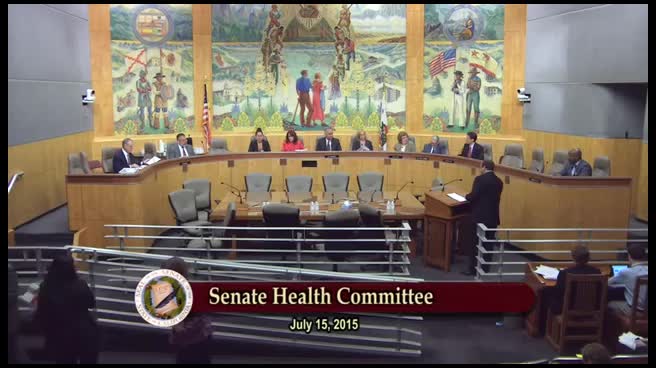 38MIN
Senate Standing Committee on Health
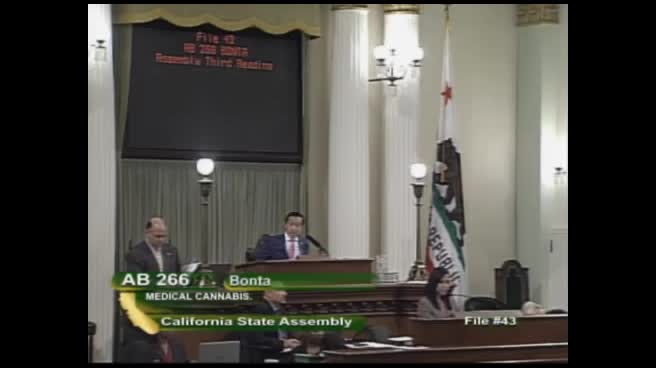 23MIN
Assembly Floor
 13MIN
Assembly Standing Committee on Appropriations
 29MIN





