AB 2786: Public postsecondary education: Donahoe Higher Education Act: 4-year baccalaureate degree.
- Session Year: 2015-2016
- House: Assembly
- Latest Version Date: 2016-04-21
Existing law, known as the Donahoe Higher Education Act, sets forth, among other things, the missions and functions of Californias public and independent segments of higher education, and the campuses operated by those segments. The public segments of higher education include the California State University, under the administration of the Trustees of the California State University, and the University of California, under the administration of the Regents of the University of California.
This bill would require the Trustees of the California State University, and request the Regents of the University of California, to offer eligible students of their respective segments an agreement guaranteeing that a student who meets certain conditions may complete a baccalaureate degree within 4 academic years, with the exception of certain programs that may require up to 5 academic years to complete. The bill would specify that a student who scores in an unspecified percentile, or above, on a standardized college readiness assessment would be presumed to be eligible to enter into an agreement under the bill. The bill would require the agreement to outline a general pathway for the coursework that the student must complete in order to continue to be qualified for the guarantee and receive his or her baccalaureate degree within the agreed-upon time.
(a)The Trustees of the California State University shall, and the Regents of the University of California are requested to, offer eligible students of their respective segments an agreement guaranteeing that a student who meets certain conditions may complete a baccalaureate degree within four academic years. A campus may provide for a longer period for programs such as engineering or teacher training that may require more than four academic years to complete, but under no circumstances may the time to a baccalaureate degree agreed to under this section be extended beyond five academic years.
(b)An agreement entered into under this section shall comply with all of the following:
(1)A student who scores in the ____ percentile or above on any standardized college readiness assessment test, such as the Scholastic Aptitude Test, ACT, or any other widely administered college readiness examination, shall be presumed to be eligible to enter into the agreement. A student who scores below the top ____ percentile, but above the ____ percentile may take another test chosen by the campus, and the campus shall establish a cut-off score for eligibility for the program pursuant to that test.
(2)The agreement shall be executed by a student and an authorized representative of the campus before the end of the students first semester or quarter of enrollment at the campus.
(3)The agreement shall outline a general pathway for the coursework that the student must complete in order to continue to be qualified for the guarantee and receive his or her baccalaureate degree within the agreed-upon time.
(4)The student shall not be required to declare a major field until the spring semester or quarter of the students sophomore year.
(4)Each campus shall, in accordance with policies adopted by the trustees or the regents, as applicable, determine the latest possible time for a participating student enrolled in a four-academic-year degree program, or a degree program that may require up to five academic years to complete as described in subdivision (a), to declare a major, but the campus shall require a participating student to declare his or her major no later than the fall semester, or quarter, as applicable, of his or her sophomore year.
(5)The student shall be required to be a full-time student, and maintain academic standards equivalent to those required pursuant to Article 1 (commencing with Section 69430) of Chapter 1.7 of Part 42 for receipt of Cal Grant awards.
(6)A student may also be required to attend orientation sessions and student success workshops in order to remain eligible for the guarantee.
(7)A student who executes an agreement under this section shall be granted priority for enrollment for each course that is part of the general pathway outlined as part of the agreement pursuant to paragraph (3).
(8)A student who meets all of the requirements of the agreement and, through no fault of his or her own, is unable to complete his or her baccalaureate degree within the guaranteed period shall pay no tuition to take the additional coursework required to complete that degree.
(c)As used in this section, campus means a campus of the California State University or the University of California, as applicable.
(a)The Trustees of the California State University shall, and the Regents of the University of California are requested to, offer eligible students of their respective segments an agreement guaranteeing that a student who meets certain conditions may complete a baccalaureate degree within four academic years. A campus may provide for a longer period for programs such as engineering or teacher training that may require more than four academic years to complete, but under no circumstances may the time to a baccalaureate degree agreed to under this section be extended beyond five academic years.
(b)An agreement entered into under this section shall comply with all of the following:
(1)A student who scores in the ____ percentile or above on any standardized college readiness assessment test, such as the Scholastic Aptitude Test, ACT, or any other widely administered college readiness examination, shall be presumed to be eligible to enter into the agreement. A student who scores below the top ____ percentile, but above the ____ percentile may take another test chosen by the campus, and the campus shall establish a cut-off score for eligibility for the program pursuant to that test.
(2)The agreement shall be executed by a student and an authorized representative of the campus before the end of the students first semester or quarter of enrollment at the campus.
(3)The agreement shall outline a general pathway for the coursework that the student must complete in order to continue to be qualified for the guarantee and receive his or her baccalaureate degree within the agreed-upon time.
(4)The student shall not be required to declare a major field until the spring semester or quarter of the students sophomore year.
(5)The student shall be required to be a full-time student, and maintain academic standards equivalent to those required pursuant to Article 1 (commencing with Section 69430) of Chapter 1.7 of Part 42 for receipt of Cal Grant awards.
(6)A student may also be required to attend orientation sessions and student success workshops in order to remain eligible for the guarantee.
(7)A student who executes an agreement under this section shall be granted priority for enrollment for each course that is part of the general pathway outlined as part of the agreement pursuant to paragraph (3).
(8)A student who meets all of the requirements of the agreement and, through no fault of his or her own, is unable to complete his or her baccalaureate degree within the guaranteed period shall pay no tuition to take the additional coursework required to complete that degree.
(c)As used in this section, campus means a campus of the California State University or the University of California, as applicable.
|
Date
|
Status
|
|---|---|
| May 27, 2016 | In committee: Held under submission. |
| May 11, 2016 | In committee: Set, first hearing. Referred to APPR. suspense file. |
| Apr 25, 2016 | Re-referred to Com. on APPR. |
| Apr 21, 2016 | Read second time and amended. |
| Apr 20, 2016 | From committee: Amend, and do pass as amended and re-refer to Com. on APPR. (Ayes 13. Noes 0.) (April 19). |
| Mar 10, 2016 | Referred to Com. on HIGHER ED. |
| Feb 22, 2016 | Read first time. |
| Feb 21, 2016 | From printer. May be heard in committee March 22. |
| Feb 19, 2016 | Introduced. To print. |
|
Date
|
Description
|
Location
|
Votes
|
|
|---|---|---|---|---|
| Apr 19, 2016 | Do pass as amended and be re-referred to the Committee on [Appropriations] | Assembly Standing Committee on Higher Education |
Passed |
This list shows positions taken on this bill by organizations on the date displayed, which is linked to the original source.
Positions by individuals are not included.
Date of Hearing: May 11, 2016
ASSEMBLY COMMITTEE ON APPROPRIATIONS
Lorena Gonzalez, Chair
ABPCA Bill Id:AB 2786
Author:(Chávez) – As Amended Ver:April 21, 2016
Policy Committee: | Higher Education | Vote: | 13 - 0 |
|
| ||
|
|
Urgency: No State Mandated Local Program: No Reimbursable: No
SUMMARY:
This bill requires the Trustees of the California State University (CSU), and requests the Regents of the University of California (UC), to offer to eligible students an agreement guaranteeing that a student who meets certain conditions may complete a baccalaureate degree within four academic years. Specifically, this bill requires the guarantee to include the following:
- A student scoring above an as-yet unspecified percentile on a standardized college readiness test shall be presumed eligible.
- A student scoring below the percentile in (a) but above another as-yet unspecified percentile may take a test of the institution’s choice and the institution shall establish a cut-off for eligibility of such students.
- Be executed before the end of the student’s first semester or quarter.
- Outline a general pathway of the student’s coursework.
- Each campus is to determine the latest possible time when the student must declare a major, but no later than fall semester of the student’s sophomore year.
- The student must attend full-time and maintain academic standards equivalent to Cal Grant program academic requirements.
- Participating students are to be granted priority for enrollment for each course of the pathway outlined in their agreement.
- A student meeting all their requirements under the agreement, and who through no fault of their own, is unable to complete their bachelor’s degree within the guaranteed period shall pay no tuition to take the courses required to complete their degree.
FISCAL EFFECT:
- CSU indicates that all 23 campuses have roadmaps for students and provide information about what students need to do to finish a degree in four years, but only four campuses (Fresno, Fullerton, Cal Poly Pomona, and San Bernardino) have programs similar to what is proposed in this bill. Administrative costs to replicate this model at the other 19 campuses would be in the range of $1.5 million. There would be lost revenue to the extent students do not have to pay tuition due to the inability to get course in a timely manner. CSU notes that at least three other campuses have discontinued their programs due to low student participation.
- UC’s four-year graduation rate for the most recent cohort is 64%, which UC indicates is well above the national average for comparable institutions. UC Merced, which has a significantly lower rate is considering an initiative to create a four-year contract with interested students. UC Riverside has also explored ways to increase its lower-than-average graduation rate. UC is undertaking several efforts to increase four-year graduation rates. Any additional efforts would likely be done outside specific parameters of this bill and costs would be absorbed by the respective campuses.
COMMENTS:
- Purpose. According to the author, "given the recent trends in rising tuition costs, the conclusions to be made are that students are having a hard time graduating in four years and are paying more for it."
- CSU encourages all students who wish to graduate in four years to take advantage of CSU's four-year degree programs, which each campus has developed. Participating students must: (a) arrive with sufficient English and mathematics skills; (b) declare a major at the time of admission (or shortly thereafter) and not change majors; (c) enroll in at least 15 units per semester; (d) fulfill all academic, grade, and coursework requirements; (e) meet with an academic advisor on a regular basis; (f) follow required administrative and academic policies and procedures; and (g) meet the unit requirement for the desired degree. Campuses must: (a) ensure regular academic counseling; (b) provide required courses; and, (c) schedule sufficient class offerings.
- Prior Legislation. AB 2092 (Chávez) of 2014, which was substantially similar to this measure, was held on this committee's Suspense file.
Analysis Prepared by: Chuck Nicol / APPR. / (916) 319-2081
Date of Hearing: April 19, 2016
ASSEMBLY COMMITTEE ON HIGHER EDUCATION
Jose Medina, Chair
ABPCA Bill Id:AB 2786 (
Author:Chávez) – As Introduced Ver:February 19, 2016
SUBJECT: Public postsecondary education: Donahoe Higher Education Act: 4-year baccalaureate degree.
SUMMARY: Requires the California State University (CSU) Trustees, and requests the University of California (UC) Regents, to offer to eligible students, as specified, an agreement guaranteeing that a student, who meets certain conditions, as specified, may complete a baccalaureate degree within 4 academic years. Specifically, this bill:
- Requires the CSU Trustees, and requests the UC Regents, to offer eligible students an agreement guaranteeing that a student who meets certain conditions may complete a baccalaureate degree within 4 academic years.
- Specifies that a campus may provide for a longer period of completion for programs such as engineering or teacher training that may require more than 4 academic years to complete, but under no circumstances may the time to baccalaureate degree agreed to under the parameters established in this measure extend beyond 5 academic years.
- Delineates that the agreement entered into shall comply with all of the following:
- A student who scores in an unspecified percentile or above on any standardized college readiness assessment test, such as the Scholastic Aptitude Test, ACT, or any other widely administered college readiness examination, shall be presumed to be eligible to enter into the agreement; and, a student who scores below the top unspecified percentile, but above an unspecified percentile may take another test chosen by the campus, and the campus shall establish a cut-off score for eligibility for the program pursuant to that test;
- The agreement shall be executed by a student and an authorized representative of the campus before the end of the student’s first semester or quarter of enrollment at the campus;
- The agreement shall outline a general pathway for the coursework that the student must complete in order to continue to be qualified for the guarantee and receive his or her baccalaureate within the agreed-upon time;
- The student shall not be required to declare a major field until the spring semester or quarter of the student’s sophomore year;
- The student shall be required to be a full-time student, and maintain academic standards equivalent to those required for receipt of Cal Grant awards;
- A student may also be required to attend orientation sessions and student success workshops in order to remain eligible for the guarantee;
- A student who executes an agreement shall be granted priority for enrollment for each course that is part of the general pathway outlined as part of the agreement, as specified; and,
- A student who meets all of the requirements of the agreement and, through no fault of his or her own, is unable to complete his or her baccalaureate degree within the guaranteed period shall pay no tuition to take the additional coursework required to complete that degree.
- Defines "campus" as a campus of the CSU or UC, as applicable.
EXISTING LAW: Declares that it is the policy of the Legislature that all resident applicants to California institutions of public higher education, who are determined to be qualified by law or by admission standards, as established by the respective governing boards of the institutions, should be admitted to either a community college, CSU, or UC campus (Education Code Section 66011).
FISCAL EFFECT: Unknown
COMMENTS: Need for the measure. According to the author, "given the recent trends in rising tuition costs, the conclusions to be made are that students are having a hard time graduating in four years and are paying more for it."
Background. Graduation rates on college campuses have become an important national issue. In 2010 President Obama called for raising the college graduation rate among 25 to 34 year olds to 60% by 2020, a 20% increase in just ten years. Governor Jerry Brown has set as a goal for each of the State’s public universities a 10% increase in the proportion graduating in four years.
According to the January 2014 report, "California's Future: Higher Education, by the Public Policy Institute of California (PPIC), three of every four bachelor's degrees awarded annually come from either a CSU or UC. PPIC found that compared to other states, California's college-bound high school graduates are more likely to enroll in community colleges than in four-year colleges or universities. However, according to PPIC, lack of preparation for college-level work and lack of financial resources keep many students from advancing in the higher education system.
PPIC found that only about half of CSU students graduate within 6 years of entering as freshmen and that 4 of every 5 students earn a degree within 6 years at the UC.
Four-year degree programs. This measure requires the CSU Trustees and requests the UC Regents to offer to eligible students, as specified, an agreement guaranteeing that a student who meets certain conditions may complete a baccalaureate degree in 4 years.
- CSU. According to the CSU's systemwide Degree-Seeking First-Time Full-Time Freshmen Report, the number of CSU first-time freshmen systemwide in fall of 2007 was 50,866; after 4 years, 15.9% graduated, with 45.7% continuing on to additional year(s) of study. Additionally, first-time freshmen systemwide in fall of 2008 was 51,409; after 4 years, 16.2% graduated, with 47.5% continuing on to additional year(s) of study.
Currently, according to the CSU 2014-15 Admission Handbook, the CSU encourages all students who wish to graduate in four years to take advantage of CSU's 4-year degree programs. Each CSU campus has developed a four year program responsive to the needs of the campus community. The common core component for all 4-year degree plans is a strong advisement program. Students are expected to meet with advisors each term to plan a program of study that will assure appropriate progress toward meeting degree requirements.
Students participating in the CSU 4-year degree program must: (1) Arrive with English and mathematics skills needed to handle the demands of university study; (2) Declare a major at the time of admission (or shortly thereafter) and not change majors; (3) Enroll in a minimum of 15 semester/quarter units each term; (4) Fulfill all academic, grade, and coursework requirements; (5) Meet with an academic advisor on a regular basis and heed advice given; (6) Follow required administrative and academic policies and procedures; and (7) Meet the unit requirement (120-132 semester/180-198 quarter units) for the baccalaureate degree sought. Campuses must: (1) Ensure regular academic counseling; (2) Provide required courses; and, (3) Schedule sufficient class offerings.
Presently, it is unclear how many CSU students are taking advantage of the CSU 4-year degree program and how many of the 23 campuses are actively promoting their 4-year degree program. However, four CSU campuses (Fresno, San Bernardino, Fullerton, and Cal Poly Pomona) currently have active 4-year pledge programs.
According to the CSU Chancellor's Office, the various pledge programs of the CSU have varying results. The 4-year graduation rates for program participants can be much higher than the undergraduate students who do not participate the program, but attrition rates are also high, often times 50% or more. Additionally, CSU Fullerton's 4-year pledge program has had five cohorts of students that graduated with 4-year graduation rates that range from 30.4% to 45.5%. However, student participation in these programs has been small. For example, at CSU San Bernardino, 620 students participate in the 4-year pledge program, but that only represents 4% of the undergraduate student population.
To note, several campuses have discontinued similar types of programs due to low participation rates of students.
UC. According to the UC, their first-time freshmen 4-year graduation rates (systemwide roughly 60% of entering freshmen graduate in 4 years), are well above the national average. However, UC Riverside (UCR) has a significantly lower percentage of their entering freshmen graduating in 4 years.
UCR is presently considering an initiative to create a 4-year graduation contract with their students. It is unclear as to when UCR will determine if indeed they will launch this initiative.
Committee considerations. This measure allows students participating in the created 4-year completion program to not have to declare a major field of study until the spring semester or quarter of the students' sophomore year. If students wait this long to declare their major field of study, will this truly allow for them to graduate in 4 years?
Committee staff recommends that the author amend this provision to instead: specify that each campus shall determine the latest possible time for a participating student in the 4-year degree contract program to declare a major, but that a participating student shall declare his or her major no later than the fall semester/quarter of his or her sophomore year.
As aforementioned, it is presently unclear how many of the campuses are encouraging their students to sign up for their 4-year graduation program. Instead of codifying the 4-year graduation program, the Committee may wish to consider amending this measure to require the CSU to increase their efforts in ensuring entering freshmen are aware of the CSU's 4-year degree program.
Previous legislation. AB 2092 (Chávez) of 2014, which was held on the Suspense File in the Assembly Appropriations Committee, was very similar in nature to this measure.
REGISTERED SUPPORT / OPPOSITION:
Support
None on file.
Opposition
None on file.
Analysis Prepared by: Jeanice Warden / HIGHER ED. / (916) 319-3960
Discussed in Hearing
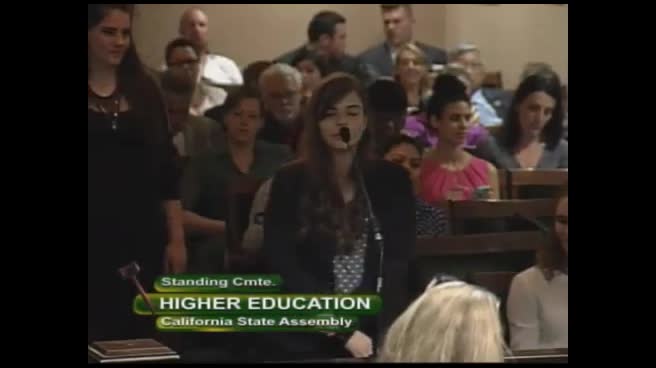 4MIN
Assembly Standing Committee on Higher Education
Bill Author

Bill Co-Author(s):