AB 2861: Electricity: distribution grid interconnection dispute resolution process.
- Session Year: 2015-2016
- House: Assembly
- Latest Version Date: 2016-09-26
Existing law places various duties upon the Public Utilities Commission with respect to distributed generation and requires each electrical corporation to submit to the commission for its approval a distribution resources plan proposal to identify optimal locations for the deployment of distributed resources, as defined. Pursuant to existing law, the commission has established operational and metering requirements for a generation facility to be interconnected to an electrical corporations distribution grid.
This bill would authorize the commission to establish an expedited distribution grid interconnection dispute resolution process, as specified, with the goal of resolving disputes over interconnection applications within the jurisdiction of the commission in no more than 60 days from the time the dispute is formally brought to the commission. The bill would require the commission to appoint a qualified electrical systems engineer with substantial interconnection expertise to advise the director of the energy division and to provide adequate commission staff to assist in resolving interconnection disputes.
Existing law places various duties upon the Public Utilities Commission with respect to distributed generation and requires each electrical corporation to submit to the commission for its approval a distribution resources plan proposal to identify optimal locations for the deployment of distributed resources, as defined. Pursuant to existing law, the commission has established operational and metering requirements for a generation facility to be interconnected to an electrical corporations distribution grid.
This bill would require the commission, by April 1, 2017, authorize the commission to establish an expedited distribution grid interconnection dispute resolution process, as specified, with the goal of resolving disputes over interconnection applications within the jurisdiction of the commission in no more than 60 days from the time the dispute is formally brought to the commission.
Existing law places various duties upon the Public Utilities Commission with respect to distributed generation and requires each electrical corporation to submit to the commission for its approval a distribution resources plan proposal to identify optimal locations for the deployment of distributed resources, as defined. Pursuant to existing law, the commission has established operational and metering requirements for a generation facility to be interconnected to an electrical corporations distribution grid.
This bill would require the commission, by April 1, 2017, to establish an expedited distribution grid interconnection dispute resolution process, as specified, with the goal of resolving disputes over interconnection applications within the jurisdiction of the commission in no more than 60 days from the time the dispute is formally brought to the commission.
(a)The commission may establish an expedited distribution grid interconnection dispute resolution process with the goal of resolving disputes over interconnection applications that are within the jurisdiction of the commission in no more than 60 days from the time the dispute is formally brought to the commission. If the commission establishes an expedited distribution grid interconnection dispute resolution process, the commission may provide exceptions to the 60-day time period when more than 60 days are needed to fairly and safely address a dispute.
(b)The expedited distribution grid interconnection dispute resolution process shall include the following elements:
(1)A distribution grid interconnection technical panel consisting of at least eight individuals selected by the commission. Four of the technical panel members shall be from electrical corporations and four shall not be from electrical corporations. The commission shall determine the length of the term of each member. A member shall not participate as a review panel member for the dispute resolution process for a contested interconnection application in any of the following situations:
(A)The member is an employee of, a contractor to, or an employee of a contractor to, an electrical corporation to which the contested interconnection application has been submitted.
(B)The member is the applicant, an installer or an employee of an installer for the applicant, or a third-party electricity purchase agreement provider for the applicant.
(C)The member has a direct financial interest in the contested interconnection application.
(2)A review panel of four members shall be selected from the technical panel for each dispute.
(3)If an applicant is unable to resolve an interconnection-related dispute after working with the electrical corporation operating the distribution grid, the applicant may seek resolution of the dispute using the commissions expedited distribution grid interconnection dispute resolution process.
(4)Upon agreeing to a final settlement of the dispute, parties shall be free to withdraw from the expedited distribution grid interconnection dispute resolution process.
(5)If the dispute is filed with the commission, the commission shall ensure that the review panel shall review the dispute and make a recommendation to the executive director of the commission within 30 days of receiving the dispute.
(6)The commission shall establish a public process to allow the electrical corporation, the applicant, and other interested parties to file written comments on the recommendation of the review panel.
(7)The review panel shall request appropriate documents from the electrical corporation involved in the dispute, including, but not limited to, interconnection application studies.
(8)The scope of the review panels review shall be limited to issues regarding compliance with the established interconnection rules. Any recommendations shall ensure safe and reliable interconnection.
(9)The scope of the review panels review is limited to making recommendations to resolve specific customer disputes and recommending associated corrective actions, and the panel shall have no authority to assess penalties.
(10)Upon receipt of the recommendation from the review panel, the executive director shall have 30 days to review the recommendation and to prepare an order to the electrical corporation resolving the dispute. If the review panel cannot agree on recommendations, then each recommendation of a review panel member shall be submitted to the executive director, who shall make the decision resolving the dispute.
(11)Any interested person seeking commission review of the executive directors determination shall file the request for review within 10 days of the determination. Upon receipt of the request for review, the executive director or the energy division director shall prepare a proposed resolution of the matter for approval by the commission.
(c)The commission shall provide the members of the technical panel who are not from electrical corporations with an appropriate per diem compensation consistent with Section 19822.5 of the Government Code.
(d)The commission shall appoint a qualified electrical systems engineer with substantial interconnection expertise to advise the director of the energy division and shall provide adequate commission staff to assist in resolving interconnection disputes.
(a)The commission may establish an expedited distribution grid interconnection dispute resolution process with the goal of resolving disputes over interconnection applications that are within the jurisdiction of the commission in no more than 60 days from the time the dispute is formally brought to the commission. If the commission establishes an expedited distribution grid interconnection dispute resolution process, the commission may provide exceptions to the 60-day time period when more than 60 days are needed to fairly and safely address a dispute.
(b)The expedited distribution grid interconnection dispute resolution process shall include the following elements:
(1)A distribution grid interconnection technical advisory panel consisting of at least eight individuals selected by the commission. Four of the technical advisory panel members shall be from electrical corporations and four shall not be from electrical corporations. The commission shall determine the length of the term of each member. A member shall not participate as a technical advisory review panel member for the dispute resolution process for a contested interconnection application in any of the following situations:
(A)The member is an employee of, a contractor to, or an employee of a contractor to, an electrical corporation to which the contested interconnection application has been submitted.
(B)The member is the applicant, an installer or an employee of an installer for the applicant, or a third-party electricity purchase agreement provider for the applicant.
(C)The member has a direct financial interest in the contested interconnection application.
(2)A review panel of four members shall be selected from the technical advisory panel for each dispute.
(3)If an applicant is unable to resolve an interconnection-related dispute after working with the electrical corporation operating the distribution grid, the applicant may seek resolution of the dispute using the commissions expedited distribution grid interconnection dispute resolution process.
(4)Upon agreeing to a final settlement of the dispute, parties shall be free to withdraw from the expedited distribution grid interconnection dispute resolution process.
(5)If the dispute is filed with the commission, the commission shall ensure that a technical advisory the review panel shall review the dispute and make a recommendation to the executive director of the commission within 30 days of receiving the dispute.
(6)The commission shall establish a public process to allow the electrical corporation, the applicant, and other interested parties to file written comments on the recommendation of the technical advisory review panel.
(7)The review panel shall request appropriate documents from the electrical corporation involved in the dispute, including, but not limited to, interconnection application studies.
(8)The scope of the technical advisory review panels review shall be limited to issues regarding compliance with the established interconnection rules. Any recommendations shall ensure safe and reliable interconnection.
(9)The scope of the technical advisory review panels review is limited to making recommendations to resolve specific customer disputes and recommending associated corrective actions, and the panel shall have no authority to assess penalties.
(10)Upon receipt of the recommendation from the technical advisory review panel, the executive director shall have 30 days to review the recommendation and to prepare an order to the electrical corporation resolving the dispute. If the review panel from the technical advisory panel cannot agree on recommendations, then each recommendation of a review panel member shall be submitted to the executive director, who shall make the decision resolving the dispute.
(11)Any interested person seeking commission review of the executive directors determination shall file the request for review within 10 days of the determination. Upon receipt of the request for review, the executive director or the energy division director shall prepare a proposed resolution of the matter for approval by the commission.
(c)The commission shall provide the members of the technical advisory panel that panel who are not from electrical corporations with an appropriate per diem compensation consistent with Section 19822.5 of the Government Code.
(d)The commission shall appoint a qualified electrical systems engineer with substantial interconnection expertise to advise the director of the energy division and shall provide adequate commission staff to assist in resolving interconnection disputes.
(a)By April 1, 2017, the commission shall The commission may establish an expedited distribution grid interconnection dispute resolution process with the goal of resolving disputes over interconnection applications that are within the jurisdiction of the commission in no more than 60 days from the time the dispute is formally brought to the commission. If the commission establishes an expedited distribution grid interconnection dispute resolution process, the commission may provide exceptions to the 60-day time period when more than 60 days are needed to fairly and safely address a dispute.
(b)The expedited distribution grid interconnection dispute resolution process shall include the following elements:
(1)A distribution grid interconnection technical advisory panel consisting of at least eight individuals selected by the commission. Four of the technical advisory panel members shall be from electrical corporations and four shall not be from electrical corporations. The commission shall determine the length of the term of each member. If any member of the panel is an employee of, or contractor to, an electrical corporation, an employee of a vendor with an open application, or has a financial interest or financial relationship to a person or corporation with a financial interest in the outcome of the decision, that member shall not participate in any discussion involving that electrical corporation, vendor, or financially interested person or corporation. A member shall not participate as a technical advisory panel member for the dispute resolution process for a contested interconnection application in any of the following situations:
(A)The member is an employee of, a contractor to, or an employee of a contractor to, an electrical corporation to which the contested interconnection application has been submitted.
(B)The member is the applicant, an installer or an employee of an installer for the applicant, or a third-party electricity purchase agreement provider for the applicant.
(C)The member has a direct financial interest in the contested interconnection application.
(2)A review panel of four members shall be selected from the technical advisory panel for each dispute.
(3)If an applicant is unable to resolve an interconnection-related dispute after working with the electrical corporation operating the distribution grid, the applicant may seek resolution of the dispute using the commissions expedited distribution grid interconnection dispute resolution process.
(4)Upon agreeing to a final settlement of the dispute, parties shall be free to withdraw from the dispute resolution process.
(5)If the dispute is filed with the commission, the commission shall ensure that a technical advisory panel shall review the dispute and make a recommendation to the executive director of the commission within 30 days of receiving the dispute.
(6)The commission shall establish a public process to allow the electrical corporation, the applicant, and other interested parties to file written comments on the recommendation of the technical advisory panel.
(7)The panel shall request appropriate documents from the electrical corporation involved in the dispute, including, but not limited to, interconnection application studies.
(8)The scope of the technical advisory panels review shall be limited to issues regarding compliance with the established interconnection rules. Any recommendations shall ensure safe and reliable interconnection.
(9)The scope of the technical advisory panels review is limited to making recommendations to resolve specific customer disputes and recommending associated corrective actions, and the panel shall have no authority to assess penalties.
(10)Upon receipt of the recommendation from the technical advisory panel, the executive director shall have 30 days to review the recommendation and to prepare an order to the electrical corporation resolving the dispute. If the review panel from the technical advisory panel cannot agree on recommendations, then each recommendation of a review panel member shall be submitted to the executive director, who shall make the decision resolving the dispute.
(11)Any interested person seeking commission review of the executive directors determination shall file the request for review within 10 days of the determination. Upon receipt of the request for review, the executive director or the energy division director shall prepare a proposed resolution of the matter for approval by the commission.
(c)The commission shall provide the members of the technical advisory panel that are not from electrical corporations with an appropriate per diem compensation consistent with Section 19822.5 of the Government Code.
(a)By April 1, 2017, the commission shall establish an expedited distribution grid interconnection dispute resolution process with the goal of resolving disputes over interconnection applications that are within the jurisdiction of the commission in no more than 60 days from the time the dispute is formally brought to the commission.
(b)The expedited distribution grid interconnection dispute resolution process shall include the following elements:
(1)A distribution grid interconnection technical advisory panel consisting of at least eight individuals selected by the commission. Four of the technical advisory panel members shall be from electrical corporations and four shall not be from electrical corporations. The commission shall determine the length of the term of each member. If any member of the panel is an employee of, or contractor to, an electrical corporation, an employee of a vendor with an open application, or has a financial interest or financial relationship to a person or corporation with a financial interest in the outcome of the decision, that member shall not participate in any discussion involving that electrical corporation, vendor, or financially interested person or corporation.
(2)A review panel of four members shall be selected from the technical advisory panel for each dispute.
(3)If an applicant is unable to resolve an interconnection-related dispute after working with the electrical corporation operating the distribution grid, the applicant may seek resolution of the dispute using the commissions expedited distribution grid interconnection dispute resolution process.
(4)Upon agreeing to a final settlement of the dispute, parties shall be free to withdraw from the dispute resolution process.
(5)If the dispute is filed with the commission, the commission shall ensure that a technical advisory panel shall review the dispute and make a recommendation to the executive director of the commission within 30 days of receiving the dispute.
(6)The commission shall establish a public process to allow the electrical corporation, the applicant, and other interested parties to file written comments on the recommendation of the technical advisory panel.
(7)The panel shall request appropriate documents from the electrical corporation involved in the dispute, including, but not limited to, interconnection application studies.
(8)The scope of the technical advisory panels review shall be limited to issues regarding compliance with the established interconnection rules. Any recommendations shall ensure safe and reliable interconnection.
(9)The scope of the technical advisory panels review is limited to making recommendations to resolve specific customer disputes and recommending associated corrective actions, and the panel shall have no authority to assess penalties.
(10)Upon receipt of the recommendation from the technical advisory panel, the executive director shall have 30 days to review the recommendation and to prepare an order to the electrical corporation resolving the dispute. If the review panel from the technical advisory panel cannot agree on recommendations, then each recommendation of a review panel member shall be submitted to the executive director, who shall make the decision resolving the dispute.
(11)Any interested person seeking commission review of the executive directors determination shall file the request for review within 10 days of the determination. Upon receipt of the request for review, the executive director or the energy division director shall prepare a proposed resolution of the matter for approval by the commission.
(c)The commission shall provide the members of the technical advisory panel that are not from electrical corporations with an appropriate per diem compensation consistent with Section 19822.5 of the Government Code.
|
Date
|
Status
|
|---|---|
| Sep 9, 2016 | Enrolled and presented to the Governor at 2:30 p.m. |
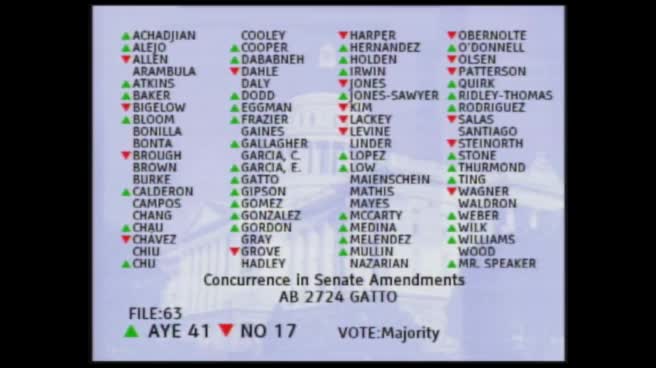
| Aug 30, 2016 | Senate amendments concurred in. To Engrossing and Enrolling. (Ayes 80. Noes 0. Page 6459.). |
| Aug 30, 2016 | Senate amendments concurred in. To Engrossing and Enrolling. |
| Aug 26, 2016 | In Assembly. Concurrence in Senate amendments pending. May be considered on or after August 28 pursuant to Assembly Rule 77. |
| Aug 24, 2016 | Read third time. Passed. Ordered to the Assembly. (Ayes 39. Noes 0. Page 5340.). |
| Aug 24, 2016 | Read third time. Passed. Ordered to the Assembly. |
| Aug 15, 2016 | Read second time. Ordered to third reading. |
| Aug 11, 2016 | From committee: Do pass. (Ayes 7. Noes 0.) (August 11). |
| Aug 1, 2016 | In committee: Referred to APPR. suspense file. |
| Aug 1, 2016 | From committee chair, with author's amendments: Amend, and re-refer to committee. Read second time, amended, and re-referred to Com. on APPR. |
| Jun 28, 2016 | From committee: Do pass and re-refer to Com. on APPR. (Ayes 9. Noes 0.) (June 27). Re-referred to Com. on APPR. |
| Jun 16, 2016 | In committee: Hearing postponed by committee. |
| Jun 9, 2016 | Referred to Com. on E., U., & C. |
| Jun 1, 2016 | In Senate. Read first time. To Com. on RLS. for assignment. |
| May 31, 2016 | Read third time. Passed. Ordered to the Senate. (Ayes 80. Noes 0. Page 5046.) |
| May 31, 2016 | Read third time. Passed. Ordered to the Senate. (Ayes 80. Noes 0.) |
| May 27, 2016 | Read second time. Ordered to third reading. |
| May 27, 2016 | From committee: Do pass. (Ayes 20. Noes 0.) (May 27). |
| May 18, 2016 | In committee: Set, first hearing. Referred to APPR. suspense file. |
| Apr 28, 2016 | Re-referred to Com. on APPR. |
| Apr 27, 2016 | Read second time and amended. |
| Apr 26, 2016 | From committee: Amend, and do pass as amended and re-refer to Com. on APPR. (Ayes 14. Noes 0.) (April 20). |
| Apr 12, 2016 | In committee: Hearing postponed by committee. |
| Mar 14, 2016 | Referred to Com. on U. & C. |
| Feb 22, 2016 | Read first time. |
| Feb 21, 2016 | From printer. May be heard in committee March 22. |
| Feb 19, 2016 | Introduced. To print. |
|
Date
|
Description
|
Location
|
Votes
|
|
|---|---|---|---|---|
| Aug 30, 2016 | AB 2861 TING Concurrence in Senate Amendments | Assembly Floor |
Passed |
|
| Aug 24, 2016 | Assembly 3rd Reading AB2861 Ting By Hueso | Senate Floor |
Passed |
|
| Aug 11, 2016 | Do pass | Senate Standing Committee on Appropriations |
Passed |
|
| Aug 1, 2016 | Placed on suspense file | Senate Standing Committee on Appropriations |
Passed |
|
| Jun 27, 2016 | Do pass, but first be re-referred to the Committee on [Appropriations] | Senate Standing Committee on Energy, Utilities and Communications |
Passed |
|
| May 31, 2016 | AB 2861 TING Assembly Third Reading | Assembly Floor |
Passed |
|
| May 27, 2016 | Do pass. | Assembly Standing Committee on Appropriations |
Passed |
|
| Apr 20, 2016 | Do pass as amended and be re-referred to the Committee on [Appropriations] | Assembly Standing Committee on Utilities and Commerce |
Passed |
This list shows positions taken on this bill by organizations on the date displayed, which is linked to the original source.
Positions by individuals are not included.
CONCURRENCE IN SENATE AMENDMENTS
CSA1 Bill Id:AB 2861
Author:(Ting)
As Amended Ver:August 1, 2016
Majority vote
ASSEMBLY: | 80-0 | (May 31, 2016) | SENATE: | 39-0 | (August 24, 2016) |
Original Committee Reference: U. & C.
SUMMARY: Authorizes the California Public Utilities Commission (CPUC) to establish an expedited distribution grid interconnection dispute resolution process to resolve disputes within 60 days, unless it determines more time is needed. Specifies the elements to be included in the dispute resolution process and requires the CPUC to establish a technical panel, a review panel, and a public process for each dispute.
The Senate amendments require the CPUC to appoint a qualified electrical systems engineer with substantial interconnection expertise to advise the director of the energy division; require the CPUC provide adequate commission staff to assist in resolving interconnection disputes; and remove the word "advisory" from the name of the technical panel to be established pursuant to this bill.
FISCAL EFFECT: According to Senate Appropriations, approximately $731,000 (Utilities Reimbursement Account) to the CPUC for staff necessary to develop and implement the expedited distribution grid interconnection dispute resolution process.
COMMENTS:
- Background: Investor-owned utilities (IOUs) own the utility lines that serve local areas, also known as the distribution grid. The interconnection is the physical connection between a generator and the grid. Disputes arise when the utility who owns, manages, and maintains the grid won't connect generation projects. A typical dispute occurs when the utility requires system improvements for safety purposes and the generator may object to some or all of the costs of the improvements.
Electric Rule 21 is a tariff that describes the interconnection, operating and metering requirements for generation facilities to be connected to an IOU's distribution system, over which the CPUC has jurisdiction. Section K of Rule 21 establishes a dispute resolution process that first provides a structure for bilateral negotiations between representatives of a generation facility and the IOU, and then directs unresolved disputes to the CPUC's Alternative Dispute Resolution (ADR) process, which is administered by the CPUC's Administrative Law Judge Division.
The CPUC does not have data on how many interconnection disputes have gone through the ADR process. However, the CPUC describes the process as rarely, if ever, having been used by interconnection applicants. The CPUC attributes this to the time and cost of the ADR process, and reports that developers instead often raise complaints with CPUC's Energy Division staff. The CPUC reports that in the last year, the Energy Division has received 20-30 informal requests for assistance with interconnection disputes.
Analysis Prepared by: Sue Kateley / U. & C. / (916) 319-2083 FN: 0004339
Office of Senate Floor Analyses (916) 651-1520 Fax: (916) 327-4478 | AB |
THIRD READING
Bill No: AB 2861
:
SENATE ENERGY, U. & C. COMMITTEE: 9-0, 6/27/16
AYES: Hueso, Morrell, Cannella, Gaines, Hertzberg, Hill, Lara, Leyva, McGuire
NO VOTE RECORDED: Pavley, Wolk
SENATE APPROPRIATIONS COMMITTEE: 7-0, 8/11/16
AYES: Lara, Bates, Beall, Hill, McGuire, Mendoza, Nielsen
ASSEMBLY FLOOR: 80-0, 5/31/16 - See last page for vote
SOURCE: California Public Utilities Commission
DIGEST: This bill authorizes the creation of an expedited dispute resolution process for distributed generation energy resources attempting to establish a connection to an investor-owned utility’s (IOU’s) electricity transmission and distribution network.
Existing law:
- Defines "distributed resources" to means distributed renewable generation resources, energy efficiency, energy storage, electric vehicles, and demand response technologies.
- Requires each IOU to submit to the California Public Utilities Commission (CPUC) for its approval or modification a distribution resources plan proposal to identify optimal locations for the deployment of distributed resources. (Public Utilities Code §769)
This bill:
- Authorizes the CPUC to establish an expedited dispute resolution process with the goal of resolving disputes over interconnection applications in no more than 60 days from the time the dispute is formally brought to the CPUC.
- Requires the dispute resolution process to have the certain elements, including a distribution grid interconnection technical panel (DGITP) of at least eight members selected by the CPUC, four of whom are from IOUs and four of whom are not, and are restricted from participating in the dispute resolution process for an interconnection application for which the member has certain defined conflicts.
- Specifies that a review panel of four members shall be selected from the DGITP for each dispute.
- Directs CPUC to establish a public process in which interested parties to the dispute may file comments with the CPUC.
- Directs each review panel to a dispute to make recommendations to the Executive Director of the CPUC, who has 30 days to review the recommendation and issue an order to the IOU.
- Establishes a process for an interested person to appeal a decision by the dispute resolution panel to the commission of the CPUC for resolution.
- Directs the CPUC to provide DGITP members that are not from IOUs with an appropriate per diem compensation.
- Requires the CPUC to appoint a qualified electrical systems engineer with substantial interconnection expertise to advise the director of the energy division and to provide adequate commission staff to assist in resolving interconnection disputes.
Background
CPUC’s Rule 21 and the Alternative Dispute Resolution Process. Electric Rule 21 is a tariff that describes the interconnection, operating and metering requirements for generation facilities to be connected to an IOU’s distribution system, over which the CPUC has jurisdiction. Section K of Rule 21 establishes a dispute resolution process that first provides a structure for bilateral negotiations between representatives of a generation facility and the IOU, and then directs unresolved disputes to the CPUC’s Alternative Dispute Resolution (ADR) process.
According to the CPUC, the ADR process is administered by the CPUC’s Administrative Law Judge (ALJ) Division. The CPUC does not have data on how many interconnection disputes have gone through the ADR process. However, the CPUC describes the process as rarely, if ever, having been used by interconnection applicants. The CPUC attribute this lack to the time and cost of the ADR process. The CPUC reports that, instead of the ADR process, developers often raise complaints with CPUC’s Energy Division staff, who lack the engineering expertise and decision-making authority to effectively intervene in interconnection disputes.
This bill would create an expedited distribution grid interconnection dispute resolution process. This bill seeks to create a forum by which interconnection disputes between a generator and an IOU can be resolved quickly and fairly. To that end, this bill authorizes the CPUC to establish an expedited distribution grid interconnection dispute resolution process with the goal of resolving disputes over interconnection applications that are within the jurisdiction of the CPUC in no more than 60 days from the time the dispute is formally brought to the commission. The idea was proposed as part of last year’s Budget Act but did not appear in the final version of the act.
If the CPUC chooses to adopt the process, this bill prescribes certain features and procedures that must be part of the process. Generally, the process would function as follows:
- The CPUC would establish a DGITP of at least eight members, four of whom work for and IOU and four of whom do not.
- An applicant for interconnection who is unable to resolve a dispute with an IOU may file with the CPUC for expedited dispute resolution.
- The CPUC would ensure that a review panel – a four-member body chosen from the DGITP, reviews the dispute via a public process and makes a recommendation to the executive director of the CPUC within 30 days of receiving the dispute.
- The CPUC executive director would have 30 days to review the recommendation and to prepare an order to the IOU resolving the dispute.
The process would provide for alternate decisions by each member of a review panel, appeal to the full commission of decisions by the executive director, and per diem for the member of a panel who do not work for an IOU.
The CPUC reports that, if this bill becomes law, the expedited interconnection dispute resolution process would likely replace the dormant ADR Process.
It is unknown whether the process this bill would allow to be established would allow disputes between generators and IOUs to be resolved more quickly or to a greater degree of general satisfaction. Many details of implementation are left to the CPUC. However, stakeholders seem to believe it might help: this bill is supported by many generators and the CPUC and is not opposed by any party, including any IOU.
Prior/Related Legislation
SB 106 (Budget and Fiscal Review Committee, 2015) included a proposal to create a similar dispute resolution process. The bill is pending on the Senate Inactive File.
FISCAL EFFECT: Appropriation: Fiscal Com.: Local:
According to the Senate Appropriations Committee, approximately $731,000 (Utilities Reimbursement Account) to the CPUC for staff necessary to develop and implement the expedited distribution grid interconnection dispute resolution process.
California Public Utilities Commission (source)
California Energy Storage Alliance
California Solar Energy Industries Association
OutBack Power Technologies
Powertree Services Inc.
Solar Energy Industries Association
SolarCity
OPPOSITION: (Verified 8/12/16)
None received
ARGUMENTS IN SUPPORT: According to the author:
Interconnection requests have grown dramatically in California. Electrical corporations and the CPUC have worked to ensure timely processing of interconnection applications. However, when a dispute arises between an existing electricity provider (which owns the distribution grid) and a renewable energy or energy storage developer attempting to connect to the grid, projects are unnecessarily delayed or come to a halt.
Examples of disputes include wildly differing fee estimates for interconnection upgrades, unreasonable response timeframes from utilities, excessive needs for meetings and re-submittals of materials.
Just as the electrical corporation oversees the interconnection processes, the same corporation handles the disputes. This structure has unduly limited the ability to get an independent review of disputes.
The technical nature of interconnections – dealing with electrical engineering, circuitry protection ‘schemes’, metering configurations, and system upgrades (such as new electrical equipment costs) – render the decision-making of the electrical corporation incoherent to most interconnection applicants. Additionally, the lack of independence in the current process, where disputes are escalated within the electrical corporation, may not provide sufficient independence in the review of disputes.
AB 2861 establishes a technical advisory panel to review disputes and to provide recommendations to the CPUC on dispute resolution. Ultimately, the CPUC has the final decision-making authority to determine the appropriate resolution.
ASSEMBLY FLOOR: 80-0, 5/31/16
AYES: Achadjian, Alejo, Travis Allen, Arambula, Atkins, Baker, Bigelow, Bloom, Bonilla, Bonta, Brough, Brown, Burke, Calderon, Campos, Chang, Chau, Chávez, Chiu, Chu, Cooley, Cooper, Dababneh, Dahle, Daly, Dodd, Eggman, Frazier, Beth Gaines, Gallagher, Cristina Garcia, Eduardo Garcia, Gatto, Gipson, Gomez, Gonzalez, Gordon, Gray, Grove, Hadley, Harper, Roger Hernández, Holden, Irwin, Jones, Jones-Sawyer, Kim, Lackey, Levine, Linder, Lopez, Low, Maienschein, Mathis, Mayes, McCarty, Medina, Melendez, Mullin, Nazarian, Obernolte, O'Donnell, Olsen, Patterson, Quirk, Ridley-Thomas, Rodriguez, Salas, Santiago, Steinorth, Mark Stone, Thurmond, Ting, Wagner, Waldron, Weber, Wilk, Williams, Wood, Rendon
8/15/16 20:30:07
**** END ****
SENATE COMMITTEE ON APPROPRIATIONS
Senator Ricardo Lara, Chair
2015 - 2016 Regular Session
AB 2861 (Ting) - Electricity: distribution grid interconnection dispute resolution process
Version: August 1, 2016 | Policy Vote: E., U., & C. 9 - 0 |
Urgency: No | Mandate: No |
Hearing Date: August 1, 2016 | Consultant: Narisha Bonakdar |
This bill meets the criteria for referral to the Suspense File.
Bill Summary:
AB 2861 authorizes the California Public Utilities Commission (CPUC) to establish an expedited distribution grid interconnection dispute resolution process to resolve disputes within 60 days, unless it determines more time is needed. The bill specifies the elements to be included in the dispute resolution process and requires the CPUC to establish a technical advisory panel, a review panel, and a public process for each dispute.
Fiscal Impact:
- Approximately $731,000 (Utilities Reimbursement Account) to the CPUC for staff necessary to develop and implement the expedited distribution grid interconnection dispute resolution process.
Background:
Distribution Grid Interconnection Disputes. Investor-owned utilities (IOUs) own the utility lines that serve local areas, also known as the distribution grid. The interconnection is the physical connection between a generator and the grid. Disputes arise when the utility who owns, manages, and maintains the grid won't connect generation projects. A typical dispute occurs when the utility requires system improvements for safety purposes and the generator may object to some or all of the costs of the improvements.
CPUC’s Rule 21 and the Alternative Dispute Resolution Process. Electric Rule 21 is a tariff that describes the interconnection, operating and metering requirements for generation facilities to be connected to an IOU’s distribution system, over which the CPUC has jurisdiction. Section K of Rule 21 establishes a dispute resolution process that first provides a structure for bilateral negotiations between representatives of a generation facility and the IOU, and then directs unresolved disputes to the CPUC’s Alternative Dispute Resolution (ADR) process, which is administered by the CPUC’s Administrative Law Judge Division.
The CPUC does not have data on how many interconnection disputes have gone through the ADR process. However, the CPUC describes the process as rarely, if ever, having been used by interconnection applicants. The CPUC attributes this to the time and cost of the ADR process, and reports that developers instead often raise complaints with CPUC’s Energy Division staff. The CPUC reports that in the last year, the Energy Division has received 20-30 informal requests for assistance with interconnection disputes.
An expedited dispute resolution process. This bill seeks to create a forum by which interconnection disputes between a generator and an IOU can be resolved quickly and fairly. To that end, this bill authorizes the CPUC to establish an expedited distribution grid interconnection dispute resolution process with the goal of resolving disputes over interconnection applications that are within the jurisdiction of the CPUC in no more than 60 days from the time the dispute is formally brought to the commission. The idea was proposed as part of last year’s budget act but did not appear in the final version.
Proposed Law:
This bill:
- Authorizes the CPUC to establish an expedited distribution grid interconnection dispute resolution process to resolve disputes within 60 days, unless it determines more time is needed.
- Specifies the elements to be included in the dispute resolution process.
- Requires the CPUC to establish a technical advisory panel, a review panel, and a public process for each dispute.
- Requires the CPUC to appoint a qualified electrical engineer with substantial expertise to advise the Director of Energy Division and provide adequate staff to assist in resolving interconnection disputes.
Staff Comments:
According to the author, this bill expedites the process of connecting more energy storage to a utility’s electric grid, which in turn means more renewable energy can be obtained.
-- END –
SENATE COMMITTEE ON ENERGY, UTILITIES AND COMMUNICATIONS
Senator Ben Hueso, Chair
2015 - 2016 Regular
Bill No: Hearing Date: 6/27/2016
Author: | |||
Version: | As Amended | ||
Urgency: | Fiscal: | ||
Consultant: | |||
SUBJECT:
DIGEST: This bill establishes authorizes the creation of an expedited dispute resolution process for distributed generation energy resources attempting to establish a connection to an investor-owned utility’s (IOU’s) electricity transmission and distribution network.
ANALYSIS:
Existing law:
- Defines "distributed resources" to means distributed renewable generation resources, energy efficiency, energy storage, electric vehicles, and demand response technologies.
- Requires each IOU to submit to the California Public Utilities Commission (CPUC) for it approval or modification a distribution resources plan proposal to identify optimal locations for the deployment of distributed resources.
(Public Utilities Code §769)
This bill:
- Authorizes the CPUC to establish an expedited dispute resolution process with the goal of resolving disputes over interconnection applications in no more than 60 days from the time the dispute is formally brought to the CPUC.
- Requires the dispute resolution process to have the certain elements, including a distribution grid interconnection technical advisory panel (TAP) of at least eight members selected by the CPUC, four of whom are from IOUs and four of whom are not, and are restricted from participating in the dispute resolution process for an interconnection application for which the member has certain defined conflicts.
- Specifies that a review panel of four members shall be selected from the TAP for each dispute.
- Directs CPUC to establish a public process in which interested parties to the dispute may file comments with the TAP.
- Directs each technical advisory panel to a dispute to make recommendations to the Executive Director of the CPUC, who has 30 days to review the recommendation and issue an order to the IOU.
- Establishes a process for an interested person to appeal a decision by the dispute resolution panel to the commission of the CPUC for resolution.
- Directs the CPUC to provide TAP members that are not from IOUs with an appropriate per diem compensation.
Background
Fighting to get on: CPUC’s Rule 21 and the Alternative Dispute Resolution Process. Electric Rule 21 is a tariff that describes the interconnection, operating and metering requirements for generation facilities to be connected to an IOU’s distribution system, over which the CPUC has jurisdiction. Section K of Rule 21 establishes a dispute resolution process that first provides a structure for bilateral negotiations between representatives of a generation facility and the IOU, and then directs unresolved disputes to the CPUC’s Alternative Dispute Resolution (ADR) process.
According to the CPUC, the ADR process is administered by the CPUC’s Administrative Law Judge (ALJ) Division. The CPUC does not have data on how many interconnection disputes have gone through the ADR process. However, the CPUC describes the process as rarely, if ever, having been used by interconnection applicants. The CPUC attribute this lack to the time and cost of the ADR process. The CPUC reports that, instead of the ADR process, developers often raise complaints with CPUC’s Energy Division staff, who lack the engineering expertise and decision-making authority to effectively intervene in interconnection disputes.
Bill would create an expedited distribution grid interconnection dispute resolution process. This bill seeks to create a forum by which interconnection disputes between a generator and an IOU can be resolved quickly and fairly. To that end, this bill authorizes the CPUC to establish an expedited distribution grid interconnection dispute resolution process with the goal of resolving disputes over interconnection applications that are within the jurisdiction of the CPUC in no more than 60 days from the time the dispute is formally brought to the commission. The idea was proposed as part of last year’s budget act but did not appear in the final version of the act.
If the CPUC chooses to adopt the process, this bill prescribes certain feature and procedures that must be part of the process. Generally, the process would function as follows:
This bill requires the process that CPUC might adopt to have the following features:
- The CPUC would establish a distribution grid interconnection technical advisory panel of at least eight members, four of whom work for and IOU and four of whom do not.
- An applicant for interconnection who is unable to resolve a dispute with an IOU may file with the CPUC for expedited dispute resolution.
- The CPUC would ensure that a technical advisory panel – a four-member body chosen from the distribution grid interconnection technical advisory panel, reviews the dispute via a public process and makes a recommendation to the executive director of the commission within 30 days of receiving the dispute.
- The CPUC executive director would have 30 days to review the recommendation and to prepare an order to the IOU resolving the dispute.
The process would provide for alternate decisions by each member of a dispute resolution panel, appeal to the full commission of decisions by the executive director, and per diem for the member of a panel who do not work for an IOU.
The CPUC reports that, if this bill becomes law, the expedited interconnection dispute resolution process would likely replace the dormant ADR Process.
It is unknown whether the process this bill would allow to be established would allow disputes between generators and IOUs to be resolved more quickly or to a greater degree of general satisfaction. Many details of implementation are left to the CPUC. However, stakeholders seem to believe it might help: this bill is supported by many generators and the CPUC and is not opposed by any party, including any IOU. Seems worth a try.
Prior/Related Legislation
SB 106 (Budget and Fiscal Review Committee, 2015) includes a proposal to create a similar dispute resolution process. The bill is pending on the Senate Inactive File.
FISCAL EFFECT: Appropriation: Fiscal Com.: Local:
SUPPORT:
California Public Utilities Commission (Source)
California Energy Storage Alliance
California Solar Energy Industries Association
OutBack Power Technologies
Powertree Services Inc.
Solar Energy Industries Association
SolarCity
OPPOSITION:
None received
ARGUMENTS IN SUPPORT: According to the author:
Interconnection requests have grown dramatically in California. Electrical corporations and the CPUC have worked to ensure timely processing of interconnection applications. However, when a dispute arises between an existing electricity provider (which owns the distribution grid) and a renewable energy or energy storage developer attempting to connect to the grid, projects are unnecessarily delayed or come to a halt.
Examples of disputes include wildly differing fee estimates for interconnection upgrades, unreasonable response timeframes from utilities, excessive needs for meetings and re-submittals of materials.
Just as the electrical corporation oversees the interconnection processes, the same corporation handles the disputes. This structure has unduly limited the ability to get an independent review of disputes.
The technical nature of interconnections – dealing with electrical engineering, circuitry protection ‘schemes’, metering configurations, and system upgrades (such as new electrical equipment costs) – render the decision-making of the electrical corporation incoherent to most interconnection applicants. Additionally, the lack of independence in the current process, where disputes are escalated within the electrical corporation, may not provide sufficient independence in the review of disputes.
AB 2861 establishes a technical advisory panel to review disputes and to provide recommendations to the CPUC on dispute resolution. Ultimately, the CPUC has the final decision-making authority to determine the appropriate resolution.
-- END --
ASSEMBLY THIRD READING
ATR Bill Id:AB 2861
Author:(Ting)
As Amended Ver:April 27, 2016
Majority vote
Committee | Votes | Ayes | Noes |
Utilities | 14-0 | Gatto, Patterson, Burke, Chávez, Dahle, Eggman, Cristina Garcia, Eduardo Garcia, Hadley, Roger Hernández, Obernolte, Quirk, Santiago, Williams | |
Appropriations | 20-0 | Gonzalez, Bigelow, Bloom, Bonilla, Bonta, Calderon, Chang, Daly, Eggman, Gallagher, Eduardo Garcia, Roger Hernández, Holden, Jones, Obernolte, Quirk, Santiago, Wagner, Weber, Wood |
|
SUMMARY: Authorizes the California Public Utilities Commission (CPUC) to establish an expedited distribution grid interconnection dispute resolution process to resolve disputes within 60 days, unless it determines more time is needed. Specifies the elements to be included in in the dispute resolution process and requires the CPUC to establish a technical advisory panel, a review panel, and a public process for each dispute.
FISCAL EFFECT: According to the Assembly Appropriations Committee, if the CPUC opted to establish the expedited dispute process, it would likely require an additional $550,000, seven staff positions and $300,000 in contracts. (CPUC Utilities Fund)
COMMENTS:
- Purpose: According to the author, this bill expedites the process of connecting more energy storage to a utility's electric grid, which in turn means more renewable energy can be obtained.
- Distribution Grid Interconnection Disputes: Investor-owned utilities (IOUs) own the distribution grid, that is, the utility lines that serve local areas. The interconnection is the physical connection between a generator and the grid. Disputes arise when the utility who owns, manages and maintains the grid won't connect generation projects. A typical dispute occurs when the utility requires system improvements for safety purposes and the generator may object to some or all of the costs of the improvements.
The CPUC currently has an Alternative Dispute Resolution (ADR) process in its interconnection rules. The process first provides a structure for bilateral negotiations then directs unresolved disputes to the ADR process, which includes an administrative law judge, and provides a dispute resolution process for all utility service provisions within the CPUC's jurisdiction. According to the CPUC, the ADR process has rarely if ever been used for distribution grid interconnection disputes. Instead, generators complain to CPUC Energy division staff who lack the engineering expertise and authority to intervene. The CPUC reports that in the last year, the Energy Division has received 20 to 30 informal requests for assistance with interconnection disputes.
This bill provides an expedited dispute process through technical advisory and review panels.
Analysis Prepared by: Sue Kateley / U. & C. / (916) 319-2083 FN: 0003108
Date of Hearing: May 18, 2016
ASSEMBLY COMMITTEE ON APPROPRIATIONS
Lorena Gonzalez, Chair
ABPCA Bill Id:AB 2861
Author:(Ting) – As Amended Ver:April 27, 2016
Policy Committee: | Utilities and Commerce | Vote: | 14 - 0 |
|
|
Urgency: No State Mandated Local Program: No Reimbursable: No
SUMMARY:
This bill authorizes the California Public Utilities Commission (PUC) to establish an expedited distribution grid interconnection dispute resolution process to resolve disputes within 60 days, unless it determines more time is needed. This bill specifies the elements to be included in in the dispute resolution process and requires the PUC to establish a technical advisory panel, a review panel, and a public process for each dispute.
FISCAL EFFECT:
If the PUC opted to establish the expedited dispute process, it would likely require an additional $550,000, seven staff positions and $300,000 in contracts. (PUC Utilities Fund.)
COMMENTS:
- Purpose. According to the author, this bill expedites the process of connecting more energy storage to a utility’s electric grid, which in turn means more renewable energy can be obtained.
- Distribution Grid Interconnection Disputes. Investor-owned utilities (IOUs) own the distribution grid, that is, the utility lines that serve local areas. The interconnection is the physical connection between a generator and the grid. Disputes arise when the utility who owns, manages and maintains the grid won't connect generation projects. A typical dispute occurs when the utility requires system improvements for safety purposes and the generator may object to some or all of the costs of the improvements.
The PUC currently has an Alternative Dispute Resolution (ADR) process in its interconnection rules. The process first provides a structure for bilateral negotiations then directs unresolved disputes to the ADR process, which includes an administrative law judge, and provides a dispute resolution process for all utility service provisions within the PUC's jurisdiction. According to the PUC, the ADR process has rarely if ever been used for distribution grid interconnection disputes. Instead, generators complain to PUC Energy division staff who lack the engineering expertise and authority to intervene. The PUC reports that in the last year, the Energy Division has received 20-30 informal request for assistance with interconnection disputes.
This bill provides an expedited dispute process through technical advisory and review panels.
Analysis Prepared by: Jennifer Galehouse / APPR. / (916) 319-2081
Date of Hearing: April 20, 2016
ASSEMBLY COMMITTEE ON UTILITIES AND COMMERCE
Mike Gatto, Chair
ABPCA Bill Id:AB 2861 (
Author:Ting) – As Introduced Ver:February 19, 2016
SUBJECT: Electricity: distribution grid interconnection dispute resolution process
SUMMARY: Requires the California Public Utilities Commission (CPUC) to establish an electric distribution system interconnection dispute process. Specifically, this bill:
- Requires the CPUC to establish an expedited distribution system interconnection process by July 1, 2017, with a goal of resolving interconnection disputes within 60 days.
- Establishes a distribution grid interconnection technical advisory panel consisting of at least eight individuals selected by the CPUC: Four from electrical corporations and four not from electrical corporations.
- Authorizes the CPUC to determine the length of the term of each member.
- Requires any member of the panel to not participate in any discussion if that member is an employee of, or contractor to, an electrical corporation, an employee of a vendor with an open application, or has a financial interest or financial relationship to a person or corporation with a financial interest in the outcome of the decision.
- Requires the advisory panel to select a review plan of four members for each dispute.
- Allows an interconnection applicant to seek resolution through the expedited process after working with the electric corporation operating the distribution grid.
- Allows parties to withdraw from the dispute resolution process upon agreeing to a final settlement of the dispute.
- Requires, if a dispute is filed with the CPUC, the CPUC to ensure that a technical advisory panel shall review the dispute and make a recommendation to the executive director CPUC within 30 days of receiving the dispute.
- Requires the CPUC to establish a public process to allow the electrical corporation, the applicant, and other interested parties to file written comments on the recommendation of the technical advisory panel.
- Authorizes the advisory panel to request appropriate documents from the electrical corporation involved in the dispute.
- Limits the scope of the technical advisory panel's review to issues regarding compliance with the established interconnection rules and making recommendations to resolve specific customer disputes and recommending associated corrective actions.
- Specifies the panel has no authority to assess penalties.
- Requires the CPUC executive director to review recommendations form the technical advisory panel within 30 days and prepare an order to the electrical corporation to resolve the dispute.
- Authorizes, if the technical advisory panel recommendation is not a consensus of all panel members, the CPUC executive director to make the final decision to resolve the dispute.
- Provides any interested person seeking CPUC review of the executive director's determination within 10 days of the determination. Upon receipt of the request for review, the executive director or the energy division director shall prepare a proposed resolution of the matter for approval by the CPUC.
- Directs the CPUC to provide the members of the technical advisory panel that are not from electrical corporations with an appropriate per diem compensation consistent with Government Code Section 19822.5.
EXISTING LAW:
- Defines "distributed resources" to means distributed renewable generation resources, energy efficiency, energy storage, electric vehicles, and demand response technologies. (Public Utilities Code 769)
- Requires each electrical corporation, as a part of its distribution planning process, to consider specified nonutility owned distributed energy resources as an alternative to investments in its distribution system to ensure reliable electric services at the lowest possible costs. (Public Utilities Code 769)
FISCAL EFFECT: Unknown.
COMMENTS:
- Author's statement: "This bill expedites the process of getting more energy storage connected to a utility’s electric grid, which in turn means more renewable energy can be obtained. This benefits all Californians by getting more clean renewable power on-line and further advances energy storage technologies."
- Background: The CPUC currently has an Alternative Dispute Resolution (ADR) Process in its interconnection rules (Rule 21 Section K). The process first provides a structure for bilateral negotiations, and then directs unresolved disputes to the CPUC's ADR process. ADR is administered by the CPUC's Administrative Law Judge (ALJ) Division, and provides a dispute resolution forum for all utility service provision under the CPUC's jurisdiction. Data has not been collected on the number of disputes related to Rule 21 interconnection that have gone through the ADR process. Anecdotally, as described above, the process has rarely, if ever, been used by interconnection applicants. Instead, developers complain to Energy Division staff, who, according to the CPUC, lack the engineering expertise and decision-making authority to effectively intervene in interconnection disputes beyond informally mediating between developers and utilities.
- How Many Interconnection Disputes? In addition, the CPUC states that the current ADR process has rarely, if ever, been used by interconnection applicants. Instead, developers often raise complaints with Energy Division staff. CPUC staff typically attempt to informally mediate between developers and utilities. In the last year, CPUC staff has received 20-30 informal requests for assistance with interconnection disputes. Of these, the CPUC states that three to five involved an engineering dispute.
- Technical Advisory Panel Process and CPUC Technical Issues: According to the CPUC, the technical advisory panel and 60-day dispute resolution process proposed in this bill would largely, if not entirely, supplant the existing process. For instance, if the bill becomes law, Rule 21 Section K will likely continue to provide a structure for bilateral negotiations before directing applicants to file disputes with the technical advisory panel, instead of directing disputes into ADR.
Also according to the CPUC, The technical advisory panel would likely be administered by Energy Division, which would entail the following administrative work:
- Determining panel selection criteria, term length, panel charter, guidelines for reviews and recommendations, and other programmatic elements;
- Facilitating a stakeholder process to determine necessary revisions to Rule 21 in order to integrate the expedited dispute resolution process into the Rule 21 process workflow;
- Launching a competitive solicitation process to solicit and contract with panel members;
- Administration of panel members' contracts and compensation;
- Creating standardized process workflows for:
- Receiving applicant disputes;
- Assigning panel members to each dispute;
- Managing the panel's review and recommendation process;
- Tracking panel members' time;
- Submitting panel recommendations to the Executive Director;
- Establishing a public process for parties to file written comments on the panel's recommendations; and
- Establishing a public process for parties to request CPUC review, via CPUC resolution, of the Executive Director's final order on dispute resolution.
- Working in conjunction with Legal Division on potentially substantial legal analysis due to the conflicted positions of at least half of the technical advisory panel.
The CPUC also states that the bill could create significant additional functions for Energy Division staff and the CPUC's Executive Director, as well as ongoing tasks for Legal Division and rulemaking start-up tasks for Administrative Law Judge (ALJ) Division staff, including:
- The Executive Director would review both unanimous and split recommendations of the technical advisory panel and issue orders with binding force;
- The Executive Director or the Energy Division Director would be required to issue a proposed resolution when a request for review of an order is received;
- Energy Division staff would likely play a significant role supporting the technical advisory panel, Executive Director, and Energy Division Director;
- Energy Division staff would have ongoing administration and contract management tasks related to the utility and non-utility members of the technical advisory panel;
- Legal Division would likely be asked to review and advise the technical advisory panel, Executive Director, and Energy Division Director; and
- CPUC staff would be required to make sure the panel meets all applicable laws, including the Bagley-Keene Open Meeting Act and conflict of interest laws.
Also according to the CPUC, even though they are sponsoring this bill they have identified a number of technical issues with the proposal in this bill. They state that the legislation may be considered duplicative of the CPUC's existing formal complaint and ADR processes, in that this bill creates a confusing and legally-challenging parallel decision-making process for the CPUC. According to the CPUC, it has only recently received its first interconnection-related complaint, no developer has entered the ADR process to staff's knowledge.
The proposed makeup of the panel in this bill might be difficult to manage and could be unnecessarily complex. The goal of the panel is to provide CPUC staff and the Executive Director an independent analysis of engineering or contractual factual disputes between the utility and developers. These disputes can involve technical details that are beyond the training of CPUC staff. A multiple member panel is not the only way to provide this independent analysis and the same goal could be meet by contracting with a single independent expert (IE) to review the dispute along with CPUC staff. IEs are already used successfully to advise the CPUC on power purchase agreements.
The CPUC recommends the following amendments to this bill:
- To emphasize efficiency in the interconnection process under this bill.
- This bill should provide the CPUC the discretion to implement an Expedited Interconnection Dispute Resolution Process consistent with the goals of a streamlined, low-cost interconnection dispute resolution process that issues binding decisions in 60 days or less, in a manner that most efficiently fits within existing CPUC processes.
- This bill should delay the program implementation deadline from April 1, 2017, to December 1, 2017, to give the CPUC adequate time to implement and staff the expedited interconnection dispute resolution process, assuming it would be effective on January 1, 2017.
- This bill should be amended to replace the technical advisory panel with an independent expert/special master (in the vein of the Independent Evaluator monitoring of Power Purchase Agreements).
- Clarifications Needed: As written there are several unanswered questions, such as:
- If there are so few disputes, is this Advisory panel needed?
- Why isn't the current ADR used in disputes?
- Does this new process replace the current ADR? If it does not, would a dispute first be addressed by the existing ADR and then referred to the new ADR? How does that help resolve disputes in a timely manner?
- What is the scope of the Advisory Panel's work? Is it limited to interconnection or can it also take on disputes related to costs to meet Rule 21 requirements? Can it take on disputes that are outside of Rule 21, such as legal matters between the utility and the project owner/developer?
- Can the Advisory Panel propose new rules or interpret existing rules?
- Who pays for the cost of the Advisory Panel? Should ratepayers pay these costs or should the loser pay? If a utility loses on the dispute should ratepayers pay or shareholders pay? What if there is more than one dispute and some are won and some are lost? Should it be proportional cost allocation in this case?
- Should developers who have a direct financial interest in the outcome of a dispute be able to serve on the advisory panel?
- Should deliberations be extended if the CPUC needs more time to safely address a dispute?
The author may wish to consider an amendment that will make the requirement to establish an advisory panel permissive, specify that persons with direct financial interest in the outcome of a dispute may not serve on the advisory panel, and provide a means to extend deliberations if the CPUC needs more time to address a dispute.
- Related Legislation.
SB 106 (Budget and Fiscal Review Committee) of 2015: Includes, among other things, a proposal to create a similar dispute resolution process. Pending on the Senate Inactive File.
- Suggested amendments:
SECTION 1.
Section 769.5 is added to the Public Utilities Code, to read:
769.5. (a) By April 1, 2017, December 17, 2017, the commission shall may establish an expedited distribution grid interconnection dispute resolution process with the goal of resolving disputes over interconnection applications that are within the jurisdiction of the commission in no more than 60 days from the time the dispute is formally brought to the commission. If the commission needs more than 60 days to fairly and safely address the dispute, the commission shall take such needed time.
(b) The expedited distribution grid interconnection dispute resolution process shall include the following elements:
(1) A distribution grid interconnection technical advisory panel consisting of at least eight individuals selected by the commission. Four of the technical advisory panel members shall be from electrical corporations and four shall not be from electrical corporations. The commission shall determine the length of the term of each member. If any member of the panel is an employee of, or contractor to, an electrical corporation to which the contested interconnection application has been submitted; or is the applicant, or an employee of the installer for the applicant, or a third party solar Power Purchase Agreement provider for the applicant who has a direct financial interest in the contested interconnection application , an employee of a vendor with an open application, or has a financial interest or financial relationship to a person or corporation with a financial interest in the outcome of the decision, that member shall not participate as a technical advisory panel member for the dispute resolution process for that contested interconnection application. in any discussion involving that electrical corporation, vendor, or financially interested person or corporation.
(2) A review panel of four members shall be selected from the technical advisory panel for each dispute.
(3) If an applicant is unable to resolve an interconnection-related dispute after working with the electrical corporation operating the distribution grid, the applicant may seek resolution of the dispute using the commission’s expedited distribution grid interconnection dispute resolution process.
(4) Upon agreeing to a final settlement of the dispute, parties shall be free to withdraw from the dispute resolution process.
(5) If the dispute is filed with the commission, the commission shall ensure that a technical advisory panel shall review the dispute and make a recommendation to the executive director of the commission within 30 days of receiving the dispute.
(6) The commission shall establish a public process to allow the electrical corporation, the applicant, and other interested parties to file written comments on the recommendation of the technical advisory panel.
(7) The panel shall request appropriate documents from the electrical corporation involved in the dispute, including, but not limited to, interconnection application studies.
(8) The scope of the technical advisory panel’s review shall be limited to issues regarding compliance with the established interconnection rules. Any recommendations shall ensure safe and reliable interconnection.
(9) The scope of the technical advisory panel’s review is limited to making recommendations to resolve specific customer disputes and recommending associated corrective actions, and the panel shall have no authority to assess penalties.
(10) Upon receipt of the recommendation from the technical advisory panel, the executive director shall have 30 days to review the recommendation and to prepare an order to the electrical corporation resolving the dispute. If the review panel from the technical advisory panel cannot agree on recommendations, then each recommendation of a review panel member shall be submitted to the executive director, who shall make the decision resolving the dispute.
(11) Any interested person seeking commission review of the executive director’s determination shall file the request for review within 10 days of the determination. Upon receipt of the request for review, the executive director or the energy division director shall prepare a proposed resolution of the matter for approval by the commission.
(c) The commission shall provide the members of the technical advisory panel that are not from electrical corporations with an appropriate per diem compensation consistent with Section 19822.5 of the Government Code.
REGISTERED SUPPORT / OPPOSITION:
Support
CPUC (Sponsor)
California Energy Storage Alliance
Opposition
None on file
Analysis Prepared by: Sue Kateley / U. & C. / (916) 319-2083
Discussed in Hearing
 38SEC
Assembly Floor
 1MIN
Senate Floor
 58SEC
Assembly Floor
 4MIN
Assembly Standing Committee on Utilities and Commerce
Bill Author

Bill Co-Author(s):