AB 2868: Energy storage.
- Session Year: 2015-2016
- House: Assembly
- Latest Version Date: 2016-09-26
Existing law requires the Public Utilities Commission (PUC) to determine appropriate targets, if any, for each load-serving entity to procure viable and cost-effective energy storage systems to be achieved by December 31, 2020.
This bill would require the PUC, in consultation with the State Air Resources Board and the State Energy Resources Conservation and Development Commission, to direct the states 3 largest electrical corporations to file applications for programs and investments to accelerate widespread deployment of distributed energy storage systems, as defined. The bill would authorize the PUC to approve, or modify and approve, programs and investments in distributed energy storage systems, as provided, and would require the PUC to prioritize those programs and investments that provide distributed energy storage systems to public sector and low-income customers. Because a violation of any order, decision, rule, direction, demand, or requirement of the PUC implementing these requirements would be a crime, this bill would impose a state-mandated local program.
The California Constitution requires the state to reimburse local agencies and school districts for certain costs mandated by the state. Statutory provisions establish procedures for making that reimbursement.
This bill would provide that no reimbursement is required by this act for a specified reason.
Existing law requires the Public Utilities Commission (PUC) to determine appropriate targets, if any, for each load-serving entity to procure viable and cost-effective energy storage systems to be achieved by December 31, 2020.
This bill would require the PUC, in consultation with the State Air Resources Board and the State Energy Resources Conservation and Development Commission, to direct the states 3 largest electrical corporations to file applications for programs and investments to accelerate widespread deployment of distributed energy storage systems, as defined. The bill would authorize the PUC to approve, or modify and approve, programs and investments in distributed energy storage systems, as provided, and would require the PUC to first approve prioritize those programs and investments that provide distributed energy storage systems to industrial, commercial, school, military, public sector and low-income customers. The bill would authorize the PUC, beginning January 1, 2019, to approve programs and investments for residential customers who enroll in time-variant pricing. The bill would require that a minimum of 20% of the storage capacity in an electrical corporations approved programs and investments be dedicated to the benefit of public schools and military installations and would limit an electrical corporations total programs and investments to 5% of annual peak load, up to 250 megawatts. Because a violation of any order, decision, rule, direction, demand, or requirement of the commission implementing these requirements would be a crime, this bill would impose a state-mandated local program.
The California Constitution requires the state to reimburse local agencies and school districts for certain costs mandated by the state. Statutory provisions establish procedures for making that reimbursement.
This bill would provide that no reimbursement is required by this act for a specified reason.
Existing law requires the Public Utilities Commission (PUC) to determine appropriate targets, if any, for each load-serving entity to procure viable and cost-effective energy storage systems to be achieved by December 31, 2020.
This bill would, until January 1, 2020, would require the PUC, in consultation with the State Air Resources Board and the State Energy Resources Conservation and Development Commission, to direct electrical corporations to file applications for programs and investments to accelerate widespread deployment of distributed energy storage systems, as defined. The bill would authorize the PUC to approve, or modify and approve, programs and investments in distributed energy storage systems, as provided, and would require the PUC to first approve those programs and investments that provide distributed energy storage systems to industrial, commercial, school, military, and low-income customers. The bill would authorize the PUC, beginning January 1, 2019, to approve programs and investments for residential customers who enroll in time-variant pricing. The bill would require that a minimum of 20% of the storage capacity in an electrical corporations approved programs and investments be dedicated to the benefit of public schools and military installations and would limit an electrical corporations total programs and investments to 5% of annual peak load, up to 250 megawatts. Because a violation of any order, decision, rule, direction, demand, or requirement of the commission implementing these requirements would be a crime, this bill would impose a state-mandated local program.
The California Constitution requires the state to reimburse local agencies and school districts for certain costs mandated by the state. Statutory provisions establish procedures for making that reimbursement.
This bill would provide that no reimbursement is required by this act for a specified reason.
Existing law requires the Public Utilities Commission (PUC) to determine appropriate targets, if any, for each load-serving entity to procure viable and cost-effective energy storage systems to be achieved by December 31, 2020.
This bill would, until January 1, 2020, require the PUC, in consultation with the State Air Resources Board and the State Energy Resources Conservation and Development Commission, to direct electrical corporations to file applications for programs and investments to accelerate widespread deployment of distributed energy storage systems, as defined. The bill would authorize the PUC to approve, or modify and approve, programs and investments in distributed energy storage systems, as provided, and would require the PUC to first approve those programs and investments that provide distributed energy storage systems to industrial, commercial, and low-income customers. The bill would authorize the PUC, beginning January 1, 2019, to approve programs and investments for residential customers who enroll in time-variant pricing. Because a violation of any order, decision, rule, direction, demand, or requirement of the commission implementing these requirements would be a crime, this bill would impose a state-mandated local program.
The California Constitution requires the state to reimburse local agencies and school districts for certain costs mandated by the state. Statutory provisions establish procedures for making that reimbursement.
This bill would provide that no reimbursement is required by this act for a specified reason.
Existing law requires the Public Utilities Commission (PUC) to determine appropriate targets, if any, for each load-serving entity to procure viable and cost-effective energy storage systems to be achieved by December 31, 2020.
This bill would, until January 1, 2020, require the PUC, in consultation with the State Air Resources Board and the State Energy Resources Conservation and Development Commission, to direct electrical corporations to file applications for programs and investments to accelerate widespread deployment of distributed energy storage systems, as defined. The bill would prohibit costs associated with the programs and investments in distributed energy storage systems from being allocated or charged to community choice aggregators or their customers. The bill would require the PUC to approve programs and investments that provide distributed energy storage systems to industrial, commercial, and low-income customers. The bill would authorize the PUC, beginning January 1, 2019, to approve programs and investments for residential customers who enroll in time-variant pricing. Because a violation of any order, decision, rule, direction, demand, or requirement of the commission implementing these requirements would be a crime, this bill would impose a state-mandated local program.
The California Constitution requires the state to reimburse local agencies and school districts for certain costs mandated by the state. Statutory provisions establish procedures for making that reimbursement.
This bill would provide that no reimbursement is required by this act for a specified reason.
Existing law requires the Public Utilities Commission (PUC) to determine appropriate targets, if any, for each load-serving entity to procure viable and cost-effective energy storage systems to be achieved by December 31, 2020.
This bill would, until January 1, 2020, require the PUC, in consultation with the State Air Resources Board and the State Energy Resources Conservation and Development Commission, to direct electrical corporations to file applications for programs and investments to accelerate widespread deployment of distributed energy storage systems, as defined. The bill would prohibit costs associated with the programs and investments in distributed energy storage systems from being allocated or charged to community choice aggregators or their customers. The bill would require the PUC to first approve programs and investments that provide distributed energy storage systems to industrial, commercial, and low-income customers and, customers. The bill would authorize the PUC, beginning January 1, 2019, would authorize the PUC to approve programs and investments for residential customers who enroll in time-variant pricing. Because a violation of any order, decision, rule, direction, demand, or requirement of the commission implementing these requirements would be a crime, this bill would impose a state-mandated local program.
The California Constitution requires the state to reimburse local agencies and school districts for certain costs mandated by the state. Statutory provisions establish procedures for making that reimbursement.
This bill would provide that no reimbursement is required by this act for a specified reason.
Existing law requires the Public Utilities Commission (PUC) to determine appropriate targets, if any, for each load-serving entity to procure viable and cost-effective energy storage systems to be achieved by December 31, 2020.
This bill would, until January 1, 2020, require the PUC, in consultation with the State Air Resources Board and the State Energy Resources Conservation and Development Commission, to direct electrical corporations to file applications for programs and investments to accelerate widespread deployment of distributed energy storage systems, as defined. The bill would require the PUC to first approve programs and investments that provide distributed energy storage systems to industrial, commercial, and low-income customers and, beginning January 1, 2019, would authorize the PUC to approve programs and investments for residential customers who enroll in time-variant pricing. Because a violation of any order, decision, rule, direction, demand, or requirement of the commission implementing these requirements would be a crime, this bill would impose a state-mandated local program.
The California Constitution requires the state to reimburse local agencies and school districts for certain costs mandated by the state. Statutory provisions establish procedures for making that reimbursement.
This bill would provide that no reimbursement is required by this act for a specified reason.
Existing law requires a local transportation authority to consult and coordinate its actions to secure funding for the completion and improvement of the priority regional highways with the cities in the county, the board of supervisors, and the Department of Transportation, for the purpose of integrating its planned highway improvements with the highway and other transportation improvement plans and operations of other transportation agencies impacting the county.
This bill would make nonsubstantive changes to these provisions.
(a)The Legislature finds and declares all of the following:
(1)The state, through the Public Utilities Commission, has taken action to promote energy storage, including setting energy storage procurement targets applicable for certain load-serving entities, totaling 1,325 megawatts, and for all other load-serving entities, to be met by 2020, with installations of the energy storage systems meeting the procurement targets by no later than the end of 2024.
(2)Ratepayer funding is currently allowed to provide incentives to customers who purchase energy storage for permanent load shifting.
(3)The Legislature reauthorized the self-generation incentive program to provide incentives to customers who achieve reductions in the emissions of greenhouse gases using technologies like energy storage.
(4)The State Energy Resources Conservation and Development Commission funds research and demonstration programs to further the effectiveness of energy storage as an important resource to the electric grid through the Electric Program Investment Charge.
(5)Federal Energy Regulatory Commission Order No. 792 directs transmission providers to define energy storage devices as generating facilities, thereby enabling these resources to take advantage of generator interconnection procedures.
(6)Industrial and commercial customers are subject to the time-of-use tariffs of the load-serving entity providing electric services, some of which also include demand charges. Industrial and commercial customers have challenges modifying their businesses to manage their electricity consumption and costs.
(7)Section 745 of the Public Utilities Code authorizes the commission to require or authorize an electrical corporation to employ default time-of-use pricing for residential customers.
(8)Changes in customer electricity usage will modify the peak time for electricity demand and effect demand charges in rate design.
(9)Properly designed and dispatched energy storage systems will help customers manage energy costs, help reduce overall system peak energy demands, improve public health, and assist in achieving greenhouse gas emissions goals.
(10)Increased demand for energy storage technologies will drive new business opportunities and create jobs.
(11)Easing energy costs for large energy users will help keep manufacturing and industrial jobs in California.
(b)It is the policy of the state and the intent of the Legislature to encourage energy storage as a means to achieve ratepayer benefits, ambient air quality standards, and the states climate change goals.
SEC. 2.Section 2838.2 is added to the Public Utilities Code, to read:2838.2.(a)The following definitions apply to this section:
(1)Distributed energy storage system means an energy storage system with a useful life of at least 10 years that is connected to the distribution system or is located on the customer side of the meter.
(2)Energy storage management system means a system by which an electrical corporation can manage the charging and discharging of the distributed energy storage system in a manner that provides benefits to ratepayers.
(b)The commission, in consultation with the State Air Resources Board and the Energy Commission, shall direct the states three largest electrical corporations to file applications for programs and investments to accelerate widespread deployment of distributed energy storage systems to achieve ratepayer benefits, reduce dependence on petroleum, meet air quality standards, and reduce emissions of greenhouse gases. Programs and investments proposed by the states three largest electrical corporations shall seek to minimize overall costs and maximize overall benefits.
(c)(1)The commission may approve, or modify and approve, programs and investments of an electrical corporation in distributed energy storage systems with appropriate energy storage management systems and reasonable mechanisms for cost recovery, if they are consistent with the requirements of this section and do not unreasonably limit or impair the ability of nonutility enterprises to market and deploy energy storage systems. The total capacity of the programs and investments in distributed energy storage systems approved by the commission pursuant to this section shall not exceed 500 megawatts, divided equally among the states three largest electrical corporations.
(2)No more than 25 percent of the capacity of distributed energy storage systems approved for programs and investments pursuant to this section shall be provided by behind-the-meter systems.
(3)The capacity authorized pursuant to paragraph (1) is in addition to any investments authorized pursuant to Section 2836.
(d)(1)The commission shall resolve each application filed by an electrical corporation pursuant to this section within 12 months of the date of filing of the completed application.
(2)The commission shall prioritize those programs and investments that provide distributed energy storage systems to public sector and low-income customers.
SEC. 3.Section 2838.3 is added to the Public Utilities Code, to read:2838.3.It is the intent of the Legislature that the commission, in authorizing an electrical corporation to recover the costs of approved energy storage programs and investments from all customers pursuant to Section 2838.2, shall ensure that the costs for the programs and investments are recovered in proportion to the benefits received, consistent with Section 451.
SEC. 4.No reimbursement is required by this act pursuant to Section 6 of Article XIIIB of the California Constitution because the only costs that may be incurred by a local agency or school district will be incurred because this act creates a new crime or infraction, eliminates a crime or infraction, or changes the penalty for a crime or infraction, within the meaning of Section 17556 of the Government Code, or changes the definition of a crime within the meaning of Section 6 of Article XIIIB of the California Constitution.
(a)The Legislature finds and declares all of the following:
(1)The state, through the Public Utilities Commission, has taken action to promote energy storage, including setting energy storage procurement targets applicable for certain load-serving entities, totaling 1,325 megawatts, and for all other load-serving entities, to be met by 2020, with installations of the energy storage systems meeting the procurement targets by no later than the end of 2024.
(2)Ratepayer funding is currently allowed to provide incentives to customers who purchase energy storage for permanent load shifting.
(3)The Legislature reauthorized the self-generation incentive program to provide incentives to customers who achieve reductions in the emissions of greenhouse gases using technologies like energy storage.
(4)The State Energy Resources Conservation and Development Commission funds research and demonstration programs to further the effectiveness of energy storage as an important resource to the electric grid through the Electric Program Investment Charge.
(5)Federal Energy Regulatory Commission Order No. 792 directs transmission providers to define energy storage devices as generating facilities, thereby enabling these resources to take advantage of generator interconnection procedures.
(6)Industrial and commercial customers are subject to the time-of-use tariffs of the load-serving entity providing electric services, some of which also include demand charges. Industrial and commercial customers have challenges modifying their businesses to manage their electricity consumption and costs.
(7)Section 745 of the Public Utilities Code authorizes the commission to require or authorize an electrical corporation to employ default time-of-use pricing for residential customers.
(8)Changes in customer electricity usage will modify the peak time for electricity demand and effect demand charges in rate design.
(9)Properly designed and dispatched energy storage systems will help customers manage energy costs, help reduce overall system peak energy demands, improve public health, and assist in achieving greenhouse gas emissions goals.
(10)Increased demand for energy storage technologies will drive new business opportunities and create jobs.
(11)Easing energy costs for large energy users will help keep manufacturing and industrial jobs in California.
(b)It is the policy of the state and the intent of the Legislature to encourage energy storage as a means to achieve ratepayer benefits, ambient air quality standards, and the states climate change goals.
SEC. 2.Section 2838.2 is added to the Public Utilities Code, to read:2838.2.(a)The following definitions apply to this section:
(1)Distributed energy storage system means an energy storage system with a useful life of at least 10 years that is connected to the distribution system or is located on the customer side of the meter.
(2)Energy storage management system means a system by which an electrical corporation can manage the charging and discharging of the distributed energy storage system in a manner that provides benefits to ratepayers.
(b)The commission, in consultation with the State Air Resources Board and the Energy Commission, shall direct the states three largest electrical corporations to file applications for programs and investments to accelerate widespread deployment of distributed energy storage systems to achieve ratepayer benefits, reduce dependence on petroleum, meet air quality standards, and reduce emissions of greenhouse gases. Programs and investments proposed by the states three largest electrical corporations shall seek to minimize overall costs and maximize overall benefits.
(c)(1)The commission may approve, or modify and approve, programs and investments of an electrical corporation in distributed energy storage systems with appropriate energy storage management systems and reasonable mechanisms for cost recovery from all distribution customers for distribution level distributed energy storage systems, and from transmission customers for transmission level distributed energy storage systems. An electrical corporations programs and investments in distributed energy storage systems shall not exceed 5 percent of the electrical corporations annual peak load, up to 250 megawatts. recovery, if they are consistent with the requirements of this section and do not unreasonably limit or impair the ability of nonutility enterprises to market and deploy energy storage systems. The total capacity of the programs and investments in distributed energy storage systems approved by the commission pursuant to this section shall not exceed 500 megawatts, divided equally among the states three largest electrical corporations.
(2)A minimum of 20 percent of the storage capacity in an electrical corporations approved programs and investments in distributed energy storage systems shall be dedicated to the benefit of public schools and military installations. The electrical corporation shall allocate the benefits of this dedicated storage capacity to benefitting schools and military installations by reducing the customers metered demand in an amount equivalent to the demand served by the storage that has been dedicated to these customers pursuant to this section.
(d)The commission shall approve an electrical corporations application for a program or investment in distributed energy storage systems if it is consistent with the requirements of this section, does not unreasonably limit or impair the ability of nonutility enterprises to market and deploy energy storage systems to other customers, and is in the interest of ratepayers.
(2)No more than 25 percent of the capacity of distributed energy storage systems approved for programs and investments pursuant to this section shall be provided by behind-the-meter systems.
(3)The capacity authorized pursuant to paragraph (1) is in addition to any investments authorized pursuant to Section 2836.
(e)
(d)(1)The commission shall approve, or modify and approve, resolve each application filed by an electrical corporation pursuant to this section within 12 months of the date of filing of the completed application. The costs associated with storage investments authorized by the commission shall be recoverable from all electricity customers on a nonbypassable basis.
(2)The commission shall first approve prioritize those programs and investments that provide distributed energy storage systems to industrial, commercial, school, military, public sector and low-income customers. Beginning January 1, 2019, the commission may approve programs and investments offered to residential customers who enroll in time-variant pricing pursuant to Section 745.
(3)The commission shall ensure that the costs for the programs and investments are recovered through transmission, distribution, and generation rate components in proportion to the benefits received.
(f)The commission shall not establish a separate fund for this program but shall allow standard cost recovery by an electrical corporation.
SEC. 3.Section 2838.3 is added to the Public Utilities Code, to read:2838.3.It is the intent of the Legislature that the commission, in authorizing an electrical corporation to recover the costs of approved energy storage programs and investments from all customers pursuant to Section 2838.2, shall ensure that the costs for the programs and investments are recovered in proportion to the benefits received, consistent with Section 451.
SEC. 3.SEC. 4.No reimbursement is required by this act pursuant to Section 6 of Article XIIIB of the California Constitution because the only costs that may be incurred by a local agency or school district will be incurred because this act creates a new crime or infraction, eliminates a crime or infraction, or changes the penalty for a crime or infraction, within the meaning of Section 17556 of the Government Code, or changes the definition of a crime within the meaning of Section 6 of Article XIIIB of the California Constitution.
(a)The Legislature finds and declares all of the following:
(1)The state, through the Public Utilities Commission, has taken action to promote energy storage, including setting energy storage procurement targets applicable for certain load-serving entities, totaling 1,325 megawatts, and for all other load-serving entities, to be met by 2020, with installations of the energy storage systems meeting the procurement targets by no later than the end of 2024.
(2)Ratepayer funding is currently allowed to provide incentives to customers who purchase energy storage for permanent load shifting.
(3)The Legislature reauthorized the self-generation incentive program to provide incentives to customers who achieve reductions in the emissions of greenhouse gases using technologies like energy storage.
(4)The State Energy Resources Conservation and Development Commission funds research and demonstration programs to further the effectiveness of energy storage as an important resource to the electric grid through the Electric Program Investment Charge.
(5)Federal Energy Regulatory Commission Order No. 792 directs transmission providers to define energy storage devices as generating facilities, thereby enabling these resources to take advantage of generator interconnection procedures.
(6)Industrial and commercial customers are subject to the time-of-use tariffs of the load-serving entity providing electric services, some of which also include demand charges. Industrial and commercial customers have challenges modifying their businesses to manage their electricity consumption and costs.
(7)Section 745 of the Public Utilities Code authorizes the commission to require or authorize an electrical corporation to employ default time-of-use pricing for residential customers.
(8)Changes in customer electricity usage will modify the peak time for electricity demand and effect demand charges in rate design.
(9)Properly designed and dispatched energy storage systems will help customers manage energy costs, help reduce overall system peak energy demands, improve public health, and assist in achieving greenhouse gas emissions goals.
(10)Increased demand for energy storage technologies will drive new business opportunities and create jobs.
(11)Easing energy costs for large energy users will help keep manufacturing and industrial jobs in California.
(b)It is the policy of the state and the intent of the Legislature to encourage energy storage as a means to achieve ratepayer benefits, ambient air quality standards, and the states climate change goals.
SEC. 2.Section 2838.2 is added to the Public Utilities Code, to read:2838.2.(a)The following definitions apply to this section:
(1)Distributed energy storage system means an energy storage system with a useful life of at least 10 years that is located on the customer side of the meter.
(2)Energy storage management system means a system by which an electrical corporation can manage the charging and discharging of the distributed energy storage system in a manner that provides benefits to ratepayers.
(b)The commission, in consultation with the State Air Resources Board and the Energy Commission, shall direct electrical corporations to file applications for programs and investments to accelerate widespread deployment of distributed energy storage systems to achieve ratepayer benefits, reduce dependence on petroleum, meet air quality standards, and reduce emissions of greenhouse gases. Programs and investments proposed by electrical corporations shall seek to minimize overall costs and maximize overall benefits.
(c)(1)The commission may approve, or modify and approve, programs and investments of an electrical corporation in distributed energy storage systems with appropriate energy storage management systems and reasonable mechanisms for cost recovery from all distribution customers for distribution level distributed energy storage systems, and from transmission customers for transmission level distributed energy storage systems, if they are consistent with this section, do not compete unfairly with nonutility enterprises, and are in the interest of the ratepayers. systems. An electrical corporations programs and investments in distributed energy storage systems shall not exceed 5 percent of the electrical corporations annual peak load, up to 250 megawatts.
(2)A minimum of 20 percent of the storage capacity in an electrical corporations approved programs and investments in distributed energy storage systems shall be dedicated to the benefit of public schools and military installations. The electrical corporation shall allocate the benefits of this dedicated storage capacity to benefitting schools and military installations by reducing the customers metered demand in an amount equivalent to the demand served by the storage that has been dedicated to these customers pursuant to this section.
(d)The commission shall approve an electrical corporations application for a program or investment in distributed energy storage systems if it is consistent with the requirements of this section, does not unreasonably limit or impair the ability of nonutility enterprises to market and deploy energy storage systems to other customers, and is in the interest of ratepayers.
(e)(1)The commission shall approve, or modify and approve, each application filed by an electrical corporation pursuant to this section within 12 months of the date of filing of the completed application. The costs associated with storage investments authorized by the commission shall be recoverable from all electricity customers on a nonbypassable basis.
(2)The commission shall first approve those programs and investments that provide distributed energy storage systems to industrial, commercial, school, military, and low-income customers. Beginning January 1, 2019, the commission may approve programs and investments offered to residential customers who enroll in time-variant pricing pursuant to Section 745.
(3)For purposes of this subdivision, to compete unfairly with nonutility enterprises means to eliminate the ability of nonutility enterprises to install distributed energy storage systems for the benefit of utility customers.
(d)This section shall remain in effect only until January 1, 2020, and as of that date is repealed, unless a later enacted statute, that is enacted before January 1, 2020, deletes or extends that date.
(3)The commission shall ensure that the costs for the programs and investments are recovered through transmission, distribution, and generation rate components in proportion to the benefits received.
(f)The commission shall not establish a separate fund for this program but shall allow standard cost recovery by an electrical corporation.
SEC. 3.No reimbursement is required by this act pursuant to Section 6 of Article XIIIB of the California Constitution because the only costs that may be incurred by a local agency or school district will be incurred because this act creates a new crime or infraction, eliminates a crime or infraction, or changes the penalty for a crime or infraction, within the meaning of Section 17556 of the Government Code, or changes the definition of a crime within the meaning of Section 6 of Article XIIIB of the California Constitution.
(a)The Legislature finds and declares all of the following:
(1)The state, through the Public Utilities Commission, has taken action to promote energy storage, including setting energy storage procurement targets applicable for certain load-serving entities, totaling 1,325 megawatts, and for all other load-serving entities, to be met by 2020, with installations of the energy storage systems meeting the procurement targets by no later than the end of 2024.
(2)Ratepayer funding is currently allowed to provide incentives to customers who purchase energy storage for permanent load shifting.
(3)The Legislature reauthorized the self-generation incentive program to provide incentives to customers who achieve reductions in the emissions of greenhouse gases using technologies like energy storage.
(4)The State Energy Resources Conservation and Development Commission funds research and demonstration programs to further the effectiveness of energy storage as an important resource to the electric grid through the Electric Program Investment Charge.
(5)Federal Energy Regulatory Commission Order No. 792 directs transmission providers to define energy storage devices as generating facilities, thereby enabling these resources to take advantage of generator interconnection procedures.
(6)Industrial and commercial customers are subject to the time-of-use tariffs of the load-serving entity providing electric services, some of which also include demand charges. Industrial and commercial customers have challenges modifying their businesses to manage their electricity consumption and costs.
(7)Section 745 of the Public Utilities Code authorizes the commission to require or authorize an electrical corporation to employ default time-of-use pricing for residential customers.
(8)Changes in customer electricity usage will modify the peak time for electricity demand and effect demand charges in rate design.
(9)Properly designed and dispatched energy storage systems will help customers manage energy costs, help reduce overall system peak energy demands, improve public health, and assist in achieving greenhouse gas emissions goals.
(10)Increased demand for energy storage technologies will drive new business opportunities and create jobs.
(11)Easing energy costs for large energy users will help keep manufacturing and industrial jobs in California.
(b)It is the policy of the state and the intent of the Legislature to encourage energy storage as a means to achieve ratepayer benefits, ambient air quality standards, and the states climate change goals.
SEC. 2.Section 2838.2 is added to the Public Utilities Code, to read:2838.2.(a)The following definitions apply to this section:
(1)Distributed energy storage system means an energy storage system with a useful life of at least 10 years that is located on the customer side of the meter.
(2)Energy storage management system means a system by which an electrical corporation can manage the charging and discharging of the distributed energy storage system in a manner that provides benefits to ratepayers.
(b)The commission, in consultation with the State Air Resources Board and the Energy Commission, shall direct electrical corporations to file applications for programs and investments to accelerate widespread deployment of distributed energy storage systems to achieve ratepayer benefits, reduce dependence on petroleum, meet air quality standards, and reduce emissions of greenhouse gases. Programs and investments proposed by electrical corporations shall seek to minimize overall costs and maximize overall benefits.
(c)(1)The commission shall may approve, or modify and approve, programs and investments in distributed energy storage systems with appropriate energy storage management systems and reasonable mechanisms for cost recovery from all distribution customers for distribution level distributed energy storage systems, and from transmission customers for transmission level distributed energy storage systems, if they are consistent with the section this section, do not compete unfairly with nonutility enterprises, and are in the interest of the ratepayers.
(2)The commission shall first approve those programs and investments that provide distributed energy storage systems to industrial, commercial, and low-income customers. Beginning January 1, 2019, the commission may approve programs and investments offered to residential customers who enroll in time-variant pricing pursuant to Section 745.
(3)For purposes of this subdivision, to compete unfairly with nonutility enterprises means to eliminate the ability of nonutility enterprises to install distributed energy storage systems for the benefit of utility customers.
(d)This section shall remain in effect only until January 1, 2020, and as of that date is repealed, unless a later enacted statute, that is enacted before January 1, 2020, deletes or extends that date.
SEC. 3.No reimbursement is required by this act pursuant to Section 6 of Article XIIIB of the California Constitution because the only costs that may be incurred by a local agency or school district will be incurred because this act creates a new crime or infraction, eliminates a crime or infraction, or changes the penalty for a crime or infraction, within the meaning of Section 17556 of the Government Code, or changes the definition of a crime within the meaning of Section 6 of Article XIIIB of the California Constitution.
(a)The Legislature finds and declares all of the following:
(1)The state, through the Public Utilities Commission, has taken action to promote energy storage, including setting energy storage procurement targets applicable for certain load-serving entities, totaling 1,325 megawatts, and for all other load-serving entities, to be met by 2020, with installations of the energy storage systems meeting the procurement targets by no later than the end of 2024.
(2)Ratepayer funding is currently allowed to provide incentives to customers who purchase energy storage for permanent load shifting.
(3)The Legislature reauthorized the self-generation incentive program to provide incentives to customers who achieve reductions in the emissions of greenhouse gases using technologies like energy storage.
(4)The State Energy Resources Conservation and Development Commission funds research and demonstration programs to further the effectiveness of energy storage as an important resource to the electric grid through the Electric Program Investment Charge.
(5)Federal Energy Regulatory Commission Order No. 792 directs transmission providers to define energy storage devices as generating facilities, thereby enabling these resources to take advantage of generator interconnection procedures.
(6)Industrial and commercial customers are subject to the time-of-use tariffs of the load-serving entity providing electric services, some of which also include demand charges. Industrial and commercial customers have challenges modifying their businesses to manage their electricity consumption and costs.
(7)Section 745 of the Public Utilities Code authorizes the commission to require or authorize an electrical corporation to employ default time-of-use pricing for residential customers.
(8)Changes in customer electricity usage will modify the peak time for electricity demand and effect demand charges in rate design.
(9)Properly designed and dispatched energy storage systems will help customers manage energy costs, help reduce overall system peak energy demands, improve public health, and assist in achieving greenhouse gas emissions goals.
(10)Increased demand for energy storage technologies will drive new business opportunities and create jobs.
(11)Easing energy costs for large energy users will help keep manufacturing and industrial jobs in California.
(b)It is the policy of the state and the intent of the Legislature to encourage energy storage as a means to achieve ratepayer benefits, ambient air quality standards, and the states climate change goals.
SEC. 2.Section 2838.2 is added to the Public Utilities Code, to read:2838.2.(a)The following definitions apply to this section:
(1)Distributed energy storage system means an energy storage system with a useful life of at least 10 years that is located on the customer side of the meter.
(2)Energy storage management system means a system by which an electrical corporation can manage the charging and discharging of the distributed energy storage system in a manner that provides benefits to ratepayers.
(b)The commission, in consultation with the State Air Resources Board and the Energy Commission, shall direct electrical corporations to file applications for programs and investments to accelerate widespread deployment of distributed energy storage systems to achieve ratepayer benefits, reduce dependence on petroleum, meet air quality standards, and reduce emissions of greenhouse gases. Programs and investments proposed by electrical corporations shall seek to minimize overall costs and maximize overall benefits.
(c)(1)The commission shall approve, or modify and approve, programs and investments in distributed energy storage systems with appropriate energy storage management systems and reasonable mechanisms for cost recovery from all distribution customers for distribution level distributed energy storage systems, and from transmission customers for transmission level distributed energy storage systems, if they are consistent with the section and are in the interest of the ratepayers.
(2)No costs associated with the programs and investments in distributed energy storage systems shall be allocated or charged to community choice aggregators or their customers.
(3)
(2)The commission shall first approve those programs and investments that provide distributed energy storage systems to industrial, commercial, and low-income customers. Beginning January 1, 2019, the commission may approve programs and investments offered to residential customers who enroll in time-variant pricing pursuant to Section 745.
(d)This section shall remain in effect only until January 1, 2020, and as of that date is repealed, unless a later enacted statute, that is enacted before January 1, 2020, deletes or extends that date.
SEC. 3.No reimbursement is required by this act pursuant to Section 6 of Article XIIIB of the California Constitution because the only costs that may be incurred by a local agency or school district will be incurred because this act creates a new crime or infraction, eliminates a crime or infraction, or changes the penalty for a crime or infraction, within the meaning of Section 17556 of the Government Code, or changes the definition of a crime within the meaning of Section 6 of Article XIIIB of the California Constitution.
(a)The Legislature finds and declares all of the following:
(1)The state, through the Public Utilities Commission, has taken action to promote energy storage, including setting energy storage procurement targets applicable for certain load-serving entities, totaling 1,325 megawatts, and for all other load-serving entities, to be met by 2020, with installations of the energy storage systems meeting the procurement targets by no later than the end of 2024.
(2)Ratepayer funding is currently allowed to provide incentives to customers who purchase energy storage for permanent load shifting.
(3)The Legislature reauthorized the self-generation incentive program to provide incentives to customers who achieve reductions in the emissions of greenhouse gases using technologies like energy storage.
(4)The Energy State Energy Resources Conservation and Development Commission funds research and demonstration programs to further the effectiveness of energy storage as an important resource to the electric grid through the Electric Program Investment Charge.
(5)Federal Energy Regulatory Commission Order No. 792 directs transmission providers to define energy storage devices as generating facilities, thereby enabling these resources to take advantage of generator interconnection procedures.
(6)Industrial and commercial customers are subject to the time-of-use tariffs of the load-serving entity providing electric services, some of which also include demand charges. Industrial and commercial customers have challenges modifying their businesses to manage their electricity consumption and costs.
(7)Section 745 of the Public Utilities Code authorizes the commission to require or authorize an electrical corporation to employ default time-of-use pricing for residential customers.
(8)Changes in customer electricity usage will modify the peak time for electricity demand and effect demand charges in rate design.
(9)Properly designed and dispatched energy storage systems will help customers manage energy costs, help reduce overall system peak energy demands, improve public health, and assist in achieving greenhouse gas emissions goals.
(10)Increased demand for energy storage technologies will drive new business opportunities and create jobs.
(11)Easing energy costs for large energy users will help keep manufacturing and industrial jobs in California.
(b)It is the policy of the state and the intent of the Legislature to encourage energy storage as a means to achieve ratepayer benefits, ambient air quality standards, and the states climate change goals.
SEC. 2.Section 2838.2 is added to the Public Utilities Code, to read:2838.2.(a)The following definitions apply to this section:
(1)Distributed energy storage system means an energy storage system with a useful life of at least 10 years that is located on the customer side of the meter.
(2)Energy storage management system means a system by which an electrical corporation can manage the charging and discharging of the distributed energy storage system in a manner that provides benefits to ratepayers.
(b)The commission, in consultation with the State Air Resources Board, Board and the Energy Commission, shall direct electrical corporations to file applications for programs and investments to accelerate widespread deployment of distributed energy storage systems to achieve ratepayer benefits, reduce dependence on petroleum, meet air quality standards, and reduce emissions of greenhouse gases. Programs and investments proposed by electrical corporations shall seek to minimize overall costs and maximize overall benefits.
(c)(1)The commission shall approve, or modify and approve, programs and investments in distributed energy storage systems with appropriate energy storage management systems and reasonable mechanisms for cost recovery from all distribution customers for distribution level distributed energy storage systems, and from transmission customers for transmission level distributed energy storage systems, if they are consistent with the section and are in the interest of the ratepayers.
(2)No costs associated with the programs and investments in distributed energy storage systems shall be allocated or charged to community choice aggregators or their customers.
(2)
(3)The commission shall first approve those programs and investments that provide distributed energy storage systems to industrial, commercial, and low-income customers. Beginning January 1, 2019, the commission may approve programs and investments offered to residential customers who enroll in time-variant pricing pursuant to Section 745.
(d) This section shall remain in effect only until January 1, 2020, and as of that date is repealed, unless a later enacted statute, that is enacted before January 1, 2020, deletes or extends that date.
SEC. 3.No reimbursement is required by this act pursuant to Section 6 of Article XIIIB of the California Constitution because the only costs that may be incurred by a local agency or school district will be incurred because this act creates a new crime or infraction, eliminates a crime or infraction, or changes the penalty for a crime or infraction, within the meaning of Section 17556 of the Government Code, or changes the definition of a crime within the meaning of Section 6 of Article XIIIB of the California Constitution.
(a)The Legislature finds and declares all of the following:
(1)The state, through the Public Utilities Commission, has taken action to promote energy storage, including setting energy storage procurement targets applicable for certain load-serving entities, totaling 1,325 megawatts, and for all other load-serving entities, to be met by 2020, with installations of the energy storage systems meeting the procurement targets by no later than the end of 2024.
(2)Ratepayer funding is currently allowed to provide incentives to customers who purchase energy storage for permanent load shifting.
(3)The Legislature reauthorized the self-generation incentive program to provide incentives to customers who achieve reductions in the emissions of greenhouse gases using technologies like energy storage.
(4)The Energy Commission funds research and demonstration programs to further the effectiveness of energy storage as an important resource to the electric grid through the Electric Program Investment Charge.
(5)Federal Energy Regulatory Commission Order No. 792 directs transmission providers to define energy storage devices as generating facilities, thereby enabling these resources to take advantage of generator interconnection procedures.
(6)Industrial and commercial customers are subject to the time-of-use tariffs of the load-serving entity providing electric services, some of which also include demand charges. Industrial and commercial customers have challenges modifying their businesses to manage their electricity consumption and costs.
(7)Section 745 of the Public Utilities Code authorizes the commission to require or authorize an electrical corporation to employ default time-of-use pricing for residential customers.
(8)Changes in customer electricity usage will modify the peak time for electricity demand and effect demand charges in rate design.
(9)Properly designed and dispatched energy storage systems will help customers manage energy costs, help reduce overall system peak energy demands, improve public health, and assist in achieving greenhouse gas emissions goals.
(10)Increased demand for energy storage technologies will drive new business opportunities and create jobs.
(11)Easing energy costs for large energy users will help keep manufacturing and industrial jobs in California.
(b)It is the policy of the state and the intent of the Legislature to encourage energy storage as a means to achieve ratepayer benefits, ambient air quality standards, and the states climate change goals.
SEC. 2.Section 2838.2 is added to the Public Utilities Code, to read:2838.2.(a)The following definitions apply to this section:
(1)Distributed energy storage system means an energy storage system with a useful life of at least 10 years that is located on the customer side of the meter.
(2)Energy storage management system means a system by which an electrical corporation can manage the charging and discharging of the distributed energy storage system in a manner that provides benefits to ratepayers.
(b)The commission, in consultation with the State Air Resources Board, and the Energy Commission, shall direct electrical corporations to file applications for programs and investments to accelerate widespread deployment of distributed energy storage systems to achieve ratepayer benefits, reduce dependence on petroleum, meet air quality standards, and reduce emissions of greenhouse gases. Programs and investments proposed by electrical corporations shall seek to minimize overall costs and maximize overall benefits.
(c)(1)The commission shall approve, or modify and approve, programs and investments in distributed energy storage systems with appropriate energy storage management systems and reasonable mechanisms for cost recovery from all distribution customers for distribution level distributed energy storage systems, and from transmission customers for transmission level distributed energy storage systems, if they are consistent with the section and are in the interest of the ratepayers.
(2)The commission shall first approve those programs and investments that provide distributed energy storage systems to industrial, commercial, and low-income customers. Beginning January 1, 2019, the commission may approve programs and investments offered to residential customers who enroll in time-variant pricing pursuant to Section 745.
(d) This section shall remain in effect only until January 1, 2020, and as of that date is repealed, unless a later enacted statute, that is enacted before January 1, 2020, deletes or extends that date.
SEC. 3.No reimbursement is required by this act pursuant to Section 6 of Article XIIIB of the California Constitution because the only costs that may be incurred by a local agency or school district will be incurred because this act creates a new crime or infraction, eliminates a crime or infraction, or changes the penalty for a crime or infraction, within the meaning of Section 17556 of the Government Code, or changes the definition of a crime within the meaning of Section 6 of Article XIIIB of the California Constitution.
SECTION 1.Section 180110 of the Public Utilities Code is amended to read:180110.The authority shall consult and coordinate its actions to secure funding for the completion and improvement of the priority regional highways with the cities in the county, the board of supervisors, and the Department of Transportation, for the purpose of integrating its planned highway improvements with the highway and other transportation improvement plans and operations of other transportation agencies impacting the county.
The authority shall consult with, and coordinate its actions to secure funding for the completion and improvement of the priority regional highways, highways with the cities in the county, the board of supervisors, and the Department of Transportation, for the purpose of integrating its planned highway improvements with the highway and other transportation improvement plans and operations of other transportation agencies impacting the county.
|
Date
|
Status
|
|---|---|
| Sep 12, 2016 | Enrolled and presented to the Governor at 11:30 a.m. |
| Aug 31, 2016 | Read third time. Passed. Ordered to the Assembly. (Ayes 24. Noes 12. Page 5578.). |
| Aug 31, 2016 | (Ayes 24. Noes 9. Page 5563.) |
| Aug 31, 2016 | Senate Rule 29.3(b) suspended. (Ayes 25. Noes 12. Page 5547.) |
| Aug 31, 2016 | Senate amendments concurred in. To Engrossing and Enrolling. |
| Aug 31, 2016 | Assembly Rule 63 suspended. |
| Aug 31, 2016 | In Assembly. Concurrence in Senate amendments pending. |
| Aug 31, 2016 | Read third time. Passed. Ordered to the Assembly. |
| Aug 31, 2016 | Ordered to third reading. |
| Aug 31, 2016 | Withdrawn from committee. |
| Aug 31, 2016 | From committee chair, with author's amendments: Amend, and re-refer to committee. Read second time, amended, and re-referred to Com. on RLS. |
| Aug 31, 2016 | Senate Rule 29.3(b) suspended. (Ayes 25. Noes 12.) |
| Aug 30, 2016 | Re-referred to Com. on RLS. |
| Aug 24, 2016 | From committee: Return to Senate floor for consideration. (Ayes 6. Noes 5.) (August 24). |
| Aug 22, 2016 | From committee: Be re-referred to Com. on E., U., & C. pursuant to Senate Rule 29.10(b). (Ayes 5. Noes 0.) Re-referred to Com. on E., U., & C. |
| Aug 22, 2016 | From committee: Be re-referred to Com. on E., U., & C. pursuant to Senate Rule 29.10. Re-referred to Com. on E., U., & C. |
| Aug 22, 2016 | Re-referred to Com. on RLS. pursuant to Senate Rule 29.10(b). |
| Aug 22, 2016 | Read second time. Ordered to third reading. |
| Aug 19, 2016 | Read third time and amended. Ordered to second reading. |
| Aug 15, 2016 | Read second time. Ordered to third reading. |
| Aug 11, 2016 | From committee: Do pass. (Ayes 5. Noes 2.) (August 11). |
| Aug 8, 2016 | Referred to APPR. suspense file. |
| Aug 2, 2016 | Read second time and amended. Re-referred to Com. on APPR. |
| Aug 1, 2016 | From committee: Amend, and do pass as amended and re-refer to Com. on APPR. (Ayes 7. Noes 2.) (June 27). |
| Jun 16, 2016 | In committee: Hearing postponed by committee. |
| Jun 15, 2016 | From committee chair, with author's amendments: Amend, and re-refer to committee. Read second time, amended, and re-referred to Com. on E., U., & C. |
| Jun 13, 2016 | From committee chair, with author's amendments: Amend, and re-refer to committee. Read second time, amended, and re-referred to Com. on E., U., & C. |
| Jun 9, 2016 | Referred to Com. on E., U., & C. |
| Jun 2, 2016 | In Senate. Read first time. To Com. on RLS. for assignment. |
| Jun 1, 2016 | Read third time. Passed. Ordered to the Senate. (Ayes 51. Noes 27. Page 5127.) |
| Jun 1, 2016 | Read third time. Passed. Ordered to the Senate. (Ayes 51. Noes 27.) |
| Jun 1, 2016 | Read third time. Passed. Ordered to the Senate. |
| May 31, 2016 | Read second time. Ordered to third reading. |
| May 27, 2016 | From committee: Do pass. (Ayes 14. Noes 6.) (May 27). |
| May 18, 2016 | In committee: Set, first hearing. Referred to APPR. suspense file. |
| Apr 21, 2016 | From committee: Do pass and re-refer to Com. on APPR. (Ayes 9. Noes 2.) (April 20). Re-referred to Com. on APPR. |
| Mar 28, 2016 | Re-referred to Com. on U. & C. |
| Mar 17, 2016 | From committee chair, with author's amendments: Amend, and re-refer to Com. on U. & C. Read second time and amended. |
| Mar 17, 2016 | Referred to Com. on U. & C. |
| Feb 22, 2016 | Read first time. |
| Feb 21, 2016 | From printer. May be heard in committee March 22. |
| Feb 19, 2016 | Introduced. To print. |
|
Date
|
Description
|
Location
|
Votes
|
|
|---|---|---|---|---|
| Aug 31, 2016 | Assembly 3rd Reading (Supplemental File 2) AB2868 Gatto By Hill | Senate Floor |
Passed |
|
| Aug 31, 2016 | AB 2868 GATTO Concurrence in Senate Amendments | Assembly Floor |
Passed |
|
| Aug 24, 2016 | That the measure be returned to Senate Floor for consideration. Ordered to third reading. | Senate Standing Committee on Energy, Utilities and Communications |
Passed |
|
| Aug 11, 2016 | Do pass | Senate Standing Committee on Appropriations |
Passed |
|
| Aug 8, 2016 | Placed on suspense file | Senate Standing Committee on Appropriations |
Passed |
|
| Jun 27, 2016 | Do pass as amended, but first amend, and re-refer to the Committee on [Appropriations] | Senate Standing Committee on Energy, Utilities and Communications |
Passed |
|
| Jun 1, 2016 | AB 2868 GATTO Assembly Third Reading | Assembly Floor |
Passed |
|
| May 27, 2016 | Do pass. | Assembly Standing Committee on Appropriations |
Passed |
|
| Apr 20, 2016 | Do pass and be re-referred to the Committee on [Appropriations] | Assembly Standing Committee on Utilities and Commerce |
Passed |
This list shows positions taken on this bill by organizations on the date displayed, which is linked to the original source.
Positions by individuals are not included.
Office of Senate Floor Analyses (916) 651-1520 Fax: (916) 327-4478 | AB |
THIRD READING
Bill No: AB 2868
:
SENATE ENERGY, U. & C. COMMITTEE: 7-2, 6/27/16
AYES: Hueso, Cannella, Hertzberg, Hill, Lara, Leyva, McGuire
NOES: Morrell, Gaines
NO VOTE RECORDED: Pavley, Wolk
SENATE APPROPRIATIONS COMMITTEE: 5-2, 8/11/16
AYES: Lara, Beall, Hill, McGuire, Mendoza
NOES: Bates, Nielsen
SENATE ENERGY, U. & C. COMMITTEE: 6-5, 8/24/16 (Pursuant to Senate Rule 29.10)
AYES: Hueso, Cannella, Gaines, Lara, Leyva, Pavley
NOES: Morrell, Hertzberg, Hill, McGuire, Wolk
ASSEMBLY FLOOR: 51-27, 6/1/16 - See last page for vote
DIGEST: This bill requires investor-owned utilities (IOUs) to file applications with the California Public Utilities Commission (CPUC) for programs and investments to accelerate widespread deployment of distributed energy storage systems.
Existing law:
- Requires the CPUC to determine appropriate targets, if any, for load-serving entities (LSEs) to procure energy storage systems. Requires LSEs to meet any targets adopted by the CPUC by 2015 and 2020. Requires publicly owned utilities (POUs) to set their own targets for the procurement of energy storage and then meet those targets by 2016 and 2021. (Public Utilities Code §2835 et seq.)
- Directs the California Energy Commission (CEC) and the CPUC, where feasible, to authorize procurement of resources to provide grid reliability services that minimize reliance on system power and fossil fuel resources and, where feasible, cost effective, and consistent with other state policy objectives, increase the use of large- and small-scale energy storage. (Public Utilities Code §400)
- Authorizes, beginning January 1, 2018, the CPUC to require or authorize an IOU to employ default time-of-use (TOU) pricing for residential customers. (Public Utilities Code §745)
This bill:
- Declares the policy of the state and intent of the Legislature to encourage energy storage as a means to achieve ratepayer benefits, ambient air quality standards, and the state’s climate change goals.
- Directs the CPUC, in consultation with the Air Resources Board and the California Energy Commission, to require the state’s three largest IOUs to file with the CPUC applications for programs and investments to accelerate widespread deployment of distributed energy storage (DES) systems to achieve ratepayer benefits and other benefits.
- Authorizes the CPUC to approve, or modify and approve, an IOU’s DES systems programs and investments with reasonable mechanisms for cost recovery if they are consistent with the requirements of this bill and do not unreasonably limit or impair the ability of nonutility enterprises to market and deploy energy storage systems.
- Limits the capacity of the IOUs collective DES system programs and investments to 500 megawatts (MW), divided equally among the three largest IOUs.
- Limits behind-the-meter DES systems to 25 percent of the capacity of DES systems approved by the CPUC.
- Requires CPUC to prioritize investments that provide DES systems to the public sector and low-income customers.
- States the intent of the Legislature that the CPUC shall ensure that the costs for the programs and investments are recovered in proportion to the benefits received, consistent with existing statute.
Background
State encourages procurement of energy storage. As the state becomes increasingly reliant on intermittent renewable energy resources, it will need options to allow it to flexibly manage electric supply and demand. Energy storage is one technology that allows for such flexible management.
Existing state programs seek to foster development and deployment of energy storage systems. Statute requires the CPUC to determine appropriate targets, if any, for LSEs to procure energy storage systems by 2015 and 2020, and directed POUs to set their own comparable energy storage system procurement targets. [AB 2514, Skinner, Chapter 469, Statutes of 2010).] The CPUC, in implementing AB 2514, established energy storage system procurement targets applicable to the state’s three largest electric IOUs totaling 1,325 MW. [See CPUC Decision 13-10-040.]
The CPUC reports the IOUs have each progressed in meeting their energy storage procurement goals. However, none has yet met its final procurement goal in any category, other than Southern California Edison (SCE), which has already exceeded the procurement goal for customer-side storage several times over.
The state has also provided financial incentives to energy storage systems. Over the last several years, the CPUC reports that the Self-Generation Incentive Program (SGIP), which the CPUC administers, has awarded $42 million to nearly 1,200 energy storage projects.
SGIP Awards to Energy Storage Systems | |||||
Years 2009-2015 | Projects | Installed Capacity (kW) | Incentive Paid | Reserved Capacity (kW) | Incentives Reserved |
Totals | 1175 | 23 | $41,547,426 | 92 | $149,215,781 |
Recently, the CPUC modified SGIP to dedicate 75 percent of funding to energy storage systems, and the Legislature is considering doubling the program budget, to a total annual budget of $163 million. A primary rationale for this storage-focus is the CPUC staff’s belief that the energy storage industry is ripe for market transformation, so that system subsidies have the potential or even the likelihood to lead to decreases in energy storage system costs.
The author intends this bill to accelerate the widespread deployment of DES systems by requiring the IOUS to administer programs and investments in energy storage.
Time-of-use rates (TOU). Time-variant rates, such as TOU rates, are a mechanism to shape demand for energy. TOU rates rely on price signals to encourage customers to reduce their use of electricity when the relative availability of electricity is low or, in some cases, to increase their electricity use when relative supply is abundant.
Currently, the CPUC requires all commercial and industrial customers of the IOUs to participate in TOU rates. Statute authorizes the CPUC to allow or require IOUs to offer TOU rates to residential customers beginning in 2018. The CPUC has recently required the IOUs to offer mandatory TOU rates to residential customers beginning in 2019, with the option for the customer to opt out of such rates at his or her request.
The use of energy storage systems has the potential to complement time-variant rates, such as TOU rates. This is because the operator of an energy storage system of a customer on TOU rates could charge the storage system when electricity rates are low (signaling abundance) and discharge the storage system when electricity rates are high (signaling scarcity).
Intent versus requirement. The latest amendment to the bill state the intent of the Legislature that the CPUC “shall” ensure that the costs for the programs and investments are recovered in proportion to the benefits received, consistent with existing statute. A statement that is the intent of the Legislature that the CPUC do something does not require the CPUC to do that thing. However, this analysis assumes that the CPUC will implement this bill consistent with the stated intent of the Legislature.
Related/Prior Legislation
SB 886 (Pavley, 2015) requires appropriate energy storage system procurement targets; requires each load-serving entity and locally owned public electric utility to plan for the procurement of energy storage systems before fossil-fuel-based generation; and requires each electrical corporation to propose measures to encourage customers to install energy storage systems. The bill passed the Senate 25-14 and was held in the Assembly Committee on Appropriations
AB 33 (Quirk, 2015) reiterates existing law, which states that new pumped hydroelectric storage facilitates eligible for any increased energy storage system targets adopted by the CPUC. The bill is pending before the full Senate.
AB 2514 (Skinner, Chapter 469, Statutes of 2010) required the CPUC to determine appropriate targets, if any, for LSEs to procure energy storage systems. The bill required LSEs to meet any targets adopted by the CPUC by 2015 and 2020. The bill required POUs to set their own targets for the procurement of energy storage and then meet those targets by 2016 and 2021.
FISCAL EFFECT: Appropriation: Fiscal Com.: Local:
According to the Senate Appropriations Committee:
- One-time costs of approximately $500,000 (Utilities Reimbursement Account) to the CPUC for a consulting budget.
- Approximately $419,000 (Utilities Reimbursement Account) annually to the CPUC for staffing costs.
- Minor costs to the ARB for consultation.
Association of California Water Agencies
California State Association of Electrical Workers
Coalition of California Utility Employees
San Diego County Water Authority
SolarCity
Stem
Tesla
OPPOSITION: (Verified 8/31/16)
California Energy Storage Alliance
California Solar Energy Industries Association
Marin Clean Energy
San Francisco Public Utilities Commission
San Francisco Water Power Sewer
Silicon Valley Leadership Group
Solar Energy Industries Association
Sonoma Clean Power
TechNet
The Alliance for Solar Choice
The Utility Reform Network
ASSEMBLY FLOOR: 51-27, 6/1/16
AYES: Alejo, Arambula, Atkins, Bloom, Bonilla, Bonta, Brown, Burke, Calderon, Campos, Chau, Chiu, Chu, Cooley, Cooper, Dababneh, Daly, Dodd, Eggman, Frazier, Cristina Garcia, Eduardo Garcia, Gatto, Gipson, Gomez, Gonzalez, Gordon, Gray, Roger Hernández, Holden, Irwin, Jones-Sawyer, Levine, Lopez, Low, McCarty, Medina, Mullin, O'Donnell, Quirk, Ridley-Thomas, Rodriguez, Salas, Santiago, Mark Stone, Thurmond, Ting, Weber, Williams, Wood, Rendon
NOES: Achadjian, Travis Allen, Baker, Bigelow, Brough, Chang, Chávez, Dahle, Beth Gaines, Gallagher, Grove, Harper, Jones, Kim, Lackey, Linder, Maienschein, Mathis, Mayes, Melendez, Obernolte, Olsen, Patterson, Steinorth, Wagner, Waldron, Wilk
NO VOTE RECORDED: Hadley, Nazarian
8/31/16 15:24:37
**** END ****
(Without Reference to File)
CONCURRENCE IN SENATE AMENDMENTS
CSA1 Bill Id:AB 2868
Author:(Gatto)
As Amended Ver:August 31, 2016
Majority vote
ASSEMBLY: | 51-27 | (June 1, 2016) | SENATE: | 24-12 | (August 31, 2016) |
Original Committee Reference: U. & C.
SUMMARY: Requires investor-owned utilities (IOUs) to file applications with the California Public Utilities Commission (CPUC) for programs and investments to accelerate the widespread deployment of distributed energy storage systems.
The Senate amendments:
- Authorize the CPUC to approve electric utility proposals and investments in distributed energy storage.
- Specify total Megawatt (MW) limit at 500 MW, divided equally among the three largest electric utilities.
- Prioritize programs to assist public and low income customers.
- Limit the total MW that can be installed on the customer-side-of the meter to no more than 25% of the total MW.
- Specify that programs and investments by utilities in distributed energy storage are not to unreasonably limit or impair the ability of non-utility enterprises to market and deploy energy storage systems.
FISCAL EFFECT: According to the Senate Appropriations Committee:
- One-time costs of approximately $500,000 (Utilities Reimbursement Account) to the CPUC for a consulting budget.
- Approximately $419,000 (Utilities Reimbursement Account) annually to the CPUC for staffing costs.
- Minor costs to the California Air Resources Board for consultation.
COMMENTS:
- Background: Existing state programs seek to foster development and deployment of energy storage systems. AB 2514 (Skinner), Chapter 469, Statutes of 2010, statute requires the CPUC to determine appropriate targets, if any, for Load Serving Entities to procure energy storage systems by 2015 and 2020, and directed publicly owned utilities to set their own comparable energy storage system procurement targets. The CPUC reports the IOUs have each progressed in meeting their energy storage procurement targets. None has yet met its final procurement goal in any category, other than Southern California Edison, which has already exceeded the procurement goal for customer-side storage.
The state has also provided financial incentives to energy storage systems. Over the last several years, the CPUC reports that the Self-Generation Incentive Program (SGIP), which the CPUC administers, has awarded $42 million to nearly 1,200 energy storage projects. The CPUC is currently considering revisions to SGIP program eligibility. A CPUC staff proposal recommends reserving at least 75% of future program awards for energy storage systems.
Analysis Prepared by: Sue Kateley / U. & C. / (916) 319-2083 FN: 0005041
SENATE COMMITTEE ON ENERGY, UTILITIES AND COMMUNICATIONS
Senator Ben Hueso, Chair
2015 - 2016 Regular
Bill No: Hearing Date: 8/24/2016
Author: | |||
Version: | As amended | ||
Urgency: | Fiscal: | ||
Consultant: | |||
SUBJECT:
DIGEST: This bill requires investor-owned utilities (IOUs) to file applications with the California Public Utilities Commission (CPUC) for programs and investments to accelerate widespread deployment of distributed energy storage systems.
ANALYSIS:
Existing law:
- Requires the CPUC to determine appropriate targets, if any, for load-serving entities (LSEs) to procure energy storage systems. Requires LSEs to meet any targets adopted by the CPUC by 2015 and 2020. Requires publicly owned utilities (POUs) to set their own targets for the procurement of energy storage and then meet those targets by 2016 and 2021. (Public Utilities Code §2835 et seq.)
- Directs the California Energy Commission (CEC) and the CPUC, where feasible, to authorize procurement of resources to provide grid reliability services that minimize reliance on system power and fossil fuel resources and, where feasible, cost effective, and consistent with other state policy objectives, increase the use of large- and small-scale energy storage. (Public Utilities Code §400)
- Authorizes, beginning January 1, 2018, the CPUC to require or authorize an IOU to employ default time-of-use (TOU) pricing for residential customers. (Public Utilities Code §745)
This bill:
- Declares it the policy of the state and intent of the Legislature to encourage energy storage as a means to achieve ratepayer benefits, ambient air quality standards, and the state’s climate change goals.
- Requires the CPUC, in consultation with the California Air Resources Board (ARB) and the CEC, to direct the IOUs to file applications for programs and investments to accelerate widespread deployment of distributed energy storage systems.
- Limits an IOU’s storage programs and investments to five percent of the IOU’s annual peak load, up to 250 megawatts (MW), and dedicates at least 20 percent of the storage capacity in an IOU’s approved storage programs and investments to the benefit of public schools and military installations.
- Authorizes the CPUC, within 12 months, to approve, or modify and approve, an IOU’s storage programs and investments with, among other things, reasonable mechanisms for cost recovery, on a nonbypasable basis, from all distribution customers for distribution-level energy storage systems and from transmission customers for transmission-level distribution storage systems.
- States that the CPUC shall approve and IOU’s application for storage programs and investments if it is consistent with the requirements of this bill and does not unreasonably limit or impair the ability of nonutility enterprises to market and deploy energy storage systems to other customers, and is in the interest of ratepayers.
- Directs the CPUC to first approve storage programs and investments that provide distributed energy storage systems to industrial, commercial, school, military, and low-income customers, and, as of January 1, 2019, authorizes the CPUC to approve IOU programs and investments offered to residential customers enrolled in time-variant pricing.
- Directs the CPUC to ensure costs for IOU storage programs and investments are recovered through transmission, distribution and generation rate components in proportion to the benefits received.
- Prohibits the CPUC from establishing a separate fund for this program.
Background
State encourages procurement of energy storage. As the state becomes increasingly reliant on intermittent renewable energy resources, it will need options to allow it to flexibly manage electric supply and demand. Energy storage is one technology that allows for such flexible management.
Existing state programs seek to foster development and deployment of energy storage systems. Statute requires the CPUC to determine appropriate targets, if any, for LSEs to procure energy storage systems by 2015 and 2020, and directed POUs to set their own comparable energy storage system procurement targets. [AB 2514, Skinner, Chapter 469, Statutes of 2010).] The CPUC, in implementing AB 2514, established energy storage system procurement targets applicable to the state’s three largest electric IOUs totaling 1,325 MW. [See CPUC Decision 13-10-040.]
The CPUC reports the IOUs have each progressed in meeting their energy storage procurement goals. However, none has yet met its final procurement goal in any category, other than Southern California Edison (SCE), which has already exceeded the procurement goal for customer-side storage several times over.
The state has also provided financial incentives to energy storage systems. Over the last several years, the CPUC reports that the Self-Generation Incentive Program (SGIP), which the CPUC administers, has awarded $42 million to nearly 1,200 energy storage projects.
SGIP Awards to Energy Storage Systems | |||||
Years 2009-2015 | Projects | Installed Capacity (kW) | Incentive Paid | Reserved Capacity (kW) | Incentives Reserved |
Totals | 1175 | 23 | $41,547,426 | 92 | $149,215,781 |
Recently, the CPUC modified SGIP to dedicate 75 percent of funding to energy storage systems, and the Legislature is considering doubling the program budget, to a total annual budget of $163 million. A primary rationale for this storage-focus is the CPUC staff’s belief that the energy storage industry is ripe for market transformation, so that system subsidies have the potential or even the likelihood to lead to decreases in energy storage system costs.
Time-of-use rates (TOU). Time-variant rates, such as TOU rates, are a mechanism to shape demand for energy. TOU rates rely on price signals to encourage customers to reduce their use of electricity when the relative availability of electricity is low or, in some cases, to increase their electricity use when relative supply is abundant.
Currently, the CPUC requires all commercial and industrial customers of the IOUs to participate in TOU rates. Statute authorizes the CPUC to allow or require IOUs to offer TOU rates to residential customers beginning in 2018. The CPUC has recently required the IOUs to offer mandatory TOU rates to residential customers beginning in 2019, with the option for the customer to opt out of such rates at his or her request.
The use of energy storage systems has the potential to complement time-variant rates, such as TOU rates. This is because the operator of an energy storage system of a customer on TOU rates could charge the storage system when electricity rates are low (signaling abundance) and discharge the storage system when electricity rates are high (signaling scarcity).
Focus on customer-side energy storage meant to ensure storage systems benefit customers directly. This bill limits the energy storage programs and investments the IOUs are to propose to only systems located on the customer side of the electricity meter. The limitation prevents the IOUs from proposing programs and investments in energy storage systems to be installed on electricity transmission or distribution systems. This is by design. The author reports that he intends the IOUs’ programs and investments to benefit IOU customers as a whole and individual customers specifically; the author concludes that the best way to ensure individual customers benefit from the IOU programs and investments is to limit them to the customer side of the meter.
Arguably, individual customers can benefit from energy storage systems located at the transmission level, the distribution level and behind the customer meter.
Several changes, seeking several more. When the committee first heard this bill on June 27 of this year, this bill required IOUs to file applications with the CPUC for programs and investments to accelerate widespread deployment of distributed energy storage systems. It still does. Nonetheless, the author has amended this bill substantially since this committee heard this bill. Those amendments resulted from negotiations among diverse stakeholders. Despite those amendments, it appears a number of additional amendments are needed to resolve the concerns of those stakeholders. Each of those proposed amendments is summarized below.
- Ensure competition in energy storage marketplace. This bill defines this term as “an energy storage system with a useful life of at least 10 years that is located on the customer side of the meter.” This definition is consistent with the author’s intent that the IOU’s programs and investments to benefit IOU customers as a whole and individual customers specifically.
However, the representatives of the nonutility storage industry express concern that the IOU’s storage programs and investments will not allow the industry to fairly compete in the storage market. This committee amended the version of this bill it heard in June to help ensure such competition. It did so by directing the CPUC to approve an IOU’s storage programs and investments provided they do not compete unfairly with nonutility enterprises, defining “compete unfairly with nonutility enterprises” to mean to eliminate the ability of nonutility enterprises to install distributed energy storage systems for the benefit of utility customers.
Subsequent amendments to this bill deleted the language added by the committee to ensure competition. The subsequent amendments tried to ensure competition by instead directing the CPUC to approve an IOU’s application for storage programs and investments so long as it does not unreasonably limit or impair the ability of nonutility enterprises to market and deploy energy storage systems to other customers. However, this language is too vague to adequately ensure competition. For example, it is unclear what is meant by “other customers.” The author’s staff suggested that “other customers” means those customers who do not have existing energy storage systems. But the text does not support that interpretation.
The author has proposed further amendments that eliminate this bill’s current language regarding competition. Instead, the author proposes to introduce four amendments to this bill meant to ensure competition by nonutility enterprises.
The first proposed amendment to address competition provides an alternative definition of “distributed energy storage system.” Currently, this bill defines such a system as one located only on the customer side of the meter. The amendment instead expands the definition of such a system to also include one connected to the electricity distribution system. The second proposed amendment caps the total amount of IOU storage programs and investments at 500 MW, divided equally among IOUs, while the third amendment caps at 25 percent the amount of distributed energy storage systems that can be dedicated to behind-the-meter programs and investments. Finally, the author proposes an amendment that explicitly directs the CPUC approve an IOU’s storage programs and investments only if they do not unreasonably limit or impair the ability of nonutility enterprises to market and deploy energy storage systems.
So, the proposed amendments described above explicitly ensure storage market competition and cap IOU participation in that marketplace. The proposed amendments are consistent with amendments made to this bill by this committee and, in fact, better ensure storage market competition. The committee should support these amendments.
- In addition to, not instead of. The author proposes amendments to explicitly state that the MW authorized by the CPUC as part of an IOU’s programs and investments in distributed energy storage systems are in addition to IOU investments to achieve energy storage target authorized by the CPUC in keeping with statute. The prior committee analysis of this bill assumed the programs and investments to be additional to IOU investments to meet existing energy storage targets. The committee should support these amendments.
- Sector targets out, public-sector prioritized, industrial and commercial sector demoted. The author also proposes amendments that would do away with the requirement that at least 20 percent of the storage capacity of an IOU’s approved programs and investments go to the benefit of public schools and military installations. The author proposes amendments that, instead, direct the commission to prioritize programs and investments to public-sector customers, as well as low-income customers (as did prior versions of the bill).
When this committee first heard this bill, this bill included no set-aside for public schools or military installations. Therefore, there is no concern, from this committee’s perspective, with removing the set-aside. However, this committee approved this bill when it included a requirement that the CPUC prioritize programs and investments that provide distributed energy systems to industrial and commercial customers, as well as low-income customers. This committee should ask the author to explain why it is appropriate to promote public sector customers and demote industrial and commercial customers.
- Prescribing cost recovery, yet confusion remains. The author has proposed amendments that would add language prescribing that the CPUC ensure that the costs for programs and investments are recovered through transmission, distribution and generation rate components in proportion to the benefits received. This language was requested by representatives of community choice aggregators (CCAs), who express concern their customers might face costs for programs and investments from which they do not benefit.
The CCAs requested this bill be amended to include similar language when this bill was first heard by this committee; this committee chose not to request the author to amend this bill in this way. Yet, the language appears in the latest version of this bill.
The language is unnecessary: the CPUC can approve rates only to the extent that they are just and reasonable. Therefore, in theory, the CPUC cannot allow recovery of costs that are significantly unproportional to the benefit received. The CCAs report they are nonetheless comforted by language that explicitly prescribes the general rule the CPUC is to follow when determining how costs are to be recovered.
In contrast, representatives of the IOUs characterize this bill’s cost recovery provisions as confusing. They note, accurately, that this bill includes three separate provisions on cost recovery – Section 2838.2(c)(1), Section 2832.2(e)(3) and Section 2838.2(f). It is unwise to provide the CPUC such unclear direction on how to determine cost recovery. Better to allow the CPUC to determine cost allocation as part of its public ratemaking process. This committee should ask the author agree to amend this bill to direct the CPUC to ensure costs are recovered from all ratepayers:
2838.2(e)(3) The commission shall ensure that costs for the programs and investments are recovered on a nonbypassable basis The commission shall ensure that the costs for the programs and investments are recovered through transmission, distribution, and generation rate components in proportion to the benefits received..
The other sections addressing cost recovery – 2838.2(c)(1), 2838.2(e)(1) and 2838.2(f) – should be amended to conform with this change, as shown below.
Senate rules prevent this committee from amending this bill further. Therefore, the author may wish to provide assurance to this committee that he will make the amendments, summarized above and shown in detail below, to this bill on the Senate floor.
Suggested amendments (highlighted – additions underlined; deletions struck out).
The people of the State of California do enact as follows:
SECTION 1. (a) The Legislature finds and declares all of the following:
(1) The state, through the Public Utilities Commission, has taken action to promote energy storage, including setting energy storage procurement targets applicable for certain load-serving entities, totaling 1,325 megawatts, and for all other load-serving entities, to be met by 2020, with installations of the energy storage systems meeting the procurement targets by no later than the end of 2024.
(2) Ratepayer funding is currently allowed to provide incentives to customers who purchase energy storage for permanent load shifting.
(3) The Legislature reauthorized the self-generation incentive program to provide incentives to customers who achieve reductions in the emissions of greenhouse gases using technologies like energy storage.
(4) The State Energy Resources Conservation and Development Commission funds research and demonstration programs to further the effectiveness of energy storage as an important resource to the electric grid through the Electric Program Investment Charge.
(5) Federal Energy Regulatory Commission Order No. 792 directs transmission providers to define energy storage devices as generating facilities, thereby enabling these resources to take advantage of generator interconnection procedures.
(6) Industrial and commercial customers are subject to the time-of-use tariffs of the load-serving entity providing electric services, some of which also include demand charges. Industrial and commercial customers have challenges modifying their businesses to manage their electricity consumption and costs.
(7) Section 745 of the Public Utilities Code authorizes the commission to require or authorize an electrical corporation to employ default time-of-use pricing for residential customers.
(8) Changes in customer electricity usage will modify the peak time for electricity demand and effect demand charges in rate design.
(9) Properly designed and dispatched energy storage systems will help customers manage energy costs, help reduce overall system peak energy demands, improve public health, and assist in achieving greenhouse gas emissions goals.
(10) Increased demand for energy storage technologies will drive new business opportunities and create jobs.
(11) Easing energy costs for large energy users will help keep manufacturing and industrial jobs in California.
(b) It is the policy of the state and the intent of the Legislature to encourage energy storage as a means to achieve ratepayer benefits, ambient air quality standards, and the state’s climate change goals.
SEC. 2. Section 2838.2 is added to the Public Utilities Code, to read:
2838.2. (a) The following definitions apply to this section:
(1) “Distributed energy storage system” means an energy storage system with a useful life of at least 10 years connected to the distribution system or that is located on the customer side of the meter.
(2) “Energy storage management system” means a system by which an electrical corporation can manage the charging and discharging of the distributed energy storage system in a manner that provides benefits to ratepayers.
(b) The commission, in consultation with the State Air Resources Board and the Energy Commission, shall direct electrical corporations to file applications for programs and investments to accelerate widespread deployment of distributed energy storage systems to achieve ratepayer benefits, reduce dependence on petroleum, meet air quality standards, and reduce emissions of greenhouse gases. Programs and investments proposed by electrical corporations shall seek to minimize overall costs and maximize overall benefits.
(c) (1) The commission may approve, or modify and approve, programs and investments of an electrical corporation in distributed energy storage systems with appropriate energy storage management systems and reasonable mechanisms for cost recovery as described in subdivision (e)(3)from all distribution customers for distribution level distributed energy storage systems, and from transmission customers for transmission level distributed energy storage, if they are consistent with this section, and do not unreasonably limit or impair the ability of non-utility enterprises to market and deploy energy storage systems, if they are consistent with this section, do not compete unfairly with nonutility enterprises, and are in the interest of the ratepayers. An electrical corporation’s programs and investments in distributed energy storage systems shall not exceed 5 percent of the electrical corporation’s annual peak load, up to 250 megawatts. The total amount of programs and investments in distributed energy storage systems across all electrical corporations pursuant to this section shall not exceed 500 megawatts, divided equally among electrical corporations.
(2) No more than 25 percent of the distributed energy storage systems approved under this section, shall be dedicated to behind-the-meter programs and investments.
(3) The megawatts authorized under subdivision (c)(1) are in addition to any investments authorized pursuant to section 2836.
(2) A minimum of 20 percent of the storage capacity in an electrical corporation’s approved programs and investments in distributed energy storage systems may shall be set aside dedicated to the benefit of public schools and military installations. The electrical corporation shall allocate the benefits of this dedicated storage capacity to benefitting schools and military installations by reducing the customer’s metered demand in an amount equivalent to the demand served by the storage that has been dedicated to these customers pursuant to this section.
(d) The commission shall approve an electrical corporation’s application for a program or investment in distributed energy storage systems if it is consistent with the requirements of this section, does not unreasonably limit or impair the ability of nonutility enterprises to market and deploy energy storage systems to other customers, and is in the interest of ratepayers.
(e) (1) The commission shall resolve approve, or modify and approve, each application filed by an electrical corporation pursuant to this section within 12 months of the date of filing of the completed application. The costs associated with storage investments authorized by the commission shall be recoverable from all electricity customers on a nonbypassable basis.
(2) The commission shall prioritize first approve those programs and investments that provide distributed energy storage systems to public sector industrial, commercial, school, military, and low-income customers. Beginning January 1, 2019, the commission may approve programs and investments offered to residential customers who enroll in time-variant pricing pursuant to Section 745.
(3)For purposes of this subdivision, to “compete unfairly with nonutility enterprises” means to eliminate the ability of nonutility enterprises to install distributed energy storage systems for the benefit of utility customers.
(d)This section shall remain in effect only until January 1, 2020, and as of that date is repealed, unless a later enacted statute, that is enacted before January 1, 2020, deletes or extends that date.
(3) The commission shall ensure that costs for the programs and investments are recovered on a nonbypassable basis The commission shall ensure that the costs for the programs and investments are recovered through transmission, distribution, and generation rate components in proportion to the benefits received.
(f) The commission shall not establish a separate fund for this program but shall allow standard cost recovery by an electrical corporation, consistent with subdivision (e)(3).
SEC. 3. No reimbursement is required by this act pursuant to Section 6 of Article XIII B of the California Constitution because the only costs that may be incurred by a local agency or school district will be incurred because this act creates a new crime or infraction, eliminates a crime or infraction, or changes the penalty for a crime or infraction, within the meaning of Section 17556 of the Government Code, or changes the definition of a crime within the meaning of Section 6 of Article XIII B of the California Constitution.
Prior/Related Legislation
AB 2514 (Skinner, Chapter 469, Statutes of 2010) required the CPUC to determine appropriate targets, if any, for LSEs to procure energy storage systems. The bill required LSEs to meet any targets adopted by the CPUC by 2015 and 2020. The bill required POUs to set their own targets for the procurement of energy storage and then meet those targets by 2016 and 2021.
AB 33 (Quirk, 2015) reiterates existing law, which states that new pumped hydroelectric storage facilitates eligible for any increased energy storage system targets adopted by the CPUC. The bill is pending before the full Senate.
SB 886 (Pavley, 2015) requires appropriate energy storage system procurement targets; requires each load-serving entity and locally owned public electric utility to plan for the procurement of energy storage systems before fossil-fuel-based generation; and requires each electrical corporation to propose measures to encourage customers to install energy storage systems. The bill passed the Senate 25-14 and was held in the Assembly Committee on Appropriations
FISCAL EFFECT: Appropriation: Fiscal Com.: Local:
According to the Senate Appropriations Committee:
- One-time costs of approximately $500,000 (Utilities Reimbursement Account) to the CPUC for a consulting budget.
- Approximately $419,000 (Utilities Reimbursement Account) annually to the CPUC for staffing costs.
- Minor costs to the ARB for consultation.
SUPPORT:
Association of California Water Agencies
California State Association of Electrical Workers
Coalition of California Utility Employees
San Diego County Water Authority
SolarCity
Stem, with amendments
OPPOSITION:
Advanced Energy Economy
California Energy Storage Alliance
California Solar Industries Association
Marin Clean Energy
San Francisco Public Utilities Commission
Silicon Valley Leadership Group
Solar Energy Industries Association
Sonoma Clean Power
TechNet
The Alliance for Solar Choice
The Utility Reform Network, oppose unless amended
ARGUMENTS IN SUPPORT: According to the author:
This bill requires the CPUC, in consultation with the ARB and the State Energy Resources Conservation and Development Commission, to direct electric corporations to file applications for programs and investments to accelerate widespread deployment of distributed energy storage systems.
Energy storage systems will help customers manage energy costs and improve electrical grid reliability by reducing overall system peak energy demands. Increased demand for energy storage technologies will drive new business opportunities and will help keep and create manufacturing and industrial jobs in California. Energy storage also offers valuable benefits to public and environmental health by assisting California achieve its greenhouse gas emissions goals.
ARGUMENTS IN OPPOSITION: Representatives of community choice aggregators (CCAs), such as Marin Clean Energy, contend this bill will require the CPUC to assign costs for the customer-side energy storage programs and investments required by this bill to all transmission and distribution customers, CCA customers included, though they receive no benefit from the program or investments.
In addition, the California Energy Storage Alliance contends this bill could excessively authorize utility-owned customer-sited energy storage investments and that this bill goes too far in promoting utility-owned customer-sited energy storage potentially to the detriment of businesses engaged in the deployment and operation of third-party customer-sited energy storage.
-- END --
Office of Senate Floor Analyses (916) 651-1520 Fax: (916) 327-4478 | AB |
THIRD READING
Bill No: AB 2868
:
SENATE ENERGY, U. & C. COMMITTEE: 7-2, 6/27/16
AYES: Hueso, Cannella, Hertzberg, Hill, Lara, Leyva, McGuire
NOES: Morrell, Gaines
NO VOTE RECORDED: Pavley, Wolk
SENATE APPROPRIATIONS COMMITTEE: 5-2, 8/11/16
AYES: Lara, Beall, Hill, McGuire, Mendoza
NOES: Bates, Nielsen
SENATE ENERGY, U. & C. COMMITTEE: 6-5, 8/24/16 (Pursuant to Senate Rule 29.10)
AYES: Hueso, Cannella, Gaines, Lara, Leyva, Pavley
NOES: Morrell, Hertzberg, Hill, McGuire, Wolk
ASSEMBLY FLOOR: 51-27, 6/1/16 - See last page for vote
DIGEST: This bill requires investor-owned utilities (IOUs) to file applications with the California Public Utilities Commission (CPUC) for programs and investments to accelerate widespread deployment of distributed energy storage systems.
Existing law:
- Requires the CPUC to determine appropriate targets, if any, for load-serving entities (LSEs) to procure energy storage systems. Requires LSEs to meet any targets adopted by the CPUC by 2015 and 2020. Requires publicly owned utilities (POUs) to set their own targets for the procurement of energy storage and then meet those targets by 2016 and 2021. (Public Utilities Code §2835 et seq.)
- Directs the California Energy Commission (CEC) and the CPUC, where feasible, to authorize procurement of resources to provide grid reliability services that minimize reliance on system power and fossil fuel resources and, where feasible, cost effective, and consistent with other state policy objectives, increase the use of large- and small-scale energy storage. (Public Utilities Code §400)
- Authorizes, beginning January 1, 2018, the CPUC to require or authorize an IOU to employ default time-of-use (TOU) pricing for residential customers. (Public Utilities Code §745)
This bill:
- Declares it the policy of the state and intent of the Legislature to encourage energy storage as a means to achieve ratepayer benefits, ambient air quality standards, and the state’s climate change goals.
- Requires the CPUC, in consultation with the California Air Resources Board (ARB) and the CEC, to direct the IOUs to file applications for programs and investments to accelerate widespread deployment of distributed energy storage systems.
- Limits an IOU’s storage programs and investments to five percent of the IOU’s annual peak load, up to 250 megawatts (MW), and dedicates at least 20 percent of the storage capacity in an IOU’s approved storage programs and investments to the benefit of public schools and military installations.
- Authorizes the CPUC, within 12 months, to approve, or modify and approve, an IOU’s storage programs and investments with, among other things, reasonable mechanisms for cost recovery, on a nonbypasable basis, from all distribution customers for distribution-level energy storage systems and from transmission customers for transmission-level distribution storage systems.
- States that the CPUC shall approve and IOU’s application for storage programs and investments if it is consistent with the requirements of this bill and does not unreasonably limit or impair the ability of nonutility enterprises to market and deploy energy storage systems to other customers, and is in the interest of ratepayers.
- Directs the CPUC to first approve storage programs and investments that provide distributed energy storage systems to industrial, commercial, school, military, and low-income customers, and, as of January 1, 2019, authorizes the CPUC to approve IOU programs and investments offered to residential customers enrolled in time-variant pricing.
- Directs the CPUC to ensure costs for IOU storage programs and investments are recovered through transmission, distribution and generation rate components in proportion to the benefits received.
- Prohibits the CPUC from establishing a separate fund for this program.
Background
State encourages procurement of energy storage. As the state becomes increasingly reliant on intermittent renewable energy resources, it will need options to allow it to flexibly manage electric supply and demand. Energy storage is one technology that allows for such flexible management.
Existing state programs seek to foster development and deployment of energy storage systems. Statute requires the CPUC to determine appropriate targets, if any, for LSEs to procure energy storage systems by 2015 and 2020, and directed POUs to set their own comparable energy storage system procurement targets. [AB 2514, Skinner, Chapter 469, Statutes of 2010).] The CPUC, in implementing AB 2514, established energy storage system procurement targets applicable to the state’s three largest electric IOUs totaling 1,325 MW. [See CPUC Decision 13-10-040.]
The CPUC reports the IOUs have each progressed in meeting their energy storage procurement goals. However, none has yet met its final procurement goal in any category, other than Southern California Edison (SCE), which has already exceeded the procurement goal for customer-side storage several times over.
The state has also provided financial incentives to energy storage systems. Over the last several years, the CPUC reports that the Self-Generation Incentive Program (SGIP), which the CPUC administers, has awarded $42 million to nearly 1,200 energy storage projects.
SGIP Awards to Energy Storage Systems | |||||
Years 2009-2015 | Projects | Installed Capacity (kW) | Incentive Paid | Reserved Capacity (kW) | Incentives Reserved |
Totals | 1175 | 23 | $41,547,426 | 92 | $149,215,781 |
Recently, the CPUC modified SGIP to dedicate 75 percent of funding to energy storage systems, and the Legislature is considering doubling the program budget, to a total annual budget of $163 million. A primary rationale for this storage-focus is the CPUC staff’s belief that the energy storage industry is ripe for market transformation, so that system subsidies have the potential or even the likelihood to lead to decreases in energy storage system costs.
Time-of-use rates (TOU). Time-variant rates, such as TOU rates, are a mechanism to shape demand for energy. TOU rates rely on price signals to encourage customers to reduce their use of electricity when the relative availability of electricity is low or, in some cases, to increase their electricity use when relative supply is abundant.
Currently, the CPUC requires all commercial and industrial customers of the IOUs to participate in TOU rates. Statute authorizes the CPUC to allow or require IOUs to offer TOU rates to residential customers beginning in 2018. The CPUC has recently required the IOUs to offer mandatory TOU rates to residential customers beginning in 2019, with the option for the customer to opt out of such rates at his or her request.
The use of energy storage systems has the potential to complement time-variant rates, such as TOU rates. This is because the operator of an energy storage system of a customer on TOU rates could charge the storage system when electricity rates are low (signaling abundance) and discharge the storage system when electricity rates are high (signaling scarcity).
Focus on customer-side energy storage meant to ensure storage systems benefit customers directly. This bill limits the energy storage programs and investments the IOUs are to propose to only systems located on the customer side of the electricity meter. The limitation prevents the IOUs from proposing programs and investments in energy storage systems to be installed on electricity transmission or distribution systems. This is by design. The author reports that he intends the IOUs’ programs and investments to benefit IOU customers as a whole and individual customers specifically; the author concludes that the best way to ensure individual customers benefit from the IOU programs and investments is to limit them to the customer side of the meter.
Arguably, individual customers can benefit from energy storage systems located at the transmission level, the distribution level and behind the customer meter.
Several changes, seeking several more. When the committee first heard this bill on June 27 of this year, this bill required IOUs to file applications with the CPUC for programs and investments to accelerate widespread deployment of distributed energy storage systems. It still does. Nonetheless, the author has amended this bill substantially since this committee heard this bill. Those amendments resulted from negotiations among diverse stakeholders. Despite those amendments, it appears a number of additional amendments are needed to resolve the concerns of those stakeholders.
FISCAL EFFECT: Appropriation: Fiscal Com.: Local:
According to the Senate Appropriations Committee:
- One-time costs of approximately $500,000 (Utilities Reimbursement Account) to the CPUC for a consulting budget.
- Approximately $419,000 (Utilities Reimbursement Account) annually to the CPUC for staffing costs.
- Minor costs to the ARB for consultation.
Association of California Water Agencies
California State Association of Electrical Workers
Coalition of California Utility Employees
San Diego County Water Authority
SolarCity
Stem
OPPOSITION: (Verified 8/24/16)
Advanced Energy Economy
California Energy Storage Alliance
California Solar Industries Association
Marin Clean Energy
San Francisco Public Utilities Commission
Silicon Valley Leadership Group
Solar Energy Industries Association
Sonoma Clean Power
TechNet
The Alliance for Solar Choice
The Utility Reform Network
ARGUMENTS IN SUPPORT: According to the author:
“This bill requires the CPUC, in consultation with the ARB and the State Energy Resources Conservation and Development Commission, to direct electric corporations to file applications for programs and investments to accelerate widespread deployment of distributed energy storage systems.
“Energy storage systems will help customers manage energy costs and improve electrical grid reliability by reducing overall system peak energy demands. Increased demand for energy storage technologies will drive new business opportunities and will help keep and create manufacturing and industrial jobs in California. Energy storage also offers valuable benefits to public and environmental health by assisting California achieve its greenhouse gas emissions goals.”
ARGUMENTS IN OPPOSITION: Representatives of community choice aggregators (CCAs), such as Marin Clean Energy, contend this bill will require the CPUC to assign costs for the customer-side energy storage programs and investments required by this bill to all transmission and distribution customers, CCA customers included, though they receive no benefit from the program or investments.
In addition, the California Energy Storage Alliance contends this bill could excessively authorize utility-owned customer-sited energy storage investments and that this bill goes too far in promoting utility-owned customer-sited energy storage potentially to the detriment of businesses engaged in the deployment and operation of third-party customer-sited energy storage.
ASSEMBLY FLOOR: 51-27, 6/1/16
AYES: Alejo, Arambula, Atkins, Bloom, Bonilla, Bonta, Brown, Burke, Calderon, Campos, Chau, Chiu, Chu, Cooley, Cooper, Dababneh, Daly, Dodd, Eggman, Frazier, Cristina Garcia, Eduardo Garcia, Gatto, Gipson, Gomez, Gonzalez, Gordon, Gray, Roger Hernández, Holden, Irwin, Jones-Sawyer, Levine, Lopez, Low, McCarty, Medina, Mullin, O'Donnell, Quirk, Ridley-Thomas, Rodriguez, Salas, Santiago, Mark Stone, Thurmond, Ting, Weber, Williams, Wood, Rendon
NOES: Achadjian, Travis Allen, Baker, Bigelow, Brough, Chang, Chávez, Dahle, Beth Gaines, Gallagher, Grove, Harper, Jones, Kim, Lackey, Linder, Maienschein, Mathis, Mayes, Melendez, Obernolte, Olsen, Patterson, Steinorth, Wagner, Waldron, Wilk
NO VOTE RECORDED: Hadley, Nazarian
8/24/16 18:31:47
**** END ****
Office of Senate Floor Analyses (916) 651-1520 Fax: (916) 327-4478 | AB |
THIRD READING
Bill No: AB 2868
:
SENATE ENERGY, U. & C. COMMITTEE: 7-2, 6/27/16
AYES: Hueso, Cannella, Hertzberg, Hill, Lara, Leyva, McGuire
NOES: Morrell, Gaines
NO VOTE RECORDED: Pavley, Wolk
SENATE APPROPRIATIONS COMMITTEE: 5-2, 8/11/16
AYES: Lara, Beall, Hill, McGuire, Mendoza
NOES: Bates, Nielsen
ASSEMBLY FLOOR: 51-27, 6/1/16 - See last page for vote
DIGEST: This bill requires investor-owned utilities (IOUs) to file applications with the California Public Utilities Commission (CPUC) for programs and investments to accelerate widespread deployment of distributed energy storage systems.
Existing law:
- Requires the CPUC to determine appropriate targets, if any, for load-serving entities (LSEs) to procure energy storage systems. Requires LSEs to meet any targets adopted by the CPUC by 2015 and 2020. Requires publicly owned utilities (POUs) to set their own targets for the procurement of energy storage and then meet those targets by 2016 and 2021. (Public Utilities Code §2835 et seq.)
- Directs the California Energy Commission (CEC) and the CPUC, where feasible, to authorize procurement of resources to provide grid reliability services that minimize reliance on system power and fossil fuel resources and, where feasible, cost effective, and consistent with other state policy objectives, increase the use of large- and small-scale energy storage. (Public Utilities Code §400)
- Authorizes, beginning January 1, 2018, the CPUC to require or authorize an IOU to employ default time-of-use (TOU) pricing for residential customers. (Public Utilities Code §745)
This bill:
- Directs the CPUC, in consultation with the California Air Resources Board (ARB) and the CEC, to direct IOUs to file applications for programs and investments to accelerate widespread deployment of distributed energy storage systems to achieve ratepayer benefits, reduce dependence on petroleum, meet air quality standards, and reduce emissions of greenhouse gases.
- Authorizes the CPUC to approve, or modify and approve, programs and investments in distributed energy storage systems with appropriate energy storage management systems and reasonable mechanisms for cost recovery from all distribution customers for distribution level distributed energy storage systems, and from transmission customers for transmission level distributed energy storage systems, if they are consistent with the section, do not compete unfairly with nonutility enterprises, and are in the interest of the ratepayers.
- Defines “compete unfairly with nonutility enterprises” to mean to eliminate the ability of nonutility enterprises to install distributed energy storage systems for the benefit of utility customers.
- Requires the CPUC to first approve programs and investments that provide distributed energy storage systems to industrial, commercial, and low-income customers.
- Authorizes the CPUC, beginning January 1, 2019, to approve programs and investments offered to residential customers who enroll in TOU pricing.
- Defines “distributed energy storage system” as an energy storage system with a useful life of at least 10 years that is located on the customer side of the meter.
- Defines “energy storage management system” as a system by which an IOU can manage the charging and discharging of the distributed energy storage system in a manner that provides benefits to ratepayers.
- Sunsets all of the above provisions as of January 1, 2020.
Background
State encourages procurement of energy storage. As the state becomes increasingly reliant on intermittent renewable energy resources, it will need options to allow it to flexibly manage electric supply and demand. Energy storage is one technology that allows for such flexible management.
Existing state programs seek to foster development and deployment of energy storage systems. Statute requires the CPUC to determine appropriate targets, if any, for LSEs to procure energy storage systems by 2015 and 2020, and directed POUs to set their own comparable energy storage system procurement targets. [AB 2514, Skinner, Chapter 469, Statutes of 2010)] The CPUC, in implementing AB 2514, established the following energy storage system procurement targets applicable to the state’s three largest electric IOUs [See CPUC Decision 13-10-040.]:
Energy Storage Procurement Targets | 2014 | 2016 | 2018 | 2020 | Total |
Southern California Edison (SCE) |
|
|
|
|
|
Transmission | 50 | 65 | 85 | 110 | 310 |
Distribution | 30 | 40 | 50 | 65 | 185 |
Customer | 10 | 15 | 25 | 35 | 85 |
Subtotal SCE | 90 | 120 | 160 | 210 | 580 |
Pacific Gas and Electric (PG&E) |
|
|
|
|
|
Transmission | 50 | 65 | 85 | 110 | 310 |
Distribution | 30 | 40 | 50 | 65 | 185 |
Customer | 10 | 15 | 25 | 35 | 85 |
Subtotal PG&E | 90 | 120 | 160 | 210 | 580 |
San Diego Gas and Electric (SDG&E) |
|
|
|
|
|
Transmission | 10 | 15 | 22 | 33 | 80 |
Distribution | 7 | 10 | 15 | 23 | 55 |
Customer | 3 | 5 | 8 | 14 | 30 |
Subtotal SDG&E | 20 | 30 | 45 | 70 | 165 |
Total IOU Energy Storage Procurement Targets | 200 | 270 | 365 | 490 | 1325 |
The CPUC reports the IOUs have each progressed in meeting their energy storage procurement goals. However, none has yet met its final procurement goal in any category, other than SCE, which has already exceeded the procurement goal for customer-side storage several times over.
The state has also provided financial incentives to energy storage systems. Over the last several years, the CPUC reports that the Self-Generation Incentive Program (SGIP), which the CPUC administers, has awarded $42 million to nearly 1,200 energy storage projects.
SGIP Awards to Energy Storage Systems | |||||
Years 2009-2015 | Projects | Installed Capacity (kW) | Incentive Paid | Reserved Capacity (kW) | Incentives Reserved |
Totals | 1175 | 23 | $41,547,426 | 92 | $149,215,781 |
The CPUC is currently considering revisions to SGIP program eligibility. While the CPUC has yet to make a decision about program revisions, a staff proposal recommends reserving at least 75 percent of future program awards for energy storage systems. A primary rationale for this storage-focus is the CPUC staff’s belief that the energy storage industry is ripe for market transformation, so that system subsidies have the potential or even the likelihood to lead to decreases in energy storage system costs.
Time-of-use rates. TOU rates are a mechanism to shape demand for energy. TOU rates rely on price signals to encourage customers to reduce their use of electricity when the relative availability of electricity is low or, in some cases, to increase their electricity use when relative supply is abundant.
Currently, the CPUC requires all commercial and industrial customers of the IOUs to participate in TOU rates. Statute authorizes the CPUC to allow or require IOUs to offer TOU rates to residential customers beginning in 2018. The CPUC has recently required the IOUs to offer mandatory TOU rates to residential customers beginning in 2019, with the option for the customer to opt out of such rates at his or her request.
The use of energy storage systems has the potential to complement TOU rates. This is because the operator of an energy storage system of a customer on TOU rates could charge the storage system when electricity rates are low (signaling abundance) and discharge the storage system when electricity rates are high (signaling scarcity).
Focus on customer-side energy storage meant to ensure storage systems benefit customers directly. This bill limits the energy storage programs and investments the IOUs are to propose to only systems located on the customer side of the electricity meter. The limitation prevents the IOUs from proposing programs and investments in energy storage systems to be installed on electricity transmission or distribution systems. This is by design. The author reports that he intends the IOUs’ programs and investments to benefit IOU customers as a whole and individual customers specifically; the best way to ensure individual customers benefit from the IOU programs and investments is to limit them to the customer side of the meter.
Arguably, individual customers can benefit from energy storage systems located at the transmission level, the distribution level and behind the customer meter. The author’s intent seems to be to encourage deployment of systems that provide direct benefits – meaning lower electric utility bills – to the customer. Energy storage systems on the customer side of the meter can lower a customer’s electric utility bill.
Short timeframe intended to spur fast action on energy storage. The author intends to encourage rapid deployment of energy storage technologies. For this reason, this bill sunsets on January 1, 2020. The author views the short duration of the program and encouraging quick action. However, action at the CPUC is rarely quick. Its proceedings to implement bills can take years. In any case, the Legislature can always extend the program sunset at a later date if becomes practically necessary.
Related/Prior Legislation
AB 2514 (Skinner, Chapter 469, Statutes of 2010) required the CPUC to determine appropriate targets, if any, for LSEs to procure energy storage systems. The bill required LSEs to meet any targets adopted by the CPUC by 2015 and 2020. The bill required POUs to set their own targets for the procurement of energy storage and then meet those targets by 2016 and 2021.
AB 33 (Quirk, 2015) reiterates existing law, which states that new pumped hydroelectric storage facilitates eligible for any increased energy storage system targets adopted by the CPUC. The bill is pending before the full Senate.
SB 886 (Pavley, 2015) requires appropriate energy storage system procurement targets; requires each load-serving entity and locally owned public electric utility to plan for the procurement of energy storage systems before fossil-fuel-based generation; and requires each electrical corporation to propose measures to encourage customers to install energy storage systems. The bill passed the Senate 25-14 and is pending in the Assembly Committee on Appropriations.
FISCAL EFFECT: Appropriation: Fiscal Com.: Local:
According to the Senate Appropriations Committee:
- One-time costs of approximately $500,000 (Utilities Reimbursement Account) to the CPUC for a consulting budget.
- Approximately $419,000 (Utilities Reimbursement Account) annually to the CPUC for staffing costs.
- Minor costs to the ARB for consultation.
Association of California Water Agencies
California State Association of Electrical Workers
Coalition of California Utility Employees
San Diego County Water Authority
SolarCity
OPPOSITION: (Verified 8/16/16)
Advanced Energy Economy
California Energy Storage Alliance
California Solar Industries Association
Marin Clean Energy
San Francisco Public Utilities Commission
Silicon Valley Leadership Group
Solar Energy Industries Association
Sonoma Clean Power
TechNet
The Alliance for Solar Choice
The Utility Reform Network
ARGUMENTS IN SUPPORT: According to the author:
This bill requires the CPUC, in consultation with the ARB and the State Energy Resources Conservation and Development Commission, to direct electric corporations to file applications for programs and investments to accelerate widespread deployment of distributed energy storage systems.
Energy storage systems will help customers manage energy costs and improve electrical grid reliability by reducing overall system peak energy demands. Increased demand for energy storage technologies will drive new business opportunities and will help keep and create manufacturing and industrial jobs in California. Energy storage also offers valuable benefits to public and environmental health by assisting California achieve its greenhouse gas emissions goals.
ARGUMENTS IN OPPOSITION: Representatives of community choice aggregators (CCAs), such as Marin Clean Energy, contend this bill will require the CPUC to assign costs for the customer-side energy storage programs and investments required by this bill to all transmission and distribution customers, CCA customers included, though they receive no benefit from the program or investments.
In addition, the California Energy Storage Alliance contends this bill could excessively authorize utility-owned customer-sited energy storage investments and that this bill goes too far in promoting utility-owned customer-sited energy storage potentially to the detriment of businesses engaged in the deployment and operation of third-party customer-sited energy storage.
ASSEMBLY FLOOR: 51-27, 6/1/16
AYES: Alejo, Arambula, Atkins, Bloom, Bonilla, Bonta, Brown, Burke, Calderon, Campos, Chau, Chiu, Chu, Cooley, Cooper, Dababneh, Daly, Dodd, Eggman, Frazier, Cristina Garcia, Eduardo Garcia, Gatto, Gipson, Gomez, Gonzalez, Gordon, Gray, Roger Hernández, Holden, Irwin, Jones-Sawyer, Levine, Lopez, Low, McCarty, Medina, Mullin, O'Donnell, Quirk, Ridley-Thomas, Rodriguez, Salas, Santiago, Mark Stone, Thurmond, Ting, Weber, Williams, Wood, Rendon
NOES: Achadjian, Travis Allen, Baker, Bigelow, Brough, Chang, Chávez, Dahle, Beth Gaines, Gallagher, Grove, Harper, Jones, Kim, Lackey, Linder, Maienschein, Mathis, Mayes, Melendez, Obernolte, Olsen, Patterson, Steinorth, Wagner, Waldron, Wilk
NO VOTE RECORDED: Hadley, Nazarian
8/16/16 17:34:56
**** END ****
SENATE COMMITTEE ON APPROPRIATIONS
Senator Ricardo Lara, Chair
2015 - 2016 Regular Session
AB 2868 (Gatto) - Energy storage
Version: June 15, 2016 | Policy Vote: E., U., & C. 7 - 2 |
Urgency: No | Mandate: Yes |
Hearing Date: August 8, 2016 | Consultant: Narisha Bonakdar |
This bill meets the criteria for referral to the Suspense File.
Bill Summary:
AB 2868 requires investor-owned utilities (IOUs) to file applications with the California Public Utilities Commission (CPUC) for programs and investments to accelerate the widespread deployment of distributed energy storage systems.
Fiscal Impact:
- One-time costs of approximately $500,000 (Utilities Reimbursement Account) to the CPUC for a consulting budget.
- Approximately $419,000 (Utilities Reimbursement Account) annually to the CPUC for staffing costs. (See staff comments)
- Minor costs to the Air Resources Board (ARB) for consultation.
Background: Existing state programs seek to foster development and deployment of energy storage systems. AB 2514 (Skinner, Chapter 469, Statutes of 2010) statute requires the CPUC to determine appropriate targets, if any, for Load Serving Entities (LSE) to procure energy storage systems by 2015 and 2020, and directed publicly owned utilities (POU) to set their own comparable energy storage system procurement targets. The CPUC, in implementing AB 2514, established energy storage system procurement targets for the state’s three largest electric IOUs.
The CPUC reports the IOUs have each progressed in meeting their energy storage procurement goals. However, none has yet met its final procurement goal in any category, other than SCE, which has already exceeded the procurement goal for customer-side storage.
The state has also provided financial incentives to energy storage systems. Over the last several years, the CPUC reports that the Self-Generation Incentive Program (SGIP), which the CPUC administers, has awarded $42 million to nearly 1,200 energy storage projects.
The CPUC is currently considering revisions to SGIP program eligibility. While the CPUC has yet to make a decision about program revisions, a staff proposal recommends reserving at least 75 percent of future program awards for energy storage systems. A primary rationale for this storage-focus is the CPUC staff’s belief that the energy storage industry is ripe for market transformation, so that system subsidies have the potential or even the likelihood to lead to decreases in energy storage system costs.
Time-of-use rates. TOU rates are a mechanism to shape demand for energy. TOU rates rely on price signals to encourage customers to reduce their use of electricity when the relative availability of electricity is low or, in some cases, to increase their electricity use when relative supply is abundant.
Currently, the CPUC requires all commercial and industrial customers of the IOUs to participate in TOU rates. Statute authorizes the CPUC to allow or require IOUs to offer TOU rates to residential customers beginning in 2018. The CPUC has recently required the IOUs to offer mandatory TOU rates to residential customers beginning in 2019, with the option for the customer to opt out of such rates at his or her request.
Proposed Law:
This bill:
- Directs the CPUC, in consultation with the ARB and the CEC, to direct IOUs to file applications for programs and investments to accelerate widespread deployment of distributed energy storage systems to achieve ratepayer benefits, reduce dependence on petroleum, meet air quality standards, and reduce emissions of greenhouse gases.
- Requires the CPUC to approve, or modify and approve, programs and investments in distributed energy storage systems with appropriate energy storage management systems and reasonable mechanisms for cost recovery from all distribution customers for distribution level distributed energy storage systems, and from transmission customers for transmission level distributed energy storage systems, if they are consistent with the section and are in the interest of the ratepayers.
- Requires the CPUC to first approve programs and investments that provide distributed energy storage systems to industrial, commercial, and low-income customers.
- Authorizes the CPUC, beginning January 1, 2019, to approve programs and investments offered to residential customers who enroll in TOU pricing.
- Defines “distributed energy storage system” as an energy storage system with a useful life of at least 10 years that is located on the customer side of the meter.
- Defines “energy storage management system” as a system by which an IOU can manage the charging and discharging of the distributed energy storage system in a manner that provides benefits to ratepayers.
- Defines “compete fairly with nonutility enterprises” as the elimination of the ability of a nonutility enterprise to install distributed energy storage systems for the benefit of utility customers.
- Sunsets all of the above provisions as of January 1, 2020.
Related Legislation:
AB 33 (Quirk, 2015) reiterates existing law, which states that new pumped hydroelectric storage facilitates eligible for any increased energy storage system targets adopted by the CPUC. AB 33 is the Senate Floor.
SB 886 (Pavley, 2015) would require appropriate energy storage system procurement targets; requires each load-serving entity and locally owned public electric utility to plan for the procurement of energy storage systems before fossil-fuel-based generation; and requires each electrical corporation to propose measures to encourage customers to install energy storage systems. SB 886 is pending hearing in the Assembly Appropriations Committee.
Staff Comments:
According to the CPUC:
AB 2868 would require the CPUC to establish new IOU programs and investments to accelerate deployment of energy storage systems that achieve ratepayer benefits such as grid benefits and customer bill savings, but without ratepayer subsidy. This would require one consolidated or three separate 18-24 month application approval proceedings and an implementation roll-out phase. Significant analytic tools and procedural effort will be required to determine the appropriate rate design, cost recovery, program design, and storage and energy management systems that will achieve the goals while keeping ratepayers whole. This is potentially equivalent to establishing a “NEM” like tariff structure for energy storage.
Implementation will require:
- 1 permanent Public Utilities Regulatory Analyst V to support the proceeding
- 1 Permanent Administrative Law Judge II to preside over the proceeding
- 0.5 Public Utilities Counsel to advise on legal issues in the first two years of the proceeding
Additionally, a $500,000 consultant budget would be needed over the course of two years to build an analytic “public tool” to support optimal rate design that achieves net rate payer benefits without cross subsidy. The Base Year cost for all the positions is $418,509 plus an additional total of $500,000 in consulting fees in Year 1 and Year 2.
-- END --
SENATE COMMITTEE ON ENERGY, UTILITIES AND COMMUNICATIONS
Senator Ben Hueso, Chair
2015 - 2016 Regular
Bill No: Hearing Date: 6/27/2016
Author: | |||
Version: | As Amended | ||
Urgency: | Fiscal: | ||
Consultant: | |||
SUBJECT:
DIGEST: This bill requires investor-owned utilities (IOUs) to file applications with the California Public Utilities Commission (CPUC) for programs and investments to accelerate widespread deployment of distributed energy storage systems.
ANALYSIS:
Existing law:
- Requires the CPUC to determine appropriate targets, if any, for load-serving entities (LSEs) to procure energy storage systems. Requires LSEs to meet any targets adopted by the CPUC by 2015 and 2020. Requires publicly owned utilities (POUs) to set their own targets for the procurement of energy storage and then meet those targets by 2016 and 2021. (Public Utilities Code §2835 et seq.)
- Directs the California Energy Commission (CEC) and the CPUC, where feasible, to authorize procurement of resources to provide grid reliability services that minimize reliance on system power and fossil fuel resources and, where feasible, cost effective, and consistent with other state policy objectives, increase the use of large- and small-scale energy storage. (Public Utilities Code §400)
- Authorizes, beginning January 1, 2018, the CPUC to require or authorize an IOU to employ default time-of-use (TOU) pricing for residential customers. (Public Utilities Code §745)
This bill:
- Directs the CPUC, in consultation with the California Air Resources Board (ARB) and the CEC, to direct IOUs to file applications for programs and investments to accelerate widespread deployment of distributed energy storage systems to achieve ratepayer benefits, reduce dependence on petroleum, meet air quality standards, and reduce emissions of greenhouse gases.
- Requires the CPUC to approve, or modify and approve, programs and investments in distributed energy storage systems with appropriate energy storage management systems and reasonable mechanisms for cost recovery from all distribution customers for distribution level distributed energy storage systems, and from transmission customers for transmission level distributed energy storage systems, if they are consistent with the section and are in the interest of the ratepayers.
- Requires the CPUC to first approve programs and investments that provide distributed energy storage systems to industrial, commercial, and low-income customers.
- Authorizes the CPUC, beginning January 1, 2019, to approve programs and investments offered to residential customers who enroll in TOU pricing.
- Defines “distributed energy storage system” as an energy storage system with a useful life of at least 10 years that is located on the customer side of the meter.
- Defines “energy storage management system” as a system by which an IOU can manage the charging and discharging of the distributed energy storage system in a manner that provides benefits to ratepayers.
- Sunsets all of the above provisions as of January 1, 2020.
Background
State encourages procurement of energy storage. As the state becomes increasingly reliant on intermittent renewable energy resources, it will need options to allow it to flexibly manage electric supply and demand. Energy storage is one technology that allows for such flexible management.
Existing state programs seek to foster development and deployment of energy storage systems. Statute requires the CPUC to determine appropriate targets, if any, for LSEs to procure energy storage systems by 2015 and 2020, and directed POUs to set their own comparable energy storage system procurement targets.[1] The CPUC, in implementing AB 2514, established the following energy storage system procurement targets applicable to the state’s three largest electric IOUs[2]:
Energy Storage Procurement Targets | 2014 | 2016 | 2018 | 2020 | Total |
Southern California Edison (SCE) |
|
|
|
|
|
Transmission | 50 | 65 | 85 | 110 | 310 |
Distribution | 30 | 40 | 50 | 65 | 185 |
Customer | 10 | 15 | 25 | 35 | 85 |
Subtotal SCE | 90 | 120 | 160 | 210 | 580 |
Pacific Gas and Electric (PG&E) |
|
|
|
|
|
Transmission | 50 | 65 | 85 | 110 | 310 |
Distribution | 30 | 40 | 50 | 65 | 185 |
Customer | 10 | 15 | 25 | 35 | 85 |
Subtotal PG&E | 90 | 120 | 160 | 210 | 580 |
San Diego Gas and Electric (SDG&E) |
|
|
|
|
|
Transmission | 10 | 15 | 22 | 33 | 80 |
Distribution | 7 | 10 | 15 | 23 | 55 |
Customer | 3 | 5 | 8 | 14 | 30 |
Subtotal SDG&E | 20 | 30 | 45 | 70 | 165 |
Total IOU Energy Storage Procurement Targets | 200 | 270 | 365 | 490 | 1325 |
The CPUC reports the IOUs have each progressed in meeting their energy storage procurement goals. However, none has yet met its final procurement goal in any category, other than SCE, which has already exceeded the procurement goal for customer-side storage several times over.
The state has also provided financial incentives to energy storage systems. Over the last several years, the CPUC reports that the Self-Generation Incentive Program (SGIP), which the CPUC administers, has awarded $42 million to nearly 1,200 energy storage projects.
SGIP Awards to Energy Storage Systems | |||||
Years 2009-2015 | Projects | Installed Capacity (kW) | Incentive Paid | Reserved Capacity (kW) | Incentives Reserved |
Totals | 1175 | 23 | $41,547,426 | 92 | $149,215,781 |
The CPUC is currently considering revisions to SGIP program eligibility. While the CPUC has yet to make a decision about program revisions, a staff proposal recommends reserving at least 75 percent of future program awards for energy storage systems. A primary rationale for this storage-focus is the CPUC staff’s belief that the energy storage industry is ripe for market transformation, so that system subsidies have the potential or even the likelihood to lead to decreases in energy storage system costs.
Time-of-use rates. TOU rates are a mechanism to shape demand for energy. TOU rates rely on price signals to encourage customers to reduce their use of electricity when the relative availability of electricity is low or, in some cases, to increase their electricity use when relative supply is abundant.
Currently, the CPUC requires all commercial and industrial customers of the IOUs to participate in TOU rates. Statute authorizes the CPUC to allow or require IOUs to offer TOU rates to residential customers beginning in 2018. The CPUC has recently required the IOUs to offer mandatory TOU rates to residential customers beginning in 2019, with the option for the customer to opt out of such rates at his or her request.
The use of energy storage systems has the potential to complement TOU rates. This is because the operator of an energy storage system of a customer on TOU rates could charge the storage system when electricity rates are low (signaling abundance) and discharge the storage system when electricity rates are high (signaling scarcity).
Focus on customer-side energy storage meant to ensure storage systems benefit customers directly. This bill limits the energy storage programs and investments the IOUs are to propose to only systems located on the customer side of the electricity meter. The limitation prevents the IOUs from proposing programs and investments in energy storage systems to be installed on electricity transmission or distribution systems. This is by design. The author reports that he intends the IOUs’ programs and investments to benefit IOU customers as a whole and individual customers specifically; the best way to ensure individual customers benefit from the IOU programs and investments is to limit them to the customer side of the meter.
Arguably, individual customers can benefit from energy storage systems located at the transmission level, the distribution level and behind the customer meter. The author’s intent seems to be to encourage deployment of systems that provide direct benefits – meaning lower electric utility bills – to the customer. Energy storage systems on the customer side of the meter can lower a customer’s electric utility bill.
Short timeframe intended to spur fast action on energy storage. The author intends to encourage rapid deployment of energy storage technologies. For this reason, this bill sunsets on January 1, 2020. The author views the short duration of the program and encouraging quick action. However, action at the CPUC is rarely quick. Its proceedings to implement bills can take years. In any case, the Legislature can always extend the program sunset at a later date if becomes practically necessary.
Bill’s prescriptions could benefit from flexibility. Despite the state’s efforts described above, or perhaps in conjunction with them, the author intends this bill spur deployment of energy storage systems. Some parties are of the view that the bill is necessary and may create additional costs for ratepayers. The Utility Reform Network, for example, notes the current high cost of energy storage as well as the state’s other efforts to promote energy storage deployment and use.
To better ensure the programs and investments required by this bill do complement the state’s existing efforts to foster the energy storage deployment and use, the author may wish to add some flexibility to the bill’s requirements. First, the author may wish to provide the CPUC flexibility in adopting the energy storage programs and incentives proposed by the IOUs. It could be that the proposals of an IOU are helplessly inadequate or unnecessary in light of developments in the coming years. However unlikely that outcome, the author may wish to amend this bill as shown below.
As described, this bill directs the IOUs to propose programs and investments to accelerate widespread deployment of distributed energy storage systems. Such systems, as defined by this bill, are on the customer side of the meter. Some, such as California Solar Energy Industries Association (CALSEIA)[3], express concern that this requirement could lead the IOUs into competition with unregulated nonutility third parties, who do not share many of benefits of a regulated utility, such as a guaranteed rate of return. These parties note that there is a robust, competitive energy storage marketplace in California. To ensure the CPUC authorizes IOU investments and ownership of customer-side energy storage systems only when market conditions justify it, the author may wish to amend this bill as shown below:
Public Utilities Code §2838.2
(c) (1) The commission shall may approve, or modify and approve, programs and investments in distributed energy storage systems with appropriate energy storage management systems and reasonable mechanisms for cost recovery from all distribution customers for distribution level distributed energy storage systems, and from transmission customers for transmission level distributed energy storage systems, if they are consistent with the section, do not compete unfairly with nonutility enterprises, and are in the interest of the ratepayers.
Prior/Related Legislation
AB 2514 (Skinner, Chapter 469, Statutes of 2010) required CPUC to determine appropriate targets, if any, for LSEs to procure energy storage systems. The bill required LSEs to meet any targets adopted by the CPUC by 2015 and 2020. The bill required POUs to set their own targets for the procurement of energy storage and then meet those targets by 2016 and 2021.
AB 33 (Quirk, 2015) reiterates existing law, which states that new pumped hydroelectric storage facilitates eligible for any increased energy storage system targets adopted by the CPUC. The bill passed this committee 11-0 and is pending before the Senate Committee on Appropriations.
SB 886 (Pavley, 2015) would require appropriate energy storage system procurement targets; requires each load-serving entity and locally owned public electric utility to plan for the procurement of energy storage systems before fossil-fuel-based generation; and requires each electrical corporation to propose measures to encourage customers to install energy storage systems. The bill passed the Senate 25-14 and is pending action in the Assembly Committee on Utilities and Commerce.
FISCAL EFFECT: Appropriation: Fiscal Com.: Local:
SUPPORT:
Association of California Water Agencies
California Energy Storage Alliance
California Solar Energy Industries Association, if amended
California State Association of Electrical Workers
Coalition of California Utility Employees
San Diego County Water Authority, if amended
Solar Energy Industries Association, if amended
SolarCity, if amended
TechNet, if amended
OPPOSITION:
Marin Clean Energy, unless amended
San Francisco Public Utilities Commission
Sonoma Clean Power, unless amended
The Utility Reform Network
ARGUMENTS IN SUPPORT: According to the author:
This bill requires the CPUC, in consultation with the State Air Resources Board and the State Energy Resources Conservation and Development Commission, to direct electric corporations to file applications for programs and investments to accelerate widespread deployment of distributed energy storage systems.
Energy storage systems will help customers manage energy costs and improve electrical grid reliability by reducing overall system peak energy demands. Increased demand for energy storage technologies will drive new business opportunities and will help keep and create manufacturing and industrial jobs in California. Energy storage also offers valuable benefits to public and environmental health by assisting California achieve its greenhouse gas emissions goals.
ARGUMENTS IN OPPOSITION: Representatives of community choice aggregators (CCAs), such as Marin Clean Energy, contend this bill will require the CPUC to assign costs for the customer-side energy storage programs and investments required by this bill to all transmission and distribution customers, CCA customers included, though they receive no benefit from the program or investments.
-- END --
ASSEMBLY THIRD READING
ATR Bill Id:AB 2868
Author:(Gatto)
As Amended Ver:March 17, 2016
Majority vote
Committee | Votes | Ayes | Noes |
Utilities | 9-2 | Gatto, Burke, Eggman, Cristina Garcia, Eduardo Garcia, Roger Hernández, Quirk, Santiago, Williams | Dahle, Obernolte |
Appropriations | 14-6 | Gonzalez, Bloom, Bonilla, Bonta, Calderon, Daly, Eggman, Eduardo Garcia, Roger Hernández, Holden, Quirk, Santiago, Weber, Wood | Bigelow, Chang, Gallagher, Jones, Obernolte, Wagner |
SUMMARY: Requires the California Public Utilities Commission (CPUC) to direct electrical corporations to file applications for programs and investments to accelerate widespread deployment of distributed energy storage systems. Specifically, this bill:
- Requires the CPUC, in consultation with the State Air Resources Board (ARB) and the California Energy Commission (CEC), to direct electrical corporations to file applications for programs and investments to accelerate widespread deployment of distributed energy storage systems.
- Requires the CPUC to initially approve programs and investments to provide distributed energy storage systems to industrial, commercial, and low-income customers, and beginning January 1, 2019, authorizes the CPUC to approve programs and investments for residential customers who enroll in time-variant pricing.
- Sunsets January 1, 2020.
FISCAL EFFECT: According to the Assembly Appropriations Committee:
- This bill requires one consolidated or three separate application approval proceedings estimated to take up to two years plus an implementation phase.
- Minor and absorbable ARB and CEC costs.
COMMENTS:
- Purpose: According to the author, this bill will encourage energy storage as a means to achieve ratepayer benefits, air quality standards, and the state's climate change goals.
- Background: On October 17, 2013, the CPUC approved Decision 13-10-040 to establish storage procurement targets and policies for load-serving entities (investor-owned utility (IOU) and non-utility. The CPUC divided the targets into three "storage grid domains": Transmission-connected, Distribution-level and Customer-Side of the Meter applications.
For customer-side of the meter applications, the CPUC included bill management/permanent load shifting, power quality, and electric vehicle charging within energy storage.
- Neither an Incentive Program or a Procurement Program: Current programs to develop energy storage are limited to the ratepayer-funded incentives provided by the Self-Generation Incentive Program and utility procurement solicitations.
This bill does not require either an incentive or a procurement solicitation. It allows a utility to design a program that benefits ratepayers and provides utility customers a way to better manage their energy bills.
This bill does not specify the structure of the program, or the size of the program, which would allow the utilities to develop a program that tailored to meet customer needs and ratepayer benefits. This bill allows the utilities to design the program and requires costs to be in the interest of ratepayers in order for a utility to qualify for cost recovery.
- Time of Use Rates: In an attempt to reduce peak loads and/or shift loads from peak to off-peak periods, utilities have implemented "time-of-use" (TOU) rate structures that charge for energy depending on the time of day and season of the year in which the energy is used. Industrial and commercial customers are subject to the TOU tariffs of the load-serving entity providing electric services, some of which also include demand charges. Similarly, the CPUC is authorized to require, or authorize, an electrical corporation to employ default time-of-use pricing for residential customers.
Although TOU structures are effective, because of the nature of their operations, industrial and commercial customers often have challenges modifying their businesses to manage their electricity consumption and costs. More common, however, are responsive changes in customer electricity usage, which modify the peak time for electricity demand and effect demand charges in rate design.
Properly designed and dispatched energy storage systems will help customers manage energy costs, help reduce overall system peak energy demands, improve public health, and assist in achieving greenhouse gas emissions goals.
The CPUC is not required to implement residential customer time of use rates until 2018.
Analysis Prepared by: Sue Kateley / U. & C. / (916) 319-2083, FN: 0003116
Date of Hearing: May 18, 2016
ASSEMBLY COMMITTEE ON APPROPRIATIONS
Lorena Gonzalez, Chair
ABPCA Bill Id:AB 2868
Author:(Gatto) – As Amended Ver:March 17, 2016
Policy Committee: | Utilities and Commerce | Vote: | 9 - 2 |
|
| ||
|
|
Urgency: No State Mandated Local Program: Yes Reimbursable: No
SUMMARY:
This bill requires the California Public Utilities Commission (PUC) to direct electrical corporations to file applications for programs and investments to accelerate widespread deployment of distributed energy storage systems. Specifically, this bill:
- Requires the PUC, in consultation with the State Air Resources Board (ARB) and the California Energy Commission (CEC), to direct electrical corporations to file applications for programs and investments to accelerate widespread deployment of distributed energy storage systems.
- Requires the PUC to initially approve programs and investments to provide distributed energy storage systems to industrial, commercial, and low-income customers, and beginning January 1, 2019, authorizes the PUC to approve programs and investments for residential customers who enroll in time-variant pricing.
- Sunsets January 1, 2020.
FISCAL EFFECT:
- This bill requires one consolidated or three separate application approval proceedings estimated to take up to two years plus an implementation phase.
- Minor and absorbable ARB and CEC costs.
COMMENTS:
- Purpose. According to the author, this bill will encourage energy storage as a means to achieve ratepayer benefits, air quality standards, and the state's climate change goals.
- Background. On October 17, 2013, the PUC approved D. 13-10-040 to establish storage procurement targets and policies for load-serving entities (investor-owned utility (IOU) and non-utility. The PUC divided the targets into three "storage grid domains": Transmission-connected, Distribution-level and Customer-Side of the Meter applications.
For customer-side of the meter applications, the PUC included bill management/permanent load shifting, power quality, and electric vehicle charging within energy storage.
- Neither an Incentive Program or a Procurement Program. Current programs to develop energy storage are limited to the ratepayer-funded incentives provided by the Self-Generation Incentive Program and utility procurement solicitations.
This bill does not require either an incentive or a procurement solicitation. It allows a utility to design a program that benefits ratepayers and provides utility customers a way to better manage their energy bills.
This bill does not specify the structure of the program, or the size of the program, which would allow the utilities to develop a program that tailored to meet customer needs and ratepayer benefits. This bill allows the utilities to design the program and requires costs to be in the interest of ratepayers in order for a utility to qualify for cost recovery.
- Time of Use Rates. In an attempt to reduce peak loads and/or shift loads from peak to off-peak periods, utilities have implemented "time-of-use" (TOU) rate structures that charge for energy depending on the time of day and season of the year in which the energy is used. Industrial and commercial customers are subject to the TOU tariffs of the load-serving entity providing electric services, some of which also include demand charges. Similarly, the PUC is authorized to require, or authorize, an electrical corporation to employ default time-of-use pricing for residential customers.
Although TOU structures are effective, because of the nature of their operations, industrial and commercial customers often have challenges modifying their businesses to manage their electricity consumption and costs. More common, however, are responsive changes in customer electricity usage, which modify the peak time for electricity demand and effect demand charges in rate design.
Properly designed and dispatched energy storage systems will help customers manage energy costs, help reduce overall system peak energy demands, improve public health, and assist in achieving greenhouse gas emissions goals.
The PUC is not required to implement residential customer time of use rates until 2018.
Analysis Prepared by: Jennifer Galehouse / APPR. / (916) 319-2081
Date of Hearing: April 20, 2016
ASSEMBLY COMMITTEE ON UTILITIES AND COMMERCE
Mike Gatto, Chair
ABPCA Bill Id:AB 2868 (
Author:Gatto) – As Amended Ver:March 17, 2016
SUBJECT: Energy storage
SUMMARY: Requires the California Public Utilities Commission (CPUC) to direct electrical corporations to file applications for programs and investments to accelerate widespread deployment of distributed energy storage systems. Specifically, this bill:
- Requires the CPUC, in consultation with the State Air Resources Board and the State Energy Resources Conservation and Development Commission, to direct electrical corporations to file applications for programs and investments to accelerate widespread deployment of distributed energy storage systems.
- Requires the CPUC to first approve programs and investments that provide distributed energy storage systems to industrial, commercial, and low-income customers and, beginning January 1, 2019, authorizes the CPUC to approve programs and investments for residential customers who enroll in time-variant pricing.
EXISTING LAW:
- Authorizes, beginning January 1, 2018, the CPUC to require or authorize an electrical corporation to employ default time-of-use pricing for residential customers. (Public Utilities Code Section 745)
Requires the CPUC to determine appropriate targets, if any, for each load-serving entity to procure viable and cost-effective energy storage systems to be achieved by December 31, 2015, and December 31, 2020. (Public Utilities Code Section 2836)
FISCAL EFFECT: Unknown.
COMMENTS:
- Author's Statement: "Energy storage, the act of disconnecting energy from when it is created and when it is used, is critical to creating a reliable and efficient electrical grid. Traditionally, storage has been accomplished via large water pumping projects that pump water into a reservoir during the hours when demand for electricity is low and then release water to generate electricity during hours of peak electricity demand. As renewable energy technologies (such as solar and wind) become more prevalent, local, customer-side storage solutions provide an opportunity to capture excess energy and store it for use until it is called on by the customer. Similarly, storage technologies provide an opportunity to shift a portion or a building’s energy demand from on-peak to off-peak times (load shifting). Use of energy storage technology not only increases the reliability of California’s grid, but it increases the utility of renewable energy and can reduce electricity bills. Increased demand for energy storage technologies will ease energy costs for large energy users, will drive new business opportunities, and will help keep and create manufacturing and industrial jobs in California."
- Background: On October 17, 2013, the CPUC approved D. 13-10-040 to establish storage procurement targets and policies for load-serving entities (investor-owned utility (IOU) and non-utility): For the IOUs, the CPUC set the following targets for the IOUs: 1,325 megawatts (MW) of storage by 2020 in four biennial solicitations (starting December 2014), as follows: Pacific Gas and Electric (PG&E), 580 MW; Southern California Edison (SCE), 580 MW; San Diego Gas and Electric (SDG&E), 165 MW. The CPUC divided the targets into three "storage grid domains": Transmission-connected, Distribution-level and Customer-Side of the Meter applications.
For customer-side of the meter applications, the CPUC included bill management/permanent load shifting, power quality, and electric vehicle charging within energy storage. The CPUC set total procurement targets on the customer-side of the meter at 85 MW for SCE, 85 MW for PG&E, and 30 MW for SDG&E.
- According to SCE, it has procured approximately 171 MW of customer-side storage through 2014 and has plans an additional 50 MW.
- According to PG&E, it has procured approximately 91 MW of customer-side storage through 2014 and has a target of 120 MW in 2016.
- According to SDG&E it has procured 4.66 MW of customer-side storage in 2014 and has 20.29 MW pending approval for 2016 with a target of 30 MW.
- Neither an Incentive Program or a Procurement Program: Current programs to develop energy storage are limited to the ratepayer-funded incentives provided by the Self-Generation Incentive Program and utility procurement solicitations.
This bill does not require either an incentive or a procurement solicitation. It allows a utility to design a program that benefits ratepayers and provides utility customers a way to better manage their energy bills. Initially this bill is limited to industrial, commercial, and low income programs.
This bill does not specify the structure of the program or the size of the program, which would allow the utilities to develop a program that tailored to meet customer needs and ratepayer benefits. Further, this bill is silent on the extent a utility may partner with third-party energy storage providers. To that extent, it allows the utilities to design the program.
This bill requires that the costs be in the interest of ratepayers in order for a utility to qualify for cost recovery.
- Time of Use Rates: In an attempt to reduce peak loads and/or shift loads from peak to off-peak periods, utilities have implemented "time-of-use" (TOU) rate structures that charge for energy depending on the dime of day and season of the year in which the energy is used. Industrial and commercial customers are subject to the TOU tariffs of the load-serving entity providing electric services, some of which also include demand charges. Similarly, Public Utilities Code Section 745 authorizes the CPUC to require or authorize an electrical corporation to employ default time-of-use pricing for residential customers.
Although TOU structures are effective, because of the nature of their operations, industrial and commercial customers often have challenges modifying their businesses to manage their electricity consumption and costs. More common, however, are responsive changes in customer electricity usage, which modify the peak time for electricity demand and effect demand charges in rate design.
Properly designed and dispatched energy storage systems will help customers manage energy costs, help reduce overall system peak energy demands, improve public health, and assist in achieving greenhouse gas emissions goals.
The CPUC is not required to implement residential customer time of use rates until 2018.
- Sunset Date: This bill requires the CPUC to first approve those programs and investments that provide distributed energy storage systems to industrial, commercial, and low-income customers. After January 1, 2019, the CPUC may approve programs and investments offered to residential customers who enroll in time-variant pricing pursuant to Public Utilities Code Section 745.
This bill sunsets January 1, 2020.
- Arguments in Support: Supporters state that this bill will significantly accelerate the deployment of energy storage resources in California, where energy storage resources still require further support to become mainstream resources available for use in grid's and by electricity customers.
REGISTERED SUPPORT / OPPOSITION:
Support
California Energy Storage Alliance
SolarCity
Opposition
None on file.
Analysis Prepared by: Sue Kateley / U. & C. / (916) 319-2083
Discussed in Hearing
 2MIN
Assembly Floor
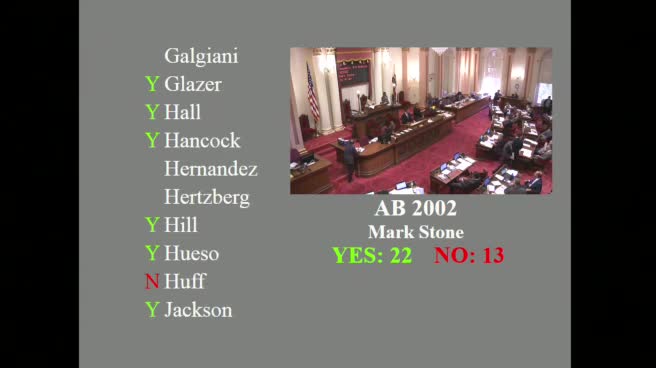 5MIN
Senate Floor
 56MIN
Senate Standing Committee on Energy, Utilities and Communications
 3MIN
Senate Standing Committee on Appropriations
 1MIN
Assembly Floor
 3MIN
Assembly Standing Committee on Utilities and Commerce
Bill Author

Bill Co-Author(s):
