AB 291: Tribal gaming: compact ratification.
- Session Year: 2015-2016
- House: Assembly
- Latest Version Date: 2016-09-12
Existing federal law, the Indian Gaming Regulatory Act of 1988, provides for the negotiation and execution of tribal-state gaming compacts for the purpose of authorizing certain types of gaming on Indian lands within a state. The California Constitution authorizes the Governor to negotiate and conclude compacts, subject to ratification by the Legislature. Existing law expressly ratifies a number of tribal-state gaming compacts, and amendments to tribal-state gaming compacts, between the State of California and specified Indian tribes.
The California Environmental Quality Act (CEQA) requires a lead agency to prepare, or cause to be prepared, and certify the completion of, an environmental impact report on a project, as defined, that it proposes to carry out or approve that may have a significant effect on the environment, as defined, or to adopt a negative declaration if it finds that the project will not have that effect.
This bill would ratify the tribal-state gaming compact entered into between the State of California and the Barona Band of Mission Indians, executed on June 22, 2016. The bill would provide that, in deference to tribal sovereignty, certain actions are not projects for the purposes of CEQA.
This bill would declare that it is to take effect immediately as an urgency statute.
The California Environmental Quality Act (CEQA) requires a lead agency, as defined, to prepare, or cause to be prepared, and certify the completion of an environmental impact report on a project that it proposes to carry out or approve that may have a significant effect on the environment or to adopt a negative declaration if it finds that the project will not have that effect. CEQA also requires a lead agency to prepare a mitigated negative declaration for a project that may have a significant effect on the environment if revisions in the project would avoid or mitigate that effect and there is no substantial evidence that the project, as revised, would have a significant effect on the environment.
CEQA requires a local agency that approves or determines to carry out a project subject to CEQA to file a notice of the approval or determination with the county clerk of each county in which the project will be located and requires the county clerk to make the notice available for public inspection. CEQA requires a person challenging a public agencys action on the ground of noncompliance with CEQA to file an action or proceeding with the court within a specified time period that commences on the date of the filing of the notice of approval or determination.
This bill would authorize a local agency, for certain water projects, to file the notice with the county clerk of the county in which the local agencys principal office is located, along with any required payment to the Department of Fish and Wildlife, and with the Office of Planning and Research, and to transmit a copy of the notice to the county clerks of the counties in which the water project is located, as specified. The bill would require the notice and the copies of the notice to be available for public inspection and posted by the respective county clerks, as provided. The bill would specify that the time period for filing an action or proceeding challenging a local agencys action on the ground of noncompliance with CEQA commences on the date on which the notice is filed with the Office of Planning and Research.
The California Environmental Quality Act (CEQA) requires a lead agency, as defined, to prepare, or cause to be prepared, and certify the completion of an environmental impact report on a project that it proposes to carry out or approve that may have a significant effect on the environment or to adopt a negative declaration if it finds that the project will not have that effect. CEQA also requires a lead agency to prepare a mitigated negative declaration for a project that may have a significant effect on the environment if revisions in the project would avoid or mitigate that effect and there is no substantial evidence that the project, as revised, would have a significant effect on the environment.
CEQA requires a local agency that approves or determines to carry out a project subject to CEQA to file a notice of the approval or determination with the county clerk of each county in which the project will be located and requires the county clerk to make the notice available for public inspection. CEQA requires a person challenging a public agencys action on the ground of noncompliance with CEQA to file an action or proceeding with the court within a specified time period that commences on the date of the filing of the notice of approval or determination.
This bill would authorize a local agency, for certain water projects, to file the notice with the county clerk of the county in which the local agencys principal office is located located, along with any required payment to the Department of Fish and Wildlife, and with the Office of Planning and Research, and to mail transmit a copy of the notice to the county clerks of the counties in which the water project is located, as specified. The bill would require the notices notice and the copies of the notice to be available for public inspection or posted, and posted by the respective county clerks, as provided. The bill would specify that the time period for filing an action or proceeding challenging a local agencys action on the ground of noncompliance with CEQA commences on the date on which the notice is filed with the Office of Planning and Research.
The California Environmental Quality Act (CEQA) requires a lead agency, as defined, to prepare, or cause to be prepared, and certify the completion of, of an environmental impact report on a project that it proposes to carry out or approve that may have a significant effect on the environment or to adopt a negative declaration if it finds that the project will not have that effect. CEQA also requires a lead agency to prepare a mitigated negative declaration for a project that may have a significant effect on the environment if revisions in the project would avoid or mitigate that effect and there is no substantial evidence that the project, as revised, would have a significant effect on the environment.
CEQA requires a local agency that approves or determines to carry out a project subject to CEQA to file a notice of the approval or determination with the county clerk of each county in which the project will be located and requires the county clerk to make the notice available for public inspection.
This bill would authorize a local agency, for certain water projects, to file the notice with the county clerk of the county in which the local agencys principal office is located in and with the Office of Planning and Research, and to mail a copy of the notice to the county clerks of the counties in which the water project is located, as specified. The bill would require the notices to be available for public inspection or posted, as provided.
The California Environmental Quality Act (CEQA) requires a lead agency, as defined, to prepare, or cause to be prepared, and certify the completion of, an environmental impact report (EIR) on a project that it proposes to carry out or approve that may have a significant effect on the environment or to adopt a negative declaration if it finds that the project will not have that effect. CEQA also requires a lead agency to prepare a mitigated negative declaration for a project that may have a significant effect on the environment if revisions in the project would avoid or mitigate that effect and there is no substantial evidence that the project, as revised, would have a significant effect on the environment.
CEQA requires a local agency that approves or determines to carry out a project subject to CEQA to file a notice of the approval or determination with the county clerk of each county in which the project will be located and requires the county clerk to make the notice available for public inspection.
This bill would authorize a local agency, for certain water projects, to file the notice with the county clerk of the county in which the local agencys principal office is located in lieu of the county clerk of each county in which the project is located and would, if the local agency exercises this authorization, require the local agency to file the notice with the Office of Planning and Research. and with the Office of Planning and Research, and to mail a copy of the notice to the county clerks of the counties in which the water project is located, as specified. The bill would require the notices to be available for public inspection or posted, as provided.The California Environmental Quality Act (CEQA) requires a lead agency, as defined, to prepare, or cause to be prepared, and certify the completion of, an environmental impact report (EIR) on a project that it proposes to carry out or approve that may have a significant effect on the environment or to adopt a negative declaration if it finds that the project will not have that effect. CEQA also requires a lead agency to prepare a mitigated negative declaration for a project that may have a significant effect on the environment if revisions in the project would avoid or mitigate that effect and there is no substantial evidence that the project, as revised, would have a significant effect on the environment.
CEQA requires a local agency that approves or determines to carry out a project subject to CEQA to file a notice of the approval or determination with the county clerk of each county in which the project will be located and requires the county clerk to make the notice available for public inspection.
This bill would authorize a local agency, for certain water projects, to file the notice with the county clerk of the county in which the local agencys principal office is located in lieu of the county clerk of each county in which the project is located and would, if the local agency exercises this authorization, require the local agency to file the notice with the Office of Planning and Research.
(a)The tribal-state gaming compact entered into in accordance with the federal Indian Gaming Regulatory Act of 1988 (18 U.S.C. Secs. 1166 to 1168, inclusive, and 25 U.S.C. Sec. 2701 et seq.) between the State of California and the Barona Band of Mission Indians, executed on June 22, 2016, is hereby ratified.
(b)(1)In deference to tribal sovereignty, none of the following shall be deemed a project for purposes of the California Environmental Quality Act (Division 13 (commencing with Section 21000) of the Public Resources Code):
(A)The execution of an amendment to the tribal-state gaming compact ratified by this section.
(B)The execution of the tribal-state gaming compact ratified by this section.
(C)The execution of an intergovernmental agreement between a tribe and a county or city government negotiated pursuant to the express authority of, or as expressly referenced in, the tribal-state gaming compact ratified by this section.
(D)The execution of an intergovernmental agreement between a tribe and the Department of Transportation negotiated pursuant to the express authority of, or as expressly referenced in, the tribal-state gaming compact ratified by this section.
(E)The on-reservation impacts of compliance with the terms of the tribal-state gaming compact ratified by this section.
(F)The sale of compact assets, as defined in subdivision (a) of Section 63048.6, or the creation of the special purpose trust established pursuant to Section 63048.65.
(2)Except as expressly provided herein, this subdivision does not exempt a city, county, or city and county, or the Department of Transportation, from the requirements of the California Environmental Quality Act.
SEC. 2.This act is an urgency statute necessary for the immediate preservation of the public peace, health, or safety within the meaning of Article IV of the Constitution and shall go into immediate effect. The facts constituting the necessity are:
In order to enhance the economic development, stability, and self-sufficiency of the Barona Band of Mission Indians and to protect the interests of the tribe and its members, the surrounding community, and the California public at the earliest possible time, it is necessary that this act take effect immediately.
SECTION 1.Section 21152 of the Public Resources Code is amended to read:21152.(a)Except as provided in Section 21152.2, if a local agency approves or determines to carry out a project that is subject to this division, the local agency shall file notice of the approval or the determination within five working days after the approval or determination becomes final, with the county clerk of each county in which the project will be located. The notice shall identify the person or persons in subdivision (b) or (c) of Section 21065, as reflected in the agencys record of proceedings, and indicate the determination of the local agency whether the project will, or will not, have a significant effect on the environment and shall indicate whether an environmental impact report has been prepared pursuant to this division. The notice shall also include certification that the final environmental impact report, if one was prepared, together with comments and responses, is available to the general public.
(b)If a local agency determines that a project is not subject to this division pursuant to subdivision (b) of Section 21080 and the local agency approves or determines to carry out the project, the local agency or the person specified in subdivision (b) or (c) of Section 21065 may file a notice of the determination with the county clerk of each county in which the project will be located. A notice filed pursuant to this subdivision shall identify the person or persons in subdivision (b) or (c) of Section 21065, as reflected in the agencys record of proceedings. A notice filed pursuant to this subdivision by a person specified in subdivision (b) or (c) of Section 21065 shall have a certificate of determination attached to it issued by the local agency responsible for making the determination that the project is not subject to this division pursuant to subdivision (b) of Section 21080. The certificate of determination may be in the form of a certified copy of an existing document or record of the local agency.
(c)A notice filed pursuant to this section shall be available for public inspection, and shall be posted within 24 hours of receipt in the office of the county clerk. A notice shall remain posted for a period of 30 days. Thereafter, the clerk shall return the notice to the local agency with a notation of the period it was posted. The local agency shall retain the notice for not less than 12 months.
SEC. 2.Section 21152.2 is added to the Public Resources Code, to read:21152.2.(a)For purposes of this section, water project means an activity undertaken pursuant to Sections 1011, 1011.5, and 1211 of, Chapter 2 (commencing with Section 1250), Chapter 6.6 (commencing with Section 1435), Chapter 10 (commencing with Section 1700), and Chapter 10.5 (commencing with Section 1725) of Part 2 of Division 2 of, the Water Code.
(b)Within five working days after a local agency has approved or made a determination to carry out a water project, a local agency, in lieu of the notice filing requirements of subdivision (a) of Section 21152 for that water project, may take all of the following actions:
(1)File the notice in the form required by subdivision (a) of Section 21152 with the county clerk of the county in which the local agencys principal office is located and make any payment to the Department of Fish and Wildlife required by Section 711.4 of the Fish and Game Code to that clerk.
(2)File the notice with the Office of Planning and Research without a further payment to the Department of Fish and Wildlife.
(3)Transmit a copy of the notice via the United States Postal Services Express Mail, postage prepaid, or via another method of delivery providing for prepaid overnight delivery, to the county clerk of each county in which the water project will be located. The copy of the notice, or an attachment to the copy of the notice, shall state the date on which the notice was filed with the Office of Planning and Research pursuant to paragraph (2).
(c)(1)The county clerk receiving a notice pursuant to paragraph (1) of subdivision (b) shall comply with subdivision (c) of Section 21152.
(2)All notices filed pursuant to paragraph (2) of subdivision (b) shall be available for public inspection, and a list of those notices shall be posted on a weekly basis in the Office of Planning and Research. Each list shall remain posted for a period of 30 days.
(3)A county clerk that receives a copy of a notice pursuant to paragraph (3) of subdivision (b) shall comply with subdivision (c) of Section 21152 and shall not require an original of that notice, any information regarding the filing of the notice with the Office of Planning and Research other than the statement described in paragraph (3) of subdivision (b), or any additional information from the local agency, but may charge a single fee of seventy-five dollars ($75) for handling the posting of the notice pursuant to subdivision (c) of Section 21152, notwithstanding subdivision (e) of Section 711.4 of the Fish and Game Code.
(d)The filing date of the notice specified in subdivisions (b) to (e), inclusive, of Section 21167, Section 21167.10, and Section 21177 shall be the date on which the notice is filed with the Office of Planning and Research pursuant to paragraph (2) of subdivision (b).
(e)Nothing in this section affects the application of Section 21092.2.
(a)Except as provided in Section 21152.2, if a local agency approves or determines to carry out a project that is subject to this division, the local agency shall file notice of the approval or the determination within five working days after the approval or determination becomes final, with the county clerk of each county in which the project will be located. The notice shall identify the person or persons in subdivision (b) or (c) of Section 21065, as reflected in the agencys record of proceedings, and indicate the determination of the local agency whether the project will, or will not, have a significant effect on the environment and shall indicate whether an environmental impact report has been prepared pursuant to this division. The notice shall also include certification that the final environmental impact report, if one was prepared, together with comments and responses, is available to the general public.
(b)If a local agency determines that a project is not subject to this division pursuant to subdivision (b) of Section 21080 and the local agency approves or determines to carry out the project, the local agency or the person specified in subdivision (b) or (c) of Section 21065 may file a notice of the determination with the county clerk of each county in which the project will be located. A notice filed pursuant to this subdivision shall identify the person or persons in subdivision (b) or (c) of Section 21065, as reflected in the agencys record of proceedings. A notice filed pursuant to this subdivision by a person specified in subdivision (b) or (c) of Section 21065 shall have a certificate of determination attached to it issued by the local agency responsible for making the determination that the project is not subject to this division pursuant to subdivision (b) of Section 21080. The certificate of determination may be in the form of a certified copy of an existing document or record of the local agency.
(c)A notice filed pursuant to this section shall be available for public inspection, and shall be posted within 24 hours of receipt in the office of the county clerk. A notice shall remain posted for a period of 30 days. Thereafter, the clerk shall return the notice to the local agency with a notation of the period it was posted. The local agency shall retain the notice for not less than 12 months.
SEC. 2.Section 21152.2 is added to the Public Resources Code, to read:21152.2.(a)For purposes of this section, water project means an activity undertaken pursuant to Sections 1011, 1011.5, and 1211 of, Chapter 2 (commencing with Section 1250), Chapter 6.6 (commencing with Section 1435), Chapter 10 (commencing with Section 1700), and Chapter 10.5 (commencing with Section 1725) of Part 2 of Division 2 of, the Water Code.
(b)Within five working days after a local agency has approved or made a determination to carry out a water project, a local agency, in lieu of the notice filing requirements of subdivision (a) of Section 21152 for that water project, may take all of the following actions:
(1)File the notice in the form required by subdivision (a) of Section 21152 with the county clerk of the county in which the local agencys principal office is located and make any payment to the Department of Fish and Wildlife required by Section 711.4 of the Fish and Game Code to that clerk.
(2)File the notice with the Office of Planning and Research without a further payment to the Department of Fish and Wildlife.
(3)Mail Transmit a copy of the notice through the via the United States mail, first-class postage prepaid with return receipt requested, Postal Services Express Mail, postage prepaid, or via another method of delivery providing for prepaid overnight delivery, to the county clerk of each county in which the water project will be located. The copy of the notice, or an attachment to the copy of the notice, shall state the date on which the notice was filed with the Office of Planning and Research pursuant to paragraph (2).
(c)(1)The county clerk receiving a notice pursuant to paragraph (1) of subdivision (b) shall comply with subdivision (c) of Section 21152.
(2)All notices filed pursuant to paragraph (2) of subdivision (b) shall be available for public inspection, and a list of those notices shall be posted on a weekly basis in the Office of Planning and Research. Each list shall remain posted for a period of 30 days.
(3)As promptly as possible, a A county clerk that receives a copy of a notice pursuant to paragraph (3) of subdivision (b) shall post that copy comply with subdivision (c) of Section 21152 and shall not require an original of that notice notice, any information regarding the filing of the notice with the Office of Planning and Research other than the statement described in paragraph (3) of subdivision (b), or any additional information from the local agency agency, but may charge a single fee of seventy-five dollars ($75) for handling the posting of the notice pursuant to subdivision (c) of Section 21152, notwithstanding subdivision (e) of Section 711.4 of the Fish and Game Code.
(d)The filing date of the notice specified in subdivisions (b) to (e), inclusive, of Section 21167, Section 21167.10, and Section 21177 shall be the date on which the notice is filed with the Office of Planning and Research pursuant to paragraph (2) of subdivision (b).
(e)Nothing in this section affects the application of Section 21092.2.
(a)Except as provided in Section 21152.2, if a local agency approves or determines to carry out a project that is subject to this division, the local agency shall file notice of the approval or the determination within five working days after the approval or determination becomes final, with the county clerk of each county in which the project will be located. The notice shall identify the person or persons in subdivision (b) or (c) of Section 21065, as reflected in the agencys record of proceedings, and indicate the determination of the local agency whether the project will, or will not, have a significant effect on the environment and shall indicate whether an environmental impact report has been prepared pursuant to this division. The notice shall also include certification that the final environmental impact report, if one was prepared, together with comments and responses, is available to the general public.
(b)If a local agency determines that a project is not subject to this division pursuant to subdivision (b) of Section 21080 and the local agency approves or determines to carry out the project, the local agency or the person specified in subdivision (b) or (c) of Section 21065 may file a notice of the determination with the county clerk of each county in which the project will be located. A notice filed pursuant to this subdivision shall identify the person or persons in subdivision (b) or (c) of Section 21065, as reflected in the agencys record of proceedings. A notice filed pursuant to this subdivision by a person specified in subdivision (b) or (c) of Section 21065 shall have a certificate of determination attached to it issued by the local agency responsible for making the determination that the project is not subject to this division pursuant to subdivision (b) of Section 21080. The certificate of determination may be in the form of a certified copy of an existing document or record of the local agency.
(c)A notice filed pursuant to this section shall be available for public inspection, and shall be posted within 24 hours of receipt in the office of the county clerk. A notice shall remain posted for a period of 30 days. Thereafter, the clerk shall return the notice to the local agency with a notation of the period it was posted. The local agency shall retain the notice for not less than 12 months.
SEC. 2.Section 21152.2 is added to the Public Resources Code, to read:21152.2.(a)For purposes of this section, water project means an activity undertaken pursuant to Sections 1011, 1011.5, and 1211 of, Chapter 2 (commencing with Section 1250), Chapter 6.6 (commencing with Section 1435), Chapter 10 (commencing with Section 1700), and Chapter 10.5 (commencing with Section 1725) of Part 2 of Division 2 of, the Water Code.
(b)Within five working days after a local agency has approved or made a determination to carry out a water project, a local agency, in lieu of the notice filing requirements of subdivision (a) of Section 21152 for that water project, may take all of the following actions:
(1)File the notice in the form required by subdivision (a) of Section 21152 with the county clerk of the county in which the local agencys principal office is located.
(2)File the notice with the Office of Planning and Research.
(3)Mail copies a copy of the notice through the United States mail, first-class postage prepaid with return receipt requested, to the county clerk of all the counties each county in which the water project will be located.
(c)(1)The county clerk receiving a notice pursuant to paragraph (1) of subdivision (b) shall comply with subdivision (c) of Section 21152.
(2)All notices filed pursuant to paragraph (2) of subdivision (b) shall be available for public inspection, and a list of those notices shall be posted on a weekly basis in the Office of Planning and Research. Each list shall remain posted for a period of 30 days.
(3)As promptly as possible, a county clerk that receives a copy of a notice pursuant to paragraph (3) of subdivision (b) shall post that copy and shall not require an original of that notice or any additional information from the local agency.
(d)The filing date of the notice specified in subdivisions (b) to (e), inclusive, of Section 21167, Section 21167.10, and Section 21177 shall be the date on which the notice is filed with the Office of Planning and Research pursuant to paragraph (2) of subdivision (b).
(e)Nothing in this section affects the application of Section 21092.2.
(a)Except as provided in Section 21152.2, if a local agency approves or determines to carry out a project that is subject to this division, the local agency shall file notice of the approval or the determination within five working days after the approval or determination becomes final, with the county clerk of each county in which the project will be located. The notice shall identify the person or persons in subdivision (b) or (c) of Section 21065, as reflected in the agencys record of proceedings, and indicate the determination of the local agency whether the project will, or will not, have a significant effect on the environment and shall indicate whether an environmental impact report has been prepared pursuant to this division. The notice shall also include certification that the final environmental impact report, if one was prepared, together with comments and responses, is available to the general public.
(b)If a local agency determines that a project is not subject to this division pursuant to subdivision (b) of Section 21080 or pursuant to Section 21172, and the local agency approves or determines to carry out the project, the local agency or the person specified in subdivision (b) or (c) of Section 21065 may file a notice of the determination with the county clerk of each county in which the project will be located. A notice filed pursuant to this subdivision shall identify the person or persons in subdivision (b) or (c) of Section 21065, as reflected in the agencys record of proceedings. A notice filed pursuant to this subdivision by a person specified in subdivision (b) or (c) of Section 21065 shall have a certificate of determination attached to it issued by the local agency responsible for making the determination that the project is not subject to this division pursuant to subdivision (b) of Section 21080 or Section 21172. The certificate of determination may be in the form of a certified copy of an existing document or record of the local agency.
(c)A notice filed pursuant to this section shall be available for public inspection, and shall be posted within 24 hours of receipt in the office of the county clerk. A notice shall remain posted for a period of 30 days. Thereafter, the clerk shall return the notice to the local agency with a notation of the period it was posted. The local agency shall retain the notice for not less than 12 months.
SEC. 2.Section 21152.2 is added to the Public Resources Code, to read:21152.2.(a)For purposes of this section, water project means an activity undertaken pursuant to Sections 1011, 1011.5, and 1211 of, Chapter 2 (commencing with Section 1250), Chapter 6.6 (commencing with Section 1435), Chapter 10 (commencing with Section 1700) 1700), and Chapter 10.5 (commencing with Section 1725) of Part 2 of Division 2 of, the Water Code.
(b)A local agency that is required to file a notice pursuant to Section 21152 for a water project may, in lieu of the filing requirements of that section, file the notice in the form required by that section with the county clerk of the county in which the local agencys principal office is located.
(c)If the lead agency files a notice pursuant to this section, the local agency shall also file the notice with the Office of Planning and Research.
(b)Within five working days after a local agency has approved or made a determination to carry out a water project, a local agency, in lieu of the notice filing requirements of subdivision (a) of Section 21152 for that water project, may take all of the following actions:
(1)File the notice in the form required by subdivision (a) of Section 21152 with the county clerk of the county in which the local agencys principal office is located.
(2)File the notice with the Office of Planning and Research.
(3)Mail copies of the notice through the United States mail, first-class postage prepaid with return receipt requested, to the county clerk of all the counties in which the water project will be located.
(d)
(c)(1)The county clerk receiving a notice pursuant to paragraph (1) of subdivision (b) shall comply with subdivision (c) of Section 25112. 21152.
(2)(A)All notices filed pursuant to paragraph (2) of subdivision (c) (b) shall be available for public inspection, and a list of those notices shall be posted on a weekly basis in the Office of Planning and Research. Each list shall remain posted for a period of 30 days.
(B)Failure to file the notice pursuant to subdivision (c) does not affect the validity of a project.
(3)As promptly as possible, a county clerk that receives a copy of a notice pursuant to paragraph (3) of subdivision (b) shall post that copy and shall not require an original of that notice or any additional information from the local agency.
(d)The filing date of the notice specified in subdivisions (b) to (e), inclusive, of Section 21167, Section 21167.10, and Section 21177 shall be the date on which the notice is filed with the Office of Planning and Research pursuant to paragraph (2) of subdivision (b).
(e)Nothing in this section affects the application of Section 21092.2.
(a)If Except as provided in Section 21152.2, if a local agency approves or determines to carry out a project that is subject to this division, the local agency shall file notice of the approval or the determination within five working days after the approval or determination becomes final, with the county clerk of each county in which the project will be located. The notice shall identify the person or persons in subdivision (b) or (c) of Section 21065, as reflected in the agencys record of proceedings, and indicate the determination of the local agency whether the project will, or will not, have a significant effect on the environment and shall indicate whether an environmental impact report has been prepared pursuant to this division. The notice shall also include certification that the final environmental impact report, if one was prepared, together with comments and responses, is available to the general public.
(b)If a local agency determines that a project is not subject to this division pursuant to subdivision (b) of Section 21080 or pursuant to Section 21172, and the local agency approves or determines to carry out the project, the local agency or the person specified in subdivision (b) or (c) of Section 21065 may file a notice of the determination with the county clerk of each county in which the project will be located. A notice filed pursuant to this subdivision shall identify the person or persons in subdivision (b) or (c) of Section 21065, as reflected in the agencys record of proceedings. A notice filed pursuant to this subdivision by a person specified in subdivision (b) or (c) of Section 21065 shall have a certificate of determination attached to it issued by the local agency responsible for making the determination that the project is not subject to this division pursuant to subdivision (b) of Section 21080 or Section 21172. The certificate of determination may be in the form of a certified copy of an existing document or record of the local agency.
(c)A notice filed pursuant to this section shall be available for public inspection, and shall be posted within 24 hours of receipt in the office of the county clerk. A notice shall remain posted for a period of 30 days. Thereafter, the clerk shall return the notice to the local agency with a notation of the period it was posted. The local agency shall retain the notice for not less than 12 months.
SEC. 2.Section 21152.2 is added to the Public Resources Code, to read:21152.2.(a)For purposes of this section, water project means an activity undertaken pursuant to Sections 1011, 1011.5, and 1211 of, Chapter 2 (commencing with Section 1250), Chapter 6.6 (commencing with Section 1435), Chapter 10 (commencing with Section 1700) and Chapter 10.5 (commencing with Section 1725) of Part 2 of Division 2 of, the Water Code.
(b)A local agency that is required to file a notice pursuant to Section 21152 for a water project may, in lieu of the filing requirements of that section, file the notice in the form required by that section with the county clerk of the county in which the local agencys principal office is located.
(c)If the lead agency files a notice pursuant to this section, the local agency shall also file the notice with the Office of Planning and Research.
(d)(1)The county clerk receiving a notice pursuant to subdivision (b) shall comply with subdivision (c) of Section 25112.
(2)(A)All notices filed pursuant to subdivision (c) shall be available for public inspection, and a list of those notices shall be posted on a weekly basis in the Office of Planning and Research. Each list shall remain posted for a period of 30 days.
(B)Failure to file the notice pursuant to subdivision (c) does not affect the validity of a project.
|
Date
|
Status
|
|---|---|
| Sep 12, 2016 | Approved by the Governor. |
| Sep 12, 2016 | Chaptered by Secretary of State - Chapter 284, Statutes of 2016. |
| Aug 25, 2016 | Enrolled and presented to the Governor at 5 p.m. |
| Aug 22, 2016 | Urgency clause adopted. Senate amendments concurred in. To Engrossing and Enrolling. (Ayes 78. Noes 0. Page 6051.). |
| Aug 22, 2016 | Urgency clause adopted. Senate amendments concurred in. To Engrossing and Enrolling. |
| Aug 16, 2016 | Read third time. Urgency clause adopted. Passed. Ordered to the Assembly. (Ayes 38. Noes 0. Page 5020.). |
| Aug 16, 2016 | Read third time. Urgency clause adopted. Passed. Ordered to the Assembly. (Ayes 38. Noes 0.). |
| Aug 16, 2016 | In Assembly. Concurrence in Senate amendments pending. May be considered on or after August 18 pursuant to Assembly Rule 77. |
| Aug 16, 2016 | Read third time. Urgency clause adopted. Passed. Ordered to the Assembly. |
| Aug 15, 2016 | Read second time. Ordered to third reading. |
| Aug 11, 2016 | Ordered to second reading. |
| Aug 11, 2016 | Withdrawn from committee. |
| Aug 4, 2016 | Re-referred to Com. on RLS. |
| Aug 4, 2016 | Withdrawn from committee. |
| Aug 3, 2016 | From committee chair, with author's amendments: Amend, and re-refer to committee. Read second time, amended, and re-referred to Com. on E.Q. |
| Jul 2, 2015 | In committee: Hearing postponed by committee. |
| Jun 30, 2015 | In committee: Set, second hearing. Hearing canceled at the request of author. |
| Jun 10, 2015 | From committee chair, with author's amendments: Amend, and re-refer to committee. Read second time, amended, and re-referred to Com. on E.Q. |
| Jun 8, 2015 | In committee: Set, first hearing. Hearing canceled at the request of author. |
| May 14, 2015 | Referred to Com. on E.Q. |
| Apr 30, 2015 | In Senate. Read first time. To Com. on RLS. for assignment. |
| Apr 30, 2015 | Read third time. Passed. Ordered to the Senate. (Ayes 77. Noes 0. Page 1226.) |
| Apr 30, 2015 | Read third time. Passed. Ordered to the Senate. |
| Apr 27, 2015 | Read second time. Ordered to Consent Calendar. |
| Apr 23, 2015 | Read second time and amended. Ordered returned to second reading. |
| Apr 22, 2015 | From committee: Amend, and do pass as amended. To Consent Calendar. (Ayes 17. Noes 0.) (April 22). |
| Apr 16, 2015 | Re-referred to Com. on APPR. |
| Apr 15, 2015 | Read second time and amended. |
| Apr 14, 2015 | From committee: Amend, and do pass as amended and re-refer to Com. on APPR. (Ayes 9. Noes 0.) (April 13). |
| Feb 23, 2015 | Referred to Com. on NAT. RES. |
| Feb 12, 2015 | From printer. May be heard in committee March 14. |
| Feb 11, 2015 | Read first time. To print. |
|
Date
|
Description
|
Location
|
Votes
|
|
|---|---|---|---|---|
| Aug 22, 2016 | AB 291 ATKINS Concurrence - Urgency Added | Assembly Floor |
Passed |
|
| Aug 16, 2016 | Assembly 3rd Reading AB291 Atkins By Hueso Urgency Clause | Senate Floor |
Passed |
|
| Apr 30, 2015 | AB 291 MEDINA Consent Calendar Second Day Regular Session | Assembly Floor |
Passed |
|
| Apr 22, 2015 | Do pass as amended. To Consent Calendar. | Assembly Standing Committee on Appropriations |
Passed |
|
| Apr 13, 2015 | Do pass as amended and be re-referred to the Committee on [Appropriations] | Assembly Standing Committee on Natural Resources |
Passed |
This list shows positions taken on this bill by organizations on the date displayed, which is linked to the original source.
Positions by individuals are not included.
CONCURRENCE IN SENATE AMENDMENTS
CSA1 Bill Id:AB 291
Author:(Atkins and Gonzalez)
As Amended Ver:August 3, 2016
2/3 vote. Urgency
ASSEMBLY: |
| (April 30, 2015) | SENATE: | 38-0 | (August 16, 2016) |
(vote not relevant)
Original Committee Reference: G.O.
SUMMARY: Ratifies a Tribal-State Gaming Compact (Compact) between the State of California (State) and the Barona Band of Mission Indians (Tribe) which was executed on June 22, 2016.
The Senate amendments delete the Assembly version of this bill, and instead:
- Ratify the Compact entered into between the State of California and the Barona Band of Mission Indians executed on June 22, 2016.
- The Compact supersedes the 1999 compact between the Tribe and the State of California.
- The Compact provides the Tribe may operate a maximum of 2,500 gaming devices.
- The Tribe has agreed to pay the State its pro rata share of the costs the State incurs for the performance of its duties under the Compact as well as 4.75% of its "gross gaming revenue," to be shared with tribes that are not gaming or that otherwise are not substantially benefiting from gaming.
- The Compact provides a framework for the sharing of gaming revenue with the County of San Diego and other local jurisdictions. Specifically, from its payments to the Revenue Sharing Trust Fund (RSTF) or the Tribal Nation Grant Fund (TNGF), the Tribe may take annual credits of up to 60% for infrastructure improvements that in part benefit county residents, fire, law enforcement, public transit, education, tourism, youth programs and other services including investments in renewable energy, water conservation or recycling projects and payments to support capital improvements or operating expenses for facilities that provide health care services to tribal members and other members of the local community.
- The Compact: a) provides a regulatory framework that respects the role of the tribal gaming agency as the primary regulator while also ensuring that state gaming regulators fulfill their responsibilities; b) requires the Tribe to conduct its gaming activities pursuant to an internal control system that implements minimum internal controls that are no less stringent than those in federal regulations; c) requires the Tribe to adopt a Tribal Labor Relations Ordinance, as specified; and, d) contains provisions to protect the health and safety of patrons, guests, and employees.
- Provide that, in deference to tribal sovereignty, certain actions are not deemed projects for purposes of the California Environmental Quality Act (CEQA); and, stipulates, except as expressly provided, that none of the provisions shall be construed to exempt a city, county, or city and county, or the Department of Transportation from CEQA requirements.
- Once effective (legislative ratification and federal approval required), this Compact will be in full force and effect for 25 years following the effective date.
- Contain an urgency clause, allowing this bill to take effect immediately upon enactment.
EXISTING LAW:
- Provides, under the Indian Gaming Regulatory Act (IGRA), for the negotiation and conclusion of compacts between federally recognized Indian tribes and the State for the purpose of conducting Class III gaming activities on Indian lands within a State as a means of promoting tribal economic development, self-sufficiency, and strong tribal governments.
- Authorizes expressly a number of tribal-state gaming compacts between the State of California and specified Indian tribes.
- Authorizes the conduct of Class III gaming activities to the extent such activities are permitted by state law, a gaming compact has been concluded by a federally recognized tribe and the State, and the compact has been approved by the Secretary of the Interior.
- Limits the operation of Class III gaming activities to Indian lands acquired on or before October 17, 1988. Provides for certain exceptions to conduct gaming activities on Indian lands acquired after October 17, 1988.
- Defines Indian lands to mean all lands within the limits of any Indian reservation, and any lands title to which is either held in trust by the United States (U.S.) for the benefit of any Indian tribe, or individual, or held by any Indian tribe or individual subject to restriction by the U.S. against alienation and over which an Indian tribe exercises governmental power.
- Requires the State to negotiate to conclude a compact in good faith with an Indian tribe having jurisdiction over the Indian lands upon which the Class III gaming activity is to be conducted. Provides the U.S. district courts with jurisdiction over any cause of action initiated by a tribal government alleging that the State failed to negotiate in good faith to conclude a compact. Prescribes the remedy, mediation supervised by the courts, if it is found that the State failed to negotiate in good faith to conclude a compact.
- Authorizes the Governor, under the California Constitution, to negotiate and conclude compacts, subject to ratification by the Legislature.
FISCAL EFFECT: Unknown
COMMENTS: On August 11, 2016, the Assembly Governmental Organization Committee held an informational hearing on this Compact between the State of California and the Barona Band of Mission Indians.
Brief History and Background:
The Barona Band of Mission Indians is located in eastern San Diego County, on an approximately 7,227-acre reservation, home to a majority of the 549 enrolled members. A seven-member Tribal Council pursuant to custom and tradition governs the Tribe. Tribal Council members are elected by the General Council, which includes all qualified voters 18 years and older. Elections are staggered and held every two years. In 1999, the Tribe entered into a tribal-state gaming compact with the State of California which has provided it with extensive economic opportunities, including a profitable casino.
The Barona Resort and Casino is a major economic force in eastern San Diego County. The Tribe employs approximately 3,000 individuals and offers 2,000 slot machines, 80 table games, a 15-table poker room, and 10 restaurants and eateries. Additionally, the Tribe operates a 400-room resort hotel and a full service day spa. The resort also features an award winning 18 hole golf course, known as the Barona Creek Golf Club.
The Tribe's efforts have brought substantial economic benefits to the Tribe and the surrounding communities. Under the leadership and guidance of the Barona Tribal Council, the Tribe has made significant investments in the reservation and the surrounding community including roads, a water reclamation plant and water recovery program, the Barona Fire Department, Tribal Enforcement and contract Sheriff Deputy, the Barona Indian Charter School, children's park, gas station and the Barona Museum and Cultural Center. The Tribe has also worked in collaboration with San Diego County on a number of public safety issues and infrastructure development projects during the term of its existing compact. Additionally, the Tribe has invested significantly in the region through philanthropic contributions to a plethora of local public and nonprofit organizations (e.g., cultural arts, educational programs, civic organizations, local schools, pediatric centers, disaster relief centers, etc.).
Furthermore, the success of the Tribe's businesses has enabled the Tribe to provide its members with medical, dental and vision insurance, death benefits, senior meal delivery services, education, housing and jobs. The Tribe provides programs for its tribal members, especially youth, to ensure healthy and productive lives. These include scholarships for all education levels, tutoring, a youth center, daycare, preschool, full service library, recreation center, organized sporting events, and cultural activities for all ages.
Key Components of the Compact:
Scope of Class III Gaming Authorized: The Tribe is authorized to operate up to 2,500 gaming devices (slot machines), banking or percentage card games, and any devices or games that are authorized under state law to the California State Lottery, provided that the Tribe will not offer such games through use of the Internet unless others in the state not affiliated with or licensed by the California State Lottery are permitted to do so under state and federal law. The Tribe shall not engage in Class III Gaming that is not expressly authorized in the Compact.
Authorized Gaming Facility: The Tribe may establish and operate not more than one gaming facility and engage in Class III Gaming only on eligible Indian lands held in trust for the Tribe, located within the boundaries of the Tribe's reservation and trust lands as those boundaries exist as of the execution date of this Compact, as legally described in the Compact (Appendix A).
Exclusivity: If gaming devices are operated anywhere in this state other than in tribe maintained facilities under compact, and an entity thereafter legally offers gaming devices -- the tribe may terminate the Compact (and thus any rights to conduct Class III gaming), or continue under this Compact with an entitlement to a reduction of the rates following the conclusion of negotiations with the State.
Payments to the Special Distribution Fund (SDF): The Tribe shall pay to the State, on a pro rata basis, the costs the State incurs for the performance of all its duties under this Compact, as established by the monies appropriated in the annual Budget Act for the performance of their duties under the Class III Gaming Compacts each fiscal year for the California Gambling Control Commission (CGCC), the California Department of Justice, the Office of the Governor, the California Department of Public Health Programs, Office of Problem Gambling, the State Controller, the Department of Human Resources, and the Financial Information System for California, or any agency or agencies the State designates as a successor to them. The Tribe's pro rata share of the State's costs in any given year this Compact is in effect may not be increased more than 5% per year, as defined.
Payments to the RSTF or the TNGF: If the Tribe operates more than 350 gaming devices at any time in a given calendar year, it shall thereafter, including in that calendar year, pay to the CGCC, for deposit into the RSTF or the TNGF, four and three quarters percent (4.75%) of its "gross gaming revenue" from the operation of gaming devices in excess of 350.
"Gross Gaming Revenue" is defined as the win from gaming devices, which is the difference between gaming wins and losses before deducting costs and expenses or deducting incentives or adjusting for changes in progressive jackpot liability accruals. Generally, the difference between patron wagers and the payouts made on winning wagers.
Credits Applied to the RSTF or the TNGF: The State agrees to provide the Tribe with annual credits for up to 60% of the payments otherwise due to be paid into the RSTF or TNGF for the following:
- Payments or the value of services provided to San Diego County, local jurisdictions, school districts, charter schools, and nonprofit and civic organizations operating facilities or providing services within the County for fire, law enforcement, emergency medical services, public transit, education, tourism, recreation, youth athletics and other services and infrastructure improvements intended to serve off-reservation needs of County residents – such payments shall be subject to approval by the State or Designated State Agency and at least 20% of the annual credits must be utilized for the above stated purposes;
- Non-gaming related capital investments and economic development projects by the Tribe that provide mutual benefits to the Tribe and the State because, for instance, they have particular cultural, social or environmental value, or diversify the sources of revenue for the Tribe's general fund;
- Payments to support operating expenses and capital improvements for non-tribal governmental agencies or facilities operating within the County of San Diego;
- Investments in, and any funds paid to the State in connection with, renewable energy projects that, in part, serve the gaming facility, to include projects that incorporate charging stations for electric or other zero-emission vehicles that are available to patrons and employees of the gaming facility and the tribe, its members and lineal descendants;
- Payments to support capital improvements and operating expenses for facilities within California that provide health care services to tribal members, Indians, and non-Indians;
- Investments by the Tribe for water treatment or conservation projects and recycling projects;
- Payments for providing general welfare benefits for, among other things, educational, healthcare, burial assistance, cultural or vocational purposes, to non-tribal members; and,
Payments by the Tribe to reimburse the County for any loss of sales tax revenue that would otherwise be due for retail sales at the Tribe's gaming facility or transient occupancy tax at the tribe's hotel if it was not located on Indian lands.
All excess authorized credits that cannot be applied in any one year because they would exceed the 60% may be applied as an annual credit in all following years that this Compact is in effect, in the same percentages, until completely exhausted.
Additional Compact Components:
Gaming Ordinance and Regulations: All gaming activities conducted under this Compact shall, at a minimum, comply with 1) a gaming ordinance duly adopted by the Tribe and approved in accordance with IGRA, 2) all rules, regulations, procedures, specifications, and standards duly adopted by the National Indian Gaming Commission (NIGC), the Tribal Gaming Agency, and the State Gaming Agency, and 3) the provisions of this Compact, as specified.
Licensing Requirements and Procedures: All persons in any way connected with the gaming operation or gaming facility who are required to be licensed or to submit to a background investigation under IGRA, and any others required to be licensed under this Compact, including, without limitation, all gaming employees, gaming resource suppliers, financial sources, and any other person having a significant influence over the gaming operation, must be licensed by the Tribal Gaming Agency and cannot have had any determination of suitability denied or revoked by the CGCC. In addition, every gaming employee must obtain, and thereafter maintain current, a valid tribal gaming license, as specified.
Minimum Internal Control Standards (MICS): The Compact requires the Tribe to conduct its Gaming Activities pursuant to an internal control system that implements MICS that are no less stringent than specified MICS of the NIGC. It requires gaming to operate pursuant to a written internal control system that reasonably assures that assets are safeguarded and accountability over assets is maintained, liabilities are properly recorded and contingent liabilities are properly disclosed, financial records are accurate and reliable, transactions are performed in accordance with the Tribe's authorization.
The Tribe is required to provide to the CGCC, upon written request, a copy of the independent certified public accountant agreed-upon procedures report conducted annually for submission to the NIGC pursuant to federal law. This report verifies that the gaming operation is in compliance with the NIGC's minimum internal control standards.
Patron Disputes: Provides that the Tribe (through its Tribal Gaming Agency) must attempt to resolve patron disputes within seven days of the play or operation of any game, including refusal to pay to a patron any alleged winnings from any gaming activities. If a patron is dissatisfied with the resolution, the Tribe shall inform the patron in writing within 15 days of the right to resolution of the dispute by the Tribal Gaming Agency, and if dissatisfied with the resolution, the patron has the right to seek resolution by binding arbitration before a single arbitrator, who shall be a retired judge, in accordance with the streamlined arbitration rules and procedures of Judicial Arbitration and Mediation Services (JAMS). The Tribal Gaming Agency must conduct an appropriate investigation, provide to the patron a copy of its procedures concerning patron complaints, and render a decision in accordance with industry practices. The decision shall be issued within 60 days of the patron's request. The Tribe agrees to waive its sovereign immunity in order to be compelled in federal or state court to abide by the resolution of arbitration. The cost and expenses of arbitration shall be initially borne by the Tribe but the arbitrator shall award to the prevailing party its costs and expenses (but no attorney fees). Any party dissatisfied with the award of the arbitrator may at the party's election invoke the JAMS Optional Arbitration Appeal Procedure; provided that the party making such election must bear all costs and expenses of JAMS and the arbitrators associated with the appeal regardless of the outcome.
Public and Workplace Liability: The Tribe is required to obtain and maintain a commercial general liability insurance policy that provides coverage of no less than $10 million. Also, requires the Tribe to adopt a Tort Liability Ordinance containing provisions that are the same as California tort law to govern all claims of bodily injury, personal injury, or property damage arising out of, connected with, or relating to the casino. The Tribe must consent to jurisdiction in the Tribe's tribal court system, once a tribal court system is established, or before a three-member tribal claims commission. Any party dissatisfied with the award of the tribal venue may invoke the JAMS Optional Arbitration Appeal Procedure. The appeal will be based solely on the record developed in the tribal court or tribal claims commission proceedings. Factual determinations will not be set aside if supported by substantial evidence. The cost and expenses of arbitration shall be initially borne equally by the parties but the JAMS arbitrator shall award to the prevailing party its costs and expenses (but no attorney fees). The Tribe consents to the jurisdiction of the tribal court, tribal claims commission, JAMS Optional Appeal Procedure and any action to enforce their judgments or the obligations in this section.
Enhanced Audit and Compliance Review Procedures: In addition to providing for an annual independent audit, the Compact allows the state to conduct its own annual audit and compact compliance review.
Inspection and Testing of Gaming Devices: Gaming devices will have to be tested, approved, and certified by an independent gaming test laboratory or state governmental gaming test laboratory to ensure they are being operated according to specified technical standards. In addition, requires the Tribal Gaming Agency to maintain adequate records that demonstrate compliance with software and hardware specifications. The State Gaming Agency would be authorized to annually conduct up to four random inspections of gaming devices in operation to confirm that the slot machines are operating in conformance with these standards.
Compliance Enforcement: It is the responsibility of the Tribal Gaming Agency to conduct on-site gaming regulation and control in order to enforce the terms of this Compact, IGRA, any applicable NIGC and State Gaming Agency regulations, and the tribal gaming ordinance with respect to gaming operation and facility compliance, and to protect the integrity of the gaming activities, the reputation of the Tribe and the gaming operation for honesty and fairness, and the confidence of patrons that tribal government gaming in California meets the highest standards of regulation and internal controls. To meet those responsibilities, the tribal gaming agency shall adopt and enforce regulations, procedures, and practices.
Labor Provisions: Rather than requiring side agreements between the Tribe and labor organizations, the Compact incorporates provisions of Tribal Labor Relations Ordinance (TLRO) that has the support of labor entities. The Compact provides that the gaming activities authorized by this Compact may only commence after the Tribe has adopted an ordinance identical to the TLRO provided for in Appendix C of the Compact, and the gaming activities may only continue as long as the Tribe maintains the ordinance. If the Tribe employs 250 or more persons in a tribal casino facility, then the provisions of the TLRO become effective. The TLRO provides for a secret ballot election. The new TLRO proscribed by this compact is modeled after the TLRO first incorporated into the compact with the Santa Ynez Band of Chumash Indians and reflects significant changes from the 1999 TLRO.
The TLRO provides for a neutrality agreement between the Tribe and union if the union requests this. If the union first offers in writing not to engage in strikes, picketing, boycotts, attack Web sites, or other economic activity at or in relation to the tribal casino or related facility and issue and deliver a Notice of Intent to Organize (NOIO) to the Tribe, then the Tribe must not disparage or advocate opposition to the union. The Tribe may make factual representations to employees concerning employment with the Tribe, but may not take actions or make statements that could reasonably be interpreted as criticizing the union or advocating against unionization. During the 365 days after the Tribe received the NOIO, the union must collect dated and signed authorization cards and complete the secret ballot election. Secret ballot elections shall be held at a location or locations determined by the employer, but there must be at least neutral location. Employee may mail ballots so long as received by Election Day. Failure to complete the secret ballot election within 365 day under the neutrality agreement shall preclude the union from delivering another NOIO for a period of 730 days
Where there is a neutrality agreement, the TLRO provides for resolution of collective bargaining impasse through interest arbitration by the Federal Mediation and Conciliation Service (FMCS). The interest arbitration procedure is modeled on the Mandatory Mediation and Conciliation provisions in the Agricultural Labor Relations Act. Other disputes are presented to an arbitrator with expertise in labor law. Appropriate challenges to the arbitrator's decision may be presented in court.
Workers' Compensation: The Tribe agrees to participate in the state's workers' compensation program with respect to employees at the casino. All disputes arising from the workers' compensation laws shall be heard by the State Workers' Compensation Appeals Board pursuant to the California Labor Code. The Tribe acknowledges the jurisdiction of the Board in such manners. Furthermore, the Tribe agrees that it will participate in the state's unemployment compensation program for providing benefits and unemployment compensation disability benefits to employees at the casino. The Tribe shall withhold all taxes due to the state, except for Tribal members living on the Tribe's reservation, and forward such amounts to the state.
Prohibitions Regarding Minors: The Tribe shall prohibit persons under the age of 18 years from being present in any room or area in which gaming activities are being conducted unless the person is en route to a non-gaming area of the gaming facility, or is employed at the Gaming Facility in a capacity other than as a gaming employee.
Alcohol Provisions: Makes it explicit that the purchase, sale, and service of alcoholic beverages shall be subject to state law – the Alcoholic Beverage Control (ABC) Act.
Use and Sale of Tobacco: The Tribe agrees to provide a non-smoking area in the gaming facility and to utilize a ventilation system throughout the gaming facility that exhausts tobacco smoke to the extent reasonably feasible under state-of-the-art technology existing as of the date of the construction or significant renovation of the gaming facility, and further agrees not to offer or sell tobacco to anyone younger than the minimum age specified in state law to legally purchase tobacco products.
Problem Gambling: The gaming operation must establish a program, approved by the Tribal Gaming Agency, to mitigate pathological and problem gaming by implementing specified measures.
Health and Safety Standards: The Tribe has agreed to adopt and comply with tribal health standards for food and beverage handling that are no less stringent than State public health standards. In addition, the Tribe has agreed to comply with federal water quality and safe drinking water standards applicable in California. The Tribe must also adopt and comply with federal and state laws forbidding harassment, including sexual harassment, discrimination and retaliation. Furthermore, the Tribe must maintain a $3 million insurance policy for these purposes and adopt an ordinance that includes a dispute resolution process.
Emergency Services Accessibility: The Tribe must make reasonable provisions for adequate emergency fire, medical, and related relief and disaster services for patrons and employees.
Building Codes and Fire Safety: In order to assure the protection of the health and safety of all gaming facility patrons, guests, and employees, the Tribe shall adopt or has already adopted, and shall maintain throughout the term of this Compact, an ordinance that requires any covered gaming facility construction to meet or exceed the applicable codes. Gaming facility construction, expansion, improvement, modification or renovation must also comply with the federal Americans with Disabilities Act.
Amendment by Agreement: The terms and conditions of this Compact may be amended at any time by the mutual and written agreement of both parties, provided that each party voluntarily consents to such negotiations in writing. Any amendments to this Compact shall be deemed to supersede, supplant and extinguish all previous understandings and agreements on the subject.
Effective Date: This Compact shall not be effective unless and until all of the following have occurred: 1) The Compact is ratified by statute in accordance with state law and 2) Notice of approval or constructive approval is published in the Federal Register. Once effective, this Compact shall be in full force and effect for State law purposes until 25 years following the effective date.
Additional Background Information:
Rincon Decision: In 2004, the Rincon Band of Mission Indians sued the State in federal court after negotiations for a new gambling agreement with then-Governor Schwarzenegger fell apart. The Tribe believed the Governor was violating federal law by insisting that tribes pay money into the state's General Fund in exchange for more slot machines.
In July 2011, the United States Supreme Court declined to review a Ninth Circuit Court's decision that ruled the state could not require the Rincon Band tribe to pay a percentage of slot machine revenue into California's General Fund for more gaming devices. The Ninth Circuit had affirmed a lower court decision that the new financial concessions were nothing more than a state tax on tribal casino revenues, which is prohibited by IGRA. The court concluded that a "non-negotiable, mandatory payment of 10% of net win into the State treasury for unrestricted use yields public revenue and is [therefore] a tax and that the court was therefore required to consider the State's demand as evidence of bad faith under IGRA's statutes."
The Rincon decision has changed the dynamics of tribal-state compact negotiations in California.
SDF: Existing law creates the SDF in the State Treasury for the receipt of revenue contributions made by tribal governments pursuant to the terms of the 1999 model Tribal-State Gaming compacts and authorizes the Legislature to appropriate money from the SDF for the following purposes: 1) grants for programs designed to address gambling addiction; 2) grants for the support of state and local government agencies impacted by tribal government gaming; 3) compensation for regulatory costs incurred by CGCC and the DOJ in connection with the implementation and administration of compacts; 4) payment of shortfalls that may occur in the Indian Gaming RSTF; 5) disbursements for the purpose of implementing the terms of tribal labor relations ordinances promulgated in accordance with the terms of the 1999 compacts; and, 6) any other purpose specified by law. The distribution formula "sunsets" on January 1, 2021.
RSTF: Existing law also creates in the State Treasury the RSTF for the receipt and deposit of moneys derived from gaming device license fees that are paid into the RSTF pursuant to the terms of specified tribal-state gaming compacts for the purpose of making distributions to non-compacted tribes (e.g., federally-recognized non-gaming and tribes that operate casinos with fewer than 350 slot machines). Revenue in the RSTF is available to CGCC, upon appropriation by the Legislature, for making distributions of $1.1 million annually to non-compact tribes. The RSTF was created as part of the 1999 compacts, which, in conjunction with the passage of Proposition 1A (2000), created gaming compacts with approximately 60 California tribes. Non-compact tribes are considered third-party beneficiaries of the 1999 compacts.
According to CGCC, which administers the RSTF, a revenue shortfall of approximately $15.5 million is anticipated this fiscal year. According to the Department of Finance (DOF), the SDF has sufficient funds in it for fiscal year 2016-2017 to cover the RSTF shortfall. However, DOF indicates that it projects a $1.6 million SDF balance deficiency in fiscal year 2017-2018 assuming a $25 million transfer to the RSTF. To cover the anticipated shortfall in 2017-2018, approximately $1.6 million will need to be transferred from the General Fund in order to ensure full RSTF payments are made to non-gaming and limited-gaming tribes. A similar amount was redirected in 2015-2016. Recent compacts, including this one, have attempted to alleviate the shortfall situation by requiring payments by Tribes directly to the RSTF. This model appears to be a template for future compacts, as well.
TNGF: The TNGF was created in the Graton Rancheria compact [AB 517 (Hall), Chapter 12, Statutes of 2012], as a new destination for gaming revenue for distribution of funds to non-gaming and limited-gaming tribes, upon application of such tribes for purposes related to effective self-governance, self-determined community, and economic development. The fund is designed to be fluid and payments are intended to be made to non-gaming tribes on a "need" basis, upon application by non-gaming tribes. The TNGF currently does not receive funding.
Related legislation: AB 629 (Gonzalez) of the current legislative session. Ratifies the tribal-state gaming compact entered into between the State and the Pala Band of Mission Indians, executed on May 6, 2016.
SB 187 (Hall) of the current legislative session. Ratifies the tribal-state gaming compact entered into between the State and the Jamul Indian Village, executed August 8, 2016.
AB 2358 (Gonzalez) of the current legislative session. Ratifies the tribal-state gaming compact entered into between the State and the Pechanga Band of Luiseno Indians, executed August 4, 2016.
AB 2915 (Committee on Governmental Organization) of the current legislative session. Ratifies the tribal-state gaming compact entered into between the State and the Agua Caliente Band of Cahuilla Indians, executed August 4, 2016.
AB 1977 (Wood) of the current legislative session. Ratifies the first amendment to the 2006 tribal-state gaming compact entered into between the State and the Yurok Tribe, executed August 4, 2016.
SB 1426 (Hall) of the current legislative session. Ratifies the tribal-state gaming compact entered into between the State and the Yocha Dehe Wintun Nation, executed on August 4, 2016.
AB 1282 (Gray) of the current legislative session. Ratifies the tribal-state gaming compact entered into between the State and the Buena Vista Rancheria of Me-Wuk Indians, executed on June 28, 2016.
AB 1767 (Bigelow) of the current legislative session. Ratifies the first amendment to the 2015 tribal-state gaming compact entered into between the State and the Jackson Rancheria Band of Miwuk Indians, executed on June 22, 2016.
SB 404 (De León) of the current legislative session. Ratifies the tribal-state gaming compact entered into between the State and the Viejas Band of Kumeyaay Indians, executed on June 22, 2016.
Prior legislation. AB 795 (Atkins), Chapter 520, Statutes of 2015. Ratified the tribal state gaming compact entered into between the State and the Sycuan Band of Kumeyaay Nation, executed on September 2, 2015.
AB 1540 (Gray), Chapter 531, Statutes of 2015. Ratified the tribal-state gaming compact entered into between the State and the Santa Ynez Band of Chumash Indians, executed on August 26, 2015.
AB 315 (Bigelow), Chapter 512, Statutes of 2015. Ratified the amended and restated tribal-state gaming compact entered into between the State and the United Auburn Indian Community, executed on August 14, 2015.
AB 475 (Bigelow), Chapter 8, Statutes of 2015. Ratified the tribal-state gaming compact entered into between the State and Jackson Rancheria Band of Miwuk Indians, executed on February 1, 2015.
SB 1356 (De León), Chapter 314, Statutes of 2014. Ratified the amendment to the tribal-state gaming compact entered into between the State and the Viejas Band of Kumeyaay Indians, executed on August 12, 2014.
SB 1224 (Correa), Chapter 300, Statutes of 2014. Ratified the tribal-state gaming compact entered into between the State and the Karuk Tribe, executed on December 4, 2013.
AB 1245 (V. Manuel Perez), Chapter 462, Statutes of 2013. Ratified the tribal-state gaming compact entered into between the State and the Ramona Band of Cahuilla Indians located in Riverside County, executed on June 10, 2013.
AB 277 (Hall), Chapter 51, Statutes of 2013. Ratified two new compacts entered into between the State and the following tribes: North Fork Rancheria, executed on August 31, 2012, and the Wiyot Tribe, executed on March 20, 2013.
AB 1267 (Hall), Chapter 6, Statutes of 2013. Ratified the amended tribal-state gaming compact entered into between the State and the Shingle Springs Band of Miwok Indians, executed on November 15, 2012.
SB 668 (Fuller), Chapter 67, Statutes of 2013. Ratified the tribal-state gaming compact entered into between the State and the Fort Independence Indian Community of Paiute Indians, executed on February 28, 2013.
AB 517 (Hall), Chapter 12, Statutes of 2012. Ratified the tribal-state gaming compact entered into between the State and the Federated Indians of Graton Rancheria of Sonoma County, executed on March 27, 2012.
AB 787 (Chesbro), Chapter 340, Statutes of 2012. Ratified the amendment to the tribal-state gaming compact entered into between the State and the Coyote Valley Band of Pomo Indians, executed on July 25, 2012.
AB 1418 (Hall), Chapter 412, Statutes of 2011. Repealed those provisions ratifying the tribal-state gaming compact entered into between the State and Pinoleville Pomo Nation, executed on March 9, 2009, and instead ratified the tribal-state gaming compact entered into between the State and the Pinoleville Pomo Nation, executed on August 8, 2011.
AB 1020 (Chesbro), Chapter 27, Statutes of 2011. Repealed the ratification of the tribal-state gaming compact entered into between the State and the Habematolel Pomo of Upper Lake, executed on September 2, 2009, and instead ratified a new tribal-state gaming compact entered into between the State and the Habematolel Pomo of Upper Lake, executed on March 17, 2011.
SB 89 (Budget and Fiscal Review Committee), Chapter 1, Statutes of 2010. Ratified the tribal-state gaming compact entered into between the State and the Habematolel Pomo of Upper Lake, executed on September 2, 2009.
AB 122 (Coto), Chapter 3, Statutes of 2010. Ratified the tribal-state gaming compact entered into between the State and the Pinoleville Pomo Nation, executed on March 10, 2009.
AB 3072 (Price), Chapter 334, Statutes of 2008. Ratified the first amendment to a tribal-state gaming compact entered into between the State and the Shingle Springs Band of Miwok Indians, executed on June 30, 2008.
SB 106 (Wiggins), Chapter 37, Statutes of 2007. Ratified a new compact between the State and the Yurok Tribe of the Yurok Reservation.
SB 174 (Ducheny), Chapter 38, Statutes of 2007. Ratified the first compact amendment to the compact between the State and Sycuan.
SB 175 (Ducheny), Chapter 39, Statutes of 2007. Ratified the first compact amendment to the compact between the State and Morongo.
SB 903 (Padilla), Chapter 40, Statutes of 2007. Ratified the first compact amendment to the compact between the State and Pechanga.
SB 941 (Padilla), Chapter 226, Statutes of 2007. Ratified the first compact amendment to the compact between the State and San Manuel.
SB 957 (Torlakson), Chapter 41, Statutes of 2007. Ratified the first compact amendment to the compact between the State and Agua Caliente.
SB 470 (Ducheny), Chapter 527, Statutes of 2006. Ratified the first amendment to the compact between the State and the Quechan Tribe of the Fort Yuma Reservation.
SB 1117 (Burton), Chapter 856, Statutes of 2004. Ratified two new and two amended compacts entered into between the State and the following tribes: Coyote Valley Band of Pomo Indians (new compact); Fort Mojave Indian Tribe (new compact); Buena Vista Rancheria of Me-Wuk Indians (amended compact); and, Ewiiaapaayp Band of Kumeyaay Indians (amended compact).
AB 687 (Núñez), Chapter 91, Statutes of 2004. Ratified amendments to five compacts entered into between the State and the following tribes: Pala Band of Mission Indians; Pauma Band of Luiseno Mission Indians of the Pauma and Yuima Reservation; Rumsey Band of Wintun Indians; United Auburn Indian Communities; and, Viejas Group of Kumeyaay Indians.
SB 930 (Burton), Chapter 802, Statutes of 2003. Ratified a compact between the State and the Torres-Martinez Desert Cahuilla Indians.
SB 411 (Ducheny), Chapter 790, Statutes of 2003. Ratified compacts between the State and the La Posta Band of Diegueno Mission Indians and the Santa Ysabel Band of Diegueno Mission Indians in San Diego County.
Proposition 1A, adopted by the people of California on March 7, 2000. Modified the prohibition against casinos and lotteries in the California Constitution to authorize the Governor to negotiate compacts, subject to legislative ratification, for the operation of slot machines, lottery games, and banking and percentage card games by federally recognized Indian tribes on Indian lands in California, in accordance with federal law. Authorized slot machines, lottery games, and banking and percentage card games to be conducted and operated on Indian lands subject to the compacts.
AB 1385 (Battin), Chapter 874, Statutes of 1999. Designated the Governor as the state officer responsible for negotiating and executing compacts between the State and federally recognized Indian tribes located in the State. Also, ratified 57 compacts and created two special funds in the State Treasury (SDF and RSTF), as specified.
SB 287 (Burton), Chapter 409, Statutes of 1998. Ratified 11 compacts negotiated between the State and Indian tribes that permitted class III video gaming devices on tribal lands and established a process for ratifying other compacts.
Analysis Prepared by: Eric Johnson / G.O. / (916) 319-2531 FN: 0004363
Office of Senate Floor Analyses (916) 651-1520 Fax: (916) 327-4478 | AB |
THIRD READING
Bill No: AB 291
:
PRIOR VOTES NOT RELEVANT
NOTE: On August 9, 2016, the Senate Governmental Organization Committee held an informational hearing on the tribal gaming compact entered into between the State of California and the Barona Band of Mission Indians.
DIGEST: This bill ratifies the tribal-state gaming compact (Compact) entered into between the State of California and the Barona Band of Mission Indians (hereafter “Tribe”) executed on June 22, 2016. Additionally, this bill provides that, in deference to tribal sovereignty, certain actions are not deemed projects for purposes of the California Environmental Quality Act (CEQA); and, stipulates, except as expressly provided, that none of the provisions shall be construed to exempt a city, county, or city and county, or the Department of Transportation from CEQA requirements.
- Provides, under the Indian Gaming Regulatory Act (IGRA), for the negotiation and conclusion of compacts between federally recognized Indian tribes and the State for the purpose of conducting Class III gaming activities on Indian lands within a State as a means of promoting tribal economic development, self-sufficiency, and strong tribal governments.
- Authorizes expressly a number of tribal-state gaming compacts between the State of California and specified Indian tribes.
- Authorizes the conduct of Class III gaming activities to the extent such activities are permitted by state law, a gaming compact has been concluded by a federally recognized tribe and the State, and the compact has been approved by the Secretary of the Interior.
- Limits the operation of Class III gaming activities to Indian lands acquired on or before October 17, 1988. Provides for certain exceptions to conduct gaming activities on Indian lands acquired after October 17, 1988.
- Defines Indian lands to mean all lands within the limits of any Indian reservation, and any lands title to which is either held in trust by the United States for the benefit of any Indian tribe, or individual, or held by any Indian tribe or individual subject to restriction by the U.S. against alienation and over which an Indian tribe exercises governmental power.
- Requires the State to negotiate to conclude a compact in good faith with an Indian tribe having jurisdiction over the Indian lands upon which the Class III gaming activity is to be conducted. Provides the U.S. district courts with jurisdiction over any cause of action initiated by a tribal government alleging that the State failed to negotiate in good faith to conclude a compact. Prescribes the remedy, mediation supervised by the courts, if it is found that the State failed to negotiate in good faith to conclude a compact.
- Authorizes the Governor, under the California Constitution, to negotiate and conclude compacts, subject to ratification by the Legislature.
This bill ratifies the Compact entered into between the State of California and the Barona Band of Mission Indians executed on June 22, 2016 and supersedes the 1999 compact between the Tribe and the State of California. Currently, the Tribe operates 2,000 gaming devices (slot machines). Under this Compact, the Tribe may operate a maximum of 2,500 gaming devices at its current facility, known as the Barona Resort and Casino in eastern San Diego County (Lakeside, CA).
The Tribe has agreed to pay the State its pro rata share of the costs the State incurs for the performance of its duties under the Compact as well as 4.75% of its “gross gaming revenue,” to be shared with tribes that are not gaming or that otherwise are not substantially benefiting from gaming.
Additionally, the Compact provides a framework for the sharing of gaming revenue with the County of San Diego and other local jurisdictions. Specifically, from its payments to the Revenue Sharing Trust Fund (RSTF) or the Tribal Nation Grant Fund (TNGF), the Tribe may take annual credits of up to 60% for infrastructure improvements that in part benefit county residents, fire, law enforcement, public transit, education, tourism, youth programs and other services including investments in renewable energy, water conservation or recycling projects and payments to support capital improvements or operating expenses for facilities that provide health care services to tribal members and other members of the local community.
Furthermore, the Compact: (a) provides a regulatory framework that respects the role of the tribal gaming agency as the primary regulator while also ensuring that state gaming regulators fulfill their responsibilities; (b) requires the Tribe to conduct its gaming activities pursuant to an internal control system that implements minimum internal controls that are no less stringent than those in federal regulations; (c) requires the Tribe to adopt a Tribal Labor Relations Ordinance, as specified; and, (d) contains provisions to protect the health and safety of patrons, guests, and employees.
BRIEF HISTORY OF THE BARONA BAND OF MISSION INDIANS
The Barona Band of Mission Indians is located in eastern San Diego County, on an approximately 7,227-acre reservation, home to a majority of the 549 enrolled members. The Tribe is governed by a seven-member Tribal Council pursuant to custom and tradition. Tribal Council members are elected by the General Council, which includes all qualified voters 18 years and older. Elections are staggered and held every two years. In 1999, the Tribe entered into a tribal-state gaming compact with the State of California which has provided it with extensive economic opportunities, including a profitable casino.
The Barona Resort and Casino is a major economic force in eastern San Diego County. The Tribe employs approximately 3,000 individuals and offers 2,000 slot machines, 80 table games, a 15 table poker room, and 10 restaurants and eateries. Additionally, the Tribe operates a 400 room resort hotel and a full service day spa. The resort also features an award winning 18-hole golf course, known as the Barona Creek Golf Club.
The Tribe’s efforts have brought substantial economic benefits to the Tribe and the surrounding communities.
Under the leadership and guidance of the Barona Tribal Council, the Tribe has made significant investments in the reservation and the surrounding community including roads, a water reclamation plant and water recovery program, the Barona Fire Department, Tribal Enforcement and contract Sheriff Deputy, the Barona Indian Charter School, children’s park, gas station and the Barona Museum and Cultural Center. The Tribe has also worked in collaboration with San Diego County on a number of public safety issues and infrastructure development projects during the term of its existing compact. Additionally, the Tribe has invested significantly in the region through philanthropic contributions to a plethora of local public and nonprofit organizations (e.g., cultural arts, educational programs, civic organizations, local schools, pediatric centers, disaster relief centers, etc.).
The success of the Tribe’s businesses has enabled the Tribe to provide its members with medical, dental and vision insurance, death benefits, senior meal delivery services, education, housing and jobs. The Tribe provides programs for its tribal members, especially youth, to ensure healthy and productive lives. These include scholarships for all education levels, tutoring, a youth center, daycare, preschool, full service library, recreation center, organized sporting events, and cultural activities for all ages.
KEY COMPONETS OF THE COMPACT
- Scope of Class III Gaming Authorized. The Tribe is authorized to operate up to 2,500 gaming devices (slot machines), banking or percentage card games, and any devices or games that are authorized under state law to the California State Lottery, provided that the Tribe will not offer such games through use of the Internet unless others in the state not affiliated with or licensed by the California State Lottery are permitted to do so under state and federal law. The Tribe shall not engage in Class III Gaming that is not expressly authorized in the Compact.
- Authorized Gaming Facility. The Tribe may establish and operate not more than one (1) gaming facility and engage in Class III Gaming only on eligible Indian lands held in trust for the Tribe, located within the boundaries of the Tribe’s reservation and trust lands as those boundaries exist as of the execution date of this Compact, as legally described in the Compact (Appendix A).
- Exclusivity. Provides that in the event the exclusive right of Indian tribes to operate Class III gaming in California pursuant to the California Constitution is nullified by the enactment, amendment, or repeal of a state statute or constitutional provision or the conclusive and dispositive judicial construction of a statute or the state Constitution by a California appellate court after the effective date of this Compact, that gaming devices may lawfully be operated by non-Indian entities, the Tribe shall have the right to: (1) terminate this Compact, in which case the Tribe will lose the right to operate Class III gaming authorized by this Compact or (2) continue under this Compact with entitlement to a reduction of the rates specified below following conclusion of negotiations, to provide for (a) compensation to the State for the costs of regulation, as defined; (b) reasonable payments to local governments impacted by tribal government gaming; (c) grants for programs designed to address gambling addiction; and, (d) such assessments as may be permissible at such time under federal law.
- Payments to the Special Distribution Fund (SDF). The Tribe shall pay to the State, on a pro rata basis, the costs the State incurs for the performance of all its duties under this Compact, as established by the monies appropriated in the annual Budget Act for the performance of their duties under the Class III Gaming Compacts each fiscal year for the California Gambling Control Commission (CGCC), the California Department of Justice, the Office of the Governor, the California Department of Public Health Programs, Office of Problem Gambling, the State Controller, the Department of Human Resources, and the Financial Information System for California, or any agency or agencies the State designates as a successor to them. The Tribe’s pro rata share of the State’s costs in any given year this Compact is in effect may not be increased more than 5% per year and shall be calculated using the following equation: “The maximum number of gaming devices operated in the gaming facility for the previous fiscal year as determined by the State Gaming Agency, divided by the maximum number of gaming devices operated by all federally recognized tribes in California pursuant to tribal-state Class-III gaming compacts during the previous State fiscal year, multiplied by the Appropriation, equals the Tribe’s pro rata share.”
- Payments to the RSTF or the TNGF. If the Tribe operates more than 350 gaming devices at any time in a given calendar year, it shall thereafter, including in that calendar year, pay to the CGCC, for deposit into the RSTF or the TNGF, 4.75% of its “gross gaming revenue” from the operation of gaming devices in excess of 350.
- “Gross Gaming Revenue” is defined as the win from gaming devices, which is the difference between gaming wins and losses before deducting costs and expenses or deducting incentives or adjusting for changes in progressive jackpot liability accruals. Generally, the difference between patron wagers and the payouts made on winning wagers.
- Credits Applied to the RSTF or the TNGF. The State agrees to provide the Tribe with annual credits for up to 60% of the payments otherwise due to be paid into the RSTF or TNGF for the following:
- Payments or the value of services provided to San Diego County, local jurisdictions, school districts, charter schools, and nonprofit and civic organizations operating facilities or providing services within the County for fire, law enforcement, emergency medical services, public transit, education, tourism, recreation, youth athletics and other services and infrastructure improvements intended to serve off-reservation needs of County residents – such payments shall be subject to approval by the State or Designated State Agency and at least 20% of the annual credits must be utilized for the above stated purposes;
- Non-gaming related capital investments and economic development projects by the Tribe that provide mutual benefits to the Tribe and the State because, for instance, they have particular cultural, social or environmental value, or diversify the sources of revenue for the Tribe’s general fund;
- Payments to support operating expenses and capital improvements for non-tribal governmental agencies or facilities operating within the County of San Diego;
- Investments in, and any funds paid to the State in connection with, renewable energy projects that, in part, serve the gaming facility, to include projects that incorporate charging stations for electric or other zero-emission vehicles that are available to patrons and employees of the gaming facility and the tribe, its members and lineal descendants;
- Payments to support capital improvements and operating expenses for facilities within California that provide health care services to tribal members, Indians, and non-Indians;
- Investments by the Tribe for water treatment or conservation projects and recycling projects;
- Payments for providing general welfare benefits for, among other things, educational, healthcare, burial assistance, cultural or vocational purposes, to non-tribal members; and,
- Payments by the Tribe to reimburse the County for any loss of sales tax revenue that would otherwise be due for retail sales at the Tribe’s gaming facility or transient occupancy tax at the tribe’s hotel if it was not located on Indian lands.
All excess authorized credits that cannot be applied in any one year because they would exceed the 60% may be applied as an annual credit in all following years that this Compact is in effect, in the same percentages, until completely exhausted.
- Quarterly Contribution Report. At the time each quarterly payment is due, the Tribe shall submit to the State a report, prepared and certified by an authorized representative of the gaming operation. The report must include: (a) calculation of the maximum number of gaming devices operated each day, (b) the gross gaming revenue calculation, (c) the amount due the SDF, (d) calculation of the amount due to the RSTF/TNGF, and (e) the total amount of the quarterly payment.
ADDITIONAL COMPACT ELEMENTS
- Gaming Ordinance and Regulations. Provides that all gaming activities conducted under this Compact shall, at a minimum, comply with (1) a gaming ordinance duly adopted by the Tribe and approved in accordance with IGRA, (2) all rules, regulations, procedures, specifications, and standards duly adopted by the National Indian Gaming Commission (NIGC), the Tribal Gaming Agency, and the State Gaming Agency, and (3) the provisions of this Compact, as specified.
- Licensing Requirements and Procedures. Provides that all persons in any way connected with the gaming operation or gaming facility who are required to be licensed or to submit to a background investigation under IGRA, and any others required to be licensed under this Compact, including, without limitation, all gaming employees, gaming resource suppliers, financial sources, and any other person having a significant influence over the gaming operation, must be licensed by the Tribal Gaming Agency and cannot have had any determination of suitability denied or revoked by the CGCC. Also, every gaming employee must obtain, and thereafter maintain current, a valid tribal gaming license, as specified.
- Minimum Internal Control Standards (MICS). Requires the Tribe to conduct its gaming activities pursuant to an internal control system that implements MICS that are no less stringent than those contained in the MICS of the federal NIGC standards, as specified. It requires gaming to operate pursuant to a written internal control system that reasonably assures that assets are safeguarded and accountability over assets is maintained; liabilities are properly recorded and contingent liabilities are properly disclosed; financial records are accurate and reliable; transactions are performed in accordance with the Tribal Gaming Agency’s authorization; access to assets is permitted only in accordance with the Tribal Gaming Agency’s approved procedures; recorded accountability for assets is compared with actual assets; and, functions, duties and responsibilities are appropriately segregated and performed by qualified personnel. The Tribe is required to provide the CGCC, upon written request, a copy of the independent certified public accountant agreed-upon procedures report conducted annually for submission to the NIGC pursuant to federal law. This report verifies that the gaming operation is in compliance with the NIGC’s MICS.
- Patron Disputes. Provides that the Tribe (through its Tribal Gaming Agency) must attempt to resolve patron disputes within three days of the play or operation of any game, including refusal to pay to a patron any alleged winnings from any gaming activities. If a patron is dissatisfied with the resolution, the Tribe shall inform the patron in writing within 15 days of the right to resolution of the dispute by the Tribal Gaming Agency. The Tribal Gaming Agency shall conduct an appropriate investigation, provide to the patron a copy of its procedures concerning patron complaints, and render a decision in accordance with industry practice. The decision shall be issued within 60 days of the patron's request. If dissatisfied with the resolution, the patron has the right to seek resolution either in the Tribe’s tribal court system, once a tribal court system is established, or by a three-member tribal claims commission consisting of one tribal government representative and at least one non-tribal member. Any party dissatisfied with the award of the Tribe’s tribal court or tribal claims commission may, at the party’s election, appeal the matter to a tribal court of appeal, if one is established, or invoke the JAMS Optional Arbitration Appeal Procedure. The cost and expense of arbitration shall initially be borne equally by the Tribe and the patron but the JAMS arbitrator shall award to the prevailing party its costs and expenses (but no attorney fees). The Tribe agrees to wave its sovereign immunity in connection with the jurisdiction of the tribal court system, the tribal claims commission, JAMS Optional Arbitration Appeal Procedure and in any action to enforce their judgments or the obligations provided in this section.
- Public and Workplace Liability. Requires the Tribe to obtain and maintain a commercial general liability insurance policy which provides coverage of no less than $10 million. Also, requires the Tribe to adopt a Tort Liability Ordinance containing provisions that are the same as California tort law to govern all claims of bodily injury, personal injury, or property damage arising out of, connected with, or relating to the casino.
- Environmental Protections. Requires the Tribe to prepare a Tribal Environmental Impact Report (TEIR) and negotiate mitigation of any off-reservation impacts, including an evaluation of energy consumption, prior to initiating the development of a Project for a facility. The Compact provides procedures regarding the (1) Notice of Preparation of Draft TEIR, (2) Notice of Completion of Draft TEIR, and (3) Issuance of Final TEIR. The Tribe’s failure to prepare an adequate TEIR when required may warrant an injunction where appropriate. Before commencement of a Project, and no later than the issuance of the final TEIR, the Tribe shall negotiate an intergovernmental agreement with the California Department of Transportation if state roads are impacted. A completed TEIR must be filed with the County, the Department of Justice, the CGCC, and the State Clearinghouse. Also, before commencement of a Project, and no later than the issuance of the final TEIR, the Tribe shall offer to commence negotiations with the County to, amongst other things, provide for the timely mitigation of any significant effect on the off-reservation environment including provisions relating to compensation for law enforcement, fire protection, emergency medical services and any other public services to be provided by the County to the Tribe as a consequence of the Project.
- Enhanced Audit and Compliance Review Procedures. Allows the State to conduct its own annual audit and Compact compliance review, in addition to providing for an annual independent audit.
- Inspection and Testing of Slot Machines. Provides that slot machines will have to be tested, approved and certified by an independent gaming test laboratory or state governmental gaming test laboratory to ensure they are being operated according to specified technical standards. Also, requires the Tribal Gaming Agency to maintain adequate records that demonstrate compliance with software and hardware specifications. The State Gaming Agency would be authorized to annually conduct up to four random inspections of slot machines in operation to confirm that the slot machines are operating in conformance with these standards.
- Compliance Enforcement. Provides that it is the responsibility of the Tribal Gaming Agency to conduct on-site gaming regulation and control in order to enforce the terms of this Compact, IGRA, any applicable NIGC and State Gaming Agency regulations, and the tribal gaming ordinance with respect to gaming operation and facility compliance, and to protect the integrity of the gaming activities, the reputation of the Tribe and the gaming operation for honesty and fairness, and the confidence of patrons that tribal government gaming in California meets the highest standards of regulation and internal controls. To meet those responsibilities, the tribal gaming agency shall adopt and enforce regulations, procedures, and practices.
- Labor Provisions. Provides that the gaming activities authorized by this Compact may only commence after the Tribe has adopted an ordinance identical to the Tribal Labor Relations Ordinance (TRLO), referenced as Appendix C of the Compact, and the gaming activities may only continue as long as the Tribe maintains the ordinance. If the Tribe employs 250 or more persons in a tribal casino facility, then the provisions of the TLRO become effective.
- Workers’ Compensation. Provides that the Tribe agrees to participate in the State’s workers’ compensation program with respect to employees at the casino. All disputes arising from the workers’ compensation laws shall be heard by the State Workers’ Compensation Appeals Board pursuant to the California Labor Code. The Tribe acknowledges the jurisdiction of the Board in such manners. In lieu of participation in the State’s system, the Tribe may create and maintain a system through self-insurance, which includes specified provisions, including hearings before an independent tribunal. Furthermore, the Tribe agrees that it will participate in the State’s unemployment compensation program for providing benefits and unemployment compensation disability benefits to employees at the casino. The Tribe shall withhold all taxes due to the state, except for Tribal members living on the Tribe’s reservation, and forward such amounts to the State.
- Prohibitions Regarding Minors. Provides that the Tribe shall prohibit persons under the age of 18 years from being present in any room or area in which gaming activities are being conducted unless the person is en route to a non-gaming area of the gaming facility, or is employed at the gaming facility in a capacity other than as a gaming employee.
- Alcohol Provisions. Makes it explicit that the purchase, sale, and service of alcoholic beverages shall be subject to state law – the Alcoholic Beverage Control (ABC) Act.
- Tobacco Provisions. Provides that the Tribe agrees to provide a non-smoking area in the gaming facility and to utilize a ventilation system throughout the gaming facility that exhausts tobacco smoke to the extent reasonably feasible under state-of-the-art technology existing as of the date of the construction or significant renovation of the gaming facility, and further agrees not to offer or sell tobacco to anyone younger than the minimum age specified in state law to legally purchase tobacco products.
- Problem Gambling. Requires the gaming operation to establish a program, approved by the Tribal Gaming Agency, to mitigate pathological and problem gaming by implementing specified measures.
- Health and Safety Standards. Provides that the Tribe has agreed to adopt and comply with tribal health standards for food and beverage handling that is no less stringent than State public health standards. Also, the Tribe has agreed to comply with federal water quality and safe drinking water standards applicable in California. The Tribe must also adopt and comply with federal and state laws forbidding harassment, including sexual harassment, discrimination and retaliation. Furthermore, the Tribe must maintain a $3 million insurance policy for these purposes and adopt an ordinance that includes a dispute resolution process.
- Building Codes and Fire Safety. Provides that in order to assure the protection of the health and safety of all gaming facility patrons, guests, and employees, the Tribe shall adopt or has already adopted, and shall maintain throughout the term of this Compact, an ordinance that requires any covered gaming facility construction to meet or exceed the applicable codes. Gaming facility construction, expansion, improvement, modification or renovation must also comply with the federal Americans with Disabilities Act.
- Emergency Services Accessibility and Possession of Firearms. Requires the Tribe to make reasonable provisions for adequate emergency fire, medical, and related relief and disaster services for patrons and employees. Also, prohibits the possession of firearms by any person in the gaming facility at all times except for federal, state, or local law enforcement personnel, or tribal law enforcement or security personnel, as authorized.
- Effective Date. Provides that this Compact shall not be effective unless and until all of the following have occurred: (a) the Compact is ratified by statute in accordance with state law and (b) notice of approval or constructive approval is published in the Federal Register. Once effective, this Compact shall be in full force and effect for 25 years following the effective date.
- Amendment by Agreement. Provides that the terms and conditions of this Compact may be amended at any time by the mutual and written agreement of both parties, provided that each party voluntarily consents to such negotiations in writing. Any amendments to this Compact shall be deemed to supersede, supplant and extinguish all previous understandings and agreements on the subject.
ADDITIONAL BACKGROUND INFORMATION
Indian Gaming Regulatory Act (IGRA)
In 1988, Congress enacted the Indian Gaming Regulatory Act (IGRA) to provide a statutory basis for the operation and regulation of gaming on Indian lands. IGRA provides that an Indian tribe may conduct gaming activity on Indian lands if the activity “is not specifically prohibited by federal law and is conducted within a State which does not prohibit such gaming activity.”
IGRA distinguishes between three classes of gaming (Class I, Class II, and Class III) and provides for different forms of regulation for each class. Class I gaming includes “social games” for minor prizes or “traditional forms of Indian gaming.” Class II gaming is defined to include bingo and card games that are explicitly authorized by the laws of the state, or that are not explicitly prohibited by the laws of the state and are played at any location in the State, so long as the card games are played in conformity with those laws and regulations. Class III gaming includes such things as slot machines, casino games and banked card games such as black jack and baccarat. Class III gaming may only be conducted under terms of a compact negotiated between an Indian tribe and a State.
IGRA was enacted against a legal background in which Indian tribes and individuals generally are exempt from state taxation within their own territory. IGRA provides that with the exception of assessments permitted under the statute, to defray the State’s costs of regulating gaming activity, IGRA shall not be interpreted as conferring upon a State authority to impose any tax, fee, charge, or other assessment upon an Indian tribe to engage in Class III activity. Nor may a State refuse to enter into negotiations based on the lack of authority to impose such a tax, fee, charge, or other assessment.
When a tribe requests negotiations for a Class III compact, IGRA requires the State to negotiate with the Indian tribe in good faith. IGRA provides a comprehensive process to prevent an impasse in compact negotiations, which is triggered when a tribe files suit alleging that the State has refused to negotiate or has failed to negotiate in good faith.
Before 2000, the California Constitution prohibited Class III gaming. In 2000, California voters approved Proposition 1A which had been proposed by the Governor and passed by the Legislature. Proposition 1A amended the California Constitution to permit the State to negotiate compacts with federally recognized Indian tribes for certain Class III gaming activities. Because non-Indian parties were still forbidden from operating gaming facilities, Proposition 1A granted Indian tribes a “constitutionally protected monopoly on most types of Class III games in California.”
Rincon Decision
The U.S. Supreme Court in July 2011 refused to consider the decision of the Ninth Circuit Court of Appeals rejecting a Class III Tribal-State Gaming Compact negotiated by then Governor Schwarzenegger with the Rincon Band of Luiseno Mission Indians. The issue of this case's impact on Indian gaming throughout the country has been a topic of great debate.
As noted, IGRA authorizes states to receive compensation for costs related to tribal gaming such as regulation and gaming addiction, and to offset the effects of casinos on surrounding communities. However, states are prohibited from assessing taxes on tribal casino revenues, so unjustified payments to a state's General Fund are no longer permissible unless the tribes are getting something in return for the required payments, such as those authorized by IGRA.
Any payments to the State, above those needed to mitigate impacts of gaming must be in exchange for a benefit deemed "exclusive" to the tribe.
The Rincon Band challenged the legality of California's "second generation" compacts pursuant to which the signatory tribes would be entitled to increase their slot machine count in return for paying percentages of the new slot machine revenue to the state's General Fund. The Ninth Circuit had affirmed a lower court decision that the new financial concessions were nothing more than a state tax on tribal casino revenues which is prohibited by IGRA.
Rincon refused to sign the amended compact which had already been executed by several other tribes choosing instead to demand that it be given the expanded gaming opportunity without making the new financial concessions. The Ninth Circuit Court of Appeals concluded that a “non-negotiable, mandatory payment of 10% of net win into the State treasury for unrestricted use yields public revenue, and is [therefore] a tax, and that the court was therefore required to consider the State’s demand as evidence of bad faith under IGRA’s statutes.”
The court noted that “the State could rebut the presumption of bad faith by demonstrating that the revenue demanded was to be used for the public interest, public safety, criminality, financial integrity, and adverse economic impacts on existing activities, but the State’s need for general tax revenue was insufficient to demonstrate good faith.”
Special Distribution Fund (SDF)
Existing law creates the SDF in the State Treasury for the receipt of revenue contributions made by tribal governments pursuant to the terms of the 1999 model Tribal-State Gaming Compacts and authorizes the Legislature to appropriate money from the SDF for the following purposes: (a) grants for programs designed to address gambling addiction; (b) grants for the support of state and local government agencies impacted by tribal government gaming; (c) compensation for regulatory costs incurred by the California Gambling Control Commission (CGCC) and the Department of Justice (DOJ) in connection with the implementation and administration of compacts; (d) payment of shortfalls that may occur in the RSTF; (e) disbursements for the purpose of implementing the terms of tribal labor relations ordinances promulgated in accordance with the terms of the 1999 compacts; and, (f) any other purpose specified by law. (Pursuant to compact renegotiations that took place with several of the larger gaming tribes during the Schwarzenegger administration, revenue from those tribes is directed into the state General Fund, instead of the SDF.)
The law establishes a method of calculating the distribution of appropriations from the SDF for grants to local government agencies impacted by tribal gaming. This method includes a requirement that the State Controller, in consultation with the CGCC, deposit funds into County Tribal Casino Accounts and Individual Tribal Casino Accounts based upon a process that takes into consideration whether the county has tribes that pay, or do not pay, into the SDF. The distribution formula "sunsets" on January 1, 2021.
Existing law also establishes an Indian Gaming Local Community Benefit Committee in each county in which gaming is conducted, specifies the composition and responsibilities of that committee, and requires that committee to make the selection of grants from the casino accounts. Among other things, the committee is responsible for establishing all application policies and procedures for grants from the casino accounts. Additionally, existing law requires the State Auditor to conduct an audit every three years and report its findings to the Legislature regarding the allocation and use of SDF grant monies.
Revenue Sharing Trust Fund (RSTF)
Existing law creates in the State Treasury the RSTF for the receipt and deposit of moneys derived from gaming device license fees that are paid into the RSTF pursuant to the terms of specified tribal-state gaming compacts for the purpose of making distributions to non-compacted California tribes (e.g., federally-recognized non-gaming tribes and tribes that operate casinos with fewer than 350 slot machines). Revenue in the RSTF is available to CGCC, upon appropriation by the Legislature, for making distributions of $1.1 million annually to non-compact tribes. The RSTF was created as part of the 1999 compacts, which, in conjunction with the passage of Proposition 1A, created gaming compacts with approximately 60 California tribes. Non-compact tribes are considered third-party beneficiaries of the 1999 compacts.
Tribal Nation Grant Fund (TNGF)
This particular fund (referenced in recent compacts) was created to complement the RSTF and provides for the distribution of funds to non-gaming tribes, upon application of such tribes for purposes related to effective self-governance, self-determined community, and economic development. Payments from this fund are intended to be made to non-gaming tribes on a “need” basis, upon application.
Prior Legislation
AB 795 (Atkins, Chapter 520, Statutes of 2015) ratified the tribal-state gaming compact entered into between the State of California and the Sycuan Band of Kumeyaay Nation, executed on September 2, 2015.
AB 1540 (Gray, Chapter 531, Statutes of 2015) ratified the tribal-state gaming compact entered into between the State of California and the Santa Ynez Band of Chumash Indians, executed on August 26, 2015.
AB 315 (Bigelow, Chapter 512, Statutes of 2015) ratified the amended and restated tribal-state gaming compact entered into between the State of California and the United Auburn Indian Community, executed on August 14, 2015.
AB 475 (Bigelow, Chapter 8, Statutes of 2015) ratified the tribal-state gaming compact entered into between the State of California and Jackson Rancheria Band of Miwuk Indians, executed on February 1, 2015.
SB 1356 (De León, Chapter 314, Statutes of 2014) ratified the amendment to the tribal-state gaming compact entered into between the State of California and the Viejas Band of Kumeyaay Indians, executed on August 12, 2014.
FISCAL EFFECT: Appropriation: Fiscal Com.: Local:
Agua Caliente Band of Cahuilla Indians
Barona Band of Mission Indians
California Labor Federation
California State Association of Electrical Workers
California State Pipe Trades Council
Pechanga Band of Luiseno Indians
Teamsters
UNITE HERE, AFL-CIO
Viejas Band of Kumeyaay Indians
OPPOSITION: (Verified 8/15/16)
None received
8/15/16 20:17:16
**** END ****
AB 291 (Medina) Page 12 of 12
SENATE COMMITTEE ON ENVIRONMENTAL QUALITY
Senator Wieckowski, Chair
2015 - 2016 Regular
Bill No: AB 291
Author: |
Medina |
||
Version: |
6/10/2015 |
Hearing Date: |
7/1/2015 |
Urgency: |
No |
Fiscal: |
Yes |
Consultant: |
Joanne Roy |
||
SUBJECT: California Environmental Quality Act: local agencies: notice of determination: water.
ANALYSIS:
Existing law, under the California Environmental Quality Act (CEQA):
Requires lead agencies with the principal responsibility for carrying out or approving a proposed discretionary project to prepare a negative declaration, mitigated declaration, or environmental impact report (EIR) for this action, unless the project is exempt from CEQA (CEQA includes various statutory exemptions, as well as categorical exemptions in the CEQA Guidelines). (Public Resources Code (PRC) §21000 et seq.).
When a project is approved or carried out by a local agency, requires the local agency to file a notice of approval or determination (NOD) within five working days after the approval or determination becomes final, with the county clerk of each county in which the project will be located. (PRC §21152).
Requires the following to be included in an NOD (PRC §21152(a)):
Identification of the project applicant, indication whether the project will have a significant effect on the environment; and,
Statement on whether an EIR has been prepared.
If an EIR has been prepared, also inclusion of certification that the final EIR, along with comments and responses, is available to the public.
If a project has been determined not to be subject to CEQA and the local agency approves or determines to carry out the project, authorizes the local agency or project applicant to file a notice of exemption (NOE) with the county clerk of each county in which the project will be located. (PRC §21152(b)).
Requires the notice to be (PRC §21152(c)):
Available for public inspection;
Posted within 24 hours of receipt of the county clerk; and,
Remain posted for 30 days.
If an NOD is not filed, requires legal challenges under CEQA begin within 180 days from the date of the public agency’s decision to carry out or approve the project. (PRC §21167(a)).
If an NOD is filed, legal challenges under CEQA begin 30 days from the date of the NOD filing. (PRC §21167(b), (c), and (e)).
This bill:
Establishes an alternative and optional procedure for filing an NOD for a local agency water project relating to water rights; conjunctive use of surface water and groundwater supplies; or, change in the point of discharge, place of use, or purpose of use.
For the alternative NOD filing procedure, provides that the local agency “may take all of the following actions”:
File the NOD in the form required in current law with the county clerk of the county in which the local agency’s principal office is located.
Make payment of the Department of Fish and Wildlife (DFW) filing fee, pursuant to Fish and Game Code (FGC) §711.4 to the county clerk of the county in which the local agency’s principal office is located.
File the NOD with the Office of Planning and Research (OPR) without further payment to DFW.
Transmit a copy of the NOD, which must state when the NOD was filed with OPR, to the county clerk of each county in which the project will be located in a specified manner.
Requires the county clerk receiving the NOD to comply with posting requirements as specified in current law, such as posting the NOD within 24 hours of receipt for a period of 30 days.
Requires all NODs filed with the Office of Planning and Research (OPR) under this alternative filing procedure to be available for public inspection at OPR and requires a list of those NODs be posted on a weekly basis in OPR for 30 days each.
Prohibits a county clerk from requiring an original NOD, any information regarding the filing of the NOD with OPR other than the date on which the NOD was filed with OPR, or any additional information from the local agency.
Authorizes a county to charge a $75 fee for handling and posting the NOD.
Requires the statute of limitations for filing a lawsuit, regarding a project subject to the alternative NOD filing process, begin on the date that the NOD is filed with OPR.
Background
CEQA: Environmental review process. CEQA provides a process for evaluating the environmental effects of a project, and includes statutory exemptions as well as categorical exemptions in the CEQA guidelines. If a project is not exempt from CEQA, an initial study is prepared to determine whether a project may have a significant effect on the environment. If the initial study shows that there would not be a significant effect on the environment, the lead agency must prepare a negative declaration. If the initial study shows that the project may have a significant effect on the environment, then the lead agency must prepare an EIR.
Generally, an EIR must accurately describe the proposed project, identify and analyze each significant environmental impact expected to result from the proposed project, identify mitigation measures to reduce those impacts to the extent feasible, and evaluate a range of reasonable alternatives to the proposed project. Prior to approving any project that has received an environmental review, an agency must make certain findings. If mitigation measures are required or incorporated into a project, the agency must adopt a reporting or monitoring program to ensure compliance with those measures.
If a mitigation measure would cause one or more significant effects in addition to those that would be caused by the proposed project, the effects of the mitigation measure must be discussed but in less detail than the significant effects of the proposed project.
What is analyzed in an environmental review? Pursuant to CEQA, an environmental review analyzing the significant direct and indirect environmental impacts of a proposed project, may include water quality, surface and subsurface hydrology, land use and agricultural resources, transportation and circulation, air quality and greenhouse gas emissions, terrestrial and aquatic biological resources, aesthetics, geology and soils, recreation, public services and utilities such as water supply and wastewater disposal, cultural resources, and tribal cultural resources.
The analysis must also evaluate the cumulative impacts of any past, present, and reasonably foreseeable projects/activities within study areas that are applicable to the resources being evaluated. A study area for a proposed project must not be limited to the footprint of the project because many environmental impacts of a development extend beyond the identified project boundary. Also, CEQA stipulates that the environmental impacts must be measured against existing physical conditions within the project area, not future, allowable conditions.
What is an NOD and how is it filed? An NOD is a brief notice filed by a public agency after it approves or determines to carry out a project. The NOD must include the project name, description, location, lead agency’s name, and the date of project approval. For an EIR, it also must summarize the project’s significant impacts and state whether mitigation measures were made as conditions of approval, findings were prepared, a mitigation monitoring or reporting program was adopted, and a statement of overriding considerations was adopted.
Within five working days of project approval, if the lead agency is a local agency, the NOD must be filed with the county clerk (or multiple county clerks if the project is located in more than one county); and, if any state agency discretionary approval is required, with OPR. The county clerk must post the NOD within 24 hours of receipt for 30 days during regular business hours and retained in the agency files for at least 12 months. The notice must also be sent to anyone previously requesting notice. After the 30 days of posting, the clerk must return the notice to the local agency with a notation of the period it was posted.
Statute of limitations. According to the Judicial Council of California, “A statute of limitations is a deadline for filing a lawsuit. Most lawsuits MUST be filed within a certain amount of time. In general, once the statute of limitations on a case ‘runs out,’ the legal claim is not valid any longer.” Depending on the type of lawsuit, the time period for a statute of limitations varies, e.g. injury to a person is two years from the date of injury, contracts in writing is four years from the date the contract was broken, or latent defects/unknown problems in real property improvements is 10 years from the date construction was mostly finished.
Under CEQA, parties wishing to challenge agency approval of a project must seek court review within the following time periods:
30 days after an agency has filed an NOD (for either a negative declaration or an EIR).
35 days after an agency has filed an NOE.
180 days after an agency decides to carry out or approve a project; or 180 days from commencement of a project for those without a formal decision (when no NOE or NOD has been filed).
The
statute of limitations begins to run on the date on which the notice
is actually posted and made available for public review. When an NOD
or NOE is not
filed, then the statute of limitations for filing a lawsuit to
attack, review, set aside, void, or annul acts or decisions of a
public agency on grounds of noncompliance with CEQA is 180 days from
the date of the agency’s decision to approve or carry out a
project.
Comments
Purpose of Bill. According to the author, “The current process provides little public notice outside of an agency’s home county, where the public presumably is particularly aware of an agency’s activities. Additionally, it creates significant confusion for local agencies filing the notices because different county clerks have different requirements for posting notices. The current process undermines CEQA’s policy for ensuring prompt resolution of disputes about environmental reviews because non-compliance with CEQA’s requirements for technical errors in posting notices can result in a much longer statute of limitations applying to such a dispute.”
Filing of NOD triggers shorter statute of limitations. If an NOD is not filed, the statute of limitations period is 180 days after the public agency’s decision to carry out or approve the project. When a public agency files an NOD in compliance with specified requirements, the statute of limitations for CEQA legal challenges related to negative declarations and EIRs is 30 days from the date of filing the NOD. Thus, the filing of an NOD significantly reduces the window of time in which a lawsuit may be filed.
Concerns with this bill’s effect on statute of limitations. As noted above, the statute of limitations for filing a lawsuit regarding a negative declaration or EIR is 30 days after an agency has filed an NOD. When a project approved by a local agency will be located in more than one county, failure to file the notice in each county may result in a denial of the shorter statute of limitations. Although no court has ruled on this issue, this is likely the result considering the strict interpretation of the statute by the courts.
This bill requires the statute of limitations, for a local agency’s water project subject to this bill, to begin on the date that the NOD is filed with OPR. The bill provides that the local agency has up to five working days after a local agency has approved or determined to carry out a water project to file the NOD with OPR and the county clerk’s office in each county the project is located. Based on the requirements of this bill, it is possible that the public may not be given the full 30 days to review an NOD.
For example, a local agency files the NOD with OPR on Day 1 (July 1, Wednesday), but files the NOD with Counties A, B, and C on Day 5 (Tuesday, July 7th, the next week). The counties have an additional 24 hours from the time of receipt to post the notice, and the NOD is posted in those counties on Day 6 (Wednesday, July 8th). People who rely on the NOD postings at the county clerk’s office will not have the opportunity to see the NOD until a full week after the clock has already started ticking on the statute of limitations; approximately 25% of the statute of limitations has been automatically shaved off before they receive notice to make a claim. Although this process provides certainty to the lead agency, it does not provide fairness to the public.
Fundamental Fairness. As shown in the example above, the running of the statute of limitations in this bill can begin a substantial amount of time ahead of when a person has been given actual notice at the county level. Is it fundamentally fair that the statute of limitations would begin days, if not a full week, before a person has had the chance to look at the NOD in a county clerk’s office?
Potentially limits public disclosure and participation. In Committee for Green Foothillls v. Santa Clara County Bd. Of Supervisors (2010) 48 Cal.4th 32 at page 43, the California Supreme Court states that NODs “alert the public about environmental decisions….Public notification serves the public’s right to be informed in such a way that it can intelligently weigh the environmental consequences of any contemplated action and have an appropriate voice in the formulation of any decision.”
In addition, the first appellate court in Latinos Unidos de Napa v. City of Napa (2011) (196 Cal.App. 4th 1154) states, “Predictability and certainty are the twin guiding virtues that enable people to comply with legal requirements…Busy, concerned persons in a community are entitled to a full 30 days of posting in a public place…”
Although this bill requires a county to post an NOD for a full 30 days, this bill may reduce the amount of time for people, who are relying on notice at the county level, to prepare and initiate a challenge to a lead agency’s environmental review.
Litigation is the only enforcement mechanism for CEQA – is it prudent to essentially allow a local agency to shorten the time for which the public is entitled to notice a claim?
Multi-county projects are not limited to water projects. Sponsors of the bill state that water projects are unique for local agency projects in that they can span multiple counties. However, it does not seem all that uncommon for non-water related projects to be located in more than one county.
For example, several local air districts’ jurisdictions and projects may overlay multiple counties, such as San Joaquin Valley Air Pollution Control District, which is made up of eight counties, and the Bay Area Air Quality Management District, which is made up of nine counties. Many multi-county special districts and projects exist in the Bay Area alone, such as: Bay Area Rapid Transit, Alameda Contra Costa Transit District, East Bay Regional Park District, Midpeninsula Open Space District. Also, energy/utility projects may span multiple counties with utility- or pipelines. Even a housing development project may be located in multiple counties such as when it crosses county lines for road access.
Considering that water projects are not unique in spanning across multiple counties, a question arises as to the need for creating special NOD filing requirements in statute to accommodate them.
NOD posting requirements: Beyond one’s control? NODs must remain posted for the full 30 days; premature removal of a posted notice, even if by a few hours, will result in application of the 180-day statute of limitations.
Sponsors of the bill contend that it is unfair for a local lead agency, on a water project covering multiple counties, to be held accountable should a county clerk located far away err in the NOD posting requirements, such as not keeping an NOD posted for the entire 30 days. However, they do not cite any incidences or cases in which a water agency has had such an issue or been subject to litigation because of violations of NOD requirements.
If a lead agency is concerned that a county may fail to post the NOD for the entire 30-day period, then it would likely behoove the lead agency to communicate with the county clerk’s office to make sure the county clerk’s office is aware of this requirement.
How pressing of an issue is this? This bill prohibits a county from requiring an original notice, any information regarding the filing of the NOD with OPR other than the date on which the notice was filed with OPR, or any additional information from the local agency other than a filing fee for the county or DFW.
Sponsors state that filing an NOD in multiple counties can be a “logistical nightmare.” They state that confusion may arise because each county has its own set of requirements for filing, e.g. number of copies, original copies, or the environmental review document must be included.
However, is this a policy issue that needs to be addressed in statute? Or is it more of a matter of improving preparation and organization on the part of the local agency when filing an NOD? There are a finite number of counties to post an NOD, a maximum of 58; and it is unlikely that any county clerk office changes its filing requirements often. In addition, filing an NOD comes at the end of the environmental review process, so there is likely a substantial amount of time for the lead agency to plan and prepare for each county’s filing requirements. In fact, the sponsors produced a chart showing the filing requirements for each county. Perhaps a more practical solution would be for a local agency to have such a tool so that they may more readily meet the filing requirements of each county.
Streamlining for one may be additional work and confusion for others. This bill creates a separate set of rules for NODs for specified types of water projects. CEQA’s NOD filing requirements in PRC §21152 cover all projects for local agencies. Counties receive and post NODs for a variety of projects in addition to water projects. Rather than have one set of statutory rules for counties to follow regarding all NOD filings, this bill would require counties to keep track and abide by two different sets of rules based on the type of project. Why should a county be obligated to follow a different set of rules for filing and posting a notice simply based on the type of project? Also, does this bill create more opportunities for litigation should a county fail to follow the requirements of this alternative NOD filing procedure?
If the concern is that counties may not be executing the requirements of filing and posting an NOD correctly, then does it make sense to mandate additional and different requirements for a special subset of NODs for the counties to abide in order to make things easier for one kind of local lead agency on specified types of projects? Does this bill create more room for error and more opportunity for litigation?
Ensuring the needs of the public are met. Counties throughout the state vary from one another and have different ways for meeting the needs of their communities. For example, some counties may be more technologically advanced than others; some counties may have more resources available than others; or, some counties’ clerk offices may be more easily accessible than others. It seems prudent to allow the counties the flexibility to have their own reasonable requirements in addition to what is required in statute, such as the number of copies that must be submitted, to ensure that their communities have the information they need.
Also, the sponsors believe this bill will address a concern they have regarding when a county clerk has posted the NOD or for how long the notice was posted. However, CEQA already provides the local agency with such information because the county clerk is required to return the notice to the local agency with a notation of the period it was posted. In addition, if a question arises about the posting during the 30-day requirement, it seems that this can be resolved through simple communication, e.g. call the county clerk’s office.
The issues trying to be resolved by this bill are more appropriately addressed at the implementation level rather than by amending the statute.
Filing fee set at $75. The purpose of a filing fee is to cover the cost of performing the service. This bill proposes to set a separate NOD filing fee a county may charge for this alternative process at $75. Pursuant to FGC §711.4(e), a county clerk may charge a processing fee of $50; and additional county fees may apply. They vary by county, but most counties charge approximately $50. For those counties in which it costs $50 to cover the transaction, is it appropriate to mandate a fee that could be potentially 50% higher than the actual cost?
Concerns with the language in the bill.
Adding confusion to the code. By adding a new section in statute for special NOD filing requirements for certain types of water projects, this bill creates confusion in other sections of CEQA. Although the bill attempts to cover some of this in proposed §21152(d), the bill is not thorough – For example, proposed subdivision (d) is not clear that it only applies to a water project where notice has been provided pursuant to this section. Other sections that refer to §21152, such as §21167.6.5, for example, should refer to the proposed §21152.2. However, this bill does not amend other sections to reference proposed §21152.2. A question arises as to how someone using these other sections would know to look at §21152.2 without a cross-reference added to those sections.
“May take all of the following actions.” This bill states that in lieu of filing an NOD pursuant to existing law, a local agency carrying out a specified type of water project “may take all of the following actions” – does this mean that the agency is not required to take all of the actions but is authorized to pick and choose? It seems unlikely that such an interpretation is intended, but the language is unclear.
Notice requirements for one county but not all? This bill requires the local agency to file an NOD, with the county clerk of the county in which the local agency’s principal office is located, in the manner mandated in PRC §21152(a), such as to indicate whether the project will have a significant effect on the environment and include certification that the final EIR, together with comments and responses, is available to the general public. However, this bill is silent as to whether PRC §21152(a) requirements apply to NOD filings in other counties. Is it the intent of this bill to allow a local agency to provide the public in counties, other than where the local agency’s principal office is located, with different or less information?
Proposed OPR’s list of NODs filed under alternative requirements. This bill requires all NODs filed with OPR under this alternative filing procedure to be available for public inspection and requires a list of those NODs be posted on a weekly basis in OPR for 30 days each. What is required to be included in the list? Why is such a list necessary? How does the posting of a list in Sacramento help people located elsewhere, such as Inyo or Humboldt Counties? Is this list meant to be available online? The language is unclear as to the purpose and requirements of this list.
Setting a bad precedent. There are likely thousands of projects subject to CEQA annually throughout the state. Lead agencies at the local level can be one of 58 counties, 482 cities, or approximately 2,300 special districts (according to the California Special Districts Association).
CEQA is a statute that covers a wide range of projects and lead agencies, and the NOD filing is one step in several of the environmental review process. CEQA is a complex statute; adding special NOD filing requirements for one type of project and catering to one type of local lead agency, as this bill proposes, would seem to further complicate process.
If special provisions for NOD filings are made for this scenario, then is it plausible that the Legislature should expect to see more proposals come forward to add separate provisions for various requirements tailored to individual wishes of other, various lead agencies? This bill sets a bad precedent.
Conclusion. As mentioned above, the sponsors of this bill do not cite any cases or incidences in which there has been issues concerning filing NODs for water projects located in multiple counties. Also, water projects are not unique in that other types of projects can be located in multiple counties as well. Sponsors’ argument that filing NODs in multiple counties is a “logistical nightmare” seems more like an inconvenience that would be better resolved through simple preparation methods of a lead agency rather than legislation.
Also, the Senate Environmental Quality Committee has been involved in several stakeholder working groups over the years and recently conducted a survey jointly with Senate Judiciary Committee to explore ways in which CEQA may be improved. Not once has the problem proposed to be addressed in this bill been raised in any of these efforts.
This bill may do more harm than good. This bill may potentially shorten the time a person has notice to file a claim, and may limit transparency and public participation, which are two pillars of CEQA. This bill may create more work and confusion for counties. Lastly, this bill may create additional causes of action.
If the intent of this bill is to provide certainty when the statute of limitations begins after a notice for a project is filed in multiple counties, and because it is imperative to provide the public the full 30 days to which it is entitled, the Committee may wish to consider striking the contents of the bill and replacing it with clarifying language in PRC §21167 stating that for a project carried out by a local agency that is located in more than one county, the commencement of the time period specified in subdivision (b), (c), (d), or (e) commences on the latest date in which a notice specified in (a) or (b) of Section 21152 has been accepted for filing by an office of the county clerk.
SOURCE:
Association of California Water Agencies
McGeorge
Law School Legislative and Public Policy Clinic
SUPPORT:
Association of Environmental Professionals
California Council for Environmental and Economic Balance
California Municipal Utilities Association
California Special Districts Association
Castaic Lake Water Agency
City of Corona
City of Sacramento
Cucamonga Valley Water District
East Bay Municipal Utility District
Eastern Municipal Water District
Mountain Counties Water Resources Association
Municipal Water District of Orange County
Northern California Water Association
San Diego County Water Authority
San Luis & Delta-Mendota Water Authority
Santa Clara Valley Water District
Sonoma County Water Agency
Southern California Water Committee
Stockton East Water District
The Metropolitan Water District of Southern California
Three Valleys Municipal Water District
Valley Ag Water Coalition
Walnut Valley Water District
Western Canal Water District
Yuba County Water Agency
OPPOSITION:
California League of Conservation Voters
Center for Biological Diversity
County of Inyo Board of Supervisors
Foothill Conservancy
Natural Resources Defense Council
Planning and Conservation League
Sierra Club California
-- END --
AB 291
Page 2
Date of Hearing: April 22, 2015
ASSEMBLY COMMITTEE ON APPROPRIATIONS
Jimmy Gomez, Chair
AB 291
(Medina) – As Amended April 15, 2015
Policy Committee: |
Natural Resources |
Vote: |
9 - 0 |
|
|
|
|
|
|
|
|
Urgency: No State Mandated Local Program: No Reimbursable:
SUMMARY:
This bill establishes an alternative procedure for the filing of California Environmental Quality Act (CEQA) notices for multi-county water transfer projects. Specifically, within five working days of approval or determination, this bill allows the local agency meet the requirement by:
Filing the notice with the clerk of the county in which the agency office is located.
Filing notice with the Office of Planning and Research (OPR).
Mailing notices to the clerks of all the affected counties, with specified posting requirements.
This bill specifies the filing date and the statute of limitations begins on the date the notice is filed with OPR.
FISCAL EFFECT:
Absorbable costs for OPR to post local agency notices on its internet website (CEQAnet).
COMMENTS:
Purpose. According to the author, CEQA notices for water projects may have to be filed in five or more counties, or wherever the project may have some impact – essentially, those counties through which the project’s water flows. If the water project involves the State Water Project (SWP) or the Central Valley Project (CVP), notices may have to be filed in dozens of counties. In some instances, technical errors in a county clerk’s posting process have resulted in additional CEQA litigation, even when the errors were not caused by the local agency that adopted the initial CEQA notice.
The purpose of this bill is to avoid having the statute of limitations for an Environmental Impact Report (EIR), or other notice of approval or determination under CEQA, contingent on the timely filing in each and every county.
Background. CEQA provides a process for evaluating the environmental effects of applicable projects undertaken or approved by public agencies. If a project is not exempt from CEQA, an initial study is prepared to determine whether the project may have a significant effect on the environment. If the initial study shows that there would not be a significant effect on the environment, the lead agency must prepare a negative declaration. If the initial study shows that the project may have a significant effect on the environment, the lead agency must prepare an EIR. Once a lead agency has approved a project, the agency must file a notice of determination.
State agencies are required to file notice with OPR, which is then posted on OPR's CEQAnet website. Local agencies are required to file notice within five working days with the county clerk of each county in which the project will be located. These notices may be posted on the county's website, but this is not required. Depending on the county's practices, the notice may simply be posted on a bulletin board in the clerk's office. CEQA also requires notices to be sent, upon request, to any interested person.
Generally, CEQA actions taken by local public agencies can be challenged in Superior Court once the agency approves or determines to carry out the project. CEQA appeals are subject to unusually short statutes of limitations, which are tied to the date the notice was filed. Under current law, court challenges of CEQA decisions generally must be filed within 30-35 days, depending on the type of decision. Failure to file a notice in time may increase the statute of limitations to 180 days.
Technical Amendents. The author is proposing technical amendments to reflect the amendments agreed upon in the Assembly Natural Resources Committee.
Analysis Prepared by: Jennifer Galehouse / APPR. / (916) 319-2081
AB 291
Page 3
Date of Hearing: April 13, 2015
ASSEMBLY COMMITTEE ON NATURAL RESOURCES
Das Williams, Chair
AB 291
(Medina) – As Introduced February 11, 2015
SUBJECT: California Environmental Quality Act: local agencies: notice of determination: water
SUMMARY: Establishes alternative procedures for the filing of California Environmental Quality Act (CEQA) notices for multi-county water projects.
EXISTING LAW:
Requires, under CEQA, lead agencies with the principal responsibility for approving or carrying out a proposed project to prepare a negative declaration, mitigated negative declaration, or environmental impact report (EIR) for this action, unless the project is exempt from CEQA.
When a project is approved or carried out by a local agency, requires the local agency to file notice of the approval or determination within five working days after the approval or determination becomes final, with the county clerk of each county in which the project will be located.
When a project is approved or carried out by a state agency, requires the state agency to file notice of the approval or determination with the Office of Planning and Research (OPR).
Authorizes judicial review of CEQA actions taken by public agencies, following the agency's decision to carry out or approve the project, subject to statutes of limitations ranging from 30 to 180 days:
Challenges alleging improper determination that a project may have a significant effect on the environment, or alleging an EIR doesn't comply with CEQA, must be filed within 30 days of filing of the notice of determination.
Challenges alleging improper determination that a project is exempt from CEQA must be filed within 35 days of filing of the notice of exemption, or 180 days if no notice has been filed.
Challenges alleging an agency has failed to determine whether a project has a significant effect on the environment must be filed within 180 days.
THIS BILL:
For water projects, authorizes a local agency to file a notice of approval or determination with the county clerk of the county in which the agency's principal office is located and with OPR, in lieu of filing with each county in which the project will be located.
Defines "water project" to include water conservation and transfer of conserved supply; conjunctive use of surface water and groundwater supplies; transfers of treated wastewater (recycled water); permits to appropriate water; petitions to change an existing water rights permit including temporary urgency changes; changes for short-term transfers of water (one year or less); and changes for long-term transfers of water (more than one year).
FISCAL EFFECT: Unknown
COMMENTS:
Background. CEQA provides a process for evaluating the environmental effects of applicable projects undertaken or approved by public agencies. If a project is not exempt from CEQA, an initial study is prepared to determine whether the project may have a significant effect on the environment. If the initial study shows that there would not be a significant effect on the environment, the lead agency must prepare a negative declaration. If the initial study shows that the project may have a significant effect on the environment, the lead agency must prepare an EIR.
Generally, an EIR must accurately describe the proposed project, identify and analyze each significant environmental impact expected to result from the proposed project, identify mitigation measures to reduce those impacts to the extent feasible, and evaluate a range of reasonable alternatives to the proposed project. If mitigation measures are required or incorporated into a project, the agency must adopt a reporting or monitoring program to ensure compliance with those measures.
Once a lead agency has approved a project, the agency must file a notice of determination. State agencies are required to file notice with OPR, which is then posted on OPR's CEQAnet website. Local agencies are required to file notice within five working days with the county clerk of each county in which the project will be located. These notices may be posted on the county's website, but this is not required. Depending on the county's practices, the notice may simply be posted on a bulletin board in the clerk's office. CEQA also requires notices to be sent upon request to any interested person.
Generally, CEQA actions taken by local public agencies can be challenged in Superior Court once the agency approves or determines to carry out the project. CEQA appeals are subject to unusually short statutes of limitations, which are tied to the date the notice was filed. Under current law, court challenges of CEQA decisions generally must be filed within 30-35 days, depending on the type of decision. Failure to file a notice in time may increase the statute of limitations to 180 days.
Author's statement:
The current process provides little public notice outside of an agency's home county, where the public presumably is particularly aware of an agency's activities. Additionally, it creates significant confusion for local agencies filing the notices because different county clerks have different requirements for posting notices. The current process undermines CEQA's policy of ensuring prompt resolution of disputes about environmental reviews because non-compliance with CEQA's requirements for technical errors in posting notices can result in a much longer statute of limitations applying to such a dispute.
Notices for water projects may have to be filed in five or more counties, or wherever the project may have some impact – essentially, those counties through which the project’s water flows. In fact, where a water project involves the State Water Project or the Central Valley Project, notices may have to be filed in dozens of counties. In some instances, technical errors in a county clerk’s posting process have resulted in additional CEQA litigation, even when the errors were not caused by the local agency that adopted the CEQA notice.
Bill may not need to sacrifice notice to all affected counties to achieve its objective. This bill creates alternative notice requirements for multi-county water projects, such as water transfers, by requiring the lead agency to file notice in its home county and with OPR, rather than in every county in which the project is located. The objective is to avoid having the 30-day statute of limitations (in the case of an EIR) contingent on timely filing in each and every county. The bill arguably improves overall public notice since the notice filed with OPR will be available online. However, it potentially deprives notice to the person who relies on the notice posted by their local county clerk. The bill could achieve its objective, while also maintaining notice to affected counties, by specifying that the statutory notice requirements are satisfied by the filing with OPR, as is the case with state agency projects, but that a copy of the notice must also be mailed within five days to the county clerk of each county in which the project will be located.
REGISTERED SUPPORT / OPPOSITION:
Support
Association of California Water Agencies (co-sponsor)
McGeorge Law School Legislative and Public Policy Clinic (co-sponsor)
Association of Environmental Professionals
California Municipal Utilities Association
California Special Districts Association
Eastern Municipal Water District
Metropolitan Water District of Southern California
Mountain Counties Water Resources Association
San Diego County Water Authority
Valley Ag Water Coalition
3 individuals
Opposition
Sierra Club California
Analysis Prepared by: Lawrence Lingbloom / NAT. RES. / (916) 319-2092
Discussed in Hearing
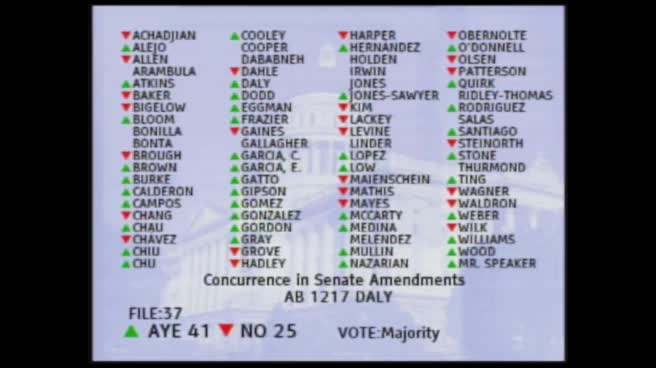 2MIN
Assembly Floor
 2MIN
Senate Floor
 8MIN




