AB 375: School employees: sick leave: paternity and maternity leave.
- Session Year: 2015-2016
- House: Assembly
- Latest Version Date: 2015-10-01
Under existing law, when a certificated school employee exhausts all available sick leave, as specified, and continues to be absent from his or her duties on account of illness or accident for an additional period of up to 5 school months, the employee during that additional period receives the difference between his or her salary and the sum that is actually paid a substitute employee employed to fill his or her position during his or her absence or, if no substitute employee was employed, the amount that would have been paid to the substitute had he or she been employed.
This bill would additionally provide the differential pay benefit described above for up to 12 weeks if the certificated school employee is absent on account of maternity or paternity leave, as defined, as specified. The bill would provide that the 12-week period shall be reduced by any period of sick leave, including accumulated sick leave, during a period of maternity or paternity leave. The bill would prohibit a certificated school employee on maternity or paternity leave pursuant to the Moore-Brown-Roberti Family Rights Act from being denied access to differential pay while on that leave. The bill would provide that, to the extent these provisions conflict with any provision of a collective bargaining agreement entered into before January 1, 2016, by a public school employer and an exclusive bargaining representative, these provisions shall not apply until the expiration or renewal of that collective bargaining agreement.
Under existing law, when a certificated school employee exhausts all available sick leave, as specified, and continues to be absent from his or her duties on account of illness or accident for an additional period of up to 5 school months, the employee during those 5 months that additional period receives the difference between his or her salary and the sum that is actually paid a substitute employee employed to fill his or her position during his or her absence or, if no substitute employee was employed, the amount that would have been paid to the substitute had he or she been employed.
This bill would instead additionally provide the differential pay benefit described above for up to 12 weeks if the certificated school employee is absent on account of illness, accident, paternity leave, or maternity or paternity leave, as defined, as specified. The bill would provide that the 12-week period be reduced by any period of sick leave, including accumulated sick leave, during a period of maternity or paternity leave. The bill would prohibit a certificated school employee on maternity or paternity leave pursuant to the Moore-Brown-Roberti Family Rights Act from being denied access to differential pay while on that leave. The bill would provide that, to the extent these changes provisions conflict with any provision of a collective bargaining agreement entered into before January 1, 2016, by a public school employer and an exclusive bargaining representative, the changes these provisions shall not apply until the expiration or renewal of that collective bargaining agreement.
Under existing law, when a certificated school employee exhausts all available sick leave, as specified, and continues to be absent from his or her duties on account of illness or accident for an additional period of 5 school months, the employee during those 5 months receives the difference between his or her salary and the sum that is actually paid a substitute employee employed to fill his or her position during his or her absence or, if no substitute employee was employed, the amount that would have been paid to the substitute had he or she been employed.
This bill would instead provide the differential pay benefit described above if the certificated school employee is absent on account of illness, accident, paternity leave, or maternity leave, as specified. The bill would prohibit a certificated school employee on maternity or paternity leave pursuant to the Moore-Brown-Roberti Family Rights Act from being denied access to differential pay while on that leave. The bill would provide that, to the extent these changes conflict with any provision of a collective bargaining agreement entered into before January 1, 2016, by a public school employer and an exclusive bargaining representative, the changes shall not apply until the expiration or renewal of that collective bargaining agreement.
Under existing law, when a certificated school employee exhausts all available sick leave, as specified, and continues to be absent from his or her duties on account of illness or accident for an additional period of 5 school months, the employee during those 5 months receives the difference between his or her salary and the sum that is actually paid a substitute employee employed to fill his or her position during his or her absence or, if no substitute employee was employed, the amount that would have been paid to the substitute had he or she been employed.
This bill would instead provide the differential pay benefit described above if the certificated school employee is absent on account of illness, accident, or maternity leave, as specified.
(a)During each school year, when a person employed in a position requiring certification qualifications has exhausted all available sick leave, including all accumulated sick leave, and continues to be absent from his or her duties on account of maternity or paternity leave pursuant to Section 12945.2 of the Government Code for a period of up to 12 school weeks, whether or not the absence arises out of or in the course of the employment of the employee, the amount deducted from the salary due him or her for any of the additional 12 weeks in which the absence occurs shall not exceed the sum that is actually paid a substitute employee employed to fill his or her position during his or her absence or, if no substitute employee was employed, the amount that would have been paid to the substitute had he or she been employed. The school district shall make every reasonable effort to secure the services of a substitute employee.
(b)For purposes of subdivision (a):
(1)The 12-week period shall be reduced by any period of sick leave, including accumulated sick leave, taken during a period of maternity or paternity leave pursuant Section 12945.2 of the Government Code.
(2)An employee shall not be provided more than one 12-week period per maternity or paternity leave. However, if a school year terminates before the 12-week period is exhausted, the employee may take the balance of the 12-week period in the subsequent school year.
(3)An employee on maternity or paternity leave pursuant to Section 12945.2 of the Government Code shall not be denied access to differential pay while on that leave.
(c)This section shall be applicable whether or not the absence from duty is by reason of a leave of absence granted by the governing board of the employing school district.
(d)To the extent that this section conflicts with a provision of a collective bargaining agreement entered into by a public school employer and an exclusive bargaining representative before January 1, 2016, pursuant to Chapter 10.7 (commencing with Section 3540) of Division 4 of Title 1 of the Government Code, this section shall not apply until expiration or renewal of that collective bargaining agreement.
(e)For purposes of this section, maternity or paternity leave means leave for reason of the birth of a child of the employee, or the placement of a child with an employee in connection with the adoption or foster care of the child by the employee.
SECTION 1.Section 44977 of the Education Code is amended to read:44977.(a)During each school year, when a person employed in a position requiring certification qualifications has exhausted all available sick leave, including all accumulated sick leave, and continues to be absent from his or her duties on account of illness, accident, paternity leave, or maternity leave for an additional period of five school months, whether or not the absence arises out of or in the course of the employment of the employee, the amount deducted from the salary due him or her for any of the additional five months in which the absence occurs shall not exceed the sum that is actually paid a substitute employee employed to fill his or her position during his or her absence or, if no substitute employee was employed, the amount that would have been paid to the substitute had he or she been employed. The school district shall make every reasonable effort to secure the services of a substitute employee.
(b)For purposes of subdivision (a):
(1)The sick leave, including accumulated sick leave, and the five-month period shall run consecutively.
(2)An employee shall not be provided more than one five-month period per illness, accident, paternity leave, or maternity leave. However, if a school year terminates before the five-month period is exhausted, the employee may take the balance of the five-month period in a subsequent school year.
(3)An employee on maternity or paternity leave pursuant to Section 12945.2 of the Government Code shall not be denied access to differential pay while on that leave.
(c)The governing board of every school district shall adopt a salary schedule for substitute employees. The salary schedule shall indicate a salary for a substitute for all categories or classes of certificated employees of the school district.
(d)Excepting in a school district the governing board of which has adopted a salary schedule for substitute employees of the school district, the amount paid the substitute employee during any month shall be less than the salary due the employee absent from his or her duties.
(e)When a person employed in a position requiring certification qualifications is absent from his or her duties on account of illness for a period of more than five school months, or when a person is absent from his or her duties for a cause other than illness, the amount deducted from the salary due him or her for the month in which the absence occurs shall be determined according to the rules and regulations established by the governing board of the school district. The rules and regulations shall not conflict with rules and regulations of the state board.
(f)This section shall not be construed as to deprive a school district, city, or city and county of the right to make any reasonable rule for the regulation of accident or sick leave or cumulative accident or sick leave without loss of salary for persons acquiring certification qualifications.
(g)This section shall be applicable whether or not the absence from duty is by reason of a leave of absence granted by the governing board of the employing school district.
(h)To the extent that the changes made to this section by Assembly Bill 375 of the 201516 Regular Session conflicts with a provision of a collective bargaining agreement entered into by a public school employer and an exclusive bargaining representative before January 1, 2016, pursuant to Chapter 10.7 (commencing with Section 3540) of Division 4 of Title 1 of the Government Code, the changes made to this section by Assembly Bill 375 of the 201516 Regular Session shall not apply until expiration or renewal of that collective bargaining agreement.
(a)During each school year, when a person employed in a position requiring certification qualifications has exhausted all available sick leave, including all accumulated sick leave, and continues to be absent from his or her duties on account of illness, accident, paternity leave, or maternity leave for an additional period of five school months, whether or not the absence arises out of or in the course of the employment of the employee, the amount deducted from the salary due him or her for any of the additional five months in which the absence occurs shall not exceed the sum that is actually paid a substitute employee employed to fill his or her position during his or her absence or, if no substitute employee was employed, the amount that would have been paid to the substitute had he or she been employed. The school district shall make every reasonable effort to secure the services of a substitute employee.
(b)For purposes of subdivision (a):
(1)The sick leave, including accumulated sick leave, and the five-month period shall run consecutively.
(2)An employee shall not be provided more than one five-month period per illness, accident, paternity leave, or maternity leave. However, if a school year terminates before the five-month period is exhausted, the employee may take the balance of the five-month period in a subsequent school year.
(3)An employee on maternity or paternity leave pursuant to Section 12945.2 of the Government Code shall not be denied access to differential pay while on that leave.
(c)The governing board of every school district shall adopt a salary schedule for substitute employees. The salary schedule shall indicate a salary for a substitute for all categories or classes of certificated employees of the school district.
(d)Excepting in a school district the governing board of which has adopted a salary schedule for substitute employees of the school district, the amount paid the substitute employee during any month shall be less than the salary due the employee absent from his or her duties.
(e)When a person employed in a position requiring certification qualifications is absent from his or her duties on account of illness for a period of more than five school months, or when a person is absent from his or her duties for a cause other than illness, the amount deducted from the salary due him or her for the month in which the absence occurs shall be determined according to the rules and regulations established by the governing board of the school district. The rules and regulations shall not conflict with rules and regulations of the state board.. board.
(f)This section shall not be construed as to deprive a school district, city, or city and county of the right to make any reasonable rule for the regulation of accident or sick leave or cumulative accident or sick leave without loss of salary for persons acquiring certification qualifications.
(g)This section shall be applicable whether or not the absence from duty is by reason of a leave of absence granted by the governing board of the employing school district.
(h)To the extent that the changes made to this section by Assembly Bill 375 of the 201516 Regular Session conflicts with a provision of a collective bargaining agreement entered into by a public school employer and an exclusive bargaining representative before January 1, 2016, pursuant to Chapter 10.7 (commencing with Section 3540) of Division 4 of Title 1 of the Government Code, the changes made to this section by Assembly Bill 375 of the 201516 Regular Session shall not apply until expiration or renewal of that collective bargaining agreement.
(a)During each school year, when a person employed in a position requiring certification qualifications has exhausted all available sick leave, including all accumulated sick leave, and continues to be absent from his or her duties on account of illness or accident illness, accident, or maternity leave for an additional period of five school months, whether or not the absence arises out of or in the course of the employment of the employee, the amount deducted from the salary due him or her for any of the additional five months in which the absence occurs shall not exceed the sum that is actually paid a substitute employee employed to fill his or her position during his or her absence or, if no substitute employee was employed, the amount that would have been paid to the substitute had he or she been employed. The school district shall make every reasonable effort to secure the services of a substitute employee.
(b)For purposes of subdivision (a):
(1)The sick leave, including accumulated sick leave, and the five-month period shall run consecutively.
(2)An employee shall not be provided more than one five-month period per illness or accident. illness, accident, or maternity leave. However, if a school year terminates before the five-month period is exhausted, the employee may take the balance of the five-month period in a subsequent school year.
(c)The governing board of every school district shall adopt a salary schedule for substitute employees. The salary schedule shall indicate a salary for a substitute for all categories or classes of certificated employees of the school district.
(d)Excepting in a school district the governing board of which has adopted a salary schedule for substitute employees of the school district, the amount paid the substitute employee during any month shall be less than the salary due the employee absent from his or her duties.
(e)When a person employed in a position requiring certification qualifications is absent from his or her duties on account of illness for a period of more than five school months, or when a person is absent from his or her duties for a cause other than illness, the amount deducted from the salary due him or her for the month in which the absence occurs shall be determined according to the rules and regulations established by the governing board of the school district. The rules and regulations shall not conflict with rules and regulations of the State Board of Education state board..
(f)Nothing in this This section shall not be construed so as to deprive any a school district, city, or city and county of the right to make any reasonable rule for the regulation of accident or sick leave or cumulative accident or sick leave without loss of salary for persons acquiring certification qualifications.
(g)This section shall be applicable whether or not the absence from duty is by reason of a leave of absence granted by the governing board of the employing school district.
|
Date
|
Status
|
|---|---|
| Oct 1, 2015 | Chaptered by Secretary of State - Chapter 400, Statutes of 2015. |
| Oct 1, 2015 | Approved by the Governor. |
| Sep 17, 2015 | Enrolled and presented to the Governor at 11:30 a.m. |
| Sep 8, 2015 | Senate amendments concurred in. To Engrossing and Enrolling. (Ayes 55. Noes 24. Page 2942.). |
| Sep 8, 2015 | Senate amendments concurred in. To Engrossing and Enrolling. (Ayes 55. Noes 24.). |
| Sep 8, 2015 | Senate amendments concurred in. To Engrossing and Enrolling. |
| Sep 3, 2015 | Read third time. Passed. Ordered to the Assembly. (Ayes 28. Noes 12. Page 2456.). |
| Sep 3, 2015 | In Assembly. Concurrence in Senate amendments pending. May be considered on or after September 5 pursuant to Assembly Rule 77. |
| Sep 3, 2015 | Read third time. Passed. Ordered to the Assembly. |
| Aug 31, 2015 | Read second time. Ordered to third reading. |
| Aug 27, 2015 | From committee: Do pass. (Ayes 5. Noes 2.) (August 27). |
| Aug 17, 2015 | In committee: Referred to APPR. suspense file. |
| Jul 8, 2015 | In committee: Hearing postponed by committee. |
| Jul 8, 2015 | From committee chair, with author's amendments: Amend, and re-refer to committee. Read second time, amended, and re-referred to Com. on APPR. |
| Jul 6, 2015 | In committee: Set, first hearing. Hearing canceled at the request of author. |
| Jun 24, 2015 | From committee: Do pass and re-refer to Com. on APPR. (Ayes 8. Noes 1.) (June 24). Re-referred to Com. on APPR. |
| Jun 11, 2015 | Referred to Coms. on ED. and APPR. |
| Jun 1, 2015 | In Senate. Read first time. To Com. on RLS. for assignment. |
| Jun 1, 2015 | Read third time. Passed. Ordered to the Senate. (Ayes 58. Noes 22. Page 1688.) |
| Jun 1, 2015 | Read third time. Passed. Ordered to the Senate. |
| May 28, 2015 | Read second time. Ordered to third reading. |
| May 27, 2015 | From committee: Do pass. (Ayes 12. Noes 4.) (May 27). |
| May 14, 2015 | From committee: Do pass and re-refer to Com. on APPR. (Ayes 6. Noes 0.) (May 13). Re-referred to Com. on APPR. |
| May 5, 2015 | Re-referred to Com. on ED. |
| May 4, 2015 | From committee chair, with author's amendments: Amend, and re-refer to Com. on ED. Read second time and amended. |
| Mar 5, 2015 | Referred to Com. on ED. |
| Feb 19, 2015 | From printer. May be heard in committee March 21. |
| Feb 18, 2015 | Read first time. To print. |
|
Date
|
Description
|
Location
|
Votes
|
|
|---|---|---|---|---|
| Sep 8, 2015 | AB 375 CAMPOS Concurrence in Senate Amendments | Assembly Floor |
Passed |
|
| Sep 3, 2015 | Assembly 3rd Reading AB375 Campos By Leyva | Senate Floor |
Passed |
|
| Aug 27, 2015 | Do pass | Senate Standing Committee on Appropriations |
Passed |
|
| Aug 17, 2015 | Placed on suspense file | Senate Standing Committee on Appropriations |
Passed |
|
| Jun 24, 2015 | Do pass, but first be re-referred to the Committee on [Appropriations] | Senate Standing Committee on Education |
Passed |
|
| Jun 1, 2015 | AB 375 CAMPOS Assembly Third Reading | Assembly Floor |
Passed |
|
| May 27, 2015 | Do pass. | Assembly Standing Committee on Appropriations |
Passed |
|
| May 13, 2015 | Do pass and be re-referred to the Committee on [Appropriations] | Assembly Standing Committee on Education |
Passed |
This list shows positions taken on this bill by organizations on the date displayed, which is linked to the original source.
Positions by individuals are not included.
AB 375
Page 2
CONCURRENCE IN SENATE AMENDMENTS
AB 375
(Campos)
As Amended July 8, 2015
Majority vote
ASSEMBLY: |
58-22 |
(June 1, 2015) |
SENATE: |
28-12 |
(September 3, 2015) |
Original Committee Reference: ED.
SUMMARY: Requires certificated school employees on maternity or paternity leave to receive differential pay. Specifically, this bill:
Specifies during each school year, when a person employed in a position requiring certification qualifications has exhausted all available sick leave, including all accumulated sick leave, and continues to be absent from his or her duties on account of maternity or paternity leave for a period of up to 12 school weeks, whether or not the absence arises out of or in the course of the employment of the employee, the amount deducted from the salary due him or her for any of the additional 12 weeks in which the absence occurs shall not exceed the sum that is actually paid a substitute employee employed to fill his or her position during his or her absence or, if no substitute employee was employed, the amount that would have been paid to the substitute had he or she been employed. The school district shall make every reasonable effort to secure the services of a substitute employee.
Specifies the 12-week period shall be reduced by any period of sick leave, including accumulated sick leave, taken during a period of maternity or paternity leave.
Specifies an employee shall not be provided more than one 12-week period per maternity or paternity leave. However, if a school year terminates before the 12-week period is exhausted, the employee may take the balance of the 12-week period in the subsequent school year.
Specifies an employee on maternity or paternity leave shall not be denied access to differential pay while on that leave.
Specifies to the extent that this measure conflicts with a provision of a collective bargaining agreement entered into by a public school employer and an exclusive bargaining representative before January 1, 2016, this measure shall not apply until expiration or renewal of that collective bargaining agreement.
Defines "maternity or paternity leave" as leave for reason of the birth of a child of the employee, or the placement of a child with an employee in connection with the adoption or foster care of the child by the employee.
The Senate amendments clarify that employees are eligible for differential pay during the 12 week period of maternity or paternity leave.
FISCAL EFFECT: According to the Senate Appropriations Committee, potential expansion of the existing Differential Pay and Reemployment mandate for one-time activities to modify current processes to include differential pay for maternity and paternity protected leave which could drive costs in the tens of thousands statewide. To the extent this bill imposes a mandate this could create pressure to increase the K-12 mandate block grant.
COMMENTS: The Moore-Brown-Roberti Family Rights Act (CFRA) is the state-law equivalent of the federal Family and Medical Leave Act (FMLA). Both acts provide for up to 12 weeks of unpaid family and medical leave for public and private employees. This bill requires school employers to pay differential pay for certificated employees who take the 12 week FMLA maternity or paternity leave. Differential pay is calculated by subtracting the cost of a substitute employee from the certificated employee's salary. As an example, if the certificated employee made $50,000 and the substitute cost $35,000, then the certificated employee would be paid the difference of $15,000 during maternity or paternity leave, after exhausting all accrued sick time.
According to the author, currently, certificated school employees can only take up to six or eight weeks of paid leave when they have a baby. Six or eight weeks is insufficient time for a new parent to care for and bon with their child. If a certificated employee wants to take off more time to spend with their newborn, then they must take unpaid leave.
Disability Leave and FMLA: Typically, mothers are on pregnancy disability leave during the first six to eight weeks, or longer, after a baby's birth. During this time, certificated employees use their sick leave and when their sick leave is exhausted, they receive differential pay for the remaining time. Once the six to eight week disability leave period is over and the employee's doctor deems the employee able to return to work, then the employee starts the 12 week leave period under FMLA. During this time, the certificated employee may be able to use accrued sick leave, but once that time is exhausted, the certificated employee is unpaid for the remaining weeks. This bill would extend the differential pay through the 12 week leave period under FMLA for both mothers and fathers.
Arguments in Support: The California Teachers Association supports the bill and states, "Maternity leave is essential, not only for a mother's full recovery from childbirth, but also to facilitate a stronger mother-child bond. A child's ability to succeed in school and in life is impacted by the strength of the relationship with the primary caretaker. This relationship impacts a child's future mental, physical, social, and emotional health. Additionally, this relationship is founded on the nonverbal emotional communication between child and parent known as the attachment bond, which occurs naturally as a baby's needs are cared for. A secure attachment bond ensures that a child will feel secure, understood, and safe; this results in eagerness to learn, healthy self-awareness, trust, and empathy. Overall, paid family leave helps keep people in the workforce after they have children. When more workers are able to take leave, they're more likely to choose to remain in the labor market, and paid parental leave is associated with higher employment in economies around the world. With today's modern and creative family structures, paternity leave after the birth of a child means both caregivers will more involved in a child's direct care nine months later – changing diapers, feeding, bathing – than a parent who doesn't take leave. Also, paternity leave results in more competent and committed parents later in their children's lives, shared responsibilities with long term societal benefits."
There is no opposition on file.
Analysis Prepared by: Chelsea Kelley / ED. / (916) 319-2087 FN: 0001876
AB 375
Page 6
|
Office of Senate Floor Analyses (916) 651-1520 Fax: (916) 327-4478 |
THIRD READING
Bill No: AB 375
Amended: 7/8/15 in Senate
SENATE EDUCATION COMMITTEE: 8-1, 6/24/15
AYES: Liu, Block, Hancock, Leyva, Mendoza, Monning, Pan, Vidak
NOES: Runner
SENATE APPROPRIATIONS COMMITTEE: 5-2, 8/27/15
AYES: Lara, Beall, Hill, Leyva, Mendoza
NOES: Bates, Nielsen
ASSEMBLY FLOOR: 58-22, 6/1/15 - See last page for vote
SUBJECT: School employees: sick leave: paternity and maternity leave
DIGEST: This bill requires certificated school employees on maternity or paternity leave to receive differential pay for up to 12 weeks of unpaid family and medical leave.
Existing law:
Specifies during each school year, when a person employed in a position requiring certification qualifications has exhausted all available sick leave, including all accumulated sick leave, and continues to be absent from his or her duties on account of illness or accident for an additional period of five school months, whether or not the absence arises out of or in the course of the employment of the employee, the amount deducted from the salary due to him or her for any of the additional five months, in which the absence occurs shall not exceed the sum that is actually paid a substitute employee employed to fill his or her position during his or her absence or, if no substitute employee was employed, the amount that would have been paid to the substitute had he or she been employed. The school district shall make every reasonable effort to secure the services of a substitute employee. Specifies the following:
The sick leave, including accumulated sick leave, and the five-month period shall run consecutively.
An employee shall not be provided more than one five-month period per illness or accident. However, if a school year terminates before the five-month period is exhausted, the employee may take the balance of the five-month period in a subsequent school year. (Education Code § 44977)
Specifies that Section 44977 shall not apply to any school district which adopts and maintains in effect a rule which provides that when a person employed in a position requiring certification qualifications is absent from his duties on account of illness or accident for a period of five school months or less whether or not the absence arises out of or in the course of the employment of the employee, he shall receive 50 percent or more of his regular salary during the period of such absence and nothing in Section 44977 shall be construed as preventing the governing board of any district from adopting any such rule. When a person employed in a position requiring certification qualifications is absent from his duties on account of illness for a period of more than five school months, or when a person is absent from his duties for a cause other than illness, the amount deducted from the salary due him for the month in which the absence occurs shall be determined according to the rules and regulations established by the governing board of the district. Such rules and regulations shall not conflict with rules and regulations of the State Board of Education. Nothing shall be construed so as to deprive any district, city, or city and county of the right to make any reasonable rule for the regulation of accident or sick leave or cumulative accident or sick leave without loss of salary for persons requiring certification qualifications. This shall be applicable whether or not the absence from duty is by reason of a leave of absence granted by the governing board of the employing district. (Education Code § 44983)
This bill:
Provides that, during each school year, when a person employed in a position requiring certification qualifications has exhausted all available sick leave, including all accumulated sick leave, and continues to be absent from his or her duties on maternity leave or paternity leave for a period of up to twelve school weeks, whether or not the absence arises out of or in the course of the employment of the employee, the amount deducted from the salary due him or her for any of the twelve weeks in which the absence occurs shall not exceed the sum that is actually paid a substitute employee employed to fill his or her position during his or her absence or, if no substitute employee was employed, the amount that would have been paid to the substitute had he or she been employed. The school district shall make every reasonable effort to secure the services of a substitute employee.
Specifies that the 12-week period shall be reduced by any period of sick leave, including accumulated sick leave, taken during a period of maternity or paternity leave, as specified.
Specifies that an employee shall not be provided more than one 12-week period per maternity leave or paternity leave. However, if a school year terminates before the five-month period is exhausted, the employee may take the balance of the 12-week period in a subsequent school year.
Provides that an employee on maternity or paternity leave pursuant to Section 12945.2 of the Government Code shall not be denied access to differential pay while on that leave.
Provides that these provisions shall be applicable whether or not the absence from duty is by reason of a leave of absence granted by the governing board of the employing district.
To the extent that the changes made by this bill conflict with a provision of a collective bargaining agreement entered into by a public school employer and an exclusive bargaining representative before January 1, 2016, this bill shall not apply until expiration or renewal of that collective bargaining agreement.
Provides that for purposes of this section, maternity or paternity leave means leave for reason of the birth of a child of the employee, or the placement of a child with an employee in connection with the adoption or foster care of the child by the employee.
Comments
Need for the bill. According to the author’s office, “Forcing teachers and other certificated employees to take entirely unpaid leave after only six or eight weeks of maternity leave, or none in the case of a new father, can lead to several issues for the employee, the school district, and society. Less parental leave has been positively correlated with lower cognitive test scores and higher rates of behavioral problems. A lack of proper postpartum support in the form of reasonable parental leave tends to lead to a delay in childhood immunizations, a decrease in the duration and likelihood of breastfeeding, increased financial hardship, and a higher chance of postpartum depression.” The author’s office indicates that six or eight weeks is insufficient time for a new parent to care for and bond with their child. If a certificated employee wants to take off more time to spend with their newborn, then they must take unpaid leave.
Protected leave. The federal Family Medical Leave Act (FMLA) and the California Family Rights Act (CFRA) provide certain employees up to 12 weeks of unpaid, job-protected leave a year for the purpose of bonding with a child, care for a parent, spouse, or child with a serious health condition, or due to an employee’s own serious health condition, and requires group health benefits to be maintained during the leave as if employees continued to work instead of taking leave. But there is no pay associated with the FMLA and CFRA, other than what the employee has earned in other accrued leaves that may apply. The FMLA and CFRA are only employment protected leaves.
Paid Family Leave (PFL). The PFL program extends disability compensation to individuals (male or female) who take time off work to care for a seriously ill child, spouse, parent, domestic partner, or to bond with a new child, or a child in connection with adoption or foster care placement. The PFL program is a component of the State Disability Insurance (SDI) program and workers covered by the SDI program are also covered for this benefit. The maximum benefit is six times the weekly benefit amount, with no more than six weeks of PFL benefits paid within any 12-month period. Employees may only be eligible for the PFL program if they are covered by the SDI program through a negotiated agreement with the State of California. If an employee does not pay into the SDI program, he or she would not be eligible to receive disability compensation under PFL. In this scenario and assuming the employee is on leave for bonding time, the employee would need to use vacation time, sick leave, or personal necessity to receive compensation or elect to take leave without pay.
Differential pay. Existing law authorizes that during the time a certificated employee is on pregnancy disability leave after the birth of a child, the employee may use sick leave and after this is exhausted, can receive differential pay for the remaining time. Once the disability leave period of six to eight weeks is over, then the employee may start the 12-week leave period under FMLA. During this time, the certificated employee may be able to use accrued sick leave, but once that time is exhausted, the certificated employee is unpaid for the remaining weeks.
This bill requires school employers to pay differential pay for certificated employees who take the 12-week FMLA maternity or paternity leave. Differential pay is calculated by subtracting the cost of a substitute employee from the certificated employee's salary, e.g., if the certificated employee makes $50,000 and the substitute cost is $35,000, then the employee would be paid the difference of $15,000 during maternity or paternity leave, after exhausting all accrued sick time.
Paid parental leave in other countries. A 2010 study by the International Labor Organization of the United Nations found that out of 167 countries studied, only four did not provide paid maternity leave for women—Lesotho, Papua New Guinea, Swaziland, and the United States. While these four countries did provide some form of maternity leave, there was no requirement that it be paid leave. As previously mentioned in the analysis, the FMLA provides for up to three months of unpaid maternity and/or paternity leave.
FISCAL EFFECT: Appropriation: No Fiscal Com.: No Local: No
According to the Senate Appropriations Committee, this bill could result in the potential expansion of the existing Differential Pay and Reemployment mandate for one-time activities to modify current processes to include differential pay for maternity and paternity protected leave which could drive costs in the tens of thousands statewide. To the extent this bill imposes a mandate, this could create pressure to increase the K-12 mandate block grant.
American Federation of State, County and Municipal Employees
California Democrats for Education Reform
California Federation of Teachers
California Teachers Association
Future is Now
Luther Burbank Education Association
San Jose Teachers Association
South Bay Labor Council
South Bay Pride at Work
United Teachers of Santa Clara
OPPOSITION: (Verified 8/27/15)
Association of California School Administrators
California School Boards Association
ASSEMBLY FLOOR: 58-22, 6/1/15
AYES: Alejo, Bloom, Bonilla, Bonta, Brown, Burke, Calderon, Campos, Chau, Chávez, Chiu, Chu, Cooley, Cooper, Dababneh, Daly, Dodd, Eggman, Frazier, Cristina Garcia, Eduardo Garcia, Gatto, Gipson, Gomez, Gonzalez, Gordon, Gray, Roger Hernández, Holden, Irwin, Jones-Sawyer, Lackey, Levine, Linder, Lopez, Low, Mathis, McCarty, Medina, Mullin, Nazarian, O'Donnell, Olsen, Perea, Quirk, Rendon, Ridley-Thomas, Rodriguez, Salas, Santiago, Mark Stone, Thurmond, Ting, Weber, Wilk, Williams, Wood, Atkins
NOES: Achadjian, Travis Allen, Baker, Bigelow, Brough, Chang, Dahle, Beth Gaines, Gallagher, Grove, Hadley, Harper, Jones, Kim, Maienschein, Mayes, Melendez, Obernolte, Patterson, Steinorth, Wagner, Waldron
Prepared by: Lenin Del Castillo / ED. / (916) 651-4105
8/31/15 8:54:56
**** END ****
AB 375 (Campos) Page 3 of 3
SENATE COMMITTEE ON APPROPRIATIONS
Senator Ricardo Lara, Chair
2015 - 2016 Regular Session
AB 375 (Campos) - School employees: sick leave: paternity and maternity leave.
|
|
Version: July 8, 2015 |
Policy Vote: ED. 8 - 1 |
Urgency: No |
Mandate: No |
Hearing Date: August 17, 2015 |
Consultant: Jillian Kissee |
This bill meets the criteria for referral to the Suspense File.
Bill Summary:
This bill expands the instances in which differential pay is provided for purposes of maternity and paternity leave to include the 12 workweek protected leave.
Fiscal Impact:
Potential expansion of the existing Differential Pay and Reemployment mandate for one-time activities to modify current processes to include differential pay for maternity and paternity protected leave which could drive costs in the tens of thousands statewide. To the extent this bill imposes a mandate this could create pressure to increase the K-12 mandate block grant. (Proposition 98)
Background:
Differential
Pay
Existing law provides differential pay to certificated employees for illness or accident. It specifies that when a person employed in a position requiring certification qualifications has exhausted all available sick leave, and continues to be absent from their duties due to illness or accident for an additional period of five school months, the amount deducted from the employee’s salary for any of the additional five months, must not exceed the sum that is actually paid a substitute employed to cover for the absence. Existing law specifies the following:
Sick leave, including accumulated sick leave, and the five-month period shall run consecutively.
An employee shall not be provided more than one five-month period per illness or accident. (Education Code § 44977)
Existing
law also requires that any employee has the right to use sick leave
and to obtain differential pay for absences necessitated by
pregnancy, miscarriage, childbirth, and recovery. (Education
Code § 44978)
Pregnancy Disability Leave
Existing law provides that it is unlawful to refuse to allow a female employee disabled by pregnancy, childbirth, or a related medical condition to take leave not to exceed four months. The employee is entitled to use vacation leave during this time. Once the vacation time is exhausted, the employee can receive differential pay for the remaining time, for up to five months. (Government Code § 12945 and Education Code § 44977)
Protected Leave
Existing law also prohibits, except under certain circumstances, the refusal to grant a request by any employee with a certain amount of service to take up to a total of 12 workweeks in a 12 month period for family care and medical leave. The employer is required to provide the employee a guarantee of employment in the same or comparable position upon the termination of the leave. The law specifies that this protected leave is separate and distinct from the pregnancy disability leave. Once an employee is cleared to return to work by a physician, the employee may take this protected leave. (Government Code § 12945.2)
The federal Family Medical Leave Act (FMLA) and the California Family Rights Act (CFRA) provides this unpaid, job-protected leave for the purpose of bonding with a child, caring for a parent, spouse, or child with a serious health condition, or due to an employee’s own serious health condition, and requires group health benefits to be maintained during the leave as if employees continued to work instead of taking leave. But there is no pay associated with the FMLA and CFRA, other than the employee’s accrued vacation or other accrued time off that may apply. Once that time is exhausted, the certificated employee is unpaid for the remaining weeks. The FMLA and CFRA are only employment protected leaves.
Certificated Employees
Certificated employees belong to the California Teachers Association (CTA) and include, teachers, speech therapists, school psychologists, nurses, and similar classifications. Administrators are certificated employees who are not teachers or student services personnel. Administrators include principals, assistant principals, program directors or coordinators, and other certificated staff members who are not providing direct services to students.
Proposed Law:
This bill expands the instances in which differential pay is provided
for purposes of maternity and paternity leave to include the 12
workweek protected leave.
Specifically, this bill provides
that when a certificated employee has exhausted all available sick
leave and continues to be absent from their duties due to maternity
and paternity leave pursuant to the CFRA, for a period of up to 12
school weeks, the amount deducted from the employee’s salary for
any of the additional 12 weeks, must not exceed the sum that is paid
a substitute employee to fill in for the absence.
The bill also provides that:
The 12 week period is offset by the use of any period of sick leave during this time.
Not more than one 12 week period per maternity or paternity leave is to be provided.
Employees on maternity or paternity protected leave must not be denied access to differential pay.
Finally, this bill provides that if its provisions conflict with a provision of a collective bargaining agreement entered into before January 1, 2016, they do not apply until expiration or renewal of that collective bargaining agreement.
Related Legislation:
AB 1562 (Gomez, 2014) would have amended existing law governing unpaid family and medical leave with respect to public or private school employees, as specified. This bill failed passage in this committee.
Staff Comments:
This bill expands the provision of differential pay to include those on both maternity and paternity protected leave who are currently ineligible for this benefit under existing law. The extent to which certificated employees will access this new benefit is unknown. Currently, after the employee’s sick leave is depleted, any remaining time that the employee is absent during protected leave would be unpaid. The expanded differential pay requirement will likely provide employees on maternity and paternity leave an incentive to be absent longer than they otherwise would have been if they were not paid during this time. However, the strength of this incentive will depend on the how long the employee can go without earning his or her full salary.
In 2003, the Commission on State Mandates (Commission) approved a mandate related to differential pay and reemployment lists for employees on differential leave pay. A test claim was submitted in response to a statute enacted in 1998 that required when calculating differential pay, sick leave, including accumulated sick leave, and the five-month period of differential pay shall run consecutively. Prior to this statute, there was an interpretation that accumulated sick leave ran concurrently with the five months entitlement to differential pay. This law likely increased costs to school districts as they were no longer allowed to offset the five months differential pay with any accumulated sick leave the employee might have. However, the Commission ruled that this change in calculation, while it may increase costs to school districts in some instances, it does not require an associated increased level of service to the public. Therefore, reimbursement of salaries related to providing differential pay was not approved.
The Commission did, however, determine administrative activities related to the change in calculating differential pay to be reimbursable. Therefore, it could be assumed that the cost of similar activities could also be claimed as a result of this bill, such as one-time workload to modify existing processes to conform to the new law. If half of the state’s school districts spent 2 hours at a rate of $60 per hour, including benefits, on this work, the state could be liable for reimbursement costs in about the tens of thousands.
If enacted, school districts may experience significant costs pressures related to providing a benefit that was not previously required. They will not realize the savings attributed to unpaid maternity and paternity protected leave that they currently experience. Costs will ultimately be dependent upon the amount of sick leave taken by applicable employees and how long they remain absent and obtain differential pay. However, employer costs based on the differential pay program should not exceed what is normally paid to a school employee who would otherwise be working.
-- END --
AB 375 (Campos) Page 5 of 5
SENATE COMMITTEE ON EDUCATION
Senator Carol Liu, Chair
2015 - 2016 Regular
Bill No: AB 375
Author: |
Campos |
||
Version: |
May 4, 2015 Hearing Date: June 24, 2015 |
||
Urgency: |
No |
Fiscal: |
No |
Consultant: |
Lenin Del Castillo |
||
Subject: School employees: sick leave: paternity and maternity leave
Note: This bill has been referred to the Committees on Education and Appropriations. A "do pass" motion should include referral to the Committee on Appropriations.
SUMMARY
This bill requires certificated school employees on maternity or paternity leave to receive differential pay for up to 12 weeks of unpaid family and medical leave.
BACKGROUND
Existing law:
Specifies during each school year, when a person employed in a position requiring certification qualifications has exhausted all available sick leave, including all accumulated sick leave, and continues to be absent from his or her duties on account of illness or accident for an additional period of five school months, whether or not the absence arises out of or in the course of the employment of the employee, the amount deducted from the salary due to him or her for any of the additional five months, in which the absence occurs shall not exceed the sum that is actually paid a substitute employee employed to fill his or her position during his or her absence or, if no substitute employee was employed, the amount that would have been paid to the substitute had he or she been employed. The school district shall make every reasonable effort to secure the services of a substitute employee. Specifies the following:
The sick leave, including accumulated sick leave, and the five-month period shall run consecutively.
An employee shall not be provided more than one five-month period per illness or accident. However, if a school year terminates before the five-month period is exhausted, the employee may take the balance of the five-month period in a subsequent school year. (Education Code § 44977)
Specifies that Section 44977 shall not apply to any school district which adopts and maintains in effect a rule which provides that when a person employed in a position requiring certification qualifications is absent from his duties on account of illness or accident for a period of five school months or less whether or not the absence arises out of or in the course of the employment of the employee, he shall receive 50 percent or more of his regular salary during the period of such absence and nothing
in Section 44977 shall be construed as preventing the governing board of any district from adopting any such rule. When a person employed in a position requiring certification qualifications is absent from his duties on account of illness for a period of more than five school months, or when a person is absent from his duties for a cause other than illness, the amount deducted from the salary due him for the month in which the absence occurs shall be determined according to the rules and regulations established by the governing board of the district. Such rules and regulations shall not conflict with rules and regulations of the State Board of Education. Nothing shall be construed so as to deprive any district, city, or city and county of the right to make any reasonable rule for the regulation of accident or sick leave or cumulative accident or sick leave without loss of salary for persons requiring certification qualifications. This shall be applicable whether or not the absence from duty is by reason of a leave of absence granted by the governing board of the employing district. (Education Code § 44983)
ANALYSIS
This bill:
During each school year, when a person employed in a position requiring certification qualifications has exhausted all available sick leave, including all accumulated sick leave, and continues to be absent from his or her duties on account of illness, accident, maternity leave or paternity leave for an additional period of five school months, whether or not the absence arises out of or in the course of the employment of the employee, the amount deducted from the salary due him or her for any of the additional five months in which the absence occurs shall not exceed the sum that is actually paid a substitute employee employed to fill his or her position during his or her absence or, if no substitute employee was employed, the amount that would have been paid to the substitute had he or she been employed.
Specifies an employee shall not be provided more than one five-month period per illness, accident, maternity leave or paternity leave. However, if a school year terminates before the five-month period is exhausted, the employee may take the balance of the five-month period in a subsequent school year.
An employee on maternity or paternity leave pursuant to Section 12945.2 of the Government Code shall not be denied access to differential pay while on that leave.
To the extent that the changes made by this measure conflict with a provision of a collective bargaining agreement entered into by a public school employer and an exclusive bargaining representative before January 1, 2016, the changes made by this measure shall not apply until expiration or renewal of that collective bargaining agreement.
STAFF COMMENTS
Need for the bill. According to the author’s office, “Forcing teachers and other certificated employees to take entirely unpaid leave after only six or eight weeks of
maternity leave, or none in the case of a new father, can lead to several issues for the employee, the school district, and society. Less parental leave has been positively correlated with lower cognitive test scores and higher rates of behavioral problems. A lack of proper postpartum support in the form of reasonable parental leave tends to lead to a delay in childhood immunizations, a decrease in the duration and likelihood of breastfeeding, increased financial hardship, and a higher chance of postpartum depression.” The author’s office indicates that six or eight weeks is insufficient time for a new parent to care for and bond with their child. If a certificated employee wants to take off more time to spend with their newborn, then they must take unpaid leave.
Protected leave. The federal Family Medical Leave Act (FMLA) and the California Family Rights Act (CFRA) provide certain employees up to 12 weeks of unpaid, job-protected leave a year for the purpose of bonding with a child, care for a parent, spouse, or child with a serious health condition, or due to an employee’s own serious health condition, and requires group health benefits to be maintained during the leave as if employees continued to work instead of taking leave. But there is no pay associated with the FMLA and CFRA, other than what the employee has earned in other accrued leaves that may apply. The FMLA and CFRA are only employment protected leaves.
Paid Family Leave (PFL). The PFL program extends disability compensation to individuals (male or female) who take time off work to care for a seriously ill child, spouse, parent, domestic partner, or to bond with a new child, or a child in connection with adoption or foster care placement. The PFL program is a component of the State Disability Insurance (SDI) program and workers covered by the SDI program are also covered for this benefit. The maximum benefit is six times the weekly benefit amount, with no more than six weeks of PFL benefits paid within any 12-month period. Employees may only be eligible for the PFL program if they are covered by the SDI program through a negotiated agreement with the State of California. If an employee does not pay into the SDI program, he or she would not be eligible to receive disability compensation under PFL. In this scenario and assuming the employee is on leave for bonding time, the employee would need to use vacation time, sick leave, or personal necessity to receive compensation or elect to take leave without pay.
Differential pay. Existing law authorizes that during the time a certificated employee is on pregnancy disability leave after the birth of a child, the employee may use sick leave and after this is exhausted, can receive differential pay for the remaining time. Once the disability leave period of 6-8 weeks is over, then the employee may start the 12 week leave period under FMLA. During this time, the certificated employee may be able to use accrued sick leave, but once that time is exhausted, the certificated employee is unpaid for the remaining weeks.
This bill requires school employers to pay differential pay for certificated employees who take the 12 week FMLA maternity or paternity leave. Differential pay is calculated by subtracting the cost of a substitute employee from the certificated employee's salary, e.g., if the certificated employee makes $50,000 and the substitute cost is $35,000, then the employee would be paid the difference of $15,000 during maternity or paternity leave, after exhausting all accrued sick time.
Paid parental leave in other countries. A 2010 study by the International Labor Organization of the United Nations found that out of 167 countries studied, only four did not provide paid maternity leave for women—Lesotho, Papua New Guinea, Swaziland, and the United States. While these four countries did provide some form of maternity leave, there was no requirement that it be paid leave. As previously mentioned in the analysis, the federal Family Medical Leave Act provides for up to three months of unpaid maternity and/or paternity leave.
Fiscal impact. According to the Assembly Appropriations Committee, this bill would result in unknown Proposition 98/General Fund state mandated reimbursable costs associated with the expansion of the existing Differential Pay and Reemployment mandate. This bill also results in increased employer costs to provide differential pay to employees not currently eligible for this benefit. Employer costs based on the differential pay program should not exceed what is normally paid to a school employee who would otherwise be working; however, this bill may place additional cost pressures on school district budgets to the extent they no longer experience cost savings as a result of not paying employees during a leave of absence due to maternity and paternity leave.
Related and prior legislation.
AB 625 (Fong, Chapter 204, Statutes of 2014) allows a community college faculty member to count a leave of absence, including maternity and paternity leave, to his/her second, third, or fourth contract year, as is required in a local bargaining agreement.
AB 1606 (Chavez, Chapter 56, Statutes of 2014) allows community college academic and classified employees to use up to 30 days of leave, as specified, for the purpose of bonding with a new child.
AB 1562 (Gomez, 2014) would have amended existing law governing unpaid family and medical leave with respect to public or private school employees, as specified. This bill failed passage in the Senate Appropriations Committee.
SUPPORT
California Democrats for Education Reform
California Federation of Teachers
California Teachers Association
Luther Burbank Education Association
San Jose Teachers Association
South Bay Labor Council
United Teachers of Santa Clara
Letters from individuals
OPPOSITION
None received.
-- END --
AB 375
Page 2
ASSEMBLY THIRD READING
AB 375
(Campos)
As Amended May 4, 2015
Majority vote
Committee |
Votes |
Ayes |
Noes |
Education |
6-0 |
O'Donnell, Chávez, McCarty, Santiago, Thurmond, Weber |
|
Appropriations |
12-4 |
Gomez, Bonta, Calderon, Daly, Eggman, Eduardo Garcia, Gordon, Holden, Quirk, Rendon, Weber, Wood |
Bigelow, Gallagher, Jones, Wagner |
SUMMARY: Requires certificated school employees on maternity or paternity leave to receive differential pay. Specifically, this bill specifies:
During each school year, when a person employed in a position requiring certification qualifications has exhausted all available sick leave, including all accumulated sick leave, and continues to be absent from his or her duties on account of illness, accident, maternity leave or paternity leave for an additional period of five school months, whether or not the absence arises out of or in the course of the employment of the employee, the amount deducted from the salary due him or her for any of the additional five months in which the absence occurs shall not exceed the sum that is actually paid a substitute employee employed to fill his or her position during his or her absence or, if no substitute employee was employed, the amount that would have been paid to the substitute had he or she been employed; and, specifies an employee shall not be provided more than one five-month period per illness, accident, maternity leave or paternity leave. However, if a school year terminates before the five-month period is exhausted, the employee may take the balance of the five-month period in a subsequent school year.
An employee on maternity or paternity leave pursuant to Government Code Section 12945.2 shall not be denied access to differential pay while on that leave.
To the extent that the changes made by this measure conflict with a provision of a collective bargaining agreement entered into by a public school employer and an exclusive bargaining representative before January 1, 2016, the changes made by this measure shall not apply until expiration or renewal of that collective bargaining agreement.
FISCAL EFFECT: According to the Assembly Appropriations Committee, unknown Proposition 98 (1988)/General Fund state mandated reimbursable costs associated with the expansion of the existing Differential Pay and Reemployment mandate.
This bill results in increased employer costs to provide differential pay to employees not currently eligible for this benefit. Employer costs based on the differential pay program should not exceed what is normally paid to a school employee who would otherwise be working; however, this bill may place additional cost pressures on school district budgets to the extent they no longer experience cost savings as a result of not paying employees during a leave of absence due to maternity and paternity leave.
COMMENTS: The Moore-Brown-Roberti Family Rights Act (CFRA) is the state-law equivalent of the federal Family and Medical Leave Act (FMLA). Both acts provide for up to 12 weeks of unpaid family and medical leave for public and private employees. This bill requires school employers to pay differential pay for certificated employees who take the 12 week FMLA maternity or paternity leave. Differential pay is calculated by subtracting the cost of a substitute employee from the certificated employee's salary. As an example, if the certificated employee made $50,000 and the substitute cost $35,000, then the certificated employee would be paid the difference of $15,000 during maternity or paternity leave, after exhausting all accrued sick time.
According to the author, currently, certificated school employees can only take up to six or eight weeks of paid leave when they have a baby. Six or eight weeks is insufficient time for a new parent to care for and bond with their child. If a certificated employee wants to take off more time to spend with their newborn, then they must take unpaid leave.
Disability Leave and FMLA: Typically, mothers are on pregnancy disability leave during the first six to eight weeks, or longer, after a baby's birth. During this time, certificated employees use their sick leave and when their sick leave is exhausted, they receive differential pay for the remaining time. Once the six to eight week disability leave period is over and the employee's doctor deems the employee able to return to work, then the employee starts the 12 week leave period under FMLA. During this time, the certificated employee may be able to use accrued sick leave, but once that time is exhausted, the certificated employee is unpaid for the remaining weeks. This bill would extend the differential pay through the 12 week leave period under FMLA for both mothers and fathers.
Arguments in Support: The California Teachers Association supports the bill and states, "Maternity leave is essential, not only for a mother's full recovery from childbirth, but also to facilitate a stronger mother-child bond. A child's ability to succeed in school and in life is impacted by the strength of the relationship with the primary caretaker. This relationship impacts a child’s future mental, physical, social, and emotional health. Additionally, this relationship is founded on the nonverbal emotional communication between child and parent known as the attachment bond, which occurs naturally as a baby's needs are cared for. A secure attachment bond ensures that a child will feel secure, understood, and safe; this results in eagerness to learn, healthy self-awareness, trust, and empathy. Overall, paid family leave helps keep people in the workforce after they have children. When more workers are able to take leave, they’re more likely to choose to remain in the labor market, and paid parental leave is associated with higher employment in economies around the world. With today’s modern and creative family structures, paternity leave after the birth of a child means both caregivers will [be] more involved in a child’s direct care nine months later – changing diapers, feeding, bathing – than a parent who doesn’t take leave. Also, paternity leave results in more competent and committed parents later in their children’s lives, shared responsibilities with long term societal benefits."
Arguments in Opposition: None on file
Analysis Prepared by: Chelsea Kelley / ED. / (916) 319-2087 FN: 0000548
AB 375
Page 2
Date of Hearing: May 27, 2015
ASSEMBLY COMMITTEE ON APPROPRIATIONS
Jimmy Gomez, Chair
AB 375
(Campos) – As Amended May 4, 2015
Policy Committee: |
Education |
Vote: |
6 - 0 |
|
|
|
|
|
|
|
|
Urgency: No State Mandated Local Program: Yes Reimbursable: Yes
SUMMARY:
This bill expands the provision of differential pay to certificated school employees for purposes of maternity or paternity leave. Current law provides this benefit for leave related to illness or accident. Specifically, this bill:
Specifies an employee shall not be provided more than one five-month period per maternity leave or paternity leave. However, if a school year terminates before the five-month period is exhausted, the employee may take the balance of the five-month period in a subsequent school year.
Specifies, to the extent that the changes made by this measure conflict with a provision of a collective bargaining agreement entered into by a public school employer and an exclusive bargaining representative before January 1, 2016, the changes made by this measure shall not apply until expiration or renewal of that collective bargaining agreement.
FISCAL EFFECT:
Unknown Proposition 98/GF state mandated reimbursable costs associated with the expansion of the existing Differential Pay and Reemployment mandate (see comments).
This bill results in increased employer costs to provide differential pay to employees not currently eligible for this benefit. Employer costs based on the differential pay program should not exceed what is normally paid to a school employee who would otherwise be working; however, this bill may place additional cost pressures on school district budgets to the extent they no longer experience cost savings as a result of not paying employees during a leave of absence due to maternity and paternity leave.
COMMENTS:
Purpose. The Moore-Brown-Roberti Family Rights Act (CFRA) is the state-law equivalent of the federal Family and Medical Leave Act (FMLA). Both acts provide for up to 12 weeks of unpaid family and medical leave for public and private employees. During this time, the certificated employee may be able to use accrued sick leave, but once that time is exhausted, the certificated employee is unpaid for the remaining weeks. This bill would extend differential pay through the 12 week leave period under FMLA for both mothers and fathers.
Differential pay is calculated by subtracting the cost of a substitute employee from the certificated employee's salary. As an example, if the certificated employee made $50,000 and the substitute cost $35,000, then the certificated employee would be paid the difference of $15,000 during maternity or paternity leave, after exhausting all accrued sick time.
The California Teachers Association (CTA) supports the bill and states maternity leave is essential, not only for a mother's full recovery from childbirth, but also to facilitate a stronger mother-child bond. CTA notes when more workers are able to take leave, they’re more likely to choose to remain in the labor market, and paid parental leave is associated with higher employment in economies around the world.
Differential pay mandate. On July 31, 2003, the Commission on State Mandates (CSM) adopted the Statement of Decision for the Differential Pay and Reemployment program. The CSM found that certain administrative activities around the provision of differential pay constituted a new program or higher level of service. Accordingly, the CSM approved a test claim for the following reimbursable activities:
When calculating differential pay, the sick leave, including accumulated sick leave, and the five-month period of differential pay shall run consecutively. (One-time administrative activity for shifting the calculation of differential pay from running concurrently to consecutively with accumulated sick leave.)
When a certificated employee is not medically able to resume the duties of his or her position following the exhaustion of all sick leave and the five-month differential pay period has been exhausted, place the employee, if not placed in another position, on a reemployment list for 24 months for probationary employees, or 39 months for permanent employees. (This activity includes the one-time activity of establishing a reemployment list for this purpose, and ongoing activities of maintaining the list.)
When the employee is medically able, return the employee to a position for which he or she is credentialed and qualified. (This activity includes the administrative duties required to process the re-employment paperwork, but not reimbursement of salary and benefits for the employee once they return to work.)
This bill expands the provision of law that provides for differential pay to also include leave related to injury, maternity and paternity leave. This expansion could result in increased cost claims related to this existing mandate. On average, annual mandated costs were approximately $27,000 per year. The Differential Pay mandate is currently included in the K-12 Education Block Grant. Under the block grant, a school district, charter school, or county office of education may choose to receive a per-pupil allocation to conduct existing K-12 mandated activities rather than receive full payment under the existing claims process. The Legislature could face pressure to increase the mandate should this bill result in increased cost claims.
Analysis Prepared by: Misty Feusahrens / APPR. / (916) 319-2081
AB 375
Page 4
Date of Hearing: May 13, 2015
ASSEMBLY COMMITTEE ON EDUCATION
Patrick O'Donnell, Chair
AB 375
Campos – As Amended May 4, 2015
SUBJECT: School employees: sick leave: paternity and maternity leave.
SUMMARY: Requires certificated school employees on maternity or paternity leave to receive differential pay. Specifically, this bill specifies:
During each school year, when a person employed in a position requiring certification qualifications has exhausted all available sick leave, including all accumulated sick leave, and continues to be absent from his or her duties on account of illness, accident, maternity leave or paternity leave for an additional period of five school months, whether or not the absence arises out of or in the course of the employment of the employee, the amount deducted from the salary due him or her for any of the additional five months in which the absence occurs shall not exceed the sum that is actually paid a substitute employee employed to fill his or her position during his or her absence or, if no substitute employee was employed, the amount that would have been paid to the substitute had he or she been employed; and, specifies an employee shall not be provided more than one five-month period per illness, accident, maternity leave or paternity leave. However, if a school year terminates before the five-month period is exhausted, the employee may take the balance of the five-month period in a subsequent school year.
An employee on maternity or paternity leave pursuant to Section 12945.2 of the Government Code shall not be denied access to differential pay while on that leave.
To the extent that the changes made by this measure conflict with a provision of a collective bargaining agreement entered into by a public school employer and an exclusive bargaining representative before January 1, 2016, the changes made by this measure shall not apply until expiration or renewal of that collective bargaining agreement.
EXISTING LAW:
Specifies during each school year, when a person employed in a position requiring certification qualifications has exhausted all available sick leave, including all accumulated sick leave, and continues to be absent from his or her duties on account of illness or accident for an additional period of five school months, whether or not the absence arises out of or in the course of the employment of the employee, the amount deducted from the salary due him or her for any of the additional five months in which the absence occurs shall not exceed the sum that is actually paid a substitute employee employed to fill his or her position during his or her absence or, if no substitute employee was employed, the amount that would have been paid to the substitute had he or she been employed. The school district shall make every reasonable effort to secure the services of a substitute employee. Specifies the following:
The sick leave, including accumulated sick leave, and the five-month period shall run consecutively.
An employee shall not be provided more than one five-month period per illness or accident. However, if a school year terminates before the five-month period is exhausted, the employee may take the balance of the five-month period in a subsequent school year. (Education Code (EC) 44977)
Specifies that Section 44977 shall not apply to any school district which adopts and maintains in effect a rule which provides that when a person employed in a position requiring certification qualifications is absent from his duties on account of illness or accident for a period of five school months or less whether or not the absence arises out of or in the course of the employment of the employee, he shall receive 50 percent or more of his regular salary during the period of such absence and nothing in Section 44977 shall be construed as preventing the governing board of any district from adopting any such rule. Notwithstanding the foregoing, when a person employed in a position requiring certification qualifications is absent from his duties on account of illness for a period of more than five school months, or when a person is absent from his duties for a cause other than illness, the amount deducted from the salary due him for the month in which the absence occurs shall be determined according to the rules and regulations established by the governing board of the district. Such rules and regulations shall not conflict with rules and regulations of the State Board of Education. Nothing shall be construed so as to deprive any district, city, or city and county of the right to make any reasonable rule for the regulation of accident or sick leave or cumulative accident or sick leave without loss of salary for persons requiring certification qualifications. This shall be applicable whether or not the absence from duty is by reason of a leave of absence granted by the governing board of the employing district. (EC 44983)
Authorizes eligible employees to take up to 12 weeks of unpaid family and medical leave, including leave for the birth or adoption of a child, leave to care for specified family members with a serious health condition, or for the employee's own serious health condition.
FISCAL EFFECT: This bill is keyed nonfiscal; however the Rules Committee has deemed that this bill shall be referred to the Appropriations Committee upon passage of this committee.
COMMENTS: The Moore-Brown-Roberti Family Rights Act (CFRA) is the state-law equivalent of the federal Family and Medical Leave Act (FMLA). Both acts provide for up to 12 weeks of unpaid family and medical leave for public and private employees. This bill requires school employers to pay differential pay for certificated employees who take the 12 week FMLA maternity or paternity leave. Differential pay is calculated by subtracting the cost of a substitute employee from the certificated employee's salary. As an example, if the certificated employee made $50,000 and the substitute cost $35,000, then the certificated employee would be paid the difference of $15,000 during maternity or paternity leave, after exhausting all accrued sick time.
According to the author, currently, certificated school employees can only take up to six or eight weeks of paid leave when they have a baby. Six or eight weeks is insufficient time for a new parent to care for and bon with their child. If a certificated employee wants to take off more time to spend with their newborn, then they must take unpaid leave.
Disability Leave and FMLA: Typically, mothers are on pregnancy disability leave during the first 6-8 weeks, or longer, after a baby's birth. During this time, certificated employees use their sick leave and when their sick leave is exhausted, they receive differential pay for the remaining time. Once the 6-8 week disability leave period is over and the employee's doctor deems the employee able to return to work, then the employee starts the 12 week leave period under FMLA. During this time, the certificated employee may be able to use accrued sick leave, but once that time is exhausted, the certificated employee is unpaid for the remaining weeks. This bill would extend the differential pay through the 12 week leave period under FMLA for both mothers and fathers.
Parental Leave in the United States and Other Countries: A 2010 study by the International Labor Organization of the United Nations found that out of 167 countries studied, 97 percent provide paid maternity leave for women. Only four out of the 167 countries studied did not: Lesotho, Papua New Guinea, Swaziland and the United States. Australia was also listed in this study as not providing paid maternity leave, but their policy recently changed and parents there currently receive 18 weeks of paid leave. While these four countries did provide some form of maternity leave there was no requirement that it be paid leave. U.S. federal law provides for up to three months of unpaid maternity and/or paternity leave. The U.S. is the only industrialized nation that doesn't mandate that parents of newborns get paid leave.
Examples of countries with progressive paid maternity/paternity leave laws include Ireland with 6.5 months of paid leave, Italy with five months of paid leave, England with nearly 10 months of paid leave, and Sweden with nearly 16 months of paid leave.
Arguments in Support: The California Teachers Association supports the bill and states, "Maternity leave is essential, not only for a mother's full recovery from childbirth, but also to facilitate a stronger mother-child bond. A child’s ability to succeed in school and in life is impacted by the strength of the relationship with the primary caretaker. This relationship impacts a child’s future mental, physical, social, and emotional health. Additionally, this relationship is founded on the nonverbal emotional communication between child and parent known as the attachment bond, which occurs naturally as a baby’s needs are cared for. A secure attachment bond ensures that a child will feel secure, understood, and safe; this results in eagerness to learn, healthy self-awareness, trust, and empathy.
Overall, paid family leave helps keep people in the workforce after they have children. When more workers are able to take leave, they’re more likely to choose to remain in the labor market, and paid parental leave is associated with higher employment in economies around the world. With today’s modern and creative family structures, paternity leave after the birth of a child means both caregivers will more involved in a child’s direct care nine months later — changing diapers, feeding, bathing — than a parent who doesn’t take leave. Also, paternity leave results in more competent and committed parents later in their children’s lives, shared responsibilities with long term societal benefits."
Previous Legislation: AB 1562 (Gomez) from 2014, which was held on the Senate Appropriations Suspense file, would have amended existing law governing unpaid family and medical leave with respect to public or private school employees, as specified.
REGISTERED SUPPORT / OPPOSITION:
Support
American Federation of State, County and Municipal Employees
California Democrats for Education Reform
California Federation of Teachers
California Teachers Association
Luther Burbank Education Association
San Jose Teachers Association
South Bay Labor Council
United Teachers of Santa Clara
Several individuals
Opposition
None on file.
Analysis Prepared by: Chelsea Kelley / ED. / (916) 319-2087
Discussed in Hearing
 24MIN
Senate Standing Committee on Appropriations
 18MIN
Assembly Floor
 1H
Assembly Standing Committee on Privacy and Consumer Protection
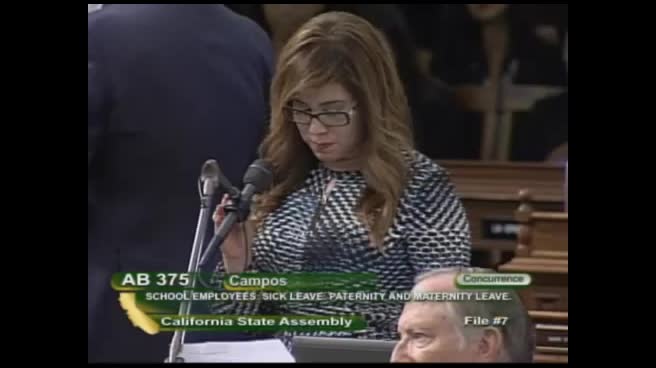 48SEC
Assembly Floor
 2MIN
Senate Floor
 1MIN
Senate Standing Committee on Appropriations
 11MIN
Senate Standing Committee on Education
 1MIN
Assembly Floor
Bill Author

Bill Co-Author(s):