AB 384: Food safety.
- Session Year: 2015-2016
- House: Assembly
- Latest Version Date: 2015-10-04
Existing law, the Sherman Food, Drug, and Cosmetic Law, prohibits the manufacture, packing, or holding of processed food unless in a food processing facility duly registered with the State Department of Public Health, upon payment of an annual registration fee. The law requires, until January 1, 2016, and in addition to the annual registration fee, every person engaged in the manufacture, packing, or holding of processed food, with specified exceptions, to pay a $100 food safety fee to be used by the department, upon appropriation, to assist in developing and implementing education and training programs related to food safety. The violation of these provisions is a crime.
This bill would delete the January 1, 2016, repeal date for the food safety fee, thus extending its duration indefinitely. By changing the definition of an existing crime, this bill would impose a state-mandated local program.
The California Constitution requires the state to reimburse local agencies and school districts for certain costs mandated by the state. Statutory provisions establish procedures for making that reimbursement.
This bill would provide that no reimbursement is required by this act for a specified reason.
(a)Every person who is engaged in the manufacture, packing, or holding of processed food in this state shall pay a food safety fee of one hundred dollars ($100) to the department in addition to any fees paid pursuant to Section 110470.
(b)Revenue received pursuant to this section shall be deposited in the Food Safety Fund created pursuant to Section 110050. A penalty of 10 percent per month shall be added to any food safety fee not paid when due.
(c)Upon appropriation, the food safety fees deposited in the Food Safety Fund shall be used by the department to assist in developing and implementing education and training programs related to food safety. These programs shall be developed in consultation with representatives of the food processing industry. Implementation shall include education and training in the prevention of microbial contamination.
(d)This section does not apply to companies exclusively involved in flour milling, dried bean processing, or in the drying or milling of rice, or to those individual registrants the director determines should not be assessed because substantial economic hardship would result to those registrants. For the purposes of this subdivision, the substantial hardship exemption shall be extended only to registrants whose wholesale gross annual income from the registered business is twenty thousand dollars ($20,000) or less.
SEC. 2.No reimbursement is required by this act pursuant to Section 6 of Article XIIIB of the California Constitution because the only costs that may be incurred by a local agency or school district will be incurred because this act creates a new crime or infraction, eliminates a crime or infraction, or changes the penalty for a crime or infraction, within the meaning of Section 17556 of the Government Code, or changes the definition of a crime within the meaning of Section 6 of Article XIIIB of the California Constitution.
(a)Every person who is engaged in the manufacture, packing, or holding of processed food in this state shall pay a food safety fee of one hundred dollars ($100) to the department in addition to any fees paid pursuant to Section 110470.
(b)Revenue received pursuant to this section shall be deposited in the Food Safety Fund created pursuant to Section 110050. A penalty of 10 percent per month shall be added to any food safety fee not paid when due.
(c)Upon appropriation, the food safety fees deposited in the Food Safety Fund shall be used by the department to assist in developing and implementing education and training programs related to food safety. These programs shall be developed in consultation with representatives of the food processing industry. Implementation shall include education and training in the prevention of microbial contamination.
(d)This section does not apply to companies exclusively involved in flour milling, dried bean processing, or in the drying or milling of rice, or to those individual registrants the director determines should not be assessed because substantial economic hardship would result to those registrants. For the purposes of this subdivision, the substantial hardship exemption shall be extended only to registrants whose wholesale gross annual income from the registered business is twenty thousand dollars ($20,000) or less.
(e)This section shall remain in effect only until January 1, 2016, and as of that date is repealed, unless a later enacted statute, that is enacted on or before January 1, 2016, deletes or extends that date.
SEC. 2.No reimbursement is required by this act pursuant to Section 6 of Article XIIIB of the California Constitution because the only costs that may be incurred by a local agency or school district will be incurred because this act creates a new crime or infraction, eliminates a crime or infraction, or changes the penalty for a crime or infraction, within the meaning of Section 17556 of the Government Code, or changes the definition of a crime within the meaning of Section 6 of Article XIIIB of the California Constitution.
|
Date
|
Status
|
|---|---|
| Oct 4, 2015 | Chaptered by Secretary of State - Chapter 477, Statutes of 2015. |
| Oct 4, 2015 | Approved by the Governor. |
| Sep 16, 2015 | Enrolled and presented to the Governor at 4 p.m. |
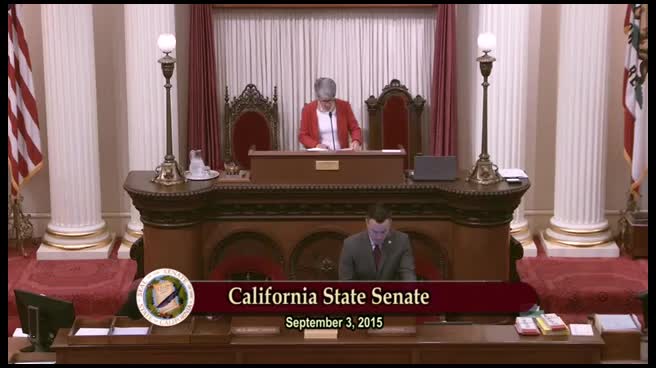
| Sep 3, 2015 | Read third time. Passed. Ordered to the Assembly. (Ayes 38. Noes 1. Page 2457.). |
| Sep 3, 2015 | In Assembly. Ordered to Engrossing and Enrolling. |
| Sep 3, 2015 | Read third time. Passed. Ordered to the Assembly. |
| Aug 31, 2015 | Read second time. Ordered to third reading. |
| Aug 27, 2015 | From committee: Do pass. (Ayes 7. Noes 0.) (August 27). |
| Aug 17, 2015 | In committee: Referred to APPR. suspense file. |
| Jul 9, 2015 | From committee: Do pass and re-refer to Com. on APPR. (Ayes 7. Noes 1.) (July 8). Re-referred to Com. on APPR. |
| Jun 11, 2015 | Referred to Com. on HEALTH. |
| Jun 1, 2015 | In Senate. Read first time. To Com. on RLS. for assignment. |
| Jun 1, 2015 | Read third time. Passed. Ordered to the Senate. (Ayes 78. Noes 2. Page 1707.) |
| Jun 1, 2015 | Read third time. Passed. Ordered to the Senate. |
| May 28, 2015 | Read second time. Ordered to third reading. |
| May 28, 2015 | From committee: Do pass. (Ayes 17. Noes 0.) (May 28). |
| Apr 22, 2015 | In committee: Set, first hearing. Referred to APPR. suspense file. |
| Apr 15, 2015 | From committee: Do pass and re-refer to Com. on APPR. (Ayes 17. Noes 0.) (April 14). Re-referred to Com. on APPR. |
| Mar 5, 2015 | Referred to Com. on HEALTH. |
| Feb 19, 2015 | From printer. May be heard in committee March 21. |
| Feb 18, 2015 | Read first time. To print. |
|
Date
|
Description
|
Location
|
Votes
|
|
|---|---|---|---|---|
| Sep 3, 2015 | Assembly 3rd Reading AB384 Perea By Galgiani | Senate Floor |
Passed |
|
| Aug 27, 2015 | Do pass | Senate Standing Committee on Appropriations |
Passed |
|
| Aug 17, 2015 | Placed on suspense file | Senate Standing Committee on Appropriations |
Passed |
|
| Jul 8, 2015 | Do pass, but first be re-referred to the Committee on [Appropriations] | Senate Standing Committee on Health |
Passed |
|
| Jun 1, 2015 | AB 384 PEREA Assembly Third Reading | Assembly Floor |
Passed |
|
| May 28, 2015 | Do pass. | Assembly Standing Committee on Appropriations |
Passed |
|
| Apr 14, 2015 | Do pass and be re-referred to the Committee on [Appropriations] | Assembly Standing Committee on Health |
Passed |
This list shows positions taken on this bill by organizations on the date displayed, which is linked to the original source.
Positions by individuals are not included.
AB 384
Page 4
|
Office of Senate Floor Analyses (916) 651-1520 Fax: (916) 327-4478 |
THIRD READING
Bill No: AB 384
Introduced: 2/18/15
SENATE HEALTH COMMITTEE: 7-1, 7/8/15
AYES: Hernandez, Hall, Monning, Nielsen, Pan, Roth, Wolk
NOES: Nguyen
NO VOTE RECORDED: Mitchell
SENATE APPROPRIATIONS COMMITTEE: 7-0, 8/27/15
AYES: Lara, Bates, Beall, Hill, Leyva, Mendoza, Nielsen
ASSEMBLY FLOOR: 78-2, 6/1/15 - See last page for vote
SOURCE: California League of Food Processors
DIGEST: This bill eliminates the January 1, 2016, sunset date on provisions of law establishing a $100 food safety fee on registered food processors, which supports education and training programs related to food safety, thereby making this program permanent.
Existing law:
Requires every person engaged in the manufacture, packing, or holding of any processed food to have a valid registration from the Department of Public Health (DPH), establishes a fee schedule for food registration permits based on the size of the facility and the number of employees, and requires this registration to be renewed annually.
Requires every person who is engaged in the manufacture, packing, or holding of processed food to pay a food safety fee of $100 to DPH in addition to the annual registration fee for food processors.
Requires the food safety fee revenue to be used by DPH to assist in developing and implementing education and training programs related to food safety. Requires these programs to be developed in consultation with representatives of the food processing industry, and to include education and training in the prevention of microbial contamination.
Exempts from the food safety fee requirements companies that are exclusively involved in flour milling, dried bean processing, or in the drying or milling of rice, or to those individuals whose gross annual income from the registered food processing business is $20,000 or less and DPH has determined the fee would result in substantial economic hardship.
Sunsets the provisions of law establishing a food safety fee on January 1, 2016.
This bill eliminates the January 1, 2016, sunset date on provisions of law which establish a $100 food safety fee that registered food processors are required to pay in addition to annual registration fees, and which require DPH to use the resulting funds to develop and implement a food safety education and training programs, thereby making this food safety program permanent.
Background
The food safety program that is being made permanent by this bill was established by AB 1559 (Cardoza, Chapter 727, Statutes of 1997). According to the Senate Health and Human Services Committee analysis of that bill, AB 1559 was sponsored by the California League of Food Processors after several dramatic news stories highlighted the issue of contaminated foods, and microbiological contamination had even reached some “low-risk” food products leading to isolated cases of illness. The $100 fee was not a new fee, but rather a re-direction of an existing $100 fee that food processors had been paying to the Department of Pesticide Regulation for pesticide regulation and research. Recent training programs offered by DPH’s Food and Drug Branch include courses on food labeling, current good manufacturing practices, and food recalls. These courses and other courses are offered for free to registered food processors.
Comments
Author’s statement. According to the author, this bill is an industry supported bill that makes permanent a fee that is used by DPH to fund an education and training program for food processors. This program deals with sanitation and contamination prevention methods and has been proven to be effective in reducing cross contamination by food processors. Due to this success, the food processors want to make the funding of the program permanent, so they have asked to have the fee sunset date deleted.
Prior Legislation
AB 2612 (Committee
on Agriculture, Chapter 393, Statutes of 2010), among other
provisions, extended the sunset on the food safety fee to January 1,
2016.
AB 1081 (Mathews, Chapter 401, Statutes of
2005), among other provisions, extended the sunset on the food safety
fee to January 1, 2011.
AB 2981 (Committee on
Agriculture, Chapter 535, Statutes of 2002), among other provisions,
extended the sunset on the food safety fee to January 1, 2006.
AB
1548 (Cardoza, Chapter 915, Statutes of 1999), among other
provisions, extended the sunset on the food safety fee to January 1,
2003.
AB 1559 (Cardoza, Chapter 727, Statutes of 1997),
established the food safety program within DPH, and required a $100
food safety fee to be paid by food processors to support the food
safety program.
FISCAL EFFECT: Appropriation: No Fiscal Com.: Yes Local: Yes
According to the Senate Appropriations Committee, ongoing costs of $640,000 per year for DPH to provide education and training to food processors on safe handling of food products, fully offset by fee revenues (Food Safety Fund).
California League of
Food Processors (source)
American Federation of State, County
and Municipal Employees
California Chamber of Commerce
Morning
Star Company
OPPOSITION: (Verified 8/28/15)
None received
ARGUMENTS IN SUPPORT: According to the author, this bill is sponsored by the California League of Food Processors (CLFP), which states the Food Industry Education and Training Program, administered by DPH, provides food safety education and training to registered food processors to reduce preventable foodborne illnesses and injuries and to assist California food processors in improving their operations. CLFP states that it supports the $100 food safety fee that is assessed on food processors to fund this program, and believes that it is a successful collaboration between industry and government. The California Chamber of Commerce states in support that the food safety program has been highly effective at providing multi-lingual training to food processing workers on the basics of food safety, sanitation, and best management practices, and supports the purpose of this bill to remove the sunset date which will allow DPH to continue collecting the $100 food safety fee on a permanent basis. The American Federation of State, County and Municipal Employees states in support that in order to improve and ensure the health of Californians, it is imperative to invest in education and training programs related to food safety.
ASSEMBLY FLOOR: 78-2, 6/1/15
AYES: Achadjian, Alejo, Travis Allen, Baker, Bigelow, Bloom, Bonilla, Bonta, Brown, Burke, Calderon, Campos, Chang, Chau, Chávez, Chiu, Chu, Cooley, Cooper, Dababneh, Dahle, Daly, Dodd, Eggman, Frazier, Beth Gaines, Gallagher, Cristina Garcia, Eduardo Garcia, Gatto, Gipson, Gomez, Gonzalez, Gordon, Gray, Grove, Hadley, Roger Hernández, Holden, Irwin, Jones, Jones-Sawyer, Kim, Lackey, Levine, Linder, Lopez, Low, Maienschein, Mathis, Mayes, McCarty, Medina, Melendez, Mullin, Nazarian, Obernolte, O'Donnell, Olsen, Patterson, Perea, Quirk, Rendon, Ridley-Thomas, Rodriguez, Salas, Santiago, Steinorth, Mark Stone, Thurmond, Ting, Wagner, Waldron, Weber, Wilk, Williams, Wood, Atkins
NOES: Brough, Harper
Prepared by: Vince Marchand / HEALTH /
8/31/15 12:47:39
**** END ****
AB 384 (Perea) Page 2 of 2
SENATE COMMITTEE ON APPROPRIATIONS
Senator Ricardo Lara, Chair
2015 - 2016 Regular Session
AB 384 (Perea) - Food safety
|
|
Version: February 18, 2015 |
Policy Vote: HEALTH 7 - 1 |
Urgency: No |
Mandate: Yes |
Hearing Date: August 17, 2015 |
Consultant: Brendan McCarthy |
This bill meets the criteria for referral to the Suspense File.
Bill Summary:
AB 384 would eliminate the sunset on the provision of law imposing a $100 fee on most food processors and authorizing the Department of Public Health to use the resulting revenue to support education and training programs for food processors.
Fiscal Impact:
Ongoing costs of $640,000 per year for the Department of Public Health to provide education and training to food processors on safe handling of food products, fully offset by fee revenues (Food Safety Fund).
Background:
Under current law, food processors must register with the Department of Public Health and are subject to regulation by the Department to protect the public health. As part of the registration process, food processors pay a fee to the Department to cover the costs of regulation. In addition, food processors pay an additional $100 fee (excluding certain small food processors) which is used to fund a program through which the Department provides education and training to food processors on safe handling of foods. The authority to impose the $100 fee and implement the training program sunsets on January 1, 2016.
Proposed Law:
AB 384 would eliminate the sunset on the provision of law imposing a $100 fee on most food processors and authorizing the Department of Public Health to use the resulting revenue to support education and training programs for food processors.
Staff Comments:
The program extended by this bill was first established by AB 1559 (Cardoza, Statutes of 1997) with a statutory sunset that has been extended several times since then. This bill would eliminate the statutory sunset, making the program permanent.
The recently enacted 2015-16 Budget Act authorizes four additional positions at the Department of Public Health to increase enforcement activities relating to food processors. These positions will be funded from a $3.3 million judgment against a food processor for violations of the state’s food safety regulations.
The only costs that may be incurred by a local agency relate to crimes and infractions. Under the California Constitution, such costs are not reimbursable by the state.
-- END --
AB 384 (Perea) Page 3 of 3
SENATE COMMITTEE ON HEALTH
Senator Ed Hernandez, O.D., Chair
BILL NO: AB 384
AUTHOR: |
Perea |
||
VERSION: |
February 18, 2015 |
||
HEARING DATE: |
July 8, 2015 |
|
|
CONSULTANT: |
Vince Marchand |
||
SUBJECT: Food safety.
SUMMARY:
Eliminates the January 1, 2016, sunset date on provisions of law establishing a $100 food safety fee on registered food processors, which supports education and training programs related to food safety, thereby making this program permanent.
Existing law:
Requires every person engaged in the manufacture, packing, or holding of any processed food to have a valid registration from the Department of Public Health (DPH), establishes a fee schedule for food registration permits based on the size of the facility and the number of employees, and requires this registration to be renewed annually.
Requires every person who is engaged in the manufacture, packing, or holding of processed food to pay a food safety fee of $100 to DPH in addition to the annual registration fee for food processors.
Requires the food safety fee revenue to be used by DPH to assist in developing and implementing education and training programs related to food safety. Requires these programs to be developed in consultation with representatives of the food processing industry, and to include education and training in the prevention of microbial contamination.
Exempts from the food safety fee requirements companies that are exclusively involved in flour milling, dried bean processing, or in the drying or milling of rice, or to those individuals whose gross annual income from the registered food processing business is $20,000 or less and DPH has determined the fee would result in substantial economic hardship.
Sunsets the provisions of law establishing a food safety fee on January 1, 2016.
This bill: Eliminates the January 1, 2016, sunset date on provisions of law which establish a $100 food safety fee that registered food processors are required to pay in addition to annual registration fees, and which require DPH to use the resulting funds to develop and implement a food safety education and training programs, thereby making this food safety program permanent.
FISCAL EFFECT:
According to the Assembly Appropriations Committee, $640,000 in annual fee revenue (Food Safety Fund) will continue to fund three DPH staff and activities in the food safety training and education program.
PRIOR VOTES:
Assembly Floor: |
78 - 2 |
Assembly Appropriations Committee: |
17 - 0 |
Assembly Health Committee: |
17 - 0 |
COMMENTS:
Author’s statement. According to the author, this bill is an industry supported bill that makes permanent a fee that is used by DPH to fund an education and training program for food processors. This program deals with sanitation and contamination prevention methods and has been proven to be effective in reducing cross contamination by food processors. Due to this success, the food processors want to make the funding of the program permanent, so they have asked to have the fee sunset date deleted.
Background. The food safety program that is being made permanent by this bill was established by AB 1559 (Cardoza, Chapter 727, Statutes of 1997). According to the Senate Health and Human Services Committee analysis of that bill, AB 1559 was sponsored by the California League of Food Processors after several dramatic news stories highlighted the issue of contaminated foods, and microbiological contamination had even reached some “low-risk” food products leading to isolated cases of illness. The $100 fee was not a new fee, but rather a re-direction of an existing $100 fee that food processors had been paying to the Department of Pesticide Regulation for pesticide regulation and research. Recent training programs offered by DPH’s Food and Drug Branch include courses on food labeling, current good manufacturing practices, and food recalls. These courses and other courses are offered for free to registered food processors.
Prior legislation. AB 2612 (Committee on Agriculture, Chapter 393, Statutes of 2010), among other provisions, extended the sunset on the food safety fee to January 1, 2016.
AB 1081 (Mathews, Chapter 401, Statutes of 2005), among other provisions, extended the sunset on the food safety fee to January 1, 2011.
AB 2981 (Committee on Agriculture, Chapter 535, Statutes of 2002), among other provisions, extended the sunset on the food safety fee to January 1, 2006.
AB 1548 (Cardoza, Chapter 915, Statutes of 1999), among other provisions, extended the sunset on the food safety fee to January 1, 2003.
AB 1559 (Cardoza, Chapter 727, Statutes of 1997), established the food safety program within DPH, and required a $100 food safety fee to be paid by food processors to support the food safety program.
Support. According to the author, this bill is sponsored by the California League of Food Processors (CLFP), which states the Food Industry Education and Training Program, administered by DPH, provides food safety education and training to registered food processors to reduce preventable foodborne illnesses and injuries and to assist California food processors in improving their operations. CLFP states that it supports the $100 food safety fee that is assessed on food processors to fund this program, and believes that it is a successful collaboration between industry and government. The California Chamber of Commerce states in support that the food safety program has been highly effective at providing multi-lingual training to food processing workers on the basics of food safety, sanitation, and best management practices, and supports the purpose of this bill to remove the sunset date which will allow DPH to continue collecting the $100 food safety fee on a permanent basis. The American Federation of State, County and Municipal Employees states in support that in order to improve and ensure the health of Californians, it is imperative to invest in education and training programs related to food safety.
SUPPORT AND OPPOSITION:
Support: California
League of Food Processors (sponsor)
American Federation of
State, County and Municipal Employees
California Chamber of
Commerce
Morning Star Company
Oppose: None received
-- END --
AB 384
Page 2
ASSEMBLY THIRD READING
AB 384
(Perea)
As Introduced February 18, 2015
Majority vote
Committee |
Votes |
Ayes |
Noes |
Health |
17-0 |
Bonta, Maienschein, Bonilla, Burke, Chávez, Chiu, Gomez, Gonzalez, Lackey, Nazarian, Patterson, Ridley-Thomas, Rodriguez, Santiago, Thurmond, Waldron, Wood |
|
Appropriations |
17-0 |
Gomez, Bigelow, Bonta, Calderon, Chang, Daly, Eggman, Gallagher, Eduardo Garcia, Gordon, Holden, Jones, Quirk, Rendon, Wagner, Weber, Wood |
|
SUMMARY: Repeals the current January 1, 2016 sunset date, thereby making permanent, the $100 food safety fee within the California Department of Public Health (DPH) paid by persons engaged in manufacture, packing, or holding of processed food in California.
FISCAL EFFECT: According to the Assembly Appropriations Committee, $640,000 in annual fee revenue (Food Safety Fund) will continue to fund three DPH staff and activities in the food industry training and education program (Program).
COMMENTS: According to the author, the fee whose sunset is being removed is used to fund the education and training of food processors in the safe handling and prevention of microbial contamination of food products. The author notes the food processing industry requested and supported the initiation of the fee to fund the program, and has requested and supported previous extensions of the fee. With the proven success of the Program, the industry is now comfortable with the removal of the sunset, making the fee and program permanent.
In response to dramatic news stories of food contamination, AB 1559 (Cardoza), Chapter 727, Statutes of 1997, established the Program within DPH. AB 1559 contained sunset provisions for the program that were subsequently legislatively extended several times. The current program will expire on January 1, 2016. This bill would delete the sunset provision entirely, making the Program and fee permanent.
The California League of Food Processors, sponsor of this bill, recognizes that safety training provided by this program is critical in avoiding contamination incidents. The California Chamber of Commerce supports this bill, noting that the Program has been a highly effective collaboration between industry and government, particularly providing multi-lingual training to food processing workers on the basics of food safety, sanitation and best management practices.
There is no known opposition to this bill.
Analysis Prepared by: Dharia McGrew / HEALTH / (916) 319-2097 FN: 0000600
AB 384
Page 2
Date of Hearing: April 22, 2015
ASSEMBLY COMMITTEE ON APPROPRIATIONS
Jimmy Gomez, Chair
AB 384
(Perea) – As Introduced February 18, 2015
Policy Committee: |
Health |
Vote: |
17 - 0 |
|
|
|
|
|
|
|
|
Urgency: No State Mandated Local Program: Yes Reimbursable: No
SUMMARY:
This bill repeals the January 1, 2016, sunset date on a food safety and education training program and associated fee within the California Department of Public Health. The fee is paid by entities manufacturing, processing, or storing processed food.
FISCAL EFFECT:
$640,000 in annual fee revenue (Food Safety Fund) will continue to fund three CDPH staff and activities in the food safety training and education program.
COMMENTS:
Purpose. According to the author, the fee whose sunset is being removed is used to fund the education and training of food processors in the safe handling and prevention of microbial contamination of food products. The author notes the food processing industry requested and supported the initiation of the fee to fund the program, and has requested and supported previous extensions of the fee. With the proven success of the program, the industry is now comfortable with the removal of the sunset, making the fee and program permanent. The California League of Food Processors, sponsor of this bill, recognizes that safety training provided by this program is critical in avoiding contamination incidents.
Related Budget Item. Recent media and regulatory attention suggests continuing, and perhaps additional, food safety education and training is warranted.
According to CDPH, in July 2013, an investigation of Sysco Corporation was initiated by the Food and Drug Branch of CDPH based on a media investigation of claims that Sysco was transporting and dropping off highly perishable foods at unrefrigerated public storage units for later pick-up and delivery to food facilities in the personal vehicles of Sysco associates. The resulting investigation by FDB verified significant gaps in Sysco’s food safety program, including gross violations such as storing potentially hazardous foods in unregistered facilities, transporting and storing potentially hazardous perishable food in unrefrigerated conditions, and not protecting products from potential contamination. A review by CDPH of Sysco distribution records over the last four years identified over 1.1 million separate violations.
Settlement of a civil complaint filed by the Santa Clara County District Attorney’s Office, as a result of CDPH's investigation of Sysco Corporation, includes $3.3 million specifically earmarked for DPH to conduct food safety transportation enforcement activities within the state, and identify other operations that are illegally storing and distributing perishable and non-perishable food in a manner that does not protect them from contamination.
The Governor's budget requests four five-year limited-term positions and $716,000 from the Food Safety Fund to implement additional enforcement activities as a result of this stipulated judgment.
Previous Legislation. AB 1559 (Cardoza), Chapter 727, Statutes of 1997, established the Program and the fee. Four subsequent bills, in 1999, 2002, 2005, and 2010 extended the fee sunset.
Analysis Prepared by: Lisa Murawski / APPR. / (916) 319-2081
AB 384
Page 3
Date of Hearing: April 14, 2015
ASSEMBLY COMMITTEE ON HEALTH
Bonta, Chair
AB 384
(Perea) – As Introduced February 18, 2015
SUBJECT:
Food safety.
SUMMARY: Repeals the current January 1, 2016 sunset date, thereby making permanent, the $100 food safety fee paid by persons engaged in manufacture, packing, or holding of processed food in California.
EXISTING LAW:
Establishes the Sherman Food, Drug, and Cosmetic Law, administered by the California Department of Public Health (DPH), to regulate the manufacture, sale, labeling, and advertising activities related to food, drugs, devices, and cosmetics in conformity with the federal Food, Drug, and Cosmetic Act.
Requires, until January 1, 2016, a person engaged in the manufacture, packing, or holding of processed food in the state to pay a food safety fee of $100 to DPH for a food safety fund. Requires the funds to be used to assist in developing and implementing education and training programs related to food safety, known as the Food Industry Education and Training Program (Program).
FISCAL EFFECT: This bill has not been analyzed by a fiscal committee.
COMMENTS:
PURPOSE OF THIS BILL. According to the author, after a series of dangerous food contamination incidents, the food processing industry asked the Legislature in 1995 to create the Food Industry Education and Training Program. In 1997 due to DPH not having the funding for the Program, the industry initiated the $100 fee for every person who is engaged in the manufacture, packing, or holding of processed food. This fee is used to fund the education and training of food processors in the safe handling and prevention of microbial contamination of food products. The author notes that the industry requested and supported previous extensions of the fee. With the proven success of the program, the food processing industry is now comfortable with the removal of the sunset making the fee and program permanent.
BACKGROUND. In response to dramatic news stories of food contamination, AB 1559 (Cardoza), Chapter 727, Statutes of 1997, established the Program within DPH. AB 1559 contained sunset provisions for the program that were subsequently legislatively extended several times. The current program will expire on January 1, 2016. This bill would delete the sunset provision entirely, making the Program and fee permanent.
According to DPH, the Program is an industry-initiated program that has been instrumental in developing high-quality training courses, manuals, and videos that focus on food safety and high-risk food commodity production. Many of the training programs DPH’s Industry Education and Training Unit has developed have been nationally recognized and serve as models of industry-government cooperation. Education and training is a critical component of a comprehensive food safety program and is specifically intended to help processors learn how they can prevent food from becoming contaminated and thereby assist them in reducing the incidence of costly food recalls and food-borne illness outbreaks.
SUPPORT. The California League of Food Processors, sponsor of this bill, recognizes that safety training provided by this program is critical in avoiding contamination incidents. Additionally, they believe this program is a successful collaboration between industry and government. The California Chamber of Commerce supports this bill, noting that the Program has been highly effective at providing multi-lingual training to food processing workers on the basics of food safety, sanitation and best management practices.
PREVIOUS LEGISLATION.
AB 2612 (Committee on Agriculture), Chapter 393, Statutes of 2010, among other provisions, extended the sunset on the food safety fee to January 1, 2016.
AB 1081 (Mathews), Chapter 401, Statutes of 2005, among other provisions, extended the sunset on the food safety fee to January 1, 2011.
AB 2981 (Committee on Agriculture), Chapter 535, Statutes of 2002, among other provisions, extended the sunset on the food safety fee to January 1, 2006.
AB 1548 (Cardoza), Chapter 915, Statutes of 1999, among other provisions, extended the sunset on the food safety fee to January 1, 2003.
AB 1559 establishes the Program within DPH. Creates the Food Safety Fund (Fund) within the State Treasury in order to provide education and training in the prevention of microbial contamination. Mandates a $100 food safety fee to be paid by food processors to the Fund.
REGISTERED SUPPORT / OPPOSITION:
Support
California League of Food Processors (sponsor)
American
Federation of State County and Municipal Employees,
AFL-CIO
California Chamber of Commerce
Morning Star Company
Opposition
None on file.
Analysis Prepared by:
Dharia McGrew / HEALTH / (916) 319-2097
Bill Author

Bill Co-Author(s):
