AB 396: Rental housing discrimination: applications: criminal records.
- Session Year: 2015-2016
- House: Assembly
- Latest Version Date: 2015-05-22
Existing law generally prohibits housing discrimination with respect to the personal characteristics of race, color, religion, sex, gender, gender identity, gender expression, sexual orientation, marital status, national origin, ancestry, familial status, source of income, disability, or genetic information.
This bill would make it unlawful for the owner of any rental housing accommodation to deny the rental or lease of a housing accommodation without first satisfying specified requirements relating to the application process. The bill would prohibit the owner of a rental housing accommodation from inquiring about, or requiring an applicant for rental housing accommodation to disclose, a criminal record during the initial application assessment phase, as defined, unless otherwise required by state or federal law. The bill would permit an owner of a rental housing accommodation, accommodation to disclose the owners criminal background check policy on the rental housing accommodation application, as specified, and after successful completion of the initial application assessment phase, to request a criminal background check and inquire about and consider an applicants criminal record in deciding whether to rent or lease. The bill would require the owner of a rental housing accommodation who is considering denying an application to rent or lease after requesting a criminal background check or considering an applicants criminal record, and the possible denial is based on the applicants criminal record, to promptly provide the applicant with a written statement listing the reasons for the possible denial before making a final decision. If, within 14 days of receipt of the written statement, the applicant provides the owner notice of evidence demonstrating the inaccuracy of the item or items within the applicants criminal record or evidence of rehabilitation or other mitigating factors, as defined, the bill would require the owner to delay the denial for a reasonable period after receipt of the information and reconsider his or her decision. The bill would require, in these circumstances, that the owner provide written notification to the applicant of his or her final decision to deny the application. The bill would require that disclosure and request to include a written disclosure that the applicant may provide evidence demonstrating inaccuracies within the applicants criminal record or evidence of rehabilitation or other mitigating factors, as defined. The bill would prohibit, in connection with a rental application, the owner of the rental housing accommodation from requiring disclosure of, or, if such information is received, denying a dwelling based in whole or in part on specified information or occurrence, including arrests that did not result in conviction, with specified exceptions, convictions that have been voided, and juvenile justice determinations, among others. The bill would provide that an owner is not liable to any person for accepting or denying a person with a criminal record as a tenant if the owner followed the above-described procedures in accepting that person as a tenant.
Existing law generally prohibits housing discrimination with respect to the personal characteristics of race, color, religion, sex, gender, gender identity, gender expression, sexual orientation, marital status, national origin, ancestry, familial status, source of income, disability, or genetic information.
This bill would make it unlawful for the owner of any rental housing accommodation to deny the rental or lease of a housing accommodation without first satisfying specified requirements relating to the application process. The bill would prohibit the owner of a rental housing accommodation from inquiring about, or requiring an applicant for rental housing accommodation to disclose, a criminal record during the initial application assessment phase, as defined, unless otherwise required by state or federal law. The bill would permit an owner of a rental housing accommodation, after the initial application assessment phase, to request a criminal background check and consider an applicants criminal record in deciding whether to rent or lease. The bill would require the owner of a rental housing accommodation who is considering denying an application to rent or lease after requesting a criminal background check or considering an applicants criminal record, and the possible denial is based on the applicants criminal record, to promptly provide the applicant with a written statement listing the reasons for the possible denial before making a final decision. If, within 14 days of receipt of the written statement, the applicant provides the owner notice of evidence demonstrating the inaccuracy of the item or items within the applicants criminal record or evidence of rehabilitation or other mitigating factors, as defined, the bill would require the owner to delay the denial for a reasonable period after receipt of the information and reconsider his or her decision. The bill would require, in these circumstances, that the owner provide written notification to the applicant of his or her final decision to deny the application. The bill would prohibit, in connection with a rental application, the owner of the rental housing accommodation from requiring disclosure of, or, if such information is received, denying a dwelling based in whole or in part on specified information or occurrence, including arrests that did not result in conviction, convictions that have been voided, and juvenile justice determinations, among others.
Existing law generally prohibits housing discrimination with respect to the personal characteristics of race, color, religion, sex, gender, gender identity, gender expression, sexual orientation, marital status, national origin, ancestry, familial status, source of income, disability, or genetic information. Existing law includes within this prohibition, in addition to the sale or rental of housing accommodation, related activities such as housing finance and real estate transaction services.
This bill would include a criminal record as a basis upon which housing discrimination is prohibited. The bill would specify that the prohibition is qualified by a requirement to the contrary in federal law. The bill would provide that criminal record includes a record regarding arrests and detentions that did not result in a conviction, as specified. The bill make technical, correctional changes. make it unlawful for the owner of any rental housing accommodation to deny the rental or lease of a housing accommodation without first satisfying specified requirements relating to the application process. The bill would prohibit the owner of a rental housing accommodation from inquiring about, or requiring an applicant for rental housing accommodation to disclose, a criminal record during the initial application assessment phase, as defined, unless otherwise required by state or federal law. The bill would permit an owner of a rental housing accommodation, after the initial application assessment phase, to request a criminal background check and consider an applicants criminal record in deciding whether to rent or lease. The bill would require the owner of a rental housing accommodation who is considering denying an application to rent or lease after requesting a criminal background check or considering an applicants criminal record, to promptly provide the applicant with a written statement listing the reasons for the possible denial before making a final decision. If, within 14 days of receipt of the written statement, the applicant provides the owner notice of evidence demonstrating the inaccuracy of the item or items within the applicants criminal record or evidence of rehabilitation or other mitigating factors, as defined, the bill would require the owner to delay the denial for a reasonable period after receipt of the information and reconsider his or her decision. The bill would require, in these circumstances, that the owner provide written notification to the applicant of his or her final decision to deny the application. The bill would prohibit, in connection with a rental application, the owner of the rental housing accommodation from requiring disclosure of, or, if such information is received, denying a dwelling based in whole or in part on specified information or occurrence, including arrests that did not result in conviction, convictions that have been voided, and juvenile justice determinations, among others.
Existing law generally prohibits housing discrimination with respect to the personal characteristics of race, color, religion, sex, gender, gender identity, gender expression, sexual orientation, marital status, national origin, ancestry, familial status, source of income, disability, or genetic information. Existing law includes within this prohibition, in addition to the sale or rental of housing accommodation, related activities such as housing finance and real estate transaction services.
This bill would include a criminal record as a basis upon which housing discrimination is prohibited. The bill would specify that the prohibition is qualified by a requirement to the contrary in federal law. The bill would provide that criminal record includes a record regarding arrests and detentions that did not result in a conviction, as specified. The bill make technical, correctional changes.
It shall be unlawful:
(a)For the owner of any housing accommodation to discriminate against or harass any person because of the race, color, religion, sex, gender, gender identity, gender expression, sexual orientation, marital status, national origin, ancestry, familial status, source of income, disability, or genetic information of that person.
(b)For the owner of any housing accommodation to make or to cause to be made any written or oral inquiry concerning the race, color, religion, sex, gender, gender identity, gender expression, sexual orientation, marital status, national origin, ancestry, familial status, disability, or genetic information of any person seeking to purchase, rent, or lease any housing accommodation.
(c)For any person to make, print, or publish, or cause to be made, printed, or published any notice, statement, or advertisement, with respect to the sale or rental of a housing accommodation that indicates any preference, limitation, or discrimination based on race, color, religion, sex, gender, gender identity, gender expression, sexual orientation, marital status, national origin, ancestry, familial status, source of income, disability, or genetic information or an intention to make that preference, limitation, or discrimination.
(d)For any person subject to the provisions of Section 51 of the Civil Code, as that section applies to housing accommodations, to discriminate against any person on the basis of sex, gender, gender identity, gender expression, sexual orientation, color, race, religion, ancestry, national origin, familial status, marital status, disability, genetic information, source of income, or on any other basis prohibited by that section. Selection preferences based on age, imposed in connection with a federally approved housing program, do not constitute age discrimination in housing.
(e)For any person, bank, mortgage company company, or other financial institution that provides financial assistance for the purchase, organization, or construction of any housing accommodation to discriminate against any person or group of persons because of the race, color, religion, sex, gender, gender identity, gender expression, sexual orientation, marital status, national origin, ancestry, familial status, source of income, disability, or genetic information in the terms, conditions, or privileges relating to the obtaining or use of that financial assistance.
(f)For any owner of housing accommodations to harass, evict, or otherwise discriminate against any person in the sale or rental of housing accommodations when the owners dominant purpose is retaliation against a person who has opposed practices unlawful under this section, informed law enforcement agencies of practices believed unlawful under this section, has testified or assisted in any proceeding under this part, or has aided or encouraged a person to exercise or enjoy the rights secured by this part. Nothing herein is intended to cause or permit the delay of an unlawful detainer action.
(g)For any person to aid, abet, incite, compel, or coerce the doing of any of the acts or practices declared unlawful in this section, or to attempt to do so.
(h)For any person, for profit, to induce any person to sell or rent any dwelling by representations regarding the entry or prospective entry into the neighborhood of a person or persons of a particular race, color, religion, sex, gender, gender identity, gender expression, sexual orientation, marital status, ancestry, disability, genetic information, source of income, familial status, or national origin.
(i)For any person or other organization or entity whose business involves real estate-related transactions to discriminate against any person in making available a transaction, or in the terms and conditions of a transaction, because of race, color, religion, sex, gender, gender identity, gender expression, sexual orientation, marital status, national origin, ancestry, source of income, familial status, disability, or genetic information.
(j)To deny a person access to, or membership or participation in, a multiple listing service, real estate brokerage organization, or other service because of race, color, religion, sex, gender, gender identity, gender expression, sexual orientation, marital status, ancestry, disability, genetic information, familial status, source of income, or national origin.
(k)To otherwise make unavailable or deny a dwelling based on discrimination because of race, color, religion, sex, gender, gender identity, gender expression, sexual orientation, familial status, source of income, disability, genetic information, or national origin.
(l)To discriminate through public or private land use practices, decisions, and authorizations because of race, color, religion, sex, gender, gender identity, gender expression, sexual orientation, familial status, marital status, disability, genetic information, national origin, source of income, or ancestry. Discrimination includes, but is not limited to, restrictive covenants, zoning laws, denials of use permits, and other actions authorized under the Planning and Zoning Law (Title 7 (commencing with Section 65000)), that make housing opportunities unavailable.
Discrimination under this subdivision also includes the existence of a restrictive covenant, regardless of whether accompanied by a statement that the restrictive covenant is repealed or void.
(m)As used in this section, race, color, religion, sex, gender, gender identity, gender expression, sexual orientation, marital status, national origin, ancestry, familial status, source of income, disability, or genetic information, includes a perception that the person has any of those characteristics or that the person is associated with a person who has, or is perceived to have, any of those characteristics.
(n)To use a financial or income standard in the rental of housing that fails to account for the aggregate income of persons residing together or proposing to reside together on the same basis as the aggregate income of married persons residing together or proposing to reside together.
(o)In instances where there is a government rent subsidy, to use a financial or income standard in assessing eligibility for the rental of housing that is not based on the portion of the rent to be paid by the tenant.
(p)For the owner of any rental housing accommodations to deny the rental or lease of a housing accommodation without first satisfying the requirements of Section 12955.05, unless otherwise required by state or federal law.
(q)(1)For the purposes of this section, source of income means lawful, verifiable income paid directly to a tenant or paid to a representative of a tenant. For the purposes of this section, a landlord is not considered a representative of a tenant.
(2)For the purposes of this section, it shall not constitute discrimination based on source of income to make a written or oral inquiry concerning the level or source of income.
SEC. 2.Section 12955.05 is added to the Government Code, to read:12955.05.(a)For purposes of this section:
(1)Criminal record means criminal offender record information, as defined in Section 13102 of the Penal Code or state summary criminal history information as defined in Section 11105 of the Penal Code.
(2)Evidence of rehabilitation or other mitigating factors means, but is not limited to, the following:
(A)A persons satisfactory compliance with all terms and conditions of parole or probation, provided that the persons inability to pay fines, fees, and restitution due to indigence shall not be considered noncompliance with terms and conditions of parole or probation.
(B)Employer recommendations, particularly a persons postconviction employment.
(C)Educational attainment or vocational or professional training since conviction, including training received while incarcerated.
(D)Completion of or active participation in rehabilitative treatment, including alcohol or drug treatment.
(E)Letters of recommendation from community organizations, counselors, case managers, teachers, community leaders, parole officers, and probation officers who have observed the person since his or her conviction.
(F)A persons familial relationship with a person who may be currently residing in the housing accommodation.
(G)The age of the person at the time of the conviction.
(H)Explanation of precedent coercive conditions, including physical, emotional, or sexual abuse, untreated substance abuse, or mental illness that contributed to the conviction.
(3)Initial application assessment phase means the period before a decision is made to rent or lease, which shall include the request for, and the provision of, an application to includes the time during which a person seeking a rental housing accommodation requests and is provided an application and including the time during which the assessment of rental history and credit history, the checking of sources of income, and the scheduling an applicant interview routinely. routinely occur.
(b)(1)It is an unlawful housing practice for the owner of a rental housing accommodation to inquire about, or to require an applicant for rental housing accommodation to disclose, a criminal record during the initial application assessment phase, unless otherwise required by state or federal law.
(2)The owner of a rental housing accommodation may disclose to the applicant, on the rental housing accommodation application, the policy and screening criteria that the owner uses in deciding whether to rent or lease to an applicant with a criminal background. The disclosure shall include a written disclosure that the applicant may provide evidence demonstrating inaccuracies within the applicants criminal record or evidence of rehabilitation or other mitigating factors, and contain written examples of evidence of rehabilitation or other mitigating factors.
(2)
(3)Following the successful completion of the initial application assessment phase, an owner of a rental housing accommodation may request a criminal background check and inquire about and consider an applicants criminal record in deciding whether to rent or lease. If the owner of a rental housing accommodation is considering denying an application to rent or lease after requesting a criminal background check or considering an applicants criminal record, and the possible denial is based on the applicants criminal record, he or she shall promptly provide the applicant with a written statement listing the reasons for the possible denial before making a final decision. The request for a criminal background check shall include a written disclosure that the applicant may provide evidence demonstrating inaccuracies within the applicants criminal record or evidence of rehabilitation or other mitigating factors and contain written examples of evidence of rehabilitation or other mitigating factors.
(3)If, within 14 days of receipt of the written statement described in paragraph (2), the applicant provides the owner of the rental housing accommodation notice orally or in writing of evidence demonstrating the inaccuracy of the item or items within the applicants criminal record or evidence of rehabilitation or other mitigating factors, the owner of the housing accommodation shall delay the denial for a reasonable period after receipt of the information and reconsider his or her decision in light of the information. If, upon individualized assessment of the applicants criminal record and the evidence of rehabilitation and mitigating factors, the applicant still has an unacceptable criminal record, then the owner of the housing accommodation shall notify the applicant of his or her final decision to deny the application in writing.
(c)With regard to an application for rental housing accommodations, the owner of the housing accommodation shall not require disclosure of, or, if such information is received, deny a dwelling based in whole or in part on the following:
(1)A previous arrest that did not result in a conviction. conviction, except for records of arrest, indictment, information, or misdemeanor complaints reported pending pronouncement of judgment on the particular subject matter of those records.
(2)Participation in, or completion of, a diversion or a deferral of judgment program.
(3)A conviction that has been judicially dismissed, expunged, voided, invalidated, or otherwise rendered inoperative, including, but not limited to, as is provided under Section 1203.4. 1203.4a, or 1203.41 of the Penal Code.
(4)A determination or adjudication in the juvenile justice system or information regarding a matter considered in or processed through the juvenile justice system.
(5)Information pertaining to an offense other than a felony or misdemeanor.
(d)An owner of a rental housing accommodation shall not be liable to any person for accepting or denying a person with a criminal record as a tenant if the owner followed the procedures set forth in this section in accepting that person as a tenant.
It shall be unlawful:
(a)For the owner of any housing accommodation to discriminate against or harass any person because of the race, color, religion, sex, gender, gender identity, gender expression, sexual orientation, marital status, national origin, ancestry, familial status, source of income, disability, or genetic information of that person.
(b)For the owner of any housing accommodation to make or to cause to be made any written or oral inquiry concerning the race, color, religion, sex, gender, gender identity, gender expression, sexual orientation, marital status, national origin, ancestry, familial status, disability, or genetic information of any person seeking to purchase, rent, or lease any housing accommodation.
(c)For any person to make, print, or publish, or cause to be made, printed, or published any notice, statement, or advertisement, with respect to the sale or rental of a housing accommodation that indicates any preference, limitation, or discrimination based on race, color, religion, sex, gender, gender identity, gender expression, sexual orientation, marital status, national origin, ancestry, familial status, source of income, disability, or genetic information or an intention to make that preference, limitation, or discrimination.
(d)For any person subject to the provisions of Section 51 of the Civil Code, as that section applies to housing accommodations, to discriminate against any person on the basis of sex, gender, gender identity, gender expression, sexual orientation, color, race, religion, ancestry, national origin, familial status, marital status, disability, genetic information, source of income, or on any other basis prohibited by that section. Selection preferences based on age, imposed in connection with a federally approved housing program, do not constitute age discrimination in housing.
(e)For any person, bank, mortgage company or other financial institution that provides financial assistance for the purchase, organization, or construction of any housing accommodation to discriminate against any person or group of persons because of the race, color, religion, sex, gender, gender identity, gender expression, sexual orientation, marital status, national origin, ancestry, familial status, source of income, disability, or genetic information in the terms, conditions, or privileges relating to the obtaining or use of that financial assistance.
(f)For any owner of housing accommodations to harass, evict, or otherwise discriminate against any person in the sale or rental of housing accommodations when the owners dominant purpose is retaliation against a person who has opposed practices unlawful under this section, informed law enforcement agencies of practices believed unlawful under this section, has testified or assisted in any proceeding under this part, or has aided or encouraged a person to exercise or enjoy the rights secured by this part. Nothing herein is intended to cause or permit the delay of an unlawful detainer action.
(g)For any person to aid, abet, incite, compel, or coerce the doing of any of the acts or practices declared unlawful in this section, or to attempt to do so.
(h)For any person, for profit, to induce any person to sell or rent any dwelling by representations regarding the entry or prospective entry into the neighborhood of a person or persons of a particular race, color, religion, sex, gender, gender identity, gender expression, sexual orientation, marital status, ancestry, disability, genetic information, source of income, familial status, or national origin.
(i)For any person or other organization or entity whose business involves real estate-related transactions to discriminate against any person in making available a transaction, or in the terms and conditions of a transaction, because of race, color, religion, sex, gender, gender identity, gender expression, sexual orientation, marital status, national origin, ancestry, source of income, familial status, disability, or genetic information.
(j)To deny a person access to, or membership or participation in, a multiple listing service, real estate brokerage organization, or other service because of race, color, religion, sex, gender, gender identity, gender expression, sexual orientation, marital status, ancestry, disability, genetic information, familial status, source of income, or national origin.
(k)To otherwise make unavailable or deny a dwelling based on discrimination because of race, color, religion, sex, gender, gender identity, gender expression, sexual orientation, familial status, source of income, disability, genetic information, or national origin.
(l)To discriminate through public or private land use practices, decisions, and authorizations because of race, color, religion, sex, gender, gender identity, gender expression, sexual orientation, familial status, marital status, disability, genetic information, national origin, source of income, or ancestry. Discrimination includes, but is not limited to, restrictive covenants, zoning laws, denials of use permits, and other actions authorized under the Planning and Zoning Law (Title 7 (commencing with Section 65000)), that make housing opportunities unavailable.
Discrimination under this subdivision also includes the existence of a restrictive covenant, regardless of whether accompanied by a statement that the restrictive covenant is repealed or void.
(m)As used in this section, race, color, religion, sex, gender, gender identity, gender expression, sexual orientation, marital status, national origin, ancestry, familial status, source of income, disability, or genetic information, includes a perception that the person has any of those characteristics or that the person is associated with a person who has, or is perceived to have, any of those characteristics.
(n)To use a financial or income standard in the rental of housing that fails to account for the aggregate income of persons residing together or proposing to reside together on the same basis as the aggregate income of married persons residing together or proposing to reside together.
(o)In instances where there is a government rent subsidy, to use a financial or income standard in assessing eligibility for the rental of housing that is not based on the portion of the rent to be paid by the tenant.
(p)For the owner of any rental housing accommodations to deny the rental or lease of a housing accommodation without first satisfying the requirements of Section 12955.05, unless otherwise required by state or federal law.
(q)(1)For the purposes of this section, source of income means lawful, verifiable income paid directly to a tenant or paid to a representative of a tenant. For the purposes of this section, a landlord is not considered a representative of a tenant.
(2)For the purposes of this section, it shall not constitute discrimination based on source of income to make a written or oral inquiry concerning the level or source of income.
SEC. 2.Section 12955.05 is added to the Government Code, to read:12955.05.(a)For purposes of this section:
(1)Criminal record means criminal offender information, as defined in Section 13102 of the Penal Code or state summary criminal history information as defined in Section 11105 of the Penal Code.
(2)Evidence of rehabilitation or other mitigating factors means, but is not limited to, the following:
(A)A persons satisfactory compliance with all terms and conditions of parole or probation, provided that the persons inability to pay fines, fees, and restitution due to indigence shall not be considered noncompliance with terms and conditions of parole or probation.
(B)Employer recommendations, particularly a persons postconviction employment.
(C)Educational attainment or vocational or professional training since conviction, including training received while incarcerated.
(D)Completion of or active participation in rehabilitative treatment, including alcohol or drug treatment.
(E)Letters of recommendation from community organizations, counselors, case managers, teachers, community leaders, parole officers, and probation officers who have observed the person since his or her conviction.
(F)A persons familial relationship with a person who may be currently residing in the housing accommodation.
(G)The age of the person at the time of the conviction.
(H)Explanation of precedent coercive conditions, including physical, emotional, or sexual abuse, untreated substance abuse, or mental illness that contributed to the conviction.
(3)Initial application assessment phase means the period before a decision is made to rent or lease, which shall include the request for, and the provision of, an application to a person seeking a rental housing accommodation and including the time during which the assessment of rental history and credit history, the checking of sources of income, and the scheduling an applicant interview routinely.
(b)(1)It is an unlawful housing practice for the owner of a rental housing accommodation to inquire about, or to require an applicant for rental housing accommodation to disclose, a criminal record during the initial application assessment phase, unless otherwise required by state or federal law.
(2)Following the initial application assessment phase, an owner of a rental housing accommodation may request a criminal background check and consider an applicants criminal record in deciding whether to rent or lease. If the owner of a rental housing accommodation is considering denying an application to rent or lease after requesting a criminal background check or considering an applicants criminal record, and the possible denial is based on the applicants criminal record, he or she shall promptly provide the applicant with a written statement listing the reasons for the possible denial before making a final decision.
(3)If, within 14 days of receipt of the written statement described in paragraph (2), the applicant provides the owner of the rental housing accommodation notice orally or in writing of evidence demonstrating the inaccuracy of the item or items within the applicants criminal record or evidence of rehabilitation or other mitigating factors, the owner of the housing accommodation shall delay the denial for a reasonable period after receipt of the information and reconsider his or her decision in light of the information. If, upon individualized assessment of the applicants criminal record and the evidence of rehabilitation and mitigating factors, the applicant still has an unacceptable criminal record, then the owner of the housing accommodation shall notify the applicant of his or her final decision to deny the application in writing.
(c)With regard to an application for rental housing accommodations, the owner of the housing accommodation shall not require disclosure of, or, if such information is received, deny a dwelling based in whole or in part on the following:
(1)A previous arrest that did not result in a conviction.
(2)Participation in, or completion of, a diversion or a deferral of judgment program.
(3)A conviction that has been judicially dismissed, expunged, voided, invalidated, or otherwise rendered inoperative, including, but not limited to, as is provided under Section 1203.4. 1203.4a, or 1203.41 of the Penal Code.
(4)A determination or adjudication in the juvenile justice system or information regarding a matter considered in or processed through the juvenile justice system.
(5)Information pertaining to an offense other than a felony or misdemeanor.
It shall be unlawful:
(a)For the owner of any housing accommodation to discriminate against or harass any person because of the race, color, religion, sex, gender, gender identity, gender expression, sexual orientation, marital status, national origin, ancestry, familial status, source of income, disability, or genetic information of that person.
(b)For the owner of any housing accommodation to make or to cause to be made any written or oral inquiry concerning the race, color, religion, sex, gender, gender identity, gender expression, sexual orientation, marital status, national origin, ancestry, familial status, disability, or genetic information of any person seeking to purchase, rent, or lease any housing accommodation.
(c)For any person to make, print, or publish, or cause to be made, printed, or published any notice, statement, or advertisement, with respect to the sale or rental of a housing accommodation that indicates any preference, limitation, or discrimination based on race, color, religion, sex, gender, gender identity, gender expression, sexual orientation, marital status, national origin, ancestry, familial status, source of income, disability, or genetic information or an intention to make that preference, limitation, or discrimination.
(d)For any person subject to the provisions of Section 51 of the Civil Code, as that section applies to housing accommodations, to discriminate against any person on the basis of sex, gender, gender identity, gender expression, sexual orientation, color, race, religion, ancestry, national origin, familial status, marital status, disability, genetic information, source of income, or on any other basis prohibited by that section. Selection preferences based on age, imposed in connection with a federally approved housing program, do not constitute age discrimination in housing.
(e)For any person, bank, mortgage company or other financial institution that provides financial assistance for the purchase, organization, or construction of any housing accommodation to discriminate against any person or group of persons because of the race, color, religion, sex, gender, gender identity, gender expression, sexual orientation, marital status, national origin, ancestry, familial status, source of income, disability, or genetic information in the terms, conditions, or privileges relating to the obtaining or use of that financial assistance.
(f)For any owner of housing accommodations to harass, evict, or otherwise discriminate against any person in the sale or rental of housing accommodations when the owners dominant purpose is retaliation against a person who has opposed practices unlawful under this section, informed law enforcement agencies of practices believed unlawful under this section, has testified or assisted in any proceeding under this part, or has aided or encouraged a person to exercise or enjoy the rights secured by this part. Nothing herein is intended to cause or permit the delay of an unlawful detainer action.
(g)For any person to aid, abet, incite, compel, or coerce the doing of any of the acts or practices declared unlawful in this section, or to attempt to do so.
(h)For any person, for profit, to induce any person to sell or rent any dwelling by representations regarding the entry or prospective entry into the neighborhood of a person or persons of a particular race, color, religion, sex, gender, gender identity, gender expression, sexual orientation, marital status, ancestry, disability, genetic information, source of income, familial status, or national origin.
(i)For any person or other organization or entity whose business involves real estate-related transactions to discriminate against any person in making available a transaction, or in the terms and conditions of a transaction, because of race, color, religion, sex, gender, gender identity, gender expression, sexual orientation, marital status, national origin, ancestry, source of income, familial status, disability, or genetic information.
(j)To deny a person access to, or membership or participation in, a multiple listing service, real estate brokerage organization, or other service because of race, color, religion, sex, gender, gender identity, gender expression, sexual orientation, marital status, ancestry, disability, genetic information, familial status, source of income, or national origin.
(k)To otherwise make unavailable or deny a dwelling based on discrimination because of race, color, religion, sex, gender, gender identity, gender expression, sexual orientation, familial status, source of income, disability, genetic information, or national origin.
(l)To discriminate through public or private land use practices, decisions, and authorizations because of race, color, religion, sex, gender, gender identity, gender expression, sexual orientation, familial status, marital status, disability, genetic information, national origin, source of income, or ancestry. Discrimination includes, but is not limited to, restrictive covenants, zoning laws, denials of use permits, and other actions authorized under the Planning and Zoning Law (Title 7 (commencing with Section 65000)), that make housing opportunities unavailable.
Discrimination under this subdivision also includes the existence of a restrictive covenant, regardless of whether accompanied by a statement that the restrictive covenant is repealed or void.
(m)As used in this section, race, color, religion, sex, gender, gender identity, gender expression, sexual orientation, marital status, national origin, ancestry, familial status, source of income, disability, or genetic information, includes a perception that the person has any of those characteristics or that the person is associated with a person who has, or is perceived to have, any of those characteristics.
(n)To use a financial or income standard in the rental of housing that fails to account for the aggregate income of persons residing together or proposing to reside together on the same basis as the aggregate income of married persons residing together or proposing to reside together.
(o)In instances where there is a government rent subsidy, to use a financial or income standard in assessing eligibility for the rental of housing that is not based on the portion of the rent to be paid by the tenant.
(p)For the owner of any rental housing accommodations to deny the rental or lease of a housing accommodation without first satisfying the requirements of Section 12955.05, unless otherwise required by state or federal law.
(p)
(q)(1)For the purposes of this section, source of income means lawful, verifiable income paid directly to a tenant or paid to a representative of a tenant. For the purposes of this section, a landlord is not considered a representative of a tenant.
(2)For the purposes of this section, it shall not constitute discrimination based on source of income to make a written or oral inquiry concerning the level or source of income.
SEC. 2.Section 12955.05 is added to the Government Code, to read:12955.05.(a)For purposes of this section:
(1)Criminal record means criminal offender information, as defined in Section 13102 of the Penal Code or state summary criminal history information as defined in Section 11105 of the Penal Code.
(2)Evidence of rehabilitation or other mitigating factors means, but is not limited to, the following:
(A)A persons satisfactory compliance with all terms and conditions of parole or probation, provided that the persons inability to pay fines, fees, and restitution due to indigence shall not be considered noncompliance with terms and conditions of parole or probation.
(B)Employer recommendations, particularly a persons postconviction employment.
(C)Educational attainment or vocational or professional training since conviction, including training received while incarcerated.
(D)Completion of or active participation in rehabilitative treatment, including alcohol or drug treatment.
(E)Letters of recommendation from community organizations, counselors, case managers, teachers, community leaders, parole officers, and probation officers who have observed the person since his or her conviction.
(F)A persons familial relationship with a person who may be currently residing in the housing accommodation.
(G)The age of the person at the time of the conviction.
(H)Explanation of precedent coercive conditions, including physical, emotional, or sexual abuse, untreated substance abuse, or mental illness that contributed to the conviction.
(3)Initial application assessment phase means the period before a decision is made to rent or lease, which shall include the request for, and the provision of, an application to a person seeking a rental housing accommodation and including the time during which the assessment of rental history and credit history, the checking of sources of income, and the scheduling an applicant interview routinely.
(b)(1)It is an unlawful housing practice for the owner of a rental housing accommodation to inquire about, or to require an applicant for rental housing accommodation to disclose, a criminal record during the initial application assessment phase, unless otherwise required by state or federal law.
(2)Following the initial application assessment phase, an owner of a rental housing accommodation may request a criminal background check and consider an applicants criminal record in deciding whether to rent or lease. If the owner of a rental housing accommodation is considering denying an application to rent or lease after requesting a criminal background check or considering an applicants criminal record, he or she shall promptly provide the applicant with a written statement listing the reasons for the possible denial before making a final decision.
(3)If, within 14 days of receipt of the written statement described in paragraph (2), the applicant provides the owner of the rental housing accommodation notice orally or in writing of evidence demonstrating the inaccuracy of the item or items within the applicants criminal record or evidence of rehabilitation or other mitigating factors, the owner of the housing accommodation shall delay the denial for a reasonable period after receipt of the information and reconsider his or her decision in light of the information. If, upon individualized assessment of the applicants criminal record and the evidence of rehabilitation and mitigating factors, the applicant still has an unacceptable criminal record, then the owner of the housing accommodation shall notify the applicant of his or her final decision to deny the application in writing.
(c)With regard to an application for rental housing accommodations, the owner of the housing accommodation shall not require disclosure of, or, if such information is received, deny a dwelling based in whole or in part on the following:
(1)A previous arrest that did not result in a conviction.
(2)Participation in, or completion of, a diversion or a deferral of judgment program.
(3)A conviction that has been judicially dismissed, expunged, voided, invalidated, or otherwise rendered inoperative, including, but not limited to, as is provided under Section 1203.4. 1203.4a, or 1203.41 of the Penal Code.
(4)A determination or adjudication in the juvenile justice system or information regarding a matter considered in or processed through the juvenile justice system.
(5)Information pertaining to an offense other than a felony or misdemeanor.
SECTION 1.Section 12955 of the Government Code is amended to read:12955.It shall be unlawful:
(a)For the owner of any housing accommodation to discriminate against or harass any person because of the race, color, religion, sex, gender, gender identity, gender expression, sexual orientation, marital status, national origin, ancestry, familial status, source of income, disability, genetic information, or criminal record of that person unless otherwise required by federal law.
(b)For the owner of any housing accommodation to make or to cause to be made any written or oral inquiry concerning the race, color, religion, sex, gender, gender identity, gender expression, sexual orientation, marital status, national origin, ancestry, familial status, disability, genetic information, or criminal record of any person seeking to purchase, rent, or lease any housing accommodation unless otherwise required by federal law.
(c)For any person to make, print, or publish, or cause to be made, printed, or published any notice, statement, or advertisement, with respect to the sale or rental of a housing accommodation that indicates any preference, limitation, or discrimination based on race, color, religion, sex, gender, gender identity, gender expression, sexual orientation, marital status, national origin, ancestry, familial status, source of income, disability, genetic information, or criminal record or an intention to make that preference, limitation, or discrimination unless otherwise required by federal law.
(d)For any person subject to the provisions of Section 51 of the Civil Code, as that section applies to housing accommodations, to discriminate against any person on the basis of sex, gender, gender identity, gender expression, sexual orientation, color, race, religion, ancestry, national origin, familial status, marital status, disability, genetic information, source of income, criminal record, or on any other basis prohibited by that section. Selection preferences based on age, imposed in connection with a federally approved housing program, do not constitute age discrimination in housing unless otherwise required by federal law.
(e)For any person, bank, mortgage company or other financial institution that provides financial assistance for the purchase, organization, or construction of any housing accommodation to discriminate against any person or group of persons because of the race, color, religion, sex, gender, gender identity, gender expression, sexual orientation, marital status, national origin, ancestry, familial status, source of income, disability, genetic information, or criminal record in the terms, conditions, or privileges relating to the obtaining or use of that financial assistance unless otherwise required by federal law.
(f)For any owner of housing accommodations to harass, evict, or otherwise discriminate against any person in the sale or rental of housing accommodations when the owners dominant purpose is retaliation against a person who has opposed practices unlawful under this section, informed law enforcement agencies of practices believed unlawful under this section, has testified or assisted in any proceeding under this part, or has aided or encouraged a person to exercise or enjoy the rights secured by this part. Nothing herein is intended to cause or permit the delay of an unlawful detainer action.
(g)For any person to aid, abet, incite, compel, or coerce the doing of any of the acts or practices declared unlawful in this section, or to attempt to do so.
(h)For any person, for profit, to induce any person to sell or rent any dwelling by representations regarding the entry or prospective entry into the neighborhood of a person or persons of a particular race, color, religion, sex, gender, gender identity, gender expression, sexual orientation, marital status, ancestry, disability, genetic information, source of income, familial status, national origin, or criminal record unless otherwise required by federal law.
(i)For any person or other organization or entity whose business involves real estate-related transactions to discriminate against any person in making available a transaction, or in the terms and conditions of a transaction, because of race, color, religion, sex, gender, gender identity, gender expression, sexual orientation, marital status, national origin, ancestry, source of income, familial status, disability, genetic information, or criminal record unless otherwise required by federal law.
(j)To deny a person access to, or membership or participation in, a multiple listing service, real estate brokerage organization, or other service because of race, color, religion, sex, gender, gender identity, gender expression, sexual orientation, marital status, ancestry, disability, genetic information, familial status, source of income, national origin, or criminal record unless otherwise required by federal law.
(k)To otherwise make unavailable or deny a dwelling based on discrimination because of race, color, religion, sex, gender, gender identity, gender expression, sexual orientation, familial status, source of income, disability, genetic information, national origin, or criminal record unless otherwise required by federal law.
(l)To discriminate through public or private land use practices, decisions, and authorizations because of race, color, religion, sex, gender, gender identity, gender expression, sexual orientation, familial status, marital status, disability, genetic information, national origin, source of income, ancestry, or criminal record unless otherwise required by federal law. Discrimination includes, but is not limited to, restrictive covenants, zoning laws, denials of use permits, and other actions authorized under the Planning and Zoning Law (Title 7 (commencing with Section 65000)), that make housing opportunities unavailable.
Discrimination under this subdivision also includes the existence of a restrictive covenant, regardless of whether accompanied by a statement that the restrictive covenant is repealed or void.
(m)As used in this section, race, color, religion, sex, gender, gender identity, gender expression, sexual orientation, marital status, national origin, ancestry, familial status, source of income, disability, genetic information, or criminal record, includes a perception that the person has any of those characteristics or that the person is associated with a person who has, or is perceived to have, any of those characteristics.
(n)To use a financial or income standard in the rental of housing that fails to account for the aggregate income of persons residing together or proposing to reside together on the same basis as the aggregate income of married persons residing together or proposing to reside together.
(o)In instances where there is a government rent subsidy, to use a financial or income standard in assessing eligibility for the rental of housing that is not based on the portion of the rent to be paid by the tenant.
It shall not constitute discrimination based on source of income to make a written or oral inquiry concerning the level or source of income.
It is not unlawful under this section for an employer to ask an employee or applicant for housing about an arrest for which the employee or applicant is out on bail or on his or her own recognizance pending trial.
SEC. 2.Section 12955.05 is added to the Government Code, to read:12955.05.For the purposes of Section 12955:
(a)Criminal record includes a record regarding a criminal conviction, an arrest that did not result in a conviction, and a detention that did not result in conviction, including one regarding a referral to, and participation in, any pretrial or posttrial diversion program or regarding a conviction that has been judicially dismissed or ordered sealed pursuant to law, including, but not limited to, Section 1203.4, 1203.4a, 1203.45, or 1210.1 of the Penal Code.
(b)Source of income means lawful, verifiable income paid directly to a tenant or paid to a representative of a tenant. A landlord is not considered a representative of a tenant.
It shall be unlawful:
(a)For the owner of any housing accommodation to discriminate against or harass any person because of the race, color, religion, sex, gender, gender identity, gender expression, sexual orientation, marital status, national origin, ancestry, familial status, source of income, disability, or genetic information, or criminal record of that person unless otherwise required by federal law.
(b)For the owner of any housing accommodation to make or to cause to be made any written or oral inquiry concerning the race, color, religion, sex, gender, gender identity, gender expression, sexual orientation, marital status, national origin, ancestry, familial status, disability, or genetic information, or criminal record of any person seeking to purchase, rent, or lease any housing accommodation unless otherwise required by federal law.
(c)For any person to make, print, or publish, or cause to be made, printed, or published any notice, statement, or advertisement, with respect to the sale or rental of a housing accommodation that indicates any preference, limitation, or discrimination based on race, color, religion, sex, gender, gender identity, gender expression, sexual orientation, marital status, national origin, ancestry, familial status, source of income, disability, or genetic information, or criminal record or an intention to make that preference, limitation, or discrimination unless otherwise required by federal law.
(d)For any person subject to the provisions of Section 51 of the Civil Code, as that section applies to housing accommodations, to discriminate against any person on the basis of sex, gender, gender identity, gender expression, sexual orientation, color, race, religion, ancestry, national origin, familial status, marital status, disability, genetic information, source of income, criminal record, or on any other basis prohibited by that section. Selection preferences based on age, imposed in connection with a federally approved housing program, do not constitute age discrimination in housing unless otherwise required by federal law.
(e)For any person, bank, mortgage company or other financial institution that provides financial assistance for the purchase, organization, or construction of any housing accommodation to discriminate against any person or group of persons because of the race, color, religion, sex, gender, gender identity, gender expression, sexual orientation, marital status, national origin, ancestry, familial status, source of income, disability, or genetic information, or criminal record in the terms, conditions, or privileges relating to the obtaining or use of that financial assistance unless otherwise required by federal law.
(f)For any owner of housing accommodations to harass, evict, or otherwise discriminate against any person in the sale or rental of housing accommodations when the owners dominant purpose is retaliation against a person who has opposed practices unlawful under this section, informed law enforcement agencies of practices believed unlawful under this section, has testified or assisted in any proceeding under this part, or has aided or encouraged a person to exercise or enjoy the rights secured by this part. Nothing herein is intended to cause or permit the delay of an unlawful detainer action.
(g)For any person to aid, abet, incite, compel, or coerce the doing of any of the acts or practices declared unlawful in this section, or to attempt to do so.
(h)For any person, for profit, to induce any person to sell or rent any dwelling by representations regarding the entry or prospective entry into the neighborhood of a person or persons of a particular race, color, religion, sex, gender, gender identity, gender expression, sexual orientation, marital status, ancestry, disability, genetic information, source of income, familial status, or national origin, or criminal record unless otherwise required by federal law.
(i)For any person or other organization or entity whose business involves real estate-related transactions to discriminate against any person in making available a transaction, or in the terms and conditions of a transaction, because of race, color, religion, sex, gender, gender identity, gender expression, sexual orientation, marital status, national origin, ancestry, source of income, familial status, disability, or genetic information, or criminal record unless otherwise required by federal law.
(j)To deny a person access to, or membership or participation in, a multiple listing service, real estate brokerage organization, or other service because of race, color, religion, sex, gender, gender identity, gender expression, sexual orientation, marital status, ancestry, disability, genetic information, familial status, source of income, or national origin, or criminal record unless otherwise required by federal law.
(k)To otherwise make unavailable or deny a dwelling based on discrimination because of race, color, religion, sex, gender, gender identity, gender expression, sexual orientation, familial status, source of income, disability, genetic information, or national origin, or criminal record unless otherwise required by federal law.
(l)To discriminate through public or private land use practices, decisions, and authorizations because of race, color, religion, sex, gender, gender identity, gender expression, sexual orientation, familial status, marital status, disability, genetic information, national origin, source of income, or ancestry, or criminal record unless otherwise required by federal law. Discrimination includes, but is not limited to, restrictive covenants, zoning laws, denials of use permits, and other actions authorized under the Planning and Zoning Law (Title 7 (commencing with Section 65000)), that make housing opportunities unavailable.
Discrimination under this subdivision also includes the existence of a restrictive covenant, regardless of whether accompanied by a statement that the restrictive covenant is repealed or void.
(m)As used in this section, race, color, religion, sex, gender, gender identity, gender expression, sexual orientation, marital status, national origin, ancestry, familial status, source of income, disability, or genetic information, or criminal record, includes a perception that the person has any of those characteristics or that the person is associated with a person who has, or is perceived to have, any of those characteristics.
(n)To use a financial or income standard in the rental of housing that fails to account for the aggregate income of persons residing together or proposing to reside together on the same basis as the aggregate income of married persons residing together or proposing to reside together.
(o)In instances where there is a government rent subsidy, to use a financial or income standard in assessing eligibility for the rental of housing that is not based on the portion of the rent to be paid by the tenant.
(p)(1)For the purposes of this section, source of income means lawful, verifiable income paid directly to a tenant or paid to a representative of a tenant. For the purposes of this section, a landlord is not considered a representative of a tenant.
(2)For the purposes of this section, it shall not constitute discrimination based on source of income to make a written or oral inquiry concerning the level or source of income.
It shall not constitute discrimination based on source of income to make a written or oral inquiry concerning the level or source of income.
It is not unlawful under this section for an employer to ask an employee or applicant for housing about an arrest for which the employee or applicant is out on bail or on his or her own recognizance pending trial.
SEC. 2.Section 12955.05 is added to the Government Code, to read:12955.05.For the purposes of Section 12955:
(a)Criminal record includes a record regarding a criminal conviction, an arrest that did not result in a conviction, and a detention that did not result in conviction, including one regarding a referral to, and participation in, any pretrial or posttrial diversion program or regarding a conviction that has been judicially dismissed or ordered sealed pursuant to law, including, but not limited to, Section 1203.4, 1203.4a, 1203.45, or 1210.1 of the Penal Code.
(b)Source of income means lawful, verifiable income paid directly to a tenant or paid to a representative of a tenant. A landlord is not considered a representative of a tenant.
|
Date
|
Status
|
|---|---|
| Feb 1, 2016 | From committee: Filed with the Chief Clerk pursuant to Joint Rule 56. |
| Jan 31, 2016 | Died pursuant to Article IV, Sec. 10(c) of the Constitution. |
| May 27, 2015 | In committee: Set, first hearing. Hearing canceled at the request of author. |
| May 26, 2015 | Re-referred to Com. on APPR. |
| May 22, 2015 | From committee chair, with author's amendments: Amend, and re-refer to Com. on APPR. Read second time and amended. |
| May 13, 2015 | In committee: Hearing postponed by committee. |
| May 4, 2015 | Re-referred to Com. on APPR. |
| Apr 30, 2015 | Read second time and amended. |
| Apr 29, 2015 | From committee: Amend, and do pass as amended and re-refer to Com. on APPR. (Ayes 4. Noes 2.) (April 29). |
| Apr 22, 2015 | Re-referred to Com. on H. & C.D. |
| Apr 21, 2015 | From committee chair, with author's amendments: Amend, and re-refer to Com. on H. & C.D. Read second time and amended. |
| Mar 5, 2015 | Referred to Com. on H. & C.D. |
| Feb 20, 2015 | From printer. May be heard in committee March 22. |
| Feb 19, 2015 | Read first time. To print. |
|
Date
|
Description
|
Location
|
Votes
|
|
|---|---|---|---|---|
| Apr 29, 2015 | Do pass as amended and be re-referred to the Committee on [Appropriations] | Assembly Standing Committee on Housing and Community Development |
Passed |
This list shows positions taken on this bill by organizations on the date displayed, which is linked to the original source.
Positions by individuals are not included.
AB 396
Page 3
Date of Hearing: May 27, 2015
ASSEMBLY COMMITTEE ON APPROPRIATIONS
Jimmy Gomez, Chair
AB 396
(Jones-Sawyer) – As Amended May 22, 2015
Policy Committee: |
Housing and Community Development |
Vote: |
4 - 2 |
|
|
|
|
|
|
|
|
Urgency: No State Mandated Local Program: No Reimbursable: No
SUMMARY: This bill limits when a landlord may inquire about a prospective tenant's criminal record. Specifically, this bill:
Provides that it is an unlawful housing practice under the Fair Employment and Housing Act (FEHA) for the owner of rental housing to inquire about, or to require an applicant for rental housing to disclose, a criminal record during the initial application assessment phase, unless otherwise required by state or federal law.
Allows the owner of rental housing to disclose to the applicant on the rental housing application, the policy and screening criteria that the owner uses in deciding whether to rent or lease to an applicant with a criminal background. The disclosure must include a written disclosure that the applicant may provide evidence of inaccuracies within the applicant’s criminal record or evidence of rehabilitation or other mitigating factors.
Provides that, following the successful completion of the initial application assessment phase, an owner of rental housing may request a criminal background check and consider an applicant’s criminal record in deciding whether to rent or lease.
Provides that the request for a criminal background check must include a written disclosure that the applicant may provide evidence of inaccuracies within the applicant’s criminal record or evidence of rehabilitation or other mitigating factors.
Provides that an owner of rental housing shall not be liable to any person for accepting or denying a person with a criminal record as a tenant if the owner follows the procedures provided in this bill in accepting that person as a tenant.
FISCAL EFFECT:
On-going annual costs to the Department of Fair Employment and Housing (DFEH) in the range of $100,000 (GF) for up to one position to handle the increased enforcement workload, assuming a 5% increase in complaint filings.
COMMENTS:
Purpose. In response to prison overcrowding directives as well as recent public safety reforms such as AB 109 (Budget Committee), Chapter 15, Statutes of 2011, and Proposition 47, unprecedented numbers of formerly incarcerated individuals are returning to our communities. The author points out that, in light of realignment, redemptive policies should be implemented to ensure people with criminal records are not blocked from being productive citizens. The author explains that this bill seeks to reduce recidivism, keep families together, reduce homelessness and unfair discrimination.
Background. FEHA prohibits employment and housing discrimination based on the protected classes of race, color, religion, sex, gender, gender identity, gender expression, sexual orientation, marital status, national origin, ancestry, familial status, source of income, disability, or genetic information. FEHA further provides that it is a civil right to be able to pursue and maintain housing or employment without facing discrimination. The Department of Fair Employment and Housing (DFEH) is the state agency responsible for enforcing FEHA and other civil rights laws.
This bill would not create a separate protected class under FEHA, but would limit when and how a landlord may consider a prospective tenant's criminal record when determining whether to rent to the applicant.
Recent Amendments. In response to opposition arguments, the author took amendments to:
Remove the 14-day period for the applicant to provide evidence of inaccuracies in the applicant’s criminal record or evidence of rehabilitation and instead require the owner to disclose to the applicant that the applicant can provide such evidence upon requesting a criminal background check.
Remove the requirement that an owner must provide an applicant with written notification of their decision to deny an application and list the reasons.
Allow owners to disclose on the initial application their policy and screening criteria regarding leasing to an applicant with a criminal background.
Remove liability for owners if they follow the notification procedures.
Related legislation: AB 1056 (Atkins), pending in this Committee, would direct the Board of State and Community Corrections to develop a Second Chance Program to provide mental health services and housing to formerly incarcerated individuals.
Prior Legislation.
AB 1650 (Jones-Sawyer), Chapter 880, Statutes of 2014, with certain exceptions, provides that state contractors must determine an on-site construction-related job applicant's minimum qualifications before obtaining and considering information regarding the applicant's criminal conviction history.
AB 218 (Dickinson), Chapter 699, Statutes of 2013, with certain exceptions, provides that a state or local agency shall not ask an applicant for employment to disclose, orally or in writing, information concerning the conviction history of the applicant, including any inquiry about conviction history on any employment application, until the agency has determined the applicant meets the minimum employment qualifications, as stated in any notice issued for the position.
Analysis Prepared by: Jennifer Swenson / APPR. / (916) 319-2081
AB 396
Page 10
Date of Hearing: April 29, 2015
ASSEMBLY COMMITTEE ON HOUSING AND COMMUNITY DEVELOPMENT
Ed Chau, Chair
AB 396
Jones-Sawyer – As Amended April 21, 2015
SUBJECT: Housing discrimination: criminal record
SUMMARY: Makes specified changes to when a landlord may inquire about a prospective tenant's criminal record. Specifically, this bill:
Provides that it is an unlawful housing practice under the Fair Employment and Housing Act (FEHA) for the owner of a rental housing accommodation to inquire about, or to require an applicant for rental housing accommodation to disclose, a criminal record during the initial application assessment phase, unless otherwise required by state or federal law.
Provides that, following the initial application assessment phase, an owner of a rental housing accommodation may request a criminal background check and consider an applicant’s criminal record in deciding whether to rent or lease.
Provides that, if the owner of a rental housing accommodation is considering denying an application to rent or lease after requesting a criminal background check or considering an applicant’s criminal record, he or she shall promptly provide the applicant with a written statement listing the reasons for the possible denial before making a final decision.
Provides that if, within 14 days of receipt of the written statement listing the reasons for the possible denial the applicant provides the owner of the rental housing accommodation notice orally or in writing of evidence demonstrating the inaccuracy of the item or items within the applicant’s criminal record or evidence of rehabilitation or other mitigating factors, the owner of the housing accommodation must delay the denial for a reasonable period after receipt of the information and reconsider his or her decision in light of the information.
Provides that if, upon individualized assessment of the applicant’s criminal record and the evidence of rehabilitation and mitigating factors, the applicant still has an unacceptable criminal record, then the owner of the housing accommodation must notify the applicant of his or her final decision to deny the application in writing.
Defines “criminal record” as criminal offender information, as defined in Section 13102 of the Penal Code or state summary criminal history information as defined in Section 11105 of the Penal Code.
Defines “evidence of rehabilitation or other mitigating factors” as including, but not limited to, the following:
A person’s satisfactory compliance with all terms and conditions of parole or probation, provided that the person’s inability to pay fines, fees, and restitution due to indigence shall not be considered noncompliance with terms and conditions of parole or probation;
Employer recommendations, particularly a person’s postconviction employment;
Educational attainment or vocational or professional training since conviction, including training received while incarcerated;
Completion of or active participation in rehabilitative treatment, including alcohol or drug treatment;
Letters of recommendation from community organizations, counselors, case managers, teachers, community leaders, parole officers, and probation officers who have observed the person since his or her conviction;
A person’s familial relationship with a person who may be currently residing in the housing accommodation;
The age of the person at the time of the conviction; and
Explanation of precedent coercive conditions, including physical, emotional, or sexual abuse, untreated substance abuse, or mental illness that contributed to the conviction.
Defines “initial application assessment phase” as the period before a decision is made to rent or lease, which shall include the request for, and the provision of, an application to a person seeking a rental housing accommodation and including the time during which the assessment of rental history and credit history, the checking of sources of income, and the scheduling of an applicant interview routinely.
Provides that, with regard to an application for rental housing accommodations, the owner of the housing accommodation shall not require disclosure of, or, if such information is received, deny a dwelling based in whole or in part on the following:
A previous arrest that did not result in a conviction.
Participation in, or completion of, a diversion or a deferral of judgment program.
A conviction that has been judicially dismissed, expunged, voided, invalidated, or otherwise rendered inoperative, including, but not limited to, as is provided under Section 1203.4. 1203.4a, or 1203.41 of the Penal Code.
A determination or adjudication in the juvenile justice system or information regarding a matter considered in or processed through the juvenile justice system.
Information pertaining to an offense other than a felony or misdemeanor.
EXISTING LAW:
Declares it to be against public policy the practice of discrimination because of race, color, religion, sex, gender, gender identity, gender expression, sexual orientation, marital status, national origin, ancestry, familial status, source of income, disability, or genetic information; and that every person has a civil right to be given the opportunity to seek, obtain, or hold employment and housing without facing discrimination based on these protected classes (Government Code Sections 12920-12921).
Declares it unlawful, pursuant to FEHA, for any housing accommodation owner to inquire about; make known any preference or limitation as to; discriminate; or harass a person based on the person’s race, color, religion, sex, gender, gender identity, gender expression, sexual orientation, marital status, national origin, ancestry, familial status, source of income, disability, or genetic information (Government Code Section 12955).
Provides that "discrimination" does not include either of the following:
Refusal to rent or lease a portion of an owner-occupied single-family house to a person as a roomer or boarder living within the household, provided that no more than one roomer or boarder is to live within the household, and the owner complies with existing prohibitions relating to discriminatory notices, statements, and advertisements.
Where the sharing of living areas in a single dwelling unit is involved, the use of words stating or tending to imply that the housing being advertised is available only to persons of one sex.
(Government Code Section 12927)
Defines "housing accommodation" as any building, structure, or portion thereof that is occupied as, or intended for occupancy as, a residence by one or more families and any vacant land that is offered for sale or lease for the construction thereon of any building, structure, or portion thereof intended to be so occupied (Government Code Section 12927).
Defines "owner" as including the lessee, sublessee, assignee, managing agent, real estate broker or salesperson, or any person having any legal or equitable right of ownership or possession or the right to rent or lease housing accommodations, and includes the state and any of its political subdivisions and any agency thereof (Government Code Section 12927).
Prohibits, under the Unruh Civil Rights Act, business establishments from discriminating on the basis of sex (including gender), race, color, religion, ancestry, national origin, disability, medical condition, genetic information, marital status, or sexual orientation, and provides civil remedies for violations of its provisions (Civil Code Section 51 et seq.).
Provides that, when a landlord or his or her agent receives a request to rent a residential property from an applicant, the landlord or his or her agent may charge that applicant an application screening fee to cover the costs of obtaining information about the applicant. The information requested and obtained by the landlord or his or her agent may include, but is not limited to, personal reference checks and consumer credit reports produced by consumer credit reporting agencies (Civil Code Section 1950.6).
Provides that a landlord or his or her agent may, but is not required to, accept and rely upon a consumer credit report presented by an applicant (Civil Code Section 1950.6).
Defines "criminal offender information" as records and data compiled by criminal justice agencies for purposes of identifying criminal offenders and of maintaining as to each such offender a summary of arrests, pretrial proceedings, the nature and disposition of criminal charges, sentencing, incarceration, rehabilitation, and release. This information must be restricted to that which is recorded as the result of an arrest, detention, or other initiation of criminal proceedings or of any consequent proceedings related thereto (Penal Code Section 13102).
Defines " state summary criminal history information" as the master record of information compiled by the Attorney General (AG) pertaining to the identification and criminal history of any person, such as name, date of birth, physical description, fingerprints, photographs, dates of arrests, arresting agencies and booking numbers, charges, dispositions, and similar data about the person. It does not include records and data compiled by criminal justice agencies other than the AG, nor does it refer to records of complaints to or investigations conducted by, or records of intelligence information or security procedures of, the office of the AG and the Department of Justice (Penal Code Section 11105).
Provides the conditions and procedures for when a conviction may be judicially dismissed, expunged, voided, or invalidated (Penal Code Sections 1203.4, 1203.4a, 1203.41).
FISCAL EFFECT: Unknown.
COMMENTS:
FEHA: FEHA prohibits employment and housing discrimination based on the protected classes of race, color, religion, sex, gender, gender identity, gender expression, sexual orientation, marital status, national origin, ancestry, familial status, source of income, disability, or genetic information. FEHA further provides that it is a civil right to be able to pursue and maintain housing or employment without facing discrimination. The Department of Fair Employment and Housing (DFEH) is the state agency responsible for enforcing FEHA and other civil rights laws.
AB 396 would not create a separate protected class under FEHA, nor would it prohibit a rental housing provider from considering or inquiring about an applicant's criminal record. Rather, it would limit when and how a landlord may consider a prospective tenant's criminal record when determining whether to rent to the applicant.
The use of criminal records when making hiring decisions: In the employment context, there are numerous provisions relating to when an employer may consider an applicant's criminal record. Employers are generally prohibited from asking applicants for employment to disclose information concerning an arrest that did not result in conviction, and convictions that have been sealed, expunged, statutorily eradicated, or dismissed. Additionally, there has been recent "ban the box" state legislation relating to when an employer may consider an applicant's criminal record. AB 1650 (Jones-Sawyer), Chapter 880, Statutes of 2014, provides that state contractors must determine an on-site, construction-related job applicant's minimum qualifications before obtaining and considering information regarding the applicant's criminal conviction history. AB 218 (Dickinson), Chapter 699, Statutes of 2013, requires that state and local agencies determine a job applicant’s minimum qualifications before obtaining and considering information regarding the applicant’s conviction history on an employment application.
The U.S. Equal Employment Opportunity Commission (EEOC) has recognized in policy guidance issued in April 2012 that there are observable racial disparities in the criminal justice system. Because criminal background checks may have a disparate impact on people of color, federal employment discrimination law prohibits no-hire policies against people with criminal records. An employer’s consideration of a conviction history may pass muster if an individualized assessment is made, taking into account whether the conviction is job-related and the time passed since the conviction. An employer therefore risks violating federal civil rights laws when it cannot articulate an objective and well-supported reason why the use of a criminal record to disqualify an applicant is related to the functions of the job. The EEOC’s guidance also makes a clear distinction between arrest and conviction records, and points out that "the fact of an arrest does not establish that criminal conduct has occurred."
The use of criminal records when considering an applicant's suitability as a tenant: Housing providers generally may inquire about and consider a wide array of information pertaining to an applicant's criminal record, subject to fair housing laws. There are no statewide "ban the box" laws in relation to when a housing provider may consider a potential tenant's criminal record. In the tenant screening process, landlords may use a variety of methods to inquire about an applicant's criminal record. For example, landlords may choose to provide rental applications that include an inquiry about an applicant's criminal record, obtain tenant screening reports, or verbally inquire about an applicant's criminal record. AB 396 would prohibit an upfront inquiry into an applicant's criminal record, and altogether prohibit inquiries into specified types of criminal records, including arrests that did not result in a conviction, juvenile records, and convictions that were dismissed. It would also provide applicants with a chance, if a landlord is considering denying tenancy based on the applicant's criminal record, to present evidence that the entries on their record are inaccurate, and evidence of rehabilitation or other mitigating factors.
Federally subsidized housing providers are only required to consider an applicant's criminal history in narrow circumstances, such as when the applicant is a sex-offender with a lifetime registration requirement. HUD has provided informal guidance encouraging HUD-assisted owners to develop policies to allow formerly incarcerated individuals to rejoin their families. In 2011 and 2012, former HUD Secretary Shaun Donovan sent two letters to HUD-assisted housing providers recognizing the pressing housing needs of individuals who have been incarcerated and urging the adoption of flexible admissions policies that enable these individuals to secure housing and rejoin their families.
Other state and local legislation: The author points to other state and local legislation that has attempted to balance the concerns of rental property owners and prospective tenants. In Oregon, it is illegal to refuse to rent to a tenant because of a previous arrest or certain kinds of criminal convictions. The legislation, passed in the 2013 session and effective Jan. 1, 2014, is based on the work of the General Residential Landlord and Tenant Coalition, comprised of landlord and tenant advocates. There are also numerous local ordinances nationwide limiting the use of criminal records in determining an applicant's eligibility as a tenant. Local governments that have enacted these ordinances include San Francisco, Dane County, WI, Madison County, WI, and Champaign, IL.
Proposition 47: Proposition 47: The Safe Neighborhood and Schools Act is a referendum passed by voters at the November 4, 2014 election. It reduces penalties for certain offenders convicted of nonserious and nonviolent property and drug crimes. The measure also allows certain offenders who have been previously convicted of such crimes to apply for reduced sentences, and requires any state savings that result from the measure be spent to support truancy (unexcused absences) prevention, mental health and substance abuse treatment, and victim services. AB 1056 (Atkins), which is also being heard in this Committee, would, among other things, direct a portion of these savings to providing post-incarceration housing opportunities such as rental assistance and housing navigation and placement. Rental property owners will be an important component of the implementation of AB 1056, should it become law.
|
|
The author points to AB 396's four goals:
"Safer communities: AB 396’s primary goal is to reduce recidivism. When people have stable housing, the chance of them re-offending significantly decreases. In fact, finding housing within the first month after release is critical to people leaving incarceration. People released without stable housing often end up in homeless shelters, where the likelihood of them absconding within the first month is seven times greater than a person with some form of housing.
"Keeping families together: By prohibiting people with arrest or criminal records from housing, families are often left with two choices: (1) they struggle to look for adequate housing that will accept all members of their family, or (2) they are ripped apart. Like all of us, people with criminal records have mothers, fathers, daughters and sons. As the HUD recognized in a letter to encourage HUD-assisted owners to develop policies to allow formerly incarcerated individuals to join their families, “people who have paid their debt to society deserve the opportunity to become caring parents, supportive parents, and caregivers to their elderly parents.”
"Homelessness is costly for all: People with criminal records need access to one of the most fundamental building blocks of a stable life—a place to live. Yet, over 80% of housing providers conduct criminal background checks, barring people from adequate housing based on their criminal history. People with criminal histories, with families who could otherwise receive them, are left homeless upon release. According to the National Housing Law Project, at least 10% of parolees are homeless nationwide. In cities such as Los Angeles and San Francisco, 30% to 50% of people on parole are homeless. In other words, discriminatory housing policies result in our community’s homeless shelters and foster care systems being unfairly burdened.
"Unfair discrimination which harms families based upon reasons that have no bearing on the success of a tenancy: Recent studies have examined the concept of foreseeability as it pertains to potential landlord liability for renting to an applicant with a criminal record whose actions harm another tenant, and the relationship between a criminal record and the ability to meet the obligations of tenancy. The findings indicate there is no empirical evidence establishing a relationship between a criminal record and an unsuccessful tenancy."
Arguments in support: Supporters point out that a safe, stable place to live is crucial to individuals transitioning back into the community post-incarceration. Housing discrimination poses an enormous barrier for these individuals. One of the bill's co-sponsors, RYSE Youth Center, states that "California has one of the highest rates of recidivism (61%) and ranks third nationwide in having the largest population of homeless. Furthermore, recent studies demonstrate an increasing relationship between incarceration and homelessness." They also point out that due to the historical and current disproportionate incarceration rate of people of color, this group is adversely affected by housing discrimination.
Another supporter, the California Partnership, states "AB 396 addresses a critical need to ensure formerly incarcerated individuals are able to find stable housing, reunify with their families, and be set up for success upon reentry into their communities. A stable place to live is fundamental to becoming and remaining a productive citizen. Therefore, automatic housing exclusions create an enormous barrier for those trying to reintegrate into society. Although California and other states nationwide have begun to pass “ban the box” laws as an attempt to address widespread employment exclusions based on a criminal record, similar action is needed to address housing exclusions."
The American Friends Service Committee specifies that "one in four adults in California has an arrest or conviction history that could show up on background checks for housing", and in Los Angeles and San Francisco, it is estimated that 30-50% of the homeless population is on parole "primarily due to the barriers confronted by formerly incarcerated people when they try to find housing." Without safeguards in the private rental market, "there is little alternative than to have the state provide housing to formerly incarcerated people, to enable them to get back on their feet. While this would undoubtedly enhance public safety, it may not be feasible within the budget constraints."
Arguments in opposition: Opponents of the bill, including the California Apartment Association, the California Association of Realtors, the California Chamber of Commerce, and the Civil Justice Association of California, contend that criminal background checks are an important tool to assist rental property owners in determining whether applicants pose a risk to tenants and to the property based on relevant prior conduct. In their view, AB 396 will impose "significant costs on rental property owners, will put existing tenants at risk, and will be unfair financially and otherwise to individuals with a criminal history."
Opponents point out that rental property owners are authorized to assess a screening fee, and that applicants are typically notified of screening criteria upfront, so they may disqualify themselves and avoid paying a screening fee if, for instance, their income or credit rating does not meet the qualifications. In opponents' view, the bill would prohibit an owner from disclosing up front that they will later inquire about certain criminal convictions, and will take away certain applicants' ability to self-disqualify prior to paying a screening fee at the time of application.
Additionally, opponents take issue with the process provided for in AB 396. The Apartment Association of Greater Los Angeles and the Santa Barbara Rental Property Association state that the bill "requires owners to adopt a cumbersome, time-consuming, multiple-step process of evaluating prospective renters and which prevents them from completing their necessary pre-rental due diligence." Opponents contend that it will be financially burdensome on property owners to wait 14 days after giving an applicant a tentative denial, as well as unfair to other applicants who are waiting for decisions on their applications. Opponents also contend that owners and managers are not qualified to determine whether an applicant has an unacceptable criminal record, could face significant liability if they make the wrong decision, and would likely be forced to consult with their attorneys every time an applicant with a criminal record applies for housing.
Related legislation:
AB 1056 (Atkins): Would direct the Board of State and Community Corrections to develop a Second Chance Program to provide mental health services and housing to formerly incarcerated individuals. This bill is pending hearing in the Assembly Committee on Housing and Community Development.
AB 1650 (Jones-Sawyer), Chapter 880, Statutes of 2014: With certain exceptions, provides that state contractors must determine an on-site construction-related job applicant's minimum qualifications before obtaining and considering information regarding the applicant's criminal conviction history.
AB 218 (Dickinson), Chapter 699, Statutes of 2013: With certain exceptions, provides that a state or local agency shall not ask an applicant for employment to disclose, orally or in writing, information concerning the conviction history of the applicant, including any inquiry about conviction history on any employment application, until the agency has determined the applicant meets the minimum employment qualifications, as stated in any notice issued for the position.
Committee Amendments: The Committee may wish to accept the amendment below, which clarifies that the owner of rental housing, once he or she has reviewed the applicant's criminal record, is only required to provide a written list of reasons for the possible denial if it is based on the applicant's criminal record.
On page 7, line 3, insert the following language:
and the possible denial is based on the applicant’s criminal record,
REGISTERED SUPPORT / OPPOSITION:
Support
Ella Baker Center for Human Rights (sponsor)
Healthy Communities, Inc. (sponsor)
Legal Aid Society – Employment Law Center (sponsor)
RYSE Youth Center (sponsor)
Women's Policy Institute of the Women's Foundation of California (sponsor)
Alameda County Faith Initiative Office Faith Advisory Council
American Friends Service Committee
Bayview/Hunters Point Community Legal
Building Opportunities for Self-Sufficiency (BOSS)
California Catholic Conference of Bishops
California Council of Community Mental Health Agencies
California Immigrant Policy Center
California Partnership
Californians United for a Responsible Budget (CURB)
Community Legal Services in East Palo Alto
Corporation for Supportive Housing (CSH)
Daughters of Destiny Youth Mentoring
Drug Policy Alliance
Fair Chance Project
Grandma's House of Hope
Justice Now
Lawyers' Committee for Civil Rights of the San Francisco Bay Area
Legal Services for Prisoners with Children (LSPC)
Los Angeles Community Action Network (LA CAN)
Los Angeles Regional Reentry Partnership (LARRP)
Mental Health America
Mothers United Against Gang Violence
National Association of Social Workers- California Chapter (NASW-CA)
National Housing Law Project (NHLP)
Oakland Unite
Princess Transitional Living for Women
Project AVARY
Root & Rebound
St. Anthony Foundation
The Black Caucus of the California Community Colleges
Urie Properties Incorporated
Volunteers of America – Project Choice
Women's Economic Agenda Project
Western Regional Advocacy Program (WRAP)
Youth ALIVE
Opposition
Apartment Association of California Southern Cities
Apartment Association of Greater Los Angeles
Apartment Association of Orange County
California Apartment Association
California Association of Realtors
California Chamber of Commerce
Civil Justice Association of California
East Bay Rental Housing Association
Nor Cal Rental Property Association
North Valley Property Owners Association
San Diego County Apartment Association (SDCAA)
Santa Barbara Rental Property Association
Western Manufactured Housing Communities (WMA)
Analysis Prepared by: Rebecca Rabovsky / H. & C.D. / (916) 319-2085
Discussed in Hearing
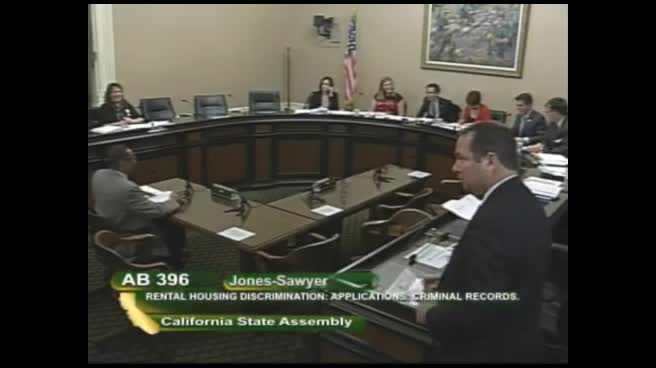 39MIN
Assembly Standing Committee on Housing and Community Development
Bill Author

Bill Co-Author(s):
