AB 399: Unemployment insurance: classified employees.
- Session Year: 2015-2016
- House: Assembly
- Latest Version Date: 2015-04-14
Existing law provides for the payment of unemployment compensation benefits and extended duration benefits to eligible persons who meet specified requirements. Existing law prohibits the payment of unemployment benefits to education employees of a public entity, as defined, including teachers, researchers, and administrators for the period between 2 academic years when there is a reasonable assurance that the employee will perform his or her regular services in the subsequent academic year, except as specified. Existing law similarly prohibits the payment of unemployment benefits to specified education employees of a public entity, other than teachers, researchers, or administrators between 2 academic years, except as specified, but provides a procedure for this 2nd category of educational employees, under certain conditions, to seek payment of retroactive unemployment benefits for the period between 2 academic years. Existing law requires specified notice regarding reasonable assurance of employment in the following academic term be sent to employees before the end of the current academic term. Existing law also authorizes payment of unemployment insurance benefits, using funds from the State Department of Education, to the 2nd category of educational employees at specified schools between academic terms in circumstances where benefits would otherwise be denied.
This bill would delete the prohibition on the payment of unemployment benefits to education employees of a public school, other than teachers, researchers, and administrators, as specified, between 2 academic years. The bill would phase in up to 8 weeks of benefits available to those specified employees over a 4-year timeframe and would make conforming changes, including eliminating the provisions for payment of unemployment benefits to these employees at the specified schools.
Because this bill would expand the categories of people who could receive benefits from the Unemployment Insurance Fund, a continuously appropriated fund, it would make an appropriation.
(a)Notwithstanding any other provision of this division, unemployment compensation benefits, extended duration benefits, and federal-state extended benefits are payable on the basis of service to which Section 3309(a)(1) of the Internal Revenue Code applies, in the same amount, on the same terms, and subject to the same conditions as benefits payable on the basis of other service subject to this division, except as provided by this section.
(b)(1)Benefits specified by subdivision (a) based on service performed in the employ of a nonprofit organization, or of any entity as defined by Section 605, except for a public school as defined in Section 22161 of the Education Code, with respect to service in an instructional, research, or principal administrative capacity for an educational institution are not payable to any individual with respect to any week which begins during the period between two successive academic years or terms or, when an agreement provides instead for a similar period between two regular but not successive terms, during that period, or during a period of paid sabbatical leave provided for in the individuals contract, if the individual performs services in the first of the academic years or terms and if there is a contract or a reasonable assurance that the individual will perform services for any educational institution in the second of the academic years or terms.
(2)Benefits specified by subdivision (a) are authorized for an employee of a public school, as referenced in paragraph (1), as follows:
(A)Two weeks of benefits during 2016 beginning July 1.
(B)Four weeks of benefits during 2017 beginning July 1.
(C)Six weeks of benefits during 2018 beginning July 1.
(D)Eight weeks of benefits during 2019 and each year thereafter beginning July 1.
(c)Benefits (1)Except as provided in paragraph (2), benefits specified by subdivision (a) based on service performed in the employ of a nonprofit organization, or of any entity as defined by Section 605, with respect to service in any other capacity than specified in subdivision (b) for an educational institution shall not be payable to any individual with respect to any week which commences during a period between two successive academic years or terms if the individual performs the service in the first of the academic years or terms and there is a reasonable assurance that the individual will perform the service in the second of the academic years or terms. However, if the individual was not offered an opportunity to perform the services for an educational institution for the second of the academic years or terms, the individual shall be entitled to a retroactive payment of benefits for each week for which the individual filed a timely claim for benefits and for which benefits were denied solely by reason of this subdivision. Retroactive benefits shall be claimed in accordance with the departments procedures which shall specify that except where the individual was entitled to benefits based on services performed for other than an educational institution, an individual who has a reasonable assurance of reemployment may satisfy the search for work requirement of subdivision (e) of Section 1253, by registering for work pursuant to subdivision (b) of Section 1253 during the period between the first and second academic terms or years. A claim for retroactive benefits may be made no later than 30 days following the commencement of the second academic year or term.
(2)Benefits specified by subdivision (a) are authorized for an individual in the employ of a public school for the period between two successive academic years or terms, as described in paragraph (1), as follows:
(A)Two weeks of benefits during 2016 beginning July 1.
(B)Four weeks of benefits during 2017 beginning July 1.
(C)Six weeks of benefits during 2018 beginning July 1.
(D)Eight weeks of benefits during 2019 and each year thereafter beginning July 1.
(d)Benefits specified by subdivision (a) based on service performed in the employ of a nonprofit organization, or of any entity as defined by Section 605, with respect to services specified by subdivision (b) or (c), are not payable to any individual with respect to any week that commences during an established and customary vacation period or holiday recess if the individual performs the specified services in the week immediately before the vacation period or holiday recess, and there is a reasonable assurance that the individual will perform the services in the period immediately following the vacation period or holiday recess.
(e)With respect to any services specified by subdivision (b) or (c), compensation payable on the basis of services in that capacity may be denied as specified in subdivision (b), (c), or (d) to any individual who performed the services in an educational institution while in the employ of an educational service agency, and for this purpose the term educational service agency is defined as a governmental agency or governmental entity that is established and operated exclusively for the purpose of providing the services to one or more educational institutions.
(f)Benefits specified by subdivision (a) based on service performed in the employ of a nonprofit organization, or of any entity as defined by Section 605, are not payable during the periods of time, and subject to the same conditions, contained in subdivisions (b), (c), (d), and (h), if the services are provided to, or on behalf of, an educational institution.
(g)For purposes of this section, reasonable assurance includes, but is not limited to, an offer of employment or assignment made by the educational institution, provided that the offer or assignment is not contingent on enrollment, funding, or program changes. An individual who has been notified that he or she will be replaced and does not have an offer of employment or assignment to perform services for an educational institution is not considered to have reasonable assurance.
(h)For purposes of this section, if the time for service performed during the period of and pursuant to any contract for any academic year or term by an individual for any employing unit as specified in subdivision (b) or (c) constitutes one-half or more of the time in total service performed for the employing unit by the individual during that same period for remuneration, all the services of the individual for the employing unit for that period shall be deemed subject to the benefit payment restriction provisions of this section.
(i)Any entity as defined by Section 605, with respect to any individual performing a service in any other capacity other than specified in subdivision (b) for an educational institution, shall provide a written statement indicating the following to the individual no later than 30 days before the end of the first of the academic years or terms:
(1)Whether or not there is a reasonable assurance of reemployment.
(2)Whether or not it is stated that the individual has no reasonable assurance of reemployment, that the individual should file a claim for benefits at the close of the academic year or term.
(3)If it is stated that the individual has reasonable assurance of reemployment, the written statement shall also inform the employee that he or she may file a claim for benefits and that the determination for eligibility for benefits is made by the Employment Development Department and not by the employer.
(4)If it is stated that the individual has reasonable assurance of reemployment, that the individual shall be entitled to a retroactive payment of benefits if the individual is not offered an opportunity to perform the services for the educational institution for the second of the academic years or terms, if the individual is otherwise eligible and he or she filed a claim for each week benefits are claimed, and if a claim for retroactive benefits is made no later than 30 days following the commencement of the second academic year or term.
SEC. 2.Section 1451 of the Unemployment Insurance Code is repealed.SEC. 3.Section 1452 of the Unemployment Insurance Code is repealed.SEC. 4.Section 1453 of the Unemployment Insurance Code is repealed.(a)Notwithstanding any other provision of this division, unemployment compensation benefits, extended duration benefits, and federal-state extended benefits are payable on the basis of service to which Section 3309(a)(1) of the Internal Revenue Code of 1954 applies, in the same amount, on the same terms, and subject to the same conditions as benefits payable on the basis of other service subject to this division, except as provided by this section.
(b)(1)Benefits specified by subdivision (a) based on service performed in the employ of a nonprofit organization, or of any entity as defined by Section 605, except for a public school as defined in Section 22161 of the Education Code, with respect to service in an instructional, research, or principal administrative capacity for an educational institution are not payable to any individual with respect to any week which begins during the period between two successive academic years or terms or, when an agreement provides instead for a similar period between two regular but not successive terms, during that period, or during a period of paid sabbatical leave provided for in the individuals contract, if the individual performs services in the first of the academic years or terms and if there is a contract or a reasonable assurance that the individual will perform services for any educational institution in the second of the academic years or terms.
(2)Benefits specified by subdivision (a) are authorized for an employee of a public school, as referenced in paragraph (1), as follows:
(A)Two weeks of benefits during 2016 beginning July 1.
(B)Four weeks of benefits during 2017 beginning July 1.
(C)Six weeks of benefits during 2018 beginning July 1.
(D)Eight weeks of benefits during 2019 and each year thereafter beginning July 1.
(c)Benefits specified by subdivision (a) based on service performed in the employ of a nonprofit organization, or of any entity as defined by Section 605, with respect to service in any other capacity than specified in subdivision (b) for an educational institution shall not be payable to any individual with respect to any week which commences during a period between two successive academic years or terms if the individual performs the service in the first of the academic years or terms and there is a reasonable assurance that the individual will perform the service in the second of the academic years or terms. However, if the individual was not offered an opportunity to perform the services for an educational institution for the second of the academic years or terms, the individual shall be entitled to a retroactive payment of benefits for each week for which the individual filed a timely claim for benefits and for which benefits were denied solely by reason of this subdivision. Retroactive benefits shall be claimed in accordance with the departments procedures which shall specify that except where the individual was entitled to benefits based on services performed for other than an educational institution, an individual who has a reasonable assurance of reemployment may satisfy the search for work requirement of subdivision (e) of Section 1253, by registering for work pursuant to subdivision (b) of Section 1253 during the period between the first and second academic terms or years. A claim for retroactive benefits may be made no later than 30 days following the commencement of the second academic year or term.
(d)Benefits specified by subdivision (a) based on service performed in the employ of a nonprofit organization, or of any entity as defined by Section 605, with respect to services specified by subdivision (b) or (c), are not payable to any individual with respect to any week that commences during an established and customary vacation period or holiday recess if the individual performs the specified services in the period week immediately before the vacation period or holiday recess, and there is a reasonable assurance that the individual will perform the services in the period immediately following the vacation period or holiday recess.
(e)With respect to any services specified by subdivision (b) or (c), compensation payable on the basis of services in that capacity may be denied as specified in subdivision (b), (c), or (d) to any individual who performed the services in an educational institution while in the employ of an educational service agency, and for this purpose the term educational service agency means is defined as a governmental agency or governmental entity that is established and operated exclusively for the purpose of providing the services to one or more educational institutions.
(f)Benefits specified by subdivision (a) based on service performed in the employ of a nonprofit organization, or of any entity as defined by Section 605, are not payable during the periods of time, and subject to the same conditions, contained in subdivisions (b), (c), (d), and (h), if the services are provided to, or on behalf of, an educational institution.
(g)For purposes of this section, reasonable assurance includes, but is not limited to, an offer of employment or assignment made by the educational institution, provided that the offer or assignment is not contingent on enrollment, funding, or program changes. An individual who has been notified that he or she will be replaced and does not have an offer of employment or assignment to perform services for an educational institution is not considered to have reasonable assurance.
(h)For purposes of this section, if the time for service performed during the period of and pursuant to any contract for any academic year or term by an individual for any employing unit as specified in subdivision (b) or (c) constitutes one-half or more of the time in total service performed for the employing unit by the individual during that same period for remuneration, all the services of the individual for the employing unit for that period shall be deemed subject to the benefit payment restriction provisions of this section.
(i)Any entity as defined by Section 605, with respect to any individual performing a service in any other capacity other than specified in subdivision (b) for an educational institution, shall provide a written statement indicating the following to the individual no later than 30 days before the end of the first of the academic years or terms:
(1)Whether or not there is a reasonable assurance of reemployment.
(2)Whether or not it is stated that the individual has no reasonable assurance of reemployment, that the individual should file a claim for benefits at the close of the academic year or term.
(3)If it is stated that the individual has reasonable assurance of reemployment, the written statement shall also inform the employee that he or she may file a claim for benefits and that the determination for eligibility for benefits is made by the Employment Development Department and not by the employer.
(4)If it is stated that the individual has reasonable assurance of reemployment, that the individual shall be entitled to a retroactive payment of benefits if the individual is not offered an opportunity to perform the services for the educational institution for the second of the academic years or terms, if the individual is otherwise eligible and he or she filed a claim for each week benefits are claimed, and if a claim for retroactive benefits is made no later than 30 days following the commencement of the second academic year or term.
SEC. 2.Section 1451 of the Unemployment Insurance Code is repealed.1451.Nonprofessional employees of the Fremont and Riverside campuses of the California School for the Deaf, the Fremont campus of the California School for the Blind, and the diagnostic schools for individuals with neurological disabilities located in Los Angeles, San Francisco, and Fresno, shall be eligible for benefits provided by this chapter, on the same terms and conditions as are specified by this part, Part 3 (commencing with Section 3501), and Part 4 (commencing with Section 4001), for all other individuals, except where inconsistent with the provisions of this chapter. Except where inconsistent with the provisions of this chapter, the provisions of this division and authorized regulations shall apply to any matter arising pursuant to this chapter.
SEC. 3.Section 1452 of the Unemployment Insurance Code is repealed.1452.Notwithstanding Section 1253.3, between terms unemployment compensation benefits are payable by the Controller, from funds appropriated for support of the State Department of Education and allocated to the state special schools, upon authorization by the Employment Development Department to individuals who are eligible to receive these benefits under this chapter. These benefits shall only be paid for weeks of unemployment occurring between school terms and during an established and customary vacation period or holiday recess when other benefits are denied solely by reason of Section 1253.3.
SEC. 4.Section 1453 of the Unemployment Insurance Code is repealed.1453.(a)There shall be transferred to the Employment Development Department from funds appropriated for support of the State Department of Education and allocated to the state special schools, at the times and in the manner provided in subdivision (b), an amount equal to the additional cost to the Employment Development Department for added administrative work arising out of this chapter.
(b)The director shall determine the sums he or she estimates the department will be entitled to receive from the State Department of Education under this section for each fiscal year, reduced or increased by any sum by which he or she finds that his or her estimates for any prior fiscal year were greater or less than the amounts which were actually required. The sum of the amounts transferred or expended pursuant to Section 1452, subdivision (a), and this subdivision in any one fiscal year shall not exceed the amount appropriated in the then current fiscal year to the State Department of Education for the purposes of this chapter.
(c)The director may require from the State Department of Education such employment, wage, financial, statistical, or other information and reports, properly verified, as may be deemed necessary by the director to carry out his or her duties under this division, which shall be filed with the director at the time and in the manner prescribed by him or her.
(d)The director may tabulate and publish information obtained pursuant to this chapter in statistical form and may divulge the name of the employing unit.
(e)The State Department of Education shall provide each employee subject to this chapter, at the end of each school term, with written information advising the employee of benefit rights pursuant to this chapter.
|
Date
|
Status
|
|---|---|
| Feb 1, 2016 | From committee: Filed with the Chief Clerk pursuant to Joint Rule 56. |
| Jan 31, 2016 | Died pursuant to Article IV, Sec. 10(c) of the Constitution. |
| May 28, 2015 | In committee: Held under submission. |
| Apr 29, 2015 | In committee: Set, first hearing. Referred to APPR. suspense file. |
| Apr 22, 2015 | From committee: Do pass and re-refer to Com. on APPR. (Ayes 9. Noes 3.) (April 22). Re-referred to Com. on APPR. |
| Apr 15, 2015 | Re-referred to Com. on INS. |
| Apr 14, 2015 | From committee chair, with author's amendments: Amend, and re-refer to Com. on INS. Read second time and amended. |
| Mar 2, 2015 | Referred to Com. on INS. |
| Feb 20, 2015 | From printer. May be heard in committee March 22. |
| Feb 19, 2015 | Read first time. To print. |
|
Date
|
Description
|
Location
|
Votes
|
|
|---|---|---|---|---|
| Apr 22, 2015 | Do pass and be re-referred to the Committee on [Appropriations] | Assembly Standing Committee on Insurance |
Passed |
This list shows positions taken on this bill by organizations on the date displayed, which is linked to the original source.
Positions by individuals are not included.
AB 399
Page 3
Date of Hearing: April 29, 2015
ASSEMBLY COMMITTEE ON APPROPRIATIONS
Jimmy Gomez, Chair
AB 399
(Ridley-Thomas) – As Amended April 14, 2015
Policy Committee: |
Insurance |
Vote: |
9 - 3 |
|
|
|
|
|
|
|
|
Urgency: No State Mandated Local Program: No Reimbursable: No
SUMMARY:
This bill allows classified, non-certificated public school employees to collect unemployment insurance (UI) benefits between school years. Beginning July 1, 2016 with two weeks of benefits, the bill phases in the level of benefits by two-week increments over four years, up to a total of eight weeks per year by July 1, 2019.
FISCAL EFFECT:
There are approximately 250,000 classified, non-certificated employees throughout the state. If 60% of those employees received the maximum allotment of weeks of UI during summer vacation each year, it would cost an additional $90 million per year, each year for four years, until the cost reached approximately $360 million in fiscal year in 2019-20 (School Employees Fund). Costs to the School Employees Fund are funded by school districts, county offices of education, community college districts, and some charter schools, whose employees receive UI benefits through this fund instead of through the UI Trust Fund.
The increased costs in UI for these workers would likely increase the quarterly Local Experience Charges (LECs) paid by school districts. It is unknown how much those costs would increase, but increased costs could easily exceed millions of dollars throughout all the school districts across the state. LECs would depend on how many employees sought UI benefits in the particular district.
There could be a direct cost impact to the UI Trust Fund, potentially of millions to tens of millions of dollars, if some charter school employees receive benefits through this fund instead of the SEF. EDD does not track which charters rely on UI Trust Fund versus those that use a different reimbursement method, but reports that only a quarter of charters participate in SEF, meaning benefits paid to employees of the remaining three-quarters would potentially impact the UI Trust Fund (though it is unclear how many schools participate in the tax-rated methodology that impacts the UI Trust Fund). The remainder of charters reimburse the UI Trust Fund directly for costs incurred to provide benefits to their employees.
Furthermore, the Employment Development Department (EDD) has raised a concern about whether increased expenditures from the UI Trust Fund could trigger an increase in federal UI taxes. Since the UI Trust Fund is insolvent and owes funds to the federal government, federal law requires a tax credit received by employers for their federal UI tax liability is reduced incrementally each year until the loan is repaid. There are also additional credit reductions, from which the state currently has a waiver. A condition of the waiver is that California does not take any action to reduce solvency from the UI Trust Fund. Increasing expenditures without corresponding revenue increases would reduce solvency, potentially threatening the waiver.
Finally, since this bill will result in such a large overall increase in UI benefits being paid out to school employees, there may be an indirect effect on UI Trust Fund solvency. Schools that currently do not use a tax-rated UI Trust Fund methodology may be financially better off to move to such a methodology, as the maximum tax rates for UI are capped at 6.2% of the first $7,000 of wages, a total of $434 per employee. That rate could be less than what they would end up paying through the SEF, though the large SEF fund balance could mitigate this for a year or so. The more schools that choose to move to a tax-rated methodology under this level of benefit expenditure, the greater the impact on UI Trust Fund solvency.
EDD also warns this bill may not conform to federal law, as it treats public school employees different than employees of nonprofits. Sanctions for non-conformity include withholding of a state’s grant for administration of the UI program, and the loss of a federal tax credit for a state’s employers.
COMMENTS:
Purpose. According to the author, thousands of school employees find the months between academic years to be a stressful period financially. Existing law prohibits certain education employees, those who are not teachers, researchers, or administrators, from receiving benefits during months in which school is not in session, unless they meet very specific criteria. Many school employees rely on summer school to maintain a reliable income source. Since 2007, however, budget cuts have led to the elimination of summer school in many districts, leaving tens of thousands of education employees without a steady income or access to unemployment insurance benefits. This bill would allow those employees to receive unemployment insurance during the summer break between school years.
Federal Law. Federal law generally requires equal treatment for the payment of UI benefits to certain nonprofit organizations, Indian tribes, and state and local government workers in the same amount, on the same terms, and subject to the same conditions, as other workers subject to state law. An exception to the equal treatment requirement pertains to the denial of UI for professional and nonprofessional employees of educational institutions during a period between or within academic years or terms when there is a contract or reasonable assurance that the employee will go back to work in the same or similar capacity in the ensuing academic year or term.
States must deny UI benefits to professional school employees between and within the academic years or terms when a contract or reasonable assurance exists. However, states have the option of providing UI benefits to nonprofessional school employees between and within the academic years or terms when a contract or reasonable assurance exists.
School Employees Fund (SEF). Public school employers, K-12 and community colleges may elect to participate in the SEF, which is a pooled-risk fund administered by the EDD, which collects quarterly contributions based upon a percentage of total wages paid by public schools and community college districts. Employers who participate in the SEF may also have to pay an additional quarterly Local Experience charge if they have higher UI costs charged to their individual accounts. Contributions deposited in the School Employees Fund are used to reimburse the UI Trust Fund for the cost of UI benefits paid to former employees. The SEF had a projected reserve of $485 million at the end of the 2014-15 fiscal year.
Previous Legislation. AB 1638 (Bocanegra) of 2014 and AB 615 (Bocanegra) of 2013 were similar to this bill, and were both held on the Suspense File of this committee.
Analysis Prepared by: Lisa Murawski / APPR. / (916) 319-2081
AB 399
Page 3
Date of Hearing: April 22, 2015
ASSEMBLY COMMITTEE ON INSURANCE
Tom Daly, Chair
AB 399
Ridley-Thomas – As Amended April 14, 2015
SUBJECT: Unemployment insurance: classified school employees
SUMMARY: Allows classified school employees to collect unemployment insurance (UI) benefits between school years. Specifically, this bill:
Exempts classified public school employees from the prohibition on educational employees collecting UI benefits.
Increases the maximum duration of UI benefits for classified public school employees as follows:
2 weeks effective July 1, 2016
4 weeks effective July 1, 2017
6 weeks effective July 1, 2018
8 weeks effective July 1, 2019
EXISTING LAW:
Provides UI benefits to employees who lose their job through no fault of their own.
Requires employers to pay state and federal taxes to pay the costs of administering and providing UI benefits.
Permits public employers to provide UI benefits to their employees on a reimbursement basis in lieu of paying payroll taxes.
Prohibits employees of public and private non-profit educational institutions from collecting UI benefits between academic years if they have reasonable assurance of being employed in the next academic term.
Permits non-professional employees of public and non-profit educational institutions to collect UI benefits retroactively should they not be employed in the next academic term after receiving reasonable assurance of future employment.
Requires employers to provide documentation of the reasonable assurance when that notice is given.
Prohibits, as a matter of federal law, providing UI benefits to professional employees between academic years.
FISCAL EFFECT: Undetermined
COMMENTS:
Purpose. According to the author, classified school employees do the essential work that keeps our public schools up and running. These extraordinary workers keep our campuses safe, clean, and efficient. Most importantly, they strive to improve the daily lives of our students. Despite the important and hard work of classified school employees, many struggle to support their families with incomes that are often inadequate to pay for food, housing, and health care. And while certified school employees, such as administrators, teachers, librarians, and nurses, earn middle class incomes and benefits that can last through the summer breaks, classified school employees do not. Unlike other employees who receive UI benefits during their regular seasonal breaks, classified school employees are ineligible to receive those same benefits. The only option for classified school employees to support their families during the summer is to find another job. Yet classified school employees are often unable to find work during the summer because employers are reluctant to hire and invest in a short-term employee. Thus, a classified school employee’s only real option for summer employment is a job with a summer school program, but those jobs are scarce. Being excluded from UI benefits creates a serious financial hardship for a classified school employee that does not exist for their fellow education workers.
Federal Law. Federal law generally requires equal treatment for the payment of UI benefits on the basis of service to certain nonprofit organizations, Indian tribes, and state and local government workers in the same amount, on the same terms, and subject to the same conditions, as other service subject to state law. An exception to the equal treatment requirement pertains to the denial of UI for “professional” and “nonprofessional” employees of educational institutions during a period between or within academic years or terms when there is a contract or reasonable assurance that the employee will go back to work in the same or similar capacity in the ensuing academic year/term. State law must deny UI benefits to professional school employees between and within the academic years or terms when a contract or reasonable assurance exists. State law may deny UI benefits to nonprofessional school employees between and within the academic years or terms when a contract or reasonable assurance exists.
Public Agency Costs. This bill would likely have relatively minor impact to the Unemployment Insurance Trust Fund (trust fund) that pays for most UIC benefits because public K-12 school districts and community colleges commonly elect to participate in the School Employees Fund (SEF) in lieu of paying payroll taxes. The SEF is a special reimbursable financing method administered by the Employment Development Department which collects contributions based upon a percentage of total wages paid by public schools and community college districts. Money deposited in the SEF is used to reimburse the trust fund for the cost of benefits paid to former employees. All 72 community college districts and 1,298 county offices of education, public school districts, and charter schools participate in the SEF. The SEF has a projected fund balance of over $485 million at the end of the 2014-15 fiscal year. The costs of paying for these additional benefits from this bill will be borne by the SEF, and the SEF costs will have to be reimbursed by the participating schools.
Opponents note that the bill would result in significant cost increases for K-12 school districts and other local educational agencies that have experienced dramatic budget cuts in recent years and continue to operate within very tight budgets. Last year the Assembly Appropriations Committee provided the following estimate for AB 1638 (Bocanegra) which is consistent with the final costs of this bill:
"There are approximately 250,000 non-certificated, classified employees throughout the state. If 60% of those employees received 8 weeks of UI during summer vacation each year, it would cost approximately $360 million (School Employees Fund)."
Retroactive Benefits. School employees expect to not work at school (and generally not be paid) during the break between academic years. In recognition of this reality, current law provides a mechanism for classified employees to receive unemployment benefits retroactively should they not be employed at the next school year. This ensures that a classified employee who expected to be employed in the next school year, but was not, can collect UIC benefits from the end of the prior school year.
Previous Legislation. In 2014, this committee passed AB 1638 (Bocanegra) which proposed to extend UI benefits to classified school employees. The bill was held on the Assembly Appropriations Committee Suspense File. In 2013, this committee passed AB 615 (Bocanegra) which is nearly identical to AB 1638. The bill was held on the Assembly Appropriations Committee Suspense File.
REGISTERED SUPPORT / OPPOSITION:
Support
Service Employees International Union, California (sponsor)
California Federation of Teachers (co-sponsor)
California Teachers Association
California Labor Federation
California School Employees Association
Opposition
California Association of School Business Officials
Orange County Department of Education
Riverside County Superintendent of Schools
Analysis Prepared by: Paul Riches / INS. / (916) 319-2086
Discussed in Hearing
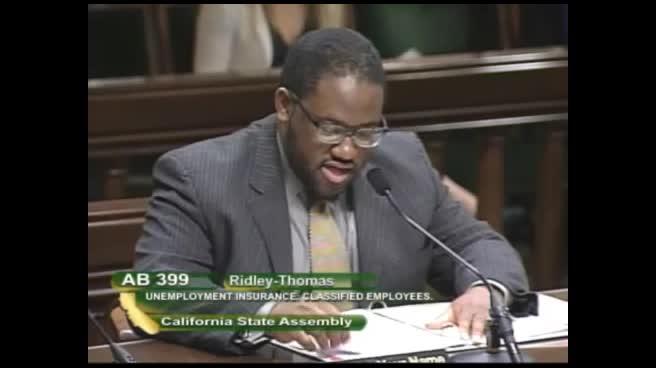 22MIN
Assembly Standing Committee on Insurance
Bill Author

Bill Co-Author(s):