AB 1113: California Longitudinal Pupil Achievement Data System: expanded learning opportunity programs.
- Session Year: 2023-2024
- House: Assembly
- Latest Version Date: 2024-09-30
Current Status:
Passed
(2024-09-30: Chaptered by Secretary of State - Chapter 1003, Statutes of 2024.)
Introduced
In Committee
First Chamber
In Committee
Second Chamber
Enacted
Existing law establishes the Expanded Learning Opportunities Program to provide funds to school districts and certain charter schools to offer, outside of any instructional time, expanded learning opportunities, as defined, to pupils enrolled in classroom-based instructional programs in kindergarten and grades 1 to 6, inclusive, under specified funding methodologies and program conditions. The After School Education and Safety Program Act of 2002, an initiative statute approved by the voters as Proposition 49 at the November 5, 2002, statewide general election, establishes the After School Education and Safety Program (ASES), under which participating public schools receive grants to operate before and after school programs serving pupils in kindergarten or any of grades 1 to 9, inclusive. Existing federal law establishes the 21st Century Community Learning Centers Program to provide pupils with academic enrichment and other activities during nonschool hours or periods when school is not in session, as provided.
Existing law establishes the California Longitudinal Pupil Achievement Data System, which is maintained by the State Department of Education and consists of pupil data from elementary and secondary schools, as specified, relating to demographics, program participation, enrollment, and statewide assessments, among other things. Existing law requires the system to be used to accomplish specified goals, including to provide an efficient, flexible, and secure means of maintaining statewide pupil level data, as provided.
This bill would require the department, beginning with the 202526 school year, to define and collect, as part of the California Longitudinal Pupil Achievement Data System, annual pupil enrollment data for each pupil enrolled in an expanded learning opportunity program, including, but not limited to, the Expanded Learning Opportunities Program, ASES, and the 21st Century Community Learning Centers Program, as specified. The bill would require the department, beginning with the 202526 school year, to identify and reduce data reporting redundancies, and provide guidance and recommendations to local educational agencies, in the collection of pupil data pursuant to these provisions and existing local educational data reporting requirements for those programs, as specified. The bill would express the intent of the Legislature to provide equitable opportunities to pupils in grades 7 to 12, inclusive, with a welcoming and enriching space through afterschool programs.
Existing law establishes the Expanded Learning Opportunities Program to provide funds to school districts and certain charter schools to offer, outside of any instructional time, expanded learning opportunities, as defined, to pupils enrolled in classroom-based instructional programs in kindergarten and grades 1 to 6, inclusive, under specified funding methodologies and program conditions. The After School Education and Safety Program Act of 2002, an initiative statute approved by the voters as Proposition 49 at the November 5, 2002, statewide general election, establishes the After School Education and Safety Program (ASES), under which participating public schools receive grants to operate before and after school programs serving pupils in kindergarten or any of grades 1 to 9, inclusive. Existing federal law establishes the 21st Century Community Learning Centers Program to provide pupils with academic enrichment and other activities during nonschool hours or periods when school is not in session, as provided.
Existing law establishes the California Longitudinal Pupil Achievement Data System, which is maintained by the State Department of Education and consists of pupil data from elementary and secondary schools, as specified, relating to demographics, program participation, enrollment, and statewide assessments, among other things. Existing law requires the system to be used to accomplish specified goals, including to provide an efficient, flexible, and secure means of maintaining statewide pupil level data, as provided.
This bill would require the department, by July 1, 2024, beginning with the 202526 school year, to define and collect, as part of the California Longitudinal Pupil Achievement Data System, annual pupil data enrollment data for each pupil enrolled in a program under an expanded learning opportunity program, including, but not limited to, the Expanded Learning Opportunities Program, the After School Education and Safety Program (ASES), or ASES, and the 21st Century Community Learning Centers Program, as specified. The bill would require the department, on or before January 1, 2025, beginning with the 202526 school year, to identify and reduce data reporting redundancies redundancies, and provide guidance and recommendations to local educational agencies, in the collection of pupil data pursuant to these provisions and existing local educational data reporting requirements for those programs. programs, as specified. The bill would express the intent of the Legislature to provide equitable opportunities to pupils in grades 7 to 12, inclusive, with a welcoming and enriching space through afterschool programs.
(2)The After School Education and Safety Program Act of 2002, an initiative statute approved by the voters as Proposition 49 at the November 5, 2002, statewide general election, establishes the After School Education and Safety Program (ASES) under which participating public schools receive grants to operate before and after school programs serving pupils in kindergarten or any of grades 1 to 9, inclusive. The act requires an amount not to exceed $550,000,000 to be continuously appropriated to the State Department of Education from the General Fund in each fiscal year for purposes of the program, and requires the amount to be allocated to public elementary, middle, and junior high schools according to a specified priority scheme, as provided. The act authorizes the Legislature to amend the provisions containing that priority scheme only by a statute, enacted by a 2/3 vote of each house and signed by the Governor, that furthers the purposes of the act. Commencing with the 202425 fiscal year, this bill would require, notwithstanding any other law, at least a certain percentage of the total amount appropriated pursuant to the act or by the Legislature in the annual Budget Act or another statute or for purposes of the ASES to be allocated on a priority basis for programs serving middle school pupils, as provided. The bill would set forth a legislative finding and declaration that the bill furthers the purposes of the act.(3)Existing federal law establishes the 21st Century Community Learning Centers Program to provide pupils with academic enrichment and other activities during nonschool hours or periods when school is not in session, as provided. Under the program, of the total amount appropriated for after school grants to community learning centers, at least 50% is required to be allocated on a priority basis to community learning centers serving high school pupils and at least 40% is required to be allocated on a priority basis to community learning centers serving elementary and middle school pupils, as provided. In any fiscal year in which the total appropriation exceeds the 200809 fiscal years total appropriation for the program, the excess amount is required to be allocated on a priority basis as 35% to community learning centers serving high school pupils, 50% to community learning centers serving elementary and middle school pupils, and 15% to community learning centers with summer programs serving elementary and middle school pupils, as provided. Commencing with the 202425 fiscal year, this bill instead would require (A) at least 60% of the total amount appropriated pursuant to the program to be allocated on a priority basis to community learning centers serving pupils in grades 9 to 12, inclusive, (B) at least 20% to community learning centers serving pupils in middle schools, and (C) at least 15% to community learning centers serving pupils in elementary schools, as provided.(4)This bill would also make nonsubstantive and conforming changes.(1)Existing law establishes the Expanded Learning Opportunities Program to provide funds to school districts and certain charter schools to offer, outside of any instructional time, expanded learning opportunities, as defined, to pupils enrolled in classroom-based instructional programs in kindergarten and grades 1 to 6, inclusive, under specified funding methodologies and program conditions.
Existing law establishes the California Longitudinal Pupil Achievement Data System, which is maintained by the State Department of Education and consists of pupil data from elementary and secondary schools, as specified, relating to demographics, program participation, enrollment, and statewide assessments, among other things. Existing law requires the system to be used to accomplish specified goals, including to provide an efficient, flexible, and secure means of maintaining statewide pupil level data, as provided.
This bill would require the department, by July 1, 2024, to collect, as part of the California Longitudinal Pupil Achievement Data System, pupil data for each pupil enrolled in a program under the Expanded Learning Opportunities Program, the After School Education and Safety Program (ASES), or the 21st Century Community Learning Centers Program, as specified. The bill would require the department, on or before January 1, 2025, to identify and reduce data reporting redundancies in the collection of pupil data pursuant to these provisions and existing local educational data reporting requirements for those programs. The bill would express the intent of the Legislature to provide equitable opportunities to pupils in grades 7 to 12, inclusive, with a welcoming and enriching space through afterschool programs.
(2)The After School Education and Safety Program Act of 2002, an initiative statute approved by the voters as Proposition 49 at the November 5, 2002, statewide general election, establishes the After School Education and Safety Program (ASES) under which participating public schools receive grants to operate before and after school programs serving pupils in kindergarten or any of grades 1 to 9, inclusive. The act requires an amount not to exceed $550,000,000 to be continuously appropriated to the State Department of Education from the General Fund in each fiscal year for purposes of the program, and requires the amount to be allocated to public elementary, middle, and junior high schools according to a specified priority scheme, as provided. The act authorizes the Legislature to amend the provisions containing that priority scheme only by a statute, enacted by a 2/3 vote of each house and signed by the Governor, that furthers the purposes of the act.
Commencing with the 202425 fiscal year, this bill would require, notwithstanding any other law, at least a certain percentage of the total amount appropriated pursuant to the act or by the Legislature in the annual Budget Act or another statute or for purposes of the ASES to be allocated on a priority basis for programs serving middle school pupils, as provided. The bill would set forth a legislative finding and declaration that the bill furthers the purposes of the act.
(3)Existing federal law establishes the 21st Century Community Learning Centers Program to provide pupils with academic enrichment and other activities during nonschool hours or periods when school is not in session, as provided. Under the program, of the total amount appropriated for after school grants to community learning centers, at least 50% is required to be allocated on a priority basis to community learning centers serving high school pupils and at least 40% is required to be allocated on a priority basis to community learning centers serving elementary and middle school pupils, as provided. In any fiscal year in which the total appropriation exceeds the 200809 fiscal years total appropriation for the program, the excess amount is required to be allocated on a priority basis as 35% to community learning centers serving high school pupils, 50% to community learning centers serving elementary and middle school pupils, and 15% to community learning centers with summer programs serving elementary and middle school pupils, as provided.
Commencing with the 202425 fiscal year, this bill instead would require (A) at least 60% of the total amount appropriated pursuant to the program to be allocated on a priority basis to community learning centers serving pupils in grades 9 to 12, inclusive, (B) at least 20% to community learning centers serving pupils in middle schools, and (C) at least 15% to community learning centers serving pupils in elementary schools, as provided.
(4)Commencing with the 202425 fiscal year, this bill would require the department, each fiscal year, to provide an add-on to a grant received under the After School Education and Safety Program of 2002 or the 21st Century Community Learning Centers Program to increase the grant by a specified cost-of-living adjustment, as provided. Commencing with the 202425 fiscal year, the bill would, each fiscal year, appropriate an amount necessary to implement these add-on grant provisions from the General Fund to the department for purposes of these provisions.(5)(4)This bill would also make nonsubstantive and conforming changes.
(6)Funds appropriated by this bill would be applied toward the minimum funding requirements for school districts and community college districts imposed by Section 8 of Article XVI of the California Constitution.(1)Existing law establishes the Expanded Learning Opportunities Program to provide funds to school districts and certain charter schools to offer, outside of any instructional time, expanded learning opportunities, as defined, to pupils enrolled in classroom-based instructional programs in kindergarten and grades 1 to 6, inclusive, under specified funding methodologies and program conditions.
Existing law establishes the California Longitudinal Pupil Achievement Data System, which is maintained by the State Department of Education and consists of pupil data from elementary and secondary schools, as specified, relating to demographics, program participation, enrollment, and statewide assessments, among other things. Existing law requires the system to be used to accomplish specified goals, including to provide an efficient, flexible, and secure means of maintaining statewide pupil level data, as provided.
This bill would require the department, by July 1, 2024, to collect, as part of the California Longitudinal Pupil Achievement Data System, pupil data for each pupil enrolled in a program under the Expanded Learning Opportunities Program, the After School Education and Safety Program (ASES), or the 21st Century Community Learning Centers Program, as specified. The bill would require the department, on or before January 1, 2025, to identify and reduce data reporting redundancies in the collection of pupil data pursuant to these provisions and existing local educational data reporting requirements for those programs. The bill would express the intent of the Legislature to provide equitable opportunities to pupils in grades 7 to 12, inclusive, with a welcoming and enriching space through afterschool programs.
(2)The After School Education and Safety Program Act of 2002, an initiative statute approved by the voters as Proposition 49 at the November 5, 2002, statewide general election, establishes the After School Education and Safety Program (ASES) under which participating public schools receive grants to operate before and after school programs serving pupils in kindergarten or any of grades 1 to 9, inclusive. The act requires an amount not to exceed $550,000,000 to be continuously appropriated to the State Department of Education from the General Fund in each fiscal year for purposes of the program, and requires the amount to be allocated to public elementary, middle, and junior high schools according to a specified priority scheme, as provided. The act authorizes the Legislature to amend the provisions containing that priority scheme only by a statute, enacted by a 2/3 vote of each house and signed by the Governor, that furthers the purposes of the act.
Commencing with the 202425 fiscal year, this bill would require, notwithstanding any other law, at least a certain percentage of the total amount appropriated pursuant to the act or by the Legislature in the annual Budget Act or another statute or for purposes of the ASES to be allocated on a priority basis for programs serving middle school pupils, as provided. The bill would set forth a legislative finding and declaration that the bill furthers the purposes of the act.
(3)Existing federal law establishes the 21st Century Community Learning Centers Program to provide pupils with academic enrichment and other activities during nonschool hours or periods when school is not in session, as provided. Under the program, of the total amount appropriated for after school grants to community learning centers, at least 50% is required to be allocated on a priority basis to community learning centers serving high school pupils and at least 40% is required to be allocated on a priority basis to community learning centers serving elementary and middle school pupils, as provided. In any fiscal year in which the total appropriation exceeds the 200809 fiscal years total appropriation for the program, the excess amount is required to be allocated on a priority basis as 35% to community learning centers serving high school pupils, 50% to community learning centers serving elementary and middle school pupils, and 15% to community learning centers with summer programs serving elementary and middle school pupils, as provided.
Commencing with the 202425 fiscal year, this bill instead would require (A) at least 60% of the total amount appropriated pursuant to the program to be allocated on a priority basis to community learning centers serving pupils in grades 9 to 12, inclusive, (B) at least 20% to community learning centers serving pupils in middle schools, and (C) at least 15% to community learning centers serving pupils in elementary schools, as provided.
(4)Commencing with the 202425 fiscal year, this bill would require the department, each fiscal year, to provide an add-on to a grant received under the After School Education and Safety Program of 2002 or the 21st Century Community Learning Centers Program to increase the grant by a specified cost-of-living adjustment, as provided. Commencing with the 202425 fiscal year, the bill would, each fiscal year, appropriate an amount necessary to implement these add-on grant provisions from the General Fund to the department for purposes of these provisions.
(5)This bill would also make nonsubstantive and conforming changes.
(6)Funds appropriated by this bill would be applied toward the minimum funding requirements for school districts and community college districts imposed by Section 8 of Article XVI of the California Constitution.
(1)Existing law establishes the Expanded Learning Opportunities Program to provide funds to school districts and certain charter schools to offer, outside of any instructional time, expanded learning opportunities, as defined, to pupils enrolled in classroom-based instructional programs in kindergarten and grades 1 to 6, inclusive, under specified funding methodologies and program conditions.
Existing law establishes the California Longitudinal Pupil Achievement Data System, which is maintained by the State Department of Education and consists of pupil data from elementary and secondary schools, as specified, relating to demographics, program participation, enrollment, and statewide assessments, among other things. Existing law requires the system to be used to accomplish specified goals, including to provide an efficient, flexible, and secure means of maintaining statewide pupil level data, as provided.
This bill would require the department, by July 1, 2024, to collect, as part of the California Longitudinal Pupil Achievement Data System, pupil data for each pupil enrolled in an expanded learning opportunity program operated by a local educational agency. a program under the Expanded Learning Opportunities Program, the After School Education and Safety Program (ASES), or the 21st Century Community Learning Centers Program, as specified. The bill would express the intent of the Legislature to provide equitable opportunities to pupils in grades 7 to 12, inclusive, with a welcoming and enriching space through afterschool programs.
(2)The After School Education and Safety Program Act of 2002, an initiative statute approved by the voters as Proposition 49 at the November 5, 2002, statewide general election, establishes the After School Education and Safety Program (ASES) under which participating public schools receive grants to operate before and after school programs serving pupils in kindergarten or any of grades 1 to 9, inclusive. The act requires an amount not to exceed $550,000,000 to be continuously appropriated to the State Department of Education from the General Fund in each fiscal year for purposes of the program, and requires the amount to be allocated to public elementary, middle, and junior high schools according to a specified priority scheme, as provided. The act authorizes the Legislature to amend the provisions containing that priority scheme only by a statute, enacted by a 2/3 vote of each house and signed by the Governor, that furthers the purposes of the act.
Commencing with the 202425 fiscal year, this bill would require, notwithstanding any other law, at least a certain percentage of the total amount appropriated pursuant to the act or by the Legislature in the annual Budget Act or another statute or for purposes of the ASES to be allocated on a priority basis for programs serving middle school pupils, as provided. The bill would set forth a legislative finding and declaration that the bill furthers the purposes of the act.
(3)Existing federal law establishes the 21st Century Community Learning Centers Program to provide pupils with academic enrichment and other activities during nonschool hours or periods when school is not in session, as provided. Under the program, of the total amount appropriated for after school grants to community learning centers, at least 50% is required to be allocated on a priority basis to community learning centers serving high school pupils and at least 40% is required to be allocated on a priority basis to community learning centers serving elementary and middle school pupils, as provided. In any fiscal year in which the total appropriation exceeds the 200809 fiscal years total appropriation for the program, the excess amount is required to be allocated on a priority basis as 35% to community learning centers serving high school pupils, 50% to community learning centers serving elementary and middle school pupils, and 15% to community learning centers with summer programs serving elementary and middle school pupils, as provided.
Commencing with the 202425 fiscal year, this bill instead would require (A) at least 60% of the total amount appropriated pursuant to the program to be allocated on a priority basis to community learning centers serving pupils in grades 9 to 12, inclusive, (B) at least 20% to community learning centers serving pupils in grades 7 to 8, inclusive, middle schools, and (C) at least 15% to community learning centers serving pupils in transitional kindergarten to grade 6, inclusive, elementary schools, as provided.
(4)Commencing with the 202425 fiscal year, this bill would require the department, each fiscal year, to provide an add-on to a grant received under the After School Education and Safety Program of 2002 or the 21st Century Community Learning Centers Program to increase the grant by a specified cost-of-living adjustment, as provided. Commencing with the 202425 fiscal year, the bill would, each fiscal year, appropriate an amount necessary to implement these add-on grant provisions from the General Fund to the department for purposes of these provisions.
(5)This bill would also make nonsubstantive and conforming changes.
(6)Funds appropriated by this bill would be applied toward the minimum funding requirements for school districts and community college districts imposed by Section 8 of Article XVI of the California Constitution.
(1)Existing law establishes the Expanded Learning Opportunities Program to provide funds to school districts and certain charter schools to offer, outside of any instructional time, expanded learning opportunities, as defined, to pupils enrolled in classroom-based instructional programs in kindergarten and grades 1 to 6, inclusive, under specified funding methodologies and program conditions.
Existing law establishes the California Longitudinal Pupil Achievement Data System, which is maintained by the State Department of Education and consists of pupil data from elementary and secondary schools, as specified, relating to demographics, program participation, enrollment, and statewide assessments, among other things. Existing law requires the system to be used to accomplish specified goals, including to provide an efficient, flexible, and secure means of maintaining statewide pupil level data, as provided.
This bill would require the department, by July 1, 2024, to collect, as part of the California Longitudinal Pupil Achievement Data System, pupil data for each pupil enrolled in an expanded learning opportunity program operated by a local educational agency. The bill would express the intent of the Legislature to provide equitable opportunities to pupils in grades 7 to 12, inclusive, with a welcoming and enriching space through afterschool programs.
(2)The After School Education and Safety Program Act of 2002, an initiative statute approved by the voters as Proposition 49 at the November 5, 2002, statewide general election, establishes the After School Education and Safety Program (ASES) under which participating public schools receive grants to operate before and after school programs serving pupils in kindergarten or any of grades 1 to 9, inclusive. The act requires an amount not to exceed $550,000,000 to be continuously appropriated to the State Department of Education from the General Fund in each fiscal year for purposes of the program, and requires the amount to be allocated to public elementary, middle, and junior high schools according to a specified priority scheme, as provided. The act authorizes the Legislature to amend the provisions containing that priority scheme only by a statute, enacted by a 2/3 vote of each house and signed by the Governor, that furthers the purposes of the act.
Commencing with the 202425 fiscal year, this bill would require, notwithstanding any other law, at least a certain percentage of the total amount appropriated pursuant to the act or by the Legislature in the annual Budget Act or another statute or for purposes of the ASES to be allocated on a priority basis for programs serving middle school pupils, as provided. The bill would set forth a legislative finding and declaration that the bill furthers the purposes of the act.
(3)Existing federal law establishes the 21st Century Community Learning Centers Program to provide pupils with academic enrichment and other activities during nonschool hours or periods when school is not in session, as provided. Under the program, of the total amount appropriated for after school grants to community learning centers, at least 50% is required to be allocated on a priority basis to community learning centers serving high school pupils and at least 40% is required to be allocated on a priority basis to community learning centers serving elementary and middle school pupils, as provided. In any fiscal year in which the total appropriation exceeds the 200809 fiscal years total appropriation for the program, the excess amount is required to be allocated on a priority basis as 35% to community learning centers serving high school pupils, 50% to community learning centers serving elementary and middle school pupils, and 15% to community learning centers with summer programs serving elementary and middle school pupils, as provided.
Commencing with the 202425 fiscal year, this bill instead would require (A) at least 60% of the total amount appropriated pursuant to the program to be allocated on a priority basis to community learning centers serving pupils in grades 9 to 12, inclusive, (B) at least 20% to community learning centers serving pupils in grades 7 to 8, inclusive, and (C) at least 15% to community learning centers serving pupils in transitional kindergarten to grade 6, inclusive, as provided.
(4)Commencing with the 202425 fiscal year, this bill would require the department, each fiscal year, to provide an add-on to a grant received under the After School Education and Safety Program of 2002 or the 21st Century Community Learning Centers Program to increase the grant by a specified cost-of-living adjustment, as provided. Commencing with the 202425 fiscal year, the bill would, each fiscal year, appropriate an amount necessary to implement these add-on grant provisions from the General Fund to the department for purposes of these provisions.
(5)This bill would also make nonsubstantive and conforming changes.
(6)Funds appropriated by this bill would be applied toward the minimum funding requirements for school districts and community college districts imposed by Section 8 of Article XVI of the California Constitution.
(a)The Legislature finds and declares all of the following:
(1)Research shows that participating in afterschool programs, including before school, after school, intersessional, and summer learning programs, improves childrens school attendance, reading and math performance, English language proficiency, grades, and behavior in class.
(2)Afterschool programs reduce childhood hunger by serving nutritious snacks or meals daily and promote physical activity and healthy behaviors.
(3)Quality afterschool programs provide supportive and diverse mentors and are a safe space where pupils build social-emotional skills, confidence, and a sense of belonging and develop healthy relationships with their peers and adults.
(4)Pupils who participate in afterschool programs are more likely to graduate high school and have lower rates of suspension and expulsion, and less likely to become involved in the criminal justice system and abuse substances.
(5)Publicly funded afterschool programs help close the opportunity gap that exists between children from higher income families and children from low-income families who could otherwise not afford enrichment activities and academic support.
(6)The state is committed to the goal of expanding universal access to afterschool programs to all schoolage children in the state to increase educational equity, help meet the needs of working families, and provide a safe and engaging place that promotes the physical, social, emotional, and academic growth and well-being of the whole child.
(7)The Budget Act of 2021 invested over $1.7 billion to expand access to after school and summer learning programs for children in transitional kindergarten, kindergarten, and grades 1 to 6, inclusive, through the establishment of the Expanded Learning Opportunities Program, and stated the legislative intent to grow the states share of that investment to $5 billion by 2025.
(b)It is the intent of the Legislature to provide equitable opportunities to pupils in grades 7 to 12, inclusive, with a welcoming and enriching space through afterschool programs, and to especially help those pupils address the disconnection, stress, and trauma of the COVID-19 pandemic, and, in alignment with the states universal afterschool goals, to engage those pupils and provide the experiences and skills to succeed in school, career, and life.
SEC. 2.Section 60902 is added to the Education Code, immediately following Section 60901, to read:60902.(a)(1)Beginning with the 202526 school year, the department shall define, consistent with paragraph (2), and collect, as part of the California Longitudinal Pupil Achievement Data System, annual pupil enrollment data for each pupil enrolled in an expanded learning opportunity program. For purposes of this section, an expanded learning opportunity program may include, but is not limited to, all of the following programs:
(A)An expanded learning opportunity program operated by a local educational agency pursuant to Section 46120.
(B)An after school education and safety program operated by a participating school pursuant to Article 22.5 (commencing with Section 8482) of Chapter 2 of Part 6 of Division 1 of Title 1.
(C)A program operated by a participating community learning center pursuant to Article 22.6 (commencing with Section 8484.7) of Chapter 2 of Part 6 of Division 1 of Title 1.
(2)Annual pupil enrollment shall align to the Expanded Learning Opportunities Program pupil access requirements pursuant to Section 46120 and reflect individual pupil access within an academic year reporting period, as determined by the department.
(3)The department shall ensure that the collection of pupil data pursuant to this section is integrated with existing local educational agency data reporting requirements for the California Longitudinal Pupil Achievement Data System.
(b)Beginning with the 202526 school year, the department shall identify and reduce data reporting redundancies, and provide guidance and recommendations to local educational agencies, in the collection of pupil data, including, but not limited to, pupil participation, for each pupil enrolled in an expanded learning opportunity program pursuant to subdivision (a) and existing local educational data reporting requirements for those programs.
SEC. 3.Notwithstanding the condition specified in Provision 9 of Item 6100-001-0890 of Section 2.00 of the Budget Acts of 2024 and 2025, the department shall not be subject to a loss of funding or Department of Finance approval for the purposes of implementing Section 2 of this act.
(a)The Legislature finds and declares all of the following:
(1)Research shows that participating in afterschool programs, including before school, after school, intersessional, and summer learning programs, improves childrens school attendance, reading and math performance, English language proficiency, grades, and behavior in class.
(2)Afterschool programs reduce childhood hunger by serving nutritious snacks or meals daily and promote physical activity and healthy behaviors.
(3)Quality afterschool programs provide supportive and diverse mentors and are a safe space where pupils build social-emotional skills, confidence, and a sense of belonging and develop healthy relationships with their peers and adults.
(4)Pupils who participate in afterschool programs are more likely to graduate high school and have lower rates of suspension and expulsion, and less likely to become involved in the criminal justice system and abuse substances.
(5)Publicly funded afterschool programs help close the opportunity gap that exists between children from higher income families and children from low-income families who could otherwise not afford enrichment activities and academic support.
(6)The state is committed to the goal of expanding universal access to afterschool programs to all schoolage children in the state to increase educational equity, help meet the needs of working families, and provide a safe and engaging place that promotes the physical, social, emotional, and academic growth and well-being of the whole child.
(7)The Budget Act of 2021 invested over $1,700,000,000 $1.7 billion to expand access to after school and summer learning programs for children in transitional kindergarten, kindergarten, and grades 1 to 6, inclusive, through the establishment of the Expanded Learning Opportunities Program, and stated the legislative intent to grow the states share of that investment to $5,000,000,000 $5 billion by 2025.
(b)It is the intent of the Legislature to provide equitable opportunities to pupils in grades 7 to 12, inclusive, with a welcoming and enriching space through afterschool programs, and to especially help those pupils address the disconnection, stress, and trauma of the COVID-19 pandemic, and, in alignment with the states universal afterschool goals, to engage those pupils and provide the experiences and skills to succeed in school, career, and life.
SEC. 2.Section 8482.55 of the Education Code is amended to read:8482.55.(a)To accomplish the purposes of the After School Education and Safety Program, commencing with the fiscal year beginning July 1, 2004, and for each fiscal year thereafter, all grants made pursuant to this article shall be awarded as set forth in this section.(b)(1)Grants made to public schools pursuant to this article for the 200506 fiscal year shall continue to be funded in each subsequent fiscal year at the 200506 fiscal year level, after the adjustments provided in paragraphs (1) and (2) of subdivision (a) of Section 8483.7 and paragraphs (1) and (2) of subdivision (a) of Section 8483.75 have been made, before any other grants are funded under this article, provided those schools continue to apply for the grants and are otherwise qualified pursuant to this article. Receipt of a grant at the 200506 fiscal year level made pursuant to this subdivision shall not affect a schools eligibility for additional grant funding as permitted in subdivisions (c) and (d) up to the maximum grants permitted in Sections 8483.7 and 8483.75.(2)(A)An elementary or middle school program grantee funded pursuant to Section 8484.8 shall apply to receive a new grant under this article in the 200607 fiscal year. These programs shall receive priority for funding before any new grant is funded pursuant to this article if the program is otherwise qualified pursuant to this article. Notwithstanding the maximum grant amounts permitted in Sections 8483.7 and 8483.75, the grantee shall receive the same amount of grant funding that it was awarded pursuant to Section 8484.8 in the fiscal year before the year for which the grantee requests funding pursuant to this article. The grantee shall apply to the department, and elect to receive funding under this article, on or before a date established by the department that is before the date by which the department awards new grants pursuant to this article.(B)Grantees funded pursuant to Section 8484.8 in the 200506 fiscal year may elect to receive funding pursuant to this article after the 200607 fiscal year and shall be funded under the conditions outlined in subparagraph (A), if funds are available.(c)Each public elementary, middle, and junior high school in the state shall be eligible to receive a three-year renewable after school grant for after school programs to be operated during the regular school year, as provided in subparagraph (A) of paragraph (1) of subdivision (a) of Section 8483.7. In the case of schools serving a combination of elementary, middle, and junior high school pupils, the applicant may apply for a grant with funding based on the middle school grant maximum. The program shall comply with the elementary program and attendance requirements for pupils in the elementary grades. For purposes of this article, a school serving a combination of middle and junior high school and high school pupils shall be eligible to apply for a grant to serve pupils through grade 9. Except as provided in this subdivision, grants for after school programs made pursuant to this subdivision shall be subject to all other sections of this article. Grants for after school programs made pursuant to this subdivision shall not exceed one hundred twelve thousand five hundred dollars ($112,500) for each regular school year for each elementary school or one hundred fifty thousand dollars ($150,000) for each regular school year for each middle or junior high school. Except as provided in subdivision (f) of this section and subdivision (a) of Section 8482.5, each public elementary, middle, and junior high school in the state shall have equal priority of funding for grants for after school programs made pursuant to this subdivision. Receipt of a grant for an after school program made pursuant to this subdivision shall not affect a schools eligibility for additional grant funding as permitted in subdivision (d) up to the maximum grants permitted in Sections 8483.7 and 8483.75. Grants made pursuant to this subdivision shall be funded after grants made pursuant to subdivision (b) and before any grants made pursuant to subdivision (d). Grants made pursuant to this subdivision shall be referred to as After School Education and Safety Universal Grants.(d)All funds remaining from the appropriation provided in Section 8483.5 after award of grants pursuant to subdivisions (b) and (c) shall be distributed pursuant to Sections 8483.7 and 8483.75. Grants for programs made pursuant to this subdivision shall be subject to all other sections of this article. Priority for grants for programs made pursuant to this subdivision shall be established pursuant to subdivision (a) of Section 8482.5 and Section 8483.3.(e)With the exception of schools previously funded under both this article and Section 8484.8, a school shall not receive grants in excess of the amounts provided in Sections 8483.7 and 8483.75.(f)If in any fiscal year the appropriation made pursuant to Section 8483.5 is insufficient to fund all eligible schools who submit an eligible application for After School Education and Safety Universal Grants pursuant to subdivision (c), priority for After School Education and Safety Universal Grants shall be established pursuant to subdivision (a) of Sections 8482.5 and 8483.3.(g)(1)Notwithstanding any other law, including subdivisions (a) through (f), inclusive, a percentage of the total amount appropriated pursuant to Section 8483.5 or by the Legislature in the annual Budget Act or another statute for After School Education and Safety Program grants shall be allocated each fiscal year on a priority basis for programs serving middle school pupils that is at least equal to the percentage of the total amount appropriated pursuant to Section 8483.5 or by the Legislature in the annual Budget Act or another statute for After School Education and Safety Program grants for the 202122 fiscal year that were allocated to programs serving middle school pupils.(2)Paragraph (1) shall apply only to new grants awarded pursuant to this article in or after the 202425 fiscal year.SEC. 3.Section 8484.7 of the Education Code is amended to read:8484.7.It is the intent of the Legislature that the 21st Century Community Learning Centers program contained within the federal No Child Left Behind Act of 2001 (Public Law 107-110) complement the After School Education and Safety Program established by Article 22.5 (commencing with Section 8482) and the Expanded Learning Opportunities Program established by Section 46120, to provide year-round opportunities for expanded learning, as defined in Section 8482.1, and to support the local flexibility needed to implement federal 21st Century Community Learning Centers programs through after school grants as specified in this article.SEC. 4.Section 8484.8 of the Education Code is amended to read:8484.8.In accordance with Part B of Title IV of the federal No Child Left Behind Act of 2001 (Public Law 107-110), funds appropriated in Item 6110-197-0890 of Section 2.00 of the Budget Act of 2002 are available for expenditure as follows, with any subsequent allocations for these purposes to be determined in the annual Budget Act:(a)Beginning with the 200607 fiscal year, 5 percent of the federal funds appropriated through this article shall be available to the department for purposes of providing technical assistance, evaluation, and training services, and for contracting for local technical assistance, for carrying out programs related to 21st Century Community Learning Centers programs.(1)The department shall provide directly, or contract for, technical assistance for new programs and any program that is not meeting attendance or performance goals, or both, and requests that assistance.(2)(A)Training and support shall include, but is not limited to, the development and distribution of voluntary guidelines for physical activity programs established pursuant to subparagraph (B) of paragraph (1) of subdivision (c) of Section 8482.3, that expand the learning opportunities of the schoolday.(B)The department shall distribute these voluntary guidelines for physical activity programs on or before July 1, 2009.(3)In accordance with Part B of Title IV of the federal No Child Left Behind Act of 2001 (Public Law 107-110), funding for programs that promote parent involvement and family literacy are an allowable use of these funds.(b)(1)At least 5 percent of the total amount appropriated pursuant to this article, after funds have been allocated pursuant to subdivision (a), shall be available for grants to provide equitable access and participation in community learning center programs, in an amount not to exceed twenty-five thousand dollars ($25,000) per site, per year, according to needs determined by the local community.(2)For purposes of paragraph (1), the department shall determine the requirements for eligibility for a grant, consistent with the following:(A)Consistent with the local partnership approach inherent in Article 22.5 (commencing with Section 8482), grants awarded under this subdivision shall provide supplemental assistance to programs. It is not intended that a grant fund the full anticipated costs of the services provided by a community learning center program.(B)In determining the need for a grant pursuant to this subdivision, the department shall base its determination on a needs assessment and a determination that existing resources are not available to meet these needs, including, but not limited to, a description of how the needs, strengths, and resources of the community have been assessed, currently available resources, and the justification for additional resources for that purpose.(C)The department shall award grants for a specific purpose, as justified by the applicant.(3)To be eligible to receive a grant under this subdivision, the designated public agency representative for the applicant shall certify that an annual fiscal audit will be conducted and that adequate, accurate records will be kept. In addition, each applicant shall provide the department with the assurance that funds received under this subdivision are expended only for those services and supports for which they are granted. The department shall require grant recipients to submit annual budget reports, and the department may withhold funds in subsequent years if after school grant funds are expended for purposes other than as awarded.(4)The department shall require grant recipients to submit quarterly expenditure reports, and the department may withhold funds in subsequent years if access or literacy grant funds are expended for purposes other than as granted.(c)At least 60 percent of the total amount appropriated pursuant to this article, after funds have been allocated pursuant to subdivision (a), shall be allocated on a priority basis for after school grants to community learning centers serving pupils in grades 9 to 12, inclusive, funded pursuant to Section 8421, at least 20 percent for community learning centers serving pupils in middle schools, and at least 15 percent for programs serving pupils in elementary schools. For grants to community learning centers serving pupils in middle schools and high schools, the department shall allocate funds to each geographic region described in subdivision (a) of Section 8423 by the regional percentage of statewide pupils who are eligible for free or reduced-price meals reported to the department for the immediately preceding fiscal year. Each regions percentage shall be determined by dividing the regions number of pupils eligible for free or reduced-price meals by the statewide number of pupils eligible for free or reduced-price meals.(d)Grant awards under this section shall be restricted to those applications that propose primarily to serve pupils that attend schoolwide programs, as described in Title I of the federal No Child Left Behind Act of 2001 (Public Law 107-110). Competitive priority shall be given to applications that propose to serve pupils in schools designated as being in need of improvement under subsection (b) of Section 6316 of Title 20 of the United States Code, and that are jointly submitted by school districts and community-based organizations.(e)(1)For grants allocated under this section to programs serving pupils in transitional kindergarten to grade 6, inclusive, the department shall allocate funds to each geographic region described in subdivision (k) by the regional percentage of statewide pupils who are eligible for free or reduced-price meals reported to the department for the immediately preceding fiscal year. Each regions percentage shall be determined by dividing the regions number of pupils eligible for free or reduced-price meals by the statewide number of pupils eligible for free or reduced-price meals. The administrators of a program established pursuant to this article may operate during regular schooldays for a minimum of 15 hours per week and any combination of summer, intersession, or vacation periods for a minimum of 3 hours per day for the regular school year pursuant to Section 8483.7. Grantees administering comprehensive programs established pursuant to Section 8482.3 are also eligible for funding for summer, intersession, or vacation periods pursuant to this section.(2)After school and summer funding grants for programs serving middle and elementary school pupils shall be allocated according to the same funding provisions, and subject to the same reporting and accountability provisions, as described in Sections 8483.7 and 8483.75.(3)Priority shall be given to grant applications that will provide year-round expanded learning programming, including programs that complement existing funded programs. Year-round expanded learning programs are defined as any combination of an applicant that provides year-round programming, an applicant that offers summer programming to complement existing after school programs, or an applicant that offers after school programs to complement existing summer programs. The applicant is not required to be the same entity that operates the existing program, but shall identify the grantee with whom the applicant is coordinating for the purpose of providing year-round programming.(4)(A)Funding for a grant shall be allocated in annual increments for a period not to exceed five years, subject to annual reporting and recertification as required by the department. The department shall establish a payment system to accommodate upfront payments. The department shall notify new grantees, whose grant awards are contingent upon the appropriation of funds for those grants, in writing no later than May 15 of each year in which new grants are awarded. A first-year grant award shall be made no later than 60 days after enactment of the annual Budget Act and any authorizing legislation. A grant award for the second and subsequent fiscal years shall be made no later than 30 days after enactment of the annual Budget Act and any authorizing legislation. The grantee shall notify the department in writing of its acceptance of the grant.(B)For the first year of a grant, the department shall allocate 25 percent of the grant for that year no later than 30 days after the grantee accepts the grant. For the second and subsequent years of the grant, the department shall allocate 25 percent of the grant for that year no later than 30 days after the annual Budget Act becomes effective. The grantee shall not use more than 15 percent of an annual grant award for administrative costs.(C)In addition to the funding allowed for administrative costs under subparagraph (B), up to 15 percent of the initial annual grant award for each after school grant recipient may be used for startup costs.(D)Under no circumstance shall funding made available pursuant to subparagraphs (B) and (C) result in an increase in the total funding of a grantee above the approved grant amount.(5)A grantee shall identify the federal, state, and local programs that will be combined or coordinated with the proposed program for the most effective use of public resources, and shall prepare a plan for continuing the program beyond federal grant funding.(6)A grantee shall submit semiannual attendance data and results to facilitate evaluation and compliance in accordance with provisions established by the department.(7)A program receiving a grant under this subdivision is not assured of grant renewal from future state or federal funding at the conclusion of the grant period. However, priority for funding pursuant to this subdivision shall be given to programs with expiring grants, if those programs have satisfactorily met projected pupil outcomes pursuant to subdivision (a) of Section 8484.(f)A total annual grant award for after school funding and grants for a site serving elementary or middle school pupils shall be fifty thousand dollars ($50,000) per year or more, consistent with federal requirements.(g)Notwithstanding any other law, and contingent upon the availability of funding, the department may adjust the after school grant cap of any grantee based upon one or both of the following:(1)Amendments made to this section by Chapter 555 of the Statutes of 2005.(2)The demonstrated pupil attendance pattern of the grantee. The department may adjust grant awards pursuant to subparagraph (A) of paragraph (1) of subdivision (a) of Section 8483.7.(h)Funds received but unexpended under this article may be carried forward to subsequent years consistent with federal requirements. In year one, the full grant may be retained.(i)If funds remain after all of the priority allocations required pursuant to subdivisions (a), (b), and (c) have been made, the department may use that money to fund additional qualified grant applications pursuant to subdivision (c) for high school, middle school, and elementary school programs.(j)In any fiscal year in which the total state appropriation for that fiscal year exceeds the total state appropriation for the 200809 fiscal year after funds have been allocated pursuant to subdivision (a), the excess amount shall be allocated on a priority basis for after school grants to community learning centers funded pursuant to Section 8421 in the same manner described in subdivision (c).(k)(1)To the extent possible, the selection of applicants by the department pursuant to this article shall result in an equitable distribution of grant awards to applicants in northern, southern, and central California, and in urban and rural areas of the state.(2)For purposes of paragraph (1), the following terms shall have the following meanings:(A)Central California means California County Superintendents Educational Services Association regions five to eight, inclusive.(B)Northern California means California County Superintendents Educational Services Association regions one to four, inclusive.(C)Southern California means California County Superintendents Educational Services Association regions 9 to 11, inclusive.(D)Urban and rural areas shall be as defined by the United States Census Bureau.(l)This article shall be operative only to the extent that federal funds are made available for the purposes of this article. It is the intent of the Legislature that this article not be considered a precedent for general fund augmentation of either the state administered, federally funded program of this article, or any other state funded before or after school program.(m)The changes made to this section by Assembly Bill 1113 of the 202324 Regular Session shall apply only to new grants awarded pursuant to this article in or after the 202425 fiscal year.SEC. 5.SEC. 2.Section 60902 is added to the Education Code, immediately following Section 60901, to read:60902.(a)By July 1, 2024, (1)Beginning with the 202526 school year, the department shall define, consistent with paragraph (2), and collect, as part of the California Longitudinal Pupil Achievement Data System, pupil data, including System, annual pupil enrollment, enrollment data for each pupil enrolled in any an expanded learning opportunity program. For purposes of this section, an expanded learning opportunity program may include, but is not limited to, all of the following programs:
(1)(A)An expanded learning opportunity program operated by a local educational agency pursuant to Section 46120.
(2)(B)An after school education and safety program operated by a participating school pursuant to Article 22.5 (commencing with Section 8482) of Chapter 2 of Part 6 of Division 1 of Title 1.
(3)(C)A program operated by a participating community learning center pursuant to Article 22.6 (commencing with Section 8484.7) of Chapter 2 of Part 6 of Division 1 of Title 1.
(2)Annual pupil enrollment shall align to the Expanded Learning Opportunities Program pupil access requirements pursuant to Section 46120 and reflect individual pupil access within an academic year reporting period, as determined by the department.
(b)(1)The(3)The department shall ensure that the collection of pupil data pursuant to subdivision (a) this section is integrated with existing local educational agency data reporting requirements for those programs. the California Longitudinal Pupil Achievement Data System.
(2)On or before January 1, 2025,(b)Beginning with the 202526 school year, the department shall identify and reduce data reporting redundancies redundancies, and provide guidance and recommendations to local educational agencies, in the collection of pupil data data, including, but not limited to, pupil participation, for each pupil enrolled in an expanded learning opportunity program pursuant to subdivision (a) and existing local educational data reporting requirements for those programs.
SEC. 6.The implementation of Section 5 of this bill shall not subject the department to a loss of funding pursuant to the condition specified in Provision 9 of Item 61000010890 of Section 2.00 of the Budget Act of 2023.SEC. 7.The Legislature finds and declares that the amendment to add subdivision (g) to Section 8482.55 of the Education Code, made by Section 2 of this act, furthers the purposes of the After School Education and Safety Program Act of 2002.SEC. 3.Notwithstanding the condition specified in Provision 9 of Item 6100-001-0890 of Section 2.00 of the Budget Acts of 2024 and 2025, the department shall not be subject to a loss of funding or Department of Finance approval for the purposes of implementing Section 2 of this act.
(a)The Legislature finds and declares all of the following:
(1)Research shows that participating in afterschool programs, including before school, after school, intersessional, and summer learning programs, improves childrens school attendance, reading and math performance, English language proficiency, grades, and behavior in class.
(2)Afterschool programs reduce childhood hunger by serving nutritious snacks or meals daily and promote physical activity and healthy behaviors.
(3)Quality afterschool programs provide supportive and diverse mentors and are a safe space where pupils build social-emotional skills, confidence, and a sense of belonging and develop healthy relationships with their peers and adults.
(4)Pupils who participate in afterschool programs are more likely to graduate high school and have lower rates of suspension and expulsion, and less likely to become involved in the criminal justice system and abuse substances.
(5)Publicly funded afterschool programs help close the opportunity gap that exists between children from higher income families and children from low-income families who could otherwise not afford enrichment activities and academic support.
(6)The state is committed to the goal of expanding universal access to afterschool programs to all schoolage children in the state to increase educational equity, help meet the needs of working families, and provide a safe and engaging place that promotes the physical, social, emotional, and academic growth and well-being of the whole child.
(7)The Budget Act of 2021 invested over $1,700,000,000 to expand access to after school and summer learning programs for children in transitional kindergarten, kindergarten, and grades 1 to 6, inclusive, through the establishment of the Expanded Learning Opportunities Program, and stated the legislative intent to grow the states share of that investment to $5,000,000,000 by 2025.
(b)It is the intent of the Legislature to provide equitable opportunities to pupils in grades 7 to 12, inclusive, with a welcoming and enriching space through afterschool programs, and to especially help those pupils address the disconnection, stress, and trauma of the COVID-19 pandemic, and, in alignment with the states universal afterschool goals, to engage those pupils and provide the experiences and skills to succeed in school, career, and life.
(c)It is also the intent of the Legislature to provide cost-of-living adjustments to the After School Education and Safety Program (ASES) and the 21st Century Community Learning Centers Program equal to those provided under the local control funding formula.SEC. 2.Section 8482.55 of the Education Code is amended to read:8482.55.(a)To accomplish the purposes of the After School Education and Safety Program, commencing with the fiscal year beginning July 1, 2004, and for each fiscal year thereafter, all grants made pursuant to this article shall be awarded as set forth in this section.
(b)(1)Grants made to public schools pursuant to this article for the 200506 fiscal year shall continue to be funded in each subsequent fiscal year at the 200506 fiscal year level, after the adjustments provided in paragraphs (1) and (2) of subdivision (a) of Section 8483.7 and paragraphs (1) and (2) of subdivision (a) of Section 8483.75 have been made, before any other grants are funded under this article, provided those schools continue to apply for the grants and are otherwise qualified pursuant to this article. Receipt of a grant at the 200506 fiscal year level made pursuant to this subdivision shall not affect a schools eligibility for additional grant funding as permitted in subdivisions (c) and (d) up to the maximum grants permitted in Sections 8483.7 and 8483.75.
(2)(A)An elementary or middle school program grantee funded pursuant to Section 8484.8 shall apply to receive a new grant under this article in the 200607 fiscal year. These programs shall receive priority for funding before any new grant is funded pursuant to this article if the program is otherwise qualified pursuant to this article. Notwithstanding the maximum grant amounts permitted in Sections 8483.7 and 8483.75, the grantee shall receive the same amount of grant funding that it was awarded pursuant to Section 8484.8 in the fiscal year before the year for which the grantee requests funding pursuant to this article. The grantee shall apply to the department, and elect to receive funding under this article, on or before a date established by the department that is before the date by which the department awards new grants pursuant to this article.
(B)Grantees funded pursuant to Section 8484.8 in the 200506 fiscal year may elect to receive funding pursuant to this article after the 200607 fiscal year and shall be funded under the conditions outlined in subparagraph (A), if funds are available.
(c)Each public elementary, middle, and junior high school in the state shall be eligible to receive a three-year renewable after school grant for after school programs to be operated during the regular school year, as provided in subparagraph (A) of paragraph (1) of subdivision (a) of Section 8483.7. In the case of schools serving a combination of elementary, middle, and junior high school pupils, the applicant may apply for a grant with funding based on the middle school grant maximum. The program shall comply with the elementary program and attendance requirements for pupils in the elementary grades. For purposes of this article, a school serving a combination of middle and junior high school and high school pupils shall be eligible to apply for a grant to serve pupils through grade 9. Except as provided in this subdivision, grants for after school programs made pursuant to this subdivision shall be subject to all other sections of this article. Grants for after school programs made pursuant to this subdivision shall not exceed one hundred twelve thousand five hundred dollars ($112,500) for each regular school year for each elementary school or one hundred fifty thousand dollars ($150,000) for each regular school year for each middle or junior high school. Except as provided in subdivision (f) of this section and subdivision (a) of Section 8482.5, each public elementary, middle, and junior high school in the state shall have equal priority of funding for grants for after school programs made pursuant to this subdivision. Receipt of a grant for an after school program made pursuant to this subdivision shall not affect a schools eligibility for additional grant funding as permitted in subdivision (d) up to the maximum grants permitted in Sections 8483.7 and 8483.75. Grants made pursuant to this subdivision shall be funded after grants made pursuant to subdivision (b) and before any grants made pursuant to subdivision (d). Grants made pursuant to this subdivision shall be referred to as After School Education and Safety Universal Grants.
(d)All funds remaining from the appropriation provided in Section 8483.5 after award of grants pursuant to subdivisions (b) and (c) shall be distributed pursuant to Sections 8483.7 and 8483.75. Grants for programs made pursuant to this subdivision shall be subject to all other sections of this article. Priority for grants for programs made pursuant to this subdivision shall be established pursuant to subdivision (a) of Section 8482.5 and Section 8483.3.
(e)With the exception of schools previously funded under both this article and Section 8484.8, a school shall not receive grants in excess of the amounts provided in Sections 8483.7 and 8483.75.
(f)If in any fiscal year the appropriation made pursuant to Section 8483.5 is insufficient to fund all eligible schools who submit an eligible application for After School Education and Safety Universal Grants pursuant to subdivision (c), priority for After School Education and Safety Universal Grants shall be established pursuant to subdivision (a) of Sections 8482.5 and 8483.3.
(g)(1)Notwithstanding any other law, including subdivisions (a) through (f), inclusive, a percentage of the total amount appropriated pursuant to Section 8483.5 or by the Legislature in the annual Budget Act or another statute for After School Education and Safety Program grants shall be allocated each fiscal year on a priority basis for programs serving middle school pupils that is at least equal to the percentage of the total amount appropriated pursuant to Section 8483.5 or by the Legislature in the annual Budget Act or another statute for After School Education and Safety Program grants for the 202122 fiscal year that were allocated to programs serving middle school pupils.
(2)Paragraph (1) shall apply only to new grants awarded pursuant to this article in or after the 202425 fiscal year.
SEC. 3.Section 8482.56 is added to the Education Code, immediately following Section 8482.55, to read:8482.56.(a)Notwithstanding any other law, commencing with the 202425 fiscal year, the department shall each fiscal year provide an add-on to a grant received under this article to increase the grant by the percentage calculated pursuant to paragraph (2) of subdivision (d) of Section 42238.02 for that fiscal year.(b)(1)Commencing with the 202425 fiscal year, an amount necessary to implement this section is hereby appropriated each fiscal year to the department for the purposes of this section.(2)For the purposes of making the computations required by Section 8 of Article XVI of the California Constitution, the appropriations made pursuant to paragraph (1) shall be deemed to be General Fund revenues appropriated for school districts, as defined in subdivision (c) of Section 41202, for the fiscal year in which the appropriation is made, and included within the total allocations to school districts and community college districts from General Fund proceeds of taxes appropriated pursuant to Article XIIIB, as defined in subdivision (e) of Section 41202, for the fiscal year in which the appropriation is made.SEC. 4.SEC. 3.Section 8484.7 of the Education Code is amended to read:8484.7.It is the intent of the Legislature that the 21st Century Community Learning Centers program contained within the federal No Child Left Behind Act of 2001 (Public Law 107-110) complement the After School Education and Safety Program established by Article 22.5 (commencing with Section 8482) and the Expanded Learning Opportunities Program established by Section 46120, to provide year-round opportunities for expanded learning, as defined in Section 8482.1, and to support the local flexibility needed to implement federal 21st Century Community Learning Centers programs through after school grants as specified in this article.
SEC. 5.SEC. 4.Section 8484.8 of the Education Code is amended to read:8484.8.In accordance with Part B of Title IV of the federal No Child Left Behind Act of 2001 (Public Law 107-110), funds appropriated in Item 6110-197-0890 of Section 2.00 of the Budget Act of 2002 are available for expenditure as follows, with any subsequent allocations for these purposes to be determined in the annual Budget Act:
(a)Beginning with the 200607 fiscal year, 5 percent of the federal funds appropriated through this article shall be available to the department for purposes of providing technical assistance, evaluation, and training services, and for contracting for local technical assistance, for carrying out programs related to 21st Century Community Learning Centers programs.
(1)The department shall provide directly, or contract for, technical assistance for new programs and any program that is not meeting attendance or performance goals, or both, and requests that assistance.
(2)(A)Training and support shall include, but is not limited to, the development and distribution of voluntary guidelines for physical activity programs established pursuant to subparagraph (B) of paragraph (1) of subdivision (c) of Section 8482.3, that expand the learning opportunities of the schoolday.
(B)The department shall distribute these voluntary guidelines for physical activity programs on or before July 1, 2009.
(3)In accordance with Part B of Title IV of the federal No Child Left Behind Act of 2001 (Public Law 107-110), funding for programs that promote parent involvement and family literacy are an allowable use of these funds.
(b)(1)At least 5 percent of the total amount appropriated pursuant to this article, after funds have been allocated pursuant to subdivision (a), shall be available for grants to provide equitable access and participation in community learning center programs, in an amount not to exceed twenty-five thousand dollars ($25,000) per site, per year, according to needs determined by the local community.
(2)For purposes of paragraph (1), the department shall determine the requirements for eligibility for a grant, consistent with the following:
(A)Consistent with the local partnership approach inherent in Article 22.5 (commencing with Section 8482), grants awarded under this subdivision shall provide supplemental assistance to programs. It is not intended that a grant fund the full anticipated costs of the services provided by a community learning center program.
(B)In determining the need for a grant pursuant to this subdivision, the department shall base its determination on a needs assessment and a determination that existing resources are not available to meet these needs, including, but not limited to, a description of how the needs, strengths, and resources of the community have been assessed, currently available resources, and the justification for additional resources for that purpose.
(C)The department shall award grants for a specific purpose, as justified by the applicant.
(3)To be eligible to receive a grant under this subdivision, the designated public agency representative for the applicant shall certify that an annual fiscal audit will be conducted and that adequate, accurate records will be kept. In addition, each applicant shall provide the department with the assurance that funds received under this subdivision are expended only for those services and supports for which they are granted. The department shall require grant recipients to submit annual budget reports, and the department may withhold funds in subsequent years if after school grant funds are expended for purposes other than as awarded.
(4)The department shall require grant recipients to submit quarterly expenditure reports, and the department may withhold funds in subsequent years if access or literacy grant funds are expended for purposes other than as granted.
(c)At least 60 percent of the total amount appropriated pursuant to this article, after funds have been allocated pursuant to subdivision (a), shall be allocated on a priority basis for after school grants to community learning centers serving pupils in grades 9 to 12, inclusive, funded pursuant to Section 8421, at least 20 percent for community learning centers serving pupils in middle schools, and at least 15 percent for programs serving pupils in elementary schools. For grants to community learning centers serving pupils in middle schools and high schools, the department shall allocate funds to each geographic region described in subdivision (a) of Section 8423 by the regional percentage of statewide pupils who are eligible for free or reduced-price meals reported to the department for the immediately preceding fiscal year. Each regions percentage shall be determined by dividing the regions number of pupils eligible for free or reduced-price meals by the statewide number of pupils eligible for free or reduced-price meals.
(d)Grant awards under this section shall be restricted to those applications that propose primarily to serve pupils that attend schoolwide programs, as described in Title I of the federal No Child Left Behind Act of 2001 (Public Law 107-110). Competitive priority shall be given to applications that propose to serve pupils in schools designated as being in need of improvement under subsection (b) of Section 6316 of Title 20 of the United States Code, and that are jointly submitted by school districts and community-based organizations.
(e)(1)For grants allocated under this section to programs serving pupils in transitional kindergarten to grade 6, inclusive, the department shall allocate funds to each geographic region described in subdivision (k) by the regional percentage of statewide pupils who are eligible for free or reduced-price meals reported to the department for the immediately preceding fiscal year. Each regions percentage shall be determined by dividing the regions number of pupils eligible for free or reduced-price meals by the statewide number of pupils eligible for free or reduced-price meals. The administrators of a program established pursuant to this article may operate during regular schooldays for a minimum of 15 hours per week and any combination of summer, intersession, or vacation periods for a minimum of three 3 hours per day for the regular school year pursuant to Section 8483.7. Grantees administering comprehensive programs established pursuant to Section 8482.3 are also eligible for funding for summer, intersession, or vacation periods pursuant to this section.
(2)After school and summer funding grants for programs serving middle and elementary school pupils shall be allocated according to the same funding provisions, and subject to the same reporting and accountability provisions, as described in Sections 8483.7 and 8483.75.
(3)Priority shall be given to grant applications that will provide year-round expanded learning programming, including programs that complement existing funded programs. Year-round expanded learning programs are defined as any combination of an applicant that provides year-round programming, an applicant that offers summer programming to complement existing after school programs, or an applicant that offers after school programs to complement existing summer programs. The applicant is not required to be the same entity that operates the existing program, but shall identify the grantee with whom the applicant is coordinating for the purpose of providing year-round programming.
(4)(A)Funding for a grant shall be allocated in annual increments for a period not to exceed five years, subject to annual reporting and recertification as required by the department. The department shall establish a payment system to accommodate upfront payments. The department shall notify new grantees, whose grant awards are contingent upon the appropriation of funds for those grants, in writing no later than May 15 of each year in which new grants are awarded. A first-year grant award shall be made no later than 60 days after enactment of the annual Budget Act and any authorizing legislation. A grant award for the second and subsequent fiscal years shall be made no later than 30 days after enactment of the annual Budget Act and any authorizing legislation. The grantee shall notify the department in writing of its acceptance of the grant.
(B)For the first year of a grant, the department shall allocate 25 percent of the grant for that year no later than 30 days after the grantee accepts the grant. For the second and subsequent years of the grant, the department shall allocate 25 percent of the grant for that year no later than 30 days after the annual Budget Act becomes effective. The grantee shall not use more than 15 percent of an annual grant award for administrative costs.
(C)In addition to the funding allowed for administrative costs under subparagraph (B), up to 15 percent of the initial annual grant award for each after school grant recipient may be used for startup costs.
(D)Under no circumstance shall funding made available pursuant to subparagraphs (B) and (C) result in an increase in the total funding of a grantee above the approved grant amount.
(5)A grantee shall identify the federal, state, and local programs that will be combined or coordinated with the proposed program for the most effective use of public resources, and shall prepare a plan for continuing the program beyond federal grant funding.
(6)A grantee shall submit semiannual attendance data and results to facilitate evaluation and compliance in accordance with provisions established by the department.
(7)A program receiving a grant under this subdivision is not assured of grant renewal from future state or federal funding at the conclusion of the grant period. However, priority for funding pursuant to this subdivision shall be given to programs with expiring grants, if those programs have satisfactorily met projected pupil outcomes pursuant to subdivision (a) of Section 8484.
(f)A total annual grant award for after school funding and grants for a site serving elementary or middle school pupils shall be fifty thousand dollars ($50,000) per year or more, consistent with federal requirements.
(g)Notwithstanding any other law, and contingent upon the availability of funding, the department may adjust the after school grant cap of any grantee based upon one or both of the following:
(1)Amendments made to this section by Chapter 555 of the Statutes of 2005.
(2)The demonstrated pupil attendance pattern of the grantee. The department may adjust grant awards pursuant to subparagraph (A) of paragraph (1) of subdivision (a) of Section 8483.7.
(h)Funds received but unexpended under this article may be carried forward to subsequent years consistent with federal requirements. In year one, the full grant may be retained.
(i)If funds remain after all of the priority allocations required pursuant to subdivisions (a), (b), and (c) have been made, the department may use that money to fund additional qualified grant applications pursuant to subdivision (c) for high school, middle school, and elementary school programs.
(j)In any fiscal year in which the total state appropriation for that fiscal year exceeds the total state appropriation for the 200809 fiscal year after funds have been allocated pursuant to subdivision (a), the excess amount shall be allocated on a priority basis for after school grants to community learning centers funded pursuant to Section 8421 in the same manner described in subdivision (c).
(k)(1)To the extent possible, the selection of applicants by the department pursuant to this article shall result in an equitable distribution of grant awards to applicants in northern, southern, and central California, and in urban and rural areas of the state.
(2)For purposes of paragraph (1), the following terms shall have the following meanings:
(A)Central California means California County Superintendents Educational Services Association regions five to eight, inclusive.
(B)Northern California means California County Superintendents Educational Services Association regions one to four, inclusive.
(C)Southern California means California County Superintendents Educational Services Association regions 9 to 11, inclusive.
(D)Urban and rural areas shall be as defined by the United States Census Bureau.
(l)This article shall be operative only to the extent that federal funds are made available for the purposes of this article. It is the intent of the Legislature that this article not be considered a precedent for general fund augmentation of either the state administered, federally funded program of this article, or any other state funded before or after school program.
(m)The changes made to this section by Assembly Bill 1113 of the 202324 Regular Session shall apply only to new grants awarded pursuant to this article in or after the 202425 fiscal year.
SEC. 6.Section 8484.85 is added to the Education Code, immediately following Section 8484.8, to read:8484.85.(a)Notwithstanding any other law, commencing with the 202425 fiscal year, the department shall each fiscal year provide an add-on to a grant received under this article to increase the grant by the percentage calculated pursuant to paragraph (2) of subdivision (d) of Section 42238.02 for that fiscal year.(b)(1)Commencing with the 202425 fiscal year, an amount necessary to implement this section is hereby appropriated each fiscal year to the department for the purposes of this section.(2)For the purposes of making the computations required by Section 8 of Article XVI of the California Constitution, the appropriations made pursuant to paragraph (1) shall be deemed to be General Fund revenues appropriated for school districts, as defined in subdivision (c) of Section 41202, for the fiscal year in which the appropriation is made, and included within the total allocations to school districts and community college districts from General Fund proceeds of taxes appropriated pursuant to Article XIIIB, as defined in subdivision (e) of Section 41202, for the fiscal year in which the appropriation is made.SEC. 7.SEC. 5.Section 60902 is added to the Education Code, immediately following Section 60901, to read:60902.(a)By July 1, 2024, the department shall collect, as part of the California Longitudinal Pupil Achievement Data System, pupil data, including annual pupil enrollment, for each pupil enrolled in any of the following programs:
(1)An expanded learning opportunity program operated by a local educational agency pursuant to Section 46120.
(2)An after school education and safety program operated by a participating school pursuant to Article 22.5 (commencing with Section 8482) of Chapter 2 of Part 6 of Division 1 of Title 1.
(3)A program operated by a participating community learning center pursuant to Article 22.6 (commencing with Section 8484.7) of Chapter 2 of Part 6 of Division 1 of Title 1.
(b)(1)The department shall ensure that the collection of pupil data pursuant to subdivision (a) is integrated with existing local educational agency data reporting requirements for those programs.
(2)On or before January 1, 2025, the department shall identify and reduce data reporting redundancies in the collection of pupil data pursuant to subdivision (a) and existing local educational data reporting requirements for those programs.
SEC. 8.SEC. 6.The implementation of Section 7 5 of this bill shall not subject the department to a loss of funding pursuant to the condition specified in Provision 9 of Item 61000010890 of Section 2.00 of the Budget Act of 2023.
SEC. 9.SEC. 7.The Legislature finds and declares that the amendment to add subdivision (g) to Section 8482.55 of the Education Code, made by Section 2 of this act, furthers the purposes of the After School Education and Safety Program Act of 2002.
(a)The Legislature finds and declares all of the following:
(1)Research shows that participating in afterschool programs, including before school, after school, intersessional, and summer learning programs, improves childrens school attendance, reading and math performance, English language proficiency, grades, and behavior in class.
(2)Afterschool programs reduce childhood hunger by serving nutritious snacks or meals daily and promote physical activity and healthy behaviors.
(3)Quality afterschool programs provide supportive and diverse mentors and are a safe space where pupils build social-emotional skills, confidence, and a sense of belonging and develop healthy relationships with their peers and adults.
(4)Pupils who participate in afterschool programs are more likely to graduate high school and have lower rates of suspension and expulsion, and less likely to become involved in the criminal justice system and abuse substances.
(5)Publicly funded afterschool programs help close the opportunity gap that exists between children from higher income families and children from low-income families who could otherwise not afford enrichment activities and academic support.
(6)The state is committed to the goal of expanding universal access to afterschool programs to all schoolage children in the state to increase educational equity, help meet the needs of working families, and provide a safe and engaging place that promotes the physical, social, emotional, and academic growth and well-being of the whole child.
(7)The Budget Act of 2021 invested over $1,700,000,000 to expand access to after school and summer learning programs for children in transitional kindergarten, kindergarten, and grades 1 to 6, inclusive, through the establishment of the Expanded Learning Opportunities Program, and stated the legislative intent to grow the states share of that investment to $5,000,000,000 by 2025.
(b)It is the intent of the Legislature to provide equitable opportunities to pupils in grades 7 to 12, inclusive, with a welcoming and enriching space through afterschool programs, and to especially help those pupils address the disconnection, stress, and trauma of the COVID-19 pandemic, and, in alignment with the states universal afterschool goals, to engage those pupils and provide the experiences and skills to succeed in school, career, and life.
(c)It is also the intent of the Legislature to provide cost-of-living adjustments to the After School Education and Safety Program (ASES) and the 21st Century Community Learning Centers Program equal to those provided under the local control funding formula.
SEC. 2.Section 8482.55 of the Education Code is amended to read:8482.55.(a)To accomplish the purposes of the After School Education and Safety Program, commencing with the fiscal year beginning July 1, 2004, and for each fiscal year thereafter, all grants made pursuant to this article shall be awarded as set forth in this section.
(b)(1)Grants made to public schools pursuant to this article for the 200506 fiscal year shall continue to be funded in each subsequent fiscal year at the 200506 fiscal year level, after the adjustments provided in paragraphs (1) and (2) of subdivision (a) of Section 8483.7 and paragraphs (1) and (2) of subdivision (a) of Section 8483.75 have been made, before any other grants are funded under this article, provided those schools continue to apply for the grants and are otherwise qualified pursuant to this article. Receipt of a grant at the 200506 fiscal year level made pursuant to this subdivision shall not affect a schools eligibility for additional grant funding as permitted in subdivisions (c) and (d) up to the maximum grants permitted in Sections 8483.7 and 8483.75.
(2)(A)An elementary or middle school program grantee funded pursuant to Section 8484.8 shall apply to receive a new grant under this article in the 200607 fiscal year. These programs shall receive priority for funding before any new grant is funded pursuant to this article if the program is otherwise qualified pursuant to this article. Notwithstanding the maximum grant amounts permitted in Sections 8483.7 and 8483.75, the grantee shall receive the same amount of grant funding that it was awarded pursuant to Section 8484.8 in the fiscal year before the year for which the grantee requests funding pursuant to this article. The grantee shall apply to the department, and elect to receive funding under this article, on or before a date established by the department that is before the date by which the department awards new grants pursuant to this article.
(B)Grantees funded pursuant to Section 8484.8 in the 200506 fiscal year may elect to receive funding pursuant to this article after the 200607 fiscal year and shall be funded under the conditions outlined in subparagraph (A), if funds are available.
(c)Each public elementary, middle, and junior high school in the state shall be eligible to receive a three-year renewable after school grant for after school programs to be operated during the regular school year, as provided in subparagraph (A) of paragraph (1) of subdivision (a) of Section 8483.7. In the case of schools serving a combination of elementary, middle, and junior high school pupils, the applicant may apply for a grant with funding based on the middle school grant maximum. The program shall comply with the elementary program and attendance requirements for pupils in the elementary grades. For purposes of this article, a school serving a combination of middle and junior high school and high school pupils shall be eligible to apply for a grant to serve pupils through grade 9. Except as provided in this subdivision, grants for after school programs made pursuant to this subdivision shall be subject to all other sections of this article. Grants for after school programs made pursuant to this subdivision shall not exceed one hundred twelve thousand five hundred dollars ($112,500) for each regular school year for each elementary school or one hundred fifty thousand dollars ($150,000) for each regular school year for each middle or junior high school. Except as provided in subdivision (f) of this section and subdivision (a) of Section 8482.5, each public elementary, middle, and junior high school in the state shall have equal priority of funding for grants for after school programs made pursuant to this subdivision. Receipt of a grant for an after school program made pursuant to this subdivision shall not affect a schools eligibility for additional grant funding as permitted in subdivision (d) up to the maximum grants permitted in Sections 8483.7 and 8483.75. Grants made pursuant to this subdivision shall be funded after grants made pursuant to subdivision (b) and before any grants made pursuant to subdivision (d). Grants made pursuant to this subdivision shall be referred to as After School Education and Safety Universal Grants.
(d)All funds remaining from the appropriation provided in Section 8483.5 after award of grants pursuant to subdivisions (b) and (c) shall be distributed pursuant to Sections 8483.7 and 8483.75. Grants for programs made pursuant to this subdivision shall be subject to all other sections of this article. Priority for grants for programs made pursuant to this subdivision shall be established pursuant to subdivision (a) of Section 8482.5 and Section 8483.3.
(e)With the exception of schools previously funded under both this article and Section 8484.8, a school shall not receive grants in excess of the amounts provided in Sections 8483.7 and 8483.75.
(f)If in any fiscal year the appropriation made pursuant to Section 8483.5 is insufficient to fund all eligible schools who submit an eligible application for After School Education and Safety Universal Grants pursuant to subdivision (c), priority for After School Education and Safety Universal Grants shall be established pursuant to subdivision (a) of Sections 8482.5 and 8483.3.
(g)(1)Notwithstanding any other law, including subdivisions (a) through (f), inclusive, a percentage of the total amount appropriated pursuant to Section 8483.5 or by the Legislature in the annual Budget Act or another statute for After School Education and Safety Program grants shall be allocated each fiscal year on a priority basis for programs serving middle school pupils that is at least equal to the percentage of the total amount appropriated pursuant to Section 8483.5 or by the Legislature in the annual Budget Act or another statute for After School Education and Safety Program grants for the 202122 fiscal year that were allocated to programs serving middle school pupils.
(2)Paragraph (1) shall apply only to new grants awarded pursuant to this article in or after the 202425 fiscal year.
SEC. 3.Section 8482.56 is added to the Education Code, immediately following Section 8482.55, to read:8482.56.(a)Notwithstanding any other law, commencing with the 202425 fiscal year, the department shall each fiscal year provide an add-on to a grant received under this article to increase the grant by the percentage calculated pursuant to paragraph (2) of subdivision (d) of Section 42238.02 for that fiscal year.
(b)(1)Commencing with the 202425 fiscal year, an amount necessary to implement this section is hereby appropriated each fiscal year to the department for the purposes of this section.
(2)For the purposes of making the computations required by Section 8 of Article XVI of the California Constitution, the appropriations made pursuant to paragraph (1) shall be deemed to be General Fund revenues appropriated for school districts, as defined in subdivision (c) of Section 41202, for the fiscal year in which the appropriation is made, and included within the total allocations to school districts and community college districts from General Fund proceeds of taxes appropriated pursuant to Article XIIIB, as defined in subdivision (e) of Section 41202, for the fiscal year in which the appropriation is made.
SEC. 4.Section 8484.7 of the Education Code is amended to read:8484.7.It is the intent of the Legislature that the 21st Century Community Learning Centers program contained within the federal No Child Left Behind Act of 2001 (Public Law 107-110) complement the After School Education and Safety Program established by Article 22.5 (commencing with Section 8482) and the Expanded Learning Opportunities Program established by Section 46120, to provide year-round opportunities for expanded learning, as defined in Section 8482.1, and to support the local flexibility needed to implement federal 21st Century Community Learning Centers programs through after school grants as specified in this article.
SEC. 5.Section 8484.8 of the Education Code is amended to read:8484.8.In accordance with Part B of Title IV of the federal No Child Left Behind Act of 2001 (Public Law 107-110), funds appropriated in Item 6110-197-0890 of Section 2.00 of the Budget Act of 2002 are available for expenditure as follows, with any subsequent allocations for these purposes to be determined in the annual Budget Act:
(a)Beginning with the 200607 fiscal year, 5 percent of the federal funds appropriated through this article shall be available to the department for purposes of providing technical assistance, evaluation, and training services, and for contracting for local technical assistance, for carrying out programs related to 21st Century Community Learning Centers programs.
(1)The department shall provide directly, or contract for, technical assistance for new programs and any program that is not meeting attendance or performance goals, or both, and requests that assistance.
(2)(A)Training and support shall include, but is not limited to, the development and distribution of voluntary guidelines for physical activity programs established pursuant to subparagraph (B) of paragraph (1) of subdivision (c) of Section 8482.3, that expand the learning opportunities of the schoolday.
(B)The department shall distribute these voluntary guidelines for physical activity programs on or before July 1, 2009.
(3)In accordance with Part B of Title IV of the federal No Child Left Behind Act of 2001 (Public Law 107-110), funding for programs that promote parent involvement and family literacy are an allowable use of these funds.
(b)(1)At least 5 percent of the total amount appropriated pursuant to this article, after funds have been allocated pursuant to subdivision (a), shall be available for grants to provide equitable access and participation in community learning center programs, in an amount not to exceed twenty-five thousand dollars ($25,000) per site, per year, according to needs determined by the local community.
(2)For purposes of paragraph (1), the department shall determine the requirements for eligibility for a grant, consistent with the following:
(A)Consistent with the local partnership approach inherent in Article 22.5 (commencing with Section 8482), grants awarded under this subdivision shall provide supplemental assistance to programs. It is not intended that a grant fund the full anticipated costs of the services provided by a community learning center program.
(B)In determining the need for a grant pursuant to this subdivision, the department shall base its determination on a needs assessment and a determination that existing resources are not available to meet these needs, including, but not limited to, a description of how the needs, strengths, and resources of the community have been assessed, currently available resources, and the justification for additional resources for that purpose.
(C)The department shall award grants for a specific purpose, as justified by the applicant.
(3)To be eligible to receive a grant under this subdivision, the designated public agency representative for the applicant shall certify that an annual fiscal audit will be conducted and that adequate, accurate records will be kept. In addition, each applicant shall provide the department with the assurance that funds received under this subdivision are expended only for those services and supports for which they are granted. The department shall require grant recipients to submit annual budget reports, and the department may withhold funds in subsequent years if after school grant funds are expended for purposes other than as awarded.
(4)The department shall require grant recipients to submit quarterly expenditure reports, and the department may withhold funds in subsequent years if access or literacy grant funds are expended for purposes other than as granted.
(c)At least 60 percent of the total amount appropriated pursuant to this article, after funds have been allocated pursuant to subdivision (a), shall be allocated on a priority basis for after school grants to community learning centers serving pupils in grades 9 to 12, inclusive, funded pursuant to Section 8421, at least 20 percent for community learning centers serving pupils in middle schools, and at least 15 percent for programs serving pupils in elementary schools. For grants to community learning centers serving pupils in middle schools and high schools, the department shall allocate funds to each geographic region described in subdivision (a) of Section 8423 by the regional percentage of statewide pupils who are eligible for free or reduced-price meals reported to the department for the immediately preceding fiscal year. Each regions percentage shall be determined by dividing the regions number of pupils eligible for free or reduced-price meals by the statewide number of pupils eligible for free or reduced-price meals.
(d)Grant awards under this section shall be restricted to those applications that propose primarily to serve pupils that attend schoolwide programs, as described in Title I of the federal No Child Left Behind Act of 2001 (Public Law 107-110). Competitive priority shall be given to applications that propose to serve pupils in schools designated as being in need of improvement under subsection (b) of Section 6316 of Title 20 of the United States Code, and that are jointly submitted by school districts and community-based organizations.
(e)(1)For grants allocated under this section to programs serving pupils in transitional kindergarten to grades grade 6, inclusive, the department shall allocate funds to each geographic region described in subdivision (k) by the regional percentage of statewide pupils who are eligible for free or reduced-price meals reported to the department for the immediately preceding fiscal year. Each regions percentage shall be determined by dividing the regions number of pupils eligible for free or reduced-price meals by the statewide number of pupils eligible for free or reduced-price meals. The administrators of a program established pursuant to this article may operate during regular schooldays for a minimum of 15 hours per week and any combination of summer, intersession, or vacation periods for a minimum of three hours per day for the regular school year pursuant to Section 8483.7. Grantees administering comprehensive programs established pursuant to Section 8482.3 are also eligible for funding for summer, intersession, or vacation periods pursuant to this section.
(2)After school and summer funding grants for programs serving middle and elementary school pupils shall be allocated according to the same funding provisions, and subject to the same reporting and accountability provisions, as described in Sections 8483.7 and 8483.75.
(3)Priority shall be given to grant applications that will provide year-round expanded learning programming, including programs that complement existing funded programs. Year-round expanded learning programs are defined as any combination of an applicant that provides year-round programming, an applicant that offers summer programming to complement existing after school programs, or an applicant that offers after school programs to complement existing summer programs. The applicant is not required to be the same entity that operates the existing program, but shall identify the grantee with whom the applicant is coordinating for the purpose of providing year-round programming.
(4)(A)Funding for a grant shall be allocated in annual increments for a period not to exceed five years, subject to annual reporting and recertification as required by the department. The department shall establish a payment system to accommodate upfront payments. The department shall notify new grantees, whose grant awards are contingent upon the appropriation of funds for those grants, in writing no later than May 15 of each year in which new grants are awarded. A first-year grant award shall be made no later than 60 days after enactment of the annual Budget Act and any authorizing legislation. A grant award for the second and subsequent fiscal years shall be made no later than 30 days after enactment of the annual Budget Act and any authorizing legislation. The grantee shall notify the department in writing of its acceptance of the grant.
(B)For the first year of a grant, the department shall allocate 25 percent of the grant for that year no later than 30 days after the grantee accepts the grant. For the second and subsequent years of the grant, the department shall allocate 25 percent of the grant for that year no later than 30 days after the annual Budget Act becomes effective. The grantee shall not use more than 15 percent of an annual grant award for administrative costs.
(C)In addition to the funding allowed for administrative costs under subparagraph (B), up to 15 percent of the initial annual grant award for each after school grant recipient may be used for startup costs.
(D)Under no circumstance shall funding made available pursuant to subparagraphs (B) and (C) result in an increase in the total funding of a grantee above the approved grant amount.
(5)A grantee shall identify the federal, state, and local programs that will be combined or coordinated with the proposed program for the most effective use of public resources, and shall prepare a plan for continuing the program beyond federal grant funding.
(6)A grantee shall submit semiannual attendance data and results to facilitate evaluation and compliance in accordance with provisions established by the department.
(7)A program receiving a grant under this subdivision is not assured of grant renewal from future state or federal funding at the conclusion of the grant period. However, priority for funding pursuant to this subdivision shall be given to programs with expiring grants, if those programs have satisfactorily met projected pupil outcomes pursuant to subdivision (a) of Section 8484.
(f)A total annual grant award for after school funding and grants for a site serving elementary or middle school pupils shall be fifty thousand dollars ($50,000) per year or more, consistent with federal requirements.
(g)Notwithstanding any other law, and contingent upon the availability of funding, the department may adjust the after school grant cap of any grantee based upon one or both of the following:
(1)Amendments made to this section by Chapter 555 of the Statutes of 2005.
(2)The demonstrated pupil attendance pattern of the grantee. The department may adjust grant awards pursuant to subparagraph (A) of paragraph (1) of subdivision (a) of Section 8483.7.
(h)Funds received but unexpended under this article may be carried forward to subsequent years consistent with federal requirements. In year one, the full grant may be retained.
(i)If funds remain after all of the priority allocations required pursuant to subdivisions (a), (b), and (c) have been made, the department may use that money to fund additional qualified grant applications pursuant to subdivision (c) for high school, middle school, and elementary school programs.
(j)In any fiscal year in which the total state appropriation for that fiscal year exceeds the total state appropriation for the 200809 fiscal year after funds have been allocated pursuant to subdivision (a), the excess amount shall be allocated on a priority basis for after school grants to community learning centers funded pursuant to Section 8421 in the same manner described in subdivision (c).
(k)(1)To the extent possible, the selection of applicants by the department pursuant to this article shall result in an equitable distribution of grant awards to applicants in northern, southern, and central California, and in urban and rural areas of the state.
(2)For purposes of paragraph (1), the following terms shall have the following meanings:
(A)Central California means California County Superintendents Educational Services Association regions five to eight, inclusive.
(B)Northern California means California County Superintendents Educational Services Association regions one to four, inclusive.
(C)Southern California means California County Superintendents Educational Services Association regions 9 to 11, inclusive.
(D)Urban and rural areas shall be as defined by the United States Census Bureau.
(l)This article shall be operative only to the extent that federal funds are made available for the purposes of this article. It is the intent of the Legislature that this article not be considered a precedent for general fund augmentation of either the state administered, federally funded program of this article, or any other state funded before or after school program.
(m)(1)The changes made to this section by Assembly Bill 1113 of the 202324 Regular Session shall apply only to new grants awarded pursuant to this article in or after the 202425 fiscal year.
SEC. 6.Section 8484.85 is added to the Education Code, immediately following Section 8484.8, to read:8484.85.(a)Notwithstanding any other law, commencing with the 202425 fiscal year, the department shall each fiscal year provide an add-on to a grant received under this article to increase the grant by the percentage calculated pursuant to paragraph (2) of subdivision (d) of Section 42238.02 for that fiscal year.
(b)(1)Commencing with the 202425 fiscal year, an amount necessary to implement this section is hereby appropriated each fiscal year to the department for the purposes of this section.
(2)For the purposes of making the computations required by Section 8 of Article XVI of the California Constitution, the appropriations made pursuant to paragraph (1) shall be deemed to be General Fund revenues appropriated for school districts, as defined in subdivision (c) of Section 41202, for the fiscal year in which the appropriation is made, and included within the total allocations to school districts and community college districts from General Fund proceeds of taxes appropriated pursuant to Article XIIIB, as defined in subdivision (e) of Section 41202, for the fiscal year in which the appropriation is made.
SEC. 7.Section 60902 is added to the Education Code, immediately following Section 60901, to read:60902.(a)By July 1, 2024, the department shall collect, as part of the California Longitudinal Pupil Achievement Data System, pupil data data, including annual pupil enrollment, for each pupil enrolled in any of the following programs:
(a)(1)An expanded learning opportunity program operated by a local educational agency pursuant to Section 46120.
(b)(2)An after school education and safety program operated by a participating school pursuant to Article 22.5 (commencing with Section 8482) of Chapter 2 of Part 6 of Division 1 of Title 1.
(c)(3)A program operated by a participating community learning center pursuant to Article 22.6 (commencing with Section 8484.7) of Chapter 2 of Part 6 of Division 1 of Title 1.
(b)(1)The department shall ensure that the collection of pupil data pursuant to subdivision (a) is integrated with existing local educational agency data reporting requirements for those programs.
(2)On or before January 1, 2025, the department shall identify and reduce data reporting redundancies in the collection of pupil data pursuant to subdivision (a) and existing local educational data reporting requirements for those programs.
SEC. 8.The implementation of Section 7 of this bill shall not subject the department to a loss of funding pursuant to the condition specified in Provision 9 of Item 61000010890 of Section 2.00 of the Budget Act of 2022. 2023.
SEC. 9.The Legislature finds and declares that the amendment to add subdivision (g) to Section 8482.55 of the Education Code, made by Section 2 of this act, furthers the purposes of the After School Education and Safety Program Act of 2002.
(a)The Legislature finds and declares all of the following:
(1)Research shows that participating in afterschool programs, including before school, after school, intersessional, and summer learning programs, improves childrens school attendance, reading and math performance, English language proficiency, grades, and behavior in class.
(2)Afterschool programs reduce childhood hunger by serving nutritious snacks and or meals daily and promote physical activity and healthy behaviors.
(3)Quality afterschool programs provide supportive and diverse mentors and are a safe space where pupils build social-emotional skills, confidence, and a sense of belonging and develop healthy relationships with their peers and adults.
(4)Pupils who participate in afterschool programs are more likely to graduate high school and have lower rates of suspension and expulsion, and less likely to become involved in the criminal justice system and abuse substances.
(5)Publicly funded afterschool programs help close the opportunity gap that exists between children from higher-income higher income families and children from low-income families who could otherwise not afford enrichment activities and academic support.
(6)The state is committed to the goal of expanding universal access to afterschool programs to all school-aged schoolage children in the state to increase educational equity, help meet the needs of working families, and provide a safe and engaging place that promotes the physical, social, emotional, and academic growth and wellbeing well-being of the whole child.
(7)The Budget Act of 2021 invested over one billion seven hundred million dollars ($1,700,000,000) $1,700,000,000 to expand access to after school and summer learning programs for children in transitional kindergarten, kindergarten, and grades 1 to 6, inclusive, through the establishment of the Expanded Learning Opportunities Program, and stated the legislative intent to grow the states share of that investment to five billion dollars ($5,000,000,000) $5,000,000,000 by 2025.
(b)It is the intent of the Legislature to provide equitable opportunities to pupils in grades 7 to 12, inclusive, with a welcoming and enriching space through afterschool programs, and to especially help those pupils address the disconnection, stress, and trauma of the COVID-19 pandemic, and, in alignment with the states universal afterschool goals, to engage those pupils and provide the experiences and skills to succeed in school, career, and life.
(c)It is also the intent of the Legislature to provide cost-of-living adjustments to the Afterschool After School Education and Safety Program (ASES) and the 21st Century Community Learning Centers Program equal to those provided under the local control funding formula.
SEC. 2.Section 8482.55 of the Education Code is amended to read:8482.55.(a)To accomplish the purposes of the After School Education and Safety Program, commencing with the fiscal year beginning July 1, 2004, and for each fiscal year thereafter, all grants made pursuant to this article shall be awarded as set forth in this section.
(b)(1)Grants made to public schools pursuant to this article for the 200506 fiscal year shall continue to be funded in each subsequent fiscal year at the 200506 fiscal year level, after the adjustments provided in paragraphs (1) and (2) of subdivision (a) of Section 8483.7 and paragraphs (1) and (2) of subdivision (a) of Section 8483.75 have been made, before any other grants are funded under this article, provided those schools continue to apply for the grants and are otherwise qualified pursuant to this article. Receipt of a grant at the 200506 fiscal year level made pursuant to this subdivision shall not affect a schools eligibility for additional grant funding as permitted in subdivisions (c) and (d) up to the maximum grants permitted in Sections 8483.7 and 8483.75.
(2)(A)An elementary or middle school program grantee funded pursuant to Section 8484.8 shall apply to receive a new grant under this article in the 200607 fiscal year. These programs shall receive priority for funding before any new grant is funded pursuant to this article if the program is otherwise qualified pursuant to this article. Notwithstanding the maximum grant amounts permitted in Sections 8483.7 and 8483.75, the grantee shall receive the same amount of grant funding that it was awarded pursuant to Section 8484.8 in the fiscal year before the year for which the grantee requests funding pursuant to this article. The grantee shall apply to the department, and elect to receive funding under this article, on or before a date established by the department that is before the date by which the department awards new grants pursuant to this article.
(B)Grantees funded pursuant to Section 8484.8 in the 200506 fiscal year may elect to receive funding pursuant to this article after the 200607 fiscal year and shall be funded under the conditions outlined in subparagraph (A), if funds are available.
(c)Each public elementary, middle, and junior high school in the state shall be eligible to receive a three-year renewable after school grant for after school programs to be operated during the regular school year, as provided in subparagraph (A) of paragraph (1) of subdivision (a) of Section 8483.7. In the case of schools serving a combination of elementary, middle, and junior high school pupils, the applicant may apply for a grant with funding based on the middle school grant maximum. The program shall comply with the elementary program and attendance requirements for pupils in the elementary grades. For purposes of this article, a school serving a combination of middle and junior high school and high school pupils shall be eligible to apply for a grant to serve pupils through grade 9. Except as provided in this subdivision, grants for after school programs made pursuant to this subdivision shall be subject to all other sections of this article. Grants for after school programs made pursuant to this subdivision shall not exceed one hundred twelve thousand five hundred dollars ($112,500) for each regular school year for each elementary school or one hundred fifty thousand dollars ($150,000) for each regular school year for each middle or junior high school. Except as provided in subdivision (f) of this section and subdivision (a) of Section 8482.5, each public elementary, middle, and junior high school in the state shall have equal priority of funding for grants for after school programs made pursuant to this subdivision. Receipt of a grant for an after school program made pursuant to this subdivision shall not affect a schools eligibility for additional grant funding as permitted in subdivision (d) up to the maximum grants permitted in Sections 8483.7 and 8483.75. Grants made pursuant to this subdivision shall be funded after grants made pursuant to subdivision (b) and before any grants made pursuant to subdivision (d). Grants made pursuant to this subdivision shall be referred to as After School Education and Safety Universal Grants.
(d)All funds remaining from the appropriation provided in Section 8483.5 after award of grants pursuant to subdivisions (b) and (c) shall be distributed pursuant to Sections 8483.7 and 8483.75. Grants for programs made pursuant to this subdivision shall be subject to all other sections of this article. Priority for grants for programs made pursuant to this subdivision shall be established pursuant to subdivision (a) of Section 8482.5 and Section 8483.3.
(e)With the exception of schools previously funded under both this article and Section 8484.8, a school shall not receive grants in excess of the amounts provided in Sections 8483.7 and 8483.75.
(f)If in any fiscal year the appropriation made pursuant to Section 8483.5 is insufficient to fund all eligible schools who submit an eligible application for After School Education and Safety Universal Grants pursuant to subdivision (c), priority for After School Education and Safety Universal Grants shall be established pursuant to subdivision (a) of Sections 8482.5 and 8483.3.
(g)(1)Notwithstanding any other law, including subdivisions (a) through (f), inclusive, a percentage of the total amount appropriated pursuant to Section 8483.5 or by the Legislature in the annual Budget Act or another statute for After School Education and Safety Program grants shall be allocated each fiscal year on a priority basis for programs serving middle school pupils that is at least equal to the percentage of the total amount appropriated pursuant to Section 8483.5 or by the Legislature in the annual Budget Act or another statute for After School Education and Safety Program grants for the 202122 fiscal year that were allocated to programs serving middle school pupils.
(2)Paragraph (1) shall apply only to new grants awarded pursuant to this article in or after the 202425 fiscal year.
SEC. 3.Section 8482.56 is added to the Education Code, immediately following Section 8482.55, to read:8482.56.(a)Notwithstanding any other law, commencing with the 202425 fiscal year, the department shall each fiscal year provide an add-on to a grant received under this article to increase the grant by the percentage calculated pursuant to paragraph (2) of subdivision (d) of Section 42238.02 for that fiscal year.
(b)(1)Commencing with the 202425 fiscal year, an amount necessary to implement this section is hereby appropriated each fiscal year to the department for the purposes of this section.
(2)For the purposes of making the computations required by Section 8 of Article XVI of the California Constitution, the appropriations made pursuant to paragraph (1) shall be deemed to be General Fund revenues appropriated for school districts, as defined in subdivision (c) of Section 41202, for the fiscal year in which the appropriation is made, and included within the total allocations to school districts and community college districts from General Fund proceeds of taxes appropriated pursuant to Article XIIIB, as defined in subdivision (e) of Section 41202, for the fiscal year in which the appropriation is made.
SEC. 4.Section 8484.7 of the Education Code is amended to read:8484.7.It is the intent of the Legislature that the 21st Century Community Learning Centers program contained within the federal No Child Left Behind Act of 2001 (Public Law 107-110) complement the After School Education and Safety Program established by Article 22.5 (commencing with Section 8482) and the Expanded Learning Opportunities Program established by Section 46120, to provide year-round opportunities for expanded learning, as defined in Section 8482.1, and to support the local flexibility needed to implement federal 21st Century Community Learning Centers programs through after school grants as specified in this article.
SEC. 5.Section 8484.8 of the Education Code is amended to read:8484.8.In accordance with Part B of Title IV of the federal No Child Left Behind Act of 2001 (Public Law 107-110), funds appropriated in Item 6110-197-0890 of Section 2.00 of the Budget Act of 2002 are available for expenditure as follows, with any subsequent allocations for these purposes to be determined in the annual Budget Act:
(a)Beginning with the 200607 fiscal year, 5 percent of the federal funds appropriated through this article shall be available to the department for purposes of providing technical assistance, evaluation, and training services, and for contracting for local technical assistance, for carrying out programs related to 21st Century Community Learning Centers programs.
(1)The department shall provide directly, or contract for, technical assistance for new programs and any program that is not meeting attendance or performance goals, or both, and requests that assistance.
(2)(A)Training and support shall include, but is not limited to, the development and distribution of voluntary guidelines for physical activity programs established pursuant to subparagraph (B) of paragraph (1) of subdivision (c) of Section 8482.3, that expand the learning opportunities of the schoolday.
(B)The department shall distribute these voluntary guidelines for physical activity programs on or before July 1, 2009.
(3)In accordance with Part B of Title IV of the federal No Child Left Behind Act of 2001 (Public Law 107-110), funding for programs that promote parent involvement and family literacy are an allowable use of these funds.
(b)(1)At least 5 percent of the total amount appropriated pursuant to this article, after funds have been allocated pursuant to subdivision (a), shall be available for grants to provide equitable access and participation in community learning center programs, in an amount not to exceed twenty-five thousand dollars ($25,000) per site, per year, according to needs determined by the local community.
(2)For purposes of paragraph (1), the department shall determine the requirements for eligibility for a grant, consistent with the following:
(A)Consistent with the local partnership approach inherent in Article 22.5 (commencing with Section 8482), grants awarded under this subdivision shall provide supplemental assistance to programs. It is not intended that a grant fund the full anticipated costs of the services provided by a community learning center program.
(B)In determining the need for a grant pursuant to this subdivision, the department shall base its determination on a needs assessment and a determination that existing resources are not available to meet these needs, including, but not limited to, a description of how the needs, strengths, and resources of the community have been assessed, currently available resources, and the justification for additional resources for that purpose.
(C)The department shall award grants for a specific purpose, as justified by the applicant.
(3)To be eligible to receive a grant under this subdivision, the designated public agency representative for the applicant shall certify that an annual fiscal audit will be conducted and that adequate, accurate records will be kept. In addition, each applicant shall provide the department with the assurance that funds received under this subdivision are expended only for those services and supports for which they are granted. The department shall require grant recipients to submit annual budget reports, and the department may withhold funds in subsequent years if after school grant funds are expended for purposes other than as awarded.
(4)The department shall require grant recipients to submit quarterly expenditure reports, and the department may withhold funds in subsequent years if access or literacy grant funds are expended for purposes other than as granted.
(c)At least 60 percent of the total amount appropriated pursuant to this article, after funds have been allocated pursuant to subdivision (a), shall be allocated on a priority basis for after school grants to community learning centers serving pupils in grades 9 to 12, inclusive, funded pursuant to Section 8421, at least 20 percent for community learning centers serving pupils in grades 7 to 8, inclusive, middle schools, and at least 15 percent for programs serving pupils in transitional kindergarten to grade 6, inclusive. elementary schools. For grants to community learning centers serving pupils in any of grades 7 to 12, inclusive, middle schools and high schools, the department shall allocate funds to each geographic region described in subdivision (a) of Section 8423 by the regional percentage of statewide pupils who are eligible for free or reduced-price meals reported to the department for the immediately preceding fiscal year. Each regions percentage shall be determined by dividing the regions number of pupils eligible for free or reduced-price meals by the statewide number of pupils eligible for free or reduced-price meals.
(d)Grant awards under this section shall be restricted to those applications that propose primarily to serve pupils that attend schoolwide programs, as described in Title I of the federal No Child Left Behind Act of 2001 (Public Law 107-110). Competitive priority shall be given to applications that propose to serve pupils in schools designated as being in need of improvement under subsection (b) of Section 6316 of Title 20 of the United States Code, and that are jointly submitted by school districts and community-based organizations.
(e)(1)For grants allocated under this section to programs serving pupils in transitional kindergarten to grades 6, inclusive, the department shall allocate funds to each geographic region described in subdivision (k) by the regional percentage of statewide pupils who are eligible for free or reduced-price meals reported to the department for the immediately preceding fiscal year. Each regions percentage shall be determined by dividing the regions number of pupils eligible for free or reduced-price meals by the statewide number of pupils eligible for free or reduced-price meals. The administrators of a program established pursuant to this article may operate during regular schooldays for a minimum of 15 hours per week and any combination of summer, intersession, or vacation periods for a minimum of three hours per day for the regular school year pursuant to Section 8483.7. Grantees administering comprehensive programs established pursuant to Section 8482.3 are also eligible for funding for summer, intersession, or vacation periods pursuant to this section.(2)After school and summer funding grants for programs serving middle and elementary school pupils shall be allocated according to the same funding provisions, and subject to the same reporting and accountability provisions, as described in Sections 8483.7 and 8483.75.
(3)Priority shall be given to grant applications that will provide year-round expanded learning programming, including programs that complement existing funded programs. Year-round expanded learning programs are defined as any combination of an applicant that provides year-round programming, an applicant that offers summer programming to complement existing after school programs, or an applicant that offers after school programs to complement existing summer programs. The applicant is not required to be the same entity that operates the existing program, but shall identify the grantee with whom the applicant is coordinating for the purpose of providing year-round programming.
(4)(A)Funding for a grant shall be allocated in annual increments for a period not to exceed five years, subject to annual reporting and recertification as required by the department. The department shall establish a payment system to accommodate upfront payments. The department shall notify new grantees, whose grant awards are contingent upon the appropriation of funds for those grants, in writing no later than May 15 of each year in which new grants are awarded. A first-year grant award shall be made no later than 60 days after enactment of the annual Budget Act and any authorizing legislation. A grant award for the second and subsequent fiscal years shall be made no later than 30 days after enactment of the annual Budget Act and any authorizing legislation. The grantee shall notify the department in writing of its acceptance of the grant.
(B)For the first year of a grant, the department shall allocate 25 percent of the grant for that year no later than 30 days after the grantee accepts the grant. For the second and subsequent years of the grant, the department shall allocate 25 percent of the grant for that year no later than 30 days after the annual Budget Act becomes effective. The grantee shall not use more than 15 percent of an annual grant award for administrative costs.
(C)In addition to the funding allowed for administrative costs under subparagraph (B), up to 15 percent of the initial annual grant award for each after school grant recipient may be used for startup costs.
(D)Under no circumstance shall funding made available pursuant to subparagraphs (B) and (C) result in an increase in the total funding of a grantee above the approved grant amount.
(5)A grantee shall identify the federal, state, and local programs that will be combined or coordinated with the proposed program for the most effective use of public resources, and shall prepare a plan for continuing the program beyond federal grant funding.
(6)A grantee shall submit semiannual attendance data and results to facilitate evaluation and compliance in accordance with provisions established by the department.
(7)A program receiving a grant under this subdivision is not assured of grant renewal from future state or federal funding at the conclusion of the grant period. However, priority for funding pursuant to this subdivision shall be given to programs with expiring grants, if those programs have satisfactorily met projected pupil outcomes pursuant to subdivision (a) of Section 8484.
(f)A total annual grant award for after school funding and grants for a site serving elementary or middle school pupils shall be fifty thousand dollars ($50,000) per year or more, consistent with federal requirements.
(g)Notwithstanding any other law, and contingent upon the availability of funding, the department may adjust the after school grant cap of any grantee based upon one or both of the following:
(1)Amendments made to this section by Chapter 555 of the Statutes of 2005.
(2)The demonstrated pupil attendance pattern of the grantee. The department may adjust grant awards pursuant to subparagraph (A) of paragraph (1) of subdivision (a) of Section 8483.7.
(h)Funds received but unexpended under this article may be carried forward to subsequent years consistent with federal requirements. In year one, the full grant may be retained.
(i)If funds remain after all of the priority allocations required pursuant to subdivisions (a), (b), and (c) have been made, the department may use that money to fund additional qualified grant applications pursuant to subdivision (b). (c) for high school, middle school, and elementary school programs.
(j)In any fiscal year in which the total state appropriation for that fiscal year exceeds the total state appropriation for the 200809 fiscal year after funds have been allocated pursuant to subdivision (a), the excess amount shall be allocated on a priority basis for after school grants to community learning centers funded pursuant to Section 8421 in the same manner described in subdivision (c).
(k)(1)To the extent possible, the selection of applicants by the department pursuant to this article shall result in an equitable distribution of grant awards to applicants in northern, southern, and central California, and in urban and rural areas of the state.
(2)For purposes of paragraph (1), the following terms shall have the following meanings:
(A)Central California means California County Superintendents Educational Services Association regions five to eight, inclusive.
(B)Northern California means California County Superintendents Educational Services Association regions one to four, inclusive.
(C)Southern California means California County Superintendents Educational Services Association regions 9 to 11, inclusive.
(D)Urban and rural areas shall be as defined by the United States Census Bureau.
(l)This article shall be operative only to the extent that federal funds are made available for the purposes of this article. It is the intent of the Legislature that this article not be considered a precedent for general fund augmentation of either the state administered, federally funded program of this article, or any other state funded before or after school program.
(m)(1)The changes made to this section by Assembly Bill ____ 1113 of the 202324 Regular Session shall apply only to new grants awarded pursuant to this article in or after the 202425 fiscal year.
SEC. 6.Section 8484.85 is added to the Education Code, immediately following Section 8484.8, to read:8484.85.(a)Notwithstanding any other law, commencing with the 202425 fiscal year, the department shall each fiscal year provide an add-on to a grant received under this article to increase the grant by the percentage calculated pursuant to paragraph (2) of subdivision (d) of Section 42238.02 for that fiscal year.
(b)(1)Commencing with the 202425 fiscal year, an amount necessary to implement this section is hereby appropriated each fiscal year to the department for the purposes of this section.
(2)For the purposes of making the computations required by Section 8 of Article XVI of the California Constitution, the appropriations made pursuant to paragraph (1) shall be deemed to be General Fund revenues appropriated for school districts, as defined in subdivision (c) of Section 41202, for the fiscal year in which the appropriation is made, and included within the total allocations to school districts and community college districts from General Fund proceeds of taxes appropriated pursuant to Article XIIIB, as defined in subdivision (e) of Section 41202, for the fiscal year in which the appropriation is made.
SEC. 7.Section 60902 is added to the Education Code, immediately following Section 60901, to read:60902.By July 1, 2024, the department shall collect, as part of the California Longitudinal Pupil Achievement Data System, pupil data for each pupil enrolled in an any of the following programs:
(a)An expanded learning opportunity program operated by a local educational agency pursuant to Section 46120.
(b)An after school education and safety program operated by a participating school pursuant to Article 22.5 (commencing with Section 8482) of Chapter 2 of Part 6 of Division 1 of Title 1.
(c)A program operated by a participating community learning center pursuant Article 22.6 (commencing with Section 8484.7) of Chapter 2 of Part 6 of Division 1 of Title 1.
SEC. 8.The implementation of Section 7 of this bill shall not subject the department to a loss of funding pursuant to the condition specified in Provision 9 of Item 61000010890 of Section 2.00 of the Budget Act of 2022.
SEC. 9.The Legislature finds and declares that the amendment to add subdivision (g) to Section 8482.55 of the Education Code, made by Section 2 of this act, furthers the purposes of the After School Education and Safety Program Act of 2002.
REVISIONS: HeadingLine 2.(a)The Legislature finds and declares all of the following:
(1)Research shows that participating in afterschool programs, including before school, after school, intersessional, and summer learning programs, improves childrens school attendance, reading and math performance, English language proficiency, grades, and behavior in class.
(2)Afterschool programs reduce childhood hunger by serving nutritious snacks and or meals daily and promote physical activity and healthy behaviors.
(3)Quality afterschool programs provide supportive and diverse mentors and are a safe space where pupils build social-emotional skills, confidence, and a sense of belonging and develop healthy relationships with their peers and adults.
(4)Pupils who participate in afterschool programs are more likely to graduate high school and have lower rates of suspension and expulsion, and less likely to become involved in the criminal justice system and abuse substances.
(5)Publicly funded afterschool programs help close the opportunity gap that exists between children from higher-income families and children from low-income families who could otherwise not afford enrichment activities and academic support.
(6)The state is committed to the goal of expanding universal access to afterschool programs to all school-aged children in the state to increase educational equity, help meet the needs of working families, and provide a safe and engaging place that promotes the physical, social, emotional, and academic growth and wellbeing of the whole child.
(7)The Budget Act of 2021 invested over one billion seven hundred million dollars ($1,700,000,000) to expand access to after school and summer learning programs for children in transitional kindergarten, kindergarten, and grades 1 to 6, inclusive, through the establishment of the Expanded Learning Opportunities Program, and stated the legislative intent to grow the states share of that investment to five billion dollars ($5,000,000,000) by 2025.
(b)It is the intent of the Legislature to provide equitable opportunities to pupils in grades 7 to 12, inclusive, with a welcoming and enriching space through afterschool programs, and to especially help those pupils address the disconnection, stress, and trauma of the COVID-19 pandemic, and, in alignment with the states universal afterschool goals, to engage those pupils and provide the experiences and skills to succeed in school, career, and life.
(c)It is also the intent of the Legislature to provide cost-of-living adjustments to the Afterschool Education and Safety Program (ASES) and the 21st Century Community Learning Centers Program equal to those provided under the local control funding formula.
SEC. 2.Section 8482.55 of the Education Code is amended to read:8482.55.(a)To accomplish the purposes of the After School Education and Safety Program, commencing with the fiscal year beginning July 1, 2004, and for each fiscal year thereafter, all grants made pursuant to this article shall be awarded as set forth in this section.
(b)(1)Grants made to public schools pursuant to this article for the 200506 fiscal year shall continue to be funded in each subsequent fiscal year at the 200506 fiscal year level, after the adjustments provided in paragraphs (1) and (2) of subdivision (a) of Section 8483.7 and paragraphs (1) and (2) of subdivision (a) of Section 8483.75 have been made, before any other grants are funded under this article, provided those schools continue to make application apply for the grants and are otherwise qualified pursuant to this article. Receipt of a grant at the 200506 fiscal year level made pursuant to this subdivision shall not affect a schools eligibility for additional grant funding as permitted in subdivisions (c) and (d) up to the maximum grants permitted in Sections 8483.7 and 8483.75.
(2)(A)An elementary or middle school program grantee funded pursuant to Section 8484.8 shall apply to receive a new grant under this article in the 200607 fiscal year. These programs shall receive priority for funding before any new grant is funded pursuant to this article if the program is otherwise qualified pursuant to this article. Notwithstanding the maximum grant amounts permitted in Sections 8483.7 and 8483.75, the grantee shall receive the same amount of grant funding that it was awarded pursuant to Section 8484.8 in the fiscal year before the year for which the grantee requests funding pursuant to this article. The grantee shall apply to the department, and elect to receive funding under this article, on or before a date established by the department that is before the date by which the department awards new grants pursuant to this article.
(B)Grantees funded pursuant to Section 8484.8 in the 200506 fiscal year may elect to receive funding pursuant to this article after the 200607 fiscal year and shall be funded under the conditions outlined in subparagraph (A), if funds are available.
(c)Each public elementary, middle, and junior high school in the state shall be eligible to receive a three-year renewable after school grant for after school programs to be operated during the regular school year, as provided in subparagraph (A) of paragraph (1) of subdivision (a) of Section 8483.7. In the case of schools serving a combination of elementary, middle, and junior high school pupils, the applicant may apply for a grant with funding based on the middle school grant maximum. The program shall comply with the elementary program and attendance requirements for pupils in the elementary grades. For purposes of this article, a school serving a combination of middle and junior high school and high school pupils shall be eligible to apply for a grant to serve pupils through grade 9. Except as provided in this subdivision, grants for after school programs made pursuant to this subdivision shall be subject to all other sections of this article. Grants for after school programs made pursuant to this subdivision shall not exceed one hundred twelve thousand five hundred dollars ($112,500) for each regular school year for each elementary school or one hundred fifty thousand dollars ($150,000) for each regular school year for each middle or junior high school. Except as provided in subdivision (f) of this section and subdivision (a) of Section 8482.5, each public elementary, middle, and junior high school in the state shall have equal priority of funding for grants for after school programs made pursuant to this subdivision. Receipt of a grant for an after school program made pursuant to this subdivision shall not affect a schools eligibility for additional grant funding as permitted in subdivision (d) up to the maximum grants permitted in Sections 8483.7 and 8483.75. Grants made pursuant to this subdivision shall be funded after grants made pursuant to subdivision (b) and before any grants made pursuant to subdivision (d). Grants made pursuant to this subdivision shall be referred to as After School Education and Safety Universal Grants.
(d)All funds remaining from the appropriation provided in Section 8483.5 after award of grants pursuant to subdivisions (b) and (c) shall be distributed pursuant to Sections 8483.7 and 8483.75. Grants for programs made pursuant to this subdivision shall be subject to all other sections of this article. Priority for grants for programs made pursuant to this subdivision shall be established pursuant to subdivision (a) of Section 8482.5 and Section 8483.3.
(e)With the exception of schools previously funded under both this article and Section 8484.8, a school shall not receive grants in excess of the amounts provided in Sections 8483.7 and 8483.75.
(f)If in any fiscal year the appropriation made pursuant to Section 8483.5 is insufficient to fund all eligible schools who submit an eligible application for After School Education and Safety Universal Grants pursuant to subdivision (c), priority for After School Education and Safety Universal Grants shall be established pursuant to subdivision (a) of Sections 8482.5 and 8483.3.
(g)(1)Notwithstanding any other law, including subdivisions (a) through (f), inclusive, a percentage of the total amount appropriated pursuant to Section 8483.5 or by the Legislature in the annual Budget Act or another statute for After School Education and Safety Program grants shall be allocated each fiscal year on a priority basis for programs serving middle school pupils that is at least equal to the percentage of the total amount appropriated pursuant to Section 8483.5 or by the Legislature in the annual Budget Act or another statute for After School Education and Safety Program grants for the 202122 fiscal year that were allocated to programs serving middle school pupils.
(2)Paragraph (1) shall apply only to new grants awarded pursuant to this article in or after the 202425 fiscal year.
SEC. 3.Section 8482.56 is added to the Education Code, immediately following Section 8482.55, to read:8482.56.(a)Notwithstanding any other law, commencing with the 202425 fiscal year, the department shall each fiscal year provide an add-on to a grant received under this article to increase the grant by the percentage calculated pursuant to paragraph (2) of subdivision (d) of Section 42238.02 for that fiscal year.
(b)(1)Commencing with the 202425 fiscal year, an amount necessary to implement this section is hereby appropriated each fiscal year to the department for the purposes of this section.
(2)For the purposes of making the computations required by Section 8 of Article XVI of the California Constitution, the appropriations made pursuant to paragraph (1) shall be deemed to be General Fund revenues appropriated for school districts, as defined in subdivision (c) of Section 41202, for the fiscal year in which the appropriation is made, and included within the total allocations to school districts and community college districts from General Fund proceeds of taxes appropriated pursuant to Article XIIIB, as defined in subdivision (e) of Section 41202, for the fiscal year in which the appropriation is made.
SEC. 4.Section 8484.7 of the Education Code is amended to read:8484.7.It is the intent of the Legislature that the 21st Century Community Learning Centers program contained within the federal No Child Left Behind Act of 2001 (Public Law 107-110) complement the After School Education and Safety Program established by Article 22.5 (commencing with Section 8482) and the Expanded Learning Opportunities Program established by Section 46120, to provide year-round opportunities for expanded learning, as defined in Section 8482.1, and to support the local flexibility needed to implement federal 21st Century Community Learning Centers programs through after school grants as specified in this article.
SEC. 5.Section 8484.8 of the Education Code is amended to read:8484.8.In accordance with Part B of Title IV of the federal No Child Left Behind Act of 2001 (Public Law 107-110), funds appropriated in Item 6110-197-0890 of Section 2.00 of the Budget Act of 2002 are available for expenditure as follows, with any subsequent allocations for these purposes to be determined in the annual Budget Act:
(a)Beginning with the 200607 fiscal year, 5 percent of the federal funds appropriated through this article shall be available to the department for purposes of providing technical assistance, evaluation, and training services, and for contracting for local technical assistance, for carrying out programs related to 21st Century Community Learning Centers programs.
(1)The department shall provide directly, or contract for, technical assistance for new programs and any program that is not meeting attendance or performance goals, or both, and requests that assistance.
(2)(A)Training and support shall include, but is not limited to, the development and distribution of voluntary guidelines for physical activity programs established pursuant to subparagraph (B) of paragraph (1) of subdivision (c) of Section 8482.3, that expand the learning opportunities of the schoolday.
(B)The department shall distribute these voluntary guidelines for physical activity programs on or before July 1, 2009.
(3)In accordance with Part B of Title IV of the federal No Child Left Behind Act of 2001 (Public Law 107-110), funding for programs that promote parent involvement and family literacy are an allowable use of these funds.
(b)(1)At least 5 percent of the total amount appropriated pursuant to this article, after funds have been allocated pursuant to subdivision (a), shall be available for grants to provide equitable access and participation in community learning center programs, in an amount not to exceed twenty-five thousand dollars ($25,000) per site, per year, according to needs determined by the local community.
(2)For purposes of paragraph (1), the department shall determine the requirements for eligibility for a grant, consistent with the following:
(A)Consistent with the local partnership approach inherent in Article 22.5 (commencing with Section 8482), grants awarded under this subdivision shall provide supplemental assistance to programs. It is not intended that a grant fund the full anticipated costs of the services provided by a community learning center program.
(B)In determining the need for a grant pursuant to this subdivision, the department shall base its determination on a needs assessment and a determination that existing resources are not available to meet these needs, including, but not limited to, a description of how the needs, strengths, and resources of the community have been assessed, currently available resources, and the justification for additional resources for that purpose.
(C)The department shall award grants for a specific purpose, as justified by the applicant.
(3)To be eligible to receive a grant under this subdivision, the designated public agency representative for the applicant shall certify that an annual fiscal audit will be conducted and that adequate, accurate records will be kept. In addition, each applicant shall provide the department with the assurance that funds received under this subdivision are expended only for those services and supports for which they are granted. The department shall require grant recipients to submit annual budget reports, and the department may withhold funds in subsequent years if after school grant funds are expended for purposes other than as awarded.
(4)The department shall require grant recipients to submit quarterly expenditure reports, and the department may withhold funds in subsequent years if access or literacy grant funds are expended for purposes other than as granted.
(c)At least 50 60 percent of the total amount appropriated pursuant to this article, after funds have been allocated pursuant to subdivision (a), shall be allocated on a priority basis for after school grants to community learning centers serving high school pupils in grades 9 to 12, inclusive, funded pursuant to Section 8421. The 8421, at least 20 percent for community learning centers serving pupils in grades 7 to 8, inclusive, and at least 15 percent for programs serving pupils in transitional kindergarten to grade 6, inclusive. For grants to community learning centers serving pupils in any of grades 7 to 12, inclusive, the department shall allocate funds to each geographic region described in subdivision (a) of Section 8423 by the regional percentage of statewide pupils who are eligible for free or reduced-price meals reported to the department for the immediately preceding fiscal year. Each regions percentage shall be determined by dividing the regions number of pupils eligible for free or reduced-price meals by the statewide number of pupils eligible for free or reduced-price meals.
(d)Grant awards under this section shall be restricted to those applications that propose primarily to serve pupils that attend schoolwide programs, as described in Title I of the federal No Child Left Behind Act of 2001 (Public Law 107-110). Competitive priority shall be given to applications that propose to serve pupils in schools designated as being in need of improvement under subsection (b) of Section 6316 of Title 20 of the United States Code, and that are jointly submitted by school districts and community-based organizations.
(e)(1)At least 40 percent of the total amount appropriated pursuant to this article, after funds have been allocated pursuant to subdivision (a), shall be For grants allocated under this section to programs serving elementary and middle school pupils. The pupils in transitional kindergarten to grades 6, inclusive, the department shall allocate funds to each geographic region described in subdivision (k) by the regional percentage of statewide pupils who are eligible for free or reduced-price meals reported to the department for the immediately preceding fiscal year. Each regions percentage shall be determined by dividing the regions number of pupils eligible for free or reduced-price meals by the statewide number of pupils eligible for free or reduced-price meals. The administrators of a program established pursuant to this article may operate during regular schooldays for a minimum of 15 hours per week and any combination of summer, intersession, or vacation periods for a minimum of three hours per day for the regular school year pursuant to Section 8483.7. Grantees administering comprehensive programs established pursuant to Section 8482.3 are also eligible for funding for summer, intersession, or vacation periods pursuant to this section.(2)After school and summer funding grants for programs serving middle and elementary school pupils shall be allocated according to the same funding provisions, and subject to the same reporting and accountability provisions, as described in Sections 8483.7 and 8483.75.
(3)Priority shall be given to grant applications that will provide year-round expanded learning programming, including programs that complement existing funded programs. Year-round expanded learning programs are defined as any combination of an applicant that provides year-round programming, an applicant that offers summer programming to complement existing after school programs, or an applicant that offers after school programs to complement existing summer programs. The applicant is not required to be the same entity that operates the existing program, but shall identify the grantee with whom the applicant is coordinating for the purpose of providing year-round programming.
(4)(A)Funding for a grant shall be allocated in annual increments for a period not to exceed five years, subject to annual reporting and recertification as required by the department. The department shall establish a payment system to accommodate upfront payments. The department shall notify new grantees, whose grant awards are contingent upon the appropriation of funds for those grants, in writing no later than May 15 of each year in which new grants are awarded. A first-year grant award shall be made no later than 60 days after enactment of the annual Budget Act and any authorizing legislation. A grant award for the second and subsequent fiscal years shall be made no later than 30 days after enactment of the annual Budget Act and any authorizing legislation. The grantee shall notify the department in writing of its acceptance of the grant.
(B)For the first year of a grant, the department shall allocate 25 percent of the grant for that year no later than 30 days after the grantee accepts the grant. For the second and subsequent years of the grant, the department shall allocate 25 percent of the grant for that year no later than 30 days after the annual Budget Act becomes effective. The grantee shall not use more than 15 percent of an annual grant award for administrative costs.
(C)In addition to the funding allowed for administrative costs under subparagraph (B), up to 15 percent of the initial annual grant award for each after school grant recipient may be used for startup costs.
(D)Under no circumstance shall funding made available pursuant to subparagraphs (B) and (C) result in an increase in the total funding of a grantee above the approved grant amount.
(5)A grantee shall identify the federal, state, and local programs that will be combined or coordinated with the proposed program for the most effective use of public resources, and shall prepare a plan for continuing the program beyond federal grant funding.
(6)A grantee shall submit semiannual attendance data and results to facilitate evaluation and compliance in accordance with provisions established by the department.
(7)A program receiving a grant under this subdivision is not assured of grant renewal from future state or federal funding at the conclusion of the grant period. However, priority for funding pursuant to this subdivision shall be given to programs with expiring grants, if those programs have satisfactorily met projected pupil outcomes pursuant to subdivision (a) of Section 8484.
(f)A total annual grant award for after school funding and grants for a site serving elementary or middle school pupils shall be fifty thousand dollars ($50,000) per year or more, consistent with federal requirements.
(g)Notwithstanding any other law, and contingent upon the availability of funding, the department may adjust the after school grant cap of any grantee based upon one or both of the following:
(1)Amendments made to this section by Chapter 555 of the Statutes of 2005.
(2)The demonstrated pupil attendance pattern of the grantee. The department may adjust grant awards pursuant to subparagraph (A) of paragraph (1) of subdivision (a) of Section 8483.7.
(h)Funds received but unexpended under this article may be carried forward to subsequent years consistent with federal requirements. In year one, the full grant may be retained.
(i)If funds remain after all of the priority allocations required pursuant to subdivisions (a), (b), (c), and (e) and (c) have been made, the department may use that money to fund additional qualified grant applications under subdivision (c), in order to ensure that all federal funds received for these purposes are expended for these purposes. If funds remain after additional qualified grant applications are approved for funding pursuant to subdivision (c), the department may award the remaining funds for additional qualified grant applications pursuant to subdivisions (b) and (e). pursuant to subdivision (b).
(j)In any fiscal year in which the total state appropriation for that fiscal year exceeds the total state appropriation for the 200809 fiscal year after funds have been allocated pursuant to subdivision (a), the excess amount shall be allocated on a priority basis for after school grants to community learning centers funded pursuant to Section 8421 as follows: in the same manner described in subdivision (c).
(1)Thirty-five percent to community learning centers serving high school pupils. (2)Fifty percent to community learning centers serving elementary and middle school pupils. (3) Fifteen percent to summer programs serving elementary and middle school pupils.(k)(1)To the extent possible, the selection of applicants by the department pursuant to this article shall result in an equitable distribution of grant awards to applicants in northern, southern, and central California, and in urban and rural areas of the state.
(2)For purposes of paragraph (1), the following terms shall have the following meanings:
(A)Central California means California County Superintendents Educational Services Association regions five to eight, inclusive.
(B)Northern California means California County Superintendents Educational Services Association regions one to four, inclusive.
(C)Southern California means California County Superintendents Educational Services Association regions 9 to 11, inclusive.
(D)Urban and rural areas shall be as defined by the United States Census Bureau.
(l)This article shall be operative only to the extent that federal funds are made available for the purposes of this article. It is the intent of the Legislature that this article not be considered a precedent for general fund augmentation of either the state administered, federally funded program of this article, or any other state funded before or after school program.
(m)(1)The changes made to this section by Assembly Bill ____ of the 202324 Regular Session shall apply only to new grants awarded pursuant to this article in or after the 202425 fiscal year.
SEC. 6.Section 8484.85 is added to the Education Code, immediately following Section 8484.8, to read:8484.85.(a)Notwithstanding any other law, commencing with the 202425 fiscal year, the department shall each fiscal year provide an add-on to a grant received under this article to increase the grant by the percentage calculated pursuant to paragraph (2) of subdivision (d) of Section 42238.02 for that fiscal year.
(b)(1)Commencing with the 202425 fiscal year, an amount necessary to implement this section is hereby appropriated each fiscal year to the department for the purposes of this section.
(2)For the purposes of making the computations required by Section 8 of Article XVI of the California Constitution, the appropriations made pursuant to paragraph (1) shall be deemed to be General Fund revenues appropriated for school districts, as defined in subdivision (c) of Section 41202, for the fiscal year in which the appropriation is made, and included within the total allocations to school districts and community college districts from General Fund proceeds of taxes appropriated pursuant to Article XIIIB, as defined in subdivision (e) of Section 41202, for the fiscal year in which the appropriation is made.
SEC. 7.Section 60902 is added to the Education Code, immediately following Section 60901, to read:60902.By July 1, 2024, the department shall collect, as part of the California Longitudinal Pupil Achievement Data System, pupil data for each pupil enrolled in an expanded learning opportunity program operated by a local educational agency pursuant to Section 46120.
SEC. 8.The implementation of Section 7 of this bill shall not subject the department to a loss of funding pursuant to the condition specified in Provision 9 of Item 61000010890 of Section 2.00 of the Budget Act of 2022.
SEC. 9.The Legislature finds and declares that the amendment to add subdivision (g) to Section 8482.55 of the Education Code, made by Section 2 of this act, furthers the purposes of the After School Education and Safety Program Act of 2002.
|
Date
|
Status
|
|---|---|
| Sep 30, 2024 | Chaptered by Secretary of State - Chapter 1003, Statutes of 2024. |
| Sep 30, 2024 | Approved by the Governor. |
| Sep 12, 2024 | Enrolled and presented to the Governor at 4 p.m. |
| Aug 31, 2024 | Senate amendments concurred in. To Engrossing and Enrolling. (Ayes 74. Noes 0.). |
| Aug 31, 2024 | In Assembly. Concurrence in Senate amendments pending. |
| Aug 31, 2024 | Read third time. Passed. Ordered to the Assembly. (Ayes 39. Noes 0.). |
| Aug 28, 2024 | Read second time. Ordered to third reading. |
| Aug 27, 2024 | Read third time and amended. Ordered to second reading. |
| Aug 27, 2024 | Joint Rule 61 suspended. |
| Jul 1, 2024 | Read second time. Ordered to third reading. |
| Jun 27, 2024 | Ordered to second reading. |
| Jun 27, 2024 | From inactive file. |
| Sep 11, 2023 | Ordered to inactive file at the request of Senator Laird. |
| Sep 5, 2023 | Read second time. Ordered to third reading. |
| Sep 1, 2023 | Read second time and amended. Ordered returned to second reading. |
| Sep 1, 2023 | From committee: Amend, and do pass as amended. (Ayes 7. Noes 0.) (September 1). |
| Aug 14, 2023 | In committee: Referred to APPR suspense file. |
| Jul 13, 2023 | From committee: Do pass and re-refer to Com. on APPR. (Ayes 7. Noes 0.) (July 12). Re-referred to Com. on APPR. |
| Jul 5, 2023 | From committee chair, with author's amendments: Amend, and re-refer to committee. Read second time, amended, and re-referred to Com. on ED. |
| Jun 7, 2023 | Referred to Com. on ED. |
| May 31, 2023 | In Senate. Read first time. To Com. on RLS. for assignment. |
| May 30, 2023 | Read third time. Passed. Ordered to the Senate. (Ayes 80. Noes 0. Page 1899.) |
| May 18, 2023 | Read second time. Ordered to third reading. |
| May 18, 2023 | From committee: Do pass. (Ayes 15. Noes 0.) (May 18). |
| May 18, 2023 | Coauthors revised. |
| May 18, 2023 | Joint Rule 62(a), file notice suspended. (Page 1580.) |
| May 17, 2023 | In committee: Set, first hearing. Referred to APPR. suspense file. |
| Apr 27, 2023 | From committee: Do pass and re-refer to Com. on APPR. (Ayes 7. Noes 0.) (April 26). Re-referred to Com. on APPR. |
| Apr 17, 2023 | In committee: Set, second hearing. Hearing canceled at the request of author. |
| Mar 21, 2023 | Re-referred to Com. on ED. |
| Mar 20, 2023 | From committee chair, with author's amendments: Amend, and re-refer to Com. on ED. Read second time and amended. |
| Mar 16, 2023 | In committee: Set, first hearing. Hearing canceled at the request of author. |
| Mar 2, 2023 | Referred to Com. on ED. |
| Feb 16, 2023 | From printer. May be heard in committee March 18. |
| Feb 15, 2023 | Read first time. To print. |
|
Date
|
Description
|
Location
|
Votes
|
|
|---|---|---|---|---|
| Aug 31, 2024 | AB 1113 McCarty Concurrence in Senate Amendments | Assembly Floor |
Passed |
|
| Aug 31, 2024 | Assembly 3rd Reading AB1113 McCarty et al. By Limón | Senate Floor |
Passed |
|
| Sep 1, 2023 | Do pass as amended | Senate Standing Committee on Appropriations |
Passed |
|
| Aug 14, 2023 | Placed on suspense file | Senate Standing Committee on Appropriations |
Passed |
|
| Jul 12, 2023 | Do pass, but first be re-referred to the Committee on [Appropriations] | Senate Standing Committee on Education |
Passed |
|
| May 30, 2023 | AB 1113 McCarty Assembly Third Reading | Assembly Floor |
Passed |
|
| May 18, 2023 | Do pass. | Assembly Standing Committee on Appropriations |
Passed |
|
| Apr 26, 2023 | Do pass and be re-referred to the Committee on [Appropriations] | Assembly Standing Committee on Education |
Passed |
This list shows positions taken on this bill by organizations on the date displayed, which is linked to the original source.
Positions by individuals are not included.
|
Organization
|
Position
|
Date
|
|---|---|---|
| After-School All-Stars, Los Angeles | ** Support | |
| ARC | ** Support | |
| Association Of California School Administrators | ** Against | |
| A World Fit For Kids | ** Support | |
| Bay Area Community Resources | ** Support | |
| california after school advocacy alliance | ** Support | |
| California Alliance of Boys & Girls Clubs | ** Support | |
| California Conservation Corps Foundation | ** Support | |
| California High School Coalition | ** Support | |
| California High Schools Coalition | ** Support | |
| Californians for Justice | ** Support | |
| California School-Age Consortium | ** Support | |
| California Teaching Fellows Foundation | ** Support | |
| Catholic Charities of Santa Clara County | ** Support | |
| Children Now | ** Support | |
| Children's Defense Fund - CA | ** Support | |
| Clare Rose Center for Creative Youth Development | ** Support | |
| Council for a Strong America | ** Support | |
| Culture Thrive | ** Support | |
| EduCare Foundation | ** Support | |
| Edventure More | ** Support | |
| Edvoice | ** Support | |
| Envisioneers | ** Support | |
| Fight Crime: Invest in Kids | ** Support | |
| Generation Up | ** Support | |
| GSPN | ** Support | |
| heart of los angeles | ** Support | |
| Innovate Public Schools | ** Support | |
| LA's BEST After School Enrichment Program | ** Support | |
| Linked Learning Alliance | ** Support | |
| Los Angeles Conservation Corps | ** Support | |
| Mission: Readiness | ** Support | |
| Para Los Ninos | ** Support | |
| Parent Institute for Quality Education | ** Support | |
| parent organization network | ** Support | |
| Partnership for Children & Youth | ** Support | |
| Public Advocates | ** Support | |
| ReadyNation | ** Support | |
| Sacramento Chinese Community Service Center | ** Support | |
| San Diego Regional Arts and Culture Coalition | ** Support | |
| San Mateo County Child Care Partnership Council | ** Support | |
| STAR Education | ** Support | |
| Team Prime Time | ** Support | |
| the children's initiative | ** Support | |
| THINK Together | ** Support | |
| Woodcraft Rangers | ** Support | |
| YMCA of San Diego County | ** Support |
CONCURRENCE IN SENATE AMENDMENTS
CSA1 Bill Id:AB 1113
Author:(McCarty)
As Amended Ver:August 27, 2024
Majority vote
SUMMARY
Requires that the California Department of Education (CDE), beginning in the 2025-26 school year, collect data on students enrolled in expanded learning programs, including but not limited to the Expanded Learning Opportunities Program (ELOP), the After School Education and Safety Program (ASES), and the 21st Century Community Learning Centers (21st CCLC). Also requires the CDE to ensure the collection of data is integrated with existing local educational agency (LEA) reporting requirements for the California Longitudinal Pupil Achievement Data System (CALPADS). Requires the CDE to identify and reduce data reporting redundancies and to provide guidance and recommendations to LEAs in the collection of student data, including student participation in expanded learning programs. Specifies that the CDE not be subject to a loss of funding or Department of Finance approval for the purposes of implementing these provisions.
Senate Amendments
- Remove the requirements that a portion of the funds appropriated for the ASES program be prioritized for middle schools and that a portion of funding for the 21st CCLC be prioritized for high schools.
- Remove the intent of the Legislature to provide a cost-of-living adjustment (COLA) for expanded learning programs.
COMMENTS
Value of afterschool programs. According to a 2016 report by the Afterschool Alliance, "Research has found that when children from low-income families take part in quality afterschool programs, they see positive gains. Consistent participation in high-quality afterschool programs has been shown to help students improve their work habits and demonstrate higher levels of persistence, and helps to close the achievement gap that exists between children from low-income families and their more affluent peers."
ASES program. The ASES program, passed by voters as Proposition 49 in 2002, provides a minimum of $550 million annually from Proposition 98 for before and afterschool programs for kindergarten through grade 9 students. The 2017-18 Budget Act increased ongoing funding to the ASES program by $50 million for a total of $600 million.
21st CCLC Program. The 21st CCLC program is a federally funded competitive grant program. The purpose of the program is to support the creation of community learning centers that provide academic enrichment opportunities during non-school hours for children, particularly students who attend high-poverty and low-performing schools. The program helps students meet state and local student standards in core academic subjects, such as reading and math; offers students a broad array of enrichment activities that can complement their regular academic programs; and offers educational services to the families of participating children. Programs must operate during every regular school day and may operate during summer, weekends, intercession, or vacation periods.
Expanded Learning Opportunity Program (ELOP). The ELOP program, established in 2021, provides funding for afterschool and summer school enrichment programs for Transitional Kindergarten (TK) through 6th grade students. The state provided $1.8 billion Proposition 98 funding in 2021-22 to establish this program, with a goal to reach $5 billion annually by 2025-26. The Budget Act of 2022 provided $4 billion in ongoing funding for ELOP.
According to the Author
"We have witnessed firsthand the transformative power of expanded learning programs. Students who participate in these programs not only achieve higher grades, but also exhibit higher graduation rates, reduced suspension rates, and a decreased likelihood of entering the criminal justice system. It is important that we know and understand who exactly is enrolled in these programs so we can understand the full picture of who is benefiting. Data on afterschool program enrollment and participation is vital to protecting funding for these programs, by showing the profound impact it has on student lives."
Arguments in Support
The Partnership for Children and Youth writes, "Research shows that middle and high school students who participate in expanded learning are more likely to graduate and less likely to become involved in the justice system. Ensuring access for middle and high school students is critical as we emerge from the COVID-19 pandemic, which resulted in dramatic decreases in student attendance and engagement.
It is important to ensure that all students have the opportunity to participate in quality expanded learning programs, however, not all students have equitable access to expanded learning programs right now. Currently, only 18% of high schools in California receive state or federal funding for afterschool programs. Statewide, there are just over 1,000 high schools that have 40% or more students eligible for free or reduced-price meals (FRPM) that do not receive 21st CCLC funding. While California invested $4 billion in Expanded Learning Opportunity Program (ELOP), that is prioritized for students TK-6. Even when ELO-P reaches full implementation (at $5 billion), less than 2% of total expanded learning funding in the state will be dedicated to high school students even though they make up 33% of the California student population."
Arguments in Opposition
None on file
FISCAL COMMENTS
According to the Senate Appropriations Committee, "the CDE estimates one-time General Fund costs of $183,000 in the first year of implementation, and ongoing General Fund costs of $941,000 each year for 5.5 positions to comply with the bill's data collection and CALPADS requirement for students participating in the ELOP."
VOTES:
ASM EDUCATION: 7-0-0
YES: Muratsuchi, Megan Dahle, Juan Carrillo, Hoover, Lee, McCarty, Quirk-Silva
ASM APPROPRIATIONS: 15-0-1
YES: Holden, Megan Dahle, Bryan, Calderon, Wendy Carrillo, Dixon, Mike Fong, Hart, Lowenthal, Mathis, Papan, Pellerin, Sanchez, Weber, Ortega
ABS, ABST OR NV: Robert Rivas
ASSEMBLY FLOOR: 80-0-0
YES: Addis, Aguiar-Curry, Alanis, Alvarez, Arambula, Bains, Bauer-Kahan, Bennett, Berman, Boerner, Bonta, Bryan, Calderon, Juan Carrillo, Wendy Carrillo, Cervantes, Chen, Connolly, Megan Dahle, Davies, Dixon, Essayli, Flora, Mike Fong, Vince Fong, Friedman, Gabriel, Gallagher, Garcia, Gipson, Grayson, Haney, Hart, Holden, Hoover, Irwin, Jackson, Jones-Sawyer, Kalra, Lackey, Lee, Low, Lowenthal, Maienschein, Mathis, McCarty, McKinnor, Muratsuchi, Stephanie Nguyen, Ortega, Pacheco, Papan, Jim Patterson, Joe Patterson, Pellerin, Petrie-Norris, Quirk-Silva, Ramos, Reyes, Luz Rivas, Robert Rivas, Rodriguez, Blanca Rubio, Sanchez, Santiago, Schiavo, Soria, Ta, Ting, Valencia, Villapudua, Waldron, Wallis, Ward, Weber, Wicks, Wilson, Wood, Zbur, Rendon
UPDATED
VERSION: August 27, 2024
CONSULTANT: Debbie Look / ED. / (916) 319-2087 FN: 0004969
SENATE RULES COMMITTEE Office of Senate Floor Analyses (916) 651-1520 Fax: (916) 327-4478 | AB 1113 |
THIRD READING
Bill No: AB 1113
Author: McCarty (D), et al.
Amended: 8/27/24 in Senate
Vote: 21
SENATE EDUCATION COMMITTEE: 7-0, 7/12/23
AYES: Newman, Ochoa Bogh, Cortese, Glazer, McGuire, Smallwood-Cuevas, Wilk
SENATE APPROPRIATIONS COMMITTEE: 7-0, 9/1/23
AYES: Portantino, Jones, Ashby, Bradford, Seyarto, Wahab, Wiener
ASSEMBLY FLOOR: 80-0, 5/30/23 - See last page for vote
SUBJECT: California Longitudinal Pupil Achievement Data System: expanded learning opportunity programs
SOURCE: California Afterschool Advocacy Alliance
Partnership for Children & Youth
DIGEST:
This bill requires the California Department of Education (CDE), beginning the 2025-26 school year, to (1) define and collect as part of the California Longitudinal Pupil Achievement Data System (CALPADS), annual pupil enrollment data for each pupil enrolled in any an expanded learning opportunity program, as specified; and (2) to identify and reduce data reporting redundancies, and provide guidance and recommendations to local educational agencies (LEA), in the collection of pupil data, including, but not limited to, pupil participation, for each pupil enrolled in an expanded learning opportunity program
Senate Floor Amendment of 8/27/24 requires the CDE, beginning the 2025-26 school year, to (1) define and collect as part of the CALPADS, annual pupil enrollment data for each pupil enrolled in any an expanded learning opportunity program, as specified; and (2) to identify and reduce data reporting redundancies, and provide guidance and recommendations to LEAs, in the collection of pupil data, including, but not limited to, pupil participation, for each pupil enrolled in an expanded learning opportunity program, and strikes education code section 8482.55, 8484.7, and 8484.8 reverting those sections back to existing law.
ANALYSIS:
Existing law:
- Commencing with the 2022–23 school year, as a condition of receipt of funds allocated, all local educational agencies shall offer to all pupils in classroom-based instructional programs in kindergarten and grades 1 to 6, inclusive, access to ELOP, and shall ensure that access is provided to any pupil whose parent or guardian requests their placement in a program. (Education Code (EC) § 46120 (b)(1))
- Local educational agencies operating ELOPs pursuant to this section may operate a before-school component of a program, an after-school component of a program, or both the before and after-school components of a program, on one or multiple schoolsites in compliance with the educational literacy and enrichment element; meals; and eligible schools/entities as specified in the ASES (EC 4612 § (b)(2))
- Local educational agencies may serve all pupils, including elementary, middle, and secondary school pupils, in expanded learning opportunity programs. (EC § 46120 (b)(4))
- This section does not limit parent choice in choosing a care provider or program for their child outside the required instructional minutes provided during a school day. Pupil participation in an expanded learning opportunities program is optional. Children eligible for an expanded learning opportunities program may participate in and generate reimbursement for other state or federally-subsidized childcare programs, pursuant to the statutes regulating those programs. (EC 46120 (b)(7)
- The ASES program shall be established to serve pupils in kindergarten and grades 1 to 9, inclusive, at participating public elementary, middle, junior high, and charter schools. (EC § 8482.3(a))
- A program may operate a before-school component program, an after-school component, or both in one or multiple schoolsites and requires each component to include an educational and literacy element (in which tutoring or homework assistance is provided) and an educational enrichment element (such as fine arts, career technical education (CTE), recreation, physical fitness, and prevention activities). If a program operates at multiple schoolsites, only one application shall be required for its establishment, and require each component to consist of these two elements:
- An educational and literacy element in which tutoring or homework assistance is provided in one or more of the following areas: language arts, mathematics, history and social science, computer training, or science.
- An educational enrichment element that may include, but need not be limited to, fine arts, career technical education, recreation, physical fitness, and prevention activities. (EC § 8482.3 (b) & (c))
- The purpose of this part is to provide opportunities for communities to establish or expand activities in community learning centers that provide opportunities for academic enrichment, offer students a broad array of additional services, programs, and activities, and offer families of students served by community learning centers opportunities for active and meaningful engagement in their children’s education. (20 United States Code (U.S.C.) § 7171 (a)(1) – (3))
- The term ‘‘eligible entity’’ means a local educational agency, community-based organization, Indian tribe, or tribal organization (as such terms are defined in section 4 of the Indian Self-Determination and Education Act (25 U.S.C. 450b)), another public or private entity, or a consortium of 2 or more such agencies, organizations, or entities. (20 U.S.C. § 7171 (b)(3))
- In awarding subgrants under this part, a State educational agency shall give priority to applications proposing to target services to students who primarily attend schools that perform the following:
- Implement comprehensive support and improvement activities or targeted support and improvement activities for students and families of those students as specified.
- Enroll students who may be at risk for academic failure, dropping out of school, involvement in criminal or delinquent activities, or who lack strong positive role models. (20 U.S.C. § 6311 (c))
This bill:
- Requires the CDE, beginning the 2025-26 school year, to:
- Define and collect as part of the CALPADS, annual pupil enrollment data for each pupil enrolled in any an expanded learning opportunity program, as specified; and
- Identify and reduce data reporting redundancies, and provide guidance and recommendations to LEAs, in the collection of pupil data, including, but not limited to, pupil participation, for each pupil enrolled in an expanded learning opportunity program.
Comments
- Need for a bill. According to the author, “High quality afterschool and summer programs provide safe and engaging places that promote physical, social, emotional, and academic growth for students of all ages. However, the vast majority of funding is directed toward young students, leaving few resources for middle and high school age students. This bill increases equity by ensuring all California students, TK through 12, have an enriching place after school where they can develop skills and relationships that will help them succeed in school, career, and life.”
- The Importance of After School Programs. According to the Afterschool Alliance, “Quality afterschool programs understand that children and youth in different age groups vary in academic, psychological, and physical activity needs. Consistent participation in afterschool programs has shown lower dropout rates and has helped close achievement gaps for low-income students. Regularly participating in an afterschool program may also reduce risky behaviors and help older youth gain college and career-needed skills. Afterschool programming has been shown to improve social and academic outcomes for students. However, research points to certain key elements for success. To fully realize all the positives of afterschool programming, students must receive a regular dosage, adequately trained staff, and high-quality programming.” CDE’s 2017 After School Programs Report finds that high-quality after-school and other expanded learning programs (ELPs) that purposely provide academic and developmentally enriching services have positively impacted a wide range of student outcomes, including the following:
- School attendance and academic motivation.
- Academic work habits, homework completion, English language development, and academic achievement (e.g., student grades and test scores)
- Social-emotional development, behavior, and discipline.
- The After School Education and Safety Program. ASES, established in 2002 via Proposition 49 (Prop 49), provides $550 million annually for before and after-school programs for kindergarten – 9th grade. The 2017-18 Budget Act (AB 97 (Ting); Chapter 14, Statues of 2017) increased ongoing funding to the ASES program by $50 million for $600 million. In 2021-22 (AB 130 (Committee on Budget); Chapter 44, Statues of 2021), ASES programs received $650 million in state funds. In addition, one-time federal COVID relief funding supports temporary rate increases and additional slots. These funds will temporarily increase the ASES per student daily rate from $8.88 to $10.18 in 2021-22 and 2022-23. According to the California Afterschool Advocacy Alliance, ASES programs serve more than 400,000 students at 4,200 schools daily.
ASES aims to create incentives for establishing locally driven ELP, including after-school programs that partner with public schools and communities to provide academic and literacy support and safe, constructive alternatives for youth. The ASES involves collaboration among parents, youth, school representatives, governmental agencies, individuals from community-based organizations, and the private sector.
- Early Learning Opportunities Program (ELOP). ELOP (AB 130; Chapter 44, Statues of 2021) is state-level funding unique to California and applies to grades kindergarten through 6 (K-6). It is intended specifically to create and/or support programs that do not replicate learning activities in the regular school day and school year. ELOP is available for all school districts in California, including charter schools and frontier and remote classified schools. In fact, LEAs cannot opt for ELOP. ELOP funding can be used for a wide range of afterschool, before-school, intersession, summer, and other enrichment programs outside of the regular school day. Further, ELOP allows for blended and braided funding, allowing LEAs to braid and blend their 21st CLCC and ASES funding. In the 2021-22 fiscal year, the state provided $1.8 billion in Proposition 98 funding to establish this program, to reach $5 billion annually by 2025-26. In the 2022-23 fiscal year, the state increased total available funding for expanded learning for grades K-6 in California is now at a record high of $4 billion annually.
Can ELOP Be Used To Fund Middle and High School After School Programs? ELOP can be used to fund afterschool programs in elementary, middle, and secondary schools (EC 46120 (b)(4)). However, grades K-6 must be prioritized before serving pupils in middle and high school. (EC 46120 (a))
- CDE: California Longitudinal Pupil Achievement Data System (CALPADS). CALPADS provides LEAs with access to longitudinal data and reports on their students. It gives LEAs immediate access to information on new students, enabling the LEAs to place students appropriately and determine whether any assessments are necessary. To meet the requirements of LEAs shall retain and report to CALPADS individual pupil and staff records, including:
- Statewide Student Identifier data;
- Student enrollment and exit data;
- All necessary data to produce required graduation and dropout rates;
- Demographic data;
- Data necessary to comply with the No Child Left Behind Act of 2001; and
- Other data elements deemed necessary by the Superintendent of Public Instruction (SPI), with approval of the State Board of Education (SBE), to comply with the federal reporting requirements delineated in the No Child Left Behind Act of 2001 and after review and comment by the convened advisory board.
FISCAL EFFECT: Appropriation: No Fiscal Com.: Yes Local: No
According to the Senate Appropriations Committee, “The bill’s priorities for the allocation of funds for ASES and the 21st CCLC program could potentially result in the redistribution of existing program funds depending on whether the various grade levels are receiving the prescribed percentage of funds. Specifically, there could be federal fund shifts of approximately $20 million to provide at least 60% (rather than at least 50%) of 21st CCLC program funding to high schools programs, beginning in the 2024-25 fiscal year. The CDE estimates one-time General Fund costs of $183,000 in the first year of implementation, and ongoing General Fund costs of $941,000 each year for 5.5 positions to comply with the bill’s data collection and California Longitudinal Pupil Achievement Data System (CALPADS) requirement for students participating in the ELOP.”
SUPPORT: (Verified 8/27/24)
California Afterschool Advocacy Alliance (Co-Source)
Partnership for Children & Youth (Co-Source)
A World Fit for Kids
After-School All-stars, Los Angeles
ARC
Bay Area Community Resources
California Alliance of Boys & Girls Clubs
California Conservation Corps Foundation
California High School Coalition
California High Schools Coalition
California School-Age Consortium
California Teaching Fellows Foundation
Californians for Justice
Catholic Charities of Santa Clara County
Children Now
Children's Defense Fund - CA
Clare Rose Center for Creative Youth Development
Council for A Strong America
Culture Thrive
EduCare Foundation
Edventure More
EdVoice
Envisioneers
Fight Crime: Invest in Kids
Generation Up
GSPN
Heart of Los Angeles
Innovate Public Schools
LA's Best After School Enrichment Program
Linked Learning Alliance
Los Angeles Conservation Corps
Mission: Readiness
Para Los Ninos
Parent Institute for Quality Education
Parent Organization Network
Public Advocates
ReadyNation
Sacramento Chinese Community Service Center
San Diego Regional Arts and Culture Coalition
San Mateo County Child Care Partnership Council
STAR Education
Team Prime Time
The Children's Initiative
Think Together
Woodcraft Rangers
YMCA of San Diego County
OPPOSITION: (Verified 8/27/24)
None received
ASSEMBLY FLOOR: 80-0, 5/30/23
AYES: Addis, Aguiar-Curry, Alanis, Alvarez, Arambula, Bains, Bauer-Kahan, Bennett, Berman, Boerner, Bonta, Bryan, Calderon, Juan Carrillo, Wendy Carrillo, Cervantes, Chen, Connolly, Megan Dahle, Davies, Dixon, Essayli, Flora, Mike Fong, Vince Fong, Friedman, Gabriel, Gallagher, Garcia, Gipson, Grayson, Haney, Hart, Holden, Hoover, Irwin, Jackson, Jones-Sawyer, Kalra, Lackey, Lee, Low, Lowenthal, Maienschein, Mathis, McCarty, McKinnor, Muratsuchi, Stephanie Nguyen, Ortega, Pacheco, Papan, Jim Patterson, Joe Patterson, Pellerin, Petrie-Norris, Quirk-Silva, Ramos, Reyes, Luz Rivas, Robert Rivas, Rodriguez, Blanca Rubio, Sanchez, Santiago, Schiavo, Soria, Ta, Ting, Valencia, Villapudua, Waldron, Wallis, Ward, Weber, Wicks, Wilson, Wood, Zbur, Rendon
Prepared by: Kordell Hampton / ED. / (916) 651-4105
8/28/24 23:30:25
**** END ****
SENATE RULES COMMITTEE Office of Senate Floor Analyses (916) 651-1520 Fax: (916) 327-4478 | AB 1113 |
THIRD READING
Bill No: AB 1113
Author: McCarty (D), et al.
Amended: 9/1/23 in Senate
Vote: 27
SENATE EDUCATION COMMITTEE: 7-0, 7/12/23
AYES: Newman, Ochoa Bogh, Cortese, Glazer, McGuire, Smallwood-Cuevas, Wilk
SENATE APPROPRIATIONS COMMITTEE: 7-0, 9/1/23
AYES: Portantino, Jones, Ashby, Bradford, Seyarto, Wahab, Wiener
ASSEMBLY FLOOR: 80-0, 5/30/23 - See last page for vote
SUBJECT: The Expanded Learning Opportunities Program: the California Longitudinal Pupil Achievement Data System: the After School Education and Safety Program: the 21st Century Community Learning Centers Program
SOURCE: California Afterschool Advocacy Alliance
Partnership for Children & Youth
DIGEST:
This bill creates new set asides for funds appropriated for the After School Education and Safety Program (ASES) to be prioritized for middle schools; prioritizes a portion of funding for the 21st Century Community Learning Centers (21st CCLC) for high schools; and requires the California Department of Education (CDE) to collect data on students participating in the Expanded Learning Opportunities Program (ELOP).
ANALYSIS:
Existing law:
- Provides that, commencing with the 2022–23 school year, as a condition of receipt of funds allocated, all local educational agencies shall offer to all pupils in classroom-based instructional programs in kindergarten and grades 1 to 6, inclusive, access to ELOP, and shall ensure that access is provided to any pupil whose parent or guardian requests their placement in a program. (Education Code (EC) § 46120 (b)(1))
- Declares that local educational agencies operating ELOPs pursuant to this section may operate a before-school component of a program, an after-school component of a program, or both the before and after-school components of a program, on one or multiple schoolsites in compliance with the educational literacy and enrichment element; meals; and eligible schools/entities as specified in the ASES (EC 4612 § (b)(2))
- Provides that local educational agencies may serve all pupils, including elementary, middle, and secondary school pupils, in expanded learning opportunity programs. (EC § 46120 (b)(4))
- Does not limit parent choice in choosing a care provider or program for their child outside the required instructional minutes provided during a school day. Pupil participation in an expanded learning opportunities program is optional. Children eligible for an expanded learning opportunities program may participate in and generate reimbursement for other state or federally-subsidized childcare programs, pursuant to the statutes regulating those programs. (EC 46120 (b)(7)
- Declares that the ASES program shall be established to serve pupils in kindergarten and grades 1 to 9, inclusive, at participating public elementary, middle, junior high, and charter schools. (EC § 8482.3(a))
- States that a program may operate a before-school component program, an after-school component, or both in one or multiple schoolsites and requires each component to include an educational and literacy element (in which tutoring or homework assistance is provided) and an educational enrichment element (such as fine arts, career technical education (CTE), recreation, physical fitness, and prevention activities). If a program operates at multiple schoolsites, only one application shall be required for its establishment, and require each component to consist of these two elements:
- An educational and literacy element in which tutoring or homework assistance is provided in one or more of the following areas: language arts, mathematics, history and social science, computer training, or science.
- An educational enrichment element that may include, but need not be limited to, fine arts, career technical education, recreation, physical fitness, and prevention activities. (EC § 8482.3 (b) & (c))
- States that the purpose of this part is to provide opportunities for communities to establish or expand activities in community learning centers that provide opportunities for academic enrichment, offer students a broad array of additional services, programs, and activities, and offer families of students served by community learning centers opportunities for active and meaningful engagement in their children’s education. (20 United States Code (U.S.C.) § 7171 (a)(1) – (3))
- Defines ‘‘eligible entity’’ to mean a local educational agency, community-based organization, Indian tribe, or tribal organization (as such terms are defined in section 4 of the Indian Self-Determination and Education Act (25 U.S.C. 450b)), another public or private entity, or a consortium of 2 or more such agencies, organizations, or entities. (20 U.S.C. § 7171 (b)(3))
- Provides that, in awarding subgrants under this part, a State educational agency shall give priority to applications proposing to target services to students who primarily attend schools that perform the following:
- Implement comprehensive support and improvement activities or targeted support and improvement activities for students and families of those students as specified.
- Enroll students who may be at risk for academic failure, dropping out of school, involvement in criminal or delinquent activities, or who lack strong positive role models. (20 U.S.C. § 6311 (c))
This bill:
- Requires, for new grants beginning in the 2024-25 fiscal year, at least 30% of the total amount appropriated for ASES program grants continue to be allocated on a priority basis for programs serving middle school students.
- Requires that, for new grants awarded after the enactment of this bill, at least 60% of federal funds appropriated to the 21st CCLC be allocated on a priority basis for programs serving students in grades 9 to 12 (up from 50% currently), at least 20% for programs serving students in grades 7 to 8, and at least 15% for programs serving students in TK to grade 6.
- Requires the CDE, by July 1, 2024, to collect, as part of the California Longitudinal Pupil Achievement Data System (CALPADS), including annual pupil enrollment, for each pupil enrolled in any of the following programs:
- An expanded learning opportunity program operated by a local educational agency as specified.
- An after-school education and safety program operated by a participating school as specified.
- A program operated by a participating community learning center as specified.
- Requires CDE to ensure that the collection of pupil data, as specified in 4), is integrated with existing local educational agency data reporting requirements for those programs.
- Requires CDE, on or before January 1, 2025, to identify and reduce data reporting redundancies in the collection of pupil data, as specified in 4), and existing local educational data reporting requirements for those programs.
Comments
- Need for a bill. According to the author, “High quality afterschool and summer programs provide safe and engaging places that promote physical, social, emotional, and academic growth for students of all ages. However, the vast majority of funding is directed toward young students, leaving few resources for middle and high school age students. This bill increases equity by ensuring all California students, TK through 12, have an enriching place after school where they can develop skills and relationships that will help them succeed in school, career, and life.”
- The Importance of After School Programs. According to the Afterschool Alliance, “Quality afterschool programs understand that children and youth in different age groups vary in academic, psychological, and physical activity needs. Consistent participation in afterschool programs has shown lower dropout rates and has helped close achievement gaps for low-income students. Regularly participating in an afterschool program may also reduce risky behaviors and help older youth gain college and career-needed skills. Afterschool programming has been shown to improve social and academic outcomes for students. However, research points to certain key elements for success. To fully realize all the positives of afterschool programming, students must receive a regular dosage, adequately trained staff, and high-quality programming.” CDE’s 2017 After School Programs Report finds that high-quality after-school and other expanded learning programs (ELPs) that purposely provide academic and developmentally enriching services have positively impacted a wide range of student outcomes, including the following:
- School attendance and academic motivation.
- Academic work habits, homework completion, English language development, and academic achievement (e.g., student grades and test scores)
- Social-emotional development, behavior, and discipline.
- The After School Education and Safety Program. ASES, established in 2002 via Proposition 49 (Prop 49), provides $550 million annually for before and after-school programs for kindergarten – 9th grade. The 2017-18 Budget Act (AB 97 Ting, Chapter 14, Statues of 2017) increased ongoing funding to the ASES program by $50 million for $600 million. In 2021-22 (AB 130 Committee on Budget, Chapter 44, Statues of 2021), ASES programs received $650 million in state funds. In addition, one-time federal COVID relief funding supports temporary rate increases and additional slots. These funds will temporarily increase the ASES per student daily rate from $8.88 to $10.18 in 2021-22 and 2022-23. According to the California Afterschool Advocacy Alliance, ASES programs serve more than 400,000 students at 4,200 schools daily.
ASES aims to create incentives for establishing locally driven ELP, including after-school programs that partner with public schools and communities to provide academic and literacy support and safe, constructive alternatives for youth. The ASES involves collaboration among parents, youth, school representatives, governmental agencies, individuals from community-based organizations, and the private sector.
The set aside is to ensure at least 30% of the total amount appropriated for ASES program grants continues to be allocated on a priority basis for programs serving middle school students.
- 21st Century Community Learning Centers. The purpose of the 21st CCLC program is to support the creation of community learning centers that provide academic enrichment opportunities during non-school hours for children, particularly students who attend high-poverty and low-performing schools in transitional kindergarten to grades 1-12, inclusive. The program helps students meet state and local student standards in core academic subjects, such as reading and math; offers students a broad array of enrichment activities that can complement their regular academic programs; and offers educational services to the families of participating children. Programs must operate during every regular school day and may operate during summer, weekends, intersession, or vacation periods.
Awards are made to State Education Agencies (SEAs), in this case, the CDE. For this program, an eligible entity means a local educational agency, community-based organization, another public or private entity, or a consortium of two or more such agencies, organizations, or entities. States must prioritize applications that a local educational agency and a community-based organization or other public or private entity jointly submit. According to data on the U.S. Department of Education’s website, the 21st CLCC in California was allocated $148,460,316 in 2021. CDE reports that, as of 2018-19, 4,548 California schools received ASES and CCLC funding and served 885,993 students.
The current set-asides for 21st CLCC is at least 50% for community learning centers serving pupils in high schools. This bill would specify that community learning centers serving pupils in high schools could receive at least 60%, with middle schools receiving 20% and at least 15% for elementary.
- Early Learning Opportunities Program (ELOP). ELOP (AB 130 Committee on Budget, Chapter 44, Statues of 2021) is state-level funding unique to California and applies to grades kindergarten through 6 (K-6). It is intended specifically to create and/or support programs that do not replicate learning activities in the regular school day and school year. ELOP is available for all school districts in California, including charter schools and frontier and remote classified schools. In fact, local educational agencies (LEAs) cannot opt for ELOP. ELOP funding can be used for a wide range of afterschool, before-school, intersession, summer, and other enrichment programs outside of the regular school day. Further, ELOP allows for blended and braided funding, allowing LEAs to braid and blend their 21st CLCC and ASES funding. In the 2021-22 fiscal year, the state provided $1.8 billion in Proposition 98 funding to establish this program, to reach $5 billion annually by 2025-26. In the 2022-23 fiscal year, the state increased total available funding for expanded learning for grades K-6 in California is now at a record high of $4 billion annually.
Can ELOP Be Used To Fund Middle and High School After School Programs? ELOP can be used to fund afterschool programs in elementary, middle, and secondary schools (EC 46120 (b)(4)). However, grades K-6 must be prioritized before serving pupils in middle and high school. (EC 46120 (a))
- CDE: California Longitudinal Pupil Achievement Data System (CALPADS). CALPADS provides LEAs with access to longitudinal data and reports on their students. It gives LEAs immediate access to information on new students, enabling the LEAs to place students appropriately and determine whether any assessments are necessary. To meet the requirements of LEAs shall retain and report to CALPADS individual pupil and staff records, including:
- Statewide Student Identifier data;
- Student enrollment and exit data;
- All necessary data to produce required graduation and dropout rates;
- Demographic data;
- Data necessary to comply with the No Child Left Behind Act of 2001; and
- Other data elements deemed necessary by the SPI, with approval of the State Board of Education (SBE), to comply with the federal reporting requirements delineated in the No Child Left Behind Act of 2001 and after review and comment by the convened advisory board.
Given CALPADS current data capacity, the requirement of this bill would require CALPADS to expand its current system capacity to track pupils enrolled in ELOP, ASES and 21st CLCC. It is also important to note that while pupils may attend ASES and 21st CLCC programs, some of these programs take place outside of the normal school setting.
FISCAL EFFECT: Appropriation: No Fiscal Com.: Yes Local: No
According to the Senate Appropriations Committee:
- This bill’s priorities for the allocation of funds for ASES and the 21st CCLC program could potentially result in the redistribution of existing program funds depending on whether the various grade levels are receiving the prescribed percentage of funds. Specifically, there could be federal fund shifts of approximately $20 million to provide at least 60% (rather than at least 50%) of 21st CCLC program funding to high schools programs, beginning in the 2024-25 fiscal year.
- The CDE estimates one-time General Fund costs of $183,000 in the first year of implementation, and ongoing General Fund costs of $941,000 each year for 5.5 positions to comply with the bill’s data collection and California Longitudinal Pupil Achievement Data System (CALPADS) requirement for students participating in the ELOP.
SUPPORT: (Verified 9/1/23)
California Afterschool Advocacy Alliance (co-source)
Partnership for Children & Youth (co-source)
A World Fit for Kids
After-School All-stars, Los Angeles
ARC
Bay Area Community Resources
California Alliance of Boys & Girls Clubs
California Conservation Corps Foundation
California High Schools Coalition
California School-Age Consortium
California Teaching Fellows Foundation
Californians for Justice
Catholic Charities of Santa Clara County
Children Now
Children's Defense Fund - CA
Clare Rose Center for Creative Youth Development
Council for a Strong America
Culture Thrive
EduCare Foundation
Edventure More
EdVoice
Envisioneers
Fight Crime: Invest in Kids
Generation Up
GSPN
Heart of Los Angeles
Innovate Public Schools
LA’s Best After School Enrichment Program
Linked Learning Alliance
Los Angeles Conservation Corps
Mission: Readiness
Para Los Ninos
Parent Institute for Quality Education
Parent Organization Network
Public Advocates
ReadyNation
Sacramento Chinese Community Service Center
San Diego Regional Arts and Culture Coalition
San Mateo County Child Care Partnership Council
STAR Education
Team Prime Time
The Children's Initiative
Think Together
Woodcraft Rangers
YMCA of San Diego County
OPPOSITION: (Verified 9/1/23)
None received
ARGUMENTS IN SUPPORT: According to the California Afterschool Advocacy Alliance, “Research shows that middle and high school students who participate in expanded learning are more likely to graduate and less likely to become involved in the justice system. An evaluation of afterschool programs for high school students in California showed that participating students scored higher on standardized tests and had better school attendance than their peers. Ensuring access for middle and high school students is critical as we emerge from the COVID-19 pandemic, which dramatically decreased student attendance and engagement. Afterschool programs are so much more than just a place kids TK-12th grade go to play with their friends and get help with their homework. Expanded learning programs are an integral part of California’s collective plan to close opportunity gaps. Each student deserves to have a safe, enriching place to go after school ends, where they can develop skills and relationships that will help them succeed in school, career, and life. The California Afterschool Advocacy Alliance (CA3) places equity and opportunity front and center. For these reasons, we strongly support AB 1113.”
ASSEMBLY FLOOR: 80-0, 5/30/23
AYES: Addis, Aguiar-Curry, Alanis, Alvarez, Arambula, Bains, Bauer-Kahan, Bennett, Berman, Boerner, Bonta, Bryan, Calderon, Juan Carrillo, Wendy Carrillo, Cervantes, Chen, Connolly, Megan Dahle, Davies, Dixon, Essayli, Flora, Mike Fong, Vince Fong, Friedman, Gabriel, Gallagher, Garcia, Gipson, Grayson, Haney, Hart, Holden, Hoover, Irwin, Jackson, Jones-Sawyer, Kalra, Lackey, Lee, Low, Lowenthal, Maienschein, Mathis, McCarty, McKinnor, Muratsuchi, Stephanie Nguyen, Ortega, Pacheco, Papan, Jim Patterson, Joe Patterson, Pellerin, Petrie-Norris, Quirk-Silva, Ramos, Reyes, Luz Rivas, Robert Rivas, Rodriguez, Blanca Rubio, Sanchez, Santiago, Schiavo, Soria, Ta, Ting, Valencia, Villapudua, Waldron, Wallis, Ward, Weber, Wicks, Wilson, Wood, Zbur, Rendon
Prepared by: Kordell Hampton / ED. / (916) 651-4105
9/4/23 9:19:22
**** END ****
SENATE COMMITTEE ON
Senator Anthony Portantino, Chair
2023 - 2024 Regular Session
AB 1113 (McCarty) - The Expanded Learning Opportunities Program: the California Longitudinal Pupil Achievement Data System: the After School Education and Safety Program: the 21st Century Community Learning Centers Program
Version: | Policy Vote: |
Urgency: | Mandate: |
Hearing Date: | Consultant: |
Bill Summary:
This bill establishes priorities for the allocation of funds appropriated for the After School Education and Safety (ASES) program and 21st Century Community Learning Centers (CCLC) Program, and also provides a cost-of-living adjustment (COLA) for the ASES and 21st CCLC programs. Further, this bill requires the California Department of Education (CDE) to collect data on students participating in the Expanded Learning Opportunities Program (ELOP).
*********** ANALYSIS ADDENDUM – SUSPENSE FILE ***********
The following information is revised to reflect amendments
adopted by the committee on September 1, 2023
Fiscal Impact:
- The bill’s priorities for the allocation of funds for ASES and the 21st CCLC program could potentially result in the redistribution of existing program funds depending on whether the various grade levels are receiving the prescribed percentage of funds. Specifically, there could be federal fund shifts of approximately $20 million to provide at least 60% (rather than at least 50%) of 21st CCLC program funding to high schools programs, beginning in the 2024-25 fiscal year.
- The CDE estimates one-time General Fund costs of $183,000 in the first year of implementation, and ongoing General Fund costs of $941,000 each year for 5.5 positions to comply with the bill’s data collection and California Longitudinal Pupil Achievement Data System (CALPADS) requirement for students participating in the ELOP.
Author Amendments:
Remove the requirement to provide a COLA for the ASES and 21st CCLC programs.
-- END --
SENATE COMMITTEE ON APPROPRIATIONS
Senator Anthony Portantino, Chair
2023 - 2024 Regular Session
AB 1113 (McCarty) - The Expanded Learning Opportunities Program: the California Longitudinal Pupil Achievement Data System: the After School Education and Safety Program: the 21st Century Community Learning Centers Program
Version: July 5, 2023 | Policy Vote: ED. 7 - 0 |
Urgency: No | Mandate: No |
Hearing Date: August 14, 2023 | Consultant: Lenin Del Castillo |
Bill Summary:
This bill establishes priorities for the allocation of funds appropriated for the After School Education and Safety (ASES) program and 21st Century Community Learning Centers (CCLC) Program, and also provides a cost-of-living adjustment (COLA) for the ASES and 21st CCLC programs. Further, this bill requires the California Department of Education (CDE) to collect data on students participating in the Expanded Learning Opportunities Program (ELOP).
Fiscal Impact:
- This bill could result in ongoing Proposition 98 General Fund costs of approximately $38 million to provide the COLA for the ASES and 21st CCLC programs beginning with the 2024-25 fiscal year. The increase in the continuous appropriation for the ASES program could result in a corresponding increase in the Proposition 98 minimum guarantee and also trigger a Proposition 98 rebench.
- The bill’s priorities for the allocation of funds for ASES and the 21st CCLC program could potentially result in the redistribution of existing program funds depending on whether the various grade levels are receiving the prescribed percentage of funds. Specifically, there could be federal fund shifts of approximately $20 million to provide at least 60% (rather than at least 50%) of 21st CCLC program funding to high schools programs, beginning in the 2024-25 fiscal year.
- The CDE estimates one-time General Fund costs of $183,000 in the first year of implementation, and ongoing General Fund costs of $941,000 each year for 5.5 positions to comply with the bill’s data collection and California Longitudinal Pupil Achievement Data System (CALPADS) requirement for students participating in the ELOP.
Background:
The ASES Program, established in 2002 via Proposition 49 (Prop 49), provides funding each year for before and after school programs for kindergarten – 9th grade. The purpose of ASES is to create incentives for establishing locally-driven Expanded Learning programs, including after school programs that partner with public schools and communities to provide academic and literacy support, and safe, constructive alternatives for youth. The ASES involves collaboration among parents, youth, and representatives from schools, governmental agencies, individuals from community-based organizations, and the private sector.
The purpose of 21st CCLC program is to support the creation of community learning centers that provide academic enrichment opportunities during non-school hours for children, particularly students who attend high-poverty and low-performing schools in transitional kindergarten (TK) to grades 1-12, inclusive. The program helps students meet state and local student standards in core academic subjects, such as reading and math; offers students a broad array of enrichment activities that can complement their regular academic programs; and offers educational services to the families of participating children. Programs must operate during every regular school day and may operate during summer, weekends, intersession, or vacation periods.
The California Longitudinal Pupil Achievement Data System (CALPADS) provides LEAs with access to longitudinal data and reports on their students. It gives LEAs immediate access to information on new students, enabling the LEAs to place students appropriately and determine whether any assessments are necessary. To meet the requirements of LEAs shall retain and report to CALPADS individual pupil and staff records, including statewide student identifier data, student enrollment and exit data, and all necessary data to produce required graduation and dropout rates.
Proposed Law:
This bill requires, for new grants beginning in the 2024-25 fiscal year, at least 30% of the total amount appropriated for ASES program grants continue to be allocated on a priority basis for programs serving middle school students. This bill also requires the CDE, beginning with the 2024-25 fiscal year, to provide a COLA, as specified, to grants received under the ASES program and the 21st CCLC and requires an annual appropriation to the CDE for this purpose each year, as specified.
This bill requires that, for new grants awarded after the enactment of this bill, at least 60% of federal funds appropriated for the 21st CCLC program be allocated on a priority basis for programs serving students in grades 9 to 12 (up from 50%), at least 20% for programs serving students in grades 7 to 8, and at least 15% for programs serving students in TK to grade 6.
This bill requires the CDE, by July 1, 2024, to collect, as part of the California Longitudinal Pupil Achievement Data System (CALPADS), including annual pupil enrollment, for each pupil enrolled in any of the following programs:
- An expanded learning opportunity program operated by an LEA, as specified.
- An after-school education and safety program operated by a participating school as specified.
- A program operated by a participating community learning center as specified.
This bill requires CDE to ensure that the collection of pupil data is integrated with existing local educational agency data reporting requirements for those programs and on or before January 1, 2025, to identify and reduce data reporting redundancies in the collection of pupil data and existing local educational data reporting requirements for those programs.
Related Legislation:
AB 2507 (McCarty, 2022) was substantially similar to this bill and was held on the Suspense File in this committee.
-- END --
SENATE COMMITTEE ON EDUCATION
Senator Josh Newman, Chair
2023 - 2024 Regular
Bill No: Hearing Date: July 12, 2023
Author: | |||
Version: |
| ||
Urgency: | Fiscal: | ||
Consultant: | |||
Subject: .
SUMMARY
This bill creates new set asides for funds appropriated for the After School Education and Safety Program (ASES) to be prioritized for middle schools; prioritizes a portion of funding for the 21st Century Community Learning Centers (21st CCLC) for high schools; requires a cost-of-living adjustment (COLA) for expanded learning programs, and requires the California Department of Education (CDE) to collect data on students participating in the Expanded Learning Opportunities Program (ELOP).
BACKGROUND
Existing law:
Early Learning Opportunities Program
- Commencing with the 2022–23 school year, as a condition of receipt of funds allocated, all local educational agencies shall offer to all pupils in classroom-based instructional programs in kindergarten and grades 1 to 6, inclusive, access to ELOP, and shall ensure that access is provided to any pupil whose parent or guardian requests their placement in a program. (Education Code (EC) § 46120 (b)(1))
- Local educational agencies operating ELOPs pursuant to this section may operate a before-school component of a program, an after-school component of a program, or both the before and after-school components of a program, on one or multiple schoolsites in compliance with the educational literacy and enrichment element; meals; and eligible schools/entities as specified in the ASES (EC 4612 § (b)(2))
- Local educational agencies may serve all pupils, including elementary, middle, and secondary school pupils, in expanded learning opportunity programs. (EC § 46120 (b)(4))
- This section does not limit parent choice in choosing a care provider or program for their child outside the required instructional minutes provided during a school day. Pupil participation in an expanded learning opportunities program is optional. Children eligible for an expanded learning opportunities program may participate in and generate reimbursement for other state or federally-subsidized childcare programs, pursuant to the statutes regulating those programs. (EC 46120 (b)(7)
After School Education and Safety
- The ASES program shall be established to serve pupils in kindergarten and grades 1 to 9, inclusive, at participating public elementary, middle, junior high, and charter schools. (EC § 8482.3(a))
- A program may operate a before-school component program, an after-school component, or both in one or multiple schoolsites and requires each component to include an educational and literacy element (in which tutoring or homework assistance is provided) and an educational enrichment element (such as fine arts, career technical education (CTE), recreation, physical fitness, and prevention activities). If a program operates at multiple schoolsites, only one application shall be required for its establishment, and require each component to consist of these two elements:
- An educational and literacy element in which tutoring or homework assistance is provided in one or more of the following areas: language arts, mathematics, history and social science, computer training, or science.
- An educational enrichment element that may include, but need not be limited to, fine arts, career technical education, recreation, physical fitness, and prevention activities. (EC § 8482.3 (b) & (c))
21st Century Community Learning Centers
- The purpose of this part is to provide opportunities for communities to establish or expand activities in community learning centers that provide opportunities for academic enrichment, offer students a broad array of additional services, programs, and activities, and offer families of students served by community learning centers opportunities for active and meaningful engagement in their children’s education. (20 United States Code (U.S.C.) § 7171 (a)(1) – (3))
- The term ‘‘eligible entity’’ means a local educational agency, community-based organization, Indian tribe, or tribal organization (as such terms are defined in section 4 of the Indian Self-Determination and Education Act (25 U.S.C. 450b)), another public or private entity, or a consortium of 2 or more such agencies, organizations, or entities. (20 U.S.C. § 7171 (b)(3))
- In awarding subgrants under this part, a State educational agency shall give priority to applications proposing to target services to students who primarily attend schools that perform the following:
- Implement comprehensive support and improvement activities or targeted support and improvement activities for students and families of those students as specified.
- Enroll students who may be at risk for academic failure, dropping out of school, involvement in criminal or delinquent activities, or who lack strong positive role models. (20 U.S.C. § 6311 (c))
ANALYSIS
This bill creates new set asides for funds appropriated for the ASES to be prioritized for middle schools; prioritizes a portion of funding for the 21st CCLC for high schools; requires a COLA for expanded learning programs, and requires the CDE to collect data on students participating in the ELOP. Specifically, this bill:
- Requires, for new grants beginning in the 2024-25 fiscal year, at least 30% of the total amount appropriated for ASES program grants continue to be allocated on a priority basis for programs serving middle school students.
- Requires the CDE to provide a COLA, as specified, to grants received under the ASES program and the 21st CCLC, beginning with the 2024-25 fiscal year, and requires an appropriation to the CDE for this purpose each year.
- Requires that, for new grants awarded after the enactment of this bill, at least 60% of federal funds appropriated to the 21st CCLC be allocated on a priority basis for programs serving students in grades 9 to 12 (up from 50% currently), at least 20% for programs serving students in grades 7 to 8, and at least 15% for programs serving students in TK to grade 6.
- Requires the CDE, by July 1, 2024, to collect, as part of the California Longitudinal Pupil Achievement Data System (CALPADS), including annual pupil enrollment, for each pupil enrolled in any of the following programs:
- An expanded learning opportunity program operated by a local educational agency as specified.
- An after-school education and safety program operated by a participating school as specified.
- A program operated by a participating community learning center as specified.
- Requires CDE to ensure that the collection of pupil data, as specified in 4), is integrated with existing local educational agency data reporting requirements for those programs.
- Requires CDE, on or before January 1, 2025, to identify and reduce data reporting redundancies in the collection of pupil data, as specified in 4), and existing local educational data reporting requirements for those programs.
STAFF COMMENTS
- Need for a bill. According to the author, “High quality afterschool and summer programs provide safe and engaging places that promote physical, social, emotional, and academic growth for students of all ages. However, the vast majority of funding is directed toward young students, leaving few resources for middle and high school age students. This bill increases equity by ensuring all California students, TK through 12, have an enriching place after school where they can develop skills and relationships that will help them succeed in school, career, and life.”
- The Importance of After School Programs. According to the Afterschool Alliance, “Quality afterschool programs understand that children and youth in different age groups vary in academic, psychological, and physical activity needs. Consistent participation in afterschool programs has shown lower dropout rates and has helped close achievement gaps for low-income students. Regularly participating in an afterschool program may also reduce risky behaviors and help older youth gain college and career-needed skills. Afterschool programming has been shown to improve social and academic outcomes for students. However, research points to certain key elements for success. To fully realize all the positives of afterschool programming, students must receive a regular dosage, adequately trained staff, and high-quality programming.” CDE’s 2017 After School Programs Report finds that high-quality after-school and other expanded learning programs (ELPs) that purposely provide academic and developmentally enriching services have positively impacted a wide range of student outcomes, including the following:
- School attendance and academic motivation.
- Academic work habits, homework completion, English language development, and academic achievement (e.g., student grades and test scores)
- Social-emotional development, behavior, and discipline.
- The After School Education and Safety Program. ASES, established in 2002 via Proposition 49 (Prop 49), provides $550 million annually for before and after-school programs for kindergarten – 9th grade. The 2017-18 Budget Act (AB 97 (Ting); Chapter 14, Statues of 2017) increased ongoing funding to the ASES program by $50 million for $600 million. In 2021-22 (AB 130 (Committee on Budget); Chapter 44, Statues of 2021), ASES programs received $650 million in state funds. In addition, one-time federal COVID relief funding supports temporary rate increases and additional slots. These funds will temporarily increase the ASES per student daily rate from $8.88 to $10.18 in 2021-22 and 2022-23. According to the California Afterschool Advocacy Alliance, ASES programs serve more than 400,000 students at 4,200 schools daily.
ASES aims to create incentives for establishing locally driven ELP, including after-school programs that partner with public schools and communities to provide academic and literacy support and safe, constructive alternatives for youth. The ASES involves collaboration among parents, youth, school representatives, governmental agencies, individuals from community-based organizations, and the private sector.
The set aside is to ensure at least 30% of the total amount appropriated for ASES program grants continues to be allocated on a priority basis for programs serving middle school students.
- 21st Century Community Learning Centers. The purpose of the 21st CCLC program is to support the creation of community learning centers that provide academic enrichment opportunities during non-school hours for children, particularly students who attend high-poverty and low-performing schools in transitional kindergarten to grades 1-12, inclusive. The program helps students meet state and local student standards in core academic subjects, such as reading and math; offers students a broad array of enrichment activities that can complement their regular academic programs; and offers educational services to the families of participating children. Programs must operate during every regular school day and may operate during summer, weekends, intersession, or vacation periods.
Awards are made to State Education Agencies (SEAs), in this case, the CDE. For this program, an eligible entity means a local educational agency, community-based organization, another public or private entity, or a consortium of two or more such agencies, organizations, or entities. States must prioritize applications that a local educational agency and a community-based organization or other public or private entity jointly submit. According to data on the U.S. Department of Education’s website, the 21st CLCC in California was allocated $148,460,316 in 2021. CDE reports that, as of 2018-19, 4,548 California schools received ASES and CCLC funding and served 885,993 students.
The current set-asides for 21st CLCC is at least 50% for community learning centers serving pupils in high schools. This bill would specify that community learning centers serving pupils in high schools could receive at least 60%, with middle schools receiving 20% and at least 15% for elementary.
Early Learning Opportunities Program (ELOP). ELOP (AB 130; Chapter 44, Statues of 2021) is state-level funding unique to California and applies to grades kindergarten through 6 (K-6). It is intended specifically to create and/or support programs that do not replicate learning activities in the regular school day and school year. ELOP is available for all school districts in California, including charter schools and frontier and remote classified schools. In fact, local educational agencies (LEAs) cannot opt for ELOP. ELOP funding can be used for a wide range of afterschool, before-school, intersession, summer, and other enrichment programs outside of the regular school day. Further, ELOP allows for blended and braided funding, allowing LEAs to braid and blend their 21st CLCC and ASES funding. In the 2021-22 fiscal year, the state provided $1.8 billion in Proposition 98 funding to establish this program, to reach $5 billion annually by 2025-26. In the 2022-23 fiscal year, the state increased total available funding for expanded learning for grades K-6 in California is now at a record high of $4 billion annually.
Can ELOP Be Used To Fund Middle and High School After School Programs? ELOP can be used to fund afterschool programs in elementary, middle, and secondary schools (EC 46120 (b)(4)). However, grades K-6 must be prioritized before serving pupils in middle and high school. (EC 46120 (a))
The committee may wish to consider whether these new set-asides in ASES and 21st CLCC meant to target middle and high school programs will capture pupils in grades 7-12 as ELOP prioritizes grades K-6.
- CDE: California Longitudinal Pupil Achievement Data System (CALPADS). CALPADS provides LEAs with access to longitudinal data and reports on their students. It gives LEAs immediate access to information on new students, enabling the LEAs to place students appropriately and determine whether any assessments are necessary. To meet the requirements of LEAs shall retain and report to CALPADS individual pupil and staff records, including:
- Statewide Student Identifier data;
- Student enrollment and exit data;
- All necessary data to produce required graduation and dropout rates;
- Demographic data;
- Data necessary to comply with the No Child Left Behind Act of 2001; and
- Other data elements deemed necessary by the SPI, with approval of the State Board of Education (SBE), to comply with the federal reporting requirements delineated in the No Child Left Behind Act of 2001 and after review and comment by the convened advisory board.
Given CALPADS current data capacity, the requirement of this bill would require CALPADS to expand its current system capacity to track pupils enrolled in ELOP, ASES and 21st CLCC. It is also important to note that while pupils may attend ASES and 21st CLCC programs, some of these programs take place outside of the normal school setting. The committee may wish to consider how CALPADS will be able to capture pupils that attend programs outside of the school setting will be captured.
- Related Legislation
AB 2507 (McCarty, 2022) would have created new set-asides for the disbursement of ASES) and 21st CCLC competitive grants, establish a cost-of-living adjustment (COLA) for ASES and requires that the provisions be operative only if the Legislature appropriates at least $5 billion in a fiscal year to fund the Universal Afterschool Program and Expanded Learning Opportunities Program. This bill was held in Senate Appropriations Committee.
AB 1112 (Carrillo, 2021) would have required the CDE to conduct a statewide cost study, utilizing an expanded learning stakeholder group, to determine adequate funding levels for expanded learning programs and make associated recommendations. This bill was held in the Senate Appropriations Committee.
AB 130 (Committee on Budget), Chapter 44, Statutes of 2021, establishes the ELOP and appropriates $753 million for allocation to specified school districts and charter schools serving a high proportion of unduplicated pupils. Requires, upon receipt of funding for this purpose, established schools serving pupils in kindergarten through grade 6 to provide at least 50% of unduplicated pupils with expanded learning opportunity programs for a minimum of 9 hours of combined in-person instruction and expanded learning opportunities on school days and no less than 9 hours of expanded learning opportunities per day for at least 30 non-schooldays during summer and intersession periods.
AB 2501 (Carrillo, 2022) establishes the California Universal Afterschool Program Workgroup within the CDE to develop recommendations to develop a roadmap for providing universal access to afterschool programs for all school-age children. This bill Died in Senate Education Committee.
SB 78 (Leyva, 2017) would have appropriated to the ASES program an additional $99,135,000 in the 2017-18 fiscal year and each fiscal year after that, commencing with the increases to the minimum wage implemented during the 2018–19 fiscal year, and every fiscal year after that required the DOF to adjust the total ASES program funding amount of $654,135,000 by adding an amount necessary to fund an increase in the daily pupil rate of 50% of each increase to the minimum wage. This bill was held in the Assembly Education Committee.
SUPPORT
California Afterschool Advocacy Alliance (Co-Sponsor)
Partnership for Children & Youth (Co-Sponsor)
A World Fit for Kids
After-School All-stars, Los Angeles
ARC
Bay Area Community Resources
California Conservation Corps Foundation
California High School Coalition
California School-Age Consortium
California Teaching Fellows Foundation
Californians for Justice
Catholic Charities of Santa Clara County
Children Now
Children's Defense Fund - CA
Clare Rose Center for Creative Youth Development
Council for A Strong America
Culture Thrive
EduCare Foundation
EdVoice
Envisioneers
Fight Crime: Invest in Kids
Generation Up
GSPN
Heart of Los Angeles
Innovate Public Schools
Linked Learning Alliance
Los Angeles Conservation Corps
Mission: Readiness
Parent Institute for Quality Education
Parent Organization Network
Public Advocates
ReadyNation
San Diego Regional Arts and Culture Coalition
STAR Education
Team Prime Time
The Children's Initiative
Think Together
Woodcraft Rangers
YMCA of San Diego County
OPPOSITION
None Received
-- END --
ASSEMBLY THIRD READING
ATR Bill Id:AB 1113
Author:(McCarty)
As Amended Ver:March 20, 2023
2/3 vote
SUMMARY
Requires that a portion of the funds appropriated for the After School Education and Safety Program (ASES) be prioritized for middle schools; prioritizes a portion of funding for the 21st Century Community Learning Centers (21st CCLC) for high schools; requires a cost-of-living adjustment (COLA) for expanded learning programs, and requires the CDE to collect data on students participating in the Expanded Learning Opportunities Program (ELOP).
Major Provisions
- Requires, for new grants beginning in the 2024-25 fiscal year, at least 30% of the total amount appropriated for ASES program grants continue to be allocated on a priority basis for programs serving middle school students.
- Requires the California Department of Education (CDE) to provide a COLA, as specified, to grants received under the ASES program and the 21st CCLC, beginning with the 2024-25 fiscal year, and requires an appropriation to the CDE for this purpose each year.
- Requires that, for new grants awarded after the enactment of this bill, at least 60% of federal funds appropriated to the 21st CCLC be allocated on a priority basis for programs serving students in grades nine to 12 (up from 50% currently), at least 20% for programs serving students in grades seven to eight, and at least 15% for programs serving students in TK to grade six.
- Requires the CDE to collect, as part of the California Longitudinal Pupil Achievement Data System (CALPADS), student data for every student enrolled in an expanded learning opportunity program operated by an LEA.
COMMENTS
Afterschool programs benefit high school students. A large body of research demonstrates that older youth benefit from attending afterschool programs. A study on the impacts of the ASSETS program for high school students in California found small but positive effects on English-language arts and math scores, school attendance, and suspension rates (National Center for Research on Evaluation, Standards, and Student Testing, 2012). A 2021 WestEd study, Promoting Protective Factors in California's Afterschool Programs, looked at how afterschool programs promote "protective factors" (e.g. adult supports and positive environments), which protect against or mitigate against risk factors (e.g. poverty and adverse childhood experiences), and increase the likelihood of resilience and successful outcomes. In many respects, afterschool programs are a more effective venue for fostering protective factors than the school system due to their emphasis on the importance of promoting positive adult relationships, youth engagement, and social-emotional learning. The study found that students who participated in afterschool programs had higher levels of meaningful participation in school and reported greater levels of school connectedness, academic motivation, and caring adult relationships than non-participants. Across all of the indicators measured, the positive effects were greater among high school students than students in younger grades.
According to the Author
"High quality afterschool and summer programs provide safe and engaging places that promote physical, social, emotional, and academic growth for students of all ages. However, the vast majority of funding is directed toward young students, leaving few resources for middle and high school age students. This bill increases equity by ensuring all California students, TK through 12, have an enriching place after school where they can develop skills and relationships that will help them succeed in school, career, and life."
Arguments in Support
The Partnership for Children and Youth, a co-sponsor, writes, "Research shows that middle and high school students who participate in expanded learning are more likely to graduate and less likely to become involved in the justice system. Ensuring access for middle and high school students is critical as we emerge from the COVID-19 pandemic, which resulted in dramatic decreases in student attendance and engagement. It is important to ensure that all students have the opportunity to participate in quality expanded learning programs, however, not all students have equitable access to expanded learning programs right now. Currently, only 18% of high schools in California receive state or federal funding for afterschool programs. Statewide, there are just over 1,000 high schools that have 40% or more students eligible for free or reduced-price meals (FRPM) that do not receive 21st CCLC funding. While California invested $4 billion in Expanded Learning Opportunity Program (ELOP), that is prioritized for students TK-6. Even when ELO-P reaches full implementation (at $5 billion), less than 2% of total expanded learning funding in the state will be dedicated to high school students even though they make up 33% of the California student population. Ongoing funding and cost-of-living adjustments are critical to recruit and retain quality staff in expanded learning. Even before the pandemic, expanded learning providers had trouble recruiting and retaining staff—teachers, paraprofessionals, and community partners—due to low wages. High staff turnover makes it hard to build the positive staff-child relationships that are the foundation of student learning and social development. To support the workforce and help ensure students receive the quality programming they deserve, AB 1113 would require equitable COLAs for ASES and 21st CCLC programs that are currently and repeatedly left out of the annual COLAs given through LCFF, categorical programs, and child care."
Arguments in Opposition
The Association of California School Administrators writes, "While ACSA is supportive of providing a stable revenue source for afterschool programs for older youth, we are concerned that AB 1113 will decimate elementary afterschool programs that rely on braiding the ASES and 21st CCLC funds with ELOP funds to sustain their programs. ACSA believes all children deserve access to high-quality afterschool programs, however, AB 1113's approach, cutting elementary programs to fund middle and high school programs, may result in many young children losing afterschool programs. We would instead urge new resources be dedicated to middle and high school afterschool programs.
School districts that have fully implemented ELOP have seen great success. The program has reengaged children to want to learn and be at school again, benefited working families who no longer have to worry about childcare, and improved school culture by including interested classified and credentialed staff to be part of the program. Although ELOP will assist children's developmental growth and create a strong groundwork for them, it is still a heavy lift for LEAs to implement the program. AB 1113 is premature as LEAs should have the ability to utilize all resources to cover, plan, and create the (continued) mandated ELOP program. In addition, current law permits LEAs to use surplus funds towards serving additional grades, including older youth. This flexibility provides LEAs with local control to decide what is in the best interest of communities.
ACSA would support the bill if it were amended to remove any funding changes and, instead, add clarification language that LEAs may extend their ELOP programs to middle and secondary grades. We believe that these amendments strike the right balance of ensuring LEAs can use all the funding sources available to them to create extraordinary programs; at the same time, the amendments also reaffirm to LEAs that they can expand their programs to serve older youth as well."
FISCAL COMMENTS
According to the Assembly Appropriations Committee:
- Ongoing Proposition 98 General Fund, likely in the tens of millions of dollars annually, to provide a COLA to ASES and 21st CCLC program grants. Costs would depend on the annual COLA and the amount of funding allocated to the programs. The Governor proposes an 8.13% LCFF COLA for the 2023-24 fiscal year. Applying this to the amount of total funding provided to the programs in the 2022-23 fiscal year would result in additional costs of $85 million.
The Budget Act of 2022 provided $795 million in Proposition 98 General Fund to ASES. In addition, the act provided $191 million federal fund and $54 million Proposition 98 General Fund for the 21st CCLC program. These same levels of funding are proposed for 2023-24.
The state uses a portion of ASES and 21st CCLC program allocations ($16 million in the 2020‑21 fiscal year) to fund a regional system of support for expanded learning programs. This system of support includes CDE, 16 county offices of education across 11 regions, and contracted technical assistance providers.
- Federal fund shifts of approximately $20 million to provide at least 60%, rather than at least 50%, of 21st CCLC program funding to high schools programs, beginning in 2024-25.
- One-time and ongoing General Fund costs to CDE. CDE would require one-time funding of $166,000 in the first year of implementation and ongoing funding of $108,000 annually for an Information Technology Specialist.
VOTES
ASM EDUCATION: 7-0-0
YES: Muratsuchi, Megan Dahle, Juan Carrillo, Hoover, Lee, McCarty, Quirk-Silva
ASM APPROPRIATIONS: 15-0-1
YES: Holden, Megan Dahle, Bryan, Calderon, Wendy Carrillo, Dixon, Mike Fong, Hart, Lowenthal, Mathis, Papan, Pellerin, Sanchez, Weber, Ortega
ABS, ABST OR NV: Robert Rivas
UPDATED
VERSION: March 20, 2023
CONSULTANT: Debbie Look / ED. / (916) 319-2087 FN: 0000845
Date of Hearing: May 17, 2023
ASSEMBLY COMMITTEE ON APPROPRIATIONS
Chris Holden, Chair
ABPCA Bill Id:AB 1113
Author:(McCarty) – As Amended Ver:March 20, 2023
Policy Committee: | Education | Vote: | 7 - 0 |
|
| ||
|
|
Urgency: No State Mandated Local Program: No Reimbursable: No
SUMMARY:
This bill requires the California Department of Education (CDE) to begin collecting data pertaining to afterschool and expanded learning programs as part of its California Longitudinal Pupil Achievement Data System (CalPADS); requires a certain portion of After School Education and Safety Program (ASES) funding go to middle school programs; changes how federal 21st Century Community Learning Centers (21st CCLC) program funding is allocated; and provides an ongoing cost-of-living adjustment (COLA) to ASES and the 21st CCLC program.
Specifically, this bill requires the CDE, by July 1, 2024, to collect, as part of the CalPADS pupil data for each pupil enrolled in a program under the Expanded Learning Opportunities Program (ELOP), ASES, or the 21st CCLC program.
In addition, commencing with the 2024-25 fiscal year, this bill:
- Requires CDE provide at least the same portion of ASES funding to middle school afterschool programs, as is provided in the 2021-22 fiscal year (about 30%).
- Makes changes to how CDE allocates federal 21st CCLC funding. Specifically, it requires at least 60% of funding go to high school after school program, rather than at least 50%, as is designated in current law. In addition, the bill requires at least 20% go to middle school after school programs, and at least 15% go to elementary school programs, rather than at least 40% going to both middle school and elementary school programs.
- Provides, each fiscal year, an add-on to a grant received under ASES or the 21st CCLC program equal to the COLA provided to the Local Control Funding Formula (LCFF) in that year.
FISCAL EFFECT:
- Ongoing Proposition 98 General Fund, likely in the tens of millions of dollars annually, to provide a COLA to ASES and 21st CCLC program grants. Costs would depend on the annual COLA and the amount of funding allocated to the programs. The Governor proposes an 8.13% LCFF COLA for the 2023-24 fiscal year. Applying this to the amount of total funding provided to the programs in the 2022-23 fiscal year would result in additional costs of $85 million.
The Budget Act of 2022 provided $795 million in Proposition 98 General Fund to ASES. In addition, the act provided $191 million federal fund and $54 million Proposition 98 General Fund for the 21st CCLC program. These same levels of funding are proposed for the 2023-24 fiscal year.
The state uses a portion of ASES and 21st CCLC program allocations ($16 million in the 2020‑21 fiscal year) to fund a regional system of support for expanded learning programs. This system of support includes CDE, 16 county offices of education across 11 regions, and contracted technical assistance providers.
- Federal fund shifts of approximately $20 million to provide at least 60%, rather than at least 50%, of 21st CCLC program funding to high schools programs, beginning in 2024-25 fiscal year.
- One-time and ongoing General Fund costs to CDE. CDE would require one-time funding of $166,000 in the first year of implementation and ongoing funding of $108,000 annually for an Information Technology Specialist.
COMMENTS:
- Purpose. According to the author:
High quality afterschool and summer programs provide safe and engaging places that promote physical, social, emotional, and academic growth for students of all ages. However, the vast majority of funding is directed toward young students, leaving few resources for middle and high school age students. This bill increases equity by ensuring all California students, TK through 12, have an enriching place after school where they can develop skills and relationships that will help them succeed in school, career, and life.
- Background. Expanded learning programs offer students academic and enrichment activities outside of normal school hours. The state’s two longstanding expanded learning programs are ASES and 21st CCLC program. ASES supports local programs created through partnerships between schools and community entities to provide literacy, academic enrichment, and safe alternatives for students in kindergarten through ninth grade. The 21st Century program was established by the federal Elementary and Secondary Education Act in 1994, and reauthorized in the federal Every Student Succeeds Act in 2015. The program provides funding for elementary and middle schools to support community learning centers that provide academic enrichment opportunities during non-school hours for children, particularly those attending high-poverty schools. The Legislature created ELOP for the 2021-22 school year. ELOP provides funding for afterschool and summer school enrichment programs for students in TK through sixth grade. The Budget Act of 2022 included $4 billion Proposition 98 General Fund for ELOP.
- Support and Opposition. According to the Partnership for Children and Youth, a co-sponsor of this bill:
Currently, only 18% of high schools in California receive state or federal funding for afterschool programs. Statewide, there are just over 1,000 high schools that have 40% or more students eligible for free or reduced-price meals that do not receive 21st CCLC funding. While California invested $4 billion in ELOP, that is prioritized for students TK-6. Even when ELOP reaches full implementation (at $5 billion), less than 2% of total expanded learning funding in the state will be dedicated to high school students even though they make up 33% of the California student population.
According to the Association of California School Administrators, an opponent of this bill:
While ACSA is supportive of providing a stable revenue source for afterschool programs for older youth, we are concerned that AB 1113 will decimate elementary afterschool programs that rely on braiding the ASES and 21st CCLC funds with ELOP funds to sustain their programs. ACSA believes all children deserve access to high-quality afterschool programs, however, AB 1113’s approach, cutting elementary programs to fund middle and high school programs, may result in many young children losing afterschool programs. We would instead urge new resources be dedicated to middle and high school afterschool programs.
- Prior Legislation. AB 2507 (McCarty), of the 2021-22 Legislative Session, was similar to this bill. AB 2507 was held in the Senate Appropriations Committee.
Analysis Prepared by: Natasha Collins / APPR. / (916) 319-2081
Date of Hearing: April 26, 2023
ASSEMBLY COMMITTEE ON EDUCATION
Al Muratsuchi, Chair
ABPCA Bill Id:AB 1113 (
Author:McCarty) – As Amended Ver:March 20, 2023
SUBJECT: The Expanded Learning Opportunities Program: the California Longitudinal Pupil Achievement Data System: the After School Education and Safety Program: the 21st Century Community Learning Centers Program
SUMMARY: Requires that a portion of the funds appropriated for the After School Education and Safety Program (ASES) be prioritized for middle schools; prioritizes a portion of funding for the 21st Century Community Learning Centers (21st CCLC) for high schools; requires a cost-of-living adjustment (COLA) for expanded learning programs, and requires the CDE to collect data on students participating in the Expanded Learning Opportunities Program (ELOP). Specifically, this bill:
- Requires, for new grants beginning in the 2024-25 fiscal year, at least 30% of the total amount appropriated for ASES program grants continue to be allocated on a priority basis for programs serving middle school students.
- Requires the California Department of Education (CDE) to provide a COLA, as specified, to grants received under the ASES program and the 21st CCLC, beginning with the 2024-25 fiscal year, and requires an appropriation to the CDE for this purpose each year.
- Requires that, for new grants awarded after the enactment of this bill, at least 60% of federal funds appropriated to the 21st CCLC be allocated on a priority basis for programs serving students in grades 9 to 12 (up from 50% currently), at least 20% for programs serving students in grades 7 to 8, and at least 15% for programs serving students in TK to grade 6.
- Requires the CDE to collect, as part of the California Longitudinal Pupil Achievement Data System (CALPADS), student data for every student enrolled in an expanded learning opportunity program operated by an LEA.
EXISTING LAW:
- Defines “expanded learning” as before school, afterschool, summer, or intersession learning programs that focus on developing the academic, social, emotional, and physical needs and interests of students through hands-on, engaging learning experiences. (Education Code (EC) 8482.1)
- Expresses the intent of the Legislature that expanded learning programs are student-centered, results driven, include community partners, and complement, but do not replicate, learning activities in the regular schoolday and school year. (EC 8482.1)
- Establishes the ASES program, passed by voters as Proposition 49 in 2002, which provides $550 million annually for before and afterschool programs for K-9 students. Priority for funding is granted to schools where at least 50% of the students are eligible for free or reduced price meals. ASES programs receive direct grants, for which attendance is projected and grants are funded up-front, in three one-year increments. (EC 8482, 8482.4, & 8482.5)
- Sets the maximum total direct grant awarded annually for an ASES program as $112,500 for each regular school year for elementary schools and $150,000 for middle or junior high schools. Specifies additional factors that may increase the maximum grant awards, subject to funding. (EC 8482.55, 8483.7)
- Provides for a summer grant for ASES programs in excess of 180 days or during any combination of summer, intersession.
- Continuously appropriates $550 million from the General Fund to the CDE for the ASES program. (EC 8483.5)
- Expresses the intent of the Legislature that the federal 21st CCLC program (Public Law 107-110) complement the ASES program to provide year-round opportunities for expanded learning. (EC 8484.7)
- Requires that at least 50% of the total amount appropriated for the 21st CCLC be allocated on a priority basis for programs serving high school students, and at least 40% for programs serving elementary and middle school students. (EC 8484.8)
- Establishes the 21st CCLC High School After School Safety and Enrichment for Teens (ASSETS) program to create incentives for establishing locally driven school enrichment programs that partner with schools and communities to provide academic supports and safe, constructive alternatives for high school students in the hours after the regular schoolday, and that support college and career readiness and requires that the CDE implement the ASSETS program only to the extent that federal funds are available. (EC 8421, 8425)
- Specifies that an ASSETS grantee receive a five-year grant of up to $250,000 per year per site, pursuant to meeting specified conditions, and subject to the availability of federal funds for this purpose. (EC 8426)
- Establishes the ELOP and allocates funding to school districts and charter schools based upon their unduplicated pupil count. Requires, commencing with the 2021-22 and 2022-23 school years, as a condition of receipt of these funds, school districts and charter schools to offer to at least all unduplicated pupils in kindergarten to grade 6 and to provide to at least 50% of unduplicated pupils enrolled in kindergarten to grade 6, classroom-based instructional programs with expanded learning opportunity programs that provide access to no less than 9 hours of combined in-person instructional time and expanded learning opportunities per instructional day on schooldays, and no less than 9 hours of expanded learning opportunities per day for at least 30 non-schooldays during intersessional periods. (EC 46120)
FISCAL EFFECT: Unknown
COMMENTS:
Need for the bill. According to the author, “High quality afterschool and summer programs provide safe and engaging places that promote physical, social, emotional, and academic growth for students of all ages. However, the vast majority of funding is directed toward young students, leaving few resources for middle and high school age students. This bill increases equity by ensuring all California students, TK through 12, have an enriching place after school where they can develop skills and relationships that will help them succeed in school, career, and life.”
Value of afterschool programs. According to a 2016 report by the Afterschool Alliance, “Research has found that when children from low-income families take part in quality afterschool programs, they see positive gains. Consistent participation in high-quality afterschool programs has been shown to help students improve their work habits and demonstrate higher levels of persistence, and helps to close the achievement gap that exists between children from low-income families and their more affluent peers.”
The California Afterschool Advocacy Alliance reports that public afterschool programs:
- Improve school attendance and reduce dropout rates;
- Help English language learners transition to proficiency;
- Expand STEAM learning and develop workforce skills;
- Build social-emotional skills, health, and nutrition;
- Prevent and reduce youth substance use and abuse; and
- Reduce juvenile crime by keeping students engaged during the prime time for crime involving children.
A 2019 report by Fight Crime, Invest in Kids, From Risk to Opportunity: Afterschool Programs Keep Kids Safe when Juvenile Crime Peaks, notes that the hours immediately after school lets out, when parents are not likely available to supervise, are the prime time for juvenile crime. Juvenile arrest rates have decreased by 70% nationally since 2000 due in part to increased access to high-quality afterschool programming. Not only do high-quality programs provide youth with a safe and stable environment that can help keep them from engaging in dangerous behavior or becoming the victim of a crime, these programs also contribute to positive outcomes such as improved attendance, improved classroom behavior, better academic outcomes, and increased graduation rates. The positive impact that high-quality afterschool programs have on high school graduation rates is particularly important to law enforcement leaders because they know that six in 10 inmates nationwide do not have a high school diploma.
A 2021 report by the Learning Policy Institute (LPI), Transforming Challenges Into Opportunities: The Role of Expanded Learning Time in Advancing Educational Equity, notes that “high-quality expanded learning time initiatives support students’ development of critical skills, as well as their social-emotional health and well-being. For maximum benefit, these programs should be taught by well-prepared educators who utilize student-centered pedagogy and curriculum. For programming to effectively meet students’ needs, it must complement the learning that takes place during the typical school day in ways that support essential curricular standards and the learning activities developed to achieve those standards. In an ideal world, expanded learning is seamlessly woven into the regular school day.
Decades of research have demonstrated that disparities in out-of-school learning opportunities translate into disparities in academic achievement. By 6th grade, students from middle- and upper-income families typically spend upwards of 6,000 more hours on educational activities than students from low-income families. Research estimates that the cumulative summer learning gap accounts for more than half the difference in 9th-grade achievement between students from low-income families and their more affluent peers, which in turn contributes to the likelihood of students entering college-track high school programs and meeting college-going requirements. Out-of-school time has become an essential tool for mitigating inequitable educational outcomes for students.” (LPI, 2021)
ASES program. The ASES program, passed by voters as Proposition 49 in 2002, provides a minimum of $550 million annually from Proposition 98 for before and afterschool programs for kindergarten through grade 9 students. The 2017-18 Budget Act increased ongoing funding to the ASES program by $50 million for a total of $600 million. According to the CDE, the current maximum grant amount is $152,612 per year for elementary schools and $203,483 per year for middle/junior high schools.
School districts, COEs, state special schools, and charter schools are eligible for funding. Local governments and nonprofit organizations working in partnership with LEAs may also apply for funding. Afterschool programs must commence immediately following the end of the school day and at least until 6 p.m. for 15 hours per week. Grants are provided in three one-year increments. Priority for funding goes to schools where at least 50% of the students are eligible for free- or reduced-priced lunch. Each program is required to provide a match equal to not less than one-third of the total grant. Facilities may count towards 25% of the local contribution.
Participating afterschool programs are required to have an educational and literacy component in which tutoring or homework assistance is provided in one or more of the following areas: language arts, mathematics, history and social science, computer training, or sciences; and an educational enrichment component, which may include, but is not limited to, fine arts, career technical education, career exploration, recreation, physical fitness and prevention activities. ASES grantees are able to apply for summer/supplemental funding in order to operate for more than 180 days, including during summer, intersession or vacation periods.
21st CCLC Program. The 21st CCLC program is a federally funded competitive grant program. The purpose of the program is to support the creation of community learning centers that provide academic enrichment opportunities during non-school hours for children, particularly students who attend high-poverty and low-performing schools. The program helps students meet state and local student standards in core academic subjects, such as reading and math; offers students a broad array of enrichment activities that can complement their regular academic programs; and offers educational services to the families of participating children. Programs must operate during every regular school day and may operate during summer, weekends, intercession, or vacation periods.
This program is federally funded, and makes up the smallest portion of California’s afterschool funding. Federal law allows this funding to be used to serve children in any grade (TK-12), but California reserves 50% of the funding for high school students in the Afterschool Safety and Enrichment for Teens (ASSETS) program.
The 21st CCLC currently receives approximately $150 million in federal funding. Of this $79 million or 53% is allocated to elementary and middle schools, and $70 million or 47% to high schools.
21st CCLC High School After School Safety and Enrichment for Teens (ASSETS). The purpose of the ASSETs program is to provide local flexibility in the establishment or expansion of community learning centers that provide students in grades 9 to 12 with academic enrichment opportunities and activities designed to complement the student's regular academic program and that support college and career readiness, assist with literacy and related educational development services for families of these students, and provide a safe environment for students participating in their programs. This is the only dedicated expanded learning funding currently available in California for high school students.
The following chart, provided by the CDE illustrates the funding levels and students served by the three expanded learning programs discussed above.
2022-23 | 21st CCLC | ASSETS | ASES |
Total funding allocation | $78 million | $70 million | $731 million |
Total # of grantees | 73 | 72 | 565 |
Total # students served – cumulative daily total | 677,597 | 3,364,167 | 41,032,340 |
CDE data also demonstrates the demographic profile of the students served in the existing expanded learning programs, which illustrate that programs serve a greater proportion of socieconomically disadvantaged students, those that are Black or Latino, English learners and foster youth, compared to the statewide populations:
Characteristic | Expanded learning school average | State Proportion |
Socioeconomically disadvantaged | 82.2% | 60.9% |
Black | 6.8% | 5.4% |
Latino | 69.6% | 54.6% |
English learner | 28.5% | 19.3% |
Foster youth | 0.7% | 0.5% |
Expanded Learning Opportunity Program (ELOP). The ELOP program, established in 2021, provides funding for afterschool and summer school enrichment programs for Transitional Kindergarten (TK) through 6th grade students. The state provided $1.8 billion Proposition 98 funding in 2021-22 to establish this program, with a goal to reach $5 billion annually by 2025-26. The Budget Act of 2022 provided $4 billion in ongoing funding for ELOP.
School districts and charter schools are required to offer at least nine hours of combined in-person instructional time and expanded learning opportunities during the school day and for 30 days during the summer. The program must include educational and enrichment components with maximum student to staff ratios of 20:1.
Funding for ELOP is apportioned on a formula basis rather than through a competitive grant process. Funding is based on the district or charter’s number of English learners and low-income students in grades TK-6th grade. In 2022-23, districts and charter schools with a student body that is equal to or more than 75% unduplicated pupils receive $2,750 per unduplicated student enrolled in TK-6 for ELOP allowable services. LEAs with concentrations of unduplicated pupils less than 75% receive approximately $2,000 per unduplicated student enrolled in TK-6, with a minimum apportionment of $50,000.
Beginning in the 2023-24 school year, as a condition of ELOP funding, districts and charter schools with a student body that is equal to or more than 75% unduplicated pupils must offer the program to all TK through grade 6 students in classroom-based settings and provide access to any student whose parent or guardian requests their placement in a program. LEAs with less than 75% concentrations of unduplicated pupils must offer ELOP to all TK through grade 6 students attending classroom-based programs who are unduplicated and must provide access to at least 50% of those students.
Afterschool programs benefit high school students. A large body of research demonstrates that older youth benefit from attending afterschool programs. A study on the impacts of the ASSETS program for high school students in California found small but positive effects on English-language arts and math scores, school attendance, and suspension rates (National Center for Research on Evaluation, Standards, and Student Testing, 2012).
A 2021 WestEd study, Promoting Protective Factors in California’s Afterschool Programs, looked at how afterschool programs promote “protective factors” (e.g. adult supports and positive environments), which protect against or mitigate against risk factors (e.g. poverty and adverse childhood experiences), and increase the likelihood of resilience and successful outcomes. In many respects, afterschool programs are a more effective venue for fostering protective factors than the school system due to their emphasis on the importance of promoting positive adult relationships, youth engagement, and social-emotional learning. The study found that students who participated in afterschool programs had higher levels of meaningful participation in school and reported greater levels of school connectedness, academic motivation, and caring adult relationships than non-participants. Across all of the indicators measured, the positive effects were greater among high school students than students in younger grades.
A 2012 independent statewide evaluation of high school afterschool programs in California, by the National Center for Research on Evaluation, Standards, and Student Testing, found that:
- High School students who attended ASSETs programs performed slightly better than non-participants did on their English-language arts and math assessment scores;
- Program sites that were observed as high in quality features of youth development impacted students’ positive perceptions of academic competence, socio-emotional competence, future aspirations, and life skills;
- Participation in an ASSETs program had a small positive effect on school attendance;
- Frequent participants at the afterschool programs were found to be less likely to be suspended than students who did not participate at all; and
- All stakeholders (parents, teachers, students) felt that the programs helped students’ academic attitudes, cognitive competence, socio-emotional competence, and future aspirations.
Current funding for afterschool programs prioritizes elementary school students. According to the author, the vast majority of current afterschool funding is prioritized for grades TK-6, leaving out older youth who could benefit from access to these programs. Only 2.8% of total afterschool funding in the state is dedicated for high school students. The percentage of afterschool funding directed towards youth and middle and high school will decrease in the next 3 years as the funding for grades TK-6 through the ELOP program grows from the current $1.7 billion to the full $5 billion. This bill would maintain the current level of 30% of ASES funding for middle school students and increases the percentage of 21st CCLC funding for high school students from 50% to 60%, as well as requiring 20% for grades 7 and 8, and 15% for TK-6.
Arguments in support. The Partnership for Children and Youth, a co-sponsor, writes, “Research shows that middle and high school students who participate in expanded learning are more likely to graduate and less likely to become involved in the justice system. Ensuring access for middle and high school students is critical as we emerge from the COVID-19 pandemic, which resulted in dramatic decreases in student attendance and engagement.
It is important to ensure that all students have the opportunity to participate in quality expanded learning programs, however, not all students have equitable access to expanded learning programs right now. Currently, only 18% of high schools in California receive state or federal funding for afterschool programs. Statewide, there are just over 1,000 high schools that have 40% or more students eligible for free or reduced-price meals (FRPM) that do not receive 21st CCLC funding. While California invested $4 billion in Expanded Learning Opportunity Program (ELOP), that is prioritized for students TK-6. Even when ELO-P reaches full implementation (at $5 billion), less than 2% of total expanded learning funding in the state will be dedicated to high school students even though they make up 33% of the California student population.
To increase access for all students to quality expanded learning programs, AB 1113 would prioritize 60% of future 21st CCLC funding to be allocated for high school students (an increase of 10%), while protecting 20% for middle school students and 15% for elementary students.
Ongoing funding and cost-of-living adjustments are critical to recruit and retain quality staff in expanded learning. Even before the pandemic, expanded learning providers had trouble recruiting and retaining staff—teachers, paraprofessionals, and community partners—due to low wages. High staff turnover makes it hard to build the positive staff-child relationships that are the foundation of student learning and social development. To support the workforce and help ensure students receive the quality programming they deserve, AB 1113 would require equitable COLAs for ASES and 21st CCLC programs that are currently and repeatedly left out of the annual COLAs given through LCFF, categorical programs, and child care.”
Arguments in opposition. The Association of California School Administrators writes, “While ACSA is supportive of providing a stable revenue source for afterschool programs for older youth, we are concerned that AB 1113 will decimate elementary afterschool programs that rely on braiding the ASES and 21st CCLC funds with ELOP funds to sustain their programs. ACSA believes all children deserve access to high-quality afterschool programs, however, AB 1113’s approach, cutting elementary programs to fund middle and high school programs, may result in many young children losing afterschool programs. We would instead urge new resources be dedicated to middle and high school afterschool programs.
School districts that have fully implemented ELOP have seen great success. The program has reengaged children to want to learn and be at school again, benefited working families who no longer have to worry about childcare, and improved school culture by including interested classified and credentialed staff to be part of the program. Although ELOP will assist children's developmental growth and create a strong groundwork for them, it is still a heavy lift for LEAs to implement the program.
AB 1113 is premature as LEAs should have the ability to utilize all resources to cover, plan, and create the (continued) mandated ELOP program. In addition, current law permits LEAs to use surplus funds towards serving additional grades, including older youth. This flexibility provides LEAs with local control to decide what is in the best interest of communities.
ACSA would support the bill if it were amended to remove any funding changes and, instead, add clarification language that LEAs may extend their ELOP programs to middle and secondary grades. We believe that these amendments strike the right balance of ensuring LEAs can use all the funding sources available to them to create extraordinary programs; at the same time, the amendments also reaffirm to LEAs that they can expand their programs to serve older youth as well.”
Related legislation. AB 2507 (McCarty) of the 2021-22 session was similar to this measure. This bill was held in the Senate Appropriations Committee.
AB 2501 (Carrillo) of the 2021-22 Session would establish the California Universal Afterschool Program Workgroup to develop recommendations and proposals to reduce impediments and to develop a roadmap for providing universal access to afterschool programs for all school-age children. This bill was held in the Senate Appropriations Committee.
AB 1112 (Carrillo) of the 2021-22 Session would have required the CDE to conduct a statewide cost study, utilizing an expanded learning stakeholder group, to determine adequate funding levels for expanded learning programs and make associated recommendations. This bill was held in the Senate Appropriations Committee.
AB 130 (Committee on Budget) Chapter 44, Statutes of 2021, establishes the Expanded Learning Opportunity Program (ELOP) and appropriates $753 million for allocation to specified school districts and charter schools serving a high proportion of unduplicated pupils. Requires, upon receipt of funding for this purpose, specified schools serving pupils in kindergarten through grade 6 to provide at least 50% of unduplicated pupils with expanded learning opportunity programs for a minimum of 9 hours of combined in-person instruction and expanded learning opportunities on school days and no less than 9 hours of expanded learning opportunities per day for at least 30 non-schooldays during summer and intersessional periods.
AB 1725 (Carrillo) of the 2019-20 Session would have increased funding for the ASES program by $112.8 million, beginning in the 2019-20 fiscal year, and specified conditions for ongoing increases. This bill was held in the Senate Education Committee.
AB 1085 (McCarty) of the 2019-20 Session would have encouraged ASES programs, the 21st CCLC programs, and the ASSETS programs to establish programs designed to educate about and prevent substance use disorders or to prevent harm from substance abuse; would have required the State Department of Health Care Services (DHCS) to enter into interagency agreements with the CDE to administer those programs; and authorizes DHCS to consider selecting those programs for funding from the Youth Education, Prevention, Early Intervention, and Treatment Account (YEPEITA) portion of the Control, Regulate and Tax Adult Use of Marijuana Act. This bill was vetoed by the Governor with the following message:
This bill would authorize the DHCS to redirect cannabis tax funds generated under Proposition 64 to after-school programs administered by the state. I support increased access to after-school programs, which is why I worked with the Legislature to provide an additional $50 million to support these programs. This bill, however, attempts to change the funding allocation process specified by Proposition 64, which does not authorize the Legislature to modify the fund allocation process prior to July 1, 2028.
SB 78 (Leyva) of the 2017-18 Session would have appropriated to the ASES program an additional $99 million in the 2017-18 fiscal year and each fiscal year thereafter, and commencing with the increases to the minimum wage implemented during the 2018–19 fiscal year, and every fiscal year thereafter, required the DOF to adjust the total ASES program funding amount of $654 million by adding an amount necessary to fund an increase in the daily pupil rate of 50% of each increase to the minimum wage. This bill was held in the Assembly Education Committee.
SB 645 (Hancock) of the 2015-16 Session would have authorized an ASES program to suspend operation for up to five days in a fiscal year beginning January 1, 2016. This bill was held in the Assembly Appropriations Committee.
AB 1426 (Cooper) of the 2015-16 Session would have increased the per-student daily and weekly rates for the ASES program, and eliminated the requirement for the afterschool component of the program to operate at least until 6 p.m. on regular schooldays. This bill was held in the Senate Appropriations Committee.
AB 2663 (Cooper) of the 2015-16 Session would have continuously appropriated $73.3 million for the ASES beginning with the 2016-17 fiscal year and adjusted the appropriation annually thereafter based on the California Consumer Price Index. This bill was held in the Assembly Appropriations Committee.
REGISTERED SUPPORT / OPPOSITION:
Support
A World Fit for Kids
After-school All-stars, Los Angeles
Arc
Bay Area Community Resources
California Afterschool Advocacy Alliance
California High Schools Coalition
California School-age Consortium
California Teaching Fellows Foundation
Californians for Justice
Catholic Charities of Santa Clara County
Children Now
Educare Foundation
Edventure More
Edvoice
Envisioneers
Fight Crime: Invest in Kids
Innovate Public Schools
La's Best After School Enrichment Program
Los Angeles Conservation Corps
Para Los Ninos
Partnership for Children & Youth
Public Advocates
Sacramento Chinese Community Service Center
San Mateo County Child Care Partnership Council
Team Prime Time
The Children's Initiative
Think Together
Woodcraft Rangers
YMCA of San Diego County
One individual
Opposition
Association of California School Administrators
Analysis Prepared by: Debbie Look / ED. / (916) 319-2087
Date of Hearing: April 12, 2023
ASSEMBLY COMMITTEE ON EDUCATION
Al Muratsuchi, Chair
ABPCA Bill Id:AB 1113 (
Author:McCarty) – As Amended Ver:March 20, 2023
SUBJECT: The Expanded Learning Opportunities Program: the California Longitudinal Pupil Achievement Data System: the After School Education and Safety Program: the 21st Century Community Learning Centers Program
SUMMARY: Requires that a portion of the funds appropriated for the After School Education and Safety Program (ASES) be prioritized for middle schools; prioritizes a portion of funding for the 21st Century Community Learning Centers (21st CCLC) for high schools; requires a cost-of-living adjustment (COLA) for expanded learning programs, and requires the CDE to collect data on students participating in the Expanded Learning Opportunities Program (ELOP). Specifically, this bill:
- Requires, for new grants beginning in the 2024-25 fiscal year, at least 30% of the total amount appropriated for ASES program grants continue to be allocated on a priority basis for programs serving middle school students.
- Requires the California Department of Education (CDE) to provide a COLA, as specified, to grants received under the ASES program and the 21st CCLC, beginning with the 2024-25 fiscal year, and requires an appropriation to the CDE for this purpose each year.
- Requires that, for new grants awarded after the enactment of this bill, at least 60% of federal funds appropriated to the 21st CCLC be allocated on a priority basis for programs serving students in grades 9 to 12 (up from 50% currently), at least 20% for programs serving students in grades 7 to 8, and at least 15% for programs serving students in TK to grade 6.
- Requires the CDE to collect, as part of the California Longitudinal Pupil Achievement Data System (CALPADS), student data for every student enrolled in an expanded learning opportunity program operated by an LEA.
EXISTING LAW:
- Defines “expanded learning” as before school, afterschool, summer, or intersession learning programs that focus on developing the academic, social, emotional, and physical needs and interests of students through hands-on, engaging learning experiences. (Education Code (EC) 8482.1)
- Expresses the intent of the Legislature that expanded learning programs are student-centered, results driven, include community partners, and complement, but do not replicate, learning activities in the regular schoolday and school year. (EC 8482.1)
- Establishes the ASES program, passed by voters as Proposition 49 in 2002, which provides $550 million annually for before and afterschool programs for K-9 students. Priority for funding is granted to schools where at least 50% of the students are eligible for free or reduced price meals. ASES programs receive direct grants, for which attendance is projected and grants are funded up-front, in three one-year increments. (EC 8482, 8482.4, & 8482.5)
- Sets the maximum total direct grant awarded annually for an ASES program as $112,500 for each regular school year for elementary schools and $150,000 for middle or junior high schools. Specifies additional factors that may increase the maximum grant awards, subject to funding. (EC 8482.55, 8483.7)
- Provides for a summer grant for ASES programs in excess of 180 days or during any combination of summer, intersession.
- Continuously appropriates $550 million from the General Fund to the CDE for the ASES program. (EC 8483.5)
- Expresses the intent of the Legislature that the federal 21st CCLC program (Public Law 107-110) complement the ASES program to provide year-round opportunities for expanded learning. (EC 8484.7)
- Requires that at least 50% of the total amount appropriated for the 21st CCLC be allocated on a priority basis for programs serving high school students, and at least 40% for programs serving elementary and middle school students. (EC 8484.8)
- Establishes the 21st CCLC High School After School Safety and Enrichment for Teens (ASSETS) program to create incentives for establishing locally driven school enrichment programs that partner with schools and communities to provide academic supports and safe, constructive alternatives for high school students in the hours after the regular schoolday, and that support college and career readiness and requires that the CDE implement the ASSETS program only to the extent that federal funds are available. (EC 8421, 8425)
- Specifies that an ASSETS grantee receive a five-year grant of up to $250,000 per year per site, pursuant to meeting specified conditions, and subject to the availability of federal funds for this purpose. (EC 8426)
- Establishes the ELOP and allocates funding to school districts and charter schools based upon their unduplicated pupil count. Requires, commencing with the 2021-22 and 2022-23 school years, as a condition of receipt of these funds, school districts and charter schools to offer to at least all unduplicated pupils in kindergarten to grade 6 and to provide to at least 50% of unduplicated pupils enrolled in kindergarten to grade 6, classroom-based instructional programs with expanded learning opportunity programs that provide access to no less than 9 hours of combined in-person instructional time and expanded learning opportunities per instructional day on schooldays, and no less than 9 hours of expanded learning opportunities per day for at least 30 non-schooldays during intersessional periods. (EC 46120)
FISCAL EFFECT: Unknown
COMMENTS:
Need for the bill. According to the author, “High quality afterschool and summer programs provide safe and engaging places that promote physical, social, emotional, and academic growth for students of all ages. However, the vast majority of funding is directed toward young students, leaving few resources for middle and high school age students. This bill increases equity by ensuring all California students, TK through 12, have an enriching place after school where they can develop skills and relationships that will help them succeed in school, career, and life.”
Value of afterschool programs. According to a 2016 report by the Afterschool Alliance, “Research has found that when children from low-income families take part in quality afterschool programs, they see positive gains. Consistent participation in high-quality afterschool programs has been shown to help students improve their work habits and demonstrate higher levels of persistence, and helps to close the achievement gap that exists between children from low-income families and their more affluent peers.”
The California Afterschool Advocacy Alliance reports that public afterschool programs:
- Improve school attendance and reduce dropout rates;
- Help English language learners transition to proficiency;
- Expand STEAM learning and develop workforce skills;
- Build social-emotional skills, health, and nutrition;
- Prevent and reduce youth substance use and abuse; and
- Reduce juvenile crime by keeping students engaged during the prime time for crime involving children.
A 2019 report by Fight Crime, Invest in Kids, From Risk to Opportunity: Afterschool Programs Keep Kids Safe when Juvenile Crime Peaks, notes that the hours immediately after school lets out, when parents are not likely available to supervise, are the prime time for juvenile crime. Juvenile arrest rates have decreased by 70% nationally since 2000 due in part to increased access to high-quality afterschool programming. Not only do high-quality programs provide youth with a safe and stable environment that can help keep them from engaging in dangerous behavior or becoming the victim of a crime, these programs also contribute to positive outcomes such as improved attendance, improved classroom behavior, better academic outcomes, and increased graduation rates. The positive impact that high-quality afterschool programs have on high school graduation rates is particularly important to law enforcement leaders because they know that six in 10 inmates nationwide do not have a high school diploma.
A 2021 report by the Learning Policy Institute (LPI), Transforming Challenges Into Opportunities: The Role of Expanded Learning Time in Advancing Educational Equity, notes that “high-quality expanded learning time initiatives support students’ development of critical skills, as well as their social-emotional health and well-being. For maximum benefit, these programs should be taught by well-prepared educators who utilize student-centered pedagogy and curriculum. For programming to effectively meet students’ needs, it must complement the learning that takes place during the typical school day in ways that support essential curricular standards and the learning activities developed to achieve those standards. In an ideal world, expanded learning is seamlessly woven into the regular school day.
Decades of research have demonstrated that disparities in out-of-school learning opportunities translate into disparities in academic achievement. By 6th grade, students from middle- and upper-income families typically spend upwards of 6,000 more hours on educational activities than students from low-income families. Research estimates that the cumulative summer learning gap accounts for more than half the difference in 9th-grade achievement between students from low-income families and their more affluent peers, which in turn contributes to the likelihood of students entering college-track high school programs and meeting college-going requirements. Out-of-school time has become an essential tool for mitigating inequitable educational outcomes for students.” (LPI, 2021)
ASES program. The ASES program, passed by voters as Proposition 49 in 2002, provides a minimum of $550 million annually from Proposition 98 for before and afterschool programs for kindergarten through grade 9 students. The 2017-18 Budget Act increased ongoing funding to the ASES program by $50 million for a total of $600 million. According to the CDE, the current maximum grant amount is $152,612 per year for elementary schools and $203,483 per year for middle/junior high schools.
School districts, COEs, state special schools, and charter schools are eligible for funding. Local governments and nonprofit organizations working in partnership with LEAs may also apply for funding. Afterschool programs must commence immediately following the end of the school day and at least until 6 p.m. for 15 hours per week. Grants are provided in three one-year increments. Priority for funding goes to schools where at least 50% of the students are eligible for free- or reduced-priced lunch. Each program is required to provide a match equal to not less than one-third of the total grant. Facilities may count towards 25% of the local contribution.
Participating afterschool programs are required to have an educational and literacy component in which tutoring or homework assistance is provided in one or more of the following areas: language arts, mathematics, history and social science, computer training, or sciences; and an educational enrichment component, which may include, but is not limited to, fine arts, career technical education, career exploration, recreation, physical fitness and prevention activities. ASES grantees are able to apply for summer/supplemental funding in order to operate for more than 180 days, including during summer, intersession or vacation periods.
21st CCLC Program. The 21st CCLC program is a federally funded competitive grant program. The purpose of the program is to support the creation of community learning centers that provide academic enrichment opportunities during non-school hours for children, particularly students who attend high-poverty and low-performing schools. The program helps students meet state and local student standards in core academic subjects, such as reading and math; offers students a broad array of enrichment activities that can complement their regular academic programs; and offers educational services to the families of participating children. Programs must operate during every regular school day and may operate during summer, weekends, intercession, or vacation periods.
This program is federally funded, and makes up the smallest portion of California’s afterschool funding. Federal law allows this funding to be used to serve children in any grade (TK-12), but California reserves 50% of the funding for high school students in the Afterschool Safety and Enrichment for Teens (ASSETS) program.
The 21st CCLC currently receives approximately $150 million in federal funding. Of this $79 million or 53% is allocated to elementary and middle schools, and $70 million or 47% to high schools.
21st CCLC High School After School Safety and Enrichment for Teens (ASSETS). The purpose of the ASSETs program is to provide local flexibility in the establishment or expansion of community learning centers that provide students in grades 9 to 12 with academic enrichment opportunities and activities designed to complement the student's regular academic program and that support college and career readiness, assist with literacy and related educational development services for families of these students, and provide a safe environment for students participating in their programs. This is the only dedicated expanded learning funding currently available in California for high school students.
The following chart, provided by the CDE illustrates the funding levels and students served by the three expanded learning programs discussed above.
2022-23 | 21st CCLC | ASSETS | ASES |
Total funding allocation | $78 million | $70 million | $731 million |
Total # of grantees | 73 | 72 | 565 |
Total # students served – cumulative daily total | 677,597 | 3,364,167 | 41,032,340 |
CDE data also demonstrates the demographic profile of the students served in the existing expanded learning programs, which illustrate that programs serve a greater proportion of socieconomically disadvantaged students, those that are Black or Latino, English learners and foster youth, compared to the statewide populations:
Characteristic | Expanded learning school average | State Proportion |
Socioeconomically disadvantaged | 82.2% | 60.9% |
Black | 6.8% | 5.4% |
Latino | 69.6% | 54.6% |
English learner | 28.5% | 19.3% |
Foster youth | 0.7% | 0.5% |
Expanded Learning Opportunity Program (ELOP). The ELOP program, established in 2021, provides funding for afterschool and summer school enrichment programs for Transitional Kindergarten (TK) through 6th grade students. The state provided $1.8 billion Proposition 98 funding in 2021-22 to establish this program, with a goal to reach $5 billion annually by 2025-26. The Budget Act of 2022 provided $4 billion in ongoing funding for ELOP.
School districts and charter schools are required to offer at least nine hours of combined in-person instructional time and expanded learning opportunities during the school day and for 30 days during the summer. The program must include educational and enrichment components with maximum student to staff ratios of 20:1.
Funding for ELOP is apportioned on a formula basis rather than through a competitive grant process. Funding is based on the district or charter’s number of English learners and low-income students in grades TK-6th grade. In 2022-23, districts and charter schools with a student body that is equal to or more than 75% unduplicated pupils receive $2,750 per unduplicated student enrolled in TK-6 for ELOP allowable services. LEAs with concentrations of unduplicated pupils less than 75% receive approximately $2,000 per unduplicated student enrolled in TK-6, with a minimum apportionment of $50,000.
Beginning in the 2023-24 school year, as a condition of ELOP funding, districts and charter schools with a student body that is equal to or more than 75% unduplicated pupils must offer the program to all TK through grade 6 students in classroom-based settings and provide access to any student whose parent or guardian requests their placement in a program. LEAs with less than 75% concentrations of unduplicated pupils must offer ELOP to all TK through grade 6 students attending classroom-based programs who are unduplicated and must provide access to at least 50% of those students.
Afterschool programs benefit high school students. A large body of research demonstrates that older youth benefit from attending afterschool programs. A study on the impacts of the ASSETS program for high school students in California found small but positive effects on English-language arts and math scores, school attendance, and suspension rates (National Center for Research on Evaluation, Standards, and Student Testing, 2012).
A 2021 WestEd study, Promoting Protective Factors in California’s Afterschool Programs, looked at how afterschool programs promote “protective factors” (e.g. adult supports and positive environments), which protect against or mitigate against risk factors (e.g. poverty and adverse childhood experiences), and increase the likelihood of resilience and successful outcomes. In many respects, afterschool programs are a more effective venue for fostering protective factors than the school system due to their emphasis on the importance of promoting positive adult relationships, youth engagement, and social-emotional learning. The study found that students who participated in afterschool programs had higher levels of meaningful participation in school and reported greater levels of school connectedness, academic motivation, and caring adult relationships than non-participants. Across all of the indicators measured, the positive effects were greater among high school students than students in younger grades.
A 2012 independent statewide evaluation of high school afterschool programs in California, by the National Center for Research on Evaluation, Standards, and Student Testing, found that:
- High School students who attended ASSETs programs performed slightly better than non-participants did on their English-language arts and math assessment scores;
- Program sites that were observed as high in quality features of youth development impacted students’ positive perceptions of academic competence, socio-emotional competence, future aspirations, and life skills;
- Participation in an ASSETs program had a small positive effect on school attendance;
- Frequent participants at the afterschool programs were found to be less likely to be suspended than students who did not participate at all; and
- All stakeholders (parents, teachers, students) felt that the programs helped students’ academic attitudes, cognitive competence, socio-emotional competence, and future aspirations.
Current funding for afterschool programs prioritizes elementary school students. According to the author, the vast majority of current afterschool funding is prioritized for grades TK-6, leaving out older youth who could benefit from access to these programs. Only 2.8% of total afterschool funding in the state is dedicated for high school students. The percentage of afterschool funding directed towards youth and middle and high school will decrease in the next 3 years as the funding for grades TK-6 through the ELOP program grows from the current $1.7 billion to the full $5 billion. This bill would maintain the current level of 30% of ASES funding for middle school students and increases the percentage of 21st CCLC funding for high school students from 50% to 60%, as well as requiring 20% for grades 7 and 8, and 15% for TK-6.
Arguments in support. The Partnership for Children and Youth, a co-sponsor, writes, “Research shows that middle and high school students who participate in expanded learning are more likely to graduate and less likely to become involved in the justice system. Ensuring access for middle and high school students is critical as we emerge from the COVID-19 pandemic, which resulted in dramatic decreases in student attendance and engagement.
It is important to ensure that all students have the opportunity to participate in quality expanded learning programs, however, not all students have equitable access to expanded learning programs right now. Currently, only 18% of high schools in California receive state or federal funding for afterschool programs. Statewide, there are just over 1,000 high schools that have 40% or more students eligible for free or reduced-price meals (FRPM) that do not receive 21st CCLC funding. While California invested $4 billion in Expanded Learning Opportunity Program (ELOP), that is prioritized for students TK-6. Even when ELO-P reaches full implementation (at $5 billion), less than 2% of total expanded learning funding in the state will be dedicated to high school students even though they make up 33% of the California student population.
To increase access for all students to quality expanded learning programs, AB 1113 would prioritize 60% of future 21st CCLC funding to be allocated for high school students (an increase of 10%), while protecting 20% for middle school students and 15% for elementary students.
Ongoing funding and cost-of-living adjustments are critical to recruit and retain quality staff in expanded learning. Even before the pandemic, expanded learning providers had trouble recruiting and retaining staff—teachers, paraprofessionals, and community partners—due to low wages. High staff turnover makes it hard to build the positive staff-child relationships that are the foundation of student learning and social development. To support the workforce and help ensure students receive the quality programming they deserve, AB 1113 would require equitable COLAs for ASES and 21st CCLC programs that are currently and repeatedly left out of the annual COLAs given through LCFF, categorical programs, and child care.”
Arguments in opposition. The Association of California School Administrators writes, “While ACSA is supportive of providing a stable revenue source for afterschool programs for older youth, we are concerned that AB 1113 will decimate elementary afterschool programs that rely on braiding the ASES and 21st CCLC funds with ELOP funds to sustain their programs. ACSA believes all children deserve access to high-quality afterschool programs, however, AB 1113’s approach, cutting elementary programs to fund middle and high school programs, may result in many young children losing afterschool programs. We would instead urge new resources be dedicated to middle and high school afterschool programs.
School districts that have fully implemented ELOP have seen great success. The program has reengaged children to want to learn and be at school again, benefited working families who no longer have to worry about childcare, and improved school culture by including interested classified and credentialed staff to be part of the program. Although ELOP will assist children's developmental growth and create a strong groundwork for them, it is still a heavy lift for LEAs to implement the program.
AB 1113 is premature as LEAs should have the ability to utilize all resources to cover, plan, and create the (continued) mandated ELOP program. In addition, current law permits LEAs to use surplus funds towards serving additional grades, including older youth. This flexibility provides LEAs with local control to decide what is in the best interest of communities.
ACSA would support the bill if it were amended to remove any funding changes and, instead, add clarification language that LEAs may extend their ELOP programs to middle and secondary grades. We believe that these amendments strike the right balance of ensuring LEAs can use all the funding sources available to them to create extraordinary programs; at the same time, the amendments also reaffirm to LEAs that they can expand their programs to serve older youth as well.”
Recommended Committee Amendments. Staff recommends that the bill be amended to remove the changes to the percentage allocations for the ASES and 21st CCLC.
Related legislation. AB 2507 (McCarty) of the 2021-22 session was similar to this measure. This bill was held in the Senate Appropriations Committee.
AB 2501 (Carrillo) of the 2021-22 Session would establish the California Universal Afterschool Program Workgroup to develop recommendations and proposals to reduce impediments and to develop a roadmap for providing universal access to afterschool programs for all school-age children. This bill was held in the Senate Appropriations Committee.
AB 1112 (Carrillo) of the 2021-22 Session would have required the CDE to conduct a statewide cost study, utilizing an expanded learning stakeholder group, to determine adequate funding levels for expanded learning programs and make associated recommendations. This bill was held in the Senate Appropriations Committee.
AB 130 (Committee on Budget) Chapter 44, Statutes of 2021, establishes the Expanded Learning Opportunity Program (ELOP) and appropriates $753 million for allocation to specified school districts and charter schools serving a high proportion of unduplicated pupils. Requires, upon receipt of funding for this purpose, specified schools serving pupils in kindergarten through grade 6 to provide at least 50% of unduplicated pupils with expanded learning opportunity programs for a minimum of 9 hours of combined in-person instruction and expanded learning opportunities on school days and no less than 9 hours of expanded learning opportunities per day for at least 30 non-schooldays during summer and intersessional periods.
AB 1725 (Carrillo) of the 2019-20 Session would have increased funding for the ASES program by $112.8 million, beginning in the 2019-20 fiscal year, and specified conditions for ongoing increases. This bill was held in the Senate Education Committee.
AB 1085 (McCarty) of the 2019-20 Session would have encouraged ASES programs, the 21st CCLC programs, and the ASSETS programs to establish programs designed to educate about and prevent substance use disorders or to prevent harm from substance abuse; would have required the State Department of Health Care Services (DHCS) to enter into interagency agreements with the CDE to administer those programs; and authorizes DHCS to consider selecting those programs for funding from the Youth Education, Prevention, Early Intervention, and Treatment Account (YEPEITA) portion of the Control, Regulate and Tax Adult Use of Marijuana Act. This bill was vetoed by the Governor with the following message:
This bill would authorize the DHCS to redirect cannabis tax funds generated under Proposition 64 to after-school programs administered by the state. I support increased access to after-school programs, which is why I worked with the Legislature to provide an additional $50 million to support these programs. This bill, however, attempts to change the funding allocation process specified by Proposition 64, which does not authorize the Legislature to modify the fund allocation process prior to July 1, 2028.
SB 78 (Leyva) of the 2017-18 Session would have appropriated to the ASES program an additional $99 million in the 2017-18 fiscal year and each fiscal year thereafter, and commencing with the increases to the minimum wage implemented during the 2018–19 fiscal year, and every fiscal year thereafter, required the DOF to adjust the total ASES program funding amount of $654 million by adding an amount necessary to fund an increase in the daily pupil rate of 50% of each increase to the minimum wage. This bill was held in the Assembly Education Committee.
SB 645 (Hancock) of the 2015-16 Session would have authorized an ASES program to suspend operation for up to five days in a fiscal year beginning January 1, 2016. This bill was held in the Assembly Appropriations Committee.
AB 1426 (Cooper) of the 2015-16 Session would have increased the per-student daily and weekly rates for the ASES program, and eliminated the requirement for the afterschool component of the program to operate at least until 6 p.m. on regular schooldays. This bill was held in the Senate Appropriations Committee.
AB 2663 (Cooper) of the 2015-16 Session would have continuously appropriated $73.3 million for the ASES beginning with the 2016-17 fiscal year and adjusted the appropriation annually thereafter based on the California Consumer Price Index. This bill was held in the Assembly Appropriations Committee.
REGISTERED SUPPORT / OPPOSITION:
Support
A World Fit for Kids
After-school All-stars, Los Angeles
Arc
Bay Area Community Resources
California Afterschool Advocacy Alliance
California High Schools Coalition
California School-age Consortium
California Teaching Fellows Foundation
Californians for Justice
Catholic Charities of Santa Clara County
Educare Foundation
Edventure More
Edvoice
Envisioneers
Fight Crime: Invest in Kids
LA's Best After School Enrichment Program
Los Angeles Conservation Corps
Para Los Ninos
Partnership for Children & Youth
Public Advocates
Sacramento Chinese Community Service Center
Team Prime Time
The Children's Initiative
Think Together
Woodcraft Rangers
YMCA of San Diego County
One individual
Opposition
Association of California School Administrators
Analysis Prepared by: Debbie Look / ED. / (916) 319-2087
Discussed in Hearing
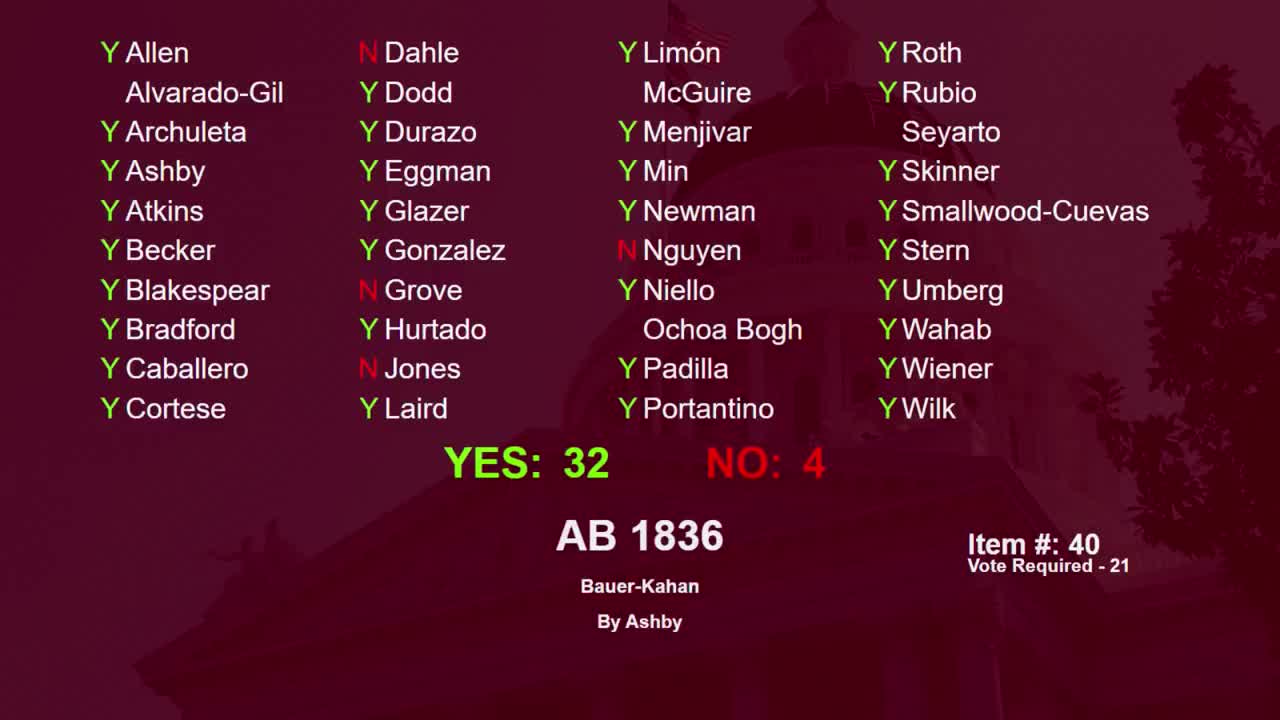 52SEC
Senate Floor
 29SEC
Assembly Floor
 1MIN
Senate Standing Committee on Appropriations
 8MIN
Senate Standing Committee on Education
 1MIN
Assembly Floor
 13MIN
Assembly Standing Committee on Education
Bill Author