AB 1203: Sales and use taxes: exemptions: breast pumps and related supplies.
- Session Year: 2023-2024
- House: Assembly
- Latest Version Date: 2023-10-13
Current Status:
Passed
(2023-10-13: Chaptered by Secretary of State - Chapter 833, Statutes of 2023.)
Introduced
In Committee
First Chamber
In Committee
Second Chamber
Enacted
Existing state sales and use tax laws impose a tax on retailers measured by the gross receipts from the sale of tangible personal property sold at retail in this state or on the storage, use, or other consumption in this state of tangible personal property purchased from a retailer for storage, use, or other consumption in this state. The Sales and Use Tax Law provides various exemptions from those taxes.
This bill, on or after April 1, 2024, and before April 1, 2029, would exempt the gross receipts from the sale in this state of, and the storage, use, or other consumption in this state of, breast pumps, breast pump collection and storage supplies, breast pump kits, and breast pads.
Existing law requires a bill authorizing a new tax expenditure to contain, among other things, specific goals, purposes, and objectives that the tax expenditure will achieve, detailed performance indicators, and data collection requirements.
This bill would make findings detailing the goals of the above-described tax expenditure and performance indicators for determining whether the tax expenditure meets those goals.
The Bradley-Burns Uniform Local Sales and Use Tax Law authorizes counties and cities to impose local sales and use taxes in conformity with the Sales and Use Tax Law, and existing laws authorize districts, as specified, to impose transactions and use taxes in accordance with the Transactions and Use Tax Law, which generally conforms to the Sales and Use Tax Law. Amendments to the Sales and Use Tax Law are automatically incorporated into the local tax laws.
Existing law requires the state to reimburse counties and cities for revenue losses caused by the enactment of sales and use tax exemptions.
This bill would provide that, notwithstanding Section 2230 of the Revenue and Taxation Code, no appropriation is made and the state shall not reimburse any local agencies for sales and use tax revenues lost by them pursuant to this bill.
This bill would take effect immediately as a tax levy.
Existing state sales and use tax laws impose a tax on retailers measured by the gross receipts from the sale of tangible personal property sold at retail in this state or on the storage, use, or other consumption in this state of tangible personal property purchased from a retailer for storage, use, or other consumption in this state. The Sales and Use Tax Law provides various exemptions from those taxes.
This bill, on or after April 1, 2024, and before April 1, 2029, would exempt the gross receipts from the sale in this state of, and the storage, use, or other consumption in this state of, breast pumps, breast pump collection and storage supplies, breast pump kits, and breast pads.
Existing law requires a bill authorizing a new tax expenditure to contain, among other things, specific goals, purposes, and objectives that the tax expenditure will achieve, detailed performance indicators, and data collection requirements.
This bill would make findings detailing the goals of the above-described tax expenditure and performance indicators for determining whether the tax expenditure meets those goals.
The Bradley-Burns Uniform Local Sales and Use Tax Law authorizes counties and cities to impose local sales and use taxes in conformity with the Sales and Use Tax Law, and existing laws authorize districts, as specified, to impose transactions and use taxes in accordance with the Transactions and Use Tax Law, which generally conforms to the Sales and Use Tax Law. Amendments to the Sales and Use Tax Law are automatically incorporated into the local tax laws.
Existing law requires the state to reimburse counties and cities for revenue losses caused by the enactment of sales and use tax exemptions.
This bill would provide that, notwithstanding Section 2230 of the Revenue and Taxation Code, no appropriation is made and the state shall not reimburse any local agencies for sales and use tax revenues lost by them pursuant to this bill.
This bill would take effect immediately as a tax levy.
Existing state sales and use tax laws impose a tax on retailers measured by the gross receipts from the sale of tangible personal property sold at retail in this state or on the storage, use, or other consumption in this state of tangible personal property purchased from a retailer for storage, use, or other consumption in this state. The Sales and Use Tax Law provides various exemptions from those taxes.
This bill, on or after April 1, 2024, and before April 1, 2029, would exempt the gross receipts from the sale in this state of, and the storage, use, or other consumption in this state of, breast pumps, breast pump collection and storage supplies, breast pump kits, and breast pads.
Existing law requires a bill authorizing a new tax expenditure to contain, among other things, specific goals, purposes, and objectives that the tax expenditure will achieve, detailed performance indicators, and data collection requirements.
This bill would make findings detailing the goals of the above-described tax expenditure and performance indicators for determining whether the tax expenditure meets those goals.
The Bradley-Burns Uniform Local Sales and Use Tax Law authorizes counties and cities to impose local sales and use taxes in conformity with the Sales and Use Tax Law, and existing laws authorize districts, as specified, to impose transactions and use taxes in accordance with the Transactions and Use Tax Law, which generally conforms to the Sales and Use Tax Law. Amendments to the Sales and Use Tax Law are automatically incorporated into the local tax laws.
Existing law requires the state to reimburse counties and cities for revenue losses caused by the enactment of sales and use tax exemptions.
This bill would provide that, notwithstanding Section 2230 of the Revenue and Taxation Code, no appropriation is made and the state shall not reimburse any local agencies for sales and use tax revenues lost by them pursuant to this bill.
This bill would take effect immediately as a tax levy.
Existing state sales and use tax laws impose a tax on retailers measured by the gross receipts from the sale of tangible personal property sold at retail in this state or on the storage, use, or other consumption in this state of tangible personal property purchased from a retailer for storage, use, or other consumption in this state. The Sales and Use Tax Law provides various exemptions from those taxes.
This bill, on or after January April 1, 2024, and before January April 1, 2029, would exempt the gross receipts from the sale in this state of, and the storage, use, or other consumption in this state of, breast pumps, breast pump collection and storage supplies, breast pump kits, and breast pads.
Existing law requires a bill authorizing a new tax expenditure to contain, among other things, specific goals, purposes, and objectives that the tax expenditure will achieve, detailed performance indicators, and data collection requirements.
This bill would make findings detailing the goals of the above-described tax expenditure and performance indicators for determining whether the tax expenditure meets those goals.
The Bradley-Burns Uniform Local Sales and Use Tax Law authorizes counties and cities to impose local sales and use taxes in conformity with the Sales and Use Tax Law, and existing laws authorize districts, as specified, to impose transactions and use taxes in accordance with the Transactions and Use Tax Law, which generally conforms to the Sales and Use Tax Law. Amendments to the Sales and Use Tax Law are automatically incorporated into the local tax laws.
Existing law requires the state to reimburse counties and cities for revenue losses caused by the enactment of sales and use tax exemptions.
This bill would provide that, notwithstanding Section 2230 of the Revenue and Taxation Code, no appropriation is made and the state shall not reimburse any local agencies for sales and use tax revenues lost by them pursuant to this bill.
This bill would take effect immediately as a tax levy.
Existing state sales and use tax laws impose a tax on retailers measured by the gross receipts from the sale of tangible personal property sold at retail in this state or on the storage, use, or other consumption in this state of tangible personal property purchased from a retailer for storage, use, or other consumption in this state. The Sales and Use Tax Law provides various exemptions from those taxes.
This bill, on or after January 1, 2024, and before January 1, 2029, would exempt the gross receipts from the sale in this state of, and the storage, use, or other consumption in this state of, breast pumps, breast pump collection and storage supplies, breast pump kits, and breast pads.
Existing law requires a bill authorizing a new tax expenditure to contain, among other things, specific goals, purposes, and objectives that the tax expenditure will achieve, detailed performance indicators, and data collection requirements.
This bill would make findings detailing the goals of the above-described tax expenditure and performance indicators for determining whether the tax expenditure meets those goals.
The Bradley-Burns Uniform Local Sales and Use Tax Law authorizes counties and cities to impose local sales and use taxes in conformity with the Sales and Use Tax Law, and existing laws authorize districts, as specified, to impose transactions and use taxes in accordance with the Transactions and Use Tax Law, which generally conforms to the Sales and Use Tax Law. Amendments to the Sales and Use Tax Law are automatically incorporated into the local tax laws.
Existing law requires the state to reimburse counties and cities for revenue losses caused by the enactment of sales and use tax exemptions.
This bill would provide that, notwithstanding Section 2230 of the Revenue and Taxation Code, no appropriation is made and the state shall not reimburse any local agencies for sales and use tax revenues lost by them pursuant to this bill.
This bill would take effect immediately as a tax levy.
(a)On and after April 1, 2024, and before April 1, 2029, there are exempted from the taxes imposed by this part the gross receipts from the sale in this state of, and the storage, use, or other consumption in this state of, all of the following:
(1)Breast pumps.
(2)Breast pump collection and storage supplies.
(3)Breast pump kits.
(4)Breast pads.
(b)For purposes of this section, all of the following definitions shall apply:
(1)(A)Breast pump means an electrically or manually controlled pump device designed and marketed to be used to express milk from a human breast during lactation.
(B)Breast pump includes the electrically or manually controlled pump device and any battery, alternating current (AC) adapter, or other power supply unit packaged and sold with the pump device at the time of sale to power the pump device.
(2)(A)Breast pump collection and storage supplies means tangible personal property designed or marketed to be used in conjunction with a breast pump to collect milk expressed from a human breast and store collected milk until it is ready for consumption, including, but is not limited to, all of the following:
(i)Breast shields and breast shield connectors.
(ii)Breast pump tubes and tubing adapters.
(iii)Breast pump valves and membranes.
(iv)Backflow protectors and backflow protector adaptors.
(v)Bottle and bottle caps specific to the operation of the breast pump.
(vi)Breast milk storage bags.
(vii)Other items that may be useful to initiate, support, or sustain breastfeeding using a breast pump during lactation, that may be sold separately, but are generally sold as part of a breast pump kit.
(B)Breast pump collection and storage supplies does not include the following items if not sold as part of a breast pump kit prepackaged by the breast pump manufacturer or distributor:
(i)Bottles and bottle caps not specific to the operation of the breast pump.
(ii)Breast pump travel bags and other similar carrying accessories, including ice packs, labels, and other similar products.
(iii)Breast pump cleaning supplies.
(iv)Nursing bras, bra pads, breast shells, and other similar products.
(v)Creams, ointments, and other similar products that relieve breastfeeding-related symptoms or conditions of the breasts or nipples.
(3)Breast pump kit means a kit that contains a breast pump and one or more of the following items:
(A)Breast pump collection and storage supplies.
(B)Other tangible personal property that may be useful to initiate, support, or sustain breastfeeding using a breast pump during lactation, so long as the other tangible personal property sold with the breast pump kit at the time of the sale are less than 10 percent of the total sales price of the breast pump kit.
(c)For purposes of complying with Section 41, the Legislature finds and declares the following:
(1)The specific goals, purposes, and objectives of this act are:
(A)To promote public health by increasing the affordability of, and expanding access to, breast pumps and related supplies.
(B)To ease the financial burden placed on families who rely on breast pumps to feed their children.
(C)To create parity in taxation between formula and breast pump equipment.
(D)To incentivize optimal breastfeeding for the entirety of time recommended by experts.
(2)(A)To measure the goals set forth in paragraph (1), the Legislative Analysts Office shall review the effectiveness of the exemption and may request information for this purpose from the California Department of Tax and Fee Administration and any other relevant state government entity.
(B)On or before July 1, 2027, the Legislative Analysts Office shall submit a report, in compliance with Section 9795 of the Government Code, of the review completed pursuant to subparagraph (A) to the Assembly Committee on Revenue and Taxation and the Senate Governance and Finance Committee. The report shall include, but is not limited to, both of the following:
(i)A recommendation on whether the exemption should be modified, extended, or allowed to become inoperative.
(ii)An assessment on whether more targeted approaches to providing families in need with adequate access to breast pumps and related supplies are available.
(d)This section shall remain in effect only until April 1, 2029, and as of that date is repealed.
SEC. 2.Notwithstanding Section 2230 of the Revenue and Taxation Code, no appropriation is made by this act and the state shall not reimburse any local agency for any sales and use tax revenues lost by it under this act.
SEC. 3.This act provides for a tax levy within the meaning of Article IV of the California Constitution and shall go into immediate effect.
(a)On and after April 1, 2024, and before April 1, 2029, there are exempted from the taxes imposed by this part the gross receipts from the sale in this state of, and the storage, use, or other consumption in this state of, all of the following:
(1)Breast pumps.
(2)Breast pump collection and storage supplies.
(3)Breast pump kits.
(4)Breast pads.
(b)For purposes of this section, all of the following definitions shall apply:
(1)(A)Breast pump means an electrically or manually controlled pump device designed and marketed to be used to express milk from a human breast during lactation.
(B)Breast pump includes the electrically or manually controlled pump device and any battery, alternating current (AC) adapter, or other power supply unit packaged and sold with the pump device at the time of sale to power the pump device.
(2)(A)Breast pump collection and storage supplies means tangible personal property designed or marketed to be used in conjunction with a breast pump to collect milk expressed from a human breast and store collected milk until it is ready for consumption, including, but is not limited to, all of the following:
(i)Breast shields and breast shield connectors.
(ii)Breast pump tubes and tubing adapters.
(iii)Breast pump valves and membranes.
(iv)Backflow protectors and backflow protector adaptors.
(v)Bottle and bottle caps specific to the operation of the breast pump.
(vi)Breast milk storage bags.
(vii)Other items that may be useful to initiate, support, or sustain breastfeeding using a breast pump during lactation, that may be sold separately, but are generally sold as part of a breast pump kit.
(B)Breast pump collection and storage supplies does not include the following items if not sold as part of a breast pump kit prepackaged by the breast pump manufacturer or distributor:
(i)Bottles and bottle caps not specific to the operation of the breast pump.
(ii)Breast pump travel bags and other similar carrying accessories, including ice packs, labels, and other similar products.
(iii)Breast pump cleaning supplies.
(iv)Nursing bras, bra pads, breast shells, and other similar products.
(v)Creams, ointments, and other similar products that relieve breastfeeding-related symptoms or conditions of the breasts or nipples.
(3)Breast pump kit means a kit that contains a breast pump and one or more of the following items:
(A)Breast pump collection and storage supplies.
(B)Other tangible personal property that may be useful to initiate, support, or sustain breastfeeding using a breast pump during lactation, so long as the other tangible personal property sold with the breast pump kit at the time of the sale are less than 10 percent of the total sales price of the breast pump kit.
(c)For purposes of complying with Section 41, the Legislature finds and declares the following:
(1)The specific goals, purposes, and objectives of this act are:
(A)To promote public health by increasing the affordability of, and expanding access to, breast pumps and related supplies.
(B)To ease the financial burden placed on families who rely on breast pumps to feed their children.
(C)To create parity in taxation between formula and breast pump equipment.
(D)To incentivize optimal breastfeeding for the entirety of time recommended by experts.
(2)(A)To measure the goals set forth in paragraph (1), the Legislative Analysts Office shall review the effectiveness of the exemption and may request information for this purpose from the California Department of Tax and Fee Administration and any other relevant state government entity.
(B)On or before July 1, 2027, the Legislative Analysts Office shall submit a report, in compliance with Section 9795 of the Government Code, of the review completed pursuant to subparagraph (A) to the Assembly Committee on Revenue and Taxation and the Senate Governance and Finance Committee. The report shall include, but is not limited to, both of the following:
(i)A recommendation on whether the exemption should be modified, extended, or allowed to become inoperative.
(ii)An assessment on whether more targeted approaches to providing families in need with adequate access to breast pumps and related supplies are available.
(d)This section shall remain in effect only until April 1, 2029, and as of that date is repealed.
SEC. 2.Notwithstanding Section 2230 of the Revenue and Taxation Code, no appropriation is made by this act and the state shall not reimburse any local agency for any sales and use tax revenues lost by it under this act.
SEC. 3.This act provides for a tax levy within the meaning of Article IV of the California Constitution and shall go into immediate effect.
(a)On and after April 1, 2024, and before April 1, 2029, there are exempted from the taxes imposed by this part the gross receipts from the sale in this state of, and the storage, use, or other consumption in this state of, all of the following:
(1)Breast pumps.
(2)Breast pump collection and storage supplies.
(3)Breast pump kits.
(4)Breast pads.
(b)For purposes of this section, all of the following definitions shall apply:
(1)(A)Breast pump means an electrically or manually controlled pump device designed and marketed to be used to express milk from a human breast during lactation.
(B)Breast pump includes the electrically or manually controlled pump device and any battery, alternating current (AC) adapter, or other power supply unit packaged and sold with the pump device at the time of sale to power the pump device.
(2)(A)Breast pump collection and storage supplies means tangible personal property designed or marketed to be used in conjunction with a breast pump to collect milk expressed from a human breast and store collected milk until it is ready for consumption, including, but is not limited to, all of the following:
(i)Breast shields and breast shield connectors.
(ii)Breast pump tubes and tubing adapters.
(iii)Breast pump valves and membranes.
(iv)Backflow protectors and backflow protector adaptors.
(v)Bottle and bottle caps specific to the operation of the breast pump.
(vi)Breast milk storage bags.
(vii)Other items that may be useful to initiate, support, or sustain breastfeeding using a breast pump during lactation, that may be sold separately, but are generally sold as part of a breast pump kit.
(B)Breast pump collection and storage supplies does not include the following items if not sold as part of a breast pump kit prepackaged by the breast pump manufacturer or distributor:
(i)Bottles and bottle caps not specific to the operation of the breast pump.
(ii)Breast pump travel bags and other similar carrying accessories, including ice packs, labels, and other similar products.
(iii)Breast pump cleaning supplies.
(iv)Nursing bras, bra pads, breast shells, and other similar products.
(v)Creams, ointments, and other similar products that relieve breastfeeding-related symptoms or conditions of the breasts or nipples.
(3)Breast pump kit means a kit that contains a breast pump and one or more of the following items:
(A)Breast pump collection and storage supplies.
(B)Other tangible personal property that may be useful to initiate, support, or sustain breastfeeding using a breast pump during lactation, so long as the other tangible personal property sold with the breast pump kit at the time of the sale are less than 10 percent of the total sales price of the breast pump kit.
(c)For purposes of complying with Section 41, the Legislature finds and declares the following:
(1)The specific goals, purposes, and objectives of this act are:
(A)To promote public health by increasing the affordability of, and expanding access to, breast pumps and related supplies.
(B)To ease the financial burden placed on families who rely on breast pumps to feed their children.
(C)To create parity in taxation between formula and breast pump equipment.
(D)To incentivize optimal breastfeeding for the entirety of time recommended by experts.
(2)(A)To measure the goals set forth in paragraph (1), the Legislative Analysts Office shall review the effectiveness of the exemption and may request information for this purpose from the California Department of Tax and Fee Administration and any other relevant state government entity.
(B)On or before July 1, 2027, the Legislative Analysts Office shall submit a report, in compliance with Section 9795 of the Government Code, of the review completed pursuant to subparagraph (A) to the Assembly Committee on Revenue and Taxation and to the Senate Governance and Finance Committee. The report shall include, but is not limited to, both of the following:
(i)A recommendation on whether the exemption should be modified, extended, or allowed to become inoperative.
(ii)An assessment on whether more targeted approaches to providing families in need with adequate access to breast pumps and related supplies are available.
(d)This section shall remain in effect only until April 1, 2029, and as of that date is repealed.
SEC. 2.Notwithstanding Section 2230 of the Revenue and Taxation Code, no appropriation is made by this act and the state shall not reimburse any local agency for any sales and use tax revenues lost by it under this act.
SEC. 3.This act provides for a tax levy within the meaning of Article IV of the California Constitution and shall go into immediate effect.
(a)On and after January April 1, 2024, and before January April 1, 2029, there are exempted from the taxes imposed by this part the gross receipts from the sale in this state of, and the storage, use, or other consumption in this state of, all of the following:
(1)Breast pumps.
(2)Breast pump collection and storage supplies.
(3)Breast pump kits.
(4)Breast pads.
(b)For purposes of this section, all of the following definitions shall apply:
(1)(A)Breast pump means an electrically or manually controlled pump device designed and marketed to be used to express milk from a human breast during lactation.
(B)Breast pump includes the electrically or manually controlled pump device and any battery, alternating current (AC) adapter, or other power supply unit packaged and sold with the pump device at the time of sale to power the pump device.
(2)(A)Breast pump collection and storage supplies means tangible personal property designed or marketed to be used in conjunction with a breast pump to collect milk expressed from a human breast and store collected milk until it is ready for consumption, including, but is not limited to, all of the following:
(i)Breast shields and breast shield connectors.
(ii)Breast pump tubes and tubing adapters.
(iii)Breast pump valves and membranes.
(iv)Backflow protectors and backflow protector adaptors.
(v)Bottle and bottle caps specific to the operation of the breast pump.
(vi)Breast milk storage bags.
(vii)Other items that may be useful to initiate, support, or sustain breastfeeding using a breast pump during lactation, that may be sold separately, but are generally sold as part of a breast pump kit.
(B)Breast pump collection and storage supplies does not include the following items if not sold as part of a breast pump kit prepackaged by the breast pump manufacturer or distributor:
(i)Bottles and bottle caps not specific to the operation of the breast pump.
(ii)Breast pump travel bags and other similar carrying accessories, including ice packs, labels, and other similar products.
(iii)Breast pump cleaning supplies.
(iv)Nursing bras, bra pads, breast shells, and other similar products.
(v)Creams, ointments, and other similar products that relieve breastfeeding-related symptoms or conditions of the breasts or nipples.
(3)Breast pump kit means a kit that contains a breast pump and one or more of the following items:
(A)Breast pump collection and storage supplies.
(B)Other tangible personal property that may be useful to initiate, support, or sustain breastfeeding using a breast pump during lactation, so long as the other tangible personal property sold with the breast pump kit at the time of the sale are less than 10 percent of the total sales price of the breast pump kit.
(c)It is the intent of the Legislature to enact legislation to comply with the requirements of Section 41.(c)For purposes of complying with Section 41, the Legislature finds and declares the following:
(1)The specific goals, purposes, and objectives of this act are:
(A)To promote public health by increasing the affordability of, and expanding access to, breast pumps and related supplies.
(B)To ease the financial burden placed on families who rely on breast pumps to feed their children.
(C)To create parity in taxation between formula and breast pump equipment.
(D)To incentivize optimal breastfeeding for the entirety of time recommended by experts.
(2)(A)To measure the goals set forth in paragraph (1), the Legislative Analysts Office shall review the effectiveness of the exemption and may request information for this purpose from the California Department of Tax and Fee Administration and any other relevant state government entity.
(B)On or before July 1, 2027, the Legislative Analysts Office shall submit a report, in compliance with Section 9795 of the Government Code, of the review completed pursuant to subparagraph (A) to the Assembly Committee on Revenue and Taxation and to the Senate Governance and Finance Committee. The report shall include, but is not limited to, both of the following:
(i)A recommendation on whether the exemption should be modified, extended, or allowed to become inoperative.
(ii)An assessment on whether more targeted approaches to providing families in need with adequate access to breast pumps and related supplies are available.
(d)This section shall remain in effect only until January April 1, 2029, and as of that date is repealed.
SEC. 2.Notwithstanding Section 2230 of the Revenue and Taxation Code, no appropriation is made by this act and the state shall not reimburse any local agency for any sales and use tax revenues lost by it under this act.
SEC. 3.This act provides for a tax levy within the meaning of Article IV of the California Constitution and shall go into immediate effect.
(a)On and after January 1, 2024, and before January 1, 2029, there are exempted from the taxes imposed by this part the gross receipts from the sale in this state of, and the storage, use, or other consumption in this state of, all of the following:
(1)Breast pumps.
(2)Breast pump collection and storage supplies.
(3)Breast pump kits.
(4)Breast pads.
(b)For purposes of this section, all of the following definitions shall apply:
(1)(A)Breast pump means an electrically or manually controlled pump device designed and marketed to be used to express milk from a human breast during lactation.
(B)Breast pump includes the electrically or manually controlled pump device and any battery, alternating current (AC) adapter, or other power supply unit packaged and sold with the pump device at the time of sale to power the pump device.
(2)(A)Breast pump collection and storage supplies means tangible personal property designed or marketed to be used in conjunction with a breast pump to collect milk expressed from a human breast and store collected milk until it is ready for consumption, including, but is not limited to, all of the following:
(i)Breast shields and breast shield connectors.
(ii)Breast pump tubes and tubing adapters.
(iii)Breast pump valves and membranes.
(iv)Backflow protectors and backflow protector adaptors.
(v)Bottle and bottle caps specific to the operation of the breast pump.
(vi)Breast milk storage bags.
(vii)Other items that may be useful to initiate, support, or sustain breastfeeding using a breast pump during lactation, that may be sold separately, but are generally sold as part of a breast pump kit.
(B)Breast pump collection and storage supplies does not include the following items if not sold as part of a breast pump kit prepackaged by the breast pump manufacturer or distributor:
(i)Bottles and bottle caps not specific to the operation of the breast pump.
(ii)Breast pump travel bags and other similar carrying accessories, including ice packs, labels, and other similar products.
(iii)Breast pump cleaning supplies.
(iv)Nursing bras, bra pads, breast shells, and other similar products.
(v)Creams, ointments, and other similar products that relieve breastfeeding-related symptoms or conditions of the breasts or nipples.
(3)Breast pump kit means a kit that contains a breast pump and one or more of the following items:
(A)Breast pump collection and storage supplies.
(B)Other tangible personal property that may be useful to initiate, support, or sustain breastfeeding using a breast pump during lactation, so long as the other tangible personal property sold with the breast pump kit at the time of the sale are less than 10 percent of the total sales price of the breast pump kit.
(c)It is the intent of the Legislature to enact legislation to comply with the requirements of Section 41.
(d)This section shall remain in effect only until January 1, 2029, and as of that date is repealed.
SEC. 2.Notwithstanding Section 2230 of the Revenue and Taxation Code, no appropriation is made by this act and the state shall not reimburse any local agency for any sales and use tax revenues lost by it under this act.
SEC. 3.This act provides for a tax levy within the meaning of Article IV of the California Constitution and shall go into immediate effect.
|
Date
|
Status
|
|---|---|
| Oct 13, 2023 | Chaptered by Secretary of State - Chapter 833, Statutes of 2023. |
| Oct 13, 2023 | Approved by the Governor. |
| Sep 19, 2023 | Enrolled and presented to the Governor at 4 p.m. |
| Sep 12, 2023 | Senate amendments concurred in. To Engrossing and Enrolling. (Ayes 80. Noes 0. Page 3296.). |
| Sep 12, 2023 | Assembly Rule 77 suspended. (Page 3228.) |
| Sep 11, 2023 | In Assembly. Concurrence in Senate amendments pending. May be considered on or after September 13 pursuant to Assembly Rule 77. |
| Sep 11, 2023 | Read third time. Passed. Ordered to the Assembly. (Ayes 39. Noes 0. Page 2578.). |
| Sep 5, 2023 | Read second time. Ordered to third reading. |
| Sep 1, 2023 | From committee: Do pass. (Ayes 7. Noes 0.) (September 1). |
| Jul 3, 2023 | In committee: Referred to APPR suspense file. |
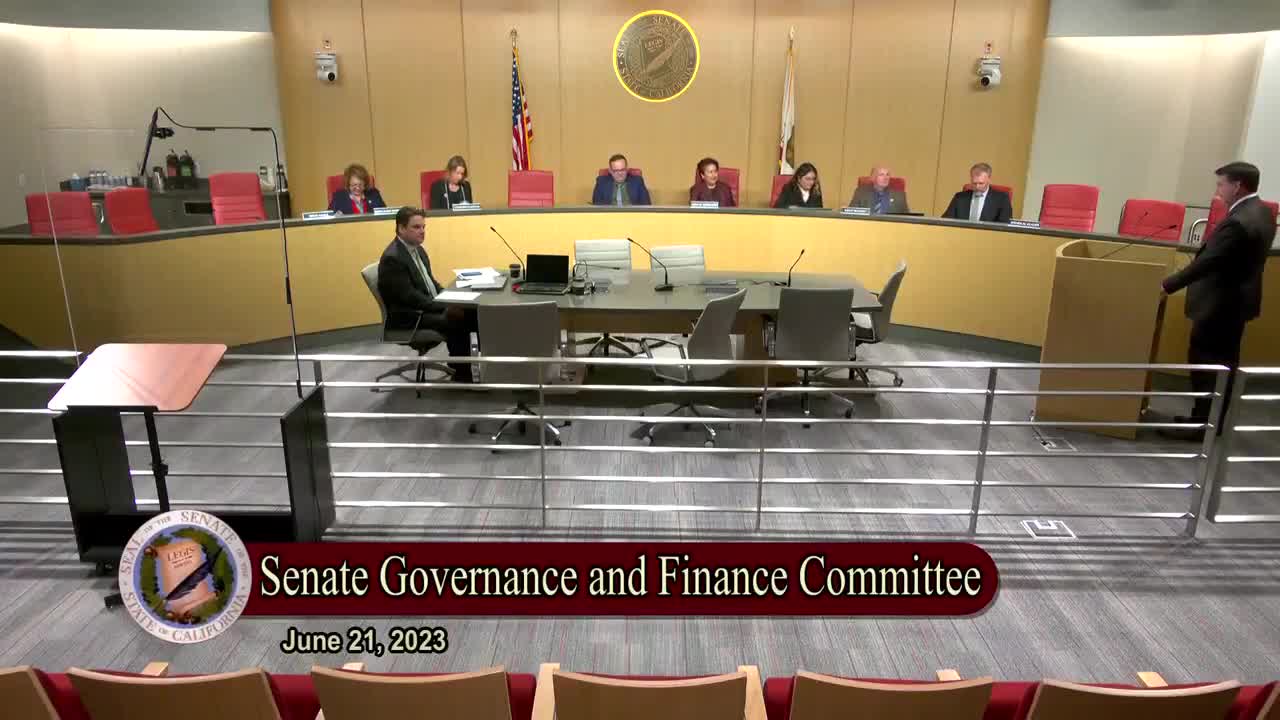
| Jun 21, 2023 | From committee: Do pass and re-refer to Com. on APPR. (Ayes 7. Noes 0.) (June 21). Re-referred to Com. on APPR. |
| Jun 14, 2023 | From committee chair, with author's amendments: Amend, and re-refer to committee. Read second time, amended, and re-referred to Com. on GOV. & F. |
| Jun 7, 2023 | Referred to Com. on GOV. & F. |
| May 26, 2023 | In Senate. Read first time. To Com. on RLS. for assignment. |
| May 25, 2023 | Read third time. Passed. Ordered to the Senate. (Ayes 77. Noes 0. Page 1764.) |
| May 18, 2023 | Read second time. Ordered to third reading. |
| May 18, 2023 | From committee: Do pass. (Ayes 15. Noes 0.) (May 18). |
| May 18, 2023 | Joint Rule 62(a), file notice suspended. (Page 1580.) |
| May 17, 2023 | In committee: Set, first hearing. Referred to APPR. suspense file. |
| May 2, 2023 | From committee: Do pass and re-refer to Com. on APPR. (Ayes 11. Noes 0.) (May 1). Re-referred to Com. on APPR. |
| Apr 19, 2023 | Re-referred to Com. on REV. & TAX. |
| Apr 18, 2023 | From committee chair, with author's amendments: Amend, and re-refer to Com. on REV. & TAX. Read second time and amended. |
| Mar 28, 2023 | In committee: Set, second hearing. Referred to REV. & TAX. suspense file. |
| Mar 21, 2023 | In committee: Set, first hearing. Hearing canceled at the request of author. |
| Mar 2, 2023 | Referred to Com. on REV. & TAX. |
| Feb 17, 2023 | From printer. May be heard in committee March 19. |
| Feb 16, 2023 | Read first time. To print. |
|
Date
|
Description
|
Location
|
Votes
|
|
|---|---|---|---|---|
| Sep 12, 2023 | AB 1203 Bains Concurrence in Senate Amendments | Assembly Floor |
Passed |
|
| Sep 11, 2023 | Assembly 3rd Reading AB1203 Bains et al. By Ashby | Senate Floor |
Passed |
|
| Sep 1, 2023 | Do pass | Senate Standing Committee on Appropriations |
Passed |
|
| Jul 3, 2023 | Placed on suspense file | Senate Standing Committee on Appropriations |
Passed |
|
| Jun 21, 2023 | Do pass, but first be re-referred to the Committee on [Appropriations] | Senate Standing Committee on Governance and Finance |
Passed |
|
| May 25, 2023 | AB 1203 Bains Assembly Third Reading | Assembly Floor |
Passed |
|
| May 18, 2023 | Do pass. | Assembly Standing Committee on Appropriations |
Passed |
|
| May 1, 2023 | Do pass and be re-referred to the Committee on [Appropriations] | Assembly Standing Committee on Revenue and Taxation |
Passed |
This list shows positions taken on this bill by organizations on the date displayed, which is linked to the original source.
Positions by individuals are not included.
|
Organization
|
Position
|
Date
|
|---|---|---|
| Aeroflow Healthcare INC. | ** Support | |
| American Academy Of Pediatrics, California | ** Support | |
| American College Of Obstetricians And Gynecologists District Ix | ** Support | |
| BreastfeedLA | ** Support | |
| California Academy Of Family Physicians | ** Support | |
| California Breastfeeding Coalition | ** Support | |
| California Catholic Conference | ** Support | |
| California Nurses Association | ** Support | |
| California Tax Reform Association | ** Against | |
| California Teachers Association | ** Against | |
| Children'S Specialty Care Coalition | ** Support | |
| Maternal and Child Health Access | ** Support | |
| Parity For Pumps | ** Support | |
| San Diego Breastfeeding Coalition | ** Support | |
| UDW AFSCME Local 3930 | ** Support | |
| Yummy Mummy, LLC | ** Support |
CONCURRENCE IN SENATE AMENDMENTS
CSA1 Bill Id:AB 1203
Author:(Bains and Cervantes)
As Amended Ver:June 14, 2023
Majority vote
SUMMARY
Provides a temporary exemption, under the Sales and Use Tax (SUT) Law, for breast pumps and related items.
- Provides, on and after April 1, 2024, and before April 1, 2029, a SUT exemption for the following:
- Breast pumps;
- Breast pump collection and storage supplies;
- Breast pump kits; and,
- Breast pads.
- Provides that, notwithstanding existing law, the state shall not reimburse any local agency for any SUT revenues lost by it under this bill.
- Takes immediate effect as a tax levy.
- Sunsets the exemption on April 1, 2029.
Senate Amendments
Add co-authors.
COMMENTS
- What would this bill do? This bill provides a complete SUT exemption for breast pumps, breast pump collection and storage supplies, breast pump kits, and breast pads. The exemption would apply for a five-year period, from April 1, 2024 through March 31, 2028.
The author notes that the benefits of breastfeeding, for both parent and child, are well established. Specifically, the author's office notes:
For infants, breast milk contains antibodies and other essential nutrients that can help prevent illness and infection. Breast milk's health impacts can be long lasting as breast milk is linked to a lower risk of obesity, asthma, and other chronic diseases later in life. For parents, breastfeeding [. . .] is associated with a lower risk of breast and ovarian cancer, and can be emotionally rewarding for both parent and child.
The author also points to the fact that infant formula is already exempt from taxation. As such, the author contends that, "a sales tax placed on pumps represents a lack of parity between breast and formula feeding."
- Breast pumps are often covered by insurance: Committee staff understands that, under the Affordable Care Act, insurance companies must generally cover breast pumps and supplies at no cost to pregnant members or members who just gave birth. In addition, women who are eligible for Medicaid or the Supplemental Nutrition Program for Women, Infants, and Children may receive a breast pump for free or at reduced cost.
According to the Author
The author has provided the following statement in support of this bill:
Breast pumps are an absolute necessity for families who want to breastfeed their children, and provide an avenue for working parents to continue to breastfeed their children. The taxation of breast pumps represent an unnecessary financial burden and lack of parity with tax-exempt infant formula. By eliminating the sales tax on breast pumps, AB 1203 will remove an unnecessary barrier for families who seek to provide breast milk for their infant children.
Arguments in Support
This bill is sponsored by Parity for Pumps, which notes:
Parity for Pumps (P4P) is a nationwide effort, launched in 2019, with the goal of eliminating sales and use taxes on breast pumps and supplies in states across the country. In the same year, P4P successfully worked with leaders at the Streamlined Sales Tax Project to approve model language defining pumps and supplies and with the National Foundation for Women Legislators to adopt a resolution in support of tax exemptions for breast pumps. To date, only eight states fully exempt pumps and supplies. A handful of states have conditional exemptions, but these aren't a real solution.
Families should have all available options for feeding their infants. By exempting the sales tax on breast pumps, AB 1203 will remove an unnecessary barrier for families who seek to provide breast milk for their infant children.
Arguments in Opposition
This bill is opposed by the California Tax Reform Association, which notes:
SUT exemptions reduce available funding to support vital services in several ways. Firstly, they lead to a lower tax revenue collected by state and local governments. This, in turn, translates to less funding available for essential public programs and services such as education, healthcare, public safety, and infrastructure. When these services face funding constraints, they may suffer from reduced effectiveness, negatively impacting the quality of life for all Californians, particularly those in lower income brackets.
FISCAL COMMENTS
According to the Senate Appropriations Committee:
- The California Department of Tax and Fee Administration (CDTFA) estimates that this bill would result in General Fund revenue losses of $1.7 million in 2023-24 (a partial-year effect), and $7.1 million in 2024-25.
- Additionally, CDTFA estimates that this bill would result in total local government SUT revenue losses of about $2 million in 2023-24 (a partial-year effect), and $8.3 million in 2024-25.
- One of the destinations of SUT revenue is the 2011 Local Revenue Fund, which provides local governments with public safety realignment money. Under the California Constitution, if the taxes collected by the 2011 Local Revenue Fund sales tax rate (1.0625 percentage points) are reduced or cease to be operative, the State is required to annually offset the reduction. Consequently, this bill would require a backfill from the General Fund to the 2011 Local Revenue Fund of $2 million annually.
- CDTFA would incur minor and absorbable costs to implement the provisions of this bill, including taxpayer outreach, staff training, and answering public inquiries.
- The Legislative Analyst's Office would likely incur absorbable costs to write this bill's specified report.
VOTES:
ASM REVENUE AND TAXATION: 11-0-0
YES: Irwin, Wallis, Bains, Grayson, Pacheco, Jim Patterson, Petrie-Norris, Luz Rivas, Ta, Valencia, Zbur
ASM APPROPRIATIONS: 15-0-1
YES: Holden, Megan Dahle, Bryan, Calderon, Wendy Carrillo, Dixon, Mike Fong, Hart, Lowenthal, Mathis, Papan, Pellerin, Sanchez, Weber, Ortega
ABS, ABST OR NV: Robert Rivas
ASSEMBLY FLOOR: 77-0-3
YES: Addis, Alanis, Alvarez, Arambula, Bains, Bauer-Kahan, Bennett, Berman, Boerner, Bonta, Bryan, Calderon, Juan Carrillo, Wendy Carrillo, Cervantes, Chen, Connolly, Megan Dahle, Davies, Dixon, Essayli, Flora, Mike Fong, Vince Fong, Friedman, Gabriel, Gallagher, Garcia, Gipson, Grayson, Haney, Hart, Holden, Hoover, Irwin, Jackson, Jones‑Sawyer, Kalra, Lackey, Lee, Low, Lowenthal, Maienschein, McCarty, McKinnor, Muratsuchi, Stephanie Nguyen, Ortega, Pacheco, Jim Patterson, Joe Patterson, Pellerin, Petrie‑Norris, Quirk-Silva, Ramos, Reyes, Luz Rivas, Robert Rivas, Rodriguez, Blanca Rubio, Sanchez, Santiago, Schiavo, Soria, Ta, Ting, Valencia, Villapudua, Waldron, Wallis, Ward, Weber, Wicks, Wilson, Wood, Zbur, Rendon
ABS, ABST OR NV: Aguiar-Curry, Mathis, Papan
SENATE FLOOR: 39-0-1
YES: Allen, Alvarado-Gil, Archuleta, Ashby, Atkins, Becker, Blakespear, Bradford, Cortese, Dahle, Dodd, Durazo, Eggman, Glazer, Gonzalez, Grove, Hurtado, Jones, Laird, Limón, McGuire, Menjivar, Min, Newman, Nguyen, Niello, Ochoa Bogh, Padilla, Portantino, Roth, Rubio, Seyarto, Skinner, Smallwood-Cuevas, Stern, Umberg, Wahab, Wiener, Wilk
ABS, ABST OR NV: Caballero
UPDATED
VERSION: June 14, 2023
CONSULTANT: M. David Ruff / REV. & TAX. / (916) 319-2098 FN: 0001866
SENATE RULES COMMITTEE Office of Senate Floor Analyses (916) 651-1520 Fax: (916) 327-4478 | AB 1203 |
THIRD READING
Bill No: AB 1203
Author: Bains (D) and Cervantes (D), et al.
Amended: 6/14/23 in Senate
Vote: 21- Urgency
SENATE GOVERNANCE & FIN. COMMITTEE: 7-0, 6/21/23
AYES: Caballero, Seyarto, Blakespear, Dahle, Durazo, Glazer, Wiener
NO VOTE RECORDED: Skinner
SENATE APPROPRIATIONS COMMITTEE: 7-0, 9/1/23
AYES: Portantino, Jones, Ashby, Bradford, Seyarto, Wahab, Wiener
ASSEMBLY FLOOR: 77-0, 5/25/23 - See last page for vote
SUBJECT: Sales and use taxes: exemptions: breast pumps and related supplies
SOURCE: Parity for Pumps
Yummy Mummy, LLC
DIGEST:
This bill exempts breast pumps, breast pump collection and storage supplies, breast pump kits, and breast pads purchased between April 1, 2024, and April 1, 2029 from the state and local sales and use tax.
ANALYSIS:
Existing law:
- Imposes the sales tax on every retailer “engaged in business in this state” that sells tangible personal property, and requires them to register with the California Department of Tax and Fee Administration (CDTFA), as well as collect and remit appropriate tax at purchase and remit the amount to CDTFA.
- Applies the sales tax whenever a retail sale occurs, which is generally any sale other than one for resale in the regular course of business.
- Provides that unless the purchaser pays the sales tax to the retailer, he or she is liable for the use tax, which the law imposes on any person consuming tangible personal property in the state, and requires the purchaser to remit use tax to CDTFA.
- Sets the state sales and use tax rate at 7.25% of the sales price of the property sold or used.
- Allows cities, counties, and specified special districts to increase the sales and use tax, also known as district or transactions and use taxes, up to a 2% countywide cap, with some exceptions.
- Exempts entirely from the sales and use tax some products (prescription drugs, food, poultry litter), while others are exempted from the state sales tax, but not the local share, such as farm equipment and machinery, diesel fuel used for farming and food processing, teleproduction and postproduction equipment, timber harvesting equipment and machinery, and racehorse breeding stock.
- Exempts some necessities of life from sales and use tax, including food for consumption and prescription drugs, which includes infant formula, among others.
- Exempts from the state and local increments of the sales and use tax (SB 92, Committee on Budget a& Fiscal Review, Chapter 34, Statutes of 2019):
- Menstrual hygiene products, including tampons, sanitary napkins primarily designed and labeled for menstrual hygiene use, and menstrual sponges and cups; and
- Diapers designed, manufactured, processed, fabricated, or packaged for use by infants, toddlers, and children.
This bill:
- Exempts breast pumps, breast pump collection and storage supplies, breast pump kits, and breast pads from the state and local sales and use tax.
- Commences the exemption on April 1, 2024, and sunsets it on April 1, 2029.
- Defines a "breast pump" as an electrically or manually controlled pump device designed and marketed to be used to express milk from a human breast during lactation, which specifically includes the electrically or manually controlled pump device and any battery, alternating current adapter, or other power supply unit packaged and sold with the pump device at the time of sale to power the pump device.
- Further defines "breast pump collection and storage supplies" as property designed or marketed to be used in conjunction with a breast pump to collect milk expressed from a human breast and store collected milk until it is ready for consumption, including all of the following:
- Breast shields and breast shield connectors;
- Breast pump tubes and tubing adapters;
- Breast pump valves and membranes;
- Backflow protectors and backflow protector adaptors;
- Bottle and bottle caps specific to the operation of the breast pump;
- Breast milk storage bags; and,
- Other items that may be useful to initiate, support, or sustain breastfeeding using a breast pump during lactation, that may be sold separately, but are generally sold as part of a breast pump kit.
- Excludes from exemption the following items if not sold as part of a breast pump kit prepackaged by the breast pump manufacturer or distributor:
- Bottles and bottle caps not specific to the operation of the breast pump;
- Breast pump travel bags and other similar carrying accessories, including ice packs, labels, and other similar products;
- Breast pump cleaning supplies;
- Nursing bras, bra pads, breast shells, and other similar products; and,
- Creams, ointments, and other similar products that relieve breastfeeding-related symptoms or conditions of the breasts or nipples.
- Defines a "breast pump kit" to mean a kit that contains a breast pump and either breast pump collection and storage supplies or other property that may be useful to initiate, support, or sustain breastfeeding using a breast pump during lactation, so long as the other property sold with the breast pump kit at the time of the sale are less than 10% of the total sales price of the breast pump kit.
- Makes legislative findings and declarations to comply with Section 41 of the Revenue and Taxation Code.
FISCAL EFFECT: Appropriation: No Fiscal Com.: Yes Local: No
According to the Senate Appropriations Committee:
- The California Department of Tax and Fee Administration (CDTFA) estimates that this bill would result in General Fund revenue losses of $1.7 million in 2023-24 (a partial-year effect), and $7.1 million in 2024-25.
- Additionally, CDTFA estimates that the bill would result in total local government SUT revenue losses of about $2 million in 2023-24 (a partial-year effect), and $8.3 million in 2024-25.
- One of destinations of SUT revenue is the 2011 Local Revenue Fund, which provides local governments with public safety realignment money. Under the California Constitution, if the taxes collected by the 2011 Local Revenue Fund sales tax rate (1.0625 percentage points) are reduced or cease to be operative, the State is required to annually offset the reduction. Consequently, this bill would require a backfill from the General Fund to the 2011 Local Revenue Fund of $2 million annually.
- CDTFA would incur minor and absorbable costs to implement the provisions of the bill, including taxpayer outreach, staff training, and answering public inquiries.
- The Legislative Analyst’s Office (LAO) would likely incur absorbable costs to write the bill’s specified report.
SUPPORT: (Verified 9/2/23)
Parity for Pumps
Yummy Mummy, LLC
Aeroflow Healthcare Inc
American College of Obstetricians and Gynecologists District Ix
Breastfeedla
California Academy of Family Physicians
California Breastfeeding Coalition
California Catholic Conference
California Nurses Association
Children's Specialty Care Coalition
March of Dimes
Maternal and Child Health Access
San Diego Breastfeeding Coalition
UDW AFSCME Local 3930
OPPOSITION: (Verified 9/2/23)
California Teachers Association
ARGUMENTS IN SUPPORT: According to the author, “Breast pumps are an absolute necessity for families who want to breastfeed their children, and provide an avenue for working parents to continue to breastfeed their children. The taxation of breast pumps represent an unnecessary financial burden and lack of parity with tax-exempt infant formula. By eliminating the sales tax on breast pumps, AB 1203 will remove an unnecessary barrier for families who seek to provide breast milk for their infant children.”
ARGUMENTS IN OPPOSITION: According to the California Teachers Association, “According to the Department of Finance, the state provided over $87 billion in General Fund tax expenditures in 2022-23 (including income, sales and use, corporate and other taxes). This number continues to grow each year. This revenue would have otherwise gone to the General Fund, of which approximately 40 percent would have gone toward Proposition 98 for K-14 education. This means that approximately $33 billion is redirected away from schools and community colleges each year. While we understand this bill is well intended, CTA does not support this approach, as it would reduce overall funding for education. CTA believes that Proposition 98 should be protected from reductions through the creation of new or expanding existing tax expenditures, especially as the state faces a budget deficit.”
ASSEMBLY FLOOR: 77-0, 5/25/23
AYES: Addis, Alanis, Alvarez, Arambula, Bains, Bauer-Kahan, Bennett, Berman, Boerner, Bonta, Bryan, Calderon, Juan Carrillo, Wendy Carrillo, Cervantes, Chen, Connolly, Megan Dahle, Davies, Dixon, Essayli, Flora, Mike Fong, Vince Fong, Friedman, Gabriel, Gallagher, Garcia, Gipson, Grayson, Haney, Hart, Holden, Hoover, Irwin, Jackson, Jones-Sawyer, Kalra, Lackey, Lee, Low, Lowenthal, Maienschein, McCarty, McKinnor, Muratsuchi, Stephanie Nguyen, Ortega, Pacheco, Jim Patterson, Joe Patterson, Pellerin, Petrie-Norris, Quirk-Silva, Ramos, Reyes, Luz Rivas, Robert Rivas, Rodriguez, Blanca Rubio, Sanchez, Santiago, Schiavo, Soria, Ta, Ting, Valencia, Villapudua, Waldron, Wallis, Ward, Weber, Wicks, Wilson, Wood, Zbur, Rendon
NO VOTE RECORDED: Aguiar-Curry, Mathis, Papan
Prepared by: Colin Grinnell / GOV. & F. / (916) 651-4119
9/4/23 10:44:46
**** END ****
SENATE COMMITTEE ON APPROPRIATIONS
Senator Anthony Portantino, Chair
2023 - 2024 Regular Session
AB 1203 (Bains) - Sales and use taxes: exemptions: breast pumps and related supplies
Version: June 14, 2023 | Policy Vote: GOV. & F. 7 - 0 |
Urgency: No | Mandate: No |
Hearing Date: July 3, 2023 | Consultant: Robert Ingenito |
Bill Summary:
AB 1203 would exempt breast pumps, breast pump collection and storage supplies, breast pump kits, and breast pads from the sales and use tax, as specified.
Fiscal Impact:
- The California Department of Tax and Fee Administration (CDTFA) estimates that this bill would result in General Fund revenue losses of $1.7 million in 2023-24 (a partial-year effect), and $7.1 million in 2024-25.
- Additionally, CDTFA estimates that the bill would result in total local government SUT revenue losses of about $2 million in 2023-24 (a partial-year effect), and $8.3 million in 2024-25.
- One of destinations of SUT revenue is the 2011 Local Revenue Fund, which provides local governments with public safety realignment money. Under the California Constitution, if the taxes collected by the 2011 Local Revenue Fund sales tax rate (1.0625 percentage points) are reduced or cease to be operative, the State is required to annually offset the reduction. Consequently, this bill would require a backfill from the General Fund to the 2011 Local Revenue Fund of $2 million annually.
- CDTFA would incur minor and absorbable costs to implement the provisions of the bill, including taxpayer outreach, staff training, and answering public inquiries.
- The Legislative Analyst’s Office (LAO) would likely incur absorbable costs to write the bill’s specified report.
Background:
Except where a specific exemption or exclusion is provided, current law imposes SUT on all retailers for the privilege of selling tangible personal property (TPP) at retail in California, or on the storage, use, or other consumption in this state of TPP purchased from a retailer. Unless purchasers pay the sales tax to the retailer, they are liable for the use tax, which the law imposes on any person consuming tangible personal property in the state. The use tax is the same rate as the sales tax.
After CDTFA collects SUT revenue ($78 billion in 2021-22), it allocates the money to various state and local funds. Roughly half—collected from an approximately 3.9 percent rate—goes to the General Fund and can be spent on any state program, such as education, health care, and criminal justice. Another 1.25 percent, known as the Bradley-Burns rate, goes to cities and counties for general purposes. Three sales tax funds have uniform state rates and support specified programs—a 1.0625 percent rate for 2011 realignment (county-administered criminal justice, mental health, and social service programs); a 0.5 percent rate for 1991 realignment (county-administered health and social services programs); and a 0.5 percent rate for city and county public safety programs pursuant to Proposition 172 (1993). Additionally, some local governments levy optional local rates—known as Transactions and Use Taxes (TUTs)—and a small portion of these funds are used for general purposes. As of December 31, 2022, the average statewide SUT rate was 8.56 percent.
Many items are fully exempted from the SUT (prescription drugs, food, poultry litter), while others are exempted from the state sales tax, but not the local share. Examples include farm equipment and machinery, diesel fuel used for farming and food processing, teleproduction and postproduction equipment, timber harvesting equipment and machinery, and racehorse breeding stock.
The SUT is generally considered to be a regressive tax; however, current law exempts some necessities of life, including food for consumption at home, housing, and prescription drugs, which includes infant formula, among others. Recently, the Legislature approved a full state and local SUT exemption for (1) menstrual hygiene products, including tampons, sanitary napkins primarily designed and labeled for menstrual hygiene use, and menstrual sponges and cups, and (2) diapers designed, manufactured, processed, fabricated, or packaged for use by infants, toddlers, and children.
Proposed Law:
This bill would, beginning April 1, 2024 and before April 1, 2029, exempt breast pumps, breast pump collection and storage supplies (all as defined), breast pump kits, and breast pads from the state and local SUT.
Staff Comments:
Taxable sales data currently reported to CDTFA lack sufficient detail to allow it to develop a revenue estimate of the SUT loss that would result from this bill. As an alternative, the Department relied on market research data to estimate the relevant taxable sales and then calculated implied revenue loss that result using current SUT rates.
Revenue loss in the out-years through 2029 would be driven by several factors, including near-term (1) fertility rates, and (2) breastfeeding rates. The annual General Fund revenue loss would likely remain below $10 million.
-- END --
SENATE COMMITTEE ON GOVERNANCE AND FINANCE
Senator Anna M. Caballero, Chair
2023 - 2024 Regular
Bill No: | AB 1203 | Hearing Date: | 6/21/23 |
Author: | Bains | Tax Levy: | Yes |
Version: | 6/14/23 Amended | Fiscal: | Yes |
Consultant: | Grinnell | ||
Sales and use taxes: exemptions: breast pumps and related supplies
Exempts breast pumps, breast pump collection and storage supplies, breast pump kits, and breast pads purchased between April 1, 2024, and April 1, 2029 from the state and local sales and use tax.
Background
Tax expenditures. California law allows various income tax credits, deductions, exemptions, and exclusions. The Legislature enacts such tax incentives either to compensate taxpayers for incurring certain expenses, such as child adoption, or to influence certain behavior, such as charitable giving. The Legislature uses tax incentives to encourage taxpayers to do something they would otherwise not do, but for the tax credit. The Department of Finance is required annually to publish a list of tax expenditures, currently totaling around $87 billion per year.
Sales and Use Tax. State law imposes the sales tax on every retailer engaged in business in this state that sells tangible personal property, and requires them to collect the appropriate tax from the purchase and remit the amount to the California Department of Tax and Fee Administration (CDTFA). Sales tax applies whenever a retail sale is made, which is basically any sale other than one for resale in the regular course of business. Unless the person pays the sales tax to the retailer, he or she is liable for the use tax, which is imposed on any person consuming tangible personal property in the state. The use tax rate is the same rate as the sales tax rate, and must be remitted on or before the last day of the month following the quarterly period in which the person made the purchase. The current rate is 7.25% in the table below. Additionally, cities and counties may increase the sales and use tax rate up to 2% for either specific or general purposes pursuant to the California Constitution’s vote requirements.
Rate | Jurisdiction | Purpose/Authority | |
|---|---|---|---|
3.9375% | State (General Fund) | State general purposes | |
1.0625% |
| Realignment of local public safety services | |
0.50% | State (Local Revenue Fund) | Local governments to fund health and welfare programs | |
0.50% | State (Local Public Safety Fund) | Local governments to fund public safety services | |
1.25% | Local (City/County) 1.00% City and County | City and county general operations. Dedicated to county transportation purposes | |
7.25% | Total Statewide Rate |
Many items are fully exempted from the sales and use tax in California (prescription drugs, food, poultry litter), while others are exempted from the state sales tax, but not the local share, such as farm equipment and machinery, diesel fuel used for farming and food processing, teleproduction and postproduction equipment, timber harvesting equipment and machinery, and racehorse breeding stock.
Recent Sales and Use Tax exemptions. While generally a regressive tax, state law exempts some necessities of life from sales and use tax, including food for consumption and prescription drugs, which includes infant formula, among others. Additionally, the Legislature has sought in recent years to bring more gender equity to California’s tax system, such as when it enacted SB 92 (Committee on Budget and Fiscal Review), which exempted from state and local sales and use tax:
- Menstrual hygiene products, including tampons, sanitary napkins primarily designed and labeled for menstrual hygiene use, and menstrual sponges and cups; and,
- Diapers designed, manufactured, processed, fabricated, or packaged for use by infants, toddlers, and children.
Seeking to reduce a financial barrier for families who seek to provide breast milk for their infant children, Parity for Pumps wants to exempt breast pumps, breast pump collection and storage supplies, breast pump kits, and breast pads from the state and local sales and use tax.
Proposed Law
Assembly Bill 1203 exempts breast pumps, breast pump collection and storage supplies, breast pump kits, and breast pads from the state and local sales and use tax. The exemption commences on April 1, 2024, and sunsets on April 1, 2029.
The bill defines a "breast pump" as an electrically or manually controlled pump device designed and marketed to be used to express milk from a human breast during lactation. The term specifically includes the electrically or manually controlled pump device and any battery, alternating current adapter, or other power supply unit packaged and sold with the pump device at the time of sale to power the pump device.
AB 1203 further defines "breast pump collection and storage supplies" as property designed or marketed to be used in conjunction with a breast pump to collect milk expressed from a human breast and store collected milk until it is ready for consumption, including all of the following:
- Breast shields and breast shield connectors;
- Breast pump tubes and tubing adapters;
- Breast pump valves and membranes;
- Backflow protectors and backflow protector adaptors;
- Bottle and bottle caps specific to the operation of the breast pump;
- Breast milk storage bags; and,
- Other items that may be useful to initiate, support, or sustain breastfeeding using a breast pump during lactation, that may be sold separately, but are generally sold as part of a breast pump kit.
However, the bill excludes from exemption the following items if not sold as part of a breast pump kit prepackaged by the breast pump manufacturer or distributor:
- Bottles and bottle caps not specific to the operation of the breast pump;
- Breast pump travel bags and other similar carrying accessories, including ice packs, labels, and other similar products;
- Breast pump cleaning supplies;
- Nursing bras, bra pads, breast shells, and other similar products; and,
- Creams, ointments, and other similar products that relieve breastfeeding-related symptoms or conditions of the breasts or nipples.
AB 1203 further defines a "breast pump kit" to mean a kit that contains a breast pump and either breast pump collection and storage supplies or other property that may be useful to initiate, support, or sustain breastfeeding using a breast pump during lactation, so long as the other property sold with the breast pump kit at the time of the sale are less than 10% of the total sales price of the breast pump kit.
State Revenue Impact
According to CDTFA, AB 1203 results in estimated sales and use tax revenue losses of $3.7 million in fiscal year 2023-24 and $15.4 million in 2024-25.
Comments
1. Purpose of the bill. According to the author, “Breast pumps are an absolute necessity for families who want to breastfeed their children, and provide an avenue for working parents to continue to breastfeed their children. The taxation of breast pumps represent an unnecessary financial burden and lack of parity with tax-exempt infant formula. By eliminating the sales tax on breast pumps, AB 1203 will remove an unnecessary barrier for families who seek to provide breast milk for their infant children.”
2. Revenue loss. Existing tax law provides various credits, deductions, exclusions, and exemptions for certain taxpayers. By exempting a currently taxable item of property, AB 1203 will result in the State General fund receiving less revenue. As a result, the state will have to reduce spending or increase taxes to account for the loss.
3. Who benefits? The federal Patient Protection and Affordable Care Act (ACA) requires health insurers, including Medi-Cal, to cover a breast pump and supplies at no cost to pregnant members or members who just gave birth and are breastfeeding, unless the plan is grandfathered and not subject to the ACA’s requirements. However, health insurers vary with regard to which kind of pump and products are covered, and whether they will pay for the pump directly or require nursing mothers to first purchase it and then seek reimbursement. Hospitals also purchase breast pumps for nursing mothers. In these cases, it’s unclear whether health plans and hospitals exempt from sales and use tax under AB 1203 would pass along these savings to nursing mothers. Proponents argue most insurance plans generally only cover lower-quality pumps, and generally do not cover replacement parts and extra supplies that would be exempt under the bill. Additionally, pediatricians recommend nursing infants for at least their first year, and insurers will generally not pay for replacement pumps if the initial one becomes unusable due to wear and tear.
4. State and local. AB 1203 exempts breast pumps, breast pump collection and storage supplies, breast pump kits, and breast pads, as defined, from the state and local sales and use tax. While state law contains similar full exemptions, other exemptions apply only to the State General Fund increment (3.9375%). Partial exemptions do not reduce sales and use tax revenues that flow to local agencies, but taxpayers and retailers generally prefer them in part because local rates vary in California, making calculating the correct amount of tax more cumbersome. AB 1203 says that the state will not reimburse local agencies for lost revenue. However, SB 92, which provided full exemptions for menstrual hygiene products and diapers, backfilled some local agency revenue losses by directing the Department of Finance to estimate the amount of revenue that would have otherwise flowed to the Local Revenue Fund (LRF) under its 1.0625% dedicated rate, and required the Controller to transfer an equal amount to the LRF from the General Fund. While SB 92 offset some local revenue losses, it did not do so fully because the bill did not backfill other non-LRF increments that flow to local agencies.
5. Section 41. Section 41 of the Revenue and Taxation Code requires any bill enacting a new tax expenditure to contain, among other things, specific goals, purposes, and objectives that the tax expenditure will achieve, detailed performance indicators, along with data collection and reporting requirements (SB 1335, Leno, 2014). AB 1203 states as its goal, purpose, and objective to:
- Promote public health by increasing the affordability of, and expanding access to, breast pumps and related supplies.
- Ease the financial burden placed on families who rely on breast pumps to feed their children.
- Create parity in taxation between formula and breast pump equipment.
- Incentivize optimal breastfeeding for the entirety of time recommended by experts
The measure directs the Legislative Analyst’s Office to report by July 1, 2027, on the effectiveness of the exemption. The report must include:
- A recommendation on whether the exemption should be modified, extended, or allowed to become inoperative.
- An assessment on whether more targeted approaches to providing families in need of adequate access to breast pumps and related supplies are available.
Assembly Actions
Assembly Revenue and Taxation Committee: 11-0
Assembly Appropriations Committee: 15-0
Assembly Floor: 77-0
Support and Opposition
(6/16/23)
Support: Parity for Pumps (Sponsor)
Yummy Mummy, LLC (Sponsor)
Aeroflow Healthcare INC.
American College of Obstetricians and Gynecologists District Ix
Breastfeedla
California Academy of Family Physicians
California Breastfeeding Coalition
Children's Specialty Care Coalition
March of Dimes
San Diego Breastfeeding Coalition
Opposition: California Teachers Association
-- END --
ASSEMBLY THIRD READING
ATR Bill Id:AB 1203
Author:(Bains and Cervantes)
As Amended Ver:April 18, 2023
Majority vote. Tax Levy
SUMMARY
Provides a temporary exemption, under the Sales and Use Tax (SUT) Law, for breast pumps and related items.
Major Provisions
- Provides, on and after April 1, 2024, and before April 1, 2029, a SUT exemption for the following:
- Breast pumps;
- Breast pump collection and storage supplies;
- Breast pump kits; and,
- Breast pads.
- Provides that, notwithstanding existing law, the state shall not reimburse any local agency for any SUT revenues lost by it under this bill.
- Takes immediate effect as a tax levy.
- Sunsets the exemption on April 1, 2029.
COMMENTS
- What would this bill do? This bill provides a complete SUT exemption for breast pumps, breast pump collection and storage supplies, breast pump kits, and breast pads. The exemption would apply for a five-year period, from April 1, 2024 through March 31, 2028.
The author notes that the benefits of breastfeeding, for both parent and child, are well established. Specifically, the author's office notes:
For infants, breast milk contains antibodies and other essential nutrients that can help prevent illness and infection. Breast milk's health impacts can be long lasting as breast milk is linked to a lower risk of obesity, asthma, and other chronic diseases later in life. For parents, breastfeeding [. . .] is associated with a lower risk of breast and ovarian cancer, and can be emotionally rewarding for both parent and child.
The author also points to the fact that infant formula is already exempt from taxation. As such, the author contends that, "a sales tax placed on pumps represents a lack of parity between breast and formula feeding."
- Breast pumps are often covered by insurance: Committee staff understands that, under the Affordable Care Act, insurance companies must generally cover breast pumps and supplies at no cost to pregnant members or members who just gave birth. In addition, women who are eligible for Medicaid or the Supplemental Nutrition Program for Women, Infants, and Children may receive a breast pump for free or at reduced cost.
According to the Author
The author has provided the following statement in support of this bill:
Breast pumps are an absolute necessity for families who want to breastfeed their children, and provide an avenue for working parents to continue to breastfeed their children. The taxation of breast pumps represent an unnecessary financial burden and lack of parity with tax-exempt infant formula. By eliminating the sales tax on breast pumps, AB 1203 will remove an unnecessary barrier for families who seek to provide breast milk for their infant children.
Arguments in Support
This bill is sponsored by Parity for Pumps, which notes:
Parity for Pumps (P4P) is a nationwide effort, launched in 2019, with the goal of eliminating sales and use taxes on breast pumps and supplies in states across the country. In the same year, P4P successfully worked with leaders at the Streamlined Sales Tax Project to approve model language defining pumps and supplies and with the National Foundation for Women Legislators to adopt a resolution in support of tax exemptions for breast pumps. To date, only eight states fully exempt pumps and supplies. A handful of states have conditional exemptions, but these aren't a real solution.
Families should have all available options for feeding their infants. By exempting the sales tax on breast pumps, AB 1203 will remove an unnecessary barrier for families who seek to provide breast milk for their infant children.
Arguments in Opposition
This bill is opposed by the California Tax Reform Association, which notes:
SUT exemptions reduce available funding to support vital services in several ways.
Firstly, they lead to a lower tax revenue collected by state and local governments. This,
in turn, translates to less funding available for essential public programs and services
such as education, healthcare, public safety, and infrastructure. When these services
face funding constraints, they may suffer from reduced effectiveness, negatively
impacting the quality of life for all Californians, particularly those in lower income
brackets.
FISCAL COMMENTS
According to the Assembly Appropriations Committee:
- SUT revenue loss of approximately $3.7 million in fiscal year (FY) 2023-24, $15.4 million in FY 2024-25, and $16.5 million in FY 2025-26. This bill prohibits the state from reimbursing any local agency for any lost SUT revenues. Thus, approximately $1.7 million in FY 2023-24, $7.1 million in FY 2024-25, and $7.6 million in FY 2025-26 of that revenue loss would be attributable to the General Fund (GF) (3.9375% rate).
Additionally, the exemption would result in GF cost pressures, as one component of California's SUT rate is the 1.0625% rate supporting the 2011 Local Revenue Fund, which provides local governments with public safety realignment money. Proposition 30 (2012) protected the fund by ensuring, in the event the 1.0625% component is reduced or eliminated, local governments continue to receive a commensurate level of state funding.
- Minor and absorbable costs to the California Department of Tax and Fee Administration to administer the exemption, including taxpayer outreach, staff training, and answering public inquiries.
- Costs of an unknown, but likely absorbable, amount to the Legislative Analyst's Office (LAO) to prepare the report reviewing the exemption's effectiveness and providing recommendations. However, the Legislature sees a wide array of bills that require the LAO to measure different tax expenditures. Generally, a request to prepare an individual report would not generate significant new workload for the LAO. But, taken together, these proposals strain the ability of the LAO fulfill other existing or future legislative mandates and requests, as the LAO's budget is subject to the Legislature's constitutional spending cap.
VOTES
ASM REVENUE AND TAXATION: 11-0-0
YES: Irwin, Wallis, Bains, Grayson, Pacheco, Jim Patterson, Petrie-Norris, Luz Rivas, Ta, Valencia, Zbur
ASM APPROPRIATIONS: 15-0-1
YES: Holden, Megan Dahle, Bryan, Calderon, Wendy Carrillo, Dixon, Mike Fong, Hart, Lowenthal, Mathis, Papan, Pellerin, Sanchez, Weber, Ortega
ABS, ABST OR NV: Robert Rivas
UPDATED
VERSION: April 18, 2023
CONSULTANT: M. David Ruff / REV. & TAX. / (916) 319-2098 FN: 0000611
Date of Hearing: May 17, 2023
ASSEMBLY COMMITTEE ON APPROPRIATIONS
Chris Holden, Chair
ABPCA Bill Id:AB 1203
Author:(Bains) – As Amended Ver:April 18, 2023
Policy Committee: | Revenue and Taxation | Vote: | 11 - 0 |
|
| ||
|
|
Urgency: No State Mandated Local Program: No Reimbursable: No
SUMMARY:
This bill creates, on or after April 1, 2024, and before April 1, 2029, an exemption under the Sales and Use Tax (SUT) Law for breast pumps and related items.
This bill declares the goals of the exemption and requires, by July 1, 2027, the Legislative Analyst’s Office (LAO) to review the effectiveness of the exemption and submit a report to the Legislature. The LAO may request information from the California Department of Tax and Fee Administration (CDTFA) and any other relevant state agency to conduct this review.
FISCAL EFFECT:
- SUT revenue loss of approximately $3.7 million in fiscal year (FY) 2023-24, $15.4 million in FY 2024-25, and $16.5 million in FY 2025-26. This bill prohibits the state from reimbursing any local agency for any lost SUT revenues. Thus, approximately $1.7 million in FY 2023-24, $7.1 million in FY 2024-25, and $7.6 million in FY 2025-26 of that revenue loss would be attributable to the General Fund (GF) (3.9375% rate).
Additionally, the exemption would result in GF cost pressures, as one component of California’s SUT rate is the 1.0625% rate supporting the 2011 Local Revenue Fund, which provides local governments with public safety realignment money. Proposition 30 (2012) protected the fund by ensuring, in the event the 1.0625% component is reduced or eliminated, local governments continue to receive a commensurate level of state funding.
- Minor and absorbable costs to CDTFA to administer the exemption, including taxpayer outreach, staff training, and answering public inquiries.
- Costs of an unknown, but likely absorbable, amount to the LAO to prepare the report reviewing the exemption’s effectiveness and providing recommendations. However, this committee sees a wide array of bills that require the LAO to measure different tax expenditures. Generally, a request to prepare an individual report would not generate significant new workload for the LAO. But, taken together, these proposals strain the ability of the LAO fulfill other existing or future legislative mandates and requests, as the LAO’s budget is subject to the Legislature’s constitutional spending cap.
COMMENTS:
- Purpose. According to the author:
Breast pumps are an absolute necessity for working families who want to breastfeed their children, and provide an avenue for working parents to continue to breastfeed their children. The taxation of breast pumps represent an unnecessary financial burden and lack of parity with tax-exempt infant formula. By eliminating the sales tax on breast pumps, AB 1203 will remove an unnecessary barrier for families who seek to provide breast milk for their infant children.
- Support and Opposition. This bill is sponsored by Parity for Pumps, which argues:
A qualified exemption – whether based on medical necessity, pursuant to a prescription, or provided under the state Medicaid program – is insufficient. Eliminating this tax is one step California can take to improve access to breastfeeding for women of all socioeconomic statuses.
This bill is also supported by physician groups and some labor organizations.
This bill is opposed by the California Tax Reform Association and California Teachers Association (CTA). CTA notes that while this bill is well intended, “CTA does not support this approach, as it would reduce overall funding for education,” especially as the state faces a budget deficit.
- Background.
Erosion of the SUT Base. Despite being the state’s third largest source of GF revenues, the past several decades have seen a dramatic reduction in the state’s reliance on SUT and a corresponding increase in reliance on personal income tax revenues. California’s economy has seen dramatic growth in the service and information sectors, resulting in a significant erosion of the SUT base that further shrinks with any additional SUT exemption.
The SUT is also widely criticized as a regressive tax that disproportionately impacts the wallets of lower-income individuals. However, there is some degree of progressivity provided via various exemptions for certain necessities of life, such as food, housing, and prescription medication.
Breast Pumps. Existing law exempts infant formula from SUT. This bill provides a SUT exemption for breast pumps and related items to facilitate breastfeeding. As the author contends, “a sales tax placed on pumps represents a lack of parity between breast and formula feeding.” As noted in the Assembly Revenue and Taxation Committee’s analysis of this bill, insurance companies must generally cover breast pumps and supplies at no cost to pregnant patients or patients who just gave birth. Additionally, mothers eligible for Medicaid or the Supplemental Nutrition Program for Women, Infants, and Children may receive a breast pump for free or at reduced cost. This bill provides a SUT exemption for breast pumps otherwise purchased by any person. Thus, this bill indiscriminately provides tax relief to low-income working parents, but also to wealthier consumers.
Analysis Prepared by: Irene Ho / APPR. / (916) 319-2081
Date of Hearing: May 1, 2023
ASSEMBLY COMMITTEE ON REVENUE AND TAXATION
Jacqui Irwin, Chair
ABPCA Bill Id:AB 1203 (
Author:Bains) – As Amended Ver:April 18, 2023
SUSPENSE
Majority vote. Tax levy. Fiscal committee.
SUBJECT: Sales and use taxes: exemptions: breast pumps and related supplies
SUMMARY: Provides a temporary exemption, under the Sales and Use Tax (SUT) Law, for breast pumps and related items. Specifically, this bill:
- Provides, on and after April 1, 2024, and before April 1, 2029, a SUT exemption for the following:
- Breast pumps;
- Breast pump collection and storage supplies;
- Breast pump kits; and,
- Breast pads.
- Defines a "breast pump" as an electrically or manually controlled pump device designed and marketed to be used to express milk from a human breast during lactation. The term specifically includes the electrically or manually controlled pump device and any battery, alternating current (AC) adapter, or other power supply unit packaged and sold with the pump device at the time of sale to power the pump device.
- Defines "breast pump collection and storage supplies" as tangible personal property (TPP) designed or marketed to be used in conjunction with a breast pump to collect milk expressed from a human breast and store collected milk until it is ready for consumption, including all of the following:
- Breast shields and breast shield connectors;
- Breast pump tubes and tubing adapters;
- Breast pump valves and membranes;
- Backflow protectors and backflow protector adaptors;
- Bottle and bottle caps specific to the operation of the breast pump;
- Breast milk storage bags; and,
- Other items that may be useful to initiate, support, or sustain breastfeeding using a breast pump during lactation, that may be sold separately, but are generally sold as part of a breast pump kit.
- Provides that the term "breast pump collection and storage supplies" does not include the following items if not sold as part of a breast pump kit prepackaged by the breast pump manufacturer or distributor:
- Bottles and bottle caps not specific to the operation of the breast pump;
- Breast pump travel bags and other similar carrying accessories, including ice packs, labels, and other similar products;
- Breast pump cleaning supplies;
- Nursing bras, bra pads, breast shells, and other similar products; and,
- Creams, ointments, and other similar products that relieve breastfeeding-related symptoms or conditions of the breasts or nipples.
- Bottles and bottle caps not specific to the operation of the breast pump;
- Defines a "breast pump kit" to mean a kit that contains a breast pump and one or more of the following items:
- Breast pump collection and storage supplies; or,
- Other TPP that may be useful to initiate, support, or sustain breastfeeding using a breast pump during lactation, so long as the other TPP sold with the breast pump kit at the time of the sale are less than 10% of the total sales price of the breast pump kit.
- Breast pump collection and storage supplies; or,
- Provides that, for purposes of complying with the requirements of Revenue and Taxation Code (R&TC) Section 41, the Legislature finds and declares the following:
- The specific goals, purposes, and objectives of this bill are to:
- Promote public health by increasing the affordability of, and expanding access to, breast pumps and related supplies;
- Ease the financial burden placed on families who rely on breast pumps to feed their children;
- Create parity in taxation between formula and breast pump equipment; and,
- Incentivize optimal breastfeeding for the entirety of time recommended by experts.
- Promote public health by increasing the affordability of, and expanding access to, breast pumps and related supplies;
- To measure the goals set forth above, the Legislative Analyst's Office (LAO) shall review the effectiveness of the exemption and may request information for this purpose from the California Department of Tax and Fee Administration (CDTFA) and any other relevant state government entity; and,
- On or before July 1, 2027, the LAO shall submit a report of its review to the Assembly Committee on Revenue and Taxation and to the Senate Governance and Finance Committee. This report shall include both of the following:
- A recommendation on whether the exemption should be modified, extended, or allowed to become inoperative; and,
- An assessment on whether more targeted approaches to providing families in need with adequate access to breast pumps and related supplies are available.
- The specific goals, purposes, and objectives of this bill are to:
- Provides that, notwithstanding existing law, the state shall not reimburse any local agency for any SUT revenues lost by it under this bill.
- Takes immediate effect as a tax levy.
- Sunsets the exemption on April 1, 2029.
EXISTING LAW:
- Imposes a sales tax on retailers for the privilege of selling TPP, absent a specific exemption. The tax is based upon the retailer's gross receipts from TPP sales in this state. (R&TC Section 6001 et seq.)
- Imposes a complimentary use tax on the storage, use, or other consumption of TPP generally purchased out-of-state and brought into California. The use tax is imposed on the purchaser; and unless the purchaser pays the use tax to an entity registered to collect California's use tax, the purchaser remains liable for the tax. The use tax is set at the same rate as the state's sales tax and must generally be remitted to the CDTFA. (R&TC Section 6001 et seq.)
- Provides a SUT exemption for food products for human consumption, as specified (including baby formula). (R&TC Section 6359.)
- Provides, on and after January 1, 2020, a SUT exemption for menstrual hygiene products, as defined. (R&TC Section 6363.10.)
- Provides, on and after January 1, 2020, a SUT exemption for diapers designed, manufactured, processed, fabricated, or packaged for use by infants, toddlers, and children. (R&TC Section 6363.9.)
- Requires any bill introduced on or after January 1, 2020, that authorizes a SUT exemption, to contain all of the following:
- Specific goals, purposes, and objectives that the tax expenditure will achieve;
- Detailed performance indicators for the Legislature to use when measuring whether the tax expenditure meets the goals, purposes, and objectives stated in the bill; and,
- Specified data collection requirements to enable the Legislature to determine whether the tax expenditure is meeting, failing to meet, or exceeding those specific goals, purposes, and objectives. (R&TC Section 41(a).)
- Specific goals, purposes, and objectives that the tax expenditure will achieve;
FISCAL EFFECT: A detailed revenue estimate is pending, but CDTFA estimates that the revenue losses are likely to be above $150,000.
COMMENTS:
- The author has provided the following statement in support of this bill:
Breast pumps are an absolute necessity for families who want to breastfeed their children, and provide an avenue for working parents to continue to breastfeed their children. The taxation of breast pumps represent an unnecessary financial burden and lack of parity with tax-exempt infant formula. By eliminating the sales tax on breast pumps, AB 1203 will remove an unnecessary barrier for families who seek to provide breast milk for their infant children.
- This bill is sponsored by Parity for Pumps, which notes:
Parity for Pumps (P4P) is a nationwide effort, launched in 2019, with the goal of eliminating sales and use taxes on breast pumps and supplies in states across the country. In the same year, P4P successfully worked with leaders at the Streamlined Sales Tax Project to approve model language defining pumps and supplies and with the National Foundation for Women Legislators to adopt a resolution in support of tax exemptions for breast pumps. To date, only eight states fully exempt pumps and supplies. A handful of states have conditional exemptions, but these aren't a real solution.
Families should have all available options for feeding their infants. By exempting the sales tax on breast pumps, AB 1203 will remove an unnecessary barrier for families who seek to provide breast milk for their infant children.
- This bill is supported by the American Academy of Pediatrics, which notes:
Breast pumps are basic necessities for breastfeeding mothers, and taxing pumps limits access to breastfeeding by making the product more expensive. Breast pumps and supplies should be exempt from sales tax without restriction. A qualified exemption — whether based on medical necessity, pursuant to a prescription, or provided under the state Medicaid program — is insufficient. Eliminating this tax is one step California can take to improve access to breastfeeding for women of all socioeconomic statuses, and it's a solution that's both simple and cost-effective.
Families should have all available options for feeding their infants. By exempting the sales tax on breast pumps, AB 1203 will remove an unnecessary barrier for families who seek to provide breast milk for their infant children.
- This bill is opposed by the California Tax Reform Association, which notes:
SUT exemptions reduce available funding to support vital services in several ways.
Firstly, they lead to a lower tax revenue collected by state and local governments. This,
in turn, translates to less funding available for essential public programs and services
such as education, healthcare, public safety, and infrastructure. When these services
face funding constraints, they may suffer from reduced effectiveness, negatively
impacting the quality of life for all Californians, particularly those in lower income
brackets.
- Committee Staff Comments:
- What is a "tax expenditure"? Existing law provides various credits, deductions, exclusions, and exemptions for particular taxpayer groups. In the late 1960s, U.S. Treasury officials began arguing that these features of the tax law should be referred to as "expenditures" since they are generally enacted to accomplish some governmental purpose and there is a determinable cost associated with each (in the form of foregone revenues).
- What is a "tax expenditure"? Existing law provides various credits, deductions, exclusions, and exemptions for particular taxpayer groups. In the late 1960s, U.S. Treasury officials began arguing that these features of the tax law should be referred to as "expenditures" since they are generally enacted to accomplish some governmental purpose and there is a determinable cost associated with each (in the form of foregone revenues).
As the Department of Finance notes in its annual Tax Expenditure Report, there are several key differences between tax expenditures and direct expenditures. First, tax expenditures are reviewed less frequently than direct expenditures. Second, there is generally no control over the amount of revenue losses associated with any given tax expenditure. Finally, it should also be noted that, once enacted, it takes a two-thirds vote to rescind an existing tax expenditure absent a sunset date. This effectively results in a "one-way ratchet" whereby tax expenditures can be conferred by majority vote, but cannot be rescinded, irrespective of their efficacy or cost, without a supermajority vote.
- An overview of the SUT Law: The SUT represents the state's third largest source of General Fund (GF) revenues. Nevertheless, the past several decades have seen a dramatic reduction in the state's reliance on the SUT and a corresponding increase in its reliance on personal income tax revenues. In fiscal year (FY) 2023-24, SUT revenues are estimated to comprise only 15.9% of the state's GF revenues, down from nearly 60% in FY 1950-51.
- What accounts for the state's reduced reliance on SUT revenues? The SUT Law was enacted in a very different era. In the 1930s, California's economy was largely dominated by manufacturing, and residents mostly bought and sold tangible goods. Thus, in establishing the base for a new consumption tax, it made sense to impose the tax on sales of TPP, defined as personal property that may be "seen, weighed, measured, felt, or touched." Over the past 80 years, however, California's economy has seen dramatic growth in the service and information sectors, resulting in a significant erosion of the SUT base. For example, the Commission on the 21st Century Economy noted that spending on taxable goods represented 34.6% of personal income in 2008, down from 55.4% in 1980. As a result, tax experts and economists from across the political spectrum argue that California should expand its SUT base.
It could be argued that, while well-intentioned, additional SUT exemptions further erode an already shrinking SUT base. This, in turn, increases fiscal pressures to maintain or even increase California's relatively high SUT rate. High rates arguably promote non-compliance and encourage out-of-state purchases, placing California retailers at a competitive disadvantage. High rates also risk impacting consumer decision-making, which runs counter to widely accepted principles of sound tax policy.
- What would this bill do? This bill provides a complete SUT exemption for breast pumps, breast pump collection and storage supplies, breast pump kits, and breast pads. The exemption would apply for a five-year period, from April 1, 2024 through March 31, 2028.
The author notes that the benefits of breastfeeding, for both parent and child, are well established. Specifically, the author's office notes:
For infants, breast milk contains antibodies and other essential nutrients that can help prevent illness and infection. Breast milk's health impacts can be long lasting as breast milk is linked to a lower risk of obesity, asthma, and other chronic diseases later in life. For parents, breastfeeding [. . .] is associated with a lower risk of breast and ovarian cancer, and can be emotionally rewarding for both parent and child.
The author also points to the fact that infant formula is already exempt from taxation. As such, the author contends that, "a sales tax placed on pumps represents a lack of parity between breast and formula feeding."
- An inherently regressive tax: The SUT has been widely criticized as a regressive exaction that most heavily impacts those least able to pay. For example, a survey by the Nevada Legislative Counsel Bureau long ago concluded that in the case of a retail sales tax with food exempt, "the lowest income group would experience the highest ratio of tax to income . . . ." (Survey of Sales Taxes Applicable to Nevada 59 (Bull. No. 3, May 1948).) Others, however, contend that a degree of progressivity is provided via the various exemptions built into most state SUT laws (i.e., for certain necessities of life such as food, housing, and medical care).
Proponents of this bill might argue that an exemption for breast pumps would further promote a degree of progressivity in an already regressive tax regime. Proponents might also note that, to reduce the regressive nature of the SUT, exemptions have been enacted for numerous necessities of life, including food and prescription medications. Critics, however, might contend that SUT exemptions are a blunt instrument for affecting social policy. While this bill provides financial relief to low-income parents struggling to make ends meet, this bill also provides relief indiscriminately to wealthy consumers who might not even notice the exemption.
- Breast pumps are often covered by insurance: Committee staff understands that, under the Affordable Care Act, insurance companies must generally cover breast pumps and supplies at no cost to pregnant members or members who just gave birth. In addition, women who are eligible for Medicaid or the Supplemental Nutrition Program for Women, Infants, and Children may receive a breast pump for free or at reduced cost.
- Policy on tax expenditures: Both R&TC Section 41 and Committee policy require any tax expenditure bill to outline specific goals, purposes, and objectives that the tax expenditure will achieve, along with detailed performance indicators for the Legislature to use when measuring whether the tax expenditure meets those stated goals, purposes, and objectives. A tax expenditure bill will not be eligible for a Committee vote unless it has complied with these requirements. This bill has been amended to comply with R&TC Section 41.
In addition to the R&TC Section 41 requirements, this Committee's policy also requires that all tax expenditure proposals contain an appropriate sunset provision to be eligible for a vote. According to this policy, an "appropriate sunset provision" means five years, except in the case of a tax expenditure measure providing relief to California veterans, in which case "appropriate sunset provision" means 10 years. This bill includes a 5-year sunset date in compliance with Committee policy.
REGISTERED SUPPORT / OPPOSITION:
Support
Parity for Pumps (Sponsor)
Aeroflow Healthcare
American Academy of Pediatrics, California
American College of Obstetricians and Gynecologists District IX
California Academy of Family Physicians
California Breastfeeding Coalition
California Catholic Conference
California Nurses Association
Children's Specialty Care Coalition
Maternal and Child Health Access
UDW / AFSCME Local 3930
Yummy Mummy
Opposition
California Tax Reform Association
California Teachers Association
Analysis Prepared by: M. David Ruff / REV. & TAX. / (916) 319-2098
Date of Hearing: March 27, 2023
ASSEMBLY COMMITTEE ON REVENUE AND TAXATION
Jacqui Irwin, Chair
ABPCA Bill Id:AB 1203 (
Author:Bains) – As Introduced Ver:February 16, 2023
Majority vote. Tax levy. Fiscal committee.
SUBJECT: Sales and use taxes: exemptions: breast pumps and related supplies
SUMMARY: Provides a temporary exemption, under the Sales and Use Tax (SUT) Law, for breast pumps and related items. Specifically, this bill:
- Provides, on and after January 1, 2024, and before January 1, 2029, a SUT exemption for the following:
- Breast pumps;
- Breast pump collection and storage supplies;
- Breast pump kits; and,
- Breast pads.
- Defines a "breast pump" as an electrically or manually controlled pump device designed and marketed to be used to express milk from a human breast during lactation. The term specifically includes the electrically or manually controlled pump device and any battery, alternating current (AC) adapter, or other power supply unit packaged and sold with the pump device at the time of sale to power the pump device.
- Defines "breast pump collection and storage supplies" as tangible personal property (TPP) designed or marketed to be used in conjunction with a breast pump to collect milk expressed from a human breast and store collected milk until it is ready for consumption, including all of the following:
- Breast shields and breast shield connectors;
- Breast pump tubes and tubing adapters;
- Breast pump valves and membranes;
- Backflow protectors and backflow protector adaptors;
- Bottle and bottle caps specific to the operation of the breast pump;
- Breast milk storage bags; and,
- Other items that may be useful to initiate, support, or sustain breastfeeding using a breast pump during lactation, that may be sold separately, but are generally sold as part of a breast pump kit.
- Provides that the term "breast pump collection and storage supplies" does not include the following items if not sold as part of a breast pump kit prepackaged by the breast pump manufacturer or distributor:
- Bottles and bottle caps not specific to the operation of the breast pump;
- Breast pump travel bags and other similar carrying accessories, including ice packs, labels, and other similar products;
- Breast pump cleaning supplies;
- Nursing bras, bra pads, breast shells, and other similar products; and,
- Creams, ointments, and other similar products that relieve breastfeeding-related symptoms or conditions of the breasts or nipples.
- Bottles and bottle caps not specific to the operation of the breast pump;
- Defines a "breast pump kit" to mean a kit that contains a breast pump and one or more of the following items:
- Breast pump collection and storage supplies; or,
- Other TPP that may be useful to initiate, support, or sustain breastfeeding using a breast pump during lactation, so long as the other TPP sold with the breast pump kit at the time of the sale are less than 10% of the total sales price of the breast pump kit.
- Breast pump collection and storage supplies; or,
- Provides that it is the intent of the Legislature to enact legislation to comply with the requirements of Revenue and Taxation Code (R&TC) Section 41.
- Provides that, notwithstanding existing law, the state shall not reimburse any local agency for any SUT revenues lost by it under this bill.
- Takes immediate effect as a tax levy.
- Sunsets the exemption on January 1, 2029.
EXISTING LAW:
- Imposes a sales tax on retailers for the privilege of selling TPP, absent a specific exemption. The tax is based upon the retailer's gross receipts from TPP sales in this state. (R&TC Section 6001 et seq.)
- Imposes a complimentary use tax on the storage, use, or other consumption of TPP generally purchased out-of-state and brought into California. The use tax is imposed on the purchaser; and unless the purchaser pays the use tax to an entity registered to collect California's use tax, the purchaser remains liable for the tax. The use tax is set at the same rate as the state's sales tax and must generally be remitted to the California Department of Tax and Fee Administration (CDTFA). (R&TC Section 6001 et seq.)
- Provides a SUT exemption for food products for human consumption, as specified (including baby formula). (R&TC Section 6359.)
- Provides, on and after January 1, 2020, a SUT exemption for menstrual hygiene products, as defined. (R&TC Section 6363.10.)
- Provides, on and after January 1, 2020, a SUT exemption for diapers designed, manufactured, processed, fabricated, or packaged for use by infants, toddlers, and children. (R&TC Section 6363.9.)
- Requires any bill introduced on or after January 1, 2020, that authorizes a SUT exemption, to contain all of the following:
- Specific goals, purposes, and objectives that the tax expenditure will achieve;
- Detailed performance indicators for the Legislature to use when measuring whether the tax expenditure meets the goals, purposes, and objectives stated in the bill; and,
- Specified data collection requirements to enable the Legislature to determine whether the tax expenditure is meeting, failing to meet, or exceeding those specific goals, purposes, and objectives. (R&TC Section 41(a).)
- Specific goals, purposes, and objectives that the tax expenditure will achieve;
FISCAL EFFECT: A detailed revenue estimate is pending, but CDTFA estimates that the revenue losses are likely to be above $150,000.
COMMENTS:
- The author has provided the following statement in support of this bill:
Breast pumps are an absolute necessity for families who want to breastfeed their children, and provide an avenue for working parents to continue to breastfeed their children. The taxation of breast pumps represent an unnecessary financial burden and lack of parity with tax-exempt infant formula. By eliminating the sales tax on breast pumps, AB 1203 will remove an unnecessary barrier for families who seek to provide breast milk for their infant children.
- This bill is sponsored by Parity for Pumps, which notes:
Parity for Pumps (P4P) is a nationwide effort, launched in 2019, with the goal of eliminating sales and use taxes on breast pumps and supplies in states across the country. In the same year, P4P successfully worked with leaders at the Streamlined Sales Tax Project to approve model language defining pumps and supplies and with the National Foundation for Women Legislators to adopt a resolution in support of tax exemptions for breast pumps. To date, only eight states fully exempt pumps and supplies. A handful of states have conditional exemptions, but these aren't a real solution.
Families should have all available options for feeding their infants. By exempting the sales tax on breast pumps, AB 1203 will remove an unnecessary barrier for families who seek to provide breast milk for their infant children.
- This bill is supported by the American Academy of Pediatrics, which notes:
Breast pumps are basic necessities for breastfeeding mothers, and taxing pumps limits access to breastfeeding by making the product more expensive. Breast pumps and supplies should be exempt from sales tax without restriction. A qualified exemption — whether based on medical necessity, pursuant to a prescription, or provided under the state Medicaid program — is insufficient. Eliminating this tax is one step California can take to improve access to breastfeeding for women of all socioeconomic statuses, and it's a solution that's both simple and cost-effective.
Families should have all available options for feeding their infants. By exempting the sales tax on breast pumps, AB 1203 will remove an unnecessary barrier for families who seek to provide breast milk for their infant children.
- This bill is opposed by the California Tax Reform Association, which notes:
SUT exemptions reduce available funding to support vital services in several ways.
Firstly, they lead to a lower tax revenue collected by state and local governments. This,
in turn, translates to less funding available for essential public programs and services
such as education, healthcare, public safety, and infrastructure. When these services
face funding constraints, they may suffer from reduced effectiveness, negatively
impacting the quality of life for all Californians, particularly those in lower income
brackets.
- Committee Staff Comments:
- What is a "tax expenditure"? Existing law provides various credits, deductions, exclusions, and exemptions for particular taxpayer groups. In the late 1960s, U.S. Treasury officials began arguing that these features of the tax law should be referred to as "expenditures" since they are generally enacted to accomplish some governmental purpose and there is a determinable cost associated with each (in the form of foregone revenues).
- What is a "tax expenditure"? Existing law provides various credits, deductions, exclusions, and exemptions for particular taxpayer groups. In the late 1960s, U.S. Treasury officials began arguing that these features of the tax law should be referred to as "expenditures" since they are generally enacted to accomplish some governmental purpose and there is a determinable cost associated with each (in the form of foregone revenues).
As the Department of Finance notes in its annual Tax Expenditure Report, there are several key differences between tax expenditures and direct expenditures. First, tax expenditures are reviewed less frequently than direct expenditures. Second, there is generally no control over the amount of revenue losses associated with any given tax expenditure. Finally, it should also be noted that, once enacted, it takes a two-thirds vote to rescind an existing tax expenditure absent a sunset date. This effectively results in a "one-way ratchet" whereby tax expenditures can be conferred by majority vote, but cannot be rescinded, irrespective of their efficacy or cost, without a supermajority vote.
- An overview of the SUT Law: The SUT represents the state's third largest source of General Fund (GF) revenues. Nevertheless, the past several decades have seen a dramatic reduction in the state's reliance on the SUT and a corresponding increase in its reliance on personal income tax revenues. In fiscal year (FY) 2023-24, SUT revenues are estimated to comprise only 15.9% of the state's GF revenues, down from nearly 60% in FY 1950-51.
- What accounts for the state's reduced reliance on SUT revenues? The SUT Law was enacted in a very different era. In the 1930s, California's economy was largely dominated by manufacturing, and residents mostly bought and sold tangible goods. Thus, in establishing the base for a new consumption tax, it made sense to impose the tax on sales of TPP, defined as personal property that may be "seen, weighed, measured, felt, or touched." Over the past 80 years, however, California's economy has seen dramatic growth in the service and information sectors, resulting in a significant erosion of the SUT base. For example, the Commission on the 21st Century Economy noted that spending on taxable goods represented 34.6% of personal income in 2008, down from 55.4% in 1980. As a result, tax experts and economists from across the political spectrum argue that California should expand its SUT base.
It could be argued that, while well-intentioned, additional SUT exemptions further erode an already shrinking SUT base. This, in turn, increases fiscal pressures to maintain or even increase California's relatively high SUT rate. High rates arguably promote non-compliance and encourage out-of-state purchases, placing California retailers at a competitive disadvantage. High rates also risk impacting consumer decision-making, which runs counter to widely accepted principles of sound tax policy.
- What would this bill do? This bill provides a complete SUT exemption for breast pumps, breast pump collection and storage supplies, breast pump kits, and breast pads. The exemption would apply for a five-year period, from January 1, 2024 through December 31, 2028.
The author notes that the benefits of breastfeeding, for both parent and child, are well established. Specifically, the author's office notes:
For infants, breast milk contains antibodies and other essential nutrients that can help prevent illness and infection. Breast milk's health impacts can be long lasting as breast milk is linked to a lower risk of obesity, asthma, and other chronic diseases later in life. For parents, breastfeeding [. . .] is associated with a lower risk of breast and ovarian cancer, and can be emotionally rewarding for both parent and child.
The author also points to the fact that infant formula is already exempt from taxation. As such, the author contends that, "a sales tax placed on pumps represents a lack of parity between breast and formula feeding."
- An inherently regressive tax: The SUT has been widely criticized as a regressive exaction that most heavily impacts those least able to pay. For example, a survey by the Nevada Legislative Counsel Bureau long ago concluded that in the case of a retail sales tax with food exempt, "the lowest income group would experience the highest ratio of tax to income . . . ." (Survey of Sales Taxes Applicable to Nevada 59 (Bull. No. 3, May 1948).) Others, however, contend that a degree of progressivity is provided via the various exemptions built into most state SUT laws (i.e., for certain necessities of life such as food, housing, and medical care).
Proponents of this bill might argue that an exemption for breast pumps would further promote a degree of progressivity in an already regressive tax regime. Proponents might also note that, to reduce the regressive nature of the SUT, exemptions have been enacted for numerous necessities of life, including food and prescription medications. Critics, however, might contend that SUT exemptions are a blunt instrument for affecting social policy. While this bill provides financial relief to low-income parents struggling to make ends meet, this bill also provides relief indiscriminately to wealthy consumers who might not even notice the exemption.
- Providing additional lead time: This bill provides the SUT exemption on and after January 1, 2024. However, CDTFA generally requires at least six months to draft a regulation, notify taxpayers, and update publications on its website. As such, the author may wish to consider amendments delaying the exemption's operative date until April 1, 2024.
- Breast pumps are often covered by insurance: Committee staff understands that, under the Affordable Care Act, insurance companies must generally cover breast pumps and supplies at no cost to pregnant members or members who just gave birth. In addition, women who are eligible for Medicaid or the Supplemental Nutrition Program for Women, Infants, and Children may receive a breast pump for free or at reduced cost.
- Policy on tax expenditures: Both R&TC Section 41 and Committee policy require any tax expenditure bill to outline specific goals, purposes, and objectives that the tax expenditure will achieve, along with detailed performance indicators for the Legislature to use when measuring whether the tax expenditure meets those stated goals, purposes, and objectives. A tax expenditure bill will not be eligible for a Committee vote unless it has complied with these requirements. This bill, in its current form, does not comply with R&TC Section 41, but the author's office is working on language to bring this bill into compliance.
In addition to the R&TC Section 41 requirements, this Committee's policy also requires that all tax expenditure proposals contain an appropriate sunset provision to be eligible for a vote. According to this policy, an "appropriate sunset provision" means five years, except in the case of a tax expenditure measure providing relief to California veterans, in which case "appropriate sunset provision" means 10 years. This bill includes a 5-year sunset date in compliance with Committee policy.
REGISTERED SUPPORT / OPPOSITION:
Support
Parity for Pumps (Sponsor)
Aeroflow Healthcare
American Academy of Pediatrics, California
California Breastfeeding Coalition
California Catholic Conference
California Nurses Association
Maternal and Child Health Access
Yummy Mummy
Opposition
California Tax Reform Association
Analysis Prepared by: M. David Ruff / REV. & TAX. / (916) 319-2098