AB 1226: Corrections: Placement of incarcerated persons.
- Session Year: 2023-2024
- House: Assembly
- Latest Version Date: 2023-07-21
Current Status:
Passed
(2023-07-21: Chaptered by Secretary of State - Chapter 98, Statutes of 2023.)
Introduced
In Committee
First Chamber
In Committee
Second Chamber
Enacted
Existing law requires the Department of Corrections and Rehabilitation to conduct assessments and examinations of all inmates who are newly committed to a state prison that include investigation of all pertinent circumstances of the persons life, including, but not limited to, data regarding the inmates history of substance abuse, medical and mental health, education, family background, criminal activity, and social functioning.
Existing law requires the Secretary of the Department of Corrections and Rehabilitation to assign a prisoner to the institution of the appropriate security level and gender population nearest the prisoners home, unless other classification factors make such a placement unreasonable.
This bill, for an incarcerated person with a parent and child relationship with a child under 18 years of age, as specified, or who is a guardian or relative caregiver of a child, as defined, would require the secretary to place the person in the correctional institution or facility that is located nearest to the primary place of residence of the persons child, provided that the placement would be suitable and appropriate, would facilitate increased contact between the person and their child, and the incarcerated parent gives their consent to the placement. The bill would authorize the department to reevaluate an incarcerated persons placement to determine whether existing orders should be modified, including whether the persons child has moved to a place significantly nearer to an otherwise suitable and appropriate institution. The bill would allow an incarcerated person to request a review of their housing assignment when there is a change in the primary place of residence of the persons child upon which the persons housing assignment was based.
Existing law requires the Department of Corrections and Rehabilitation to conduct assessments and examinations of all inmates who are newly committed to a state prison that include investigation of all pertinent circumstances of the persons life, including, but not limited to, data regarding the inmates history of substance abuse, medical and mental health, education, family background, criminal activity, and social functioning.
Existing law requires the Secretary of the Department of Corrections and Rehabilitation to assign a prisoner to the institution of the appropriate security level and gender population nearest the prisoners home, unless other classification factors make such a placement unreasonable.
This bill, for an incarcerated person with a parent and child relationship with a child under 18 years of age, as specified, or who is a guardian or relative caregiver of a child, as defined, would require the secretary to place the person in the correctional institution or facility that is located nearest to the primary place of residence of the persons child, provided that the placement would be suitable and appropriate, would facilitate increased contact between the person and their child, and the incarcerated parent gives their consent to the placement.
(a)For purposes of this section, the following terms have the following meanings:
(1)Incarcerated persons home means a place where the incarcerated persons spouse, parents, or children reside at the time of commitment or at the time of a review of an incarcerated persons classification or housing assignment.
(2)Reasonable includes consideration of the safety of the incarcerated person and the institution.
(3)Reassign means to transfer an incarcerated persons housing assignment from one institution to another.
(b)(1)The Secretary of the Department of Corrections and Rehabilitation shall evaluate a person who is newly committed to a state prison. The evaluation shall include the investigation of all pertinent circumstances of the persons life, including the existence of any strong community and family ties, the maintenance of which may aid in the persons rehabilitation, and the antecedents of the violation of law because of which the person has been committed to prison.
(2)An incarcerated persons placement may be reevaluated to determine whether existing orders and dispositions should be modified or continued in force, including, but not limited to, whether a child described in subparagraph (A) of paragraph (2) of subdivision (c) has moved to a place significantly nearer to an otherwise suitable and appropriate institution.
(c)(1)The secretary shall classify incarcerated persons based on the evaluations described in subdivision (b), and when reasonable, the secretary shall assign or reassign an incarcerated person to the institution of the appropriate security level and gender population nearest the incarcerated persons home, unless other classification factors make that placement unreasonable.
(2)(A)If the incarcerated person has a parent and child relationship with a child under 18 years of age, as described in Chapter 2 (commencing with Section 7610) of Part 3 of Division 12 of the Family Code, or is a guardian or relative caregiver as defined in Section 17550 of the Family Code, the secretary shall place the person in the correctional institution or facility that is located nearest to the primary place of residence of the persons child, provided that the placement is suitable and appropriate, would facilitate increased contact between the person and their child, and the incarcerated parent gives their consent to the placement.
(B)An incarcerated person may request a review of their housing assignment when there is a change in the primary place of residence of the persons child upon which the persons housing assignment was based.
(C)If an incarcerated person has more than one child under 18 years of age, the department shall make a separate determination for each individual child.
(d)When the diagnostic study of an incarcerated person committed to an indeterminate sentence pursuant to subdivision (b) of Section 1168 indicates the need for a psychiatric or psychological evaluation, the secretary shall cause a psychiatric or psychological report to be prepared for the Board of Parole Hearings prior to the release of the incarcerated person. The report shall be prepared by a psychiatrist or psychologist licensed to practice in this state.
(e)Before the release of an incarcerated person committed under subdivision (b) of Section 1168, the secretary shall provide the Board of Parole Hearings with a written evaluation of the incarcerated person.
(a)For purposes of this section, the following terms have the following meanings:
(1)Incarcerated persons home means a place where the incarcerated persons spouse, parents, or children reside at the time of commitment. commitment or at the time of a review of an incarcerated persons classification or housing assignment.
(2)Reasonable includes consideration of the safety of the incarcerated person and the institution, the length of term, and the availability of institutional programs and housing. institution.
(3)Reassign means to transfer an incarcerated persons housing assignment from one institution to another.
(b)(1)The Secretary of the Department of Corrections and Rehabilitation shall evaluate a person who is newly committed to a state prison. The evaluation shall include the investigation of all pertinent circumstances of the persons life, including the existence of any strong community and family ties, the maintenance of which may aid in the persons rehabilitation, and the antecedents of the violation of law because of which the person has been committed to prison. A person may be reexamined to determine whether existing orders and dispositions should be modified or continued in force.
(2)An incarcerated persons placement may be reevaluated to determine whether existing orders and dispositions should be modified or continued in force, including, but not limited to, whether a child described in subparagraph (A) of paragraph (2) of subdivision (c) has moved to a place significantly nearer to an otherwise suitable and appropriate institution.
(c)(1)The secretary shall classify incarcerated persons based on the evaluation evaluations described in subdivision (b), and when reasonable, the secretary shall assign or reassign an incarcerated person to the institution of the appropriate security level and gender population nearest the incarcerated persons home, unless other classification factors make that placement unreasonable.
(2)(A)If the incarcerated person has a parent and child relationship with a child under 18 years of age, as described in Chapter 2 (commencing with Section 7610) of Part 3 of Division 12 of the Family Code, or is a guardian or relative caregiver as defined in Section 17550 of the Family Code, the secretary shall place the person in the correctional institution or facility that is located nearest to the primary place of residence of the persons child, provided that the placement is suitable and appropriate, would facilitate increased contact between the person and their child, and the incarcerated parent gives their consent to the placement.
(B)An incarcerated person may request a review of their housing assignment when there is a change in the primary place of residence of the persons child upon which the persons housing assignment was based.
(B)(C)If an incarcerated person has more than one child under 18 years of age, the department shall make a separate determination for each individual child.
(d)When the diagnostic study of an incarcerated person committed to an indeterminate sentence pursuant to subdivision (b) of Section 1168 indicates the need for a psychiatric or psychological evaluation, the secretary shall cause a psychiatric or psychological report to be prepared for the Board of Parole Hearings prior to the release of the incarcerated person. The report shall be prepared by a psychiatrist or psychologist licensed to practice in this state.
(e)Before the release of an incarcerated person committed under subdivision (b) of Section 1168, the secretary shall provide the Board of Parole Hearings with a written evaluation of the incarcerated person.
(a)For purposes of this section, the following terms have the following meanings:
(1)Incarcerated persons home means a place where the incarcerated persons spouse, parents, or children reside at the time of commitment.
(2)Reasonable includes consideration of the safety of the incarcerated person and the institution, the length of term, and the availability of institutional programs and housing.
(b)The Secretary of the Department of Corrections and Rehabilitation shall evaluate a person who is newly committed to a state prison. The evaluation shall include the investigation of all pertinent circumstances of the persons life, including the existence of any strong community and family ties, the maintenance of which may aid in the persons rehabilitation, and the antecedents of the violation of law because of which the person has been committed to prison. A person may be reexamined to determine whether existing orders and dispositions should be modified or continued in force.
(c)(1)The secretary shall classify incarcerated persons based on the evaluation in subdivision (b), and when reasonable, the secretary shall assign an incarcerated person to the institution of the appropriate security level and gender population nearest the incarcerated persons home, unless other classification factors make that placement unreasonable.
(2)(A)If the incarcerated person has a parent and child relationship with a child under 18 years of age, as described in Chapter 2 (commencing with Section 7610) of Part 3 of Division 12 of the Family Code, or is a guardian or relative caregiver as defined in Section 17550 of the Family Code, the secretary shall place the person in the correctional institution or facility that is located nearest to the primary place of residence of the persons child, provided that the placement is suitable and appropriate, would facilitate increased contact between the person and their child, and the incarcerated parent gives their consent to the placement.
(B)If an incarcerated person has more than one child under 18 years of age, the department shall make a separate determination for each individual child.
(d)When the diagnostic study of an incarcerated person committed to an indeterminate sentence pursuant to subdivision (b) of Section 1168 indicates the need for a psychiatric or psychological evaluation, the secretary shall cause a psychiatric or psychological report to be prepared for the Board of Parole Hearings prior to the release of the incarcerated person. The report shall be prepared by a psychiatrist or psychologist licensed to practice in this state.
(e)Before the release of an incarcerated person committed under subdivision (b) of Section 1168, the secretary shall provide the Board of Parole Hearings with a written evaluation of the incarcerated person.
|
Date
|
Status
|
|---|---|
| Jul 21, 2023 | Chaptered by Secretary of State - Chapter 98, Statutes of 2023. |
| Jul 21, 2023 | Approved by the Governor. |
| Jul 11, 2023 | Enrolled and presented to the Governor at 3 p.m. |
| Jun 29, 2023 | In Assembly. Ordered to Engrossing and Enrolling. |
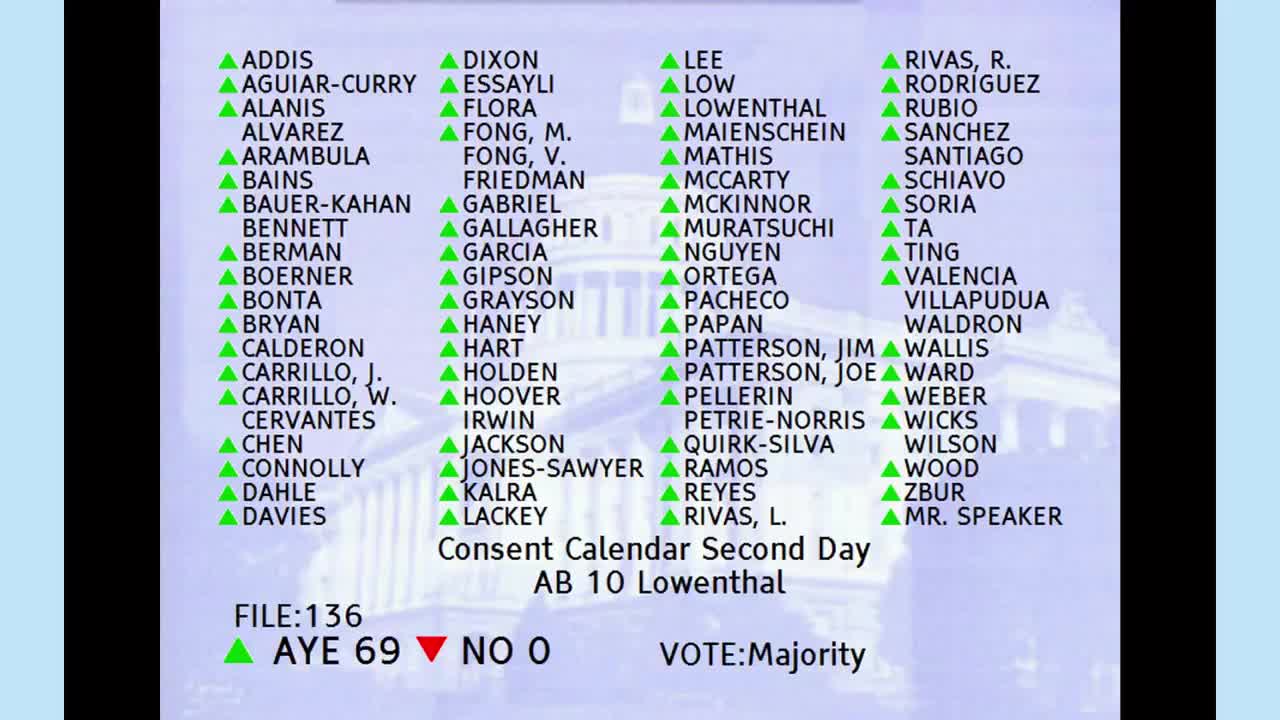
| Jun 29, 2023 | Read third time. Passed. Ordered to the Assembly. (Ayes 39. Noes 0. Page 1829.). |
| Jun 27, 2023 | Read second time. Ordered to Consent Calendar. |
| Jun 26, 2023 | From committee: Be ordered to second reading file pursuant to Senate Rule 28.8 and ordered to Consent Calendar. |
| Jun 13, 2023 | From committee: Do pass and re-refer to Com. on APPR with recommendation: To Consent Calendar. (Ayes 5. Noes 0.) (June 13). Re-referred to Com. on APPR. |
| May 31, 2023 | Referred to Com. on PUB S. |
| May 18, 2023 | In Senate. Read first time. To Com. on RLS. for assignment. |
| May 18, 2023 | Read third time. Passed. Ordered to the Senate. (Ayes 70. Noes 0. Page 1606.) |
| May 4, 2023 | Ordered to third reading. |
| May 4, 2023 | From Consent Calendar. |
| Apr 27, 2023 | Read second time. Ordered to Consent Calendar. |
| Apr 26, 2023 | From committee: Do pass. To Consent Calendar. (Ayes 16. Noes 0.) (April 26). |
| Mar 28, 2023 | From committee: Do pass and re-refer to Com. on APPR. with recommendation: To Consent Calendar. (Ayes 8. Noes 0.) (March 28). Re-referred to Com. on APPR. |
| Mar 23, 2023 | Re-referred to Com. on PUB. S. |
| Mar 22, 2023 | From committee chair, with author's amendments: Amend, and re-refer to Com. on PUB. S. Read second time and amended. |
| Mar 2, 2023 | Referred to Com. on PUB. S. |
| Feb 17, 2023 | From printer. May be heard in committee March 19. |
| Feb 16, 2023 | Read first time. To print. |
|
Date
|
Description
|
Location
|
Votes
|
|
|---|---|---|---|---|
| Jun 29, 2023 | Consent Calendar AB1226 Haney et al. | Senate Floor |
Passed |
|
| Jun 13, 2023 | Do pass, but first be re-referred to the Committee on [Appropriations] with the recommendation: To Consent Calendar | Senate Standing Committee on Public Safety |
Passed |
|
| May 18, 2023 | AB 1226 Haney Assembly Third Reading | Assembly Floor |
Passed |
|
| Apr 26, 2023 | Do pass. To Consent Calendar. | Assembly Standing Committee on Appropriations |
Passed |
|
| Mar 28, 2023 | Do pass and be re-referred to the Committee on [Appropriations] with recommendation: To Consent Calendar | Assembly Standing Committee on Public Safety |
Passed |
This list shows positions taken on this bill by organizations on the date displayed, which is linked to the original source.
Positions by individuals are not included.
|
Organization
|
Position
|
Date
|
|---|---|---|
| Alliance for Boys and Men of Color | ** Support | |
| A New Way of Life Reentry Project | ** Support | |
| Aouon Orange County | ** Support | |
| Blameless and Forever Free Ministries | ** Support | |
| California Alliance for Youth and Community Justice | ** Support | |
| California Attorneys For Criminal Justice | ** Support | |
| California Catholic Conference | ** Support | |
| California Immigrant Policy Center | ** Support | |
| California Public Defenders Association | ** Support | |
| Center on Juvenile and Criminal Justice | ** Support | |
| ChildrenS Law Center Of California | ** Support | |
| City and County of San Francisco, Board of Supervisors | ** Support | |
| Communities United for Restorative Youth Justice | ** Support | |
| Community Works | ** Support | |
| East Bay Family Defenders | ** Support | |
| Ella Baker Center For Human Rights | ** Support | |
| Empowering Women Impacted by Incarceration | ** Support | |
| Felony Murder Elimination Project | ** Support | |
| First 5 Alameda County | ** Support | |
| Fresno Barrios Unidos | ** Support | |
| Grace Institute - End Child Poverty in Ca | ** Support | |
| Initiate Justice | ** Support | |
| Jessie’s Place | ** Support | |
| John Burton Advocates for Youth | ** Support | |
| Legal Aid At Work | ** Support | |
| Legal Services for Prisoners with Children | ** Support | |
| milpa | ** Support | |
| National Association Of Social Workers, California Chapter | ** Support | |
| National Center for Youth Law | ** Support | |
| National Institute for Criminal Justice Reform | ** Support | |
| Prosecutors Alliance California | ** Support | |
| Roadmap to Peace Initiative | ** Support | |
| Root & Rebound | ** Support | |
| Safe Return Project | ** Support | |
| Secure Justice | ** Support | |
| Showing Up For Racial Justice, Bay Area | ** Support | |
| Showing Up for Racial Justice Santa Cruz County | ** Support | |
| Sister Warriors Freedom Center | ** Support | |
| Smart Justice California | ** Support | |
| Starting Over, Inc. | ** Support | |
| The Place4grace | ** Support | |
| The Transformative In-prison Workgroup | ** Support | |
| UC Berkeley's Underground Scholars Initiative | ** Support | |
| Underground Scholars Initiative - UC Berkeley | ** Support | |
| Universidad Popular | ** Support | |
| Valorcalifornia / Valorus | ** Support | |
| Young Women's Freedom Center | ** Support | |
| Youth ALIVE! | ** Support | |
| Youth Leadership Institute | ** Support |
SENATE RULES COMMITTEE Office of Senate Floor Analyses (916) 651-1520 Fax: (916) 327-4478 | AB 1226 |
CONSENT
Bill No: AB 1226
Author: Haney (D), et al.
Amended: 3/22/23 in Assembly
Vote: 21
SENATE PUBLIC SAFETY COMMITTEE: 5-0, 6/13/23
AYES: Wahab, Ochoa Bogh, Bradford, Skinner, Wiener
SENATE APPROPRIATIONS COMMITTEE: Senate Rule 28.8
ASSEMBLY FLOOR: 70-0, 5/18/23 - See last page for vote
SUBJECT: Corrections: Placement of incarcerated persons
SOURCE: Alliance for Boys and Men of Color
Jessie’s Place
Legal Services for Prisoners with Children
The Place4Grace
Underground Scholars Initiative, UC Berkeley
DIGEST:
This bill requires the California Department of Corrections and Rehabilitation (CDCR) to assign or reassign an incarcerated person in the correctional institution or facility that is located nearest to the primary place of residence of the person’s child, except as specified.
ANALYSIS:
Existing law:
- Provides that the term of imprisonment fixed by the judgment in a criminal action commences to run only upon the actual delivery of the defendant into the custody of the Secretary of CDCR at the place designated by the Secretary. (Pen. Code, § 2900, subd. (a).)
- Requires CDCR to examine and study each person who is newly committed to a state prison. Provides that this includes the investigation of all pertinent circumstances of the person’s life such as the existence of any strong community and family ties, the maintenance of which may aid in the person’s rehabilitation, and the antecedents of the violation of law for which the person has been committed to prison. (Pen. Code, § 5068.)
- Requires CDCR, upon the basis of the examination and study, to classify incarcerated persons, and when reasonable, assign an incarcerated person to the institution of the appropriate security level and gender population nearest the person’s home, unless other classification factors make such a placement unreasonable. (Pen. Code, § 5068.)
- Defines “reasonable” to include consideration of the safety of the prisoner and the institution, the length of term, and the availability of institutional programs and housing. (Pen. Code, § 5068.)
- Defines “prisoner’s home” as a place where the prisoner’s spouse, parents, or children reside at the time of commitment. (Pen. Code, § 5068.)
- Provides that the “parent child relationship” is established between a child and natural parent, by proof of having given birth to the child, or between a child and adoptive parent, by proof of adoption. (Fam. Code, § 7610.)
- Defines “guardian” as the legal guardian of the child, who assumed care and control of the child while the child was in the guardian’s control, and who is not a biological or adoptive parent. (Fam. Code, § 17550.)
- Defines “relative caregiver” as a relative, who assumed primary responsibility for the child while the child was in the relative’s care and control, and who is not a biological or adoptive parent. (Fam. Code, § 17550.)
- Defines a “relative” as an adult who is related to the child by blood, adoption, or affinity within the fifth degree of kinship, including stepparents, stepsiblings, and all relatives whose status is preceded by the words “great,” “great-great,” or “grand” or the spouse of any of those persons even if the marriage was terminated by death or dissolution. (Welf. & Inst. Code, § 11362.)
- Prohibits an incarcerated persons from being prohibited from family visits based solely on the fact that the person were sentenced to life without the possibility of parole or sentenced to life and is without a parole date established by the Board of Parole Hearings. (Pen. Code, § 6404.)
- Requires that regulations adopted by CDCR which may impact the visitation of incarcerated persons to, among other things, consider the important role of visitation in establishing and maintaining a meaningful connection with family and community. (Pen. Code, § 6400.)
This bill:
- Provides that following the initial intake evaluation, an incarcerated person’s placement may be reevaluated to determine whether existing orders and dispositions should be modified or continued in force, including, but not limited to, whether the incarcerated person’s child has moved to a place significantly nearer to an otherwise suitable and appropriate institution.
- Requires the Secretary to classify incarcerated persons based on the initial evaluation or reevaluation, and requires the Secretary, when reasonable, to assign or reassign an incarcerated person to the institution of the appropriate security level and gender population nearest the incarcerated person’s home, unless other classification factors make that placement unreasonable.
- Requires the Secretary, if the person has a parent and child relationship with a child under 18 years of age, as described, or is a guardian or relative caregiver, as defined, to place an incarcerated person in the correctional institution or facility that is located nearest to the primary place of residence of the person’s child, provided that the placement is suitable and appropriate, would facilitate increased contact between the person and their child, and the incarcerated parent gives their consent to the placement.
- Provides that an incarcerated person may request a review of their housing assignment when there is a change in the primary place of residence of the person’s child upon which the person’s housing assignment was based.
- Requires the department to make a separate determination for each individual child if an incarcerated person has more than one child under 18 years of age.
- Defines “incarcerated person’s home” to include a place where the incarcerated person’s spouse, parents, or children reside at the time of commitment or at the time of a review of an incarcerated person’s classification or housing assignment.
- Defines “reasonable” to include consideration of the safety of the incarcerated person and the institution.
- Defines “reassign” to mean the transfer of an incarcerated person’s housing assignment from one institution to another.
Background
CDCR’s Department Operations Manual (DOM) establishes the procedures for reception, processing, and transfer of incarcerated persons into CDCR institutions. (DOM § 61010.2.) Upon reception, staff processes each newly incarcerated person by collecting their social and criminal history as well as interviewing the person. (DOM § 61010.4.) A correctional counselor reviews all relevant documents available during the reception process and completes a score sheet. (DOM § 61010.9.) An incarcerated person’s placement score usually determines to which institution to the person will be assigned. (Ibid.)
The correctional counselor takes into account a wide array of factors to calculate the placement score, including but not limited to the incarcerated person’s gang involvement, immigration status, psychiatric and medical conditions, age at first arrest, age at reception, number of years of their total term, prior incarceration, prior incarceration behavior including any serious disciplinary history, whether the person is condemned or serving life without the possibility of parole, history of escape, whether the person has a current or prior conviction for a violent felony, and whether the case is one of public interest. (DOM §§ 61010.11.2-61010.11.6.) The incarcerated person’s score determines the security level institution of the institution where they can be placed. (Ibid.)
Each year an annual review is performed by a counselor to determine if an incarcerated person’s placement score should be reduced or increased. CDCR, What to Expect <https://www.cdcr.ca.gov/ombuds/ombuds/entering-a-prison-faqs/ [as of Jun. 6, 2023].) An incarcerated person has the opportunity to reduce their score if the person has been programming and have not received any disciplinary actions, and an incarcerated person’s score and subsequent housing level can be increased as a result of disciplinary actions. The incarcerated person’s family location is taken into consideration when the person is initially assigned to be housed at a particular institution, but being placed near family is not guaranteed due to many other factors. (Ibid.)
This bill requires CDCR, if an incarcerated person has a child under 18, or is a guardian or relative caregiver, to place the person in the correctional institution or facility that is located nearest to the primary place of residence of the child, if the placement would facilitate increased contact between the person and their child, and if the incarcerated parent gives their consent to the placement. This bill also allows an incarcerated parent to request a review of their housing assignment when there is a change in the primary place of residence of their children.
FISCAL EFFECT: Appropriation: No Fiscal Com.: Yes Local: No
SUPPORT: (Verified 6/26/23)
Alliance for Boys and Men of Color (co-source)
Jessie’s Place (co-source)
Legal Services for Prisoners with Children (co-source)
The Place4Grace (co-source)
Underground Scholars Initiative, UC Berkeley (co-source)
California Alliance for Youth and Community Justice
California Attorneys for Criminal Justice
California Immigrant Policy Center
California Public Defenders Association
Children’s Law Center of California
City and County of San Francisco Board of Supervisors
Communities United for Restorative Youth Justice
East Bay Family Defenders
Ella Baker Center for Human Rights
Felony Murder Elimination Project
First 5 Alameda County
Initiate Justice
Legal Aid at Work
National Association of Social Workers, California Chapter
National Institute for Criminal Justice Reform
Prosecutors Alliance California
Root & Rebound
Safe Return Project
Secure Justice
Showing Up for Racial Justice Bay Area
Showing Up for Racial Justice Santa Cruz County
Sister Warriors Freedom Center
Smart Justice California
OPPOSITION: (Verified 6/26/23)
None received
ASSEMBLY FLOOR: 70-0, 5/18/23
AYES: Addis, Aguiar-Curry, Alanis, Alvarez, Arambula, Bains, Bauer-Kahan, Bennett, Boerner, Bonta, Bryan, Calderon, Juan Carrillo, Wendy Carrillo, Chen, Connolly, Megan Dahle, Davies, Dixon, Essayli, Mike Fong, Gabriel, Garcia, Gipson, Grayson, Haney, Hart, Holden, Hoover, Irwin, Jackson, Kalra, Lackey, Lee, Low, Lowenthal, Maienschein, Mathis, McCarty, Muratsuchi, Stephanie Nguyen, Ortega, Pacheco, Papan, Jim Patterson, Joe Patterson, Pellerin, Petrie-Norris, Quirk-Silva, Ramos, Reyes, Luz Rivas, Robert Rivas, Rodriguez, Blanca Rubio, Sanchez, Santiago, Schiavo, Soria, Ta, Ting, Valencia, Villapudua, Wallis, Ward, Weber, Wicks, Wood, Zbur, Rendon
NO VOTE RECORDED: Berman, Cervantes, Flora, Vince Fong, Friedman, Gallagher, Jones-Sawyer, McKinnor, Waldron, Wilson
Prepared by: Stephanie Jordan / PUB. S. /
6/28/23 11:12:28
**** END ****
SENATE COMMITTEE ON PUBLIC SAFETY
Senator Aisha Wahab, Chair
2023 - 2024 Regular
Bill No: AB 1226 Hearing Date: June 13, 2023
Author: | Haney | ||
Version: | March 22, 2023 | ||
Urgency: | No | Fiscal: | Yes |
Consultant: | SJ | ||
Subject: Corrections: Placement of incarcerated persons
HISTORY
Source: Alliance for Boys and Men of Color
Legal Services for Prisoners with Children
The Place4Grace
Underground Scholars Initiative, UC Berkeley
Jessie’s Place
Prior Legislation: SB 1139 (Kamlager), Ch. 837, Stats. 2022
AB 990 (Santiago), vetoed 2021
AB 964 (Medina), held in Assembly Appropriations 2019
SB 843 (Comm. on Budget), Ch. 33, Stats. 2016
SB 1157 (Mitchell), vetoed 2016
AB 2133 (Goldberg), Ch. 238, Stats. 2002
Support: California Alliance for Youth and Community Justice; California Attorneys for Criminal Justice; California Immigrant Policy Center; California Public Defenders Association; Children’s Law Center of California; Communities United for Restorative Youth Justice; East Bay Family Defenders; Ella Baker Center for Human Rights; Felony Murder Elimination Project; First 5 Alameda County; Initiate Justice; Legal Aid at Work; National Association of Social Workers, California Chapter; National Institute for Criminal Justice Reform; Prosecutors Alliance California; Root & Rebound; Safe Return Project; Secure Justice; Showing Up for Racial Justice Bay Area; Showing Up for Racial Justice Santa Cruz County; Sister Warriors Freedom Center; Smart Justice California
Opposition: None known
Assembly Floor Vote: 70 - 0
PURPOSE
The purpose of this bill is to require the California Department of Corrections and Rehabilitation (CDCR) to assign or reassign an incarcerated person in the correctional institution or facility that is located nearest to the primary place of residence of the person’s child, except as specified.
Existing law provides that the term of imprisonment fixed by the judgment in a criminal action commences to run only upon the actual delivery of the defendant into the custody of the Secretary of CDCR at the place designated by the Secretary. (Pen. Code, § 2900, subd. (a).)
Existing law requires CDCR to examine and study each person who is newly committed to a state prison. Provides that this includes the investigation of all pertinent circumstances of the person’s life such as the existence of any strong community and family ties, the maintenance of which may aid in the person’s rehabilitation, and the antecedents of the violation of law for which the person has been committed to prison. (Pen. Code, § 5068.)
Existing law requires CDCR, upon the basis of the examination and study, to classify incarcerated persons, and when reasonable, assign an incarcerated person to the institution of the appropriate security level and gender population nearest the person’s home, unless other classification factors make such a placement unreasonable. (Pen. Code, § 5068.)
Existing law defines “reasonable” to include consideration of the safety of the prisoner and the institution, the length of term, and the availability of institutional programs and housing. (Pen. Code, § 5068.)
Existing law defines “prisoner’s home” as a place where the prisoner’s spouse, parents, or children reside at the time of commitment. (Pen. Code, § 5068.)
Existing law provides that the “parent child relationship” is established between a child and natural parent, by proof of having given birth to the child, or between a child and adoptive parent, by proof of adoption. (Fam. Code, § 7610.)
Existing law defines “guardian” as the legal guardian of the child, who assumed care and control of the child while the child was in the guardian’s control, and who is not a biological or adoptive parent. (Fam. Code, § 17550.)
Existing law defines “relative caregiver” as a relative, who assumed primary responsibility for the child while the child was in the relative’s care and control, and who is not a biological or adoptive parent. (Fam. Code, § 17550.)
Existing law defines a “relative” as an adult who is related to the child by blood, adoption, or affinity within the fifth degree of kinship, including stepparents, stepsiblings, and all relatives whose status is preceded by the words “great,” “great-great,” or “grand” or the spouse of any of those persons even if the marriage was terminated by death or dissolution. (Welf. & Inst. Code, § 11362.)
Existing law prohibits an incarcerated persons from being prohibited from family visits based solely on the fact that the person were sentenced to life without the possibility of parole or sentenced to life and is without a parole date established by the Board of Parole Hearings. (Pen. Code, § 6404.)
Existing law requires that regulations adopted by CDCR which may impact the visitation of incarcerated persons to, among other things, consider the important role of visitation in establishing and maintaining a meaningful connection with family and community. (Pen. Code, § 6400.)
This bill provides that following the initial intake evaluation, an incarcerated person’s placement may be reevaluated to determine whether existing orders and dispositions should be modified or continued in force, including, but not limited to, whether the incarcerated person’s child has moved to a place significantly nearer to an otherwise suitable and appropriate institution.
This bill requires the Secretary to classify incarcerated persons based on the initial evaluation or reevaluation, and requires the Secretary, when reasonable, to assign or reassign an incarcerated person to the institution of the appropriate security level and gender population nearest the incarcerated person’s home, unless other classification factors make that placement unreasonable.
This bill requires the Secretary, if the person has a parent and child relationship with a child under 18 years of age, as described, or is a guardian or relative caregiver, as defined, to place an incarcerated person in the correctional institution or facility that is located nearest to the primary place of residence of the person’s child, provided that the placement is suitable and appropriate, would facilitate increased contact between the person and their child, and the incarcerated parent gives their consent to the placement.
This bill provides that an incarcerated person may request a review of their housing assignment when there is a change in the primary place of residence of the person’s child upon which the person’s housing assignment was based.
This bill requires the department to make a separate determination for each individual child if an incarcerated person has more than one child under 18 years of age.
This bill defines “incarcerated person’s home” to include a place where the incarcerated person’s spouse, parents, or children reside at the time of commitment or at the time of a review of an incarcerated person’s classification or housing assignment.
This bill defines “reasonable” to include consideration of the safety of the incarcerated person and the institution.
This bill defines “reassign” to mean the transfer of an incarcerated person’s housing assignment from one institution to another.
COMMENTS
- Need For This Bill
According to the author:
A relationship between a parent and child is crucial for the child’s behavioral and emotional development. Sadly, children with incarcerated parents have a harder time creating a relationship with their parent because they have less contact with them. One of the main barriers to children and incarcerated parents maintaining contact is the long distances between prison and the child’s home. There are thousands of incarcerated parents who are placed more than 500 miles from their children, making it difficult for the child to maintain contact. AB 1226 respects the right of a child to remain in contact with their incarcerated parent by requiring CDCR to place incarcerated parents in the closest institution to their child’s home.
- Placement of Persons Incarcerated at CDCR
CDCR’s Department Operations Manual (DOM) establishes the procedures for reception, processing, and transfer of incarcerated persons into CDCR institutions. (DOM § 61010.2.) Upon reception, staff processes each newly incarcerated person by collecting their social and criminal history as well as interviewing the person. (DOM § 61010.4.) A correctional counselor reviews all relevant documents available during the reception process and completes a score sheet. (DOM § 61010.9.) An incarcerated person’s placement score usually determines to which institution to the person will be assigned. (Ibid.)
The correctional counselor takes into account a wide array of factors to calculate the placement score, including but not limited to the incarcerated person’s gang involvement, immigration status, psychiatric and medical conditions, age at first arrest, age at reception, number of years of their total term, prior incarceration, prior incarceration behavior including any serious disciplinary history, whether the person is condemned or serving life without the possibility of parole, history of escape, whether the person has a current or prior conviction for a violent felony, and whether the case is one of public interest. (DOM §§ 61010.11.2-61010.11.6.) The incarcerated person’s score determines the security level institution of the institution where they can be placed. (Ibid.)
Each year an annual review is performed by a counselor to determine if an incarcerated person’s placement score should be reduced or increased. CDCR, What to Expect <https://www.cdcr.ca.gov/ombuds/ombuds/entering-a-prison-faqs/> [as of Jun. 6, 2023].) An incarcerated person has the opportunity to reduce their score if the person has been programming and have not received any disciplinary actions, and an incarcerated person’s score and subsequent housing level can be increased as a result of disciplinary actions. The incarcerated person’s family location is taken into consideration when the person is initially assigned to be housed at a particular institution, but being placed near family is not guaranteed due to many other factors. (Ibid.)
This bill would require CDCR, if an incarcerated person has a child under 18, or is a guardian or relative caregiver, to place the person in the correctional institution or facility that is located nearest to the primary place of residence of the child, if the placement would facilitate increased contact between the person and their child, and if the incarcerated parent gives their consent to the placement. This bill would also allow an incarcerated parent to request a review of their housing assignment when there is a change in the primary place of residence of their children.
- Benefits of Visitation
Proponents of this bill argue that it would reduce barriers to in-person visitation given that incarcerated individuals are less likely to receive visits the further they are housed from home. Research has shown that in-person visitation is beneficial, particularly in reducing recidivism. (Prison Policy Initiative, Research Roundup: The Positive Impacts of Family Contact for Incarcerated People and Their Families (Dec. 21, 2021) available at <https://www.prisonpolicy.org/blog/2021/12/21/family_contact/> [as of Jun. 6, 2023].) Visitation has also been shown to have a positive correlation with increased compliance with prison rules. (Ibid.) Research has additionally found that visitation is linked to improved mental health for incarcerated individuals, including reduced depressive symptoms. (Ibid.) Finally, supportive family relationships can promote the psychological and physiological well-being of incarcerated individuals and their loved ones. (Ibid.)
- Argument in Support
Legal Services for Prisoners with Children, one of the bill’s co-sponsors, writes:
Currently, about 195,000 children have incarcerated parents in California state prisons. Due to sudden separation from their caregiver, children with incarcerated parents experience unique issues such as antisocial behavior and drug abuse. However, children who are able to maintain contact with their parents experience less severe harmful impacts.
Additionally, incarcerated parents who participate in family visitation programs have lower rates of parole violation and recidivism after release. Regular contact between children and their incarcerated parents also improves family reunification following the parent’s release from prison.
Under current CDCR practices, the incarcerated parent’s family location is taken into consideration. However, there is no law that requires CDCR to place a parent close to their minor child and many families end up hundreds of miles apart from each other.
Being incarcerated long distances from home is the number one barrier to families with minor children staying in contact with one another.
In 2019, CDCR released information that said only 25% of incarcerated people in California state prisons are placed in institutions less than 100 miles from their home. …
Visitation falls off significantly the farther from home a person is incarcerated. 50% of people placed less than 50 miles away from home receive frequent family visitation, but only 15% of people placed 500 miles away receive visitors.
Incarcerated mothers in particular, struggle to maintain contact with their children. More than half of incarcerated mothers do not receive any visits from their children while they are in prison. The single most significant reason for lack of contact is the children’s distance from their mothers’ prisons, many of which are located far from major population centers.
AB 1226 removes contact barriers between children and their incarcerated parents or caregivers by requiring CDCR to assign the incarcerated person to serve their term in the institution closest to their minor child’s home.
-- END --
ASSEMBLY THIRD READING
ATR Bill Id:AB 1226
Author:(Haney)
As Amended Ver:March 22, 2023
Majority vote
SUMMARY
Requires the California Department of Corrections and Rehabilitation (CDCR) to assign or reassign an incarcerated person in the correctional institution or facility that is located nearest to the primary place of residence of the person's child, except as specified.
Major Provisions
- States that, if an incarcerated person has a parent and child relationship with a child under 18 years of age, as defined, or is a guardian or relative caregiver, as defined, the Secretary shall place the person in the correctional institution or facility that is located nearest to the primary place of residence of the person's child, if the placement is suitable and reasonable, would facilitate increased contact between the person and their child, and the incarcerated parent gives their consent to the placement.
- Provides that an incarcerated person's placement may be reevaluated to determine whether existing orders and dispositions should be modified or continued in force, including, but not limited to, whether their child has moved to a place significantly nearer to an otherwise suitable and appropriate institution.
- Allows an incarcerated person to request a review of their housing assignment when there is a change in the primary place of residence of the person's child upon which the person's housing assignment was based.
- Requires CDCR to make a separate determination for each individual child if an incarcerated person has more than one child under 18 years of age.
- Redefines "Incarcerated person's home" to include a place where the incarcerated person's spouse, parents, or children reside at the time of commitment or at the time of a review of an incarcerated person’s classification or housing assignment.
- Redefines "Reasonable" to include consideration of the safety of the incarcerated persons and the institution.
- Defines "Reassign" to mean the transfer of an incarcerated person's housing assignment from one institution to another.
COMMENTS
According to the Author
"A relationship between a parent and child is crucial for the child's behavioral and emotional development. Sadly, children with incarcerated parents have a harder time creating a relationship with their parent because they have less contact with them. One of the main barriers to children and incarcerated parents maintaining contact is the long distances between prison and the child's home. There are thousands of incarcerated parents who are placed more than 500 miles from their children, making it difficult for the child to maintain contact. AB 1226 respects the right of a child to remain in contact with their incarcerated parent by requiring CDCR to place incarcerated parents in the closest institution to their child’s home."
Arguments in Support
According to Legal Services for Prisoners with Children, "Parents and caregivers play a critical role in the development of their children. Data shows that up until the age of 18, frequent contact between the child and their parent is crucial for the child's behavioral and emotional development.
"Currently, about 195,000 children have incarcerated parents in California state prisons. Due to sudden separation from their caregiver, children with incarcerated parents experience unique issues such as antisocial behavior and drug abuse. However, children who are able to maintain contact with their parents experience less severe harmful impacts.
"Additionally, incarcerated parents who participate in family visitation programs have lower rates of parole violation and recidivism after release. Regular contact between children and their incarcerated parents also improves family reunification following the parent's release from prison.
"Under current CDCR practices, the incarcerated parent's family location is taken into consideration. However, there is no law that requires CDCR to place a parent close to their minor child and many families end up hundreds of miles apart from each other.
"Being incarcerated long distances from home is the number one barrier to families with minor children staying in contact with one another.
"In 2019, CDCR released information that said only 25% of incarcerated people in California state prisons are placed in institutions less than 100 miles from their home. The long distances place a burden on families who do not have the financial means or the time to travel across the state for family visits.
"Visitation falls off significantly the farther from home a person is incarcerated. 50% of people placed less than 50 miles away from home receive frequent family visitation, but only 15% of people placed 500 miles away receive visitors.
"Incarcerated mothers in particular, struggle to maintain contact with their children. More than half of incarcerated mothers do not receive any visits from their children while they are in prison. The single most significant reason for lack of contact is the children's distance from their mothers' prisons, many of which are located far from major population centers.
"AB 1226 removes contact barriers between children and their incarcerated parents or caregivers by requiring CDCR to assign the incarcerated person to serve their term in the institution closest to their minor child’s home."
Arguments in Opposition
None Submitted.
FISCAL COMMENTS
According to the Assembly Appropriations Committee, "Minimal, likely absorbable costs (General Fund) to CDCR. CDCR reports that the duties created by this bill are similar to their existing practices, and would not create significant additional costs."
VOTES
ASM PUBLIC SAFETY: 8-0-0
YES: Jones-Sawyer, Alanis, Bonta, Bryan, Lackey, Jackson, Santiago, Zbur
ASM APPROPRIATIONS: 16-0-0
YES: Holden, Megan Dahle, Bryan, Calderon, Wendy Carrillo, Dixon, Mike Fong, Hart, Lowenthal, Mathis, Papan, Pellerin, Robert Rivas, Sanchez, Weber, Wilson
UPDATED
VERSION: March 22, 2023
CONSULTANT: Liah Burnley / PUB. S. / (916) 319-3744 FN: 0000324
Date of Hearing: April 26, 2023
ASSEMBLY COMMITTEE ON APPROPRIATIONS
Chris Holden, Chair
ABPCA Bill Id:AB 1226
Author:(Haney) – As Amended Ver:March 22, 2023
Policy Committee: | Public Safety | Vote: | 8 - 0 |
|
| ||
|
|
Urgency: No State Mandated Local Program: No Reimbursable: No
SUMMARY:
This bill requires the California Department of Corrections and Rehabilitation (CDCR) to assign or reassign an incarcerated person in the correctional facility that is closest to the residence of the incarcerated person’s child, as long as the placement is otherwise suitable, would increase contact between the person and the child, and the incarcerated person consents to the placement. The bill also allows an incarcerated person to request review of their housing assignment if their child moves.
FISCAL EFFECT:
Minimal, likely absorbable costs (General Fund) to CDCR. CDCR reports that the duties created by this bill are similar to their existing practices, and would not create significant additional costs.
COMMENTS:
- Author’s Statement. According to the author:
A relationship between a parent and child is crucial for the child’s behavioral and emotional development. Sadly, children with incarcerated parents have a harder time creating a relationship with their parent because they have less contact with them. One of the main barriers to children and incarcerated parents maintaining contact is the long distances between prison and the child’s home. There are thousands of incarcerated parents who are placed more than 500 miles from their children, making it difficult for the child to maintain contact. AB 1226 respects the right of a child to remain in contact with their incarcerated parent by requiring CDCR to place incarcerated parents in the closest institution to their child’s home.
- CDCR Housing Assignments. Existing law requires CDCR to, when reasonable, assign an incarcerated person to the institution closest to the person’s home, where “home” means the place where the person’s spouse, parents, or children live at the time the person is committed to CDCR custody. In determining where to place an inmate, CDCR may consider the level of security they required, the length of their term, and the availability of institutional programs and housing. Existing regulations also require CDCR to review an inmate’s housing assignment annually.
This bill updates the language of the above-referenced statutes to emphasize the importance of considering family and community relationships when making housing determinations for inmates in CDCR custody. The bill also allows CDCR to re-evaluate an incarcerated person’s housing assignment if the person’s child has moved near another suitable institution, and directs CDCR to place the incarcerated person in the facility nearest to their child, provided the facility is otherwise an appropriate placement, the move would facilitate increased contact between the child and incarcerated person, and the incarcerated person gives their consent to the placement. The bill also allows an incarcerated person to request re-evaluation of their housing assignment if their child’s residence has changed.
CDCR reports minimal costs resulting from this bill because, although the bill places more emphasis on the parent-child relationship in particular, existing law already requires CDCR to consider familial relationships when making housing assignments for inmates. To the extent that this bill would prompt many more inmates to request re-evaluation of their housing placements, or would prompt CDCR to begin conducting many additional housing evaluations outside the annual reviews it already conducts, this bill could result in additional General Fund staffing costs to CDCR.
Analysis Prepared by: Annika Carlson / APPR. / (916) 319-2081
Date of Hearing: March 28, 2023
Counsel: Liah Burnley
ASSEMBLY COMMITTEE ON
Reginald Byron Jones-Sawyer, Sr., Chair
ABPCA Bill Id:
Author:() – As Ver:
SUMMARY:
Requires the California Department of Corrections and Rehabilitation (CDCR) to assign or reassign an incarcerated person in the correctional institution or facility that is located nearest to the primary place of residence of the person’s child, except as specified. Specifically, this bill:
- States that, if an incarcerated person has a parent and child relationship with a child under 18 years of age, as defined, or is a guardian or relative caregiver, as defined, the Secretary shall place the person in the correctional institution or facility that is located nearest to the primary place of residence of the person’s child, if the placement is suitable and reasonable, would facilitate increased contact between the person and their child, and the incarcerated parent gives their consent to the placement.
- Provides that an incarcerated person’s placement may be reevaluated to determine whether existing orders and dispositions should be modified or continued in force, including, but not limited to, whether their child has moved to a place significantly nearer to an otherwise suitable and appropriate institution.
- Allows an incarcerated person to request a review of their housing assignment when there is a change in the primary place of residence of the person’s child upon which the person’s housing assignment was based.
- Requires CDCR to make a separate determination for each individual child if an incarcerated person has more than one child under 18 years of age.
- Redefines “Incarcerated person’s home” to include a place where the incarcerated person’s spouse, parents, or children reside at the time of commitment or at the time of a review of an incarcerated person’s classification or housing assignment.
- Redefines “Reasonable” to include consideration of the safety of the incarcerated persons and the institution.
- Defines “Reassign” to mean the transfer of an incarcerated person’s housing assignment from one institution to another.
EXISTING LAW:
- Provides that defendants sentenced to state prison shall be delivered to the custody of the Secretary at the place designated by the Secretary to serve the term of imprisonment ordered by the court. (Pen. Code, § 2900.)
- Requires CDCR to examine and study each person who is newly committed to a state prison. This includes the investigation of all pertinent circumstances of the person’s life such as the existence of any strong community and family ties, the maintenance of which may aid in the person’s rehabilitation, and the antecedents of the violation of law for which the person has been committed to prison. (Pen. Code, § 5068.)
- Provides that, upon the basis of the examination and study, CDCR shall classify incarcerated persons, and when reasonable, assign an incarcerated person to the institution of the appropriate security level and gender population nearest the person’s home, unless other classification factors make such a placement unreasonable. (Pen. Code, § 5068.)
- Defines “reasonable” to include consideration of the safety of the prisoner and the institution, the length of term, and the availability of institutional programs and housing. (Pen. Code, § 5068.)
- Defines “Prisoner’s home” as a place where the prisoner’s spouse, parents, or children reside at the time of commitment. (Pen. Code, § 5068.)
- Provides that a “parent child relationship” is established between a child and natural parent, by proof of having given birth to the child, or between a child and adoptive parent, by proof of adoption. (Pen. Code, § 5068; Fam. Code, § 7610.)
- Defines “Guardian” as the legal guardian of the child, who assumed care and control of the child while the child was in the guardian’s control, and who is not a biological or adoptive parent. (Pen. Code, § 5068; Fam. Code, § 17550.)
- Defines “Relative caregiver” as a relative, who assumed primary responsibility for the child while the child was in the relative’s care and control, and who is not a biological or adoptive parent. A relative is an adult who is related to the child by blood, adoption, or affinity within the fifth degree of kinship, including stepparents, stepsiblings, and all relatives whose status is preceded by the words “great,” “great-great,” or “grand” or the spouse of any of those persons even if the marriage was terminated by death or dissolution. (Pen. Code, § 5068; Fam. Code, § 17550; Welf. & Inst. Code, § 11362.)
- States that incarcerated persons shall not be prohibited from family visits based solely on the fact that they were sentenced to life without the possibility of parole or sentenced to life and is without a parole date established by the Board of Parole Hearings. (Pen. Code, § 6404.)
- Requires that regulations adopted by CDCR which may impact the visitation of incarcerated persons, among other things, consider the important role of visitation in establishing and maintaining a meaningful connection with family and community. (Pen. Code, § 6400.)
FISCAL EFFECT:
Unknown
COMMENTS:
- Author's Statement: According to the author, “A relationship between a parent and child is crucial for the child’s behavioral and emotional development. Sadly, children with incarcerated parents have a harder time creating a relationship with their parent because they have less contact with them. One of the main barriers to children and incarcerated parents maintaining contact is the long distances between prison and the child’s home. There are thousands of incarcerated parents who are placed more than 500 miles from their children, making it difficult for the child to maintain contact. AB 1226 respects the right of a child to remain in contact with their incarcerated parent by requiring CDCR to place incarcerated parents in the closest institution to their child’s home.”
- Placement of Persons Incarcerated at CDCR: CDCR’s Department Operations Manual (DOM) establishes the standard procedures for reception, processing, and transfer of incarcerated persons into CDCR institutions. (DOM § 61010.2.) Upon reception, staff processes each newly-incarcerated person by collecting their social and criminal history, and interviewing the person. (DOM § 61010.4.) A correctional counselor reviews all relevant documents available during the reception process and completes a score sheet. An incarcerated person’s placement score usually determines to which institution to they will be assigned. (DOM § 61010.9.)
The correctional counselor takes into account a wide array of factors to calculate the placement score, including but not limited to the incarcerated person’s gang involvement, immigration status, psychiatric and medical conditions, age at first arrest, age at reception, number of years of their total term, prior incarceration, prior incarceration behavior including any serious disciplinary history, whether the person is condemned or serving life without the possibility of parole, history of escape, whether the person has a current or prior conviction for a violent felony, and whether the case is one of public interest. (DOM §§ 61010.1-61010.18.) The incarcerated person’s score determines what level institution they can be placed. (Ibid.) Institutions range from least to most restrictive, Level I – Level IV. (Ibid.)
Each year an annual review is performed by a counselor to determine if an incarcerated person meets the criteria to have their placement score reduced. An incarcerated person has the opportunity to reduce their score if they have been programming and have not received any disciplinary actions. In contrast, an incarcerated person’s score and subsequent housing level can be increased due to receiving disciplinary actions. (CDCR, What to Expect <https://www.cdcr.ca.gov/ombuds/ombuds/entering-a-prison-faqs/> [as of March 15, 2023].) According to CDCR, the incarcerated person’s family location is taken into consideration, however, being placed near family is not guaranteed due to many other factors. (Ibid.)
This bill would require CDCR, if an incarcerated person has a child, or children, under 18 years of age, to place the person in the correctional institution or facility that is located nearest to the primary place of residence of the child, if the placement would facilitate increased contact between the person and their child, and if the incarcerated parent gives their consent to the placement. This bill would also allow an incarcerated parent to request a review of their housing assignment when there is a change in the primary place of residence of their children. - Importance of Parent-Child Visitation: Being incarcerated long distances away from home is a barrier for families with minor children to in-person visitation. The purpose of this bill is to alleviate that burden by requiring CDCR to consider placing an incarcerated person in correctional institution that is located nearest to the primary place of residence of their children.
Decades of research has shown that in-person visitation is beneficial, particularly when it comes to reducing recidivism. (Prison Policy Imitative, Research Roundup: The Positive Impacts of Family Contact for Incarcerated People and Their Families (Dec. 21, 2021) <https://www.prisonpolicy.org/blog/2021/12/21/family_contact/> [as of March 11, 2023].) One study found that any visit reduced the risk of recidivism by 13% for felony reconvictions and 25% for technical violation revocations, which reflects the fact that visitation generally had a greater impact on revocations. (Ibid.) The findings further showed that more frequent and recent visits were associated with a decreased risk of recidivism. (Ibid.) A 1972 study on visitation that followed 843 people on parole from California prisons found that those who had no visitors during their incarceration were six times more likely to be reincarcerated than people with three or more visitors. (Ibid.) Visitation is also correlated with adherence to prison rules. (Ibid.) A 2019 study found that one additional visit per month would reduce misconduct by 14%. According to another study, misconduct tended to decrease in the three weeks before a visit. (Ibid.) This may explain why more frequent visits lead to more consistent good behavior, better overall outcomes and post-release success. (Ibid.) Research has also found that visitation is linked to better mental health, including reduced depressive symptoms for incarcerated persons. (Ibid.) Supportive family relationships can promote psychological and physiological health for incarcerated people and their loved ones. (Ibid.) When done well, visitation can ease anxiety in children and mitigate some of the impacts on strained interpersonal relationships. (Ibid.) Children who had displayed concerning behavior upon their parent’s incarceration showed improved behavior after visiting. (Ibid.)
- Argument in Support: According to Legal Services for Prisoners with Children, “Parents and caregivers play a critical role in the development of their children. Data shows that up until the age of 18, frequent contact between the child and their parent is crucial for the child’s behavioral and emotional development.
“Currently, about 195,000 children have incarcerated parents in California state prisons. Due to sudden separation from their caregiver, children with incarcerated parents experience unique issues such as antisocial behavior and drug abuse. However, children who are able to maintain contact with their parents experience less severe harmful impacts.
“Additionally, incarcerated parents who participate in family visitation programs have lower rates of parole violation and recidivism after release. Regular contact between children and their incarcerated parents also improves family reunification following the parent’s release from prison.
“Under current CDCR practices, the incarcerated parent’s family location is taken into consideration. However, there is no law that requires CDCR to place a parent close to their minor child and many families end up hundreds of miles apart from each other.
“Being incarcerated long distances from home is the number one barrier to families with minor children staying in contact with one another.
“In 2019, CDCR released information that said only 25% of incarcerated people in California state prisons are placed in institutions less than 100 miles from their home. The long distances place a burden on families who do not have the financial means or the time to travel across the state for family visits.
“Visitation falls off significantly the farther from home a person is incarcerated. 50% of people placed less than 50 miles away from home receive frequent family visitation, but only 15% of people placed 500 miles away receive visitors.
“Incarcerated mothers in particular, struggle to maintain contact with their children. More than half of incarcerated mothers do not receive any visits from their children while they are in prison. The single most significant reason for lack of contact is the children’s distance from their mothers’ prisons, many of which are located far from major population centers.
“AB 1226 removes contact barriers between children and their incarcerated parents or caregivers by requiring CDCR to assign the incarcerated person to serve their term in the institution closest to their minor child’s home.”
- Related Legislation:
- AB 958 (Santiago), would make the right to visitation in correctional facilities a civil right, as specified. AB 958 is pending in the Assembly Appropriations Committee.
- AB 280 (Holden), would limit the use of segregated confinement in detention facilities in the State and require facilities to follow specified procedures related to segregated confinement. AB 280 is pending in the Assembly Appropriations Committee.
- AB 958 (Santiago), would make the right to visitation in correctional facilities a civil right, as specified. AB 958 is pending in the Assembly Appropriations Committee.
- Prior Legislation:
- AB 990 (Santiago), of the 2021-2022 Legislative Session, would have made the right to visitation in correctional facilities a civil right, as specified. AB 990 was vetoed.
- SB 1008 (Becker) Chapter 827, Statutes of 2022, requires CDCR to provide voice communication services to incarcerated persons free of charge.
- SB 1139 (Kamlager) Chapter 837, Statutes of 2022, requires, among other things, emergency in-person contact visits and video calls to be made available whenever an incarcerated person is hospitalized or moved to a medical unit within the facility and the incarcerated person is in a critical or more serious medical condition.
- AB 964 (Medina), of the 2019-2020 Legislative Session, would have required all local detention facilities to offer in-person visitation. AB 964 was held on the Assembly Appropriations suspense file.
- SB 843 (Committee on Budget), Chapter 33, Statutes of 2016, barred prohibiting incarcerated persons from family visits based solely on the fact that the incarcerated person is sentenced to life without the possibility of parole or is sentenced to life and is without a parole date.
- SB 1157 (Mitchell), of the 2015-2016 Legislative Session, would have prohibited local correctional facilities and juvenile facilities from replacing in-person visits with video or other types of electronic visitation. SB 1157 was vetoed.
- SCR 20, Chapter 88, Statutes of 2009, encouraged correctional facilities to distribute the Children of Incarcerated Parents Bill of Rights to children of incarcerated parents, and to use the bill of rights as a framework for analysis and determination of procedures when making decisions about services for these children.
- AB 2133 (Goldberg), Chapter 238, Statutes of 2002, required that any amendments to regulations adopted by CDCR which may impact the visitation of incarcerated persons recognize and consider the value of visitation as a means of increasing safety in prisons, maintaining family and community connections, and preparing inmates for successful release and rehabilitation.
REGISTERED SUPPORT / OPPOSITION:
Support
Legal Services for Prisoners With Children (Co-Sponsor)
The Place4grace (Co-Sponsor)
A New Way of Life Reentry Project
Alliance for Boys and Men of Color
Aouon Orange County
Blameless and Forever Free Ministries
California Alliance for Youth and Community Justice
California Catholic Conference
California Public Defenders Association (CPDA)
Center on Juvenile and Criminal Justice
Communities United for Restorative Youth Justice (CURYJ)
Community Works
Ella Baker Center for Human Rights
Empowering Women Impacted by Incarceration
Fresno Barrios Unidos
Grace Institute - End Child Poverty in Ca
Initiate Justice
Jesse's Place Org
John Burton Advocates for Youth
Legal Aid At Work
Milpa (motivating Individual Leadership for Public Advancement)
National Center for Youth Law
Prosecutors Alliance California
Roadmap to Peace Initiative
Root & Rebound
Secure Justice
Showing Up for Racial Justice Santa Cruz County
Smart Justice California
Starting Over, INC.
The Transformative In-prison Workgroup
UC Berkeley's Underground Scholars Initiative (USI)
Universidad Popular
Valorcalifornia / Valorus
Young Women's Freedom Center
Youth Alive!
Youth Leadership Institute
5 Private Individuals
Opposition
None.
Analysis Prepared by:
Bill Author

Bill Co-Author(s):
