AB 1308: Planning and Zoning Law: single-family residences: parking requirements.
- Session Year: 2023-2024
- House: Assembly
- Latest Version Date: 2023-10-11
Current Status:
Passed
(2023-10-11: Chaptered by Secretary of State - Chapter 756, Statutes of 2023.)
Introduced
In Committee
First Chamber
In Committee
Second Chamber
Enacted
The Planning and Zoning Law authorizes the legislative body of any county or city to adopt ordinances that regulate the use of buildings, structures, and land as between industry, business, residences, open space, and other purposes.
This bill would prohibit a public agency, as defined, from increasing the minimum parking requirement that applies to a single-family residence as a condition of approval of a project to remodel, renovate, or add to a single-family residence, except as specified. By imposing additional duties on local officials, the bill would impose a state-mandated local program.
The bill would include findings that changes proposed by this bill address a matter of statewide concern rather than a municipal affair and, therefore, apply to all cities, including charter cities.
The California Constitution requires the state to reimburse local agencies and school districts for certain costs mandated by the state. Statutory provisions establish procedures for making that reimbursement.
This bill would provide that no reimbursement is required by this act for a specified reason.
The Planning and Zoning Law authorizes the legislative body of any county or city to adopt ordinances that regulate the use of buildings, structures, and land as between industry, business, residences, open space, and other purposes.
This bill would prohibit a public agency, as defined, from imposing a new increasing the minimum parking requirement on that applies to a single-family residence as a condition of approval of a project to remodel, renovate, or add to a single-family residence, except as specified. By imposing additional duties on local officials, the bill would impose a state-mandated local program.
The bill would include findings that changes proposed by this bill address a matter of statewide concern rather than a municipal affair and, therefore, apply to all cities, including charter cities.
The California Constitution requires the state to reimburse local agencies and school districts for certain costs mandated by the state. Statutory provisions establish procedures for making that reimbursement.
This bill would provide that no reimbursement is required by this act for a specified reason.
The Planning and Zoning Law authorizes the legislative body of any county or city to adopt ordinances that regulate the use of buildings, structures, and land as between industry, business, residences, open space, and other purposes.
This bill would prohibit a public agency, as defined, from imposing a new minimum parking requirement on a project to remodel, renovate, or add to a single-family residence, except as specified. By imposing additional duties on local officials, the bill would impose a state-mandated local program.
The bill would include findings that changes proposed by this bill address a matter of statewide concern rather than a municipal affair and, therefore, apply to all cities, including charter cities.
The California Constitution requires the state to reimburse local agencies and school districts for certain costs mandated by the state. Statutory provisions establish procedures for making that reimbursement.
This bill would provide that no reimbursement is required by this act for a specified reason.
(a)A public agency shall not increase the minimum parking requirement that applies to a single-family residence as a condition of approval of a project to remodel, renovate, or add to a single-family residence provided that the project does not cause the single-family residence to exceed any maximum size limit imposed by the applicable zoning regulations, including, but not limited to, height, lot coverage, and floor-to-area ratio.
(b)For purposes of this section, public agency means the state or any state agency, board or commission, any city, county, city and county, including charter cities, or special district, or any agency, board, or commission of the city, county, city and county, special district, joint powers authority, or other political subdivision.
(c)The Legislature finds and declares that the imposition of mandatory parking minimums can increase the cost of housing, limit the number of available units, lead to an oversupply of parking spaces, and increased greenhouse gas emissions. Therefore, this section shall be interpreted in favor of the prohibition of the imposition of mandatory parking minimums as outlined in this section.
(d)This section shall not be construed to allow a local agency to impose parking restrictions that are more restrictive than the requirements a local agency is authorized to impose under Section 65852.2, if the single-family residence is on the same lot as an accessory dwelling unit.
SEC. 2.The Legislature finds and declares that to lower the cost of housing production by reducing unnecessary parking requirements is a matter of statewide concern and is not a municipal affair as that term is used in Section 5 of Article XI of the California Constitution. Therefore, Section 1 of this act adding Section 65863.3 to the Government Code applies to all cities, including charter cities.
SEC. 3.No reimbursement is required by this act pursuant to Section 6 of Article XIIIB of the California Constitution because a local agency or school district has the authority to levy service charges, fees, or assessments sufficient to pay for the program or level of service mandated by this act, within the meaning of Section 17556 of the Government Code.
(a)A public agency shall not impose a new increase the minimum parking requirement on that applies to a single-family residence as a condition of approval of a project to remodel, renovate, or add to a single-family residence provided that the project does not cause the single-family residence to exceed a any maximum size limit imposed by the applicable zoning regulations, including, but not limited to, height, lot coverage, and floor-to-area ratio restriction imposed by the public agency. ratio.
(b)For purposes of this section, public agency means the state or any state agency, board or commission, any city, county, city and county, including charter cities, or special district, or any agency, board, or commission of the city, county, city and county, special district, joint powers authority, or other political subdivision.
(c)The Legislature finds and declares that the imposition of mandatory parking minimums can increase the cost of housing, limit the number of available units, lead to an oversupply of parking spaces, and increased greenhouse gas emissions. Therefore, this section shall be interpreted in favor of the prohibition of the imposition of mandatory parking minimums as outlined in this section.
(d)This section shall not be construed to allow a local agency to impose parking restrictions that are more restrictive than the requirements a local agency is authorized to impose under Section 65852.2, if the single-family residence is on the same lot as an accessory dwelling unit.
SEC. 2.The Legislature finds and declares that to lower the cost of housing production by reducing unnecessary parking requirements is a matter of statewide concern and is not a municipal affair as that term is used in Section 5 of Article XI of the California Constitution. Therefore, Section 1 of this act adding Section 65863.3 to the Government Code applies to all cities, including charter cities.
SEC. 3.No reimbursement is required by this act pursuant to Section 6 of Article XIIIB of the California Constitution because a local agency or school district has the authority to levy service charges, fees, or assessments sufficient to pay for the program or level of service mandated by this act, within the meaning of Section 17556 of the Government Code.
(a)A public agency shall not impose a new minimum parking requirement on a project to remodel, renovate, or add to a single-family residence provided that the project does not cause the single-family residence to exceed a floor-to-area ratio restriction imposed by the public agency.
(b)For purposes of this section, public agency means the state or any state agency, board or commission, any city, county, city and county, including charter cities, or special district, or any agency, board, or commission of the city, county, city and county, special district, joint powers authority, or other political subdivision.
(c)The Legislature finds and declares that the imposition of mandatory parking minimums can increase the cost of housing, limit the number of available units, lead to an oversupply of parking spaces, and increased greenhouse gas emissions. Therefore, this section shall be interpreted in favor of the prohibition of the imposition of mandatory parking minimums as outlined in this section.
SEC. 2.The Legislature finds and declares that to lower the cost of housing production by reducing unnecessary parking requirements is a matter of statewide concern and is not a municipal affair as that term is used in Section 5 of Article XI of the California Constitution. Therefore, Section 1 of this act adding Section 65863.3 to the Government Code applies to all cities, including charter cities.
SEC. 3.No reimbursement is required by this act pursuant to Section 6 of Article XIIIB of the California Constitution because a local agency or school district has the authority to levy service charges, fees, or assessments sufficient to pay for the program or level of service mandated by this act, within the meaning of Section 17556 of the Government Code.
|
Date
|
Status
|
|---|---|
| Oct 11, 2023 | Chaptered by Secretary of State - Chapter 756, Statutes of 2023. |
| Oct 11, 2023 | Approved by the Governor. |
| Sep 12, 2023 | Enrolled and presented to the Governor at 2 p.m. |
| Sep 5, 2023 | In Assembly. Ordered to Engrossing and Enrolling. |
| Sep 5, 2023 | Read third time. Passed. Ordered to the Assembly. (Ayes 28. Noes 5. Page 2374.). |
| Aug 15, 2023 | Read second time. Ordered to third reading. |
| Aug 14, 2023 | From committee: Be ordered to second reading pursuant to Senate Rule 28.8. |
| Jul 11, 2023 | From committee: Do pass and re-refer to Com. on APPR. (Ayes 10. Noes 1.) (July 10). Re-referred to Com. on APPR. |
| Jun 21, 2023 | From committee: Do pass and re-refer to Com. on HOUSING. (Ayes 6. Noes 2.) (June 21). Re-referred to Com. on HOUSING. |
| Jun 7, 2023 | Referred to Coms. on GOV. & F. and HOUSING. |
| May 26, 2023 | In Senate. Read first time. To Com. on RLS. for assignment. |
| May 25, 2023 | Read third time. Passed. Ordered to the Senate. (Ayes 71. Noes 3. Page 1736.) |
| May 4, 2023 | Read second time. Ordered to third reading. |
| May 3, 2023 | From committee: Do pass. (Ayes 14. Noes 2.) (May 3). |
| Apr 19, 2023 | From committee: Do pass and re-refer to Com. on APPR. (Ayes 6. Noes 1.) (April 19). Re-referred to Com. on APPR. |
| Apr 3, 2023 | Re-referred to Com. on H. & C.D. |
| Mar 30, 2023 | Read second time and amended. |
| Mar 29, 2023 | From committee: Amend, and do pass as amended and re-refer to Com. on H. & C.D. (Ayes 7. Noes 1.) (March 29). |
| Mar 2, 2023 | Referred to Coms. on L. GOV. and H. & C.D. |
| Feb 17, 2023 | From printer. May be heard in committee March 19. |
| Feb 16, 2023 | Read first time. To print. |
|
Date
|
Description
|
Location
|
Votes
|
|
|---|---|---|---|---|
| Sep 5, 2023 | Assembly 3rd Reading AB1308 Quirk-Silva et al. By Wiener | Senate Floor |
Passed |
|
| Jul 10, 2023 | Do pass, but first be re-referred to the Committee on [Appropriations] | Senate Standing Committee on Housing |
Passed |
|
| Jun 21, 2023 | Do pass, but first be re-referred to the Committee on [Housing] | Senate Standing Committee on Governance and Finance |
Passed |
|
| May 25, 2023 | AB 1308 Quirk-Silva Assembly Third Reading | Assembly Floor |
Passed |
|
| May 3, 2023 | Do pass. | Assembly Standing Committee on Appropriations |
Passed |
|
| Apr 19, 2023 | Do pass and be re-referred to the Committee on [Appropriations] | Assembly Standing Committee on Housing and Community Development |
Passed |
|
| Mar 29, 2023 | Do pass as amended and be re-referred to the Committee on [Housing and Community Development] | Assembly Standing Committee on Local Government |
Passed |
This list shows positions taken on this bill by organizations on the date displayed, which is linked to the original source.
Positions by individuals are not included.
|
Organization
|
Position
|
Date
|
|---|---|---|
| California YIMBY | ** Support | |
| City of Newport Beach | ** Against | |
| City Of Pleasanton | ** Against | |
| City of Santa Clarita | ** Against | |
| Habitat For Humanity California | ** Support | |
| Livable California | ** Against | |
| San Francisco Bay Area Planning and Urban Research Association | ** Support | |
| VALLEY INDUSTRY AND COMMERCE ASSOCIATION | ** Support |
SENATE RULES COMMITTEE Office of Senate Floor Analyses (916) 651-1520 Fax: (916) 327-4478 | AB 1308 |
THIRD READING
Bill No: AB 1308
Author: Quirk-Silva (D) and Friedman (D)
Amended: 3/30/23 in Assembly
Vote: 21
SENATE GOVERNANCE & FIN. COMMITTEE: 6-2, 6/21/23
AYES: Caballero, Blakespear, Durazo, Glazer, Skinner, Wiener
NOES: Seyarto, Dahle
SENATE HOUSING COMMITTEE: 10-1, 7/10/23
AYES: Wiener, Ochoa Bogh, Blakespear, Caballero, Cortese, McGuire, Padilla, Skinner, Umberg, Wahab
NOES: Seyarto
SENATE APPROPRIATIONS COMMITTEE: Senate Rule 28.8
ASSEMBLY FLOOR: 71-3, 5/25/23 - See last page for vote
SUBJECT: Planning and Zoning Law: single-family residences: parking requirements
SOURCE: Author
DIGEST:
This bill prohibits a public agency from increasing the minimum parking requirement that applies to a single-family residence as a condition of approval of a project to remodel, renovate, or add to a single-family residence.
ANALYSIS:
Existing law:
- Allows, pursuant to the California Constitution, cities and counties counties to “make and enforce within its limits, all local, police, sanitary and other ordinances and regulations not in conflict with general laws.” It is from this fundamental power (commonly called the police power) that cities and counties derive their authority to regulate behavior to preserve the health, safety, and welfare of the public—including land use authority.
- Prohibits public agencies from imposing minimum automobile parking requirements on specified residential, commercial and other developments located within one-half mile of public transit (AB 2097, Friedman, Chapter 459, Statutes of 2022).
- Limits the parking requirements a city or county may impose on accessory dwelling units (ADUs) if:
- The ADU is located within half mile of public transit or shopping;
- The ADU is located within an architecturally and historically significant historic district:
- The ADU is part of an existing primary residence;
- On-street parking permits are required, but not offered to the occupant of the ADU; or
- There is a car-share vehicle located within one block of the ADU.
This bill:
- Prohibits a local agency from increasing the minimum parking requirement that applies to a single-family residence as a condition of approving a project to remodel, renovate, or add to the residence, provided the project does not cause the residence to exceed any maximum size limit imposed by the applicable zoning regulations, including height, lot coverage, and floor-to-area ratio.
- Provides that its provisions must not be construed to allow a local agency to impose parking restrictions that are more restrictive than the parking requirements a local agency is authorized to impose in existing law, if the single-family residence is on the same lot as an ADU.
- Makes findings and declarations to further its intent, and defines its terms.
Background
Local governments use their police power to enact zoning ordinances that shape development, such as setting maximum heights and densities for housing units, minimum numbers of required parking spaces, setbacks to preserve privacy, lot coverage ratios to increase open space, and others. These ordinances can also include conditions on development to address aesthetics, community impacts, or other particular site-specific considerations. Cities and counties generally establish requirements for a minimum amount of parking developers must provide for a given facility or use, known as parking minimums or parking ratios.
However, some research has documented harms associated with parking minimums outside the housing context. According to the Terner Center for Housing Innovation:
“Parking requirements have also been linked to a variety of negative secondary impacts, in particular the environmental costs for cities. Parking contributes to the urban heat island effect and does not support any biodiversity. Land coverage by asphalt increases stormwater runoff, which raises the risk of flooding and causes higher pollution levels in freshwater systems. Chemical compounds used to seal parking lots can seep into groundwater and freshwater systems, which contributes to pollution and decreases the health of these ecosystems. Because it encourages automobile usage, parking also hinders the effectiveness and usage of alternative forms of transit (public transportation, biking, etc.), increases congestion, and causes externalities like air pollution, noise pollution, and greenhouse gas emissions.
To avoid the construction of unnecessary parking spaces, the author wants to prohibit local agencies from increasing parking requirements when individuals remodel, renovate, or add to their home.
Comments
- Purpose of the bill. According to the author, “For years, California has been trading housing for parking. We’re in the midst of a housing crisis, desperately looking for solutions, and we need to consider all options to reduce the overall cost of housing. Mandatory parking requirements worsen California’s severe housing shortage by raising the cost of housing production. Parking structures on single-family residences can cost upward of $25,000, take up vital land space on the property and yet, families may not own additional cars. AB 1308 does not prohibit property owners from building parking. It would simply give them the flexibility to decide how much parking to build based on their need and affordability, instead of requiring them to comply with a one-size fits all mandate.”
- Home rule. Local officials are elected to represent the interests of all their constituents and to look broadly at how new development might impact their community. For example, concerns over the encroachment of wildfire may prompt some local governments to impose parking requirements to ensure streets are open for evacuation and emergency response. Some local agencies have developed policies that increase minimum parking requirements for a single-family residence as a condition of approving a project to remodel, renovate, or add to the residence. Others, such as the City of Newport Beach, state that their ability to increase minimum parking requirements in these cases helps ensure they comply with state laws affecting coastal communities. Regardless of the decisions local officials have made regarding how minimum parking requirements apply in these cases, AB 1308 prohibits all local agencies from increasing the minimum parking requirement that applies to a single-family residence as a condition of approving a project to remodel, renovate, or add to the residence. On the one hand, this one-size-fits-all approach could override local requirements that reflect community needs and preferences. On the other hand, this requirement only applies if the project does not cause the single-family residence to exceed any maximum size limit imposed by the applicable zoning regulations, ensuring other local standards continue to apply without requiring property owners to build costly, and unnecessary, parking. Should the Legislature take these decisions about parking requirements out of the hands of local elected officials?
FISCAL EFFECT: Appropriation: No Fiscal Com.: Yes Local: Yes
SUPPORT: (Verified 8/16/23)
California YIMBY
Habitat for Humanity California
San Francisco Bay Area Planning and Urban Research Association
Valley Industry and Commerce Association
OPPOSITION: (Verified 8/16/23)
City of Newport Beach
City of Pleasanton
City of Santa Clarita
ASSEMBLY FLOOR: 71-3, 5/25/23
AYES: Addis, Alanis, Alvarez, Arambula, Bains, Bauer-Kahan, Bennett, Berman, Boerner, Bonta, Bryan, Calderon, Juan Carrillo, Wendy Carrillo, Cervantes, Chen, Connolly, Megan Dahle, Davies, Flora, Mike Fong, Vince Fong, Friedman, Gabriel, Garcia, Gipson, Grayson, Haney, Hart, Holden, Hoover, Irwin, Jackson, Jones-Sawyer, Kalra, Lackey, Lee, Low, Lowenthal, Maienschein, McCarty, McKinnor, Stephanie Nguyen, Ortega, Pacheco, Papan, Joe Patterson, Pellerin, Petrie-Norris, Quirk-Silva, Ramos, Reyes, Luz Rivas, Robert Rivas, Rodriguez, Blanca Rubio, Santiago, Schiavo, Soria, Ting, Valencia, Villapudua, Waldron, Wallis, Ward, Weber, Wicks, Wilson, Wood, Zbur, Rendon
NOES: Dixon, Essayli, Sanchez
NO VOTE RECORDED: Aguiar-Curry, Gallagher, Mathis, Muratsuchi, Jim Patterson, Ta
Prepared by: Anton Favorini-Csorba / GOV. & F. / (916) 651-4119
8/16/23 14:04:41
**** END ****
SENATE COMMITTEE ON HOUSING
Senator Scott Wiener, Chair
2023 - 2024 Regular
Bill No: AB 1308 Hearing Date: 7/10/2023
Author: | Quirk-Silva | ||
Version: | 3/30/2023 | ||
Urgency: | No | Fiscal: | Yes |
Consultant: | Alison Hughes | ||
SUBJECT: Planning and Zoning Law: single-family residences: parking requirements
DIGEST: This bill prohibits a public agency from increasing the minimum parking requirement that applies to a single-family residence as a condition of approval of a project to remodel, renovate, or add to a single-family residence, provided the project does not cause the residence to exceed any maximum size limit imposed by the applicable zoning regulations.
ANALYSIS:
Existing law:
- Authorizes the legislative body of any county or city to adopt ordinances that establish requirements for offstreet parking and loading.
- Prohibits public agencies from imposing minimum automobile parking requirements on specified residential, commercial and other developments located within one-half mile of public transit.
- Limits the parking requirements a city or county may impose on accessory dwelling units (ADUs).
This bill:
- Prohibits a public agency from increasing the minimum parking requirement that applies to a single-family residence as a condition of approval of a project to remodel, renovate, or add to a single-family residence, provided the project does not cause the residence to exceed any maximum size limit imposed by the applicable zoning regulations, including, but not limited to, height, lot coverage, and floor-to-area ratio (FAR).
- Defines “public agency” to mean the state or any state agency, board, or commission, any city, county, city and county, including charter cities, or special district, or any agency, board, or commission of the city, county, city and county, special district, joint powers authority, or other political subdivision.
- Provides that this bill must not be construed to allow a local agency to impose parking restrictions that are more restrictive than the requirements a local agency is allowed to impose under ADU laws, if the single-family residence is on the same lot as an ADU.
COMMENTS:
- Author’s statement. “It seems that for years California has been trading housing for parking. We’re in the midst of a housing crisis, desperately looking for a solution, and we need to consider all options to reduce the overall cost of housing. Mandatory parking requirements also worsen California’s severe housing shortage by raising the cost of housing production. Parking structures on single-family residences can cost upward of $25,000, take up vital land space on the property and yet, families may not own additional cars. AB 1308 does not prohibit property owners from building parking. It would simply give them the flexibility to decide how much parking to build based on their need and affordability, instead of requiring them to comply with a one-size fits all mandate.”
- Parking standards. Cities and counties generally establish requirements for a minimum amount of parking that developers must provide for a given facility or use, known as parking minimums or parking ratios. Local governments commonly index parking minimums to conditions related to the building or facility with which they are associated. For example, shopping centers may have parking requirements linked to total floor space, restaurants may be linked to the total number of seats, and hotels may have parking spaces linked to the number of beds or rooms.
In 2019, the California Air Resources Board (CARB) reviewed over 200 municipal codes and found that for nonresidential construction, an average of at least one parking space is installed for every 275 square feet of nonresidential building floor space. Accounting for the fact that approximately 60% of reviewed municipal codes already allow developers to reduce parking by an average of 30%, CARB staff estimated that between 1.4 million and 1.7 million new nonresidential parking spaces may be constructed from 2021-2024.
CARB also conducted a limited review of minimum parking requirements and found that parking requirements often result in an over-supply of parking. In reviewing 10 developments in Southern California, CARB noted that while most sites built exactly the minimum parking required by the local agency, the peak parking utilization at these sites ranged from 56% to 72 % at each development, suggesting that the minimum requirements established by the local agency created an oversupply of parking. - Sustainability goals and transit-oriented development. AB 32 (Núñez, Chapter 488, Statutes of 2006) requires California to reduce greenhouse gas (GHG) emissions to 1990 levels by 2020. SB 375 (Steinberg, Chapter 728, Statutes 2008) supports the state’s climate action goals to reduce GHG emissions through coordinated transportation and land-use planning with the goal of more sustainable communities by requiring cities and counties to adopt sustainable communities strategies to show how development will support reduction in GHG emissions. A key component of reducing GHG is to move people out of their cars and into public transit. To encourage use of transit, some cities and counties have adopted policies like eliminating minimum parking requirements for projects that are close to transit where demand for parking spaces is low. Parking requirements often prevent infill redevelopment on small lots where it is difficult and costly to fit both a new building and the required parking. In addition, parking requirements prevent new uses for older buildings that lack the required parking spaces.
- Cost of parking spaces. Parking requirements can increase the cost of housing production and render some projects infeasible, whether financially due to the cost of constructing parking or physically due to capacity limitations of some sites. The average construction cost per space, excluding land cost, for a parking structure in the United States is $24,000 for aboveground parking and $34,000 for underground parking. Certain types of parking — podium or subterranean — can increase parking costs by 6% or more relative to other types of parking. The City and County of San Francisco eliminated parking minimums in 2018. According to the San Francisco Planning Department, at the time parking minimums were eliminated, minimum parking rules added as much as $50,000 to the cost per housing unit. A recent study by Santa Clara University found that the cost of garage parking to renter households is approximately $1,700 per year, or an additional 17% of a housing unit’s rent.
Others note that parking requirements can reduce the number of buildable units on a site by taking up space that could be devoted to housing. TransForm’s GreenTrip program analyzed parking utilization at 68 affordable-housing developments throughout the Bay Area and found substantial overdevelopment of residential parking, at an extremely high cost. Surveying the buildings’ parking lots at night when residents would be expected to be sleeping (with their cars in the on-site spaces), the study found that 31% of the 9,387 spaces were empty. This is valuable space that could arguably be better served for housing.
- Eliminating Local Parking Requirements. There is a significant body of academic research regarding the potential impact of minimum parking ratios on car ownership, vehicle miles traveled (VMT), use of public transit, and transportation trends generally. While significant research exists, however, the impacts of parking ratios on VMT and car ownership are difficult to quantify due to the potential for residents to self-select and move to developments based on their existing circumstances or preferences. For example, a person that cannot afford, or wishes to forego, car ownership may choose to live in a development that does not include parking and is adjacent to transit. Conversely, an individual with little interest in transit may choose a development with ample parking spaces. This reality has made it difficult to prove whether increased parking standards induce more driving.
In a recent journal article (What do Residential Lotteries Show us About Transportation Choices?), researchers from the University of California found that data from affordable housing lotteries in San Francisco provided a unique setting that effectively randomized housing assignments for housing lottery applicants. The research found that lottery applicants applied indiscriminately for available affordable units without respect to attributes such as the amount of off-street parking available for any particular unit. This created a setting that allowed researchers to analyze whether individuals essentially “assigned” a home with more or less parking influenced their propensity for car ownership and their driving frequency. The study found “that a building’s parking ratio not only influences car ownership, vehicle travel and public transport use, but has a stronger effect than public transport accessibility. Buildings with at least one parking space per unit (as required by zoning codes in most US cities, and in San Francisco until circa 2010) have more than twice the car ownership rate of buildings that have no parking.” Specifically, the study found, “In buildings with no on-site parking, only 38% of households own a car. In buildings with at least one parking space per unit, more than 81% of households own automobiles.”
- Parking requirements and single-family homes. There is little data available regarding underutilized parking spaces among single-family residences. However, the Legislature has previously moved to restrict the amount of parking local governments can require for single-family homes with ADUs. Under ADU law, local governments cannot impose any parking requirements if the ADU is part of the proposed or existing primary residence or an accessory structure (i.e., an existing detached garage or shed).
This bill prohibits public agencies from increasing a home’s minimum parking requirements as a condition of approval for projects to remodel, renovate, or expand a single-family residence. The prohibition would not apply to remodels where the residence will exceed any maximum size restrictions imposed by the site’s zoning, including height, lot coverage, or FAR restrictions. The bill also makes clear that these parking rules do not supersede existing law that restricts how local jurisdictions can impose parking requirements on ADUs.
As evidence for the need for the bill, the author points to a local ordinance passed in 2021 in the City of Pasadena, which created parity between the city’s ADU parking rules and rules for regular expansions of single-family homes. Before passage of the ordinance, a property could build an 800 square foot ADU and be required to build no additional covered, off-street parking spaces, but for an addition of the same size to an existing single-family home, the city’s development code required them to add two new covered spaces.[1]
- Opposition. The City of Pleasanton is opposed writing that they should retain the police power to set parking minimums. They do not have the same public transit access as other cities and do not believe it appropriate to restrict the ability for residents to drive. Livable California writes that parking should at the discretion of locals and can impact vulnerable populations.
- Double-referral. This bill passed out of the Governance and Finance Committee on June 21 on a 6-2 vote.
Related Legislation:
AB 2097 (Friedman, Chapter 459, Statutes of 2022) — prohibited public agencies from imposing minimum parking requirements on certain residential, commercial, and other developments located within one-half mile of public transit.
AB 744 (Chau/Quirk, Chapter 699, Statutes of 2015) — required a local government, upon the request of a developer that receives a density bonus, to reduce the minimum parking requirements for a housing development, if it meets specified criteria.
FISCAL EFFECT: Appropriation: Fiscal Com.: Local:
POSITIONS: (Communicated to the committee before noon on Wednesday,
July 5, 2023.)
SUPPORT:
California YIMBY
Habitat for Humanity California
Valley Industry and Commerce Association (VICA)
OPPOSITION:
City of Pleasanton
Livable California
-- END --
SENATE COMMITTEE ON GOVERNANCE AND FINANCE
Senator Anna M. Caballero, Chair
2023 - 2024 Regular
Bill No: | AB 1308 | Hearing Date: | 6/21/23 |
Author: | Quirk-Silva | Tax Levy: | No |
Version: | 3/30/23 | Fiscal: | Yes |
Consultant: | Peterson | ||
Planning and Zoning Law: single-family residences: parking requirements
Prohibits a public agency from increasing the minimum parking requirement that applies to a single-family residence as a condition of approval of a project to remodel, renovate, or add to a single-family residence.
Background
Planning and approving new housing is mainly a local responsibility. The California Constitution allows cities and counties to “make and enforce within its limits, all local, police, sanitary and other ordinances and regulations not in conflict with general laws.” It is from this fundamental power (commonly called the police power) that cities and counties derive their authority to regulate behavior to preserve the health, safety, and welfare of the public—including land use authority.
Planning and Zoning Law. State law provides additional powers and duties to cities and counties regarding land use. The Planning and Zoning Law requires every county and city to adopt a general plan that sets out planned uses for all of the area covered by the plan. A general plan must include specified mandatory “elements,” including a housing element that establishes the locations and densities of housing, among other requirements. Cities’ and counties’ major land use decisions—including most zoning ordinances and other aspects of development permitting—must be consistent with their general plans. The Planning and Zoning Law also establishes a planning agency in each city and county, which may be a separate planning commission, administrative body, or the legislative body of the city or county itself. Cities and counties must provide a path to appeal a decision to the planning commission and/or the city council or county board of supervisors. Local governments have broad authority to define the specific approval processes needed to satisfy these considerations. Some housing projects can be permitted by city or county planning staff “ministerially” or without further approval from elected officials, but most large housing projects require “discretionary” approvals from local governments, such as a conditional use permit or a change in zoning laws. This process requires hearings by the local planning commission and public notice, and may require additional approvals.
Local governments use their police power to enact zoning ordinances that shape development, such as setting maximum heights and densities for housing units, minimum numbers of required parking spaces, setbacks to preserve privacy, lot coverage ratios to increase open space, and others. These ordinances can also include conditions on development to address aesthetics, community impacts, or other particular site-specific considerations.
Parking standards. Cities and counties generally establish requirements for a minimum amount of parking developers must provide for a given facility or use, known as parking minimums or parking ratios. Local governments commonly index parking minimums to conditions related to the building or facility with which they are associated. For example, shopping centers may have parking requirements linked to total floor space, restaurant parking may be linked to the total number of seats, and hotels may have parking spaces linked to the number of beds or rooms.
In 2019, the California Air Resources Board (CARB) reviewed over 200 municipal codes and found that for nonresidential construction, an average of at least one parking space is installed for every 275 square feet of nonresidential building floor space. Accounting for the fact that approximately 60% of reviewed municipal codes already allow developers to reduce parking by an average of 30%, CARB staff estimated that between 1.4 million and 1.7 million new nonresidential parking spaces may be constructed from 2021-2024.
CARB also conducted a limited review of minimum parking requirements and found parking requirements often result in an over-supply of parking. In reviewing 10 developments in Southern California, CARB noted that while most sites built exactly the minimum parking required by the local agency, the peak parking utilization at these sites ranged from 56% to 72% at each development.
Both CARB reviews suggest the minimum requirements are too high, creating an unnecessary oversupply of parking. In response, the Legislature has enacted several policies limiting minimum parking requirements. Parking requirements for accessory dwelling units (ADUs) cannot exceed one parking space per accessory dwelling unit or per bedroom, whichever is less. These spaces may be provided as tandem parking on a driveway. SB 1069 (Wieckowski, 2016) further limited the parking requirements cities and counties can impose on accessory dwelling units (ADUs) when:
- The ADU is located within ½ mile of public transit or shopping;
- The ADU is located within an architecturally and historically significant historic district:
- The ADU is part of an existing primary residence;
- On-street parking permits are required, but not offered to the occupant of the ADU; or
- There is a car-share vehicle located within one block of the ADU.
AB 2097 (Friedman, 2022) prohibited public agencies from imposing minimum automobile parking requirements on specified residential, commercial and other developments located within one-half mile of public transit.
Research on parking and its impacts. Although challenging to quantify, parking minimums are thought to encourage automobile use. For example, in a recent journal article, (What do Residential Lotteries Show us About Transportation Choices?), researchers from the University of California found that data from affordable housing lotteries in San Francisco provided a unique setting that effectively randomized housing assignments for housing lottery applicants. The study found “that a building’s parking ratio not only influences car ownership, vehicle travel and public transport use, but has a stronger effect than public transport accessibility. Buildings with at least one parking space per unit (as required by zoning codes in most US cities, and in San Francisco until circa 2010) have more than twice the car ownership rate of buildings that have no parking… In buildings with no on-site parking, only 38% of households own a car. In buildings with at least one parking space per unit, more than 81% of households own automobiles.”
A number of sources have documented the harms associated with imposing parking requirements. Of particular interest given California’s housing challenges is parking requirements can increase the cost of building homes and make some projects infeasible, whether financially due to the cost of constructing parking or physically due to capacity limitations of some sites. For example, the City and County of San Francisco eliminated parking minimums in 2018. According to the San Francisco Planning Department:
“San Francisco eliminated mandatory parking requirements in 2018, recognizing that these requirements can lead to an oversupply of parking spaces that encourages car dependence, discourages mass transit usage, and increases the cost of housing. According to estimates by SF Planning Department, at the time parking minimums were eliminated, minimum parking rules added as much as $50,000 to the cost of the housing unit. They undermined pedestrian safety, requiring dangerous driveways to be built in some of the most densely populated, walkable areas of the City. Parking minimums also contributed to traffic congestion, encouraging residents to own private cars, instead of taking transit, walking, or biking.”
A recent study by Santa Clara University found the cost of garage parking to renter households is approximately $1,700 per year, or an additional 17% of a housing unit’s rent. Others note parking requirements can reduce the number of buildable units on a site by taking up space that could be devoted to housing.
Research has documented other harms associated with parking minimums outside the housing context. According to the Terner Center for Housing Innovation:
“Parking requirements have also been linked to a variety of negative secondary impacts, in particular the environmental costs for cities. Parking contributes to the urban heat island effect and does not support any biodiversity. Land coverage by asphalt increases stormwater runoff, which raises the risk of flooding and causes higher pollution levels in freshwater systems. Chemical compounds used to seal parking lots can seep into groundwater and freshwater systems, which contributes to pollution and decreases the health of these ecosystems. Because it encourages automobile usage, parking also hinders the effectiveness and usage of alternative forms of transit (public transportation, biking, etc.), increases congestion, and causes externalities like air pollution, noise pollution, and greenhouse gas emissions.
To avoid the construction of unnecessary parking spaces, the author wants to prohibit local agencies from increasing parking requirements when individuals remodel, renovate, or add to their home.
Proposed Law
Assembly Bill 1308 prohibits a local agency from increasing the minimum parking requirement that applies to a single-family residence as a condition of approving a project to remodel, renovate, or add to the residence, provided the project does not cause the residence to exceed any maximum size limit imposed by the applicable zoning regulations, including height, lot coverage, and floor-to-area ratio.
AB 1308 provides its provisions must not be construed to allow a local agency to impose parking restrictions that are more restrictive than the parking requirements a local agency is authorized to impose in existing law, if the single-family residence is on the same lot as an ADU.
AB 1308 makes findings and declarations to further its intent, and defines its terms.
State Revenue Impact
No estimate.
Comments
1. Purpose of the bill. According to the author, “For years, California has been trading housing for parking. We’re in the midst of a housing crisis, desperately looking for solutions, and we need to consider all options to reduce the overall cost of housing. Mandatory parking requirements worsen California’s severe housing shortage by raising the cost of housing production. Parking structures on single-family residences can cost upward of $25,000, take up vital land space on the property and yet, families may not own additional cars. AB 1308 does not prohibit property owners from building parking. It would simply give them the flexibility to decide how much parking to build based on their need and affordability, instead of requiring them to comply with a one-size fits all mandate.”
2. Home rule. Local officials are elected to represent the interests of all their constituents and to look broadly at how new development might impact their community. For example, concerns over the encroachment of wildfire may prompt some local governments to impose parking requirements to ensure streets are open for evacuation and emergency response. Some local agencies have developed policies that increase minimum parking requirements for a single-family residence as a condition of approving a project to remodel, renovate, or add to the residence. For example, the City of Newport Beach claims its ability to increase minimum parking requirements in these cases helps ensure they comply with state laws affecting coastal communities. Regardless of the decisions local officials have made regarding how minimum parking requirements apply in these cases, AB 1308 prohibits all local agencies from increasing the minimum parking requirement that applies to a single-family residence as a condition of approving a project to remodel, renovate, or add to the residence. On the one hand, this one-size-fits-all approach could override local requirements that reflect community needs and preferences. On the other hand, this requirement only applies if the project does not cause the single-family residence to exceed any maximum size limit imposed by the applicable zoning regulations, ensuring other local standards continue to apply without requiring property owners to build costly, and unnecessary, parking. Should the Legislature take these decisions about parking requirements out of the hands of local elected officials?
3. Mandate. The California Constitution requires the state to reimburse local governments for the costs of new or expanded state mandated local programs. Because AB 1308 imposes new duties on local officials, Legislative Counsel says that it imposes a new state mandate. AB 1308 disclaims the state's responsibility for providing reimbursement by citing local governments’ authority to charge for the costs of implementing the bill's provisions.
4. Charter city. The California Constitution allows cities that adopt charters to control their own “municipal affairs.” In all other matters, charter cities must follow the general, statewide laws. Because the Constitution doesn't define “municipal affairs,” the courts determine whether a topic is a municipal affair or an issue of statewide concern. AB 1308 says its statutory provisions apply to charter cities. To support this assertion, the bill includes a legislative finding that lowering the cost of housing production by reducing unnecessary parking requirements is a matter of statewide concern.
5. Related legislation. AB 894 (Friedman, 2023) requires public agencies to allow developments to count underutilized and shared parking spaces toward a parking requirement imposed by the agency. The bill is also scheduled for the Committee’s June 21st meeting.
6. Coming and going. The Senate Rules Committee ordered a double-referral of AB 1308: first, to the Governance and Finance Committee to consider its impact on local governments, and second to the Housing Committee.
Assembly Actions
Assembly Local Government Committee: 7-1
Assembly Housing and Community Development Committee: 6-1
Assembly Appropriations Committee: 14-2
Assembly Floor: 71-3
Support and Opposition
(6/16/23)
Support: California Yimby
Habitat for Humanity California
Opposition: None received.
-- END --
ASSEMBLY THIRD READING
ATR Bill Id:AB 1308
Author:(Quirk-Silva and Friedman)
As Amended Ver:March 30, 2023
Majority vote
SUMMARY
This bill prohibits a public agency from increasing the minimum parking requirement that applies to a single-family residence as a condition of approval of a project to remodel, renovate, or add to a single-family residence, provided the project does not cause the residence to exceed any maximum size limit imposed by the applicable zoning regulations.
Major Provisions
- Prohibits a public agency from imposing a new minimum parking requirement on a project to remodel, renovate, or add to a single family residence provided that the project does not cause the residence to exceed any maximum size limit imposed by applicable zoning regulations.
- Defines "public agency" to mean the state or any state agency, board or commission, any city, county, city and county, including charter cities, or special district, or any agency, board, or commission of the city, county, city and county, special district, joint powers authority, or other political subdivision.
COMMENTS
Local Parking Standards. Cities and counties generally establish parking standards that capture various types of facilities and uses. Parking standards are commonly indexed to conditions related to the building or facility with which they are associated. For example, shopping centers may have parking requirements linked to total floor space, restaurants may be linked to the total number of seats, and hotels and residential buildings may have parking spaces linked to the number of beds or rooms present at the facility or residence.
This bill prohibits public agencies from imposing new parking requirements on projects that remodel, renovate, or expand a single family residence provided that the project does not cause the residence exceed any maximum size limit imposed by applicable zoning regulations.
According to the Author
According to the author, "We're in the midst of a housing crisis, desperately looking for a solution, and we need to consider all options to reduce the overall cost of housing. Mandatory parking requirements also worsen California's severe housing shortage by raising the cost of housing production. Parking structures on single-family residences can cost upward of $25,000, take up vital land space on the property and yet, families may not own additional cars. AB 1308 does not prohibit property owners from building parking. It would simply give them the flexibility to decide how much parking to build based on their need and affordability, instead of requiring them to comply with a one-size fits all mandate."
Arguments in Support
The Valley Industry and Commerce Association writes in support, "AB 1308 will both lower the amount of unnecessary parking that is being built in California, as well as lower the cost for renovating or updating existing single-family homes. By reducing the overbuilding of parking across the state, this bill will also reduce traffic, greenhouse gas emissions, and air pollution, as well as lower the cost of housing for both renters and homeowners."
Arguments in Opposition
The City of Newport Beach writes in opposition, "We believe that AB 1309 restricts local control by limiting a city's ability to decide whether or not to waive the parking space requirement. This constraint may affect the decision-making process, as it reduces the opportunity for cities to use information and consultation to determine the best decision for their communities."
FISCAL COMMENTS
According to the Assembly Appropriations Committee, no state costs. Local costs resulting from this bill are not reimbursable by the state because local agencies have general authority to charge and adjust planning and permitting fees to cover their administrative expenses associated with new planning mandates.
VOTES
ASM LOCAL GOVERNMENT: 7-1-0
YES: Aguiar-Curry, Boerner Horvath, Pacheco, Ramos, Robert Rivas, Waldron, Wilson
NO: Dixon
ASM HOUSING AND COMMUNITY DEVELOPMENT: 6-1-1
YES: Wicks, Wendy Carrillo, Zbur, Kalra, Quirk-Silva, Ward
NO: Sanchez
ABS, ABST OR NV: Joe Patterson
ASM APPROPRIATIONS: 14-2-0
YES: Holden, Megan Dahle, Bryan, Calderon, Wendy Carrillo, Mike Fong, Hart, Lowenthal, Mathis, Papan, Pellerin, Robert Rivas, Weber, Wilson
NO: Dixon, Sanchez
UPDATED
VERSION: March 30, 2023
CONSULTANT: Hank Brady / L. GOV. / (916) 319-3958 FN: 0000323
Date of Hearing: May 3, 2023
ASSEMBLY COMMITTEE ON APPROPRIATIONS
Chris Holden, Chair
ABPCA Bill Id:AB 1308
Author:(Quirk-Silva) – As Amended Ver:March 30, 2023
Policy Committee: | Local Government | Vote: | 7 - 1 |
Housing and Community Development | 6 - 1 | ||
|
|
Urgency: No State Mandated Local Program: Yes Reimbursable: No
SUMMARY:
This bill prohibits a public agency from increasing the minimum parking requirement that applies to a single-family residence as a condition of approval of a project to remodel, renovate, or add to a single-family residence, provided the project does not cause the residence to exceed any maximum size limit imposed by the applicable zoning regulations, including, but not limited to, height, lot coverage, and floor-to-area ratio.
FISCAL EFFECT:
No state costs. Local costs resulting from this bill are not reimbursable by the state because local agencies have general authority to charge and adjust planning and permitting fees to cover their administrative expenses associated with new planning mandates.
COMMENTS:
- Purpose. According to the author:
Mandatory parking requirements also worsen California’s severe housing shortage by raising the cost of housing production. Parking structures on single-family residences can cost upward of $25,000, take up vital land space on the property and yet, families may not own additional cars. [This bill] does not prohibit property owners from building parking. It would simply give them the flexibility to decide how much parking to build based on their need and affordability, instead of requiring them to comply with a one-size fits all mandate.
- Background. Existing law allows cities and counties to establish minimum parking requirements for both residential and nonresidential buildings. Parking minimums are commonly indexed to conditions related to the building or facility with which they are associated. For example, shopping centers may have parking requirements linked to total floor space and restaurants may be linked to the total number of seats, while hotels and residential units may have parking spaces linked to the number of beds or rooms.
The California Air Resources Board (CARB) recently found that parking requirements often result in an over-supply of parking. In reviewing 10 developments in southern California, CARB noted that most sites built exactly the minimum parking required by the local agency, but the peak parking utilization at these sites ranged from 56% to 72% at each development, suggesting the minimum requirements established by the local agency created an oversupply of parking.
Parking requirements can increase the cost of housing production and render some projects infeasible, whether financially as a result of the cost of constructing parking, or physically due to capacity limitations of some sites. In jurisdictions where parking requirements apply as a condition of approval for a single-family residence remodel or renovation project, a homeowner must incorporate the cost of constructing the additional parking into their overall renovation budget. With little data available regarding underutilized parking spaces among single-family residences, a homeowner may spend a significant sum without any clear evidence the parking spaces are actually necessary or that existing street parking is inadequate. If space limitations are present, the parking requirements may prohibit the project from proceeding as designed.
Under ADU law, local governments cannot impose any parking requirements if the ADU is part of the proposed or existing primary residence or an accessory structure (an existing detached garage or shed). The bill prohibits a local agency from increasing minimum parking requirements as a condition of approval to remodel, renovate, or add on to a single-family residence, provided the project does not cause the residence to exceed any maximum size limit imposed by the applicable zoning regulations.
- Arguments in Support. California YIMBY writes:
Local ordinances in the majority of cities and counties across the state require a single-family homeowner to add two covered parking spaces for any remodel, update or addition. This rule creates an inequity for homeowners seeking to build additions that usually do not generate any additional parking demand. In an effort to roll back burdensome parking requirements, AB 1308 would prohibit a public agency from imposing a new minimum parking requirement on a project to remodel, update, renovate or add to a single-family residence, provided the project does not cause the single-family residence to exceed a floor area ratio restriction.
- Arguments in Opposition. The City of Newport Beach opposes the bill unless amended to reconcile differences between the approach in the bill and other state laws governing housing with the development restrictions in the Coastal Act. They argue this bill conflicts with minimum parking mandates in the Coastal Act designed to ensure unrestricted public beach access.
- Prior Legislation. AB 2097 (Friedman), Chapter 459, Statutes of 2022, prohibits public agencies from imposing minimum parking requirements on certain residential, commercial, and other developments located within one-half mile of public transit.
AB 744 (Chau/Quirk), Chapter 699, Statutes of 2015, requires a local government, upon the request of a developer that receives a density bonus, to reduce the minimum parking requirements for a housing development, if it meets specified criteria.
Analysis Prepared by: Jennifer Swenson / APPR. / (916) 319-2081
Date of Hearing: April 19, 2023
ASSEMBLY COMMITTEE ON HOUSING AND COMMUNITY DEVELOPMENT
Buffy Wicks, Chair
ABPCA Bill Id:AB 1308 (
Author:Quirk-Silva) – As Amended Ver:March 30, 2023
SUBJECT: Planning and Zoning Law: single-family residences: parking requirements
SUMMARY: Prohibits a public agency from increasing the minimum parking requirement that applies to a single-family residence as a condition of approval of a project to remodel, renovate, or add to a single-family residence provided that the project does not cause the residence to exceed any maximum size imposed by the zoning. Specifically, this bill:
- Prohibits a public agency from increasing the minimum parking requirement that applies to a single-family residence as a condition of approval of a project to remodel, renovate, or add to a single-family residence provided the project does not cause the residence to exceed any maximum size limit imposed by the applicable zoning regulations, including, but not limited to, height, lot coverage, and floor-to-area ratio (FAR).
- Defines “public agency” to mean the state or any state agency, board, or commission, any city, county, city and county, including charter cities, or special district, or any agency, board, or commission of the city, county, city and county, special district, joint powers authority, or other political subdivision.
- Provides that this bill must not be construed to allow a local agency to impose parking restrictions that are more restrictive than the requirements a local agency is allowed to impose under accessory dwelling unit (ADU) laws, if the single-family residence is on the same lot as an ADU.
- Makes the following findings and declarations:
- The imposition of mandatory parking minimums can increase the cost of housing, limit the number of available units, lead to an oversupply of parking spaces, and increase greenhouse gas emissions. Therefore, this bill must be interpreted in favor of the prohibition of the imposition of mandatory parking minimums as outlined.
- Applies the bill to all cities, including charter cities.
- Provides that no reimbursement is required by this bill, pursuant to Section 6 of Article XIII B of the California Constitution, because a local agency or school district has the authority to levy service charges, fees, or assessments sufficient to pay for the program or level of service mandated by this bill.
EXISTING LAW:
- Requires each city or county to adopt a general plan for the physical development of the city or county and authorizes the adoption and administration of zoning laws, ordinances, rules, and regulations by cities and counties. (Government Code (GC) Section 65300 – 65404)
- Authorizes the legislative body of any county or city to adopt ordinances that establish requirements for offstreet parking and loading. (GC 65850(d))
- Prohibits public agencies from imposing minimum automobile parking requirements on specified residential, commercial and other developments located within one-half mile of public transit. (GC 65863.2)
- Limits the parking requirements a city or county may impose on ADUs. (GC 65852.2)
FISCAL EFFECT: Unknown.
COMMENTS:
Author’s Statement: According to the author, “It seems that for years California has been trading housing for parking. We’re in the midst of a housing crisis, desperately looking for a solution, and we need to consider all options to reduce the overall cost of housing. Mandatory parking requirements also worsen California’s severe housing shortage by raising the cost of housing production. Parking structures on single-family residences can cost upward of $25,000, take up vital land space on the property and yet, families may not own additional cars. AB 1308 does not prohibit property owners from building parking. It would simply give them the flexibility to decide how much parking to build based on their need and affordability, instead of requiring them to comply with a one-size fits all mandate.”
Background: The California Constitution provides cities and counties the authority to regulate behavior to preserve the health, safety, and welfare of the public. This provision, (commonly called the police power) gives cities and counties broad authority to regulate land use and other matters, provided that the local policy is “not in conflict with general laws.”
Cities and counties use their police power to enact zoning ordinances that shape development, such as setting maximum heights and densities for housing units, setbacks to preserve privacy, lot coverage ratios to increase open space, and others. Through this authority, cities and counties also establish minimum numbers of required vehicle parking spaces for nonresidential and residential buildings.
Parking Standards and Utilization: Cities and counties generally establish parking standards that capture various types of facilities and uses. Parking standards are commonly indexed to conditions related to the building or facility with which they are associated. For example, shopping centers may have parking requirements linked to total floor space, restaurants may be linked to the total number of seats, and hotels and residential buildings may have parking spaces linked to the number of beds, rooms, or units present at the facility or residence.
The state does not establish minimum requirements related to the number of vehicle parking spaces that must be provided for new developments; however, state regulations include requirements relative to the type of vehicle parking that must be provided as a percent of the total parking required per development. For example, the California Green Building Code requires 10 percent of parking spaces at residential developments and six percent of parking spaces at nonresidential developments to be EV parking spaces. State and federal law additionally require cities and counties to ensure that a specified percentage of vehicle parking spaces at new developments are accessible to persons with disabilities.
The California Air Resources Board (CARB), as part of a collaboration with researchers at UC Davis and USC, recently conducted a limited review of minimum parking requirements and found that parking requirements often result in an over-supply of parking. In reviewing 10 developments in Southern California, CARB noted that while most sites built exactly the minimum parking required by the local agency, the peak parking utilization at these sites ranged from 56 percent to 72 percent at each development, suggesting that the minimum requirements established by the local agency created an oversupply of parking.
In addition, TransForm has tracked development cost and utilization of parking spaces at multifamily housing sites around the San Francisco Bay Area since 2013, in the GreenTRIP Parking Database.[1] The data shows an average of 28 percent of parking spaces go unused at these housing sites, and the total construction cost of those unused spaces exceeds $198 million.
Covered, offsite parking is expensive to construct, with a basic two-car detached garage costing up to $25,000 or more. In jurisdictions where these increased requirements apply, a homeowner has to incorporate the cost of constructing the additional parking into their overall renovation budget and spend a significant sum without any clear evidence that the parking spaces are actually necessary or that existing street parking is inadequate. If there is no available space left on a site for new covered parking, this requirement can make it impossible to proceed with a project as designed.
There is little data available regarding underutilized parking spaces among single-family residences. However, the Legislature has previously moved to restrict the amount of parking local governments can require for single-family homes with ADUs. Under ADU law, local governments cannot impose any parking requirements if the ADU is part of the proposed or existing primary residence or an accessory structure (i.e. an existing detached garage or shed).
Key Provisions of This Bill: This bill prohibits public agencies from increasing a home’s minimum parking requirements as a condition of approval for projects to remodel, renovate, or expand a single-family residence. The prohibition would not apply to remodels where the residence will exceed any maximum size restrictions imposed by the site’s zoning, including height, lot coverage, or FAR restrictions. The bill also makes clear that these parking rules do not supersede existing law that restricts how local jurisdictions can impose parking requirements on ADUs.
As evidence for the need for the bill, the author points to a local ordinance passed in 2021 in the City of Pasadena, which created parity between the city’s ADU parking rules and rules for regular expansions of single-family homes. Before passage of the ordinance, a property could build an 800 square foot ADU and be required to build no additional covered, off-street parking spaces, but for an addition of the same size to an existing single-family home, the city’s development code required them to add two new covered spaces.[2]
Arguments in Support: According to SPUR, “Local ordinances in the majority of cities and counties across the state require a single-family homeowner to add two covered parking spaces for any remodel, update or addition. This rule creates an inequity for homeowners seeking to build additions that usually do not generate any additional parking demand. AB 1308 would prohibit a public agency from imposing a new minimum parking requirement on a project
to remodel, update, renovate or add to a single-family residence provided the project does not cause the single-family residence to exceed a floor area ratio restriction. Eliminating significant cost barriers for homeowners looking to modernize and improve their property is an additional way to meet California's housing needs.”
Arguments in Opposition: The City of Newport Beach opposes the bill unless amended to reconcile differences between the approach in the bill and other state laws governing housing with the development restrictions in the Coastal Act. They argue that this bill conflicts with minimum parking mandates in the Coastal Act designed to ensure unrestricted public beach access.
Related Legislation:
AB 2097 (Friedman), Chapter 459, Statutes of 2022: Prohibits public agencies from imposing minimum parking requirements on certain residential, commercial, and other developments located within one-half mile of public transit.
AB 1401 (Friedman) of 2021 was substantially similar to AB 2097. This bill was held in the Senate Appropriations Committee.
AB 744 (Chau/Quirk), Chapter 699, Statutes of 2015: Requires a local government, upon the request of a developer that receives a density bonus, to reduce the minimum parking requirements for a housing development, if it meets specified criteria.
Double Referred: This bill was previously heard in the Assembly Committee on Local Government, where it passed on a vote of 7-1.
REGISTERED SUPPORT / OPPOSITION:
Support
California YIMBBY
San Francisco Bay Area Planning and Urban Research Association
Opposition
City of Newport Beach
Analysis Prepared by: Nicole Restmeyer / H. & C.D. / (916) 319-2085
Date of Hearing: March 29, 2023
ASSEMBLY COMMITTEE ON LOCAL GOVERNMENT
Cecilia Aguiar-Curry, Chair
ABPCA Bill Id:AB 1308 (
Author:Quirk-Silva) – As Introduced Ver:February 16, 2023
SUBJECT: Planning and Zoning Law: single-family residences: parking requirements.
SUMMARY: Prohibits a public agency from imposing a new minimum parking requirement on a project to remodel, renovate, or add to a single-family residence provided that the project does not cause the residence to exceed the floor-to-area ratio restriction imposed by the public agency. Specifically, this bill:
- Prohibits a public agency from imposing a new minimum parking requirement on a project to remodel, renovate, or add to a single family residence provided that the project does not cause the residence to exceed a floor-to-area ratio restriction imposed by the public agency.
- Defines “public agency” to mean the state or any state agency, board or commission, any city, county, city and county, including charter cities, or special district, or any agency, board, or commission of the city, county, city and county, special district, joint powers authority, or other political subdivision.
- Makes the following findings and declarations:
- The imposition of mandatory parking minimums can increase the cost of housing, limit the number of available units, lead to an oversupply of parking spaces, and increased greenhouse gas emissions. Therefore, this bill shall be interpreted in favor of the prohibition of the imposition of mandatory parking minimums as outlined in this section.
- To lower the cost of housing production by reducing unnecessary parking requirements is a matter of statewide concern and is not a municipal affair as that term is used in Section 5 of Article XI of the California Constitution. Therefore, this bill applies to all cities, including charter cities.
- Provides that no reimbursement is required by this bill, pursuant to Section 6 of Article XIII B of the California Constitution, because a local agency or school district has the authority to levy service charges, fees, or assessments sufficient to pay for the program or level of service mandated by this bill.
EXISTING LAW:
- Requires each city or county to adopt a general plan for the physical development of the city or county and authorizes the adoption and administration of zoning laws, ordinances, rules, and regulations by cities and counties. (Government Code § 65300 – 65404).
- Prohibits public agencies from imposing minimum automobile parking requirements on specified residential, commercial and other developments located within one-half mile of public transit. (Government Code §65863.2).
- Limits the parking requirements a city or county may impose on accessory dwelling units (ADUs). (Government Code § 65852.2).
FISCAL EFFECT: This bill is keyed fiscal and contains a state-mandated local program.
COMMENTS:
- Bill Summary and Author’s Statement. This bill prohibits public agencies from imposing new parking requirements on projects that remodel, renovate, or expand a single family residence provided that the project does not cause the residence exceed the maximum floor-to-area ratio imposed by the public agency.
According to the author, “We’re in the midst of a housing crisis, desperately looking for a solution, and we need to consider all options to reduce the overall cost of housing. Mandatory parking requirements also worsen California’s severe housing shortage by raising the cost of housing production. Parking structures on single-family residences can cost upward of $25,000, take up vital land space on the property and yet, families may not own additional cars. AB 1308 does not prohibit property owners from building parking. It would simply give them the flexibility to decide how much parking to build based on their need and affordability, instead of requiring them to comply with a one-size fits all mandate.”
- Background. The California Constitution provides cities and counties the authority to regulate behavior to preserve the health, safety, and welfare of the public. This provision, (commonly called the police power) gives cities and counties broad authority to regulate land use and other matters, provided that the local policy is “not in conflict with general laws.”
Cities and counties use their police power to enact zoning ordinances that shape development, such as setting maximum heights and densities for housing units, setbacks to preserve privacy, lot coverage ratios to increase open space, and others. Through this authority, cities and counties also establish minimum numbers of required vehicle parking spaces for nonresidential and residential buildings.
- Local Parking Standards. Cities and counties generally establish parking standards that capture various types of facilities and uses. Parking standards are commonly indexed to conditions related to the building or facility with which they are associated. For example, shopping centers may have parking requirements linked to total floor space, restaurants may be linked to the total number of seats, and hotels and residential buildings may have parking spaces linked to the number of beds or rooms present at the facility or residence.
In 2019, California Air Resources Board (CARB) staff reviewed over 200 municipal codes and found that, for nonresidential construction, an average of at least one parking space is installed for every 275 square feet of nonresidential building floor space. Accounting for the fact that approximately 60 percent of reviewed municipal codes already allow developers to reduce parking by an average of 30 percent, CARB staff estimated that between 1.4 million and 1.7 million new nonresidential parking spaces may be constructed from 2021-2024.
- State and Federal Parking Requirements. The state does not establish minimum requirements related to the number of vehicle parking spaces that must be provided for new developments; however, state regulations include requirements relative to the type of vehicle parking that must be provided as a percent of the total parking required per development. For example, the California Green Building Code requires 10 percent of parking spaces at residential developments and six percent of parking spaces at nonresidential developments to be EV parking spaces. State and federal law additionally require cities and counties to ensure that a specified percentage of vehicle parking spaces at new developments are accessible to persons with disabilities.
- Policy Considerations. The Committee may wish to consider the following:
- Floor-to-area ratio. This bill prohibits public agencies from imposing new minimum parking standards on projects that remodel, renovate, or expand an existing single-family residence if the expansion does not cause the residence to exceed the floor-to-area ratio imposed by the public agency. While many zoning codes adopted by local agencies use floor-to-area ratio requirements to control for the maximum allowed size of a development, many local agencies use alternative measures such as maximum height requirements and lot coverage requirements to limit building size. The Committee may wish to consider whether focusing the bill exclusively on floor-to-area ratio standards is too narrow.
- Public agencies vs. local agencies. The bill refers to floor-to-area ratios imposed by “public agencies” and defines public agencies to include state agencies, boards and commissions. Development restrictions such as floor-to-area ratios are a creature of local zoning ordinances adopted and enforced by the local agency with land use authority over the area. The Committee may wish to consider clarifying that the bill’s provisions limiting new parking requirements are linked to the applicable local zoning regulations.
- Consistency with ADU law. ADU law limits parking requirements local agencies can impose on properties where ADUs are developed. The Committee may wish to consider clarifying that the bill’s provisions do not supersede the parking provisions in ADU law.
- Committee Amendments. In order to address the issues discussed above, the Committee may wish to consider the following amendments:
- Delete proposed 65863.3 (a) and rewrite that subdivision to read as follows:
“(a) A public agency shall not increase the minimum parking requirement that applies to a single family residence as a condition of approval of a project to remodel, renovate, or add to a single-family residence provided that the project does not cause the single-family residence to exceed any maximum size limit imposed by the applicable zoning regulations, including height, lot coverage, and floor-to-area ratio.”
- Add language to clarify that the bill does not expand the ability of local agencies to impose parking restrictions on parcels that seek to build ADUs by adding the following language to the bill:
“(d) This section shall not be construed to allow a local agency to impose parking restrictions that are more restrictive than the requirements a local agency is authorized to impose under Section 65852.2, if the single-family residence is on the same lot as an accessory dwelling unit.”
- Arguments in Support. None on file.
- Arguments in Opposition. None on file.
REGISTERED SUPPORT / OPPOSITION:
Support
None on file.
Opposition
None on file.
Analysis Prepared by: Hank Brady / L. GOV. / (916) 319-3958
Discussed in Hearing
 3MIN
Senate Floor
 6MIN
Senate Standing Committee on Housing
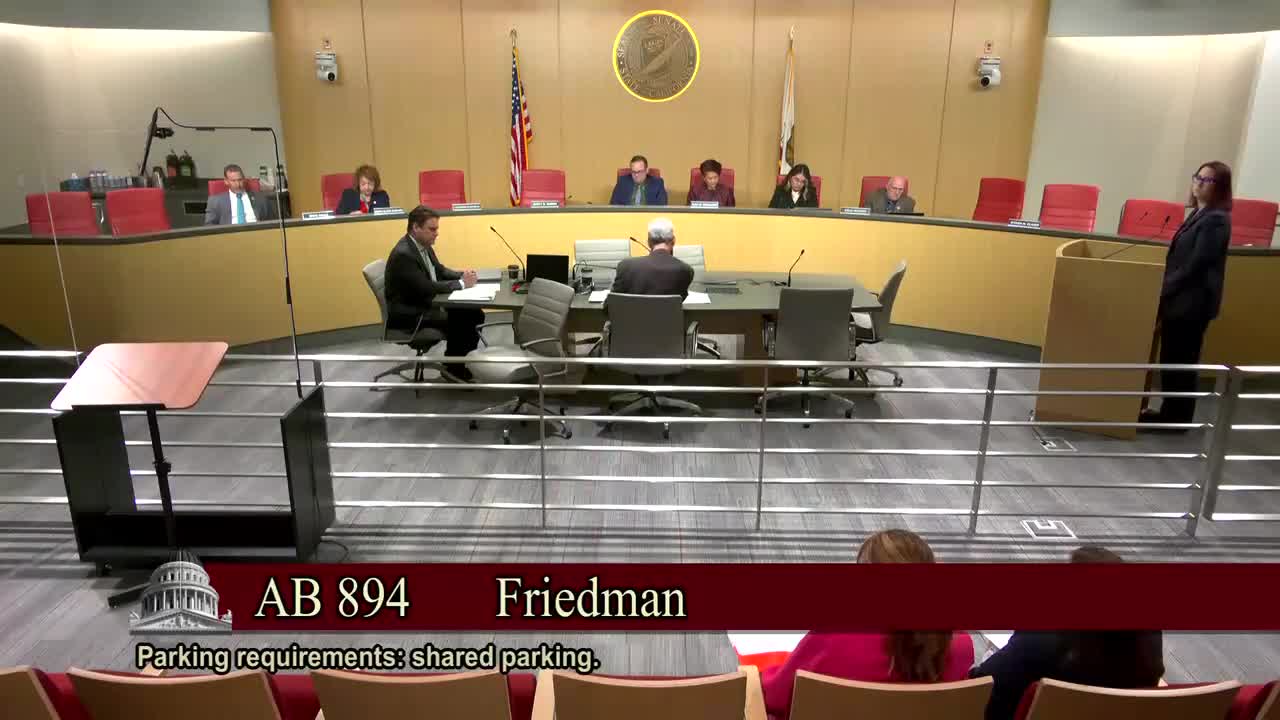 8MIN
Senate Standing Committee on Governance and Finance
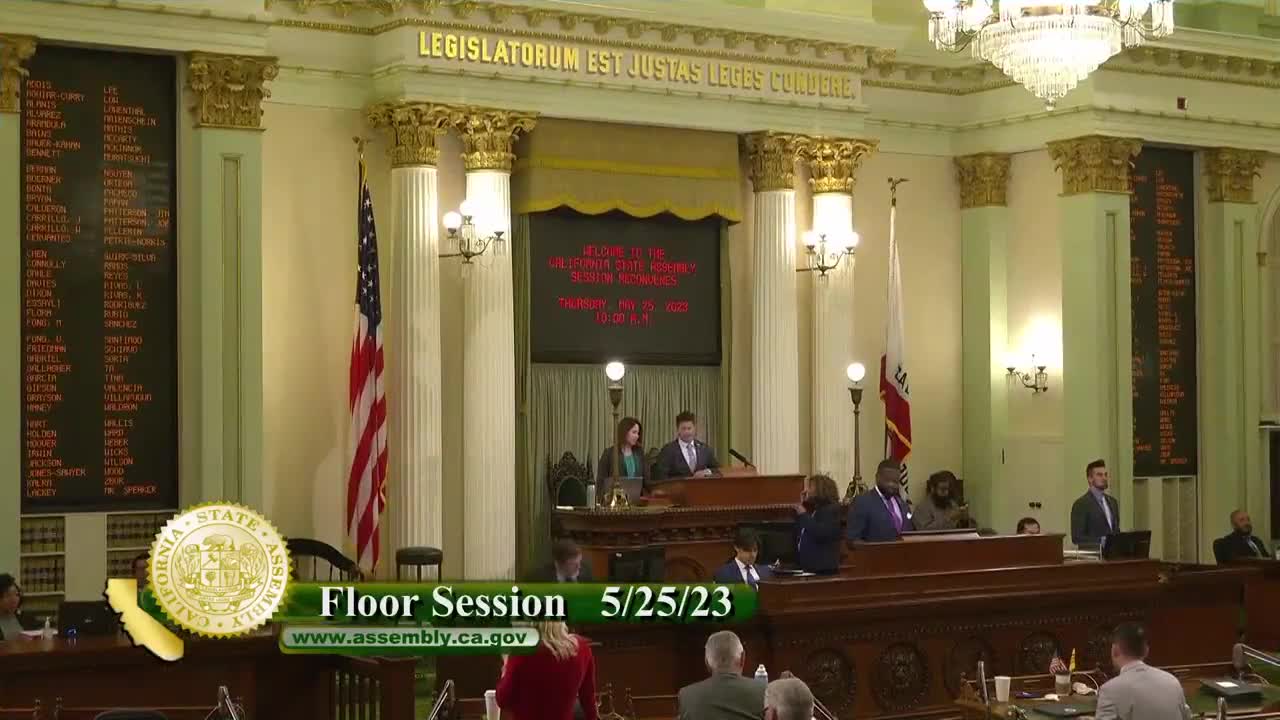 4MIN
Assembly Floor
 6MIN
Assembly Standing Committee on Housing and Community Development
 6MIN
Assembly Standing Committee on Local Government


Bill Co-Author(s):