AB 1319: Bay Area Housing Finance Authority: housing revenue.
- Session Year: 2023-2024
- House: Assembly
- Latest Version Date: 2023-10-11
Current Status:
Passed
(2023-10-11: Chaptered by Secretary of State - Chapter 758, Statutes of 2023.)
Introduced
In Committee
First Chamber
In Committee
Second Chamber
Enacted
(1)Existing law, the San Francisco Bay Area Regional Housing Finance Act, establishes the Bay Area Housing Finance Agency to raise, administer, and allocate funding for affordable housing in the San Francisco Bay area, as defined, and provide technical assistance at a regional level for tenant protection, affordable housing preservation, and new affordable housing production. Existing law requires the Bay Area Housing Finance Authority and executive board of the Association of Bay Area Governments to form an advisory committee composed of 9 representatives with knowledge and experience in the areas of affordable housing finance and development, tenant protection, and housing preservation.
This bill would require the authority and executive board to form an advisory committee composed of at least 9 and no more than 11 representatives with knowledge and expertise in the areas of affordable housing finance, construction workforce, and development, tenant protection, and housing preservation.
The act provides the authority with various powers, including the power to place a measure on the ballot to raise revenue and allocate funds throughout the San Francisco Bay area, apply for and receive grants or loans from public and private entities, incur and issue bonds and other indebtedness, and otherwise incur liabilities or obligations. The act authorizes the authority to allocate and deploy financing to cities, counties, other public agencies within the San Francisco Bay area and private affordable housing developers to finance affordable housing development, as specified.
This bill would specify that the authority is limited to placing only one measure on the ballot per election. The bill would also authorize the authority to deploy financing to nonprofit corporations to finance affordable housing development, as specified.
Existing law authorizes a city or county, or an agency created pursuant to a joint powers agreement, to issue revenue bonds to defray the costs of acquiring home mortgages or making loans to lending institutions in order to enable them to make home mortgages, and the costs of studies and surveys, insurance premiums, underwriting fees, legal, accounting and marketing services incurred in connection with the issuance and sale of bonds, as specified.
This bill would authorize the authority to issue mortgage revenue bonds, pursuant to provisions described above; acquire, hold, develop, operate, and dispose of real property; and create one or more California limited liability companies of which the authority is the sole member.
(2)The California Environmental Quality Act (CEQA) requires a lead agency, as defined, to prepare, or cause to be prepared, and certify the completion of an environmental impact report on a project that it proposes to carry out or approve that may have a significant effect on the environment or to adopt a negative declaration if it finds that the project will not have that effect. CEQA also requires a lead agency to prepare a mitigated negative declaration for a project that may have a significant effect on the environment if revisions in the project would avoid or mitigate that effect and there is no substantial evidence that the project, as revised, would have a significant effect on the environment.
This bill would exempt from CEQA any actions taken by the authority to raise, administer, or allocate funding for tenant protection, affordable housing preservation, or new affordable housing production or to provide technical assistance consistent with the authoritys purpose.
(3)Existing law authorizes the executive board of the authority to impose a commercial linkage fee, as defined, in an amount not to exceed ten dollars ($10) per square foot, within the San Francisco Bay area, as specified. Existing law requires the expenditures of proceeds from a commercial linkage fee be limited to affordable housing production, preservation, and tenant protection programs.
This bill would authorize the expenditures of proceeds from a commercial linkage fee to include the authoritys related administrative costs.
(4)The act defines authority revenues to include, without limitation, revenues generated by any special tax, fee, or charge imposed by the authority, other than ad valorem property taxes. Existing law, the Revenue Bond Law of 1941, requires a local agency to annually publish a summary statement showing, among other things, the amount of gross revenues from revenue bonds.
This bill would revise and recast the definition of authority revenue to also include loan repayments, investment income, or income derived from the ownership or operation of real property. The bill would provide for prioritization of spending of authority revenues. The bill would require the authority to publish the above-described summary statement not more than 9 months after the close of each fiscal year.
(5)Existing law requires the authority to distribute regional housing revenue, as defined, in the form of a grant, loan, or other financing tool in a manner that achieves certain minimum shares over 5-year periods. In this regard, existing law requires 5% of those regional housing revenues for tenant protection programs for low- and moderate-income households, which includes, among other things, preeviction and eviction legal services and providing emergency rental assistance for lower income households.
This bill would include homelessness prevention services, as specified, as an eligible expense under tenant protection programs for low- and moderate-income households.
(6)Existing law requires the authority to distribute funds received through the authorized funding measures according to specified provisions, which in part require each county to adopt a county expenditure plan applicable to county housing revenue. Existing law requires, in order for the expenditure plan to be deemed complete, the expenditure plan to specify, among other things, a description of any specific project or program proposed to receive funding.
This bill would additionally require the plan to demonstrate that the county has consulted with each city in the county, excluding cities that receive a direct allocation.
(7)Existing law requires, if the authority proposes a measure that will generate revenues and that requires voter approval, the board of supervisors of the relevant county or counties to call a special election on the measure. Existing law requires each county included in the measure to use the exact ballot question, impartial analysis, and summary of the expenditure plan provided by the authority. Existing law requires these materials to include, among other things, an estimate of the number of affordable housing units to be built or preserved by household income category served, and a description of any specific projects planned to be funded.
This bill would instead require each county included in the measure to use the election materials provided by the authority, including the exact ballot question, impartial analysis, and full text of the ballot measure for inclusion in the voter information pamphlet. The bill would make conforming changes.
By changing the duties of local officials with respect to elections procedures for revenue measures on behalf of the authority, this bill would impose a state-mandated local program.
(8)The California Constitution requires the state to reimburse local agencies and school districts for certain costs mandated by the state. Statutory provisions establish procedures for making that reimbursement.
This bill would provide that, if the Commission on State Mandates determines that the bill contains costs mandated by the state, reimbursement for those costs shall be made pursuant to the statutory provisions noted above.
(1)Existing law, the San Francisco Bay Area Regional Housing Finance Act, establishes the Bay Area Housing Finance Agency to raise, administer, and allocate funding for affordable housing in the San Francisco Bay area, as defined, and provide technical assistance at a regional level for tenant protection, affordable housing preservation, and new affordable housing production. Existing law requires the Bay Area Housing Finance Authority and executive board of the Association of Bay Area Governments to form an advisory committee composed of 9 representatives with knowledge and experience in the areas of affordable housing finance and development, tenant protection, and housing preservation.
This bill would require the authority and executive board to form an advisory committee composed of at least 9 and no more than 11 representatives with knowledge and expertise in the areas of affordable housing finance, construction workforce, and development, tenant protection, and housing preservation.
The act provides the authority with various powers, including the power to place a measure on the ballot to raise revenue and allocate funds throughout the San Francisco Bay area, apply for and receive grants or loans from public and private entities, incur and issue bonds and other indebtedness, and otherwise incur liabilities or obligations. The act authorizes the authority to allocate and deploy financing to cities, counties, other public agencies within the San Francisco Bay area and private affordable housing developers to finance affordable housing development, as specified.
This bill would specify that the authority is limited to placing only one measure on the ballot per election. The bill would also authorize the authority to deploy financing to nonprofit corporations to finance affordable housing development, as specified.
Existing law authorizes a city or county, or an agency created pursuant to a joint powers agreement, to issue revenue bonds to defray the costs of acquiring home mortgages or making loans to lending institutions in order to enable them to make home mortgages, and the costs of studies and surveys, insurance premiums, underwriting fees, legal, accounting and marketing services incurred in connection with the issuance and sale of bonds, as specified.
This bill would authorize the authority to issue mortgage revenue bonds, pursuant to provisions described above; acquire, hold, develop, operate, and dispose of real property; and create one or more California limited liability companies of which the authority is the sole member.
(2)The California Environmental Quality Act (CEQA) requires a lead agency, as defined, to prepare, or cause to be prepared, and certify the completion of an environmental impact report on a project that it proposes to carry out or approve that may have a significant effect on the environment or to adopt a negative declaration if it finds that the project will not have that effect. CEQA also requires a lead agency to prepare a mitigated negative declaration for a project that may have a significant effect on the environment if revisions in the project would avoid or mitigate that effect and there is no substantial evidence that the project, as revised, would have a significant effect on the environment.
This bill would exempt from CEQA any actions taken by the authority to raise, administer, or allocate funding for tenant protection, affordable housing preservation, or new affordable housing production or to provide technical assistance consistent with the authoritys purpose.
(3)Existing law authorizes the executive board of the authority to impose a commercial linkage fee, as defined, in an amount not to exceed ten dollars ($10) per square foot, within the San Francisco Bay area, as specified. Existing law requires the expenditures of proceeds from a commercial linkage fee be limited to affordable housing production, preservation, and tenant protection programs.
This bill would authorize the expenditures of proceeds from a commercial linkage fee to include the authoritys related administrative costs.
(4)The act defines authority revenues to include, without limitation, revenues generated by any special tax, fee, or charge imposed by the authority, other than ad valorem property taxes. Existing law, the Revenue Bond Law of 1941, requires a local agency to annually publish a summary statement showing, among other things, the amount of gross revenues from revenue bonds.
This bill would revise and recast the definition of authority revenue to also include loan repayments, investment income, or income derived from the ownership or operation of real property. The bill would provide for prioritization of spending of authority revenues. The bill would require the authority to publish the above-described summary statement be published not more than 9 months after the close of each fiscal year.
(5)Existing law requires the authority to distribute regional housing revenue, as defined, in the form of a grant, loan, or other financing tool in a manner that achieves certain minimum shares over 5-year periods. In this regard, existing law requires 5% of those regional housing revenues for tenant protection programs for low- and moderate-income households, which includes, among other things, preeviction and eviction legal services and providing emergency rental assistance for lower income households.
This bill would include homelessness prevention services, as specified, as an eligible expense under tenant protection programs for low- and moderate-income households.
(6)Existing law requires the authority to distribute funds received through the authorized funding measures according to specified provisions, which in part require each county to adopt a county expenditure plan applicable to county housing revenue. Existing law requires, in order for the expenditure plan to be deemed complete, the expenditure plan to specify, among other things, a description of any specific project or program proposed to receive funding.
This bill would additionally require the plan to demonstrate that the county has consulted with each city in the county, excluding cities that receive a direct allocation.
(6)(7)Existing law requires, if the authority proposes a measure that will generate revenues and that requires voter approval, the board of supervisors of the relevant county or counties to call a special election on the measure. Existing law requires each county included in the measure to use the exact ballot question, impartial analysis, and summary of the expenditure plan provided by the authority. Existing law requires these materials to include, among other things, an estimate of the number of affordable housing units to be built or preserved by household income category served, and a description of any specific projects planned to be funded.
This bill would instead require each county included in the measure to use the election materials provided by the authority, including the exact ballot question, impartial analysis, and full text of the ballot measure for inclusion in the voter information pamphlet. The bill would make conforming changes.
By changing the duties of local officials with respect to elections procedures for revenue measures on behalf of the authority, this bill would impose a state-mandated local program.
(7)(8)The California Constitution requires the state to reimburse local agencies and school districts for certain costs mandated by the state. Statutory provisions establish procedures for making that reimbursement.
This bill would provide that, if the Commission on State Mandates determines that the bill contains costs mandated by the state, reimbursement for those costs shall be made pursuant to the statutory provisions noted above.
(1)Existing law, the San Francisco Bay Area Regional Housing Finance Act, establishes the Bay Area Housing Finance Agency to raise, administer, and allocate funding for affordable housing in the San Francisco Bay area, as defined, and provide technical assistance at a regional level for tenant protection, affordable housing preservation, and new affordable housing production.
The act provides the authority with various powers, including the power to place a measure on the ballot to raise revenue and allocate funds throughout the San Francisco Bay area, apply for and receive grants or loans from public and private entities, incur and issue bonds and other indebtedness, and otherwise incur liabilities or obligations. The act authorizes the authority to allocate and deploy financing to cities, counties, other public agencies within the San Francisco Bay area and private affordable housing developers to finance affordable housing development, as specified.
This bill would specify that the authority is limited to placing only one measure on the ballot per election. The bill would also authorize the authority to deploy financing to nonprofit corporations to finance affordable housing development, as specified.
Existing law authorizes a city or county, or an agency created pursuant to a joint powers agreement, to issue revenue bonds to defray the costs of acquiring home mortgages or making loans to lending institutions in order to enable them to make home mortgages, and the costs of studies and surveys, insurance premiums, underwriting fees, legal, accounting and marketing services incurred in connection with the issuance and sale of bonds, as specified.
This bill would authorize the authority to issue mortgage revenue bonds, pursuant to provisions described above; acquire, hold, develop, operate, and dispose of real property; and create one or more California limited liability companies of which the authority is the sole member.
(2)The California Environmental Quality Act (CEQA) requires a lead agency, as defined, to prepare, or cause to be prepared, and certify the completion of an environmental impact report on a project that it proposes to carry out or approve that may have a significant effect on the environment or to adopt a negative declaration if it finds that the project will not have that effect. CEQA also requires a lead agency to prepare a mitigated negative declaration for a project that may have a significant effect on the environment if revisions in the project would avoid or mitigate that effect and there is no substantial evidence that the project, as revised, would have a significant effect on the environment.
This bill would exempt from CEQA any actions taken by the authority to raise, administer, or allocate funding for tenant protection, affordable housing preservation, or new affordable housing production or to provide technical assistance consistent with the authoritys purpose.
(3)Existing law authorizes the executive board of the authority to impose a commercial linkage fee, as defined, in an amount not to exceed ten dollars ($10) per square foot, within the San Francisco Bay area, as specified. Existing law requires the expenditures of proceeds from a commercial linkage fee be limited to affordable housing production, preservation, and tenant protection programs.
This bill would authorize the expenditures of proceeds from a commercial linkage fee to include the authoritys related administrative costs.
(4)The act defines authority revenues to include, without limitation, revenues generated by any special tax, fee, or charge imposed by the authority, other than ad valorem property taxes. Existing law, the Revenue Bond Law of 1941, requires a local agency to annually publish a summary statement showing, among other things, the amount of gross revenues from revenue bonds.
This bill would revise and recast the definition of authority revenue to also include loan repayments, investment income, or income derived from the ownership or operation of real property. The bill would provide for prioritization of spending of authority revenues. The bill would require the authority to publish the above-described summary statement be published not more than 9 months after the close of each fiscal year.
(5)Existing law requires the authority to distribute regional housing revenue, as defined, in the form of a grant, loan, or other financing tool in a manner that achieves certain minimum shares over 5-year periods. In this regard, existing law requires 5% of those regional housing revenues for tenant protection programs for low- and moderate-income households, which includes, among other things, preeviction and eviction legal services and providing emergency rental assistance for lower income households.
This bill would include homelessness prevention services, as specified, as an eligible expense under tenant protection programs for low- and moderate-income households.
(6)Existing law requires, if the authority proposes a measure that will generate revenues and that requires voter approval, the board of supervisors of the relevant county or counties to call a special election on the measure. Existing law requires each county included in the measure to use the exact ballot question, impartial analysis, and summary of the expenditure plan provided by the authority. Existing law requires these materials to include, among other things, an estimate of the number of affordable housing units to be built or preserved by household income category served, and a description of any specific projects planned to be funded.
This bill would instead require each county included in the measure to use the election materials provided by the authority, including the exact ballot question, impartial analysis, and full text of the ballot measure for inclusion in the voter information pamphlet. The bill would remove the requirement that these materials include a description of any specific projects planned to be funded by the measure. The bill would make conforming changes.
By changing the duties of local officials with respect to elections procedures for revenue measures on behalf of the authority, this bill would impose a state-mandated local program.
(7)The California Constitution requires the state to reimburse local agencies and school districts for certain costs mandated by the state. Statutory provisions establish procedures for making that reimbursement.
This bill would provide that, if the Commission on State Mandates determines that the bill contains costs mandated by the state, reimbursement for those costs shall be made pursuant to the statutory provisions noted above.
(1)Existing law, the San Francisco Bay Area Regional Housing Finance Act, establishes the Bay Area Housing Finance Agency to raise, administer, and allocate funding for affordable housing in the San Francisco Bay area, as defined, and provide technical assistance at a regional level for tenant protection, affordable housing preservation, and new affordable housing production.
The act provides the authority with various powers, including the power to place a measure on the ballot to raise revenue and allocate funds throughout the San Francisco Bay area, apply for and receive grants or loans from public and private entities, incur and issue bonds and other indebtedness, and otherwise incur liabilities or obligations. The act authorizes the authority to allocate and deploy financing to cities, counties, other public agencies within the San Francisco Bay area and private affordable housing developers to finance affordable housing development, as specified.
This bill would specify that the authority is limited to placing only one measure on the ballot per election. The bill would also authorize the authority to deploy financing to nonprofit corporations to finance affordable housing development, as specified.
Existing law authorizes a city or county, or an agency created pursuant to a joint powers agreement, to issue revenue bonds to defray the costs of acquiring home mortgages or making loans to lending institutions in order to enable them to make home mortgages, and the costs of studies and surveys, insurance premiums, underwriting fees, legal, accounting and marketing services incurred in connection with the issuance and sale of bonds, as specified.
This bill would authorize the authority to issue mortgage revenue bonds, pursuant to provisions described above; acquire, hold, develop, operate, and dispose of real property; and create one or more California limited liability companies of which the authority is the sole member.
(2)The California Environmental Quality Act (CEQA) requires a lead agency, as defined, to prepare, or cause to be prepared, and certify the completion of an environmental impact report on a project that it proposes to carry out or approve that may have a significant effect on the environment or to adopt a negative declaration if it finds that the project will not have that effect. CEQA also requires a lead agency to prepare a mitigated negative declaration for a project that may have a significant effect on the environment if revisions in the project would avoid or mitigate that effect and there is no substantial evidence that the project, as revised, would have a significant effect on the environment.
This bill would exempt from CEQA any actions taken by the authority to raise, administer, or allocate funding for tenant protection, affordable housing preservation, or new affordable housing production or to provide technical assistance consistent with the authoritys purpose.
(3)Existing law authorizes the executive board of the authority to impose a commercial linkage fee, as defined, in an amount not to exceed ten dollars ($10) per square foot, within the San Francisco Bay area, as specified. Existing law requires the expenditures of proceeds from a commercial linkage fee be limited to affordable housing production, preservation, and tenant protection programs.
This bill would authorize the expenditures of proceeds from a commercial linkage fee to include the authoritys related administrative costs.
(4)The act defines authority revenues to include, without limitation, revenues generated by any special tax, fee, or charge imposed by the authority, other than ad valorem property taxes. Existing law, the Revenue Bond Law of 1941, requires a local agency to annually publish a summary statement showing, among other things, the amount of gross revenues from revenue bonds.
This bill would revise and recast the definition of authority revenue to also include loan repayments, investment income, or income derived from the ownership or operation of real property. The bill would provide for prioritization of spending of authority revenues. The bill would require the authority to publish the above-described summary statement be published not more than 9 months after the close of each fiscal year.
(4)(5)Existing law requires the authority to distribute regional housing revenue, as defined, in the form of a grant, loan, or other financing tool in a manner that achieves certain minimum shares over 5-year periods. In this regard, existing law requires 5% of those regional housing revenues for tenant protection programs for low- and moderate-income households, which includes, among other things, preeviction and eviction legal services and providing emergency rental assistance for lower income households.
This bill would include homelessness prevention services, as specified, as an eligible expense under tenant protection programs for low- and moderate-income households.
(5)(6)Existing law requires, if the authority proposes a measure that will generate revenues and that requires voter approval, the board of supervisors of the relevant county or counties to call a special election on the measure. Existing law requires each county included in the measure to use the exact ballot question, impartial analysis, and summary of the expenditure plan provided by the authority. Existing law requires these materials to include, among other things, an estimate of the number of affordable housing units to be built or preserved by household income category served, and a description of any specific projects planned to be funded.
This bill would instead require each county included in the measure to use the election materials provided by the authority, including the exact ballot title and summary, question, impartial analysis, and summary full text of the ballot measure for inclusion in the voter information pamphlet. The bill would remove the requirement that these materials include a description of any specific projects planned to be funded by the measure. The bill would make conforming changes.
By changing the duties of local officials with respect to elections procedures for revenue measures on behalf of the authority, this bill would impose a state-mandated local program.
(6)(7)The California Constitution requires the state to reimburse local agencies and school districts for certain costs mandated by the state. Statutory provisions establish procedures for making that reimbursement.
This bill would provide that, if the Commission on State Mandates determines that the bill contains costs mandated by the state, reimbursement for those costs shall be made pursuant to the statutory provisions noted above.
(1)Existing law, the San Francisco Bay Area Regional Housing Finance Act, establishes the Bay Area Housing Finance Agency to raise, administer, and allocate funding for affordable housing in the San Francisco Bay area, as defined, and provide technical assistance at a regional level for tenant protection, affordable housing preservation, and new affordable housing production.
The act provides the authority with various powers, including the power to place a measure on the ballot to raise revenue and allocate funds throughout the San Francisco Bay area, apply for and receive grants or loans from public and private entities, incur and issue bonds and other indebtedness, and otherwise incur liabilities or obligations.
Existing law authorizes a city or county, or an agency created pursuant to a joint powers agreement, to issue revenue bonds to defray the costs of acquiring home mortgages or making loans to lending institutions in order to enable them to make home mortgages, and the costs of studies and surveys, insurance premiums, underwriting fees, legal, accounting and marketing services incurred in connection with the issuance and sale of bonds, as specified.
This bill would authorize the authority to issue mortgage revenue bonds, pursuant to provisions described above; acquire, hold, develop, operate, and dispose of real property; and create one or more California limited liability companies of which the authority is the sole member.
(2)The California Environmental Quality Act (CEQA) requires a lead agency, as defined, to prepare, or cause to be prepared, and certify the completion of an environmental impact report on a project that it proposes to carry out or approve that may have a significant effect on the environment or to adopt a negative declaration if it finds that the project will not have that effect. CEQA also requires a lead agency to prepare a mitigated negative declaration for a project that may have a significant effect on the environment if revisions in the project would avoid or mitigate that effect and there is no substantial evidence that the project, as revised, would have a significant effect on the environment.
This bill would exempt from CEQA any actions taken by the authority to raise, administer, or allocate funding for tenant protection, affordable housing preservation, or new affordable housing production or to provide technical assistance consistent with the authoritys purpose.
(3)Existing law authorizes the executive board of the authority to impose a commercial linkage fee, as defined, in an amount not to exceed ten dollars ($10) per square foot, within the San Francisco Bay area, as specified. Existing law requires the expenditures of proceeds from a commercial linkage fee be limited to affordable housing production, preservation, and tenant protection programs.
This bill would authorize the expenditures of proceeds from a commercial linkage fee to include the authoritys related administrative costs.
(4)Existing law requires the authority to distribute regional housing revenue, as defined, in the form of a grant, loan, or other financing tool in a manner that achieves the certain minimum shares over 5-year periods. In this regard, existing law requires 5% of those regional housing revenues for tenant protection programs for low- and moderate-income households, which includes, among other things, preeviction and eviction legal services and providing emergency rental assistance for lower income households.
This bill would include homelessness prevention services, as specified, as an eligible expense under tenant protection programs for low- and moderate-income households.
(5)Existing law requires, if the authority proposes a measure that will generate revenues and that requires voter approval, the board of supervisors of the relevant county or counties to call a special election on the measure. Existing law requires each county included in the measure to use the exact ballot question, impartial analysis, and summary of the expenditure plan provided by the authority. Existing law requires these materials to include, among other things, an estimate of the number of affordable housing units to be built or preserved by household income category served, and a description of any specific projects planned to be funded.
This bill would instead require each county included in the measure to use the election materials provided by the authority, including the ballot title and summary, impartial analysis, and summary of the ballot measure for inclusion in the voter information pamphlet. The bill would remove the requirement that these materials include a description of any specific projects planned to be funded by the measure.
By changing the duties of local officials with respect to elections procedures for revenue measures on behalf of the authority, this bill would impose a state-mandated local program.
(6)The California Constitution requires the state to reimburse local agencies and school districts for certain costs mandated by the state. Statutory provisions establish procedures for making that reimbursement.
This bill would provide that, if the Commission on State Mandates determines that the bill contains costs mandated by the state, reimbursement for those costs shall be made pursuant to the statutory provisions noted above.
For purposes of this title:
(a)Affordable housing is defined as housing that is restricted by recorded document to provide the housing at an affordable housing cost, as defined in Section 50052.5 of the Health and Safety Code, or an affordable rent, as defined in Section 50053 of the Health and Safety Code, as applicable.
(b)Authority means the Bay Area Housing Finance Authority established pursuant to Section 64510.
(c)Board means the governing board of the Bay Area Housing Finance Authority.
(d)Executive board means the executive board of the Association of Bay Area Governments.
(e)Extremely low income households has the same meaning as the term is defined in Section 50106 of the Health and Safety Code.
(f)Lower income households has the same meaning as that term is defined in Section 50079.5 of the Health and Safety Code.
(g)Low- or moderate-income households has the same meaning as persons and families of low or moderate income, as defined in Section 50093 of the Health and Safety Code.
(h)San Francisco Bay area means the entire area within the territorial boundaries of the Counties of Alameda, Contra Costa, Marin, Napa, San Mateo, Santa Clara, Solano, and Sonoma, and the City and County of San Francisco.
(i)Very low income households has the same meaning as the term is defined in Section 50105 of the Health and Safety Code.
SEC. 2.Section 64511 of the Government Code is amended to read:64511.(a)(1)The executive board shall review and approve the regional expenditure plan required pursuant to paragraph (5) of subdivision (d) of Section 64650 and projects authorized by this chapter before review, approval, and allocation by the authority.
(2)(A)The executive board and the authority board shall form an advisory committee composed of at least nine and no more than 11 representatives with knowledge and experience in the areas of affordable housing finance, construction workforce, and development, tenant protection, and housing preservation. The advisory committee shall assist in the development of funding guidelines and the overall implementation of the program.
(B)Consistent with the provisions of this chapter, the advisory committee shall provide consultation and make recommendations to the executive board and the authority board. The advisory committee will meet as necessary to fulfill their roles and responsibilities.
(b)(1)A member of the authority board may receive a per diem for each board meeting that the member attends. The authority board shall set the amount of that per diem for a members attendance, but that amount shall not exceed one hundred dollars ($100) per meeting. A member shall not receive a payment for more than two meetings in a calendar month.
(2)A member may waive a payment of per diem authorized by this subdivision.
(c)(1)Five years after the voters approve an initial ballot measure pursuant to Section 64521, the authority and the executive board shall review the implementation of the measure. The review shall include the following:
(A)An analysis of the expenditures to date.
(B)The number of affordable housing units produced and preserved at different household income levels.
(C)The tenant protection services provided, and the roles of the executive board and the authority.
(2)The executive board and the authority board may, upon mutual concurrence, as a part of the review described in this subdivision elect to transfer or delegate a responsibility authorized in this title to the executive board or the authority, as applicable, except for the provisions of Article 3 (commencing with Section 64630) of Chapter 2 of Part 2.
(d)(1)Members of the authority board are subject to Article 2.4 (commencing with Section 53234) of Chapter 2 of Part 1 of Division 2 of Title 5.
(2)The authority shall be subject to the Ralph M. Brown Act (Chapter 9 (commencing with Section 54950) of Part 1 of Division 2 of Title 5), the California Public Records Act (Division 10 (commencing with Section 7920.000) of Title 1), and the Political Reform Act of 1974 (Title 9 (commencing with Section 81000)).
(e)In addition to the requirements under subdivision (d), the authority shall engage in public participation processes, which shall include the following:
(1)Outreach efforts to encourage the active participation of a broad range of stakeholder groups in the planning process, including, but not limited to, affordable housing and homelessness advocates, nonprofit developers, neighborhood and community groups, environmental advocates, equity organizations, home builder representatives, and business organizations.
(2)Holding at least one public meeting regarding any relevant plan or proposals being considered by the authority. The authority shall hold any such meeting at a time and a location convenient for members of the public. The authority shall place each plan or proposal under consideration on a meeting agenda of the authority board for discussion at least 30 days before the authority board takes action.
(3)A process for enabling members of the public to provide a single request to receive authority notices, information, and updates.
SEC. 3.Section 64520 of the Government Code is amended to read:64520.In implementing this title, the authority may do all of the following:
(a)Subject to the approval of the executive board, place one measure per election on the ballot to raise revenue and allocate funds throughout the San Francisco Bay area, as provided in Part 2 (commencing with Section 64600).
(b)Apply for and receive grants or loans from public and private entities.
(c)Solicit and accept gifts, fees, grants, loans, and other allocations from public and private entities.
(d)Deposit or invest moneys of the authority in banks or financial institutions, as provided in Chapter 4 (commencing with Section 53600) of Part 1 of Division 2 of Title 5, including the investment of any money that is not required for the immediate necessities of the authority, as determined by the authority.
(e)Sue and be sued, except as otherwise provided by law, in all actions and proceedings, in all courts and tribunals of competent jurisdiction.
(f)Engage counsel and other professional services.
(g)Enter into and perform all necessary contracts.
(h)Enter into joint powers agreements pursuant to the Joint Exercise of Powers Act (Chapter 5 (commencing with Section 6500) of Division 7 of Title 1).
(i)Hire staff, define their qualifications and duties, and provide a schedule of compensation for the performance of their duties.
(j)Utilize staff employed by the Metropolitan Transportation Commission.
(k)Allocate and deploy capital and generated fees or income in the form of grants, loans, equity, interest rate subsidies, and other financing tools to the cities, counties, other public agencies within the San Francisco Bay area, private affordable housing developers, and nonprofit corporations organized pursuant to Section 501(c)(3) of the Internal Revenue Code to finance affordable housing development, preserve and enhance existing affordable housing, and fund tenant protection programs, pursuant to this title, in accordance with applicable constitutional requirements.
(l)Establish and modify the terms of potential capital investments deployed by the authority, including waiving or forgiving interest or principal payments.
(m)Collect data on housing production and monitor progress on meeting regional and state housing goals.
(n)Provide support and technical assistance to local governments in relation to producing and preserving affordable housing and providing tenant protections.
(o)Provide public information about the authoritys housing programs and policies.
(p)Incur and issue bonds and other indebtedness, and otherwise incur liabilities or obligations in accordance with Article 3 (commencing with Section 64630) of Chapter 2 of Part 2, and issue mortgage revenue bonds pursuant to Part 5 (commencing with Section 52000) of Division 31 of the Health and Safety Code.
(q)Acquire, hold, develop, operate, and dispose of real property, including residential real property.
(r)(1)Create one or more California limited liability companies of which the authority is the sole member and exercise any of the powers granted to the authority by this title through those limited liability companies.
(2)Any limited liability company created pursuant to paragraph (1) shall be subject to the to the Ralph M. Brown Act (Chapter 9 (commencing with Section 54950) of Part 1 of Division 2 of Title 5), the California Public Records Act (Division 10 (commencing with Section 7920.000) of Title 1), and the Political Reform Act of 1974 (Title 9 (commencing with Section 81000)).
(s)Any other implied powers necessary or incidental to carry out the intent and purposes of this title.
SEC. 4.Section 64521 of the Government Code is amended to read:64521.(a)Subject to the initial approval of the executive board, if the authority proposes a measure pursuant to Part 2 (commencing with Section 64600) that will generate revenues and that requires voter approval pursuant to the California Constitution, the board of supervisors of the county or counties in which the authority has determined to place the measure on the ballot shall call a special election on the measure. The special election shall be consolidated with the next regularly scheduled statewide election and the measure shall be submitted to the voters in the appropriate counties, consistent with the requirements of Articles XIIIA, XIIIC, and XIII, or Article XVI of the California Constitution, as applicable.
(b)(1)For the purpose of placement of a measure on the ballot, the authority is a district, as defined in Section 317 of the Elections Code. Except as otherwise provided in this section, a measure proposed by the authority that requires voter approval shall be submitted to the voters of the counties, as determined by the authority, in accordance with the provisions of the Elections Code applicable to districts, including the provisions of Chapter 4 (commencing with Section 9300) of Division 9 of the Elections Code.
(2)Because the authority has no revenues as of the operative date of this section, the appropriations limit for the authority shall be originally established based on receipts from the initial measure that would generate revenues for the authority pursuant to subdivision (a), and that establishment of an appropriations limit shall not be deemed a change in an appropriations limit for purposes of Section 4 of Article XIIIB of the California Constitution.
(c)The authority shall file with the board of supervisors of each county in which the measure shall appear on the ballot a resolution of the authority board requesting consolidation and setting forth the exact form of the ballot question, in accordance with Section 10403 of the Elections Code.
(d)Notwithstanding Section 9313 of the Elections Code, the legal counsel for the authority shall prepare an impartial analysis of the measure. The impartial analysis prepared by the legal counsel for the authority shall be subject to review and revision by the county counsel of the county that contains the largest population, as determined by the most recent federal decennial census, among those counties in which the measure will be submitted to the voters.
(e)(1)Each county included in the measure shall use the election materials provided by the authority, including the exact ballot question, impartial analysis, and full text of the ballot measure for inclusion in the voter information pamphlet. The text of the ballot measure shall include, but is not limited to, all of the following:
(A)A description of the purpose and goals of the measure.
(B)A description of the categories of eligible expenditures to be funded.
(C)An estimate of the number of affordable housing units to be built or preserved by household income category served, and a description of any specific projects planned to be funded.
(D)An estimate of minimum funding levels to be provided to different expenditure categories by county.
(E)An overview of decisionmaking and oversight provisions applicable to the funds.
(2)If two or more counties included in the measure are required to prepare a translation of ballot materials into the same language other than English, the county that contains the largest population, as determined by the most recent federal decennial census, among those counties that are required to prepare a translation of ballot materials into the same language other than English shall prepare the translation, or authorize the authority to prepare the translation, and that translation shall be used by the other county or counties, as applicable.
(f)Notwithstanding Section 13116 of the Elections Code, the elections officials of the counties where the measure proposed by the authority is placed on the ballot shall mutually agree to use the same letter designation for the measure.
(g)The county clerk of each county shall report the results of the special election to the authority. If two-thirds of all voters voting on the question at the special election vote affirmatively, or a different approval threshold required by the California Constitution at the time the election is achieved, the measure shall take effect in the counties in which the measure appeared on the ballot within the timeframe specified in the measure.
(h)(1)Notwithstanding Section 10520 of the Elections Code, for any election at which the authority proposes a measure pursuant to subdivision (a) of Section 64520 that would generate revenues, the authority shall reimburse each county in which that measure appears on the ballot only for the incremental costs incurred by the county elections official related to submitting the measure to the voters with proceeds from the measure, or if the measure fails, with any eligible funds transferred to the authority from the Association of Bay Area Governments or the Metropolitan Transportation Commission or other public or private entity.
(2)For purposes of this subdivision, incremental costs include all of the following:
(A)The cost to prepare, review, and revise the impartial analysis of the measure that is required by subdivision (d).
(B)The cost to prepare a translation of ballot materials into a language other than English by any county, as described in subdivision (e).
(C)The additional costs that exceed the costs incurred for other election races or ballot measures, if any, appearing on the same ballot in each county in which the measure appears on the ballot, including both of the following:
(i)The printing and mailing of ballot materials.
(ii)The canvass of the vote regarding the measure pursuant to Division 15 (commencing with Section 15000) of the Elections Code.
SEC. 5.Section 64523 is added to the Government Code, to read:64523.Actions taken by the authority to raise, administer, or allocate funding for tenant protection, affordable housing preservation, or new affordable housing production, or to provide technical assistance consistent with the authoritys purpose shall be exempt from the California Environmental Quality Act (Division 13 (commencing with Section 21000) of the Public Resources Code).
SEC. 6.Section 64621 of the Government Code is amended to read:64621.(a)(1)Subject to paragraph (4), the executive board may establish, increase, or impose a commercial linkage fee, in an amount not to exceed ten dollars ($10) per square foot, within the San Francisco Bay area by enactment of a resolution, in accordance with the requirements of this article, that is in addition to any fee, as defined in Section 66000, that is levied by an underlying land use jurisdiction.
(2)The fee shall be adjusted on July 1 of each year, in accordance with the California Construction Cost Index. The annual adjustment may increase the fee to be greater than the ten-dollar ($10) maximum imposed by paragraph (1).
(3)The authority board shall ratify, by resolution, any commercial linkage fee or modification to a commercial linkage fee adopted by the executive board.
(4)The executive board shall not establish a commercial linkage fee pursuant to paragraph (1) until after the voters approve a parcel tax pursuant to Section 64610 or a general obligation bond pursuant to Section 64631.
(5)(A)The executive board may establish, increase, or impose a commercial linkage fee pursuant to this article by a resolution that provides for a fee assessed on commercial development projects within the San Francisco Bay area.
(B)A resolution establishing or revising the fee shall provide that the amount of the fee required to be paid shall be reduced by the amount that the applicant is required to pay, if any, for a commercial linkage fee for affordable housing imposed by the relevant underlying land use jurisdiction.
(b)Before establishing, increasing, or imposing a commercial linkage fee, the executive board shall prepare a regional jobs and housing nexus study in order to support the necessity and amount of the fee. The study, or separate study conducted before the establishment of a commercial linkage fee, shall examine the factors listed in paragraph (5) of subdivision (d), may consider other potential consequences, and shall take into consideration the potential impact of the fee on the creation of high-paying jobs for people without four-year degrees.
(c)Expenditures of proceeds from a commercial linkage fee shall be limited to affordable housing production, preservation, tenant protection, as described in subparagraphs (A) and (B) of paragraph (2) of subdivision (b) of Section 64650, and the authoritys related administrative costs.
(d)In any action to establish, increase, or impose a commercial linkage fee, the executive board shall do all of the following:
(1)Identify the purpose of the commercial linkage fee.
(2)Determine how there is a reasonable relationship between the fees use and the type of commercial development project on which the fee is imposed, based on the regional nexus study prepared pursuant to subdivision (b).
(3)Determine how there is a reasonable relationship between the need for housing and the type of commercial development project on which the fee is imposed, based on the regional nexus study prepared pursuant to subdivision (b).
(4)Determine how there is a reasonable relationship between the amount of the fee and the cost of the housing necessitated by the commercial development project that is attributable to the development on which the fee is imposed, based on the regional nexus study prepared pursuant to subdivision (b).
(5)(A)Adopt findings that, based upon the executive boards analysis and the regional nexus study, the commercial linkage fee:
(i)Would concentrate jobs near transit.
(ii)Would not reduce commercial development and space for jobs, particularly in economically disadvantaged areas.
(iii)Would not exacerbate intraregional job-to-housing imbalances.
(iv)Would not disincentivize mixed-use development.
(6)Specify the estimated administrative costs of the authority in connection with the imposition of the fee to be included in the amount of the fee.
(B)The executive board shall provide analysis to support the findings and consider other potential consequences of the fee.
(e)The executive board and the authority shall suspend the imposition of a commercial linkage fee after two consecutive quarters of negative gross domestic product growth within the San Francisco Bay area. The fee may be reinstated after two consecutive quarters of positive gross domestic product growth within the San Francisco Bay area. The executive board and the authority board may reinstate the fee by resolution that states the condition in the previous sentence is met but shall not be subject to subdivisions (b), (c), or (d) of this section.
SEC. 7.Section 64622 of the Government Code is amended to read:64622.(a)A commercial linkage fee established, increased, or imposed pursuant to this article shall not exceed the reasonable cost of providing the housing necessitated by the commercial development project for which the commercial linkage fee is imposed, as determined in the regional nexus study pursuant to subdivision (b) of Section 64621, and the authoritys related administrative costs.
(b)It is the intent of the Legislature in adding this section to codify existing constitutional and decisional law with respect to the imposition of development fees and monetary exactions on developments by local agencies. This section is declaratory of existing law and shall not be construed or interpreted as creating new law or as modifying or changing existing law.
SEC. 8.Section 64627 of the Government Code is amended to read:64627.(a)Any person may request an audit in order to determine whether any fee or charge levied by the executive board and the authority board exceeds the amount necessary to cover the reasonable cost of providing the housing necessitated by the commercial development project for which the commercial linkage fee is imposed, as determined in the regional nexus study pursuant to subdivision (b) of Section 64621 and the authoritys related administrative costs. If a person makes that request, the executive board and the authority may retain an independent auditor to conduct an audit to determine whether the commercial linkage fee is reasonable, but is not required to conduct the audit if an audit has been performed for the same fee within the previous 12 months.
(b)If an audit pursuant to this section determines that the amount of any commercial linkage fee or charge does not meet the requirements of this article, the executive board and the authority board shall adjust the fee accordingly.
(c)The authority shall retain an independent auditor to conduct an audit only if the person who requests the audit deposits with the authority the amount of the executive boards and the authoritys reasonable estimate of the cost of the independent audit. At the conclusion of the audit, the authority shall reimburse unused sums, if any, or the requesting person shall pay the authority the excess of the actual cost of the audit over the sum which was deposited.
(d)Any audit conducted by an independent auditor pursuant to this section shall conform to generally accepted auditing standards.
(e)This section shall not be construed as granting any additional authority to any local agency to levy any fee or charge which is not otherwise authorized by another provision of law, nor shall its provisions be construed as granting authority to any local agency to levy a new fee or charge when other provisions of law specifically prohibit the levy of a fee or charge.
SEC. 9.Section 64631 of the Government Code is amended to read:64631.(a)The authority may incur or refund general obligation bonded indebtedness, secured by the levy of ad valorem property taxes, pursuant to Article XIIIA of the California Constitution, and any amendment thereto, for any purpose allowed by state law or the California Constitution.
(b)For purposes of incurring general obligation bonded indebtedness pursuant to this section, the authority shall comply with the requirements of Chapter 3 (commencing with Section 53400) of Part 1 of Division 2 of Title 5.
(c)The board of the authority shall annually at the time of making the levy of taxes for county purposes, levy a tax for that year upon property in the authoritys jurisdiction for the interest and redemption of all outstanding bonds of the authority, as provided by Section 1 of Article XIIIA of the California Constitution. The tax shall not be less than sufficient to pay the interest on the bonds as it becomes due and to provide a sinking fund for the payment of the principal payable or on before maturity and may include an allowance for an annual reserve, established for the purpose of avoiding fluctuating tax levies. The tax shall be sufficient to provide funds for the payment of the interest on the bonds as it becomes due and also any part of the principal and interest that is to become due before the proceeds of a tax levied at the time for making the next general tax levy may be made available for the payment of the principal and interest.
SEC. 10.Section 64632 of the Government Code is amended to read:64632.(a)(1)For purposes of this section, authority revenues includes, without limitation, revenues generated by either of the following:
(A)Any special tax, fee, or charge imposed by the authority, other than ad valorem property taxes.
(B)Any loan repayments, investment income, or income derived from the ownership or operation of real property.
(2)(A)The authority may issue revenue bonds, payable from authority revenues, in accordance with the Revenue Bond Law of 1941 (Chapter 6 (commencing with Section 54300) of Part 1 of Division 2 of Title 5), for the purposes set forth in this title and in any resolution adopted by the authority, or measure adopted by voters, in connection with the generation of authority revenues or imposition of those special taxes, fees, or other charges.
(B)For purposes of issuing revenue bonds pursuant to this section, all or any portion of the authority revenues designated by the authority, the special taxes, fees, or other charges described in subparagraph (A) shall constitute an enterprise within the meaning of Section 54309.
(C)Any authority revenues designated pursuant to subparagraph (B) shall constitute revenues within the meaning of Section 54315.
(3)To exercise the powers described in this section, the authority shall ensure that the text of the ballot measure prepared pursuant to Section 64521 related to voter approval of a special tax under this title notifies the voters that proceeds from the special tax may be used as payment for revenue bonds.
(4)For purposes of this section, the authority shall be deemed to be a local agency within the meaning of Section 54307. Article 3 (commencing with Section 54380) of Chapter 6 of Part 1 of Division 2 of Title 5 and the limitations on the rate of interest set forth in subdivision (b) of Section 54402 do not apply to the issuance and sale of bonds pursuant to this section. Instead, the authority shall authorize the issuance of bonds by resolution at any time, and from time to time, which shall specify all of the following:
(A)The purposes for which the bonds are to be issued.
(B)The maximum principal amount of the bonds.
(C)The maximum term for the bonds.
(D)(i)The maximum rate of interest to be payable upon the bonds, which shall not exceed the maximum rate permitted for bonds of the authority by Section 53531 or any other applicable provisions of law.
(ii)In the case of bonds bearing a variable interest rate, the variable rate shall not, on any day, exceed the maximum rate permitted for bonds of the authority by Section 53531 or any other applicable provisions of law. However, the variable interest rate may, on any day, exceed that maximum rate in subparagraph (A), if the interest paid on the bonds from their date of original issuance to that day does not exceed the total interest that would have been permitted if the bonds had borne interest at all times from the date of issuance to that day at the maximum rate permitted from time to time by Section 53531 or any other applicable provisions of law.
(E)The maximum original issue premium or discount on the sale of the bonds.
(F)The denomination or denominations of the revenue bonds, which shall not be less than five thousand dollars ($5,000).
(b)The resolution may also contain any other matters authorized by this chapter or any other law.
(c)The revenue bonds may be sold at public or private sale or on a negotiated sale basis and at the prices, above or below par, as determined by the authority board.
(d)The revenue bonds, or each series thereof, shall be dated and numbered consecutively and shall be signed by the executive director of the authority, whose signature may be printed, lithographed, or mechanically reproduced. If any officer whose signature appears on the revenue bonds ceases to be that officer before the delivery of the bonds, the officers signature is as effective as if the officer had remained in office.
(e)Any summary statement required to be published by the authority pursuant to Section 54522 shall be published annually, not more than nine months after the close of each fiscal year.
(f)This section provides a complete, additional, and alternative method for the issuance of revenue bonds by the authority. An issuance does not need to comply with the procedures specified elsewhere in this article or other laws, but shall instead be issued in accordance with the procedures specified in this article.
(g)(1)To the extent permitted by law, authority revenues shall be applied according the following priority:
(A)First, to operation and maintenance of any housing project, if so required by the relevant financing documents.
(B)Second, to the payment of bonds with respect to which the revenues have been pledged.
(C)Third, to the payment of obligations in connection with bonds.
(D)Fourth, to the payment of administrative costs.
(E)Fifth, to any other purpose permitted by law and authorized by this title.
(2)All moneys received by the authority shall be trust funds applied solely for purposes of this title.
SEC. 11.Section 64650 of the Government Code is amended to read:64650.(a)(1)Revenue generated pursuant to this part shall be used for the construction of new affordable housing, affordable housing preservation, tenant protection programs, planning and technical assistance related to affordable housing, and for infrastructure to support housing and other purposes, as provided for in this section.
(2)For purposes of this section:
(A)County housing revenue are those funds distributed pursuant to subparagraph (A) of paragraph (1) of subdivision (d) and subparagraph (A) of paragraph (2) of subdivision (d).
(B)Regional housing revenues are those revenues described in subparagraph (B) of paragraph (1) of subdivision (d) and subparagraph (B) of paragraph (2) of subdivision (d).
(b)(1)The allocation of regional housing revenues to projects and programs shall be first approved by the executive board and subsequently by the authority. If the authority takes an action different from the executive board, the executive board must subsequently approve the action.
(2)Subject to funding eligibility and adjustment pursuant to paragraph (3), the authority shall distribute regional housing revenue in the form of a grant, loan, or other financing tool pursuant to subdivision (k) of Section 64520 in a manner that achieves the following minimum shares over five-year periods commencing after revenue is approved by voters as follows:
(A)(i)A minimum of two-thirds for production and preservation of affordable housing as follows:
(I)A minimum of 52 percent for the production of rental housing that is restricted by recorded document to be affordable to lower income households for at least 55 years, including, but not limited to, housing serving specific populations such as veterans, seniors, people with disabilities, current or former foster youth, victims of abuse, and people experiencing or at risk of homelessness. Eligible expenses, for purposes of this paragraph, include, but are not limited to, development costs, as defined in Section 50065 of the Health and Safety Code.
(II)A minimum of 15 percent for preservation of housing that is restricted by recorded document to be affordable to low- or moderate-income households for 55 years. Funding pursuant to this clause for preservation programs may be used to acquire, rehabilitate, and preserve existing housing units restricted for affordability, as well as housing from the private market, including residential hotels, as defined in paragraph (1) of subdivision (b) of Section 50519 of the Health and Safety Code, in order to prevent the loss of affordability. Funding provided pursuant to this clause shall be subject to both of the following conditions:
(ia)Existing residents of buildings acquired for the purpose of affordable housing preservation shall not be displaced, even if the residents household income exceeds the moderate-income limits in Section 50093 of the Health and Safety Code.
(ib)Buildings acquired for the purpose of affordable housing preservation shall achieve 100 percent occupancy by low- or moderate-income households over time through unit turnover.
(ii)Funding provided pursuant to this subparagraph shall be subject to the following conditions in the event that demolition or rehabilitation of housing units is required:
(I)If the housing units are occupied at the date of acquisition, the housing development shall provide at least the same number of units of equivalent number of bedrooms to be made available at affordable rent or affordable housing cost to, and occupied by, persons and families in the same or lower income category as those households in occupancy.
(II)If existing residents must be relocated due to demolition or rehabilitation needs, the developer must provide relocation benefits to the occupants of those housing rental units subject to Chapter 16 (commencing with Section 7260) of Division 7 of Title 1. This subclause does not supersede any provision of a locally adopted ordinance that requires greater relocation assistance to displaced households.
(III)If existing residents must be relocated due to demolition or rehabilitation needs, the developer shall provide a right of first refusal for a comparable unit available in the new or rehabilitated housing development that is affordable to the household at an affordable rent, as defined in Section 50053 of the Health and Safety Code, or an affordable housing cost, as defined in Section 50052.5 of the Health and Safety Code.
(B)A minimum of 5 percent for tenant protection programs for low- and moderate-income households. However, regional housing revenues derived from a bond authorized in Section 64631 shall not be spent for these purposes unless, and only to the extent, permitted by law. The executive board and the authority board shall prioritize the use of revenue sources that are eligible for tenant protection programs in order to meet the minimum requirement of this subparagraph, or as that requirement is modified pursuant to paragraph (3), to the extent feasible. Eligible expenses provided pursuant to this paragraph may only be spent on the following:
(i)Preeviction and eviction legal services, counseling, advice and consultation, training, renter education, and representation, and services to improve habitability that protect against displacement of tenants.
(ii)Providing emergency rental assistance for lower income households. Rental assistance provided pursuant to this clause shall not exceed 48 months for each assisted household, except that for severely rent-burdened seniors on fixed incomes, rental assistance may be renewed for successive 48-month terms. For purposes of this clause, a severely rent-burdened senior is a senior that pays more than 50 percent of their pretax income on rent.
(iii)Homelessness prevention services, including, but not limited to, emergency financial assistance, supportive services, and housing problem solving.
(iv)Providing relocation assistance for lower income households beyond what is legally required of landlords according to local or state law.
(v)Collection and tracking of information related to displacement and displacement risk, rents, and evictions in the region.
(C)A maximum of 10 percent for a grant program for local governments that qualify based on criteria established in funding guidelines adopted by the executive board and the authority board, in consultation with the advisory committee. Subject to any limitations on the funding source, eligible expenditures pursuant to this subparagraph must support housing and related uses, including, but not limited to, grants for the following purposes:
(i)Technical assistance, preparation, and adoption of planning documents and process improvements to accelerate and support housing production, preservation, and tenant protections.
(ii)Infrastructure needs associated with increased housing production, including, but not limited to, transportation, schools, and parks.
(iii)One-time uses that address homelessness, including, but not limited to, homeless shelters and infrastructure to support those shelters, and homeless prevention programs.
(iv)Programs to enable low- or moderate-income households to become or remain homeowners, including, but not limited to, below market rate ownership programs, downpayment assistance programs, residential rehabilitation loan programs, and grants or loans to assist in the rehabilitation or replacement of existing mobilehomes located in a mobilehome or manufactured home community.
(v)Tenant protection programs, as described in subparagraph (B).
(D)Funding subject to this paragraph that is derived from a bond issued pursuant to Section 64631 shall be expended consistent with Article XIII A of the California Constitution and any amendment thereto.
(3)No earlier than five years after approval of a funding measure under Chapter 2 (commencing with Section 64610) and subject to consultation with the advisory committee, the executive board and the authority board may change any of the minimum requirements in subparagraph (A) or (B) of paragraph (2) if the executive board and the authority board each adopt a finding that the regions needs in a given category differ from those requirements. The executive board must approve the finding by a two-thirds vote, which must be subsequently approved by the authority board by a two-thirds vote. Approval of the finding shall be subject to the public participation requirements provided in subdivision (e) of Section 64511.
(4)The authority shall distribute the revenues derived from a commercial linkage fee established, increased, or imposed pursuant to Article 2 (commencing with Section 64620) of Chapter 2, net of related administrative costs of the authority, to each city or county in a manner that is consistent with the regional nexus study adopted by the executive board and the authority board. A city or county that receives revenues pursuant to this paragraph shall use that revenue solely for affordable housing necessitated by a commercial development project on which the fee was imposed, as determined by the executive board and the authority board pursuant to Section 64621.
(c)Except as otherwise provided in paragraph (4) of subdivision (b), the executive board and the authority board may approve funds for a project or program directly to a city, a county, a public entity, or a private project sponsor.
(d)(1)The authority shall distribute funds received through the funding measures authorized in Sections 64610 and 64611 and Article 3 (commencing with Section 64630) of Chapter 2 as follows:
(A)At least 80 percent of the revenue received shall be allocated to the county of origin for expenditure in that county, consistent with the county expenditure plan adopted pursuant to paragraph (6). Each county board of supervisors shall determine the appropriate entity or entities within their county to administer the funds. Counties may use up to 5 percent of these funds for administrative purposes to assist with the development and implementation of the expenditure plan in their county.
(B)Up to 20 percent of the revenue received shall be collected by the authority for expenditures consistent with the regional expenditure plan adopted pursuant to paragraph (5) and for the purposes set forth in subdivision (a), and shall be eligible to be spent in any county in which the measure is in effect.
(2)The authority shall distribute funds received through the funding measure authorized in Section 64612 as follows:
(A)At least 50 percent of the revenue received shall be allocated to the county of origin for expenditure in the county, consistent with the county expenditure plan adopted pursuant to paragraph (6). Each county board of supervisors shall determine the appropriate entity within their county to administer the funds allocated to their county. Counties may use up to 5 percent of these funds for administrative purposes to assist with the development and implementation of the expenditure plan in their county.
(B)Up to 50 percent of the revenue received shall be collected by the authority for expenditures consistent with the regional expenditure plan adopted pursuant to paragraph (5) and for the purposes set forth in subdivision (a), and shall be eligible to be spent in any county in which the measure is in effect.
(3)No earlier than five years after approval of a funding measure under Chapter 2 (commencing with Section 64610), the executive board and the authority board may review and adjust the minimum requirements regarding the distribution of funds in paragraphs (1) and (2). After consultation with the advisory committee and subject to the public participation requirements of subdivision (e) of Section 64511, the executive board and the authority board may adopt a finding that it is in the best interest of the region to modify the distribution of funds and adopt a revised policy. A vote in support of modifying the distribution of funds in paragraphs (1) and (2) must be approved first by a two-thirds vote of the executive board, followed by a subsequent two-thirds vote of the authority.
(4)County housing revenue may be spent on affordable housing production, affordable housing preservation, and tenant protection programs, as described in subparagraphs (A) and (B) of paragraph (2) of subdivision (b), provided that the expenditures are consistent with the county expenditure plan and the California Constitution.
(A)A county, including a city and county, shall provide a direct allocation to a city in their county if it is one of the three largest cities, including a city and county, in the San Francisco Bay area, as determined by the most recent population estimate by the Department of Finance. The direct allocation shall be based on the citys share of the countys regional housing need allocation pursuant to Section 65584 for lower income households. A city described in this subparagraph may use up to 5 percent of its direct allocation for administrative purposes to assist with the development and implementation of its expenditure plan.
(B)A county receiving funds from this chapter that does not include one of the three largest cities, including a city and county, in the region shall provide an option for a direct allocation to a city that has been allocated more than 30 percent of that countys regional housing need allocation for lower income households during that regional housing need allocation period. The direct allocation shall be based on the citys share of the countys regional housing need allocation for lower income households. A city described in this subparagraph may use up to 5 percent of its direct allocation for administrative purposes to assist with the development and implementation of its expenditure plan.
(C)A city that receives a direct allocation shall prepare, adopt, and transmit to the county in which it is located an expenditure plan consistent with the provisions in paragraph (6) and prioritize projects that help the city achieve its regional housing need allocation. A city receiving a direct allocation shall be subject to the same minimum shares applicable to counties in clause (i) of subparagraph (B) of paragraph (6), unless the executive board and the authority each adopt a finding, based on a thorough review and after consultation with the advisory committee, that the minimum allocation requirements are not the best use of the funds to address the citys affordable housing needs. The executive board must approve the finding by a two-thirds vote, which must be subsequently approved by the authority board by a two-thirds vote.
(5)(A)The executive board and the authority board shall, in consultation with the advisory committee, adopt a regional expenditure plan for the use of housing revenue by July 1 of each year, except the executive board and the authority board shall select the deadline to adopt the first regional expenditure plan. The regional expenditure plan may cover multiple years, as determined by the executive board and the authority board. The authority may take action on the regional expenditure plan only after it has been approved by the executive board. If the authority adopts changes to the regional expenditure plan, the changes must be subsequently approved by the executive board.
(B)The regional expenditure plan shall set forth the share of revenue and estimated funding amount to be spent on each of the categories established in subdivision (b), indicate the household income levels to be served within each category of expenditures, and estimate the number of affordable housing units to be built or preserved and the number of tenants to be protected. To the extent feasible, the regional expenditure plan shall include a description of any specific project or program proposed to receive funding, including the location, amount of funding, and anticipated outcomes, as well as the estimated funding level for each of the categories listed in subparagraph (A) or (B) of paragraph (2) of subdivision (b). Beginning the second year, the authority shall include a report in the regional expenditure plan that provides its allocations and expenditures to date of projects and programs funded and the extent to which the minimum targets in subparagraph (A) or (B) of paragraph (2) of subdivision (b) were achieved.
(C)The regional expenditure plan shall include the following information for any specific project that has received an allocation of regional housing revenue during the prior year:
(i)Whether the project proponent has requested a building permit for the project, and if so, the date when it was requested.
(ii)Whether the project proponent is eligible to request a building permit for the project, and if so, the date when it became eligible.
(iii)Whether the project proponent has obtained final approval or certification that the housing development is habitable, such as a certificate of occupancy, and if so, the date when it was obtained.
(6)Each county shall adopt a county expenditure plan applicable to county housing revenue no sooner than 30 days after a draft of the plan has been placed on an agenda of the governing body for discussion. Each county shall transmit the county expenditure plan to the executive board and the authority as follows:
(A)The expenditure plan shall be transmitted by July 1 of each year, except the executive board and the authority board shall select the deadline for the transmission of the first expenditure plan. The deadline for the transmission of the first expenditure plan shall provide at least 90 days for a county to prepare the expenditure plan after the election approving a tax or bond pursuant to this part is certified. An expenditure plan may cover multiple years, as determined by the county.
(B)To be deemed complete, the expenditure plan shall specify the proposed allocation of funds as follows:
(i)The proposed share of revenues that will be allocated to the construction of new affordable housing, affordable housing preservation, and tenant protection programs. Except as provided in subclause (IV), the expenditure plan shall demonstrate that over a five-year period the county will meet the following allocations:
(I)A minimum allocation of 52 percent towards construction of new affordable housing that prioritizes projects that help achieve regional housing need allocation targets for housing affordable to extremely low income, very low income, and lower income households.
(II)A minimum allocation of 15 percent towards affordable housing preservation.
(III)A minimum allocation of 5 percent towards tenant protection programs.
(IV)A county expenditure plan may deviate from the minimum shares required by this clause if the executive board and the authority board each adopt a finding, based on a thorough review and after consultation with the advisory committee, that the minimum allocations are not the best use of the funds to address the countys affordable housing needs. The executive board must adopt the finding by a two-thirds vote, which must be subsequently approved by the authority board by a two-thirds vote.
(ii)To the extent feasible, the plan shall include a description of any specific project or program proposed to receive funding, including the location, amount of funding, and anticipated outcomes, as well as the estimated funding level for each of the categories listed in clause (i).
(iii)The plan shall demonstrate the county has consulted with each city in the county, excluding cities that receive a direct allocation.
(iv)Commencing with the second year, each county shall include in its expenditure plan a report on its allocations and expenditures to date of projects and programs funded and the extent to which the minimum targets in clause (i) were achieved.
(7)If the executive board and the authority board each determine by a majority vote that a county has not submitted a complete expenditure plan pursuant to the requirements of subparagraph (B) of paragraph (6), the authority may withhold allocation of revenues to that county until the county submits a complete expenditure plan.
(8)The authority shall post each completed expenditure plan on its internet website.
(9)A county may request the executive board and the authority to administer all or a portion of its county housing revenue. If the executive board and the authority board agree to administer the funds, they shall develop and adopt an annual expenditure plan applicable to that portion of the funds that shall be jointly approved by the executive board and the authority board, in consultation with the county, and projects allocated according to that plan shall be subject to the same timelines described in paragraph (10).
(10)After county housing revenues are committed to a specific project, they shall remain available for expenditure for three years. A county may authorize expenditures beyond three years pursuant to guidelines that shall be reviewed and adopted by the executive board and the authority board, in consultation with the advisory committee.
(11)(A)Funds allocated to a city pursuant to paragraph (3) shall be committed to a specific project within five years of receipt.
(B)Once committed to a specific project, funds shall remain available for expenditure for an additional five years, unless an extension is authorized pursuant to subparagraph (C).
(C)If the funds have not been expended within five years of receipt as required in subparagraph (B), the city shall show that it has made adequate progress towards completing the project. If the county in which the city is located finds that adequate progress has been made, the county shall authorize an additional 24 months to grant entitlements to the remainder of the project. If the county in which the city is located does not find that adequate progress has been made, the funds shall be transferred to the county. The county shall hold the funds until the city submits a plan satisfactory to the county to move forward with the project or allocate funds to another qualified project consistent with the citys expenditure plan.
(D)For purposes of this paragraph, adequate progress means the project has received the land use approvals or entitlements necessary for at least 75 percent of the projects units.
(e)Before the distribution of funds each year in accordance with subdivision (d), the authority shall be entitled to up to 5 percent of the funds of any measure approved pursuant to this part for general administration and overhead.
SEC. 12.If the Commission on State Mandates determines that this act contains costs mandated by the state, reimbursement to local agencies and school districts for those costs shall be made pursuant to Part 7 (commencing with Section 17500) of Division 4 of Title 2 of the Government Code.
For purposes of this title:
(a)Affordable housing is defined as housing that is restricted by recorded document to provide the housing at an affordable housing cost, as defined in Section 50052.5 of the Health and Safety Code, or an affordable rent, as defined in Section 50053 of the Health and Safety Code, as applicable.
(b)Authority means the Bay Area Housing Finance Authority established pursuant to Section 64510.
(c)Board means the governing board of the Bay Area Housing Finance Authority.
(d)Executive board means the executive board of the Association of Bay Area Governments.
(e)Extremely low income households has the same meaning as the term is defined in Section 50106 of the Health and Safety Code.
(f)Lower income households has the same meaning as that term is defined in Section 50079.5 of the Health and Safety Code.
(g)Low- or moderate-income households has the same meaning as persons and families of low or moderate income, as defined in Section 50093 of the Health and Safety Code.
(h)San Francisco Bay area means the entire area within the territorial boundaries of the Counties of Alameda, Contra Costa, Marin, Napa, San Mateo, Santa Clara, Solano, and Sonoma, and the City and County of San Francisco.
(i)Very low income households has the same meaning as the term is defined in Section 50105 of the Health and Safety Code.
SEC. 2.Section 64511 of the Government Code is amended to read:64511.(a)(1)The executive board shall review and approve the regional expenditure plan required pursuant to paragraph (5) of subdivision (d) of Section 64650 and projects authorized by this chapter before review, approval, and allocation by the authority.
(2)(A)The executive board and the authority board shall form an advisory committee composed of at least nine and no more than 11 representatives with knowledge and experience in the areas of affordable housing finance finance, construction workforce, and development, tenant protection, and housing preservation. The advisory committee shall assist in the development of funding guidelines and the overall implementation of the program.
(B)Consistent with the provisions of this chapter, the advisory committee shall provide consultation and make recommendations to the executive board and the authority board. The advisory committee will meet as necessary to fulfill their roles and responsibilities.
(b)(1)A member of the authority board may receive a per diem for each board meeting that the member attends. The authority board shall set the amount of that per diem for a members attendance, but that amount shall not exceed one hundred dollars ($100) per meeting. A member shall not receive a payment for more than two meetings in a calendar month.
(2)A member may waive a payment of per diem authorized by this subdivision.
(c)(1)Five years after the voters approve an initial ballot measure pursuant to Section 64521, the authority and the executive board shall review the implementation of the measure. The review shall include the following:
(A)An analysis of the expenditures to date.
(B)The number of affordable housing units produced and preserved at different household income levels.
(C)The tenant protection services provided, and the roles of the executive board and the authority.
(2)The executive board and the authority board may, upon mutual concurrence, as a part of the review described in this subdivision elect to transfer or delegate a responsibility authorized in this title to the executive board or the authority, as applicable, except for the provisions of Article 3 (commencing with Section 64630) of Chapter 2 of Part 2.
(d)(1)Members of the authority board are subject to Article 2.4 (commencing with Section 53234) of Chapter 2 of Part 1 of Division 2 of Title 5.
(2)The authority shall be subject to the Ralph M. Brown Act (Chapter 9 (commencing with Section 54950) of Part 1 of Division 2 of Title 5), the California Public Records Act (Division 10 (commencing with Section 7920.000) of Title 1), and the Political Reform Act of 1974 (Title 9 (commencing with Section 81000)).
(e)In addition to the requirements under subdivision (d), the authority shall engage in public participation processes, which shall include the following:
(1)Outreach efforts to encourage the active participation of a broad range of stakeholder groups in the planning process, including, but not limited to, affordable housing and homelessness advocates, nonprofit developers, neighborhood and community groups, environmental advocates, equity organizations, home builder representatives, and business organizations.
(2)Holding at least one public meeting regarding any relevant plan or proposals being considered by the authority. The authority shall hold any such meeting at a time and a location convenient for members of the public. The authority shall place each plan or proposal under consideration on a meeting agenda of the authority board for discussion at least 30 days before the authority board takes action.
(3)A process for enabling members of the public to provide a single request to receive authority notices, information, and updates.
SEC. 2.SEC. 3.Section 64520 of the Government Code is amended to read:64520.In implementing this title, the authority may do all of the following:
(a)Subject to the approval of the executive board, place one measure per election on the ballot to raise revenue and allocate funds throughout the San Francisco Bay area, as provided in Part 2 (commencing with Section 64600).
(b)Apply for and receive grants or loans from public and private entities.
(c)Solicit and accept gifts, fees, grants, loans, and other allocations from public and private entities.
(d)Deposit or invest moneys of the authority in banks or financial institutions, as provided in Chapter 4 (commencing with Section 53600) of Part 1 of Division 2 of Title 5, including the investment of any money that is not required for the immediate necessities of the authority, as determined by the authority.
(e)Sue and be sued, except as otherwise provided by law, in all actions and proceedings, in all courts and tribunals of competent jurisdiction.
(f)Engage counsel and other professional services.
(g)Enter into and perform all necessary contracts.
(h)Enter into joint powers agreements pursuant to the Joint Exercise of Powers Act (Chapter 5 (commencing with Section 6500) of Division 7 of Title 1).
(i)Hire staff, define their qualifications and duties, and provide a schedule of compensation for the performance of their duties.
(j)Utilize staff employed by the Metropolitan Transportation Commission.
(k)Allocate and deploy capital and generated fees or income in the form of grants, loans, equity, interest rate subsidies, and other financing tools to the cities, counties, other public agencies within the San Francisco Bay area, private affordable housing developers, and nonprofit corporations organized pursuant to Section 501(c)(3) of the Internal Revenue Code to finance affordable housing development, preserve and enhance existing affordable housing, and fund tenant protection programs, pursuant to this title, in accordance with applicable constitutional requirements.
(l)Establish and modify the terms of potential capital investments deployed by the authority, including waiving or forgiving interest or principal payments.
(m)Collect data on housing production and monitor progress on meeting regional and state housing goals.
(n)Provide support and technical assistance to local governments in relation to producing and preserving affordable housing and providing tenant protections.
(o)Provide public information about the authoritys housing programs and policies.
(p)Incur and issue bonds and other indebtedness, and otherwise incur liabilities or obligations in accordance with Article 3 (commencing with Section 64630) of Chapter 2 of Part 2, and issue mortgage revenue bonds pursuant to Part 5 (commencing with Section 52000) of Division 31 of the Health and Safety Code.
(q)Acquire, hold, develop, operate, and dispose of real property, including residential real property.
(r)(1)Create one or more California limited liability companies of which the authority is the sole member and exercise any of the powers granted to the authority by this title through those limited liability companies.
(2)Any limited liability company created pursuant to paragraph (1) shall be subject to the to the Ralph M. Brown Act (Chapter 9 (commencing with Section 54950) of Part 1 of Division 2 of Title 5), the California Public Records Act (Division 10 (commencing with Section 7920.000) of Title 1), and the Political Reform Act of 1974 (Title 9 (commencing with Section 81000)).
(s)Any other implied powers necessary or incidental to carry out the intent and purposes of this title.
SEC. 3.SEC. 4.Section 64521 of the Government Code is amended to read:64521.(a)Subject to the initial approval of the executive board, if the authority proposes a measure pursuant to Part 2 (commencing with Section 64600) that will generate revenues and that requires voter approval pursuant to the California Constitution, the board of supervisors of the county or counties in which the authority has determined to place the measure on the ballot shall call a special election on the measure. The special election shall be consolidated with the next regularly scheduled statewide election and the measure shall be submitted to the voters in the appropriate counties, consistent with the requirements of Articles XIIIA, XIIIC, and XIII, or Article XVI of the California Constitution, as applicable.
(b)(1)For the purpose of placement of a measure on the ballot, the authority is a district, as defined in Section 317 of the Elections Code. Except as otherwise provided in this section, a measure proposed by the authority that requires voter approval shall be submitted to the voters of the counties, as determined by the authority, in accordance with the provisions of the Elections Code applicable to districts, including the provisions of Chapter 4 (commencing with Section 9300) of Division 9 of the Elections Code.
(2)Because the authority has no revenues as of the operative date of this section, the appropriations limit for the authority shall be originally established based on receipts from the initial measure that would generate revenues for the authority pursuant to subdivision (a), and that establishment of an appropriations limit shall not be deemed a change in an appropriations limit for purposes of Section 4 of Article XIIIB of the California Constitution.
(c)The authority shall file with the board of supervisors of each county in which the measure shall appear on the ballot a resolution of the authority board requesting consolidation and setting forth the exact form of the ballot question, in accordance with Section 10403 of the Elections Code.
(d)Notwithstanding Section 9313 of the Elections Code, the legal counsel for the authority shall prepare an impartial analysis of the measure. The impartial analysis prepared by the legal counsel for the authority shall be subject to review and revision by the county counsel of the county that contains the largest population, as determined by the most recent federal decennial census, among those counties in which the measure will be submitted to the voters.
(e)(1)Each county included in the measure shall use the election materials provided by the authority, including the exact ballot question, impartial analysis, and full text of the ballot measure for inclusion in the voter information pamphlet. The text of the ballot measure shall include, but is not limited to, all of the following:
(A)A description of the purpose and goals of the measure.
(B)A description of the categories of eligible expenditures to be funded.
(C)An estimate of the number of affordable housing units to be built or preserved by household income category served, and a description of any specific projects planned to be funded.
(D)An estimate of minimum funding levels to be provided to different expenditure categories by county.
(E)An overview of decisionmaking and oversight provisions applicable to the funds.
(2)If two or more counties included in the measure are required to prepare a translation of ballot materials into the same language other than English, the county that contains the largest population, as determined by the most recent federal decennial census, among those counties that are required to prepare a translation of ballot materials into the same language other than English shall prepare the translation, or authorize the authority to prepare the translation, and that translation shall be used by the other county or counties, as applicable.
(f)Notwithstanding Section 13116 of the Elections Code, the elections officials of the counties where the measure proposed by the authority is placed on the ballot shall mutually agree to use the same letter designation for the measure.
(g)The county clerk of each county shall report the results of the special election to the authority. If two-thirds of all voters voting on the question at the special election vote affirmatively, or a different approval threshold required by the California Constitution at the time the election is achieved, the measure shall take effect in the counties in which the measure appeared on the ballot within the timeframe specified in the measure.
(h)(1)Notwithstanding Section 10520 of the Elections Code, for any election at which the authority proposes a measure pursuant to subdivision (a) of Section 64520 that would generate revenues, the authority shall reimburse each county in which that measure appears on the ballot only for the incremental costs incurred by the county elections official related to submitting the measure to the voters with proceeds from the measure, or if the measure fails, with any eligible funds transferred to the authority from the Association of Bay Area Governments or the Metropolitan Transportation Commission or other public or private entity.
(2)For purposes of this subdivision, incremental costs include all of the following:
(A)The cost to prepare, review, and revise the impartial analysis of the measure that is required by subdivision (d).
(B)The cost to prepare a translation of ballot materials into a language other than English by any county, as described in subdivision (e).
(C)The additional costs that exceed the costs incurred for other election races or ballot measures, if any, appearing on the same ballot in each county in which the measure appears on the ballot, including both of the following:
(i)The printing and mailing of ballot materials.
(ii)The canvass of the vote regarding the measure pursuant to Division 15 (commencing with Section 15000) of the Elections Code.
SEC. 4.SEC. 5.Section 64523 is added to the Government Code, to read:64523.Actions taken by the authority to raise, administer, or allocate funding for tenant protection, affordable housing preservation, or new affordable housing production, or to provide technical assistance consistent with the authoritys purpose shall be exempt from the California Environmental Quality Act (Division 13 (commencing with Section 21000) of the Public Resources Code).
SEC. 5.SEC. 6.Section 64621 of the Government Code is amended to read:64621.(a)(1)Subject to paragraph (4), the executive board may establish, increase, or impose a commercial linkage fee, in an amount not to exceed ten dollars ($10) per square foot, within the San Francisco Bay area by enactment of a resolution, in accordance with the requirements of this article, that is in addition to any fee, as defined in Section 66000, that is levied by an underlying land use jurisdiction.
(2)The fee shall be adjusted on July 1 of each year, in accordance with the California Construction Cost Index. The annual adjustment may increase the fee to be greater than the ten-dollar ($10) maximum imposed by paragraph (1).
(3)The authority board shall ratify, by resolution, any commercial linkage fee or modification to a commercial linkage fee adopted by the executive board.
(4)The executive board shall not establish a commercial linkage fee pursuant to paragraph (1) until after the voters approve a parcel tax pursuant to Section 64610 or a general obligation bond pursuant to Section 64631.
(5)(A)The executive board may establish, increase, or impose a commercial linkage fee pursuant to this article by a resolution that provides for a fee assessed on commercial development projects within the San Francisco Bay area.
(B)A resolution establishing or revising the fee shall provide that the amount of the fee required to be paid shall be reduced by the amount that the applicant is required to pay, if any, for a commercial linkage fee for affordable housing imposed by the relevant underlying land use jurisdiction.
(b)Before establishing, increasing, or imposing a commercial linkage fee, the executive board shall prepare a regional jobs and housing nexus study in order to support the necessity and amount of the fee. The study, or separate study conducted before the establishment of a commercial linkage fee, shall examine the factors listed in paragraph (5) of subdivision (d), may consider other potential consequences, and shall take into consideration the potential impact of the fee on the creation of high-paying jobs for people without four-year degrees.
(c)Expenditures of proceeds from a commercial linkage fee shall be limited to affordable housing production, preservation, tenant protection, as described in subparagraphs (A) and (B) of paragraph (2) of subdivision (b) of Section 64650, and the authoritys related administrative costs.
(d)In any action to establish, increase, or impose a commercial linkage fee, the executive board shall do all of the following:
(1)Identify the purpose of the commercial linkage fee.
(2)Determine how there is a reasonable relationship between the fees use and the type of commercial development project on which the fee is imposed, based on the regional nexus study prepared pursuant to subdivision (b).
(3)Determine how there is a reasonable relationship between the need for housing and the type of commercial development project on which the fee is imposed, based on the regional nexus study prepared pursuant to subdivision (b).
(4)Determine how there is a reasonable relationship between the amount of the fee and the cost of the housing necessitated by the commercial development project that is attributable to the development on which the fee is imposed, based on the regional nexus study prepared pursuant to subdivision (b).
(5)(A)Adopt findings that, based upon the executive boards analysis and the regional nexus study, the commercial linkage fee:
(i)Would concentrate jobs near transit.
(ii)Would not reduce commercial development and space for jobs, particularly in economically disadvantaged areas.
(iii)Would not exacerbate intraregional job-to-housing imbalances.
(iv)Would not disincentivize mixed-use development.
(6)Specify the estimated administrative costs of the authority in connection with the imposition of the fee to be included in the amount of the fee.
(B)The executive board shall provide analysis to support the findings and consider other potential consequences of the fee.
(e)The executive board and the authority shall suspend the imposition of a commercial linkage fee after two consecutive quarters of negative gross domestic product growth within the San Francisco Bay area. The fee may be reinstated after two consecutive quarters of positive gross domestic product growth within the San Francisco Bay area. The executive board and the authority board may reinstate the fee by resolution that states the condition in the previous sentence is met but shall not be subject to subdivisions (b), (c), or (d) of this section.
SEC. 6.SEC. 7.Section 64622 of the Government Code is amended to read:64622.(a)A commercial linkage fee established, increased, or imposed pursuant to this article shall not exceed the reasonable cost of providing the housing necessitated by the commercial development project for which the commercial linkage fee is imposed, as determined in the regional nexus study pursuant to subdivision (b) of Section 64621, and the authoritys related administrative costs.
(b)It is the intent of the Legislature in adding this section to codify existing constitutional and decisional law with respect to the imposition of development fees and monetary exactions on developments by local agencies. This section is declaratory of existing law and shall not be construed or interpreted as creating new law or as modifying or changing existing law.
SEC. 7.SEC. 8.Section 64627 of the Government Code is amended to read:64627.(a)Any person may request an audit in order to determine whether any fee or charge levied by the executive board and the authority board exceeds the amount necessary to cover the reasonable cost of providing the housing necessitated by the commercial development project for which the commercial linkage fee is imposed, as determined in the regional nexus study pursuant to subdivision (b) of Section 64621 and the authoritys related administrative costs. If a person makes that request, the executive board and the authority may retain an independent auditor to conduct an audit to determine whether the commercial linkage fee is reasonable, but is not required to conduct the audit if an audit has been performed for the same fee within the previous 12 months.
(b)If an audit pursuant to this section determines that the amount of any commercial linkage fee or charge does not meet the requirements of this article, the executive board and the authority board shall adjust the fee accordingly.
(c)The authority shall retain an independent auditor to conduct an audit only if the person who requests the audit deposits with the authority the amount of the executive boards and the authoritys reasonable estimate of the cost of the independent audit. At the conclusion of the audit, the authority shall reimburse unused sums, if any, or the requesting person shall pay the authority the excess of the actual cost of the audit over the sum which was deposited.
(d)Any audit conducted by an independent auditor pursuant to this section shall conform to generally accepted auditing standards.
(e)This section shall not be construed as granting any additional authority to any local agency to levy any fee or charge which is not otherwise authorized by another provision of law, nor shall its provisions be construed as granting authority to any local agency to levy a new fee or charge when other provisions of law specifically prohibit the levy of a fee or charge.
SEC. 8.SEC. 9.Section 64631 of the Government Code is amended to read:64631.(a)The authority may incur or refund general obligation bonded indebtedness, secured by the levy of ad valorem property taxes, pursuant to Article XIIIA of the California Constitution, and any amendment thereto, for any purpose allowed by state law or the California Constitution.
(b)For purposes of incurring general obligation bonded indebtedness pursuant to this section, the authority shall comply with the requirements of Chapter 3 (commencing with Section 53400) of Part 1 of Division 2 of Title 5.
(c)The board of the authority shall annually at the time of making the levy of taxes for county purposes, levy a tax for that year upon property in the authoritys jurisdiction for the interest and redemption of all outstanding bonds of the authority, as provided by Section 1 of Article XIIIA of the California Constitution. The tax shall not be less than sufficient to pay the interest on the bonds as it becomes due and to provide a sinking fund for the payment of the principal payable or on before maturity and may include an allowance for an annual reserve, established for the purpose of avoiding fluctuating tax levies. The tax shall be sufficient to provide funds for the payment of the interest on the bonds as it becomes due and also any part of the principal and interest that is to become due before the proceeds of a tax levied at the time for making the next general tax levy may be made available for the payment of the principal and interest.
SEC. 9.SEC. 10.Section 64632 of the Government Code is amended to read:64632.(a)(1)For purposes of this section, authority revenues includes, without limitation, revenues generated by either of the following:
(A)Any special tax, fee, or charge imposed by the authority, other than ad valorem property taxes.
(B)Any loan repayments, investment income, or income derived from the ownership or operation of real property.
(2)(A)The authority may issue revenue bonds, payable from authority revenues, in accordance with the Revenue Bond Law of 1941 (Chapter 6 (commencing with Section 54300) of Part 1 of Division 2 of Title 5), for the purposes set forth in this title and in any resolution adopted by the authority, or measure adopted by voters, in connection with the generation of authority revenues or imposition of those special taxes, fees, or other charges.
(B)For purposes of issuing revenue bonds pursuant to this section, all or any portion of the authority revenues designated by the authority, the special taxes, fees, or other charges described in subparagraph (A) shall constitute an enterprise within the meaning of Section 54309.
(C)Any authority revenues designated pursuant to subparagraph (B) shall constitute revenues within the meaning of Section 54315.
(3)To exercise the powers described in this section, the authority shall ensure that the text of the ballot measure prepared pursuant to Section 64521 related to voter approval of a special tax under this title notifies the voters that proceeds from the special tax may be used as payment for revenue bonds.
(4)For purposes of this section, the authority shall be deemed to be a local agency within the meaning of Section 54307. Article 3 (commencing with Section 54380) of Chapter 6 of Part 1 of Division 2 of Title 5 and the limitations on the rate of interest set forth in subdivision (b) of Section 54402 do not apply to the issuance and sale of bonds pursuant to this section. Instead, the authority shall authorize the issuance of bonds by resolution at any time, and from time to time, which shall specify all of the following:
(A)The purposes for which the bonds are to be issued.
(B)The maximum principal amount of the bonds.
(C)The maximum term for the bonds.
(D)(i)The maximum rate of interest to be payable upon the bonds, which shall not exceed the maximum rate permitted for bonds of the authority by Section 53531 or any other applicable provisions of law.
(ii)In the case of bonds bearing a variable interest rate, the variable rate shall not, on any day, exceed the maximum rate permitted for bonds of the authority by Section 53531 or any other applicable provisions of law. However, the variable interest rate may, on any day, exceed that maximum rate in subparagraph (A), if the interest paid on the bonds from their date of original issuance to that day does not exceed the total interest that would have been permitted if the bonds had borne interest at all times from the date of issuance to that day at the maximum rate permitted from time to time by Section 53531 or any other applicable provisions of law.
(E)The maximum original issue premium or discount on the sale of the bonds.
(F)The denomination or denominations of the revenue bonds, which shall not be less than five thousand dollars ($5,000).
(b)The resolution may also contain any other matters authorized by this chapter or any other law.
(c)The revenue bonds may be sold at public or private sale or on a negotiated sale basis and at the prices, above or below par, as determined by the authority board.
(d)The revenue bonds, or each series thereof, shall be dated and numbered consecutively and shall be signed by the executive director of the authority, whose signature may be printed, lithographed, or mechanically reproduced. If any officer whose signature appears on the revenue bonds ceases to be that officer before the delivery of the bonds, the officers signature is as effective as if the officer had remained in office.
(e)Any summary statement required to be published by the authority pursuant to Section 54522 shall be published annually, not more than nine months after the close of each fiscal year.
(f)This section provides a complete, additional, and alternative method for the issuance of revenue bonds by the authority. An issuance does not need to comply with the procedures specified elsewhere in this article or other laws, but shall instead be issued in accordance with the procedures specified in this article.
(g)(1)To the extent permitted by law, authority revenues shall be applied according the following priority:
(A)First, to operation and maintenance of any housing project, if so required by the relevant financing documents.
(B)Second, to the payment of bonds with respect to which the revenues have been pledged.
(C)Third, to the payment of obligations in connection with bonds.
(D)Fourth, to the payment of administrative costs.
(E)Fifth, to any other purpose permitted by law and authorized by this title.
(2)All moneys received by the authority shall be trust funds applied solely for purposes of this title.
SEC. 10.SEC. 11.Section 64650 of the Government Code is amended to read:64650.(a)(1)Revenue generated pursuant to this part shall be used for the construction of new affordable housing, affordable housing preservation, tenant protection programs, planning and technical assistance related to affordable housing, and for infrastructure to support housing and other purposes, as provided for in this section.
(2)For purposes of this section:
(A)County housing revenue are those funds distributed pursuant to subparagraph (A) of paragraph (1) of subdivision (d) and subparagraph (A) of paragraph (2) of subdivision (d).
(B)Regional housing revenues are those revenues described in subparagraph (B) of paragraph (1) of subdivision (d) and subparagraph (B) of paragraph (2) of subdivision (d).
(b)(1)The allocation of regional housing revenues to projects and programs shall be first approved by the executive board and subsequently by the authority. If the authority takes an action different from the executive board, the executive board must subsequently approve the action.
(2)Subject to funding eligibility and adjustment pursuant to paragraph (3), the authority shall distribute regional housing revenue in the form of a grant, loan, or other financing tool pursuant to subdivision (k) of Section 64520 in a manner that achieves the following minimum shares over five-year periods commencing after revenue is approved by voters as follows:
(A)(i)A minimum of two-thirds for production and preservation of affordable housing as follows:
(I)A minimum of 52 percent for the production of rental housing that is restricted by recorded document to be affordable to lower income households for at least 55 years, including, but not limited to, housing serving specific populations such as veterans, seniors, people with disabilities, current or former foster youth, victims of abuse, and people experiencing or at risk of homelessness. Eligible expenses, for purposes of this paragraph, include, but are not limited to, development costs, as defined in Section 50065 of the Health and Safety Code.
(II)A minimum of 15 percent for preservation of housing that is restricted by recorded document to be affordable to low- or moderate-income households for 55 years. Funding pursuant to this clause for preservation programs may be used to acquire, rehabilitate, and preserve existing housing units restricted for affordability, as well as housing from the private market, including residential hotels, as defined in paragraph (1) of subdivision (b) of Section 50519 of the Health and Safety Code, in order to prevent the loss of affordability. Funding provided pursuant to this clause shall be subject to both of the following conditions:
(ia)Existing residents of buildings acquired for the purpose of affordable housing preservation shall not be displaced, even if the residents household income exceeds the moderate-income limits in Section 50093 of the Health and Safety Code.
(ib)Buildings acquired for the purpose of affordable housing preservation shall achieve 100 percent occupancy by low- or moderate-income households over time through unit turnover.
(ii)Funding provided pursuant to this subparagraph shall be subject to the following conditions in the event that demolition or rehabilitation of housing units is required:
(I)If the housing units are occupied at the date of acquisition, the housing development shall provide at least the same number of units of equivalent number of bedrooms to be made available at affordable rent or affordable housing cost to, and occupied by, persons and families in the same or lower income category as those households in occupancy.
(II)If existing residents must be relocated due to demolition or rehabilitation needs, the developer must provide relocation benefits to the occupants of those housing rental units subject to Chapter 16 (commencing with Section 7260) of Division 7 of Title 1. This subclause does not supersede any provision of a locally adopted ordinance that requires greater relocation assistance to displaced households.
(III)If existing residents must be relocated due to demolition or rehabilitation needs, the developer shall provide a right of first refusal for a comparable unit available in the new or rehabilitated housing development that is affordable to the household at an affordable rent, as defined in Section 50053 of the Health and Safety Code, or an affordable housing cost, as defined in Section 50052.5 of the Health and Safety Code.
(B)A minimum of 5 percent for tenant protection programs for low- and moderate-income households. However, regional housing revenues derived from a bond authorized in Section 64631 shall not be spent for these purposes unless, and only to the extent, permitted by law. The executive board and the authority board shall prioritize the use of revenue sources that are eligible for tenant protection programs in order to meet the minimum requirement of this subparagraph, or as that requirement is modified pursuant to paragraph (3), to the extent feasible. Eligible expenses provided pursuant to this paragraph may only be spent on the following:
(i)Preeviction and eviction legal services, counseling, advice and consultation, training, renter education, and representation, and services to improve habitability that protect against displacement of tenants.
(ii)Providing emergency rental assistance for lower income households. Rental assistance provided pursuant to this clause shall not exceed 48 months for each assisted household, except that for severely rent-burdened seniors on fixed incomes, rental assistance may be renewed for successive 48-month terms. For purposes of this clause, a severely rent-burdened senior is a senior that pays more than 50 percent of their pretax income on rent.
(iii)Homelessness prevention services, including, but not limited to, emergency financial assistance, supportive services, and housing problem solving.
(iv)Providing relocation assistance for lower income households beyond what is legally required of landlords according to local or state law.
(v)Collection and tracking of information related to displacement and displacement risk, rents, and evictions in the region.
(C)A maximum of 10 percent for a grant program for local governments that qualify based on criteria established in funding guidelines adopted by the executive board and the authority board, in consultation with the advisory committee. Subject to any limitations on the funding source, eligible expenditures pursuant to this subparagraph must support housing and related uses, including, but not limited to, grants for the following purposes:
(i)Technical assistance, preparation, and adoption of planning documents and process improvements to accelerate and support housing production, preservation, and tenant protections.
(ii)Infrastructure needs associated with increased housing production, including, but not limited to, transportation, schools, and parks.
(iii)One-time uses that address homelessness, including, but not limited to, homeless shelters and infrastructure to support those shelters, and homeless prevention programs.
(iv)Programs to enable low- or moderate-income households to become or remain homeowners, including, but not limited to, below market rate ownership programs, downpayment assistance programs, residential rehabilitation loan programs, and grants or loans to assist in the rehabilitation or replacement of existing mobilehomes located in a mobilehome or manufactured home community.
(v)Tenant protection programs, as described in subparagraph (B).
(D)Funding subject to this paragraph that is derived from a bond issued pursuant to Section 64631 shall be expended consistent with Article XIII A of the California Constitution, or Constitution and any successor provision amendment thereto.
(3)No earlier than five years after approval of a funding measure under Chapter 2 (commencing with Section 64610) and subject to consultation with the advisory committee, the executive board and the authority board may change any of the minimum requirements in subparagraph (A) or (B) of paragraph (2) if the executive board and the authority board each adopt a finding that the regions needs in a given category differ from those requirements. The executive board must approve the finding by a two-thirds vote, which must be subsequently approved by the authority board by a two-thirds vote. Approval of the finding shall be subject to the public participation requirements provided in subdivision (e) of Section 64511.
(4)The authority shall distribute the revenues derived from a commercial linkage fee established, increased, or imposed pursuant to Article 2 (commencing with Section 64620) of Chapter 2, net of related administrative costs of the authority, to each city or county in a manner that is consistent with the regional nexus study adopted by the executive board and the authority board. A city or county that receives revenues pursuant to this paragraph shall use that revenue solely for affordable housing necessitated by a commercial development project on which the fee was imposed, as determined by the executive board and the authority board pursuant to Section 64621.
(c)Except as otherwise provided in paragraph (4) of subdivision (b), the executive board and the authority board may approve funds for a project or program directly to a city, a county, a public entity, or a private project sponsor.
(d)(1)The authority shall distribute funds received through the funding measures authorized in Sections 64610 and 64611 and Article 3 (commencing with Section 64630) of Chapter 2 as follows:
(A)At least 80 percent of the revenue received shall be allocated to the county of origin for expenditure in that county, consistent with the county expenditure plan adopted pursuant to paragraph (6). Each county board of supervisors shall determine the appropriate entity or entities within their county to administer the funds. Counties may use up to 5 percent of these funds for administrative purposes to assist with the development and implementation of the expenditure plan in their county.
(B)Up to 20 percent of the revenue received shall be collected by the authority for expenditures consistent with the regional expenditure plan adopted pursuant to paragraph (5) and for the purposes set forth in subdivision (a), and shall be eligible to be spent in any county in which the measure is in effect.
(2)The authority shall distribute funds received through the funding measure authorized in Section 64612 as follows:
(A)At least 50 percent of the revenue received shall be allocated to the county of origin for expenditure in the county, consistent with the county expenditure plan adopted pursuant to paragraph (6). Each county board of supervisors shall determine the appropriate entity within their county to administer the funds allocated to their county. Counties may use up to 5 percent of these funds for administrative purposes to assist with the development and implementation of the expenditure plan in their county.
(B)Up to 50 percent of the revenue received shall be collected by the authority for expenditures consistent with the regional expenditure plan adopted pursuant to paragraph (5) and for the purposes set forth in subdivision (a), and shall be eligible to be spent in any county in which the measure is in effect.
(3)No earlier than five years after approval of a funding measure under Chapter 2 (commencing with Section 64610), the executive board and the authority board may review and adjust the minimum requirements regarding the distribution of funds in paragraphs (1) and (2). After consultation with the advisory committee and subject to the public participation requirements of subdivision (e) of Section 64511, the executive board and the authority board may adopt a finding that it is in the best interest of the region to modify the distribution of funds and adopt a revised policy. A vote in support of modifying the distribution of funds in paragraphs (1) and (2) must be approved first by a two-thirds vote of the executive board, followed by a subsequent two-thirds vote of the authority.
(4)County housing revenue may be spent on affordable housing production, affordable housing preservation, and tenant protection programs, as described in subparagraphs (A) and (B) of paragraph (2) of subdivision (b), provided that the expenditures are consistent with the county expenditure plan and the California Constitution.
(A)A county, including a city and county, shall provide a direct allocation to a city in their county if it is one of the three largest cities, including a city and county, in the San Francisco Bay area, as determined by the most recent population estimate by the Department of Finance. The direct allocation shall be based on the citys share of the countys regional housing need allocation pursuant to Section 65584 for lower income households. A city described in this subparagraph may use up to 5 percent of its direct allocation for administrative purposes to assist with the development and implementation of its expenditure plan.
(B)A county receiving funds from this chapter that does not include one of the three largest cities, including a city and county, in the region shall provide an option for a direct allocation to a city that has been allocated more than 30 percent of that countys regional housing need allocation for lower income households during that regional housing need allocation period. The direct allocation shall be based on the citys share of the countys regional housing need allocation for lower income households. A city described in this subparagraph may use up to 5 percent of its direct allocation for administrative purposes to assist with the development and implementation of its expenditure plan.
(C)A city that receives a direct allocation shall prepare, adopt, and transmit to the county in which it is located an expenditure plan consistent with the provisions in paragraph (6) and prioritize projects that help the city achieve its regional housing need allocation. A city receiving a direct allocation shall be subject to the same minimum shares applicable to counties in clause (i) of subparagraph (B) of paragraph (6), unless the executive board and the authority each adopt a finding, based on a thorough review and after consultation with the advisory committee, that the minimum allocation requirements are not the best use of the funds to address the citys affordable housing needs. The executive board must approve the finding by a two-thirds vote, which must be subsequently approved by the authority board by a two-thirds vote.
(5)(A)The executive board and the authority board shall, in consultation with the advisory committee, adopt a regional expenditure plan for the use of housing revenue by July 1 of each year, except the executive board and the authority board shall select the deadline to adopt the first regional expenditure plan. The regional expenditure plan may cover multiple years, as determined by the executive board and the authority board. The authority may take action on the regional expenditure plan only after it has been approved by the executive board. If the authority adopts changes to the regional expenditure plan, the changes must be subsequently approved by the executive board.
(B)The regional expenditure plan shall set forth the share of revenue and estimated funding amount to be spent on each of the categories established in subdivision (b), indicate the household income levels to be served within each category of expenditures, and estimate the number of affordable housing units to be built or preserved and the number of tenants to be protected. To the extent feasible, the regional expenditure plan shall include a description of any specific project or program proposed to receive funding, including the location, amount of funding, and anticipated outcomes, as well as the estimated funding level for each of the categories listed in subparagraph (A) or (B) of paragraph (2) of subdivision (b). Beginning the second year, the authority shall include a report in the regional expenditure plan that provides its allocations and expenditures to date of projects and programs funded and the extent to which the minimum targets in subparagraph (A) or (B) of paragraph (2) of subdivision (b) were achieved.
(C)The regional expenditure plan shall include the following information for any specific project that has received an allocation of regional housing revenue during the prior year:
(i)Whether the project proponent has requested a building permit for the project, and if so, the date when it was requested.
(ii)Whether the project proponent is eligible to request a building permit for the project, and if so, the date when it became eligible.
(iii)Whether the project proponent has obtained final approval or certification that the housing development is habitable, such as a certificate of occupancy, and if so, the date when it was obtained.
(6)Each county shall adopt a county expenditure plan applicable to county housing revenue no sooner than 30 days after a draft of the plan has been placed on an agenda of the governing body for discussion. Each county shall transmit the county expenditure plan to the executive board and the authority as follows:
(A)The expenditure plan shall be transmitted by July 1 of each year, except the executive board and the authority board shall select the deadline for the transmission of the first expenditure plan. The deadline for the transmission of the first expenditure plan shall provide at least 90 days for a county to prepare the expenditure plan after the election approving a tax or bond pursuant to this part is certified. An expenditure plan may cover multiple years, as determined by the county.
(B)To be deemed complete, the expenditure plan shall specify the proposed allocation of funds as follows:
(i)The proposed share of revenues that will be allocated to the construction of new affordable housing, affordable housing preservation, and tenant protection programs. Except as provided in subclause (IV), the expenditure plan shall demonstrate that over a five-year period the county will meet the following allocations:
(I)A minimum allocation of 52 percent towards construction of new affordable housing that prioritizes projects that help achieve regional housing need allocation targets for housing affordable to extremely low income, very low income, and lower income households.
(II)A minimum allocation of 15 percent towards affordable housing preservation.
(III)A minimum allocation of 5 percent towards tenant protection programs.
(IV)A county expenditure plan may deviate from the minimum shares required by this clause if the executive board and the authority board each adopt a finding, based on a thorough review and after consultation with the advisory committee, that the minimum allocations are not the best use of the funds to address the countys affordable housing needs. The executive board must adopt the finding by a two-thirds vote, which must be subsequently approved by the authority board by a two-thirds vote.
(ii)To the extent feasible, the plan shall include a description of any specific project or program proposed to receive funding, including the location, amount of funding, and anticipated outcomes, as well as the estimated funding level for each of the categories listed in clause (i).
(iii)The plan shall demonstrate the county has consulted with each city in the county, excluding cities that receive a direct allocation.
(iii)(iv)Commencing with the second year, each county shall include in its expenditure plan a report on its allocations and expenditures to date of projects and programs funded and the extent to which the minimum targets in clause (i) were achieved.
(7)If the executive board and the authority board each determine by a majority vote that a county has not submitted a complete expenditure plan pursuant to the requirements of subparagraph (B) of paragraph (6), the authority may withhold allocation of revenues to that county until the county submits a complete expenditure plan.
(8)The authority shall post each completed expenditure plan on its internet website.
(9)A county may request the executive board and the authority to administer all or a portion of its county housing revenue. If the executive board and the authority board agree to administer the funds, they shall develop and adopt an annual expenditure plan applicable to that portion of the funds that shall be jointly approved by the executive board and the authority board, in consultation with the county, and projects allocated according to that plan shall be subject to the same timelines described in paragraph (10).
(10)After county housing revenues are committed to a specific project, they shall remain available for expenditure for three years. A county may authorize expenditures beyond three years pursuant to guidelines that shall be reviewed and adopted by the executive board and the authority board, in consultation with the advisory committee.
(11)(A)Funds allocated to a city pursuant to paragraph (3) shall be committed to a specific project within five years of receipt.
(B)Once committed to a specific project, funds shall remain available for expenditure for an additional five years, unless an extension is authorized pursuant to subparagraph (C).
(C)If the funds have not been expended within five years of receipt as required in subparagraph (B), the city shall show that it has made adequate progress towards completing the project. If the county in which the city is located finds that adequate progress has been made, the county shall authorize an additional 24 months to grant entitlements to the remainder of the project. If the county in which the city is located does not find that adequate progress has been made, the funds shall be transferred to the county. The county shall hold the funds until the city submits a plan satisfactory to the county to move forward with the project or allocate funds to another qualified project consistent with the citys expenditure plan.
(D)For purposes of this paragraph, adequate progress means the project has received the land use approvals or entitlements necessary for at least 75 percent of the projects units.
(e)Before the distribution of funds each year in accordance with subdivision (d), the authority shall be entitled to up to 5 percent of the funds of any measure approved pursuant to this part for general administration and overhead.
SEC. 11.SEC. 12.If the Commission on State Mandates determines that this act contains costs mandated by the state, reimbursement to local agencies and school districts for those costs shall be made pursuant to Part 7 (commencing with Section 17500) of Division 4 of Title 2 of the Government Code.
For purposes of this title:
(a)Affordable housing is defined as housing that is restricted by recorded document to provide the housing at an affordable housing cost, as defined in Section 50052.5 of the Health and Safety Code, or an affordable rent, as defined in Section 50053 of the Health and Safety Code, as applicable.
(b)Authority means the Bay Area Housing Finance Authority established pursuant to Section 64510.
(c)Board means the governing board of the Bay Area Housing Finance Authority.
(d)Executive board means the executive board of the Association of Bay Area Governments.
(e)Extremely low income households has the same meaning as the term is defined in Section 50106 of the Health and Safety Code.
(f)Lower income households has the same meaning as that term is defined in Section 50079.5 of the Health and Safety Code.
(g)Low- or moderate-income households has the same meaning as persons and families of low or moderate income, as defined in Section 50093 of the Health and Safety Code.
(h)San Francisco Bay area means the entire area within the territorial boundaries of the Counties of Alameda, Contra Costa, Marin, Napa, San Mateo, Santa Clara, Solano, and Sonoma, and the City and County of San Francisco.
(i)Very low income households has the same meaning as the term is defined in Section 50105 of the Health and Safety Code.
SEC. 2.Section 64520 of the Government Code is amended to read:64520.In implementing this title, the authority may do all of the following:
(a)Subject to the approval of the executive board, place one measure per election on the ballot to raise revenue and allocate funds throughout the San Francisco Bay area, as provided in Part 2 (commencing with Section 64600).
(b)Apply for and receive grants or loans from public and private entities.
(c)Solicit and accept gifts, fees, grants, loans, and other allocations from public and private entities.
(d)Deposit or invest moneys of the authority in banks or financial institutions, as provided in Chapter 4 (commencing with Section 53600) of Part 1 of Division 2 of Title 5, including the investment of any money that is not required for the immediate necessities of the authority, as determined by the authority.
(e)Sue and be sued, except as otherwise provided by law, in all actions and proceedings, in all courts and tribunals of competent jurisdiction.
(f)Engage counsel and other professional services.
(g)Enter into and perform all necessary contracts.
(h)Enter into joint powers agreements pursuant to the Joint Exercise of Powers Act (Chapter 5 (commencing with Section 6500) of Division 7 of Title 1).
(i)Hire staff, define their qualifications and duties, and provide a schedule of compensation for the performance of their duties.
(j)Utilize staff employed by the Metropolitan Transportation Commission.
(k)Allocate and deploy capital and generated fees or income in the form of grants, loans, equity, interest rate subsidies, and other financing tools to the cities, counties, other public agencies within the San Francisco Bay area, private affordable housing developers, and nonprofit corporations organized pursuant to Section 501(c)(3) of the Internal Revenue Code to finance affordable housing development, preserve and enhance existing affordable housing, and fund tenant protection programs, pursuant to this title, in accordance with applicable constitutional requirements.
(l)Establish and modify the terms of potential capital investments deployed by the authority, including waiving or forgiving interest or principal payments.
(m)Collect data on housing production and monitor progress on meeting regional and state housing goals.
(n)Provide support and technical assistance to local governments in relation to producing and preserving affordable housing and providing tenant protections.
(o)Provide public information about the authoritys housing programs and policies.
(p)Incur and issue bonds and other indebtedness, and otherwise incur liabilities or obligations in accordance with Article 3 (commencing with Section 64630) of Chapter 2 of Part 2, and issue mortgage revenue bonds pursuant to Part 5 (commencing with Section 52000) of Division 31 of the Health and Safety Code.
(q)Acquire, hold, develop, operate, and dispose of real property, including residential real property.
(r)(1)Create one or more California limited liability companies of which the authority is the sole member and exercise any of the powers granted to the authority by this title through those limited liability companies.
(2)Any limited liability company created pursuant to paragraph (1) shall be subject to the to the Ralph M. Brown Act (Chapter 9 (commencing with Section 54950) of Part 1 of Division 2 of Title 5), the California Public Records Act (Division 10 (commencing with Section 7920.000) of Title 1), and the Political Reform Act of 1974 (Title 9 (commencing with Section 81000)).
(s)Any other implied powers necessary or incidental to carry out the intent and purposes of this title.
SEC. 3.Section 64521 of the Government Code is amended to read:64521.(a)Subject to the initial approval of the executive board, if the authority proposes a measure pursuant to Part 2 (commencing with Section 64600) that will generate revenues and that requires voter approval pursuant to the California Constitution, the board of supervisors of the county or counties in which the authority has determined to place the measure on the ballot shall call a special election on the measure. The special election shall be consolidated with the next regularly scheduled statewide election and the measure shall be submitted to the voters in the appropriate counties, consistent with the requirements of Articles XIIIA, XIIIC, and XIII, or Article XVI of the California Constitution, as applicable.
(b)(1)For the purpose of placement of a measure on the ballot, the authority is a district, as defined in Section 317 of the Elections Code. Except as otherwise provided in this section, a measure proposed by the authority that requires voter approval shall be submitted to the voters of the counties, as determined by the authority, in accordance with the provisions of the Elections Code applicable to districts, including the provisions of Chapter 4 (commencing with Section 9300) of Division 9 of the Elections Code.
(2)Because the authority has no revenues as of the operative date of this section, the appropriations limit for the authority shall be originally established based on receipts from the initial measure that would generate revenues for the authority pursuant to subdivision (a), and that establishment of an appropriations limit shall not be deemed a change in an appropriations limit for purposes of Section 4 of Article XIIIB of the California Constitution.
(c)The authority shall file with the board of supervisors of each county in which the measure shall appear on the ballot a resolution of the authority board requesting consolidation and setting forth the exact form of the ballot question, in accordance with Section 10403 of the Elections Code.
(d)Notwithstanding Section 9313 of the Elections Code, the legal counsel for the authority shall prepare an impartial analysis of the measure. The impartial analysis prepared by the legal counsel for the authority shall be subject to review and revision by the county counsel of the county that contains the largest population, as determined by the most recent federal decennial census, among those counties in which the measure will be submitted to the voters.
(e)(1)Each county included in the measure shall use the election materials provided by the authority, including the exact ballot question, impartial analysis, and full text of the ballot measure for inclusion in the voter information pamphlet. The text of the ballot measure shall include, but is not limited to, all of the following:
(A)A description of the purpose and goals of the measure.
(B)A description of the categories of eligible expenditures to be funded.
(C)An estimate of the number of affordable housing units to be built or preserved by household income category served. served, and a description of any specific projects planned to be funded.
(D)An estimate of minimum funding levels to be provided to different expenditure categories by county.
(E)An overview of decisionmaking and oversight provisions applicable to the funds.
(2)If two or more counties included in the measure are required to prepare a translation of ballot materials into the same language other than English, the county that contains the largest population, as determined by the most recent federal decennial census, among those counties that are required to prepare a translation of ballot materials into the same language other than English shall prepare the translation, or authorize the authority to prepare the translation, and that translation shall be used by the other county or counties, as applicable.
(f)Notwithstanding Section 13116 of the Elections Code, the elections officials of the counties where the measure proposed by the authority is placed on the ballot shall mutually agree to use the same letter designation for the measure.
(g)The county clerk of each county shall report the results of the special election to the authority. If two-thirds of all voters voting on the question at the special election vote affirmatively, or a different approval threshold required by the California Constitution at the time the election is achieved, the measure shall take effect in the counties in which the measure appeared on the ballot within the timeframe specified in the measure.
(h)(1)Notwithstanding Section 10520 of the Elections Code, for any election at which the authority proposes a measure pursuant to subdivision (a) of Section 64520 that would generate revenues, the authority shall reimburse each county in which that measure appears on the ballot only for the incremental costs incurred by the county elections official related to submitting the measure to the voters with proceeds from the measure, or if the measure fails, with any eligible funds transferred to the authority from the Association of Bay Area Governments or the Metropolitan Transportation Commission or other public or private entity.
(2)For purposes of this subdivision, incremental costs include all of the following:
(A)The cost to prepare, review, and revise the impartial analysis of the measure that is required by subdivision (d).
(B)The cost to prepare a translation of ballot materials into a language other than English by any county, as described in subdivision (e).
(C)The additional costs that exceed the costs incurred for other election races or ballot measures, if any, appearing on the same ballot in each county in which the measure appears on the ballot, including both of the following:
(i)The printing and mailing of ballot materials.
(ii)The canvass of the vote regarding the measure pursuant to Division 15 (commencing with Section 15000) of the Elections Code.
SEC. 4.Section 64523 is added to the Government Code, to read:64523.Actions taken by the authority to raise, administer, or allocate funding for tenant protection, affordable housing preservation, or new affordable housing production, or to provide technical assistance consistent with the authoritys purpose shall be exempt from the California Environmental Quality Act (Division 13 (commencing with Section 21000) of the Public Resources Code).
SEC. 5.Section 64621 of the Government Code is amended to read:64621.(a)(1)Subject to paragraph (4), the executive board may establish, increase, or impose a commercial linkage fee, in an amount not to exceed ten dollars ($10) per square foot, within the San Francisco Bay area by enactment of a resolution, in accordance with the requirements of this article, that is in addition to any fee, as defined in Section 66000, that is levied by an underlying land use jurisdiction.
(2)The fee shall be adjusted on July 1 of each year, in accordance with the California Construction Cost Index. The annual adjustment may increase the fee to be greater than the ten-dollar ($10) maximum imposed by paragraph (1).
(3)The authority board shall ratify, by resolution, any commercial linkage fee or modification to a commercial linkage fee adopted by the executive board.
(4)The executive board shall not establish a commercial linkage fee pursuant to paragraph (1) until after the voters approve a parcel tax pursuant to Section 64610 or a general obligation bond pursuant to Section 64631.
(5)(A)The executive board may establish, increase, or impose a commercial linkage fee pursuant to this article by a resolution that provides for a fee assessed on commercial development projects within the San Francisco Bay area.
(B)A resolution establishing or revising the fee shall provide that the amount of the fee required to be paid shall be reduced by the amount that the applicant is required to pay, if any, for a commercial linkage fee for affordable housing imposed by the relevant underlying land use jurisdiction.
(b)Before establishing, increasing, or imposing a commercial linkage fee, the executive board shall prepare a regional jobs and housing nexus study in order to support the necessity and amount of the fee. The study, or separate study conducted before the establishment of a commercial linkage fee, shall examine the factors listed in paragraph (5) of subdivision (d), may consider other potential consequences, and shall take into consideration the potential impact of the fee on the creation of high-paying jobs for people without four-year degrees.
(c)Expenditures of proceeds from a commercial linkage fee shall be limited to affordable housing production, preservation, tenant protection, as described in subparagraphs (A) and (B) of paragraph (2) of subdivision (b) of Section 64650, and the authoritys related administrative costs.
(d)In any action to establish, increase, or impose a commercial linkage fee, the executive board shall do all of the following:
(1)Identify the purpose of the commercial linkage fee.
(2)Determine how there is a reasonable relationship between the fees use and the type of commercial development project on which the fee is imposed, based on the regional nexus study prepared pursuant to subdivision (b).
(3)Determine how there is a reasonable relationship between the need for housing and the type of commercial development project on which the fee is imposed, based on the regional nexus study prepared pursuant to subdivision (b).
(4)Determine how there is a reasonable relationship between the amount of the fee and the cost of the housing necessitated by the commercial development project that is attributable to the development on which the fee is imposed, based on the regional nexus study prepared pursuant to subdivision (b).
(5)(A)Adopt findings that, based upon the executive boards analysis and the regional nexus study, the commercial linkage fee:
(i)Would concentrate jobs near transit.
(ii)Would not reduce commercial development and space for jobs, particularly in economically disadvantaged areas.
(iii)Would not exacerbate intraregional job-to-housing imbalances.
(iv)Would not disincentivize mixed-use development.
(6)Specify the estimated administrative costs of the authority in connection with the imposition of the fee to be included in the amount of the fee.
(B)The executive board shall provide analysis to support the findings and consider other potential consequences of the fee.
(e)The executive board and the authority shall suspend the imposition of a commercial linkage fee after two consecutive quarters of negative gross domestic product growth within the San Francisco Bay area. The fee may be reinstated after two consecutive quarters of positive gross domestic product growth within the San Francisco Bay area. The executive board and the authority board may reinstate the fee by resolution that states the condition in the previous sentence is met but shall not be subject to subdivisions (b), (c), or (d) of this section.
SEC. 6.Section 64622 of the Government Code is amended to read:64622.(a)A commercial linkage fee established, increased, or imposed pursuant to this article shall not exceed the reasonable cost of providing the housing necessitated by the commercial development project for which the commercial linkage fee is imposed, as determined in the regional nexus study pursuant to subdivision (b) of Section 64621, and the authoritys related administrative costs.
(b)It is the intent of the Legislature in adding this section to codify existing constitutional and decisional law with respect to the imposition of development fees and monetary exactions on developments by local agencies. This section is declaratory of existing law and shall not be construed or interpreted as creating new law or as modifying or changing existing law.
SEC. 7.Section 64627 of the Government Code is amended to read:64627.(a)Any person may request an audit in order to determine whether any fee or charge levied by the executive board and the authority board exceeds the amount necessary to cover the reasonable cost of providing the housing necessitated by the commercial development project for which the commercial linkage fee is imposed, as determined in the regional nexus study pursuant to subdivision (b) of Section 64621 and the authoritys related administrative costs. If a person makes that request, the executive board and the authority may retain an independent auditor to conduct an audit to determine whether the commercial linkage fee is reasonable, but is not required to conduct the audit if an audit has been performed for the same fee within the previous 12 months.
(b)If an audit pursuant to this section determines that the amount of any commercial linkage fee or charge does not meet the requirements of this article, the executive board and the authority board shall adjust the fee accordingly.
(c)The authority shall retain an independent auditor to conduct an audit only if the person who requests the audit deposits with the authority the amount of the executive boards and the authoritys reasonable estimate of the cost of the independent audit. At the conclusion of the audit, the authority shall reimburse unused sums, if any, or the requesting person shall pay the authority the excess of the actual cost of the audit over the sum which was deposited.
(d)Any audit conducted by an independent auditor pursuant to this section shall conform to generally accepted auditing standards.
(e)This section shall not be construed as granting any additional authority to any local agency to levy any fee or charge which is not otherwise authorized by another provision of law, nor shall its provisions be construed as granting authority to any local agency to levy a new fee or charge when other provisions of law specifically prohibit the levy of a fee or charge.
SEC. 8.Section 64631 of the Government Code is amended to read:64631.(a)The authority may incur or refund general obligation bonded indebtedness, secured by the levy of ad valorem property taxes, pursuant to Article XIIIA of the California Constitution, or any successor provision thereto and any amendment thereto, for any purpose allowed by state law. law or the California Constitution.
(b)For purposes of incurring general obligation bonded indebtedness pursuant to this section, both of the following shall apply: the authority shall comply with the requirements of Chapter 3 (commencing with Section 53400) of Part 1 of Division 2 of Title 5.
(1)The authority shall comply with the requirements of Chapter 3 (commencing with Section 53400) of Part 1 of Division 2 of Title 5.(2)Acquisition or improvement of real property includes, but is not limited to, real property owned by private parties, loans and grants for acquisition and improvement of real property, capitalized staff time, capitalized operating reserves, demolition costs, relocation costs, and the costs of providing temporary housing.(c)The board of the authority shall annually at the time of making the levy of taxes for county purposes, levy a tax for that year upon property in the authoritys jurisdiction for the interest and redemption of all outstanding bonds of the authority, as provided by Section 1 of Article XIIIA of the California Constitution. The tax shall not be less than sufficient to pay the interest on the bonds as it becomes due and to provide a sinking fund for the payment of the principal payable or on before maturity and may include an allowance for an annual reserve, established for the purpose of avoiding fluctuating tax levies. The tax shall be sufficient to provide funds for the payment of the interest on the bonds as it becomes due and also any part of the principal and interest that is to become due before the proceeds of a tax levied at the time for making the next general tax levy may be made available for the payment of the principal and interest.
SEC. 9.Section 64632 of the Government Code is amended to read:64632.(a)(1)For purposes of this section, authority revenues includes, without limitation, revenues generated by either of the following:
(A)Any special tax, fee, or charge imposed by the authority, other than ad valorem property taxes.
(B)Any loan repayments, investment income, or income derived from the ownership or operation of real property.
(2)(A)The authority may issue revenue bonds, payable from authority revenues, in accordance with the Revenue Bond Law of 1941 (Chapter 6 (commencing with Section 54300) of Part 1 of Division 2 of Title 5), for the purposes set forth in this title and in any resolution adopted by the authority, or measure adopted by voters, in connection with the generation of authority revenues or imposition of those special taxes, fees, or other charges.
(B)For purposes of issuing revenue bonds pursuant to this section, all or any portion of the authority revenues designated by the authority, the special taxes, fees, or other charges described in subparagraph (A) shall constitute an enterprise within the meaning of Section 54309.
(C)Any authority revenues designated pursuant to subparagraph (B) shall constitute revenues within the meaning of Section 54315.
(3)To exercise the powers described in this section, the authority shall ensure that the text of the ballot measure prepared pursuant to Section 64521 related to voter approval of a special tax under this title notifies the voters that proceeds from the special tax may be used as payment for revenue bonds.
(4)For purposes of this section, the authority shall be deemed to be a local agency within the meaning of Section 54307. Article 3 (commencing with Section 54380) of Chapter 6 of Part 1 of Division 2 of Title 5 and the limitations on the rate of interest set forth in subdivision (b) of Section 54402 do not apply to the issuance and sale of bonds pursuant to this section. Instead, the authority shall authorize the issuance of bonds by resolution at any time, and from time to time, which shall specify all of the following:
(A)The purposes for which the bonds are to be issued.
(B)The maximum principal amount of the bonds.
(C)The maximum term for the bonds.
(D)(i)The maximum rate of interest to be payable upon the bonds, which shall not exceed the maximum rate permitted for bonds of the authority by Section 53531 or any other applicable provisions of law.
(ii)In the case of bonds bearing a variable interest rate, the variable rate shall not, on any day, exceed the maximum rate permitted for bonds of the authority by Section 53531 or any other applicable provisions of law. However, the variable interest rate may, on any day, exceed that maximum rate in subparagraph (A), if the interest paid on the bonds from their date of original issuance to that day does not exceed the total interest that would have been permitted if the bonds had borne interest at all times from the date of issuance to that day at the maximum rate permitted from time to time by Section 53531 or any other applicable provisions of law.
(E)The maximum original issue premium or discount on the sale of the bonds.
(F)The denomination or denominations of the revenue bonds, which shall not be less than five thousand dollars ($5,000).
(b)The resolution may also contain any other matters authorized by this chapter or any other law.
(c)The revenue bonds may be sold at public or private sale or on a negotiated sale basis and at the prices, above or below par, as determined by the authority board.
(d)The revenue bonds, or each series thereof, shall be dated and numbered consecutively and shall be signed by the executive director of the authority, whose signature may be printed, lithographed, or mechanically reproduced. If any officer whose signature appears on the revenue bonds ceases to be that officer before the delivery of the bonds, the officers signature is as effective as if the officer had remained in office.
(e)Any summary statement required to be published by the authority pursuant to Section 54522 shall be published annually, not more than nine months after the close of each fiscal year.
(f)This section provides a complete, additional, and alternative method for the issuance of revenue bonds by the authority. An issuance does not need to comply with the procedures specified elsewhere in this article or other laws, but shall instead be issued in accordance with the procedures specified in this article.
(g)(1)To the extent permitted by law, authority revenues shall be applied according the following priority:
(A)First, to operation and maintenance of any housing project, if so required by the relevant financing documents.
(B)Second, to the payment of bonds with respect to which the revenues have been pledged.
(C)Third, to the payment of obligations in connection with bonds.
(D)Fourth, to the payment of administrative costs.
(E)Fifth, to any other purpose permitted by law and authorized by this title.
(2)All moneys received by the authority shall be trust funds applied solely for purposes of this title.
SEC. 10.Section 64650 of the Government Code is amended to read:64650.(a)(1)Revenue generated pursuant to this part shall be used for the construction of new affordable housing, affordable housing preservation, tenant protection programs, planning and technical assistance related to affordable housing, and for infrastructure to support housing and other purposes, as provided for in this section.
(2)For purposes of this section:
(A)County housing revenue are those funds distributed pursuant to subparagraph (A) of paragraph (1) of subdivision (d) and subparagraph (A) of paragraph (2) of subdivision (d).
(B)Regional housing revenues are those revenues described in subparagraph (B) of paragraph (1) of subdivision (d) and subparagraph (B) of paragraph (2) of subdivision (d).
(b)(1)The allocation of regional housing revenues to projects and programs shall be first approved by the executive board and subsequently by the authority. If the authority takes an action different from the executive board, the executive board must subsequently approve the action.
(2)Subject to funding eligibility and adjustment pursuant to paragraph (3), the authority shall distribute regional housing revenue in the form of a grant, loan, or other financing tool pursuant to subdivision (k) of Section 64520 in a manner that achieves the following minimum shares over five-year periods commencing after revenue is approved by voters as follows:
(A)(i)A minimum of two-thirds for production and preservation of affordable housing as follows:
(I)A minimum of 52 percent for the production of rental housing that is restricted by recorded document to be affordable to lower income households for at least 55 years, including, but not limited to, housing serving specific populations such as veterans, seniors, people with disabilities, current or former foster youth, victims of abuse, and people experiencing or at risk of homelessness. Eligible expenses, for purposes of this paragraph, include, but are not limited to, development costs, as defined in Section 50065 of the Health and Safety Code.
(II)A minimum of 15 percent for preservation of housing that is restricted by recorded document to be affordable to low- or moderate-income households for 55 years. Funding pursuant to this clause for preservation programs may be used to acquire, rehabilitate, and preserve existing housing units restricted for affordability, as well as housing from the private market, including residential hotels, as defined in paragraph (1) of subdivision (b) of Section 50519 of the Health and Safety Code, in order to prevent the loss of affordability. Funding provided pursuant to this clause shall be subject to both of the following conditions:
(ia)Existing residents of buildings acquired for the purpose of affordable housing preservation shall not be displaced, even if the residents household income exceeds the moderate-income limits in Section 50093 of the Health and Safety Code.
(ib)Buildings acquired for the purpose of affordable housing preservation shall achieve 100 percent occupancy by low- or moderate-income households over time through unit turnover.
(ii)Funding provided pursuant to this subparagraph shall be subject to the following conditions in the event that demolition or rehabilitation of housing units is required:
(I)If the housing units are occupied at the date of acquisition, the housing development shall provide at least the same number of units of equivalent number of bedrooms to be made available at affordable rent or affordable housing cost to, and occupied by, persons and families in the same or lower income category as those households in occupancy.
(II)If existing residents must be relocated due to demolition or rehabilitation needs, the developer must provide relocation benefits to the occupants of those housing rental units subject to Chapter 16 (commencing with Section 7260) of Division 7 of Title 1. This subclause does not supersede any provision of a locally adopted ordinance that requires greater relocation assistance to displaced households.
(III)If existing residents must be relocated due to demolition or rehabilitation needs, the developer shall provide a right of first refusal for a comparable unit available in the new or rehabilitated housing development that is affordable to the household at an affordable rent, as defined in Section 50053 of the Health and Safety Code, or an affordable housing cost, as defined in Section 50052.5 of the Health and Safety Code.
(B)A minimum of 5 percent for tenant protection programs for low- and moderate-income households. However, regional housing revenues derived from a bond authorized in Section 64631 shall not be spent for these purposes unless, and only to the extent, permitted by law. The executive board and the authority board shall prioritize the use of revenue sources that are eligible for tenant protection programs in order to meet the minimum requirement of this subparagraph, or as that requirement is modified pursuant to paragraph (3), to the extent feasible. Eligible expenses provided pursuant to this paragraph may only be spent on the following:
(i)Preeviction and eviction legal services, counseling, advice and consultation, training, renter education, and representation, and services to improve habitability that protect against displacement of tenants.
(ii)Providing emergency rental assistance for lower income households. Rental assistance provided pursuant to this clause shall not exceed 48 months for each assisted household, except that for severely rent-burdened seniors on fixed incomes, rental assistance may be renewed for successive 48-month terms. For purposes of this clause, a severely rent-burdened senior is a senior that pays more than 50 percent of their pretax income on rent.
(iii)Homelessness prevention services, including, but not limited to, emergency financial assistance, supportive services, and housing problem solving.
(iv)Providing relocation assistance for lower income households beyond what is legally required of landlords according to local or state law.
(v)Collection and tracking of information related to displacement and displacement risk, rents, and evictions in the region.
(C)A maximum of 10 percent for a grant program for local governments that qualify based on criteria established in funding guidelines adopted by the executive board and the authority board, in consultation with the advisory committee. Subject to any limitations on the funding source, eligible expenditures pursuant to this subparagraph must support housing and related uses, including, but not limited to, grants for the following purposes:
(i)Technical assistance, preparation, and adoption of planning documents and process improvements to accelerate and support housing production, preservation, and tenant protections.
(ii)Infrastructure needs associated with increased housing production, including, but not limited to, transportation, schools, and parks.
(iii)One-time uses that address homelessness, including, but not limited to, homeless shelters and infrastructure to support those shelters, and homeless prevention programs.
(iv)Programs to enable low- or moderate-income households to become or remain homeowners, including, but not limited to, below market rate ownership programs, downpayment assistance programs, residential rehabilitation loan programs, and grants or loans to assist in the rehabilitation or replacement of existing mobilehomes located in a mobilehome or manufactured home community.
(v)Tenant protection programs, as described in subparagraph (B).
(D)Funding subject to this paragraph that is derived from a bond issued pursuant to Section 64631 shall be expended consistent with Article XIII A of the California Constitution, or any successor provision thereto.
(3)No earlier than five years after approval of a funding measure under Chapter 2 (commencing with Section 64610) and subject to consultation with the advisory committee, the executive board and the authority board may change any of the minimum requirements in subparagraph (A) or (B) of paragraph (2) if the executive board and the authority board each adopt a finding that the regions needs in a given category differ from those requirements. The executive board must approve the finding by a two-thirds vote, which must be subsequently approved by the authority board by a two-thirds vote. Approval of the finding shall be subject to the public participation requirements provided in subdivision (e) of Section 64511.
(4)The authority shall distribute the revenues derived from a commercial linkage fee established, increased, or imposed pursuant to Article 2 (commencing with Section 64620) of Chapter 2, net of related administrative costs of the authority, to each city or county in a manner that is consistent with the regional nexus study adopted by the executive board and the authority board. A city or county that receives revenues pursuant to this paragraph shall use that revenue solely for affordable housing necessitated by a commercial development project on which the fee was imposed, as determined by the executive board and the authority board pursuant to Section 64621.
(c)Except as otherwise provided in paragraph (4) of subdivision (b), the executive board and the authority board may approve funds for a project or program directly to a city, a county, a public entity, or a private project sponsor.
(d)(1)The authority shall distribute funds received through the funding measures authorized in Sections 64610 and 64611 and Article 3 (commencing with Section 64630) of Chapter 2 as follows:
(A)At least 80 percent of the revenue received shall be allocated to the county of origin for expenditure in that county, consistent with the county expenditure plan adopted pursuant to paragraph (6). Each county board of supervisors shall determine the appropriate entity or entities within their county to administer the funds. Counties may use up to 5 percent of these funds for administrative purposes to assist with the development and implementation of the expenditure plan in their county.
(B)Up to 20 percent of the revenue received shall be collected by the authority for expenditures consistent with the regional expenditure plan adopted pursuant to paragraph (5) and for the purposes set forth in subdivision (a), and shall be eligible to be spent in any county in which the measure is in effect.
(2)The authority shall distribute funds received through the funding measure authorized in Section 64612 as follows:
(A)At least 50 percent of the revenue received shall be allocated to the county of origin for expenditure in the county, consistent with the county expenditure plan adopted pursuant to paragraph (6). Each county board of supervisors shall determine the appropriate entity within their county to administer the funds allocated to their county. Counties may use up to 5 percent of these funds for administrative purposes to assist with the development and implementation of the expenditure plan in their county.
(B)Up to 50 percent of the revenue received shall be collected by the authority for expenditures consistent with the regional expenditure plan adopted pursuant to paragraph (5) and for the purposes set forth in subdivision (a), and shall be eligible to be spent in any county in which the measure is in effect.
(3)No earlier than five years after approval of a funding measure under Chapter 2 (commencing with Section 64610), the executive board and the authority board may review and adjust the minimum requirements regarding the distribution of funds in paragraphs (1) and (2). After consultation with the advisory committee and subject to the public participation requirements of subdivision (e) of Section 64511, the executive board and the authority board may adopt a finding that it is in the best interest of the region to modify the distribution of funds and adopt a revised policy. A vote in support of modifying the distribution of funds in paragraphs (1) and (2) must be approved first by a two-thirds vote of the executive board, followed by a subsequent two-thirds vote of the authority.
(4)County housing revenue may be spent on affordable housing production, affordable housing preservation, and tenant protection programs, as described in subparagraphs (A) and (B) of paragraph (2) of subdivision (b), provided that the expenditures are consistent with the county expenditure plan and the California Constitution.
(A)A county, including a city and county, shall provide a direct allocation to a city in their county if it is one of the three largest cities, including a city and county, in the San Francisco Bay area, as determined by the most recent population estimate by the Department of Finance. The direct allocation shall be based on the citys share of the countys regional housing need allocation pursuant to Section 65584 for lower income households. A city described in this subparagraph may use up to 5 percent of its direct allocation for administrative purposes to assist with the development and implementation of its expenditure plan.
(B)A county receiving funds from this chapter that does not include one of the three largest cities, including a city and county, in the region shall provide an option for a direct allocation to a city that has been allocated more than 30 percent of that countys regional housing need allocation for lower income households during that regional housing need allocation period. The direct allocation shall be based on the citys share of the countys regional housing need allocation for lower income households. A city described in this subparagraph may use up to 5 percent of its direct allocation for administrative purposes to assist with the development and implementation of its expenditure plan.
(C)A city that receives a direct allocation shall prepare, adopt, and transmit to the county in which it is located an expenditure plan consistent with the provisions in paragraph (6) and prioritize projects that help the city achieve its regional housing need allocation. A city receiving a direct allocation shall be subject to the same minimum shares applicable to counties in clause (i) of subparagraph (B) of paragraph (6), unless the executive board and the authority each adopt a finding, based on a thorough review and after consultation with the advisory committee, that the minimum allocation requirements are not the best use of the funds to address the citys affordable housing needs. The executive board must approve the finding by a two-thirds vote, which must be subsequently approved by the authority board by a two-thirds vote.
(5)(A)The executive board and the authority board shall, in consultation with the advisory committee, adopt a regional expenditure plan for the use of housing revenue by July 1 of each year, except the executive board and the authority board shall select the deadline to adopt the first regional expenditure plan. The regional expenditure plan may cover multiple years, as determined by the executive board and the authority board. The authority may take action on the regional expenditure plan only after it has been approved by the executive board. If the authority adopts changes to the regional expenditure plan, the changes must be subsequently approved by the executive board.
(B)The regional expenditure plan shall set forth the share of revenue and estimated funding amount to be spent on each of the categories established in subdivision (b), indicate the household income levels to be served within each category of expenditures, and estimate the number of affordable housing units to be built or preserved and the number of tenants to be protected. To the extent feasible, the regional expenditure plan shall include a description of any specific project or program proposed to receive funding, including the location, amount of funding, and anticipated outcomes, as well as the estimated funding level for each of the categories listed in subparagraph (A) or (B) of paragraph (2) of subdivision (b). Beginning the second year, the authority shall include a report in the regional expenditure plan that provides its allocations and expenditures to date of projects and programs funded and the extent to which the minimum targets in subparagraph (A) or (B) of paragraph (2) of subdivision (b) were achieved.
(C)The regional expenditure plan shall include the following information for any specific project that has received an allocation of regional housing revenue during the prior year:
(i)Whether the project proponent has requested a building permit for the project, and if so, the date when it was requested.
(ii)Whether the project proponent is eligible to request a building permit for the project, and if so, the date when it became eligible.
(iii)Whether the project proponent has obtained final approval or certification that the housing development is habitable, such as a certificate of occupancy, and if so, the date when it was obtained.
(6)Each county shall adopt a county expenditure plan applicable to county housing revenue no sooner than 30 days after a draft of the plan has been placed on an agenda of the governing body for discussion. Each county shall transmit the county expenditure plan to the executive board and the authority as follows:
(A)The expenditure plan shall be transmitted by July 1 of each year, except the executive board and the authority board shall select the deadline for the transmission of the first expenditure plan. The deadline for the transmission of the first expenditure plan shall provide at least 90 days for a county to prepare the expenditure plan after the election approving a tax or bond pursuant to this part is certified. An expenditure plan may cover multiple years, as determined by the county.
(B)To be deemed complete, the expenditure plan shall specify the proposed allocation of funds as follows:
(i)The proposed share of revenues that will be allocated to the construction of new affordable housing, affordable housing preservation, and tenant protection programs. Except as provided in subclause (IV), the expenditure plan shall demonstrate that over a five-year period the county will meet the following allocations:
(I)A minimum allocation of 52 percent towards construction of new affordable housing that prioritizes projects that help achieve regional housing need allocation targets for housing affordable to extremely low income, very low income, and lower income households.
(II)A minimum allocation of 15 percent towards affordable housing preservation.
(III)A minimum allocation of 5 percent towards tenant protection programs.
(IV)A county expenditure plan may deviate from the minimum shares required by this clause if the executive board and the authority board each adopt a finding, based on a thorough review and after consultation with the advisory committee, that the minimum allocations are not the best use of the funds to address the countys affordable housing needs. The executive board must adopt the finding by a two-thirds vote, which must be subsequently approved by the authority board by a two-thirds vote.
(ii)To the extent feasible, the plan shall include a description of any specific project or program proposed to receive funding, including the location, amount of funding, and anticipated outcomes, as well as the estimated funding level for each of the categories listed in clause (i).
(iii)Commencing with the second year, each county shall include in its expenditure plan a report on its allocations and expenditures to date of projects and programs funded and the extent to which the minimum targets in clause (i) were achieved.
(7)If the executive board and the authority board each determine by a majority vote that a county has not submitted a complete expenditure plan pursuant to the requirements of subparagraph (B) of paragraph (6), the authority may withhold allocation of revenues to that county until the county submits a complete expenditure plan.
(8)The authority shall post each completed expenditure plan on its internet website.
(9)A county may request the executive board and the authority to administer all or a portion of its county housing revenue. If the executive board and the authority board agree to administer the funds, they shall develop and adopt an annual expenditure plan applicable to that portion of the funds that shall be jointly approved by the executive board and the authority board, in consultation with the county, and projects allocated according to that plan shall be subject to the same timelines described in paragraph (10).
(10)After county housing revenues are committed to a specific project, they shall remain available for expenditure for three years. A county may authorize expenditures beyond three years pursuant to guidelines that shall be reviewed and adopted by the executive board and the authority board, in consultation with the advisory committee.
(11)(A)Funds allocated to a city pursuant to paragraph (3) shall be committed to a specific project within five years of receipt.
(B)Once committed to a specific project, funds shall remain available for expenditure for an additional five years, unless an extension is authorized pursuant to subparagraph (C).
(C)If the funds have not been expended within five years of receipt as required in subparagraph (B), the city shall show that it has made adequate progress towards completing the project. If the county in which the city is located finds that adequate progress has been made, the county shall authorize an additional 24 months to grant entitlements to the remainder of the project. If the county in which the city is located does not find that adequate progress has been made, the funds shall be transferred to the county. The county shall hold the funds until the city submits a plan satisfactory to the county to move forward with the project or allocate funds to another qualified project consistent with the citys expenditure plan.
(D)For purposes of this paragraph, adequate progress means the project has received the land use approvals or entitlements necessary for at least 75 percent of the projects units.
(e)Before the distribution of funds each year in accordance with subdivision (d), the authority shall be entitled to up to 5 percent of the funds of any measure approved pursuant to this part for general administration and overhead.
SEC. 11.If the Commission on State Mandates determines that this act contains costs mandated by the state, reimbursement to local agencies and school districts for those costs shall be made pursuant to Part 7 (commencing with Section 17500) of Division 4 of Title 2 of the Government Code.
For purposes of this title:
(a)Affordable housing is defined as housing that is restricted by recorded document to provide the housing at an affordable housing cost, as defined in Section 50052.5 of the Health and Safety Code. Code, or an affordable rent, as defined in Section 50053 of the Health and Safety Code, as applicable.
(b)Authority means the Bay Area Housing Finance Authority established pursuant to Section 64510.
(c)Board means the governing board of the Bay Area Housing Finance Authority.
(d)Executive board means the executive board of the Association of Bay Area Governments.
(e)Extremely low income households has the same meaning as the term is defined in Section 50106 of the Health and Safety Code.
(f)Lower income households has the same meaning as that term is defined in Section 50079.5 of the Health and Safety Code.
(g)Low- or moderate-income households has the same meaning as persons and families of low or moderate income, as defined in Section 50093 of the Health and Safety Code.
(h)San Francisco Bay area means the entire area within the territorial boundaries of the Counties of Alameda, Contra Costa, Marin, Napa, San Mateo, Santa Clara, Solano, and Sonoma, and the City and County of San Francisco.
(i)Very low income households has the same meaning as the term is defined in Section 50105 of the Health and Safety Code.
SECTION 1.SEC. 2.Section 64520 of the Government Code is amended to read:64520.In implementing this title, the authority may do all of the following:
(a)Subject to the approval of the executive board, place one or more measures measure per election on the ballot to raise revenue and allocate funds throughout the San Francisco Bay area, as provided in Part 2 (commencing with Section 64600).
(b)Apply for and receive grants or loans from public and private entities.
(c)Solicit and accept gifts, fees, grants, loans, and other allocations from public and private entities.
(d)Deposit or invest moneys of the authority in banks or financial institutions, as provided in Chapter 4 (commencing with Section 53600) of Part 1 of Division 2 of Title 5, including the investment of any money that is not required for the immediate necessities of the authority, as determined by the authority.
(e)Sue and be sued, except as otherwise provided by law, in all actions and proceedings, in all courts and tribunals of competent jurisdiction.
(f)Engage counsel and other professional services.
(g)Enter into and perform all necessary contracts.
(h)Enter into joint powers agreements pursuant to the Joint Exercise of Powers Act (Chapter 5 (commencing with Section 6500) of Division 7 of Title 1).
(i)Hire staff, define their qualifications and duties, and provide a schedule of compensation for the performance of their duties.
(j)Utilize staff employed by the Metropolitan Transportation Commission.
(k)Allocate and deploy capital and generated fees or income in the form of grants, loans, equity, interest rate subsidies, and other financing tools to the cities, counties, other public agencies within the San Francisco Bay area, private affordable housing developers, and other entities nonprofit corporations organized pursuant to Section 501(c)(3) of the Internal Revenue Code to finance affordable housing development, preserve and enhance existing affordable housing, and fund tenant protection programs, pursuant to this title, in accordance with applicable constitutional requirements.
(l)Establish and modify the terms of potential capital investments deployed by the authority, including waiving or forgiving interest or principal payments.
(m)Collect data on housing production and monitor progress on meeting regional and state housing goals.
(n)Provide support and technical assistance to local governments in relation to producing and preserving affordable housing and providing tenant protections.
(o)Provide public information about the authoritys housing programs and policies.
(p)Incur and issue bonds and other indebtedness, and otherwise incur liabilities or obligations in accordance with Article 3 (commencing with Section 64630) of Chapter 2 of Part 2, and issue mortgage revenue bonds pursuant to Part 5 (commencing with Section 52000) of Division 31 of the Health and Safety Code.
(q)Acquire, hold, develop, operate, and dispose of real property, including residential real property.
(r)Create one or more California limited liability companies of which the authority is the sole member and exercise any of the powers granted to the authority by this title through those limited liability companies.
(s)Any other implied powers necessary or incidental to carry out the intent and purposes of this title.
SEC. 2.SEC. 3.Section 64521 of the Government Code is amended to read:64521.(a)Subject to the initial approval of the executive board, if the authority proposes a measure pursuant to Part 2 (commencing with Section 64600) that will generate revenues and that requires voter approval pursuant to the California Constitution, the board of supervisors of the county or counties in which the authority has determined to place the measure on the ballot shall call a special election on the measure. The special election shall be consolidated with the next regularly scheduled statewide election and the measure shall be submitted to the voters in the appropriate counties, consistent with the requirements of Articles XIIIA, XIIIC, and XIII, or Article XVI of the California Constitution, as applicable.
(b)(1)For the purpose of placement of a measure on the ballot, the authority is a district, as defined in Section 317 of the Elections Code. Except as otherwise provided in this section, a measure proposed by the authority that requires voter approval shall be submitted to the voters of the counties, as determined by the authority, in accordance with the provisions of the Elections Code applicable to districts, including the provisions of Chapter 4 (commencing with Section 9300) of Division 9 of the Elections Code.
(2)Because the authority has no revenues as of the operative date of this section, the appropriations limit for the authority shall be originally established based on receipts from the initial measure that would generate revenues for the authority pursuant to subdivision (a), and that establishment of an appropriations limit shall not be deemed a change in an appropriations limit for purposes of Section 4 of Article XIIIB of the California Constitution.
(c)The authority shall file with the board of supervisors of each county in which the measure shall appear on the ballot a resolution of the authority board requesting consolidation and setting forth the exact form of the ballot question, in accordance with Section 10403 of the Elections Code.
(d)Notwithstanding Section 9313 of the Elections Code, the legal counsel for the authority shall prepare an impartial analysis of the measure. The impartial analysis prepared by the legal counsel for the authority shall be subject to review and revision by the county counsel of the county that contains the largest population, as determined by the most recent federal decennial census, among those counties in which the measure will be submitted to the voters.
(e)(1)Each county included in the measure shall use the election materials provided by the authority, including the exact ballot title and summary, question, impartial analysis, and summary full text of the ballot measure for inclusion in the voter information pamphlet. The summary text of the ballot measure shall include, but is not limited to, all of the following:
(A)A description of the purpose and goals of the measure.
(B)A description of the categories of eligible expenditures to be funded.
(C)An estimate of the number of affordable housing units to be built or preserved by household income category served.
(D)An estimate of minimum funding levels to be provided to different expenditure categories by county.
(E)An overview of decisionmaking and oversight provisions applicable to the funds.
(2)If two or more counties included in the measure are required to prepare a translation of ballot materials into the same language other than English, the county that contains the largest population, as determined by the most recent federal decennial census, among those counties that are required to prepare a translation of ballot materials into the same language other than English shall prepare the translation, or authorize the authority to prepare the translation, and that translation shall be used by the other county or counties, as applicable.
(f)Notwithstanding Section 13116 of the Elections Code, the elections officials of the counties where the measure proposed by the authority is placed on the ballot shall mutually agree to use the same letter designation for the measure.
(g)The county clerk of each county shall report the results of the special election to the authority. If two-thirds of all voters voting on the question at the special election vote affirmatively, or a different approval threshold required by the California Constitution at the time the election is achieved, the measure shall take effect in the counties in which the measure appeared on the ballot within the timeframe specified in the measure.
(h)(1)Notwithstanding Section 10520 of the Elections Code, for any election at which the authority proposes a measure pursuant to subdivision (a) of Section 64520 that would generate revenues, the authority shall reimburse each county in which that measure appears on the ballot only for the incremental costs incurred by the county elections official related to submitting the measure to the voters with proceeds from the measure, or if the measure fails, with any eligible funds transferred to the authority from the Association of Bay Area Governments or the Metropolitan Transportation Commission or other public or private entity.
(2)For purposes of this subdivision, incremental costs include all of the following:
(A)The cost to prepare, review, and revise the impartial analysis of the measure that is required by subdivision (d).
(B)The cost to prepare a translation of ballot materials into a language other than English by any county, as described in subdivision (e).
(C)The additional costs that exceed the costs incurred for other election races or ballot measures, if any, appearing on the same ballot in each county in which the measure appears on the ballot, including both of the following:
(i)The printing and mailing of ballot materials.
(ii)The canvass of the vote regarding the measure pursuant to Division 15 (commencing with Section 15000) of the Elections Code.
SEC. 3.SEC. 4.Section 64523 is added to the Government Code, to read:64523.Actions taken by the authority to raise, administer, or allocate funding for tenant protection, affordable housing preservation, or new affordable housing production, or to provide technical assistance consistent with the authoritys purpose shall be exempt from the California Environmental Quality Act (Division 13 (commencing with Section 21000) of the Public Resources Code).
SEC. 4.SEC. 5.Section 64621 of the Government Code is amended to read:64621.(a)(1)Subject to paragraph (4), the executive board may establish, increase, or impose a commercial linkage fee, in an amount not to exceed ten dollars ($10) per square foot, within the San Francisco Bay area by enactment of a resolution, in accordance with the requirements of this article, that is in addition to any fee, as defined in Section 66000, that is levied by an underlying land use jurisdiction.
(2)The fee shall be adjusted on July 1 of each year, in accordance with the California Construction Cost Index. The annual adjustment may increase the fee to be greater than the ten-dollar ($10) maximum imposed by paragraph (1).
(3)The authority board shall ratify, by resolution, any commercial linkage fee or modification to a commercial linkage fee adopted by the executive board.
(4)The executive board shall not establish a commercial linkage fee pursuant to paragraph (1) until after the voters approve a parcel tax pursuant to Section 64610 or a general obligation bond pursuant to Section 64631.
(5)(A)The executive board may establish, increase, or impose a commercial linkage fee pursuant to this article by a resolution that provides for a fee assessed on commercial development projects within the San Francisco Bay area.
(B)A resolution establishing or revising the fee shall provide that the amount of the fee required to be paid shall be reduced by the amount that the applicant is required to pay, if any, for a commercial linkage fee for affordable housing imposed by the relevant underlying land use jurisdiction.
(b)Before establishing, increasing, or imposing a commercial linkage fee, the executive board shall prepare a regional jobs and housing nexus study in order to support the necessity and amount of the fee. The study, or separate study conducted before the establishment of a commercial linkage fee, shall examine the factors listed in paragraph (5) of subdivision (d), may consider other potential consequences, and shall take into consideration the potential impact of the fee on the creation of high-paying jobs for people without four-year degrees.
(c)Expenditures of proceeds from a commercial linkage fee shall be limited to affordable housing production, preservation, tenant protection, as described in subparagraphs (A) and (B) of paragraph (2) of subdivision (b) of Section 64650, and the authoritys related administrative costs.
(d)In any action to establish, increase, or impose a commercial linkage fee, the executive board shall do all of the following:
(1)Identify the purpose of the commercial linkage fee.
(2)Determine how there is a reasonable relationship between the fees use and the type of commercial development project on which the fee is imposed, based on the regional nexus study prepared pursuant to subdivision (b).
(3)Determine how there is a reasonable relationship between the need for housing and the type of commercial development project on which the fee is imposed, based on the regional nexus study prepared pursuant to subdivision (b).
(4)Determine how there is a reasonable relationship between the amount of the fee and the cost of the housing necessitated by the commercial development project that is attributable to the development on which the fee is imposed, based on the regional nexus study prepared pursuant to subdivision (b).
(5)(A)Adopt findings that, based upon the executive boards analysis and the regional nexus study, the commercial linkage fee:
(i)Would concentrate jobs near transit.
(ii)Would not reduce commercial development and space for jobs, particularly in economically disadvantaged areas.
(iii)Would not exacerbate intraregional job-to-housing imbalances.
(iv)Would not disincentivize mixed-use development.
(6)Specify the estimated administrative costs of the authority in connection with the imposition of the fee to be included in the amount of the fee.
(B)The executive board shall provide analysis to support the findings and consider other potential consequences of the fee.
(e)The executive board and the authority shall suspend the imposition of a commercial linkage fee after two consecutive quarters of negative gross domestic product growth within the San Francisco Bay area. The fee may be reinstated after two consecutive quarters of positive gross domestic product growth within the San Francisco Bay area. The executive board and the authority board may reinstate the fee by resolution that states the condition in the previous sentence is met but shall not be subject to subdivisions (b), (c), or (d) of this section.
SEC. 5.SEC. 6.Section 64622 of the Government Code is amended to read:64622.(a)A commercial linkage fee established, increased, or imposed pursuant to this article shall not exceed the reasonable cost of providing the housing necessitated by the commercial development project for which the commercial linkage fee is imposed, as determined in the regional nexus study pursuant to subdivision (b) of Section 64621, and the authoritys related administrative costs.
(b)It is the intent of the Legislature in adding this section to codify existing constitutional and decisional law with respect to the imposition of development fees and monetary exactions on developments by local agencies. This section is declaratory of existing law and shall not be construed or interpreted as creating new law or as modifying or changing existing law.
SEC. 6.SEC. 7.Section 64627 of the Government Code is amended to read:64627.(a)Any person may request an audit in order to determine whether any fee or charge levied by the executive board and the authority board exceeds the amount necessary to cover the reasonable cost of providing the housing necessitated by the commercial development project for which the commercial linkage fee is imposed, as determined in the regional nexus study pursuant to subdivision (b) of Section 64621 and the authoritys related administrative costs. If a person makes that request, the executive board and the authority may retain an independent auditor to conduct an audit to determine whether the commercial linkage fee is reasonable, but is not required to conduct the audit if an audit has been performed for the same fee within the previous 12 months.
(b)If an audit pursuant to this section determines that the amount of any commercial linkage fee or charge does not meet the requirements of this article, the executive board and the authority board shall adjust the fee accordingly.
(c)The authority shall retain an independent auditor to conduct an audit only if the person who requests the audit deposits with the authority the amount of the executive boards and the authoritys reasonable estimate of the cost of the independent audit. At the conclusion of the audit, the authority shall reimburse unused sums, if any, or the requesting person shall pay the authority the excess of the actual cost of the audit over the sum which was deposited.
(d)Any audit conducted by an independent auditor pursuant to this section shall conform to generally accepted auditing standards.
(e)This section shall not be construed as granting any additional authority to any local agency to levy any fee or charge which is not otherwise authorized by another provision of law, nor shall its provisions be construed as granting authority to any local agency to levy a new fee or charge when other provisions of law specifically prohibit the levy of a fee or charge.
SEC. 7.SEC. 8.Section 64631 of the Government Code is amended to read:64631.(a)The authority may incur or refund general obligation bonded indebtedness, secured by the levy of ad valorem property taxes, pursuant to Article XIIIA of the California Constitution, or any successor provision thereto for any purpose allowed by state law, including, but not limited to, the acquisition or improvement of real property, or the funding or refunding of any outstanding indebtedness in connection with the acquisition or improvement of real property. Acquisition or improvement of real property includes, but is not limited to, real property owned by private parties, loans and grants for acquisition and improvement of real property, capitalized staff time, capitalized operating reserves, demolition costs, relocation costs, and the costs of providing temporary housing. law.
(b)For purposes of incurring general obligation bonded indebtedness pursuant to this subdivision, the section, both of the following shall apply:
(1)The authority shall comply with the requirements of Chapter 3 (commencing with Section 53400) of Part 1 of Division 2 of Title 5.
(2)Acquisition or improvement of real property includes, but is not limited to, real property owned by private parties, loans and grants for acquisition and improvement of real property, capitalized staff time, capitalized operating reserves, demolition costs, relocation costs, and the costs of providing temporary housing.
(c)The board of the authority shall annually at the time of making the levy of taxes for county purposes, levy a tax for that year upon property in the authoritys jurisdiction for the interest and redemption of all outstanding bonds of the authority, as provided by Section 1 of Article XIIIA of the California Constitution. The tax shall not be less than sufficient to pay the interest on the bonds as it becomes due and to provide a sinking fund for the payment of the principal payable or on before maturity and may include an allowance for an annual reserve, established for the purpose of avoiding fluctuating tax levies. The tax shall be sufficient to provide funds for the payment of the interest on the bonds as it becomes due and also any part of the principal and interest that is to become due before the proceeds of a tax levied at the time for making the next general tax levy may be made available for the payment of the principal and interest.
SEC. 8.SEC. 9.Section 64632 of the Government Code is amended to read:64632.(a)(1)For purposes of this section, authority revenues includes, without limitation, revenues generated by either of the following:
(A)Any special tax, fee, or charge imposed by the authority, other than ad valorem property taxes.
(B)Any loan repayments, investment income, or income derived from the ownership or operation of real property.
(2)(A)The authority may issue revenue bonds, payable from authority revenues, in accordance with the Revenue Bond Law of 1941 (Chapter 6 (commencing with Section 54300) of Part 1 of Division 2 of Title 5), for the purposes set forth in this title and in any resolution adopted by the authority, or measure adopted by voters, in connection with the generation of authority revenues or imposition of those special taxes, fees, or other charges.
(B)For purposes of issuing revenue bonds pursuant to this section, all or any portion of the authority revenues designated by the authority, the special taxes, fees, or other charges described in subparagraph (A) shall constitute an enterprise within the meaning of Section 54309.
(C)Any authority revenues designated pursuant to subparagraph (B) shall constitute revenues within the meaning of Section 54315.
(3)To exercise the powers described in this section, the authority shall ensure that any expenditure plan summary the text of the ballot measure prepared pursuant to Section 64521 related to voter approval of a special tax under this title notifies the voters that proceeds from the special tax may be used as payment for revenue bonds.
(4)For purposes of this section, the authority shall be deemed to be a local agency within the meaning of Section 54307. Article 3 (commencing with Section 54380) of Chapter 6 of Part 1 of Division 2 of Title 5 and the limitations on the rate of interest set forth in subdivision (b) of Section 54402 do not apply to the issuance and sale of bonds pursuant to this section. Instead, the authority shall authorize the issuance of bonds by resolution at any time, and from time to time, which shall specify all of the following:
(A)The purposes for which the bonds are to be issued.
(B)The maximum principal amount of the bonds.
(C)The maximum term for the bonds.
(D)(i)The maximum rate of interest to be payable upon the bonds, which shall not exceed the maximum rate permitted for bonds of the authority by Section 53531 or any other applicable provisions of law.
(ii)In the case of bonds bearing a variable interest rate, the variable rate shall not, on any day, exceed the maximum rate permitted for bonds of the authority by Section 53531 or any other applicable provisions of law. However, the variable interest rate may, on any day, exceed that maximum rate in subparagraph (A), if the interest paid on the bonds from their date of original issuance to that day does not exceed the total interest that would have been permitted if the bonds had borne interest at all times from the date of issuance to that day at the maximum rate permitted from time to time by Section 53531 or any other applicable provisions of law.
(E)The maximum original issue premium or discount on the sale of the bonds.
(F)The denomination or denominations of the revenue bonds, which shall not be less than five thousand dollars ($5,000).
(b)The resolution may also contain any other matters authorized by this chapter or any other law.
(c)The revenue bonds may be sold at public or private sale or on a negotiated sale basis and at the prices, above or below par, as determined by the authority board.
(d)The revenue bonds, or each series thereof, shall be dated and numbered consecutively and shall be signed by the executive director of the authority, whose signature may be printed, lithographed, or mechanically reproduced. If any officer whose signature appears on the revenue bonds ceases to be that officer before the delivery of the bonds, the officers signature is as effective as if the officer had remained in office.
(e)Any summary statement required to be published by the authority pursuant to Section 54522 shall be published annually, not more than nine months after the close of each fiscal year.
(e)(f)This section provides a complete, additional, and alternative method for the issuance of revenue bonds by the authority. An issuance does not need to comply with the procedures specified elsewhere in this article or other laws, but shall instead be issued in accordance with the procedures specified in this article.
(f)(g)(1)To the extent permitted by law, authority revenues shall be applied according the following priority:
(A)First, to operation and maintenance of any housing project, if so required by the relevant financing documents.
(B)Second, to the payment of bonds with respect to which the revenues have been pledged.
(C)Third, to the payment of obligations in connection with bonds.
(D)Fourth, to the payment of administrative costs.
(E)Fifth, to any other purpose permitted by law and authorized by this title.
(2)All moneys received by the authority shall be trust funds applied solely for purposes of this title.
SEC. 9.SEC. 10.Section 64650 of the Government Code is amended to read:64650.(a)(1)Revenue generated pursuant to this part shall be used for the construction of new affordable housing, affordable housing preservation, tenant protection programs, planning and technical assistance related to affordable housing, and for infrastructure to support housing and other purposes, as provided for in this section.
(2)For purposes of this section:
(A)County housing revenue are those funds distributed pursuant to subparagraph (A) of paragraph (1) of subdivision (d) and subparagraph (A) of paragraph (2) of subdivision (d).
(B)Regional housing revenues are those revenues described in subparagraph (B) of paragraph (1) of subdivision (d) and subparagraph (B) of paragraph (2) of subdivision (d).
(b)(1)The allocation of regional housing revenues to projects and programs shall be first approved by the executive board and subsequently by the authority. If the authority takes an action different from the executive board, the executive board must subsequently approve the action.
(2)Subject to funding eligibility and adjustment pursuant to paragraph (3), the authority shall distribute regional housing revenue in the form of a grant, loan, or other financing tool pursuant to subdivision (k) of Section 64520 in a manner that achieves the following minimum shares over five-year periods commencing after revenue is approved by voters as follows:
(A)(i)A minimum of two-thirds for production and preservation of affordable housing as follows:
(I)A minimum of 52 percent for the production of rental housing that is restricted by recorded document to be affordable to lower income households for at least 55 years, including, but not limited to, housing serving specific populations such as veterans, seniors, people with disabilities, current or former foster youth, victims of abuse, and people experiencing or at risk of homelessness. Eligible expenses, for purposes of this paragraph, include, but are not limited to, development costs, as defined in Section 50065 of the Health and Safety Code.
(II)A minimum of 15 percent for preservation of housing that is restricted by recorded document to be affordable to low- or moderate-income households for 55 years. Funding pursuant to this clause for preservation programs may be used to acquire, rehabilitate, and preserve existing housing units restricted for affordability, as well as housing from the private market, including residential hotels, as defined in paragraph (1) of subdivision (b) of Section 50519 of the Health and Safety Code, in order to prevent the loss of affordability. Funding provided pursuant to this clause shall be subject to both of the following conditions:
(ia)Existing residents of buildings acquired for the purpose of affordable housing preservation shall not be displaced, even if the residents household income exceeds the moderate-income limits in Section 50093 of the Health and Safety Code.
(ib)Buildings acquired for the purpose of affordable housing preservation shall achieve 100 percent occupancy by low- or moderate-income households over time through unit turnover.
(ii)Funding provided pursuant to this subparagraph shall be subject to the following conditions in the event that demolition or rehabilitation of housing units is required:
(I)If the housing units are occupied at the date of acquisition, the housing development shall provide at least the same number of units of equivalent number of bedrooms to be made available at affordable rent or affordable housing cost to, and occupied by, persons and families in the same or lower income category as those households in occupancy.
(II)If existing residents must be relocated due to demolition or rehabilitation needs, the developer must provide relocation benefits to the occupants of those housing rental units subject to Chapter 16 (commencing with Section 7260) of Division 7 of Title 1. This subclause does not supersede any provision of a locally adopted ordinance that requires greater relocation assistance to displaced households.
(III)If existing residents must be relocated due to demolition or rehabilitation needs, the developer shall provide a right of first refusal for a comparable unit available in the new or rehabilitated housing development that is affordable to the household at an affordable rent, as defined in Section 50053 of the Health and Safety Code, or an affordable housing cost, as defined in Section 50052.5 of the Health and Safety Code.
(B)A minimum of 5 percent for tenant protection programs for low- and moderate-income households. The executive board and the authority board shall prioritize the use of revenue sources that are eligible for tenant protection programs in order to meet the minimum requirement of this subparagraph, or as that requirement is modified pursuant to paragraph (3), to the extent feasible. Eligible expenses provided pursuant to this paragraph may only be spent on the following:
(i)Preeviction and eviction legal services, counseling, advice and consultation, training, renter education, and representation, and services to improve habitability that protect against displacement of tenants.
(ii)Providing emergency rental assistance for lower income households. Rental assistance provided pursuant to this clause shall not exceed 48 months for each assisted household, except that for severely rent-burdened seniors on fixed incomes, rental assistance may be renewed for successive 48-month terms. For purposes of this clause, a severely rent-burdened senior is a senior that pays more than 50 percent of their pretax income on rent.
(iii)Homelessness prevention services, including, but not limited to, emergency financial assistance, supportive services, and housing problemsolving. problem solving.
(iv)Providing relocation assistance for lower income households beyond what is legally required of landlords according to local or state law.
(v)Collection and tracking of information related to displacement and displacement risk, rents, and evictions in the region.
(C)A maximum of 10 percent for a grant program for local governments that qualify based on criteria established in funding guidelines adopted by the executive board and the authority board, in consultation with the advisory committee. Subject to any limitations on the funding source, eligible expenditures pursuant to this subparagraph must support housing and related uses, including, but not limited to, grants for the following purposes:
(i)Technical assistance, preparation, and adoption of planning documents and process improvements to accelerate and support housing production, preservation, and tenant protections.
(ii)Infrastructure needs associated with increased housing production, including, but not limited to, transportation, schools, and parks.
(iii)One-time uses that address homelessness, including, but not limited to, homeless shelters and infrastructure to support those shelters, and homeless prevention programs.
(iv)Programs to enable low- or moderate-income households to become or remain homeowners, including, but not limited to, below market rate ownership programs, downpayment assistance programs, residential rehabilitation loan programs, and grants or loans to assist in the rehabilitation or replacement of existing mobilehomes located in a mobilehome or manufactured home community.
(v)Tenant protection programs, as described in subparagraph (B).
(D)Funding subject to this paragraph that is derived from a bond issued pursuant to Section 64631 shall be expended consistent with Article XIII A of the California Constitution, or any successor provision thereto.
(3)No earlier than five years after approval of a funding measure under Chapter 2 (commencing with Section 64610) and subject to consultation with the advisory committee, the executive board and the authority board may change any of the minimum requirements in subparagraph (A) or (B) of paragraph (2) if the executive board and the authority board each adopt a finding that the regions needs in a given category differ from those requirements. The executive board must approve the finding by a two-thirds vote, which must be subsequently approved by the authority board by a two-thirds vote. Approval of the finding shall be subject to the public participation requirements provided in subdivision (e) of Section 64511.
(4)The authority shall distribute the revenues derived from a commercial linkage fee established, increased, or imposed pursuant to Article 2 (commencing with Section 64620) of Chapter 2, net of related administrative costs of the authority, to each city or county in a manner that is consistent with the regional nexus study adopted by the executive board and the authority board. A city or county that receives revenues pursuant to this paragraph shall use that revenue solely for affordable housing necessitated by a commercial development project on which the fee was imposed, as determined by the executive board and the authority board pursuant to Section 64621.
(c)Except as otherwise provided in paragraph (4) of subdivision (b), the executive board and the authority board may approve funds for a project or program directly to a city, a county, a public entity, or a private project sponsor.
(d)(1)The authority shall distribute funds received through the funding measures authorized in Sections 64610 and 64611 and Article 3 (commencing with Section 64630) of Chapter 2 as follows:
(A)At least 80 percent of the revenue received shall be allocated to the county of origin for expenditure in that county, consistent with the county expenditure plan adopted pursuant to paragraph (6). Each county board of supervisors shall determine the appropriate entity or entities within their county to administer the funds. Counties may use up to 5 percent of these funds for administrative purposes to assist with the development and implementation of the expenditure plan in their county.
(B)Up to 20 percent of the revenue received shall be collected by the authority for expenditures consistent with the regional expenditure plan adopted pursuant to paragraph (5) and for the purposes set forth in subdivision (a), and shall be eligible to be spent in any county in which the measure is in effect.
(2)The authority shall distribute funds received through the funding measure authorized in Section 64612 as follows:
(A)At least 50 percent of the revenue received shall be allocated to the county of origin for expenditure in the county, consistent with the county expenditure plan adopted pursuant to paragraph (6). Each county board of supervisors shall determine the appropriate entity within their county to administer the funds allocated to their county. Counties may use up to 5 percent of these funds for administrative purposes to assist with the development and implementation of the expenditure plan in their county.
(B)Up to 50 percent of the revenue received shall be collected by the authority for expenditures consistent with the regional expenditure plan adopted pursuant to paragraph (5) and for the purposes set forth in subdivision (a), and shall be eligible to be spent in any county in which the measure is in effect.
(3)No earlier than five years after approval of a funding measure under Chapter 2 (commencing with Section 64610), the executive board and the authority board may review and adjust the minimum requirements regarding the distribution of funds in paragraphs (1) and (2). After consultation with the advisory committee and subject to the public participation requirements of subdivision (e) of Section 64511, the executive board and the authority board may adopt a finding that it is in the best interest of the region to modify the distribution of funds and adopt a revised policy. A vote in support of modifying the distribution of funds in paragraphs (1) and (2) must be approved first by a two-thirds vote of the executive board, followed by a subsequent two-thirds vote of the authority.
(4)County housing revenue may be spent on affordable housing production, affordable housing preservation, and tenant protection programs, as described in subparagraphs (A) and (B) of paragraph (2) of subdivision (b), provided that the expenditures are consistent with the county expenditure plan and the California Constitution.
(A)A county, including a city and county, shall provide a direct allocation to a city in their county if it is one of the three largest cities, including a city and county, in the San Francisco Bay area, as determined by the most recent population estimate by the Department of Finance. The direct allocation shall be based on the citys share of the countys regional housing need allocation pursuant to Section 65584 for lower income households. A city described in this subparagraph may use up to 5 percent of its direct allocation for administrative purposes to assist with the development and implementation of its expenditure plan.
(B)A county receiving funds from this chapter that does not include one of the three largest cities, including a city and county, in the region shall provide an option for a direct allocation to a city that has been allocated more than 30 percent of that countys regional housing need allocation for lower income households during that regional housing need allocation period. The direct allocation shall be based on the citys share of the countys regional housing need allocation for lower income households. A city described in this subparagraph may use up to 5 percent of its direct allocation for administrative purposes to assist with the development and implementation of its expenditure plan.
(C)A city that receives a direct allocation shall prepare, adopt, and transmit to the county in which it is located an expenditure plan consistent with the provisions in paragraph (6) and prioritize projects that help the city achieve its regional housing need allocation. A city receiving a direct allocation shall be subject to the same minimum shares applicable to counties in clause (i) of subparagraph (B) of paragraph (6), unless the executive board and the authority each adopt a finding, based on a thorough review and after consultation with the advisory committee, that the minimum allocation requirements are not the best use of the funds to address the citys affordable housing needs. The executive board must approve the finding by a two-thirds vote, which must be subsequently approved by the authority board by a two-thirds vote.
(5)(A)The executive board and the authority board shall, in consultation with the advisory committee, adopt a regional expenditure plan for the use of housing revenue by July 1 of each year, except the executive board and the authority board shall select the deadline to adopt the first regional expenditure plan. The regional expenditure plan may cover multiple years, as determined by the executive board and the authority board. The authority may take action on the regional expenditure plan only after it has been approved by the executive board. If the authority adopts changes to the regional expenditure plan, the changes must be subsequently approved by the executive board.
(B)The regional expenditure plan shall set forth the share of revenue and estimated funding amount to be spent on each of the categories established in subdivision (b), indicate the household income levels to be served within each category of expenditures, and estimate the number of affordable housing units to be built or preserved and the number of tenants to be protected. To the extent feasible, the regional expenditure plan shall include a description of any specific project or program proposed to receive funding, including the location, amount of funding, and anticipated outcomes, as well as the estimated funding level for each of the categories listed in subparagraph (A) or (B) of paragraph (2) of subdivision (b). Beginning the second year, the authority shall include a report in the regional expenditure plan that provides its allocations and expenditures to date of projects and programs funded and the extent to which the minimum targets in subparagraph (A) or (B) of paragraph (2) of subdivision (b) were achieved.
(C)The regional expenditure plan shall include the following information for any specific project that has received an allocation of regional housing revenue during the prior year:
(i)Whether the project proponent has requested a building permit for the project, and if so, the date when it was requested.
(ii)Whether the project proponent is eligible to request a building permit for the project, and if so, the date when it became eligible.
(iii)Whether the project proponent has obtained final approval or certification that the housing development is habitable, such as a certificate of occupancy, and if so, the date when it was obtained.
(6)Each county shall adopt a county expenditure plan applicable to county housing revenue no sooner than 30 days after a draft of the plan has been placed on an agenda of the governing body for discussion. Each county shall transmit the county expenditure plan to the executive board and the authority as follows:
(A)The expenditure plan shall be transmitted by July 1 of each year, except the executive board and the authority board shall select the deadline for the transmission of the first expenditure plan. The deadline for the transmission of the first expenditure plan shall provide at least 90 days for a county to prepare the expenditure plan after the election approving a tax or bond pursuant to this part is certified. An expenditure plan may cover multiple years, as determined by the county.
(B)To be deemed complete, the expenditure plan shall specify the proposed allocation of funds as follows:
(i)The proposed share of revenues that will be allocated to the construction of new affordable housing, affordable housing preservation, and tenant protection programs. Except as provided in subclause (IV), the expenditure plan shall demonstrate that over a five-year period the county will meet the following allocations:
(I)A minimum allocation of 52 percent towards construction of new affordable housing that prioritizes projects that help achieve regional housing need allocation targets for housing affordable to extremely low income, very low income, and lower income households.
(II)A minimum allocation of 15 percent towards affordable housing preservation.
(III)A minimum allocation of 5 percent towards tenant protection programs.
(IV)A county expenditure plan may deviate from the minimum shares required by this clause if the executive board and the authority board each adopt a finding, based on a thorough review and after consultation with the advisory committee, that the minimum allocations are not the best use of the funds to address the countys affordable housing needs. The executive board must adopt the finding by a two-thirds vote, which must be subsequently approved by the authority board by a two-thirds vote.
(ii)To the extent feasible, the plan shall include a description of any specific project or program proposed to receive funding, including the location, amount of funding, and anticipated outcomes, as well as the estimated funding level for each of the categories listed in clause (i).
(iii)Commencing with the second year, each county shall include in its expenditure plan a report on its allocations and expenditures to date of projects and programs funded and the extent to which the minimum targets in clause (i) were achieved.
(7)If the executive board and the authority board each determine by a majority vote that a county has not submitted a complete expenditure plan pursuant to the requirements of subparagraph (B) of paragraph (6), the authority may withhold allocation of revenues to that county until the county submits a complete expenditure plan.
(8)The authority shall post each completed expenditure plan on its internet website.
(9)A county may request the executive board and the authority to administer all or a portion of its county housing revenue. If the executive board and the authority board agree to administer the funds, they shall develop and adopt an annual expenditure plan applicable to that portion of the funds that shall be jointly approved by the executive board and the authority board, in consultation with the county, and projects allocated according to that plan shall be subject to the same timelines described in paragraph (10).
(10)After county housing revenues are committed to a specific project, they shall remain available for expenditure for three years. A county may authorize expenditures beyond three years pursuant to guidelines that shall be reviewed and adopted by the executive board and the authority board, in consultation with the advisory committee.
(11)(A)Funds allocated to a city pursuant to paragraph (3) shall be committed to a specific project within five years of receipt.
(B)Once committed to a specific project, funds shall remain available for expenditure for an additional five years, unless an extension is authorized pursuant to subparagraph (C).
(C)If the funds have not been expended within five years of receipt as required in subparagraph (B), the city shall show that it has made adequate progress towards completing the project. If the county in which the city is located finds that adequate progress has been made, the county shall authorize an additional 24 months to grant entitlements to the remainder of the project. If the county in which the city is located does not find that adequate progress has been made, the funds shall be transferred to the county. The county shall hold the funds until the city submits a plan satisfactory to the county to move forward with the project or allocate funds to another qualified project consistent with the citys expenditure plan.
(D)For purposes of this paragraph, adequate progress means the project has received the land use approvals or entitlements necessary for at least 75 percent of the projects units.
(e)Before the distribution of funds each year in accordance with subdivision (d), the authority shall be entitled to up to 5 percent of the funds of any measure approved pursuant to this part for general administration and overhead.
SEC. 10.SEC. 11.If the Commission on State Mandates determines that this act contains costs mandated by the state, reimbursement to local agencies and school districts for those costs shall be made pursuant to Part 7 (commencing with Section 17500) of Division 4 of Title 2 of the Government Code.
In implementing this title, the authority may do all of the following:
(a)Subject to the approval of the executive board, place one or more measures on the ballot to raise revenue and allocate funds throughout the San Francisco Bay area, as provided in Part 2 (commencing with Section 64600).
(b)Apply for and receive grants or loans from public and private entities.
(c)Solicit and accept gifts, fees, grants, loans, and other allocations from public and private entities.
(d)Deposit or invest moneys of the authority in banks or financial institutions, as provided in Chapter 4 (commencing with Section 53600) of Part 1 of Division 2 of Title 5, including the investment of any money that is not required for the immediate necessities of the authority, as determined by the authority.
(e)Sue and be sued, except as otherwise provided by law, in all actions and proceedings, in all courts and tribunals of competent jurisdiction.
(f)Engage counsel and other professional services.
(g)Enter into and perform all necessary contracts.
(h)Enter into joint powers agreements pursuant to the Joint Exercise of Powers Act (Chapter 5 (commencing with Section 6500) of Division 7 of Title 1).
(i)Hire staff, define their qualifications and duties, and provide a schedule of compensation for the performance of their duties.
(j)Utilize staff employed by the Metropolitan Transportation Commission.
(k)Allocate and deploy capital and generated fees or income in the form of grants, loans, equity, interest rate subsidies, and other financing tools to the cities, counties, other public agencies within the San Francisco Bay area, private affordable housing developers, and other entities to finance affordable housing development, preserve and enhance existing affordable housing, and fund tenant protection programs, pursuant to this title, in accordance with applicable constitutional requirements.
(l)Establish and modify the terms of potential capital investments deployed by the authority, including waiving or forgiving interest or principal payments.
(m)Collect data on housing production and monitor progress on meeting regional and state housing goals.
(n)Provide support and technical assistance to local governments in relation to producing and preserving affordable housing and providing tenant protections.
(o)Provide public information about the authoritys housing programs and policies.
(p)Incur and issue bonds and other indebtedness, and otherwise incur liabilities or obligations in accordance with Article 3 (commencing with Section 64630) of Chapter 2 of Part 2, and issue mortgage revenue bonds pursuant to Part 5 (commencing with Section 52000) of Division 31 of the Health and Safety Code.
(q)Acquire, hold, develop, operate, and dispose of real property, including residential real property.
(r)Create one or more California limited liability companies of which the authority is the sole member and exercise any of the powers granted to the authority by this title through those limited liability companies.
(s)Any other implied powers necessary or incidental to carry out the intent and purposes of this title.
SEC. 2.Section 64521 of the Government Code is amended to read:64521.(a)Subject to the initial approval of the executive board, if the authority proposes a measure pursuant to Part 2 (commencing with Section 64600) that will generate revenues and that requires voter approval pursuant to the California Constitution, the board of supervisors of the county or counties in which the authority has determined to place the measure on the ballot shall call a special election on the measure. The special election shall be consolidated with the next regularly scheduled statewide election and the measure shall be submitted to the voters in the appropriate counties, consistent with the requirements of Articles XIIIA, XIIIC, and XIII, or Article XVI of the California Constitution, as applicable.
(b)(1)For the purpose of placement of a measure on the ballot, the authority is a district, as defined in Section 317 of the Elections Code. Except as otherwise provided in this section, a measure proposed by the authority that requires voter approval shall be submitted to the voters of the counties, as determined by the authority, in accordance with the provisions of the Elections Code applicable to districts, including the provisions of Chapter 4 (commencing with Section 9300) of Division 9 of the Elections Code.
(2)Because the authority has no revenues as of the operative date of this section, the appropriations limit for the authority shall be originally established based on receipts from the initial measure that would generate revenues for the authority pursuant to subdivision (a), and that establishment of an appropriations limit shall not be deemed a change in an appropriations limit for purposes of Section 4 of Article XIIIB of the California Constitution.
(c)The authority shall file with the board of supervisors of each county in which the measure shall appear on the ballot a resolution of the authority board requesting consolidation and setting forth the exact form of the ballot question, in accordance with Section 10403 of the Elections Code.
(d)Notwithstanding Section 9313 of the Elections Code, the legal counsel for the authority shall prepare an impartial analysis of the measure. The impartial analysis prepared by the legal counsel for the authority shall be subject to review and revision by the county counsel of the county that contains the largest population, as determined by the most recent federal decennial census, among those counties in which the measure will be submitted to the voters.
(e)(1)Each county included in the measure shall use the election materials provided by the authority, including the ballot title and summary, impartial analysis, and summary of the ballot measure for inclusion in the voter information pamphlet. The summary of the ballot measure shall include, but is not limited to, all of the following:
(A)A description of the purpose and goals of the measure.
(B)A description of the categories of eligible expenditures to be funded.
(C)An estimate of the number of affordable housing units to be built or preserved by household income category served.
(D)An estimate of minimum funding levels to be provided to different expenditure categories by county.
(E)An overview of decisionmaking and oversight provisions applicable to the funds.
(2)If two or more counties included in the measure are required to prepare a translation of ballot materials into the same language other than English, the county that contains the largest population, as determined by the most recent federal decennial census, among those counties that are required to prepare a translation of ballot materials into the same language other than English shall prepare the translation, or authorize the authority to prepare the translation, and that translation shall be used by the other county or counties, as applicable.
(f)Notwithstanding Section 13116 of the Elections Code, the elections officials of the counties where the measure proposed by the authority is placed on the ballot shall mutually agree to use the same letter designation for the measure.
(g)The county clerk of each county shall report the results of the special election to the authority. If two-thirds of all voters voting on the question at the special election vote affirmatively, or a different approval threshold required by the California Constitution at the time the election is achieved, the measure shall take effect in the counties in which the measure appeared on the ballot within the timeframe specified in the measure.
(h)(1)Notwithstanding Section 10520 of the Elections Code, for any election at which the authority proposes a measure pursuant to subdivision (a) of Section 64520 that would generate revenues, the authority shall reimburse each county in which that measure appears on the ballot only for the incremental costs incurred by the county elections official related to submitting the measure to the voters with proceeds from the measure, or if the measure fails, with any eligible funds transferred to the authority from the Association of Bay Area Governments or the Metropolitan Transportation Commission or other public or private entity.
(2)For purposes of this subdivision, incremental costs include all of the following:
(A)The cost to prepare, review, and revise the impartial analysis of the measure that is required by subdivision (d).
(B)The cost to prepare a translation of ballot materials into a language other than English by any county, as described in subdivision (e).
(C)The additional costs that exceed the costs incurred for other election races or ballot measures, if any, appearing on the same ballot in each county in which the measure appears on the ballot, including both of the following:
(i)The printing and mailing of ballot materials.
(ii)The canvass of the vote regarding the measure pursuant to Division 15 (commencing with Section 15000) of the Elections Code.
SEC. 3.Section 64523 is added to the Government Code, to read:64523.Actions taken by the authority to raise, administer, or allocate funding for tenant protection, affordable housing preservation, or new affordable housing production, or to provide technical assistance consistent with the authoritys purpose shall be exempt from the California Environmental Quality Act (Division 13 (commencing with Section 21000) of the Public Resources Code).
SEC. 4.Section 64621 of the Government Code is amended to read:64621.(a)(1)Subject to paragraph (4), the executive board may establish, increase, or impose a commercial linkage fee, in an amount not to exceed ten dollars ($10) per square foot, within the San Francisco Bay area by enactment of a resolution, in accordance with the requirements of this article, that is in addition to any fee, as defined in Section 66000, that is levied by an underlying land use jurisdiction.
(2)The fee shall be adjusted on July 1 of each year, in accordance with the California Construction Cost Index. The annual adjustment may increase the fee to be greater than the ten-dollar ($10) maximum imposed by paragraph (1).
(3)The authority board shall ratify, by resolution, any commercial linkage fee or modification to a commercial linkage fee adopted by the executive board.
(4)The executive board shall not establish a commercial linkage fee pursuant to paragraph (1) until after the voters approve a parcel tax pursuant to Section 64610 or a general obligation bond pursuant to Section 64631.
(5)(A)The executive board may establish, increase, or impose a commercial linkage fee pursuant to this article by a resolution that provides for a fee assessed on commercial development projects within the San Francisco Bay area.
(B)A resolution establishing or revising the fee shall provide that the amount of the fee required to be paid shall be reduced by the amount that the applicant is required to pay, if any, for a commercial linkage fee for affordable housing imposed by the relevant underlying land use jurisdiction.
(b)Before establishing, increasing, or imposing a commercial linkage fee, the executive board shall prepare a regional jobs and housing nexus study in order to support the necessity and amount of the fee. The study, or separate study conducted before the establishment of a commercial linkage fee, shall examine the factors listed in paragraph (5) of subdivision (d), may consider other potential consequences, and shall take into consideration the potential impact of the fee on the creation of high-paying jobs for people without four-year degrees.
(c)Expenditures of proceeds from a commercial linkage fee shall be limited to affordable housing production, preservation, tenant protection, as described in subparagraphs (A) and (B) of paragraph (2) of subdivision (b) of Section 64650, and the authoritys related administrative costs.
(d)In any action to establish, increase, or impose a commercial linkage fee, the executive board shall do all of the following:
(1)Identify the purpose of the commercial linkage fee.
(2)Determine how there is a reasonable relationship between the fees use and the type of commercial development project on which the fee is imposed, based on the regional nexus study prepared pursuant to subdivision (b).
(3)Determine how there is a reasonable relationship between the need for housing and the type of commercial development project on which the fee is imposed, based on the regional nexus study prepared pursuant to subdivision (b).
(4)Determine how there is a reasonable relationship between the amount of the fee and the cost of the housing necessitated by the commercial development project that is attributable to the development on which the fee is imposed, based on the regional nexus study prepared pursuant to subdivision (b).
(5)(A)Adopt findings that, based upon the executive boards analysis and the regional nexus study, the commercial linkage fee:
(i)Would concentrate jobs near transit.
(ii)Would not reduce commercial development and space for jobs, particularly in economically disadvantaged areas.
(iii)Would not exacerbate intraregional job-to-housing imbalances.
(iv)Would not disincentivize mixed-use development.
(6)Determine Specify the estimated administrative costs of the authority in connection with the imposition of the fee to be included in the amount of the fee.
(B)The executive board shall provide analysis to support the findings and consider other potential consequences of the fee.
(e)The executive board and the authority shall suspend the imposition of a commercial linkage fee after two consecutive quarters of negative gross domestic product growth within the San Francisco Bay area. The fee may be reinstated after two consecutive quarters of positive gross domestic product growth within the San Francisco Bay area. The executive board and the authority board may reinstate the fee by resolution that states the condition in the previous sentence is met but shall not be subject to subdivisions (b), (c), or (d) of this section.
SEC. 5.Section 64622 of the Government Code is amended to read:64622.(a)A commercial linkage fee established, increased, or imposed pursuant to this article shall not exceed the reasonable cost of providing the housing necessitated by the commercial development project for which the commercial linkage fee is imposed, as determined in the regional nexus study pursuant to subdivision (b) of Section 64621, and the authoritys related administrative costs.
(b)It is the intent of the Legislature in adding this section to codify existing constitutional and decisional law with respect to the imposition of development fees and monetary exactions on developments by local agencies. This section is declaratory of existing law and shall not be construed or interpreted as creating new law or as modifying or changing existing law.
SEC. 6.Section 64627 of the Government Code is amended to read:64627.(a)Any person may request an audit in order to determine whether any fee or charge levied by the executive board and the authority board exceeds the amount necessary to cover the reasonable cost of providing the housing necessitated by the commercial development project for which the commercial linkage fee is imposed, as determined in the regional nexus study pursuant to subdivision (b) of Section 64621 and the authoritys related administrative costs. If a person makes that request, the executive board and the authority may retain an independent auditor to conduct an audit to determine whether the commercial linkage fee is reasonable, but is not required to conduct the audit if an audit has been performed for the same fee within the previous 12 months.
(b)If an audit pursuant to this section determines that the amount of any commercial linkage fee or charge does not meet the requirements of this article, the executive board and the authority board shall adjust the fee accordingly.
(c)The authority shall retain an independent auditor to conduct an audit only if the person who requests the audit deposits with the authority the amount of the executive boards and the authoritys reasonable estimate of the cost of the independent audit. At the conclusion of the audit, the authority shall reimburse unused sums, if any, or the requesting person shall pay the authority the excess of the actual cost of the audit over the sum which was deposited.
(d)Any audit conducted by an independent auditor pursuant to this section shall conform to generally accepted auditing standards.
(e)This section shall not be construed as granting any additional authority to any local agency to levy any fee or charge which is not otherwise authorized by another provision of law, nor shall its provisions be construed as granting authority to any local agency to levy a new fee or charge when other provisions of law specifically prohibit the levy of a fee or charge.
SEC. 7.Section 64631 of the Government Code is amended to read:64631.(a)The authority may incur general obligation bonded indebtedness, secured by the levy of ad valorem property taxes, pursuant to Article XIIIA of the California Constitution, or any successor provision thereto for any lawful purpose. purpose allowed by state law, including, but not limited to, the acquisition or improvement of real property, or the funding or refunding of any outstanding indebtedness in connection with the acquisition or improvement of real property. Acquisition or improvement of real property includes, but is not limited to, real property owned by private parties, loans and grants for acquisition and improvement of real property, capitalized staff time, capitalized operating reserves, demolition costs, relocation costs, and the costs of providing temporary housing.
(b)For purposes of incurring general obligation bonded indebtedness pursuant to this subdivision, the authority shall comply with the requirements of Chapter 3 (commencing with Section 53400) of Part 1 of Division 2 of Title 5.
(c)The board of the authority shall annually at the time of making the levy of taxes for county purposes, levy a tax for that year upon property in the authoritys jurisdiction for the interest and redemption of all outstanding bonds of the authority, as provided by Section 1 of Article XIIIA of the California Constitution. The tax shall not be less than sufficient to pay the interest on the bonds as it becomes due and to provide a sinking fund for the payment of the principal payable or on before maturity and may include an allowance for an annual reserve, established for the purpose of avoiding fluctuating tax levies. The tax shall be sufficient to provide funds for the payment of the interest on the bonds as it becomes due and also any part of the principal and interest that is to become due before the proceeds of a tax levied at the time for making the next general tax levy may be made available for the payment of the principal and interest.
SEC. 8.Section 64632 of the Government Code is amended to read:64632.(a)(1)For purposes of this section, authority revenues includes, without limitation, revenues generated by any either of the following:
(A)Any special tax, fee, or charge imposed by the authority, other than ad valorem property taxes, and any taxes.
(B)Any loan repayments, investment income, or income derived from the ownership or operation of real property.
(2)(A)The authority may issue revenue bonds, payable from authority revenues, in accordance with the Revenue Bond Law of 1941 (Chapter 6 (commencing with Section 54300) of Part 1 of Division 2 of Title 5), for the purposes set forth in this title and in any resolution adopted by the authority, or measure adopted by voters, in connection with the generation of authority revenues or imposition of those special taxes, fees, or other charges.
(B)For purposes of issuing revenue bonds pursuant to this section, all or any portion of the authority revenues designated by the authority, the special taxes, fees, or other charges described in subparagraph (A) shall constitute an enterprise within the meaning of Section 54309.
(C)Any authority revenues designated pursuant to subparagraph (B) shall constitute revenues within the meaning of Section 54315.
(3)To exercise the powers described in this section, the authority shall ensure that any expenditure plan summary prepared pursuant to Section 64521 related to voter approval of a special tax under this title notifies the voters that proceeds from the special tax may be used as payment for revenue bonds.
(4)For purposes of this section, the authority shall be deemed to be a local agency within the meaning of Section 54307. Article 3 (commencing with Section 54380) of Chapter 6 of Part 1 of Division 2 of Title 5 and the limitations on the rate of interest set forth in subdivision (b) of Section 54402 do not apply to the issuance and sale of bonds pursuant to this section. Instead, the authority shall authorize the issuance of bonds by resolution at any time, and from time to time, which shall specify all of the following:
(A)The purposes for which the bonds are to be issued.
(B)The maximum principal amount of the bonds.
(C)The maximum term for the bonds.
(D)(i)The maximum rate of interest to be payable upon the bonds, which shall not exceed the maximum rate permitted for bonds of the authority by Section 53531 or any other applicable provisions of law.
(ii)In the case of bonds bearing a variable interest rate, the variable rate shall not, on any day, exceed the maximum rate permitted for bonds of the authority by Section 53531 or any other applicable provisions of law. However, the variable interest rate may, on any day, exceed that maximum rate in subparagraph (A), if the interest paid on the bonds from their date of original issuance to that day does not exceed the total interest that would have been permitted if the bonds had borne interest at all times from the date of issuance to that day at the maximum rate permitted from time to time by Section 53531 or any other applicable provisions of law.
(E)The maximum original issue premium or discount on the sale of the bonds.
(F)The denomination or denominations of the revenue bonds, which shall not be less than five thousand dollars ($5,000).
(b)The resolution may also contain any other matters authorized by this chapter or any other law.
(c)The revenue bonds may be sold at public or private sale or on a negotiated sale basis and at the prices, above or below par, as determined by the authority board.
(d)The revenue bonds, or each series thereof, shall be dated and numbered consecutively and shall be signed by the executive director of the authority, whose signature may be printed, lithographed, or mechanically reproduced. If any officer whose signature appears on the revenue bonds ceases to be that officer before the delivery of the bonds, the officers signature is as effective as if the officer had remained in office.
(e)This section provides a complete, additional, and alternative method for the issuance of revenue bonds by the authority. An issuance does not need to comply with the procedures specified elsewhere in this article or other laws, but shall instead be issued in accordance with the procedures specified in this article.
(f)(1)To the extent permitted by law, authority revenues shall be applied according the following priority:
(A)First, to operation and maintenance of any housing project, if so required by the relevant financing documents.
(B)Second, to the payment of bonds with respect to which the revenues have been pledged.
(C)Third, to the payment of obligations in connection with bonds.
(D)Fourth, to the payment of administrative costs.
(E)Fifth, to any other purpose permitted by law and authorized by this title.
(2)All moneys received by the authority shall be trust funds applied solely for purposes of this title.
SEC. 9.Section 64650 of the Government Code is amended to read:64650.(a)(1)Revenue generated pursuant to this part shall be used for the construction of new affordable housing, affordable housing preservation, tenant protection programs, planning and technical assistance related to affordable housing, and for infrastructure to support housing and other purposes, as provided for in this section.
(2)For purposes of this section:
(A)County housing revenue are those funds distributed pursuant to subparagraph (A) of paragraph (1) of subdivision (d) and subparagraph (A) of paragraph (2) of subdivision (d).
(B)Regional housing revenues are those revenues described in subparagraph (B) of paragraph (1) of subdivision (d) and subparagraph (B) of paragraph (2) of subdivision (d).
(b)(1)The allocation of regional housing revenues to projects and programs shall be first approved by the executive board and subsequently by the authority. If the authority takes an action different from the executive board, the executive board must subsequently approve the action.
(2)Subject to funding eligibility and adjustment pursuant to paragraph (3), the authority shall distribute regional housing revenue in the form of a grant, loan, or other financing tool pursuant to subdivision (k) of Section 64520 in a manner that achieves the following minimum shares over five-year periods commencing after revenue is approved by voters as follows:
(A)(i)A minimum of two-thirds for production and preservation of affordable housing as follows:
(I)A minimum of 52 percent for the production of rental housing that is restricted by recorded document to be affordable to lower income households for at least 55 years, including, but not limited to, housing serving specific populations such as veterans, seniors, people with disabilities, current or former foster youth, victims of abuse, and people experiencing or at risk of homelessness. Eligible expenses, for purposes of this paragraph, include, but are not limited to, development costs, as defined in Section 50065 of the Health and Safety Code.
(II)A minimum of 15 percent for preservation of housing that is restricted by recorded document to be affordable to low- or moderate-income households for 55 years. Funding pursuant to this clause for preservation programs may be used to acquire, rehabilitate, and preserve existing housing units restricted for affordability, as well as housing from the private market, including residential hotels, as defined in paragraph (1) of subdivision (b) of Section 50519 of the Health and Safety Code, in order to prevent the loss of affordability. Funding provided pursuant to this clause shall be subject to both of the following conditions:
(ia)Existing residents of buildings acquired for the purpose of affordable housing preservation shall not be displaced, even if the residents household income exceeds the moderate-income limits in Section 50093 of the Health and Safety Code.
(ib)Buildings acquired for the purpose of affordable housing preservation shall achieve 100 percent occupancy by low- or moderate-income households over time through unit turnover.
(ii)Funding subject to this paragraph that is derived from a bond issued pursuant to Section 64631 shall be expended consistent with Article XIII A of the California Constitution, or any successor provision thereto.(iii)(ii)Funding provided pursuant to this paragraph subparagraph shall be subject to the following conditions in the event that demolition or rehabilitation of housing units is required:
(I)If the housing units are occupied at the date of acquisition, the housing development shall provide at least the same number of units of equivalent number of bedrooms to be made available at affordable rent or affordable housing cost to, and occupied by, persons and families in the same or lower income category as those households in occupancy.
(II)If existing residents must be relocated due to demolition or rehabilitation needs, the developer must provide relocation benefits to the occupants of those housing rental units subject to Chapter 16 (commencing with Section 7260) of Division 7 of Title 1. This subclause does not supersede any provision of a locally adopted ordinance that requires greater relocation assistance to displaced households.
(III)If existing residents must be relocated due to demolition or rehabilitation needs, the developer shall provide a right of first refusal for a comparable unit available in the new or rehabilitated housing development that is affordable to the household at an affordable rent, as defined in Section 50053 of the Health and Safety Code, or an affordable housing cost, as defined in Section 50052.5 of the Health and Safety Code.
(B)A minimum of 5 percent for tenant protection programs for low- and moderate-income households. The executive board and the authority board shall prioritize the use of revenue sources that are eligible for tenant protection programs in order to meet the minimum requirement of this subparagraph, or as that requirement is modified pursuant to paragraph (3), to the extent feasible. Eligible expenses provided pursuant to this paragraph may only be spent on the following:
(i)Preeviction and eviction legal services, counseling, advice and consultation, training, renter education, and representation, and services to improve habitability that protect against displacement of tenants.
(ii)Providing emergency rental assistance for lower income households. Rental assistance provided pursuant to this clause shall not exceed 48 months for each assisted household, except that for severely rent-burdened seniors on fixed incomes, rental assistance may be renewed for successive 48-month terms. For purposes of this clause, a severely rent-burdened senior is a senior that pays more than 50 percent of their pretax income on rent.
(iii)Homelessness prevention services, including, but not limited to, emergency financial assistance, supportive services, and housing problemsolving.
(iv)Providing relocation assistance for lower income households beyond what is legally required of landlords according to local or state law.
(v)Collection and tracking of information related to displacement and displacement risk, rents, and evictions in the region.
(C)A maximum of 10 percent for a grant program for local governments that qualify based on criteria established in funding guidelines adopted by the executive board and the authority board, in consultation with the advisory committee. Subject to any limitations on the funding source, eligible expenditures pursuant to this subparagraph must support housing and related uses, including, but not limited to, grants for the following purposes:
(i)Technical assistance, preparation, and adoption of planning documents and process improvements to accelerate and support housing production, preservation, and tenant protections.
(ii)Infrastructure needs associated with increased housing production, including, but not limited to, transportation, schools, and parks.
(iii)One-time uses that address homelessness, including, but not limited to, homeless shelters and infrastructure to support those shelters, and homeless prevention programs.
(iv)Programs to enable low- or moderate-income households to become or remain homeowners, including, but not limited to, below market rate ownership programs, downpayment assistance programs, residential rehabilitation loan programs, and grants or loans to assist in the rehabilitation or replacement of existing mobilehomes located in a mobilehome or manufactured home community.
(v)Tenant protection programs, as described in subparagraph (B).
(D)Funding subject to this paragraph that is derived from a bond issued pursuant to Section 64631 shall be expended consistent with Article XIII A of the California Constitution, or any successor provision thereto.
(3)No earlier than five years after approval of a funding measure under Chapter 2 (commencing with Section 64610) and subject to consultation with the advisory committee, the executive board and the authority board may change any of the minimum requirements in subparagraph (A) or (B) of paragraph (2) if the executive board and the authority board each adopt a finding that the regions needs in a given category differ from those requirements. The executive board must approve the finding by a two-thirds vote, which must be subsequently approved by the authority board by a two-thirds vote. Approval of the finding shall be subject to the public participation requirements provided in subdivision (e) of Section 64511.
(4)The authority shall distribute the revenues derived from a commercial linkage fee established, increased, or imposed pursuant to Article 2 (commencing with Section 64620) of Chapter 2, net of related administrative costs of the authority, to each city or county in a manner that is consistent with the regional nexus study adopted by the executive board and the authority board. A city or county that receives revenues pursuant to this paragraph shall use that revenue solely for affordable housing necessitated by a commercial development project on which the fee was imposed, as determined by the executive board and the authority board pursuant to Section 64621.
(c)Except as otherwise provided in paragraph (4) of subdivision (b), the executive board and the authority board may approve funds for a project or program directly to a city, a county, a public entity, or a private project sponsor.
(d)(1)The authority shall distribute funds received through the funding measures authorized in Sections 64610 and 64611 and Article 3 (commencing with Section 64630) of Chapter 2 as follows:
(A)At least 80 percent of the revenue received shall be allocated to the county of origin for expenditure in that county, consistent with the county expenditure plan adopted pursuant to paragraph (6). Each county board of supervisors shall determine the appropriate entity or entities within their county to administer the funds. Counties may use up to 5 percent of these funds for administrative purposes to assist with the development and implementation of the expenditure plan in their county.
(B)Up to 20 percent of the revenue received shall be collected by the authority for expenditures consistent with the regional expenditure plan adopted pursuant to paragraph (5) and for the purposes set forth in subdivision (a), and shall be eligible to be spent in any county in which the measure is in effect.
(2)The authority shall distribute funds received through the funding measure authorized in Section 64612 as follows:
(A)At least 50 percent of the revenue received shall be allocated to the county of origin for expenditure in the county, consistent with the county expenditure plan adopted pursuant to paragraph (6). Each county board of supervisors shall determine the appropriate entity within their county to administer the funds allocated to their county. Counties may use up to 5 percent of these funds for administrative purposes to assist with the development and implementation of the expenditure plan in their county.
(B)Up to 50 percent of the revenue received shall be collected by the authority for expenditures consistent with the regional expenditure plan adopted pursuant to paragraph (5) and for the purposes set forth in subdivision (a), and shall be eligible to be spent in any county in which the measure is in effect.
(3)No earlier than five years after approval of a funding measure under Chapter 2 (commencing with Section 64610), the executive board and the authority board may review and adjust the minimum requirements regarding the distribution of funds in paragraphs (1) and (2). After consultation with the advisory committee and subject to the public participation requirements of subdivision (e) of Section 64511, the executive board and the authority board may adopt a finding that it is in the best interest of the region to modify the distribution of funds and adopt a revised policy. A vote in support of modifying the distribution of funds in paragraphs (1) and (2) must be approved first by a two-thirds vote of the executive board, followed by a subsequent two-thirds vote of the authority.
(4)County housing revenue may be spent on affordable housing production, affordable housing preservation, and tenant protection programs, as described in subparagraphs (A) and (B) of paragraph (2) of subdivision (b), provided that the expenditures are consistent with the county expenditure plan and the California Constitution.
(A)A county, including a city and county, shall provide a direct allocation to a city in their county if it is one of the three largest cities, including a city and county, in the San Francisco Bay area, as determined by the most recent population estimate by the Department of Finance. The direct allocation shall be based on the citys share of the countys regional housing need allocation pursuant to Section 65584 for lower income households. A city described in this subparagraph may use up to 5 percent of its direct allocation for administrative purposes to assist with the development and implementation of its expenditure plan.
(B)A county receiving funds from this chapter that does not include one of the three largest cities, including a city and county, in the region shall provide an option for a direct allocation to a city that has been allocated more than 30 percent of that countys regional housing need allocation for lower income households during that regional housing need allocation period. The direct allocation shall be based on the citys share of the countys regional housing need allocation for lower income households. A city described in this subparagraph may use up to 5 percent of its direct allocation for administrative purposes to assist with the development and implementation of its expenditure plan.
(C)A city that receives a direct allocation shall prepare, adopt, and transmit to the county in which it is located an expenditure plan consistent with the provisions in paragraph (6) and prioritize projects that help the city achieve its regional housing need allocation. A city receiving a direct allocation shall be subject to the same minimum shares applicable to counties in clause (i) of subparagraph (B) of paragraph (6), unless the executive board and the authority each adopt a finding, based on a thorough review and after consultation with the advisory committee, that the minimum allocation requirements are not the best use of the funds to address the citys affordable housing needs. The executive board must approve the finding by a two-thirds vote, which must be subsequently approved by the authority board by a two-thirds vote.
(5)(A)The executive board and the authority board shall, in consultation with the advisory committee, adopt a regional expenditure plan for the use of housing revenue by July 1 of each year, except the executive board and the authority board shall select the deadline to adopt the first regional expenditure plan. The regional expenditure plan may cover multiple years, as determined by the executive board and the authority board. The authority may take action on the regional expenditure plan only after it has been approved by the executive board. If the authority adopts changes to the regional expenditure plan, the changes must be subsequently approved by the executive board.
(B)The regional expenditure plan shall set forth the share of revenue and estimated funding amount to be spent on each of the categories established in subdivision (b), indicate the household income levels to be served within each category of expenditures, and estimate the number of affordable housing units to be built or preserved and the number of tenants to be protected. To the extent feasible, the regional expenditure plan shall include a description of any specific project or program proposed to receive funding, including the location, amount of funding, and anticipated outcomes, as well as the estimated funding level for each of the categories listed in subparagraph (A) or (B) of paragraph (2) of subdivision (b). Beginning the second year, the authority shall include a report in the regional expenditure plan that provides its allocations and expenditures to date of projects and programs funded and the extent to which the minimum targets in subparagraph (A) or (B) of paragraph (2) of subdivision (b) were achieved.
(C)The regional expenditure plan shall include the following information for any specific project that has received an allocation of regional housing revenue during the prior year:
(i)Whether the project proponent has requested a building permit for the project, and if so, the date when it was requested.
(ii)Whether the project proponent is eligible to request a building permit for the project, and if so, the date when it became eligible.
(iii)Whether the project proponent has obtained final approval or certification that the housing development is habitable, such as a certificate of occupancy, and if so, the date when it was obtained.
(6)Each county shall adopt a county expenditure plan applicable to county housing revenue no sooner than 30 days after a draft of the plan has been placed on an agenda of the governing body for discussion. Each county shall transmit the county expenditure plan to the executive board and the authority as follows:
(A)The expenditure plan shall be transmitted by July 1 of each year, except the executive board and the authority board shall select the deadline for the transmission of the first expenditure plan. The deadline for the transmission of the first expenditure plan shall provide at least 90 days for a county to prepare the expenditure plan after the election approving a tax or bond pursuant to this part is certified. An expenditure plan may cover multiple years, as determined by the county.
(B)To be deemed complete, the expenditure plan shall specify the proposed allocation of funds as follows:
(i)The proposed share of revenues that will be allocated to the construction of new affordable housing, affordable housing preservation, and tenant protection programs. Except as provided in subclause (IV), the expenditure plan shall demonstrate that over a five-year period the county will meet the following allocations:
(I)A minimum allocation of 52 percent towards construction of new affordable housing that prioritizes projects that help achieve regional housing need allocation targets for housing affordable to extremely low income, very low income, and lower income households.
(II)A minimum allocation of 15 percent towards affordable housing preservation.
(III)A minimum allocation of 5 percent towards tenant protection programs.
(IV)A county expenditure plan may deviate from the minimum shares required by this clause if the executive board and the authority board each adopt a finding, based on a thorough review and after consultation with the advisory committee, that the minimum allocations are not the best use of the funds to address the countys affordable housing needs. The executive board must adopt the finding by a two-thirds vote, which must be subsequently approved by the authority board by a two-thirds vote.
(ii)To the extent feasible, the plan shall include a description of any specific project or program proposed to receive funding, including the location, amount of funding, and anticipated outcomes, as well as the estimated funding level for each of the categories listed in clause (i).
(iii)Commencing with the second year, each county shall include in its expenditure plan a report on its allocations and expenditures to date of projects and programs funded and the extent to which the minimum targets in clause (i) were achieved.
(7)If the executive board and the authority board each determine by a majority vote that a county has not submitted a complete expenditure plan pursuant to the requirements of subparagraph (B) of paragraph (6), the authority may withhold allocation of revenues to that county until the county submits a complete expenditure plan.
(8)The authority shall post each completed expenditure plan on its internet website.
(9)A county may request the executive board and the authority to administer all or a portion of its county housing revenue. If the executive board and the authority board agree to administer the funds, they shall develop and adopt an annual expenditure plan applicable to that portion of the funds that shall be jointly approved by the executive board and the authority board, in consultation with the county, and projects allocated according to that plan shall be subject to the same timelines described in paragraph (10).
(10)After county housing revenues are committed to a specific project, they shall remain available for expenditure for three years. A county may authorize expenditures beyond three years pursuant to guidelines that shall be reviewed and adopted by the executive board and the authority board, in consultation with the advisory committee.
(11)(A)Funds allocated to a city pursuant to paragraph (3) shall be committed to a specific project within five years of receipt.
(B)Once committed to a specific project, funds shall remain available for expenditure for an additional five years, unless an extension is authorized pursuant to subparagraph (C).
(C)If the funds have not been expended within five years of receipt as required in subparagraph (B), the city shall show that it has made adequate progress towards completing the project. If the county in which the city is located finds that adequate progress has been made, the county shall authorize an additional 24 months to grant entitlements to the remainder of the project. If the county in which the city is located does not find that adequate progress has been made, the funds shall be transferred to the county. The county shall hold the funds until the city submits a plan satisfactory to the county to move forward with the project or allocate funds to another qualified project consistent with the citys expenditure plan.
(D)For purposes of this paragraph, adequate progress means the project has received the land use approvals or entitlements necessary for at least 75 percent of the projects units.
(e)Before the distribution of funds each year in accordance with subdivision (d), the authority shall be entitled to up to 5 percent of the funds of any measure approved pursuant to this part for general administration and overhead.
SEC. 10.If the Commission on State Mandates determines that this act contains costs mandated by the state, reimbursement to local agencies and school districts for those costs shall be made pursuant to Part 7 (commencing with Section 17500) of Division 4 of Title 2 of the Government Code.
REVISIONS: HeadingLine 5.In implementing this title, the authority may do all of the following:
(a)Subject to the approval of the executive board, place a measure one or more measures on the ballot to raise revenue and allocate funds throughout the San Francisco Bay area, as provided in Part 2 (commencing with Section 64600).
(b)Apply for and receive grants or loans from public and private entities.
(c)Solicit and accept gifts, fees, grants, loans, and other allocations from public and private entities.
(d)Deposit or invest moneys of the authority in banks or financial institutions, as provided in Chapter 4 (commencing with Section 53600) of Part 1 of Division 2 of Title 5, including the investment of any money that is not required for the immediate necessities of the authority, as determined by the authority.
(e)Sue and be sued, except as otherwise provided by law, in all actions and proceedings, in all courts and tribunals of competent jurisdiction.
(f)Engage counsel and other professional services.
(g)Enter into and perform all necessary contracts.
(h)Enter into joint powers agreements pursuant to the Joint Exercise of Powers Act (Chapter 5 (commencing with Section 6500) of Division 7 of Title 1).
(i)Hire staff, define their qualifications and duties, and provide a schedule of compensation for the performance of their duties.
(j)Utilize staff employed by the Metropolitan Transportation Commission.
(k)Allocate and deploy capital and generated fees or income in the form of grants, loans, equity, interest rate subsidies, and other financing tools to the cities, counties, other public agencies within the San Francisco Bay area, and private affordable housing developers developers, and other entities to finance affordable housing development, preserve and enhance existing affordable housing, and fund tenant protection programs, pursuant to this title, in accordance with applicable constitutional requirements.
(l)Establish and modify the terms of potential capital investments deployed by the authority, including waiving or forgiving interest or principal payments.
(m)Collect data on housing production and monitor progress on meeting regional and state housing goals.
(n)Provide support and technical assistance to local governments in relation to producing and preserving affordable housing and providing tenant protections.
(o)Provide public information about the authoritys housing programs and policies.
(p)Incur and issue bonds and other indebtedness, and otherwise incur liabilities or obligations in accordance with Article 3 (commencing with Section 64630) of Chapter 2 of Part 2. 2, and issue mortgage revenue bonds pursuant to Part 5 (commencing with Section 52000) of Division 31 of the Health and Safety Code.
(q)Acquire, hold, develop, operate, and dispose of real property, including residential real property.
(r)Create one or more California limited liability companies of which the authority is the sole member and exercise any of the powers granted to the authority by this title through those limited liability companies.
(q)(s)Any other express or implied powers necessary or incidental to carry out the intent and purposes of this title.
SEC. 2.Section 64521 of the Government Code is amended to read:64521.(a)Subject to the initial approval of the executive board, if the authority proposes a measure pursuant to Part 2 (commencing with Section 64600) that will generate revenues and that requires voter approval pursuant to the California Constitution, the board of supervisors of the county or counties in which the authority has determined to place the measure on the ballot shall call a special election on the measure. The special election shall be consolidated with the next regularly scheduled statewide election and the measure shall be submitted to the voters in the appropriate counties, consistent with the requirements of Articles XIIIA, XIIIC, and XIII, or Article XVI of the California Constitution, as applicable.
(b)(1)For the purpose of placement of a measure on the ballot, the authority is a district, as defined in Section 317 of the Elections Code. Except as otherwise provided in this section, a measure proposed by the authority that requires voter approval shall be submitted to the voters of the counties, as determined by the authority, in accordance with the provisions of the Elections Code applicable to districts, including the provisions of Chapter 4 (commencing with Section 9300) of Division 9 of the Elections Code.
(2)Because the authority has no revenues as of the operative date of this section, the appropriations limit for the authority shall be originally established based on receipts from the initial measure that would generate revenues for the authority pursuant to subdivision (a), and that establishment of an appropriations limit shall not be deemed a change in an appropriations limit for purposes of Section 4 of Article XIIIB of the California Constitution.
(c)The authority shall file with the board of supervisors of each county in which the measure shall appear on the ballot a resolution of the authority board requesting consolidation and setting forth the exact form of the ballot question, in accordance with Section 10403 of the Elections Code.
(d)Notwithstanding Section 9313 of the Elections Code, the legal counsel for the authority shall prepare an impartial analysis of the measure. The impartial analysis prepared by the legal counsel for the authority shall be subject to review and revision by the county counsel of the county that contains the largest population, as determined by the most recent federal decennial census, among those counties in which the measure will be submitted to the voters.
(e)(1)Each county included in the measure shall use the exact ballot question, election materials provided by the authority, including the ballot title and summary, impartial analysis, and summary of the expenditure plan provided by the authority. ballot measure for inclusion in the voter information pamphlet. The summary of the expenditure plan ballot measure shall be prepared by the authority and include include, but is not limited to, all of the following:
(A)A description of the purpose and goals of the measure.
(B)A description of the categories of eligible expenditures to be funded.
(C)An estimate of the number of affordable housing units to be built or preserved by household income category served, and a description of any specific projects planned to be funded. served.
(D)An estimate of minimum funding levels to be provided to different expenditure categories by county.
(E)An overview of decisionmaking and oversight provisions applicable to the funds.
(2)If two or more counties included in the measure are required to prepare a translation of ballot materials into the same language other than English, the county that contains the largest population, as determined by the most recent federal decennial census, among those counties that are required to prepare a translation of ballot materials into the same language other than English shall prepare the translation, or authorize the authority to prepare the translation, and that translation shall be used by the other county or counties, as applicable.
(f)Notwithstanding Section 13116 of the Elections Code, the elections officials of the counties where the measure proposed by the authority is placed on the ballot shall mutually agree to use the same letter designation for the measure.
(g)The county clerk of each county shall report the results of the special election to the authority. If two-thirds of all voters voting on the question at the special election vote affirmatively, or a different approval threshold required by the California Constitution at the time the election is achieved, the measure shall take effect in the counties in which the measure appeared on the ballot within the timeframe specified in the measure.
(h)(1)Notwithstanding Section 10520 of the Elections Code, for any election at which the authority proposes a measure pursuant to subdivision (a) of Section 64520 that would generate revenues, the authority shall reimburse each county in which that measure appears on the ballot only for the incremental costs incurred by the county elections official related to submitting the measure to the voters with proceeds from the measure, or if the measure fails, with any eligible funds transferred to the authority from the Association of Bay Area Governments or the Metropolitan Transportation Commission or other public or private entity.
(2)For purposes of this subdivision, incremental costs include all of the following:
(A)The cost to prepare, review, and revise the impartial analysis of the measure that is required by subdivision (d).
(B)The cost to prepare a translation of ballot materials into a language other than English by any county, as described in subdivision (e).
(C)The additional costs that exceed the costs incurred for other election races or ballot measures, if any, appearing on the same ballot in each county in which the measure appears on the ballot, including both of the following:
(i)The printing and mailing of ballot materials.
(ii)The canvass of the vote regarding the measure pursuant to Division 15 (commencing with Section 15000) of the Elections Code.
SEC. 3.Section 64523 is added to the Government Code, to read:64523.Actions taken by the authority to raise, administer, or allocate funding for tenant protection, affordable housing preservation, or new affordable housing production, or to provide technical assistance consistent with the authoritys purpose shall be exempt from the California Environmental Quality Act (Division 13 (commencing with Section 21000) of the Public Resources Code).
SEC. 4.Section 64621 of the Government Code is amended to read:64621.(a)(1)Subject to paragraph (4), the executive board may establish, increase, or impose a commercial linkage fee, in an amount not to exceed ten dollars ($10) per square foot, within the San Francisco Bay area by enactment of a resolution, in accordance with the requirements of this article, that is in addition to any fee, as defined in Section 66000, that is levied by an underlying land use jurisdiction.
(2)The fee shall be adjusted on July 1 of each year, in accordance with the California Construction Cost Index. The annual adjustment may increase the fee to be greater than the ten-dollar ($10) maximum imposed by paragraph (1).
(3)The authority board shall ratify, by resolution, any commercial linkage fee or modification to a commercial linkage fee adopted by the executive board.
(4)The executive board shall not establish a commercial linkage fee pursuant to paragraph (1) until after the voters approve a parcel tax pursuant to Section 64610 or a general obligation bond pursuant to Section 64631.
(5)(A)The executive board may establish, increase, or impose a commercial linkage fee pursuant to this article by a resolution that provides for a fee assessed on commercial development projects within the San Francisco Bay area.
(B)A resolution establishing or revising the fee shall provide that the amount of the fee required to be paid shall be reduced by the amount that the applicant is required to pay, if any, for a commercial linkage fee for affordable housing imposed by the relevant underlying land use jurisdiction.
(b)Before establishing, increasing, or imposing a commercial linkage fee, the executive board shall prepare a regional jobs and housing nexus study in order to support the necessity and amount of the fee. The study, or separate study conducted before the establishment of a commercial linkage fee, shall examine the factors listed in paragraph (5) of subdivision (d), may consider other potential consequences, and shall take into consideration the potential impact of the fee on the creation of high-paying jobs for people without four-year degrees.
(c)Expenditures of proceeds from a commercial linkage fee shall be limited to affordable housing production, preservation, and tenant protection, as described in subparagraphs (A) and (B) of paragraph (2) of subdivision (b) of Section 64650. 64650, and the authoritys related administrative costs.
(d)In any action to establish, increase, or impose a commercial linkage fee, the executive board shall do all of the following:
(1)Identify the purpose of the commercial linkage fee.
(2)Determine how there is a reasonable relationship between the fees use and the type of commercial development project on which the fee is imposed, based on the regional nexus study prepared pursuant to subdivision (b).
(3)Determine how there is a reasonable relationship between the need for housing and the type of commercial development project on which the fee is imposed, based on the regional nexus study prepared pursuant to subdivision (b).
(4)Determine how there is a reasonable relationship between the amount of the fee and the cost of the housing necessitated by the commercial development project that is attributable to the development on which the fee is imposed, based on the regional nexus study prepared pursuant to subdivision (b).
(5)(A)Adopt findings that, based upon the executive boards analysis and the regional nexus study, the commercial linkage fee:
(i)Would concentrate jobs near transit.
(ii)Would not reduce commercial development and space for jobs, particularly in economically disadvantaged areas.
(iii)Would not exacerbate intraregional job-to-housing imbalances.
(iv)Would not disincentivize mixed-use development.
(6)Determine the estimated administrative costs of the authority in connection with the imposition of the fee to be included in the amount of the fee.
(B)The executive board shall provide analysis to support the findings and consider other potential consequences of the fee.
(e)The executive board and the authority shall suspend the imposition of a commercial linkage fee after two consecutive quarters of negative gross domestic product growth within the San Francisco Bay area. The fee may be reinstated after two consecutive quarters of positive gross domestic product growth within the San Francisco Bay area. The executive board and the authority board may reinstate the fee by resolution that states the condition in the previous sentence is met but shall not be subject to subdivisions (b), (c), or (d) of this section.
SEC. 5.Section 64622 of the Government Code is amended to read:64622.(a)A commercial linkage fee established, increased, or imposed pursuant to this article shall not exceed the reasonable cost of providing the housing necessitated by the commercial development project for which the commercial linkage fee is imposed, as determined in the regional nexus study pursuant to subdivision (b) of Section 64621. 64621, and the authoritys related administrative costs.
(b)It is the intent of the Legislature in adding this section to codify existing constitutional and decisional law with respect to the imposition of development fees and monetary exactions on developments by local agencies. This section is declaratory of existing law and shall not be construed or interpreted as creating new law or as modifying or changing existing law.
SEC. 6.Section 64627 of the Government Code is amended to read:64627.(a)Any person may request an audit in order to determine whether any fee or charge levied by the executive board and the authority board exceeds the amount necessary to cover the reasonable cost of providing the housing necessitated by the commercial development project for which the commercial linkage fee is imposed, as determined in the regional nexus study pursuant to subdivision (b) of Section 64621. 64621 and the authoritys related administrative costs. If a person makes that request, the executive board and the authority may retain an independent auditor to conduct an audit to determine whether the commercial linkage fee is reasonable, but is not required to conduct the audit if an audit has been performed for the same fee within the previous 12 months.
(b)If an audit pursuant to this section determines that the amount of any commercial linkage fee or charge does not meet the requirements of this article, the executive board and the authority board shall adjust the fee accordingly.
(c)The authority shall retain an independent auditor to conduct an audit only if the person who requests the audit deposits with the authority the amount of the executive boards and the authoritys reasonable estimate of the cost of the independent audit. At the conclusion of the audit, the authority shall reimburse unused sums, if any, or the requesting person shall pay the authority the excess of the actual cost of the audit over the sum which was deposited.
(d)Any audit conducted by an independent auditor pursuant to this section shall conform to generally accepted auditing standards.
(e)This section shall not be construed as granting any additional authority to any local agency to levy any fee or charge which is not otherwise authorized by another provision of law, nor shall its provisions be construed as granting authority to any local agency to levy a new fee or charge when other provisions of law specifically prohibit the levy of a fee or charge.
SEC. 7.Section 64631 of the Government Code is amended to read:64631.(a)The authority may incur general obligation bonded indebtedness, secured by the levy of ad valorem property taxes, pursuant to paragraph (2) of subdivision (b) of Section 1 of Article XIIIA of the California Constitution, for the acquisition or improvement of real property or for funding or refunding of any outstanding indebtedness in connection with the acquisition or improvement of that real property. or any successor provision thereto for any lawful purpose. Acquisition or improvement of real property includes, but is not limited to, real property owned by private parties, loans and grants for acquisition and improvement of real property, capitalized staff time, capitalized operating reserves, demolition costs, relocation costs, and the costs of providing temporary housing.
(b)For purposes of incurring general obligation bonded indebtedness pursuant to this subdivision, the authority shall comply with the requirements of Chapter 3 (commencing with Section 53400) of Part 1 of Division 2 of Title 5.
(c)The board of the authority shall annually at the time of making the levy of taxes for county purposes, levy a tax for that year upon property in the authoritys jurisdiction for the interest and redemption of all outstanding bonds of the authority, as provided by Section 1 of Article XIIIA of the California Constitution. The tax shall not be less than sufficient to pay the interest on the bonds as it becomes due and to provide a sinking fund for the payment of the principal payable or on before maturity and may include an allowance for an annual reserve, established for the purpose of avoiding fluctuating tax levies. The tax shall be sufficient to provide funds for the payment of the interest on the bonds as it becomes due and also any part of the principal and interest that is to become due before the proceeds of a tax levied at the time for making the next general tax levy may be made available for the payment of the principal and interest.
SEC. 8.Section 64632 of the Government Code is amended to read:64632.(a)(1)For purposes of this section, authority revenues includes, without limitation, revenues generated by any special tax, fee, or charge imposed by the authority, other than ad valorem property taxes. taxes, and any loan repayments, investment income, or income derived from the ownership or operation of real property.
(2)(A)The authority may issue revenue bonds, payable from authority revenues, in accordance with the Revenue Bond Law of 1941 (Chapter 6 (commencing with Section 54300) of Part 1 of Division 2 of Title 5), for the purposes set forth in this title and in any resolution adopted by the authority, or measure adopted by voters, in connection with the generation of authority revenues or imposition of those special taxes, fees, or other charges. For
(B)For purposes of issuing revenue bonds pursuant to this section, all or any portion of the authority revenues designated by the authority, the special taxes, fees, or other charges described in the previous sentence subparagraph (A) shall constitute an enterprise within the meaning of Section 54309.
(C)Any authority revenues designated pursuant to subparagraph (B) shall constitute revenues within the meaning of Section 54315.
(3)To exercise the powers described in this section, the authority shall ensure that any expenditure plan summary prepared pursuant to Section 64521 related to voter approval of a special tax under this title notifies the voters that proceeds from the special tax may be used as payment for revenue bonds.
(4)For purposes of this section, the authority shall be deemed to be a local agency within the meaning of Section 54307. Article 3 (commencing with Section 54380) of Chapter 6 of Part 1 of Division 2 of Title 5 and the limitations on the rate of interest set forth in subdivision (b) of Section 54402 do not apply to the issuance and sale of bonds pursuant to this section. Instead, the authority shall authorize the issuance of bonds by resolution at any time, and from time to time, which shall specify all of the following:
(A)The purposes for which the bonds are to be issued.
(B)The maximum principal amount of the bonds.
(C)The maximum term for the bonds.
(D)(i)The maximum rate of interest to be payable upon the bonds, which shall not exceed the maximum rate permitted for bonds of the authority by Section 53531 or any other applicable provisions of law.
(ii)In the case of bonds bearing a variable interest rate, the variable rate shall not, on any day, exceed the maximum rate permitted for bonds of the authority by Section 53531 or any other applicable provisions of law. However, the variable interest rate may, on any day, exceed that maximum rate in subparagraph (A), if the interest paid on the bonds from their date of original issuance to that day does not exceed the total interest that would have been permitted if the bonds had borne interest at all times from the date of issuance to that day at the maximum rate permitted from time to time by Section 53531 or any other applicable provisions of law.
(E)The maximum original issue premium or discount on the sale of the bonds.
(F)The denomination or denominations of the revenue bonds, which shall not be less than five thousand dollars ($5,000).
(b)The resolution may also contain any other matters authorized by this chapter or any other law.
(c)The revenue bonds may be sold at public or private sale or on a negotiated sale basis and at the prices, above or below par, as determined by the authority board.
(d)The revenue bonds, or each series thereof, shall be dated and numbered consecutively and shall be signed by the executive director of the authority, whose signature may be printed, lithographed, or mechanically reproduced. If any officer whose signature appears on the revenue bonds ceases to be that officer before the delivery of the bonds, the officers signature is as effective as if the officer had remained in office.
(e)This section provides a complete, additional, and alternative method for the issuance of revenue bonds by the authority. An issuance does not need to comply with the procedures specified elsewhere in this article or other laws, but shall instead be issued in accordance with the procedures specified in this article.
(f)(1)To the extent permitted by law, authority revenues shall be applied according the following priority:
(A)First, to operation and maintenance of any housing project, if so required by the relevant financing documents.
(B)Second, to the payment of bonds with respect to which the revenues have been pledged.
(C)Third, to the payment of obligations in connection with bonds.
(D)Fourth, to the payment of administrative costs.
(E)Fifth, to any other purpose permitted by law and authorized by this title.
(2)All moneys received by the authority shall be trust funds applied solely for purposes of this title.
SEC. 9.Section 64650 of the Government Code is amended to read:64650.(a)(1)Revenue generated pursuant to this part shall be used for the construction of new affordable housing, affordable housing preservation, tenant protection programs, planning and technical assistance related to affordable housing, and for infrastructure to support housing and other purposes, as provided for in this section.
(2)For purposes of this section:
(A)County housing revenue are those funds distributed pursuant to subparagraph (A) of paragraph (1) of subdivision (d) and subparagraph (A) of paragraph (2) of subdivision (d).
(B)Regional housing revenues are those revenues described in subparagraph (B) of paragraph (1) of subdivision (d) and subparagraph (B) of paragraph (2) of subdivision (d).
(b)(1)The allocation of regional housing revenues to projects and programs shall be first approved by the executive board and subsequently by the authority. If the authority takes an action different from the executive board, the executive board must subsequently approve the action.
(2)Subject to funding eligibility and adjustment pursuant to paragraph (3), the authority shall distribute regional housing revenue in the form of a grant, loan, or other financing tool pursuant to subdivision (k) of Section 64520 in a manner that achieves the following minimum shares over five-year periods commencing after revenue is approved by voters as follows:
(A)(i)A minimum of two-thirds for production and preservation of affordable housing as follows:
(I)A minimum of 52 percent for the production of rental housing that is restricted by recorded document to be affordable to lower income households for at least 55 years, including, but not limited to, housing serving specific populations such as veterans, seniors, people with disabilities, current or former foster youth, victims of abuse, and people experiencing or at risk of homelessness. Eligible expenses, for purposes of this paragraph, include, but are not limited to, development costs, as defined in Section 50065 of the Health and Safety Code.
(II)A minimum of 15 percent for preservation of housing that is restricted by recorded document to be affordable to low- or moderate-income households for 55 years. Funding pursuant to this clause for preservation programs may be used to acquire, rehabilitate, and preserve existing housing units restricted for affordability, as well as housing from the private market, including residential hotels, as defined in paragraph (1) of subdivision (b) of Section 50519 of the Health and Safety Code, in order to prevent the loss of affordability. Funding provided pursuant to this clause shall be subject to both of the following conditions:
(ia)Existing residents of buildings acquired for the purpose of affordable housing preservation shall not be displaced, even if the residents household income exceeds the moderate-income limits in Section 50093 of the Health and Safety Code.
(ib)Buildings acquired for the purpose of affordable housing preservation shall achieve 100 percent occupancy by low- or moderate-income households over time through unit turnover.
(ii)Funding subject to this paragraph that is derived from a bond issued pursuant to Section 64631 shall be expended solely to purchase or improve real property, consistent with paragraph (2) of subdivision (b) of Section 1 of Article XIII A of the California Constitution. Constitution, or any successor provision thereto.
(iii)Funding provided pursuant to this paragraph shall be subject to the following conditions in the event that demolition or rehabilitation of housing units is required:
(I)If the housing units are occupied at the date of acquisition, the housing development shall provide at least the same number of units of equivalent number of bedrooms to be made available at affordable rent or affordable housing cost to, and occupied by, persons and families in the same or lower income category as those households in occupancy.
(II)If existing residents must be relocated due to demolition or rehabilitation needs, the developer must provide relocation benefits to the occupants of those housing rental units subject to Chapter 16 (commencing with Section 7260) of Division 7 of Title 1. This subclause does not supersede any provision of a locally adopted ordinance that requires greater relocation assistance to displaced households.
(III)If existing residents must be relocated due to demolition or rehabilitation needs, the developer shall provide a right of first refusal for a comparable unit available in the new or rehabilitated housing development that is affordable to the household at an affordable rent, as defined in Section 50053 of the Health and Safety Code, or an affordable housing cost, as defined in Section 50052.5 of the Health and Safety Code.
(B)A minimum of 5 percent for tenant protection programs for low- and moderate-income households. However, regional housing revenues derived from a bond authorized in Section 64631 shall not be spent for these purposes. Therefore, the The executive board and the authority board shall prioritize the use of revenue sources that are eligible for tenant protection programs in order to meet the minimum requirement of this subparagraph, or as that requirement is modified pursuant to paragraph (3), to the extent feasible. Eligible expenses provided pursuant to this paragraph may only be spent on the following:
(i)Preeviction and eviction legal services, counseling, advice and consultation, training, renter education, and representation, and services to improve habitability that protect against displacement of tenants.
(ii)Providing emergency rental assistance for lower income households. Rental assistance provided pursuant to this clause shall not exceed 48 months for each assisted household, except that for severely rent-burdened seniors on fixed incomes, rental assistance may be renewed for successive 48-month terms. For purposes of this clause, a severely rent-burdened senior is a senior that pays more than 50 percent of their pretax income on rent.
(iii)Homelessness prevention services, including, but not limited to, emergency financial assistance, supportive services, and housing problemsolving.
(iii)(iv)Providing relocation assistance for lower income households beyond what is legally required of landlords according to local or state law.
(iv)(v)Collection and tracking of information related to displacement and displacement risk, rents, and evictions in the region.
(C)A maximum of 10 percent for a grant program for local governments that qualify based on criteria established in funding guidelines adopted by the executive board and the authority board, in consultation with the advisory committee. Subject to any limitations on the funding source, eligible expenditures pursuant to this subparagraph must support housing and related uses, including, but not limited to, grants for the following purposes:
(i)Technical assistance, preparation, and adoption of planning documents and process improvements to accelerate and support housing production, preservation, and tenant protections.
(ii)Infrastructure needs associated with increased housing production, including, but not limited to, transportation, schools, and parks.
(iii)One-time uses that address homelessness, including, but not limited to, homeless shelters and infrastructure to support those shelters, and homeless prevention programs.
(iv)Programs to enable low- or moderate-income households to become or remain homeowners, including, but not limited to, below market rate ownership programs, downpayment assistance programs, residential rehabilitation loan programs, and grants or loans to assist in the rehabilitation or replacement of existing mobilehomes located in a mobilehome or manufactured home community.
(v)Tenant protection programs, as described in subparagraph (B).
(3)No earlier than five years after approval of a funding measure under Chapter 2 (commencing with Section 64610) and subject to consultation with the advisory committee, the executive board and the authority board may change any of the minimum requirements in subparagraph (A) or (B) of paragraph (2) if the executive board and the authority board each adopt a finding that the regions needs in a given category differ from those requirements. The executive board must approve the finding by a two-thirds vote, which must be subsequently approved by the authority board by a two-thirds vote. Approval of the finding shall be subject to the public participation requirements provided in subdivision (e) of Section 64511.
(4)The authority shall distribute the revenues derived from a commercial linkage fee established, increased, or imposed pursuant to Article 2 (commencing with Section 64620) of Chapter 2 2, net of related administrative costs of the authority, to each city or county in a manner that is consistent with the regional nexus study adopted by the executive board and the authority board. A city or county that receives revenues pursuant to this paragraph shall use that revenue solely for affordable housing necessitated by a commercial development project on which the fee was imposed, as determined by the executive board and the authority board pursuant to Section 64621.
(c)Except as otherwise provided in paragraph (4) of subdivision (b), the executive board and the authority board may approve funds for a project or program directly to a city, a county, a public entity, or a private project sponsor.
(d)(1)The authority shall distribute funds received through the funding measures authorized in Sections 64610 and 64611 and Article 3 (commencing with Section 64630) of Chapter 2 as follows:
(A)At least 80 percent of the revenue received shall be allocated to the county of origin for expenditure in that county, consistent with the county expenditure plan adopted pursuant to paragraph (6). Each county board of supervisors shall determine the appropriate entity or entities within their county to administer the funds. Counties may use up to 5 percent of these funds for administrative purposes to assist with the development and implementation of the expenditure plan in their county.
(B)Up to 20 percent of the revenue received shall be collected by the authority for expenditures consistent with the regional expenditure plan adopted pursuant to paragraph (5) and for the purposes set forth in subdivision (a), and shall be eligible to be spent in any county in which the measure is in effect.
(2)The authority shall distribute funds received through the funding measure authorized in Section 64612 as follows:
(A)At least 50 percent of the revenue received shall be allocated to the county of origin for expenditure in the county, consistent with the county expenditure plan adopted pursuant to paragraph (6). Each county board of supervisors shall determine the appropriate entity within their county to administer the funds allocated to their county. Counties may use up to 5 percent of these funds for administrative purposes to assist with the development and implementation of the expenditure plan in their county.
(B)Up to 50 percent of the revenue received shall be collected by the authority for expenditures consistent with the regional expenditure plan adopted pursuant to paragraph (5) and for the purposes set forth in subdivision (a), and shall be eligible to be spent in any county in which the measure is in effect.
(3)No earlier than five years after approval of a funding measure under Chapter 2 (commencing with Section 64610), the executive board and the authority board may review and adjust the minimum requirements regarding the distribution of funds in paragraphs (1) and (2). After consultation with the advisory committee and subject to the public participation requirements of subdivision (e) of Section 64511, the executive board and the authority board may adopt a finding that it is in the best interest of the region to modify the distribution of funds and adopt a revised policy. A vote in support of modifying the distribution of funds in paragraphs (1) and (2) must be approved first by a two-thirds vote of the executive board, followed by a subsequent two-thirds vote of the authority.
(4)County housing revenue may be spent on affordable housing production, affordable housing preservation, and tenant protection programs, as described in subparagraphs (A) and (B) of paragraph (2) of subdivision (b), provided that the expenditures are consistent with the county expenditure plan and the California Constitution.
(A)A county, including a city and county, shall provide a direct allocation to a city in their county if it is one of the three largest cities, including a city and county, in the San Francisco Bay area, as determined by the most recent population estimate by the Department of Finance. The direct allocation shall be based on the citys share of the countys regional housing need allocation pursuant to Section 65584 for lower income households. A city described in this subparagraph may use up to 5 percent of its direct allocation for administrative purposes to assist with the development and implementation of its expenditure plan.
(B)A county receiving funds from this chapter that does not include one of the three largest cities, including a city and county, in the region shall provide an option for a direct allocation to a city that has been allocated more than 30 percent of that countys regional housing need allocation for lower income households during that regional housing need allocation period. The direct allocation shall be based on the citys share of the countys regional housing need allocation for lower income households. A city described in this subparagraph may use up to 5 percent of its direct allocation for administrative purposes to assist with the development and implementation of its expenditure plan.
(C)A city that receives a direct allocation shall prepare, adopt, and transmit to the county in which it is located an expenditure plan consistent with the provisions in paragraph (6) and prioritize projects that help the city achieve its regional housing need allocation. A city receiving a direct allocation shall be subject to the same minimum shares applicable to counties in clause (i) of subparagraph (B) of paragraph (6), unless the executive board and the authority each adopt a finding, based on a thorough review and after consultation with the advisory committee, that the minimum allocation requirements are not the best use of the funds to address the citys affordable housing needs. The executive board must approve the finding by a two-thirds vote, which must be subsequently approved by the authority board by a two-thirds vote.
(5)(A)The executive board and the authority board shall, in consultation with the advisory committee, adopt a regional expenditure plan for the use of housing revenue by July 1 of each year, except the executive board and the authority board shall select the deadline to adopt the first regional expenditure plan. The regional expenditure plan may cover multiple years, as determined by the executive board and the authority board. The authority may take action on the regional expenditure plan only after it has been approved by the executive board. If the authority adopts changes to the regional expenditure plan, the changes must be subsequently approved by the executive board.
(B)The regional expenditure plan shall set forth the share of revenue and estimated funding amount to be spent on each of the categories established in subdivision (b), indicate the household income levels to be served within each category of expenditures, and estimate the number of affordable housing units to be built or preserved and the number of tenants to be protected. To the extent feasible, the regional expenditure plan shall include a description of any specific project or program proposed to receive funding, including the location, amount of funding, and anticipated outcomes, as well as the estimated funding level for each of the categories listed in subparagraph (A) or (B) of paragraph (2) of subdivision (b). Beginning the second year, the authority shall include a report in the regional expenditure plan that provides its allocations and expenditures to date of projects and programs funded and the extent to which the minimum targets in subparagraph (A) or (B) of paragraph (2) of subdivision (b) were achieved.
(C)The regional expenditure plan shall include the following information for any specific project that has received an allocation of regional housing revenue during the prior year:
(i)Whether the project proponent has requested a building permit for the project, and if so, the date when it was requested.
(ii)Whether the project proponent is eligible to request a building permit for the project, and if so, the date when it became eligible.
(iii)Whether the project proponent has obtained final approval or certification that the housing development is habitable, such as a certificate of occupancy, and if so, the date when it was obtained.
(6)Each county shall adopt a county expenditure plan applicable to county housing revenue no sooner than 30 days after a draft of the plan has been placed on an agenda of the governing body for discussion. Each county shall transmit the county expenditure plan to the executive board and the authority as follows:
(A)The expenditure plan shall be transmitted by July 1 of each year, except the executive board and the authority board shall select the deadline for the transmission of the first expenditure plan. The deadline for the transmission of the first expenditure plan shall provide at least 90 days for a county to prepare the expenditure plan after the election approving a tax or bond pursuant to this part is certified. An expenditure plan may cover multiple years, as determined by the county.
(B)To be deemed complete, the expenditure plan shall specify the proposed allocation of funds as follows:
(i)The proposed share of revenues that will be allocated to the construction of new affordable housing, affordable housing preservation, and tenant protection programs. Except as provided in subclause (IV), the expenditure plan shall demonstrate that over a five-year period the county will meet the following allocations:
(I)A minimum allocation of 52 percent towards construction of new affordable housing that prioritizes projects that help achieve regional housing need allocation targets for housing affordable to extremely low income, very low income, and lower income households.
(II)A minimum allocation of 15 percent towards affordable housing preservation.
(III)A minimum allocation of 5 percent towards tenant protection programs.
(IV)A county expenditure plan may deviate from the minimum shares required by this clause if the executive board and the authority board each adopt a finding, based on a thorough review and after consultation with the advisory committee, that the minimum allocations are not the best use of the funds to address the countys affordable housing needs. The executive board must adopt the finding by a two-thirds vote, which must be subsequently approved by the authority board by a two-thirds vote.
(ii)To the extent feasible, the plan shall include a description of any specific project or program proposed to receive funding, including the location, amount of funding, and anticipated outcomes, as well as the estimated funding level for each of the categories listed in clause (i).
(iii)Commencing with the second year, each county shall include in its expenditure plan a report on its allocations and expenditures to date of projects and programs funded and the extent to which the minimum targets in clause (i) were achieved.
(7)If the executive board and the authority board each determine by a majority vote that a county has not submitted a complete expenditure plan pursuant to the requirements of subparagraph (B) of paragraph (6), the authority may withhold allocation of revenues to that county until the county submits a complete expenditure plan.
(8)The authority shall post each completed expenditure plan on its internet website.
(9)A county may request the executive board and the authority to administer all or a portion of its county housing revenue. If the executive board and the authority board agree to administer the funds, they shall develop and adopt an annual expenditure plan applicable to that portion of the funds that shall be jointly approved by the executive board and the authority board, in consultation with the county, and projects allocated according to that plan shall be subject to the same timelines described in paragraph (10).
(10)After county housing revenues are committed to a specific project, they shall remain available for expenditure for three years. A county may authorize expenditures beyond three years pursuant to guidelines that shall be reviewed and adopted by the executive board and the authority board, in consultation with the advisory committee.
(11)(A)Funds allocated to a city pursuant to paragraph (3) shall be committed to a specific project within five years of receipt.
(B)Once committed to a specific project, funds shall remain available for expenditure for an additional five years, unless an extension is authorized pursuant to subparagraph (C).
(C)If the funds have not been expended within five years of receipt as required in subparagraph (B), the city shall show that it has made adequate progress towards completing the project. If the county in which the city is located finds that adequate progress has been made, the county shall authorize an additional 24 months to grant entitlements to the remainder of the project. If the county in which the city is located does not find that adequate progress has been made, the funds shall be transferred to the county. The county shall hold the funds until the city submits a plan satisfactory to the county to move forward with the project or allocate funds to another qualified project consistent with the citys expenditure plan.
(D)For purposes of this paragraph, adequate progress means the project has received the land use approvals or entitlements necessary for at least 75 percent of the projects units.
(e)Before the distribution of funds each year in accordance with subdivision (d), the authority shall be entitled to up to 5 percent of the funds of any measure approved pursuant to this part for general administration and overhead.
SEC. 10.If the Commission on State Mandates determines that this act contains costs mandated by the state, reimbursement to local agencies and school districts for those costs shall be made pursuant to Part 7 (commencing with Section 17500) of Division 4 of Title 2 of the Government Code.
|
Date
|
Status
|
|---|---|
| Oct 11, 2023 | Chaptered by Secretary of State - Chapter 758, Statutes of 2023. |
| Oct 11, 2023 | Approved by the Governor. |
| Sep 13, 2023 | Enrolled and presented to the Governor at 3 p.m. |
| Sep 7, 2023 | Senate amendments concurred in. To Engrossing and Enrolling. (Ayes 59. Noes 17. Page 3031.). |
| Sep 5, 2023 | In Assembly. Concurrence in Senate amendments pending. May be considered on or after September 7 pursuant to Assembly Rule 77. |
| Sep 5, 2023 | Read third time. Passed. Ordered to the Assembly. (Ayes 31. Noes 8. Page 2370.). |
| Aug 30, 2023 | Read second time. Ordered to third reading. |
| Aug 29, 2023 | Read third time and amended. Ordered to second reading. |
| Aug 15, 2023 | Read second time. Ordered to third reading. |
| Aug 14, 2023 | From committee: Be ordered to second reading pursuant to Senate Rule 28.8. |
| Jul 13, 2023 | Read second time and amended. Re-referred to Com. on APPR. |
| Jul 13, 2023 | From committee: Amend, and do pass as amended and re-refer to Com. on APPR. (Ayes 6. Noes 2.) (July 12). |
| Jun 29, 2023 | In committee: Hearing postponed by committee. |
| Jun 21, 2023 | From committee: Do pass and re-refer to Com. on GOV. & F. (Ayes 8. Noes 2.) (June 20). Re-referred to Com. on GOV. & F. |
| Jun 12, 2023 | From committee chair, with author's amendments: Amend, and re-refer to committee. Read second time, amended, and re-referred to Com. on HOUSING. |
| Jun 7, 2023 | Referred to Coms. on HOUSING and GOV. & F. |
| May 26, 2023 | In Senate. Read first time. To Com. on RLS. for assignment. |
| May 25, 2023 | Read third time. Passed. Ordered to the Senate. (Ayes 58. Noes 17. Page 1742.) |
| May 18, 2023 | Read second time. Ordered to third reading. |
| May 17, 2023 | From committee: Do pass. (Ayes 12. Noes 4.) (May 17). |
| Apr 25, 2023 | From committee: Do pass and re-refer to Com. on APPR. (Ayes 8. Noes 3.) (April 24). Re-referred to Com. on APPR. |
| Apr 25, 2023 | Coauthors revised. |
| Mar 29, 2023 | From committee: Do pass and re-refer to Com. on NAT. RES. (Ayes 6. Noes 2.) (March 29). Re-referred to Com. on NAT. RES. |
| Mar 29, 2023 | Coauthors revised. |
| Mar 20, 2023 | Re-referred to Com. on H. & C.D. |
| Mar 16, 2023 | From committee chair, with author's amendments: Amend, and re-refer to Com. on H. & C.D. Read second time and amended. |
| Mar 2, 2023 | Referred to Coms. on H. & C.D. and NAT. RES. |
| Feb 17, 2023 | From printer. May be heard in committee March 19. |
| Feb 16, 2023 | Read first time. To print. |
|
Date
|
Description
|
Location
|
Votes
|
|
|---|---|---|---|---|
| Sep 7, 2023 | AB 1319 Wicks Concurrence in Senate Amendments | Assembly Floor |
Passed |
|
| Sep 5, 2023 | Assembly 3rd Reading AB1319 Wicks et al. By Cortese | Senate Floor |
Passed |
|
| Jul 12, 2023 | Do pass as amended, but first amend, and re-refer to the Committee on [Appropriations] | Senate Standing Committee on Governance and Finance |
Passed |
|
| Jun 20, 2023 | Do pass, but first be re-referred to the Committee on [Governance and Finance] | Senate Standing Committee on Housing |
Passed |
|
| May 25, 2023 | AB 1319 Wicks Assembly Third Reading | Assembly Floor |
Passed |
|
| May 17, 2023 | Do pass. | Assembly Standing Committee on Appropriations |
Passed |
|
| Apr 24, 2023 | Do pass and be re-referred to the Committee on [Appropriations] | Assembly Standing Committee on Natural Resources |
Passed |
|
| Mar 29, 2023 | Do pass and be re-referred to the Committee on [Natural Resources] | Assembly Standing Committee on Housing and Community Development |
Passed |
This list shows positions taken on this bill by organizations on the date displayed, which is linked to the original source.
Positions by individuals are not included.
|
Organization
|
Position
|
Date
|
|---|---|---|
| All Home | ** Support | |
| Alta Housing | ** Support | |
| Association Of Bay Area Governments | ** Support | |
| Bay Area Local Initiatives Support Corporation | ** Support | |
| Burbank Housing | ** Support | |
| California Housing Partnership | ** Support | |
| City Of Half Moon Bay | ** Support | |
| City of San Jose | ** Support | |
| Community Land Trust Association of West Marin | ** Support | |
| Deborah Penrose, Mayor of Half Moon Bay | ** Support | |
| Deborah Penrose- Mayor of Half Moon Bay | ** Support | |
| Destination: Home | ** Support | |
| East Bay Housing Organizations | ** Support | |
| East Bay YIMBY | ** Support | |
| Eden Housing | ** Support | |
| Enterprise Community Partners Inc | ** Support | |
| EPACANDO | ** Support | |
| Facebook, Inc. | ** Support | |
| Generation Housing | ** Support | |
| Greenbelt Alliance | ** Support | |
| Grow the Richmond | ** Support | |
| Housing Choices | ** Support | |
| Housing Choices Coalition for Persons with Developmental Disabilities | ** Support | |
| Housing Choices Coalition for Persons With Developmental Disabilities, INC. | ** Support | |
| Housing Leadership Council of San Mateo County | ** Support | |
| Housing Trust Silicon Valley | ** Support | |
| Howard Jarvis Taxpayers Association | ** Against | |
| Lanterman Housing Alliance | ** Support | |
| League Of Women Voters Of California | ** Support | |
| Livable California | ** Support | |
| Menlo Together | ** Support | |
| Metropolitan Transportation Commission | ** Support | |
| MidPen Housing | ** Support | |
| Mission Street Neighbors | ** Support | |
| Monument Impact | ** Support | |
| Mountain View YIMBY | ** Support | |
| Napa-Solano for Everyone | ** Support | |
| Non Profit Housing Association of Northern California | ** Support | |
| Non-Profit Housing Association of Northern California | ** Support | |
| Northern Neighbors | ** Support | |
| Peninsula for Everyone | ** Support | |
| Progress Noe Valley | ** Support | |
| Public Advocates | ** Support | |
| Resources for Community Development | ** Support | |
| Sacred Heart Community Service | ** Support | |
| San Francisco Foundation | ** Support | |
| San Francisco Yimby | ** Support | |
| Santa Rosa Yimby | ** Support | |
| Save The Bay | ** Support | |
| Silicon Valley Community Foundation | ** Support | |
| Social Action Ministry | ** Support | |
| South Bay Yimby | ** Support | |
| Southside Forward | ** Support | |
| SPUR | ** Support | |
| SV@Home | ** Support | |
| The John Stewart Company | ** Support | |
| The San Francisco Foundation | ** Support | |
| Transform | ** Support | |
| Urban Habitat | ** Support | |
| Yimby Action | ** Support |
CONCURRENCE IN SENATE AMENDMENTS
CSA1 Bill Id:AB 1319
Author:(Wicks)
As Amended Ver:August 29, 2023
Majority vote
SUMMARY
Modifies how the Bay Area Housing Finance Authority (BAHFA) may collect and expend revenue.
Senate Amendments
- Revises BAHFAs advisory board by allowing it to have 9-11 members, instead of specifically having nine, and by specifying that the advisory board must contain at least one representative with expertise in the construction workforce;
- Specifies that the "other entities" to whom BAHFA can allocate capital must be non-profits;
- Specifies that any limited liability company created by BAHFA is subject to the Brown Act and Public Records Act;
- Strikes the following proposed amendments regarding the information required in the election materials provided by each county:
- The proposed amendment that the materials include the ballot title and summary, instead of the exact ballot question; and
- The proposed amendment that the ballot materials do not need to provide a description of any specific projects planned to be funded.
- Requires each county's expenditure plan to demonstrate that the county has consulted with each city in the county, excluding cities that receive a direct allocation;
- Specifies that any summary statement required to be published by the authority must be published annually, not more than nine months after the close of each fiscal year; and
- Strikes the definition of "acquisition or improvement of real property."
COMMENTS
BAHFA: AB 1487 (Chiu), Chapter 598, Statutes of 2019, created BAHFA to allow the Bay Area region to raise and distribute new revenue to address the region's housing crisis. The statute requires BAHFA to direct most of the revenue towards the production of new affordable housing, with the remaining money going towards preservation of existing affordable housing, protection of tenants at risk of displacement and homelessness, technical assistance, and administration. BAHFA is required to return most of the money raised by regional initiatives to the counties and large cities from which the revenue was derived. The rest of the revenue is expended at the discretion of BAHFA to address regional priorities.
BAHFA is governed by the same geographically diverse board as the Metropolitan Transportation Commission (MTC). Its expenditure plan must also be approved by the Association of Bay Area Governments (ABAG), made up of 101 cities and towns and nine counties. An external advisory committee is charged with designing an Equity Framework to ensure BAHFA serves the needs of resource-poor communities throughout the region.
BAHFA is gearing up to place its first regional housing bond on the ballot to raise billions of dollars to fulfill its mission of delivering housing affordability at scale. In preparing for this regional bond, MTC and affordable housing advocates have identified a number of modifications and clarifications that would benefit the ability of BAHFA to collect and expend revenue. This bill contains those proposed modifications and clarifications, including:
- Amending the revenue-raising process by:
- Specifying that BAHFA is able to run ballot more than one ballot measures, as long as there is only one ballot measure per election;
- Specifying that BAHFA has the power to issue mortgage revenue bonds, which is currently unclear in the statute, and to do so via a limited liability company.
- Aligning BAHFA specifically with the state constitution, such that if the state constitution is amended the provisions of BAHFA would be amended as well.
- Clarify that BAHFA may directly levy taxes. Currently the law is unclear as to whether BAHFA could levy those taxes or if they would be reliant on each county to which the tax applies to collect the taxes and send them to BAHFA.
- Amending the utilization and disbursement of revenue by:
- Allowing BAHFA to allocate funds to nonprofits that cannot currently receive funding, but might help BAHFA fulfill its objectives, such as offering tenant support services;
- Clarifying that BAHFA may hold, develop, operate, and dispose of real property, enabling the region to move nimbly to secure available land for affordable housing;
- Allowing BAHFA to disburse revenues without CEQA review. This power is similar to that held by the state's Department of Housing and Community Development; and
- Expanding the way BAHFA can expend its revenue to include homelessness prevention services. These services would include activities proven to prevent homelessness, such as emergency financial assistance, supportive services, and housing problem-solving.
According to the Author
"AB 1319 enacts targeted modifications to state law governing the BAHFA to maximize the benefits BAHFA can deliver for the region's residents. At no cost to the state, these changes will provide the Bay Area additional tools to lower housing development costs, expand housing options affordable to lower income households, and protect vulnerable renters."
Arguments in Support
Supporters of the bill argue that it puts forward narrowly focused clarifications and modifications that will make BAHFA as high functioning as possible. According to Enterprise Community Partners, this bill will "maximize the benefits that BAHFA can deliver for the needs of Bay Area residents facing rising housing costs, instability, and homelessness."
Arguments in Opposition
The opponent of the bill, the Howard Jarvis Taxpayers Association, argue against the requirement that counties use BAHFA's ballot materials. They also argued against the removal of the provision to require ballot materials to list any specific projects planned to be funded. It should be noted that this provision was restored by Senate amendments.
FISCAL COMMENTS
According to the Assembly Appropriations Committee, no state costs. Local costs, likely minor, to local elections officials in each county with respect to changing elections procedures for revenue measures on behalf of BAHFA. These costs are potentially reimbursable by the state, subject to a determination by the Commission on State Mandates. It is unlikely a county would submit a claim.
Existing law requires BAHFA to reimburse each county for the incremental costs incurred by the county elections official related to submitting a measure to the voters with proceeds from the measure.
VOTES:
ASM HOUSING AND COMMUNITY DEVELOPMENT: 6-2-0
YES: Wicks, Wendy Carrillo, Gabriel, Juan Carrillo, Quirk-Silva, Ward
NO: Joe Patterson, Sanchez
ASM NATURAL RESOURCES: 8-3-0
YES: Luz Rivas, Addis, Friedman, Muratsuchi, Pellerin, Ward, Wood, Zbur
NO: Flora, Hoover, Mathis
ASM APPROPRIATIONS: 12-4-0
YES: Holden, Bryan, Calderon, Wendy Carrillo, Mike Fong, Hart, Lowenthal, Papan, Pellerin, Robert Rivas, Weber, Ortega
NO: Megan Dahle, Dixon, Mathis, Sanchez
ASSEMBLY FLOOR: 58-17-5
YES: Addis, Alvarez, Arambula, Bains, Bennett, Berman, Bonta, Bryan, Calderon, Juan Carrillo, Wendy Carrillo, Cervantes, Connolly, Mike Fong, Friedman, Gabriel, Garcia, Gipson, Grayson, Haney, Hart, Holden, Jackson, Jones-Sawyer, Kalra, Lee, Low, Lowenthal, Maienschein, McCarty, McKinnor, Muratsuchi, Stephanie Nguyen, Ortega, Pacheco, Papan, Pellerin, Petrie-Norris, Quirk-Silva, Ramos, Reyes, Luz Rivas, Robert Rivas, Rodriguez, Blanca Rubio, Santiago, Schiavo, Soria, Ting, Valencia, Villapudua, Ward, Weber, Wicks, Wilson, Wood, Zbur, Rendon
NO: Bauer-Kahan, Chen, Megan Dahle, Davies, Dixon, Essayli, Flora, Vince Fong, Gallagher, Hoover, Lackey, Jim Patterson, Joe Patterson, Sanchez, Ta, Waldron, Wallis
ABS, ABST OR NV: Aguiar-Curry, Alanis, Boerner, Irwin, Mathis
SENATE FLOOR: 31-8-1
YES: Allen, Archuleta, Ashby, Atkins, Becker, Blakespear, Bradford, Caballero, Cortese, Dodd, Durazo, Eggman, Glazer, Gonzalez, Hurtado, Laird, Limón, McGuire, Menjivar, Min, Newman, Portantino, Roth, Rubio, Skinner, Smallwood-Cuevas, Stern, Umberg, Wahab, Wiener, Wilk
NO: Alvarado-Gil, Dahle, Grove, Jones, Nguyen, Niello, Ochoa Bogh, Seyarto
ABS, ABST OR NV: Padilla
UPDATED
VERSION: August 29, 2023
CONSULTANT: Steve Wertheim / H. & C.D. / (916) 319-2085 FN: 0001795
SENATE RULES COMMITTEE Office of Senate Floor Analyses (916) 651-1520 Fax: (916) 327-4478 | AB 1319 |
THIRD READING
Bill No: AB 1319
Author: Wicks (D), et al.
Amended: 8/29/23 in Senate
Vote: 21
SENATE HOUSING COMMITTEE: 8-2, 6/20/23
AYES: Wiener, Blakespear, Caballero, Cortese, Padilla, Skinner, Umberg, Wahab
NOES: Ochoa Bogh, Seyarto
NO VOTE RECORDED: McGuire
SENATE GOVERNANCE & FIN. COMMITTEE: 6-2, 7/12/23
AYES: Caballero, Blakespear, Durazo, Glazer, Skinner, Wiener
NOES: Seyarto, Dahle
SENATE APPROPRIATIONS COMMITTEE: Senate Rule 28.8
ASSEMBLY FLOOR: 58-17, 5/25/23 - See last page for vote
SUBJECT: Bay Area Housing Finance Authority: housing revenue
SOURCE: Association of Bay Area Governments
Metropolitan Transportation Commission
DIGEST:
This bill makes several changes to the Bay Area Housing Finance Authority (BAHFA).
Senate Floor Amendments of 8/29/23 require BAHFA and the executive board to form an advisory committee composed of at least nine and no more than 11 representatives with specified knowledge and expertise. The amendments additionally require the expenditure plan to demonstrate that the county has consulted with each city in the county, excluding cities that receive a direct allocation.
ANALYSIS:
Existing law:
- Establishes BAHFA throughout the San Francisco Bay Area and set forth the governing structure and powers of the board, allowable financing activities, and allowable expenditures of the revenues generated.
- Defines “board” as the governing board of BAHFA, which is governed by the same board that governs Metropolitan Transportation Commission (MTC), and “executive board” as the executive board of Association of Bay Area Governments (ABAG).
- States that the purpose of BAHFA is to raise, administer, and allocate funding and provide technical assistance at a regional level for tenant protection, affordable housing preservation, and new affordable housing production.
- Authorizes the BAHFA to do the following:
- Subject to the approval of the executive board, place a measure on the ballot to raise revenue and allocate funds throughout the San Francisco Bay Area.
- Apply for and receive grants or loans from public and private entities.
- Solicit and accept gifts, fees, loans, and other allocations from public and private entities.
- Deposit or invest moneys of the authority in banks or financial institutions including money that was not required for the immediate necessities of BAHFA.
- Sue and be sued; engage counsel and other professional services; and enter into and perform necessary contracts.
- Hire staff and utilize staff employed by MTC.
- Allocate and deploy capital and generated fees or income in the form of grants, loans, equity, interest rate subsidies, and other financing tools to the cities, counties and other public agencies within the San Francisco Bay Area, and private affordable housing developers to finance affordable housing development, preserve and enhance existing affordable housing, and fund tenant protection programs.
- Establish and modify the terms of potential capital investments deployed by BAHFA.
- Collect data on housing production and monitor progress on meeting regional and state housing goals.
- Provide support and technical assistance to local governments related to affordable housing production and preservation, and tenant protection.
- Provide public information regarding the BAHFA’s housing programs and policies.
- Incur and issue bonds and other indebtedness.
- Purchase, lease, sell, rent, transfer, assign, and otherwise acquire or dispose of property, including real property.
- Any other express or implied powers necessary to carry out the intent and purposes of this title.
- Provides that, subject to approval by the executive board, if the BAHFA proposes a measure that will generate revenues and that requires voter approval, the board of supervisors of the county or counties in which the authority has determined to place the measure on the ballot shall call a special election on the measure.
- Requires each county included in the ballot measure to include, among other things, a summary of an expenditure plan provided by BAHFA for inclusion in the ballot pamphlet, as specified.
- Authorizes BAHFA, subject to prior approval by the executive board, to raise and allocate new revenue through the following:
- Special taxes, subject to voter approval, including a parcel tax, gross receipts business license taxes (gross receipts tax), and a special business tax (head tax).
- Commercial linkage fees.
- Provides that any funding mechanism or combination of funding mechanisms that requires voter approval may be placed on the ballot in all or a subset of the nine counties in the San Francisco Bay Area, but in no case shall it be placed on the ballot in fewer than four counties.
- Requires revenue to be used for the construction of new affordable housing, affordable housing preservation, tenant protection programs, planning and technical assistance related to affordable housing, and infrastructure to support housing, and those purposes detailed below.
- Requires the allocation of regional housing revenues to be first approved by the executive board and subsequently by BAHFA. The funds shall be distributed in the form of a grant, loan, or other financing tool in a manner that achieves minimum shares over five-year periods after the revenue is approved by voters, as follows:
- A minimum of 2/3 for production and preservation of affordable housing, as specified.
- A minimum of 5% for tenant protection programs for low- and moderate-income households, as specified.
- A minimum of 10% for a grant program for local governments that qualify based on criteria funding guidelines established by the executive board and the authority in consultation with the advisory committee. Eligible expenditures must support housing and related uses, and include, but not be limited to, grants for the following:
- Technical assistance, preparation and adoption of planning documents, and process improvements to accelerate and support housing production, preservation, and tenant protections.
- Infrastructure needs associated with increased housing production, including but not limited to, transportation, schools, and parks.
- One-time uses that address homelessness, including, but not limited to, homeless shelters.
- Programs to enable low- or moderate-income households to become or remain homeowners.
- Tenant protection programs.
- Requires BAHFA to distribute the revenue derived from a commercial linkage fee to each city or county in a manner that is consistent with a regional nexus study adopted by the executive board and BAHFA. These revenues shall be used exclusively for the production of housing units necessitated by a commercial development project on which the fee was imposed and as determined by the executive board and the authority board.
- Requires the executive board and BAHFA to, in consultation with the advisory committee, adopt a regional expenditure plan for the uses of housing revenue by July 1 of each year. The expenditure plan shall set forth:
- The share of revenue and estimated funding amount to be spent in each of the authorized categories.
- Indicate the household income levels to be served within each category of expenditures.
- Estimate the number of affordable housing units to be built or preserved and the number of tenants to be protected.
- Requires, to the extent feasible, the expenditure plan to include a description of projects to be funded, location, amount of funding, and anticipated outcomes. Beginning in year two, BAHFA shall include a report in the regional expenditure plan that provides the allocations and expenditures of projects and projects funded.
- Requires the regional housing plan to contain specified information for any specific project that has received an allocation of regional housing revenue during the prior year, including whether the project proponent has requested or been eligible to receive a building permit and whether the project proponent has obtained approval or certification that the development is habitable.
This bill:
- Clarifies that BAHFA may place one measure per election on the ballot.
- Require BAHFA and executive board to form an advisory committee composed of at least nine and no more than 11 representatives with specified knowledge and expertise.
- Enables BAHFA to allocate and deploy revenue to any nonprofit entity that is involved in financing affordable housing development, preserving and enhancing existing affordable housing, and funding tenant protection programs.
- Enables BAHFA to issue mortgage revenue bonds.
- Enables BAHFA to acquire, hold, develop, operate, and dispose of real property, including residential real property.
- Enables BAHFA to create one or more California limited liability companies of which BAHFA is the sole member, and exercise any of the powers granted to BAHFA through those limited liability companies.
- Specifies that BAHFA's powers include those implied powers that are incidental to carrying out the intent and purposes of the law that created BAHFA.
- Removes the requirement that the summary of a ballot measure related to BAHFA include a description of any specific projects planned to be funded by the ballot measure.
- Exempts the following actions taken by BAHFA from the California Environmental Quality Act (CEQA):
- Raising, administering, or allocating funding for tenant protection, affordable housing preservation, or new affordable housing production.
- Providing technical assistance.
- Allows BAHFA to incorporate administrative costs into calculating and expending any commercial linkage fee that it establishes.
- Specifies that the general obligation bond indebtedness that may be incurred or refunded by BAHFA for any purpose allowed by state law.
- Expands the definition of what constitutes BAHFA's revenue to include any loan repayments, investment income, or income derived from the ownership or operation of real property.
- Specifies that, to the extent permitted by law, BAHFA's revenues must be applied in the following order of priority:
- To operation and maintenance of any housing project, if so required by the relevant financing documents;
- To the payment of bonds with respect to which revenues have been pledged;
- To the payment of obligations in connection with bonds;
- To the payment of administrative costs; and
- To any other purpose permitted by law and authorized by the portion of law that controls BAHFA.
- Specifies that all moneys received by BAHFA are considered trust funds that must be applied solely for purposes specified by law.
- Enables expenditures for tenant protection programs to include homelessness prevention services, including, but not limited to, emergency financial assistance, supportive services, and housing problem solving.
- Requires the expenditure plan to demonstrate that the county has consulted with each city in the county, excluding cities that receive a direct allocation.
Background
In 2019, following a robust regional collaborative effort, the Legislature passed and the Governor signed AB 1487 (Chiu, Chapter 598, Statutes of 2019) which established BAHFA throughout the San Francisco Bay Area and set forth the governing structure and powers of the board, allowable financing activities, and allowable uses of the revenues generated. Its purpose was to raise, administer, and allocate funding and provide technical assistance at a regional level for tenant protection, affordable housing preservation, and new affordable housing production. That bill established MTC as the board of the authority, and ABAG as the executive board, making ABAG the lead agency.
Comments
- Author’s statement. According to the author, "AB 1319 enacts targeted modifications to state law governing the BAHFA to maximize the benefits BAHFA can deliver for the region's residents. At no cost to the state, these changes will provide the Bay Area additional tools to lower housing development costs, expand housing options affordable to lower income households, and protect vulnerable renters."
- Actions taken since 2019. Since the passage of AB 1487, BAHFA has hired an executive director and staff, and completed a draft Business Plan and Equity Framework. In 2020, BAHFA received $20 million from the state budget to help pilot large-scale approaches to address regional housing challenges, including a region-wide online portal designed to simplify the process of finding and applying for an affordable unit. BAHFA is also gearing up to place its first regional housing bond on the ballot to raise billions of dollars to fulfill its mission of delivering housing affordability at scale.
In preparing for this regional bond, MTC and affordable housing advocates have identified a number of modifications and clarifications that would benefit the ability of BAHFA to collect and expend revenue. This bill contains those proposed modifications and clarifications
FISCAL EFFECT: Appropriation: No Fiscal Com.: Yes Local: Yes
SUPPORT: (Verified 8/14/23)
Association of Bay Area Governments (co-source)
Metropolitan Transportation Commission (co-source)
All Home
Alta Housing
Bay Area Local Initiatives Support Corporation
Burbank Housing
California Housing Partnership
City of Half Moon Bay
City of San Jose
Community Land Trust Association of West Marin
Destination: Home
East Bay Housing Organizations
East Bay YIMBY
Eden Housing
Enterprise Community Partners, Inc.
EPACANDO
Facebook, Inc.
Generation Housing
Greenbelt Alliance
Grow the Richmond
Housing Choices Coalition for Persons with Developmental Disabilities, Inc.
Housing Leadership Council of San Mateo County
Housing Trust Silicon Valley
Lanterman Housing Alliance
League of Women Voters of California
Livable California
Mayor Deborah Penrose, City of Half Moon Bay
Menlo Together
MidPen Housing
Mission Street Neighbors
Monument Impact
Mountain View YIMBY
Napa-Solano for Everyone
Non-Profit Housing Association of Northern California
Northern Neighbors
Peninsula for Everyone
Progress Noe Valley
Public Advocates
Resources for Community Development
Sacred Heart Community Service
San Francisco Foundation
San Francisco YIMBY
Santa Rosa YIMBY
Save the Bay
Silicon Valley Community Foundation
Social Action Ministry
South Bay YIMBY
Southside Forward
SPUR
SV@home
The John Stewart Company
Transform
Urban Habitat
YIMBY Action
OPPOSITION: (Verified 8/14/23)
None received
ASSEMBLY FLOOR: 58-17, 5/25/23
AYES: Addis, Alvarez, Arambula, Bains, Bennett, Berman, Bonta, Bryan, Calderon, Juan Carrillo, Wendy Carrillo, Cervantes, Connolly, Mike Fong, Friedman, Gabriel, Garcia, Gipson, Grayson, Haney, Hart, Holden, Jackson, Jones-Sawyer, Kalra, Lee, Low, Lowenthal, Maienschein, McCarty, McKinnor, Muratsuchi, Stephanie Nguyen, Ortega, Pacheco, Papan, Pellerin, Petrie-Norris, Quirk-Silva, Ramos, Reyes, Luz Rivas, Robert Rivas, Rodriguez, Blanca Rubio, Santiago, Schiavo, Soria, Ting, Valencia, Villapudua, Ward, Weber, Wicks, Wilson, Wood, Zbur, Rendon
NOES: Bauer-Kahan, Chen, Megan Dahle, Davies, Dixon, Essayli, Flora, Vince Fong, Gallagher, Hoover, Lackey, Jim Patterson, Joe Patterson, Sanchez, Ta, Waldron, Wallis
NO VOTE RECORDED: Aguiar-Curry, Alanis, Boerner, Irwin, Mathis
Prepared by: Alison Hughes / HOUSING / (916) 651-4124
8/31/23 11:06:45
**** END ****
SENATE RULES COMMITTEE Office of Senate Floor Analyses (916) 651-1520 Fax: (916) 327-4478 | AB 1319 |
THIRD READING
Bill No: AB 1319
Author: Wicks (D), et al.
Amended: 7/13/23 in Senate
Vote: 21
SENATE HOUSING COMMITTEE: 8-2, 6/20/23
AYES: Wiener, Blakespear, Caballero, Cortese, Padilla, Skinner, Umberg, Wahab
NOES: Ochoa Bogh, Seyarto
NO VOTE RECORDED: McGuire
SENATE GOVERNANCE & FIN. COMMITTEE: 6-2, 7/12/23
AYES: Caballero, Blakespear, Durazo, Glazer, Skinner, Wiener
NOES: Seyarto, Dahle
SENATE APPROPRIATIONS COMMITTEE: Senate Rule 28.8
ASSEMBLY FLOOR: 58-17, 5/25/23 - See last page for vote
SUBJECT: Bay Area Housing Finance Authority: housing revenue
SOURCE: Association of Bay Area Governments
Metropolitan Transportation Commission
DIGEST:
This bill makes several changes to the Bay Area Housing Finance Authority (BAHFA).
ANALYSIS:
Existing law:
- Establishes BAHFA throughout the San Francisco Bay Area and set forth the governing structure and powers of the board, allowable financing activities, and allowable expenditures of the revenues generated.
- Defines “board” as the governing board of BAHFA, which is governed by the same board that governs Metropolitan Transportation Commission (MTC), and “executive board” as the executive board of Association of Bay Area Governments (ABAG).
- States that the purpose of BAHFA is to raise, administer, and allocate funding and provide technical assistance at a regional level for tenant protection, affordable housing preservation, and new affordable housing production.
- Authorizes the BAHFA to do the following:
- Subject to the approval of the executive board, place a measure on the ballot to raise revenue and allocate funds throughout the San Francisco Bay Area.
- Apply for and receive grants or loans from public and private entities.
- Solicit and accept gifts, fees, loans, and other allocations from public and private entities.
- Deposit or invest moneys of the authority in banks or financial institutions including money that was not required for the immediate necessities of BAHFA.
- Sue and be sued; engage counsel and other professional services; and enter into and perform necessary contracts.
- Hire staff and utilize staff employed by MTC.
- Allocate and deploy capital and generated fees or income in the form of grants, loans, equity, interest rate subsidies, and other financing tools to the cities, counties and other public agencies within the San Francisco Bay Area, and private affordable housing developers to finance affordable housing development, preserve and enhance existing affordable housing, and fund tenant protection programs.
- Establish and modify the terms of potential capital investments deployed by BAHFA.
- Collect data on housing production and monitor progress on meeting regional and state housing goals.
- Provide support and technical assistance to local governments related to affordable housing production and preservation, and tenant protection.
- Provide public information regarding the BAHFA’s housing programs and policies.
- Incur and issue bonds and other indebtedness.
- Purchase, lease, sell, rent, transfer, assign, and otherwise acquire or dispose of property, including real property.
- Any other express or implied powers necessary to carry out the intent and purposes of this title.
- Provides that, subject to approval by the executive board, if the BAHFA proposes a measure that will generate revenues and that requires voter approval, the board of supervisors of the county or counties in which the authority has determined to place the measure on the ballot shall call a special election on the measure.
- Requires each county included in the ballot measure to include, among other things, a summary of an expenditure plan provided by BAHFA for inclusion in the ballot pamphlet, as specified.
- Authorizes BAHFA, subject to prior approval by the executive board, to raise and allocate new revenue through the following:
- Special taxes, subject to voter approval, including a parcel tax, gross receipts business license taxes (gross receipts tax), and a special business tax (head tax).
- Commercial linkage fees.
- Provides that any funding mechanism or combination of funding mechanisms that requires voter approval may be placed on the ballot in all or a subset of the nine counties in the San Francisco Bay Area, but in no case shall it be placed on the ballot in fewer than four counties.
- Requires revenue to be used for the construction of new affordable housing, affordable housing preservation, tenant protection programs, planning and technical assistance related to affordable housing, and infrastructure to support housing, and those purposes detailed below.
- Requires the allocation of regional housing revenues to be first approved by the executive board and subsequently by BAHFA. The funds shall be distributed in the form of a grant, loan, or other financing tool in a manner that achieves minimum shares over five-year periods after the revenue is approved by voters, as follows:
- A minimum of 2/3 for production and preservation of affordable housing, as specified.
- A minimum of 5% for tenant protection programs for low- and moderate-income households, as specified.
- A minimum of 10% for a grant program for local governments that qualify based on criteria funding guidelines established by the executive board and the authority in consultation with the advisory committee. Eligible expenditures must support housing and related uses, and include, but not be limited to, grants for the following:
- Technical assistance, preparation and adoption of planning documents, and process improvements to accelerate and support housing production, preservation, and tenant protections.
- Infrastructure needs associated with increased housing production, including but not limited to, transportation, schools, and parks.
- One-time uses that address homelessness, including, but not limited to, homeless shelters.
- Programs to enable low- or moderate-income households to become or remain homeowners.
- Tenant protection programs.
- Requires BAHFA to distribute the revenue derived from a commercial linkage fee to each city or county in a manner that is consistent with a regional nexus study adopted by the executive board and BAHFA. These revenues shall be used exclusively for the production of housing units necessitated by a commercial development project on which the fee was imposed and as determined by the executive board and the authority board.
- Requires the executive board and BAHFA to, in consultation with the advisory committee, adopt a regional expenditure plan for the uses of housing revenue by July 1 of each year. The expenditure plan shall set forth:
- The share of revenue and estimated funding amount to be spent in each of the authorized categories.
- Indicate the household income levels to be served within each category of expenditures.
- Estimate the number of affordable housing units to be built or preserved and the number of tenants to be protected.
- Requires, to the extent feasible, the expenditure plan to include a description of projects to be funded, location, amount of funding, and anticipated outcomes. Beginning in year two, BAHFA shall include a report in the regional expenditure plan that provides the allocations and expenditures of projects and projects funded.
- Requires the regional housing plan to contain specified information for any specific project that has received an allocation of regional housing revenue during the prior year, including whether the project proponent has requested or been eligible to receive a building permit and whether the project proponent has obtained approval or certification that the development is habitable.
This bill:
- Clarifies that BAHFA may place one measure per election on the ballot.
- Enables BAHFA to allocate and deploy revenue to any nonprofit entity that is involved in financing affordable housing development, preserving and enhancing existing affordable housing, and funding tenant protection programs.
- Enables BAHFA to issue mortgage revenue bonds.
- Enables BAHFA to acquire, hold, develop, operate, and dispose of real property, including residential real property.
- Enables BAHFA to create one or more California limited liability companies of which BAHFA is the sole member, and exercise any of the powers granted to BAHFA through those limited liability companies.
- Specifies that BAHFA's powers include those implied powers that are incidental to carrying out the intent and purposes of the law that created BAHFA.
- Removes the requirement that the summary of a ballot measure related to BAHFA include a description of any specific projects planned to be funded by the ballot measure.
- Exempts the following actions taken by BAHFA from the California Environmental Quality Act (CEQA):
- Raising, administering, or allocating funding for tenant protection, affordable housing preservation, or new affordable housing production.
- Providing technical assistance.
- Allows BAHFA to incorporate administrative costs into calculating and expending any commercial linkage fee that it establishes.
- Specifies that the general obligation bond indebtedness that may be incurred or refunded by BAHFA for any purpose allowed by state law.
- Expands the definition of what constitutes BAHFA's revenue to include any loan repayments, investment income, or income derived from the ownership or operation of real property.
- Specifies that, to the extent permitted by law, BAHFA's revenues must be applied in the following order of priority:
- To operation and maintenance of any housing project, if so required by the relevant financing documents;
- To the payment of bonds with respect to which revenues have been pledged;
- To the payment of obligations in connection with bonds;
- To the payment of administrative costs; and
- To any other purpose permitted by law and authorized by the portion of law that controls BAHFA.
- Specifies that all moneys received by BAHFA are considered trust funds that must be applied solely for purposes specified by law.
- Enables expenditures for tenant protection programs to include homelessness prevention services, including, but not limited to, emergency financial assistance, supportive services, and housing problem solving.
Background
In 2019, following a robust regional collaborative effort, the legislature passed and the governor signed AB 1487 (Chiu, Chapter 598, Statutes of 2019) which established BAHFA throughout the San Francisco Bay Area and set forth the governing structure and powers of the board, allowable financing activities, and allowable uses of the revenues generated. Its purpose was to raise, administer, and allocate funding and provide technical assistance at a regional level for tenant protection, affordable housing preservation, and new affordable housing production. That bill established MTC as the board of the authority, and ABAG as the executive board, making ABAG the lead agency.
Comments
- Author’s statement. "AB 1319 enacts targeted modifications to state law governing the BAHFA to maximize the benefits BAHFA can deliver for the region's residents. At no cost to the state, these changes will provide the Bay Area additional tools to lower housing development costs, expand housing options affordable to lower income households, and protect vulnerable renters."
- Actions taken since 2019. Since the passage of AB 1487, BAHFA has hired an executive director and staff, and completed a draft Business Plan and Equity Framework. In 2020, BAHFA received $20 million from the state budget to help pilot large-scale approaches to address regional housing challenges, including a region-wide online portal designed to simplify the process of finding and applying for an affordable unit. BAHFA is also gearing up to place its first regional housing bond on the ballot to raise billions of dollars to fulfill its mission of delivering housing affordability at scale.
In preparing for this regional bond, MTC and affordable housing advocates have identified a number of modifications and clarifications that would benefit the ability of BAHFA to collect and expend revenue. This bill contains those proposed modifications and clarifications
FISCAL EFFECT: Appropriation: No Fiscal Com.: Yes Local: Yes
SUPPORT: (Verified 8/14/23)
Association of Bay Area Governments (co-source)
Metropolitan Transportation Commission (co-source)
All Home
Alta Housing
Bay Area Local Initiatives Support Corporation
Burbank Housing
California Housing Partnership
City of Half Moon Bay
City of San Jose
Community Land Trust Association of West Marin
Destination: Home
East Bay Housing Organizations
East Bay YIMBY
Eden Housing
Enterprise Community Partners, Inc.
Epacando
Facebook, Inc.
Generation Housing
Greenbelt Alliance
Grow the Richmond
Housing Choices Coalition for Persons With Developmental Disabilities, Inc.
Housing Leadership Council of San Mateo County
Housing Trust Silicon Valley
Lanterman Housing Alliance
League of Women Voters of California
Livable California
Mayor Deborah Penrose, City of Half Moon Bay
Menlo Together
MidPen Housing
Mission Street Neighbors
Monument Impact
Mountain View YIMBY
Napa-Solano for Everyone
Non-Profit Housing Association of Northern California
Northern Neighbors
Peninsula for Everyone
Progress Noe Valley
Public Advocates
Resources for Community Development
Sacred Heart Community Service
San Francisco Foundation
San Francisco YIMBY
Santa Rosa YIMBY
Save the Bay
Silicon Valley Community Foundation
Social Action Ministry
South Bay YIMBY
Southside Forward
SPUR
SV@home
The John Stewart Company
Transform
Urban Habitat
YIMBY Action
OPPOSITION: (Verified 8/14/23)
None received
ASSEMBLY FLOOR: 58-17, 5/25/23
AYES: Addis, Alvarez, Arambula, Bains, Bennett, Berman, Bonta, Bryan, Calderon, Juan Carrillo, Wendy Carrillo, Cervantes, Connolly, Mike Fong, Friedman, Gabriel, Garcia, Gipson, Grayson, Haney, Hart, Holden, Jackson, Jones-Sawyer, Kalra, Lee, Low, Lowenthal, Maienschein, McCarty, McKinnor, Muratsuchi, Stephanie Nguyen, Ortega, Pacheco, Papan, Pellerin, Petrie-Norris, Quirk-Silva, Ramos, Reyes, Luz Rivas, Robert Rivas, Rodriguez, Blanca Rubio, Santiago, Schiavo, Soria, Ting, Valencia, Villapudua, Ward, Weber, Wicks, Wilson, Wood, Zbur, Rendon
NOES: Bauer-Kahan, Chen, Megan Dahle, Davies, Dixon, Essayli, Flora, Vince Fong, Gallagher, Hoover, Lackey, Jim Patterson, Joe Patterson, Sanchez, Ta, Waldron, Wallis
NO VOTE RECORDED: Aguiar-Curry, Alanis, Boerner, Irwin, Mathis
Prepared by: Alison Hughes / HOUSING / (916) 651-4124
8/16/23 14:55:13
**** END ****
SENATE COMMITTEE ON GOVERNANCE AND FINANCE
Senator Anna M. Caballero, Chair
2023 - 2024 Regular
Bill No: | AB 1319 | Hearing Date: | 7/12/23 |
Author: | Wicks | Tax Levy: | No |
Version: | 6/12/23 | Fiscal: | Yes |
Consultant: | Peterson | ||
Bay Area Housing Finance Authority: housing revenue
Makes numerous changes to the San Francisco Bay Area Regional Housing Finance Act.
Background
Local agencies use various tools to finance affordable housing production and preservation, as well as to protect tenants living in those affordable housing units. These include special taxes, impact fees, and bonds.
Special taxes. The California Constitution states taxes local governments levy are either general taxes, subject to majority voter approval, or special taxes, subject to 2/3 vote (Article XIII C), which local agencies use for specified purposes. Proposition 13 (1978) required a 2/3 vote of each house of the Legislature for state tax increases, and 2/3 vote of local voters for local special taxes. One of the most common forms of a special tax is a parcel tax. Parcel taxes are not ad valorem or assessed based on the value of a property; instead they are generally a flat rate assessed per parcel regardless of its size, or on a per square foot rate. Agencies can use revenues in almost any way that serves local needs, such as ongoing expenses, programs, or buildings. Counties collect parcel taxes with property taxes, and then remit funds to the agency imposing the tax. Property tax law generally guides parcel tax collection.
Bonds. When public agencies issue bonds, they borrow money from investors, who provide cash in exchange for the agencies’ commitment to repay the principal amount of the bond plus interest. Bonds are usually either revenue bonds, which repay investors out of revenue generated from the project the agency buys with bond proceeds, or general obligation bonds, which the public agency pays out of general revenues and the agency guarantees with its full faith and credit. Since bonds produce interest costs, they are generally used for financing projects with useful lives that correspond to the bond’s term, such as an affordable housing project. Public agencies generally do not use bonds to fund services, such as procuring legal services. Generally, issuing bonds requires a 2/3 voter approval. However, some types of revenue bonds do not require a 2/3 vote, or any vote at all. For example, the Revenue Bond Law of 1941 only requires majority voter approval.
Private activity bonds (PABs) are a third type of bonds. PABs are tax-exempt bonds public agencies issue on behalf of private businesses allowing for lower borrowing costs than those private entities pay when financing projects at market rates. Local agencies can issue PABs for a variety of purposes, including low-income and multi-family housing, industrial development, or facilities that treat water, sewage, or hazardous material. Unlike other bonds, the obligation to pay principal and interest on PABs is not the local agency’s responsibility, but the responsibility of the private entity receiving bond proceeds. Since these bonds are federally tax-exempt, the federal government limits the number of PABs each state can issue in a given year. The California Debt Limit Allocation Committee (CDLAC) monitors the cap. Local agencies need an allocation from this amount approved by CDLAC to issue PABs.
To provide financing for decent, safe, and sanitary housing that people in the lower income ranges can afford to purchase, existing law allows a city or county to issue mortgage revenue bonds, a type of PABs to defray the costs of acquiring home mortgages, to sell or otherwise dispose of any home mortgages, or make loans to lending institutions to enable them to make home mortgages. The local agency must adopt regulations establishing criteria for families to qualify for a home financing program based on:
- Income available for housing needs;
- Size of household;
- Costs and condition of available housing, and
- Eligibility for federal housing assistance.
Mortgagors must certify that the individuals remain in the home for at least two years, unless they have a hardship, and the program must comply with the land use and housing elements of the local agency’s general plan. Bonds issued to help finance these mortgages must not have maturity dates beyond 45 years.
Bay Area Housing Finance Authority. In 2019, the Legislature enacted AB 1487 (Chiu), which established the Bay Area Housing Finance Authority (BAHFA) to raise, administer, and allocate funding and provide technical assistance in the nine-county Bay Area region for tenant protection, affordable housing preservation, and new affordable housing production. Two governmental entities provide region-wide housing planning: the Metropolitan Transportation Commission (MTC) and the Association of Bay Area Governments (ABAG). These entities govern the authority. Among its powers, AB 1487 allows its board to place various types of revenue-generating measures on the ballot in all nine Bay Area counties. Specifically, the bill allows the authority to approve:
- Various types of special taxes, including parcel taxes;
- A regional commercial linkage fee; and
- General obligation and revenue bonds.
If approved, the authority retains 20% of revenue raised for the authority to spend, and distributes remaining funds directly to counties and specified cities for specified housing projects, programs, and related infrastructure. If BAHFA approves a regional commercial linkage fee, it must spend funds according to the regional nexus study, and can only impose the commercial linkage fee if voters first approve a tax. BAHFA planned to put a regional financing measure on the November 2020 ballot, but the COVID-19 pandemic forced the agency to delay its plans. The Budget Act of 2021 (SB 129, Skinner) allocated $20 million to BAHFA to fund five BAHFA pilot programs.
Los Angeles County Affordable Housing Solutions Agency. Building off the Bay Area model, SB 679 (Kamlager, 2021) created the Los Angeles County Affordable Housing Solutions Agency (LACAHSA). A 21-member board of local government elected officials and housing experts govern the agency. Similar to BAHFA, LACAHSA can also put approve special taxes and bonds, but it does not have the authority to approve a regional commercial linkage fee. LACAHSA retains 30% of the revenue it raises for regional priorities.
BAHFA wants to make various changes to its authorizing legislation.
Proposed Law
Assembly Bill 1319 makes various changes to the Bay Area Housing Finance Authority (BAHFA) powers, financial provisions, and election materials.
Modifies BAHFA powers. AB 1319 makes the following changes to BAHFA’s powers:
- Limits BAHFA to one measure per election;
- Allows BAHFA to allocate funds to nonprofit corporations, not just affordable housing developers;
- Allows BAHFA to acquire, hold, develop, operate, and dispose of real property;
- Allows BAHFA to create one or more California limited liability companies (LLCs) of which BAHFA is the sole member, and exercise any powers granted to the authority through those LLCs; and
- Instead of allowing BAHFA to carry out any other express or implied powers necessary, it allows BAHFA to carry out any other implied powers necessary or incidental to carry out BAHFA’s purposes.
Modifies BAHFA financial provisions. AB 1319 makes numerous changes to BAHFA’s financial provisions.
AB 1319 makes the following changes to BAHFA’s bond authority:
- Allows BAHFA to issue GO bonds for any purpose state law allows, not just acquisition or improvement of real property;
- Expands the definition of acquisition or improvement of real property for purposes of issuing GO bonds to include real property owned by private parties, loans and grants for acquisition and improvement of real property, capitalized staff time, capitalized operating reserves, demolition costs, relocation costs, and the costs of providing temporary housing;
- No longer prohibits GO bond revenues from being spent for tenant protection programs; and
- Specifies the procedures for BAHFA to impose a tax to pay for this bonded indebtedness.
AB 1319 makes the following changes BAHFA to impose a commercial language fee:
- Requires BAHFA to adopt findings to specify the estimated administrative costs of the authority in connection with the imposition of the fee to be included in the amount of the fee; and
- Allows commercial linkage fee revenue to fund BAHFA’s related administrative costs.
AB 1319 makes other changes to BAHFA’s financial provisions including:
- Expanding the definition of BAHFA revenues to include any loan repayments, investment income, or income derived from the ownership or operation of real property, not just revenue from any special tax, fee, or charge imposed by the authority, other than ad valorem property taxes;
- Expands the type of revenue that BAHFA can use to secure revenue bonds to include all BAHFA revenues described above;
- When BAHFA generates its required revenue summary statement, it must publish it annually, not more than nine months after the close of each fiscal year;
- Provides that, to the extent law permits, authority revenues must be applied according to the following priority:
- Operation and maintenance of any housing project;
- Payment of bonds;
- Payment of obligations in connection with bonds;
- Administrative costs; and
- Any other purpose the law permits.
- Expands the definition of tenant protection programs to include homelessness prevention services, including emergency financial assistance, supportive services, and housing problem solving.
AB 1319 provides that actions taken to raise, administer, allocate funds, or provide technical assistance consistent with agency’s purpose are exempt from the California Environmental Quality Act.
Changes election materials. Currently, each county must include in the measure the exact ballot question, impartial analysis, and summary of the expenditure plan, which must include a description of the measure, the categories of expenditures, an estimate of affordable housing units to be built, and a description of any specific projects planned to be funding. AB 1319 still requires each county to include a description of the measure, the categories of expenditures, an estimate of affordable housing to be built, but no longer requires a summary of the expenditure plan or a description of any specific projects planned to be funded.
AB 1319 also makes technical changes.
State Revenue Impact
No estimate.
Comments
1. Purpose of the bill. According to the author, “AB 1319 enacts targeted modifications to state law governing the BAHFA to maximize the benefits BAHFA can deliver for the region's residents. At no cost to the state, these changes will provide the Bay Area additional tools to lower housing development costs, expand housing options affordable to lower income households, and protect vulnerable renters.”
2. Cart before the horse. AB 1319 makes several changes to BAHFA’s bond authority that warrant further consideration:
- AB 1319 continues to require BAHFA to spend GO bond revenue consistent with Article XIIIA, but also allows it issue GO bonds pursuant to any successor provision for any purpose allowed by state law. Unless there is a subsequent constitutional amendment, Article XIIIA would continue to limit GO bond authority to bonded indebtedness for the acquisition or improvement of real property. Additionally, AB 1319 does not define “successor provision,” so it is unclear what future provisions apply. According to BAHFA, it expects to place a GO bond measure on the same ballot as a yet to be introduced constitutional amendment. If these changes are not made now, then they may have to wait for future legislation to expand their GO bond authority.
- AB 1319 defines “acquisition or improvement of real property,” the term used in Article XIIIA, to include real property owned by private parties, loans and grants for acquisition and improvement of real property, capitalized staff time, capitalized operating reserves, demolition costs, relocation costs, and the costs of providing temporary housing. It also removes a prohibition on BAHFA’s use of GO bond proceeds to fund tenant protection programs. It is unclear whether these uses are consistent with the constitutional limitations for GO bond revenue for acquisition or improvement of real property. Additionally, using GO bond revenue for private purposes could affect their tax-exempt status, resulting in higher interest rates and borrowing costs, and therefore the ad valorem taxes needed to repay them.
The Committee may wish to consider amending the bill to revise or remove these potentially problematic bond provisions.
3. Not so fast. AB 1319 allows BAHFA to create LLCs it controls. According to BAHFA, this is necessary for it issue revenue bonds for moderate-income housing. However, LLCs are separate legal entities, and are not always subject to the same transparency requirements. While LLCs are not generally subject to the Ralph M. Brown Act, which regulates how local agencies conduct public meetings, the Brown Act requires LLCs that meet any of the following conditions to meet its requirements:
- LLCs that an elected legislative body creates to exercise legally delegated authority;
- LLCs that receive funds from a local agency and the membership of whose governing body includes a member of the legislative body of the local agency appointed to that governing body; and
- LLCs with a member of the legislative body of the local agency as a full voting member of the governing body of the LLC.
The California Public Records Act requires that LLCs described above follow its provisions, meaning their records are subject to public inspection. While this would appear to cover any LLCs BAHFA creates, the Committee may wish to consider amending the bill to ensure these LLCs remain accountable to the public.
4. Too much or not enough? AB 1319 changes the information that voters receive when BAHFA submits a ballot measure. Missing from BAHFA’s current requirements is a description of any specific projects planned to be funding. According to BAHFA, it may not have any specific projects identified when it submits the measure the voters. Additionally, BAHFA and counties will not approve expenditure plans in time to include a summary on the ballot. Does AB 1319 ensure that voters receive sufficient information on how BAHFA will use the revenue it generates? The Committee may wish to consider amending the bill to provide additional information on how BAHFA plans to distribute funds.
5. Mandate. The California Constitution requires the state to reimburse local governments for the costs of new or expanded state mandated local programs. Because AB 1319 imposes new duties on local officials regarding development approvals, Legislative Counsel says that the bill imposes a new state mandate. The measure states that if the Commission on State Mandates determines that the bill imposes a reimbursable mandate, then reimbursement must be made pursuant to existing statutory provisions.
6. Incoming! The Senate Housing Committee approved AB 1319 at its June 20th hearing on a vote of 8-2. The Senate Governance and Finance Committee is hearing AB 1319 as the committee of second reference.
Assembly Actions
Assembly Housing and Community Development Committee: 6-2
Assembly Natural Resources Committee: 8-3
Assembly Appropriations Committee: 12-4
Assembly Floor: 58-17
Support and Opposition
(7/7/23)
Support: Association of Bay Area Governments (Co-Sponsor)
Enterprise Community Partners, INC. (Co-Sponsor)
Metropolitan Transportation Commission (Co-Sponsor)
Non Profit Housing Association of Northern California (Co-Sponsor)
Deborah Penrose- Mayor of Half Moon Bay
All Home
Alta Housing
Bay Area Lisc
Burbank Housing
California Housing Partnership
City of Half Moon Bay
City of San Jose
Community Land Trust Association of West Marin
Destination: Home
East Bay Housing Organizations
East Bay Yimby
Eden Housing
Epacando
Generation Housing
Greenbelt Alliance
Grow the Richmond
Housing Choices
Housing Leadership Council of San Mateo County
Housing Trust Silicon Valley
John Stewart Company
League of Women Voters of California
Menlo Together
Meta
Midpen Housing Corporation
Monument Impact
Mountain View Yimby
Napa-Solano for Everyone
New Livable California Dba Livable California
Northern Neighbors
Peninsula for Everyone
Progress Noe Valley
Public Advocates
Resources for Community Development
Sacred Heart Community Service
San Francisco Foundation
San Francisco Yimby
Santa Rosa Yimby
Save the Bay
Silicon Valley Community Foundation
Social Action Ministry (SAM)
South Bay Yimby
Southside Forward
Spur
Sv@home
The John Stewart Company
The San Francisco Foundation
Transform
Urban Habitat
Yimby Action
Opposition: Howard Jarvis Taxpayers Association
-- END --
SENATE COMMITTEE ON HOUSING
Senator Scott Wiener, Chair
2023 - 2024 Regular
Bill No: AB 1319 Hearing Date: 6/20/2023
Author: | Wicks | ||
Version: | 6/12/2023 Amended | ||
Urgency: | No | Fiscal: | Yes |
Consultant: | Alison Hughes | ||
SUBJECT: Bay Area Housing Finance Authority: housing revenue
DIGEST: This bill makes several changes to the Bay Area Housing Finance Authority (BAHFA).
ANALYSIS:
Existing law:
- Established BAHFA throughout the San Francisco Bay Area and set forth the governing structure and powers of the board, allowable financing activities, and allowable expenditures of the revenues generated.
BAHFA Governing Board
- Defines “board” as the governing board of BAHFA, which is governed by the same board that governs MTC, and “executive board” as the executive board of Association of Bay Area Governments (ABAG).
- States that the purpose of the authority is to raise, administer, and allocate funding and provide technical assistance at a regional level for tenant protection, affordable housing preservation, and new affordable housing production.
BAHFA Powers
- Authorizes the authority to do the following:
- Subject to the approval of the executive board, place a measure on the ballot to raise revenue and allocate funds throughout the San Francisco Bay Area.
- Apply for and receive grants or loans from public and private entities.
- Solicit and accept gifts, fees, loans, and other allocations from public and private entities.
- Deposit or invest moneys of the authority in banks or financial institutions including money that was not required for the immediate necessities of the authority.
- Sue and be sued; engage counsel and other professional services; and enter into and perform necessary contracts.
- Hire staff and utilize staff employed by MTC.
- Allocate and deploy capital and generated fees or income in the form of grants, loans, equity, interest rate subsidies, and other financing tools to the cities, counties and other public agencies within the San Francisco Bay Area, and private affordable housing developers to finance affordable housing development, preserve and enhance existing affordable housing, and fund tenant protection programs.
- Establish and modify the terms of potential capital investments deployed by the authority.
- Collect data on housing production and monitor progress on meeting regional and state housing goals.
- Provide support and technical assistance to local governments related to affordable housing production and preservation, and tenant protection.
- Provide public information regarding the authority’s housing programs and policies.
- Incur and issue bonds and other indebtedness.
- Purchase, lease, sell, rent, transfer, assign, and otherwise acquire or dispose of property, including real property.
- Any other express or implied powers necessary to carry out the intent and purposes of this title.
- Provides that, subject to approval by the executive board, if the authority proposes a measure that will generate revenues and that requires voter approval, the board of supervisors of the county or counties in which the authority has determined to place the measure on the ballot shall call a special election on the measure.
- Requires each county included in the ballot measure to include, among other things, a summary of an expenditure plan provided by the authority for inclusion in the ballot pamphlet, as specified.
BAHFA Financing Activities
- Authorizes the authority, subject to prior approval by the executive board, to raise and allocate new revenue through the following:
- Special taxes, subject to voter approval, including a parcel tax, gross receipts business license taxes (gross receipts tax), and a special business tax (head tax).
- Commercial linkage fees.
- Any funding mechanism or combination of funding mechanisms that requires voter approval may be placed on the ballot in all or a subset of the nine counties in the San Francisco Bay Area, but in no case shall it be placed on the ballot in fewer than four counties.
- States the Legislature’s intent for the funds to distribute the responsibility for addressing the affordable housing needs of the region across commercial developers, business above a certain size, taxpayers, and property owners within the region.
Expenditures
- Requires revenue to be used for the construction of new affordable housing, affordable housing preservation, tenant protection programs, planning and technical assistance related to affordable housing, and infrastructure to support housing, and those purposes detailed below.
- Requires the allocation of regional housing revenues to be first approved by the executive board and subsequently by the authority. The funds shall be distributed in the form of a grant, loan, or other financing tool in a manner that achieves minimum shares over five-year periods after the revenue is approved by voters, as follows:
- A minimum of 2/3 for production and preservation of affordable housing, as follows:
- A minimum of 52% for the production of rental housing that is deed restricted to be affordable to lower income households for at least 55 years.
- A minimum of 15% for preservation of housing that is deed restricted to be affordable to low- or moderate-income households for 55 years. Funding shall be subject to both of the following conditions:
- Existing residents of buildings acquired for the purpose of affordable housing preservation shall not be displaced.
- Buildings required for the purpose of affordable housing shall achieve 100% occupancy by low- or moderate-income households over time throughout unit turnover.
- Provides that funding shall be subject to the following in the event that demolition or rehabilitation of housing units is required:
- If the housing units are occupied at the date of acquisition, the housing development shall provide at least the same number of units of equivalent number of bedrooms to be made available at affordable rent or affordable to lower-income households.
- If existing residents must be relocated due to demolition or rehabilitation needs, the developer must provide relocation benefits to the occupants of those housing rental units.
- If existing residents must be relocated due to demolition or rehabilitation needs, the developer shall provide a right of first refusal for a comparable unit available in the new or rehabilitated housing development that is affordable to the household at an affordable rent or an affordable housing cost.
- A minimum of 5% for tenant protection programs for low- and moderate-income households. Funds may only be spent on the following:
Pre-eviction and eviction legal services, counselling, advice and consultation, training, renter education, and representation, and services to improve habitability that protect against displacement of tenants.
Providing emergency rental assistance for lower income households, as specified.
Providing relocation assistance for lower income households beyond what is legally required of landlords according to local or state law.
Collection and tracking of information related to displacement and displacement risks, rents, and evictions in the region.
- A minimum of 10% for a grant program for local governments that qualify based on criteria funding guidelines established by the executive board and the authority in consultation with the advisory committee. Eligible expenditures must support housing and related uses, and include, but not be limited to, grants for the following:
- Technical assistance, preparation and adoption of planning documents, and process improvements to accelerate and support housing production, preservation, and tenant protections.
- Infrastructure needs associated with increased housing production, including but not limited to, transportation, schools, and parks.
- One-time uses that address homelessness, including, but not limited to, homeless shelters.
- Programs to enable low- or moderate-income households to become or remain homeowners.
- Tenant protection programs.
- Requires the authority to distribute the revenue derived from a commercial linkage fee to each city or county in a manner that is consistent with a regional nexus study adopted by the executive board and the authority. These revenues shall be used exclusively for the production of housing units necessitated by a commercial development project on which the fee was imposed and as determined by the executive board and the authority board.
- Requires the authority to distribute parcel and gross receipt taxes as follows:
- At least 80% of the revenue shall be allocated to the county of origin for expenditure in that county, consistent with the expenditure plan below.
- Up to 20% shall be collected by the authority for expenditures consistent with the purposes set above and eligible to be used in any county in which the measure is in effect.
- Requires the authority to distribute funds received through the head tax as follows:
- At least 50% of the revenue shall be allocated to the county of origin for expenditure in the county, consistent with the expenditure plan.
- Up to 50% shall be collected by the authority for expenditures consistent with specified purposes and eligible to be used in any county in which the measure is in effect.
- Requires the executive board and the authority to, in consultation with the advisory committee, adopt a regional expenditure plan for the uses of housing revenue by July 1 of each year. The expenditure plan shall set forth: (a) the share of revenue and estimated funding amount to be spent in each of the authorized categories, (b) indicate the household income levels to be served within each category of expenditures, and (c) estimate the number of affordable housing units to be built or preserved and the number of tenants to be protected.
- Requires, to the extent feasible, the expenditure plan to include a description of projects to be funded, location, amount of funding, and anticipated outcomes. Beginning in year two, the authority shall include a report in the regional expenditure plan that provides the allocations and expenditures of projects and projects funded.
- Requires the regional housing plan to contain specified information for any specific project that has received an allocation of regional housing revenue during the prior year, including whether the project proponent has requested or been eligible to receive a building permit and whether the project proponent has obtained approval or certification that the development is habitable.
- Requires each county to adopt an expenditure plan applicable to county housing revenue that specifies the proposed allocation of funds and demonstrates how the funds will meet the minimum allocations identified, as specified.
- Requires the authority to submit an annual report to the Legislature on allocations and expenditures under its control, as specified.
This bill:
- Clarifies that BAHFA may place one measure per election on the ballot.
- Enables BAHFA to allocate and deploy revenue to any nonprofit entity that is involved in financing affordable housing development, preserving and enhancing existing affordable housing, and funding tenant protection programs.
- Enables BAHFA to issue mortgage revenue bonds.
- Enables BAHFA to acquire, hold, develop, operate, and dispose of real property, including residential real property.
- Enables BAHFA to create one or more California limited liability companies of which BAHFA is the sole member, and exercise any of the powers granted to BAHFA through those limited liability companies.
- Specifies that BAHFA's powers include those implied powers that are incidental to carrying out the intent and purposes of the law that created BAHFA.
- Removes the requirement that the summary of a ballot measure related to BAHFA include a description of any specific projects planned to be funded by the ballot measure.
- Exempts the following actions taken by BAHFA from the California Environmental Quality Act (CEQA):
- Raising, administering, or allocating funding for tenant protection, affordable housing preservation, or new affordable housing production; and
- Providing technical assistance.
- Allow BAFHA to incorporate administrative costs into calculating and expending any commercial linkage fee that it establishes.
- Specifies that the general obligation bond indebtedness that may be incurred or refunded by BAHFA for any purpose allowed by state law.
- Provides that for purposes of incurring general obligation bond indebtedness, acquisition or improvement of real property includes, but is not limited to, real property owned by private parties, loans and grants for acquisition and improvement of real property, capitalized staff time, capitalized operating reserves, demolition costs, relocation costs and the costs of providing temporary housing.
- Expands the definition of what constitutes BAHFA's revenue to include any loan repayments, investment income, or income derived from the ownership or operation of real property.
- Specifies that, to the extent permitted by law, BAHFA's revenues must be applied in the following order of priority:
- To operation and maintenance of any housing project, if so required by the relevant financing documents;
- To the payment of bonds with respect to which revenues have been pledged;
- To the payment of obligations in connection with bonds;
- To the payment of administrative costs; and
- To any other purpose permitted by law and authorized by the portion of law that controls BAHFA.
- Specifies that all moneys received by BAHFA are considered trust funds that must be applied solely for purposes specified by law.
- Removes the specification that regional housing revenues derived from a general obligation bond must not be spent for tenant protection programs.
- Enables expenditures for tenant protection programs to include homelessness prevention services, including, but not limited to, emergency financial assistance, supportive services, and housing problem solving.
COMMENTS:
- Author’s statement. "AB 1319 enacts targeted modifications to state law governing the BAHFA to maximize the benefits BAHFA can deliver for the region's residents. At no cost to the state, these changes will provide the Bay Area additional tools to lower housing development costs, expand housing options affordable to lower income households, and protect vulnerable renters."
- BAHFA. In 2019, following a robust regional collaborative effort, the legislature passed and the governor signed AB 1487 (Chiu, Chapter 598) which established BAHFA throughout the San Francisco Bay Area and set forth the governing structure and powers of the board, allowable financing activities, and allowable uses of the revenues generated. Its purpose was to raise, administer, and allocate funding and provide technical assistance at a regional level for tenant protection, affordable housing preservation, and new affordable housing production. That bill established MTC as the board of the authority, and ABAG as the executive board, making ABAG the lead agency.
- Actions taken since 2019. Since the passage of AB 1487, BAHFA has hired an executive director and staff, and completed a draft Business Plan and Equity Framework. In 2020, BAHFA received $20 million from the state budget to help pilot large-scale approaches to address regional housing challenges, including a region-wide online portal designed to simplify the process of finding and applying for an affordable unit. BAHFA is also gearing up to place its first regional housing bond on the ballot to raise billions of dollars to fulfill its mission of delivering housing affordability at scale.
In preparing for this regional bond, MTC and affordable housing advocates have identified a number of modifications and clarifications that would benefit the ability of BAHFA to collect and expend revenue. This bill contains those proposed modifications and clarifications, including:
- Amending the revenue-raising process by:
- Specifying that BAHFA is able to conduct more than one ballot measure, which is currently unclear in the statute. This would enable BAHFA to run ballot measures over the coming years;
- Specifying that BAHFA has the power to issue mortgage revenue bonds through a limited liability company. This would enable BAHFA to begin financing development prior to passage of the regional revenue measure;
- Removing the requirement that election materials provide BAHFA’s expenditure plan and a description of any specific projects planned to be funded. This requirement proved infeasible because affordable housing projects are privately developed, and largely unknowable to the developers, counties, and BAHFA, in advance of a ballot measure;
- Clarify that BAHFA may directly levy taxes. Currently the law is unclear as to whether BAHFA may levy those taxes or if they would be reliant on each county to which the tax applies to collect the taxes and send them to BAHFA.
- Amending the utilization and disbursement of revenue by:
- Allowing BAHFA to allocate funds to entities that cannot currently receive funding, such as nonprofits offering tenant support services;
- Clarifying that BAHFA may hold, develop, operate, and dispose of real property, enabling the region to move nimbly to secure available land for affordable housing;
- Allowing BAHFA to disburse revenues without CEQA review. This power is similar to that held by the state’s Department of Housing and Community Development; and
- Expanding the way BAHFA can expend its revenue to include homelessness prevention services. These services would include activities proven to prevent homelessness, such as emergency financial assistance, supportive services, and housing problem solving.
- Double-referral. This bill was also referred to the Governance and Finance Committee.
Related Legislation:
AB 1487 (Chiu, Chapter 598, Statutes of 2019) — established BAHFA throughout the San Francisco Bay Area and sets forth the governing structure and powers of the BAHFA Board, allowable financing activities, and allowable expenditures of the revenues generated.
FISCAL EFFECT: Appropriation: Fiscal Com.: Local:
POSITIONS: (Communicated to the committee before noon on Wednesday,
June 14, 2023.)
SUPPORT:
Association of Bay Area Governments (ABAG) (Co-Sponsor)
Metropolitan Transportation Commission (Co-Sponsor)
All Home
Alta Housing
Bay Area Lisc
Burbank Housing
California Housing Partnership
City of Half Moon Bay
City of San Jose
Community Land Trust Association of West Marin
Destination: Home
East Bay Housing Organization (EBHO)
East Bay YIMBY
Eden Housing
Enterprise Community Partners, INC.
Epacando
Facebook, INC.
Generation Housing
Greenbelt Alliance
Grow the Richmond
Housing Choices Coalition for Persons With Developmental Disabilities, INC.
Housing Leadership Council of San Mateo County
Housing Trust Silicon Valley
John Stewart Company
Lanterman Housing Alliance
League of Women Voters of California
Livable California
Mayor Deborah Penrose, City of Half Moon Bay
Menlo Together
Midpen Housing
Mission Street Neighbors
Monument Impact
Mountain View Yimby
Napa-Solano for Everyone
Nonprofit Housing Association of Northern California
Northern Neighbors SF
Peninsula for Everyone
Progress Noe Valley
Public Advocates
Resources for Community Development
Sacred Heart Community Service
San Francisco Bay Area Planning and Urban Research Association (SPUR)
San Francisco YIMBY
Santa Rosa YIMBY
Save the Bay
Silicon Valley At Home (SV@HOME)
Silicon Valley Community Foundation
South Bay YIMBY
Southside Forward
The John Stewart Company
The San Francisco Foundation
Transform
Urban Habitat
YIMBY Action
OPPOSITION:
None received.
-- END --
ASSEMBLY THIRD READING
ATR Bill Id:AB 1319
Author:(Wicks)
As Amended Ver:March 16, 2023
Majority vote
SUMMARY
Modifies how the Bay Area Housing Finance Authority (BAHFA) may collect and expend revenue.
Major Provisions
- Clarifies that BAHFA may place more than one measure on the ballot.
- Enables BAHFA to allocate and deploy revenue to any entity that is involved in financing affordable housing development, preserving and enhancing existing affordable housing, and funding tenant protection programs.
- Enables BAHFA to issue mortgage revenue bonds.
- Enables BAHFA to acquire, hold, develop, operate, and dispose of real property, including residential real property.
- Enables BAHFA to create one or more California limited liability companies of which BAHFA is the sole member, and exercise any of the powers granted to BAHFA through those limited liability companies.
- Specifies that BAHFA's powers include those implied powers that are incidental to carrying out the intent and purposes of the law that created BAHFA.
- Removes the requirement that the summary of a ballot measure related to BAHFA include a description of any specific projects planned to be funded by the ballot measure.
- Exempts the following actions taken by BAHFA from the California Environmental Quality Act (CEQA):
- Raising, administering, or allocating funding for tenant protection, affordable housing preservation, or new affordable housing production; and
- Providing technical assistance.
- Allow BAFHA to incorporate administrative costs into calculating and expending any commercial linkage fee that it establishes.
- Amends the provisions controlling general obligation bonds and affiliated taxes, as follows:
- Expands the reasons BAHFA may incur general obligation bonded indebtedness to include "any lawful purpose;"
- Specifies that the general obligation bond indebtedness that may be incurred by BAHFA includes the acquisition or improvement of real property, or the funding or refunding of any outstanding indebtedness in connection with the acquisition or improvement of real property;
- Specifies the manner in which BAHFA may levy taxes for the purposes of repaying general obligation bonds, as follows:
- Requires that BAHFA's board must annually tax the property within the authority's jurisdiction for the interest and redemption of all of BAHFA's outstanding bonds;
- Specifies that the tax must not be less than sufficient to pay the interest on the bonds as it becomes due and to provide a sinking fund for the payment of the principal payable or on before maturity and may include an allowance for an annual reserve, established for the purpose of avoiding fluctuating tax levies; and
- Requires that the tax must be sufficient to provide funds for the payment of the interest on the bonds as it becomes due and also any part of the principal and interest that is to become due before the next annual tax is levied.
- Expands the definition of what constitutes BAHFA's revenue to include any loan repayments, investment income, or income derived from the ownership or operation of real property.
- Specifies that, to the extent permitted by law, BAHFA's revenues must be applied in the following order of priority:
- To operation and maintenance of any housing project, if so required by the relevant financing documents;
- To the payment of bonds with respect to which revenues have been pledged;
- To the payment of obligations in connection with bonds;
- To the payment of administrative costs; and
- To any other purpose permitted by law and authorized by the portion of law that controls BAHFA.
- Specifies that all moneys received by BAHFA are considered trust funds that must be applied solely for purposes specified by law.
- Removes the specification that regional housing revenues derived from a general obligation bond must not be spent for tenant protection programs.
- Enables expenditures for tenant protection programs to include homelessness prevention services, including, but not limited to, emergency financial assistance, supportive services, and housing problem-solving.
- Require local agencies and school districts to be reimbursed if the Commission on State Mandates determines that this act contains costs mandated by the state.
COMMENTS
BAHFA: AB 1487 (Chiu), Chapter 598, Statutes of 2019 created BAHFA to allow the Bay Area region to raise and distribute new revenue to address the region's housing crisis. The statute requires BAHFA to direct most of the revenue towards the production of new affordable housing, with the remaining money going towards preservation of existing affordable housing, protection of tenants at risk of displacement and homelessness, technical assistance, and administration. BAHFA is required to return most of the money raised by regional initiatives to the counties and large cities from which the revenue was derived. The rest of the revenue is expended at the discretion of BAHFA to address regional priorities.
BAHFA is governed by the same geographically diverse board as the Metropolitan Transportation Commission (MTC). Its expenditure plan must also be approved by the Association of Bay Area Governments (ABAG), made up of 101 cities and towns and nine counties. An external advisory committee is charged with designing an Equity Framework to ensure BAHFA serves the needs of resource-poor communities throughout the region.
Since the passage of AB 1487, BAHFA has hired an executive director and staff, and completed a draft Business Plan and Equity Framework. In 2020, BAHFA received $20 million from the state budget to help pilot large-scale approaches to address regional housing challenges, including a region-wide online portal designed to simplify the process of finding and applying for an affordable apartment. BAHFA is also gearing up to place its first regional housing bond on the ballot to raise billions of dollars to fulfill its mission of delivering housing affordability at scale.
In preparing for this regional bond, MTC and affordable housing advocates have identified a number of modifications and clarifications that would benefit the ability of BAHFA to collect and expend revenue. This bill contains those proposed modifications and clarifications, including:
- Amending the revenue-raising process by:
- Specifying that BAHFA is able to conduct more than one ballot measure, which is currently unclear in the statute. This would enable BAHFA to run ballot measures over the coming years;
- Specifying that BAHFA has the power to issue mortgage revenue bonds, which is currently unclear in the statute, and to do so via a limited liability company. This would enable BAHFA to begin financing development prior to passage of the regional revenue measure;
- Removing the requirement that election materials provide BAHFA's expenditure plan and a description of any specific projects planned to be funded. This requirement proved practically infeasible because affordable housing projects are privately developed, and largely unknowable to the developers, counties, and BAHFA, in advance of a ballot measure;
- Aligning BAHFA specifically with the state constitution, such that if the state constitution is amended the provisions of BAHFA would be amended as well. These changes are specific to the requirement of a two-thirds vote for passage of a bond, and for use of bond proceeds for non-capital projects; and
- Clarify that BAHFA may directly levy taxes. Currently the law is unclear as to whether BAHFA could levy those taxes or if they would be reliant on each county to which the tax applies to collect the taxes and send them to BAHFA.
- Amending the utilization and disbursement of revenue by:
- Allowing BAHFA to allocate funds to entities that cannot currently receive funding, but might help BAHFA fulfill its objectives, such as nonprofits offering tenant support services;
- Clarifying that BAHFA may hold, develop, operate, and dispose of real property, enabling the region to move nimbly to secure available land for affordable housing;
- Clarifying that BAHFA's powers include those that are incidental to carry out its intent and purpose;
- Allowing BAHFA to disburse revenues without CEQA review. This power is similar to that held by the state's Department of Housing and Community Development; and
- Expanding the way BAHFA can expend its revenue to include homelessness prevention services. These services would include activities proven to prevent homelessness, such as emergency financial assistance, supportive services, and housing problem-solving.
According to the Author
"AB 1319 enacts targeted modifications to state law governing the BAHFA to maximize the benefits BAHFA can deliver for the region's residents. At no cost to the state, these changes will provide the Bay Area additional tools to lower housing development costs, expand housing options affordable to lower income households, and protect vulnerable renters."
Arguments in Support
Supporters of the bill argue that it puts forward narrowly focused clarifications and modifications that will make BAHFA as high functioning as possible. According to Enterprise Community Partners, this bill will "maximize the benefits that BAHFA can deliver for the needs of Bay Area residents facing rising housing costs, instability, and homelessness."
Arguments in Opposition
The opponent of the bill, the Howard Jarvis Taxpayers Association, argue against the removal of the provision to require ballot materials to list specific projects. They state, "Including county-specific information and a description of any specific projects planned to be funded by the measure allows voters to make informed decisions about the necessity of the tax."
FISCAL COMMENTS
According to the Assembly Committee on Appropriations: No state costs. Local costs, likely minor, to local elections officials in each county with respect to changing elections procedures for revenue measures on behalf of BAHFA. These costs are potentially reimbursable by the state, subject to a determination by the Commission on State Mandates. It is unlikely a county would submit a claim.
Existing law requires BAHFA to reimburse each county for the incremental costs incurred by the county elections official related to submitting a measure to the voters with proceeds from the measure.
VOTES
ASM HOUSING AND COMMUNITY DEVELOPMENT: 6-2-0
YES: Wicks, Wendy Carrillo, Gabriel, Juan Carrillo, Quirk-Silva, Ward
NO: Joe Patterson, Sanchez
ASM NATURAL RESOURCES: 8-3-0
YES: Luz Rivas, Addis, Friedman, Muratsuchi, Pellerin, Ward, Wood, Zbur
NO: Flora, Hoover, Mathis
ASM APPROPRIATIONS: 12-4-0
YES: Holden, Bryan, Calderon, Wendy Carrillo, Mike Fong, Hart, Lowenthal, Papan, Pellerin, Robert Rivas, Weber, Ortega
NO: Megan Dahle, Dixon, Mathis, Sanchez
UPDATED
VERSION: March 16, 2023
CONSULTANT: Steve Wertheim / H. & C.D. / (916) 319-2085 FN: 0000399
Date of Hearing: May 17, 2023
ASSEMBLY COMMITTEE ON APPROPRIATIONS
Chris Holden, Chair
ABPCA Bill Id:AB 1319
Author:(Wicks) – As Amended Ver:March 16, 2023
Policy Committee: | Housing and Community Development | Vote: | 6 - 2 |
Natural Resources | 8 - 3 | ||
|
|
Urgency: No State Mandated Local Program: Yes Reimbursable: Yes
SUMMARY:
This bill modifies the Bay Area Housing Finance Authority’s (BAHFA’s) authority collect and expend revenue, and provides a California Environmental Quality Act (CEQA) exemption to actions taken by BAHFA to raise, administer, or allocate funding for tenant protection, affordable housing preservation, or new affordable housing production.
Specifically, this bill:
- Authorizes BAHFA to allocate and deploy revenue to any entity involved in financing affordable housing development, preserving and enhancing existing affordable housing, and funding tenant protection programs.
- Authorizes BAHFA to issue mortgage revenue bonds.
- Authorizes BAHFA to acquire, hold, develop, operate, and dispose of real property, including residential real property.
- Authorizes BAHFA to create one or more California limited liability companies of which BAHFA is the sole member, and exercise any of the powers granted to BAHFA through those limited liability companies.
- Removes the requirement the summary of a ballot measure related to BAHFA include a description of any specific projects planned to be funded by the ballot measure.
- Exempts specified actions taken by BAHFA from CEQA.
- Amends the provisions controlling the administration of any commercial linkage fee established by BAHFA, general obligation bonds, and affiliated taxes.
- Expands the definition of BAHFA’s revenue to include any loan repayments, investment income, or income derived from the ownership or operation of real property.
- Removes the specification that regional housing revenues derived from a general obligation bond must not be spent for tenant protection programs.
- Authorizes expenditures for tenant protection programs to include homelessness prevention services, including, but not limited to, emergency financial assistance, supportive services, and housing problem-solving.
FISCAL EFFECT:
No state costs. Local costs, likely minor, to local elections officials in each county with respect to changing elections procedures for revenue measures on behalf of BAHFA. These costs are potentially reimbursable by the state, subject to a determination by the Commission on State Mandates. It is unlikely a county would submit a claim.
Existing law requires BAHFA to reimburse each county for the incremental costs incurred by the county elections official related to submitting a measure to the voters with proceeds from the measure.
COMMENTS:
- Purpose. According to the author:
AB 1319 enacts targeted modifications to state law governing the BAHFA to maximize the benefits BAHFA can deliver for the region’s residents. At no cost to the state, these changes will provide the Bay Area additional tools to lower housing development costs, expand housing options affordable to lower income households, and protect vulnerable renters.
- Background. AB 1487 (Chiu, Chapter 598, Statutes of 2019) created BAHFA to allow the Bay Area region to raise and distribute new revenue to address the housing crisis. The statute requires BAHFA to direct most of its revenue towards the production of new affordable housing, with the remainder going towards preservation of existing affordable housing, protection of tenants at risk of displacement and homelessness, technical assistance, and administration. BAHFA is required to spend most of the money raised by regional initiatives to the counties and large cities from which the revenue was derived. The remainder is expended at the discretion of BAHFA to address regional priorities.
Since the passage of AB 1487, BAHFA has hired an executive director and staff, and completed a draft Business Plan and Equity Framework. In 2020, BAHFA received $20 million from the state to help pilot large-scale approaches to address regional housing challenges, including a region-wide online portal designed to simplify the process of finding and applying for an affordable apartment. BAHFA is also preparing to place its first regional housing bond on the ballot.
The Metropolitan Transportation Commission (MTC) and affordable housing advocates have identified a number of modifications and clarifications that would benefit the ability of BAHFA to collect and expend revenue. This bill contains those proposed changes.
This bill also adds a new CEQA exemption for specified BAHFA actions. This provision is similar to the longstanding exemption for finance-related administrative actions by the Department of Housing and Community Development (HCD). This exemption does not apply to the affordable housing development projects that BAHFA’s actions may support. The lead agency for CEQA for those projects would be the relevant city or county.
- Arguments in Support. Supporters of the bill argue it puts forward narrowly focused clarifications and modifications that will make BAHFA as high functioning as possible. According to Enterprise Community Partners, this bill will “maximize the benefits that BAHFA can deliver for the needs of Bay Area residents facing rising housing costs, instability, and homelessness.”
- Arguments in Opposition. The opponent of the bill, the Howard Jarvis Taxpayers Association, argues against the removal of the provision to require ballot materials to list specific projects. They state, “Including county-specific information and a description of any specific projects planned to be funded by the measure allows voters to make informed decisions about the necessity of the tax.”
Analysis Prepared by: Jennifer Swenson / APPR. / (916) 319-2081
Date of Hearing: April 24, 2023
ASSEMBLY COMMITTEE ON NATURAL RESOURCES
Luz Rivas, Chair
ABPCA Bill Id:AB 1319 (
Author:Wicks) – As Amended Ver:March 16, 2023
SUBJECT: Bay Area Housing Finance Authority: housing revenue
SUMMARY: Modifies how the Bay Area Housing Finance Authority (BAHFA) may collect and expend revenue. Provides that actions taken by BAHFA to raise, administer, or allocate funding for tenant protection, affordable housing preservation, or new affordable housing production, or to provide technical assistance consistent with BAHFA’s purpose is exempt from the California Environmental Quality Act (CEQA).
EXISTING LAW:
- Establishes BAHFA, and specifies its jurisdiction, governance structure, and powers related to financing development and protection of affordable housing in the nine Bay Area counties. (Government Code 64500, et seq.)
- Requires, pursuant to CEQA, lead agencies with the principal responsibility for carrying out or approving a proposed project to prepare a negative declaration, mitigated negative declaration, or environmental impact report (EIR) for this action, unless the project is exempt from CEQA. (Public Resources Code (PRC) 21000, et seq.)
- Exempts from CEQA actions taken by the Department of Housing and Community Development (HCD) or the California Housing Finance Agency (CalHFA) to provide financial assistance or insurance for the development and construction of affordable housing if the project that is the subject of the application for financial assistance or insurance will be reviewed pursuant to CEQA by another public agency. (PRC 21080.10)
FISCAL EFFECT: Unknown
COMMENTS:
- Background. AB 1487 (Chiu), Chapter 598, Statutes of 2019, created BAHFA to allow the Bay Area region to raise and distribute new revenue to address the housing crisis. The statute requires BAHFA to direct most of the revenue towards the production of new affordable housing, with the remaining money going towards preservation of existing affordable housing, protection of tenants at risk of displacement and homelessness, technical assistance, and administration. BAHFA is required to return most of the money raised by regional initiatives to the counties and large cities from which the revenue was derived. The rest of the revenue is expended at the discretion of BAHFA to address regional priorities.
BAHFA is governed by the same board as the Metropolitan Transportation Commission (MTC). Its expenditure plan must also be approved by the Association of Bay Area Governments (ABAG), made up of 101 cities and towns and nine counties. An external advisory committee is charged with designing an Equity Framework to ensure BAHFA serves the needs of resource-poor communities throughout the region.
Since the passage of AB 1487, BAHFA has hired an executive director and staff, and completed a draft Business Plan and Equity Framework. In 2020, BAHFA received $20 million from the state budget to help pilot large-scale approaches to address regional housing challenges, including a region-wide online portal designed to simplify the process of finding and applying for an affordable apartment. BAHFA is also gearing up to place its first regional housing bond on the ballot to raise billions of dollars to fulfill its mission of delivering housing affordability at scale.
In preparing for this regional bond, MTC and affordable housing advocates have identified a number of modifications and clarifications that would benefit the ability of BAHFA to collect and expend revenue. This bill contains those proposed modifications and clarifications
This bill was referred to this committee because it adds a new CEQA exemption for specified BAHFA actions. This provision is similar to the longstanding exemption for finance-related administrative actions by HCD. This exemption does not apply to the affordable housing development projects that BAHFA’s actions may support. The lead agency for CEQA for such projects would be the relevant city or county.
- Author’s statement:
AB 1319 enacts targeted modifications to state law governing BAHFA to maximize the benefits BAHFA can deliver for the region’s residents. At no cost to the state, these changes will provide the Bay Area additional tools to lower housing development costs, expand housing options affordable to lower income households, and protect vulnerable renters.
- Related legislation. SB 679 (Kamlager), Chapter 661, Statutes of 2022, established the Los Angeles County Affordable Housing Solutions Agency (LACAHSA), and authorized LACAHSA to utilize specified local financing tools for the purpose of funding renter protections, and the preservation and production of affordable housing units. SB 679, which was not heard in this committee, included a similar CEQA exemption for LACAHSA actions to finance, fund, or issue grants, loans, or bonds, as well as purchase or lease of real property for specified purposes.
- Double referral. This bill was heard by the Housing and Community Development Committee on March 29 and passed by a vote of 6-2.
REGISTERED SUPPORT / OPPOSITION:
Support
All Home
Alta Housing
Association of Bay Area Governments (ABAG)
Bay Area LISC
Burbank Housing
California Housing Partnership
City of San Jose
Community Land Trust Association of West Marin
Deborah Penrose, Mayor of Half Moon Bay
Destination: Home
East Bay Housing Organizations
East Bay YIMBY
Eden Housing
Enterprise Community Partners
Epacando
Generation Housing
Greenbelt Alliance
Grow the Richmond
Housing Choices Coalition for Persons With Developmental Disabilities
Housing Leadership Council of San Mateo County
Housing Trust Silicon Valley
League of Women Voters of California
Menlo Together
Metropolitan Transportation Commission
MidPen Housing
Mission Street Neighbors
Monument Impact
Mountain View YIMBY
Napa-Solano for Everyone
New Livable California
Non-Profit Housing Association of Northern California
Northern Neighbors SF
Peninsula for Everyone
Progress Noe Valley
Public Advocates
Resources for Community Development
Sacred Heart Community Service
San Francisco YIMBY
Santa Rosa YIMBY
Save the Bay
Silicon Valley At Home
Silicon Valley Community Foundation
South Bay YIMBY
Southside Forward
SPUR
The John Stewart Company
The San Francisco Foundation
Transform
Urban Habitat
YIMBY Action
Opposition
Howard Jarvis Taxpayers Association
Analysis Prepared by: Lawrence Lingbloom / NAT. RES. /
Date of Hearing: March 29, 2023
ASSEMBLY COMMITTEE ON HOUSING AND COMMUNITY DEVELOPMENT
Buffy Wicks, Chair
ABPCA Bill Id:AB 1319 (
Author:Wicks) – As Amended Ver:March 16, 2023
SUBJECT: Bay Area Housing Finance Authority: housing revenue
SUMMARY: Modifies how the Bay Area Housing Finance Authority (BAHFA) may collect and expend revenue. Specifically, this bill:
- Clarifies that BAHFA may place more than one measure on the ballot.
- Enables BAHFA to allocate and deploy revenue to any entity that is involved in financing affordable housing development, preserving and enhancing existing affordable housing, and funding tenant protection programs.
- Enables BAHFA to issue mortgage revenue bonds.
- Enables BAHFA to acquire, hold, develop, operate, and dispose of real property, including residential real property.
- Enables BAHFA to create one or more California limited liability companies of which BAHFA is the sole member, and exercise any of the powers granted to BAHFA through those limited liability companies.
- Specifies that BAHFA’s powers include those implied powers that are incidental to carrying out the intent and purposes of the law that created BAHFA.
- Removes the requirement that the summary of a ballot measure related to BAHFA include a description of any specific projects planned to be funded by the ballot measure.
- Exempts the following actions taken by BAHFA from the California Environmental Quality Act (CEQA):
- Raising, administering, or allocating funding for tenant protection, affordable housing preservation, or new affordable housing production; and
- Providing technical assistance.
- Amends the provisions controlling the administration of any commercial linkage fee established by BAHFA, as follows:
- Specifies that expenditures and proceeds generated by this fee may be spent by BAHFA to administer the fee;
- Allows that, in determining the amount of the fee, BAHFA may factor in administrative costs; and
- Requires that BAHFA, in any action to establish, increase, or impose the fee, specify the estimated administrative costs to be included in the amount of the fee.
- Amends the provisions controlling general obligation bonds and affiliated taxes, as follows:
- Expands the reasons BAHFA may incur general obligation bonded indebtedness to include “any lawful purpose;”
- Specifies that the general obligation bond indebtedness that may be incurred by BAHFA includes the acquisition or improvement of real property, or the funding or refunding of any outstanding indebtedness in connection with the acquisition or improvement of real property. Further specifies that the “acquisition or improvement of real property” includes, but is not limited to, real property owned by private parties, loans and grants for acquisition and improvement of real property, capitalized staff time, capitalized operating reserves, demolition costs, relocation costs, and the costs of providing temporary housing;
- Specifies the manner in which BAHFA may levy taxes for the purposes of repaying general obligation bonds, as follows:
- Requires that BAHFA’s board must annually tax the property within the authority’s jurisdiction for the interest and redemption of all of BAHFA’s outstanding bonds;
- Specifies that the tax must not be less than sufficient to pay the interest on the bonds as it becomes due and to provide a sinking fund for the payment of the principal payable or on before maturity and may include an allowance for an annual reserve, established for the purpose of avoiding fluctuating tax levies; and
- Requires that the tax must be sufficient to provide funds for the payment of the interest on the bonds as it becomes due and also any part of the principal and interest that is to become due before the next annual tax is levied.
- Expands the definition of what constitutes BAHFA’s revenue to include any loan repayments, investment income, or income derived from the ownership or operation of real property.
- Specifies that, to the extent permitted by law, BAHFA’s revenues must be applied in the following order of priority:
- To operation and maintenance of any housing project, if so required by the relevant financing documents;
- To the payment of bonds with respect to which revenues have been pledged;
- To the payment of obligations in connection with bonds;
- To the payment of administrative costs; and
- To any other purpose permitted by law and authorized by the portion of law that controls BAHFA.
- Specifies that all moneys received by BAHFA are considered trust funds that must be applied solely for purposes specified by law.
- Removes the specification that regional housing revenues derived from a general obligation bond must not be spent for tenant protection programs.
- Enables expenditures for tenant protection programs to include homelessness prevention services, including, but not limited to, emergency financial assistance, supportive services, and housing problem-solving.
- Require local agencies and school districts to be reimbursed if the Commission on State Mandates determines that this act contains costs mandated by the state.
EXISTING LAW:
- Establishes BAHFA, and specifies:
- Its jurisdiction includes the nine Bay Area counties;
- Its governance structure, including that it is governed by the same board that governs the Metropolitan Transportation Commission, and any effort to collect revenues or plans to expend them must be approved by the Executive Committee of the Association of Bay Area Governments;
- Its powers, including that:
- It may place a measure on the ballot to raise revenue and allocate funds throughout the San Francisco Bay area;
- It may allocate and deploy revenues to the cities, counties, other public agencies within the San Francisco Bay area, and private affordable housing developers to finance affordable housing development, preserve and enhance existing affordable housing, and fund tenant protection programs;
- It may incur and issue bonds and other indebtedness; and
- Its powers include any other implied powers necessary to carry out the intent and purposes of the law.
- That the requirements for the language in a ballot measure include an expenditure plan prepared by BAHFA, which must include a description of any specific projects planned to be funded.
- The mechanisms by which it may raise revenues, including:
- Special taxes, subject to voter approval;
- A parcel tax;
- A gross receipts business license tax;
- A special business tax; and
- A commercial linkage fee.
- The allocation of resources, including that:
- At least 80 percent of the revenue must return to the county of origin, except for a commercial linkage fee, in which 50 percent would return to the county of origin;
- A minimum of 52 percent of the revenues must be for production of affordable housing;
- A minimum of 15 percent of the revenues must be for preservation of affordable housing;
- A minimum of 5 percent of the revenues must be for tenant protection programs for low- and moderate-income households; and
- For money that is not returned to the counties and is retained by BAHFA, a maximum of 10 percent of the revenues must be used for a grant program for local governments to support technical assistance, infrastructure needs, and homeownership (Government Code (GC) Title 6.8).
- Exempts from CEQA actions taken by the Department of Housing and Community Development (HCD) or the California Housing Finance Agency (CalHFA) to provide financial assistance or insurance for the development and construction of residential housing for persons and families of low or moderate income if the project that is the subject of the application for financial assistance or insurance will be reviewed pursuant to this division by another public agency (Public Resources Code (PRC) 21080.10).
FISCAL EFFECT: Unknown
COMMENTS:
Author’s Statement: According to the author, “AB 1319 enacts targeted modifications to state law governing the BAHFA to maximize the benefits BAHFA can deliver for the region’s residents. At no cost to the state, these changes will provide the Bay Area additional tools to lower housing development costs, expand housing options affordable to lower income households, and protect vulnerable renters.”
Bay Area Housing Crisis: Like much of California, the Bay Area is in the midst of a housing crisis. Twenty percent of households can afford to purchase the median priced single-family home – 50 percent less than the national average.[1] Over half of renters – and 80 percent of low-income renters – are “rent burdened,” in households paying more than 30 percent of their income toward housing, which means they have less to pay for other essentials such as food, transportation, and health care.[2] In 2022, over 37,000 Bay Area residents experienced homelessness on a given night.[3] Californians rank housing affordability and homelessness as the two most important issues for the state to address.[4]
A major cause of our housing crisis is the mismatch between the supply of housing and the need for housing. While there are various estimates of the size of this mismatch, they all concur that the deficit is in the millions of units. The Statewide Housing Plan adopted by HCD in 2022 determined that, to address this mismatch, in the next eight years, the Bay Area needs approximately 440,000 units of housing, including 180,000 units affordable to lower income households. [5]
To meet the need for lower income households in the Bay Area would require the production of 22,500 units of affordable housing annually for eight years. Over the past eight years, an average of 3,500 units of affordable housing has been produced each year in the Bay Area – less than one-sixth of the needed units.
BAHFA: AB 1487 (Chiu, Chapter 598, Statutes of 2019) created BAHFA to allow the Bay Area region to raise and distribute new revenue to address the housing crisis. The statute requires BAHFA to direct most of the revenue towards the production of new affordable housing, with the remaining money going towards preservation of existing affordable housing, protection of tenants at risk of displacement and homelessness, technical assistance, and administration. BAHFA is required to return most of the money raised by regional initiatives to the counties and large cities from which the revenue was derived. The rest of the revenue is expended at the discretion of BAHFA to address regional priorities.
BAHFA is governed by the same geographically diverse board as the Metropolitan Transportation Commission (MTC). Its expenditure plan must also be approved by the Association of Bay Area Governments (ABAG), made up of 101 cities and towns and nine counties. An external advisory committee is charged with designing an Equity Framework to ensure BAHFA serves the needs of resource-poor communities throughout the region.
Since the passage of AB 1487, BAHFA has hired an executive director and staff, and completed a draft Business Plan and Equity Framework. In 2020, BAHFA received $20 million from the state budget to help pilot large-scale approaches to address regional housing challenges, including a region-wide online portal designed to simplify the process of finding and applying for an affordable apartment. BAHFA is also gearing up to place its first regional housing bond on the ballot to raise billions of dollars to fulfill its mission of delivering housing affordability at scale.
In preparing for this regional bond, MTC and affordable housing advocates have identified a number of modifications and clarifications that would benefit the ability of BAHFA to collect and expend revenue. This bill contains those proposed modifications and clarifications, including:
- Amending the revenue-raising process by:
- Specifying that BAHFA is able to conduct more than one ballot measure, which is currently unclear in the statute. This would enable BAHFA to run ballot measures over the coming years;
- Specifying that BAHFA has the power to issue mortgage revenue bonds, which is currently unclear in the statute, and to do so via a limited liability company. This would enable BAHFA to begin financing development prior to passage of the regional revenue measure;
- Removing the requirement that election materials provide BAHFA’s expenditure plan and a description of any specific projects planned to be funded. This requirement proved practically infeasible because affordable housing projects are privately developed, and largely unknowable to the developers, counties, and BAHFA, in advance of a ballot measure;
- Aligning BAHFA specifically with the state constitution, such that if the state constitution is amended the provisions of BAHFA would be amended as well. These changes are specific to the requirement of a 2/3 vote for passage of a bond, and for use of bond proceeds for non-capital projects; and
- Clarify that BAHFA may directly levy taxes. Currently the law is unclear as to whether BAHFA could levy those taxes or if they would be reliant on each county to which the tax applies to collect the taxes and send them to BAHFA.
- Amending the utilization and disbursement of revenue by:
- Allowing BAHFA to allocate funds to entities that cannot currently receive funding, but might help BAHFA fulfill its objectives, such as nonprofits offering tenant support services;
- Clarifying that BAHFA may hold, develop, operate, and dispose of real property, enabling the region to move nimbly to secure available land for affordable housing;
- Clarifying that BAHFA’s powers include those that are incidental to carry out its intent and purpose;
- Allowing BAHFA to disburse revenues without CEQA review. This power is similar to that held by the state’s Department of Housing and Community Development; and
- Expanding the way BAHFA can expend its revenue to include homelessness prevention services. These services would include activities proven to prevent homelessness, such as emergency financial assistance, supportive services, and housing problem-solving.
Arguments in Support: Supporters of the bill argue that it puts forward narrowly focused clarifications and modifications that will make BAHFA as high functioning as possible. According to Enterprise Community Partners, this bill will “maximize the benefits that BAHFA can deliver for the needs of Bay Area residents facing rising housing costs, instability, and homelessness.”
Arguments in Opposition: The opponent of the bill, the Howard Jarvis Taxpayers Association, argue against the removal of the provision to require ballot materials to list specific projects. They state, “Including county-specific information and a description of any specific projects planned to be funded by the measure allows voters to make informed decisions about the necessity of the tax.”
Related Legislation:
ACA 1 (Aguiar-Curry, 2023): Would reduce the voter threshold to approve general obligation bonds for the production of affordable housing, among other uses, from two-thirds to 55 percent. This constitutional amendment is pending referral to committee.
SB 679 (Kamlager, Chapter 661, Statutes of 2022): This bill established the Los Angeles County Affordable Housing Solutions Agency (LACAHSA), and authorizes LACAHSA to utilize specified local financing tools for the purpose of funding renter protections, and the preservation and production of housing units affordable to households earning up to 80 percent of the area median income (AMI).
AB 1487 (Chiu, Chapter 598, Statutes of 2019): This bill established BAHFA throughout the San Francisco Bay Area and sets forth the governing structure and powers of the BAHFA Board, allowable financing activities, and allowable expenditures of the revenues generated.
Double referred: This bill was also referred to the Assembly Committee on Natural Resources, where it will be heard should it pass out of this committee.
REGISTERED SUPPORT / OPPOSITION:
Support
Metropolitan Transportation Commission (Sponsor)
All Home
Alta Housing
Association of Bay Area Governments
Bay Area LISC
Burbank Housing
California Housing Partnership
City of San Jose
Community Land Trust Association of West Marin
Destination: Home
East Bay Housing Organization
East Bay Yimby
Eden Housing
Enterprise Community Partners
EPACANDO
Generation Housing
Greenbelt Alliance
Grow the Richmond
Housing Choices Coalition for Persons with Developmental Disabilities
Housing Leadership Council of San Mateo County
Housing Trust Silicon Valley
John Stewart Company
Mayor of Half Moon Bay Deborah Penrose
Menlo Together
MidPen Housing
Monument Impact
Mountain View Yimby
Napa-Solano for Everyone
Livable California
Non-profit Housing Association of Northern California
Nonprofit Housing Association of Northern California
Northern Neighbors SF
Peninsula for Everyone
Progress Noe Valley
Public Advocates
Resources for Community Development
Sacred Heart Community Service
San Francisco Yimby
Santa Rosa Yimby
Save the Bay
Silicon Valley at Home
Silicon Valley Community Foundation
South Bay Yimby
Southside Forward
SPUR
SV@Home
The John Stewart Company
The San Francisco Foundation
Transform
Urban Habitat
Yimby Action
Opposition
Howard Jarvis Taxpayers Association
Analysis Prepared by: Steve Wertheim / H. & C.D. / (916) 319-2085
California Association of Realtors Housing Affordability Index. Data for the 4th quarter of 2022. ↑
Carolina Reid, UC Berkeley’s Terner Center of Housing Innovation, December 2011: On the Edge of
Homelessness: The Vulnerability of Extremely Low-Income Households in the Bay Area. See Figure 7. ↑
Business, Consumer Affairs, and Housing Agency’s Homelessness Data Integration System ↑
UC Berkeley’s Institute of Governmental Studies, April 2022: https://escholarship.org/uc/item/7sn293xs ↑
Statewide numbers from Department of Housing and Community Development (HCD): 2022 Statewide Housing Plan. Bay Area numbers from HCD’s APR Dashboard, Page 9. ↑
Discussed in Hearing
 48SEC
Assembly Floor
 3MIN
Senate Floor
 7MIN
Senate Standing Committee on Governance and Finance
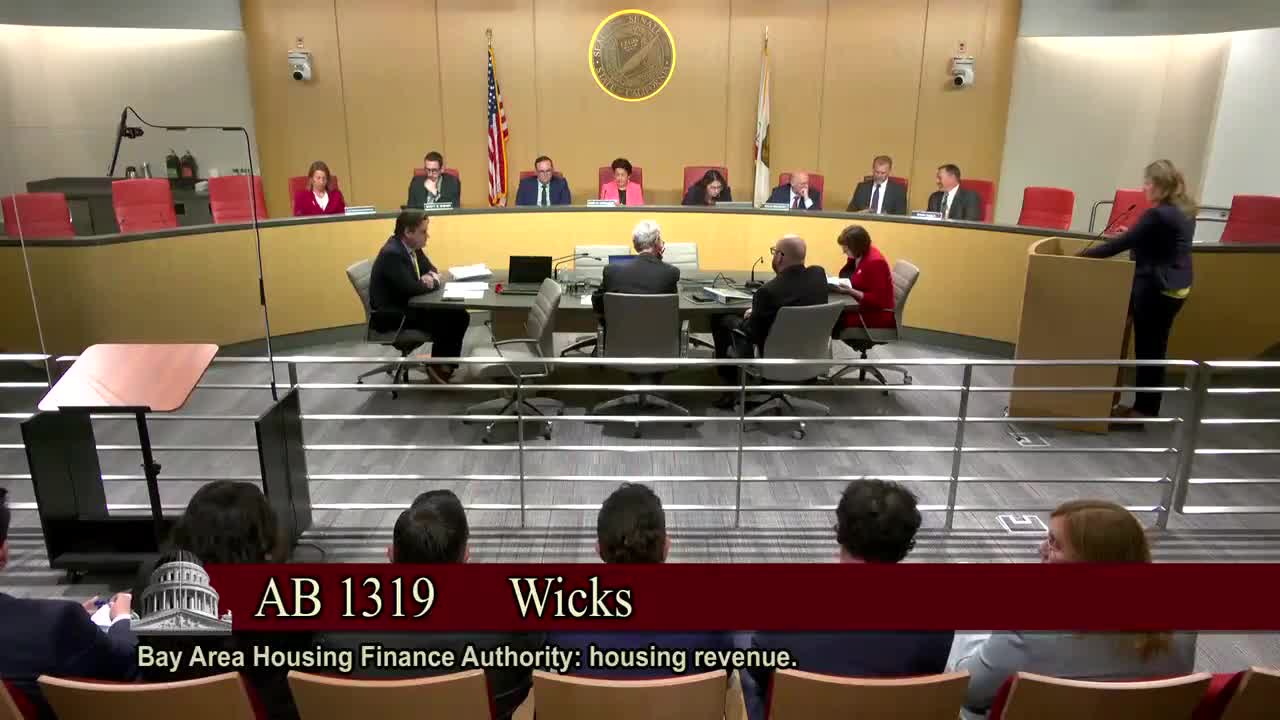 46SEC
Senate Standing Committee on Governance and Finance
 6MIN
Senate Standing Committee on Housing
 56SEC
Assembly Floor
 1MIN
Assembly Standing Committee on Appropriations
 4MIN
Assembly Standing Committee on Natural Resources
Bill Author











