AB 1337: State Water Resources Control Board: water diversion curtailment.
- Session Year: 2023-2024
- House: Assembly
- Latest Version Date: 2023-05-18
Current Status:
Failed
(2023-07-10: In committee: Set, first hearing. Hearing canceled at the request of author.)
Introduced
In Committee
First Chamber
In Committee
Second Chamber
Enacted
(1)Under existing law, the diversion or use of water other than as authorized by specified provisions of law is a trespass, subject to specified civil liability.
This bill would expand the instances when the diversion or use of water is considered a trespass.
(2)Existing law establishes the State Water Resources Control Board in the California Environmental Protection Agency and vests the board with various powers and duties, including, among other things, to ascertain whether or not water heretofore filed upon or attempted to be appropriated is appropriated under the laws of this state. Existing law authorizes the board to adopt emergency regulations if, among other things, the regulations are adopted to prevent the waste, unreasonable use, unreasonable method of use, or unreasonable method of diversion, of water, to promote water recycling or water conservation, to require curtailment of diversions when water is not available under the diverters priority of right, or in furtherance of any of the foregoing, to require reporting of diversion or use or the preparation of monitoring reports.
This bill would authorize the board to issue a curtailment order for any diversion, regardless of basis of right, when water is not available under the diverters priority of right. The bill would authorize require the board to adopt regulations to implement this provision.
(3)Existing law authorizes the board to issue a cease and desist order against a person who is violating, or threatening to violate, certain requirements relating to water use.
This bill would additionally authorize the board to issue a cease and desist order when a water right holder fails to curtail diversions when water is unavailable under the water right holders priority of right.
(1)Under existing law, the diversion or use of water other than as authorized by specified provisions of law is a trespass, subject to specified civil liability.
This bill would expand the instances when the diversion or use of water is considered a trespass.
Existing
(2)Existing law establishes the State Water Resources Control Board in the California Environmental Protection Agency and vests the board with various powers and duties, including, among other things, to ascertain whether or not water heretofore filed upon or attempted to be appropriated is appropriated under the laws of this state. Existing law authorizes the board to adopt emergency regulations if, among other things, the regulations are adopted to prevent the waste, unreasonable use, unreasonable method of use, or unreasonable method of diversion, of water, to promote water recycling or water conservation, to require curtailment of diversions when water is not available under the diverters priority of right, or in furtherance of any of the foregoing, to require reporting of diversion or use or the preparation of monitoring reports.
The California Environmental Quality Act (CEQA) requires a lead agency, as defined, to prepare, or cause to be prepared, and certify the completion of an environmental impact report on a project that the lead agency proposes to carry out or approve that may have a significant effect on the environment or to adopt a negative declaration if it finds that the project will not have that effect.This bill would authorize the board to adopt regulations for various water conservation purposes, including, but not limited to, to prevent the waste, unreasonable use, unreasonable method of use, or unreasonable method of diversion of water, and to implement these regulations through orders curtailing the diversion or use of water under any claim of right. The bill would require the board to provide notice and an opportunity to be heard before issuing an order, except where an opportunity to be heard before the issuance of an order would be impractical given the likelihood of harm to the purposes of the various water conservation regulations. The bill would provide that a person or entity may be civilly liable for a violation of any regulation or order issued by the board pursuant to these provisions in an amount not to exceed $1,000 for each day in which the violation has occurred and $2,500 for each acre-foot of water diverted or used in violation of the applicable requirement. The bill would authorize the imposition of this civil liability by the superior court, as specified, or administratively by the board. The bill would provide that a regulation or order issued by the board pursuant to these provisions, or by emergency regulation, is exempt from CEQA. issue a curtailment order for any diversion, regardless of basis of right, when water is not available under the diverters priority of right. The bill would authorize the board to adopt regulations to implement this provision.
(3)Existing law authorizes the board to issue a cease and desist order against a person who is violating, or threatening to violate, certain requirements relating to water use.
This bill would additionally authorize the board to issue a cease and desist order when a water right holder fails to curtail diversions when water is unavailable under the water right holders priority of right.
Existing law establishes the State Water Resources Control Board in the California Environmental Protection Agency and vests the board with various powers and duties, including, among other things, to ascertain whether or not water heretofore filed upon or attempted to be appropriated is appropriated under the laws of this state. Existing law authorizes the board to adopt emergency regulations if, among other things, the regulations are adopted to prevent the waste, unreasonable use, unreasonable method of use, or unreasonable method of diversion, of water, to promote water recycling or water conservation, to require curtailment of diversions when water is not available under the diverters priority of right, or in furtherance of any of the foregoing, to require reporting of diversion or use or the preparation of monitoring reports.
The California Environmental Quality Act (CEQA) requires a lead agency, as defined, to prepare, or cause to be prepared, and certify the completion of an environmental impact report on a project that the lead agency proposes to carry out or approve that may have a significant effect on the environment or to adopt a negative declaration if it finds that the project will not have that effect.
This bill would authorize the board to adopt regulations for various water conservation purposes, including, but not limited to, to prevent the waste, unreasonable use, unreasonable method of use, or unreasonable method of diversion of water, and to implement these regulations through orders curtailing the diversion or use of water under any claim of right. The bill would require the board to provide notice and an opportunity to be heard before issuing an order, except where an opportunity to be heard before the issuance of an order would be impractical given the likelihood of harm to the purposes of the various water conservation regulations. The bill would provide that a person or entity may be civilly liable for a violation of any regulation or order issued by the board pursuant to these provisions in an amount not to exceed $1,000 for each day in which the violation has occurred and $2,500 for each acre-foot of water diverted or used in violation of the applicable requirement. The bill would authorize the imposition of this civil liability by the superior court, as specified, or administratively by the board. The bill would provide that a regulation or order issued by the board pursuant to these provisions, or by emergency regulation, is exempt from CEQA.
(a)It is the intent of the Legislature that the State Water Resources Control Board shall be able to exercise its full authority under Section 2 of Article X of the California Constitution, the public trust doctrine, and Division 1 (commencing with Section 100) and Division 2 (commencing with Section 1000) of the Water Code to ensure that the use or diversion of water under any claim of right serves the public interest.
(b)It is the intent of the Legislature that this bill clarify that the State Water Resources Control Board has the necessary authority to curtail pre-1914 water rights and address the gap in the state boards authority revealed by the court in the series of cases known as the California Water Curtailment Cases.
SEC. 2.Section 1052 of the Water Code is amended to read:1052.(a)The diversion or use of water subject to this division other than as authorized is a trespass.
(b)(1)An action for the issuance of injunctive relief as may be warranted by way of temporary restraining order, preliminary injunction, or permanent injunction, may be brought by the Attorney General on behalf of the board, or in the Attorney Generals independent capacity in the name of the people of the State of California, where the diversion or use of water is threatened, is occurring, or has occurred.
(2)(A)A civil action for a violation under this section resulting from unlicensed cannabis cultivation may also be brought by a city attorney or county counsel, upon approval of the board, in the name of the people of the State of California.
(B)A city attorney or county counsel shall inform and coordinate with the board as to the investigation of potential violations of this section related to unlicensed cannabis cultivation. Unless the board withholds its approval within 21 days after the local jurisdiction provides notice of its intent to file, the local jurisdiction may deem the boards silence as approval.
(c)A person or entity committing a trespass as defined in this section may be liable in an amount not to exceed the following:
(1)If the unauthorized diversion or use occurs in a critically dry year immediately preceded by two or more consecutive below normal, dry, or critically dry years, or during a period for which the Governor has issued a proclamation of a state of emergency under the California Emergency Services Act (Chapter 7 (commencing with Section 8550) of Division 1 of Title 2 of the Government Code) based on drought conditions, the sum of the following:
(A)One thousand dollars ($1,000) for each day in which the trespass occurs.
(B)Two thousand five hundred dollars ($2,500) for each acre-foot of water diverted or used in excess of that diverters water rights.
(2)If the unauthorized diversion or use is not described by paragraph (1), five hundred dollars ($500) for each day in which the unauthorized diversion or use occurs.
(3)Notwithstanding paragraphs (1) and (2), up to three thousand five hundred dollars ($3,500) for each day in which the unauthorized diversion or use for unlicensed cannabis cultivation occurs.
(d)Civil liability for a violation of this section may be imposed by the superior court or the board as follows:
(1)The superior court may impose civil liability in an action brought by the Attorney General, upon request of the board, to impose, assess, and recover any sums pursuant to subdivision (c). In determining the appropriate amount, the court shall take into consideration all relevant circumstances, including, but not limited to, the extent of harm caused by the violation, the nature and persistence of the violation, the length of time over which the violation occurs, and the corrective action, if any, taken by the violator.
(2)The superior court may impose civil liability in an action for a violation under this section resulting from unlicensed cannabis cultivation brought by a city attorney or county counsel to impose, assess, and recover any sums pursuant to subdivision (c). In determining the appropriate amount, the court shall take into consideration all relevant circumstances, including, but not limited to, the extent of harm caused by the violation, whether the violation was intentional or committed knowingly, the nature and persistence of the violation, the length of time over which the violation has occurred, and the corrective action, if any, taken by the violator. The court shall make its findings on the record.
(3)The board may impose civil liability in accordance with Section 1055.
(e)(1)Upon appropriation by the Legislature, funds recovered in an action pursuant to this section shall be used to proportionally reimburse the Attorney General, city attorney, county counsel, and the board for costs of bringing the action, including reasonable attorneys fees, and of investigating the violation and supporting the prosecution of the action.
(2)Except for reimbursements to the Attorney General, city attorney, or county counsel, as specified in paragraph (1), all funds recovered pursuant to this section shall be deposited in the Water Rights Fund established pursuant to Section 1550.
(f)The remedies prescribed in this section are cumulative and not alternative.
SEC. 3.Chapter 2.5 (commencing with Section 1065) is added to Part 1 of Division 2 of the Water Code, to read:2.5.Water Shortage Enforcement1065.(a)The board may issue a curtailment order for any diversion, regardless of basis of right, when water is not available under the diverters priority of right.
(b)Failure to comply with a curtailment order is a trespass as provided in Section 1052. trespass.
(c)The board may shall adopt regulations to implement this section.
SEC. 4.Section 1831 of the Water Code is amended to read:1831.(a)When the board determines that any person is violating, or threatening to violate, any requirement described in subdivision (d), the board may issue an order to that person to cease and desist from that violation.
(b)The cease and desist order shall require that person to comply forthwith or in accordance with a time schedule set by the board.
(c)The board may issue a cease and desist order only after notice and an opportunity for hearing pursuant to Section 1834.
(d)The board may issue a cease and desist order in response to a violation or threatened violation of any of the following:
(1)The prohibition set forth in Section 1052 against the unauthorized diversion or use of water subject to this division.
(2)When a water right holder fails to curtail diversions when water is unavailable under the water right holders priority of right.
(3)Any term or condition of a permit, license, certification, or registration issued under this division.
(4)Any decision or order of the board issued under this part, Section 275, Chapter 11 (commencing with Section 10735) of Part 2.74 of Division 6, or Article 7 (commencing with Section 13550) of Chapter 7 of Division 7, in which decision or order the person to whom the cease and desist order will be issued, or a predecessor in interest to that person, was named as a party directly affected by the decision or order.
(5)A regulation adopted under Section 1058.5.
(6)Any extraction restriction, limitation, order, or regulation adopted or issued under Chapter 11 (commencing with Section 10735) of Part 2.74 of Division 6.
(7)Any diversion or use of water for cannabis cultivation if any of paragraphs (1) to (6), inclusive, or any of the following applies:
(A)A license is required, but has not been obtained, under Chapter 6 (commencing with Section 26060) or Chapter 7 (commencing with Section 26070) of Division 10 of the Business and Professions Code.
(B)The diversion is not in compliance with an applicable limitation or requirement established by the board or the Department of Fish and Wildlife under Section 13149.
(C)The diversion or use is not in compliance with a requirement imposed under paragraphs (1) and (2) of subdivision (b) of Section 26060.1 of, and paragraph (3) of subdivision (a) of Section 26070 of, the Business and Professions Code.
(e)This article does not alter the regulatory authority of the board under other provisions of law.
(a)It is the intent of the Legislature that the State Water Resources Control Board shall be able to exercise its full authority under Section 2 of Article X of the California Constitution, the public trust doctrine, and Division 1 (commencing with Section 100) and Division 2 (commencing with Section 1000) of the Water Code to ensure that the use or diversion of water under any claim of right serves the public interest.
(b)It is the intent of the Legislature that this bill clarify that the State Water Resources Control Board has the necessary authority to curtail pre-1914 water rights and address the gap in the state boards authority revealed by the court in the series of cases known as the California Water Curtailment Cases.
SEC. 2.Section 1052 of the Water Code is amended to read:1052.(a)The diversion or use of water subject to this division other than as authorized in this division is a trespass.
(b)(1)An action for the issuance of injunctive relief as may be warranted by way of temporary restraining order, preliminary injunction, or permanent injunction, may be brought by the Attorney General on behalf of the board, or in the Attorney Generals independent capacity in the name of the people of the State of California, where the diversion or use of water is threatened, is occurring, or has occurred.
(2)(A)A civil action for a violation under this section resulting from unlicensed cannabis cultivation may also be brought by a city attorney or county counsel, upon approval of the board, in the name of the people of the State of California.
(B)A city attorney or county counsel shall inform and coordinate with the board as to the investigation of potential violations of this section related to unlicensed cannabis cultivation. Unless the board withholds its approval within 21 days after the local jurisdiction provides notice of its intent to file, the local jurisdiction may deem the boards silence as approval.
(c)A person or entity committing a trespass as defined in this section may be liable in an amount not to exceed the following:
(1)If the unauthorized diversion or use occurs in a critically dry year immediately preceded by two or more consecutive below normal, dry, or critically dry years, or during a period for which the Governor has issued a proclamation of a state of emergency under the California Emergency Services Act (Chapter 7 (commencing with Section 8550) of Division 1 of Title 2 of the Government Code) based on drought conditions, the sum of the following:
(A)One thousand dollars ($1,000) for each day in which the trespass occurs.
(B)Two thousand five hundred dollars ($2,500) for each acre-foot of water diverted or used in excess of that diverters water rights.
(2)If the unauthorized diversion or use is not described by paragraph (1), five hundred dollars ($500) for each day in which the unauthorized diversion or use occurs.
(3)Notwithstanding paragraphs (1) and (2), up to three thousand five hundred dollars ($3,500) for each day in which the unauthorized diversion or use for unlicensed cannabis cultivation occurs.
(d)Civil liability for a violation of this section may be imposed by the superior court or the board as follows:
(1)The superior court may impose civil liability in an action brought by the Attorney General, upon request of the board, to impose, assess, and recover any sums pursuant to subdivision (c). In determining the appropriate amount, the court shall take into consideration all relevant circumstances, including, but not limited to, the extent of harm caused by the violation, the nature and persistence of the violation, the length of time over which the violation occurs, and the corrective action, if any, taken by the violator.
(2)The superior court may impose civil liability in an action for a violation under this section resulting from unlicensed cannabis cultivation brought by a city attorney or county counsel to impose, assess, and recover any sums pursuant to subdivision (c). In determining the appropriate amount, the court shall take into consideration all relevant circumstances, including, but not limited to, the extent of harm caused by the violation, whether the violation was intentional or committed knowingly, the nature and persistence of the violation, the length of time over which the violation has occurred, and the corrective action, if any, taken by the violator. The court shall make its findings on the record.
(3)The board may impose civil liability in accordance with Section 1055.
(e)(1)Upon appropriation by the Legislature, funds recovered in an action pursuant to this section shall be used to proportionally reimburse the Attorney General, city attorney, county counsel, and the board for costs of bringing the action, including reasonable attorneys fees, and of investigating the violation and supporting the prosecution of the action.
(2)Except for reimbursements to the Attorney General, city attorney, or county counsel, as specified in paragraph (1), all funds recovered pursuant to this section shall be deposited in the Water Rights Fund established pursuant to Section 1550.
(f)The remedies prescribed in this section are cumulative and not alternative.
SECTION 1.SEC. 3.Chapter 2.5 (commencing with Section 1065) is added to Part 1 of Division 2 of the Water Code, to read:2.5.Water Shortage Enforcement1065.(a)The board may issue a curtailment order for any diversion, regardless of basis of right, when water is not available under the diverters priority of right.
(b)Failure to comply with a curtailment order is a trespass as provided in Section 1052.
(c)The board may adopt regulations to implement this section.
1065.The board may adopt regulations for any of the following purposes:(a)To prevent the waste, unreasonable use, unreasonable method of use, or unreasonable method of diversion of water.(b)To promote water recycling or water conservation.(c)To protect public trust resources.(d)To require curtailment of diversions when water is not available under the diverters priority of right.(e)In furtherance of any of the purposes of this section, to require reporting of diversion or use or the preparation of monitoring reports.1066.(a)The board may implement regulations through orders curtailing the diversion or use of water under any claim of right.(b)(1)The board shall provide notice and an opportunity to be heard, except where an opportunity to be heard before the issuance of an order would be impractical given the likelihood of harm to the purposes described in Section 1065, or other relevant circumstances.(2)The opportunity to be heard may be tailored to the circumstances, may be a collective rather than individual process, and may be written or oral.(3)If the board does not provide an opportunity to be heard before the issuance of an order, the board shall promptly provide the opportunity after the issuance of the order, such as through the petition for reconsideration process pursuant to Chapter 4 (commencing with Section 1120).1067.(a)A person or entity may be civilly liable for a violation of any regulation or order issued under this chapter in an amount not to exceed the sum of the following:(1)One thousand dollars ($1,000) for each day in which the violation has occurred.(2)Two thousand five hundred dollars ($2,500) for each acre-foot of water diverted or used in violation of the applicable requirement.(b)Civil liability may be imposed by the superior court. The Attorney General, upon the request of the board, shall petition the superior court to impose, assess, and recover those sums.(c)Civil liability may be imposed administratively by the board pursuant to Section 1055.1068.A regulation or order issued by the board under this chapter or Section 1058.5 shall be exempt from the requirements of the California Environmental Quality Act (Division 13 (commencing with Section 21000) of the Public Resources Code). 1069.This chapter does not limit any authority held by the board under this code or any other law.SEC. 4.Section 1831 of the Water Code is amended to read:1831.(a)When the board determines that any person is violating, or threatening to violate, any requirement described in subdivision (d), the board may issue an order to that person to cease and desist from that violation.
(b)The cease and desist order shall require that person to comply forthwith or in accordance with a time schedule set by the board.
(c)The board may issue a cease and desist order only after notice and an opportunity for hearing pursuant to Section 1834.
(d)The board may issue a cease and desist order in response to a violation or threatened violation of any of the following:
(1)The prohibition set forth in Section 1052 against the unauthorized diversion or use of water subject to this division.
(2)When a water right holder fails to curtail diversions when water is unavailable under the water right holders priority of right.
(2)(3)Any term or condition of a permit, license, certification, or registration issued under this division.
(3)(4)Any decision or order of the board issued under this part, Section 275, Chapter 11 (commencing with Section 10735) of Part 2.74 of Division 6, or Article 7 (commencing with Section 13550) of Chapter 7 of Division 7, in which decision or order the person to whom the cease and desist order will be issued, or a predecessor in interest to that person, was named as a party directly affected by the decision or order.
(4)(5)A regulation adopted under Section 1058.5.
(5)(6)Any extraction restriction, limitation, order, or regulation adopted or issued under Chapter 11 (commencing with Section 10735) of Part 2.74 of Division 6.
(6)(7)Any diversion or use of water for cannabis cultivation if any of paragraphs (1) to (5), (6), inclusive, or any of the following applies:
(A)A license is required, but has not been obtained, under Chapter 6 (commencing with Section 26060) or Chapter 7 (commencing with Section 26070) of Division 10 of the Business and Professions Code.
(B)The diversion is not in compliance with an applicable limitation or requirement established by the board or the Department of Fish and Wildlife under Section 13149.
(C)The diversion or use is not in compliance with a requirement imposed under paragraphs (1) and (2) of subdivision (b) of Section 26060.1 of, and paragraph (3) of subdivision (a) of Section 26070 of, the Business and Professions Code.
(e)This article does not alter the regulatory authority of the board under other provisions of law.
The board may adopt regulations for any of the following purposes:
(a)To prevent the waste, unreasonable use, unreasonable method of use, or unreasonable method of diversion of water.
(b)To promote water recycling or water conservation.
(c)To protect public trust resources.
(d)To require curtailment of diversions when water is not available under the diverters priority of right.
(e)In furtherance of any of the purposes of this section, to require reporting of diversion or use or the preparation of monitoring reports.
1066.(a)The board may implement regulations through orders curtailing the diversion or use of water under any claim of right.
(b)(1)The board shall provide notice and an opportunity to be heard, except where an opportunity to be heard before the issuance of an order would be impractical given the likelihood of harm to the purposes described in Section 1065, or other relevant circumstances.
(2)The opportunity to be heard may be tailored to the circumstances, may be a collective rather than individual process, and may be written or oral.
(3)If the board does not provide an opportunity to be heard before the issuance of an order, the board shall promptly provide the opportunity after the issuance of the order, such as through the petition for reconsideration process pursuant to Chapter 4 (commencing with Section 1120).
1067.(a)A person or entity may be civilly liable for a violation of any regulation or order issued under this chapter in an amount not to exceed the sum of the following:
(1)One thousand dollars ($1,000) for each day in which the violation has occurred.
(2)Two thousand five hundred dollars ($2,500) for each acre-foot of water diverted or used in violation of the applicable requirement.
(b)Civil liability may be imposed by the superior court. The Attorney General, upon the request of the board, shall petition the superior court to impose, assess, and recover those sums.
(c)Civil liability may be imposed administratively by the board pursuant to Section 1055.
1068.A regulation or order issued by the board under this chapter or Section 1058.5 shall be exempt from the requirements of the California Environmental Quality Act (Division 13 (commencing with Section 21000) of the Public Resources Code).
1069.This chapter does not limit any authority held by the board under this code or any other law.
|
Date
|
Status
|
|---|---|
| Jul 10, 2023 | In committee: Set, first hearing. Hearing canceled at the request of author. |
| Jun 21, 2023 | In committee: Hearing postponed by committee. |
| Jun 7, 2023 | Referred to Com. on N.R. & W. |
| May 31, 2023 | In Senate. Read first time. To Com. on RLS. for assignment. |
| May 30, 2023 | Read third time. Passed. Ordered to the Senate. (Ayes 45. Noes 20. Page 1933.) |
| May 22, 2023 | Read second time. Ordered to third reading. |
| May 18, 2023 | Joint Rule 62(a), file notice suspended. (Page 1580.) |
| May 18, 2023 | Read second time and amended. Ordered returned to second reading. |
| May 18, 2023 | From committee: Amend, and do pass as amended. (Ayes 11. Noes 4.) (May 18). |
| May 17, 2023 | In committee: Set, first hearing. Referred to APPR. suspense file. |
| Apr 24, 2023 | Re-referred to Com. on APPR. pursuant to Assembly Rule 96. |
| Apr 24, 2023 | Re-referred to Com. on JUD. |
| Apr 20, 2023 | Read second time and amended. |
| Apr 19, 2023 | From committee: Amend, and do pass as amended and re-refer to Com. on JUD. (Ayes 9. Noes 4.) (April 18). |
| Mar 2, 2023 | Referred to Coms. on W., P., & W. and JUD. |
| Feb 17, 2023 | From printer. May be heard in committee March 20. |
| Feb 16, 2023 | Read first time. To print. |
|
Date
|
Description
|
Location
|
Votes
|
|
|---|---|---|---|---|
| May 30, 2023 | AB 1337 Wicks Assembly Third Reading | Assembly Floor |
Passed |
|
| May 18, 2023 | Do pass as amended. | Assembly Standing Committee on Appropriations |
Passed |
|
| Apr 18, 2023 | Do pass as amended and be re-referred to the Committee on [Judiciary] | Assembly Standing Committee on Water, Parks, and Wildlife |
Passed |
This list shows positions taken on this bill by organizations on the date displayed, which is linked to the original source.
Positions by individuals are not included.
|
Organization
|
Position
|
Date
|
|---|---|---|
| African American Farmers of California | ** Against | |
| Agricultural Council Of California | ** Against | |
| American Rivers | ** Support | |
| Antelope Valley EastKern Water Agency | ** Against | |
| Association Of California Water Agencies | ** Against | |
| Ban SUP | ** Support | |
| Bay Area Council | ** Against | |
| BeaumontCherry Valley Water District | ** Against | |
| Bella Vista Water District | ** Against | |
| Bellflower-Somerset Mutual Water Company | ** Against | |
| Byron-Bethany Irrigation District | ** Against | |
| California Alliance for Jobs | ** Against | |
| California Association Of Realtors | ** Against | |
| California Association Of Winegrape Growers | ** Against | |
| California Building Industry Association | ** Against | |
| California Business Properties Association | ** Against | |
| California Cattlemen'S Association | ** Against | |
| California Chamber Of Commerce | ** Against | |
| California Coastkeeper Alliance | ** Support | |
| California Cotton Ginners And Growers Association Inc. | ** Against | |
| California Environmental Voters | ** Support | |
| California Farm Bureau Federation | ** Against | |
| California Fresh Fruit Association | ** Against | |
| California League of Food Producers | ** Against | |
| California Manufacturers & Technology Association | ** Against | |
| California Municipal Utilities Association | ** Against | |
| California Outdoors | ** Support | |
| California Special Districts Association | ** Against | |
| California Trout | ** Support | |
| California Walnut Commission | ** Against | |
| California Water Association | ** Against | |
| California Water Research | ** Support | |
| California Women for Agriculture | ** Against | |
| Carmichael Water District | ** Against | |
| Center For Biological Diversity | ** Support | |
| Central Delta Water Agency | ** Against | |
| City of Corona | ** Against | |
| City of Fairfield | ** Against | |
| City of Foster City | ** Against | |
| City of Lodi | ** Against | |
| City of Mountain View | ** Against | |
| City of Roseville | ** Against | |
| City of Stockton | ** Against | |
| Clean Water Action | ** Support | |
| Coachella Valley Water District | ** Against | |
| Coachella Valley Waterkeeper | ** Support | |
| Coast Action Group | ** Support | |
| Coastside County Water District | ** Against | |
| County Of Stanislaus | ** Against | |
| Cucamonga Valley Water District | ** Against | |
| Defenders Of Wildlife | ** Support | |
| Del Puerto Water District | ** Against | |
| Desert Water Agency | ** Against | |
| Dunnigan Water District | ** Against | |
| East Turlock Subbasin Groundwater Sustainability Agency | ** Against | |
| East Valley Water District | ** Against | |
| El Dorado Irrigation District | ** Against | |
| Elk Grove Water District | ** Against | |
| Elsinore Valley Municipal Water District | ** Against | |
| Florin Resource Conservation District/elk Grove Water District | ** Against | |
| Fresno County Board of Supervisors | ** Against | |
| Fresno Irrigation District | ** Against | |
| Friant Water Authority | ** Against | |
| Friends of the Eel River | ** Support | |
| Friends of the River | ** Support | |
| Humboldt Baykeeper | ** Support | |
| Humboldt Bay Municipal Water District | ** Against | |
| Imperial Irrigation District | ** Against | |
| Indio Water Authority | ** Against | |
| Inland Empire Waterkeeper | ** Support | |
| International Bottled Water Association | ** Against | |
| Irvine Ranch Water District | ** Against | |
| Jerry Dyer, Mayor of City of Fresno | ** Against | |
| Kaweah Delta Water Conservation District | ** Against | |
| Kaweah & St. Johns Rivers Association | ** Against | |
| Kern County Board of Supervisors | ** Against | |
| Kern County Water Agency | ** Against | |
| Kings; County Of | ** Against | |
| Kings River Conservation District | ** Against | |
| Kings River Water Association | ** Against | |
| Lake Arrowhead Community Services District | ** Against | |
| Leadership Counsel for Justice and Accountability | ** Support | |
| League Of Women Voters Of California | ** Support | |
| Los Angeles Waterkeeper | ** Support | |
| Madera County Board of Supervisors | ** Against | |
| Manteca Chamber of Commerce | ** Against | |
| Mayor of City & County of San Francisco London Breed | ** Against | |
| McKinleyville Community Services District | ** Against | |
| Merced County Board of Supervisors | ** Against | |
| Mesa Water District | ** Against | |
| Metropolitan Water District Of Orange County | ** Against | |
| Modesto Irrigation District | ** Against | |
| Mojave Water Agency | ** Against | |
| Mono Lake Committee | ** Support | |
| montecito water district | ** Against | |
| Monterey Waterkeeper | ** Support | |
| Municipal Water District Of Orange County | ** Against | |
| Napa County Flood Control And Water Conservation District | ** Against | |
| Nisei Farmers League Inc. | ** Against | |
| Northern California Water Association | ** Against | |
| Oakdale Irrigation District | ** Against | |
| opportunity stanislaus | ** Against | |
| Orange County Coastkeeper | ** Support | |
| Orange County Water District | ** Against | |
| Pacheco Water District | ** Against | |
| Pacific Coast Federation of Fishermen's Association | ** Support | |
| Palmdale Water District | ** Against | |
| Pinedale County Water Agency | ** Against | |
| Placer County Water Agency | ** Against | |
| Planning And Conservation League | ** Support | |
| Rancho California Water District | ** Against | |
| Regional Water Authority | ** Against | |
| Restore the Delta | ** Support | |
| Rosedale-Rio Bravo Water Storage District | ** Against | |
| Rowland Water District | ** Against | |
| Russian Riverkeeper | ** Support | |
| Sacramento County Water Agency | ** Against | |
| San Bernardino Valley Water Conservation District | ** Against | |
| San Diego Coastkeeper | ** Support | |
| San Diego County Water Authority | ** Against | |
| San Francisco Baykeeper | ** Support | |
| San Francisco Public Utilities Commission | ** Against | |
| San Gabriel Valley Municipal Water District | ** Against | |
| San Gorgonio Pass Water Agency | ** Against | |
| San Joaquin County Board of Supervisors | ** Against | |
| San Joaquin River Exchange Contractors Water Authority | ** Against | |
| San Juan Water District | ** Against | |
| San Luis Delta-Mendota Water Authority | ** Against | |
| Santa Barbara Channelkeeper | ** Support | |
| Santa Clarita Valley Water Agency | ** Against | |
| Santa Margarita Water District | ** Against | |
| Sierra Club California | ** Support | |
| Solano County Board of Supervisors | ** Against | |
| Solano County Water Agency | ** Against | |
| Solano Irrigation District | ** Against | |
| Southern California Water Coalition | ** Against | |
| Southern California Watershed Alliance | ** Support | |
| South San Joaquin Irrigation District | ** Against | |
| South Yuba River Citizens League | ** Support | |
| Stanislaus County Board of Supervisors | ** Against | |
| State Water Contractors | ** Against | |
| Stockton East Water District | ** Against | |
| Sweetwater Authority | ** Against | |
| Tahoe City Public Utility District | ** Against | |
| Tehachapi-cummings County Water District | ** Against | |
| The Wine Institute | ** Against | |
| Three Valleys Municipal Water District | ** Against | |
| Tranquillity Irrigation District | ** Against | |
| Tri-County Water Authority | ** Against | |
| Trout Unlimited | ** Support | |
| Tulare County Board of Supervisors | ** Against | |
| Tulare Irrigation District | ** Against | |
| Tuolumne County Water Agency | ** Against | |
| Tuolumne River Trust | ** Support | |
| Tuolumne Utilities District | ** Against | |
| Turlock Irrigation District | ** Against | |
| Union Of Concerned Scientists | ** Support | |
| United Water Conservation District | ** Against | |
| Upper San Gabriel Valley Municipal Water District | ** Against | |
| Valley Ag Water Coalition | ** Against | |
| Valley Center Municipal Water District | ** Against | |
| Walnut Valley Water District | ** Against | |
| Water Climate Trust | ** Support | |
| Water Foundation | ** Support | |
| Western Agricultural Processors Association | ** Against | |
| Western Canal Water District | ** Against | |
| Western Growers Association | ** Against | |
| Western Municipal Water District | ** Against | |
| West Valley Water District | ** Against | |
| Wholly H2O | ** Support | |
| Yuba River Waterkeeper | ** Support | |
| Yuba Water Agency | ** Against |
SENATE COMMITTEE ON NATURAL RESOURCES AND WATER
Senator Dave Min, Chair
2023 - 2024 Regular
Bill No: AB 1337 Hearing Date: July 10, 2023
Author: | |||
Version: | Amended | ||
Urgency: | Fiscal: | ||
Consultant: | |||
Subject: State Water Resources Control Board: water diversion curtailment
BACKGROUND AND EXISTING LAW
Background
State Water Resources Control Board (SWRCB). SWRCB’s mission is “to preserve, enhance, and restore the quality of California’s water resources and drinking water for the protection of the environment, public health, and all beneficial uses, and to ensure proper water resource allocation and efficient use, for the benefit of present and future generations.” The five-member SWRCB allocates water rights, adjudicates water right disputes, develops statewide water protection plans, establishes water quality standards, and guides the nine Regional Water Quality Control Boards located in major watersheds of the state. Since its creation in 1967, SWRCB has followed its original mandate to balance, to the extent possible, all uses of California’s water resources.
California water rights. California law recognizes riparian and appropriative water rights for surface water. The 1850 Constitution adopted the Common law, which included riparian water rights. Riparian rights grant all landowners contiguous to a river a share of the water in the river. Five years later, the California Supreme Court adopted the Appropriation Doctrine, commonly called “first in time, first in right,” in Irwin v. Phillips. California was the first Western state to recognize this doctrine, which had developed in Gold Rush mining camps on streams where there were no private landowners. For the next 58 years, those needing water could appropriate water for their needs by simply diverting water and using it for a beneficial use. The one who diverted water first enjoyed the senior right to divert the water needed before the next water right holder could divert water. The state had no administrative process for establishing these water rights until enactment of the Water Commission Act in 1914.
California Water Curtailment Cases (6th Dist. September 2022). This case addressed the SWRCB’s 2015 curtailment of diversions by senior water right (pre-1914) holders in the Sacramento-San Joaquin Delta (Delta), when drought conditions reduced available water for diversion. Certain Delta water agencies challenged SWRCB’s authority, under Water Code (Wat. C.) § 1052(a), to curtail pre-1914 water right holders. The Court of Appeal held that Section 1052(a) excluded pre-1914 water rights from SWRCB’s regulatory authority.
While the Court of Appeal ruled that Section 1052(a) did not give SWRCB authority, the court identified other possible sources for their authority suggesting SWRCB could use emergency regulation or a reasonable use determination. Both options could present difficulty, limiting the effectiveness of SWRCB’s regulation in times of drought, which climate change has made increasingly common. In discussing the reasoning behind its ruling, the court suggests that the time may be ripe for the Legislature to re-visit the question of whether SWRCB should have broader authority over pre-1914 water rights: “Whether this approach to water rights in California represents sound policy in a time of increasing water scarcity is a question for the Legislature.”
Existing law:
- Provides that the diversion or use of water other than as authorized is a trespass and sets administrative penalties for trespass of $500 per day or, during periods of drought, of $1,000 per day and $2,500 per acre-foot (AF) of water diverted in excess of a diverter’s water right (Wat. C. § 1052).
- Authorizes the executive director of SWRCB to issue a complaint to any person that diverts water in violation of a water right, fails to comply with a cease and desist order issued by SWRCB, or makes a willful misstatement on a water diversion and use statement. Prescribes procedures for service of such a complaint and authorizes SWRCB to issue an order to impose administrative civil liability after any necessary hearing (Wat. C. § 1055).
- Authorizes SWRCB to adopt reasonable rules and regulations to carry out its powers and duties under the Water Code (Wat. C. § 1058).
- Authorizes SWRCB to adopt emergency regulations during times of drought to enforce the reasonable use doctrine, promote water recycling or conservation, curtail diversions due to lack of water availability, or to require reporting on water use. Provides such emergency regulations are not subject to review by the Office of Administrative Law and may only remain in effect for one year. Sets penalties for violations of emergency regulations at $500 per day (Wat. C. § 1058.5).
- States legislative intent that all issues relating to state water law decided by SWRCB be reviewed in state court if a party seeks judicial review. Requires an aggrieved party seeking judicial review to file a petition for a writ of mandate within 30 days of SWRCB’s final action leading to the petition for review (Wat. C. § 1126).
- Authorizes SWRCB to issue a cease and desist order for specified violations of the Water Code, including unauthorized diversion or use, violation of a water right permit or license, or an emergency regulation (Wat. C. § 1831).
PROPOSED LAW
This bill:
- Authorizes SWRCB to issue a curtailment order for any diversion, regardless of basis of right, when water is not available under the diverter’s priority of right, and makes the failure to comply with a curtailment order a trespass.
- Requires SWRCB to adopt regulations to implement these provisions.
- Requires SWRCB to adopt regulations to implement these provisions.
- Authorizes SWRCB to issue a cease and desist order when a water right holder fails to curtail diversions when water is unavailable under the water right holder’s priority of right.
- Expands the instances when unauthorized diversion or use of water is considered a trespass.
- Makes findings and declarations with regards to SWRCB’s ability to exercise its full authority under the Reasonable Use Doctrine, the public trust doctrine, and Divisions 1 and 2 of the Water Code. (Sec. 1)
ARGUMENTS IN SUPPORT
According to the author, “Before California passed The Water Commission Act in 1913, our state’s water rights system was fundamentally exclusionary. Reflecting pioneer values, it was textbook discrimination—with Indigenous People and Californians of color literally forbidden from owning the land that was necessary to attain a water right. But that was the law, and in 1914 we began regulating our water supply in a more comprehensive fashion. Our laws evolved, along with our values.
And yet, more than one hundred years later, those who inherited pre-1914 water rights still claim that simply because they were [‘]first in time, first in line[‘], that their water use should not by regulated by a state-appointed body during times of shortage. The simple fact is, they have inherited a legal right that is long overdue for modest reform.
The State Water Resources Control Board currently has the ability to curtail post-1914 water rights holders—about two-thirds all water use in the state—in order to balance legitimate demands from residents, agriculture, businesses, and the environment. In 2015, the Board asserted that statute gives it the authority to apply the same rules to pre-1914 rights holders. But it was sued, and last year the Sixth District Court of Appeal sided against them. In the ruling, they wrote: [‘]Whether this approach to water rights in California represents sound policy in a time of increasing water scarcity is a question for the Legislature.[‘] AB 1337 takes up this question.
The scope of this bill is nothing radical. It extends an authority the Water Board already exercises after three consecutive years of statewide drought. Giving the Board flexibility to issue and enforce a curtailment order [‘]regardless of basis of right, when water is not available under the diverter’s priority of right[‘] is a matter of equity. In plain English, it means that in times of shortage—made increasingly severe because of climate change—all water rights holders would fall under the same rules.”
ARGUMENTS IN OPPOSITION
According to a large coalition of water agencies, business groups, local jurisdictions, and agricultural groups, “AB 1337 would overhaul how California has managed and delivered water for more than a century. The bill’s vision for future water management involves handing [SWRCB] unfettered authority to control water use as it sees fit. Under this proposed system of water management, water managers would operate at the whims of the state. Reliability in water rights would be severely diminished, and many water agencies would struggle to meet the needs of homes and businesses throughout the state.
Curtailments have only recently been used in widespread fashion in California, and they have significant ramifications that extend far beyond the water right holders themselves. Curtailments, and the resulting reduction in anticipated water supply, can disrupt agriculture, industry, and other water-dependent sectors, leading to job losses, revenue declines, and other economic hardships. Additionally, curtailment orders can disproportionately impact small and disadvantaged water users who may lack the resources to adapt to changing water conditions.”
COMMENTS
Equity considerations. An amicus curiae brief filed by the Environmental Law Clinic at Stanford Law School on behalf of the Winnemem Wintu, the Shingle Springs Band of Miwok Indians, Little Manila Rising, and Restore the Delta in the California Water Curtailments Cases argues that “exempting senior water rights from [SWRCB] authority perpetuates a de jure racist water rights system and compounds historical harms.” The amicus brief authoritatively describes how early Californians advanced policies (e.g., the “Act for the Government and Protection of Indians” passed in 1850) to dispossess Indigenous Peoples of their land and, therefore, their ability to obtain water rights. Likewise, the brief cites the “Alien Land Law” passed in 1913 that prevented Asian immigrants from acquiring land until 1952 when the California Supreme Court finally declared the law unconstitutional. The amicus brief also points out that laws barring certain populations from acquiring property also barred them from acquiring water rights because property ownership is necessary to obtain a riparian right and property ownership or control is necessary to obtain and put an appropriative right to beneficial use. The amicus brief concludes that the pre-1914 appropriative and riparian water right claims asserted by respondents in the case “stand on violent, racist origins. Allowing these water rights claims to exist outside of regulations and enforcement would compound historical and ongoing harms to Indigenous Peoples and other people of color.”
In its decision, the court of California Water Curtailment Cases acknowledges the arguments in the amicus brief, “we do not question the importance of the issues identified by the amici,” but states its task is one of statutory interpretation and that “the policy question of how to treat water rights given their history (as addressed in the amicus brief) and in the face of decreasing water supplies” is a question that only the Legislature can take up.
Be more specific. Opponents of the bill are concerned that the curtailment authority would provide SWRCB with “unfettered authority to control water use as it sees fit.” The concern lies both in the circumstances under which SWRCB issues a curtailment order and the specifics of the curtailment itself. Specifically, SWRCB would be authorized to issue a curtailment order “when water is not available under the diverter’s priority of right,” and it is unclear what the scope of that order could be. Although SWRCB is required to adopt regulations to implement these provisions, it is unclear exactly what those regulations would cover and the information considered.
To fill in some of the gaps, the committee may wish to amend the bill impose certain requirements on the adoption of regulations. (See Amendment 1)
More to come, potentially. Discussions are still being had regarding the scope of this bill. One idea is to limit the bill to Section 3 of the bill, which expands what is considered a “trespass” when it comes to the diversion or use of water. If such a direction is taken, the bill would make pre-1914 water rights holders subject to enforcement. As discussed above, pre-1914 rights were established during a time when many groups were barred from owning property and therefore barring them from acquiring water rights. While this change would not change that right, and pre-1914 water rights would still be considered most senior to all other rights, it would at least make the pre-1914 water right holders subject to the same rules and enforcement as post-1914 water right holders.
Related legislation
SB 389 (Allen, 2023) authorizes SWRCB, upon making a certain finding, to investigate the diversion and use of water from a stream system to determine whether the diversion and use are based on upon appropriation, riparian right, or other basis of right. SB 389 is pending before the Assembly Water, Parks, and Wildlife Committee.
AB 460 (Bauer-Kahan, 2023) authorizes SWRCB to issue, on its own motion or upon petition of an interested party, an interim relief order to a diverter or user of water in adjudicative proceedings to enforce the reasonable use doctrine, water rights, water quality standards, and other provisions of water law. The bill also increases the penalties for specified violations from $500 per day to $10,000 per day and $2,500 per AF of water illegally diverted. AB 460 is pending before this committee.
SUGGESTED AMENDMENTS
AMENDMENT 1
Amend Water Code §1065(c) to incorporate the following:
- Require regulations be adopted by January 1, 2027.
- Require regulations identify the circumstances under which SWRCB would be authorized to issue curtailment orders.
- Require regulations to include the curtailment methodologies on which the curtailment orders would be based.
- Require SWRCB curtailment methodologies, regulations, and orders to consider judgements and decrees, water right priority, and other information SWRCB deems relevant.
- Specify the adoption of regulations shall be in accordance with the full rulemaking process of the Administrative Procedure Act.
SUPPORT
California Coastkeeper Alliance (co-sponsor)
Planning and Conservation League (co-sponsor)
American Rivers
Ban SUP (Single Use Plastic)
California Environmental Voters (formerly CLCV)
California Outdoors
California Water Research
Center for Biological Diversity
Clean Water Action
Coachella Valley Waterkeeper
Coast Action Group
Defenders of Wildlife
Friends of the Eel River
Friends of the River
Humboldt Baykeeper
Inland Empire Waterkeeper
Leadership Counsel for Justice and Accountability
League of Women Voters of California
Los Angeles Waterkeeper
Monterey Waterkeeper
Orange County Coastkeeper
Pacific Coast Federation of Fishermen's Association
Restore the Delta
Russian Riverkeeper
San Diego Coastkeeper
San Francisco Baykeeper
Santa Barbara Channelkeeper
Sierra Club California
South Yuba River Citizens League
Southern California Watershed Alliance
Tuolumne River Trust
Union of Concerned Scientists
Water Climate Trust
Water Foundation
Wholly H2O
Yuba River Waterkeeper
OPPOSITION
African American Farmers of California
Agricultural Council of California
Antelope Valley East-Kern Water Agency
Association of California Water Agencies (ACWA)
Bay Area Council
Beaumont-cherry Valley Water District
Bella Vista Water District
Bellflower-Somerset Mutual Water Company
Byron-Bethany Irrigation District
California Alliance for Jobs
California Association of Realtors
California Association of Winegrape Growers
California Building Industry Association
California Business Properties Association
California Cattlemen's Association
California Chamber of Commerce
California Cotton Ginners and Growers Association INC.
California Farm Bureau Federation
California Fresh Fruit Association
California League of Food Producers
California Manufacturers & Technology Association
California Municipal Utilities Association
California Walnut Commission
California Water Association
California Women for Agriculture
Carmichael Water District
City of Corona
City of Fairfield
City of Foster City
City of Lodi
City of Mountain View
City of Roseville
City of Stockton
Coachella Valley Water District
Coastside County Water District
Contra Costa Water District (unless amended)
County of Stanislaus
Cucamonga Valley Water District
Del Puerto Water District
Desert Water Agency
Dunnigan Water District
East Bay Municipal Utility District (unless amended)
East Turlock Subbasin Groundwater Sustainability Agency
East Valley Water District
El Dorado Irrigation District
Elsinore Valley Municipal Water District
Florin Resource Conservation District/Elk Grove Water District
Fresno County Board of Supervisors
Fresno Irrigation District
Friant Water Authority
Humboldt Bay Municipal Water District
Imperial Irrigation District
Indio Water Authority
International Bottled Water Association
Jerry Dyer, Mayor of City of Fresno
Kaweah & St. Johns Rivers Association
Kaweah Delta Water Conservation District
Kern County Board of Supervisors
Kern County Water Agency
Kings River Conservation District
Kings River Water Association
Kings; County of
Lake Arrowhead Community Services District
Madera County Board of Supervisors
Mayor of City & County of San Francisco London Breed
McKinleyville Community Services District
Merced County Board of Supervisors
Mesa Water District
Modesto Irrigation District
Mojave Water Agency
Montecito Water District
Municipal Water District of Orange County
Napa County Flood Control and Water Conservation District
Nisei Farmers League INC.
Northern California Water Association
Oakdale Irrigation District
Opportunity Stanislaus
Orange County Water District
Pacheco Water District
Palmdale Water District
Pinedale County Water Agency
Placer County Water Agency
Rancho California Water District
Regional Water Authority
Rosedale-Rio Bravo Water Storage District
Rowland Water District
Sacramento County Water Agency
San Bernardino Valley Water Conservation District
San Diego County Water Authority
San Francisco Public Utilities Commission
San Gabriel Valley Municipal Water District
San Gorgonio PASS Water Agency
San Joaquin County Board of Supervisors
San Joaquin River Exchange Contractors Water Authority
San Juan Water District
San Luis Delta-Mendota Water Authority
Santa Clarita Valley Water Agency
Santa Margarita Water District
Solano County Board of Supervisors
Solano County Water Agency
Solano Irrigation District
South San Joaquin Irrigation District
Southern California Water Coalition
Stanislaus County Board of Supervisors
State Water Contractors
Stockton East Water District
Sweetwater Authority
Tahoe City Public Utility District
Tehachapi-Cummings County Water District
The Wine Institute
Three Valleys Municipal Water District
Tranquility Irrigation District
Tri-county Water Authority
Tulare County Board of Supervisors
Tulare Irrigation District
Tuolumne County Water Agency
Tuolumne Utilities District
Turlock Irrigation District
United Water Conservation District
Upper San Gabriel Valley Municipal Water District
Valley Ag Water Coalition
Valley Center Municipal Water District
Walnut Valley Water District
West Valley Water District
Western Agricultural Processors Association
Western Canal Water District
Western Growers Association
Western Municipal Water District
Yuba Water Agency
-- END --
ASSEMBLY THIRD READING
ATR Bill Id:AB 1337
Author:(Wicks)
As Amended Ver:May 18, 2023
Majority vote
SUMMARY
Authorizes the State Water Resources Control Board (State Water Board) to issue a curtailment order for any diversion, regardless of basis of right, when water is not available under the diverter's priority of right.
Major Provisions
- Requires the State Water Board to adopt regulations governing implementation of curtailment orders.
- Authorizes the State Water Board to issue a cease and desist order when a water right holder fails to curtail diversions when water is unavailable under the water right holder's priority of right.
- Expands the instances when unauthorized diversion or use of water is considered a trespass.
COMMENTS
This bill responds to the appellate case, California Water Curtailment Cases (6th Dist. September 2022). This case addressed the State Water Board's 2015 curtailment of diversions by senior water right (pre-1914) holders in the Sacramento-San Joaquin Delta (Delta), when drought conditions reduced available water for diversion. Certain Delta water agencies challenged the State Water Board's authority, under Water Code § 1052(a), to curtail pre-1914 water right holders. (The 1914 Water Commission Act created the State administrative process for establishing and regulating water rights.) The Court of Appeal held that Section 1052(a) excluded pre-1914 water rights from the State Water Board's regulatory authority.
California water rights. California law recognizes riparian and appropriative water rights for surface water. The 1850 Constitution adopted the Common law, which included riparian water rights. Riparian rights grant all landowners contiguous to a river a share of the water in the river. Five years later, the California Supreme Court adopted the Appropriation Doctrine, commonly called "first in time, first in right," in Irwin v. Phillips. California was the first Western state to recognize this doctrine, which had developed in Gold Rush mining camps, on streams where there were no private landowners. For the next 58 years, those needing water could appropriate water for their needs by simply diverting water and using it for a beneficial use. The one who diverted water first enjoyed the senior right to divert the water needed before the next water right holder could divert water. The state had no administrative process for establishing these water rights until enactment of the Water Commission Act in 1914.
The California Water Curtailments Cases dealt with this very question: the extent of the State Water Board's authority over pre-1914 appropriative rights. The Court of Appeal ruled that Section 1052(a) did not give the State Water Board authority, but identified other possible sources for their authority suggesting the State Water Board could use emergency regulation or a reasonable use determination. Both options could present difficulty, limiting the effectiveness of the State Water Board's regulation in times of drought, which climate change has made increasingly common. In discussing the reasoning behind its ruling, the court suggests that the time may be ripe for the Legislature to re-visit the question of whether the State Water Board should have broader authority over pre-1914 water rights: "Whether this approach to water rights in California represents sound policy in a time of increasing water scarcity is a question for the Legislature."
According to the Author
"In the Sixth Appellate District's recent decision in California Water Curtailment Cases No. H047270, it upheld the position that the Water Commission Act of 1913 exempted pre-existing water rights from regulation. This stands in stark contrast to other Western States who simply incorporated pre-existing rights into their regulatory system. This exemption has both major policy and equity implications. Pre-1914 rights are the strongest claims to water in the state, yet these claims were unavailable to minorities. In the latter 1800s and early 1900s, several laws in California made it illegal or practically impossible for any minority to obtain or maintain a water right." The author asserts that by explicitly placing pre-1914 water right holders under the jurisdiction of the State Water Board this bill will "ensure that all parties are fairly participating in our water system, to protect public trust resources, to promote conservation, and to prevent waste and unreasonable use."
Arguments in Support
The California Coastkeeper Alliance (CCK) and a number of environmental organizations support this bill maintaining that the State Water Board, while responsible for enforcing California water rights system, has surprisingly limited ability to do so. CCK et al. contend that this bill is necessary to address this gap so that the State Water Board is "able to curtail all water rights when there is a shortage." These organizations point out that junior water rights are subject to curtailments due to lack of water availability but that senior water rights are exempt from similar regulation due to decisions made when the Legislature passed the Water Commission Act of 1913. CCK et al. argue that with increasing impacts from climate change, it is time to "bring all water rights under the same regulatory regime."
Arguments in Opposition
The California Municipal Utilities Association (CMUA) and a number of water agencies and agricultural trade associations oppose this bill arguing that it goes too far and hands the State Water Board "unfettered authority to control water as it sees fit." CMUA et al. note that the State Water Board's use of curtailments to deal with water shortages during drought is a relatively new occurrence and that curtailments "have significant ramifications that extend far beyond the water right holders themselves. Curtailments, and the resulting reduction in anticipated water supply, can disrupt agriculture, industry, and other water-dependent sectors, leading to job losses, revenue declines, and other economic hardships." CMUA et al. assert that curtailments should be reserved for use during emergency drought conditions.
FISCAL COMMENTS
According to the Assembly Appropriations Committee, the State Water Board estimates an ongoing annual cost of $675,000 to adopt and implement regulations related to curtailment and water rights enforcement pursuant to this bill (Water Rights Fund and General Fund).
VOTES
ASM WATER, PARKS, AND WILDLIFE: 9-4-2
YES: Bauer-Kahan, Bennett, Friedman, Hart, Kalra, Pellerin, Schiavo, Ward, Weber
NO: Mathis, Alanis, Megan Dahle, Davies
ABS, ABST OR NV: Blanca Rubio, Villapudua
ASM APPROPRIATIONS: 11-4-1
YES: Holden, Bryan, Calderon, Wendy Carrillo, Mike Fong, Hart, Lowenthal, Papan, Pellerin, Weber, Ortega
NO: Megan Dahle, Dixon, Mathis, Sanchez
ABS, ABST OR NV: Robert Rivas
UPDATED
VERSION: May 18, 2023
CONSULTANT: Pablo Garza / W., P., & W. / (916) 319-2096 FN: 0000962
Date of Hearing: May 17, 2023
ASSEMBLY COMMITTEE ON APPROPRIATIONS
Chris Holden, Chair
ABPCA Bill Id:AB 1337
Author:(Wicks) – As Amended Ver:April 20, 2023
Policy Committee: | Water, Parks and Wildlife | Vote: | 9 - 4 |
|
| ||
|
|
Urgency: No State Mandated Local Program: No Reimbursable: No
SUMMARY:
This bill authorizes the State Water Resources Control Board (State Water Board) to issue a curtailment order for any diversion, regardless of basis of right, when water is not available under the diverter’s priority of right, adopt regulations to implement this provision, and issue a cease and desist order when a water right holder fails to curtail diversions when water is unavailable under the water right holder’s priority of right. This bill also expands the instances when the diversion or use of water is considered a trespass.
FISCAL EFFECT:
The State Water Board estimates an ongoing annual cost of $675,000 to adopt and implement regulations related to curtailment and water rights enforcement pursuant to this bill (Water Rights Fund and General Fund).
COMMENTS:
1) Purpose. According to the author:
Before California passed The Water Commission Act in 1913, our state’s water rights system was fundamentally unfair. It was exclusionary—the textbook definition of systemic racism—with Indigenous People and Californians of color literally forbidden from owning the land that was necessary to attain a water right…Now, more than one hundred years later, those who have inherited the pre-1914 water rights claim they were “first in time, first in line”, and oppose this bill because it would subject them to regulation by a state-appointed body…The State Water Resources Control Board already has the ability to curtail water use in order to balance legitimate demands from residents, agriculture, businesses, and the environment. However, it lost a court case against the same organizations that oppose this bill, and AB 1337 amends the law upon which that ruling was based.
2) Background. This bill responds to the California Water Curtailment Cases (6th District, September 2022), which addressed the State Water Board’s 2015 curtailment of diversions by senior water right (pre-1914) holders in the Sacramento-San Joaquin Delta (Delta), when drought conditions reduced available water for diversion. Certain Delta water agencies challenged the State Water Board’s authority, under Water Code § 1052(a), to curtail pre-1914 water right holders. The Court of Appeal held that Section 1052(a) excluded pre-1914 water rights from the State Water Board’s regulatory authority.
California law recognizes riparian and appropriative water rights for surface water. The 1850 Constitution adopted the Common Law, which included riparian water rights. Riparian rights grant all landowners contiguous to a river a share of the water in the river. Five years later, the California Supreme Court adopted the Appropriation Doctrine, commonly called “first in time, first in right.” For the next 58 years, those needing water could appropriate water for their needs by simply diverting water and using it for a beneficial use. The one who diverted water first enjoyed the senior right to divert the water needed before the next water right holder could divert water. The state had no administrative process for establishing these water rights until enactment of the Water Commission Act in 1914.
The California Water Curtailments Cases dealt with the extent of the State Water Board’s authority over pre-1914 appropriative rights. The Court of Appeal ruled that Section 1052(a) did not give the State Water Board authority, but identified other possible sources for their authority, suggesting the State Water Board could use emergency regulation or a reasonable use determination. Both options could present difficulty, limiting the effectiveness of the State Water Board’s regulation in times of drought, which climate change has made increasingly common. In discussing the reasoning behind its ruling, the court suggested the time may be ripe for the Legislature to revisit the question of whether the State Water Board should have broader authority over pre-1914 water rights.
This bill states it is the intent of the Legislature that the State Water Board shall be able to exercise its full authority under the California Constitution, the public trust doctrine, and the Water Code to ensure that the use or diversion of water under any claim of right serves the public interest, and that the State Water Board has the necessary authority to curtail pre-1914 water rights and address the gap in the board’s authority revealed by the court in the California Water Curtailment Cases.
3) Support and Opposition. Writing in support, a coalition of environmental organizations states:
As California faces a hotter and dryer climate and water shortages become increasingly common, the ability to curtail water rights is essential to maintaining a functional water rights system. Otherwise, divertors would be able to divert outside of their priority, water could be used wastefully and unreasonably, or diversions could drain rivers dry, leaving nothing left for important aquatic ecosystems. However, the State Water Board lacks the authority to curtail all rights outside of a state-wide drought emergency, even though localized conditions can be dire even when the entire state is not experiencing a drought crisis… To ensure that the Water Board is fully equipped to manage the state’s water rights system, protect the public trust, and prevent waste and unreasonable use, the undersigned organizations express their support for AB 1337.
Writing in opposition, a coalition of water, agricultural, and business organization states, among other things:
AB 1337 would overhaul how California has managed and delivered water for more than a century. The bill’s vision for future water management is little more than handing the State Water Board unfettered authority to control water use as it sees fit. Under this proposed system of water management, water managers would operate at the whims of the state. Reliability in water rights would be severely diminished, and many water agencies would struggle to meet the needs of homes and businesses throughout the state. AB 1337 threatens to undermine the basic foundation of water management and water delivery in California by proposing to authorize the State Water Board to reallocate water rights with little or no constitutional process.
Analysis Prepared by: Nikita Koraddi / APPR. / (916) 319-2081
Date of Hearing: April 18, 2023
ASSEMBLY COMMITTEE ON WATER, PARKS, AND WILDLIFE
Rebecca Bauer-Kahan, Chair
ABPCA Bill Id:AB 1337 (
Author:Wicks) – As Introduced Ver:February 16, 2023
SUBJECT: State Water Resources Control Board: water shortage enforcement
SUMMARY: Authorizes the State Water Resources Control Board (State Water Board) to adopt regulations to ensure water is used in the public’s interest and to implement regulations through orders curtailing water use under any claim of right. Specifically, this bill:
- Authorizes the State Water Board to adopt regulations for any of the following purposes:
- To prevent the waste, unreasonable use, unreasonable method of use, or unreasonable method of diversion of water;
- To promote water recycling or water conservation;
- To protect public trust resources;
- To require curtailment of diversions when water is not available under the diverter’s priority of right; or
- To require reporting of diversion or use or the preparation of monitoring reports in furtherance of the purposes outlined in (a) through (d), above.
- Authorizes the State Water Board to implement regulations through orders to curtail the diversion of water under any claim of right.
- Requires the State Water Board to provide the party receiving an order under this bill notice and an opportunity to be heard except where an opportunity to be heard before issuance of an order would be impractical given the likelihood of harm to the purposes outlined in #1, above. Further provides that the opportunity to be heard:
- May be tailored to the circumstances, may be a collective rather than individual process, and may be written or oral; and
- Shall be promptly provided if an order is issued before an opportunity to be heard is provided.
- Provides that a person or entity may be civilly liable for any regulation or order issued under this bill in an amount as follows:
- $1,000 for each day in which the violation has occurred; and
- $2,500 for each acre-foot (AF) of water diverted or used in violation of the applicable requirement.
- Provides that civil liability may be imposed by a superior court after receiving a petition by the Attorney General, acting on behalf of the State Water Board, or administratively by the State Water Board through existing processes for this purpose.
- Provides that a regulation or order issued by the State Water Board under this bill shall be exempt from the California Environmental Quality Act (CEQA).
- Provides that this bill does not limit any authority held by the State Water Board under any other provision of law.
EXISTING LAW:
- Provides that the diversion or use of water other than as authorized is a trespass and sets administrative penalties for trespass of $500 per day or, during periods of drought, of $1,000 per day and $2,500 per AF of water diverted in excess of a diverter’s water right (Water Code § 1052).
- Authorizes the executive director of the State Water Board to issue a complaint to any person that diverts water in violation of a water right, fails to comply with a cease and desist order issued by the State Water Board, or makes a willful misstatement on a water diversion and use statement. Prescribes procedure for service of such a complaint and authorizes the State Water Board to issue an order to impose administrative civil liability after any necessary hearing (Water Code § 1055).
- Authorizes the State Water Board to adopt reasonable rules and regulations to carry out its powers and duties under the Water Code (Water Code § 1058).
- Authorizes the State Water Board to adopt emergency regulations during times of drought to enforce the reasonable use doctrine, promote water recycling or conservation, curtail diversions due to lack of water availability, or to require reporting on water use. Provides such emergency regulations are not subject to review by the Office of Administrative Law and may only remain in effect for one year. Sets penalties for violations of emergency regulations at $500 per day (Water Code § 1058.5).
- States legislative intent that all issues relating to state water law decided by the State Water Board be reviewed in state court if a party seeks judicial review. Requires an aggrieved party seeking judicial review to file a petition for a writ of mandate within 30 days of the State Water Board’s final action leading to the petition for review (Water Code § 1126).
- Authorizes the State Water Board to issue a cease and desist order for specified violations of the Water Code including unauthorized diversion or use, violation of a water right permit or license, or an emergency regulation (Water Code § 1831).
FISCAL EFFECT: Unknown. This bill is keyed fiscal.
COMMENTS:
- Purpose of this bill. According to the author, “in the Sixth Appellate District’s recent decision in California Water Curtailment Cases No. H047270, it upheld the position that the Water Commission Act of 1913 exempted pre-existing water rights from regulation. This stands in stark contrast to other Western States who simply incorporated pre-existing rights into their regulatory system. This exemption has both major policy and equity implications. Pre-1914 rights are the strongest claims to water in the state, yet these claims were unavailable to minorities. In the latter 1800s and early 1900s, several laws in California made it illegal or practically impossible for any minority to obtain or maintain a water right.”
The author asserts that by explicitly placing pre-1914 water right holders under the jurisdiction of the State Water Board this bill will “ensure that all parties are fairly participating in our water system, to protect public trust resources, to promote conservation, and to prevent waste and unreasonable use.” - Background. This bill responds to the appellate case cited by the author, California Water Curtailment Cases (6th Dist. September 2022). This case addressed the State Water Board’s 2015 curtailment of diversions by senior water right (pre-1914) holders in the Sacramento-San Joaquin Delta (Delta), when drought conditions reduced available water for diversion. Certain Delta water agencies challenged the State Water Board’s authority, under Water Code § 1052(a), to curtail pre-1914 water right holders. (The 1914 Water Commission Act created the State administrative process for establishing and regulating water rights.) The Court of Appeal held that Section 1052(a) excluded pre-1914 water rights from the State Water Board’s regulatory authority.
California water rights. California law recognizes riparian and appropriative water rights for surface water. The 1850 Constitution adopted the Common law, which included riparian water rights. Riparian rights grant all landowners contiguous to a river a share of the water in the river. Five years later, the California Supreme Court adopted the Appropriation Doctrine, commonly called “first in time, first in right,” in Irwin v. Phillips. California was the first Western state to recognize this doctrine, which had developed in Gold Rush mining camps, on streams where there were no private landowners. For the next 58 years, those needing water could appropriate water for their needs by simply diverting water and using it for a beneficial use. The one who diverted water first enjoyed the senior right to divert the water needed before the next water right holder could divert water. The state had no administrative process for establishing these water rights until enactment of the Water Commission Act in 1914.
The California Water Curtailments Cases dealt with this very question: the extent of the State Water Board’s authority over pre-1914 appropriative rights. The Court of Appeal ruled that Section 1052(a) did not give the State Water Board authority, but identified other possible sources for their authority suggesting the State Water Board could use emergency regulation or a reasonable use determination. Both options could present difficulty, limiting the effectiveness of the State Water Board’s regulation in times of drought, which climate change has made increasingly common. In discussing the reasoning behind its ruling, the court suggests that the time may be ripe for the Legislature to re-visit the question of whether the State Water Board should have broader authority over pre-1914 water rights: “Whether this approach to water rights in California represents sound policy in a time of increasing water scarcity is a question for the Legislature.” - Policy considerations. An amicus curiae brief filed by the Environmental Law Clinic at Stanford Law School filed on behalf of the Winnemem Wintu, the Shingle Springs Band of Miwok Indians, Little Manila Rising, and Restore the Delta in the California Water Curtailments Cases argues that “exempting senior water rights from [State Water] Board authority perpetuates a de jure racist water rights system and compounds historical harms.” The amicus brief authoritatively describes how early Californians advanced policies (e.g., the “Act for the Government and Protection of Indians” passed in 1850) to dispossess Indigenous Peoples of their land and, therefore, their ability to obtain water rights. Likewise, the brief cites the “Alien Land Law” passed in 1913 that prevented Asian immigrants from acquiring land until 1952 when the California Supreme Court finally declared the law unconstitutional. The amicus brief goes on to point out that laws barring targeted populations from acquiring property also barred them from acquiring water rights because property ownership is necessary to obtain a riparian right and property ownership or control is necessary to obtain and put an appropriative right to beneficial use. The amicus brief concludes that the pre-1914 appropriative and riparian water right claims asserted by respondents in the case “stand on violent, racist origins. Allowing these water rights claims to exist outside of regulations and enforcement would compound historical and ongoing harms to Indigenous Peoples and other people of color.” In its decision, the court acknowledges the arguments in the amicus brief, “we do not question the importance of the issues identified by the amici,” but states its task is one of statutory interpretation and that “the policy question of how to treat water rights given their history (as addressed in the amicus brief) and in the face of decreasing water supplies” is a question that only the Legislature can take up. The Committee may wish to consider the historical context of water rights raised in the amicus brief as it deliberates on this bill.
- Possible committee amendments. This bill is intended to address the gap in the State Water Board’s authority over pre-1914 appropriative rights revealed by the court in the California Water Curtailments Cases decision. The court’s ruling was narrow and found that, in the instance in question, the State Water Board lacked authority; however, the court noted a number of instances in which the State Water Board did have authority over pre-1914 appropriative rights. The Committee may wish to ask the author to take another approach to address the court’s narrow ruling and to clarify the Legislature’s intent that the pre-1914 appropriative water rights be subject to the full authority of the State Water Board. The following amendments would accomplish this:
Amendment 1 – Strike the current contents of this bill.
Amendment 2 – add legislative intent language as follows:
It is the intent of the Legislature that the State Water Resources Control Board be able to exercise its full authority under Section 2, Article X of the California Constitution, the public trust doctrine, and Division 1 (commencing with Section 100) and Division 2 (commencing with Section 1000) of the Water Code to ensure that the use or diversion of water under any claim of right serves the public interest.
It is the intent of the Legislature that this bill clarify that the State Water Resources Control Board has authority to curtail pre-1914 water rights and address the gap in the Board’s authority revealed by the court in the California Water Curtailment Cases.
Amendment 3 – Amend Section 1052 of the Water Code to read:
1052. (a) The diversion or use of water subject to this division other than as authorized in this division is a trespass.
Amendment 4 – Add Section 1065 to the Water Code to read:
CHAPTER 2.5. Water Shortage Enforcement
1065. The board may issue a curtailment order for any diversion, regardless of basis of right, when water is not available under the diverter’s priority of right.
(a) Failure to comply with a curtailment order is a trespass as provided in Section 1052.
(b) The board may adopt regulations to implement this section.
Amendment 5 – Amend Section 1831 of the Water Code to read:
1831. (a) When the board determines that any person is violating, or threatening to violate, any requirement described in subdivision (d), the board may issue an order to that person to cease and desist from that violation.
(b) The cease and desist order shall require that person to comply forthwith or in accordance with a time schedule set by the board.
(c) The board may issue a cease and desist order only after notice and an opportunity for hearing pursuant to Section 1834.
(d) The board may issue a cease and desist order in response to a violation or threatened violation of any of the following:
(1) The prohibition set forth in Section 1052 against the unauthorized diversion or use of water subject to this division.
(2) When a water right holder fails to curtail diversions when water is unavailable under the water right holder’s priority of right.
(3) Any term or condition of a permit, license, certification, or registration issued under this division.
(3) (4) Any decision or order of the board issued under this part, Section 275, Chapter 11 (commencing with Section 10735) of Part 2.74 of Division 6, or Article 7 (commencing with Section 13550) of Chapter 7 of Division 7, in which decision or order the person to whom the cease and desist order will be issued, or a predecessor in interest to that person, was named as a party directly affected by the decision or order.
(4) (5) A regulation adopted under Section 1058.5.
(5) (6) Any extraction restriction, limitation, order, or regulation adopted or issued under Chapter 11 (commencing with Section 10735) of Part 2.74 of Division 6.
(6) (7) Any diversion or use of water for cannabis cultivation if any of paragraphs (1) to (5) (6), inclusive, or any of the following applies: […]
- Arguments in support. The Mono Lake Committee supports this bill arguing that in times of shortage, it is necessary for the State Water Board to curtail water rights. There is no question about whether the State Water Board has authority to curtail junior water rights (i.e., post-1914 rights), but it has limited authority to curtail pre-1914 and riparian rights and may only do so when authorized by the Governor through an emergency order. The Mono Lake Committee contends that the current situation increases pressure to use water dedicated to environmental purposes and that “in order to protect legal water rights holders and the environment from otherwise avoidable harm, it is necessary for the [State Water] Board to be able to curtail pre-1914 or riparian water rights and enforce that curtailment.”
- Arguments in opposition. The California Municipal Utilities Association (CMUA) opposes this bill arguing that it “may effectuate a regulatory taking” and that it materially alters the water rights system in California that “could result in the inability of water agencies to meet existing needs and to plan for the future because there is no certainty of receiving the full extent of their water rights.” CMUA asserts that this bill is not justified as the State Water Board already has authority to adopt emergency regulations during times of drought and “there should be no need to curtail diversions” when there is no water shortage. In addition, CMUA expresses concerns that this bill exempts the adoption of regulations from CEQA without a requirement that the State Water Board make any findings that the regulations will not have an adverse impact on the environment. Finally, CMUA contends this bill violates due process by allowing the State Water Board to issue an order without first providing an opportunity to be heard.
- Double-referral. This bill is also referred to the Judiciary Committee.
- Related legislation. AB 460 (Bauer-Kahan) of the current legislative session grants the State Water Board authority to issue an interim relief order to enforce the reasonable use doctrine, public trust doctrine, water rights, and other provisions of water law. Increases penalties for specified violations from $500 per day to $10,000 per day and $2,500 per AF of water illegally diverted. AB 460 is pending before this Committee.
SB 389 (Allen) of the current legislative session authorizes the State Water Board to investigate the diversion and use of water from a stream to determine whether the diversion and use is based upon an appropriative right, riparian right, or other basis of right. SB 389 is set for hearing in the Senate Natural Resources and Water Committee.
REGISTERED SUPPORT / OPPOSITION:
Support
California Coastkeeper Alliance (co-sponsor)
Planning and Conservation League (co-sponsor)
Mono Lake Committee
Ban SUP (single use plastic)
California Environmental Voters
California Trout
Clean Water Action
Coachella Valley Waterkeeper
Defenders of Wildlife
Friends of the Eel River
Friends of the River
Humboldt Baykeeper
Inland Empire Waterkeeper
Los Angeles Waterkeeper
Mono Lake Committee
Monterey Waterkeeper
Orange County Coastkeeper
Russian Riverkeeper
San Diego Coastkeeper
Santa Barbara Channelkeeper
South Yuba River Citizens League
Trout Unlimited
Union of Concerned Scientists
Wholly H2O
Yuba River Waterkeeper
Opposition
Agricultural Council of California
Antelope Valley East Kern Water Agency
Association of California Water Agencies
Byron-Bethany Irrigation District
California Association of Winegrape Growers
California Building Industry Association
California Business Properties Association
California Cattlemen's Association
California Chamber of Commerce
California Farm Bureau Federation
California Manufacturers & Technology Association
California Municipal Utilities Association
California Special Districts Association
Carmichael Water District
Central Delta Water Agency
City of Corona
City of Roseville
Coachella Valley Water District
Coastside County Water District
County of San Joaquin
Cucamonga Valley Water District
Desert Water Agency
Dunnigan Water District
East Turlock Subbasin Groundwater Sustainability Agency
Elk Grove Water District
Elsinore Valley Municipal Water District
Friant Water Authority
Humboldt Bay Municipal Water District
Imperial Irrigation District
Irvine Ranch Water District
Kern County Water Agency
Lake Arrowhead Community Services District
Manteca Chamber of Commerce
McKinleyville Community Services District
Mesa Water District
Metropolitan Water District of Orange County
Modesto Irrigation District
Mojave Water Agency
Montecito Water District
Napa County Flood Control and Water Conservation District
Northern California Water Association
Oakdale Irrigation District
Placer County Water Agency
Regional Water Authority
Rosedale-Rio Bravo Water Storage District
Rowland Water District
San Francisco Public Utilities Commission
San Gabriel Valley Municipal Water District
San Gorgonio Pass Water Agency
San Juan Water District
San Luis Delta-Mendota Water Authority
Santa Clarita Valley Water Agency
Santa Margarita Water District
Solano County Water Agency
Solano Irrigation District
South San Joaquin Irrigation District
Southern California Water Coalition
Stockton East Water District
Tehachapi-cummings County Water District
Three Valleys Municipal Water District
Tranquility Irrigation District
Tri-county Water Authority
Tuolumne County Water Agency
Tuolumne Utilities District
Turlock Irrigation District
United Water Conservation District
Valley Center Municipal Water District
Walnut Valley Water District
Western Growers Association
Western Municipal Water District
Wine Institute
Yuba Water Agency
Analysis Prepared by: Pablo Garza / W., P., & W. / (916) 319-2096
Discussed in Hearing
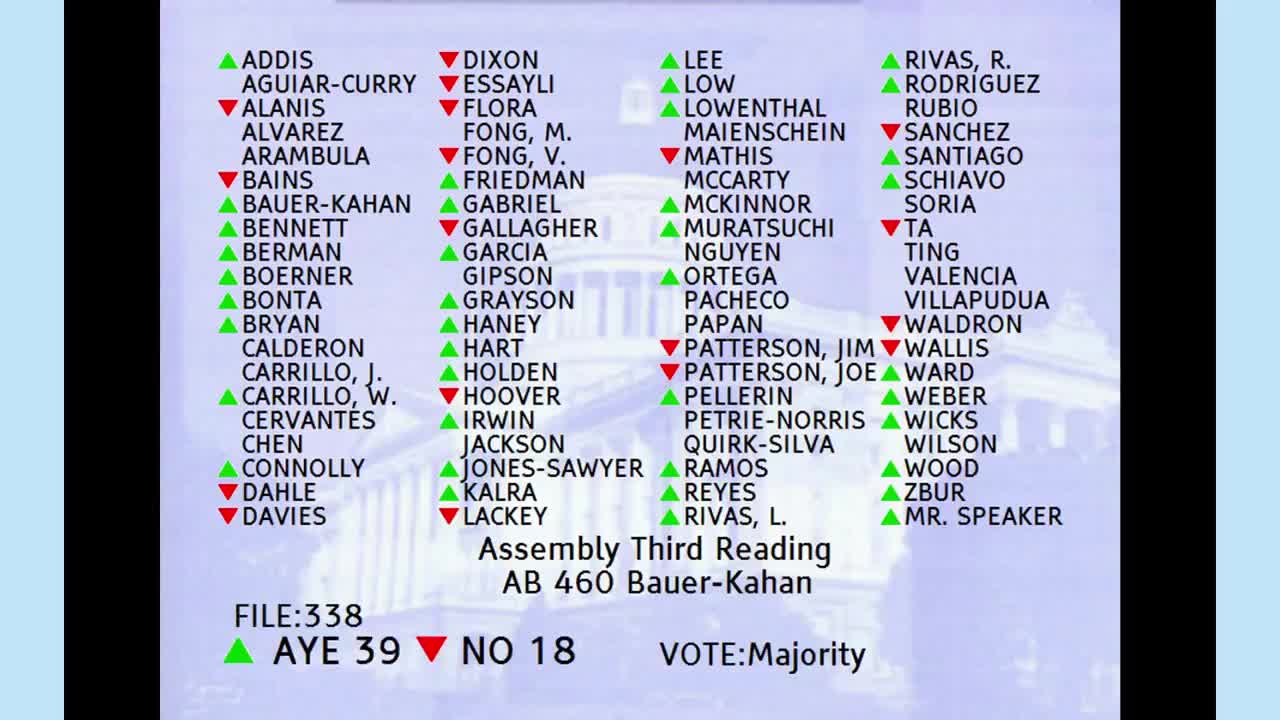 29MIN
Assembly Floor
 57MIN
Assembly Standing Committee on Water, Parks, and Wildlife
Bill Author

Bill Co-Author(s):