AB 452: Water Rights Fund: groundwater regulation.
- Session Year: 2015-2016
- House: Assembly
- Latest Version Date: 2015-04-21
Existing law, the Sustainable Groundwater Management Act, requires all groundwater basins designated as high- or medium-priority basins by the Department of Water Resources that are designated as basins subject to critical conditions of overdraft to be managed under a groundwater sustainability plan or coordinated groundwater sustainability plans by January 31, 2020, and requires all other groundwater basins designated as high- or medium-priority basins to be managed under a groundwater sustainability plan or coordinated groundwater sustainability plans by January 31, 2022, except as specified. Existing law establishes groundwater reporting requirements for a person extracting groundwater in an area within a basin that is not within the management area of a groundwater sustainability agency or that is a probationary basin. Existing law establishes the Water Rights Fund, which consists of various fees and penalties.
This bill would establish the Groundwater Regulation Subaccount in the Water Rights Fund and would provide that moneys in the subaccount are available, upon appropriation by the Legislature, to the State Water Resources Control Board for the purpose of board enforcement of the provisions of the act.
Existing law authorizes the board to issue a cease and desist order in response to a violation or threatened violation of any decision or order of the board under the act or any extraction restriction, limitation, order, or regulation adopted or issued by the board under the act. Under existing law, a person who violates a cease and desist order of the board may be civilly liable, as prescribed.
Existing law establishes groundwater reporting requirements for a person extracting groundwater in an area within a basin that is not within the management area of a groundwater sustainability agency or that is a probationary basin. Existing law requires each report of groundwater extraction to be accompanied by a specified fee. Existing law subjects a person to civil liability if that person fails to file, as required, a report of groundwater extraction, tampers with a required measuring device, or makes a material misstatement in connection with the filing of a report of groundwater extraction. Existing law provides that the making of any willful misstatement in connection with these groundwater reporting requirements is a misdemeanor punishable as prescribed.
This bill would provide for the funds received under the above-described provisions to be deposited into the subaccount. prohibit water rights fees from being available for expenditure by the board for the purposes of board enforcement of the provisions of the act and the groundwater reporting requirements.
Existing law, the Sustainable Groundwater Management Act, requires all groundwater basins designated as high- or medium-priority basins by the Department of Water Resources that are designated as basins subject to critical conditions of overdraft to be managed under a groundwater sustainability plan or coordinated groundwater sustainability plans by January 31, 2020, and requires all other groundwater basins designated as high- or medium-priority basins to be managed under a groundwater sustainability plan or coordinated groundwater sustainability plans by January 31, 2022, except as specified. Existing law establishes the Water Rights Fund, which consists of various fees and penalties.
This bill would establish the Groundwater Regulation Subaccount in the Water Rights Fund and would provide that moneys in the subaccount are available, upon appropriation by the Legislature, to the State Water Resources Control Board for the purpose of board enforcement of the provisions of the act.
Existing law authorizes the board to issue a cease and desist order in response to a violation or threatened violation of any decision or order of the board under the act or any extraction restriction, limitation, order, or regulation adopted or issued by the board under the act. Under existing law, a person who violates a cease and desist order of the board may be civilly liable, as prescribed.
Existing law establishes groundwater reporting requirements for a person extracting groundwater in an area within a basin that is not within the management area of a groundwater sustainability agency or that is a probationary basin. Existing law requires each report of groundwater extraction to be accompanied by a specified fee. Existing law subjects a person to civil liability if that person fails to file, as required, a report of groundwater extraction, tampers with a required measuring device, or makes a material misstatement in connection with the filing of a report of groundwater extraction. Existing law provides that the making of any willful misstatement in connection with these groundwater reporting requirements is a misdemeanor punishable as prescribed.
This bill would provide for the funds received under the above-described provisions to be deposited into the subaccount.
(a)The board shall adopt a schedule of fees pursuant to Section 1530 to recover costs incurred in administering Chapter 11 (commencing with Section 10735) of Part 2.74 of Division 6. Recoverable costs include, but are not limited to, costs incurred in connection with investigations, facilitation, monitoring, hearings, enforcement, and administrative costs in carrying out these actions.
(b)The fee schedule adopted under this section may include, but is not limited to, the following:
(1)A fee for participation as a petitioner or party to an adjudicative proceeding.
(2)A fee for the filing of a report pursuant to Part 5.2 (commencing with Section 5200) of Division 2.
(c)Consistent with Section 3 of Article XIII A of the California Constitution, the board shall set the fees under this section in an amount sufficient to cover all costs incurred and expended from the Groundwater Regulation Subaccount for the purposes of Part 5.2 (commencing with Section 5200) and Chapter 11 (commencing with Section 10735) of Part 2.74 of Division 6. In setting these fees, the board is not required to fully recover these costs in the year or the year immediately after the costs are incurred, but the board may provide for recovery of these costs over a period of years.
SEC. 2.SECTION 1.Section 1552 of the Water Code is amended to read:1552.(a)The money in the Water Rights Fund is available for expenditure, upon appropriation by the Legislature, for the following purposes:
(1)For expenditure by the State Board of Equalization in the administration of this chapter and the Fee Collection Procedures Law (Part 30 (commencing with Section 55001) of Division 2 of the Revenue and Taxation Code) in connection with any fee or expense subject to this chapter.
(2)For the payment of refunds, pursuant to Part 30 (commencing with Section 55001) of Division 2 of the Revenue and Taxation Code, of fees or expenses collected pursuant to this chapter.
(3)For expenditure by the board for the purposes of carrying out this division, Division 1 (commencing with Section 100), Part 2 (commencing with Section 10500) and Chapter 11 (commencing with Section 10735) of Part 2.74 of Division 6, and Article 7 (commencing with Section 13550) of Chapter 7 of Division 7.
(4)For expenditures by the board for the purposes of carrying out Sections 13160 and 13160.1 in connection with activities involving hydroelectric power projects subject to licensing by the Federal Energy Regulatory Commission.
(5)For expenditures by the board for the purposes of carrying out Sections 13140 and 13170 in connection with plans and policies that address the diversion or use of water.
(b)The money in the Water Rights Fund Water rights fees shall not be available for expenditure by the board for the purpose of purposes of Part 5.2 (commencing with Section 5200) and Chapter 11 (commencing with Section 10735) of Part 2.74 of Division 6.
SEC. 3.Section 1553 is added to the Water Code, to read:1553.(a)The Groundwater Regulation Subaccount is hereby established in the Water Rights Fund.
(b)All of the following shall be deposited in the Groundwater Regulation Subaccount:
(1)Funds recovered in response to a violation or threatened violation of any decision or order of the board issued under Chapter 11 (commencing with Section 10735) of Part 2.74 of Division 6 or any extraction restriction, limitation, order, or regulation adopted or issued under that chapter.
(2)Funds received pursuant to subdivision (f) of Section 5202.
(3)Funds recovered pursuant to Section 5208.
(c)The money in the Groundwater Regulation Subaccount shall be available to the board, upon appropriation by the Legislature, for the purpose of carrying out Chapter 11 (commencing with Section 10735) of Part 2.74 of Division 6.
(a)The board shall adopt a schedule of fees pursuant to Section 1530 to recover costs incurred in administering Chapter 11 (commencing with Section 10735) of Part 2.74 of Division 6. Recoverable costs include, but are not limited to, costs incurred in connection with investigations, facilitation, monitoring, hearings, enforcement, and administrative costs in carrying out these actions.
(b)The fee schedule adopted under this section may include, but is not limited to, the following:
(1)A fee for participation as a petitioner or party to an adjudicative proceeding.
(2)A fee for the filing of a report pursuant to Part 5.2 (commencing with Section 5200) of Division 2.
(c)Consistent with Section 3 of Article XIII A of the California Constitution, the board shall set the fees under this section in an amount sufficient to cover all costs incurred and expended from the Water Rights Fund Groundwater Regulation Subaccount for the purposes of Part 5.2 (commencing with Section 5200) and Chapter 11 (commencing with Section 10735) of Part 2.74 of Division 6. In setting these fees, the board is not required to fully recover these costs in the year or the year immediately after the costs are incurred, but the board may provide for recovery of these costs over a period of years.
SEC. 2.Section 1552 of the Water Code is amended to read:1552.(a)The money in the Water Rights Fund is available for expenditure, upon appropriation by the Legislature, for the following purposes:
(a)
(1)For expenditure by the State Board of Equalization in the administration of this chapter and the Fee Collection Procedures Law (Part 30 (commencing with Section 55001) of Division 2 of the Revenue and Taxation Code) in connection with any fee or expense subject to this chapter.
(b)
(2)For the payment of refunds, pursuant to Part 30 (commencing with Section 55001) of Division 2 of the Revenue and Taxation Code, of fees or expenses collected pursuant to this chapter.
(c)
(3)For expenditure by the board for the purposes of carrying out this division, Division 1 (commencing with Section 100), Part 2 (commencing with Section 10500) and Chapter 11 (commencing with Section 10735) of Part 2.74 of Division 6, and Article 7 (commencing with Section 13550) of Chapter 7 of Division 7.
(d)
(4)For expenditures by the board for the purposes of carrying out Sections 13160 and 13160.1 in connection with activities involving hydroelectric power projects subject to licensing by the Federal Energy Regulatory Commission.
(e)
(5)For expenditures by the board for the purposes of carrying out Sections 13140 and 13170 in connection with plans and policies that address the diversion or use of water.
(b)The money in the Water Rights Fund shall not be available for expenditure by the board for the purpose of Chapter 11 (commencing with Section 10735) of Part 2.74 of Division 6.
SEC. 3.Section 1553 is added to the Water Code, to read:1553.(a)The Groundwater Regulation Subaccount is hereby established in the Water Rights Fund.
(b)All of the following shall be deposited in the Groundwater Regulation Subaccount:
(1)Funds recovered in response to a violation or threatened violation of any decision or order of the board issued under Chapter 11 (commencing with Section 10735) of Part 2.74 of Division 6 or any extraction restriction, limitation, order, or regulation adopted or issued under that chapter.
(2)Funds received pursuant to subdivision (f) of Section 5202.
(3)Funds recovered pursuant to Section 5208.
(c)The money in the Groundwater Regulation Subaccount shall be available to the board, upon appropriation by the Legislature, for the purpose of carrying out Chapter 11 (commencing with Section 10735) of Part 2.74 of Division 6.
|
Date
|
Status
|
|---|---|
| Jan 5, 2016 | From committee: Without further action pursuant to Joint Rule 62(a). |
| Jan 4, 2016 | In committee: Set, final hearing. Hearing canceled at the request of author. |
| Apr 28, 2015 | In committee: Set, second hearing. Hearing canceled at the request of author. |
| Apr 22, 2015 | Re-referred to Com. on W., P., & W. |
| Apr 21, 2015 | From committee chair, with author's amendments: Amend, and re-refer to Com. on W., P., & W. Read second time and amended. |
| Apr 14, 2015 | In committee: Set, first hearing. Failed passage. Reconsideration granted. |
| Mar 5, 2015 | Referred to Com. on W., P., & W. |
| Feb 24, 2015 | From printer. May be heard in committee March 26. |
| Feb 23, 2015 | Read first time. To print. |
|
Date
|
Description
|
Location
|
Votes
|
|
|---|---|---|---|---|
| Apr 14, 2015 | Reconsideration. | Assembly Standing Committee on Water, Parks, and Wildlife |
Passed |
|
| Apr 14, 2015 | Do pass and be re-referred to the Committee on [Appropriations] | Assembly Standing Committee on Water, Parks, and Wildlife |
Failed |
This list shows positions taken on this bill by organizations on the date displayed, which is linked to the original source.
Positions by individuals are not included.
AB 452
Page 4
Date of Hearing: April 28, 2015
ASSEMBLY COMMITTEE ON WATER, PARKS, AND WILDLIFE
Marc Levine, Chair
AB 452
(Bigelow) – As Amended April 21, 2015
SUBJECT: Water rights fees: limitation
SUMMARY: Prohibits the State Water Resources Control Board (State Water Board) from using water rights fees collected under the water rights program to fund Sustainable Groundwater Management Act (SGMA) enforcement.
EXISTING LAW:
Requires State Water Board to adopt, by emergency regulations, an annual schedule of water rights fees and to adjust the fees annually to conform to the revenue levels set forth in the Budget Act.
Requires all water rights fee revenue be deposited in the Water Rights Fund.
Authorizes the State Water Board to assess water rights fees that include, but are not limited to, the issuance, review, monitoring, changes to, and enforcement of, appropriative permits, licenses, certificates, registrations, and water leases (Water Rights Program).
Authorizes the State Water Board to enforce, and collect fines for, illegal water diversions.
Requires the Department of Water Resources (DWR) to evaluate groundwater basins and designate them as high, medium, low or very low, according to various factors including, but not limited to, level of dependence upon the basin by municipal and agricultural users;
Requires that local agencies in high- and medium-priority groundwater basins subject to SGMA form one or more local Groundwater Sustainability Agencies (GSAs) by June 30, 2017 in order to develop and implement Groundwater Sustainability Plans (GSPs) that sustainably manage the groundwater basin or subbasin, as defined.
Requires that GSAs in basins with chronic overdraft develop and adopt GSPs for their basin or subbasin by January 31, 2020.
Requires that GSAs in all other high- and medium-priority basins subject to SGMA develop and adopt GSPs by January 31, 2022.
Delays enforcement for failure to a adopt a GSP in a high- or medium-priority basins that is in a condition where groundwater extractions result in significant depletions of interconnected surface waters until January 31, 2025.
Requires that adopted GSPs utilize a 50 year planning horizon that will achieve sustainability in a basin or subbasin within 20 years and include identified milestones at five year intervals.
Defines sustainable groundwater management in a GSP as avoiding undesirable results in the basin or subbasin from groundwater pumping such as significant and unreasonable: lowering of groundwater levels: reduction of groundwater storage; seawater intrusion; degraded water quality; land subsidence; and, depletions of interconnected surface waters.
Provides GSAs with optional tools for reaching sustainability including, but not limited to, the ability to conduct investigations, collect fees, limit pumping, require measurement and reporting of groundwater extractions, monitor compliance, charge civil penalties for violations, and implement plans and programs to recharge a basin or subbasin.
Authorizes the State Water Board to declare a basin in probationary status and adopt an interim plan for a basin, subbasin, or portion of a basin or subbasin, under three narrow circumstances:
There is no GSA for all or a portion of a basin or subbasin by June 30, 2017;
There is no GSP for all or a portion of a basin or subbasin by the relevant deadline; or,
A submitted GSP is deemed inadequate by DWR and there is also either:
Chronic overdraft in the basin or subbasin; or,
Groundwater pumping is causing a significant depletion of interconnected surface waters in the basin or subbasin.
Allows the State Water Board, in an area that has no GSA by June 30, 2017, to require direct reporting of groundwater extractions and to charge fees to administer that program.
Allows the State Water Board, when a basin is deemed probationary, to charge fees for interim management and fines for enforcement, including fines for material misstatements in reports of groundwater extraction or measurement.
FISCAL EFFECT: Unknown
COMMENTS: This bill prohibits the State Water Board from using Water Rights Program fees to fund SGMA enforcement actions.
Purpose: The author states that this bill is needed to confirm that money in the Water Rights Fund "will get used how it was originally intended to be used" and that "water rights fees should be separated from various other fees."
Consistency with Proposition 26: In 2010, the passage of Proposition 26, the so-called "Stop Hidden Taxes" initiative, amended the California Constitution with regard to state and local fees. The state provisions make any levy charge, or exaction, of any kind, a tax requiring the approval of a supermajority of the Legislature, with certain exceptions.
A primary exception is that a State fee is not considered a tax if it is equivalent to the "reasonable regulatory costs" to the State of issuing licenses and permits, performing investigations, inspections and audits, enforcing agricultural marketing orders or enforcing or adjudicating those activities. This bill is consistent with the Proposition 26 requirement that the water rights fees that the State Board collects must be tied to the reasonable regulatory costs of the State's water rights program.Water Rights Fund use is the subject of existing litigation: Since 2004, the State Water Board has been statutorily required to adopt emergency regulations revising and establishing water right fees to be deposited in the Water Rights Fund and revising fees for water quality certification. In addition to assessing annual fees and one-time filing fees, the State Water Board may pass through fees to federal water contractors who contract for water supply under a federally held water right (commonly referred to as the “pass-through fees”). The State Water Board must set a fee schedule that will generate revenues in the amount appropriated by the Legislature for expenditure from the Water Rights Fund for support of water right program activities. The State Water Board also must review and revise the fees each fiscal year as necessary to conform to these revenue levels. Each year since the State Water Board first adopted emergency water right fee regulations in 2003, it has been sued by agricultural and water-user interests. The litigation is still pending.
Supporting arguments: Supporters state that this bill would ensure that only moneys in the Groundwater Regulation Subaccount would be available for SGMA enforcement. Supporters add that this bill would prohibit moneys in the subaccount from being used to fund regulatory activities related to surface water rights. Supporters state that this bill ensures that revenues derived from fees on water rights permits and licenses are not comingled with fees or penalties imposed pursuant to SGMA because the "former are imposed for and benefit the administration of surface water rights, while the latter are related to groundwater management." Supporters state they want to keep surface water and groundwater separated as "two programmatic areas of responsibilities."
Opposing arguments: Opponents state the success of SGMA depends on the ability of the State Water Board to act to ensure sustainable groundwater management when a local entity fails to do so. Opponents point out that restricting the State Water Board's abilities to use money existing in the Water Rights Fund for SGMA enforcement continues to impose the mistaken distinction between surface water and groundwater that has persisted in California law for centuries.
Prior and Related Legislation: SGMA went into effect on January 1, 2014. The Act and its related provisions were the result of almost a year of intense stakeholder negotiations culminating in the drafting of the three interlocking bills that formed SGMA: SB 1168 (Pavley), Chapter 346, Statutes of 2014; AB 1739 (Dickenson), Chapter 347, Statutes of 2014; and SB 1319 (Pavley), Chapter 348, Statutes of 2014.
This bill is one of 13 bills proposing changes to SGMA and its related statutes this session. The other bills are:
AB 453 (Bigelow) allows groundwater management plans adopted prior to SGMA to be amended and extended.
AB 454 (Bigelow) adds one year to the deadline to form a GSA or adopt a GSP.
AB 455 (Bigelow) requires the Judicial Council to come up with a 270-day process for completing all California Environmental Quality Act (CEQA) legal challenges to SGMA projects.
AB 617 (Perea) adds mutual water companies to GSAs.
AB 938 (Salas) makes minor technical changes to SGMA.
AB 939 (Salas) changes the time period for providing technical data upon which a fee is based from 10 days to 20 days before the meeting to adopt the fee.
AB 1242 (Gray) prohibits the State Water Board from setting in-stream flows standards unless the Board mitigates for the potential local response of increased groundwater use.
AB 1243 (Gray) rebates 50% of all SGMA enforcement penalties back to local governments and water districts for groundwater recharge projects.
AB 1390 (Alejo) creates a streamlined process for groundwater adjudications and exempting them from SGMA, except minimal reporting requirements.
SB 13 (Pavley) makes noncontroversial technical cleanup changes to SGMA.
SB 226 (Pavley) adds a streamlined groundwater adjudication section to SGMA.
SB 487 (Nielsen) exempts SGMA projects from CEQA.
Suggested Committee amendments: The author has taken amendments to narrow the scope of the original bill but the term "water rights fees" may need to be defined in order to prevent later confusion.
REGISTERED SUPPORT / OPPOSITION:
Support
Association of California Water Agencies
Rural County Representatives of California
Valley Ag Water Coalition
Opposition
Center for Biological Diversity
Clean Water Action
Community Water Center
Leadership Council for Justice and Accountability
Natural Resources Defense Council
Sierra Club California
Analysis Prepared by: Tina Cannon Leahy / W., P., & W. / (916) 319-2096
AB 452
Page 5
Date of Hearing: April 14, 2015
ASSEMBLY COMMITTEE ON WATER, PARKS, AND WILDLIFE
Marc Levine, Chair
AB 452
(Bigelow) – As Introduced February 23, 2015
SUBJECT: Sustainable Groundwater Management Act: enforcement
SUMMARY: Limits funding the State Water Resources Control Board (State Water Board) can use to implement and enforce the Sustainable Groundwater Management Act (SGMA). Specifically, this bill:
Revokes authority for the State Water Board to use Water Rights Fund monies to carry out SGMA and expressly prohibits using Water Rights Fund monies for SGMA enforcement;
Creates a Groundwater Regulation Subaccount in the Water Rights Fund;
Directs the State Water Board to deposit into the Groundwater Regulation Subaccount amounts it recovers from:
SGMA enforcement violations;
Fees accompanying direct reports of extractions by persons subject to SGMA but with no local Groundwater Sustainability Agency; and,
Fines collected for making a false report or willful misstatement in a report of groundwater pumping or measurement.
Authorizes the State Water Board to use fees available in the Groundwater Regulation Subaccount, upon appropriation by the Legislature, for SGMA enforcement activities.
EXISTING LAW:
Requires State Water Board to adopt, by emergency regulations, an annual schedule of water rights fees and to adjust the fees annually to conform to the revenue levels set forth in the Budget Act.
Requires all water rights fee revenue be deposited in the Water Rights Fund.
Authorizes the State Water Board to assess water rights fees that include, but are not limited to, the issuance, review, monitoring, changes to, and enforcement of, appropriative permits, licenses, certificates, registrations, and water leases.
Authorizes the State Water Board to enforce, and collect fines for, illegal water diversions.
Requires the Department of Water Resources (DWR) to evaluate groundwater basins and designate them as high, medium, low or very low, according to various factors including, but not limited to, level of dependence upon the basin by municipal and agricultural users;
Requires that local agencies in high- and medium-priority groundwater basins subject to SGMA form one or more local Groundwater Sustainability Agencies (GSAs) by June 30, 2017 in order to develop and implement Groundwater Sustainability Plans (GSPs) that sustainably manage the groundwater basin or subbasin, as defined.
Requires that GSAs in basins with chronic overdraft develop and adopt GSPs for their basin or subbasin by January 31, 2020.
Requires that GSAs in all other high- and medium-priority basins subject to SGMA develop and adopt GSPs by January 31, 2022.
Delays enforcement for failure to a adopt a GSP in a high- or medium-priority basins that is in a condition where groundwater extractions result in significant depletions of interconnected surface waters until January 31, 2025.
Requires that adopted GSPs utilize a 50 year planning horizon that will achieve sustainability in a basin or subbasin within 20 years and include identified milestones at five year intervals.
Defines sustainable groundwater management in a GSP as avoiding undesirable results in the basin or subbasin from groundwater pumping such as significant and unreasonable: lowering of groundwater levels: reduction of groundwater storage; seawater intrusion; degraded water quality; land subsidence; and, depletions of interconnected surface waters.
Provides GSAs with optional tools for reaching sustainability including, but not limited to, the ability to conduct investigations, collect fees, limit pumping, require measurement and reporting of groundwater extractions, monitor compliance, charge civil penalties for violations, and implement plans and programs to recharge a basin or subbasin.
Authorizes the State Water Board to declare a basin in probationary status and adopt an interim plan for a basin, subbasin, or portion of a basin or subbasin, under three narrow circumstances:
There is no GSA for all or a portion of a basin or subbasin by June 30, 2017;
There is no GSP for all or a portion of a basin or subbasin by the relevant deadline; or,
A submitted GSP is deemed inadequate by DWR and there is also either:
Chronic overdraft in the basin or subbasin; or,
Groundwater pumping is causing a significant depletion of interconnected surface waters in the basin or subbasin.
Allows the State Water Board, in an area that has no GSA by June 30, 2017, to require direct reporting of groundwater extractions and to charge fees to administer that program.
Allows the State Water Board, when a basin is deemed probationary, to charge fees for interim management and fines for enforcement, including fines for material misstatements in reports of groundwater extraction or measurement.
FISCAL EFFECT: Unknown
COMMENTS: This bill would limit the State Water Board's ability to use Water Rights Fund monies to initiate SGMA enforcement actions. This bill requires that only fees collected from SGMA enforcement actions can be used to fund other SGMA enforcement actions.
The author states that this bill is needed to confirm that money in the Water Rights Fund "will get used how it was originally intended to be used" and that "water rights fees and penalties should be separated from various other fees." However, the California Constitution already limits the use of water rights fees to administration of the water rights program. Penalties were excluded from that requirement because they are not meant to benefit the lawbreakers from whom they are collected.
Existing Water Rights Fund limitations
In 2010, the passage of Proposition 26, the so-called "Stop Hidden Taxes" initiative, amended California Constitution with regard to state and local fees. The state provisions make any levy charge, or exaction, of any kind, a tax requiring the approval of a supermajority of the Legislature, with certain exceptions.
A primary exception is that a State fee is not considered a tax if it is equivalent to the "reasonable regulatory costs" to the State of issuing licenses and permits, performing investigations, inspections and audits, enforcing agricultural marketing orders or enforcing or adjudicating those activities. This means that Proposition 26 already requires the water rights fees that the State Board collects to be tied to the reasonable regulatory costs of the State's water rights program.
Fines, penalties, or other monetary charges imposed by the State or the Courts for violations of law were made expressly exempt under Prop. 26. That makes sense as fines are meant to be punitive. They are not required to benefit the class of violators.
Water Rights Fund use is the subject of existing litigation
Since 2004, the State Water Board has been statutorily required to adopt emergency regulations
revising
and establishing water right fees to be deposited in the Water Rights
Fund and revising fees for water quality certification. In addition
to assessing annual fees and one-time filing fees, the State Water
Board may pass through fees to federal water contractors who contract
for water supply under a federally held water right (commonly
referred to as the “pass-through fees”). The State Water Board
must set a fee schedule that will generate revenues in the amount
appropriated by the Legislature for expenditure from the Water Rights
Fund for support of water right program activities. The State Water
Board also must review and revise the fees each fiscal year as
necessary to conform to these revenue levels. Each year since the
State Water Board first adopted emergency water right fee regulations
in 2003, it has been sued by agricultural and water-user interests.
The litigation is still pending.
Supporting arguments. Supporters state that this bill would ensure that only moneys in the Groundwater Regulation Subaccount would be available for SGMA enforcement. Supporters add that this bill would prohibit moneys in the subaccount from being used to fund regulatory activities related to surface water rights. Supporters state that this bill ensures that revenues derived from fees on water rights permits and licenses are not comingled with fees or penalties imposed pursuant to SGMA because the "former are imposed for and benefit the administration of surface water rights, while the latter are related to groundwater management." Supporters state they want to keep surface water and groundwater separated as "two programmatic areas of responsibilities."
Opposing arguments. Opponents state that this bill limits the State Water Board's ability to administer and enforce local groundwater plans by narrowing its ability to collect fees to recover costs. Opponents state the success of SGMA depends on the ability of the State Water Board to act to ensure sustainable groundwater management when a local entity fails to do so. Opponents point out that restricting the State Water Board's abilities to use money existing in the Water Rights Fund for SGMA enforcement continues to impose the mistaken distinction between surface water and groundwater that has persisted in California law for centuries. Those opponents maintain the State Water Board should have the discretion to apply all water right violation funds for water rights management, wherever the need exists.
Related Legislation
This is one of 14 bills in the Legislature proposing changes to SGMA and its related statutes. The other bills are: AB 453 (Bigelow) allowing groundwater management plans adopted prior to SGMA to be amended and extended; AB 454 (Bigelow) adding one year to the deadline to form a GSA or adopt a GSP; AB 455 (Bigelow) requiring the Judicial Council to come up with a 270-day process for completing all California Environmental Quality Act (CEQA) legal challenges to SGMA projects; AB 617 (Perea) adding mutual water companies to GSAs; AB 938 (Salas) making minor technical changes to SGMA; AB 939 (Salas) changing the time period for providing technical data upon which a fee is based from 10 days to 20 days before the meeting to adopt the fee; AB 1242 (Gray) prohibiting the State Water Board from setting in-stream flows standards unless the Board mitigates for the potential local response of increased groundwater use; AB 1243 (Gray) rebating 50% of all SGMA enforcement penalties back to local governments and water districts for groundwater recharge projects; AB 1390 (Alejo) creating a streamlined process for groundwater adjudications and exempting them from SGMA, except minimal reporting requirements; AB 1531 (Environmental Safety and Toxic Materials Committee) making minor technical changes to SGMA; SB 13 (Pavley) making noncontroversial technical cleanup changes to SGMA; SB 226 (Pavley) adding a streamlined groundwater adjudication section to SGMA; and SB 487 (Nielsen) exempting SGMA projects from CEQA.
REGISTERED SUPPORT / OPPOSITION:
Support
Association of California Water Agencies
Rural County Representatives of California
Valley Ag Water Coalition
Opposition
Center for Biological Diversity
Clean Water Action
Community Water Center
Leadership Council for Justice and Accountability
Natural Resources Defense Council
Sierra Club California
Analysis Prepared by: Tina Cannon Leahy / W., P., & W. / (916) 319-2096
Discussed in Hearing
 7MIN
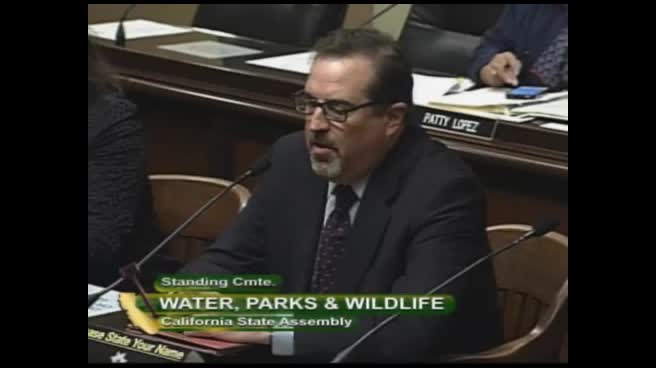
Assembly Standing Committee on Water, Parks, and Wildlife
Bill Author

Bill Co-Author(s):