AB 454: Sustainable groundwater management.
- Session Year: 2015-2016
- House: Assembly
- Latest Version Date: 2015-02-23
Existing law, the Sustainable Groundwater Management Act, requires all groundwater basins designated as high- or medium-priority basins by the Department of Water Resources that are designated as basins subject to critical conditions of overdraft to be managed under a groundwater sustainability plan or coordinated groundwater sustainability plans by January 31, 2020, and requires all other groundwater basins designated as high- or medium-priority basins to be managed under a groundwater sustainability plan or coordinated groundwater sustainability plans by January 31, 2022, except as specified.
This bill would require a high- or medium-priority basin that is not subject to critical conditions of overdraft to be managed under a groundwater sustainability plan or coordinated groundwater sustainability plan by January 31, 2023.
The act authorizes the state board to designate a high- or medium- priority basin that is not subject to critical conditions of overdraft as a probationary basin after January 31, 2025, if the determination is made that the plan is either inadequate or not being implemented in a manner that will likely achieve the sustainability goal and the basin is in a condition where groundwater extractions result in significant depletions of interconnected surface water.
This bill would change that date to January 31, 2026.
The act authorizes the state board to designate a basin as a probationary basin if after June 30, 2017, there is not a groundwater sustainability agency or coordinated groundwater sustainability agencies for an entire high- or medium- priority basin, and no local agency has submitted an alternative.
This bill would change that date to June 30, 2018.
(a)This section applies to a person who does either of the following:
(1)Extracts groundwater from a probationary basin 90 days or more after the board designates the basin as a probationary basin pursuant to Section 10735.2.
(2)Extracts groundwater on or after July 1, 2017, 2018, in an area within a basin that is not within the management area of a groundwater sustainability agency and where the county does not assume responsibility to be the groundwater sustainability agency, as provided in subdivision (b) of Section 10724.
(b)Except as provided in subdivision (c), a person subject to this section shall file a report of groundwater extraction by December 15 of each year for extractions made in the preceding water year.
(c)Unless reporting is required pursuant to paragraph (2) of subdivision (c) of Section 10735.2, this section does not apply to any of the following:
(1)An extraction by a de minimis extractor.
(2)An extraction excluded from reporting pursuant to paragraph (1) of subdivision (c) of Section 10735.2.
(3)An extraction reported pursuant to Part 5 (commencing with Section 4999).
(4)An extraction that is included in annual reports filed with a court or the board by a watermaster appointed by a court or pursuant to statute to administer a final judgment determining rights to water. The reports shall identify the persons who have extracted water and give the general place of use and the quantity of water that has been extracted from each source.
(d)Except as provided in Section 5209, the report shall be filed with the board.
(e)The report may be filed by the person extracting water or on that persons behalf by an agency that person designates and that maintains a record of the water extracted.
(f)Each report shall be accompanied by the fee imposed pursuant to Section 1529.5.
SEC. 2.Section 10720.7 of the Water Code is amended to read:10720.7.(a)(1)By January 31, 2020, all basins designated as high- or medium-priority basins by the department that have been designated in Bulletin 118, as may be updated or revised on or before January 1, 2017, as basins that are subject to critical conditions of overdraft shall be managed under a groundwater sustainability plan or coordinated groundwater sustainability plans pursuant to this part.
(2)By January 31, 2022, 2023, all basins designated as high- or medium-priority basins by the department that are not subject to paragraph (1) shall be managed under a groundwater sustainability plan or coordinated groundwater sustainability plans pursuant to this part.
(b)The Legislature encourages and authorizes basins designated as low- and very low priority basins by the department to be managed under groundwater sustainability plans pursuant to this part. Chapter 11 (commencing with Section 10735) does not apply to a basin designated as a low- or very low priority basin.
SEC. 3.Section 10724 of the Water Code is amended to read:10724.(a)In the event that there is an area within a basin that is not within the management area of a groundwater sustainability agency, the county within which that unmanaged area lies will be presumed to be the groundwater sustainability agency for that area.
(b)A county described in subdivision (a) shall provide notification to the department pursuant to Section 10723.8 unless the county notifies the department that it will not be the groundwater sustainability agency for the area. Extractions of groundwater made on or after July 1, 2017, 2018, in that area shall be subject to reporting in accordance with Part 5.2 (commencing with Section 5200) of Division 2 if the county does either of the following:
(1)Notifies the department that it will not be the groundwater sustainability agency for an area.
(2)Fails to provide notification to the department pursuant to Section 10723.8 for an area on or before June 30, 2017. 2018.
SEC. 4.Section 10735.2 of the Water Code is amended to read:10735.2.(a)The board, after notice and a public hearing, may designate a basin as a probationary basin, if the board finds one or more of the following applies to the basin:
(1)After June 30, 2017, 2018, none of the following have occurred:
(A) A local agency has elected to be a groundwater sustainability agency that intends to develop a groundwater sustainability plan for the entire basin.
(B) A collection of local agencies has formed a groundwater sustainability agency or prepared agreements to develop one or more groundwater sustainability plans that will collectively serve as a groundwater sustainability plan for the entire basin.
(C) A local agency has submitted an alternative that has been approved or is pending approval pursuant to Section 10733.6. If the department disapproves an alternative pursuant to Section 10733.6, the board shall not act under this paragraph until at least 180 days after the department disapproved the alternative.
(2) The basin is subject to paragraph (1) of subdivision (a) of Section 10720.7, and after January 31, 2020, none of the following have occurred:
(A) A groundwater sustainability agency has adopted a groundwater sustainability plan for the entire basin.
(B) A collection of local agencies has adopted groundwater sustainability plans that collectively serve as a groundwater sustainability plan for the entire basin.
(C)The department has approved an alternative pursuant to Section 10733.6.
(3)The basin is subject to paragraph (1) of subdivision (a) of Section 10720.7 and after January 31, 2020, the department, in consultation with the board, determines that a groundwater sustainability plan is inadequate or that the groundwater sustainability program is not being implemented in a manner that will likely achieve the sustainability goal.
(4)The basin is subject to paragraph (2) of subdivision (a) of Section 10720.7, and after January 31, 2022, 2023, none of the following have occurred:
(A)A groundwater sustainability agency has adopted a groundwater sustainability plan for the entire basin.
(B)A collection of local agencies has adopted groundwater sustainability plans that collectively serve as a groundwater sustainability plan for the entire basin.
(C)The department has approved an alternative pursuant to Section 10733.6.
(5)The basin is subject to paragraph (2) of subdivision (a) of Section 10720.7, and either of the following have occurred:
(A)After January 31, 2022, 2023, both of the following have occurred:
(i)The department, in consultation with the board, determines that a groundwater sustainability plan is inadequate or that the groundwater sustainability plan is not being implemented in a manner that will likely achieve the sustainability goal.
(ii)The board determines that the basin is in a condition of long-term overdraft.
(B)After January 31, 2025, 2026, both of the following have occurred:
(i)The department, in consultation with the board, determines that a groundwater sustainability plan is inadequate or that the groundwater sustainability plan is not being implemented in a manner that will likely achieve the sustainability goal.
(ii)The board determines that the basin is in a condition where groundwater extractions result in significant depletions of interconnected surface waters.
(b)In making the findings associated with paragraph (3) or (5) of subdivision (a), the department and board may rely on periodic assessments the department has prepared pursuant to Chapter 10 (commencing with Section 10733). The board may request that the department conduct additional assessments utilizing the regulations developed pursuant to Chapter 10 (commencing with Section 10733) and make determinations pursuant to this section. The board shall post on its Internet Web site and provide at least 30 days for the public to comment on any determinations provided by the department pursuant to this subdivision.
(c)(1) The determination may exclude a class or category of extractions from the requirement for reporting pursuant to Part 5.2 (commencing with Section 5200) of Division 2 if those extractions are subject to a local plan or program that adequately manages groundwater within the portion of the basin to which that plan or program applies, or if those extractions are likely to have a minimal impact on basin withdrawals.
(2)The determination may require reporting of a class or category of extractions that would otherwise be exempt from reporting pursuant to paragraph (1) of subdivision (c) of Section 5202 if those extractions are likely to have a substantial impact on basin withdrawals or requiring reporting of those extractions is reasonably necessary to obtain information for purposes of this chapter.
(3)The determination may establish requirements for information required to be included in reports of groundwater extraction, for installation of measuring devices, or for use of a methodology, measuring device, or both, pursuant to Part 5.2 (commencing with Section 5200) of Division 2.
(4)The determination may modify the water year or reporting date for a report of groundwater extraction pursuant to Section 5202.
(d)If the board finds that litigation challenging the formation of a groundwater sustainability agency prevented its formation before July 1, 2017, 2018, pursuant to paragraph (1) of subdivision (a) or prevented a groundwater sustainability program from being implemented in a manner likely to achieve the sustainability goal pursuant to paragraph (3), (4), or (5) of subdivision (a), the board shall not designate a basin as a probationary basin for a period of time equal to the delay caused by the litigation.
(e)The board shall exclude from probationary status any portion of a basin for which a groundwater sustainability agency demonstrates compliance with the sustainability goal.
|
Date
|
Status
|
|---|---|
| Feb 1, 2016 | From committee: Filed with the Chief Clerk pursuant to Joint Rule 56. |
| Jan 31, 2016 | Died pursuant to Article IV, Sec. 10(c) of the Constitution. |
| Apr 14, 2015 | From committee: Do pass and re-refer to Com. on APPR. (Ayes 8. Noes 7.) (April 14). Re-referred to Com. on APPR. |
| Mar 5, 2015 | Referred to Com. on W., P., & W. |
| Feb 24, 2015 | From printer. May be heard in committee March 26. |
| Feb 23, 2015 | Read first time. To print. |
|
Date
|
Description
|
Location
|
Votes
|
|
|---|---|---|---|---|
| Apr 14, 2015 | Do pass and be re-referred to the Committee on [Appropriations] | Assembly Standing Committee on Water, Parks, and Wildlife |
Passed |
This list shows positions taken on this bill by organizations on the date displayed, which is linked to the original source.
Positions by individuals are not included.
AB 454
Page 4
Date of Hearing: April 14, 2015
ASSEMBLY COMMITTEE ON WATER, PARKS, AND WILDLIFE
Marc Levine, Chair
AB 454
(Bigelow) – As Introduced February 23, 2015
SUBJECT: Sustainable Groundwater Management Act
SUMMARY: Adds one year to each of the deadlines for forming a management agency under the Sustainable Groundwater Management Act (SGMA) and adopting a plan. Specifically, this bill:
Changes the compliance date for forming a Groundwater Sustainability Agency (GSA) from June 30, 2017 to June 30, 2018;
Changes the compliance deadline for adopting a Groundwater Sustainability Plan (GSP) from January 31, 2022 to January 31, 20123 for high- and medium-priority groundwater basins that is neither:
In a critical condition of overdraft; or,
In a condition where groundwater extractions result in significant depletions of interconnected surface waters.
Changes the compliance deadline for adopting a GSP from January 31, 2025 to January 31, 2026 for high- and medium- priority groundwater basins that are in a condition where groundwater extractions result in significant depletions of interconnected surface waters.
EXISTING LAW:
Requires the Department of Water Resources (DWR) to evaluate groundwater basins and designate them as high, medium, low or very low, according to various factors including, but not limited to, level of dependence upon the basin by municipal and agricultural users;
Requires that local agencies in high- and medium-priority groundwater basins subject to SGMA form one or more local Groundwater Sustainability Agencies (GSAs) by June 30, 2017 in order to develop and implement Groundwater Sustainability Plans (GSPs) that provide for the sustainable management of the groundwater basin or subbasin, as defined.
Requires that GSAs in basins with chronic overdraft develop and adopt GSPs for their basin or subbasin by January 31, 2020.
Requires that GSAs in all other high- and medium-priority basins subject to SGMA develop and adopt GSPs by January 31, 2022.
Delays enforcement for failure to a adopt a GSP in a high- or medium-priority basins that is in a condition where groundwater extractions result in significant depletions of interconnected surface waters until January 31, 2025.
Requires that adopted GSPs utilize a 50 year planning horizon that will achieve sustainability in a basin or subbasin within 20 years and include identified milestones at five year intervals.
Defines sustainable groundwater management in a GSP as avoiding undesirable results in the basin or subbasin from groundwater pumping such as significant and unreasonable: lowering of groundwater levels: reduction of groundwater storage; seawater intrusion; degraded water quality; land subsidence; and, depletions of interconnected surface waters.
Provides GSAs with optional tools for reaching sustainability including, but not limited to, the ability to conduct investigations, collect fees, limit pumping, require measurement and reporting of groundwater extractions, monitor compliance, charge civil penalties for violations, and implement plans and programs to recharge a basin or subbasin.
Authorizes the State Water Board to declare a basin in probationary status and adopt an interim plan for a basin, subbasin, or portion of a basin or subbasin, under three narrow circumstances:
There is no GSA for all or a portion of a basin or subbasin by June 30, 2017;
There is no GSP for all or a portion of a basin or subbasin by the relevant deadline; or,
A submitted GSP is deemed inadequate by DWR and there is also either:
Chronic overdraft in the basin or subbasin; or,
Groundwater pumping is causing a significant depletion of interconnected surface waters in the basin or subbasin.
Allows the State Water Board, in an area that has no GSA by June 30, 2017, to require direct reporting of groundwater extractions and to charge fees to administer that program.
FISCAL EFFECT: Unknown
COMMENTS: This bill would delay multiple SGMA deadlines, require DWR, the State Water Board, and others that are helping to implement SGMA to re-write and redistribute guidance materials.
SGMA took effect four months ago and the short time lines in the Act are reflective of the crisis facing many of the State's groundwater basins. California is more dependent on groundwater than any other state in the United States. Groundwater makes up 40% of the overall water supply in an average year but during drought many water users drill new wells or increase pumping from existing wells. That can push the State's reliance on groundwater to more than 60% of the overall water supply.
SGMA was adopted in 2014 when California was in its third year of drought. It is now in the fourth year of drought causing the Governor to issue Executive Order B-29-15 on April 1, 2015, proclaiming a State of Emergency throughout the State due to limited rainfall, record low snowpack in the Sierra Nevada Mountains, decreased water levels in reservoirs, reduced flows in the State's rivers, and "shrinking supplies in underground water basins."
The Executive Order seeks to accelerate actions that can help address the crisis including immediately requiring local agencies in high- and medium-priority basins to begin monitoring groundwater levels in compliance with DWR's California Statewide Groundwater Elevation Monitoring program, if they are not doing so already. If those agencies fail, DWR is to report them to the State Water Board for potential enforcement action.
Supporting arguments. The author states that this bill is "needed to allow locals a little bit more time to determine and organize their groundwater sustainability plans, as the current time line is unrealistic for many locals throughout California."
Opposing arguments. Opponents state that SGMA deadlines were negotiated among many parties only a few months ago. Opponents add that they are not aware of any changed circumstances that would necessitate building in additional delays and are of the opinion that the original timelines in SGMA are "overly generous."
Related Legislation
This is one of 14 bills in the Legislature proposing changes to SGMA and its related statutes. The other bills are: AB 452 (Bigelow) prohibiting the State Water Board from using Water Rights Fund monies for SGMA enforcement, except funds collected from SGMA enforcement; AB 453 (Bigelow) allowing groundwater management plans adopted prior to SGMA to be amended and extended; AB 455 (Bigelow) requiring the Judicial Council to come up with a 270-day process for completing all California Environmental Quality Act (CEQA) legal challenges to SGMA projects; AB 617 (Perea) adding mutual water companies to GSAs; AB 938 (Salas) making minor technical changes to SGMA; AB 939 (Salas) changing the time period for providing technical data upon which a fee is based from 10 days to 20 days before the meeting to adopt the fee; AB 1242 (Gray) prohibiting the State Water Board from setting in-stream flows standards unless the Board mitigates for the potential local response of increased groundwater use; AB 1243 (Gray) rebating 50% of all SGMA enforcement penalties back to local governments and water districts for groundwater recharge projects; AB 1390 (Alejo) creating a streamlined process for groundwater adjudications and exempting them from SGMA, except minimal reporting requirements; AB 1531 (Environmental Safety and Toxic Materials Committee) making minor technical changes to SGMA; SB 13 (Pavley) making noncontroversial technical cleanup changes to SGMA; SB 226 (Pavley) adding a streamlined groundwater adjudication section to SGMA; and SB 487 (Nielsen) exempting SGMA projects from CEQA.
REGISTERED SUPPORT / OPPOSITION:
Support
None on file
Opposition
Center for Biological Diversity
Clean Water Action
Community Water Center
Leadership Counsel for Justice & Accountability
Natural Resources Defense Council
Sierra Club of California
Analysis Prepared by: Tina Cannon Leahy / W., P., & W. / (916) 319-2096
Discussed in Hearing
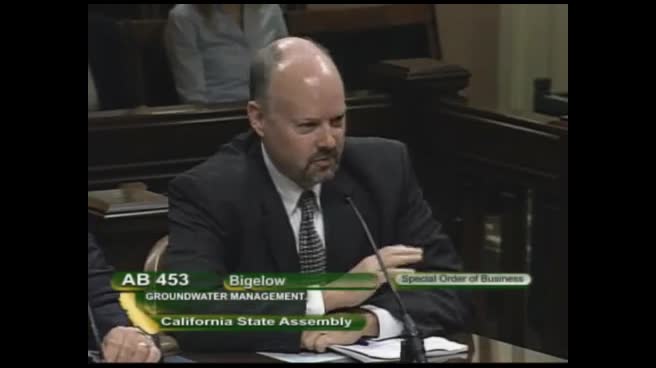 4MIN
Assembly Standing Committee on Water, Parks, and Wildlife
Bill Author

Bill Co-Author(s):