AB 1423: Product safety: PFAS: artificial turf or synthetic surfaces.
- Session Year: 2023-2024
- House: Assembly
- Latest Version Date: 2023-09-14
Current Status:
Failed
(2024-01-29: Consideration of Governor's veto stricken from file.)
Introduced
In Committee
First Chamber
In Committee
Second Chamber
Enacted
Existing law, beginning January 1, 2025, prohibits the manufacture, sale, delivery, hold, or offer for sale in commerce of any cosmetic product that contains any intentionally added perfluoroalkyl and polyfluoroalkyl substances (PFAS), as defined. Existing law similarly prohibits, commencing January 1, 2025, a person from manufacturing, distributing, selling, or offering for sale in the state any new, not previously used, textile articles that contain regulated PFAS, except as specified, and requires a manufacturer to use the least toxic alternative when removing regulated PFAS in textile articles to comply with these provisions.
This bill would prohibit, except as provided and commencing January 1, 2026, a public entity, including a charter city, charter county, city, or county, any public or private school serving pupils in kindergarten or any of grades 1 to 12, inclusive, a public institution of higher education, other than the University of California, or a private institution of higher education from purchasing or installing a covered surface containing regulated PFAS, as defined.
Commencing January 1, 2026, the bill would prohibit a person or entity from manufacturing, distributing, selling, or offering for sale in the state any covered surface that contains regulated PFAS. The bill would provide that a violation of this prohibition is punishable by a specified civil penalty, upon an action brought by the Attorney General, a city attorney, a county counsel, or a district attorney. The bill would require a manufacturer of a covered surface to use the least toxic alternative when replacing regulated PFAS in a covered surface in accordance with these provisions.
The hazardous waste control laws require the Department of Toxic Substances Control to regulate the handling and management of hazardous materials and hazardous waste. Existing law, known as the Green Chemistry Program, requires the department to adopt regulations to establish a process to identify and prioritize chemicals or chemical ingredients in consumer products that may be considered as being chemicals of concern. Existing law provides that the Green Chemistry Program does not authorize the department to supersede the regulatory authority of any other department or agency or duplicate or adopt conflicting regulations for product categories already regulated or subject to pending regulation, as provided. The departments Safer Consumer Products Program implements the Green Chemistry Program pursuant to regulations adopted by the department known as the Safer Consumer Products Regulations.
This bill would provide that if the Department of Toxic Substances Control adopts regulations pursuant to these provisions, as provided, that conflict with the above-described prohibitions concerning regulated PFAS, enforcement mechanisms, or requirements to replace regulated PFAS with the least toxic alternative, then those regulations adopted by the department shall prevail.
The bill would include findings that changes proposed by this bill address a matter of statewide concern rather than a municipal affair and, therefore, apply to all cities, including charter cities.
Existing law, beginning January 1, 2025, prohibits the manufacture, sale, delivery, hold, or offer for sale in commerce of any cosmetic product that contains any intentionally added perfluoroalkyl and polyfluoroalkyl substances (PFAS), as defined. Existing law similarly prohibits, commencing January 1, 2025, a person from manufacturing, distributing, selling, or offering for sale in the state any new, not previously used, textile articles that contain regulated PFAS, except as specified, and requires a manufacturer to use the least toxic alternative when removing regulated PFAS in textile articles to comply with these provisions.
This bill would, commencing January 1, 2024, require a manufacturer or installer of a covered surface, defined as artificial turf or a synthetic surface that resembles grass, proposing to design or install a field with a covered surface for, or sell a field with a covered surface to, any party to notify the party at the earliest possible date if the covered surface contains regulated PFAS, as defined, of that fact. The bill would also prohibit, except as provided and commencing January 1, 2024, 2026, a public entity, including a charter city, charter county, city, or county, any public or private school serving pupils in kindergarten or any of grades 1 to 12, inclusive, a public institution of higher education, other than the University of California, or a private institution of higher education from purchasing or installing a covered surface containing regulated PFAS, as provided. defined.
Commencing January 1, 2026, the bill would prohibit a person or entity from manufacturing, distributing, selling, or offering for sale in the state any covered surface that contains regulated PFAS. The bill would provide that a violation of this prohibition is punishable by a specified civil penalty, upon an action brought by the Attorney General, a city attorney, a county counsel, or a district attorney. The bill would require a manufacturer of a covered surface to use the least toxic alternative when replacing regulated PFAS in a covered surface in accordance with these provisions.
The hazardous waste control laws require the Department of Toxic Substances Control to regulate the handling and management of hazardous materials and hazardous waste. Existing law, known as the Green Chemistry Program, requires the department to adopt regulations to establish a process to identify and prioritize chemicals or chemical ingredients in consumer products that may be considered as being chemicals of concern. Existing law provides that the Green Chemistry Program does not authorize the department to supersede the regulatory authority of any other department or agency or duplicate or adopt conflicting regulations for product categories already regulated or subject to pending regulation, as provided. The departments Safer Consumer Products Program implements the Green Chemistry Program pursuant to regulations adopted by the department known as the Safer Consumer Products regulations.
This bill would provide that if the Department of Toxic Substances Control adopts regulations pursuant to these provisions, as provided, that conflict with the above-described prohibitions concerning regulated PFAS, enforcement mechanisms, or requirements to replace regulated PFAS with the least toxic alternative, then those regulations adopted by the department shall prevail.
The bill would include findings that changes proposed by this bill address a matter of statewide concern rather than a municipal affair and, therefore, apply to all cities, including charter cities.
Existing law, beginning January 1, 2025, prohibits the manufacture, sale, delivery, hold, or offer for sale in commerce of any cosmetic product that contains any intentionally added perfluoroalkyl and polyfluoroalkyl substances (PFAS), as defined. Existing law similarly prohibits, commencing January 1, 2025, a person from manufacturing, distributing, selling, or offering for sale in the state any new, not previously used, textile articles that contain regulated PFAS, except as specified, and requires a manufacturer to use the least toxic alternative when removing regulated PFAS in textile articles to comply with these provisions.
This bill would, commencing January 1, 2024, require a manufacturer or installer of a covered surface, defined as artificial turf or a synthetic surface that resembles grass, proposing to design or install a field with a covered surface for, or sell a field with a covered surface to, any party to notify the party at the earliest possible date if the covered surface contains regulated PFAS, as defined, of that fact. The bill would also prohibit, commencing January 1, 2024, a public entity, including a charter city, charter county, city, or county, any public or private school serving pupils in kindergarten or any of grades 1 to 12, inclusive, a public institution of higher education, other than the University of California, or a private institution of higher education from purchasing or installing a covered surface containing regulated PFAS, as provided.
Commencing January 1, 2025, 2026, the bill would prohibit a person or entity from manufacturing, distributing, selling, or offering for sale in the state any covered surface that contains regulated PFAS. The bill would provide that a violation of this prohibition is punishable by a specified civil penalty, upon an action brought by the Attorney General, a city attorney, a county counsel, or a district attorney. The bill would require a manufacturer of a covered surface to use the least toxic alternative when replacing regulated PFAS in a covered surface in accordance with these provisions.
The hazardous waste control laws require the Department of Toxic Substances Control to regulate the handling and management of hazardous materials and hazardous waste. Existing law, known as the Green Chemistry Program, requires the department to adopt regulations to establish a process to identify and prioritize chemicals or chemical ingredients in consumer products that may be considered as being chemicals of concern. Existing law provides that the Green Chemistry Program does not authorize the department to supersede the regulatory authority of any other department or agency or duplicate or adopt conflicting regulations for product categories already regulated or subject to pending regulation, as provided. The departments Safer Consumer Products Program implements the Green Chemistry Program pursuant to regulations adopted by the department known as the Safer Consumer Products regulations.
This bill would provide that if the Department of Toxic Substances Control adopts regulations pursuant to these provisions, as provided, that conflict with the above-described prohibitions concerning regulated PFAS, enforcement mechanisms, or requirements to replace regulated PFAS with the least toxic alternative, then those regulations adopted by the department shall prevail.
The bill would include findings that changes proposed by this bill address a matter of statewide concern rather than a municipal affair and, therefore, apply to all cities, including charter cities.
Existing law, beginning January 1, 2025, prohibits the manufacture, sale, delivery, hold, or offer for sale in commerce of any cosmetic product that contains any intentionally added perfluoroalkyl and polyfluoroalkyl substances (PFAS), as defined. Existing law similarly prohibits, commencing January 1, 2025, a person from manufacturing, distributing, selling, or offering for sale in the state any new, not previously used, textile articles that contain regulated PFAS, except as specified, and requires a manufacturer to use the least toxic alternative when removing regulated PFAS in textile articles to comply with these provisions.
This bill would, commencing January 1, 2024, require a manufacturer or installer of a covered surface, defined as artificial turf or a synthetic surface that resembles grass, proposing to design, sell, design or install a field with a covered surface to for, or sell a field with a covered surface to, any party to notify the party at the earliest possible date that if the covered surface contains regulated PFAS, as defined. defined, of that fact. The bill would also prohibit, commencing January 1, 2024, a public entity, including a charter city, charter county, city, or county, any public or private school serving pupils in kindergarten or any of grades 1 to 12, inclusive, a public institution of higher education, other than the University of California, or a private institution of higher education from purchasing or installing a covered surface containing regulated PFAS, as provided.
Commencing January 1, 2025, the bill would prohibit a person or entity from manufacturing, distributing, selling, or offering for sale in the state any covered surface that contains regulated PFAS. The bill would provide that a violation of this prohibition is punishable by a specified civil penalty, upon an action brought by the Attorney General, a city attorney, a county counsel, or a district attorney. The bill would require a manufacturer of a covered surface to use the least toxic alternative when replacing regulated PFAS in a covered surface in accordance with these provisions.
The hazardous waste control laws require the Department of Toxic Substances Control to regulate the handling and management of hazardous materials and hazardous waste. Existing law, known as the Green Chemistry Program, requires the department to adopt regulations to establish a process to identify and prioritize chemicals or chemical ingredients in consumer products that may be considered as being chemicals of concern. Existing law provides that the Green Chemistry Program does not authorize the department to supersede the regulatory authority of any other department or agency or duplicate or adopt conflicting regulations for product categories already regulated or subject to pending regulation, as provided. The departments Safer Consumer Products Program implements the Green Chemistry Program pursuant to regulations adopted by the department known as the Safer Consumer Products regulations.
This bill would provide that if the Department of Toxic Substances Control adopts regulations pursuant to these provisions, as provided, that conflict with the above-described prohibitions concerning regulated PFAS, enforcement mechanisms, or requirements to replace regulated PFAS with the least toxic alternative, then those regulations adopted by the department shall prevail.
The bill would include findings that changes proposed by this bill address a matter of statewide concern rather than a municipal affair and, therefore, apply to all cities, including charter cities.
Existing law, beginning January 1, 2025, prohibits the manufacture, sale, delivery, hold, or offer for sale in commerce of any cosmetic product that contains any intentionally added perfluoroalkyl and polyfluoroalkyl substances (PFAS), as defined. Existing law similarly prohibits, commencing January 1, 2025, a person from manufacturing, distributing, selling, or offering for sale in the state any new, not previously used, textile articles that contain regulated PFAS, except as specified, and requires a manufacturer to use the least toxic alternative when removing regulated PFAS in textile articles to comply with these provisions.
This bill would, commencing January 1, 2024, require a manufacturer or installer of a covered surface, defined as artificial turf or a synthetic surface that resembles grass, proposing to design, sell, or install a field with a covered surface to any party to notify the party at the earliest possible date that the covered surface contains regulated PFAS, as defined. The bill would also prohibit, commencing January 1, 2024, a public entity, including a charter city, charter county, city, or county, any public or private school serving pupils in kindergarten or any of grades 1 to 12, inclusive, a public institution of higher education, other than the University of California, or a private institution of higher education from purchasing or installing a covered surface containing regulated PFAS, as provided. Commencing
Commencing January 1, 2025, the bill would prohibit a person or entity from manufacturing, distributing, selling, or offering for sale in the state any covered surface that contains regulated PFAS. The bill would provide that a violation of this prohibition is punishable by a specified civil penalty, upon an action brought by the Attorney General, a city attorney, a county counsel, or a district attorney. The bill would require a manufacturer of a covered surface to use the least toxic alternative when replacing regulated PFAS in a covered surface in accordance with these provisions.
The bill would include findings that changes proposed by this bill address a matter of statewide concern rather than a municipal affair and, therefore, apply to all cities, including charter cities.
Existing law, beginning January 1, 2025, prohibits the manufacture, sale, delivery, hold, or offer for sale in commerce of any cosmetic product that contains any intentionally added perfluoroalkyl and polyfluoroalkyl substances (PFAS), as defined. Existing law similarly prohibits, commencing January 1, 2025, a person from manufacturing, distributing, selling, or offering for sale in the state any new, not previously used, textile articles that contain regulated PFAS, except as specified, and requires a manufacturer to use the least toxic alternative when removing regulated PFAS in textile articles to comply with these provisions.
This bill would, commencing July January 1, 2024, require a manufacturer or installer of a covered surface, defined as artificial turf or a synthetic surface that resembles grass, to indicate whether or not the covered surface contains added PFAS, as provided, on the product packaging or label of the covered surface and to not advertise a covered surface containing regulated PFAS, as defined, as otherwise, if it contains regulated PFAS. Commencing July 1, 2024, the bill would require a manufacturer or installer of a covered surface proposing to design, sell, or install a field with a covered surface to any party to notify the party at the initial stages of negotiations or planning of a contract earliest possible date that the covered surface contains regulated PFAS. PFAS, as defined. The bill would also prohibit, commencing January 1, 2025, 2024, a state entity or public entity, including a charter city, charter county, city, or county, any public or private school serving pupils in kindergarten or any of grades 1 to 12, inclusive, a public institution of higher education, other than the University of California, or a private institution of higher education from purchasing or installing a covered surface containing regulated PFAS, as provided. Commencing January 1, 2025, the bill would prohibit a person or entity from manufacturing, distributing, selling, or offering for sale in the state any covered surface that contains regulated PFAS. The bill would require a manufacturer of a covered surface to use the least toxic alternative when replacing regulated PFAS chemicals in a covered surface in accordance with these provisions.
The bill would include findings that changes proposed by this bill address a matter of statewide concern rather than a municipal affair and, therefore, apply to all cities, including charter cities.
Existing law, beginning January 1, 2025, prohibits the manufacture, sale, delivery, hold, or offer for sale in commerce of any cosmetic product that contains any intentionally added perfluoroalkyl and polyfluoroalkyl substances (PFAS). (PFAS), as defined. Existing law similarly prohibits, commencing January 1, 2025, a person from manufacturing, distributing, selling, or offering for sale in the state any new, not previously used, textile articles that contain regulated PFAS, except as specified, and requires a manufacturer to use the least toxic alternative when removing regulated PFAS in textile articles to comply with these provisions.
This bill would, commencing July 1, 2024, require a manufacturer of a covered surface, defined as artificial turf or a synthetic surface that resembles grass, to indicate whether or not the covered surface contains added PFAS, as provided, on the product packaging or label of the covered surface and to not advertise a covered surface containing regulated PFAS, as defined, as otherwise, if it contains regulated PFAS. Commencing July 1, 2024, the bill would require a manufacturer or installer of a covered surface proposing to design, sell, or install a field with a covered surface to any party to notify the party at the initial stages of negotiations or planning of a contract that the covered surface contains regulated PFAS. The bill would also prohibit, commencing January 1, 2025, a state entity or any public or private school serving pupils in kindergarten or any of grades 1 to 12, inclusive, from purchasing or installing a covered surface containing regulated PFAS, as provided. The bill would require a manufacturer of a covered surface to use the least toxic alternative when replacing PFAS chemicals in a covered surface in accordance with these provisions.
This bill would express the intent of the Legislature to enact subsequent legislation that would require notification of PFAS in specified products.Existing law, beginning January 1, 2025, prohibits the manufacture, sale, delivery, hold, or offer for sale in commerce of any cosmetic product that contains any intentionally added perfluoroalkyl and polyfluoroalkyl substances (PFAS).
This bill would express the intent of the Legislature to enact subsequent legislation that would require notification of PFAS in specified products.
The Legislature finds and declares all of the following:
(a)Perfluoroalkyl and polyfluoroalkyl substances, a class of chemicals known as PFAS, are highly toxic and highly persistent in the environment.
(b)PFAS have been linked by scientific, peer-reviewed research to severe health problems, including kidney and liver damage, developmental harm, and immune system disruption.
(c)PFAS is routinely used in the production and manufacturing of artificial turf and is emitted as part of the dust as the fields age and degrade due to use and exposure to the elements.
(d)Children are uniquely at risk to exposure to PFAS playing on artificial turf or synthetic grass as their height leads them to more readily inhale, ingest, and come in dermal contact with dust emitted from the fields. Adults are also exposed to PFAS when playing on these fields.
SEC. 2.Chapter 12.6 (commencing with Section 108948) is added to Part 3 of Division 104 of the Health and Safety Code, to read:12.6.Artificial Fields108948.For purposes of this chapter, the following definitions apply:
(a)Covered surface means artificial turf or a synthetic surface that resembles grass.
(b)Perfluoroalkyl and polyfluoroalkyl substances or PFAS means a class of fluorinated organic chemicals containing at least one fully fluorinated carbon atom.
(c)Regulated PFAS includes either of the following:
(1)PFAS that a manufacturer has intentionally added to a product and that has a functional or technical effect in the product.
(2)The presence of PFAS in a product or product component at or above 20 parts per million, as measured in total organic fluorine. Presence shall be based upon testing after the manufacturing process but before installation.
108948.1.(a)(1)Commencing January 1, 2026, a covered surface containing regulated PFAS shall not be purchased or installed by any of the following entities:
(A)A public entity, including a charter city, charter county, city, or county.
(B)A public or private school serving pupils in kindergarten or any of grades 1 to 12, inclusive.
(C)A public or private institution of higher education, except as provided in paragraph (2).
(2)Commencing January 1, 2026, the University of California is requested to comply with the prohibition described in paragraph (1).
(b)Paragraph (1) of subdivision (a) shall not apply to those entities listed in subparagraphs (A) to (C), inclusive, of paragraph (1) of subdivision (a) who have, on or before December 31, 2025, approved the concept design of, contracted for the installation of, or purchased a covered surface that contains regulated PFAS.
108948.2.(a)Commencing January 1, 2026, no person or entity shall manufacture, distribute, sell, or offer for sale in the state any covered surface that contains regulated PFAS.
(b)(1)Upon an action brought by the Attorney General, a city attorney, a county counsel, or a district attorney, a person or entity that violates subdivision (a) shall be liable for a civil penalty not to exceed five thousand dollars ($5,000) for a first violation, and not to exceed ten thousand dollars ($10,000) for each subsequent violation.
(2)(A)If the Department of Toxic Substances Control adopts regulations, pursuant to the Green Chemistry Program (Article 14 (commencing with Section 25251) of Chapter 6.5 of Division 20) or any other authority, that conflict with the authority in paragraph (1), the Attorney General, a city attorney, a county counsel, or a district attorney shall no longer be authorized to bring any action pursuant to paragraph (1).
(B)The Attorney General, a city attorney, a county counsel, or a district attorney may resolve any action brought prior to the adoption of the regulations described in subparagraph (A).
(c)Except as provided in paragraph (2) of subdivision (b), this section does not impair or impede any other rights, causes of action, claims, or defenses available under any other law and the remedies provided in this section are cumulative with any other remedies available under any other law.
108948.3.(a)A manufacturer of a covered surface shall use the least toxic alternative when replacing regulated PFAS in a covered surface in accordance with this chapter.
(b)Notwithstanding subdivision (a), if a manufacturer of a covered surface or other responsible entity completes an alternatives analysis for the use of regulated PFAS in a covered surface, pursuant to the authority granted in the Green Chemistry Program (Article 14 (commencing with Section 25251) of Chapter 6.5 of Division 20) and related regulations, or any other state law, the conclusions in that alternatives analysis that comply with the Green Chemistry Program (Article 14 (commencing with Section 25251) of Chapter 6.5 of Division 20) and related regulations, or any other state law, as applicable, shall govern the choice of alternatives used by the manufacturer in place of PFAS in a covered surface.
108948.4.(a)If the Department of Toxic Substances Control adopts a regulatory response described in the Safer Consumer Products Program (Chapter 55 (commencing with Section 69501) of Division 4.5 of Title 22 of the California Code of Regulations) governing activity prohibited by Section 108948.1 or 108948.2, the prohibitions of Section 108948.1 or 108948.2 shall not apply upon the date that the department posts a notice on its internet website that it has adopted the regulatory response.
(b)Notwithstanding subdivisions (b) and (c) of Section 25257.1, this chapter shall not be construed to prohibit or restrict the authority of the Department of Toxic Substances Control to prioritize or take action on any products containing PFAS in order to limit exposure to or reduce the level of hazard posed by PFAS.
SEC. 3.The Legislature finds and declares that the potential public health harm due to the presence of PFAS in any public park or public space in California is a matter of statewide concern and is not a municipal affair as that term is used in Section 5 of Article XI of the California Constitution. Therefore, Section 2 of this act adding Section 108948.1 of the Health and Safety Code applies to all cities, including charter cities.
The Legislature finds and declares all of the following:
(a)Perfluoroalkyl and polyfluoroalkyl substances, a class of chemicals known as PFAS, are highly toxic and highly persistent in the environment.
(b)PFAS have been linked by scientific, peer-reviewed research to severe health problems, including kidney and liver damage, developmental harm, and immune system disruption.
(c)PFAS is routinely used in the production and manufacturing of artificial turf and is emitted as part of the dust as the fields age and degrade due to use and exposure to the elements.
(d)Children are uniquely at risk to exposure to PFAS playing on artificial turf or synthetic grass as their height leads them to more readily inhale, ingest, and come in dermal contact with dust emitted from the fields. Adults are also exposed to PFAS when playing on these fields.
SEC. 2.Chapter 12.6 (commencing with Section 108948) is added to Part 3 of Division 104 of the Health and Safety Code, to read:12.6.Artificial Fields108948.For purposes of this chapter, the following definitions apply:
(a)Covered surface means artificial turf or a synthetic surface that resembles grass.
(b)Perfluoroalkyl and polyfluoroalkyl substances or PFAS means a class of fluorinated organic chemicals containing at least one fully fluorinated carbon atom.
(c)Regulated PFAS includes either of the following:
(1)PFAS that a manufacturer has intentionally added to a product and that has a functional or technical effect in the product.
(2)The presence of PFAS in a product or product component at or above 20 parts per million, as measured in total organic fluorine. Presence shall be based upon testing after the manufacturing process but before installation.
108948.1.(a)Commencing January 1, 2024, a manufacturer or installer of a covered surface proposing to design or install a field with a covered surface for, or sell a field with a covered surface to, any party shall notify the party at the earliest possible date that the covered surface contains regulated PFAS if the covered surface contains regulated PFAS.(b)108948.1.(a)(1)Commencing January 1, 2024, 2026, a covered surface containing regulated PFAS shall not be purchased or installed by any of the following entities:
(A)A public entity, including a charter city, charter county, city, or county.
(B)A public or private school serving pupils in kindergarten or any of grades 1 to 12, inclusive.
(C)A public or private institution of higher education, except as provided in paragraph (2).
(2)Commencing January 1, 2024, 2026, the University of California is requested to comply with the prohibition described in paragraph (1).
(3)(b)Paragraph (1) of subdivision (a) shall not apply to those entities listed in subparagraphs (A) to (C), inclusive, of paragraph (1) of subdivision (a) who have concluded have, on or before December 31, 2025, approved the concept design and permitting of a covered surface, of, contracted for the installation of a covered surface, of, or purchased a covered surface on or before December 31, 2023. that contains regulated PFAS.
108948.2.(a)Commencing January 1, 2026, no person or entity shall manufacture, distribute, sell, or offer for sale in the state any covered surface that contains regulated PFAS.
(b)(1)Upon an action brought by the Attorney General, a city attorney, a county counsel, or a district attorney, a person or entity that violates subdivision (a) shall be liable for a civil penalty not to exceed five thousand dollars ($5,000) for a first violation, and not to exceed ten thousand dollars ($10,000) for each subsequent violation.
(2)(A)If the Department of Toxic Substances Control adopts regulations, pursuant to the Green Chemistry Program (Article 14 (commencing with Section 25251) of Chapter 6.5 of Division 20) or any other authority, that conflict with the authority in paragraph (1), the Attorney General, a city attorney, a county counsel, or a district attorney shall no longer be authorized to bring any action pursuant to paragraph (1).
(B)The Attorney General, a city attorney, a county counsel, or a district attorney may resolve any action brought prior to the adoption of the regulations described in subparagraph (A).
(c)Except as provided in paragraph (2) of subdivision (b), this section does not impair or impede any other rights, causes of action, claims, or defenses available under any other law and the remedies provided in this section are cumulative with any other remedies available under any other law.
108948.3.(a)A manufacturer of a covered surface shall use the least toxic alternative when replacing regulated PFAS in a covered surface in accordance with this chapter.
(b)Notwithstanding subdivision (a), if a manufacturer of a covered surface or other responsible entity completes an alternatives analysis for the use of regulated PFAS in a covered surface, pursuant to the authority granted in the Green Chemistry Program (Article 14 (commencing with Section 25251) of Chapter 6.5 of Division 20) and related regulations, or any other state law, the conclusions in that alternatives analysis that comply with the Green Chemistry Program (Article 14 (commencing with Section 25251) of Chapter 6.5 of Division 20) and related regulations, or any other state law, as applicable, shall govern the choice of alternatives used by the manufacturer in place of PFAS in a covered surface.
108948.4.(a)If the Department of Toxic Substances Control adopts a regulatory response described in the Safer Consumer Products Program (Chapter 55 (commencing with Section 69501) of Division 4.5 of Title 22 of the California Code of Regulations) governing activity prohibited by Section 108948.1 or 108948.2, the prohibitions of Section 108948.1 or 108948.2 shall not apply upon the date that the department posts a notice on its internet website that it has adopted the regulatory response.
(b)Notwithstanding subdivisions (b) and (c) of Section 25257.1, this chapter shall not be construed to prohibit or restrict the authority of the Department of Toxic Substances Control to prioritize or take action on any products containing PFAS in order to limit exposure to or reduce the level of hazard posed by PFAS.
SEC. 3.The Legislature finds and declares that the potential public health harm due to the presence of PFAS in any public park or public space in California is a matter of statewide concern and is not a municipal affair as that term is used in Section 5 of Article XI of the California Constitution. Therefore, Section 2 of this act adding Section 108948.1 of the Health and Safety Code applies to all cities, including charter cities.
The Legislature finds and declares all of the following:
(a)Perfluoroalkyl and polyfluoroalkyl substances, a class of chemicals known as PFAS, are highly toxic and highly persistent in the environment.
(b)PFAS have been linked by scientific, peer-reviewed research to severe health problems, including kidney and liver damage, developmental harm, and immune system disruption.
(c)PFAS is routinely used in the production and manufacturing of artificial turf and is emitted as part of the dust as the fields age and degrade due to use and exposure to the elements.
(d)Children are uniquely at risk to exposure to PFAS playing on artificial turf or synthetic grass as their height leads them to more readily inhale, ingest, and come in dermal contact with dust emitted from the fields. Adults are also exposed to PFAS when playing on these fields.
SEC. 2.Chapter 12.6 (commencing with Section 108948) is added to Part 3 of Division 104 of the Health and Safety Code, to read:12.6.Artificial Fields108948.For purposes of this chapter, the following definitions apply:
(a)Covered surface means artificial turf or a synthetic surface that resembles grass.
(b)Perfluoroalkyl and polyfluoroalkyl substances or PFAS means a class of fluorinated organic chemicals containing at least one fully fluorinated carbon atom.
(c)Regulated PFAS includes either of the following:
(1)PFAS that a manufacturer has intentionally added to a product and that has a functional or technical effect in the product.
(2)The presence of PFAS in a product or product component at or above one part 20 parts per million, as measured in total organic fluorine. Presence shall be based upon testing after the manufacturing process but before installation.
108948.1.(a)Commencing January 1, 2024, a manufacturer or installer of a covered surface proposing to design or install a field with a covered surface for, or sell a field with a covered surface to, any party shall notify the party at the earliest possible date that the covered surface contains regulated PFAS if the covered surface contains regulated PFAS.
(b)(1)Commencing January 1, 2024, a covered surface containing regulated PFAS shall not be purchased or installed by any of the following entities:
(A)A public entity, including a charter city, charter county, city, or county.
(B)A public or private school serving pupils in kindergarten or any of grades 1 to 12, inclusive.
(C)A public or private institution of higher education, except as provided in paragraph (2).
(2)Commencing January 1, 2024, the University of California is requested to comply with the prohibition described in paragraph (1).
(3)Paragraph (1) shall not apply to those entities listed in subparagraphs (A) to (C), inclusive, of paragraph (1) who have concluded the design and permitting of a covered surface, contracted for the installation of a covered surface, or purchased a covered surface on or before December 31, 2023.
108948.2.(a)Commencing January 1, 2025, 2026, no person or entity shall manufacture, distribute, sell, or offer for sale in the state any covered surface that contains regulated PFAS.
(b)(1)Upon an action brought by the Attorney General, a city attorney, a county counsel, or a district attorney, a person or entity that violates subdivision (a) shall be liable for a civil penalty not to exceed five thousand dollars ($5,000) for a first violation, and not to exceed ten thousand dollars ($10,000) for each subsequent violation.
(2)(A)If the Department of Toxic Substances Control adopts regulations, pursuant to the Green Chemistry Program (Article 14 (commencing with Section 25251) of Chapter 6.5 of Division 20) or any other authority, that conflict with the authority in paragraph (1), the Attorney General, a city attorney, a county counsel, or a district attorney shall no longer be authorized to bring any action pursuant to paragraph (1).
(B)The Attorney General, a city attorney, a county counsel, or a district attorney may resolve any action brought prior to the adoption of the regulations described in subparagraph (A).
(c)Except as provided in paragraph (2) of subdivision (b), this section does not impair or impede any other rights, causes of action, claims, or defenses available under any other law and the remedies provided in this section are cumulative with any other remedies available under any other law.
108948.3.(a)A manufacturer of a covered surface shall use the least toxic alternative when replacing regulated PFAS in a covered surface in accordance with this chapter.
(b)Notwithstanding subdivision (a), if the Department of Toxic Substances Control conducts a manufacturer of a covered surface or other responsible entity completes an alternatives analysis for the use of regulated PFAS in a covered surface, pursuant to the authority granted in the Green Chemistry Program (Article 14 (commencing with Section 25251) of Chapter 6.5 of Division 20) and related regulations, or any other authority, state law, the findings and guidelines conclusions in that alternatives analysis that comply with the Green Chemistry Program (Article 14 (commencing with Section 25251) of Chapter 6.5 of Division 20) and related regulations, or any other state law, as applicable, shall govern the choice of alternatives used by manufacturers the manufacturer in place of PFAS in a covered surface.
108948.4.(a)If the Department of Toxic Substances Control adopts a regulatory response described in the Safer Consumer Products Program (Chapter 55 (commencing with Section 69501) of Division 4.5 of Title 22 of the California Code of Regulations) governing activity prohibited by Section 108948.1 or 108948.2, the prohibitions of Section 108948.1 or 108948.2 shall not apply upon the date that the department posts a notice on its internet website that it has adopted the regulatory response.
(b)Notwithstanding subdivisions (b) and (c) of Section 25257.1, this chapter shall not be construed to prohibit or restrict the authority of the Department of Toxic Substances Control to prioritize or take action on any products containing PFAS in order to limit exposure to or reduce the level of hazard posed by PFAS.
SEC. 3.The Legislature finds and declares that the potential public health harm due to the presence of PFAS in any public park or public space in California is a matter of statewide concern and is not a municipal affair as that term is used in Section 5 of Article XI of the California Constitution. Therefore, Section 2 of this act adding Section 108948.1 of the Health and Safety Code applies to all cities, including charter cities.
The Legislature finds and declares all of the following:
(a)Perfluoroalkyl and polyfluoroalkyl substances, a class of chemicals known as PFAS, are highly toxic and highly persistent in the environment.
(b)PFAS have been linked by scientific, peer-reviewed research to severe health problems, including kidney and liver damage, developmental harm, and immune system disruption.
(c)PFAS is routinely used in the production and manufacturing of artificial turf and is emitted as part of the dust as the fields age and degrade due to use and exposure to the elements.
(d)Children are uniquely at risk to exposure to PFAS playing on artificial turf or synthetic grass as their height leads them to more readily inhale, ingest, and come in dermal contact with dust emitted from the fields. Adults are also exposed to PFAS when playing on these fields.
SEC. 2.Chapter 12.6 (commencing with Section 108948) is added to Part 3 of Division 104 of the Health and Safety Code, to read:12.6.Artificial Fields108948.For purposes of this chapter, the following definitions apply:
(a)Covered surface means artificial turf or a synthetic surface that resembles grass.
(b)Perfluoroalkyl and polyfluoroalkyl substances or PFAS means a class of fluorinated organic chemicals containing at least one fully fluorinated carbon atom.
(c)Regulated PFAS includes either of the following:
(1)PFAS that a manufacturer has intentionally added to a product and that has a functional or technical effect in the product.
(2)The presence of PFAS in a product or product component at or above one part per million, as measured in total organic fluorine.
108948.1.(a)Commencing January 1, 2024, a manufacturer or installer of a covered surface proposing to design, sell, design or install a field with a covered surface for, or install sell a field with a covered surface to to, any party shall notify the party at the earliest possible date that the covered surface contains regulated PFAS. PFAS if the covered surface contains regulated PFAS.
(a)(b)(1)Commencing January 1, 2024, a covered surface containing regulated PFAS shall not be purchased or installed by any of the following entities:
(A)A public entity, including a charter city, charter county, city, or county.
(B)A public or private school serving pupils in kindergarten or any of grades 1 to 12, inclusive.
(C)A public or private institution of higher education, except as provided in paragraph (2).
(2)Commencing January 1, 2024, the University of California is requested to comply with the prohibition described in paragraph (1).
(3)Paragraph (1) shall not apply to those entities listed in subparagraphs (A) to (C), inclusive, of paragraph (1) who have concluded the design and permitting of a covered surface, contracted for the installation of a covered surface, or purchased a covered surface on or before December 31, 2023.
108948.2.(a)Commencing January 1, 2025, no person or entity shall manufacture, distribute, sell, or offer for sale in the state any covered surface that contains regulated PFAS.
(b)(1)Upon an action brought by the Attorney General, a city attorney, a county counsel, or a district attorney, a person or entity that violates subdivision (a) shall be liable for a civil penalty not to exceed five thousand dollars ($5,000) for a first violation, and not to exceed ten thousand dollars ($10,000) for each subsequent violation.
(2)(A)If the Department of Toxic Substances Control adopts regulations, pursuant to the Green Chemistry Program (Article 14 (commencing with Section 25251) of Chapter 6.5 of Division 20) or any other authority, that conflict with the authority in paragraph (1), the Attorney General, a city attorney, a county counsel, or a district attorney shall no longer be authorized to bring any action pursuant to paragraph (1).
(B)The Attorney General, a city attorney, a county counsel, or a district attorney may resolve any action brought prior to the adoption of the regulations described in subparagraph (A).
(c)This Except as provided in paragraph (2) of subdivision (b), this section does not impair or impede any other rights, causes of action, claims, or defenses available under any other law. The law and the remedies provided in this section are cumulative with any other remedies available under any other law.
108948.3.(a)A manufacturer of a covered surface shall use the least toxic alternative when replacing regulated PFAS in a covered surface in accordance with this chapter.
(b)Notwithstanding subdivision (a), if the Department of Toxic Substances Control conducts an alternatives analysis for the use of regulated PFAS in a covered surface, pursuant to the authority granted in the Green Chemistry Program (Article 14 (commencing with Section 25251) of Chapter 6.5 of Division 20) and related regulations, or any other authority, the findings and guidelines in that alternatives analysis shall govern the choice of alternatives used by manufacturers in place of PFAS in a covered surface.
108948.4.(a)If the Department of Toxic Substances Control adopts a regulatory response described in the Safer Consumer Products Program (Chapter 55 (commencing with Section 69501) of Division 4.5 of Title 22 of the California Code of Regulations) governing activity prohibited by Section 108948.1 or 108948.2, the prohibitions of Section 108948.1 or 108948.2 shall not apply upon the date that the department posts a notice on its internet website that it has adopted the regulatory response.
(b)Notwithstanding subdivisions (b) and (c) of Section 25257.1, this chapter shall not be construed to prohibit or restrict the authority of the Department of Toxic Substances Control to prioritize or take action on any products containing PFAS in order to limit exposure to or reduce the level of hazard posed by PFAS.
SEC. 3.The Legislature finds and declares that the potential public health harm due to the presence of PFAS in any public park or public space in California is a matter of statewide concern and is not a municipal affair as that term is used in Section 5 of Article XI of the California Constitution. Therefore, Section 2 of this act adding Section 108948.1 of the Health and Safety Code applies to all cities, including charter cities.
The Legislature finds and declares all of the following:
(a)Perfluoroalkyl and polyfluoroalkyl substances, a class of chemicals known as PFAS, are highly toxic and highly persistent in the environment.
(b)PFAS have been linked by scientific, peer-reviewed research to severe health problems, including kidney and liver damage, developmental harm, and immune system disruption.
(c)PFAS is routinely used in the production and manufacturing of artificial turf and is emitted as part of the dust as the fields age and degrade due to use and exposure to the elements.
(d)Children are uniquely at risk to exposure to PFAS playing on artificial turf or synthetic grass as their height leads them to more readily inhale, ingest, and come in dermal contact with dust emitted from the fields. Adults are also exposed to PFAS when playing on these fields.
SEC. 2.Chapter 12.6 (commencing with Section 108948) is added to Part 3 of Division 104 of the Health and Safety Code, to read:12.6.Artificial Fields108948.For purposes of this chapter, the following definitions apply:
(a)Covered surface means artificial turf or a synthetic surface that resembles grass.
(b)Perfluoroalkyl and polyfluoroalkyl substances or PFAS means a class of fluorinated organic chemicals containing at least one fully fluorinated carbon atom.
(c)Regulated PFAS includes either of the following:
(1)PFAS that a manufacturer has intentionally added to a product and that has a functional or technical effect in the product.
(2)The presence of PFAS in a product or product component at or above one part per million, as measured in total organic fluorine.
108948.1.Commencing January 1, 2024, a manufacturer or installer of a covered surface proposing to design, sell, or install a field with a covered surface to any party shall notify the party at the earliest possible date that the covered surface contains regulated PFAS.
(a)(1)Commencing January 1, 2024, a covered surface containing regulated PFAS shall not be purchased or installed by any of the following entities:
(A)A public entity, including a charter city, charter county, city, or county.
(B)A public or private school serving pupils in kindergarten or any of grades 1 to 12, inclusive.
(C)A public or private institution of higher education, except as provided in paragraph (2).
(2)Commencing January 1, 2024, the University of California is requested to comply with the prohibition described in paragraph (1).
(3)Paragraph (1) shall not apply to those entities listed in subparagraphs (A) to (C), inclusive, of paragraph (1) who have concluded the design and permitting of a covered surface, contracted for the installation of a covered surface, or purchased a covered surface on or before December 31, 2023.
108948.2.(a)Commencing January 1, 2025, no person or entity shall manufacture, distribute, sell, or offer for sale in the state any covered surface that contains regulated PFAS.
(b)Upon an action brought by the Attorney General, a city attorney, a county counsel, or a district attorney, a person or entity that violates subdivision (a) shall be liable for a civil penalty not to exceed five thousand dollars ($5,000) for a first violation, and not to exceed ten thousand dollars ($10,000) for each subsequent violation.
(c)This section does not impair or impede any other rights, causes of action, claims, or defenses available under any other law. The remedies provided in this section are cumulative with any other remedies available under any other law.
108948.3.A manufacturer of a covered surface shall use the least toxic alternative when replacing regulated PFAS in a covered surface in accordance with this chapter.
SEC. 3.The Legislature finds and declares that the potential public health harm due to the presence of PFAS in any public park or public space in California is a matter of statewide concern and is not a municipal affair as that term is used in Section 5 of Article XI of the California Constitution. Therefore, Section 2 of this act adding Section 108948.1 of the Health and Safety Code applies to all cities, including charter cities.
The Legislature finds and declares all of the following:
(a)Perfluoroalkyl and polyfluoroalkyl substances, a class of chemicals known as PFAS, are highly toxic and highly persistent in the environment.
(b)PFAS have been linked by scientific, peer-reviewed research to severe health problems, including kidney and liver damage, developmental harm, and immune system disruption.
(c)PFAS is routinely used in the production and manufacturing of artificial turf and is emitted as part of the dust as the fields age and degrade due to use and exposure to the elements.
(d)Children are uniquely at risk to exposure to PFAS playing on artificial turf or synthetic grass as their height leads them to more readily inhale, ingest, and come in dermal contact with dust emitted from the fields. Adults are also exposed to PFAS when playing on these fields.
SEC. 2.Chapter 12.6 (commencing with Section 108948) is added to Part 3 of Division 104 of the Health and Safety Code, to read:12.6.Artificial Fields108948.For purposes of this chapter, the following definitions apply:
(a)Covered surface means artificial turf or a synthetic surface that resembles grass.
(b)Perfluoroalkyl and polyfluoroalkyl substances or PFAS means a class of fluorinated organic chemicals containing at least one fully fluorinated carbon atom.
(c)Regulated PFAS includes either of the following:
(1)PFAS that a manufacturer has intentionally added to a product and that has a functional or technical effect in the product.
(2)The presence of PFAS in a product or product component at or above the following thresholds, one part per million, as measured in total organic fluorine: fluorine.
(A)Commencing January 1, 2024, 100 parts per million.(B)Commencing January 1, 2027, 10 parts per million.108948.1.(a)Commencing July 1, 2024, a manufacturer of a covered surface shall do both of the following:(1)(A)Indicate whether or not the covered surface contains regulated PFAS by including the following PFAS statement on the product packaging or label of the covered surface:This product:____ contains added perfluoroalkyl and polyfluoroalkyl substances (PFAS), chemicals that are highly persistent in the environment and are linked to severe negative health effects.____ contains no added PFAS.(B)A manufacturer of covered surfaces shall indicate the absence or presence of regulated PFAS by placing an X in one of the appropriate blanks described in subparagraph (A).(2)Not advertise a covered surface containing regulated PFAS as otherwise, if it contains regulated PFAS.(b)108948.1.Commencing July January 1, 2024, a manufacturer or installer of a covered surface proposing to design, sell, or install a field with a covered surface to any party shall notify the party at the initial stages of negotiations or planning of a contract earliest possible date that the covered surface contains regulated PFAS.
(c)(a)(1)Commencing January 1, 2025, no state entity, public school serving pupils in any of kindergarten or grades 1 to 12, inclusive, or private school serving pupils in kindergarten or any of grades 1 to 12, inclusive, shall purchase or install 2024, a covered surface containing regulated PFAS. PFAS shall not be purchased or installed by any of the following entities:
(A)A public entity, including a charter city, charter county, city, or county.
(B)A public or private school serving pupils in kindergarten or any of grades 1 to 12, inclusive.
(C)A public or private institution of higher education, except as provided in paragraph (2).
(2)Commencing January 1, 2024, the University of California is requested to comply with the prohibition described in paragraph (1).
(2)(3)Paragraph (1) shall not apply to installations of covered surfaces that were purchased, or contracts for the installation of covered surfaces that were finalized, on or before January 1, 2025. those entities listed in subparagraphs (A) to (C), inclusive, of paragraph (1) who have concluded the design and permitting of a covered surface, contracted for the installation of a covered surface, or purchased a covered surface on or before December 31, 2023.
108948.2.Commencing January 1, 2025, no person or entity shall manufacture, distribute, sell, or offer for sale in the state any covered surface that contains regulated PFAS.
108948.2.108948.3.A manufacturer of a covered surface shall use the least toxic alternative when replacing regulated PFAS chemicals in a covered surface in accordance with this chapter.
SEC. 3.The Legislature finds and declares that the potential public health harm due to the presence of PFAS in any public park or public space in California is a matter of statewide concern and is not a municipal affair as that term is used in Section 5 of Article XI of the California Constitution. Therefore, Section 2 of this act adding Section 108948.1 of the Health and Safety Code applies to all cities, including charter cities.
The Legislature finds and declares all of the following:
(a)Perfluoroalkyl and polyfluoroalkyl substances, a class of chemicals known as PFAS, are highly toxic and highly persistent in the environment.
(b)PFAS have been linked by scientific, peer-reviewed research to severe health problems, including kidney and liver damage, developmental harm, and immune system disruption.
(c)PFAS is routinely used in the production and manufacturing of artificial turf and is emitted as part of the dust as the fields age and degrade due to use and exposure to the elements.
(d)Children are uniquely at risk to exposure to PFAS playing on artificial turf or synthetic grass as their height leads them to more readily inhale, ingest, and come in dermal contact with dust emitted from the fields. Adults are also exposed to PFAS when playing on these fields.
SEC. 2.Chapter 12.6 (commencing with Section 108948) is added to Part 3 of Division 104 of the Health and Safety Code, to read:12.6.Artificial Fields108948.For purposes of this chapter, the following definitions apply:
(a)Covered surface means artificial turf or a synthetic surface that resembles grass.
(b)Perfluoroalkyl and polyfluoroalkyl substances or PFAS means a class of fluorinated organic chemicals containing at least one fully fluorinated carbon atom.
(c)Regulated PFAS includes either of the following:
(1)PFAS that a manufacturer has intentionally added to a product and that has a functional or technical effect in the product.
(2)The presence of PFAS in a product or product component at or above the following thresholds, as measured in total organic fluorine:
(A)Commencing January 1, 2024, 100 parts per million.
(B)Commencing January 1, 2027, 10 parts per million.
108948.1.(a)Commencing July 1, 2024, a manufacturer of a covered surface shall do both of the following:
(1)(A)Indicate whether or not the covered surface contains regulated PFAS by including the following PFAS statement on the product packaging or label of the covered surface:
This product:
____ contains added perfluoroalkyl and polyfluoroalkyl substances (PFAS), chemicals that are highly persistent in the environment and are linked to severe negative health effects.
____ contains no added PFAS.
(B)A manufacturer of covered surfaces shall indicate the absence or presence of regulated PFAS by placing an X in one of the appropriate blanks described in subparagraph (A).
(2)Not advertise a covered surface containing regulated PFAS as otherwise, if it contains regulated PFAS.
(b)Commencing July 1, 2024, a manufacturer or installer of a covered surface proposing to design, sell, or install a field with a covered surface to any party shall notify the party at the initial stages of negotiations or planning of a contract that the covered surface contains regulated PFAS.
(c)(1)Commencing January 1, 2025, no state entity, public school serving pupils in any of kindergarten or grades 1 to 12, inclusive, or private school serving pupils in kindergarten or any of grades 1 to 12, inclusive, shall purchase or install a covered surface containing regulated PFAS.
(2)Paragraph (1) shall not apply to installations of covered surfaces that were purchased, or contracts for the installation of covered surfaces that were finalized, on or before January 1, 2025.
108948.2.A manufacturer of a covered surface shall use the least toxic alternative when replacing PFAS chemicals in a covered surface in accordance with this chapter.
SECTION 1.It is the intent of the Legislature to enact subsequent legislation that would require notification of perfluoroalkyl and polyfluoroalkyl substances (PFAS) in specified products.It is the intent of the Legislature to enact subsequent legislation that would require notification of perfluoroalkyl and polyfluoroalkyl substances (PFAS) in specified products.
|
Date
|
Status
|
|---|---|
| Jan 29, 2024 | Consideration of Governor's veto stricken from file. |
| Jan 3, 2024 | Consideration of Governor's veto pending. |
| Oct 8, 2023 | Vetoed by Governor. |
| Sep 20, 2023 | Enrolled and presented to the Governor at 4 p.m. |
| Sep 12, 2023 | Senate amendments concurred in. To Engrossing and Enrolling. (Ayes 64. Noes 9. Page 3228.). |
| Sep 12, 2023 | Assembly Rule 77 suspended. (Page 3228.) |
| Sep 11, 2023 | In Assembly. Concurrence in Senate amendments pending. May be considered on or after September 13 pursuant to Assembly Rule 77. |
| Sep 11, 2023 | Read third time. Passed. Ordered to the Assembly. (Ayes 35. Noes 2. Page 2561.). |
| Sep 5, 2023 | Read second time. Ordered to third reading. |
| Sep 1, 2023 | Read second time and amended. Ordered returned to second reading. |
| Sep 1, 2023 | From committee: Amend, and do pass as amended. (Ayes 5. Noes 1.) (September 1). |
| Aug 21, 2023 | In committee: Referred to APPR suspense file. |
| Aug 9, 2023 | In committee: Hearing postponed by committee. |
| Jul 13, 2023 | From committee: Do pass and re-refer to Com. on APPR. (Ayes 7. Noes 0.) (July 12). Re-referred to Com. on APPR. |
| Jul 3, 2023 | Read second time and amended. Re-referred to Com. on GOV. & F. |
| Jun 29, 2023 | From committee: Amend, and do pass as amended and re-refer to Com. on GOV. & F. (Ayes 6. Noes 0.) (June 28). |
| Jun 14, 2023 | From committee chair, with author's amendments: Amend, and re-refer to committee. Read second time, amended, and re-referred to Com. on E.Q. |
| Jun 7, 2023 | Referred to Coms. on E.Q. and GOV. & F. |
| May 26, 2023 | In Senate. Read first time. To Com. on RLS. for assignment. |
| May 25, 2023 | Read third time. Passed. Ordered to the Senate. (Ayes 64. Noes 9. Page 1779.) |
| May 18, 2023 | Read second time. Ordered to third reading. |
| May 18, 2023 | From committee: Do pass. (Ayes 11. Noes 4.) (May 18). |
| May 10, 2023 | In committee: Set, first hearing. Referred to APPR. suspense file. |
| Apr 19, 2023 | From committee: Do pass and re-refer to Com. on APPR. (Ayes 7. Noes 2.) (April 18). Re-referred to Com. on APPR. |
| Apr 17, 2023 | Re-referred to Com. on E.S. & T.M. |
| Apr 13, 2023 | From committee chair, with author's amendments: Amend, and re-refer to Com. on E.S. & T.M. Read second time and amended. |
| Apr 11, 2023 | Re-referred to Com. on E.S. & T.M. |
| Apr 10, 2023 | From committee chair, with author's amendments: Amend, and re-refer to Com. on E.S. & T.M. Read second time and amended. |
| Mar 20, 2023 | Re-referred to Com. on E.S. & T.M. |
| Mar 16, 2023 | From committee chair, with author's amendments: Amend, and re-refer to Com. on E.S. & T.M. Read second time and amended. |
| Mar 16, 2023 | Referred to Com. on E.S. & T.M. |
| Feb 18, 2023 | From printer. May be heard in committee March 20. |
| Feb 17, 2023 | Read first time. To print. |
|
Date
|
Description
|
Location
|
Votes
|
|
|---|---|---|---|---|
| Sep 12, 2023 | AB 1423 Schiavo Concurrence in Senate Amendments | Assembly Floor |
Passed |
|
| Sep 11, 2023 | Assembly 3rd Reading AB1423 Schiavo By Allen | Senate Floor |
Passed |
|
| Sep 1, 2023 | Do pass as amended | Senate Standing Committee on Appropriations |
Passed |
|
| Aug 21, 2023 | Placed on suspense file | Senate Standing Committee on Appropriations |
Passed |
|
| Jul 12, 2023 | Do pass, but first be re-referred to the Committee on [Appropriations] | Senate Standing Committee on Governance and Finance |
Passed |
|
| Jun 28, 2023 | Do pass as amended, but first amend, and re-refer to the Committee on [Governance and Finance] | Senate Standing Committee on Environmental Quality |
Passed |
|
| May 25, 2023 | AB 1423 Schiavo Assembly Third Reading | Assembly Floor |
Passed |
|
| May 18, 2023 | Do pass. | Assembly Standing Committee on Appropriations |
Passed |
|
| Apr 18, 2023 | Do pass and be re-referred to the Committee on [Appropriations] | Assembly Standing Committee on Environmental Safety and Toxic Materials |
Passed |
This list shows positions taken on this bill by organizations on the date displayed, which is linked to the original source.
Positions by individuals are not included.
|
Organization
|
Position
|
Date
|
|---|---|---|
| Active San Gabriel Valley | ** Support | |
| American College Of Obstetricians And Gynecologists District Ix | ** Support | |
| As You Sow | ** Support | |
| A Voice for Choice Advocacy | ** Support | |
| Ban Single Use Plastic | ** Support | |
| Bay Area Jewish Earth Alliance | ** Support | |
| California Brain Tumor Association | ** Support | |
| California Product Stewardship Council | ** Support | |
| California Professional Firefighters | ** Support | |
| cleanearth4kids.org | ** Support | |
| Clean Water Action | ** Support | |
| Climate Reality Project, Los Angeles Chapter | ** Support | |
| Climate Reality Project, San Fernando Valley | ** Support | |
| East Bay Municipal Utility District | ** Support | |
| Elders Climate Action, Norcal and Socal Chapters | ** Support | |
| Environmental Working Group | ** Support | |
| Facts: Families Advocating for Chemical & Toxics Safety | ** Support | |
| Friends Committee On Legislation Of California | ** Support | |
| Glendale Environmental Coalition | ** Support | |
| Hammond Climate Solutions Foundation | ** Support | |
| Interfaith Climate Action Network Contra Costa County | ** Support | |
| Mamavation - Non-toxic Products for Healthy Families | ** Support | |
| moms advocating sustainability | ** Support | |
| National Stewardship Action Council | ** Support | |
| Natural Resources Defense Council | ** Support | |
| Non Toxic Communities | ** Support | |
| North County Climate Change Alliance | ** Support | |
| Physicians for Social Responsibility-San Francisco Bay Area Chapter | ** Support | |
| Progressives for Democracy in America | ** Support | |
| recolte energy | ** Support | |
| Resource Renewal Institute | ** Support | |
| Safe Healthy Playing Fields, Inc. | ** Support | |
| San Francisco Baykeeper | ** Support | |
| Save LA River Open Space | ** Support | |
| SD-SEQUEL | ** Support | |
| Sierra Club California | ** Support | |
| Socal 350 | ** Support | |
| Studio City Residents Association | ** Support | |
| Surfrider Foundation | ** Support | |
| Synthetic Turf Council | ** Against | |
| the River Project | ** Support | |
| Urban Ecology Project | ** Support | |
| West Berkeley Alliance for Clean Air and Safe Jobs | ** Support |
GOVERNOR'S VETO
GV Bill Id:AB 1423
Author:(Schiavo)
As Enrolled Ver:September 14, 2023
2/3 vote
SUMMARY
Prohibits, commencing January 1, 2026, the manufacturing or sale of artificial turf that contains perfluoroalkyl and polyfluoroalkyl substances (PFAS), as defined, and prohibits, commencing January 1, 2026, a public entity, a public or private school, or a public or private institution of higher learning, as specified, from purchasing or installing artificial turf that contains PFAS.
The Senate Amendments:
- Change the definition of "regulated PFAS" to include the presence of PFAS in a product or product component at or above 20 parts per million, instead of one part per million.
- Specify that the presence of PFAS shall be based upon testing after the manufacturing process but before installation.
- Delete the provision that would have required, commencing January 1, 2024, a manufacturer or installer of a covered surface proposing to design, install, or sell a field with a covered surface notify the buying party that the covered surface contains regulated PFAS if the covered surface contains regulated PFAS.
- Change the date, from January 1, 2024, to January 1, 2026, by which a covered surface containing regulated PFAS is prohibited from being purchased or installed by specified entities, including a public entity, a public or private school serving pupils in kindergarten or any of grades 1 to 12, and a public or private institution of higher education.
- Change the date, from January 1, 2025, to January 1, 2026, by which a person or entity is prohibited from manufacturing, distributing, selling, or offering for sale in the state any covered surface that contains regulated PFAS.
- Provide that if the Department of Toxic Substances Control (DTSC) adopts regulations pursuant to the Green Chemistry Program or any other authority that conflict with the enforcement authority in the bill, the Attorney General, a city attorney, a county counsel, or a district attorney shall no longer be authorized to bring any action pursuant to the provisions of the bill. Provide that the Attorney General, a city attorney, a county counsel, or a district attorney may resolve any action brought prior to the adoption of the above regulations.
- Provide that if a manufacturer of a covered surface or other responsible entity completes an alternatives analysis for the use of regulated PFAS in a covered surface, pursuant to the authority granted in the Green Chemistry Program and related regulations, or any other state law, the conclusions in that alternatives analysis that comply with the Green Chemistry Program and related regulations, or any other state law, as applicable, shall govern the choice of alternatives used by the manufacturer in place of PFAS in a covered surface.
- Provide that if DTSC adopts a regulatory response described in the Safer Consumer Products Program, as specified, the prohibitions in the bill shall no longer apply beginning upon the date that DTSC posts a notice on its internet website that it has adopted the regulatory response.
- Specify that the provisions of the bill shall not be construed to prohibit or restrict the authority of DTSC to prioritize or take action on any products containing PFAS in order to limit exposure to or reduce the level of hazard posed by PFAS.
- Make other technical and conforming changes.
Governor’s Veto Message
This bill would prohibit, by 2026, a person, public entity, or educational institution from purchasing or installing artificial turf that contains intentionally added perfluoroalkyl or polyfluoroalkyl substances (PFAS) at a certain concentration level.
This is one of three single-product chemical bans passed by the Legislature this year that attempt to address serious concerns with the presence of PFAS in consumer products. These bills do not identify or require any regulatory agency to determine compliance with, or enforce, the proposed statute.
While I strongly support the author's intent and have signed similar legislation in the past, I am concerned that this bill falls short of providing enhanced protection to California consumers due to lack of regulatory oversight. Previously enacted single-product chemical bans, which also lack oversight, are proving challenging to implement, with inconsistent interpretations and confusion among manufacturers about how to comply with the restrictions.
In order to instill consumer confidence and effectively address public health and environmental concerns, I am directing the Department of Toxic Substances Control to engage with the author and the Legislature and consider alternative approaches to regulating the use of these harmful chemicals in consumer products.
COMMENTS
Perfluoroalkyl and polyfluoroalkyl substances (PFAS): Per- and polyfluorinated substances (PFASs) are a large group of synthetic, highly fluorinated substances that have been widely used in industrial and consumer applications for their heat, water, and lipid resistance properties for more than seven decades. PFAS are long-lasting chemicals that break down very slowly over time. PFAS are ubiquitous, and researchers have found PFAS in indoor and outdoor environments, plants, soil, food, drinking water, wildlife, companion animals, production animals, and humans at locations across the nation and around the globe. Scientific studies have shown that exposure to some PFAS may be linked to harmful health effects in humans and animals. More than 9,000 PFAS chemicals are included in the United States Environmental Protection Agency's (US EPA's) Master List of PFAS Substances.
Exposure to PFAS: The main route of exposure to PFAS is through ingestion of contaminated food or liquid (accounting for up to half of total exposure), and through inhalation and ingestion of contaminated indoor air and dust. Food can become contaminated with PFAS through contaminated soil and water used to grow the food, food packaging containing PFAS, and equipment that uses PFAS during food processing. Some foods, such as fish, meat, eggs and leafy vegetables, may contain PFAS due to bioaccumulation and crop uptake. Studies have shown that PFAS can transfer from pregnant mothers to their fetuses via the placenta during gestation, as well as transfer from nursing mothers to their infants via breastfeeding. Dermal exposure is also possible when people touch products treated with PFAS, such as carpets or clothing. Young children may be susceptible to higher levels of exposure than adults because they ingest more dust containing PFAS and mouth PFAS-treated consumer products. Workers, such as carpet installers, carpet cleaners, firefighters, and workers in furniture, furnishings, outdoor clothing, and carpet stores, may also experience above average PFAS exposure levels.
Exposure to PFAS in drinking water is an escalating concern due to the persistence of PFAS chemicals in the environment and their tendency to accumulate in groundwater.
Hazard traits of PFAS: An intrinsic property of PFAS is the extreme environmental persistence of either the individual compounds or their degradation products or both, resulting in their classification as "forever chemicals." Most PFAS are mobile in environmental media such as air and water, and thus are widespread in living organisms and the environment. Several PFAS bioaccumulate significantly in animals or plants and emerging evidence points to their phytotoxicity, aquatic toxicity, and terrestrial ecotoxicity.
According to the US EPA, current peer-reviewed scientific studies have shown that exposure to certain levels of PFAS may lead to: reproductive effects such as decreased fertility or increased high blood pressure in pregnant women; developmental effects or delays in children, including low birth weight, accelerated puberty, bone variations, or behavioral changes; increased risk of some cancers, including prostate, kidney, and testicular cancers; reduced ability of the body’s immune system to fight infections, including reduced vaccine response; interference with the body’s natural hormones; and, increased cholesterol levels and/or risk of obesity.
Regulating PFAS as a class: DTSC has adopted a rationale for regulating PFAS chemicals as a class, concluding, "it is both ineffective and impractical to regulate this complex class of chemicals with a piecemeal approach." This rationale was presented in the February, 2021, Environmental Health Perspectives article, "Regulating PFAS as a Chemical Class under the California Safer Consumer Products Program," which states, "The widespread use, large number, and diverse chemical structures of PFAS pose challenges to any sufficiently protective regulation, emissions reduction, and remediation at contaminated sites. Regulating only a subset of PFAS has led to their replacement with other members of the class with similar hazards, that is, regrettable substitutions… Regulating PFAS as a class is thus logical, necessary, and forward-thinking."
PFAS in turf: DTSC notes that it is interested in PFAS in synthetic turf due to multiple public comments received on its proposed regulations to list carpets and rugs containing PFASs as a Priority Product under its Safer Consumer Products program. DTSC points to testing on artificial turf commissioned by two non-profit organizations, Public Employees for Environmental Responsibility (PEER) and The Ecology Center. The testing, which appears to have been on 10 samples of artificial turf (one new, one manufactured in 2004, and 8 of unclear manufacturing dates), found elemental fluorine and specific PFAS chemicals, which they argue suggests that PFAS is an ingredient of the carpet grass fibers or the backing, or a byproduct of the manufacturing process. PEER and The Ecology Center also report that that they found turf patents and industry literature discussing the widespread use of PFAS as a plastic processing aid to enhance smoothness and reduce friction. It should be noted that, in response to the media coverage of these reports, the Synthetic Turf Council put out a statement that condemned the groups' "inaccurate, non-verified report using questionable test methods."
Through the Safer Consumer Products Program, DTSC has previously evaluated PFASs in carpets and rugs, as well as in other consumer products. DTSC says that, as with carpets and rugs, PFASs may be used in the manufacture of artificial turf as an aid in molding and extrusion of the plastic blades, or may be applied to the finished product to enhance surface properties. According to DTSC, the PFASs present in artificial turf have a similar potential to contribute to or cause adverse impacts to sensitive subpopulations.
This bill: This bill prohibits, commencing January 1, 2026, a person or entity from manufacturing, distributing, selling, or offering for sale in the state any artificial turf that contains PFAS at or above 20 parts per million. It also prohibits, commencing January 1, 2026, a public entity, a public or private school, or a public or private institution of higher learning, as specified, from purchasing or installing artificial turf that contains PFAS at that level. Additionally, this bill provides the Attorney General and other government attorneys with specified civil penalties to bring against violators of the law. These penalty provisions are in addition to the Attorney General’s existing authority to enforce this, and related product safety statutory provisions, such as through the Unfair Competition Law.
According to the Author
"PFAS are a class of 'forever chemicals' which, when ingested, inhaled, or contacted with the skin can harm human and environmental health. This includes negative impacts on the immune system, cardiovascular system, childhood development, and risks of cancer. Artificial turf fields have been found to contain PFAS, and, as fields age, they releases microplastic dust that contains PFAS. Children are particularly at risk of inhaling and ingesting this dust as they play on fields. AB 1423 protects youth and adult athletes by ensuring that fields installed in schools and by public agencies do not contain PFAS and that artificial turf of the future does not contain these harmful chemicals."
Arguments in Support
A coalition of supporters argues, "[DTSC] has confirmed the science -- PFAS are long-lasting, toxic chemicals that adversely affects humans and the environment. We are exposed through water, food, and consumer products like food packaging, furniture, carpet, cosmetics, and clothing. The Legislature has recognized this and has taken recent actions to ban PFAS in a wide range of consumer products. One product that has yet to be addressed and which creates a health hazard especially for children is artificial turf. PFAS contaminates every blade, as it’s used to prevent the blades from sticking to the mold in the extrusion process. The Legislature’s science committees, Assembly ESTM and Senate EQ have both approved this bill after considering the impacts of this products and the exposure to athletes and the environment…. We are just now beginning to understand the financial implications of PFAS pollution. Purveyors of drinking water are grappling with wells that must be closed or filtering water coming from long-standing water sources."
Arguments in Opposition
The Synthetic Turf Council argues, "As currently drafted, AB 1423 creates significant compliance challenges for artificial turf manufacturers and suppliers for the following reasons: …The bill also intends to regulate levels of unintentionally added PFAS to 1 part per million (PPM) in total organic fluorine. While our manufacturers and suppliers fully intend to comply with the provisions of the bill related to intentionally added PFAS, we are concerned that trace quantities of a chemical may be present in natural or synthetic ingredients, recycled content, manufacturing processes or equipment. Therefore, we believe it would be more prudent (in addition to allowing for testing protocols to be developed) to establish the compliance threshold for unintentionally added PFAS at 100 PPM beginning in 2026 and 50 PPM in 2028. These thresholds have been previously recognized by the legislature in AB 1817 (Ting) [Chapter 762, Statutes of 2022] and AB 652 (Friedman) [Chapter 500, Statutes of 2021]."
FISCAL COMMENTS
According to the Senate Appropriations Committee, enactment of this bill could result in potential costs of an unknown amount (Proposition 98 General Fund) to local educational agencies, to the extent the cost of alternatives to a covered surface containing PFAS is more expensive. The state has over 11,000 schools. It could also result in potential costs of an unknown but likely minor amount (General Fund) to the University of California (UC), to the extent the cost of alternatives to a covered surface containing PFAS is more expensive. The UC has nine undergraduate campuses with various intercollegiate athletic facilities that may use artificial turf or synthetic surfaces that resemble grass. Additionally, the Senate Appropriations Committee reports that the Department of Justice anticipates any costs due to enactment of this bill would be minor and absorbable.
VOTES
ASM ENVIRONMENTAL SAFETY AND TOXIC MATERIALS: 7-2-0
YES: Lee, Arambula, Bauer-Kahan, Connolly, McKinnor, Pacheco, Zbur
NO: Hoover, Ta
ASM APPROPRIATIONS: 11-4-1
YES: Holden, Bryan, Calderon, Wendy Carrillo, Mike Fong, Hart, Lowenthal, Papan, Pellerin, Weber, Ortega
NO: Megan Dahle, Dixon, Mathis, Sanchez
ABS, ABST OR NV: Robert Rivas
ASSEMBLY FLOOR: 64-9-7
YES: Addis, Alvarez, Arambula, Bains, Bauer-Kahan, Bennett, Berman, Boerner, Bonta, Bryan, Calderon, Juan Carrillo, Wendy Carrillo, Cervantes, Connolly, Essayli, Flora, Mike Fong, Friedman, Gabriel, Garcia, Gipson, Grayson, Haney, Hart, Holden, Irwin, Jackson, Jones‑Sawyer, Kalra, Lee, Low, Lowenthal, Maienschein, McCarty, McKinnor, Muratsuchi, Stephanie Nguyen, Ortega, Pacheco, Pellerin, Petrie-Norris, Quirk-Silva, Ramos, Reyes, Luz Rivas, Robert Rivas, Rodriguez, Blanca Rubio, Santiago, Schiavo, Soria, Ting, Valencia, Villapudua, Waldron, Wallis, Ward, Weber, Wicks, Wilson, Wood, Zbur, Rendon
NO: Megan Dahle, Davies, Dixon, Vince Fong, Gallagher, Hoover, Jim Patterson, Joe Patterson, Sanchez
ABS, ABST OR NV: Aguiar-Curry, Alanis, Chen, Lackey, Mathis, Papan, Ta
SENATE FLOOR: 35-2-3
YES: Allen, Alvarado-Gil, Archuleta, Ashby, Atkins, Becker, Blakespear, Bradford, Cortese, Dahle, Dodd, Durazo, Eggman, Glazer, Gonzalez, Grove, Hurtado, Laird, Limón, McGuire, Menjivar, Min, Newman, Ochoa Bogh, Padilla, Portantino, Roth, Rubio, Skinner, Smallwood‑Cuevas, Stern, Umberg, Wahab, Wiener, Wilk
NO: Jones, Niello
ABS, ABST OR NV: Caballero, Nguyen, Seyarto
ASSEMBLY FLOOR: 64-9-7
YES: Addis, Aguiar-Curry, Alvarez, Arambula, Bains, Bauer-Kahan, Bennett, Berman, Boerner, Bonta, Bryan, Calderon, Juan Carrillo, Wendy Carrillo, Cervantes, Connolly, Essayli, Mike Fong, Friedman, Gabriel, Garcia, Gipson, Grayson, Haney, Hart, Holden, Irwin, Jackson, Jones-Sawyer, Kalra, Lee, Low, Lowenthal, Maienschein, McCarty, McKinnor, Muratsuchi, Stephanie Nguyen, Ortega, Pacheco, Papan, Pellerin, Petrie-Norris, Quirk-Silva, Ramos, Rendon, Reyes, Luz Rivas, Rodriguez, Blanca Rubio, Santiago, Schiavo, Soria, Ting, Valencia, Villapudua, Waldron, Ward, Weber, Wicks, Wilson, Wood, Zbur, Robert Rivas
NO: Chen, Megan Dahle, Davies, Vince Fong, Gallagher, Hoover, Mathis, Jim Patterson, Sanchez
ABS, ABST OR NV: Alanis, Dixon, Flora, Lackey, Joe Patterson, Ta, Wallis
UPDATED
VERSION: September 14, 2023
CONSULTANT: Shannon McKinney / E.S. & T.M. / (916) 319-3965 FN: 0002525
CONCURRENCE IN SENATE AMENDMENTS
CSA1 Bill Id:AB 1423
Author:(Schiavo)
As Amended Ver:September 1, 2023
Majority vote
SUMMARY
Prohibits, commencing January 1, 2026, the manufacturing or sale of artificial turf that contains perfluoroalkyl and polyfluoroalkyl substances (PFAS), as defined, and prohibits, commencing January 1, 2026, a public entity, a public or private school, or a public or private institution of higher learning, as specified, from purchasing or installing artificial turf that contains PFAS.
Senate Amendments
- Change the definition of "regulated PFAS" to include the presence of PFAS in a product or product component at or above 20 parts per million, instead of one part per million.
- Specify that the presence of PFAS shall be based upon testing after the manufacturing process but before installation.
- Delete the provision that would have required, commencing January 1, 2024, a manufacturer or installer of a covered surface proposing to design, install, or sell a field with a covered surface notify the buying party that the covered surface contains regulated PFAS if the covered surface contains regulated PFAS.
- Change the date, from January 1, 2024, to January 1, 2026, by which a covered surface containing regulated PFAS is prohibited from being purchased or installed by specified entities, including a public entity, a public or private school serving pupils in kindergarten or any of grades 1 to 12, and a public or private institution of higher education.
- Change the date, from January 1, 2025, to January 1, 2026, by which a person or entity is prohibited from manufacturing, distributing, selling, or offering for sale in the state any covered surface that contains regulated PFAS.
- Provide that if the Department of Toxic Substances Control (DTSC) adopts regulations pursuant to the Green Chemistry Program or any other authority that conflict with the enforcement authority in the bill, the Attorney General, a city attorney, a county counsel, or a district attorney shall no longer be authorized to bring any action pursuant to the provisions of the bill. Provide that the Attorney General, a city attorney, a county counsel, or a district attorney may resolve any action brought prior to the adoption of the above regulations.
- Provide that if a manufacturer of a covered surface or other responsible entity completes an alternatives analysis for the use of regulated PFAS in a covered surface, pursuant to the authority granted in the Green Chemistry Program and related regulations, or any other state law, the conclusions in that alternatives analysis that comply with the Green Chemistry Program and related regulations, or any other state law, as applicable, shall govern the choice of alternatives used by the manufacturer in place of PFAS in a covered surface.
- Provide that if DTSC adopts a regulatory response described in the Safer Consumer Products Program, as specified, the prohibitions in the bill shall no longer apply beginning upon the date that DTSC posts a notice on its internet website that it has adopted the regulatory response.
- Specify that the provisions of the bill shall not be construed to prohibit or restrict the authority of DTSC to prioritize or take action on any products containing PFAS in order to limit exposure to or reduce the level of hazard posed by PFAS.
- Make other technical and conforming changes.
COMMENTS
Perfluoroalkyl and polyfluoroalkyl substances (PFAS): Per- and polyfluorinated substances (PFASs) are a large group of synthetic, highly fluorinated substances that have been widely used in industrial and consumer applications for their heat, water, and lipid resistance properties for more than seven decades. PFAS are long-lasting chemicals that break down very slowly over time. PFAS are ubiquitous, and researchers have found PFAS in indoor and outdoor environments, plants, soil, food, drinking water, wildlife, companion animals, production animals, and humans at locations across the nation and around the globe. Scientific studies have shown that exposure to some PFAS may be linked to harmful health effects in humans and animals. More than 9,000 PFAS chemicals are included in the United States Environmental Protection Agency's (US EPA's) Master List of PFAS Substances.
Exposure to PFAS: The main route of exposure to PFAS is through ingestion of contaminated food or liquid (accounting for up to half of total exposure), and through inhalation and ingestion of contaminated indoor air and dust. Food can become contaminated with PFAS through contaminated soil and water used to grow the food, food packaging containing PFAS, and equipment that uses PFAS during food processing. Some foods, such as fish, meat, eggs and leafy vegetables, may contain PFAS due to bioaccumulation and crop uptake. Studies have shown that PFAS can transfer from pregnant mothers to their fetuses via the placenta during gestation, as well as transfer from nursing mothers to their infants via breastfeeding. Dermal exposure is also possible when people touch products treated with PFAS, such as carpets or clothing. Young children may be susceptible to higher levels of exposure than adults because they ingest more dust containing PFAS and mouth PFAS-treated consumer products. Workers, such as carpet installers, carpet cleaners, firefighters, and workers in furniture, furnishings, outdoor clothing, and carpet stores, may also experience above average PFAS exposure levels.
Exposure to PFAS in drinking water is an escalating concern due to the persistence of PFAS chemicals in the environment and their tendency to accumulate in groundwater.
Hazard traits of PFAS: An intrinsic property of PFAS is the extreme environmental persistence of either the individual compounds or their degradation products or both, resulting in their classification as "forever chemicals." Most PFAS are mobile in environmental media such as air and water, and thus are widespread in living organisms and the environment. Several PFAS bioaccumulate significantly in animals or plants and emerging evidence points to their phytotoxicity, aquatic toxicity, and terrestrial ecotoxicity.
According to the US EPA, current peer-reviewed scientific studies have shown that exposure to certain levels of PFAS may lead to: reproductive effects such as decreased fertility or increased high blood pressure in pregnant women; developmental effects or delays in children, including low birth weight, accelerated puberty, bone variations, or behavioral changes; increased risk of some cancers, including prostate, kidney, and testicular cancers; reduced ability of the body's immune system to fight infections, including reduced vaccine response; interference with the body's natural hormones; and, increased cholesterol levels and/or risk of obesity.
Regulating PFAS as a class: DTSC has adopted a rationale for regulating PFAS chemicals as a class, concluding, "it is both ineffective and impractical to regulate this complex class of chemicals with a piecemeal approach." This rationale was presented in the February, 2021, Environmental Health Perspectives article, "Regulating PFAS as a Chemical Class under the California Safer Consumer Products Program," which states, "The widespread use, large number, and diverse chemical structures of PFAS pose challenges to any sufficiently protective regulation, emissions reduction, and remediation at contaminated sites. Regulating only a subset of PFAS has led to their replacement with other members of the class with similar hazards, that is, regrettable substitutions… Regulating PFAS as a class is thus logical, necessary, and forward-thinking."
PFAS in turf: DTSC notes that it is interested in PFAS in synthetic turf due to multiple public comments received on its proposed regulations to list carpets and rugs containing PFASs as a Priority Product under its Safer Consumer Products program. DTSC points to testing on artificial turf commissioned by two non-profit organizations, Public Employees for Environmental Responsibility (PEER) and The Ecology Center. The testing, which appears to have been on 10 samples of artificial turf (one new, one manufactured in 2004, and 8 of unclear manufacturing dates), found elemental fluorine and specific PFAS chemicals, which they argue suggests that PFAS is an ingredient of the carpet grass fibers or the backing, or a byproduct of the manufacturing process. PEER and The Ecology Center also report that that they found turf patents and industry literature discussing the widespread use of PFAS as a plastic processing aid to enhance smoothness and reduce friction. It should be noted that, in response to the media coverage of these reports, the Synthetic Turf Council put out a statement that condemned the groups' "inaccurate, non-verified report using questionable test methods."
Through the Safer Consumer Products Program, DTSC has previously evaluated PFASs in carpets and rugs, as well as in other consumer products. DTSC says that, as with carpets and rugs, PFASs may be used in the manufacture of artificial turf as an aid in molding and extrusion of the plastic blades, or may be applied to the finished product to enhance surface properties. According to DTSC, the PFASs present in artificial turf have a similar potential to contribute to or cause adverse impacts to sensitive subpopulations.
This bill: This bill prohibits, commencing January 1, 2026, a person or entity from manufacturing, distributing, selling, or offering for sale in the state any artificial turf that contains PFAS at or above 20 parts per million. It also prohibits, commencing January 1, 2026, a public entity, a public or private school, or a public or private institution of higher learning, as specified, from purchasing or installing artificial turf that contains PFAS at that level. Additionally, this bill provides the Attorney General and other government attorneys with specified civil penalties to bring against violators of the law. These penalty provisions are in addition to the Attorney General's existing authority to enforce this, and related product safety statutory provisions, such as through the Unfair Competition Law.
According to the Author
"PFAS are a class of 'forever chemicals' which, when ingested, inhaled, or contacted with the skin can harm human and environmental health. This includes negative impacts on the immune system, cardiovascular system, childhood development, and risks of cancer. Artificial turf fields have been found to contain PFAS, and, as fields age, they releases microplastic dust that contains PFAS. Children are particularly at risk of inhaling and ingesting this dust as they play on fields. AB 1423 protects youth and adult athletes by ensuring that fields installed in schools and by public agencies do not contain PFAS and that artificial turf of the future does not contain these harmful chemicals."
Arguments in Support
A coalition of supporters argues, "[DTSC] has confirmed the science -- PFAS are long-lasting, toxic chemicals that adversely affects humans and the environment. We are exposed through water, food, and consumer products like food packaging, furniture, carpet, cosmetics, and clothing. The Legislature has recognized this and has taken recent actions to ban PFAS in a wide range of consumer products. One product that has yet to be addressed and which creates a health hazard especially for children is artificial turf. PFAS contaminates every blade, as it's used to prevent the blades from sticking to the mold in the extrusion process. The Legislature's science committees, Assembly ESTM and Senate EQ have both approved this bill after considering the impacts of this products and the exposure to athletes and the environment…. We are just now beginning to understand the financial implications of PFAS pollution. Purveyors of drinking water are grappling with wells that must be closed or filtering water coming from long-standing water sources."
Arguments in Opposition
The Synthetic Turf Council argues, "As currently drafted, AB 1423 creates significant compliance challenges for artificial turf manufacturers and suppliers for the following reasons: …The bill also intends to regulate levels of unintentionally added PFAS to 1 part per million (PPM) in total organic fluorine. While our manufacturers and suppliers fully intend to comply with the provisions of the bill related to intentionally added PFAS, we are concerned that trace quantities of a chemical may be present in natural or synthetic ingredients, recycled content, manufacturing processes or equipment. Therefore, we believe it would be more prudent (in addition to allowing for testing protocols to be developed) to establish the compliance threshold for unintentionally added PFAS at 100 PPM beginning in 2026 and 50 PPM in 2028. These thresholds have been previously recognized by the legislature in AB 1817 (Ting) (2021) and AB 652 (Friedman) (2021)."
FISCAL COMMENTS
According to the Senate Appropriations Committee, enactment of this bill could result in potential costs of an unknown amount (Proposition 98 General Fund) to local educational agencies, to the extent the cost of alternatives to a covered surface containing PFAS is more expensive. The state has over 11,000 schools. It could also result in potential costs of an unknown but likely minor amount (General Fund) to the University of California (UC), to the extent the cost of alternatives to a covered surface containing PFAS is more expensive. The UC has nine undergraduate campuses with various intercollegiate athletic facilities that may use artificial turf or synthetic surfaces that resemble grass. Additionally, the Senate Appropriations Committee reports that the Department of Justice anticipates any costs due to enactment of this bill would be minor and absorbable.
VOTES:
ASM ENVIRONMENTAL SAFETY AND TOXIC MATERIALS: 7-2-0
YES: Lee, Arambula, Bauer-Kahan, Connolly, McKinnor, Pacheco, Zbur
NO: Hoover, Ta
ASM APPROPRIATIONS: 11-4-1
YES: Holden, Bryan, Calderon, Wendy Carrillo, Mike Fong, Hart, Lowenthal, Papan, Pellerin, Weber, Ortega
NO: Megan Dahle, Dixon, Mathis, Sanchez
ABS, ABST OR NV: Robert Rivas
ASSEMBLY FLOOR: 64-9-7
YES: Addis, Alvarez, Arambula, Bains, Bauer-Kahan, Bennett, Berman, Boerner, Bonta, Bryan, Calderon, Juan Carrillo, Wendy Carrillo, Cervantes, Connolly, Essayli, Flora, Mike Fong, Friedman, Gabriel, Garcia, Gipson, Grayson, Haney, Hart, Holden, Irwin, Jackson, Jones‑Sawyer, Kalra, Lee, Low, Lowenthal, Maienschein, McCarty, McKinnor, Muratsuchi, Stephanie Nguyen, Ortega, Pacheco, Pellerin, Petrie-Norris, Quirk-Silva, Ramos, Reyes, Luz Rivas, Robert Rivas, Rodriguez, Blanca Rubio, Santiago, Schiavo, Soria, Ting, Valencia, Villapudua, Waldron, Wallis, Ward, Weber, Wicks, Wilson, Wood, Zbur, Rendon
NO: Megan Dahle, Davies, Dixon, Vince Fong, Gallagher, Hoover, Jim Patterson, Joe Patterson, Sanchez
ABS, ABST OR NV: Aguiar-Curry, Alanis, Chen, Lackey, Mathis, Papan, Ta
SENATE FLOOR: 35-2-3
YES: Allen, Alvarado-Gil, Archuleta, Ashby, Atkins, Becker, Blakespear, Bradford, Cortese, Dahle, Dodd, Durazo, Eggman, Glazer, Gonzalez, Grove, Hurtado, Laird, Limón, McGuire, Menjivar, Min, Newman, Ochoa Bogh, Padilla, Portantino, Roth, Rubio, Skinner, Smallwood‑Cuevas, Stern, Umberg, Wahab, Wiener, Wilk
NO: Jones, Niello
ABS, ABST OR NV: Caballero, Nguyen, Seyarto
UPDATED
VERSION: September 1, 2023
CONSULTANT: Shannon McKinney / E.S. & T.M. / (916) 319-3965 FN: 0002050
SENATE RULES COMMITTEE Office of Senate Floor Analyses (916) 651-1520 Fax: (916) 327-4478 | AB 1423 |
THIRD READING
Bill No: AB 1423
Author: Schiavo (D)
Amended: 9/1/23 in Senate
Vote: 21
SENATE ENVIRONMENTAL QUALITY COMMITTEE: 6-0, 6/28/23
AYES: Allen, Dahle, Gonzalez, Hurtado, Menjivar, Skinner
NO VOTE RECORDED: Nguyen
SENATE GOVERNANCE & FIN. COMMITTEE: 7-0, 7/12/23
AYES: Caballero, Blakespear, Dahle, Durazo, Glazer, Skinner, Wiener
NO VOTE RECORDED: Seyarto
SENATE APPROPRIATIONS COMMITTEE: 5-1, 9/1/23
AYES: Portantino, Ashby, Bradford, Wahab, Wiener
NOES: Jones
NO VOTE RECORDED: Seyarto
ASSEMBLY FLOOR: 64-9, 5/25/23 - See last page for vote
SUBJECT: Product safety: PFAS: artificial turf or synthetic surfaces
SOURCE: Environmental Working Group
DIGEST:
This bill prohibits, commencing January 1, 2026, a public entity or educational institution, as specified, from purchasing or installing a covered surface that contains intentionally added per- and polyfluoroalkyl substances (PFAS) or PFAS at a concentration at or above 20 part per million (ppm). Commencing January 1, 2026, this bill prohibits a person or entity from manufacturing, distributing, selling, or offering for sale in the state any covered surface meeting these PFAS criteria. If the Department of Toxic Substances Control (DTSC) takes a regulatory action on artificial turf containing PFAS, the prohibitions of this bill will be repealed.
ANALYSIS:
Existing law:
California Safe Drinking Water and Toxic Enforcement Act of 1986 (Proposition 65) (HSC § 25249.5 et seq.)
- Prohibits a person, in the course of doing business, from knowingly discharging or releasing a chemical known to the state to cause cancer or reproductive toxicity into water or onto or into land where such chemical passes or probably will pass into any source of drinking water.
- Prohibits a person, in the course of doing business, from knowingly and intentionally exposing any individual to a chemical known to the state to cause cancer or reproductive toxicity without first giving clear and reasonable warning to such individual.
- Requires the Governor to publish a list of chemicals known to cause cancer or reproductive toxicity and to annually revise the list. The Office of Environmental Health Hazard Assessment (OEHHA) has listed perfluorooctanoic acid (PFOA) and perfluorooctane sulfonate (PFOS), which are members of the PFAS class, as chemicals known to the state to cause developmental toxicity and cancer.
Safer Consumer Products (Green Chemistry) statutes (HSC § 25252 et seq.):
- Requires the Department of Toxic Substances Control (DTSC) to adopt regulations to establish a process to identify and prioritize chemicals or chemical ingredients in consumer products that may be considered chemicals of concern, as specified.
- Requires DTSC to adopt regulations to establish a process to evaluate chemicals of concern in consumer products, and their potential alternatives, to determine how to best limit exposure or to reduce the level of hazard posed by a chemical of concern.
- Specifies, but does not limit, regulatory responses that DTSC can take following the completion of an alternatives analysis, ranging from no action, to a prohibition of the chemical in the product.
This bill:
- Defines “covered surface” as artificial turf or a synthetic surface resembling grass.
- Prohibits, commencing January 1, 2026, covered surfaces containing intentionally added PFAS or PFAS at or above 20 ppm to be purchased or installed by:
- A public entity;
- A public or private school serving pupils K through 12; or
- A public or private institution of higher education.
- Requests but does not require the University of California to comply.
- Provides that the above prohibitions do not apply to a listed public and/or education entity who has, on or before December 31, 2025, approved the concept design of, contracted for the installation of, or purchased a covered surface that contains PFAS prohibited by this bill.
- Prohibits, commencing January 1, 2026, any person or entity from manufacturing, distributing, selling, or offering for sale in the state any covered surface containing intentionally added PFAS or PFAS at or above 20 ppm.
- Requires manufacturers of covered surfaces to use the least toxic alternative when replacing PFAS in a covered surface and that if a responsible entity conducts an alternatives analysis for the use of PFAS in a covered surface under DTSC’s Safer Consumer Products program, those findings and guidelines are to govern the choice of alternatives.
- Repeals the prohibitions in this bill if DTSC adopts a regulatory response governing activity covered in this bill.
- States that this legislation shall not be construed to prohibit of restrict the authority of DTSC to prioritize or take action on any products containing PFAS.
- Provides that, upon an action brought by the Attorney General, a city attorney, a county counsel, or a district attorney, a person or entity that violates the PFAS restrictions of this bill shall be liable for a civil penalty not to exceed $5,000 for a first violation, and not to exceed $10,000 for each subsequent violation.
- Provides that if DTSC adopts regulations that conflict with this authority, the Attorney General, city attorney, county counsel, or district attorney may resolve any action brought prior to the adoption of DTSC regulations but shall no longer be authorized to bring any action.
- Except as described in (a) above, provides that these penalty provisions do not impair or impede any other rights, causes of action, claims, or defenses available under any other law. Provides that the remedies delineated in the bill are cumulative with any other remedies available under any other law.
Background
- Perfluoroalkyl and polyfluoroalkyl substances (PFAS). PFAS exposure occurs mainly through ingestion of contaminated food or liquids. Exposure can also occur though inhalation and touch, and PFAS can be transferred through pregnancy and breastfeeding. PFAS remains in the body for a long time, so as people continue to be exposed to PFAS, the PFAS levels in their bodies may increase to the point that they suffer adverse health effects. According to the United States Environmental Protection Agency (US EPA), current peer-reviewed scientific studies have shown that exposure to certain levels of PFAS may lead to reproductive effects such as decreased fertility or increased high blood pressure in pregnant people; developmental effects or delays in children, including low birth weight, accelerated puberty, bone variations, or behavioral changes; increased risk of some cancers, including prostate, kidney, and testicular cancers; reduced ability of the body’s immune system to fight infections, including reduced vaccine response; interference with the body’s natural hormones; and, increased cholesterol levels and/or risk of obesity.
- DTSC’s Safer Consumer Products Program. DTSC administers the Safer Consumer Products (SCP, previously known as Green Chemistry) Program, which aims to advance the design, development, and use of products that are chemically safer for people and the environment. DTSC's approach provides science-based criteria and procedures for identifying and evaluating alternatives with the objective of replacing chemicals of concern with safer chemicals and avoiding the use of substitute chemicals that pose equal or greater harm.
Under DTSC’s SCP Program, all PFAS chemicals are “Candidate Chemicals” because they exhibit specified hazard traits. DTSC has designated two product categories that contain PFAS as “Priority Products”: carpets and rugs and certain surface treatments. A Priority Product is a consumer product identified by DTSC that contains one or more Candidate Chemicals and that has the potential to contribute to significant or widespread adverse impacts to humans or the environment. Manufacturers of a Priority Product must submit certain documentation regarding their product to DTSC and submit an alternatives analysis or they can remove the product for sale in California or remove or replace the chemical of concern. DTSC has proposed evaluating artificial turf with PFAS in its 2021-2023 Priority Product Work Plan.
Comments
- Purpose of Bill. According to the author, “PFAS are a class of ‘forever chemicals’ which, when ingested, inhaled, or contacted with the skin can harm human and environmental health. This includes negative impacts on the immune system, cardiovascular system, childhood development, and risks of cancer. Artificial turf fields have been found to contain PFAS, and, as fields age, they releases microplastic dust that contains PFAS. Children are particularly at risk of inhaling and ingesting this dust as they play on fields. AB 1423 protects youth and adult athletes by ensuring that fields installed in schools and by public agencies do not contain PFAS and that artificial turf of the future does not contain these harmful chemicals.”
- PFAS in artificial turf. A number of recent studies identified PFAS in artificial turf, where PFAS may be used as an aid in molding and extrusion of the plastic blades, or may be applied to the finished product to enhance surface properties. Artificial turf is listed in DTSC’s 2021-2023 Priority Product Work Plan as part of the SCP Program. According to this Plan, chemicals in artificial turf are of particular concern because turf is frequently used by sensitive subpopulations such as young children and the potential exposure to chemicals is high because of the wear and tear the turf undergoes through high-friction athletic use and its exposure to the elements outdoors. This wear and tear also means chemicals including PFAS can readily enter the environment, including contaminating groundwater. A set of tests of artificial turf being considered for installation at a high school in 2021 detected PFAS of between 10 and 70 ppm in the artificial turf components, as measured in total organic fluorine. Existing patents for artificial turf suggest concentrations as high as 400 ppm.
- Chemical bans benefit from someone in charge. Many chemical prohibition bills, including this one, are placed in a unique location in the California Codes, sometimes referred to as the “orphan codes.” In these code sections, no state agency is designated to provide oversight of the provisions of the law. As a result, there is no direct enforcement, no establishment of standardized testing methods, no compliance program, no guidance for manufacturers seeking to comply with these laws, and no related information for consumers. Because of these deficiencies, it is challenging for some manufacturers to comply and difficult or impossible to know if manufacturers are complying with the requirements of the law. The only current option for enforcement of the prohibitions in the “orphan codes” is for a district attorney or the state Attorney General to bring an action against a manufacturer under the Unfair Competition Law (UCL), unless specified otherwise. However, this requires a member of the public to pay for the testing of a product for the presence of a prohibited chemical, and then the Attorney General or district attorney must have the resources and ability to prioritize action on these complaints.
This bill takes a step forward on statutory chemical prohibitions by adding civil penalties for violations of the restrictions in the bill. These penalty provisions are in addition to the authority to enforce under the UCL, and are consistent with existing statutory penalties relating to PFAS in firefighting foam. Further, this bill repeals its prohibitions if DTSC adopts a regulatory response on artificial turf. This approach was taken in AB 1319 (Butler, Chapter 467, Statutes of 2011), which banned bisphenol A above 0.1 parts per billion in baby bottles. Artificial turf is listed in DTSC’s 2021-2023 Priority Product Work Plan as part of the SCP Program, but it will likely take a number of years to result in a regulation for PFAS in artificial turf. The intention is to ensure that there is the appropriate entity provides guidance and ensures compliance with the regulatory actions it determines appropriates, once it is prepared to do so.
- PFAS concentration thresholds. This and several other PFAS prohibitions prohibit intentionally added PFAS and additionally set a concentration threshold for any PFAS in a product, intentionally added or not. Such a threshold may be warranted because determining whether PFAS were intentionally added in the manufacturing of a product can be a challenge when certain manufacturing information is proprietary or contaminated product components are used. Setting a concentration threshold can further protect public health, but the chosen concentration should be appropriate. There is no concentration of PFAS that has been proven safe, and as long-lasting chemicals, they build up in the human body and in the environment over time. PFAS in different types of products may be of greater concern than others depending on how likely the chemicals are to enter the body.
As with enforcement, determining an appropriate concentration threshold could benefit from a public entity with scientists with health and environmental backgrounds determining the risks of chemical exposure at different levels. Without that resource, the Legislature is tasked with setting the appropriately protective standard in statute, and presumably updating those statutory thresholds by legislation when needed. An agency performing oversight may also be better-equipped to establish testing methodology standards.
Related/Prior Legislation
AB 1319 (Butler, Chapter 467, Statutes of 2011) prohibited bisphenol A (BPA) above 0.1 parts per billion from bottles or cups designed to hold food or beverages for children 3 years of age or younger.
[NOTE: See the Senate Environmental Quality Committee analysis for detailed background of this bill.]
FISCAL EFFECT: Appropriation: No Fiscal Com.: Yes Local: No
According to the Senate Appropriations Committee:
- Potential costs of an unknown amount (Proposition 98 General Fund) to local educational agencies, to the extent the cost of alternatives to a covered surface containing PFAS is more expensive. The state has over 11,000 schools.
- Potential costs of an unknown but likely minor amount (General Fund) to the University of California (UC), to the extent the cost of alternatives to a covered surface containing PFAS is more expensive. The UC has nine undergraduate campuses with various intercollegiate athletic facilities that may use artificial turf or synthetic surfaces that resemble grass.
- The Department of Justice anticipates any costs would be minor and absorbable.
SUPPORT: (Verified 9/1/23)
Environmental Working Group (source)
A Voice for Choice Advocacy
Active San Gabriel Valley
Ban Single Use Plastic
California Product Stewardship Council
California Professional Firefighters
Cleanearth4kids.org
Climate Reality Project, Los Angeles Chapter
Climate Reality Project, San Fernando Valley
East Bay Municipal Utility District
Friends Committee on Legislation of California
Glendale Environmental Coalition
National Stewardship Action Council
Natural Resources Defense Council
Safe Healthy Playing Fields, Inc.
Sierra Club California
Surfrider Foundation
Urban Ecology Project
OPPOSITION: (Verified 9/1/23)
Synthetic Turf Council
ARGUMENTS IN SUPPORT: According to supporters, “The Department of Toxic Substances Control has confirmed the science -- PFAS are long-lasting, toxic chemicals that adversely affects humans and the environment. We are exposed through water, food, and consumer products like food packaging, furniture, carpet, cosmetics, and clothing. The Legislature has recognized this and has taken recent actions to ban PFAS in a wide range of consumer products. One product that has yet to be addressed and which creates a health hazard especially for children is turf. PFAS contaminates every blade, as it’s used to prevent the blades from sticking to the mold in the extrusion process. The Swedish Environmental Protection Agency conducted studies on the amount of plastic and microplastics shed from artificial turf annually, finding an average of 5 grams of particles under 300 microns per square meter per year. In context, California has over 1000 turf fields, and if each is just the size of a football field (5,351 square meters), that’s over 50,000 pounds of plastic particles shed a year. With PFAS a component of this dust, and our children are particularly exposed, California must act to protect our children from these toxic forever chemicals. And, the shedding PFAS can end up in the environment and drinking water through runoff from turf.”
ARGUMENTS IN OPPOSITION: According to the Synthetic Turf Council, “The bill also intends to regulate levels of unintentionally added PFAS to 1 part per million (PPM) [since amended to 20 ppm] in total organic fluorine. While our manufacturers and suppliers fully intend to comply with the provisions of the bill related to intentionally added PFAS, we are concerned that trace quantities of a chemical may be present in natural or synthetic ingredients, recycled content, manufacturing processes or equipment. Therefore, we believe it would be more prudent (in addition to allowing for testing protocols to be developed) to establish the compliance threshold for unintentionally added PFAS at 100 PPM beginning in 2026 and 50 PPM in 2028. These thresholds have been previously recognized by the legislature in AB 1817 (Ting) (2021) and AB 652 (Friedman) (2021).”
ASSEMBLY FLOOR: 64-9, 5/25/23
AYES: Addis, Alvarez, Arambula, Bains, Bauer-Kahan, Bennett, Berman, Boerner, Bonta, Bryan, Calderon, Juan Carrillo, Wendy Carrillo, Cervantes, Connolly, Essayli, Flora, Mike Fong, Friedman, Gabriel, Garcia, Gipson, Grayson, Haney, Hart, Holden, Irwin, Jackson, Jones-Sawyer, Kalra, Lee, Low, Lowenthal, Maienschein, McCarty, McKinnor, Muratsuchi, Stephanie Nguyen, Ortega, Pacheco, Pellerin, Petrie-Norris, Quirk-Silva, Ramos, Reyes, Luz Rivas, Robert Rivas, Rodriguez, Blanca Rubio, Santiago, Schiavo, Soria, Ting, Valencia, Villapudua, Waldron, Wallis, Ward, Weber, Wicks, Wilson, Wood, Zbur, Rendon
NOES: Megan Dahle, Davies, Dixon, Vince Fong, Gallagher, Hoover, Jim Patterson, Joe Patterson, Sanchez
NO VOTE RECORDED: Aguiar-Curry, Alanis, Chen, Lackey, Mathis, Papan, Ta
Prepared by: Theresa Keates / E.Q. / (916) 651-4108
9/2/23 16:58:28
**** END ****
SENATE COMMITTEE ON
Senator Anthony Portantino, Chair
2023 - 2024 Regular Session
AB 1423 (Schiavo) - Product safety: PFAS: artificial turf or synthetic surfaces
Version: | Policy Vote: |
Urgency: | Mandate: |
Hearing Date: | Consultant: |
Bill Summary:
This bill would ban the installation of artificial turf containing specified levels of Perfluoroalkyl and polyfluoroalkyl substances (PFAS) at certain public and private institutions, including local schools, and would completely ban the manufacture, distribution, and sale of the same type of turf.
*********** ANALYSIS ADDENDUM – SUSPENSE FILE ***********
The following information is revised to reflect amendments
adopted by the committee on September 1, 2023
Fiscal Impact:
- Potential costs of an unknown amount (Proposition 98 General Fund) to local educational agencies, to the extent the cost of alternatives to a covered surface containing PFAS is more expensive. The state has over 11,000 schools.
- Potential costs of an unknown but likely minor amount (General Fund) to the University of California (UC), to the extent the cost of alternatives to a covered surface containing PFAS is more expensive. The UC has nine undergraduate campuses with various intercollegiate athletic facilities that may use artificial turf or synthetic surfaces that resemble grass.
- The Department of Justice anticipates any costs would be minor and absorbable.
Author Amendments:
These amendments would remove noticing requirements and delay implementation by two years.
-- END --
SENATE COMMITTEE ON
Senator Anthony Portantino, Chair
2023 - 2024 Regular Session
AB 1423 (Schiavo) - Product safety: PFAS: artificial turf or synthetic surfaces
Version: | Policy Vote: |
Urgency: | Mandate: |
Hearing Date: | Consultant: |
Bill Summary:
This bill would ban the installation of artificial turf containing specified levels of Perfluoroalkyl and polyfluoroalkyl substances (PFAS) at certain public and private institutions, including local schools, and would completely ban the manufacture, distribution, and sale of the same type of turf.
Fiscal Impact:
- Potential costs of an unknown amount (Proposition 98 General Fund) to local educational agencies, to the extent the cost of alternatives to a covered surface containing PFAS is more expensive. The state has over 11,000 schools.
- Potential costs of an unknown but likely minor amount (General Fund) to the University of California (UC), to the extent the cost of alternatives to a covered surface containing PFAS is more expensive. The UC has nine undergraduate campuses with various intercollegiate athletic facilities that may use artificial turf or synthetic surfaces that resemble grass.
- The Department of Justice anticipates any costs would be minor and absorbable.
Background:
PFAS are a large group of synthetic substances that have been widely used in industrial and consumer applications for their heat, water, and oil resistance properties since their invention in the 1930s. PFAS are used extensively in carpets, furniture fabrics, apparel, paper packaging for food, non-stick cookware, personal care products, and other products designed to be waterproof; grease, heat, water and stain resistant; or, non-stick. Commercial applications span many sectors of the economy, including aerospace, apparel, automotive, building and construction, pharmaceuticals, medical devices, paints, electronics, semiconductors, energy, oil and gas exploration, first responder safety, firefighting foams, and health care.
Scientific studies have shown that exposure to some PFAS may be linked to harmful health effects in humans and animals. PFAS are long-lasting chemicals that break down very slowly over time. During production, use, and disposal, PFAS can migrate into the soil, water, and air. PFAS have been found in indoor and outdoor environments, plants, soil, food, drinking water, wildlife and domestic animals, and humans. The persistence and proliferation of PFAS chemicals makes it challenging to study and assess the overall potential human health and environmental risks of PFAS exposure.
PFAS regulation. There are many thousands of chemicals in the PFAS class (the US EPA’s master list of PFAS chemicals listed over 12,000) and more types of PFAS can be developed. DTSC has adopted a rationale for regulating this large and diverse number of PFAS chemicals as a class rather than with a piecemeal approach. This is because all PFAS share at least one common hazard trait and regulations that focus on subsets of these chemicals have resulted in their replacement with other PFAS with similar hazards.
Safer Consumer Products Program. DTSC administers the Safer Consumer Products (SCP, previously known as Green Chemistry) Program, which aims to advance the design, development, and use of products that are chemically safer for people and the environment. DTSC's approach provides science-based criteria and procedures for identifying and evaluating alternatives with the objective of replacing chemicals of concern with safer chemicals and avoiding the use of substitute chemicals that pose equal or greater harm. Under DTSC’s SCP Program, all PFAS chemicals are “Candidate Chemicals” because they exhibit specified hazard traits. DTSC has designated two product categories that contain PFAS as “Priority Products”: carpets and rugs and certain surface treatments. A Priority Product is a consumer product identified by DTSC that contains one or more Candidate Chemicals and that has the potential to contribute to significant or widespread adverse impacts to humans or the environment. Manufacturers of a Priority Product must submit certain documentation regarding their product to DTSC and submit an alternatives analysis or they can remove the product for sale in California or remove or replace the chemical of concern. DTSC has proposed evaluating artificial turf with PFAS in its 2021-2023 Priority Product Work Plan, and previously proposed investigating PFAS in other product categories, such as food packaging and children’s products.
The Environmental Working Group wants to prohibit public entities (including local governmental agencies), public and private schools, and public and private institutions of higher education from purchasing or installing artificial turf containing PFAS (at specified levels) beginning January 1, 2024. Environmental Working Group also wants to require other entities considering the purchase and installation of artificial turf to be notified that the turf contains PFAS at specified levels and wants to ban the manufacture, distribution, and sale of artificial turf containing PFAS (at specified levels) beginning 2026.
Proposed Law:
This bill would prohibit the following from purchasing or installing covered surfaces containing intentionally added PFAS or PFAS at or above 20 ppm:
- Any public entity (including local governmental agencies)
- A public or private school serving pupils K through 12
- A public or private institution of higher education
AB 1423’s ban on purchases would begin on January 1, 2024, but would not affect any of the above who have concluded the design and permitting of a covered surface, contracted for the installation of a covered surface, or purchased a covered surface on or before December 31, 2023. The measure would request but not require the University of California to comply with the installation prohibition that would commence January 1, 2024.
Commencing January 1, 2024, AB 1423 would also require a manufacturer or installers of “covered surfaces” that propose to sell, design, or install a field with artificial turf containing intentionally added PFAS or PFAS at or above 20 ppm to notify the recipient of the turf. The measure would define a “covered surface” as artificial turf or a synthetic surface resembling grass. In determining whether “covered surfaces” contain PFAS at the prohibited level, AB 1423 would specify that relevant testing must occur after manufacture but before installation.
Commencing January 1, 2026, AB 1423 would also prohibit any person or entity from manufacturing, distributing, selling, or offering for sale in the state any “covered surface” containing intentionally added PFAS or PFAS at or above 20 ppm, effectively banning the product.
AB 1423 additionally would require manufacturers of “covered surfaces” to use the least toxic alternative when replacing PFAS in a “covered surface” and would require that those manufacturers conduct their analysis to determine the least toxic alternative in compliance with the requirements of the Green Chemistry Act.
The bill would repeal its prohibitions if DTSC adopts a regulatory response governing the activity covered by it. AB 1423 would also provide that, upon an action brought by the Attorney General, a city attorney, a county counsel, or a district attorney, a person or entity that violates the PFAS restrictions of this bill would be liable for a civil penalty not to exceed five thousand dollars ($5,000) for a first violation, and not to exceed ten thousand dollars ($10,000) for each subsequent violation.
The measure would provide that if DTSC adopts regulations that conflict with this authority, the Attorney General, city attorney, county counsel, or district attorney may resolve any action brought prior to the adoption of DTSC regulations, but would no longer be authorized to bring any action after new DTSC regulations become effective.
The bill would provide that, except as described above in the bill requirements limiting legal action following the adoption of alternative regulations by DTSC, its penalty provisions do not impair or impede any other rights, causes of action, claims, or defenses available under any other law and provides that the remedies delineated by it are cumulative with any other remedies available under any other law.
Related Legislation:
AB 727 (Weber) would prohibit, beginning January 1, 2026, a person from manufacturing, selling, delivering, distributing, holding, or offering for sale, a cleaning product that contains intentionally-added PFAS or PFAS at or above 50 ppm, on January 1, 2027, a cleaning product that contains PFAS at or above 25 ppm, and on January 1, 2028, 10 ppm.
AB 246 (Papan) would prohibit, commencing January 1, 2025, a person from manufacturing, distributing, selling, or offering for sale in the state any menstrual products that contain intentionally added PFAS or, commencing January 1, 2027, concentrations of PFAS above 10 parts per million.
AB 347 (Ting) would require DTSC to enforce and ensure compliance with PFAS prohibitions and require DTSC to test at least 200 juvenile products and 200 food packaging samples by January 1, 2025. It would authorize DTSC to assess fines against manufacturers in violation of the PFAS prohibitions.
AB 1817 (Ting, Chapter 762, Statutes of 2022) prohibits, beginning January 1, 2024, a person from distributing, selling, or offering for sale in the state a textile article, as defined, that contains intentionally added PFAS, or starting January 1, 2025, any PFAS at concentrations of 100 ppm or more, or starting January 1, 2027, 50 ppm or more.
AB 2771 (Friedman, Chapter 804, Statutes of 2022) prohibits, commencing January 1, 2025, a person or entity from manufacturing, selling, delivering, holding, or offering for sale in commerce any cosmetic product that contains intentionally added PFAS.
AB 502 (Allen, Chapter 701, Statutes of 2022) makes a number of updates to California’s Safer Consumer Products Program in line with perceived shortcomings from its first ten years with regards to the speed of the program to filling existing data gaps.
AB 1200 (Ting, Chapter 503, Statutes of 2021) prohibits, commencing January 1, 2023, the sale of food packaging, as defined, that contains intentionally added PFAS or PFAS at concentrations at or above 100 ppm. This bill also requires, starting January 1, 2024, certain labels for cookware products containing intentionally added chemicals from specified lists.
AB 652 (Freidman, Chapter 500, Statutes of 2021) prohibits, on or after July 1, 2023, a person from selling or distributing in commerce any new juvenile products that contain intentionally added PFAS or PFAS at or above 100 ppm.
AB 2762 (Muratsuchi, Chapter 314, Statutes of 2020) prohibits, commencing January 1, 2025, a person or entity from manufacturing, selling, delivering, holding, or offering for sale, in commerce any cosmetic product that contains any specified intentionally added ingredients, including some PFAS chemicals.
SB 1044 (Allen, Chapter 308, Statutes of 2020) prohibits the manufacture, sale, distribution, and use of firefighting foam containing intentionally added PFAS chemicals by January 1, 2022, with some exceptions, and requires notification of the presence of intentionally added PFAS in the protective equipment of firefighters.
AB 1319 (Butler, Chapter 467, Statutes of 2011) prohibits bisphenol A (BPA) above 0.1 parts per billion from bottles or cups designed to hold food or beverages for children 3 years of age or younger.
-- END --
SENATE COMMITTEE ON GOVERNANCE AND FINANCE
Senator Anna M. Caballero, Chair
2023 - 2024 Regular
Bill No: | AB 1423 | Hearing Date: | 7/12/23 |
Author: | Schiavo | Tax Levy: | No |
Version: | 7/3/23 Amended | Fiscal: | Yes |
Consultant: | Rounds | ||
Product safety: PFAS: artificial turf or synthetic surfaces
Bans the installation of artificial turf containing specified levels of Perfluoroalkyl and polyfluoroalkyl substances (PFAS) at certain public and private institutions, including local schools, and completely bans the manufacture, distribution, and sale of the same type of turf .
Background
The California Constitution allows a city or a county to “make and enforce within its limits, all local, police, sanitary and other ordinances and regulations not in conflict with general laws.” It is from this fundamental ‘police power’ that cities and counties derive their authority to regulate behavior to preserve the health, safety, and welfare of the public. Such local authority includes the power to pass local ordinances providing for the health and safety of the residents under its jurisdiction. The California Constitution also provides that state government is empowered to pass, execute, and interpret “general laws” through its legislative, executive, and judicial branches, respectively. “General laws” have uniform application across the territory of the state.
Perfluoroalkyl and polyfluoroalkyl substances (PFAS). Per- and polyfluoroalkyl substances (PFAS) are a large group of synthetic substances that have been widely used in industrial and consumer applications for their heat, water, and oil resistance properties since their invention in the 1930s. PFAS are used extensively in carpets, furniture fabrics, apparel, paper packaging for food, non-stick cookware, personal care products, and other products designed to be waterproof; grease, heat, water and stain resistant; or, non-stick. Commercial applications span many sectors of the economy, including aerospace, apparel, automotive, building and construction, pharmaceuticals, medical devices, paints, electronics, semiconductors, energy, oil and gas exploration, first responder safety, firefighting foams, and health care.
Scientific studies have shown that exposure to some PFAS may be linked to harmful health effects in humans and animals. PFAS are long-lasting chemicals that break down very slowly over time. During production, use, and disposal, PFAS can migrate into the soil, water, and air. PFAS have been found in indoor and outdoor environments, plants, soil, food, drinking water, wildlife and domestic animals, and humans. The persistence and proliferation of PFAS chemicals makes it challenging to study and assess the overall potential human health and environmental risks of PFAS exposure.
PFAS Regulation. There are many thousands of chemicals in the PFAS class (the US EPA’s master list of PFAS chemicals listed over 12,000) and more types of PFAS can be developed. DTSC has adopted a rationale for regulating this large and diverse number of PFAS chemicals as a class rather than with a piecemeal approach. This is because all PFAS share at least one common hazard trait and regulations that focus on subsets of these chemicals have resulted in their replacement with other PFAS with similar hazards.
Department of Toxic Substance Control’s (DTSC) Safer Consumer Products Program. DTSC administers the Safer Consumer Products (SCP, previously known as Green Chemistry) Program, which aims to advance the design, development, and use of products that are chemically safer for people and the environment. DTSC's approach provides science-based criteria and procedures for identifying and evaluating alternatives with the objective of replacing chemicals of concern with safer chemicals and avoiding the use of substitute chemicals that pose equal or greater harm. Under DTSC’s SCP Program, all PFAS chemicals are “Candidate Chemicals” because they exhibit specified hazard traits. DTSC has designated two product categories that contain PFAS as “Priority Products”: carpets and rugs and certain surface treatments. A Priority Product is a consumer product identified by DTSC that contains one or more Candidate Chemicals and that has the potential to contribute to significant or widespread adverse impacts to humans or the environment. Manufacturers of a Priority Product must submit certain documentation regarding their product to DTSC and submit an alternatives analysis or they can remove the product for sale in California or remove or replace the chemical of concern. DTSC has proposed evaluating artificial turf with PFAS in its 2021-2023 Priority Product Work Plan, and previously proposed investigating PFAS in other product categories, such as food packaging and children’s products.
The Environmental Working Group wants to prohibit public entities (including local governmental agencies), public and private schools, and public and private institutions of higher education from purchasing or installing artificial turf containing PFAS (at specified levels) beginning January 1, 2024. Environmental Working Group also wants to require other entities considering the purchase and installation of artificial turf to be notified that the turf contains PFAS at specified levels and wants to ban the manufacture, distribution, and sale of artificial turf containing PFAS (at specified levels) beginning 2026.
Proposed Law
Assembly Bill 1423 prohibits the following from purchasing or installing covered surfaces containing intentionally added PFAS or PFAS at or above 20 ppm:
- Any public entity (including local governmental agencies)
- A public or private school serving pupils K through 12
- A public or private institution of higher education
AB 1423’s ban on purchases begins on January 1, 2024, but does not affect any of the above who have concluded the design and permitting of a covered surface, contracted for the installation of a covered surface, or purchased a covered surface on or before December 31, 2023. The measure requests but does not require the University of California to comply with the installation prohibition that commences January 1, 2024.
Commencing January 1, 2024, AB 1423 also requires a manufacturer or installers of “covered surfaces” that propose to sell, design, or install a field with artificial turf containing intentionally added PFAS or PFAS at or above 20 ppm to notify the recipient of the turf. The measure defines a “covered surface” as artificial turf or a synthetic surface resembling grass. In determining whether “covered surfaces” contain PFAS at the prohibited level, AB 1423 specifies that relevant testing must occur after manufacture but before installation.
Commencing January 1, 2026, AB 1423 would also prohibit any person or entity from manufacturing, distributing, selling, or offering for sale in the state any “covered surface” containing intentionally added PFAS or PFAS at or above 20 ppm, effectively banning the product.
AB 1423 additionally requires manufacturers of “covered surfaces” to use the least toxic alternative when replacing PFAS in a “covered surface” and requires that those manufacturers conduct their analysis to determine the least toxic alternative in compliance with the requirements of the Green Chemistry Act.
The bill repeals its prohibitions if DTSC adopts a regulatory response governing the activity covered by it. AB 1423 also provides that, upon an action brought by the Attorney General, a city attorney, a county counsel, or a district attorney, a person or entity that violates the PFAS restrictions of this bill shall be liable for a civil penalty not to exceed five thousand dollars ($5,000) for a first violation, and not to exceed ten thousand dollars ($10,000) for each subsequent violation.
The measure provides that if DTSC adopts regulations that conflict with this authority, the Attorney General, city attorney, county counsel, or district attorney may resolve any action brought prior to the adoption of DTSC regulations, but shall no longer be authorized to bring any action after new DTSC regulations become effective.
The bill provides that, except as described above in the bill requirements limiting legal action following the adoption of alternative regulations by DTSC, its penalty provisions do not impair or impede any other rights, causes of action, claims, or defenses available under any other law and provides that the remedies delineated by it are cumulative with any other remedies available under any other law.
State Revenue Impact
No estimate.
Comments
1. Purpose of the bill. According to the author, “PFAS are a class of ‘forever chemicals’ which, when ingested, inhaled, or contacted with the skin can harm human and environmental health. This includes negative impacts on the immune system, cardiovascular system, childhood development, and risks of cancer. Artificial turf fields have been found to contain PFAS, and, as fields age, they releases microplastic dust that contains PFAS. Children are particularly at risk of inhaling and ingesting this dust as they play on fields. AB 1423 protects youth and adult athletes by ensuring that fields installed in schools and by public agencies do not contain PFAS and that artificial turf of the future does not contain these harmful chemicals.”
2. Home Rule. AB 1423 bars local public agencies, among others, from purchasing or installing covered surfaces containing intentionally added PFAS or PFAS at or above 20 ppm. However, local agencies are generally free to choose to purchase the materials necessary to cost-effectively provide public services, which AB 1423 would limit. While research demonstrates the public health harms of these chemicals, the Committee may want to consider whether this decision is best left to local officials who know their communities best.
3. Charter Cities. The California Constitution allows cities that adopt charters to control their own “municipal affairs.” In all other matters, charter cities must follow the general, statewide laws. Because the Constitution doesn't define “municipal affairs,” the courts determine whether a topic is a municipal affair or an issue of statewide concern. AB 1423 says that its provisions apply to all cities, including charter cities because of the potential public health harm due to the presence of PFAS in any public park or public space in California.
4. Double Referral. The Senate Rules Committee has ordered a double-referral of AB 1423, first to the Senate Environmental Quality Committee which approved it 6-0, on June 28th, and second to the Senate Governance & Finance Committee.
Assembly Actions
Assembly Environmental Safety and Toxic Materials Committee 7-2
Assembly Appropriations Committee 11-4
Assembly Floor Committee 64-9
Support and Opposition
(7/7/23)
Support: A Voice for Choice Advocacy
Active San Gabriel Valley
American College of Obstetricians and Gynecologists District Ix
As You Sow
Ban Single Use Plastic (SUP)
Bay Area Jewish Earth Alliance
California Brain Tumor Association
California Product Stewardship Council
California Professional Firefighters
Clean Water Action
Cleanearth4kids.org
Climate Reality Project, Los Angeles Chapter
Climate Reality Project, San Fernando Valley
East Bay Municipal Utility District
Environmental Working Group
Facts: Families Advocating for Chemical & Toxics Safety
Friends Committee on Legislation of California
Glendale Environmental Coalition
Hammond Climate Solutions Foundation
Interfaith Climate Action Network of Contra Costa County
Mamavation - Non-toxic Products for Healthy Families
Moms Advocating Sustainability
National Stewardship Action Council
Natural Resources Defense Council (NRDC)
Non Toxic Communities
North County Climate Change Alliance
Physicians for Social Responsibility - San Francisco Bay Area Chapter
Progressives for Democracy in America
Recolte Energy
Resource Renewal Institute
Safe Healthy Playing Fields, INC.
San Francisco Baykeeper
Save LA River Open Space
Sd-sequel
Sierra Club California
Socal 350
Studio City Residents Association
Surfrider Foundation
The River Project
Urban Ecology Project
West Berkeley Alliance for Clean Air and Safe Jobs
3 Individuals
Opposition: Synthetic Turf Council
-- END --
SENATE COMMITTEE ON ENVIRONMENTAL QUALITY
Senator Allen, Chair
2023 - 2024 Regular
Bill No. | AB 1423 | Hearing Date: | 6/28/2023 |
Author: | Schiavo | ||
Version: | 6/14/2023 | ||
Urgency: | No | Fiscal: | Yes |
Consultant: | Theresa Keates | ||
SUBJECT: Product safety: PFAS: artificial turf or synthetic surfaces
DIGEST: This bill would prohibit, commencing January 1, 2024, a public entity or educational institution, as specified, from purchasing or installing a covered surface that contains intentionally added PFAS or PFAS at a concentration at or above 1 part per million (ppm) and would require manufacturers or installers to notify recipients of artificial turf that meet these PFAS criteria. Commencing January 1, 2025, this bill would prohibit a person or entity from manufacturing, distributing, selling, or offering for sale in the state any covered surface meeting these PFAS criteria. If the Department of Toxic Substances Control (DTSC) takes a regulatory action on artificial turf, would repeal the prohibitions of this bill.
ANALYSIS:
Existing law:
- Under the California Safe Drinking Water and Toxic Enforcement Act of 1986 (Proposition 65) (HSC § 25249.5 et seq.):
- Prohibits a person, in the course of doing business, from knowingly discharging or releasing a chemical known to the state to cause cancer or reproductive toxicity into water or onto or into land where such chemical passes or probably will pass into any source of drinking water.
- Prohibits a person, in the course of doing business, from knowingly and intentionally exposing any individual to a chemical known to the state to cause cancer or reproductive toxicity without first giving clear and reasonable warning to such individual.
- Requires the Governor to publish a list of chemicals known to cause cancer or reproductive toxicity and to annually revise the list. The Office of Environmental Health Hazard Assessment (OEHHA) has listed perfluorooctanoic acid (PFOA) and perfluorooctane sulfonate (PFOS), which are members of the PFAS class, as chemicals known to the state to cause developmental toxicity and cancer.
- Under the Safer Consumer Products (Green Chemistry) statutes (HSC § 25252 et seq.):
- Requires the Department of Toxic Substances Control (DTSC) to adopt regulations to establish a process to identify and prioritize chemicals or chemical ingredients in consumer products that may be considered chemicals of concern, as specified.
- Requires DTSC to adopt regulations to establish a process to evaluate chemicals of concern in consumer products, and their potential alternatives, to determine how to best limit exposure or to reduce the level of hazard posed by a chemical of concern.
- Specifies, but does not limit, regulatory responses that DTSC can take following the completion of an alternatives analysis, ranging from no action, to a prohibition of the chemical in the product.
This bill:
- Defines “covered surface” as artificial turf or a synthetic surface resembling grass.
- Commencing January 1, 2024, requires a manufacturer or installer proposing to sell, design, or install a field with a covered surface containing intentionally added PFAS or PFAS at or above 1 ppm to notify the recipient.
- Commencing January 1, 2024, prohibits covered surfaces containing intentionally added PFAS or PFAS at or above 1 ppm to be purchased or installed by:
- A public entity.
- A public or private school serving pupils K through 12.
- A public or private institution of higher education.
- Requests but does not require the University of California to comply.
- Commencing January 1, 2025, prohibits any person or entity from manufacturing, distributing, selling, or offering for sale in the state any covered surface containing intentionally added PFAS or PFAS at or above 1 ppm.
- Requires manufacturers of covered surfaces to use the least toxic alternative when replacing PFAS in a covered surface and that if DTSC conducts an alternatives analysis, those findings and guidelines are to govern the choice of alternatives.
- Repeals the prohibitions in this bill if DTSC adopts a regulatory response governing activity covered in this bill.
- Provides that, upon an action brought by the Attorney General, a city attorney, a county counsel, or a district attorney, a person or entity that violates the PFAS restrictions of this bill shall be liable for a civil penalty not to exceed five thousand dollars ($5,000) for a first violation, and not to exceed ten thousand dollars ($10,000) for each subsequent violation.
- Provides that if DTSC adopts regulations that conflict with this authority, the Attorney General, city attorney, county counsel, or district attorney may resolve any action brought prior to the adoption of DTSC regulations but shall no longer be authorized to bring any action.
- Except as described in (a) above, provides that these penalty provisions do not impair or impede any other rights, causes of action, claims, or defenses available under any other law. Provides that the remedies delineated in the bill are cumulative with any other remedies available under any other law.
Background
- Perfluoroalkyl and polyfluoroalkyl substances (PFAS). Per- and polyfluoroalkyl substances (PFAS) are a large group of synthetic substances that have been widely used in industrial and consumer applications for their heat, water, and oil resistance properties since their invention in the 1930s. PFAS are used extensively in carpets, furniture fabrics, apparel, paper packaging for food, non-stick cookware, personal care products, and other products designed to be waterproof; grease, heat, water and stain resistant; or, non-stick. Commercial applications span many sectors of the economy, including aerospace, apparel, automotive, building and construction, pharmaceuticals, medical devices, paints, electronics, semiconductors, energy, oil and gas exploration, first responder safety, firefighting foams, and health care.
Scientific studies have shown that exposure to some PFAS may be linked to harmful health effects in humans and animals. PFAS are long-lasting chemicals that break down very slowly over time. During production, use, and disposal, PFAS can migrate into the soil, water, and air. PFAS have been found in indoor and outdoor environments, plants, soil, food, drinking water, wildlife and domestic animals, and humans. The persistence and proliferation of PFAS chemicals makes it challenging to study and assess the overall potential human health and environmental risks of PFAS exposure.
- Hazards of PFAS. PFAS exposure occurs mainly through ingestion of contaminated food or liquids. Exposure can also occur though inhalation and touch, and PFAS can be transferred through pregnancy and breastfeeding. PFAS remains in the body for a long time, so as people continue to be exposed to PFAS, the PFAS levels in their bodies may increase to the point that they suffer adverse health effects. According to the United States Environmental Protection Agency (US EPA), current peer-reviewed scientific studies have shown that exposure to certain levels of PFAS may lead to reproductive effects such as decreased fertility or increased high blood pressure in pregnant people; developmental effects or delays in children, including low birth weight, accelerated puberty, bone variations, or behavioral changes; increased risk of some cancers, including prostate, kidney, and testicular cancers; reduced ability of the body’s immune system to fight infections, including reduced vaccine response; interference with the body’s natural hormones; and, increased cholesterol levels and/or risk of obesity.
- Regulating PFAS as a class. There are many thousands of chemicals in the PFAS class (the US EPA’s master list of PFAS chemicals listed over 12,000 as of the writing of this analysis) and more types of PFAS can be developed. DTSC has adopted a rationale for regulating this large and diverse number of PFAS chemicals as a class rather than with a piecemeal approach. This is because all PFAS share at least one common hazard trait and regulations that focus on subsets of these chemicals have resulted in their replacement with other PFAS with similar hazards.
- DTSC’s Safer Consumer Products Program. DTSC administers the Safer Consumer Products (SCP, previously known as Green Chemistry) Program, which aims to advance the design, development, and use of products that are chemically safer for people and the environment. DTSC's approach provides science-based criteria and procedures for identifying and evaluating alternatives with the objective of replacing chemicals of concern with safer chemicals and avoiding the use of substitute chemicals that pose equal or greater harm.
Under DTSC’s SCP Program, all PFAS chemicals are “Candidate Chemicals” because they exhibit specified hazard traits. DTSC has designated two product categories that contain PFAS as “Priority Products”: carpets and rugs and certain surface treatments. A Priority Product is a consumer product identified by DTSC that contains one or more Candidate Chemicals and that has the potential to contribute to significant or widespread adverse impacts to humans or the environment. Manufacturers of a Priority Product must submit certain documentation regarding their product to DTSC and submit an alternatives analysis or they can remove the product for sale in California or remove or replace the chemical of concern. DTSC has proposed evaluating artificial turf with PFAS in its 2021-2023 Priority Product Work Plan, and previously proposed investigating PFAS in other product categories, such as food packaging and children’s products, but during the investigative period the Legislature prohibited PFAS in those product categories and it appears DTSC has shifted its resources to investigating other product/chemical combinations.
While the intent of the SCP regulations is to establish a robust and thorough regulatory process rooted in science to consider exposure to chemicals in consumer products, it has long been recognized that DTSC does not have the resources to evaluate all, or even a significant percentage of, chemicals in every consumer product application. To that end, the SCP statute does not preclude the Legislature from taking legislative action on the use of chemicals in consumer product applications. When there is credible scientific evidence to support a change in state policy to protect public health, the Legislature can respond to that science more quickly than DTSC can. However, many PFAS prohibitions, including this bill, have not been assigned to an agency and therefore lack oversight and enforcement (see “Chemical bans benefit from someone in charge” Comment).
- Prior PFAS legislation. The Legislature has enacted several PFAS prohibitions in the last several years. These include PFAS prohibitions at different levels across many product categories: a ban on PFAS in textiles (AB 1817,Ting, Chapter 762, Statutes of 2022); cosmetic products (AB 2771, Friedman, Chapter 804, Statutes of 2022); food packaging (AB 1200, Ting, Chapter 503, Statutes of 2021); new juvenile products (AB 652, Friedman, Chapter 500, Statutes of 2021); and, firefighting foam (SB 1044, Allen, Chapter 308, Statutes of 2020). The Legislature also authorized the State Water Board to order public water systems to monitor for PFAS and required municipalities to notify consumers for PFAS detected above notification levels (AB 756, C. Garcia, Chapter 162, Statutes of 2019). California is not alone in this: just this year, 195 new bills were introduced in dozens of state legislatures in the country seeking to ban PFAS in an expanding list of products. In early February 2023, the European Union, which already bans certain PFAS types, proposed an across-the-board ban on the use of PFAS. If adopted, the E.U.’s ban would come into effect in 2027.
Comments
- Purpose of Bill. According to the author, “PFAS are a class of ‘forever chemicals’ which, when ingested, inhaled, or contacted with the skin can harm human and environmental health. This includes negative impacts on the immune system, cardiovascular system, childhood development, and risks of cancer. Artificial turf fields have been found to contain PFAS, and, as fields age, they releases microplastic dust that contains PFAS. Children are particularly at risk of inhaling and ingesting this dust as they play on fields. AB 1423 protects youth and adult athletes by ensuring that fields installed in schools and by public agencies do not contain PFAS and that artificial turf of the future does not contain these harmful chemicals.”
- PFAS in artificial turf. A number of recent studies identified PFAS in artificial turf, where PFAS may be used as an aid in molding and extrusion of the plastic blades, or may be applied to the finished product to enhance surface properties. Artificial turf is listed in DTSC’s 2021-2023 Priority Product Work Plan as part of the SCP Program. According to this Plan, chemicals in artificial turf are of particular concern because turf is frequently used by sensitive subpopulations such as young children and the potential exposure to chemicals is high because of the wear and tear the turf undergoes through high-friction athletic use and its exposure to the elements outdoors. This wear and tear also means chemicals including PFAS can readily enter the environment, including contaminating groundwater. A set of tests of artificial turf being considered for installation at a high school in 2021 detected PFAS of between 10 and 70 ppm in the artificial turf components, as measured in total organic fluorine. Existing patents for artificial turf suggest concentrations as high as 400 ppm.
- Chemical bans benefit from someone in charge. Many chemical prohibition bills, including this one, are placed in a unique location in the California Codes, sometimes referred to as the “orphan codes.” In these code sections, no state agency is designated to provide oversight of the provisions of the law. As a result, there is no direct enforcement, no establishment of standardized testing methods, no compliance program, no guidance for manufacturers seeking to comply with these laws, and no related information for consumers. Because of these deficiencies, it is challenging for some manufacturers to comply and difficult or impossible to know if manufacturers are complying with the requirements of the law.
The only current option for enforcement of the prohibitions in the “orphan codes” is for a district attorney or the state Attorney General to bring an action against a manufacturer under the Unfair Competition Law (UCL), unless specified otherwise. However, this requires a member of the public to pay for the testing of a product for the presence of a prohibited chemical, and then the Attorney General or district attorney must have the resources and ability to prioritize action on these complaints. To the knowledge of this and prior Committees that have considered this bill, this kind of enforcement has not happened, nor has any comprehensive report or investigation been done on compliance with the prohibitions in the “orphan code.”
This bill takes a step forward on statutory chemical prohibitions by adding civil penalties for violations of the restrictions in the bill. These penalty provisions are in addition to the authority to enforce under the UCL, and are consistent with existing statutory penalties relating to PFAS in firefighting foam.
Further, this bill repeals its prohibitions if DTSC adopts a regulatory response on artificial turf. This approach was taken in AB 1319 (Butler, Chapter 467, Statutes of 2011), which banned bisphenol A above 0.1 parts per billion in baby bottles. Artificial turf is listed in DTSC’s 2021-2023 Priority Product Work Plan as part of the SCP Program, but it will likely take a number of years to result in a regulation for PFAS in artificial turf. The intention is to ensure that there is the appropriate entity provides guidance and ensures compliance with the regulatory actions it determines appropriates, once it is prepared to do so.
- PFAS concentration thresholds. This and several other PFAS prohibitions prohibit intentionally added PFAS and additionally set a concentration threshold for any PFAS in a product, intentionally added or not. Such a threshold may be warranted because determining whether PFAS were intentionally added in the manufacturing of a product can be a challenge when certain manufacturing information is proprietary or contaminated product components are used. Setting a concentration threshold can further protect public health, but the chosen concentration should be appropriate. There is no concentration of PFAS that has been proven safe, and as long-lasting chemicals, they build up in the human body and in the environment over time. PFAS in different types of products may be of greater concern than others depending on how likely the chemicals are to enter the body.
As with enforcement, determining an appropriate concentration threshold could benefit from a public entity with scientists with health and environmental backgrounds determining the risks of chemical exposure at different levels. Without that resource, the Legislature is tasked with setting the appropriately protective standard in statute, and presumably updating those statutory thresholds by legislation when needed. An agency performing oversight would also be better-equipped to establish testing methodology standards.
This bill would set that threshold at 1 ppm, which is low compared to previous legislation. The lowest threshold in other proposed PFAS bans is 10 ppm: AB 246 (Papan) would set a threshold of 10 ppm in menstrual products beginning in 2027 and AB 727 (Weber) would set a threshold of 10 ppm in cleaning products beginning in 2028. Other PFAS prohibitions in statute set thresholds in different product categories ranging from 50 ppm to 100 ppm, and some have this threshold decrease over time (see the “Related/Prior Legislation” section of this analysis). For, drinking water, which may deserve the most stringent limit, the US EPA’s proposed legally enforceable Maximum Contaminant Level (MCLs) is 4 parts per trillion (ppt) for PFOA and PFOS, two chemicals in the PFAS family.
While commercial labs do not currently appear to commonly test for PFAS concentrations as low at 1 ppm, the technology does exist and is used in research laboratories. Testing capabilities have improved with time, a trend that can be expected to continue. However, there is uncertainty about the reliability of commercial testing for concentrations as low as 1 ppm by 2024. Existing studies of PFAS in artificial turf do not all test for PFAS in the same way, but those that measure total organic fluorine, the same method as in this bill and other PFAS bills, have used laboratory testing with a detection limit that enabled testing 20 ppm. To be better aligned with current testing capabilities given the short timeline of implementation in this bill, the committee may wish to amend the threshold in this bill to 20 ppm.
The opposition is also concerned that manufacturers are no longer in control of contamination that could occur after the installation of a field. In acknowledgement of this, the committee may wish to amend the bill to specify that PFAS testing occur after manufacturing, but before installation.
- Short timelines. The bill’s statewide ban on artificial turf that contains intentionally added PFAS or PFAS above the threshold would come into effect on January 1, 2025. The opposition is concerned that smaller manufacturers may require more time to comply. The committee may wish to amend the bill to extend the implementation of the statewide ban to January 1, 2026.
- Regrettable substitutions. When prohibiting a toxic or otherwise hazardous chemical, it is important to prevent manufacturers from replacing the prohibited chemical with another hazardous chemical, or a chemical even more hazardous than the one prohibited. Like several other statues dealing with chemicals in the “orphan code,” this bill requires a manufacturer to use the least toxic alternative when removing regulated PFAS to comply with the restrictions in this bill. DTSC does have a process to avoid such regrettable substitutions: manufacturers of products listed as Priority Products complete alternative analyses. This process takes a lifecycle approach and considers not only the toxicity of a chemical, but also its persistence and environmental impact. This bill yields to DTSC’s alternative analysis if and when that is completed. The committee may wish to make a clarifying amendment that manufacturers conduct alternative analyses, not DTSC.
- Committee amendments. Staff recommends the committee adopt the bolded amendments contained in comments 4, 5, and 6 above.
Related/Prior Legislation
AB 727 (Weber) would prohibit, beginning January 1, 2026, a person from manufacturing, selling, delivering, distributing, holding, or offering for sale, a cleaning product that contains intentionally-added PFAS or PFAS at or above 50 ppm, on January 1, 2027, a cleaning product that contains PFAS at or above 25 ppm, and on January 1, 2028, 10 ppm. This bill is pending before the Senate Judiciary Committee.
AB 246 (Papan) would prohibit, commencing January 1, 2025, a person from manufacturing, distributing, selling, or offering for sale in the state any menstrual products that contain intentionally added PFAS or, commencing January 1, 2027, concentrations of PFAS above 10 parts per million. This bill is pending before the Judiciary Quality Committee.
AB 347 (Ting) would require DTSC to enforce and ensure compliance with PFAS prohibitions and require DTSC to test at least 200 juvenile products and 200 food packaging samples by January 1, 2025. It would authorize DTSC to assess fines against manufacturers in violation of the PFAS prohibitions. This bill is pending before the Senate Environmental Quality Committee.
AB 1817 (Ting, Chapter 762, Statutes of 2022) prohibits, beginning January 1, 2024, a person from distributing, selling, or offering for sale in the state a textile article, as defined, that contains intentionally added PFAS, or starting January 1, 2025, any PFAS at concentrations of 100 ppm or more, or starting January 1, 2027, 50 ppm or more.
AB 2771 (Friedman, Chapter 804, Statutes of 2022) prohibits, commencing January 1, 2025, a person or entity from manufacturing, selling, delivering, holding, or offering for sale in commerce any cosmetic product that contains intentionally added PFAS.
AB 502 (Allen, Chapter 701, Statutes of 2022) makes a number of updates to California’s Safer Consumer Products Program in line with perceived shortcomings from its first ten years with regards to the speed of the program to filling existing data gaps.
AB 1200 (Ting, Chapter 503, Statutes of 2021) prohibits, commencing January 1, 2023, the sale of food packaging, as defined, that contains intentionally added PFAS or PFAS at concentrations at or above 100 ppm. This bill also requires, starting January 1, 2024, certain labels for cookware products containing intentionally added chemicals from specified lists.
AB 652 (Freidman, Chapter 500, Statutes of 2021) prohibits, on or after July 1, 2023, a person from selling or distributing in commerce any new juvenile products that contain intentionally added PFAS or PFAS at or above 100 ppm.
AB 2762 (Muratsuchi, Chapter 314, Statutes of 2020) prohibits, commencing January 1, 2025, a person or entity from manufacturing, selling, delivering, holding, or offering for sale, in commerce any cosmetic product that contains any specified intentionally added ingredients, including some PFAS chemicals.
SB 1044 (Allen, Chapter 308, Statutes of 2020) prohibits the manufacture, sale, distribution, and use of firefighting foam containing intentionally added PFAS chemicals by January 1, 2022, with some exceptions, and requires notification of the presence of intentionally added PFAS in the protective equipment of firefighters.
AB 1319 (Butler, Chapter 467, Statutes of 2011) prohibits bisphenol A (BPA) above 0.1 parts per billion from bottles or cups designed to hold food or beverages for children 3 years of age or younger.
DOUBLE REFERRAL:
If this measure is approved by the Senate Environmental Quality Committee, the do pass motion must include the action to re-refer the bill to the Senate Governance and Finance Committee.
SOURCE:
Environmental Working Group
SUPPORT:
California Professional Firefighters
Climate Reality Project, Los Angeles Chapter
Climate Reality Project, San Fernando Valley
East Bay Municipal Utility District
Safe Healthy Playing Fields, INC.
OPPOSITION:
Synthetic Turf Council
ARGUMENTS IN SUPPORT:
According to Safe Healthy Playing Fields, Inc.: “The presence of PFAS in synthetic turf is beyond dispute. The volume of current, ‘retired’ and planned playing fields and the rush to roll out plastic grass carpets by individuals, businesses and municipalities falsely believing it to be an answer to drought conditions, and the increasing frequency with which cities and boards of education are deliberately seeking to place plastic playing fields near or over waterways, single source aquifers and drinking water reservoirs speaks to the urgency that both the PFAS chemicals and the product itself must be regulated. SHPFI requests you to be acutely aware of the human health ramifications of hundreds of thousands of children and athletes often exposed for multiple hours per day and multiple days per week. We ask you to employ the precautionary principle in regards to both the chemicals and the product.”
ARGUMENTS IN OPPOSITION:
According to the Synthetic Turf Council, “As currently drafted, AB 1423 creates significant compliance challenges for artificial turf manufacturers and suppliers for the following reasons: The bill a ban on the sale of artificial turf containing intentionally added PFAS on January 1, 2024 to certain public entities and by January 1, 2025 for all sales in California. These dates do not provide enough time for manufacturers and suppliers to develop viable alternatives for the market place. […] The bill also intends to regulate levels of unintentionally added PFAS to 1 part per million (PPM) in total organic fluorine. While our manufacturers and suppliers fully intend to comply with the provisions of the bill related to intentionally added PFAS, we are concerned that trace quantities of a chemical may be present in natural or synthetic ingredients, recycled content, manufacturing processes or equipment.”
-- END --
ASSEMBLY THIRD READING
ATR Bill Id:AB 1423
Author:(Schiavo)
As Amended Ver:April 13, 2023
Majority vote
SUMMARY
Prohibits, commencing January 1, 2025, the manufacturing or sale of artificial turf that contains perfluoroalkyl and polyfluoroalkyl substances (PFAS), as defined, and prohibits, commencing January 1, 2024, a public entity, a public or private school, or a public or private institution of higher learning, as specified, from purchasing or installing artificial turf that contains PFAS.
Major Provisions
- Defines "regulated PFAS" as including either of the following:
- PFAS that a manufacturer has intentionally added to a product and that has a functional or technical effect in the product; or,
- The presence of PFAS in a product or product component at or above one part per million (ppm), as measured in total organic fluorine.
- Requires, commencing January 1, 2024, a manufacturer or installer of artificial turf proposing to design, sell, or install a field with artificial turf to any party to notify the party at the earliest possible date that the artificial turf contains regulated PFAS.
- Prohibits, commencing January 1, 2024, artificial turf containing regulated PFAS from being purchased or installed by any of the following entities:
- A public entity, including a charter city, charter county, city, or county;
- A public or private school serving pupils in kindergarten or any of grades 1 to 12, inclusive; or,
- A public or private institution of higher education, except the University of California.
- Requests, commencing January 1, 2024, the University of California to comply with the prohibition on the purchase or installation of artificial turf containing regulated PFAS.
- Prohibits, commencing January 1, 2025, a person or entity from manufacturing, distributing, selling, or offering for sale in the state any artificial turf that contains regulated PFAS.
- Provides that, upon an action brought by the Attorney General, a city attorney, a county counsel, or a district attorney, a person or entity that violates the PFAS restrictions in artificial turf provisions of this bill shall be liable for a civil penalty not to exceed $5,000 for a first violation, and not to exceed $10,000 for each subsequent violation.
COMMENTS
Perfluoroalkyl and polyfluoroalkyl substances (PFAS): Per- and polyfluorinated substances (PFASs) are a large group of synthetic, highly fluorinated substances that have been widely used in industrial and consumer applications for their heat, water, and lipid resistance properties for more than seven decades. PFAS are long-lasting chemicals that break down very slowly over time. PFAS are ubiquitous, and researchers have found PFAS in indoor and outdoor environments, plants, soil, food, drinking water, wildlife, companion animals, production animals, and humans at locations across the nation and around the globe. Scientific studies have shown that exposure to some PFAS may be linked to harmful health effects in humans and animals. More than 9,000 PFAS chemicals are included in the United States Environmental Protection Agency's (US EPA's) Master List of PFAS Substances.
Exposure to PFAS: The main route of exposure to PFAS is through ingestion of contaminated food or liquid (accounting for up to half of total exposure), and through inhalation and ingestion of contaminated indoor air and dust. Food can become contaminated with PFAS through contaminated soil and water used to grow the food, food packaging containing PFAS, and equipment that uses PFAS during food processing. Some foods, such as fish, meat, eggs and leafy vegetables, may contain PFAS due to bioaccumulation and crop uptake. Studies have shown that PFAS can transfer from pregnant mothers to their fetuses via the placenta during gestation, as well as transfer from nursing mothers to their infants via breastfeeding. Dermal exposure is also possible when people touch products treated with PFAS, such as carpets or clothing. Young children may be susceptible to higher levels of exposure than adults because they ingest more dust containing PFAS and mouth PFAS-treated consumer products. Workers, such as carpet installers, carpet cleaners, firefighters, and workers in furniture, furnishings, outdoor clothing, and carpet stores, may also experience above average PFAS exposure levels.
Exposure to PFAS in drinking water is an escalating concern due to the persistence of PFAS chemicals in the environment and their tendency to accumulate in groundwater.
Hazard traits of PFAS: An intrinsic property of PFAS is the extreme environmental persistence of either the individual compounds or their degradation products or both, resulting in their classification as "forever chemicals." Most PFAS are mobile in environmental media such as air and water, and thus are widespread in living organisms and the environment. Several PFAS bioaccumulate significantly in animals or plants and emerging evidence points to their phytotoxicity, aquatic toxicity, and terrestrial ecotoxicity.
According to the US EPA, current peer-reviewed scientific studies have shown that exposure to certain levels of PFAS may lead to: reproductive effects such as decreased fertility or increased high blood pressure in pregnant women; developmental effects or delays in children, including low birth weight, accelerated puberty, bone variations, or behavioral changes; increased risk of some cancers, including prostate, kidney, and testicular cancers; reduced ability of the body's immune system to fight infections, including reduced vaccine response; interference with the body's natural hormones; and, increased cholesterol levels and/or risk of obesity.
Regulating PFAS as a class: The Department of Toxic Substances Control (DTSC) has adopted a rationale for regulating PFAS chemicals as a class, concluding, "it is both ineffective and impractical to regulate this complex class of chemicals with a piecemeal approach." This rationale was presented in the February, 2021, Environmental Health Perspectives article, "Regulating PFAS as a Chemical Class under the California Safer Consumer Products Program," which states, "The widespread use, large number, and diverse chemical structures of PFAS pose challenges to any sufficiently protective regulation, emissions reduction, and remediation at contaminated sites. Regulating only a subset of PFAS has led to their replacement with other members of the class with similar hazards, that is, regrettable substitutions… Regulating PFAS as a class is thus logical, necessary, and forward-thinking."
PFAS in turf: DTSC notes that it is interested in PFAS in synthetic turf due to multiple public comments received on its proposed regulations to list carpets and rugs containing PFASs as a Priority Product under its Safer Consumer Products program. DTSC points to testing on artificial turf commissioned by two non-profit organizations, Public Employees for Environmental Responsibility (PEER) and The Ecology Center. The testing, which appears to have been on 10 samples of artificial turf (one new, one manufactured in 2004, and eight of unclear manufacturing dates), found elemental fluorine and specific PFAS chemicals, which they argue suggests that PFAS is an ingredient of the carpet grass fibers or the backing, or a byproduct of the manufacturing process. PEER and The Ecology Center also report that that they found turf patents and industry literature discussing the widespread use of PFAS as a plastic processing aid to enhance smoothness and reduce friction. It should be noted that, in response to the media coverage of these reports, the Synthetic Turf Council put out a statement that condemned the groups' "inaccurate, non-verified report using questionable test methods."
Through the Safer Consumer Products Program, DTSC has previously evaluated PFASs in carpets and rugs, as well as in other consumer products. DTSC says that, as with carpets and rugs, PFASs may be used in the manufacture of artificial turf as an aid in molding and extrusion of the plastic blades, or may be applied to the finished product to enhance surface properties. According to DTSC, the PFASs present in artificial turf have a similar potential to contribute to or cause adverse impacts to sensitive subpopulations.
This bill: This bill prohibits, commencing January 1, 2025, a person or entity from manufacturing, distributing, selling, or offering for sale in the state any artificial turf that contains PFAS at or above one ppm. It also prohibits, commencing January 1, 2024, a public entity, a public or private school, or a public or private institution of higher learning, as specified, from purchasing or installing artificial turf that contains PFAS at that level. Finally, also commencing January 1, 2024, it requires a manufacturer or installer of artificial turf proposing to design, sell, or install a field with artificial turf to any party to notify the party at the earliest possible date that the artificial turf contains regulated PFAS.
Enforcement: Like this bill, most of the state's chemical prohibition bills were placed in what is sometimes referred to as the "orphan codes." In these code sections, no state agency is designated to provide oversight of the provisions of the law. As a result, there is no compliance program, no guidance for manufacturers seeking to comply with these laws, no related information for consumers, and no state entity investigating complaints, testing products for compliance, or bringing enforcement actions against violators.
This bill: This bill provides the Attorney General and other government attorneys with specified civil penalties to bring against violators of the law. These penalty provisions are in addition to the Attorney General's existing authority to enforce this, and related product safety statutory provisions, such as through the Unfair Competition Law. The author of this bill, Committee staff, and stakeholders are continuing to discuss the development of a more comprehensive enforcement program for laws regulating dangerous chemicals in consumer products.
According to the Author
"PFAS are a class of "forever chemicals" which, when ingested, inhaled, or contacted with the skin can harm human and environmental health. This includes negative impacts on the immune system, cardiovascular system, childhood development, and risks of cancer. Artificial turf has been found to contain PFAS, and as fields age, the artificial turf releases microplastic dust that contains PFAS. Children are particularly at risk of inhaling and ingesting this dust as they play on fields. AB 1423 empowers consumers to avoid artificial grass that uses PFAS in manufacturing, and it further ensures that fields installed in schools and by the state in the future will not contain PFAS, protecting youth and preventing the long term health impacts of PFAS."
Arguments in Support
According to a coalition of supporters, "The Swedish Environmental Protection Agency conducted studies on the amount of plastic and microplastics shed from artificial turf annually, finding an average of 5 grams of particles under 300 microns per square meter per year… California has over 1000 turf fields, and if each is just the size of a football field (5,351 square meters), that's over 50,000 pounds of plastic particles shed a year. With PFAS a component of this dust, and our children are particularly exposed, California must act to protect our children from these toxic forever chemicals. And, the shedding PFAS can end up in the environment and drinking water through runoff from turf. .. AB 1423 addresses this issue by requiring those selling or installing turf to let buyers know that it contains PFAS… The bill then bans further installation of turf with PFAS commencing on January 1, 2025. There is an exemption for entities that are well into the process of installing turf after the bill becomes law."
Arguments in Opposition
None on file.
FISCAL COMMENTS
According to the Assembly Appropriations Committee, enactment of this bill could result in potential General Fund costs, of an unknown amount, to the University of California, to the extent the cost of alternatives to artificial turf containing PFAS is more expensive. The University of California has nine undergraduate campuses with various intercollegiate athletic facilities that may use artificial turf or synthetic surfaces that resemble grass. Enactment of this bill could also result in potential Proposition 98 General Fund costs, of an unknown amount, to local educational agencies, to the extent the cost of alternatives to artificial turf containing PFAS is more expensive. The state has over 11,000 schools. Additionally, the Department of Justice (DOJ) anticipates minor and absorbable costs as a result of enactment of this bill. The DOJ notes, however, that while enactment of individual chemical prohibition bills this legislative session may result in no significant impact to the DOJ, should several of the current chemical prohibition bills with similar enforcement provisions become law, the DOJ would need to request additional resources to process the increase in its workload.
VOTES
ASM ENVIRONMENTAL SAFETY AND TOXIC MATERIALS: 7-2-0
YES: Lee, Arambula, Bauer-Kahan, Connolly, McKinnor, Pacheco, Zbur
NO: Hoover, Ta
ASM APPROPRIATIONS: 11-4-1
YES: Holden, Bryan, Calderon, Wendy Carrillo, Mike Fong, Hart, Lowenthal, Papan, Pellerin, Weber, Ortega
NO: Megan Dahle, Dixon, Mathis, Sanchez
ABS, ABST OR NV: Robert Rivas
UPDATED
VERSION: April 13, 2023
CONSULTANT: Shannon McKinney / E.S. & T.M. / (916) 319-3965 FN: 0000458
Date of Hearing: May 10, 2023
ASSEMBLY COMMITTEE ON APPROPRIATIONS
Chris Holden, Chair
ABPCA Bill Id:AB 1423
Author:(Schiavo) – As Amended Ver:April 13, 2023
Policy Committee: | Environmental Safety and Toxic Materials | Vote: | 7 - 2 |
|
| ||
|
|
Urgency: No State Mandated Local Program: No Reimbursable: No
SUMMARY:
This bill prohibits, commencing January 1, 2025, the manufacturing or sale of artificial turf or a synthetic surface that resembles grass (covered surface) that contains PFAS, and prohibits, commencing January 1, 2024, certain entities from purchasing or installing artificial turf that contains PFAS.
Specifically, this bill, among other things:
- Requires, commencing January 1, 2024, a manufacturer or installer of a covered surface proposing to design, sell, or install a field with a covered surface to any party to notify the party at the earliest possible date that the covered surface contains PFAS.
- Prohibits, commencing January 1, 2024, a covered surface containing PFAS from being purchased or installed by any of the following entities:
- A public entity, including a charter city, charter county, city, or county.
- A public or private school serving pupils in kindergarten or any of grades one to 12.
- A public or private institution of higher education, except the University of California.
- Exempts those entities above that have concluded the design and permitting of a covered surface, contracted for the installation of a covered surface, or purchased a covered surface on or before December 31, 2023, from the prohibition.
- Requests, commencing January 1, 2024, the University of California to comply with the prohibition.
- Prohibits, commencing January 1, 2025, a person or entity from manufacturing, distributing, selling, or offering for sale in the state any covered surface that contains PFAS.
- Provides that, upon an action brought by the Attorney General, a city attorney, a county counsel, or a district attorney, a person or entity that violates the provisions of this bill shall be liable for specified civil penalties.
- Requires a manufacturer of a covered surface to use the least toxic alternative when replacing regulated PFAS in a covered surface.
FISCAL EFFECT:
1) Potential General Fund costs, of an unknown amount, to the University of California (UC), to the extent the cost of alternatives to a covered surface containing PFAS is more expensive. The UC has nine undergraduate campuses with various intercollegiate athletic facilities that may use artificial turf or synthetic surfaces that resemble grass.
2) Potential Proposition 98 General Fund costs, of an unknown amount, to local educational agencies, to the extent the cost of alternatives to a covered surface containing PFAS is more expensive. The state has over 11,000 schools.
3) The Department of Justice (DOJ) anticipates minor and absorbable costs as a result of this bill but notes as numerous bills this session may result in no significant impact to DOJ, should an aggregate of these bills become law, DOJ would need to request additional resources to process the increase to its workload.
COMMENTS:
1) Purpose. According to the author:
Artificial turf has been found to contain PFAS, and as fields age, the artificial turf releases microplastic dust that contains PFAS. Children are particularly at risk of inhaling and ingesting this dust as they play on fields. AB 1423 empowers consumers to avoid artificial grass that uses PFAS in manufacturing, and it further ensures that fields installed in schools and by the state in the future will not contain PFAS, protecting youth and preventing the long term health impacts of PFAS.
2) Background.
Addressing PFAS. PFAS are a ubiquitous class of more than 9,000 synthetic chemicals that have been in use in a wide range of industrial and consumer products since the 1940s for their heat, water, and lipid resistance properties. PFAS are linked to a variety of health harms, such as cancer, endocrine disruption, developmental and reproductive toxicity, and immune dysregulation. These chemicals are harmful at extremely low doses; contaminate the air, soil, drinking water, plants and wildlife during production, use and disposal; and are extremely persistent in the environment. In fact, PFAS are commonly referred to as “forever chemicals” because they do not break down and instead bioaccumulate and persist in human and animal tissues.
Several state agencies, including the Department of Toxic Substances Control (DTSC), the State Water Board, and the Office of Environmental Health Hazard Assessment, have undertaken efforts to address PFAS. The Legislature has also enacted bans on PFAS in textiles, food packaging, juvenile products, certain cosmetics, and firefighting foam; authorized the State Water Board to order public water systems to monitor for PFAS; and required municipalities to notify customers for PFAS detected above notification levels.
PFAS in Synthetic Turf. As part of its Safer Consumer Products “2021-2023 Priority Product Work Plan”, DTSC notes it is interested in PFAS in synthetic turf due to multiple public comments received on its proposed regulations to list carpets and rugs containing PFAS as a Priority Product. DTSC points to information provided to it by the Synthetic Turf Council, which estimates there are currently between 12,000 and 13,000 synthetic turf sports fields in the United States, with 1,200 to 1,500 new installations each year. The Synthetic Turf Council estimates that 750 fields are replaced each year. DTSC argues the use of artificial turf at outdoor facilities is of concern since these facilities are frequently used by sensitive subpopulations, including young children. While air circulation is generally better in an outdoor application, there is also an increased potential for exposure to concerning chemicals in turf due to faster material degradation by outdoor elements, such as ultraviolet light, and high friction athletic use. According to DTSC, the PFAS present in artificial turf may contribute to or cause adverse impacts to sensitive subpopulations. Therefore, DTSC plans to leverage its prior work on PFAS in carpets and rugs and other products to evaluate PFAS in artificial turf. This evaluation is pending.
Enforcement. Like this bill, most of the state’s chemical prohibition bills are placed in what is sometimes referred to as the "orphan codes." In these code sections, no state agency is designated to provide oversight of the provisions of the law. As a result, there is no compliance program, no guidance for manufacturers seeking to comply with these laws, no related information for consumers, and no state entity investigating complaints, testing products for compliance, or bringing enforcement actions against violators. This bill and the bills listed under “related legislation” include provisions that provide the Attorney General (AG) and local government attorneys with specified civil penalties to bring against violators of the law. These penalty provisions are in addition to the AG’s existing authority to enforce this and related product safety bills, such as through the Unfair Competition Law (UCL), although this committee and the policy committee are not aware of any enforcement actions taken by the AG or a district attorney under the UCL, or any other law, to enforce the chemical prohibition laws under the "orphan codes." The authors of these bills, committee staff, and stakeholders are continuing to discuss what a more comprehensive enforcement program might look like for laws regulating dangerous chemicals in consumer products.
3) Related Legislation. AB 246 (Papan) prohibits, commencing January 1, 2025, a person from manufacturing, distributing, selling, or offering for sale in the state any menstrual products that contain regulated PFAS. AB 246 is pending on the Assembly Floor.
AB 418 (Gabriel) prohibits, commencing January 1, 2025, a person or entity from manufacturing, selling, delivering, distributing, holding, or offering for sale in commerce a food product that contains any of several specified substances. AB 418 is pending on the Assembly Floor.
AB 727 (Weber) prohibits, beginning January 1, 2025, a person from manufacturing, selling, delivering, distributing, holding, or offering for sale a cleaning product that contains intentionally added PFAS or PFAS at or above 50 parts per million (PPM) and on January 1, 2027, a cleaning product that contains PFAS at or above 25 PPM. AB 727 is pending on the Assembly Floor.
Analysis Prepared by: Nikita Koraddi / APPR. / (916) 319-2081
Date of Hearing: April 18, 2023
ASSEMBLY COMMITTEE ON ENVIRONMENTAL SAFETY AND TOXIC MATERIALS
Alex Lee, Chair
ABPCA Bill Id:AB 1423 (
Author:Schiavo) – As Amended Ver:April 13, 2023
SUBJECT: Product safety: perfluoroalkyl and polyfluoroalkyl substances: artificial turf or synthetic surfaces
SUMMARY: Prohibits, commencing January 1, 2025, the manufacturing or sale of artificial turf that contains PFAS, as defined, and prohibits, commencing January 1, 2024, a public entity, a public or private school, or a public or private institution of higher learning, as specified, from purchasing or installing artificial turf that contains PFAS. Specifically, this bill:
- Makes legislative findings about PFAS and PFAS exposure.
- Defines "covered surface" as artificial turf or a synthetic surface that resembles grass.
- Defines "perfluoroalkyl and polyfluoroalkyl substances" or "PFAS" as a class of fluorinated organic chemicals containing at least one fully fluorinated carbon atom.
- Defines "regulated PFAS" as including either of the following:
- PFAS that a manufacturer has intentionally added to a product and that has a functional or technical effect in the product; or,
- The presence of PFAS in a product or product component at or above one part per million (ppm), as measured in total organic fluorine.
- Requires, commencing January 1, 2024, a manufacturer or installer of a covered surface proposing to design, sell, or install a field with a covered surface to any party to notify the party at the earliest possible date that the covered surface contains regulated PFAS.
- Prohibits, commencing January 1, 2024, a covered surface containing regulated PFAS from being purchased or installed by any of the following entities:
- A public entity, including a charter city, charter county, city, or county;
- A public or private school serving pupils in kindergarten or any of grades 1 to 12, inclusive; or,
- A public or private institution of higher education, except the University of California.
- Requests, commencing January 1, 2024, the University of California to comply with the prohibition on the purchase or installation of a covered surface containing regulated PFAS.
- Exempts those entities above that have concluded the design and permitting of a covered surface, contracted for the installation of a covered surface, or purchased a covered surface on or before December 31, 2023, from the prohibition on the purchase or installation of a covered surface containing regulated PFAS.
- Prohibits, commencing January 1, 2025, a person or entity from manufacturing, distributing, selling, or offering for sale in the state any covered surface that contains regulated PFAS.
- Provides that, upon an action brought by the Attorney General, a city attorney, a county counsel, or a district attorney, a person or entity that violates the PFAS restrictions in covered surfaces provisions of this bill shall be liable for a civil penalty not to exceed five thousand dollars ($5,000) for a first violation, and not to exceed ten thousand dollars ($10,000) for each subsequent violation.
- Provides that these penalty provisions do not impair or impede any other rights, causes of action, claims, or defenses available under any other law. Provides that the remedies delineated in the bill are cumulative with any other remedies available under any other law.
- Requires a manufacturer of a covered surface to use the least toxic alternative when replacing regulated PFAS in a covered surface.
EXISTING LAW:
- Requires, commencing January 1, 2022, a person that sells firefighter personal protective equipment to provide a written notice to the purchaser if the firefighter personal protective equipment contains intentionally added PFAS chemicals. (Health and Safety Code (HSC) § 13029 (b)(1))
- Prohibits, commencing January 1, 2022, a manufacturer of class B firefighting foam from manufacturing, or knowingly selling, offering for sale, distributing for sale, or distributing for use, and a person from using, class B firefighting foam containing intentionally added PFAS chemicals. (HSC § 13061 (b)(1))
- Prohibits, on and after July 1, 2023, a person, including, but not limited to, a manufacturer, from selling or distributing in commerce in this state any new, not previously owned, juvenile product, as defined, that contains intentionally added PFAS or PFAS at or above 100 ppm, as measured in total organic fluorine. (HSC § 108946)
- Prohibits, on or after January 1, 2025, a person from manufacturing, distributing, selling, or offering for sale in the state any new, not previously used, textile articles that contain intentionally added PFAS, or PFAS at or above 100 PPM, and on or after January 1, 2027, 50 PPM, as measured in total organic fluorine. (HSC § 108971)
- Prohibits, commencing January 1, 2025, a person or entity from manufacturing, selling, delivering, holding, or offering for sale, in commerce any cosmetic product that contains any specified intentionally added ingredients, including some PFAS chemicals. (HSC § 108980 (a))
- Prohibits, commencing January 1, 2025, a person or entity from manufacturing, selling, delivering, holding, or offering for sale in commerce any cosmetic product that contains intentionally added PFAS. (HSC § 108981.5)
- Prohibits, commencing on January 1, 2023, a person from distributing, selling, or offering for sale in the state any food packaging that contains that contains intentionally added PFAS or PFAS at or above 100 ppm, as measured in total organic fluorine. (HSC § 109000)
- Authorizes the State Water Resources Control Board (State Water Board) to order a public water system to monitor for PFAS; requires community water systems to report detections; and, where a detected level of these substances exceeds the response level, to take a water source out of use or provide a prescribed public notification. (HSC §116378)
Under the California Safe Drinking Water and Toxic Enforcement Act of 1986 (Proposition 65):
- Prohibits a person, in the course of doing business, from knowingly discharging or releasing a chemical known to the state to cause cancer or reproductive toxicity into water or onto or into land where such chemical passes or probably will pass into any source of drinking water. (HSC § 25249.5)
- Prohibits a person, in the course of doing business, from knowingly and intentionally exposing any individual to a chemical known to the state to cause cancer or reproductive toxicity without first giving clear and reasonable warning to such individual. (HSC § 25249.6)
- Requires the Governor to publish a list of chemicals known to cause cancer or reproductive toxicity and to annually revise the list. The Office of Environmental Health Hazard Assessment (OEHHA) has listed perfluorooctanoic acid (PFOA) and perfluorooctane sulfonate (PFOS), which are members of the PFAS class, as chemicals known to the state to cause developmental toxicity. (HSC § 25249.8)
Under the Safer Consumer Products (Green Chemistry) statutes:
- Requires the Department of Toxic Substances Control (DTSC) to adopt regulations to establish a process to identify and prioritize chemicals or chemical ingredients in consumer products that may be considered chemicals of concern, as specified. (HSC § 25252)
- Requires DTSC to adopt regulations to establish a process to evaluate chemicals of concern in consumer products, and their potential alternatives, to determine how to best limit exposure or to reduce the level of hazard posed by a chemical of concern. (HSC § 25253 (a))
- Specifies, but does not limit, regulatory responses that DTSC can take following the completion of an alternatives analysis, ranging from no action, to a prohibition of the chemical in the product. (HSC § 25253)
FISCAL EFFECT: Unknown.
COMMENTS:
Need for the bill: According to the author, "PFAS are a class of "forever chemicals" which, when ingested, inhaled, or contacted with the skin can harm human and environmental health. This includes negative impacts on the immune system, cardiovascular system, childhood development, and risks of cancer. Artificial turf has been found to contain PFAS, and as fields age, the artificial turf releases microplastic dust that contains PFAS. Children are particularly at risk of inhaling and ingesting this dust as they play on fields. AB 1423 empowers consumers to avoid artificial grass that uses PFAS in manufacturing, and it further ensures that fields installed in schools and by the state in the future will not contain PFAS, protecting youth and preventing the long term health impacts of PFAS."
Perfluoroalkyl and polyfluoroalkyl substances (PFAS): Per- and polyfluorinated substances (PFASs) are a large group of synthetic, highly fluorinated substances that have been widely used in industrial and consumer applications for their heat, water, and lipid resistance properties for more than seven decades. PFAS are long-lasting chemicals that break down very slowly over time. PFAS are ubiquitous, and researchers have found PFAS in indoor and outdoor environments, plants, soil, food, drinking water, wildlife, companion animals, production animals, and humans at locations across the nation and around the globe. Scientific studies have shown that exposure to some PFAS may be linked to harmful health effects in humans and animals. More than 9,000 PFAS chemicals are included in the United States Environmental Protection Agency's (US EPA's) Master List of PFAS Substances. The persistence and proliferation of PFAS chemicals makes it challenging to study and assess the overall potential human health and environmental risks of PFAS exposure.
The breadth of uses of PFAS is immense, making it impossible to avoid exposure. PFAS are used extensively in surface coating and protectant formulations due to their unique ability to reduce the surface tension of liquids. In consumer products, PFAS is used in carpets, furniture fabrics, apparel, paper packaging for food, non-stick cookware, personal care products, and other products designed to be waterproof; grease, heat, water and stain resistant; or, non-stick. Commercial applications span many sectors of the economy, including aerospace, apparel, automotive, building and construction, pharmaceuticals, medical devices, paints, electronics, semiconductors, energy, oil and gas exploration, first responder safety, firefighting foams, and health care. During production, use, and disposal, PFAS can migrate into the soil, water, and air.
Exposure to PFAS: The main route of exposure to PFAS is through ingestion of contaminated food or liquid (accounting for up to half of total exposure), and through inhalation and ingestion of contaminated indoor air and dust. Food can become contaminated with PFAS through contaminated soil and water used to grow the food, food packaging containing PFAS, and equipment that uses PFAS during food processing. Some foods, such as fish, meat, eggs and leafy vegetables, may contain PFAS due to bioaccumulation and crop uptake. Studies have shown that PFAS can transfer from pregnant mothers to their fetuses via the placenta during gestation, as well as transfer from nursing mothers to their infants via breastfeeding. Dermal exposure is also possible when people touch products treated with PFAS, such as carpets or clothing. Young children may be susceptible to higher levels of exposure than adults because they ingest more dust containing PFAS and mouth PFAS-treated consumer products. Workers, such as carpet installers, carpet cleaners, firefighters, and workers in furniture, furnishings, outdoor clothing, and carpet stores, may also experience above average PFAS exposure levels.
Exposure to PFAS in drinking water is an escalating concern due to the persistence of PFAS chemicals in the environment and their tendency to accumulate in groundwater. Groundwater PFAS contamination typically has been associated with industrial facilities where these chemicals were manufactured or used in other products, and in airfields where the chemicals have been used for firefighting. PFAS chemicals can also enter the environment and drinking water through composting, landfilling, recycling, and incineration of products containing PFAS. The State Water Board indicates that the four major sources of PFAS in drinking water in California are fire training/fire response sites, industrial sites, landfills, and wastewater treatment plants/biosolids. The State Water Board notes that because of their presence and persistence in many drinking water supplies, PFAS remain a serious source of exposure decades after their release into the environment.
Like humans, wildlife is exposed to PFAS by consuming contaminated water or food. Within aquatic food webs, PFAS were found to increase in concentration from ambient water to plankton and further up the food chain.
Hazard traits of PFAS: According to DTSC, all PFAS display at least one of the hazard traits identified in California's Safer Consumer Products (Green Chemistry) Hazard Traits Regulations (22 C.C.R § 69401 et seq.). An intrinsic property of PFAS is the extreme environmental persistence of either the individual compounds or their degradation products or both, resulting in their classification as "forever chemicals." Most PFAS are mobile in environmental media such as air and water, and thus are widespread in living organisms and the environment. Several PFAS bioaccumulate significantly in animals or plants and emerging evidence points to their phytotoxicity, aquatic toxicity, and terrestrial ecotoxicity.
DTSC contends that exposure to PFAS can lead to adverse health outcomes in humans. If humans are exposed to PFAS through diet, drinking water, or inhalation, some of these chemicals remain in the body for a long time. As people continue to be exposed to PFAS, the PFAS levels in their bodies may increase to the point that they suffer adverse health effects. According to the US EPA, current peer-reviewed scientific studies have shown that exposure to certain levels of PFAS may lead to: reproductive effects such as decreased fertility or increased high blood pressure in pregnant women; developmental effects or delays in children, including low birth weight, accelerated puberty, bone variations, or behavioral changes; increased risk of some cancers, including prostate, kidney, and testicular cancers; reduced ability of the body’s immune system to fight infections, including reduced vaccine response; interference with the body’s natural hormones; and, increased cholesterol levels and/or risk of obesity.
Regulating PFAS as a class: DTSC has adopted a rationale for regulating PFAS chemicals as a class, concluding, "it is both ineffective and impractical to regulate this complex class of chemicals with a piecemeal approach." This rationale was presented in the February, 2021, Environmental Health Perspectives article, "Regulating PFAS as a Chemical Class under the California Safer Consumer Products Program." The authors of the article state,
"The widespread use, large number, and diverse chemical structures of PFAS pose challenges to any sufficiently protective regulation, emissions reduction, and remediation at contaminated sites. Regulating only a subset of PFAS has led to their replacement with other members of the class with similar hazards, that is, regrettable substitutions. Regulations that focus solely on perfluoroalkyl acids (PFAAs) are ineffective, given that nearly all other PFAS can generate PFAAs in the environment… We at the California DTSC propose regulating certain consumer products if they contain any member of the class of PFAS because: a) all PFAS, or their degradation, reaction, or metabolism products, display at least one common hazard trait according to the California Code of Regulations, namely environmental persistence; and b) certain key PFAS that are the degradation, reaction or metabolism products, or impurities of nearly all other PFAS display additional hazard traits, including toxicity; are widespread in the environment, humans, and biota; and will continue to cause adverse impacts for as long as any PFAS continue to be used. Regulating PFAS as a class is thus logical, necessary, and forward-thinking."
Other researchers have made the case for managing PFAS as a chemical class, including in "Scientific Basis for Managing PFAS as a Chemical Class" published in June, 2020, in Environmental Science & Technology Letters and "Strategies for grouping per- and polyfluoroalkyl substances (PFAS) to protect human and environmental health," also published in June, 2020, in Environmental Science: Processes & Impacts.
Artificial turf: Artificial turf is also referred to as synthetic turf, SynTurf, AstroTurf, artificial/synthetic grass, or plastic grass. It is composed of a backing layer foundation, blades resembling grass, and a filling that serves as shock absorbing material. According to DTSC in its Safer Consumer Products Program 2021-2023 Priority Product Work Plan, the backing and fiber layers of artificial turf are made of similar materials as carpets and rugs, such as polyvinyl chloride, polypropylene, nylon, and polyurethane. DTSC points to information provided by the Synthetic Turf Council, which estimates that there are currently between 12,000 and 13,000 synthetic turf sports fields in the United States, with 1,200 to 1,500 new installations each year. The Synthetic Turf Council estimated that 750 fields are replaced each year. With the average field containing approximately 40,000 pounds of plastic carpet and 400,000 pounds of infill, this can create over 300 million pounds of waste annually.
DTSC argues that the use of artificial turf at outdoor facilities is of concern since these facilities are frequently used by sensitive subpopulations, including young children. While air circulation is generally better in an outdoor application, there is also an increased potential for exposure to concerning chemicals in turf due to faster material degradation by outdoor elements, such as ultraviolet light, and high friction athletic use. In addition to increasing the release of chemicals from artificial turf during use, these factors also affect the product’s life and make it necessary to replace it every eight to 10 years.
PFAS in artificial turf: In its 2021-2023 Priority Product Work Plan, DTSC notes that it is interested in PFAS in synthetic turf due to multiple public comments received on their proposed regulations to list carpets and rugs containing PFASs as a Priority Product. DTSC points to testing on artificial turf commissioned by two non-profit organizations, Public Employees for Environmental Responsibility (PEER) and The Ecology Center. The testing, which appears to have been on 10 samples (one new, one manufactured in 2004, and 8 of unclear manufacturing dates), found elemental fluorine and specific PFAS chemicals, which they argue suggests that PFAS is an ingredient of the carpet grass fibers or the backing, or a byproduct of the manufacturing process. PEER and The Ecology Center also report that that they found turf patents and industry literature discussing the widespread use of PFAS as a plastic processing aid to enhance smoothness and reduce friction. They say that this may mean PFAS are in many other plastic products. It should be noted that, in response to the media coverage of these reports, the Synthetic Turf Council put out a statement that condemned the groups' "inaccurate, non-verified report using questionable test methods."
Through the Safer Consumer Products Program, DTSC has previously evaluated PFASs in carpets and rugs, as well as in other consumer products. DTSC says that, as with carpets and rugs, PFASs may be used in the manufacture of artificial turf as an aid in molding and extrusion of the plastic blades, or may be applied to the finished product to enhance surface properties. According to DTSC, the PFASs present in artificial turf have a similar potential to contribute to or cause adverse impacts to sensitive subpopulations. Therefore, DTSC plans to leverage its prior work on PFASs in carpets and rugs and other products to evaluate PFASs in artificial turf. This evaluation is pending.
Alternatives to PFAS in artificial turf: The author’s office points to specific reports for examples of potential alternatives to PFAS in artificial turf. One is a March 22, 2023, proposal for restriction of PFAS by the European Chemicals Agency, which reviews information on PFAS alternatives. This report overviews the various use cases and assessment of alternatives for PFAS. While there is no outright mention of turf, the author’s office argues that a few examples are close, such as use of replacements in plastic packaging, where it is used as an aid to improve flow behavior. The author’s office points out that the report indicates that there is strong evidence for alternatives for PFAS used as processing aids. The author’s office also points to a Corning slide deck on the potential use of silicones for die stick resistance in extrusion in place of PFAS.
This bill: This bill prohibits, commencing January 1, 2025, a person or entity from manufacturing, distributing, selling, or offering for sale in the state any covered surface that contains PFAS at or above one ppm. It also prohibits, commencing January 1, 2024, a public entity, a public or private school, or a public or private institution of higher learning, as specified, from purchasing or installing a covered surface that contains PFAS at that level. Finally, also commencing January 1, 2024, it requires a manufacturer or installer of a covered surface proposing to design, sell, or install a field with a covered surface to any party to notify the party at the earliest possible date that the covered surface contains regulated PFAS.
Recent US EPA action on PFAS: According to the US EPA, "Under the Biden-Harris Administration, [US] EPA has restored scientific integrity and accelerated the pace of research and actions needed to tackle the PFAS crisis and protect American communities." On October 18, 2021, US EPA Administrator Michael S. Regan announced the agency’s PFAS Strategic Roadmap, which laid out a whole-of-agency approach to addressing PFAS. The roadmap sets timelines by which US EPA plans to take specific actions and commits to, "bolder new policies to safeguard public health, protect the environment, and hold polluters accountable."
Additionally, the US EPA reported that since the roadmap’s release in October 2021, US EPA has taken a number of key actions to address PFAS, including proposing to designate two PFAS as hazardous substances under the federal Comprehensive Environmental Response, Compensation, and Liability Act; releasing drinking water health advisories for four PFAS; laying the foundation for enhancing data on PFAS; and, beginning to distribute $10 billion in funding to address emerging contaminants under the Bipartisan Infrastructure Law.
State action on PFAS: California has undertaken efforts to address PFAS substances across several state entities.
At DTSC, all PFAS chemicals are "Candidate Chemicals" under the Safer Consumer Products (SCP, previously known as Green Chemistry) Program, because they exhibit a hazard trait and/or an environmental or toxicological endpoint, and the entire class of PFAS was added by the California Environmental Contaminant Biomonitoring Program to its list of priority chemicals.
On July 1, 2021, DTSC designated carpets and rugs containing PFAS as a "Priority Product." A Priority Product is a consumer product identified by DTSC that contains one or more Candidate Chemicals and that has the potential to contribute to significant or widespread adverse impacts to humans or the environment. The Priority Product designation required domestic and foreign carpet and rug manufacturers that use PFAS and related chemicals in their products to submit information on all of the manufacturer’s products that contain PFAS and are sold in California, by August 30, 2021. Manufacturers were then required to show intent to remove or replace PFAS in their products, remove the product from the market, or identify potential alternatives to PFAS to be used in the product by December 28, 2021.
In regulations that went into effect on April 1, 2022, DTSC also designated treatments containing PFAS for use on converted textiles or leathers such as carpets, upholstery, clothing, and shoes as a Priority Product. Domestic and foreign manufacturers of treatments for converted textiles or leathers that contain any member of the class of PFAS selling their products in California were required to submit information on those products by May 31, 2022. After submitting the required information, manufacturers were then required to show intent to mitigate exposure to PFAS in their products by September 28, 2022.
DTSC has also proposed evaluating artificial turf with PFAS in their Draft Priority Product Work Plan for 2021-2023. Previously, DTSC proposed investigating PFAS in other product categories, such as food packaging and children’s products, but during the investigative period the Legislature prohibited PFAS in those product categories and it appears DTSC has shifted its resources to investigating other product/ chemical combinations.
OEHHA, under the Safe Drinking Water and Toxic Enforcement Act of 1986 (Proposition 65), listed PFOA and PFOS as chemicals known to the state to cause reproductive toxicity. In July, 2021, OEHHA announced the release of a draft document for public review describing proposed Public Health Goals (PHGs) for PFOA and PFOS in drinking water. A PHG is the level of a chemical contaminant in drinking water that does not pose a significant risk to health. PHGs published by OEHHA are considered by the State Water Resources Control Board (State Water Board) in setting drinking water regulatory standards (Maximum Contaminant Levels, or MCLs) for California.
The State Water Board has taken a number of additional recent actions related to PFAS in drinking water, including, in July 2020, issuing investigative orders to publicly owned treatment works that receive PFAS in their influent wastewater flow to include sampling for 31 PFAS compounds. In August 2020, it also issued a General Order for public water systems to sample for and report PFAS. It also issued drinking water notification levels and response levels for several PFAS compounds.
Recently, the State Legislature has taken action on PFAS by enacting a slew of bills prohibiting PFAS at different levels across many product categories. These include a ban on textiles that contain PFAS (AB 1817,Ting, Chapter 762, Statutes of 2022); a ban on cosmetic products that contain PFAS (AB 2771, Friedman, Chapter 804, Statutes of 2022); a ban on food packaging that contains PFAS (AB 1200, Ting, Chapter 503, Statutes of 2021); a ban on new juvenile products that contain PFAS (AB 652, Freidman, Chapter 500, Statutes of 2021); and, a ban on firefighting foam containing PFAS (SB 1044, Allen, Chapter 308, Statutes of 2020). The Legislature also authorized the State Water Board to order public water systems to monitor for PFAS and required municipalities to notify consumers for PFAS detected above notification levels (AB 756, C. Garcia, Chapter 162, Statutes of 2019).
Chemical bans and the Safer Consumer Products Program: In 2008, California enacted AB 1879 (Feuer and Huffman, Chapter 559, Statutes of 2008) to establish a regulatory process for identifying and prioritizing chemicals of concern in consumer products, to create methods for analyzing alternatives to existing hazardous chemicals, and to ultimately take regulatory action to reduce the level of harm from the chemicals in those products. DTSC did this by promulgating the Safer Consumer Products regulations, which took effect in October 2013. DTSC's approach provides science-based criteria and procedures for identifying and evaluating alternatives with the objective of replacing chemicals of concern with safer chemicals and avoiding the use of substitute chemicals that pose equal or greater harm.
While the intent of AB 1879 is to establish a robust and thorough regulatory process rooted in science to consider exposure to chemicals in consumer products, it has long been recognized that DTSC does not have the resources to evaluate all, or even a significant percentage of, chemicals in every consumer product application. The permutations of product and chemical combinations are virtually limitless. To that end, the Safer Consumer Products statute does not preclude the Legislature from taking legislative action on the use of chemicals in consumer product applications. When there is credible scientific evidence to support a change in state policy to protect public health, the Legislature can respond to that science more expeditiously than can DTSC. Since AB 1879 was enacted, the Legislature has enacted policies on various chemical-product applications, which include, in addition to the PFAS prohibitions listed above, a ban on flame retardants in children's products, mattresses, and upholstered furniture (AB 2998, Bloom, Chapter 924, Statutes of 2018); a ban on BPA in toddler sippy cups and bottles (AB 1319, Butler, Chapter 467, Statutes of 2011); a ban on the sale of jewelry with cadmium at certain levels (AB 929, Pavley, Chapter 313, Statutes of 2010); and, a ban on the sale of brake pads containing copper in exceedances of certain levels (SB 346, Kehoe, Chapter 307, Statutes of 2010).
DTSC, in fact, wrote in support of AB 1319 (Butler) stating: "DTSC does not believe that the [Safer Consumer Products] regulations should ever be viewed as excluding action that the Legislature might take to address specific product related concerns that are brought to its attention. Not only have the regulations taken longer to adopt than originally anticipated, DTSC also expects that the process to be represented in the regulations will be subject to time and resource constraints. There may be circumstances that warrant more timely action than DTSC can accommodate through its process."
Enforcement and compliance for chemical prohibition laws: Most of the chemical prohibition bills listed previously are placed in a unique location in the California Codes, sometimes referred to as the "orphan codes." In these code sections, no state agency is designated to provide oversight of the provisions of the law. As a result, there is no direct enforcement, no compliance program, no guidance for manufacturers seeking to comply with these laws, and no related information for consumers. This means there are no regulations or public guidance documents clarifying the intent of the law and no state entity investigating complaints, testing affected products for compliance, or bringing enforcement actions against violators. Because of these deficiencies, it is challenging for some manufacturers to comply and impossible to know if any manufacturers are complying with the requirements of the law.
This bill: The provisions of this bill are placed in the "orphan code" section of the Health and Safety Code.
Unfair Competition Law (UCL): The only current option for enforcement of the prohibitions in the "orphan codes" is for a district attorney or the state Attorney General to bring an action against a manufacturer under the UCL (unless specified otherwise). The UCL is one of the primary tools currently available to government attorneys to protect the public from "any unlawful, unfair or fraudulent business act or practice and unfair, deceptive, untrue or misleading advertising[.]" (Business and Professions Code Section 17200.). As recently summarized by the California Supreme Court:
The statute’s purpose is to protect both consumers and competitors by promoting fair competition in commercial markets for goods and services. In service of that purpose, the Legislature framed the UCL’s substantive provisions in broad, sweeping language to reach anything that can properly be called a business practice and that at the same time is forbidden by law. By proscribing any unlawful business practice, section 17200 borrows violations of other laws and treats them as unlawful practices that the unfair competition law makes independently actionable. [T]he Legislature…intended by this sweeping language to permit tribunals to enjoin on-going wrongful business conduct in whatever context such activity might occur. To that end, the Legislature has created a scheme of overlapping enforcement authority. […] While the UCL provides for both public and private enforcement, authorized public prosecutors have an additional tool to enforce the state's consumer protection laws: civil penalties. (Abbott Laboratories v. Superior Court (2020) 9 Cal. 5th 642, 651-52 [internal citations and quotations omitted.])
Remedies under the UCL include injunctive relief, restitution, and civil penalties. It is important to note that even though a district attorney or the Attorney General can take an action to enforce these chemical prohibitions in the "orphan codes" using the UCL, before a case is filed, a member of the public must purchase and test products at a certified laboratory for the prohibited chemical, which is expensive. Then, the Attorney General or district attorney must have the resources and ability to prioritize action on these complaints before other responsibilities.
To date, the Committee is unaware of any comprehensive report or investigation by any entity on compliance with the chemical prohibitions in the "orphan code," nor is it aware of any entity that is sampling, testing, or tracking compliance with the "orphan codes." Additionally, to date, the Committee is not aware of any enforcement actions taken by the Attorney General or a district attorney under the UCL, or any other law, to enforce any of the chemical prohibition laws under the "orphan codes."
This bill: While the provisions of this bill are placed under the "orphan" section of the Health and Safety Code, the author has added provisions that provide government attorneys with civil penalty options to bring against violators of the law. Specifically, this bill provides that, upon an action brought by the Attorney General, a city attorney, a county counsel, or a district attorney, a person or entity that violates the PFAS restrictions for covered surfaces as delineated in this bill shall be liable for a civil penalty, capped at $5,000 for a first violation and $10,000 for each subsequent violation. The bill additionally provides that these penalty provisions do not impair or impede any other rights, causes of action, claims, or defenses available under any other law. AB 1423 also provides that the remedies delineated in the bill are cumulative with any other remedies available under any other law. These penalty provisions are in addition to the authority for government attorneys to enforce under the UCL, and are consistent with existing statutory penalties relating to PFAS in firefighting foam.
In addition to the penalty provisions currently included in the bill, the author has indicated that she is willing to continue to work with the Committee and stakeholders on a comprehensive enforcement program for dangerous chemicals in products.
Acceptable levels of exposure to PFAS: This bill prohibits PFAS in a covered surface at or above one ppm, as measured in total organic fluorine. There are two other bills pending before the Committee with differing PFAS thresholds in different product categories, and 5 statutes with differing PFAS thresholds for other products (see the "Existing Law" section of this analysis.) As with enforcement, setting thresholds on chemicals in products would benefit from a public entity with oversight responsibility. In that case, a team of scientists with related public health backgrounds could set the appropriately protective thresholds and be able to update the thresholds through regulation consistent with emerging science. Without that resource, the Legislature is tasked with setting the appropriately protective standard in statute, and presumably updating those statutory thresholds by legislation when needed.
For the thresholds set in this bill, the author’s office argues, "Artificial turf requires a more stringent limit [than other uses of PFAS] due to a few factors and it should not be compared to other products like clothing, food packaging, and children’s products. The most important distinctions are weathering and mechanical stress. In terms of weathering, artificial turf spends its entire life outside in the sun and rain. Many other products are not intended by the manufacturer to be used outside, full time, for 8-12 years in all weather. This weathering increases the risk posed by this product as it sheds PFAS laden plastic dust. ...For mechanical stress, artificial turf is intended to be played on with shoes, cleats, and other sports equipment with significant force. This mechanical grinding creates small particles that children inhale, ingest, and come into dermal contact with. A secondary concern is similar to other products in that it also leaches PFAS from its plastic "encapsulation"; however, the sheer size and scope of this product sitting outside statewide means that it should be treated differently with acres and acres of fields capable of leeching PFAS into stormwater and groundwater."
Regrettable substitutions: While each of the laws listed in the "orphan code" prohibit a chemical that has been suspected of or found to be toxic or hazardous the laws do not prevent a manufacturer from replacing the prohibited chemical with another hazardous chemical, or a chemical even more hazardous than the one prohibited. In addition, several of the laws dealing with chemicals in the "orphan code" require manufacturers to use the least toxic alternative when replacing the chemical in question. Without a state entity overseeing these substitutions, it is difficult or impossible to know whether manufacturers are replacing prohibited chemicals with substances that are safer or more hazardous.
This bill: This bill requires a manufacturer of a covered surface to use the least toxic alternative when replacing regulated PFAS in a covered surface.
Moving forward: This bill, along with the other PFAS bills pending in front of the Committee, takes a step forward on statutory chemical prohibitions by adding civil penalties for violations of the restrictions in the bill. However, there remains no entity proving guidance or ensuring compliance with the prohibitions. Moving forward, the authors of these bills, along with stakeholders, the Committee, and the Administration, should continue to discuss effective oversight of these new and existing chemical prohibition laws.
Related legislation:
- AB 246 (Papan). Prohibits, beginning January 1, 2025, a person from manufacturing, distributing, selling, or offering for sale a menstrual product that contains intentionally-added PFAS, and beginning January 1, 2027, a menstrual product that contains PFAS at or above 10 PPM. This bill is pending before the Assembly Environmental Safety and Toxic Materials Committee.
- AB 727 (Weber). Prohibits, beginning January 1, 2025, a person from manufacturing, selling, delivering, distributing, holding, or offering for sale, a cleaning product that contains intentionally-added PFAS or PFAS at or above 50 PPM, and on January 1, 2027, a cleaning product that contains PFAS at or above 25 PPM. This bill is pending before the Assembly Environmental Safety and Toxic Materials Committee.
- AB 1817 (Ting, Chapter 762, Statutes of 2022). Prohibits, beginning January 1, 2024, a person from distributing, selling, or offering for sale in the state a textile article, as defined, that contains regulated PFAS, and requires a manufacturer to use the least toxic alternative when removing regulated PFAS in textile articles to comply with the provisions of the bill.
- AB 2771 (Friedman, Chapter 804, Statutes of 2022). Prohibits, commencing January 1, 2025, a person or entity from manufacturing, selling, delivering, holding, or offering for sale in commerce any cosmetic product that contains intentionally added PFAS.
- AB 1200 (Ting, Chapter 503, Statutes of 2021). Prohibits, commencing January 1, 2023, the sale of food packaging that contains PFAS; requires, commencing January 1, 2024, cookware manufacturers to label their product if it contains an intentionally added chemical on specified lists; and prohibits, commencing January 1, 2023, for the internet and January 1, 2024, for the cookware package, a cookware manufacturer from making a claim that cookware is free of a chemical, unless no chemical from that chemical class is intentionally added to the cookware.
- AB 652 (Freidman, Chapter 500, Statutes of 2021). Prohibits, on or after July 1, 2023, a person from selling or distributing in commerce any new juvenile products that contain PFAS.
- SB 1044 (Allen, Chapter 308, Statutes of 2020). Prohibits the manufacture, sale, distribution, and use of firefighting foam containing PFAS chemicals by January 1, 2022, with some exceptions, and requires notification of the presence of PFAS in the protective equipment of firefighters.
- SB 1056 (Portantino, 2020). Would have required the State Water Board to establish an analytical laboratory method that can be used as a tool to assess the extent of PFAS contamination in drinking water, surface water, groundwater, and wastewater. This bill was held in the Senate Environmental Quality Committee.
- AB 756 (C. Garcia, Chapter 162, Statutes of 2019). Authorizes the State Water Board to order one or more public water systems to monitor for PFAS and requires municipalities to notify consumers for PFAS detected above notification levels.
- AB 841 (Ting, Chapter 372, Statutes of 2019). As heard by the Assembly, would have required OEHHA to assess PFAS substances, especially as they might be found in drinking water, to determine which might pose a potential risk to human health. The contents of this bill were deleted in the Senate and amended with unrelated content.
- AB 958 (Ting, 2018). Would have required a manufacturer of food packaging or cookware sold in the state to visibly disclose on an exterior location of the food packaging or cookware packaging a specified statement relating to the presence of PFAS in the product. This bill was held on the Senate Floor.
- SB 1313 (Corbett, 2008). Would have prohibited the manufacture, sale, or distribution of any food contact substance, as defined, which contains perfluorinated compounds, as defined, in any concentration exceeding 10 parts per billion. This bill was vetoed by Governor Arnold Schwarzenegger whose veto message said, "I have signed AB 1879 (Feuer) and SB 509 (Simitian) which mark the beginning of California's historic Green Chemistry Initiative. It is within this process that chemicals like PFCs should be addressed."
REGISTERED SUPPORT / OPPOSITION:
Support
A Voice for Choice Advocacy
Active San Gabriel Valley
American College of Obstetricians and Gynecologists District IX
Ban Single Use Plastic (SUP)
California Product Stewardship Council
California Professional Firefighters
Clean Water Action
Climate Reality Project, Los Angeles Chapter
Climate Reality Project, San Fernando Valley
Elders Climate Action, NorCal and SoCal Chapters
Environmental Working Group
Friends Committee on Legislation of California
Glendale Environmental Coalition
National Stewardship Action Council
Natural Resources Defense Council (NRDC)
Safe Healthy Playing Fields, Inc.
Sierra Club California
Surfrider Foundation
Urban Ecology Project
Opposition
None on file.
Analysis Prepared by: Shannon McKinney / E.S. & T.M. /
Discussed in Hearing
 55SEC
Assembly Floor
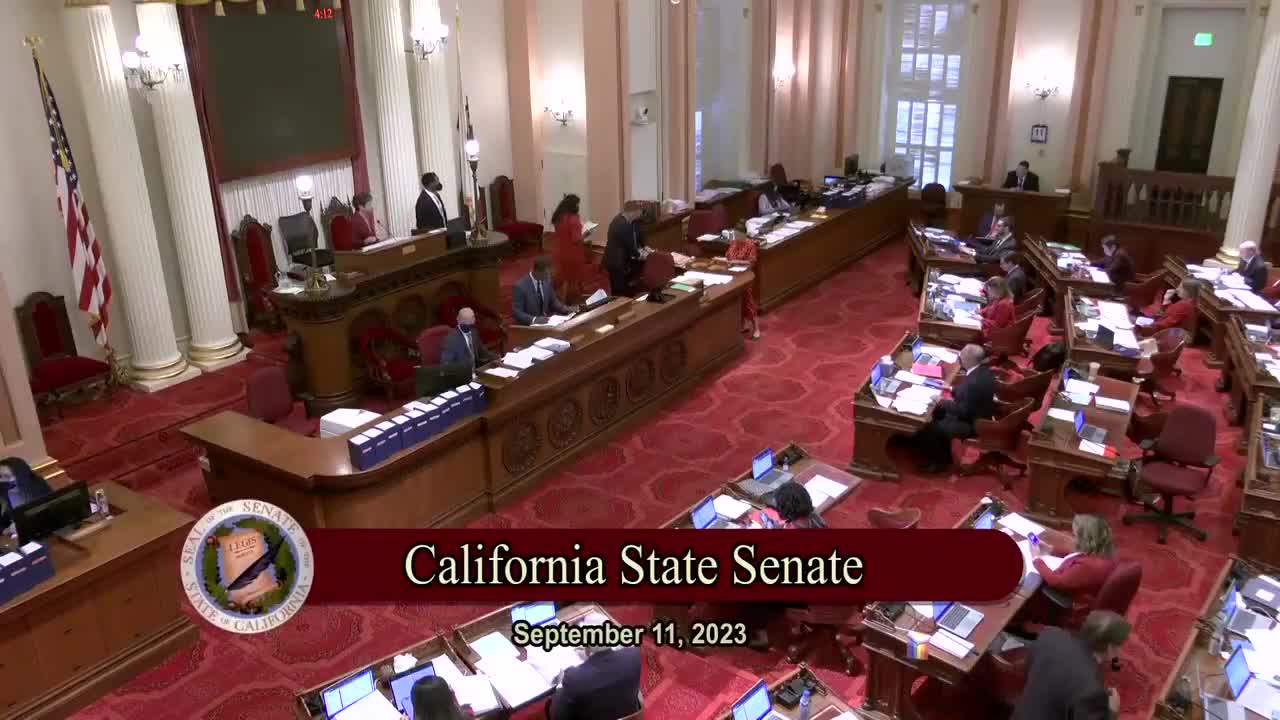 2MIN
Senate Floor
 4MIN
Senate Standing Committee on Appropriations
 10MIN
Senate Standing Committee on Governance and Finance
 13MIN
Senate Standing Committee on Environmental Quality
 2MIN
Assembly Floor
 11MIN
Assembly Standing Committee on Environmental Safety and Toxic Materials
Bill Author

Bill Co-Author(s):