AB 1467: Nevaeh Youth Sports Safety Act.
- Session Year: 2023-2024
- House: Assembly
- Latest Version Date: 2023-06-29
Current Status:
Passed
(2023-06-29: Chaptered by Secretary of State - Chapter 24, Statutes of 2023.)
Introduced
In Committee
First Chamber
In Committee
Second Chamber
Enacted
Existing law requires a youth sports organization that elects to offer an athletic program to comply with specified concussion and sudden cardiac arrest prevention protocols, including, among other things, offering annual education or related materials to each coach, administrator, and referee, umpire, or other game official of the youth sports organization. Existing law requires that those materials include, among other things, information relating to the use of an automated external defibrillator (AED), if it is available, in the event of a cardiac emergency.
Existing law, the California Youth Football Act, requires a youth sports organization that conducts a tackle football program to comply with certain protocols, including a coach annually receiving first aid, cardiopulmonary resuscitation, and AED certification, and at least one independent nonrostered individual being present at all practice locations and holding current and active certification in AED protocols, among other credentials.
This bill, the Nevaeh Youth Sports Safety Act, would, commencing January 1, 2027, require a youth sports organization that elects to offer an athletic program to ensure that its athletes have access to an AED during any official practice or match. For purposes of that provision, if an AED is administered during an applicable medical circumstance, the bill would require that the AED be administered by a medical professional, coach, or other person designated by the youth sports organization, who holds AED certification and who complies with any other qualifications required pursuant to federal and state law applicable to the use of an AED.
Existing law requires a youth sports organization that elects to offer an athletic program to comply with specified concussion and sudden cardiac arrest prevention protocols, including, among other things, offering annual education or related materials to each coach, administrator, and referee, umpire, or other game official of the youth sports organization. Existing law requires that those materials include, among other things, information relating to the use of an automated external defibrillator (AED), if it is available, in the event of a cardiac emergency.
Existing law, the California Youth Football Act, requires a youth sports organization that conducts a tackle football program to comply with certain protocols, including a coach annually receiving first aid, cardiopulmonary resuscitation, and AED certification, and at least one independent nonrostered individual being present at all practice locations and holding current and active certification in AED protocols, among other credentials.
This bill, the Nevaeh Youth Sports Safety Act, would would, commencing January 1, 2027, require a youth sports organization that elects to offer an athletic program to ensure that its athletes have access to an AED during any official practice or match. The bill would require that an AED be administered, during an applicable medical circumstance, For purposes of that provision, if an AED is administered during an applicable medical circumstance, the bill would require that the AED be administered by a medical professional, coach, or other person designated by the youth sports organization, who holds AED certification and who complies with any other qualifications required pursuant to federal and state law applicable to the use of an AED.
Existing law requires a youth sports organization that elects to offer an athletic program to comply with specified concussion and sudden cardiac arrest prevention protocols, including, among other things, offering annual education or related materials to each coach, administrator, and referee, umpire, or other game official of the youth sports organization. Existing law requires that those materials include, among other things, information relating to the use of an automated external defibrillator (AED), if it is available, in the event of a cardiac emergency.
Existing law, the California Youth Football Act, requires a youth sports organization that conducts a tackle football program to comply with certain protocols, including a coach annually receiving first aid, cardiopulmonary resuscitation, and AED certification, and at least one independent nonrostered individual being present at all practice locations and holding current and active certification in AED protocols, among other credentials.
This bill, the Nevaeh Youth Sports Safety Act, would require a youth sports organization that elects to offer an athletic program to ensure that its athletes have access to an AED during any official practice or match. The bill would require that an AED be administered, during an applicable medical circumstance, by a medical professional, coach, or other person designated by the youth sports organization, who holds AED certification and who complies with any other qualifications required pursuant to federal and state law applicable to the use of an AED.
For purposes of this article, the following definitions apply:
(a)Coach means a person appointed by the youth sports organization to supervise or instruct a participant in a sport.
(b)Official practice or match means a sport session in which live action or one or more drills are conducted, or a match, as scheduled by the youth sports organization, the coach, or other designee of the organization.
(c)Youth sports organization has the same meaning as set forth in Section 124235.
124238.5.(a)Commencing January 1, 2027, a youth sports organization that elects to offer an athletic program shall ensure that its athletes have access to an automated external defibrillator (AED) during any official practice or match, subject to subdivision (b).
(b)For purposes of subdivision (a), if an AED is administered during an applicable medical circumstance, the AED shall be administered by a medical professional, coach, or other person designated by the youth sports organization, who holds AED certification and who complies with any other qualifications required pursuant to federal and state law applicable to the use of an AED.
For purposes of this article, the following definitions apply:
(a)Coach means a person appointed by the youth sports organization to supervise or instruct a participant in a sport.
(b)Official practice or match means a sport session in which live action or one or more drills are conducted, or a match, as scheduled by the youth sports organization, the coach, or other designee of the organization.
(c)Youth sports organization has the same meaning as set forth in Section 124235.
124238.5.(a)A Commencing January 1, 2027, a youth sports organization that elects to offer an athletic program shall ensure that its athletes have access to an automated external defibrillator (AED) during any official practice or match, subject to subdivision (b).
(b)For purposes of subdivision (a), an AED shall be administered, if an AED is administered during an applicable medical circumstance, the AED shall be administered by a medical professional, coach, or other person designated by the youth sports organization, who holds AED certification and who complies with any other qualifications required pursuant to federal and state law applicable to the use of an AED.
For purposes of this article, the following definitions apply:
(a)Coach means a person appointed by the youth sports organization to supervise or instruct a participant in a sport.
(b)Official practice or match means a sport session in which live action or one or more drills are conducted, or a match, as scheduled by the youth sports organization, the coach, or other designee of the organization.
(c)Youth sports organization has the same meaning as set forth in Section 124235.
124238.5.(a)A youth sports organization that elects to offer an athletic program shall ensure that its athletes have access to an automated external defibrillator (AED) during any official practice or match, subject to subdivision (b).
(b)For purposes of subdivision (a), an AED shall be administered, during an applicable medical circumstance, by a medical professional, coach, or other person designated by the youth sports organization, who holds AED certification and who complies with any other qualifications required pursuant to federal and state law applicable to the use of an AED.
|
Date
|
Status
|
|---|---|
| Jun 29, 2023 | Chaptered by Secretary of State - Chapter 24, Statutes of 2023. |
| Jun 29, 2023 | Approved by the Governor. |
| Jun 23, 2023 | Enrolled and presented to the Governor at 3 p.m. |
| Jun 15, 2023 | In Assembly. Ordered to Engrossing and Enrolling. |
| Jun 15, 2023 | Read third time. Passed. Ordered to the Assembly. (Ayes 40. Noes 0. Page 1575.). |
| Jun 8, 2023 | Read second time. Ordered to Consent Calendar. |
| Jun 7, 2023 | From committee: Do pass. To Consent Calendar. (Ayes 12. Noes 0.) (June 7). |
| May 3, 2023 | Referred to Com. on HEALTH. |
| Mar 30, 2023 | In Senate. Read first time. To Com. on RLS. for assignment. |
| Mar 30, 2023 | Read third time. Passed. Ordered to the Senate. (Ayes 65. Noes 0. Page 1008.) |
| Mar 23, 2023 | Read second time. Ordered to Consent Calendar. |
| Mar 22, 2023 | Read second time and amended. Ordered returned to second reading. |
| Mar 21, 2023 | From committee: Amend, and do pass as amended. To Consent Calendar. (Ayes 5. Noes 0.) (March 21). |
| Mar 9, 2023 | Referred to Com. on A., E., S., & T. |
| Feb 18, 2023 | From printer. May be heard in committee March 20. |
| Feb 17, 2023 | Read first time. To print. |
|
Date
|
Description
|
Location
|
Votes
|
|
|---|---|---|---|---|
| Jun 15, 2023 | Consent Calendar AB1467 Alanis | Senate Floor |
Passed |
|
| Jun 7, 2023 | Do pass and be ordered to the Consent Calendar | Senate Standing Committee on Health |
Passed |
|
| Mar 30, 2023 | AB 1467 Alanis Consent Calendar Second Day | Assembly Floor |
Passed |
|
| Mar 21, 2023 | Do pass as amended. To Consent Calendar. | Assembly Standing Committee on Arts, Entertainment, Sports, and Tourism |
Passed |
This list shows positions taken on this bill by organizations on the date displayed, which is linked to the original source.
Positions by individuals are not included.
|
Organization
|
Position
|
Date
|
|---|---|---|
| California Orthopaedic Association | ** Support | |
| California Youth Football Alliance | ** Support | |
| Philips | ** Support | |
| Save Youth Football – California Coalition | ** Support |
SENATE RULES COMMITTEE Office of Senate Floor Analyses (916) 651-1520 Fax: (916) 327-4478 | AB 1467 |
CONSENT
Bill No: AB 1467
Author: Alanis (R)
Amended: 3/22/23 in Assembly
Vote: 21
SENATE HEALTH COMMITTEE: 12-0, 6/7/23 (Consent)
AYES: Eggman, Nguyen, Glazer, Gonzalez, Grove, Hurtado, Limón, Menjivar, Roth, Rubio, Wahab, Wiener
ASSEMBLY FLOOR: 60-0, 3/30/23 (Consent) - See last page for vote
SUBJECT: Nevaeh Youth Sports Safety Act
SOURCE: Author
DIGEST:
This bill requires a youth sports organization that elects to offer an athletic program to ensure that by January 1, 2027, its athletes have access to an automated external defibrillator (AED) during any official practice or match.
ANALYSIS:
Existing law:
- Defines a “youth sports organization” as an organization, business, nonprofit entity, or a local governmental agency that sponsors or conducts amateur sports competitions, training, camps, or clubs in which persons 17 years of age or younger participate. [HSC §124235 (b)(4)]
- Requires a youth sports organization to comply with certain requirements related to athletes suspected of sustaining a concussion or head injury, or who has passed out or fainted, including removal from the athletic activity and a prohibition on returning until he or she is evaluated by a licensed health care provider. Requires youth sports organizations to give both a concussion and head injury information sheet, and a sudden cardiac arrest information sheet, to each athlete on an annual basis. [HSC §124235]
- Requires each coach, administrator, and referee, umpire, or other game official of the youth sports organization to successfully complete concussion and head injury and sudden cardiac arrest prevention education at least once, either online or in person, before supervising an athlete in an activity of the youth sports organization. [HSC §124235(a)(5)]
- Requires “sudden cardiac arrest prevention education and educational materials” and a “sudden cardiac arrest information sheet” to include, at a minimum, information relating to cardiac conditions and their potential consequences, the signs and symptoms of sudden cardiac arrest, best practices for removal of an athlete from an athletic activity after fainting or a suspected cardiac condition is observed, steps for returning an athlete to activity, and what to do in the event of a cardiac emergency, which includes calling 911, performing hands-only CPR, and using an AED if it is available. [HSC §124235(b)(3)]
- Establishes the California Youth Football Act, which establishes additional requirements on youth sports organizations that conduct a tackle football program, including requiring a minimum of one certified emergency medical technician, state-licensed paramedic, or higher-level medical professional to be present during all games, and requiring coaches to annually receive first aid, CPR, and AED certification. [HSC §124240 et seq., §124241(h) and (i)]
- Requires, as part of the California Youth Football Act, that at least one independent nonrostered individual, appointed by the youth sports organization, to be present at all practice locations, and requires the individual to hold current certifications in first aid, CPR, AED, and concussion protocols. [HSC §124241(j)]
- Requires a school district or charter school that offers any interscholastic athletic program to acquire at least one AED for each school that participates in the program, and encourages the school district or charter school to ensure that the AED is available for the purpose of rendering emergency care or treatment within a recommended three to five minutes of sudden cardiac arrest to pupils, spectators, and any other individuals in attendance at the program’s on-campus activities or events, and to ensure that the AED is available to athletic trainers and coaches and authorized persons at these activities or events. [EDC §35179.6]
- Requires a person or entity that acquires an AED to comply with all regulations governing the placement of an AED, notify an agent of the local emergency medical services agency of the existence, location, and type of AED acquired, ensure that the AED is maintained and tested according to the operation and maintenance guidelines of the manufacturer, ensure that the AED is tested at least biannually and after each use, ensure that an inspection is made of all AEDs on the premises at least every 90 days for potential issues related to the operability of the device, and ensure that records of the maintenance and testing are maintained. [HSC §1797.196]
- Exempts a person or entity that acquires an AED for emergency use from liability for any civil damages resulting from the use of the AED if the person or entity has complied with the requirements in 8) above. [CIV §1714.21(d)]
- Exempts any person who, in good faith and not for compensation, renders emergency care or treatment by use of an AED at the scene of an emergency from being liable for any civil damages resulting from any acts or omissions in rendering the emergency care. [CIV §1714.21(b)]
This bill:
- Requires a youth sports organization that elects to offer an athletic program to ensure, commencing January 1, 2027, that its athletes have access to an AED during any official practice or match, subject to 2) below.
- Requires, if an AED is administered during an applicable medical circumstance, the AED to be administered by a medical professional, coach, or other person designated by the youth sports organization who holds AED certification and who complies with any other qualifications required pursuant to federal and state law applicable to the use of an AED.
- Defines “youth sports organization” as having the same definition as in related sections of existing law.
Comments
- Author’s statement. According to the author, AEDs are critical pieces of medical equipment that can save lives, if used within minutes of a cardiac emergency. Despite efforts in recent years to increase AED accessibility and overall safety for young athletes, current law does not require private sports organizations to own or provide access to an AED. When parents and guardians register their children for a sports team, they should feel comfortable knowing their child will remain safe in the event of an emergency. Unfortunately, this is not the case anymore. This bill fulfills a promise to Nevaeh’s family and countless others that California is dedicated to keeping children safe.
- Background. According to information provided by the author, young athletes have become increasingly affected by heart issues, including cardiac arrest. Although sports teams at public and charter schools are required to provide AED access, private youth sports organizations are not. In August of 2022, 10-year-old Nevaeh Johnson died after collapsing on the field of Waterford High School while cheering for the Waterford Sabercats youth football team. Although the high school owned an AED inside their gymnasium, the team did not have access. Her family believes that if staff had access to the AED, her death may have been averted.
- Background AEDs and sudden cardiac arrest. According to the American Heart Association (AHA), an AED is a lightweight, portable device that delivers an electric shock through the chest to the heart. The shock can stop an irregular rhythm and allow a normal rhythm to resume in a heart in sudden cardiac arrest. The AED has a built-in computer, which assesses the patient's heart rhythm, determines whether the person is in cardiac arrest, and signals whether to administer the shock. Audible cues guide the user through the process.
According to the National Heart, Blood, and Lung Institute, sudden cardiac arrest (SCA) is a condition in which the heart suddenly and unexpectedly stops beating, and usually causes death if it's not treated within minutes. SCA is not the same as a heart attack. A heart attack is when blood flow to the heart is blocked, and SCA is when the heart malfunctions and suddenly stops beating unexpectedly. A heart attack is a “circulation” problem and sudden cardiac arrest is an “electrical” problem. However, SCA can happen after or during recovery from a heart attack. Ventricular fibrillation (v-fib), a type of arrhythmia, causes most SCAs. During v-fib, the heart's lower chambers don't beat normally, and instead quiver very rapidly and irregularly and little or no blood is pumped to the body. Other problems with the heart's electrical system can also cause SCA. For example, SCA can occur if the rate of the heart's electrical signals becomes very slow and stops. SCA also can occur if the heart muscle doesn't respond to the heart's electrical signals. Coronary heart disease; severe physical stress; certain inherited disorders; and structural changes in the heart can also cause SCA.
According to the American College of Cardiology (ACC), when playing sports, an athlete’s heart is working faster and pumping harder. Adrenaline is pumped throughout the body, and the heart needs more oxygen than normal. Dehydration, fever or changes in electrolytes can also play a part. In people whose hearts are not normal to begin with, these extra stresses can sometimes trigger the electrical system of the heart and cause SCA. While rare, SCA is the leading medical cause of death in young athletes. ACC states that warning signs during exercise include passing out, dizziness, chest pain, shortness of breath, and seizures. According to a study published in December 2017, a loss of consciousness in athletes during sports activity is usually not immediately recognized as SCA and time is wasted by checking breathing and body movement. Immediate CPR and defibrillation with an AED should be initiated if an athlete is experiencing SCA. Without defibrillation, the probability of surviving declines by 10% per minute.
Related/Prior Legislation
AB 379 (Maienschein, Chapter 174, Statutes of 2019) added “an athlete who has passed out or fainted” to law that prohibits an athlete in a youth sports organization from returning to athletic activity until being evaluated and cleared by a health care provider. AB 379 required the athlete, if the health care provider suspects that they have a cardiac condition that puts them at risk for sudden cardiac arrest or other heart-related issues, to remain under the care of the health care provider until the athlete is cleared to play.
AB 1 (Cooper, Chapter 158, Statutes of 2019) enacted the California Youth Football Act, which establishes certain requirements on youth football, including limiting full-contact practices to 30 minutes per day, and no more than two days per week, and requires an EMT or higher-level medical professional to be present during all games, and one independent non-rostered individual to be present at all practice locations with the authority to evaluate and remove any youth tackle football participant from practice who exhibits an injury.
SB 1397 (Hill, Chapter 1014, Statutes of 2018) extended the requirement that buildings constructed after January 1, 2017, have an AED on the premises, to apply this requirement to existing buildings that undergo a significant modification on or after January 1, 2020.
AB 2009 (Maienschein, Chapter 646, Statutes of 2018) required a school district or charter school that elects to offer any interscholastic athletic program to ensure that there is a written emergency action plan in place, and to acquire at least one AED for each school.
SB 287 (Hueso, Chapter 449, Statutes of 2015) required certain buildings with capacities of 200 persons or greater, as specified, constructed on or after January 1, 2017, to have an AED on the premises.
SB 658 (Hill, Chapter 264, Statutes of 2015) repealed or reduced various requirements relating to entities who acquire AEDs, including repealing requirements that employees complete training, and reducing the inspection requirements from every 30 days to every 90 days.
FISCAL EFFECT: Appropriation: No Fiscal Com.: No Local: No
SUPPORT: (Verified 6/8/23)
California Orthopaedic Association
California Youth Football Alliance
Save Youth Football – California Coalition
Philips
OPPOSITION: (Verified 6/8/23)
None received
ARGUMENTS IN SUPPORT: The California Orthopaedic Association (COA) states in support that California law has increasingly recognized the value of AEDs and has granted Good Samaritan liability protection to folks who use AEDs to respond after a person has suffered cardiac arrest. The COA states that AEDs are now very user friendly with instructions printed on them in a way that a bystander could render aid even without specialized training. The COA supports youth sports and supports efforts to make them as safe as possible. The California Youth Football Alliance states that providing mandated and critical access to an AED for young athletes and their families should be an absolute priority for the California Legislature. Save Youth Football – California Coalition states that this is another step forward in the continued improvements being made to provide the safest possible youth sports playing experience for children across California. Philips, which produces a variety of healthcare technologies including AEDs, states that one study found that sports related sudden cardiac arrest accounted for 39% of SCAs among those under 18 years of age. Philips states that requiring AEDs in youth athletic programs is essential if SCA strikes young athletes.
ASSEMBLY FLOOR: 60-0, 3/30/23
AYES: Addis, Aguiar-Curry, Alanis, Arambula, Bains, Bennett, Berman, Boerner Horvath, Juan Carrillo, Wendy Carrillo, Cervantes, Connolly, Megan Dahle, Davies, Essayli, Flora, Mike Fong, Vince Fong, Friedman, Gallagher, Gipson, Haney, Hart, Holden, Hoover, Jackson, Jones-Sawyer, Lackey, Lee, Low, Lowenthal, Maienschein, McKinnor, Muratsuchi, Stephanie Nguyen, Pacheco, Jim Patterson, Joe Patterson, Petrie-Norris, Ramos, Reyes, Luz Rivas, Robert Rivas, Rodriguez, Blanca Rubio, Sanchez, Santiago, Schiavo, Ta, Ting, Valencia, Villapudua, Waldron, Wallis, Weber, Wicks, Wilson, Wood, Zbur, Rendon
NO VOTE RECORDED: Alvarez, Bauer-Kahan, Bonta, Bryan, Calderon, Chen, Dixon, Gabriel, Garcia, Grayson, Irwin, Kalra, Mathis, McCarty, Ortega, Papan, Pellerin, Quirk-Silva, Soria, Ward
Prepared by: Vincent D. Marchand / HEALTH / (916) 651-4111
6/9/23 13:01:13
**** END ****
SENATE COMMITTEE ON HEALTH
Senator Dr. Susan Talamantes Eggman, Chair
BILL NO: AB 1467
AUTHOR: | Alanis | ||
VERSION: | March 22, 2023 | ||
HEARING DATE: | June 7, 2023 | ||
CONSULTANT: | Vincent D. Marchand | ||
SUBJECT: Nevaeh Youth Sports Safety Act
SUMMARY:
Requires a youth sports organization that elects to offer an athletic program to ensure that by January 1, 2027, its athletes have access to an automated external defibrillator (AED) during any official practice or match.
Existing law:
- Defines a “youth sports organization” as an organization, business, nonprofit entity, or a local governmental agency that sponsors or conducts amateur sports competitions, training, camps, or clubs in which persons 17 years of age or younger participate. [HSC §124235 (b)(4)]
- Requires a youth sports organization to comply with certain requirements related to athletes suspected of sustaining a concussion or head injury, or who has passed out or fainted, including removal from the athletic activity and a prohibition on returning until he or she is evaluated by a licensed health care provider. Requires youth sports organizations to give both a concussion and head injury information sheet, and a sudden cardiac arrest information sheet, to each athlete on an annual basis. [HSC §124235]
- Requires each coach, administrator, and referee, umpire, or other game official of the youth sports organization to successfully complete concussion and head injury and sudden cardiac arrest prevention education at least once, either online or in person, before supervising an athlete in an activity of the youth sports organization. [HSC §124235(a)(5)]
- Requires “sudden cardiac arrest prevention education and educational materials” and a “sudden cardiac arrest information sheet” to include, at a minimum, information relating to cardiac conditions and their potential consequences, the signs and symptoms of sudden cardiac arrest, best practices for removal of an athlete from an athletic activity after fainting or a suspected cardiac condition is observed, steps for returning an athlete to activity, and what to do in the event of a cardiac emergency, which includes calling 911, performing hands-only CPR, and using an AED if it is available. [HSC §124235(b)(3)]
- Establishes the California Youth Football Act, which establishes additional requirements on youth sports organizations that conduct a tackle football program, including requiring a minimum of one certified emergency medical technician, state-licensed paramedic, or higher-level medical professional to be present during all games, and requiring coaches to annually receive first aid, CPR, and AED certification. [HSC §124240 et seq., §124241(h) and (i)]
- Requires, as part of the California Youth Football Act, that at least one independent nonrostered individual, appointed by the youth sports organization, to be present at all practice locations, and requires the individual to hold current certifications in first aid, CPR, AED, and concussion protocols. [HSC §124241(j)]
- Requires a school district or charter school that offers any interscholastic athletic program to acquire at least one AED for each school that participates in the program, and encourages the school district or charter school to ensure that the AED is available for the purpose of rendering emergency care or treatment within a recommended three to five minutes of sudden cardiac arrest to pupils, spectators, and any other individuals in attendance at the program’s on-campus activities or events, and to ensure that the AED is available to athletic trainers and coaches and authorized persons at these activities or events. [EDC §35179.6]
- Requires a person or entity that acquires an AED to comply with all regulations governing the placement of an AED, notify an agent of the local emergency medical services agency of the existence, location, and type of AED acquired, ensure that the AED is maintained and tested according to the operation and maintenance guidelines of the manufacturer, ensure that the AED is tested at least biannually and after each use, ensure that an inspection is made of all AEDs on the premises at least every 90 days for potential issues related to the operability of the device, and ensure that records of the maintenance and testing are maintained. [HSC §1797.196]
- Exempts a person or entity that acquires an AED for emergency use from liability for any civil damages resulting from the use of the AED if the person or entity has complied with the requirements in 8) above. [CIV §1714.21(d)]
- Exempts any person who, in good faith and not for compensation, renders emergency care or treatment by use of an AED at the scene of an emergency from being liable for any civil damages resulting from any acts or omissions in rendering the emergency care. [CIV §1714.21(b)]
This bill:
- Requires a youth sports organization that elects to offer an athletic program to ensure, commencing January 1, 2027, that its athletes have access to an AED during any official practice or match, subject to 2) below.
- Requires, if an AED is administered during an applicable medical circumstance, the AED to be administered by a medical professional, coach, or other person designated by the youth sports organization who holds AED certification and who complies with any other qualifications required pursuant to federal and state law applicable to the use of an AED.
- Defines “youth sports organization” as having the same definition as in related sections of existing law.
FISCAL EFFECT:
This bill is keyed nonfiscal.
COMMENTS:
- Author’s statement. According to the author, AEDs are critical pieces of medical equipment that can save lives, if used within minutes of a cardiac emergency. Despite efforts in recent years to increase AED accessibility and overall safety for young athletes, current law does not require private sports organizations to own or provide access to an AED. When parents and guardians register their children for a sports team, they should feel comfortable knowing their child will remain safe in the event of an emergency. Unfortunately, this is not the case anymore. This bill fulfills a promise to Nevaeh’s family and countless others that California is dedicated to keeping children safe.
- Background. According to information provided by the author, young athletes have become increasingly affected by heart issues, including cardiac arrest. Although sports teams at public and charter schools are required to provide AED access, private youth sports organizations are not. In August of 2022, ten-year-old Nevaeh Johnson died after collapsing on the field of Waterford High School while cheering for the Waterford Sabercats youth football team. Although the high school owned an AED inside their gymnasium, the team did not have access. Her family believes that if staff had access to the AED, her death may have been averted.
- Background AEDs and sudden cardiac arrest. According to the American Heart Association (AHA), an AED is a lightweight, portable device that delivers an electric shock through the chest to the heart. The shock can stop an irregular rhythm and allow a normal rhythm to resume in a heart in sudden cardiac arrest. The AED has a built-in computer, which assesses the patient's heart rhythm, determines whether the person is in cardiac arrest, and signals whether to administer the shock. Audible cues guide the user through the process.
According to the National Heart, Blood, and Lung Institute, sudden cardiac arrest (SCA) is a condition in which the heart suddenly and unexpectedly stops beating, and usually causes death if it's not treated within minutes. SCA is not the same as a heart attack. A heart attack is when blood flow to the heart is blocked, and SCA is when the heart malfunctions and suddenly stops beating unexpectedly. A heart attack is a “circulation” problem and sudden cardiac arrest is an “electrical” problem. However, SCA can happen after or during recovery from a heart attack. Ventricular fibrillation (v-fib), a type of arrhythmia, causes most SCAs. During v-fib, the heart's lower chambers don't beat normally, and instead quiver very rapidly and irregularly and little or no blood is pumped to the body. Other problems with the heart's electrical system can also cause SCA. For example, SCA can occur if the rate of the heart's electrical signals becomes very slow and stops. SCA also can occur if the heart muscle doesn't respond to the heart's electrical signals. Coronary heart disease; severe physical stress; certain inherited disorders; and structural changes in the heart can also cause SCA.
According to the American College of Cardiology (ACC), when playing sports, an athlete’s heart is working faster and pumping harder. Adrenaline is pumped throughout the body, and the heart needs more oxygen than normal. Dehydration, fever or changes in electrolytes can also play a part. In people whose hearts are not normal to begin with, these extra stresses can sometimes trigger the electrical system of the heart and cause SCA. While rare, SCA is the leading medical cause of death in young athletes. ACC states that warning signs during exercise include passing out, dizziness, chest pain, shortness of breath, and seizures. According to a study published in December 2017, a loss of consciousness in athletes during sports activity is usually not immediately recognized as SCA and time is wasted by checking breathing and body movement. Immediate CPR and defibrillation with an AED should be initiated if an athlete is experiencing SCA. Without defibrillation, the probability of surviving declines by 10% per minute. - Prior legislation. AB 379 (Maienschein, Chapter 174, Statutes of 2019) adds “an athlete who has passed out or fainted” to law that prohibits an athlete in a youth sports organization from returning to athletic activity until being evaluated and cleared by a health care provider. AB 379 requires the athlete, if the health care provider suspects that they have a cardiac condition that puts them at risk for sudden cardiac arrest or other heart-related issues, to remain under the care of the health care provider until the athlete is cleared to play.
AB 1 (Cooper, Chapter 158, Statutes of 2019) enacts the California Youth Football Act, which establishes certain requirements on youth football, including limiting full-contact practices to 30 minutes per day, and no more than two days per week, and requires an EMT or higher-level medical professional to be present during all games, and one independent non-rostered individual to be present at all practice locations with the authority to evaluate and remove any youth tackle football participant from practice who exhibits an injury.
SB 1397 (Hill, Chapter 1014, Statutes of 2018) extends the requirement that buildings constructed after January 1, 2017 have an AED on the premises, to apply this requirement to existing buildings that undergo a significant modification on or after January 1, 2020.
AB 2009 (Maienschein, Chapter 646, Statutes of 2018) requires a school district or charter school that elects to offer any interscholastic athletic program to ensure that there is a written emergency action plan in place, and to acquire at least one AED for each school.
SB 287 (Hueso, Chapter 449, Statutes of 2015), requires certain buildings with capacities of 200 persons or greater, as specified, constructed on or after January 1, 2017, to have an AED on the premises.
SB 658 (Hill, Chapter 264, Statutes of 2015) repeals or reduces various requirements relating to entities who acquire AEDs, including repealing requirements that employees complete training, and reducing the inspection requirements from every 30 days to every 90 days. - Support. The California Orthopaedic Association (COA) states in support that California law has increasingly recognized the value of AEDs and has granted Good Samaritan liability protection to folks who use AEDs to respond after a person has suffered cardiac arrest. The COA states that AEDs are now very user friendly with instructions printed on them in a way that a bystander could render aid even without specialized training. The COA supports youth sports and supports efforts to make them as safe as possible. The California Youth Football Alliance states that providing mandated and critical access to an AED for young athletes and their families should be an absolute priority for the California Legislature. Save Youth Football – California Coalition states that this is another step forward in the continued improvements being made to provide the safest possible youth sports playing experience for children across California. Philips, which produces a variety of healthcare technologies including AEDs, states that one study found that sports related sudden cardiac arrest accounted for 39% of SCAs among those under 18 years of age. Philips states that requiring AEDs in youth athletic programs is essential if SCA strikes young athletes.
SUPPORT AND OPPOSITION:
Support: California Orthopaedic Association
California Youth Football Alliance
Save Youth Football – California Coalition
Philips
Oppose: None received
-- END --
Date of Hearing: March 21, 2023
ASSEMBLY COMMITTEE ON ARTS, ENTERTAINMENT, SPORTS, AND TOURISM
Sharon Quirk-Silva, Chair
ABPCA Bill Id:AB 1467 (
Author:Alanis) – As Introduced Ver:February 17, 2023
SUBJECT: Nevaeh Youth Sports Safety Act
SUMMARY: Establishes the Nevaeh Youth Sports Safety Act, which requires youth sports organizations to provide their athletes with access to an automated external defibrillator (AED) during any official practice or match.
Specifically, this bill:
- Requires a youth sports organization that elects to offer an athletic program to ensure that its athletes have access to an AED during any official practice or match, as defined.
- States that an AED must be administered, during an applicable medical circumstance, by a medical professional, coach, or other person designated by the youth sports organization, who holds AED certification and who complies with any other qualifications required pursuant to federal and state law applicable to the use of an AED.
- Defines “coach” to mean a person appointed by the youth sports organization to supervise or instruct a participant in a sport.
- Defines “Official practice or match” to mean a sport session in which live action or one or more drills are conducted, or a match, as scheduled by the youth sports organization, the coach, or other designee of the organization.
- Defines “Youth sports organization” to have the same meaning set forth pursuant to existing law.
EXISTING LAW:
Requires a youth sports organization that elects to offer an athletic program to comply with all of the following (Health and Safety Code 124235):
- Require an athlete who is suspected of sustaining a concussion or other head injury, or who has passed out or fainted, in an athletic activity to be immediately removed from the athletic activity for the remainder of the day, and not be permitted to return to any athletic activity until the athlete is evaluated by a licensed healthcare provider;
- Prohibit the athlete from returning to athletic activity until the athlete receives written clearance to return to athletic activity from a licensed healthcare provider;
- If the licensed healthcare provider determines that the athlete sustained a concussion or other head injury, the athlete must complete a graduated return-to-play protocol of no less than seven days in duration under the supervision of a licensed healthcare provider.
- If the licensed healthcare provider suspects that the athlete has a cardiac condition that puts the athlete at risk for sudden cardiac arrest or other heart-related issues, the athlete must remain under the care of the licensed healthcare provider to pursue follow-up testing until the athlete is cleared to play.
- Require if an athlete who is 17 years of age or younger has been removed from athletic activity due to a suspected concussion or due to fainting or another suspected cardiac condition, the youth sports organization to notify a parent or guardian of that athlete of the time and date of the injury, the symptoms observed, and any treatment provided to that athlete for the injury;
- On a yearly basis, the youth sports organization shall give both a concussion and head injury and a sudden cardiac arrest information sheet to each athlete. The information sheet shall be signed and returned by the athlete and, if the athlete is 17 years of age or younger, shall also be signed by the athlete’s parent or guardian, before the athlete initiates practice or competition.
- If the athlete is six years of age or younger, only the signature of the athlete’s parent or guardian shall be required to comply with this paragraph. If the athlete is 18 years of age or older, only the signature of the athlete shall be required to comply with this paragraph.
- The information sheet may be sent and returned through an electronic medium including, but not necessarily limited to, fax or electronic mail.
- Requires on a yearly basis, the youth sports organization to offer concussion and head injury and sudden cardiac arrest prevention education, or related educational materials, or both, to each coach, administrator, and referee, umpire, or other game official of the youth sports organization.
- Requires the youth sports organization to require both of the following:
- Each coach, administrator, and referee, umpire, or other game official of the youth sports organization shall be required to successfully complete the concussion and head injury and sudden cardiac arrest prevention education offered pursuant to paragraph (4) at least once, either online or in person, before supervising an athlete in an activity of the youth sports organization.
- The youth sports organization shall post related information, as referenced in paragraph (4), online, or provide educational materials to athletes and parents, or both.
- Requires the youth sports organization to identify both of the following:
- Procedures to ensure compliance with the requirements for providing concussion and head injury and sudden cardiac arrest prevention education and a concussion and head injury and sudden cardiac arrest prevention information sheet, as referenced in paragraphs (3) to (5), inclusive.
- Procedures to ensure compliance with the athlete removal provisions and the return-to-play protocol required pursuant to paragraph (1).
- Establishes the definition of a “Licensed healthcare provider” to mean either of the following:
- A licensed healthcare provider who is trained in the evaluation and management of concussions and is acting within the scope of the provider’s practice for evaluation and management of concussions or other head injuries.
- A licensed healthcare provider who is trained in the evaluation and management of cardiac conditions and is acting within the scope of that provider’s practice for evaluation and management of sudden cardiac arrest, fainting, and shortness of breath.
- Establishes the definition of a “Sudden cardiac arrest prevention education and educational materials” and a “sudden cardiac arrest information sheet” to at a minimum include information relating to all of the following:
- Cardiac conditions and their potential consequences.
- The signs and symptoms of sudden cardiac arrest.
- Best practices for removal of an athlete from an athletic activity after fainting or a suspected cardiac condition is observed.
- Steps for returning an athlete to an athletic activity after the athlete faints or experiences a cardiac condition.
- What to do in the event of a cardiac emergency: this shall include calling 911, performing hands-only CPR, and using an automated external defibrillator (AED) if it is available.
- Establishes the definition of a “Youth sports organization” means an organization, business, nonprofit entity, or a local governmental agency that sponsors or conducts amateur sports competitions, training, camps, or clubs in which persons 17 years of age or younger participate.
- States that the above sections apply to all persons participating in the activities of a youth sports organization, irrespective of their ages. It does not prohibit a youth sports organization, or any other appropriate entity, from adopting and enforcing rules intended to provide a higher standard of safety for athletes than the standard established under this section.
FISCAL EFFECT: None. This measure is keyed non-fiscal by the Legislative Counsel.
COMMENTS:
1) Author statement. According to the author, “AEDs are critical pieces of medical equipment that can save lives, if used within minutes of a cardiac emergency. Despite efforts in recent years to increase AED accessibility and overall safety for young athletes, current law does not require private sports organizations to own or have access to an AED. When parents and guardians register their children for a sports team, they should feel comfortable knowing their child will remain safe in the event of an emergency. Unfortunately, this is not the case anymore. AB 1467 fulfills a promise to Nevaeh’s family and countless others that California is dedicated to keeping children safe.”
2) Committee Amendments. Add an implementation date of January 1, 2027 in order to give private organizations time to either rent or purchase an AED for their athletes. Other changes are minor and technical.
- Prior and related legislation.
- AB 245 (McKinnor) of this Session modifies the California High School Coaching Education and Training Program requirements by revising the component of training in cardiopulmonary resuscitation and first aid to include rehearsing the appropriate responses to the signs and symptoms of concussions, heat illness, and cardiac arrest. This bill is pending before this committee.
- AB 1 (Cooper), Chapter 158, Statutes of 2019, among other provisions, required a coach appointed by a youth sports organization to supervise or instruct a participant in the sport of youth tackle football to annually receive first aid, cardiopulmonary resuscitation, and AED certification. Required at least one independent non-rostered individual, appointed by the youth sports organization, to be present at all practice locations. Requires the individual to hold current and active certification in first aid, CPR, AED, and concussion protocols.
- AB 379 (Maienschein), Chapter 174, Statutes of 2019, added “an athlete who has passed out or fainted” to existing law that prohibits an athlete from returning to athletic activity until being evaluated and cleared by a health care provider. Required the athlete, if the health care provider suspects that the athlete has a cardiac condition that puts the athlete at risk for sudden cardiac arrest or other heart-related issues, to remain under the care of the healthcare provider to pursue follow-up testing until the athlete is cleared to play.
- AB 2009 (Maienschein), Chapter 646, Statutes of 2018, Required a school district or charter school that elects to offer any interscholastic athletic program to ensure that there is a written emergency action plan in place and acquire at least one automated external defibrillator (AED) for each school for the purpose of emergency care in the event of cardiac arrest and other related medical emergencies. Clarifies that existing law providing conditional liability protections to those acquiring or using these AEDs would apply.
- AB 2007 (McCarty), Chapter 516, Statutes of 2016, required amateur youth sports organizations to adopt concussion treatment and recognition protocols similar to those in existing law for student athletes in 27 designated sports, as specified. Also required youth sports organizations to develop return-to-play protocols, and provide yearly concussion and head injury information sheets and education, as provided.
- AB 1639 (Mainschein), Chapter 792, Statutes of 2016, established the Eric Paredes Sudden Cardiac Arrest Prevention Act that requires the California Department of Education (CDE) to make available specified guidelines and materials on sudden cardiac arrest (SCA): pupils and parents to sign informational materials before athletic participation; training of coaches; and set requirements for action in the event a pupil experiences specified symptoms.
- AB 2127 (Cooley), Chapter 165, Statutes of 2014, among other things, limits full-contact practices for high school and middle school football teams for concussion and head injury prevention, and requires that a return-to-play protocol after concussion or head injury be no less than seven days in duration.
- AB 588 (Fox), Chapter 423, Statutes of 2013, applies existing law relating to students who sustain, or are suspecting of sustaining, a concussion during a school-sponsored athletic activity to charter schools and private schools.
- AB 1451 (Hayashi), Chapter 173, Statutes of 2012, includes a basic understanding of the signs and symptoms of concussions and the appropriate response to concussions within the California High School Coaching Education and Training Program, administered by school districts.
- h) AB 25 (Hayashi), Chapter 465, Statutes of 2011, requires a school district that elects to offer athletic programs to immediately remove an athlete who is suspected of sustaining a concussion or head injury during that activity; prohibits the return of the athlete to that activity until he or she is evaluated by, and receives written clearance from, a licensed health care provider; requires, on a yearly basis, a concussion and head injury information sheet to be signed and returned by the athlete and the athlete’s parent or guardian before the athlete’s initiating practice or competition.
REGISTERED SUPPORT / OPPOSITION:
Support
There is no support on file.
Opposition
There is no opposition on file.
Analysis Prepared by: Brian Anderson / A.,E.,S., & T. / (916) 319-3450
Discussed in Hearing
 12MIN
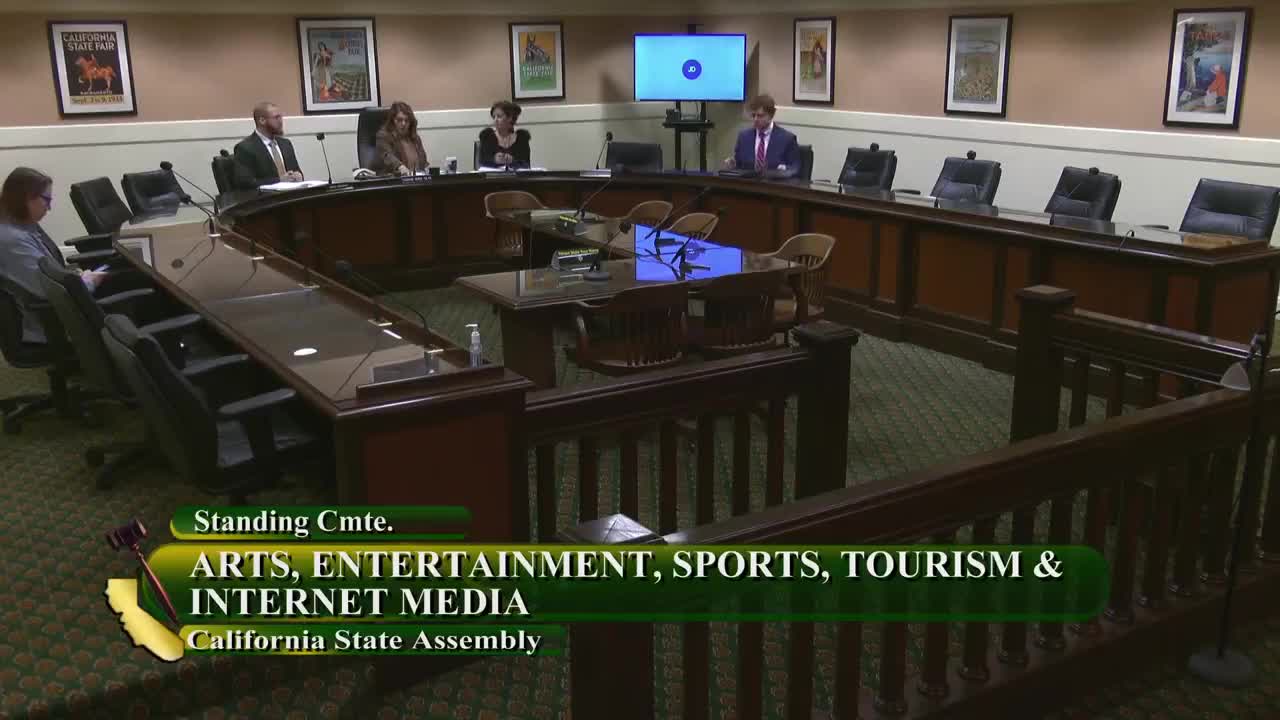
Assembly Standing Committee on Arts, Entertainment, Sports, and Tourism
Bill Author

Bill Co-Author(s):