AB 15: Public records: parole calculations and inmate release credits.
- Session Year: 2023-2024
- House: Assembly
- Latest Version Date: 2024-01-03
Current Status:
Failed
(2024-01-10: From committee: Without further action pursuant to Joint Rule 62(a).)
Introduced
In Committee
First Chamber
In Committee
Second Chamber
Enacted
Existing law, the California Public Records Act, requires state and local agencies to make their records available for inspection by the public, subject to specified criteria and with specified exceptions. Existing law exempts from disclosure any investigatory or security file compiled by any other state or local police agency, or any investigatory or security files compiled by any other state or local agency for correctional, law enforcement, or licensing purposes.
Under existing law, criminal offenders sentenced to imprisonment in the state prison are sentenced for either a determinate term or an indeterminate life sentence, and a person sentenced to an indeterminate life sentence is held until release by the Board of Parole Hearings. Under existing law, a person sentenced to a determinate sentence is released after serving the term of their sentence, minus any credits earned, and is required to serve a period of time after release under parole supervision.
Existing constitutional provisions, enacted by Proposition 57 at the November 8, 2016, statewide general election, make an inmate sentenced to state prison for a conviction of a nonviolent felony offense eligible for early parole consideration after completing the full term for their primary offense, as defined.
This bill would provide that Department of Corrections and Rehabilitation records pertaining to an inmates release date and their early release credits are public records and are subject to disclosure under the California Public Records Act. Act, with specified exceptions. The bill would state that the provisions relative to the California Public Records Act are declaratory of existing law.
Existing law, the California Public Records Act, requires state and local agencies to make their records available for inspection by the public, subject to specified criteria and with specified exceptions. Existing law exempts from disclosure any investigatory or security file compiled by any other state or local police agency, or any investigatory or security files compiled by any other state or local agency for correctional, law enforcement, or licensing purposes.
Under existing law, criminal offenders sentenced to imprisonment in the state prison are sentenced for either a determinate term or an indeterminate life sentence, and a person sentenced to an indeterminate life sentence is held until release by the Board of Parole Hearings. Under existing law, a person sentenced to a determinate sentence is released after serving the term of their sentence, minus any credits earned, and is required to serve a period of time after release under parole supervision.
Existing constitutional provisions, enacted by Proposition 57 at the November 8, 2016, statewide general election, make an inmate sentenced to state prison for a conviction of a nonviolent felony offense eligible for early parole consideration after completing the full term for their primary offense, as defined.
This bill would provide that Department of Corrections and Rehabilitation records pertaining to an inmates release date and their early release credits are public records and are subject to disclosure under the California Public Records Act. The bill would state that the provisions relative to the California Public Records Act are declaratory of existing law.
(a)To the extent that disclosure is not prohibited by any other provision of the Public Records Act, Department of Corrections and Rehabilitation records pertaining to an inmates release date and what the inmate did to earn any release credits are public records and are subject to disclosure under this division.
(1)A disclosure under this section shall be sufficiently detailed and include the number of days of credit that were based on each of the following categories:
(A)Good behavior.
(B)Rehabilitation and education program participation.
(C)Pretrial release credits.
(2)A disclosure shall also include the types of rehabilitative and education programs that the inmate participated in and completed.
(b)This section does not require the disclosure of Department of Corrections and Rehabilitation records that are subject to the privacy protections of the Health Insurance Portability and Accountability Act of 1996 (HIPAA) (Public Law 104-191).
(c)(1)This section does not require the disclosure of early release credits earned by an in-custody informant for providing exceptional assistance in maintaining the safety and security of a prison, as described in Section 2935 of the Penal Code.
(2)As used in this section, in-custody informant has the same meaning as in subdivision (a) of Section 1127a of the Penal Code.
SEC. 2.The addition of Section 7923.611 to the Government Code made by this act does not constitute a change in, but is declaratory of, existing law.
(a)Department of Corrections and Rehabilitation records pertaining to an inmates release date and what the inmate did to earn any release credits are public records and are subject to disclosure under this division.
(1)A disclosure under this section shall be sufficiently detailed and include the number of days of credit that were based on each of the following categories:
(A)Good behavior.
(B)Rehabilitation and education program participation.
(C)Pretrial release credits.
(2)A disclosure shall also include the types of rehabilitative and education programs that the inmate participated in and completed.
(b)This section does not require the disclosure of Department of Corrections and Rehabilitation records that are subject to the privacy protections of the Health Insurance Portability and Accountability Act of 1996 (HIPAA) (Public Law 104-191).
SEC. 2.The addition of Section 7923.611 to the Government Code made by this act does not constitute a change in, but is declaratory of, existing law. REVISIONS: HeadingLines 4 and 6.(a)Department of Corrections and Rehabilitation records pertaining to an inmates release date and what the inmate did to earn any release credits are public records and are subject to disclosure under this division.
(1)A disclosure under this section shall be sufficiently detailed and include the number of days of credit that were based on each of the following categories:
(A)Good behavior.
(B)Rehabilitation and education program participation.
(C)Pretrial release credits.
(2)A disclosure shall also include the types of rehabilitative and education programs that the inmate participated in and completed.
(b)This section does not require the disclosure of Department of Corrections and Rehabilitation records that are subject to the privacy protections of the Health Insurance Portability and Accountability Act of 1996 (HIPAA) (Public Law 104-191).
SEC. 2.The addition of Section 7923.611 to the Government Code made by this act does not constitute a change in, but is declaratory of, existing law.
|
Date
|
Status
|
|---|---|
| Jan 10, 2024 | From committee: Without further action pursuant to Joint Rule 62(a). |
| Jan 9, 2024 | In committee: Set, final hearing. Hearing canceled at the request of author. |
| Jan 4, 2024 | Re-referred to Com. on PUB. S. |
| Jan 3, 2024 | From committee chair, with author's amendments: Amend, and re-refer to Com. on PUB. S. Read second time and amended. |
| Mar 8, 2023 | Coauthors revised. |
| Mar 7, 2023 | In committee: Set, second hearing. Failed passage. Reconsideration granted. |
| Mar 1, 2023 | Re-referred to Com. on PUB. S. |
| Feb 28, 2023 | From committee chair, with author's amendments: Amend, and re-refer to Com. on PUB. S. Read second time and amended. |
| Feb 14, 2023 | In committee: Set, first hearing. Hearing canceled at the request of author. |
| Feb 2, 2023 | Referred to Coms. on PUB. S. and JUD. |
| Dec 6, 2022 | From printer. May be heard in committee January 5. |
| Dec 5, 2022 | Read first time. To print. |
|
Date
|
Description
|
Location
|
Votes
|
|
|---|---|---|---|---|
| Mar 7, 2023 | Do pass and be re-referred to the Committee on [Judiciary] | Assembly Standing Committee on Public Safety |
Failed |
This list shows positions taken on this bill by organizations on the date displayed, which is linked to the original source.
Positions by individuals are not included.
|
Organization
|
Position
|
Date
|
|---|---|---|
| Arcadia Police Officers' Association | ** Support | |
| Burbank Police Officers' Association | ** Support | |
| California Attorneys For Criminal Justice | ** Against | |
| California Coalition of School Safety Professionals | ** Support | |
| California District Attorneys Association | ** Support | |
| California Public Defenders Association | ** Against | |
| California State Sheriffs' Association | ** Support | |
| CLAREMONT POLICE OFFICERS ASSOCIATION | ** Support | |
| Corona Police Officers Association | ** Support | |
| Culver City Police Officers' Association | ** Support | |
| Ella Baker Center For Human Rights | ** Against | |
| Fullerton Police Officers' Association | ** Support | |
| Inglewood Police Officers Association | ** Support | |
| Initiate Justice | ** Against | |
| los angeles school police officers association | ** Support | |
| Newport Beach Police Association | ** Support | |
| Palos Verdes Police Officers Association | ** Support | |
| PLACER COUNTY DEPUTY SHERIFFS ASSOCIATION | ** Support | |
| Pomona Police Officers' Association | ** Support | |
| RIVERSIDE POLICE OFFICERS ASSOCIATION | ** Support | |
| Riverside Sheriffs' Association | ** Support | |
| Santa Ana Police Officers Association | ** Support | |
| The Transformative In-prison Workgroup | ** Against | |
| Upland Police Officers Association | ** Support |
Date of Hearing: March 7, 2023
Counsel: Andrew Ironside
ASSEMBLY COMMITTEE ON
Reginald Byron Jones-Sawyer, Sr., Chair
ABPCA Bill Id:
Author:() – As Ver:
SUMMARY:
States that California Department of Corrections and Rehabilitation (CDCR) records pertaining to an inmates release date and what an inmate did to earn release credits are public records subject to disclosure under the California Public Records Act (CPRA). Specifically, this bill:
- States that CDCR records pertaining to an inmate’s release date and what the inmate did to earn any release credits are public records subject to disclosure under CPRA.
- Requires disclosure to be sufficiently detailed and include the number of days of credit that were based on each of the following categories:
- Good behavior;
- Rehabilitation and education program participation; and,
- Pretrial release credits.
- Good behavior;
- Requires disclosure to include the types of rehabilitative and education programs that the inmate participated in and completed.
- Provides that CDCR is not required to disclose records that are subject to the privacy protections of the Health Insurance Portability and Accountability Act of 1996 (HIPPA).
EXISTING LAW:
- Provides that all people are by nature free and independent and have inalienable rights, including privacy. (Cal. Const., Art. I, § 1.)
- Provides that the people have the right of access to information concerning the conduct of the people’s business, and, therefore, the meetings of public bodies and the writings of public officials and agencies shall be open to public scrutiny. (Cal. Const., Art. I, § 3, subd. (b)(1).)
- Defines “public records” to include any writing containing information relating to the conduct of the public’s business, prepared, owned, used, or retained by any state or local agency regardless of physical form or characteristics. (Gov. Code, § 7920.530.)
- Declares that the Legislature, mindful of the right of individuals to privacy, finds and declares that access to information concerning the conduct of the people’s business is a fundamental and necessary right of every person in this state. (Gov. Code, § 7921.000.)
- Provides that the inalienable right to privacy under the California Constitution may exempt certain records, or portions thereof, from disclosure under the California Public Records Act. (Gov. Code, § 7930.000.)
- Provides that Penal Code sections 11076 and 13202 may operate to exempt criminal offender record information, or portions thereof, from disclosure. (Gov. Code, § 7930.130.)
- Defines “criminal offender record information” as records and data compiled by criminal justice agencies for purposes of identifying criminal offenders and of maintaining as to each such offender a summary of arrests, pretrial proceedings, the nature and disposition of criminal charges, sentencing, incarceration, rehabilitation, and release. (Pen. Code, § 13102.)
- Requires an agency to justify withholding any record by demonstrating that the record in question is exempt under express provisions of CPRA, or that on the facts of a particular case the public interest served by not disclosing the record clearly outweighs the public interest served by disclosure of the record. (Gov. Code, § 7922.000.)
- Provides for a right of access to criminal offender record information by any person or public agency authorized by law. (Pen. Code, § 13200.)
- Provides that the right of access to criminal offender record information does not authorize access of any person or public agency to such information unless such access is otherwise authorized by law. (Pen. Code, § 13201.)
- Provides that every public agency or bona fide research institution concerned with the prevention or control of crime, the quality of criminal justice, or the custody or correction of offenders may be provided with criminal offender record information, including criminal court records, as required for the performance of its duties, including the conduct of research. (Pen. Code, § 13202.)
- Provides that criminal offender record information shall be disseminated, whether directly or through any intermediary, only to such agencies as are, or may subsequently be, authorized access to such records by statutes. (Pen. Code, § 11076.)
- Requires CDCR to establish written guidelines for accessibility of records, to post those guidelines in a conspicuous public place at CDCR offices, and to make a copy of the guidelines available upon request free of charge to any person requesting them. (Gov. Code, § 6253.4(b)(5).)
- Provides that any person may institute a proceeding for injunctive or declarative relief, or for a writ of mandate, in any court of competent jurisdiction, to enforce that person’s right to inspect or receive a copy of any public record or class of public records. (Gov. Code, § 7923.)
- Requires CDCR to establish written guidelines for accessibility of records. (Gov. Code, § 7922.635, subd. (a)(6).)
- Provides that an inmate, unless otherwise precluded, is eligible to receive good conduct, rehabilitation, and/or education credits to advance the inmate’s release date if sentenced to a determinate term or to advance an inmate’s initial parole hearing date if sentenced to an indeterminate term with the possibility of parole. (Pen. Code, §§ 2931, 2933 & 2933.05; see also 15 CCR § 3043.4, et. seq.)
- Provides that, in addition to other specified limitations, the only inmate or parolee data which may be released without a valid written authorization from the inmate or parolee to the media or to the public includes that inmate’s or parolee’s:
- Name;
- Age;
- Race and/or ethnicity;
- Birthplace;
- County of last legal residence;
- Commitment offense;
- Date of admission to CDCR and CDCR number;
- Facility assignments and a general description of behavior;
- Patient health condition given in short and general terms that do not communicate specific medical information about the individual, such as good, fair, serious, critical, treated and released, or undetermined;
- Manner of death as natural, homicide, suicide, accidental, or executed; and,
- Sentencing and release actions, including month and year of current parole eligibility date. (15 CCR § 3261.2(e)(1)-(11).)
- Name;
FISCAL EFFECT:
Unknown
COMMENTS:
- Author's Statement: According to the author, “In recent news, we have seen cases of violent, convicted felons who were released early from their prison sentences, and who then went on to commit more violent felony offenses against the public. In many of these cases, the Department of Corrections and Rehabilitation (CDCR) has refused to disclose information as to how those inmates obtained their early release credits. It is vital to the creation of a fair and just system for all Californians, that we have a transparent criminal justice system. AB 15 will provide that CDCR records pertaining to an inmate’s early release date and how they earned their early release credits are available to the public, and are subject to disclosure under the California Public Records Act. AB 15 will create more transparencies to ensure that CDCR is properly applying the law, to help Californian’s feel safe in their communities and to create just outcomes for all.”
- Proposition 57: On November 8, 2016, Californians voted on whether to increase rehabilitation services and decrease the state’s prison population by approving Proposition 57. Known as The Public Safety and Rehabilitation Act of 2016, Proposition 57 proposed, among other things, to authorize CDCR to award sentence credits for rehabilitation, good behavior, and education. It would require CDCR to pass regulations to that effect. (https://vig.cdn.sos.ca.gov/2016/general/en/pdf/complete-vig.pdf.) Voters approved Proposition 57 by a margin of nearly 30 points. (https://ballotpedia.org/California_Proposition_57,_Parole_for_Non-Violent_Criminals_and_Juvenile_Court_Trial_Requirements_(2016).) And, as required, CDCR has since issued regulations to effectuate the proposition’s purpose. (Cal. Const., Art. I, § 32, subd. (b); 15 CCR § 3043, et seq.)
This bill would make information related to release credits earned by incarcerated persons subject to disclosure under the CPRA. Proponents claim that this disclosure is necessary because CDCR has “potentially endanger[ed] Californians” by “releasing large numbers of inmates early” under Proposition 57. However, according to the most recent data, the violent crime rate in California is lower today than it was when voters approved Proposition 57, when violent crime was already historically low. (https://www.ppic.org/publication/crime-trends-in-california/.) Similarly, in 2020, the property crime rate in California reached its lowest level since 1960. And, while it ticked up by 2.4% in 2021, it remains low. (Ibid.)
- California Public Records Act (CPRA): The CPRA provides that every person or entity in California has a right to access information concerning the conduct of the people’s business. (Gov. Code, §7921.000; Cal. Const., Art. I, § 3, subd. (b)(1).) Despite the public’s fundamental right to access public records, the California Constitution also provides people have inalienable rights, including the right to pursue and obtain privacy. (Cal. Const., Art. I, § 1.) The CPRA provides that the inalienable right to privacy under California Constitution may exempt certain records, or portions thereof, from disclosure under the Act. (Gov. Code, §7930.000.) It specifically states that Penal Code sections 11076 and 13202 may operate to exempt criminal offender record information, or portions thereof, from disclosure. (Gov. Code, § 7930.130.)
If an agency rejects a public records request, the CPRA requires the agency to justify withholding any record by demonstrating that the record in question is exempt under express provisions of CPRA, or that on the facts of a particular case the public interest served by not disclosing the record clearly outweighs the public interest served by disclosure of the record. (Civ. Code, § 7922.000.) Any person may challenge an agency’s rejection of a CPRA request by instituting proceedings for injunctive or declarative relief, or for a writ of mandate, in any court of competent jurisdiction, to enforce that person’s right to inspect or receive a copy of any public record or class of public records. (Gov. Code, § 7923.)
CDCR has issued regulations governing the disclosure of information relating to an incarcerated person. Specifically, CDCR regulations state, “[T]he only inmate or parolee data which may be released without a valid written authorization from the inmate or parolee to the media or to the public” includes their name, age, race and/or ethnicity, birthplace, count of last legal residence, commitment offense, date of admission, facility assignment, a general description of behavior, a short and general description of an inmate’s health or manner of death, and the month and year of their release. (15 CCR § 3261.2(e)(1)-(11).)
This bill would require CDCR to disclose significantly more information than is likely required under the CPRA, and which appears to be protected. - Institutional Safety at CDCR Facilities: This bill would make “[CDCR] records pertaining to an inmate’s release date and what the inmate did to earn any release credits…subject to disclosure” under the California Public Records Act (CPRA). This bill provides no exceptions to or restrictions on disclosure, other than for records protected by the Health Insurance Portability and Accountability Act of 1996 (HIPAA). Nor does this bill exempt from disclosure an incarcerated person’s release credit information before that person’s release date has been set. Even if the date has been set, an incarcerated person is not immediately released upon receiving that date. In either case, a person could request information on an incarcerated person’s rehabilitative efforts and then communicate that information to another incarcerated person within the same institution.
For example, an incarcerated person may receive “up to twelve months of Extraordinary Conduct Credit” for “provid[ing] exceptional assistance in maintaining the safety and security of a prison.” (Pen. Code, § 2935; 15 CCR § 3043.6, subd. (a).) Disclosure that an incarcerated person assisted corrections staff may put that person at risk from other incarcerated persons, particularly if the provided information resulted in consequences for other incarcerated persons. Given the ongoing efforts by CDCR to manage security threat groups (“gangs”) and other security threats within its institutions, there may be reason for concern that such broad disclosures would threaten institutional safety and the safety of the people in CDCR’s care. Similarly, it could also put the individual in immediate risk from persons who are not incarcerated, such as members of rival gangs, once they are released from prison. - A Disincentive to Participate in Rehabilitative Programming: As mentioned above, this bill provides broad disclosure on what an incarcerated person did to earn release credits before that person has been released from CDCR, which may place that person at risk. Moreover, this bill requires disclosure of “the types of rehabilitative and education programs that the inmate participated in and completed.” This likely would require the disclosure of information about any rehabilitation credits an incarcerated person earns for participation in self-help and peer support groups, such as Narcotics Anonymous and/or Alcoholics Anonymous among others. If earning credits could result in disclosure of an incarcerated person’s personal information or might threaten their personal safety, will they be disincentivized to participate in rehabilitative programming?
- Vague Language: This bill provides that “[a] disclosure…shall be sufficiently detailed and include the number of days of credit…,” but it does not provide guidance to CDCR on the records, or the portions of records, that would be required to meet that standard. Given that the bill requires that disclosures be both “sufficiently detailed and include the number of days of credit…,” disclosure would have to go beyond a cursory calculation of the total credit days an incarcerated person has earned. But what level of detail is “sufficient[]” to comply with this bill’s mandate? Would CDCR have to report the number of Narcotics Anonymous meetings an incarcerated person attended while in custody? Would CDCR have to report that an incarcerated person received credit for providing information that helped thwart a threat to institutional security? (See 15 CCR § 3043.6, subd. (a).) Would CDCR have to report the content of the information that person provided? The bill’s language does not resolve these questions.
- Argument in Support: According to the California District Attorneys Association: “As you well know, the California Department of Corrections and Rehabilitation has been releasing large numbers of inmates early, potentially endangering Californians. CDAA is very concerned that the process through which this is done remains, in many cases, a mystery. Your bill will help us all understand better what is happening.”
- Argument in Opposition: According to the Transformative In-Prison Workgroup: “We believe California has made significant progress enacting progressive reforms to reduce wasteful prison spending, and expanding rehabilitation and other alternatives that have proven to effectively reduce and prevent crime in a more cost-efficient manner. These reforms were in response to a steady rise in incarceration rates and the undeniable presence of racial, gender, and socio-economic disparities. Specifically, Proposition 57, entitled "Public Safety and Rehabilitation Act" empowered the CDCR to increase prison credits earned by incarcerated people for completing rehabilitative programs. This proposition was overwhelmingly supported by Californians. First, because Californians want safer communities and neighbors. Second, because as a recent survey from Californians United for Safety and Justice illustrates, the majority of survivors of crime say the state should be more focused on rehabilitating people who commit crimes versus punishment. Lastly, because no life sentenced incarcerated person is automatically released or entitled to release from prison under Proposition 57. To be granted parole, all life sentenced incarcerated people must demonstrate that they are rehabilitated and do not pose a danger to the public to earn their release through the parole board hearing process.
“Sound rehabilitative programming is empirically proven to reduce recidivism, increase public safety, and improve reentry outcomes. Rehabilitative programming in California prisons provides the incarcerated population with reentry support, skills and workforce development, as well as trauma healing and restorative justice programs, AB 15 (Dixon) dangerously suggests that this programming is inadequate.
“We are also extremely troubled by the obvious underlying intent of AB 15 (Dixon), which appears to be nothing more than seeking to capitalize on tragedy and instill fear in the public. These are the failed approaches to crime and imprisonment that Californians have rejected. It would be a massive mistake to move backwards into the demagoguery and grandstanding that helped to create the system of mass incarceration.” - Related Legislation: AB 1260 (Joe Patterson), would require CDCR to make an initial determination of the minimum eligible parole date for an inmate based on the sentence of the court, any credits awarded, and the good conduct credit rate, as specified. AB 1260 is pending hearing in this committee.
- Prior Legislation: SB 345 (Bradford), of the 2017-2018 Legislative Session, would have required CDCR, among others, to the extent not prohibited by the CPRA, to conspicuously post on their Internet website, in a searchable manner, all current standards, policies, practices, operating procedures, and education and training materials. Governor Brown vetoed SB 345.
REGISTERED SUPPORT / OPPOSITION:
Support
Arcadia Police Officers' Association
Burbank Police Officers' Association
California Coalition of School Safety Professionals
California District Attorneys Association
California State Sheriffs' Association
Claremont Police Officers Association
Corona Police Officers Association
Culver City Police Officers' Association
Fullerton Police Officers' Association
Inglewood Police Officers Association
Los Angeles School Police Officers Association
Newport Beach Police Association
Palos Verdes Police Officers Association
Placer County Deputy Sheriffs' Association
Pomona Police Officers' Association
Riverside Police Officers Association
Riverside Sheriffs' Association
Santa Ana Police Officers Association
Upland Police Officers Association
1 Private Individual
Opposition
California Attorneys for Criminal Justice
Ella Baker Center for Human Rights
Initiate Justice
The Transformative In-prison Workgroup
California Public Defenders Association (CPDA)
Analysis Prepared by:
Discussed in Hearing
 3MIN
Senate Floor
 24MIN
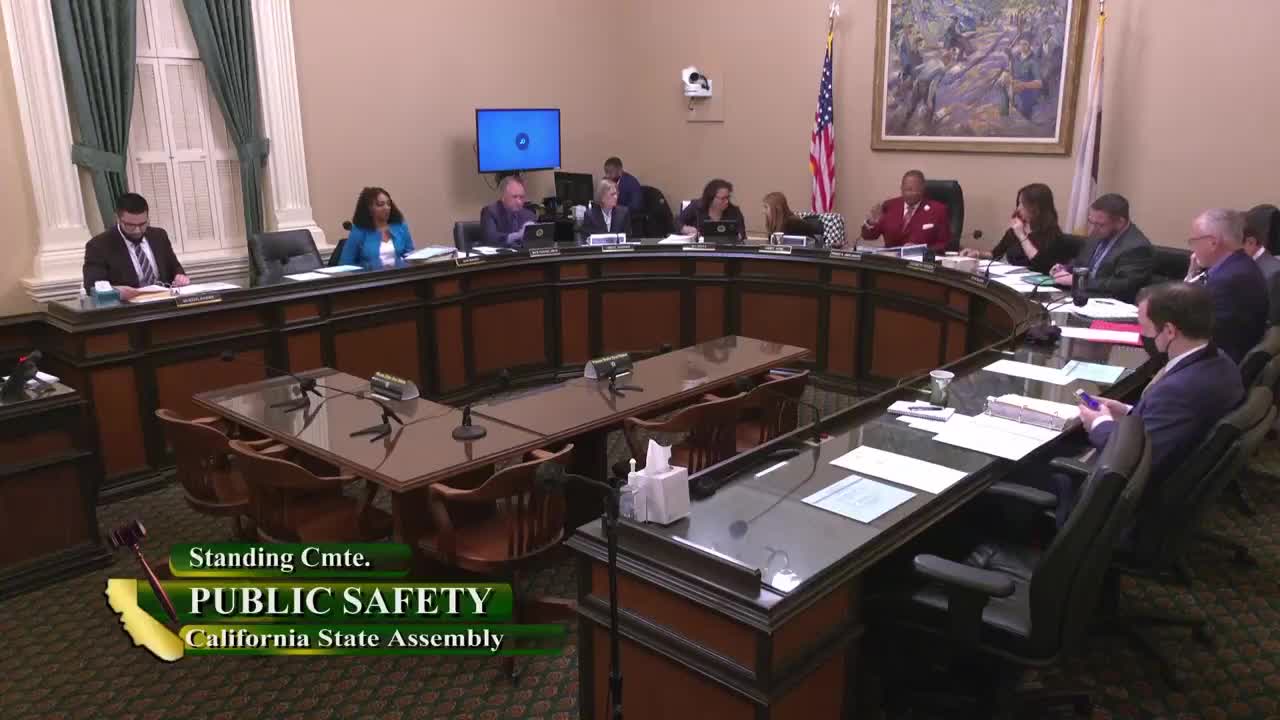
Assembly Standing Committee on Public Safety
 24MIN