AB 1546: California Consumer Privacy Act of 2018: statute of limitations.
- Session Year: 2023-2024
- House: Assembly
- Latest Version Date: 2023-02-17
Current Status:
Failed
(2023-09-01: In committee: Held under submission.)
Introduced
In Committee
First Chamber
In Committee
Second Chamber
Enacted
The California Consumer Privacy Act of 2018 (CCPA) grants to a consumer various rights with respect to personal information, as defined, that is collected by a business, as defined, including the right to request that a business delete personal information about the consumer that the business has collected from the consumer. The California Privacy Rights Act of 2020, approved by the voters as Proposition 24 at the November 3, 2020, statewide general election, amended, added to, and reenacted the CCPA. The CCPA establishes the California Privacy Protection Agency with full administrative power, authority, and jurisdiction to implement and enforce the CCPA. The CCPA subjects a violator of its provisions to a certain administrative fine pursuant to an administrative action brought by the agency, as prescribed. The CCPA prohibits an administrative action from being commenced more than 5 years after the date on which a violation occurred. The CCPA also subjects a violator of its provisions to a civil penalty, as specified, to be assessed and recovered in a civil action brought by the Attorney General. Existing law generally requires an action upon a statute for a forfeiture or penalty to the people of the state to be commenced within one year.
This bill would require an action by the Attorney General to enforce the CCPA to be commenced within 5 years after the cause of action accrued.
(a)Any business, service provider, contractor, or other person that violates this title shall be subject to an injunction and liable for a civil penalty of not more than two thousand five hundred dollars ($2,500) for each violation or seven thousand five hundred dollars ($7,500) for each intentional violation and each violation involving the personal information of minor consumers, as adjusted pursuant to paragraph (5) of subdivision (a) of Section 1798.185, which shall be assessed and recovered in a civil action brought in the name of the people of the State of California by the Attorney General. The court may consider the good faith cooperation of the business, service provider, contractor, or other person in determining the amount of the civil penalty.
(b)Any civil penalty recovered by an action brought by the Attorney General for a violation of this title, and the proceeds of any settlement of any said action, shall be deposited in the Consumer Privacy Fund.
(c)The agency shall, upon request by the Attorney General, stay an administrative action or investigation under this title to permit the Attorney General to proceed with an investigation or civil action and shall not pursue an administrative action or investigation, unless the Attorney General subsequently determines not to pursue an investigation or civil action. The agency may not limit the authority of the Attorney General to enforce this title.
(d)No civil action may be filed by the Attorney General under this section for any a violation of this title after the agency has issued a decision pursuant to Section 1798.199.85 or an order pursuant to Section 1798.199.55 against that person for the same violation.
(e)An action by the Attorney General to enforce this title shall be commenced within five years after the cause of action accrued.
(e)(f)This section shall not affect the private right of action provided for in Section 1798.150.
|
Date
|
Status
|
|---|---|
| Sep 1, 2023 | In committee: Held under submission. |
| Aug 21, 2023 | In committee: Referred to APPR suspense file. |
| Aug 2, 2023 | In committee: Hearing postponed by committee. |
| Jun 21, 2023 | From committee: Do pass and re-refer to Com. on APPR. (Ayes 9. Noes 2.) (June 20). Re-referred to Com. on APPR. |
| May 31, 2023 | Referred to Com. on JUD. |
| May 18, 2023 | In Senate. Read first time. To Com. on RLS. for assignment. |
| May 18, 2023 | Read third time. Passed. Ordered to the Senate. (Ayes 59. Noes 15. Page 1604.) |
| May 4, 2023 | Read second time. Ordered to third reading. |
| May 3, 2023 | From committee: Do pass. (Ayes 12. Noes 4.) (May 3). |
| Apr 18, 2023 | From committee: Do pass and re-refer to Com. on APPR. (Ayes 8. Noes 3.) (April 18). Re-referred to Com. on APPR. |
| Apr 12, 2023 | From committee: Do pass and re-refer to Com. on JUD. (Ayes 8. Noes 3.) (April 11). Re-referred to Com. on JUD. |
| Mar 9, 2023 | Referred to Coms. on P. & C.P. and JUD. |
| Feb 18, 2023 | From printer. May be heard in committee March 20. |
| Feb 17, 2023 | Read first time. To print. |
|
Date
|
Description
|
Location
|
Votes
|
|
|---|---|---|---|---|
| Aug 21, 2023 | Placed on suspense file | Senate Standing Committee on Appropriations |
Passed |
|
| Jun 20, 2023 | Do pass, but first be re-referred to the Committee on [Appropriations] | Senate Standing Committee on Judiciary |
Passed |
|
| May 18, 2023 | AB 1546 Gabriel Assembly Third Reading | Assembly Floor |
Passed |
|
| May 3, 2023 | Do pass. | Assembly Standing Committee on Appropriations |
Passed |
|
| Apr 18, 2023 | Do pass and be re-referred to the Committee on [Appropriations] | Assembly Standing Committee on Judiciary |
Passed |
|
| Apr 11, 2023 | Do pass and be re-referred to the Committee on [Judiciary] | Assembly Standing Committee on Privacy and Consumer Protection |
Passed |
This list shows positions taken on this bill by organizations on the date displayed, which is linked to the original source.
Positions by individuals are not included.
|
Organization
|
Position
|
Date
|
|---|---|---|
| Aclu California Action | ** Support | |
| Advanced Medical Technology Association | ** Against | |
| American Financial Services Association | ** Against | |
| Attorney General Rob Bonta | ** Support | |
| California Chamber Of Commerce | ** Against | |
| California Credit Union League | ** Against | |
| California Department of Justice | ** Support | |
| California Financial Services Association | ** Against | |
| California Grocers Association | ** Against | |
| California League of Food Producers | ** Against | |
| California Manufacturers & Technology Association | ** Against | |
| California Mortgage Bankers Association | ** Against | |
| California Retailers Association | ** Against | |
| Card Coalition | ** Against | |
| Civil Justice Association Of California | ** Against | |
| Computer & Communications Industry Association | ** Against | |
| Electronic Frontier Foundation | ** Support | |
| Insights Association | ** Against | |
| National Association of Mutual Insurance Companies | ** Against | |
| National Payroll Reporting Consortium | ** Against | |
| NetChoice | ** Against | |
| Oakland Privacy | ** Support | |
| Personal Insurance Federation Of California | ** Against | |
| Securities Industry And Financial Markets Association | ** Against | |
| Silicon Valley Leadership Group | ** Against | |
| Software & Information Industry Association | ** Against | |
| State Privacy & Security Coalition, Inc. | ** Against | |
| Technet | ** Against |
SENATE COMMITTEE ON APPROPRIATIONS
Senator Anthony Portantino, Chair
2023 - 2024 Regular Session
AB 1546 (Gabriel) - California Consumer Privacy Act of 2018: statute of limitations
Version: February 17, 2023 | Policy Vote: JUD. 9 - 2 |
Urgency: No | Mandate: No |
Hearing Date: August 21, 2023 | Consultant: Matthew Fleming |
Bill Summary:
AB 1546 would extend the statute of limitations for actions brought by the Attorney General to enforce the California Consumer Privacy Act from one year to five years after the accrual of the cause of action.
Fiscal Impact:
Unknown court workload cost pressures to adjudicate civil actions brought by the Attorney General that would otherwise be time barred under existing law (Trial Court Trust Fund, General Fund). See Staff Comments for additional detail.
Background:
The California Consumer Privacy Act of 2018 (CCPA) grants consumers certain rights with regard to their personal information, as defined. With passage of the California Privacy Rights Act of 2020 (CPRA), the CCPA got an overhaul. Consumers are afforded the right to receive notice from businesses at the point of collection of personal information and the right to access that information at any time. The CCPA also grants consumers the right to request that a business delete any personal information about the consumer that the business has collected from the consumer. However, a business is not required to comply with such a request to delete if it is necessary for the business to maintain the consumer’s personal information in order to carry out certain obligations or other conduct.
The CCPA provides adult consumers the right, at any time, “to direct a business that sells personal information about the consumer to third parties not to sell the consumer’s personal information. This right may be referred to as the right to opt-out.” Changes made by the CPRA extend this to opting out of the “sharing” of the personal information as well. A business is thereafter prohibited from selling (or sharing) that information unless consent is subsequently provided. A business that sells personal information to third parties is required to notify consumers that this information may be sold and that they have the right to opt out of such sales. The CPRA added a new category of information, sensitive information, which includes data such as precise geolocation and genetic information. Consumers are additionally empowered to limit businesses’ use of such information.
Responsibility for enforcement of the CCPA is shared between the California Privacy Protection Agency (CPPA) and the Attorney General. The Attorney General may demand the CPPA stay any administrative action or investigation to permit the Attorney General to proceed with an investigation or civil action, and the CPPA cannot pursue an administrative action or investigation thereafter, unless the Attorney General subsequently determines not to pursue an investigation or civil action. The CCPA states that the CPPA may not limit the enforcement authority of the Attorney General. However, the Attorney General is prohibited from filing a civil action after the CPPA has issued a decision or an order against that person for the same violation. Under existing law, the CPPA has five years within which to bring an administrative enforcement action. Actions brought by the Attorney General, by contrast, are subject to a one-year timeline.
Proposed Law:
Extends the statute of limitations for civil actions brought by the Attorney General to enforce the CCPA to within five years after the cause of action accrued
Related Legislation:
- AB 947 (Gabriel, 2023) adds citizenship and immigration status to the definition of “sensitive information” for purposes of the CCPA. AB 947 is pending on the Senate Floor.
- AB 1194 (Wendy Carrillo, 2023) provides stronger privacy protections pursuant to the CCPA where the consumer information contains information related to accessing, procuring, or searching for services regarding contraception, pregnancy care, and perinatal care, including abortion services. AB 1194 is pending on the Senate Floor.
Staff Comments:
It is unknown how many additional actions would be brought with the 5-year limitation period proposed by this bill that would otherwise lapse under the one-year limitation in existing law. However, it generally costs about $8,000 to operate a courtroom for one eight-hour day. Although courts are not funded on the basis of workload, increased pressure on the trial courts and staff may create a need for increased funding for courts from the General Fund (GF) to perform existing duties. Numerous trial court operations are funded through the imposition and collection of criminal fines and fees. However, the Legislature has reduced and eliminated criminal fines and fees over the past decade. As a result, the 2023-24 budget includes an ongoing annual allocation of $105.1 million backfill from the General Fund in order to address declining revenue to the Trial Court Trust Fund.
-- END --
Senator Thomas Umberg, Chair
2023-2024 Regular Session
Bill No: AB 1546 (Author:Gabriel)
Version: February 17, 2023
Hearing Date: June 20, 2023
Fiscal: Yes
Urgency: No
Consultant: CK
SUBJECT
California Consumer Privacy Act of 2018: statute of limitations
DIGEST
This bill extends the statute of limitations for actions brought by the Attorney General to enforce the California Consumer Privacy Act to five years after the accrual of the cause of action.
EXECUTIVE SUMMARY
The California Consumer Privacy Act of 2018 (CCPA) grants consumers certain rights with regard to their personal information, including enhanced notice, access, and disclosure; the right to deletion; the right to restrict the sale of information; and protection from discrimination for exercising these rights. (Civ. Code § 1798.100 et seq.) It places attendant obligations on businesses to respect those rights. In the November 3, 2020, election, voters approved Proposition 24, which established the California Privacy Rights Act of 2020 (CPRA). The CPRA amends the CCPA, limits further amendment, and creates the California Privacy Protection Agency (PPA).
Responsibility for enforcement of the CCPA is shared between the PPA and the Attorney General. However, the PPA has five years within which to bring an administrative enforcement action. Actions brought by the Attorney General are subject to a one-year timeline.
To harmonize these statutes of limitations and to allow adequate time for the Attorney General to investigate and carry out enforcement, this bill extends the relevant statute of limitations to five years from the accrual of the cause of action.
This bill is sponsored by Attorney General Rob Bonta. It is supported by various privacy and consumer groups, including ACLU California Action. It is opposed by various industry groups, including the California Chamber of Commerce and TechNet.
PROPOSED CHANGES TO THE LAW
Existing law:
- Establishes the CCPA, which grants consumers certain rights with regard to their personal information, including enhanced notice, access, and disclosure; the right to deletion; the right to restrict the sale of information; and protection from discrimination for exercising these rights. It places attendant obligations on businesses to respect those rights. (Civ. Code § 1798.100 et seq.)
- Grants a consumer the right to request that a business that collects personal information about the consumer disclose to the consumer the following:
- the categories of personal information it has collected about that consumer;
- the categories of sources from which the personal information is collected;
- the business or commercial purpose for collecting or selling personal information;
- the categories of third parties with whom the business shares personal information; and
- the specific pieces of personal information it has collected about that consumer. (Civ. Code § 1798.110.)
- Provides consumers the right to request that a business that sells the consumer’s personal information, or that discloses it for a business purpose, disclose to the consumer the following:
- the categories of personal information that the business collected about the consumer;
- the categories of personal information that the business sold about the consumer and the categories of third parties to whom the personal information was sold, by category or categories of personal information for each third party to whom the personal information was sold; and
- the categories of personal information that the business disclosed about the consumer for a business purpose. (Civ. Code § 1798.115.)
- Provides a consumer the right, at any time, to direct a business that sells personal information about the consumer to third parties not to sell the consumer’s personal information. It requires such a business to provide notice to consumers, as specified, that this information may be sold and that consumers have the right to opt out of the sale of their personal information. (Civ. Code § 1798.120.)
- Prohibits a business from discriminating against a consumer because the consumer exercised any of the consumer’s rights under the CCPA. (Civ. Code § 1798.125(a)(1).)
- Defines “personal information” as information that identifies, relates to, describes, is reasonably capable of being associated with, or could reasonably be linked, directly or indirectly, with a particular consumer or household. The CCPA provides a nonexclusive series of categories of information deemed to be personal information, including identifiers, biometric information, and geolocation data. (Civ. Code § 1798.140(v).)
- Establishes the CPRA, which amends the CCPA and creates the PPA, which is charged with implementing these privacy laws, promulgating regulations, and carrying out enforcement actions. (Civ. Code § 798.100 et seq.; Proposition 24 (2020).)
- Provides that administrative actions to enforce the CCPA must be brought by the PPA within five years after the date on which the underlying violation occurred. (Civ. Code § 1798.199.70.)
- Establishes civil penalties for CCPA violations, to be recovered through a civil action brought on behalf of the people of the state of California by the Attorney General. (Civ. Code § 1798.199.90(a).)
- Requires an action upon a statute for a forfeiture or penalty to the people of this state to be brought within one year if the statute does not specify otherwise. (Civ. Proc. Code § 340.)
- Permits amendment of the CPRA by a majority vote of each house of the Legislature and the signature of the Governor, provided such amendments are consistent with and further the purpose and intent of this act as set forth therein. (Proposition 24 § 25 (2020).)
This bill extends the statute of limitations for civil actions brought by the Attorney General to enforce the CCPA to within five years after the cause of action accrued.
COMMENTS
- California’s landmark privacy protection law
As stated, the CCPA grants consumers certain rights with regard to their personal information, as defined. With passage of the CPRA in 2020, the CCPA got an overhaul. Consumers are afforded the right to receive notice from businesses at the point of collection of personal information and the right to access that information at any time. The CCPA also grants consumers the right to request that a business delete any personal information about the consumer that the business has collected from the consumer. However, a business is not required to comply with such a request to delete if it is necessary for the business to maintain the consumer’s personal information in order to carry out certain obligations or other conduct. (Civ. Code § 1798.105(d).)
The CCPA provides adult consumers the right, at any time, “to direct a business that sells personal information about the consumer to third parties not to sell the consumer’s personal information. This right may be referred to as the right to opt-out.” Changes made by the CPRA extend this to opting out of the “sharing” of the personal information as well. A business is thereafter prohibited from selling (or sharing) that information unless consent is subsequently provided. A business that sells personal information to third parties is required to notify consumers that this information may be sold and that they have the right to opt out of such sales. (Civ. Code § 1798.120(a).) The CPRA added a new category of information, sensitive information, which includes data such as precise geolocation and genetic information. Consumers are additionally empowered to limit businesses’ use of such information.
- CCPA enforcement
The CPRA created the PPA and transferred many of the responsibilities over to it from the Attorney General. This includes the responsibility for administering and implementing the CCPA, including promulgating regulations and educating consumers about their rights.
However, the CPRA established an enforcement framework that envisions the Attorney General maintaining a strong collaborative role with the PPA.
Upon the sworn complaint of any person or on its own initiative, the PPA may investigate possible violations and if probable cause is found, it shall hold a hearing, after providing notice to the alleged violator. If a violation is found to have occurred, the PPA may order the violator to cease and desist violation and impose administrative fines.
The Attorney General is authorized to bring a civil action against any business, service provider, contractor, or other person that violates the CCPA and may seek injunctive relief and civil penalties of not more than $2,500 for each violation or $7,500 for each intentional violation and each violation involving the personal information of minor consumers. The court may consider the good faith cooperation of the business, service provider, contractor, or other person in determining the amount of the civil penalty.[1]
The Attorney General may demand the PPA stay any administrative action or investigation to permit the Attorney General to proceed with an investigation or civil action, and the PPA cannot pursue an administrative action or investigation thereafter, unless the Attorney General subsequently determines not to pursue an investigation or civil action. The CCPA states that the PPA may not limit the enforcement authority of the Attorney General. However, the Attorney General is prohibited from filing a civil action after the PPA has issued a decision or an order against that person for the same violation.
The CCPA provides the PPA five years after the date on which the violation occurred within which to commence its action. The CCPA does not specifically state the statute relevant to Attorney General actions, but the Code of Civil Procedure establishes a default one-year statute of limitations for such actions.
In order to harmonize the two relevant time periods for bringing enforcement actions, this bill extends the statute of limitations for civil enforcement of the CCPA by the Attorney General to five years after the accrual of the cause of action.
According to the author:
AB 1546 addresses an apparent oversight in the drafting of Proposition 24 (2020), the California Privacy Rights Act, by aligning the statutes of limitation for civil and administrative enforcement of the California Consumer Privacy Act (CCPA). The current statute of limitations for civil enforcement of CCPA by the Attorney General is an unreasonably short period of only one year. This is far too little time for the California Department of Justice (CalDOJ) to learn of a potential CCPA violation, conduct a thorough investigation, and file a civil lawsuit. By contrast, the California Privacy Protection Agency has five years to bring an administrative action to enforce the CCPA.
AB 1546 would increase the statute of limitations for CCPA enforcement by providing CalDOJ five years, not one year, to bring a civil enforcement action. By doing so, the bill seeks to enhance DOJ’s ability to carry out its duty to enforce California’s landmark privacy law, thereby enhancing the consumer privacy of all Californians.
- Stakeholder positions
Attorney General Rob Bonta, the sponsor of this bill, explains the need for it:
The current one-year SOL for civil enforcement is unreasonably short and limits DOJ’s ability to enforce California’s landmark privacy law and protect the public. Furthermore, the conspicuous discrepancy between the one-year SOL for civil enforcement by DOJ and the five-year SOL for administrative enforcement by the Agency makes little sense as public policy. Without a longer SOL, the AG’s office may have no choice but to quickly sue targets, without the opportunity for a full investigation or engagement, to unilaterally toll the statute and preserve its ability to seek appropriate penalties. A longer SOL allows DOJ more time to engage with businesses and address issues fully, as opposed to the more heavy-handed alternative of having to sue quickly.
The lack of alignment between the Agency’s and DOJ’s statute of limitations can also create inefficiencies in cases that involve violations of the CCPA and other laws that can only be enforced by DOJ. If the DOJ’s short one-year SOL has expired, the two agencies might be forced to bring parallel administrative and civil actions, rather than having those issues addressed in a single civil action brought by DOJ.
Writing in support, Oakland Privacy states:
Privacy harms, or violations of the right to know, right to correct and right to delete, do not always come to light immediately. In some cases, consumers might not be aware that their instructions are not being followed, or it may take some time to connect a quantity of consumer complaints with a widespread and significant violation of Act after review and investigation.
In order to robustly enforce the CCPA as envisioned by the Legislature, the statute of limitations needs to be sufficient for harms to become apparent and for their full scope to be accurately investigated.
A coalition of business and industry interests, including the California Grocers Association and NetChoice, writes in opposition:
Fundamentally, we question the need for this bill as we are unaware of any examples of time-barred claims that the AG would have otherwise pursued in the five years since the CCPA was first passed and that might indicate a serious problem warranting legislation. To the contrary, we have every reason to believe that there is vigorous, real-time enforcement happening. There are no less than 40 examples of “CCPA Enforcement Case Examples” cited on the AG’s website at this time. (See CCPA Enforcement Case Examples | State of California - Department of Justice - Office of the Attorney General.)
Extending the statute of limitations for civil enforcement would only amplify the risk that businesses face for alleged violations, through no fault of their own. In contrast, preserving the status quo does not harm consumers because violations can still feasibly be pursued by the Privacy Agency for up to five years. In the rare event that the AG’s clock runs out to commence an enforcement action, this “fallback” ensures that consumer rights are still protected and undercuts any need to extend the AG’s limitations period.
- Furthering the purpose and intent of the CPRA
Section 25 of the CPRA requires any amendments thereto to be “consistent with and further the purpose and intent of this act as set forth in Section 3.” Section 3 declares that “it is the purpose and intent of the people of the State of California to further protect consumers’ rights, including the constitutional right of privacy.” It then lays out a series of guiding principles. These include various consumer rights such as:
- consumers should know who is collecting their personal information;
- consumers should have control over how their personal information is used; and
- consumers should benefit from businesses’ use of their personal information.
Section 3 also includes a series of responsibilities that businesses should have. These include:
- businesses should specifically and clearly inform consumers about how they use personal information; and
- businesses should only collect consumers’ personal information for specific, explicit, and legitimate disclosed purposes.
Section 3 also lays out various guiding principles about how the law should be implemented.
This bill provides more time for the state’s top lawyer to investigate and enforce violations of the CCPA. This allows for a fuller realization of the benefits intended by the law. Therefore, as it explicitly states, this bill “furthers the purposes and intent of The California Privacy Rights Act of 2020.”
SUPPORT
Attorney General Rob Bonta (sponsor)
ACLU California Action
Electronic Frontier Foundation
Oakland Privacy
OPPOSITION
Advanced Medical Technology Association
American Financial Services Association
California Chamber of Commerce
California Credit Union League
California Financial Services Association
California Grocers Association
California League of Food Producers
California Manufacturers & Technology Association
California Mortgage Bankers Association
California Retailers Association
Card Coalition
Civil Justice Association of California
Computer & Communications Industry Association (CCIA)
Insights Association
National Association of Mutual Insurance Companies
National Payroll Reporting Consortium
NetChoice
Personal Insurance Federation of California
Securities Industry and Financial Markets Association
Silicon Valley Leadership Group
Software & Information Industry Association
State Privacy & Security Coalition, Inc.
TechNet
RELATED LEGISLATION
Pending Legislation:
AB 947 (Gabriel, 2023) adds citizenship and immigration status to the definition of “sensitive information” for purposes of the CCPA. AB 947 is set to be heard the same day as this bill.
AB 1194 (Wendy Carrillo, 2023) provides stronger privacy protections pursuant to the CCPA where the consumer information contains information related to accessing, procuring, or searching for services regarding contraception, pregnancy care, and perinatal care, including abortion services. AB 1194 is set to be heard the same day as this bill.
Prior Legislation:
AB 335 (Boerner Horvath, Ch. 700, Stats. 2021) exempted from provisions of the CCPA certain vessel information retained or shared between a vessel dealer and the vessel’s manufacturer.
AB 694 (Assembly Committee on Privacy and Consumer Protection, Ch. 525, Stats. 2021) made nonsubstantive and conforming changes to the CCPA to clean up the language amended in by the CPRA.
AB 375 (Chau, Ch. 55, Stats. 2018) established the CCPA.
PRIOR VOTES:
Assembly Floor (Ayes 59, Noes 15)
Assembly Appropriations Committee (Ayes 12, Noes 4)
Assembly Judiciary Committee (Ayes 8, Noes 3)
Assembly Privacy and Consumer Protection Committee (Ayes 8, Noes 3)
**************
Penalties and fines imposed as part of enforcement actions brought by either the PPA or the Attorney General are all placed in the Consumer Privacy Fund within the General Fund. ↑
ASSEMBLY THIRD READING
ATR Bill Id:AB 1546
Author:(Gabriel)
As Introduced Ver:February 17, 2023
Majority vote
SUMMARY
Fixes a drafting oversight by amending the California Consumer Privacy Act (CCPA) to expressly permit the Attorney General to file a civil action within five years, rather than the current default of one year, thereby aligning the statute of limitations for civil enforcement by the Attorney General with the five-year statute of limitations for administrative enforcement by the California Privacy Protection Agency.
Major Provisions
Provides that an action by the Attorney General to enforce the CCPA must be commenced within five years after the cause of action accrued.
COMMENTS
This bill proposes to align the statutes of limitations for civil and administrative enforcement of the California Consumer Privacy Act (CCPA), thereby providing the Attorney General five years to bring a civil action to enforce the CCPA. Five years is the same period of time that the California Privacy Protection Agency (Privacy Agency) currently has to bring an administrative action to enforce the CCPA. Current law does not specify a statute of limitations for CCPA civil enforcement. As explained below, this absence appears to be the result of a drafting oversight. Without this bill, the current, default statute of limitations for CCPA civil enforcement—an unreasonably short period of only one year—will stay in place, and the Attorney General's ability to safeguard Californians' privacy will remain significantly diminished.
The California Consumer Protection Act (CCPA). In 2018, the Legislature enacted the CCPA when it passed AB 375 (Chau), Chapter 55, Statutes of 2018, a groundbreaking law that greatly enhanced privacy protections for Californians' personal data. Under the CCPA, the authority to sue for the majority of violations lies exclusively with the Attorney General. But the CCPA has never specified how much time that the Attorney General has after a violation occurs to file a civil enforcement action. Because of this lack of specificity, the statute of limitations for civil CCPA enforcement defaults to Code of Civil Procedure Section 340(b), which allows only one year for public attorneys to file an action to enforce a statute and seek a civil penalty.
In 2020, voters approved Proposition 24, the California Privacy Rights Act, which amended the CCPA to, among other things, create the Privacy Agency, vested with full administrative power, authority, and jurisdiction to implement and enforce the CCPA. Among the Privacy Agency's duties and powers is administrative enforcement authority over the CCPA. (Civil Code Section 1798.199.40.)
What is the difference between civil and administrative enforcement of the CCPA? Briefly, civil enforcement of the CCPA requires the Attorney General to file a complaint in a trial court (generally, either the Superior Court of California or, as appropriate, a United State District Court) alleging that a business has violated one or more of the CCPA's provisions. The case then proceeds in court until it settles, is dismissed, or the court issues a final decision.
Administrative enforcement of the CCPA generally does not involve the courts and is conducted within the Privacy Agency itself. The case may be decided by the Privacy Agency or by an administrative law judge. (Civil Code Section 1798.199.55, 1798.199.60; Government Code Section 11370.2(a), 11517.) Unlike the Attorney General, who may pursue violations of other, related laws together with CCPA violations in the same court case, the Privacy Agency is only authorized to enforce CCPA violations. An administrative hearing initiated by the Privacy Agency will generally proceed until it settles, is dismissed, or a final decision is issued, though this decision may then be appealed to the courts. (Civil Code Section 1799.199.85.) Administrative enforcement of the CCPA by the Privacy Agency is set to begin on July 1, 2023. (Civil Code Section1798.185 (d).)
Proposition 24 vested the Privacy Agency with authority to bring an administrative action alleging any CCPA violation within five years after the date on which the violation occurred. (Civil Code Section 1798.199.70.) However, through an apparent oversight, Proposition 24 did not make a conforming change to the statute of limitations for the Attorney General's civil enforcement of the CCPA.
What this bill would do. This bill consists of a single sentence: "An action by the Attorney General to enforce this title shall be commenced within five years after the cause of action accrued." In other words, the bill would give the Attorney General five years to sue for a CCPA violation.
This period is significant because investigating and preparing a case alleging violations of online privacy laws is quite complex. Such a case often involves factual considerations, legal questions, and technical issues. To illustrate, a privacy enforcement case may require analyzing the flow of data to and from a business's servers, including review of these flows by an expert technologist. Simultaneously, attorneys must analyze the legal and business arrangements between the business and third parties, including arrangements governed by statute, regulation, contract, privacy policies, and terms of use. These arrangements are then compared with the business's data flows to assess the latter's legality. Formal pre-lawsuit investigative tools, such as subpoenas, are often required to obtain needed information. If the targets do not comply with subpoenas, they must be enforced in court, further prolonging investigations. Preparing the case often also involves locating and interviewing witnesses, and engaging with third parties that may possess relevant information. As should be evident, these are complicated, time-consuming endeavors that can take much longer than one year – especially if one wants them done accurately in order to ensure that meritorious cases are prosecuted.
What is the evidence that the lack of a five-year statute of limitations for civil enforcement is the result of a drafting oversight? Civil Code section 1798.199.90, which this bill would amend, provides:
(d) No civil action may be filed by the Attorney General under this section for any violation of this title after the [Privacy Agency] has issued a decision pursuant to Section 1798.199.85 or an order pursuant to Section 1798.199.55 against that person for the same violation.
That is, under existing law, if the Privacy Agency finds that a business violated the CCPA in an administrative proceeding, the Attorney General cannot then sue the business for identical CCPA violations. This makes sense.
The statutory and regulatory procedures that govern the Privacy Agency's conduct of an administrative proceeding are involved and time-consuming. First, the Privacy Agency can investigate possible CCPA violations based either on a third party's sworn complaint or on its own initiative. (Civil Code Section 1798.199.45.) The Privacy Agency has subpoena power and can go to court to enforce a subpoena if a response is not forthcoming. (Civil Code Section 1798.199.65.) If it finds evidence of violations, the Privacy Agency next has to hold a probable cause hearing, preceded by at least 30 days' notice to the alleged violator. (Civil Code Section 1798.199.50.) If the Privacy Agency determines that there is probable cause for CCPA violations, it may only then proceed with a formal hearing to determine whether a violation occurred. (Civil Code Section 1798.199.55.)
Given the intricacy of these steps, it is hard to believe that the Privacy Agency would be able to complete a CCPA enforcement action within one year of a violation. Yet that is what the opponents of this bill are arguing: that the drafters of Proposition 24 intended to forbid the Attorney General both (i) from suing a business more than one year after it violates the CCPA and (ii) from suing a business for the same violations that the Privacy Agency previously prosecuted successfully – even though the Privacy Agency will almost certainly take longer than one year to complete its enforcement action. Subdivision (d), quoted above, would make more sense if the Attorney General had the same amount of time as the Privacy Agency to pursue CCPA violations.
A longer statute of limitations does not place additional administrative burdens on businesses. Businesses must already retain the relevant information for five years in case the Privacy Agency decides to pursue administrative enforcement. The same information would be at issue in a civil or an administrative proceeding, so the potential of civil enforcement by the Attorney General for a longer period of time should not affect businesses' data retention practices or requirements.
A longer statute of limitations may actually reduce burdens on businesses An actual burden imposed by a one-year statute of limitations is that a business may be exposed to two parallel enforcement actions, one civil and one administrative, rather than a single civil lawsuit. If one year proves insufficient for the Attorney General to develop its CCPA claims, then the Attorney General may well file suit alleging non-CCPA privacy violations, while the Privacy Agency then proceeds with administrative enforcement under the CCPA. This would expose the business to all of the costs and burdens of defending two actions simultaneously. By contrast, if the Attorney General was granted the same statute of limitations as the Privacy Agency, the CCPA violations could easily be folded into a single civil lawsuit along with the non-CCPA violations, with no additional enforcement by the Privacy Agency. This would mean businesses only having to defend against one case, rather than two.
According to the Author
[O]ne year…is far too little time for the California Department of Justice to learn of a potential CCPA violation, conduct a thorough investigation, and file a civil lawsuit. By contrast, the California Privacy Protection Agency has five years to bring an administrative action to enforce the CCPA.
AB 1546 would increase the statute of limitations for CCPA enforcement by providing CalDOJ five years, not one year, to bring a civil enforcement action. By doing so, the bill seeks to enhance CalDOJ's ability to carry out its duty to enforce California's landmark privacy law, thereby enhancing the consumer privacy of all Californians.
Arguments in Support
Oakland Privacy explains the need for this bill:
Privacy harms, or violations of the right to know, right to correct and right to delete, do not always come to light immediately. In some cases, consumers might not be aware that their instructions are not being followed, or it may take some time to connect a quantity of consumer complaints with a widespread and significant violation of Act after review and investigation. […] The statute of limitations needs to be sufficient for harms to become apparent and for their full scope to be accurately investigated.
Arguments in Opposition
The Civil Justice Association of California argues that this bill is unnecessary:
The Attorney General's office has been clear that it is vigorously enforcing the CCPA. Thus, there is no reason to extend the enforcement window to five years, rather than the one year originally negotiated in statute. This is further compounded by the fact that there is consensus that the vast majority of statutory violations are likely to be technical errors or minor issues easily addressed in a one-year window.
FISCAL COMMENTS
According to the Assembly Appropriations Committee, minor state costs, if any.
VOTES
ASM PRIVACY AND CONSUMER PROTECTION: 8-3-0
YES: Gabriel, Bauer-Kahan, Bennett, Irwin, Kalra, Lowenthal, Papan, Wicks
NO: Joe Patterson, Essayli, Vince Fong
ASM JUDICIARY: 8-3-0
YES: Maienschein, Connolly, Haney, Kalra, Pacheco, Papan, Reyes, Robert Rivas
NO: Essayli, Dixon, Sanchez
ASM APPROPRIATIONS: 12-4-0
YES: Holden, Bryan, Calderon, Wendy Carrillo, Mike Fong, Hart, Lowenthal, Papan, Pellerin, Robert Rivas, Weber, Wilson
NO: Megan Dahle, Dixon, Mathis, Sanchez
UPDATED
VERSION: February 17, 2023
CONSULTANT: Jith Meganathan / P. & C.P. / (916) 319-2200 FN: 0000315
Date of Hearing: May 3, 2023
ASSEMBLY COMMITTEE ON APPROPRIATIONS
Chris Holden, Chair
ABPCA Bill Id:AB 1546
Author:(Gabriel) – As Introduced Ver:February 17, 2023
Policy Committee: | Privacy and Consumer Protection | Vote: | 8 - 3 |
Judiciary | 8 - 3 | ||
|
|
Urgency: No State Mandated Local Program: No Reimbursable: No
SUMMARY:
This bill extends, from one year to five years, the statute of limitations for claims brought by the Attorney General (AG) for violations of the California Consumer Privacy Act of 2018.
FISCAL EFFECT:
Minor state costs, if any.
COMMENTS:
Background, Purpose and Arguments. The Legislature enacted the California Consumer Privacy Act when it passed AB 375 (Chau), Chapter 55, Statures of 2018, which, broadly, provides consumers the right to know what of their personal information is collected by a business, the right to access that personal information, the right to delete such personal information, the right to know whether and what personal information is being sold or disclosed, the right to stop a business from selling their information and the right to equal service and price.
Subsequently, voters approved Proposition 24, the California Privacy Rights Act of 2020, which amended the Consumer Privacy Act of 2018 to, among other things, create the California Privacy Protection Agency. The Privacy Protection Agency’s duties and powers include administrative enforcement authority over the Consumer Privacy Act of 2018.
The Consumer Protection Act of 2018 gives the AG authority to sue for the majority of violations of the act. But the Consumer Protection Act does not specify how much time the Attorney General has after a violation occurs to file a civil enforcement action. Therefore, the statute of limitations for civil enforcement of the Consumer Protection Act defaults to one year, consistent with Code of Civil Procedure Section 340(b).
In contrast, the voter-approved Privacy Rights Act of 2020 explicitly allows the Privacy Protection Agency to bring administrative action up to five years after the date a violation occurred. (See Civil Code section 1798.199.70.)
Some bill proponents describe this discrepancy as “an oversight.” In any case, the author contends one year is “far too little time for the California Department of Justice to learn of a potential [California Consumer Privacy Act] violation, conduct a thorough investigation, and file a civil lawsuit.” The author intends the bill to enhance the AG’s “ability to carry out its duty to enforce California’s landmark privacy law, thereby enhancing the consumer privacy of all Californians.”
Opponents—mainly industry organizations and business often subject to California’s privacy laws—disagree, arguing the bill is, in summary:
(1) unwarranted and unfair, (2) contravenes established legal principles around the function of shorter limitations periods, (3) not in the interest of justice and due process rights of businesses (4) incentivizes the AG to wait until violations have accrued significantly before bringing a claim, and (5) exacerbates the compliance challenges that businesses face in an already unstable privacy law landscape, as they continue to await necessary regulations without the ability to at least seek guidance from the AG in the interim.
This bill is sponsored by the AG.
Analysis Prepared by: Jay Dickenson / APPR. / (916) 319-2081
Date of Hearing: April 18, 2023
ASSEMBLY COMMITTEE ON JUDICIARY
Brian Maienschein, Chair
ABPCA Bill Id:AB 1546
Author:(Gabriel) – As Introduced Ver:February 17, 2023
SUBJECT: California Consumer Privacy Act of 2018: statute of limitations
KEY ISSUE: SHALL THE STATUTE OF LIMITATIONS FOR claims that allege VIOLATIONS OF THE CALIFORNIA CONSUMER PRIVACY ACT OF 2018 and are BROUGHT BY THE ATTORNEY GENERAL, BE EXTENDED FROM ONE YEAR TO FIVE YEARS?
SYNOPSIS
The California Consumer Privacy Act (CCPA) was established in 2018 with the passage of AB 375 (Chau). The CCPA was subsequently amended and expanded in 2020 by Proposition 24, which is commonly referred to as the California Privacy Rights Act (CPRA). The CCPA did not specify a statute of limitations for civil claims brought by the Attorney General, therefore automatically defaulting to a one year statute of limitations. This statute of limitations is significantly shorter than the statute of limitations granted to the California Privacy Protection Agency (Privacy Agency) under Proposition 24, creating inconsistent enforcement rules between the AG and the Privacy Agency. This bill proposes extending the statute of limitations for civil claims pursuant to the CCPA brought by the AG to five years.
The bill is sponsored by the California Department of Justice, Office of the Attorney General. It is opposed by a broad coalition of business and technology industry advocates. It was previously heard by the Assembly Committee on Privacy and Consumer Protection and passed out on a vote of 8-3.
SUMMARY: Extends the statute of limitations for claims brought by the Attorney General for violations of the California Consumer Privacy Act of 2018 from one year to five years.
EXISTING LAW:
- Establishes the California Consumer Privacy Act (CCPA). (Civil Code Sections 1798.100-1798.199.100. Unless otherwise noted all future references are to the Civil Code.)
- Provides that the CCPA applies to any for-profit entity that collects consumers’ personal information, does business in California, and meets one or more of the following criteria:
- It had gross annual revenue of over $25 million in the previous calendar year.
- It buys, receives, or sells the personal information of 100,000 or more California residents, households, or devices annually.
- It derives 50% or more of its annual revenue from selling California residents’ personal information. (Section 1798.140 (d).)
- Defines “consumer” as a natural person who is a California resident. (Section 1798.140 (i).)
- Provides a consumer, subject to exemptions and qualifications, various rights, including the following:
- The right to know the business or commercial purpose for collecting, selling, or sharing personal information and the categories of persons to whom the business discloses personal information. (Section 1798.110.)
- The right to request that a business disclose the specific pieces of information the business has collected about the consumer, and the categories of third parties to whom the personal information was disclosed. (Section 1798.110.)
- The right to request deletion of personal information that a business has collected from the consumer. (Section 1798.105.)
- The right to opt-out of the sale of the consumer’s personal information if the consumer is over 16 years of age. (Sale of the personal information of a consumer below the age of 16 is barred unless the minor opts-in to its sale.) (Section 1798.120.)
- The right to equal service and price, despite the consumer’s exercise of any of these rights, unless the difference in price is reasonably related to the value of the customer’s data. (Section 1798.125.)
- Defines “personal information” as information that identifies, relates to, describes, is reasonably capable of being associated with, or could reasonably be linked, directly or indirectly, with a particular consumer or household. Personal information includes such information as:
- Name, alias, postal address, unique personal identifier, online identifier, IP address, email address, account name, social security number, driver’s license number, passport number, or other identifier.
- Commercial information, including records of personal property, products or services purchased, obtained, or considered, or other purchasing or consuming histories or tendencies.
- Biometric information.
- Internet activity information, including browsing history and search history.
- Geolocation data.
- Professional or employment-related information. (Section 1798.140 (v).)
- Establishes the California Privacy Protection Agency (Privacy Agency), vested with full administrative power, authority, and jurisdiction to implement and enforce the CCPA. The Privacy Agency is governed by a five-member board, with the chairperson and one member appointed by the Governor, and the three remaining members are appointed by the Attorney General, the Senate Rules Committee, and the Speaker of the Assembly. (Section 1798.199.10.)
- Specifies procedures whereby the Privacy Agency may bring administrative enforcement actions to address CCPA violations. (Sections 1798.199.45, 1798.199.50, 1798.199.55, 1798.199.60.)
- Establishes administrative penalties for CCPA violations, to be recovered through administrative enforcement actions brought by the Privacy Agency. (Section 1798.155.)
- Provides five years from the date upon which a violation of the CCPA occurred for the Privacy Agency to bring an administrative enforcement action. (Section 1798.199.70.)
- Establishes civil penalties for CCPA violations, to be recovered through a civil action brought on behalf of the people of the state of California by the Attorney General. (Section 1798.199.90 (a).)
- Prohibits the Attorney General from filing a civil action under the CCPA after the Privacy Agency has issued a decision or an order against that person for the same violation. (Section 1798.199.90 (d).)
- Provides the Attorney General, in the absence of a longer statutory limitations period, a default period of one year to bring an action for a civil penalty on behalf of the people of the state of California. (Code of Civil Procedure Section 340 (b).)
FISCAL EFFECT: As currently in print this bill is keyed fiscal.
COMMENTS: The California Consumer Privacy Act (CCPA) was established in 2018 with the passage of AB 375 ((Chau) Chapter 55, Stats. 2018). The CCPA was subsequently amended and expanded in 2020 by Proposition 24, which is commonly referred to as the California Privacy Rights Act (CPRA). Both the CCPA and CPRA were developed to protect Californians and their digital privacy. The CCPA, passed in 2018, allowed enforcement of its provisions by the Attorney General, but did not specify a statute of limitations on claims brought by the Attorney General. Therefore, the statute of limitations defaulted to reflect the default one-year statute of limitations found at Section 340(b) of the Code of Civil Procedure. Subsequently Proposition 24 created a five-year statute of limitations for enforcement through the newly established California Privacy Protection Agency (Privacy Agency), but was silent as to the statute of limitations for claims brought by the Attorney General. Ultimately, the failure of the CCPA to identify a statute of limitations for Attorney General (AG) enforcement and Proposition 24’s clear establishment of a five-year statute of limitation for enforcement by the Privacy Agency created inconsistent statute of limitations for government enforcement of the same protections. According to the author:
AB 1546 addresses an apparent oversight in the drafting of Proposition 24 (2020), the California Privacy Rights Act, by aligning the statutes of limitation for civil and administrative enforcement of the California Consumer Privacy Act (CCPA). The current statute of limitations for civil enforcement of CCPA by the Attorney General is an unreasonably short period of only one year. This is far too little time for the California Department of Justice (CalDOJ) to learn of a potential CCPA violation, conduct a thorough investigation, and file a civil lawsuit. By contrast, the California Privacy Protection Agency has five years to bring an administrative action to enforce the CCPA.
The Legislature has the power to create, extend, and change statutes of limitation, as it deems appropriate. The policy behind statutes of limitations provides that they “are designed to promote justice by preventing surprises through the revival of claims that have been allowed to slumber until evidence has been lost, memories have faded, and witnesses have disappeared. The theory is that even if one has a just claim it is unjust not to put the adversary on notice to defend within the period of limitation and the right to be free of stale claims in time comes to prevail over the right to prosecute them.” (3 Witkin, California Procedure Section 433, 4th Ed.)
Nonetheless, courts have acknowledged that, “the need for repose is not so overarching that the Legislature cannot by express legislative provision allow certain actions to be brought at any time, and it has occasionally done so.” (Duty v. Abex Corp (1989) 214 Cal.App.3rd 742, 749 [citations omitted].) The United States Supreme Court has long held that:
Statutes of limitation find their justification in necessity and convenience rather than in logic. They represent expedients, rather than principles. . . . They are by definition arbitrary, and their operation does not discriminate against the just and the unjust claim, or the avoidable or unavoidable delay . . . . Their shelter has never been regarded as what now is called a "fundamental right" . . . . [T]he history of pleas of limitation shows them to be good only by legislative grace and to be subject to a relatively large degree of legislative control. (Chase Securities Corp. v. Donaldson (1945) 325 U.S. 304, 314.)
The difference between civil and administrative enforcement of the CCPA. As previously stated, the Privacy Agency is tasked with administrative enforcement of the CCPA. On the other hand, as the state’s primary prosecutor, the Attorney General engages in civil and criminal enforcement of all of our state’s laws. Among the innumerable differences between these two enforcement mechanisms is the necessary reliance of the AG’s office on the judicial system. Conversely, administrative enforcement, whether through the Privacy Agency or any other state agency, does not necessarily rely on court action, but rather on either a statutorily mandated, or internally determined administrative process.
This bill would impose a five-year statute of limitations for CCPA enforcement actions brought by the Attorney General. In doing so, the bill would arguably facilitate enforcement of the CPRA by the Attorney General, and create consistency with the Privacy Agency’s enforcement abilities.
Establishing a five-year statute of limitations would not only potentially help achieve consistency between agency and prosecutorial enforcement, but would also seemingly benefit the businesses that may be the subject of litigation. For example, under the status quo, the Attorney General may very well be forced to sue soon after learning of a potential violation in order to toll the statute. This leaves little room for the AG’s office to learn of a suspected violation, engage with the business or entity who appears to have violated the CCPA in order to determine the severity of the violation, or even to determine whether a violation has occurred. By extending the statute of limitations, the AGs office would arguably have more time to engage in an investigation and mutually beneficial dialogue, rather than simply skipping to formal litigation.
The opposition posits that the distinct circumstances of the two enforcement agencies necessarily justifies the different statutes of limitations. To some extent, this argument appears to undermine the opposition’s own stance. They are correct that the AG stands in a different position to the Privacy Agency in that they are additionally tasked with enforcement of all of California’s laws, while the Privacy Agency focuses exclusively on the CCPA. Therefore, the AG may, in fact, bring litigation that incorporates additional claims beyond those arising under the CCPA which necessitate further time and resources. To the extent that the existing one-year statute of limitations forces the AG to bring claims before they are fully investigated, businesses may already be feeling the weight of an imbalanced statute of limitations. Moreover, due to the AG’s authority to enforce all of California law, a business that engages in a single behavior that constitutes a violation of the CCPA and other existing laws may actually see dual enforcement actions – one from the Privacy Agency for the CCPA violation and one from the AG for the remaining violations. As such, it is reasonable to conclude that extending the statute of limitations for the AGs office would allow for greater consolidation of claims, and facilitate businesses’ defense capabilities.
The opponents of this bill also argue that the delay in the Privacy Agency’s regulatory rule making process, which was slated to have completed and released its regulations by July 1, 2022, has resulted in significant burdens on businesses and their ability to fully comply with the CCPA. This seems a reasonable position, and to the extent businesses struggle to fully comply with the CCPA because of the Privacy Agency’s own delay, there is arguably room for grace in enforcement of the CCPA. However, what that grace may be or how it should be structured is arguably outside of this Committee’s jurisdiction, and better addressed by the Assembly Committee on Privacy and Consumer Protection, which is tasked with analyzing privacy policy, including the Privacy Agency’s own regulations. Moreover, the Privacy Agency’s delay in implementing their regulations does not eliminate the value of ensuring consistent enforcement timelines for the two state agencies.
ARGUMENTS IN SUPPORT: This bill is sponsored by the California Department of Justice, Office of the Attorney General. In support of the measure they write:
The current one-year SOL for civil enforcement is unreasonably short and limits DOJ’s ability to enforce California’s landmark privacy law and protect the public, especially given that civil enforcement of CCPA remains limited to DOJ. Furthermore, the conspicuous discrepancy between the one-year SOL for civil enforcement by DOJ and the five-year SOL for administrative enforcement by the Agency makes little sense as public policy. Without a longer SOL, the AG’s office may have no choice but to quickly sue targets, without the opportunity for a full investigation or engagement, to unilaterally toll the statute and preserve its ability to seek appropriate penalties. A longer SOL allows DOJ more time to engage with businesses and address issues fully, as opposed to the more heavy-handed alternative of having to sue quickly.
The lack of alignment between the Agency’s and DOJ’s statute of limitations can also create inefficiencies in cases that involve violations of the CCPA and other laws that can only be enforced by DOJ. If the DOJ’s short one-year SOL has expired, the two agencies might be forced to bring parallel administrative and civil actions, rather than having those issues addressed in a single civil action brought by DOJ.
Accordingly, AB 1546 would amend the CCPA to expressly permit DOJ to file a civil action within five years of a violation, instead of the current one-year statute of limitations. The bill would align civil enforcement of CCPA by the Attorney General with the five-year SOL for administrative enforcement provided to the Agency. Most importantly, it would enhance the Attorney General and DOJ’s ability to carry out their duty to enforce California’s landmark consumer privacy law.
Further, the Electronic Frontier Foundation states:
EFF has long advocated for strong enforcement in privacy bills, which includes giving enforcers the resources and support they need to effectively carry out their jobs. We agree with the Attorney General’s office that this is a much-needed technical fix to the state’s privacy law, and it is reasonable to bring this statute of limitations in line with what was established for the California Privacy Protection Agency.
ARGUMENTS IN OPPOSITION: This bill is opposed by a large coalition of tech and business advocates. In support of their position, they write:
AB 1546 is premature and unnecessary: robust enforcement already exists and all parties would be better served by prioritizing efforts that promote compliance.
Our members care deeply about data privacy and compliance with California’s data privacy law. The vast majority of businesses have spent thousands of hours and in some cases tens of millions of dollars to come into compliance with the CCPA (AB 375, Chau, Chapter 55, Statutes of 2018) and the amendments made to that law by the California Privacy Rights Act (CPRA; approved by voters in Proposition 24 of 2020). The law is complex and often vague to begin with, and compliance has only been made exponentially more difficult due the Agency’s significant delay in issuing comprehensive, final regulations.
That delay has significantly cut down the one-year window that businesses would have had to come into full compliance before Proposition 24 enforcement actions could commence. Now, businesses are in an untenable position of having to defend themselves for possible violations of provisions that they did not have adequate time to implement, or for which there are no regulations in place at all. Yet, instead of addressing issues that continue to undermine the ability of businesses to achieve compliance, this bill prioritizes giving the AG additional time to bring claims for potential violations.
Fundamentally, we question the need for this bill as we are unaware of any examples of time-barred claims that the AG would have otherwise pursued in the five years since the CCPA was first passed and that might indicate a serious problem warranting legislation. To the contrary, we have every reason to believe that there is vigorous, real-time enforcement happening. There are no less than 40 examples of “CCPA Enforcement Case Examples” cited on the AG’s website at this time. (See CCPA Enforcement Case Examples | State of California - Department of Justice - Office of the Attorney General.)
Extending the statute of limitations for civil enforcement would only amplify the risk that businesses face for alleged violations, through no fault of their own. In contrast, preserving the status quo does not harm consumers because violations can still feasibly be pursued by the Privacy Agency for up to five years. In the rare event that the AG’s clock runs out to commence an enforcement action, this “fallback” ensures that consumer rights are still protected and undercuts any need to extend the AG’s limitations period.
Finally, there are two other considerations that are important to weigh in conjunction with this proposal. First, Proposition 24 eliminated the CCPA provision that expressly authorized businesses to seek guidance on compliance from the AG. Second, it also repealed provisions pertaining to a right to cure - their ability to avoid penalties by addressing violations within 30 days of notice. Such changes only exacerbate the unfairness of a proposal to now extend the timeframe for the AG to commence an action for CCPA violations.
We would argue that justice is better served by directing any available funding at staffing up the Agency and otherwise providing sorely needed compliance guidance to businesses. Indeed, as outlined further below, we believe all parties benefit from shorter limitations periods as they promote notice of good faith errors and prevent avoidable violations impacting additional consumers earlier.
[…]
Lack of parity cannot be definitively attributed to oversight when the law is silent and is justified given the differences of experience and resources available to the AG and the Agency.
Fundamentally, we disagree that the lack of parity between the statute of limitations for administrative actions by the CPPA and civil enforcement by the AG was an oversight. Silence could easily be interpreted in multiple ways. For example, we would contend that existing law’s failure to provide the AG five years to commence an action after a violation occurs was intentional. Providing a brand-new agency with extended statute of limitations was a practical necessity, as it had zero enforcement capabilities at the time Proposition 24 was passed, and still has very little enforcement capabilities three years later as it continues to staff up. That is not the case for the AG and should be considered in weighing the appropriateness of providing parity here for two governmental bodies with vastly different resources. Moreover, parity is less compelling when you consider the years of experience and resources that the AG’s Privacy Unit has in comparison to a brand-new agency.
REGISTERED SUPPORT / OPPOSITION:
Support
California Department of Justice (sponsor)
Electronic Frontier Foundation
Oakland Privacy
Opposition
American Financial Services Association
California Chamber of Commerce
California Credit Union League
California Financial Services Association
California Grocers Association
California League of Food Producers
California Manufacturers & Technology Association
California Retailers Association
Card Coalition
Civil Justice Association of California
Computer & Communications Industry Association
Insights Association
National Payroll Reporting Consortium
Netchoice
Software & Information Industry Association
State Privacy and Security Coalition, INC.
Technet
Analysis Prepared by: Manuela Boucher-de la Cadena / JUD. / (916) 319-2334
Date of Hearing: April 11, 2023
ASSEMBLY COMMITTEE ON PRIVACY AND CONSUMER PROTECTION
Jesse Gabriel, Chair
ABPCA Bill Id:AB 1546 (
Author:Gabriel) – As Introduced Ver:February 17, 2023
SUBJECT: California Consumer Privacy Act of 2018: statute of limitations
SYNOPSIS
This measure, sponsored by the Office of Attorney General Rob Bonta, would align the statutes of limitations for civil and administrative enforcement of the California Consumer Privacy Act (CCPA) by providing the Attorney General five years to bring a civil action to enforce the CCPA. Five years is the same period of time that the California Privacy Protection Agency (Privacy Agency) currently has to bring an administrative action to enforce the CCPA.
Current law does not specify a statute of limitations for CCPA civil enforcement. Without this bill, the current, default statute of limitations for CCPA civil enforcement—an unreasonably short period of only one year—will stay in place, and the Attorney General’s ability to safeguard Californians’ privacy will remain significantly diminished. As detailed herein, the steps involved in investigating and preparing a meritorious CCPA lawsuit once privacy violations come to light are complex. One year is generally insufficient to complete these steps.
The absence of a statute of limitations for civil enforcement appears to be the result of a drafting oversight. Other CCPA provisions clearly envision the Attorney General having more than one year to bring a lawsuit, particularly a provision that bars the Attorney General from suing a business for violations after the Privacy Agency has already enforced against the business.
The five-year statute of limitations should not place additional administrative burdens on businesses, since these businesses must already preserve records for five years in order to comply with the Privacy Agency’s statute of limitations.
However, an actual burden imposed by a one-year statute of limitations is that a business may be exposed to two parallel enforcement actions, one civil (for non-CCPA privacy violations) and one administrative (for CCPA violations), rather than a single civil case.
The bill is supported by the Electronic Frontier Foundation and Oakland Privacy. It is opposed by a coalition of seventeen business trade associations, led by the California Chamber of Commerce.
If passed by this Committee, the bill will next be heard by the Assembly Judiciary Committee.
SUMMARY: Fixes a drafting oversight by amending the California Consumer Privacy Act (CCPA) to expressly permit the Attorney General to file a civil action within five years, rather than the current default of one year, thereby aligning the statute of limitations for civil enforcement by the Attorney General with the five-year statute of limitations for administrative enforcement by the California Privacy Protection Agency. Specifically, this bill provides that an action by the Attorney General to enforce the CCPA must be commenced within five years after the cause of action accrued.
EXISTING LAW:
- Establishes the California Consumer Privacy Act (CCPA). (Civ. Code §§ 1798.100-1798.199.100.)
- Provides that the CCPA applies to any for-profit entity that collects consumers’ personal information, does business in California, and meets one or more of the following criteria:
- It had gross annual revenue of over $25 million in the previous calendar year.
- It buys, receives, or sells the personal information of 100,000 or more California residents, households, or devices annually.
- It derives 50% or more of its annual revenue from selling California residents’ personal information. (Civ. Code § 1798.140(d).)
- Defines “consumer” as a natural person who is a California resident. (Civ. Code § 1798.140(i).)
- Provides a consumer, subject to exemptions and qualifications, various rights, including the following:
- The right to know the business or commercial purpose for collecting, selling, or sharing personal information and the categories of persons to whom the business discloses personal information. (Civ. Code § 1798.110.)
- The right to request that a business disclose the specific pieces of information the business has collected about the consumer, and the categories of third parties to whom the personal information was disclosed. (Civ. Code § 1798.110.)
- The right to request deletion of personal information that a business has collected from the consumer. (Civ. Code § 1798.105.)
- The right to opt-out of the sale of the consumer’s personal information if the consumer is over 16 years of age. (Sale of the personal information of a consumer below the age of 16 is barred unless the minor opts-in to its sale.) (Civ. Code § 1798.120.)
- The right to equal service and price, despite the consumer’s exercise of any of these rights, unless the difference in price is reasonably related to the value of the customer’s data. (Civ. Code § 1798.125.)
- Defines “personal information” as information that identifies, relates to, describes, is reasonably capable of being associated with, or could reasonably be linked, directly or indirectly, with a particular consumer or household. Personal information includes such information as:
- Name, alias, postal address, unique personal identifier, online identifier, IP address, email address, account name, social security number, driver’s license number, passport number, or other identifier.
- Commercial information, including records of personal property, products or services purchased, obtained, or considered, or other purchasing or consuming histories or tendencies.
- Biometric information.
- Internet activity information, including browsing history and search history.
- Geolocation data.
- Professional or employment-related information. (Civ. Code § 1798.140(v).)
- Establishes the California Privacy Protection Agency (Privacy Agency), vested with full administrative power, authority, and jurisdiction to implement and enforce the CCPA. The Privacy Agency is governed by a five-member board, with the chairperson and one member appointed by the Governor, and the three remaining members are appointed by the Attorney General, the Senate Rules Committee, and the Speaker of the Assembly. (Civ. Code § 1798.199.10.)
- Specifies procedures whereby the Privacy Agency may bring administrative enforcement actions to address CCPA violations. (Civ. Code §§ 1798.199.45, 1798.199.50, 1798.199.55, 1798.199.60.)
- Establishes administrative penalties for CCPA violations, to be recovered through administrative enforcement actions brought by the Privacy Agency. (Civ. Code § 1798.155.)
- Provides five years from the date upon which a violation of the CCPA occurred for the Privacy Agency to bring an administrative enforcement action. (Civ. Code § 1798.199.70.)
- Establishes civil penalties for CCPA violations, to be recovered through a civil action brought on behalf of the people of the state of California by the Attorney General. (Civ. Code § 1798.199.90(a).)
- Prohibits the Attorney General from filing a civil action under the CCPA after the Privacy Agency has issued a decision or an order against that person for the same violation. (Civ. Code § 1798.199.90(d).)
- Provides the Attorney General, in the absence of a longer statutory limitations period, a default period of one year to bring an action for a civil penalty on behalf of the people of the state of California. (Code Civ. Proc. § 340(b).)
FISCAL EFFECT: As currently in print this bill is keyed fiscal.
COMMENTS:
1) Background. This bill proposes to align the statutes of limitations for civil and administrative enforcement of the California Consumer Privacy Act (CCPA), thereby providing the Attorney General five years to bring a civil action to enforce the CCPA. Five years is the same period of time that the California Privacy Protection Agency (Privacy Agency) currently has to bring an administrative action to enforce the CCPA. Current law does not specify a statute of limitations for CCPA civil enforcement. As explained below, this absence appears to be the result of a drafting oversight. Without this bill, the current, default statute of limitations for CCPA civil enforcement—an unreasonably short period of only one year—will stay in place, and the Attorney General’s ability to safeguard Californians’ privacy will remain significantly diminished.
2) Author’s statement. According to the author:
[O]ne year…is far too little time for the California Department of Justice to learn of a potential CCPA violation, conduct a thorough investigation, and file a civil lawsuit. By contrast, the California Privacy Protection Agency has five years to bring an administrative action to enforce the CCPA.
AB 1546 would increase the statute of limitations for CCPA enforcement by providing CalDOJ five years, not one year, to bring a civil enforcement action. By doing so, the bill seeks to enhance CalDOJ’s ability to carry out its duty to enforce California’s landmark privacy law, thereby enhancing the consumer privacy of all Californians.
3) The California Consumer Protection Act (CCPA). In 2018, the Legislature enacted the CCPA when it passed AB 375 (Chau, Chap. 55, Stats. 2018), a groundbreaking law that greatly enhanced privacy protections for Californians’ personal data. Under the CCPA, the authority to sue for the majority of violations lies exclusively with the Attorney General. But the CCPA has never specified how much time that the Attorney General has after a violation occurs to file a civil enforcement action. Because of this lack of specificity, the statute of limitations for civil CCPA enforcement defaults to Code of Civil Procedure Section 340(b), which allows only one year for public attorneys to file an action to enforce a statute and seek a civil penalty.
In 2020, voters approved Proposition 24, the California Privacy Rights Act, which amended the CCPA to, among other things, create the Privacy Agency, vested with full administrative power, authority, and jurisdiction to implement and enforce the CCPA. Among the Privacy Agency’s duties and powers is administrative enforcement authority over the CCPA. (Civ. Code § 1798.199.40.)
4) What is the difference between civil and administrative enforcement of the CCPA? Briefly, civil enforcement of the CCPA requires the Attorney General to file a complaint in a trial court (generally, either the Superior Court of California or, as appropriate, a United State District Court) alleging that a business has violated one or more of the CCPA’s provisions. The case then proceeds in court until it settles, is dismissed, or the court issues a final decision.
Administrative enforcement of the CCPA generally does not involve the courts and is conducted under the auspices of the Privacy Agency itself. The case may be decided by the Privacy Agency or by an administrative law judge. (Civ. Code §§ 1798.199.55, 1798.199.60; Gov. Code §§ 11370.2(a), 11517.) Unlike the Attorney General, who may pursue violations of other, related laws together with CCPA violations in the same court case, the Privacy Agency is only authorized to enforce CCPA violations. An administrative hearing initiated by the Privacy Agency will generally proceed until it settles, is dismissed, or a final decision is issued, though this decision may then be appealed to the courts. (Civ. Code § 1799.199.85.) Administrative enforcement of the CCPA by the Privacy Agency is set to begin on July 1, 2023. (Civ. Code § 1798.185 (d).)
Proposition 24 vested the Privacy Agency with authority to bring an administrative action alleging any CCPA violation within five years after the date on which the violation occurred. (Civ. Code § 1798.199.70.) However, through an apparent oversight, Proposition 24 did not make a conforming change to the statute of limitations for the Attorney General’s civil enforcement of the CCPA.
5) What this bill would do. This bill consists of a single sentence: “An action by the Attorney General to enforce this title shall be commenced within five years after the cause of action accrued.” In other words, the bill would give the Attorney General five years to sue for a CCPA violation.
This period is significant because investigating and preparing a case alleging violations of online privacy laws is quite complex. Such a case often involves factual considerations, legal questions, and technical issues. To illustrate, a privacy enforcement case may require analyzing the flow of data to and from a business’s servers, including review of these flows by an expert technologist. Simultaneously, attorneys must analyze the legal and business arrangements between the business and third parties, including arrangements governed by statute, regulation, contract, privacy policies, and terms of use. These arrangements are then compared with the business’s data flows to assess the latter’s legality. Formal pre-lawsuit investigative tools, such as subpoenas, are often required to obtain needed information. If the targets do not comply with subpoenas, they must be enforced in court, further prolonging investigations. Preparing the case often also involves locating and interviewing witnesses, and engaging with third parties that may possess relevant information. As should be evident, these are complicated, time-consuming endeavors that can take much longer than one year—especially if one wants them done accurately in order to ensure that meritorious cases are prosecuted.
6) What is the evidence that the lack of a five-year statute of limitations for civil enforcement is the result of a drafting oversight? A coalition of bill opponents vigorously disputes that the one-year statute of limitations for civil CCPA enforcement is due to a drafting oversight. These opponents instead contend that the short limitations period was a deliberate choice, writing:
Fundamentally, we disagree that the lack of parity between the statute of limitations for administrative actions by the CPPA and civil enforcement by the AG was an oversight. Silence could easily be interpreted in multiple ways. For example, we would contend that existing law’s failure to provide the AG five years to commence an action after a violation occurs was intentional. Providing a brand-new agency with extended statute of limitations was a practical necessity, as it had zero enforcement capabilities at the time Proposition 24 was passed, and still has very little enforcement capabilities three years later as it continues to staff up. That is not the case for the AG and should be considered in weighing the appropriateness of providing parity here for two governmental bodies with vastly different resources. Moreover, parity is less compelling when you consider the years of experience and resources that the AG’s Privacy Unit has in comparison to a brand-new agency.
In essence, bill opponents argue here that the absence of a statute of limitations in a ballot initiative (Proposition 24) is due to the fact that the newly-formed Privacy Agency would require several years to develop its enforcement capabilities, and therefore would need more time than the (well-established) Department of Justice to bring its initial enforcement actions.
This argument is dubious. Given the significant expense and difficulty of enacting a ballot initiative—a law that can only be repealed by the voters—and the rarity with which enacted initiatives are repealed, the drafters of the California Privacy Rights Act could reasonably expect that the Act would remain in effect forever. It is hard to believe that the drafters would have deliberately shortened the Attorney General’s enforcement ability, relative to the Privacy Agency’s, in perpetuity simply because it would take the Privacy Agency a few years to become fully operational.
Moreover, if Proposition 24’s drafters had recognized that the Privacy Agency would initially require additional time to bring enforcement actions they could have easily provided a longer limitations period during the first period of the Privacy Agency’s existence, then scaled this period back to match the period granted the Attorney General. But Proposition 24 made no such explicit allowance for the Privacy Agency’s start-up period.
Finally, what is perhaps most significant is the text of Civil Code section 1798.199.90, which this bill would amend. Subdivision (d) of that section provides:
(d) No civil action may be filed by the Attorney General under this section for any violation of this title after the [Privacy Agency] has issued a decision pursuant to Section 1798.199.85 or an order pursuant to Section 1798.199.55 against that person for the same violation.
That is, if the Privacy Agency finds that a business violated the CCPA in an administrative proceeding, the Attorney General cannot then sue the business for identical CCPA violations. The statutory and regulatory procedures that govern the Privacy Agency’s conduct of an administrative proceeding are involved and time-consuming. First, the Privacy Agency can investigate possible CCPA violations based either on a third party’s sworn complaint or on its own initiative. (Civ. Code § 1798.199.45.) The Privacy Agency has subpoena power and can go to court to enforce a subpoena if a response is not forthcoming. (Civ. Code § 1798.199.65.) If it finds evidence of violations, the Privacy Agency next has to hold a probable cause hearing, preceded by at least 30 days’ notice to the alleged violator. (Civ. Code § 1798.199.50.) If the Privacy Agency determines that there is probable cause for CCPA violations, it may only then proceed with a formal hearing to determine whether a violation occurred. (Civ. Code § 1798.199.55.)
Given the intricacy of these steps, it is hard to believe that the Privacy Agency would be able to complete a CCPA enforcement action within one year of a violation. Yet that is what the opponents of this bill are arguing: that the drafters of Proposition 24 intended to forbid the Attorney General both (i) from suing a business more than one year after it violates the CCPA and (ii) from suing a business for the same violations that the Privacy Agency previously prosecuted successfully—even though the Privacy Agency will almost certainly take longer than one year to complete its enforcement action. Subdivision (d), quoted above, would make far more sense if the Attorney General had the same amount of time as the Privacy Agency to pursue CCPA violations.
6) Analysis: A longer statute of limitations does not place additional administrative burdens on businesses. One of the more curious opposition arguments is that equalizing the statutes of limitations for civil and administrative CCPA enforcement would somehow increase businesses’ current data retention burdens. The opposition coalition writes: “A five-year statute of limitations only further incentivizes businesses to retain all consumer information for five years, contravening pro-privacy and data minimization principles, and exposes both businesses and consumers alike to high risks associated with data breaches.” But this bills add no such “incentive,” because businesses must already retain the relevant information for five years in case the Privacy Agency decides to pursue administrative enforcement. The same information would be at issue in a civil or an administrative proceeding, so the potential of civil enforcement by the Attorney General for a longer period of time should not affect businesses’ data retention practices or requirements.
An actual burden imposed by a one-year statute of limitations is that a business may be exposed to two parallel enforcement actions, one civil and one administrative, rather than a single civil lawsuit. The opposition coalition appears to ignore this possibility when it writes that “violations can still feasibly be pursued by the Privacy Agency for up to five years. In the rare event that the AG’s clock runs out to commence an enforcement action, this ‘fallback’ ensures that consumer rights are still protected.” But this argument fails to recognize that a business’s conduct may violate privacy laws other than the CCPA. In this situation, if one year proves insufficient for the Attorney General to develop its CCPA claims, then the Attorney General may well file suit alleging non-CCPA claims, while the Privacy Agency then proceeds with administrative enforcement under the CCPA. This would expose the business to all of the costs and burdens of defending two actions simultaneously. By contrast, if the Attorney General was granted the same statute of limitations as the Privacy Agency, the CCPA violations could easily be folded into a single civil lawsuit, with no additional enforcement by the Privacy Agency. Civil Code section 1798.199.90 expressly contemplates this possibility. It permits the Attorney General to request that the Privacy Agency “stay an administrative action or investigation under [the CCPA] to permit the Attorney General to proceed with an investigation or civil action”; if this occurs, the Privacy Agency may not continue with administrative enforcement unless “the Attorney General subsequently determines not to pursue and investigation or civil action.” (Civ. Code § 1798.199.90(c).) In other words, a longer statute of limitations for the Attorney General may, paradoxically, mean lower burdens for businesses which might otherwise face simultaneous civil and administrative cases.
7) Analysis: This bill furthers the purpose and intent of the California Privacy Rights Act. To protect Californians from potential efforts to weaken statutory protections in the California Privacy Rights Act, Proposition 24 provided that the Act may be amended by a majority vote of the Legislature only if the amendments are consistent with and further the Act’s purpose and intent, i.e., to further protect consumers’ rights, including the constitutional right of privacy. (Ballot Pamphlet., Primary Elec. (Nov. 3, 2020) text of Prop. 24, § 25, pp. 74-5.) With the passage of the CCPA, as subsequently amended by Proposition 24, California has the most comprehensive laws in the country when it comes to protecting consumers’ rights to privacy.
Yet these rights have little meaning without adequate enforcement. As should be clear from the discussion above, it will be challenging for the Attorney General to thoroughly investigate and prepare a civil lawsuit for CCPA violations within one year. The risk is that the Attorney General may have no choice but to quickly sue targets, without the opportunity for a full investigation, to unilaterally toll the statute of limitations and preserve the ability to seek appropriate penalties. A longer statute of limitations will allow the Attorney General’s Office more time to engage with businesses and address issues fully, perhaps avoiding an unnecessary lawsuit, as opposed to the more heavy-handed alternative of having to sue quickly. In other words, a longer statute of limitations may end up benefitting businesses by giving them more time to demonstrate CCPA compliance and thereby avoid litigation.
Ultimately, the deterrent of facing either a potential lawsuit by the Attorney General or a potential administrative enforcement action by the Privacy Agency ought to increase business compliance with the CCPA. Conversely, the diminished risk of a lawsuit with a one-year statute of limitations may cause businesses to slacken in their compliance.
By extending the statute of limitations for civil CCPA enforcement, this bill would enhance the ability of the Attorney General’s Office to carry out its statutory duty to enforce CCPA and protect the consumer privacy of all Californians, including underserved and marginalized communities.
In other words, passage of this bill would enhance California consumers’ privacy and further the purpose and intent of the California Privacy Rights Act, as required by Proposition 24.
ARGUMENTS IN SUPPORT: Oakland Privacy explains the need for this bill:
Privacy harms, or violations of the right to know, right to correct and right to delete, do not always come to light immediately. In some cases, consumers might not be aware that their instructions are not being followed, or it may take some time to connect a quantity of consumer complaints with a widespread and significant violation of Act after review and investigation. […] The statute of limitations needs to be sufficient for harms to become apparent and for their full scope to be accurately investigated.
ARGUMENTS IN OPPOSITION: The Civil Justice Association of California argues that this bill is unnecessary:
The Attorney General’s office has been clear that it is vigorously enforcing the CCPA. Thus, there is no reason to extend the enforcement window to five years, rather than the one year originally negotiated in statute. This is further compounded by the fact that there is consensus that the vast majority of statutory violations are likely to be technical errors or minor issues easily addressed in a one-year window.
REGISTERED SUPPORT / OPPOSITION:
Support
Office of Attorney General Rob Bonta (sponsor)
Electronic Frontier Foundation
Oakland Privacy
Opposition
American Financial Services Association
California Chamber of Commerce
California Credit Union League
California Financial Services Association
California Grocers Association
California League of Food Producers
California Manufacturers & Technology Association
California Retailers Association
Card Coalition
Civil Justice Association of California
Computer & Communications Industry Association
Insights Association
National Payroll Reporting Consortium
Netchoice
Software & Information Industry Association
State Privacy and Security Coalition, Inc.
Technet
Analysis Prepared by: Jith Meganathan / P. & C.P. / (916) 319-2200
Discussed in Hearing
 46SEC
Senate Standing Committee on Appropriations
 18MIN
Senate Standing Committee on Judiciary
 2MIN
Assembly Floor
 11MIN
Assembly Standing Committee on Judiciary
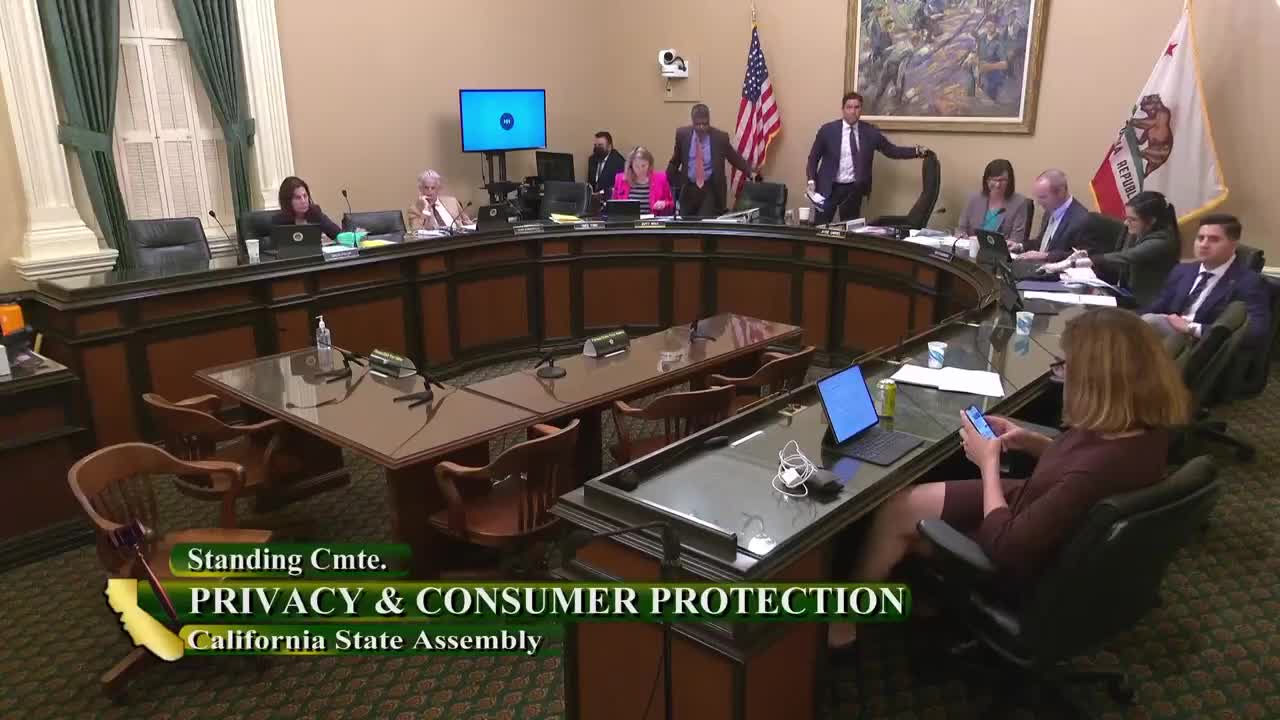 19MIN
Assembly Standing Committee on Privacy and Consumer Protection
Bill Author

Bill Co-Author(s):