AB 1563: Groundwater sustainability agency: groundwater extraction permit: verification.
- Session Year: 2023-2024
- House: Assembly
- Latest Version Date: 2023-06-28
Current Status:
Failed
(2024-05-22: Re-referred to Com. on L. GOV.)
Introduced
In Committee
First Chamber
In Committee
Second Chamber
Enacted
Existing law, the Sustainable Groundwater Management Act, requires all groundwater basins designated as high- or medium-priority basins by the Department of Water Resources that are designated as basins subject to critical conditions of overdraft to be managed under a groundwater sustainability plan or coordinated groundwater sustainability plans by January 31, 2020, and requires all other groundwater basins designated as high- or medium-priority basins to be managed under a groundwater sustainability plan or coordinated groundwater sustainability plans by January 31, 2022, plans, except as specified. Existing law authorizes any local agency or combination of local agencies overlying a groundwater basin to decide to become a groundwater sustainability agency for that basin and imposes specified duties upon that agency or combination of agencies, as provided. Existing law authorizes a groundwater sustainability agency to request of the county, and requires a county to consider, that the county forward permit requests for the construction of new groundwater wells, the enlarging of existing groundwater wells, and the reactivation of abandoned groundwater wells to the agency before permit approval.
This bill would instead require a county to forward permit requests for the construction of new groundwater wells, the enlarging of existing groundwater wells, and the reactivation of abandoned groundwater wells to the groundwater sustainability agency before permit approval.
Existing law requires the State Water Resources Control Board to adopt a model water well, cathodic protection well, and monitoring well drilling and abandonment ordinance implementing certain standards for water well construction, maintenance, and abandonment and requires each county, city, or water agency, where appropriate, not later than January 15, 1990, to adopt a water well, cathodic protection well, and monitoring well drilling and abandonment ordinance that meets or exceeds certain standards. Under existing law, if a county, city, or water agency, where appropriate, fails to adopt an ordinance establishing water well, cathodic protection well, and monitoring well drilling and abandonment standards, the model ordinance adopted by the state board is required to take effect on February 15, 1990, and is required to be enforced by the county or city and have the same force and effect as if adopted as a county or city ordinance.
This bill would prohibit a county, city, or any other water well permitting agency from approving a permit for a new groundwater well or for an alteration to an existing well in a basin subject to the act and classified as a critically overdrafted basin unless specified conditions are met. Among these conditions, the bill would require a county, city, or any other water well permitting agency to obtain a written verification from the groundwater sustainability agency that manages the basin or area of the basin where the well is proposed to be located determining that, among other things, the extraction by the proposed well is consistent with any sustainable groundwater management program established in any applicable groundwater sustainability plan adopted by that groundwater sustainability agency or an alternate plan approved or under review by the Department of Water Resources.
The bill would also require, as a condition of approving a permit for a new groundwater well or for an alteration to an existing well in an above-described basin, a county, city, or any other water well permitting agency to, among other things, post the well permit application on its internet website for at least 30 days before approving the permit. By imposing additional requirements on a county, city, or any other water well permitting agency, the bill would impose a state-mandated local program.
This bill would provide various exemptions from the above-described provisions, including exempting a permit for any well that provides less than 2 acre-feet of water annually for domestic use or any well used by a public water supply system or state small water system.
The California Constitution requires the state to reimburse local agencies and school districts for certain costs mandated by the state. Statutory provisions establish procedures for making that reimbursement.
This bill would provide that no reimbursement is required by this act for a specified reason.
Existing law, the Sustainable Groundwater Management Act, requires all groundwater basins designated as high- or medium-priority basins by the Department of Water Resources that are designated as basins subject to critical conditions of overdraft to be managed under a groundwater sustainability plan or coordinated groundwater sustainability plans by January 31, 2020, and requires all other groundwater basins designated as high- or medium-priority basins to be managed under a groundwater sustainability plan or coordinated groundwater sustainability plans by January 31, 2022, except as specified. Existing law authorizes any local agency or combination of local agencies overlying a groundwater basin to decide to become a groundwater sustainability agency for that basin and imposes specified duties upon that agency or combination of agencies, as provided. Existing law authorizes a groundwater sustainability agency to request of the county, and requires a county to consider, that the county forward permit requests for the construction of new groundwater wells, the enlarging of existing groundwater wells, and the reactivation of abandoned groundwater wells to the agency before permit approval.
This bill would instead require a county to forward permit requests for the construction of new groundwater wells, the enlarging of existing groundwater wells, and the reactivation of abandoned groundwater wells to the groundwater sustainability agency before permit approval.
Existing law requires the State Water Resources Control Board to adopt a model water well, cathodic protection well, and monitoring well drilling and abandonment ordinance implementing certain standards for water well construction, maintenance, and abandonment and requires each county, city, or water agency, where appropriate, not later than January 15, 1990, to adopt a water well, cathodic protection well, and monitoring well drilling and abandonment ordinance that meets or exceeds certain standards. Under existing law, if a county, city, or water agency, where appropriate, fails to adopt an ordinance establishing water well, cathodic protection well, and monitoring well drilling and abandonment standards, the model ordinance adopted by the state board is required to take effect on February 15, 1990, and is required to be enforced by the county or city and have the same force and effect as if adopted as a county or city ordinance.
This bill would prohibit a county, city, or any other water well permitting agency from approving a permit for a new groundwater well or for an alteration to an existing well in a basin subject to the act and classified as a critically overdrafted basin unless specified conditions are met. Among these conditions, the bill would require a county, city, or any other water well permitting agency to obtain a written verification from the groundwater sustainability agency that manages the basin or area of the basin where the well is proposed to be located determining that, among other things, the extraction by the proposed well is consistent with any sustainable groundwater management program established in any applicable groundwater sustainability plan adopted by that groundwater sustainability agency or an alternate plan approved or under review by the Department of Water Resources.
The bill would also require, as a condition of approving a permit for a new groundwater well or for an alteration to an existing well in an above-described basin, a county, city, or any other water well permitting agency to, among other things, post the well permit application on its internet website for at least 30 days before approving the permit. By imposing additional requirements on a county, city, or any other water well permitting agency, the bill would impose a state-mandated local program.
This bill would provide various exemptions from the above-described provisions, including exempting a permit for any well that provides less than 2 acre-feet of water annually for domestic use or any well used by a public water supply system or state small water system.
The California Constitution requires the state to reimburse local agencies and school districts for certain costs mandated by the state. Statutory provisions establish procedures for making that reimbursement.
This bill would provide that no reimbursement is required by this act for a specified reason.
(a)A groundwater sustainability agency shall have the following additional authority and may regulate groundwater extraction using that authority:
(1)To impose spacing requirements on new groundwater well construction to minimize well interference and impose reasonable operating regulations on existing groundwater wells to minimize well interference, including requiring extractors to operate on a rotation basis.
(2)To control groundwater extractions by regulating, limiting, or suspending extractions from individual groundwater wells or extractions from groundwater wells in the aggregate, construction of new groundwater wells, enlargement of existing groundwater wells, or reactivation of abandoned groundwater wells, or otherwise establishing groundwater extraction allocations. Those actions shall be consistent with the applicable elements of the city or county general plan, unless there is insufficient sustainable yield in the basin to serve a land use designated in the city or county general plan. A limitation on extractions by a groundwater sustainability agency shall not be construed to be a final determination of rights to extract groundwater from the basin or any portion of the basin.
(3)To authorize temporary and permanent transfers of groundwater extraction allocations within the agencys boundaries, if the total quantity of groundwater extracted in any water year is consistent with the provisions of the groundwater sustainability plan. The transfer is subject to applicable city and county ordinances.
(4)To establish accounting rules to allow unused groundwater extraction allocations issued by the agency to be carried over from one year to another and voluntarily transferred, if the total quantity of groundwater extracted in any five-year period is consistent with the provisions of the groundwater sustainability plan.
(b)This section does not authorize a groundwater sustainability agency to issue permits for the construction, modification, or abandonment of groundwater wells, except as authorized by a county with authority to issue those permits. A county shall forward permit requests for the construction of new groundwater wells, the enlarging of existing groundwater wells, and the reactivation of abandoned groundwater wells to the groundwater sustainability agency before permit approval.
SEC. 2.Article 5 (commencing with Section 13807) is added to Chapter 10 of Division 7 of the Water Code, to read:5.Water Wells13807.(a)In addition to meeting the other requirements of this chapter, a county, city, or any other water well permitting agency shall not approve a permit for a new groundwater well or for alteration of an existing well in a basin subject to the Sustainable Groundwater Management Act (Part 2.74 (commencing with Section 10720) of Division 6) and classified as a critically overdrafted basin unless all of the following conditions are met:
(1)The county, city, or any other water well permitting agency obtains written verification from a groundwater sustainability agency managing the basin or area of the basin where the well is proposed to be located that groundwater extraction by the proposed well meets both of the following conditions:
(A)The proposed well would not be inconsistent with any sustainable groundwater management program established in any applicable groundwater sustainability plan adopted by that groundwater sustainability agency or an alternate plan approved or under review by the department.
(B)The department, and the proposed well would not decrease the likelihood of achieving a sustainability goal for the basin covered by such a plan.
(2)(A)The permit applicant has provided the permitting agency a written report prepared by a licensed professional that indicates that the extraction by the proposed well is not likely to interfere with the production and functioning of one or more existing nearby wells and is not likely to cause subsidence that would adversely impact or damage nearby infrastructure.(B)As used in this paragraph, licensed professional means a professional engineer licensed pursuant to Chapter 7 (commencing with Section 6700) of Division 3 of the Business and Professions Code, or a professional geologist licensed pursuant to Chapter 12.5 (commencing with Section 7800) of Division 3 of the Business and Professions Code.(2)The county, city, or any other water well permitting agency shall first determine that extraction from the proposed well is not likely to interfere with the production and functioning of existing nearby wells, and is not likely to cause subsidence that would adversely impact or damage nearby infrastructure.
(3)The county, city, or any other water well permitting agency posts the well permit application on its internet website for at least 30 days.
(b)Subdivision (a) does not apply to all of the following:
(1)Permits for wells that will provide less than two acre-feet per year of groundwater for individual domestic users.
(2)Permits for wells that will exclusively provide groundwater to public water supply systems or state small water systems as defined in Section 116275 of the Health and Safety Code.
(3)Permits for wells in adjudicated basins identified in Section 10720.8.
(4)Maintenance of a well.
(5)Alterations, replacement, or maintenance to a well pump.
(6)Replacement of an existing, currently permitted, well only if both of the following conditions are met:
(A)The new well will produce the equivalent quantity of water as the well being replaced.
(B)The original well is either decommissioned or will be used for storage.
(7)Extension of the well casing for an existing, currently permitted, well casing of an existing well, only if the new extension does not result in the well producing an increased quantity of water.
(8)Permits for wells that will replace existing, currently permitted wells with new wells that will produce an equivalent quantity of water as the capacity of the well being replaced when the existing well is being replaced because it has been acquired by eminent domain or acquired while under threat of condemnation.
(c)Any findings required by this section do not constitute a discretionary approval for the purpose of the California Environmental Quality Act (Division 13 (commencing with Section 21000) of the Public Resources Code). Nothing in this section alters any other existing obligations related to compliance with the California Environmental Quality Act in issuing well permits.
SEC. 3.No reimbursement is required by this act pursuant to Section 6 of Article XIIIB of the California Constitution because a local agency or school district has the authority to levy service charges, fees, or assessments sufficient to pay for the program or level of service mandated by this act, within the meaning of Section 17556 of the Government Code.
(a)A groundwater sustainability agency shall have the following additional authority and may regulate groundwater extraction using that authority:
(1)To impose spacing requirements on new groundwater well construction to minimize well interference and impose reasonable operating regulations on existing groundwater wells to minimize well interference, including requiring extractors to operate on a rotation basis.
(2)To control groundwater extractions by regulating, limiting, or suspending extractions from individual groundwater wells or extractions from groundwater wells in the aggregate, construction of new groundwater wells, enlargement of existing groundwater wells, or reactivation of abandoned groundwater wells, or otherwise establishing groundwater extraction allocations. Those actions shall be consistent with the applicable elements of the city or county general plan, unless there is insufficient sustainable yield in the basin to serve a land use designated in the city or county general plan. A limitation on extractions by a groundwater sustainability agency shall not be construed to be a final determination of rights to extract groundwater from the basin or any portion of the basin.
(3)To authorize temporary and permanent transfers of groundwater extraction allocations within the agencys boundaries, if the total quantity of groundwater extracted in any water year is consistent with the provisions of the groundwater sustainability plan. The transfer is subject to applicable city and county ordinances.
(4)To establish accounting rules to allow unused groundwater extraction allocations issued by the agency to be carried over from one year to another and voluntarily transferred, if the total quantity of groundwater extracted in any five-year period is consistent with the provisions of the groundwater sustainability plan.
(b)This section does not authorize a groundwater sustainability agency to issue permits for the construction, modification, or abandonment of groundwater wells, except as authorized by a county with authority to issue those permits. A groundwater sustainability agency may request of the county, and the county shall consider, that the county shall forward permit requests for the construction of new groundwater wells, the enlarging of existing groundwater wells, and the reactivation of abandoned groundwater wells to the groundwater sustainability agency before permit approval.
SEC. 2.Article 5 (commencing with Section 13807) is added to Chapter 10 of Division 7 of the Water Code, to read:5.Water Wells13807.(a)In addition to meeting the other requirements of this chapter, a county, city, or any other water well permitting agency shall not approve a permit for a new groundwater well or for alteration of an existing well in a basin subject to the Sustainable Groundwater Management Act (Part 2.74 (commencing with Section 10720) of Division 6) and classified as a critically overdrafted basin unless all of the following conditions are met:
(1)The county, city, or any other water well permitting agency obtains written verification from a groundwater sustainability agency managing the basin or area of the basin where the well is proposed to be located that groundwater extraction by the proposed well meets both of the following conditions:
(A)The proposed well would not be inconsistent with any sustainable groundwater management program established in any applicable groundwater sustainability plan adopted by that groundwater sustainability agency or an alternate plan approved or under review by the department.
(B)The proposed well would not decrease the likelihood of achieving a sustainability goal for the basin covered by such a plan.
(2)(A)The permit applicant has provided the permitting agency a written report prepared by a licensed professional that indicates that the extraction by the proposed well is not likely to interfere with the production and functioning of one or more existing nearby wells and is not likely to cause subsidence that would adversely impact or damage nearby infrastructure.
(B)As used in this paragraph, licensed professional means a professional engineer licensed pursuant to Chapter 7 (commencing with Section 6700) of Division 3 of the Business and Professions Code, or a professional geologist licensed pursuant to Chapter 12.5 (commencing with Section 7800) of Division 3 of the Business and Professions Code.
(3)The county, city, or any other water well permitting agency posts the well permit application on its internet website for at least 30 days.
(b)Subdivision (a) does not apply to all of the following:
(1)Permits for wells that will provide less than two acre-feet per year of groundwater for individual domestic users.
(2)Permits for wells that will exclusively provide groundwater to public water supply systems or state small water systems as defined in Section 116275 of the Health and Safety Code.
(3)Permits for wells in adjudicated basins identified in Section 10720.8.
(4)Maintenance of a well.
(5)Alterations, replacement, or maintenance to a well pump.
(6)Replacement of an existing, currently permitted, well only if both of the following conditions are met:
(A)The new well will produce the equivalent quantity of water as the well being replaced.
(B)The original well is either decommissioned or will be used for storage.
(7)Extension of the well casing for an existing, currently permitted, well casing of an existing well, only if the new extension does not result in the well producing an increased quantity of water.
(8)Permits for wells that will replace existing, currently permitted wells with new wells that will produce an equivalent quantity of water as the capacity of the well being replaced when the existing well is being replaced because it has been acquired by eminent domain or acquired while under threat of condemnation.
(c)Any findings required by this section do not constitute a discretionary approval for the purpose of the California Environmental Quality Act (Division 13 (commencing with Section 21000) of the Public Resources Code). Nothing in this section alters any other existing obligations related to compliance with the California Environmental Quality Act in issuing well permits.
SEC. 3.No reimbursement is required by this act pursuant to Section 6 of Article XIIIB of the California Constitution because a local agency or school district has the authority to levy service charges, fees, or assessments sufficient to pay for the program or level of service mandated by this act, within the meaning of Section 17556 of the Government Code.
|
Date
|
Status
|
|---|---|
| May 22, 2024 | Re-referred to Com. on L. GOV. |
| May 13, 2024 | Re-referred to Com. on RLS. |
| May 13, 2024 | Withdrawn from committee. |
| Jul 12, 2023 | In committee: Set, first hearing. Hearing canceled at the request of author. |
| Jun 29, 2023 | In committee: Hearing postponed by committee. |
| Jun 28, 2023 | From committee chair, with author's amendments: Amend, and re-refer to committee. Read second time, amended, and re-referred to Com. on GOV. & F. |
| Jun 22, 2023 | From committee: Do pass and re-refer to Com. on GOV. & F. (Ayes 7. Noes 4.) (June 22). Re-referred to Com. on GOV. & F. |
| Jun 7, 2023 | Referred to Coms. on N.R. & W. and GOV. & F. |
| May 26, 2023 | In Senate. Read first time. To Com. on RLS. for assignment. |
| May 25, 2023 | Read third time. Passed. Ordered to the Senate. (Ayes 45. Noes 20. Page 1787.) |
| May 18, 2023 | Read second time. Ordered to third reading. |
| May 18, 2023 | From committee: Do pass. (Ayes 12. Noes 3.) (May 18). |
| Apr 19, 2023 | In committee: Set, first hearing. Referred to APPR. suspense file. |
| Mar 28, 2023 | From committee: Do pass and re-refer to Com. on APPR. (Ayes 8. Noes 4.) (March 28). Re-referred to Com. on APPR. |
| Mar 9, 2023 | Referred to Com. on W., P., & W. |
| Feb 18, 2023 | From printer. May be heard in committee March 20. |
| Feb 17, 2023 | Read first time. To print. |
|
Date
|
Description
|
Location
|
Votes
|
|
|---|---|---|---|---|
| Jun 22, 2023 | Do pass, but first be re-referred to the Committee on [Governance and Finance] | Senate Standing Committee on Natural Resources and Water |
Passed |
|
| May 25, 2023 | AB 1563 Bennett Assembly Third Reading | Assembly Floor |
Passed |
|
| May 18, 2023 | Do pass. | Assembly Standing Committee on Appropriations |
Passed |
|
| Mar 28, 2023 | Do pass and be re-referred to the Committee on [Appropriations] | Assembly Standing Committee on Water, Parks, and Wildlife |
Passed |
This list shows positions taken on this bill by organizations on the date displayed, which is linked to the original source.
Positions by individuals are not included.
|
Organization
|
Position
|
Date
|
|---|---|---|
| Agricultural Council Of California | ** Against | |
| Almond Alliance of California | ** Against | |
| Association Of California Water Agencies | ** Against | |
| California Alfalfa & Forage Association | ** Against | |
| California Association Of Winegrape Growers | ** Against | |
| California Builders Alliance | ** Against | |
| California Cattlemen'S Association | ** Against | |
| California Chamber Of Commerce | ** Against | |
| California Climate and Agriculture Network | ** Support | |
| California Cotton Ginners and Growers Association | ** Against | |
| California Environmental Voters | ** Support | |
| California Farm Bureau | ** Against | |
| California Fresh Fruit Association | ** Against | |
| California Grain and Feed Association | ** Against | |
| California Groundwater Coalition | ** Against | |
| California League of Food Producers | ** Against | |
| California Manufacturers & Technology Association | ** Against | |
| California Seed Association | ** Against | |
| California State Association Of Counties | ** Against | |
| California Walnut Commission | ** Against | |
| CivicWell | ** Support | |
| Climate Action California | ** Support | |
| Climate Reality Project, Los Angeles Chapter | ** Support | |
| Climate Reality Project, San Fernando Valley | ** Support | |
| CoLab Ventura County | ** Against | |
| Community Alliance With Family Farmers | ** Support | |
| County of San Joaquin | ** Against | |
| Kern County Water Agency | ** Against | |
| Kings River Conservation District | ** Against | |
| Kings River Water Association | ** Against | |
| League Of California Cities | ** Against | |
| Northern California Water Association | ** Against | |
| Palmdale Water District | ** Against | |
| Rural County Representatives of California | ** Against | |
| Sacramento Regional Builders Exchange | ** Against | |
| South San Joaquin Irrigation District | ** Against | |
| United Water Conservation District | ** Against | |
| Valley Ag Water Coalition | ** Against | |
| Ventura County Farm Bureau | ** Against | |
| Western Agricultural Processors Association | ** Against | |
| Western Growers Association | ** Against | |
| Western Plant Health Association | ** Against | |
| Winegrowers of Napa County | ** Against | |
| Wine Institute | ** Against |
SENATE COMMITTEE ON GOVERNANCE AND FINANCE
Senator Anna M. Caballero, Chair
2023 - 2024 Regular
Bill No: | AB 1563 | Hearing Date: | 7/12/23 |
Author: | Bennett | Tax Levy: | No |
Version: | 6/28/23 | Fiscal: | Yes |
Consultant: | Goldberg | ||
Groundwater sustainability agency: groundwater extraction permit: verification
Prohibits permitting agencies from approving permits for certain new groundwater wells or altering certain existing well permits in a critically over-drafted basin subject to the Sustainable Groundwater Management Act unless certain conditions are met.
Background
Groundwater 101. According to the Department of Water Resources (DWR), groundwater supplies about 40% of California’s water in a “normal” year and as much as 60% in dry years. DWR estimates there are two million groundwater wells in California, and between 7,000 and 15,000 new wells are drilled each year. Groundwater wells are permitted by local agencies and these local enforcement agencies (LEAs) ensure compliance with well standards set by DWR before issuing a permit. Some LEA’s adopt standards for wells that surpass DWR’s guidelines.
SGMA Freud. The Sustainable Groundwater Management Act (SGMA) was created in 2014 by three bills – SB 1168 (Pavley), SB 1319 (Pavley), and AB 1739 (Dickinson) – with the goal of managing and using groundwater in a manner that can be maintained during the planning and implementation horizon.
SGMA requires groundwater sustainability agencies (GSAs) in medium- and high-priority groundwater basins – which includes 21 critically over-drafted basins – to develop and implement groundwater sustainability plans (GSPs) to reduce groundwater pumping to sustainable levels by 2040.
SGMA is flexible in the sense that it allows GSAs to customize their GSPs to their regional economic and environmental circumstances. It provides for the sustainable management of groundwater basins by empowering local agencies to manage those basins, while minimizing state intervention.
Each GSA in a medium and high-priority basin must develop and implement a GSP to meet the sustainability goal. Sustainable management of groundwater is defined as the avoidance of six “undesirable results:” (a) chronic lowering of groundwater levels; (b) reduction of groundwater storage; (c) seawater intrusion; (d) degraded water quality; (e) land subsidence that substantially interferes with surface land uses; and (f) depletions of interconnected surface water.
SGMA authorizes state intervention in limited circumstances, generally when DWR determines a GSP is inadequate or isn’t being implemented properly.
If DWR finds a GSP is inadequate, it gives the GSA 180 days to cure any deficiencies. If after that time, DWR still finds the GSP inadequate, the State Water Resources Control Board (SWRCB) considers – via a noticed public hearing – whether the basin should be designated as a probationary basin.
Once a basin is determined to be “probationary,” the GSA has one year to address the issues and if they are not resolved, the SWRCB may begin another public process to determine whether to implement an interim plan for the basin. Should that occur, the SWRCB temporarily manages the groundwater in the basin until the GSA can demonstrate its ability to manage the basin sustainably.
Of California’s 515 groundwater basins and sub-basins, 94 of them – according to DWR’s California Groundwater Update 2020 – account for about 98% of the state’s groundwater use and are overlain by about 88% of the state’s irrigated acres. Additionally, 21 of these basins – which account for 67% of the groundwater use in the state on average – have been identified by DWR as being in a condition of critical overdraft.
Well Permitting. Approval of individual well permit applications is typically done by cities or counties under their land use power. Well permitting is a ministerial process where the permitting agency only looks to see if the application meets a set of pre-established criteria, as opposed to being a discretionary process where the permitting agency would have to exercise some level of subjective judgement in order to issue the permit.
However, SGMA grants numerous powers to GSAs to help them get the groundwater basins they manage to a level of sustainability. These include two specific powers related to wells and groundwater extraction. A GSA can:
- Control groundwater extractions by regulating, limiting, or suspending extractions from individual groundwater wells or extractions from groundwater wells in the aggregate, construction of new groundwater wells, enlargement of existing groundwater wells, or reactivation of abandoned groundwater wells, or otherwise establishing groundwater extraction allocations; and
- Impose spacing requirements on new groundwater well construction and impose reasonable operating regulations on existing groundwater wells to minimize well interference.
However, a GSA cannot issue permits for the construction, modification, or abandonment of groundwater wells, except as authorized by a county with authority to issue those permits. A GSA may request the permitting agency forward permit applications for new or expanded wells before approving a well permit and while the permitting agency must “consider” the request, it does not have to agree.
DWR estimates there are two million groundwater wells in California and indicates that between 7,000 and 15,000 new wells are constructed each year.
Governor’s Executive Order. The Governor issued Executive Order (EO) N-7-22 on March 28, 2022, to address California’s ongoing drought and one provision of the EO related specifically to SGMA well drilling permits.
Specifically, the EO prohibits a county, city, or other public agency from issuing a permit for a new groundwater well or for altering an existing well in a basin subject to SGMA and classified as medium-or high-priority without:
- Obtaining written verification from the GSA where the well is proposed to be located that it would be consistent with an adopted GSP and would not decrease the likelihood of achieving a sustainability goal for the basin covered by the GSP; and
- Determining extraction of groundwater from the proposed well is either not likely to interfere with the production and functioning of existing nearby wells, and not likely to cause subsidence that would adversely impact or damage nearby infrastructure.
The EO exempted from its provisions permits for wells that will provide less than two acre-feet per year of groundwater for individual domestic users and permits for wells that will exclusively provide groundwater to public water supply systems.
The author is seeking to codify portions of the EO and make other related changes.
Proposed Law
Assembly Bill 1563 changes the process where a GSA can ask – but cannot require – a county to forward requests for new, expanded, or re-activated groundwater well permits to the GSA to a process where the county would be required to forward such requests to the GSA.
A county, city, or any other well permitting agency (hereafter, permitting agency) would be prohibited from approving a permit for a new groundwater well or to alter an existing well in a critically over-drafted basin subject to SGMA unless:
- The permitting agency first determines extraction from the proposed well is not likely to interfere with the production and functioning of existing nearby wells, and is not likely to cause subsidence that would adversely impact or damage nearby infrastructure.
- The permitting agency obtains written verification from a GSA managing the basin or the area of the basin where the well is proposed to be located that groundwater extraction by the proposed well:
- Is not inconsistent with any sustainable GSP adopted by the GSA or an alternate plan approved or under review by DWR.
- Would not decrease the likelihood of achieving a sustainability goal for the basin covered by the plan.
- The permitting agency posts the well permit application on its internet website for at least 30 days.
- Excludes from the above prohibition:
- Permits for wells that will provide less than two acre-feet per year of groundwater for individual domestic uses.
- Permits for wells that will exclusively provide groundwater to public water supply systems or state small water systems.
- Permits for wells in specified adjudicated basins.
- Maintenance of a well.
- Alterations, replacement, or maintenance of a well pump.
- Replacement of an existing, currently permitted well if:
- The new well will produce the equivalent quantity of water as the well being replaced; and
- The original well is either decommissioned or will be used for storage.
- Extension of the well casing for an existing, currently permitted well if the new extension does not result in the well producing an increased quantity of water.
- Permits for wells to replace existing, currently permitted wells that will produce an equivalent quantity of water when the existing well is being replaced because it has been acquired by eminent domain or acquired while under the threat of condemnation.
- Provides these findings do not constitute a discretionary approval for purposes of the California Environmental Quality Act (CEQA).
State Revenue Impact
No estimate.
Comments
1. Purpose of the bill. According to the author, “In 2014, amidst a historic drought, SGMA was passed to establish a statewide framework to help protect groundwater basins from over-pumping and have them reach long-term sustainable pumping levels. Various stakeholders, including Groundwater Sustainability Agencies, GSAs, have identified well permitting as a gap in constructing and evaluating GSPs. Currently, counties, not GSAs, have the responsibility and authority to issue well permits. However, counties are not tasked with reaching groundwater sustainability and typically issue permits without consideration of undesirable impacts or permanent damage to aquifers, communities, and infrastructure. AB 1563 is a common sense step that furthers the legislative goal set in 2014. Currently SGMA grants authority to GSAs to regulate extraction but did not give them the authority to sign-off before new wells are drilled into the basins they are responsible for getting into long-term sustainability. With more than 6,000 new wells drilled into critically over-drafted basins since SGMA passed 2014 and more than 1,000 domestic wells going dry in those same basins each of the last three years, it is simply logical that GSA’s should have the authority to sign-off before new wells are permitted.”
2. No place like home? When the Legislature enacted SGMA in 2014, it attempted to strike a careful balance between exercising state control and oversight – since properly managing the California’s water supply affects all Californians – and preserving local authority. SGMA allows local agencies (the GSAs) to develop their own plans to manage their groundwater, but provides a state-level check to ensure the GSPs wwill achieve sustainability. It also gives GSAs broad authority to regulate groundwater extraction, but doesn’t mandate that they used any particular power.
SGMA left certain land use authorities for cities and counties intact, including well permitting. It allowed comments to flow back and forth between GSAs and land use agencies when developing GSPs and general plans, respectively. AB 1563 – following the lead set by the Governor’s EO – takes a different approach by setting the same policy in all critically over-drafted basins, regardless of the specific conditions in those basins and whether the GSP is functioning as intended. On the one hand, AB 1563 – like the Governor’s EO – is arguably a step away from the state-local balance SGMA tried to strike. On the other hand, it could also be argued that in these critically over-drafted basins – which became over-drafted in part due to too many permits being issued and/or too much groundwater being pumped out of the aquafers – perhaps a stronger state hand is warranted.
3. June 28 amendments – shifting the burden & aligning with the Governor’s EO. The June 28, 2023, author’s amendments to this measure removed one point of contention from this measure – though it created another – by deleting the provision requiring someone wanting to drill a well in an over-drafted GSA basin to first pay for a report from a professional engineer or professional geologist. The report would have had to conclude the proposed well is not likely to interfere with an existing nearby well and is not likely to cause subsidence that would adversely impact or damage nearby infrastructure before the permitting agency can approve it.
How much these reports cost depends on whom you ask. Some groups in opposition to this bill argue that at a cost approaching $2 million for such a report, that is prohibitive for many people and businesses, especially for small or family farmers. The author and some stakeholder groups put the cost of these types of engineering reports more in the neighborhood of $10,000 to $25,000, though if it is determined that subsidence needs to be measured, the cost could balloon to $250,000.
While the amendments ensure a permit applicant won’t have to pay for an engineering or a geologist report, they shift the burden (and potential cost) to the permitting agencies – in most cases, the counties. That’s because the bill requires the permitting agency to determine any extraction from a proposed well is not likely to interfere with existing nearby wells and is not likely to cause subsidence that would damage nearby infrastructure.
On this provision, AB 1563 is very similar to the Governor’s EO – both depart from existing law, where well permitting is a ministerial process (does the permit meet a set of pre-established criteria), and arguably change it to a discretionary process (where the permitting agencies would have to make determinations about likely impacts if a permit is issued).
4. Compliance with the Governor’s EO (and eventually this bill?). Permit applicants and permitting agencies that are complying with the Governor’s EO would arguably have little problem complying with this provision of the bill, since the two processes are nearly identical, though again, both are a departure from current law.
The question is, how are they complying?
Anecdotally, reports from some of the opponents to this measure say overall, requests for new well-drilling permits are down significantly from prior years and at least two counties – Mendocino and Tehama – have stopped issuing permits entirely following the issuance of the EO.
Other permitting agencies have reportedly begun having well applicants – and, in some cases, their GSA – sign “attestation forms,” attesting that receiving a permit and drilling their requested well won’t “likely” interfere with the production and functioning of existing nearby wells, and won’t “likely” cause subsidence that would adversely impact or damage nearby infrastructure.
Whether this attestation process is legally sufficient – and/or what the Governor envisioned when issuing his EO – are open questions. However, EOs, which are designed to be temporary, and legislatively-enacted statutes, which are designed to be much longer lasting, are very different balls of wax. As such, an affected entity’s (permit applicants and permitting agencies) ability and willingness to comply with an EO may be different from their ability and willingness to comply with a statute. Similarly, courts may view what is appropriate compliance with an EO differently than how they view what is appropriate compliance with a statute.
It is worth noting that DWR is currently doing a well permit analysis to examine how permitting agencies have implemented the Governor’s EO, what different processes have been adopted, whether some should serve as models for all permitting agencies or some should be banned, and more. The results of this analysis are expected to be completed in September or October. As such, the Committee may wish to consider whether this measure is premature.
5. The Governor’s EO vs. AB 1563. Executive Orders have the force and effect of law for as long as they are in effect. What the author is attempting to do is codify the principle found in the EO that a GSA should have to agree to a groundwater well permit issued by a local permitting agency because absent such authority, the GSA cannot adequately manage the groundwater basin.
However, there are some significant differences between the EO and this bill:
First, the Governor’s EO is broader in that it applies to all medium- and high-priority groundwater basins, while AB 1563 only applies to a subset of those – the critically overdrafted basins.
Second, the Governor’s EO gives permitting agencies a choice of how to proceed before issuing a permit for a new groundwater well or for altering an existing well in a basin subject to SGMA and classified as medium-or high-priority. They must accomplish both tasks below, but can do them in whichever order they choose:
- Obtain written verification from the GSA where the well is proposed to be located that it would be consistent an adopted GSP and would not decrease the likelihood of achieving a sustainability goal for the basin covered by the GSP.
- Determine the extraction of groundwater from the proposed well is both not likely to interfere with the production and functioning of existing nearby wells, and not likely to cause subsidence that would adversely impact or damage nearby infrastructure.
All things being equal, it would likely be more advantageous to first contact the GSA about the permit, because if it declines to verify the proposed well is consistent with the GSP, that decision obviates the need for the permitting agency to take the second step.
AB 1563 also requires both steps to be taken, but appears to require the permitting agency to:
- First determine extraction of groundwater from the proposed well is both not likely to interfere with the production and functioning of existing nearby wells, and not likely to cause subsidence that would adversely impact or damage nearby infrastructure.
- Next, obtain written verification from the GSA where the well is proposed that any extraction would not be inconsistent with the GSA’s GSP or alternate plan approved or under review by DWR, and the proposed well would not decrease the likelihood of achieving the sustainability goal for the basin.
This arguably requires the permitting agency to incur costs when in the end, the GSA may decline to provide written verification that the proposed well is consistent with the GSP.
Third, the only two exemptions in the EO are for permits related to wells that will provide less than two acre-feet per year of groundwater for individual domestic users and wells that will exclusively provide groundwater to public water supply systems.
AB 1563 provides seven additional exemptions (detailed below in Comment 7), which arguably make it harder for a GSA to get a complete picture of all of the groundwater wells being permitted and all of the water that may be being withdrawn from the critically-overdrawn basins targeted by this bill.
6. CEQA – can discretionary be ministerial? “Ministerial permits” are those issued based on whether a proposed project complies with a set of stablished standards, while “discretionary permits” are those requiring a person or a decision-making body to exercise judgement in order to approve them.
Generally speaking, ministerial permits – such as those issued by permitting agencies to drill groundwater wells – are not subject to CEQA.
Under current law, issuing well drilling permits is a ministerial act. The Governor’s EO and this bill, as noted in Comment 3, require permitting agencies to first determine extraction of groundwater from the proposed well is both not likely to interfere with the production and functioning of existing nearby wells, and not likely to cause subsidence that would adversely impact or damage nearby infrastructure.
So, both the Governor’s EO and AB 1563 effectively turn a ministerial act into a discretionary one, arguably subjecting it to CEQA.
AB 1563 attempts to preclude this conclusion from being drawn by stating “any findings required by this section do not constitute a discretionary approval” under CEQA.
Somewhat confusing is the use of the term “findings,” since nowhere in the bill is the permitting agency or anyone else required to make any findings – rather, the bill requires permitting agencies to “determine” certain impacts are not likely to occur. Regardless, the bill requires the permitting agency to make a judgement call about whether a proposed well will or won’t interfere with existing wells or cause subsidence – and calls that a ministerial act for the purposes of CEQA, meaning CEQA would not apply, thus creating a backdoor CEQA exemption. It is not clear why, if the author wishes to exempt these activities from CEQA, the bill doesn’t simply state the findings (or determinations) required by the measure are exempt from Division 13, commencing with Section 21000, of the Public Resources Code.
7. Second verse, (nearly) same as the first. Last year the author introduced a substantially similar bill, AB 2201. The main differences between this bill and AB 2201 are:
- This bill only applies to critically over-drafted basins. AB 2201 was broader, also applying to medium- and high-priority basins.
- This bill requires the permitting agency to determine extractions from the proposed well are not likely to interfere with the production and functioning of existing nearby wells, and are not likely to cause subsidence that would adversely impact or damage nearby infrastructure. AB 2201 required the permit applicant provides a written report, prepared by either a licensed engineer or geologist, to the permitting agency that essentially makes this same finding.
- This bill contains more exemptions from its provisions than were afforded in AB 2201. Both bills exempt:
- Permits for wells that will provide less than two acre-feet per year of groundwater for individual domestic uses (this is the first of two exemptions in the Governor’s EO).
- Permits for wells that will exclusively provide groundwater to public water supply systems or state small water systems (this is the second of two exemptions in the Governor’s EO).
- Permits for wells in specified adjudicated basins.
- Maintenance of a well.
- Alterations, replacement, or maintenance of a well pump.
This bill includes the following additional exemptions:
- Replacement of existing, currently permitted wells if:
- The new well will produce the equivalent quantity of water as the well being replaced; and
- The original well is either decommissioned or will be used for storage.
- Extension of the well casing for an existing, currently permitted well if the new extension does not result in the well producing an increased quantity of water.
- Permits for wells that will replace existing, currently permitted wells with new wells that will produce an equivalent quantity of water when the existing well is being replaced because it has been acquired by eminent domain or acquired while under threat of condemnation.
- Replacement of existing, currently permitted wells if:
- This bill specifies that any findings required by the bill do not constitute a discretionary approval for the purposes of CEQA.
The Senate Governance & Finance Committee approved AB 2201 on a 3-1 vote and it passed the Senate Floor on a 22-16 vote, but the author did not take it up for a concurrence vote in the Assembly.
8. Coming and going. The Senate Rules Committee has double referred AB 1563, first to the Senate Natural Resources & Water Committee, where it passed on a 7-4 vote on June 22, 2023, and then to the Senate Governance and Finance Committee.
Assembly Actions
Assembly Water, Parks & Wildlife Committee: 8-4
Assembly Appropriations Committee: 12-3
Assembly Floor: 45-20
Support and Opposition
(7/7/23)
Support: California Climate and Agriculture Network
California Environmental Voters (formerly CLCV)
Civicwell (formally the Local Government Commission)
Climate Action California
Climate Reality Project, Los Angeles Chapter
Climate Reality Project, San Fernando Valley
Community Alliance With Family Farmers
Opposition: Agricultural Council of California
Almond Alliance of California
Association of California Water Agencies (ACWA)
California Alfalfa & Forage Association
California Association of Winegrape Growers
California Builders Alliance
California Cattlemen's Association
California Chamber of Commerce
California Cotton Ginners and Growers Association
California Farm Bureau
California Fresh Fruit Association
California Grain and Feed Association
California League of Food Producers
California Manufacturers & Technology Association
California Seed Association
California State Association of Counties (CSAC)
California Walnut Commission
Colab Ventura County
County of San Joaquin
Kern County Water Agency
Kings River Conservation District
Kings River Water Association
League of California Cities
Northern California Water Association
Palmdale Water District
Rural County Representatives of California (RCRC)
Sacramento Regional Builders Exchange
South San Joaquin Irrigation District
United Water Conservation District
Valley Ag Water Coalition
Ventura County Farm Bureau
Western Agricultural Processors Association
Western Growers Association
Western Plant Health Association
Wine Institute
Winegrowers of Napa County
-- END --
SENATE COMMITTEE ON NATURAL RESOURCES AND WATER
Senator Dave Min, Chair
2023 - 2024 Regular
Bill No: AB Hearing Date: June 22, 2023
Author: | Bennett | ||
Version: | February 17, 2023 Introduced | ||
Urgency: | No | Fiscal: | Yes |
Consultant: | Genevieve Wong | ||
Subject: Groundwater sustainability agency: groundwater extraction permit: verification
BACKGROUND AND EXISTING LAW
Groundwater wells. According to the Department of Water Resources (DWR), groundwater supplies approximately 40 percent of California’s water supply in a “normal” year and as much as 60 percent in dry years. DWR estimates there are two million groundwater wells in California at present and indicates that between 7,000 and 15,000 new wells are constructed each year. Permitting for construction, alteration, or destruction of groundwater wells is handled by local agencies; typically this is a county department of environmental health, but cities and water agencies also exercise this authority in some cases. These local enforcing agencies (LEA), at a minimum, ensure compliance with well standards set by DWR before issuing a permit. Some LEA’s adopt standards for wells that surpass DWR guidelines.
Oftentimes, a permit for a groundwater well is deemed a “ministerial” action by an LEA. “‘Ministerial’ describes a governmental decision involving little or no personal judgement by the public official as to the wisdom or manner of carrying out the project. The public official merely applies the law to the facts as presented but uses no special discretion or judgment in reaching a decision” (Title 14, California Code of Regulations, § 15369). In a ministerial approval process, permits may be issued without considering undesirable impacts or permanent damage to aquifers, communities, and infrastructure.
Sustainable Groundwater Management Act. In contrast to other environmental legislation, California was the last state in the West to adopt a statewide groundwater management system. In 2014, the Legislature passed and then Governor Brown signed SB 1168 (Pavley), SB 1319 (Pavley) and AB 1739 (Dickinson). Those three bills established the Sustainable Groundwater Management Act (SGMA), and made other related changes to the California Water Code. Together, those bills provide a framework for sustainable groundwater management, with the goal of managing and using groundwater in a manner that can be maintained during the planning and implementation horizon without causing undesirable results.
“The foundation of [SGMA] is that groundwater is best managed at the local level, and the State’s primary role is to provide guidance and support.” (DWR website, https://water.ca.gov/Programs/Groundwater-Management/Assistance-and-Engagement, last accessed 4/10/2023). SGMA requires groundwater sustainability agencies (GSAs) in medium- and high-priority groundwater basins, which includes 21 critically overdrafted basins, to develop and implement groundwater sustainability plans (GSPs). GSAs may customize their GSPs to their regional economic and environmental circumstances. Thus, while SGMA provides for the sustainable management of groundwater basins, it does so by empowering local agencies to manage groundwater basins, while minimizing state intervention.
Governor’s drought Executive Orders (EO). The Governor issued EO N-7-22 on March 28, 2022, to extend the existing drought emergency and require various administrative response to the drought. Among these actions, paragraph nine of EO N-7-22 prohibited a local or public agency from issuing a permit for a new groundwater well or the alteration of an existing well in a groundwater basin subject to SGMA “without first obtaining written verification from a [GSA] managing the basin or area of the basin where the well is proposed to be located that groundwater extraction by the proposed well would not be inconsistent with any sustainable groundwater management program established in any applicable [GSP] adopted by that [GSA] and would not decrease the likelihood of achieving a sustainability goal for the basin covered by such a plan.” Furthermore, the EO requires that a LEA determine that a proposed new well or modification of an existing well would not likely interfere with nearby wells and would not cause subsidence that would harm infrastructure before issuing a permit. EO N-3-23 issued on February 13, 2023, again extended the drought emergency and the provisions related to groundwater well permitting except that it exempts well permits to replace existing wells that have been acquired by eminent domain or acquired while under threat of condemnation. This provision is intended to address any wells that must be moved related to construction of high-speed rail. On March 10, 2023, EO N-4-23 again extended these provisions relating to groundwater well permitting.
Existing law, under SGMA:
- Requires high- or medium-priority basins that are subject to critical conditions of overdraft to be managed by a GSP or coordinated GSPs by January 31, 2020, and requires all other high- or medium-priority basins to be managed under a GSP or coordinated GSPs by January 31, 2022. (Wat. C. §10720.7(a))
- Authorizes a local agency or combination of local agencies overlying a groundwater basin to decide to become a GSA for that basin. (Wat. C. §10723)
- Requires a GSA of each medium- and high-priority basin to develop and implement a GSP to meet the sustainability goal. Defines sustainable management of groundwater as the avoidance of six “undesirable results:” (a) chronic lowering of groundwater levels; (b) reduction of groundwater storage; (c) seawater intrusion; (d) degraded water quality; (e) land subsidence that substantially interferes with surface land uses; and (f) depletions of interconnected surface water. (Wat. C. §§10721, 10727)
- Permits a GSA to require registration of any groundwater extraction facility (i.e. groundwater well) within its management area (Wat. C. §10725.6).
- Prohibits a GSA from issuing a permit for the construction, modification, or abandonment of a groundwater well unless authorized by a county to do so. Permits a GSA to request that a county forward permit applications for construction, modification, or reactivation of groundwater wells to the GSA before approval and requires counties to consider such a request from a GSA (Wat. C. §10726.4(b)).
PROPOSED LAW
This bill prohibits a county, city, or any other well permitting agency (hereafter, permitting agency) from approving a permit for a new groundwater well or for alteration of an existing well in a critically overdrafted basin subject to SGMA unless certain conditions are met. Specifically,
- A permitting agency cannot approve a permit for a new groundwater well or for alteration of an existing well in a critically overdrafted basin subject to SGMA unless:
- The permitting agency obtains written verification from a GSA managing the basin or the area of the basin where the well is proposed to be located that groundwater extraction by the proposed well meets both of the following:
- The proposed well is not inconsistent with any sustainable groundwater management program established by any applicable GSP adopted by that GSA or an alternate plan approved or under review by DRW.
- The proposed well would not decrease the likelihood of achieving a sustainability goal for the basin covered by the plan.
- The permit applicant provides a written report, prepared by either a licensed engineer or geologist, to the permitting agency that indicates that the extraction by the proposed well is not likely to interfere with the production and functioning of one or more existing nearby wells and is not likely to cause subsidence that would adversely impact or damage nearby infrastructure.
- The permitting agency posts the well permit application on its internet website for at least 30 days.
- The permitting agency obtains written verification from a GSA managing the basin or the area of the basin where the well is proposed to be located that groundwater extraction by the proposed well meets both of the following:
- Excludes from the above prohibition:
- Permits for wells that will provide less than two acre-feet per year of groundwater for individual domestic uses.
- Permits for wells that will exclusively provide groundwater to public water supply systems or state small water systems.
- Permits for wells in specified adjudicated basins.
- Maintenance of a well.
- Alterations, replacement, or maintenance of a well pump.
- Replacement of an existing, currently permitted well if:
- The new well will produce the equivalent quantity of water as the well being replaced; and
- The original well is either decommissioned or will be used for storage.
- Extension of the well casing for an existing, currently permitted well casing of an existing well if the new extension does not result in the well producing an increased quantity of water.
- Permits for wells that will replace existing, currently permitted wells with new wells that will produce an equivalent quantity of water as the capacity of the well being replaced when the existing well is being replaced because it has been acquired by eminent domain or acquired while under the threat of condemnation.
- Permits for wells that will provide less than two acre-feet per year of groundwater for individual domestic uses.
- Provides that these findings do not constitute a discretionary approval for purposes of the California Environmental Quality Act (CEQA).
ARGUMENTS IN SUPPORT
According to the author, “In 2014, amidst a historic drought, SGMA was passed to establish a statewide framework to help protect groundwater basins from over-pumping and have them reach long-term sustainable pumping levels. Various stakeholders, including Groundwater Sustainability Agencies, GSAs, have identified well permitting as a gap in constructing and evaluating GSPs. Currently, counties, not GSAs, have the responsibility and authority to issue well permits. However, counties are not tasked with reaching groundwater sustainability and typically issue permits without consideration of undesirable impacts or permanent damage to aquifers, communities, and infrastructure. AB 1563 is a common sense step that furthers the legislative goal set in 2014. Currently SGMA grants authority to GSAs to regulate extraction but did not give them the authority to sign-off before new wells are drilled into the basins they are responsible for getting into long-term sustainability. With more than 6,000 new wells drilled into critically overdrafted basins since SGMA passed in 2014 and more than 1,000 domestic wells going dry in those same basins each of the last three years, it is simply logical that GSA’s should have the authority to sign-off before new wells are permitted.”
ARGUMENTS IN OPPOSITION
A coalition of stakeholders, including CalChamber, Wine Institute, and the California Farm Bureau Federation, among others, write in opposition to the bill for a number of reasons. The reasons include that the bill is premature because DWR is currently developing best practices, that the required report may be cost prohibitive, that noticing the proposed well could trigger CEQA, and that GSAs are not required to act within a certain timeframe and could potentially delay the ability of the applicant to use the proposed well.
COMMENTS
Double referral. This bill is double referred with the Senate Governance and Finance Committee, with this committee being the committee of first referral. Elements of this bill under the jurisdiction of the Senate Governance and Finance Committee are included here for context and completeness only and will be discussed before that committee.
A higher standard. As discussed above, many groundwater well permits are issued ministerially. By requiring that certain conditions be met before a permitting agency approves a permit for a new well or for alteration of an existing well in a critically overdrafted basin, this bill sets a higher standard of review for the permitting of those wells. This higher standard is necessary to support the principal purpose of SGMA – to ensure basins are managed in a sustainable manner. If permitting agencies issue permits without consideration of its impact to a GSP, the likelihood of undesirable results, such as subsidence, depleting groundwater levels, and degrading groundwater quality, will increase. Without coordination, how can a GSA be expected to manage its basin sustainably?
Although SGMA permits GSAs to require registration of a groundwater well within its management area, this authority applies to already existing groundwater wells. To adequately implement their GSPs, a GSA should also know when a well is being proposed and how that proposed well could interplay with the GSP. This extra tool will help GSAs ensure the basin is managed in a sustainable manner. This commonsense, proactive approach helps facilitate coordination between permitting agencies and GSAs, identifying potential undesirable results before they happen.
It costs money, honey. This bill requires a permit applicant to provide a written report of a professional engineer or professional geologist indicating that the extraction by the proposed well is not likely to interfere with the production or functioning of an existing nearby well and is not likely to cause subsidence that would adversely impact or damage nearby infrastructure. Groups in opposition have argued that this requirement is cost prohibitive, especially for small or family farmers, as the analysis could reach or exceed $2 million. However, according to information provided by the author and some stakeholder groups, engineering reports can cost between $10,000 - $25,000 for the evaluation of well interference. If it is determined that subsidence needs to be measured, the cost would increase and could be as much as $250,000. It is likely that the median cost will be somewhere in between, and will be largely dependent on the unique circumstances of each proposed well.
While EO N-7-22 does not specifically require a geologist or engineer report, the executive order does prohibit the issuance of a permit for a new groundwater well or for alteration of an existing well without first determining that the extraction of groundwater from the proposed well is (1) not likely to interfere with the production and functioning of nearby wells, and (2) not likely to cause subsidence that would adversely impact or damage nearby structure. It does appear that some stakeholder groups have been utilizing engineering reports to implement the EO.
Can notice trigger CEQA? CEQA only applies to projects where (1) there is a discretionary action of a public agency and (2) that action is likely to lead to significant environmental impacts. Unless the project meets both of these tests, CEQA is not applied. Ministerial review means that an agency does not have discretionary power over whether to approve or disapprove a project. If the project meets certain objective requirements, the agency must approve it. Without a discretionary action, CEQA does not apply. If a proposed well is subject to ministerial review, the requirement to post a notice about the well will not change that ministerial review to a discretionary one.
What about unmanaged areas or areas that do not have a GSP? AB 1563 prohibits a water well permitting agency from approving a permit for a new groundwater well or for alteration of an existing well in a critically overdrafted basin subject to SGMA unless certain requirements are met, including that the permitting agency obtains written verification from the relevant GSA is able to make certain findings. However, a question arises as to what is the well permitting agency’s responsibilities when it comes to unmanaged areas, areas that do not have a GSA and therefore do not have a GSP, or areas that do have a GSA but do not have an approved GSP.
SGMA only requires high- or medium-priority basins to have a GSP. GSPs are implemented by GSAs. High- and medium-priority basins that are subject to critical conditions are overdraft were required to have a GSP by January 31, 2020, and high- and medium-priority basins that are not subject to critical conditions of overdraft had until 2022. Thus, if there is not a GSA for an area, it is likely because that area is not a high- or medium-priority basin and therefore not required to have a GSP under SGMA. The author may wish to consider and clarify what the responsibilities of a well permitting agencies are in these circumstances.
Another scenario is that the GSP of a high- or medium- priority basin that is subject to critical overdraft could still be going through the state approval process. For example, the GSP has be deemed inadequate by DWR but SWRCB has not yet determined that an interim plan is appropriate. What would be the process used by the well permitting agency’s in these circumstances? The author may wish to make this clarification.
Take two. Last year the author introduced a similar bill, AB 2201. The main differences between this bill and AB 2201 are:
- This bill applies to critically overdrafted basins; AB 2201 applied to medium or high priority basins.
- In addition to the exemptions provided in AB 2201, this bill also does not apply to:
- Replacement of existing, currently permitted wells if certain conditions are met.
- Extension of the well casing for an existing, currently permitted well if the new extension does not result in the well producing an increased quantity of water.
- Permits for wells that will replace existing, currently permitted wells with new wells that will produce an equivalent quantity of water when the existing well is being replaced because it has been acquired by eminent domain or acquired while under threat of condemnation.
- This bill specifies that any findings required by the bill do not constitute a discretionary approval for the purposes of CEQA.
AB 2201 did not pass the Assembly Floor on concurrence.
Related legislation
AB 429 (Bennett, 2023) prohibits, if one percent of domestic wells in the basin have gone dry, a local agency from approving permits for groundwater wells in a critically overdrafted basin until it obtains a written verification from the relevant GSA determining that the well is consistent with sustainable groundwater management and determines that the well will not interfere with existing nearby wells. AB 429 was referred to the Assembly Water, Parks, and Wildlife Committee but never heard.
AB 2201 (Bennett, 2022) would have required local agencies to obtain written verification stating that a proposed well will not undermine sustainable groundwater management or cause well interference prior to approving a permit application for a groundwater well. Would have exempted specified types of wells (e.g., domestic) and activities (e.g., maintenance) from its provisions. AB 2201 died on the Assembly Floor.
SB 1317 (Wolk, 2016) would have required a city or county overlying a high- or medium-priority basin to prohibit the issuance of a permit for a new groundwater extraction facility or require a permit applicant to demonstrate that extraction of groundwater from the proposed facility would not contribute to, or create, an undesirable result. SB 1317 was referred to the Assembly Water, Parks, and Wildlife Committee but never heard.
SUPPORT
California Climate and Agriculture Network
California Environmental Voters (formerly CLCV)
Climate Action California
Climate Reality Project, Los Angeles Chapter
Climate Reality Project, San Fernando Valley
Community Alliance with Family Farmers
OPPOSITION
Agricultural Council of California
Association of California Water Agencies
California Alfalfa & Forage Association
California Association of Winegrape Growers
California Builders Alliance
California Cattlemen's Association
California Chamber of Commerce
California Cotton Ginners & Growers Association
California Farm Bureau Federation
California Fresh Fruit Association
California Grain & Feed Association
California Groundwater Coalition
California League of Food Producers
California Manufacturers and Technology Association
California Seed Association
California Walnut Commission
Colab Ventura County
Kings River Conservation District
Kings River Water Association
Northern California Water Association
Sacramento Regional Builders Exchange
United Water Conservation District
Valley Ag Water Coalition
Western Agricultural Processors Association
Western Growers Association
Western Plant Health Association
Wine Institute
Winegrowers of Napa County
-- END --
ASSEMBLY THIRD READING
ATR Bill Id:AB 1563
Author:(Bennett)
As Introduced Ver:February 17, 2023
Majority vote
SUMMARY
Prohibits a local agency from approving permits for groundwater wells in a critically over-drafted basin until it obtains a written verification from the relevant groundwater sustainability agency (GSA) determining that the well is consistent with sustainable groundwater management and a report by a licensed professional that the well will not interfere with existing nearby wells.
Major Provisions
- Prohibits a local agency from approving a permit for a new well or alteration of an existing well in a critically overdrafted groundwater basin until it obtains written verification from the GSA that manages the basin where the well is proposed to be located that pumping by the well meets the following conditions:
- The proposed well would not be inconsistent with the applicable groundwater sustainability plan (GSP) or alternate plan for the basin; and
- The proposed well would not decrease the likelihood of achieving the sustainability goal for the basin.
- Requires a well permit applicant to provide a local agency with a written report completed by a licensed professional that indicates that pumping by a proposed well is not likely to interfere with existing nearby wells and is not likely to cause subsidence that would adversely impact or damage nearby infrastructure.
- Exempts the following from the requirements of this bill:
- Permits for wells that will provide less than two-acre feet of water annually for individual domestic users;
- Permits for wells that will exclusively provide water to a public water supply system or state small water system;
- Permits for wells in adjudicated basins excluded from the Sustainable Groundwater Management Act (SGMA);
- Maintenance of a well;
- Alterations to, replacement of, or maintenance of a well pump;
- Replacement of an existing well that will produce the same or less water as the existing well if the existing well will be decommissioned or used for storage;
- Extension of the well casing for an existing well if the extension does not increase the pumping capacity of the existing casing and well; and
- Permits for wells to replace existing wells with new wells that produce an equivalent amount of water if the existing well is being replaced because it has been acquired by eminent domain or acquired while under threat of condemnation.
COMMENTS
According to DWR, groundwater supplies approximately 40% of California's water supply in a "normal" year and as much as 60 percent in dry years. Groundwater was largely unregulated in California until the passage of the Sustainable Groundwater Management Act (SGMA) in 2014. SGMA established a statewide framework to help protect groundwater resources over the long term. SGMA requires local agencies to form GSAs for medium- and high-priority basins as designated by DWR. A GSA, which is made up of one or more local agencies overlying a groundwater basin, is required to develop and implement a GSP. GSPs provide a roadmap for how groundwater basins will reach long-term sustainability without causing undesirable results, namely significant groundwater level declines, groundwater storage reductions, seawater intrusion, water quality degradation, land subsidence, and surface water depletions.
DWR estimates there are two million groundwater wells in California at present and indicates that between 7,000 and 15,000 new wells are constructed each year. Permitting for construction, alteration, or destruction of groundwater wells is handled by local agencies; typically this is a county department of environmental health, but cities and water agencies also exercise this authority in some cases. These local enforcing agencies (LEA), at a minimum, ensure compliance with well standards set by DWR before issuing a permit. Some LEA's adopt standards for wells that surpass DWR guidelines.
Oftentimes, a permit for a groundwater well is deemed a "ministerial" action by an LEA. "'Ministerial' describes a governmental decision involving little or no personal judgement by the public official as to the wisdom or manner of carrying out the project. The public official merely applies the law to the facts as presented but uses no special discretion or judgement in reaching a decision" (14 California Code of Regulations Section 15369). This bill would set a higher standard of review for permitting of groundwater wells to ensure that the well does not result in specified adverse impacts.
Governor's drought Executive Orders (EO). The Governor issued EO N-7022 on March 28, 2022, to extend the existing drought emergency and require various administrative response to the drought. Among these actions, paragraph nine of EO N-7-22 prohibited a local or public agency from issuing a permit for a new groundwater well or the alteration of an existing well in a groundwater basin subject to SGMA "without first obtaining written verification from a [GSA] managing the basin or area of the basin where the well is proposed to be located that groundwater extraction by the proposed well would not be inconsistent with any sustainable groundwater management program established in any applicable [GSP] adopted by that [GSA] and would not decrease the likelihood of achieving a sustainability goal for the basin covered by such a plan." Furthermore, the EO requires that a LEA determine that a proposed new well or modification of an existing well would not likely interfere with nearby wells and would not cause subsidence that would harm infrastructure before issuing a permit. EO N-3-23 issued on February 13, 2023 again extended the drought emergency and the provisions related to groundwater well permitting except that it exempts well permits to replace existing wells that have been acquired by eminent domain or acquired while under threat of condemnation. This provision is intended to address any wells that must be moved related to construction of high-speed rail. The Administration has not provided information regarding how implementation of the EO has unfolded.
According to the Author
Groundwater well permitting is a recognized gap in SGMA and that the lack of consideration of sustainable groundwater management goals in approving groundwater well permits is undermining the goals of SGMA. The author points to analysis conducted by the Los Angeles Times in December 2021 that more than 6,200 groundwater wells that provide water for agriculture had been drilled in the San Joaquin Valley since the passage of SGMA as evidence that this bill is necessary. Furthermore, data obtained through DWR's voluntary dry well reporting system indicates that more than 2,700 groundwater wells have gone dry statewide since the beginning of 2020. While DWR's data also indicates that many of these dry wells have been mitigated by either an interim solution (e.g., hauled or bottled water or tapping into a neighbor's supply) or resolved by a replacement well or groundwater level recovery, the number of voluntary reports indicates a significant problem. The author argues that this bill is a "common sense step" that helps address this problem and furthers the goals of SGMA.
Arguments in Support
CivicWell argues that this bill "is an important step to further the legislative intent of SGMA, which already grants GSAs the authority to 'regulate extraction' of groundwater, by providing clear mechanisms for registering new wells within a GSA's jurisdiction and regulating their extraction of water in line with locally-developed [GSPs]. SGMA already requires GSAs to consider 'all beneficial uses and users of groundwater,' specifically including domestic well users and disadvantaged communities. [This bill] will help equip local GSAs in critically overdrafted basins with the necessary authority to fully reach sustainability by ensuring that counties do not approve new groundwater wells unless they are consistent with GSP's requirements to meet sustainability and do not harm other users of water. [This bill] builds upon Governor Newsom's Executive Order to ensure that the protection of groundwater resources can be made permanent while preserving the ability of local agencies to ensure that the plans they have developed can succeed."
Arguments in Opposition
The California Chamber and California Farm Bureau Federation along with a number of agricultural and business organizations and GSAs (Coalition) oppose this bill arguing that it restricts access to water for food production, circumvents local control in the management of groundwater resources provided by SGMA, and is premature given ongoing implementation of EO N-7-22. The Coalition maintains that this bill "imposes significant costs upon well applicants and increases the likelihood of legal challenges to well permitting decisions. Small family farmers are the least likely to be able to afford the new requirements in this bill, particularly when these farmers are already."
FISCAL COMMENTS
According to the Assembly Appropriations Committee, the State Water Resources Control Board (State Water Board) estimates ongoing annual costs of approximately $450,000 (General Fund) to review an estimated few hundred groundwater well permits every year in critically overdrafted basins that are subject to state intervention.
VOTES
ASM WATER, PARKS, AND WILDLIFE: 8-4-3
YES: Bauer-Kahan, Bennett, Friedman, Hart, Wood, Pellerin, Schiavo, Weber
NO: Mathis, Alanis, Megan Dahle, Davies
ABS, ABST OR NV: Blanca Rubio, Villapudua, Ward
ASM APPROPRIATIONS: 12-3-1
YES: Holden, Megan Dahle, Bryan, Calderon, Wendy Carrillo, Mike Fong, Hart, Lowenthal, Papan, Pellerin, Weber, Ortega
NO: Dixon, Mathis, Sanchez
ABS, ABST OR NV: Robert Rivas
UPDATED
VERSION: February 17, 2023
CONSULTANT: Pablo Garza / W., P., & W. / (916) 319-2096 FN: 0000756
Date of Hearing: April 19, 2023
ASSEMBLY COMMITTEE ON APPROPRIATIONS
Chris Holden, Chair
ABPCA Bill Id:AB 1563
Author:(Bennett) – As Introduced Ver:February 17, 2023
Policy Committee: | Water, Parks and Wildlife | Vote: | 8 - 4 |
|
| ||
|
|
Urgency: No State Mandated Local Program: Yes Reimbursable: No
SUMMARY:
This bill prohibits a county, city, or any other water well permitting agency from approving a permit for a new groundwater well or for an alteration to an existing well in a basin subject to the Sustainable Groundwater Management Act (SGMA) and classified as a critically overdrafted basin, unless specified conditions are met.
Specifically, this bill, among other things:
- Requires a county to forward permit requests for new groundwater wells, enlargement of existing wells, and the reactivation of abandoned wells to the groundwater sustainability agency (GSA) before permit approval.
- Prohibits a county, city, or any other water well permitting agency from approving a permit for a new groundwater well or for alteration of an existing well in a basin subject to SGMA and classified as a critically overdrafted basin unless all of the following conditions are met:
- The county, city, or any other water well permitting agency obtains written verification from a GSA managing the basin or area of the basin where the well is proposed to be located that groundwater extraction by the proposed well meets both of the following conditions:
- The proposed well would not be inconsistent with any sustainable groundwater management program established in any applicable groundwater sustainability plan (GSP) adopted by that GSA or an alternate plan approved or under review by the Department of Water Resources (DWR).
- The proposed well would not decrease the likelihood of achieving a sustainability goal for the basin covered by such a GSP.
- The permit applicant has provided the permitting agency a written report prepared by a licensed professional that indicates the extraction by the proposed well is not likely to interfere with the production and functioning of one or more existing nearby wells and is not likely to cause subsidence that would adversely impact or damage nearby infrastructure.
- The county, city, or any other water well permitting agency posts the well permit application on its website for at least 30 days.
- The county, city, or any other water well permitting agency obtains written verification from a GSA managing the basin or area of the basin where the well is proposed to be located that groundwater extraction by the proposed well meets both of the following conditions:
- Exempts specified permits and activities from the requirements of this bill.
- Provides that any findings required by this bill do not constitute a discretionary approval for the purpose of the California Environmental Quality Act (CEQA) and that this bill does not alter any existing obligations related to CEQA compliance in issuing well permits.
FISCAL EFFECT:
The State Water Resources Control Board (State Water Board) estimates ongoing annual costs of approximately $450,000 (General Fund) to review an estimated few hundred groundwater well permits every year in critically overdrafted basins that are subject to state intervention.
COMMENTS:
1) Purpose. According to the author:
Various stakeholders, including Groundwater Sustainability Agencies, GSAs, have identified well permitting as a gap in constructing and evaluating GSPs. Currently, counties, not GSAs, have the responsibility and authority to issue well permits. However, counties are not tasked with reaching groundwater sustainability and typically issue permits without consideration of undesirable impacts or permanent damage to aquifers, communities, and infrastructure. AB 1563 is a common sense step that furthers the legislative goal set in 2014…With more than 6,000 new wells drilled into critically overdrafted basins since SGMA passed 2014 and more than 1,000 domestic wells going dry in those same basins each of the last three years, it is simply logical that GSA’s should have the authority to sign-off before new wells are permitted.
2) Sustainable Groundwater Management Act (SGMA). According to the Department of Water Resources (DWR), groundwater is a critical source of water for both farms and cities in California, supplying 40% of water in a typical year and as much as 60% in drought years. About 80% of Californians use groundwater for drinking or other household uses. Signed into law in 2014, after nearly a century of mismanagement of the state’s groundwater resources, SGMA established a statewide framework to help protect groundwater resources over the long term. SGMA requires local agencies to form GSAs for medium- and high-priority basins as designated by DWR. A GSA, which is made up of one or more local agencies overlying a groundwater basin, is required to develop and implement a GSP. GSPs provide a roadmap for how groundwater basins will reach long-term sustainability without causing undesirable results, namely significant groundwater level declines, groundwater storage reductions, seawater intrusion, water quality degradation, land subsidence, and surface water depletions. DWR estimates there are currently two million groundwater wells in California and between 7,000 and 15,000 new wells are constructed each year.
In early March 2023, DWR announced decisions for GSPs for 12 critically overdrafted basins in Central California. DWR recommended approvals for plans for six basins along with recommended corrective actions for the basins to remain in an approved status. DWR deemed the remaining six basins as inadequate and transitioned them from DWR’s oversight to the State Water Board for state intervention under SGMA, which is a process that could result in the State Water Board temporarily managing and protecting groundwater resources until local agencies are able and willing to do so adequately.
Out of a total of 94 groundwater basins required to submit plans under SGMA, DWR has provided determinations for 24 basins and is reviewing an additional 61 plans from 59 of the state’s high- and medium- priority basins that were submitted to DWR in January 2022. DWR anticipates issuing determinations for the remaining basins throughout 2023.
3) Permitting New Groundwater Wells. As noted in the Assembly Water, Parks and Wildlife Committee analysis of this bill, permitting for the construction, alteration, or destruction of groundwater wells is handled by local agencies, typically a county department of environmental health, but cities and water agencies also exercise this authority in some cases. These local enforcing agencies (LEAs), at a minimum, ensure compliance with well standards set by DWR before issuing a permit. Some LEAs adopt standards for wells that surpass DWR guidelines. Often, a permit for a groundwater well is deemed a “ministerial” action by a local agency. Ministerial actions do not require the exercise of any discretion by the agency. GSAs, on the other hand, do not have express authority to regulate new well permits even though new wells can directly impact a GSA’s ability to reach sustainability goals within a GSA’s basin. This bill would set a higher standard of review for permitting of groundwater wells.
4) Governor’s Drought Executive Order. Executive Order (EO) N-7022, issued on March 28, 2022, extended the drought state of emergency and required various administrative responses to the drought. Among these actions, the EO prohibited a local or public agency from issuing a permit for a new groundwater well or the alteration of an existing well in a groundwater basin subject to SGMA:
Without first obtaining written verification from a [GSA] managing the basin or area of the basin where the well is proposed to be located that groundwater extraction by the proposed well would not be inconsistent with any sustainable groundwater management program established in any applicable [GSP] adopted by that [GSA] and would not decrease the likelihood of achieving a sustainability goal for the basin covered by such a plan.
Furthermore, the EO requires an LEA, before issuing a permit, to determine that a proposed new well or modification of an existing well would not likely interfere with nearby wells and would not cause subsidence that would harm infrastructure. EO N-3-23 issued on February 13, 2023, again extended the drought emergency and the provisions related to groundwater well permitting except that it exempts well permits to replace existing wells that have been acquired by eminent domain or while under threat of condemnation. This provision is intended to address any wells that must be moved related to the construction of high-speed rail. This bill has many similarities to the EO; however, the EO is not permanent and could be lifted at any time.
- Support and Opposition. Writing in support, the Community Alliance with Family Farmers states:
CAFF is pleased to support AB 1563 as we have seen the disastrous consequences for rural residents and small farms of allowing the unlimited drilling of new and deeper wells throughout the agricultural regions of California. In Yolo County, where CAFF is based, in a 10-year span 800 new wells were drilled and 47,000 acres of perennial crops were planted, with 72% of this acreage planted on historically non-irrigated land. Many drinking water and shallow agricultural wells dried up in the process.
Writing in opposition, a large coalition of agricultural and business groups state:
This bill imposes significant costs upon well applicants and increases the likelihood of legal challenges to well permitting decisions. Small family farmers are the least likely to be able to afford the new requirements in this bill, particularly when these farmers are already struggling to keep their businesses running. In addition, the proposed requirements in the bill are untimely, considering current state study into well permitting best practices.
Analysis Prepared by: Nikita Koraddi / APPR. / (916) 319-2081
Date of Hearing: March 28, 2023
ASSEMBLY COMMITTEE ON WATER, PARKS, AND WILDLIFE
Rebecca Bauer-Kahan, Chair
ABPCA Bill Id:AB 1563 (
Author:Bennett) – As Introduced Ver:February 17, 2023
SUBJECT: Groundwater sustainability agency: groundwater extraction permit: verification
SUMMARY: Prohibits a local agency from approving permits for groundwater wells in a critically over-drafted basin until it obtains a written verification from the relevant groundwater sustainability agency (GSA) determining that the well is consistent with sustainable groundwater management and a report by a licensed professional that the well will not interfere with existing nearby wells. Specifically, this bill:
- Requires a county to forward permit applications for new groundwater wells, enlargement of existing wells, or reactivation of an abandoned well to the applicable GSA before approval.
- Prohibits a local agency from approving a permit for a new well or alteration of an existing well in a critically overdrafted groundwater basin until it obtains written verification from the GSA that manages the basin where the well is proposed to be located that pumping by the well meets the following conditions:
- The proposed well would not be inconsistent with the applicable groundwater sustainability plan (GSP) or alternate plan for the basin; and
- The proposed well would not decrease the likelihood of achieving the sustainability goal for the basin.
- Requires a well permit applicant to provide a local agency with a written report completed by a licensed professional that indicates that pumping by a proposed well is not likely to interfere with existing nearby wells and is not likely to cause subsidence that would adversely impact or damage nearby infrastructure.
- Defines “licensed professional” as a professional engineer or geologist who holds a license from the appropriate California licensing body.
- Exempts the following from the requirements of this bill:
- Permits for wells that will provide less than two-acre feet of water annually for individual domestic users;
- Permits for wells that will exclusively provide water to a public water supply system or state small water system;
- Permits for wells in adjudicated basins excluded from the Sustainable Groundwater Management Act (SGMA);
- Maintenance of a well;
- Alterations to, replacement of, or maintenance of a well pump;
- Replacement of an existing well that will produce the same or less water as the existing well if the existing well will be decommissioned or used for storage;
- Extension of the well casing for an existing well if the extension does not increase the pumping capacity of the existing casing and well; and
- Permits for wells to replace existing wells with new wells that produce an equivalent amount of water if the existing well is being replaced because it has been acquired by eminent domain or acquired while under threat of condemnation.
- Provides that any findings required by this bill do not constitute discretionary approval for the purposes of the California Environmental Quality Act (CEQA) and that this bill does not alter any existing obligations related to CEQA compliance in issuing well permits.
EXISTING LAW:
- Enacts SGMA that requires local agencies to sustainably manage groundwater in high- or medium-priority basins by 2040. Defines sustainable management of groundwater as the avoidance of the following six “undesirable results:” (a) chronic lowering of groundwater levels; (b) reduction of groundwater storage; (c) seawater intrusion; (d) degraded water quality; (e) land subsidence; and (f) depletions of interconnected surface water (Water Code § 10720 et seq.).
- Requires the Department of Water Resources (DWR) to designate groundwater basins as high-, medium-, low-, or very low-priority for the purposes of SGMA and requires that the designation be based on specified criteria, including population of the overlying basin, number of wells in the basin, and irrigated acreage in the basin (Water Code § 10722.4).
- Requires DWR to identify groundwater basins that are subject to critical conditions of overdraft (Water Code § 12924).
- Requires local agencies in high- and medium-priority basins to form a GSA by June 30, 2017, unless statute designates an “exclusive local agency” for a given area. Provides that a county will be the default GSA for any area in a high- or medium- priority basin not managed by a GSA unless said county notifies DWR that it will not be the GSA for an uncovered portion of a high- or medium-priority basin (Water Code §§ 10723 – 10724).
- Permits a GSA to require registration of any groundwater extraction facility (e.g., groundwater well) within its management area (Water Code § 10725.6).
- Prohibits a GSA from issuing a permit for the construction, modification, or abandonment of a groundwater well unless authorized by a county to do so. Permits a GSA to request that a county forward permit applications for construction, modification, or reactivation of groundwater wells to the GSA before approval and requires counties to consider such a request from a GSA [Water Code § 10726.4 (b)].
- Defines a de minimus extractor as a person who extracts, for domestic purposes, two acre-feet or less per year (Water Code § 10721).
- Provides that 26 adjudicated basins are not subject to SGMA (Water Code § 10720.8).
- Defines a “state small water system” as a piped water system that provides water for human consumption and serves between five and 14 service connections and does not regularly serve drinking water to more than an average of 25 individuals for more than 60 days out of the year (Health and Safety Code § 116275).
FISCAL EFFECT: Unknown. This bill is keyed fiscal.
COMMENTS:
- Purpose of this bill. The author maintains that groundwater well permitting is a recognized gap in SGMA and that the lack of consideration of sustainable groundwater management goals in approving groundwater well permits is undermining the goals of SGMA. The author points to analysis conducted by the Los Angeles Times in December 2021 that more than 6,200 groundwater wells that provide water for agriculture had been drilled in the San Joaquin Valley since the passage of SGMA as evidence that this bill is necessary. Furthermore, data obtained through DWR’s voluntary dry well reporting system indicates that more than 2,700 groundwater wells have gone dry statewide since the beginning of 2020. While DWR’s data also indicates that many of these dry wells have been mitigated by either an interim solution (e.g., hauled or bottled water or tapping into a neighbor’s supply) or resolved by a replacement well or groundwater level recovery, the number of voluntary reports indicates a significant problem. The author argues that this bill is a “common sense step” that helps address this problem and furthers the goals of SGMA.
The author cites studies that find Latino communities are disproportionately impacted by nitrate pollution, low income and minority communities face serious water quality problems, and households headed by people of color are 35 percent more likely to lack access to piped water as compared to white households. The author maintains that this bill will help to address these disparities in access to safe drinking water for disadvantaged and low-income communities and communities of color. - Background. According to DWR, groundwater supplies approximately 40 percent of California’s water supply in a “normal” year and as much as 60 percent in dry years. DWR estimates there are two million groundwater wells in California at present and indicates that between 7,000 and 15,000 new wells are constructed each year. Permitting for construction, alteration, or destruction of groundwater wells is handled by local agencies; typically this is a county department of environmental health, but cities and water agencies also exercise this authority in some cases. These local enforcing agencies (LEA), at a minimum, ensure compliance with well standards set by DWR before issuing a permit. Some LEA’s adopt standards for wells that surpass DWR guidelines.
Oftentimes, a permit for a groundwater well is deemed a “ministerial” action by an LEA. “‘Ministerial’ describes a governmental decision involving little or no personal judgement by the public official as to the wisdom or manner of carrying out the project. The public official merely applies the law to the facts as presented but uses no special discretion or judgement in reaching a decision” (14 California Code of Regulations § 15369). This bill would set a higher standard of review for permitting of groundwater wells to ensure that the well does not result in specified adverse impacts.
Governor’s drought Executive Orders (EO). The Governor issued EO N-7022 on March 28, 2022, to extend the existing drought emergency and require various administrative response to the drought. Among these actions, paragraph nine of EO N-7-22 prohibited a local or public agency from issuing a permit for a new groundwater well or the alteration of an existing well in a groundwater basin subject to SGMA “without first obtaining written verification from a [GSA] managing the basin or area of the basin where the well is proposed to be located that groundwater extraction by the proposed well would not be inconsistent with any sustainable groundwater management program established in any applicable [GSP] adopted by that [GSA] and would not decrease the likelihood of achieving a sustainability goal for the basin covered by such a plan.” Furthermore, the EO requires that a LEA determine that a proposed new well or modification of an existing well would not likely interfere with nearby wells and would not cause subsidence that would harm infrastructure before issuing a permit. EO N-3-23 issued on February 13, 2023 again extended the drought emergency and the provisions related to groundwater well permitting except that it exempts well permits to replace existing wells that have been acquired by eminent domain or acquired while under threat of condemnation. This provision is intended to address any wells that must be moved related to construction of high-speed rail. The Administration has not provided information regarding how implementation of the EO has unfolded.
- Policy considerations. This bill has many similarities with the EO; however, the EO is not permanent and, given current hydrologic conditions, is likely to be lifted in the near future. This bill raises the issue of whether an ongoing change in how local agencies permit groundwater wells is needed.
Substantially similar bills. This bill is similar to AB 429 by the same author that is also before the Committee at this hearing. There are four primary differences between the two bills: 1) this bill requires the permit applicant to engage a licensed professional to determine whether the well would interfere with nearby existing wells while AB 429 requires the permitting agency to make this determination; 2) this bill applies once enacted while AB 429 contains a trigger so that it only takes effect if one percent of domestic wells in the basin go dry; 3) this bill requires the permitting agency to post the application online for 30 days while AB 429 contains no such requirement; and 4) this bill clarifies that the determinations it requires do not constitute a discretionary approval (thereby potentially avoiding review under the California Environmental Quality Act) while AB 429 contains no such clarification. - Arguments in support. The Climate Reality Project supports this bill asserting that drilling of new wells is an ongoing problem and that it will better protect human safety and public health from excessive drilling. The Project maintains that “there have been incidents in which local drinking water in the Central Valley has become scarce when adjacent large wells have been drilled” and that this bill will address this problem.
- Arguments in opposition. The California Chamber and California Farm Bureau Federation along with a number of agricultural and business organizations and GSAs (Coalition) oppose this bill arguing that it restricts access to water for food production, circumvents local control in the management of groundwater resources provided by SGMA, and is premature given ongoing implementation of EO N-7-22. The Coalition maintains that this bill “imposes significant costs upon well applicants and increases the likelihood of legal challenges to well permitting decisions. Small family farmers are the least likely to be able to afford the new requirements in this bill, particularly when these farmers are already.”
- Related legislation. AB 429 (Bennett), current session, is substantially similar to this bill except that it only applies if one percent of the domestic wells in a basin go dry and requires the permitting agency (rather than a licensed professional engaged by the permit applicant) to determine that a well will not interfere with existing nearby wells before issuing a permit. AB 429 is set for hearing before this Committee on March 28, 2023.
AB 2201 (Bennett), 2021-22 Session, would have required local agencies to obtain written verification stating that a proposed well will not undermine sustainable groundwater management or cause well interference prior to approving a permit application for a groundwater well. Would have exempted specified types of wells (e.g., domestic) and activities (e.g., maintenance) from its provisions. AB 2201 died on the Assembly Floor.
SB 1317 (Wolk), 2015-16 Session, would have required a city or county overlying a high- or medium-priority basin to prohibit the issuance of a permit for a new groundwater extraction facility or require a permit applicant to demonstrate that extraction of groundwater from the proposed facility would not contribute to, or create, an undesirable result. SB 1317 was referred to this committee but never heard.
REGISTERED SUPPORT / OPPOSITION:
Support
Climate Reality Project, California Coalition
Community Alliance with Family Farmers
Opposition
Agricultural Council of California
California Alfalfa & Forage Association
California Association of Winegrape Growers
California Cattlemen's Association
California Chamber of Commerce
California Cotton Ginners & Growers Association
California Farm Bureau Federation
California Fresh Fruit Association
California Grain and Feed Association
California League of Food Producers
California Manufacturers & Technology Association
California Seed Association
California Walnut Commission
CoLab Ventura County
Kings River Conservation District
Northern California Water Association
United Water Conservation District
Valley Ag Water Coalition
Western Agricultural Processors Association
Western Growers Association
Western Plant Health Association
Wine Institute
Winegrowers of Napa County
Analysis Prepared by: Pablo Garza / W., P., & W. / (916) 319-2096
Discussed in Hearing
 25MIN
Senate Standing Committee on Natural Resources and Water
 5MIN
Assembly Floor
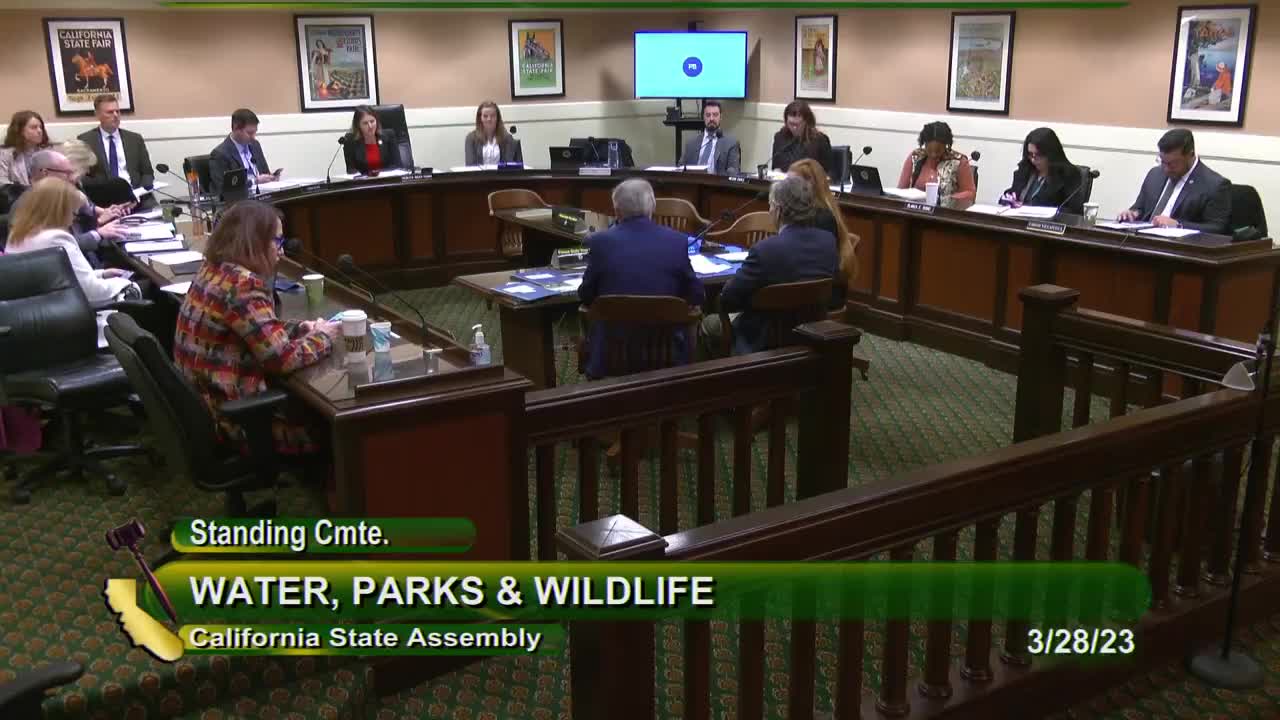 58MIN
Assembly Standing Committee on Water, Parks, and Wildlife
Bill Author

Bill Co-Author(s):