AB 1572: Potable water: nonfunctional turf.
- Session Year: 2023-2024
- House: Assembly
- Latest Version Date: 2023-10-13
Current Status:
Passed
(2023-10-13: Chaptered by Secretary of State - Chapter 849, Statutes of 2023.)
Introduced
In Committee
First Chamber
In Committee
Second Chamber
Enacted
(1)Existing law establishes various state water policies, including the policy that the use of water for domestic purposes is the highest use of water.
This bill would make legislative findings and declarations concerning water use, including that the use of potable water to irrigate nonfunctional turf is wasteful and incompatible with state policy relating to climate change, water conservation, and reduced reliance on the Sacramento-San Joaquin Delta ecosystem. The bill would direct all appropriate state agencies to encourage and support the elimination of irrigation of nonfunctional turf with potable water.
(2)Existing law, the Integrated Regional Water Management Planning Act, authorizes a regional water management group to prepare and adopt an integrated regional water management plan in accordance with specified requirements, including, among other things, the identification and consideration of the water-related needs of disadvantaged communities in the area within the boundaries of the plan.
This bill would additionally require an integrated regional water management plan to address the identification and consideration of the water-related needs of owners and occupants of affordable housing, including the removal and replacement of nonfunctional turf.
(3)Existing law provides various findings and declarations of the Legislature related to sustainable water use and demand reduction. Existing law imposes various water use reduction requirements that apply to urban retail water suppliers, including a requirement that the state achieve a 20% reduction in urban per capita water use by December 31, 2020.
This bill would prohibit the use of potable water, as defined, for the irrigation of nonfunctional turf located on commercial, industrial, and institutional properties, other than a cemetery, and on properties of homeowners associations, common interest developments, and community service organizations or similar entities, as specified. The bill would authorize the State Water Resources Control Board to create a form for compliance certification and would require owners of covered properties to certify their compliance, as specified. The bill would authorize a public water system, city, county, or city and county to enforce these provisions, as specified. The bill would require the Governors Office of Business and Economic Development to support small and minority-owned businesses that provide services that advance compliance with these provisions.
(1)Existing law establishes various state water policies, including the policy that the use of water for domestic purposes is the highest use of water.
This bill would make legislative findings and declarations concerning water use, including that the use of potable water to irrigate nonfunctional turf is wasteful and incompatible with state policy relating to climate change, water conservation, and reduced reliance on the Sacramento-San Joaquin Delta ecosystem. The bill would direct all appropriate state agencies to encourage and support the elimination of irrigation of nonfunctional turf with potable water.
(2)Existing law, the Integrated Regional Water Management Planning Act, authorizes a regional water management group to prepare and adopt an integrated regional water management plan in accordance with specified requirements, including, among other things, the identification and consideration of the water-related needs of disadvantaged communities in the area within the boundaries of the plan.
This bill would additionally require an integrated regional water management plan to address the identification and consideration of the water-related needs of owners and occupants of affordable housing, including the removal and replacement of nonfunctional turf.
(3)Existing law provides various findings and declarations of the Legislature related to sustainable water use and demand reduction. Existing law imposes various water use reduction requirements that apply to urban retail water suppliers, including a requirement that the state achieve a 20% reduction in urban per capita water use by December 31, 2020.
This bill would prohibit the use of potable water, as defined, for the irrigation of nonfunctional turf located on commercial, industrial, and institutional properties properties, other than a cemetery cemetery, and on properties of homeowners associations, common interest developments, and community service organizations or similar entities, as specified. The bill would require authorize the State Water Resources Control Board to establish, no later than July 1, 2026, specified create a form for compliance and certification requirements. The bill and would require owners of covered properties to certify their compliance with these provisions, compliance, as specified. The bill would authorize a public water system, city, county, or city and county to enforce these provisions, as specified. The bill would require the Governors Office of Business and Economic Development to support small and minority-owned businesses that provide services that advance compliance with these provisions.
(1)Existing law establishes various state water policies, including the policy that the use of water for domestic purposes is the highest use of water.
This bill would make legislative findings and declarations concerning water use, including that the use of potable water to irrigate nonfunctional turf is wasteful and incompatible with state policy relating to climate change, water conservation, and reduced reliance on the Sacramento-San Joaquin Delta ecosystem. The bill would direct all appropriate state agencies to encourage and support the elimination of irrigation of nonfunctional turf with potable water.
(2)Existing law, the Integrated Regional Water Management Planning Act, authorizes a regional water management group to prepare and adopt an integrated regional water management plan in accordance with specified requirements, including, among other things, the identification and consideration of the water-related needs of disadvantaged communities in the area within the boundaries of the plan.
This bill would additionally require an integrated regional water management plan to address the identification and consideration of the water-related needs of owners and occupants of affordable housing, including the removal and replacement of nonfunctional turf.
(3)Existing law provides various findings and declarations of the Legislature related to sustainable water use and demand reduction. Existing law imposes various water use reduction requirements that apply to urban retail water suppliers, including a requirement that the state achieve a 20% reduction in urban per capita water use by December 31, 2020.
This bill would prohibit the use of potable water, as defined, for the irrigation of nonfunctional turf located on commercial, industrial, and institutional properties other than a cemetery, cemetery and on properties of homeowners associations, common interest developments, and community service organizations or similar entities, as specified. The bill would require the State Water Resources Control Board to establish, no later than July 1, 2026, specified compliance and certification requirements. The bill would require owners of covered properties to certify their compliance with these provisions, as specified. The bill would authorize a public water system, city, county, or city and county to enforce these provisions, as specified. The bill would require the Governors Office of Business and Economic Development to support small and minority-owned businesses that provide services that advance compliance with these provisions.
(1)Existing law establishes various state water policies, including the policy that the use of water for domestic purposes is the highest use of water.
This bill would make legislative findings and declarations concerning water use, including that the use of potable water to irrigate nonfunctional turf is wasteful and incompatible with state policy relating to climate change, water conservation, and reduced reliance on the Sacramento-San Joaquin Delta ecosystem. The bill would direct all appropriate state agencies to encourage and support the elimination of irrigation of nonfunctional turf with potable water.
(2)Existing law, the Integrated Regional Water Management Planning Act, authorizes a regional water management group to prepare and adopt an integrated regional water management plan in accordance with specified requirements, including, among other things, the identification and consideration of the water-related needs of disadvantaged communities in the area within the boundaries of the plan.
This bill would additionally require an integrated regional water management plan to address the identification and consideration of the water-related needs of owners and occupants of affordable housing, including the removal and replacement of nonfunctional turf.
(3)Existing law provides various findings and declarations of the Legislature related to sustainable water use and demand reduction. Existing law imposes various water use reduction requirements that apply to urban retail water suppliers, including a requirement that the state achieve a 20% reduction in urban per capita water use by December 31, 2020.
This bill would prohibit the use of potable water, as defined, for the irrigation of nonfunctional turf located on commercial, industrial, institutional, and multifamily residential properties, and institutional properties other than a cemetery, as specified. The bill would require the State Water Resources Control Board to establish, no later than July 1, 2026, specified compliance and certification requirements. The bill would require owners of covered properties to certify their compliance with these provisions, as specified. The bill would authorize a public water system, city, county, or city and county to enforce these provisions, as specified. The bill would require the Governors Office of Business and Economic Development to support small and minority-owned businesses that provide services that advance compliance with these provisions.
(1)Existing law establishes various state water policies, including the policy that the use of water for domestic purposes is the highest use of water.
This bill would make legislative findings and declarations concerning water use, including that the use of potable water to irrigate nonfunctional turf is wasteful and incompatible with state policy relating to climate change, water conservation, and reduced reliance on the Sacramento-San Joaquin Delta ecosystem. The bill would direct all appropriate state agencies to encourage and support the elimination of irrigation of nonfunctional turf with potable water.
(2)Existing law, the Integrated Regional Water Management Planning Act, authorizes a regional water management group to prepare and adopt an integrated regional water management plan in accordance with specified requirements, including, among other things, the identification and consideration of the water-related needs of disadvantaged communities in the area within the boundaries of the plan.
This bill would additionally require an integrated regional water management plan to address the identification and consideration of the water-related needs of owners and occupants of affordable housing, including the removal and replacement of nonfunctional turf.
(2)(3)Existing law provides various findings and declarations of the Legislature related to sustainable water use and demand reduction. Existing law imposes various water use reduction requirements that apply to urban retail water suppliers, including a requirement that the state achieve a 20% reduction in urban per capita water use by December 31, 2020.
This bill would prohibit the use of potable water, as defined, for the irrigation of nonfunctional turf located on commercial, industrial, institutional, and multifamily residential properties, as specified. The bill would require the State Water Resources Control Board to establish, no later than July 1, 2025, 2026, specified compliance and certification requirements. The bill would require owners of covered properties to certify their compliance with these provisions, as specified. The bill would authorize a public water system, city, county, or city and county to enforce these provisions. The bill would place related requirements on the board, including, beginning July 1, 2030, requiring the board, with input from public water systems, to annually conduct a compliance audit for 2 of the states hydrologic regions, so that all of the states hydrologic regions receive an audit once every 5 years, as specified. The bill would request the Division of Agriculture and Natural Resources within the office of the President of the University of California, in consultation with the Department of Education, to disseminate information on native and climate-appropriate plants that support vibrant ecosystems, including pollinators, in schools serving kindergarten and grades 1 through 12 and would additionally request the vice president of the division to, no later than June 30, 2026, report to the Senate Committee on Natural Resources and Water and the Assembly Committee on Water, Parks, and Wildlife on progress in implementing these provisions. provisions, as specified. The bill would require the Governors Office of Business and Economic Development to support small and minority-owned businesses that provide services that advance compliance with these provisions.
(1)Existing law establishes various state water policies, including the policy that the use of water for domestic purposes is the highest use of water.
This bill would make legislative findings and declarations concerning water use, including that the use of potable water to irrigate nonfunctional turf is wasteful and incompatible with state policy relating to climate change, water conservation, and reduced reliance on the Sacramento-San Joaquin Delta ecosystem. The bill would direct all appropriate state agencies to encourage and support the elimination of irrigation of nonfunctional turf with potable water.
(2)Existing law provides various findings and declarations of the Legislature related to sustainable water use and demand reduction. Existing law imposes various water use reduction requirements that apply to urban retail water suppliers, including a requirement that the state achieve a 20% reduction in urban per capita water use by December 31, 2020.
This bill would prohibit the use of potable water, as defined, for the irrigation of nonfunctional turf located on commercial, industrial, municipal, institutional, and multifamily residential properties, as specified. The bill would require the State Water Resources Control Board to establish, no later than July 1, 2025, specified compliance and certification requirements. The bill would require owners of covered properties to certify their compliance with these provisions, as specified. The bill would authorize a public water system, city, county, or city and county to enforce these provisions. The bill would place related requirements on the board, including, beginning July 1, 2030, requiring the board, with input from public water systems, to annually conduct a compliance audit for 2 of the states hydrologic regions, so that all of the states hydrologic regions receive an audit once every 5 years, as specified. The bill would request the Division of Agriculture and Natural Resources within the office of the President of the University of California, in consultation with the Department of Education, to disseminate information on native and climate-appropriate plants that support vibrant ecosystems, including pollinators, in schools serving kindergarten and grades 1 through 12 and would additionally request the vice president of the division to, no later than June 30, 2026, report to the Senate Committee on Natural Resources and Water and the Assembly Committee on Water, Parks, and Wildlife on progress in implementing these provisions. The bill would require the Governors Office of Business and Economic Development to support small and minority-owned businesses that provide services that advance compliance with these provisions.
(1)Existing law establishes various state water policies, including the policy that the use of water for domestic purposes is the highest use of water.
This bill would make legislative findings and declarations concerning water use, including that the use of potable water to irrigate nonfunctional turf is wasteful and incompatible with state policy relating to climate change, water conservation, and reduced reliance on the Sacramento-San Joaquin Delta ecosystem. The bill would direct all appropriate state agencies to encourage and support the elimination of irrigation of nonfunctional turf with potable water.
(2)Existing law provides various findings and declarations of the Legislature related to sustainable water use and demand reduction. Existing law imposes various water use reduction requirements that apply to urban retail water suppliers, including a requirement that the state achieve a 20% reduction in urban per capita water use by December 31, 2020.
This bill would prohibit the use of potable water, as defined, for the irrigation of nonfunctional turf located on commercial, industrial, municipal, institutional, and multifamily residential properties, as specified. The bill would require the State Water Resources Control Board to establish, no later than July 1, 2025, specified compliance, certification, and reporting compliance and certification requirements. The bill would require owners of covered properties to certify their compliance with these provisions, as specified. The bill would authorize an urban water supplier, a public water system, city, county, or city and county to enforce these provisions. The bill would place related requirements on the board and the Department of Water Resources, board, including, beginning July 1, 2028, 2030, requiring the board, in collaboration with the department and with assistance from urban water suppliers, with input from public water systems, to annually conduct a compliance audit for 2 of the states hydrologic regions, so that all of the states hydrologic regions receive an audit once every 5 years, as specified. The bill would require request the Division of Agriculture and Natural Resources within the office of the President of the University of California, in consultation with the Department of Education, to disseminate information on native and drought-tolerant climate-appropriate plants that support vibrant ecosystems, including pollinators, in schools serving kindergarten and grades 1 through 12 and would additionally require request the vice president of the division to, no later then than June 30, 2026, report to the Senate Committee on Environmental Quality Natural Resources and Water and the Assembly Committee on Water, Parks, and Wildlife on progress in implementing these provisions. The bill would require the Governors Office of Business and Economic Development to support small and minority-owned businesses that provide services that advance compliance with these provisions.
(1)Existing law establishes various state water policies, including the policy that the use of water for domestic purposes is the highest use of water.
This bill would make legislative findings and declarations concerning water use, including that the use of potable water to irrigate nonfunctional turf is wasteful and incompatible with state policy relating to climate change, water conservation, and reduced reliance on the Sacramento-San Joaquin Delta ecosystem. The bill would direct all appropriate state agencies to encourage and support the elimination of irrigation of nonfunctional turf with potable water.
(2)Existing law provides various findings and declarations of the Legislature related to sustainable water use and demand reduction. Existing law imposes various water use reduction requirements that apply to urban retail water suppliers, including a requirement that the state achieve a 20% reduction in urban per capita water use by December 31, 2020.
This bill would prohibit the use of potable water, as defined, for the irrigation of nonfunctional turf located on commercial, industrial, municipal, institutional, and multifamily residential properties, as specified. The bill would require the State Water Resources Control Board to establish, no later than July 1, 2025, specified compliance, certification, and reporting requirements. The bill would require owners of covered properties to certify their compliance with these provisions, as specified. The bill would authorize an urban water supplier, city, county, or city and county to enforce these provisions. The bill would place related requirements on the board and the Department of Water Resources, including, beginning July 1, 2028, requiring the board, in collaboration with the department and with assistance from urban water suppliers, to annually conduct a compliance audit for 2 of the states hydrologic regions, so that all of the states hydrologic regions receive an audit once every 5 years, as specified. The bill would require the Division of Agriculture and Natural Resources within the office of the President of the University of California, in consultation with the Department of Education, to disseminate information on native and drought-tolerant plants that support vibrant ecosystems, including pollinators, in schools serving kindergarten and grades 1 through 12 and would additionally require the vice president of the division to, no later then June 30, 2026, report to the Senate Committee on Environmental Quality and the Assembly Committee on Water, Parks, and Wildlife on progress in implementing these provisions. The bill would require the Governors Office of Business and Economic Development to support small and minority-owned businesses that provide services that advance compliance with these provisions.
(a)The Legislature hereby finds and declares all of the following:
(1)The use of potable water to irrigate nonfunctional turf is wasteful and incompatible with state policy relating to climate change, water conservation, and reduced reliance on the Sacramento-San Joaquin Delta ecosystem.
(2)The Governor reported in August 2022 that climate change will bring significant enduring reductions in Californias water supply and that the state must take steps to respond to this reality.
(3)The State of Nevada enacted AB 356 in 2021 to prohibit the use of Colorado River water to irrigate nonfunctional turf on all properties except single-family residences by January 1, 2027.
(b)It is the intent of the Legislature that the irrigation of grasses for agricultural production shall not be limited by requirements to eliminate the use of potable water to irrigate nonfunctional turf.
(c)The Legislature hereby directs all appropriate state agencies to encourage and support the elimination of irrigation of nonfunctional turf with potable water.
SEC. 2.Section 10540 of the Water Code is amended to read:10540.(a)A regional water management group may prepare and adopt an integrated regional water management plan in accordance with this part.
(b)A regional water management group may coordinate its planning activities to address or incorporate all or part of any of the following actions of its members into its plan:
(1)Groundwater management planning pursuant to Part 2.75 (commencing with Section 10750), groundwater sustainability planning pursuant to Part 2.74 (commencing with Section 10720), or other specific groundwater management authority.
(2)Urban water management planning pursuant to Part 2.6 (commencing with Section 10610).
(3)The preparation of a water supply assessment required pursuant to Part 2.10 (commencing with Section 10910).
(4)Agricultural water management planning pursuant to Part 2.8 (commencing with Section 10800).
(5)City and county general planning pursuant to Section 65350 of the Government Code.
(6)Stormwater resource planning that is undertaken pursuant to Part 2.3 (commencing with Section 10560).
(7)Other water resource management planning, including flood protection, watershed management planning, and multipurpose program planning.
(c)At a minimum, all plans shall address all of the following:
(1)Protection and improvement of water supply reliability, including identification of feasible agricultural and urban water use efficiency strategies.
(2)Identification and consideration of the drinking water quality of communities within the area of the plan.
(3)Protection and improvement of water quality within the area of the plan, consistent with the relevant basin plan.
(4)Identification of any significant threats to groundwater resources from overdrafting.
(5)Protection, restoration, and improvement of stewardship of aquatic, riparian, and watershed resources within the region.
(6)Protection of groundwater resources from contamination.
(7)Identification and consideration of the water-related needs of disadvantaged communities and owners and occupants of affordable housing, including the removal and replacement of nonfunctional turf, as defined in Section 10608.12, in the area within the boundaries of the plan.
(d)This section does not obligate a local agency to fund the implementation of any project or program.
SEC. 3.Section 10608.12 of the Water Code is amended to read:10608.12.Unless the context otherwise requires, the following definitions govern the construction of this part:
(a)Affordable housing has the same meaning as defined in Section 34191.30 of the Health and Safety Code.
(b)Agricultural water supplier means a water supplier, either publicly or privately owned, providing water to 10,000 or more irrigated acres, excluding recycled water. Agricultural water supplier includes a supplier or contractor for water, regardless of the basis of right, that distributes or sells water for ultimate resale to customers. Agricultural water supplier does not include the department.
(c)Base daily per capita water use means any of the following:
(1)The urban retail water suppliers estimate of its average gross water use, reported in gallons per capita per day and calculated over a continuous 10-year period ending no earlier than December 31, 2004, and no later than December 31, 2010.
(2)For an urban retail water supplier that meets at least 10 percent of its 2008 measured retail water demand through recycled water that is delivered within the service area of an urban retail water supplier or its urban wholesale water supplier, the urban retail water supplier may extend the calculation described in paragraph (1) up to an additional five years to a maximum of a continuous 15-year period ending no earlier than December 31, 2004, and no later than December 31, 2010.
(3)For the purposes of Section 10608.22, the urban retail water suppliers estimate of its average gross water use, reported in gallons per capita per day and calculated over a continuous five-year period ending no earlier than December 31, 2007, and no later than December 31, 2010.
(d)Baseline commercial, industrial, and institutional water use means an urban retail water suppliers base daily per capita water use for commercial, industrial, and institutional users.
(e)CII water use means water used by commercial water users, industrial water users, institutional water users, and large landscape water users.
(f)Commercial water user means a water user that provides or distributes a product or service.
(g)Common area means that portion of a common interest development or of a property owned or managed by a homeowners association or a community service organization or similar entity that is not assigned or allocated to the exclusive use of the occupants of an individual dwelling unit within the property.
(h)Common interest development has the same meaning as in Section 4100 of the Civil Code.
(i)Community service organization or similar entity has the same meaning as in Section 4110 of the Civil Code.
(j)Community space means an area designated by a property owner or a governmental agency to accommodate human foot traffic for civic, ceremonial, or other community events or social gatherings.
(k)Compliance daily per capita water use means the gross water use during the final year of the reporting period, reported in gallons per capita per day.
(l)Disadvantaged community means a community with an annual median household income that is less than 80 percent of the statewide annual median household income.
(m)Functional turf means a ground cover surface of turf located in a recreational use area or community space. Turf enclosed by fencing or other barriers to permanently preclude human access for recreation or assembly is not functional turf.
(n)Gross water use means the total volume of water, whether treated or untreated, entering the distribution system of an urban retail water supplier, excluding all of the following:
(1)Recycled water that is delivered within the service area of an urban retail water supplier or its urban wholesale water supplier.
(2)The net volume of water that the urban retail water supplier places into long-term storage.
(3)The volume of water the urban retail water supplier conveys for use by another urban water supplier.
(4)The volume of water delivered for agricultural use, except as otherwise provided in subdivision (f) of Section 10608.24.
(o)Homeowners association means an association as defined in Section 4080 of the Civil Code.
(p)Industrial water user means a water user that is primarily a manufacturer or processor of materials as defined by the North American Industry Classification System code sectors 31 to 33, inclusive, or an entity that is a water user primarily engaged in research and development.
(q)Institutional water user means a water user dedicated to public service. This type of user includes, among other users, higher education institutions, schools, courts, churches, hospitals, government facilities, and nonprofit research institutions.
(r)Interim urban water use target means the midpoint between the urban retail water suppliers base daily per capita water use and the urban retail water suppliers urban water use target for 2020.
(s)Large landscape means a nonresidential landscape as described in the performance measures for CII water use adopted pursuant to Section 10609.10.
(t)Locally cost effective means that the present value of the local benefits of implementing an agricultural efficiency water management practice is greater than or equal to the present value of the local cost of implementing that measure.
(u)Nonfunctional turf means any turf that is not functional turf, and includes turf located within street rights-of-way and parking lots.
(v)Performance measures means actions to be taken by urban retail water suppliers that will result in increased water use efficiency by CII water users. Performance measures may include, but are not limited to, educating CII water users on best management practices, conducting water use audits, and preparing water management plans. Performance measures do not include process water.
(w)Potable reuse means direct potable reuse, indirect potable reuse for groundwater recharge, and reservoir water augmentation as those terms are defined in Section 13561.
(x)Potable water means water that is suitable for human consumption.
(y)Process water means water used by industrial water users for producing a product or product content or water used for research and development. Process water includes, but is not limited to, continuous manufacturing processes, and water used for testing, cleaning, and maintaining equipment. Water used to cool machinery or buildings used in the manufacturing process or necessary to maintain product quality or chemical characteristics for product manufacturing or control rooms, data centers, laboratories, clean rooms, and other industrial facility units that are integral to the manufacturing or research and development process is process water. Water used in the manufacturing process that is necessary for complying with local, state, and federal health and safety laws, and is not incidental water, is process water. Process water does not mean incidental water uses.
(z)Public water system has the same meaning as defined in Section 116275 of the Health and Safety Code.
(aa)Recreational use area means an area designated by a property owner or a governmental agency to accommodate human foot traffic for recreation, including, but not limited to, sports fields, golf courses, playgrounds, picnic grounds, or pet exercise areas. This recreation may be either formal or informal.
(ab)Recycled water means recycled water, as defined in subdivision (n) of Section 13050.
(ac)Regional water resources management means sources of supply resulting from watershed-based planning for sustainable local water reliability or any of the following alternative sources of water:
(1)The capture and reuse of stormwater or rainwater.
(2)The use of recycled water.
(3)The desalination of brackish groundwater.
(4)The conjunctive use of surface water and groundwater in a manner that is consistent with the safe yield of the groundwater basin.
(ad)Reporting period means the years for which an urban retail water supplier reports compliance with the urban water use targets.
(ae)Turf has the same meaning as defined in Section 491 of Title 23 of the California Code of Regulations.
(af)Urban retail water supplier means a water supplier, either publicly or privately owned, that directly provides potable municipal water to more than 3,000 end users or that supplies more than 3,000 acre-feet of potable water annually at retail for municipal purposes.
(ag)Urban water supplier has the same meaning as defined in Section 10617.
(ah)Urban water use objective means an estimate of aggregate efficient water use for the previous year based on adopted water use efficiency standards and local service area characteristics for that year, as described in Section 10609.20.
(ai)Urban water use target means the urban retail water suppliers targeted future daily per capita water use.
(aj)Urban wholesale water supplier means a water supplier, either publicly or privately owned, that provides more than 3,000 acre-feet of water annually at wholesale for potable municipal purposes.
SEC. 4.Chapter 2.5 (commencing with Section 10608.14) is added to Part 2.55 of Division 6 of the Water Code, to read:2.5.Nonfunctional Turf 10608.14.(a)The use of potable water for the irrigation of nonfunctional turf located on commercial, industrial, and institutional properties, other than a cemetery, and on properties of homeowners associations, common interest developments, and community service organizations or similar entities is prohibited as of the following dates:
(1)All properties owned by the Department of General Services, beginning January 1, 2027.
(2)All properties owned by local governments, local or regional public agencies, and public water systems, except those specified in paragraph (5), beginning January 1, 2027.
(3)All other institutional properties and all commercial and industrial properties, beginning January 1, 2028.
(4)All common areas of properties of homeowners associations, common interest developments, and community service organizations or similar entities, beginning January 1, 2029.
(5)All properties owned by local governments, local public agencies, and public water systems in a disadvantaged community, beginning January 1, 2031, or the date upon which a state funding source is made available to fund conversion of nonfunctional turf on these properties to climate-appropriate landscapes, whichever is later.
(b)Notwithstanding subdivision (a), the use of potable water is not prohibited by this section to the extent necessary to ensure the health of trees and other perennial nonturf plantings, or to the extent necessary to address an immediate health and safety need.
(c)The board may, upon a showing of good cause for reasons including economic hardship, critical business need, and potential impacts to human health or safety, postpone a compliance deadline in subdivision (a) by up to three years for certain persons, institutions, and businesses, and may create a form to be used for compliance certification to the board by property owners.
(d)Public water systems shall, by no later than January 1, 2027, revise their regulations, ordinances, or policies governing water service to include the requirements of subdivisions (a) and (b), as revised by the board pursuant to subdivision (c), and shall communicate the requirements to their customers on or before that date.
(e)(1)An owner of commercial, industrial, or institutional property with more than 5,000 square feet of irrigated area other than a cemetery shall certify to the board, commencing June 30, 2030, and every three years thereafter through 2039, that their property is in compliance with the requirements of this chapter.
(2)An owner of a property with more than 5,000 square feet of irrigated common area that is a homeowners association, common interest development, or community service organization or similar entity shall certify to the board, commencing June 30, 2031, and every three years thereafter through 2040, that their property is in compliance with the requirements of this chapter.
(f)Noncompliance by a person or entity with this chapter or regulations adopted thereunder shall be subject to civil liability and penalties set forth in Section 1846, or to civil liability and penalties imposed by an urban retail water supplier pursuant to a locally adopted ordinance or policy.
(g)(1)A public water system, city, county, or city and county may enforce the provisions of this chapter.
(2)To avoid duplication of enforcement, any entity identified in paragraph (1) that is not a retail public water system shall notify the retail public water system 30 days prior to enforcement of the provisions of this chapter against a property served by such system.
(3)Nothing in paragraph (2) shall preclude enforcement by any entity identified in paragraph (1) once adequate notice is given.
(h)The department shall, when using funds appropriated for water conservation for turf replacement, prioritize financial assistance for nonfunctional turf replacement to public water systems serving disadvantaged communities and to owners of affordable housing.
(i)The department shall utilize the saveourwater.com internet website and outreach campaign to provide information and resources on converting nonfunctional turf to native vegetation.
(j)The Governors Office of Business and Economic Development shall support small and minority-owned businesses that provide services that advance compliance with this chapter.
SEC. 5.Section 10608.22 of the Water Code is amended to read:10608.22.Notwithstanding the method adopted by an urban retail water supplier pursuant to Section 10608.20, an urban retail water suppliers per capita daily water use reduction shall be no less than 5 percent of base daily per capita water use as defined in paragraph (3) of subdivision (c) of Section 10608.12. This section does not apply to an urban retail water supplier with a base daily per capita water use at or below 100 gallons per capita per day.
(a)The Legislature hereby finds and declares all of the following:
(1)The use of potable water to irrigate nonfunctional turf is wasteful and incompatible with state policy relating to climate change, water conservation, and reduced reliance on the Sacramento-San Joaquin Delta ecosystem.
(2)The Governor reported in August 2022 that climate change will bring significant enduring reductions in Californias water supply and that the state must take steps to respond to this reality.
(3)The State of Nevada enacted AB 356 in 2021 to prohibit the use of Colorado River water to irrigate nonfunctional turf on all properties except single-family residences by January 1, 2027.
(b)It is the intent of the Legislature that the irrigation of grasses for agricultural production shall not be limited by requirements to eliminate the use of potable water to irrigate nonfunctional turf.
(c)The Legislature hereby directs all appropriate state agencies to encourage and support the elimination of irrigation of nonfunctional turf with potable water.
SEC. 2.Section 10540 of the Water Code is amended to read:10540.(a)A regional water management group may prepare and adopt an integrated regional water management plan in accordance with this part.
(b)A regional water management group may coordinate its planning activities to address or incorporate all or part of any of the following actions of its members into its plan:
(1)Groundwater management planning pursuant to Part 2.75 (commencing with Section 10750), groundwater sustainability planning pursuant to Part 2.74 (commencing with Section 10720), or other specific groundwater management authority.
(2)Urban water management planning pursuant to Part 2.6 (commencing with Section 10610).
(3)The preparation of a water supply assessment required pursuant to Part 2.10 (commencing with Section 10910).
(4)Agricultural water management planning pursuant to Part 2.8 (commencing with Section 10800).
(5)City and county general planning pursuant to Section 65350 of the Government Code.
(6)Stormwater resource planning that is undertaken pursuant to Part 2.3 (commencing with Section 10560).
(7)Other water resource management planning, including flood protection, watershed management planning, and multipurpose program planning.
(c)At a minimum, all plans shall address all of the following:
(1)Protection and improvement of water supply reliability, including identification of feasible agricultural and urban water use efficiency strategies.
(2)Identification and consideration of the drinking water quality of communities within the area of the plan.
(3)Protection and improvement of water quality within the area of the plan, consistent with the relevant basin plan.
(4)Identification of any significant threats to groundwater resources from overdrafting.
(5)Protection, restoration, and improvement of stewardship of aquatic, riparian, and watershed resources within the region.
(6)Protection of groundwater resources from contamination.
(7)Identification and consideration of the water-related needs of disadvantaged communities and owners and occupants of affordable housing, including the removal and replacement of nonfunctional turf, as defined in Section 10608.12, in the area within the boundaries of the plan.
(d)This section does not obligate a local agency to fund the implementation of any project or program.
SEC. 3.Section 10608.12 of the Water Code is amended to read:10608.12.Unless the context otherwise requires, the following definitions govern the construction of this part:
(a)Affordable housing has the same meaning as defined in Section 34191.30 of the Health and Safety Code.
(b)Agricultural water supplier means a water supplier, either publicly or privately owned, providing water to 10,000 or more irrigated acres, excluding recycled water. Agricultural water supplier includes a supplier or contractor for water, regardless of the basis of right, that distributes or sells water for ultimate resale to customers. Agricultural water supplier does not include the department.
(c)Base daily per capita water use means any of the following:
(1)The urban retail water suppliers estimate of its average gross water use, reported in gallons per capita per day and calculated over a continuous 10-year period ending no earlier than December 31, 2004, and no later than December 31, 2010.
(2)For an urban retail water supplier that meets at least 10 percent of its 2008 measured retail water demand through recycled water that is delivered within the service area of an urban retail water supplier or its urban wholesale water supplier, the urban retail water supplier may extend the calculation described in paragraph (1) up to an additional five years to a maximum of a continuous 15-year period ending no earlier than December 31, 2004, and no later than December 31, 2010.
(3)For the purposes of Section 10608.22, the urban retail water suppliers estimate of its average gross water use, reported in gallons per capita per day and calculated over a continuous five-year period ending no earlier than December 31, 2007, and no later than December 31, 2010.
(d)Baseline commercial, industrial, and institutional water use means an urban retail water suppliers base daily per capita water use for commercial, industrial, and institutional users.
(e)CII water use means water used by commercial water users, industrial water users, institutional water users, and large landscape water users.
(f)Commercial water user means a water user that provides or distributes a product or service.
(g)Common area means that portion of a multifamily residential property or common interest development or of a property owned or managed by a homeowners association or a community service organization or similar entity that is not assigned or allocated to the exclusive use of the occupants of an individual dwelling unit within the property.
(h)Common interest development has the same meaning as in Section 4100 of the Civil Code.
(i)Community service organization or similar entity has the same meaning as in Section 4110 of the Civil Code.
(j)Community space means an area designated by a property owner or a governmental agency to accommodate human foot traffic for civic, ceremonial, or other community events or social gatherings.
(k)Compliance daily per capita water use means the gross water use during the final year of the reporting period, reported in gallons per capita per day.
(l)Disadvantaged community means a community with an annual median household income that is less than 80 percent of the statewide annual median household income.
(m)Functional turf means a ground cover surface of turf located in a recreational use area or community space. Turf enclosed by fencing or other barriers to permanently preclude human access for recreation or assembly is not functional turf.
(n)Gross water use means the total volume of water, whether treated or untreated, entering the distribution system of an urban retail water supplier, excluding all of the following:
(1)Recycled water that is delivered within the service area of an urban retail water supplier or its urban wholesale water supplier.
(2)The net volume of water that the urban retail water supplier places into long-term storage.
(3)The volume of water the urban retail water supplier conveys for use by another urban water supplier.
(4)The volume of water delivered for agricultural use, except as otherwise provided in subdivision (f) of Section 10608.24.
(o)Homeowners association means an association as defined in Section 4080 of the Civil Code.
(p)Industrial water user means a water user that is primarily a manufacturer or processor of materials as defined by the North American Industry Classification System code sectors 31 to 33, inclusive, or an entity that is a water user primarily engaged in research and development.
(q)Institutional water user means a water user dedicated to public service. This type of user includes, among other users, higher education institutions, schools, courts, churches, hospitals, government facilities, and nonprofit research institutions.
(r)Interim urban water use target means the midpoint between the urban retail water suppliers base daily per capita water use and the urban retail water suppliers urban water use target for 2020.
(s)Large landscape means a nonresidential landscape as described in the performance measures for CII water use adopted pursuant to Section 10609.10.
(t)Locally cost effective means that the present value of the local benefits of implementing an agricultural efficiency water management practice is greater than or equal to the present value of the local cost of implementing that measure.
(u)Multifamily residential property means a property that includes a building containing more than four dwelling units.(v)(u)Nonfunctional turf means any turf that is not functional turf, and includes turf located within street rights-of-way and parking lots.
(w)(v)Performance measures means actions to be taken by urban retail water suppliers that will result in increased water use efficiency by CII water users. Performance measures may include, but are not limited to, educating CII water users on best management practices, conducting water use audits, and preparing water management plans. Performance measures do not include process water.
(x)(w)Potable reuse means direct potable reuse, indirect potable reuse for groundwater recharge, and reservoir water augmentation as those terms are defined in Section 13561.
(y)(x)Potable water means water that is suitable for human consumption.
(z)(y)Process water means water used by industrial water users for producing a product or product content or water used for research and development. Process water includes, but is not limited to, continuous manufacturing processes, and water used for testing, cleaning, and maintaining equipment. Water used to cool machinery or buildings used in the manufacturing process or necessary to maintain product quality or chemical characteristics for product manufacturing or control rooms, data centers, laboratories, clean rooms, and other industrial facility units that are integral to the manufacturing or research and development process is process water. Water used in the manufacturing process that is necessary for complying with local, state, and federal health and safety laws, and is not incidental water, is process water. Process water does not mean incidental water uses.
(aa)(z)Public water system has the same meaning as defined in Section 116275 of the Health and Safety Code.
(ab)(aa)Recreational use area means an area designated by a property owner or a governmental agency to accommodate human foot traffic for recreation, including, but not limited to, sports fields, golf courses, playgrounds, picnic grounds, or pet exercise areas. This recreation may be either formal or informal.
(ac)(ab)Recycled water means recycled water, as defined in subdivision (n) of Section 13050.
(ad)(ac)Regional water resources management means sources of supply resulting from watershed-based planning for sustainable local water reliability or any of the following alternative sources of water:
(1)The capture and reuse of stormwater or rainwater.
(2)The use of recycled water.
(3)The desalination of brackish groundwater.
(4)The conjunctive use of surface water and groundwater in a manner that is consistent with the safe yield of the groundwater basin.
(ae)(ad)Reporting period means the years for which an urban retail water supplier reports compliance with the urban water use targets.
(af)(ae)Turf has the same meaning as defined in Section 491 of Title 23 of the California Code of Regulations.
(ag)(af)Urban retail water supplier means a water supplier, either publicly or privately owned, that directly provides potable municipal water to more than 3,000 end users or that supplies more than 3,000 acre-feet of potable water annually at retail for municipal purposes.
(ah)(ag)Urban water supplier has the same meaning as defined in Section 10617.
(ai)(ah)Urban water use objective means an estimate of aggregate efficient water use for the previous year based on adopted water use efficiency standards and local service area characteristics for that year, as described in Section 10609.20.
(aj)(ai)Urban water use target means the urban retail water suppliers targeted future daily per capita water use.
(ak)(aj)Urban wholesale water supplier means a water supplier, either publicly or privately owned, that provides more than 3,000 acre-feet of water annually at wholesale for potable municipal purposes.
SEC. 4.Chapter 2.5 (commencing with Section 10608.14) is added to Part 2.55 of Division 6 of the Water Code, to read:2.5.Nonfunctional Turf 10608.14.(a)The use of potable water for the irrigation of nonfunctional turf located on commercial, industrial, and institutional properties, other than a cemetery, and on properties of homeowners associations, common interest developments, and community service organizations or similar entities is prohibited as of the following dates:
(1)All properties owned by the Department of General Services, beginning January 1, 2027.
(2)All properties owned by local governments, local or regional public agencies, and public water systems, except those specified in paragraph (5), beginning January 1, 2027.
(3)All other institutional properties and all commercial and industrial properties, beginning January 1, 2028.
(4)All common areas of properties of homeowners associations, common interest developments, and community service organizations or similar entities, beginning January 1, 2029.
(5)All properties owned by local governments, local public agencies, and public water systems in a disadvantaged community, beginning January 1, 2031, or the date upon which a state funding source is made available to fund conversion of nonfunctional turf on these properties to climate-appropriate landscapes, whichever is later.
(b)Notwithstanding subdivision (a), the use of potable water is not prohibited by this section to the extent necessary to ensure the health of trees and other perennial nonturf plantings, or to the extent necessary to address an immediate health and safety need.
(c)The board may, upon a showing of good cause for reasons including economic hardship, critical business need, and potential impacts to human health or safety, postpone a compliance deadline in subdivision (a) by up to three years for certain persons, institutions, and businesses, and may create a form to be used for compliance certification to the board by property owners.
(d)Public water systems shall, by no later than January 1, 2027, revise their regulations, ordinances, or policies governing water service to include the requirements of subdivisions (a) and (b), as revised by the board pursuant to subdivision (c), and shall communicate the requirements to their customers on or before that date.
(e)(1)An owner of commercial, industrial, or institutional property with more than 5,000 square feet of irrigated area other than a cemetery shall certify to the board, commencing June 30, 2030, and every three years thereafter through 2039, that their property is in compliance with the requirements of this chapter.
(2)An owner of a property with more than 5,000 square feet of irrigated common area that is a homeowners association, common interest development, or community service organization or similar entity shall certify to the board, commencing June 30, 2031, and every three years thereafter through 2040, that their property is in compliance with the requirements of this chapter.
(f)Noncompliance by a person or entity with this chapter or regulations adopted thereunder shall be subject to civil liability and penalties set forth in Section 1846, or to civil liability and penalties imposed by an urban retail water supplier pursuant to a locally adopted ordinance or policy.
(g)(1)A public water system, city, county, or city and county may enforce the provisions of this chapter.
(2)To avoid duplication of enforcement, any entity identified in paragraph (1) that is not a retail public water system shall notify the retail public water system 30 days prior to enforcement of the provisions of this chapter against a property served by such system.
(3)Nothing in paragraph (2) shall preclude enforcement by any entity identified in paragraph (1) once adequate notice is given.
(h)The department shall, when using funds appropriated for water conservation for turf replacement, prioritize financial assistance for nonfunctional turf replacement to public water systems serving disadvantaged communities and to owners of affordable housing.
(i)The department shall utilize the saveourwater.com internet website and outreach campaign to provide information and resources on converting nonfunctional turf to native vegetation.
(j)The Governors Office of Business and Economic Development shall support small and minority-owned businesses that provide services that advance compliance with this chapter.
SEC. 5.Section 10608.22 of the Water Code is amended to read:10608.22.Notwithstanding the method adopted by an urban retail water supplier pursuant to Section 10608.20, an urban retail water suppliers per capita daily water use reduction shall be no less than 5 percent of base daily per capita water use as defined in paragraph (3) of subdivision (c) of Section 10608.12. This section does not apply to an urban retail water supplier with a base daily per capita water use at or below 100 gallons per capita per day.
(a)The Legislature hereby finds and declares all of the following:
(1)The use of potable water to irrigate nonfunctional turf is wasteful and incompatible with state policy relating to climate change, water conservation, and reduced reliance on the Sacramento-San Joaquin Delta ecosystem.
(2)The Governor reported in August 2022 that climate change will bring significant enduring reductions in Californias water supply and that the state must take steps to respond to this reality.
(3)The State of Nevada enacted AB 356 in 2021 to prohibit the use of Colorado River water to irrigate nonfunctional turf on all properties except single-family residences by January 1, 2027.
(b)It is the intent of the Legislature that the irrigation of grasses for agricultural production shall not be limited by requirements to eliminate the use of potable water to irrigate nonfunctional turf.
(c)The Legislature hereby directs all appropriate state agencies to encourage and support the elimination of irrigation of nonfunctional turf with potable water.
SEC. 2.Section 10540 of the Water Code is amended to read:10540.(a)A regional water management group may prepare and adopt an integrated regional water management plan in accordance with this part.
(b)A regional water management group may coordinate its planning activities to address or incorporate all or part of any of the following actions of its members into its plan:
(1)Groundwater management planning pursuant to Part 2.75 (commencing with Section 10750), groundwater sustainability planning pursuant to Part 2.74 (commencing with Section 10720), or other specific groundwater management authority.
(2)Urban water management planning pursuant to Part 2.6 (commencing with Section 10610).
(3)The preparation of a water supply assessment required pursuant to Part 2.10 (commencing with Section 10910).
(4)Agricultural water management planning pursuant to Part 2.8 (commencing with Section 10800).
(5)City and county general planning pursuant to Section 65350 of the Government Code.
(6)Stormwater resource planning that is undertaken pursuant to Part 2.3 (commencing with Section 10560).
(7)Other water resource management planning, including flood protection, watershed management planning, and multipurpose program planning.
(c)At a minimum, all plans shall address all of the following:
(1)Protection and improvement of water supply reliability, including identification of feasible agricultural and urban water use efficiency strategies.
(2)Identification and consideration of the drinking water quality of communities within the area of the plan.
(3)Protection and improvement of water quality within the area of the plan, consistent with the relevant basin plan.
(4)Identification of any significant threats to groundwater resources from overdrafting.
(5)Protection, restoration, and improvement of stewardship of aquatic, riparian, and watershed resources within the region.
(6)Protection of groundwater resources from contamination.
(7)Identification and consideration of the water-related needs of disadvantaged communities and owners and occupants of affordable housing, including the removal and replacement of nonfunctional turf, as defined in Section 10608.12, in the area within the boundaries of the plan.
(d)This section does not obligate a local agency to fund the implementation of any project or program.
SEC. 3.Section 10608.12 of the Water Code is amended to read:10608.12.Unless the context otherwise requires, the following definitions govern the construction of this part:
(a)Affordable housing has the same meaning as defined in Section 34191.30 of the Health and Safety Code.
(b)Agricultural water supplier means a water supplier, either publicly or privately owned, providing water to 10,000 or more irrigated acres, excluding recycled water. Agricultural water supplier includes a supplier or contractor for water, regardless of the basis of right, that distributes or sells water for ultimate resale to customers. Agricultural water supplier does not include the department.
(c)Base daily per capita water use means any of the following:
(1)The urban retail water suppliers estimate of its average gross water use, reported in gallons per capita per day and calculated over a continuous 10-year period ending no earlier than December 31, 2004, and no later than December 31, 2010.
(2)For an urban retail water supplier that meets at least 10 percent of its 2008 measured retail water demand through recycled water that is delivered within the service area of an urban retail water supplier or its urban wholesale water supplier, the urban retail water supplier may extend the calculation described in paragraph (1) up to an additional five years to a maximum of a continuous 15-year period ending no earlier than December 31, 2004, and no later than December 31, 2010.
(3)For the purposes of Section 10608.22, the urban retail water suppliers estimate of its average gross water use, reported in gallons per capita per day and calculated over a continuous five-year period ending no earlier than December 31, 2007, and no later than December 31, 2010.
(d)Baseline commercial, industrial, and institutional water use means an urban retail water suppliers base daily per capita water use for commercial, industrial, and institutional users.
(e)CII water use means water used by commercial water users, industrial water users, institutional water users, and large landscape water users.
(f)Commercial water user means a water user that provides or distributes a product or service.
(g)Common area means that portion of a multifamily residential property or common interest development or of a property owned or managed by a homeowners association or a community service organization or similar entity that is not assigned or allocated to the exclusive use of the occupants of an individual dwelling unit within the property.
(h)Common interest development has the same meaning as in Section 4100 of the Civil Code.
(i)Community service organization or similar entity has the same meaning as in Section 4110 of the Civil Code.
(j)Community space means an area designated by a property owner or a governmental agency to accommodate human foot traffic for civic, ceremonial, or other community events or social gatherings.
(k)Compliance daily per capita water use means the gross water use during the final year of the reporting period, reported in gallons per capita per day.
(l)Disadvantaged community means a community with an annual median household income that is less than 80 percent of the statewide annual median household income.
(m)Functional turf means a ground cover surface of turf located in a recreational use area or community space. Turf enclosed by fencing or other barriers to permanently preclude human access for recreation or assembly is not functional turf.
(n)Gross water use means the total volume of water, whether treated or untreated, entering the distribution system of an urban retail water supplier, excluding all of the following:
(1)Recycled water that is delivered within the service area of an urban retail water supplier or its urban wholesale water supplier.
(2)The net volume of water that the urban retail water supplier places into long-term storage.
(3)The volume of water the urban retail water supplier conveys for use by another urban water supplier.
(4)The volume of water delivered for agricultural use, except as otherwise provided in subdivision (f) of Section 10608.24.
(o)Homeowners association means an association as defined in Section 4080 of the Civil Code.
(p)Industrial water user means a water user that is primarily a manufacturer or processor of materials as defined by the North American Industry Classification System code sectors 31 to 33, inclusive, or an entity that is a water user primarily engaged in research and development.
(q)Institutional water user means a water user dedicated to public service. This type of user includes, among other users, higher education institutions, schools, courts, churches, hospitals, government facilities, and nonprofit research institutions.
(r)Interim urban water use target means the midpoint between the urban retail water suppliers base daily per capita water use and the urban retail water suppliers urban water use target for 2020.
(s)Large landscape means a nonresidential landscape as described in the performance measures for CII water use adopted pursuant to Section 10609.10.
(t)Locally cost effective means that the present value of the local benefits of implementing an agricultural efficiency water management practice is greater than or equal to the present value of the local cost of implementing that measure.
(u)Multifamily residential property means a property that includes a building containing more than four dwelling units.
(v)Nonfunctional turf means any turf that is not functional turf, and includes turf located within street rights-of-way and parking lots.
(w)Performance measures means actions to be taken by urban retail water suppliers that will result in increased water use efficiency by CII water users. Performance measures may include, but are not limited to, educating CII water users on best management practices, conducting water use audits, and preparing water management plans. Performance measures do not include process water.
(x)Potable reuse means direct potable reuse, indirect potable reuse for groundwater recharge, and reservoir water augmentation as those terms are defined in Section 13561.
(y)Potable water means water that is suitable for human consumption.
(z)Process water means water used by industrial water users for producing a product or product content or water used for research and development. Process water includes, but is not limited to, continuous manufacturing processes, and water used for testing, cleaning, and maintaining equipment. Water used to cool machinery or buildings used in the manufacturing process or necessary to maintain product quality or chemical characteristics for product manufacturing or control rooms, data centers, laboratories, clean rooms, and other industrial facility units that are integral to the manufacturing or research and development process is process water. Water used in the manufacturing process that is necessary for complying with local, state, and federal health and safety laws, and is not incidental water, is process water. Process water does not mean incidental water uses.
(aa)Public water system has the same meaning as defined in Section 116275 of the Health and Safety Code.
(ab)Recreational use area means an area designated by a property owner or a governmental agency to accommodate human foot traffic for recreation, including, but not limited to, sports fields, golf courses, playgrounds, picnic grounds, or pet exercise areas. This recreation may be either formal or informal.
(ac)Recycled water means recycled water, as defined in subdivision (n) of Section 13050.
(ad)Regional water resources management means sources of supply resulting from watershed-based planning for sustainable local water reliability or any of the following alternative sources of water:
(1)The capture and reuse of stormwater or rainwater.
(2)The use of recycled water.
(3)The desalination of brackish groundwater.
(4)The conjunctive use of surface water and groundwater in a manner that is consistent with the safe yield of the groundwater basin.
(ae)Reporting period means the years for which an urban retail water supplier reports compliance with the urban water use targets.
(af)Turf has the same meaning as defined in Section 491 of Title 23 of the California Code of Regulations.
(ag)Urban retail water supplier means a water supplier, either publicly or privately owned, that directly provides potable municipal water to more than 3,000 end users or that supplies more than 3,000 acre-feet of potable water annually at retail for municipal purposes.
(ah)Urban water supplier has the same meaning as defined in Section 10617.
(ai)Urban water use objective means an estimate of aggregate efficient water use for the previous year based on adopted water use efficiency standards and local service area characteristics for that year, as described in Section 10609.20.
(aj)Urban water use target means the urban retail water suppliers targeted future daily per capita water use.
(ak)Urban wholesale water supplier means a water supplier, either publicly or privately owned, that provides more than 3,000 acre-feet of water annually at wholesale for potable municipal purposes.
SEC. 4.Chapter 2.5 (commencing with Section 10608.14) is added to Part 2.55 of Division 6 of the Water Code, to read:2.5.Nonfunctional Turf 10608.14.(a)The use of potable water for the irrigation of nonfunctional turf located on commercial, industrial, and institutional properties properties, other than a cemetery cemetery, and on properties of homeowners associations, common interest developments, and community service organizations or similar entities is prohibited as of the following dates:
(1)All properties owned or leased by the Department of General Services, beginning January 1, 2027.
(2)All properties owned by local governments, local or regional public agencies, and public water systems, except those specified in paragraph (5), beginning January 1, 2027.
(3)All other institutional properties and all commercial and industrial properties, beginning January 1, 2028.
(4)All common areas of properties of homeowners associations, common interest developments, and community service organizations or similar entities, beginning January 1, 2029.
(5)All properties owned by local governments, local public agencies, and public water systems in a disadvantaged community, beginning January 1, 2031, or the date upon which a state funding source is made available to fund conversion of nonfunctional turf on these properties to climate-appropriate landscapes, whichever is later.
(b)Notwithstanding subdivision (a), the use of potable water is not prohibited by this section to the extent necessary to ensure the health of trees and other perennial nonturf plantings, or to the extent necessary to address an immediate health and safety need.
(c)The board may, upon a showing of good cause for reasons including economic hardship, critical business need, and potential impacts to human health or safety, postpone a compliance deadline in subdivision (a) by up to three years for certain persons, institutions, and businesses, and may create a form to be used for compliance certification to the board by property owners.
(d)Public water systems shall, by no later than January 1, 2027, revise their regulations, ordinances, or policies governing water service to include the requirements of subdivisions (a) and (b), as revised by the board pursuant to subdivision (c), and shall communicate the requirements to their customers on or before that date.
(e)(1)An owner of commercial, industrial, or institutional property with more than 5,000 square feet of irrigated area other than a cemetery shall certify to the board, commencing June 30, 2030, and every three years thereafter through 2039, that their property is in compliance with the requirements of this chapter.
(2)An owner of a property with more than 5,000 square feet of irrigated common area that is a homeowners association, common interest development, or community service organization or similar entity shall certify to the board, commencing June 30, 2031, and every three years thereafter through 2040, that their property is in compliance with the requirements of this chapter.
(f)Noncompliance by a person or entity with this chapter or regulations adopted thereunder shall be subject to civil liability and penalties set forth in Section 1846, or to civil liability and penalties imposed by an urban retail water supplier pursuant to a locally adopted ordinance or policy.
(g)(1)A public water system, city, county, or city and county may enforce the provisions of this chapter.
(2)To avoid duplication of enforcement, any entity identified in paragraph (1) that is not a retail public water system shall notify the retail public water system 30 days prior to enforcement of the provisions of this chapter against a property served by such system.
(3)Nothing in paragraph (2) shall preclude enforcement by any entity identified in paragraph (1) once adequate notice is given.
(h)The department shall, when using funds appropriated for water conservation for turf replacement, prioritize financial assistance for nonfunctional turf replacement to public water systems serving disadvantaged communities and to owners of affordable housing.
(i)The department shall utilize the saveourwater.com internet website and outreach campaign to provide information and resources on converting nonfunctional turf to native vegetation.
(j)The Governors Office of Business and Economic Development shall support small and minority-owned businesses that provide services that advance compliance with this chapter.
SEC. 5.Section 10608.22 of the Water Code is amended to read:10608.22.Notwithstanding the method adopted by an urban retail water supplier pursuant to Section 10608.20, an urban retail water suppliers per capita daily water use reduction shall be no less than 5 percent of base daily per capita water use as defined in paragraph (3) of subdivision (c) of Section 10608.12. This section does not apply to an urban retail water supplier with a base daily per capita water use at or below 100 gallons per capita per day.
(a)The Legislature hereby finds and declares all of the following:
(1)The use of potable water to irrigate nonfunctional turf is wasteful and incompatible with state policy relating to climate change, water conservation, and reduced reliance on the Sacramento-San Joaquin Delta ecosystem.
(2)The Governor reported in August 2022 that climate change will bring significant enduring reductions in Californias water supply and that the state must take steps to respond to this reality.
(3)The State of Nevada enacted AB 356 in 2021 to prohibit the use of Colorado River water to irrigate nonfunctional turf on all properties except single-family residences by January 1, 2027.
(b)It is the intent of the Legislature that the irrigation of grasses for agricultural production shall not be limited by requirements to eliminate the use of potable water to irrigate nonfunctional turf.
(c)The Legislature hereby directs all appropriate state agencies to encourage and support the elimination of irrigation of nonfunctional turf with potable water.
SEC. 2.Section 10540 of the Water Code is amended to read:10540.(a)A regional water management group may prepare and adopt an integrated regional water management plan in accordance with this part.
(b)A regional water management group may coordinate its planning activities to address or incorporate all or part of any of the following actions of its members into its plan:
(1)Groundwater management planning pursuant to Part 2.75 (commencing with Section 10750), groundwater sustainability planning pursuant to Part 2.74 (commencing with Section 10720), or other specific groundwater management authority.
(2)Urban water management planning pursuant to Part 2.6 (commencing with Section 10610).
(3)The preparation of a water supply assessment required pursuant to Part 2.10 (commencing with Section 10910).
(4)Agricultural water management planning pursuant to Part 2.8 (commencing with Section 10800).
(5)City and county general planning pursuant to Section 65350 of the Government Code.
(6)Stormwater resource planning that is undertaken pursuant to Part 2.3 (commencing with Section 10560).
(7)Other water resource management planning, including flood protection, watershed management planning, and multipurpose program planning.
(c)At a minimum, all plans shall address all of the following:
(1)Protection and improvement of water supply reliability, including identification of feasible agricultural and urban water use efficiency strategies.
(2)Identification and consideration of the drinking water quality of communities within the area of the plan.
(3)Protection and improvement of water quality within the area of the plan, consistent with the relevant basin plan.
(4)Identification of any significant threats to groundwater resources from overdrafting.
(5)Protection, restoration, and improvement of stewardship of aquatic, riparian, and watershed resources within the region.
(6)Protection of groundwater resources from contamination.
(7)Identification and consideration of the water-related needs of disadvantaged communities and owners and occupants of affordable housing, including the removal and replacement of nonfunctional turf, as defined in Section 10608.12, in the area within the boundaries of the plan.
(d)This section does not obligate a local agency to fund the implementation of any project or program.
SEC. 3.Section 10608.12 of the Water Code is amended to read:10608.12.Unless the context otherwise requires, the following definitions govern the construction of this part:
(a)Affordable housing has the same meaning as defined in Section 34191.30 of the Health and Safety Code.
(b)Agricultural water supplier means a water supplier, either publicly or privately owned, providing water to 10,000 or more irrigated acres, excluding recycled water. Agricultural water supplier includes a supplier or contractor for water, regardless of the basis of right, that distributes or sells water for ultimate resale to customers. Agricultural water supplier does not include the department.
(c)Base daily per capita water use means any of the following:
(1)The urban retail water suppliers estimate of its average gross water use, reported in gallons per capita per day and calculated over a continuous 10-year period ending no earlier than December 31, 2004, and no later than December 31, 2010.
(2)For an urban retail water supplier that meets at least 10 percent of its 2008 measured retail water demand through recycled water that is delivered within the service area of an urban retail water supplier or its urban wholesale water supplier, the urban retail water supplier may extend the calculation described in paragraph (1) up to an additional five years to a maximum of a continuous 15-year period ending no earlier than December 31, 2004, and no later than December 31, 2010.
(3)For the purposes of Section 10608.22, the urban retail water suppliers estimate of its average gross water use, reported in gallons per capita per day and calculated over a continuous five-year period ending no earlier than December 31, 2007, and no later than December 31, 2010.
(d)Baseline commercial, industrial, and institutional water use means an urban retail water suppliers base daily per capita water use for commercial, industrial, and institutional users.
(e)CII water use means water used by commercial water users, industrial water users, institutional water users, and large landscape water users.
(f)Commercial water user means a water user that provides or distributes a product or service.
(g)Common area means that portion of a multifamily residential property or common interest development or of a property owned or managed by a homeowners association or a community service organization or similar entity that is not assigned or allocated to the exclusive use of the occupants of an individual dwelling unit within the property.
(h)Common interest development has the same meaning as in Section 4100 of the Civil Code.
(i)Community service organization or similar entity has the same meaning as in Section 4110 of the Civil Code.
(j)Community space means an area designated by a property owner or a governmental agency to accommodate human foot traffic for civic, ceremonial, or other community events or social gatherings.
(k)Compliance daily per capita water use means the gross water use during the final year of the reporting period, reported in gallons per capita per day.
(l)Disadvantaged community means a community with an annual median household income that is less than 80 percent of the statewide annual median household income.
(m)Functional turf means a ground cover surface of turf located in a recreational use area or community space. Turf enclosed by fencing or other barriers to permanently preclude human access for recreation or assembly is not functional turf.
(n)Gross water use means the total volume of water, whether treated or untreated, entering the distribution system of an urban retail water supplier, excluding all of the following:
(1)Recycled water that is delivered within the service area of an urban retail water supplier or its urban wholesale water supplier.
(2)The net volume of water that the urban retail water supplier places into long-term storage.
(3)The volume of water the urban retail water supplier conveys for use by another urban water supplier.
(4)The volume of water delivered for agricultural use, except as otherwise provided in subdivision (f) of Section 10608.24.
(o)Homeowners association means an association as defined in Section 4080 of the Civil Code.
(p)Industrial water user means a water user that is primarily a manufacturer or processor of materials as defined by the North American Industry Classification System code sectors 31 to 33, inclusive, or an entity that is a water user primarily engaged in research and development.
(q)Institutional water user means a water user dedicated to public service. This type of user includes, among other users, higher education institutions, schools, courts, churches, hospitals, government facilities, and nonprofit research institutions.
(r)Interim urban water use target means the midpoint between the urban retail water suppliers base daily per capita water use and the urban retail water suppliers urban water use target for 2020.
(s)Large landscape means a nonresidential landscape as described in the performance measures for CII water use adopted pursuant to Section 10609.10.
(t)Locally cost effective means that the present value of the local benefits of implementing an agricultural efficiency water management practice is greater than or equal to the present value of the local cost of implementing that measure.
(u)Multifamily residential property means a property that includes a building containing more than four dwelling units.
(v)Nonfunctional turf means any turf that is not functional turf, and includes turf located within street rights-of-way and parking lots.
(w)Performance measures means actions to be taken by urban retail water suppliers that will result in increased water use efficiency by CII water users. Performance measures may include, but are not limited to, educating CII water users on best management practices, conducting water use audits, and preparing water management plans. Performance measures do not include process water.
(x)Potable reuse means direct potable reuse, indirect potable reuse for groundwater recharge, and reservoir water augmentation as those terms are defined in Section 13561.
(y)Potable water means water that is suitable for human consumption.
(z)Process water means water used by industrial water users for producing a product or product content or water used for research and development. Process water includes, but is not limited to, continuous manufacturing processes, and water used for testing, cleaning, and maintaining equipment. Water used to cool machinery or buildings used in the manufacturing process or necessary to maintain product quality or chemical characteristics for product manufacturing or control rooms, data centers, laboratories, clean rooms, and other industrial facility units that are integral to the manufacturing or research and development process is process water. Water used in the manufacturing process that is necessary for complying with local, state, and federal health and safety laws, and is not incidental water, is process water. Process water does not mean incidental water uses.
(aa)Public water system has the same meaning as defined in Section 116275 of the Health and Safety Code.
(ab)Recreational use area means an area designated by a property owner or a governmental agency to accommodate human foot traffic for recreation, such as including, but not limited to, sports fields, golf courses, playgrounds, picnic grounds, or pet exercise areas. This recreation may be either formal or informal.
(ac)Recycled water means recycled water, as defined in subdivision (n) of Section 13050.
(ad)Regional water resources management means sources of supply resulting from watershed-based planning for sustainable local water reliability or any of the following alternative sources of water:
(1)The capture and reuse of stormwater or rainwater.
(2)The use of recycled water.
(3)The desalination of brackish groundwater.
(4)The conjunctive use of surface water and groundwater in a manner that is consistent with the safe yield of the groundwater basin.
(ae)Reporting period means the years for which an urban retail water supplier reports compliance with the urban water use targets.
(af)Turf has the same meaning as defined in Section 491 of Title 23 of the California Code of Regulations.
(ag)Urban retail water supplier means a water supplier, either publicly or privately owned, that directly provides potable municipal water to more than 3,000 end users or that supplies more than 3,000 acre-feet of potable water annually at retail for municipal purposes.
(ah)Urban water supplier has the same meaning as defined in Section 10617.
(ai)Urban water use objective means an estimate of aggregate efficient water use for the previous year based on adopted water use efficiency standards and local service area characteristics for that year, as described in Section 10609.20.
(aj)Urban water use target means the urban retail water suppliers targeted future daily per capita water use.
(ak)Urban wholesale water supplier means a water supplier, either publicly or privately owned, that provides more than 3,000 acre-feet of water annually at wholesale for potable municipal purposes.
SEC. 4.Chapter 2.5 (commencing with Section 10608.14) is added to Part 2.55 of Division 6 of the Water Code, to read:2.5.Nonfunctional Turf 10608.14.(a)The use of potable water for the irrigation of nonfunctional turf located on commercial, industrial, and institutional properties other than a cemetery and on properties of homeowners associations, common interest developments, and community service organizations or similar entities is prohibited as of the following dates:
(1)All properties owned or leased by the Department of General Services, beginning January 1, 2027.
(2)All properties owned by local governments, local or regional public agencies, and public water systems, except those specified in paragraph (5), beginning January 1, 2027.
(3)All other institutional properties and all commercial and industrial properties, beginning January 1, 2028.
(4)All common areas of properties of homeowners associations, common interest developments, and community service organizations or similar entities, beginning January 1, 2029.
(5)All properties owned by local governments, local public agencies, and public water systems in a disadvantaged community, beginning January 1, 2031, or the date upon which a state funding source is made available to fund conversion of nonfunctional turf on these properties to climate-appropriate landscapes, whichever is later.
(b)Notwithstanding subdivision (a), the use of potable water is not prohibited by this section to the extent necessary to ensure the health of trees and other perennial nonturf plantings, or to the extent necessary to address an immediate health and safety need.
(c)The board may, upon a showing of good cause for reasons including economic hardship, critical business need, and potential impacts to human health or safety, postpone a compliance deadline in subdivision (a) by up to three years for certain persons, institutions, and businesses, and may create a form to be used for compliance certification to the board by property owners.
(d)Public water systems shall, by no later than January 1, 2027, revise their regulations, ordinances, or policies governing water service to include the requirements of subdivisions (a) and (b), as revised by the board pursuant to subdivision (c), and shall communicate the requirements to their customers on or before that date.
(e)(1)An owner of commercial, industrial, or institutional property with more than 5,000 square feet of irrigated area other than a cemetery shall certify to the board, commencing June 30, 2030, and every three years thereafter through 2039, that their property is in compliance with the requirements of this chapter.
(2)An owner of a property with more than 5,000 square feet of irrigated common area that is a homeowners association, common interest development, or community service organization or similar entity shall certify to the board, commencing June 30, 2031, and every three years thereafter through 2040, that their property is in compliance with the requirements of this chapter.
(f)Noncompliance by a person or entity with this chapter or regulations adopted thereunder shall be subject to civil liability and penalties set forth in Section 1846, or to civil liability and penalties imposed by an urban retail water supplier pursuant to a locally adopted ordinance or policy.
(g)(1)A public water system, city, county, or city and county may enforce the provisions of this chapter.
(2)To avoid duplication of enforcement, any entity identified in paragraph (1) that is not a retail public water system shall notify the retail public water system 30 days prior to enforcement of the provisions of this chapter against a property served by such system.
(3)Nothing in paragraph (2) shall preclude enforcement by any entity identified in paragraph (1) once adequate notice is given.
(h)The department shall, when using funds appropriated for water conservation for turf replacement, prioritize financial assistance for nonfunctional turf replacement to public water systems serving disadvantaged communities and to owners of affordable housing.
(i)The department shall utilize the saveourwater.com internet website and outreach campaign to provide information and resources on converting nonfunctional turf to native vegetation.
(j)The Governors Office of Business and Economic Development shall support small and minority-owned businesses that provide services that advance compliance with this chapter.
SEC. 5.Section 10608.22 of the Water Code is amended to read:10608.22.Notwithstanding the method adopted by an urban retail water supplier pursuant to Section 10608.20, an urban retail water suppliers per capita daily water use reduction shall be no less than 5 percent of base daily per capita water use as defined in paragraph (3) of subdivision (c) of Section 10608.12. This section does not apply to an urban retail water supplier with a base daily per capita water use at or below 100 gallons per capita per day.
(a)The Legislature hereby finds and declares all of the following:
(1)The use of potable water to irrigate nonfunctional turf is wasteful and incompatible with state policy relating to climate change, water conservation, and reduced reliance on the Sacramento-San Joaquin Delta ecosystem.
(2)The Governor reported in August 2022 that climate change will bring significant enduring reductions in Californias water supply and that the state must take steps to respond to this reality.
(3)The State of Nevada enacted AB 356 in 2021 to prohibit the use of Colorado River water to irrigate nonfunctional turf on all properties except single-family residences by January 1, 2027.
(b)It is the intent of the Legislature that the irrigation of grasses for agricultural production shall not be limited by requirements to eliminate the use of potable water to irrigate nonfunctional turf.
(c)The Legislature hereby directs all appropriate state agencies to encourage and support the elimination of irrigation of nonfunctional turf with potable water.
SEC. 2.Section 10540 of the Water Code is amended to read:10540.(a)A regional water management group may prepare and adopt an integrated regional water management plan in accordance with this part.
(b)A regional water management group may coordinate its planning activities to address or incorporate all or part of any of the following actions of its members into its plan:
(1)Groundwater management planning pursuant to Part 2.75 (commencing with Section 10750), groundwater sustainability planning pursuant to Part 2.74 (commencing with Section 10720), or other specific groundwater management authority.
(2)Urban water management planning pursuant to Part 2.6 (commencing with Section 10610).
(3)The preparation of a water supply assessment required pursuant to Part 2.10 (commencing with Section 10910).
(4)Agricultural water management planning pursuant to Part 2.8 (commencing with Section 10800).
(5)City and county general planning pursuant to Section 65350 of the Government Code.
(6)Stormwater resource planning that is undertaken pursuant to Part 2.3 (commencing with Section 10560).
(7)Other water resource management planning, including flood protection, watershed management planning, and multipurpose program planning.
(c)At a minimum, all plans shall address all of the following:
(1)Protection and improvement of water supply reliability, including identification of feasible agricultural and urban water use efficiency strategies.
(2)Identification and consideration of the drinking water quality of communities within the area of the plan.
(3)Protection and improvement of water quality within the area of the plan, consistent with the relevant basin plan.
(4)Identification of any significant threats to groundwater resources from overdrafting.
(5)Protection, restoration, and improvement of stewardship of aquatic, riparian, and watershed resources within the region.
(6)Protection of groundwater resources from contamination.
(7)Identification and consideration of the water-related needs of disadvantaged communities and owners and occupants of affordable housing, including the removal and replacement of nonfunctional turf, as defined in Section 10608.12, in the area within the boundaries of the plan.
(d)This section does not obligate a local agency to fund the implementation of any project or program.
SEC. 3.Section 10608.12 of the Water Code is amended to read:10608.12.Unless the context otherwise requires, the following definitions govern the construction of this part:
(a)Affordable housing has the same meaning as defined in Section 34191.30 of the Health and Safety Code.
(b)Agricultural water supplier means a water supplier, either publicly or privately owned, providing water to 10,000 or more irrigated acres, excluding recycled water. Agricultural water supplier includes a supplier or contractor for water, regardless of the basis of right, that distributes or sells water for ultimate resale to customers. Agricultural water supplier does not include the department.
(c)Base daily per capita water use means any of the following:
(1)The urban retail water suppliers estimate of its average gross water use, reported in gallons per capita per day and calculated over a continuous 10-year period ending no earlier than December 31, 2004, and no later than December 31, 2010.
(2)For an urban retail water supplier that meets at least 10 percent of its 2008 measured retail water demand through recycled water that is delivered within the service area of an urban retail water supplier or its urban wholesale water supplier, the urban retail water supplier may extend the calculation described in paragraph (1) up to an additional five years to a maximum of a continuous 15-year period ending no earlier than December 31, 2004, and no later than December 31, 2010.
(3)For the purposes of Section 10608.22, the urban retail water suppliers estimate of its average gross water use, reported in gallons per capita per day and calculated over a continuous five-year period ending no earlier than December 31, 2007, and no later than December 31, 2010.
(d)Baseline commercial, industrial, and institutional water use means an urban retail water suppliers base daily per capita water use for commercial, industrial, and institutional users.
(e)CII water use means water used by commercial water users, industrial water users, institutional water users, and large landscape water users.
(f)Commercial water user means a water user that provides or distributes a product or service.
(g)Common area means that portion of a multifamily residential property or common interest development that is not assigned or allocated to the exclusive use of the occupants of an individual dwelling unit within the property.
(h)Common interest development has the same meaning as in Section 4100 of the Civil Code.
(i)Community service organization or similar entity has the same meaning as in Section 4110 of the Civil Code.
(j)Community space means an area designated by a property owner or a governmental agency to accommodate human foot traffic for civic, ceremonial, or other community events or social gatherings.
(k)Compliance daily per capita water use means the gross water use during the final year of the reporting period, reported in gallons per capita per day.
(l)Disadvantaged community means a community with an annual median household income that is less than 80 percent of the statewide annual median household income.
(m)Functional turf means a ground cover surface of turf located in a recreational use area or community space. Turf enclosed by fencing or other barriers to permanently preclude human access for recreation or assembly is not functional turf.
(n)Gross water use means the total volume of water, whether treated or untreated, entering the distribution system of an urban retail water supplier, excluding all of the following:
(1)Recycled water that is delivered within the service area of an urban retail water supplier or its urban wholesale water supplier.
(2)The net volume of water that the urban retail water supplier places into long-term storage.
(3)The volume of water the urban retail water supplier conveys for use by another urban water supplier.
(4)The volume of water delivered for agricultural use, except as otherwise provided in subdivision (f) of Section 10608.24.
(o)Homeowners association means an association as defined in Section 4080 of the Civil Code.
(p)Industrial water user means a water user that is primarily a manufacturer or processor of materials as defined by the North American Industry Classification System code sectors 31 to 33, inclusive, or an entity that is a water user primarily engaged in research and development.
(q)Institutional water user means a water user dedicated to public service. This type of user includes, among other users, higher education institutions, schools, courts, churches, hospitals, government facilities, and nonprofit research institutions.
(r)Interim urban water use target means the midpoint between the urban retail water suppliers base daily per capita water use and the urban retail water suppliers urban water use target for 2020.
(s)Large landscape means a nonresidential landscape as described in the performance measures for CII water use adopted pursuant to Section 10609.10.
(t)Locally cost effective means that the present value of the local benefits of implementing an agricultural efficiency water management practice is greater than or equal to the present value of the local cost of implementing that measure.
(u)Multifamily residential property means a property that includes a building containing more than four dwelling units.
(v)Nonfunctional turf means any turf that is not functional turf, and includes turf located within street rights-of-way and parking lots.
(w)Performance measures means actions to be taken by urban retail water suppliers that will result in increased water use efficiency by CII water users. Performance measures may include, but are not limited to, educating CII water users on best management practices, conducting water use audits, and preparing water management plans. Performance measures do not include process water.
(x)Potable reuse means direct potable reuse, indirect potable reuse for groundwater recharge, and reservoir water augmentation as those terms are defined in Section 13561.
(y)Potable water means water that is suitable for human consumption.
(z)Process water means water used by industrial water users for producing a product or product content or water used for research and development. Process water includes, but is not limited to, continuous manufacturing processes, and water used for testing, cleaning, and maintaining equipment. Water used to cool machinery or buildings used in the manufacturing process or necessary to maintain product quality or chemical characteristics for product manufacturing or control rooms, data centers, laboratories, clean rooms, and other industrial facility units that are integral to the manufacturing or research and development process is process water. Water used in the manufacturing process that is necessary for complying with local, state, and federal health and safety laws, and is not incidental water, is process water. Process water does not mean incidental water uses.
(aa)Public water system has the same meaning as defined in Section 116275 of the Health and Safety Code.
(ab)Recreational use area means an area designated by a property owner or a governmental agency to accommodate human foot traffic for recreation, such as sports fields, golf courses, playgrounds, picnic grounds, or pet exercise areas. This recreation may be either formal or informal.
(ac)Recycled water means recycled water, as defined in subdivision (n) of Section 13050.
(ad)Regional water resources management means sources of supply resulting from watershed-based planning for sustainable local water reliability or any of the following alternative sources of water:
(1)The capture and reuse of stormwater or rainwater.
(2)The use of recycled water.
(3)The desalination of brackish groundwater.
(4)The conjunctive use of surface water and groundwater in a manner that is consistent with the safe yield of the groundwater basin.
(ae)Reporting period means the years for which an urban retail water supplier reports compliance with the urban water use targets.
(af)Turf has the same meaning as defined in Section 491 of Title 23 of the California Code of Regulations.
(ag)Urban retail water supplier means a water supplier, either publicly or privately owned, that directly provides potable municipal water to more than 3,000 end users or that supplies more than 3,000 acre-feet of potable water annually at retail for municipal purposes.
(ah)Urban water supplier has the same meaning as defined in Section 10617.
(ai)Urban water use objective means an estimate of aggregate efficient water use for the previous year based on adopted water use efficiency standards and local service area characteristics for that year, as described in Section 10609.20.
(aj)Urban water use target means the urban retail water suppliers targeted future daily per capita water use.
(ak)Urban wholesale water supplier means a water supplier, either publicly or privately owned, that provides more than 3,000 acre-feet of water annually at wholesale for potable municipal purposes.
SEC. 4.Chapter 2.5 (commencing with Section 10608.14) is added to Part 2.55 of Division 6 of the Water Code, to read:2.5.Nonfunctional Turf 10608.14.(a)The use of potable water for the irrigation of nonfunctional turf located on commercial, industrial, institutional, and multifamily residential properties and institutional properties other than a cemetery is prohibited as of the following dates:
(1)All properties owned or leased by the Department of General Services, beginning January 1, 2027.
(2)All properties owned by local governments, local or regional public agencies, and public water systems, except those specified in paragraph (5), beginning January 1, 2028. 2027.
(3)All other institutional properties and all commercial and industrial properties, beginning January 1, 2029. 2028.
(4)All common areas of multifamily residential properties, except those specified in paragraph (5), and all common areas of properties of homeowners associations, common interest developments, and community service organizations or similar entities, beginning January 1, 2030. 2029.
(5)All common areas of multifamily residential affordable housing properties and all properties owned by local governments, local public agencies, and public water systems in a disadvantaged community, beginning January 1, 2031, or the date upon which a state funding source is made available to fund conversion of nonfunctional turf on such these properties to climate-appropriate landscapes, whichever is later.
(b)Notwithstanding subdivision (a), the use of potable water is not prohibited by this section to the extent necessary to ensure the health of trees and other perennial nonturf plantings, or to the extent necessary to address an immediate health and safety need.
(c)The board may may, upon a showing of good cause for reasons including economic hardship, critical business need, and potential impacts to human health or safety, postpone a compliance deadline in subdivision (a) by up to three years for certain persons, institutions, and businesses by regulation.
(d)The board shall develop and adopt regulations no later than July 1, 2026, that shall establish both of the following:(1)Procedures and criteria for compliance deadline extensions, including economic hardship, critical business need, and any other categories the board determines are essential to public health and safety.(2)Methods of businesses, and may create a form to be used for compliance certification to the board by property owners.
(e)(d)Public water systems shall, by no later than January 1, 2027, revise their regulations, ordinances, or policies governing water service to impose include the requirements of subdivisions (a) and (b), as revised by the board pursuant to subdivisions (c) and (d), subdivision (c), and shall communicate the requirements to their customers on or before that date.
(f)(e)(1)An owner of commercial, industrial, and or institutional property with more than 5,000 square feet of irrigated area other than a cemetery shall certify to the board, commencing June 30, 2030, and every three years thereafter through 2039, that their property is in compliance with the requirements of this chapter.
(2)An owner of a multifamily residential property with more than 5,000 square feet of irrigated common area that is a homeowners association, common interest development, or community service organization or similar entity shall certify to the board, commencing June 30, 2031, and every three years thereafter through 2040, that their property is in compliance with the requirements of this chapter.
(g)(f)Noncompliance by a person or entity with this chapter or regulations adopted thereunder shall be subject to civil liability and penalties set forth in Section 1846, or to civil liability and penalties imposed by an urban retail water supplier pursuant to a locally adopted ordinance or policy.
(h)(g)(1)A public water system, city, county, or city and county may enforce the provisions of this chapter.
(2)To avoid duplication of enforcement, any entity identified in paragraph (1) that is not a retail public water system shall notify the retail public water system 30 days prior to enforcement of the provisions of this chapter against a property served by such system.
(3)Nothing in paragraph (2) shall preclude enforcement by any entity identified in paragraph (1) once adequate notice is given.
(i)(h)The department shall, when using funds appropriated for water conservation, conservation for turf replacement, prioritize financial assistance for nonfunctional turf replacement to public water systems serving disadvantaged communities and to owners of affordable housing.
(j)(i)The department shall utilize the saveourwater.com internet website and outreach campaign to provide information and resources on converting nonfunctional turf to native vegetation.
(k)(j)The Governors Office of Business and Economic Development shall support small and minority-owned businesses that provide services that advance compliance with this chapter.
SEC. 5.Section 10608.22 of the Water Code is amended to read:10608.22.Notwithstanding the method adopted by an urban retail water supplier pursuant to Section 10608.20, an urban retail water suppliers per capita daily water use reduction shall be no less than 5 percent of base daily per capita water use as defined in paragraph (3) of subdivision (c) of Section 10608.12. This section does not apply to an urban retail water supplier with a base daily per capita water use at or below 100 gallons per capita per day.
(a)The Legislature hereby finds and declares all of the following:
(1)The use of potable water to irrigate nonfunctional turf is wasteful and incompatible with state policy relating to climate change, water conservation, and reduced reliance on the Sacramento-San Joaquin Delta ecosystem.
(2)The Governor reported in August 2022 that climate change will bring significant enduring reductions in Californias water supply and that the state must take steps to respond to this reality.
(3)The State of Nevada enacted AB 356 in 2021 to prohibit the use of Colorado River water to irrigate nonfunctional turf on all properties except single-family residences by January 1, 2027.
(b)It is the intent of the Legislature that the irrigation of grasses for agricultural production shall not be limited by requirements to eliminate the use of potable water to irrigate nonfunctional turf.
(c)The Legislature hereby directs all appropriate state agencies to encourage and support the elimination of irrigation of nonfunctional turf with potable water.
SEC. 2.Section 10540 of the Water Code is amended to read:10540.(a)A regional water management group may prepare and adopt an integrated regional water management plan in accordance with this part.
(b)A regional water management group may coordinate its planning activities to address or incorporate all or part of any of the following actions of its members into its plan:
(1)Groundwater management planning pursuant to Part 2.75 (commencing with Section 10750), groundwater sustainability planning pursuant to Part 2.74 (commencing with Section 10720), or other specific groundwater management authority.
(2)Urban water management planning pursuant to Part 2.6 (commencing with Section 10610).
(3)The preparation of a water supply assessment required pursuant to Part 2.10 (commencing with Section 10910).
(4)Agricultural water management planning pursuant to Part 2.8 (commencing with Section 10800).
(5)City and county general planning pursuant to Section 65350 of the Government Code.
(6)Stormwater resource planning that is undertaken pursuant to Part 2.3 (commencing with Section 10560).
(7)Other water resource management planning, including flood protection, watershed management planning, and multipurpose program planning.
(c)At a minimum, all plans shall address all of the following:
(1)Protection and improvement of water supply reliability, including identification of feasible agricultural and urban water use efficiency strategies.
(2)Identification and consideration of the drinking water quality of communities within the area of the plan.
(3)Protection and improvement of water quality within the area of the plan, consistent with the relevant basin plan.
(4)Identification of any significant threats to groundwater resources from overdrafting.
(5)Protection, restoration, and improvement of stewardship of aquatic, riparian, and watershed resources within the region.
(6)Protection of groundwater resources from contamination.
(7)Identification and consideration of the water-related needs of disadvantaged communities and owners and occupants of affordable housing, including the removal and replacement of nonfunctional turf, as defined in Section 10608.12, in the area within the boundaries of the plan.
(d)This section does not obligate a local agency to fund the implementation of any project or program.
SEC. 2.SEC. 3.Section 10608.12 of the Water Code is amended to read:10608.12.Unless the context otherwise requires, the following definitions govern the construction of this part:
(a)Affordable housing has the same meaning as defined in Section 34191.30 of the Health and Safety Code.
(b)Agricultural water supplier means a water supplier, either publicly or privately owned, providing water to 10,000 or more irrigated acres, excluding recycled water. Agricultural water supplier includes a supplier or contractor for water, regardless of the basis of right, that distributes or sells water for ultimate resale to customers. Agricultural water supplier does not include the department.
(c)Base daily per capita water use means any of the following:
(1)The urban retail water suppliers estimate of its average gross water use, reported in gallons per capita per day and calculated over a continuous 10-year period ending no earlier than December 31, 2004, and no later than December 31, 2010.
(2)For an urban retail water supplier that meets at least 10 percent of its 2008 measured retail water demand through recycled water that is delivered within the service area of an urban retail water supplier or its urban wholesale water supplier, the urban retail water supplier may extend the calculation described in paragraph (1) up to an additional five years to a maximum of a continuous 15-year period ending no earlier than December 31, 2004, and no later than December 31, 2010.
(3)For the purposes of Section 10608.22, the urban retail water suppliers estimate of its average gross water use, reported in gallons per capita per day and calculated over a continuous five-year period ending no earlier than December 31, 2007, and no later than December 31, 2010.
(d)Baseline commercial, industrial, and institutional water use means an urban retail water suppliers base daily per capita water use for commercial, industrial, and institutional users.
(e)CII water use means water used by commercial water users, industrial water users, institutional water users, and large landscape water users.
(f)Commercial water user means a water user that provides or distributes a product or service.
(g)Common area means that portion of a multifamily residential property or common interest development that is not assigned or allocated to the exclusive use of the occupants of an individual dwelling unit within the property.
(g)(h)Common interest development has the same meaning as in Section 4100 of the Civil Code.
(h)(i)Community service organization or similar entity has the same meaning as in Section 4110 of the Civil Code.
(j)Community space means an area designated by a property owner or a governmental agency to accommodate human foot traffic for civic, ceremonial, or other community events or social gatherings.
(i)(k)Compliance daily per capita water use means the gross water use during the final year of the reporting period, reported in gallons per capita per day.
(j)(l)Disadvantaged community means a community with an annual median household income that is less than 80 percent of the statewide annual median household income.
(k)Division means the Division of Agriculture and Natural Resources within the office of the President of the University of California.(m)Functional turf means a ground cover surface of turf located in a recreational use area or community space. Turf enclosed by fencing or other barriers to preclude human access for recreation or assembly is not functional turf.
(l)(n)Gross water use means the total volume of water, whether treated or untreated, entering the distribution system of an urban retail water supplier, excluding all of the following:
(1)Recycled water that is delivered within the service area of an urban retail water supplier or its urban wholesale water supplier.
(2)The net volume of water that the urban retail water supplier places into long-term storage.
(3)The volume of water the urban retail water supplier conveys for use by another urban water supplier.
(4)The volume of water delivered for agricultural use, except as otherwise provided in subdivision (f) of Section 10608.24.
(m)(o)Homeowners association means an association as defined in Section 4080 of the Civil Code.
(n)(p)Industrial water user means a water user that is primarily a manufacturer or processor of materials as defined by the North American Industry Classification System code sectors 31 to 33, inclusive, or an entity that is a water user primarily engaged in research and development.
(o)(q)Institutional water user means a water user dedicated to public service. This type of user includes, among other users, higher education institutions, schools, courts, churches, hospitals, government facilities, and nonprofit research institutions.
(p)(r)Interim urban water use target means the midpoint between the urban retail water suppliers base daily per capita water use and the urban retail water suppliers urban water use target for 2020.
(q)(s)Large landscape means a nonresidential landscape as described in the performance measures for CII water use adopted pursuant to Section 10609.10.
(r)(t)Locally cost effective means that the present value of the local benefits of implementing an agricultural efficiency water management practice is greater than or equal to the present value of the local cost of implementing that measure.
(s)(u)Multifamily residential property means a property that includes a building containing more than four dwelling units.
(t)(v)Nonfunctional turf means any turf that is not located in areas designated by a property owner or a government agency for recreational use or public assembly. Nonfunctional turf does not include turf located in cemeteries. functional turf, and includes turf located within street rights-of-way and parking lots.
(u)(w)Performance measures means actions to be taken by urban retail water suppliers that will result in increased water use efficiency by CII water users. Performance measures may include, but are not limited to, educating CII water users on best management practices, conducting water use audits, and preparing water management plans. Performance measures do not include process water.
(v)(x)Potable reuse means direct potable reuse, indirect potable reuse for groundwater recharge, and reservoir water augmentation as those terms are defined in Section 13561.
(w)(y)Potable water means water that is suitable for human consumption.
(x)(z)Process water means water used by industrial water users for producing a product or product content or water used for research and development. Process water includes, but is not limited to, continuous manufacturing processes, and water used for testing, cleaning, and maintaining equipment. Water used to cool machinery or buildings used in the manufacturing process or necessary to maintain product quality or chemical characteristics for product manufacturing or control rooms, data centers, laboratories, clean rooms, and other industrial facility units that are integral to the manufacturing or research and development process is process water. Water used in the manufacturing process that is necessary for complying with local, state, and federal health and safety laws, and is not incidental water, is process water. Process water does not mean incidental water uses.
(y)(aa)Public water system has the same meaning as defined in Section 116275 of the Health and Safety Code.
(ab)Recreational use area means an area designated by a property owner or a governmental agency to accommodate human foot traffic for recreation, such as sports fields, golf courses, playgrounds, picnic grounds, or pet exercise areas. This recreation may be either formal or informal.
(z)(ac)Recycled water means recycled water, as defined in subdivision (n) of Section 13050.
(aa)(ad)Regional water resources management means sources of supply resulting from watershed-based planning for sustainable local water reliability or any of the following alternative sources of water:
(1)The capture and reuse of stormwater or rainwater.
(2)The use of recycled water.
(3)The desalination of brackish groundwater.
(4)The conjunctive use of surface water and groundwater in a manner that is consistent with the safe yield of the groundwater basin.
(ab)(ae)Reporting period means the years for which an urban retail water supplier reports compliance with the urban water use targets.
(ac)(af)Turf has the same meaning as defined in Section 491 of Title 23 of the California Code of Regulations.
(ad)(ag)Urban retail water supplier means a water supplier, either publicly or privately owned, that directly provides potable municipal water to more than 3,000 end users or that supplies more than 3,000 acre-feet of potable water annually at retail for municipal purposes.
(ae)(ah)Urban water supplier has the same meaning as defined in Section 10617.
(af)(ai)Urban water use objective means an estimate of aggregate efficient water use for the previous year based on adopted water use efficiency standards and local service area characteristics for that year, as described in Section 10609.20.
(ag)(aj)Urban water use target means the urban retail water suppliers targeted future daily per capita water use.
(ah)(ak)Urban wholesale water supplier means a water supplier, either publicly or privately owned, that provides more than 3,000 acre-feet of water annually at wholesale for potable municipal purposes.
SEC. 3.SEC. 4.Chapter 2.5 (commencing with Section 10608.14) is added to Part 2.55 of Division 6 of the Water Code, to read:2.5.Nonfunctional Turf 10608.14.(a)The use of potable water for the irrigation of nonfunctional turf located on commercial, industrial, institutional, and multifamily residential properties is prohibited as of the following dates:
(1)All properties owned or leased by the Department of General Services, beginning January 1, 2026. 2027.
(2)All institutional properties, properties owned by local governments, local or regional public agencies, and public water systems, except those specified in paragraph (5), beginning January 1, 2027. 2028.
(3)All other institutional properties and all commercial and industrial properties, beginning January 1, 2028. 2029.
(4)All common areas of multifamily residential properties, except those specified in paragraph (5), and all common areas of properties of homeowners associations, common interest developments, and community service organizations or similar entities, but not including the residences of these entities members or separate interests, beginning January 1, 2029. 2030.
(5)All common areas of multifamily residential affordable housing properties and all institutional properties owned by local governments, local public agencies, and public water systems in a disadvantaged community, beginning January 1, 2030. 2031, or the date upon which a state funding source is made available to fund conversion of nonfunctional turf on such properties to climate-appropriate landscapes, whichever is later.
(b)Notwithstanding subdivision (a), the use of potable water is not prohibited by this section to the extent necessary to ensure the health of trees and other perennial nonturf plantings, or to the extent necessary to address an immediate health and safety need.
(c)The board may postpone a compliance deadline in subdivision (a) by up to three years for certain persons, institutions, and businesses by regulation.
(d)The board shall develop and adopt regulations no later than July 1, 2025, 2026, that shall establish both of the following:
(1)Procedures and criteria for compliance deadline extensions, including economic hardship, critical business need, and any other categories the board determines are essential to public health and safety.
(2)Methods of compliance certification to the board by property owners.
(e)Public water systems shall, by no later than January 1, 2026, 2027, revise their regulations, ordinances, or policies governing water service to impose the requirements of subdivisions (a) and (b), as revised by the board pursuant to subdivisions (c) and (d), and shall communicate the requirements to their customers on or before that date.
(f)(1)An owner of commercial, industrial, and institutional property with more than 5,000 square feet of irrigated area other then than a cemetery shall certify to the board, commencing June 30, 2029, 2030, and every three years thereafter through 2038, 2039, that their property is in compliance with the requirements of this chapter.
(2)An owner of a multifamily residential property with more than 5,000 square feet of irrigated common area shall certify to the board, commencing June 30, 2030, 2031, and every three years thereafter through 2039, 2040, that their property is in compliance with the requirements of this chapter.
(g)Noncompliance by a person or entity with this chapter or regulations adopted thereunder shall be subject to civil liability and penalties set forth in Section 1846, or to civil liability and penalties imposed by an urban retail water supplier pursuant to a locally adopted ordinance or policy.
(h)(1)A public water system, city, county, or city and county may enforce the provisions of this chapter.
(i)(1)Beginning July 1, 2030, the board, with input from public water systems as described in paragraph (4), shall annually conduct a compliance audit for two of the states hydrologic regions, so that all of the states hydrologic regions receive an audit once every five years. The audit shall be based upon a representative sample of properties subject to the requirements of subdivision (a) and shall include all of the following:(A)Visual inspections of commercial and industrial properties known to have large lots and significant landscaping.(B)Visual inspections of nonresidential properties with extraordinarily high water use.(C)Visual inspections of nonresidential addresses that have been the subject of water waste complaints in the past year.(2)Visual inspections shall be conducted without entry to nonpublic properties or premises.(3)The board shall post the audit data on its internet website, including both of the following:(A)Number of inspections conducted by property type.(B)Number of violations identified.(4)The board may coordinate with public water systems to identify readily available information regarding properties that may be in violation of this section.(2)To avoid duplication of enforcement, any entity identified in paragraph (1) that is not a retail public water system shall notify the retail public water system 30 days prior to enforcement of the provisions of this chapter against a property served by such system.
(3)Nothing in paragraph (2) shall preclude enforcement by any entity identified in paragraph (1) once adequate notice is given.
(j)(i)The department shall, using funds appropriated for water conservation and integrated regional water management, conservation, prioritize financial assistance for nonfunctional turf replacement to public water systems serving disadvantaged communities and to owners of affordable housing.
(k)(j)The department shall utilize the saveourwater.com internet website and outreach campaign to provide information and resources on converting nonfunctional turf to native vegetation.
(l)The department shall analyze and quantify how compliance with this chapter supports the goal of reducing reliance on the Sacramento-San Joaquin Delta as directed by Division 35 (commencing with Section 85000).(m)The division is requested to, in consultation with the Department of Education, disseminate information on native and climate-appropriate plants that support vibrant ecosystems, including pollinators, in schools serving kindergarten and grades 1 through 12.(n)The divisions vice president is requested to, no later than June 30, 2026, report to the Senate Committee on Natural Resources and Water and the Assembly Committee on Water, Parks, and Wildlife on progress in implementing this chapter.(o)(k)The Governors Office of Business and Economic Development shall support small and minority-owned businesses that provide services that advance compliance with this chapter.
SEC. 4.SEC. 5.Section 10608.22 of the Water Code is amended to read:10608.22.Notwithstanding the method adopted by an urban retail water supplier pursuant to Section 10608.20, an urban retail water suppliers per capita daily water use reduction shall be no less than 5 percent of base daily per capita water use as defined in paragraph (3) of subdivision (c) of Section 10608.12. This section does not apply to an urban retail water supplier with a base daily per capita water use at or below 100 gallons per capita per day.
(a)The Legislature hereby finds and declares all of the following:
(1)The use of potable water to irrigate nonfunctional turf is wasteful and incompatible with state policy relating to climate change, water conservation, and reduced reliance on the Sacramento-San Joaquin Delta ecosystem.
(2)The Governor reported in August 2022 that climate change will bring significant enduring reductions in Californias water supply and that the state must take steps to respond to this reality.
(3)The State of Nevada enacted AB 356 in 2021 to prohibit the use of Colorado River water to irrigate nonfunctional turf on all properties except single-family residences by January 1, 2027.
(b)It is the intent of the Legislature that the irrigation of grasses for agricultural production shall not be limited by requirements to eliminate the use of potable water to irrigate nonfunctional turf.
(c)The Legislature hereby directs all appropriate state agencies to encourage and support the elimination of irrigation of nonfunctional turf with potable water.
SEC. 2.Section 10608.12 of the Water Code is amended to read:10608.12.Unless the context otherwise requires, the following definitions govern the construction of this part:
(a)Affordable housing has the same meaning as defined in Section 34191.30 of the Health and Safety Code.
(b)Agricultural water supplier means a water supplier, either publicly or privately owned, providing water to 10,000 or more irrigated acres, excluding recycled water. Agricultural water supplier includes a supplier or contractor for water, regardless of the basis of right, that distributes or sells water for ultimate resale to customers. Agricultural water supplier does not include the department.
(c)Base daily per capita water use means any of the following:
(1)The urban retail water suppliers estimate of its average gross water use, reported in gallons per capita per day and calculated over a continuous 10-year period ending no earlier than December 31, 2004, and no later than December 31, 2010.
(2)For an urban retail water supplier that meets at least 10 percent of its 2008 measured retail water demand through recycled water that is delivered within the service area of an urban retail water supplier or its urban wholesale water supplier, the urban retail water supplier may extend the calculation described in paragraph (1) up to an additional five years to a maximum of a continuous 15-year period ending no earlier than December 31, 2004, and no later than December 31, 2010.
(3)For the purposes of Section 10608.22, the urban retail water suppliers estimate of its average gross water use, reported in gallons per capita per day and calculated over a continuous five-year period ending no earlier than December 31, 2007, and no later than December 31, 2010.
(d)Baseline commercial, industrial, and institutional water use means an urban retail water suppliers base daily per capita water use for commercial, industrial, and institutional users.
(e)CII water use means water used by commercial water users, industrial water users, institutional water users, and large landscape water users.
(f)Commercial water user means a water user that provides or distributes a product or service.
(g)Common interest development has the same meaning as in Section 4100 of the Civil Code.
(h)Community service organization or similar entity has the same meaning as in Section 4110 of the Civil Code.
(g)(i)Compliance daily per capita water use means the gross water use during the final year of the reporting period, reported in gallons per capita per day.
(h)(j)Disadvantaged community means a community with an annual median household income that is less than 80 percent of the statewide annual median household income.
(i)(k)Division means the Division of Agriculture and Natural Resources within the office of the President of the University of California.
(j)(l)Gross water use means the total volume of water, whether treated or untreated, entering the distribution system of an urban retail water supplier, excluding all of the following:
(1)Recycled water that is delivered within the service area of an urban retail water supplier or its urban wholesale water supplier.
(2)The net volume of water that the urban retail water supplier places into long-term storage.
(3)The volume of water the urban retail water supplier conveys for use by another urban water supplier.
(4)The volume of water delivered for agricultural use, except as otherwise provided in subdivision (f) of Section 10608.24.
(m)Homeowners association means an association as defined in Section 4080 of the Civil Code.
(k)(n)Industrial water user means a water user that is primarily a manufacturer or processor of materials as defined by the North American Industry Classification System code sectors 31 to 33, inclusive, or an entity that is a water user primarily engaged in research and development.
(l)(o)Institutional water user means a water user dedicated to public service. This type of user includes, among other users, higher education institutions, schools, courts, churches, hospitals, government facilities, and nonprofit research institutions.
(m)(p)Interim urban water use target means the midpoint between the urban retail water suppliers base daily per capita water use and the urban retail water suppliers urban water use target for 2020.
(n)(q)Large landscape means a nonresidential landscape as described in the performance measures for CII water use adopted pursuant to Section 10609.10.
(o)(r)Locally cost effective means that the present value of the local benefits of implementing an agricultural efficiency water management practice is greater than or equal to the present value of the local cost of implementing that measure.
(p)(s)Multifamily residential property means a property that includes a building containing more than four dwelling units.
(q)(t)Nonfunctional turf means any turf that is not located in areas designated by a property owner or a government agency for recreational use or public assembly. Nonfunctional turf does not include turf located in cemeteries.
(r)(u)Performance measures means actions to be taken by urban retail water suppliers that will result in increased water use efficiency by CII water users. Performance measures may include, but are not limited to, educating CII water users on best management practices, conducting water use audits, and preparing water management plans. Performance measures do not include process water.
(s)(v)Potable reuse means direct potable reuse, indirect potable reuse for groundwater recharge, and reservoir water augmentation as those terms are defined in Section 13561.
(t)(w)Potable water means water that is suitable for human consumption.
(u)(x)Process water means water used by industrial water users for producing a product or product content or water used for research and development. Process water includes, but is not limited to, continuous manufacturing processes, and water used for testing, cleaning, and maintaining equipment. Water used to cool machinery or buildings used in the manufacturing process or necessary to maintain product quality or chemical characteristics for product manufacturing or control rooms, data centers, laboratories, clean rooms, and other industrial facility units that are integral to the manufacturing or research and development process is process water. Water used in the manufacturing process that is necessary for complying with local, state, and federal health and safety laws, and is not incidental water, is process water. Process water does not mean incidental water uses.
(v)(y)Public water system has the same meaning as defined in Section 116275 of the Health and Safety Code.
(w)(z)Recycled water means recycled water, as defined in subdivision (n) of Section 13050.
(x)(aa)Regional water resources management means sources of supply resulting from watershed-based planning for sustainable local water reliability or any of the following alternative sources of water:
(1)The capture and reuse of stormwater or rainwater.
(2)The use of recycled water.
(3)The desalination of brackish groundwater.
(4)The conjunctive use of surface water and groundwater in a manner that is consistent with the safe yield of the groundwater basin.
(y)(ab)Reporting period means the years for which an urban retail water supplier reports compliance with the urban water use targets.
(z)(ac)Turf has the same meaning as defined in Section 491 of Title 23 of the California Code of Regulations.
(aa)(ad)Urban retail water supplier means a water supplier, either publicly or privately owned, that directly provides potable municipal water to more than 3,000 end users or that supplies more than 3,000 acre-feet of potable water annually at retail for municipal purposes.
(ab)(ae)Urban water supplier has the same meaning as defined in Section 10617.
(ac)(af)Urban water use objective means an estimate of aggregate efficient water use for the previous year based on adopted water use efficiency standards and local service area characteristics for that year, as described in Section 10609.20.
(ad)(ag)Urban water use target means the urban retail water suppliers targeted future daily per capita water use.
(ae)(ah)Urban wholesale water supplier means a water supplier, either publicly or privately owned, that provides more than 3,000 acre-feet of water annually at wholesale for potable municipal purposes.
SEC. 3.Chapter 2.5 (commencing with Section 10608.14) is added to Part 2.55 of Division 6 of the Water Code, to read:2.5.Nonfunctional Turf 10608.14.(a)The use of potable water for the irrigation of nonfunctional turf located on commercial, industrial, municipal, institutional, and multifamily residential properties is prohibited as of the following dates:
(1)All properties owned or leased by the Department of General Services, beginning January 1, 2026.
(2)All municipal and institutional properties, except those specified in paragraph (5), beginning January 1, 2027.
(3)All commercial and industrial properties, beginning January 1, 2028.
(4)All multifamily residential properties, except those specified in paragraph (5), and all properties of homeowners associations, common interest developments, and community service organizations or similar entities, but not including the residences of these entities members or separate interests, beginning January 1, 2029.
(5)All multifamily residential affordable housing properties and all municipal institutional properties in a disadvantaged community, beginning January 1, 2030.
(b)Notwithstanding subdivision (a), the use of potable water is not prohibited by this section to the extent necessary to ensure the health of trees and other perennial nonturf plantings, or to the extent necessary to address an immediate health and safety need.
(c)The board may extend the postpone a compliance date deadline in subdivision (a) by up to three years for certain persons, institutions, and businesses by regulation.
(d)The board shall develop and adopt regulations no later than July 1, 2025, that shall establish both of the following:
(1)Procedures and criteria for compliance deadline extensions, including economic hardship, critical business need, and any other categories the board determines are essential to public health and safety.
(2)Methods of compliance certification to the board by property owners.
(e)Public water systems shall shall, by no later than January 1, 2026, revise their regulations, ordinances, or policies governing water service to include impose the requirements of subdivisions (a) and (b), and any extensions thereto adopted by the board no later than January 1, 2026, as revised by the board pursuant to subdivisions (c) and (d), and shall communicate the requirements to their customers on or before that date.
(f)(1)An owner of commercial, industrial, municipal, and institutional property with more than 5,000 square feet of irrigated area other then a cemetery shall certify to the board, commencing June 30, 2029, and every three years thereafter through 2038, that their property is in compliance with the requirements of this chapter.
(2)An owner of a multifamily residential property with more than 5,000 square feet of irrigated area shall certify to the board, commencing June 30, 2030, and every three years thereafter through 2039, that their property is in compliance with the requirements of this chapter.
(g)Noncompliance by a person or entity with this chapter or regulations adopted thereunder shall be subject to civil liability and penalties set forth in Section 1846, or to civil liability and penalties imposed by an urban retail water supplier pursuant to a locally adopted ordinance or policy.
(h)A public water system, city, county, or city and county may enforce the provisions of this chapter.
(i)(1)Beginning July 1, 2030, the board, with input from public water systems as described in paragraph (4), shall annually conduct a compliance audit for two of the states hydrologic regions, so that all of the states hydrologic regions receive an audit once every five years. The audit shall be based upon a representative sample of properties subject to the requirements of subdivision (a) and shall include all of the following:
(A)Visual inspections of commercial and industrial properties known to have large lots and significant landscaping.
(B)Visual inspections of nonresidential properties with extraordinarily high water use.
(C)Visual inspections of nonresidential addresses that have been the subject of water waste complaints in the past year.
(2)Visual inspections shall be conducted without entry to nonpublic properties or premises.
(3)The board shall post the audit data on its internet website, including both of the following:
(A)Number of inspections conducted by property type.
(B)Number of violations identified.
(4)The board may coordinate with public water systems to identify readily available information regarding properties that may be in violation of this section.
(j)The department shall, using funds appropriated for water conservation and integrated regional water management, prioritize financial assistance for nonfunctional turf replacement to public water systems serving disadvantaged communities and to owners of affordable housing.
(k)The department shall utilize the saveourwater.com internet website and outreach campaign to provide information and resources on converting nonfunctional turf to native vegetation.
(l)The department shall analyze and quantify how compliance with this chapter supports the goal of reducing reliance on the Sacramento-San Joaquin Delta as directed by Division 35 (commencing with Section 85000).
(m)The division is requested to, in consultation with the Department of Education, disseminate information on native and climate-appropriate plants that support vibrant ecosystems, including pollinators, in schools serving kindergarten and grades 1 through 12.
(n)The divisions vice president is requested to, no later than June 30, 2026, report to the Senate Committee on Natural Resources and Water and the Assembly Committee on Water, Parks, and Wildlife on progress in implementing this chapter.
(o)The Governors Office of Business and Economic Development shall support small and minority-owned businesses that provide services that advance compliance with this chapter.
SEC. 4.Section 10608.22 of the Water Code is amended to read:10608.22.Notwithstanding the method adopted by an urban retail water supplier pursuant to Section 10608.20, an urban retail water suppliers per capita daily water use reduction shall be no less than 5 percent of base daily per capita water use as defined in paragraph (3) of subdivision (b) (c) of Section 10608.12. This section does not apply to an urban retail water supplier with a base daily per capita water use at or below 100 gallons per capita per day.
(a)The Legislature hereby finds and declares all of the following:
(1)The use of potable water to irrigate nonfunctional turf is wasteful and incompatible with state policy relating to climate change, water conservation, and reduced reliance on the Sacramento-San Joaquin Delta ecosystem.
(2)The Governor reported in August 2022 that climate change will bring significant enduring reductions in Californias water supply and that the state must take steps to respond to this reality.
(3)The State of Nevada enacted AB 356 in 2021 to prohibit the use of Colorado River water to irrigate nonfunctional turf on all properties except single-family residences by January 1, 2027.
(b)It is the intent of the Legislature that the irrigation of grasses for agricultural production shall not be limited by requirements to eliminate the use of potable water to irrigate nonfunctional turf.
(c)The Legislature hereby directs all appropriate state agencies to encourage and support the elimination of irrigation of nonfunctional turf with potable water.
SEC. 2.Section 10608.12 of the Water Code is amended to read:10608.12.Unless the context otherwise requires, the following definitions govern the construction of this part:
(a)Affordable housing has the same meaning as defined in Section 34191.30 of the Health and Safety Code.
(b)Agricultural water supplier means a water supplier, either publicly or privately owned, providing water to 10,000 or more irrigated acres, excluding recycled water. Agricultural water supplier includes a supplier or contractor for water, regardless of the basis of right, that distributes or sells water for ultimate resale to customers. Agricultural water supplier does not include the department.
(c)Base daily per capita water use means any of the following:
(1)The urban retail water suppliers estimate of its average gross water use, reported in gallons per capita per day and calculated over a continuous 10-year period ending no earlier than December 31, 2004, and no later than December 31, 2010.
(2)For an urban retail water supplier that meets at least 10 percent of its 2008 measured retail water demand through recycled water that is delivered within the service area of an urban retail water supplier or its urban wholesale water supplier, the urban retail water supplier may extend the calculation described in paragraph (1) up to an additional five years to a maximum of a continuous 15-year period ending no earlier than December 31, 2004, and no later than December 31, 2010.
(3)For the purposes of Section 10608.22, the urban retail water suppliers estimate of its average gross water use, reported in gallons per capita per day and calculated over a continuous five-year period ending no earlier than December 31, 2007, and no later than December 31, 2010.
(d)Baseline commercial, industrial, and institutional water use means an urban retail water suppliers base daily per capita water use for commercial, industrial, and institutional users.
(e)CII water use means water used by commercial water users, industrial water users, institutional water users, and large landscape water users.
(f)Commercial water user means a water user that provides or distributes a product or service.
(g)Compliance daily per capita water use means the gross water use during the final year of the reporting period, reported in gallons per capita per day.
(h)Disadvantaged community means a community with an annual median household income that is less than 80 percent of the statewide annual median household income.
(i)Division means the Division of Agriculture and Natural Resources within the office of the President of the University of California.
(j)Gross water use means the total volume of water, whether treated or untreated, entering the distribution system of an urban retail water supplier, excluding all of the following:
(1)Recycled water that is delivered within the service area of an urban retail water supplier or its urban wholesale water supplier.
(2)The net volume of water that the urban retail water supplier places into long-term storage.
(3)The volume of water the urban retail water supplier conveys for use by another urban water supplier.
(4)The volume of water delivered for agricultural use, except as otherwise provided in subdivision (f) of Section 10608.24.
(k)Industrial water user means a water user that is primarily a manufacturer or processor of materials as defined by the North American Industry Classification System code sectors 31 to 33, inclusive, or an entity that is a water user primarily engaged in research and development.
(l)Institutional water user means a water user dedicated to public service. This type of user includes, among other users, higher education institutions, schools, courts, churches, hospitals, government facilities, and nonprofit research institutions.
(m)Interim urban water use target means the midpoint between the urban retail water suppliers base daily per capita water use and the urban retail water suppliers urban water use target for 2020.
(n)Large landscape means a nonresidential landscape as described in the performance measures for CII water use adopted pursuant to Section 10609.10.
(o)Locally cost effective means that the present value of the local benefits of implementing an agricultural efficiency water management practice is greater than or equal to the present value of the local cost of implementing that measure.
(p)Multifamily residential property means a property that includes a building containing more than four dwelling units.
(q)Nonfunctional turf means any turf that is not located in areas designated by a property owner or a government agency for recreational use or public assembly. Nonfunctional turf does not include turf located in cemeteries.
(r)Performance measures means actions to be taken by urban retail water suppliers that will result in increased water use efficiency by CII water users. Performance measures may include, but are not limited to, educating CII water users on best management practices, conducting water use audits, and preparing water management plans. Performance measures do not include process water.
(s)Potable reuse means direct potable reuse, indirect potable reuse for groundwater recharge, and reservoir water augmentation as those terms are defined in Section 13561.
(t)Potable water means water that is suitable for human consumption.
(u)Process water means water used by industrial water users for producing a product or product content or water used for research and development. Process water includes, but is not limited to, continuous manufacturing processes, and water used for testing, cleaning, and maintaining equipment. Water used to cool machinery or buildings used in the manufacturing process or necessary to maintain product quality or chemical characteristics for product manufacturing or control rooms, data centers, laboratories, clean rooms, and other industrial facility units that are integral to the manufacturing or research and development process is process water. Water used in the manufacturing process that is necessary for complying with local, state, and federal health and safety laws, and is not incidental water, is process water. Process water does not mean incidental water uses.
(v)Public water system has the same meaning as defined in Section 116275 of the Health and Safety Code.
(w)Recycled water means recycled water, as defined in subdivision (n) of Section 13050.
(x)Regional water resources management means sources of supply resulting from watershed-based planning for sustainable local water reliability or any of the following alternative sources of water:
(1)The capture and reuse of stormwater or rainwater.
(2)The use of recycled water.
(3)The desalination of brackish groundwater.
(4)The conjunctive use of surface water and groundwater in a manner that is consistent with the safe yield of the groundwater basin.
(y)Reporting period means the years for which an urban retail water supplier reports compliance with the urban water use targets.
(z)Turf has the same meaning as defined in Section 491 of Title 23 of the California Code of Regulations.
(aa)Urban retail water supplier means a water supplier, either publicly or privately owned, that directly provides potable municipal water to more than 3,000 end users or that supplies more than 3,000 acre-feet of potable water annually at retail for municipal purposes.
(ab)Urban water supplier has the same meaning as defined in Section 10617.
(ac)Urban water use objective means an estimate of aggregate efficient water use for the previous year based on adopted water use efficiency standards and local service area characteristics for that year, as described in Section 10609.20.
(ad)Urban water use target means the urban retail water suppliers targeted future daily per capita water use.
(ae)Urban wholesale water supplier means a water supplier, either publicly or privately owned, that provides more than 3,000 acre-feet of water annually at wholesale for potable municipal purposes.
SEC. 3.Chapter 2.5 (commencing with Section 10608.14) is added to Part 2.55 of Division 6 of the Water Code, to read:2.5.Nonfunctional Turf 10608.14.(a)The use of potable water for the irrigation of nonfunctional turf located on commercial, industrial, municipal, institutional, and multifamily residential properties is prohibited as of the following dates:
(1)All properties owned or leased by the Department of General Services, beginning January 1, 2026.
(2)All commercial, industrial, municipal, municipal and institutional properties, except those specified in paragraph (4), (5), beginning January 1, 2027.
(3)All commercial and industrial properties, beginning January 1, 2028.
(3)(4)All multifamily residential properties, except those specified in paragraph (4), (5), beginning January 1, 2028. 2029.
(4)(5)All multifamily residential affordable housing properties and all municipal properties in a disadvantaged community, beginning January 1, 2029. 2030.
(b)Notwithstanding subdivision (a), the use of potable water is not prohibited by this section to the extent necessary to ensure the health of trees and other perennial nonturf plantings, or to the extent necessary to address an immediate health and safety need.
(b)(c)The board may extend the compliance date by up to three years for certain persons, institutions, and businesses by regulation.
(c)(d)The board shall develop and adopt regulations no later than July 1, 2025, that shall establish all both of the following:
(1)Allowances Procedures and criteria for compliance extensions, including economic hardship, critical business need, and any other categories the board determines are essential to public health and safety.
(2)Methods of compliance certification. certification to the board by property owners.
(3)Reporting requirements for an urban water supplier and public water system.(d)Regulations governing the terms and conditions of water service adopted by urban retail water suppliers shall include the requirements of subdivision (a) no later than January 1, 2026.(e)Public water systems shall revise their regulations, ordinances, or policies governing water service to include the requirements of subdivisions (a) and (b), and any extensions thereto adopted by the board no later than January 1, 2026, and shall communicate the requirements to their customers on or before that date.
(e)(f)(1)An owner of commercial, industrial, municipal, and institutional property with more than 5,000 square feet of irrigated area other then a cemetery shall certify, certify to the board, commencing June 30, 2028, 2029, and every three years thereafter, thereafter through 2038, that their property is in compliance with the requirements of this chapter.
(2)An owner of a multifamily residential property with more than 5,000 square feet of irrigated area shall certify, certify to the board, commencing June 30, 2029, 2030, and every three years thereafter, thereafter through 2039, that their property is in compliance with the requirements of this chapter.
(f)(g)Noncompliance by a person or entity with this chapter or regulations adopted thereunder shall be subject to civil liability and penalties set forth in Section 1846, or to civil liability and penalties imposed by an urban retail water supplier pursuant to a locally adopted regulation. ordinance or policy.
(g)An urban water supplier,(h)A public water system, city, county, or city and county may enforce the provisions of this chapter.
(h)The Public Utilities Commission shall, through a rulemaking proceeding, or decisions in general rate cases, before January 1, 2026, set penalty amounts for investor-owned water companies that violate the requirements of this chapter.(i)(1)Beginning July 1, 2028, 2030, the board, in collaboration with the department, and with assistance from urban water suppliers, with input from public water systems as described in paragraph (4), shall annually conduct a compliance audit for two of the states hydrologic regions, so that all of the states hydrologic regions receive an audit once every five years. The audit shall be based upon a representative sample of properties subject to the requirements of subdivision (a) and shall include all of the following:
(A)Visual inspections of commercial and industrial properties known to have large lots and significant landscaping.
(B)Visual inspections of nonresidential properties with extraordinarily high water use.
(C)Visual inspections of nonresidential addresses that have been the subject of water waste complaints in the past year.
(2)Visual inspections shall be conducted without entry to nonpublic properties or premises.
(3)The board and the department shall post the audit data on their respective internet websites, its internet website, including both of the following:
(A)Number of inspections conducted by property type.
(B)Number of violations identified.
(4)An urban water supplier shall provide to the board information to facilitate compliance audits through the reporting mechanism established pursuant to Section 116530 of the Health and Safety Code.(4)The board may coordinate with public water systems to identify readily available information regarding properties that may be in violation of this section.
(j)The department shall, using funds appropriated for water conservation and integrated regional water management, prioritize financial assistance for nonfunctional turf replacement to public water suppliers systems serving disadvantaged communities and to owners of affordable housing.
(k)The department shall utilize the saveourwater.com internet website and outreach campaign to provide information and resources on converting nonfunctional turf to native vegetation.
(l)The department shall analyze and quantify how compliance with this chapter supports the goal of reducing reliance on the Sacramento-San Joaquin Delta as directed by Division 35 (commencing with Section 85000).
(m)The division shall, is requested to, in consultation with the Department of Education, disseminate information on native and drought-tolerant climate-appropriate plants that support vibrant ecosystems, including pollinators, in schools serving kindergarten and grades 1 through 12.
(n)The divisions vice president shall, is requested to, no later than June 30, 2026, report to the Senate Committee on Environmental Quality Natural Resources and Water and the Assembly Committee on Water, Parks, and Wildlife on progress in implementing this chapter.
(o)The Governors Office of Business and Economic Development shall support small and minority-owned businesses that provide services that advance compliance with this chapter.
(a)The Legislature hereby finds and declares all of the following:
(1)The use of potable water to irrigate nonfunctional turf is wasteful and incompatible with state policy relating to climate change, water conservation, and reduced reliance on the Sacramento-San Joaquin Delta ecosystem.
(2)The Governor reported in August 2022 that climate change will bring significant enduring reductions in Californias water supply and that the state must take steps to respond to this reality.
(3)The State of Nevada enacted AB 356 in 2021 to prohibit the use of Colorado River water to irrigate nonfunctional turf on all properties except single-family residences by January 1, 2027.
(b)It is the intent of the Legislature that the irrigation of grasses for agricultural production shall not be limited by requirements to eliminate the use of potable water to irrigate nonfunctional turf.
(c)The Legislature hereby directs all appropriate state agencies to encourage and support the elimination of irrigation of nonfunctional turf with potable water.
SEC. 2.Section 10608.12 of the Water Code is amended to read:10608.12.Unless the context otherwise requires, the following definitions govern the construction of this part:
(a)Affordable housing has the same meaning as defined in Section 34191.30 of the Health and Safety Code.
(a)(b)Agricultural water supplier means a water supplier, either publicly or privately owned, providing water to 10,000 or more irrigated acres, excluding recycled water. Agricultural water supplier includes a supplier or contractor for water, regardless of the basis of right, that distributes or sells water for ultimate resale to customers. Agricultural water supplier does not include the department.
(b)(c)Base daily per capita water use means any of the following:
(1)The urban retail water suppliers estimate of its average gross water use, reported in gallons per capita per day and calculated over a continuous 10-year period ending no earlier than December 31, 2004, and no later than December 31, 2010.
(2)For an urban retail water supplier that meets at least 10 percent of its 2008 measured retail water demand through recycled water that is delivered within the service area of an urban retail water supplier or its urban wholesale water supplier, the urban retail water supplier may extend the calculation described in paragraph (1) up to an additional five years to a maximum of a continuous 15-year period ending no earlier than December 31, 2004, and no later than December 31, 2010.
(3)For the purposes of Section 10608.22, the urban retail water suppliers estimate of its average gross water use, reported in gallons per capita per day and calculated over a continuous five-year period ending no earlier than December 31, 2007, and no later than December 31, 2010.
(c)(d)Baseline commercial, industrial, and institutional water use means an urban retail water suppliers base daily per capita water use for commercial, industrial, and institutional users.
(d)(e)CII water use means water used by commercial water users, industrial water users, institutional water users, and large landscape water users.
(e)(f)Commercial water user means a water user that provides or distributes a product or service.
(f)(g)Compliance daily per capita water use means the gross water use during the final year of the reporting period, reported in gallons per capita per day.
(g)(h)Disadvantaged community means a community with an annual median household income that is less than 80 percent of the statewide annual median household income.
(i)Division means the Division of Agriculture and Natural Resources within the office of the President of the University of California.
(h)(j)Gross water use means the total volume of water, whether treated or untreated, entering the distribution system of an urban retail water supplier, excluding all of the following:
(1)Recycled water that is delivered within the service area of an urban retail water supplier or its urban wholesale water supplier.
(2)The net volume of water that the urban retail water supplier places into long-term storage.
(3)The volume of water the urban retail water supplier conveys for use by another urban water supplier.
(4)The volume of water delivered for agricultural use, except as otherwise provided in subdivision (f) of Section 10608.24.
(i)(k)Industrial water user means a water user that is primarily a manufacturer or processor of materials as defined by the North American Industry Classification System code sectors 31 to 33, inclusive, or an entity that is a water user primarily engaged in research and development.
(j)(l)Institutional water user means a water user dedicated to public service. This type of user includes, among other users, higher education institutions, schools, courts, churches, hospitals, government facilities, and nonprofit research institutions.
(k)(m)Interim urban water use target means the midpoint between the urban retail water suppliers base daily per capita water use and the urban retail water suppliers urban water use target for 2020.
(l)(n)Large landscape means a nonresidential landscape as described in the performance measures for CII water use adopted pursuant to Section 10609.10.
(m)(o)Locally cost effective means that the present value of the local benefits of implementing an agricultural efficiency water management practice is greater than or equal to the present value of the local cost of implementing that measure.
(p)Multifamily residential property means a property that includes a building containing more than four dwelling units.
(q)Nonfunctional turf means any turf that is not located in areas designated by a property owner or a government agency for recreational use or public assembly. Nonfunctional turf does not include turf located in cemeteries.
(n)(r)Performance measures means actions to be taken by urban retail water suppliers that will result in increased water use efficiency by CII water users. Performance measures may include, but are not limited to, educating CII water users on best management practices, conducting water use audits, and preparing water management plans. Performance measures do not include process water.
(o)(s)Potable reuse means direct potable reuse, indirect potable reuse for groundwater recharge, and reservoir water augmentation as those terms are defined in Section 13561.
(t)Potable water means water that is suitable for human consumption.
(p)(u)Process water means water used by industrial water users for producing a product or product content or water used for research and development. Process water includes, but is not limited to, continuous manufacturing processes, and water used for testing, cleaning, and maintaining equipment. Water used to cool machinery or buildings used in the manufacturing process or necessary to maintain product quality or chemical characteristics for product manufacturing or control rooms, data centers, laboratories, clean rooms, and other industrial facility units that are integral to the manufacturing or research and development process is process water. Water used in the manufacturing process that is necessary for complying with local, state, and federal health and safety laws, and is not incidental water, is process water. Process water does not mean incidental water uses.
(v)Public water system has the same meaning as defined in Section 116275 of the Health and Safety Code.
(q)(w)Recycled water means recycled water, as defined in subdivision (n) of Section 13050.
(r)(x)Regional water resources management means sources of supply resulting from watershed-based planning for sustainable local water reliability or any of the following alternative sources of water:
(1)The capture and reuse of stormwater or rainwater.
(2)The use of recycled water.
(3)The desalination of brackish groundwater.
(4)The conjunctive use of surface water and groundwater in a manner that is consistent with the safe yield of the groundwater basin.
(s)(y)Reporting period means the years for which an urban retail water supplier reports compliance with the urban water use targets.
(z)Turf has the same meaning as defined in Section 491 of Title 23 of the California Code of Regulations.
(t)(aa)Urban retail water supplier means a water supplier, either publicly or privately owned, that directly provides potable municipal water to more than 3,000 end users or that supplies more than 3,000 acre-feet of potable water annually at retail for municipal purposes.
(ab)Urban water supplier has the same meaning as defined in Section 10617.
(u)(ac)Urban water use objective means an estimate of aggregate efficient water use for the previous year based on adopted water use efficiency standards and local service area characteristics for that year, as described in Section 10609.20.
(v)(ad)Urban water use target means the urban retail water suppliers targeted future daily per capita water use.
(w)(ae)Urban wholesale water supplier means a water supplier, either publicly or privately owned, that provides more than 3,000 acre-feet of water annually at wholesale for potable municipal purposes.
SEC. 3.Chapter 2.5 (commencing with Section 10608.14) is added to Part 2.55 of Division 6 of the Water Code, to read:2.5.Nonfunctional Turf 10608.14.(a)The use of potable water for the irrigation of nonfunctional turf located on commercial, industrial, municipal, institutional, and multifamily residential properties is prohibited as of the following dates:
(1)All properties owned or leased by the Department of General Services, beginning January 1, 2026.
(2)All commercial, industrial, municipal, and institutional properties, except those specified in paragraph (4), beginning January 1, 2027.
(3)All multifamily residential properties, except those specified in paragraph (4), beginning January 1, 2028.
(4)All multifamily residential affordable housing properties and all municipal properties in a disadvantaged community, beginning January 1, 2029.
(b)The board may extend the compliance date for certain persons, institutions, and businesses by regulation.
(c)The board shall develop and adopt regulations no later than July 1, 2025, that shall establish all of the following:
(1)Allowances for compliance extensions, including economic hardship, critical business need, and any other categories the board determines are essential to public health and safety.
(2)Methods of compliance certification.
(3)Reporting requirements for an urban water supplier and public water system.
(d)Regulations governing the terms and conditions of water service adopted by urban retail water suppliers shall include the requirements of subdivision (a) no later than January 1, 2026.
(e)(1)An owner of commercial, industrial, municipal, and institutional property with more than 5,000 square feet of irrigated area shall certify, commencing June 30, 2028, and every three years thereafter, that their property is in compliance with the requirements of this chapter.
(2)An owner of a multifamily residential property with more than 5,000 square feet of irrigated area shall certify, commencing June 30, 2029, and every three years thereafter, that their property is in compliance with the requirements of this chapter.
(f)Noncompliance by a person or entity with this chapter or regulations adopted thereunder shall be subject to civil liability and penalties set forth in Section 1846, or to civil liability and penalties imposed by an urban retail water supplier pursuant to a locally adopted regulation.
(g)An urban water supplier, city, county, or city and county may enforce the provisions of this chapter.
(h)The Public Utilities Commission shall, through a rulemaking proceeding, or decisions in general rate cases, before January 1, 2026, set penalty amounts for investor-owned water companies that violate the requirements of this chapter.
(i)(1)Beginning July 1, 2028, the board, in collaboration with the department, and with assistance from urban water suppliers, shall annually conduct a compliance audit for two of the states hydrologic regions, so that all of the states hydrologic regions receive an audit once every five years. The audit shall include all of the following:
(A)Visual inspections of commercial and industrial properties known to have large lots and significant landscaping.
(B)Visual inspections of nonresidential properties with extraordinarily high water use.
(C)Visual inspections of addresses that have been the subject of water waste complaints in the past year.
(2)Visual inspections shall be conducted without entry to nonpublic properties or premises.
(3)The board and the department shall post the audit data on their respective internet websites, including both of the following:
(A)Number of inspections conducted by property type.
(B)Number of violations identified.
(4)An urban water supplier shall provide to the board information to facilitate compliance audits through the reporting mechanism established pursuant to Section 116530 of the Health and Safety Code.
(j)The department shall, using funds appropriated for water conservation and integrated regional water management, prioritize financial assistance for nonfunctional turf replacement to water suppliers serving disadvantaged communities and to owners of affordable housing.
(k)The department shall utilize the saveourwater.com internet website and outreach campaign to provide information and resources on converting nonfunctional turf to native vegetation.
(l)The department shall analyze and quantify how compliance with this chapter supports the goal of reducing reliance on the Sacramento-San Joaquin Delta as directed by Division 35 (commencing with Section 85000).
(m)The division shall, in consultation with the Department of Education, disseminate information on native and drought-tolerant plants that support vibrant ecosystems, including pollinators, in schools serving kindergarten and grades 1 through 12.
(n)The divisions vice president shall, no later than June 30, 2026, report to the Senate Committee on Environmental Quality and the Assembly Committee on Water, Parks, and Wildlife on progress in implementing this chapter.
(o)The Governors Office of Business and Economic Development shall support small and minority-owned businesses that provide services that advance compliance with this chapter.
|
Date
|
Status
|
|---|---|
| Oct 13, 2023 | Chaptered by Secretary of State - Chapter 849, Statutes of 2023. |
| Oct 13, 2023 | Approved by the Governor. |
| Sep 20, 2023 | Enrolled and presented to the Governor at 4 p.m. |
| Sep 12, 2023 | Senate amendments concurred in. To Engrossing and Enrolling. (Ayes 55. Noes 18. Page 3305.). |
| Sep 12, 2023 | Assembly Rule 77 suspended. (Page 3228.) |
| Sep 11, 2023 | In Assembly. Concurrence in Senate amendments pending. May be considered on or after September 13 pursuant to Assembly Rule 77. |
| Sep 11, 2023 | Read third time. Passed. Ordered to the Assembly. (Ayes 28. Noes 10. Page 2580.). |
| Sep 6, 2023 | Read second time. Ordered to third reading. |
| Sep 5, 2023 | Read third time and amended. Ordered to second reading. |
| Sep 5, 2023 | Read second time. Ordered to third reading. |
| Sep 1, 2023 | From committee: Do pass. (Ayes 5. Noes 2.) (September 1). |
| Aug 28, 2023 | In committee: Referred to APPR suspense file. |
| Aug 17, 2023 | In committee: Hearing postponed by committee. |
| Aug 16, 2023 | From committee chair, with author's amendments: Amend, and re-refer to committee. Read second time, amended, and re-referred to Com. on APPR. |
| Jul 10, 2023 | Read second time and amended. Re-referred to Com. on APPR. |
| Jul 6, 2023 | From committee: Amend, and do pass as amended and re-refer to Com. on APPR. (Ayes 7. Noes 2.) (July 3). |
| Jun 21, 2023 | In committee: Hearing postponed by committee. |
| Jun 19, 2023 | From committee chair, with author's amendments: Amend, and re-refer to committee. Read second time, amended, and re-referred to Com. on N.R. & W. |
| Jun 14, 2023 | Referred to Com. on N.R. & W. |
| Jun 1, 2023 | In Senate. Read first time. To Com. on RLS. for assignment. |
| May 31, 2023 | Read third time. Passed. Ordered to the Senate. (Ayes 55. Noes 18. Page 2016.) |
| May 22, 2023 | Read second time. Ordered to third reading. |
| May 18, 2023 | Read second time and amended. Ordered returned to second reading. |
| May 18, 2023 | From committee: Amend, and do pass as amended. (Ayes 11. Noes 3.) (May 18). |
| May 10, 2023 | In committee: Set, first hearing. Referred to APPR. suspense file. |
| Apr 24, 2023 | Re-referred to Com. on APPR. |
| Apr 20, 2023 | Read second time and amended. |
| Apr 19, 2023 | From committee: Amend, and do pass as amended and re-refer to Com. on APPR. (Ayes 9. Noes 3.) (April 18). |
| Apr 12, 2023 | Re-referred to Com. on W., P., & W. |
| Apr 11, 2023 | From committee chair, with author's amendments: Amend, and re-refer to Com. on W., P., & W. Read second time and amended. |
| Mar 9, 2023 | Referred to Com. on W., P., & W. |
| Feb 18, 2023 | From printer. May be heard in committee March 20. |
| Feb 17, 2023 | Read first time. To print. |
|
Date
|
Description
|
Location
|
Votes
|
|
|---|---|---|---|---|
| Sep 12, 2023 | AB 1572 Friedman Concurrence in Senate Amendments | Assembly Floor |
Passed |
|
| Sep 11, 2023 | Assembly 3rd Reading AB1572 Friedman et al. By Stern | Senate Floor |
Passed |
|
| Sep 1, 2023 | Do pass | Senate Standing Committee on Appropriations |
Passed |
|
| Aug 28, 2023 | Placed on suspense file | Senate Standing Committee on Appropriations |
Passed |
|
| Jul 3, 2023 | Do pass as amended, but first amend, and re-refer to the Committee on [Appropriations] | Senate Standing Committee on Natural Resources and Water |
Passed |
|
| May 31, 2023 | AB 1572 Friedman Assembly Third Reading | Assembly Floor |
Passed |
|
| May 18, 2023 | Do pass as amended. | Assembly Standing Committee on Appropriations |
Passed |
|
| Apr 18, 2023 | Do pass as amended and be re-referred to the Committee on [Appropriations] | Assembly Standing Committee on Water, Parks, and Wildlife |
Passed |
This list shows positions taken on this bill by organizations on the date displayed, which is linked to the original source.
Positions by individuals are not included.
|
Organization
|
Position
|
Date
|
|---|---|---|
| Association Of California Water Agencies | ** Against | |
| Burbank Water and Power | ** Support | |
| CalChamber | ** Against | |
| California Alliance For Golf | ** Support | |
| California Business Roundtable | ** Against | |
| California Climate Action | ** Support | |
| California Coastal Protection Network | ** Support | |
| California Institute for Biodiversity | ** Support | |
| California Landscape Contractors Association | ** Against | |
| California Municipal Utilities Association | ** Against | |
| California Native Plant Society | ** Support | |
| California Special Districts Association | ** Against | |
| California Water Efficiency Partnership | ** Support | |
| California Water Service Company | ** Support | |
| City of Roseville | ** Against | |
| Clean Water Action | ** Support | |
| Climate Action California | ** Support | |
| Climate Reality Project, California Coalition | ** Support | |
| Community Associations Institute - California Legislative Action Committee | ** Against | |
| Defenders Of Wildlife | ** Support | |
| Desert Water Agency | ** Against | |
| Eastern Municipal Water District | ** Support | |
| El Dorado Irrigation District | ** Against | |
| Elsinore Valley Municipal Water District | ** Against | |
| Environmental Working Group | ** Support | |
| Heal The Bay | ** Support | |
| LAANE | ** Support | |
| Los Angeles Waterkeeper | ** Support | |
| Mesa Water District | ** Against | |
| Metropolitan Water District Of Southern California | ** Support | |
| Mono Lake Committee | ** Support | |
| Natural Resources Defense Council | ** Support | |
| Planning And Conservation League | ** Support | |
| Regional Water Authority | ** Against | |
| Santa Margarita Water District | ** Against | |
| Sierra Club California | ** Support | |
| Sonoma County Water Agency | ** Support |
CONCURRENCE IN SENATE AMENDMENTS
CSA1 Bill Id:AB 1572
Author:(Friedman)
As Amended Ver:September 5, 2023
Majority vote
SUMMARY
Prohibits the use of potable water to irrigate nonfunctional turf on commercial, municipal, institutional (except for cemeteries), homeowners' association, common interest development, and community service organization properties. Begins a phase-in of this ban on specified property types beginning January 1, 2027.
Senate Amendments
- Provide the ban on the use of potable water to irrigate nonfunctional turf does not apply to multifamily residential properties or cemeteries.
- Delete a requirement that the State Water Resources Control Board (State Water Board) adopt regulations to establish procedures and criteria for compliance deadline extensions and methods for certification of property owner compliance with the requirements of this bill.
- Expedite the application of the ban on the use of potable water to irrigate nonfunctional turf for properties owned by specified entities as follows:
- For local agencies by 2027 (rather than 2028);
- For institutional, commercial, and industrial properties by 2028 (rather than 2029); and
- For homeowners' associations, common interest developments, and community service organizations by 2029 (rather than 2030).
- Make technical and conforming changes.
COMMENTS
California, along with other Western states, experienced severe drought conditions from 2021 until this past winter. Drought, even extreme drought, is not unusual for this region, but the fact that California experienced such severe dry conditions only a few years after its worst drought on record from 2012-16 has raised alarm bells across the state and the West. The situation in the Colorado River Basin led U.S. Bureau of Reclamation Commissioner Camille Touton to call for a reduction in use of Colorado River water of between 2 million acre-feet (AF) and 4 million AF annually to avoid loss of power generation and to ensure water deliveries.
California drought emergency 2021-23. Wetter conditions allowed Governor Newsom to lift the drought emergency for most regions of the state on March 28, 2023, by issuing Executive Order (EO) N-5-23. The relief was welcome, but the previous three years of drought have been severe. The Governor first declared a drought emergency on April 2021, directing various actions to conserve water, and extended the emergency order seven times due to ongoing drought conditions. Because of worsening drought conditions in early 2022, the Governor expanded the state's drought response by issuing EO N-7-22 on March 28, 2022. EO N-7-22 directed a suite of actions, including that the State Water Board consider adopting an emergency regulation banning the irrigation of "nonfunctional turf" in the commercial, industrial, and institutional sectors.
Emergency regulation on nonfunctional turf. Following the Governor's direction, the State Water Board adopted an emergency regulation banning the irrigation of decorative grass, with limited exceptions, that took effect on June 10, 2022. The emergency regulation was in effect until June 10, 2023. The definition of "nonfunctional turf" in the emergency regulation was slightly narrower than this bill in that it is limited to ornamental turf: "turf that is solely ornamental and not regularly used for human recreational purposes or for civic or community events. Non-functional turf does not include sports fields and turf that is regularly used for human recreational purposes or for civic or community events." In contrast, this bill does not narrow its definition of "nonfunctional turf" to turf that is "solely ornamental," but rather defines it by its designated use.
Nevada nonfunctional turf ban. In 2021, the Nevada Legislature enacted AB 356 (Ways and Means Committee) that prohibits the use of Colorado River water to irrigate nonfunctional turf on commercial, multi-family, and institutional properties within the service territory of the Southern Nevada Water Authority (SNWA) or its member agencies beginning January 1, 2027. SNWA serves more than 2.2 million residents in Southern Nevada, including the Las Vegas metropolitan area. AB 356 (2021) directed SNWA to define nonfunctional turf and SNWA has, in turn, developed the following definition: "an irrigated grass area not providing functional use;" SNWA indicates that examples include streetscape turf; grass in front of, between, behind or otherwise adjacent to a properties not zoned single-family residential; and turf managed by a homeowner association that does not provide a recreational benefit to the community. This bill's definition is similar to that used by SNWA.
According to the Author
"There is an urgent need for additional efforts to reduce unnecessary water use in urban areas. Although drought conditions from 2014-2017 were said to be the most severe drought since statehood, California saw dry conditions return quickly, with severe curtailments of State Project water deliveries imposed in 2022. At the same time, water supply conditions deteriorated rapidly in the Colorado River Basin, a major source of water for urban Southern California." The author notes efforts currently underway to address the shortfall of water in the Colorado River Basin as further evidence of the need for California to reduce its overall water use and demand on Colorado River water in particular.
The author notes "a large portion of California's treated drinking water is used to irrigate urban landscapes. In a year without drought restrictions, roughly half of all publicly supplied water is used outdoors, primarily for landscape irrigation…. In a study published in 2005, it was estimated that California had approximately 2.75 million acres of turf grass. Nearly all this turf requires irrigation to survive, and nearly all the irrigation is with treated drinking water."
Arguments in Support
This bill is co-sponsored by the Natural Resources Defense Council, Heal the Bay, and the Metropolitan Water District of Southern California who argue this bill "will phase out unnecessary water use in urban areas, support communities in saving both water and money and speed the transition to sustainable alternatives that can keep landscapes beautiful." The sponsors note that California has had policy in place since 1990 to reduce water use for landscape irrigation in urban settings, but that, nonetheless, "a legacy of irrigated decorative grass remains."
Arguments in Opposition
The California Landscape Contractors Association (CLCA) opposes this bill maintaining that eliminating the irrigation of nonfunctional turf "will not make a significant dent in the state's water needs." Further, CLCA asserts this bill is a "one size fits all approach to water conservation" that does not take into account the availability of water in the state's diverse regions.
FISCAL COMMENTS
According to the Senate Appropriations Committee, this bill will result in the following fiscal impacts:
- GO-Biz estimates ongoing costs of about $136,000 annually (General Fund) for one position to provide information and technical assistance to small and minority-owned businesses.
- Unknown but potentially significant costs, possibly as high as tens of millions of dollars (General Fund), for the Department of General Services (DGS) to replace nonfunctional turf on state-owned properties where nonpotable water is not available for irrigation. DGS notes, however, that costs could be as little as zero if DGS did nothing and allowed all nonfunctional turf die off without replacing it. This theoretical possibility is unlikely due to the visual blight that would result, but it does illustrate the wide range of potential DGS costs.
- Unknown, potentially significant costs (General Fund) for the California Department of Education, the University of California, and other state agencies to comply with the provisions of this bill.
- The State Water Board and the Department of Water Resources anticipate any costs would be minor and absorbable.
VOTES:
ASM WATER, PARKS, AND WILDLIFE: 9-3-3
YES: Bauer-Kahan, Bennett, Friedman, Hart, Kalra, Pellerin, Schiavo, Villapudua, Weber
NO: Alanis, Megan Dahle, Davies
ABS, ABST OR NV: Mathis, Blanca Rubio, Ward
ASM APPROPRIATIONS: 11-3-2
YES: Holden, Bryan, Calderon, Wendy Carrillo, Mike Fong, Hart, Lowenthal, Papan, Pellerin, Weber, Ortega
NO: Megan Dahle, Dixon, Sanchez
ABS, ABST OR NV: Mathis, Robert Rivas
ASSEMBLY FLOOR: 55-18-7
YES: Addis, Aguiar-Curry, Arambula, Bauer-Kahan, Bennett, Berman, Boerner, Bonta, Bryan, Calderon, Juan Carrillo, Wendy Carrillo, Cervantes, Connolly, Mike Fong, Friedman, Gabriel, Garcia, Gipson, Grayson, Haney, Hart, Holden, Irwin, Jackson, Jones-Sawyer, Kalra, Lee, Low, Lowenthal, Maienschein, McCarty, McKinnor, Muratsuchi, Ortega, Papan, Pellerin, Petrie‑Norris, Quirk-Silva, Ramos, Reyes, Luz Rivas, Robert Rivas, Santiago, Schiavo, Ting, Valencia, Villapudua, Ward, Weber, Wicks, Wilson, Wood, Zbur, Rendon
NO: Alanis, Chen, Megan Dahle, Davies, Dixon, Essayli, Flora, Vince Fong, Gallagher, Hoover, Lackey, Mathis, Jim Patterson, Joe Patterson, Sanchez, Ta, Waldron, Wallis
ABS, ABST OR NV: Alvarez, Bains, Stephanie Nguyen, Pacheco, Rodriguez, Blanca Rubio, Soria
SENATE FLOOR: 29-10-1
YES: Allen, Archuleta, Ashby, Atkins, Becker, Blakespear, Bradford, Cortese, Dodd, Durazo, Eggman, Glazer, Gonzalez, Laird, Limón, McGuire, Menjivar, Min, Newman, Padilla, Portantino, Roth, Rubio, Skinner, Smallwood-Cuevas, Stern, Umberg, Wahab, Wiener
NO: Alvarado-Gil, Dahle, Grove, Hurtado, Jones, Nguyen, Niello, Ochoa Bogh, Seyarto, Wilk
ABS, ABST OR NV: Caballero
UPDATED
VERSION: September 5, 2023
CONSULTANT: Pablo Garza / W., P., & W. / (916) 319-2096 FN: 0002366
SENATE RULES COMMITTEE Office of Senate Floor Analyses (916) 651-1520 Fax: (916) 327-4478 | AB 1572 |
THIRD READING
Bill No: AB 1572
Author: Friedman (D), et al.
Amended: 9/5/23 in Senate
Vote: 21
SENATE NATURAL RES. & WATER COMMITTEE: 7-2, 7/3/23
AYES: Min, Allen, Eggman, Limón, McGuire, Padilla, Stern
NOES: Seyarto, Dahle
NO VOTE RECORDED: Grove, Hurtado
SENATE APPROPRIATIONS COMMITTEE: 5-2, 9/1/23
AYES: Portantino, Ashby, Bradford, Wahab, Wiener
NOES: Jones, Seyarto
ASSEMBLY FLOOR: 55-18, 5/31/23 - See last page for vote
SUBJECT: Potable water: nonfunctional turf
SOURCE: Heal the Bay
Metropolitan Water District of Southern California
Natural Resources Defense Council
DIGEST:
This bill prohibits the use of potable water for irrigation of nonfunctional turf located on commercial, industrial, or institutional properties as specified, and authorizes the State Water Resources Control Board (SWRCB) to create a form for compliance certification.
Senate Floor Amendments of 9/6/23 delete the definition of “multifamily residential property” and make conforming changes.
ANALYSIS:
Existing law:
- Imposes a penalty of up to $500 per day for violations of water rights or orders or regulations adopted by the State Water Resources Control Board (SWRCB) (Water Code (Wat. C.) § 1846).
- Requires SWRCB, in coordination with the Department of Water Resources (DWR), to adopt long-term standards for outdoor residential use, outdoor irrigation of landscaped areas with dedicated irrigation meters in conjunction with commercial, industrial, and institutional (CII) water use, and a volume for water loss by June 30, 2022 (Wat. C. § 10609.2).
- Defines the following terms relative to water conservation law (Wat. C. § 10608.12):
- “Commercial water user” as a water user that provides or distributes a product or service.
- “Disadvantaged community” as a community with an annual median household income that is less than 80 percent of the statewide average.
- “Industrial water user” as a water user that is primarily a manufacturer or processor of materials or that is primarily engaged in research and development.
- “Institutional water user” as a water user dedicated to public service, including higher education institutions, schools, courts, churches, hospitals, government facilities, and nonprofit research institutions.
- “Large landscape” as a nonresidential landscape as described by performance measures for CII water use adopted by SWRCB.
- “Urban retail water supplier” as either a public or private water supplier that provides potable municipal water to more than 3,000 end users or that supplies more than 3,000 acre-feet annually at retail for municipal purposes.
- Requires each “urban retail water supplier” to calculate its urban water use objective no later than January 1, 2024, and by January 1 every year thereafter. The urban water use objective shall be the sum of the following: (a) aggregate estimated efficient indoor residential water use; (b) aggregate estimated efficient outdoor residential water use; (c) aggregate estimated efficient outdoor CII water use; (d) aggregate estimated efficient water loses; (e) aggregate estimated water use with variances, as appropriate; and (f) bonus incentives for potable reuse (Wat. C. §10609.20).
- Declares that the use of potable domestic water for nonpotable uses, including outdoor irrigation, is a waste or unreasonable use of water if recycled water is available for these uses (Wat. C. § 13550).
This bill:
- Defines “nonfunctional turf” as any turf that is not functional turf, and includes turf located within street rights-of-way and parking lots.
- Defines “functional turf” as ground cover surface of turf located in a recreational use area or community space. Does not include turf enclosed by fencing or other barriers to permanently preclude human access for recreation or assembly.
- Phases out the use of potable water for the irrigation of nonfunctional turf located on CII properties, other than a cemetery, and on properties of homeowners’ associations, common interest developments, and community service organizations or similar entities as follows:
- Beginning January 1, 2027:
- All properties owned by the Department of General Services.
- All properties owned by local governments, local or regional public agencies, and public water systems, except as specified.
- Beginning January 1, 2028: All other institutional properties and all commercial and industrial properties.
- Beginning January 1, 2029: All common areas of properties of homeowners’ associations, common interest developments, and community service organizations or similar entities.
- Beginning January 1, 2031, or the date a state funding source is made available to fund the conversion of nonfunctional turf to climate-appropriate landscapes for these properties, whichever is later: All properties owned by local governments, local public agencies, and public water systems in a disadvantaged community.
- Beginning January 1, 2027:
Specifies that the use of potable water is not prohibited to the extent it is necessary to ensure the health of trees and other perennial nonturf plantings, or to the extent necessary to address an immediate health and safety need.
- Authorizes SWRCB, upon showing of good cause, to postpone the above compliance deadlines by up to three years for certain persons, institutions, and businesses, and authorizes SWRCB to create a form to be used for compliance certification.
- Requires public water systems, by January 1, 2027, to revise their regulations, ordinances, or policies governing water service to include these requirements relating to the use of potable water, and requires the public water systems to communicate these requirements to their customers.
- Requires an owner of CII property with more than 5,000 square feet of irrigated area, other than a cemetery, to certify to SWRCB, commencing in 2030 and every three years thereafter through 2039, that their property complies with these requirements.
- Requires an owner of a property with more than 5,000 square feet of irrigated common area that is a homeowners’ association, common interest development, or community service organization or similar entity to certify to SWRCB, commencing 2031 and every three years thereafter through 2040, that their property complies with these requirements.
- Provides a person or entity who does not comply with these provisions or regulations adopted pursuant to these provisions is subject to civil liability and penalties, as specified.
- Authorizes a public water system, city, county, or city and county to enforce these provisions.
- Requires the DWR to prioritize financial assistance for nonfunctional turf replacement to public water systems serving disadvantaged communities and to owners of affordable housing when using funds appropriated for water conservation for turf replacement.
- Requires the Governor’s Office of Business and Economic Development to support small and minority-owned businesses that provide services that advance these provisions.
- Requires an integrated regional water management plan, which may be prepared and adopted by a regional water management group, to include identification and consideration of the water needs of owners and occupants of affordable housing, including the removal and replacement of nonfunctional turf.
- Makes findings and declarations relating to the use of potable water for the irrigation of nonfunctional turf.
Background
- California drought emergency. California, along with other Western states, experienced severe drought conditions from 2021 until this winter. Drought, even extreme drought, is not unusual for this region, but the fact that California experienced such severe dry conditions only a few years after its worst drought on record from 2012-16 has raised alarm bells across the state and the West. The situation in the Colorado River Basin has led U.S. Bureau of Reclamation Commissioner Camille Touton to call for a reduction in use of Colorado River water of between two million acre-feet (AF) and four million AF annually to avoid loss of power generation and to ensure water deliveries.
Between 2021 – 2023, the state found itself in a drought emergency. The Governor first declared a drought emergency in Mendocino and Sonoma Counties on April 21, 2021, directing various actions to conserve water, and extended the emergency to an additional 39 counties on May 10, 2021. On October 19, 2021, the Governor declared a statewide drought emergency. In total, the emergency was extended seven times due to ongoing drought conditions. Because of worsening drought conditions in early 2022, the Governor expanded the state’s drought response by issuing Executive Order (EO) N-7-22 on March 28, 2022. EO N-7-22 directed a suite of actions, including that the SWRCB consider adopting an emergency regulation banning the irrigation of “nonfunctional turf” in the commercial, industrial, and institutional sectors. On March 28, 2023, Governor Newsom lifted the drought emergency for most regions of the state by issuing EO N-5-23.
- Emergency regulation on nonfunctional turf. Following the Governor’s direction, SWRCB adopted an emergency regulation prohibiting the use of potable water for the irrigation of nonfunctional turf at commercial, industrial, and institutional sites, with limited exceptions. The emergency regulation defined “nonfunctional turf” as turf that is solely ornamental and not regularly used for human recreational purposes or for civic or community events. Under the regulations, nonfunctional turf does not include sports fields.
The emergency regulation took effect on June 10, 2022, and will be in effect until June 2024.
[NOTE: See the Senate Natural Resources and Water Committee analysis for additional background information.]
Related/Prior Legislation
AB 1573 (Friedman, 2023) makes changes to required provisions in the Model Water Efficient Landscape Ordinance developed by DWR, including requiring the use of more native or water efficient plants and a prohibition on the use of nonfunctional turf in new or renovated commercial and industrial areas. AB 1573 is on the Senate Floor.
FISCAL EFFECT: Appropriation: No Fiscal Com.: Yes Local: No
According to the Senate Appropriations Committee:
- GO-Biz estimates ongoing costs of about $136,000 annually (General Fund) for one position to provide information and technical assistance to small and minority-owned businesses.
- Unknown but potentially significant costs, possibly as high as tens of millions of dollars (General Fund), for the Department of General Services (DGS) to replace nonfunctional turf on state-owned properties where nonpotable water is not available for irrigation. DGS notes, however, that costs could be as little as zero if the department did nothing and allowed all nonfunctional turf die off without replacing it. This theoretical possibility is unlikely due to the visual blight that would result, but it does illustrate the wide range of potential DGS costs.
- Unknown, potentially significant costs (General Fund) for the California Department of Education, the University of California, and other state agencies to comply with the provisions of this bill.
- The SWRCB and the DWR anticipate any costs would be minor and absorbable.
SUPPORT: (Verified 9/1/23)
Heal the Bay (co-source)
Metropolitan Water District of Southern California (co-source)
Natural Resources Defense Council (co-source)
Burbank Water and Power
California Alliance for Golf
California Climate Action
California Coastal Protection Network
California Institute for Biodiversity
California Native Plant Society
California Water Efficiency Partnership
Clean Water Action
Climate Action California
Climate Reality Project, California Coalition
Defenders of Wildlife
Eastern Municipal Water District
Environmental Working Group
LAANE
Los Angeles Waterkeeper
Mono Lake Committee
Planning and Conservation League
Sierra Club California
Sonoma County Water Agency
OPPOSITION: (Verified 9/1/23)
California Business Roundtable
California Landscape Contractors Association
Community Associations Institute – California Legislative Action Committee
Santa Margarita Water District
ARGUMENTS IN SUPPORT: According to the author, “[t]here is an urgent need for additional efforts to reduce unnecessary water use in urban areas. Although drought conditions from 2014-2017 were said to be the most severe drought since statehood, California saw dry conditions return quickly, with severe curtailments of State Project water deliveries imposed in 2022. At the same time, water supply conditions deteriorated rapidly in the Colorado River Basin, a major source of water for urban Southern California. The Commissioner of the US Bureau of Reclamation has stated that reductions of water withdrawals of from 2 to 4 million [AF] per year, or as much as 1/3 of the recent annual usage of Colorado River water, will be needed to protect water and power operations at Glen Canyon and Hoover Dams, and avoid catastrophic depletion of Lakes Powell and Mead. California and neighboring states have offered different scenarios for Reclamation to consider, but the proposals put forward all envision major reductions, a significant share of which will inevitably fall on California’s urban water users.
“A large portion of California’s treated drinking water is used to irrigate urban landscapes. In a year without drought restrictions, roughly half of all publicly supplied water is used outdoors, primarily for landscape irrigation. In much of the state, turf grass became a staple of urban development in both residential and commercial applications as well as public rights-of-way. In a study published in 2005, it was estimated that California had approximately 2.75 million acres of turf grass. Nearly all this turf requires irrigation to survive, and nearly all the irrigation is with treated drinking water.
“AB 1572 is an extension of past and current state policies to reduce unnecessary water consumption in urban landscapes. It would prohibit the use of drinking water for the irrigation of nonfunctional turf located on commercial, industrial, municipal, and institutional properties, in stages between January 1, 2027 and January 1, 2031. This will help California businesses and communities save both water and money, and transition to sustainable alternatives that can keep landscapes beautiful.”
ARGUMENTS IN OPPOSITION: According to the Community Associations Institute – California Legislative Action Committee (CAI-CLAC), “AB 1572 would impose a one-size fits all mandate that conflicts with the flexibility existing laws provide urban retail water suppliers to manage water supplies and meet customer demands and future growth.
“CAI-CLAC respectfully requests the deletion of recent amendments to AB 1572 that include homeowner associations (HOA) in the application of its provisions to multifamily residential units. The irrigation of natural turf in an HOA setting can be complicated in that natural turf can be a feature provided in a common element, limited common element, or excusive common element.
“One example of the latter is a small natural turf element in front of a home or condominium that is similar to the front lawn of a single-family home but is cared for by the HOA. The cost to transition to non-potable irrigation in an HOA would be borne by the homeowner through increased assessments. The one-size-fits-all approach in your legislation will lead to uneven impacts in HOA communities.”
ASSEMBLY FLOOR: 55-18, 5/31/23
AYES: Addis, Aguiar-Curry, Arambula, Bauer-Kahan, Bennett, Berman, Boerner, Bonta, Bryan, Calderon, Juan Carrillo, Wendy Carrillo, Cervantes, Connolly, Mike Fong, Friedman, Gabriel, Garcia, Gipson, Grayson, Haney, Hart, Holden, Irwin, Jackson, Jones-Sawyer, Kalra, Lee, Low, Lowenthal, Maienschein, McCarty, McKinnor, Muratsuchi, Ortega, Papan, Pellerin, Petrie-Norris, Quirk-Silva, Ramos, Reyes, Luz Rivas, Robert Rivas, Santiago, Schiavo, Ting, Valencia, Villapudua, Ward, Weber, Wicks, Wilson, Wood, Zbur, Rendon
NOES: Alanis, Chen, Megan Dahle, Davies, Dixon, Essayli, Flora, Vince Fong, Gallagher, Hoover, Lackey, Mathis, Jim Patterson, Joe Patterson, Sanchez, Ta, Waldron, Wallis
NO VOTE RECORDED: Alvarez, Bains, Stephanie Nguyen, Pacheco, Rodriguez, Blanca Rubio, Soria
Prepared by: Genevieve Wong / N.R. & W. / (916) 651-4116
9/6/23 9:48:16
**** END ****
SENATE RULES COMMITTEE Office of Senate Floor Analyses (916) 651-1520 Fax: (916) 327-4478 | AB 1572 |
THIRD READING
Bill No: AB 1572
Author: Friedman (D), et al.
Amended: 8/16/23 in Senate
Vote: 21
SENATE NATURAL RES. & WATER COMMITTEE: 7-2, 7/3/23
AYES: Min, Allen, Eggman, Limón, McGuire, Padilla, Stern
NOES: Seyarto, Dahle
NO VOTE RECORDED: Grove, Hurtado
SENATE APPROPRIATIONS COMMITTEE: 5-2, 9/1/23
AYES: Portantino, Ashby, Bradford, Wahab, Wiener
NOES: Jones, Seyarto
ASSEMBLY FLOOR: 55-18, 5/31/23 - See last page for vote
SUBJECT: Potable water: nonfunctional turf
SOURCE: Heal the Bay
Metropolitan Water District of Southern California
Natural Resources Defense Council
DIGEST:
This bill prohibits the use of potable water for irrigation of nonfunctional turf located on commercial, industrial, or institutional properties as specified, and authorizes the State Water Resources Control Board (SWRCB) to create a form for compliance certification.
ANALYSIS:
Existing law:
- Imposes a penalty of up to $500 per day for violations of water rights or orders or regulations adopted by the State Water Resources Control Board (SWRCB) (Water Code (Wat. C.) § 1846).
- Requires SWRCB, in coordination with the Department of Water Resources (DWR), to adopt long-term standards for outdoor residential use, outdoor irrigation of landscaped areas with dedicated irrigation meters in conjunction with commercial, industrial, and institutional (CII) water use, and a volume for water loss by June 30, 2022 (Wat. C. § 10609.2).
- Defines the following terms relative to water conservation law (Wat. C. § 10608.12):
- “Commercial water user” as a water user that provides or distributes a product or service.
- “Disadvantaged community” as a community with an annual median household income that is less than 80 percent of the statewide average.
- “Industrial water user” as a water user that is primarily a manufacturer or processor of materials or that is primarily engaged in research and development.
- “Institutional water user” as a water user dedicated to public service, including higher education institutions, schools, courts, churches, hospitals, government facilities, and nonprofit research institutions.
- “Large landscape” as a nonresidential landscape as described by performance measures for CII water use adopted by SWRCB.
- “Urban retail water supplier” as either a public or private water supplier that provides potable municipal water to more than 3,000 end users or that supplies more than 3,000 acre-feet annually at retail for municipal purposes.
- Requires each “urban retail water supplier” to calculate its urban water use objective no later than January 1, 2024, and by January 1 every year thereafter. The urban water use objective shall be the sum of the following: (a) aggregate estimated efficient indoor residential water use; (b) aggregate estimated efficient outdoor residential water use; (c) aggregate estimated efficient outdoor CII water use; (d) aggregate estimated efficient water loses; (e) aggregate estimated water use with variances, as appropriate; and (f) bonus incentives for potable reuse (Wat. C. §10609.20).
- Declares that the use of potable domestic water for nonpotable uses, including outdoor irrigation, is a waste or unreasonable use of water if recycled water is available for these uses (Wat. C. § 13550).
This bill:
- Defines “nonfunctional turf” as any turf that is not functional turf, and includes turf located within street rights-of-way and parking lots.
- Defines “functional turf” as ground cover surface of turf located in a recreational use area or community space. Does not include turf enclosed by fencing or other barriers to permanently preclude human access for recreation or assembly.
- Phases out the use of potable water for the irrigation of nonfunctional turf located on CII properties, other than a cemetery, and on properties of homeowners’ associations, common interest developments, and community service organizations or similar entities as follows:
- Beginning January 1, 2027:
- All properties owned by the Department of General Services.
- All properties owned by local governments, local or regional public agencies, and public water systems, except as specified.
- Beginning January 1, 2028: All other institutional properties and all commercial and industrial properties.
- Beginning January 1, 2029: All common areas of properties of homeowners’ associations, common interest developments, and community service organizations or similar entities.
- Beginning January 1, 2031, or the date a state funding source is made available to fund the conversion of nonfunctional turf to climate-appropriate landscapes for these properties, whichever is later: All properties owned by local governments, local public agencies, and public water systems in a disadvantaged community.
- Beginning January 1, 2027:
Specifies that the use of potable water is not prohibited to the extent it is necessary to ensure the health of trees and other perennial nonturf plantings, or to the extent necessary to address an immediate health and safety need.
- Authorizes SWRCB, upon showing of good cause, to postpone the above compliance deadlines by up to three years for certain persons, institutions, and businesses, and authorizes SWRCB to create a form to be used for compliance certification.
- Requires public water systems, by January 1, 2027, to revise their regulations, ordinances, or policies governing water service to include these requirements relating to the use of potable water, and requires the public water systems to communicate these requirements to their customers.
- Requires an owner of CII property with more than 5,000 square feet of irrigated area, other than a cemetery, to certify to SWRCB, commencing in 2030 and every three years thereafter through 2039, that their property complies with these requirements.
- Requires an owner of a property with more than 5,000 square feet of irrigated common area that is a homeowners’ association, common interest development, or community service organization or similar entity to certify to SWRCB, commencing 2031 and every three years thereafter through 2040, that their property complies with these requirements.
- Provides a person or entity who does not comply with these provisions or regulations adopted pursuant to these provisions is subject to civil liability and penalties, as specified.
- Authorizes a public water system, city, county, or city and county to enforce these provisions.
- Requires the Department of Water Resources (DWR) to prioritize financial assistance for nonfunctional turf replacement to public water systems serving disadvantaged communities and to owners of affordable housing when using funds appropriated for water conservation for turf replacement.
- Requires the Governor’s Office of Business and Economic Development to support small and minority-owned businesses that provide services that advance these provisions.
- Requires an integrated regional water management plan, which may be prepared and adopted by a regional water management group, to include identification and consideration of the water needs of owners and occupants of affordable housing, including the removal and replacement of nonfunctional turf.
- Makes findings and declarations relating to the use of potable water for the irrigation of nonfunctional turf.
Background
- California drought emergency. California, along with other Western states, experienced severe drought conditions from 2021 until this winter. Drought, even extreme drought, is not unusual for this region, but the fact that California experienced such severe dry conditions only a few years after its worst drought on record from 2012-16 has raised alarm bells across the state and the West. The situation in the Colorado River Basin has led U.S. Bureau of Reclamation Commissioner Camille Touton to call for a reduction in use of Colorado River water of between 2 million acre-feet (AF) and 4 million AF annually to avoid loss of power generation and to ensure water deliveries.
- Between 2021 – 2023, the state found itself in a drought emergency. The Governor first declared a drought emergency in Mendocino and Sonoma Counties on April 21, 2021, directing various actions to conserve water, and extended the emergency to an additional 39 counties on May 10, 2021. On October 19, 2021, the Governor declared a statewide drought emergency. In total, the emergency was extended seven times due to ongoing drought conditions. Because of worsening drought conditions in early 2022, the Governor expanded the state’s drought response by issuing Executive Order (EO) N-7-22 on March 28, 2022. EO N-7-22 directed a suite of actions, including that the State Water Resources Control Board (SWRCB) consider adopting an emergency regulation banning the irrigation of “nonfunctional turf” in the commercial, industrial, and institutional sectors. On March 28, 2023, Governor Newsom lifted the drought emergency for most regions of the state by issuing EO N-5-23.
- Emergency regulation on nonfunctional turf. Following the Governor’s direction, SWRCB adopted an emergency regulation prohibiting the use of potable water for the irrigation of nonfunctional turf at commercial, industrial, and institutional sites, with limited exceptions. The emergency regulation defined “nonfunctional turf” as turf that is solely ornamental and not regularly used for human recreational purposes or for civic or community events. Under the regulations, nonfunctional turf does not include sports fields.
The emergency regulation took effect on June 10, 2022, and will be in effect until June 2024.
[NOTE: See the Senate Natural Resources and Water Committee analysis for additional background information.]
Related/Prior Legislation
AB 1573 (Friedman, 2023) makes changes to required provisions in the Model Water Efficient Landscape Ordinance developed by DWR, including requiring the use of more native or water efficient plants and a prohibition on the use of nonfunctional turf in new or renovated commercial and industrial areas. AB 1573 is on the Senate Floor.
FISCAL EFFECT: Appropriation: No Fiscal Com.: Yes Local: No
According to the Senate Appropriations Committee:
- “GO-Biz estimates ongoing costs of about $136,000 annually (General Fund) for one position to provide information and technical assistance to small and minority-owned businesses.
- Unknown but potentially significant costs, possibly as high as tens of millions of dollars (General Fund), for the Department of General Services (DGS) to replace nonfunctional turf on state-owned properties where nonpotable water is not available for irrigation. DGS notes, however, that costs could be as little as zero if the department did nothing and allowed all nonfunctional turf die off without replacing it. This theoretical possibility is unlikely due to the visual blight that would result, but it does illustrate the wide range of potential DGS costs.
- Unknown, potentially significant costs (General Fund) for the California Department of Education, the University of California, and other state agencies to comply with the provisions of this bill.
- The SWRCB and the Department of Water Resources (DWR) anticipate any costs would be minor and absorbable.”
SUPPORT: (Verified 9/1/23)
Heal the Bay (co-source)
Metropolitan Water District of Southern California (co-source)
Natural Resources Defense Council (co-source)
Burbank Water and Power
California Alliance for Golf
California Climate Action
California Coastal Protection Network
California Institute for Biodiversity
California Native Plant Society
California Water Efficiency Partnership
Clean Water Action
Climate Action California
Climate Reality Project, California Coalition
Defenders of Wildlife
Eastern Municipal Water District
Environmental Working Group
Laane
Los Angeles Waterkeeper
Mono Lake Committee
Planning and Conservation League
Sierra Club California
Sonoma County Water Agency
OPPOSITION: (Verified 9/1/23)
California Business Roundtable
California Landscape Contractor's Association
Community Associations Institute – California Legislative Action Committee
Santa Margarita Water District
ARGUMENTS IN SUPPORT: According to the author, “[t]here is an urgent need for additional efforts to reduce unnecessary water use in urban areas. Although drought conditions from 2014-2017 were said to be the most severe drought since statehood, California saw dry conditions return quickly, with severe curtailments of State Project water deliveries imposed in 2022. At the same time, water supply conditions deteriorated rapidly in the Colorado River Basin, a major source of water for urban Southern California. The Commissioner of the US Bureau of Reclamation has stated that reductions of water withdrawals of from 2 to 4 million [AF] per year, or as much as 1/3 of the recent annual usage of Colorado River water, will be needed to protect water and power operations at Glen Canyon and Hoover Dams, and avoid catastrophic depletion of Lakes Powell and Mead. California and neighboring states have offered different scenarios for Reclamation to consider, but the proposals put forward all envision major reductions, a significant share of which will inevitably fall on California’s urban water users.
A large portion of California’s treated drinking water is used to irrigate urban landscapes. In a year without drought restrictions, roughly half of all publicly supplied water is used outdoors, primarily for landscape irrigation. In much of the state, turf grass became a staple of urban development in both residential and commercial applications as well as public rights-of-way. In a study published in 2005, it was estimated that California had approximately 2.75 million acres of turf grass. Nearly all this turf requires irrigation to survive, and nearly all the irrigation is with treated drinking water.
AB 1572 is an extension of past and current state policies to reduce unnecessary water consumption in urban landscapes. It would prohibit the use of drinking water for the irrigation of nonfunctional turf located on commercial, industrial, municipal, and institutional properties, in stages between January 1, 2027 and January 1, 2031. This will help California businesses and communities save both water and money, and transition to sustainable alternatives that can keep landscapes beautiful.”
ARGUMENTS IN OPPOSITION: According to the Community Association Institute – California Legislative Action Committee, “AB 1572 would impose a one-size fits all mandate that conflicts with the flexibility existing laws provide urban retail water suppliers to manage water supplies and meet customer demands and future growth.
CAI-CLAC respectfully requests the deletion of recent amendments to AB 1572 that include homeowner associations (HOA) in the application of its provisions to multifamily residential units. The irrigation of natural turf in an HOA setting can be complicated in that natural turf can be a feature provided in a common element, limited common element, or excusive common element.
One example of the latter is a small natural turf element in front of a home or condominium that is similar to the front lawn of a single-family home but is cared for by the HOA. The cost to transition to non-potable irrigation in an HOA would be borne by the homeowner through increased assessments. The one-size-fits-all approach in your legislation will lead to uneven impacts in HOA communities.”
ASSEMBLY FLOOR: 55-18, 5/31/23
AYES: Addis, Aguiar-Curry, Arambula, Bauer-Kahan, Bennett, Berman, Boerner, Bonta, Bryan, Calderon, Juan Carrillo, Wendy Carrillo, Cervantes, Connolly, Mike Fong, Friedman, Gabriel, Garcia, Gipson, Grayson, Haney, Hart, Holden, Irwin, Jackson, Jones-Sawyer, Kalra, Lee, Low, Lowenthal, Maienschein, McCarty, McKinnor, Muratsuchi, Ortega, Papan, Pellerin, Petrie-Norris, Quirk-Silva, Ramos, Reyes, Luz Rivas, Robert Rivas, Santiago, Schiavo, Ting, Valencia, Villapudua, Ward, Weber, Wicks, Wilson, Wood, Zbur, Rendon
NOES: Alanis, Chen, Megan Dahle, Davies, Dixon, Essayli, Flora, Vince Fong, Gallagher, Hoover, Lackey, Mathis, Jim Patterson, Joe Patterson, Sanchez, Ta, Waldron, Wallis
NO VOTE RECORDED: Alvarez, Bains, Stephanie Nguyen, Pacheco, Rodriguez, Blanca Rubio, Soria
Prepared by: Genevieve Wong / N.R. & W. / (916) 651-4116
9/2/23 12:11:13
**** END ****
SENATE COMMITTEE ON
Senator Anthony Portantino, Chair
2023 - 2024 Regular Session
AB 1572 (Friedman) - Potable water: nonfunctional turf
Version: | Policy Vote: |
Urgency: | Mandate: |
Hearing Date: | Consultant: |
Bill Summary:
This bill would prohibit the use of potable water for irrigation of nonfunctional turf located on commercial, industrial, or institutional properties as specified, authorize the State Water Resources Control Board (SWRCB) to create a form for compliance certification, and require the Governor’s Office of Business and Economic Development (GO-Biz) to support small and minority-owned businesses providing services that could advance compliance.
Fiscal Impact:
- GO-Biz estimates ongoing costs of about $136,000 annually (General Fund) for one position to provide information and technical assistance to small and minority-owned businesses.
- Unknown but potentially significant costs, possibly as high as tens of millions of dollars (General Fund), for the Department of General Services (DGS) to replace nonfunctional turf on state-owned properties where nonpotable water is not available for irrigation. DGS notes, however, that costs could be as little as zero if the department did nothing and allowed all nonfunctional turf die off without replacing it. This theoretical possibility is unlikely due to the visual blight that would result, but it does illustrate the wide range of potential DGS costs.
- Unknown, potentially significant costs (General Fund) for the California Department of Education, the University of California, and other state agencies to comply with the provisions of this bill.
- The SWRCB and the Department of Water Resources (DWR) anticipate any costs would be minor and absorbable.
Background:
California, along with other Western states, experienced severe drought conditions from 2021 until this winter. Drought, even extreme drought, is not unusual for this region, but the fact that California experienced such severe dry conditions only a few years after its worst drought on record from 2012-16 has raised alarm bells across the state and the West. The situation in the Colorado River Basin has led U.S. Bureau of Reclamation Commissioner Camille Touton to call for a reduction in use of Colorado River water of between 2 million acre-feet (AF) and 4 million AF annually to avoid loss of power generation and to ensure water deliveries.
California drought emergency. Between 2021 – 2023, the state found itself in a drought emergency. The Governor first declared a drought emergency in Mendocino and Sonoma Counties on April 21, 2021, directing various actions to conserve water, and extended the emergency to an additional 39 counties on May 10, 2021. On October 19, 2021, the Governor declared a statewide drought emergency. In total, the emergency was extended seven times due to ongoing drought conditions. Because of worsening drought conditions in early 2022, the Governor expanded the state’s drought response by issuing Executive Order (EO) N-7-22 on March 28, 2022. EO N-7-22 directed a suite of actions, including that the State Water Resources Control Board (SWRCB) consider adopting an emergency regulation banning the irrigation of “nonfunctional turf” in the commercial, industrial, and institutional sectors. On March 28, 2023, Governor Newsom lifted the drought emergency for most regions of the state by issuing EO N-5-23.
Emergency regulation on nonfunctional turf. Following the Governor’s direction, SWRCB adopted an emergency regulation prohibiting the use of potable water for the irrigation of nonfunctional turf at commercial, industrial, and institutional sites, with limited exceptions. The emergency regulation defined “nonfunctional turf” as turf that is solely ornamental and not regularly used for human recreational purposes or for civic or community events. Under the regulations, nonfunctional turf does not include sports fields. The emergency regulation took effect on June 10, 2022, and will be in effect until June 2024.
Governor’s “California’s Water Supply Strategy: Adapting to a Hotter, Drier Future” (August 2022). Governor Newsom released this strategy to address a projected 10% decrease in water supply (6 million to 9 million AF of water) by 2040 due to climate change. To address this shortfall, the strategy sets targets and outlines actions for increased water recycling, desalination, stormwater capture, and water conservation as well as an expansion of 4 million AF of surface and underground storage. Achieving the targets laid out in the strategy would “close the evaporative gap.” One action highlighted is the conversion of 500 million square feet of ornamental turf by 2030. The Administration asserts this can be achieved through programs and policies that incentivize turf conversion and that, if this goal is achieved, it could save 66,000 AF of water annually at a cost of $1 billion.
Nevada nonfunctional turf ban. In 2021, the Nevada Legislature enacted AB 356 (Committee on Ways and Means) that prohibits the use of Colorado River water to irrigate nonfunctional turf on commercial, multi-family, and institutional properties within the service territory of the Southern Nevada Water Authority (SNWA) or its member agencies beginning January 1, 2027. SNWA serves more than 2.2 million residents in Southern Nevada, including the Las Vegas metropolitan area. AB 356 directed SNWA to define nonfunctional turf and SNWA has, in turn, developed the following definition: “an irrigated grass area not providing functional use;” SNWA indicates that examples include streetscape turf; grass in front of, between, behind or otherwise adjacent to a properties not zoned single-family residential; and turf managed by an HOA that does not provide a recreational benefit to the community. This bill’s definition is similar to that used by SNWA.
Proposed Law:
This bill would prohibit the use of potable water for irrigation of nonfunctional turf located on commercial, industrial, or institutional properties, among other things. Specifically, this bill would:
- Define “nonfunctional turf” as any turf that is not functional turf, and includes turf located within street rights-of-way and parking lots.
- Defines “functional turf” as ground cover surface of turf located in a recreational use area or community space. Does not include turf enclosed by fencing or other barriers to permanently preclude human access for recreation or assembly.
- Defines “functional turf” as ground cover surface of turf located in a recreational use area or community space. Does not include turf enclosed by fencing or other barriers to permanently preclude human access for recreation or assembly.
- Phase out the use of potable water for the irrigation of nonfunctional turf located on CII properties other than a cemetery and on properties of homeowners’ associations, common interest developments, and community service organizations or similar entities as follows:
- Beginning January 1, 2027:
- All properties owned by DGS.
- All properties owned by local governments, local or regional public agencies, and public water systems, except as specified.
- Beginning January 1, 2028: All other institutional properties and all commercial and industrial properties.
- Beginning January 1, 2029: All common areas of properties of homeowners’ associations, common interest developments, and community service organizations or similar entities.
- Beginning January 1, 2031, or the date a state funding source is made available to fund the conversion of nonfunctional turf to climate-appropriate landscapes for these properties, whichever is later: All properties owned by local governments, local public agencies, and public water systems in a disadvantaged community.
- Beginning January 1, 2027:
- Specify that the use of potable water is not prohibited to the extent it is necessary to ensure the health of trees and other perennial nonturf plantings, or to the extent necessary to address an immediate health and safety need.
- Authorize SWRCB, upon showing of good cause, to postpone the above compliance deadlines by up to three years for certain persons, institutions, and businesses.
- Require public water systems, by January 1, 2027, to revise their regulations, ordinances, or policies governing water service to include these requirements relating to the use of potable water, and requires the public water systems to communicate these requirements to their customers.
- Require an owner of CII property with more than 5,000 square feet of irrigated area, other than a cemetery, to certify to SWRCB, commencing in 2030 and every three years thereafter through 2039, that their property complies with these requirements.
- Require an owner of a property with more than 5,000 square feet of irrigated common area that is a homeowners’ association, common interest development, or community service organization or similar entity to certify to SWRCB, commencing 2031 and every three years thereafter through 2040, that their property complies with these requirements.
- A person or entity who does not comply with these provisions or regulations adopted pursuant to these provisions is subject to civil liability and penalties, as specified.
- Authorize a public water system, city, county, or city and county to enforce these provisions.
- Require the DWR to prioritize financial assistance for nonfunctional turf replacement to public water systems serving disadvantaged communities and to owners of affordable housing when using funds appropriated for water conservation for turf replacement.
- Require an integrated regional water management plan, which may be prepared and adopted by a regional water management group, to include identification and consideration of the water needs of owners and occupants of affordable housing, including the removal and replacement of nonfunctional turf.
- Make findings and declarations relating to the use of potable water for the irrigation of nonfunctional turf.
Related Legislation:
AB 1573 (Friedman, 2023) would make changes to required provisions in the Model Water Efficient Landscape Ordinance developed by DWR, including requiring the use of more native or water efficient plants and a prohibition on the use of nonfunctional turf in new or renovated commercial and industrial areas.
SB 606 (Hertzberg, Chapter 14, Statues of 2018) requires SWRCB and DWR to adopt water efficiency regulations, outlines requirements for water suppliers, specifies penalties for violations, and makes technical, conforming changes.
AB 1668 (Friedman, Chapter 15, Statutes of 2018), among other provisions, requires DWR, in consultation with SWRCB and other stakeholders, to identify small water suppliers and rural communities that may be at risk of drought and water shortage vulnerability by January 1, 2020. Further requires DWR by January 1, 2020, to propose recommendations and guidance regarding the development and use of countywide drought contingency plans to address drought planning for small water suppliers and rural communities.
-- END --
SENATE COMMITTEE ON NATURAL RESOURCES AND WATER
Senator Dave Min, Chair
2023 - 2024 Regular
Bill No: AB Hearing Date: July 3, 2023
Author: | Friedman | ||
Version: | June 19, 2023 Amended | ||
Urgency: | No | Fiscal: | Yes |
Consultant: | Genevieve Wong | ||
Subject: Potable water: nonfunctional turf
BACKGROUND AND EXISTING LAW
Background
California, along with other Western states, experienced severe drought conditions from 2021 until this winter. Drought, even extreme drought, is not unusual for this region, but the fact that California experienced such severe dry conditions only a few years after its worst drought on record from 2012-16 has raised alarm bells across the state and the West. The situation in the Colorado River Basin has led U.S. Bureau of Reclamation Commissioner Camille Touton to call for a reduction in use of Colorado River water of between 2 million acre-feet (AF) and 4 million AF annually to avoid loss of power generation and to ensure water deliveries.
California drought emergency. Between 2021 – 2023, the state found itself in a drought emergency. The Governor first declared a drought emergency in Mendocino and Sonoma Counties on April 21, 2021, directing various actions to conserve water, and extended the emergency to an additional 39 counties on May 10, 2021. On October 19, 2021, the Governor declared a statewide drought emergency. In total, the emergency was extended seven times due to ongoing drought conditions. Because of worsening drought conditions in early 2022, the Governor expanded the state’s drought response by issuing Executive Order (EO) N-7-22 on March 28, 2022. EO N-7-22 directed a suite of actions, including that the State Water Resources Control Board (SWRCB) consider adopting an emergency regulation banning the irrigation of “nonfunctional turf” in the commercial, industrial, and institutional sectors. On March 28, 2023, Governor Newsom lifted the drought emergency for most regions of the state by issuing EO N-5-23.
Emergency regulation on nonfunctional turf. Following the Governor’s direction, SWRCB adopted an emergency regulation prohibiting the use of potable water for the irrigation of nonfunctional turf at commercial, industrial, and institutional sites, with limited exceptions. The emergency regulation defined “nonfunctional turf” as turf that is solely ornamental and not regularly used for human recreational purposes or for civic or community events. Under the regulations, nonfunctional turf does not include sports fields.
The emergency regulation took effect on June 10, 2022, and will be in effect until June 2024.
Governor’s “California’s Water Supply Strategy: Adapting to a Hotter, Drier Future” (August 2022). Governor Newsom released this strategy to address a projected 10% decrease in water supply (6 million to 9 million AF of water) by 2040 due to climate change. To address this shortfall, the strategy sets targets and outlines actions for increased water recycling, desalination, stormwater capture, and water conservation as well as an expansion of 4 million AF of surface and underground storage. Achieving the targets laid out in the strategy would “close the evaporative gap.” One action highlighted is the conversion of 500 million square feet of ornamental turf by 2030. The Administration asserts this can be achieved through programs and policies that incentivize turf conversion and that, if this goal is achieved, it could save 66,000 AF of water annually at a cost of $1 billion.
Nevada nonfunctional turf ban. In 2021, the Nevada Legislature enacted AB 356 (Committee on Ways and Means) that prohibits the use of Colorado River water to irrigate nonfunctional turf on commercial, multi-family, and institutional properties within the service territory of the Southern Nevada Water Authority (SNWA) or its member agencies beginning January 1, 2027. SNWA serves more than 2.2 million residents in Southern Nevada, including the Las Vegas metropolitan area. AB 356 directed SNWA to define nonfunctional turf and SNWA has, in turn, developed the following definition: “an irrigated grass area not providing functional use;” SNWA indicates that examples include streetscape turf; grass in front of, between, behind or otherwise adjacent to a properties not zoned single-family residential; and turf managed by an HOA that does not provide a recreational benefit to the community. This bill’s definition is similar to that used by SNWA.
Existing law
- Imposes a penalty of up to $500 per day for violations of water rights or orders or regulations adopted by SWRCB (Wat. C. § 1846).
- Establishes a standard for indoor residential water use as follows: (a) 55 gallons per capita per day (gpcd) until January 1, 2025; (b) 47 gpcd beginning January 1, 2025; and (c) 42 gpcd beginning January 1, 2030 (Wat. C. § 10609.4).
- Requires SWRCB, in coordination with DWR, to adopt long-term standards for outdoor residential use, outdoor irrigation of landscaped areas with dedicated irrigation meters in conjunction with commercial, industrial, and institutional (CII) water use, and a volume for water loss by June 30, 2022 (Wat. C. § 10609.2).
- Defines the following terms relative to water conservation law (Wat. C. § 10608.12):
- “Commercial water user” as a water user that provides or distributes a product or service.
- “Disadvantaged community” as a community with an annual median household income that is less than 80 percent of the statewide average.
- “Industrial water user” as a water user that is primarily a manufacturer or processor of materials or that is primarily engaged in research and development.
- “Institutional water user” as a water user dedicated to public service, including higher education institutions, schools, courts, churches, hospitals, government facilities, and nonprofit research institutions.
- “Large landscape” as a nonresidential landscape as described by performance measures for CII water use adopted by SWRCB.
- “Urban retail water supplier” as either a public or private water supplier that provides potable municipal water to more than 3,000 end users or that supplies more than 3,000 acre-feet annually at retail for municipal purposes.
- Requires each “urban retail water supplier” to calculate its urban water use objective no later than January 1, 2024, and by January 1 every year thereafter. The urban water use objective shall be the sum of the following: (a) aggregate estimated efficient indoor residential water use; (b) aggregate estimated efficient outdoor residential water use; (c) aggregate estimated efficient outdoor CII water use; (d) aggregate estimated efficient water loses; (e) aggregate estimated water use with variances, as appropriate; and (f) bonus incentives for potable reuse (Wat. C. §10609.20).
- Declares that the use of potable domestic water for nonpotable uses, including outdoor irrigation, is a waste or unreasonable use of water if recycled water is available for these uses (Wat. C. § 13550).
PROPOSED LAW
- Defines “nonfunctional turf” as any turf that is not functional turf, and includes turf located within street rights-of-way and parking lots.
- Defines “functional turf” as ground cover surface of turf located in a recreational use area or community space. Does not include turf enclosed by fencing or other barriers to permanently preclude human access for recreation or assembly.
- Defines “functional turf” as ground cover surface of turf located in a recreational use area or community space. Does not include turf enclosed by fencing or other barriers to permanently preclude human access for recreation or assembly.
- Phases out the use of potable water for the irrigation of nonfunctional turf located on CII properties other than a cemetery as follows:
- Beginning January 1, 2027:
- All properties owned or leased by the Department of General Services.
- All properties owned by local governments, local or regional public agencies, and public water systems, except as specified.
- Beginning January 1, 2028: All other institutional properties and all commercial and industrial properties.
- Beginning January 1, 2029: All common areas of properties of homeowners’ associations, common interest developments, and community service organizations or similar entities.
- Beginning January 1, 2031, or the date a state funding source is made available to fund the conversion of nonfunctional turf to climate-appropriate landscapes for these properties, whichever is later: All properties owned by local governments, local public agencies, and public water systems in a disadvantaged community.
- Beginning January 1, 2027:
Specifies that the use of potable water is not prohibited to the extent it is necessary to ensure the health of trees and other perennial nonturf plantings, or to the extent necessary to address an immediate health and safety need.
- Authorizes SWRCB, upon showing of good cause, to postpone the above compliance deadlines by up to three years for certain persons, institutions, and businesses.
- Requires public water systems, by January 1, 2027, to revise their regulations, ordinances, or policies governing water service to include these requirements relating to the use of potable water, and requires the public water systems to communicate these requirements to their customers.
- Requires an owner of CII property with more than 5,000 square feet of irrigated area, other than a cemetery, to certify to SWRCB, commencing in 2030 and every three years thereafter through 2039, that their property complies with these requirements.
- Requires an owner of a property with more than 5,000 square feet of irrigated common area that is a homeowners’ association, common interest development, or community service organization or similar entity to certify to SWRCB, commencing 2031 and every three years thereafter through 2040, that their property complies with these requirements.
- A person or entity who does not comply with these provisions or regulations adopted pursuant to these provisions is subject to civil liability and penalties, as specified.
- Authorizes a public water system, city, county, or city and county to enforce these provisions.
- Requires the Department of Water Resources (DWR) to prioritize financial assistance for nonfunctional turf replacement to public water systems serving disadvantaged communities and to owners of affordable housing when using funds appropriated for water conservation for turf replacement.
- Requires an integrated regional water management plan, which may be prepared and adopted by a regional water management group, to include identification and consideration of the water needs of owners and occupants of affordable housing, including the removal and replacement of nonfunctional turf.
- Makes findings and declarations relating to the use of potable water for the irrigation of nonfunctional turf.
ARGUMENTS IN SUPPORT
According to the author, “[t]here is an urgent need for additional efforts to reduce unnecessary water use in urban areas. Although drought conditions from 2014-2017 were said to be the most severe drought since statehood, California saw dry conditions return quickly, with severe curtailments of State Project water deliveries imposed in 2022. At the same time, water supply conditions deteriorated rapidly in the Colorado River Basin, a major source of water for urban Southern California. The Commissioner of the US Bureau of Reclamation has stated that reductions of water withdrawals of from 2 to 4 million [AF] per year, or as much as 1/3 of the recent annual usage of Colorado River water, will be needed to protect water and power operations at Glen Canyon and Hoover Dams, and avoid catastrophic depletion of Lakes Powell and Mead. California and neighboring states have offered different scenarios for Reclamation to consider, but the proposals put forward all envision major reductions, a significant share of which will inevitably fall on California’s urban water users.
A large portion of California’s treated drinking water is used to irrigate urban landscapes. In a year without drought restrictions, roughly half of all publicly supplied water is used outdoors, primarily for landscape irrigation. In much of the state, turf grass became a staple of urban development in both residential and commercial applications as well as public rights-of-way. In a study published in 2005, it was estimated that California had approximately 2.75 million acres of turf grass. Nearly all this turf requires irrigation to survive, and nearly all the irrigation is with treated drinking water.
AB 1572 is an extension of past and current state policies to reduce unnecessary water consumption in urban landscapes. It would prohibit the use of drinking water for the irrigation of nonfunctional turf located on commercial, industrial, municipal, and institutional properties, in stages between January 1, 2027 and January 1, 2031. This will help California businesses and communities save both water and money, and transition to sustainable alternatives that can keep landscapes beautiful.”
ARGUMENTS IN OPPOSITION
According to the Community Association Institute, “AB 1572 would impose a one-size fits all mandate that conflicts with the flexibility existing laws provide urban retail water suppliers to manage water supplies and meet customer demands and future growth.
CAI-CLAC respectfully requests the deletion of recent amendments to AB 1572 that include homeowner associations (HOA) in the application of its provisions to multifamily residential units. The irrigation of natural turf in an HOA setting can be complicated in that natural turf can be a feature provided in a common element, limited common element, or excusive common element.
One example of the latter is a small natural turf element in front of a home or condominium that is similar to the front lawn of a single-family home but is cared for by the HOA. The cost to transition to non-potable irrigation in an HOA would be borne by the homeowner through increased assessments. The one-size-fits-all approach in your legislation will lead to uneven impacts in HOA communities.”
COMMENTS
Emergency regulation definition for “nonfunctional turf” differs from this bill. The definition for nonfunctional turf in the emergency regulation is slightly narrower in that it is limited to ornamental turf: “turf that is solely ornamental and not regularly used for human recreational purposes or for civic or community events. Non-functional turf does not include sports fields and turf that is regularly used for human recreational purposes or for civic or community events.” In contrast, this bill defines nonfunctional turf by what it is not: turf that is not functional turf. The bill defines “functional turf” as “a ground cover surface of turf located in a recreational use area or community space,” and provides that turf enclosed by fencing or other barriers to permanently preclude human access for recreation or assembly is not functional turf. Under AB 1572, any turf that does not fall within the definition of “functional turf” is nonfunctional turf, which includes turf located within street right-of-ways and parking lots.
Finding clarity. Generally, AB 1572 prohibits the use of potable water for irrigation of nonfunctional turf located on commercial, industrial, or institutional properties and would phase in this prohibition based on the type of property. Proposed Water Code § 10608.14(a)(4) applies the prohibition to “all common areas of properties of [HOAs], [CIDs], and community service organizations or similar entities beginning January 1, 2029.” However, HOAs and CIDs do not appear to fit within the definition for commercial, industrial, or institutional properties. While AB 1572 does not define commercial, industrial, or institutional properties, it does define “commercial water user,” “industrial water user,” and “institutional water user.” “Commercial water user” means a water user that provides or distributes a product or service. “Industrial water user” means a water user that is primarily a manufacturer or processor of materials or an entity that is a water user primarily engaged in research and development. “Institutional water user” means a water user dedicated to public service, which includes higher education institutions, schools, courts, churches, hospitals, governmental facilities, and nonprofit research institutions. It is not clear that HOAs or CIDs fit within any of these definitions for commercial, industrial, or institutional.
If interpreting the provisions based on the plain language of the proposed statute, the language would be interpreted to prohibit all common areas of properties of HOAs, CIDs, and community service organizations that have turf located on commercial, industrial, and institutional properties from using potable water on nonfunctional turf beginning January 1, 2029, which is not likely to be the author’s intent.
Additionally, proposed Water Code § 10608.14(a)(4) also refers to "all common areas of properties of HOAs, CIDs, and community service organizations...." However, the definition of "common area" means "that portion of a multifamily residential property or common interest development that is not assigned or allocated to the exclusive use of the occupants of an individual dwelling unit within the property." Thus, the definition of "common area" does not include HOAs or community service organizations.
These two "mismatches" have the potential to cause confusion on the scope of the bill. The committee may wish to amend the bill to clarify the bill’s prohibition applies to HOAs, CIDs, and community service organizations, even if not considered a commercial, industrial, or institutional property and to clarify the definition of “common area” such that it includes HOAs, CIDs, and community service organizations. (See Amendments 1 and 2).
Technical change. The author has requested the following technical change be made to the definition of “recreational use area”:
10608.12 (ab) “Recreational use area” means an area designated by a property owner or a governmental agency to accommodate human foot traffic for recreation, such as including, but not limited to, sports fields, golf courses, playgrounds, picnic grounds, or pet exercise areas. This recreation may be either formal or informal.
The committee may wish to amend the bill to make this change. (See Amendment 1).
Related legislation
AB 1573 (Friedman, 2023) makes changes to required provisions in the Model Water Efficient Landscape Ordinance developed by DWR, including requiring the use of more native or water efficient plants and a prohibition on the use of nonfunctional turf in new or renovated commercial and industrial areas. AB 1573 is pending before this Committee.
SB 606 (Hertzberg, Chapter 14, Statues of 2018) requires SWRCB and DWR to adopt water efficiency regulations, outlines requirements for water suppliers, specifies penalties for violations, and makes technical, conforming changes.
AB 1668 (Friedman, Chapter 15, Statutes of 2018), among other provisions, requires DWR, in consultation with SWRCB and other stakeholders, to identify small water suppliers and rural communities that may be at risk of drought and water shortage vulnerability by January 1, 2020. Further requires DWR by January 1, 2020, to propose recommendations and guidance regarding the development and use of countywide drought contingency plans to address drought planning for small water suppliers and rural communities.
SUGGESTED AMENDMENTS
AMENDMENT 1
Amend Water Code § 10608.12 as follows:
10608.12 (ab) “Recreational use area” means an area designated by a property owner or a governmental agency to accommodate human foot traffic for recreation, such as including, but not limited to, sports fields, golf courses, playgrounds, picnic grounds, or pet exercise areas. This recreation may be either formal or informal.
.
.
.
(g) “Common area” means that portion of a multifamily residential property or common interest development or of a property owned or managed by a homeowners’ association or a community service organization or similar entity that is not assigned or allocated to the exclusive use of the occupants of an individual dwelling unit within the property.
AMENDMENT 2
Amend Water Code § 10608.14(a) as follows:
(a) The use of potable water for the irrigation of nonfunctional turf located on commercial, industrial, and institutional properties other than a cemetery and on properties of homeowners’ associations, common interest developments, and community service organizations or similar entities is prohibited as of the following dates: …
SUPPORT
Heal the Bay (co-sponsor)
Metropolitan Water District of Southern California (co-sponsor)
Natural Resources Defense Council (co-sponsor)
California Climate Action
California Coastal Protection Network
California Institute for Biodiversity
California Water Efficiency Partnership
Clean Water Action
Climate Action California
Climate Reality Project, California Coalition
Defenders of Wildlife
Environmental Working Group
Los Angeles Waterkeeper
Mono Lake Committee
Planning and Conservation League
Sierra Club California
Sonoma County Water Agency
OPPOSITION
Community Associations Institute’s California Legislative Action Committee (unless amended)
-- END --
ASSEMBLY THIRD READING
ATR Bill Id:AB 1572
Author:(Friedman)
As Amended Ver:May 18, 2023
Majority vote
SUMMARY
Prohibits the use of potable water to irrigate nonfunctional turf on commercial, municipal, institutional, and multifamily residential properties. Begins a phase-in of this ban for specified property types beginning January 1, 2027.
Major Provisions
- Defines "nonfunctional turf" as any not functional turf and includes turf located within street rights-of-way and parking lots.
- Defines "functional turf" as a ground cover surface of turf located in a recreational use area or community space. Turf enclosed by fencing or other barriers to preclude human access for recreation or assembly is not functional turf.
- Prohibits the use of potable water to irrigate nonfunctional turf on commercial, industrial, municipal, institutional, and multifamily residential properties and phases this ban in as follows:
- Beginning January 1, 2027, for all properties owned or leased by the Department of General Services;
- Beginning January 1, 2028, for all properties owned by local agencies and public water systems, except those in disadvantaged communities (DAC);
- Beginning January 1, 2029, for all other institutional properties (not covered under #b, above, and all commercial and industrial properties;
- Beginning January 1, 2030, for common areas of all multifamily residential properties and common areas of all homeowner's associations, common interest organizations, and community service organizations, except those in DACs; and
- Beginning January 1, 3031, for common areas of all multifamily residential affordable housing properties and all institutional properties in a DAC.
- Requires the State Water Resources Control Board (State Water Board) to adopt regulations by July 1, 2026, to develop procedures and criteria for compliance extensions (e.g., for economic hardship) and to establish methods of compliance certification by property owners.
- Provides that an entity not in compliance with this bill shall be subject to civil liability of up to $500 per day of violation and any penalties imposed by an urban water supplier.
- Requires the Department of Water Resources to prioritize water conservation funding to replace nonfunctional turf for public water agencies serving DACs and to owners of affordable housing.
COMMENTS
California, along with other Western states, experienced severe drought conditions from 2021 until this winter. Drought, even extreme drought, is not unusual for this region, but the fact that California experienced such severe dry conditions only a few years after its worst drought on record from 2012-16 has raised alarm bells across the state and the West. The situation in the Colorado River Basin has led U.S. Bureau of Reclamation Commissioner Camille Touton to call for a reduction in use of Colorado River water of between 2 million acre-feet (AF) and 4 million AF annually to avoid loss of power generation and to ensure water deliveries.
California drought emergency 2021-23. Fortunately, wetter conditions allowed Governor Newsom to lift the drought emergency for most regions of the state on March 28, 2023, by issuing Executive Order (EO) N-5-23. The relief is welcome, but the previous three years have been severe. The Governor first declared a drought emergency on April 2021, directing various actions to conserve water, and extended the emergency due to ongoing drought conditions seven times. Because of worsening drought conditions in early 2022, the Governor expanded the state's drought response by issuing EO N-7-22 on March 28, 2022. EO N-7-22 directed a suite of actions, including that the State Water Board consider adopting an emergency regulation banning the irrigation of "nonfunctional turf" in the commercial, industrial, and institutional sectors.
Emergency regulation on nonfunctional turf. Following the Governor's direction, the State Water Board adopted an emergency regulation banning the irrigation of decorative grass, with limited exceptions, that took effect on June 10, 2022. The emergency regulation remains in effect until June 10, 2023. The definition of "nonfunctional turf" in the emergency regulation is slightly narrower than this bill in that it is limited to ornamental turf: "turf that is solely ornamental and not regularly used for human recreational purposes or for civic or community events. Non-functional turf does not include sports fields and turf that is regularly used for human recreational purposes or for civic or community events." In contrast, this bill does not narrow its definition of "nonfunctional turf" to turf that is "solely ornamental," but rather defines it by its designated use. The emergency regulation also includes homeowners' associations (HOA) and common interest developments (CID) in the definition of "commercial, industrial and institutional," but does not include actual residences within HOAs or CIDs. This bill, in contrast, does not cover HOAs and CIDs in its current form.
Nevada nonfunctional turf ban. In 2021, the Nevada Legislature enacted AB 356 (Committee on Ways and Means), Chapter 364, Statutes of 2021 that prohibits the use of Colorado River water to irrigate nonfunctional turf on commercial, multi-family, and institutional properties within the service territory of the Southern Nevada Water Authority (SNWA) or its member agencies beginning January 1, 2027. SNWA serves more than 2.2 million residents in Southern Nevada, including the Las Vegas metropolitan area. AB 356 directed SNWA to define nonfunctional turf and SNWA has, in turn, developed the following definition: "an irrigated grass area not providing functional use;" SNWA indicates that examples include streetscape turf; grass in front of, between, behind or otherwise adjacent to a properties not zoned single-family residential; and turf managed by an HOA that does not provide a recreational benefit to the community. This bill's definition is similar to that used by SNWA.
According to the Author
"There is an urgent need for additional efforts to reduce unnecessary water use in urban areas. Although drought conditions from 2014-2017 were said to be the most severe drought since statehood, California saw dry conditions return quickly, with severe curtailments of State Project water deliveries imposed in 2022. At the same time, water supply conditions deteriorated rapidly in the Colorado River Basin, a major source of water for urban Southern California." The author notes efforts currently underway to address the shortfall of water in the Colorado River Basin as further evidence of the need for California to reduce its overall water use and demand on Colorado River water in particular.
The author notes "a large portion of California's treated drinking water is used to irrigate urban landscapes. In a year without drought restrictions, roughly half of all publicly supplied water is used outdoors, primarily for landscape irrigation…. In a study published in 2005, it was estimated that California had approximately 2.75 million acres of turf grass. Nearly all this turf requires irrigation to survive, and nearly all the irrigation is with treated drinking water."
Arguments in Support
This bill is sponsored by the Natural Resources Defense Council and Heal the Bay (sponsors) that argue this bill "will phase out unnecessary water use in urban areas, support communities in saving both water and money and speed the transition to sustainable alternatives that can keep landscapes beautiful." The sponsors note that California has had policy in place since 1990 to reduce water use for landscape irrigation in urban settings, but that, nonetheless, "a legacy of irrigated decorative grass remains."
Arguments in Opposition
The El Dorado Irrigation District (EID) opposes this bill arguing that: "first, it would impose a one size fits all mandate that conflicts with the flexibility existing laws provide urban retail water suppliers to manage water supplies to meet customer demands and future growth. Second, the irrigation of nonfunctional turf in the EID service area is a beneficial use (municipal and industrial) that the district can accommodate today and into the foreseeable future." Finally, EID also raises concerns that this bill could limit approaches to mitigate heat impacts and urban heat islands resulting from increasing temperatures.
FISCAL COMMENTS
According to the Assembly Appropriations Committee, this bill has the following fiscal impacts:
- The State Water Board estimates annual costs of approximately $450,000 for three years to adopt required regulations (General Fund or special fund).
- DGS estimates costs of an unknown but potentially significant amount, ranging from tens of thousands to millions of dollars, to vacate noncompliant buildings and property leased by the state and to replace nonfunctional turf on state-owned properties where non-potable water is unavailable for irrigation (General Fund).
- Minor and absorbable costs to the Governor's Office of Business and Economic Development.
VOTES
ASM WATER, PARKS, AND WILDLIFE: 9-3-3
YES: Bauer-Kahan, Bennett, Friedman, Hart, Kalra, Pellerin, Schiavo, Villapudua, Weber
NO: Alanis, Megan Dahle, Davies
ABS, ABST OR NV: Mathis, Blanca Rubio, Ward
ASM APPROPRIATIONS: 11-3-2
YES: Holden, Bryan, Calderon, Wendy Carrillo, Mike Fong, Hart, Lowenthal, Papan, Pellerin, Weber, Ortega
NO: Megan Dahle, Dixon, Sanchez
ABS, ABST OR NV: Mathis, Robert Rivas
UPDATED
VERSION: May 18, 2023
CONSULTANT: Pablo Garza / W., P., & W. / (916) 319-2096 FN: 0000963
Date of Hearing: May 10, 2023
ASSEMBLY COMMITTEE ON APPROPRIATIONS
Chris Holden, Chair
ABPCA Bill Id:AB 1572
Author:(Friedman) – As Amended Ver:April 20, 2023
Policy Committee: | Water, Parks and Wildlife | Vote: | 9 - 3 |
|
| ||
|
|
Urgency: No State Mandated Local Program: No Reimbursable: No
SUMMARY:
This bill, among other things, phases in a prohibition on the use of potable water to irrigate nonfunctional turf on specified property types.
Specifically, this bill:
- Prohibits, with specified exceptions, the use of potable water to irrigate nonfunctional turf on commercial, industrial, institutional, and multifamily residential properties and properties owned or leased by the Department of General Services (DGS), by specified dates. Requires owners of these property types with more than 5,000 square feet of irrigated area, other than a cemetery, to certify to the State Water Board compliance with this bill, as specified.
- Permits the State Water Resources Control Board (State Water Board) to postpone a compliance deadline by up to three years through regulation and requires the State Water Board, by July 1, 2025, to adopt regulations to develop procedures and criteria for compliance deadline extensions.
- Requires public water systems, by January 1, 2026, to revise their regulations, ordinances, or policies to impose the prohibition and to communicate the requirements to their customers.
- Subjects an entity not in compliance with this bill to civil liability and penalties and authorizes a water system, city, county, or city and county, to enforce this bill’s provisions.
- Requires, by July 1, 2030, the State Water Board to begin annual compliance audits to track implementation of this bill, as specified.
- Requires the Department of Water Resources (DWR) to provide information and resources on converting nonfunctional turf to native vegetation using specified platforms and to prioritize water conservation and integrated regional water management (IRWM) funding to prioritize financial assistance for nonfunctional turf replacement for public water agencies serving disadvantaged communities and to owners of affordable housing.
- Requires DWR to analyze and quantify how compliance with this bill supports the goal of reducing reliance on the Sacramento-San Joaquin Delta.
- Requests the Division of Agriculture and Natural Resources within the office of the President of the University of California (UC ANR) to consult with the Department of Education (CDE) to disseminate information on native and climate-appropriate plants in K-12 schools, and requires the vice president of UC ANR, by June 30, 2026, to report to the Legislature on progress implementing this bill.
- Requires the Governor’s Office of Business and Economic Development (GO-Biz) to support small and minority-owned businesses that provide services that advance compliance with this bill.
FISCAL EFFECT:
1) The State Water Board estimates annual costs of approximately $450,000 for three years to adopt required regulations and additional ongoing annual costs of an unknown but significant amount, in the low millions of dollars, to conduct annual compliance audits, including establishing methodology and criteria for a representative sample of covered properties (General Fund).
2) DWR estimates total costs of approximately $350,000 over five years for staff and consultant costs to analyze and quantify how compliance with this bill supports the goal of reducing reliance on the Delta (General Fund).
3) Costs of an unknown but potentially significant amount to UC ANR and CDE to disseminate required information in K-12 schools and to report to the Legislature.
4) DGS estimates costs of an unknown but potentially significant amount, ranging from tens of thousands to millions of dollars, to vacate noncompliant buildings and property leased by the state and to replace nonfunctional turf on state-owned properties where non-potable water is unavailable for irrigation.
5) Minor and absorbable costs to GO-Biz.
COMMENTS:
1) Purpose. According to the author:
A large portion of California’s treated drinking water is used to irrigate urban landscapes. In a year without drought restrictions, roughly half of all publicly supplied water is used outdoors, primarily for landscape irrigation…. In a study published in 2005, it was estimated that California had approximately 2.75 million acres of turf grass. Nearly all this turf requires irrigation to survive, and nearly all the irrigation is with treated drinking water… [This bill is] an extension of past and current state policies to reduce unnecessary water consumption in urban landscapes.
2) Background.
Executive Order Addressing Worsening Drought. Executive Order (EO) EO N-7-22, issued by the Governor in March 2022 to address worsening drought conditions in the state, directed a suite of actions, including that the State Water Board consider adopting an emergency regulation banning the irrigation of nonfunctional turf in the commercial, industrial, and institutional sectors. Following the Governor’s direction, the State Water Board adopted an emergency regulation banning the irrigation of decorative grass, with limited exceptions, that took effect on June 10, 2022. The emergency regulation remains in effect until June 10, 2023. The emergency regulations define “nonfunctional turf” as turf that is “solely ornamental and not regularly used for human recreational purposes or for civic or community events” and does not include “sports fields and turf that is regularly used for human recreational purposes or for civic or community events." This definition is slightly narrower than this bill’s definition of nonfunctional turf in that the bill defines nonfunctional turf according to its designated use.
The administration released its “California’s Water Supply Strategy: Adapting to a Hotter, Drier Future” in 2022 to address a projected 10% decrease in water by 2040 due to climate change. One action highlighted in the strategy is the conversion of 500 million square feet of ornamental turf to landscapes that use less water by 2030 with the help of programs and policies that incentivize turf conversion. According to the strategy, if this goal is achieved, it could save 66,000 acre-feet of water annually. The strategy directed DWR to establish a grant program to support local efforts to replace ornamental turf with drought-tolerant landscaping and — where schools and parks require turf — to make turf irrigation and maintenance more efficient, with a focus on disadvantaged communities.
Nevada Nonfunctional Turf Ban. In 2021, the Nevada Legislature banned the use of Colorado River water, beginning January 1, 2027, to irrigate nonfunctional turf on commercial, multifamily, and institutional properties within the service territory of the Southern Nevada Water Authority (SNWA) or its member agencies. SNWA serves more than 2.2 million residents in Southern Nevada, including the Las Vegas metropolitan area. This bill’s definition of nonfunctional turf is similar to the one used by SNWA.
3) Related Legislation. AB 1573 (Friedman) makes changes to provisions in the Model Water Efficient Landscape Ordinance developed by DWR, including requiring the use of more native or water-efficient plants and a prohibition on the use of nonfunctional turf in new or renovated commercial and industrial areas. AB 1573 is pending in this committee.
Analysis Prepared by: Nikita Koraddi / APPR. / (916) 319-2081
Date of Hearing: April 18, 2023
ASSEMBLY COMMITTEE ON WATER, PARKS, AND WILDLIFE
Rebecca Bauer-Kahan, Chair
ABPCA Bill Id:AB 1572 (
Author:Friedman) – As Amended Ver:April 11, 2023
SUBJECT: Potable water: nonfunctional turf
SUMMARY: Prohibits the use of potable water to irrigate nonfunctional turf on commercial, municipal, institutional, and multifamily residential properties. Begins a phase-in of this ban for specified property types beginning January 1, 2026. Specifically, this bill:
- Defines “nonfunctional turf” as any turf not located in areas designated by a property owner or a government agency for recreational use or public assembly. Excludes cemeteries from this definition.
- Prohibits the use of potable water to irrigate nonfunctional turf on commercial, industrial, municipal, institutional, and multifamily residential properties and phases this ban in as follows:
- Beginning January 1, 2026, for all properties owned or leased by the Department of General Services;
- Beginning January 1, 2027, for all municipal and institutional properties, except those in disadvantaged communities (DAC);
- Beginning January 1, 2028, for all commercial and industrial properties;
- Beginning January 1, 2029, for all multifamily residential properties, except those in DACs; and
- Beginning January 1, 3030, for all multifamily residential affordable housing properties and all municipal properties in a DAC.
- Exempts the use of potable water to ensure the health of trees and other perennial plantings or to address immediate health and safety needs from the prohibition outlined in #2, above.
- Permits the State Water Resources Control Board (State Water Board) to extend compliance dates outlined in #2, above, by up to three years through regulation.
- Requires the State Water Board to adopt regulations by July 1, 2025, to develop procedures and criteria for compliance extensions (e.g., for economic hardship) and to establish methods of compliance certification by property owners.
- Requires public water systems to update their regulations, ordinances, or policies governing water use no later than January 1, 2026, to incorporate the prohibition on the use of potable water on nonfunctional turf established by this bill and to communicate these requirements to their customers on or before January 1, 2026.
- Requires commercial, industrial, municipal, and institutional property owners with more than 5,000 square feet of irrigated areas to certify to the State Water Board compliance with this bill beginning June 30, 2029 and every three years thereafter through 2038.
- Requires multifamily residential property owners with more than 5,000 square feet of irrigated areas to certify to the State Water Board compliance with this bill beginning June 30, 2030 and every three years thereafter through 2039.
- Provides that an entity not in compliance with this bill shall be subject to civil liability of up to $500 per day of violation and any penalties imposed by an urban water supplier.
- Authorizes a water system, city, county, or city and county to enforce the provisions of this bill.
- Requires the State Water Board to begin annual compliance audits to track implementation of this bill on July 1, 2030. The State Water Board shall audit two hydrologic regions each year and rotate regions so that every region is audited every five years. The compliance audits shall include visual inspections of specified properties and be posted on the State Water Board’s internet web site.
- Requires the Department of Water Resources to prioritize water conservation and integrated regional water management (IRWM) funding to replace nonfunctional turf for public water agencies serving DACs and to owners of affordable housing.
- Requests the Division of Agriculture and Natural Resources within the office of the President of the University of California (Division) to consult with the Department of Education to disseminate information on native and climate-appropriate plants in schools serving K through 12 grades. Requires the Vice President of the Division to report to the Legislature on progress implementing this bill no later than June 30, 2026.
- Defines various terms for the purposes of this bill, including “affordable housing,” “multifamily residential housing,” “potable water,” and “turf.”
EXISTING LAW:
- Imposes a penalty of up to $500 per day for violations of water rights or orders or regulations adopted by the State Water Board (Water Code § 1846).
- Establishes a standard for indoor residential water use as follows: (a) 55 gallons per capita daily (gpcd) until January 1, 2025; (b) 47 gpcd beginning January 1, 2025; and (c) 42 gpcd beginning January 1, 2030 (Water Code § 10609.4).
- Requires the State Water Board, in coordination with DWR, to adopt long-term standards for outdoor residential use, outdoor irrigation with dedicated irrigation meters in conjunction with commercial, industrial, and institutional (CII) water use, and a volume for water loss by June 30, 2022 (Water Code § 10609.2).
- Defines the following terms relative to water conservation law (Water Code § 10608.12):
- “Commercial water user” as a water user the provides or distributes a product or service;
- “Disadvantaged community” as a community with an annual median household income that is less than 80 percent of the statewide average;
- “Industrial water user” as a water user that is primarily a manufacturer or processor of materials or that is primarily engaged in research and development;
- “Institutional water user” as a water user dedicated to public service, including higher education institutions, schools, courts, churches, hospitals, government facilities, and nonprofit research institutions;
- “Large landscape” as a nonresidential landscape as described by performance measures adopted by the State Water Board; and
- “Urban retail water supplier” as either a public or private water supplier that provides potable municipal water to more than 3,000 end users or that supplies more than 3,000 acre-feet annually at retail for municipal purposes.
- Requires each “urban retail water supplier” to calculate its urban water use objective no later than January 1, 2024, and by January 1 every year thereafter. The urban water use objective shall be the sum of the following: (a) aggregate estimated efficient indoor residential water use; (b) aggregate estimated efficient outdoor residential water use; (c) aggregate estimated efficient outdoor CII water use; (d) aggregate estimated efficient water loses; (e) aggregate estimated water use with variances, as appropriate; and (f) bonus incentives for potable reuse (Water Code §10609.20).
- Declares that the use of potable domestic water for nonpotable uses, including outdoor irrigation, is a waste or unreasonable use of water if recycled water is available for these uses (Water Code § 13550).
FISCAL EFFECT: Unknown. This bill is keyed fiscal.
COMMENTS:
- Purpose of this bill. According to the author, “there is an urgent need for additional efforts to reduce unnecessary water use in urban areas. Although drought conditions from 2014-2017 were said to be the most severe drought since statehood, California saw dry conditions return quickly, with severe curtailments of State Project water deliveries imposed in 2022. At the same time, water supply conditions deteriorated rapidly in the Colorado River Basin, a major source of water for urban Southern California.” The author notes efforts currently underway to address the shortfall of water in the Colorado River Basin as further evidence of the need for California to reduce its overall water use and demand on Colorado River water in particular.
The author notes “a large portion of California’s treated drinking water is used to irrigate urban landscapes. In a year without drought restrictions, roughly half of all publicly supplied water is used outdoors, primarily for landscape irrigation…. In a study published in 2005, it was estimated that California had approximately 2.75 million acres of turf grass. Nearly all this turf requires irrigation to survive, and nearly all the irrigation is with treated drinking water.”
Finally, the author argues that this bill “is an extension of past and current state policies to reduce unnecessary water consumption in urban landscapes. It would prohibit the use of drinking water for the irrigation of nonfunctional turf located on commercial, industrial, municipal, institutional, and multifamily residential properties, in stages between January 1, 2026 and January 1, 2029. This will help California businesses and communities save both water and money, and transition to sustainable alternatives that can keep landscapes beautiful.” - Background. California, along with other Western states, experienced severe drought conditions from 2021 until this winter. Drought, even extreme drought, is not unusual for this region, but the fact that California experienced such severe dry conditions only a few years after its worst drought on record from 2012-16 has raised alarmed bells across the state and the West. The situation in the Colorado River Basin has led U.S. Bureau of Reclamation Commissioner Camille Touton to call for a reduction in use of Colorado River water of between 2 million acre-feet (AF) and 4 million AF annually to avoid loss of power generation and to ensure water deliveries.
California drought emergency 2021-23. Fortunately, wetter conditions allowed Governor Newsom to lift the drought emergency for most regions of the state on March 28, 2023, by issuing Executive Order (EO) N-5-23. The relief is welcome, but the previous three years have been severe. The Governor first declared a drought emergency on April 2021, directing various actions to conserve water, and extended the emergency due to ongoing drought conditions seven times. Because of worsening drought conditions in early 2022, the Governor expanded the state’s drought response by issuing EO N-7-22 on March 28, 2022. EO N-7-22 directed a suite of actions, including that the State Water Board consider adopting an emergency regulation banning the irrigation of “nonfunctional turf” in the commercial, industrial, and institutional sectors.
Emergency regulation on nonfunctional turf. Following the Governor’s direction, the State Water Board adopted an emergency regulation banning the irrigation of decorative grass, with limited exceptions, that took effect on June 10, 2022. The emergency regulation remains in effect until June 10, 2023. The definition of “nonfunctional turf” in the emergency regulation is slightly narrower than this bill in that it is limited to ornamental turf: “turf that is solely ornamental and not regularly used for human recreational purposes or for civic or community events. Non-functional turf does not include sports fields and turf that is regularly used for human recreational purposes or for civic or community events." In contrast, this bill does not narrow its definition of “nonfunctional turf” to turf that is “solely ornamental,” but rather defines it by its designated use. The emergency regulation also includes homeowners’ associations (HOA) and common interest developments (CID) in the definition of “commercial, industrial and institutional,” but does not include actual residences within HOAs or CIDs. This bill in contrast does not cover HOAs and CIDs in its current form.
Governor’s “California’s Water Supply Strategy: Adapting to a Hotter, Drier Future” (August 2022). Governor Newsom released this strategy to address a projected 10% decrease in water supply (6 million to 9 million AF of water) by 2040 due to climate change. To address this shortfall, the strategy sets targets and outlines actions for increased water recycling, desalination, stormwater capture, and water conservation as well as an expansion of 4 million AF of surface and underground storage. Achieving the targets laid out in the strategy would “close the evaporative gap.” One action highlighted is the conversion of 500 million square feet of ornamental turf by 2030. The Administration asserts this can be achieved through programs and policies that incentivize turf conversion and that, if this goal is achieved, it could save 66,000 AF of water annually at a cost of $1 billion.
“The Untapped Potential of California’s Urban Water Supply: Water Efficiency, Water Reuse, and Stormwater Capture.” This report by the Pacific Institute released in April 2022 estimates that conversion of turf to less water-intensive landscapes on commercial, industrial, and institutional properties could save up to 400,000 AF of water per year.
Nevada nonfunctional turf ban. In 2021, the Nevada Legislature enacted AB 356 (Committee on Ways and Means) that prohibits the use of Colorado River water to irrigate nonfunctional turf on commercial, multi-family, and institutional properties within the service territory of the Southern Nevada Water Authority (SNWA) or its member agencies beginning January 1, 2027. SNWA serves more than 2.2 million residents in Southern Nevada, including the Las Vegas metropolitan area. AB 356 directed SNWA to define nonfunctional turf and SNWA has, in turn, developed the following definition: “an irrigated grass area not providing functional use;” SNWA indicates that examples include streetscape turf; grass in front of, between, behind or otherwise adjacent to a properties not zoned single-family residential; and turf managed by an HOA that does not provide a recreational benefit to the community. This bill’s definition is similar to that used by SNWA. - Arguments in support. This bill is sponsored by the Natural Resources Defense Council and Heal the Bay (sponsors) that argue this bill “will phase out unnecessary water use in urban areas, support communities in saving both water and money and speed the transition to sustainable alternatives that can keep landscapes beautiful.” The sponsors note that California has had policy in place since 1990 to reduce water use for landscape irrigation in urban settings, but that, nonetheless, “a legacy of irrigated decorative grass remains.”
- Oppose unless amended. The Association of California Water Agencies (ACWA) and other associations have taken an “oppose unless amended” position on this bill due to concerns over the definition of “nonfunctional turf” in this bill. ACWA et al. support prohibiting the use of potable water on nonfunctional turf in certain sectors, but are concerned that this bill’s definition is broader than that in the emergency regulations and that the prohibition applies to multifamily housing. In addition, ACWA et al. argue that it is inappropriate to allow water wholesalers and other entities that do not have a direct relationship with individual customers to enforce the provisions of this bill; for this reason, they seek “language that would require coordination with the local water retailer for any enforcement by an entity that is not the retailer.” Finally, ACWA et al. assert that “directing funding intended for IRWM activities to focus on turf replacement is inappropriate” and seek an amendment striking the reference to IRWM funding from this bill.
- Opposition. The El Dorado Irrigation District (EID) opposes this bill arguing that it undermines local agencies’ discretion and flexibility to meet their urban water use objective as required by AB 1668 and that it will “impose significant new costs on urban retail water suppliers.” EID contends that this bill “is based on a path of scarcity, imposing restrictions and prohibitions on a selective basis. Instead, the Legislature should focus on increasing resilience and enhancing adaptive capacity that will provide opportunities to strengthen water resources management and plan for climate change impacts.”
- Proposed committee amendments. Unlike the emergency regulation, this bill does not cover turf in HOAs, CIDs, and community service organizations that do not have a recreational or other civic purpose. The Committee may wish to consider asking the author to amend this bill to include HOA, CID, and community service organization properties in the prohibition. In addition, this bill prohibits the use of potable water to irrigate nonfunctional turf on “municipal” properties along with commercial, industrial, and institutional. Including “municipal” is likely unnecessary as it appears to have the same meaning as “institutional” properties. The Committee may wish to ask the author to consider striking references to “municipal” in this bill as it may be redundant and could create ambiguity or confusion. The following amendments will address both of these issues:
Amendment 1 – Add the following definitions to Section 10608.12 of the Water Code:
(g) “Common interest development” has the same meaning as in Section 4100 of the Civil Code.
(h) “Community service organization or similar entity” has the same meaning as in Section 4110 of the Civil Code.
(m) “Homeowners’ association” means an “association” as defined in Section 4080 of the Civil Code.
Amendment 2 – Amend Section 10608.14 of the Water Code as follows:
10608.14. (a) The use of potable water for the irrigation of nonfunctional turf located on commercial, industrial, municipal, institutional, and multifamily residential properties is prohibited as of the following dates:
(1) All properties owned or leased by the Department of General Services, beginning January 1, 2026.
(2) All municipal and institutional properties, except those specified in paragraph (5), beginning January 1, 2027.
(3) All commercial and industrial properties, beginning January 1, 2028.
(4) All multifamily residential properties, and except those specified in paragraph (5), and all properties of homeowners’ associations, common interest developments, and community service organizations or similar entities, but not including the residences of these entities’ members or separate interests, beginning January 1, 2029.
(5) All multifamily residential affordable housing properties and all municipal institutional properties in a disadvantaged community, beginning January 1, 2030.
(b) Notwithstanding subdivision (a), the use of potable water is not prohibited by this section to the extent necessary to ensure the health of trees and other perennial nonturf plantings, or to the extent necessary to address an immediate health and safety need.
(c) The board may extend the compliance date by up to three years for certain persons, institutions, and businesses by regulation.
(d) The board shall develop and adopt regulations no later than July 1, 2025, that shall establish both of the following:
(1) Procedures and criteria for compliance extensions, including economic hardship, critical business need, and any other categories the board determines are essential to public health and safety.
(2) Methods of compliance certification to the board by property owners.
(e) Public water systems shall revise their regulations, ordinances, or policies governing water service to include the requirements of subdivisions (a) and (b), and any extensions thereto adopted by the board no later than January 1, 2026, and shall communicate the requirements to their customers on or before that date.
(f) (1) An owner of commercial, industrial, municipal, and institutional property with more than 5,000 square feet of irrigated area other then a cemetery shall certify to the board, commencing June 30, 2029, and every three years thereafter through 2038, that their property is in compliance with the requirements of this chapter.
- Related legislation. AB 1573 (Friedman) of the current legislative session makes changes to required provisions in the Model Water Efficient Landscape Ordinance developed by DWR, including requiring the use of more native or water efficient plants and a prohibition on the use of nonfunctional turf in new or renovated commercial and industrial areas. AB 1573 is pending before this Committee.
SB 606 (Hertzberg), Chapter 14, Statues of 2018, requires the State Board and DWR to adopt water efficiency regulations, outlines requirements for water suppliers, specifies penalties for violations, and makes technical, conforming changes.
AB 1668 (Friedman), Chapter 15, Statutes of 2018, among other provisions, requires DWR, in consultation with the State Water Board and other stakeholders, to identify small water suppliers and rural communities that may be at risk of drought and water shortage vulnerability by January 1, 2020. Further requires DWR by January 1, 2020, to propose recommendations and guidance regarding the development and use of countywide drought contingency plans to address drought planning for small water suppliers and rural communities.
REGISTERED SUPPORT / OPPOSITION:
Support
Heal the Bay (co-sponsor)
Natural Resources Defense Council (co-sponsor)
California Coastal Protection Network
California Institute for Biodiversity
California Water Service Company
Clean Water Action
Defenders of Wildlife
Heal the Bay
Los Angeles Waterkeeper
Mono Lake Committee
Natural Resources Defense Council
Sierra Club California
Sonoma County Water Agency
Oppose unless amended
Association of California Water Agencies
CalChamber
California Municipal Utilities Association
California Special Districts Association
City of Roseville
Mesa Water District
Regional Water Authority
Santa Margarita Water District
Opposition
Desert Water Agency
El Dorado Irrigation District
Elsinore Valley Municipal Water District
Analysis Prepared by: Pablo Garza / W., P., & W. / (916) 319-2096
Discussed in Hearing
 1MIN
Assembly Floor
 3MIN
Senate Floor
 3MIN
Senate Standing Committee on Appropriations
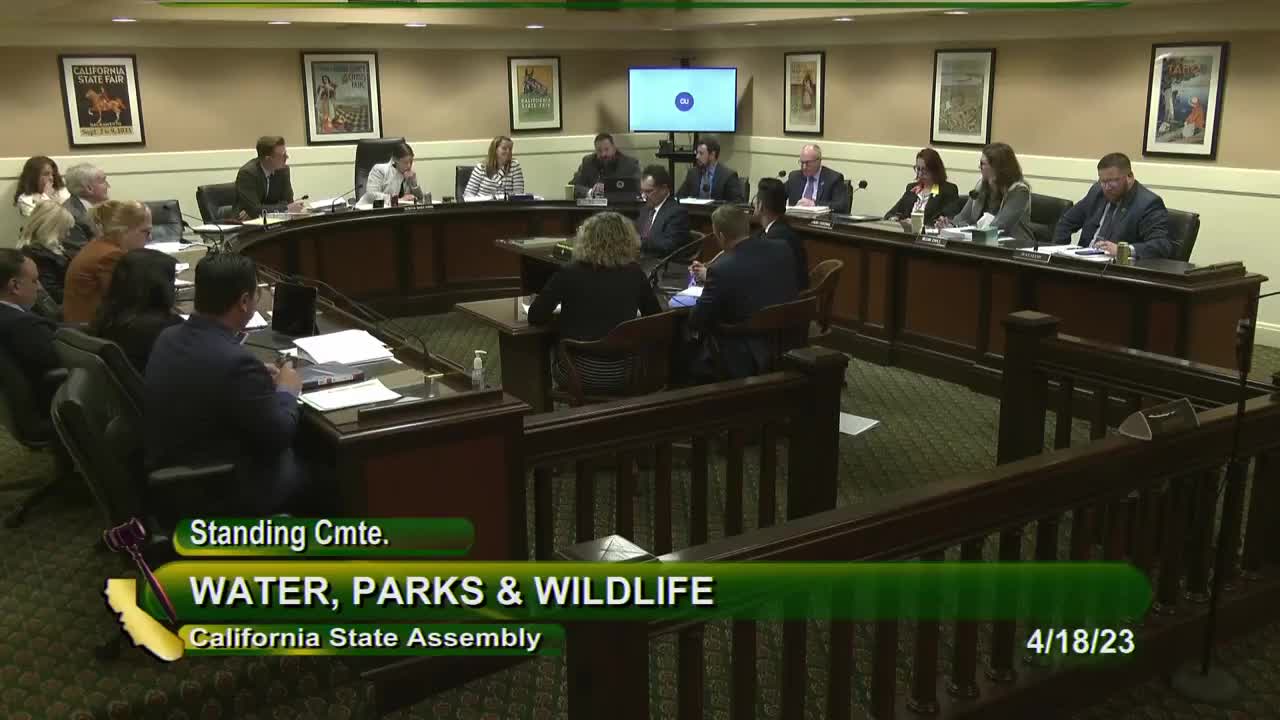 17MIN
Assembly Standing Committee on Water, Parks, and Wildlife
Bill Author

Bill Co-Author(s):
