AB 1657: The Affordable Housing Bond Act of 2024.
- Session Year: 2023-2024
- House: Assembly
- Latest Version Date: 2024-03-04
Current Status:
Failed
(2024-03-04: From committee chair, with author's amendments: Amend, and re-refer to committee. Read second time, amended, and re-referred to Com. on APPR.)
Introduced
In Committee
First Chamber
In Committee
Second Chamber
Enacted
Under existing law, there are programs providing assistance for, among other things, emergency housing, multifamily housing, farmworker housing, home ownership for very low and low-income households, and downpayment assistance for first-time home buyers. Existing law also authorizes the issuance of bonds in specified amounts pursuant to the State General Obligation Bond Law and requires that proceeds from the sale of these bonds be used to finance various existing housing programs, capital outlay related to infill development, brownfield cleanup that promotes infill development, and housing-related parks.
This bill would enact the Affordable Housing Bond Act of 2024, which, if adopted, would authorize the issuance of bonds in the amount of $10,000,000,000 pursuant to the State General Obligation Bond Law. Proceeds from the sale of these bonds would be used to finance programs to fund affordable rental housing and homeownership programs, including, among others, the Multifamily Housing Program, the CalHome Program, and the Joe Serna, Jr. Farmworker Housing Grant Program.
This bill would provide for submission of the bond act to the voters at the March 5, 2024, statewide general election in accordance with specified law.
This bill would declare that it is to take effect immediately as an urgency statute.
Under existing law, there are programs providing assistance for, among other things, emergency housing, multifamily housing, farmworker housing, home ownership for very low and low-income households, and downpayment assistance for first-time home buyers. Existing law also authorizes the issuance of bonds in specified amounts pursuant to the State General Obligation Bond Law and requires that proceeds from the sale of these bonds be used to finance various existing housing programs, capital outlay related to infill development, brownfield cleanup that promotes infill development, and housing-related parks.
This bill would enact the Affordable Housing Bond Act of 2024, which, if adopted, would authorize the issuance of bonds in the amount of $_____ $10,000,000,000 pursuant to the State General Obligation Bond Law. Proceeds from the sale of these bonds would be used to finance programs to fund affordable rental housing and homeownership programs, as provided. including, among others, the Multifamily Housing Program, the CalHome Program, and the Joe Serna, Jr. Farmworker Housing Grant Program.
This bill would provide for submission of the bond act to the voters at the November March 5, 2024, statewide general election in accordance with specified law.
This bill would declare that it is to take effect immediately as an urgency statute.
Under existing law, there are programs providing assistance for, among other things, emergency housing, multifamily housing, farmworker housing, home ownership for very low and low-income households, and downpayment assistance for first-time home buyers. Existing law also authorizes the issuance of bonds in specified amounts pursuant to the State General Obligation Bond Law and requires that proceeds from the sale of these bonds be used to finance various existing housing programs, capital outlay related to infill development, brownfield cleanup that promotes infill development, and housing-related parks.
This bill would enact the Affordable Housing Bond Act of 2024, which, if adopted, would authorize the issuance of bonds in the amount of $_____ pursuant to the State General Obligation Bond Law. Proceeds from the sale of these bonds would be used to finance programs to fund affordable rental housing and homeownership programs, as provided.
This bill would provide for submission of the bond act to the voters at the November 5, 2024, statewide general election in accordance with specified law.
This bill would declare that it is to take effect immediately as an urgency statute.
This part shall be known as the Affordable Housing Bond Act of 2024.
54051.This part shall only become operative upon adoption by the voters at the March 5, 2024, statewide general election.
54052.For purposes of this part, fund means the Affordable Housing Bond Act Trust Fund of 2024 created pursuant to Section 54054.
2.Affordable Housing Bond Act Trust Fund of 2024 and Program54054.(a)The Affordable Housing Bond Act Trust Fund of 2024 is hereby created within the State Treasury. It is the intent of the Legislature that the proceeds of bonds, exclusive of refunding bonds issued pursuant to Section 54076, be deposited in the fund and used to fund affordable rental housing and homeownership programs.
(b)The proceeds of bonds issued and sold pursuant to this part for the purposes specified in this chapter shall be allocated in the following manner:
(1)Five billion two hundred fifty million dollars ($5,250,000,000) to be deposited in the Housing Rehabilitation Loan Fund established pursuant to Section 50661 to be used for the Multifamily Housing Program authorized by Chapter 6.7 (commencing with Section 50675) of Part 2. At least 10 percent of assisted units in each development receiving these funds shall be affordable to extremely low income households.
(2)One billion seven hundred fifty million dollars ($1,750,000,000) to be deposited in the Housing Rehabilitation Loan Fund established pursuant to Section 50661 to be used for supportive housing, as defined in Section 50675.14, pursuant to the Multifamily Housing Program authorized by Chapter 6.7 (commencing with Section 50675) of Part 2. The department shall offer capitalized operating subsidy reserves for supportive housing units in developments receiving these funds.
(3)One billion five hundred million dollars ($1,500,000,000), to be appropriated by the Legislature, to preserve or rehabilitate existing subsidized or unsubsidized rental housing through the following programs:
(A)The program commonly known as the Portfolio Reinvestment Program established pursuant to Chapter 5.5 (commencing with Section 50606) of Part 2.
(B)The Energy Efficiency Low-Income Weatherization Program established pursuant to Section 12087.5 of the Government Code.
(C)A program, to be administered by the Department of Housing and Community Development, to fund the acquisition and rehabilitation of unrestricted housing units and attach long-term affordability restrictions on the housing units, while safeguarding against the displacement of current residents. It is the intent of the Legislature that the specific criteria establishing eligibility for and use of the funds shall be established in statute.
(4)One billion dollars ($1,000,000,000), to be appropriated by the Legislature, to provide homeownership opportunities through the following programs:
(A)The CalHome Program established pursuant to Chapter 6 (commencing with Section 50650) of Part 2.
(B)The home purchase assistance program established pursuant to Chapter 6.8 (commencing with Section 51341) of Part 3.
(5)Five hundred million dollars ($500,000,000), to be appropriated by the Legislature, for the following programs:
(A)The Joe Serna, Jr. Farmworker Housing Grant Program pursuant to Chapter 3.2 (commencing with Section 50515.2) of Part 2.
(B)A dedicated, flexible, and comprehensive state program designed for, and in consultation with, tribes, which shall be administered by the Department of Housing and Community Development, to finance housing and housing-related activities that will enable tribes to rebuild and reconstitute their communities. It is the intent of the Legislature that the specific criteria establishing eligibility for and use of the funds shall be established in statute.
54056.(a)The Legislature may, from time to time, amend any law related to programs to which funds are, or have been, allocated pursuant to this chapter for the purposes of improving the efficiency and effectiveness of those programs or to further the goals of those programs.
(b)The Legislature may amend this chapter in order to reallocate the proceeds of bonds issued and sold pursuant to this part among the programs to which funds are to be allocated pursuant to this chapter as necessary to effectively promote the development of affordable housing in this state.
(c)The Department of Housing and Community Development may disburse any funds made available to housing development projects pursuant to this chapter during the construction period.
3.Fiscal Provisions54060.Bonds in the total amount of ten billion dollars ($10,000,000,000), exclusive of refunding bonds issued pursuant to Section 54076, or so much thereof as is necessary as determined by the committee, are hereby authorized to be issued and sold for carrying out the purposes expressed in this part and to reimburse the General Obligation Bond Expense Revolving Fund pursuant to Section 16724.5 of the Government Code. All bonds herein authorized that have been duly issued, sold, and delivered as provided herein shall constitute valid and binding general obligations of the state, and the full faith and credit of the state is hereby pledged for the punctual payment of both principal of and interest on those bonds when due.
54062.The bonds authorized by this part shall be prepared, executed, issued, sold, paid, and redeemed as provided in the State General Obligation Bond Law (Chapter 4 (commencing with Section 16720) of Part 3 of Division 4 of Title 2 of the Government Code), except subdivisions (a) and (b) of Section 16727 of the Government Code, and all of the provisions of that law as amended from time to time apply to the bonds and to this part, except as provided in Section 54078, and are hereby incorporated in this part as though set forth in full in this part.
54064.(a)Solely for the purpose of authorizing the issuance and sale, pursuant to the State General Obligation Bond Law, of the bonds authorized by this part, the committee is continued in existence. For the purposes of this part, the Housing Finance Committee is the committee as that term is used in the State General Obligation Bond Law.
(b)For the purposes of the State General Obligation Bond Law, the Department of Housing and Community Development is designated the board for programs administered by the department, and the California Housing Finance Agency is the board for programs administered by the agency.
54066.Upon request of the board stating that funds are needed for purposes of this part, the committee shall determine whether or not it is necessary or desirable to issue bonds, and, if so, the amount of bonds to be issued and sold. Successive issues of bonds may be authorized and sold to carry out those actions progressively, and are not required to be sold at any one time. Bonds may bear interest subject to federal income tax.
54068.There shall be collected annually, in the same manner and at the same time as other state revenue is collected, a sum of money in addition to the ordinary revenues of the state, sufficient to pay the principal of, and interest on, the bonds each year. It is the duty of all officers charged by law with any duty in regard to the collections of state revenues to do or perform each and every act that is necessary to collect that additional sum.
54070.Notwithstanding Section 13340 of the Government Code, there is hereby continuously appropriated from the General Fund in the State Treasury, for the purposes of this part, an amount that will equal the total of both of the following:
(a)The sum annually necessary to pay the principal of, and interest on, bonds issued and sold pursuant to this part, as the principal and interest become due and payable.
(b)The sum that is necessary to carry out Section 54074, appropriated without regard to fiscal years.
54072.The board may request the Pooled Money Investment Board to make a loan from the Pooled Money Investment Account, in accordance with Section 16312 of the Government Code, for purposes of this part. The amount of the request shall not exceed the amount of the unsold bonds that the committee has, by resolution, authorized to be sold, excluding any refunding bonds authorized pursuant to Section 54076, for purposes of this part, less any amount loaned pursuant to this section and not yet repaid and any amount withdrawn from the General Fund pursuant to Section 54074 and not yet returned to the General Fund. The board shall execute any documents as required by the Pooled Money Investment Board to obtain and repay the loan. Any amount loaned shall be deposited in the fund to be allocated in accordance with this part.
54074.For purposes of carrying out this part, the Director of Finance may, by executive order, authorize the withdrawal from the General Fund of an amount or amounts not to exceed the amount of the unsold bonds that the committee has, by resolution, authorized to be sold, excluding any refunding bonds authorized pursuant to Section 54076, for purposes of this part, less any amount loaned pursuant to Section 54072 and not yet repaid and any amount withdrawn from the General Fund pursuant to this section and not yet returned to the General Fund. Any amounts withdrawn shall be deposited in the fund to be allocated in accordance with this part. Any moneys made available under this section shall be returned to the General Fund, plus the interest that the amounts would have earned in the Pooled Money Investment Account, from moneys received from the sale of bonds that would otherwise be deposited in that fund.
54076.The bonds may be refunded in accordance with Article 6 (commencing with Section 16780) of Chapter 4 of Part 3 of Division 4 of Title 2 of the Government Code. Approval by the electors of this act shall constitute approval of any refunding bonds issued to refund bonds issued pursuant to this part, including any prior issued refunding bonds. A bond refunded with the proceeds of a refunding bond as authorized by this section may be legally defeased to the extent permitted by law in the manner and to the extent set forth in the resolution, as amended from time to time, authorizing that refunded bond.
54078.Notwithstanding any provisions in the State General Obligation Bond Law, the maturity date of bonds authorized by this part shall not be later than 35 years from the date of each bond. The maturity of each series shall be calculated from the date of issuance of each bond.
54080.The Legislature hereby finds and declares that, inasmuch as the proceeds from the sale of bonds authorized by this part are not proceeds of taxes as that term is used in Article XIII B of the California Constitution, the disbursement of these proceeds is not subject to the limitations imposed by that article.
54082.Notwithstanding any provision of the State General Obligation Bond Law with regard to the proceeds from the sale of bonds authorized by this part that are subject to investment under Article 4 (commencing with Section 16470) of Chapter 3 of Part 2 of Division 4 of Title 2 of the Government Code, the Treasurer may maintain a separate account for investment earnings, may order the payment of those earnings to comply with any rebate requirement applicable under federal law, and may otherwise direct the use and investment of those proceeds so as to maintain the tax-exempt status of tax-exempt bonds and to obtain any other advantage under federal law on behalf of the funds of this state.
54084.(a)Subject to subdivision (b), all moneys derived from premiums and accrued interest on bonds sold pursuant to this part shall be transferred to the General Fund as a credit to expenditures for bond interest.
(b)Amounts derived from premiums may be reserved and used to pay the costs of bond issuance before transfer to the General Fund.
SEC. 2.Section 1 of this act shall become operative upon the adoption by the voters of the Affordable Housing Bond Act of 2024.
SEC. 3.Section 1 of this act shall be submitted to the voters at the March 5, 2024, statewide election in accordance with provisions of the Government Code and the Elections Code governing the submission of a statewide measure to the voters.
SEC. 4.This act is an urgency statute necessary for the immediate preservation of the public peace, health, or safety within the meaning of Article IV of the California Constitution and shall go into immediate effect. The facts constituting the necessity are:
In order to maximize the time available for the analysis and preparation of the proposed issuance of bonds pursuant to this act, it is necessary that this act take effect immediately.
This part shall be known as the Affordable Housing Bond Act of 2024.
54051.This part shall only become operative upon adoption by the voters at the November March 5, 2024, statewide general election.
54052.For purposes of this part, fund means the Affordable Housing Bond Act Trust Fund of 2024 created pursuant to Section 54054.
2.Affordable Housing Bond Act Trust Fund of 2024 and Program54054.(a)The Affordable Housing Bond Act Trust Fund of 2024 is hereby created within the State Treasury. It is the intent of the Legislature that the proceeds of bonds, exclusive of refunding bonds issued pursuant to Section 54076, be deposited in the fund and used to fund affordable rental housing and homeownership programs.
(b)It is the intent of the Legislature to further determine the allocation of these funds to specific programs.(b)The proceeds of bonds issued and sold pursuant to this part for the purposes specified in this chapter shall be allocated in the following manner:
(1)Five billion two hundred fifty million dollars ($5,250,000,000) to be deposited in the Housing Rehabilitation Loan Fund established pursuant to Section 50661 to be used for the Multifamily Housing Program authorized by Chapter 6.7 (commencing with Section 50675) of Part 2. At least 10 percent of assisted units in each development receiving these funds shall be affordable to extremely low income households.
(2)One billion seven hundred fifty million dollars ($1,750,000,000) to be deposited in the Housing Rehabilitation Loan Fund established pursuant to Section 50661 to be used for supportive housing, as defined in Section 50675.14, pursuant to the Multifamily Housing Program authorized by Chapter 6.7 (commencing with Section 50675) of Part 2. The department shall offer capitalized operating subsidy reserves for supportive housing units in developments receiving these funds.
(3)One billion five hundred million dollars ($1,500,000,000), to be appropriated by the Legislature, to preserve or rehabilitate existing subsidized or unsubsidized rental housing through the following programs:
(A)The program commonly known as the Portfolio Reinvestment Program established pursuant to Chapter 5.5 (commencing with Section 50606) of Part 2.
(B)The Energy Efficiency Low-Income Weatherization Program established pursuant to Section 12087.5 of the Government Code.
(C)A program, to be administered by the Department of Housing and Community Development, to fund the acquisition and rehabilitation of unrestricted housing units and attach long-term affordability restrictions on the housing units, while safeguarding against the displacement of current residents. It is the intent of the Legislature that the specific criteria establishing eligibility for and use of the funds shall be established in statute.
(4)One billion dollars ($1,000,000,000), to be appropriated by the Legislature, to provide homeownership opportunities through the following programs:
(A)The CalHome Program established pursuant to Chapter 6 (commencing with Section 50650) of Part 2.
(B)The home purchase assistance program established pursuant to Chapter 6.8 (commencing with Section 51341) of Part 3.
(5)Five hundred million dollars ($500,000,000), to be appropriated by the Legislature, for the following programs:
(A)The Joe Serna, Jr. Farmworker Housing Grant Program pursuant to Chapter 3.2 (commencing with Section 50515.2) of Part 2.
(B)A dedicated, flexible, and comprehensive state program designed for, and in consultation with, tribes, which shall be administered by the Department of Housing and Community Development, to finance housing and housing-related activities that will enable tribes to rebuild and reconstitute their communities. It is the intent of the Legislature that the specific criteria establishing eligibility for and use of the funds shall be established in statute.
54056.(a)The Legislature may, from time to time, amend any law related to programs to which funds are, or have been, allocated pursuant to this chapter for the purposes of improving the efficiency and effectiveness of those programs or to further the goals of those programs.
(b)The Legislature may amend this chapter to reallocate the proceeds of bonds issued and sold pursuant to this part among the programs to which funds are to be allocated pursuant to this chapter as necessary to effectively promote the development of affordable housing in this state.
(c)The Department of Housing and Community Development may disburse any funds made available to housing development projects pursuant to this chapter during the construction period.
3.Fiscal Provisions54060.Bonds in the total amount of _____ ten billion dollars ($_____), ($10,000,000,000), exclusive of refunding bonds issued pursuant to Section 54076, or so much thereof as is necessary as determined by the committee, are hereby authorized to be issued and sold for carrying out the purposes expressed in this part and to reimburse the General Obligation Bond Expense Revolving Fund pursuant to Section 16724.5 of the Government Code. All bonds herein authorized that have been duly issued, sold, and delivered as provided herein shall constitute valid and binding general obligations of the state, and the full faith and credit of the state is hereby pledged for the punctual payment of both principal of and interest on those bonds when due.
54062.The bonds authorized by this part shall be prepared, executed, issued, sold, paid, and redeemed as provided in the State General Obligation Bond Law (Chapter 4 (commencing with Section 16720) of Part 3 of Division 4 of Title 2 of the Government Code), except subdivisions (a) and (b) of Section 16727 of the Government Code, and all of the provisions of that law as amended from time to time apply to the bonds and to this part, except as provided in Section 54078, and are hereby incorporated in this part as though set forth in full in this part.
54064.(a)Solely for the purpose of authorizing the issuance and sale, pursuant to the State General Obligation Bond Law, of the bonds authorized by this part, the committee is continued in existence. For the purposes of this part, the Housing Finance Committee is the committee as that term is used in the State General Obligation Bond Law.
(b)For the purposes of the State General Obligation Bond Law, the Department of Housing and Community Development is designated the board for programs administered by the department, and the California Housing Finance Agency is the board for programs administered by the agency.
54066.Upon request of the board stating that funds are needed for purposes of this part, the committee shall determine whether or not it is necessary or desirable to issue bonds, and, if so, the amount of bonds to be issued and sold. Successive issues of bonds may be authorized and sold to carry out those actions progressively, and are not required to be sold at any one time. Bonds may bear interest subject to federal income tax.
54068.There shall be collected annually, in the same manner and at the same time as other state revenue is collected, a sum of money in addition to the ordinary revenues of the state, sufficient to pay the principal of, and interest on, the bonds each year. It is the duty of all officers charged by law with any duty in regard to the collections of state revenues to do or perform each and every act that is necessary to collect that additional sum.
54070.Notwithstanding Section 13340 of the Government Code, there is hereby continuously appropriated from the General Fund in the State Treasury, for the purposes of this part, an amount that will equal the total of both of the following:
(a)The sum annually necessary to pay the principal of, and interest on, bonds issued and sold pursuant to this part, as the principal and interest become due and payable.
(b)The sum that is necessary to carry out Section 54074, appropriated without regard to fiscal years.
54072.The board may request the Pooled Money Investment Board to make a loan from the Pooled Money Investment Account, in accordance with Section 16312 of the Government Code, for purposes of this part. The amount of the request shall not exceed the amount of the unsold bonds that the committee has, by resolution, authorized to be sold, excluding any refunding bonds authorized pursuant to Section 54076, for purposes of this part, less any amount loaned pursuant to this section and not yet repaid and any amount withdrawn from the General Fund pursuant to Section 54074 and not yet returned to the General Fund. The board shall execute any documents as required by the Pooled Money Investment Board to obtain and repay the loan. Any amount loaned shall be deposited in the fund to be allocated in accordance with this part.
54074.For purposes of carrying out this part, the Director of Finance may, by executive order, authorize the withdrawal from the General Fund of an amount or amounts not to exceed the amount of the unsold bonds that the committee has, by resolution, authorized to be sold, excluding any refunding bonds authorized pursuant to Section 54076, for purposes of this part, less any amount loaned pursuant to Section 54072 and not yet repaid and any amount withdrawn from the General Fund pursuant to this section and not yet returned to the General Fund. Any amounts withdrawn shall be deposited in the fund to be allocated in accordance with this part. Any moneys made available under this section shall be returned to the General Fund, plus the interest that the amounts would have earned in the Pooled Money Investment Account, from moneys received from the sale of bonds that would otherwise be deposited in that fund.
54076.The bonds may be refunded in accordance with Article 6 (commencing with Section 16780) of Chapter 4 of Part 3 of Division 4 of Title 2 of the Government Code. Approval by the electors of this act shall constitute approval of any refunding bonds issued to refund bonds issued pursuant to this part, including any prior issued refunding bonds. A bond refunded with the proceeds of a refunding bond as authorized by this section may be legally defeased to the extent permitted by law in the manner and to the extent set forth in the resolution, as amended from time to time, authorizing that refunded bond.
54078.Notwithstanding any provisions in the State General Obligation Bond Law, the maturity date of bonds authorized by this part shall not be later than 35 years from the date of each bond. The maturity of each series shall be calculated from the date of issuance of each bond.
54080.The Legislature hereby finds and declares that, inasmuch as the proceeds from the sale of bonds authorized by this part are not proceeds of taxes as that term is used in Article XIII B of the California Constitution, the disbursement of these proceeds is not subject to the limitations imposed by that article.
54082.Notwithstanding any provision of the State General Obligation Bond Law with regard to the proceeds from the sale of bonds authorized by this part that are subject to investment under Article 4 (commencing with Section 16470) of Chapter 3 of Part 2 of Division 4 of Title 2 of the Government Code, the Treasurer may maintain a separate account for investment earnings, may order the payment of those earnings to comply with any rebate requirement applicable under federal law, and may otherwise direct the use and investment of those proceeds so as to maintain the tax-exempt status of tax-exempt bonds and to obtain any other advantage under federal law on behalf of the funds of this state.
54084.(a)Subject to subdivision (b), all moneys derived from premiums and accrued interest on bonds sold pursuant to this part shall be transferred to the General Fund as a credit to expenditures for bond interest.
(b)Amounts derived from premiums may be reserved and used to pay the costs of bond issuance before transfer to the General Fund.
SEC. 2.Section 1 of this act shall become operative upon the adoption by the voters of the Affordable Housing Bond Act of 2024.
SEC. 3.Section 1 of this act shall be submitted to the voters at the November March 5, 2024, statewide election in accordance with provisions of the Government Code and the Elections Code governing the submission of a statewide measure to the voters.
SEC. 4.This act is an urgency statute necessary for the immediate preservation of the public peace, health, or safety within the meaning of Article IV of the California Constitution and shall go into immediate effect. The facts constituting the necessity are:
In order to maximize the time available for the analysis and preparation of the proposed issuance of bonds pursuant to this act, it is necessary that this act take effect immediately.
This part shall be known as the Affordable Housing Bond Act of 2024.
54051.This part shall only become operative upon adoption by the voters at the November 5, 2024, statewide general election.
54052.For purposes of this part, fund means the Affordable Housing Bond Act Trust Fund of 2024 created pursuant to Section 54054.
2.Affordable Housing Bond Act Trust Fund of 2024 and Program54054.(a)The Affordable Housing Bond Act Trust Fund of 2024 is hereby created within the State Treasury. It is the intent of the Legislature that the proceeds of bonds, exclusive of refunding bonds issued pursuant to Section 54076, be deposited in the fund and used to fund affordable rental housing and homeownership programs.
(b)It is the intent of the Legislature to further determine the allocation of these funds to specific programs.
54056.(a)The Legislature may, from time to time, amend any law related to programs to which funds are, or have been, allocated pursuant to this chapter for the purposes of improving the efficiency and effectiveness of those programs or to further the goals of those programs.
(b)The Legislature may amend this chapter to reallocate the proceeds of bonds issued and sold pursuant to this part among the programs to which funds are to be allocated pursuant to this chapter as necessary to effectively promote the development of affordable housing in this state.
3.Fiscal Provisions54060.Bonds in the total amount of _____ dollars ($_____), exclusive of refunding bonds issued pursuant to Section 54076, or so much thereof as is necessary as determined by the committee, are hereby authorized to be issued and sold for carrying out the purposes expressed in this part and to reimburse the General Obligation Bond Expense Revolving Fund pursuant to Section 16724.5 of the Government Code. All bonds herein authorized that have been duly issued, sold, and delivered as provided herein shall constitute valid and binding general obligations of the state, and the full faith and credit of the state is hereby pledged for the punctual payment of both principal of and interest on those bonds when due.
54062.The bonds authorized by this part shall be prepared, executed, issued, sold, paid, and redeemed as provided in the State General Obligation Bond Law (Chapter 4 (commencing with Section 16720) of Part 3 of Division 4 of Title 2 of the Government Code), except subdivisions (a) and (b) of Section 16727 of the Government Code, and all of the provisions of that law as amended from time to time apply to the bonds and to this part, except as provided in Section 54078, and are hereby incorporated in this part as though set forth in full in this part.
54064.(a)Solely for the purpose of authorizing the issuance and sale, pursuant to the State General Obligation Bond Law, of the bonds authorized by this part, the committee is continued in existence. For the purposes of this part, the Housing Finance Committee is the committee as that term is used in the State General Obligation Bond Law.
(b)For the purposes of the State General Obligation Bond Law, the Department of Housing and Community Development is designated the board for programs administered by the department, and the California Housing Finance Agency is the board for programs administered by the agency.
54066.Upon request of the board stating that funds are needed for purposes of this part, the committee shall determine whether or not it is necessary or desirable to issue bonds, and, if so, the amount of bonds to be issued and sold. Successive issues of bonds may be authorized and sold to carry out those actions progressively, and are not required to be sold at any one time. Bonds may bear interest subject to federal income tax.
54068.There shall be collected annually, in the same manner and at the same time as other state revenue is collected, a sum of money in addition to the ordinary revenues of the state, sufficient to pay the principal of, and interest on, the bonds each year. It is the duty of all officers charged by law with any duty in regard to the collections of state revenues to do or perform each and every act that is necessary to collect that additional sum.
54070.Notwithstanding Section 13340 of the Government Code, there is hereby continuously appropriated from the General Fund in the State Treasury, for the purposes of this part, an amount that will equal the total of both of the following:
(a)The sum annually necessary to pay the principal of, and interest on, bonds issued and sold pursuant to this part, as the principal and interest become due and payable.
(b)The sum that is necessary to carry out Section 54074, appropriated without regard to fiscal years.
54072.The board may request the Pooled Money Investment Board to make a loan from the Pooled Money Investment Account, in accordance with Section 16312 of the Government Code, for purposes of this part. The amount of the request shall not exceed the amount of the unsold bonds that the committee has, by resolution, authorized to be sold, excluding any refunding bonds authorized pursuant to Section 54076, for purposes of this part, less any amount loaned pursuant to this section and not yet repaid and any amount withdrawn from the General Fund pursuant to Section 54074 and not yet returned to the General Fund. The board shall execute any documents as required by the Pooled Money Investment Board to obtain and repay the loan. Any amount loaned shall be deposited in the fund to be allocated in accordance with this part.
54074.For purposes of carrying out this part, the Director of Finance may, by executive order, authorize the withdrawal from the General Fund of an amount or amounts not to exceed the amount of the unsold bonds that the committee has, by resolution, authorized to be sold, excluding any refunding bonds authorized pursuant to Section 54076, for purposes of this part, less any amount loaned pursuant to Section 54072 and not yet repaid and any amount withdrawn from the General Fund pursuant to this section and not yet returned to the General Fund. Any amounts withdrawn shall be deposited in the fund to be allocated in accordance with this part. Any moneys made available under this section shall be returned to the General Fund, plus the interest that the amounts would have earned in the Pooled Money Investment Account, from moneys received from the sale of bonds that would otherwise be deposited in that fund.
54076.The bonds may be refunded in accordance with Article 6 (commencing with Section 16780) of Chapter 4 of Part 3 of Division 4 of Title 2 of the Government Code. Approval by the electors of this act shall constitute approval of any refunding bonds issued to refund bonds issued pursuant to this part, including any prior issued refunding bonds. A bond refunded with the proceeds of a refunding bond as authorized by this section may be legally defeased to the extent permitted by law in the manner and to the extent set forth in the resolution, as amended from time to time, authorizing that refunded bond.
54078.Notwithstanding any provisions in the State General Obligation Bond Law, the maturity date of bonds authorized by this part shall not be later than 35 years from the date of each bond. The maturity of each series shall be calculated from the date of issuance of each bond.
54080.The Legislature hereby finds and declares that, inasmuch as the proceeds from the sale of bonds authorized by this part are not proceeds of taxes as that term is used in Article XIII B of the California Constitution, the disbursement of these proceeds is not subject to the limitations imposed by that article.
54082.Notwithstanding any provision of the State General Obligation Bond Law with regard to the proceeds from the sale of bonds authorized by this part that are subject to investment under Article 4 (commencing with Section 16470) of Chapter 3 of Part 2 of Division 4 of Title 2 of the Government Code, the Treasurer may maintain a separate account for investment earnings, may order the payment of those earnings to comply with any rebate requirement applicable under federal law, and may otherwise direct the use and investment of those proceeds so as to maintain the tax-exempt status of tax-exempt bonds and to obtain any other advantage under federal law on behalf of the funds of this state.
54084.(a)Subject to subdivision (b), all moneys derived from premiums and accrued interest on bonds sold pursuant to this part shall be transferred to the General Fund as a credit to expenditures for bond interest.
(b)Amounts derived from premiums may be reserved and used to pay the costs of bond issuance before transfer to the General Fund.
SEC. 2.Section 1 of this act shall become operative upon the adoption by the voters of the Affordable Housing Bond Act of 2024.
SEC. 3.Section 1 of this act shall be submitted to the voters at the November 5, 2024, statewide election in accordance with provisions of the Government Code and the Elections Code governing the submission of a statewide measure to the voters.
SEC. 4.This act is an urgency statute necessary for the immediate preservation of the public peace, health, or safety within the meaning of Article IV of the California Constitution and shall go into immediate effect. The facts constituting the necessity are:
In order to maximize the time available for the analysis and preparation of the proposed issuance of bonds pursuant to this act, it is necessary that this act take effect immediately.
|
Date
|
Status
|
|---|---|
| Mar 4, 2024 | From committee chair, with author's amendments: Amend, and re-refer to committee. Read second time, amended, and re-referred to Com. on APPR. |
| Sep 1, 2023 | In committee: Held under submission. |
| Aug 14, 2023 | In committee: Referred to APPR suspense file. |
| Jul 13, 2023 | From committee: Do pass and re-refer to Com. on APPR. (Ayes 6. Noes 2.) (July 12). Re-referred to Com. on APPR. |
| Jun 21, 2023 | From committee: Do pass and re-refer to Com. on GOV. & F. (Ayes 9. Noes 2.) (June 20). Re-referred to Com. on GOV. & F. |
| Jun 14, 2023 | Referred to Coms. on HOUSING and GOV. & F. |
| Jun 1, 2023 | In Senate. Read first time. To Com. on RLS. for assignment. |
| May 31, 2023 | Read third time. Urgency clause adopted. Passed. Ordered to the Senate. (Ayes 61. Noes 13. Page 2065.). |
| May 18, 2023 | Read second time. Ordered to third reading. |
| May 18, 2023 | From committee: Do pass. (Ayes 11. Noes 3.) (May 18). |
| May 10, 2023 | In committee: Set, first hearing. Referred to APPR. suspense file. |
| Apr 27, 2023 | From committee: Do pass and re-refer to Com. on APPR. (Ayes 6. Noes 1.) (April 26). Re-referred to Com. on APPR. |
| Apr 18, 2023 | Re-referred to Com. on H. & C.D. |
| Apr 17, 2023 | From committee chair, with author's amendments: Amend, and re-refer to Com. on H. & C.D. Read second time and amended. |
| Mar 9, 2023 | Referred to Com. on H. & C.D. |
| Feb 18, 2023 | From printer. May be heard in committee March 20. |
| Feb 17, 2023 | Read first time. To print. |
|
Date
|
Description
|
Location
|
Votes
|
|
|---|---|---|---|---|
| Aug 14, 2023 | Placed on suspense file | Senate Standing Committee on Appropriations |
Passed |
|
| Jul 12, 2023 | Do pass, but first be re-referred to the Committee on [Appropriations] | Senate Standing Committee on Governance and Finance |
Passed |
|
| Jun 20, 2023 | Do pass, but first be re-referred to the Committee on [Governance and Finance] | Senate Standing Committee on Housing |
Passed |
|
| May 31, 2023 | AB 1657 Wicks Third Reading Urgency | Assembly Floor |
Passed |
|
| May 18, 2023 | Do pass. | Assembly Standing Committee on Appropriations |
Passed |
|
| Apr 26, 2023 | Do pass and be re-referred to the Committee on [Appropriations] | Assembly Standing Committee on Housing and Community Development |
Passed |
This list shows positions taken on this bill by organizations on the date displayed, which is linked to the original source.
Positions by individuals are not included.
|
Organization
|
Position
|
Date
|
|---|---|---|
| Abode Communities | ** Support | |
| Abode Services | ** Support | |
| Aclu California Action | ** Support | |
| Alta Housing | ** Support | |
| American Institute Of Architects, Los Angeles Chapter | ** Support | |
| American Planning Association, California Chapter | ** Support | |
| A. Robbins Group | ** Support | |
| Ascencia | ** Support | |
| Association Of Bay Area Governments | ** Support | |
| Bay Area Community Services | ** Support | |
| Bay Area LISC | ** Support | |
| Behavioral Health and Recovery Services | ** Support | |
| Brighter Future Initiative | ** Support | |
| California Apartment Association | ** Support | |
| California Association Of Local Housing Finance Agencies | ** Support | |
| California Association Of Realtors | ** Against | |
| California Climate and Agriculture Network | ** Support | |
| California Faculty Association | ** Support | |
| California Housing Consortium | ** Support | |
| California Housing Partnership Corporation | ** Support | |
| Catholic Charities of Santa Clara County | ** Support | |
| CDR | ** Support | |
| Change and New Beginnings | ** Support | |
| CHISPA | ** Support | |
| City of Alameda | ** Support | |
| City of Camarillo | ** Support | |
| City of Concord | ** Support | |
| City Of El Centro | ** Support | |
| City of Encinitas | ** Support | |
| City of Firebaugh | ** Support | |
| City of Foster City | ** Support | |
| City of Fremont | ** Support | |
| City of Goleta | ** Support | |
| City Of Inglewood | ** Support | |
| City of Long Beach | ** Support | |
| City of Norwalk | ** Support | |
| City Of Pleasanton | ** Support | |
| City Of Redlands | ** Support | |
| City of Riverside | ** Support | |
| City of San Jose | ** Support | |
| City of Santa Monica | ** Support | |
| City of Thousand Oaks | ** Support | |
| City of West Hollywood | ** Support | |
| Colesworthy Real Estate Services | ** Support | |
| Community HousingWorks | ** Support | |
| Community Land Trust Association of West Marin | ** Support | |
| Congregations Organized for Prophetic Engagement | ** Support | |
| Corporation For Supportive Housing | ** Support | |
| Council of Community Housing Organizations | ** Support | |
| CRP Affordable Housing and Community Development | ** Support | |
| Cty Housing, INC. | ** Support | |
| Curtis Development | ** Support | |
| Devine & Gong, Inc. | ** Support | |
| EAH Housing | ** Support | |
| East Bay Housing Organizations | ** Support | |
| East Palo Alto Community Alliance Neighborhood Development Organization | ** Support | |
| Eden Housing | ** Support | |
| Empowering Pacific Islander Communities | ** Support | |
| Enterprise Community Partners Inc | ** Support | |
| evolve california | ** Support | |
| Excelerate Housing Group | ** Support | |
| Friends Committee On Legislation Of California | ** Support | |
| FSY Architects, INC | ** Support | |
| Gunkel Architecture INC. | ** Support | |
| Habitat For Humanity California | ** Support | |
| Habitat for Humanity Greater San Francisco | ** Support | |
| Hollywood Community Housing Corporation | ** Support | |
| Housing Action Coalition | ** Support | |
| Housing Authority of the City of Alameda | ** Support | |
| Housing Authority of The City of San Luis Obispo | ** Support | |
| Housing California | ** Support | |
| Housing Claremont | ** Support | |
| Housing El Dorado | ** Support | |
| Housing Is a Human Right Oc | ** Support | |
| Housing Land Trust of the North Bay | ** Support | |
| Housing Trust Silicon Valley | ** Support | |
| Imagine LA | ** Support | |
| Inland So Cal Housing Collective | ** Support | |
| Jonathan Rose Companies | ** Support | |
| King and I Outreach Ministry | ** Support | |
| Kitchens for Good | ** Support | |
| League Of California Cities | ** Support | |
| Legal Aid of Sonoma County | ** Support | |
| Lift To Rise | ** Support | |
| LINC Housing | ** Support | |
| Livable California | ** Support | |
| Lived Experience Advisers | ** Support | |
| Los Angeles County Department of Mental Health | ** Support | |
| Many Mansions | ** Support | |
| Mercy Housing California | ** Support | |
| Metropolitan Transportation Commission | ** Support | |
| MidPen Housing Corporation | ** Support | |
| Monterrey County Renters United | ** Support | |
| Mutual Housing California | ** Support | |
| Myall Consulting | ** Support | |
| National Alliance to End Homelessness | ** Support | |
| Non-Profit Housing Association of Northern California | ** Support | |
| North Valley Housing Trust | ** Support | |
| Orange County Housing Finance Trust | ** Support | |
| People's Budget Orange County | ** Support | |
| Resources for Community Development | ** Support | |
| san francisco housing development corporation | ** Support | |
| Santa Clara Methodist Retirement Foundation | ** Support | |
| Self-Help Enterprises | ** Support | |
| Southern California Association of Non-Profit Housing | ** Support | |
| Strive Real Estate LLC | ** Support | |
| Supervisor Jaron E. Brandont, County of Tuolumne District 5 | ** Support | |
| Supportive Housing Alliance | ** Support | |
| Tenderloin Neighborhood Development Corporation | ** Support | |
| The Armony Companies | ** Support | |
| The Greenlining Institute | ** Support | |
| The Kelsey | ** Support | |
| The Kennedy Commission | ** Support | |
| The San Francisco Housing Accelerator Fund | ** Support | |
| Turning Point Community Programs | ** Support | |
| Valley Restart Shelter | ** Support | |
| Ventura Social Services Task Force | ** Support | |
| Wakeland Housing and Community Development Corporation | ** Support | |
| western center on law & poverty | ** Support | |
| Zen Development Consultants LLC | ** Support |
SENATE COMMITTEE ON APPROPRIATIONS
Senator Anthony Portantino, Chair
2023 - 2024 Regular Session
AB 1657 (Wicks) - The Affordable Housing Bond Act of 2024
Version: April 17, 2023 | Policy Vote: HOUSING 9 - 2, GOV. & F. 6 - 2 |
Urgency: Yes | Mandate: No |
Hearing Date: August 14, 2023 | Consultant: Mark McKenzie |
Bill Summary:
AB 1657, an urgency measure, would enact the Affordable Housing Bond Act of 2024, which authorizes the sale of $10 billion in general obligation bonds, upon approval by voters at the March 5, 2024 statewide election.
Fiscal Impact:
- Bond costs: Total principal and interest costs of approximately $16.58 billion to pay off the bonds ($10 billion in principal and $6.58 billion in interest), with average annual debt service payments of $553 million (General Fund), when all bonds are sold, and assuming a 30-year maturity and an interest rate of 3.63% (the rate secured by the Treasurer for new 30-year bonds at the most recent sale). If interest rates increase to 5% in the near future, annual debt service would be approximately $651 million (General Fund) and total principal and interest costs over the repayment period would be approximately $19.52 billion.
- Administrative costs: The Department of Housing and Community Development (HCD) would incur significant increased staffing and operations costs to administer the various housing programs funded by this Bond Act (Affordable Housing Bond Act Trust Fund of 2024). HCD expects to utilize up to 5% of bond proceeds dedicated to programs it administers, or up to $438 million in total, for administrative costs. See staff comments.
The California Housing Finance Agency (CalHFA) and the Department of Community Services and Development do not anticipate significant costs as a result of this measure.
- Ballot costs: One-time Secretary of State (SOS) costs in the range of $784,000 to $984,000 for printing and mailing costs to place the measure on the ballot for the March 5, 2024 statewide primary election. (General Fund)
Background:
Existing law establishes the following programs:
- The Multifamily Housing Program (MHP), which is administered by HCD to assist the new construction, rehabilitation, and preservation of permanent and transitional rental housing for lower income households through loans to local governments and non- and for-profit developers.
- The Portfolio Reinvestment Program, which is administered by HCD to provide loans or grants to rehabilitate, capitalize operating subsidy or replacement reserves for, and extend the long-term affordability of HCD-funded housing projects that have an affordability restriction that has expired, that have an affordability restriction with a remaining term of less than 10 years, or are otherwise at-risk for conversion to market-rate housing.
- The Energy Efficiency Low-Income Weatherization Program, which is administered by the Department of Community Services and Development to provide technical assistance and incentives for the installation of energy efficiency measures and solar photovoltaic systems in low-income multifamily dwellings serving priority populations.
- The Joe Serna, Jr. Farmworker Housing Grant Program (Serna Program), which is administered by HCD to finance the new construction, rehabilitation, and acquisition of owner-occupied and rental units for agricultural workers, with a priority for lower income households.
- The CalHome, which is administered by HCD to provide grants to local public agencies and non-profit developers to assist individuals and households through deferred-payment loans. The funds provide direct, forgivable loans to assist development projects involving multiple ownership units, including single-family subdivisions.
Existing law authorizes CalHFA to provide first time homebuyer assistance, including but not limited to a deferred-payment, low-interest, subordinate mortgage loan, including down payment assistance, closing cost assistance, or both, to make financing affordable to low- and moderate-income households. Existing law, as enacted by SB 2 (Atkins), Chap. 364/2017, the Building Homes and Jobs Act, provides funding for, among other programs, affordable homeownership and rental housing opportunities for agricultural workers and their families. This funding is administered by HCD in conjunction with the Serna Program.
California has the largest concentration of severely unaffordable housing markets in the nation and the statewide average home value reached a new record in June 2022 at $793,300. To keep up with demand, HCD estimates that California must plan for the development of more than 2.5 million homes over the next eight years, and no less than one million of those homes must meet the needs of lower-income households (more than 640,000 very low-income and 385,000 low-income units are needed). For decades, not enough housing was constructed to meet need, resulting in a severe undersupply of housing.
At the state level, California has invested significantly in affordable housing construction and rehabilitation in recent years through the passage of one-time discretionary actions in the budget and the passage of voter approved bonds. Only in the last few years have the Legislature and Governor allocated General Fund dollars to affordable housing programs. Beginning in 2019, an unprecedented $8 billion from the General Fund has been dedicated to a variety of affordable housing programs. The Veterans and Affordable Housing Bond Act of 2018 (Proposition 1), authorized $3 billion to fund state affordable housing programs and $1 billion for the CalVet program, which provides mortgages to veterans. All of the funding from the bond will be fully allocated by the end of 2023. In addition, Proposition 2 of 2018 authorized the state to issue $2 billion in General Obligations bonds against revenues from the Mental Health Services Act for purposes of funding the No Place Like Home Program. Those funds supported the construction of over 7,000 supportive housing units and the funds are now exhausted.
Proposed Law:
AB 1657 would enact the Affordable Housing Bond Act of 2024, which places a $10 billion general obligation bond before voters in the March 2024 primary election to finance specified affordable housing and homeownership programs. If approved, the measure directs proceeds of bonds issued and sold for the following:
- $5.25 billion deposited in the Housing Rehabilitation Loan Fund to be used for the Multifamily Housing Program (MHP). At least 10% of assisted units in each development receiving funding must be available for extremely low-income households.
- $1.75 billion to be deposited in the Housing Rehabilitation Loan Fund to be used for supportive housing administered through the MHP program. The measure requires HCD to offer capitalized operating subsidy reserves for supportive housing developments receiving funding.
- $1.5 billion to be appropriated by the Legislature to preserve or rehabilitate existing subsidized or unsubsidized rental housing through the following programs: the Portfolio Reinvestment Program, the Energy Efficiency Low-Income Weatherization Program, and a program to be created by the Legislature and administered by HCD that funds acquisition and rehabilitation of unrestricted housing units and attaches long-term affordability restrictions to the units.
- $1 billion to be appropriated by the Legislature to provide homeownership opportunities through the CalHOME Program, which provide grants to local public agencies and non-profit developers to assist individuals and households through deferred-payment loans; and the My Home down payment assistance program administered by CalHFA.
- $500 million to be appropriated by the Legislature for the Joe Serna, Jr. Farmworker Housing (Serna) Program and a dedicated program to be created by the Legislature, administered by HCD, and designed for, and in consultation with, tribes to finance housing and housing-related activities that will enable tribes to rebuild and reconstitute their communities.
AB 1657 would authorize the Legislature to amend any of the statutes related to programs funded by this measure to improve the efficiency and effectiveness of those programs, and to reallocate proceeds of bonds among those programs as necessary to effectively promote the development of affordable housing in this state. The bill would also authorize HCD to disburse any funds made available to housing development projects funded by this measure during the construction period.
The measure only takes effect if enacted by voters at the March 4, 2024 statewide election, and contains an urgency clause giving the measure immediate effect if enacted.
Related Legislation:
SB 18 (McGuire), which is currently pending in the Assembly Appropriations Committee, would establish the Tribal Housing Grant Program and require HCD to allocate grant funds, upon appropriation by the Legislature, to federally-recognized Indian reservations and Rancherias, and tribally designated housing entities, for specified affordable housing projects and purposes
SB 225 (Caballero), which is currently pending in the Assembly Appropriations Committee, would establish the Community Anti-Displacement and Preservation Program to fund the acquisition and rehabilitation of unrestricted housing units, and attach affordability restrictions on those units, while safeguarding against the displacement of current residents, as specified.
SB 834 (Portantino), which is currently pending in the Assembly Housing and Community Development Committee, would enact the California Family Home Construction and Homeownership Bond Act of 2023, which authorizes the issuance of $25 billion in general obligation bonds, upon approval by voters at the next statewide general election. Bond funds would be used to provide secondary mortgage loans to qualified homebuyers and loans to qualified homebuilders for predevelopment infrastructure improvements, as specified.
SB 3 (Beall), Chap. 365/2017, authorized the issuance of $4 billion in general obligation bond for various existing housing programs, including $1 billion for the CalVet Home Loan Program, upon approval by the voters at the 2018 general election. This measure was approved by the voters as Proposition 1 of 2018.
Staff Comments:
The State Treasurer recently sold nearly $2.6 billion in general obligation bonds (including refinancing $1.2 billion in existing bond debt). The all-in interest rate on new 30-year bonds sold on April 6, 2023 was 3.63%. The estimates noted above assume equivalent rates, but also note the difference in debt service costs if the rate rose to historical averages of 5%. Staff notes that interest rates for general obligation bond sales have fluctuated in recent years, with rates as low as 2% in 2021 and as high as 3.93% in September of 2022. California’s GO Bonds are rated Aa2 by Moody’s Investor Service, AA- by S&P Global Ratings, and AA by Fitch Ratings.
AB 1657 would allocate proceeds from the sale of general obligation bonds for six existing programs, four of which are administered by HCD, and for two new programs to be created by the Legislature and administered by HCD: one for specified tribal housing activities, and one to fund the acquisition and rehabilitation of unrestricted housing units and attachment of affordability restrictions to those units. Staff notes that two bills currently pending in the Assembly would create new programs that align with the purposes specified in this bill. As noted in the related legislation section above, SB 18 (McGuire), would establish the Tribal Housing Grant Program and SB 225 would establish the Community Anti-Displacement and Preservation Program.
HCD anticipates that this bond program would allow MHP to triple its annual funding allocation, in addition to the creation of two new programs, as specified, which would require an additional 25.0 to 30.0 PY of new staff in the first budget year and ongoing. In addition, HCD anticipates that this bond would allow for the issuance of approximately 1,000 new loans to support the development of affordable housing and 300 grants over 10 years. To close this volume of loans and manage those grants, HCD estimates a need for approximately 70.0 to 75.0 PY of new personnel, and an additional 30.0 to 35.0 PY of staffing to be hired on a staggered basis over the life of the bond for long term management and compliance monitoring of the funded projects. Total staffing needs are estimated to be between 125.0 and 140.0 PY, with some immediate needs and others added over a subsequent decade.
HCD expects total staffing needs to be within the typical 5% cap for administrative costs authorized by housing bond measures. Staff notes that the measure does not include explicit authority for HCD and other administering entities to use up to 5% of bond allocations for administrative purposes, but the General Obligation Bond law authorizes bond proceeds to be used to pay the costs of a state agency for administering a grant or loan program, as specified. (Government Code Sec. 16727). The Committee may wish to consider an amendment to explicitly authorize administering entities to use up to 5% of bond proceeds for administrative purposes.
SOS indicates that printing and mailing costs associated with placing a measure on the statewide ballot are estimated to be approximately $123,000 per page, based on the average for the last three elections, and depending on the length of the ballot. The fiscal estimates noted above reflect the addition of 6-8 pages in the Voter Information Guide. Actual costs would depend upon the length of the title and summary, analysis by the Legislative Analyst’s Office, proponent and opponent arguments, and text of the proposal.
-- END --
A SENATE COMMITTEE ON GOVERNANCE AND FINANCE
Senator Anna M. Caballero, Chair
2023 - 2024 Regular
Bill No: | AB 1657 | Hearing Date: | 7/12/23 |
Author: | Wicks | Tax Levy: | No |
Version: | 4/17/23 | Fiscal: | Yes |
Consultant: | Grinnell | ||
The Affordable Housing Bond Act of 2024
Enacts the Affordable Housing Bond Act of 2024, which places a $10 billion General Obligation bond before voters in the March, 2024 primary election to finance specified affordable housing and homeownership programs
Background
When public agencies issue bonds, they essentially borrow money from investors, who provide cash in exchange for the agencies’ commitment to repay the principal amount of the bond plus interest in the future. Bonds are usually either revenue bonds, which repay investors out of revenue generated from the project the agency buys with bond proceeds or from a specific dedicated revenue source, or general obligation (GO) bonds, which the public agency pays out of general revenues and are guaranteed by its full faith and credit.
State general obligation bonds. Section One of Article XVI of the California Constitution and the state’s General Obligation Bond Law guide the issuance of the state’s GO debt. The Constitution allows the Legislature to place GO bonds on the ballot for specific purposes with a two-thirds vote of the Assembly and Senate. Voters also can place bonds on the ballot by initiative, as they have for parks, water projects, high-speed rail, and stem cell research, among others. Either way, GO bonds must be ratified by majority vote of the state’s electorate. Unlike local GO bonds, approval by the state’s electorate does not automatically trigger an increased tax to repay the bond. The Constitution commits the state to repay investors from general revenues above all other claims, except payments to public education.
California voters approved $38.4 billion of GO bonds between 1974 and 1999, which increased significantly to $112 billion between 2000 and 2010, then decreased to slightly less than $28 billion between 2010 and 2018. In 2020, voters approved Proposition 14, which authorized $5.5 billion state bonds for stem cell and other medical research.
Bond acts have standard provisions that authorize the State Treasurer to sell a specified amount of bonds, and generally include several uniform provisions that:
- Establish the state’s obligation to repay them, and pledge its full faith and credit to repayment;
- Set forth issuance procedures, and link the bond act to the state’s General Obligation Bond Law;
- Designate a finance committee with specified membership, chaired by the State Treasurer;
- Charge the committee with determining whether it is “necessary or desirable” to issue the bonds; and
- Add other mechanisms necessary for the State Treasurer and the Department of Finance (DOF) to implement the bond act, including allowing the board to request a loan from the Pooled Money Investment Board to advance funds for bond-funded programs prior to the bond sale, among others.
In bond acts, the Legislature generally:
- Sets forth categories of projects eligible for bond funds, such as library construction or school facility modernization;
- Chooses an administrative agency to award the funds, such as the State Librarian or the State Allocation Board;
- Details the criteria to guide the administrative agency’s funding in each category,
- Enacts enforcement and audit provisions; and
- Provides for an election to approve the bond act.
Should the voters approve the bond act, the Legislature generally appropriates funds to the chosen agencies to fund projects consistent with the criteria, generally as part of the Budget Act. However, some bond acts do not require direct legislative appropriation, such as school facility bonds. DOF surveys agencies to determine the need for bond funds based on a project’s readiness, and then asks the State Treasurer to sell bonds necessary to fund those projects. After the bond sale, DOF determines which bond acts and agencies receive bond proceeds.
In 2018, voters approved Proposition 1, the Veterans and Affordable Housing Bond Act of 2018, which authorized the issuance of $3 billion in GO bonds for several affordable housing construction programs at the Department of Housing and Community Development (HCD). According to the State Treasurer, $2.47 billion of Proposition 1 bonds remain unissued.
California’s Housing Crisis. California faces a severe housing shortage. A variety of factors have contributed to the lack of housing production. Recent reports by the Legislative Analyst’s Office and others point to local approval processes as a major factor. They argue local governments control most of the decisions about where, when, and how to build new housing, and those governments are quick to respond to vocal community members who may not want new neighbors. The building industry also points to the California Environmental Quality Act as an impediment, and housing advocates note a lack of a dedicated source of funds for affordable housing.
A major cause of the housing crisis is the mismatch between the supply and demand for housing. The Statewide Housing Plan adopted by the Department of Housing and Community Development in 2022 found California needs approximately 2.5 million units of housing, including one million units affordable to lower income households, to address this mismatch over the next eight years. That would require production of over 300,000 units a year, including over 120,000 units a year of housing affordable to lower income households. However, production in the past decade has lagged at under 100,000 units per year – including less than 10,000 units of affordable housing per year.
Seeking additional funds to finance affordable housing and homeownership programs, the author wants to place a general obligation bond before voters.
Proposed Law
Assembly Bill 1657 enacts the Affordable Housing Bond Act of 2024, which places a $10 billion GO bond before voters in the March 2024 primary election to finance specified affordable housing and homeownership programs. If approved, the measure directs proceeds of bonds issued and sold for the following:
- $5.25 billion to the Multifamily Housing Program (MHP) at HCD to assist in the new construction, rehabilitation, and preservation of permanent and transitional rental housing for lower income households through loans to local governments and non- and for-profit developers. At least 10% of units in a MHP development must be available for extremely low-income households;
- $1.75 billion to supportive housing administered through the MHP program. The measure requires HCD to offer capitalized operating subsidy reserves for supportive housing developments receiving funding;
- $1.5 billion for programs to preserve or rehabilitate existing subsidized or unsubsidized rental housing, split among the following programs: the Portfolio Reinvestment Program, the Energy Efficiency Low-Income Weatherization Program, and a program to be created by the Legislature that funds acquisition and rehabilitation of unrestricted housing units and the attachment of long-term affordability restrictions to the units;
- $1 billion to the CalHOME Program, which provide grants to local public agencies and non-profit developers to assist individuals and households through deferred-payment loans; and the My Home down payment assistance program administered by the California Housing Finance Agency (CalHFA); and
- $500 million to the Joe Serna, Jr. Farmworker Housing (Serna) Program and a dedicated program for tribes to finance housing and housing related activities that will enable tribes to rebuild and reconstitute their communities.
AB 1657 provides the Legislature can amend any law related to programs funded by the bond for purposes of improving their efficiency and effectiveness, or further the goals, of those programs. The measure also allows the Legislature to amend its provisions to reallocate the proceeds of bonds issued and sold pursuant to this part among the programs to which funds are to be allocated pursuant to this chapter as necessary to effectively promote the development of affordable housing in this state. The bill also allows HCD to disburse any funds made available to housing development projects by the bill during the construction period.
The bill also incorporates standard provisions in GO bond law, either explicitly or by reference, with some modifications, including a maximum 35 year maturity date measured from the date of issue. The measure retains the Housing Finance Committee from the previous housing bond, which consists of the Controller, the Treasurer, the Director of Finance, the Secretary of Business, Consumer Services and Housing, the Director of HCD and the Executive Director of CalHFA, or their designated representatives, AB 1657 charges the committee with determining whether it is necessary or desirable to issue bonds, and if so, the amount of bonds to be issued and sold.
The bill defines many of its terms, includes an urgency clause, and also states legislative findings and declarations supporting its purposes.
State Revenue Impact
No estimate.
Comments
1. Purpose of the bill. According to the author, “We cannot take our foot off the gas when it comes to our state’s affordable housing investments. Now is the time to double down on our commitment to solving California’s housing shortage. Even in a tight fiscal climate, the staggering need demands that we treat the crisis with the urgency it deserves. The Affordable Housing Bond Act of 2024 needs to be a priority among any bonds issued in the next year.”
2. Sixteen tons. Setting the right amount of state GO debt is difficult; both the State Treasurer and the Legislative Analyst’s Office (LAO) state that there is no correct level. Instead, experts suggest that states should look at three criteria: affordability, comparability, and optimality.[1]
California currently has $67.9 billion of GO and $8.1 billion of lease revenue debt outstanding, which is affordable. The Governor’s 2021 Five-Year Infrastructure Plan estimates that the Debt Service Ratio, or the ratio between debt service and general fund revenues, as 2.68% in 2021-22, 2.84% in 2022-23, and between 2.67% and 2.7% for the next three fiscal years. Annual expenditures on debt service will grow from $2.9 billion in 2000-01 to $5.8 billion in 2025-26. Additionally, all but 1.4% in outstanding debt is paid at a fixed rate of interest. While debt service is currently a small part of the State’s Budget, every dollar spent on debt service reduces the funding that is available for other priorities.
California’s comparability to other states is less favorable, but has improved significantly in recent years. The State Treasurer’s 2022 Debt Affordability Report (DAR), issued last October, contains the following information:
Debt Ratios Of 10 Most Populous States, Ranked By Ratio Of Debt To Personal Income | ||||
State | Moody’s/ S&P/ | Debt to personal income(b) | Debt per capita(b) | Debt as a % |
Texas | Aaa/AAA/AAA | 1.1% | $682 | 1% |
North Carolina | Aaa/AAA/AAA | 1.2% | $686 | 1.1% |
Florida | Aaa/AA/AAA | 1.2% | $756 | 1.3% |
Michigan | Aa1/AA/AA+ | 1.5% | $833 | 1.5% |
Georgia | Aaa/AAA/AAA | 2% | $1,087 | 1.7% |
Pennsylvania | Aa3/A+/AA+ | 2.5% | $1,616 | 2.5% |
Ohio | Aa1/AA+/AA- | 3% | $1,718 | 2.7% |
California Illinois | Aa2/AA-/AA Baa1BBB+-/BBB+ | 3.2% 4.4% | $2,458 $2,958 | 2.9% 4% |
New York | Aa1/AA+/AA+ | 5.1% | $3,871 | 4.1% |
Moody’s Median All States | 2.1% | $1,179 | 2.1% | |
Median For The 10 Most Populous States | 2.25% | $1,352 | 2.1% | |
(a) Moody’s, Standard & Poor’s, and Fitch Ratings as of August, 2022 (b) Figures as reported by Moody’s in its 2022 State Debt Medians Report based on 2021 fiscal data, except for California, which reflect fiscal 2020. (c) State GDP numbers have a one-year lag. | ||||
Determining optimality, or whether government is investing in the quantity and quality of public capital desired by residents, and financing the appropriate share with debt, is more difficult. LAO recommends that the Legislature consider the Governor’s annual Five-Year Infrastructure Plan as a starting point to developing a coordinated approach to infrastructure funding, and establish a committee to focus on statewide infrastructure.
3. The good news. Ratings issued from the three major credit rating agencies often inform investors and the public regarding the state’s creditworthiness, and assess any investment risk from investing in California GO bonds. Rating agencies Fitch, Standard and Poor’s, and Moody’s have praised California’s deep and diverse economy, recent balanced and on-time budgets, reduced budget deficits, and improved reserves and liquidity. However, the agencies also state that California faces challenges: a highly volatile revenue system, constitutionally-imposed governance restrictions, high housing costs that threaten economic growth, and minimal prefunding of retiree health care benefits, among others. Once considered an outlier, the “credit spread” between California bonds and other states as measured by the benchmark 30-year Municipal Market Data Index has tightened significantly in the last ten years; credit spreads represent the difference in yield between two bonds of similar maturity but different credit quality. The DAR notes that California’s credit spread has declined from a high of more than 150 basis points at the end of 2009 to as narrow as four basis points in September 2018, and was 24 points in June 2022.
4. The bad news. California has a distinct problem: of the $156.4 billion in GO bonds that voters have authorized, around $24.4 billion hasn’t been issued yet. Among others, the state hasn’t issued more than $5.2 billion from the Stem Cell Research Bond approved in 2020, $4.7 billion from the 2014 water bond, and $3.5 billion to fund high speed rail. According to the Treasurer, the state has issued an average of $7.9 billion of GO bonds annually. The Treasurer expects similar issuance amounts in future years. While the state has made great progress reducing the amount of authorized, unissued bonds in recent years, many bond-funded projects have not yet received required approvals. Market appetite and debt service payments limit the amount of GO bonds the state can sell. As a result, projects with voter-approved bond authority, as well as any new GO bond-funded projects, may have to wait to receive the necessary cash.
5. Rates. In March 2020, in response to the COVID-19 pandemic, the Federal Open Markets Committee (Committee) cut the federal funds rate twice, setting the range between 0.0%and 0.25%. One year later, in response to rising inflation, the Committee began a series of rate increases, with a current range of 4.75% to 5%. Changes in the federal funds rates has broad effects on the economy, including for states when issuing GO bonds; higher interest rates mean that borrowers pay more when borrowing the same amount of debt, all else equal. The conflict in Ukraine, the lingering impacts from the COVID-19 pandemic, and other trends have caused market fluctuations in interest rates for governments issuing tax-exempt debt. According to the DAR, until October 2021, tax-exempt rates lagged and remained low through the end of December; however, starting in January 2022, tax-exempt interest rates began to rise sharply, snapped back briefly in May and early June, but those gains reversed very quickly. Data from the state’s last four bond sales demonstrates these fluctuations:
- Bond sales between March 2020 and 2021 generally had all-in interest costs just above 2%, and yields between 0.06% and 2.58% depending on duration.
- The March 2022 sale of $2.3 billion in bonds had an all-in true interest cost of 3.09%, and yields ranging from .94% to 3.29%.
- The September 2022 sale of $2.3 billion in bonds had an all-in true interest cost of 3.93%, and yields ranging from 2.34% to 4.3%.
- The April 2023 sale of $2.6 billion in bonds had an all-in true interest cost of 3.63%, and yields ranging between 2.21% to 3.98%.
Given recent fluctuations in interest rates, it’s unclear what the true cost to the state’s General Fund will be when currently authorized, or any newly approved, bonds are sold. For example, an $11 billion bond with a 30-year maturity issued at a 2% interest rate would have a total debt service of $14.7 billion, or $491 million per year. The same bond issued at a 4% interest rate has a total debt service of $19.1 billion, or $636 million per year assuming the same inflation rate and yield. .
6. Future attractions. Earlier this year, the Senate approved four bills to place authorizations for GO bonds before voters:
- SB 28 (Glazer) proposes $15.5 for preschool, K-12, Community College, CSU, and UC facilities. The Assembly Higher Education Committee approved the bill, which is now pending in the Assembly Education Committee.
- SB 638 (Eggman) proposes $6 billion to finance flood control efforts. The measure is set for hearing in the Assembly Water, Parks, and Wildlife Committee and is double referred to the Assembly Natural Resources Committee.
- SB 834 (Portantino) proposes $25 billion for home ownership and construction. The measure is pending in the Assembly Housing and Community Development Committee.
- SB 867 (Allen) proposes $15.5 billion for drought, wildfire, and other climate resilience projects. The Assembly Water, Parks, and Wildlife Committee approved the bill, and it is currently pending in the Assembly Natural Resources Committee.
In addition to AB 1657, the Assembly also approved six other bills that place authorizations for GO bonds before voters:
- AB 305 (Villapudua) proposes $4.5 billion for flood control projects. The measure is currently pending in the Senate Natural Resources Committee, and is double-referred to the Senate Governance and Finance Committee.
- AB 408 (Wilson) proposes $3.365 billion for agricultural, food, farmworker, and climate purposes. The Senate Agriculture Committee approved the measure on July 3rd, which will also be heard at the Committee’s July 12th hearing.
- AB 511 (Irwin) proposes $4.68 billion for construction and rehabilitation of, unlocked, voluntary, and community-based treatment settings and residential care settings and housing for veterans and others who are experiencing homelessness or are at risk of homelessness and are living with a behavioral health challenge. The bill is set for hearing in the Senate Housing Committee, and if approved, and will also be heard at the Committee’s July 12th hearing.
- AB 1510 (Jones-Sawyer) enacts the Fighting Fentanyl Bond Act of 2024, which proposes an unspecified amount for substance use treatment, harm reduction programs, supportive services for students, programs targeting drug trafficking, substance use treatment programs in prisons and juvenile facilities, and recovery housing and transitional housing for previously incarcerated individuals. The Senate Health Committee approved the bill on July 5th, and will also be heard at the Committee’s July 12th hearing.
- AB 1567 (E. Garcia), proposes $15.995 billion to finance projects for safe drinking water, wildfire prevention, drought preparation, flood protection, extreme heat mitigation, clean energy, and workforce development programs. The bill is currently pending in the Senate Natural Resources Committee, and is double-referred to the Senate Governance and Finance Committee.
7. Incoming! The Senate Housing Committee approved AB 1657 by a vote of 9 to 2 on June 20. The Senate Governance and Finance Committee is hearing the bill as the committee of second reference.
8. Urgency. As an urgency statute, AB 1657 must be approved by a two-thirds vote of each house of the Legislature. Regular legislation takes effect on the January 1 following its passage, but urgency bills take effect as soon as they are passed, signed, and chaptered.
Assembly Actions
Assembly Housing and Community Development Committee: 6-1
Assembly Appropriations Committee: 11-3
Assembly Floor: 61-13
Support and Opposition
(7/7/23)
Support: A. Robbins Group
Abode Services
ACLU California Action
Alta Housing
American Institute of Architects, Los Angeles Chapter
Ascencia
Association of Bay Area Governments (ABAG)
Bay Area Community Services
Bay Area Lisc
Behavioral Health and Recovery Services
Brighter Future Initiative
California Apartment Association
California Association of Local Housing Finance Agencies (CAL-ALHPFA)
California Climate and Agriculture Network
California Faculty Association
California Housing Consortium
California Housing Partnership Corporation
Catholic Charities of Santa Clara County
Cdr
Change and New Beginnings
Chispa
City of Alameda
City of Foster City
City of Goleta
City of Long Beach
City of Norwalk
City of Pleasanton
City of Redlands
City of Riverside
Colesworthy Real Estate Services
Community Housingworks
Community Land Trust Association of West Marin
Congregations Organized for Prophetic Engagement (COPE)
Corporation for Supportive Housing (CSH)
Council of Community Housing Organizations
Crp Affordable Housing and Community Development
Cty Housing, INC.
Curtis Development
Devine & Gong, INC.
Eah Housing
East Bay Housing Organizations
East Palo Alto Community Alliance Neighborhood Development Organization
Empowering Pacific Islander Communities (EPIC)
Enterprise Community Partners, INC.
Evolve California
Excelerate Housing Group
Friends Committee on Legislation of California
Fsy Architects, INC
Gunkel Architecture INC.
Habitat for Humanity California
Habitat for Humanity Greater San Francisco
Hollywood Community Housing Corporation
Housing Action Coalition
Housing Authority of The City of Alameda
Housing Authority of The City of San Luis Obispo
Housing California
Housing Claremont
Housing El Dorado
Housing Is a Human Right OC
Housing Land Trust of The North Bay
Housing Trust Silicon Valley
Imagine LA
Inland Socal Housing Collective
Jonathan Rose Companies
King and I Outreach Ministry
Kitchens for Good
Legal Aid of Sonoma County
Lift to Rise
Linc Housing
Lived Experience Advisers
Los Angeles County Department of Mental Health
Many Mansions
Mercy Housing California
Metropolitan Transportation Commission
Midpen Housing Corporation
Monterey County Renters United
Mutual Housing California
Myall Consulting
National Alliance to End Homelessness
Non-profit Housing Association of Northern California
North Valley Housing Trust
Orange County Housing Finance Trust
People's Budget Orange County
Resources for Community Development
San Francisco Housing Development Corporation
Santa Clara Methodist Retirement Foundation
Self-help Enterprises
Strive Real Estate LLC
Supportive Housing Alliance
Tenderloin Neighborhood Development Corporation
The Armony Companies
The Greenlining Institute
The Kelsey
The Kennedy Commission
The San Francisco Housing Accelerator Fund
Turning Point Community Programs
Valley Restart Shelter
Ventura Social Services Task Force
Wakeland Housing and Community Development Corporation
Western Center on Law & Poverty
Zen Development Consultants LLC
Opposition: California Association of Realtors
-- END --
Robert Wassmer and Ronald Fisher “Debt Burdens of California State and Local Governments: Past, Present and Future.” As requested and supported by the California Debt and Investment Advisory Commission. July 2011. ↑
SENATE COMMITTEE ON HOUSING
Senator Scott Wiener, Chair
2023 - 2024 Regular
Bill No: AB 1657 Hearing Date: 6/20/2023
Author: | Wicks | ||
Version: | 4/17/2023 | ||
Urgency: | Yes | Fiscal: | Yes |
Consultant: | Alison Hughes | ||
SUBJECT: The Affordable Housing Bond Act of 2024
DIGEST: This urgency bill authorizes the Affordable Housing Bond Act of 2024 to place a $10 billion housing bond on the March 5, 2024 primary ballot to fund production of affordable housing and supportive housing.
ANALYSIS:
Existing law:
- Authorized the Veterans and Affordable Housing Bond Act of 2018, which provided $4 billion in funding, including $1 billion for the Department of Veterans Affairs (CalVet) program and $3 billion for various affordable housing programs.
- Establishes the Multifamily Housing Program (MHP) at the California Department of Housing and Community Development (HCD0 to assist the new construction, rehabilitation, and preservation of permanent and transitional rental housing for lower income households through loans to local governments and non- and for-profit developers.
- Establishes the Portfolio Reinvestment Program to provide loans or grants to rehabilitate, capitalize operating subsidy or replacement reserves for, and extend the long-term affordability of HCD-funded housing projects that have an affordability restriction that has expired, that have an affordability restriction with a remaining term of less than 10 years, or are otherwise at-risk for conversion to market-rate housing.
- Establishes the Energy Efficiency Low-Income Weatherization Program, which provides technical assistance and incentives for the installation of energy efficiency measures and solar photovoltaic systems in low-income multifamily dwellings serving priority populations.
- Establishes the Joe Serna, Jr. Farmworker Housing Grant Program (Serna Program) at HCD to finance the new construction, rehabilitation, and acquisition of owner-occupied and rental units for agricultural workers, with a priority for lower income households.
- Establishes CalHome at HCD to provide grants to local public agencies and non-profit developers to assist individuals and households through deferred-payment loans. The funds provide direct, forgivable loans to assist development projects involving multiple ownership units, including single-family subdivisions.
- Authorizes CalHFA to provide first time homebuyer assistance, including but not limited to a deferred-payment, low-interest, subordinate mortgage loan, including down payment assistance, closing cost assistance, or both, to make financing affordable to low- and moderate-income households.
- Provides, through SB 2 (Atkins, Chapter 364, Statutes of 2017), the Building Homes and Jobs Act, with funding for, among other programs, affordable homeownership and rental housing opportunities for agricultural workers and their families. This funding is administered by HCD in conjunction with the Serna Program.
This urgency bill:
- Authorizes $10 billion in general obligation bonds to fund the following programs:
- $5.25 billion to MHP. At least 10% of units in a MHP development must be available for extremely low-income households;
- $1.75 billion to supportive housing administered through the MHP program. Requires HCD to offer capitalized operating subsidy reserves for supportive housing developments receiving funding;
- $1.5 billion for programs to preserve or rehabilitate existing subsidized or unsubsidized rental housing, split among the following programs: the Portfolio Reinvestment Program, the Energy Efficiency Low-Income Weatherization Program, and a program to be created by the Legislature that funds acquisition and rehabilitation of unrestricted housing units (i.e., unsubsidized housing that may naturally be affordable) and the attachment of long-term affordability restrictions to the units;
- $1 billion to the CalHOME Program and the My Home down payment assistance program administered by the California Housing Finance Agency (CalHFA); and
- $500 million to the Joe Serna, Jr. Farmworker Housing (Serna) Program and a dedicated program for tribes to finance housing and housing related activities that will enable tribes to rebuild and reconstitute their communities.
- Authorizes the Legislature to amend any law related to programs, which have been allocated funds by the bond to further improve the efficacy and effectiveness of those programs.
- Authorizes the Legislature to reallocate funds authorized by the bond to effectively promote affordable housing in the state.
- Authorizes HCD to disperse funds made available through the bond to housing developments during the construction period.
COMMENTS:
- Author’s statement. “We cannot take our foot off the gas when it comes to our state’s affordable housing investments. Now is the time to double down on our commitment to solving California’s housing shortage. Even in a tight fiscal climate, the staggering need demands that we treat the crisis with the urgency it deserves. The Affordable Housing Bond Act of 2024 needs to be a priority among any bonds issued in the next year.”
- California’s Housing Crisis. California has the largest concentration of severely unaffordable housing markets in the nation and the statewide average home value reached a new record in June 2022 at $793,300. To keep up with demand, HCD estimates that California must plan for the development of more than 2.5 million homes over the next eight years, and no less than one million of those homes must meet the needs of lower-income households (more than 640,000 very low-income and 385,000 low-income units are needed). For decades, not enough housing was constructed to meet need, resulting in a severe undersupply of housing.
As a result of the severe housing shortage, millions of Californians, who are disproportionately lower-income and people of color, must make hard decisions about paying for housing at the expense of food, health care, child care, and transportation—one in three households in the state don’t earn enough money to meet their basic needs. A lack of affordable housing is the biggest contributor to homelessness. As housing costs continue to rise, rent becomes less affordable for lower-income households, who are forced to live beyond their means (paying more than 30% of income on housing costs) or are pushed out of their homes, leading to rapid increases in homelessness. Variation in rates of homelessness cannot be explained by variation in rates of individual factors such as poverty or mental illness, however, cities with higher rents and lower rental vacancy rates (i.e., tighter housing markets) are directly linked to higher per capita rates of homelessness.
- Affordable housing finance generally. Developing housing that is affordable to very low- and low-income families requires some amount of public investment. The high cost of land and construction, as well as regulatory barriers, in California generally makes it economically impossible to build new housing that can be sold or rented at prices affordable to those households. The private sector sometimes provides financial subsidies or land donations mandatorily through inclusionary zoning policies or voluntarily through density bonus ordinances. In most cases, however, some amount of public financial subsidy is needed from federal, state, and/or local governments.
- Publicly available funds for affordable housing. Prior to 1974, the federal government invested heavily in affordable housing construction. When those units began to deteriorate, the Housing Community and Development Act ended most new construction of public housing and the Housing Choice Voucher Program (Section 8) was created in its place. This new program allowed eligible tenants to pay only a portion of their rent (based on their income) and shifted funds from public housing authorities to the private sector. The goal was to eliminate concentrations of low-income people in housing developments. In 1981, the Reagan administration dismantled federal affordable housing funding. From 1978 to 1983, the funding for low- to moderate-income housing decreased by 77%. In 1970, there were 300,000 more low-cost rental units (6.5 million) than low-income renter households (6.2 million). By 1985, however, the number of low-cost units had fallen to 5.6 million, and the number of low-income renter households had grown to 8.9 million, a disparity of 3.3 million units. Federal investments have not gone back up to pre-1978 levels.
At the state level, California has invested significantly in affordable housing construction and rehabilitation in recent years through the passage of one-time discretionary actions in the budget and the passage of voter approved bonds.
Only in the last few years have the Legislature and Governor allocated General Fund dollars to affordable housing programs. Beginning in 2019, an unprecedented $8 billion from the General Fund has gone to a variety of affordable housing programs. The Veterans and Affordable Housing Bond Act of 2018 (Proposition 1), authorized $3 billion to fund state affordable housing programs and $1 billion for the CalVet program, which provides mortgages to veterans. All of the funding from the bond will be fully allocated by the end of 2023. Proposition 2 of 2018 authorized the state to issue $2 billion in General Obligations bonds against revenues from the Mental Health Services Act for purposes of funding the No Place Like Home Program (NPLH) NPLH. Those funds supported the construction of over 7,000 supportive housing units and the funds are now exhausted.
It should be noted that of these investments, only funds from the Affordable Housing and Sustainable Communities program (AHSC), federal and state low income housing tax credits, and funds from SB 2 (Atkins, Chapter 364, Statutes of 2017), are ongoing sources of funding.
These investments, while critical, have not made up for decades of disinvestment from the federal level. Significant ongoing investments are necessary to meet the current undersupply of housing affordable to lower-income families.
- A renewed GO Bond for Housing. AB 1657 would provide $1.75 billion to supportive housing for people at-risk or experiencing homelessness. In addition, the bond would require that 10% of any units created through MHP go to people who are extremely low-income (at or below 30% of area median income), who may be at greater risk of homelessness. It would also reinvest in the Serna Program and CalHOME. These three programs benefited from funding through Proposition 1.
The bond would also fund two new programs: (1) a newly created Tribal Housing Advisory Committee at the Business, Consumer Services, and Housing Agency (contemplated by AB 371, Garcia, 2023); and (2) a program to support acquisition and rehabilitation of unrestricted housing units and attach long-term affordability restrictions to the units (contemplated by SB 490 (Caballero, 2022) and SB 225 (Caballero, 2023)).
- Opposition. The California Association of Realtors is opposed unless projects containing 1-4 unit are exempted.
- Double referral. This bill was also referred to the Senate Governance and Finance Committee.
Related Legislation:
SB 3 (Beall, Chapter 365, Statutes of 2017) — enacted the Veterans and Affordable Housing Bond Act of 2018 (Proposition 1, 2018) and authorized the issuance of $4 billion in general obligation (GO) bonds for affordable housing programs and a veteran’s homeownership program, subject to approval by the voters in the November 6, 2018 election.
FISCAL EFFECT: Appropriation: Fiscal Com.: Local:
POSITIONS: (Communicated to the committee before noon on Wednesday,
June 14, 2023.)
SUPPORT:
Supervisor Jaron E. Brandont, County of Tuolumne District 5
Abode Communities
American Planning Association, California Chapter
California Apartment Association
California Housing Consortium
California Housing Partnership Corporation
City of Camarillo
City of Concord
City of El Centro
City of Encinitas
City of Firebaugh
City of Fremont
City of Inglewood
City of San Jose
City of Santa Monica
City of Thousand Oaks
City of West Hollywood
Eah Housing
Eden Housing
Greenlining Institute
Habitat for Humanity California
Housing Action Coalition
Housing California
League of California Cities
Livable California
Mercy Housing California
Non-profit Housing Association of Northern California (NPH)
Resources for Community Development
Southern California Association of Non-profit Housing (SCANPH)
Supportive Housing Alliance
OPPOSITION:
California Association of Realtors
-- END --
ASSEMBLY THIRD READING
ATR Bill Id:AB 1657
Author:(Wicks)
As Amended Ver:April 17, 2023
2/3 vote. Urgency
SUMMARY
Authorizes the Affordable Housing Bond Act of 2024 to place a $10 billion housing bond on the March 5, 2024 primary ballot to fund production of affordable housing and supportive housing
Major Provisions
- Authorizes $10 billion in general obligation bonds to fund the following programs:
- $5.25 billion to the Multifamily Housing Program (MHP). At least 10% of units in a MHP development must be available for extremely low-income households;
- $1.75 billion to supportive housing administered through the MHP program. Requires the Department of Housing and Community Development (HCD) to offer capitalized operating subsidy reserves for supportive housing developments receiving funding;
- $1.5 billion for programs to preserve or rehabilitate existing subsidized or unsubsidized rental housing, split among the following programs: the Portfolio Reinvestment Program, the Energy Efficiency Low-Income Weatherization Program, and a program to be created by the Legislature that funds acquisition and rehabilitation of unrestricted housing units and the attachment of long-term affordability restrictions to the units;
- $1 billion to the CalHOME Program and the My Home down payment assistance program administered by the California Housing Finance Agency (CalHFA); and
- $500 million to the Joe Serna, Jr. Farmworker Housing Program and a dedicated program for tribes to finance housing and housing related activities that will enable tribes to rebuild and reconstitute their communities.
- Authorizes the Legislature to amend any law related to programs which have been allocated funds by the bond to further improve the efficacy and effectiveness of those programs.
- Authorizes the Legislature to reallocate funds authorized by the bond to effectively promote affordable housing in the state.
- Authorizes HCD to disperse funds made available through the bond to housing developments during the construction period.
- Includes the following definitions:
- "Board" means HCD for programs administered by the department and CalHFA for programs administered by the agency;
- "Committee" means the Housing Finance Committee;
- "Fund" means the Affordable Housing Bond Act of 2024;
- Authorizes the committee, upon a request by the board, to determine whether or not it is necessary and desirable to issue bonds, upon a request by the board, and if so the bonds will be issued and sold.
- Authorizes the board to request the Pooled Money Investment Board to make a loan from the Pooled Money Investment Account to support the bond.
- Includes an urgency clause.
COMMENTS
Affordable Housing Need: According to the 2022 Statewide Housing Plan, to meet California's unmet housing needs, the state needs an additional 2.5 million housing units, including 1.2 million for lower-income households. Decades of underbuilding have led to a lack of housing overall, particularly housing that is affordable to lower-income households. The state needs an additional 180,000 new units of housing a year to keep up with demand – including about 80,000 units of housing affordable to lower-income households. By contrast, production in the past decade has been under 100,000 units per year – including less than 20,000 units of affordable housing per year.
Furthermore, the state's homelessness crisis is driven in large part by the lack of affordable rental housing for lower income people. According to the California Housing Partnership Corporation's (CHPC)'s Housing Need Dashboard, in the current market, nearly 2 million extremely low-income and very low-income renter households are competing for roughly 683,000 available and affordable rental units in the state. Over three-quarters of the state's extremely low-income households and over half of the state's very low-income households are severely rent burdened, paying more than 50% of their income toward rent each month.
Despite recent investments over the last few years, state and local governments have not significantly invested in affordable housing production in decades, leading to a lack of supply. In addition, local governments have failed to adequately zone or plan for affordable housing for decades. In the last seven years, the state has taken major steps to increase the supply of housing by requiring local governments to plan and zone for 2.5 million new housing units, holding local governments accountable for approving housing, and streamlining both affordable housing and mixed-income housing.
Affordable Housing Funding: Developing housing that is affordable to very low- and low-income families requires some amount of public investment. Due to the high cost of land and construction materials and significant regulatory barriers, the private market does not build housing that is affordable for lower income households. The state provides public subsidy to non-profit and for-profit developers to build affordable housing that is deed restricted for 55 years. Historically the state has funded affordable housing production through voter-approved bonds and low-income housing tax credits (LIHTC). Only in the last few years have the Legislature and Governor allocated General Fund dollars to affordable housing programs. Beginning in 2019, an unprecedented $8 billion in General Fund has gone to a variety of affordable housing programs. According to the Legislative Analyst's Office, this year the state is facing a budget shortfall of $24 billion, which makes the likelihood of securing significant General Fund dollars for affordable housing programs unlikely.
The last voter-approved bond, the Veterans and Affordable Housing Bond Act of 2018, authorized $3 billion to fund state affordable housing programs and $1 billion for the CalVet program, which provides mortgages to veterans. All of the funding from the bond, including $1.5 billion for the state's flagship affordable multi-family rental housing program – MHP – will be fully allocated by the end of 2023.
In addition to bond proceeds and the General Fund, the federal and state government both subsidize affordable housing through LIHTC. The federal government offers two forms of tax credits, a 9% and a 4% credit. The 9% credit equates to approximately $109 million in subsidy. The 4% credits are unlimited but must be paired with private activity bonds (PABs), which are capped. Since 1986, the state has offered a state LIHTC that generally equates to about $100 million each year. In 2019, AB 101 (Budget Committee), Chapter 159, Statutes of 2019 was signed into law, providing an additional $500 million in "enhanced" state LIHTCs in 2020 and future years, subject to appropriation. Twenty-five million of the $500 million in enhanced LIHTC is available for farmworker housing developments. The enhanced LIHTC must be paired with 4% federal credits in an effort to capitalize on the unlimited nature of those credits and to leverage PABs. When the additional $500 million was first made available, the federal tax-exempt bond ceiling for PABs of approximately $4 billion had not yet been reached. In 2014, for example, developers only used $80.5 million in annual federal 4 percent tax credits, significantly less than prior years. This is because there was little supplemental funding from housing bonds or local funding sources available to fill the remaining financing gap. The loss of redevelopment funding and state housing bond funds, which were used in combination with 4 percent federal credits to achieve higher affordability, had made the 4 percent federal credits less effective. Thus, the additional $500 million was targeted to the 4 percent credit and coupled with PABs, in part, to encourage developers to fully utilize any remaining PABs that were being left on the table. When the $500 million was made available, there was also a significant uptick in state and local housing construction funding, so 4% credit applications increased rapidly and PABs became oversubscribed and are currently highly competitive.
Without some form of additional subsidy either through General Obligation bonds, a General Fund appropriation, or more state LIHTC, no more than a trickle of affordable housing projects will have enough subsidy to move forward beyond 2023 given the existing limited resources of state and federal LIHTC.
Other Funding for Affordable Housing: In 2017, the Legislature passed SB 2 (Atkins), Chapter 364, Statutes of 2017 which created a permanent funding source for affordable housing through a $75 recording fee on real estate documents, excluding those recorded at the time of sale of a property. The fee generates between $300 million and $500 million each year. Seventy percent of the funds must go directly to counties to spend on housing priorities. The remaining 30 percent is split amount the CalHFA Mixed Income Housing program, the Joe Serna, Jr. Farmworker Housing Program, and funds for state incentive programs.
The Affordable Housing and Sustainable Communities (AHSC) Program is one of the state's affordable housing program that receives ongoing funds. The program is funded by a continuous appropriation of 20% of funds from the Greenhouse Gas Reduction Fund (GGRF), funded by proceeds of the cap-and-trade system. Because AHSC is a GHG reduction program, applicants who receive awards are responsible for monitoring and reporting their projects' emissions reductions using a quantification methodology certified by the California Air Resources Board. Since 2015, AHSC has made six rounds of funding, producing 6,050 affordable housing units and reducing 1.58 million tons of CO2E.
Supportive Housing: Supportive housing combines non-time-limited affordable housing assistance with wrap-around supportive services for people experiencing homelessness, as well as other people with disabilities. The state has funded supportive housing through MHP and the No Place Like Home Program (NPLH). NPLH authorized the state to issue $2 billion in General Obligations bonds against revenues from the Mental Health Services Act – a 1% tax on millionaires in the state. Those funds supported the construction of over 7,000 supportive housing units and the funds are now exhausted. This bill would provide $1.75 billion to supportive housing for people at risk or experiencing homelessness. In addition, the bond would require that 10% of any units created through MHP go to people who are extremely low-income (at or below 30% of area median income), who may be at greater risk of homelessness.
Other Programs: This bill would require a portion of the bond proceeds to go toward a program to finance housing and housing-related activities that will enable tribes to rebuild and reconstitute their communities. This program does not exist, but AB 371 (Garcia) of the current legislative session which is pending hearing in this committee, would create a Tribal Housing Advisory Committee at the Business, Consumer Services, and Housing Agency. If AB 371 and the bond pass, and funding becomes available, this advisory committee could provide input for how to allocate those funds for tribal housing purposes. AB 1657 also references funding for a program to be created by the Legislature that funds acquisition and rehabilitation of unrestricted housing units and attached long-term affordability restrictions to the units. SB 490 (Caballero), Chapter 602, Statutes of 2022 and SB 225 (Caballero) of the current legislative session would create a program to support acquisition and rehabilitation of unrestricted housing units and attach long-term affordability restrictions to the units.
According to the Author
"We cannot take our foot off the gas when it comes to our state's affordable housing investments. Now is the time to double down on our commitment to solving California's housing shortage. Even in a tight fiscal climate, the staggering need demands that we treat the crisis with the urgency it deserves. The Affordable Housing Bond Act of 2024 needs to be a priority among any bonds issued in the next year."
Arguments in Support
According to supporters, this bill comes at a crucial time for the state. The state has received over $3.5 billion in funding requests to build affordable housing – an oversubscription rate of 4:1. With sufficient investment in successful housing programs like MHP and the LIHTC, the state could get over 15,000 permitted and shovel-ready affordable housing units to construction.
Arguments in Opposition
Howard Jarvis Taxpayers Association are opposed to this bill because they do not consider bonds a fiscally prudent want to fund state policy priorities.
FISCAL COMMENTS
According to the Assembly Appropriations Committee:
- Estimated total principal and interest costs of approximately $$19 billion ($10 billion in principal and $9 billion in interest). General Fund (GF) debt service payments of approximately $630 million annually beginning in 2026, after all bonds are sold, assuming they are sold in two years. This assumes an interest rate of 5% and a 30-year maturity Actual costs would depend on the interest rate and the timing of the sales.
- The Department of Housing and Community Development (HCD) would incur significant increased staffing and operating costs to administer the various housing programs, and create two new housing programs funded by the bond act. Consistent with previous housing bond measures (Proposition 1C from 2009, Proposition 1 from 2018, and Proposition 2 also from 2018), HCD expects to utilize up to 5% of bond proceeds for administrative purposes. If actual administrative costs exceed this cap, there could be additional GF cost pressures to the extent those additional resources are approved in future budget acts.
- Estimated GF costs to the Secretary of State (SOS) in the range of $984,000 to $1.23 million for printing and mailing costs to place the measure on the ballot in the March 5, 2024, statewide election. This estimate assumes an average per-page cost of $123,000 and the addition of eight to ten pages in the Voter Information Guide.
VOTES
ASM HOUSING AND COMMUNITY DEVELOPMENT: 6-1-1
YES: Wicks, Wendy Carrillo, Gabriel, Kalra, Quirk-Silva, Ward
NO: Sanchez
ABS, ABST OR NV: Joe Patterson
ASM APPROPRIATIONS: 11-3-2
YES: Holden, Bryan, Calderon, Wendy Carrillo, Mike Fong, Hart, Lowenthal, Papan, Pellerin, Weber, Ortega
NO: Megan Dahle, Dixon, Sanchez
ABS, ABST OR NV: Mathis, Robert Rivas
UPDATED
VERSION: April 17, 2023
CONSULTANT: Lisa Engel / H. & C.D. / (916) 319-2085 FN: 0000674
Date of Hearing: May 10, 2023
ASSEMBLY COMMITTEE ON APPROPRIATIONS
Chris Holden, Chair
ABPCA Bill Id:AB 1657
Author:(Wicks) – As Amended Ver:April 17, 2023
Policy Committee: | Housing and Community Development | Vote: | 6 - 1 |
|
| ||
|
|
Urgency: Yes State Mandated Local Program: No Reimbursable: No
SUMMARY:
This bill enacts the Affordable Housing Bond Act of 2024, which authorizes the issuance of $10 billion in general obligation bonds, upon approval by voters at the March 5, 2024, statewide primary election. Bond funds would be used to fund new and existing affordable rental housing and homeownership programs.
Specifically, this bill:
- Authorizes $10 billion in general obligation bonds to fund the following programs:
- $5.25 billion to the Multifamily Housing Program (MHP). At least 10% of units in a MHP development must be available for extremely low-income households.
- $1.75 billion to supportive housing administered through the MHP program. Requires the Department of Housing and Community Development (HCD) to offer capitalized operating subsidy reserves for supportive housing developments receiving funding.
- $1.5 billion for programs to preserve or rehabilitate existing subsidized or unsubsidized rental housing, split among the following programs: the Portfolio Reinvestment Program, the Energy Efficiency Low-Income Weatherization Program, and a program to be created by the Legislature that funds acquisition and rehabilitation of unrestricted housing units and the attachment of long-term affordability restrictions to the units.
- $1 billion to the CalHOME Program and the My Home down payment assistance program administered by the California Housing Finance Agency (CalHFA).
- $500 million to the Joe Serna, Jr. Farmworker Housing Program and a dedicated program for tribes to finance housing and housing related activities that will enable tribes to rebuild and reconstitute their communities.
- Authorizes the Legislature to amend any law related to programs which have been allocated funds by the bond to further improve the efficacy and effectiveness of those programs and to reallocate funds authorized by the bond to effectively promote affordable housing in the state.
- Authorizes HCD to disperse funds made available through the bond to housing developments during the construction period.
FISCAL EFFECT:
- Estimated total principal and interest costs of approximately $$19 billion ($10 billion in principal and $9 billion in interest). General Fund (GF) debt service payments of approximately $630 million annually beginning in 2026, after all bonds are sold, assuming they are sold in two years. This assumes an interest rate of 5% and a 30-year maturity Actual costs would depend on the interest rate and the timing of the sales.
- The Department of Housing and Community Development (HCD) would incur significant increased staffing and operating costs to administer the various housing programs, and create two new housing programs funded by the bond act. Consistent with previous housing bond measures (Proposition 1C from 2009, Proposition 1 from 2018, and Proposition 2 also from 2018), HCD expects to utilize up to 5% of bond proceeds for administrative purposes. If actual administrative costs exceed this cap, there could be additional GF cost pressures to the extent those additional resources are approved in future budget acts.
- Estimated GF costs to the Secretary of State (SOS) in the range of $984,000 to $1.23 million for printing and mailing costs to place the measure on the ballot in the March 5, 2024, statewide election. This estimate assumes an average per-page cost of $123,000 and the addition of eight to ten pages in the Voter Information Guide.
COMMENTS:
- Purpose. The author intends this bill to provide additional funding for affordable and supportive housing. According to the author:
We cannot take our foot off the gas when it comes to our state’s affordable housing investments. Now is the time to double down on our commitment to solving California’s housing shortage. Even in a tight fiscal climate, the staggering need demands that we treat the crisis with the urgency it deserves. The Affordable Housing Bond Act of 2024 needs to be a priority among any bonds issued in the next year.
- Background. According to the 2022 Statewide Housing Plan, to meet California’s unmet housing needs, the state needs an additional 2.5 million housing units, including 1.2 million for lower-income households. Decades of underbuilding have led to a lack of housing overall, particularly housing that is affordable to lower-income households. The state needs an additional 180,000 new units of housing a year to keep up with demand – including about 80,000 units of housing affordable to lower-income households. By contrast, production in the past decade has been under 100,000 units per year, including less than 20,000 units of affordable housing per year.
The state provides public subsidy to non-profit and for-profit developers to build affordable housing that is deed restricted for 55 years. Historically the state has funded affordable housing production through voter-approved bonds and low-income housing tax credits (LIHTC). Only in the last few years have the Legislature and Governor allocated GF dollars to affordable housing programs. Beginning in 2019, an unprecedented $8 billion in GF has gone to a variety of affordable housing programs.
The last voter-approved bond, the Veterans and Affordable Housing Bond Act of 2018, authorized $3 billion to fund state affordable housing programs and $1 billion for the CalVet program providing mortgages to veterans. All of the funding from the bond, including $1.5 billion for MHP, will be fully allocated by the end of 2023.
In addition to bond proceeds and the GF, the federal and state government both subsidize affordable housing through LIHTC. The federal government offers two forms of tax credits, a 9% and a 4 %credit. The 9% credit equates to approximately $109 million in subsidy. The 4% credits are unlimited but must be paired with private activity bonds (PABs), which are capped. Since 1986, the state has offered a state LIHTC that generally equates to about $100 million each year. In 2019, AB 101 (Budget Committee) provided an additional $500 million in “enhanced” state LIHTCs in 2020 and future years, subject to appropriation. $25 million of the $500 million in enhanced LIHTC is available for farmworker housing developments.
Without additional subsidy either through general obligation bonds, an GF appropriation, or more state LIHTC, only a limited number of affordable housing projects will be able to move forward beyond 2023 given the existing limited resources of state and federal LIHTC.
This bill proposes to submit to California voters a ballot proposition to provide for the issuance of $10 billion in general obligation bonds to continue affordable housing programs. If approved at the March 5, 2024, election, it would allow for several years of continued funding for the development of affordable, supportive, and transitional housing for the state’s low-income families.
- Related Legislation. AB 531 (Irwin) enacts the Veterans Housing and Homeless Prevention (VHHP) Bond Act of 2024, which authorizes the sale of $600 million in general obligation bonds upon approval by voters at the March 5, 2024, statewide primary election. Bond funds would be used to provide housing for veterans and their families pursuant to the Veterans Housing and Homeless Prevention (VHHP) Act of 2014. AB 531 is pending in this committee.
- Prior Legislation. SB 3 (Beall), Chapter 365, Statutes of 2017, authorized the issuance of $4 billion in general obligation bonds for affordable housing programs and a veteran’s homeownership program, subject to approval by the voters in the November 6, 2018 election.
Analysis Prepared by: Jennifer Swenson / APPR. / (916) 319-2081
Date of Hearing: April 26, 2023
ASSEMBLY COMMITTEE ON HOUSING AND COMMUNITY DEVELOPMENT
Buffy Wicks, Chair
ABPCA Bill Id:AB 1657 (
Author:Wicks) – As Amended Ver:April 17, 2023
SUBJECT: The Affordable Housing Bond Act of 2024
SUMMARY: Authorizes the Affordable Housing Bond Act of 2024 to place a $10 billion housing bond on the March 5, 2024 primary ballot to fund production of affordable housing and supportive housing. Specifically, this bill:
- Authorizes $10 billion in general obligation bonds to fund the following programs:
- $5.25 billion to the Multifamily Housing Program (MHP). At least 10 percent of units in a MHP development must be available for extremely low-income households;
- $1.75 billion to supportive housing administered through the MHP program. Requires the Department of Housing and Community Development (HCD) to offer capitalized operating subsidy reserves for supportive housing developments receiving funding;
- $1.5 billion for programs to preserve or rehabilitate existing subsidized or unsubsidized rental housing, split among the following programs: the Portfolio Reinvestment Program, the Energy Efficiency Low-Income Weatherization Program, and a program to be created by the Legislature that funds acquisition and rehabilitation of unrestricted housing units and the attachment of long-term affordability restrictions to the units;
- $1 billion to the CalHOME Program and the My Home down payment assistance program administered by the California Housing Finance Agency (CalHFA); and
- $500 million to the Joe Serna, Jr. Farmworker Housing Program and a dedicated program for tribes to finance housing and housing related activities that will enable tribes to rebuild and reconstitute their communities.
- Authorizes the Legislature to amend any law related to programs which have been allocated funds by the bond to further improve the efficacy and effectiveness of those programs.
- Authorizes the Legislature to reallocate funds authorized by the bond to effectively promote affordable housing in the state.
- Authorizes HCD to disperse funds made available through the bond to housing developments during the construction period.
- Includes the following definitions:
- “Board” means HCD for programs administered by the department and CalHFA for programs administered by the agency;
- “Committee” means the Housing Finance Committee;
- “Fund” means the Affordable Housing Bond Act of 2024;
- Authorizes the committee, upon a request by the board, to determine whether or not it is necessary and desirable to issue bonds, upon a request by the board, and if so the bonds will be issued and sold.
- Authorizes the board to request the Pooled Money Investment Board to make a loan from the Pooled Money Investment Account to support the bond.
- Includes an urgency clause.
EXISTING LAW:
- Authorized the Veterans and Affordable Housing Bond Act of 2018, which provided $4 billion in funding, including $1 billion for the CalVet program and $3 billion for various affordable housing programs. (Health and Safety Code (HSC) Section 54000-54034 and Military and Veterans Code 998.600-998.614)
- Establishes MHP at HCD to assist the new construction, rehabilitation, and preservation of permanent and transitional rental housing for lower income households through loans to local governments and non- and for-profit developers. (HSC Section 50675)
- Establishes the Portfolio Reinvestment Program to provide loans or grants to rehabilitate, capitalize operating subsidy or replacement reserves for, and extend the long-term affordability of HCD-funded housing projects that have an affordability restriction that has expired, that have an affordability restriction with a remaining term of less than 10 years, or are otherwise at risk for conversion to market-rate housing. (HSC Section 50606)
- Establishes the Energy Efficiency Low-Income Weatherization Program, which provides technical assistance and incentives for the installation of energy efficiency measures and solar photovoltaic systems in low-income multifamily dwellings serving priority populations. (Government Code Section 12087.5)
- Establishes the Joe Serna, Jr. Farmworker Housing Grant Program (Serna Program) at HCD to finance the new construction, rehabilitation, and acquisition of owner-occupied and rental units for agricultural workers, with a priority for lower income households. (HSC Section 50515.2)
- Establishes CalHome at HCD to provide grants to local public agencies and non-profit developers to assist individuals and households through deferred-payment loans. The funds provide direct, forgivable loans to assist development projects involving multiple ownership units, including single-family subdivisions. (HSC Section 50650)
- Authorizes CalHFA to provide first time homebuyer assistance, including but not limited to a deferred-payment, low-interest, subordinate mortgage loan, including down payment assistance, closing cost assistance, or both, to make financing affordable to low- and moderate-income households. (HSC Section 51341)
- Provides, through SB 2 (Atkins, Chapter 364, Statutes of 2017), the Building Homes and Jobs Act, with funding for, among other programs, affordable homeownership and rental housing opportunities for agricultural workers and their families. This funding is administered by HCD in conjunction with the Serna Program. (Government Code Section 27388.1)
FISCAL EFFECT: Unknown.
COMMENTS:
Author’s Statement: According to the author, “We cannot take our foot off the gas when it comes to our state’s affordable housing investments. Now is the time to double down on our commitment to solving California’s housing shortage. Even in a tight fiscal climate, the staggering need demands that we treat the crisis with the urgency it deserves. The Affordable Housing Bond Act of 2024 needs to be a priority among any bonds issued in the next year.”
Affordable Housing Need: According to the 2022 Statewide Housing Plan, to meet California’s unmet housing needs, the state needs an additional 2.5 million housing units, including 1.2 million for lower-income households. Decades of underbuilding have led to a lack of housing overall, particularly housing that is affordable to lower-income households. The state needs an additional 180,000 new units of housing a year to keep up with demand – including about 80,000 units of housing affordable to lower-income households. By contrast, production in the past decade has been under 100,000 units per year – including less than 20,000 units of affordable housing per year.
Furthermore, the state’s homelessness crisis is driven in large part by the lack of affordable rental housing for lower income people. According to the California Housing Partnership Corporation’s (CHPC)’s Housing Need Dashboard, in the current market, nearly 2 million extremely low-income and very low-income renter households are competing for roughly 683,000 available and affordable rental units in the state. Over three-quarters of the state’s extremely low-income households and over half of the state’s very low-income households are severely rent burdened, paying more than 50 percent of their income toward rent each month.
Despite recent investments over the last few years, state and local governments have not significantly invested in affordable housing production in decades, leading to a lack of supply. In addition, local governments have failed to adequately zone or plan for affordable housing for decades. In the last seven years, the state has taken major steps to increase the supply of housing by requiring local governments to plan and zone for 2.5 million new housing units, holding local governments accountable for approving housing, and streamlining both affordable housing and mixed-income housing.
Affordable Housing Funding: Developing housing that is affordable to very low- and low-income families requires some amount of public investment. Due to the high cost of land and construction materials and significant regulatory barriers, the private market does not build housing that is affordable for lower income households. The state provides public subsidy to non-profit and for-profit developers to build affordable housing that is deed restricted for 55 years. Historically the state has funded affordable housing production through voter-approved bonds and low-income housing tax credits (LIHTC). Only in the last few years have the Legislature and Governor allocated General Fund dollars to affordable housing programs. Beginning in 2019, an unprecedented $8 billion in General Fund has gone to a variety of affordable housing programs. According to the Legislative Analyst’s Office, this year the state is facing a budget shortfall of $24 billion, which makes the likelihood of securing significant General Fund dollars for affordable housing programs unlikely.
The last voter-approved bond, the Veterans and Affordable Housing Bond Act of 2018, authorized $3 billion to fund state affordable housing programs and $1 billion for the CalVet program, which provides mortgages to veterans. All of the funding from the bond, including $1.5 billion for the state’s flagship affordable multi-family rental housing program – MHP – will be fully allocated by the end of 2023.
In addition to bond proceeds and the General Fund, the federal and state government both subsidize affordable housing through LIHTC. The federal government offers two forms of tax credits, a 9 percent and a 4 percent credit. The 9 percent credit equates to approximately $109 million in subsidy. The 4 percent credits are unlimited but must be paired with private activity bonds (PABs), which are capped. Since 1986, the state has offered a state LIHTC that generally equates to about $100 million each year. In 2019, AB 101 (Budget Committee, Chapter 159) was signed into law, providing an additional $500 million in “enhanced” state LIHTCs in 2020 and future years, subject to appropriation. Twenty-five million of the $500 million in enhanced LIHTC is available for farmworker housing developments. The enhanced LIHTC must be paired with 4 percent federal credits in an effort to capitalize on the unlimited nature of those credits and to leverage PABs. When the additional $500 million was first made available, the federal tax-exempt bond ceiling for PABs of approximately $4 billion had not yet been reached. In 2014, for example, developers only used $80.5 million in annual federal 4 percent tax credits, significantly less than prior years. This is because there was little supplemental funding from housing bonds or local funding sources available to fill the remaining financing gap. The loss of redevelopment funding and state housing bond funds, which were used in combination with 4 percent federal credits to achieve higher affordability, had made the 4 percent federal credits less effective. Thus, the additional $500 million was targeted to the 4 percent credit and coupled with PABs, in part, to encourage developers to fully utilize any remaining PABs that were being left on the table. When the $500 million was made available, there was also a significant uptick in state and local housing construction funding, so 4 percent credit applications increased rapidly and PABs became oversubscribed and are currently highly competitive.
Without some form of additional subsidy either through General Obligation bonds, a General Fund appropriation, or more state LIHTC, no more than a trickle of affordable housing projects will have enough subsidy to move forward beyond 2023 given the existing limited resources of state and federal LIHTC.
Other Funding for Affordable Housing: In 2017, the Legislature passed SB 2 (Atkins), Chapter 364, which created a permanent funding source for affordable housing through a $75 recording fee on real estate documents, excluding those recorded at the time of sale of a property. The fee generates between $300 million and $500 million each year. Seventy percent of the funds must go directly to counties to spend on housing priorities. The remaining 30 percent is split amount the CalHFA Mixed Income Housing program, the Joe Serna, Jr. Farmworker Housing Program, and funds for state incentive programs.
The Affordable Housing and Sustainable Communities (AHSC) Program is one of the state’s affordable housing program that receives ongoing funds. The program is funded by a continuous appropriation of 20 percent of funds from the Greenhouse Gas Reduction Fund (GGRF), funded by proceeds of the cap-and-trade system. Because AHSC is a GHG reduction program, applicants who receive awards are responsible for monitoring and reporting their projects’ emissions reductions using a quantification methodology certified by the California Air Resources Board. Since 2015, AHSC has made six rounds of funding, producing 6,050 affordable housing units and reducing 1.58 million tons of CO2E.
Supportive Housing: Supportive housing combines non-time-limited affordable housing assistance with wrap-around supportive services for people experiencing homelessness, as well as other people with disabilities. The state has funded supportive housing through MHP and the No Place Like Home Program (NPLH). NPLH authorized the state to issue $2 billion in General Obligations bonds against revenues from the Mental Health Services Act – a 1 percent tax on millionaires in the state. Those funds supported the construction of over 7,000 supportive housing units and the funds are now exhausted. AB 1657 would provide $1.75 billion to supportive housing for people at risk or experiencing homelessness. In addition, the bond would require that 10 percent of any units created through MHP go to people who are extremely low-income (at or below 30 percent of area median income), who may be at greater risk of homelessness.
Other Programs: AB 1657 would require a portion of the bond proceeds to go toward a program to finance housing and housing-related activities that will enable tribes to rebuild and reconstitute their communities. This program does not exist, but AB 371 (Garcia), which is pending hearing in this committee, would create a Tribal Housing Advisory Committee at the Business, Consumer Services, and Housing Agency. If AB 371 and the bond pass, and funding becomes available, this advisory committee could provide input for how to allocate those funds for tribal housing purposes. AB 1657 also references funding for a program to be created by the Legislature that funds acquisition and rehabilitation of unrestricted housing units and attached long-term affordability restrictions to the units. SB 490 (Caballero) of 2022 and SB 225 (Caballero) this year would create a program to support acquisition and rehabilitation of unrestricted housing units and attach long-term affordability restrictions to the units.
Arguments in Support: According to supporters, this bill comes at a crucial time for the state. The state has received over $3.5 billion in funding requests to build affordable housing – an oversubscription rate of 4:1. With sufficient investment in successful housing programs like MHP and the LIHTC, the state could get over 15,000 permitted and shovel-ready affordable housing units to construction.
Arguments in Opposition: None on file.
Related Legislation:
SB 3 (Beall), Chapter 365, Statutes of 2017: Enacted the Veterans and Affordable Housing Bond Act of 2018 and authorized the issuance of $4 billion in general obligation (GO) bonds for affordable housing programs and a veteran’s homeownership program, subject to approval by the voters in the November 6, 2018 election.
REGISTERED SUPPORT / OPPOSITION:
Support
Abode Communities
American Planning Association, California Chapter
California Housing Consortium
California Housing Partnership Corporation
City of San Jose
EAH Housing
Housing California
Livable California
Southern California Association of Non-Profit Housing
Opposition
None on file.
Analysis Prepared by: Lisa Engel / H. & C.D. / (916) 319-2085
Discussed in Hearing
 1MIN
Senate Standing Committee on Appropriations
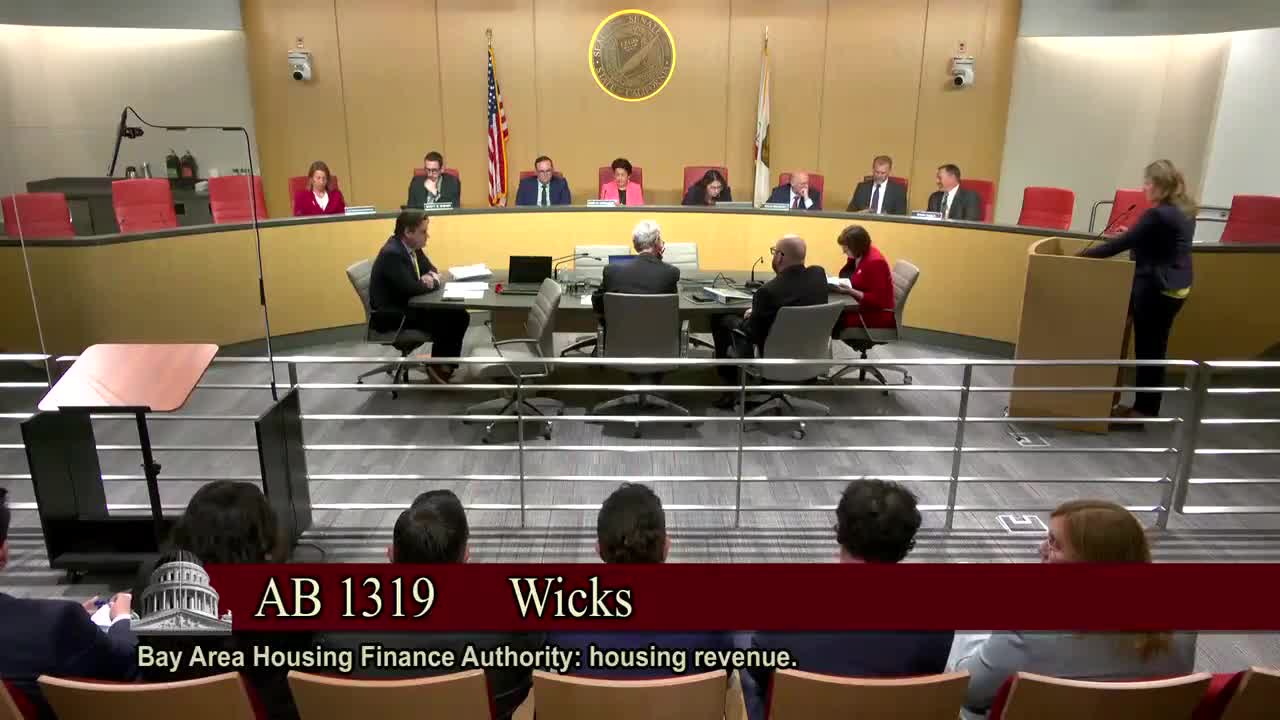 13MIN
Senate Standing Committee on Governance and Finance
 11MIN
Senate Standing Committee on Housing
 3MIN
Assembly Standing Committee on Housing and Community Development
Bill Author

Bill Co-Author(s):