AB 1748: Logistics use projects: sensitive receptors.
- Session Year: 2023-2024
- House: Assembly
- Latest Version Date: 2023-05-01
Current Status:
Failed
(2024-02-01: From committee: Filed with the Chief Clerk pursuant to Joint Rule 56.)
Introduced
In Committee
First Chamber
In Committee
Second Chamber
Enacted
Existing law, the Planning and Zoning Law, sets forth various requirements relating to the review of development project permit applications and the issuance of development permits for specified classes of development projects.
This bill would prohibit the County of Riverside, the County of San Bernardino, and any of the cities cities, joint powers authorities, or agencies with land use authority within those counties from approving the development or expansion of any qualifying logistics use, as defined, that is adjacent to sensitive receptors, as defined, unless the local agency imposes certain requirements, as specified, including a minimum setback on the qualifying logistics use of 300 feet or follows an industrial guideline framework, as specified. if the logistics use consists of 400,000 or more square feet of building space, including, but not limited to, warehouses. By imposing new requirements on local agencies, the bill would impose a state-mandated local program.
The bill would include findings that changes proposed by this bill address a matter of statewide concern rather than a municipal affair and, therefore, apply to all cities, including charter cities.
This bill would make legislative findings and declarations as to the necessity of a special statute for the Counties of Riverside and San Bernardino and Bernardino, the cities located within those counties. counties, and any joint powers authority or agency with land use authority in those counties.
The California Constitution requires the state to reimburse local agencies and school districts for certain costs mandated by the state. Statutory provisions establish procedures for making that reimbursement.
This bill would provide that no reimbursement is required by this act for a specified reason.
Existing law, the Planning and Zoning Law, sets forth various requirements relating to the review of development project permit applications and the issuance of development permits for specified classes of development projects.
This bill would prohibit the County of Riverside, the County of San Bernardino, and any of the cities within those counties from approving the development or expansion of any qualifying logistics use, as defined, that is adjacent to sensitive receptors, as defined, unless the local agency imposes a minimum setback on the qualifying logistics use of 300 feet or follows an industrial guideline framework, as specified. By imposing new requirements on local agencies, the bill would impose a state-mandated local program.
The bill would include findings that changes proposed by this bill address a matter of statewide concern rather than a municipal affair and, therefore, apply to all cities, including charter cities.
This bill would make legislative findings and declarations as to the necessity of a special statute for the Counties of Riverside and San Bernardino and the cities located within those counties.
The California Constitution requires the state to reimburse local agencies and school districts for certain costs mandated by the state. Statutory provisions establish procedures for making that reimbursement.
This bill would provide that no reimbursement is required by this act for a specified reason.
Existing law establishes the Government Code and prescribes general provisions for purposes of its interpretation.This bill would make a nonsubstantive change to the provision naming the Government Code.Existing law establishes the Government Code and prescribes general provisions for purposes of its interpretation.
This bill would make a nonsubstantive change to the provision naming the Government Code.
(a)For purposes of this section:
(1)Development or expansion of any qualifying logistics use means any of the following:(A)The development of any qualifying logistics use.(B)The expansion of any existing qualifying logistics use.(C)The expansion of any existing logistics use, where the logistics use after the expansion would be a qualifying logistics use.(2)(1)Local agency means any of the following:
(A)The County of Riverside.
(B)The County of San Bernardino.
(C)Any city located within the County of Riverside or the County of San Bernardino.
(D)Any joint powers authority or agency with land use authority that is located within the County of Riverside or San Bernardino.
(3)Qualifying logistics use(2)Logistics use means any logistics use with 400,000 or more square feet of building space, including, but not limited to, warehouses. land use for the movement or storage of cargo, goods, or products for later distribution to business or retail customers, or both, including any land use serving heavy-duty trucks involved in such movement of cargo, goods, or products.
(4)(3)Sensitive receptors means one or more of the following:
(A)A legally permitted residence, including, but not limited to, a private home, apartment, condominium unit, group home, dormitory unit, retirement home, or shelter.
(B)A school, including, but not limited to, preschool, prekindergarten, or school maintaining kindergarten or any of grades 1 to 12, inclusive.
(C)A licensed daycare facility.
(D)A health care facility, including, but not limited to, any hospital, medical clinic, community clinic, medical center, nursing home, long-term care facility, hospices, hospice, convalescent facility, or similar live-in housing.
(E)A community center.
(F)An established community place of worship.
(G)A public playground, public recreation field, or public recreation center.
(4)Stacking means an area for temporary parking and lining of motor vehicles while awaiting service or other activity.
(b)A Except as specified in subdivision (c), a local agency shall not approve the any of the following:
(1)The development or expansion of any qualifying a logistics use that is adjacent to a sensitive receptor unless the local agency does either of the following: receptor.
(2)The expansion of an existing logistics use that is adjacent to a sensitive receptor.
(3)The expansion of an existing logistics use that, after the expansion, would be adjacent to a sensitive receptor.
(c)A local agency may approve the development or expansion of a logistics use, as specified in subdivision (b), if the local agency requires all of the following:
(1)Imposes If the logistics use consists of 400,000 or more square feet of building space, including, but not limited to, warehouses, the logistics use shall include a minimum setback on the qualifying logistics use of 300 feet from the buildings loading docks measured from the property line of any sensitive receptor to the nearest dock door using a direct straight-line method.
(2)Follows an industrial guideline framework, good neighbor policy, or sustainability ordinance adopted by the local agency, which, in its discretion, adequately balances siting qualifying logistics uses next to sensitive receptors.(2)All of the following landscape buffer requirements:
(A)If the logistics use consists of 50,000 or more square feet of building space, including, but not limited to, warehouses, the logistics use shall include a 10-foot-wide landscaping buffer on any side of the property that is adjacent to a sensitive receptor.
(B)If the logistics use consists of 400,000 or more square feet of building space, including, but not limited to, warehouses, the logistics use shall include a 20-foot-wide landscaping buffer on any side of the property that is adjacent to a sensitive receptor.
(C)The landscaped buffer areas pursuant to subparagraphs (A) and (B) shall include, at a minimum, a solid decorative wall at least 10 feet in height, natural ground landscaping, and solid-screen buffering trees.
(D)The landscape buffer areas pursuant to subparagraphs (A) and (B) shall be external to the decorative wall.
(E)Solid-screen buffering trees in landscape buffer areas pursuant to subparagraphs (A) and (B) shall be evergreen, drought tolerant, in a minimum 36-inch box, and shall be spaced at no greater than 40 feet on center.
(F)The property owner and any successors subject to this paragraph shall maintain the trees and ensure unhealthy or dead trees are removed and replaced in a timely fashion.
(3)If the logistics use consists of 200,000 or more square feet of building space, including, but not limited to, warehouses, the logistics use shall comply with both of the following design requirements:
(A)The loading docks and truck entries to the logistics use shall be oriented away from adjacent sensitive receptors.
(B)The truck drive aisles shall be located away from sensitive receptors.
(4)If the logistics use consists of 200,000 or more square feet of building space, including, but not limited to, warehouses, the logistics use shall comply with the following stacking depth requirements:
(A)The entry gates into the loading dock and truck court area shall be positioned a minimum of 140 feet of total available stacking depth inside the property line.
(B)The minimum stacking distance shall be increased by 70 feet for every 20 loading docks beyond 50 docks.
(5)If the logistics use consists of 200,000 or more square feet of building space, including, but not limited to, warehouses, the property owner and any successors shall place anti-idling signs indicating a three-minute diesel truck engine idling restriction. The signs shall be posted at entrances to the site and in the dock areas and shall be strictly enforced by the facility operator.
SEC. 2.The Legislature finds and declares that Section 1 of this act adding Chapter 2.8 (commencing with Section 65098) to Division 1 of Title 7 of the Government Code addresses a matter of statewide concern rather than a municipal affair as that term is used in Section 5 of Article XI of the California Constitution. Therefore, Section 1 of this act applies to all cities within the Counties of Riverside and San Bernardino, including charter cities.
SEC. 3.The Legislature finds and declares that a special statute is necessary and that a general statute cannot be made applicable within the meaning of Section 16 of Article IV of the California Constitution because of the significant need to protect homes, schools, daycare facilities, and other sensitive receptors in the Counties of Riverside and San Bernardino, and in the cities located within those counties, or under the jurisdiction of any joint powers authority or agency with land use authority in those counties, from the potential harm created by large warehouses and other logistics uses.
SEC. 4.No reimbursement is required by this act pursuant to Section 6 of Article XIIIB of the California Constitution because a local agency or school district has the authority to levy service charges, fees, or assessments sufficient to pay for the program or level of service mandated by this act, within the meaning of Section 17556 of the Government Code.
(a)For purposes of this section:
(1)Development or expansion of any qualifying logistics use means any of the following:
(A)The development of any qualifying logistics use.
(B)The expansion of any existing qualifying logistics use.
(C)The expansion of any existing logistics use, where the logistics use after the expansion would be a qualifying logistics use.
(2)Local agency means any of the following:
(A)The County of Riverside.
(B)The County of San Bernardino.
(C)Any city located within the County of Riverside or the County of San Bernardino.
(3)Qualifying logistics use means any logistics use with 400,000 or more square feet of building space, including, but not limited to, warehouses.
(4)Sensitive receptors means one or more of the following:
(A)A legally permitted residence, including, but not limited to, a private home, apartment, condominium unit, group home, dormitory unit, retirement home, or shelter.
(B)A school, including, but not limited to, preschool, prekindergarten, or school maintaining kindergarten or any of grades 1 to 12, inclusive.
(C)A licensed daycare facility.
(D)A health care facility, including, but not limited to, any hospital, medical clinic, community clinic, medical center, nursing home, long-term care facility, hospices, convalescent facility, or similar live-in housing.
(E)A community center.
(F)An established community place of worship.
(G)A public playground, public recreation field, or public recreation center.
(b)A local agency shall not approve the development or expansion of any qualifying logistics use that is adjacent to a sensitive receptor unless the local agency does either of the following:
(1)Imposes a minimum setback on the qualifying logistics use of 300 feet from the buildings loading docks measured from the property line of any sensitive receptor to the nearest dock door using a direct straight-line method.
(2)Follows an industrial guideline framework, good neighbor policy, or sustainability ordinance adopted by the local agency, which, in its discretion, adequately balances siting qualifying logistics uses next to sensitive receptors.
SEC. 2.The Legislature finds and declares that Section 1 of this act adding Chapter 2.8 (commencing with Section 65098) to Division 1 of Title 7 of the Government Code addresses a matter of statewide concern rather than a municipal affair as that term is used in Section 5 of Article XI of the California Constitution. Therefore, Section 1 of this act applies to all cities within the Counties of Riverside and San Bernardino, including charter cities.
SEC. 3.The Legislature finds and declares that a special statute is necessary and that a general statute cannot be made applicable within the meaning of Section 16 of Article IV of the California Constitution because of the significant need to protect homes, schools, daycare facilities, and other sensitive receptors in the Counties of Riverside and San Bernardino, and in the cities located within those counties, from the potential harm created by large warehouses and other logistics uses.
SEC. 4.No reimbursement is required by this act pursuant to Section 6 of Article XIIIB of the California Constitution because a local agency or school district has the authority to levy service charges, fees, or assessments sufficient to pay for the program or level of service mandated by this act, within the meaning of Section 17556 of the Government Code.
SECTION 1.Section 1 of the Government Code is amended to read:1.This act shall be known and may be cited as the Government Code.This act shall be known and may be cited as the Government Code.
|
Date
|
Status
|
|---|---|
| Feb 1, 2024 | From committee: Filed with the Chief Clerk pursuant to Joint Rule 56. |
| Jan 31, 2024 | Died pursuant to Art. IV, Sec. 10(c) of the Constitution. |
| May 17, 2023 | In committee: Hearing postponed by committee. |
| May 2, 2023 | Re-referred to Com. on APPR. |
| May 1, 2023 | Read second time and amended. |
| Apr 27, 2023 | From committee: Amend, and do pass as amended and re-refer to Com. on APPR. (Ayes 8. Noes 0.) (April 26). |
| Apr 3, 2023 | Re-referred to Com. on L. GOV. |
| Mar 30, 2023 | From committee chair, with author's amendments: Amend, and re-refer to Com. on L. GOV. Read second time and amended. |
| Mar 30, 2023 | Referred to Com. on L. GOV. |
| Feb 18, 2023 | From printer. May be heard in committee March 20. |
| Feb 17, 2023 | Read first time. To print. |
|
Date
|
Description
|
Location
|
Votes
|
|
|---|---|---|---|---|
| Apr 26, 2023 | Do pass as amended and be re-referred to the Committee on [Appropriations] | Assembly Standing Committee on Local Government |
Passed |
This list shows positions taken on this bill by organizations on the date displayed, which is linked to the original source.
Positions by individuals are not included.
|
Organization
|
Position
|
Date
|
|---|---|---|
| 350 Humboldt | ** Against | |
| Association Of Western Employers | ** Support | |
| California Environmental Voters | ** Against | |
| California State Council Of Laborers | ** Support | |
| Center for Community Action & Environmental Justice | ** Against | |
| City of Fontana | ** Support | |
| cleanearth4kids.org | ** Against | |
| Climate Action California | ** Against | |
| Climate Center The | ** Against | |
| District Council Of Iron Workers Of The State Of California And Vicinity | ** Support | |
| Friends Committee On Legislation Of California | ** Against | |
| Grow Fontana | ** Against | |
| Inland Action | ** Support | |
| Inland Empire Economic Partnership | ** Support | |
| Pink Panthers | ** Against | |
| Rebuild Socal Partnership | ** Support | |
| Redford Conservancy for Southern California Sustainability at Pitzer College | ** Against | |
| R-now | ** Against | |
| Safe Routes Partnership | ** Against | |
| San Bernardino County | ** Support | |
| San Manuel Band Of Mission Indians | ** Support | |
| Santa Cruz Climate Action Network | ** Against | |
| Sierra Club California | ** Against | |
| State Building And Construction Trades Council Of Ca | ** Support | |
| United Contractors | ** Support |
Date of Hearing: April 26, 2023
ASSEMBLY COMMITTEE ON LOCAL GOVERNMENT
Cecilia Aguiar-Curry, Chair
ABPCA Bill Id:AB 1748 (
Author:Ramos) – As Amended Ver:March 30, 2023
SUBJECT: Qualifying logistics use projects.
SUMMARY: Requires specified local agencies to impose a 300-foot setback requirement on parcels that are adjacent to sensitive receptors and include a warehouse that is larger than 400,000 square feet unless the local agency adopts specified alternative policies. Specifically, this bill:
- Prohibits the County of Riverside, the County of San Bernardino, and any city located within those counties from approving the development or expansion of any qualifying logistics use that is adjacent to a sensitive receptor unless the local agency does either of the following:
- Imposes a minimum setback on the qualifying logistics use of 300 feet from the building’s loading docks measured from the property line of any sensitive receptor to the nearest dock door using a direct straight-line method.
- Follows an industrial guideline framework, good neighbor policy, or sustainability ordinance adopted by the local agency, which, in its discretion, adequately balances siting qualifying logistics uses next to sensitive receptors.
- Defines the following terms:
- “Development or expansion of any qualifying logistics use” means any of the following:
- The development of any qualifying logistics use.
- The expansion of any existing qualifying logistics use.
- The expansion of any existing logistics use where the logistics use after the expansion would be a qualifying logistics use.
- “Qualifying logistics use” means any logistics use with 400,000 or more square feet of building space, including, but not limited to, warehouses.
- “Sensitive receptors” means one or more of the following:
- A legally permitted residence, including, but not limited to, a private home, apartment, condominium unit, group home, dormitory unit, retirement home, or shelter.
- A school, including, but not limited to, preschool, prekindergarten, or school maintaining kindergarten or any of grades 1 to 12, inclusive.
- A licensed daycare facility.
- A health care facility, including, but not limited to, any hospital, medical clinic, community clinic, medical center, nursing home, long-term care facility, hospices, convalescent facility, or similar live-in housing.
- A community center.
- An established community place of worship.
- A public playground, public recreation field, or public recreation center.
- “Development or expansion of any qualifying logistics use” means any of the following:
- Finds and declares that the provisions of the bill address a matter of statewide concern rather than a municipal affair as that term is used in Section 5 of Article XI of the California Constitution. Therefore, this bill applies to all cities within the Counties of Riverside and San Bernardino, including charter cities.
- Finds and declares that a special statute is necessary and that a general statute cannot be made applicable within the meaning of Section 16 of Article IV of the California Constitution because of the significant need to protect homes, schools, daycare facilities, and other sensitive receptors in the Counties of Riverside and San Bernardino, and in the cities located within those counties, from the potential harm created by large warehouses and other logistics uses.
- Provides that no reimbursement is required pursuant to Section 6 of Article XIII B of the California Constitution because a local agency or school district has the authority to levy service charges, fees, or assessments sufficient to pay for the program or level of service mandated by this act, within the meaning of Section 17556 of the Government Code.
EXISTING LAW:
- Requires each city and county to prepare, adopt, and administer a general plan for its jurisdiction, which must include a housing element, to shape the future growth of its community (Government Code § 65300 – 65404).
- Establishes the California Environmental Quality Act (CEQA), which requires lead agencies with the principal responsibility for carrying out or approving a proposed project to prepare a negative declaration, mitigated negative declaration, or environmental impact report (EIR) for this action, unless the project is exempt from CEQA (Public Resources Code § 21000, et seq.).
FISCAL EFFECT: This bill is keyed fiscal and contains a state-mandated local program.
COMMENTS:
- Bill Summary and Author’s Statement. This bill requires local agencies in Riverside County and San Bernardino County to require a 300-foot buffer for any logistics use facility that includes 400,000 square feet of building space and is adjacent to a sensitive receptor. This bill waives these requirements if the local agency follows an industrial guideline framework, good neighbor policy, or sustainability ordinance.
According to the author, “AB 1748 is a balanced approach to warehouse siting following the model set out last year after vigorous debate and hard won compromise between the Sierra Club San Gorgonio Chapter, Attorney General Rob Bonta and developers to minimize the impacts of the warehouse project in the City of Fontana. It addresses the need to mitigate vital health concerns important to all of us while protecting critical product supply chains around the globe, nation and state. We saw what happens when ports and other transportation hubs are stalled for products such as baby formula, medicine, food products and building materials are held up.”
This bill is sponsored by the California State Council of Laborers and the Inland Empire Economic Partnership.
- Logistics Development in California. The proliferation of e-commerce and consumer expectations for rapid shipping contributed to a boom in warehouse development in California. The Environmental Justice Bureau at the Department of Justice (DOJ) notes that in the Inland Empire alone, 150 million square feet of new industrial space was developed from 2009-2019, and that 21 of the largest 100 logistics leases signed in 2019 were located in the Inland Empire.
- Measuring Warehouses. This bill and AB 1000 (Reyes) both seek to establish minimum setback requirements on new warehouse developments and expansions. While this bill applies only to Riverside and San Bernardino Counties, AB 1000 would apply statewide. The provisions of this bill would affect any proposed warehouse development in the identified jurisdictions that include more than 400,000 square feet of building space, while AB 1000 would apply to all warehouses that include more 100,000 square feet of building space.
Researchers at the Redford Conservancy at Pitzer College and Radical Research LLC prepared a database of existing and proposed warehouses located in San Bernardino and Riverside County. The tool can be used to estimate the total number of warehouses in San Bernardino and Riverside County that meet the size criteria of each bill. In order to determine the number of warehouses that meet the criteria of each bill, the tool applies lot coverage (floor area ratio) estimates to parcels developed with warehouses. Lot coverage for warehouses varies, but several jurisdictions in Riverside and San Bernardino assume a warehouse will cover between 50 and 60 percent of the total parcel. This means that a 100,000 square foot warehouse will typically be located on a lot totaling between 165,000 and 200,000 square feet, while a 400,000 square foot warehouse typically requires a lot that is between 670,000 square feet and 800,000 square feet.
The chart below provides an estimate of the total number of warehouses in San Bernardino and Riverside County (5,404) and estimates of how many of those warehouses exceed 100,000 square feet and 400,000 square feet based on assumed lot coverage ratios. The larger lot coverage estimate increases the number of existing warehouses that are assumed to be larger than 100,000 and 400,000 square feet, as it increases the numbers of parcels that can accommodate a development of that size. The inverse is true when the smaller lot coverage is used, as it decreases the number of parcels that can accommodate warehouses of that size.
Warehouse size | Number of Warehouses | Total Warehouse area in square feet | ||
50% Lot Coverage | 60% Lot Coverage | 50% Lot Coverage | 60% Lot Coverage | |
Less than 100,000 square feet | 3,164 | 2,794 | 113,000,000 | 95,000,000 |
Between 100,000 and 400,000 square feet. | 1,757 | 1,987 | 326,000,000 | 370,000,000 |
More than 400,000 square feet. | 483 | 683 | 355,000,000 | 488,000,000 |
The data suggests that 41 percent to 49 percent of all warehouses built in San Bernardino and Riverside Counties are larger than 100,000 square feet, with those warehouses accounting for 85 percent to 90 percent of all warehouse space located in the two counties. Approximately 9 percent to 12.5 percent of all warehouses built in San Bernardino and Riverside Counties exceed 400,000 square feet in size, but those warehouses account for 44 percent to 51 percent of all warehouse space located in the two counties.[1]
- Best Practices and Mitigation Measures. DOJ adopted a guidance memo titled Warehouse Projects: Best Practices and Mitigation Measures to Comply with the California Environmental Quality Act, last updated September 2022. The memo identifies best practices for avoiding and mitigating impacts associated with warehouse development. The memo relies heavily on research prepared by the CARB. Among the recommendations proposed in the memo related to the siting and design of warehouses, the memo notes that a best practice includes “Per CARB guidance, siting warehouse facilities so that their property lines are at least 1,000 feet from the property lines of the nearest sensitive receptors.” The underlying data the memo cites in support of this recommendation found an 80 percent drop off in the concentration of diesel particulate matter emissions from distribution centers at approximately 1,000 feet. CARB and the South Coast Air Quality Management District analyses indicate that providing a separation of 1,000 feet would substantially reduce diesel particulate matter concentrations and public exposure downwind of a distribution center.[2]
- CEQA and Local Approval. CEQA requires public agencies to study and mitigate, to the extent feasible, the environmental impacts of proposed projects, providing a key protection for the environment and residents of California. Under CEQA, a local agency carrying out a discretionary project must first determine if the project may have a significant effect on the environment. Projects can include jurisdiction-wide efforts such as the update of a general plan, approval of jurisdiction-wide contracts (e.g., waste hauling contracts or water service), and zoning ordinance amendments. A project can also include individual development actions such as the approval of warehouses, stadiums, gas storage facilities, and other types of developments. In the case of any discretionary project, if a local agency finds that the potential for significant environmental impacts exists, CEQA requires the agency to prepare and certify the completion of an environmental impact report (EIR).
CEQA places the burden on the approving agency to affirmatively show that it has considered feasible mitigation and alternatives that can lessen or avoid identified impacts through a statement of findings for each identified significant impact. The CEQA Guidelines provide direction on the content of the statement of the findings, and states that one or more of the following findings must be identified for each impact:
- Changes or alterations have been required in, or incorporated into, the project which avoid or substantially lessen the significant environmental effect as identified in the final EIR.
- Such changes or alterations are within the responsibility and jurisdiction of another public agency and not the agency making the finding. Such changes have been adopted by such other agency or can and should be adopted by such other agency.
- Specific economic, legal, social, technological, or other considerations, including provision of employment opportunities for highly trained workers, make infeasible the mitigation measures or project alternatives identified in the final EIR.
A lead agency may approve a project with unavoidable (unmitigated) adverse environmental impacts. When doing so, CEQA requires the agency to make a statement in the record of its views on the ultimate balancing of the merits of approving the project despite the environmental impacts in a “statement of overriding considerations.”
Approval of discretionary projects such as warehouse facilities is subject to CEQA and the lead agency must prepare an EIR if the project may have potentially significant environmental impacts. However, CEQA authorizes lead agencies to prepare a statement of overriding considerations and approve a project with unmitigated or unavoidable impacts. In practice, cities and counties may exercise this authority to approve projects that may significantly impact local residents. For example, the City of Perris prepared a Statement of Facts and Findings and Overriding Considerations for a proposed logistics development involving more than 1.7 million square feet of warehouse space. The City found in the Final EIR that the proposed project, located 300 feet from existing residents, would create long-term operational emission and cumulative criteria pollutants that constituted significant and unavoidable impacts. However, the City found such unmitigated effects were acceptable in view of specified overriding considerations. Among the overriding considerations cited were the creation of 685 new jobs and an estimated increase of $215,000 in additional city tax revenue.
- Stockton and Fontana Warehouse Settlement Agreements. In 2022, DOJ reached two separate settlement agreements with the City of Fontana and the City of Stockton relative to their approval of warehouse developments. In both settlements, DOJ intervened during the CEQA process where the city was acting as the lead agency approving a warehouse development. In the City of Fontana, DOJ filed a lawsuit against the city in July of 2021 challenging its approval of the project and arguing that Fontana’s limited environmental review violated CEQA.[3] In the City of Stockton, DOJ submitted letters to the city outlining concerns that its environmental review of the proposed warehouse project failed to adopt all feasible mitigation measures as required by CEQA.[4] In April of 2022, DOJ announced a settlement agreement with the City of Fontana, the warehouse developer, and other litigants in the case. In December of 2022, DOJ announced a settlement agreement with the City of Stockton regarding its approval of warehouse developments.
- Settlement Agreement Terms. The settlement agreements between DOJ and each city impose similar mitigation measures relative to warehouse developments and include standards and conditions that are unique to each agreement. Both agreements require each city to adopt a land use ordinance establishing strict standards for citing new warehouse developments within their respective jurisdictions. The City of Fontana adopted a new warehouse-citing ordinance in April 2022. The Stockton Agreement requires Stockton to propose a warehouse ordinance no later than December 31, 2023.
Warehouse siting design requirements are embedded in the Fontana Ordinance. The Stockton Agreement outlines warehouse siting design requirements to be incorporated in the Stockton Ordinance. With respect to siting design, the settlement agreements require both cities to impose standards on new warehouse developments that are adjacent to sensitive receptors via ordinance. The ordinances include or are required to include standards related to:
- Minimum setbacks.
- Onsite landscaped buffers.
- Decorative buffer walls at specified heights.
- Entry gate and loading dock orientation.
- Vehicle circulation.
- Signage relative to truck idling.
The siting design terms in both agreements are largely similar but vary in some key areas. For example, both agreements establish comparable landscaping, truck dock and truck entry orientation, and signage requirements. The Fontana Ordinance applies some of its provisions to warehouses that are 50,000 square feet or larger, some provisions to warehouses that are 200,000 square feet or larger, and other requirements only to warehouses that are 400,000 square feet or larger. With respect to the setback requirements, which are a key provision of this bill and AB 1000 (Reyes), the Fontana Ordinance requires warehouses that are 400,000 square feet or larger to establish a setback of 300 feet from the property line of the nearest sensitive receptor. The Stockton Agreement applies to logistics use projects with a building or buildings totaling 100,000 square feet. The Stockton Agreement requires that logistics uses and their associated loading docks are no closer than 300 feet from sensitive receptors, and requires the City to consider the public health and safety benefits of requiring a larger buffer, up to 1,000 feet. In Fontana, the setbacks are measured from the property line of the sensitive receptor to the nearest dock door at the logistics use facility. In Stockton the agreement stipulates setbacks established by Stockton’s ordinance will be measured from the loading dock or any building edge, whichever is closer, to the property line of any nearby sensitive receptors.
The agreements also included a series of requirements that are not related to the warehouse siting and design. The Fontana Agreement imposed 26 separate requirements and sub-requirements directly on the warehouse development that was the subject of DOJ’s lawsuit. This includes requirements for electric vehicle fleets, solar power, construction fleets, construction operating hours, and the establishment of a community benefit fund providing amenities to residents and the local school district. The Stockton Agreement requires the city to propose ordinance provisions that are similar to the standards that the Fontana Agreement imposed directly on the operator. The agreement includes a requirement that the proposed ordinance establish requirements for electric vehicle fleets, solar power, construction fleets, and other requirements for new warehouse developments larger than 100,000 square feet.
This bill incorporates one provision from one element of the larger Fontana Agreement; the 300-foot setback requirement for warehouses larger than 400,000 square feet. AB 1000 proposes to adopt a setback requirement suggested in the Stockton agreement --1,000 feet for warehouses larger than 100,000 square feet-- and incorporates a myriad of the other construction, siting design, and operating requirements proposed in the Stockton Agreement.
- Setback Requirements in Context. In both DOJ settlement agreements, the buffer requirements are measured from the dock door, or warehouse building envelope, to the property line of a sensitive receptor. Assuming a lot coverage of 50-60 percent as noted above, a 400,000 square foot warehouse would occupy a parcel that is 670,000 - 800,000 square feet in size (notably, Fontana assumes a land coverage ratio of 45-55 percent for typical warehousing facilities).
In 2019, CARB staff reviewed warehouse parking requirements in over 185 municipal codes and found that local codes typically require warehouse facilities to provide one parking space for every 933 square feet of building floor space. [5] This means that a 400,000 square foot warehouse would likely have more than 370 parking spaces onsite. A typical parking space measures from 8 to 10 feet wide and 18-20 feet long. Off-street parking also requires driveways and access lanes for circulation within the parking lot. As a result, off-street parking typically requires 300 square feet (compact, urban off-street parking) to 400 square feet (full-size, urban off-street parking) of land per parking space.[6] This means a warehouse subject to the 300-foot buffer requirement would already include roughly 150,000 square feet of paved parking onsite.
The warehouse buffer this bill would establish is measured from the dock door of the warehouse to the property line of a sensitive receptor. This means that any onsite drive aisles and parking lots, as well as public streets and right-of-way, count toward the minimum buffer requirement of 300 feet. Given the typical parcel size and the parking requirements for warehouse facilities, and that a typical two-lane frontage road with 12-foot lanes requires a span of 32 feet, the proposed buffer may simply codify the default buffer distance that already exists for a 400,000 square foot warehouse whether or not it is adjacent to a sensitive receptor. [7]
- Policy Considerations. The Committee may wish to consider the following:
- The buffer distance in the Fontana Agreement represents one aspect of a comprehensive siting and design standard intended to mitigate the impacts of siting new warehouse facilities adjacent to sensitive receptors. This bill does not include other aspects of the siting and design standard that were critical to the agreement. The Committee may wish to consider incorporating the balance of siting and design standards included in the Fontana Agreement.
- As drafted, the bill requires the imposition of a 300-foot buffer on warehouses that are larger than 400,000 square feet, unless the city adopts an industrial guideline framework, good neighbor policy, or sustainability ordinance. These terms are vague and undefined and could create a loophole from the buffer requirement. The Committee may wish to consider removing this provision, or incorporating more robust definitions and standards into this provision.
- Committee Amendments. In order to address the policy considerations noted above, The Committee may wish to consider the following amendments:
- Remove the existing definition of “qualifying logistics use.”
- Include any joint powers authority that is located in Riverside County or San Bernardino County in the definition of a “local agency” that is subject to the bill.
- Define the following terms:
- “Logistics Use” means any land use for the movement or storage of cargo, goods, or products for later distribution to business and/or retail customers, including any land use serving heavy-duty trucks involved in such movement of cargo, goods, or products.
- “Stacking” means an area for temporary parking and lining of motor vehicles while awaiting service or other activity.
- Revise the siting and design standards local agencies must require of a logistics use to read as follows:
(b) A Except as specified in subdivision (c), a local agency shall not approve the any of the following:
(1) The development or expansion of any qualifying a logistics use that is adjacent to a sensitive receptor unless the local agency does either of the following: receptor.
(2) The expansion of an existing logistics use that is adjacent to a sensitive receptor.
(3) The expansion of an existing logistics use that, after the expansion, would be adjacent to a sensitive receptor.
(c) A local agency may approve the development or expansion of a logistics use, as specified in subdivision (b), if the local agency requires all of the following:
(1) Imposes If the logistics use consists of 400,000 or more square feet of building space, including, but not limited to, warehouses, the logistics use shall include a minimum setback on the qualifying logistics use of 300 feet from the building’s loading docks measured from the property line of any sensitive receptor to the nearest dock door using a direct straight-line method.
(2) Follows an industrial guideline framework, good neighbor policy, or sustainability ordinance adopted by the local agency, which, in its discretion, adequately balances siting qualifying logistics uses next to sensitive receptors.
(2) All of the following landscape buffer requirements:
(A) If the logistics use consists of 50,000 or more square feet of building space, including, but not limited to, warehouses, the logistics use shall include a 10-foot-wide landscaping buffer on any side of the property that is adjacent to a sensitive receptor.
(B) If the logistics use consists of 400,000 or more square feet of building space, including, but not limited to, warehouses, the logistics use shall include a 20-foot-wide landscaping buffer on any side of the property that is adjacent to a sensitive receptor.
(C) The landscaped buffer areas pursuant to subparagraphs (A) and (B) shall include, at a minimum, a solid decorative wall at least 10 feet in height, natural ground landscaping, and solid-screen buffering trees.
(D) The landscape buffer areas pursuant to subparagraphs (A) and (B) shall be external to the decorative wall.
(E) Solid-screen buffering trees in landscape buffer areas pursuant to subparagraphs (A) and (B) shall be evergreen, drought tolerant, in a minimum 36-inch box, and shall be spaced at no greater than 40 feet on center.
(F) The property owner and any successors subject to this paragraph shall maintain the trees and ensure unhealthy or dead trees are removed and replaced in a timely fashion.
(3) If the logistics use consists of 200,000 or more square feet of building space, including, but not limited to, warehouses, the logistics use shall comply with both of the following design requirements:
(A) The loading docks and truck entries to the logistics use shall be oriented away from adjacent sensitive receptors.
(B) The truck drive aisles shall be located away from sensitive receptors.
(4) If the logistics use consists of 200,000 or more square feet of building space, including, but not limited to, warehouses, the logistics use shall comply with the following stacking depth requirements:
(A) The entry gates into the loading dock and truck court area shall be positioned a minimum of 140 feet of total available stacking depth inside the property line.
(B) The minimum stacking distance shall be increased by 70 feet for every 20 loading docks beyond 50 docks.
(5) If the logistics use consists of 200,000 or more square feet of building space, including, but not limited to, warehouses, the property owner and any successors shall place anti-idling signs indicating a three-minute diesel truck engine idling restriction. The signs shall be posted at entrances to the site and in the dock areas and shall be strictly enforced by the facility operator.
- Make technical and conforming changes.
- Related Legislation. AB 1000 (Reyes), would prohibit local agency approval of a “qualifying logistics use” (e.g., a warehouse of 100,000 or more square feet) within 1,000 feet of a sensitive receptor, as defined, except that a local agency may approve a qualifying logistics use between 750 and 1,000 feet from a sensitive receptor if the local agency conducts an air pollution analysis and imposes specified mitigation measures. AB 1000 is pending in this Committee.
- Previous Legislation. AB 2840 (Reyes) of 2022, among other provisions, would have prohibited public agencies from siting warehouse developments within 1,000 feet of a sensitive land use. This bill was held in the Senate Governance and Finance Committee.
AB 1547 (Reyes) of 2021, among other provisions, would have prohibited public agencies from siting warehouse developments within 3,000 yards of a sensitive land use. This bill was held in the Natural Resources Committee.
- Arguments in Support. The California State Council of Laborers writes in support, “California’s ports and distribution centers are critical to our local, state, and national economies and it is imperative that our policy makers develop comprehensive solutions that improve the environment, spur economic grown and support goods movement. AB 1748 brings innovative solutions to tackle immediate air quality and supply chain issues while also [bringing] our distribution process into the 21st century.”
- Arguments in Opposition. The Sierra Club of California writes in opposition, “AB 1748 is a weak policy favoring developers that does not create drastic changes for impacted communities. Local agencies have the choice to impose a setback of only 300 feet or follow a set of local agency guidelines that will essentially give permission for polluters to pollute near sensitive receptors. We need stronger statewide protections that ensure warehouses and large [logistics] centers are truly good neighbors, and this is showcased in AB 1000, which establishes a large enough buffer zone as well as other rigorous standards that disallows industrial sites from giving permission to cause further harm to frontline communities.”
REGISTERED SUPPORT / OPPOSITION:
Support
California State Council of Laborers [SPONSOR]
Inland Empire Economic Partnership [SPONSOR]
Association of Western Employers
City of Fontana
District Council of Iron Workers of The State of California and Vicinity
Inland Action
Rebuild Socal Partnership
San Bernardino County
San Manuel Band of Mission Indians
State Building and Construction Trades Council of Ca
United Contractors (UCON)
Opposition
350 Humboldt
California Environmental Voters (formerly Clcv)
Center for Community Action & Environmental Justice
Cleanearth4kids.org
Climate Action California
Climate Center; the
Friends Committee on Legislation of California
Grow Fontana
Pink Panthers
R-now
Redford Conservancy for Southern California Sustainability At Pitzer College
Safe Routes Partnership
Santa Cruz Climate Action Network
Sierra Club California
Analysis Prepared by: Hank Brady / L. GOV. / (916) 319-3958
Robert Redford Conservancy and Radical Research LLC: Warehouse CITY. https://radicalresearch.shinyapps.io/WarehouseCITY/ ↑
Department of Justice: Bureau of Environmental Justice. Warehouse Projects: Best Practices and Mitigation Measures to Comply with the California Environmental Quality Act. (Updated September 2022). ↑
Attorney General Bonta Announces Innovative Settlement with City of Fontana to Address Environmental Injustices in Warehouse Development. California Department of Justice, April 18, 2022. Bureau of Environmental Justice. https://oag.ca.gov/news/press-releases/attorney-general-bonta-announces-innovative-settlement-city-fontana-address. ↑
Attorney General Bonta Announces Agreement with City of Stockton to Address Environmental Impacts from Continued Warehouse Development. California Department of Justice, December 6, 2022. Bureau of Environmental Justice. https://oag.ca.gov/news/press-releases/attorney-general-bonta-announces-agreement-city-stockton-address-environmental. ↑
California Air Resources Board. EV Charging Infrastructure: Nonresidential Building Standards. 2019/2020 Intervening Code Cycle: CARB Staff Technical and Cost Analysis. (2019) Page C-1. https://ww2.arb.ca.gov/sites/default/files/2020-09/CARB_Technical_Analysis_EV_Charging_Nonresidential_CALGreen_2019_2020_Intervening_Code.pdf ↑
Litman, Todd. Parking Management Best Practices. (Routledge, 2018) 50-51. ↑
California Department of Transportation. Highway Design Manual: Chapter 300 Geometric Cross Section. (2020) 300-47 – 300-48. ↑
Discussed in Hearing
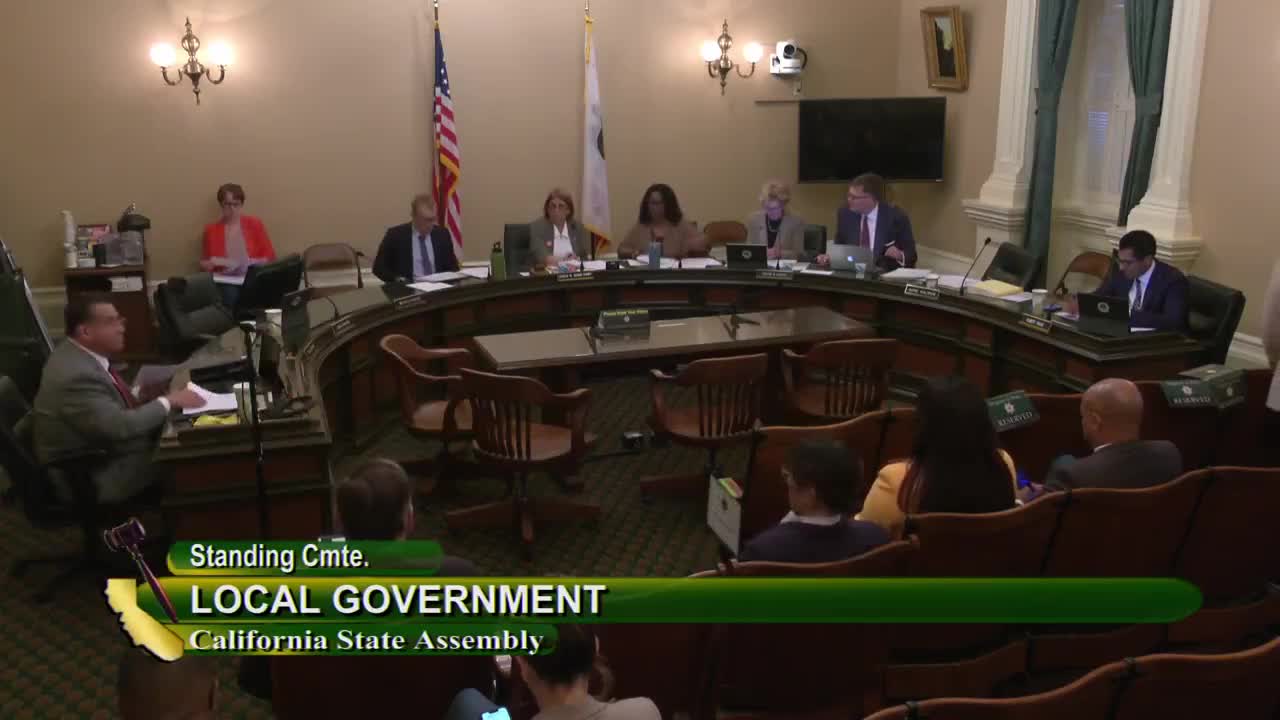 41MIN
Assembly Standing Committee on Local Government
Bill Author

Bill Co-Author(s):
