AB 1784: Primary elections: candidate withdrawals.
- Session Year: 2023-2024
- House: Assembly
- Latest Version Date: 2024-09-22
Current Status:
Passed
(2024-09-22: Chaptered by Secretary of State - Chapter 355, Statutes of 2024.)
Introduced
In Committee
First Chamber
In Committee
Second Chamber
Enacted
Existing law requires candidates for an office at a primary election to deliver their nomination documents to the county elections official no later than 5 p.m. on the 88th day before the primary election, or in specified cases, no later than 5 p.m. on the 83rd day before the primary election. Existing law prohibits a person who has delivered nomination documents to the county elections official from withdrawing their candidacy. Existing law further prohibits a person from filing nomination documents for a party nomination and an independent nomination for the same office, or for more than one office at the same election.
This bill would permit a candidate for any office other than a statewide office, as defined, at a primary election to withdraw their nomination documents for that office during the applicable filing period. The bill would establish requirements for withdrawal, including that the candidate submit a statement under penalty of perjury that they are withdrawing their nomination documents and understand the withdrawal is irrevocable and that the filing fees are nonrefundable. The bill would permit a candidate who withdraws to file nomination documents for another office at that primary election during the applicable filing period. The bill would clarify that a candidate is prohibited from filing nomination documents for more than one office at the same primary election, except as specified. If an incumbent has delivered but then withdrawn their nomination documents before 5 p.m. on the 88th day before the primary election, the bill would authorize another candidate to deliver their nomination documents no later than 5 p.m. on the 83rd day before the primary election.
By establishing a new crime based upon the requirement that a candidate submit a statement of withdrawal under penalty of perjury, and by establishing new duties for local elections officials, the bill would create a state-mandated local program.
The California Constitution requires the state to reimburse local agencies and school districts for certain costs mandated by the state. Statutory provisions establish procedures for making that reimbursement.
This bill would provide that with regard to certain mandates no reimbursement is required by this act for a specified reason.
With regard to any other mandates, this bill would provide that, if the Commission on State Mandates determines that the bill contains costs so mandated by the state, reimbursement for those costs shall be made pursuant to the statutory provisions noted above.
Existing law requires candidates for an office at a primary election to deliver their nomination documents to the county elections official no later than 5 p.m. on the 88th day before the primary election, or in specified cases, no later than 5 p.m. on the 83rd day before the primary election. Existing law prohibits a person who has delivered nomination documents to the county elections official from withdrawing their candidacy. Existing law further prohibits a person from filing nomination documents for a party nomination and an independent nomination for the same office, or for more than one office at the same election.
This bill would permit a candidate for an office any office other than a statewide office, as defined, at a primary election to withdraw their nomination documents for that office during the applicable filing period. The bill would establish requirements for withdrawal, including that the candidate submit a statement under penalty of perjury that they are withdrawing their nomination documents and understand the withdrawal is irrevocable. irrevocable and that the filing fees are nonrefundable. The bill would permit a candidate who withdraws to file nomination documents for another office at that primary election during the applicable filing period. The bill would clarify that a candidate is prohibited from filing nomination documents for more than one office at the same primary election, except as specified. If an incumbent has delivered but then withdrawn their nomination documents before 5 p.m. on the 88th day before the primary election, the bill would authorize another candidate to deliver their nomination documents no later than 5 p.m. on the 83rd day before the primary election.
By establishing a new crime based upon the requirement that a candidate submit a statement of withdrawal under penalty of perjury, and by establishing new duties for local elections officials, the bill would create a state-mandated local program.
The California Constitution requires the state to reimburse local agencies and school districts for certain costs mandated by the state. Statutory provisions establish procedures for making that reimbursement.
This bill would provide that with regard to certain mandates no reimbursement is required by this act for a specified reason.
With regard to any other mandates, this bill would provide that, if the Commission on State Mandates determines that the bill contains costs so mandated by the state, reimbursement for those costs shall be made pursuant to the statutory provisions noted above.
Existing law requires candidates for an office at a primary election to deliver their nomination documents to the county elections official no later than 5 p.m. on the 88th day before the primary election, or in specified cases, no later than 5 p.m. on the 83rd day before the primary election. Existing law prohibits a person who has delivered nomination documents to the county elections official from withdrawing their candidacy. Existing law further prohibits a person from filing nomination documents for a party nomination and an independent nomination for the same office, or for more than one office at the same election.
This bill would permit a candidate for an office at a primary election to withdraw their nomination documents for that office during the applicable filing period. The bill would establish requirements for withdrawal, including that the candidate submit a statement under penalty of perjury that they are withdrawing their nomination documents and understand the withdrawal is irrevocable. The bill would permit a candidate who withdraws to file nomination documents for another office at that primary election during the applicable filing period. The bill would clarify that a candidate is prohibited from filing nomination documents for more than one office at the same primary election, except as specified. If an incumbent has delivered but then withdrawn their nomination documents before 5 p.m. on the 88th day before the primary election, the bill would authorize another candidate to deliver their nomination documents no later than 5 p.m. on the 83rd day before the primary election.
By establishing a new crime based upon the requirement that a candidate submit a statement of withdrawal under penalty of perjury, and by establishing new duties for local elections officials, the bill would create a state-mandated local program.
The California Constitution requires the state to reimburse local agencies and school districts for certain costs mandated by the state. Statutory provisions establish procedures for making that reimbursement.
This bill would provide that with regard to certain mandates no reimbursement is required by this act for a specified reason.
With regard to any other mandates, this bill would provide that, if the Commission on State Mandates determines that the bill contains costs so mandated by the state, reimbursement for those costs shall be made pursuant to the statutory provisions noted above.
Existing law requires candidates for an office at a primary election to deliver their nomination documents to the county elections official no later than 5 p.m. on the 88th day before the primary election, or in specified cases, no later than 5 p.m. on the 83rd day before the primary election. Existing law prohibits a person who has delivered nomination documents to the county elections official from withdrawing their candidacy. Existing law further prohibits a person from filing nomination documents for a party nomination and an independent nomination for the same office, or for more than one office at the same election.
This bill would permit a candidate for an office at a primary election to withdraw their nomination documents for that office during the applicable filing period. The bill would establish requirements for withdrawal, including that the candidate submit a statement under penalty of perjury that they are withdrawing their nomination documents and understand the withdrawal is irrevocable. The bill would permit a candidate who withdraws to file nomination documents for another office at that primary election during the applicable filing period. The bill would clarify that a candidate is prohibited from filing nomination documents for more than one office at the same primary election, except as specified.
By establishing a new crime based upon the requirement that a candidate submit a statement of withdrawal under penalty of perjury, and by establishing new duties for local elections officials, the bill would create a state-mandated local program.
The California Constitution requires the state to reimburse local agencies and school districts for certain costs mandated by the state. Statutory provisions establish procedures for making that reimbursement.
This bill would provide that with regard to certain mandates no reimbursement is required by this act for a specified reason.
With regard to any other mandates, this bill would provide that, if the Commission on State Mandates determines that the bill contains costs so mandated by the state, reimbursement for those costs shall be made pursuant to the statutory provisions noted above.
This bill would state the intent of the Legislature to enact legislation clarifying that a person is prohibited from filing nomination documents for more than one office at the same election.Existing law prohibits a person from filing nomination documents for a party nomination and an independent nomination for the same office, or for more than one office at the same election.
This bill would state the intent of the Legislature to enact legislation clarifying that a person is prohibited from filing nomination documents for more than one office at the same election.
The Legislature finds and declares all of the following:
(a)Since 1913, state law has prohibited a person from filing nomination papers for more than one office at the same primary election, and since 1917, state law has prohibited a person from withdrawing as a candidate at a primary election after filing a declaration of candidacy for an office at that election.
(b)Californias prohibition against a person filing nomination papers for more than one office at the same primary election serves important governmental interests, including regulating the number of candidates who appear on the ballot, limiting gamesmanship, avoiding voter confusion, preventing unnecessary special elections, and facilitating the operation of the states prohibition on holding incompatible offices.
(c)Notwithstanding Californias longstanding prohibition on a person filing nomination papers to run for more than one office at a primary election, in December 2023, a Sacramento County Superior Court judge ordered the Secretary of State to place the name of a candidate on the ballot for a seat in the United States House of Representatives even though that same person was also appearing on the ballot as a candidate for a seat in the California State Assembly. The judges ruling concluded that the prohibition on filing nomination papers for more than one office at a primary election applies only to the process for the independent nomination of candidates.
(d)In reaching this decision, the judge acknowledged that the ruling may result in voter confusion and the disenfranchisement of voters if [the candidate] is ultimately elected for both offices but does not retain one. The judge additionally concluded that it somewhat defies common sense to find the law permits a candidate to run for two offices during the same election.
(e)If a candidate is elected to multiple offices at a primary election but can serve in only one, the result is a vacant elective office. Such a vacancy will leave voters without representation until a new official can be seated, and often necessitates a special election that can be costly and suffer from low and unrepresentative turnout.
(f)Allowing candidates to run for multiple offices at a primary election unfairly places voters in the position of being asked to vote for a candidate without knowing if that candidate will accept the office if elected.
SEC. 2.It is the intent of the Legislature in enacting this bill to do all of the following:
(a)Clarify that California law does not permit a person to file nomination documents for more than one office at the same primary election.
(b)Consistent with California Secretary of State Opinion No. 82 SOS 1, issued in March 1982, clarify that for the purpose of the prohibition on filing nomination papers for more than one office at the same primary election, the position of member of a political partys county central committee is not an office.
(c)Create a procedure that allows a candidate to withdraw nomination documents that were previously filed for an office other than a statewide office at a primary election without unduly interfering with elections officials preparations for conducting the election.
(d)Expressly require an elections official to reject a candidates nomination documents if the candidate attempts to file for more than one office at a primary election, unless the candidate has withdrawn all previously filed nomination documents as permitted by this act.
SEC. 3.Section 8003 of the Elections Code is amended to read:8003.(a)(1)A person shall not file nomination papers for more than one office at the same primary election.
(2)For purposes of paragraph (1), office does not include the position of member of a political partys county central committee.
(b)If a person has filed nomination papers for an office at a primary election and those nomination papers have not been withdrawn pursuant to Section 8020.5, the elections official shall reject as invalid any nomination papers that the person attempts to file for another office at the same primary election.
SEC. 4.Section 8020.5 is added to the Elections Code, to read:8020.5.(a)A candidate may withdraw nomination documents for any office other than a statewide office that the candidate delivered for filing to the county elections official by delivering a statement of withdrawal to the county elections official. The statement may be delivered to the county elections official by a person other than the candidate. If the statement is not executed by the candidate in the office of the elections official, the candidate shall execute the statement before a notary public appointed by the Secretary of State or other state official. The statement shall be signed by the candidate under penalty of perjury, and shall include all of the following:
(1)Identification of the office for which the candidate previously delivered nomination documents for filing to the county elections official.
(2)A statement that the candidate irrevocably withdraws those nomination documents.
(3)A statement that the candidate understands that by withdrawing the nomination documents, the candidate will not appear on the ballot as a candidate for that office.
(4)A statement that the candidate understands that they will not receive a refund of any filing fees that the candidate paid in connection with the candidacy for that office pursuant to subdivision (a) of Section 8105 of the Elections Code.
(b)A candidate shall have until 5 p.m. on the 88th day before the primary election to withdraw nomination documents, except that if the extended period for filing nomination documents specified in Section 8022 or Section 8024 applies for a particular office, a candidate shall have until 5 p.m. on the 83rd day before the primary election to withdraw nomination documents for that office.
(c)A candidate who withdraws nomination documents pursuant to this section may, during the applicable filing period, file nomination documents for any other office at the same primary election for which the person is eligible to be a candidate, except the office for which the person withdrew their nomination documents. This subdivision shall not be construed to extend any deadline for filing nomination documents.
(d)If a candidate withdraws their nomination documents and does not subsequently qualify as a candidate for another office at the same primary election, the candidates name shall not appear on the ballot for any office at that election.
(e)If a candidate delivers a statement of withdrawal to a county elections official pursuant to this section, and the office to which the statement applies is one for which nomination documents are required to be filed in the office of the Secretary of State pursuant to subdivision (a) of Section 8100, the county elections official shall do all of the following:
(1)Immediately upon receipt, electronically send a copy of the statement to the Secretary of State.
(2)If the office to which the statement applies is to be voted on in more than one county, immediately upon receipt electronically send a copy of the statement to the elections official in each other affected county.
(3)Within five days of receipt of the statement, forward the original statement to the Secretary of State.
(f)For purposes of this section, statewide office means the office of Governor, Lieutenant Governor, Attorney General, Controller, Insurance Commissioner, Secretary of State, Superintendent of Public Instruction, Treasurer, or Member of the United States Senate.
SEC. 5.Section 8022 of the Elections Code is amended to read:8022.Notwithstanding Section 8020 or any other provision of the law, if nomination documents for an incumbent state Senator, Member of the Assembly, state constitutional officer, Insurance Commissioner, Member of the United States House of Representatives, or United States Senator are not delivered by 5 p.m. on the 88th day before the direct primary election, or are delivered but then are withdrawn before 5 p.m. on the 88th day before the direct primary election, any person other than the person who was the incumbent on the 88th day shall have until 5 p.m. on the 83rd day before the election to file nomination documents for the elective office.
However, if the incumbents failure to file nomination documents is because the incumbent has already served the maximum number of terms permitted by the California Constitution for that office, there shall be no extension of the period for filing the nomination documents.
SEC. 6.Section 8024 of the Elections Code is amended to read:8024.Notwithstanding Section 8020 or any other provision of the law, if nomination documents for an incumbent officer of a county are not delivered by 5 p.m. on the 88th day before the direct primary election, or are delivered but then are withdrawn before 5 p.m. on the 88th day before the direct primary election, any person other than the person who was the incumbent on the 88th day shall have until 5 p.m. on the 83rd day before the election to file nomination documents for the elective office.
This section is not applicable where there is no incumbent eligible to be elected.
SEC. 7.Section 8040 of the Elections Code is amended to read:8040.(a)The declaration of candidacy by a candidate shall be substantially as follows:
DECLARATION OF CANDIDACY |
I hereby declare myself a candidate for nomination to the office of ________ District Number ________ to be voted for at the primary election to be held ________, 20__, and declare the following to be true: My name is . I want my name and occupational designation to appear on the ballot as follows: ______________________________________. |
Addresses: Residence Business Mailing |
Telephone numbers: Day _________ Evening _________ |
Internet website:_______________________________________ |
I meet the statutory and constitutional qualifications for this office (including, but not limited to, citizenship, residency, and party preference, if required). |
I am at present an incumbent of the following public office |
(if any) __________. |
If nominated, I will accept the nomination and not withdraw, except as permitted by state law. |
Signature of candidate |
A candidate for voter-nominated office shall also complete all of the following: | ||
(1)I hereby certify that: | ||
(a)At the time of presentation of this declaration, as shown by my current affidavit of registration, I have disclosed the following political party preference, if any: . | ||
(b)My complete voter registration and party affiliation/preference history, from [10 years prior to current year] through the date of signing this document, is as follows: | ||
Party Registration | County | Timeframe (by year) |
(2)Pursuant to Section 8002.5 of the Elections Code, select one of the following: | ||
______ Party Preference: _____________________ (insert the name of the qualified political party as disclosed upon your affidavit of registration). | ||
______ Party Preference: None (if you have declined to disclose a preference for a qualified political party upon your affidavit of registration). | ||
Dated this ___ day of _____, 20___. | ||
Signature of candidate | ||
| A Notary Public or other officer completing this certificate verifies only the identity of the individual who signed the document to which this certificate is attached, and not the truthfulness, accuracy, or validity of that document. |
State of California | ) | |
County of | ) ss. | |
) |
Subscribed and sworn to before me this ___ day of ________, 20____. |
Signature of Notary Public (or other official) Notary Public Seal |
Examined and certified by me this ________ day of ________, 20____. |
County Elections Official |
WARNING: Every person acting on behalf of a candidate is guilty of a misdemeanor who deliberately fails to file at the proper time and in the proper place any declaration of candidacy in the persons possession which is entitled to be filed under the provisions of the Elections Code Section 18202. |
(b)At the discretion of the elections official, a candidate for a judicial office, or a candidate for any office whose voter registration information is confidential under Section 2166, 2166.5, 2166.7, or 2166.8 may withhold the candidates residence address from the declaration of candidacy. If a candidate does not state the candidates residence address on the declaration of candidacy, the elections official shall verify whether the candidates address is within the appropriate political subdivision and add the notation verified where appropriate on the declaration.
(c)If a candidate will not be within the State of California during the entire nomination period and is unable to appear before a notary public appointed by the Secretary of State or other California official to complete their declaration of candidacy, the candidate may appear before a notary public in another state to complete the declaration of candidacy. The candidate shall attach to their declaration of candidacy a notarial certificate from the out-of-state notary that complies with the law of the notarys state.
SEC. 8.Section 8800 of the Elections Code is amended to read:8800.Except as provided in Section 8020.5, a candidate whose declaration of candidacy has been filed for any primary election shall not withdraw as a candidate at that primary election.
SEC. 9.Section 8809 of the Elections Code is amended to read:8809.Whenever a candidate has declared a candidacy for a primary election and has not withdrawn pursuant to Section 8020.5, the candidates name shall be printed upon the ballot for the primary election, unless the candidate has died, and that fact has been ascertained by the officer charged with the duty of printing the ballots, at least 68 days before the day of the election.
SEC. 10.Section 10225 of the Elections Code is amended to read:10225.(a)Notwithstanding Sections 10220 and 10224, if nomination papers for an incumbent officer of the city are not filed by or on the 88th day before the election, during normal business hours, as posted, or are filed but then are withdrawn before the close of normal business hours on the 88th day before the election, the voters shall have until the 83rd day before the election during normal business hours, as posted, to nominate candidates other than the person who was the incumbent on the 88th day, for that incumbents elective office.
(b)This section is not applicable where there is no incumbent eligible to be elected. If this section is applicable, notwithstanding Section 10224, a candidate may withdraw their nomination paper until the 83rd day before the election during normal business hours, as posted.
SEC. 11.Section 10229 of the Elections Code is amended to read:10229.(a)If, by the 88th day, during normal business hours as posted, before the day fixed for a regularly scheduled municipal election or the 83rd day before the election, during normal business hours as posted, if an incumbent fails to file or files but then withdraws pursuant to Section 10225, (i) no one or only one person has been nominated for any office that is elected on a citywide basis, or (ii) no one or only one person is nominated to be elected from or by a legislative district, or (iii) in the case of any office or offices to be elected at large, the number of persons who have been nominated for those offices does not exceed the number to be filled at that election; or, if, by the 88th day, during normal business hours as posted, before a municipal election to fill any vacancy in office, no one or only one person has been nominated for any elective office to be filled at that election, and the election is subject to Section 36512 of the Government Code, the city elections official shall submit a certificate of these facts to the governing body of the city and inform the governing body of the city that it may, at a regular or special meeting held before the municipal election, adopt one of the following courses of action:
(1)Appoint to the office the person who has been nominated.
(2)Appoint to the office an eligible elector if no one has been nominated.
(3)Hold the election, if either no one or only one person has been nominated. The city elections official shall publish a notice of the facts described in this section and the courses of action available under this subdivision. Publication shall be made pursuant to Section 6061 of the Government Code in any newspaper of general circulation as designated by the city elections official.
After the fifth day following the date of posting or publication, the governing body of the city may make the appointment or direct an election to be held in the affected territory. The person appointed, if any, shall qualify and take office and serve exactly as if elected at a municipal election for the office.
Notwithstanding Section 10403, if, by the 75th day before the municipal election, no person has been appointed to office pursuant to paragraph (1) or (2), the election shall be held.
(b)Subdivision (a) shall not apply if, at the regularly scheduled municipal election, more than one person has been nominated to another city office to be elected on a citywide basis or a city measure has qualified and is to be submitted to the voters at that municipal election.
(c)Notwithstanding Chapter 1 (commencing with Section 8600) of Part 3 of Division 8, or any other provision of the law to the contrary, if the governing body of a city makes an appointment pursuant to subdivision (a), the elections official shall not accept for filing any statement of write-in candidacy that is submitted after the appointment is made.
(d)Nothing in this section shall be construed to prevent a city from enacting an ordinance pursuant to Section 36512 of the Government Code, requiring that a special election be held, or from enacting an ordinance pursuant to Section 36512 of the Government Code, providing that a person appointed to fill a vacancy on the city council shall hold office only until the date of the special election, or both. Any ordinance or ordinances may allow for appointment consistent with subdivision (a) without requiring or providing for a special election.
If an appointment to office is made in a particular legislative district pursuant to subdivision (a), that appointment shall not affect the conduct of the municipal election in other legislative districts of the city.
SEC. 12.Section 10407 of the Elections Code is amended to read:10407.(a)Notwithstanding any other provision of law, whenever other elections are consolidated with a regularly scheduled election, the period for the filing of nomination documents by candidates in elections consolidated with the regularly scheduled election shall commence on the 113th day before the election. The nomination documents shall be filed not later than the close of business on the 88th day before the regularly scheduled election in the office of the appropriate officer, during regular office hours.
(b)Notwithstanding subdivision (a), if nomination documents for an incumbent officer of a political subdivision are not filed by the close of business on the 88th day before the election, or are filed but then are withdrawn before the close of normal business hours on the 88th day before the election, any person other than the person who was the incumbent on the 88th day shall have until the close of business on the 83rd day before the election to file nomination documents for the elective office. This section is not applicable where there is no incumbent eligible to be elected.
SEC. 13.Section 10516 of the Elections Code is amended to read:10516.(a)Notwithstanding any other provision of law, in any district or agency election, if a declaration of candidacy for an incumbent elective officer of a district is not filed by 5 p.m. on the 88th day before the general district election, or is filed but then is withdrawn before 5 p.m. on the 88th day before the election, any person other than the person who was the incumbent on the 88th day shall have until 5 p.m. on the 83rd day before the election to file a declaration of candidacy for the elective office.
(b)This section is not applicable where there is no incumbent to be elected. If this section is applicable, notwithstanding Section 10510, a candidate may withdraw their declaration of candidacy until 5 p.m. on the 83rd day before the general election.
SEC. 14.Section 10604 of the Elections Code is amended to read:10604.(a)Notwithstanding Section 10603, if a declaration of candidacy for an incumbent member of a school district or community college district governing board or of a county board of education is not filed by 5 p.m. on the 88th day before the election, or is filed but then is withdrawn before 5 p.m. on the 88th day before the election, any person, other than the person who was the incumbent on the 88th day, shall have until 5 p.m. on the 83rd day before an election to file a declaration of candidacy for the elective office.
(b)This section is not applicable where there is no incumbent eligible to be elected. If this section is applicable, notwithstanding Section 10603, a candidate whose declaration of candidacy has been filed for any school district or community college district governing board election or county board of education election may withdraw as a candidate until 5 p.m. on the 83rd day before the election.
SEC. 15.No reimbursement is required by this act pursuant to Section 6 of Article XIIIB of the California Constitution for certain costs that may be incurred by a local agency or school district because, in that regard, this act creates a new crime or infraction, eliminates a crime or infraction, or changes the penalty for a crime or infraction, within the meaning of Section 17556 of the Government Code, or changes the definition of a crime within the meaning of Section 6 of Article XIIIB of the California Constitution.
However, if the Commission on State Mandates determines that this act contains other costs mandated by the state, reimbursement to local agencies and school districts for those costs shall be made pursuant to Part 7 (commencing with Section 17500) of Division 4 of Title 2 of the Government Code.
The Legislature finds and declares all of the following:
(a)Since 1913, state law has prohibited a person from filing nomination papers for more than one office at the same primary election, and since 1917, state law has prohibited a person from withdrawing as a candidate at a primary election after filing a declaration of candidacy for an office at that election.
(b)Californias prohibition against a person filing nomination papers for more than one office at the same primary election serves important governmental interests, including regulating the number of candidates who appear on the ballot, limiting gamesmanship, avoiding voter confusion, preventing unnecessary special elections, and facilitating the operation of the states prohibition on holding incompatible offices.
(c)Notwithstanding Californias longstanding prohibition on a person filing nomination papers to run for more than one office at a primary election, in December 2023, a Sacramento County Superior Court judge ordered the Secretary of State to place the name of a candidate on the ballot for a seat in the United States House of Representatives even though that same person was also appearing on the ballot as a candidate for a seat in the California State Assembly. The judges ruling concluded that the prohibition on filing nomination papers for more than one office at a primary election applies only to the process for the independent nomination of candidates.
(d)In reaching this decision, the judge acknowledged that the ruling may result in voter confusion and the disenfranchisement of voters if [the candidate] is ultimately elected for both offices but does not retain one. The judge additionally concluded that it somewhat defies common sense to find the law permits a candidate to run for two offices during the same election.
(e)If a candidate is elected to multiple offices at a primary election but can serve in only one, the result is a vacant elective office. Such a vacancy will leave voters without representation until a new official can be seated, and often necessitates a special election that can be costly and suffer from low and unrepresentative turnout.
(f)Allowing candidates to run for multiple offices at a primary election unfairly places voters in the position of being asked to vote for a candidate without knowing if that candidate will accept the office if elected.
SEC. 2.It is the intent of the Legislature in enacting this bill to do all of the following:
(a)Clarify that California law does not permit a person to file nomination documents for more than one office at the same primary election.
(b)Consistent with California Secretary of State Opinion No. 82 SOS 1, issued in March 1982, clarify that for the purpose of the prohibition on filing nomination papers for more than one office at the same primary election, the position of member of a political partys county central committee is not an office.
(c)Create a procedure that allows a candidate to withdraw nomination documents that were previously filed for an office at a primary election without unduly interfering with elections officials preparations for conducting the election.
(d)Expressly require an elections official to reject a candidates nomination documents if the candidate attempts to file for more than one office at a primary election, unless the candidate has withdrawn all previously filed nomination documents as permitted by this act.
SEC. 3.Section 8003 of the Elections Code is amended to read:8003.(a)(1)A person shall not file nomination papers for more than one office at the same primary election.
(2)For purposes of paragraph (1), office does not include the position of member of a political partys county central committee.
(b)If a person has filed nomination papers for an office at a primary election and those nomination papers have not been withdrawn pursuant to Section 8020.5, the elections official shall reject as invalid any nomination papers that the person attempts to file for another office at the same primary election.
SEC. 4.Section 8020.5 is added to the Elections Code, to read:8020.5.(a)A candidate may withdraw nomination documents that the candidate delivered for filing to the county elections official by delivering a statement of withdrawal to the county elections official. The statement may be delivered to the county elections official by a person other than the candidate. The statement shall be signed by the candidate under penalty of perjury, and shall include all of the following:
(1)Identification of the office for which the candidate previously delivered nomination documents for filing to the county elections official.
(2)A statement that the candidate irrevocably withdraws those nomination documents.
(3)A statement that the candidate understands that by withdrawing the nomination documents, the candidate will not appear on the ballot as a candidate for that office.
(b)A candidate shall have until 5 p.m. on the 88th day before the primary election to withdraw nomination documents, except that if the extended period for filing nomination documents specified in Section 8022 or Section 8024 applies for a particular office, a candidate shall have until 5 p.m. on the 83rd day before the primary election to withdraw nomination documents for that office.
(c)A candidate who withdraws nomination documents pursuant to this section may, during the applicable filing period, file nomination documents for any other office at the same primary election for which the person is eligible to be a candidate, except the office for which the person withdrew their nomination documents. This subdivision shall not be construed to extend any deadline for filing nomination documents.
(d)If a candidate withdraws their nomination documents and does not subsequently qualify as a candidate for another office at the same primary election, the candidates name shall not appear on the ballot for any office at that election.
(e)If a candidate delivers a statement of withdrawal to a county elections official pursuant to this section, and the office to which the statement applies is one for which nomination documents are required to be filed in the office of the Secretary of State pursuant to subdivision (a) of Section 8100, the county elections official shall do all of the following:
(1)Immediately upon receipt, electronically send a copy of the statement to the Secretary of State.
(2)If the office to which the statement applies is to be voted on in more than one county, immediately upon receipt electronically send a copy of the statement to the elections official in each other affected county.
(3)Within five days of receipt of the statement, forward the original statement to the Secretary of State.
SEC. 5.Section 8022 of the Elections Code is amended to read:8022.Notwithstanding Section 8020 or any other provision of the law, if nomination documents for an incumbent state Senator, Member of the Assembly, state constitutional officer, Insurance Commissioner, Member of the United States House of Representatives, or United States Senator are not delivered by 5 p.m. on the 88th day before the direct primary election, or are delivered but then are withdrawn before 5 p.m. on the 88th day before the direct primary election, any person other than the person who was the incumbent on the 88th day shall have until 5 p.m. on the 83rd day before the election to file nomination documents for the elective office.
However, if the incumbents failure to file nomination documents is because the incumbent has already served the maximum number of terms permitted by the California Constitution for that office, there shall be no extension of the period for filing the nomination documents.
SEC. 6.Section 8024 of the Elections Code is amended to read:8024.Notwithstanding Section 8020 or any other provision of the law, if nomination documents for an incumbent officer of a county are not delivered by 5 p.m. on the 88th day before the direct primary election, or are delivered but then are withdrawn before 5 p.m. on the 88th day before the direct primary election, any person other than the person who was the incumbent on the 88th day shall have until 5 p.m. on the 83rd day before the election to file nomination documents for the elective office.
This section is not applicable where there is no incumbent eligible to be elected.
SEC. 7.Section 8040 of the Elections Code is amended to read:8040.(a)The declaration of candidacy by a candidate shall be substantially as follows:
DECLARATION OF CANDIDACY |
I hereby declare myself a candidate for nomination to the office of ________ District Number ________ to be voted for at the primary election to be held ________, 20__, and declare the following to be true: My name is . I want my name and occupational designation to appear on the ballot as follows: ______________________________________. |
Addresses: Residence Business Mailing |
Telephone numbers: Day _________ Evening _________ |
Internet website:_______________________________________ |
I meet the statutory and constitutional qualifications for this office (including, but not limited to, citizenship, residency, and party preference, if required). |
I am at present an incumbent of the following public office |
(if any) __________. |
If nominated, I will accept the nomination and not withdraw, except as permitted by state law. |
Signature of candidate |
A candidate for voter-nominated office shall also complete all of the following: | ||
(1)I hereby certify that: | ||
(a)At the time of presentation of this declaration, as shown by my current affidavit of registration, I have disclosed the following political party preference, if any: . | ||
(b)My complete voter registration and party affiliation/preference history, from [10 years prior to current year] through the date of signing this document, is as follows: | ||
Party Registration | County | Timeframe (by year) |
(2)Pursuant to Section 8002.5 of the Elections Code, select one of the following: | ||
______ Party Preference: _____________________ (insert the name of the qualified political party as disclosed upon your affidavit of registration). | ||
______ Party Preference: None (if you have declined to disclose a preference for a qualified political party upon your affidavit of registration). | ||
Dated this ___ day of _____, 20___. | ||
Signature of candidate | ||
| A Notary Public or other officer completing this certificate verifies only the identity of the individual who signed the document to which this certificate is attached, and not the truthfulness, accuracy, or validity of that document. |
State of California | ) | |
County of | ) ss. | |
) |
Subscribed and sworn to before me this ___ day of ________, 20____. |
Signature of Notary Public (or other official) Notary Public Seal |
Examined and certified by me this ________ day of ________, 20____. |
County Elections Official |
WARNING: Every person acting on behalf of a candidate is guilty of a misdemeanor who deliberately fails to file at the proper time and in the proper place any declaration of candidacy in the persons possession which is entitled to be filed under the provisions of the Elections Code Section 18202. |
(b)At the discretion of the elections official, a candidate for a judicial office, or a candidate for any office whose voter registration information is confidential under Section 2166, 2166.5, 2166.7, or 2166.8 may withhold the candidates residence address from the declaration of candidacy. If a candidate does not state the candidates residence address on the declaration of candidacy, the elections official shall verify whether the candidates address is within the appropriate political subdivision and add the notation verified where appropriate on the declaration.
(c)If a candidate will not be within the State of California during the entire nomination period and is unable to appear before a notary public appointed by the Secretary of State or other California official to complete their declaration of candidacy, the candidate may appear before a notary public in another state to complete the declaration of candidacy. The candidate shall attach to their declaration of candidacy a notarial certificate from the out-of-state notary that complies with the law of the notarys state.
SEC. 8.Section 8800 of the Elections Code is amended to read:8800.Except as provided in Section 8020.5, a candidate whose declaration of candidacy has been filed for any primary election shall not withdraw as a candidate at that primary election.
SEC. 9.Section 8809 of the Elections Code is amended to read:8809.Whenever a candidate has declared a candidacy for a primary election and has not withdrawn pursuant to Section 8020.5, the candidates name shall be printed upon the ballot for the primary election, unless the candidate has died, and that fact has been ascertained by the officer charged with the duty of printing the ballots, at least 68 days before the day of the election.
SEC. 10.Section 10225 of the Elections Code is amended to read:10225.(a)Notwithstanding Sections 10220 and 10224, if nomination papers for an incumbent officer of the city are not filed by or on the 88th day before the election, during normal business hours, as posted, or are filed but then are withdrawn before the close of normal business hours on the 88th day before the election, the voters shall have until the 83rd day before the election during normal business hours, as posted, to nominate candidates other than the person who was the incumbent on the 88th day, for that incumbents elective office.
(b)This section is not applicable where there is no incumbent eligible to be elected. If this section is applicable, notwithstanding Section 10224, a candidate may withdraw their nomination paper until the 83rd day before the election during normal business hours, as posted.
SEC. 11.Section 10229 of the Elections Code is amended to read:10229.(a)If, by the 88th day, during normal business hours as posted, before the day fixed for a regularly scheduled municipal election or the 83rd day before the election, during normal business hours as posted, if an incumbent fails to file or files but then withdraws pursuant to Section 10225, (i) no one or only one person has been nominated for any office that is elected on a citywide basis, or (ii) no one or only one person is nominated to be elected from or by a legislative district, or (iii) in the case of any office or offices to be elected at large, the number of persons who have been nominated for those offices does not exceed the number to be filled at that election; or, if, by the 88th day, during normal business hours as posted, before a municipal election to fill any vacancy in office, no one or only one person has been nominated for any elective office to be filled at that election, and the election is subject to Section 36512 of the Government Code, the city elections official shall submit a certificate of these facts to the governing body of the city and inform the governing body of the city that it may, at a regular or special meeting held before the municipal election, adopt one of the following courses of action:
(1)Appoint to the office the person who has been nominated.
(2)Appoint to the office an eligible elector if no one has been nominated.
(3)Hold the election, if either no one or only one person has been nominated. The city elections official shall publish a notice of the facts described in this section and the courses of action available under this subdivision. Publication shall be made pursuant to Section 6061 of the Government Code in any newspaper of general circulation as designated by the city elections official.
After the fifth day following the date of posting or publication, the governing body of the city may make the appointment or direct an election to be held in the affected territory. The person appointed, if any, shall qualify and take office and serve exactly as if elected at a municipal election for the office.
Notwithstanding Section 10403, if, by the 75th day before the municipal election, no person has been appointed to office pursuant to paragraph (1) or (2), the election shall be held.
(b)Subdivision (a) shall not apply if, at the regularly scheduled municipal election, more than one person has been nominated to another city office to be elected on a citywide basis or a city measure has qualified and is to be submitted to the voters at that municipal election.
(c)Notwithstanding Chapter 1 (commencing with Section 8600) of Part 3 of Division 8, or any other provision of the law to the contrary, if the governing body of a city makes an appointment pursuant to subdivision (a), the elections official shall not accept for filing any statement of write-in candidacy that is submitted after the appointment is made.
(d)Nothing in this section shall be construed to prevent a city from enacting an ordinance pursuant to Section 36512 of the Government Code, requiring that a special election be held, or from enacting an ordinance pursuant to Section 36512 of the Government Code, providing that a person appointed to fill a vacancy on the city council shall hold office only until the date of the special election, or both. Any ordinance or ordinances may allow for appointment consistent with subdivision (a) without requiring or providing for a special election.
If an appointment to office is made in a particular legislative district pursuant to subdivision (a), that appointment shall not affect the conduct of the municipal election in other legislative districts of the city.
SEC. 12.Section 10407 of the Elections Code is amended to read:10407.(a)Notwithstanding any other provision of law, whenever other elections are consolidated with a regularly scheduled election, the period for the filing of nomination documents by candidates in elections consolidated with the regularly scheduled election shall commence on the 113th day before the election. The nomination documents shall be filed not later than the close of business on the 88th day before the regularly scheduled election in the office of the appropriate officer, during regular office hours.
(b)Notwithstanding subdivision (a), if nomination documents for an incumbent officer of a political subdivision are not filed by the close of business on the 88th day before the election, or are filed but then are withdrawn before the close of normal business hours on the 88th day before the election, any person other than the person who was the incumbent on the 88th day shall have until the close of business on the 83rd day before the election to file nomination documents for the elective office. This section is not applicable where there is no incumbent eligible to be elected.
SEC. 13.Section 10516 of the Elections Code is amended to read:10516.(a)Notwithstanding any other provision of law, in any district or agency election, if a declaration of candidacy for an incumbent elective officer of a district is not filed by 5 p.m. on the 88th day before the general district election, or is filed but then is withdrawn before 5 p.m. on the 88th day before the election, any person other than the person who was the incumbent on the 88th day shall have until 5 p.m. on the 83rd day before the election to file a declaration of candidacy for the elective office.
(b)This section is not applicable where there is no incumbent to be elected. If this section is applicable, notwithstanding Section 10510, a candidate may withdraw their declaration of candidacy until 5 p.m. on the 83rd day before the general election.
SEC. 14.Section 10604 of the Elections Code is amended to read:10604.(a)Notwithstanding Section 10603, if a declaration of candidacy for an incumbent member of a school district or community college district governing board or of a county board of education is not filed by 5 p.m. on the 88th day before the election, or is filed but then is withdrawn before 5 p.m. on the 88th day before the election, any person, other than the person who was the incumbent on the 88th day, shall have until 5 p.m. on the 83rd day before an election to file a declaration of candidacy for the elective office.
(b)This section is not applicable where there is no incumbent eligible to be elected. If this section is applicable, notwithstanding Section 10603, a candidate whose declaration of candidacy has been filed for any school district or community college district governing board election or county board of education election may withdraw as a candidate until 5 p.m. on the 83rd day before the election.
SEC. 15.No reimbursement is required by this act pursuant to Section 6 of Article XIIIB of the California Constitution for certain costs that may be incurred by a local agency or school district because, in that regard, this act creates a new crime or infraction, eliminates a crime or infraction, or changes the penalty for a crime or infraction, within the meaning of Section 17556 of the Government Code, or changes the definition of a crime within the meaning of Section 6 of Article XIIIB of the California Constitution.
However, if the Commission on State Mandates determines that this act contains other costs mandated by the state, reimbursement to local agencies and school districts for those costs shall be made pursuant to Part 7 (commencing with Section 17500) of Division 4 of Title 2 of the Government Code.
REVISIONS: HeadingLine 1.The Legislature finds and declares all of the following:
(a)Since 1913, state law has prohibited a person from filing nomination papers for more than one office at the same primary election, and since 1917, state law has prohibited a person from withdrawing as a candidate at a primary election after filing a declaration of candidacy for an office at that election.
(b)Californias prohibition against a person filing nomination papers for more than one office at the same primary election serves important governmental interests, including regulating the number of candidates who appear on the ballot, limiting gamesmanship, avoiding voter confusion, preventing unnecessary special elections, and facilitating the operation of the states prohibition on holding incompatible offices.
(c)Notwithstanding Californias longstanding prohibition on a person filing nomination papers to run for more than one office at a primary election, in December 2023, a Sacramento County Superior Court judge ordered the Secretary of State to place the name of a candidate on the ballot for a seat in the United States House of Representatives even though that same person was also appearing on the ballot as a candidate for a seat in the California State Assembly. The judges ruling concluded that the prohibition on filing nomination papers for more than one office at a primary election applies only to the process for the independent nomination of candidates.
(d)In reaching this decision, the judge acknowledged that the ruling may result in voter confusion and the disenfranchisement of voters if [the candidate] is ultimately elected for both offices but does not retain one. The judge additionally concluded that it somewhat defies common sense to find the law permits a candidate to run for two offices during the same election.
(e)If a candidate is elected to multiple offices at a primary election but can serve in only one, the result is a vacant elective office. Such a vacancy will leave voters without representation until a new official can be seated, and often necessitates a special election that can be costly and suffer from low and unrepresentative turnout.
(f)Allowing candidates to run for multiple offices at a primary election unfairly places voters in the position of being asked to vote for a candidate without knowing if that candidate will accept the office if elected.
SEC. 2.It is the intent of the Legislature in enacting this bill to do all of the following:
(a)Clarify that California law does not permit a person to file nomination documents for more than one office at the same primary election.
(b)Consistent with California Secretary of State Opinion No. 82 SOS 1, issued in March 1982, clarify that for the purpose of the prohibition on filing nomination papers for more than one office at the same primary election, the position of member of a political partys county central committee is not an office. office.
(c)Create a procedure that allows a candidate to withdraw nomination documents that were previously filed for an office at a primary election without unduly interfering with elections officials preparations for conducting the election.
(d)Expressly require an elections official to reject a candidates nomination documents if the candidate attempts to file for more than one office at a primary election, unless the candidate has withdrawn all previously filed nomination documents as permitted by this act.
SEC. 3.Section 8003 of the Elections Code is amended to read:8003.(a)(1)A person shall not file nomination papers for more than one office at the same primary election.
(2)For purposes of paragraph (1), office does not include the position of member of a political partys county central committee.
(b)If a person has filed nomination papers for an office at a primary election and those nomination papers have not been withdrawn pursuant to Section 8020.5, the elections official shall reject as invalid any nomination papers that the person attempts to file for another office at the same primary election.
SEC. 4.Section 8020.5 is added to the Elections Code, to read:8020.5.(a)A candidate may withdraw nomination documents that the candidate delivered for filing to the county elections official by delivering a statement of withdrawal to the county elections official. The statement may be delivered to the county elections official by a person other than the candidate. The statement shall be signed by the candidate under penalty of perjury, and shall include all of the following:
(1)Identification of the office for which the candidate previously delivered nomination documents for filing to the county elections official.
(2)A statement that the candidate irrevocably withdraws those nomination documents.
(3)A statement that the candidate understands that by withdrawing the nomination documents, the candidate will not appear on the ballot as a candidate for that office.
(b)A candidate shall have until 5 p.m. on the 88th day before the primary election to withdraw nomination documents, except that if the extended period for filing nomination documents specified in Section 8022 or Section 8024 applies for a particular office, a candidate shall have until 5 p.m. on the 83rd day before the primary election to withdraw nomination documents for that office.
(c)A candidate who withdraws nomination documents pursuant to this section may, during the applicable filing period, file nomination documents for any other office at the same primary election for which the person is eligible to be a candidate, except the office for which the person withdrew their nomination documents. This subdivision shall not be construed to extend any deadline for filing nomination documents.
(d)If a candidate withdraws their nomination documents and does not subsequently qualify as a candidate for another office at the same primary election, the candidates name shall not appear on the ballot for any office at that election.
SEC. 5.Section 8022 of the Elections Code is amended to read:8022.Notwithstanding Section 8020 or any other provision of the law, if nomination documents for an incumbent state Senator, Member of the Assembly, state constitutional officer, Insurance Commissioner, Member of the United States House of Representatives, or United States Senator are not delivered by 5 p.m. on the 88th day before the direct primary election, or are delivered but then are withdrawn before 5 p.m. on the 88th day before the direct primary election, any person other than the person who was the incumbent on the 88th day shall have until 5 p.m. on the 83rd day before the election to file nomination documents for the elective office.
However, if the incumbents failure to file nomination documents is because he or she the incumbent has already served the maximum number of terms permitted by the California Constitution for that office, there shall be no extension of the period for filing the nomination documents.
SEC. 6.Section 8024 of the Elections Code is amended to read:8024.Notwithstanding Section 8020 or any other provision of the law, if nomination documents for an incumbent officer of a county are not delivered by 5 p.m. on the 88th day before the direct primary election, or are delivered but then are withdrawn before 5 p.m. on the 88th day before the direct primary election, any person other than the person who was the incumbent on the 88th day shall have until 5 p.m. on the 83rd day before the election to file nomination documents for the elective office.
This section is not applicable where there is no incumbent eligible to be elected.
SEC. 7.Section 8040 of the Elections Code is amended to read:8040.(a)The declaration of candidacy by a candidate shall be substantially as follows:
DECLARATION OF CANDIDACY |
I hereby declare myself a candidate for nomination to the office of ________ District Number ________ to be voted for at the primary election to be held ________, 20__, and declare the following to be true: My name is . I want my name and occupational designation to appear on the ballot as follows: ______________________________________. |
Addresses: Residence Business Mailing |
Telephone numbers: Day _________ Evening _________ |
Internet website:_______________________________________ |
I meet the statutory and constitutional qualifications for this office (including, but not limited to, citizenship, residency, and party preference, if required). |
I am at present an incumbent of the following public office |
(if any) __________. |
If nominated, I will accept the nomination and not withdraw. withdraw, except as permitted by state law. |
Signature of candidate |
A candidate for voter-nominated office shall also complete all of the following: | ||
(1)I hereby certify that: | ||
(a)At the time of presentation of this declaration, as shown by my current affidavit of registration, I have disclosed the following political party preference, if any: . | ||
(b)My complete voter registration and party affiliation/preference history, from [10 years prior to current year] through the date of signing this document, is as follows: | ||
Party Registration | County | Timeframe (by year) |
(2)Pursuant to Section 8002.5 of the Elections Code, select one of the following: | ||
______ Party Preference: _____________________ (insert the name of the qualified political party as disclosed upon your affidavit of registration). | ||
______ Party Preference: None (if you have declined to disclose a preference for a qualified political party upon your affidavit of registration). | ||
Dated this ___ day of _____, 20___. | ||
Signature of candidate | ||
| A Notary Public or other officer completing this certificate verifies only the identity of the individual who signed the document to which this certificate is attached, and not the truthfulness, accuracy, or validity of that document. |
State of California | ) | |
County of | ) ss. | |
) |
Subscribed and sworn to before me this ___ day of ________, 20____. |
Signature of Notary Public (or other official) Notary Public Seal |
Examined and certified by me this ________ day of ________, 20____. |
County Elections Official |
WARNING: Every person acting on behalf of a candidate is guilty of a misdemeanor who deliberately fails to file at the proper time and in the proper place any declaration of candidacy in the persons possession which is entitled to be filed under the provisions of the Elections Code Section 18202. |
(b)At the discretion of the elections official, a candidate for a judicial office, or a candidate for any office whose voter registration information is confidential under Section 2166, 2166.5, or 2166.7, or 2166.8 may withhold the candidates residence address from the declaration of candidacy. If a candidate does not state the candidates residence address on the declaration of candidacy, the elections official shall verify whether the candidates address is within the appropriate political subdivision and add the notation verified where appropriate on the declaration.
(c)If a candidate will not be within the State of California during the entire nomination period and is unable to appear before a notary public appointed by the Secretary of State or other California official to complete their declaration of candidacy, the candidate may appear before a notary public in another state to complete the declaration of candidacy. The candidate shall attach to their declaration of candidacy a notarial certificate from the out-of-state notary that complies with the law of the notarys state.
SEC. 5.SEC. 8.Section 8800 of the Elections Code is amended to read:8800.Except as provided in Section 8020.5, a candidate whose declaration of candidacy has been filed for any primary election shall not withdraw as a candidate at that primary election.
SEC. 6.SEC. 9.Section 8809 of the Elections Code is amended to read:8809.Whenever a candidate has declared a candidacy for a primary election and has not withdrawn pursuant to Section 8020.5, the candidates name shall be printed upon the ballot for the primary election, unless the candidate has died, and that fact has been ascertained by the officer charged with the duty of printing the ballots, at least 68 days before the day of the election.
SEC. 10.Section 10225 of the Elections Code is amended to read:10225.(a)Notwithstanding Sections 10220 and 10224, if nomination papers for an incumbent officer of the city are not filed by or on the 88th day before the election, during normal business hours, as posted, or are filed but then are withdrawn before the close of normal business hours on the 88th day before the election, the voters shall have until the 83rd day before the election during normal business hours, as posted, to nominate candidates other than the person who was the incumbent on the 88th day, for that incumbents elective office.
(b)This section is not applicable where there is no incumbent eligible to be elected. If this section is applicable, notwithstanding Section 10224, a candidate may withdraw his or her their nomination paper until the 83rd day before the election during normal business hours, as posted.
SEC. 11.Section 10229 of the Elections Code is amended to read:10229.(a)If, by the 88th day, during normal business hours as posted, prior to before the day fixed for a regularly scheduled municipal election or the 83rd day before the election, during normal business hours as posted, if an incumbent fails to file or files but then withdraws pursuant to Section 10225, (i) no one or only one person has been nominated for any office that is elected on a citywide basis, or (ii) no one or only one person is nominated to be elected from or by a legislative district, or (iii) in the case of any office or offices to be elected at large, the number of persons who have been nominated for those offices does not exceed the number to be filled at that election; or, if, by the 88th day, during normal business hours as posted, before a municipal election to fill any vacancy in office, no one or only one person has been nominated for any elective office to be filled at that election, and the election is subject to Section 36512 of the Government Code, the city elections official shall submit a certificate of these facts to the governing body of the city and inform the governing body of the city that it may, at a regular or special meeting held before the municipal election, adopt one of the following courses of action:
(1)Appoint to the office the person who has been nominated.
(2)Appoint to the office an eligible elector if no one has been nominated.
(3)Hold the election, if either no one or only one person has been nominated. The city elections official shall publish a notice of the facts described in this section and the courses of action available under this subdivision. Publication shall be made pursuant to Section 6061 of the Government Code in any newspaper of general circulation as designated by the city elections official.
After the fifth day following the date of posting or publication, the governing body of the city may make the appointment or direct an election to be held in the affected territory. The person appointed, if any, shall qualify and take office and serve exactly as if elected at a municipal election for the office.
Notwithstanding Section 10403, if, by the 75th day before the municipal election, no person has been appointed to office pursuant to paragraph (1) or (2), the election shall be held.
(b)Subdivision (a) shall not apply if, at the regularly scheduled municipal election, more than one person has been nominated to another city office to be elected on a citywide basis or a city measure has qualified and is to be submitted to the voters at that municipal election.
(c)Notwithstanding Chapter 1 (commencing with Section 8600) of Part 3 of Division 8, or any other provision of the law to the contrary, if the governing body of a city makes an appointment pursuant to subdivision (a), the elections official shall not accept for filing any statement of write-in candidacy that is submitted after the appointment is made.
(d)Nothing in this section shall be construed to prevent a city from enacting an ordinance pursuant to Section 36512 of the Government Code, requiring that a special election be held, or from enacting an ordinance pursuant to Section 36512 of the Government Code, providing that a person appointed to fill a vacancy on the city council shall hold office only until the date of the special election, or both. Any ordinance or ordinances may allow for appointment consistent with subdivision (a) without requiring or providing for a special election.
If an appointment to office is made in a particular legislative district pursuant to subdivision (a), that appointment shall not affect the conduct of the municipal election in other legislative districts of the city.
SEC. 12.Section 10407 of the Elections Code is amended to read:10407.(a)Notwithstanding any other provision of law, whenever other elections are consolidated with a regularly scheduled election, the period for the filing of nomination documents by candidates in elections consolidated with the regularly scheduled election shall commence on the 113th day prior to before the election. The nomination documents shall be filed not later than the close of business on the 88th day prior to before the regularly scheduled election in the office of the appropriate officer, during regular office hours.
(b)Notwithstanding subdivision (a), if nomination documents for an incumbent officer of a political subdivision are not filed by the close of business on the 88th day before the election, or are filed but then are withdrawn before the close of normal business hours on the 88th day before the election, any person other than the person who was the incumbent on the 88th day shall have until the close of business on the 83rd day before the election to file nomination documents for the elective office. This section is not applicable where there is no incumbent eligible to be elected.
SEC. 13.Section 10516 of the Elections Code is amended to read:10516.(a)Notwithstanding any other provision of law, in any district or agency election, if a declaration of candidacy for an incumbent elective officer of a district is not filed by 5 p.m. on the 88th day before the general district election, or is filed but then is withdrawn before 5 p.m. on the 88th day before the election, any person other than the person who was the incumbent on the 88th day shall have until 5 p.m. on the 83rd day before the election to file a declaration of candidacy for the elective office.
(b)This section is not applicable where there is no incumbent to be elected. If this section is applicable, notwithstanding Section 10510, a candidate may withdraw his or her their declaration of candidacy until 5 p.m. on the 83rd day before the general election.
SEC. 14.Section 10604 of the Elections Code is amended to read:10604.(a)Notwithstanding Section 10603, if a declaration of candidacy for an incumbent member of a school district or community college district governing board or of a county board of education is not filed by 5 p.m. on the 88th day before the election, or is filed but then is withdrawn before 5 p.m. on the 88th day before the election, any person, other than the person who was the incumbent on the 88th day, shall have until 5 p.m. on the 83rd day before an election to file a declaration of candidacy for the elective office.
(b)This section is not applicable where there is no incumbent eligible to be elected. If this section is applicable, notwithstanding Section 10603, a candidate whose declaration of candidacy has been filed for any school district or community college district governing board election or county board of education election may withdraw as a candidate until 5 p.m. on the 83rd day before the election.
SEC. 7.SEC. 15.No reimbursement is required by this act pursuant to Section 6 of Article XIIIB of the California Constitution for certain costs that may be incurred by a local agency or school district because, in that regard, this act creates a new crime or infraction, eliminates a crime or infraction, or changes the penalty for a crime or infraction, within the meaning of Section 17556 of the Government Code, or changes the definition of a crime within the meaning of Section 6 of Article XIIIB of the California Constitution.
However, if the Commission on State Mandates determines that this act contains other costs mandated by the state, reimbursement to local agencies and school districts for those costs shall be made pursuant to Part 7 (commencing with Section 17500) of Division 4 of Title 2 of the Government Code.
The Legislature finds and declares all of the following:
(a)Since 1913, state law has prohibited a person from filing nomination papers for more than one office at the same primary election, and since 1917, state law has prohibited a person from withdrawing as a candidate at a primary election after filing a declaration of candidacy for an office at that election.
(b)Californias prohibition against a person filing nomination papers for more than one office at the same primary election serves important governmental interests, including regulating the number of candidates who appear on the ballot, limiting gamesmanship, avoiding voter confusion, preventing unnecessary special elections, and facilitating the operation of the states prohibition on holding incompatible offices.
(c)Notwithstanding Californias longstanding prohibition on a person filing nomination papers to run for more than one office at a primary election, in December 2023, a Sacramento County Superior Court judge ordered the Secretary of State to place the name of a candidate on the ballot for a seat in the United States House of Representatives even though that same person was also appearing on the ballot as a candidate for a seat in the California State Assembly. The judges ruling concluded that the prohibition on filing nomination papers for more than one office at a primary election applies only to the process for the independent nomination of candidates.
(d)In reaching this decision, the judge acknowledged that the ruling may result in voter confusion and the disenfranchisement of voters if [the candidate] is ultimately elected for both offices but does not retain one. The judge additionally concluded that it somewhat defies common sense to find the law permits a candidate to run for two offices during the same election.
(e)If a candidate is elected to multiple offices at a primary election but can serve in only one, the result is a vacant elective office. Such a vacancy will leave voters without representation until a new official can be seated, and often necessitates a special election that can be costly and suffer from low and unrepresentative turnout.
(f)Allowing candidates to run for multiple offices at a primary election unfairly places voters in the position of being asked to vote for a candidate without knowing if that candidate will accept the office if elected.
SEC. 2.It is the intent of the Legislature in enacting this bill to do all of the following:
(a)Clarify that California law does not permit a person to file nomination documents for more than one office at the same primary election.
(b)Consistent with California Secretary of State Opinion No. 82 SOS 1, issued in March 1982, clarify that for the purpose of the prohibition on filing nomination papers for more than one office at the same primary election, the position of member of a political partys county central committee is not an office.
(c)Create a procedure that allows a candidate to withdraw nomination documents that were previously filed for an office at a primary election without unduly interfering with elections officials preparations for conducting the election.
(d)Expressly require an elections official to reject a candidates nomination documents if the candidate attempts to file for more than one office at a primary election, unless the candidate has withdrawn all previously filed nomination documents as permitted by this act.
SEC. 3.Section 8003 of the Elections Code is amended to read:8003.This chapter does not prohibit the independent nomination of candidates under Part 2 (commencing with Section 8300), subject to the following limitations:(a)A candidate whose name has been on the ballot as a candidate of a party at the direct primary and who has been defeated for that party nomination is ineligible for nomination as an independent candidate. He is also ineligible as a candidate named by a party central committee to fill a vacancy on the ballot for a general election.(b)No(a)(1)A person may shall not file nomination papers for a party nomination and an independent nomination for the same office, or for more than one office at the same primary election.
(2)For purposes of paragraph (1), office does not include the position of member of a political partys county central committee.
(b)If a person has filed nomination papers for an office at a primary election and those nomination papers have not been withdrawn pursuant to Section 8020.5, the elections official shall reject as invalid any nomination papers that the person attempts to file for another office at the same primary election.
SEC. 4.Section 8020.5 is added to the Elections Code, to read:8020.5.(a)A candidate may withdraw nomination documents that the candidate delivered for filing to the county elections official by delivering a statement of withdrawal to the county elections official. The statement may be delivered to the county elections official by a person other than the candidate. The statement shall be signed by the candidate under penalty of perjury, and shall include all of the following:
(1)Identification of the office for which the candidate previously delivered nomination documents for filing to the county elections official.
(2)A statement that the candidate irrevocably withdraws those nomination documents.
(3)A statement that the candidate understands that by withdrawing the nomination documents, the candidate will not appear on the ballot as a candidate for that office.
(b)A candidate shall have until 5 p.m. on the 88th day before the primary election to withdraw nomination documents, except that if the extended period for filing nomination documents specified in Section 8022 or Section 8024 applies for a particular office, a candidate shall have until 5 p.m. on the 83rd day before the primary election to withdraw nomination documents for that office.
(c)A candidate who withdraws nomination documents pursuant to this section may, during the applicable filing period, file nomination documents for any other office at the same primary election for which the person is eligible to be a candidate, except the office for which the person withdrew their nomination documents. This subdivision shall not be construed to extend any deadline for filing nomination documents.
(d)If a candidate withdraws their nomination documents and does not subsequently qualify as a candidate for another office at the same primary election, the candidates name shall not appear on the ballot for any office at that election.
SEC. 5.Section 8800 of the Elections Code is amended to read:8800.No Except as provided in Section 8020.5, a candidate whose declaration of candidacy has been filed for any primary election may shall not withdraw as a candidate at that primary election. election.
SEC. 6.Section 8809 of the Elections Code is amended to read:8809.Whenever a candidate has declared a candidacy for a primary election, election and has not withdrawn pursuant to Section 8020.5, the candidates name shall be printed upon the ballot for the primary election, unless the candidate has died, and that fact has been ascertained by the officer charged with the duty of printing the ballots, at least 68 days before the day of the election.
SEC. 7.No reimbursement is required by this act pursuant to Section 6 of Article XIIIB of the California Constitution for certain costs that may be incurred by a local agency or school district because, in that regard, this act creates a new crime or infraction, eliminates a crime or infraction, or changes the penalty for a crime or infraction, within the meaning of Section 17556 of the Government Code, or changes the definition of a crime within the meaning of Section 6 of Article XIIIB of the California Constitution.
However, if the Commission on State Mandates determines that this act contains other costs mandated by the state, reimbursement to local agencies and school districts for those costs shall be made pursuant to Part 7 (commencing with Section 17500) of Division 4 of Title 2 of the Government Code.
SECTION 1.It is the intent of the Legislature to enact legislation clarifying that a person shall not file nomination documents for more than one office at the same election.It is the intent of the Legislature to enact legislation clarifying that a person shall not file nomination documents for more than one office at the same election.
|
Date
|
Status
|
|---|---|
| Sep 22, 2024 | Chaptered by Secretary of State - Chapter 355, Statutes of 2024. |
| Sep 22, 2024 | Approved by the Governor. |
| Aug 28, 2024 | Enrolled and presented to the Governor at 4 p.m. |
| Aug 22, 2024 | Senate amendments concurred in. To Engrossing and Enrolling. (Ayes 62. Noes 0. Page 6438.). |
| Aug 20, 2024 | In Assembly. Concurrence in Senate amendments pending. May be considered on or after August 22 pursuant to Assembly Rule 77. |
| Aug 20, 2024 | Read third time. Passed. Ordered to the Assembly. (Ayes 40. Noes 0. Page 5231.). |
| Aug 6, 2024 | Read second time. Ordered to third reading. |
| Aug 5, 2024 | From committee: Be ordered to second reading pursuant to Senate Rule 28.8. |
| Jul 2, 2024 | From committee: Do pass and re-refer to Com. on APPR. (Ayes 7. Noes 0.) (July 2). Re-referred to Com. on APPR. |
| Jun 12, 2024 | From committee chair, with author's amendments: Amend, and re-refer to committee. Read second time, amended, and re-referred to Com. on E. & C.A. |
| May 22, 2024 | Referred to Com. on E. & C.A. |
| May 9, 2024 | In Senate. Read first time. To Com. on RLS. for assignment. |
| May 9, 2024 | Read third time. Passed. Ordered to the Senate. (Ayes 65. Noes 0. Page 5157.) |
| May 2, 2024 | Read second time. Ordered to Consent Calendar. |
| May 1, 2024 | From committee: Do pass. To Consent Calendar. (Ayes 14. Noes 0.) (May 1). |
| May 1, 2024 | Coauthors revised. |
| Apr 15, 2024 | Re-referred to Com. on APPR. |
| Apr 11, 2024 | Read second time and amended. |
| Apr 10, 2024 | From committee: Amend, and do pass as amended and re-refer to Com. on APPR. with recommendation: To Consent Calendar. (Ayes 8. Noes 0.) (April 10). |
| Apr 3, 2024 | Re-referred to Com. on ELECTIONS. |
| Apr 2, 2024 | From committee chair, with author's amendments: Amend, and re-refer to Com. on ELECTIONS. Read second time and amended. |
| Mar 6, 2024 | Re-referred to Com. on ELECTIONS. |
| Mar 4, 2024 | From committee chair, with author's amendments: Amend, and re-refer to Com. on ELECTIONS. Read second time and amended. |
| Mar 4, 2024 | Referred to Com. on ELECTIONS. |
| Jan 4, 2024 | From printer. May be heard in committee February 3. |
| Jan 3, 2024 | Read first time. To print. |
|
Date
|
Description
|
Location
|
Votes
|
|
|---|---|---|---|---|
| Aug 22, 2024 | AB 1784 Pellerin Concurrence in Senate Amendments | Assembly Floor |
Passed |
|
| Aug 20, 2024 | Assembly 3rd Reading AB1784 Pellerin et al. By Blakespear | Senate Floor |
Passed |
|
| Jul 2, 2024 | Do pass, but first be re-referred to the Committee on [Appropriations] | Senate Standing Committee on Elections and Constitutional Amendments |
Passed |
|
| May 9, 2024 | AB 1784 Pellerin Consent Calendar Second Day Regular Session | Assembly Floor |
Passed |
|
| May 1, 2024 | Do pass. To Consent Calendar. | Assembly Standing Committee on Appropriations |
Passed |
|
| Apr 10, 2024 | Do pass as amended, and be re-referred to the Committee on [Appropriations] with recommendation: To Consent Calendar | Assembly Standing Committee on Elections |
Passed |
This list shows positions taken on this bill by organizations on the date displayed, which is linked to the original source.
Positions by individuals are not included.
|
Organization
|
Position
|
Date
|
|---|---|---|
| California Association of Clerks and Election Officials | ** Support | |
| League Of Women Voters Of California | ** Support | |
| Santa Monica Democratic Club | ** Support | |
| Secretary of State Shirley N. Weber, Ph.D. | ** Support |
CONCURRENCE IN SENATE AMENDMENTS
CSA1 Bill Id:AB 1784
Author:(Pellerin and Wendy Carrillo)
As Amended Ver:June 12, 2024
Majority vote
SUMMARY
Clarifies that state law prohibits a person from running for more than one office at a primary election. Allows a person who has filed to be a candidate at a primary election, other than a candidate for statewide office, to withdraw that candidacy until the filing deadline for that office.
Senate Amendments
- Provide that the provisions of this bill that allow a person to withdraw a candidacy after filing nomination documents do not apply to candidates for statewide office.
- Specify that a candidate's paperwork to withdraw a candidacy after filing nomination documents must either be completed in the office of the elections official or executed before a notary public appointed by the Secretary of State (SOS) or other state official.
- Require a candidate's paperwork to withdraw a candidacy after filing nomination documents to include an acknowledgment that the candidate understands that they will not receive a refund of any filing fees that the candidate already paid.
- Make corresponding changes.
COMMENTS
Since 1913, California law has prohibited a person from filing nomination papers for more than one office at the same election (Chapter 690, Statutes of 1913). While the restriction on running for more than one office at a primary election is included in a section of law that discusses the independent nomination of candidates, courts, elections officials, and the California Attorney General have long interpreted that law as applying more broadly to all candidates at primary elections, not only to those who seek to be nominated for the general election ballot under the independent nomination process.
Notwithstanding this longstanding prohibition, in December 2023, a Sacramento Superior Court judge ordered the SOS to place a person on the ballot as a candidate for the 20th Congressional District in California even though that same person was appearing on the ballot as a candidate for the 32nd Assembly District. The judge's ruling concluded that the prohibition on filing nomination papers for more than one office at a primary election applies only to the process for the independent nomination of candidates. In the decision, the judge acknowledged that the ruling "may result in voter confusion and the disenfranchisement of voters if [the candidate] is ultimately elected for both offices but does not retain one." This bill clarifies that a person may not file nomination papers for more than one office at a primary election.
California law generally prohibits a person from withdrawing as a candidate at a primary election after filing a declaration of candidacy for an office at that primary election. This prohibition on candidate withdrawal, coupled with a prohibition on running for more than one office at a primary election, would prevent a candidate from being able to change plans and run for a different office once they have filed for one office at the primary election. This bill would allow a person to withdraw their candidacy at a primary election up until the filing deadline, if the candidacy was for an office other than a statewide office, thereby providing a candidate with some flexibility if circumstances change such that the candidate wishes to run for a different office at the primary election.
This bill includes a provision that specifies that the position of member of a political party county central committee is not an "office," for the purpose of the prohibition on a person filing declarations of candidacy for more than one office at a primary election. This provision is consistent with a longstanding interpretation by the SOS that the position of member of a county central committee is not an "office" for the purpose of the prohibition on filing nomination papers for more than one office at a primary election.
The Senate amendments make various minor changes to the provisions of this bill as approved by the Assembly. This bill, as amended in the Senate, generally is consistent with prior Assembly actions.
Please see the policy committee analysis for a full discussion of this bill.
According to the Author
"For more than 100 years, California law has prohibited a person from running for more than one office at a primary election. This longstanding prohibition serves important public policy goals, including avoiding voter confusion and preventing unnecessary special elections. Despite this prohibition, a Sacramento Superior Court judge ordered the Secretary of State to allow a candidate to run simultaneously for seats in both the State Assembly and the United States House of Representatives. AB 1784 clarifies that California law does not permit a person to file nomination documents for more than one office at the same primary election. Elections officials would be required to reject a candidate's nomination documents if the candidate attempts to file for more than one office at a primary election, unless the candidate has withdrawn all previously filed nomination papers as permitted by this bill. Finally, AB 1784 allows a candidate for an office other than statewide office to withdraw nomination documents that were previously filed for an office at a primary election in order to allow the candidate to change plans and run for a different office. If an incumbent who filed for reelection subsequently withdraws, candidate filing for that office would be extended in the same manner as if the incumbent did not file for reelection. This withdrawal procedure is carefully designed to avoid unduly interfering with elections officials' preparations for conducting the election."
Arguments in Support
In support of this bill, the League of Women Voters of California writes, "While state law has long prohibited dual candidacies, AB 1784's clarification is necessary due to a recent narrow interpretation by the Sacramento Superior Court. In her decision allowing a candidate to run for two offices during the same election, the judge acknowledged that the ruling 'may result in voter confusion and the disenfranchisement of voters if [the candidate] is ultimately elected for both offices but does not retain one.' Voter confusion and undermining confidence in elections are certainly key problems with dual candidacies. Furthermore, they subject voters to the bait and switch of voting for a candidate who may choose to accept election to another office. Finally, if a candidate wins both contests, then one jurisdiction is left without representation. This would likely result in a special election which is both expensive and historically subject to low and unrepresentative turnout."
Arguments in Opposition
None received.
FISCAL COMMENTS
According to the Senate Appropriations Committee, pursuant to Senate Rule 28.8, negligible state costs.
VOTES:
ASM ELECTIONS: 8-0-0
YES: Pellerin, Lackey, Bennett, Berman, Cervantes, Essayli, Low, Weber
ASM APPROPRIATIONS: 14-0-1
YES: Wicks, Sanchez, Arambula, Bryan, Calderon, Wendy Carrillo, Dixon, Mike Fong, Grayson, Haney, Hart, Pellerin, Ta, Villapudua
ABS, ABST OR NV: Jim Patterson
ASSEMBLY FLOOR: 65-0-15
YES: Addis, Aguiar-Curry, Alanis, Alvarez, Arambula, Bauer-Kahan, Bennett, Berman, Boerner, Bonta, Bryan, Calderon, Juan Carrillo, Wendy Carrillo, Chen, Connolly, Davies, Dixon, Essayli, Mike Fong, Vince Fong, Friedman, Gallagher, Garcia, Gipson, Hart, Holden, Hoover, Irwin, Jackson, Jones-Sawyer, Kalra, Lackey, Lee, Lowenthal, Maienschein, McCarty, McKinnor, Muratsuchi, Ortega, Pacheco, Papan, Jim Patterson, Joe Patterson, Pellerin, Quirk- Silva, Ramos, Rendon, Reyes, Rodriguez, Blanca Rubio, Sanchez, Santiago, Soria, Ta, Valencia, Villapudua, Waldron, Ward, Weber, Wicks, Wilson, Wood, Zbur, Robert Rivas
ABS, ABST OR NV: Bains, Cervantes, Megan Dahle, Flora, Gabriel, Grayson, Haney, Low, Mathis, Stephanie Nguyen, Petrie-Norris, Luz Rivas, Schiavo, Ting, Wallis
UPDATED
VERSION: June 12, 2024
CONSULTANT: Ethan Jones / ELECTIONS / (916) 319-2094 FN: 0003750
SENATE RULES COMMITTEE Office of Senate Floor Analyses (916) 651-1520 Fax: (916) 327-4478 | AB 1784 |
THIRD READING
Bill No: AB 1784
Author: Pellerin (D) and Wendy Carrillo (D), et al.
Amended: 6/12/24 in Senate
Vote: 21
SENATE ELECTIONS & C.A. COMMITTEE: 7-0, 7/2/24
AYES: Blakespear, Nguyen, Allen, Menjivar, Newman, Portantino, Umberg
SENATE APPROPRIATIONS COMMITTEE: Senate Rule 28.8
ASSEMBLY FLOOR: 65-0, 5/9/24 (Consent) - See last page for vote
SUBJECT: Primary elections: candidate withdrawals
SOURCE: Author
DIGEST:
This bill clarifies that state law prohibits a person from running for more than one office at a primary election. This bill allows a person who has filed to be a candidate at a primary election to withdraw from the race up until the candidate filing deadline for that office, though this provision does not apply to anyone running for statewide office.
ANALYSIS:
Existing law:
- Prohibits a candidate for state office who filed their declaration of candidacy for any primary election from withdrawing as a candidate from that election.
- Permits a candidate for city office, district office, school district governing board, community college district governing board, and county board of education to withdraw as a candidate up until the filing deadline.
- Requires a candidate’s name to be printed on the ballot at a primary election if they have declared a candidacy for that election, unless the candidate dies 68 or more days prior to the election.
- Extends the filing deadline by five days in cases where the incumbent officeholder does not file for re-election.
- Provides certain state laws related to nominations of candidates at primary elections do not apply to:
- Recall elections.
- The presidential primary.
- The nomination of officers of cities or counties whose charters provide a system for nominating candidates for those offices.
- The nomination of officers for any district not formed for municipal purposes.
- The nomination of officers for general law cities.
- The nomination of school district officers.
This bill:
- Clarifies a person cannot file nomination papers for more than one office at the same primary election.
- Specifies this does not apply to a political party’s county central committee.
- Requires an elections official to reject as invalid any nomination papers that a person attempts to file for an office at a primary election if the person has already filed – and not withdrawn – nomination papers for another office at the same primary election.
- Allows a candidate – or their designee – to withdraw nomination documents up until 5:00 p.m. on the deadline for candidates to file nomination documents for a primary election if they:
- Identify the office for which they previously filed nomination documents.
- Sign a statement acknowledging their decision to withdraw is irrevocable.
- Sign a statement acknowledging they understand they will not appear on the ballot as a candidate for that office.
- Permits a candidate who withdraws nomination documents pursuant to this procedure to file nomination documents for any other office at the same primary election for which they are eligible.
- Requires a county elections official who receives a statement of withdrawal from a candidate to:
- Immediately electronically send a copy of that statement to the Secretary of State (SOS) and to county elections officials in any other affected counties; and
- Forward the original statement of withdrawal to the SOS within five days.
- Specifies if an eligible incumbent files nomination documents for an office and subsequently withdraws those documents, the candidate filing deadline for that office is extended in the same manner as if the incumbent had not filed the nomination documents.
- Repeals obsolete provisions of law related to the independent nomination of candidates.
Background
- And Then The Earth Cooled… Prior to 1910, California generally did not hold primary elections to determine who would appear on the ballot at the general election. Instead, political parties held conventions to choose their nominees for the general election ballot. A candidate wanting to be elected as an independent candidate, rather than as the nominee of a political party, could do so by collecting a specified number of signatures from voters on nomination papers.
In 1908, California voters approved a constitutional amendment requiring the Legislature to enact laws to allow candidates for public office to be directly nominated at primary elections and the following year the state’s primary election system was born. It permitted independent candidates to be on the general election ballot – as long as they hadn’t been defeated at a primary election earlier in the year.
Rocket forward to 1913, when the Legislature made various changes to the state’s primary election laws, including one banning a person from filing nomination papers for a party nomination and an independent nomination to the same office, or for more than one office at the same election.
These provisions have long been interpreted as preventing any candidates from filing and running for two offices on the same ballot – an interpretation backed by California State Attorney General opinions in 1940 and 1962, and by the California Supreme Court in 1982.
- Sacramento Superior Court, 2023. A December 2023 decision by the Sacramento Superior Court interpreted the more than century old state statutes preventing a candidate for running for two different offices on the same ballot in a different way, allowing Assemblyman Vince Fong to run simultaneously for the nomination in Assembly District (AD) 32 and Congressional District (CD) 20 on the same ballot.
Then-Assemblyman Fong had filed nomination documents to run for the Assembly in late November 2023, but 13 days later, after the incumbent in the 20th Congressional District announced he was not going to run for re-election, then-Assemblyman Fong filed nomination documents for CD 20.
On December 15, 2023, the SOS – citing the statutes from the early 1900s – announced she would not include Mr. Fong on the list of certified candidates for CD 20 because he had already filed, and by law was precluded from withdrawing, papers to run for office in AD 32.
Mr. Fong took the matter to court and on December 28, 2023, the Sacramento Superior Court ordered the SOS to place Mr. Fong on the ballot in the CD 20 race, regardless of the fact he was already on the ballot in AD 32, writing:
The Secretary of State cited a century-old statute (Elections Code section 8003) that on its face applies only to ‘independent candidate nominations,’ a process that was long ago abandoned by the state in favor of its current ‘top two’ nomination process. Mr. Fong is not seeking an ‘independent nomination’ to the House of Representatives (because there is literally no longer a process for that in California). Therefore, section 8003 is wholly inapplicable to him, and the Secretary of State’s attempted creative application of that section (to Mr. Fong’s voter-nominated candidacy) to bar Mr. Fong from the Congressional ballot must be rejected by this Court.
The Court also noted:
The Court notes that it is concerned about the outcome of this Petition, as it may result in voter confusion and the disenfranchisement of voters if Fong is ultimately elected for both offices but does not retain one. Moreover, it somewhat defies common sense to find the law permits a candidate to run for two offices during the same election. However, as stated above, the Court is compelled to interpret the law as it is written by the Legislature …
The SOS appealed the ruling to the Third District Court of Appeal, but that court upheld the Sacramento decision, concluding:
If the Legislature wants to prohibit candidates from running for more than one office at the same election, it is free to do so. Unless and until it does so, however, we must take section 8003 as we find it and enforce it as written.
Comments
- According to the Author: “AB 1784 will clarify that California law does not permit a person to file nomination documents for more than one office at the same primary election, and that this prohibition is not limited to the independent nomination process. Elections officials would be required to reject a candidate’s nomination documents if the candidate attempts to file for more than one office at a primary election, unless the candidate has withdrawn all previously filed nomination papers as permitted by this bill.
“Finally, AB 1784 will allow a candidate for an office other than statewide office to withdraw nomination documents that were previously filed for an office at a primary election in order to allow the candidate to change plans and run for a different office. If an incumbent who filed for reelection subsequently withdraws, candidate filing for that office would be extended in the same manner as if the incumbent did not file for reelection. This withdrawal procedure is carefully designed to avoid unduly interfering with elections officials’ preparations for conducting the election.”
- Making It Clear – Crystal Clear. One of the underlying issues in the 2023 court case involving former Assemblymember Fong is that while – in the eyes of two courts – it wasn’t clear a person couldn’t run for two offices on the same ballot, it was clear a person who had filed for one office could not withdraw that filing. This bill clarifies:
- A person truly cannot – with the exception of one of the offices being a political party central committee – run for two offices.
- A person can withdraw their nomination papers – unless they have been filed for a statewide office – for one office in order to run for another.
- Wait, I Need More Time! Current law states if an incumbent does not file papers to run for re-election, the filing deadline is extended by five days to allow other would-be candidates to file papers to run for office.
This bill takes that same principal and applies it to cases where an incumbent files for re-election and then withdraws their papers (as this bill allows them to do), so the filing deadline would also be extended by five days in these cases.
- No Return To Sender, Even If Address Is Known. When candidates file for office, they have to pay a filing fee equal to 1% of the first-year’s salary of the office for which they are running. This year, the filing fee for a State Assembly seat was $1,226.94. Candidates can choose to submit signature from registered votes in lieu of paying the filing fee – and this year, the in lieu signature requirement for a State Assembly seat was 1,000 signatures.
This bill states any candidate who files and then withdraws their nominating papers must forfeit any filing fees they may have paid to run for that office. Of course, for the candidate who submitted signatures in lieu of paying filing fees, this is the equivalent of cutting the sleeves off of their vest. They wouldn’t lose any money, though they would be out plenty of time, effort and possibly shoe leather.
- Nothing To See Here, Nothing At All. The longstanding prohibition against candidates filing for more than one office at a primary election is not an absolute prohibition. For instance, the ballot for this year’s statewide primary election included the name of a person who was a candidate both for United States Senate and in the American Independent Party’s primary for President.
State law dealing with candidate nominations at primary elections does not apply to presidential primary elections, and candidates for President at primary elections do not file declarations of candidacy, which is why the dual candidacy prohibition did not apply in that situation.
Furthermore, nothing in existing law prohibits a person who is holding one office from running for another office, even where the terms of those two offices overlap. For example, under existing law, a State Senator could run for Congress halfway through their four-year State Senate term without having to resign from the Senate in order to run for the Congressional seat. Nothing in this bill would change either of those longstanding policies.
FISCAL EFFECT: Appropriation: No Fiscal Com.: Yes Local: Yes
SUPPORT: (Verified 8/5/24)
California Association of Clerks and Election Officials
League of Women Voters of California
Santa Monica Democratic Club
OPPOSITION: (Verified 8/5/24)
None received
ASSEMBLY FLOOR: 65-0, 5/9/24
AYES: Addis, Aguiar-Curry, Alanis, Alvarez, Arambula, Bauer-Kahan, Bennett, Berman, Boerner, Bonta, Bryan, Calderon, Juan Carrillo, Wendy Carrillo, Chen, Connolly, Davies, Dixon, Essayli, Mike Fong, Vince Fong, Friedman, Gallagher, Garcia, Gipson, Hart, Holden, Hoover, Irwin, Jackson, Jones-Sawyer, Kalra, Lackey, Lee, Lowenthal, Maienschein, McCarty, McKinnor, Muratsuchi, Ortega, Pacheco, Papan, Jim Patterson, Joe Patterson, Pellerin, Quirk-Silva, Ramos, Rendon, Reyes, Rodriguez, Blanca Rubio, Sanchez, Santiago, Soria, Ta, Valencia, Villapudua, Waldron, Ward, Weber, Wicks, Wilson, Wood, Zbur, Robert Rivas
NO VOTE RECORDED: Bains, Cervantes, Megan Dahle, Flora, Gabriel, Grayson, Haney, Low, Mathis, Stephanie Nguyen, Petrie-Norris, Luz Rivas, Schiavo, Ting, Wallis
Prepared by: Evan Goldberg / E. & C.A. / (916) 651-4106
8/7/24 15:18:34
**** END ****
SENATE COMMITTEE ON
ELECTIONS AND CONSTITUTIONAL AMENDMENTS
Senator Catherine Blakespear, Chair
2023 - 2024 Regular
Bill No: 1784 Hearing Date: 7/2/24
Author: | Pellerin | ||
Version: |
| ||
Urgency: | Fiscal: | ||
Consultant: | |||
Subject:
DIGEST
This bill clarifies state law prohibits a person from running for more than one office at a primary election. This bill also allows a person who has filed to be a candidate at a primary election to withdraw from the race up until the candidate filing deadline for that office, though this provision does not apply to anyone running for statewide office.
ANALYSIS
Existing law:
- Prohibits a candidate for state office who filed their declaration of candidacy for any primary election from withdrawing as a candidate from that election.
- Permits a candidate for city office, district office, school district governing board, community college district governing board, and county board of education to withdraw as a candidate up until the filing deadline.
- Requires a candidate’s name to be printed on the ballot at a primary election if the candidate has declared a candidacy for that election, unless the candidate has died 68 or more days prior to the election.
- Extends the filing deadline by five days in cases where the incumbent officeholder does not file for re-election.
- Provides certain state laws related to nominations of candidates at primary elections do not apply to:
- Recall elections;
- The presidential primary;
- The nomination of officers of cities or counties whose charters provide a system for nominating candidates for those offices;
- The nomination of officers for any district not formed for municipal purposes;
- The nomination of officers for general law cities; and
- The nomination of school district officers.
This bill:
- Clarifies that a person cannot file nomination papers for more than one office at the same primary election.
- Specifies this does not apply to a political party’s county central committee.
- Requires an elections official to reject as invalid any nomination papers that a person attempts to file for an office at a primary election if the person has already filed – and not withdrawn – nomination papers for another office at the same primary election.
- Allows a candidate – or their designee – to withdraw nomination documents up until 5:00 p.m. on the deadline for candidates to file nomination documents for a primary election if they:
- Identify the office for which they previously filed nomination documents;
- Sign a statement acknowledging their decision to withdraw is irrevocable; and
- Sign a statement acknowledging they understand they will not appear on the ballot as a candidate for that office.
- Permits a candidate who withdraws nomination documents pursuant to this procedure to file nomination documents for any other office at the same primary election for which they are eligible.
- Requires a county elections official who receives a statement of withdrawal from a candidate to:
- Immediately electronically send a copy of that statement to the Secretary of State (SOS) and to county elections officials in any other affected counties; and
- Forward the original statement of withdrawal to the SOS within five days.
- Specifies if an eligible incumbent files nomination documents for an office and subsequently withdraws those documents, the candidate filing deadline for that office is extended in the same manner as if the incumbent had not filed the nomination documents.
- Repeals obsolete provisions of law related to the independent nomination of candidates.
BACKGROUND
And Then The Earth Cooled… Prior to 1910, California generally did not hold primary elections to determine who would appear on the ballot at the general election. Instead, political parties held conventions to choose their nominees for the general election ballot. A candidate wanting to be elected as an independent candidate, rather than as the nominee of a political party, could do so by collecting a specified number of signatures from voters on nomination papers.
In 1908, California voters approved a constitutional amendment requiring the Legislature to enact laws to allow candidates for public office to be directly nominated at primary elections and the following year the state’s primary election system was born. It permitted independent candidates to be on the general election ballot – as long as they hadn’t been defeated at a primary election earlier in the year.
Rocket forward to 1913, when the Legislature made various changes to the state’s primary election laws, including one banning a person from filing nomination papers for a party nomination and an independent nomination to the same office, or for more than one office at the same election.
These provisions have long been interpreted as preventing any candidates from filing and running for two offices on the same ballot – an interpretation backed by California State Attorney General opinions in 1940 and 1962, and by the California Supreme Court in 1982.
Sacramento Superior Court, 2023. A December 2023 decision by the Sacramento Superior Court interpreted the more than century old state statutes preventing a candidate for running for two different offices on the same ballot in a different way, allowing Assemblyman Vince Fong to run simultaneously for the nomination in Assembly District (AD) 32 and Congressional District (CD) 20 on the same ballot.
Then-Assemblyman Fong had filed nomination documents to run for the Assembly in late November 2023, but 13 days later, after the incumbent in the 20th Congressional District announced he was not going to run for re-election, then-Assemblyman Fong filed nomination documents for CD 20.
On December 15, 2023, the SOS – citing the statutes from the early 1900s – announced she would not include Mr. Fong on the list of certified candidates for CD 20 because he had already filed, and by law was precluded from withdrawing papers to run for office in AD 32.
Mr. Fong took the matter to court and on December 28, 2023, the Sacramento Superior Court ordered the SOS to place Mr. Fong on the ballot in the CD 20 race, regardless of the fact he was already on the ballot in AD 32, writing:
“The Secretary of State cited a century-old statute (Elections Code section 8003) that on its face applies only to ‘independent candidate nominations,’ a process that was long ago abandoned by the state in favor of its current ‘top two’ nomination process. Mr. Fong is not seeking an ‘independent nomination’ to the House of Representatives (because there is literally no longer a process for that in California). Therefore, section 8003 is wholly inapplicable to him, and the Secretary of State’s attempted creative application of that section (to Mr. Fong’s voter-nominated candidacy) to bar Mr. Fong from the Congressional ballot must be rejected by this Court.”
The Court also noted:
“The Court notes that it is concerned about the outcome of this Petition, as it may result in voter confusion and the disenfranchisement of voters if Fong is ultimately elected for both offices but does not retain one. Moreover, it somewhat defies common sense to find the law permits a candidate to run for two offices during the same election. However, as stated above, the Court is compelled to interpret the law as it is written by the Legislature …”
The SOS appealed the ruling to the Third District Court of Appeal, but that court upheld the Sacramento decision, concluding:
“If the Legislature wants to prohibit candidates from running for more than one office at the same election, it is free to do so. Unless and until it does so, however, we must take section 8003 as we find it and enforce it as written.”
COMMENTS
- According to the Author: “AB 1784 will clarify that California law does not permit a person to file nomination documents for more than one office at the same primary election, and that this prohibition is not limited to the independent nomination process. Elections officials would be required to reject a candidate’s nomination documents if the candidate attempts to file for more than one office at a primary election, unless the candidate has withdrawn all previously filed nomination papers as permitted by this bill.
“Finally, AB 1784 will allow a candidate for an office other than statewide office to withdraw nomination documents that were previously filed for an office at a primary election in order to allow the candidate to change plans and run for a different office. If an incumbent who filed for reelection subsequently withdraws, candidate filing for that office would be extended in the same manner as if the incumbent did not file for reelection. This withdrawal procedure is carefully designed to avoid unduly interfering with elections officials’ preparations for conducting the election.”
- Making It Clear – Crystal Clear. One of the underlying issues in the 2023 court case involving former Assemblymember Fong is that while – in the eyes of two courts – it wasn’t clear a person couldn’t run for two offices on the same ballot, it was clear a person who had filed for one office could not withdraw that filing.
This bill clarifies:
- A person truly cannot – with the exception of one of the offices being a political party central committee – run for two offices; and
- A person can withdraw their nomination papers – unless they have been filed for a statewide office – for one office in order to run for another.
- Wait, I Need More Time! Current law states if an incumbent does not file papers to run for re-election, the filing deadline is extended by five days to allow other would-be candidates to file papers to run for office.
This bill takes that same principal and applies it to cases where an incumbent files for re-election and then withdraws their papers (as this bill allows them to do), so the filing deadline would also be extended by five days in these cases.
- What About Well-Known Non-Incumbents? The rationale behind the current law filing extension and the one proposed by this bill is to prevent an incumbent from filing to run for re-election, then backing out at the last moment and, hypothetically, telling just one person who could then file for that office and presumably gain an advantage. That advantage would come because many people who may have wanted to run for the seat in question likely wouldn’t have given the presence of an incumbent in the race.
Arguably, this same type of system gaming could take place under the new file-but-withdraw provisions permitted by this bill. A well-known non-incumbent could file papers for a legislative or congressional seat, which may dissuade others from entering the race, then withdraw at the last moment, tipping off one person they want to see win the seat file papers to run.
On the one hand, such a circumstance is arguably highly unlikely to occur. On the other hand, one could contend it is a matter of equity – and if such a circumstance is highly unlikely to occur, then the burden on county elections officials who would have to deal with any filing extension should be minimal.
As such, the Committee may wish to consider expanding the five-day extension in current law to any candidate – not just incumbents – who file and then withdraw papers to run for a state or federal office in California (excluding statewide offices).
- No Return To Sender, Even If Address Is Known. When candidates file for office, they have to pay a filing fee equal to 1% of the first-year’s salary of the office for which they are running. This year, the filing fee for a State Assembly seat was $1,226.94. Candidates can choose to submit signature from registered votes in lieu of paying the filing fee – and this year, the in lieu signature requirement for a State Assembly seat was 1,000 signatures.
This bill states any candidate who files and then withdraws their nominating papers must forfeit any filing fees they may have paid to run for that office. Of course, for the candidate who submitted signatures in lieu of paying filing fees, this is the equivalent of cutting the sleeves off of their vest. They wouldn’t lose any money, though they will be out plenty of time, effort and possibly shoe leather.
- Nothing To See Here, Nothing At All. The longstanding prohibition against candidates filing for more than one office at a primary election is not an absolute prohibition. For instance, the ballot for this year’s statewide primary election included the name of a person who was a candidate both for United States Senate and in the American Independent Party’s primary for President.
State law dealing with candidate nominations at primary elections does not apply to presidential primary elections, and candidates for President at primary elections do not file declarations of candidacy, which is why the dual candidacy prohibition did not apply in that situation.
Furthermore, nothing in existing law prohibits a person who is holding one office from running for another office, even where the terms of those two offices overlap. For example, under existing law, a State Senator could run for Congress halfway through their four-year State Senate term without having to resign from the Senate in order to run for the Congressional seat.
Nothing in this bill would change either of those longstanding policies.
PRIOR ACTIONS
Assembly Floor: 65-0
Assembly Appropriations Committee: 14-0
Assembly Elections Committee: 8-0
POSITIONS
Sponsor: Author
Support: League of Women Voters of California
Santa Monica Democratic Club
Oppose: None received
-- END --
Date of Hearing: May 1, 2024
ASSEMBLY COMMITTEE ON APPROPRIATIONS
Buffy Wicks, Chair
ABPCA Bill Id:AB 1784
Author:(Pellerin) – As Amended Ver:April 11, 2024
Policy Committee: | Elections | Vote: | 8 - 0 |
|
| ||
|
|
Urgency: No State Mandated Local Program: Yes Reimbursable: Yes
SUMMARY:
This bill clarifies that state law prohibits a person from running for more than one office in a primary election and creates a new process for a candidate to withdraw from the primary election prior to the candidate filing deadline.
Specifically, this bill:
- Revises a provision of existing law that prohibits a person from filing nomination papers for more than one office at the same primary election, such that the prohibition is in a standalone provision, instead of being contained within a provision of law that also relates to the independent nomination of candidates.
- Requires an elections official to reject as invalid the nomination papers a person files for another office if the person has already filed nomination papers for an office in that same primary election and the original papers have not been withdrawn.
- Allows a candidate for office in a primary election to withdraw their nomination documents for that office during the applicable filing period by delivering a statement of withdrawal, signed under penalty of perjury and containing specified information, to the elections official.
- Allows a candidate who withdraws from running for one office to file nomination documents for another office in the primary election during the applicable filing period.
- Requires an elections official to immediately send an electronic copy of a statement of withdrawal to the Secretary of State (SOS) or the elections official in another county for a multi-county election, as applicable.
FISCAL EFFECT:
- Minor and absorbable costs to the SOS to receive statements of withdrawal and reconcile the information with nomination documents. The provisions of the bill prohibiting dual candidacies clarify existing law and have no fiscal impact to the SOS.
- By requiring a local elections official to accept a statement of withdrawal from a candidate and send such documents to other officials, this bill may create a state-mandated local program. If the Commission on State Mandates determines the provisions of this bill create a new program or impose a higher level of service for which the state must reimburse local costs, the local agency could claim reimbursement from the state. However, since this bill primarily clarifies existing law and the number of candidates who may utilize the new withdrawal process is likely small, reimbursable costs, if any, should be minor and absorbable.
COMMENTS:
- Purpose. According to the author:
For more than 100 years, California law has prohibited a person from running for more than one office at a primary election. This longstanding prohibition serves important public policy goals, including avoiding voter confusion and preventing unnecessary special elections.
Despite this prohibition, a Sacramento Superior Court judge ordered the [SOS] to allow a candidate to run simultaneously for seats in both the State Assembly and the United States House of Representatives. The judge concluded that the prohibition on filing nomination papers for more than one office applies only to the process for independent nomination of candidates. This conclusion is contrary to how current and former California Secretaries of State from both major political parties and nonpartisan local county elections officials have interpreted the law for decades. In her decision, the judge even acknowledged that it “defies common sense to find the law permits a candidate to run for two offices during the same election.”
This bill is supported by the California Association of Clerks and Election Officials, League of Women Voters of California, and Santa Monica Democratic Club.
- Prohibition of Dual Candidacies. Existing law was previously understood to prohibit a candidate from running for more than one office at a primary election. However, after the SOS appealed the decision of the Sacramento Superior Court judge referenced in the author’s statement, a California appellate court denied the petition and sided with the lower court. Existing law also generally prohibits a person from withdrawing as a candidate at a primary election after filing a declaration of candidacy for the office. This bill clarifies long-standing law prohibiting dual candidacies in the same primary election and additionally allows a person to withdraw their candidacy for an office up until the filing deadline, thus providing a candidate some flexibility if circumstances change and the candidate wishes to run for a different office in the primary election than the office for which the candidate initially filed.
Analysis Prepared by: Irene Ho / APPR. / (916) 319-2081
Date of Hearing: April 10, 2024
ASSEMBLY COMMITTEE ON ELECTIONS
Gail Pellerin, Chair
ABPCA Bill Id:AB 1784 (
Author:Pellerin) – As Amended Ver:April 2, 2024
AS PROPOSED TO BE AMENDED
SUBJECT: Primary elections: candidate withdrawals.
SUMMARY: Clarifies that state law prohibits a person from running for more than one office at a primary election. Allows a person who has filed to be a candidate at a primary election to withdraw that candidacy until the candidate filing deadline for that office. Specifically, this bill:
- Recodifies a provision of existing law that prohibits a person from filing nomination papers for more than one office at the same primary election so that it is a standalone prohibition, instead of being contained within a provision of law that also relates to the independent nomination of candidates.
- Specifies that for the purpose of the prohibition against filing nomination papers for more than one office at a primary election, the position of member of a political party’s county central committee is not an “office.”
- Requires an elections official to reject as invalid any nomination papers that a person attempts to file for an office at a primary election if the person has already filed nomination papers for another office at the same primary election, and those earlier-filed nomination papers have not been withdrawn, as specified.
- Allows a candidate to withdraw nomination documents that the candidate delivered for filing to the county elections official at a primary election by delivering a statement of withdrawal to the county elections official.
- Provides that the statement of withdrawal may be delivered to the county elections official by a person other than the candidate.
- Requires the statement to be signed by the candidate under penalty of perjury, and to include all of the following:
- Identification of the office for which the candidate previously filed nomination documents.
- A statement that the candidate irrevocably withdraws those previously-filed nomination documents.
- A statement that the candidate understands that by withdrawing the nomination documents, the candidate will not appear on the ballot as a candidate for that office.
- Allows a candidate to withdraw previously-filed nomination documents until 5 p.m. on the deadline for candidates to file nomination documents for that office.
- Permits a candidate who withdraws nomination documents pursuant to this procedure to file nomination documents for any other office at the same primary election for which the person is eligible to be a candidate, except for the office for which the person withdrew their nomination documents. Clarifies that this provision does not extend the deadline for filing nomination documents. Specifies that if a candidate withdraws their nomination documents and does not subsequently qualify as a candidate for another office at the same primary election, the candidate’s name shall not appear on the ballot for any office at that election.
- Requires a county elections official who receives a statement of withdrawal from a candidate for elective state or federal office to do both of the following:
- Electronically send a copy of that statement to the Secretary of State (SOS) and to county elections officials in other affected counties immediately upon receipt of the statement.
- Forward the original statement of withdrawal to the SOS within five days of receipt.
- Specifies that if an eligible incumbent files nomination documents for an office and subsequently withdraws those documents pursuant to this bill or existing law, the candidate filing deadline for that office is extended in the same manner as if the incumbent had not filed the nomination documents.
- Repeals obsolete provisions of law related to the independent nomination of candidates.
- Contains findings and declarations and statements describing the intent of the Legislature in enacting this bill.
- Makes corresponding changes.
EXISTING LAW:
- Provides that existing law related to primary elections does not prohibit the independent nomination of candidates, as specified, subject to the following limitations:
- A candidate whose name has been on the ballot as a candidate of a party at a direct primary and who has been defeated for that party nomination is ineligible for nomination as an independent candidate and is ineligible as a candidate named by a party central committee to fill a vacancy on the ballot for a general election.
- No person may file nomination papers for a party nomination and an independent nomination for the same office, or for more than one office at the same election. (Elections Code §8003)
- Prohibits a candidate whose declaration of candidacy has been filed for any primary election from withdrawing as a candidate at that primary election. (Elections Code §8800) Permits a candidate for city office, district office, school district governing board, community college district governing board, and county board of education to withdraw as a candidate until the filing deadline for the office that the candidate is seeking. (Elections Code §§10224, 10225, 10510, 10516, 10603, and 10604)
- Requires a candidate’s name to be printed on the ballot at a primary election if the candidate has declared a candidacy for that election, unless the candidate has died and that fact has been ascertained by the elections official at least 68 day before the election. (Elections Code §8809)
- Provides that specified state laws related to nominations of candidates at primary elections do not apply to any of the following:
- Recall elections.
- The presidential primary.
- The nomination of officers of cities or counties whose charters provide a system for nominating candidates for those offices.
- The nomination of officers for any district not formed for municipal purposes.
- The nomination of officers for general law cities.
- The nomination of school district officers. (Elections Code §8000)
- Recall elections.
FISCAL EFFECT: Unknown. State-mandated local program; contains a crimes and infractions disclaimer; contains reimbursement direction.
COMMENTS:
- Author’s Amendments: After the committee’s deadline for pre-committee author’s amendments, the author proposed minor amendments to this bill to require a county elections official who receives a statement of withdrawal from a candidate for elective state or federal office to do both of the following:
- Electronically send a copy of that statement to the SOS and to county elections officials in other affected counties immediately upon receipt.
- Forward the original statement of withdrawal to the SOS within five days.
This analysis reflects those proposed author’s amendments.
- Purpose of the Bill: According to the author:
For more than 100 years, California law has prohibited a person from running for more than one office at a primary election. This longstanding prohibition serves important public policy goals, including avoiding voter confusion and preventing unnecessary special elections.
Despite this prohibition, a Sacramento Superior Court judge ordered the Secretary of State to allow a candidate to run simultaneously for seats in both the State Assembly and the United States House of Representatives. The judge concluded that the prohibition on filing nomination papers for more than one office applies only to the process for independent nomination of candidates. This conclusion is contrary to how current and former California Secretaries of State from both major political parties and nonpartisan local county elections officials have interpreted the law for decades. In her decision, the judge even acknowledged that it “defies common sense to find the law permits a candidate to run for two offices during the same election.”
AB 1784 will clarify that California law does not permit a person to file nomination documents for more than one office at the same primary election, and that this prohibition is not limited to the independent nomination process. Elections officials would be required to reject a candidate’s nomination documents if the candidate attempts to file for more than one office at a primary election, unless the candidate has withdrawn all previously filed nomination papers as permitted by this bill.
Finally, AB 1784 will allow a candidate to withdraw nomination documents that were previously filed for an office at a primary election in order to allow the candidate to change plans and run for a different office. If an incumbent who filed for reelection subsequently withdraws, candidate filing for that office would be extended in the same manner as if the incumbent did not file for reelection. This withdrawal procedure is carefully designed to avoid unduly interfering with elections officials’ preparations for conducting the election.
- History of Prohibition on Multiple Candidacies: Prior to 1910, California generally did not hold primary elections to determine the candidates that would appear on the ballot at the general election as nominees of qualified political parties. Instead, political parties held conventions at which they chose their nominees for public office, with those nominees appearing on the ballot at the general election. A candidate who wished to seek office as an independent candidate, rather than as the nominee of a political party, could qualify to appear on the general election ballot by collecting a specified number of signatures from voters on nomination papers.
In 1908, however, California voters approved a constitutional amendment to require the Legislature to enact laws that provide for the direct nomination of candidates for public office at primary elections. The following year, the Legislature approved legislation (Chapter 405, Statutes of 1909) that created a primary election system that would be used to determine the candidates from each political party that would appear on ballot in the general election. That legislation included language that specified that it did not prohibit the independent nomination of candidates for the general election, except that a candidate defeated at the primary election was ineligible for an independent nomination to the same office at the same election.
Four years later, the Legislature made various changes to the state’s primary election laws, including adding provisions that prohibited a person from filing nomination papers for a party nomination and an independent nomination at the same office, or for more than one office at the same election (Chapter 690, Statutes of 1913). Those provisions that were originally added to state law in 1913 have remained in state law since that time, and currently are codified as subdivision (b) of Section 8003 of the Elections Code.
While the restriction on running for more than one office at a primary election is included in a section of law that discusses the independent nomination of candidates, courts, elections officials, and the California Attorney General (AG) have long interpreted that law as applying more broadly to all candidates at primary elections, not only to those who seek to be nominated for the general election ballot under the independent nomination process. In 1940 (Ops. Cal. Atty. Gen. No. NS-2739 (1940)) and again in 1962 (40 Ops. Cal. Atty. Gen. 99 (1962)), the AG issued opinions that concluded that a prior version of this provision prohibited an individual from seeking more than one office at the same primary election. Neither opinion was conditioned on the candidate seeking one or more offices under the independent nomination procedure. Similarly, in 1982, the California Supreme Court described a prior version of this provision as “[a] statutory proscription against dual candidacy” (Moore v. Panish (1982) 32 Cal.3d 535). That same year, the California Secretary of State (SOS) issued a legal opinion interpreting the same statutory provision to apply to all candidates, not just independent candidates (Opinion No 82 SOS 1 (1982)). - Candidate Withdrawal: As detailed above, existing California law generally prohibits a person from withdrawing as a candidate at a primary election after filing a declaration of candidacy for an office at that primary election. This restriction was enacted by the Legislature in 1917 (Chapter 711, Statutes of 1917). For offices that are not subject to the state’s primary election laws, however, including candidates for office in school districts, community college districts, county boards of education, special districts, and general law cities, state law expressly allows a person to withdraw as a candidate after filing for office until the deadline for filing for that office.
Based on information from the National Conference of State Legislatures and research by committee staff, it appears that California is the only state that has a complete prohibition on candidates withdrawing after filing nomination documents for a primary election.
California’s prohibition on candidate withdrawal coupled with a prohibition on running for more than one office at a primary election would prevent a candidate from being able to change plans and run for a different office once they have filed for one office at the primary election. By allowing a person to withdraw their candidacy up until the filing deadline for an office, this bill would provide a candidate with some flexibility if circumstances change such that the candidate wishes to run for a different office at the primary election. - Sacramento Superior Court Case: Background information provided by the author indicates that this bill was introduced in response to a December 2023 decision by the Sacramento Superior Court in which the court ordered the SOS to place a person on the ballot as a candidate for the 20th Congressional District in California even though that same person was appearing on the ballot as a candidate for the 32nd Assembly District. The candidate in question had filed nomination documents to run for the Assembly in late-November 2023. Thirteen days later, after the incumbent officeholder in the 20th Congressional District announced that he was not going to run for re-election, the candidate who previously filed nomination documents for the 32nd Assembly District also filed nomination documents for the 20th Congressional District. On December 15, 2023, the SOS announced that she would not include the candidate on the list of certified candidates for the 20th Congressional District because the candidate had already filed for the Assembly. The SOS noted that state law both prohibits a candidate who has filed their declaration of candidacy from withdrawing as a candidate at that primary election and prohibits a candidate from filing nomination papers for more than one office at the same election.
On December 22, 2023, the candidate petitioned the Sacramento Superior Court for a writ of mandate ordering the SOS to include his name on the list of candidates for the 20th Congressional District for the March 2024 primary election. Just six days later, on December 28, 2023, the court heard oral argument in the case, and ordered the SOS to place the name of a candidate on the ballot for a seat in the 20th Congressional District even though that same person was also appearing on the ballot as a candidate for Assembly. The judge’s ruling concluded that the prohibition on filing nomination papers for more than one office at a primary election applies only to the process for the independent nomination of candidates. In the decision, the judge acknowledged that the ruling “may result in voter confusion and the disenfranchisement of voters if [the candidate] is ultimately elected for both offices but does not retain one.”
Because the court’s ruling was issued on the same day as the statutory deadline for the SOS to issue the certified list of candidates for the March 2024 statewide primary election, the SOS included that candidate’s name as a candidate for both the 32nd Assembly District and the 20th Congressional District. Although the SOS subsequently sought review of the Superior Court’s ruling in the Third District Appellate Court, the March 2024 statewide primary election proceeded with that candidate’s name being listed on the ballot for both offices. The Appellate Court heard oral arguments in that case on April 4, 2024. It has not issued its ruling at the time of the preparation of this committee analysis.
Even though the Sacramento Superior Court ruling was issued after the close of the regular nomination period for this year’s primary election, at least one other candidate has already sought to run for multiple offices at a primary election, citing that ruling as a basis. According to a news report from KGET TV 17, the NBC television affiliate in the Bakersfield and Kern County region, a candidate who appeared on the ballot in the 20th Congressional District at the March primary election subsequently filed paperwork to run as a write-in candidate in the 32nd Assembly District at the same election. According to the news report, the SOS excluded this candidate’s name from the list of qualified write-in candidates in the 32nd Assembly District because he had already filed as a candidate for another office at that primary election.
- Central Committee: This bill includes a provision that specifies that the position of member of a political party county central committee is not an “office,” for the purpose of the prohibition on a person filing declarations of candidacy for more than one office at a primary election. A lack of clarity in state law has resulted in different conclusions over the years about whether the restriction on running for more than one office at a primary election applies to positions on a political party county central committee. In 1940 (Ops. Cal. Atty. Gen. No. NS-2739 (1940)) and again in 1962 (40 Ops. Cal. Atty. Gen. 99 (1962), the AG issued opinions concluding that membership on a political party county central committee was an “office” under the Elections Code, and therefore found that prohibition on filing for more than one office at a primary election prohibited a person from filing to run for a political party county central committee and a public office at the same primary election. Those opinions reached that conclusion based on the belief that the Legislature intended a position on a county central committee to be considered an office, and therefore subject to the restriction.
In 1982, however, the California Supreme Court ruled that the restriction on filing nomination papers for more than one office at a primary election did not apply to county central committee (Moore v. Panish (1982) 32 Cal.3d 535). Earlier that same year, the SOS issued an opinion reaching the same conclusion, finding that member of a county central committee was not an “office” for the purpose of that prohibition. (Opinion No 82 SOS 1 (1982))
In recent election cycles, multiple candidates have filed to run both for a political party’s county central committee and a public office at the same primary election. Nonetheless, the lack of clarity in the Elections Code may still contribute to confusion about whether such dual candidacies are allowed. This bill would make it expressly clear in state law that membership on a county central committee is not an “office,” for the purpose of the prohibition on filing nomination papers for more than one office at a primary election, thereby eliminating this ambiguity. - Certain Dual Candidacies Allowed: The longstanding prohibition against candidates filing for more than one office at a primary election is not an absolute prohibition, and certain candidates have appeared on the ballot for more than one office at a primary election without running afoul of that prohibition. For instance, the ballot for this year’s statewide primary election included the name of a person who was a candidate both for United States Senate and in the American Independent Party’s primary for President. As detailed above, state law dealing with candidate nominations at primary elections does not apply to presidential primary elections, and candidates for President at primary elections do not file declarations of candidacy, which is why the dual candidacy prohibition did not apply in that situation.
Furthermore, nothing in existing law prohibits a person who is holding one office from running for another office, even where the terms of those two offices overlap. For example, under existing law, a state Senator who is in the first half of a four-year term could run for a term in Congress that begins about halfway through the Senate term, and would not be required to resign from the Senate in order to run for that Congressional seat.
Nothing in this bill would change either of those longstanding policies. - Arguments in Support: In support of this bill, the League of Women Voters of California writes:
While state law has long prohibited dual candidacies, AB 1784’s clarification is necessary due to a recent narrow interpretation by the Sacramento Superior Court. In her decision allowing a candidate to run for two offices during the same election, the judge acknowledged that the ruling “may result in voter confusion and the disenfranchisement of voters if [the candidate] is ultimately elected for both offices but does not retain one.”
Voter confusion and undermining confidence in elections are certainly key problems with dual candidacies. Furthermore, they subject voters to the bait and switch of voting for a candidate who may choose to accept election to another office. Finally, if a candidate wins both contests, then one jurisdiction is left without representation. This would likely result in a special election which is both expensive and historically subject to low and unrepresentative turnout.
The League of Women Voters of California supports AB 1784 as crucial to fixing a situation that is very bad for California’s democracy. Because the tides can change quickly in politics, we also appreciate the careful design of a withdrawal process that inures to the benefit of voters, candidates, and the timely and efficient conduct of elections.
- Related Legislation: AB 1795 (Wendy Carrillo), which is pending in this committee, specifies that a candidate is prohibited from filing nomination documents for more than one office at the same primary election, and permits a candidate who has filed a declaration of candidacy for an office at a primary election to additionally file nomination documents for one of a number of specified offices if a filing extension is granted for that second office because the incumbent has not filed nomination documents.
AB 2003 (Vince Fong), which is pending in this committee, permits a candidate whose declaration of candidacy has been filed for a primary election to withdraw their candidacy until the deadline for filing nomination documents for that office at the primary election.
AB 3284 (Elections Committee), which is pending in this committee, is an elections omnibus bill that makes various minor and technical changes to state law governing elections. Both AB 3284 and this bill propose to amend Section 8040 of the Elections Code.
REGISTERED SUPPORT / OPPOSITION:
Support
California Association of Clerks & Election Officials
League of Women Voters of California
Santa Monica Democratic Club
Secretary of State Shirley N. Weber, Ph.D. (if amended)
Opposition
None on file.
Analysis Prepared by: Ethan Jones / ELECTIONS / (916) 319-2094
Discussed in Hearing
 1MIN
Assembly Floor
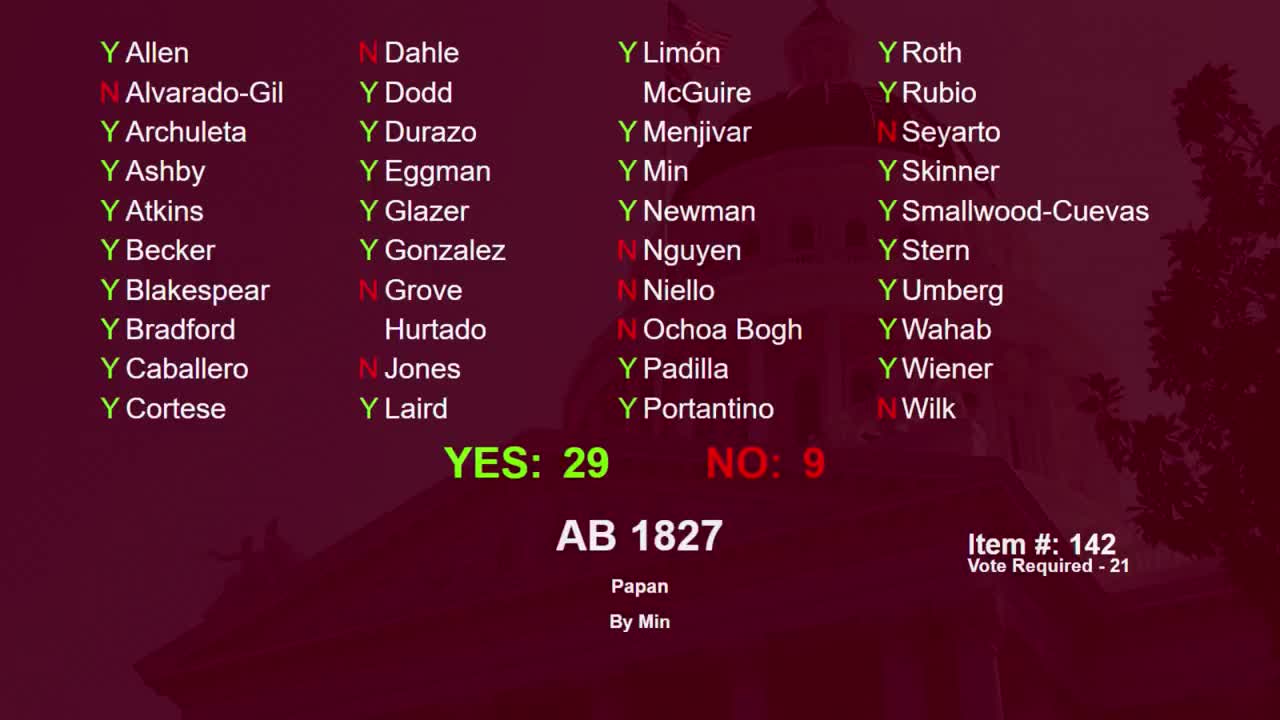 1MIN
Senate Floor
 5MIN