AB 1827: Local government: fees and charges: water: higher consumptive water parcels.
- Session Year: 2023-2024
- House: Assembly
- Latest Version Date: 2024-09-22
Current Status:
Passed
(2024-09-22: Chaptered by Secretary of State - Chapter 359, Statutes of 2024.)
Introduced
In Committee
First Chamber
In Committee
Second Chamber
Enacted
The California Constitution specifies various requirements with respect to the levying of assessments and property-related fees and charges by a local agency, including requiring that the local agency provide public notice and a majority protest procedure in the case of assessments and submit property-related fees and charges for approval by property owners subject to the fee or charge or the electorate residing in the affected area following a public hearing.
Existing law, known as the Proposition 218 Omnibus Implementation Act, prescribes specific procedures and parameters for local jurisdictions to comply with these requirements and, among other things, authorizes an agency providing water, wastewater, sewer, or refuse collection services to adopt a schedule of fees or charges authorizing automatic adjustments that pass through increases in wholesale charges for water, sewage treatment, or wastewater treatment or adjustments for inflation under certain circumstances. Existing law defines, among other terms, the term water for these purposes to mean any system of public improvements intended to provide for the production, storage, supply, treatment, or distribution of water from any source.
This bill would provide that the fees or charges for property-related water service imposed or increased, as specified, may include the incrementally higher costs of water service due to specified factors, including the higher water usage demand of parcels. The bill would provide that the incrementally higher costs of water service associated with higher water usage demands, the maximum potential water use, or projected peak water usage may be allocated using any method that reasonably assesses the water service providers cost of serving those parcels that are increasing potential water usage demand, maximum potential water use, or projected peak water usage. The bill would declare that these provisions are declaratory of existing law.
The California Constitution specifies various requirements with respect to the levying of assessments and property-related fees and charges by a local agency, including requiring that the local agency provide public notice and a majority protest procedure in the case of assessments and submit property-related fees and charges for approval by property owners subject to the fee or charge or the electorate residing in the affected area following a public hearing.
Existing law, known as the Proposition 218 Omnibus Implementation Act, prescribes specific procedures and parameters for local jurisdictions to comply with these requirements and, among other things, authorizes an agency providing water, wastewater, sewer, or refuse collection services to adopt a schedule of fees or charges authorizing automatic adjustments that pass through increases in wholesale charges for water, sewage treatment, or wastewater treatment or adjustments for inflation under certain circumstances. Existing law defines, among other terms, the term water for these purposes to mean any system of public improvements intended to provide for the production, storage, supply, treatment, or distribution of water from any source.
This bill would provide that the fees or charges for property-related water service imposed or increased, as specified, may include the incrementally higher costs of water service due to specified factors, including the higher water usage demand of parcels. The bill would provide that the incrementally higher costs of water service associated with higher water usage demands, the maximum potential water use, or a projected peak water usage demand may be allocated using any method that reasonably assesses the water service providers cost of serving those parcels that are increasing potential water usage demand, maximum potential water use, or project projected peak water use demand. usage. The bill would declare that these provisions are declaratory of existing law.
The California Constitution specifies various requirements with respect to the levying of assessments and property-related fees and charges by a local agency, including requiring that the local agency provide public notice and a majority protest procedure in the case of assessments and submit property-related fees and charges for approval by property owners subject to the fee or charge or the electorate residing in the affected area following a public hearing.
Existing law, known as the Proposition 218 Omnibus Implementation Act, prescribes specific procedures and parameters for local jurisdictions to comply with these requirements and, among other things, authorizes an agency providing water, wastewater, sewer, or refuse collection services to adopt a schedule of fees or charges authorizing automatic adjustments that pass through increases in wholesale charges for water, sewage treatment, or wastewater treatment or adjustments for inflation under certain circumstances. Existing law defines, among other terms, the term water for these purposes to mean any system of public improvements intended to provide for the production, storage, supply, treatment, or distribution of water from any source.
This bill would provide that the fees or charges for property-related water service imposed or increased, as specified, may include the incrementally higher costs of water service due to specified factors, including the higher water usage demand of parcels. The bill would provide that the costs associated with higher water usage demands, the maximum potential water use, or a projected peak water usage demand may be allocated using any method that reasonably assesses the water service providers cost of serving those parcels that are increasing potential water usage demand, maximum potential water use, or project peak water use demand. The bill would declare that these provisions are declaratory of existing law.
(a)The fees or charges for property-related water service imposed or increased pursuant to Section 6 of Article XIII D of the California Constitution may include the incrementally higher costs of water service due to any of the following:
(1)The higher water usage demand of parcels.
(2)The maximum potential water use.
(3)Projected peak water usage.
(4)Any combination of paragraphs (1) to (3), inclusive.
(b)(1)The incrementally higher costs of water service associated with higher water usage demands, the maximum potential water use, or projected peak water usage may be allocated using any method that reasonably assesses the water service providers cost of serving those parcels that are increasing potential water usage demand, maximum potential water use, or projected peak water usage.
(2)In addition to any other method consistent with Section 6 of Article XIII D of the California Constitution, the incrementally higher costs of water service associated with higher water usage demand, maximum potential water use, or projected peak water usage may be allocated among customer classes, within customer classes, or both, based on meter size or peaking factors, as those methods reasonably assess the water service providers cost of serving parcels that increase water usage demand, maximum potential water use, or projected peak water usage.
(c)This section is declaratory of existing law.
(a)The fees or charges for property-related water service imposed or increased pursuant to Section 6 of Article XIII D of the California Constitution may include the incrementally higher costs of water service due to any of the following:
(1)The higher water usage demand of parcels.
(2)The maximum potential water use of parcels. use.
(3)Projected peak water usage.
(4)Any combination of paragraphs (1) to (3), inclusive.
(b)(1)The incrementally higher costs of water service associated with higher water usage demands, the maximum potential water use, or a projected peak water usage demand may be allocated using any method that reasonably assesses the water service providers cost of serving those parcels that are increasing potential water usage demand, maximum potential water use, or project projected peak water use demand. usage.
(2)In addition to any other method consistent with Section 6 of Article XIII D of the California Constitution, the incrementally higher costs of water service associated with higher water usage demands, the demand, maximum potential water use, or a projected peak water usage demand cost may be allocated among customer classes, within customer classes, or both, based on meter size or peaking factors, as those are two methods that reasonably assess the water service providers cost of serving those parcels which are increasing demand or potential water use. parcels that increase water usage demand, maximum potential water use, or projected peak water usage.
(c)This section is declaratory of existing law.
(a)The fees or charges for property-related water service imposed or increased pursuant to Section 6 of Article XIII D of the California Constitution may include the incrementally higher costs of water service due to any of the following:
(1)The higher water usage demand of parcels.
(2)The maximum potential water use of parcels.
(3)Projected peak water usage.
(4)Any combination of paragraphs (1) to (3), inclusive.
(b)(1)The costs associated with higher water usage demands, the maximum potential water use, or a projected peak water usage demand may be allocated using any method that reasonably assesses the water service providers cost of serving those parcels that are increasing potential water usage demand, maximum potential water use, or project peak water use demand.
(2)In addition to any other method consistent with Section 6 of Article XIII D of the California Constitution, the costs associated with higher water usage demands, the maximum potential water use, or a projected peak water usage demand cost may be allocated based on meter size or peaking factors, as those are two methods that reasonably assess the water service providers cost of serving those parcels which are increasing demand or potential water use.
(c)This section is declaratory of existing law.
|
Date
|
Status
|
|---|---|
| Sep 22, 2024 | Chaptered by Secretary of State - Chapter 359, Statutes of 2024. |
| Sep 22, 2024 | Approved by the Governor. |
| Aug 27, 2024 | Enrolled and presented to the Governor at 12 p.m. |
| Aug 20, 2024 | In Assembly. Ordered to Engrossing and Enrolling. |
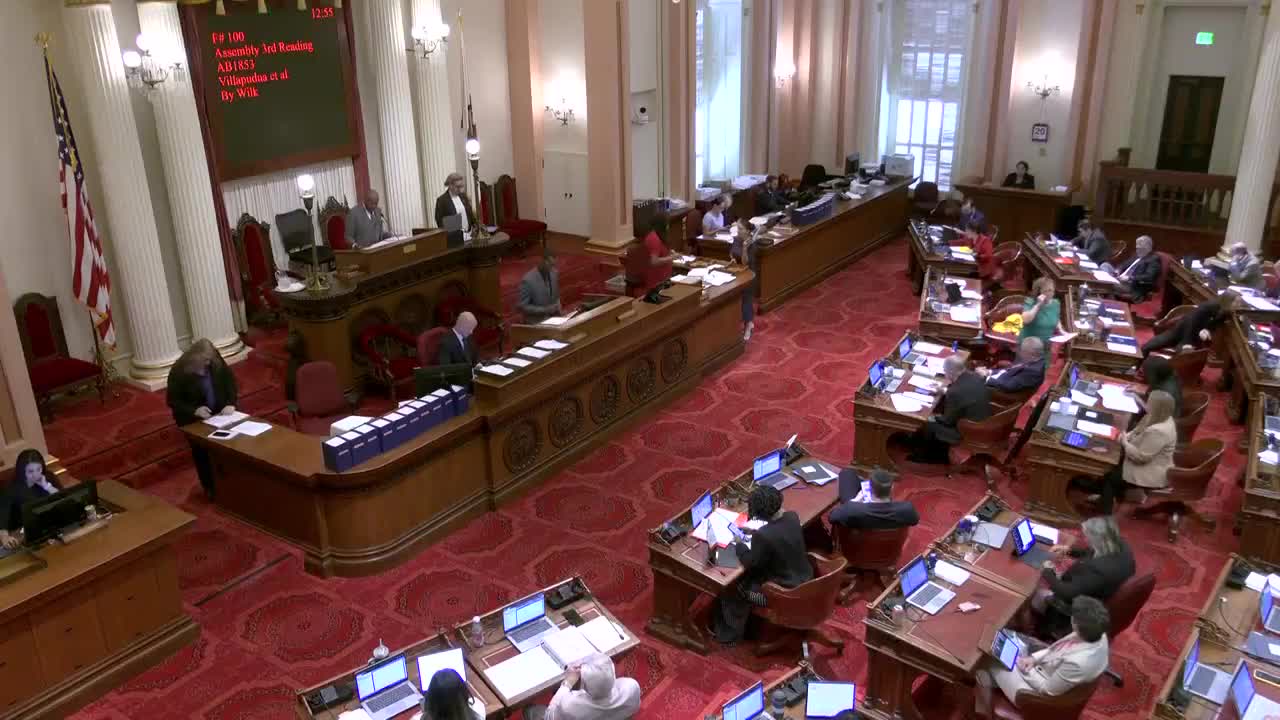
| Aug 20, 2024 | Read third time. Passed. Ordered to the Assembly. (Ayes 30. Noes 9. Page 5228.). |
| Jun 27, 2024 | Read second time. Ordered to third reading. |
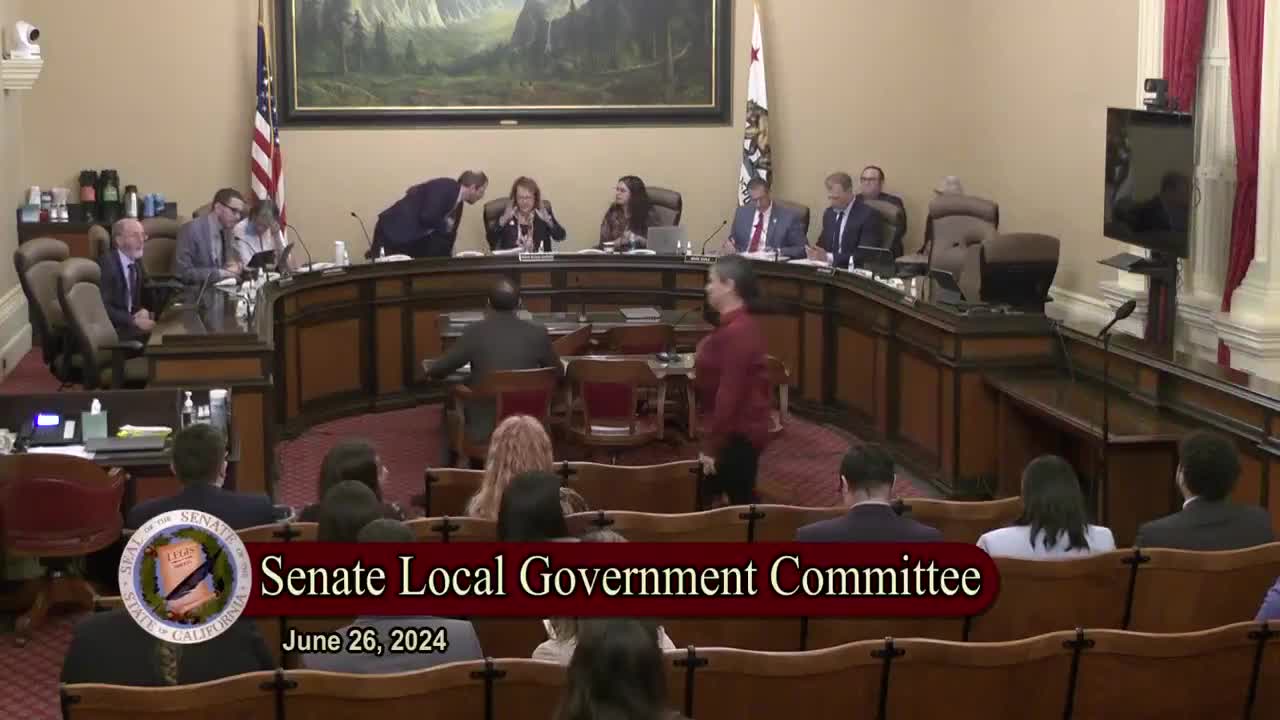
| Jun 26, 2024 | From committee: Do pass. (Ayes 5. Noes 2.) (June 26). |
| May 29, 2024 | Referred to Com. on L. GOV. |
| May 21, 2024 | In Senate. Read first time. To Com. on RLS. for assignment. |
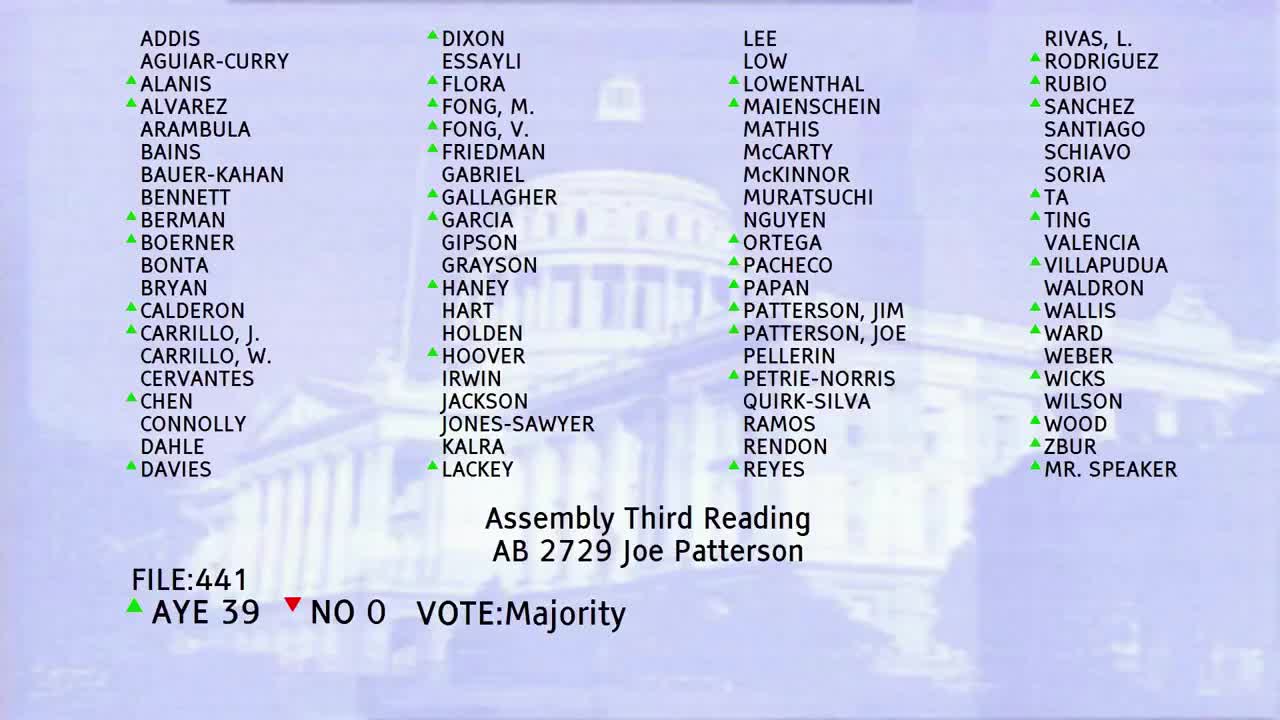
| May 20, 2024 | Read third time. Passed. Ordered to the Senate. (Ayes 55. Noes 15. Page 5302.) |
| Apr 29, 2024 | Read second time. Ordered to third reading. |
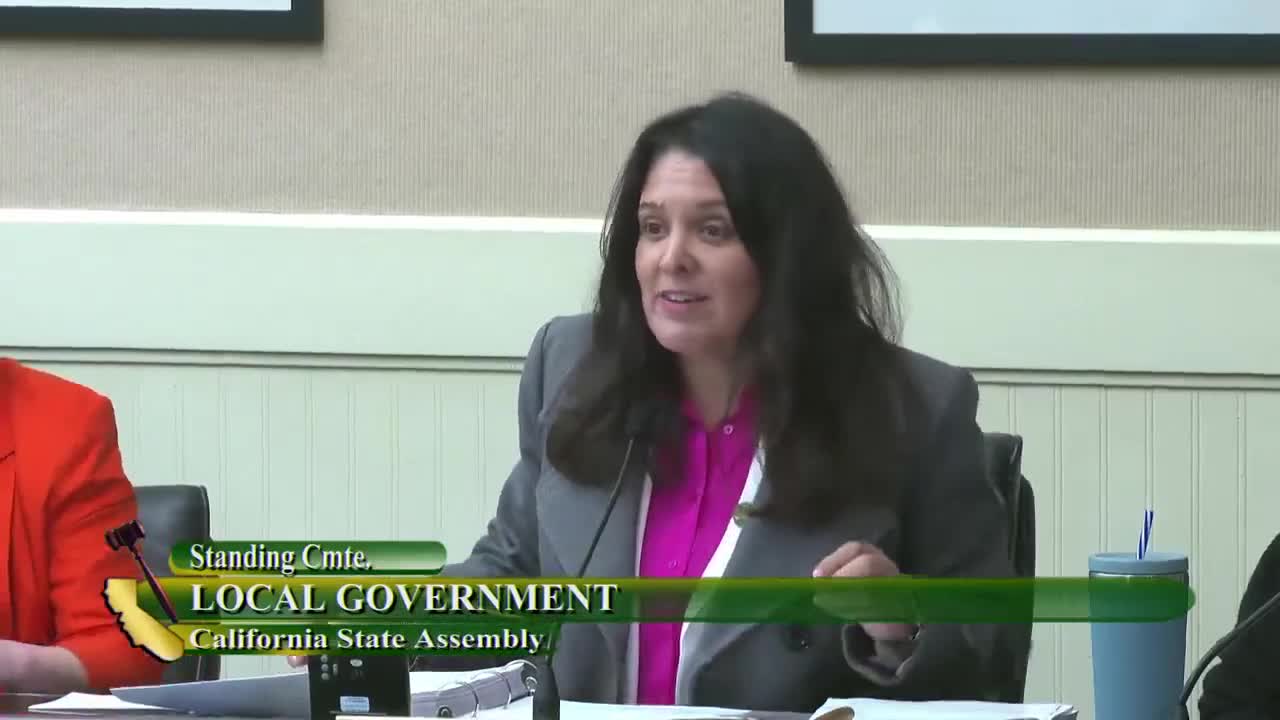
| Apr 25, 2024 | From committee: Do pass. (Ayes 7. Noes 1.) (April 24). |
| Apr 8, 2024 | Re-referred to Com. on L. GOV. |
| Apr 4, 2024 | From committee chair, with author's amendments: Amend, and re-refer to Com. on L. GOV. Read second time and amended. |
| Jan 29, 2024 | Referred to Com. on L. GOV. |
| Jan 13, 2024 | From printer. May be heard in committee February 12. |
| Jan 12, 2024 | Read first time. To print. |
|
Date
|
Description
|
Location
|
Votes
|
|
|---|---|---|---|---|
| Aug 20, 2024 | Assembly 3rd Reading AB1827 Papan By Min | Senate Floor |
Passed |
|
| Jun 26, 2024 | Do pass | Senate Standing Committee on Local Government |
Passed |
|
| May 20, 2024 | AB 1827 Papan Assembly Third Reading | Assembly Floor |
Passed |
|
| Apr 24, 2024 | Do pass. | Assembly Standing Committee on Local Government |
Passed |
This list shows positions taken on this bill by organizations on the date displayed, which is linked to the original source.
Positions by individuals are not included.
|
Organization
|
Position
|
Date
|
|---|---|---|
| 7th Generation Advisors | ** Support | |
| Association Of California Water Agencies | ** Support | |
| California Coastkeeper Alliance | ** Support | |
| California Council For Environmental & Economic Balance | ** Support | |
| california hawaii state conference of the naacp | ** Support | |
| California Municipal Utilities Association | ** Support | |
| California Special Districts Association | ** Support | |
| California State Association Of Counties | ** Support | |
| California Water Association | ** Support | |
| California Water Efficiency Partnership | ** Support | |
| City Of Sacramento | ** Support | |
| City of Santa Rosa | ** Support | |
| Coachella Valley Waterkeeper | ** Support | |
| Community Water Center | ** Support | |
| Cucamonga Valley Water District | ** Support | |
| East Bay Municipal Utility District | ** Support | |
| Eastern Municipal Water District | ** Support | |
| East Orange County Water District | ** Support | |
| Friends of the River | ** Support | |
| Howard Jarvis Taxpayers Association | ** Against | |
| Humboldt Waterkeeper | ** Support | |
| Inland Empire Waterkeeper | ** Support | |
| Irvine Ranch Water District | ** Support | |
| LAANE | ** Support | |
| Las Virgenes Municipal Water District | ** Support | |
| Los Angeles Waterkeeper | ** Support | |
| Metropolitan Water District Of Southern California | ** Support | |
| Monterey Waterkeeper | ** Support | |
| Monte Vista Water District | ** Support | |
| Municipal Water District Of Orange County | ** Support | |
| Orange County Coastkeeper | ** Support | |
| Orange County Waterkeeper | ** Support | |
| Otay Water District | ** Support | |
| Planning And Conservation League | ** Support | |
| Russian Riverkeeper | ** Support | |
| San Diego Coastkeeper | ** Support | |
| San Diego County Water Authority | ** Support | |
| San Gabriel Valley Water Association | ** Support | |
| Santa Barbara Channelkeeper | ** Support | |
| Santa Clara Valley Water District | ** Support | |
| See | ** Support | |
| Shasta Waterkeeper | ** Support | |
| Sierra Club California | ** Support | |
| Social Eco Education | ** Support | |
| Southern California Water Coalition | ** Support | |
| South Yuba River Citizens League | ** Support | |
| Sweetwater Authority | ** Support | |
| Three Valleys Municipal Water District | ** Support | |
| Town of Hillsborough | ** Support | |
| Trabuco Canyon Water District | ** Support | |
| Upper San Gabriel Valley Municipal Water District | ** Support | |
| Yorba Linda Water District | ** Support | |
| Yuba River Waterkeeper | ** Support |
SENATE RULES COMMITTEE Office of Senate Floor Analyses (916) 651-1520 Fax: (916) 327-4478 | AB 1827 |
THIRD READING
Bill No: AB 1827
Author: Papan (D)
Amended: 4/4/24 in Assembly
Vote: 21
SENATE LOCAL GOVERNMENT COMMITTEE: 5-2, 6/26/24
AYES: Durazo, Glazer, Skinner, Wahab, Wiener
NOES: Seyarto, Dahle
ASSEMBLY FLOOR: 55-15, 5/20/24 - See last page for vote
SUBJECT: Local government: fees and charges: water: higher consumptive water parcels
SOURCE: California Coastkeeper Alliance
Irvine Ranch Water District
DIGEST:
This bill provides that fees or charges for property-related water service imposed or increased pursuant to the California Constitution may include the incrementally higher costs of water service.
ANALYSIS:
Existing law:
- Imposes constitutional limits on local officials’ ability to impose, increase, and extend fees, including property-related fees (Proposition 218, 1996).
- Defines a property-related fee as any levy other than an ad valorem tax, a special tax, or an assessment imposed by an agency on a parcel or on a person as an incident of property ownership, including a user fee for a property-related service.
- Specifies definitions and procedures related to Proposition 218 in the Proposition 218 Omnibus Implementation Act (SB 919, Rainey, Chapter 38, Statutes of 1997). The Proposition 218 Omnibus Implementation Act requires local officials to, before imposing a new property related fee or increase an existing one:
- Identify the parcels to be charged.
- Calculate the fee for each parcel.
- Notify the parcels’ owners in writing about the fees and the hearing.
- Hold a public hearing to consider and count protests.
- Abandon the fees if a majority of the parcels’ owners protest.
- Requires new or increased property-related fees to:
- Be less than the proportional cost of service to each parcel.
- Receive approval by a majority-vote of the affected property owners, two-thirds registered voter approval, or weighted ballot approval by the affected property owners.
- Exempts property-related fees for water, sewer, and refuse collection from the voter approval requirements of Proposition 218.
This bill:
- Provides that the fees or charges for property-related water service imposed or increase pursuant to the California Constitution may include the incrementally higher costs of water service due to any of the following:
- The higher water usage demand of parcels;
- The maximum potential water use;
- Projected peak water usage; or
- Any combination of a) through c) above.
- Specifies that the incrementally higher costs of water service associated with higher water usage demands, the maximum potential water use, or projected peak water usage may be allocated using any method that reasonably assesses the water service provider's cost of serving those parcels that are increasing potential water usage demand, maximum potential water use, or projected peak water usage.
- Provides that in addition to any other method consistent with the California Constitution, the incrementally higher costs of water service associated with higher water usage demand, maximum potential water use, or projected peak water usage may be allocated among customer classes, within customer classes, or both, based on meter size or peaking factors, as those methods reasonably assess the water service provider's cost of serving parcels that increase water usage demand, maximum potential water use, or projected peak water usage.
- States that this bill is declaratory of existing law.
Background
Proposition 218. Neither Proposition 218, nor the Proposition 218 Omnibus Implementation Act, provide an explicit remedy, such as a refund, to ratepayers beyond invalidating the fee amounts moving forward. However, ratepayers – even in Proposition 218-related cases – may have opportunities to receive a refund even when statute does not explicitly provide one. Even if statute does not provide an explicit remedy, and the Government Claims Act does not apply, courts can still order a remedy for violations of a provision of the California Constitution. Under Katzberg v. Regents of University of California California (2002) 29 Cal.4th 300, 317, the California Supreme Court applied a two-prong test to identify circumstances when a constitutional violation allows for a refund.
Otay Water District. Otay Water District (the District) provides water, recycled water, and sewer service to over 225,000 customers across roughly 125 square miles of southeastern San Diego County. The District imposes a tiered rate structure for single-family residential customers to encourage water conservation. Otay Water District’s tiered rate structure has three components. First, all customers pay a fixed monthly charge based on the size of their water meter. Second, customers pay a variable usage fee based on their water consumption, meaning heavier water users pay more per unit of water than lower water users. Third, the District sets an energy charge and an improvement-district charge.
Ratepayers challenged the District’s rates, claiming they were not proportional to the cost of service for each parcel, as required by Proposition 218 (Coziahr v. Otay Water District, San Diego County Super. Ct. No. 37-2015-00400000-CU-MC-CTL). Specifically, higher-usage ratepayers claimed the rates the District charged exceeded the costs for the District to serve them. In January 2022, the San Diego Superior Court filed a judgment in favor of the ratepayers, and ordered the District to refund ratepayers $18 million plus $200,000 each month, plus interest, until the District brings its rates into compliance with Proposition 218.
The District has appealed the ruling. Oral arguments are expected later this year. In its appeal, the District claims its rate tiers, which charge higher-volume users more to ensure its water system ensures can meet peak demands, are consistent with Proposition 218. The District argues, since higher volume users cause these higher peak demands, they should pay more to provide a water system to meet can meet the higher demand they cause. Additionally, the District contends that, even if its rates were not proportional to the cost of service, the Court should not have awarded a refund because Proposition 218 only authorizes prospective relief.
Other water providers have faced similar challenges. For example, in 2021, the San Diego Superior Court invalidated the City of San Diego’s tiered water rates finding they were not proportional to the cost of service attributable to each parcel as required by Proposition 218 (Patz vs. City of San Diego, San Diego County Super. Ct. No. 37-2015-23413-CU-MC-CTL). Like Coziahr, the Court ordered the City of San Diego to refund customers. The City of San Diego appealed the Court’s ruling in Patz, but the case has not yet been resolved.
Comments
- Purpose of this bill. According to the author, “To meet demands driven upward by high-water users, a water supplier often has higher costs associated with building, operating, and maintaining a larger water system that can meet those larger water demands. They also have added costs for the additional water supplies needed to serve those larger uses. While collectively, all customers pay for the water service costs, contribution by higher use parcels per Proposition 218 should be proportionately larger than smaller use parcels. Recent trial courts’ imposition of increasing degrees of granularity and precision, instead of well accepted methods for cost allocation, have made the allocation of costs to higher water users nearly impossible. AB 1827 affirms that existing law allows water suppliers to use reasonable and well-accepted methods of assessing the incremental costs associated with higher water usage demands to high water users; thereby, confirming what Proposition 218 requires for water rates and charges.”
- Let it play out. This bill claims it is declaratory of existing law, but the two San Diego County Superior Court decisions suggest it is up for debate. While the respective local agencies have appealed these rulings, oral arguments are not likely to begin until later this year. The longer these cases remain unresolved, the more interest that accrues on the amount of money the districts must refund if the lower court rulings are upheld. The local agencies would likely have to ask current and future ratepayers to pay for refunds due to these higher-consumption users if its appeal is unsuccessful. On the other hand, waiting for the litigation’s resolution would allow the Legislature time to determine whether legislation is needed to clarify the methodologies a local agency can use to assess fees that comply with Proposition 218. Should the Legislature intervene before the appeals have played out in court?
- Fairness. Many local agencies used tiered rates to ensure they have water supplies and infrastructure needed to meet the demands of their customers. Tiered rates charge water customers that use more water than other similar customers a higher rate because those higher-use customers increase the overall cost of providing water service. Local agencies support these specific charges with ratemaking studies engineers complete to ensure they properly attribute costs to customers in line with Proposition 218. Tiered rate structures encourage customers to conserve water to avoid higher rates. However, some groups, like the California Farm Bureau, caution that allowing tiered rates that can allocate the incrementally higher costs of water service among customer classes could single out agricultural customers served by municipal utilities. They argue these agricultural customers may have a harder time conserving water while keeping their commercial enterprise afloat. However, this bill would not allow local agencies to charge higher-income ratepayers more to subsidize the rates of lower-income customers. Instead, it ensures, if someone is using enough water to increase the costs of operating a water system, the higher water user pays for those costs, not those who are making efforts to conserve water.
- We are not alone. Responding to legal challenges like those affecting Otay Water District and the City of San Diego, SB 1072 (Padilla, 2024) provides that, if a court determines that a fee or charge for a property-related service violates Proposition 218, then the local agency must credit that amount against the cost of providing the property related service, instead of refunding the ratepayers that challenges the fees. The measure is currently pending on the Assembly Floor.
FISCAL EFFECT: Appropriation: No Fiscal Com.: No Local: No
SUPPORT: (Verified 6/27/24)
California Coastkeeper Alliance (co-source)
Irvine Ranch Water District (co-source)
7th Generation Advisors
Association of California Water Agencies
California Council for Environmental & Economic Balance
California Hawaii State Conference of the NAACP
California Municipal Utilities Association
California Special Districts Association
California State Association of Counties
California Water Association
California Water Efficiency Partnership
City of Sacramento
City of Santa Rosa
Coachella Valley Waterkeeper
Community Water Center
Cucamonga Valley Water District
East Bay Municipal Utility District
East Orange County Water District
Eastern Municipal Water District
Friends of The River
Humboldt Waterkeeper
Inland Empire Waterkeeper
Laane (los Angeles Alliance for A New Economy)
Las Virgenes Municipal Water District
Los Angeles Waterkeeper
Metropolitan Water District of Southern California
Monte Vista Water District
Monterey Waterkeeper
Municipal Water District of Orange County
Orange County Waterkeeper
Otay Water District
Planning and Conservation League
Russian Riverkeeper
San Diego Coastkeeper
San Diego County Water Authority
San Gabriel Valley Water Association
Santa Barbara Channelkeeper
Santa Clara Valley Water District
See (social Eco Education)
Shasta Waterkeeper
Sierra Club California
South Yuba River Citizens League (SYRCL)
Southern California Water Coalition
Three Valleys Muncipal Water District
Town of Hillsborough
Trabuco Canyon Water District
Upper San Gabriel Valley Municipal Water District
Yorba Linda Water District
Yuba River Waterkeeper
OPPOSITION: (Verified 6/27/24)
Howard Jarvis Taxpayers Association (HJTA)
1 individual
ASSEMBLY FLOOR: 55-15, 5/20/24
AYES: Addis, Aguiar-Curry, Alvarez, Bains, Bauer-Kahan, Bennett, Berman, Boerner, Bonta, Bryan, Calderon, Juan Carrillo, Wendy Carrillo, Connolly, Mike Fong, Friedman, Garcia, Gipson, Grayson, Haney, Hart, Holden, Irwin, Jackson, Jones-Sawyer, Kalra, Lee, Low, Lowenthal, McCarty, McKinnor, Muratsuchi, Ortega, Pacheco, Papan, Pellerin, Petrie-Norris, Quirk-Silva, Ramos, Rendon, Reyes, Rodriguez, Blanca Rubio, Santiago, Schiavo, Ting, Valencia, Villapudua, Ward, Weber, Wicks, Wilson, Wood, Zbur, Robert Rivas
NOES: Alanis, Davies, Dixon, Essayli, Flora, Vince Fong, Gallagher, Hoover, Lackey, Jim Patterson, Joe Patterson, Sanchez, Ta, Waldron, Wallis
NO VOTE RECORDED: Arambula, Cervantes, Chen, Megan Dahle, Gabriel, Maienschein, Mathis, Stephanie Nguyen, Luz Rivas, Soria
Prepared by: Jonathan Peterson / L. GOV. / (916) 651-4119
6/28/24 13:06:19
**** END ****
SENATE COMMITTEE ON LOCAL GOVERNMENT
Senator María Elena Durazo, Chair
2023 - 2024 Regular
Bill No: | AB 1827 | Hearing Date: | 6/26/24 |
Author: | Papan | Fiscal: | No |
Version: | 4/4/24 | Consultant: | Peterson |
Local government: fees and charges: water: higher consumptive water parcels
Provides that fees or charges for property-related water service imposed or increased pursuant to the California Constitution may include the incrementally higher costs of water service.
Background
Proposition 218. The California Constitution requires voter approval for taxes and many other fees and charges. Proposition 218 (1996) added Article XIIID to the California Constitution, which imposed voter approval requirements for most “property-related fees”—any levy other than an ad valorem tax, a special tax, or an assessment imposed by an agency on a parcel or on a person as an incident of property ownership, including a user fee or charge for a property-related service.
Before a local government can charge a new property-related fee, or increase an existing one, Proposition 218 requires local officials to:
- Identify the parcels to be charged;
- Calculate the fee for each parcel;
- Notify the parcels’ owners in writing about the fees and the hearing;
- Hold a public hearing to consider and count protests; and
- Abandon the fees if a majority of the parcels’ owners protest.
New, increased, or extended property-related fees generally require voter approval by one of the following: a majority-vote of the affected property owners; two-thirds registered voter approval; or weighted ballot approval by the affected property owners.
Fees or charges for property related services cannot exceed the proportional cost of providing service to the parcel and must be used only for the purposes for which they were collected. Property-related fees must also only fund services actually used by or immediately available to the property owner, not based on potential or future use. Finally, Proposition 218 prohibits local governments from imposing fees or charges for general governmental services—including fire, police, ambulance, or library services—if the service is available to the public at large in substantially the same manner as it is to property owners.
Water, sewer, and refuse collection services are exempt from Proposition 218’s voter approval requirements, but must meet all other procedural and substantive requirements in Proposition 218, including the requirement to hold a protest hearing not less than 45 days after mailing a notice of new or increased rates to affected property owners. If a majority protest the fee, based on the proportional obligation of the affected property, then the local agency cannot impose the fee.
Proposition 218 is a complex statute and has been the subject of many court cases and rulings that often conflict with one another. In the past, the Legislature has weighed in to provide clarity on how to apply Proposition 218’s provisions and statutorily reinforced court rulings that align with the Legislature’s priorities. In particular, immediately after the passage of Proposition 218, the Legislature enacted the Proposition 218 Omnibus Implementation Act to translate many of Proposition 218’s requirements into statutory definitions and procedures (SB 919, Rainey, 1997).
Tiered rates. Setting water rates can be a complex endeavor, and local agencies impose water rates in many different ways. Since the voters approved Proposition 218’s requirements, how public agency water providers impose these fees is a common debate. One increasingly common form of rates are tiered rates. According to the PPIC report Paying for Water in California, “By the mid-2000s, over half of the state’s urban water utilities used tiered rates, and the practice has been growing as more utilities aim to reduce per capita urban water use, still high in California relative to comparable economies with similar climates, such as Australia, Spain, and Israel. The legal issue is whether these rate structures are consistent with Proposition 218’s requirement that fees be proportional to the cost of service. This accounting requirement turns out to be more complex than voters may have anticipated when they approved this constitutional reform. The courts have ruled that agencies cannot set different price tiers for different customer categories unless the rate differentials are based on differences in costs of service among categories. This ruling is beneficial insofar as it discourages the artificial subsidization of water use.”
In 2015, Capistrano Taxpayers Association v. City of San Juan Capistrano (2015) 235 Cal.App.4th 1493, the California Court of Appeals ruled the City’s water pricing violated the constitutional requirement that fees not exceed the proportional cost of the service attributable to the parcel because the City did not adequately calculate the costs attributed to each parcel. The court continued by saying, “This is not to say City Water must calculate a rate for 225 Elm Street and then calculate another for the house across the street at 226. Neither the voters nor the Constitution say anything we can find that would prohibit tiered pricing.” The court also stated that “And, we emphasize, there is nothing at all in subdivision (b)(3) or elsewhere in Proposition 218 that prevents water agencies from passing on the incrementally higher costs of expensive water to incrementally higher users.” Lastly, the court noted that “...we see nothing in article XIII, section 6, subdivision (b)(3) of the California Constitution that is incompatible with water agencies passing on the true, marginal cost of water to those consumers whose extra use of water forces water agencies to incur higher costs to supply that extra water.” Courts have interpreted the application of Proposition 218’s constitutional provisions numerous times, and despite the ruling in Capistrano, disputes over how best to determine rates continue to this day.
Recent legal challenges. Otay Water District (the District) provides water, recycled water, and sewer service to over 225,000 customers across roughly 125 square miles of southeastern San Diego County. The District imposes a tiered rate structure for single-family residential customers to encourage water conservation that has three components. First, all customers pay a fixed monthly charge based on the size of their water meter. Second, customers pay a variable usage fee based on their water consumption, meaning heavier water users pay more per unit of water than lower water users. Third, the District sets an energy charge and an improvement-district charge. In 2013, to ensure these rates met constitutional requirements, the District hired a consultant to complete a comprehensive rate study. In 2017, the District hired a different consultant to ensure its rates remained consistent with Proposition 218.
Ratepayers challenged the District’s rates, claiming they were not proportional to the cost of service for each parcel, as required by Proposition 218 (Coziahr v. Otay Water District, San Diego County Super. Ct. No. 37-2015-00400000-CU-MC-CTL ). Specifically, higher-usage ratepayers claimed the rates the District charged exceeded the costs for the District to serve them. In January 2022, the San Diego Superior Court filed a judgment in favor of the ratepayers, and ordered Otay Water District to refund ratepayers $18 million plus $200,000 each month, plus interest, until the District brings its rates into compliance with Proposition 218. Otay Water District has appealed the ruling. Oral arguments are expected later this year.
Other water providers have faced similar challenges. For example, in 2021, the San Diego Superior Court invalidated the City of San Diego’s tiered water rates finding they were not proportional to the cost of service attributable to each parcel as required by Proposition 218 (Patz vs. City of San Diego, San Diego County Super. Ct. No. 37-2015-23413-CU-MC-CTL). Like Coziahr, the Court ordered the City to refund customers. The City appealed the Court’s ruling in Patz, but the case has not yet been resolved.
The author wants to clarify that tiered water rates are allowed under existing law.
Proposed Law
Assembly Bill 1827 provides that fees or charges for property-related water service imposed or increased pursuant to the California Constitution may include the incrementally higher costs of water service due to any of the following:
- The higher water usage demand of parcels;
- The maximum potential water use;
- Projected peak water usage; or
- Any combination of the above.
The measure allows local agencies to allocate the incrementally higher costs of water service using any method that reasonably assesses the water service provider’s cost of serving those parcels that are increasing the factors mentioned above.
AB 1827 also provides, in addition to any other method consistent with the California Constitution, local agencies can allocate the incrementally higher costs of water service among customer classes, or within customer classes, based on meter size or peaking factors, as those methods reasonably assess the water service provider’s higher costs linked to delivering water to higher-usage parcels.
Finally, AB 1827 specifies it is declaratory of existing law.
Comments
1. Purpose of the bill. According to the author, “To meet demands driven upward by high-water users, a water supplier often has higher costs associated with building, operating, and maintaining a larger water system that can meet those larger water demands. They also have added costs for the additional water supplies needed to serve those larger uses.
“While collectively, all customers pay for the water service costs, contribution by higher use parcels per Proposition 218 should be proportionately larger than smaller use parcels. Recent trial courts’ imposition of increasing degrees of granularity and precision, instead of well accepted methods for cost allocation, have made the allocation of costs to higher water users nearly impossible.
“AB 1827 affirms that existing law allows water suppliers to use reasonable and well-accepted methods of assessing the incremental costs associated with higher water usage demands to high water users; thereby, confirming what Proposition 218 requires for water rates and charges.”
2. Let it play out. AB 1827 claims it is declaratory of existing law, but the two San Diego County Superior Court decisions suggest it is up for debate. While the respective local agencies have appealed these rulings, oral arguments are not likely to begin until later this year. The longer these cases remain unresolved, the more interest that accrues on the amount of money the districts must refund if the lower court rulings are upheld. The local agencies would likely have to ask current and future ratepayers to pay for refunds due to these higher-consumption users if its appeal is unsuccessful. On the other hand, waiting for the litigation’s resolution would allow the Legislature time to determine whether legislation is needed to clarify the methodologies a local agency can use to assess fees that comply with Proposition 218. Should the Legislature intervene before the appeals have played out in court?
3. Fairness. Many local agencies used tiered rates to ensure they have water supplies and infrastructure needed to meet the demands of their customers. Tiered rates charge water customers that use more water than other similar customers a higher rate because those higher-use customers increase the overall cost of providing water service. Local agencies support these specific charges with ratemaking studies engineers complete to ensure they properly attribute costs to customers in line with Proposition 218. Tiered rate structures encourage customers to conserve water to avoid higher rates. However, some groups, like the California Farm Bureau, caution that allowing tiered rates that can allocate the incrementally higher costs of water service among customer classes could single out agricultural customers served by municipal utilities. They argue these agricultural customers may have a harder time conserving water while keeping their commercial enterprise afloat. However, this bill would not allow local agencies to charge higher-income ratepayers more to subsidize the rates of lower-income customers. Instead, it ensures, if someone is using enough water to increase the costs of operating a water system, the higher water user pays for those costs, not those who are making efforts to conserve water.
4. We are not alone. Responding to legal challenges like those affecting Otay Water District and the City of San Diego, SB 1072 (Padilla, 2024) provides that, if a court determines that a fee or charge for a property-related service violates Proposition 218, then the local agency must credit that amount against the cost of providing the property related service, instead of refunding the ratepayers that challenges the fees. The measure is currently pending in the Assembly Local Government Committee.
Assembly Actions
Assembly Local Government Committee: 7-1
Assembly Floor: 55-15
Support and Opposition
(6/21/24)
Support:
California Coastkeeper Alliance (Co-Sponsor)
Irvine Ranch Water District (Co-Sponsor)
7th Generation Advisors
Association of California Water Agencies
California Council for Environmental & Economic Balance
California Municipal Utilities Association
California Special Districts Association
California State Association of Counties
California Water Association
California Water Efficiency Partnership
City of Sacramento
Coachella Valley Waterkeeper
Community Water Center
Cucamonga Valley Water District
East Bay Municipal Utility District
East Orange County Water District
Eastern Municipal Water District
Friends of The River
Humboldt Waterkeeper
Inland Empire Waterkeeper
Laane (los Angeles Alliance for A New Economy)
Las Virgenes Municipal Water District
Los Angeles Waterkeeper
Metropolitan Water District of Southern California
Monte Vista Water District
Monterey Waterkeeper
Municipal Water District of Orange County
Orange County Waterkeeper
Otay Water District
Planning and Conservation League
Russian Riverkeeper
San Diego Coastkeeper
San Diego County Water Authority
San Gabriel Valley Water Association
Santa Barbara Channelkeeper
Santa Clara Valley Water District
See (social Eco Education)
Shasta Waterkeeper
Sierra Club California
South Yuba River Citizens League (SYRCL)
Southern California Water Coalition
Three Valleys Muncipal Water District
Town of Hillsborough
Trabuco Canyon Water District
Upper San Gabriel Valley Municipal Water District
Yorba Linda Water District
Yuba River Waterkeeper
Opposition: Howard Jarvis Taxpayers Association (HJTA)
1 Individual
-- END --
ASSEMBLY THIRD READING
ATR Bill Id:AB 1827
Author:(Papan)
As Amended Ver:April 4, 2024
Majority vote
SUMMARY
Provides that fees or charges for property-related water service may include the incrementally higher costs of water service, as specified.
Major Provisions
- Provides that the fees or charges for property-related water service imposed or increase pursuant to the California Constitution may include the incrementally higher costs of water service due to any of the following:
- The higher water usage demand of parcels.
- The maximum potential water use.
- Projected peak water usage.
- Any combination of a) through c) above.
- Specifies that the incrementally higher costs of water service associated with higher water usage demands, the maximum potential water use, or projected peak water usage may be allocated using any method that reasonably assesses the water service provider's cost of serving those parcels that are increasing potential water usage demand, maximum potential water use, or projected peak water usage.
- Provides that in addition to any other method consistent with the California Constitution, the incrementally higher costs of water service associated with higher water usage demand, maximum potential water use, or projected peak water usage may be allocated among customer classes, within customer classes, or both, based on meter size or peaking factors, as those methods reasonably assess the water service provider's cost of serving parcels that increase water usage demand, maximum potential water use, or projected peak water usage.
- States that this bill is declaratory of existing law.
COMMENTS
Financing Water Infrastructure. Local governments in California provide most water related services in the state which include water service, sewer service, flood control, and storm water management. A 2014 Public Policy Institute of California (PPIC) report, Paying for Water in California, outlines four sources of funding currently used for water in California: a) Fees, which include water and waste water bills, property assessments or fees, developer or connection fees, and permitting fees; b) Taxes, which include both general and special taxes, including parcel taxes; c) Fines and penalties, which include excessive pumping on groundwater or directly to customers in violation of rationing restrictions during drought emergencies; and, d) Bonds, which include general obligation and revenue bonds. Local agencies frequently point to the series of constitutional reforms, Proposition 13 (1978), Proposition 218 (1996), and Proposition 26 (2010), that have made it increasingly more difficult to generate the necessary revenue to fund the costs of providing water and other essential services.
Proposition 218. The California Constitution requires voter approval for taxes and many other fees and charges. Proposition 218 (1996) added Article XIIID to the California Constitution, which imposed voter approval requirements for most "property-related fees"—any levy other than an ad valorem tax, a special tax, or an assessment imposed by an agency on a parcel or on a person as an incident of property ownership, including a user fee or charge for a property-related service.
Before a local government can charge a new property-related fee, or increase an existing one, Proposition 218 requires local officials to:
- Identify the parcels to be charged.
- Calculate the fee for each parcel.
- Notify the parcels' owners in writing about the fees and the hearing.
- Hold a public hearing to consider and count protests.
- Abandon the fees if a majority of the parcels' owners protest.
New, increased, or extended property-related fees generally require voter approval by one of the following: a majority-vote of the affected property owners; two-thirds registered voter approval; or weighted ballot approval by the affected property owners.
Fees or charges for property related services cannot exceed the proportional cost of providing service to the parcel and must be used only for the purposes for which they were collected. Property-related fees must also only fund services actually used by or immediately available to the property owner, not based on potential or future use. Finally, Proposition 218 prohibits local governments from imposing property-related fees or charges for general governmental services—including fire, police, ambulance, or library services—if the service is available to the public at large in substantially the same manner as it is to property owners.
Water, sewer, and refuse collection services are exempt from Proposition 218's voter approval requirements, but must meet all other procedural and substantive requirements in Proposition 218, including the requirement to hold a protest hearing not less than 45 days after mailing a notice of new or increased rates to affected property owners. If a majority protest the fee, based on the proportional obligation of the affected property, then the local agency cannot impose the fee.
Proposition 218 Omnibus Implementation Act. Proposition 218 is a complex statute and has been the subject of many court cases and rulings that often conflict with one another. In the past, the Legislature has weighed in to provide clarity on how to apply Proposition 218's provisions and statutorily reinforced court rulings that align with the Legislature's priorities. In particular, immediately after the passage of Proposition 218, the Legislature enacted the Proposition 218 Omnibus Implementation Act to translate many of Proposition 218's requirements into statutory definitions and procedures (SB 919 (Rainey), Chapter 38, Statutes of 1997). More recently, the Legislature amended the Proposition 218 Implementation Act to define "water" in a manner that is consistent with an appellate court decision that provided greater flexibility to water agencies when setting rates (AB 2403 (Rendon) Chapter 78, Statutes of 2014). SB 231 (Hertzberg) Chapter 536, Statutes of 2017, defined "sewer" for the purposes of the Proposition 218 Omnibus Implementation Act, and SB 1386 (Moorlach), Chapter 240, Statutes of 2020, provided that fire hydrants are a part of water service for the purposes of Proposition 218.
According to the Author
According to the author, "To meet demands driven upward by high-water users, a water supplier often has higher costs associated with building, operating, and maintaining a larger water system that can meet those larger water demands. They also have added costs for the additional water supplies needed to serve those larger uses. While collectively, all customers pay for the water service costs, contribution by higher use parcels per Proposition 218 should be proportionately larger than smaller use parcels. Recent trial courts' imposition of increasing degrees of granularity and precision, instead of well accepted methods for cost allocation, have made the allocation of costs to higher water users nearly impossible. [This bill] affirms that existing law allows water suppliers to use reasonable and well-accepted methods of assessing the incremental costs associated with higher water usage demands to high water users; thereby, confirming what Proposition 218 requires for water rates and charges."
Arguments in Support
According to the California Coastkeeper Alliance and Irvine Ranch Water District, the sponsors of this bill, "This important measure, which is supported by a coalition of statewide associations, environmental organizations, water suppliers and regional stakeholders, would ensure water suppliers can continue to use meter size and peaking factors to proportionally allocate the costs associated with providing water service among customers.
"California courts have ruled many times over that public water suppliers must allocate costs associated with higher water demands to those customers whose extra water use causes the supplier to incur higher costs. Water suppliers have long relied on meter size and peaking factors— a factor that estimates the peak demands due to high water users as compared to normal demands— to proportionally allocate costs among customers. Recent lawsuits, however, have sought to prevent the use of these legitimate factors. AB 1827 provides time sensitive clarification to the courts considering such cases that attempt to call the use of these factors into question.
"AB 1827 reinforces the authority of public water agencies under the law to ensure water suppliers can continue to use meter size and peaking factors to proportionally allocate the costs associated with providing water service among customers. AB 1827 does this by amending Proposition 218's implementing statute to confirm that these long-standing cost allocation methods may be used consistent with Proposition 218. Because of lawsuits that threaten California water suppliers' ability to use these well-accepted methods of cost allocation, this measure is critical to preventing these costs from being passed on to low-water users."
Arguments in Opposition
According to the Howard Jarvis Taxpayers Association, "Article XIII D, Section 6(b)(4) clearly states, 'No fee or charge may be imposed for a service unless that service is actually used by, or immediately available to, the owner of the property in question. Fees or charges based on potential or future use of a service are not permitted.' Thus, basing a charge on 'maximum potential water use' is not permitted under Proposition 218.
"Similar concerns are raised by subdivision (b)(2) of proposed section 53750.6. It states, 'In addition to any other method consistent with Section 6 of Article XIII D of the California Constitution, the costs associated with higher water usage demands, the maximum potential water use, or a projected peak water usage demand cost may be allocated based on meter size or peaking factors, as those are two methods that reasonably assess the water service provider's cost of serving those parcels which are increasing demand or potential water use.
"In addition to the problem discussed above, where customers could be charged in advance for 'potential water use,' this subdivision introduces the possibility of a charge for 'peaking factors,' which are often based on an assumed 'maximum hour consumption,' even though very few (if any) public water agencies have time-of-use technology that could even theoretically identify the 'maximum hour' for water consumption, let alone measure that consumption in a manner that could be used to reasonably determine peaking factors. In practice, many public water agencies just plug in a 'maximum hour' ratio that yields a preferred result, because they lack the data required to actually measure or quantify this ratio. Thus, in the absence of time-of-use technology, peaking factors are generally make-believe.
"...Often, such peaks are caused by water-intensive industrial users, not residential users who end up paying higher rates due to fabricated peaking factors. This methodology is also unconstitutional, because it results in a disproportionate rate structure, in violation of Article XIII D, Section 6(b)(3), which provides that '[t]he amount of a fee or charge imposed upon any parcel or person as an incident of property ownership shall not exceed the proportional cost of the service attributable to the parcel."
FISCAL COMMENTS
None.
VOTES
ASM LOCAL GOVERNMENT: 7-1-1
YES: Juan Carrillo, Valencia, Kalra, Pacheco, Ramos, Ward, Wilson
NO: Waldron
ABS, ABST OR NV: Essayli
UPDATED
VERSION: April 4, 2024
CONSULTANT: Jimmy MacDonald / L. GOV. / (916) 319-3958 FN: 0002803
Date of Hearing: April 24, 2024
ASSEMBLY COMMITTEE ON LOCAL GOVERNMENT
Juan Carrillo, Chair
ABPCA Bill Id:AB 1827 (
Author:Papan) – As Amended Ver:April 4, 2024
SUBJECT: Local government: fees and charges: water: higher consumptive water parcels.
SUMMARY: Provides that fees or charges for property-related water service may include the incrementally higher costs of water service, as specified. Specifically, this bill:
- Provides that the fees or charges for property-related water service imposed or increase pursuant to the California Constitution may include the incrementally higher costs of water service due to any of the following:
- The higher water usage demand of parcels.
- The maximum potential water use.
- Projected peak water usage.
- Any combination of a) through c) above.
- Specifies that the incrementally higher costs of water service associated with higher water usage demands, the maximum potential water use, or projected peak water usage may be allocated using any method that reasonably assesses the water service provider’s cost of serving those parcels that are increasing potential water usage demand, maximum potential water use, or projected peak water usage.
- Provides that in addition to any other method consistent with the California Constitution, the incrementally higher costs of water service associated with higher water usage demand, maximum potential water use, or projected peak water usage may be allocated among customer classes, within customer classes, or both, based on meter size or peaking factors, as those methods reasonably assess the water service provider’s cost of serving parcels that increase water usage demand, maximum potential water use, or projected peak water usage.
- States that this bill is declaratory of existing law.
FISCAL EFFECT: None.
COMMENTS:
- Financing Water Infrastructure. Local governments in California provide most water related services in the state which include water service, sewer service, flood control, and storm water management. A 2014 Public Policy Institute of California (PPIC) report, Paying for Water in California, outlines four sources of funding currently used for water in California: a) Fees, which include water and waste water bills, property assessments or fees, developer or connection fees, and permitting fees; b) Taxes, which include both general and special taxes, including parcel taxes; c) Fines and penalties, which include excessive pumping on groundwater or directly to customers in violation of rationing restrictions during drought emergencies; and, d) Bonds, which include general obligation and revenue bonds. Local agencies frequently point to the series of constitutional reforms, Proposition 13 (1978), Proposition 218 (1996), and Proposition 26 (2010), that have made it increasingly more difficult to generate the necessary revenue to fund the costs of providing water and other essential services.
- Proposition 218. The California Constitution requires voter approval for taxes and many other fees and charges. Proposition 218 (1996) added Article XIIID to the California Constitution, which imposed voter approval requirements for most “property-related fees”—any levy other than an ad valorem tax, a special tax, or an assessment imposed by an agency on a parcel or on a person as an incident of property ownership, including a user fee or charge for a property-related service.
Before a local government can charge a new property-related fee, or increase an existing one, Proposition 218 requires local officials to:
- Identify the parcels to be charged.
- Calculate the fee for each parcel.
- Notify the parcels’ owners in writing about the fees and the hearing.
- Hold a public hearing to consider and count protests.
- Abandon the fees if a majority of the parcels’ owners protest.
New, increased, or extended property-related fees generally require voter approval by one of the following: a majority-vote of the affected property owners; two-thirds registered voter approval; or weighted ballot approval by the affected property owners.
Fees or charges for property related services cannot exceed the proportional cost of providing service to the parcel and must be used only for the purposes for which they were collected. Property-related fees must also only fund services actually used by or immediately available to the property owner, not based on potential or future use. Finally, Proposition 218 prohibits local governments from imposing property-related fees or charges for general governmental services—including fire, police, ambulance, or library services—if the service is available to the public at large in substantially the same manner as it is to property owners.
Water, sewer, and refuse collection services are exempt from Proposition 218’s voter approval requirements, but must meet all other procedural and substantive requirements in Proposition 218, including the requirement to hold a protest hearing not less than 45 days after mailing a notice of new or increased rates to affected property owners. If a majority protest the fee, based on the proportional obligation of the affected property, then the local agency cannot impose the fee.
- Proposition 218 Omnibus Implementation Act. Proposition 218 is a complex statute and has been the subject of many court cases and rulings that often conflict with one another. In the past, the Legislature has weighed in to provide clarity on how to apply Proposition 218’s provisions and statutorily reinforced court rulings that align with the Legislature’s priorities. In particular, immediately after the passage of Proposition 218, the Legislature enacted the Proposition 218 Omnibus Implementation Act to translate many of Proposition 218's requirements into statutory definitions and procedures [SB 919 (Rainey), Chapter 38, Statutes of 1997]. More recently, the Legislature amended the Proposition 218 Implementation Act to define “water” in a manner that is consistent with an appellate court decision that provided greater flexibility to water agencies when setting rates [AB 2403 (Rendon) Chapter 78, Statutes of 2014]. SB 231 (Hertzberg) Chapter 536, Statutes of 2017, defined "sewer" for the purposes of the Proposition 218 Omnibus Implementation Act, and SB 1386 (Moorlach), Chapter 240, Statutes of 2020, provided that fire hydrants are a part of water service for the purposes of Proposition 218.
- Water Rates. Setting water rates can be a complex endeavor, and local agencies impose water rates in many different ways. Since the voters approved Proposition 218’s requirements, how public agency water providers impose these fees is a common debate. One increasingly common form of rates are tiered rates. According to the PPIC report Paying for Water in California, “By the mid-2000s, over half of the state’s urban water utilities used tiered rates, and the practice has been growing as more utilities aim to reduce per capita urban water use, still high in California relative to comparable economies with similar climates, such as Australia, Spain, and Israel. The legal issue is whether these rate structures are consistent with Proposition 218’s requirement that fees be proportional to the cost of service. This accounting requirement turns out to be more complex than voters may have anticipated when they approved this constitutional reform. The courts have ruled that agencies cannot set different price tiers for different customer categories unless the rate differentials are based on differences in costs of service among categories. This ruling is beneficial insofar as it discourages the artificial subsidization of water use.”
In 2015, Capistrano Taxpayers Association v. City of San Juan Capistrano (2015) 235 Cal.App.4th 1493, the court ruled that the City’s water pricing violated the constitutional requirement that fees not exceed the proportional cost of the service attributable to the parcel. The court continued by saying, “This is not to say City Water must calculate a rate for 225 Elm Street and then calculate another for the house across the street at 226. Neither the voters nor the Constitution say anything we can find that would prohibit tiered pricing.” The court also stated that “And, we emphasize, there is nothing at all in subdivision (b)(3) or elsewhere in Proposition 218 that prevents water agencies from passing on the incrementally higher costs of expensive water to incrementally higher users.” Lastly, the court noted that “...we see nothing in article XIII, section 6, subdivision (b)(3) of the California Constitution that is incompatible with water agencies passing on the true, marginal cost of water to those consumers whose extra use of water forces water agencies to incur higher costs to supply that extra water.” Courts have interpreted the application of Proposition 218’s constitutional provisions numerous times, and despite the ruling in Capistrano, disputes over how best to determine rates continue to this day.
As noted by supporters of this bill, a 2021 trial court decision, Patz vs. City of San Diego, invalidated the City’s water rates, concluding that the City failed to demonstrate, by substantial evidence, that the tiered water rates were imposed in compliance with Proposition 218. Two of the major issues at hand in the Patz case are the use of “peak water usage” and charging different rates to different customer classes (i.e. residential, commercial, etc.), which this bill seeks to address. Patz is currently in the process of appeal.
- Bill Summary. This bill make makes changes to the Proposition 218 Implementation Act by providing that fees or charges for property-related water services imposed or increased may include the incrementally higher costs of water service due to the higher water usage demand of parcels, the maximum potential water use, projected peak water usage, or any combination of the three. This bill also specifies that the incrementally higher costs of water service, as specified, may be allocated among customer classes, within customer classes, or both, based on meter size or peaking factors. Lastly, this bill would declare that these provisions are declaratory of existing law. The California Coastkeeper Alliance and Irvine Ranch Water District are the sponsors of this bill.
- Author’s Statement. According to the author, “To meet demands driven upward by high-water users, a water supplier often has higher costs associated with building, operating, and maintaining a larger water system that can meet those larger water demands. They also have added costs for the additional water supplies needed to serve those larger uses.
“While collectively, all customers pay for the water service costs, contribution by higher use parcels per Proposition 218 should be proportionately larger than smaller use parcels. Recent trial courts’ imposition of increasing degrees of granularity and precision, instead of well accepted methods for cost allocation, have made the allocation of costs to higher water users nearly impossible.
“AB 1827 affirms that existing law allows water suppliers to use reasonable and well-accepted methods of assessing the incremental costs associated with higher water usage demands to high water users; thereby, confirming what Proposition 218 requires for water rates and charges.” - Policy Consideration. Proposition 218 imposes constitutional limitations on property-related fees. As a result, the Legislature is limited in the actions it can take to change how the Proposition works, absent a constitutional amendment. The Legislature can enact statutes to help shape the courts’ interpretations of constitutional provisions, but in the end, the courts will ultimately interpret Proposition 218’s constitutional requirements. Nonetheless, the case at issue in this bill may be suited to legislative intervention. Courts have ruled that tiered water rates can be utilized by water providers.
Ultimately, if the courts find a conflict between Article XIII D and the provisions of this bill, they will be bound to follow the Constitution, meaning this bill may not have the desired effect on the litigation at hand. The Committee may wish to consider the need for the bill in light of existing constitutional constraints.
- Previous Legislation. SB 1386 (Moorlach), Chapter 240, Statutes of 2020, provided that fire hydrants are a part of water service for the purposes of Proposition 218.
SB 231 (Hertzberg), Chapter 536, Statutes of 2017, defined "sewer" for the purposes of the Proposition 218 Omnibus Implementation Act.
SB 1298 (Hertzberg) of 2016 would have specified the definition of “sewer” for the purposes of the Proposition 218 Omnibus Implementation Act. SB 1298 died on the inactive file in the Assembly.
AB 1362 (Gordon) of 2015, would have provided a definition for "stormwater" to mean "any system of public improvements, or service intended to provide for the quality, conservation, control, or conveyance of waters that land on or drain across the natural or man-made landscape" in the Proposition 218 Omnibus Implementation Act. AB 1362 would have only become operative if a constitutional amendment was approved by the voters. The introduced version of AB 1362 was subsequently amended into a different issue area to address mosquito and vector control districts.
AB 2403 (Rendon), Chapter 78, Statutes of 2014, expanded the definition of "water" in the Proposition 218 of 1996 Omnibus Implementation Act to mean any system of public improvements intended to provide for the production, storage, supply, treatment, or distribution of water from any source.
SB 919 (Rainey), Chapter 38, Statutes of 1997, enacted the Proposition 218 Omnibus Implementation Act to prescribe specific procedures and parameters for local jurisdictions in complying with Article XIII C and Article XIII D of the California Constitution.
- Related Legislation. SB 1072 (Padilla) requires that, if a property-related fee or charge creates revenues in excess of the local government’s reasonable cost of providing the specific benefit or specific government service, the excess revenues be used only to reduce the subsequently adopted and following property-related fee or charge. This bill is currently in the Senate Local Government Committee.
- Arguments in Support. According to the California Coastkeeper Alliance and Irvine Ranch Water District, the sponsors of this bill, “This important measure, which is supported by a coalition of statewide associations, environmental organizations, water suppliers and regional stakeholders, would ensure water suppliers can continue to use meter size and peaking factors to proportionally allocate the costs associated with providing water service among customers.
“California courts have ruled many times over that public water suppliers must allocate costs associated with higher water demands to those customers whose extra water use causes the supplier to incur higher costs. Water suppliers have long relied on meter size and peaking factors— a factor that estimates the peak demands due to high water users as compared to normal demands— to proportionally allocate costs among customers. Recent lawsuits, however, have sought to prevent the use of these legitimate factors. AB 1827 provides time sensitive clarification to the courts considering such cases that attempt to call the use of these factors into question.
“AB 1827 reinforces the authority of public water agencies under the law to ensure water suppliers can continue to use meter size and peaking factors to proportionally allocate the costs associated with providing water service among customers. AB 1827 does this by amending Proposition 218’s implementing statute to confirm that these long-standing cost allocation methods may be used consistent with Proposition 218. Because of lawsuits that threaten California water suppliers’ ability to use these well-accepted methods of cost allocation, this measure is critical to preventing these costs from being passed on to low-water users.”
- Arguments in Opposition. According to the Howard Jarvis Taxpayers Association, “Article XIII D, Section 6(b)(4) clearly states, ‘No fee or charge may be imposed for a service unless that service is actually used by, or immediately available to, the owner of the property in question. Fees or charges based on potential or future use of a service are not permitted.’ Thus, basing a charge on ‘maximum potential water use’ is not permitted under Proposition 218.
“Similar concerns are raised by subdivision (b)(2) of proposed section 53750.6. It states, ‘In addition to any other method consistent with Section 6 of Article XIII D of the California Constitution, the costs associated with higher water usage demands, the maximum potential water use, or a projected peak water usage demand cost may be allocated based on meter size or peaking factors, as those are two methods that reasonably assess the water service provider’s cost of serving those parcels which are increasing demand or potential water use.
“In addition to the problem discussed above, where customers could be charged in advance for ‘potential water use,’ this subdivision introduces the possibility of a charge for ‘peaking factors,’ which are often based on an assumed ‘maximum hour consumption,’ even though very few (if any) public water agencies have time-of-use technology that could even theoretically identify the ‘maximum hour’ for water consumption, let alone measure that consumption in a manner that could be used to reasonably determine peaking factors. In practice, many public water agencies just plug in a ‘maximum hour’ ratio that yields a preferred result, because they lack the data required to actually measure or quantify this ratio. Thus, in the absence of time-of-use technology, peaking factors are generally make-believe.
“...Often, such peaks are caused by water-intensive industrial users, not residential users who end up paying higher rates due to fabricated peaking factors. This methodology is also unconstitutional, because it results in a disproportionate rate structure, in violation of Article XIII D, Section 6(b)(3), which provides that ‘[t]he amount of a fee or charge imposed upon any parcel or person as an incident of property ownership shall not exceed the proportional cost of the service attributable to the parcel.”
REGISTERED SUPPORT / OPPOSITION:
Support
California Coastkeeper Alliance [SPONSOR]
Irvine Ranch Water District [SPONSOR]
7th Generation Advisors
Association of California Water Agencies
California Council for Environmental & Economic Balance
California Municipal Utilities Association
California Special Districts Association
California Water Association
California Water Efficiency Partnership
City of Sacramento
Coachella Valley Waterkeeper
Community Water Center
Eastern Municipal Water District
Friends of the River
Humboldt Waterkeeper
Inland Empire Waterkeeper
Las Virgenes Municipal Water District
Los Angeles Alliance for a New Economy
Los Angeles Waterkeeper
Monte Vista Water District
Monterey Waterkeeper
Orange County Coastkeeper
Otay Water District
Russian Riverkeeper
San Diego Coastkeeper
San Gabriel Valley Water Association
Santa Barbara Channelkeeper
Santa Clara Valley Water District
Shasta Waterkeeper
Sierra Club California
Social Eco Education
South Yuba River Citizens League
Southern California Water Coalition
Sweetwater Authority
Three Valleys Municipal Water District
Trabuco Canyon Water District
Upper San Gabriel Valley Municipal Water District
Yorba Linda Water District
Yuba River Waterkeeper
Opposition
Howard Jarvis Taxpayers Association
Analysis Prepared by: Jimmy MacDonald / L. GOV. / (916) 319-3958
Discussed in Hearing
 4MIN
Senate Floor
 11MIN
Senate Standing Committee on Local Government
 2MIN
Assembly Floor
 9MIN
Assembly Standing Committee on Local Government
Bill Author

Bill Co-Author(s):