AB 1836: Use of likeness: digital replica.
- Session Year: 2023-2024
- House: Assembly
- Latest Version Date: 2024-09-17
Current Status:
Passed
(2024-09-17: Chaptered by Secretary of State - Chapter 258, Statutes of 2024.)
Introduced
In Committee
First Chamber
In Committee
Second Chamber
Enacted
Existing law establishes a cause of action for damages on behalf of specified injured parties for the unauthorized use of a deceased personalitys name, voice, signature, photograph, or likeness in any manner, on or in products, merchandise, or goods, or for purposes of advertising or selling, or soliciting purchases of, products, merchandise, goods, or services within 70 years of the personalitys death, except as specified.
Existing law specifies that for the above-described provision, a play, book, magazine, newspaper, musical composition, audiovisual work, radio or television program, single and original work of art, work of political or newsworthy value, or an advertisement or commercial announcement for any of these works, shall not be considered a product, article of merchandise, good, or service if it is fictional or nonfictional entertainment, or a dramatic, literary, or musical work.
This bill would make a person who produces, distributes, or makes available the digital replica of a deceased personalitys voice or likeness in an expressive audiovisual work or sound recording without specified prior consent liable to any injured party in an amount equal to the greater of $10,000 or the actual damages suffered by a person controlling the rights to the deceased personalitys likeness, except as prescribed. The bill would define digital replica to mean a computer-generated, highly realistic electronic representation that is readily identifiable as the voice or visual likeness of an individual that is embodied in a sound recording, image, audiovisual work, or transmission in which the actual individual either did not actually perform or appear, or the actual individual did perform or appear, but the fundamental character of the performance or appearance has been materially altered.
Existing law also establishes a cause of action for damages on behalf of specified injured parties for the unauthorized use of a deceased personalitys name, voice, signature, photograph, or likeness in any manner, on or in products, merchandise, or goods, or for purposes of advertising or selling, or soliciting purchases of, products, merchandise, goods, or services within 70 years of the personalitys death, except as specified.
Existing law specifies that for the above-described provision, a play, book, magazine, newspaper, musical composition, audiovisual work, radio or television program, single and original work of art, work of political or newsworthy value, or an advertisement or commercial announcement for any of these works, shall not be considered a product, article of merchandise, good, or service if it is fictional or nonfictional entertainment, or a dramatic, literary, or musical work.
This bill would make a person who produces, distributes, or makes available the digital replica of a deceased personalitys voice or likeness in an expressive audiovisual work or sound recording without specified prior consent liable to any injured party in an amount equal to the greater of $10,000 or the actual damages suffered by a person controlling the rights to the deceased personalitys likeness, except as prescribed. The bill would define digital replica to mean a digital simulation of the voice or likeness of an individual that so closely resembles the individuals voice or likeness that a layperson would not be able to readily distinguish the digital simulation from the individuals authentic voice or likeness. computer-generated, highly realistic electronic representation that is readily identifiable as the voice or visual likeness of an individual that is embodied in a sound recording, image, audiovisual work, or transmission in which the actual individual either did not actually perform or appear, or the actual individual did perform or appear, but the fundamental character of the performance or appearance has been materially altered.
Existing law provides that the author of any original work of authorship that is not fixed in any tangible medium of expression has an exclusive ownership in the representation or expression of that work as against all persons except one who originally and independently creates the same or similar work. Existing law also provides that the inventor or proprietor of any invention or design, with or without delineation, or other graphical representation, has an exclusive ownership in the invention or design, and in the representation or expression thereof, which continues so long as the invention or design and those representations or expressions remain in the inventors or proprietors possession.
This bill would state the intent of the Legislature to enact legislation to ensure that all intellectual property is sufficiently protected from exploitation.
Existing law also establishes a cause of action for damages on behalf of specified injured parties for the unauthorized use of a deceased personalitys name, voice, signature, photograph, or likeness in any manner, on or in products, merchandise, or goods, or for purposes of advertising or selling, or soliciting purchases of, products, merchandise, goods, or services within 70 years of the personalitys death, except as specified.
Existing law specifies that for the above-described provision, a play, book, magazine, newspaper, musical composition, audiovisual work, radio or television program, single and original work of art, work of political or newsworthy value, or an advertisement or commercial announcement for any of these works, shall not be considered a product, article of merchandise, good, or service if it is fictional or nonfictional entertainment, or a dramatic, literary, or musical work.
This bill would make a person who produces, distributes, or makes available the digital replica of a deceased personalitys voice or likeness in an expressive audiovisual work or sound recording without specified prior consent liable to any injured party in an amount equal to the greater of $10,000 or the actual damages suffered by a person controlling the rights to the deceased personalitys likeness, except as prescribed. The bill would define digital replica to mean a digital simulation of the voice or likeness of an individual that so closely resembles the individuals voice or likeness that a layperson would not be able to readily distinguish the digital simulation from the individuals authentic voice or likeness.
Existing law provides that the author of any original work of authorship that is not fixed in any tangible medium of expression has an exclusive ownership in the representation or expression of that work as against all persons except one who originally and independently creates the same or similar work. Existing law also provides that the inventor or proprietor of any invention or design, with or without delineation, or other graphical representation, has an exclusive ownership in the invention or design, and in the representation or expression thereof, which continues so long as the invention or design and those representations or expressions remain in their the inventors or proprietors possession.
This bill would state the intent of the Legislature to enact legislation to ensure that all intellectual property is sufficiently protected from exploitation.
Existing law also establishes a cause of action for damages on behalf of specified injured parties for the unauthorized use of a deceased personalitys name, voice, signature, photograph, or likeness in any manner, on or in products, merchandise, or goods, or for purposes of advertising or selling, or soliciting purchases of, products, merchandise, goods, or services within 70 years of the personalitys death, except as specified.
Existing law specifies that for the above-described provision, a play, book, magazine, newspaper, musical composition, audiovisual work, radio or television program, single and original work of art, work of political or newsworthy value, or an advertisement or commercial announcement for any of these works, shall not be considered a product, article of merchandise, good, or service if it is fictional or nonfictional entertainment, or a dramatic, literary, or musical work.
This bill, notwithstanding the above-described exception, bill would establish a cause of action in an amount equal to the greater of $10,000 or the actual damages suffered by the person or persons controlling the rights for the unauthorized production, distribution, or availability of a digital replica, as defined, of a deceased personality in an audiovisual work or sound recording, as described. make a person who produces, distributes, or makes available the digital replica of a deceased personalitys voice or likeness in an expressive audiovisual work or sound recording without specified prior consent liable to any injured party in an amount equal to the greater of $10,000 or the actual damages suffered by a person controlling the rights to the deceased personalitys likeness, except as prescribed. The bill would define digital replica to mean a digital simulation of the voice or likeness of an individual that so closely resembles the individuals voice or likeness that a layperson would not be able to readily distinguish the digital simulation from the individuals authentic voice or likeness.
Existing law provides that the author of any original work of authorship that is not fixed in any tangible medium of expression has an exclusive ownership in the representation or expression of that work as against all persons except one who originally and independently creates the same or similar work. Existing law also provides that the inventor or proprietor of any invention or design, with or without delineation, or other graphical representation, has an exclusive ownership in the invention or design, and in the representation or expression thereof, which continues so long as the invention or design and those representations or expressions remain in their possession.
This bill would state the intent of the Legislature to enact legislation to ensure that all intellectual property is sufficiently protected from exploitation.
Existing law also establishes a cause of action for damages on behalf of specified injured parties for the unauthorized use of a deceased personalitys name, voice, signature, photograph, or likeness in any manner, on or in products, merchandise, or goods, or for purposes of advertising or selling, or soliciting purchases of, products, merchandise, goods, or services within 70 years of the personalitys death, except as specified.
Existing law specifies that for the above-described provision, a play, book, magazine, newspaper, musical composition, audiovisual work, radio or television program, single and original work of art, work of political or newsworthy value, or an advertisement or commercial announcement for any of these works, shall not be considered a product, article of merchandise, good, or service if it is fictional or nonfictional entertainment, or a dramatic, literary, or musical work.
This bill, notwithstanding the above-described exception, would establish a cause of action in an amount equal to the greater of $10,000 or the actual damages suffered by the person or persons controlling the rights for the unauthorized production, distribution, or availability of a digital replica, as defined, of a deceased personality in an audiovisual work or sound recording, as described.
It is the intent of the Legislature to enact legislation to ensure that all intellectual property is sufficiently protected from exploitation.
SEC. 2.Section 3344.1 of the Civil Code is amended to read:3344.1.(a)(1)(A)Subject to subparagraph (B), a person who uses a deceased personalitys name, voice, signature, photograph, or likeness, in any manner, on or in products, merchandise, or goods, or for purposes of advertising or selling, or soliciting purchases of, products, merchandise, goods, or services, without prior consent from the person or persons specified in subdivision (c), shall be liable for any damages sustained by the person or persons injured as a result thereof. In addition, in any action brought under this section, the person who violated the section shall be liable to the injured party or parties in an amount equal to the greater of seven hundred fifty dollars ($750) or the actual damages suffered by the injured party or parties, as a result of the unauthorized use, and any profits from the unauthorized use that are attributable to the use and are not taken into account in computing the actual damages. In establishing these profits, the injured party or parties shall be required to present proof only of the gross revenue attributable to the use, and the person who violated the section shall prove the persons deductible expenses. Punitive damages may also be awarded to the injured party or parties. The prevailing party or parties in any action under this section shall also be entitled to attorneys fees and costs.
(B)(i)Except as provided in clause (ii), a play, book, magazine, newspaper, musical composition, audiovisual work, radio or television program, single and original work of art, work of political or newsworthy value, or an advertisement or commercial announcement for any of these works, shall not be considered a product, article of merchandise, good, or service if it is fictional or nonfictional entertainment, or a dramatic, literary, or musical work.
(ii)If a work described in clause (i) includes within it a use in connection with a product, article of merchandise, good, or service, this use shall not be exempt under this subparagraph, notwithstanding the unprotected uses inclusion in a work otherwise exempt under this subparagraph, if the claimant proves that this use is so directly connected with a product, article of merchandise, good, or service as to constitute an act of advertising, selling, or soliciting purchases of that product, article of merchandise, good, or service by the deceased personality without prior consent from the person or persons specified in subdivision (c).
(2)(A)(i)Notwithstanding paragraph (1) and subject to clause (ii), a person who produces, distributes, or makes available the digital replica of a deceased personalitys voice or likeness in an expressive audiovisual work or sound recording without prior consent from a person specified in subdivision (c) shall be liable to any injured party in an amount equal to the greater of ten thousand dollars ($10,000) or the actual damages suffered by a person controlling the rights to the deceased personalitys likeness.
(ii)For purposes of this section, a digital replica may be used without consent if the use of the digital replica meets any of the following criteria:
(I)The use is in connection with any news, public affairs, or sports broadcast or account.
(II)The use is for purposes of comment, criticism, scholarship, satire, or parody.
(III)The use is a representation of the individual as the individuals self in a documentary or in a historical or biographical manner, including some degree of fictionalization, unless the use is intended to create, and does create, the false impression that the work is an authentic recording in which the individual participated.
(IV)The use is fleeting or incidental.
(V)The use is in an advertisement or commercial announcement for a work described in subclauses (I) to (IV), inclusive.
(B)For purposes of this paragraph:
(i)Audiovisual work means a work that consists of a series of related images that are intrinsically intended to be shown by the use of machines or devices, including projectors, viewers, or electronic equipment, together with accompanying sounds, if any, regardless of the nature of the material objects, including films or tapes, in which the works are embodied.
(ii)(I)Digital replica means a computer-generated, highly realistic electronic representation that is readily identifiable as the voice or visual likeness of an individual that is embodied in a sound recording, image, audiovisual work, or transmission in which the actual individual either did not actually perform or appear, or the actual individual did perform or appear, but the fundamental character of the performance or appearance has been materially altered.
(II)Digital replica does not include the electronic reproduction, use of a sample of one sound recording or audiovisual work into another, remixing, mastering, or digital remastering of a sound recording or audiovisual work authorized by the copyrightholder.
(b)The rights recognized under this section are property rights, freely transferable or descendible, in whole or in part, by contract or by means of any trust or any other testamentary instrument, executed before or after January 1, 1985. The rights recognized under this section shall be deemed to have existed at the time of death of any deceased personality who died prior to January 1, 1985, and, except as provided in subdivision (o), shall vest in the persons entitled to these property rights under the testamentary instrument of the deceased personality effective as of the date of their death. In the absence of an express transfer in a testamentary instrument of the deceased personalitys rights in the deceased personalitys name, voice, signature, photograph, or likeness, a provision in the testamentary instrument that provides for the disposition of the residue of the deceased personalitys assets shall be effective to transfer the rights recognized under this section in accordance with the terms of that provision. The rights established by this section shall also be freely transferable or descendible by contract, trust, or any other testamentary instrument by any subsequent owner of the deceased personalitys rights as recognized by this section. Nothing in this section shall be construed to render invalid or unenforceable any contract entered into by a deceased personality during the deceased personalitys lifetime by which the deceased personality assigned the rights, in whole or in part, to use the deceased personalitys name, voice, signature, photograph, or likeness, regardless of whether the contract was entered into before or after January 1, 1985.
(c)The consent required by this section shall be exercisable by the person or persons to whom the right of consent, or portion thereof, has been transferred in accordance with subdivision (b), or if no transfer has occurred, then by the person or persons to whom the right of consent, or portion thereof, has passed in accordance with subdivision (d).
(d)Subject to subdivisions (b) and (c), after the death of any person, the rights under this section shall belong to the following person or persons and may be exercised, on behalf of and for the benefit of all of those persons, by those persons who, in the aggregate, are entitled to more than a one-half interest in the rights:
(1)The entire interest in those rights belongs to the surviving spouse of the deceased personality unless there are any surviving children or grandchildren of the deceased personality, in which case one-half of the entire interest in those rights belongs to the surviving spouse.
(2)The entire interest in those rights belongs to the surviving children of the deceased personality and to the surviving children of any dead child of the deceased personality unless the deceased personality has a surviving spouse, in which case the ownership of a one-half interest in rights is divided among the surviving children and grandchildren.
(3)If there is no surviving spouse, and no surviving children or grandchildren, then the entire interest in those rights belongs to the surviving parent or parents of the deceased personality.
(4)The rights of the deceased personalitys children and grandchildren are in all cases divided among them and exercisable in the manner provided in Section 240 of the Probate Code according to the number of the deceased personalitys children represented. The share of the children of a dead child of a deceased personality can be exercised only by the action of a majority of them.
(e)If any deceased personality does not transfer the deceased personalitys rights under this section by contract, or by means of a trust or testamentary instrument, and there are no surviving persons as described in subdivision (d), then the rights set forth in subdivision (a) shall terminate.
(f)(1)A successor in interest to the rights of a deceased personality under this section or a licensee thereof shall not recover damages for a use prohibited by this section that occurs before the successor in interest or licensee registers a claim of the rights under paragraph (2).
(2)Any person claiming to be a successor in interest to the rights of a deceased personality under this section or a licensee thereof may register that claim with the Secretary of State on a form prescribed by the Secretary of State and upon payment of a fee as set forth in subdivision (d) of Section 12195 of the Government Code. The form shall be verified and shall include the name and date of death of the deceased personality, the name and address of the claimant, the basis of the claim, and the rights claimed.
(3)Upon receipt and after filing of any document under this section, the Secretary of State shall post the document along with the entire registry of persons claiming to be a successor in interest to the rights of a deceased personality or a registered licensee under this section upon the Secretary of States internet website. The Secretary of State may microfilm or reproduce by other techniques any of the filings or documents and destroy the original filing or document. The microfilm or other reproduction of any document under this section shall be admissible in any court of law. The microfilm or other reproduction of any document may be destroyed by the Secretary of State 70 years after the death of the personality named therein.
(4)Claims registered under this subdivision shall be public records.
(g)An action shall not be brought under this section by reason of any use of a deceased personalitys name, voice, signature, photograph, or likeness occurring after the expiration of 70 years after the death of the deceased personality.
(h)As used in this section, deceased personality means any natural person whose name, voice, signature, photograph, or likeness has commercial value at the time of that persons death, or because of that persons death, whether or not during the lifetime of that natural person the person used the persons name, voice, signature, photograph, or likeness on or in products, merchandise, or goods, or for purposes of advertising or selling, or solicitation of purchase of, products, merchandise, goods, or services. A deceased personality shall include, without limitation, any such natural person who has died within 70 years prior to January 1, 1985.
(i)As used in this section, photograph means any photograph or photographic reproduction, still or moving, or any videotape or live television transmission, of any person, such that the deceased personality is readily identifiable. A deceased personality shall be deemed to be readily identifiable from a photograph if one who views the photograph with the naked eye can reasonably determine who the person depicted in the photograph is.
(j)For purposes of this section, the use of a name, voice, signature, photograph, or likeness in connection with any news, public affairs, or sports broadcast or account, or any political campaign, shall not constitute a use for which consent is required under subdivision (a).
(k)The use of a name, voice, signature, photograph, or likeness in a commercial medium shall not constitute a use for which consent is required under subdivision (a) solely because the material containing the use is commercially sponsored or contains paid advertising. Rather, it shall be a question of fact whether or not the use of the deceased personalitys name, voice, signature, photograph, or likeness was so directly connected with the commercial sponsorship or with the paid advertising as to constitute a use for which consent is required under subdivision (a).
(l)Nothing in this section shall apply to the owners or employees of any medium used for advertising, including, but not limited to, newspapers, magazines, radio and television networks and stations, cable television systems, billboards, and transit advertisements, by whom any advertisement or solicitation in violation of this section is published or disseminated, unless it is established that the owners or employees had knowledge of the unauthorized use of the deceased personalitys name, voice, signature, photograph, or likeness as prohibited by this section.
(m)The remedies provided for in this section are cumulative and shall be in addition to any others provided for by law.
(n)In the case of an individual who performs music as a profession, an action to enforce this section may be brought by that individual and by any person or entity that has entered into a contract for the individuals exclusive personal services as a recording artist or an exclusive license to distribute sound recordings that capture the individuals audio performances.
(o)This section shall apply to the adjudication of liability and the imposition of any damages or other remedies in cases in which the liability, damages, and other remedies arise from acts occurring directly in this state. For purposes of this section, acts giving rise to liability shall be limited to the use, on or in products, merchandise, goods, or services, or the advertising or selling, or soliciting purchases of, products, merchandise, goods, or services prohibited by this section.
(p)Notwithstanding any provision of this section to the contrary, if an action was taken prior to May 1, 2007, to exercise rights recognized under this section relating to a deceased personality who died prior to January 1, 1985, by a person described in subdivision (d), other than a person who was disinherited by the deceased personality in a testamentary instrument, and the exercise of those rights was not challenged successfully in a court action by a person described in subdivision (b), that exercise shall not be affected by subdivision (b). In that case, the rights that would otherwise vest in one or more persons described in subdivision (b) shall vest solely in the person or persons described in subdivision (d), other than a person disinherited by the deceased personality in a testamentary instrument, for all future purposes.
(q)The rights recognized by this section are expressly made retroactive, including to those deceased personalities who died prior to January 1, 1985.
It is the intent of the Legislature to enact legislation to ensure that all intellectual property is sufficiently protected from exploitation.
SEC. 2.Section 3344.1 of the Civil Code is amended to read:3344.1.(a)(1)(A)Subject to subparagraph (B), a person who uses a deceased personalitys name, voice, signature, photograph, or likeness, in any manner, on or in products, merchandise, or goods, or for purposes of advertising or selling, or soliciting purchases of, products, merchandise, goods, or services, without prior consent from the person or persons specified in subdivision (c), shall be liable for any damages sustained by the person or persons injured as a result thereof. In addition, in any action brought under this section, the person who violated the section shall be liable to the injured party or parties in an amount equal to the greater of seven hundred fifty dollars ($750) or the actual damages suffered by the injured party or parties, as a result of the unauthorized use, and any profits from the unauthorized use that are attributable to the use and are not taken into account in computing the actual damages. In establishing these profits, the injured party or parties shall be required to present proof only of the gross revenue attributable to the use, and the person who violated the section shall prove the persons deductible expenses. Punitive damages may also be awarded to the injured party or parties. The prevailing party or parties in any action under this section shall also be entitled to attorneys fees and costs.
(B)(i)Except as provided in clause (ii), a play, book, magazine, newspaper, musical composition, audiovisual work, radio or television program, single and original work of art, work of political or newsworthy value, or an advertisement or commercial announcement for any of these works, shall not be considered a product, article of merchandise, good, or service if it is fictional or nonfictional entertainment, or a dramatic, literary, or musical work.
(ii)If a work described in clause (i) includes within it a use in connection with a product, article of merchandise, good, or service, this use shall not be exempt under this subparagraph, notwithstanding the unprotected uses inclusion in a work otherwise exempt under this subparagraph, if the claimant proves that this use is so directly connected with a product, article of merchandise, good, or service as to constitute an act of advertising, selling, or soliciting purchases of that product, article of merchandise, good, or service by the deceased personality without prior consent from the person or persons specified in subdivision (c).
(2)(A)(i)Notwithstanding paragraph (1) and subject to clause (ii), a person who produces, distributes, or makes available the digital replica of a deceased personalitys voice or likeness in an expressive audiovisual work or sound recording without prior consent from a person specified in subdivision (c) shall be liable to any injured party in an amount equal to the greater of ten thousand dollars ($10,000) or the actual damages suffered by a person controlling the rights to the deceased personalitys likeness.
(ii)For purposes of this section, a digital replica may be used without consent if the use of the digital replica meets any of the following criteria:
(I)The use is in connection with any news, public affairs, or sports broadcast or account.
(II)The use is for purposes of comment, criticism, scholarship, satire, or parody.
(III)The use is a representation of the individual as the individuals self in a documentary or in a historical or biographical manner, including some degree of fictionalization, unless the use is intended to create, and does create, the false impression that the work is an authentic recording in which the individual participated.
(IV)The use is fleeting or incidental.
(V)The use is in an advertisement or commercial announcement for a work described in subclauses (I) to (IV), inclusive.
(B)For purposes of this paragraph:
(i)Audiovisual work means a work that consists of a series of related images that are intrinsically intended to be shown by the use of machines or devices, including projectors, viewers, or electronic equipment, together with accompanying sounds, if any, regardless of the nature of the material objects, including films or tapes, in which the works are embodied.
(ii)(I)Digital replica means a digital simulation of the voice or likeness of an individual that so closely resembles the individuals voice or likeness that a layperson would not be able to readily distinguish the digital simulation from the individuals authentic voice or likeness. computer-generated, highly realistic electronic representation that is readily identifiable as the voice or visual likeness of an individual that is embodied in a sound recording, image, audiovisual work, or transmission in which the actual individual either did not actually perform or appear, or the actual individual did perform or appear, but the fundamental character of the performance or appearance has been materially altered.
(II)Digital replica does not include the electronic reproduction, use of a sample of one sound recording or audiovisual work into another, remixing, mastering, or digital remastering of a sound recording or audiovisual work authorized by the copyrightholder.
(b)The rights recognized under this section are property rights, freely transferable or descendible, in whole or in part, by contract or by means of any trust or any other testamentary instrument, executed before or after January 1, 1985. The rights recognized under this section shall be deemed to have existed at the time of death of any deceased personality who died prior to January 1, 1985, and, except as provided in subdivision (o), shall vest in the persons entitled to these property rights under the testamentary instrument of the deceased personality effective as of the date of their death. In the absence of an express transfer in a testamentary instrument of the deceased personalitys rights in the deceased personalitys name, voice, signature, photograph, or likeness, a provision in the testamentary instrument that provides for the disposition of the residue of the deceased personalitys assets shall be effective to transfer the rights recognized under this section in accordance with the terms of that provision. The rights established by this section shall also be freely transferable or descendible by contract, trust, or any other testamentary instrument by any subsequent owner of the deceased personalitys rights as recognized by this section. Nothing in this section shall be construed to render invalid or unenforceable any contract entered into by a deceased personality during the deceased personalitys lifetime by which the deceased personality assigned the rights, in whole or in part, to use the deceased personalitys name, voice, signature, photograph, or likeness, regardless of whether the contract was entered into before or after January 1, 1985.
(c)The consent required by this section shall be exercisable by the person or persons to whom the right of consent, or portion thereof, has been transferred in accordance with subdivision (b), or if no transfer has occurred, then by the person or persons to whom the right of consent, or portion thereof, has passed in accordance with subdivision (d).
(d)Subject to subdivisions (b) and (c), after the death of any person, the rights under this section shall belong to the following person or persons and may be exercised, on behalf of and for the benefit of all of those persons, by those persons who, in the aggregate, are entitled to more than a one-half interest in the rights:
(1)The entire interest in those rights belongs to the surviving spouse of the deceased personality unless there are any surviving children or grandchildren of the deceased personality, in which case one-half of the entire interest in those rights belongs to the surviving spouse.
(2)The entire interest in those rights belongs to the surviving children of the deceased personality and to the surviving children of any dead child of the deceased personality unless the deceased personality has a surviving spouse, in which case the ownership of a one-half interest in rights is divided among the surviving children and grandchildren.
(3)If there is no surviving spouse, and no surviving children or grandchildren, then the entire interest in those rights belongs to the surviving parent or parents of the deceased personality.
(4)The rights of the deceased personalitys children and grandchildren are in all cases divided among them and exercisable in the manner provided in Section 240 of the Probate Code according to the number of the deceased personalitys children represented. The share of the children of a dead child of a deceased personality can be exercised only by the action of a majority of them.
(e)If any deceased personality does not transfer the deceased personalitys rights under this section by contract, or by means of a trust or testamentary instrument, and there are no surviving persons as described in subdivision (d), then the rights set forth in subdivision (a) shall terminate.
(f)(1)A successor in interest to the rights of a deceased personality under this section or a licensee thereof shall not recover damages for a use prohibited by this section that occurs before the successor in interest or licensee registers a claim of the rights under paragraph (2).
(2)Any person claiming to be a successor in interest to the rights of a deceased personality under this section or a licensee thereof may register that claim with the Secretary of State on a form prescribed by the Secretary of State and upon payment of a fee as set forth in subdivision (d) of Section 12195 of the Government Code. The form shall be verified and shall include the name and date of death of the deceased personality, the name and address of the claimant, the basis of the claim, and the rights claimed.
(3)Upon receipt and after filing of any document under this section, the Secretary of State shall post the document along with the entire registry of persons claiming to be a successor in interest to the rights of a deceased personality or a registered licensee under this section upon the Secretary of States internet website. The Secretary of State may microfilm or reproduce by other techniques any of the filings or documents and destroy the original filing or document. The microfilm or other reproduction of any document under this section shall be admissible in any court of law. The microfilm or other reproduction of any document may be destroyed by the Secretary of State 70 years after the death of the personality named therein.
(4)Claims registered under this subdivision shall be public records.
(g)An action shall not be brought under this section by reason of any use of a deceased personalitys name, voice, signature, photograph, or likeness occurring after the expiration of 70 years after the death of the deceased personality.
(h)As used in this section, deceased personality means any natural person whose name, voice, signature, photograph, or likeness has commercial value at the time of that persons death, or because of that persons death, whether or not during the lifetime of that natural person the person used the persons name, voice, signature, photograph, or likeness on or in products, merchandise, or goods, or for purposes of advertising or selling, or solicitation of purchase of, products, merchandise, goods, or services. A deceased personality shall include, without limitation, any such natural person who has died within 70 years prior to January 1, 1985.
(i)As used in this section, photograph means any photograph or photographic reproduction, still or moving, or any videotape or live television transmission, of any person, such that the deceased personality is readily identifiable. A deceased personality shall be deemed to be readily identifiable from a photograph if one who views the photograph with the naked eye can reasonably determine who the person depicted in the photograph is.
(j)For purposes of this section, the use of a name, voice, signature, photograph, or likeness in connection with any news, public affairs, or sports broadcast or account, or any political campaign, shall not constitute a use for which consent is required under subdivision (a).
(k)The use of a name, voice, signature, photograph, or likeness in a commercial medium shall not constitute a use for which consent is required under subdivision (a) solely because the material containing the use is commercially sponsored or contains paid advertising. Rather, it shall be a question of fact whether or not the use of the deceased personalitys name, voice, signature, photograph, or likeness was so directly connected with the commercial sponsorship or with the paid advertising as to constitute a use for which consent is required under subdivision (a).
(l)Nothing in this section shall apply to the owners or employees of any medium used for advertising, including, but not limited to, newspapers, magazines, radio and television networks and stations, cable television systems, billboards, and transit advertisements, by whom any advertisement or solicitation in violation of this section is published or disseminated, unless it is established that the owners or employees had knowledge of the unauthorized use of the deceased personalitys name, voice, signature, photograph, or likeness as prohibited by this section.
(m)The remedies provided for in this section are cumulative and shall be in addition to any others provided for by law.
(n)In the case of an individual who performs music as a profession, an action to enforce this section may be brought by that individual and by any person or entity that has entered into a contract for the individuals exclusive personal services as a recording artist or an exclusive license to distribute sound recordings that capture the individuals audio performances.
(n)(o)This section shall apply to the adjudication of liability and the imposition of any damages or other remedies in cases in which the liability, damages, and other remedies arise from acts occurring directly in this state. For purposes of this section, acts giving rise to liability shall be limited to the use, on or in products, merchandise, goods, or services, or the advertising or selling, or soliciting purchases of, products, merchandise, goods, or services prohibited by this section.
(o)(p)Notwithstanding any provision of this section to the contrary, if an action was taken prior to May 1, 2007, to exercise rights recognized under this section relating to a deceased personality who died prior to January 1, 1985, by a person described in subdivision (d), other than a person who was disinherited by the deceased personality in a testamentary instrument, and the exercise of those rights was not challenged successfully in a court action by a person described in subdivision (b), that exercise shall not be affected by subdivision (b). In that case, the rights that would otherwise vest in one or more persons described in subdivision (b) shall vest solely in the person or persons described in subdivision (d), other than a person disinherited by the deceased personality in a testamentary instrument, for all future purposes.
(p)(q)The rights recognized by this section are expressly made retroactive, including to those deceased personalities who died prior to January 1, 1985.
It is the intent of the Legislature to enact legislation to ensure that all intellectual property is sufficiently protected from exploitation.
SEC. 2.Section 3344.1 of the Civil Code is amended to read:3344.1.(a)(1)(A)Subject to subparagraph (B), a person who uses a deceased personalitys name, voice, signature, photograph, or likeness, in any manner, on or in products, merchandise, or goods, or for purposes of advertising or selling, or soliciting purchases of, products, merchandise, goods, or services, without prior consent from the person or persons specified in subdivision (c), shall be liable for any damages sustained by the person or persons injured as a result thereof. In addition, in any action brought under this section, the person who violated the section shall be liable to the injured party or parties in an amount equal to the greater of seven hundred fifty dollars ($750) or the actual damages suffered by the injured party or parties, as a result of the unauthorized use, and any profits from the unauthorized use that are attributable to the use and are not taken into account in computing the actual damages. In establishing these profits, the injured party or parties shall be required to present proof only of the gross revenue attributable to the use, and the person who violated the section shall prove the persons deductible expenses. Punitive damages may also be awarded to the injured party or parties. The prevailing party or parties in any action under this section shall also be entitled to attorneys fees and costs.
(B)(i)Except as provided in clause (ii), a play, book, magazine, newspaper, musical composition, audiovisual work, radio or television program, single and original work of art, work of political or newsworthy value, or an advertisement or commercial announcement for any of these works, shall not be considered a product, article of merchandise, good, or service if it is fictional or nonfictional entertainment, or a dramatic, literary, or musical work.
(ii)If a work described in clause (i) includes within it a use in connection with a product, article of merchandise, good, or service, this use shall not be exempt under this subparagraph, notwithstanding the unprotected uses inclusion in a work otherwise exempt under this subparagraph, if the claimant proves that this use is so directly connected with a product, article of merchandise, good, or service as to constitute an act of advertising, selling, or soliciting purchases of that product, article of merchandise, good, or service by the deceased personality without prior consent from the person or persons specified in subdivision (c).
(2)(A)(i)Notwithstanding paragraph (1) and subject to clause (ii), a person who produces, distributes, or makes available the digital replica of a deceased personalitys voice or likeness in an expressive audiovisual work or sound recording without prior consent from a person specified in subdivision (c) shall be liable to any injured party in an amount equal to the greater of ten thousand dollars ($10,000) or the actual damages suffered by a person controlling the rights to the deceased personalitys likeness.
(ii)For purposes of this section, a digital replica may be used without consent to the extent the use is protected by the First Amendment to the United States Constitution, if the use of the digital replica meets any of the following criteria:
(I)The use is in connection with any news, public affairs, or sports broadcast or account.
(II)The use is for purposes of comment, criticism, scholarship, satire, or parody.
(III)The use is a representation of the individual as the individuals self in an audiovisual work, a documentary or in a historical or biographical manner, including some degree of fictionalization, unless the audiovisual work containing the use is intended to create, and does create, the false impression that the work is an authentic recording in which the individual participated.
(IV)The use is fleeting or incidental.
(V)The use is in an advertisement or commercial announcement for a work described in subclauses (I) to (IV), inclusive.
(B)For purposes of this paragraph:
(i)Audiovisual work means a work that consists of a series of related images that are intrinsically intended to be shown by the use of machines or devices, including projectors, viewers, or electronic equipment, together with accompanying sounds, if any, regardless of the nature of the material objects, including films or tapes, in which the works are embodied.
(ii)Digital replica means a digital simulation of the voice or likeness of an individual that so closely resembles the individuals voice or likeness that a layperson would not be able to readily distinguish the digital simulation from the individuals authentic voice or likeness.
(b)The rights recognized under this section are property rights, freely transferable or descendible, in whole or in part, by contract or by means of any trust or any other testamentary instrument, executed before or after January 1, 1985. The rights recognized under this section shall be deemed to have existed at the time of death of any deceased personality who died prior to January 1, 1985, and, except as provided in subdivision (o), shall vest in the persons entitled to these property rights under the testamentary instrument of the deceased personality effective as of the date of their death. In the absence of an express transfer in a testamentary instrument of the deceased personalitys rights in the deceased personalitys name, voice, signature, photograph, or likeness, a provision in the testamentary instrument that provides for the disposition of the residue of the deceased personalitys assets shall be effective to transfer the rights recognized under this section in accordance with the terms of that provision. The rights established by this section shall also be freely transferable or descendible by contract, trust, or any other testamentary instrument by any subsequent owner of the deceased personalitys rights as recognized by this section. Nothing in this section shall be construed to render invalid or unenforceable any contract entered into by a deceased personality during the deceased personalitys lifetime by which the deceased personality assigned the rights, in whole or in part, to use the deceased personalitys name, voice, signature, photograph, or likeness, regardless of whether the contract was entered into before or after January 1, 1985.
(c)The consent required by this section shall be exercisable by the person or persons to whom the right of consent, or portion thereof, has been transferred in accordance with subdivision (b), or if no transfer has occurred, then by the person or persons to whom the right of consent, or portion thereof, has passed in accordance with subdivision (d).
(d)Subject to subdivisions (b) and (c), after the death of any person, the rights under this section shall belong to the following person or persons and may be exercised, on behalf of and for the benefit of all of those persons, by those persons who, in the aggregate, are entitled to more than a one-half interest in the rights:
(1)The entire interest in those rights belongs to the surviving spouse of the deceased personality unless there are any surviving children or grandchildren of the deceased personality, in which case one-half of the entire interest in those rights belongs to the surviving spouse.
(2)The entire interest in those rights belongs to the surviving children of the deceased personality and to the surviving children of any dead child of the deceased personality unless the deceased personality has a surviving spouse, in which case the ownership of a one-half interest in rights is divided among the surviving children and grandchildren.
(3)If there is no surviving spouse, and no surviving children or grandchildren, then the entire interest in those rights belongs to the surviving parent or parents of the deceased personality.
(4)The rights of the deceased personalitys children and grandchildren are in all cases divided among them and exercisable in the manner provided in Section 240 of the Probate Code according to the number of the deceased personalitys children represented. The share of the children of a dead child of a deceased personality can be exercised only by the action of a majority of them.
(e)If any deceased personality does not transfer the deceased personalitys rights under this section by contract, or by means of a trust or testamentary instrument, and there are no surviving persons as described in subdivision (d), then the rights set forth in subdivision (a) shall terminate.
(f)(1)A successor in interest to the rights of a deceased personality under this section or a licensee thereof shall not recover damages for a use prohibited by this section that occurs before the successor in interest or licensee registers a claim of the rights under paragraph (2).
(2)Any person claiming to be a successor in interest to the rights of a deceased personality under this section or a licensee thereof may register that claim with the Secretary of State on a form prescribed by the Secretary of State and upon payment of a fee as set forth in subdivision (d) of Section 12195 of the Government Code. The form shall be verified and shall include the name and date of death of the deceased personality, the name and address of the claimant, the basis of the claim, and the rights claimed.
(3)Upon receipt and after filing of any document under this section, the Secretary of State shall post the document along with the entire registry of persons claiming to be a successor in interest to the rights of a deceased personality or a registered licensee under this section upon the Secretary of States internet website. The Secretary of State may microfilm or reproduce by other techniques any of the filings or documents and destroy the original filing or document. The microfilm or other reproduction of any document under this section shall be admissible in any court of law. The microfilm or other reproduction of any document may be destroyed by the Secretary of State 70 years after the death of the personality named therein.
(4)Claims registered under this subdivision shall be public records.
(g)An action shall not be brought under this section by reason of any use of a deceased personalitys name, voice, signature, photograph, or likeness occurring after the expiration of 70 years after the death of the deceased personality.
(h)As used in this section, deceased personality means any natural person whose name, voice, signature, photograph, or likeness has commercial value at the time of that persons death, or because of that persons death, whether or not during the lifetime of that natural person the person used the persons name, voice, signature, photograph, or likeness on or in products, merchandise, or goods, or for purposes of advertising or selling, or solicitation of purchase of, products, merchandise, goods, or services. A deceased personality shall include, without limitation, any such natural person who has died within 70 years prior to January 1, 1985.
(i)As used in this section, photograph means any photograph or photographic reproduction, still or moving, or any videotape or live television transmission, of any person, such that the deceased personality is readily identifiable. A deceased personality shall be deemed to be readily identifiable from a photograph if one who views the photograph with the naked eye can reasonably determine who the person depicted in the photograph is.
(j)For purposes of this section, the use of a name, voice, signature, photograph, or likeness in connection with any news, public affairs, or sports broadcast or account, or any political campaign, shall not constitute a use for which consent is required under subdivision (a).
(k)The use of a name, voice, signature, photograph, or likeness in a commercial medium shall not constitute a use for which consent is required under subdivision (a) solely because the material containing the use is commercially sponsored or contains paid advertising. Rather, it shall be a question of fact whether or not the use of the deceased personalitys name, voice, signature, photograph, or likeness was so directly connected with the commercial sponsorship or with the paid advertising as to constitute a use for which consent is required under subdivision (a).
(l)Nothing in this section shall apply to the owners or employees of any medium used for advertising, including, but not limited to, newspapers, magazines, radio and television networks and stations, cable television systems, billboards, and transit advertisements, by whom any advertisement or solicitation in violation of this section is published or disseminated, unless it is established that the owners or employees had knowledge of the unauthorized use of the deceased personalitys name, voice, signature, photograph, or likeness as prohibited by this section.
(m)The remedies provided for in this section are cumulative and shall be in addition to any others provided for by law.
(n)This section shall apply to the adjudication of liability and the imposition of any damages or other remedies in cases in which the liability, damages, and other remedies arise from acts occurring directly in this state. For purposes of this section, acts giving rise to liability shall be limited to the use, on or in products, merchandise, goods, or services, or the advertising or selling, or soliciting purchases of, products, merchandise, goods, or services prohibited by this section.
(o)Notwithstanding any provision of this section to the contrary, if an action was taken prior to May 1, 2007, to exercise rights recognized under this section relating to a deceased personality who died prior to January 1, 1985, by a person described in subdivision (d), other than a person who was disinherited by the deceased personality in a testamentary instrument, and the exercise of those rights was not challenged successfully in a court action by a person described in subdivision (b), that exercise shall not be affected by subdivision (b). In that case, the rights that would otherwise vest in one or more persons described in subdivision (b) shall vest solely in the person or persons described in subdivision (d), other than a person disinherited by the deceased personality in a testamentary instrument, for all future purposes.
(p)The rights recognized by this section are expressly made retroactive, including to those deceased personalities who died prior to January 1, 1985.
It is the intent of the Legislature to enact legislation to ensure that all intellectual property is sufficiently protected from exploitation.
SEC. 2.Section 3344.1 of the Civil Code is amended to read:3344.1.(a)(1)(A)Subject to subparagraph (B), a person who uses a deceased personalitys name, voice, signature, photograph, or likeness, in any manner, on or in products, merchandise, or goods, or for purposes of advertising or selling, or soliciting purchases of, products, merchandise, goods, or services, without prior consent from the person or persons specified in subdivision (c), shall be liable for any damages sustained by the person or persons injured as a result thereof. In addition, in any action brought under this section, the person who violated the section shall be liable to the injured party or parties in an amount equal to the greater of seven hundred fifty dollars ($750) or the actual damages suffered by the injured party or parties, as a result of the unauthorized use, and any profits from the unauthorized use that are attributable to the use and are not taken into account in computing the actual damages. In establishing these profits, the injured party or parties shall be required to present proof only of the gross revenue attributable to the use, and the person who violated the section shall prove the persons deductible expenses. Punitive damages may also be awarded to the injured party or parties. The prevailing party or parties in any action under this section shall also be entitled to attorneys fees and costs.
(B)(i)Except as provided in clause (ii), a play, book, magazine, newspaper, musical composition, audiovisual work, radio or television program, single and original work of art, work of political or newsworthy value, or an advertisement or commercial announcement for any of these works, shall not be considered a product, article of merchandise, good, or service if it is fictional or nonfictional entertainment, or a dramatic, literary, or musical work.
(ii)If a work described in clause (i) includes within it a use in connection with a product, article of merchandise, good, or service, this use shall not be exempt under this subparagraph, notwithstanding the unprotected uses inclusion in a work otherwise exempt under this subparagraph, if the claimant proves that this use is so directly connected with a product, article of merchandise, good, or service as to constitute an act of advertising, selling, or soliciting purchases of that product, article of merchandise, good, or service by the deceased personality without prior consent from the person or persons specified in subdivision (c).
(2)(A)(i)Notwithstanding paragraph (1) and subject to clause (ii), a person who produces, distributes, or makes available the digital replica of a deceased personalitys voice or likeness in an expressive audiovisual work or sound recording without prior consent from a person specified in subdivision (c) shall be liable to any injured party in an amount equal to the greater of ten thousand dollars ($10,000) or the actual damages suffered by a person controlling the rights to the deceased personalitys likeness.
(ii)For purposes of this section, a digital replica may be used without consent to the extent the use is protected by the First Amendment to the United States Constitution, if the use of the digital replica meets any of the following criteria:
(I)The use is in connection with any news, public affairs, or sports broadcast or account.
(II)The use is for purposes of comment, criticism, scholarship, satire, or parody.
(III)The use is a representation of the individual as the individuals self in an audiovisual work, unless the audiovisual work containing the use is intended to create, and does create, the false impression that the work is an authentic recording in which the individual participated.
(IV)The use is fleeting or incidental.
(V)The use is in an advertisement or commercial announcement for a work described in subclauses (I) to (IV), inclusive.
(B)For purposes of this paragraph:
(i)Audiovisual work means a work that consists of a series of related images that are intrinsically intended to be shown by the use of machines or devices, including projectors, viewers, or electronic equipment, together with accompanying sounds, if any, regardless of the nature of the material objects, including films or tapes, in which the works are embodied.
(ii)Digital replica means a digital simulation of the voice or likeness of an individual that so closely resembles the individuals voice or likeness that a layperson would not be able to readily distinguish the digital simulation from the individuals authentic voice or likeness.
(b)The rights recognized under this section are property rights, freely transferable or descendible, in whole or in part, by contract or by means of any trust or any other testamentary instrument, executed before or after January 1, 1985. The rights recognized under this section shall be deemed to have existed at the time of death of any deceased personality who died prior to January 1, 1985, and, except as provided in subdivision (o), shall vest in the persons entitled to these property rights under the testamentary instrument of the deceased personality effective as of the date of their death. In the absence of an express transfer in a testamentary instrument of the deceased personalitys rights in the deceased personalitys name, voice, signature, photograph, or likeness, a provision in the testamentary instrument that provides for the disposition of the residue of the deceased personalitys assets shall be effective to transfer the rights recognized under this section in accordance with the terms of that provision. The rights established by this section shall also be freely transferable or descendible by contract, trust, or any other testamentary instrument by any subsequent owner of the deceased personalitys rights as recognized by this section. Nothing in this section shall be construed to render invalid or unenforceable any contract entered into by a deceased personality during the deceased personalitys lifetime by which the deceased personality assigned the rights, in whole or in part, to use the deceased personalitys name, voice, signature, photograph, or likeness, regardless of whether the contract was entered into before or after January 1, 1985.
(c)The consent required by this section shall be exercisable by the person or persons to whom the right of consent, or portion thereof, has been transferred in accordance with subdivision (b), or if no transfer has occurred, then by the person or persons to whom the right of consent, or portion thereof, has passed in accordance with subdivision (d).
(d)Subject to subdivisions (b) and (c), after the death of any person, the rights under this section shall belong to the following person or persons and may be exercised, on behalf of and for the benefit of all of those persons, by those persons who, in the aggregate, are entitled to more than a one-half interest in the rights:
(1)The entire interest in those rights belongs to the surviving spouse of the deceased personality unless there are any surviving children or grandchildren of the deceased personality, in which case one-half of the entire interest in those rights belongs to the surviving spouse.
(2)The entire interest in those rights belongs to the surviving children of the deceased personality and to the surviving children of any dead child of the deceased personality unless the deceased personality has a surviving spouse, in which case the ownership of a one-half interest in rights is divided among the surviving children and grandchildren.
(3)If there is no surviving spouse, and no surviving children or grandchildren, then the entire interest in those rights belongs to the surviving parent or parents of the deceased personality.
(4)The rights of the deceased personalitys children and grandchildren are in all cases divided among them and exercisable in the manner provided in Section 240 of the Probate Code according to the number of the deceased personalitys children represented. The share of the children of a dead child of a deceased personality can be exercised only by the action of a majority of them.
(e)If any deceased personality does not transfer the deceased personalitys rights under this section by contract, or by means of a trust or testamentary instrument, and there are no surviving persons as described in subdivision (d), then the rights set forth in subdivision (a) shall terminate.
(f)(1)A successor in interest to the rights of a deceased personality under this section or a licensee thereof shall not recover damages for a use prohibited by this section that occurs before the successor in interest or licensee registers a claim of the rights under paragraph (2).
(2)Any person claiming to be a successor in interest to the rights of a deceased personality under this section or a licensee thereof may register that claim with the Secretary of State on a form prescribed by the Secretary of State and upon payment of a fee as set forth in subdivision (d) of Section 12195 of the Government Code. The form shall be verified and shall include the name and date of death of the deceased personality, the name and address of the claimant, the basis of the claim, and the rights claimed.
(3)Upon receipt and after filing of any document under this section, the Secretary of State shall post the document along with the entire registry of persons claiming to be a successor in interest to the rights of a deceased personality or a registered licensee under this section upon the Secretary of States internet website. The Secretary of State may microfilm or reproduce by other techniques any of the filings or documents and destroy the original filing or document. The microfilm or other reproduction of any document under this section shall be admissible in any court of law. The microfilm or other reproduction of any document may be destroyed by the Secretary of State 70 years after the death of the personality named therein.
(4)Claims registered under this subdivision shall be public records.
(g)An action shall not be brought under this section by reason of any use of a deceased personalitys name, voice, signature, photograph, or likeness occurring after the expiration of 70 years after the death of the deceased personality.
(h)As used in this section, deceased personality means any natural person whose name, voice, signature, photograph, or likeness has commercial value at the time of that persons death, or because of that persons death, whether or not during the lifetime of that natural person the person used the persons name, voice, signature, photograph, or likeness on or in products, merchandise, or goods, or for purposes of advertising or selling, or solicitation of purchase of, products, merchandise, goods, or services. A deceased personality shall include, without limitation, any such natural person who has died within 70 years prior to January 1, 1985.
(i)As used in this section, photograph means any photograph or photographic reproduction, still or moving, or any videotape or live television transmission, of any person, such that the deceased personality is readily identifiable. A deceased personality shall be deemed to be readily identifiable from a photograph if one who views the photograph with the naked eye can reasonably determine who the person depicted in the photograph is.
(j)For purposes of this section, the use of a name, voice, signature, photograph, or likeness in connection with any news, public affairs, or sports broadcast or account, or any political campaign, shall not constitute a use for which consent is required under subdivision (a).
(k)The use of a name, voice, signature, photograph, or likeness in a commercial medium shall not constitute a use for which consent is required under subdivision (a) solely because the material containing the use is commercially sponsored or contains paid advertising. Rather, it shall be a question of fact whether or not the use of the deceased personalitys name, voice, signature, photograph, or likeness was so directly connected with the commercial sponsorship or with the paid advertising as to constitute a use for which consent is required under subdivision (a).
(l)Nothing in this section shall apply to the owners or employees of any medium used for advertising, including, but not limited to, newspapers, magazines, radio and television networks and stations, cable television systems, billboards, and transit advertisements, by whom any advertisement or solicitation in violation of this section is published or disseminated, unless it is established that the owners or employees had knowledge of the unauthorized use of the deceased personalitys name, voice, signature, photograph, or likeness as prohibited by this section.
(m)The remedies provided for in this section are cumulative and shall be in addition to any others provided for by law.
(n)This section shall apply to the adjudication of liability and the imposition of any damages or other remedies in cases in which the liability, damages, and other remedies arise from acts occurring directly in this state. For purposes of this section, acts giving rise to liability shall be limited to the use, on or in products, merchandise, goods, or services, or the advertising or selling, or soliciting purchases of, products, merchandise, goods, or services prohibited by this section.
(o)Notwithstanding any provision of this section to the contrary, if an action was taken prior to May 1, 2007, to exercise rights recognized under this section relating to a deceased personality who died prior to January 1, 1985, by a person described in subdivision (d), other than a person who was disinherited by the deceased personality in a testamentary instrument, and the exercise of those rights was not challenged successfully in a court action by a person described in subdivision (b), that exercise shall not be affected by subdivision (b). In that case, the rights that would otherwise vest in one or more persons described in subdivision (b) shall vest solely in the person or persons described in subdivision (d), other than a person disinherited by the deceased personality in a testamentary instrument, for all future purposes.
(p)The rights recognized by this section are expressly made retroactive, including to those deceased personalities who died before prior to January 1, 1985.
It is the intent of the Legislature to enact legislation to ensure that all intellectual property is sufficiently protected from exploitation.
SEC. 2.Section 3344.1 of the Civil Code is amended to read:3344.1.(a)(1)(A)Subject to subparagraph (B), a person who uses a deceased personalitys name, voice, signature, photograph, or likeness, in any manner, on or in products, merchandise, or goods, or for purposes of advertising or selling, or soliciting purchases of, products, merchandise, goods, or services, without prior consent from the person or persons specified in subdivision (c), shall be liable for any damages sustained by the person or persons injured as a result thereof. In addition, in any action brought under this section, the person who violated the section shall be liable to the injured party or parties in an amount equal to the greater of seven hundred fifty dollars ($750) or the actual damages suffered by the injured party or parties, as a result of the unauthorized use, and any profits from the unauthorized use that are attributable to the use and are not taken into account in computing the actual damages. In establishing these profits, the injured party or parties shall be required to present proof only of the gross revenue attributable to the use, and the person who violated the section shall prove the persons deductible expenses. Punitive damages may also be awarded to the injured party or parties. The prevailing party or parties in any action under this section shall also be entitled to attorneys fees and costs.
(B)(i)Except as provided in clause (ii), a play, book, magazine, newspaper, musical composition, audiovisual work, radio or television program, single and original work of art, work of political or newsworthy value, or an advertisement or commercial announcement for any of these works, shall not be considered a product, article of merchandise, good, or service if it is fictional or nonfictional entertainment, or a dramatic, literary, or musical work.
(ii)If a work described in clause (i) includes within it a use in connection with a product, article of merchandise, good, or service, this use shall not be exempt under this subparagraph, notwithstanding the unprotected uses inclusion in a work otherwise exempt under this subparagraph, if the claimant proves that this use is so directly connected with a product, article of merchandise, good, or service as to constitute an act of advertising, selling, or soliciting purchases of that product, article of merchandise, good, or service by the deceased personality without prior consent from the person or persons specified in subdivision (c).
(2)(A)(i)Notwithstanding paragraph (1) and subject to clause (ii), a person who produces, distributes, or makes available the digital replica of a deceased personalitys voice or likeness in an expressive audiovisual work or sound recording without prior consent from a person specified in subdivision (c) shall be liable to any injured party in an amount equal to the greater of ten thousand dollars ($10,000) or the actual damages suffered by a person controlling the rights to the deceased personalitys likeness.
(ii)To For purposes of this section, a digital replica may be used without consent to the extent a the use is protected by the First Amendment to the United States Constitution, it is deemed a fair use and not a violation of an individual right, for purposes of this section, if the use of the digital replica meets any of the following criteria:
(I)The use is in connection with any news, public affairs, or sports broadcast or account.
(II)The use is for purposes of comment, criticism, scholarship, satire, or parody.
(III)The use is a representation of the individual as the individuals self in an audiovisual work, unless the audiovisual work containing the use is intended to create, and does create, the false impression that the work is an authentic recording in which the individual participated.
(IV)The use is fleeting or incidental.
(V)The use is in an advertisement or commercial announcement for a work described in subclauses (I) to (III), (IV), inclusive.
(B)For purposes of this paragraph:
(i)Audiovisual work means a work that consists of a series of related images that are intrinsically intended to be shown by the use of machines or devices, including projectors, viewers, or electronic equipment, together with accompanying sounds, if any, regardless of the nature of the material objects, including films or tapes, in which the works are embodied.
(ii)Digital replica means a digital simulation of the voice or likeness of an individual that so closely resembles the individuals voice or likeness that a layperson would not be able to readily distinguish the digital simulation from the individuals authentic voice or likeness.
(b)The rights recognized under this section are property rights, freely transferable or descendible, in whole or in part, by contract or by means of any trust or any other testamentary instrument, executed before or after January 1, 1985. The rights recognized under this section shall be deemed to have existed at the time of death of any deceased personality who died prior to January 1, 1985, and, except as provided in subdivision (o), shall vest in the persons entitled to these property rights under the testamentary instrument of the deceased personality effective as of the date of their death. In the absence of an express transfer in a testamentary instrument of the deceased personalitys rights in the deceased personalitys name, voice, signature, photograph, or likeness, a provision in the testamentary instrument that provides for the disposition of the residue of the deceased personalitys assets shall be effective to transfer the rights recognized under this section in accordance with the terms of that provision. The rights established by this section shall also be freely transferable or descendible by contract, trust, or any other testamentary instrument by any subsequent owner of the deceased personalitys rights as recognized by this section. Nothing in this section shall be construed to render invalid or unenforceable any contract entered into by a deceased personality during the deceased personalitys lifetime by which the deceased personality assigned the rights, in whole or in part, to use the deceased personalitys name, voice, signature, photograph, or likeness, regardless of whether the contract was entered into before or after January 1, 1985.
(c)The consent required by this section shall be exercisable by the person or persons to whom the right of consent, or portion thereof, has been transferred in accordance with subdivision (b), or if no transfer has occurred, then by the person or persons to whom the right of consent, or portion thereof, has passed in accordance with subdivision (d).
(d)Subject to subdivisions (b) and (c), after the death of any person, the rights under this section shall belong to the following person or persons and may be exercised, on behalf of and for the benefit of all of those persons, by those persons who, in the aggregate, are entitled to more than a one-half interest in the rights:
(1)The entire interest in those rights belongs to the surviving spouse of the deceased personality unless there are any surviving children or grandchildren of the deceased personality, in which case one-half of the entire interest in those rights belongs to the surviving spouse.
(2)The entire interest in those rights belongs to the surviving children of the deceased personality and to the surviving children of any dead child of the deceased personality unless the deceased personality has a surviving spouse, in which case the ownership of a one-half interest in rights is divided among the surviving children and grandchildren.
(3)If there is no surviving spouse, and no surviving children or grandchildren, then the entire interest in those rights belongs to the surviving parent or parents of the deceased personality.
(4)The rights of the deceased personalitys children and grandchildren are in all cases divided among them and exercisable in the manner provided in Section 240 of the Probate Code according to the number of the deceased personalitys children represented. The share of the children of a dead child of a deceased personality can be exercised only by the action of a majority of them.
(e)If any deceased personality does not transfer the deceased personalitys rights under this section by contract, or by means of a trust or testamentary instrument, and there are no surviving persons as described in subdivision (d), then the rights set forth in subdivision (a) shall terminate.
(f)(1)A successor in interest to the rights of a deceased personality under this section or a licensee thereof shall not recover damages for a use prohibited by this section that occurs before the successor in interest or licensee registers a claim of the rights under paragraph (2).
(2)Any person claiming to be a successor in interest to the rights of a deceased personality under this section or a licensee thereof may register that claim with the Secretary of State on a form prescribed by the Secretary of State and upon payment of a fee as set forth in subdivision (d) of Section 12195 of the Government Code. The form shall be verified and shall include the name and date of death of the deceased personality, the name and address of the claimant, the basis of the claim, and the rights claimed.
(3)Upon receipt and after filing of any document under this section, the Secretary of State shall post the document along with the entire registry of persons claiming to be a successor in interest to the rights of a deceased personality or a registered licensee under this section upon the Secretary of States internet website. The Secretary of State may microfilm or reproduce by other techniques any of the filings or documents and destroy the original filing or document. The microfilm or other reproduction of any document under this section shall be admissible in any court of law. The microfilm or other reproduction of any document may be destroyed by the Secretary of State 70 years after the death of the personality named therein.
(4)Claims registered under this subdivision shall be public records.
(g)An action shall not be brought under this section by reason of any use of a deceased personalitys name, voice, signature, photograph, or likeness occurring after the expiration of 70 years after the death of the deceased personality.
(h)As used in this section, deceased personality means any natural person whose name, voice, signature, photograph, or likeness has commercial value at the time of that persons death, or because of that persons death, whether or not during the lifetime of that natural person the person used the persons name, voice, signature, photograph, or likeness on or in products, merchandise, or goods, or for purposes of advertising or selling, or solicitation of purchase of, products, merchandise, goods, or services. A deceased personality shall include, without limitation, any such natural person who has died within 70 years prior to January 1, 1985.
(i)As used in this section, photograph means any photograph or photographic reproduction, still or moving, or any videotape or live television transmission, of any person, such that the deceased personality is readily identifiable. A deceased personality shall be deemed to be readily identifiable from a photograph if one who views the photograph with the naked eye can reasonably determine who the person depicted in the photograph is.
(j)For purposes of this section, the use of a name, voice, signature, photograph, or likeness in connection with any news, public affairs, or sports broadcast or account, or any political campaign, shall not constitute a use for which consent is required under subdivision (a).
(k)The use of a name, voice, signature, photograph, or likeness in a commercial medium shall not constitute a use for which consent is required under subdivision (a) solely because the material containing the use is commercially sponsored or contains paid advertising. Rather, it shall be a question of fact whether or not the use of the deceased personalitys name, voice, signature, photograph, or likeness was so directly connected with the commercial sponsorship or with the paid advertising as to constitute a use for which consent is required under subdivision (a).
(l)Nothing in this section shall apply to the owners or employees of any medium used for advertising, including, but not limited to, newspapers, magazines, radio and television networks and stations, cable television systems, billboards, and transit advertisements, by whom any advertisement or solicitation in violation of this section is published or disseminated, unless it is established that the owners or employees had knowledge of the unauthorized use of the deceased personalitys name, voice, signature, photograph, or likeness as prohibited by this section.
(m)The remedies provided for in this section are cumulative and shall be in addition to any others provided for by law.
(n)This section shall apply to the adjudication of liability and the imposition of any damages or other remedies in cases in which the liability, damages, and other remedies arise from acts occurring directly in this state. For purposes of this section, acts giving rise to liability shall be limited to the use, on or in products, merchandise, goods, or services, or the advertising or selling, or soliciting purchases of, products, merchandise, goods, or services prohibited by this section.
(o)Notwithstanding any provision of this section to the contrary, if an action was taken prior to May 1, 2007, to exercise rights recognized under this section relating to a deceased personality who died prior to January 1, 1985, by a person described in subdivision (d), other than a person who was disinherited by the deceased personality in a testamentary instrument, and the exercise of those rights was not challenged successfully in a court action by a person described in subdivision (b), that exercise shall not be affected by subdivision (b). In that case, the rights that would otherwise vest in one or more persons described in subdivision (b) shall vest solely in the person or persons described in subdivision (d), other than a person disinherited by the deceased personality in a testamentary instrument, for all future purposes.
(p)The rights recognized by this section are expressly made retroactive, including to those deceased personalities who died before January 1, 1985.
It is the intent of the Legislature to enact legislation to ensure that all intellectual property is sufficiently protected from exploitation.
SEC. 2.Section 3344.1 of the Civil Code is amended to read:3344.1.(a)(1)Any (A)Subject to subparagraph (B), a person who uses a deceased personalitys name, voice, signature, photograph, or likeness, in any manner, on or in products, merchandise, or goods, or for purposes of advertising or selling, or soliciting purchases of, products, merchandise, goods, or services, without prior consent from the person or persons specified in subdivision (c), shall be liable for any damages sustained by the person or persons injured as a result thereof. In addition, in any action brought under this section, the person who violated the section shall be liable to the injured party or parties in an amount equal to the greater of seven hundred fifty dollars ($750) or the actual damages suffered by the injured party or parties, as a result of the unauthorized use, and any profits from the unauthorized use that are attributable to the use and are not taken into account in computing the actual damages. In establishing these profits, the injured party or parties shall be required to present proof only of the gross revenue attributable to the use, and the person who violated the section is required to shall prove their the persons deductible expenses. Punitive damages may also be awarded to the injured party or parties. The prevailing party or parties in any action under this section shall also be entitled to attorneys fees and costs.
(2)(A)For purposes of this subdivision,(B)(i)Except as provided in clause (ii), a play, book, magazine, newspaper, musical composition, audiovisual work, radio or television program, single and original work of art, work of political or newsworthy value, or an advertisement or commercial announcement for any of these works, shall not be considered a product, article of merchandise, good, or service if it is fictional or nonfictional entertainment, or a dramatic, literary, or musical work.
(B)Notwithstanding subparagraph (A), any person who produces, distributes, or makes available the digital replica of a deceased personality in an audiovisual work or sound recording, in any manner related to the work performed by the deceased personality while living, shall be liable to the injured party or parties in an amount equal to the greater of ten thousand dollars ($10,000) or the actual damages suffered by the person or persons controlling the rights. For purposes of this clause, digital replica means a simulation of the voice or likeness of an individual that is readily identifiable as the individual and is created using digital technology.(3)(ii)If a work that is protected under paragraph (2) described in clause (i) includes within it a use in connection with a product, article of merchandise, good, or service, this use shall not be exempt under this subdivision, subparagraph, notwithstanding the unprotected uses inclusion in a work otherwise exempt under this subdivision, subparagraph, if the claimant proves that this use is so directly connected with a product, article of merchandise, good, or service as to constitute an act of advertising, selling, or soliciting purchases of that product, article of merchandise, good, or service by the deceased personality without prior consent from the person or persons specified in subdivision (c).
(2)(A)(i)Notwithstanding paragraph (1) and subject to clause (ii), a person who produces, distributes, or makes available the digital replica of a deceased personalitys voice or likeness in an expressive audiovisual work or sound recording without prior consent from a person specified in subdivision (c) shall be liable to any injured party in an amount equal to the greater of ten thousand dollars ($10,000) or the actual damages suffered by a person controlling the rights to the deceased personalitys likeness.
(ii)To the extent a use is protected by the First Amendment to the United States Constitution, it is deemed a fair use and not a violation of an individual right, for purposes of this section, if the use of the digital replica meets any of the following criteria:
(I)The use is in connection with any news, public affairs, or sports broadcast or account.
(II)The use is for purposes of comment, criticism, scholarship, satire, or parody.
(III)The use is a representation of the individual as the individuals self in an audiovisual work, unless the audiovisual work containing the use is intended to create, and does create, the false impression that the work is an authentic recording in which the individual participated.
(IV)The use is fleeting or incidental.
(V)The use is in an advertisement or commercial announcement for a work described in subclauses (I) to (III), inclusive.
(B)For purposes of this paragraph:
(i)Audiovisual work means a work that consists of a series of related images that are intrinsically intended to be shown by the use of machines or devices, including projectors, viewers, or electronic equipment, together with accompanying sounds, if any, regardless of the nature of the material objects, including films or tapes, in which the works are embodied.
(ii)Digital replica means a digital simulation of the voice or likeness of an individual that so closely resembles the individuals voice or likeness that a layperson would not be able to readily distinguish the digital simulation from the individuals authentic voice or likeness.
(b)The rights recognized under this section are property rights, freely transferable or descendible, in whole or in part, by contract or by means of any trust or any other testamentary instrument, executed before or after January 1, 1985. The rights recognized under this section shall be deemed to have existed at the time of death of any deceased personality who died prior to January 1, 1985, and, except as provided in subdivision (o), shall vest in the persons entitled to these property rights under the testamentary instrument of the deceased personality effective as of the date of their death. In the absence of an express transfer in a testamentary instrument of the deceased personalitys rights in their the deceased personalitys name, voice, signature, photograph, or likeness, a provision in the testamentary instrument that provides for the disposition of the residue of the deceased personalitys assets shall be effective to transfer the rights recognized under this section in accordance with the terms of that provision. The rights established by this section shall also be freely transferable or descendible by contract, trust, or any other testamentary instrument by any subsequent owner of the deceased personalitys rights as recognized by this section. Nothing in this section shall be construed to render invalid or unenforceable any contract entered into by a deceased personality during their the deceased personalitys lifetime by which the deceased personality assigned the rights, in whole or in part, to use their the deceased personalitys name, voice, signature, photograph, or likeness, regardless of whether the contract was entered into before or after January 1, 1985.
(c)The consent required by this section shall be exercisable by the person or persons to whom the right of consent, or portion thereof, has been transferred in accordance with subdivision (b), or if no transfer has occurred, then by the person or persons to whom the right of consent, or portion thereof, has passed in accordance with subdivision (d).
(d)Subject to subdivisions (b) and (c), after the death of any person, the rights under this section shall belong to the following person or persons and may be exercised, on behalf of and for the benefit of all of those persons, by those persons who, in the aggregate, are entitled to more than a one-half interest in the rights:
(1)The entire interest in those rights belongs to the surviving spouse of the deceased personality unless there are any surviving children or grandchildren of the deceased personality, in which case one-half of the entire interest in those rights belongs to the surviving spouse.
(2)The entire interest in those rights belongs to the surviving children of the deceased personality and to the surviving children of any dead child of the deceased personality unless the deceased personality has a surviving spouse, in which case the ownership of a one-half interest in rights is divided among the surviving children and grandchildren.
(3)If there is no surviving spouse, and no surviving children or grandchildren, then the entire interest in those rights belongs to the surviving parent or parents of the deceased personality.
(4)The rights of the deceased personalitys children and grandchildren are in all cases divided among them and exercisable in the manner provided in Section 240 of the Probate Code according to the number of the deceased personalitys children represented. The share of the children of a dead child of a deceased personality can be exercised only by the action of a majority of them.
(e)If any deceased personality does not transfer their the deceased personalitys rights under this section by contract, or by means of a trust or testamentary instrument, and there are no surviving persons as described in subdivision (d), then the rights set forth in subdivision (a) shall terminate.
(f)(1)A successor in interest to the rights of a deceased personality under this section or a licensee thereof shall not recover damages for a use prohibited by this section that occurs before the successor in interest or licensee registers a claim of the rights under paragraph (2).
(2)Any person claiming to be a successor in interest to the rights of a deceased personality under this section or a licensee thereof may register that claim with the Secretary of State on a form prescribed by the Secretary of State and upon payment of a fee as set forth in subdivision (d) of Section 12195 of the Government Code. The form shall be verified and shall include the name and date of death of the deceased personality, the name and address of the claimant, the basis of the claim, and the rights claimed.
(3)Upon receipt and after filing of any document under this section, the Secretary of State shall post the document along with the entire registry of persons claiming to be a successor in interest to the rights of a deceased personality or a registered licensee under this section upon the Secretary of States internet website. The Secretary of State may microfilm or reproduce by other techniques any of the filings or documents and destroy the original filing or document. The microfilm or other reproduction of any document under this section shall be admissible in any court of law. The microfilm or other reproduction of any document may be destroyed by the Secretary of State 70 years after the death of the personality named therein.
(4)Claims registered under this subdivision shall be public records.
(g)An action shall not be brought under this section by reason of any use of a deceased personalitys name, voice, signature, photograph, or likeness occurring after the expiration of 70 years after the death of the deceased personality.
(h)As used in this section, deceased personality means any natural person whose name, voice, signature, photograph, or likeness has commercial value at the time of their that persons death, or because of their that persons death, whether or not during the lifetime of that natural person the person used their the persons name, voice, signature, photograph, or likeness on or in products, merchandise, or goods, or for purposes of advertising or selling, or solicitation of purchase of, products, merchandise, goods, or services. A deceased personality shall include, without limitation, any such natural person who has died within 70 years prior to January 1, 1985.
(i)As used in this section, photograph means any photograph or photographic reproduction, still or moving, or any videotape or live television transmission, of any person, such that the deceased personality is readily identifiable. A deceased personality shall be deemed to be readily identifiable from a photograph if one who views the photograph with the naked eye can reasonably determine who the person depicted in the photograph is.
(j)For purposes of this section, the use of a name, voice, signature, photograph, or likeness in connection with any news, public affairs, or sports broadcast or account, or any political campaign, shall not constitute a use for which consent is required under subdivision (a).
(k)The use of a name, voice, signature, photograph, or likeness in a commercial medium shall not constitute a use for which consent is required under subdivision (a) solely because the material containing the use is commercially sponsored or contains paid advertising. Rather, it shall be a question of fact whether or not the use of the deceased personalitys name, voice, signature, photograph, or likeness was so directly connected with the commercial sponsorship or with the paid advertising as to constitute a use for which consent is required under subdivision (a).
(l)Nothing in this section shall apply to the owners or employees of any medium used for advertising, including, but not limited to, newspapers, magazines, radio and television networks and stations, cable television systems, billboards, and transit advertisements, by whom any advertisement or solicitation in violation of this section is published or disseminated, unless it is established that the owners or employees had knowledge of the unauthorized use of the deceased personalitys name, voice, signature, photograph, or likeness as prohibited by this section.
(m)The remedies provided for in this section are cumulative and shall be in addition to any others provided for by law.
(n)This section shall apply to the adjudication of liability and the imposition of any damages or other remedies in cases in which the liability, damages, and other remedies arise from acts occurring directly in this state. For purposes of this section, acts giving rise to liability shall be limited to the use, on or in products, merchandise, goods, or services, or the advertising or selling, or soliciting purchases of, products, merchandise, goods, or services prohibited by this section.
(o)Notwithstanding any provision of this section to the contrary, if an action was taken prior to May 1, 2007, to exercise rights recognized under this section relating to a deceased personality who died prior to January 1, 1985, by a person described in subdivision (d), other than a person who was disinherited by the deceased personality in a testamentary instrument, and the exercise of those rights was not challenged successfully in a court action by a person described in subdivision (b), that exercise shall not be affected by subdivision (b). In that case, the rights that would otherwise vest in one or more persons described in subdivision (b) shall vest solely in the person or persons described in subdivision (d), other than a person disinherited by the deceased personality in a testamentary instrument, for all future purposes.
(p)The rights recognized by this section are expressly made retroactive, including to those deceased personalities who died before January 1, 1985.
It is the intent of the legislature to enact legislation to ensure that all intellectual property is sufficiently protected from exploitation.
SEC. 2.Section 3344.1 of the Civil Code is amended to read:3344.1.(a)(1)Any person who uses a deceased personalitys name, voice, signature, photograph, or likeness, in any manner, on or in products, merchandise, or goods, or for purposes of advertising or selling, or soliciting purchases of, products, merchandise, goods, or services, without prior consent from the person or persons specified in subdivision (c), shall be liable for any damages sustained by the person or persons injured as a result thereof. In addition, in any action brought under this section, the person who violated the section shall be liable to the injured party or parties in an amount equal to the greater of seven hundred fifty dollars ($750) or the actual damages suffered by the injured party or parties, as a result of the unauthorized use, and any profits from the unauthorized use that are attributable to the use and are not taken into account in computing the actual damages. In establishing these profits, the injured party or parties shall be required to present proof only of the gross revenue attributable to the use, and the person who violated the section is required to prove his or her their deductible expenses. Punitive damages may also be awarded to the injured party or parties. The prevailing party or parties in any action under this section shall also be entitled to attorneys fees and costs.
(2)(A)For purposes of this subdivision, a play, book, magazine, newspaper, musical composition, audiovisual work, radio or television program, single and original work of art, work of political or newsworthy value, or an advertisement or commercial announcement for any of these works, shall not be considered a product, article of merchandise, good, or service if it is fictional or nonfictional entertainment, or a dramatic, literary, or musical work.
(B)Notwithstanding subparagraph (A), any person who produces, distributes, or makes available the digital replica of a deceased personality in an audiovisual work or sound recording, in any manner related to the work performed by the deceased personality while living, shall be liable to the injured party or parties in an amount equal to the greater of ten thousand dollars ($10,000) or the actual damages suffered by the person or persons controlling the rights. For purposes of this clause, digital replica means a simulation of the voice or likeness of an individual that is readily identifiable as the individual and is created using digital technology.
(3)If a work that is protected under paragraph (2) includes within it a use in connection with a product, article of merchandise, good, or service, this use shall not be exempt under this subdivision, notwithstanding the unprotected uses inclusion in a work otherwise exempt under this subdivision, if the claimant proves that this use is so directly connected with a product, article of merchandise, good, or service as to constitute an act of advertising, selling, or soliciting purchases of that product, article of merchandise, good, or service by the deceased personality without prior consent from the person or persons specified in subdivision (c).
(b)The rights recognized under this section are property rights, freely transferable or descendible, in whole or in part, by contract or by means of any trust or any other testamentary instrument, executed before or after January 1, 1985. The rights recognized under this section shall be deemed to have existed at the time of death of any deceased personality who died prior to January 1, 1985, and, except as provided in subdivision (o), shall vest in the persons entitled to these property rights under the testamentary instrument of the deceased personality effective as of the date of his or her their death. In the absence of an express transfer in a testamentary instrument of the deceased personalitys rights in his or her their name, voice, signature, photograph, or likeness, a provision in the testamentary instrument that provides for the disposition of the residue of the deceased personalitys assets shall be effective to transfer the rights recognized under this section in accordance with the terms of that provision. The rights established by this section shall also be freely transferable or descendible by contract, trust, or any other testamentary instrument by any subsequent owner of the deceased personalitys rights as recognized by this section. Nothing in this section shall be construed to render invalid or unenforceable any contract entered into by a deceased personality during his or her their lifetime by which the deceased personality assigned the rights, in whole or in part, to use his or her their name, voice, signature, photograph, or likeness, regardless of whether the contract was entered into before or after January 1, 1985.
(c)The consent required by this section shall be exercisable by the person or persons to whom the right of consent, or portion thereof, has been transferred in accordance with subdivision (b), or if no transfer has occurred, then by the person or persons to whom the right of consent, or portion thereof, has passed in accordance with subdivision (d).
(d)Subject to subdivisions (b) and (c), after the death of any person, the rights under this section shall belong to the following person or persons and may be exercised, on behalf of and for the benefit of all of those persons, by those persons who, in the aggregate, are entitled to more than a one-half interest in the rights:
(1)The entire interest in those rights belongs to the surviving spouse of the deceased personality unless there are any surviving children or grandchildren of the deceased personality, in which case one-half of the entire interest in those rights belongs to the surviving spouse.
(2)The entire interest in those rights belongs to the surviving children of the deceased personality and to the surviving children of any dead child of the deceased personality unless the deceased personality has a surviving spouse, in which case the ownership of a one-half interest in rights is divided among the surviving children and grandchildren.
(3)If there is no surviving spouse, and no surviving children or grandchildren, then the entire interest in those rights belongs to the surviving parent or parents of the deceased personality.
(4)The rights of the deceased personalitys children and grandchildren are in all cases divided among them and exercisable in the manner provided in Section 240 of the Probate Code according to the number of the deceased personalitys children represented. The share of the children of a dead child of a deceased personality can be exercised only by the action of a majority of them.
(e)If any deceased personality does not transfer his or her their rights under this section by contract, or by means of a trust or testamentary instrument, and there are no surviving persons as described in subdivision (d), then the rights set forth in subdivision (a) shall terminate.
(f)(1)A successor in interest to the rights of a deceased personality under this section or a licensee thereof shall not recover damages for a use prohibited by this section that occurs before the successor in interest or licensee registers a claim of the rights under paragraph (2).
(2)Any person claiming to be a successor in interest to the rights of a deceased personality under this section or a licensee thereof may register that claim with the Secretary of State on a form prescribed by the Secretary of State and upon payment of a fee as set forth in subdivision (d) of Section 12195 of the Government Code. The form shall be verified and shall include the name and date of death of the deceased personality, the name and address of the claimant, the basis of the claim, and the rights claimed.
(3)Upon receipt and after filing of any document under this section, the Secretary of State shall post the document along with the entire registry of persons claiming to be a successor in interest to the rights of a deceased personality or a registered licensee under this section upon the Secretary of States Internet Web site. internet website. The Secretary of State may microfilm or reproduce by other techniques any of the filings or documents and destroy the original filing or document. The microfilm or other reproduction of any document under this section shall be admissible in any court of law. The microfilm or other reproduction of any document may be destroyed by the Secretary of State 70 years after the death of the personality named therein.
(4)Claims registered under this subdivision shall be public records.
(g)An action shall not be brought under this section by reason of any use of a deceased personalitys name, voice, signature, photograph, or likeness occurring after the expiration of 70 years after the death of the deceased personality.
(h)As used in this section, deceased personality means any natural person whose name, voice, signature, photograph, or likeness has commercial value at the time of his or her their death, or because of his or her their death, whether or not during the lifetime of that natural person the person used his or her their name, voice, signature, photograph, or likeness on or in products, merchandise, or goods, or for purposes of advertising or selling, or solicitation of purchase of, products, merchandise, goods, or services. A deceased personality shall include, without limitation, any such natural person who has died within 70 years prior to January 1, 1985.
(i)As used in this section, photograph means any photograph or photographic reproduction, still or moving, or any videotape or live television transmission, of any person, such that the deceased personality is readily identifiable. A deceased personality shall be deemed to be readily identifiable from a photograph if one who views the photograph with the naked eye can reasonably determine who the person depicted in the photograph is.
(j)For purposes of this section, the use of a name, voice, signature, photograph, or likeness in connection with any news, public affairs, or sports broadcast or account, or any political campaign, shall not constitute a use for which consent is required under subdivision (a).
(k)The use of a name, voice, signature, photograph, or likeness in a commercial medium shall not constitute a use for which consent is required under subdivision (a) solely because the material containing the use is commercially sponsored or contains paid advertising. Rather, it shall be a question of fact whether or not the use of the deceased personalitys name, voice, signature, photograph, or likeness was so directly connected with the commercial sponsorship or with the paid advertising as to constitute a use for which consent is required under subdivision (a).
(l)Nothing in this section shall apply to the owners or employees of any medium used for advertising, including, but not limited to, newspapers, magazines, radio and television networks and stations, cable television systems, billboards, and transit advertisements, by whom any advertisement or solicitation in violation of this section is published or disseminated, unless it is established that the owners or employees had knowledge of the unauthorized use of the deceased personalitys name, voice, signature, photograph, or likeness as prohibited by this section.
(m)The remedies provided for in this section are cumulative and shall be in addition to any others provided for by law.
(n)This section shall apply to the adjudication of liability and the imposition of any damages or other remedies in cases in which the liability, damages, and other remedies arise from acts occurring directly in this state. For purposes of this section, acts giving rise to liability shall be limited to the use, on or in products, merchandise, goods, or services, or the advertising or selling, or soliciting purchases of, products, merchandise, goods, or services prohibited by this section.
(o)Notwithstanding any provision of this section to the contrary, if an action was taken prior to May 1, 2007, to exercise rights recognized under this section relating to a deceased personality who died prior to January 1, 1985, by a person described in subdivision (d), other than a person who was disinherited by the deceased personality in a testamentary instrument, and the exercise of those rights was not challenged successfully in a court action by a person described in subdivision (b), that exercise shall not be affected by subdivision (b). In that case, the rights that would otherwise vest in one or more persons described in subdivision (b) shall vest solely in the person or persons described in subdivision (d), other than a person disinherited by the deceased personality in a testamentary instrument, for all future purposes.
(p)The rights recognized by this section are expressly made retroactive, including to those deceased personalities who died before January 1, 1985.
|
Date
|
Status
|
|---|---|
| Sep 17, 2024 | Chaptered by Secretary of State - Chapter 258, Statutes of 2024. |
| Sep 17, 2024 | Approved by the Governor. |
| Sep 12, 2024 | Enrolled and presented to the Governor at 4 p.m. |
| Aug 31, 2024 | Assembly Rule 63 suspended. (Ayes 53. Noes 15.) |
| Aug 31, 2024 | In Assembly. Concurrence in Senate amendments pending. |
| Aug 31, 2024 | Senate amendments concurred in. To Engrossing and Enrolling. (Ayes 57. Noes 8.). |
| Aug 31, 2024 | Read third time. Passed. Ordered to the Assembly. (Ayes 32. Noes 4.). |
| Aug 19, 2024 | Read second time. Ordered to third reading. |
| Aug 15, 2024 | Read second time and amended. Ordered returned to second reading. |
| Aug 15, 2024 | From committee: Amend, and do pass as amended. (Ayes 5. Noes 1.) (August 15). |
| Aug 5, 2024 | In committee: Referred to APPR suspense file. |
| Jul 3, 2024 | Read second time and amended. Re-referred to Com. on APPR. |
| Jul 3, 2024 | From committee: Amend, and do pass as amended and re-refer to Com. on APPR. (Ayes 11. Noes 0.) (July 2). |
| May 29, 2024 | Referred to Coms. on JUD. and APPR. |
| May 21, 2024 | In Senate. Read first time. To Com. on RLS. for assignment. |
| May 20, 2024 | Read third time. Passed. Ordered to the Senate. (Ayes 59. Noes 0. Page 5312.) |
| May 9, 2024 | Read second time. Ordered to third reading. |
| May 8, 2024 | From committee: Do pass. (Ayes 11. Noes 0.) (May 8). |
| May 6, 2024 | Re-referred to Com. on APPR. |
| May 2, 2024 | Read second time and amended. |
| May 1, 2024 | From committee: Amend, and do pass as amended and re-refer to Com. on APPR. (Ayes 9. Noes 0.) (April 30). |
| Apr 29, 2024 | Re-referred to Com. on JUD. |
| Apr 25, 2024 | From committee chair, with author's amendments: Amend, and re-refer to Com. on JUD. Read second time and amended. |
| Apr 22, 2024 | Re-referred to Com. on JUD. |
| Apr 18, 2024 | Read second time and amended. |
| Apr 17, 2024 | From committee: Amend, and do pass as amended and re-refer to Com. on JUD. (Ayes 8. Noes 0.) (April 16). |
| Feb 12, 2024 | Referred to Coms. on P. & C.P. and JUD. |
| Jan 17, 2024 | From printer. May be heard in committee February 16. |
| Jan 16, 2024 | Read first time. To print. |
|
Date
|
Description
|
Location
|
Votes
|
|
|---|---|---|---|---|
| Aug 31, 2024 | AB 1836 BAUER-KAHAN Concurrence in Senate Amendments | Assembly Floor |
Passed |
|
| Aug 31, 2024 | Assembly 3rd Reading AB1836 Bauer-Kahan By Ashby | Senate Floor |
Passed |
|
| Aug 15, 2024 | Do pass as amended | Senate Standing Committee on Appropriations |
Passed |
|
| Aug 5, 2024 | Placed on suspense file | Senate Standing Committee on Appropriations |
Passed |
|
| Jul 2, 2024 | Do pass as amended, but first amend, and re-refer to the Committee on [Appropriations] | Senate Standing Committee on Judiciary |
Passed |
|
| May 20, 2024 | AB 1836 Bauer-Kahan Assembly Third Reading | Assembly Floor |
Passed |
|
| May 8, 2024 | Do pass. | Assembly Standing Committee on Appropriations |
Passed |
|
| Apr 30, 2024 | Do pass as amended and be re-referred to the Committee on [Appropriations] | Assembly Standing Committee on Judiciary |
Passed |
|
| Apr 16, 2024 | Do pass as amended and be re-referred to the Committee on [Judiciary] | Assembly Standing Committee on Privacy and Consumer Protection |
Passed |
This list shows positions taken on this bill by organizations on the date displayed, which is linked to the original source.
Positions by individuals are not included.
|
Organization
|
Position
|
Date
|
|---|---|---|
| Artist Rights Alliance | ** Support | |
| Black Music Action Coalition | ** Support | |
| California Chamber Of Commerce | ** Against | |
| California Labor Federation, Afl-Cio | ** Support | |
| Computer & Communications Industry Association | ** Against | |
| Concept Art Association | ** Support | |
| Electronic Frontier Foundation | ** Against | |
| Entertainment Software Association | ** Against | |
| Individual | ** Against | |
| Los Angeles County Democratic Party | ** Support | |
| Media Coalition | ** Against | |
| Motion Picture Association | ** Against | |
| Music Artists Coalition | ** Support | |
| Recording Academy | ** Support | |
| SAG-AFTRA | ** Support | |
| Songwriters of North America | ** Support | |
| Technet | ** Against | |
| The Media Coalition | ** Against | |
| University of Pennsylvania | ** Against |
CONCURRENCE IN SENATE AMENDMENTS
CSA1 Bill Id:AB 1836
Author:(Bauer-Kahan)
As Amended Ver:August 15, 2024
Majority vote
SUMMARY
Establishes a specific cause of action for beneficiaries of deceased celebrities for the unauthorized use of a digital replica of the celebrity in audiovisual works or sound recordings.
Senate Amendments
Remove reference to the First Amendment in specified exemptions to the bill. Change the definition of digital replica to conform with the pending federal NO FAKES Act of 2024.
COMMENTS
Postmortem right of publicity. The use of a person's name or image without consent for commercial purposes has long been recognized as an actionable invasion of privacy at common law. In 1974, California Civil Code section 3344 codified the right to publicity for living personalities, imposing liability on any person who knowingly uses another's name, voice, signature, photograph, or likeness, in any manner, on or in products, merchandise, or goods, or for purposes of advertising or selling, or soliciting purchases of, products, merchandise, goods or services, without prior consent.[1]
After two California Supreme Court cases in 1979 found that California's statutory right to publicity was not transferable upon death,[2] the Legislature extended the right to the heirs of deceased "personalities"—that is, individuals' whose likeness had commercial value at the time of their death.[3] Under current law, Civil Code section 3344.1 establishes a cause of action for damages on behalf of injured rightsholders for the unauthorized commercial use of a deceased personality's name or likeness within 70 years of the personality's death.
Excluded from the reach of this right, however, is any "play, book, magazine, newspaper, musical composition, audiovisual work, radio or television program, single and original work of art, work of political or newsworthy value, or an advertisement or commercial announcement for any of these works" that is "fictional or nonfictional entertainment, or a dramatic, literary, or musical work." This so-called "expressive works" exemption appears to require updating to address transformative advancements in artificial intelligence and digital technology.
Digital replicas and the entertainment industry. Despite having been dead for 64 years, James Dean was cast in a movie in 2019 using a digital replica: a computer-generated avatar of an individual's likeness—their face, body, voice, movement; indeed, their very identity—that appears authentic and can be manipulated to move in life-like fashion.
"In effect, digital replicas enable moviemakers to use existing stills, footage, and data scans of an actor to make it appear as though an actor gave a performance in a movie that the actor never actually gave."[4]
Initially, this technology was used to finish movies when an actor became unavailable before completion of filming, such as Paul Walker, who died during the production of Furious 7.[5] Similarly, Star Wars: The Rise of Skywalker repurposed unused footage of Carrie Fisher from The Return of Jedi, with Fisher's daughter serving as the body stand-in for the scene.[6] "As the technology has advanced, however, it has become capable of creating entirely new performances in movies that actors had no active role in making."[7]
Similar developments have occurred in the music industry. "The Lost Tapes of the 27 Club," for example, is a "project featuring songs written and mostly performed by machines in the styles of other musicians who died at 27: Jimi Hendrix, Jim Morrison, and Amy Winehouse. Each track is the result of AI programs analyzing up to 30 songs by each artist and granularly studying the tracks' vocal melodies, chord changes, guitar riffs and solos, drum patterns, and lyrics to guess what their 'new' compositions would sound like."[8] The results are convincing mimicries of the unique styles of these artists in novel songs.
Whereas the above examples were authorized uses, there have also been high-profile instances of unauthorized digital necromancy. For example, George Carlin's estate recently sued a media company that used artificial intelligence to create an hour-long comedy special entitled "George Carlin: I'm Glad I'm Dead." "The faked special [was] widely condemned by Carlin's fans and family members, who believe it to be a mockery of the late comedian's work."[9] His estate claimed, among other things, a violation of his right of publicity.[10] The parties settled, with the media company agreeing to remove the comedy routine from the internet and cease using Carlin's image, voice, or likeness without permission.[11]
Concerns regarding the use of artificial intelligence in the entertainment industry played a major role in the 2023 strike by writers and performers that brought Hollywood to a standstill. After months of negotiations with the Alliance of Motion Picture and Television Producers, SAG-AFTRA ratified an agreement that, among other things, "establishes detailed informed consent and compensation guardrails for the use of AI, hair and makeup equity, meaningful protections for the casting process, sexual harassment prevention protections and more."[12]
Likely constitutional. As discussed in detail in the Assembly Judiciary Committee's analysis of a prior, substantially similar version of the bill, the bill is likely to withstand a First Amendment challenge, in part because the bill exempts specified uses that are generally protected under the First Amendment.
According to the Author
Performers deserve protection from exploitation by AI. California has strong protections for a living artist's voice, image, and likeness that are not the mirrored for deceased performers. Technology has progressed to the point to allow generation of new films, shows, and songs from deceased performers without due consent. Without similar protections to living performers, the intellectual property of deceased artists is at risk. When California's laws protecting artist's rights were written, no one anticipated the ability to re-animate the dead with AI. AB 1836 prevents the endless recycling of deceased artist’s work by protecting deceased performers from exploitation by digital replicas.
Arguments in Support
SAG-AFTRA, the bill's sponsor, writes:
Families and beneficiaries of deceased California performers should have the absolute right to prohibit, or to permit with consent, the use of voice and likeness property rights in expressive works. These performers forged careers using their voices and likeness and left a legacy of creative expression we all enjoy. They are now at risk of being reanimated for performances without consent or payment to their loved ones, or without their loved ones able to say, "No, they did not want this, please stop." (Emphasis in original.)
Arguments in Opposition
Computer & Communications Industry Association, California Chamber of Commerce, and TechNet jointly write:
In our offered amendments, we recommended that liability be targeted to a person or entity who committed intentionally or knowingly use a digital replica in violation of an individual's intellectual property rights, rather than tying liability to the product that allowed the media to be generated or served as a means for the digital replica to be shared. This division of responsibility will ensure that liability lies in the most appropriate place — with the actor most capable of minimizing harm and most responsible for any harm that ensues. It will also ensure that other expressive uses are protected while holding bad actors accountable for the most high-risk and, likely most harmful, scenarios. To further clarify this division of responsibility, we recommended providing a knowledge standard so businesses have a proper roadmap in order to comply. Regrettably, these amendments were not incorporated in AB 1836.
FISCAL COMMENTS
According to the Senate Appropriations Committee analysis of the bill:
Unknown, potentially significant cost pressure to the state funded trial court system (Trial Court Trust Fund, General Fund) to adjudicate the expanded cause of action created by this bill. The fiscal impact of this bill to the courts will depend on many unknown factors, including the numbers of violations alleged to have occurred, if parties settle the matter before the filing of an action, and the factors unique to each case.
VOTES:
ASM PRIVACY AND CONSUMER PROTECTION: 8-0-3
YES: Bauer-Kahan, Bryan, Irwin, Lowenthal, Ortega, Ward, Wicks, Wilson
ABS, ABST OR NV: Joe Patterson, Dixon, Hoover
ASM JUDICIARY: 9-0-3
YES: Kalra, Bauer-Kahan, Bryan, Connolly, Haney, Maienschein, McKinnor, Pacheco, Reyes
ABS, ABST OR NV: Dixon, Essayli, Sanchez
ASM APPROPRIATIONS: 11-0-4
YES: Wicks, Arambula, Bryan, Calderon, Wendy Carrillo, Mike Fong, Friedman, Haney, Hart, Pellerin, Villapudua
ABS, ABST OR NV: Sanchez, Dixon, Jim Patterson, Ta
ASSEMBLY FLOOR: 59-0-21
YES: Addis, Aguiar-Curry, Alvarez, Bains, Bauer-Kahan, Bennett, Berman, Boerner, Bonta, Bryan, Calderon, Juan Carrillo, Wendy Carrillo, Connolly, Flora, Mike Fong, Friedman, Gallagher, Garcia, Gipson, Grayson, Haney, Hart, Holden, Irwin, Jackson, Jones-Sawyer, Kalra, Lee, Low, Lowenthal, Maienschein, McCarty, McKinnor, Muratsuchi, Ortega, Pacheco, Papan, Pellerin, Petrie-Norris, Quirk-Silva, Ramos, Rendon, Reyes, Blanca Rubio, Santiago, Schiavo, Soria, Ting, Valencia, Villapudua, Waldron, Ward, Weber, Wicks, Wilson, Wood, Zbur, Robert Rivas
ABS, ABST OR NV: Alanis, Arambula, Cervantes, Chen, Megan Dahle, Davies, Dixon, Essayli, Vince Fong, Gabriel, Hoover, Lackey, Mathis, Stephanie Nguyen, Jim Patterson, Joe Patterson, Luz Rivas, Rodriguez, Sanchez, Ta, Wallis
UPDATED
VERSION: August 15, 2024
CONSULTANT: Josh Tosney / P. & C.P. / (916) 319-2200 FN: 0005066
Ch. 1595, Stats. 1971. ↑
Lugosi v. Universal Pictures (1979) 25 Cal.3d 813; Guglielmi v. Spelling-Goldberg Productions (1979) 25 Cal.3d 860. ↑
Ch. 1704, Stats. 1984. ↑
Alexandra Curren, Note, Digital Replicas: Harm Caused by Actors’ Digital Twins and Hope Provided by the Right of Publicity (2023) 102 Tex. L. Rev. 155, 159. ↑
Digital identity and the future of acting, Filmmakers Academy, https://www.filmmakersacademy.com/digital-identity-and-the-future-of-acting/. ↑
Langmann, How J.J. Abrams Pulled Off Carrie Fisher’s CGI Flashback in Star Wars: The Rise of Skywalker (Jan. 8, 2020) Esquire, https://www.esquire.com/entertainment/movies/a30429072/was-carrie-fisher-cgi-in-star-wars-the-rise-of-skywalker/. ↑
Digital Replicas, supra, 102 Tex. L. Rev. at 159 (fn omitted). ↑
Grow, In Computero: Hear How AI Software Wrote a ‘New’ Nirvana Song (Apr. 2, 2021) https://www.rollingstone.com/music/music-features/nirvana-kurt-cobain-ai-song-1146444/. ↑
Weatherbed, George Carlin’s estate is suing the creator of fake AI comedy special (Jan. 26, 2024) The Verge, https://www.theverge.com/2024/1/26/24051476/dudesy-ai-generated-george-carlin-special-sued-by-late-comedians-estate. ↑
Estate of George Carlin v. Dudesy, LLC et al (Dist. Court Central Cal., Case No. 2:24-cv-00711), gov.uscourts.cacd.912662.1.0.pdf (courtlistener.com). ↑
Brittain, George Carlin’s estate settles lawsuit over AI-generated comedy routine (Apr. 3, 2024) Reuters, https://www.reuters.com/legal/transactional/george-carlins-estate-settles-lawsuit-over-ai-generated-comedy-routine-2024-04-03 ↑
Lawler, Hollywood’s actors vote to make their new deal official—the strikes are really over (Dec. 5, 2023) The Verge, https://www.theverge.com/2023/12/5/23990186/hollywoods-actors-vote-to-make-their-new-deal-official-the-strikes-are-really-over. ↑
SENATE RULES COMMITTEE Office of Senate Floor Analyses (916) 651-1520 Fax: (916) 327-4478 | AB 1836 |
THIRD READING
Bill No: AB 1836
Author: Bauer-Kahan (D)
Amended: 8/15/24 in Senate
Vote: 21
SENATE JUDICIARY COMMITTEE: 11-0, 7/2/24
AYES: Umberg, Wilk, Allen, Ashby, Caballero, Durazo, Laird, Niello, Roth, Stern, Wahab
SENATE APPROPRIATIONS COMMITTEE: 5-1, 8/15/24
AYES: Caballero, Ashby, Becker, Bradford, Wahab
NOES: Jones
NO VOTE RECORDED: Seyarto
ASSEMBLY FLOOR: 59-0, 5/20/24 - See last page for vote
SUBJECT: Use of likeness: digital replica
SOURCE: SAG-AFTRA
DIGEST:
This bill prohibits a person from producing, distributing, or making available the digital replica of a deceased personality’s voice or likeness in an expressive audiovisual work or sound recording without prior consent, except as provided.
ANALYSIS:
Existing law:
- Establishes California’s right of publicity law, which provides that any person who knowingly uses another’s name, voice, signature, photograph, or likeness, in any manner, on or in products, merchandise, or goods, or for purposes of advertising or selling, or soliciting purchases of, products, merchandise, goods or services, without such person’s prior consent, shall be liable for any damages sustained by the person or persons injured as a result thereof. (Civ. Code § 3344(a).)[1]
- Provides that a use of a name, voice, signature, photograph, or likeness in connection with any news, public affairs, or sports broadcast or account, or any political campaign, shall not constitute a use for which consent is required pursuant to the above. (§ 3344(d).)
- Subjects a person in violation to liability to the injured party for the greater of the actual damages suffered or statutory damages of $750, and any profits from the unauthorized use that are attributable to the use and are not taken into account in computing the actual damages. Punitive damages may also be awarded to the injured party or parties. The prevailing party shall also be entitled to attorney’s fees and costs. (§ 3344(a).)
- Establishes a right to publicity for a “deceased personality,” which provides that any person who uses a deceased personality’s name, voice, signature, photograph, or likeness, in any manner, on or in products, merchandise, or goods, or for purposes of advertising or selling, or soliciting purchases of, products, merchandise, goods, or services, without prior consent from the heirs or assignees is subject to liability for any damages sustained by the person or persons injured as a result thereof. Additionally provides that a violator is liable for the greater of $750 or the actual damages suffered by the injured party or parties, and any profits from the unauthorized use not attributable to the use and not taken into account in computing the actual damages. (§ 3344.1(a)(1).)
- Excludes from the above a play, book, magazine, newspaper, musical composition, audiovisual work, radio or television program, single and original work of art, work of political or newsworthy value, or an advertisement or commercial announcement for any of these works, if it is fictional or nonfictional entertainment, or a dramatic, literary, or musical work. This is referred to as the “expressive works” exemption. (§ 3344.1(a)(2).)
- Provides that if a work that is protected under this exemption includes within it a use in connection with a product, article of merchandise, good, or service, this use shall not be exempt, notwithstanding the unprotected use’s inclusion in a work otherwise exempt, if the claimant proves that this use is so directly connected with a product, article of merchandise, good, or service as to constitute an act of advertising, selling, or soliciting purchases of that product, article of merchandise, good, or service by the deceased personality without prior consent from the person or persons. (§ 3344.1(a)(3).)
- Defines “deceased personality” as a natural person whose name, voice, signature, photograph, or likeness has commercial value at the time of their death, or because of their death, whether or not during the lifetime of that natural person the person used their name, voice, signature, photograph, or likeness on or in products, merchandise, or goods, or for purposes of advertising or selling, or solicitation of purchase of, products, merchandise, goods, or services. (§ 3344.1(h).)
- Provides that these rights are property rights that are freely transferable or descendible and that expire 70 years after the death of the deceased personality. (§ 3344.1(b), (g).)
- Exempts from the requirement for consent the use of a name, voice, signature, photograph, or likeness in connection with any news, public affairs, or sports broadcast or account, or any political campaign. (§ 3344.1(j).)
This bill:
- Amends Section 3344.1 to provide that a person who produces, distributes, or makes available the digital replica of a deceased personality’s voice or likeness in an expressive audiovisual work or sound recording without prior consent from those specified is liable to any injured party in an amount equal to the greater of $10,000 or the actual damages suffered by a person controlling the rights to the deceased personality’s likeness.
- Permits a digital replica to be used without consent, if the use of the digital replica meets any of the following criteria:
- The use is in connection with any news, public affairs, or sports broadcast or account.
- The use is for purposes of comment, criticism, scholarship, satire, or parody.
- The use is a representation of the individual as the individual’s self in a documentary or in a historical or biographical manner, including some degree of fictionalization, unless the use is intended to create, and does create, the false impression that the work is an authentic recording in which the individual participated.
- The use is fleeting or incidental.
- The use is in an advertisement or commercial announcement for one of the above works.
- Defines the following terms:
- “Audiovisual work” means a work that consists of a series of related images that are intrinsically intended to be shown by the use of machines or devices together with accompanying sounds, if any, regardless of the nature of the material objects, including films or tapes, in which the works are embodied.
- “Digital replica” means a computer-generated, highly realistic electronic representation that is readily identifiable as the voice or visual likeness of an individual that is embodied in a sound recording, image, audiovisual work, or transmission in which the actual individual either did not actually perform or appear, or the actual individual did perform or appear, but the fundamental character of the performance or appearance has been materially altered. This does not include the electronic reproduction, use of a sample of one sound recording or audiovisual work into another, remixing, mastering, or digital remastering of a sound recording or audiovisual work authorized by the copyright holder.
- Provides that in the case of an individual who performs music as a profession, an action to enforce this section may be brought by that individual and by any person or entity that has entered into a contract for the individual’s exclusive personal services as a recording artist or an exclusive license to distribute sound recordings that capture the individual’s audio performances.
Background
California has a statutory right to publicity that applies postmortem. The law prohibits a person from using a deceased personality’s name, voice, signature, photograph, or likeness, in any manner, on or in products, merchandise, or goods, or for purposes of advertising or selling, or soliciting purchases of, products, merchandise, goods, or services, without prior consent. Exempt from this requirement are so called “expressive works,” which include a play, book, magazine, newspaper, musical composition, audiovisual work, radio or television program, single and original work of art, work of political or newsworthy value, or an advertisement or commercial announcement for any of these works, if it is fictional or nonfictional entertainment, or a dramatic, literary, or musical work.
Given the transformative capabilities of generative artificial intelligence to produce realistic digital replicas of these personalities, a call has been made to update California’s statute to more adequately protect these postmortem publicity rights in this new technological age. This bill does so by creating a new right of action specific for nonconsensual “digital replicas” with exemptions for various uses, such as in news broadcasts or for purposes of comment or parody. The bill is sponsored by SAG-AFTRA. It is supported by various groups, including the California Labor Federation, AFL-CIO. It is opposed by tech and industry groups, including the California Chamber of Commerce and the Motion Picture Association.
Comments
According to the author:
Performers deserve protection from exploitation by AI. California has strong protections for a living artist’s voice, image, and likeness that are not the mirrored for deceased performers. Technology has progressed to the point to allow generation of new films, shows, and songs from deceased performers without due consent. Without similar protections to living performers, the intellectual property of deceased artists is at risk. When California’s laws protecting artist’s rights were written, no one anticipated the ability to re-animate the dead with AI. AB 1836 prevents the endless recycling of deceased artist’s work by protecting deceased performers from exploitation by digital replicas.
Updating the law to address “digital replicas.” This bill seeks to address the use of “digital replicas” of deceased personalities, The concern from the artistic community is that the terms of using such digital replicas need to be fairly negotiated:
Innovations in digital technology and artificial intelligence have transformed the increasingly sophisticated world of visual effects, which can ever more convincingly draw from, replicate and morph flesh-and-blood performers into virtual avatars. Those advancements have thrust the issue toward the top of the grievances cited in the weekslong strike by the actors’ union.
SAG-AFTRA, the union representing more than 150,000 television and movie actors, fears that a proposal from Hollywood studios calling for performers to consent to use of their digital replicas at “initial employment” could result in its members’ voice intonations, likenesses and bodily movements being scanned and used in different contexts without extra compensation.[2]
This bill prohibits a person from producing, distributing, or making available the digital replica of a deceased personality’s voice or likeness in an expressive audiovisual work or sound recording without prior consent from specified persons, essentially the personality’s heirs or their assignees. Violations subject the person to liability to any injured party in an amount equal to the greater of $10,000 or the actual damages suffered by a person controlling the rights to the deceased personality’s likeness.
FISCAL EFFECT: Appropriation: No Fiscal Com.: No Local: No
According to the Senate Appropriations Committee:
Unknown, potentially significant cost pressure to the state funded trial court system (Trial Court Trust Fund, General Fund) to adjudicate the expanded cause of action created by this bill. The fiscal impact of this bill to the courts will depend on many unknown factors, including the numbers of violations alleged to have occurred, if parties settle the matter before the filing of an action, and the factors unique to each case. An eight-hour court day costs approximately $8,000 in staff in workload. If the bill results in only 12 or more days spent in court, trial court costs could be in the hundreds of thousands of dollars. While the courts are not funded on a workload basis, an increase in workload could result in delayed court services and would put pressure on the General Fund to fund additional staff and resources and to increase the amount appropriated to backfill for trial court operations. The Budget Act of 2024, for the fiscal year beginning July 1, 2024, includes a $97 million reduction to the trial courts, a commensurate reduction of up to 7.95 percent to the budget for the state-level judiciary, and a reduction of the trial court state-level emergency reserve in the Trial Court Trust Fund from $10 million to $5 million. The Budget Act also includes a $37.3 million General Fund backfill for the Trial Court Trust Fund to address the continued decline in civil fee and criminal fine and penalty revenues expected in fiscal year 2024‒25.
SUPPORT: (Verified 8/20/24)
SAG-AFTRA (source)
California Labor Federation, AFL-CIO
Concept Art Association
Los Angeles County Democratic Party
OPPOSITION: (Verified 8/20/24)
California Chamber of Commerce
Computer & Communications Industry Association
Electronic Frontier Foundation
Media Coalition
Technet
ARGUMENTS IN SUPPORT: SAG-AFTRA, the sponsor of the bill, writes:
Technology companies and content creators now have the tools to transform old video footage, sound recordings, life casts, body scans, still images, audio files, biometric data, and more, into realistic depictions of people performing things they have never performed or doing things they have never done. The latest in digital replication technology, courtesy of exponential advancements in AI, allows for the ability to transform still images into live action audiovisual content and the ability to easily clone human voices.
This presents an obvious and direct threat to the families of deceased performers who now face, without immediate changes to the law, the nonconsensual digital replication of their loved ones into audio visual works and sound recordings. At present, this nonconsensual use is arguably permitted in California. Civil Code Section 3344.1 includes express, specific exemptions against liability for the unauthorized use of voice and likeness in “musical compositions, audiovisual works, or television programs.”
If we don’t pass AB 1836, California should prepare to be a new home for unscrupulous individuals and companies looking to commercialize the talents of deceased California performers.
There is no recourse in California for the families and/or beneficiaries if others wish to use their loved ones for profit. There is also no recourse for current artists who now must compete in a marketplace saturated with the digital clones of the deceased.
ARGUMENTS IN OPPOSITION: The Electronic Frontier Foundation writes:
California’s existing law under Civil Code § 3344.1 limits liability for misappropriation of the use of a deceased personalities’ “name, voice, signature, photograph, or likeness” in advertisements or on merchandise. A.B. 1836 would dramatically expand the reach of publicity rights in California – already among the most expansive in the nation--to encompass uses that are not tied to commercial products or advertising.
Under A.B. 1836, a deceased personality’s estate could use it to extract statutory damages of $10,000 for the use of the dead person’s image or voice “in any manner related to the work performed by the deceased personality while living” – an incredibly unclear standard that will invite years of litigation. And it does all of this not to protect any living person, but only those who hope to grow rich exploiting their identities long after they are long gone.
ASSEMBLY FLOOR: 59-0, 5/20/24
AYES: Addis, Aguiar-Curry, Alvarez, Bains, Bauer-Kahan, Bennett, Berman, Boerner, Bonta, Bryan, Calderon, Juan Carrillo, Wendy Carrillo, Connolly, Flora, Mike Fong, Friedman, Gallagher, Garcia, Gipson, Grayson, Haney, Hart, Holden, Irwin, Jackson, Jones-Sawyer, Kalra, Lee, Low, Lowenthal, Maienschein, McCarty, McKinnor, Muratsuchi, Ortega, Pacheco, Papan, Pellerin, Petrie-Norris, Quirk-Silva, Ramos, Rendon, Reyes, Blanca Rubio, Santiago, Schiavo, Soria, Ting, Valencia, Villapudua, Waldron, Ward, Weber, Wicks, Wilson, Wood, Zbur, Robert Rivas
NO VOTE RECORDED: Alanis, Arambula, Cervantes, Chen, Megan Dahle, Davies, Dixon, Essayli, Vince Fong, Gabriel, Hoover, Lackey, Mathis, Stephanie Nguyen, Jim Patterson, Joe Patterson, Luz Rivas, Rodriguez, Sanchez, Ta, Wallis
Prepared by: Christian Kurpiewski / JUD. / (916) 651-4113
8/20/24 14:59:08
All further references are to the Civil Code unless otherwise specified. ↑
Marc Tracy, Digital Replicas, a Fear of Striking Actors, Already Fill Screens (August 4, 2023) The New York Times, https://www.nytimes.com/2023/08/04/arts/television/actors-strike-digital-replicas.html. ↑
SENATE RULES COMMITTEE Office of Senate Floor Analyses (916) 651-1520 Fax: (916) 327-4478 | AB 1836 |
THIRD READING
Bill No: AB 1836
Author: Bauer-Kahan (D)
Amended: 8/15/24 in Senate
Vote: 21
SENATE JUDICIARY COMMITTEE: 11-0, 7/2/24
AYES: Umberg, Wilk, Allen, Ashby, Caballero, Durazo, Laird, Niello, Roth, Stern, Wahab
SENATE APPROPRIATIONS COMMITTEE: 5-1, 8/15/24
AYES: Caballero, Ashby, Becker, Bradford, Wahab
NOES: Jones
NO VOTE RECORDED: Seyarto
ASSEMBLY FLOOR: 59-0, 5/20/24 - See last page for vote
SUBJECT: Use of likeness: digital replica
SOURCE: SAG-AFTRA
DIGEST:
This bill prohibits a person from producing, distributing, or making available the digital replica of a deceased personality’s voice or likeness in an expressive audiovisual work or sound recording without prior consent, except as provided.
ANALYSIS:
Existing law:
- Establishes California’s right of publicity law, which provides that any person who knowingly uses another’s name, voice, signature, photograph, or likeness, in any manner, on or in products, merchandise, or goods, or for purposes of advertising or selling, or soliciting purchases of, products, merchandise, goods or services, without such person’s prior consent, shall be liable for any damages sustained by the person or persons injured as a result thereof. (Civ. Code § 3344(a).)[1]
- Provides that a use of a name, voice, signature, photograph, or likeness in connection with any news, public affairs, or sports broadcast or account, or any political campaign, shall not constitute a use for which consent is required pursuant to the above. (§ 3344(d).)
- Subjects a person in violation to liability to the injured party for the greater of the actual damages suffered or statutory damages of $750, and any profits from the unauthorized use that are attributable to the use and are not taken into account in computing the actual damages. Punitive damages may also be awarded to the injured party or parties. The prevailing party shall also be entitled to attorney’s fees and costs. (§ 3344(a).)
- Establishes a right to publicity for a “deceased personality,” which provides that any person who uses a deceased personality’s name, voice, signature, photograph, or likeness, in any manner, on or in products, merchandise, or goods, or for purposes of advertising or selling, or soliciting purchases of, products, merchandise, goods, or services, without prior consent from the heirs or assignees is subject to liability for any damages sustained by the person or persons injured as a result thereof. Additionally provides that a violator is liable for the greater of $750 or the actual damages suffered by the injured party or parties, and any profits from the unauthorized use not attributable to the use and not taken into account in computing the actual damages. (§ 3344.1(a)(1).)
- Excludes from the above a play, book, magazine, newspaper, musical composition, audiovisual work, radio or television program, single and original work of art, work of political or newsworthy value, or an advertisement or commercial announcement for any of these works, if it is fictional or nonfictional entertainment, or a dramatic, literary, or musical work. This is referred to as the “expressive works” exemption. (§ 3344.1(a)(2).)
- Provides that if a work that is protected under this exemption includes within it a use in connection with a product, article of merchandise, good, or service, this use shall not be exempt, notwithstanding the unprotected use’s inclusion in a work otherwise exempt, if the claimant proves that this use is so directly connected with a product, article of merchandise, good, or service as to constitute an act of advertising, selling, or soliciting purchases of that product, article of merchandise, good, or service by the deceased personality without prior consent from the person or persons. (§ 3344.1(a)(3).)
- Defines “deceased personality” as a natural person whose name, voice, signature, photograph, or likeness has commercial value at the time of their death, or because of their death, whether or not during the lifetime of that natural person the person used their name, voice, signature, photograph, or likeness on or in products, merchandise, or goods, or for purposes of advertising or selling, or solicitation of purchase of, products, merchandise, goods, or services. (§ 3344.1(h).)
- Provides that these rights are property rights that are freely transferable or descendible and that expire 70 years after the death of the deceased personality. (§ 3344.1(b), (g).)
- Exempts from the requirement for consent the use of a name, voice, signature, photograph, or likeness in connection with any news, public affairs, or sports broadcast or account, or any political campaign. (§ 3344.1(j).)
This bill:
- Amends Section 3344.1 to provide that a person who produces, distributes, or makes available the digital replica of a deceased personality’s voice or likeness in an expressive audiovisual work or sound recording without prior consent from those specified is liable to any injured party in an amount equal to the greater of $10,000 or the actual damages suffered by a person controlling the rights to the deceased personality’s likeness.
- Permits a digital replica to be used without consent, if the use of the digital replica meets any of the following criteria:
- The use is in connection with any news, public affairs, or sports broadcast or account.
- The use is for purposes of comment, criticism, scholarship, satire, or parody.
- The use is a representation of the individual as the individual’s self in a documentary or in a historical or biographical manner, including some degree of fictionalization, unless the use is intended to create, and does create, the false impression that the work is an authentic recording in which the individual participated.
- The use is fleeting or incidental.
- The use is in an advertisement or commercial announcement for one of the above works.
- Defines the following terms:
- “Audiovisual work” means a work that consists of a series of related images that are intrinsically intended to be shown by the use of machines or devices together with accompanying sounds, if any, regardless of the nature of the material objects, including films or tapes, in which the works are embodied.
- “Digital replica” means a computer-generated, highly realistic electronic representation that is readily identifiable as the voice or visual likeness of an individual that is embodied in a sound recording, image, audiovisual work, or transmission in which the actual individual either did not actually perform or appear, or the actual individual did perform or appear, but the fundamental character of the performance or appearance has been materially altered. This does not include the electronic reproduction, use of a sample of one sound recording or audiovisual work into another, remixing, mastering, or digital remastering of a sound recording or audiovisual work authorized by the copyright holder.
- Provides that in the case of an individual who performs music as a profession, an action to enforce this section may be brought by that individual and by any person or entity that has entered into a contract for the individual’s exclusive personal services as a recording artist or an exclusive license to distribute sound recordings that capture the individual’s audio performances.
Background
California has a statutory right to publicity that applies postmortem. The law prohibits a person from using a deceased personality’s name, voice, signature, photograph, or likeness, in any manner, on or in products, merchandise, or goods, or for purposes of advertising or selling, or soliciting purchases of, products, merchandise, goods, or services, without prior consent. Exempt from this requirement are so called “expressive works,” which include a play, book, magazine, newspaper, musical composition, audiovisual work, radio or television program, single and original work of art, work of political or newsworthy value, or an advertisement or commercial announcement for any of these works, if it is fictional or nonfictional entertainment, or a dramatic, literary, or musical work.
Given the transformative capabilities of generative artificial intelligence to produce realistic digital replicas of these personalities, a call has been made to update California’s statute to more adequately protect these postmortem publicity rights in this new technological age. This bill does so by creating a new right of action specific for nonconsensual “digital replicas” with exemptions for various uses, such as in news broadcasts or for purposes of comment or parody. The bill is sponsored by SAG-AFTRA. It is supported by various groups, including the California Labor Federation, AFL-CIO. It is opposed by tech and industry groups, including the California Chamber of Commerce and the Motion Picture Association.
Comments
According to the author:
Performers deserve protection from exploitation by AI. California has strong protections for a living artist’s voice, image, and likeness that are not the mirrored for deceased performers. Technology has progressed to the point to allow generation of new films, shows, and songs from deceased performers without due consent. Without similar protections to living performers, the intellectual property of deceased artists is at risk. When California’s laws protecting artist’s rights were written, no one anticipated the ability to re-animate the dead with AI. AB 1836 prevents the endless recycling of deceased artist’s work by protecting deceased performers from exploitation by digital replicas.
Updating the law to address “digital replicas.” This bill seeks to address the use of “digital replicas” of deceased personalities, The concern from the artistic community is that the terms of using such digital replicas need to be fairly negotiated:
Innovations in digital technology and artificial intelligence have transformed the increasingly sophisticated world of visual effects, which can ever more convincingly draw from, replicate and morph flesh-and-blood performers into virtual avatars. Those advancements have thrust the issue toward the top of the grievances cited in the weekslong strike by the actors’ union.
SAG-AFTRA, the union representing more than 150,000 television and movie actors, fears that a proposal from Hollywood studios calling for performers to consent to use of their digital replicas at “initial employment” could result in its members’ voice intonations, likenesses and bodily movements being scanned and used in different contexts without extra compensation.[2]
This bill prohibits a person from producing, distributing, or making available the digital replica of a deceased personality’s voice or likeness in an expressive audiovisual work or sound recording without prior consent from specified persons, essentially the personality’s heirs or their assignees. Violations subject the person to liability to any injured party in an amount equal to the greater of $10,000 or the actual damages suffered by a person controlling the rights to the deceased personality’s likeness.
FISCAL EFFECT: Appropriation: No Fiscal Com.: No Local: No
According to the Senate Appropriations Committee:
Unknown, potentially significant cost pressure to the state funded trial court system (Trial Court Trust Fund, General Fund) to adjudicate the expanded cause of action created by this bill. The fiscal impact of this bill to the courts will depend on many unknown factors, including the numbers of violations alleged to have occurred, if parties settle the matter before the filing of an action, and the factors unique to each case. An eight-hour court day costs approximately $8,000 in staff in workload. If the bill results in only 12 or more days spent in court, trial court costs could be in the hundreds of thousands of dollars. While the courts are not funded on a workload basis, an increase in workload could result in delayed court services and would put pressure on the General Fund to fund additional staff and resources and to increase the amount appropriated to backfill for trial court operations. The Budget Act of 2024, for the fiscal year beginning July 1, 2024, includes a $97 million reduction to the trial courts, a commensurate reduction of up to 7.95 percent to the budget for the state-level judiciary, and a reduction of the trial court state-level emergency reserve in the Trial Court Trust Fund from $10 million to $5 million. The Budget Act also includes a $37.3 million General Fund backfill for the Trial Court Trust Fund to address the continued decline in civil fee and criminal fine and penalty revenues expected in fiscal year 2024‒25.
SUPPORT: (Verified 8/15/24)
SAG-AFTRA (source)
California Labor Federation, AFL-CIO
Concept Art Association
Los Angeles County Democratic Party
OPPOSITION: (Verified 8/15/24)
California Chamber of Commerce
Computer & Communications Industry Association
Electronic Frontier Foundation
Media Coalition
Motion Picture Association
Technet
ARGUMENTS IN SUPPORT: SAG-AFTRA, the sponsor of the bill, writes:
Technology companies and content creators now have the tools to transform old video footage, sound recordings, life casts, body scans, still images, audio files, biometric data, and more, into realistic depictions of people performing things they have never performed or doing things they have never done. The latest in digital replication technology, courtesy of exponential advancements in AI, allows for the ability to transform still images into live action audiovisual content and the ability to easily clone human voices.
This presents an obvious and direct threat to the families of deceased performers who now face, without immediate changes to the law, the nonconsensual digital replication of their loved ones into audio visual works and sound recordings. At present, this nonconsensual use is arguably permitted in California. Civil Code Section 3344.1 includes express, specific exemptions against liability for the unauthorized use of voice and likeness in “musical compositions, audiovisual works, or television programs.”
If we don’t pass AB 1836, California should prepare to be a new home for unscrupulous individuals and companies looking to commercialize the talents of deceased California performers.
There is no recourse in California for the families and/or beneficiaries if others wish to use their loved ones for profit. There is also no recourse for current artists who now must compete in a marketplace saturated with the digital clones of the deceased.
ARGUMENTS IN OPPOSITION: The Electronic Frontier Foundation writes:
California’s existing law under Civil Code § 3344.1 limits liability for misappropriation of the use of a deceased personalities’ “name, voice, signature, photograph, or likeness” in advertisements or on merchandise. A.B. 1836 would dramatically expand the reach of publicity rights in California – already among the most expansive in the nation--to encompass uses that are not tied to commercial products or advertising.
Under A.B. 1836, a deceased personality’s estate could use it to extract statutory damages of $10,000 for the use of the dead person’s image or voice “in any manner related to the work performed by the deceased personality while living” – an incredibly unclear standard that will invite years of litigation. And it does all of this not to protect any living person, but only those who hope to grow rich exploiting their identities long after they are long gone.
ASSEMBLY FLOOR: 59-0, 5/20/24
AYES: Addis, Aguiar-Curry, Alvarez, Bains, Bauer-Kahan, Bennett, Berman, Boerner, Bonta, Bryan, Calderon, Juan Carrillo, Wendy Carrillo, Connolly, Flora, Mike Fong, Friedman, Gallagher, Garcia, Gipson, Grayson, Haney, Hart, Holden, Irwin, Jackson, Jones-Sawyer, Kalra, Lee, Low, Lowenthal, Maienschein, McCarty, McKinnor, Muratsuchi, Ortega, Pacheco, Papan, Pellerin, Petrie-Norris, Quirk-Silva, Ramos, Rendon, Reyes, Blanca Rubio, Santiago, Schiavo, Soria, Ting, Valencia, Villapudua, Waldron, Ward, Weber, Wicks, Wilson, Wood, Zbur, Robert Rivas
NO VOTE RECORDED: Alanis, Arambula, Cervantes, Chen, Megan Dahle, Davies, Dixon, Essayli, Vince Fong, Gabriel, Hoover, Lackey, Mathis, Stephanie Nguyen, Jim Patterson, Joe Patterson, Luz Rivas, Rodriguez, Sanchez, Ta, Wallis
Prepared by: Christian Kurpiewski / JUD. / (916) 651-4113
8/18/24 8:50:58
All further references are to the Civil Code unless otherwise specified. ↑
Marc Tracy, Digital Replicas, a Fear of Striking Actors, Already Fill Screens (August 4, 2023) The New York Times, https://www.nytimes.com/2023/08/04/arts/television/actors-strike-digital-replicas.html. ↑
SENATE COMMITTEE ON
Senator Anna Caballero, Chair
2023 - 2024 Regular Session
AB 1836 (Bauer-Kahan) - Use of likeness: digital replica
Version: | Policy Vote: |
Urgency: | Mandate: |
Hearing Date: | Consultant: |
Bill Summary:
AB 1836 prohibits using “digital replicas” of a deceased person in an expressive audiovisual work or sound recording without prior consent, as specified.
*********** ANALYSIS ADDENDUM – SUSPENSE FILE ***********
The following information is revised to reflect amendments
adopted by the committee on August 15, 2024
Fiscal Impact:
Unknown, potentially significant cost pressure to the state funded trial court system (Trial Court Trust Fund, General Fund) to adjudicate the expanded cause of action created by this bill. The fiscal impact of this bill to the courts will depend on many unknown factors, including the numbers of violations alleged to have occurred, if parties settle the matter before the filing of an action, and the factors unique to each case. An eight-hour court day costs approximately $8,000 in staff in workload. If the bill results in only 12 or more days spent in court, trial court costs could be in the hundreds of thousands of dollars. While the courts are not funded on a workload basis, an increase in workload could result in delayed court services and would put pressure on the General Fund to fund additional staff and resources and to increase the amount appropriated to backfill for trial court operations. The Budget Act of 2024, for the fiscal year beginning July 1, 2024, includes a $97 million reduction to the trial courts, a commensurate reduction of up to 7.95 percent to the budget for the state-level judiciary, and a reduction of the trial court state-level emergency reserve in the Trial Court Trust Fund from $10 million to $5 million. The Budget Act also includes a $37.3 million General Fund backfill for the Trial Court Trust Fund to address the continued decline in civil fee and criminal fine and penalty revenues expected in fiscal year 2024‒25.
Author Amendments:
These amendments revise the definition of “digital replica” to mean a “computer-generated, highly realistic electronic representation that is readily identifiable as the voice or visual likeness of an individual that is embodied in a sound recording, image, audiovisual work, or transmission in which the actual individual either did not actually perform or appear, or the actual individual did perform or appear, but the fundamental character of the performance or appearance has been materially altered,” as specified.
These amendments also authorize, in the case of an individual who performs music as profession, an action to enforce to be brought by that individual and by any person or entity that has entered into a contract for the individual’s exclusive personal services as a recording artist or an exclusive license to distribute sound recordings that capture the individual’s audio performances.
-- END --
SENATE COMMITTEE ON
Senator Anna Caballero, Chair
2023 - 2024 Regular Session
AB 1836 (Bauer-Kahan) - Use of likeness: digital replica
Version: | Policy Vote: |
Urgency: | Mandate: |
Hearing Date: | Consultant: |
Bill Summary:
AB 1836 prohibits using “digital replicas” of a deceased person in an expressive audiovisual work or sound recording without prior consent, as specified.
Fiscal Impact:
Unknown, potentially significant cost pressure to the state funded trial court system (Trial Court Trust Fund, General Fund) to adjudicate the expanded cause of action created by this bill. The fiscal impact of this bill to the courts will depend on many unknown factors, including the numbers of violations alleged to have occurred, if parties settle the matter before the filing of an action, and the factors unique to each case. An eight-hour court day costs approximately $8,000 in staff in workload. If the bill results in only 12 or more days spent in court, trial court costs could be in the hundreds of thousands of dollars. While the courts are not funded on a workload basis, an increase in workload could result in delayed court services and would put pressure on the General Fund to fund additional staff and resources and to increase the amount appropriated to backfill for trial court operations. The Budget Act of 2024, for the fiscal year beginning July 1, 2024, includes a $97 million reduction to the trial courts, a commensurate reduction of up to 7.95 percent to the budget for the state-level judiciary, and a reduction of the trial court state-level emergency reserve in the Trial Court Trust Fund from $10 million to $5 million. The Budget Act also includes a $37.3 million General Fund backfill for the Trial Court Trust Fund to address the continued decline in civil fee and criminal fine and penalty revenues expected in fiscal year 2024‒25.
Background:
In 1984, the Legislature enacted what is now Civil Code Section 3344.1, to recognize postmortem publicity rights as property rights that may be transferred, specified prohibited uses, and required the registration of those rights with the Secretary of State. An action to enforce rights protected by Section 3344.1 must be brought within 70 years of the death of the celebrity. Section 3344.1 provides that the definition of “deceased personality” extends to any natural person whose name, voice, signature, photograph, or likeness has commercial value either at the time of the person’s death, or because of the person's death.
Section 3344.1 distinguishes between permissible use of the celebrity’s likeness in expressive works of art and entertainment (which the statute permits) and commercial use in connection with products, goods, and merchandise (which is prohibited without consent). The right to consent to the commercial use of a deceased personality’s name, voice signature, photograph, and likeness or image is a transferable right, exercisable by the person to whom the right devolved by trust or testamentary instrument, or to whom it was transferred by contract.
Commercial Speech is speech that merely proposes a commercial transaction or relates solely to the speaker’s and the audience’s economic interests. Commercial speech has historically received less First Amendment protection than other forms of protected speech. Laws regulating commercial speech are generally constitutional if they directly advance a substantial government interest and are not broader than necessary to serve that interest.
The First Amendment on the other hand protects expressive speech. Government can regulate some speech, if the “governmental interest is unrelated to the suppression of free expression.” (United States v. O’Brien (1968) 391 U.S. 367, 377.) However, there are some narrow categories of speech (even if they are expressive) that are unprotected by the First Amendment including, defamation, true threats, obscenity, fraud, and incitement.
This bill would regulate purely expressive speech— “expressive audiovisual work or sound recording”— in a statute intended to regulate commercial speech.
Proposed Law:
- Provides that a person who produces, distributes, or makes available the digital replica of a deceased personality’s voice or likeness in an expressive audiovisual work or sound recording, without prior consent, is liable to any injured party.
- Establishes statutory damages for a violation in an amount equal to the greater of $10,000 or the actual damages suffered by a person controlling the rights to the deceased personality’s likeness.
- Permits the use of a digital replica in an expressive audiovisual work or sound recording without prior consent, in the following specified circumstances:
- The use is in connection with any news, public affairs, or sports broadcast or account;
- The use is for purposes of comment, criticism, scholarship, satire, or parody;
- The use is a representation of the individual as the individual’s self in a documentary or in a historical or biographical manner, including some degree of fictionalization, unless the use is intended to create, and does create, the false impression that the work is an authentic recording in which the individual participated;
- The use is fleeting or incidental; or,
- The use is in an advertisement or commercial announcement for one of the above works.
- Defines “Digital replica” as a digital simulation of the voice or likeness of an individual that so closely resembles the individual’s voice or likeness that a layperson would not be able to readily distinguish it from the individual’s authentic voice or likeness.
-- END --
Senator Thomas Umberg, Chair
2023-2024 Regular Session
Bill No: AB 1836 (Author:Bauer-Kahan)
Version: May 2, 2024
Hearing Date: July 2, 2024
Fiscal: No
Urgency: No
Consultant: CK
SUBJECT
Use of likeness: digital replica
DIGEST
This bill prohibits a person from producing, distributing, or making available the digital replica of a deceased personality’s voice or likeness in an expressive audiovisual work or sound recording without prior consent, except as provided.
EXECUTIVE SUMMARY
California has a statutory right to publicity that applies postmortem. The law prohibits a person from using a deceased personality’s name, voice, signature, photograph, or likeness, in any manner, on or in products, merchandise, or goods, or for purposes of advertising or selling, or soliciting purchases of, products, merchandise, goods, or services, without prior consent. Exempt from this requirement are so called “expressive works,” which include a play, book, magazine, newspaper, musical composition, audiovisual work, radio or television program, single and original work of art, work of political or newsworthy value, or an advertisement or commercial announcement for any of these works, if it is fictional or nonfictional entertainment, or a dramatic, literary, or musical work.
Given the transformative capabilities of generative artificial intelligence to produce realistic digital replicas of these personalities, a call has been made to update California’s statute to more adequately protect these postmortem publicity rights in this new technological age. This bill does so by creating a new right of action specific for nonconsensual “digital replicas” with exemptions for various uses, such as in news broadcasts or for purposes of comment or parody, to the extent the use is protected by the First Amendment to the United States Constitution. The bill is sponsored by SAG-AFTRA. It is supported by various groups, including the California Labor Federation, AFL-CIO. It is opposed by tech and industry groups, including the California Chamber of Commerce and the Motion Picture Association.
PROPOSED CHANGES TO THE LAW
Existing law:
- Establishes California’s right of publicity law, which provides that any person who knowingly uses another’s name, voice, signature, photograph, or likeness, in any manner, on or in products, merchandise, or goods, or for purposes of advertising or selling, or soliciting purchases of, products, merchandise, goods or services, without such person’s prior consent, shall be liable for any damages sustained by the person or persons injured as a result thereof. (Civ. Code § 3344(a).)[1]
- Provides that a use of a name, voice, signature, photograph, or likeness in connection with any news, public affairs, or sports broadcast or account, or any political campaign, shall not constitute a use for which consent is required pursuant to the above. (§ 3344(d).)
- Subjects a person in violation to liability to the injured party for the greater of the actual damages suffered or statutory damages of $750, and any profits from the unauthorized use that are attributable to the use and are not taken into account in computing the actual damages. Punitive damages may also be awarded to the injured party or parties. The prevailing party shall also be entitled to attorney’s fees and costs. (§ 3344(a).)
- Establishes a right to publicity for a “deceased personality,” which provides that any person who uses a deceased personality’s name, voice, signature, photograph, or likeness, in any manner, on or in products, merchandise, or goods, or for purposes of advertising or selling, or soliciting purchases of, products, merchandise, goods, or services, without prior consent from the heirs or assignees is subject to liability for any damages sustained by the person or persons injured as a result thereof. Additionally provides that a violator is liable for the greater of $750 or the actual damages suffered by the injured party or parties, and any profits from the unauthorized use not attributable to the use and not taken into account in computing the actual damages. (§ 3344.1(a)(1).)
- Excludes from the above a play, book, magazine, newspaper, musical composition, audiovisual work, radio or television program, single and original work of art, work of political or newsworthy value, or an advertisement or commercial announcement for any of these works, if it is fictional or nonfictional entertainment, or a dramatic, literary, or musical work. This is referred to as the “expressive works” exemption. (§ 3344.1(a)(2).)
- Provides that if a work that is protected under this exemption includes within it a use in connection with a product, article of merchandise, good, or service, this use shall not be exempt, notwithstanding the unprotected use’s inclusion in a work otherwise exempt, if the claimant proves that this use is so directly connected with a product, article of merchandise, good, or service as to constitute an act of advertising, selling, or soliciting purchases of that product, article of merchandise, good, or service by the deceased personality without prior consent from the person or persons. (§ 3344.1(a)(3).)
- Defines “deceased personality” as a natural person whose name, voice, signature, photograph, or likeness has commercial value at the time of their death, or because of their death, whether or not during the lifetime of that natural person the person used their name, voice, signature, photograph, or likeness on or in products, merchandise, or goods, or for purposes of advertising or selling, or solicitation of purchase of, products, merchandise, goods, or services. (§ 3344.1(h).)
- Provides that these rights are property rights that are freely transferable or descendible and that expire 70 years after the death of the deceased personality. (§ 3344.1(b), (g).)
- Exempts from the requirement for consent the use of a name, voice, signature, photograph, or likeness in connection with any news, public affairs, or sports broadcast or account, or any political campaign. (§ 3344.1(j).)
This bill:
- Amends Section 3344.1 to provide that a person who produces, distributes, or makes available the digital replica of a deceased personality’s voice or likeness in an expressive audiovisual work or sound recording without prior consent from those specified is liable to any injured party in an amount equal to the greater of $10,000 or the actual damages suffered by a person controlling the rights to the deceased personality’s likeness.
- Permits a digital replica to be used without consent to the extent the use is protected by the First Amendment to the United States Constitution, if the use of the digital replica meets any of the following criteria:
- The use is in connection with any news, public affairs, or sports broadcast or account.
- The use is for purposes of comment, criticism, scholarship, satire, or parody.
- The use is a representation of the individual as the individual’s self in an audiovisual work, unless the audiovisual work containing the use is intended to create, and does create, the false impression that the work is an authentic recording in which the individual participated.
- The use is fleeting or incidental.
- The use is in an advertisement or commercial announcement for one of the above works.
- Defines the following terms:
- “Audiovisual work” means a work that consists of a series of related images that are intrinsically intended to be shown by the use of machines or devices, including projectors, viewers, or electronic equipment, together with accompanying sounds, if any, regardless of the nature of the material objects, including films or tapes, in which the works are embodied.
- “Digital replica” means a digital simulation of the voice or likeness of an individual that so closely resembles the individual’s voice or likeness that a layperson would not be able to readily distinguish the digital simulation from the individual’s authentic voice or likeness.
COMMENTS
- History of right to publicity
In 1984, SB 613 (Campbell, Ch. 1704, Stats. 1984) enacted what is now Civil Code Section 3344.1, to address the ruling in Lugosi v. Universal Pictures (1979) 25 Cal.3d 813. The decision was interpreted by some as holding that a celebrity’s right of publicity expired at death and thus the publicity rights that had not been used or exploited by the time of death of the celebrity defaulted to the public domain. When it was enacted, Civil Code Section 3344.1 recognized publicity rights as property rights that may be transferred, specified prohibited uses, and required the registration of those rights with the Secretary of State. An action to enforce rights protected by Section 3344.1 was then required to be brought within 50 years of the death of the celebrity.
SB 209 (Burton, Ch. 988, Stats. 1999) was later enacted to abrogate the Ninth Circuit’s decision in Astaire v. Best Film & Video (9th Cir. 1997) 116 F. 3d 1297, which held that the unauthorized use of Fred Astaire’s image in a “how to” dance video was not prohibited by the statute. The amendments to Section 3344.1 deleted certain exceptions in the statute that had been relied on by the court in the Astaire case and inserted language to distinguish between permissible use of the celebrity’s likeness in works of art and entertainment (which the statute permitted) and use in connection with products, goods, and merchandise (which is prohibited without consent), and extended the period of protection provided by the statute from 50 years to 70 years after the death of the celebrity. The right to consent to the commercial use of a deceased personality’s name, voice signature, photograph, and likeness or image is a transferable right, exercisable by the person to whom the right devolved by trust or testamentary instrument, or to whom it was transferred by contract.
Section 3344.1 was again amended in 2007 by SB 771 (Kuehl, Ch. 439, Stats. 2007), abrogating two court decisions and following the invitation from the courts, clarifying that a deceased celebrity’s right of publicity applies to individuals regardless of whether they died before or after January 1, 1985. The last substantive amendment to the statute was in 2010; AB 585 (Cook, Ch. 20, Stats. 2010) expanded the definition of “deceased personality” to any natural person whose name, voice, signature, photograph, or likeness has commercial value either at the time of the person’s death, or because of the person's death.
- Updating the law to address “digital replicas”
This bill seeks to address the use of “digital replicas” of deceased personalities, which it defines as a digital simulation of the voice or likeness of an individual that so closely resembles the individual’s voice or likeness that a layperson would not be able to readily distinguish the digital simulation from the individual’s authentic voice or likeness.
Digital replicas, in some form, have been around for a while but the technology has been rapidly advancing:
Such scenarios can sound like science fiction, but “performances” by the past selves of aged or even deceased actors have helped carry movies like 2016’s “Rogue One: A Star Wars Story.” Aided by motion capture recorded on a different actor, Peter Cushing, who died in 1994, reprised his role as Grand Moff Tarkin from the original 1977 “Star Wars” film. (His estate gave permission.)
“Digital humans have been part of the visual effects process for quite a while now — about 20 years,” said Paul Franklin, a visual effects supervisor at DNEG.[2]
The concern from the artistic community is that the terms of using such digital replicas need to be fairly negotiated:
Innovations in digital technology and artificial intelligence have transformed the increasingly sophisticated world of visual effects, which can ever more convincingly draw from, replicate and morph flesh-and-blood performers into virtual avatars. Those advancements have thrust the issue toward the top of the grievances cited in the weekslong strike by the actors’ union.
SAG-AFTRA, the union representing more than 150,000 television and movie actors, fears that a proposal from Hollywood studios calling for performers to consent to use of their digital replicas at “initial employment” could result in its members’ voice intonations, likenesses and bodily movements being scanned and used in different contexts without extra compensation.[3]
This bill prohibits a person from producing, distributing, or making available the digital replica of a deceased personality’s voice or likeness in an expressive audiovisual work or sound recording without prior consent from specified persons, essentially the personality’s heirs or their assignees. Violations subject the person to liability to any injured party in an amount equal to the greater of $10,000 or the actual damages suffered by a person controlling the rights to the deceased personality’s likeness.
According to the author:
Performers deserve protection from exploitation by AI. California has strong protections for a living artist’s voice, image, and likeness that are not the mirrored for deceased performers. Technology has progressed to the point to allow generation of new films, shows, and songs from deceased performers without due consent. Without similar protections to living performers, the intellectual property of deceased artists is at risk. When California’s laws protecting artist’s rights were written, no one anticipated the ability to re-animate the dead with AI. AB 1836 prevents the endless recycling of deceased artist’s work by protecting deceased performers from exploitation by digital replicas.
- Rights to publicity and the First Amendment
A coalition in opposition, including TechNet, argues the bill “represents a significant departure from California’s long-established right of publicity statute under §3344.1, which could likely infringe upon First Amendment protected expressive uses.” The case law on the First Amendment implications of rights to publicity is, at best, uncertain.
The United States Supreme Court seminal case on the subject is Zacchini v. Scripps-Howard Broad. Co. (1977) 433 U.S. 562. Zacchini was an entertainer that performed a “human cannonball” act in which he would be shot out of a cannon into a net hundreds of feet away. A local reporter filmed his entire act, and it was broadcast on the local news. Zacchini brought suit alleging violation of his state-law “right to publicity.” The broadcaster countered on First Amendment grounds. The Supreme Court found the right to publicity claim was not violative of the First Amendment:
There is no doubt that entertainment, as well as news, enjoys First Amendment protection. It is also true that entertainment itself can be important news. Time, Inc. v. Hill. But it is important to note that neither the public nor respondent will be deprived of the benefit of petitioner's performance as long as his commercial stake in his act is appropriately recognized. Petitioner does not seek to enjoin the broadcast of his performance; he simply wants to be paid for it.[4]
However, the Court did not give much guidance on the First Amendment standard to be applied, but instead framed the case as more of an issue akin to copyright law:
[T]he State's interest in permitting a "right of publicity" is in protecting the proprietary interest of the individual in his act in part to encourage such entertainment. As we later note, the State's interest is closely analogous to the goals of patent and copyright law, focusing on the right of the individual to reap the reward of his endeavors and having little to do with protecting feelings or reputation.[5]
The California Supreme Court has provided some more guidance on the issue and detailed the complex interaction of the First Amendment and the right to publicity:
The tension between the right of publicity and the First Amendment is highlighted by recalling the two distinct, commonly acknowledged purposes of the latter. First, to preserve an uninhibited marketplace of ideas and to repel efforts to limit the uninhibited, robust and wide-open debate on public issues. Second, to foster a fundamental respect for individual development and self-realization. The right to self-expression is inherent in any political system which respects individual dignity. Each speaker must be free of government restraint regardless of the nature or manner of the views expressed unless there is a compelling reason to the contrary.
The right of publicity has a potential for frustrating the fulfillment of both these purposes. Because celebrities take on public meaning, the appropriation of their likenesses may have important uses in uninhibited debate on public issues, particularly debates about culture and values. And because celebrities take on personal meanings to many individuals in the society, the creative appropriation of celebrity images can be an important avenue of individual expression. . . . The right of publicity derived from public prominence does not confer a shield to ward off caricature, parody and satire. Rather, prominence invites creative comment.[6]
However, the court then proceeded to state the important role that right to publicity laws play in this space:
But having recognized the high degree of First Amendment protection for noncommercial speech about celebrities, we need not conclude that all expression that trenches on the right of publicity receives such protection. The right of publicity, like copyright, protects a form of intellectual property that society deems to have some social utility. Often considerable money, time and energy are needed to develop one's prominence in a particular field. Years of labor may be required before one's skill, reputation, notoriety or virtues are sufficiently developed to permit an economic return through some medium of commercial promotion. For some, the investment may eventually create considerable commercial value in one's identity.[7]
The Court concluded that the Legislature has the authority to provide “that a celebrity's heirs and assigns have a legitimate protectable [sic] interest in exploiting the value to be obtained from merchandising the celebrity's image, whether that interest be conceived as a kind of natural property right or as an incentive for encouraging creative work.” The Court asserted: “Although critics have questioned whether the right of publicity truly serves any social purpose, there is no question that the Legislature has a rational basis for permitting celebrities and their heirs to control the commercial exploitation of the celebrity's likeness.” Ultimately, the Court established what is known as the “transformative use test,” derived from copyright law, that required a work to be “sufficiently transformative” to receive protection and differentiated it from works that merely siphoned the economic value of a person:
Although surprisingly few courts have considered in any depth the means of reconciling the right of publicity and the First Amendment, we follow those that have in concluding that depictions of celebrities amounting to little more than the appropriation of the celebrity's economic value are not protected expression under the First Amendment.[8]
Courts have continued to hone the law in a series of cases in the wake of Comedy III Products.[9]
This bill attempts to create room for these protected expressions by providing a series of exemptions, where the digital replica can be used without consent. Those include:
- The use is in connection with any news, public affairs, or sports broadcast or account.
- The use is for purposes of comment, criticism, scholarship, satire, or parody.
- The use is a representation of the individual as the individual’s self in an audiovisual work, unless the audiovisual work containing the use is intended to create, and does create, the false impression that the work is an authentic recording in which the individual participated.
- The use is fleeting or incidental.
- The use is in an advertisement or commercial announcement for one of these works.
However, the prefatory clause to these exemptions states that they apply “to the extent the use is protected by the First Amendment to the United States Constitution.” Opposition raises concerns with this language. The Motion Picture Association (MPA) writes:
The Bill as amended in the Assembly does include a list of statutory exemptions in proposed § 3344.1(a)(2)(A)(ii), a positive step that MPA appreciates. Regrettably, however, those exemptions as drafted are not adequate to protect filmmakers from the chilling effect that the broad new right would create, including through legal actions brought to muzzle filmmakers seeking to tell fact-based stories about the world around us and the people in it, warts-and-all. Specifically, inclusion of the phrase “to the extent the use is protected by the First Amendment to the United States Constitution” negates the benefit of the statutory exemptions, and MPA strongly urges that it be deleted.
MPA argues this language “effectively imports the need to perform First Amendment analysis” into the determination of whether those exemptions apply and thus severely undermines the effectiveness of the statutory exemptions.
In response to concerns, the author has agreed to amendments that remove the controversial clause and that rework the third exemption to read:
(III) The use is a representation of the individual as the individual’s self in a documentary or in a historical or biographical manner, including some degree of fictionalization, unless the use is intended to create, and does create, the false impression that the work is an authentic recording in which the individual participated.
Writing in support, SAG-AFTRA, the sponsor of the bill, explains the need for it:
Recent amendments also make it clear that the rights established in this bill are narrow and that those rights will be balanced with the 1st Amendment.
Technology companies and content creators now have the tools to transform old video footage, sound recordings, life casts, body scans, still images, audio files, biometric data, and more, into realistic depictions of people performing things they have never performed or doing things they have never done. The latest in digital replication technology, courtesy of exponential advancements in AI, allows for the ability to transform still images into live action audiovisual content and the ability to easily clone human voices.
This presents an obvious and direct threat to the families of deceased performers who now face, without immediate changes to the law, the nonconsensual digital replication of their loved ones into audio visual works and sound recordings. At present, this nonconsensual use is arguably permitted in California. Civil Code Section 3344.1 includes express, specific exemptions against liability for the unauthorized use of voice and likeness in "musical compositions, audiovisual works, or television programs."
If we don't pass AB 1836, California should prepare to be a new home for unscrupulous individuals and companies looking to commercialize the talents of deceased California performers.
There is no recourse in California for the families and/or beneficiaries if others wish to use their loved ones for profit. There is also no recourse for current artists who now must compete in a marketplace saturated with the digital clones of the deceased.
SUPPORT
SAG-AFTRA (sponsor)
California Labor Federation, AFL-CIO
Concept Art Association
Los Angeles County Democratic Party
OPPOSITION
California Chamber of Commerce
Computer & Communications Industry Association
Electronic Frontier Foundation
Media Coalition
Motion Picture Association
Technet
RELATED LEGISLATION
Pending Legislation:
SB 970 (Ashby, 2024) ensures, among other things, that media manipulated or generated by artificial intelligence technology is incorporated into the right of publicity law and criminal false impersonation statutes. SB 970 was held in the Senate Appropriations Committee.
AB 2602 (Kalra, 2024) provides that a provision in an agreement for the performance of personal or professional services that contains a provision allowing for the use of a digital replica of an individual’s voice or likeness is unenforceable if it does not include a reasonably specific description of the intended uses and is not negotiated with legal representation or by a labor union, as specified. AB 2602 is currently in this Committee.
Prior Legislation:
SB 613 (Campbell, Ch. 1704, Stats. 1984) See Comment 1.
SB 209 (Burton, Ch. 988, Stats. 1999) See Comment 1.
SB 771 (Kuehl, Ch. 439, Stats. 2007) See Comment 1.
AB 585 (Cook, Ch. 20, Stats. 2010) See Comment 1.
PRIOR VOTES:
Assembly Floor (Ayes 59, Noes 0)
Assembly Appropriations Committee (Ayes 11, Noes 0)
Assembly Judiciary Committee (Ayes 9, Noes 0)
Assembly Privacy and Consumer Protection Committee (Ayes 8, Noes 0)
**************
All further references are to the Civil Code unless otherwise specified. ↑
Marc Tracy, Digital Replicas, a Fear of Striking Actors, Already Fill Screens (August 4, 2023) The New York Times, https://www.nytimes.com/2023/08/04/arts/television/actors-strike-digital-replicas.html. ↑
Ibid. ↑
Zacchini v. Scripps-Howard Broad. Co. (1977) 433 U.S. 562, 578. ↑
Id. at 573. ↑
Comedy III Prods., Inc. v. Gary Saderup, Inc. (2001) 25 Cal. 4th 387, 396-397 (internal citations and quotations omitted.) ↑
Id. at 399. ↑
Id. at 400. ↑
See No Doubt v. Activision Publishing, Inc. (2011) 192 Cal.App.4th 1018; Kirby v. Sega of Am., Inc. (2006) 144 Cal.App.4th 47; Keller v. Electronic Arts Inc. (9th Cir. 2013) 724 F.3d 1268, 1276-1277; but see Sarver v. Chartier (9th Cir. 2016) 813 F.3d 891. ↑
ASSEMBLY THIRD READING
ATR Bill Id:AB 1836
Author:(Bauer-Kahan)
As Amended Ver:May 2, 2024
Majority vote
SUMMARY
Establishes a specific cause of action for beneficiaries of deceased "personalities"—individuals whose likeness has commercial value at the time of their death—for the unauthorized use of a digital replica of the celebrity in audiovisual works or sound recordings.
Major Provisions
- Establishes a cause of action in an amount equal to the greater of $10,000 or the actual damages suffered by the party who controls the rights of a deceased personality against any person who, without prior consent of the party controlling the rights, produces, distributes, or makes available the digital replica of the deceased personality's voice or likeness in an expressive audiovisual work or sound recording.
- Exempts from 1), above, specified expressive uses generally protected under the First Amendment to the United States Constitution.
- Defines "digital replica" as a digital simulation of the voice or likeness of an individual that so closely resembles the individual's voice or likeness that a layperson would not be able to readily distinguish the digital simulation from the individual's authentic voice or likeness.
COMMENTS
Postmortem Right of Publicity. The use of a person's name or image without consent for commercial purposes has long been recognized as an actionable invasion of privacy at common law. In 1974, California Civil Code section 3344 codified the right to publicity for living personalities, imposing liability on any person who knowingly uses another's name, voice, signature, photograph, or likeness, in any manner, on or in products, merchandise, or goods, or for purposes of advertising or selling, or soliciting purchases of, products, merchandise, goods or services, without prior consent.[1]
After two California Supreme Court cases, Lugosi v. Universal Pictures (1979) 25 Cal.3d 813 and Guglielmi v. Spelling-Goldberg Productions (1979) 25 Cal.3d 860, found that California's statutory right to publicity was not transferable upon death, the Legislature extended the right to the heirs of deceased "personalities"—that is, individuals' whose likeness had commercial value at the time of their death.[2] Under current law, Civil Code section 3344.1 establishes a cause of action for damages on behalf of specified injured parties for the unauthorized use of a deceased personality's name, voice, signature, photograph, or likeness in any manner, on or in products, merchandise, or goods, or for purposes of advertising or selling, or soliciting purchases of, products, merchandise, goods, or services within 70 years of the personality's death.
Excluded from the reach of this right, however, is any "play, book, magazine, newspaper, musical composition, audiovisual work, radio or television program, single and original work of art, work of political or newsworthy value, or an advertisement or commercial announcement for any of these works" that is "fictional or nonfictional entertainment, or a dramatic, literary, or musical work." This so-called "expressive works" exemption—which has no counterpart in the right of publicity for living individuals—appears to require updating to address transformative advancements in artificial intelligence and digital technology.
Digital replicas and the entertainment industry. Despite having been dead for 64 years, James Dean was cast in a movie in 2019 using a digital replica: a computer-generated avatar of an individual's likeness—their face, body, voice, movement; indeed, their very identity—that appears authentic and can be manipulated to move in life-like fashion. "In effect, digital replicas enable moviemakers to use existing stills, footage, and data scans of an actor to make it appear as though an actor gave a performance in a movie that the actor never actually gave."[3]
Initially, this technology was used to finish movies when an actor died before completion of filming, such as Paul Walker, who died during the production of Furious 7.[4] Similarly, Star Wars: The Rise of Skywalker repurposed unused footage of Carrie Fisher from The Return of Jedi, with Fisher's daughter serving as the body stand-in for the scene.[5] "As the technology has advanced, however, it has become capable of creating entirely new performances in movies that actors had no active role in making."[6]
Similar developments have occurred in the music industry. "The Lost Tapes of the 27 Club," for example, is a "project featuring songs written and mostly performed by machines in the styles of other musicians who died at 27: Jimi Hendrix, Jim Morrison, and Amy Winehouse. Each track is the result of AI programs analyzing up to 30 songs by each artist and granularly studying the tracks' vocal melodies, chord changes, guitar riffs and solos, drum patterns, and lyrics to guess what their 'new' compositions would sound like."[7] The results are convincing mimicries of the unique styles of these artists in novel songs.
Whereas the above examples were authorized uses, there have also been high-profile instances of unauthorized digital necromancy. For example, George Carlin's estate recently sued a media company that used artificial intelligence to create an hour-long comedy special entitled "George Carlin: I'm Glad I'm Dead." "The faked special [was] widely condemned by Carlin's fans and family members, who believe it to be a mockery of the late comedian's work."[8] His estate claimed, among other things, a violation of his right of publicity.[9] The parties settled, with the media company agreeing to remove the comedy routine from the internet and cease using Carlin's image, voice, or likeness without permission.[10]
Concerns regarding the use of artificial intelligence in the entertainment industry played a major role in the 2023 strike by writers and performers that brought Hollywood to a standstill. After months of negotiations with the Alliance of Motion Picture and Television Producers, SAG-AFTRA ratified an agreement that, among other things, "establishes detailed informed consent and compensation guardrails for the use of AI, hair and makeup equity, meaningful protections for the casting process, sexual harassment prevention protections and more."[11] These protections apply only to the living, however.
Proponents of the bill contend protections for deceased celebrities necessitate a legislative solution. Otherwise, content creators can use as they see fit a bastardized ghost of a deceased celebrity at the expense of the celebrity's reputation and the family's financial, privacy, and dignitary interests. Indeed, New York and Tennessee recently passed digital replica laws. And two bills are pending in Congress—the No Fakes Act in the Senate,[12] and the No AI Fraud Act in the House[13]—that include postmortem protections against unauthorized uses in expressive works.
Likely constitutional. As discussed in detail in the Assembly Judiciary Committee's analysis, this bill could be challenged under the First Amendment. The committee concluded that the bill is likely to withstand judicial scrutiny, in part because the bill allows use of digital replicas without consent for specified expressive uses generally protected under the First Amendment.
According to the Author
Performers deserve protection from exploitation by AI. California has strong protections for a living artist's voice, image, and likeness that are not the mirrored for deceased performers. Technology has progressed to the point to allow generation of new films, shows, and songs from deceased performers without due consent. Without similar protections to living performers, the intellectual property of deceased artists is at risk. When California's laws protecting artist's rights were written, no one anticipated the ability to re-animate the dead with AI. AB 1836 prevents the endless recycling of deceased artist's work by protecting deceased performers from exploitation by digital replicas.
Arguments in Support
SAG-AFTRA, the bill's sponsor, writes:
Families and beneficiaries of deceased California performers should have the absolute right to prohibit, or to permit with consent, the use of voice and likeness property rights in expressive works. These performers forged careers using their voices and likeness and left a legacy of creative expression we all enjoy. They are now at risk of being reanimated for performances without consent or payment to their loved ones, or without their loved ones able to say, "No, they did not want this, please stop." (Emphasis in original.)
Arguments in Opposition
Electronic Frontier Foundation writes:
Under A.B. 1836, a deceased personality's estate could use [Civil Code Section 3344.1] to extract statutory damages of $10,000 for the use of the dead person's image or voice "in any manner related to the work performed by the deceased personality while living" – an incredibly unclear standard that will invite years of litigation. What is worse, it eliminates existing exemptions for important uses such as in plays, films, and news commentary. And it does all of this not to protect any living person, but only those who hope to grow rich exploiting their identities long after they are long gone.
FISCAL COMMENTS
According to the Assembly Appropriations Committee, cost pressures to courts as a result of litigation under this bill are unlikely to generate enough annual court workload to exceed the committee's suspense threshold.
VOTES
ASM PRIVACY AND CONSUMER PROTECTION: 8-0-3
YES: Bauer-Kahan, Bryan, Irwin, Lowenthal, Ortega, Ward, Wicks, Wilson
ABS, ABST OR NV: Joe Patterson, Dixon, Hoover
ASM JUDICIARY: 9-0-3
YES: Kalra, Bauer-Kahan, Bryan, Connolly, Haney, Maienschein, McKinnor, Pacheco, Reyes
ABS, ABST OR NV: Dixon, Essayli, Sanchez
ASM APPROPRIATIONS: 11-0-4
YES: Wicks, Arambula, Bryan, Calderon, Wendy Carrillo, Mike Fong, Friedman, Haney, Hart, Pellerin, Villapudua
ABS, ABST OR NV: Sanchez, Dixon, Jim Patterson, Ta
UPDATED
VERSION: May 2, 2024
CONSULTANT: Josh Tosney / P. & C.P. / (916) 319-2200 FN: 0002934
Ch. 1595, Stats. 1971. ↑
Ch. 1704, Stats. 1984. ↑
Alexandra Curren, Note, Digital Replicas: Harm Caused by Actors’ Digital Twins and Hope Provided by the Right of Publicity (2023) 102 Tex. L. Rev. 155, 159. ↑
Digital identity and the future of acting, Filmmakers Academy, https://www.filmmakersacademy.com/digital-identity-and-the-future-of-acting/. ↑
Langmann, How J.J. Abrams Pulled Off Carrie Fisher’s CGI Flashback in Star Wars: The Rise of Skywalker (Jan. 8, 2020) Esquire, https://www.esquire.com/entertainment/movies/a30429072/was-carrie-fisher-cgi-in-star-wars-the-rise-of-skywalker/. ↑
Digital Replicas, supra, 102 Tex. L. Rev. at 159 (fn omitted). ↑
Grow, In Computero: Hear How AI Software Wrote a ‘New’ Nirvana Song (Apr. 2, 2021) https://www.rollingstone.com/music/music-features/nirvana-kurt-cobain-ai-song-1146444/. ↑
Weatherbed, George Carlin’s estate is suing the creator of fake AI comedy special (Jan. 26, 2024) The Verge, https://www.theverge.com/2024/1/26/24051476/dudesy-ai-generated-george-carlin-special-sued-by-late-comedians-estate. ↑
Estate of George Carlin v. Dudesy, LLC et al (Dist. Court Central Cal., Case No. 2:24-cv-00711), gov.uscourts.cacd.912662.1.0.pdf (courtlistener.com). ↑
Brittain, George Carlin’s estate settles lawsuit over AI-generated comedy routine (Apr. 3, 2024) Reuters, https://www.reuters.com/legal/transactional/george-carlins-estate-settles-lawsuit-over-ai-generated-comedy-routine-2024-04-03 ↑
Lawler, Hollywood’s actors vote to make their new deal official—the strikes are really over (Dec. 5, 2023) The Verge, https://www.theverge.com/2023/12/5/23990186/hollywoods-actors-vote-to-make-their-new-deal-official-the-strikes-are-really-over. ↑
Nurture Originals, Foster Art, and Keep Entertainment Safe (NO FAKES) Act, https://www.coons.senate.gov/imo/media/doc/no_fakes_act_one_pager.pdf. ↑
Hundreds of artists, actors, and creators back Salazar’s No AI Act (Feb. 2, 2024) https://salazar.house.gov/media/press-releases/hundreds-artists-actors-and-creators-back-salazars-no-ai-fraud-act. ↑
ASSEMBLY THIRD READING
ATR Bill Id:AB 1836
Author:(Bauer-Kahan)
As Amended Ver:May 2, 2024
Majority vote
SUMMARY
Establishes a specific cause of action for beneficiaries of deceased "personalities"—individuals whose likeness has commercial value at the time of their death—for the unauthorized use of a digital replica of the celebrity in audiovisual works or sound recordings.
Major Provisions
- Establishes a cause of action in an amount equal to the greater of $10,000 or the actual damages suffered by the party who controls the rights of a deceased personality against any person who, without prior consent of the party controlling the rights, produces, distributes, or makes available the digital replica of the deceased personality's voice or likeness in an expressive audiovisual work or sound recording.
- Exempts from 1) specified expressive uses generally protected under the First Amendment to the United States Constitution.
- Defines "digital replica" as a digital simulation of the voice or likeness of an individual that so closely resembles the individual's voice or likeness that a layperson would not be able to readily distinguish the digital simulation from the individual's authentic voice or likeness.
COMMENTS
Postmortem Right of Publicity. The use of a person's name or image without consent for commercial purposes has long been recognized as an actionable invasion of privacy at common law. In 1974, California Civil Code section 3344 codified the right to publicity for living personalities, imposing liability on any person who knowingly uses another's name, voice, signature, photograph, or likeness, in any manner, on or in products, merchandise, or goods, or for purposes of advertising or selling, or soliciting purchases of, products, merchandise, goods or services, without prior consent.[1]
After two California Supreme Court cases, Lugosi v. Universal Pictures (1979) 25 Cal.3d 813 and Guglielmi v. Spelling-Goldberg Productions (1979) 25 Cal.3d 860, found that California's statutory right to publicity was not transferable upon death, the Legislature extended the right to the heirs of deceased "personalities"—that is, individuals' whose likeness had commercial value at the time of their death.[2] Under current law, Civil Code section 3344.1 establishes a cause of action for damages on behalf of specified injured parties for the unauthorized use of a deceased personality's name, voice, signature, photograph, or likeness in any manner, on or in products, merchandise, or goods, or for purposes of advertising or selling, or soliciting purchases of, products, merchandise, goods, or services within 70 years of the personality's death.
Excluded from the reach of this right, however, is any "play, book, magazine, newspaper, musical composition, audiovisual work, radio or television program, single and original work of art, work of political or newsworthy value, or an advertisement or commercial announcement for any of these works" that is "fictional or nonfictional entertainment, or a dramatic, literary, or musical work." This so-called "expressive works" exemption—which has no counterpart in the right of publicity for living individuals—appears to require updating to address transformative advancements in artificial intelligence and digital technology.
Digital replicas and the entertainment industry. Despite having been dead for 64 years, James Dean was cast in a movie in 2019 using a digital replica: a computer-generated avatar of an individual's likeness—their face, body, voice, movement; indeed, their very identity—that appears authentic and can be manipulated to move in life-like fashion. "In effect, digital replicas enable moviemakers to use existing stills, footage, and data scans of an actor to make it appear as though an actor gave a performance in a movie that the actor never actually gave."[3]
Initially, this technology was used to finish movies when an actor died before completion of filming, such as Paul Walker, who died during the production of Furious 7.[4] Similarly, Star Wars: The Rise of Skywalker repurposed unused footage of Carrie Fisher from The Return of Jedi, with Fisher's daughter serving as the body stand-in for the scene.[5] "As the technology has advanced, however, it has become capable of creating entirely new performances in movies that actors had no active role in making."[6]
Similar developments have occurred in the music industry. "The Lost Tapes of the 27 Club," for example, is a "project featuring songs written and mostly performed by machines in the styles of other musicians who died at 27: Jimi Hendrix, Jim Morrison, and Amy Winehouse. Each track is the result of AI programs analyzing up to 30 songs by each artist and granularly studying the tracks' vocal melodies, chord changes, guitar riffs and solos, drum patterns, and lyrics to guess what their 'new' compositions would sound like."[7] The results are convincing mimicries of the unique styles of these artists in novel songs.
Whereas the above examples were authorized uses, there have also been high-profile instances of unauthorized digital necromancy. For example, George Carlin's estate recently sued a media company that used artificial intelligence to create an hour-long comedy special entitled "George Carlin: I'm Glad I'm Dead." "The faked special [was] widely condemned by Carlin's fans and family members, who believe it to be a mockery of the late comedian's work."[8] His estate claimed, among other things, a violation of his right of publicity.[9] The parties settled, with the media company agreeing to remove the comedy routine from the internet and cease using Carlin's image, voice, or likeness without permission.[10]
Concerns regarding the use of artificial intelligence in the entertainment industry played a major role in the 2023 strike by writers and performers that brought Hollywood to a standstill. After months of negotiations with the Alliance of Motion Picture and Television Producers, SAG-AFTRA ratified an agreement that, among other things, "establishes detailed informed consent and compensation guardrails for the use of AI, hair and makeup equity, meaningful protections for the casting process, sexual harassment prevention protections and more."[11] These protections apply only to the living, however.
Proponents of the bill contend protections for deceased celebrities necessitate a legislative solution. Otherwise, content creators can use as they see fit a bastardized ghost of a deceased celebrity at the expense of the celebrity's reputation and the family's financial, privacy, and dignitary interests. Indeed, New York and Tennessee recently passed digital replica laws. And two bills are pending in Congress—the No Fakes Act in the Senate,[12] and the No AI Fraud Act in the House[13]—that include postmortem protections against unauthorized uses in expressive works.
Likely constitutional. As discussed in detail in the Assembly Judiciary Committee's analysis, this bill could be challenged under the First Amendment. The committee concluded that the bill is likely to withstand judicial scrutiny, in part because the bill allows use of digital replicas without consent for specified expressive uses generally protected under the First Amendment.
According to the Author
Performers deserve protection from exploitation by AI. California has strong protections for a living artist's voice, image, and likeness that are not the mirrored for deceased performers. Technology has progressed to the point to allow generation of new films, shows, and songs from deceased performers without due consent. Without similar protections to living performers, the intellectual property of deceased artists is at risk. When California's laws protecting artist's rights were written, no one anticipated the ability to re-animate the dead with AI. AB 1836 prevents the endless recycling of deceased artist's work by protecting deceased performers from exploitation by digital replicas.
Arguments in Support
SAG-AFTRA, the bill's sponsor, writes:
Families and beneficiaries of deceased California performers should have the absolute right to prohibit, or to permit with consent, the use of voice and likeness property rights in expressive works. These performers forged careers using their voices and likeness and left a legacy of creative expression we all enjoy. They are now at risk of being reanimated for performances without consent or payment to their loved ones, or without their loved ones able to say, "No, they did not want this, please stop." (Emphasis in original.)
Arguments in Opposition
Electronic Frontier Foundation writes:
Under A.B. 1836, a deceased personality's estate could use [Civil Code Section 3344.1] to extract statutory damages of $10,000 for the use of the dead person's image or voice "in any manner related to the work performed by the deceased personality while living" – an incredibly unclear standard that will invite years of litigation. What is worse, it eliminates existing exemptions for important uses such as in plays, films, and news commentary. And it does all of this not to protect any living person, but only those who hope to grow rich exploiting their identities long after they are long gone.
FISCAL COMMENTS
According to the Assembly Appropriations Committee, cost pressures to courts as a result of litigation under this bill are unlikely to generate enough annual court workload to exceed the committee's suspense threshold.
VOTES
ASM PRIVACY AND CONSUMER PROTECTION: 8-0-3
YES: Bauer-Kahan, Bryan, Irwin, Lowenthal, Ortega, Ward, Wicks, Wilson
ABS, ABST OR NV: Joe Patterson, Dixon, Hoover
ASM JUDICIARY: 9-0-3
YES: Kalra, Bauer-Kahan, Bryan, Connolly, Haney, Maienschein, McKinnor, Pacheco, Reyes
ABS, ABST OR NV: Dixon, Essayli, Sanchez
ASM APPROPRIATIONS: 11-0-4
YES: Wicks, Arambula, Bryan, Calderon, Wendy Carrillo, Mike Fong, Friedman, Haney, Hart, Pellerin, Villapudua
ABS, ABST OR NV: Sanchez, Dixon, Jim Patterson, Ta
UPDATED
VERSION: May 2, 2024
CONSULTANT: Josh Tosney / P. & C.P. / (916) 319-2200 FN: 0002918
1) Ch. 1595, Stats. 1971 ↑
2). Ch. 1704, Stats. 1984. ↑
3) Alexandra Curren, Note, Digital Replicas: Harm Caused by Actors' Digital Twins and Hope Provided by the Right of Publicity (2023) 102 Tex. L. Rev. 155, 159.
4) Digital identity and the future of acting, Filmmakers Academy https://www.filmmakersacademy.com/digital-identity-and-the-future-of-acting/ ↑
5) Langmann, How J.J. Abrams Pulled Off Carrie Fisher's CGI Flashback in Star Wars: The Rise of Skywalker (Jan. 8, 2020) Esquire, Esquire, https://www.esquire.com/entertainment/movies/a30429072/was-carrie-fisher-cgi-in-star-wars-the-rise-of-skywalker/ ↑
6) Digital Replicas, supra, 102 Tex. L. Rev. at 159 (fn omitted) ↑
7) Grow, In Computero: Hear How AI Software Wrote a 'New' Nirvana Song (Apr. 2, 2021) https://www.rollingstone.com/music/music-features/nirvana-kurt-cobain-ai-song-1146444/. ↑
8) Weatherbed, George Carlin's estate is suing the creator of fake AI comedy special (Jan. 26, 2024) The Verge,
https://www.theverge.com/2024/1/26/24051476/dudesy-ai-generated-george-carlin-special-sued-by-late-comedians-estate ↑
9) Estate of George Carlin v. Dudesy, LLC et al (Dist. Court Central Cal., Case No. 2:24-cv-00711), gov.uscourts.cacd.912662.1.0.pdf (courtlistener.com). ↑
10) Brittain, George Carlin's estate settles lawsuit over AI-generated comedy routine (Apr. 3, 2024) Reuters, https://www.reuters.com/legal/transactional/george-carlins-estate-settles-lawsuit-over-ai-generated-comedy-routine-2024-04-03/#:~:text=The estate of Carlin%2C who died in 2008%2C ↑
11) Lawler, Hollywood's actors vote to make their new deal official—the strikes are really over (Dec. 5, 2023) The Verge, https://www.theverge.com/2023/12/5/23990186/hollywoods-actors-vote-to-make-their-new-deal-official-the-strikes-are-really-over. ↑
12) Nurture Originals, Foster Art, and Keep Entertainment Safe (NO FAKES) Act, https://www.coons.senate.gov/imo/media/doc/no_fakes_act_one_pager.pdf. ↑
13) Hundreds of artists, actors, and creators back Salazar's No AI Act (Feb. 2, 2024) https://salazar.house.gov/media/press-releases/hundreds-artists-actors-and-creators-back-salazars-no-ai-fraud-act. ↑
ASSEMBLY THIRD READING
ATR Bill Id:AB 1836
Author:(Bauer-Kahan)
As Amended Ver:May 2, 2024
Majority vote
SUMMARY
Establishes a specific cause of action for beneficiaries of deceased "personalities"—individuals whose likeness has commercial value at the time of their death—for the unauthorized use of a digital replica of the celebrity in audiovisual works or sound recordings.
Major Provisions
- Establishes a cause of action in an amount equal to the greater of $10,000 or the actual damages suffered by the party who controls the rights of a deceased personality against any person who, without prior consent of the party controlling the rights, produces, distributes, or makes available the digital replica of the deceased personality's voice or likeness in an expressive audiovisual work or sound recording.
- Exempts from 1) specified expressive uses generally protected under the First Amendment to the United States Constitution.
- Defines "digital replica" as a digital simulation of the voice or likeness of an individual that so closely resembles the individual's voice or likeness that a layperson would not be able to readily distinguish the digital simulation from the individual's authentic voice or likeness.
COMMENTS
Postmortem Right of Publicity. The use of a person's name or image without consent for commercial purposes has long been recognized as an actionable invasion of privacy at common law. In 1974, California Civil Code section 3344 codified the right to publicity for living personalities, imposing liability on any person who knowingly uses another's name, voice, signature, photograph, or likeness, in any manner, on or in products, merchandise, or goods, or for purposes of advertising or selling, or soliciting purchases of, products, merchandise, goods or services, without prior consent.[1]
After two California Supreme Court cases, Lugosi v. Universal Pictures (1979) 25 Cal.3d 813 and Guglielmi v. Spelling-Goldberg Productions (1979) 25 Cal.3d 860, found that California's statutory right to publicity was not transferable upon death, the Legislature extended the right to the heirs of deceased "personalities"—that is, individuals' whose likeness had commercial value at the time of their death.[2] Under current law, Civil Code section 3344.1 establishes a cause of action for damages on behalf of specified injured parties for the unauthorized use of a deceased personality's name, voice, signature, photograph, or likeness in any manner, on or in products, merchandise, or goods, or for purposes of advertising or selling, or soliciting purchases of, products, merchandise, goods, or services within 70 years of the personality's death.
Excluded from the reach of this right, however, is any "play, book, magazine, newspaper, musical composition, audiovisual work, radio or television program, single and original work of art, work of political or newsworthy value, or an advertisement or commercial announcement for any of these works" that is "fictional or nonfictional entertainment, or a dramatic, literary, or musical work." This so-called "expressive works" exemption—which has no counterpart in the right of publicity for living individuals—appears to require updating to address transformative advancements in artificial intelligence and digital technology.
Digital replicas and the entertainment industry. Despite having been dead for 64 years, James Dean was cast in a movie in 2019 using a digital replica: a computer-generated avatar of an individual's likeness—their face, body, voice, movement; indeed, their very identity—that appears authentic and can be manipulated to move in life-like fashion. "In effect, digital replicas enable moviemakers to use existing stills, footage, and data scans of an actor to make it appear as though an actor gave a performance in a movie that the actor never actually gave."[3]
Initially, this technology was used to finish movies when an actor died before completion of filming, such as Paul Walker, who died during the production of Furious 7.[4] Similarly, Star Wars: The Rise of Skywalker repurposed unused footage of Carrie Fisher from The Return of Jedi, with Fisher's daughter serving as the body stand-in for the scene.[5] "As the technology has advanced, however, it has become capable of creating entirely new performances in movies that actors had no active role in making."[6]
Similar developments have occurred in the music industry. "The Lost Tapes of the 27 Club," for example, is a "project featuring songs written and mostly performed by machines in the styles of other musicians who died at 27: Jimi Hendrix, Jim Morrison, and Amy Winehouse. Each track is the result of AI programs analyzing up to 30 songs by each artist and granularly studying the tracks' vocal melodies, chord changes, guitar riffs and solos, drum patterns, and lyrics to guess what their 'new' compositions would sound like."[7] The results are convincing mimicries of the unique styles of these artists in novel songs.
Whereas the above examples were authorized uses, there have also been high-profile instances of unauthorized digital necromancy. For example, George Carlin's estate recently sued a media company that used artificial intelligence to create an hour-long comedy special entitled "George Carlin: I'm Glad I'm Dead." "The faked special [was] widely condemned by Carlin's fans and family members, who believe it to be a mockery of the late comedian's work."[8] His estate claimed, among other things, a violation of his right of publicity.[9] The parties settled, with the media company agreeing to remove the comedy routine from the internet and cease using Carlin's image, voice, or likeness without permission.[10]
Concerns regarding the use of artificial intelligence in the entertainment industry played a major role in the 2023 strike by writers and performers that brought Hollywood to a standstill. After months of negotiations with the Alliance of Motion Picture and Television Producers, SAG-AFTRA ratified an agreement that, among other things, "establishes detailed informed consent and compensation guardrails for the use of AI, hair and makeup equity, meaningful protections for the casting process, sexual harassment prevention protections and more."[11] These protections apply only to the living, however.
Proponents of the bill contend protections for deceased celebrities necessitate a legislative solution. Otherwise, content creators can use as they see fit a bastardized ghost of a deceased celebrity at the expense of the celebrity's reputation and the family's financial, privacy, and dignitary interests. Indeed, New York and Tennessee recently passed digital replica laws. And two bills are pending in Congress—the No Fakes Act in the Senate,[12] and the No AI Fraud Act in the House[13]—that include postmortem protections against unauthorized uses in expressive works.
Likely constitutional. As discussed in detail in the Assembly Judiciary Committee's analysis, this bill could be challenged under the First Amendment. The committee concluded that the bill is likely to withstand judicial scrutiny, in part because the bill allows use of digital replicas without consent for specified expressive uses generally protected under the First Amendment.
According to the Author
Performers deserve protection from exploitation by AI. California has strong protections for a living artist's voice, image, and likeness that are not the mirrored for deceased performers. Technology has progressed to the point to allow generation of new films, shows, and songs from deceased performers without due consent. Without similar protections to living performers, the intellectual property of deceased artists is at risk. When California's laws protecting artist's rights were written, no one anticipated the ability to re-animate the dead with AI. AB 1836 prevents the endless recycling of deceased artist's work by protecting deceased performers from exploitation by digital replicas.
Arguments in Support
SAG-AFTRA, the bill's sponsor, writes:
Families and beneficiaries of deceased California performers should have the absolute right to prohibit, or to permit with consent, the use of voice and likeness property rights in expressive works. These performers forged careers using their voices and likeness and left a legacy of creative expression we all enjoy. They are now at risk of being reanimated for performances without consent or payment to their loved ones, or without their loved ones able to say, "No, they did not want this, please stop." (Emphasis in original.)
Arguments in Opposition
Electronic Frontier Foundation writes:
Under A.B. 1836, a deceased personality's estate could use [Civil Code Section 3344.1] to extract statutory damages of $10,000 for the use of the dead person's image or voice "in any manner related to the work performed by the deceased personality while living" – an incredibly unclear standard that will invite years of litigation. What is worse, it eliminates existing exemptions for important uses such as in plays, films, and news commentary. And it does all of this not to protect any living person, but only those who hope to grow rich exploiting their identities long after they are long gone.
FISCAL COMMENTS
According to the Assembly Appropriations Committee, cost pressures to courts as a result of litigation under this bill are unlikely to generate enough annual court workload to exceed the committee's suspense threshold.
VOTES
ASM PRIVACY AND CONSUMER PROTECTION: 8-0-3
YES: Bauer-Kahan, Bryan, Irwin, Lowenthal, Ortega, Ward, Wicks, Wilson
ABS, ABST OR NV: Joe Patterson, Dixon, Hoover
ASM JUDICIARY: 9-0-3
YES: Kalra, Bauer-Kahan, Bryan, Connolly, Haney, Maienschein, McKinnor, Pacheco, Reyes
ABS, ABST OR NV: Dixon, Essayli, Sanchez
ASM APPROPRIATIONS: 11-0-4
YES: Wicks, Arambula, Bryan, Calderon, Wendy Carrillo, Mike Fong, Friedman, Haney, Hart, Pellerin, Villapudua
ABS, ABST OR NV: Sanchez, Dixon, Jim Patterson, Ta
UPDATED
VERSION: May 2, 2024
CONSULTANT: Josh Tosney / P. & C.P. / (916) 319-2200 FN: 0002918
Ch. 1595, Stats. 1971. ↑
Ch. 1704, Stats. 1984. ↑
Alexandra Curren, Note, Digital Replicas: Harm Caused by Actors' Digital Twins and Hope Provided by the Right of Publicity (2023) 102 Tex. L. Rev. 155, 159. ↑
Digital identity and the future of acting, Filmmakers Academy, https://www.filmmakersacademy.com/digital-identity-and-the-future-of-acting/. ↑
Langmann, How J.J. Abrams Pulled Off Carrie Fisher's CGI Flashback in Star Wars: The Rise of Skywalker (Jan. 8, 2020) Esquire, https://www.esquire.com/entertainment/movies/a30429072/was-carrie-fisher-cgi-in-star-wars-the-rise-of-skywalker/. ↑
Digital Replicas, supra, 102 Tex. L. Rev. at 159 (fn omitted). ↑
Grow, In Computero: Hear How AI Software Wrote a 'New' Nirvana Song (Apr. 2, 2021) https://www.rollingstone.com/music/music-features/nirvana-kurt-cobain-ai-song-1146444/. ↑
Weatherbed, George Carlin's estate is suing the creator of fake AI comedy special (Jan. 26, 2024) The Verge, https://www.theverge.com/2024/1/26/24051476/dudesy-ai-generated-george-carlin-special-sued-by-late-comedians-estate. ↑
Estate of George Carlin v. Dudesy, LLC et al (Dist. Court Central Cal., Case No. 2:24-cv-00711), gov.uscourts.cacd.912662.1.0.pdf (courtlistener.com). ↑
Brittain, George Carlin's estate settles lawsuit over AI-generated comedy routine (Apr. 3, 2024) Reuters, https://www.reuters.com/legal/transactional/george-carlins-estate-settles-lawsuit-over-ai-generated-comedy-routine-2024-04-03/#:~:text=The%20estate%20of%20Carlin%2C%20who%20died%20in%202008%2C,April%201%2C%20according%20to%20court%20filings%20from%20Tuesday. ↑
Lawler, Hollywood's actors vote to make their new deal official—the strikes are really over (Dec. 5, 2023) The Verge, https://www.theverge.com/2023/12/5/23990186/hollywoods-actors-vote-to-make-their-new-deal-official-the-strikes-are-really-over. ↑
Nurture Originals, Foster Art, and Keep Entertainment Safe (NO FAKES) Act, https://www.coons.senate.gov/imo/media/doc/no_fakes_act_one_pager.pdf. ↑
Hundreds of artists, actors, and creators back Salazar's No AI Act (Feb. 2, 2024) https://salazar.house.gov/media/press-releases/hundreds-artists-actors-and-creators-back-salazars-no-ai-fraud-act. ↑
Date of Hearing: May 8, 2024
ASSEMBLY COMMITTEE ON APPROPRIATIONS
Buffy Wicks, Chair
ABPCA Bill Id:AB 1836
Author:(Bauer-Kahan) – As Amended Ver:May 2, 2024
Policy Committee: | Privacy and Consumer Protection | Vote: | 8 - 0 |
Judiciary | 9 - 0 | ||
|
|
Urgency: No State Mandated Local Program: No Reimbursable: No
SUMMARY:
This bill creates a civil cause of action against a person who, without authorization, produces, distributes, or makes available a digital replica of a deceased personality’s voice or likeness, unless the use falls into a specified exception.
FISCAL EFFECT:
Cost pressures (Trial Court Trust Fund, General Fund) of an unknown amount to the courts to adjudicate claims filed under the cause of action created by this bill. Actual costs will depend on the number of cases filed and the amount of court time needed to adjudicate each case. Some cases will likely be relatively straightforward and require little court time to resolve; others, given the constitutional issues, evolving technologies, and industries implicated are likely to result in more protracted litigation. It generally costs about $1,000 to operate a courtroom for one hour. At that rate, on the whole, it is unlikely these cases will generate enough annual court workload to exceed this committee’s suspense threshold.
COMMENTS:
- Purpose. According to the author:
Performers deserve protection from exploitation by AI. California has strong protections for a living artist’s voice, image, and likeness that are not the mirrored for deceased performers. Technology has progressed to the point to allow generation of new films, shows, and songs from deceased performers without due consent. Without similar protections to living performers, the intellectual property of deceased artists is at risk. When California’s laws protecting artist’s rights were written, no one anticipated the ability to re-animate the dead with AI.
- Background. Under existing law, there is a right to publicity for a deceased person’s image or likeness. This right imposes liability on a person who uses a deceased personality’s name, voice, signature, photograph, or likeness within 70 years of the personality’s death for commercial gain and without the consent of the person who holds the right of publicity. Generally, these cases are brought by a deceased celebrity’s heirs or estate against a person who uses the celebrity’s likeness or voice without consent for a commercial purpose. However, advocates for this measure argue that the existing right to publicity does not sufficiently impose liability for digital replicas of a deceased celebrity. Advances in generative AI technology and other tools make it much easier to create realistic images and sound that are indistinguishable from actual photographs and recordings. This bill creates a private right of action that allows a lawsuit to enforce unauthorized, commercial use of a digital replica of a deceased personality. As discussed in detail in the analysis of this bill by the Assembly Committee on Judiciary, this approach has First Amendment implications and will likely be challenged in the courts. The committee concluded that, opposition concerns notwithstanding, the bill is likely to withstand judicial scrutiny, in part since it contains an express exemption that allows use of digital replicas without consent for specified expressive uses generally authorized under the First Amendment.
Analysis Prepared by: Annika Carlson / APPR. / (916) 319-2081
Date of Hearing: April 30, 2024
ASSEMBLY COMMITTEE ON JUDICIARY
Ash Kalra, Chair
ABPCA Bill Id:AB 1836
Author:(Bauer-Kahan) – As Amended Ver:April 25, 2024
As Proposed to be Amended
SUBJECT: Use of likeness: digital replica
KEY ISSUE: in order to protect the property rights of a deceased celebrity’s estate, should the unauthorized use of a digital replica of a deceased celebrity’s voice and likeness in an expressive work be prohibited?
SYNOPSIS
The rise and increased ubiquity of digital replicas—computer-generated reproductions of an individual’s likeness, voice intonations, and bodily movements—provides an opportunity for the Legislature to weigh in on the ongoing clash between an individual’s postmortem publicity rights and safeguarding freedom of expression. Right of publicity laws aim to protect a person’s image, likeness, or persona from unauthorized commercial exploitation, even after their death. These laws, however, can sometimes encroach upon the First Amendment rights of creators, particularly in cases where the use of a deceased person’s likeness is for expressive purposes, such as in works of art, literature, or journalism. Existing law balances those interests by granting a “right of publicity” property right to the heirs of deceased celebrities, while carving out “expressive works” from its reach. In other words, if someone wants to use a deceased celebrity’s likeness to sell a t-shirt, they must obtain consent (and pay the fee) for its use; if on the other hand, a filmmaker, for example, wants to depict a historical event using a deceased celebrity’s likeness to represent that public figure’s role in that event, no explicit consent is needed.
Proponents of this measure believe that exponential advancements in artificial intelligence that enable, for example, still images to be transformed to live action audiovisual content and the cloning of a human voice, necessitate a reworked “right of publicity” framework. This bill creates a new cause of action against any person who “produces, distributes, or makes available the digital replica” in an unauthorized expressive audiovisual work or sound recording. In order to balance First Amendment concerns, the definition of “digital replica” is narrowly defined as one that “so closely resembles the individual’s voice or likeness that a layperson would not be able to readily distinguish [them].” Furthermore, additional amendments taken in the Privacy and Consumer Protection Committee, where this measure passed 8-0, include statutory exemptions to the digital replica expressive use prohibition imposed by the bill. As proposed to be amended, the prefatory clause to the statutory exemptions is slightly modified to reduce confusion. The proposed amendments are in the SUMMARY below and discussed throughout the analysis.
This measure is sponsored by SAG-AFTRA and is supported by a broad coalition of performers, songwriters and the California Labor Federation, AFL-CIO. The bill is opposed by the California Chamber of Commerce, TechNet, and the Motion Picture Association, whose remaining opposition is limited to the inclusion of the prefatory clause of the statutory exemptions, which they believe will chill speech and invite frivolous litigation.
SUMMARY: Grants a cause of action to beneficiaries of deceased celebrities for unauthorized use of a digital replica of their likeness or voice in an audiovisual work or sound recording. Specifically, this bill:
- Establishes a cause of action in an amount equal to the greater of $10,000 or the actual damages suffered by the party who controls the rights of a deceased personality against any person who produces, distributes, or makes available the digital replica of the deceased personality in an audiovisual work or sound recording, in any manner related to the work performed by the deceased personality while living.
- Defines “digital replica” as a digital simulation of the voice or likeness of an individual that so closely resembles the individual’s voice or likeness that a layperson would not be able to readily distinguish the digital simulation from the individual’s authentic voice or likeness.
- Defines “audiovisual work” as a work that consists of a series of related images that are intrinsically intended to be shown by the use of machines or devices, including projectors, viewers, or electronic equipment, together with accompanying sounds, if any, regardless of the nature of the material objects, including films or tapes, in which the works are embodied.
- Establishes that a digital replica may be used without consent to the extent the use is protected by the First Amendment, if the use of the digital replica meets any of the following criteria:
- The use is in connection with any news, public affairs, or sports broadcast or account.
- The use is for purposes of comment, criticism, scholarship, satire, or parody.
- The use is a representation of the individual as the individual’s self in an audiovisual work, unless the audiovisual work containing the use is intended to create, and does create, the false impression that the work is an authentic recording in which the individual participated.
- The use is fleeting or incidental.
- The use is in an advertisement or commercial announcement for a work described in a)-d).
EXISTING LAW:
- Provides that any person who knowingly uses another’s name, voice, signature, photograph or likeness, in any manner, on or in products, merchandise, or goods, or for the purposes of advertising or selling, or soliciting purchases of, products, merchandise, goods or services, without such person’s prior consent, is liable for any damages sustained by the person or persons injured as a result thereof. Additionally provides that a violator is liable for the greater of $750 or the actual damages suffered by the injured party or parties, and any profits from the unauthorized use not taken into account in computing the actual damages. (Civil Code Section 3344 (a). All further statutory references are to the Civil Code, unless otherwise specified.)
- Excludes from 1), use of a name, voice, signature, photograph, or likeness in connection with any news, public affairs, or sports broadcast or account, or any political campaign. (Section 3344 (d).)
- Establishes an analogous right for a “deceased personality,” defined as a natural person whose name, voice, signature, photograph, or likeness has commercial value at the time of his or her death, or because of his or her death, whether or not during the lifetime of that natural person the person used his or her name, voice, signature, photograph, or likeness on or in products, merchandise, or goods, or for purposes of advertising or selling, or solicitation of purchase of, products, merchandise, goods, or services. (Section 3344.1 (a)(1), (h).)
- Provides that any person who uses a deceased personality’s name, voice, signature, photograph, or likeness, in any manner, on or in products, merchandise, or goods, or for purposes of advertising or selling, or soliciting purchases of, products, merchandise, goods, or services, without prior consent from the heirs or assignees is subject to liability for any damages sustained by the person or persons injured as a result thereof. Additionally provides that a violator is liable for the greater of $750 or the actual damages suffered by the injured party or parties, and any profits from the unauthorized use not attributable to the use and not taken into account in computing the actual damages. (Section 3344.1 (a)(1).)
- Provides that these rights are property rights that are freely transferable or descendible. (Section 3344.1 (b).)
- Prohibits an action from being brought under 3) more than 70 years after the death of the deceased personality. (Section 3344.1 (g).)
- Excludes from 3) the use of a name, voice, signature, photograph, or likeness in connection with any news, public affairs, or sports broadcast or account, or any political campaign. (Section 3344.1 (j).)
- Additionally excludes from the right in 3) so-called “expressive works”: a play, book, magazine, newspaper, musical composition, audiovisual work, radio or television program, single and original work of art, work of political or newsworthy value, or an advertisement or commercial announcement for any of these works. (Section 3344.1 (a)(2).) Further provides that this exemption does not include within it a use in connection with a product, article of merchandise, good, or service, if the claimant proves that this use is so directly connected with a product, article of merchandise, good, or service as to constitute an act of advertising, selling, or soliciting purchases of that product, article of merchandise, good, or service by the deceased personality without prior consent. (Section 3344.1 (a)(3).)
FISCAL EFFECT: As currently in print this bill is keyed non-fiscal.
COMMENTS: The rise and increased ubiquity of digital replicas—computer-generated reproductions of an individual’s likeness, voice intonations, and bodily movements—provides an opportunity for the Legislature to weigh in on the ongoing clash between the interests in protecting an individual’s postmortem publicity rights and in safeguarding freedom of expression. Right of publicity laws aim to protect a person’s image, likeness, or persona from unauthorized commercial exploitation, even after their death. These laws, however, can sometimes encroach upon the First Amendment rights of creators, particularly in cases where the use of a deceased person’s likeness is for expressive purposes, such as in works of art, literature, or journalism. Existing law balances those interests by granting a “right of publicity” property right to the heirs of deceased celebrities, while carving out “expressive works” from its reach. In other words, if someone wants to use a deceased celebrity’s likeness to sell a T-shirt, they must obtain consent (and pay the fee) for its use; if on the other hand, a filmmaker, for example, wants to depict a historical event using a deceased celebrity’s likeness to represent that public figure’s role in that event, no explicit consent is needed. Proponents of this measure believe that exponential advancements in artificial intelligence that enable, for example, still images to be transformed to live action audiovisual content and the cloning of a human voice, necessitate a reworked “right of publicity” framework. This bill creates a new cause of action against any person who “produces, distributes, or makes available the digital replica” in an unauthorized expressive audiovisual work or sound recording. According to the author:
Performers deserve protection from exploitation by AI. California has strong protections for a living artist’s voice, image, and likeness that are not the mirrored for deceased performers. Technology has progressed to the point to allow generation of new films, shows, and songs from deceased performers without due consent. Without similar protections to living performers, the intellectual property of deceased artists is at risk. When California’s laws protecting artist’s rights were written, no one anticipated the ability to re-animate the dead with AI. AB 1836 prevents the endless recycling of deceased artist’s work by protecting deceased performers from exploitation by digital replicas.
Existing law: publicity rights for the deceased. Effective in 1985, the California Legislature enacted legislation to provide for a posthumous, seventy-year “right of publicity” that is transferable by contract, trust or testamentary instrument. This right of publicity imposes liability on any person who uses a deceased personality’s name, voice, signature, photograph, or likeness within seventy years of the personality’s death for commercial gain and without the consent of the person or persons who hold the right of publicity – usually the person’s surviving family members, heirs, or trustee. Generally, this statute is designed to prevent the commercial misappropriation of celebrities who were famous in their lifetimes and whose name, voice, or likeness survives as something akin to an intellectual property right that has continuing commercial value, especially when the person’s fame is used to sell merchandise.
A quick review of the legislative history of Civil Code Section 3344.1, the statute conferring a right of publicity on the deceased, is helpful for understanding this bill.
In 1984, SB 613 (Campbell, Chap. 1704, Stats. 1984), created an exception to the general rule that privacy rights end with an individual’s death. This was done solely for the right to publicity, and is enunciated in Civil Code section 3344.1. The 1984 legislation stemmed from two California Supreme Court cases, Lugosi v. Universal Pictures (1979) 25 Cal.3d 813 and Guglielmi v. Spelling-Goldberg Productions (1979) 25 Cal.3d 860, which found that California’s statutory right to publicity was not transferable upon death, such that the heirs of deceased celebrities had no statutory protections at all. In response, SB 613 created a statutory inheritable right to publicity, which was similar, though not identical to, the right to publicity for living celebrities.
The legislation was further amended in 1999 with SB 209 (Burton, Chap. 998, Stats. 1999), in response to a failed lawsuit by the widow of Fred Astaire over the unauthorized use of her husband Fred Astaire's image in a “how to” dance video based on the then statutory scheme, which set forth a list of uses of celebrity images that did not require consent. (Astaire v. Best Film & Video (9th Cir. 1997) 116 F.3d 1297, as amended by 136 F.3d 1208 (9th Cir. 1998).) SB 209 eliminated the list of exemptions for deceased celebrities, and thereby substantially expanded the types of uses for which consent of the celebrity’s heirs is required. That bill also extended the descendible right to publicity from 50 to 70 years after the death of the celebrity. The bill as introduced and later amended also added a prohibition against unauthorized digital manipulation of a celebrity performance to create a new performance; and a prohibition against a biographical use which was known to be false and presented as true. However, these latter two provisions were eliminated in the final compromise version of the bill. The specific blanket exemption for certain enumerated expressive works was deleted, but rather than replacing the blanket exemption for the statutory list of expressive works, the Legislature adopted a provision stating that those expressive works are not to be considered “products” or “services” if they are entertainment, or a dramatic, literary, or musical work, except to the extent the claimant proves that the use of the name, likeness, etc. within such works is so directly connected with a product or service so as to constitute an act of advertising, or selling that product or service by the deceased personality.
Civil Code Section 3344.1 was again amended in 2007 (SB 771, Keuhl, Chap. 439, Stats. 2007), abrogating two court decisions and following the invitation from the California federal court, clarifying that a deceased celebrity’s right of publicity applies to individuals regardless of whether they died before or after January 1, 1985. In 2009, the Legislature again amended this legislation, expanding the definition of “deceased personality” to any natural person whose name, voice, signature, photograph, or likeness has commercial value either at the time of the person’s death, or because of the person's death (SB 585, Cook, Chap. 20, Stats. 2010). The statutory right of publicity of the deceased has remained virtually unchanged since then.
For purposes of analyzing this bill, the key provisions of the existing right of publicity for the deceased are as follows:
- Prohibits commercial use of a deceased personality’s likeness without prior consent. “Any person who uses a deceased personality’s name, voice, signature, photograph, or likeness, in any manner, on or in products, merchandise, or goods, or for purposes of advertising or selling, or soliciting purchases of, products, merchandise, goods, or services, without prior consent … shall be liable for any damages sustained by the person or persons injured as a result thereof.” (Section 3344.1 (a)(1).)
- Establishes that expressive works are not commercial uses, and therefore do not require consent. “[A] play, book, magazine, newspaper, musical composition, audiovisual work, radio or television program, single and original work of art, work of political or newsworthy value, or an advertisement or commercial announcement for any of these works, shall not be considered a product, article of merchandise, good, or service if it is fictional or nonfictional entertainment, or a dramatic, literary, or musical work.” (Section 3344.1 (a)(2).)
- Establishes statutory damages of $750 or actual damages.
The problem. According to the author and sponsors, the expressive use exemption in existing law, which permits unauthorized use of voice and likeness in, among other things, “musical compositions, audiovisual works, or television programs” is too broad given the recent advances in technology. Specifically, advances in artificial intelligence allow the digital creation of new audio, visual, or audio-visual performances of a deceased celebrity, and under the existing expressive use exemption, those digital replicas could be entirely unauthorized and still lawful.
What the bill does. This bill creates a new digital replica property right for beneficiaries of deceased celebrities (i.e., individuals whose likeness had commercial value when they passed). The right applies against anyone who:
- Produces, distributes, or makes available,
- A digital simulation of the voice or likeness of an individual that so closely resembles the individual’s voice or likeness that a layperson would not be able to readily distinguish the digital simulation from the individual’s authentic voice or likeness,
- In an audiovisual work or sound recording.
Unless, to the extent protected by the First Amendment, the use is any of the following:
- In connection with any news, public affairs, or sports broadcast or account.
- For purposes of comment, criticism, scholarship, satire, or parody.
- A representation of the individual as the individual’s self in an audiovisual work, unless the audiovisual work containing the use is intended to create, and does create, the false impression that the work is an authentic recording in which the individual participated.
- Fleeting or incidental.
- In an advertisement or commercial announcement for any of the above uses.
Violators of this digital replica right would be subject to $10,000 in statutory damages or actual damages.
Opposition argument #1: The bill, as introduced, would violate the First Amendment.
The introduced version of this measure, which broadly prohibited the unauthorized use of digital replicas in expressive works, raised significant concerns, as observed by the opposition. The opposition objected to the over-breadth of both the expressive use prohibition and the definition of “digital replica.” Both of those concerns were addressed in the amendments taken in the prior committee, the Committee on Privacy and Consumer Protection, to varying degrees of satisfaction.
Definition of digital replica. The Motion Pictures Association (MPA) requested that the definition of “digital replica” be narrowed from a “simulation of the voice or likeness of an individual that is readily identifiable as the individual and is created using digital technology” to “include only highly realistic representations of an individual.” Those concerns were addressed and resolved with the definition of “digital replica” that is in the bill in print. The author may wish to consider further amending the definition of digital replica to expressly exempt “remastering and reproduction of preexisting works” so as to avoid potential copyright preemption issues, similar to the approach taken by New York’s postmortem digital replica right (N.Y. Civ. Rights L. Section 50-f.)
Statutory exemptions. As introduced, this bill did not include any statutory exemptions, broadly prohibiting digital replicas in expressive works, and potentially implicating the First Amendment. “In the First Amendment context, a law may be invalidated as overbroad if ‘a substantial number of its applications are unconstitutional, judged in relation to the statute’s plainly legitimate sweep.’” (United States v. Stevens (2010) 559 U.S. 460, 473, (quoting Washington State Grange v. Washington State Republican Party (2008) 552 U.S. 442, 449, n.6).)
In response to those concerns, the author amended the measure, adopting express statutory exemptions for uses, to the extent those exemptions are protected by the First Amendment. This amendment resolved much, but not all, of opposition’s concerns, as discussed below.
Standard of review. The MPA argues that this bill, which regulates speech within “expressive works” such as audiovisual performance and audio recordings, will be subject to “strict scrutiny” – the most stringent standard for any First Amendment analysis.
Under this standard, the bill could survive legal challenge only if the regulation: 1) serves a compelling government interest and 2) is narrowly tailored to serve that interest. (Sarver v. Chartier (9th Cir. 2016) 813 F.3d 891, 903 [“By its terms, California’s right of publicity law clearly restricts speech based upon its content.”]; see also Eugene Volokh, Freedom of Speech and the Right of Publicity, 40 Hous. L. Rev. 903, 912 n.35 (2003) [“The right of publicity is clearly content-based: It prohibits the unlicensed use of particular content (people’s name or likenesses)…. But even if it’s seen as content-neutral, strict scrutiny is still the proper test, because the right of publicity doesn’t leave open ample alternative channels for the speaker to convey the content that he wishes to convey.”]; see also Reed v. Town of Gilbert, Arizona (2015) 576 U.S. 155, 163 [holding that content-based laws, such as the right of publicity, are presumptively unconstitutional].)
Proponents of this measure, however, cite to a significant body of case law, in arguing that the bill would be subject to California’s transformative use test. As explained by Robert C. Post and Jennifer Rothman in their recent analysis of right of publicity laws:
California’s transformative-work test derives from one consideration used in copyright law’s multifactor fair use doctrine. The test considers “whether the work in question adds significant creative elements so as to be transformed into something more than a mere celebrity likeness or imitation.” Comedy III Prods., Inc. v. Gary Saderup, Inc. (Cal. 2001) 21 P.3d 797, 799. This approach was first adopted by the California Supreme Court in Comedy III, in which the court held that a realistic portrait of the Three Stooges infringed the deceased comedians’ rights of publicity. The court used the test to reject a First Amendment defense because the portrait at issue (which was also printed on multiple t-shirts) was realistic and did not add significant additional material or commentary, a feature that presumably would have turned the work into a transformative one.
(Robert C. Post & Jennifer Rothman, Right(s) of Publicity and the First Amendment, (2020) 130 Yale Law Journal 86, 129 available at https://www.yalelawjournal.org/article/the-first-amendment-and-the-rights-of-publicity.) In that same article, the authors note that this transformative use doctrine is “woefully inadequate.” (Id. at 158.)
The only Supreme Court case to ever decide a right of publicity case is Zacchini v. Scripps-Howard Broad, Co. (1977) 433 U.S. 562. The plaintiff was Hugo Zacchini, who performed “the feat of being shot from a cannon into a net some 200 feet away. The entire performance last[ed] about 15 seconds.” Zacchini objected when a news station sought to film his act at an Ohio fair. Ignoring his objections, the news station recorded his performance and subsequently broadcast the footage of his “human cannonball” routine on the nightly news. The Supreme Court allowed his right of publicity claim to proceed, even though the news coverage of Zacchini’s performance was “presumptively” constitutional. (Id. at 566.) In so holding, the Supreme Court found that his cannonball shtick was property within the meaning of Ohio’s right of publicity law, and that a local television station could not assert a First Amendment privilege to broadcast the plaintiff’s act in its entirety. (Id. at 575-79.) The Court did not create a clear standard for balancing the First Amendment interests against the human cannonball’s property right in his performance.
As a result of this convoluted and murky body of law, as further expanded upon in the Privacy and Consumer Protection Committee’s analysis of this bill (See pp. 5-10), it is unclear whether a court would apply strict scrutiny, the transformative use test, or an entirely different standard altogether should this measure be challenged.
Under whichever test a court would choose to apply, the bill seems likely to survive constitutional scrutiny. As discussed above, the bill contains statutory exemptions for presumptively First Amendment-covered expressive uses. Its revised definition of “digital replica” expressly excludes protected uses, such as cartoon versions of performers routinely used in shows like The Simpsons or South Park. And although the government interests likely do not extend to a deceased person’s dignitary interests, the government does have an interest in protecting the property rights of the dead and those who hold those testamentary rights.
Opposition argument #2: The prefatory clause “to the extent protected by First Amendment” to the statutory exemptions will invite litigation.
The opposition argues that the statutory exemptions to the digital replica right taken in Privacy Committee, which include uses such as satire and parody, are a positive step to ensuring necessary First Amendment protections. But, they argue, the inclusion of the prefatory clause “to the extent a use is protected by the First Amendment” negates the benefits of the statutory exemptions. The MPA argues that this prefatory clause “severely undermine[s] the effectiveness of the statutory exemptions, suggesting that each use case might require vindication through an extensive judicial process to prove that expressive uses are protected by the First Amendment—a process that would impermissibly chill speech”—and invite litigation.
As a legal matter, the inclusion of the prefatory clause “to the extent protected by the First Amendment” is largely meaningless. The First Amendment limits claims premised on speech whether we as a Legislature say so or not. (See New York Times Co. v. Sullivan (1964) 376 U.S. 254, 265 [holding that the First Amendment applies not only to direct regulation by the government, but also to civil claims brought by private parties].) The sponsors of this measure believe that including this clause will nevertheless limit studios and record labels from summarily rejecting valid claims based on rights of publicity merely by pointing to the statutory exemptions. Adding this clause, they believe, will require studios to engage in more meaningful evaluation of claims by rights’ holders. While this may have the effect of increased litigation, supporters point to California’s “anti-SLAPP” motion to strike statute (Code of Civil Procedure Section 425.16), as properly deterring frivolous First Amendment claims. The anti-SLAPP statute was “enacted to allow early dismissal of meritless first amendment cases aimed at chilling expression through costly, time-consuming litigation.” (Metabolife Int’l, Inc. v. Wornick (9th Cir. 2001) 264 F.3d 832, 839.)
Author’s amendments. In order to lessen confusion, the author proposes to remove references to “fair use” and “individual rights,” which appear to be imported from other First Amendment discourse. The author proposes the following, as well as an additional technical clarification:
3344.1 (a)(2)(A)(ii) To For purposes of this section, a digital replica may be used without consent to the extent a the use is protected by the First Amendment to the United States Constitution, it is deemed a fair use and not a violation of an individual right, for purposes of this section, if the use of the digital replica meets any of the following criteria:
(I) The use is in connection with any news, public affairs, or sports broadcast or account.
(II) The use is for purposes of comment, criticism, scholarship, satire, or parody.
(III) The use is a representation of the individual as the individual’s self in an audiovisual work, unless the audiovisual work containing the use is intended to create, and does create, the false impression that the work is an authentic recording in which the individual participated.
(IV) The use is fleeting or incidental.
(V) The use is in an advertisement or commercial announcement for a work described in subclauses (I) to (III), (IV), inclusive.
ARGUMENTS IN SUPPORT: A coalition of recordings artists, including the Recording Academy and the Black Music Action Coalition, support this measure:
The latest in digital replication technology, courtesy of the exponential advancements in artificial intelligence (AI), allows for the ability to transform still images into live action audiovisual content and the ability to easily clone human voices. Technology companies and content creators now have the tools to transform old video footage, sound recordings, life casts, body scans, still images, audio files, biometric data, and more, into realistic depictions of people performing things they have never performed or doing things they have never done. This presents a direct threat to the families of deceased performers who now face, without immediate changes to 3344.1, the nonconsensual digital replication of their loved ones into audio visual works and sound recordings.
The California Labor Federation explains the bill’s importance to ensuring worker protections:
Technology companies and content creators now have the tools to transform old video footage, sound recordings, life casts, body scans, still images, audio files, and biometric data into realistic depictions of people performing content they have never performed. The latest in digital replication technology, courtesy of exponential advancements in AI, allows for the ability to transform still images into live action audiovisual content and the ability to easily clone human voices.
This presents an obvious and direct threat to the families of deceased performers who now face the nonconsensual digital replication of their loved ones into audio visual works and sound recordings. Today, this nonconsensual use is specifically permitted in California. Current law does not provide recourse in California for the families and/or beneficiaries if others wish to use their loved ones for profit. Families and beneficiaries of deceased California performers should have the absolute right to prohibit, or to permit with consent, the use of voice and likeness property rights in expressive works.
AB 1836 will ensure families and beneficiaries have the statutory right to prevent the digital replication of their deceases loved ones without consent. California has always been a leader in establishing worker protections across all industries. It must now be a leader in digital likeness and voice protection, or risk becoming home to massive exploitation.
SAG-AFTRA, the bill’s sponsors, explain:
Families and beneficiaries of deceased California performers should have the absolute right to prohibit, or to permit with consent, the use of voice and likeness property rights in expressive works. These performers forged careers using their voices and likeness and left a legacy of creative expression we all enjoy. They are now at risk of being reanimated for performances without consent or payment to their loved ones, without their loved ones able to say, “No, they did not want this, please stop.”
Digital likeness and voice replication is only becoming more convincing and cheaper to create. Most U.S. states have established common law and/or statutory rights that protect voice and likeness. And now states are starting to specifically protect against digital replication in expressive works. … California cannot fall behind in an area it once led.
ARGUMENTS IN OPPOSITION: TechNet, the Computer and Communications Industry Association and the California Chamber of Commerce opposed the bill as introduced, stating that “AB 1836 would depart significantly from California’s long-established right of publicity statute under §3344.1, which would likely infringe upon First Amendment-protected expressive uses.”
The Electronic Frontier Foundation, a non-profit organization that works to protect civil liberties in the digital age, opposes this measure:
California’s existing law under Civil Code § 3344.1 limits liability for misappropriation of the use of a deceased personalities’ “name, voice, signature, photograph, or likeness” in advertisements or on merchandise. A.B. 1836 would dramatically expand the reach of publicity rights in California – already among the most expansive in the nation--to encompass uses that are not tied to commercial products or advertising.
Under A.B. 1836, a deceased personality’s estate could use it to extract statutory damages of $10,000 for the use of the dead person’s image or voice “in any manner related to the work performed by the deceased personality while living” – an incredibly unclear standard that will invite years of litigation. What is worse, it eliminates existing exemptions for important uses such as in plays, films, and news commentary. And it does all of this not to protect any living person, but only those who hope to grow rich exploiting their identities long after they are long gone.
REGISTERED SUPPORT / OPPOSITION:
Support
Artists Rights Alliance (ARA)
Black Music Action Coalition
California Labor Federation, AFL-CIO
Music Artists Coalition (MAC)
Recording Academy
SAG-AFTRA
Songwriters of North America
Various individuals
Opposition
California Chamber of Commerce
Computer and Communications Industry Association
Electronic Frontier Foundation
Motion Picture Association (unless amended)
TechNet
One Individual (unless amended)
Other
Entertainment Software Association
Analysis Prepared by: Shiran Zohar / JUD. / (916) 319-2334
Date of Hearing: April 30, 2024
ASSEMBLY COMMITTEE ON JUDICIARY
Ash Kalra, Chair
ABPCA Bill Id:AB 1836
Author:(Bauer-Kahan) – As Amended Ver:April 25, 2024
As Proposed to be Amended
SUBJECT: Use of likeness: digital replica
KEY ISSUE: in order to protect the property rights of a deceased celebrity’s estate, should the unauthorized use of a digital replica of a deceased celebrity’s voice and likeness in an expressive work be prohibited?
SYNOPSIS
The rise and increased ubiquity of digital replicas—computer-generated reproductions of an individual’s likeness, voice intonations, and bodily movements—provides an opportunity for the Legislature to weigh in on the ongoing clash between an individual’s postmortem publicity rights and safeguarding freedom of expression. Right of publicity laws aim to protect a person’s image, likeness, or persona from unauthorized commercial exploitation, even after their death. These laws, however, can sometimes encroach upon the First Amendment rights of creators, particularly in cases where the use of a deceased person’s likeness is for expressive purposes, such as in works of art, literature, or journalism. Existing law balances those interests by granting a “right of publicity” property right to the heirs of deceased celebrities, while carving out “expressive works” from its reach. In other words, if someone wants to use a deceased celebrity’s likeness to sell a t-shirt, they must obtain consent (and pay the fee) for its use; if on the other hand, a filmmaker, for example, wants to depict a historical event using a deceased celebrity’s likeness to represent that public figure’s role in that event, no explicit consent is needed.
Proponents of this measure believe that exponential advancements in artificial intelligence that enable, for example, still images to be transformed to live action audiovisual content and the cloning of a human voice, necessitate a reworked “right of publicity” framework. This bill creates a new cause of action against any person who “produces, distributes, or makes available the digital replica” in an unauthorized expressive audiovisual work or sound recording. In order to balance First Amendment concerns, the definition of “digital replica” is narrowly defined as one that “so closely resembles the individual’s voice or likeness that a layperson would not be able to readily distinguish [them].” Furthermore, additional amendments taken in the Privacy and Consumer Protection Committee, where this measure passed 8-0, include statutory exemptions to the digital replica expressive use prohibition imposed by the bill. As proposed to be amended, the prefatory clause to the statutory exemptions is slightly modified to reduce confusion. The proposed amendments are in the SUMMARY below and discussed throughout the analysis.
This measure is sponsored by SAG-AFTRA and is supported by a broad coalition of performers, songwriters and the California Labor Federation, AFL-CIO. The bill is opposed by the California Chamber of Commerce, TechNet, and the Motion Picture Association, whose remaining opposition is limited to the inclusion of the prefatory clause of the statutory exemptions, which they believe will chill speech and invite frivolous litigation.
SUMMARY: Grants a cause of action to beneficiaries of deceased celebrities for unauthorized use of a digital replica of their likeness or voice in an audiovisual work or sound recording. Specifically, this bill:
- Establishes a cause of action in an amount equal to the greater of $10,000 or the actual damages suffered by the party who controls the rights of a deceased personality against any person who produces, distributes, or makes available the digital replica of the deceased personality in an audiovisual work or sound recording, in any manner related to the work performed by the deceased personality while living.
- Defines “digital replica” as a digital simulation of the voice or likeness of an individual that so closely resembles the individual’s voice or likeness that a layperson would not be able to readily distinguish the digital simulation from the individual’s authentic voice or likeness.
- Defines “audiovisual work” as a work that consists of a series of related images that are intrinsically intended to be shown by the use of machines or devices, including projectors, viewers, or electronic equipment, together with accompanying sounds, if any, regardless of the nature of the material objects, including films or tapes, in which the works are embodied.
- Establishes that a digital replica may be used without consent to the extent the use is protected by the First Amendment, if the use of the digital replica meets any of the following criteria:
- The use is in connection with any news, public affairs, or sports broadcast or account.
- The use is for purposes of comment, criticism, scholarship, satire, or parody.
- The use is a representation of the individual as the individual’s self in an audiovisual work, unless the audiovisual work containing the use is intended to create, and does create, the false impression that the work is an authentic recording in which the individual participated.
- The use is fleeting or incidental.
- The use is in an advertisement or commercial announcement for a work described in a)-d).
EXISTING LAW:
- Provides that any person who knowingly uses another’s name, voice, signature, photograph or likeness, in any manner, on or in products, merchandise, or goods, or for the purposes of advertising or selling, or soliciting purchases of, products, merchandise, goods or services, without such person’s prior consent, is liable for any damages sustained by the person or persons injured as a result thereof. Additionally provides that a violator is liable for the greater of $750 or the actual damages suffered by the injured party or parties, and any profits from the unauthorized use not taken into account in computing the actual damages. (Civil Code Section 3344 (a). All further statutory references are to the Civil Code, unless otherwise specified.)
- Excludes from 1), use of a name, voice, signature, photograph, or likeness in connection with any news, public affairs, or sports broadcast or account, or any political campaign. (Section 3344 (d).)
- Establishes an analogous right for a “deceased personality,” defined as a natural person whose name, voice, signature, photograph, or likeness has commercial value at the time of his or her death, or because of his or her death, whether or not during the lifetime of that natural person the person used his or her name, voice, signature, photograph, or likeness on or in products, merchandise, or goods, or for purposes of advertising or selling, or solicitation of purchase of, products, merchandise, goods, or services. (Section 3344.1 (a)(1), (h).)
- Provides that any person who uses a deceased personality’s name, voice, signature, photograph, or likeness, in any manner, on or in products, merchandise, or goods, or for purposes of advertising or selling, or soliciting purchases of, products, merchandise, goods, or services, without prior consent from the heirs or assignees is subject to liability for any damages sustained by the person or persons injured as a result thereof. Additionally provides that a violator is liable for the greater of $750 or the actual damages suffered by the injured party or parties, and any profits from the unauthorized use not attributable to the use and not taken into account in computing the actual damages. (Section 3344.1 (a)(1).)
- Provides that these rights are property rights that are freely transferable or descendible. (Section 3344.1 (b).)
- Prohibits an action from being brought under 3) more than 70 years after the death of the deceased personality. (Section 3344.1 (g).)
- Excludes from 3) the use of a name, voice, signature, photograph, or likeness in connection with any news, public affairs, or sports broadcast or account, or any political campaign. (Section 3344.1 (j).)
- Additionally excludes from the right in 3) so-called “expressive works”: a play, book, magazine, newspaper, musical composition, audiovisual work, radio or television program, single and original work of art, work of political or newsworthy value, or an advertisement or commercial announcement for any of these works. (Section 3344.1 (a)(2).) Further provides that this exemption does not include within it a use in connection with a product, article of merchandise, good, or service, if the claimant proves that this use is so directly connected with a product, article of merchandise, good, or service as to constitute an act of advertising, selling, or soliciting purchases of that product, article of merchandise, good, or service by the deceased personality without prior consent. (Section 3344.1 (a)(3).)
FISCAL EFFECT: As currently in print this bill is keyed non-fiscal.
COMMENTS: The rise and increased ubiquity of digital replicas—computer-generated reproductions of an individual’s likeness, voice intonations, and bodily movements—provides an opportunity for the Legislature to weigh in on the ongoing clash between the interests in protecting an individual’s postmortem publicity rights and in safeguarding freedom of expression. Right of publicity laws aim to protect a person’s image, likeness, or persona from unauthorized commercial exploitation, even after their death. These laws, however, can sometimes encroach upon the First Amendment rights of creators, particularly in cases where the use of a deceased person’s likeness is for expressive purposes, such as in works of art, literature, or journalism. Existing law balances those interests by granting a “right of publicity” property right to the heirs of deceased celebrities, while carving out “expressive works” from its reach. In other words, if someone wants to use a deceased celebrity’s likeness to sell a T-shirt, they must obtain consent (and pay the fee) for its use; if on the other hand, a filmmaker, for example, wants to depict a historical event using a deceased celebrity’s likeness to represent that public figure’s role in that event, no explicit consent is needed. Proponents of this measure believe that exponential advancements in artificial intelligence that enable, for example, still images to be transformed to live action audiovisual content and the cloning of a human voice, necessitate a reworked “right of publicity” framework. This bill creates a new cause of action against any person who “produces, distributes, or makes available the digital replica” in an unauthorized expressive audiovisual work or sound recording. According to the author:
Performers deserve protection from exploitation by AI. California has strong protections for a living artist’s voice, image, and likeness that are not the mirrored for deceased performers. Technology has progressed to the point to allow generation of new films, shows, and songs from deceased performers without due consent. Without similar protections to living performers, the intellectual property of deceased artists is at risk. When California’s laws protecting artist’s rights were written, no one anticipated the ability to re-animate the dead with AI. AB 1836 prevents the endless recycling of deceased artist’s work by protecting deceased performers from exploitation by digital replicas.
Existing law: publicity rights for the deceased. Effective in 1985, the California Legislature enacted legislation to provide for a posthumous, seventy-year “right of publicity” that is transferable by contract, trust or testamentary instrument. This right of publicity imposes liability on any person who uses a deceased personality’s name, voice, signature, photograph, or likeness within seventy years of the personality’s death for commercial gain and without the consent of the person or persons who hold the right of publicity – usually the person’s surviving family members, heirs, or trustee. Generally, this statute is designed to prevent the commercial misappropriation of celebrities who were famous in their lifetimes and whose name, voice, or likeness survives as something akin to an intellectual property right that has continuing commercial value, especially when the person’s fame is used to sell merchandise.
A quick review of the legislative history of Civil Code Section 3344.1, the statute conferring a right of publicity on the deceased, is helpful for understanding this bill.
In 1984, SB 613 (Campbell, Chap. 1704, Stats. 1984), created an exception to the general rule that privacy rights end with an individual’s death. This was done solely for the right to publicity, and is enunciated in Civil Code section 3344.1. The 1984 legislation stemmed from two California Supreme Court cases, Lugosi v. Universal Pictures (1979) 25 Cal.3d 813 and Guglielmi v. Spelling-Goldberg Productions (1979) 25 Cal.3d 860, which found that California’s statutory right to publicity was not transferable upon death, such that the heirs of deceased celebrities had no statutory protections at all. In response, SB 613 created a statutory inheritable right to publicity, which was similar, though not identical to, the right to publicity for living celebrities.
The legislation was further amended in 1999 with SB 209 (Burton, Chap. 998, Stats. 1999), in response to a failed lawsuit by the widow of Fred Astaire over the unauthorized use of her husband Fred Astaire's image in a “how to” dance video based on the then statutory scheme, which set forth a list of uses of celebrity images that did not require consent. (Astaire v. Best Film & Video (9th Cir. 1997) 116 F.3d 1297, as amended by 136 F.3d 1208 (9th Cir. 1998).) SB 209 eliminated the list of exemptions for deceased celebrities, and thereby substantially expanded the types of uses for which consent of the celebrity’s heirs is required. That bill also extended the descendible right to publicity from 50 to 70 years after the death of the celebrity. The bill as introduced and later amended also added a prohibition against unauthorized digital manipulation of a celebrity performance to create a new performance; and a prohibition against a biographical use which was known to be false and presented as true. However, these latter two provisions were eliminated in the final compromise version of the bill. The specific blanket exemption for certain enumerated expressive works was deleted, but rather than replacing the blanket exemption for the statutory list of expressive works, the Legislature adopted a provision stating that those expressive works are not to be considered “products” or “services” if they are entertainment, or a dramatic, literary, or musical work, except to the extent the claimant proves that the use of the name, likeness, etc. within such works is so directly connected with a product or service so as to constitute an act of advertising, or selling that product or service by the deceased personality.
Civil Code Section 3344.1 was again amended in 2007 (SB 771, Keuhl, Chap. 439, Stats. 2007), abrogating two court decisions and following the invitation from the California federal court, clarifying that a deceased celebrity’s right of publicity applies to individuals regardless of whether they died before or after January 1, 1985. In 2009, the Legislature again amended this legislation, expanding the definition of “deceased personality” to any natural person whose name, voice, signature, photograph, or likeness has commercial value either at the time of the person’s death, or because of the person's death (SB 585, Cook, Chap. 20, Stats. 2010). The statutory right of publicity of the deceased has remained virtually unchanged since then.
For purposes of analyzing this bill, the key provisions of the existing right of publicity for the deceased are as follows:
- Prohibits commercial use of a deceased personality’s likeness without prior consent. “Any person who uses a deceased personality’s name, voice, signature, photograph, or likeness, in any manner, on or in products, merchandise, or goods, or for purposes of advertising or selling, or soliciting purchases of, products, merchandise, goods, or services, without prior consent … shall be liable for any damages sustained by the person or persons injured as a result thereof.” (Section 3344.1 (a)(1).)
- Establishes that expressive works are not commercial uses, and therefore do not require consent. “[A] play, book, magazine, newspaper, musical composition, audiovisual work, radio or television program, single and original work of art, work of political or newsworthy value, or an advertisement or commercial announcement for any of these works, shall not be considered a product, article of merchandise, good, or service if it is fictional or nonfictional entertainment, or a dramatic, literary, or musical work.” (Section 3344.1 (a)(2).)
- Establishes statutory damages of $750 or actual damages.
The problem. According to the author and sponsors, the expressive use exemption in existing law, which permits unauthorized use of voice and likeness in, among other things, “musical compositions, audiovisual works, or television programs” is too broad given the recent advances in technology. Specifically, advances in artificial intelligence allow the digital creation of new audio, visual, or audio-visual performances of a deceased celebrity, and under the existing expressive use exemption, those digital replicas could be entirely unauthorized and still lawful.
What the bill does. This bill creates a new digital replica property right for beneficiaries of deceased celebrities (i.e., individuals whose likeness had commercial value when they passed). The right applies against anyone who:
- Produces, distributes, or makes available,
- A digital simulation of the voice or likeness of an individual that so closely resembles the individual’s voice or likeness that a layperson would not be able to readily distinguish the digital simulation from the individual’s authentic voice or likeness,
- In an audiovisual work or sound recording.
Unless, to the extent protected by the First Amendment, the use is any of the following:
- In connection with any news, public affairs, or sports broadcast or account.
- For purposes of comment, criticism, scholarship, satire, or parody.
- A representation of the individual as the individual’s self in an audiovisual work, unless the audiovisual work containing the use is intended to create, and does create, the false impression that the work is an authentic recording in which the individual participated.
- Fleeting or incidental.
- In an advertisement or commercial announcement for any of the above uses.
Violators of this digital replica right would be subject to $10,000 in statutory damages or actual damages.
Opposition argument #1: The bill, as introduced, would violate the First Amendment.
The introduced version of this measure, which broadly prohibited the unauthorized use of digital replicas in expressive works, raised significant concerns, as observed by the opposition. The opposition objected to the over-breadth of both the expressive use prohibition and the definition of “digital replica.” Both of those concerns were addressed in the amendments taken in the prior committee, the Committee on Privacy and Consumer Protection, to varying degrees of satisfaction.
Definition of digital replica. The Motion Pictures Association (MPA) requested that the definition of “digital replica” be narrowed from a “simulation of the voice or likeness of an individual that is readily identifiable as the individual and is created using digital technology” to “include only highly realistic representations of an individual.” Those concerns were addressed and resolved with the definition of “digital replica” that is in the bill in print. The author may wish to consider further amending the definition of digital replica to expressly exempt “remastering and reproduction of preexisting works” so as to avoid potential copyright preemption issues, similar to the approach taken by New York’s postmortem digital replica right (N.Y. Civ. Rights L. Section 50-f.)
Statutory exemptions. As introduced, this bill did not include any statutory exemptions, broadly prohibiting digital replicas in expressive works, and potentially implicating the First Amendment. “In the First Amendment context, a law may be invalidated as overbroad if ‘a substantial number of its applications are unconstitutional, judged in relation to the statute’s plainly legitimate sweep.’” (United States v. Stevens (2010) 559 U.S. 460, 473, (quoting Washington State Grange v. Washington State Republican Party (2008) 552 U.S. 442, 449, n.6).)
In response to those concerns, the author amended the measure, adopting express statutory exemptions for uses, to the extent those exemptions are protected by the First Amendment. This amendment resolved much, but not all, of opposition’s concerns, as discussed below.
Standard of review. The MPA argues that this bill, which regulates speech within “expressive works” such as audiovisual performance and audio recordings, will be subject to “strict scrutiny” – the most stringent standard for any First Amendment analysis.
Under this standard, the bill could survive legal challenge only if the regulation: 1) serves a compelling government interest and 2) is narrowly tailored to serve that interest. (Sarver v. Chartier (9th Cir. 2016) 813 F.3d 891, 903 [“By its terms, California’s right of publicity law clearly restricts speech based upon its content.”]; see also Eugene Volokh, Freedom of Speech and the Right of Publicity, 40 Hous. L. Rev. 903, 912 n.35 (2003) [“The right of publicity is clearly content-based: It prohibits the unlicensed use of particular content (people’s name or likenesses)…. But even if it’s seen as content-neutral, strict scrutiny is still the proper test, because the right of publicity doesn’t leave open ample alternative channels for the speaker to convey the content that he wishes to convey.”]; see also Reed v. Town of Gilbert, Arizona (2015) 576 U.S. 155, 163 [holding that content-based laws, such as the right of publicity, are presumptively unconstitutional].)
Proponents of this measure, however, cite to a significant body of case law, in arguing that the bill would be subject to California’s transformative use test. As explained by Robert C. Post and Jennifer Rothman in their recent analysis of right of publicity laws:
California’s transformative-work test derives from one consideration used in copyright law’s multifactor fair use doctrine. The test considers “whether the work in question adds significant creative elements so as to be transformed into something more than a mere celebrity likeness or imitation.” Comedy III Prods., Inc. v. Gary Saderup, Inc. (Cal. 2001) 21 P.3d 797, 799. This approach was first adopted by the California Supreme Court in Comedy III, in which the court held that a realistic portrait of the Three Stooges infringed the deceased comedians’ rights of publicity. The court used the test to reject a First Amendment defense because the portrait at issue (which was also printed on multiple t-shirts) was realistic and did not add significant additional material or commentary, a feature that presumably would have turned the work into a transformative one.
(Robert C. Post & Jennifer Rothman, Right(s) of Publicity and the First Amendment, (2020) 130 Yale Law Journal 86, 129 available at https://www.yalelawjournal.org/article/the-first-amendment-and-the-rights-of-publicity.) In that same article, the authors note that this transformative use doctrine is “woefully inadequate.” (Id. at 158.)
The only Supreme Court case to ever decide a right of publicity case is Zacchini v. Scripps-Howard Broad, Co. (1977) 433 U.S. 562. The plaintiff was Hugo Zacchini, who performed “the feat of being shot from a cannon into a net some 200 feet away. The entire performance last[ed] about 15 seconds.” Zacchini objected when a news station sought to film his act at an Ohio fair. Ignoring his objections, the news station recorded his performance and subsequently broadcast the footage of his “human cannonball” routine on the nightly news. The Supreme Court allowed his right of publicity claim to proceed, even though the news coverage of Zacchini’s performance was “presumptively” constitutional. (Id. at 566.) In so holding, the Supreme Court found that his cannonball shtick was property within the meaning of Ohio’s right of publicity law, and that a local television station could not assert a First Amendment privilege to broadcast the plaintiff’s act in its entirety. (Id. at 575-79.) The Court did not create a clear standard for balancing the First Amendment interests against the human cannonball’s property right in his performance.
As a result of this convoluted and murky body of law, as further expanded upon in the Privacy and Consumer Protection Committee’s analysis of this bill (See pp. 5-10), it is unclear whether a court would apply strict scrutiny, the transformative use test, or an entirely different standard altogether should this measure be challenged.
Under whichever test a court would choose to apply, the bill seems likely to survive constitutional scrutiny. As discussed above, the bill contains statutory exemptions for presumptively First Amendment-covered expressive uses. Its revised definition of “digital replica” expressly excludes protected uses, such as cartoon versions of performers routinely used in shows like The Simpsons or South Park. And although the government interests likely do not extend to a deceased person’s dignitary interests, the government does have an interest in protecting the property rights of the dead and those who hold those testamentary rights.
Opposition argument #2: The prefatory clause “to the extent protected by First Amendment” to the statutory exemptions will invite litigation.
The opposition argues that the statutory exemptions to the digital replica right taken in Privacy Committee, which include uses such as satire and parody, are a positive step to ensuring necessary First Amendment protections. But, they argue, the inclusion of the prefatory clause “to the extent a use is protected by the First Amendment” negates the benefits of the statutory exemptions. The MPA argues that this prefatory clause “severely undermine[s] the effectiveness of the statutory exemptions, suggesting that each use case might require vindication through an extensive judicial process to prove that expressive uses are protected by the First Amendment—a process that would impermissibly chill speech”—and invite litigation.
As a legal matter, the inclusion of the prefatory clause “to the extent protected by the First Amendment” is largely meaningless. The First Amendment limits claims premised on speech whether we as a Legislature say so or not. (See New York Times Co. v. Sullivan (1964) 376 U.S. 254, 265 [holding that the First Amendment applies not only to direct regulation by the government, but also to civil claims brought by private parties].) The sponsors of this measure believe that including this clause will nevertheless limit studios and record labels from summarily rejecting valid claims based on rights of publicity merely by pointing to the statutory exemptions. Adding this clause, they believe, will require studios to engage in more meaningful evaluation of claims by rights’ holders. While this may have the effect of increased litigation, supporters point to California’s “anti-SLAPP” motion to strike statute (Code of Civil Procedure Section 425.16), as properly deterring frivolous First Amendment claims. The anti-SLAPP statute was “enacted to allow early dismissal of meritless first amendment cases aimed at chilling expression through costly, time-consuming litigation.” (Metabolife Int’l, Inc. v. Wornick (9th Cir. 2001) 264 F.3d 832, 839.)
Author’s amendments. In order to lessen confusion, the author proposes to remove references to “fair use” and “individual rights,” which appear to be imported from other First Amendment discourse. The author proposes the following, as well as an additional technical clarification:
3344.1 (a)(2)(A)(ii) To For purposes of this section, a digital replica may be used without consent to the extent a the use is protected by the First Amendment to the United States Constitution, it is deemed a fair use and not a violation of an individual right, for purposes of this section, if the use of the digital replica meets any of the following criteria:
(I) The use is in connection with any news, public affairs, or sports broadcast or account.
(II) The use is for purposes of comment, criticism, scholarship, satire, or parody.
(III) The use is a representation of the individual as the individual’s self in an audiovisual work, unless the audiovisual work containing the use is intended to create, and does create, the false impression that the work is an authentic recording in which the individual participated.
(IV) The use is fleeting or incidental.
(V) The use is in an advertisement or commercial announcement for a work described in subclauses (I) to (III), (IV), inclusive.
ARGUMENTS IN SUPPORT: A coalition of recordings artists, including the Recording Academy and the Black Music Action Coalition, support this measure:
The latest in digital replication technology, courtesy of the exponential advancements in artificial intelligence (AI), allows for the ability to transform still images into live action audiovisual content and the ability to easily clone human voices. Technology companies and content creators now have the tools to transform old video footage, sound recordings, life casts, body scans, still images, audio files, biometric data, and more, into realistic depictions of people performing things they have never performed or doing things they have never done. This presents a direct threat to the families of deceased performers who now face, without immediate changes to 3344.1, the nonconsensual digital replication of their loved ones into audio visual works and sound recordings.
The California Labor Federation explains the bill’s importance to ensuring worker protections:
Technology companies and content creators now have the tools to transform old video footage, sound recordings, life casts, body scans, still images, audio files, and biometric data into realistic depictions of people performing content they have never performed. The latest in digital replication technology, courtesy of exponential advancements in AI, allows for the ability to transform still images into live action audiovisual content and the ability to easily clone human voices.
This presents an obvious and direct threat to the families of deceased performers who now face the nonconsensual digital replication of their loved ones into audio visual works and sound recordings. Today, this nonconsensual use is specifically permitted in California. Current law does not provide recourse in California for the families and/or beneficiaries if others wish to use their loved ones for profit. Families and beneficiaries of deceased California performers should have the absolute right to prohibit, or to permit with consent, the use of voice and likeness property rights in expressive works.
AB 1836 will ensure families and beneficiaries have the statutory right to prevent the digital replication of their deceases loved ones without consent. California has always been a leader in establishing worker protections across all industries. It must now be a leader in digital likeness and voice protection, or risk becoming home to massive exploitation.
SAG-AFTRA, the bill’s sponsors, explain:
Families and beneficiaries of deceased California performers should have the absolute right to prohibit, or to permit with consent, the use of voice and likeness property rights in expressive works. These performers forged careers using their voices and likeness and left a legacy of creative expression we all enjoy. They are now at risk of being reanimated for performances without consent or payment to their loved ones, without their loved ones able to say, “No, they did not want this, please stop.”
Digital likeness and voice replication is only becoming more convincing and cheaper to create. Most U.S. states have established common law and/or statutory rights that protect voice and likeness. And now states are starting to specifically protect against digital replication in expressive works. … California cannot fall behind in an area it once led.
ARGUMENTS IN OPPOSITION: TechNet, the Computer and Communications Industry Association and the California Chamber of Commerce opposed the bill as introduced, stating that “AB 1836 would depart significantly from California’s long-established right of publicity statute under §3344.1, which would likely infringe upon First Amendment-protected expressive uses.”
The Electronic Frontier Foundation, a non-profit organization that works to protect civil liberties in the digital age, opposes this measure:
California’s existing law under Civil Code § 3344.1 limits liability for misappropriation of the use of a deceased personalities’ “name, voice, signature, photograph, or likeness” in advertisements or on merchandise. A.B. 1836 would dramatically expand the reach of publicity rights in California – already among the most expansive in the nation--to encompass uses that are not tied to commercial products or advertising.
Under A.B. 1836, a deceased personality’s estate could use it to extract statutory damages of $10,000 for the use of the dead person’s image or voice “in any manner related to the work performed by the deceased personality while living” – an incredibly unclear standard that will invite years of litigation. What is worse, it eliminates existing exemptions for important uses such as in plays, films, and news commentary. And it does all of this not to protect any living person, but only those who hope to grow rich exploiting their identities long after they are long gone.
REGISTERED SUPPORT / OPPOSITION:
Support
Artists Rights Alliance (ARA)
Black Music Action Coalition
California Labor Federation, AFL-CIO
Music Artists Coalition (MAC)
Recording Academy
SAG-AFTRA
Songwriters of North America
Various individuals
Opposition
California Chamber of Commerce
Computer and Communications Industry Association
Electronic Frontier Foundation
Motion Picture Association (unless amended)
TechNet
University of Pennsylvania
Other
Entertainment Software Association
Analysis Prepared by: Shiran Zohar / JUD. / (916) 319-2334
Date of Hearing: April 16, 2024
ASSEMBLY COMMITTEE ON PRIVACY AND CONSUMER PROTECTION
Rebecca Bauer-Kahan, Chair
ABPCA Bill Id:AB 1836 (
Author:Bauer-Kahan) – As Introduced Ver:January 16, 2024
AS PROPOSED TO BE AMENDED
SUBJECT: Intellectual property: use of likeness: digital replica
SNYOPSIS
California law grants a property right—the “right of publicity”—to the heirs of deceased celebrities, making it a tort to use the celebrity’s name, voice, signature, photograph, or likeness for unauthorized commercial purposes. Excluded from the reach of this right is any “play, book, magazine, newspaper, musical composition, audiovisual work, radio or television program, single and original work of art, work of political or newsworthy value, or an advertisement or commercial announcement for any of these works” that is “fictional or nonfictional entertainment, or a dramatic, literary, or musical work.”
This so-called “expressive works” exemption, which traces back to the 1980s, appears to require updating to address transformative advancements in artificial intelligence and digital technology. Digital replicas—computer-generated reproductions of an individual’s likeness, voice intonations, and bodily movements—can be manipulated to create a “performance” in a creative work. Often this is done without consent of, or compensation to, the family members. In effect, this enables content creators to use as they see fit a bastardized ghost of a deceased celebrity at the expense of the celebrity’s reputation and the family’s financial, privacy, and dignitary interests.
This bill, sponsored by the Screen Actors Guild-American Federation of Television and Radio Artists (SAG-AFTRA) and supported by a coalition of organizations representing artists as well as the California Labor Federation, seeks to provide greater protections to the heirs of deceased celebrities. Specifically, the bill narrows the scope of the expressive works exemption by establishing a specific cause of action against unauthorized uses of digital replicas in audiovisual works and sound recordings.
Opponents include Technet, Chamber of Commerce, Computer and Communications Industry Association, and Electronic Frontier Foundation. They argue the bill is overbroad and stifles creative expression protected by the First Amendment. Echoing these concerns, the Motion Picture Association and Media Coalition take an oppose-unless-amended position, arguing the bill must be narrowed to be compatible with the First Amendment.
As described below, the author has offered to amend the bill to narrow the definition of “digital replica,” clarify the bill’s scope, and add provisions that expressly exclude certain protected uses. The amendments should allay many of the opposition’s concerns.
If the bill passes this Committee, it will next be heard by the Judiciary Committee.
SUMMARY: This bill grants a specific cause of action to beneficiaries of deceased “personalities”[1]—individuals whose likeness has commercial value at the time of their death— for unauthorized use of a digital replica of the celebrity in audiovisual works or sound recordings. Specifically, this bill:
- Establishes a cause of action in an amount equal to the greater of $10,000 or the actual damages suffered by the party who controls the rights of a deceased personality against any person who produces, distributes, or makes available the digital replica of the deceased personality in an audiovisual work or sound recording, in any manner related to the work performed by the deceased personality while living.
- Defines “digital replica” as a simulation of the voice or likeness of an individual that is readily identifiable as the individual and is created using digital technology.
EXISTING LAW:
- Provides that any person who knowingly uses another’s name, voice, signature, photograph or likeness, in any manner, on or in products, merchandise, or goods, or for the purposes of advertising or selling, or soliciting purchases of, products, merchandise, goods or services, without such person’s prior consent, is liable for any damages sustained by the person or persons injured as a result thereof. Additionally provides that a violator is liable for the greater of $750 or the actual damages suffered by the injured party or parties, and any profits from the unauthorized use not taken into account in computing the actual damages. (Civ. Code § 3344(a).)
- Excludes from 1) a use of a name, voice, signature, photograph, or likeness in connection with any news, public affairs, or sports broadcast or account, or any political campaign. (Civ. Code § 3344(d).)
- Establishes an analogous right for a “deceased personality,” defined as a natural person whose name, voice, signature, photograph, or likeness has commercial value at the time of his or her death, or because of his or her death, whether or not during the lifetime of that natural person the person used his or her name, voice, signature, photograph, or likeness on or in products, merchandise, or goods, or for purposes of advertising or selling, or solicitation of purchase of, products, merchandise, goods, or services. (Civ. Code § 3344.1(a)(1), (h).)
- Provides that any person who uses a deceased personality’s name, voice, signature, photograph, or likeness, in any manner, on or in products, merchandise, or goods, or for purposes of advertising or selling, or soliciting purchases of, products, merchandise, goods, or services, without prior consent from the heirs or assignees is subject to liability for any damages sustained by the person or persons injured as a result thereof. Additionally provides that a violator is liable for the greater of $750 or the actual damages suffered by the injured party or parties, and any profits from the unauthorized use not attributable to the use and not taken into account in computing the actual damages. (Civ. Code § 3344.1(a)(1).)
- Provides that these rights are property rights that are freely transferable or descendible. (Civ. Code § 3344.1(b).)
- Prohibits an action from being brought under 3) more than 70 years after the death of the deceased personality. (Civ. Code § 3344.1(g).)
- Excludes from 3) the use of a name, voice, signature, photograph, or likeness in connection with any news, public affairs, or sports broadcast or account, or any political campaign. (Civ. Code § 3344.1(j).)
- Additionally excludes from the right in 3) so-called “expressive works”: a play, book, magazine, newspaper, musical composition, audiovisual work, radio or television program, single and original work of art, work of political or newsworthy value, or an advertisement or commercial announcement for any of these works. (Civ. Code § 3344.1 (a)(2).) Further provides that this exemption does not include within it a use in connection with a product, article of merchandise, good, or service, if the claimant proves that this use is so directly connected with a product, article of merchandise, good, or service as to constitute an act of advertising, selling, or soliciting purchases of that product, article of merchandise, good, or service by the deceased personality without prior consent. (Civ. Code § 3344.1(a)(3).)
FISCAL EFFECT: As currently in print, the bill is keyed nonfiscal.
COMMENTS:
1) Digital replicas and the entertainment industry. Despite having been dead for 64 years, James Dean was cast in a movie in 2019 using a digital replica: a computer-generated avatar of an individual’s likeness—their face, body, voice, movement; indeed, their very identity—that appears authentic and can be manipulated to move in life-like fashion. “In effect, digital replicas enable moviemakers to use existing stills, footage, and data scans of an actor to make it appear as though an actor gave a performance in a movie that the actor never actually gave.”[2]
Initially, this technology was used to finish movies when an actor died before completion of filming, such as Paul Walker, who died during the production of Furious 7.[3] Similarly, Star Wars: The Rise of Skywalker repurposed unused footage of Carrie Fisher from The Return of Jedi, with Fisher’s daughter serving as the body stand-in for the scene.[4] “As the technology has advanced, however, it has become capable of creating entirely new performances in movies that actors had no active role in making.”[5]
Similar developments have occurred in the music industry. “The Lost Tapes of the 27 Club,” for example, is a “project featuring songs written and mostly performed by machines in the styles of other musicians who died at 27: Jimi Hendrix, Jim Morrison, and Amy Winehouse. Each track is the result of AI programs analyzing up to 30 songs by each artist and granularly studying the tracks’ vocal melodies, chord changes, guitar riffs and solos, drum patterns, and lyrics to guess what their ‘new’ compositions would sound like.”[6] The results are convincing mimicries of the unique styles of these artist in novel songs.
Whereas the above examples were authorized uses, there have also been high-profile instances of unauthorized digital necromancy. For example, George Carlin’s estate recently sued a media company that used artificial intelligence to create an hour-long comedy special entitled “George Carlin: I’m Glad I’m Dead.” “The faked special [was] widely condemned by Carlin’s fans and family members, who believe it to be a mockery of the late comedian’s work.”[7] His estate claimed, among other things, a violation of his right of publicity.[8] The parties settled, with the media company agreeing to remove the comedy routine from the internet and cease using Carlin’s image, voice, or likeness without permission.[9]
Concerns regarding the use of artificial intelligence in the entertainment industry played a major role in the 2023 strike by writers and performers that brought Hollywood to a standstill. After months of negotiations with the Alliance of Motion Picture and Television Producers, SAG-AFTRA ratified an agreement that, among other things, “establishes detailed informed consent and compensation guardrails for the use of AI, hair and makeup equity, meaningful protections for the casting process, sexual harassment prevention protections and more.”[10] These protections apply only to the living, however.
Proponents of the bill contend protections for deceased celebrities necessitate a legislative solution. Indeed, New York and Tennessee recently passed digital replica laws. And two bills are pending in Congress—the No Fakes Act in the Senate,[11] and the No AI Fraud Act in the House[12]—that include postmortem protections against unauthorized uses in expressive works. As a coalition of organizations representing musicians and artists writes:
Technology companies and content creators now have the tools to transform old video footage, sound recordings, life casts, body scans, still images, audio files, biometric data, and more, into realistic depictions of people performing things they have never performed or doing things they have never done. This presents a direct threat to the families of deceased performers who now face, without immediate changes to 3344.1, the nonconsensual digital replication of their loved ones into audio visual works and sound recordings.
2) Author’s statement. The author writes:
Performers deserve protection from exploitation by AI. California has strong protections for a living artist’s voice, image, and likeness that are not then mirrored for deceased performers. Technology has progressed to the point to allow a generation of new films, shows, and songs from deceased performers without due consent. Without similar protections to living performers, the intellectual property of deceased artists is at risk. When California’s laws protecting artist’s rights were written, no one anticipated the ability to re-animate the dead with AI. AB 1836 prevents the endless recycling of deceased artist’s work by protecting deceased performers from exploitation by digital replicas.
3) Postmortem Right of Publicity. The use of a person’s name or image without consent for commercial purposes has long been recognized as an actionable invasion of privacy at common law. In 1974, California Civil Code section 3344 codified the right to publicity for living personalities, imposing liability on any person who knowingly uses another’s name, voice, signature, photograph, or likeness, in any manner, on or in products, merchandise, or goods, or for purposes of advertising or selling, or soliciting purchases of, products, merchandise, goods or services, without prior consent.[13]
In Zacchini v. Scripps-Howard Broad, Co. (1977) 433 U.S. 562, the United States Supreme Court framed the right in terms of economic rather than privacy interests:
The State’s interest in permitting a “right of publicity” is in protecting the proprietary interest of the individual in his act in part to encourage such entertainment. The State’s interest is closely analogous to the goals of patent and copyright law, focusing on the right of the individual to reap the reward of his endeavors and having little to do with protecting feelings or reputation? “The rationale for [protecting the right of publicity] is the straight-forward one of preventing unjust enrichment by the theft of good will. No social purpose is served by having the defendant get free some aspect of the plaintiff that would have market value and for which he would normally pay. [Citation.]”[14]
After two California Supreme Court cases, Lugosi v. Universal Pictures (1979) 25 Cal.3d 813 and Guglielmi v. Spelling-Goldberg Productions (1979) 25 Cal.3d 860, found that California’s statutory right to publicity was not transferable upon death, the Legislature extended the right to the heirs of deceased “personalities”—that is, individuals’ whose likeness had commercial value at the time of their death.[15]
4) Expressive Works Exemption. As originally enacted, the posthumous right of publicity contained a broad exemption for expressive works not contained in its counterpart statute applicable to living individuals.[16] Following a case in which the Ninth Circuit, applying the expressive works exemption, rejected a lawsuit against the producers of video dance lessons featuring movie clips of Fred Astaire,[17] his widow, Robyn Astaire, along with the Screen Actors Guild, sponsored SB 209 (Burton, 1999). Initially, the bill proposed to remove the expressive works exemption altogether. The Assembly Judiciary Committee analysis of the bill stated that it “effectively seeks to bring these two statutes into conformity, eliminating the list of exemptions for deceased celebrities, and thereby substantially expanding the types of uses for which consent of the celebrity’s heirs is required.”[18]
Shortly after the bill passed out of Assembly Judiciary, it was amended to further exclude “works of expression . . . that alter[] or manipulate[] the deceased personality’s name, voice, signature, photograph, or likeness using digital technology now known or hereafter developed.”[19] The Assembly Appropriations analysis of the bill stated that “Mrs. Astaire and the president of the Screen Actors Guild argue that companies should not be able to digitally alter a celebrity’s image and create entirely new performances without first seeking permission from their heirs.”[20] The analysis stated that the Motion Picture Association of America (MPAA), which opposed the bill, “contends the prohibition on manipulation of images using digital technology is too broad and will create barriers to the use of new technology and limit creative expression in books, television, movies, etc. The MPAA believes more study and discussion is warranted on this issue.”[21]
The bill was then amended to strike the provision regarding digital technology (as well as another extending defamation protections to deceased individuals). Language similar to the original expressive works exemption was restored to the bill. That language read then as it does now: “For purposes of this subdivision, a play, book, magazine, newspaper, musical composition, audiovisual work, radio or television program, single and original work of art, work of political or newsworthy value, or an advertisement or commercial announcement for any of these works, shall not be considered a product, article of merchandise, good, or service if it is fictional or nonfictional entertainment, or a dramatic, literary, or musical work.”
5) What this bill does. This bill gives beneficiaries of deceased “personalities”—individuals whose likeness had commercial value when they passed—greater control over the deceased’s likeness when the means of appropriating it is through a digital replica. The bill does so by creating a carveout, specific to digital replicas, in the expressive works exemption. Specifically, the bill establishes a cause of action in an amount equal to the greater of $10,000 or the actual damages suffered by the party who controls the rights of a deceased personality against any person who produces, distributes, or makes available the digital replica of the deceased personality in an audiovisual work or sound recording, in any manner related to the work performed by the deceased personality while living. “Digital replica,” for these purposes, is defined as a simulation of the voice or likeness of an individual that is readily identifiable as the individual and is created using digital technology.
6) First Amendment considerations. The United States and California Constitutions prohibit abridging, among other fundamental rights, freedom of speech.[22] The California Supreme Court in Comedy III Productions, Inc. v. Gary Saderup, Inc. (2001) 25 Cal.4th 387 (Comedy III), recognized the “tension between the right of publicity and the First Amendment.”[23] “When artistic expression takes the form of a literal depiction or imitation of a celebrity for commercial gain, directly trespassing on the right of publicity without adding significant expression beyond that trespass, the state law interest in protecting the fruits of artistic labor outweighs the expressive interests of the imitative artist.”[24]
Drawing on the “fair use” doctrine in copyright law, the Court adopted “a balancing test between the First Amendment and the right of publicity based on whether the work in question adds significant creative elements so as to be transformed into something more than a mere . . . likeness or imitation.”[25] The test asks “whether the new work merely ‘supersedes the objects’ of the original creation, or instead adds something new, with a further purpose or different character, altering the first with new expression, meaning, or message.”[26] “Another way of stating the inquiry is whether the celebrity likeness is one of the ‘raw materials’ from which an original work is synthesized, or whether the depiction or imitation of the celebrity is the very sum and substance of the work in question.”[27] This is based not on “the quality of the artistic contribution,” but rather “whether the literal and imitative or the creative elements predominate in the work.”[28] A “subsidiary inquiry” is whether “the marketability and economic value of the challenged work derive primarily from the fame of the celebrity depicted[.]”[29] “When the value of the work comes principally from some source other than the [plaintiff]—from the creativity, skill, and reputation of the artist—it may be presumed that sufficient transformative elements are present to warrant First Amendment Protection.”[30] “In sum, when an artist is faced with a right of publicity challenge to his or her work, he or she may raise as affirmative defense that the work is protected by the First Amendment inasmuch as it contains significant transformative elements or that the value of the work does not derive primarily from the celebrity’s fame.”[31]
Using this test, the Court rejected a First Amendment defense to a right-of-publicity lawsuit because, although not bereft of creativity, the depictions at issue—lithographs and silkscreened Three Stooges T-shirts—were, at bottom, “literal, conventional depictions of The Three Stooges” intended to “exploit their fame.”[32] Such “depictions of celebrities amounting to little more than the appropriation of the celebrity’s economic value are not protected expression under the First Amendment.”[33] “Indeed, were we to decide that [the defendant’s] depictions were protected by the First Amendment, we cannot perceive how the right of publicity would remain a viable right other than in cases of falsified celebrity endorsements.”[34]
Two years later, the California Supreme Court in Winter v. DC Comics (2003) 30 Cal.4th 881, 890 (Winter) upheld a First Amendment defense against the right of publicity, finding transformative a comic book’s depictions of two musicians that “contain[ed] significant expressive content other than plaintiffs’ mere likeness” because they were “distorted for purposes of lampoon, parody, or caricature,” drawn as “half-human and half worm” in the context of “a larger story, which is itself quite expressive.”[35] Unlike the replications of the Three Stooges, the comic book depicted “fanciful, creative characters, not pictures” of the musicians.[36]
Similarly, in Kirby v. Sega of Am., Inc. (2006) 144 Cal.App.4th 47 (Kirby), the California Court of Appeal found sufficiently transformative an anime video game character, Ulala, who resembled a 1990s singer, Kirby, in terms of facial features, style, and catchphrases.[37] The court found that Ulala differed from Kirby in physique, hairstyle, costumes, and dance moves.[38] Moreover, the fact that Ulala was “a space-age reporter in the 25th century”[39] led the court to conclude that Ulala was not an “imitative character.”[40] Rather, the court concluded—quoting Winter—Ulala was a “fanciful, creative character” who “exists in the context of a unique and expressive video game,” and thus the portrayal was protected by the First Amendment.[41]
The Ninth Circuit applied this test in concluding that a Hallmark card featuring Paris Hilton’s head on a cartoon waitress’s body was not transformative because, despite some differences, the card drew directly from an episode of Hilton’s television show in which she was depicted as “born to privilege, working as a waitress.”[42] The court stated, “[w]hile a work need not be phantasmagoric as in Winter or fanciful as in Kirby in order to be transformative, there is enough doubt as to whether Hallmark’s card is transformative under our case law that we cannot say Hallmark is entitled to the defense as a matter of law.”[43]
A trio of video game cases is informative as to how a court might address a First Amendment defense to an action brought under this bill. In No Doubt v. Activision Publishing, Inc. (2011) 192 Cal.App.4th 1018 (No Doubt), the California Court of Appeal addressed a videogame’s use of “avatars of No Doubt” that were “computer-generated recreations of the real band members, painstakingly designed to mimic their likenesses.”[44] Based on “motion-capture photography” that enabled the videogame maker “to reproduce their likenesses, movements, and sounds with precision,” these avatars of “real celebrity musicians” stood in “in stark contrast to the ‘fanciful, creative characters’ in Winter and Kirby.”[45] Citing Comedy III, the court noted that life-like reproductions of celebrities may qualify for First Amendment protection if “the context into which a literal celebrity depiction is placed creates ‘something new, with a further purpose or different character, altering the first [likeness] with new expression, meaning, or message.’”[46] In this case, however, the fact “[t]hat the avatars can be manipulated to perform at fanciful venues including outer space or to sing songs the real band would object to singing, or that the avatars appear in the context of a video game that contains many other creative elements, does not transform the avatars into anything other than exact depictions of No Doubt’s members doing exactly what they do as celebrities.”[47]
In Keller v. Electronic Arts Inc. (9th Cir. 2013) 724 F.3d 1268, 1276-1277 and Davis v. Elec. Arts, Inc. (9th Cir. 2015) 775 F.3d 1172, 1178, the Ninth Circuit relied heavily on No Doubt in rejecting First Amendment defenses asserted for video games containing life-like reproductions of collegiate and professional athletes, respectively, playing the very sports in which the athletes had achieved renown. In addition to considering the verisimilitude of the depictions of the players themselves, the court expressly stated in Keller that, like the Third Circuit in Hart v. Electronic Arts, Inc. (3d Cir. 2013) 717 F.3d 141, it “considered the potentially transformative nature of the game as a whole.”[48] Collectively, these cases suggest that a postmortem publicity suit involving a digital replica in an audiovisual work—a life-like avatar, likely depicting the deceased doing what they did as celebrities—would survive a First Amendment challenge.
Largely ignoring these cases, the Media Coalition and the Motion Picture Association (MPA) assert that the bill is unconstitutional as drafted. Most helpful to their argument is Sarver v. Chartier (9th Cir. 2016) 813 F.3d 891, in which a Ninth Circuit panel concluded that the above-described line of cases did not apply to a publicity suit brought by the army sergeant who was the subject of the movie Hurt Locker. Like the cases above, the speech at issue was expressive rather than commercial speech.[49] Unlike those cases, however, the subject was “a private person” who had not labored to develop “the economic value of any performance of persona” that warranted protection from exploitation.[50] Instead of applying the “transformative” test, then, the court treated the application of the right of publicity in this context as a “content-based” speech restriction, which is subject to “strict scrutiny” and thus is presumptively unconstitutional absent a compelling state interest in restricting the speech. The court found no such interest and thus held that “applying California’s right of publicity in this case would violate the First Amendment.”[51]
MPA argues the bill in print “would unconstitutionally restrict wide swaths of First Amendment-protected speech, chilling the use of new and existing digital filmmaking techniques and censoring the depiction of real individuals in biopics, docudramas, and similar works.” In particular, MPA and Media Coalition assert that the bill would fail the “strict scrutiny” test applied in Sarver for lack of a compelling state interest. MPA writes:
[T]he government has no compelling interest in restricting creative depictions of real people (including performers) in stories about them or the world they inhabit. Nor is there a compelling government interest in protecting against the use of digital replicas of deceased individuals in expressive works. The employment-based interest does not exist for deceased individuals. And other purported justifications for protecting deceased performers are unavailing. Any interest in a performer’s reputation or dignity is already governed by defamation and privacy law, which is personal to the individual at issue. And recognizing dignitary interests of deceased individuals, and giving heirs or corporate successors the ability to sue over them, would represent a radical change in longstanding American law (including over a century of California law), under which “there can be no defamation of the dead.” (Footnote omitted.)
But the fact that such rights have not been conferred does not show the government lacks a sufficient interest in protecting the privacy, reputational, and dignitary interests of the deceased and their families from the potential harms of digital disinterment. As SAG-AFTRA, the bill’s sponsor, writes:
Families and beneficiaries of deceased California performers should have the absolute right to prohibit, or to permit with consent, the use of voice and likeness property rights in expressive works. These performers forged careers using their voices and likeness and left a legacy of creative expression we all enjoy. They are now at risk of being reanimated for performances without consent or payment to their loved ones, or without their loved ones able to say, “No, they did not want this, please stop.” (Emphasis in original.)
More to the point, Sarver is readily distinguishable from the circumstances this bill targets, as Sarver did not involve the misappropriation of a celebrity persona. The “transformative” test has been criticized by some courts and academics,[52] but it remains controlling doctrine in California.[53]
The cases discussed above suggest that, as a general matter, publicity challenges against unauthorized digital replicas under the bill are compatible with the First Amendment. But the application of old doctrines to a rapidly evolving technology is, at best, uncertain. The author and sponsors recognize this challenge but contend that the blanket exemption for expressive works goes well beyond the protections of the First Amendment. In their view, the families of deceased celebrities should not be barred from asserting claims as a matter of law; rather, courts should be empowered to do as they’ve always done and grapple with a novel issue on a case-by-case basis.
7) Amendments respond to opposition concerns. Opponents of the bill urge that it be amended to narrow the definition of “digital replica.” MPA requests that it “include only highly realistic representations of an individual.” The author’s amendments set forth below narrow the definition along these lines.
Opponents also request narrowing the bill to address First Amendment concerns, with Media Coalition asserting the bill must be limited to commercial uses and other opponents arguing the bill must be limited to deceptive uses of digital replicas. Neither assertion finds solid footing in the case law discussed above, which involved expressive speech that was not deceptive. Taking a different approach, Technet, Chamber of Commerce, and Computer & Communications Industry Associates (CCIA) request clarifying that the bill does not override the First Amendment. CCIA specifically argues that the bill should exclude specified protected uses of a digital replica. In response, the author’s amendments include certain protected uses.
The amendments are as follows:
SEC. 2. Section 3344.1 of the Civil Code is amended to read:
3344.1. (a) (1) Any (A) Subject to subparagraph (B), a person who uses a deceased personality’s name, voice, signature, photograph, or likeness, in any manner, on or in products, merchandise, or goods, or for purposes of advertising or selling, or soliciting purchases of, products, merchandise, goods, or services, without prior consent from the person or persons specified in subdivision (c), shall be liable for any damages sustained by the person or persons injured as a result thereof. In addition, in any action brought under this section, the person who violated the section shall be liable to the injured party or parties in an amount equal to the greater of seven hundred fifty dollars ($750) or the actual damages suffered by the injured party or parties, as a result of the unauthorized use, and any profits from the unauthorized use that are attributable to the use and are not taken into account in computing the actual damages. In establishing these profits, the injured party or parties shall be required to present proof only of the gross revenue attributable to the use, and the person who violated the section is required to shall prove their the person’s deductible expenses. Punitive damages may also be awarded to the injured party or parties. The prevailing party or parties in any action under this section shall also be entitled to attorney’s fees and costs.
(2) (A) For purposes of this subdivision,
(B) (i) Except as provided in clause (ii), a play, book, magazine, newspaper, musical composition, audiovisual work, radio or television program, single and original work of art, work of political or newsworthy value, or an advertisement or commercial announcement for any of these works, shall not be considered a product, article of merchandise, good, or service if it is fictional or nonfictional entertainment, or a dramatic, literary, or musical work.
(B) Notwithstanding subparagraph (A), any person who produces, distributes, or makes available the digital replica of a deceased personality in an audiovisual work or sound recording, in any manner related to the work performed by the deceased personality while living, shall be liable to the injured party or parties in an amount equal to the greater of ten thousand dollars ($10,000) or the actual damages suffered by the person or persons controlling the rights. For purposes of this clause, “digital replica” means a simulation of the voice or likeness of an individual that is readily identifiable as the individual and is created using digital technology.
(3)
(ii) If a work that is protected under paragraph (2) described in clause (i) includes within it a use in connection with a product, article of merchandise, good, or service, this use shall not be exempt under thissubdivision, subparagraph, notwithstanding the unprotected use’s inclusion in a work otherwise exempt under this subdivision, subparagraph, if the claimant proves that this use is so directly connected with a product, article of merchandise, good, or service as to constitute an act of advertising, selling, or soliciting purchases of that product, article of merchandise, good, or service by the deceased personality without prior consent from the person or persons specified in subdivision (c).
(2) (A) (i) Notwithstanding paragraph (1) and subject to clause (ii), a person who produces, distributes, or makes available the digital replica of a deceased personality’s voice or likeness in an expressive audiovisual work or sound recording without prior consent from a person specified in subdivision (c) shall be liable to any injured party in an amount equal to the greater of ten thousand dollars ($10,000) or the actual damages suffered by a person controlling the rights to the deceased personality’s likeness.
(ii) To the extent a use is protected by the First Amendment to the United States Constitution, it is deemed a fair use and not a violation of an individual right, for purposes of this section, if the use of the digital replica meets any of the following criteria:
(I) The use is in connection with any news, public affairs, or sports broadcast or account.
(II) The use is for purposes of comment, criticism, scholarship, satire, or parody.
(III) The use is a representation of the individual as the individual’s self in an audiovisual work, unless the audiovisual work containing the use is intended to create, and does create, the false impression that the work is an authentic recording in which the individual participated.
(IV) The use is fleeting or incidental.
(V) The use is in an advertisement or commercial announcement for a work described in subclauses (I) to (III), inclusive.
(B) For purposes of this paragraph:
(i) “Audiovisual work” means a work that consists of a series of related images that are intrinsically intended to be shown by the use of machines, or devices, including projectors, viewers, or electronic equipment, together with accompanying sounds, if any, regardless of the nature of the material objects, including films or tapes, in which the works are embodied.
(ii) “Digital replica” means a digital simulation of the voice or likeness of an individual that so closely resembles the individual’s voice or likeness that a layperson would not be able to readily distinguish the digital simulation from the individual’s authentic voice or likeness.
[ . . . ]
8) Related legislation.
AB 2602 (Kalra, 2024) provides that a provision in an agreement for the performance of personal or professional services is unenforceable if it: 1) contains a provision allowing for the use of a digital replica of an individual’s voice or likeness; 2) does not clearly define and detail all of the proposed uses; and 3) is not negotiated with legal representation or by a labor union, as specified. The bill will be heard in this committee on April 23rd.
AB 3050 (Low, 2024) would provide that an AI-generating entity or individual that creates a deepfake using a person’s name, voice, signature, photograph, or likeness, in any manner, without permission from the person being depicted in the deepfake, is liable for the actual damages suffered by the person or persons as a result of the unauthorized use. The bill is pending in this Committee.
SB 970 (Ashby, 2024) would provide that, for purposes of Civil Code Section 3344, a synthetic voice or likeness that a reasonable person would believe to be a genuine voice or likeness, is deemed to be the voice or likeness of the person depicted.
ARGUMENTS IN SUPPORT: A coalition of supporters from the music industry writes:
The latest in digital replication technology, courtesy of the exponential advancements in artificial intelligence (AI), allows for the ability to transform still images into live action audiovisual content and the ability to easily clone human voices. Technology companies and content creators now have the tools to transform old video footage, sound recordings, life casts, body scans, still images, audio files, biometric data, and more, into realistic depictions of people performing things they have never performed or doing things they have never done. This presents a direct threat to the families of deceased performers who now face, without immediate changes to 3344.1, the nonconsensual digital replication of their loved ones into audio visual works and sound recordings.
ARGUMENTS IN OPPOSITION:
Electronic Frontier Foundation writes:
A.B. 1836 would dramatically expand the reach of publicity rights in California – already among the broadest in the nation – to encompass uses that are not tied to commercial products or advertising.
Under A.B. 1836, a deceased personality’s estate could extract statutory damages of $10,000 for the use of the dead person’s image or voice “in any manner related to the work performed by the deceased personality while living” – an incredibly unclear standard that will invite years of litigation. What is worse, it eliminates existing exemptions for important uses such as in plays, films, and news commentary. And it does all of this not to protect any living person, but only those who hope to grow rich exploiting others’ identities long after they are long gone. (Emphasis in original.)
REGISTERED SUPPORT / OPPOSITION:
Support
Artists Rights Alliance (ARA)
Black Music Action Coalition
California Labor Federation, Afl-cio
Music Artists Coalition (MAC)
Recording Academy
Sag-aftra (sponsor)
Songwriters of North America
Opposition
1 Individual
California Chamber of Commerce
Computer and Communications Industry Association
Electronic Frontier Foundation
Individual (Law Professor, Pennsylvania Carey Law School)
Technet
Oppose Unless Amended
The Media Coalition
Analysis Prepared by: Josh Tosney / P. & C.P. / (916) 319-2200
This analysis uses the terms “personality” and “celebrity” interchangeably. ↑
Alexandra Curren, Note, Digital Replicas: Harm Caused by Actors’ Digital Twins and Hope Provided by the Right of Publicity (2023) 102 Tex. L. Rev. 155, 159. ↑
Digital identity and the future of acting, Filmmakers Academy, https://www.filmmakersacademy.com/digital-identity-and-the-future-of-acting/. ↑
Langmann, How J.J. Abrams Pulled Off Carrie Fisher’s CGI Flashback in Star Wars: The Rise of Skywalker (Jan. 8, 2020) Esquire, https://www.esquire.com/entertainment/movies/a30429072/was-carrie-fisher-cgi-in-star-wars-the-rise-of-skywalker/. ↑
Digital Replicas, supra, 102 Tex. L. Rev. at 159 (fn omitted). ↑
Grow, In Computero: Hear How AI Software Wrote a ‘New’ Nirvana Song (Apr. 2, 2021) https://www.rollingstone.com/music/music-features/nirvana-kurt-cobain-ai-song-1146444/. ↑
Weatherbed, George Carlin’s estate is suing the creator of fake AI comedy special (Jan. 26, 2024) The Verge, https://www.theverge.com/2024/1/26/24051476/dudesy-ai-generated-george-carlin-special-sued-by-late-comedians-estate. ↑
Estate of George Carlin v. Dudesy, LLC et al (Dist. Court Central Cal., Case No. 2:24-cv-00711), gov.uscourts.cacd.912662.1.0.pdf (courtlistener.com). ↑
Brittain, George Carlin’s estate settles lawsuit over AI-generated comedy routine (Apr. 3, 2024) Reuters, https://www.reuters.com/legal/transactional/george-carlins-estate-settles-lawsuit-over-ai-generated-comedy-routine-2024-04-03/#:~:text=The%20estate%20of%20Carlin%2C%20who%20died%20in%202008%2C,April%201%2C%20according%20to%20court%20filings%20from%20Tuesday. ↑
Lawler, Hollywood’s actors vote to make their new deal official—the strikes are really over (Dec. 5, 2023) The Verge, https://www.theverge.com/2023/12/5/23990186/hollywoods-actors-vote-to-make-their-new-deal-official-the-strikes-are-really-over. ↑
Nurture Originals, Foster Art, and Keep Entertainment Safe (NO FAKES) Act, https://www.coons.senate.gov/imo/media/doc/no_fakes_act_one_pager.pdf. ↑
Hundreds of artists, actors, and creators back Salazar’s No AI Act (Feb. 2, 2024) https://salazar.house.gov/media/press-releases/hundreds-artists-actors-and-creators-back-salazars-no-ai-fraud-act. ↑
Ch. 1595, Stats. 1971. ↑
Id. at p. 573. ↑
Ch. 1704, Stats. 1984. ↑
As originally enacted, section 3344.1(n) provided that “[a] play, book, magazine, newspaper, musical composition, film, radio or television program,” work of “political or newsworthy value,” “[s]ingle and original works of fine art,” or “[a]n advertisement or commercial announcement” for the above works were all exempt from the provisions of the statute. ↑
Astaire v. Best Film & Video Corp. (9th Cir. 1997) 116 F.3d 1297. ↑
Assem. Jud. Analysis of SB 209 (1999-2000 Reg. Sess.), as amended March 3, 1999, p. 9. ↑
SB 209, as amended June 29, 1999 (emphasis added). ↑
Id. at p. 2. ↑
Id. at p. 3. ↑
U.S. Const., 1st and 14th Amends; Cal. Const. art. I, § 2. ↑
Id. at p. 396. ↑
Id. at p. 405, footnote and citation omitted. ↑
Comedy III, supra, 25 Cal.4th at p. 391. ↑
Id. at p. 404. ↑
Id. at p. 406. ↑
Ibid. ↑
Ibid. ↑
Ibid. ↑
Ibid. ↑
Comedy III, supra, 25 Cal.4th at p. 409. ↑
Id. at p. 400. ↑
Id. at p. 409. ↑
Winter v. DC Comics (2003) 30 Cal.4th 881, 890. ↑
Id. at p. 892. ↑
Id. at p. 59. ↑
Ibid. ↑
Ibid. ↑
Id. at p. 61. ↑
Ibid, internal quotation marks omitted. ↑
Hilton v. Hallmark Cards (9th Cir. 2009) 599 F.3d 894, 911. ↑
Ibid. ↑
Id. at 1033. ↑
Ibid. ↑
Id. at 1034, internal quotation marks omitted. ↑
Ibid. ↑
Keller, supra, 724 F.3d at p. 1278. ↑
Id. at p. 905. ↑
Ibid. ↑
Id. at p. 906. ↑
“Lower courts have struggled mightily[] . . . to figure out how to apply [the test] to expressive works such as films, plays, and television programs.” (De Havilland v. FX Networks, LLC (2018) 21 Cal.App.5th 845, 863.) “[O]nce we realize that the larger purpose of any such test is to determine the constitutional value of particular communicative acts, we can also see that the doctrine is woefully inadequate.” (Robert C. Post & Jennifer E. Rothman, The First Amendment and the Right(s) of Publicity (2020) 130 Yale L.J. 86, 158.) ↑
Courts continue to apply the “transformative” test. (See e.g., De Havilland v. FX Networks, LLC (2018) 21 Cal.App.5th 845, 863 [First amendment protected movie actor’s portrayal of a fictitious interview, which was “a far cry from T-shirts depicting a representational, pedestrian, uncreative drawing of The Three Stooges”]; Woloszynska v. Netflix, Inc. (N.D.Cal. 2023) U.S.Dist.LEXIS 194648 [use of photo in TV show protected by First Amendment].) ↑
Discussed in Hearing
 2MIN
Senate Floor
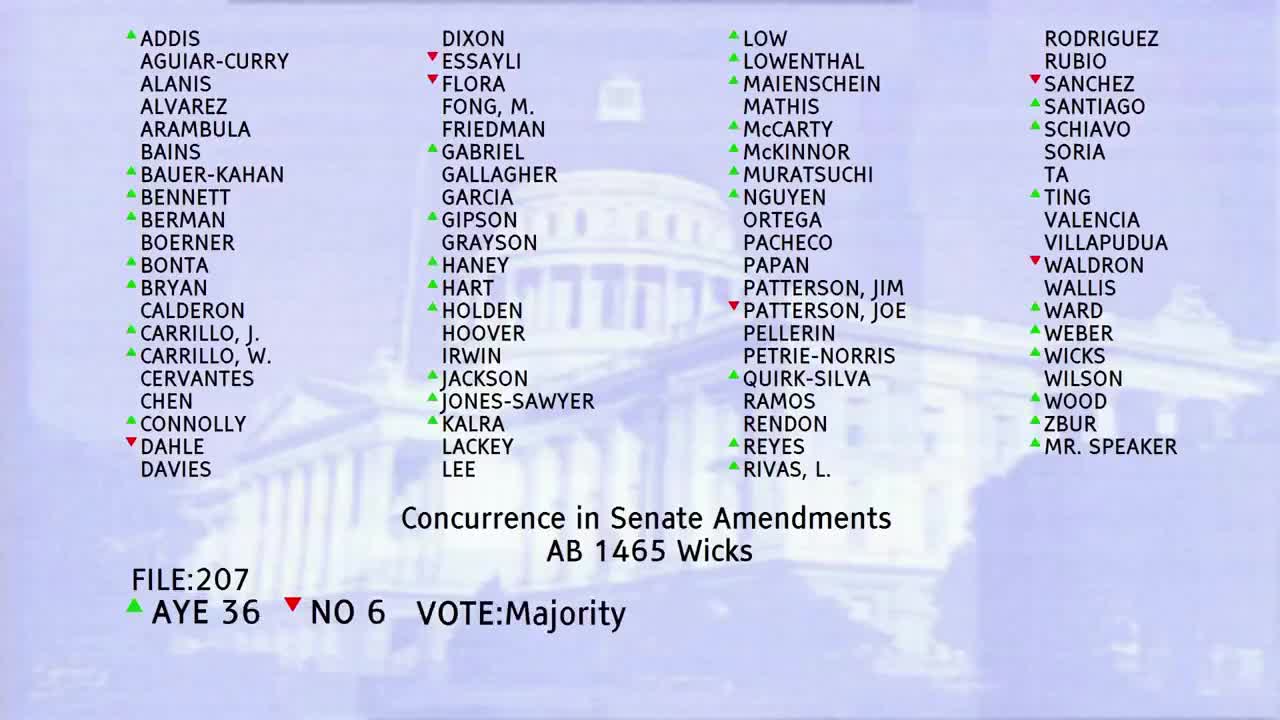 1MIN
Assembly Floor
 14MIN
Senate Standing Committee on Judiciary
 3MIN
Assembly Floor
 1MIN
Assembly Standing Committee on Appropriations
 37MIN
Assembly Standing Committee on Judiciary
 41MIN
Assembly Standing Committee on Privacy and Consumer Protection
Bill Author

Bill Co-Author(s):