AB 1840: Home Purchase Assistance Program: eligibility.
- Session Year: 2023-2024
- House: Assembly
- Latest Version Date: 2024-08-31
Current Status:
Failed
(2024-09-06: Vetoed by Governor.)
Introduced
In Committee
First Chamber
In Committee
Second Chamber
Enacted
Existing law establishes the California Housing Finance Agency in the Department of Housing and Community Development, and authorizes the agency to, among other things, make loans to finance affordable housing, including residential structures, housing developments, multifamily rental housing, special needs housing, and other forms of housing, as specified. Existing law requires the agency to administer a home purchase assistance program for the purpose of assisting low- and moderate-income home buyers to qualify for the purchase of owner-occupied homes, as specified. Existing law establishes the Home Purchase Assistance Fund, which is continuously appropriated for expenditure pursuant to the program and defraying the administrative costs for the agency. Existing law requires, on and after July 1, 2016, unobligated amounts remaining in any fund established for specified purposes to be transferred to the fund for expenditure by the agency for the purposes of the program.
This bill would specify that an applicant who meets all other requirements for a loan under the program, including, but not limited to, any requirements imposed on the agency in administering the program by specified entities, and who is otherwise eligible under applicable federal and state law, shall not be disqualified solely based on the applicants immigration status. By expanding the persons eligible to receive moneys from a continuously appropriated fund, this bill would make an appropriation.
Existing law establishes the California Housing Finance Agency in the Department of Housing and Community Development, and authorizes the agency to, among other things, make loans to finance affordable housing, including residential structures, housing developments, multifamily rental housing, special needs housing, and other forms of housing, as specified. Existing law establishes the California Dream for All Program to provide shared appreciation loans to qualified first-time homebuyers, requires the agency to administer a home purchase assistance program for the purpose of assisting low- and moderate-income home buyers to qualify for the purchase of owner-occupied homes, as specified. Existing law establishes the California Dream for All Home Purchase Assistance Fund, which is continuously appropriated for expenditure pursuant to the program and defraying the administrative costs for the agency. Existing law authorizes moneys deposited into the fund to include, among other moneys, appropriations from the Legislature from the General Fund or other state fund. requires, on and after July 1, 2016, unobligated amounts remaining in any fund established for specified purposes to be transferred to the fund for expenditure by the agency for the purposes of the program.
This bill would specify that an applicant under the program who meets all other requirements for a loan under the program, including, but not limited to, any requirements imposed by the Federal National Mortgage Association or other loan servicer, on the agency in administering the program by specified entities, and who is otherwise eligible under applicable federal and state law, shall not be disqualified solely based on the applicants immigration status. By expanding the persons eligible to receive moneys from a continuously appropriated fund, this bill would make an appropriation. The bill would recast the fund so that appropriations from the Legislature from the General Fund or other state fund are deposited into the California Dream for All Subaccount, which the bill would create and make available upon appropriation by the Legislature for specified purposes.
Existing law establishes the California Housing Finance Agency in the Department of Housing and Community Development, and authorizes the agency to, among other things, make loans to finance affordable housing, including residential structures, housing developments, multifamily rental housing, special needs housing, and other forms of housing, as specified. Existing law establishes the California Dream for All Program to provide shared appreciation loans to qualified first-time homebuyers, as specified. Existing law establishes the California Dream for All Fund, which is continuously appropriated for expenditure pursuant to the program and defraying the administrative costs for the agency. Existing law authorizes moneys deposited into the fund to include, among other moneys, appropriations from the Legislature from the General Fund or other state fund.
This bill would specify that an applicant under the program who meets all other requirements for a loan under the program, including, but not limited to, any requirements imposed by the Federal National Mortgage Association or other loan servicer, shall not be disqualified solely based on the applicants immigration status. By expanding the persons eligible to receive moneys from a continuously appropriated fund, this bill would make an appropriation. The bill would recast the fund so that appropriations from the Legislature from the General Fund or other state fund are deposited into the California Dream for All Subaccount, which the bill would create and make available upon appropriation by the Legislature for specified purposes.
Existing law establishes the California Housing Finance Agency in the Department of Housing and Community Development, and authorizes the agency to, among other things, make loans to finance affordable housing, including residential structures, housing developments, multifamily rental housing, special needs housing, and other forms of housing, as specified. Existing law establishes the California Dream for All Program to provide shared appreciation loans to qualified first-time homebuyers, as specified. Existing law establishes the California Dream for All Fund, which is continuously appropriated for expenditure pursuant to the program and defraying the administrative costs for the agency. Existing law defines first-time homebuyer for these purposes. Existing law authorizes moneys deposited into the fund to include, among other moneys, appropriations from the Legislature from the General Fund or other state fund.
This bill would specify that the definition of first-time homebuyer includes, but is not limited to, undocumented persons. an applicant under the program shall not be disqualified solely based on the applicants immigration status. By expanding the persons eligible to receive moneys from a continuously appropriated fund, this bill would make an appropriation. The bill would recast the fund so that appropriations from the Legislature from the General Fund or other state fund are deposited into the California Dream for All Subaccount, which the bill would create and make available upon appropriation by the Legislature for specified purposes.
Existing law establishes the California Housing Finance Agency in the Department of Housing and Community Development, and authorizes the agency to, among other things, make loans to finance affordable housing, including residential structures, housing developments, multifamily rental housing, special needs housing, and other forms of housing, as specified. Existing law establishes the California Dream for All Program to provide shared appreciation loans to qualified first-time homebuyers, as specified. Existing law establishes the California Dream for All Fund, which is continuously appropriated for expenditure pursuant to the program and defraying the administrative costs for the agency. Existing law defines first-time homebuyer for these purposes.
This bill would specify that the definition of first-time homebuyer includes, but is not limited to, undocumented persons.
(a)An applicant who meets the requirements for a loan under the home purchase assistance program, including, but not limited to, any requirements imposed on the agency in administering the program by the Federal National Mortgage Association, a government-sponsored enterprise, a loan servicer, an investor, or a guarantor, and who is otherwise eligible under applicable federal and state law, shall not be disqualified by the agency solely based on the applicants immigration status.
(b)The Legislature finds and declares that this chapter is a state law within the meaning of Section 1621(d) of Title 8 of the United States Code.
(a)An applicant who meets the requirements for a loan under the home purchase assistance program, including, but not limited to, any requirements imposed on the agency in administering the program by the Federal National Mortgage Association, a government-sponsored enterprise, a loan servicer, an investor, or a guarantor, and who is otherwise eligible under applicable federal and state law, shall not be disqualified by the agency solely based on the applicants immigration status.
(b)The Legislature finds and declares that this chapter is a state law within the meaning of Section 1621(d) of Title 8 of the United States Code.
SECTION 1.Section 51523 of the Health and Safety Code is amended to read:51523.(a)The California Dream for All Program is hereby established to provide shared appreciation loans to qualified first-time homebuyers. The program shall be limited to providing assistance to low- and moderate-income homebuyers in the purchase of owner-occupied homes. The agency, subject to the availability of funds for the purposes of this chapter, shall implement and administer the California Dream for All Program in accordance with this chapter.(b)(1)In implementing this part, the agency shall adopt policies, rules, and regulations by resolution of the board of directors of the agency and consistent with this part to achieve all of the following:(A)Provide assistance to meaningfully expand access to homeownership.(B)Expand opportunities for California households to accumulate wealth for themselves and their families. The agency shall make any necessary program adjustments consistent with the requirements of this chapter, which may include limiting the percentage of appreciation payable under the program, to ensure that design of the loan product is not an unreasonable impediment to homeowner wealth creation.(C)Maximize the number of households assisted over time by exploring and implementing methods for selling subordinate second mortgages originated pursuant to this chapter to investors in order to generate additional funding for the program.(D)Establish a revolving, shared appreciation first-time homebuyer program with the goal of eventually providing up to one billion dollars ($1,000,000,000) per year for first-time homebuyers.(E)The amount of assistance shall only be made available in conjunction with first mortgage loan financing provided by the agency, and funds available pursuant to this chapter shall also be available for interest rate buydowns and closing cost assistance for that first mortgage loan financing. Any funds made available for interest rate buydowns shall be made in conjunction with a shared appreciation loan.(F)All repayments shall be deposited into the fund for ongoing use in the program.(G)Sustainability for the agency without significantly adversely affecting its borrowing capacity or ability to meet other affordable housing or agency needs.(H)Adequate consumer protection and consumer disclosure protections.(2)Policies, rules, and regulations adopted pursuant to this part shall not be subject to Chapter 3.5 (commencing with Section 11340) of Part 1 of Division 3 of Title 2 of the Government Code.(c)(1)An applicant under the program who meets all other requirements for a loan under the program, including, but not limited to, any requirements imposed by the Federal National Mortgage Association or other loan servicer, shall not be disqualified solely based on the applicants immigration status.(2)The Legislature finds and declares that this chapter is a state law within the meaning of Section 1621(d) of Title 8 of the United State Code.SEC. 2.Section 51524 of the Health and Safety Code is amended to read:51524.(a)(1)There is hereby established in the State Treasury the California Dream for All Fund.(2)Notwithstanding Section 13340 of the Government Code, except as provided in subdivision (c), all moneys in the fund are continuously appropriated to the agency, without regard to fiscal years, for expenditure pursuant to this chapter and defraying administrative costs of the agency.(3)Notwithstanding Section 16305.7 of the Government Code, any interest earned or other increment derived from investments made from moneys in the fund shall be deposited in the fund.(b)Moneys deposited in the fund may include proceeds from the agency issuing revenue bonds for the purposes set forth in this chapter pursuant to Section 51350, the sale or issuance of any debt instrument secured by repayment of loans originated pursuant to this chapter, and repayments from the program.(c)(1)There is hereby established in the fund the California Dream for All Subaccount.(2)Moneys in the California Dream for All Subaccount shall include any appropriation from the Legislature from the General Fund or other state fund. Moneys from any other source shall not be deposited into the California Dream for All Subaccount.(3)Notwithstanding subdivision (a), moneys in the California Dream for All Subaccount shall be available upon appropriation by the Legislature for expenditure pursuant to this chapter and defraying administrative costs of the agency.(a)The California Dream for All Program is hereby established to provide shared appreciation loans to qualified first-time homebuyers. The program shall be limited to providing assistance to low- and moderate-income homebuyers in the purchase of owner-occupied homes. The agency, subject to the availability of funds for the purposes of this chapter, shall implement and administer the California Dream for All Program in accordance with this chapter.
(b)(1)In implementing this part, the agency shall adopt policies, rules, and regulations by resolution of the board of directors of the agency and consistent with this part to achieve all of the following:
(A)Provide assistance to meaningfully expand access to homeownership.
(B)Expand opportunities for California households to accumulate wealth for themselves and their families. The agency shall make any necessary program adjustments consistent with the requirements of this chapter, which may include limiting the percentage of appreciation payable under the program, to ensure that design of the loan product is not an unreasonable impediment to homeowner wealth creation.
(C)Maximize the number of households assisted over time by exploring and implementing methods for selling subordinate second mortgages originated pursuant to this chapter to investors in order to generate additional funding for the program.
(D)Establish a revolving, shared appreciation first-time homebuyer program with the goal of eventually providing up to one billion dollars ($1,000,000,000) per year for first-time homebuyers.
(E)The amount of assistance shall only be made available in conjunction with first mortgage loan financing provided by the agency, and funds available pursuant to this chapter shall also be available for interest rate buydowns and closing cost assistance for that first mortgage loan financing. Any funds made available for interest rate buydowns shall be made in conjunction with a shared appreciation loan.
(F)All repayments shall be deposited into the fund for ongoing use in the program.
(G)Sustainability for the agency without significantly adversely affecting its borrowing capacity or ability to meet other affordable housing or agency needs.
(H)Adequate consumer protection and consumer disclosure protections.
(2)Policies, rules, and regulations adopted pursuant to this part shall not be subject to Chapter 3.5 (commencing with Section 11340) of Part 1 of Division 3 of Title 2 of the Government Code.
(c)(1)An applicant under the program who meets all other requirements for a loan under the program, including, but not limited to, any requirements imposed by the Federal National Mortgage Association or other loan servicer, shall not be disqualified solely based on the applicants immigration status.
(2)The Legislature finds and declares that this chapter is a state law within the meaning of Section 1621(d) of Title 8 of the United State Code.
SEC. 2.Section 51524 of the Health and Safety Code is amended to read:51524.(a)(1)There is hereby established in the State Treasury the California Dream for All Fund.
(2)Notwithstanding Section 13340 of the Government Code, except as provided in subdivision (c), all moneys in the fund are continuously appropriated to the agency, without regard to fiscal years, for expenditure pursuant to this chapter and defraying administrative costs of the agency.
(3)Notwithstanding Section 16305.7 of the Government Code, any interest earned or other increment derived from investments made from moneys in the fund shall be deposited in the fund.
(b)Moneys deposited in the fund may include proceeds from the agency issuing revenue bonds for the purposes set forth in this chapter pursuant to Section 51350, the sale or issuance of any debt instrument secured by repayment of loans originated pursuant to this chapter, and repayments from the program.
(c)(1)There is hereby established in the fund the California Dream for All Subaccount.
(2)Moneys in the California Dream for All Subaccount shall include any appropriation from the Legislature from the General Fund or other state fund. Moneys from any other source shall not be deposited into the California Dream for All Subaccount.
(3)Notwithstanding subdivision (a), moneys in the California Dream for All Subaccount shall be available upon appropriation by the Legislature for expenditure pursuant to this chapter and defraying administrative costs of the agency.
(a)The California Dream for All Program is hereby established to provide shared appreciation loans to qualified first-time homebuyers. The program shall be limited to providing assistance to low- and moderate-income homebuyers in the purchase of owner-occupied homes. The agency, subject to the availability of funds for the purposes of this chapter, shall implement and administer the California Dream for All Program in accordance with this chapter.
(b)(1)In implementing this part, the agency shall adopt policies, rules, and regulations by resolution of the board of directors of the agency and consistent with this part to achieve all of the following:
(A)Provide assistance to meaningfully expand access to homeownership.
(B)Expand opportunities for California households to accumulate wealth for themselves and their families. The agency shall make any necessary program adjustments consistent with the requirements of this chapter, which may include limiting the percentage of appreciation payable under the program, to ensure that design of the loan product is not an unreasonable impediment to homeowner wealth creation.
(C)Maximize the number of households assisted over time by exploring and implementing methods for selling subordinate second mortgages originated pursuant to this chapter to investors in order to generate additional funding for the program.
(D)Establish a revolving, shared appreciation first-time homebuyer program with the goal of eventually providing up to one billion dollars ($1,000,000,000) per year for first-time homebuyers.
(E)The amount of assistance shall only be made available in conjunction with first mortgage loan financing provided by the agency, and funds available pursuant to this chapter shall also be available for interest rate buydowns and closing cost assistance for that first mortgage loan financing. Any funds made available for interest rate buydowns shall be made in conjunction with a shared appreciation loan.
(F)All repayments shall be deposited into the fund for ongoing use in the program.
(G)Sustainability for the agency without significantly adversely affecting its borrowing capacity or ability to meet other affordable housing or agency needs.
(H)Adequate consumer protection and consumer disclosure protections.
(2)Policies, rules, and regulations adopted pursuant to this part shall not be subject to Chapter 3.5 (commencing with Section 11340) of Part 1 of Division 3 of Title 2 of the Government Code.
(c)(1)An applicant under the program shall not be disqualified solely based on the applicants immigration status.
(2)The Legislature finds and declares that this chapter is a state law within the meaning of Section 1621(d) of Title 8 of the United State Code.
SEC. 2.Section 51524 of the Health and Safety Code is amended to read:51524.(a)(1)There is hereby established in the State Treasury the California Dream for All Fund.
(2)Notwithstanding Section 13340 of the Government Code, except as provided in subdivision (c), all moneys in the fund are continuously appropriated to the agency, without regard to fiscal years, for expenditure pursuant to this chapter and defraying administrative costs of the agency.
(3)Notwithstanding Section 16305.7 of the Government Code, any interest earned or other increment derived from investments made from moneys in the fund shall be deposited in the fund.
(b)Moneys deposited in the fund may include appropriations from the Legislature from the General Fund or other state fund, proceeds from the agency issuing revenue bonds for the purposes set forth in this chapter pursuant to Section 51350, the sale or issuance of any debt instrument secured by repayment of loans originated pursuant to this chapter, and repayments from the program.
(c)(1)There is hereby established in the fund the California Dream for All Subaccount.
(2)Moneys in the California Dream for All Subaccount shall include any appropriation from the Legislature from the General Fund or other state fund. Moneys from any other source shall not be deposited into the California Dream for All Subaccount.
(3)Notwithstanding subdivision (a), moneys in the California Dream for All Subaccount shall be available upon appropriation by the Legislature for expenditure pursuant to this chapter and defraying administrative costs of the agency.
SECTION 1.Section 51522 of the Health and Safety Code is amended to read:51522.For the purposes of this chapter:(a)First-time homebuyer means a person, including, but not limited to, an undocumented person, who is a purchaser of an owner-occupied housing unit and who neither has, nor has had, a present ownership in a principal residence at any time during the three-year period prior to the date on which the mortgage pursuant to this division is executed, except that this limitation shall not apply to a purchaser of a principal residence in a targeted area.(b)Fund means the California Dream for All Fund.(c)Program means the California Dream for All Program.(d)Shared appreciation loan means a deferred-payment subordinate mortgage loan, the repayment of which is based on the amount of the subordinate loan plus the appreciation in the value of the home financed by the loan from the time of purchase to the time the home is sold or refinanced.For the purposes of this chapter:
(a)First-time homebuyer has the same meaning as defined in Section 50068.5. means a person, including, but not limited to, an undocumented person, who is a purchaser of an owner-occupied housing unit and who neither has, nor has had, a present ownership in a principal residence at any time during the three-year period prior to the date on which the mortgage pursuant to this division is executed, except that this limitation shall not apply to a purchaser of a principal residence in a targeted area.
(b)Fund means the California Dream for All Fund.
(c)Program means the California Dream for All Program.
(d)Shared appreciation loan means a deferred-payment subordinate mortgage loan, the repayment of which is based on the amount of the subordinate loan plus the appreciation in the value of the home financed by the loan from the time of purchase to the time the home is sold or refinanced.
|
Date
|
Status
|
|---|---|
| Sep 6, 2024 | Vetoed by Governor. |
| Sep 5, 2024 | Enrolled and presented to the Governor at 4 p.m. |
| Aug 28, 2024 | Senate amendments concurred in. To Engrossing and Enrolling. (Ayes 53. Noes 18.). |
| Aug 28, 2024 | Assembly Rule 77 suspended. |
| Aug 28, 2024 | In Assembly. Concurrence in Senate amendments pending. May be considered on or after August 30 pursuant to Assembly Rule 77. |
| Aug 27, 2024 | Read third time. Passed. Ordered to the Assembly. (Ayes 25. Noes 14.). |
| Aug 19, 2024 | Read second time. Ordered to third reading. |
| Aug 15, 2024 | Read second time and amended. Ordered returned to second reading. |
| Aug 15, 2024 | From committee: Amend, and do pass as amended. (Ayes 5. Noes 2.) (August 15). |
| Aug 5, 2024 | In committee: Referred to APPR suspense file. |
| Jul 3, 2024 | From committee: Do pass and re-refer to Com. on APPR. (Ayes 9. Noes 2.) (July 2). Re-referred to Com. on APPR. |
| Jun 19, 2024 | From committee: Do pass and re-refer to Com. on JUD. (Ayes 7. Noes 3.) (June 18). Re-referred to Com. on JUD. |
| May 29, 2024 | Referred to Coms. on HOUSING and JUD. |
| May 22, 2024 | In Senate. Read first time. To Com. on RLS. for assignment. |
| May 21, 2024 | Read third time. Passed. Ordered to the Senate. (Ayes 56. Noes 15. Page 5395.) |
| May 20, 2024 | Read second time. Ordered to third reading. |
| May 16, 2024 | From committee: Do pass. (Ayes 11. Noes 4.) (May 16). |
| May 8, 2024 | In committee: Set, first hearing. Referred to APPR. suspense file. |
| Apr 22, 2024 | Re-referred to Com. on APPR. |
| Apr 18, 2024 | Read second time and amended. |
| Apr 17, 2024 | From committee: Amend, and do pass as amended and re-refer to Com. on APPR. (Ayes 6. Noes 2.) (April 17). |
| Feb 29, 2024 | Re-referred to Com. on H. & C.D. |
| Feb 28, 2024 | From committee chair, with author's amendments: Amend, and re-refer to Com. on H. & C.D. Read second time and amended. |
| Jan 29, 2024 | Referred to Com. on H. & C.D. |
| Jan 17, 2024 | From printer. May be heard in committee February 16. |
| Jan 16, 2024 | Read first time. To print. |
|
Date
|
Description
|
Location
|
Votes
|
|
|---|---|---|---|---|
| Aug 28, 2024 | AB 1840 Arambula Concurrence in Senate Amendments | Assembly Floor |
Passed |
|
| Aug 27, 2024 | Assembly 3rd Reading AB1840 Arambula By Wiener | Senate Floor |
Passed |
|
| Aug 15, 2024 | Do pass as amended | Senate Standing Committee on Appropriations |
Passed |
|
| Aug 5, 2024 | Placed on suspense file | Senate Standing Committee on Appropriations |
Passed |
|
| Jul 2, 2024 | Do pass, but first be re-referred to the Committee on [Appropriations] | Senate Standing Committee on Judiciary |
Passed |
|
| Jun 18, 2024 | Do pass, but first be re-referred to the Committee on [Judiciary] | Senate Standing Committee on Housing |
Passed |
|
| May 21, 2024 | AB 1840 Arambula Assembly Third Reading | Assembly Floor |
Passed |
|
| May 16, 2024 | Do pass. | Assembly Standing Committee on Appropriations |
Passed |
|
| Apr 17, 2024 | Do pass as amended and be re-referred to the Committee on [Appropriations] | Assembly Standing Committee on Housing and Community Development |
Passed |
This list shows positions taken on this bill by organizations on the date displayed, which is linked to the original source.
Positions by individuals are not included.
|
Organization
|
Position
|
Date
|
|---|---|---|
| Aclu California Action | ** Support | |
| Bravo & Bravo | ** Support | |
| California Faculty Association | ** Support | |
| California Housing Partnership Corporation | ** Support | |
| California Immigrant Policy Center | ** Support | |
| Central Valley Immigrant Integration Collaborative | ** Support | |
| City of Alameda | ** Support | |
| Coalition for Humane Immigrant Rights | ** Support | |
| Episcopal Communities & Services | ** Support | |
| Livable California | ** Support | |
| Oasis Legal Services | ** Support | |
| PICO California | ** Support | |
| Western Center on Law & Poverty, INC. | ** Support | |
| World Relief, Sacramento | ** Support |
GOVERNOR'S VETO
GV Bill Id:AB 1840
Author:(Arambula)
As Enrolled Ver:August 31, 2024
2/3 Vote
SUMMARY
This bill prohibits disqualification of an applicant to one of the California Housing Finance Authority's (CalHFA's) home purchase assistance programs solely on the basis of the applicant's immigration status.
Senate Amendments
- Delete the creation of the California Dream for All Subaccount.
- Moves the provisions of the bill to a new code section.
Governor’s Veto Message
This bill seeks to prohibit the disqualification of applicants from one of California Housing Finance Agency's (CalHFA) home purchase assistance programs based solely on their immigration status.
Given the finite funding available for CalHFA programs, expanding program eligibility must be carefully considered within the broader context of the annual state budget to ensure we manage our resources effectively.
COMMENTS
Program eligibility. CalHFA implements a variety of home purchase assistance program included the California Dream for All Program. In order to be eligible for the California Dream for All Program, each borrower must be a first-time homebuyer; be either a citizen or other National of the United States, or a "Qualified Alien" as defined under 8 USC Section 1641 (e.g., a refugee, an individual who has been granted asylum, or a lawful permanent resident); and meet specified credit, income, and loan requirements, including Fannie Mae underwriting goals (see #3 below). In addition, at least one borrower must be a first-generation homebuyer and a current California resident.
Federal requirements. As noted above, the California Dream for All Program requires first mortgages to meet the underwriting goals of the Federal National Mortgage Association (commonly known as Fannie Mae). Fannie Mae is a government-sponsored enterprise under the conservatorship of the Federal Housing Finance Agency (FHFA). Fannie Mae purchases mortgages from lenders to free up the money they need to make other mortgage loans, thereby ensuring the ongoing availability of affordable mortgages. Fannie Mae's standards require a borrower to have a valid Social Security Number or Individual Taxpayer Identification Number (ITIN), in addition to meeting existing legal residency and documentation requirements. The author's office notes that individuals who are able to obtain an ITIN are generally those who have achieved Deferred Action for Childhood Arrivals (DACA) status.
Under Section 1621(d) of Title 8 of the United States Code, "A State may provide that an alien who is not lawfully present in the United States is eligible for any State or local public benefit for which such alien would otherwise be ineligible under subsection (a), only through the enactment of a State law after August 22, 1996, which affirmatively provides for such eligibility."
Eligibility requirements for the California Dream for All Program include undocumented individuals with an ITIN who also meet existing legal residency and documentation requirements. However, this eligibility is specified in program regulations, which the author notes is insufficient to meet the requirements of Section 1621(d) of Title 8 of the US Code. Accordingly, this bill will explicitly provide in statute that a program applicant who meets all other requirements for a CalHFA home purchase assistance program, including but not limited to any requirements imposed by Fannie Mae or other loan servicer, shall not be disqualified solely based on their immigration status.
According to the Author
"The social and economic benefits of homeownership should be available to everyone. As such, the California Dream for all program should be available to all. Homeownership is a fundamental tool for wealth building, as it fosters financial stability and provides a tangible investment in one's future. When undocumented individuals are excluded from such programs, they miss out on a crucial method of securing financial security and personal stability for themselves and their families. Limiting access to homeownership assistance programs perpetuates inequality and excludes residents of California from obtaining a significant wealth building opportunity. Expanding access to homeownership is not only important to personal prosperity but also fosters economic stability and promotes a robust local economy. Ensuring universal access by all qualified borrowers to the California Dream for All Program will contribute to the overall success and vitality of California."
Arguments in Support
The sponsor of the bill states in support that this bill seeks to ensure that all qualified Californians, regardless of immigration status, can access the Dream for All program and be able to contribute to the overall success and vitality of the state.
Arguments in Opposition
Several individuals state in opposition to this bill that noncitizens should not be eligible for state programs.
FISCAL COMMENTS
According to the Senate Appropriations Committee:
- Unknown significant cost pressures, potentially in the millions annually, to provide additional funding for the California Dream for All Program to accommodate the expanded eligibility population. (General Fund)
- The California Housing Finance Agency (CalHFA) indicates that any costs to update program regulations to prohibit application disqualification based on immigration status would be minor and absorbable. (California Dream for All Fund)
VOTES
ASM HOUSING AND COMMUNITY DEVELOPMENT: 6-2-1
YES: Ward, Grayson, Kalra, Lee, Quirk-Silva, Reyes
NO: Joe Patterson, Sanchez
ABS, ABST OR NV: Wilson
ASM APPROPRIATIONS: 11-4-0
YES: Wicks, Arambula, Bryan, Calderon, Wendy Carrillo, Mike Fong, Grayson, Haney, Hart, Pellerin, Villapudua
NO: Sanchez, Dixon, Jim Patterson, Ta
ASSEMBLY FLOOR: 56-15-9
YES: Addis, Aguiar-Curry, Alvarez, Arambula, Bains, Bauer-Kahan, Bennett, Berman, Boerner, Bonta, Bryan, Calderon, Juan Carrillo, Wendy Carrillo, Connolly, Mike Fong, Garcia, Gipson, Grayson, Haney, Hart, Irwin, Jackson, Jones-Sawyer, Kalra, Lee, Low, Lowenthal, Maienschein, McCarty, McKinnor, Muratsuchi, Stephanie Nguyen, Ortega, Pacheco, Papan, Pellerin, Quirk-Silva, Ramos, Rendon, Reyes, Rodriguez, Blanca Rubio, Santiago, Schiavo, Soria, Ting, Valencia, Villapudua, Ward, Weber, Wicks, Wilson, Wood, Zbur, Robert Rivas
NO: Chen, Davies, Dixon, Essayli, Flora, Vince Fong, Gallagher, Hoover, Lackey, Jim Patterson, Joe Patterson, Sanchez, Ta, Waldron, Wallis
ABS, ABST OR NV: Alanis, Cervantes, Megan Dahle, Friedman, Gabriel, Holden, Mathis, Petrie-Norris, Luz Rivas
SENATE FLOOR: 25-14-1
YES: Allen, Archuleta, Ashby, Atkins, Becker, Bradford, Caballero, Cortese, Durazo, Eggman, Gonzalez, Laird, Limón, McGuire, Menjivar, Newman, Padilla, Portantino, Roth, Rubio, Skinner, Smallwood-Cuevas, Stern, Wahab, Wiener
NO: Alvarado-Gil, Blakespear, Dahle, Dodd, Glazer, Grove, Jones, Min, Nguyen, Niello, Ochoa Bogh, Seyarto, Umberg, Wilk
ABS, ABST OR NV: Hurtado
ASSEMBLY FLOOR: 53-18-8
YES: Addis, Aguiar-Curry, Alvarez, Arambula, Bains, Bauer-Kahan, Bennett, Berman, Boerner, Bonta, Bryan, Calderon, Juan Carrillo, Wendy Carrillo, Connolly, Mike Fong, Friedman, Gabriel, Garcia, Gipson, Grayson, Haney, Hart, Holden, Jackson, Jones-Sawyer, Kalra, Lee, Low, Lowenthal, Maienschein, McCarty, McKinnor, Stephanie Nguyen, Papan, Pellerin, Quirk-Silva, Ramos, Rendon, Reyes, Luz Rivas, Blanca Rubio, Santiago, Soria, Ting, Valencia, Villapudua, Ward, Weber, Wicks, Wood, Zbur, Robert Rivas
NO: Alanis, Chen, Megan Dahle, Davies, Dixon, Essayli, Flora, Gallagher, Hoover, Lackey, Mathis, Jim Patterson, Joe Patterson, Petrie-Norris, Sanchez, Ta, Waldron, Wallis
ABS, ABST OR NV: Cervantes, Irwin, Muratsuchi, Ortega, Pacheco, Rodriguez, Schiavo, Wilson
UPDATED
VERSION: August 31, 2024
CONSULTANT: Lisa Engel / H. & C.D. / (916) 319-2085 FN: 0005075
CONCURRENCE IN SENATE AMENDMENTS
CSA1 Bill Id:AB 1840
Author:(Arambula)
As Amended Ver:August 15, 2024
Majority vote
SUMMARY
This bill prohibits disqualification of an applicant to one of the California Housing Finance Authority's (CalHFA's) home purchase assistance programs solely on the basis of the applicant's immigration status.
Senate Amendments
- Delete the creation of the California Dream for All Subaccount.
- Moves the provisions of the bill to a new code section.
COMMENTS
Program eligibility. CalHFA implements a variety of home purchase assistance program included the California Dream for All Program. In order to be eligible for the California Dream for All Program, each borrower must be a first-time homebuyer; be either a citizen or other National of the United States, or a "Qualified Alien" as defined under 8 USC Section 1641 (e.g., a refugee, an individual who has been granted asylum, or a lawful permanent resident); and meet specified credit, income, and loan requirements, including Fannie Mae underwriting goals (see #3 below). In addition, at least one borrower must be a first-generation homebuyer and a current California resident.
Federal requirements. As noted above, the California Dream for All Program requires first mortgages to meet the underwriting goals of the Federal National Mortgage Association (commonly known as Fannie Mae). Fannie Mae is a government-sponsored enterprise under the conservatorship of the Federal Housing Finance Agency (FHFA). Fannie Mae purchases mortgages from lenders to free up the money they need to make other mortgage loans, thereby ensuring the ongoing availability of affordable mortgages. Fannie Mae's standards require a borrower to have a valid Social Security Number or Individual Taxpayer Identification Number (ITIN), in addition to meeting existing legal residency and documentation requirements. The author's office notes that individuals who are able to obtain an ITIN are generally those who have achieved Deferred Action for Childhood Arrivals (DACA) status.
Under Section 1621(d) of Title 8 of the United States Code, "A State may provide that an alien who is not lawfully present in the United States is eligible for any State or local public benefit for which such alien would otherwise be ineligible under subsection (a), only through the enactment of a State law after August 22, 1996, which affirmatively provides for such eligibility."
Eligibility requirements for the California Dream for All Program include undocumented individuals with an ITIN who also meet existing legal residency and documentation requirements. However, this eligibility is specified in program regulations, which the author notes is insufficient to meet the requirements of Section 1621(d) of Title 8 of the US Code. Accordingly, this bill will explicitly provide in statute that a program applicant who meets all other requirements for a CalHFA home purchase assistance program, including but not limited to any requirements imposed by Fannie Mae or other loan servicer, shall not be disqualified solely based on their immigration status.
According to the Author
"The social and economic benefits of homeownership should be available to everyone. As such, the California Dream for all program should be available to all. Homeownership is a fundamental tool for wealth building, as it fosters financial stability and provides a tangible investment in one's future. When undocumented individuals are excluded from such programs, they miss out on a crucial method of securing financial security and personal stability for themselves and their families. Limiting access to homeownership assistance programs perpetuates inequality and excludes residents of California from obtaining a significant wealth building opportunity. Expanding access to homeownership is not only important to personal prosperity but also fosters economic stability and promotes a robust local economy. Ensuring universal access by all qualified borrowers to the California Dream for All Program will contribute to the overall success and vitality of California."
Arguments in Support
The sponsor of the bill states in support that this bill seeks to ensure that all qualified Californians, regardless of immigration status, can access the Dream for All program and be able to contribute to the overall success and vitality of the state.
Arguments in Opposition
Several individuals state in opposition to this bill that noncitizens should not be eligible for state programs.
FISCAL COMMENTS
According to the Senate Appropriations Committee:
- Unknown significant cost pressures, potentially in the millions annually, to provide additional funding for the California Dream for All Program to accommodate the expanded eligibility population. (General Fund)
- The California Housing Finance Agency (CalHFA) indicates that any costs to update program regulations to prohibit application disqualification based on immigration status would be minor and absorbable. (California Dream for All Fund)
VOTES:
ASM HOUSING AND COMMUNITY DEVELOPMENT: 6-2-1
YES: Ward, Grayson, Kalra, Lee, Quirk-Silva, Reyes
NO: Joe Patterson, Sanchez
ABS, ABST OR NV: Wilson
ASM APPROPRIATIONS: 11-4-0
YES: Wicks, Arambula, Bryan, Calderon, Wendy Carrillo, Mike Fong, Grayson, Haney, Hart, Pellerin, Villapudua
NO: Sanchez, Dixon, Jim Patterson, Ta
ASSEMBLY FLOOR: 56-15-9
YES: Addis, Aguiar-Curry, Alvarez, Arambula, Bains, Bauer-Kahan, Bennett, Berman, Boerner, Bonta, Bryan, Calderon, Juan Carrillo, Wendy Carrillo, Connolly, Mike Fong, Garcia, Gipson, Grayson, Haney, Hart, Irwin, Jackson, Jones-Sawyer, Kalra, Lee, Low, Lowenthal, Maienschein, McCarty, McKinnor, Muratsuchi, Stephanie Nguyen, Ortega, Pacheco, Papan, Pellerin, Quirk-Silva, Ramos, Rendon, Reyes, Rodriguez, Blanca Rubio, Santiago, Schiavo, Soria, Ting, Valencia, Villapudua, Ward, Weber, Wicks, Wilson, Wood, Zbur, Robert Rivas
NO: Chen, Davies, Dixon, Essayli, Flora, Vince Fong, Gallagher, Hoover, Lackey, Jim Patterson, Joe Patterson, Sanchez, Ta, Waldron, Wallis
ABS, ABST OR NV: Alanis, Cervantes, Megan Dahle, Friedman, Gabriel, Holden, Mathis, Petrie-Norris, Luz Rivas
SENATE FLOOR: 25-14-1
YES: Allen, Archuleta, Ashby, Atkins, Becker, Bradford, Caballero, Cortese, Durazo, Eggman, Gonzalez, Laird, Limón, McGuire, Menjivar, Newman, Padilla, Portantino, Roth, Rubio, Skinner, Smallwood-Cuevas, Stern, Wahab, Wiener
NO: Alvarado-Gil, Blakespear, Dahle, Dodd, Glazer, Grove, Jones, Min, Nguyen, Niello, Ochoa Bogh, Seyarto, Umberg, Wilk
ABS, ABST OR NV: Hurtado
UPDATED
VERSION: August 15, 2024
CONSULTANT: Lisa Engel / H. & C.D. / (916) 319-2085 FN: 0004312
SENATE RULES COMMITTEE Office of Senate Floor Analyses (916) 651-1520 Fax: (916) 327-4478 | AB 1840 |
THIRD READING
Bill No: AB 1840
Author: Arambula (D)
Amended: 8/15/24 In Senate
Vote: 21
SENATE HOUSING COMMITTEE: 7-3, 6/18/24
AYES: Skinner, Caballero, Cortese, Menjivar, Padilla, Umberg, Wahab
NOES: Ochoa Bogh, Blakespear, Seyarto
SENATE JUDICIARY COMMITTEE: 9-2, 7/2/24
AYES: Umberg, Allen, Ashby, Caballero, Durazo, Laird, Roth, Stern, Wahab
NOES: Wilk, Niello
SENATE APPROPRIATIONS COMMITTEE: 5-2, 8/15/24
AYES: Caballero, Ashby, Becker, Bradford, Wahab
NOES: Jones, Seyarto
ASSEMBLY FLOOR: 56-15, 5/21/24 - See last page for vote
SUBJECT: Home Purchase Assistance Program: eligibility
SOURCE: Coalition for Humane Immigrant Rights
DIGEST:
This bill prohibits disqualification of an applicant to one of the California Housing Finance Authority’s (CalHFA’s) home purchase assistance programs solely on the basis of the applicant’s immigration status.
ANALYSIS:
Existing law:
- Establishes authority for CalHFA implement home purchase assistance programs and directs CalHFA to prioritize using funds to assist first-time homebuyers.
- Requires CalHFA to adopt policies, rules, and regulations to achieve all of the following:
- Provide assistance to meaningfully expand access to homeownership.
- Expand opportunities for California households to accumulate wealth for themselves and their families, including ensuring that design of the loan product is not an unreasonable impediment to homeowner wealth creation.
- Maximize the number of households assisted over time by exploring and implementing methods for selling subordinate second mortgages to generate additional funding for the program.
- Establish a revolving, shared appreciation first-time homebuyer program with the goal of eventually providing up to $1 billion per year for first-time homebuyers.
- Provide adequate consumer protection and consumer disclosure protections.
This bill provides that an applicant who meets the requirements for a loan under a CalHFA home purchase assistance program shall not be disqualified from the solely on the basis of the applicant’s immigration status.
Comments
- Author’s statement. According to the author, “The social and economic benefits of homeownership should be available to everyone. As such, the California Dream for all program should be available to all. Homeownership is a fundamental tool for wealth building, as it fosters financial stability and provides a tangible investment in one’s future. When undocumented individuals are excluded from such programs, they miss out on a crucial method of securing financial security and personal stability for themselves and their families. Limiting access to homeownership assistance programs perpetuates inequality and excludes residents of California from obtaining a significant wealth building opportunity. Expanding access to homeownership is not only important to personal prosperity but also fosters economic stability and promotes a robust local economy. Ensuring universal access by all qualified borrowers to the California Dream for All Program will contribute to the overall success and vitality of California.”
- Program eligibility. CalHFA implements a variety of home purchase assistance program included the California Dream for All Program. In order to be eligible for the California Dream for All Program, each borrower must be a first-time homebuyer; be either a citizen or other National of the United States, or a “Qualified Alien” as defined under 8 USC Section 1641 (e.g., a refugee, an individual who has been granted asylum, or a lawful permanent resident); and meet specified credit, income, and loan requirements, including Fannie Mae underwriting goals (see #3 below). In addition, at least one borrower must be a first-generation homebuyer and a current California resident.
- Federal requirements. As noted in 2) above, the California Dream for All Program requires first mortgages to meet the underwriting goals of the Federal National Mortgage Association (commonly known as Fannie Mae). Fannie Mae is a government-sponsored enterprise under the conservatorship of the Federal Housing Finance Agency (FHFA). Fannie Mae purchases mortgages from lenders to free up the money they need to make other mortgage loans, thereby ensuring the ongoing availability of affordable mortgages. Fannie Mae’s standards require a borrower to have a valid Social Security Number or Individual Taxpayer Identification Number (ITIN), in addition to meeting existing legal residency and documentation requirements. The author’s office notes that individuals who are able to obtain an ITIN are generally those who have achieved Deferred Action for Childhood Arrivals (DACA) status.
Under Section 1621(d) of Title 8 of the United States Code, “A State may provide that an alien who is not lawfully present in the United States is eligible for any State or local public benefit for which such alien would otherwise be ineligible under subsection (a), only through the enactment of a State law after August 22, 1996, which affirmatively provides for such eligibility.”
Eligibility requirements for the California Dream for All Program include undocumented individuals with an ITIN who also meet existing legal residency and documentation requirements. However, this eligibility is specified in program regulations, which the author notes is insufficient to meet the requirements of Section 1621(d) of Title 8 of the US Code. Accordingly, this bill will explicitly provide in statute that a program applicant who meets all other requirements for a CalHFA home purchase assistance program, including but not limited to any requirements imposed by Fannie Mae or other loan servicer, shall not be disqualified solely based on their immigration status.
Related/Prior Legislation
AB 140 (Committee on Budget, Chapter 111, Statutes of 2021) required the State Treasurer, in consultation with CalHFA, HCD, and other relevant stakeholders to develop a framework for the California Dream for All First Time Homebuyers Program to reduce barriers to homeownership.
FISCAL EFFECT: Appropriation: Yes Fiscal Com.: Yes Local: No
According to the Senate Appropriations Committee:
- Unknown significant cost pressures, potentially in the millions annually, to provide additional funding for the California Dream for All Program to accommodate the expanded eligibility population. (General Fund)
- The California Housing Finance Agency (CalHFA) indicates that any costs to update program regulations to prohibit application disqualification based on immigration status would be minor and absorbable. (California Dream for All Fund)
SUPPORT: (Verified 8/15/24)
Coalition for Humane Immigrant Rights (source)
ACLU California Action
Bravo & Bravo
California Faculty Association
California Housing Partnership Corporation
California Immigrant Policy Center
Central Valley Immigrant Integration Collaborative
City of Alameda
Episcopal Communities & Services (ECS)
Livable California
Oasis Legal Services
Pico California
Western Center on Law & Poverty, INC.
World Relief Sacramento
OPPOSITION: (Verified 8/15/24)
10 individuals
ARGUMENTS IN SUPPORT: The sponsor of the bill states in support that this bill seeks to ensure that all qualified Californians, regardless of immigration status, can access the Dream for All program and be able to contribute to the overall success and vitality of the state.
ARGUMENTS IN OPPOSITION: Several individuals state in opposition to this bill that noncitizens should not be eligible for state programs.
ASSEMBLY FLOOR: 56-15, 5/21/24
AYES: Addis, Aguiar-Curry, Alvarez, Arambula, Bains, Bauer-Kahan, Bennett, Berman, Boerner, Bonta, Bryan, Calderon, Juan Carrillo, Wendy Carrillo, Connolly, Mike Fong, Garcia, Gipson, Grayson, Haney, Hart, Irwin, Jackson, Jones-Sawyer, Kalra, Lee, Low, Lowenthal, Maienschein, McCarty, McKinnor, Muratsuchi, Stephanie Nguyen, Ortega, Pacheco, Papan, Pellerin, Quirk-Silva, Ramos, Rendon, Reyes, Rodriguez, Blanca Rubio, Santiago, Schiavo, Soria, Ting, Valencia, Villapudua, Ward, Weber, Wicks, Wilson, Wood, Zbur, Robert Rivas
NOES: Chen, Davies, Dixon, Essayli, Flora, Vince Fong, Gallagher, Hoover, Lackey, Jim Patterson, Joe Patterson, Sanchez, Ta, Waldron, Wallis
NO VOTE RECORDED: Alanis, Cervantes, Megan Dahle, Friedman, Gabriel, Holden, Mathis, Petrie-Norris, Luz Rivas
Prepared by: Max Ladow / HOUSING / (916) 651-4124
8/18/24 8:50:59
**** END ****
SENATE COMMITTEE ON APPROPRIATIONS
Senator Anna Caballero, Chair
2023 - 2024 Regular Session
AB 1840 (Arambula) - California Dream for All Program: eligibility
Version: April 18, 2024 | Policy Vote: HOUSING 7 - 3, JUD. 9 - 2 |
Urgency: No | Mandate: No |
Hearing Date: August 15, 2024 | Consultant: Mark McKenzie |
Bill Summary:
AB 1840 would expand eligibility for the California Dream for All Program by prohibiting an applicant who meets all other eligibility requirements for a program loan from being disqualified solely based on the applicant’s immigration status, as specified.
*********** ANALYSIS ADDENDUM – SUSPENSE FILE ***********
The following information is revised to reflect amendments
adopted by the committee on August 15, 2024
Fiscal Impact:
- Unknown significant cost pressures, potentially in the millions annually, to provide additional funding for the Home Purchase Assistance Program to accommodate the expanded eligibility population. (General Fund)
- The California Housing Finance Agency (CalHFA) indicates that any costs to update program regulations to prohibit application disqualification based on immigration status would be minor and absorbable. (Home Purchase Assistance Fund)
Author Amendments:
- Delete current provisions pertaining to the California Dream for All Program and the creation of a California Dream for All Subaccount.
- Prohibit disqualification of an applicant for a Home Purchase Assistance Program loan solely based on their immigration status if they meet all other requirements for a loan under the program, and who is otherwise eligible under applicable federal and state laws, as specified.
-- END --
SENATE COMMITTEE ON APPROPRIATIONS
Senator Anna Caballero, Chair
2023 - 2024 Regular Session
AB 1840 (Arambula) - California Dream for All Program: eligibility
Version: April 18, 2024 | Policy Vote: HOUSING 7 - 3, JUD. 9 - 2 |
Urgency: No | Mandate: No |
Hearing Date: August 5, 2024 | Consultant: Mark McKenzie |
Bill Summary:
AB 1840 would expand eligibility for the California Dream for All Program by prohibiting an applicant who meets all other eligibility requirements for a program loan from being disqualified solely based on the applicant’s immigration status, as specified.
Fiscal Impact:
- Unknown significant cost pressures, potentially in the millions annually, to provide additional funding for the California Dream for All Program to accommodate the expanded eligibility population. (General Fund)
- The California Housing Finance Agency (CalHFA) indicates that any costs to update program regulations to prohibit application disqualification based on immigration status would be minor and absorbable. (California Dream for All Fund)
Background:
Existing law, as enacted by SB 197 (Committee on Budget and Fiscal Review), Chap. 70/2022, establishes the California Dream for All Program to provide shared appreciation loans to low- and moderate-income first-time homebuyers. Existing law requires CalHFA to implement and administer the program through the adoption of specified policies, rules, and regulations. The program offers up to 20% for down payment or closing costs, not to exceed $150,000, to first-time, first-generation homebuyers who meet the CalHFA income limit for the county in which they purchase a home. The Dream for All Shared Appreciation Loan is a down payment assistance program used in conjunction with the Dream for All conventional first mortgage for down payment and/or closing costs. Upon sale or transfer of the home, the homebuyer repays the original down payment loan, plus a share of the appreciation in the value of the home (20% of the appreciation for moderate-income borrowers, or 15% for low-income borrowers).
In order to be eligible for the California Dream for All Program, each borrower must be a first-time homebuyer; be either a citizen or other National of the United States, or a “Qualified Alien” as defined under 8 USC Section 1641 (e.g., a refugee, an individual who has been granted asylum, or a lawful permanent resident); and meet specified credit, income, and loan requirements, including Fannie Mae underwriting goals. In addition, at least one borrower must be a first-generation homebuyer and a current California resident. All borrowers must occupy the property as their primary residence within 60 days of closing. Program applicants must request a voucher through a registration process, and CalHFA selects registrants who will receive a voucher through a randomized drawing, once eligibility has been established.
Existing law establishes the California Dream for All Fund and requires all moneys deposited into the Fund to be continuously appropriated to CalHFA for program expenditures and CalHFA’s administrative costs. Moneys deposited into the Fund may include appropriations from the Legislature from the General Fund or other state fund, proceeds from issuance revenue bonds or other debt instruments secured by loan repayments, and other repayments from the program. To date, the program has been funded through an initial $500 million General Fund appropriation in the 2022-23 Budget, and a second $20 million appropriation in the 2023-24 Budget. The first phase of program included $300 million of the initial funding, and all loans were reserved within two weeks of opening the application process. Phase one assisted 2,182 applicants with purchases of their first homes. The remaining funds were reserved in a second phase of the program as of April 29, 2024. No additional funding was provided in the recently-enacted 2024-25 Budget.
Proposed Law:
AB 1840 would expand eligibility for the California Dream for All Program. Specifically, this bill would:
- Prohibit disqualification of an applicant for a program loan solely based on their immigration status if they meet all other requirements for a loan under the program, as specified.
- Establish the California Dream for All Subaccount within the California Dream for All Fund. Moneys in the Subaccount would be limited to any appropriation by the Legislature from the General Fund or other state fund.
- Specify that moneys in the Subaccount would be available upon appropriation by the Legislature, rather than continuously appropriated to CalHFA, for California Dream for All Program expenditures and for CalHFA administrative costs
Related Legislation:
SB 197 (Committee on the Budget and Fiscal Review), Ch. 70/2022, established the California Dream for All Program to provide a shared appreciation loan to low- or moderate-income first-time and first-generation homebuyers for assistance with the down payment and closing costs of a home purchase, as specified.
AB 140 (Committee on the Budget), Ch. 111/2021, directed the California Treasurer, in consultation with CalHFA, the California Department of Housing and Community Development, and others, to develop a framework by July 2022 for the California Dream for All Program to make homeownership more affordable to low- and moderate-income Californians.
Staff Comments:
This bill explicitly provides statutory authority to California Dream for All applicants to qualify for a shared appreciation loan if they meet all eligibility requirements except for the current citizenship or “qualified alien” eligibility. By expanding eligibility for a program that has been oversubscribed and is currently unfunded, this bill creates General Fund cost pressures to provide additional program funding. The bill also creates a Subaccount within the California Dream for All Fund, and require all funding provided by the Legislature to be subject to an appropriation, whereas loan repayments and other moneys within the California Dream for All Fund could be used for new program expenditures at the discretion of CalHFA.
-- END --
Senator Thomas Umberg, Chair
2023-2024 Regular Session
Bill No: AB 1840 (Author:Arambula)
Version: April 18, 2024
Hearing Date: July 2, 2024
Fiscal: Yes
Urgency: No
Consultant: ID
SUBJECT
California Dream for All Program: eligibility
DIGEST
This bill specifies that an otherwise eligible applicant for the California Dream for All Program may not be disqualified based solely on their immigration status, and clarifies that the California Dream for All program is a state law within the meaning of specified federal law.
EXECUTIVE SUMMARY
Homeownership is an essential tool for the creation and generation of wealth for Californian families. Yet, in recent years, housing in California has become so expensive that homeownership is now out of reach for many Californians, and particularly for Californians who are low income or are members of underserved communities. To help make homeownership attainable for low- and moderate-income first-time and first-generation homebuyers, the Legislature created the California Dream for All Program. The Program provides prospective homebuyers with shared appreciation loans to cover 20% of the purchase price or up to $120,000 to cover the down payment or closing costs. The program has been a resounding success. However, there has been a lack of clarity about whether those without immigration status qualify for the program. This bill specifies that no applicant who otherwise qualifies for a California Dream for All Program loan may be disqualified solely on the basis of their immigration status, and that the program falls within an exception in a federal law that prohibits the provision of state public benefits to individuals without immigration status. This bill also creates a subaccount within the California Dream for All Fund for specified purposes. AB 1840 is sponsored by the Coalition for Humane Immigrant Rights, and is supported by numerous other immigrants’ rights organizations, pro-housing organizations, the California Faculty Association, the City of Alameda, and ACLU California Action. The Committee has received no timely opposition. This bill passed the Senate Housing Committee by a vote of 7 to 3.
PROPOSED CHANGES TO THE LAW
Existing federal law:
- Establishes the Personal Responsibility and Work Opportunity Reconciliation Act of 1996 and specifies that certain immigrants shall not be eligible for any state or local public benefit, except as provided.
- Defines “state or local public benefit” to mean the following:
- any grant, contract, loan, professional license, or commercial license provided by an agency or state of local government or by appropriated funds of a State or local government; and
- any retirement, welfare, health, disability, public or assisted housing, postsecondary education, food assistance, unemployment benefit, or any other similar benefit for which payments or assistance are provided to an individual, household, or family eligibility unit by an agency of a State or local government or by appropriated funds of a State or local government.
- Provides specified state or local public benefits that are exempt from the prohibition in (1). (8 U.S.C. § 1621.)
- Defines “state or local public benefit” to mean the following:
- Specifies that a state may provide that undocumented immigrants who are not lawfully present in the United States are eligible for a state or local public benefit for which the individual would otherwise be ineligible under this Act only through the enactment of a state law after August 22, 1996, that affirmatively provides for that eligibility. (8 U.S.C. § 1621(d).)
Existing state law:
- Establishes the California Dream for All Program under the California Housing Finance Agency (CalHFA) to provide shared appreciation loans to qualified, low- and moderate-income first-time homebuyers. (Health & Saf. Code § 51523.)
- Requires CalHFA to adopt policies, rules, and regulations to achieve all of the following:
- provide assistance to meaningfully expand access to homeownership;
- expand opportunities for California households to accumulate wealth for themselves and their families, including ensuring that design of the loan product is not an unreasonable impediment to homeowner wealth creation;
- maximize the number of households assisted over time by exploring and implementing methods for selling subordinate second mortgages to generate additional funding for the program;
- establish a revolving, shared appreciation first-time homebuyer program with the goal of eventually providing up to $1 billion per year for first-time homebuyers;
- provide assistance only in conjunction with CalHFA first mortgage loan financing. Funds available under this program shall also be available for interest rate buydowns, in conjunction with a shared appreciation loan, and for closing cost assistance;
- deposit all repayments into the fund for ongoing use in the program;
- maintain sustainability for CalHFA without significantly adversely affecting its borrowing capacity or ability to meet other affordable housing or agency needs; and
- provide adequate consumer protection and consumer disclosure protections. (Health & Saf. Code § 51523.)
- Establishes the California Dream for All Fund in the State Treasury and requires all moneys in the Fund to be continuously appropriated to CalHFA. Specifies that any interest earned from investments made from these funds shall be deposited in the Fund. (Health & Saf. Code § 51524.)
- Requires CalHFA to submit a report to the Legislature by January 10, 2023, and annually thereafter, providing details about the program’s implementation, including about the number of loans made and the characteristics of the borrowers. (Health & Saf. Code § 51526.)
This bill:
- Provides that an applicant who meets all other requirements for a shared appreciation loan under the California Dream for All Program, including requirements imposed by the Federal National Mortgage Association or other loan servicer, may not be disqualified solely on the basis of their immigration status.
- Specifies that the Legislature finds and declares that the California Dream for All Program is a state law within the meaning of the exception in (2), above, at subdivision (d) of Section 1621 of Title 8 of the United States Code.
- Establishes in the California Dream for All Fund a Subaccount, into which only funds appropriated by the Legislature from the General Fund or other state fund may be deposited. Specifies that all funds appropriated by the Legislature to the Subaccount shall be available for expenditure for the California Dream for All Program and for defraying the administrative costs of the agency.
COMMENTS
- Author’s Statement
According to the author:
The social and economic benefits of homeownership should be available to everyone. As such, the California Dream for all program should be available to all. Homeownership is a fundamental tool for wealth building, as it fosters financial stability and provides a tangible investment in one’s future. When undocumented individuals are excluded from such programs, they miss out on a crucial method of securing financial security and personal stability for themselves and their families. Limiting access to homeownership assistance programs perpetuates inequality and excludes residents of California from obtaining a significant wealth building opportunity. Expanding access to homeownership is not only important to personal prosperity but also fosters economic stability and promotes a robust local economy. Ensuring universal access by all qualified borrowers to the California Dream for All Program will contribute to the overall success and vitality of California.
- Homeownership is essential for wealth creation yet also exceedingly out of reach for many Californians
Homeownership has long been considered an essential part of the creation and generation of wealth for Californian families. It provides greater stability and lower housing costs over time, and allows families to accrue wealth through the relatively reliable increase in value that homes usually experience. Scholarship also typically has identified racial gaps in homeownership as a major factor in the racial disparity in generational wealth.
Yet, in recent years, housing in California has become so expensive that homeownership is now out of reach for the vast majority of Californians. The price of homes has increased so significantly that only the wealthiest of prospective buyers can afford to purchase. In mid-2022, the median price of a single-family home in California set an astounding record high of $898,980.[1] This represented a ten percent increase in the price of homes over the previous year, and the priciest housing market in the nation. Such a median price would require an annual income of more than double the state’s median household income. Accordingly, it should be no surprise that homeownership rates in California are the second lowest in the country, at 56 percent from 2016 to 2020.[2] The high costs of homeownership disproportionately affect people of color, who have lower rates of homeownership than white Californians.[3]
Immigrants may face a number of unique additional barriers to homeownership, such as a lack of credit history in the United States if they have not lived in the United States long, discrimination in housing accommodations, and insecure immigration status. Research has shown that homeownership increases the more years an immigrant has lived in the United States, as only 16% of Latino immigrant households who had lived in the United States for less than five years own a home, while 61% of those who had lived in the United States for 21 years or more do.[4] In addition, the eligibility requirements for various loan programs require that the borrower have certain immigration statuses to qualify. In order to obtain a conforming conventional mortgage loan, as in one that conforms to the guidelines set by a Government-Sponsored Enterprise (GSE) like Fannie Mae, a borrower must be a United States Citizen, a Lawful Permanent Resident, or a person lawfully present in the United States.[5] In order to receive mortgage loans insured by the Federal Housing Administration (FHA), a borrower must be: a United States Citizen; a Lawful Permanent Resident; an asylee or refugee; a citizen of a freely associated state; an employee under a work visa; or an immigrant, such as one with a grant of Deferred Action Against Childhood Arrivals (DACA), who has work authorization in the United States.[6] Given these barriers and eligibility requirements, many immigrants rely on non-traditional financing options, or utilize a type of mortgage called an ITIN mortgage that tends to have higher down payment requirements and significantly higher mortgage rates than conforming mortgages.[7] Others are simply locked out of homeownership. It is estimated that only 28% of undocumented individuals in the United States are homeowners.[8]
- The Personal Responsibility and Work Opportunity Reconciliation Act of 1996
In 1996, President Bill Clinton signed the Personal Responsibility and Work Opportunity Reconciliation Act of 1996 (PRWORA). (Pub. L. 104-193, 104th Cong. 1996.) PRWORA substantially reformed the welfare system, including how immigrants may qualify for public benefits. It limited many immigrants’ eligibility for public benefits to those who were considered a qualified immigrant, which included only those of certain immigration statuses. For federal means-tested public benefits, PRWORA limited such benefits to qualified immigrants who had resided in the United States for at least five years.
In addition, PRWORA put into place the provisions relevant to this bill. Those provisions make any immigrant who is not a qualified immigrant under the statute, a nonimmigrant under immigration law, or an immigrant who has been temporarily paroled into the United States for urgent humanitarian reasons or significant public benefit, ineligible for state or local public benefits, with specified exceptions. (8 U.S.C. § 1621.) PRWORA provided that a state or local public benefit for the purposes of its prohibition includes: any grant, contract, loan, professional license, or commercial license; any retirement, welfare, health, disability, public or assisted housing, postsecondary education, food assistance, unemployment benefit, or any other similar benefit. (8 U.S.C. § 1621(c).) However, PWRORA included an important caveat to its prohibition: a state may provide that an immigrant without lawful status in the United States is eligible for a State or local public benefit through enactment of a state law that affirmatively provides for such eligibility. (8 U.S.C. § 1621(d).)
- The California Dream for All Program
In 2021, as part of the budget process, the Legislature directed the California Treasurer, in consultation with the California Housing Finance Agency (CalHFA), the California Department of Housing and Community Development, and others, to develop a framework by July 2022 for the California Dream for All Program to make homeownership more affordable to low- and moderate-income Californians. (AB 140 (Committee on the Budget), Ch. 111, Stats. 2021.) In June 2022, the State Treasurer published the requisite report regarding the California Dream for All Program, proposing a shared appreciation loan to provide qualifying Californians with down payment assistance. The program was officially created through SB 197 (Committee on the Budget and Fiscal Review, Ch. 70, Stats. 2022). A shared appreciation loan through the program is a subordinate mortgage loan to cover up to 20%, or at most $150,000, for the down payment or closing costs on the sale. The homeowner does not begin to repay this loan until they have sold the home. (Health & Saf. Code § 51522(d).) Upon selling or refinancing the home, the homeowner must repay the loan amount and the corresponding portion of the appreciation in the value of the home, instead of a set mortgage rate per year like typical mortgages. In order to be eligible for the shared appreciation loan, all borrowers must be a first-time homebuyer, one borrower must be a first-generation homebuyer, and the borrowers must meet specified maximum income requirements.[9]
The California Dream for All program was wildly successful in its first round of applications. The program had initially been appropriated $300 million, from which the program would assist about 2,300 homebuyers. All available loans were reserved within two weeks of the program’s launch.[10] With those funds, 2,183 new homeowners were assisted with their purchase, 55% of whom belonged to communities of color.[11]
- AB 1840 ensures that Californians can access the California Dream for All Program regardless of immigration status
AB 1840 specifies that an applicant for a shared appreciation loan under the California Dream for All program who otherwise meets the requirements for the program may not be disqualified solely based on the applicant’s immigration status. An applicant would still need to meet all program requirements, including any requirements imposed by a mortgage servicer or the FHA. The author asserts that these changes are necessary because of concerns that they have heard from undocumented community members that immigration status requirements are unclear. The handbook for the California Dream for All program states that borrower eligibility is limited to “either a citizen or other National of the United States, or a “qualified alien as defined in 8 U.S.C. § 1641.” However, the author asserts that they have received conflicting information from CalHFA. It should also be noted that the statute creating the California Dream for All Program does not mention a specific requirement relating to an applicant’s immigration status.
AB 1840 further specifies that the program is a state law within the meaning of the exception in the PWRORA for state laws that explicitly provide public benefits eligibility to immigrants without lawful status. In so doing, it is specifying in law that the exception in PWRORA applies, such that the state may provide loans under the California Dream for All Program without running afoul of PWRORA’s prohibition on a state providing an undocumented individual public benefits. As loans are specifically mentioned in PRWORA’s definition of a public benefit, the California Dream for All Program’s shared appreciation loan would otherwise fall within PWRORA’s prohibition.
There has been some litigation around PRWORA and other state laws that provide benefits to undocumented individuals. In Martinez v. Regents of University of California, out-of-state students of the University of California challenged California’s law providing undocumented individuals with in-state tuition when they have attended California high schools and met other requirements. (Martinez v. Regents of University of California, (2010) 50 Cal. 4th 1277.) The California Supreme Court determined that the law complied with PRWORA’s exception because it was enacted after PRWORA, and stated in numerous provisions that it applies to persons without lawful immigration status. (Id., 1294.) In another case, In Re Garcia, the California Supreme Court found that an undocumented applicant for admission to the State Bar as a licensed attorney was not precluded from being admitted because Business and Professions Code Section 6064 explicitly allowed undocumented individuals to be admitted to the State Bar. (In re Garcia, (2014) 58 Cal. 4th 440.) While the power to regulate immigration is exclusively a federal power, any question of preemption raised by AB 2584 can be easily dispensed with because PRWORA’s exemption expressly permits AB 2584’s provisions. (Martinez, 50 Cal. at 1298.)
SUPPORT
Coalition for Humane Immigrant Rights (sponsor)
ACLU California Action
California Faculty Association
California Housing Partnership
California Immigrant Policy Center
City of Alameda
Livable California
Oasis Legal Services
PICO California
Western Center on Law and Poverty
OPPOSITION
None received
RELATED LEGISLATION
Pending Legislation: None known.
Prior Legislation:
AB 717 (Villapudua, 2023) requires the California Dream for All Program’s borrower education program to include information on revocable living trusts and revocable transfer on death deeds, along with changes to other provisions of law. AB 717 is on the inactive file on the Senate Floor.
SB 197 (Committee on the Budget and Fiscal Review, Ch. 70, Stats. 2022) created the California Dream for All Program to provide a shared appreciation loan to low- or moderate-income first-time and first-generation homebuyers for assistance with the down payment and closing costs of a home purchase.
AB 140 (Committee on the Budget, Ch. 111, Stats. 2021) directed the California Treasurer, in consultation with CalHFA, the California Department of Housing and Community Development, and others, to develop a framework by July 2022 for the California Dream for All Program to make homeownership more affordable to low- and moderate-income Californians.
PRIOR VOTES:
Senate Housing Committee (Ayes 7, Noes 3)
Assembly Floor (Ayes 56, Noes 15)
Assembly Appropriations Committee (Ayes 11, Noes 4)
Assembly Housing and Community Development Committee (Ayes 6, Noes 2)
**************
Ryan Lillis, “Unaffordable: California home prices break yet another record. How do we compare to US?” The Sacramento Bee (Jun. 29, 2022), available at https://www.sacbee.com/news/california/article262865873.html. ↑
Marisol Cuellar Mejia el al, “Homeownership Trends in California,” Public Policy Institute of California (Jun. 14, 2022), available at https://www.ppic.org/blog/homeownership-trends-in-california/. ↑
California Housing Finance Agency, Underserved Communities (accessed Jun. 21, 2024), available at https://www.calhfa.ca.gov/community/index.htm. ↑
Sharon Cornelissen, “Overcoming barriers to immigrant homeownership in the US,” Joint Center for Housing Studies (Jul. 25, 2023), available at https://www.jchs.harvard.edu/blog/overcoming-barriers-immigrant-homeownership-us. ↑
Fannie Mae, B2-2-02, Non-U.S. Citizen Borrower Eligibility Requirements (07/28/2015), available at https://selling-guide.fanniemae.com/sel/b2-2-02/non-us-citizen-borrower-eligibility-requirements. ↑
U.S. Dept. of Housing & Urban Development, Mortgagee Letter 2021-12: Eligibility Requirements for Certain Non-Permanent Resident Borrowers (May 28, 2021), https://www.hud.gov/sites/dfiles/OCHCO/documents/2021-12hsgml.pdf. ↑
Molly Grace, “Getting a mortgage as a non-resident of the US: what immigrant homebuyers should know,” Business Insider (Jul. 17, 2023), available at https://www.businessinsider.com/personal-finance/buy-house-as-immigrant-without-permanent-legal-status. ↑
Migration Policy Institute, Profile of the Unauthorized Population: United States (2019), available at https://www.migrationpolicy.org/data/unauthorized-immigrant-population/state/US. ↑
California Housing Finance Agency, “California Dream For All Shared Appreciation Loan,” (accessed Jun. 20, 2024), available at https://www.calhfa.ca.gov/dream/index.htm. ↑
Karen Garcia, “California has already run out of cash to help first-time home buyers. Here’s what happened,” The LA Times (Apr. 8, 2023), available at https://www.latimes.com/california/story/2023-04-08/california-has-already-run-out-of-cash-to-help-first-time-home-buyers-heres-what-happened. ↑
California Housing Finance Agency, supra note 3. ↑
SENATE COMMITTEE ON HOUSING
Senator Nancy Skinner, Chair
2023 - 2024 Regular
Bill No: AB 1840 Hearing Date: 6/18/2024
Author: | Arambula | ||
Version: | 4/18/2024 | ||
Urgency: | No | Fiscal: | Yes |
Consultant: | Erin Riches | ||
SUBJECT: California Dream for All Program: eligibility
DIGEST: This bill prohibits disqualification of an applicant to the California Dream for All Program solely on the basis of the applicant’s immigration status.
ANALYSIS:
Existing law:
- Establishes the California Dream for All Program under the California Housing Finance Agency (CalHFA) to provide shared appreciation loans to qualified first-time homebuyers.
- Requires CalHFA to adopt policies, rules, and regulations to achieve all of the following:
- Provide assistance to meaningfully expand access to homeownership.
- Expand opportunities for California households to accumulate wealth for themselves and their families, including ensuring that design of the loan product is not an unreasonable impediment to homeowner wealth creation.
- Maximize the number of households assisted over time by exploring and implementing methods for selling subordinate second mortgages to generate additional funding for the program.
- Establish a revolving, shared appreciation first-time homebuyer program with the goal of eventually providing up to $1 billion per year for first-time homebuyers.
- Provide assistance only in conjunction with CalHFA first mortgage loan financing. Funds available under this program shall also be available for interest rate buydowns, in conjunction with a shared appreciation loan, and for closing cost assistance.
- Deposit all repayments into the fund for ongoing use in the program.
- Maintain sustainability for CalHFA without significantly adversely affecting its borrowing capacity or ability to meet other affordable housing or agency needs.
- Provide adequate consumer protection and consumer disclosure protections.
- Establishes the California Dream for All Fund in the State Treasury and requires all moneys in the Fund to be continuously appropriated to CalHFA.
This bill:
- Provides that an applicant may not be disqualified from the California Dream for All Program solely on the basis of the applicant’s immigration status.
- Establishes a subaccount in the California Dream for All Fund and requires monies in the subaccount to include any appropriation from the Legislature or any other state fund.
COMMENTS:
- Author statement. “The social and economic benefits of homeownership should be available to everyone. As such, the California Dream for all program should be available to all. Homeownership is a fundamental tool for wealth building, as it fosters financial stability and provides a tangible investment in one’s future. When undocumented individuals are excluded from such programs, they miss out on a crucial method of securing financial security and personal stability for themselves and their families. Limiting access to homeownership assistance programs perpetuates inequality and excludes residents of California from obtaining a significant wealth building opportunity. Expanding access to homeownership is not only important to personal prosperity but also fosters economic stability and promotes a robust local economy. Ensuring universal access by all qualified borrowers to the California Dream for All Program will contribute to the overall success and vitality of California.”
- California Dream for All Program. The California Dream for All Program was created as part of the 2021 budget agreement (AB 140, Committee on Budget, Chapter 111, Statutes of 2021) in order to help reduce barriers to homeownership. The program offers up to 20% for down payment or closing costs, not to exceed $150,000, to first-time, first-generation homebuyers who meet the CalHFA income limit for the county in which they purchase a home. The Dream For All Shared Appreciation Loan is a down payment assistance program used in conjunction with the Dream For All conventional first mortgage for down payment and/or closing costs. Upon sale or transfer of the home, the homebuyer repays the original down payment loan, plus a share of the appreciation in the value of the home. For example, if the program provided a loan for 20% of the home purchase price to a moderate-income homebuyer, if the buyer then sold or transferred the home they would have to pay back the original loan plus 20% of any appreciation in the value of the home.
- Program eligibility. In order to be eligible for the California Dream for All Program, each borrower must be a first-time homebuyer; be either a citizen or other National of the United States, or a “Qualified Alien” as defined under 8 USC Section 1641 (e.g., a refugee, an individual who has been granted asylum, or a lawful permanent resident); and meet specified credit, income, and loan requirements, including Fannie Mae underwriting goals (see #4 below). In addition, at least one borrower must be a first-generation homebuyer and a current California resident. All borrowers must occupy the property as their primary residence within 60 days of closing.
- Federal requirements. As noted in (3) above, the California Dream for All Program requires first mortgages to meet the underwriting goals of the Federal National Mortgage Association (commonly known as Fannie Mae). Fannie Mae is a government-sponsored enterprise under the conservatorship of the Federal Housing Finance Agency (FHFA). Fannie Mae purchases mortgages from lenders to free up the money they need to make other mortgage loans, thereby ensuring the ongoing availability of affordable mortgages. Fannie Mae’s standards require a borrower to have a valid Social Security Number or Individual Taxpayer Identification Number (ITIN), in addition to meeting existing legal residency and documentation requirements. The author’s office notes that individuals who are able to obtain an ITIN are generally those who have achieved Deferred Action for Childhood Arrivals (DACA) status.
Under Section 1621(d) of Title 8 of the United States Code, “A State may provide that an alien who is not lawfully present in the United States is eligible for any State or local public benefit for which such alien would otherwise be ineligible under subsection (a), only through the enactment of a State law after August 22, 1996, which affirmatively provides for such eligibility.”
Eligibility requirements for the California Dream for All Program include undocumented individuals with an ITIN who also meet existing legal residency and documentation requirements. However, this eligibility is specified in program regulations, which the author notes is insufficient to meet the requirements of Section 1621(d) of Title 8 of the US Code. Accordingly, this bill will explicitly provide in statute that a program applicant who meets all other requirements for the program, including but not limited to any requirements imposed by Fannie Mae or other loan servicer, shall not be disqualified solely based on their immigration status.
- Program funding. This bill restructures the Dream for All account to create a subaccount. The author states that because only special funds can be used to take equity positions in the homes of “eligible aliens,” this will statutorily provide for CalHFA to reserve General Fund allocations for all other participants.
- Opposition. Several individuals state in opposition to this bill that noncitizens should not be eligible for state programs.
- Double referral. This bill has also been referred to the Judiciary Committee.
Related Legislation:
AB 140 (Committee on Budget, Chapter 111, Statutes of 2021) — required the State Treasurer, in consultation with CalHFA, HCD, and other relevant stakeholders to develop a framework for the California Dream for All First Time Homebuyers Program to reduce barriers to homeownership.
FISCAL EFFECT: Appropriation: Yes Fiscal Com.: Yes Local: No
POSITIONS: (Communicated to the committee before noon on Wednesday,
June 12, 2024.)
SUPPORT:
Coalition for Humane Immigrant Rights (CHIRLA) (Sponsor)
ACLU California Action
Bravo & Bravo
California Faculty Association
California Housing Partnership Corporation
California Immigrant Policy Center
Central Valley Immigrant Integration Collaborative
City of Alameda
Episcopal Communities & Services (ECS)
Livable California
Oasis Legal Services
Pico California
Western Center on Law & Poverty, INC.
World Relief Sacramento
OPPOSITION:
7 individuals
-- END --
ASSEMBLY THIRD READING
ATR Bill Id:AB 1840
Author:(Arambula)
As Amended Ver:April 18, 2024
Majority vote
SUMMARY
Provides that an applicant for the California Dream for All Program cannot be disqualified for the program based solely on the applicant's immigration status
Major Provisions
- Provides that an applicant for the California Dream for All Program cannot be disqualified for the program based solely on the applicant's immigration status.
- Finds and declares that the policy in this bill is necessary within the meaning of Section 1621(d) of Title 8 of the United State Code.
- Establishes in the California Dream for All Fund a subaccount and requires moneys in the subaccount to include any appropriation from the Legislature from the General Fund or other state fund.
COMMENTS
California Dream for All Program: The California Dream for All Program, administered by CalHFA, was created through the budget in 2022 to increase opportunities for homeownership among low- and moderate-income homebuyers. The program received a total of $700 million ($500 million in 2022-23, $200 million in 2023-24) in General Fund money.
The program is structured similarly to CalHFA's traditional down payment assistance program, MyHome, with some important differences. MyHome provides up to 6% in downpayment assistance, while California Dream for All provides up to 20% in downpayment assistance, not to exceed $150,000. Both programs are structured as a secured second mortgage on the home and the buyer must repay the second if the home is sold, or it can be paid back if the buyer refinances. The first mortgage is owned and serviced by a conventional lender. Lenders identify borrowers that meet the programs income qualifications and connect them with CalHFA for assistance. CalHFA does not own or services the first mortgage. In the second round of funding for the CA Dream for all Program, the guidelines were changed to require homebuyers to be the first generation in their families to purchase home. This policy is intended to direct the funding to families who have not benefited from the wealth creation and ancillary benefits that comes from owning a home.
CA Dream For All also has an equity sharing component that requires homebuyers to share a portion of the accumulated equity in their home when they sell. If a homebuyer receives 20% in downpayment assistance they must pay 15% of any appreciation of the home plus the 20% in downpayment assistance when they sell.
Fannie Mae Underwriting Requirements: The structure of CA Dream for All requires the first mortgages associated with the program to meet Fannie Mae underwriting goals. The first mortgages are not owned or serviced by CalHFA, but must be qualified to be serviced and sold to qualified lenders. As it pertains to immigration status, Fannie Mae's standards require a borrower to have a valid Social Security number or Individual Taxpayer Identification Number (ITIN), in addition to meeting existing legal residency and documentation requirements. If the loans associated with CA Dream for All do not meet this standard, the program could not function.
According to the Author
"The social and economic benefits of homeownership should be available to everyone. As such, the California Dream for all program should be available to all. Homeownership is a fundamental tool for wealth building, as it fosters financial stability and provides a tangible investment in one's future. When undocumented individuals are excluded from such programs, they miss out on a crucial method of securing financial security and personal stability for themselves and their families. Limiting access to homeownership assistance programs perpetuates inequality and excludes residents of California from obtaining a significant wealth building opportunity. Expanding access to homeownership is not only important to personal prosperity but also fosters economic stability and promotes a robust local economy. Ensuring universal access by all qualified borrowers to the California Dream for All Program will contribute to the overall success and vitality of California."
Arguments in Support
According to the California Housing Partnership, "AB 1840 helps accomplish this goal by ensuring that the state's most transformative program to achieve homeownership, the Dream for All Program, is open to all residents regardless of immigration status."
Arguments in Opposition
None on file.
FISCAL COMMENTS
According to the Assembly Committee on Appropriations:
- General Fund (GF) cost pressures to provide additional funding for the California Dream for All Program to accommodate the expanded eligible applicant population. For context, if 20 newly-eligible applicants each receive $75,000 in downpayment assistance, the cost to the fund would be $1.5 million.
- The California Housing Finance Agency (CalHFA) anticipates administrative costs to be minor and absorbable.
According to the Legislative Analyst's Office, the General Fund faces a structural deficit in the tens of billions of dollars over the next several fiscal years.
VOTES
ASM HOUSING AND COMMUNITY DEVELOPMENT: 6-2-1
YES: Ward, Grayson, Kalra, Lee, Quirk-Silva, Reyes
NO: Joe Patterson, Sanchez
ABS, ABST OR NV: Wilson
ASM APPROPRIATIONS: 11-4-0
YES: Wicks, Arambula, Bryan, Calderon, Wendy Carrillo, Mike Fong, Grayson, Haney, Hart, Pellerin, Villapudua
NO: Sanchez, Dixon, Jim Patterson, Ta
UPDATED
VERSION: April 18, 2024
CONSULTANT: Lisa Engel / H. & C.D. / (916) 319-2085 FN: 0003093
Date of Hearing: May 8, 2024
ASSEMBLY COMMITTEE ON APPROPRIATIONS
Buffy Wicks, Chair
ABPCA Bill Id:AB 1840
Author:(Arambula) – As Amended Ver:April 18, 2024
Policy Committee: | Housing and Community Development | Vote: | 6 - 2 |
|
| ||
|
|
Urgency: No State Mandated Local Program: No Reimbursable: No
SUMMARY:
This bill provides that an applicant for the California Dream for All Program cannot be disqualified for the program based solely on the applicant’s immigration status, provided all other loan criteria are met.
Specifically, this bill:
- Provides that an applicant for the California Dream for All Program who meets all other requirements for a loan under the program, including, but not limited to, any requirements imposed by the Federal National Mortgage Association or other loan servicer, cannot be disqualified for the program based solely on the applicant’s immigration status.
- Recasts the California Dream for All Fund by requiring any appropriation by the Legislature from the General Fund or other state fund to be deposited into the California Dream for All Subaccount, which this bill creates.
FISCAL EFFECT:
- General Fund (GF) cost pressures to provide additional funding for the California Dream for All Program to accommodate the expanded eligible applicant population. For context, if 20 newly-eligible applicants each receive $75,000 in downpayment assistance, the cost to the fund would be $1.5 million.
- The California Housing Finance Agency (CalHFA) anticipates administrative costs to be minor and absorbable.
According to the Legislative Analyst’s Office, the General Fund faces a structural deficit in the tens of billions of dollars over the next several fiscal years.
COMMENTS:
- Purpose. According to the author:
The social and economic benefits of homeownership should be available to everyone. As such, the California Dream for all program should be available to all. Homeownership is a fundamental tool for wealth building, as it fosters financial stability and provides a tangible investment in one’s future. When undocumented individuals are excluded from such programs, they miss out on a crucial method of securing financial security and personal stability for themselves and their families. Limiting access to homeownership assistance programs perpetuates inequality and excludes residents of California from obtaining a significant wealth building opportunity.
- Background. The California Dream for All Program, administered by CalHFA, was created through the budget in 2022 to increase opportunities for homeownership among low- and moderate-income homebuyers. The program received a total of $700 million ($500 million in fiscal year (FY) 2022-23, $200 million in FY 2023-24) in GF money.
The program is structured similarly to CalHFA’s traditional down payment assistance program, MyHome, with some important differences. MyHome provides up to 6% in downpayment assistance, while the California Dream for All Program provides up to 20% in downpayment assistance, with assistance to one recipient not to exceed $150,000. Both programs are structured as a secured second mortgage on the home and the buyer must repay the second mortgage if the home is sold, or it can be paid back if the buyer refinances. In the second round of funding for the California Dream for All Program, the guidelines were changed to require homebuyers to be the first generation in their families to purchase a home. This policy is intended to direct funding to families who have not benefited from the wealth creation and ancillary benefits that come from owning a home. This bill expands eligibility for the California Dream for All to include applicants who otherwise qualify for the program, but for their immigration status.
The structure of the California Dream for All program requires the first mortgages associated with the program to meet Fannie Mae underwriting goals. The first mortgages are not owned or serviced by CalHFA, but must be qualified to be serviced and sold to qualified lenders. As it pertains to immigration status, Fannie Mae’s standards require a borrower to have a valid Social Security number or Individual Taxpayer Identification, in addition to meeting existing legal residency and documentation requirements. These criteria make it unclear whether the author’s intended recipients will benefit from the proposed program expansion.
Existing law establishes the California Dream for All Fund, which provides for program expenditures, including the administrative costs of CalHFA. Existing law authorizes moneys deposited into the fund to include, among other moneys, appropriations from the Legislature from the GF or other state fund. The bill recasts the fund so that appropriations from the Legislature from the GF or other state fund are instead deposited into the California Dream for All Subaccount. CalHFA indicates no other state or federal funds are appropriated for this program at this time. The purpose of the subaccount is not clear.
Analysis Prepared by: Jennifer Swenson / APPR. / (916) 319-2081
Date of Hearing: April 17, 2024
ASSEMBLY COMMITTEE ON HOUSING AND COMMUNITY DEVELOPMENT
Christopher M. Ward, Chair
ABPCA Bill Id:AB 1840 (
Author:Arambula) – As Amended Ver:February 28, 2024
SUBJECT: California Dream for All Program: eligibility
SUMMARY: Provides that an applicant for the California Dream for All Program cannot be disqualified for the program based solely on the applicant’s immigration status. Specifically, this bill:
- Provides that an applicant for the California Dream for All Program cannot be disqualified for the program based solely on the applicant’s immigration status.
- Finds and declares that the policy in this bill is necessary within the meaning of Section 1621(d) of Title 8 of the United State Code.
- Establishes in the California Dream for All Fund a subaccount and requires moneys in the subaccount to include any appropriation from the Legislature from the General Fund or other state fund.
EXISTING LAW:
Federal Law:
- Provides that a state may provide that an alien who is not lawfully present in the United States is eligible for any State or local public benefit for which such alien would otherwise be ineligible under Federal Law. (Section 1621(d) of Title 8 of the United State Code).
State Law:
- Establishes the California Dream for All Program at the California Housing Finance Agency (CalHFA) to provide shared appreciation loans to qualified first-time homebuyers for low- and moderate-income homebuyers in the purchase of owner-occupied homes (Health and Safety Code (HSC) 51523)
- Requires CalHFA to adopt policies, rules, and regulations by resolution of the board of directors of the agency to achieve all of the following:
- Provide assistance to meaningfully expand access to homeownership;
- Expand opportunities for California households to accumulate wealth for themselves and their families. The agency shall make any necessary program adjustments consistent with the requirements of this law, which may include limiting the percentage of appreciation payable under the program, to ensure that design of the loan product is not an unreasonable impediment to homeowner wealth creation;
- Maximize the number of households assisted over time by exploring and implementing methods for selling subordinate second mortgages originated pursuant to this program to investors in order to generate additional funding for the program;
- Establish a revolving, shared appreciation first-time homebuyer program with the goal of eventually providing up to $1 billion per year for first-time homebuyers;
- Require assistance to be made available in conjunction with first mortgage loan financing provided by the agency, and interest rate buydowns and closing cost assistance for that first mortgage loan financing. Any funds made available for interest rate buydowns shall be made in conjunction with a shared appreciation loan;
- Require repayments of funds into the program to be used for the ongoing use of the program;
- Require sustainability for the agency without significantly adversely affecting its borrowing capacity or ability to meet other affordable housing or agency needs; and
- Require adequate consumer protection and consumer disclosure protections. (HSC 51523)
- Establishes in the State Treasury the California Dream for All Fund. All moneys in the fund are continuously appropriated to the agency, without regard to fiscal years, for expenditure for the California Dream for All Program and defraying administrative costs of CalHFA. (HSC 51524)
FISCAL EFFECT: Unknown.
COMMENTS:
Author’s Statement: According to the author, “the social and economic benefits of homeownership should be available to everyone. As such, the California Dream for all program should be available to all. Homeownership is a fundamental tool for wealth building, as it fosters financial stability and provides a tangible investment in one’s future. When undocumented individuals are excluded from such programs, they miss out on a crucial method of securing financial security and personal stability for themselves and their families. Limiting access to homeownership assistance programs perpetuates inequality and excludes residents of California from obtaining a significant wealth building opportunity. Expanding access to homeownership is not only important to personal prosperity but also fosters economic stability and promotes a robust local economy. Ensuring universal access by all qualified borrowers to the California Dream for All Program will contribute to the overall success and vitality of California.”
California Dream for All Program: The California Dream for All Program, administered by CalHFA, was created through the budget in 2022 to increase opportunities for homeownership among low- and moderate-income homebuyers. The program received a total of $700 million ($500 million in 2022-23, $200 million in 2023-24) in General Fund money.
The program is structured similarly to CalHFA’s traditional down payment assistance program, MyHome, with some important differences. MyHome provides up to 6% in downpayment assistance, while California Dream for All provides up to 20% in downpayment assistance, not to exceed $150,000. Both programs are structured as a secured second mortgage on the home and the buyer must repay the second if the home is sold, or it can be paid back if the buyer refinances. The first mortgage is owned and serviced by a conventional lender. Lenders identify borrowers that meet the programs income qualifications and connect them with CalHFA for assistance. CalHFA does not own or services the first mortgage. In the second round of funding for the CA Dream for all Program, the guidelines were changed to require homebuyers to be the first generation in their families to purchase home. This policy is intended to direct the funding to families who have not benefited from the wealth creation and ancillary benefits that comes from owning a home.
CA Dream For All also has an equity sharing component that requires homebuyers to share a portion of the accumulated equity in their home when they sell. If a homebuyer receives 20% in downpayment assistance they must pay 15% of any appreciation of the home plus the 20% in downpayment assistance when they sell.
Fannie Mae Underwriting Requirements: The structure of CA Dream for All requires the first mortgages associated with the program to meet Fannie Mae underwriting goals. The first mortgages are not owned or serviced by CalHFA, but must be qualified to be serviced and sold to qualified lenders. As it pertains to immigration status, Fannie Mae’s standards require a borrower to have a valid Social Security number or Individual Taxpayer Identification Number (ITIN), in addition to meeting existing legal residency and documentation requirements. If the loans associated with CA Dream for All do not meet this standard, the program could not function.
Arguments in Support: According to the California Housing Partnership, “AB 1840 helps accomplish this goal by ensuring that the state’s most transformative program to achieve homeownership, the Dream for All Program, is open to all residents regardless of immigration status.”
Arguments in Opposition: None on file.
Committee Amendments: Staff recommends the bill be amended to make clear that applicants for CA Dream for All must meet the underwriting requirements of Fannie Mae in order to not be disqualified solely based on immigration status:
(c) (1) An applicant under the program who meets all other requirements for a loan under the program, including, but not limited to, any requirements imposed by the Federal National Mortgage Association or other loan servicer, shall not be disqualified solely based on the applicant’s immigration status.
REGISTERED SUPPORT / OPPOSITION:
Support
ACLU California Action
Bravo & Bravo
California Housing Partnership Corporation
California Immigrant Policy Center
Central Valley Immigrant Integration Collaborative
Coalition for Humane Immigrant Rights (CHIRLA)
Episcopal Communities & Services (ECS)
Oasis Legal Services
PICO California
Western Center on Law & Poverty
World Relief Sacramento
Opposition
None on file.
Analysis Prepared by: Lisa Engel / H. & C.D. / (916) 319-2085
Discussed in Hearing
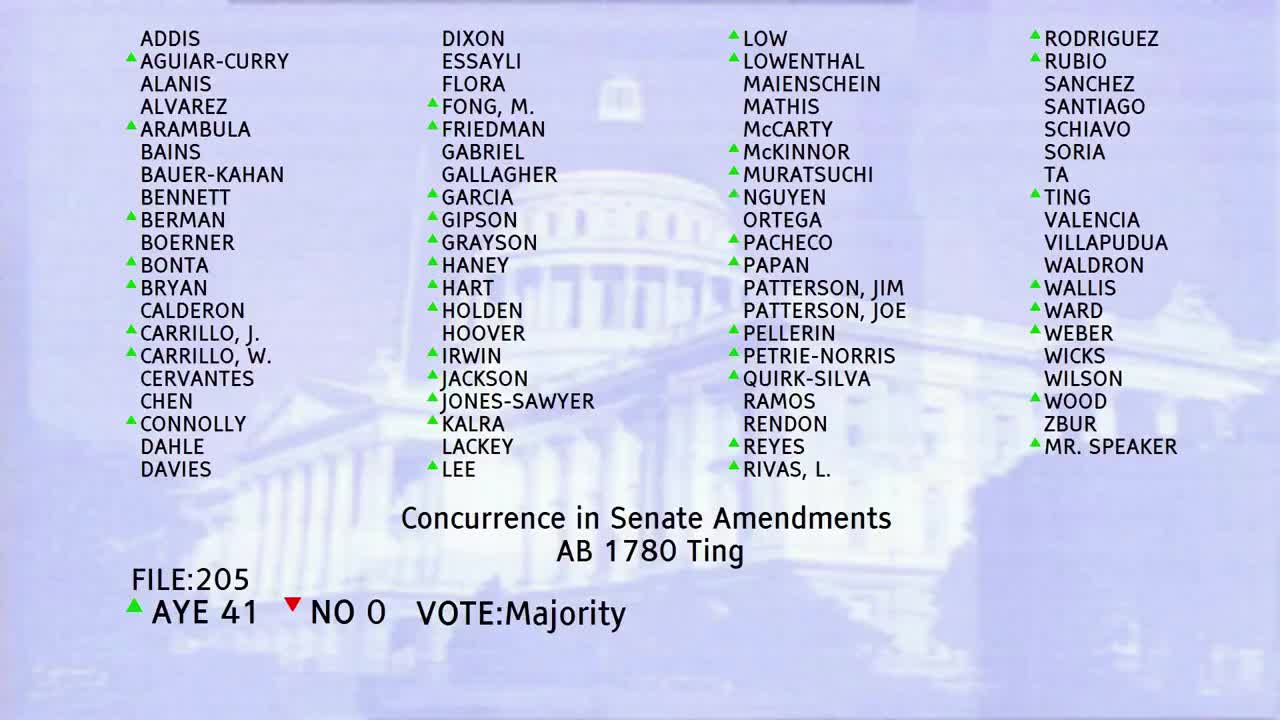 37MIN
Assembly Floor
 25MIN
Senate Floor
 9MIN
Senate Standing Committee on Judiciary
 16MIN
Senate Standing Committee on Housing
 2MIN
Assembly Floor
 13MIN
Assembly Standing Committee on Housing and Community Development
Bill Author

Bill Co-Author(s):