AB 1871: Adopted course of study for grades 7 to 12: social sciences: personal financial literacy.
- Session Year: 2023-2024
- House: Assembly
- Latest Version Date: 2024-09-28
Current Status:
Passed
(2024-09-28: Chaptered by Secretary of State - Chapter 810, Statutes of 2024.)
Introduced
In Committee
First Chamber
In Committee
Second Chamber
Enacted
Existing law requires the adopted course of study for grades 7 to 12, inclusive, to offer courses in specified areas of study, including, among others, social sciences, drawing upon the disciplines of anthropology, economics, geography, history, political science, psychology, and sociology, designed to fit the maturity of the pupils. Existing law requires social science instruction to include, among other things, instruction that provides a foundation for understanding the development of the American economic system, including the role of the entrepreneur and labor.
This bill, with respect to the adopted course of study for grades 7 to 12, inclusive, would require the social sciences area of study to also include instruction on personal financial literacy, as provided. By imposing additional duties on school officials, the bill would impose a state-mandated local program.
This bill would incorporate additional changes to Section 51220 of the Education Code proposed by AB 1821 to be operative only if this bill and AB 1821 are enacted and this bill is enacted last.
The California Constitution requires the state to reimburse local agencies and school districts for certain costs mandated by the state. Statutory provisions establish procedures for making that reimbursement.
This bill would provide that, if the Commission on State Mandates determines that the bill contains costs mandated by the state, reimbursement for those costs shall be made pursuant to the statutory provisions noted above.
Existing law requires the adopted course of study for grades 7 to 12, inclusive, to offer courses in specified areas of study, including, among others, (1) social sciences, drawing upon the disciplines of anthropology, economics, geography, history, political science, psychology, and sociology, designed to fit the maturity of the pupils, and (2) career technical education designed and conducted for the purpose of preparing youth for gainful employment in the occupations and in the numbers that are appropriate to the personnel needs of the state and the community served, and relevant to the career desires and needs of the pupils. Existing law requires social science instruction to include, among other things, instruction that provides a foundation for understanding the development of the American economic system, including the role of the entrepreneur and labor.
This bill, with respect to the adopted course of study for grades 7 to 12, inclusive, would require the social sciences and career technical education areas area of study to also include instruction on personal financial literacy, as provided. By imposing additional duties on school officials, the bill would impose a state-mandated local program.
The California Constitution requires the state to reimburse local agencies and school districts for certain costs mandated by the state. Statutory provisions establish procedures for making that reimbursement.
This bill would provide that, if the Commission on State Mandates determines that the bill contains costs mandated by the state, reimbursement for those costs shall be made pursuant to the statutory provisions noted above.
Existing law requires the adopted course of study for grades 7 to 12, inclusive, to offer courses in specified areas of study, including, among others, (1) social sciences, drawing upon the disciplines of anthropology, economics, geography, history, political science, psychology, and sociology, designed to fit the maturity of the pupils, and (2) career technical education designed and conducted for the purpose of preparing youth for gainful employment in the occupations and in the numbers that are appropriate to the personnel needs of the state and the community served, and relevant to the career desires and needs of the pupils. Existing law requires social science instruction to include, among other things, instruction that provides a foundation for understanding the development of the American economic system, including the role of the entrepreneur and labor.
This bill, with respect to the adopted course of study for grades 7 to 12, would require the social sciences and career technical education areas of study to also include instruction on personal financial literacy, as provided. By imposing additional duties on school officials, the bill would impose a state-mandated local program.
The California Constitution requires the state to reimburse local agencies and school districts for certain costs mandated by the state. Statutory provisions establish procedures for making that reimbursement.
This bill would provide that, if the Commission on State Mandates determines that the bill contains costs mandated by the state, reimbursement for those costs shall be made pursuant to the statutory provisions noted above.
The adopted course of study for grades 7 to 12, inclusive, shall offer courses in the following areas of study:
(a)English, including knowledge of and appreciation for literature, language, and composition, and the skills of reading, listening, and speaking.
(b)(1)Social sciences, drawing upon the disciplines of anthropology, economics, geography, history, political science, psychology, and sociology, designed to fit the maturity of the pupils. Instruction shall provide a foundation for understanding the history, resources, development, and government of California and the United States of America; instruction in our American legal system, the operation of the juvenile and adult criminal justice systems, and the rights and duties of citizens under the criminal and civil law and the State and Federal Constitutions; the development of the American economic system, including the role of the entrepreneur and labor; personal financial literacy; the relations of persons to their human and natural environment; eastern and western cultures and civilizations; human rights issues, with particular attention to the study of the inhumanity of genocide, slavery, and the Holocaust; and contemporary issues.
(2)For purposes of this subdivision, genocide may include the Armenian Genocide. The Armenian Genocide means the torture, starvation, and murder of 1,500,000 Armenians, which included death marches into the Syrian desert, by the rulers of the Ottoman Turkish Empire and the exile of more than 500,000 innocent people during the period from 1915 to 1923, inclusive.
(c)World language or languages, beginning not later than grade 7, designed to develop a facility for understanding, speaking, reading, and writing the particular language.
(d)Physical education, with emphasis given to physical activities that are conducive to health and to vigor of body and mind, as required by Section 51222.
(e)Science, including the physical and biological aspects, with emphasis on basic concepts, theories, and processes of scientific investigation, on the place of humans in ecological systems, on the causes and effects of climate change, on the methods to mitigate and adapt to climate change, and with appropriate applications of the interrelation and interdependence of the sciences. Appropriate coursework including material on the causes and effects of climate change and methods to mitigate and adapt to climate change shall be offered to pupils as soon as possible, commencing no later than the 202425 school year.
(f)Mathematics, including instruction designed to develop mathematical understandings, operational skills, and insight into problem solving procedures.
(g)Visual and performing arts, including dance, music, theater, and visual arts, with emphasis upon development of aesthetic appreciation and the skills of creative expression.
(h)Applied arts, including instruction in the areas of consumer education, family and consumer sciences education, industrial arts, general business education, or general agriculture.
(i)Career technical education designed and conducted for the purpose of preparing youth for gainful employment in the occupations and in the numbers that are appropriate to the personnel needs of the state and the community served and relevant to the career desires and needs of the pupils.
(j)Automobile driver education, designed to develop a knowledge of the Vehicle Code and other laws of this state relating to the operation of motor vehicles, a proper acceptance of personal responsibility in traffic, a true appreciation of the causes, seriousness, and consequences of traffic accidents, and the knowledge and attitudes necessary for the safe operation of motor vehicles. A course in automobile driver education shall include education in the safe operation of motorcycles.
(k)Other studies that the governing board may prescribe.
SEC. 1.5.Section 51220 of the Education Code is amended to read:51220.The adopted course of study for grades 7 to 12, inclusive, shall offer courses in the following areas of study:
(a)English, including knowledge of and appreciation for literature, language, and composition, and the skills of reading, listening, and speaking.
(b)(1)Social sciences, drawing upon the disciplines of anthropology, economics, geography, history, political science, psychology, and sociology, designed to fit the maturity of the pupils. Instruction shall provide a foundation for understanding the history, resources, development, and government of California and the United States of America; instruction in our American legal system, the operation of the juvenile and adult criminal justice systems, and the rights and duties of citizens under the criminal and civil law and the State and Federal Constitutions; the development of the American economic system, including the role of the entrepreneur and labor; personal financial literacy; the relations of persons to their human and natural environment; eastern and western cultures and civilizations; human rights issues, with particular attention to the study of the inhumanity of genocide, slavery, and the Holocaust, and, to the extent instruction is provided on the Spanish colonization of California or the Gold Rush Era, the treatment and perspectives of Native Americans during those periods; and contemporary issues.
(2)For purposes of this subdivision, genocide may include the Armenian Genocide. The Armenian Genocide means the torture, starvation, and murder of 1,500,000 Armenians, which included death marches into the Syrian desert, by the rulers of the Ottoman Turkish Empire and the exile of more than 500,000 innocent people during the period from 1915 to 1923, inclusive.
(c)World language or languages, beginning not later than grade 7, designed to develop a facility for understanding, speaking, reading, and writing the particular language.
(d)Physical education, with emphasis given to physical activities that are conducive to health and to vigor of body and mind, as required by Section 51222.
(e)Science, including the physical and biological aspects, with emphasis on basic concepts, theories, and processes of scientific investigation, on the place of humans in ecological systems, on the causes and effects of climate change, on the methods to mitigate and adapt to climate change, and with appropriate applications of the interrelation and interdependence of the sciences. Appropriate coursework including material on the causes and effects of climate change and methods to mitigate and adapt to climate change shall be offered to pupils as soon as possible, commencing no later than the 202425 school year.
(f)Mathematics, including instruction designed to develop mathematical understandings, operational skills, and insight into problem solving procedures.
(g)Visual and performing arts, including dance, music, theater, and visual arts, with emphasis upon development of aesthetic appreciation and the skills of creative expression.
(h)Applied arts, including instruction in the areas of consumer education, family and consumer sciences education, industrial arts, general business education, or general agriculture.
(i)Career technical education designed and conducted for the purpose of preparing youth for gainful employment in the occupations and in the numbers that are appropriate to the personnel needs of the state and the community served and relevant to the career desires and needs of the pupils.
(j)Automobile driver education, designed to develop a knowledge of the Vehicle Code and other laws of this state relating to the operation of motor vehicles, a proper acceptance of personal responsibility in traffic, a true appreciation of the causes, seriousness, and consequences of traffic accidents, and the knowledge and attitudes necessary for the safe operation of motor vehicles. A course in automobile driver education shall include education in the safe operation of motorcycles.
(k)Other studies that the governing board may prescribe.
SEC. 2.Section 1.5 of this bill incorporates amendments to Section 51220 of the Education Code proposed by both this bill and Assembly Bill 1821. That section of this bill shall only become operative if (1) both bills are enacted and become effective on or before January 1, 2025, (2) each bill amends Section 51220 of the Education Code, and (3) this bill is enacted after Assembly Bill 1821, in which case Section 1 of this bill shall not become operative.
SEC. 3.If the Commission on State Mandates determines that this act contains costs mandated by the state, reimbursement to local agencies and school districts for those costs shall be made pursuant to Part 7 (commencing with Section 17500) of Division 4 of Title 2 of the Government Code.
The adopted course of study for grades 7 to 12, inclusive, shall offer courses in the following areas of study:
(a)English, including knowledge of and appreciation for literature, language, and composition, and the skills of reading, listening, and speaking.
(b)(1)Social sciences, drawing upon the disciplines of anthropology, economics, geography, history, political science, psychology, and sociology, designed to fit the maturity of the pupils. Instruction shall provide a foundation for understanding the history, resources, development, and government of California and the United States of America; instruction in our American legal system, the operation of the juvenile and adult criminal justice systems, and the rights and duties of citizens under the criminal and civil law and the State and Federal Constitutions; the development of the American economic system, including the role of the entrepreneur and labor; personal financial literacy; the relations of persons to their human and natural environment; eastern and western cultures and civilizations; human rights issues, with particular attention to the study of the inhumanity of genocide, slavery, and the Holocaust; and contemporary issues.
(2)For purposes of this subdivision, genocide may include the Armenian Genocide. The Armenian Genocide means the torture, starvation, and murder of 1,500,000 Armenians, which included death marches into the Syrian desert, by the rulers of the Ottoman Turkish Empire and the exile of more than 500,000 innocent people during the period from 1915 to 1923, inclusive.
(c)World language or languages, beginning not later than grade 7, designed to develop a facility for understanding, speaking, reading, and writing the particular language.
(d)Physical education, with emphasis given to physical activities that are conducive to health and to vigor of body and mind, as required by Section 51222.
(e)Science, including the physical and biological aspects, with emphasis on basic concepts, theories, and processes of scientific investigation, on the place of humans in ecological systems, on the causes and effects of climate change, on the methods to mitigate and adapt to climate change, and with appropriate applications of the interrelation and interdependence of the sciences. Appropriate coursework including material on the causes and effects of climate change and methods to mitigate and adapt to climate change shall be offered to pupils as soon as possible, commencing no later than the 202425 school year.
(f)Mathematics, including instruction designed to develop mathematical understandings, operational skills, and insight into problem solving procedures.
(g)Visual and performing arts, including dance, music, theater, and visual arts, with emphasis upon development of aesthetic appreciation and the skills of creative expression.
(h)Applied arts, including instruction in the areas of consumer education, family and consumer sciences education, industrial arts, general business education, or general agriculture.
(i)Career technical education designed and conducted for the purpose of preparing youth for gainful employment in the occupations and in the numbers that are appropriate to the personnel needs of the state and the community served and relevant to the career desires and needs of the pupils.
(j)Automobile driver education, designed to develop a knowledge of the Vehicle Code and other laws of this state relating to the operation of motor vehicles, a proper acceptance of personal responsibility in traffic, a true appreciation of the causes, seriousness, and consequences of traffic accidents, and the knowledge and attitudes necessary for the safe operation of motor vehicles. A course in automobile driver education shall include education in the safe operation of motorcycles.
(k)Other studies that the governing board may prescribe.
SEC. 1.5.Section 51220 of the Education Code is amended to read:51220.The adopted course of study for grades 7 to 12, inclusive, shall offer courses in the following areas of study:
(a)English, including knowledge of and appreciation for literature, language, and composition, and the skills of reading, listening, and speaking.
(b)(1)Social sciences, drawing upon the disciplines of anthropology, economics, geography, history, political science, psychology, and sociology, designed to fit the maturity of the pupils. Instruction shall provide a foundation for understanding the history, resources, development, and government of California and the United States of America; instruction in our American legal system, the operation of the juvenile and adult criminal justice systems, and the rights and duties of citizens under the criminal and civil law and the State and Federal Constitutions; the development of the American economic system, including the role of the entrepreneur and labor; personal financial literacy; the relations of persons to their human and natural environment; eastern and western cultures and civilizations; human rights issues, with particular attention to the study of the inhumanity of genocide, slavery, and the Holocaust; Holocaust, and, to the extent instruction is provided on the Spanish colonization of California or the Gold Rush Era, the treatment and perspectives of Native Americans during those periods; and contemporary issues.
(2)For purposes of this subdivision, genocide may include the Armenian Genocide. The Armenian Genocide means the torture, starvation, and murder of 1,500,000 Armenians, which included death marches into the Syrian desert, by the rulers of the Ottoman Turkish Empire and the exile of more than 500,000 innocent people during the period from 1915 to 1923, inclusive.
(c)World language or languages, beginning not later than grade 7, designed to develop a facility for understanding, speaking, reading, and writing the particular language.
(d)Physical education, with emphasis given to physical activities that are conducive to health and to vigor of body and mind, as required by Section 51222.
(e)Science, including the physical and biological aspects, with emphasis on basic concepts, theories, and processes of scientific investigation, on the place of humans in ecological systems, on the causes and effects of climate change, on the methods to mitigate and adapt to climate change, and with appropriate applications of the interrelation and interdependence of the sciences. Appropriate coursework including material on the causes and effects of climate change and methods to mitigate and adapt to climate change shall be offered to pupils as soon as possible, commencing no later than the 202425 school year.
(f)Mathematics, including instruction designed to develop mathematical understandings, operational skills, and insight into problem solving procedures.
(g)Visual and performing arts, including dance, music, theater, and visual arts, with emphasis upon development of aesthetic appreciation and the skills of creative expression.
(h)Applied arts, including instruction in the areas of consumer education, family and consumer sciences education, industrial arts, general business education, or general agriculture.
(i)Career technical education designed and conducted for the purpose of preparing youth for gainful employment in the occupations and in the numbers that are appropriate to the personnel needs of the state and the community served and relevant to the career desires and needs of the pupils.
(j)Automobile driver education, designed to develop a knowledge of the Vehicle Code and other laws of this state relating to the operation of motor vehicles, a proper acceptance of personal responsibility in traffic, a true appreciation of the causes, seriousness, and consequences of traffic accidents, and the knowledge and attitudes necessary for the safe operation of motor vehicles. A course in automobile driver education shall include education in the safe operation of motorcycles.
(k)Other studies that the governing board may prescribe.
SEC. 2.Section 1.5 of this bill incorporates amendments to Section 51220 of the Education Code proposed by both this bill and Assembly Bill 1821. That section of this bill shall only become operative if (1) both bills are enacted and become effective on or before January 1, 2025, (2) each bill amends Section 51220 of the Education Code, and (3) this bill is enacted after Assembly Bill 1821, in which case Section 1 of this bill shall not become operative.
SEC. 2.SEC. 3.If the Commission on State Mandates determines that this act contains costs mandated by the state, reimbursement to local agencies and school districts for those costs shall be made pursuant to Part 7 (commencing with Section 17500) of Division 4 of Title 2 of the Government Code.
The adopted course of study for grades 7 to 12, inclusive, shall offer courses in the following areas of study:
(a)English, including knowledge of and appreciation for literature, language, and composition, and the skills of reading, listening, and speaking.
(b)(1)Social sciences, drawing upon the disciplines of anthropology, economics, geography, history, political science, psychology, and sociology, designed to fit the maturity of the pupils. Instruction shall provide a foundation for understanding the history, resources, development, and government of California and the United States of America; instruction in our American legal system, the operation of the juvenile and adult criminal justice systems, and the rights and duties of citizens under the criminal and civil law and the State and Federal Constitutions; the development of the American economic system, including the role of the entrepreneur and labor; personal financial literacy; the relations of persons to their human and natural environment; eastern and western cultures and civilizations; human rights issues, with particular attention to the study of the inhumanity of genocide, slavery, and the Holocaust; and contemporary issues.
(2)For purposes of this subdivision, genocide may include the Armenian Genocide. The Armenian Genocide means the torture, starvation, and murder of 1,500,000 Armenians, which included death marches into the Syrian desert, by the rulers of the Ottoman Turkish Empire and the exile of more than 500,000 innocent people during the period from 1915 to 1923, inclusive.
(c)World language or languages, beginning not later than grade 7, designed to develop a facility for understanding, speaking, reading, and writing the particular language.
(d)Physical education, with emphasis given to physical activities that are conducive to health and to vigor of body and mind, as required by Section 51222.
(e)Science, including the physical and biological aspects, with emphasis on basic concepts, theories, and processes of scientific investigation, on the place of humans in ecological systems, on the causes and effects of climate change, on the methods to mitigate and adapt to climate change, and with appropriate applications of the interrelation and interdependence of the sciences. Appropriate coursework including material on the causes and effects of climate change and methods to mitigate and adapt to climate change shall be offered to pupils as soon as possible, commencing no later than the 202425 school year.
(f)Mathematics, including instruction designed to develop mathematical understandings, operational skills, and insight into problem solving procedures.
(g)Visual and performing arts, including dance, music, theater, and visual arts, with emphasis upon development of aesthetic appreciation and the skills of creative expression.
(h)Applied arts, including instruction in the areas of consumer education, family and consumer sciences education, industrial arts, general business education, or general agriculture.
(i)Career technical education designed and conducted for the purpose of preparing youth for gainful employment in the occupations and in the numbers that are appropriate to the personnel needs of the state and the community served and relevant to the career desires and needs of the pupils, including, but not limited to, their personal financial literacy. pupils.
(j)Automobile driver education, designed to develop a knowledge of the Vehicle Code and other laws of this state relating to the operation of motor vehicles, a proper acceptance of personal responsibility in traffic, a true appreciation of the causes, seriousness, and consequences of traffic accidents, and the knowledge and attitudes necessary for the safe operation of motor vehicles. A course in automobile driver education shall include education in the safe operation of motorcycles.
(k)Other studies that the governing board may prescribe.
SEC. 2.If the Commission on State Mandates determines that this act contains costs mandated by the state, reimbursement to local agencies and school districts for those costs shall be made pursuant to Part 7 (commencing with Section 17500) of Division 4 of Title 2 of the Government Code.
REVISIONS: HeadingLine 2.The adopted course of study for grades 7 to 12, inclusive, shall offer courses in the following areas of study:
(a)English, including knowledge of and appreciation for literature, language, and composition, and the skills of reading, listening, and speaking.
(b)(1)Social sciences, drawing upon the disciplines of anthropology, economics, geography, history, political science, psychology, and sociology, designed to fit the maturity of the pupils. Instruction shall provide a foundation for understanding the history, resources, development, and government of California and the United States of America; instruction in our American legal system, the operation of the juvenile and adult criminal justice systems, and the rights and duties of citizens under the criminal and civil law and the State and Federal Constitutions; the development of the American economic system, including the role of the entrepreneur and labor; personal financial literacy; the relations of persons to their human and natural environment; eastern and western cultures and civilizations; human rights issues, with particular attention to the study of the inhumanity of genocide, slavery, and the Holocaust; and contemporary issues.
(2)For purposes of this subdivision, genocide may include the Armenian Genocide. The Armenian Genocide means the torture, starvation, and murder of 1,500,000 Armenians, which included death marches into the Syrian desert, by the rulers of the Ottoman Turkish Empire and the exile of more than 500,000 innocent people during the period from 1915 to 1923, inclusive.
(c)World language or languages, beginning not later than grade 7, designed to develop a facility for understanding, speaking, reading, and writing the particular language.
(d)Physical education, with emphasis given to physical activities that are conducive to health and to vigor of body and mind, as required by Section 51222.
(e)Science, including the physical and biological aspects, with emphasis on basic concepts, theories, and processes of scientific investigation, on the place of humans in ecological systems, on the causes and effects of climate change, on the methods to mitigate and adapt to climate change, and with appropriate applications of the interrelation and interdependence of the sciences. Appropriate coursework including material on the causes and effects of climate change and methods to mitigate and adapt to climate change shall be offered to pupils as soon as possible, commencing no later than the 202425 school year.
(f)Mathematics, including instruction designed to develop mathematical understandings, operational skills, and insight into problem solving procedures.
(g)Visual and performing arts, including dance, music, theater, and visual arts, with emphasis upon development of aesthetic appreciation and the skills of creative expression.
(h)Applied arts, including instruction in the areas of consumer education, family and consumer sciences education, industrial arts, general business education, or general agriculture.
(i)Career technical education designed and conducted for the purpose of preparing youth for gainful employment in the occupations and in the numbers that are appropriate to the personnel needs of the state and the community served and relevant to the career desires and needs of the pupils. pupils, including, but not limited to, their personal financial literacy.
(j)Automobile driver education, designed to develop a knowledge of the Vehicle Code and other laws of this state relating to the operation of motor vehicles, a proper acceptance of personal responsibility in traffic, a true appreciation of the causes, seriousness, and consequences of traffic accidents, and the knowledge and attitudes necessary for the safe operation of motor vehicles. A course in automobile driver education shall include education in the safe operation of motorcycles.
(k)Other studies that the governing board may prescribe.
SEC. 2.If the Commission on State Mandates determines that this act contains costs mandated by the state, reimbursement to local agencies and school districts for those costs shall be made pursuant to Part 7 (commencing with Section 17500) of Division 4 of Title 2 of the Government Code.
|
Date
|
Status
|
|---|---|
| Sep 28, 2024 | Chaptered by Secretary of State - Chapter 810, Statutes of 2024. |
| Sep 28, 2024 | Approved by the Governor. |
| Sep 11, 2024 | Enrolled and presented to the Governor at 4 p.m. |
| Aug 30, 2024 | In Assembly. Concurrence in Senate amendments pending. |
| Aug 30, 2024 | Senate amendments concurred in. To Engrossing and Enrolling. (Ayes 77. Noes 0.). |
| Aug 29, 2024 | Read third time. Passed. Ordered to the Assembly. (Ayes 40. Noes 0.). |
| Aug 26, 2024 | Read second time. Ordered to third reading. |
| Aug 22, 2024 | Read third time and amended. Ordered to second reading. |
| Aug 22, 2024 | Ordered to third reading. |
| Aug 22, 2024 | Action rescinded whereby the bill was read third time, passed, and to Assembly. |
| Jun 17, 2024 | In Senate. Held at Desk. |
| Jun 17, 2024 | Ordered to the Senate. |
| Jun 17, 2024 | Withdrawn from Engrossing and Enrolling. |
| Jun 13, 2024 | In Assembly. Ordered to Engrossing and Enrolling. |
| Jun 13, 2024 | Read third time. Passed. Ordered to the Assembly. (Ayes 37. Noes 0. Page 4490.). |
| Jun 11, 2024 | Read second time. Ordered to Consent Calendar. |
| Jun 10, 2024 | From committee: Be ordered to second reading file pursuant to Senate Rule 28.8 and ordered to Consent Calendar. |
| May 29, 2024 | From committee: Do pass and re-refer to Com. on APPR with recommendation: To Consent Calendar. (Ayes 7. Noes 0.) (May 29). Re-referred to Com. on APPR. |
| May 8, 2024 | Referred to Com. on ED. |
| Apr 25, 2024 | In Senate. Read first time. To Com. on RLS. for assignment. |
| Apr 25, 2024 | Read third time. Passed. Ordered to the Senate. (Ayes 75. Noes 0. Page 4996.) |
| Apr 18, 2024 | Read second time. Ordered to Consent Calendar. |
| Apr 17, 2024 | From committee: Do pass. To Consent Calendar. (Ayes 15. Noes 0.) (April 17). |
| Apr 17, 2024 | Coauthors revised. |
| Apr 2, 2024 | Re-referred to Com. on APPR. |
| Apr 1, 2024 | Read second time and amended. |
| Mar 21, 2024 | From committee: Amend, and do pass as amended and re-refer to Com. on APPR. with recommendation: To Consent Calendar. (Ayes 7. Noes 0.) (March 20). |
| Feb 5, 2024 | Referred to Com. on ED. |
| Jan 23, 2024 | From printer. May be heard in committee February 22. |
| Jan 22, 2024 | Read first time. To print. |
|
Date
|
Description
|
Location
|
Votes
|
|
|---|---|---|---|---|
| Aug 30, 2024 | AB 1871 Alanis Concurrence in Senate Amendments | Assembly Floor |
Passed |
|
| Aug 29, 2024 | Assembly 3rd Reading AB1871 Alanis et al. By Seyarto | Senate Floor |
Passed |
|
| Jun 13, 2024 | Consent Calendar 2nd AB1871 Alanis et al. | Senate Floor |
Passed |
|
| May 29, 2024 | Do pass, but first be re-referred to the Committee on [Appropriations] with the recommendation: To Consent Calendar | Senate Standing Committee on Education |
Passed |
|
| Apr 25, 2024 | AB 1871 Alanis Consent Calendar Second Day Regular Session | Assembly Floor |
Passed |
|
| Apr 17, 2024 | Do pass. To Consent Calendar. | Assembly Standing Committee on Appropriations |
Passed |
|
| Mar 20, 2024 | Do pass as amended, and be re-referred to the Committee on [Appropriations] with recommendation: To Consent Calendar | Assembly Standing Committee on Education |
Passed |
This list shows positions taken on this bill by organizations on the date displayed, which is linked to the original source.
Positions by individuals are not included.
|
Organization
|
Position
|
Date
|
|---|---|---|
| America First Policy Institute - California | ** Support | |
| American Council Of Life Insurers | ** Support | |
| Association Of California Life & Health Insurance Companies | ** Support | |
| California Association Of School Business Officials | ** Support | |
| California Bankers Association | ** Support | |
| California Community Banking Network | ** Support | |
| California Credit Union League | ** Support | |
| California Mortgage Bankers Association | ** Support | |
| Electronic Transactions Association | ** Support | |
| Financial Planning Association | ** Support | |
| Generation Up | ** Support | |
| Independent Insurance Agents & Brokers of California, Inc. | ** Support | |
| National Association Of Insurance And Financial Advisors - California | ** Support | |
| Perk Advocacy | ** Support | |
| The Academy of Financial Education | ** Support |
CONCURRENCE IN SENATE AMENDMENTS
CSA1 Bill Id:AB 1871
Author:(Alanis)
As Amended Ver:August 22, 2024
Majority vote
SUMMARY
Adds personal financial literacy for the course of study in social sciences for grades 7 through 12.
Senate Amendments
Add language to avoid conflicts with AB 1821 and 1805.
COMMENTS
"We have long noted with dismay that students who take a high school course in personal finance tend to do no better on our exam than those who do not." Research on the impact of high school financial literacy instruction shows limited impact on knowledge and behavior. Numerous sources of data suggest that many American adults lack the understanding needed to make sound financial decisions (Milken Institute, 2021) and that adult financial knowledge is related to their financial behavior (Hilgert, 2003). Survey data also show that high school students have poor understanding of personal finance, with students from families with greater financial resources substantially more financially literate than those from families that are less well-off. (Mandell, 2008).
Financial literacy is viewed as particularly important given the complexity of financial products and services, and the increased responsibility of individuals for their own financial security, after the deregulation of the financial services industry. (Greenspan, 2005)
Over the years, authors of numerous bills before the Committee (see related legislation) have used these findings to propose increasing financial literacy instruction in high school as a solution to this problem. They have argued that financial literacy instruction in high school will improve financial knowledge and subsequently improve financial behavior in adulthood.
However, research on the relationship between high school financial literacy instruction and financial knowledge and behavior after high school is decidedly mixed and mostly negative. Some of the available evidence includes the following findings:
- One study found that after several years, students who took a financial literacy course were no more financially literate than those who did not. Young adults who took the course did not consider themselves to be more savings-oriented, and did not report better financial behavior, than those who did not take the course. (Mandell, 2009)
- One study found that financial literacy mandates do not significantly affect saving behavior. (Cole, 2008)
- One report on the results of a popular financial literacy curriculum found that students who had taken a high school class in personal finance or money management were no more financially literate than those who had not. (Mandell, 2006).
- Research published as a TIAA brief found no definitive increases in account ownership, non-retirement investment accounts, or homeownership among students who took a financial literacy course. (Harvey, 2022)
- One study found that financial literacy education decreases reliance on nonstudent debt and improves repayment behavior, but that these effects tend to fade out with age. (Brown, 2016)
- One study found short-term (3 month) benefits in financial knowledge, behavior, and self-efficacy among students after studying a financial literacy curriculum. (Danes, 1999)
- One study found that financial education mandates reduced the likelihood and frequency of the use of payday loans (Harvey, 2019).
- One study found increased credit scores and decreased delinquencies among students subject to a financial literacy course requirement. (Urban, 2018)
- One study found increases in aid applications and federal loans and a decrease in private loans and the likelihood of holding credit card balances among students who had experienced financial literacy instruction. (Stoddard, 2020)
One author concludes that, "We have long noted with dismay that students who take a high school course in personal finance tend to do no better on our exam than those who do not. This finding has been a great disappointment to consumer educators and to those who support efforts to make courses in personal finance a requirement for high school graduation, and it points to the need for better materials and teacher training." (Mandell, 2006).
According to the Author
"AB 1871 aims to strengthen our future generations by creating opportunities for students to learn about personal finance as it relates to the American economic system before they become financially independent young adults. Adding a financial literacy component to social science-based curriculum will help teach minors about saving, budgeting, investing, debt, retirement planning, and more before they become financially independent adults. With AB 1871, students will have additional pathways to learn knowledge that is vital to their futures."
Arguments in Support
The Association of California Life and Health Insurance Companies writes, "ACLHIC is a state trade association representing many of the largest life and health insurers doing business in California. ACLI advocates on behalf of these 280 member companies whose products and services help 90 million American families achieve financial security. NAIFA-California represents licensed insurance and financial professionals throughout the state. IIABCal represents independent insurance agents and brokers, who customarily specialize in personal and commercial property and liability policies, and who have the ability to place coverage with a variety of competing insurers. Collectively, our associations protect clients against life's inherent risks, help hard-working Americans prepare for retirement, and create financial security and prosperity so clients can leave a legacy for future generations. We recognize that financial literacy is the foundation to achieve financial security. As such, our members strongly support efforts to enhance access to financial education and we understand the importance and value of financial literacy to future generations."
Arguments in Opposition
None on file
FISCAL COMMENTS
According to the Senate Appropriations Committee, pursuant to Senate Rule 28.58, negligible state costs.
VOTES:
ASM EDUCATION: 7-0-0
YES: Muratsuchi, Addis, Alvarez, Bonta, Flora, Hoover, McCarty
ASM APPROPRIATIONS: 15-0-0
YES: Wicks, Sanchez, Arambula, Bryan, Calderon, Wendy Carrillo, Dixon, Mike Fong, Grayson, Haney, Hart, Jim Patterson, Pellerin, Ta, Villapudua
ASSEMBLY FLOOR: 75-0-5
YES: Addis, Aguiar-Curry, Alanis, Alvarez, Arambula, Bains, Bauer-Kahan, Bennett, Berman, Bonta, Bryan, Calderon, Juan Carrillo, Wendy Carrillo, Cervantes, Chen, Connolly, Davies, Dixon, Essayli, Flora, Mike Fong, Vince Fong, Friedman, Gabriel, Garcia, Gipson, Grayson, Haney, Holden, Hoover, Irwin, Jackson, Jones-Sawyer, Kalra, Lackey, Lee, Low, Lowenthal, Maienschein, McCarty, McKinnor, Muratsuchi, Stephanie Nguyen, Ortega, Pacheco, Papan, Jim Patterson, Joe Patterson, Pellerin, Petrie-Norris, Quirk-Silva, Ramos, Rendon, Reyes, Luz Rivas, Rodriguez, Blanca Rubio, Sanchez, Santiago, Schiavo, Soria, Ta, Ting, Valencia, Villapudua, Waldron, Wallis, Ward, Weber, Wicks, Wilson, Wood, Zbur, Robert Rivas
ABS, ABST OR NV: Boerner, Megan Dahle, Gallagher, Hart, Mathis
SENATE FLOOR: 40-0-0
YES: Allen, Alvarado-Gil, Archuleta, Ashby, Atkins, Becker, Blakespear, Bradford, Caballero, Cortese, Dahle, Dodd, Durazo, Eggman, Glazer, Gonzalez, Grove, Hurtado, Jones, Laird, Limón, McGuire, Menjivar, Min, Newman, Nguyen, Niello, Ochoa Bogh, Padilla, Portantino, Roth, Rubio, Seyarto, Skinner, Smallwood-Cuevas, Stern, Umberg, Wahab, Wiener, Wilk
SENATE FLOOR: 37-0-3
YES: Allen, Archuleta, Ashby, Atkins, Becker, Blakespear, Bradford, Caballero, Cortese, Dahle, Dodd, Durazo, Eggman, Glazer, Gonzalez, Grove, Hurtado, Jones, Laird, McGuire, Menjivar, Min, Newman, Nguyen, Niello, Ochoa Bogh, Padilla, Portantino, Roth, Rubio, Seyarto, Skinner, Smallwood-Cuevas, Umberg, Wahab, Wiener, Wilk
ABS, ABST OR NV: Alvarado-Gil, Limón, Stern
UPDATED
VERSION: August 22, 2024
CONSULTANT: Tanya Lieberman / ED. / (916) 319-2087 FN: 0004907
SENATE RULES COMMITTEE Office of Senate Floor Analyses (916) 651-1520 Fax: (916) 327-4478 | AB 1871 |
THIRD READING
Bill No: AB 1871
Author: Alanis (R), et al.
Amended: 8/22/24 in Senate
Vote: 21
PRIOR SENATE FLOOR VOTES NOT RELEVANT
SENATE EDUCATION COMMITTEE: 7-0, 5/29/24
AYES: Newman, Ochoa Bogh, Cortese, Glazer, Gonzalez, Smallwood-Cuevas, Wilk
SENATE APPROPRIATIONS COMMITTEE: Senate Rule 28.8
ASSEMBLY FLOOR: 75-0, 4/25/24 (Consent) - See last page for vote
SUBJECT: Adopted course of study for grades 7 to 12: social sciences: personal financial literacy
SOURCE: Author
DIGEST:
This bill includes personal finance within the history-social sciences (H-SS) area of study within the adopted course of study for grades 7 to 12.
Senate Floor Amendments of 8/22/24 for the purposes of chaptering, this bill incorporates the provision of AB 1821 (Ramos, 2024).
ANALYSIS:
Existing law:
- Requires that, when the H-SS Framework is revised after January 1, 2017, the Instructional Quality Commission (IQC) consider including content on financial literacy at least twice in three grade spans (Kindergarten through grade 5, grades 6-8, and grades 9-12), instruction on the following:
a) Fundamentals of banking for personal use, including, but not limited to, savings and checking.
b) Principles of budgeting and personal finance.
c) Employment and understanding factors that affect net income.
d) Uses and costs of credit, including the relation of debt and interest to credit.
e) Uses and costs of loans, including student loans.
f) Types and costs of insurance.
g) Forms of governmental taxation.
h) Principles of investing and building wealth.
i) Identity theft and security.
j) Planning and paying for postsecondary education.
k) Charitable giving. (Education Code (EC) § 51284.5)
- Requires the IQC, during but not before the next revision of textbooks or curriculum frameworks in the social sciences, health, and mathematics curricula, the State Board of Education (SBE) to ensure that these academic areas integrate components of human growth, human development, and human contribution to society, across the life course, and also financial literacy, including, but not limited to, budgeting and managing credit, student loans, consumer debt, and identity theft security. (EC § 51284)
- Requires that, as a condition of graduating from high school, of the three courses in social studies, two must be year-long courses in United States History and Geography, and in World History, culture, and Geography, and that the remaining two are a one-semester courses in American government and civics, and a one-semester course in economics. (EC § 51225.3)
- Requires the Superintendent of Public Instruction (SPI), with the approval of the SBE, to plan and develop a one-semester course entitled Consumer Economics, which includes instruction on the uses and costs of credit, for use in schools maintaining any grades seventh to twelfth grades. (EC § 51833)
This bill includes personal finance within the social sciences area of study within the adopted course of study for grades 7 to 12.
Comments
- Need for the bill. According to the author, “AB 1871 aims to strengthen our future generations by creating opportunities for students to learn about personal finance as it relates to the American economic system before they become financially independent young adults. Adding a financial literacy component to social science-based curriculum will help teach minors about saving, budgeting, investing, debt, retirement planning, and more before they become financially independent adults. With AB 1871, students will have additional pathways to learn knowledge that is vital to their futures.”
- How Curriculum, Standards, Frameworks, and Model Curricula Are Created and Adopted. The Legislature has vested the IQC and SBE with the authority to develop and adopt state curriculum and instructional materials. The IQC develops curriculum frameworks in each subject by convening expert panels, developing drafts, and holding public hearings to solicit input. Changes are frequently made in response to public comment. The SBE then adopts the frameworks in a public meeting. The SBE also adopts, in a public process, instructional materials aligned to those frameworks for grades K-8. School district governing boards and charter schools then adopt instructional materials aligned to these standards and frameworks. Local adoption of new curricula involves significant local cost and investment of resources and professional development.
These existing processes involve practitioners and experts who have an in-depth understanding of curriculum and instruction, including the full scope and sequence of the curriculum in each subject and at each grade level, constraints on instructional time and resources, and the relationship of curriculum to state assessments and other measures of student progress.
- H-SS Framework – Personal Finance. Currently, the H-SS Framework, adopted in 2016, contains the following objectives related to financial literacy:
Grade 1: Students acquire a beginning understanding of economics, including how people exchange money for goods and services, and how people make choices about how to spend money, including budgeting.
Grade 2: Students learn basic economic concepts of human wants, scarcity, and choice; the importance of specialization in work today. Students also develop an understanding of their roles as consumers in a complex economy.
Grade 9: Elective course outline in financial literacy: Students learn about credit cards and other forms of consumer debt, savings and budgeting, retirement planning, state and federal laws related to personal finance (e.g., bankruptcy), financial credit scores, credit card applications, bank account applications, simple and compound interest calculations, retirement calculations, and mortgage and interest rates. Students also learn about the importance of managing credit and debt, and identity theft security.
The H-SS Framework also emphasizes the ability of personal finance concepts to be taught through the required high school economics course, noting: “Budgeting can be taught as an example of scarcity; job applications can be taught as examples of human capital inventories; student loans can be taught as an investment in developing human capital; use of credit cards can be taught to explain the opportunity cost of interest and repayment; and interest on credit can be taught as an example of price determination through supply and demand.”
What Is The IQC Currently Required To Consider During the Next Revision of the H-SS Framework? Statute requires the IQC to consider the following content to be include as part of the next revision of the H-SS Framework revision.
- Fundamentals of banking for personal use, including, but not limited to, savings and checking;
b) Principles of budgeting and personal finance;
c) Employment and understanding factors that affect net income;
d) Uses and costs of credit, including the relation of debt and interest to credit;
e) Uses and costs of loans, including student loans;
f) Types and costs of insurance;
g) Forms of governmental taxation;
h) Principles of investing and building wealth;
i) Identity theft and security;
j) Planning and paying for postsecondary education; and
k) Charitable giving.
- Additional resources provided by the California Department of Education (CDE) on financial literacy. On CDE’s website, it provides a host of lesson plans, curricula programs, student contests, professional development, research, and more. These resources span kindergarten through grade twelve (K–12), and many provide customizable support. For example:
- California Council on Economic Education (CCEE). Founded as part of the California State University Foundation to provide economics and financial literacy training, the CCEE works with California teachers to support K–12 financial literacy education. They provide comprehensive economic and financial literacy resources for teachers and students, including lesson plans, student contests, and curricula programs.
- Jump$tart. This national nonprofit coalition consists of more than 100 organizations that share a commitment to “financial smarts for students” by providing resources and training to support financial literacy education. Their clearinghouse external link opens in a new window or tab and is a database of personal finance resources available from a variety of education providers such as government, business, and nonprofit organizations.
- Next Gen Personal Finance (NGPF). NGPF provides a wide variety of up-to-date resources for teachers, students, and families. Resources include games (for both students and instructors), free curriculum units customizable by course length (for both middle and high school), case studies, Questions of the Day, a video library, blog, and podcast.
Related/Prior Legislation
AB 431 (Papan, 2023) would have required the SPI to allocate these funds to school districts, county offices of education, charter schools, and the state special schools on the basis of an equal amount per unit of average daily attendance, as those numbers were reported at the time of the first principal apportionment for the 2022–23 fiscal year.
AB 526 (Ta, 2023) would have required the SPI to allocate these funds to school districts, county offices of education, charter schools, and the state special schools on the basis of an equal amount per unit of average daily attendance, as those numbers were reported at the time of the first principal apportionment for the 2021–22 fiscal year.
AB 1161 (Hover, 2023) would have required the IQC, when the H-SS Framework is revised after January 1, 2017, to also consider including age-appropriate information and content for kindergarten and grades 1 to 12, inclusive, on the importance of estate planning and the use of trusts.
AB 1456 (Joe Patterson, 2023) would have add financial literacy to the adopted course of study for social science instruction.
AB 858 (Dababneh, 2017) would have established the California Financial Literacy Initiative, to be administered by the SPI, for the purpose of improving the availability of instructional materials and programs to help students understand how to manage their finances and protect their financial privacy. This bill was vetoed by Governor Brown:
This bill is unnecessary. The History-Social Science Framework already contains financial literacy content for pupils in kindergarten through grade 12, as well as a financial literacy elective. In addition, the California Department of Education maintains a Web page with financial literacy resources for pupils in kindergarten through grade 12.
AB 2546 (Ian Calderon, Chapter 616, Statutes of 2016) required that, when the H-SS Framework is revised after January 1, 2017, the IQC consider including specified content on financial literacy.
AB 391 (Wieckowski, 2013) would have required the H-SS Framework, when updated, to include financial literacy, and required the one-semester instructional program entitled Consumer Economics already developed by the SPI and adopted by the SBE to be updated to include instruction in specified areas of financial literacy. This bill was held in the Assembly Appropriations Committee.
FISCAL EFFECT: Appropriation: No Fiscal Com.: Yes Local: Yes
SUPPORT: (Verified 8/22/24)
America First Policy Institute - California
American Council of Life Insurers
Association of California Life & Health Insurance Companies
California Association of School Business Officials
California Bankers Association
California Community Banking Network
California Credit Union League
California Mortgage Bankers Association
Electronic Transactions Association
Financial Planning Association
Generation Up
Independent Insurance Agents & Brokers of California, INC.
National Association of Insurance and Financial Advisors - California
PERK Advocacy
The Academy of Financial Education
OPPOSITION: (Verified 8/22/24)
None received
ARGUMENTS IN SUPPORT: According to the California Bankers Association, “Banks are a reflection of the communities that they serve, and members of the California Bankers Association have long been committed to being conduits and advocates of financial literacy and empowerment. Financial education has proven to have a meaningful impact on individuals and communities – from avoiding scams to navigating choices between financial products that best align with financial goals and needs, thereby playing a critical role in a vibrant consumer marketplace. Communities thrive when individuals are empowered, and it is commendable that the requirement in AB 1871 to include personal financial literacy in social science education will give California’s youths a greater quality of life through access to financial education and financial empowerment. For these reasons, we are pleased to support AB 1871.”
ASSEMBLY FLOOR: 75-0, 4/25/24
AYES: Addis, Aguiar-Curry, Alanis, Alvarez, Arambula, Bains, Bauer-Kahan, Bennett, Berman, Bonta, Bryan, Calderon, Juan Carrillo, Wendy Carrillo, Cervantes, Chen, Connolly, Davies, Dixon, Essayli, Flora, Mike Fong, Vince Fong, Friedman, Gabriel, Garcia, Gipson, Grayson, Haney, Holden, Hoover, Irwin, Jackson, Jones-Sawyer, Kalra, Lackey, Lee, Low, Lowenthal, Maienschein, McCarty, McKinnor, Muratsuchi, Stephanie Nguyen, Ortega, Pacheco, Papan, Jim Patterson, Joe Patterson, Pellerin, Petrie-Norris, Quirk-Silva, Ramos, Rendon, Reyes, Luz Rivas, Rodriguez, Blanca Rubio, Sanchez, Santiago, Schiavo, Soria, Ta, Ting, Valencia, Villapudua, Waldron, Wallis, Ward, Weber, Wicks, Wilson, Wood, Zbur, Robert Rivas
NO VOTE RECORDED: Boerner, Megan Dahle, Gallagher, Hart, Mathis
Prepared by: Kordell Hampton / ED. / (916) 651-4105
8/23/24 21:36:17
**** END ****
SENATE RULES COMMITTEE Office of Senate Floor Analyses (916) 651-1520 Fax: (916) 327-4478 | AB 1871 |
CONSENT
Bill No: AB 1871
Author: Alanis (R), et al.
Amended: 4/1/24 in Assembly
Vote: 21
SENATE EDUCATION COMMITTEE: 7-0, 5/29/24
AYES: Newman, Ochoa Bogh, Cortese, Glazer, Gonzalez, Smallwood-Cuevas, Wilk
SENATE APPROPRIATIONS COMMITTEE: Senate Rule 28.8
ASSEMBLY FLOOR: 75-0, 4/25/24 (Consent) - See last page for vote
SUBJECT: Adopted course of study for grades 7 to 12: social sciences: personal financial literacy
SOURCE: Author
DIGEST:
This bill includes personal finance within the history-social sciences (H-SS) area of study within the adopted course of study for grades 7 to 12.
ANALYSIS:
Existing law:
- Requires that, when the H-SS Framework is revised after January 1, 2017, the Instructional Quality Commission (IQC) consider including content on financial literacy at least twice in three grade spans (Kindergarten through grade 5, grades 6-8, and grades 9-12), instruction on the following:
a) Fundamentals of banking for personal use, including, but not limited to, savings and checking.
b) Principles of budgeting and personal finance.
c) Employment and understanding factors that affect net income.
d) Uses and costs of credit, including the relation of debt and interest to credit.
e) Uses and costs of loans, including student loans.
f) Types and costs of insurance.
g) Forms of governmental taxation.
h) Principles of investing and building wealth.
i) Identity theft and security.
j) Planning and paying for postsecondary education.
k) Charitable giving. (Education Code (EC) § 51284.5)
- Requires the IQC, during but not before the next revision of textbooks or curriculum frameworks in the social sciences, health, and mathematics curricula, the State Board of Education (SBE) to ensure that these academic areas integrate components of human growth, human development, and human contribution to society, across the life course, and also financial literacy, including, but not limited to, budgeting and managing credit, student loans, consumer debt, and identity theft security. (EC § 51284)
- Requires that, as a condition of graduating from high school, of the three courses in social studies, two must be year-long courses in United States History and Geography, and in World History, culture, and Geography, and that the remaining two are a one-semester courses in American government and civics, and a one-semester course in economics. (EC § 51225.3)
- Requires the Superintendent of Public Instruction (SPI), with the approval of the SBE, to plan and develop a one-semester course entitled Consumer Economics, which includes instruction on the uses and costs of credit, for use in schools maintaining any grades seventh to twelfth grades. (EC § 51833)
This bill includes personal finance within the social sciences area of study within the adopted course of study for grades 7 to 12.
Comments
- Need for the bill. According to the author, “AB 1871 aims to strengthen our future generations by creating opportunities for students to learn about personal finance as it relates to the American economic system before they become financially independent young adults. Adding a financial literacy component to social science-based curriculum will help teach minors about saving, budgeting, investing, debt, retirement planning, and more before they become financially independent adults. With AB 1871, students will have additional pathways to learn knowledge that is vital to their futures.”
- How Curriculum, Standards, Frameworks, and Model Curricula Are Created and Adopted. The Legislature has vested the IQC and SBE with the authority to develop and adopt state curriculum and instructional materials. The IQC develops curriculum frameworks in each subject by convening expert panels, developing drafts, and holding public hearings to solicit input. Changes are frequently made in response to public comment. The SBE then adopts the frameworks in a public meeting. The SBE also adopts, in a public process, instructional materials aligned to those frameworks for grades K-8. School district governing boards and charter schools then adopt instructional materials aligned to these standards and frameworks. Local adoption of new curricula involves significant local cost and investment of resources and professional development.
These existing processes involve practitioners and experts who have an in-depth understanding of curriculum and instruction, including the full scope and sequence of the curriculum in each subject and at each grade level, constraints on instructional time and resources, and the relationship of curriculum to state assessments and other measures of student progress.
- H-SS Framework – Personal Finance. Currently, the H-SS Framework, adopted in 2016, contains the following objectives related to financial literacy:
Grade 1: Students acquire a beginning understanding of economics, including how people exchange money for goods and services, and how people make choices about how to spend money, including budgeting.
Grade 2: Students learn basic economic concepts of human wants, scarcity, and choice; the importance of specialization in work today. Students also develop an understanding of their roles as consumers in a complex economy.
Grade 9: Elective course outline in financial literacy: Students learn about credit cards and other forms of consumer debt, savings and budgeting, retirement planning, state and federal laws related to personal finance (e.g., bankruptcy), financial credit scores, credit card applications, bank account applications, simple and compound interest calculations, retirement calculations, and mortgage and interest rates. Students also learn about the importance of managing credit and debt, and identity theft security.
The H-SS Framework also emphasizes the ability of personal finance concepts to be taught through the required high school economics course, noting: “Budgeting can be taught as an example of scarcity; job applications can be taught as examples of human capital inventories; student loans can be taught as an investment in developing human capital; use of credit cards can be taught to explain the opportunity cost of interest and repayment; and interest on credit can be taught as an example of price determination through supply and demand.”
What Is The IQC Currently Required To Consider During the Next Revision of the H-SS Framework? Statute requires the IQC to consider the following content to be include as part of the next revision of the H-SS Framework revision.
- Fundamentals of banking for personal use, including, but not limited to, savings and checking;
b) Principles of budgeting and personal finance;
c) Employment and understanding factors that affect net income;
d) Uses and costs of credit, including the relation of debt and interest to credit;
e) Uses and costs of loans, including student loans;
f) Types and costs of insurance;
g) Forms of governmental taxation;
h) Principles of investing and building wealth;
i) Identity theft and security;
j) Planning and paying for postsecondary education; and
k) Charitable giving.
- Additional resources provided by the California Department of Education (CDE) on financial literacy. On CDE’s website, it provides a host of lesson plans, curricula programs, student contests, professional development, research, and more. These resources span kindergarten through grade twelve (K–12), and many provide customizable support. For example:
- California Council on Economic Education (CCEE). Founded as part of the California State University Foundation to provide economics and financial literacy training, the CCEE works with California teachers to support K–12 financial literacy education. They provide comprehensive economic and financial literacy resources for teachers and students, including lesson plans, student contests, and curricula programs.
- Jump$tart. This national nonprofit coalition consists of more than 100 organizations that share a commitment to “financial smarts for students” by providing resources and training to support financial literacy education. Their clearinghouse external link opens in a new window or tab and is a database of personal finance resources available from a variety of education providers such as government, business, and nonprofit organizations.
- Next Gen Personal Finance (NGPF). NGPF provides a wide variety of up-to-date resources for teachers, students, and families. Resources include games (for both students and instructors), free curriculum units customizable by course length (for both middle and high school), case studies, Questions of the Day, a video library, blog, and podcast.
Related/Prior Legislation
AB 2546 (Ian Calderon, Chapter 616, Statutes of 2016) required that, when the H-SS Framework is revised after January 1, 2017, the IQC consider including specified content on financial literacy.
AB 431 (Papan, 2023) would have required the SPI to allocate these funds to school districts, county offices of education, charter schools, and the state special schools on the basis of an equal amount per unit of average daily attendance, as those numbers were reported at the time of the first principal apportionment for the 2022–23 fiscal year.
AB 526 (Ta, 2023) would have required the SPI to allocate these funds to school districts, county offices of education, charter schools, and the state special schools on the basis of an equal amount per unit of average daily attendance, as those numbers were reported at the time of the first principal apportionment for the 2021–22 fiscal year.
AB 1161 (Hover, 2023) would have required the IQC, when the H-SS Framework is revised after January 1, 2017, to also consider including age-appropriate information and content for kindergarten and grades 1 to 12, inclusive, on the importance of estate planning and the use of trusts.
AB 1456 (Joe Patterson, 2023) would have add financial literacy to the adopted course of study for social science instruction.
AB 858 (Dababneh, 2017) would have established the California Financial Literacy Initiative, to be administered by the SPI, for the purpose of improving the availability of instructional materials and programs to help students understand how to manage their finances and protect their financial privacy. This bill was vetoed by Governor Brown:
This bill is unnecessary. The History-Social Science Framework already contains financial literacy content for pupils in kindergarten through grade 12, as well as a financial literacy elective. In addition, the California Department of Education maintains a Web page with financial literacy resources for pupils in kindergarten through grade 12.
AB 391 (Wieckowski, 2013) would have required the H-SS Framework, when updated, to include financial literacy, and required the one-semester instructional program entitled Consumer Economics already developed by the SPI and adopted by the SBE to be updated to include instruction in specified areas of financial literacy. This bill was held in the Assembly Appropriations Committee.
FISCAL EFFECT: Appropriation: No Fiscal Com.: Yes Local: Yes
SUPPORT: (Verified 6/10/24)
America First Policy Institute - California
American Council of Life Insurers
Association of California Life & Health Insurance Companies
California Association of School Business Officials
California Bankers Association
California Community Banking Network
California Credit Union League
California Mortgage Bankers Association
Electronic Transactions Association
Financial Planning Association
Generation Up
Independent Insurance Agents & Brokers of California, INC.
National Association of Insurance and Financial Advisors - California
PERK Advocacy
The Academy of Financial Education
OPPOSITION: (Verified 6/10/24)
None received
ARGUMENTS IN SUPPORT: According to the California Bankers Association, “Banks are a reflection of the communities that they serve, and members of the California Bankers Association have long been committed to being conduits and advocates of financial literacy and empowerment. Financial education has proven to have a meaningful impact on individuals and communities – from avoiding scams to navigating choices between financial products that best align with financial goals and needs, thereby playing a critical role in a vibrant consumer marketplace. Communities thrive when individuals are empowered, and it is commendable that the requirement in AB 1871 to include personal financial literacy in social science education will give California’s youths a greater quality of life through access to financial education and financial empowerment. For these reasons, we are pleased to support AB 1871.”
ASSEMBLY FLOOR: 75-0, 4/25/24
AYES: Addis, Aguiar-Curry, Alanis, Alvarez, Arambula, Bains, Bauer-Kahan, Bennett, Berman, Bonta, Bryan, Calderon, Juan Carrillo, Wendy Carrillo, Cervantes, Chen, Connolly, Davies, Dixon, Essayli, Flora, Mike Fong, Vince Fong, Friedman, Gabriel, Garcia, Gipson, Grayson, Haney, Holden, Hoover, Irwin, Jackson, Jones-Sawyer, Kalra, Lackey, Lee, Low, Lowenthal, Maienschein, McCarty, McKinnor, Muratsuchi, Stephanie Nguyen, Ortega, Pacheco, Papan, Jim Patterson, Joe Patterson, Pellerin, Petrie-Norris, Quirk-Silva, Ramos, Rendon, Reyes, Luz Rivas, Rodriguez, Blanca Rubio, Sanchez, Santiago, Schiavo, Soria, Ta, Ting, Valencia, Villapudua, Waldron, Wallis, Ward, Weber, Wicks, Wilson, Wood, Zbur, Robert Rivas
NO VOTE RECORDED: Boerner, Megan Dahle, Gallagher, Hart, Mathis
Prepared by: Kordell Hampton / ED. / (916) 651-4105
6/11/24 13:14:10
**** END ****
SENATE COMMITTEE ON EDUCATION
Senator Josh Newman, Chair
2023 - 2024 Regular
Bill No: Hearing Date: May 29, 2024
Author: | Alanis | ||
Version: |
| ||
Urgency: | Fiscal: | ||
Consultant: | |||
Subject: .
SUMMARY
This bill includes personal finance within the history-social sciences (H-SS) area of study within the adopted course of study for grades 7 to 12.
BACKGROUND
Existing Law:
Education Code (EC)
- Requires that, when the H-SS Framework is revised after January 1, 2017, the Instructional Quality Commission (IQC) consider including content on financial literacy at least twice in three grade spans (Kindergarten through grade 5, grades 6-8, and grades 9-12), instruction on the following:
a) Fundamentals of banking for personal use, including, but not limited to, savings and checking.
b) Principles of budgeting and personal finance.
c) Employment and understanding factors that affect net income.
d) Uses and costs of credit, including the relation of debt and interest to credit.
e) Uses and costs of loans, including student loans.
f) Types and costs of insurance.
g) Forms of governmental taxation.
h) Principles of investing and building wealth.
i) Identity theft and security.
j) Planning and paying for postsecondary education.
k) Charitable giving. (EC § 51284.5)
- Requires the IQC, during but not before the next revision of textbooks or curriculum frameworks in the social sciences, health, and mathematics curricula, the State Board of Education (SBE) to ensure that these academic areas integrate components of human growth, human development, and human contribution to society, across the life course, and also financial literacy, including, but not limited to, budgeting and managing credit, student loans, consumer debt, and identity theft security. (EC § 51284)
- Requires that, as a condition of graduating from high school, of the three courses in social studies, two must be year-long courses in United States History and Geography, and in World History, culture, and geography, and that the remaining two are a one-semester courses in American government and civics, and a one-semester course in economics. (EC § 51225.3)
- Requires the Superintendent of Public Instruction (SPI), with the approval of the SBE, to plan and develop a one-semester course entitled Consumer Economics, which includes instruction on the uses and costs of credit, for use in schools maintaining any grades seventh to twelfth grades. (EC § 51833)
ANALYSIS
This bill includes personal finance within the social sciences area of study within the adopted course of study for grades 7 to 12.
STAFF COMMENTS
- Need for the bill. According to the author, “AB 1871 aims to strengthen our future generations by creating opportunities for students to learn about personal finance as it relates to the American economic system before they become financially independent young adults. Adding a financial literacy component to social science-based curriculum will help teach minors about saving, budgeting, investing, debt, retirement planning, and more before they become financially independent adults. With AB 1871, students will have additional pathways to learn knowledge that is vital to their futures.”
- How Curriculum, Standards, Frameworks, and Model Curricula Are Created and Adopted. The Legislature has vested the IQC and SBE with the authority to develop and adopt state curriculum and instructional materials. The IQC develops curriculum frameworks in each subject by convening expert panels, developing drafts, and holding public hearings to solicit input. Changes are frequently made in response to public comment. The SBE then adopts the frameworks in a public meeting. The SBE also adopts, in a public process, instructional materials aligned to those frameworks for grades K-8. School district governing boards and charter schools then adopt instructional materials aligned to these standards and frameworks. Local adoption of new curricula involves significant local cost and investment of resources and professional development.
These existing processes involve practitioners and experts who have an in-depth understanding of curriculum and instruction, including the full scope and sequence of the curriculum in each subject and at each grade level, constraints on instructional time and resources, and the relationship of curriculum to state assessments and other measures of student progress.
- H-SS Framework – Personal Finance. Currently, the H-SS Framework, adopted in 2016, contains the following objectives related to financial literacy:
Grade 1: Students acquire a beginning understanding of economics, including how people exchange money for goods and services, and how people make choices about how to spend money, including budgeting.
Grade 2: Students learn basic economic concepts of human wants, scarcity, and choice; the importance of specialization in work today. Students also develop an understanding of their roles as consumers in a complex economy.
Grade 9: Elective course outline in financial literacy: Students learn about credit cards and other forms of consumer debt, savings and budgeting, retirement planning, state and federal laws related to personal finance (e.g., bankruptcy), financial credit scores, credit card applications, bank account applications, simple and compound interest calculations, retirement calculations, and mortgage and interest rates. Students also learn about the importance of managing credit and debt, and identity theft security.
The Framework also emphasizes the ability of personal finance concepts to be taught through the required high school economics course, noting: “Budgeting can be taught as an example of scarcity; job applications can be taught as examples of human capital inventories; student loans can be taught as an investment in developing human capital; use of credit cards can be taught to explain the opportunity cost of interest and repayment; and interest on credit can be taught as an example of price determination through supply and demand.”
What Is The IQC Currently Required To Consider During the Next Revision of the H_SS Framework? Statute requires the IQC to consider the following content to be include as part of the next revision of the H-SS Framework revision.
- Fundamentals of banking for personal use, including, but not limited to, savings and checking;
b) Principles of budgeting and personal finance;
c) Employment and understanding factors that affect net income;
d) Uses and costs of credit, including the relation of debt and interest to credit;
e) Uses and costs of loans, including student loans;
f) Types and costs of insurance;
g) Forms of governmental taxation;
h) Principles of investing and building wealth;
i) Identity theft and security;
j) Planning and paying for postsecondary education; and
k) Charitable giving.
- Additional resources provided by the California Department of Education (CDE) on financial literacy. On CDE’s website, it provides a host of lesson plans, curricula programs, student contests, professional development, research, and more. These resources span kindergarten through grade twelve (K–12), and many provide customizable support. For example:
California Council on Economic Education (CCEE). Founded as part of the California State University Foundation to provide economics and financial literacy training, the CCEE works with California teachers to support K–12 financial literacy education. They provide comprehensive economic and financial literacy resources for teachers and students, including lesson plans, student contests, and curricula programs.
Jump$tart. This national nonprofit coalition consists of more than 100 organizations that share a commitment to “financial smarts for students” by providing resources and training to support financial literacy education. Their clearinghouse external link opens in a new window or tab and is a database of personal finance resources available from a variety of education providers such as government, business, and nonprofit organizations.
Next Gen Personal Finance (NGPF). NGPF provides a wide variety of up-to-date resources for teachers, students, and families. Resources include games (for both students and instructors), free curriculum units customizable by course length (for both middle and high school), case studies, Questions of the Day, a video library, blog, and podcast.
- Related Legislation.
AB 2546 (Ian Calderon, Chapter 616, Statutes of 2016) requires that, when the H-SS Framework is revised after January 1, 2017, the IQC consider including specified content on financial literacy.
AB 431 (Papan, 2023) would require the SPI to allocate these funds to school districts, county offices of education, charter schools, and the state special schools on the basis of an equal amount per unit of average daily attendance, as those numbers were reported at the time of the first principal apportionment for the 2022–23 fiscal year.
AB 526 (Ta, 2023) would require the SPI to allocate these funds to school districts, county offices of education, charter schools, and the state special schools on the basis of an equal amount per unit of average daily attendance, as those numbers were reported at the time of the first principal apportionment for the 2021–22 fiscal year.
AB 1161 (Hover, 2023) would require the IQC, when the H-SS Framework is revised after January 1, 2017, to also consider including age-appropriate information and content for kindergarten and grades 1 to 12, inclusive, on the importance of estate planning and the use of trusts.
AB 1456 (Joe Patterson, 2023) would add financial literacy to the adopted course of study for social science instruction.
AB 858 (Dababneh, 2017) would have established the California Financial Literacy Initiative, to be administered by the SPI, for the purpose of improving the availability of instructional materials and programs to help students understand how to manage their finances and protect their financial privacy. This bill was vetoed by Governor Brown:
This bill is unnecessary. The History-Social Science Framework already contains financial literacy content for pupils in kindergarten through grade 12, as well as a financial literacy elective. In addition, the California Department of Education maintains a Web page with financial literacy resources for pupils in kindergarten through grade 12.
AB 391 (Wieckowski, 2013) would have required the H-SS Framework, when updated, to include financial literacy, and required the one-semester instructional program entitled Consumer Economics already developed by the SPI and adopted by the SBE to be updated to include instruction in specified areas of financial literacy. This bill was held in the Assembly Appropriations Committee.
SB 1080 (Lieu, 2012) would have authorized instruction provided in economics to include personal finances, including, but not limited to, mathematics, budgeting, savings, credit, and identity theft. The bill would have required the CDE to develop a personal finance curriculum in the next cycle in which the mathematics and H-SS Framework were to be adopted. This bill was held in the Assembly Judiciary Committee.
SB 696 (Lieu, 2012) would have encouraged the instruction provided in economics to include instruction related to the understanding of personal finances, including budgeting, savings, credit, and identity theft. The bill would have also made several legislative findings and declarations. This bill did not receive a hearing.
SB 779 (Lieu, 2011) would have authorized a school district, as part of providing economics instruction in grades 7-12, to include personal finances, including, but not limited to, budget savings, credit, and identify theft. This bill would have also required the CDE to consider developing a personal finance curriculum in the next cycle in which the history/social science curriculum framework would have been adopted. This bill was held in the Assembly Appropriations Committee.
SB 223 (Wyland, 2009) would have required that one-half of the economics course required for high school graduation focus on personal finance and financial literacy. This bill was held in the Assembly Appropriations Committee.
AB 1502 (Lieu, 2008) would have required the SBE and the Curriculum Development and Supplemental Materials Commission (now the IQC) to ensure that information about financial literacy be included in appropriate subject area frameworks, encouraged school districts to include instruction in personal finance, as specified in economics, and authorized the SPI to accept private donations for the purposes of implementing these provisions. This measure was vetoed by Governor Schwarzenegger.
While I acknowledge that teaching students the importance of financial literacy is meritorious, school districts already have the flexibility to incorporate money management into their lesson plans. Moreover, the State Board of Education adopted content standards are developed by a diverse group of experts and are intentionally broad in order to allow coverage of various events, developments, and issues. I continue to believe that the State should establish rigorous academic standards and frameworks, but refrain from being overly prescriptive in specific school curriculum.
AB 1950 (Lieu, 2006) would have authorized school districts to provide instruction in personal finances in economics courses. This measure was vetoed by Governor Schwarzenegger:
School districts already have the flexibility to incorporate money management into their lesson plans and that the state’s content standards are intentionally broad in order to allow instruction on a range of topics.
AB 2435 (Wiggins, 2004) would have authorized school districts to include instruction related to the understanding of personal finances in economics courses. This measure was vetoed by Governor Schwarzenegger:
School districts already have the flexibility to incorporate money management into their lesson plans and that the state’s content standards are intentionally broad in order to allow instruction on a range of topics.
SUPPORT
California Association of School Business Officials
California Bankers Association
California Community Banking Network
California Credit Union League
OPPOSITION
None received
-- END --
Date of Hearing: April 17, 2024
ASSEMBLY COMMITTEE ON APPROPRIATIONS
Buffy Wicks, Chair
ABPCA Bill Id:AB 1871
Author:(Alanis) – As Amended Ver:April 1, 2024
Policy Committee: | Education | Vote: | 7 - 0 |
|
| ||
|
|
Urgency: No State Mandated Local Program: Yes Reimbursable: Yes
SUMMARY:
This bill adds to the course of study for social sciences for students in grades seven to 12 instruction on “personal financial literacy.”
FISCAL EFFECT:
Minor to no Proposition 98 General Fund costs to local educational agencies (LEAs) serving students in grades seven through 12 to fulfill this requirement.
Current law already requires California high school students to take one semester of economics to graduate. The content standards for grade twelve economics include topics that support personal financial literacy, such as financial markets and taxes. As the bill does not define personal financial literacy, the economics course likely could fulfill the requirement of this bill.
If the Commission on State Mandates determines the bill’s requirements to be a reimbursable state mandate, the state would need to reimburse these costs to local educational agencies or provide funding through the K-12 Mandate Block Grant.
COMMENTS:
- Background. Current law defines for students in public school an “adopted course of study.” For grades seven through 12, schools are to provide students a course of study that offers courses to students in the areas of English, math, social sciences, world languages, physical education, science, visual and performing arts, applied arts, career technical education, driver education, and other subjects that the governing board of a school district may prescribe.
This bill adds content related to personal financial literacy to the course of study for social studies.
- Related Legislation. AB 1821 (Ramos) adds to the course of study for public school students information related to the Spanish colonization of California and Gold Rush period and the treatment of Native Americans. The bill is pending in this committee.
Analysis Prepared by: Natasha Collins / APPR. / (916) 319-2081
Date of Hearing: March 20, 2024
ASSEMBLY COMMITTEE ON EDUCATION
Al Muratsuchi, Chair
ABPCA Bill Id:AB 1871 (
Author:Alanis) – As Introduced Ver:January 22, 2024
SUBJECT: Adopted course of study for grades 7 to 12: social sciences and career technical education: personal financial literacy
SUMMARY: Includes personal financial literacy in the adopted course of study for grades 7 to 12, in social sciences and career technical education (CTE) areas of study.
EXISTING LAW:
- Establishes the course of study for grades 7 through 12, which includes:
- Social sciences, drawing upon the disciplines of anthropology, economics, geography, history, political science, psychology, and sociology, designed to fit the maturity of the pupils. Instruction shall provide a foundation for understanding the history, resources, development, and government of California and the United States of America; instruction in our American legal system, the operation of the juvenile and adult criminal justice systems, and the rights and duties of citizens under the criminal and civil law and the State and Federal Constitutions; the development of the American economic system, including the role of the entrepreneur and labor; the relations of persons to their human and natural environment; eastern and western cultures and civilizations; human rights issues, with particular attention to the study of the inhumanity of genocide, slavery, and the Holocaust; and contemporary issues; and
- CTE designed and conducted for the purpose of preparing youth for gainful employment in the occupations and in the numbers that are appropriate to the personnel needs of the state and the community served and relevant to the career desires and needs of the pupils. (Education Code (EC) 51220)
- Specifies requirements for graduation from high school, including three courses in English, two courses in mathematics, two courses in science, three courses in social studies, one course in visual or performing arts or world languages or CTE, two courses in physical education, and, commencing with students graduating in the 2029-30 academic year, a one-semester course in ethnic studies. (EC 51225.3)
- Requires that, of the three courses in social studies, two must be year-long courses in U.S. history and geography, and in world history, culture, and geography, and that the remaining two be a one-semester course in U.S. government and civics, and a one-semester course in economics. (EC 51225.3)
- Authorizes the governing board of a school district to require a student to complete additional coursework, beyond the courses required at the state level, in order to receive a diploma of graduation from high school. (EC 51225.3)
- Requires that, when the History-Social Science Curriculum Framework is revised after January 1, 2017, the Instructional Quality Commission (IQC) consider including content on financial literacy at least twice in three grade spans (kindergarten through grade 5, grades 6-8, and grades 9-12), including instruction on:
- Fundamentals of banking for personal use, including, but not limited to, savings and checking;
- Principles of budgeting and personal finance;
- Employment and understanding factors that affect net income;
- Uses and costs of credit, including the relation of debt and interest to credit;
- Uses and costs of loans, including student loans;
- Types and costs of insurance;
- Forms of governmental taxation;
- Principles of investing and building wealth;
- Identity theft and security;
- Planning and paying for postsecondary education; and
- Charitable giving. (EC 51284.5)
- Requires that, concurrently with, but not prior to, the next revision of textbooks or curriculum frameworks in the social sciences, health, and mathematics curricula, the State Board of Education (SBE) ensure that these academic areas integrate components of human growth, human development, and human contribution to society, across the life course, and also financial literacy, including, but not limited to, budgeting and managing credit, student loans, consumer debt, and identity theft security. (EC 51284)
FISCAL EFFECT: This bill has been keyed a possible state-mandated local program by the Office of Legislative Counsel.
COMMENTS:
Need for the bill. The author states, “AB 1871 aims to strengthen our future generations by creating opportunities for students to learn about personal finance as it relates to the American economic system before they become financially independent young adults. Adding a financial literacy component to social science-based curriculum will help teach minors about saving, budgeting, investing, debt, retirement planning, and more before they become financially independent adults. With AB 1871, students will have additional pathways to learn knowledge that is vital to their futures.”
Including financial literacy in CTE course of study is unnecessary and would be highly disruptive. This bill proposes to include personal financial literacy in the adopted course of study for grades 7 to 12, in both social sciences and career technical education areas of study.
As noted below - and in countless prior analyses on this topic - personal finance is included in the History-Social Science curriculum in multiple grades, and is required content in one of the courses required for graduation from high school.
The CTE curriculum is designed to align with 15 industry sectors, including:
- Agriculture and Natural Resources;
- Arts, Media, and Entertainment;
- Building and Construction Trades;
- Business and Finance;
- Education, Child Development, and Family Services;
- Energy, Environment, and Utilities;
- Engineering and Architecture;
- Fashion and Interior Design;
- Health Science and Medical Technology;
- Hospitality, Tourism, and Recreation;
- Information and Communication Technologies;
- Manufacturing and Product Development;
- Marketing, Sales, and Service;
- Public Services; and
- Transportation
Including personal finance in the course of study for CTE would mean revising all of the industry-specific standards, the curriculum framework, and the criteria for evaluation of adopted instructional materials in grades 7-8. It would also mean, among other things, that all 15 of the designated subjects credentials authorizing teaching in CTE fields (including aviation, interior design, and medical terminology), and the corresponding teacher preparation programs preparing teachers to earn those credentials, would need to be revised to include this content. For these reasons, staff recommends that this provision be removed from the bill.
“We have long noted with dismay that students who take a high school course in personal finance tend to do no better on our exam than those who do not.” Research on the impact of high school financial literacy instruction shows limited impact on knowledge and behavior. Numerous sources of data suggest that many American adults lack the understanding needed to make sound financial decisions (Milken Institute, 2021) and that adult financial knowledge is related to their financial behavior (Hilgert, 2003). Survey data also show that high school students have poor understanding of personal finance, with students from families with greater financial resources substantially more financially literate than those from families that are less well-off. (Mandell, 2008).
Financial literacy is viewed as particularly important given the complexity of financial products and services, and the increased responsibility of individuals for their own financial security, after the deregulation of the financial services industry. (Greenspan, 2005)
Over the years, authors of numerous bills before the Committee (see related legislation) have used these findings to propose increasing financial literacy instruction in high school as a solution to this problem. They have argued that financial literacy instruction in high school will improve financial knowledge and subsequently improve financial behavior in adulthood.
However, research on the relationship between high school financial literacy instruction and financial knowledge and behavior after high school is decidedly mixed and mostly negative. Some of the available evidence includes the following findings:
- One study found that after several years, students who took a financial literacy course were no more financially literate than those who did not. Young adults who took the course did not consider themselves to be more savings-oriented, and did not report better financial behavior, than those who did not take the course. (Mandell, 2009)
- One study found that financial literacy mandates do not significantly affect saving behavior. (Cole, 2008)
- One report on the results of a popular financial literacy curriculum found that students who had taken a high school class in personal finance or money management were no more financially literate than those who had not. (Mandell, 2006).
- Research published as a TIAA brief found no definitive increases in account ownership, non-retirement investment accounts, or homeownership among students who took a financial literacy course. (Harvey, 2022)
- One study found that financial literacy education decreases reliance on nonstudent debt and improves repayment behavior, but that these effects tend to fade out with age. (Brown, 2016)
- One study found short-term (3 month) benefits in financial knowledge, behavior, and self-efficacy among students after studying a financial literacy curriculum. (Danes, 1999)
- One study found that financial education mandates reduced the likelihood and frequency of the use of payday loans (Harvey, 2019).
- One study found increased credit scores and decreased delinquencies among students subject to a financial literacy course requirement. (Urban, 2018)
- One study found increases in aid applications and federal loans and a decrease in private loans and the likelihood of holding credit card balances among students who had experienced financial literacy instruction. (Stoddard, 2020)
One author concludes that, “We have long noted with dismay that students who take a high school course in personal finance tend to do no better on our exam than those who do not. This finding has been a great disappointment to consumer educators and to those who support efforts to make courses in personal finance a requirement for high school graduation, and it points to the need for better materials and teacher training.” (Mandell, 2006).
Financial literacy content is already in the curriculum. The state’s History-Social Science Framework, adopted in July, 2016, contains financial literacy content in at least the following grades:
- Grade 1: Students acquire a beginning understanding of economics, including how people exchange money for goods and services, and how people make choices about how to spend money, including budgeting.
- Grade 2: Students learn basic economic concepts of human wants, scarcity, and choice; the importance of specialization in work today. Students also develop an understanding of their roles as consumers in a complex economy.
- Grade 9: (elective course in financial literacy): Students learn about credit cards and other forms of consumer debt, savings and budgeting, retirement planning, state and federal laws related to personal finance (e.g., bankruptcy), financial credit scores, credit card applications, bank account applications, simple and compound interest calculations, retirement calculations, and mortgage and interest rates. Students also learn about the importance of managing credit and debt, and identity theft security.
- High school economics course required for graduation: Students learn about personal budgeting, banking, debt, credit cards, interest, student loan debt, mortgage debt, saving, and investing. This content is presented in relation to larger economic issues and concepts. The Framework also emphasizes the ability of personal finance concepts to be taught through the required economics course, noting that “Budgeting can be taught as an example of scarcity; job applications can be taught as examples of human capital inventories; student loans can be taught as an investment in developing human capital; use of credit cards can be taught to explain the opportunity cost of interest and repayment; and interest on credit can be taught as an example of price determination through supply and demand.”
Pursuant to current law, the next revision of the History-Social Science Framework will include more financial literacy content, including:
- Fundamentals of banking for personal use, including, but not limited to, savings and checking;
- Principles of budgeting and personal finance;
- Employment and understanding factors that affect net income;
- Uses and costs of credit, including the relation of debt and interest to credit;
- Uses and costs of loans, including student loans;
- Types and costs of insurance;
- Forms of governmental taxation;
- Principles of investing and building wealth;
- Identity theft and security;
- Planning and paying for postsecondary education; and
- Charitable giving.
Financial literacy content included in required economics course. As noted above, the state’s new History-Social Science framework includes a significant amount of personal finance content in the course outline for the required economics course, and encourages the use of personal finance concepts to help students learn about macroeconomic principles.
The following examples from the economics course outline provide examples of how personal finance content is integrated into the course:
- “Teachers might begin by telling students they will be assigned a unique (and imagined by the teacher) economic identity: this identity initially consists of a monthly salary, a list of bills, and a checkbook or an online system of sending and receiving money. Starting with their monthly salary, students are directed to determine their take home pay by subtracting federal and state taxes.”
- “Next, students must pay their bills. Bills consist of a pre-determined amount for these categories: rent/mortgage, utilities, cell phone, student loan payment, car payment, car insurance. Once bills are paid, students allocate money for the remainder of the month. They can choose whether or how much to save; how much to devote to food, gas, and other staples; and how to use any discretionary money left over. Once students have divided their resources for a month, they should take a step back and look at their larger budgets, perhaps using budgeting tools online, making charts or graphs to understand how and where they spend money.”
- “With a budget in hand, students can begin to learn about different kinds of debt and different kinds of ways of accumulating personal wealth. Starting with debt, teachers provide students with an overview of what a credit card is, how interest gets calculated, what compound interest consists of, and how credit card debt affects individuals in the marketplace. Students can calculate credit card payments and factor that into their contrived economic identities for practice. In addition, teachers can provide similar overviews of student loan debt and mortgage debt.”
- “Students should also learn about different options of saving money. While teachers will go into more depth later in the semester about marketplace investments (in which students can learn to “play” the stock market, for example), students can learn now about different options for saving their resources from their above-described budgets.”
- “By learning about personal finance from this individual perspective, students will now learn about how international markets are interrelated and how they affect their own finances and economic opportunities. At the more local level immediate relevance can be achieved by discussing city and/or county budgets (i.e., revenues and expenditures), payday loans, rent-a-centers, and even chambers of commerce.”
- “Studying these topics now will help students when they become adults, and must confront decisions about household budgets, student loans, credit cards, mortgages, and savings and investment strategies. Just as students began this course learning about personal finance, the concepts can be woven throughout the course, applying the economic ideas and analytical tools mentioned above to other sectors of the economy.”
Arguments in support. The Association of California Life and Health Insurance Companies writes, “ACLHIC is a state trade association representing many of the largest life and health insurers doing business in California. ACLI advocates on behalf of these 280 member companies whose products and services help 90 million American families achieve financial security. NAIFA-California represents licensed insurance and financial professionals throughout the state. IIABCal represents independent insurance agents and brokers, who customarily specialize in personal and commercial property and liability policies, and who have the ability to place coverage with a variety of competing insurers. Collectively, our associations protect clients against life's inherent risks, help hard-working Americans prepare for retirement, and create financial security and prosperity so clients can leave a legacy for future generations. We recognize that financial literacy is the foundation to achieve financial security. As such, our members strongly support efforts to enhance access to financial education and we understand the importance and value of financial literacy to future generations.”
Recommended Committee Amendments. Staff recommends that this bill be amended to remove the inclusion of personal financial literacy in the CTE course of study, as it is not within the scope of that subject.
Related legislation. AB 984 (McCarty) of the 2023-24 Session would have required the one-semester course in economics a high school student must take as a graduation requirement to include content in personal finance. The content is to be aligned with the history-social science curriculum framework adopted by the SBE. This bill was held on the Assembly Inactive File.
AB 526 (Ta) of the 2023-24 Session would require the Superintendent of Public Instruction (SPI), subject to an appropriation for this purpose, to allocate funding for the purchase of standards-aligned instructional materials and professional development in financial literacy.
AB 431 (Papan) of the 2023-24 Session would require the SPI, subject to an appropriation for this purpose, to allocate funding for the purchase of standards-aligned instructional materials and professional development in financial literacy.
AB 1161 (Hoover) of the 2023-24 Session would add the importance of estate planning and the use of trusts to the list of content which the IQC must consider adding to the history-social science curriculum framework the next time it is revised.
AB 2051 (Cunningham) of the 2021-22 Session would have required the SPI to allocate funding to LEAs and the state special schools for the purchase of standards-aligned instructional materials and professional development in financial literacy. This bill was held in the Senate Appropriations Committee.
AB 2215 (Rubio) of the 2021-22 Session would have established a financial education public-private partnership, composed of 16 members and administered by the State Treasurer, to promote instruction in financial literacy instruction, as specified. This bill was held in the Assembly Appropriations Committee.
AB 639 (Cunningham) of the 2021-22 Session would have authorized school districts and charter schools, commencing with the 2022–23 school year, to incorporate a financial literacy program into an economics course required for graduation. This bill was held in the Assembly Education Committee.
AB 2187 (Cunningham) of the 2019-20 Session would have authorized school districts and charter schools, commencing with the 2022–23 school year, to incorporate a financial literacy program into an economics course required for graduation. This bill was held in the Assembly Education Committee.
AB 1087 (Cunningham) of the 2019-20 Session would have established the California Financial Literacy Initiative, for the purpose of improving the availability of instructional materials and programs to help students understand how to manage their finances and protect their financial privacy. This bill was held in the Assembly Appropriations Committee.
SB 83 (Stone) of the 2017-18 Session would have required the development of a model curriculum for an elective course in financial literacy for pupils in grades 9 to 12. This bill was held in the Assembly Appropriations Committee.
AB 858 (Dababneh) of the 2017-18 Session would have established the California Financial Literacy Initiative, for the purpose of improving the availability of instructional materials and programs to help students understand how to manage their finances and protect their financial privacy. This bill was vetoed by the Governor, who stated:
This bill is unnecessary. The History-Social Science Framework already contains financial literacy content for pupils in kindergarten through grade 12, as well as a financial literacy elective. In addition, the California Department of Education maintains a Web page with financial literacy resources for pupils in kindergarten through grade 12.
AB 2546 (Calderon), Chapter 616, Statutes of 2016, requires that, when the History-Social Science Curriculum Framework is revised after January 1, 2017, the IQC consider including specified content on financial literacy at least twice in three grade spans.
SB 1296 (Liu) of the 2015-16 Session would have required “consumer and homemaking education” to include financial literacy instruction on subjects including, but not limited to, student loans, credit cards, and investment and retirement accounts. This bill was held in the Senate Education Committee.
AB 166 (Hernández), Chapter 135, Statutes of 2013, requires that, concurrently with the next revision of textbooks or curriculum frameworks in the social sciences, health, and mathematics curricula, the SBE ensure that these academic areas integrate components of human growth, human development, and human contribution to society, across the life course, and also financial literacy, including, but not limited to, budgeting and managing credit, student loans, consumer debt, and identity theft security.
AB 391 (Wieckowski) of the 2013-14 Session would have required the SPI and SBE to plan and develop a one-semester course in consumer education, include specified areas of content related to financial literacy, and encourage financial literacy instruction to be included in the next revision of the history-social science frameworks. This bill was held in the Assembly Appropriations Committee.
SB 1080 (Lieu) of the 2011-12 Session would have authorized instruction provided in economics to include personal finances, including budgeting, savings, credit, and identity theft. The bill would have required the CDE to develop a personal finance curriculum in the next cycle in which the mathematics and History-Social Science Curriculum Framework were to be adopted. This bill was held in the Assembly Judiciary Committee.
SB 696 (Lieu) of the 2011-12 Session would have encouraged the instruction provided in economics to include instruction related to the understanding of personal finances, including budgeting, savings, credit, and identity theft. This bill was held in the Senate Rules Committee.
SB 1080 (Lieu) of the 2011-12 Session would have authorized instruction provided in economics to include personal finances, including, but not limited to, mathematics, budgeting, savings, credit, and identity theft. The bill would have required the CDE to develop a personal finance curriculum in the next cycle in which the mathematics and History-Social Science Curriculum Framework were to be adopted. This bill was held in the Assembly Judiciary Committee.
SB 779 (Lieu) of the 2011-12 Session would have authorized a school district, as part of providing economics instruction in grades 7-12, to include personal finances, including, but not limited to, budget savings, credit, and identify theft. This bill would have also required the CDE to consider developing a personal finance curriculum in the next cycle in which the history/social science curriculum framework would have been adopted. This bill was held in the Assembly Appropriations Committee.
SB 223 (Wyland) of the 2009-10 Session would have required that one-half of the economics course required for high school graduation focus on personal finance and financial literacy. This measure was held in the Assembly Appropriations Committee.
AB 1502 (Lieu) of the 2007-08 Session would have required the SBE and the Curriculum Development and Supplemental Materials Commission (now the IQC) to ensure that information about financial literacy be included in appropriate subject area frameworks, encouraged school districts to include instruction in personal finance, as specified in economics, and authorized the SPI to accept private donations for the purposes of implementing these provisions. This measure was vetoed by the Governor, who stated:
While I acknowledge that teaching students the importance of financial literacy is meritorious, school districts already have the flexibility to incorporate money management into their lesson plans. Moreover, the State Board of Education adopted content standards are developed by a diverse group of experts and are intentionally broad in order to allow coverage of various events, developments, and issues. I continue to believe that the State should establish rigorous academic standards and frameworks, but refrain from being overly prescriptive in specific school curriculum.
AB 150 (Lieu) of the 2007-08 Session would have established the California Financial Literacy Initiative (Initiative), for the purpose of improving the availability of instructional materials and programs to help students understand how to manage their finances and protect their financial privacy, and would have authorized financial institutions to collect information about students who use online curricula which the institutions develop and which are endorsed by the Initiative. That bill was vetoed by the Governor, who stated:
Teaching students the principles of money management is a worthy goal. However, this bill would merely authorize the Superintendent of Public Instruction (SPI) to convene an advisory committee and make financial literacy resources and materials that are grade-level appropriate available online. Superintendent O’Connell already has the authority to do these things, if he so chooses. In addition, many financial institutions and services providers already provide an abundance of information on financial literacy that is readily available on the Internet.
AB 1950 (Lieu) of the 2005-06 Session would have authorized school districts to provide instruction in personal finances in economics courses. This measure was vetoed by the Governor, who stated:
I vetoed a substantially similar bill, AB 2435 (Wiggins, 2004). As I previously stated, the bill is unnecessary because school districts already have the authority to teach budgeting, savings, and credit, under current law. Thus, my veto message remains applicable.
AB 2435 (Wiggins) of the 2003-04 Session authorized school districts to include instruction related to the understanding of personal finances in economics courses. This measure was vetoed by the Governor, who stated:
Allowing school districts to teach middle school and high school students about the importance of properly maintaining their personal finances is a worthy objective. However, this bill is unnecessary because school districts already have the authority to teach "budgeting, savings, and credit," under current law. Although I am unable to support this legislation, I agree with the importance of learning to spend wisely and properly managing finances. Learning to balance a checkbook, saving money for a rainy day, and understanding the dangers of too much credit card debt are all vital skills for kids to learn in order to become responsible adults. While teaching financial responsibility is important for our children, I would welcome future legislation that requires all members of the State Legislature to complete a course in financial management and responsibility. Requiring legislators to take a refresher course on managing finances may be the wisest investment the State could ever make. California may never have found itself in the deep fiscal crisis that it has had to endure, if such a requirement were signed into law earlier. One of the best lessons we can offer to our children, is to practice sound financial principles, and I believe the Legislature should begin teaching kids by example.
REGISTERED SUPPORT / OPPOSITION:
Support
America First Policy Institute - California
American Council of Life Insurers
Association of California Life and Health Insurance Companies
California Bankers Association
California Credit Union League
California State PTA
Financial Planning Association
Generation Up
Independent Insurance Agents & Brokers of California, INC.
National Association of Insurance and Financial Advisors - California
Opposition
None on file
Analysis Prepared by: Tanya Lieberman / ED. / (916) 319-2087
Discussed in Hearing
View Older Hearings
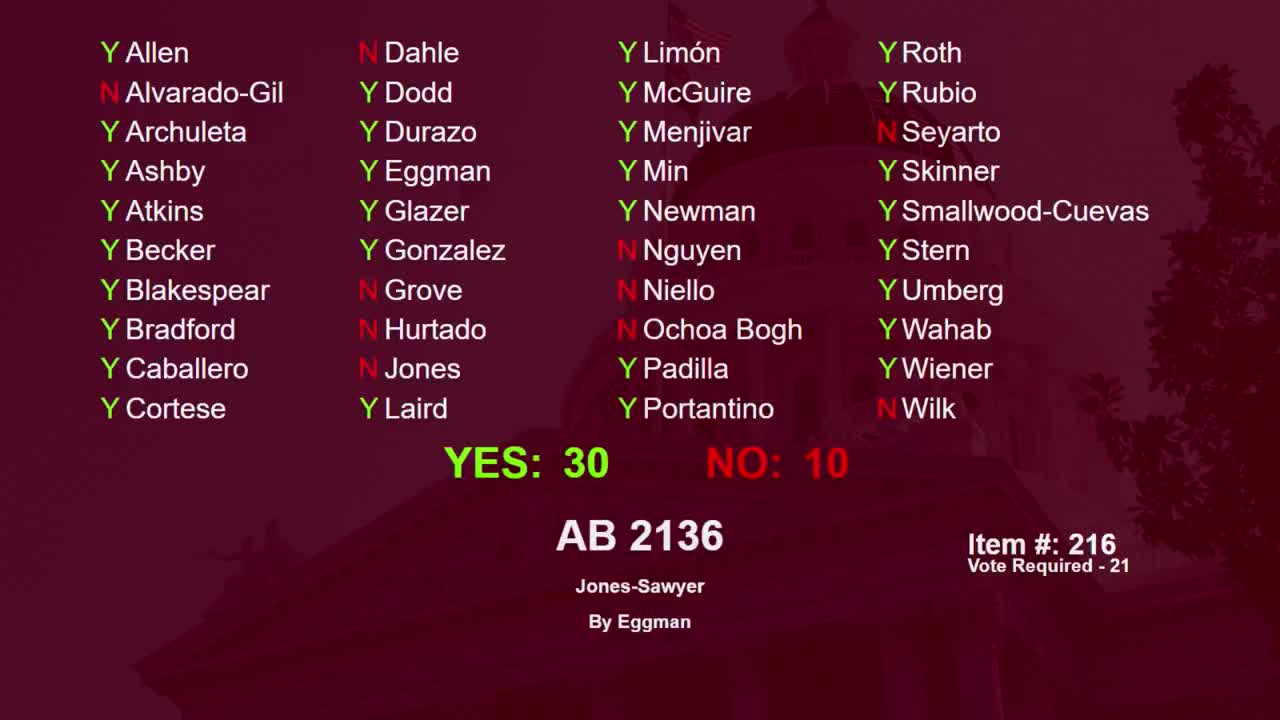
Bill Author