AB 1909: Criminal fines: collection.
- Session Year: 2023-2024
- House: Assembly
- Latest Version Date: 2024-01-24
Current Status:
Failed
(2024-05-16: In committee: Held under submission.)
Introduced
In Committee
First Chamber
In Committee
Second Chamber
Enacted
Existing law generally authorizes fines, including restitution fines, and restitution orders to be deemed a money judgment that is fully enforceable as if the order were a civil judgment, and makes any portion of the restitution order that remains unsatisfied after a defendant is no longer on probation, parole, postrelease community supervision, or mandatory supervision, or after a term in custody enforceable, as specified. Existing law authorizes a local collection program to continue to enforce restitution orders once a defendant is no longer on probation, postrelease community supervision, or mandatory supervision or after a term in custody.
This bill would make any portion of a restitution order that remains unsatisfied after a defendant has completed diversion enforceable. The bill would also authorize a local collection program to continue to enforce restitution orders after a defendant has completed diversion.
(a)If the judgment is for a fine, including a restitution fine ordered pursuant to Section 1202.4, 1202.44, or 1202.45, or Section 1203.04 as operative on or before August 2, 1995, or Section 13967 of the Government Code, as operative on or before September 28, 1994, with or without imprisonment, or a diversion restitution fee ordered pursuant to Section 1001.90, the judgment may be enforced in the manner provided for the enforcement of money judgments generally. Any portion of a restitution fine or restitution fee that remains unsatisfied after a defendant is no longer on probation, parole, postrelease community supervision pursuant to Section 3451, or mandatory supervision pursuant to subparagraph (B) of paragraph (5) of subdivision (h) of Section 1170, after a term in custody pursuant to subparagraph (A) of paragraph (5) of subdivision (h) of Section 1170, or after completing diversion is enforceable by the California Victim Compensation Board pursuant to this section. Notwithstanding any other provision of law prohibiting disclosure, the state, as defined in Section 900.6 of the Government Code, a local public entity, as defined in Section 900.4 of the Government Code, or any other entity, may provide the California Victim Compensation Board any and all information to assist in the collection of unpaid portions of a restitution fine for terminated probation or parole cases, or of a restitution fee for completed diversion cases. For purposes of the preceding sentence, state, as defined in Section 900.6 of the Government Code, and any other entity shall not include the Franchise Tax Board. A local collection program may continue to collect restitution fines and restitution orders once a defendant is no longer on probation, postrelease community supervision, or mandatory supervision or after a term in custody pursuant to subparagraph (A) of paragraph (5) of subdivision (h) of Section 1170.
(b)In any case in which a defendant is ordered to pay restitution, the order to pay restitution (1) is deemed a money judgment if the defendant was informed of his or her their right to have a judicial determination of the amount and was provided with a hearing, waived a hearing, or stipulated to the amount of the restitution ordered, and (2) shall be fully enforceable by a victim as if the restitution order were a civil judgment, and enforceable in the same manner as is provided for the enforcement of any other money judgment. Upon the victims request, the court shall provide the victim in whose favor the order of restitution is entered with a certified copy of that order and a copy of the defendants disclosure pursuant to paragraph (5) of subdivision (f) of Section 1202.4, affidavit or information pursuant to paragraph (6) of subdivision (f) of Section 1202.4, or report pursuant to paragraph (8) of subdivision (f) of Section 1202.4. The court also shall provide this information to the district attorney upon request in connection with an investigation or prosecution involving perjury or the veracity of the information contained within the defendants financial disclosure. In addition, upon request, the court shall provide the California Victim Compensation Board with a certified copy of any order imposing a restitution fine or order and a copy of the defendants disclosure pursuant to paragraph (5) of subdivision (f) of Section 1202.4, affidavit or information pursuant to paragraph (6) of subdivision (f) of Section 1202.4, or report pursuant to paragraph (8) of subdivision (f) of Section 1202.4. A victim shall have access to all resources available under the law to enforce the restitution order, including, but not limited to, access to the defendants financial records, use of wage garnishment and lien procedures, information regarding the defendants assets, and the ability to apply for restitution from any fund established for the purpose of compensating victims in civil cases. Any portion of a restitution order that remains unsatisfied after a defendant is no longer on probation, parole, postrelease community supervision under Section 3451, or mandatory supervision imposed pursuant to subparagraph (B) of paragraph (5) of subdivision (h) of Section 1170 or after a term in custody pursuant to subparagraph (A) of paragraph (5) of subdivision (h) of Section 1170 or after completing diversion is enforceable by the victim pursuant to this section. Victims and the California Victim Compensation Board shall inform the court whenever an order to pay restitution is satisfied. A local collection program may continue to enforce victim restitution orders once a defendant is no longer on probation, postrelease community supervision, or mandatory supervision or after completion of a term in custody pursuant to subparagraph (A) of paragraph (5) of subdivision (h) of Section 1170. 1170 or after completing diversion.
(c)A defendant who owes a restitution fine, a restitution order, or any portion thereof, and who is released from the custody of a county jail facility after a term in custody pursuant to subparagraph (A) of paragraph (5) of subdivision (h) of Section 1170 shall have a continuing obligation to pay the restitution fine or restitution order in full.
(d)Except as provided in subdivision (d), and notwithstanding the amount in controversy limitation of Section 85 of the Code of Civil Procedure, a restitution order or restitution fine that was imposed pursuant to Section 1202.4 in any of the following cases may be enforced in the same manner as a money judgment in a limited civil case:
(1)In a misdemeanor case.
(2)In a case involving violation of a city or town ordinance.
(3)In a noncapital criminal case where the court has received a plea of guilty or nolo contendere.
(e)Chapter 3 (commencing with Section 683.010) of Division 1 of Title 9 of Part 2 of the Code of Civil Procedure shall not apply to any of the following:
(1)A judgment for court-ordered fines, forfeitures, penalties, fees, or assessments.
(2)A restitution fine or restitution order imposed pursuant to Section 1202.4, 1202.44, or 1202.45, or Section 1203.04, as operative on or before August 2, 1995, or Section 13967 of the Government Code, as operative on or before September 28, 1994.
(3)A diversion restitution fee ordered pursuant to Section 1001.90.
|
Date
|
Status
|
|---|---|
| May 16, 2024 | In committee: Held under submission. |
| Mar 20, 2024 | In committee: Set, first hearing. Referred to APPR. suspense file. |
| Feb 27, 2024 | From committee: Do pass and re-refer to Com. on APPR. (Ayes 8. Noes 0.) (February 27). Re-referred to Com. on APPR. |
| Feb 5, 2024 | Referred to Com. on PUB. S. |
| Jan 25, 2024 | From printer. May be heard in committee February 24. |
| Jan 24, 2024 | Read first time. To print. |
|
Date
|
Description
|
Location
|
Votes
|
|
|---|---|---|---|---|
| Feb 27, 2024 | Do pass and be re-referred to the Committee on [Appropriations] | Assembly Standing Committee on Public Safety |
Passed |
This list shows positions taken on this bill by organizations on the date displayed, which is linked to the original source.
Positions by individuals are not included.
|
Organization
|
Position
|
Date
|
|---|---|---|
| Arcadia Police Officers' Association | ** Support | |
| Burbank Police Officers' Association | ** Support | |
| California Coalition of School Safety Professionals | ** Support | |
| California Narcotic Officers' Association | ** Support | |
| Californians United for a Responsible Budget | ** Against | |
| California Public Defenders Association | ** Against | |
| California Reserve Peace Officers Association | ** Support | |
| CLAREMONT POLICE OFFICERS ASSOCIATION | ** Support | |
| Corona Police Officers Association | ** Support | |
| Crime Victims Alliance | ** Support | |
| Culver City Police Officers' Association | ** Support | |
| Deputy Sheriffs Association of Monterey County | ** Support | |
| Fullerton Police Officers' Association | ** Support | |
| Legal Services for Prisoners with Children | ** Against | |
| Los Angeles County District Attorney'S Office | ** Support | |
| Los Angeles School Police Management Association | ** Support | |
| los angeles school police officers association | ** Support | |
| Murrieta Police Officers' Association | ** Support | |
| Newport Beach Police Association | ** Support | |
| Novato Police Officers Association | ** Support | |
| Palos Verdes Police Officers Association | ** Support | |
| Peace Officers Research Association Of California | ** Support | |
| PLACER COUNTY DEPUTY SHERIFFS ASSOCIATION | ** Support | |
| Pomona Police Officers' Association | ** Support | |
| RIVERSIDE POLICE OFFICERS ASSOCIATION | ** Support | |
| Riverside Sheriffs' Association | ** Support | |
| Santa Ana Police Officers Association | ** Support | |
| Upland Police Officers Association | ** Support |
Date of Hearing: March 20, 2024
ASSEMBLY COMMITTEE ON APPROPRIATIONS
Buffy Wicks, Chair
ABPCA Bill Id:AB 1909
Author:(Quirk-Silva) – As Introduced Ver:January 24, 2024
Policy Committee: | Public Safety | Vote: | 8 - 0 |
|
| ||
|
|
Urgency: No State Mandated Local Program: No Reimbursable: No
SUMMARY:
This bill makes a restitution order that remains unpaid after a defendant has completed diversion enforceable by a victim in the same way a civil judgment is enforceable, and authorizes a local collection program to continue to enforce an unsatisfied restitution order after a defendant has completed diversion.
FISCAL EFFECT:
Costs (Trial Court Trust Fund, General Fund) of an unknown but potentially significant amount to the courts to enforce affected victim restitution orders in civil court. Actual costs will depend on the number of victim restitution orders issued for defendants in diversion that remain unpaid upon completion of diversion and the amount of court time needed to enforce unsatisfied restitution orders in civil court. It generally costs approximately $1,000 to operate a courtroom for one hour. Although courts are not funded on the basis of workload, increased pressure on the Trial Court Trust Fund may create a need for increased funding for courts from the General Fund. The Governor’s 2024-25 budget proposes $83.1 million ongoing from the General Fund to backfill declining revenue to the Trial Court Trust Fund.
According to the Legislative Analyst’s Office, the General Fund faces a structural deficit in the tens of billions of dollars over the next several fiscal years.
COMMENTS:
- Purpose. According to the author:
Ensuring that victims receive their compensation is not just fair, it is a fundamental part of the very nature of justice. AB 1909 is about striking that balance – supporting individual’s opportunities to turn their lives around, while also making sure that those who have suffered receive the support they need to heal and move forward.
- Background. Existing law allows a court to order a criminal defendant to pay victim restitution to help compensate the victim for economic losses they sustained as a result of the crime. Even if a defendant is ordered to participate in diversion – a system in which the defendant can avoid a criminal conviction by completing an alternative criminal justice intervention program – California law allows a judge to order the defendant to pay victim restitution. However, existing law is silent about what happens when a defendant has not finished paying their victim restitution by the time they complete diversion.
This bill specifies that if a defendant completes diversion but has not paid the full balance of their victim restitution order, the victim may enforce the restitution order in civil court in the same way that any civil judgment is enforceable. In other words, the victim is entitled to file a petition asking the court to force the defendant to pay the balance of the victim restitution order to the victim. A civil money judgment can be enforced through court proceedings to determine the defendant’s assets and initiate efforts to collect the unpaid portion of victim restitution through wage garnishment, a property lien, a property seizure order, or other methods of collection.
It is difficult to assess the fiscal impact of this bill because there is very little relevant data available. It is unclear how frequently victim restitution is ordered in diversion cases, the average dollar amount of these orders, and how often there is an unpaid balance on a restitution order after diversion is completed. It is also unknown how many victims would choose to seek court enforcement of the unpaid balance of a victim restitution order – in diversion cases, the amount of money at issue may be low enough that it’s not worth pursuing through a potentially lengthy and laborious court process. Absent definitive data on these topics, it is possible that, in the aggregate, the court workload costs for adjudicating civil enforcement of these unpaid victim restitution orders statewide could exceed this committee’s suspense threshold.
Analysis Prepared by: Annika Carlson / APPR. / (916) 319-2081
Date of Hearing: February 27, 2024
Counsel: Liah Burnley
ASSEMBLY COMMITTEE ON
Kevin McCarty, Chair
ABPCA Bill Id:
Author:() – As Ver:
SUMMARY:
Makes any restitution order that remains unsatisfied after a defendant has completed diversion enforceable by a victim as if the restitution order were a civil judgment, and enforceable in the same manner as is provided for the enforcement of any other money judgment. Specifically, this bill:
- Makes any portion of a restitution order that remains unsatisfied after a defendant has completed diversion enforceable by the victim in the same manner as a civil judgment.
- Authorizes a local collection program to continue to enforce restitution orders after a defendant has completed diversion.
EXISTING LAW:
- Establishes pretrial diversion as the procedure of postponing prosecution at any point in the judicial process from the point at which the accused is charged until adjudication. (Pen. Code, § 1001.1.)
- States that, at no time shall a defendant be required to make an admission of guilt as a prerequisite for placement in a pretrial diversion program. (Pen. Code, § 1001.3.)
- States that, if the defendant has performed satisfactorily during the period of diversion, the criminal charges shall be dismissed at the end of the period of diversion. (Pen. Code, § 1001.7.)
- States that, upon successful completion of a diversion program, the arrest upon which the diversion was based shall be deemed to have never occurred and the court may issue an order to seal the records pertaining to the arrest. (Pen. Code, § 1001.9.)
- Establishes specified pretrial diversion programs, including but not limited to, misdemeanor diversion, diversion of defendants with cognitive developmental disabilities, mental health diversion, bad check diversion, military diversion, parental diversion, primary caregiver diversion, and theft diversion. (Pen. Code, §§ 1001.20 - 1001.97.)
- Requires a defendant who is diverted to complete all conditions ordered by the court and to make full restitution to have their charges dismissed. (Pen. Code, § 1001.96.)
- Specifies that a defendant’s inability to pay restitution due to indigence shall not be grounds for denial of diversion or a finding that the defendant has failed to comply with the terms of diversion. (Pen. Code, § 1001.96.)
- Requires the court to impose on the defendant a diversion restitution fee. (Pen. Code, § 1001.90, subd. (a).)
- Provides that a diversion restitution fee shall not be imposed upon persons whose case is diverted by the court for cognitive developmental diversion. (Pen. Code, § 1001.90, subd. (a).)
- States that the diversion restitution fee shall be set at the discretion of the court and shall be commensurate with the seriousness of the offense, but shall not be less than $100 and not more than $1,000. (Pen. Code, § 1001.90, subd. (b).)
- Requires the diversion restitution fee to be ordered regardless of the defendant’s present ability to pay, unless there are compelling and extraordinary reasons, to waive imposition of the fee. When the waiver is granted, the court shall state on the record all reasons supporting the waiver. (Pen. Code, § 1001.90, subd. (c).)
- Provides that the state can enforce the diversion restitution fee imposed in the manner of a judgment in a civil action. (Pen. Code, §§ 1001.90, subd. (e) & 1214, subd. (a.).)
- Provides that the diversion restitution fee imposed shall be immediately deposited in the Restitution Fund. (Pen. Code, § 1001.90, subd. (f).)
- Provides that any portion of a restitution fine or restitution fee that remains unsatisfied after a defendant is no longer on probation, parole, postrelease community supervision, mandatory supervision, or after completing diversion is enforceable by the California Victim Compensation Board (CalVCB). (Pen. Code, § 1214, subd. (a).)
- States that any portion of a victim restitution order that remains unsatisfied after a defendant is no longer on probation, parole, postrelease community supervision or mandatory supervision, after a term in custody, is enforceable by the victim. (Pen. Code, § 1214, subd. (b).)
- States that victims shall have access to all resources available under the law to enforce the victim restitution order, including, but not limited to, access to the defendant’s financial records, use of wage garnishment and lien procedures, information regarding the defendant’s assets, and the ability to apply for restitution from any fund established for the purpose of compensating victims in civil cases. (Pen. Code, §1214, subd. (b).)
- Allows local collection programs to continue to enforce victim restitution orders once a defendant is no longer on probation, postrelease community supervision, or mandatory supervision or after completion of a term in custody. (Pen. Code, § 1214, subd. (b).)
FISCAL EFFECT:
Unknown.
COMMENTS:
- Author's Statement: According to the author, “The California Justice System is centered on rehabilitation and the transformative power of second chances for those who have done wrong. However, we must recognize that while we do all we can to support redemption, we cannot forget those who have been harmed along the way. Ensuring that victims receive their compensation is not just fair, it is a fundamental part of the very nature of justice. AB 1909 is about striking that balance – supporting individual’s opportunities to turn their lives around, while also making sure that those who have suffered receive the support they need to heal and move forward.”
- Victim Restitution vs. Restitution Fines and Fees: California law provides for two types of restitution: victim restitution and restitution fines and fees. The purposes of the two kinds of restitution are different. The imposition of a restitution fine is to inflict additional punishment. (People v. Dueñas (2019) 30 Cal.App.5th 157, 1169; People v. Hanson (2000) 23 Cal.4th 355, 363.) The purpose of victim restitution is to reimburse the victim for economic loss caused by the crime. (People v. Giordano (2007) 42 Cal.4th 644, 652.)
Payment of victim restitution goes directly to the victim and compensates them for economic losses they have suffered because of the defendant’s crime, i.e., to make the victim reasonably whole. (People v. Guillen (2013) 218 Cal.App.4th 975, 984.) 1) Victim restitution is a constitutional requirement and all persons who suffer losses as a result of criminal activity shall have the right to seek and secure restitution from the persons convicted of the crimes causing the losses they suffer. (Cal. Const., art. I, § 28, subd. (b)(13)(A).) A victim restitution order is an enforceable civil money judgment, and typical post-judgment enforcement tools are available to the victim. (Pen. Code, § 1214, subd. (b).) Victims have access to all available resources to enforce the order, including wage garnishment and lien procedures, even if the defendant is no longer in custody or on supervision. (Ibid.) Also, victim restitution orders can be referred to the California Franchise Tax Board (FTB) for collection and crime victims are entitled to their preference of collection agencies. (Rev. & Tax. Code, § 19820.)
On the other hand, restitution fines and fees, which are separate from victim restitution, are deposited in the Restitution Fund in the State Treasury. (Pen. Code, §§ 1204.4 & 1214, subd. (a); Guillen, supra, 218 Cal.App.4th at p. 985.) Restitution fines are enforceable by the CalVCB, even after a defendant is no longer in custody or on supervision, and can be referred to the FTB for collection. (Pen. Code, § 1214; Rev. & Tax Code, § 19820.)
Combined, the restitution fine and victim restitution, can easily exceed amounts in the tens of thousands of dollars, not including the accruing interests. The obligation to pay restitution does not vanish, even if expungement relief is granted. (Seymour, supra, 239 Cal.App.4th 1418 at p.1430 [“victim restitution is still an obligation the defendant must meet”]; In Re Timothy N. (2013) 216 Cal.App.4th 725, 738 [the defendant “is not escaping his restitution obligation” and “will be required to pay the restitution pursuant to the trial court's orders, which the victims may enforce as they would a civil judgment.”]; People v. Allen (2019) 41 Cal.App.5th 312, 329.) The obligation to pay restitution does not vanish after the defendant is no longer on probation, parole, postrelease community supervision or mandatory supervision, after a term in custody. (Pen. Code, § 1214.) - Restitution and Diversion: Diversion programs are “criminal justice interventions that try to address the root cause of what is driving criminal conduct and incentivize treatment and services. … Upon successful completion of diversion, defendants can avoid criminal convictions … .” (Judicial Council of California, Memorandum (Sept. 29, 2023). Available at <https://www.courts.ca.gov/documents/ceac-diversion-programs-memo-092923.pdf> [as of Feb. 20, 2024].) Defendants facing felony or misdemeanor charges may enter a diversion program either pretrial or postconviction, depending on the charges and nature of the case. (Ibid.)
Whenever a case is diverted, the court is required to impose on the defendant a diversion restitution fee in addition to any other administrative fee provided or imposed under the law. (Pen. Code, § 1001.90.) Under existing law, the diversion restitution fee shall not be imposed upon persons whose case is diverted by the court for cognitive developmental disability diversion. (Ibid). The diversion restitution fee imposed pursuant to is set at the discretion of the court commensurate with the seriousness of the offense, but may not be less than $100, and not more $1,000. (Ibid.)
Even though the defendant has not been convicted of a crime, generally courts are allowed to order a defendant in diversion to pay the victim restitution, in addition to the diversion restitution fee. For example, for mental health diversion, upon request, the court is required to conduct a hearing to determine whether restitution is owed to any victim as a result of the diverted offense and, if owed, order its payment during the period of diversion. However, a defendant’s inability to pay restitution due to indigence or mental disorder cannot be grounds for denial of diversion or a finding that the defendant has failed to comply with the terms of diversion. (Pen. Code, § 1001.36, subd. (f)(1)(D); see also, Pen. Code, § 1001.64, subd. (b) [allowing restitution to the victim for bad check diversion; & Pen. Code, § 181, subd. (e)(2) [allowing restitution to the victim for theft diversion].)
Under existing law, restitution fees and fines, including diversion restitution fees are enforceable by the state after the defendant is no longer on probation, parole, postrelease community supervision or mandatory supervision, or after a term in custody, or after completing diversion. (Pen. Code, § 1214, subd. (a) & 1001.90, subd. (e).) Likewise, any portion of a victim restitution order remaining after the defendant is no longer on probation, parole, postrelease community supervision or mandatory supervision, or after a term in custody, is enforceable by the victim in the same manner as a civil judgement. (Pen. Code, § 1214, subd. (b).) However, unlike the diversion restitution fee, the statute does not explicitly specify that a victim restitution order is enforceable by the victim upon the completion of diversion. This bill would make a victim restitution order enforceable by the victim in the same manner as a civil judgement after a defendant successfully completes diversion.
Similarly, existing law allows local collection programs to enforce victim restitution orders once a defendant is no longer on probation, postrelease community supervision, or mandatory supervision or after completion of a term in custody. (Pen. Code, § 1214, subd. (b).) This bill would extend this authorization to local collection programs to enforce victim restitution orders once a defendant completes diversion. - Argument in Support: According to the Los Angeles County District Attorney’s Office, the sponsor of this bill, “existing statutes are silent as to the viability of unpaid restitution orders once diversion is otherwise successfully completed. This vagueness has created confusion in the courts, resulted in inconsistent interpretations, and created a two-tier system for victims of crime. […]
“AB 1909 does not impact a defendant’s eligibility for diversion or change any existing laws around a defendant’s inability to pay. It also does not expand a court’s right to order restitution during the period of diversion or as part of a criminal sentence. Courts already have the right to order restitution under the diversion statutes mentioned. AB 1909 merely cures a vagueness in the law by closing the existing gap between obtaining a restitution order during the period of diversion and converting it to a money judgment upon completion of diversion. The clarifying amendment in this bill will ensure that defendants eligible for diversion are afforded that opportunity without shifting the expense of their crimes to their victims once diversion is completed, and a crime victim’s Constitutional right to restitution is fully protected regardless of whether a defendant is sentenced or provided the benefit of diversion.” - Argument in Opposition: According to the California Public Defenders Association (CPDA), “AB 1909 seeks to extend the restitution requirement and impose it on Californians who have not been found guilty of any criminal offense, including Californians whose cases were diverted as a result of serious mental illness pursuant to Penal Code section 1001.36.
“Among the significant concerns we have this proposal are the following:
- The fact that a person has been diverted (including pursuant to § 1001.36) does not mean that that person is guilty of the charged (or any) offense. Section AB 1909 therefore seeks to treat presumptively innocent vulnerable people who have not been convicted of any offense as if they have been convicted of criminal wrong-doing.
- Because section 1001.36 is routinely applied to defendants who are incompetent to stand trial, this bill would unconstitutionally (and pointlessly) impose criminal restitution liability on people who are unable to defend themselves and unable to comprehend the nature of the charges against them, let alone any corresponding restitution order.
“Although we firmly believe that treating presumptively innocent men and women as if they have been found guilty of criminal offenses is morally, legally, and factually erroneous, we also believe that there are modifications that could address these concerns, including:
- Adding procedural protections to restitution hearings for diverted individuals and clarifying that this procedure does not apply to diversion ordered during incompetency proceedings.
- Adding time limits to the period for which the post-diversion restitution order applies.
- Adding “ability to pay” provisions to allow courts to opt out of pointless attempts to seek restitution from unhoused, mentally ill Californians.”
- Related Legislation: SB 1035 (Ashby), would change the annual interest rate on restitution orders and the annual interest rate charged by the FTB on certain delinquent payments, including fines, fees, and restitution, to no more than 1%. SB 1035 is pending referral by Senate Rules Committee.
- Prior Legislation: AB 1530 (Skinner), Chapter 359, Statutes of 2010, provided express authority for the FTB to collect orders of restitution awarded to the FTB in criminal proceedings in the same manner and with the same priority as tax liabilities.
REGISTERED SUPPORT / OPPOSITION:
Support
Los Angeles County District Attorney's Office (Sponsor)
Arcadia Police Officers' Association
Burbank Police Officers' Association
California Coalition of School Safety Professionals
California Narcotic Officers' Association
California Reserve Peace Officers Association
Claremont Police Officers Association
Corona Police Officers Association
Crime Victims Alliance
Culver City Police Officers' Association
Deputy Sheriffs' Association of Monterey County
Fullerton Police Officers' Association
Los Angeles School Police Management Association
Los Angeles School Police Officers Association
Murrieta Police Officers' Association
Newport Beach Police Association
Novato Police Officers Association
Palos Verdes Police Officers Association
Peace Officers Research Association of California (PORAC)
Placer County Deputy Sheriffs' Association
Pomona Police Officers' Association
Riverside Police Officers Association
Riverside Sheriffs' Association
Santa Ana Police Officers Association
Upland Police Officers Association
Opposition
Legal Services for Prisoners With Children
California Public Defenders Association
Californians United for A Responsible Budget
Analysis Prepared by:
Discussed in Hearing
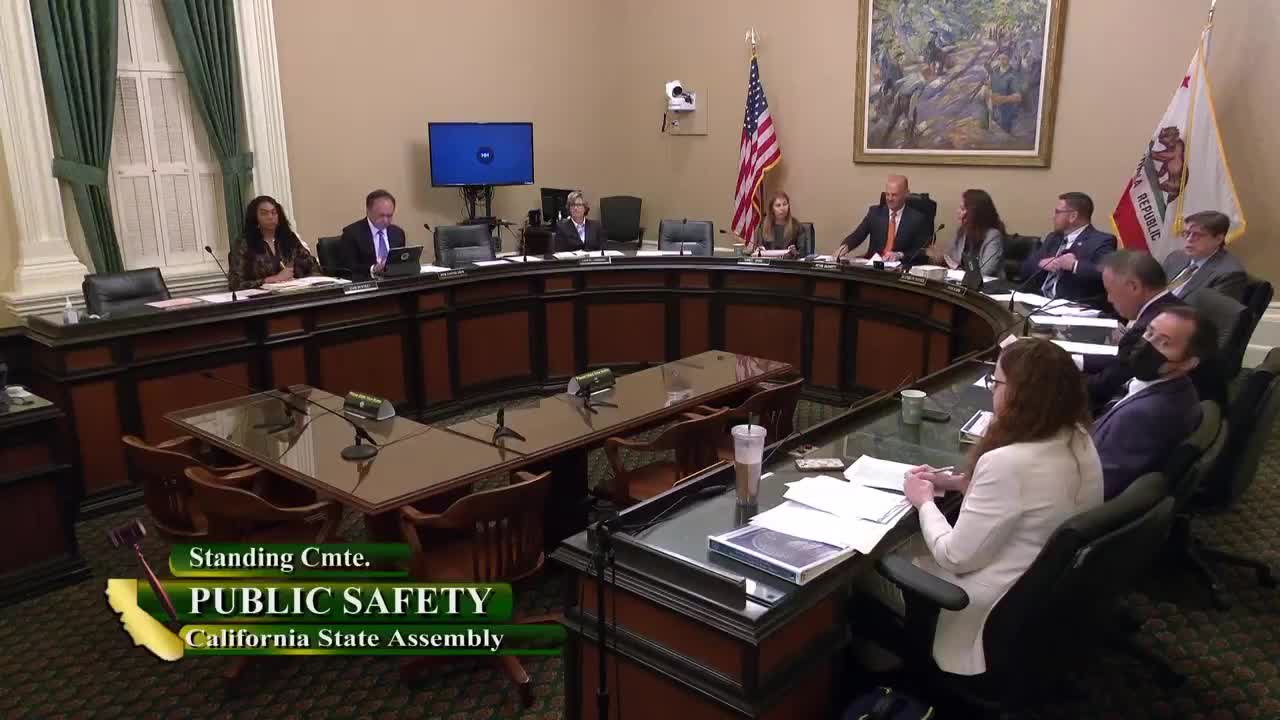 24MIN
Assembly Standing Committee on Public Safety
Bill Author

Bill Co-Author(s):