AB 1967: Food Insecurity Officer.
- Session Year: 2023-2024
- House: Assembly
- Latest Version Date: 2024-04-16
Current Status:
Failed
(2024-08-15: In committee: Held under submission.)
Introduced
In Committee
First Chamber
In Committee
Second Chamber
Enacted
Existing law provides for the California Health and Human Services Agency, which includes the State Department of Social Services. Under existing law, the California Health and Human Services Agency is under the direction of an executive officer known as the Secretary of California Health and Human Services, who is appointed by, and holds office at the pleasure of, the Governor, subject to confirmation by the Senate.
This bill would create, within the Government Operations Agency, State Department of Social Services, a Food Insecurity Officer, to be appointed by, and serve at the pleasure of, the Governor. The Food Insecurity Officer would be required to report to the Secretary, or the Secretarys designee, of the Government Operations Agency. California Health and Human Services Agency. The bill would require the Food Insecurity Officer to coordinate and address food insecurity throughout state government operations and would authorize the Food Insecurity Officer to engage with state entities for these purposes, as specified. The bill would include among the Food Insecurity Officers duties advancing the benefit adequacy and enrollment rates of the CalFresh and California Food Assistance Program (CFAP), as specified. The bill would require the Food Insecurity Officer to consult with relevant state entities and stakeholders with expertise in food insecurity and related best practices in carrying out their duties. The bill would also require the Food Insecurity Officer, beginning January 1, 2026, to submit an annual report to the relevant policy and budget committees of the Legislature that includes, among other things, data on food insecurity, CalFresh and CFAP enrollment rates, and budgetary and policy recommendations, as specified.
Existing law establishes the Government Operations Agency, which consists of several departments, including, but not limited to, the State Personnel Board, the Department of General Services, and the Office of Administrative Law. Under existing law, the Government Operations Agency is under the direction of an executive officer known as the Secretary of Government Operations, who is appointed by, and holds office at the pleasure of, the Governor, subject to confirmation by the Senate.
This bill would create, within the Government Operations Agency, a Food Insecurity Officer, to be appointed by, and serve at the pleasure of, the Governor. The Food Insecurity Officer would be required to report to the Secretary, or the Secretarys designee, of the Government Operations Agency. The bill would require the Food Insecurity Officer to coordinate and address food insecurity throughout state government operations and would authorize the Food Insecurity Officer to engage with state entities for these purposes, as specified.
(a)Within the Government Operations Agency, State Department of Social Services there shall be a Food Insecurity Officer. The Food Insecurity Officer shall be appointed by, and serve at the pleasure of, the Governor. The Food Insecurity Officer shall report to the Secretary, or the Secretarys designee, of the Government Operations Agency. California Health and Human Services Agency.
(b)The Food Insecurity Officer shall coordinate and address food insecurity across state government operations. The Food Insecurity Officer is hereby authorized to engage with state entities entities, including, but not limited to, the Department of Food and Agriculture, the State Department of Public Health, the California Department of Aging, the Department of Corrections and Rehabilitation, the State Department of Health Care Services, and the State Department of Education for the purpose of addressing food insecurity and access within state entities.
(c)The Food Insecurity Officers duties shall include, but are not limited to, the following:
(1)Advance benefit adequacy by establishing strategy and plans for benefit level adequacy under the CalFresh Program (Chapter 10 (commencing with Section 18900) of part Part 6 of Division 9 of the Welfare and Institutions Code). Code) and the California Food Assistance Program (CFAP) (Chapter 10.1 (commencing with Section 18930) of Part 6 of Division 9 of the Welfare and Institutions Code). The Food Insecurity Officer shall focus on increasing enrollment for seniors, families with children, individuals leaving incarceration, students in postsecondary education settings, and formerly incarcerated individuals.
(2)Improve health outcomes by integrating nutrition and health, including through working to pilot coverage of medically tailored meals in the Medicare Program under Title XVIII of the federal Social Security Act (42 U.S.C. Sec. 1395 et seq.), testing Medicaid coverage of nutrition education, and other nutrition supports pursuant to a waiver pursuant to subsection (a) of Section 1115 of the federal Social Security Act (42 U.S.C. Sec. 1315(a)), and expanding access of Medicaid and Medicare beneficiaries to nutrition and obesity counseling.
(3)Improve food access by addressing access to food and affordability, improve the resilience and interconnection of food systems, and improve and increase access to free and nourishing charitable food resources sourced in California, including disaster response.
(4)Seek Collaborate with relevant departments to seek applicable federal waivers or exemptions, as appropriate.
(d)(1)The Food Insecurity Officer shall, beginning January 1, 2026, annually submit to the relevant policy and budget committees of the Legislature a report that complies with Section 9795 of the Government Code and contains all of the following information:
(A)Overall statewide food insecurity rates.
(B)Food insecurity rates among seniors, families with children, individuals leaving incarceration, and formerly incarcerated individuals, to the extent that data is available.
(C)Overall enrollment rates of individuals and households eligible for CalFresh and CFAP.
(D)Enrollment rates for eligible seniors, families with children, individuals leaving incarceration, and formerly incarcerated individuals in CalFresh and CFAP.
(E)Budgetary and policy recommendations to combat food insecurity in the state.
(F)Budgetary and policy recommendations to improve enrollment rates in state and federal food and nutrition programs.
(2)The Food Insecurity Officer shall consult with relevant state entities and stakeholders with expertise in food insecurity and related best practices in carrying out their duties, including the reporting requirements described in paragraph (1).
REVISIONS: HeadingLine 2.(a)Within the Government Operations Agency, there shall be a Food Insecurity Officer. The Food Insecurity Officer shall be appointed by, and serve at the pleasure of, the Governor. The Food Insecurity Officer shall report to the Secretary, or the Secretarys designee, of the Government Operations Agency.
(b)The Food Insecurity Officer shall coordinate and address food insecurity across state government operations. The Food Insecurity Officer is hereby authorized to engage with state entities for the purpose of addressing food insecurity and access within state entities.
(c)The Food Insecurity Officers duties shall include, but are not limited to, the following:
(1)Advance benefit adequacy by establishing strategy and plans for benefit level adequacy under the CalFresh Program (Chapter 10 (commencing with Section 18900) of part 6 of Division 9 of the Welfare and Institutions Code). The Food Insecurity Officer shall focus on increasing enrollment for seniors, families with children, individuals leaving incarceration, and formerly incarcerated individuals.
(2)Improve health outcomes by integrating nutrition and health, including through working to pilot coverage of medically tailored meals in the Medicare Program under Title XVIII of the federal Social Security Act (42 U.S.C. Sec. 1395 et seq.), testing Medicaid coverage of nutrition education, and other nutrition supports pursuant to a waiver pursuant to subsection (a) of Section 1115 of the federal Social Security Act (42 U.S.C. Sec. 1315(a)), and expanding access of Medicaid and Medicare beneficiaries to nutrition and obesity counseling.
(3)Improve food access by addressing access to food and affordability, improve the resilience and interconnection of food systems, and improve and increase access to free and nourishing charitable food resources sourced in California, including disaster response.
(4)Seek applicable federal waivers or exemptions, as appropriate.
|
Date
|
Status
|
|---|---|
| Aug 15, 2024 | In committee: Held under submission. |
| Jul 1, 2024 | In committee: Referred to suspense file. |
| Jun 18, 2024 | From committee: Do pass and re-refer to Com. on APPR. (Ayes 5. Noes 0.) (June 17). Re-referred to Com. on APPR. |
| May 29, 2024 | Referred to Com. on HUMAN S. |
| May 22, 2024 | In Senate. Read first time. To Com. on RLS. for assignment. |
| May 21, 2024 | Read third time. Passed. Ordered to the Senate. (Ayes 64. Noes 1. Page 5407.) |
| May 20, 2024 | Read second time. Ordered to third reading. |
| May 16, 2024 | From committee: Do pass. (Ayes 12. Noes 1.) (May 16). |
| May 8, 2024 | In committee: Set, first hearing. Referred to APPR. suspense file. |
| Apr 24, 2024 | From committee: Do pass and re-refer to Com. on APPR. (Ayes 6. Noes 0.) (April 23). Re-referred to Com. on APPR. |
| Apr 24, 2024 | Coauthors revised. |
| Apr 17, 2024 | Re-referred to Com. on HUM. S. |
| Apr 16, 2024 | From committee chair, with author's amendments: Amend, and re-refer to Com. on HUM. S. Read second time and amended. |
| Apr 2, 2024 | In committee: Hearing postponed by committee. |
| Feb 12, 2024 | Referred to Com. on HUM. S. |
| Jan 31, 2024 | From printer. May be heard in committee March 1. |
| Jan 30, 2024 | Read first time. To print. |
|
Date
|
Description
|
Location
|
Votes
|
|
|---|---|---|---|---|
| Jul 1, 2024 | Placed on suspense file | Senate Standing Committee on Appropriations |
Passed |
|
| Jun 17, 2024 | Do pass, but first be re-referred to the Committee on [Appropriations] | Senate Standing Committee on Human Services |
Passed |
|
| May 21, 2024 | AB 1967 Jackson Assembly Third Reading | Assembly Floor |
Passed |
|
| May 16, 2024 | Do pass. | Assembly Standing Committee on Appropriations |
Passed |
|
| Apr 23, 2024 | Do pass and be re-referred to the Committee on [Appropriations] | Assembly Standing Committee on Human Services |
Passed |
This list shows positions taken on this bill by organizations on the date displayed, which is linked to the original source.
Positions by individuals are not included.
|
Organization
|
Position
|
Date
|
|---|---|---|
| Calfresh Coalition for AB1967 | ** Support | |
| California Grocers Association | ** Support | |
| California Immigrant Policy Center | ** Support | |
| California Student Aid Commission | ** Support | |
| Compass Family Services | ** Support | |
| County Health Executives Association Of California | ** Support | |
| County of Marin | ** Support | |
| Glide | ** Support | |
| Golden Gate Restaurant Association | ** Support | |
| Housing Action Coalition | ** Support | |
| Jewish Family and Children's Services of San Francisco, the Peninsula, Marin and Sonoma Counties | ** Support | |
| Marin Food Policy Council | ** Support | |
| Neighborhood Business Alliance | ** Support | |
| Peninsula Family Service | ** Support | |
| Purfoods, LLC A/k/a Mom's Meals | ** Support | |
| San Francisco Food Security Task Force | ** Support | |
| San Francisco-Marin Food Bank | ** Support | |
| Young Invincibles | ** Support |
SENATE COMMITTEE ON APPROPRIATIONS
Senator Anna Caballero, Chair
2023 - 2024 Regular Session
AB 1967 (Jackson) - Food Insecurity Officer
Version: April 16, 2024 | Policy Vote: HUMAN S. 5 - 0 |
Urgency: No | Mandate: No |
Hearing Date: July 1, 2024 | Consultant: Agnes Lee |
Bill Summary:
AB 1967 would establish a Food Insecurity Officer within the California Department of Social Services (CDSS) to coordinate and address food insecurity across state government operations.
Fiscal Impact:
The CDSS estimates General Fund costs of $223,000 in the first fiscal year and ongoing annual costs of $247,000 thereafter to establish the Food Insecurity Officer position.
Background:
There are a number of food assistance programs administered by the state. These include, but are not limited to:
- The CDSS administers the CalFresh program which provides monthly food benefits to qualified low-income individuals and families to assist with the purchase of the food they need to maintain adequate nutrition levels. CalFresh is the largest nutrition assistance program in California. CalFresh benefits are 100 percent federally funded.
- The CDSS administers the California Food Assistance Program (CFAP), which provides state-funded food assistance for individuals who are not eligible for federally funded CalFresh benefits, solely due to their immigration status.
- The CDSS administers the Child and Adult Care Food Program (CACFP), which is a federally funded program that provides free meals in facilities such as childcare centers, homeless shelters, adult daycare centers and afterschool care centers.
- The California Department of Education (CDE) administers two federally funded meal programs that target school age children, the National School Lunch Program and the School Breakfast Program. Both programs provide free or reduced priced healthy meals to income eligible students.
- The California Department of Public Health (CDPH) administers the federally-funded Special Supplemental Nutrition Program for Women, Infants, and Children (WIC) program. WIC provides, at no cost to participants, supplemental foods, nutrition education, and health care referrals to low-income pregnant, breastfeeding and postpartum women, infants, and children up to age five who are determined to be at nutritional risk.
- The Department of Health Care Services (DHCS) administers the Medically Tailored Meals Pilot Program to serve eligible Medi-Cal beneficiaries.
- The California Department of Aging oversees several nutrition programs that provide meals for older adults.
Proposed Law:
Specific provisions of the bill would:
- Establish a Food Insecurity Officer within the CDSS, appointed by the Governor, and reports to the Secretary, or the Secretary’s designee, of the California Health and Human Services Agency.
- Require the Food Insecurity Officer to coordinate and address food insecurity across state government operations, as specified.
- Require the Food Insecurity Officer to establish a strategy and plans for benefit level adequacy for CalFresh and CFAP; improve health outcomes by integrating nutrition and health, including through the Medicaid program; improve food access; collaborate with other departments to seek federal waivers or exemptions as appropriate.
- Require the Food Insecurity Officer, beginning January 1, 2026, to annually submit a report to the Legislature, as specified.
-- END --
SENATE COMMITTEE ON HUMAN SERVICES
Senator Alvarado-Gil, Chair
2023 - 2024 Regular
Bill No: | AB 1967 | ||
Author: | Jackson | ||
Version: | April 16, 2024 | Hearing Date: | June 17, 2024 |
Urgency: | No | Fiscal: | Yes |
Consultant: | Naima Ford Antal | ||
Subject: Food Insecurity Officer
SUMMARY
This bill creates the position of Food Insecurity Officer to coordinate and address food insecurity across various state departments and agencies. The bill also assigns the Food Insecurity Officer various duties and requires them to submit an annual report to the Legislature.
ABSTRACT
Existing Law:
- Declares that every human being has the right to access sufficient affordable and healthy food as an established state policy and defines food insecurity. (WIC 18700)
- Establishes the CalFresh program to administer the provision of federal Supplemental Nutrition Assistance Program (SNAP) benefits to families and individuals meeting certain criteria, as specified. (WIC 18900 et seq.)
- Establishes California Food Assistance Program (CFAP) to provide assistance for persons who are not eligible for federal SNAP benefits due solely to their immigration status, as specified. (WIC 18930 et seq.)
This Bill:
- Creates a Food Insecurity Officer in the California Department of Social Services (CDSS), appointed by the Governor, and reports to the Secretary of the California Health and Human Services Agency.
- Requires the Food Insecurity Officer to coordinate efforts to address food insecurity among state agencies and departments including but not limited to:
- Department of Food and Agriculture
- State Department of Public Health
- California Department of Aging
- Department of Corrections and Rehabilitation
- State Department of Health Care Services
- State Department of Education
- Department of Food and Agriculture
- Requires the Food Insecurity Officer to create a strategy to improve benefit level adequacy for CalFresh and CFAP; improve health outcomes through Medicaid and Medicare funded food programs; improve food access; collaborate with other departments to seek federal waivers or exemptions as appropriate.
- Requires the Food Insecurity Officer, beginning January 1, 2026, submit a report to the Legislature annually that contains the following information:
- Overall statewide food insecurity rates
- Food insecurity rates among seniors, families with children, individuals leaving incarceration, and formerly incarcerated individuals
- Overall enrollment rates of CalFresh eligible individuals and households
- Enrollment rates for CalFresh eligible seniors, families with children, individuals leaving incarceration, and formerly incarcerated individuals
- Budget and policy recommendations to decrease food insecurity and increase enrollment in food programs.
- Overall statewide food insecurity rates
- Requires the Food Insecurity Officer to consult with relevant state entities and stakeholders about best practices.
FISCAL IMPACT
According to the Assembly Appropriations Committee analysis, “CDSS estimates General Fund (GF) costs of $337,000 in the first year and $331,000 annually ongoing to support the Food Insecurity Officer. The author has submitted a budget request for $500,000 ongoing to support the position. Estimated costs of an unknown, but likely minor amount for various state departments to consult with the Food Insecurity Officer.”
BACKGROUND AND DISCUSSION
Purpose of the Bill:
According to the author, “AB 1967 seeks to establish a Food Insecurity Officer within the California Department of Social Services (CDSS) to coordinate and address food insecurity across state government operations, including, but not limited to, increasing enrollment of the CalFresh Program for seniors, families with children, individuals leaving incarceration, and formerly incarcerated individuals; piloting coverage of medically tailored meals in the Medicare Program, addressing access to food and affordability; and, seeking applicable federal waivers or exemptions, as appropriate.”
Food Insecurity in California
Hunger is a statewide problem, one that can affect people from all backgrounds. While California is the greatest food-producing state in the country, about 10 million of California’s children and adults face food insecurity, according to the California Association of Food Banks.[1] They also report that, on average, one out of every four Californians does not know where their next meal will come from and Black and Latinx families with children experience greater levels of hunger.
Because of limited financial resources, those who are food insecure sometime use cost cutting measures to stretch budgets that are harmful to their health, such as: engaging in cost-related medication underuse or non-adherence; postponing or declining medical care; forgoing the foods needed for special medical diets; purchasing a low-cost diet that relies on energy-dense, but nutrient-poor, foods; diluting or rationing infant formula; and making trade-offs between food and other basic necessities, like housing, utilities, transportation. Moreover, the impacts of childhood hunger are well known. Children who live in households experiencing food insecurity are at higher risk of health, academic, behavioral, and emotional problems than those who are not.
Food Assistance Programs
There are a number of food assistance programs operated throughout the state and administered by the California Departments of Aging, California Department of Education (CDE), CDSS, and California Department of Public Health (CDPH). CalFresh, California’s version of federal SNAP, provides monthly food benefits to qualified low-income individuals and families to assist with the purchase of the food they need to maintain adequate nutrition levels. With 3 million households (and over 5.26 million people) receiving benefits, CalFresh is the largest nutrition assistance program in California. CalFresh benefits are 100 percent federally funded and CDSS oversees the administration of CalFresh. Income eligibility standards and benefit levels for the program are established by the federal government, with one standard used nationally. CDSS also administers other nutrition programs like the Child and Adult Care Food Program (CACFP) a federally funded program that provides free meals in facilities such as childcare centers, homeless shelters, adult daycare centers and afterschool care centers. SUN Bucks is another CDSS nutrition program that provides $40 per month to low income students during the summer.
CDE administers two federally funded meal programs that target school age children, the National School Lunch Program and the School Breakfast Program. Both programs provide free or reduced priced healthy meals to income eligible students. Beginning in the 2022-23 school year, California became the first state to implement and fully fund a Universal Meals Program for school children grades PK-12. The program allows for all students who request a meal to be able to receive meals regardless of their eligibility for free or reduced priced school meals. Students may receive up to two free meals during the school day.
CDPH administers a federally-funded program called the California Special Supplemental Nutrition Program for Women, Infants, and Children (WIC). WIC provides, at no cost to participants, supplemental foods, nutrition education, and health care referrals to low-income pregnant, breastfeeding and postpartum women, infants, and children up to age five who are determined to be at nutritional risk. To be eligible for WIC, applicants must be determined by a health professional to be at nutritional risk (i.e., have certain medical-based or diet-based risk conditions).
Department of Health Care Services also administers nutrition related programs including the Medically Tailored Meals Pilot Program that is being integrated into California Advancing and Innovating Medi-Cal (CalAIM) reform. The bill seeks to promote this program and requires the Food Insecurity Officer to pursue other Medi-Cal federally funded nutrition services.
The Department of Aging oversees nutrition programs that provide meals for older adults. These services are typically offered at congregate nutrition sites or through home delivered meals. Both congregate nutrition and home delivered meals serve broad populations, with preference given to those in the greatest economic or social need. Many older adults receive nutrition assistance in congregate settings, such as in senior centers, and through Area Agencies on Aging (AAAs), Community-Based Adult Services, Adult Day Services, and Multi-Purposes Senior Services Programs. Federally funded Home-Delivered Nutrition Programs, commonly referred to as Meals on Wheels, is a longstanding program that delivers healthy meals to older adults who cannot go out and purchase food and/or prepare meals in their homes. Meals on Wheels is primarily funded by the Older Americans Act and often administered by local AAAs and overseen by the California Department of Aging.
Those in need of food assistance can also get help from thousands of food distribution sites. Food banks collect and distribute food to hunger-relief entities, such as food pantries or food closets, which in turn distribute the food within their local communities. They distribute bags or boxes of food directly to needy families and individuals without requiring those families or individuals verify eligibility.
This bill requires the Food Insecurity Officer to promote CDSS administered programs and to collaborate with these other government entities to increase participation in nutrition programs and to decrease food insecurity generally and within specified subpopulations.
Barriers to Food Assistance
Obtaining food assistance typically requires paperwork, which is often cited as the largest barrier to accessing the CalFresh and other assistance programs. There are many ways to streamline bureaucracies, and, in recent years, work has been done to identify and eliminate barriers to accessing nutrition assistance. This work includes enhancing county guidance to increase their implementation of online and phone applications, making recipients who are eligible for Medi-Cal categorically eligible for CalFresh, removing asset tests and finger imaging requirements, integrating CalFresh with other social service programs, including California Work Opportunity and Responsibility to Kids (CalWORKs), and WIC. California also eliminated the “cashout” policy, which made CalFresh newly available to about 500,000 SSI/SSP recipients. Most recently, California became the first state, beginning in the 2022-23 school year, to provide two free meals to all public school aged children who request them. There are also efforts to help prisoners enroll in CalFresh shortly before they are released so they can have access to food assistance immediately upon release.
About 1 in 8 (12 percent) of Californians receive CalFresh. However, historically, California’s CalFresh participation rate has been at or near the lowest in the nation, with only about 70 percent of eligible recipients enrolled in CalFresh and 59 percent of eligible workers. This means about 30 percent of those eligible are not receiving CalFresh. According to the most recent pre-pandemic data, only 19 percent of eligible older Californians are enrolled in CalFresh, which is the lowest rate of any state in the nation. While numerous factors contribute to California’s low take up rate for CalFresh, two commonly cited reasons for low enrollment are the complicated enrollment and recertification processes, especially for people who are elderly or disabled. Additional barriers to senior participation in CalFresh include social and linguistic isolation, lack of knowledge about the benefit, confusion about eligibility requirements, difficulty filling out an application and stigma. For the immigrant community poor translation services and misinformation on eligibility have also been identified as barriers to food assistance. Churn, the circumstance in which people become dis-enrolled and have to reapply for CalFresh due to missing paperwork or other program requirements, is also a persistent issue.
People who live in rural areas often face hunger at higher rates, in part because of the unique challenges living remotely presents. These challenges include lack of transportation when the nearest grocery store, food pantry, or food bank can be hours away, job opportunities that are more concentrated in low-wage industries, and higher rates of unemployment and underemployment. The impact of low enrollment is significant not only on the individuals but communities as a whole. According to Center on Budget and Policy data from 2019, CalFresh lifted 776,000 people out of poverty between 2014 and 2019. The US Department of Agriculture estimates that every $1 of SNAP benefits generates $1.50 in economic activity. This bill requires the Food Insecurity Officer to create strategies and plans to overcome these barriers and increase enrollment.
Related/Prior Legislation:
AB 1961 (Wicks, 2024) Requires the Strategic Growth Council, in consultation with specified agencies, to convene the End Hunger in California Master Plan Task Force to develop strategies for ensuring access to healthy and culturally relevant food for all Californians. AB 1961 is pending before Senate Human Services Committee.
AB 1968 (Jackson, 2024) Requires CDSS, by January 1, 2026, and annually thereafter, to establish a system for automatic enrollment in the CalFresh program and CFAP for individuals who meet eligibility requirements of the Supplemental Security Income/State Supplementary Program and Cash Assistance Program for Immigrants (CAPI). AB 1968 was held in the Assembly Appropriations Committee
SB 1254 (Becker, 2024) Requires CDSS to partner with CDCR and county jails to enroll otherwise eligible applicants for the CalFresh program, pending federal approval. SB 1254 was held in the Assembly Appropriations Committee.
AB 311 (Santiago, 2023) would have expanded eligibility for CFAP to any individual whose immigration status is the sole basis for their ineligibility for CalFresh by removing the 55 years of age and older limit on eligibility. Set to be heard in this committee on June 17, 2024.
SB 245 (Hurtado, 2023) would have expanded eligibility for CFAP to any individual whose immigration status is the sole basis for their ineligibility for CalFresh by removing the 55 years of age and older limit on eligibility. SB 245 is pending before the Assembly Human Services Committee and set for hearing on June 11, 2024
SB 628 (Hurtado, Chapter 879, Statutes 2023) Declares that it is the established policy of the state that every human being has the right to access sufficient, affordable, and healthy food and requires all relevant state agencies to consider this policy when revising, adopting, or establishing policies, regulations, and grant criteria when those policies, regulations, and criteria are pertinent to the distribution of sufficient affordable food.
COMMENTS
This bill will enable coordination of all the nutrition and meal programs throughout the state. As the cost of living and groceries rise, food pantries are struggling to keep up with the need. Meanwhile there are federal and state funded programs that have the capacity to help families, seniors, and individuals in need with funds for groceries or free meals. Increasing participation requires more awareness of the programs and reduced barriers to the application process. The Food Insecurity Officer’s work has the potential to move the state closer to these goals. Coordination between state agencies may also make the way these services are accessed or delivered more efficient because they often serve similar populations.
PRIOR VOTES
| |
Assembly Floor: | 64 - 1 |
Assembly Appropriations Committee: | 12 - 1 |
Assembly Human Services Committee: | 6 - 0 |
POSITIONS
Support:
American Diabetes Association
Api Council of San Francisco
CalFood incrnia Student Aid Commission
County Health Executives Association of California (CHEAC)
Curry Senior Center
Five Keys Schools and Programs
Golden Gate Restaurant Association
Housing Action Coalition
Instacart
Larkin Street Youth Services
Marin Community Foundation
Peninsula Family Service
Purfoods, LLC A/k/a Mom's Meals
San Francisco Marin Food Bank
San Francisco Neighborhood Business Alliance
San Francisco-marin Food Bank
Sf New Deal
Young Invincibles
Oppose:
None
-- END --
ASSEMBLY THIRD READING
ATR Bill Id:AB 1967
Author:(Jackson)
As Amended Ver:April 16, 2024
Majority vote
SUMMARY
Establishes a Food Insecurity Officer within the California Department of Social Services (CDSS) to coordinate and address food insecurity across state government operations, including, but not limited to, increasing enrollment of the CalFresh Program for seniors, families with children, individuals leaving incarceration, and formerly incarcerated individuals; piloting coverage of medically tailored meals in the Medicare Program, addressing access to food and affordability; and, seeking applicable federal waivers or exemptions, as appropriate.
Major Provisions
- Establishes, within CDSS, a Governor's appointed Food Insecurity Officer.
- Requires the Food Insecurity Officer to report to the Secretary, or the Secretary's designee, of the California Health and Human Services Agency.
- Requires the Food Insecurity Officer to coordinate and address food insecurity across state government operations, and authorizes the Food Insecurity Officer to engage with state entities, including, but not limited to, the California Department of Food and Agriculture, the California Department of Public Health, the California Department of Aging, the California Department of Corrections and Rehabilitation, the California Department of Health Care Services, and the California Department of Education to address food insecurity and access within state entities.
- Requires the Food Insecurity Officer, as part of their duties, to include, but not be limited to, the following:
- Advance benefit adequacy by establishing strategy and plans for benefit level adequacy under the CalFresh program and the California Food Assistance Program (CFAP) and focus on increasing enrollment for seniors, families with children, individuals leaving incarceration, and formerly incarcerated individuals;
- Improve health outcomes by integrating nutrition and health, including through:
- Working to pilot coverage of medically tailored meals in the Medicare program;
- Testing Medicaid coverage of nutrition education;
- Other nutrition supports pursuant to a waiver; and,
- Expanding access of Medicaid and Medicare beneficiaries to nutrition and obesity counseling.
- Improve food access by addressing access to food and affordability, improve the resilience and interconnection of food systems, and improve and increase access to free and nourishing charitable food resources sourced in California, including disaster response; and,
- Seek applicable federal waivers or exemptions, as appropriate.
- Requires the Food Insecurity Officer to, beginning January 1, 2026, annually submit a report to the relevant policy and budget committees of the Legislature that contains all of the following information:
- Overall statewide food insecurity rates;
- Food insecurity rates among seniors, families with children, individuals leaving incarceration, and formerly incarcerated individuals, to the extent that data is available;
- Overall enrollment rates of individuals and households eligible for CalFresh and CFAP;
- Enrollment rates for eligible seniors, families with children, individuals leaving incarceration, and formerly incarcerated individuals in CalFresh and CFAP;
- Budgetary and policy recommendations to combat food insecurity in the state; and,
- Budgetary and policy recommendations to improve enrollment rates in state and federal food and nutrition programs.
- Requires the Food Insecurity Officer to consult with relevant state entities and stakeholders to fulfill the reporting requirements described in 5) above.
COMMENTS
Background: Food Insecurity in California. The United States Department of Agriculture defines "food insecurity" as the occasional or constant lack of access to the food that one needs in order to live a healthy, active life. While California declared food as a human right in 2023 and produces nearly half of the nation's fruits and vegetables, about 8 million Californians currently struggle with food insecurity, representing 20.3% of the state's population. Factors contributing to food insecurity include economic disparities, high living costs, limited access to affordable nutrition options, and systemic barriers such as racism and discrimination.
Food Assistance Programs. Administered by CDSS, CalFresh is California's version of the federal Supplemental Nutrition Assistance Program (SNAP), and provides monthly benefits to help eligible households purchase nutritious food items. Participants receive federally-funded benefits on electronic benefit transfer cards, which can be used to purchase eligible food items such as fruits and vegetables, meat, dairy products, and seeds and plants that produce food at authorized retailers, including grocery stores, supermarkets, and farmers' markets. According to the Legislative Analyst's Office, about 5.1 million Californians received a total of $14.5 billion in CalFresh benefits, all of it federally funded, for an average monthly benefit of about $185 per recipient in 2022‑23.
CFAP, a state-funded companion program to CalFresh, provides a food benefit to individuals in limited categories of legal immigrant status who qualify for CalFresh benefits but are ineligible due to their immigration status. CFAP benefits are equivalent to those provided by CalFresh. In FY 2022-23, about 42,000 immigrants received CFAP benefits.
CalFresh and CFAP combat food insecurity by supplementing household food budgets. However, CalFresh participation rates have historically been lower than eligibility rates. Nationally, California ranks nearly last with a 70% participation rate. At the county level, participation rates vary widely, with some counties enrolling only 50% to 60% of eligible participants. Barriers to CalFresh & CFAP participation include a lack of awareness of the program, stigma associated with receiving public assistance, complex application procedures, language barriers, lack of internet access, and fear of losing benefits from other social services programs.
By establishing a Food Insecurity Officer within CDSS, this bill aims to address food insecurity by streamlining coordination across state entities, maximizing CalFresh & CFAP participation, and increasing access to food.
According to the Author
"[This bill] seeks to create a Food Insecurity Officer within the California State Department of Social Services, tasked with coordinating and addressing food insecurity throughout state government operations.
"The bill would authorize the Food Insecurity Officer to engage with state entities and seek waivers from the federal government for these purposes.
"Under [this bill], the Food Insecurity Officer would focus on increasing SNAP enrollment for seniors, families with children, individuals leaving incarceration, and formerly incarcerated individuals."
Arguments in Support
According to the San Francisco-Marin Food Bank and Young Invincibles, "California can no longer afford to leave options on the table when combating food insecurity, especially when there are existing blueprints that can be used to improve outcomes for working families."
Arguments in Opposition
No opposition on file.
FISCAL COMMENTS
According to the Assembly Appropriations Committee on May 7, 2024:
- CDSS estimates General Fund (GF) costs of $337,000 in the first year and $331,000 annually ongoing to support the Food Insecurity Officer. The author has submitted a budget request for $500,000 ongoing to support the position.
- Estimated costs of an unknown, but likely minor amount for various state departments to consult with the Food Insecurity Officer.
According to the Legislative Analyst's Office, the General Fund faces a structural deficit in the tens of billions of dollars over the next several fiscal years.
VOTES
ASM HUMAN SERVICES: 6-0-1
YES: Lee, Essayli, Calderon, Gipson, Jackson, Ortega
ABS, ABST OR NV: Mathis
ASM APPROPRIATIONS: 12-1-2
YES: Wicks, Arambula, Bryan, Calderon, Wendy Carrillo, Mike Fong, Grayson, Haney, Hart, Jim Patterson, Pellerin, Villapudua
NO: Dixon
ABS, ABST OR NV: Sanchez, Ta
UPDATED
VERSION: April 16, 2024
CONSULTANT: Bri-Ann Hernández / HUM. S. / (916) 319-2089 FN: 0003283
Date of Hearing: May 8, 2024
ASSEMBLY COMMITTEE ON APPROPRIATIONS
Buffy Wicks, Chair
ABPCA Bill Id:AB 1967
Author:(Jackson) – As Amended Ver:April 16, 2024
Policy Committee: | Human Services | Vote: | 6 - 0 |
|
| ||
|
|
Urgency: No State Mandated Local Program: No Reimbursable: No
SUMMARY:
This bill establishes a Food Insecurity Officer within the California Department of Social Services (CDSS) to coordinate and address food insecurity across state government operations.
Specifically, this bill:
- Establishes within CDSS a Food Insecurity Officer, appointed by the Governor, and requires the Food Insecurity Officer to report to the Secretary of the California Health and Human Services Agency, or the secretary’s designee.
- Requires the Food Insecurity Officer to coordinate and address food insecurity across state government operations, and authorizes the Food Insecurity Officer to engage with specified relevant state entities to address food insecurity and access within state entities.
- Requires the Food Insecurity Officer, as part of their duties, to advance benefit adequacy by establishing strategy and plans for benefit level adequacy under the CalFresh Program and the California Food Assistance Program (CFAP), improve health outcomes by integrating nutrition and health, and improve food access, as specified.
- Requires the Food Insecurity Officer to, beginning January 1, 2026, annually submit a report to the relevant policy and budget committees of the Legislature that contains specified information regarding food insecurity rates, enrollment rates of individuals and households eligible for CalFresh and CFAP, budgetary and policy recommendations to combat food insecurity and improve enrollment rates in state and federal food and nutrition programs, as specified.
- Requires the Food Insecurity Officer to consult with relevant state entities and stakeholders to fulfill the reporting requirements described above.
FISCAL EFFECT:
- CDSS estimates General Fund (GF) costs of $337,000 in the first year and $331,000 annually ongoing to support the Food Insecurity Officer. The author has submitted a budget request for $500,000 ongoing to support the position.
- Estimated costs of an unknown, but likely minor amount for various state departments to consult with the Food Insecurity Officer.
According to the Legislative Analyst’s Office, the General Fund faces a structural deficit in the tens of billions of dollars over the next several fiscal years.
COMMENTS:
- Purpose. According to the Author:
The food insecurity officer created by [this bill] will be tasked with developing solutions and strategies to address food insecurity. Food insecurity is fundamentally an issue of systemic inequities that disproportionately harms black and brown communities, and any efforts that effectively combat it will result in more equitable lives and outcomes for California. By maximizing [CalFresh] enrollment, the food insecurity officer will be working to support families and individuals most in need.
- Background. Food Insecurity. The United States Department of Agriculture (USDA) defines “food insecurity” as the occasional or constant lack of access to the food that one needs in order to live a healthy, active life. It is considered a household-level economic and social condition while hunger is the individual-level physiological condition that may result from food insecurity. About eight million Californians struggle with food insecurity, representing 20% of the state’s population. Factors contributing to food insecurity include economic disparities, high living costs, limited access to affordable nutrition options, and systemic barriers such as racism and discrimination.
Food Assistance Programs. Administered by CDSS, the CalFresh program is California’s version of the federal Supplemental Nutrition Assistance Program (SNAP), and provides monthly food assistance to qualifying low‑income individuals and households. CalFresh benefits are federally funded. On average, an individual receives approximately $185 per month. Families receive more depending on income and household size. Under federal law, CalFresh benefits are available to U.S. citizens and, under narrow circumstances, lawfully-present non-U.S. citizens. In fiscal year (FY) 2022-23, approximately 5.1 million Californians received CalFresh benefits.
The California Food Assistance Program (CFAP), a state-funded companion program to CalFresh, provides a food benefit to individuals in limited categories of legal immigrant status (meaning refugees and victims of domestic violence) who qualify for CalFresh benefits but for their immigration status. CFAP benefits are equivalent to those provided by CalFresh. In FY 2022-23, about 42,000 immigrants received CFAP benefits.
CalFresh and CFAP combat food insecurity by supplementing household food budgets. However, CalFresh participation rates have historically been lower than eligibility rates. Nationally, California ranks nearly last with a 70% participation rate. At the county level, participation rates vary widely, with some counties enrolling only 50% to 60% of eligible participants. Barriers to CalFresh & CFAP participation include a lack of awareness of the program, stigma associated with receiving public assistance, complex application procedures, language barriers, lack of internet access, and fear of losing benefits from other social services programs.
By establishing a Food Insecurity Officer within CDSS, this bill aims to address food insecurity by streamlining coordination across state entities, maximizing CalFresh & CFAP participation, and increasing access to food.
- Related Legislation. AB 1961 (Wicks), of this legislative session, requires the Strategic Growth Council, in consultation with specified agencies, to convene the End Hunger in California Master Plan Task Force to develop strategies for ensuring access to healthy and culturally relevant food for all Californians. AB 1961 is pending in this committee.
AB 1968 (Jackson), of this legislative session, requires CDSS to establish a system for automatic enrollment in the CalFresh program and CFAP for individuals who meet eligibility requirements of the Supplemental Security Income/State Supplementary Program (SSI/SSP) and Cash Assistance Program for Immigrants (CAPI). AB 1968 is pending in this committee.
Analysis Prepared by: Jennifer Swenson / APPR. / (916) 319-2081
Date of Hearing: April 23, 2024
ASSEMBLY COMMITTEE ON HUMAN SERVICES
Alex Lee, Chair
ABPCA Bill Id:AB 1967 (
Author:Jackson) – As Amended Ver:April 16, 2024
SUBJECT: Food Insecurity Officer
SUMMARY: Establishes a Food Insecurity Officer within the California Department of Social Services (CDSS) to coordinate and address food insecurity across state government operations, including, but not limited to, increasing enrollment of the CalFresh Program for seniors, families with children, individuals leaving incarceration, and formerly incarcerated individuals; piloting coverage of medically tailored meals in the Medicare Program, addressing access to food and affordability; and, seeking applicable federal waivers or exemptions, as appropriate. Specifically, this bill:
- Establishes, within CDSS, a Governor’s appointed Food Insecurity Officer.
- Requires the Food Insecurity Officer to report to the Secretary, or the Secretary’s designee, of the California Health and Human Services Agency.
- Requires the Food Insecurity Officer to coordinate and address food insecurity across state government operations, and authorizes the Food Insecurity Officer to engage with state entities, including, but not limited to, the California Department of Food and Agriculture (CDFA), the California Department of Public Health, the California Department of Aging, the California Department of Corrections and Rehabilitation, the California Department of Health Care Services, and the California Department of Education to address food insecurity and access within state entities.
- Requires the Food Insecurity Officer, as part of their duties, to include, but not be limited to, the following:
- Advance benefit adequacy by establishing strategy and plans for benefit level adequacy under the CalFresh Program and the California Food Assistance Program (CFAP) and focus on increasing enrollment for seniors, families with children, individuals leaving incarceration, and formerly incarcerated individuals;
- Improve health outcomes by integrating nutrition and health, including through:
- Working to pilot coverage of medically tailored meals in the Medicare Program;
- Testing Medicaid coverage of nutrition education;
- Other nutrition supports pursuant to a waiver; and,
- Expanding access of Medicaid and Medicare beneficiaries to nutrition and obesity counseling.
- Improve food access by addressing access to food and affordability, improve the resilience and interconnection of food systems, and improve and increase access to free and nourishing charitable food resources sourced in California, including disaster response; and,
- Seek applicable federal waivers or exemptions, as appropriate.
- Requires the Food Insecurity Officer to, beginning January 1, 2026, annually submit a report to the relevant policy and budget committees of the Legislature that contains all of the following information:
- Overall statewide food insecurity rates;
- Food insecurity rates among seniors, families with children, individuals leaving incarceration, and formerly incarcerated individuals, to the extent that data is available;
- Overall enrollment rates of individuals and households eligible for CalFresh and CFAP;
- Enrollment rates for eligible seniors, families with children, individuals leaving incarceration, and formerly incarcerated individuals in CalFresh and CFAP;
- Budgetary and policy recommendations to combat food insecurity in the state; and,
- Budgetary and policy recommendations to improve enrollment rates in state and federal food and nutrition programs.
- Requires the Food Insecurity Officer to consult with relevant state entities and stakeholders to fulfill the reporting requirements described in 5) above.
EXISTING LAW:
State law:
- Declares that every human being has the right to access sufficient affordable and healthy food as an established state policy. (Welfare and Institutions Code [WIC] § 18700)
- Establishes the CalFresh program to administer the provision of federal Supplemental Nutrition Assistance Program (SNAP) benefits to families and individuals meeting certain criteria, as specified. (WIC § 18900 et seq.)
- Establishes CFAP to provide assistance for persons who are not eligible for federal SNAP benefits due solely to their immigration status, as specified. (WIC § 18930 et seq.)
- Provides that CFAP benefits to a household be identical to the amount of CalFresh benefits if the household is eligible. (WIC § 18930(d)(1))
- Requires, to the extent allowed by federal law, the delivery of CFAP benefits be identical to the delivery of CalFresh benefits. (WIC § 18930(d)(3))
Federal law:
- Establishes under federal law the SNAP pursuant to the Food Stamp Act of 1964. (7 United States Code § 2011 et seq.)
- Establishes citizenship requirements for SNAP benefits, including that undocumented immigrants are ineligible for SNAP, as specified. (7 Code of Federal Regulations § 273.4)
FISCAL EFFECT: Unknown, this bill has not been analyzed by a fiscal committee.
COMMENTS:
Background: Food Insecurity in California. The United States Department of Agriculture (USDA) defines “food insecurity” as the occasional or constant lack of access to the food that one needs in order to live a healthy, active life. It is considered a household-level economic and social condition while hunger is the individual-level physiological condition that may result from food insecurity. While California declared food as a human right in 2023 and produces nearly half of the nation’s fruits and vegetables, about 8 million Californians currently struggle with food insecurity, representing 20.3% of the state’s population. Factors contributing to food insecurity include economic disparities, high living costs, limited access to affordable nutrition options, and systemic barriers such as racism and discrimination.
Economic factors play a significant role in driving food insecurity, particularly among low-income households. Many Californians struggle to afford basic necessities like housing, healthcare, and transportation, leaving little room in their budgets for nutritious food. High living costs, especially in urban areas like Los Angeles and San Francisco, further exacerbate this challenge, pushing individuals and families into situations where they must choose between paying for rent or putting food on the table.
Limited access to affordable and nutritious food options, commonly referred to as food deserts, is another critical aspect of food insecurity in California. In rural areas, residents may have to travel long distances to reach grocery stores or farmers’ markets, while in urban neighborhoods, access to fresh produce and healthy food choices may be scarce. Transportation barriers, inadequate public transportation, and the prevalence of fast food restaurants and convenience stores offering unhealthy, processed foods compound the lack of access to healthy food. The USDA defines “limited access” as living more than a mile from a large grocery store for urban communities and more than 10 miles for rural areas. In 2016, the California Endowment’s FreshWorks Food Access Report stated that “nearly one million Californians, 45% of whom are low-income, live without access to nearby supermarkets or large grocery stores.”
Moreover, systemic issues such as racism and discrimination disproportionately impact marginalized communities, including Black, Latinx, and Indigenous populations, immigrants, and individuals with disabilities, exacerbating their vulnerability to food insecurity. Data from the United States Census Bureau’s Household Pulse Survey shows that by March 2022, food insecurity for households with children in California was at 25.8%, with deep disparities for Black and Latinx households at 28.7% and 31.2%, respectively.
Beyond mere hunger, a lack of adequate food can have long-term physical and mental health consequences, particularly for children. Chronic diseases such as diabetes, obesity, and cardiovascular conditions are more prevalent among food-insecure individuals due to poor nutrition and limited access to healthcare. Children growing up in food-insecure households are at risk of developmental delays, academic struggles, and long-term health consequences, perpetuating intergenerational cycles of poverty and food insecurity.
CalFresh. SNAP is the largest federal nutrition assistance program designed to provide nutrition assistance to low-income families and individuals in the United States (U.S.) Administered by CDSS, CalFresh is California’s version of SNAP, which provides monthly benefits to help eligible households purchase nutritious food items. A CalFresh household is a group of people who live together, buy food and prepare meals together, meet CalFresh eligibility requirements, and are approved for CalFresh benefits. Participants receive benefits on Electronic Benefit Transfer (EBT) cards, which can be used to purchase eligible food items such as fruits and vegetables, meat, dairy products, and seeds and plants that produce food at authorized retailers, including grocery stores, supermarkets, and farmers’ markets.
The USDA sets specific eligibility requirements for SNAP programs across the country, including gross and net income, household size, assets, and certain expenses. Eligible households must have gross incomes at or below 200% of the federal poverty level, although specific income limits may vary depending on household composition. Households with a member 60 years or older or who has a disability are not subject to gross income criteria, and instead, would need to meet the net income limit after allowable deductions for that household size. If all members of the households are receiving some type of cash assistance, then the household may be categorically eligible, regardless of its gross or net income, which means that the applicant is automatically eligible for CalFresh because they qualify for a program that has similar requirements. CalFresh eligibility and enrollment are tracked by the California Statewide Automated Welfare System (CalSAWS).
Effective October 1, 2023, through September 30, 2024, the maximum annual gross income for a household size of three is $49,728. Starting in 2019‑20, individuals 65 years and older became newly eligible to receive CalFresh benefits as a way to increase enrollment among SSI/SSP recipients. There are an estimated 500,000 SSI/SSP recipients eligible for CalFresh every year. CalFresh benefits are calculated based on household size, income, and deductible living expenses, with maximum benefit levels adjusted annually based on changes in the cost of living. According to the Legislative Analyst’s Office (LAO), about 5.1 million Californians received a total of $14.5 billion in CalFresh benefits, all of it federally funded, for an average monthly benefit of about $185 per recipient in 2022‑23.
California Food Assistance Program. The federal government imposed restrictions on federal food assistance by prohibiting eligibility for legal permanent residents (LPRs) until they had resided in the U.S. for five years. States were granted the option by the federal government to offer state-funded food assistance to this population, including LPRs who had arrived less than five years prior. In response, California established CFAP to provide state-funded food assistance to eligible noncitizens using the same EBT and CalSAWs systems as CalFresh to distribute benefits. Through the EBT system, the federal government directly deposits funds into the accounts of participating households, with the state later reimbursing the federal government for these expenditures.
CFAP benefits are equivalent to those provided by CalFresh and vary based on factors such as household size, income, and deductible expenses. In the 2022-23 fiscal year, CFAP benefits amounted to $78 million from the General Fund, with an average monthly benefit of $159 per person. In April 2023, the Public Policy Institute of California (PPIC) reported that CFAP served about 42,000 noncitizens. Certain noncitizens, such as those who are undocumented, are currently ineligible for CFAP based on their immigration status.
According to CDSS, examples of individuals eligible for CFAP include noncitizens who are:
- LPRs who have not met the five-year U.S. residency requirements or 40 qualifying work quarters criteria;
- Parolees;
- Conditional entrants; or,
- Battered or abused.
The April 2023 PPIC report further revealed that California is home to 10.5 million immigrants, representing almost 25% of the entire U.S. immigrant population. As of 2019, data from the Center for Migration Studies indicated that 22% of these immigrants were undocumented, while the remaining 78% possessed legal status, such as being naturalized citizens, visa holders, or LPRs. Recent spending plans have allocated funding to extend CFAP to all income-eligible noncitizens 55 years and older, regardless of immigration status, to begin in October 2025. The LAO reports that CalFresh and CFAP served about 3.2 million households total in June 2023.
Research has demonstrated the positive impact of CalFresh and CFAP participation on food security, dietary quality, and overall health outcomes among low-income individuals and families. Food insecurity refers to the lack of consistent access to enough food for an active, healthy life. By increasing access to nutritious foods, CalFresh and CFAP help reduce the risk of chronic diseases, such as obesity, diabetes, and heart disease, while promoting healthy growth and development.
Barriers to Accessing CalFresh & CFAP. While CalFresh & CFAP have made significant strides in addressing food insecurity and promoting healthy food access, persistent challenges remain when it comes to maximizing participation. For example, CalFresh participation rates have historically been lower than eligibility rates, with many eligible individuals and households failing to enroll in the program. USDA 2018 data shows that compared to the national SNAP participation rate of 82% and states like Florida (84%), Georgia (84%), and Illinois (100%), California ranks nearly last with a 70% participation rate. On a county level, there are also stark differences from county to county on CalFresh enrollment rates for eligible individuals or families, with a 97% participation rate in Fresno compared to 52% in Contra Costa in 2017. Suboptimal participation rates compared to other states lead to an underutilization of vital resources and missed opportunities to address food insecurity and hunger. With suboptimal participation rates compared to other states and even within counties, the results are the same — underutilization of vital resources and missed opportunities to address food insecurity and malnutrition.
For many eligible individuals, barriers to CalFresh & CFAP participation include a lack of awareness about program eligibility and benefits, stigma associated with receiving public assistance, complex application procedures, language barriers, lack of internet access, and fear of losing benefits from other social services programs. For county workers who process applications, enrollment processes require substantial administrative resources, including staffing, paperwork processing, and verification procedures, which can strain agency capacities and prolong wait times for applicants, especially for large counties like Los Angeles County that processed at least 1.4 million applications in 2020.
This setback not only hinders efforts to eradicate hunger, but also deals a considerable blow to California's food economy. The USDA has shown that each dollar in federally funded CalFresh benefits generates $1.79 in economic activity. Additionally, every $1 billion in benefits leads to the creation of over 10,000 jobs across various sectors, including farm labor, transportation, and retail. By maximizing CalFresh participation alone, the state could potentially receive $1.8 billion annually in federally funded food benefits, resulting in over $3.3 billion in total annual economic activity. On the flip side, hunger costs the U.S. economy at least $77.5 billion in healthcare costs every year through higher rates of chronic disease, higher utilization of health and mental healthcare services, more frequent and high-cost hospitalizations and more frequent use of nursing homes. Research has demonstrated a reduction in healthcare costs of $1,400 per person per year among low-income adults who also receive SNAP benefits, a finding that indicates state Medicaid programs could see significant savings from increased SNAP participation.
There have been efforts to improve the CalFresh participation rate, which have focused on outreach and education, simplification of application processes, and addressing barriers specific to vulnerable populations, such as seniors, individuals with disability, and immigrant communities. In addition to expanding CFAP eligibility to noncitizens aged 55 or older in 2025 and expanding CalFresh eligibility to SSI/SSP recipients in 2019, there has been other state initiatives that increased access to nutritious food through the California Fruit and Vegetable EBT Pilot Project, which ended on April 14, 2024. For every $1 of CalFresh EBT spent on any fresh fruits and vegetables at a participating retailer, CalFresh recipients got $1 back on their EBT card to spend on any CalFresh EBT-eligible food. The pilot provided $1.9 million in rebates for fruits and vegetables to 43,000 households spread across 44 counties in February 2024, comprising an estimated 75,000 individuals who were able to afford more fresh fruits and vegetables.
Food Insecurity Officer. In light of these ongoing challenges and efforts to improve CalFresh participation rates, this bill aims to establish a dedicated Food Insecurity Officer within CDSS to serve as the central point of coordination and leadership, as well as develop and implement strategies to comprehensively address food insecurity across the state. Establishing the Food Insecurity Officer recognizes gaps and inefficiencies in the current approach to addressing food insecurity. While various state programs provide food assistance to individuals and families in need, these efforts are often fragmented. As a result, resources may be underutilized, duplication of efforts may occur, and certain populations may fall through the cracks of the system, including seniors, families with children, and individuals leaving incarceration.
By establishing a Food Insecurity Officer within CDSS, California can leverage leadership of several divisions, branches, and offices within CDSS dedicated to relevant issues, such as the Immigrant Integration Branch, Children & Family Services Division, and the CalFresh & Nutrition Branch, and coordination to overcome these challenges. This bill further aims to align efforts across state agencies, streamline processes, and maximize the impact of existing resources. Through strategic planning and collaboration, the Food Insecurity Officer has the potential to identify and address systemic barriers to food access, develop innovative solutions for increasing CalFresh & CFAP enrollment, and ensure that no Californian goes hungry, especially among vulnerable populations. By elevating the issue to a higher level of visibility within CDSS, this bill sends a clear message that addressing food insecurity is a top priority.
In addition to enrollment initiatives, this bill prioritizes improving health outcomes through nutrition interventions, including piloting coverage of medically tailored meals in the Medicare program, testing Medicaid coverage of nutrition education, and expanding access to nutrition and obesity counseling for Medicaid and Medicare beneficiaries. By integrating nutrition and health initiatives, this bill seeks to address the underlying health disparities associated with food insecurity and promote holistic well-being.
Lastly, this bill emphasizes the importance of improving food access and affordability, enhancing the resilience and interconnection of food systems, and increasing access to free and nourishing charitable food resources sourced in California. These efforts are crucial for addressing the structural barriers that contribute to food insecurity and ensuring that all Californians have access to nutritious food options, regardless of their age, immigration status, socioeconomic status, or geographic location. This bill would further require the Food Insecurity Office to seek any necessary waivers or exemptions, as appropriate.
Author’s Statement: According to the Author, “[This bill] seeks to create a Food Insecurity Officer within the California State Department of Social Services, tasked with coordinating and addressing food insecurity throughout state government operations.
“The bill would authorize the Food Insecurity Officer to engage with state entities and seek waivers from the federal government for these purposes.
“Under [this bill], the Food Insecurity Officer would focus on increasing SNAP enrollment for seniors, families with children, individuals leaving incarceration, and formerly incarcerated individuals.”
Equity Implications: Hunger and lack of access to healthy foods disproportionately impact vulnerable communities, particularly among low-income individuals, pregnant women, households with children, Black and Latinx populations, immigrants, people who are disabled, and the elderly often face greater food hardship.
According to a 2021 analysis by the Center on Budget and Policy Priorities of the Census Bureau's Household Pulse Survey, 18 million adults in the U.S. reported that their households didn't have enough to eat sometimes or often in the past week. In California, alarming rates of food insecurity were found among minority communities, with 40% of Black households and 30% of Latinx households reporting food insecurity. Moreover, a study of four tribes across Northern California revealed that a staggering 92% of Native American households suffer from food insecurity.
CalFresh and CFAP play a crucial role in combating food insecurity by supplementing household food budgets that enable recipients to purchase a variety of nutritious foods. By establishing a Food Insecurity Officer within CDSS, this bill aims to comprehensively address food insecurity through streamlining coordination across state entities, centralizing efforts, maximize CalFresh & CFAP participation, and increase access to nutritious foods.
RELATED AND PRIOR LEGISLATION:
AB 1961 (Wicks) of the current legislative session, subject to appropriation from the Legislature, requires the Strategic Growth Council, in consultation with specified agencies, to convene the End Hunger in California Master Plan Task Force to develop strategies for ensuring access to healthy and culturally relevant food for all Californians. AB 1961 is pending before the Assembly Appropriations Committee and set for a hearing on April 24, 2024.
AB 1968 (Jackson) of the current legislative session, requires CDSS, by January 1, 2026, and annually thereafter, to establish a system for automatic enrollment in the CalFresh program and CFAP for individuals who meet eligibility requirements of the Supplemental Security Income/State Supplementary Program and Cash Assistance Program for Immigrants (CAPI).
AB 1968 is pending before the Assembly Appropriations Committee and set for a hearing on April 24, 2024.
SB 628 (Hurtado), Chapter 879, Statutes of 2023, declared that it is the established policy of the state that every human being has the right to access sufficient, affordable, and healthy food and requires all relevant state agencies to consider this policy when revising, adopting, or establishing policies, regulations, and grant criteria when those policies, regulations, and criteria are pertinent to the distribution of sufficient affordable food.
AB 311 (Santiago) of 2023, would have expanded eligibility for CFAP to any individual whose immigration status is the sole basis for their ineligibility for CalFresh by removing the 55 years of age and older limit on eligibility. AB 311 was set to be heard in the Senate Human Services Committee but was canceled at the request of the author.
AB 2153 (Arambula) of 2021, would have established the California Fruit and Vegetable Supplemental Benefit Expansion Program and would have required CDSS to enroll authorized retailers to provide supplemental benefits to CalFresh recipients who purchase California-grown fresh fruits and vegetables. AB 2153 was held on the Assembly Appropriations suspense file.
AB 1965 (Wicks) of 2021, would have required CDSS to establish the California Antihunger Response program to provide state-funded benefits to individuals deemed ineligible for CalFresh as a result of the able-bodied adult without dependents time limit if a statewide time limit waiver is not granted by the federal government. AB 1965 was vetoed by Governor Gavin Newsom.
REGISTERED SUPPORT / OPPOSITION:
Support
San Francisco-Marin Food Bank (Co-Sponsor)
Young Invincibles (Co-Sponsor)
Calfresh Coalition for AB1967
California Grocers Association
California Immigrant Policy Center
California Student Aid Commission
Compass Family Services
County Health Executives Association of California (CHEAC)
County of Marin
GLIDE
Golden Gate Restaurant Association (GGRA)
Housing Action Coalition (UNREG)
Jewish Family and Children's Services of San Francisco, the Peninsula, Marin and Sonoma Counties
Marin Food Policy Council
Mayor of City & County of San Francisco London Breed
Neighborhood Business Alliance
Peninsula Family Service
Purfoods, LLC aka Mom's Meals
San Francisco Food Security Task Force
Opposition
None on file.
Analysis Prepared by: Bri-Ann Hernández / HUM. S. / (916) 319-2089
Discussed in Hearing
 8MIN
Senate Standing Committee on Human Services
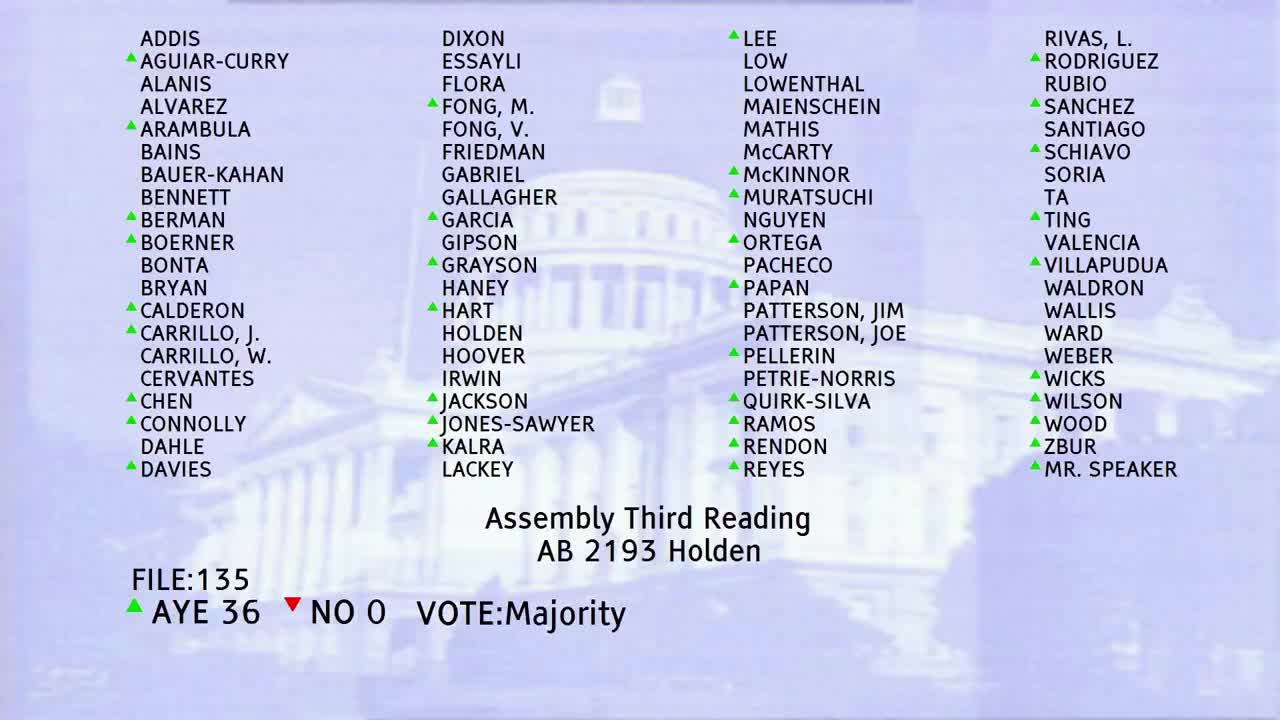 57SEC
Assembly Floor
 13MIN
Assembly Standing Committee on Human Services
 27SEC
Assembly Standing Committee on Human Services
Bill Author

Bill Co-Author(s):
