AB 2045: Controlled substances: fentanyl trafficking penalties.
- Session Year: 2023-2024
- House: Assembly
- Latest Version Date: 2024-04-11
Current Status:
Failed
(2024-05-16: In committee: Held under submission.)
Introduced
In Committee
First Chamber
In Committee
Second Chamber
Enacted
Existing law makes it a crime to solicit or encourage a minor to commit specified crimes relating to controlled substances, to hire or employ a minor to transport or sell controlled substances, or to sell or give controlled substances to minors and imposes a punishment of imprisonment for a period of 3, 6, or 9 years. Existing law makes a person who is 18 years of age or older who violates these provisions with respect to heroin, cocaine, or cocaine base on the grounds of, or within certain locations, such as a church, synagogue, or a public swimming pool, among others, or on the grounds of, or within 1,000 feet of, public or private schools, as specified, subject to punishment with an additional enhancement in the state prison of one or 2 years.
This bill would increase the penalty for that crime as it relates to fentanyl to 5, 8, or 11 years and would make the above-described enhancement applicable to offenses involving fentanyl. fentanyl if the person had knowledge that the specific controlled substance involved was fentanyl.
Existing law, the Juvenile Drug Trafficking and Schoolyard Act of 1988, subjects a person 18 years of age or over who is convicted of possession for sale, sale or transportation, or manufacturing offenses involving specified controlled substances, including cocaine base, heroin, or methamphetamine, to an additional term of imprisonment for 3, 4, or 5 years if the offense takes place upon the grounds of, or within 1,000 feet of, a public or private elementary, vocational, junior high, or high school during hours that the school is open for classes or school-related programs, or at any time when minors are using the facility where the offense occurs.This bill would make the above-described enhancement applicable to those offenses as they relate to fentanyl.By increasing the penalties for a crime, this bill would create a state-mandated local program.
The California Constitution requires the state to reimburse local agencies and school districts for certain costs mandated by the state. Statutory provisions establish procedures for making that reimbursement.
This bill would provide that no reimbursement is required by this act for a specified reason.
Existing law makes it a crime to solicit or encourage a minor to commit specified crimes relating to controlled substances, to hire or employ a minor to transport or sell controlled substances, or to sell or give controlled substances to minors and imposes a punishment of imprisonment for a period of 3, 6, or 9 years. Existing law makes a person who is 18 years of age or older who violates these provisions with respect to heroin, cocaine, or cocaine base on the grounds of, or within 1,000 feet of, public or private schools, as specified, subject to punishment with an additional enhancement in the state prison of 2 years.
This bill would increase the penalty for that crime as it relates to fentanyl to 5, 8, or 11 years and would make the above-described enhancement applicable to offenses involving fentanyl.
Existing law, the Juvenile Drug Trafficking and Schoolyard Act of 1988, subjects a person 18 years of age or over who is convicted of possession for sale, sale or transportation, or manufacturing offenses involving specified controlled substances, including cocaine base, heroin, or methamphetamine, to an additional term of imprisonment for 3, 4, or 5 years if the offense takes place upon the grounds of, or within 1,000 feet of, a public or private elementary, vocational, junior high, or high school during hours that the school is open for classes or school-related programs, or at any time when minors are using the facility where the offense occurs.
This bill would make the above-described enhancement applicable to those offenses as they relate to fentanyl.
By increasing the penalties for a crime, this bill would create a state-mandated local program.
The California Constitution requires the state to reimburse local agencies and school districts for certain costs mandated by the state. Statutory provisions establish procedures for making that reimbursement.
This bill would provide that no reimbursement is required by this act for a specified reason.
(a) Notwithstanding any other provision of law, a person 18 years of age or over who is convicted of a violation of Section 11353, in addition to the punishment imposed for that conviction, shall receive an additional punishment as follows:
(1) (A)If the offense involved heroin, cocaine, cocaine base, fentanyl, or any analog of these substances and occurred upon the grounds of, or within, a church or synagogue, a playground, a public or private youth center, a child day care facility, or a public swimming pool, during hours in which the facility is open for business, classes, or school-related programs, or at any time when minors are using the facility, the defendant shall, as a full and separately served enhancement to any other enhancement provided in paragraph (3), be punished by imprisonment in the state prison for one year.
(B)If the offense involved fentanyl or a fentanyl analog, this paragraph only applies if the person had knowledge that the specific controlled substance involved was fentanyl or a fentanyl analog.
(2) (A)If the offense involved heroin, cocaine, cocaine base, fentanyl, or any analog of these substances and occurred upon, or within 1,000 feet of, the grounds of any public or private elementary, vocational, junior high, or high school, during hours that the school is open for classes or school-related programs, or at any time when minors are using the facility where the offense occurs, the defendant shall, as a full and separately served enhancement to any other enhancement provided in paragraph (3), be punished by imprisonment in the state prison for two years.
(B)If the offense involved fentanyl or a fentanyl analog, this paragraph only applies if the person had knowledge that the specific controlled substance involved was fentanyl or a fentanyl analog.
(3) If the offense involved a minor who is at least four years younger than the defendant, the defendant shall, as a full and separately served enhancement to any other enhancement provided in this subdivision, be punished by imprisonment in the state prison for one, two, or three years, at the discretion of the court.
(b) The additional punishment provided in this section shall not be imposed unless the allegation is charged in the accusatory pleading and admitted by the defendant or found to be true by the trier of fact.
(c) The additional punishment provided in this section shall be in addition to any other punishment provided by law and shall not be limited by any other provision of law.
(d) Notwithstanding any other provision of law, the court may strike the additional punishment provided for in this section if it determines that there are circumstances in mitigation of the additional punishment and states on the record its reasons for striking the additional punishment.
(e) As used in this section the following definitions shall apply:
(1) Playground means any park or recreational area specifically designed to be used by children which has play equipment installed, including public grounds designed for athletic activities such as baseball, football, soccer, or basketball, or any similar facility located on public or private school grounds, or on city, county, or state parks.
(2) Youth center means any public or private facility that is primarily used to host recreational or social activities for minors, including, but not limited to, private youth membership organizations or clubs, social service teenage club facilities, video arcades, or similar amusement park facilities.
(3) Video arcade means any premises where 10 or more video game machines or devices are operated, and where minors are legally permitted to conduct business.
(4) Video game machine means any mechanical amusement device, which is characterized by the use of a cathode ray tube display and which, upon the insertion of a coin, slug, or token in any slot or receptacle attached to, or connected to, the machine, may be operated for use as a game, contest, or amusement.
(5) Within 1,000 feet of the grounds of any public or private elementary, vocational, junior high, or high school means any public area or business establishment where minors are legally permitted to conduct business which is located within 1,000 feet of any public or private elementary, vocational, junior high, or high school.
(6) Child day care facility has the meaning specified in Section 1596.750.
(f) This section does not require either that notice be posted regarding the proscribed conduct or that the applicable 1,000-foot boundary limit be marked.
SEC. 3.Section 11353.6 of the Health and Safety Code is amended to read:11353.6.(a)This section shall be known, and may be cited, as the Juvenile Drug Trafficking and Schoolyard Act of 1988.(b)A person 18 years of age or over who is convicted of any of the following violations, or of a conspiracy to commit one of those offenses, where the violation takes place upon the grounds of, or within 1,000 feet of, a public or private elementary, vocational, junior high, or high school during hours that the school is open for classes or school-related programs, or at any time when minors are using the facility where the offense occurs, shall receive an additional punishment of three, four, or five years at the courts discretion:(1)Section 11351.5, 11352, or 11379.6, as those sections apply to paragraph (1) of subdivision (f) of Section 11054.(2)Section 11351, 11352, or 11379.6, as those sections apply to paragraphs (8) and (11) of subdivision (c) of Section 11054.(3)Section 11378, 11379, or 11379.6, as those sections apply to paragraph (2) of subdivision (d) of Section 11055.(c)A person 18 years of age or older who is convicted of a violation pursuant to subdivision (b) that involves a minor who is at least four years younger than that person, as a full and separately served enhancement to that provided in subdivision (b), shall be punished by imprisonment pursuant to subdivision (h) of Section 1170 of the Penal Code for three, four, or five years at the courts discretion.(d)The additional terms provided in this section shall not be imposed unless the allegation is charged in the accusatory pleading and admitted or found to be true by the trier of fact.(e)The additional terms provided in this section shall be in addition to any other punishment provided by law and shall not be limited by any other provision of law.(f)Notwithstanding any other provision of law, the court may strike the additional punishment for the enhancements provided in this section if it determines that there are circumstances in mitigation of the additional punishment and states on the record its reasons for striking the additional punishment.(g)Within 1,000 feet of a public or private elementary, vocational, junior high, or high school means any public area or business establishment where minors are legally permitted to conduct business which is located within 1,000 feet of any public or private elementary, vocational, junior high, or high school.SEC. 4.SEC. 2.No reimbursement is required by this act pursuant to Section 6 of Article XIIIB of the California Constitution because the only costs that may be incurred by a local agency or school district will be incurred because this act creates a new crime or infraction, eliminates a crime or infraction, or changes the penalty for a crime or infraction, within the meaning of Section 17556 of the Government Code, or changes the definition of a crime within the meaning of Section 6 of Article XIIIB of the California Constitution.
Every (a)Except as provided in subdivision (c), a person 18 years of age or over, (a) who in any voluntary manner solicits, over who does any of the following acts shall be punished by imprisonment in the state prison for a period of three, six, or nine years:
(1)Voluntarily solicits, induces, encourages, or intimidates any minor with the intent that the minor shall violate any provision of this chapter or Section 11550 with respect to either (1) a controlled substance which is specified in subdivision (b), (c), or (e), or paragraph (1) of subdivision (f) of Section 11054, specified in paragraph (14), (15), or (20) of subdivision (d) of Section 11054, or specified in subdivision (b) or (c) of Section 11055, or specified in subdivision (h) of Section 11056, or (2) any controlled substance classified in Schedule III, IV, or V which is a narcotic drug, (b) who hires, a controlled substance listed in subdivision (b).
(2)Hires, employs, or uses a minor to unlawfully transport, carry, sell, give away, prepare for sale, or peddle any such controlled substance, or (c) who unlawfully sells, a controlled substance listed in subdivision (b).
(3)Sells, furnishes, administers, gives, or offers to sell, furnish, administer, or give, any such a controlled substance listed in subdivision (b) to a minor, shall be punished by imprisonment in the state prison for a period of three, six, or nine years. minor.
(b)The punishment stated in subdivision (a) shall apply with respect to the substances specified in the following provisions:
(1)Subdivisions (b), (c), (e), paragraphs (14), (15), and (20) of subdivision (d), and paragraph (1) of subdivision (f), of Section 11054.
(2)Subdivisions (b) and (c) of Section 11055.
(3)Subdivision (h) of Section 11056.
(4)Any controlled substance classified in Schedule III, IV, or V that is a narcotic drug.
(c)A person 18 years of age or over who does any of the acts listed in subdivision (a) with respect to fentanyl, as specified in paragraph (8) of subdivision (c) of Section 11055, shall be punished by imprisonment in the state prison for a period of five, eight, or eleven years.
SEC. 2.Section 11353.1 of the Health and Safety Code is amended to read:11353.1.(a) Notwithstanding any other provision of law, any a person 18 years of age or over who is convicted of a violation of Section 11353, in addition to the punishment imposed for that conviction, shall receive an additional punishment as follows:
(1) If the offense involved heroin, cocaine, cocaine base, or any analog of these substances and occurred upon the grounds of, or within, a church or synagogue, a playground, a public or private youth center, a child day care facility, or a public swimming pool, during hours in which the facility is open for business, classes, or school-related programs, or at any time when minors are using the facility, the defendant shall, as a full and separately served enhancement to any other enhancement provided in paragraph (3), be punished by imprisonment in the state prison for one year.
(2) If the offense involved heroin, cocaine, cocaine base, fentanyl, or any analog of these substances and occurred upon, or within 1,000 feet of, the grounds of any public or private elementary, vocational, junior high, or high school, during hours that the school is open for classes or school-related programs, or at any time when minors are using the facility where the offense occurs, the defendant shall, as a full and separately served enhancement to any other enhancement provided in paragraph (3), be punished by imprisonment in the state prison for two years.
(3) If the offense involved a minor who is at least four years younger than the defendant, the defendant shall, as a full and separately served enhancement to any other enhancement provided in this subdivision, be punished by imprisonment in the state prison for one, two, or three years, at the discretion of the court.
(b) The additional punishment provided in this section shall not be imposed unless the allegation is charged in the accusatory pleading and admitted by the defendant or found to be true by the trier of fact.
(c) The additional punishment provided in this section shall be in addition to any other punishment provided by law and shall not be limited by any other provision of law.
(d) Notwithstanding any other provision of law, the court may strike the additional punishment provided for in this section if it determines that there are circumstances in mitigation of the additional punishment and states on the record its reasons for striking the additional punishment.
(e) As used in this section the following definitions shall apply:
(1) Playground means any park or recreational area specifically designed to be used by children which has play equipment installed, including public grounds designed for athletic activities such as baseball, football, soccer, or basketball, or any similar facility located on public or private school grounds, or on city, county, or state parks.
(2) Youth center means any public or private facility that is primarily used to host recreational or social activities for minors, including, but not limited to, private youth membership organizations or clubs, social service teenage club facilities, video arcades, or similar amusement park facilities.
(3) Video arcade means any premises where 10 or more video game machines or devices are operated, and where minors are legally permitted to conduct business.
(4) Video game machine means any mechanical amusement device, which is characterized by the use of a cathode ray tube display and which, upon the insertion of a coin, slug, or token in any slot or receptacle attached to, or connected to, the machine, may be operated for use as a game, contest, or amusement.
(5) Within 1,000 feet of the grounds of any public or private elementary, vocational, junior high, or high school means any public area or business establishment where minors are legally permitted to conduct business which is located within 1,000 feet of any public or private elementary, vocational, junior high, or high school.
(6) Child day care facility has the meaning specified in Section 1596.750.
(f) This section does not require either that notice be posted regarding the proscribed conduct or that the applicable 1,000-foot boundary limit be marked.
SEC. 3.Section 11353.6 of the Health and Safety Code is amended to read:11353.6.(a)This section shall be known, and may be cited, as the Juvenile Drug Trafficking and Schoolyard Act of 1988.
(b)Any A person 18 years of age or over who is convicted of a violation of Section 11351.5, 11352, or 11379.6, as those sections apply to paragraph (1) of subdivision (f) of Section 11054, or of Section 11351, 11352, or 11379.6, as those sections apply to paragraph (11) of subdivision (c) of Section 11054, or of Section 11378, 11379, or 11379.6, as those sections apply to paragraph (2) of subdivision (d) of Section 11055, any of the following violations, or of a conspiracy to commit one of those offenses, where the violation takes place upon the grounds of, or within 1,000 feet of, a public or private elementary, vocational, junior high, or high school during hours that the school is open for classes or school-related programs, or at any time when minors are using the facility where the offense occurs, shall receive an additional punishment of three, four, or five years at the courts discretion. discretion:
(1)Section 11351.5, 11352, or 11379.6, as those sections apply to paragraph (1) of subdivision (f) of Section 11054.
(2)Section 11351, 11352, or 11379.6, as those sections apply to paragraphs (8) and (11) of subdivision (c) of Section 11054.
(3)Section 11378, 11379, or 11379.6, as those sections apply to paragraph (2) of subdivision (d) of Section 11055.
(c)Any A person 18 years of age or older who is convicted of a violation pursuant to subdivision (b) which that involves a minor who is at least four years younger than that person, as a full and separately served enhancement to that provided in subdivision (b), shall be punished by imprisonment pursuant to subdivision (h) of Section 1170 of the Penal Code for three, four, or five years at the courts discretion.
(d)The additional terms provided in this section shall not be imposed unless the allegation is charged in the accusatory pleading and admitted or found to be true by the trier of fact.
(e)The additional terms provided in this section shall be in addition to any other punishment provided by law and shall not be limited by any other provision of law.
(f)Notwithstanding any other provision of law, the court may strike the additional punishment for the enhancements provided in this section if it determines that there are circumstances in mitigation of the additional punishment and states on the record its reasons for striking the additional punishment.
(g)Within 1,000 feet of a public or private elementary, vocational, junior high, or high school means any public area or business establishment where minors are legally permitted to conduct business which is located within 1,000 feet of any public or private elementary, vocational, junior high, or high school.
SEC. 4.No reimbursement is required by this act pursuant to Section 6 of Article XIIIB of the California Constitution because the only costs that may be incurred by a local agency or school district will be incurred because this act creates a new crime or infraction, eliminates a crime or infraction, or changes the penalty for a crime or infraction, within the meaning of Section 17556 of the Government Code, or changes the definition of a crime within the meaning of Section 6 of Article XIIIB of the California Constitution.
|
Date
|
Status
|
|---|---|
| May 16, 2024 | In committee: Held under submission. |
| Apr 24, 2024 | In committee: Set, first hearing. Referred to APPR. suspense file. |
| Apr 15, 2024 | Re-referred to Com. on APPR. |
| Apr 11, 2024 | Read second time and amended. |
| Apr 10, 2024 | From committee: Amend, and do pass as amended and re-refer to Com. on APPR. (Ayes 7. Noes 0.) (April 9). |
| Feb 12, 2024 | Referred to Com. on PUB. S. |
| Feb 2, 2024 | From printer. May be heard in committee March 3. |
| Feb 1, 2024 | Read first time. To print. |
|
Date
|
Description
|
Location
|
Votes
|
|
|---|---|---|---|---|
| Apr 9, 2024 | Do pass as amended and be re-referred to the Committee on [Appropriations] | Assembly Standing Committee on Public Safety |
Passed |
This list shows positions taken on this bill by organizations on the date displayed, which is linked to the original source.
Positions by individuals are not included.
|
Organization
|
Position
|
Date
|
|---|---|---|
| Bienestar Human Services | ** Against | |
| California Association Of Highway Patrolmen | ** Support | |
| California District Attorneys Association | ** Support | |
| California for Safety and Justice | ** Against | |
| Californians United for a Responsible Budget | ** Against | |
| California Police Chiefs Association | ** Support | |
| California Public Defenders Association | ** Against | |
| California State Sheriffs' Association | ** Support | |
| Drug Policy Alliance | ** Against | |
| Ella Baker Center For Human Rights | ** Against | |
| HealthRight 360 | ** Against | |
| Initiate Justice | ** Against | |
| Initiate Justice Action | ** Against | |
| Pacific Juvenile Defender Center | ** Against | |
| Placer County District Attorney's Office | ** Support | |
| power + Resilience Project | ** Support | |
| San Francisco Public Defender | ** Against | |
| The Gubbio Project | ** Against | |
| Uncommon Law | ** Against | |
| Vera Institute Of Justice | ** Against | |
| Young Women's Freedom Center | ** Against |
Date of Hearing: April 24, 2024
ASSEMBLY COMMITTEE ON APPROPRIATIONS
Buffy Wicks, Chair
ABPCA Bill Id:AB 2045
Author:(Hoover) – As Amended Ver:April 11, 2024
Policy Committee: | Public Safety | Vote: | 7 - 0 |
|
| ||
|
|
Urgency: No State Mandated Local Program: Yes Reimbursable: No
SUMMARY:
This bill authorizes a sentencing enhancement for a defendant convicted of using, inducing, or employing a minor to transport or possess fentanyl, where the defendant knew the substance in question contained fentanyl or a fentanyl analog.
FISCAL EFFECT:
Incarceration costs (General Fund), likely in the low millions of dollars annually, to the California Department of Corrections and Rehabilitation (CDCR). Actual costs will depend on the number of enhancements imposed by the courts and the length of each enhancement. The Legislative Analyst’s Office (LAO) estimates that the average annual cost for one person incarcerated in CDCR is $133,000. If CDCR admits 20 offenders who each must serve a two-year sentence enhancement under this bill, the total cost of their incarceration resulting from this bill will be approximately $5.3 million over two years.
According to the LAO, the General Fund faces a structural deficit in the tens of billions of dollars over the next several fiscal years.
COMMENTS:
- Purpose. According to the author.
The opioid epidemic has worsened in recent years with fentanyl being the primary driver… There have been many cases where teens and young adults thought they were purchasing one drug and then overdose because fentanyl was in it, making it that much more lethal and dangerous. Given that fentanyl is 50 times stronger than heroin and 100 times stronger than morphine, this bill is necessary to hold drug traffickers accountable for selling fentanyl, especially when they target are schoolchildren.
- Background. Under existing law, if an adult is convicted of inducing or using a minor to sell or transport a controlled substance, the court imposes a base sentence plus applicable sentencing enhancements. If the offense involved selling substances on the grounds of a playground, church, youth center, or similar specified location, the current enhancement is one year in state prison. If the offense involved selling substances at or within 1,000 feet of a public or private school, the current enhancement is two years in state prison. Under existing law, the above-described enhancements are applied if the defendant is convicted of an offense involving heroin, cocaine, cocaine base, or any analog of those substances. This bill adds fentanyl to that list of substances and specifies that the enhancements apply only if the defendant knew the substance in question was fentanyl or a fentanyl analog.
Research shows that lengthy criminal sentences, which are costly to state and local governments, do not effectively deter crime. In general, the certainty that someone will be punished for an offense plays a larger role in deterring their criminal activity, rather than the length of their potential punishment. In light of the growing cost of incarceration and its limited utility in deterring crime, both the Little Hoover Commission and the Committee on Revision of the Penal Code have encouraged sentencing reform in California, including by limiting sentencing enhancements.
- Support and Opposition. Writing in support, the California State Sheriffs’ Association states:
Fentanyl-involved deaths have risen in California year over year, especially among youth. While pursuing an evidence-based public health approach to drug use is one tool to combat fentanyl, reasonable penalty enhancements can be another measurable method to combat the crisis. Bolstering enforcement efforts and enhancing penalties associated with fentanyl-related crimes will ensure that perpetrators face the full weight of the law for their contribution to the devastation caused by fentanyl. This legislation will deter potential offenders and safeguard the lives of countless minors who would otherwise fall victim to this insidious drug.
In opposition, the Drug Policy Alliance writes:
AB 2045 mirrors the “sentencing enhancement zones” laws that were enacted at the height of the War on Drugs. The impact of these policies has been studied and the research have found that “sentencing enhancement zones have never served their intended deterrent effect. But what they have done is consume resources that could low-return otherwise go to protecting youth effectively. They have created a two-tiered system of justice: a harsher one for dense urban areas with numerous schools and overlapping zones, and a milder one for rural and suburban areas, where schools are few and far between. Moreover, in many cities, people of color are more likely than white people to live in sentencing enhancement zones, leading to stark racial disparities in sentencing. (Footnotes omitted.)
Analysis Prepared by: Annika Carlson / APPR. / (916) 319-2081
Date of Hearing: April 9, 2024
Counsel: Kimberly Horiuchi
ASSEMBLY COMMITTEE ON
Kevin McCarty, Chair
ABPCA Bill Id:
Author:() – As Ver:
As Proposed to be Amended in Committee
SUMMARY:
Adds fentanyl to the list of controlled substance for which a defendant may be sentenced to an additional period of incarceration for using, inducing, or employing a minor to transport or possess specified controlled substances. Specifically, this bill:
- Adds fentanyl to the one year enhancement for any person over the age of 18 convicted of using, inducing, or employing a person under the age of 18 to transport or possess a specified controlled substance on the grounds of any church, synagogue, day care, or playground.
- Adds fentanyl to the two year enhancement for any person over the age of 18 convicted of using, inducing, or employing a person under the age of 18 to transport or possess a specified controlled substance within 1,000 feet of any public or private school during hours when the school is open or minors are present.
- Specifies that if the offense of using a minor to transport or sell a controlled substance involves fentanyl or a fentanyl analog, the person must have knowledge that the specific controlled substances involved was fentanyl or a fentanyl analog.
EXISTING LAW:
- Provides that any person 18 years of age or over who is convicted of a violation of inducing or using a minor to sell or transport controlled substances, in addition to the punishment imposed for that conviction, shall receive an additional punishment as follows:
- If the offense involved heroin, cocaine, cocaine base, or any analog of these substances and occurred upon the grounds of, or within, a church or synagogue, a playground, a public or private youth center, a child day care facility, or a public swimming pool, during hours in which the facility is open for business, classes, or school-related programs, or at any time when minors are using the facility, the defendant shall, as a full and separately served enhancement to any other enhancement, as specified, be punished by imprisonment in the state prison for one year.
- If the offense involved heroin, cocaine, cocaine base, or any analog of these substances and occurred upon, or within 1,000 feet of, the grounds of any public or private elementary, vocational, junior high, or high school, during hours that the school is open for classes or school-related programs, or at any time when minors are using the facility where the offense occurs, the defendant shall, as a full and separately served enhancement to any other enhancement, as specified, be punished by imprisonment in the state prison for two years.
- If the offense involved a minor who is at least four years younger than the defendant, the defendant shall, as a full and separately served enhancement to any other enhancement provided in this subdivision, be punished by imprisonment in the state prison for one, two, or three years, at the discretion of the court. (Health & Saf. Code, § 11353.1, subd. (a)(1-3).)
- Makes it unlawful for a person to possess for sale, or purchase for purpose of sale, several specified controlled substances, including heroin, cocaine, cocaine base, opium, and fentanyl. Provides that the punishment is imprisonment in the county jail for two, three, or four years. (Health & Saf. Code, §§ 11351, 11351.5.)
- Makes it unlawful for a person to transport, import, sell, furnish, administer, or give away, or offer or attempt to transport, import, sell, furnish, administer, or give away several specified controlled substances, including cocaine, cocaine base, heroin, and fentanyl. Provides that the punishment is imprisonment in the county jail for three, four, or five years. Provides that the punishment for transporting those specified controlled substances within the state between noncontiguous counties is imprisonment in the county jail for three, six, or nine years. (Health & Saf. Code, § 11352.)
- Makes it unlawful to possess for sale several specified controlled substances, including methamphetamine, amphetamine, and GHB. Provides that the punishment is imprisonment in the county jail for 16 months, two years, or three years. (Health & Saf. Code, § 11378.)
- Makes it unlawful for a person to transport, import into this state, sell, furnish, administer, or give away, or offer to transport, import into this state, sell, furnish, administer, or give away, or attempt to import into this state or transport specified controlled substances, including methamphetamine, amphetamine, and GHB. Provides that the punishment is imprisonment in the county jail for two, three, or four years. Provides that the punishment for transporting those specified controlled substances within the state between noncontiguous counties is imprisonment in the county jail for three, six, or nine years. (Health & Saf. Code, § 11379.)
FISCAL EFFECT:
Unknown
COMMENTS:
- Author’s Statement: According to the author: “The opioid epidemic has worsened in recent years with fentanyl being the primary driver. In fact, according to the CDC, fentanyl is now the number one cause of death for Americans ages 18-45, surpassing suicide and car accident-related deaths. This is partly attributed to how fentanyl is being sold. It is not labeled by name and is instead often used to lace cocaine, marijuana and other street drugs. There have been many cases where teens and young adults thought they were purchasing one drug and then overdose because fentanyl was in it, making it that much more lethal and dangerous. Given that fentanyl is 50 times stronger than heroin and 100 times stronger than morphine, this bill is necessary to hold drug traffickers accountable for selling fentanyl, especially when they target are schoolchildren. This bill simply updates California law to reflect the growing opioid crisis by ensuring that fentanyl is classified in the same category as other illicit drugs by increasing penalties for fentanyl dealers who specifically target our children at school.
- Fentanyl in California: In California, the number of deaths involving fentanyl has increased significantly. Between 2012 and 2018, fentanyl overdose deaths increased by more than 800%—from 82 to 786. (OPI, supra.) In 2020, there were 3,946 deaths related to fentanyl overdoses. (CDPH, California Overdose Surveillance Dashboard.)[1]
Criminal justice experts and commentators have noted that, with regard to sentencing, “A key question for policy development regards whether enhanced sanctions or an enhanced possibility of being apprehended provide any additional deterrent benefits. Research to date generally indicates that increases in the certainty of punishment, as opposed to the severity of punishment, are more likely to produce deterrent benefits.”[2] Sentencing enhancements for drug offenses specifically may have very little general deterrent effect. According to the National Research Council:
For several categories of offenders, an incapacitation strategy of crime prevention can misfire because most or all of those sent to prison are rapidly replaced in the criminal networks in which they participate. Street-level drug trafficking is the paradigm case. Drug dealing is part of a complex illegal market with low barriers to entry. Net earnings are low, and probabilities of eventual arrest and imprisonment are high… Drug policy research has nonetheless shown consistently that arrested dealers are quickly replaced by new recruits….
Despite the risks of drug dealing and the low average profits, many young disadvantaged people with little social capital and limited life chances sell drugs on street corners because it appears to present opportunities not otherwise available. However, [they] … overestimate the benefits of that activity and underestimate the risks. This perception is compounded by peer influences, social pressures, and deviant role models provided by successful dealers who live affluent lives and… avoid arrest. Similar analyses apply to members of deviant youth groups and gangs: as members … are arrested and removed from circulation, others take their place. Arrests and imprisonments of easily replaceable offenders create illicit “opportunities” for others. (Cmte. On Causes and Consequence of High Rates of Incarceration, National Research Council, The Growth of Incarceration in the United States: Exploring Causes and Consequences (2014) p. 146.)
- Drug-Related Sentencing Enhancements: One of the most common criticisms of drug-related sentencing enhancements is that it results in significant racial disparities and is most often used against users hailing largely from underserved communities. However, a great deal of statistical research has been conducted since the 2000s to determine the efficacy of drug-free school zone laws and there appears to be scant evidence that such laws reduce crime or increase child safety.
Alternatively, the Public Policy Institute in June 2020 found that the laws enacted over the past ten years that reformed California’s drug sentencing practices actually decreased racial disparities in sentencing.
“… After Prop 47 passed in November 2014, the number of bookings quickly dropped by 10.4 percent. As a result, California’s use of pretrial detention has declined. Prop 47 also led to notable decreases in racial/ethnic disparities in arrests and bookings. The African American–white arrest rate gap narrowed by about 5.9 percent, while the African American–white booking rate gap shrank by about 8.2 percent. Prop 47 has not meaningfully changed the disparities in arrest and booking rates between Latinos and whites, which are still only a small fraction of the African American–white gap. The narrowing of African American–white disparities has been driven by property and drug offenses. The gap in arrests for these offenses dropped by about 24 percent and the bookings gap narrowed by almost 33 percent. Even more striking, African American–white gaps in arrest and booking rates for drug felonies decreased by about 36 percent and 55 percent, respectively. The likelihood of an arrest leading to a jail booking declined the most for whites, but this is attributable to the relatively larger share of white arrests for drug offenses covered by Prop 47.
When we account for arrest offense differences, the decreases in the likelihood of an arrest being booked are similar across race and ethnicity. We also looked at the cumulative impact of reforms and prison population reduction measures in California since 2009 on racial disparities in incarceration. We found that the sizable reduction in the overall incarceration rate produced by these efforts has led to a narrowing of racial disparities in the proportion institutionalized on any given day. In particular, the African American–white incarceration gap dropped from about 4.5 percentage points to 2.8 percentage points, a decrease of about 36 percent.[3]
Furthermore, the Sentencing Project also noted “researchers documented that 80% of the defendants who received enhanced sentences under the drug-free zone law were black or Hispanic— even though 45% of those arrested for drug violations statewide were white.”[4]
- Argument in Support: According to the California State Sheriffs Association: “Fentanyl-involved deaths have risen in California year over year, especially among youth. While pursuing an evidence-based public health approach to drug use is one tool to combat fentanyl, reasonable penalty enhancements can be another measurable method to combat the crisis. Bolstering enforcement efforts and enhancing penalties associated with fentanyl-related crimes will ensure that perpetrators face the full weight of the law for their contribution to the devastation caused by fentanyl. This legislation will deter potential offenders and safeguard the lives of countless minors who would otherwise fall victim to this insidious drug.”
- Argument in Opposition: According to the Drug Policy Alliance: While adolescent drug use is at a record low, there has been an alarming spike on teen drug overdose deaths, in 2022, an average of 22 adolescents died of drug overdose each week. [Citation omitted for formatting.] An important driver of these overdose deaths has been fentanyl. This is a public health crisis that requires immediate attention and understand the author’s intent in introducing AB 2045. However, this bill does not propose a new solution to reduce the potential risk of teen overdose, instead it turns back the clock on the progress the state is making in advancing evidence-based policies to address the overdose crisis.”
- Related Legislation:
- AB 1848 (Davies), would expand an existing one year sentencing enhancement for any person over the age of 18 who induces a minor to transport, carry, sell, give away, prepare for sale, or sell heroin, cocaine, or cocaine base on any church, synagogue, youth center, day care, or public swimming pool grounds to include the transport, carry, sell, give away, prepare for sale, or sell heroin, cocaine, cocaine base, and fentanyl either on the grounds of, or within 1000 feet from a church, synagogue, youth center, day care, or public swimming pool. The hearing on AB 1848 was canceled at the request of the author.
- AB 2209 (Sanchez), would allow law enforcement to assist the Immigration & Customs Enforcement in investigations of any person who is suspected or previously convicted of possession for sale or sale of fentanyl. AB 2209 will be heard today in this committee.
- AB 2341 (Fong), would prohibit the granting of credits to any inmate serving a sentence for a fentanyl-related offense, as specified. AB 2341 is pending hearing in this committee.
- AB 1848 (Davies), would expand an existing one year sentencing enhancement for any person over the age of 18 who induces a minor to transport, carry, sell, give away, prepare for sale, or sell heroin, cocaine, or cocaine base on any church, synagogue, youth center, day care, or public swimming pool grounds to include the transport, carry, sell, give away, prepare for sale, or sell heroin, cocaine, cocaine base, and fentanyl either on the grounds of, or within 1000 feet from a church, synagogue, youth center, day care, or public swimming pool. The hearing on AB 1848 was canceled at the request of the author.
- Prior Legislation:
- AB 675 (Soria), of the 2023-2024 Legislative Session, would have added a substance containing a heroin analog, a substance containing fentanyl, and a substance containing a fentanyl analog to the list of controlled substances for which possession of those substances while armed with a loaded and operable firearm is a felony punishable in state prison by two, three, or four years. AB 675 was held in suspense in the Assembly Appropriations Committee.
- SB 226 (Alvarado-Gil), of the 2023-2024 Legislative Session, would add fentanyl to the list of controlled substances for which possession of those substances while armed with a loaded and operable firearm is a felony. SB 226 is failed passage in this committee.
- AB 1673 (Seyarto), of the 2021-2022 Legislative Session, would have created the Anti-Fentanyl Abuse Task Force to evaluate the nature and extent fentanyl abuse in California and to develop policy recommendations for addressing it. AB 1673 was held in suspense in the Assembly Appropriations Committee.
- SB 1070 (Melendez), of the 2021-2022 Legislative Session, would have added oxycodone and fentanyl to the list of controlled substances for which possession of those substances while armed with a loaded and operable firearm is a felony. Hearing on SB 1070 in the Senate Public Safety Committee was canceled at the request of the author.
- AB 675 (Soria), of the 2023-2024 Legislative Session, would have added a substance containing a heroin analog, a substance containing fentanyl, and a substance containing a fentanyl analog to the list of controlled substances for which possession of those substances while armed with a loaded and operable firearm is a felony punishable in state prison by two, three, or four years. AB 675 was held in suspense in the Assembly Appropriations Committee.
REGISTERED SUPPORT / OPPOSITION:
Support
(EM)power + Resilience Project
California Association of Highway Patrolmen
California District Attorneys Association
California Police Chiefs Association
California State Sheriffs' Association
Placer County District Attorney's Office
Oppose
Bienestar Human Services
California for Safety and Justice
California Public Defenders Association
Californians United for A Responsible Budget
Drug Policy Alliance
Ella Baker Center for Human Rights
Healthright 360
Initiate Justice
Initiate Justice Action
Pacific Juvenile Defender Center
San Francisco Public Defender
The Gubbio Project
Uncommon Law
Vera Institute of Justice
Young Women's Freedom Center
Analysis Prepared by:
Located at <https://skylab.cdph.ca.gov/ ODdash/> [last visited April 5, 2024].). ↑
(http://www.sentencingproject.org/doc/Deterrence%20Briefing%20.pdf.) ↑
Magnus Lofstrom, et al. (2020), “Proposition 47’s Impact on Racial Disparity in Criminal Justice Outcomes,” Public Policy Institute, located at file:///C:/Users/horiucka/Downloads/proposition-47s-impact-on-racial-disparity-in-criminal-justice-outcomes-june-2020.pdf, last visited on March 4, 2024.)
↑Porter, supra, The Sentencing Project, found at file:///C:/Users/horiucka/Downloads/Drug-Free-Zone-Laws%20(2).pdf (last visited March 4, 2024); See generally, Judith Green, et al., (March 2006) Justice Policy Institute, “Disparity by Design: How Drug-Free Zone Laws Impact Racial Disparity – and Fail to Protect Youth.” ↑
Discussed in Hearing
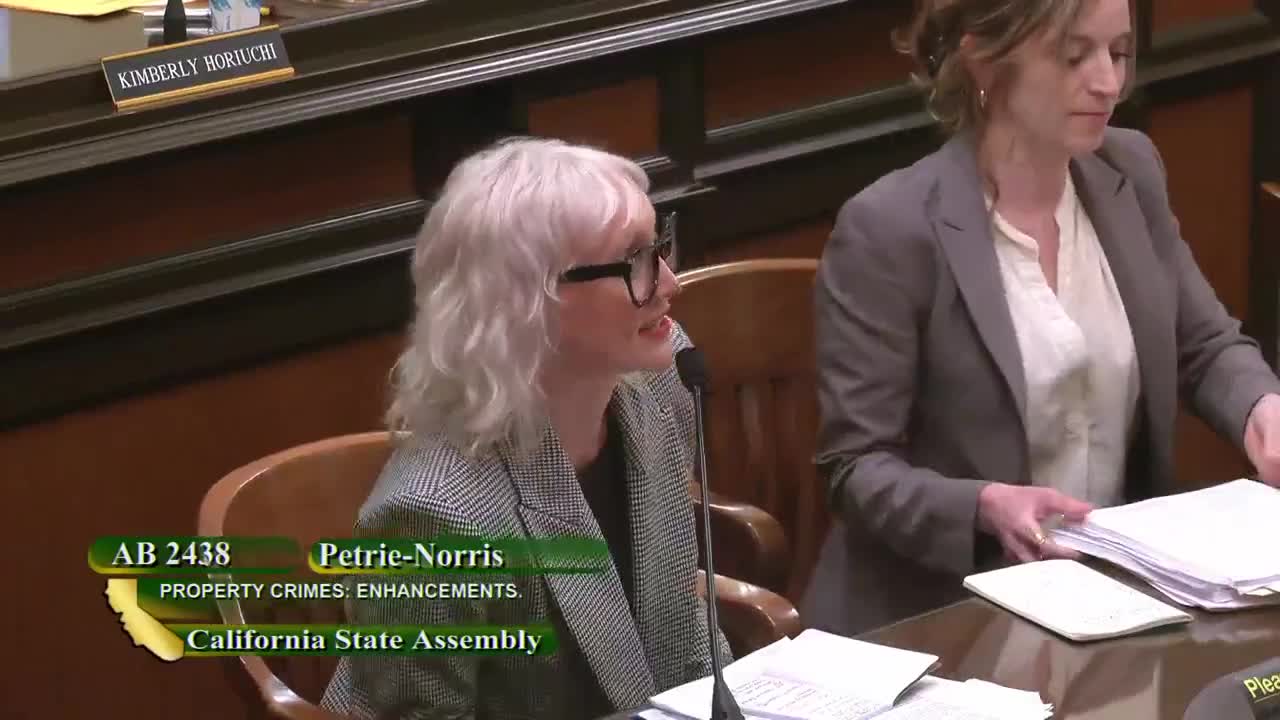 12MIN
Assembly Standing Committee on Public Safety
Bill Author