AB 2050: Voter registration database: Electronic Registration Information Center
- Session Year: 2023-2024
- House: Assembly
- Latest Version Date: 2024-05-20
Current Status:
Failed
(2024-08-15: In committee: Held under submission.)
Introduced
In Committee
First Chamber
In Committee
Second Chamber
Enacted
Existing law requires the Secretary of State to establish a statewide system to facilitate removal of duplicate or prior voter registrations to facilitate the reporting of election results and voter and candidate information and to otherwise administer and enhance election administration. Existing law also requires that certain voter registration information be provided to, among others, any person for election, scholarly, journalistic, or political purposes, or for governmental purposes, as determined by the Secretary of State.
This bill would allow the Secretary of State to apply for membership with the Electronic Registration Information Center and, if that application is approved, allow the Secretary of State to execute a membership agreement with the Electronic Registration Information Center on behalf of the state. The bill would require the Secretary of State to ensure that any confidential information or data provided by another state remains confidential, and would authorize the Secretary of State to transmit confidential information or data pursuant to that agreement. The bill would prohibit the disclosure of any information or data related to citizenship and certain types of drivers licenses and identification cards, as specified. The bill would also authorize the Secretary of State to adopt regulations necessary to implement these provisions and would require the Secretary of State to receive a certification from the Department of Technology that all proper cybersecurity protections are in place before sending any data or information to the Electronic Registration Information Center.
(a)The Secretary of State may apply for membership with the Electronic Registration Information Center. If the membership application is approved, the Secretary of State may execute a membership agreement with the Electronic Registration Information Center on behalf of the state.
(b)The Secretary of State shall ensure that any confidential information or data provided by another state to the Secretary of State remains confidential while in the Secretary of States possession.
(c)Unless otherwise specified in this section, notwithstanding subdivision (c) of Section 7924.000 of the Government Code, or paragraph (1) of subdivision (b) of Section 2194, or any other law, the Secretary of State may provide confidential information or data to persons or organizations pursuant to an agreement entered into under this section.
(d)Notwithstanding subdivision (c), no information or data related to any of the following may shall not be disclosed to any person or organization pursuant to an agreement entered into under this section with the state:
(1)Any drivers license or identification card issued pursuant to Section 12801.9 of the Vehicle Code.
(2)Citizenship.
(e)The Secretary of State may adopt regulations necessary to implement this section, including, but not limited to, regulations establishing procedures necessary to protect the confidential information identified in subdivision (c). The Secretary of State shall consult with the California Privacy Protection Agency on the development of any regulations related to the Electronic Registration Information Center.
(f)Before sending any information or data to the Electronic Registration Information Center, the Secretary of State shall receive a certification from the Department of Technology that all proper cybersecurity protections, as determined by the Department of Technology, are in place to allow the Secretary of State to send, and the Electronic Registration Information Center to receive, the data required by the Electronic Registration Information Center. If the Electronic Registration Information Center changes its data requirements, the Secretary of State shall receive a new certification from the Department of Technology certifying that all proper cybersecurity protections, as determined by the Department of Technology, are in place to allow the Secretary of State to send, and the Electronic Registration Information Center to receive, the data required by the Electronic Registration Information Center.
(a)The Secretary of State may apply for membership with the Electronic Registration Information Center. If the membership application is approved, the Secretary of State may execute a membership agreement with the Electronic Registration Information Center on behalf of the state.
(b)The Secretary of State shall ensure that any confidential information or data provided by another state to the Secretary of State remains confidential while in the Secretary of States possession.
(c)Unless otherwise specified in this section, notwithstanding subdivision (c) of Section 7924.000 of the Government Code, paragraph (1) of subdivision (b) of Section 2194, or any other law, the Secretary of State may provide confidential information or data to persons or organizations pursuant to an agreement entered into under this section.
(d)Notwithstanding subdivision (c), no information or data related to any of the following may be disclosed to any person or organization pursuant to an agreement entered into under this section with the state:
(1)Any drivers license or identification card issued pursuant to Section 12801.9 of the Vehicle Code.
(2)Citizenship.
(e)The Secretary of State may adopt regulations necessary to implement this section, including, but not limited to, regulations establishing procedures necessary to protect the confidential information identified in subdivision (c). The Secretary of State shall consult with the California Privacy Protection Agency on the development of any regulations related to the Electronic Registration Information Center.
(f)Before sending any information or data to the Electronic Registration Information Center, the Secretary of State shall receive a certification from the Department of Technology that all proper cybersecurity protections, as determined by the Department of Technology, are in place to allow the Secretary of State to send, and the Electronic Registration Information Center to receive, the data required by the Electronic Registration Information Center. If the Electronic Registration Information Center changes its data requirements, the Secretary of State shall receive a new certification from the Department of Technology certifying that all proper cybersecurity protections, as determined by the Department of Technology, are in place to allow the Secretary of State to send, and the Electronic Registration Information Center to receive, the data required by the Electronic Registration Information Center.
REVISIONS: HeadingLine 2.|
Date
|
Status
|
|---|---|
| Aug 15, 2024 | In committee: Held under submission. |
| Aug 5, 2024 | In committee: Referred to APPR suspense file. |
| Jul 3, 2024 | From committee: Do pass and re-refer to Com. on APPR. (Ayes 7. Noes 2.) (July 2). Re-referred to Com. on APPR. |
| Jun 18, 2024 | From committee: Do pass and re-refer to Com. on JUD. (Ayes 6. Noes 1.) (June 18). Re-referred to Com. on JUD. |
| Jun 5, 2024 | Referred to Coms. on E. & C.A. and JUD. |
| May 23, 2024 | In Senate. Read first time. To Com. on RLS. for assignment. |
| May 22, 2024 | Read third time. Passed. Ordered to the Senate. (Ayes 59. Noes 1. Page 5539.) |
| May 21, 2024 | Read second time. Ordered to third reading. |
| May 20, 2024 | Read second time and amended. Ordered returned to second reading. |
| May 20, 2024 | From committee: Amend, and do pass as amended. (Ayes 11. Noes 2.) (May 16). |
| May 1, 2024 | In committee: Set, first hearing. Referred to APPR. suspense file. |
| Apr 17, 2024 | From committee: Do pass and re-refer to Com. on APPR. (Ayes 8. Noes 1.) (April 16). Re-referred to Com. on APPR. |
| Mar 20, 2024 | From committee: Do pass and re-refer to Com. on P. & C.P. (Ayes 7. Noes 0.) (March 20). Re-referred to Com. on P. & C.P. |
| Mar 20, 2024 | Coauthors revised. |
| Feb 12, 2024 | Referred to Coms. on ELECTIONS and P. & C.P. |
| Feb 2, 2024 | From printer. May be heard in committee March 3. |
| Feb 1, 2024 | Read first time. To print. |
|
Date
|
Description
|
Location
|
Votes
|
|
|---|---|---|---|---|
| Aug 5, 2024 | Placed on suspense file | Senate Standing Committee on Appropriations |
Passed |
|
| Jul 2, 2024 | Do pass, but first be re-referred to the Committee on [Appropriations] | Senate Standing Committee on Judiciary |
Passed |
|
| Jun 18, 2024 | Do pass, but first be re-referred to the Committee on [Judiciary] | Senate Standing Committee on Elections and Constitutional Amendments |
Passed |
|
| May 22, 2024 | AB 2050 Pellerin Assembly Third Reading | Assembly Floor |
Passed |
|
| May 16, 2024 | Do pass as amended. | Assembly Standing Committee on Appropriations |
Passed |
|
| Apr 16, 2024 | Do pass and be re-referred to the Committee on [Appropriations] | Assembly Standing Committee on Privacy and Consumer Protection |
Passed |
|
| Mar 20, 2024 | Do pass and be re-referred to the Committee on [Privacy and Consumer Protection] | Assembly Standing Committee on Elections |
Passed |
This list shows positions taken on this bill by organizations on the date displayed, which is linked to the original source.
Positions by individuals are not included.
|
Organization
|
Position
|
Date
|
|---|---|---|
| American Civil Liberties Union California Action | ** Against | |
| California Association of Clerks and Election Officials | ** Support | |
| California Environmental Voters | ** Support | |
| California Secretary of State, Shirley N. Weber, Ph.D. | ** Support | |
| California State Association Of Counties | ** Support | |
| City Clerks Association of California | ** Support | |
| County Of Los Angeles | ** Support | |
| Election Integrity Project California, Inc. | ** Against | |
| Institute for Responsive Government | ** Support | |
| Institute for Responsive Government Action | ** Support |
SENATE COMMITTEE ON
Senator Anna Caballero, Chair
2023 - 2024 Regular Session
AB 2050 (Pellerin) - Voter registration database: Electronic Registration Information Center
Version: | Policy Vote: |
Urgency: | Mandate: |
Hearing Date: | Consultant: |
Bill Summary:
AB 2050 would permit the Secretary of State (SOS) to apply for membership with the Election Registration Information Center.
Fiscal Impact:
- SOS indicates that it would incur annual costs of $11.2 million in 2024-25, $2.8 million in 2025-26, $8 million in 2026-27, $2.8 million in 2027-28, and $8 million in 2028-29 to implement the provisions of the bill (General Fund, see Staff Comments).
- The California Privacy Protection Agency (CPPA) would incur minor and absorbable costs to consult with SOS on ERIC regulations.
- Administrative costs to the California Department of Technology to certify SOS has all proper cybersecurity protections in place would be minor and absorbable.
Background:
Formed in 2012, the Election Registration Information Center (ERIC) program is a non-profit membership organization whose mission is to assist states to improve the accuracy of voter rolls and increase access to voter registration for all eligible citizens. Each participating state (1) has a voting member on ERIC’s board of directors, and (2) must submit voter registration and specified motor vehicle department data so other member states can use these official data sources to determine voter eligibility. Currently, 24 states and Washington D.C. are members of ERIC.
Proposed Law:
This bill would do the following:
- Permit SOS to apply for membership with the ERIC.
- Require the SOS, prior to sending any information or data to ERIC, to receive a certification from the California Department of Technology (CDT) that all proper cybersecurity protections are in place to allow the SOS to send, and ERIC to receive, the data required by ERIC. Requires the SOS to receive a new certification from the CDT any time ERIC’s data requirements change.
- Require SOS ensure confidential information or data it receives from another state remains confidential while in its possession.
- Permits SOS to provide confidential information or data to individuals or organizations. Prohibits the SOS from disclosing information or data related to a DL or identification card, as specified, or to citizenship.
- Authorize SOS to adopt regulations, which must be developed in consultation with the California Privacy Protection Agency, related to joining ERIC.
Related Legislation:
- AB 1206 (Pellerin) was substantially similar to this bill, and was held under submission on the Suspense File of the Assembly Appropriations Committee.
- SB 1316 (Moorlach 2020) would have required the SOS to apply for membership with ERIC. The bill was not heard in any policy committee.
- AB 2375 (Obernolte, 2018) would have permitted SOS to apply for membership with the ERIC, and was held under submission on the Suspense File of the Assembly Appropriations Committee.
Staff Comments: SOS indicates that the cost drivers for this bill would include (1) system enhancements and modifications that would be needed to integrate VoteCal (the State’s online voter registration database) with the ERIC system, (2) membership costs (including joining fees and annual dues), (3) postage costs to notify all unregistered Californians identified by ERIC as eligible to vote, (4) regulation costs, and (5) 13 additional staff positions that would be needed to perform the additional workload under the bill, should the State become a member of ERIC. Specifically, ERIC members pay (1) a one-time membership fee of $25,000, which covers expenses for ERIC’s technology upgrades and expansion, and (2) annual dues to cover operating costs, which are determined, in part, on the citizen voting age population in each state. California’s annual membership dues are estimated to be $216,000. SOS estimates ongoing costs of approximately $2.8 million. The oscillating costs to SOS in the out-years reflect the pattern of postage costs. ERIC membership requires the State to send voter registration information to those eligible to vote but unregistered to vote, every two years.
-- END --
Senator Thomas Umberg, Chair
2023-2024 Regular Session
Bill No: AB 2050 (Author:Pellerin)
Version: May 20, 2024
Hearing Date: July 2, 2024
Fiscal: Yes
Urgency: No
Consultant: ME
SUBJECT
Voter registration database: Electronic Registration Information Center
DIGEST
This bill diminishes the privacy rights of Californians who have registered to vote in California and who are registered with the California Department of Motor Vehicles. The bill permits the sharing of the personal information of Californians with an out of state nonprofit who will share this personal information with other states. The stated purpose of the bill is to better ensure electoral integrity. While the bill has guarantees about protecting the personal information received from out of state residents, the bill cannot guarantee that other states that will gain access to voter’s personal information will actually protect that information. Proponents argue that the benefit the bill provides to democracy outweighs privacy concerns.
EXECUTIVE SUMMARY
This bill changes California’s longstanding policy to protect certain personal identifying voter information from disclosure. This bill overturns California’s privacy laws, including voter privacy law, to allow the Secretary of State (SOS) to provide confidential voter data and Department of Motor Vehicle data to an out-of-state nongovernmental organization and then to other specified states without the consent of each individual. Proponents contend that the personal information is protected through the system set up by the nongovernmental organization and that the benefit to democracy of maintaining accurate voter rolls outweighs any privacy concerns.
The bill is sponsored by the California Association of Clerks and Election Officials, is supported by the California State Association of Counties, County of Los Angeles, City Clerks Association of California, California Environmental Voters, Institute for Responsive Government Action, and California Secretary of State, Dr. Shirley N. Weber. The American Civil Liberties Union California Action and the Election Integrity Project California, Inc. oppose the bill. AB 2050 passed the Senate Elections and Constitutional Amendments Committee on a vote of 6 to 1.
PROPOSED CHANGES TO THE LAW
Existing law:
- Provides, pursuant to the California Constitution, that all people are by nature free and independent and have inalienable rights. Among these rights is the fundamental right to privacy. (Cal. Const. art. I, § 1.)
- Provides that the “right to privacy is a personal and fundamental right protected by Section 1 of Article I of the Constitution of California and by the United States Constitution and that all individuals have a right of privacy in information pertaining to them,” and further states these findings of the Legislature:
- the right to privacy is being threatened by the indiscriminate collection, maintenance, and dissemination of personal information and the lack of effective laws and legal remedies;
- the increasing use of computers and other sophisticated information technology has greatly magnified the potential risk to individual privacy that can occur from the maintenance of personal information; and
- in order to protect the privacy of individuals, it is necessary that the maintenance and dissemination of personal information be subject to strict limits. (Civ. Code § 1798.1.)
- Establishes the Information Practices Act of 1977, which places restrictions on state agencies collecting and sharing an individual’s personal information. (Civ. Code § 1798 et seq.)
- Defines “personal information” pursuant to the Information Practices Act as: any information that is maintained by an agency that identifies or describes an individual, including, but not limited to, the individual’s name, social security number, physical description, home address, home telephone number, education, financial matters, and medical or employment history. (Civ. Code § 1798.3 (a)
- Requires that each state agency maintain in its records only personal information that is relevant and necessary to accomplish the purpose of the agency. (Civ. Code § 1798.14.)
- Requires that each agency collect personal information to the greatest extent practicable directly from the individual who is the subject of the information rather than from another source. (Civ. Code § 1798.15.)
- Permits a person who is a United States citizen, a resident of California, not in prison for the conviction of a felony, and at least 18 years of age at the time of the next election to register to vote in any local, state, or federal election. (Cal. Const., Art. II, §2, §4.)
- Requires each state, pursuant to the federal Help America Vote Act of 2002 (HAVA), to implement a single, uniform, official, centralized, interactive computerized statewide voter registration list defined, maintained, and administered at the state level that contains the name and registration information of every legally registered voter in the state and assigns a unique identifier to each legally registered voter in the state. (52 U.S.C. §21083.)
- Requires certain information on an affidavit of voter registration, such as the voter’s name, home address, telephone number, email address, and party preference, to be provided to, among others, any person for election, scholarly, journalistic, or political purposes, or for governmental purposes, as determined by the SOS. (Elec. Code §2194(a).)
- Requires an affiant’s driver’s license number, identification card number, social security number, and the signature contained on an affidavit of registration or voter registration card to be confidential and not be disclosed, as specified. (Elec. Code §2194(b).)
- Provides that the home address, telephone number, e-mail address, precinct number, or other number specified by the SOS for voter registration purposes, and prior registration information shown on the voter registration card for all registered voters, are confidential and shall not be disclosed to any person, except as specified pursuant to existing law. (Gov. Code §7924.000.)
- Prohibits a person who requests voter information pursuant to existing law or who obtains signatures or other information collected for an initiative, referendum, political party qualification, or recall petition from sending that information outside of the US or making it available in any way electronically to persons outside the US, including, but not limited to, access over the internet. (Elec. Code §2188.5.)
- Requires the Department of Motor Vehicles (DMV) to issue an original driver’s license to applicants who cannot provide satisfactory proof that their presence in the United States is authorized under federal law if they meet all other qualifications and provide satisfactory proof to the DMV of their identity and California residency. (Veh. Code § 12801.9 (a)(1).)
- Prohibits the DMV from disclosing information submitted for purposes of obtaining a driver’s license or ID card, absent a subpoena for individual records in a criminal court proceeding, a court order, or in response to a law enforcement request to address an urgent health or safety need, provided the law enforcement agency certifies in writing the specific circumstances that do not permit authorities time to obtain a court order, and establishes that such documents and information are not a public record. (Veh. Code § 12800.7.)
- Provides for confidential voter registration for certain voters, including victims of domestic violence, reproductive health care workers, public safety officers, and elected officials. (Elec. Code § 2166, § 2166.5, and § 2166.7.)
- Provides that notwithstanding any other law, the California driver’s license number, the California identification card number, the social security number, and any other unique identifier used by the State of California for purposes of voter identification shown on the affidavit of voter registration of a registered voter, or added to voter registration records to comply with the requirements of the federal Help America Vote Act of 2002 (52 U.S.C. Sec. 20901 et seq.), are confidential and shall not be disclosed to any person. (Elec. Code § 2194 (b).)
This bill:
- Allows the SOS to apply for membership with the Electronic Registration Information Center, an out of state nonprofit.
- Provides that if the membership application is approved by the nonprofit, the SOS may execute a membership agreement with the nonprofit on behalf of the state.
- The SOS is required to ensure that any confidential information or data provided by another state to the SOS remains confidential while in the SOS’s possession.
- Specifies that unless otherwise provided in this bill, the SOS will be able to provide confidential information or data to any person or any organization pursuant to an agreement the SOS enters into with the nonprofit. Specifies that the privacy protections afforded to Californians pursuant to Government Code § 7924.000 and Elections Code § 2194 (b)(1) will no longer protect confidential information or data from being sent to persons or organizations pursuant to the agreement referenced in 1), above.
- Specifies that information or data related to citizenship or any driver’s license or identification card issued pursuant to Vehicle Code § 12801.9 shall not be disclosed to any person or organization pursuant to an agreement entered into under this bill with the state and the nonprofit.
- Authorizes the SOS to adopt regulations necessary to implement the provisions of this bill, including, but not limited to, regulations establishing procedures necessary to protect the confidential information identified in 4), above.
- Requires the SOS to consult with the California Privacy Protection Agency on the development of any regulations related to the nonprofit.
- Requires the SOS to receive a specified certification from the Department of Technology (DOT) before the SOS can send information or data to the nonprofit.
- Provides that before sending any information or data to the nonprofit, the SOS shall receive a certification from the DOT that all proper cybersecurity protections, as determined by the DOT, are in place to allow the SOS to send, and the nonprofit to receive, the data required by the nonprofit. Provides that if the nonprofit changes its data requirements, the SOS shall receive a new certification from the DOT certifying that all proper cybersecurity protections, as determined by the DOT, are in place to allow the SOS to send, and the nonprofit to receive, the data required by the nonprofit.
COMMENTS
- Stated need for the bill
According to the author:
The increased accessibility of California’s voter registration system has been a great success; in November of 2022, 81.63% of eligible Californians were registered to vote. However, there are almost 5 million eligible and unregistered voters in California, outnumbering the populations of 26 states.
In an election, accurate voter rolls are crucial for democracy. In California, there are likely millions of voter registration records that are out of date due to a recent move. Joining the Electronic Registration Information Center ensures that elections officials have access to the best data to keep their voter rolls current, and it would provide them with additional tools they could utilize to reach out to unregistered eligible voters. Becoming an ERIC member state is a natural next step in California’s mission to improve the accessibility and ease of voting.
California Environmental Voters writes the following in support of AB 2050:
California Environmental Voters (formerly, The California League of Conservation Voters) is writing to express our support as this bill would require the Secretary of State to ensure that any confidential information or data provided by another state remains confidential and would authorize the Secretary of State to transmit confidential information or data pursuant to that agreement. ERIC, a non-profit data consortium, is respected across the political spectrum and works to help election officials maintain and improve the accuracy of state voter rolls. California would join the 30+ other states who transmit data to ERIC, allowing us a wealth of information that would make our voter rolls more accurate.
Recently, California has made significant improvements to voter registration and voter accessibility, and still, we need to robustly expand the electorate and bring millions more voters into our voter registration system.
Secretary of State Shirley N. Weber, Ph.D. writes, “I agree with the author that this measure is a helpful mechanism that may help close the voter registration gap and improve the accuracy of our voter rolls.”
The California Association of Clerks and Election Officials writes the following in support of AB 2050:
Current law requires the Secretary of State to establish a statewide system to facilitate removal of duplicate or prior voter registrations to facilitate the reporting of election results and voter and candidate information and to otherwise administer and enhance election administration. Existing law also requires that certain voter registration information be provided to, among others, any person for election, scholarly, journalistic, or political purposes, or for governmental purposes, as determined by the Secretary of State.
Your proposal would authorize the Secretary of State to apply for membership with the Electronic Registration Information Center and, if that application is approved, permit the Secretary of State to execute a membership agreement with the Electronic Registration Information Center on behalf of the state.
AB 2050 would also require the Secretary of State to ensure that any confidential information or data provided by another state remains confidential and would authorize the Secretary of State to securely transmit certain confidential information or data pursuant to that agreement. The bill would also authorize the Secretary of State to develop regulations necessary to implement these provisions in consultation with the California Privacy Protection Agency.
2. The Electronic Registration Information Center (ERIC)
This bill allows the SOS to join the Electronic Registration Information Center (ERIC). ERIC is a nonprofit organization that was created to enable state election officials to share voter information with each member state to improve the accuracy of the voter rolls and to identify potential unregistered eligible voters. According to the ERIC website, “ERIC is a public charity non-profit membership organization comprised of 24 states and the District of Columbia. ERIC’s mission is to assist states in improving the accuracy of America’s voter rolls and increasing access to voter registration for all eligible citizens.” ERIC allows states to compare voter data with each other. Each state is required to submit voter registration and motor vehicle department data to ERIC. The data submitted includes names, addresses, dates of birth, driver’s license or state ID numbers, and the last four digits of the social security number. The District of Columbia is a member of ERIC as well as these states: Alaska, Arizona, Colorado, Connecticut, Delaware, Georgia, Illinois, Kentucky, Maine, Massachusetts, Maryland, Michigan, Minnesota, Nevada, New Jersey, New Mexico, Oregon, Pennsylvania, Rhode Island, South Carolina, Utah, Vermont, Washington, and Wisconsin.
According to ERIC’s website:
At least every 60 days, each member submits their voter registration data and licensing and identification data from motor vehicle departments (MVD) to ERIC. ERIC refers to these data as Member Data. ERIC’s technical staff uses sophisticated data matching software to compare Member Data from all member states, sometimes with data from other sources, to create the following four “list maintenance” reports.
- Cross-State Movers Report: Identifies voters who appear to have moved from one ERIC member to another using voter registration data and MVD data.
- In-State Updates Report: Identifies voters who appear to have moved within the jurisdiction, or who recently updated their contact information, using voter registration and MVD data.
- Duplicate Report: Identifies voters with duplicate registrations in the same state using voter registration data and MVD data.
- Deceased Report: Identifies voters who have died using voter registration data and Social Security death data known as the Limited Access Death Master File and MVD data.
In addition, ERIC offers three other reports:
- Eligible but Unregistered Report: Identifies individuals who appear to be eligible but who are not yet registered by matching voter registration data against MVD data.
- National Change of Address (NCOA) Report: Identifies voters who have moved using official data ERIC licenses from the US Postal Service.
- Voter Participation Report: For each federal general election, members can request reports identifying voters who appear to have voted more than once in the member jurisdiction in the same election, in more than one member jurisdiction in the same election, or on behalf of a deceased voter within the member jurisdiction.
Address validation is important and there are other tools available to help election officials identify addresses that may not be valid for the purposes of voter registration. Currently, ERIC does not investigate the validity of an address in a member’s voter registration record. Simply put, ERIC compares a member’s voter records to other members’ voter records, MVD records, and to federal deceased data and national change of address data, for the purposes of flagging differences that indicate a member’s voter record may be out of date or inaccurate. This is different from analyzing an address in a voter record to determine if the address is valid.
The agreement that California would be required to agree to in order to belong to ERIC highlights limitations in liability on the part of ERIC in the event there is unauthorized disclosure of information.[1] The bylaws specify the following, among other provisions:
Notice of Unauthorized Disclosure of Data/Indemnification-ERIC: Should there be an unauthorized disclosure of Member Data, Third-Party Data, or ERIC Reports by ERIC, whether accidental or intentional or the responsibility of a third party (“ERIC Unauthorized Disclosure”), ERIC shall immediately give notice to Members and take such other steps as required by law, insurance policies, and its incident response plan. ERIC shall keep the membership reasonably apprised of the steps it is taking to address the ERIC Unauthorized Disclosure. Understanding that ERIC’s primary source of funds are fees and dues paid by Members, and subject to consultation and approval by the Board, ERIC agrees to indemnify, defend, and hold harmless state motor vehicle agencies against any claims related to an ERIC Unauthorized Disclosure attributable to a negligent act or omission by ERIC, capped at the limit of any applicable ERIC insurance policy.
Additionally, the agreement that all member states enter into with ERIC specifies the following: “Should there be an unauthorized or impermissible use, access, acquisition, or disclosure or transmission of an ERIC Report, Member Data, Third-Party Data or protected ERIC Information, regardless of whether it is accidental or intentional (for example, Member intentionally sells, distributes, publishes or uses an ERIC Report for a purpose other than election administration, including a commercial purpose) or by a third party,” members shall take specified steps of notifying ERIC and engage in a remediation process. A member state can be removed if they do not follow the process agreed to between ERIC and the state. Member states also must agree to indemnify, defend, and hold ERIC harmless “against any claims or losses related to or stemming from the Unauthorized Disclosure.” Specifically, the agreement provides that “[t]o the extent permitted under each Member’s state law, the Member agrees to indemnify, defend and hold harmless ERIC against any claims or losses related to or stemming from the unauthorized disclosure.”
3. Privacy concerns
Californians provide their sensitive personal information to the Department of Motor Vehicles in order to obtain a driver’s license or state identification. Californians provide our personal information to elections officials in order to register to vote. This is done with the expectation that each person’s personal information will be protected because it has historically been protected through statute and the constitution. Californians have a right to privacy that is enshrined in the California Constitution and our personal information is protected through a series of state laws. The American Civil Liberties Union California Action explains the expectation of privacy that Californians are entitled to and the various laws that exist to protect our personal information. They write the following in opposition to AB 2050:
[This bill] would require the California Secretary of State (SoS) to share sensitive data with the Electronic Registration Information Center (ERIC) in conflict with California’s longstanding strict privacy statutes and constitutional requirements that protect such data.
While we appreciate the guardrails that the author has added to the bill in an attempt to safeguard Californians’ privacy, our concerns about confidentiality of private information and problematic errors in the ERIC system persist. In addition, recent problems related to the accuracy of ERIC’s data sharing and matching programs show that voters could be erroneously flagged for removal from the voter file and wrongfully disenfranchised.
ERIC is a non-profit corporation governed by a board of directors made up of representatives from member states. ERIC collects personal data from a variety of sources on residents of those member states. Membership in ERIC requires a state to transmit to ERIC voter file data and motor vehicle license and identification records, and requires member states to make best efforts to transmit data on individuals from other state agencies that perform voter registration functions.
AB 2050 would enable the SoS to “provide confidential information or data to persons or organizations pursuant to an agreement entered into under this section.” AB 2050 does provide for a narrow exclusion of information related to citizenship or any driver’s license or voter ID card secured under AB 60 (Chapter 524: Statutes of 2013), but that exclusion highlights the other personal information that would be shared with ERIC under such an agreement. AB 2050 does not contain any requirements that the SoS inform voters that their personal voter registration information is being shared, nor does the bill require a voter to consent to their personal information being shared. California could thus participate in ERIC and share, without an individual’s knowledge or consent, sensitive voter file, motor vehicle, and potentially other government agency data in spite of California Vehicle Code, Elections Code, and Civil Code provisions that explicitly protect this data.
First, the California Department of Motor Vehicles is explicitly prohibited from sharing residence address data. California Vehicle Code Section 1808.21(a) states, “Any residence address in any record of the department is confidential and shall not be disclosed to any person, except a court, law enforcement agency, or other government agency, or as authorized in Section 1808.22 or 1808.23.” Sections 1808.22 and 1808.23 provide exceptions that would not apply to ERIC.
Second, California Elections Code 2194(b)(1) states, “the California driver’s license number, the California identification card number, the social security number, and any other unique identifier used by the State of California for purposes of voter identification shown on a voter registration card of a registered voter, or added to the voter registration records to comply with the requirements of the Help America Vote Act of 2002 (42 U.S.C. Sec. 15301 et seq.), are confidential and shall not be disclosed to any person.” There are no exceptions.
Third, California has a comprehensive ban on state agencies sharing data. California Civil Code Section 1798.24 states “[a]n agency shall not disclose any personal information in a manner that would link the information disclosed to the individual to whom it pertains.” That code section includes a list of exceptions, none of which would include ERIC.
Participation in ERIC also conflicts with Article I, Section 1 of the California Constitution, which guarantees an inalienable right to privacy. Placed in the Constitution by ballot proposition in 1972, this provision has been read by the State Supreme Court to create “a legal and enforceable right of privacy for every Californian,” enforceable against the government and private parties.
In addition to these grave privacy concerns, participation in ERIC could put California voters at risk of being moved to inactive status, depriving them of important elections-related mailings and information, or worse, eventually triggering wrongful removal from the voter file. Joining ERIC could disproportionately disenfranchise voters of color by improperly flagging them as having changed addresses. One study published in 2021 asserted: “Consistent with concerns about the potential disparate racial impact of voter list maintenance, we find that minority registrants in the movers poll books were more than twice as likely as white registrants in the movers poll books to vote at the address flagged by ERIC as out of date.” In fact, that study estimated that about 9% of those who cast a ballot in Wisconsin in 2018 did so at the address of registration that ERIC had marked as out of date, raising serious concerns of voter disenfranchisement.
Supporters of the bill note that having accurate voter registration lists is critical for democracy. As explained by Professor Michael Morse from the University of Pennsylvania, Penn Carey Law School:
Accurate lists promote both electoral integrity and voter access, since voters typically must be registered to vote where they reside, even if they’ve moved. In contrast, inaccurate lists are not benign—they limit access, because voters with outdated registrations can have difficulty voting, and offer a foothold for false narratives of fraud. But accurate lists require the sharing of confidential data. ERIC is the best tool for achieving accurate lists through list maintenance, and the ACLU does not suggest otherwise. [citations omitted]
As I’ve written, voter registration lists are best understood as the vulnerable backbone of election administration. The problem is that our mobile electorate is scattered across different state registration lists. The result is our lists are both inaccurate and incomplete—more than a tenth of the electorate is likely registered at their former address and more than a third not registered at all. The solution has become list maintenance—or, identifying when voters, previously registered at one address, subsequently move or die, often by matching administrative data.
In 2014, a commission appointed by President Obama encouraged states to “share data and synchronize voter lists so that states, on their own initiative, come as close as possible to creating an accurate database of all eligible voters.” But if the idea of state coordination is simple, its implementation is not. In general, state voter registrations often lack a unique national identifier because of federal privacy restrictions on the collection of Social Security numbers. As a result, simply comparing voter registration lists across states can manufacture the appearance of fraud when none exists—because there are too many people who share the same name and date of birth for reliable comparison. ERIC unifies our disjointed registration lists by incorporating motor vehicle records too, which typically connect an individual with both their state driver’s license number and Social Security number. ERIC can thus reliably compare voter registration records across states and with the federal death list, which is indexed by Social Security number.
The allure of privacy leads the ACLU to assume that more data protections are always better. But that approach unwittingly sacrifices sound election administration. A system where election administration is decentralized, where voters are mobile, and where privacy protections strangle the flow of information, will be inaccurate. In contrast, AB 2050 strikes a better balance, permitting the limited sharing of confidential information with significant protections. For one, AB 2050 is similar to the legislative authorizations of many other ERIC states, including its certification of cybersecurity protections. For another, ERIC uses one-way hashing to protect sensitive data.
For additional information regarding data security, please visit ERIC’s website at: Security - ERIC, Inc. (ericstates.org). The website explains, among other things, that ERIC’s “data center is hosted by a U.S. based vendor.”
4. Respecting the privacy rights of Californians and providing them with agency over their personal information
The Committee may wish to amend the bill to require that the SOS to receive consent from an individual before their information is used in any transaction involving ERIC. The public policy of the state of California has been protective of the people’s right to privacy. In line with our strong public policy to protect the personal information of Californians, the Committee may wish to ensure that a person affirmatively opts in to this program. At the very least, this Committee may wish to require that a person be notified that their information will be shared with ERIC and be given a meaningful opportunity to opt out. The bill in print provides no notice to Californians who would have their personal information shared with ERIC.
SUPPORT
California Association of Clerks and Election Officials (sponsor)
California Environmental Voters
California Secretary of State Shirley N. Weber, Ph.D.
California State Association of Counties
City Clerks Association of California
County of Los Angeles
Institute for Responsive Government Action
One individual
OPPOSITION
American Civil Liberties Union California Action
Election Integrity Project California, Inc.
RELATED LEGISLATION
Pending Legislation: None known.
Prior Legislation:
AB 1206 (Pellerin, 2023) was substantially similar to this bill. The bill was held on suspense in the Assembly Appropriations Committee.
AB 1766 (Stone, Chap. 482, Stat. 2022) required that by January 1, 2027, the DMV issue restricted identification cards to eligible applicants who are unable to verify that their presence in the United States is authorized under federal law.
SB 1316 (Moorlach, 2020) was substantially similar to this bill, but would have required the SOS to apply for membership in ERIC. SB 1316 was not heard in any policy committee.
AB 2375 (Obernolte, 2018) would have permitted the SOS to apply for membership with ERIC. AB 2375 was held on suspense in the Assembly Appropriations Committee.
AB 2433 (T. Allen, 2016) was substantially similar to AB 2375. AB 2433 was held on suspense in the Assembly Appropriations Committee.
PRIOR VOTES:
Senate Elections and Constitutional Amendments Committee (Ayes 6, Noes 1)
Assembly Floor (Ayes 59, Noes 1)
Assembly Appropriations Committee (Ayes 11, Noes 2)
Assembly Privacy and Consumer Protection Committee (Ayes 8, Noes 1)
Assembly Elections Committee (Ayes 7, Noes 0)
**************
Bylaws of the Electronic Registration Information Center, Inc., available at ERIC Bylaws & Membership Agreement (ericstates.org) [as of June 29, 2024] ↑
SENATE COMMITTEE ON
ELECTIONS AND CONSTITUTIONAL AMENDMENTS
Senator Catherine Blakespear, Chair
2023 - 2024 Regular
Bill No: 2050 Hearing Date: 6/18/24
Author: | Pellerin | ||
Version: |
| ||
Urgency: | Fiscal: | ||
Consultant: | |||
Subject:
DIGEST
This bill permits the Secretary of State (SOS) to apply for membership with the Election Registration Information Center (ERIC).
ANALYSIS
Existing law:
- Permits a person who is a United States (US) citizen, a resident of California, not in prison for the conviction of a felony, and at least 18 years of age at the time of the next election to register to vote and to vote in any local, state, or federal election.
- Requires each state, pursuant to the federal Help America Vote Act of 2002 (HAVA), to implement a single, uniform, official, centralized, interactive computerized statewide voter registration list that is defined, maintained, and administered at the state level. The list must contain the name and registration information of every legally registered voter in the state and assigns a unique identifier to each legally registered voter in the state.
- Requires certain information on a voter’s registration, such as the voter’s name, home address, telephone number, email address, and party preference, to be provided to, among others, any person for election, scholarly, journalistic, or political purposes, or for governmental purposes.
- Requires a voter’s driver license (DL) number, identification card number, social security number (SSN), and the signature contained on the registration to be confidential and not be disclosed, as specified.
- Provides the home address, telephone number, e-mail address, precinct number, or other number specified by the SOS for voter registration purposes, and prior registration information shown on the voter registration card for all registered voters, are confidential and shall not be disclosed to any person, except as specified pursuant to existing law.
This bill:
- Permits the SOS to apply for membership with the ERIC.
- Requires the SOS, prior to sending any information or data to ERIC, to receive a certification from the California Department of Technology (CDT) that all proper cybersecurity protections are in place to allow the SOS to send, and ERIC to receive, the data required by ERIC. Requires the SOS to receive a new certification from the CDT any time ERIC’s data requirements change.
- Requires the SOS ensure confidential information or data it receives from another state remains confidential while in its possession.
- Permits the SOS to provide confidential information or data to individuals or organizations. Prohibits the SOS from disclosing information or data related to a DL or identification card, as specified, or to citizenship.
- Authorizes the SOS to adopt regulations, which must be developed in consultation with the California Privacy Protection Agency, related to joining ERIC.
BACKGROUND
Registration Data. According to the SOS’s February 20, 2024, report of registration, California has approximately 26,638,018 million eligible voters and 22,077,333 million registered voters (82.88%).
Election Registration Information Center. Formed in 2012, the ERIC program is a non-profit membership organization with the sole mission of assisting states to improve the accuracy of America’s voter rolls and increasing access to voter registration for all eligible citizens. Currently, 24 states (Alaska, Arizona, Colorado, Connecticut, Delaware, Georgia, Illinois, Kentucky, Maine, Maryland, Massachusetts, Michigan, Minnesota, Nevada, New Jersey, New Mexico, Oregon, Pennsylvania, Rhode Island, South Carolina, Utah, Vermont, Washington, and Wisconsin) and Washington D.C. are members of ERIC. Each participating state has a voting member on ERIC’s board of directors.
According to information provided on the ERIC website, the ERIC data center allows states to securely and safely compare voter data, thereby improving the accuracy of the voter rolls. States participating in ERIC can compare information on eligible voters from official data sources submitted by the states. Each member state submits at a minimum its voter registration and Department of Motor Vehicles (DMV) data. The data includes names, addresses, dates of birth, DL or state identification numbers, and the last four digits of the voter’s SSN. Other information, such as phone numbers, email addresses, and record status, are also submitted if they are available. ERIC states it has safeguards in place that anonymizes sensitive identifying data by converting it into indecipherable characters that are unreadable and unusable to potential hackers, through techniques such as “one-way hashing.”
These records go through a data-matching exchange that cross checks the information against lists from other participating states, as well as other data sources such as National Change of Address data from the US Postal Service (USPS) and death records from the Social Security Administration. ERIC then reports back to the states where there is a highly confident match indicating a voter moved or died, or a duplicate record exists. Once states receive the reports, they can then begin the process under federal and state law to update their voter registration records. Participating states also receive information on unregistered people who are potentially eligible to vote. ERIC bylaws require member states to use information regarding eligible or possibly eligible people who are not registered to vote to initiate contact with them about how to register to vote. Member states pay annual dues which vary depending on the population size of the state. Large states usually pay more than small states.
VoteCal. In September 2016, the SOS certified VoteCal and declared it to be the system of record for voter registration in California. VoteCal connects the SOS and all 58 county elections offices to provide a single, official statewide database of voter registration information. It also provides a publically available website, which allows a voter to apply to register online, check their voter registration status, find their polling place, opt-out of being mailed a state voter information guide, and check if their vote by mail or provisional ballot was counted by their county elections official and, if not, the reason why it was not counted.
States Withdrawing from ERIC. ERIC’s membership grew to 33 states and Washington D.C, but since that high point, nine states have withdrawn from ERIC (Alabama, Florida, Iowa, Louisiana, Missouri, Ohio, Texas, Virginia, and West Virginia). The reasons for withdrawing from ERIC may vary, but Louisiana cited security concerns.
Colorado and ERIC Mailing. According to an October 2022 news article, approximately 30,000 Colorado residents who are non-citizens and therefore ineligible to register to vote were mailed notices from the state informing them on how they could register to vote. According to the article, the problem occurred when the state compared a list of potential unregistered voters from ERIC with local DMV records. The DMV data included people who hold non-citizen driver’s licenses, which were created to allow people without legal residency to drive legally. However, a formatting error caused the system not to flag those individuals as ineligible. Consequently, postcards encouraging voter registration were sent to those drivers. According to the article, in an effort to address this error, Colorado’s SOS took additional steps to make sure none of the non-citizens registered to vote.
COMMENTS
- According to the Author: “The increased accessibility of California’s voter registration system has been a great success; in November of 2022, 81.63% of eligible Californians were registered to vote. However, there are almost 5 million eligible and unregistered voters in California, outnumbering the populations of 26 states.
“In an election, accurate voter rolls are crucial for democracy. In California, there are likely millions of voter registration records that are out of date due to a recent move. Joining the Electronic Registration Information Center ensures that elections officials have access to the best data to keep their voter rolls current, and it would provide them with additional tools they could utilize to reach out to unregistered eligible voters. Becoming an ERIC member state is a natural next step in California’s mission to improve the accessibility and ease of voting.”
- Confidential Voter Registration Information. If California participates in ERIC, the SOS would be authorized to provide confidential information or data to a private organization. As a result, this bill significantly changes California’s policy to keep certain personal identifying voter information confidential.
ERIC requires the SOS to provide the following data fields, if available, for each voter from both the voter registration lists and DMV lists:
- All name fields;
- All address fields;
- DL or state identification number;
- Last four digits of the SSN; date of birth;
- Activity dates;
- Current record status;
- Phone number; and
- Email address or other electronic contact method.
In order to participate in the program, the SOS would be required to share personal identifying information such as a voter’s DL number, SSN, and date of birth, two of which are prohibited by law from being disclosed. However, it should be noted this information would be anonymized before being transmitted.
- Nonprofit versus Government. Elections in the United States are administered and conducted at the state and local levels. As a result, there is not a federal voter registration database. Each state varies on its voter eligibility and registration practices. Due to the lack of a federal voter registration database, ERIC seeks to provide that national coordination. However, ERIC is a nonprofit (i.e., a private entity) and not a government agency.
As such, the Committee may wish to consider whether sending California’s voter registration data to ERIC is appropriate.
- Double Referral. If approved by this committee, AB 2050 will be referred to the Committee on Judiciary for further consideration.
RELATED/PRIOR LEGISLATION
AB 1206 (Pellerin) of 2023, was substantially similar to this bill. AB 1206 was held on the Assembly Committee on Appropriations’ suspense file.
SB 1316 (Moorlach) of 2020 would have required the SOS to apply for membership with ERIC. SB 1316 was not heard in any policy committee.
AB 2375 (Obernolte) of 2018 would have permitted the SOS to apply for membership with the ERIC. AB 2433 was held on the Assembly Committee on Appropriations’ suspense file. Additionally, AB 2433 (T. Allen) of 2016, which had provisions that were substantially similar to AB 2375 of 2018, was held on the Assembly Committee on Appropriations’ suspense file.
PRIOR ACTION
Assembly Floor: | 59 - 1 |
Assembly Appropriations Committee: | 11 - 2 |
Assembly Committee: | 7 - 0 |
POSITIONS
Sponsor: Author
Support: California Secretary of State Shirley N. Weber, Ph.D.
California Association of Clerks and Election Officials
California Environmental Voters
California State Association of Counties
City Clerks Association of California
County of Los Angeles Board of Supervisors
Oppose: ACLU California Action
Election Integrity Project California, Inc.
-- END --
SENATE COMMITTEE ON
ELECTIONS AND CONSTITUTIONAL AMENDMENTS
Senator Catherine Blakespear, Chair
2023 - 2024 Regular
Bill No: AB Hearing Date: 6/18/24
Author: | |||
Version: | 5/20/24 | ||
Urgency: | No | Fiscal: | Yes |
Consultant: | Scott Matsumoto | ||
Subject: Voter registration database: Electronic Registration Information Center
DIGEST
This bill permits the Secretary of State (SOS) to apply for membership with the Election Registration Information Center (ERIC).
ANALYSIS
Existing law:
- Permits a person who is a United States (US) citizen, a resident of California, not in prison for the conviction of a felony, and at least 18 years of age at the time of the next election to register to vote and to vote in any local, state, or federal election.
- Requires each state, pursuant to the federal Help America Vote Act of 2002 (HAVA), to implement a single, uniform, official, centralized, interactive computerized statewide voter registration list that is defined, maintained, and administered at the state level. The list must contain the name and registration information of every legally registered voter in the state and assigns a unique identifier to each legally registered voter in the state.
- Requires certain information on a voter’s registration, such as the voter’s name, home address, telephone number, email address, and party preference, to be provided to, among others, any person for election, scholarly, journalistic, or political purposes, or for governmental purposes.
- Requires a voter’s driver license (DL) number, identification card number, social security number (SSN), and the signature contained on the registration to be confidential and not be disclosed, as specified.
- Provides the home address, telephone number, e-mail address, precinct number, or other number specified by the SOS for voter registration purposes, and prior registration information shown on the voter registration card for all registered voters, are confidential and shall not be disclosed to any person, except as specified pursuant to existing law.
This bill:
- Permits the SOS to apply for membership with the ERIC.
- Requires the SOS, prior to sending any information or data to ERIC, to receive a certification from the California Department of Technology (CDT) that all proper cybersecurity protections are in place to allow the SOS to send, and ERIC to receive, the data required by ERIC. Requires the SOS to receive a new certification from the CDT any time ERIC’s data requirements change.
- Requires the SOS ensure confidential information or data it receives from another state remains confidential while in its possession.
- Permits the SOS to provide confidential information or data to individuals or organizations. Prohibits the SOS from disclosing information or data related to a DL or identification card, as specified, or to citizenship.
- Authorizes the SOS to adopt regulations, which must be developed in consultation with the California Privacy Protection Agency, related to joining ERIC.
BACKGROUND
Registration Data. According to the SOS’s February 20, 2024, report of registration, California has approximately 26,638,018 million eligible voters and 22,077,333 million registered voters (82.88%).
Election Registration Information Center. Formed in 2012, the ERIC program is a non-profit membership organization with the sole mission of assisting states to improve the accuracy of America’s voter rolls and increasing access to voter registration for all eligible citizens. Currently, 24 states (Alaska, Arizona, Colorado, Connecticut, Delaware, Georgia, Illinois, Kentucky, Maine, Maryland, Massachusetts, Michigan, Minnesota, Nevada, New Jersey, New Mexico, Oregon, Pennsylvania, Rhode Island, South Carolina, Utah, Vermont, Washington, and Wisconsin) and Washington D.C. are members of ERIC. Each participating state has a voting member on ERIC’s board of directors.
According to information provided on the ERIC website, the ERIC data center allows states to securely and safely compare voter data, thereby improving the accuracy of the voter rolls. States participating in ERIC can compare information on eligible voters from official data sources submitted by the states. Each member state submits at a minimum its voter registration and Department of Motor Vehicles (DMV) data. The data includes names, addresses, dates of birth, DL or state identification numbers, and the last four digits of the voter’s SSN. Other information, such as phone numbers, email addresses, and record status, are also submitted if they are available. ERIC states it has safeguards in place that anonymizes sensitive identifying data by converting it into indecipherable characters that are unreadable and unusable to potential hackers, through techniques such as “one-way hashing.”
These records go through a data-matching exchange that cross checks the information against lists from other participating states, as well as other data sources such as National Change of Address data from the US Postal Service (USPS) and death records from the Social Security Administration. ERIC then reports back to the states where there is a highly confident match indicating a voter moved or died, or a duplicate record exists. Once states receive the reports, they can then begin the process under federal and state law to update their voter registration records. Participating states also receive information on unregistered people who are potentially eligible to vote. ERIC bylaws require member states to use information regarding eligible or possibly eligible people who are not registered to vote to initiate contact with them about how to register to vote. Member states pay annual dues which vary depending on the population size of the state. Large states usually pay more than small states.
VoteCal. In September 2016, the SOS certified VoteCal and declared it to be the system of record for voter registration in California. VoteCal connects the SOS and all 58 county elections offices to provide a single, official statewide database of voter registration information. It also provides a publically available website, which allows a voter to apply to register online, check their voter registration status, find their polling place, opt-out of being mailed a state voter information guide, and check if their vote by mail or provisional ballot was counted by their county elections official and, if not, the reason why it was not counted.
States Withdrawing from ERIC. ERIC’s membership grew to 33 states and Washington D.C, but since that high point, nine states have withdrawn from ERIC (Alabama, Florida, Iowa, Louisiana, Missouri, Ohio, Texas, Virginia, and West Virginia). The reasons for withdrawing from ERIC may vary, but Louisiana cited security concerns.
Colorado and ERIC Mailing. According to an October 2022 news article, approximately 30,000 Colorado residents who are non-citizens and therefore ineligible to register to vote were mailed notices from the state informing them on how they could register to vote. According to the article, the problem occurred when the state compared a list of potential unregistered voters from ERIC with local DMV records. The DMV data included people who hold non-citizen driver’s licenses, which were created to allow people without legal residency to drive legally. However, a formatting error caused the system not to flag those individuals as ineligible. Consequently, postcards encouraging voter registration were sent to those drivers. According to the article, in an effort to address this error, Colorado’s SOS took additional steps to make sure none of the non-citizens registered to vote.
COMMENTS
- According to the Author: “The increased accessibility of California’s voter registration system has been a great success; in November of 2022, 81.63% of eligible Californians were registered to vote. However, there are almost 5 million eligible and unregistered voters in California, outnumbering the populations of 26 states.
“In an election, accurate voter rolls are crucial for democracy. In California, there are likely millions of voter registration records that are out of date due to a recent move. Joining the Electronic Registration Information Center ensures that elections officials have access to the best data to keep their voter rolls current, and it would provide them with additional tools they could utilize to reach out to unregistered eligible voters. Becoming an ERIC member state is a natural next step in California’s mission to improve the accessibility and ease of voting.”
- Confidential Voter Registration Information. If California participates in ERIC, the SOS would be authorized to provide confidential information or data to a private organization. As a result, this bill significantly changes California’s policy to keep certain personal identifying voter information confidential.
ERIC’s bylaws require the SOS to provide the following data fields, if available, for each voter from both the voter registration lists and DMV lists:
- All name fields;
- All address fields;
- DL or state identification number;
- Last four digits of the SSN; date of birth;
- Activity dates as defined by the ERIC Board of Directors;
- Current record status;
- Affirmative documentation of citizenship;
- The title/type of affirmative documentation of citizenship presented;
- Phone number; and
- Email address or other electronic contact method.
In order to participate in the program, the SOS would be required to share personal identifying information such as a voter’s DL number, SSN, and date of birth, two of which are prohibited by law from being disclosed. However, it should be noted this information would be anonymized before being transmitted.
- Nonprofit versus Government. Elections in the United States are administered and conducted at the state and local levels. As a result, there is not a federal voter registration database. Each state varies on its voter eligibility and registration practices. Due to the lack of a federal voter registration database, ERIC seeks to provide that national registration database. However, ERIC is a nonprofit (i.e., a private entity) and not a government agency.
As such, the Committee may wish to consider whether sending California’s voter registration data to ERIC is appropriate.
- Double Referral. If approved by this committee, AB 2050 will be referred to the Committee on Judiciary for further consideration.
RELATED/PRIOR LEGISLATION
AB 1206 (Pellerin) of 2023, was substantially similar to this bill. AB 1206 was held on the Assembly Committee on Appropriations’ suspense file.
SB 1316 (Moorlach) of 2020 would have required the SOS to apply for membership with ERIC. SB 1316 was not heard in any policy committee.
AB 2375 (Obernolte) of 2018 would have permitted the SOS to apply for membership with the ERIC. AB 2433 was held on the Assembly Committee on Appropriations’ suspense file. Additionally, AB 2433 (T. Allen) of 2016, which had provisions that were substantially similar to AB 2375 of 2018, was held on the Assembly Committee on Appropriations’ suspense file.
PRIOR ACTION
Assembly Floor: | |
Assembly Appropriations Committee: | |
Assembly Elections Committee: |
POSITIONS
Sponsor: Author
Support: California Secretary of State Shirley N. Weber, Ph.D.
California Association of Clerks and Election Officials
California Environmental Voters
California State Association of Counties
City Clerks Association of California
County of Los Angeles Board of Supervisors
Oppose: ACLU California Action
-- END --
ASSEMBLY THIRD READING
ATR Bill Id:AB 2050
Author:(Pellerin)
As Amended Ver:May 20, 2024
Majority vote
SUMMARY
Permits the Secretary of State (SOS) to apply for membership with the Electronic Registration Information Center (ERIC), as specified.
Major Provisions
- Permits the SOS to apply for membership with ERIC. Allows the SOS, if the membership application is approved, to execute a membership agreement with ERIC on behalf of the state.
- Requires the SOS to ensure that any confidential information or data provided by another state to the SOS remains confidential while in the SOS's possession.
- Authorizes the SOS to transmit confidential information or data pursuant to any executed ERIC membership agreement. Prohibits the SOS from disclosing information or data related to a driver's license (DL) or identification card, as specified, or to citizenship.
- Authorizes the SOS to adopt regulations, which must be developed in consultation with the California Privacy Protection Agency (CPPA), related to joining ERIC.
- Requires the SOS, prior to sending any information or data to ERIC, to receive a certification from the California Department of Technology (CDT) that all proper cybersecurity protections are in place to allow the SOS to send, and ERIC to receive, the data required by ERIC.
COMMENTS
The ERIC program is a non-profit membership organization with the sole mission of assisting states to improve the accuracy of America's voter rolls and increasing access to voter registration for all eligible citizens. With the assistance of the PEW Charitable Trusts, ERIC was formed in 2012 and is owned, governed, and funded by the states that choose to join. Currently, 24 states (Alaska, Arizona, Colorado, Connecticut, Delaware, Georgia, Illinois, Kentucky, Maine, Maryland, Massachusetts, Michigan, Minnesota, Nevada, New Jersey, New Mexico, Oregon, Pennsylvania, Rhode Island, South Carolina, Utah, Vermont, Washington, and Wisconsin) and Washington D.C. are members of ERIC. Each member state has a voting member on ERIC's board of directors.
The ERIC data center allows states to securely and safely compare voter data, thereby improving the accuracy of the voter rolls. States that choose to participate in ERIC are able to compare information on eligible voters from official data sources submitted by the states. Each member state submits at a minimum its voter registration and Department of Motor Vehicles data. The data includes names, addresses, dates of birth, DL or state identification numbers, and the last four digits of the social security number. These records go through a data-matching exchange that cross checks the information against lists from other member states as well as other data sources such as the National Change of Address data from the United States Postal Service and other existing government databases, such as death records from the Social Security Administration. ERIC then reports back to the states where there is a highly confident match indicating a voter moved or died, or the existence of a duplicate record. Once states receive the reports, they can then begin the process under federal and state law to update voter registration records. Participating states also receive information on unregistered individuals who are potentially eligible to vote.
Please see the policy committee analyses for a full discussion of this bill.
According to the Author
"In an election, accurate voter rolls are crucial for democracy. In California, there are likely millions of voter registration records that are out of date due to a recent move. Joining the Electronic Registration Information Center ensures that elections officials have access to the best data to keep their voter rolls current, and it would provide them with additional tools they could utilize to reach out to unregistered eligible voters. The increased accessibility of California's voter registration system has been a great success; in November of 2022, 81.63% of eligible Californians were registered to vote. However, there are almost 5 million eligible and unregistered voters in California, outnumbering the populations of 26 states. Becoming an ERIC member state is a natural next step in California's mission to improve the accessibility and ease of voting."
Arguments in Support
In support, the Institute for Responsive Government Action, writes, "ERIC is one of the best tools a state can adopt to efficiently identify movers and update registration records accordingly. By pooling information across multiple states, ERIC provides reliable, targeted data for updating voters who have moved within and between states and allows election officials to begin the process of removal for voters who have left the state. To date, ERIC has flagged nearly 40 million movers nationwide.
"This data on movers is crucial to the functioning of California's elections. Accurate registration records are the backbone of an effective election system. This is particularly true in a vote by mail jurisdiction like California. Accurate registration records ensure that voters are registered at the correct location and that election mail (including mail ballots) actually reaches the correct address. In the absence of these updates, ballots would be returned undeliverable or never reach voters...ERIC provides other significant benefits for voter roll accuracy. ERIC provides member states with the best available data on deceased voters, allowing California to promptly remove deceased registrants. This promotes confidence in the accuracy of the voter rolls and saves time and resources that would otherwise be spent on voters who have passed away. Similarly, in addition to flagging potential movers and deceased voters, ERIC provides member states with lists of duplicate registrations on their rolls. To date, ERIC has identified more than a million duplicate registration records for member states. Preventing duplicate records improves the accuracy and efficiency of the voting process, avoiding wasted resources and improving voter confidence in the registration and voting process."
Arguments in Opposition
In opposition, the American Civil Liberties Union California Action writes, "While we appreciate the guardrails that the author has added to the bill in an attempt to safeguard Californians' privacy, our concerns about confidentiality of private information and problematic errors in the ERIC system persist. In addition, recent problems related to the accuracy of ERIC's data sharing and matching programs show that voters could be erroneously flagged for removal from the voter file and wrongfully disenfranchised…AB 2050 does not contain any requirements that the [SOS] inform voters that their personal voter registration information is being shared, nor does the bill require a voter to consent to their personal information being shared. California could thus participate in ERIC and share, without an individual's knowledge or consent, sensitive voter file, motor vehicle, and potentially other government agency data in spite of California Vehicle Code, Elections Code, and Civil Code provisions that explicitly protect this data…In addition to these grave privacy concerns, participation in ERIC could put California voters at risk of being moved to inactive status, depriving them of important elections-related mailings and information, or worse, eventually triggering wrongful removal from the voter file. Joining ERIC could disproportionately disenfranchise voters of color by improperly flagging them as having changed addresses."
FISCAL COMMENTS
According to the Assembly Appropriations Committee:
- Ongoing costs of an unknown, but likely significant amount, in the low hundreds of thousands of dollars, to the SOS to join ERIC (General Fund (GF)). New ERIC members pay a one-time membership fee of $25,000, which covers expenses for ERIC's technology upgrades and expansion. Members also pay annual dues to cover operating costs, which are based, in part, on the citizen voting age population in each state. According to the author's office, California's annual membership dues are estimated to be $216,000.
Additionally, the SOS anticipates initial implementation costs of approximately $10.3 million for 13 additional staff positions, information technology system enhancements, and postage to contact all unregistered Californians identified by ERIC as eligible to vote (GF). Such mailings are required for ERIC members. Mailing costs would decrease over time if more people register to vote. After initial implementation, the SOS estimates ongoing costs of approximately $2.7 million (GF).
- Absorbable costs to CPPA to consult with the SOS on ERIC regulations.
- Minor and absorbable costs to CDT to certify SOS has all proper cybersecurity protections in place.
According to the Legislative Analyst's Office, the GF faces a structural deficit in the tens of billions of dollars over the next several fiscal years.
VOTES
ASM ELECTIONS: 7-0-1
YES: Pellerin, Bennett, Berman, Cervantes, Essayli, Low, Bonta
ABS, ABST OR NV: Lackey
ASM PRIVACY AND CONSUMER PROTECTION: 8-1-2
YES: Bauer-Kahan, Bryan, Irwin, Lowenthal, Ortega, Ward, Wicks, Wilson
NO: Joe Patterson
ABS, ABST OR NV: Dixon, Hoover
ASM APPROPRIATIONS: 11-2-2
YES: Wicks, Arambula, Bryan, Calderon, Wendy Carrillo, Mike Fong, Grayson, Haney, Hart, Pellerin, Villapudua
NO: Sanchez, Jim Patterson
ABS, ABST OR NV: Dixon, Ta
UPDATED
VERSION: May 20, 2024
CONSULTANT: Nichole Becker / ELECTIONS / (916) 319-2094 FN: 0003221
Date of Hearing: May 1, 2024
ASSEMBLY COMMITTEE ON APPROPRIATIONS
Buffy Wicks, Chair
ABPCA Bill Id:AB 2050
Author:(Pellerin) – As Introduced Ver:February 1, 2024
Policy Committee: | Elections | Vote: | 7 - 0 |
Privacy and Consumer Protection | 8 - 1 | ||
|
|
Urgency: No State Mandated Local Program: No Reimbursable: No
SUMMARY:
This bill allows the Secretary of State (SOS) to apply for Electronic Registration Information Center (ERIC) membership and execute a membership agreement if the application is approved.
Specifically, this bill:
- Allows the SOS to execute a membership agreement with ERIC on behalf of the state.
- Requires the SOS to ensure any confidential information or data provided by another state remains confidential.
- Authorizes the SOS to transmit confidential information or data pursuant to the agreement and prohibits the disclosure of any information or data related to citizenship and specified types of driver’s licenses and identification cards.
- Authorizes the SOS to adopt regulations necessary to implement participation in ERIC, including regulations establishing procedures necessary to protect confidential information, and requires the development of any regulations be done in consultation with the California Privacy Protection Agency (CPPA).
- Requires the SOS to receive certification from the Department of Technology (CDT) that all proper cybersecurity protections are in place prior to sending any data or information to ERIC, and requires new CDT certification each time ERIC changes its data requirements.
FISCAL EFFECT:
- Ongoing costs of an unknown, but likely significant amount, in the low hundreds of thousands of dollars, to the SOS to join ERIC (General Fund (GF)). New ERIC members pay a one-time membership fee of $25,000, which covers expenses for ERIC’s technology upgrades and expansion. Members also pay annual dues to cover operating costs, which are based, in part, on the citizen voting age population in each state. According to the author’s office, California’s annual membership dues are estimated to be $216,000.
Additionally, the SOS anticipates initial implementation costs of approximately $10.3 million for 13 additional staff positions, information technology system enhancements, and postage to contact all unregistered Californians identified by ERIC as eligible to vote (GF). Such mailings are required for ERIC members. Mailing costs would decrease over time if more people register to vote. After initial implementation, the SOS estimates ongoing costs of approximately $2.7 million (GF).
- Absorbable costs to CPPA to consult with the SOS on ERIC regulations.
- Minor and absorbable costs to CDT to certify SOS has all proper cybersecurity protections in place.
According to the Legislative Analyst’s Office, the GF faces a structural deficit in the tens of billions of dollars over the next several fiscal years.
COMMENTS:
- Purpose. According to the author:
In an election, accurate voter rolls are crucial for democracy. In California, there are likely millions of voter registration records that are out of date due to a recent move. Joining [ERIC] ensures that elections officials have access to the best data to keep their voter rolls current, and it would provide them with additional tools they could utilize to reach out to unregistered eligible voters.
- Support and Opposition. This bill is sponsored by the California Association of Clerks and Election Officials, which notes this bill will allow California to enroll into the ERIC voter registration database. This bill is also supported by other local government entities and civic engagement groups.
This bill is opposed by American Civil Liberties Union California Action and Election Integrity Project California, with the former expressing appreciation for the “guardrails that the author has added to the bill in an attempt to safeguard Californians’ privacy,” but arguing “recent problems related to the accuracy of ERIC’s data sharing and matching programs show that voters could be erroneously flagged for removal from the voter file and wrongfully disenfranchised.”
- ERIC. ERIC is a non-profit organization founded in 2012 by seven states to share voter registration information with one another in order to remove ineligible voters from their rolls and help identify unregistered eligible voters. Each member state must submit voter registration and motor vehicles department data, which includes names, addresses, dates of birth, driver’s license numbers, and social security numbers, so other member states can use these official data sources to determine voter eligibility.
Recently, ERIC has become the subject of conspiracy theories, with former President Trump claiming that ERIC was inflating voter rolls in favor of Democrats. No evidence has ever supported such accusations and the theories have largely been debunked. Yet, as a result of this misinformation, several states have either withdrawn or are threatening to withdraw from ERIC. As of April 2024, Washington D.C. and 24 states are members of ERIC (a reduction from the 33 states belonging to ERIC in April 2023). This bill authorizes the SOS to apply for ERIC membership and join ERIC, if accepted. In response to privacy concerns, this bill also requires the SOS to receive certification from CDT that all proper cybersecurity protections are in place, prior to sending any information or data to ERIC.
- Related Legislation. AB 1206 (Pellerin) requires the SOS to apply for ERIC membership and execute a membership agreement if approved. AB 1206 was held on this committee’s suspense file.
- Prior Legislation. SB 1316 (Moorlach), of the 2019-20 Legislative Session, would have required the SOS to apply for ERIC membership. SB 1316 was referred to the Senate Rules Committee without further action.
AB 2375 (Obernolte), of the 2017-18 Legislative Session, would have authorized the SOS to apply for ERIC membership. AB 2375 was held on this committee’s suspense file.
Analysis Prepared by: Irene Ho / APPR. / (916) 319-2081
Date of Hearing: April 16, 2024
ASSEMBLY COMMITTEE ON PRIVACY AND CONSUMER PROTECTION
Rebecca Bauer-Kahan, Chair
ABPCA Bill Id:AB 2050 (
Author:Pellerin) – As Introduced Ver:February 1, 2024
SUBJECT: Voter registration database: Electronic Registration Information Center
SYNOPSIS
This bill allows the Secretary of State (SOS) to join the multi-state Electronic Registration Information Center (ERIC), a non-profit organization founded in 2012 by seven states, four with Republican chief election officials and three with Democratic officials. The idea behind the organization is for state election officials of member states to share voter registration information with one another in order to both remove ineligible voters from their rolls and help identify unregistered eligible voters.
The ERIC data center allows states to compare voter data, thereby improving the accuracy of their voter rolls. States that choose to participate in ERIC are able to compare information on eligible voters from official data sources submitted by the states. Each member state submits, at a minimum, its voter registration and motor vehicles department data. The data includes names, addresses, date of births, driver’s license or state identification number, and the SSN4. Other information, such as phone numbers, email addresses, and current record status are also submitted as available.
Recently, ERIC has become the subject of far right conspiracy theories with former President Donald Trump at one point claiming that ERIC was inflating voter rolls in favor of Democrats. As a result of these theories, a number of states have withdrawn, falling from 33 states a year ago to 24 states and the District of Columbia as of April 2024. No evidence supporting the accusations has been forthcoming and the conspiracy theories have been largely debunked.
Last year, when the Committee heard a substantially similar bill there were significant privacy concerns. Current state law permits only certain voter information, such as the name, home address, telephone number, email address, and party affiliation, to be shared specifically for “election, scholarly, journalistic, or political purposes, or for governmental purposes.” Existing law explicitly requires voters’ CDL/ID numbers, SSNs, and signatures to be kept strictly confidential and not disclosed. That bill and this one change California’s longstanding policy to protect certain personal identifying voter information from disclosure.
In the form last year’s bill came to this Committee, it threatened to overturn vital privacy laws, including voter privacy law, to allow the SOS to provide confidential voter data to an out-of-state nongovernmental organization, which may or may not have sufficient cybersecurity countermeasures in place to protect sensitive voter data. In addition, it was unclear what, if anything, would prevent ERIC or other states who had joined ERIC from sharing the confidential information about California voters with the federal government or with other private entities beyond the knowledge and consent of this State and its voters. In response, Committee amendments built in additional protections into the bill. This bill maintains those changes and is identical to the amended bill last year.
This bill is author sponsored and is supported by the California Association of Clerks and Election Officials and the California State Association of Counties.
This bill previously passed the Assembly Elections Committee on a 7-0-1 vote.
SUMMARY: Authorizes the Secretary of State (SOS) to apply for membership with the Electronic Registration Information Center (ERIC). Specifically, this bill:
- Authorizes the SOS, if the membership application is approved, to execute a membership agreement with ERIC on behalf of the state.
- Requires the SOS, prior to preparing and sending data, to receive certification from the California Department of Technology (CDT) insuring that all necessary cybersecurity protections are taken both in terms of the SOS’s systems and ERIC’s system. In addition, recertification is required each time the data sharing requirements change.
- Prohibits the SOS from sending any data to ERIC that may disclose a person’s immigration and citizenship status, including prohibiting the sharing of any Department of Motor Vehicle (DMV) data relating to drivers who have obtained driver’s licenses or identification cards without submitting proof of authorized presence in the United States.
- Authorizes the SOS, notwithstanding specified provisions of existing law or any other law, to provide confidential information or data to persons or organizations pursuant to an agreement entered into under this bill.
- Authorizes the SOS to adopt regulations necessary to implement the provisions of this bill, including, but not limited to, regulations establishing procedures necessary to protect the confidential information identified above.
- Requires that the SOS consult with the California Privacy Protection Agency on the development of any regulations under the bill.
EXISTING LAW:
- Provides, pursuant to the California Constitution, that all people are by nature free and independent and have inalienable rights. Among these the fundamental right to privacy. (Cal. Const. art. I, § 1.)
- States that the “right to privacy is a personal and fundamental right protected by Section 1 of Article I of the Constitution of California and by the United States Constitution and that all individuals have a right of privacy in information pertaining to them.” Further states these findings of the Legislature:
- The right to privacy is being threatened by the indiscriminate collection, maintenance, and dissemination of personal information and the lack of effective laws and legal remedies.
- The increasing use of computers and other sophisticated information technology has greatly magnified the potential risk to individual privacy that can occur from the maintenance of personal information.
- In order to protect the privacy of individuals, it is necessary that the maintenance and dissemination of personal information be subject to strict limits. (Civ. Code § 1798.1.)
- Establishes the Information Practices Act of 1977, which places restrictions on state agencies collecting and sharing an individual’s personal information. (Civ. Code § 1798 et seq.)
- Requires that each state agency maintain in its records only personal information that is relevant and necessary to accomplish the purpose of the agency. (Civ. Code § 1798.14.)
- Requires that each agency collect personal information to the greatest extent practicable directly from the individual who is the subject of the information rather than from another source. (Civ. Code § 1798.15.)
- Permits a person who is a United States (US) citizen, a resident of California, not in prison for the conviction of a felony, and at least 18 years of age at the time of the next election to register to vote in any local, state, or federal election. (California Constitution, Article II, §§2, 4.)
- Requires each state, pursuant to the federal Help America Vote Act of 2002 (HAVA), to implement a single, uniform, official, centralized, interactive computerized statewide voter registration list defined, maintained, and administered at the state level that contains the name and registration information of every legally registered voter in the state and assigns a unique identifier to each legally registered voter in the state. (52 U.S.C. §21083.)
- Requires certain information on an affidavit of voter registration, such as the voter’s name, home address, telephone number, email address, and party preference, to be provided to, among others, any person for election, scholarly, journalistic, or political purposes, or for governmental purposes, as determined by the SOS. (Elections Code §2194(a).)
- Requires an affiant’s driver’s license number, identification card number, social security number (SSN), and the signature contained on an affidavit of registration or voter registration card to be confidential and not be disclosed, as specified. (Elections Code §2194(b).)
- Provides the home address, telephone number, e-mail address, precinct number, or other number specified by the SOS for voter registration purposes, and prior registration information shown on the voter registration card for all registered voters, are confidential and shall not be disclosed to any person, except as specified pursuant to existing law. (Government Code §7924.000.)
- Prohibits a person who requests voter information pursuant to existing law or who obtains signatures or other information collected for an initiative, referendum, political party qualification, or recall petition from sending that information outside of the US or making it available in any way electronically to persons outside the US, including, but not limited to, access over the Internet. (Elections Code §2188.5.)
- Requires the Department of Motor Vehicles (DMV) to issue an original driver’s license to applicants who cannot provide satisfactory proof that their presence in the United States is authorized under federal law if they meet all other qualifications and provide satisfactory proof to the DMV of their identity and California residency. (Veh. Code § 12801.9 (a)(1).)
- Prohibits the DMV from disclosing information submitted for purposes of obtaining a driver’s license or ID card, absent a subpoena for individual records in a criminal court proceeding, a court order, or in response to a law enforcement request to address an urgent health or safety need, provided the law enforcement agency certifies in writing the specific circumstances that do not permit authorities time to obtain a court order. Also establishes that such documents and information are not a public record. (Veh. Code § 12800.7.)
- Makes it unlawful to discriminate against a person because the person holds or presents a license issued under specified sections of the Vehicle Code. (Veh. Code § 12801.9(h).)
- Provides for confidential voter registration for certain voters, including victims of domestic violence, reproductive health care workers, public safety officers, and elected officials. (Elec. Code §§ 2166, 2166.5, and 2166.7.)
FISCAL EFFECT: As currently in print, this bill is keyed fiscal.
COMMENTS:
1) Purpose of this bill. This bill would allow the Secretary of State (SOS) to join the multi-state Electronic Registration Information Center (ERIC), a non-profit organization founded in 2012 by seven states, four with Republican chief election officials and three with Democratic officials. The idea behind the organization is for the state election official of member states to share voter registration information in order to both remove ineligible voters from their rolls and help identify unregistered eligible voters.
2) Author’s statement. According to the author:
The increased accessibility of California’s voter registration system has been a great success; in November of 2022, 81.63% of eligible Californians were registered to vote. However, there are almost 5 million eligible and unregistered voters in California, outnumbering the populations of 26 states.
In an election, accurate voter rolls are crucial for democracy. In California, there are likely millions of voter registration records that are out of date due to a recent move. Joining the Electronic Registration Information Center ensures that elections officials have access to the best data to keep their voter rolls current, and it would provide them with additional tools they could utilize to reach out to unregistered eligible voters. Becoming an ERIC member state is a natural next step in California’s mission to improve the accessibility and ease of voting.
3) AB 1206 (Pellerin). Last year, when the Committee heard a substantially similar bill there were significant privacy concerns. Current state law permits only certain voter information, such as the name, home address, telephone number, email address, and party affiliation, to be shared specifically for “election, scholarly, journalistic, or political purposes, or for governmental purposes.” Existing law explicitly requires voters’ CDL/ID numbers, SSNs, and signatures to be kept strictly confidential and not disclosed. That bill and this one change California’s longstanding policy to protect certain personal identifying voter information from disclosure.
In the form last year’s bill came to this Committee, it threatened to overturn vital privacy laws, including voter privacy law, to allow the SOS to provide confidential voter data to an out-of-state nongovernmental organization, which may or may not have sufficient cybersecurity countermeasures in place to protect sensitive voter data. In addition, it was unclear what, if anything, would prevent ERIC or other states who had joined ERIC from sharing the confidential information about California voters with the federal government or with other private entities beyond the knowledge and consent of this State and its voters.
In response, Committee amendments built in additional protections into the bill to do four things:
1. State that no AB 60 driver’s license/identification card data can be included with the data sent to ERIC.
2. Prohibit the sending of any data related to citizenship.
3. Prior to sending data to ERIC, the SOS must receive certification from the California Department of Technology (CDT) that all proper cybersecurity protections are in place, both on the SOS (sending) end and the ERIC (receiving) end. This process is required to be repeated any time the data requirements change.
4. The SOS must consult with the California Privacy Protection Agency on the development of any regulations related to ERIC.
This bill maintains those changes and is identical to the amended bill last year.
4) Electronic Registration Information Center (ERIC). ERIC is a non-profit organization with the stated mission of assisting states in improving the accuracy of America’s voter rolls and increasing access to voter registration for all eligible citizens. With the assistance of the PEW Charitable Trust, ERIC was formed in 2012 and is owned, governed, and funded by the states that choose to join. As of April 2024, Washington D.C. and 24 states are members of ERIC (this is a reduction from the 33 states that belonged in April 2023).[1]
ERIC was created to address what has been characterized as a “quirk” of the election system– there is no national database of voters in the United States. The lack of a national database is because elections are regulated by states rather than at the federal level. As a result, it is very difficult for state election officials to determine if someone is only registered in one state and is only voting once in each election. ERIC gives member states a way to compare voter data across state lines in order to both remove duplicate voters and identify eligible voters who may have moved to another state between elections and not re-registered.
According to information provided on the ERIC website, the ERIC data center allows states to securely and safely compare voter data, thereby improving the accuracy of the voter rolls. States that choose to participate in ERIC are able to compare information on eligible voters from official data sources submitted by the states. Each member state submits, at a minimum, its voter registration and motor vehicles department data. The data includes names, addresses, dates of birth, driver’s license or state identification numbers, and the last four numbers of the person’s Social Security number (SSN4). Other information, such as phone numbers, email addresses, and current record status is also submitted as available. According to the ERIC website, ERIC has safeguards in place that anonymize certain (but not all) sensitive identifying data by converting it into indecipherable characters that is unreadable and unusable to potential hackers, such as “one-way hashing.”
These records go through a data-matching exchange that crosschecks the information against lists from other member states, as well as other data sources such as the National Change of Address data from the United States Postal Service and other existing government databases, such as death records from the Social Security Administration. ERIC then reports back to the states where there is a “highly confident match” indicating a voter moved or died, or the existence of a duplicate record. It is unclear, however, exactly how many data points constitute a match. Once states receive the reports they can then begin the process of cleaning up the voter rolls, subject to state and federal law. Participating states also receive information on unregistered individuals who are potentially eligible to vote. This information will allow states to reach out to those citizens to encourage them to register to vote. Member states pay annual dues which vary depending on the population size of the state. Large states usually pay more than small states.[2]
This bill authorizes the SOS to apply for membership to the ERIC program and, if approved, requires the SOS to execute a membership agreement with ERIC on behalf of the state. The bill contains a provision that overrides state laws designed to protect voter privacy and the confidentiality of sensitive voter data, such as Social Security numbers and driver’s license numbers. Specifically, this bill authorizes the SOS, notwithstanding specific voter privacy laws which prohibit disclosure of a voter’s CDL/ID, SSN4, and signature, such as Elections Code 2194(b), or “any other law,” to provide such confidential information or data to persons or organizations if an agreement is entered to participate in ERIC.
5) Colorado and ERIC mailing. According to an October 2022 news article, approximately 30,000 Colorado residents who are non-citizens and therefore ineligible to register to vote were mailed notices from the state informing them on how they could register to vote. The problem occurred, according to a Colorado elections official, when the state compared a list of potential unregistered voters from ERIC with local DMV records. The DMV data included people who hold non-citizen driver’s licenses—which were created to allow people without legal residency to drive legally—because a formatting error caused the system not to flag those individuals as ineligible. Consequently, postcards encouraging voter registration were sent to those voters. According to the article, in an effort to address this error the Colorado’s SOS took additional steps to make sure none of the non-citizens registered to vote.[3]
6) States Withdrawing from ERIC. A number of states have withdrawn from ERIC over the last year. As noted previously, for the last decade, ERIC has operated as a nonpartisan organization with the shared goal of improving states’ voter registration rolls. According to the Brennan Center, the group has helped states identify millions of registrants who should be taken off the rolls because they moved or died, and it has facilitated millions of new registrations of eligible voters.
Unfortunately, over the last few years, ERIC has been accused by former President Donald Trump and others of inflating the voter rolls in favor of Democrats. Far-right media outlets have also suggested that ERIC’s origins are suspect because it was founded by state elections officials with financial assistance from the Pew Foundation.
According to the Brennan Center, the states that appear to be going along with these attacks have given conflicting and inaccurate reasons for withdrawing, primarily related to data collection. Missouri, on the one hand, objected to the restrictions placed on the states’ use of the data collected by ERIC. On the other hand, Florida and Alabama have raised concerns because of a lack of privacy protections.[4]
7) Privacy implications of releasing confidential voter registration data. Current state law permits only certain voter information, such as the name, home address, telephone number, email address, and party affiliation, to be shared specifically for “election, scholarly, journalistic, or political purposes, or for governmental purposes.” Current state law also explicitly requires voters’ CDL/ID numbers, SSNs, and signatures to be kept strictly confidential and not disclosed. This bill changes California’s longstanding policy to protect certain personal identifying voter information from disclosure. Like AB 1206 last year, this bill overturns all of California’s privacy laws, including voter privacy law, to allow the SOS to provide confidential voter data to an out-of-state nongovernmental organization without the individuals’ consent. The ERIC bylaws, as of the March 17, 2023 update, require the SOS to provide the following data fields for all registered voters:
- All name fields
- All address fields
- Driver’s license or state ID number
- Last four digits of Social Security number
- Date of birth
- Activity dates
- Current record status
- Phone number
- E-mail address or other electronic contact method
8) ERIC cybersecurity policy. According to documents from the ERIC website, there are three primary components to ERIC’s data matching process: data collection, anonymization, and file transfer.
1. To secure sensitive information, which ERIC defines as the date of birth, SSN4 and DL number, they provide an anonymization application to each participating jurisdiction. The anonymization, also known as “one-way hashing,” converts sensitive identifying data into indecipherable characters that are unreadable and unusable to potential hackers. According to ERIC’s security statement:
The sensitive data elements are the driver’s license or state ID number, any part of the social security number, and date of birth. The hashing application converts these data into what appears to be a string of random characters, making the data significantly more difficult for a potential hacker to utilize. A cryptographic hash is not meant to be decrypted. ERIC only accepts voter and driver’s license data files that have been hashed using the application. This ensures these sensitive data are protected at the source, in the member’s environment, prior to submission to the ERIC data center. The distribution of the hashing application to ERIC members is a closely monitored and structured process. [Emphasis added.]
2. Documents state that to further strengthen the security measures around the data, all records are sent through the anonymization process twice – once at the state level, before data is ever sent to ERIC, and once by ERIC as it receives data. States are then given account credentials to access a secure file transfer protocol (sFTP) site where their anonymized files are uploaded to a state-specific location. ERIC proceeds to run and generate reports that are available for state-specific download on the same sFTP site.
3. According to ERIC’s membership agreement, participating states are required to upload all voter data every 60 days.[5]
10) AB 60 licenses and identification cards. In 2013, the Legislature approved AB 60 (Alejo), which granted DMV the ability to issue driver’s licenses to undocumented immigrants. AB 60 was viewed by its supporters as a necessary step to not only ensure the safety of California drivers on the road, but also to address pervasive inequities faced by the state’s undocumented population. Without access to driver’s licenses, undocumented individuals were unable to legally drive themselves to accomplish the tasks of everyday life—including traveling to and from work, thereby contributing a significant portion of the state’s economy.[6] They were also unable to obtain auto insurance to protect themselves and other drivers who may encounter them.
In 2022, the Legislature expanded AB 60 licenses to include identification (ID) cards in AB 1766 (Stone, Chap. 482, Stat. 2022). That bill requires that, starting January 1, 2027, the DMV must issue ID cards to any undocumented person who is able to demonstrate proof of their identity and California residency. The bill mirrored existing privacy protections to shield applicants’ information from third parties and to preclude information and documents collected pursuant to the provisions of the bill from being treated as a public record, and would establish that such information cannot be disclosed by the department, except where necessary to comply with an order, warrant, or subpoena, each if issued by a court. This bill explicitly prohibits the sharing AB 60 restricted drivers’ licenses and identification cards in order to protect the personal information of California residents who may be lacking the proper documentation to be verify that they are in the United States legally.
11) Related legislation. AB 1206 (Pellerin) of 2023, is substantially similar to this bill. AB 1206 was held on the Assembly Appropriations Committee’s suspense file. AB 1206 passed out of the Committee on Elections on a 7-0 vote and passed out of the Committee on Privacy and Consumer Protection on a 9-1 vote.
AB 1766 (Stone, Chap. 482, Stat. 2022) required that by January 1, 2027, DMV issue restricted identification cards to eligible applicants who are unable to verify that their presence in the United States is authorized under federal law.
SB 1316 (Moorlach, 2020), which was substantially similar to this bill, would have required the SOS to apply for membership of ERIC to share voter information or data with states or groups of states in order to improve the accuracy of the statewide voter registration database. SB 1316 was not heard in any policy committee.
AB 2375 (Obernolte, 2018) would have permitted the SOS to apply for membership with ERIC to share voter registration information or data with other states or groups of states, and to use the information to update California's voter registration lists, as specified. AB 2375 passed out of this committee on a 6-1 vote. AB 2375 was held on the Assembly Appropriations Committee’s suspense file.
AB 2433 (T. Allen, 2016), which had provisions substantially similar to AB 2375 of 2018, passed out of this committee on an 8-1 vote. AB 2433 was held on the Assembly Appropriations Committee's suspense file.
AB 60 (Alejo, Chap. 524, Stats. 2013) authorized the DMV to issue an original driver’s license to a person who unable to submit satisfactory proof that the applicant’s presence in the United States is authorized under federal law, provided that person meets all other qualifications for licensure and provides satisfactory proof to DMV of their identity and California residency.
ARGUMENTS IN SUPPORT: The Institute for Responsive Government Action writes in support:
ERIC is one of the best tools a state can adopt to efficiently identify movers and update registration records accordingly. By pooling information across multiple states, ERIC provides reliable, targeted data for updating voters who have moved within and between states and allows election officials to begin the process of removal for voters who have left the state. To date, ERIC has flagged nearly 40 million movers nationwide.
This data on movers is crucial to the functioning of California’s elections. Accurate registration records are the backbone of an effective election system. This is particularly true in a vote by mail jurisdiction like California. Accurate registration records ensure that voters are registered at the correct location and that election mail (including mail ballots) actually reaches the correct address. In the absence of these updates, ballots would be returned undeliverable or never reach voters. Voters would lose the benefit of voting by mail and would be forced to update their registration through other methods, including at the polls on election day. Better address data from ERIC is a win-win for election officials and voters, saving time, money, and effort for clerks while increasing accessibility and reducing hassles for voters.
ARGUMENTS IN OPPOSITION: In opposition, ACLU California Action warns:
In addition to. . . grave privacy concerns, participation in ERIC could put California voters at risk of being moved to inactive status, depriving them of important elections-related mailings and information, or worse, eventually triggering wrongful removal from the voter file. Joining ERIC could disproportionately disenfranchise voters of color by improperly flagging them as having changed addresses. One study published in 2021 asserted: “Consistent with concerns about the potential disparate racial impact of voter list maintenance, we find that minority registrants in the movers poll books were more than twice as likely as white registrants in the movers poll books to vote at the address flagged by ERIC as out of date.”3 In fact, that study estimated that about 9% of those who cast a ballot in Wisconsin in 2018 did so at the address of registration that ERIC had marked as out of date, raising serious concerns of voter disenfranchisement.
REGISTERED SUPPORT / OPPOSITION:
Support
California Environmental Voters (formerly CLCV)
California State Association of Counties
City Clerks Association of California
Institute for Responsive Government
Los Angeles County
Opposition
ACLU California Action
Election Integrity Project California
Analysis Prepared by: Julie Salley / P. & C.P. / (916) 319-2200
More information on the current ERIC membership is available at https://ericstates.org/who-we-are/. ↑
More information available at https://ericstates.org/how-does-it-work/. ↑
Birkeland, Colorado accidentally sent voter registration notices to 30,000 residents who are not citizens, Colorado Public Radio (Oct. 7, 2022), https://www.cpr.org/2022/10/07/colorado-voter-registration-notices-non-citizens/. ↑
Clapman, States Cave to Conspiracy Theories and Leave Voter Data Cooperative, ERIC, Brennan Center for Justice (Mar. 13, 2023), https://www.brennancenter.org/our-work/analysis-opinion/states-cave-conspiracy-theories-and-leave-voter-data-cooperative-eric. ↑
More information on ERIC’s data security is available at https://ericstates.org/security/. ↑
Kitson, Undocumented Californians Significantly Contribute to State and Local Revenue (Apr. 2019), https://calbudgetcenter.org/resources/undocumented-californians-significantly-contribute-to-state-local-revenue/. ↑
Date of Hearing: April 16, 2024
ASSEMBLY COMMITTEE ON PRIVACY AND CONSUMER PROTECTION
Rebecca Bauer-Kahan, Chair
ABPCA Bill Id:AB 2050 (
Author:Pellerin) – As Introduced Ver:February 1, 2024
SUBJECT: Voter registration database: Electronic Registration Information Center
SYNOPSIS
This bill requires the Secretary of State (SOS) to join the multi-state Electronic Registration Information Center (ERIC), a non-profit organization founded in 2012 by seven states, four with Republican chief election officials and three with Democratic officials. The idea behind the organization is for state election officials of member states to share voter registration information with one another in order to both remove ineligible voters from their rolls and help identify unregistered eligible voters.
The ERIC data center allows states to compare voter data, thereby improving the accuracy of their voter rolls. States that choose to participate in ERIC are able to compare information on eligible voters from official data sources submitted by the states. Each member state submits, at a minimum, its voter registration and motor vehicles department data. The data includes names, addresses, date of births, driver’s license or state identification number, and the SSN4. Other information, such as phone numbers, email addresses, and current record status are also submitted as available.
Recently, ERIC has become the subject of far right conspiracy theories with former President Donald Trump at one point claiming that ERIC was inflating voter rolls in favor of Democrats. As a result of these theories, a number of states have withdrawn, falling from 33 states a year ago to 24 states and the District of Columbia as of April 2024. No evidence supporting the accusations has been forthcoming and the conspiracy theories have been largely debunked.
Last year, when the Committee heard a substantially similar bill there were significant privacy concerns. Current state law permits only certain voter information, such as the name, home address, telephone number, email address, and party affiliation, to be shared specifically for “election, scholarly, journalistic, or political purposes, or for governmental purposes.” Existing law explicitly requires voters’ CDL/ID numbers, SSNs, and signatures to be kept strictly confidential and not disclosed. That bill and this one change California’s longstanding policy to protect certain personal identifying voter information from disclosure.
In the form last year’s bill came to this Committee, it threatened to overturn vital privacy laws, including voter privacy law, to allow the SOS to provide confidential voter data to an out-of-state nongovernmental organization, which may or may not have sufficient cybersecurity countermeasures in place to protect sensitive voter data. In addition, it was unclear what, if anything, would prevent ERIC or other states who had joined ERIC from sharing the confidential information about California voters with the federal government or with other private entities beyond the knowledge and consent of this State and its voters. In response, Committee amendments built in additional protections into the bill. This bill maintains those changes and is identical to the amended bill last year.
This bill is author sponsored and is supported by the California Association of Clerks and Election Officials and the California State Association of Counties.
This bill previously passed the Assembly Elections Committee on a 7-0-1 vote.
SUMMARY: Authorizes the Secretary of State (SOS) to apply for membership with the Electronic Registration Information Center (ERIC). Specifically, this bill:
- Authorizes the SOS, if the membership application is approved, to execute a membership agreement with ERIC on behalf of the state.
- Requires the SOS, prior to preparing and sending data, to receive certification from the California Department of Technology (CDT) insuring that all necessary cybersecurity protections are taken both in terms of the SOS’s systems and ERIC’s system. In addition, recertification is required each time the data sharing requirements change.
- Prohibits the SOS from sending any data to ERIC that may disclose a person’s immigration and citizenship status, including prohibiting the sharing of any Department of Motor Vehicle (DMV) data relating to drivers who have obtained driver’s licenses or identification cards without submitting proof of authorized presence in the United States.
- Authorizes the SOS, notwithstanding specified provisions of existing law or any other law, to provide confidential information or data to persons or organizations pursuant to an agreement entered into under this bill.
- Authorizes the SOS to adopt regulations necessary to implement the provisions of this bill, including, but not limited to, regulations establishing procedures necessary to protect the confidential information identified above.
- Requires that the SOS consult with the California Privacy Protection Agency on the development of any regulations under the bill.
EXISTING LAW:
- Provides, pursuant to the California Constitution, that all people are by nature free and independent and have inalienable rights. Among these the fundamental right to privacy. (Cal. Const. art. I, § 1.)
- States that the “right to privacy is a personal and fundamental right protected by Section 1 of Article I of the Constitution of California and by the United States Constitution and that all individuals have a right of privacy in information pertaining to them.” Further states these findings of the Legislature:
- The right to privacy is being threatened by the indiscriminate collection, maintenance, and dissemination of personal information and the lack of effective laws and legal remedies.
- The increasing use of computers and other sophisticated information technology has greatly magnified the potential risk to individual privacy that can occur from the maintenance of personal information.
- In order to protect the privacy of individuals, it is necessary that the maintenance and dissemination of personal information be subject to strict limits. (Civ. Code § 1798.1.)
- Establishes the Information Practices Act of 1977, which places restrictions on state agencies collecting and sharing an individual’s personal information. (Civ. Code § 1798 et seq.)
- Requires that each state agency maintain in its records only personal information that is relevant and necessary to accomplish the purpose of the agency. (Civ. Code § 1798.14.)
- Requires that each agency collect personal information to the greatest extent practicable directly from the individual who is the subject of the information rather than from another source. (Civ. Code § 1798.15.)
- Permits a person who is a United States (US) citizen, a resident of California, not in prison for the conviction of a felony, and at least 18 years of age at the time of the next election to register to vote in any local, state, or federal election. (California Constitution, Article II, §§2, 4.)
- Requires each state, pursuant to the federal Help America Vote Act of 2002 (HAVA), to implement a single, uniform, official, centralized, interactive computerized statewide voter registration list defined, maintained, and administered at the state level that contains the name and registration information of every legally registered voter in the state and assigns a unique identifier to each legally registered voter in the state. (52 U.S.C. §21083.)
- Requires certain information on an affidavit of voter registration, such as the voter’s name, home address, telephone number, email address, and party preference, to be provided to, among others, any person for election, scholarly, journalistic, or political purposes, or for governmental purposes, as determined by the SOS. (Elections Code §2194(a).)
- Requires an affiant’s driver’s license number, identification card number, social security number (SSN), and the signature contained on an affidavit of registration or voter registration card to be confidential and not be disclosed, as specified. (Elections Code §2194(b).)
- Provides the home address, telephone number, e-mail address, precinct number, or other number specified by the SOS for voter registration purposes, and prior registration information shown on the voter registration card for all registered voters, are confidential and shall not be disclosed to any person, except as specified pursuant to existing law. (Government Code §7924.000.)
- Prohibits a person who requests voter information pursuant to existing law or who obtains signatures or other information collected for an initiative, referendum, political party qualification, or recall petition from sending that information outside of the US or making it available in any way electronically to persons outside the US, including, but not limited to, access over the Internet. (Elections Code §2188.5.)
- Requires the Department of Motor Vehicles (DMV) to issue an original driver’s license to applicants who cannot provide satisfactory proof that their presence in the United States is authorized under federal law if they meet all other qualifications and provide satisfactory proof to the DMV of their identity and California residency. (Veh. Code § 12801.9 (a)(1).)
- Prohibits the DMV from disclosing information submitted for purposes of obtaining a driver’s license or ID card, absent a subpoena for individual records in a criminal court proceeding, a court order, or in response to a law enforcement request to address an urgent health or safety need, provided the law enforcement agency certifies in writing the specific circumstances that do not permit authorities time to obtain a court order. Also establishes that such documents and information are not a public record. (Veh. Code § 12800.7.)
- Makes it unlawful to discriminate against a person because the person holds or presents a license issued under specified sections of the Vehicle Code. (Veh. Code § 12801.9(h).)
- Provides for confidential voter registration for certain voters, including victims of domestic violence, reproductive health care workers, public safety officers, and elected officials. (Elec. Code §§ 2166, 2166.5, and 2166.7.)
FISCAL EFFECT: As currently in print, this bill is keyed fiscal.
COMMENTS:
1) Purpose of this bill. This bill would require the Secretary of State (SOS) to join the multi-state Electronic Registration Information Center (ERIC), a non-profit organization founded in 2012 by seven states, four with Republican chief election officials and three with Democratic officials. The idea behind the organization is for the state election official of member states to share voter registration information in order to both remove ineligible voters from their rolls and help identify unregistered eligible voters.
2) Author’s statement. According to the author:
The increased accessibility of California’s voter registration system has been a great success; in November of 2022, 81.63% of eligible Californians were registered to vote. However, there are almost 5 million eligible and unregistered voters in California, outnumbering the populations of 26 states.
In an election, accurate voter rolls are crucial for democracy. In California, there are likely millions of voter registration records that are out of date due to a recent move. Joining the Electronic Registration Information Center ensures that elections officials have access to the best data to keep their voter rolls current, and it would provide them with additional tools they could utilize to reach out to unregistered eligible voters. Becoming an ERIC member state is a natural next step in California’s mission to improve the accessibility and ease of voting.
3) AB 1206 (Pellerin). Last year, when the Committee heard a substantially similar bill there were significant privacy concerns. Current state law permits only certain voter information, such as the name, home address, telephone number, email address, and party affiliation, to be shared specifically for “election, scholarly, journalistic, or political purposes, or for governmental purposes.” Existing law explicitly requires voters’ CDL/ID numbers, SSNs, and signatures to be kept strictly confidential and not disclosed. That bill and this one change California’s longstanding policy to protect certain personal identifying voter information from disclosure.
In the form last year’s bill came to this Committee, it threatened to overturn vital privacy laws, including voter privacy law, to allow the SOS to provide confidential voter data to an out-of-state nongovernmental organization, which may or may not have sufficient cybersecurity countermeasures in place to protect sensitive voter data. In addition, it was unclear what, if anything, would prevent ERIC or other states who had joined ERIC from sharing the confidential information about California voters with the federal government or with other private entities beyond the knowledge and consent of this State and its voters.
In response, Committee amendments built in additional protections into the bill to do four things:
1. State that no AB 60 driver’s license/identification card data can be included with the data sent to ERIC.
2. Prohibit the sending of any data related to citizenship.
3. Prior to sending data to ERIC, the SOS must receive certification from the California Department of Technology (CDT) that all proper cybersecurity protections are in place, both on the SOS (sending) end and the ERIC (receiving) end. This process is required to be repeated any time the data requirements change.
4. The SOS must consult with the California Privacy Protection Agency on the development of any regulations related to ERIC.
This bill maintains those changes and is identical to the amended bill last year.
4) Electronic Registration Information Center (ERIC). ERIC is a non-profit organization with the stated mission of assisting states in improving the accuracy of America’s voter rolls and increasing access to voter registration for all eligible citizens. With the assistance of the PEW Charitable Trust, ERIC was formed in 2012 and is owned, governed, and funded by the states that choose to join. As of April 2024, Washington D.C. and 24 states are members of ERIC (this is a reduction from the 33 states that belonged in April 2023). Each state has a vote, however only the first 20 states to join ERIC are members of the Board of Directors—thus California would be precluded from serving on the board.[1]
ERIC was created to address what has been characterized as a “quirk” of the election system– there is no national database of voters in the United States. The lack of a national database is because elections are regulated by states rather than at the federal level. As a result, it is very difficult for state election officials to determine if someone is only registered in one state and is only voting once in each election. ERIC gives member states a way to compare voter data across state lines in order to both remove duplicate voters and identify eligible voters who may have moved to another state between elections and not re-registered.
According to information provided on the ERIC website, the ERIC data center allows states to securely and safely compare voter data, thereby improving the accuracy of the voter rolls. States that choose to participate in ERIC are able to compare information on eligible voters from official data sources submitted by the states. Each member state submits, at a minimum, its voter registration and motor vehicles department data. The data includes names, addresses, dates of birth, driver’s license or state identification numbers, and the last four numbers of the person’s Social Security number (SSN4). Other information, such as phone numbers, email addresses, and current record status is also submitted as available. According to the ERIC website, ERIC has safeguards in place that anonymize certain (but not all) sensitive identifying data by converting it into indecipherable characters that is unreadable and unusable to potential hackers, such as “one-way hashing.”
These records go through a data-matching exchange that crosschecks the information against lists from other member states, as well as other data sources such as the National Change of Address data from the United States Postal Service and other existing government databases, such as death records from the Social Security Administration. ERIC then reports back to the states where there is a “highly confident match” indicating a voter moved or died, or the existence of a duplicate record. It is unclear, however, exactly how many data points constitute a match. Once states receive the reports they can then begin the process of cleaning up the voter rolls, subject to state and federal law. Participating states also receive information on unregistered individuals who are potentially eligible to vote. This information will allow states to reach out to those citizens to encourage them to register to vote. Member states pay annual dues which vary depending on the population size of the state. Large states usually pay more than small states.[2]
This bill authorizes the SOS to apply for membership to the ERIC program and, if approved, requires the SOS to execute a membership agreement with ERIC on behalf of the state. The bill contains a provision that overrides state laws designed to protect voter privacy and the confidentiality of sensitive voter data, such as Social Security numbers and driver’s license numbers. Specifically, this bill authorizes the SOS, notwithstanding specific voter privacy laws which prohibit disclosure of a voter’s CDL/ID, SSN4, and signature, such as Elections Code 2194(b), or “any other law,” to provide such confidential information or data to persons or organizations if an agreement is entered to participate in ERIC.
5) Colorado and ERIC mailing. According to an October 2022 news article, approximately 30,000 Colorado residents who are non-citizens and therefore ineligible to register to vote were mailed notices from the state informing them on how they could register to vote. The problem occurred, according to a Colorado elections official, when the state compared a list of potential unregistered voters from ERIC with local DMV records. The DMV data included people who hold non-citizen driver’s licenses—which were created to allow people without legal residency to drive legally—because a formatting error caused the system not to flag those individuals as ineligible. Consequently, postcards encouraging voter registration were sent to those voters. According to the article, in an effort to address this error the Colorado’s SOS took additional steps to make sure none of the non-citizens registered to vote.[3]
6) States Withdrawing from ERIC. A number of states have withdrawn from ERIC over the last year. As noted previously, for the last decade, ERIC has operated as a nonpartisan organization with the shared goal of improving states’ voter registration rolls. According to the Brennan Center, the group has helped states identify millions of registrants who should be taken off the rolls because they moved or died, and it has facilitated millions of new registrations of eligible voters.
Unfortunately, over the last few years, ERIC has been accused by former President Donald Trump and others of inflating the voter rolls in favor of Democrats. Far-right media outlets have also suggested that ERIC’s origins are suspect because it was founded by state elections officials with financial assistance from the Pew Foundation.
According to the Brennan Center, the states that appear to be going along with these attacks have given conflicting and inaccurate reasons for withdrawing, primarily related to data collection. Missouri, on the one hand, objected to the restrictions placed on the states’ use of the data collected by ERIC. On the other hand, Florida and Alabama have raised concerns because of a lack of privacy protections.[4]
7) Privacy implications of releasing confidential voter registration data. Current state law permits only certain voter information, such as the name, home address, telephone number, email address, and party affiliation, to be shared specifically for “election, scholarly, journalistic, or political purposes, or for governmental purposes.” Current state law also explicitly requires voters’ CDL/ID numbers, SSNs, and signatures to be kept strictly confidential and not disclosed. This bill changes California’s longstanding policy to protect certain personal identifying voter information from disclosure. Like AB 1206 last year, this bill overturns all of California’s privacy laws, including voter privacy law, to allow the SOS to provide confidential voter data to an out-of-state nongovernmental organization without the individuals’ consent. The ERIC bylaws, as of the March 17, 2023 update, require the SOS to provide the following data fields for all registered voters:
- All name fields
- All address fields
- Driver’s license or state ID number
- Last four digits of Social Security number
- Date of birth
- Activity dates
- Current record status
- Phone number
- E-mail address or other electronic contact method
8) ERIC cybersecurity policy. According to documents from the ERIC website, there are three primary components to ERIC’s data matching process: data collection, anonymization, and file transfer.
1. To secure sensitive information, which ERIC defines as the date of birth, SSN4 and DL number, they provide an anonymization application to each participating jurisdiction. The anonymization, also known as “one-way hashing,” converts sensitive identifying data into indecipherable characters that are unreadable and unusable to potential hackers. According to ERIC’s security statement:
The sensitive data elements are the driver’s license or state ID number, any part of the social security number, and date of birth. The hashing application converts these data into what appears to be a string of random characters, making the data significantly more difficult for a potential hacker to utilize. A cryptographic hash is not meant to be decrypted. ERIC only accepts voter and driver’s license data files that have been hashed using the application. This ensures these sensitive data are protected at the source, in the member’s environment, prior to submission to the ERIC data center. The distribution of the hashing application to ERIC members is a closely monitored and structured process. [Emphasis added.]
2. Documents state that to further strengthen the security measures around the data, all records are sent through the anonymization process twice – once at the state level, before data is ever sent to ERIC, and once by ERIC as it receives data. States are then given account credentials to access a secure file transfer protocol (sFTP) site where their anonymized files are uploaded to a state-specific location. ERIC proceeds to run and generate reports that are available for state-specific download on the same sFTP site.
3. According to ERIC’s membership agreement, participating states are required to upload all voter data every 60 days.[5]
10) AB 60 licenses and identification cards. In 2013, the Legislature approved AB 60 (Alejo), which granted DMV the ability to issue driver’s licenses to undocumented immigrants. AB 60 was viewed by its supporters as a necessary step to not only ensure the safety of California drivers on the road, but also to address pervasive inequities faced by the state’s undocumented population. Without access to driver’s licenses, undocumented individuals were unable to legally drive themselves to accomplish the tasks of everyday life—including traveling to and from work, thereby contributing a significant portion of the state’s economy.[6] They were also unable to obtain auto insurance to protect themselves and other drivers who may encounter them.
In 2022, the Legislature expanded AB 60 licenses to include identification (ID) cards in AB 1766 (Stone, Chap. 482, Stat. 2022). That bill requires that, starting January 1, 2027, the DMV must issue ID cards to any undocumented person who is able to demonstrate proof of their identity and California residency. The bill mirrored existing privacy protections to shield applicants’ information from third parties and to preclude information and documents collected pursuant to the provisions of the bill from being treated as a public record, and would establish that such information cannot be disclosed by the department, except where necessary to comply with an order, warrant, or subpoena, each if issued by a court. This bill explicitly prohibits the sharing AB 60 restricted drivers’ licenses and identification cards in order to protect the personal information of California residents who may be lacking the proper documentation to be verify that they are in the United States legally.
11) Related legislation. AB 1206 (Pellerin) of 2023, is substantially similar to this bill. AB 1206 was held on the Assembly Appropriations Committee’s suspense file. AB 1206 passed out of the Committee on Elections on a 7-0 vote and passed out of the Committee on Privacy and Consumer Protection on a 9-1 vote.
AB 1766 (Stone, Chap. 482, Stat. 2022) required that by January 1, 2027, DMV issue restricted identification cards to eligible applicants who are unable to verify that their presence in the United States is authorized under federal law.
SB 1316 (Moorlach, 2020), which was substantially similar to this bill, would have required the SOS to apply for membership of ERIC to share voter information or data with states or groups of states in order to improve the accuracy of the statewide voter registration database. SB 1316 was not heard in any policy committee.
AB 2375 (Obernolte, 2018) would have permitted the SOS to apply for membership with ERIC to share voter registration information or data with other states or groups of states, and to use the information to update California's voter registration lists, as specified. AB 2375 passed out of this committee on a 6-1 vote. AB 2375 was held on the Assembly Appropriations Committee’s suspense file.
AB 2433 (T. Allen, 2016), which had provisions substantially similar to AB 2375 of 2018, passed out of this committee on an 8-1 vote. AB 2433 was held on the Assembly Appropriations Committee's suspense file.
AB 60 (Alejo, Chap. 524, Stats. 2013) authorized the DMV to issue an original driver’s license to a person who unable to submit satisfactory proof that the applicant’s presence in the United States is authorized under federal law, provided that person meets all other qualifications for licensure and provides satisfactory proof to DMV of their identity and California residency.
ARGUMENTS IN SUPPORT: The Institute for Responsive Government Action writes in support:
ERIC is one of the best tools a state can adopt to efficiently identify movers and update registration records accordingly. By pooling information across multiple states, ERIC provides reliable, targeted data for updating voters who have moved within and between states and allows election officials to begin the process of removal for voters who have left the state. To date, ERIC has flagged nearly 40 million movers nationwide.
This data on movers is crucial to the functioning of California’s elections. Accurate registration records are the backbone of an effective election system. This is particularly true in a vote by mail jurisdiction like California. Accurate registration records ensure that voters are registered at the correct location and that election mail (including mail ballots) actually reaches the correct address. In the absence of these updates, ballots would be returned undeliverable or never reach voters. Voters would lose the benefit of voting by mail and would be forced to update their registration through other methods, including at the polls on election day. Better address data from ERIC is a win-win for election officials and voters, saving time, money, and effort for clerks while increasing accessibility and reducing hassles for voters.
ARGUMENTS IN OPPOSITION: In opposition, ACLU California Action warns:
In addition to. . . grave privacy concerns, participation in ERIC could put California voters at risk of being moved to inactive status, depriving them of important elections-related mailings and information, or worse, eventually triggering wrongful removal from the voter file. Joining ERIC could disproportionately disenfranchise voters of color by improperly flagging them as having changed addresses. One study published in 2021 asserted: “Consistent with concerns about the potential disparate racial impact of voter list maintenance, we find that minority registrants in the movers poll books were more than twice as likely as white registrants in the movers poll books to vote at the address flagged by ERIC as out of date.”3 In fact, that study estimated that about 9% of those who cast a ballot in Wisconsin in 2018 did so at the address of registration that ERIC had marked as out of date, raising serious concerns of voter disenfranchisement.
REGISTERED SUPPORT / OPPOSITION:
Support
California Environmental Voters (formerly CLCV)
California State Association of Counties
City Clerks Association of California
Institute for Responsive Government
Los Angeles County
Opposition
ACLU California Action
Election Integrity Project California
Analysis Prepared by: Julie Salley / P. & C.P. / (916) 319-2200
More information on the current ERIC membership is available at https://ericstates.org/who-we-are/. ↑
More information available at https://ericstates.org/how-does-it-work/. ↑
Birkeland, Colorado accidentally sent voter registration notices to 30,000 residents who are not citizens, Colorado Public Radio (Oct. 7, 2022), https://www.cpr.org/2022/10/07/colorado-voter-registration-notices-non-citizens/. ↑
Clapman, States Cave to Conspiracy Theories and Leave Voter Data Cooperative, ERIC, Brennan Center for Justice (Mar. 13, 2023), https://www.brennancenter.org/our-work/analysis-opinion/states-cave-conspiracy-theories-and-leave-voter-data-cooperative-eric. ↑
More information on ERIC’s data security is available at https://ericstates.org/security/. ↑
Kitson, Undocumented Californians Significantly Contribute to State and Local Revenue (Apr. 2019), https://calbudgetcenter.org/resources/undocumented-californians-significantly-contribute-to-state-local-revenue/. ↑
Date of Hearing: March 20, 2024
ASSEMBLY COMMITTEE ON ELECTIONS
Gail Pellerin, Chair
ABPCA Bill Id:AB 2050 (
Author:Pellerin) – As Introduced Ver:February 1, 2024
SUBJECT: Voter registration database: Electronic Registration Information Center.
SUMMARY: Permits the Secretary of State (SOS) to apply for membership with the Electronic Registration Information Center (ERIC), as specified. Specifically, this bill:
- Permits the SOS to apply for membership with the ERIC. Allows the SOS, if the membership application is approved, to execute a membership agreement with the ERIC on behalf of the state.
- Requires the SOS to ensure that any confidential information or data provided by another state to the SOS remains confidential while in the SOS’s possession.
- Authorizes the SOS to transmit confidential information or data pursuant to any executed ERIC membership agreement. Prohibits the SOS from disclosing information or data related to a driver’s license (DL) or identification card, as specified, or to citizenship.
- Authorizes the SOS to adopt regulations, which must be developed in consultation with the California Privacy Protection Agency (CPPA), related to joining ERIC.
- Requires the SOS, prior to sending any information or data to ERIC, to receive a certification from the California Department of Technology (CDT) that all proper cybersecurity protections are in place to allow the SOS to send, and ERIC to receive, the data required by the ERIC. Requires the SOS to receive a new certification from CDT any time ERIC’s data requirements change.
EXISTING LAW:
- Permits a person who is a United States (US) citizen, a resident of California, not in prison for the conviction of a felony, and at least 18 years of age at the time of the next election to register to vote in any local, state, or federal election. (California Constitution, Article II, §§2, 4)
- Requires each state, pursuant to the federal Help America Vote Act of 2002 (HAVA), to implement a single, uniform, official, centralized, interactive computerized statewide voter registration list defined, maintained, and administered at the state level that contains the name and registration information of every legally registered voter in the state and assigns a unique identifier to each legally registered voter in the state. (52 U.S.C. §21083)
- Requires certain information on an affidavit of voter registration, such as the voter’s name, home address, telephone number, email address, and party preference, to be provided to, among others, any person for election, scholarly, journalistic, or political purposes, or for governmental purposes, as determined by the SOS. (Elections Code §2194(a))
- Requires an affiant's DL number, identification card number, social security number (SSN), and the signature contained on an affidavit of registration or voter registration card to be confidential and not be disclosed, as specified. (Elections Code §2194(b))
- Provides the home address, telephone number, e-mail address, precinct number, or other number specified by the SOS for voter registration purposes, and prior registration information shown on the voter registration card for all registered voters, are confidential and shall not be disclosed to any person, except as specified pursuant to existing law. (Government Code §7924.000)
- Prohibits a person who requests voter information pursuant to existing law or who obtains signatures or other information collected for an initiative, referendum, political party qualification, or recall petition from sending that information outside of the US or making it available in any way electronically to persons outside the US, including, but not limited to, access over the Internet. (Elections Code §2188.5)
FISCAL EFFECT: Unknown
COMMENTS:
- Purpose of the Bill: According to the author:
In an election, accurate voter rolls are crucial for democracy. In California, there are likely millions of voter registration records that are out of date due to a recent move. Joining the Electronic Registration Information Center ensures that elections officials have access to the best data to keep their voter rolls current, and it would provide them with additional tools they could utilize to reach out to unregistered eligible voters. The increased accessibility of California’s voter registration system has been a great success; in November of 2022, 81.63% of eligible Californians were registered to vote. However, there are almost 5 million eligible and unregistered voters in California, outnumbering the populations of 26 states. Becoming an ERIC member state is a natural next step in California’s mission to improve the accessibility and ease of voting.
- Election Registration Information Center: The ERIC program is a non-profit membership organization with the sole mission of assisting states to improve the accuracy of America's voter rolls and increasing access to voter registration for all eligible citizens. With the assistance of the PEW Charitable Trusts, ERIC was formed in 2012 and is owned, governed, and funded by the states that choose to join. Currently, 24 states (Alaska, Arizona, Colorado, Connecticut, Delaware, Georgia, Illinois, Kentucky, Maine, Maryland, Massachusetts, Michigan, Minnesota, Nevada, New Jersey, New Mexico, Oregon, Pennsylvania, Rhode Island, South Carolina, Utah, Vermont, Washington, and Wisconsin) and Washington D.C. are members of ERIC. Each member state has a voting member on ERIC’s board of directors.
According to information provided on the ERIC website, the ERIC data center allows states to securely and safely compare voter data, thereby improving the accuracy of the voter rolls. States that choose to participate in ERIC are able to compare information on eligible voters from official data sources submitted by the states. Each member state submits at a minimum its voter registration and Department of Motor Vehicles (DMV) data. The data includes names, addresses, dates of birth, DL or state identification numbers, and the last four digits of the social security number (SSN). Other information, such as phone numbers, email addresses, and record status, are also submitted as available. Materials further state that ERIC has safeguards in place that anonymizes sensitive identifying data by converting it into indecipherable characters that is unreadable and unusable to potential hackers, through techniques such as "one-way hashing."
These records go through a data-matching exchange that cross checks the information against lists from other member states as well as other data sources such as the National Change of Address data from the US Postal Service (USPS) and other existing government databases, such as death records from the Social Security Administration. ERIC then reports back to the states where there is a highly confident match indicating a voter moved or died, or the existence of a duplicate record. Once states receive the reports, they can then begin the process under federal and state law to update voter registration records. Participating states also receive information on unregistered individuals who are potentially eligible to vote. ERIC bylaws require member states to use information regarding eligible or possibly eligible individuals who are not registered to vote to initiate contact with those individuals and inform them how to register to vote. Member states pay annual dues which vary depending on the population size of the state. Large states usually pay more than small states. - Access to Confidential Voter Registration Information: Current law requires certain information from affidavits of voter registration, such as the name, home address, telephone number, email address, and party preference, to be provided to, among others, any person for election, scholarly, journalistic, or political purposes, or for governmental purposes, as determined by the SOS. Existing law explicitly requires an affiant's DL number, identification card number, SSN, and the signature contained on an affidavit of registration to be confidential and not be disclosed, as specified.
This bill changes California's longstanding policy to keep certain personal identifying voter information confidential. As mentioned above, this bill permits the SOS to apply for membership to the ERIC program and authorizes the SOS to provide confidential information or data to persons or organizations if an agreement is entered into to participate in ERIC.
The ERIC bylaws require the SOS to provide the following data fields, if available, for both the voter registration lists and DMV lists: all name fields, all address fields, DL or state identification number, last four digits of the SSN, date of birth, activity dates as defined by the ERIC Board of Directors, current record status, affirmative documentation of citizenship, the title/type of affirmative documentation of citizenship presented, phone number, and email address or other electronic contact method. In order to participate in the program, the SOS would be required to share personal identifying information such as a voter's DL number, SSN, and date of birth, two of which are currently prohibited by law from being disclosed. Under the processes and procedures applicable to ERIC, however, this sensitive information would be anonymized before being transmitted.
Additionally, this bill does not contain any requirements for the SOS to inform a voter that their personal voter registration information is being shared, nor does the bill require a voter to consent to their information being shared.
On the other hand, in an effort to alleviate privacy and security concerns, this bill prohibits the SOS from disclosing any information or data related to citizenship and specified types of DL and identification cards when transmitting confidential voter information to ERIC. Additionally, this bill authorizes the SOS to adopt regulations, developed in consultation with the CPPA, necessary to join ERIC, and requires the SOS, prior to sending any information or data to ERIC, to receive a certification from the CDT that all proper cybersecurity protections are in place, as specified. - Protected Confidential Voter Registration Information: According to documents from the ERIC website, ERIC’s bylaws and membership agreement include numerous provisions addressing the protection of the data that states submit to ERIC and the data reports ERIC creates for the states. ERIC also follows an extensive set of security policies and procedures approved by the Board of Directors in its Information Security Management Plan. Specifically, to protect sensitive information, such as last four digits of the SSN and DL number, ERIC provides an anonymization application to each participating jurisdiction. The anonymization, also known as cryptographic one-way hashing, converts sensitive identifying data into a string of random characters, making the data significantly more difficult for a potential hacker to use. Moreover, the documents state that a cryptographic hash is not meant to be decrypted so ERIC does not receive this information in clear text and does not restore it to the original values. Documents state that to further strengthen the security measures around the data, all records are sent through the anonymization process twice – once at the state level, before data is ever sent to ERIC, and once by ERIC as it receives data.
At the ERIC data center, the provided data is processed through a sophisticated matching engine. The engine compares common identifying data elements and additional tools that compares multiple data sources at the same time. For instance, the mailing address on a DMV record might provide the missing link that confirms a match between two voter records that otherwise wouldn't have enough information on their own to confirm a match. ERIC produces reports for each member by analyzing the results of the matching to identify voter records from that member that may be outdated or inaccurate or people who are not currently registered to vote. Once the reports are generated they are available for secure download. Members cannot access the reports of other members. According to ERIC's membership agreement, participating states are required to upload voter data every 60 days.
- Statewide Voter Registration Database: On October 29, 2002, President George W. Bush signed HAVA. Enacted partially in response to the 2000 Presidential election, HAVA was designed to improve the administration of federal elections. Among other provisions, HAVA requires every state to implement a computerized statewide voter registration list maintained at the state level. This statewide voter registration list serves as the official list of eligible voters for any federal election held within the state.
In September of 2016, the SOS certified VoteCal and declared it to be the system of record for voter registration in California. VoteCal connects the SOS and all 58 counties offices to provide a single, official statewide database of voter registration information, and provide a publically available website which allows a voter to register online, check their voter registration status, find their polling place, opt-out of being mailed a state voter information guide, and check if their vote by mail or provisional ballot was counted by their county elections official and, if not, the reason why it was not counted.
- Voter File Maintenance: A variety of methods are used to ensure voter registration rolls are accurate and up-to-date with the goal of maintaining an accurate list to prevent ineligible people from voting, prevent anyone from voting twice, and to reduce inaccuracies and speed up the voter check-in process at polling places. States vary on how this is accomplished, but most generally have processes in place for removing duplicate records, deceased voters, felons, and people who have moved. These checks can be conducted with data from federal agencies, state agencies, and other states. In California, federal agencies used to verify voter information include the Social Security Administration, the USPS, and National Change of Address files. On the state level, voter registration data is cross-checked with information from Department of Vital Statistics, DMV, the Department of Corrections and Rehabilitation, and the Department of Health Services. On the local level, current law requires county elections officials to conduct a pre-election residency confirmation procedure by the 90th day before each statewide primary election, as specified.
ERIC produces four list maintenance reports to help states improve the accuracy of their voter rolls. The reports identify voters who have moved within the state, voters who have moved from one ERIC state to another, voters who have died, and voters with duplicate registrations in the state. Member states are required to request at least one of those reports at a minimum of once a year, though ERIC strongly encourages states to establish a regular schedule for requesting those reports.
In addition to comparing member state data, ERIC also compiles change-of-address records from the USPS and death records from the Social Security Death Master File, also referred to as the Social Security Death Index. The Death Master File is not a dataset that California currently uses when verifying voter information to identify voters who have died.
- States Withdrawing from ERIC: As mentioned above, ERIC was formed in 2012 and in 2013 had total of 13 state members. Over the decade ERIC’s membership grew to 31 states and Washington D.C. However, recent news outlets have reported that states have decided to withdraw from ERIC or are considering withdrawing. In 2022, Louisiana was the first state to pull out of ERIC citing security concerns. Subsequently, news articles reported that eight more states - Alabama, Florida, Iowa, Missouri, Ohio, Texas, Virginia, and West Virginia - have all withdrawn from ERIC.
- Colorado and ERIC Mailing: According to an October 2022 news article, approximately 30,000 Colorado residents who are non-citizens and therefore ineligible to register to vote were mailed notices from the state informing them on how they could register to vote. According to the article, the problem occurred when the state compared a list of potential unregistered voters from ERIC with local DMV records. The DMV data included people who hold non-citizen driver’s licenses — which were created to allow people without legal residency to drive legally — however, a formatting error caused the system not to flag those individuals as ineligible. Consequently, postcards encouraging voter registration were sent to those voters. According to the article, in an effort to address this error the Colorado’s SOS took additional steps to make sure none of the non-citizens registered to vote.
- Data from the Secretary of State: According to the SOS’s February 20, 2024 report of registration, California has approximately 26,638,018 million eligible voters and 22,077,333 million registered voters (82.88%).
- Presidential Commission: In 2013, the Presidential Commission on Election Administration (Commission) was established by Executive Order with the mission to identify best practices in election administration and to make recommendations to improve the voting experience. The Commission submitted a report in January 2014 entitled, "The American Voting Experience: Report and Recommendations of the Presidential Commission on Election Administration." One of the main recommendations of the Commission focused on voter registration, specifically voter roll accuracy. The report states that voter lists are essential to the management of elections and accurate lists can affect the ability of people to vote, of elections offices to detect problems, and of courts and others monitoring elections to detect election fraud or irregularities. In an effort to increase the accuracy of voter rolls, the Commission report makes the following recommendations with respect to voter registration: 1) States should adopt online registration, 2) Interstate exchanges of voter registration information should be expanded, and, 3) States should seamlessly integrate voter data acquired through the DMV with their statewide voter registration lists.
- Arguments in Support: In support of this bill, the Institute for Responsive Government Action, writes:
ERIC is one of the best tools a state can adopt to efficiently identify movers and update registration records accordingly. By pooling information across multiple states, ERIC provides reliable, targeted data for updating voters who have moved within and between states and allows election officials to begin the process of removal for voters who have left the state. To date, ERIC has flagged nearly 40 million movers nationwide.
This data on movers is crucial to the functioning of California’s elections. Accurate registration records are the backbone of an effective election system. This is particularly true in a vote by mail jurisdiction like California. Accurate registration records ensure that voters are registered at the correct location and that election mail (including mail ballots) actually reaches the correct address. In the absence of these updates, ballots would be returned undeliverable or never reach voters...
ERIC provides other significant benefits for voter roll accuracy. ERIC provides member states with the best available data on deceased voters, allowing California to promptly remove deceased registrants. This promotes confidence in the accuracy of the voter rolls and saves time and resources that would otherwise be spent on voters who have passed away.
Similarly, in addition to flagging potential movers and deceased voters, ERIC provides member states with lists of duplicate registrations on their rolls. To date, ERIC has identified more than a million duplicate registration records for member states. Preventing duplicate records improves the accuracy and efficiency of the voting process, avoiding wasted resources and improving voter confidence in the registration and voting process.
- Previous Legislation: AB 1206 (Pellerin) of 2023, is substantially similar to this bill. AB 1206 was held on the Assembly Appropriations Committee’s suspense file. AB 1206 passed out of this committee on a 7-0 vote and passed out of the Committee on Privacy and Consumer Protection on a 9-1 vote.
SB 1316 (Moorlach) of 2020 would have required the SOS to apply for membership with ERIC. SB 1316 was not heard in any policy committee.
AB 2375 (Obernolte) of 2018 would have permitted the SOS to apply for membership with the ERIC. AB 2375 passed out of this committee on a 7-0 vote and passed out of the Committee on Privacy and Consumer Protection on a 6-1 vote. AB 2433 was held on the Assembly Appropriations Committee's suspense file.
AB 2433 (T. Allen) of 2016, which had provisions that were substantially similar to AB 2375 of 2018, passed out of this committee on a 7-0 vote and passed out of the Committee on Privacy and Consumer Protection on a 8-1 vote. AB 2433 was held on the Assembly Appropriations Committee's suspense file.
- Double Referral: This bill is double-referred to the Assembly Privacy and Consumer Protection Committee.
REGISTERED SUPPORT / OPPOSITION:
Support
California Association of Clerks and Election Officials (Sponsor)
California Environmental Voters
Institute for Responsive Government Action
Opposition
None on file.
Analysis Prepared by: Nichole Becker / ELECTIONS / (916) 319-2094
Discussed in Hearing
 1MIN
Senate Standing Committee on Appropriations
 23MIN
Senate Standing Committee on Judiciary
 12MIN
Senate Standing Committee on Elections and Constitutional Amendments
 2MIN
Assembly Floor
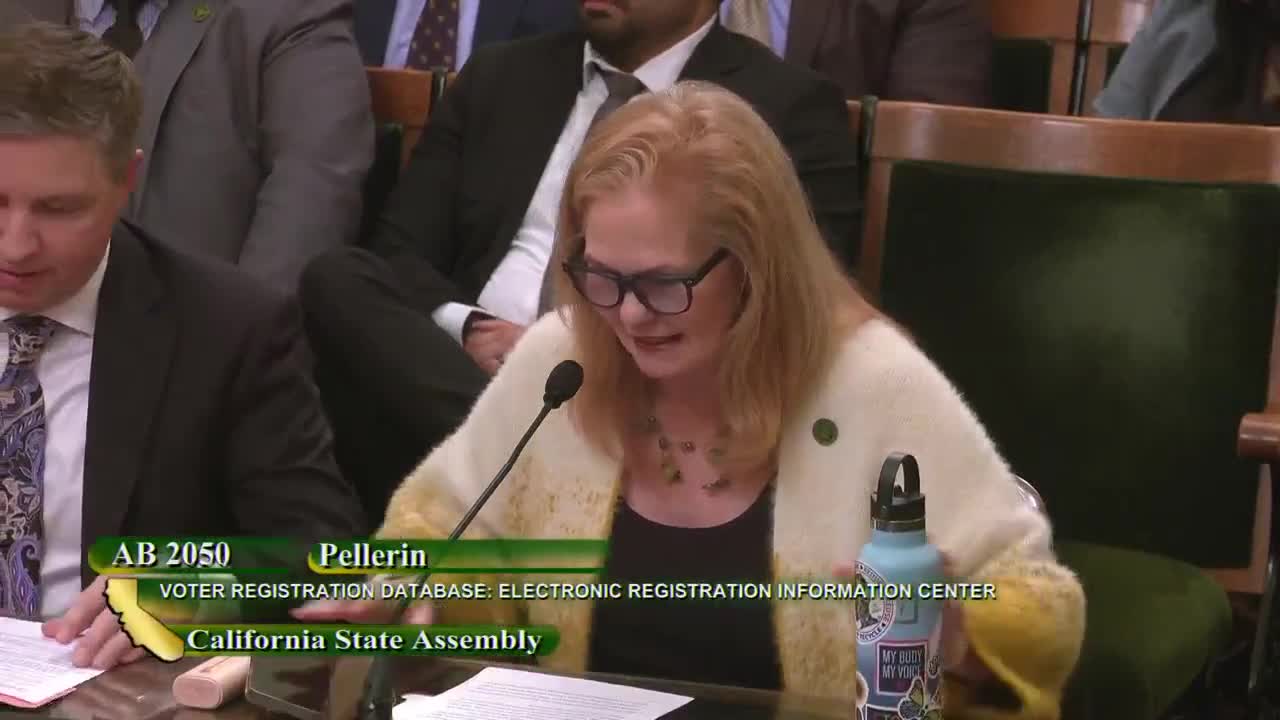 18MIN
Assembly Standing Committee on Privacy and Consumer Protection
 20MIN
Assembly Standing Committee on Elections
Bill Author