AB 2054: Energy: employment, gifts, and rates.
- Session Year: 2023-2024
- House: Assembly
- Latest Version Date: 2024-07-03
Current Status:
Failed
(2024-08-15: In committee: Held under submission.)
Introduced
In Committee
First Chamber
In Committee
Second Chamber
Enacted
(1)The California Constitution establishes the Public Utilities Commission (PUC), with jurisdiction over all public utilities, and provides for the composition and appointment of the PUC. Existing law prohibits an executive of a public utility from serving as a commissioner on the PUC within 2 years after leaving the employment of the utility.
This bill would prohibit a PUC commissioner from being employed by an entity subject to regulation by the PUC for a period of one year after the end of the commissioners term of office. The bill would prohibit a PUC commissioner from accepting a gift from an entity subject to regulation by the PUC.
(3)(2)Existing law establishes within the PUC the independent Public Advocates Office of the Public Utilities Commission to represent and advocate on behalf of the interests of public utility customers and subscribers within the commissions jurisdiction. Existing law requires the director of the Public Advocates Office to be appointed by, and serve at the pleasure of, the Governor, subject to confirmation by the Senate.
This bill would prohibit the director of the Public Advocates Office from being employed by an entity subject to regulation by the PUC for a period of one year after the end of the directors term of office. The bill would prohibit the director from accepting a gift from an entity subject to regulation by the PUC.
(4)(3)Existing law authorizes the PUC to fix the rates and charges for every public utility, and requires that those rates and charges be just and reasonable.
This bill would, in any instance where the PUC authorizes a forecast for a category of costs in a ratesetting proceeding and authorizes the recording of costs in an existing or new balancing account for potential rate recovery above the authorized forecast, authorize the PUC to further review any costs above the authorized forecast to be allocated between ratepayers and shareholders. forecast. The bill would require all proposed electrical corporation spending for wildfire expenses mitigation capital costs that is are eligible for rate recovery to include a cost-benefit analysis of the proposed expenses and at least one credible alternative, as specified.
(4)Existing law requires the PUC to annually provide the Legislature with an update on the status of its review of public utilities balancing accounts as part of a specified annual report or by posting it on its internet website, as provided.
This bill would require the PUC to include specified information as part of that annual update, including, among other things, the number of balancing accounts that have recorded costs above their forecast by public utility, the number of balancing accounts the PUC has reviewed in the past year, and the dollar amount, by public utility, of costs that have been approved and denied.
(5)Under existing law, a violation of the Public Utilities Act or any order, decision, rule, direction, demand, or requirement of the PUC is a crime.Because certain provisions of this bill would be part of the act and a violation of a PUC action implementing the bills requirements would be a crime, the bill would impose a state-mandated local program.
The California Constitution requires the state to reimburse local agencies and school districts for certain costs mandated by the state. Statutory provisions establish procedures for making that reimbursement.
This bill would provide that no reimbursement is required by this act for a specified reason.
(1)Existing law establishes the State Energy Resources Conservation and Development Commission (Energy Commission) consisting of 5 members appointed by the Governor subject to confirmation by the Senate. Existing law prohibits members of the Energy Commission from being employed by an electric utility or applicant or, within 2 years after the member ceases to be a member of the Energy Commission, by a person who engages in the sale or manufacture of a major component of a facility. A violation of this provision is punishable as a felony.
This bill would prohibit a member of the Energy Commission from being employed by an entity subject to regulation by the Energy Commission for a period of 3 years one year after ceasing to be a member of the Energy Commission. The bill would prohibit a member of the Energy Commission from accepting a gift from an entity subject to regulation by the Energy Commission. By expanding the application of an existing crime, this bill would impose a state-mandated local program.
(2)The California Constitution establishes the Public Utilities Commission (PUC), with jurisdiction over all public utilities, and provides for the composition and appointment of the PUC. Existing law prohibits an executive of a public utility from serving as a commissioner on the PUC within 2 years after leaving the employment of the utility.
This bill would prohibit a PUC commissioner from being employed by an entity subject to regulation by the PUC for a period of 3 years one year after the end of the commissioners term of office. The bill would prohibit a PUC commissioner from accepting a gift from an entity subject to regulation by the PUC.
(3)Existing law establishes within the PUC the independent Public Advocates Office of the Public Utilities Commission to represent and advocate on behalf of the interests of public utility customers and subscribers within the commissions jurisdiction. Existing law requires the director of the Public Advocates Office to be appointed by, and serve at the pleasure of, the Governor, subject to confirmation by the Senate.
This bill would prohibit the director of the Public Advocates Office from being employed by an entity subject to regulation by the PUC for a period of 3 years one year after the end of the directors term of office. The bill would prohibit the director from accepting a gift from an entity subject to regulation by the PUC.
(4)Existing law authorizes the PUC to fix the rates and charges for every public utility, and requires that those rates and charges be just and reasonable.
This bill would, in any instance where the PUC authorizes a forecast for a category of costs in a ratesetting proceeding and authorizes the recording of costs in an existing or new balancing account for potential rate recovery above the authorized forecast, require the public utility to submit an application for rate recovery and require the PUC, in a ratesetting proceeding, to determine if the recovery of costs above the authorized forecast is just and reasonable before the public utility is authorized to recover any costs above the authorized forecast. The bill would authorize any costs above the authorized forecast to be allocated between ratepayers and shareholders. The bill would require all proposed electrical corporation spending for wildfire expenses that is eligible for rate recovery to include a cost-benefit analysis of the proposed expenses and at least one credible alternative, as specified.
(5)Under existing law, a violation of the Public Utilities Act or any order, decision, rule, direction, demand, or requirement of the PUC is a crime.
Because certain provisions of this bill would be part of the act and a violation of a PUC action implementing the bills requirements would be a crime, the bill would impose a state-mandated local program.
The California Constitution requires the state to reimburse local agencies and school districts for certain costs mandated by the state. Statutory provisions establish procedures for making that reimbursement.
This bill would provide that no reimbursement is required by this act for a specified reason.
(1)Existing law establishes the State Energy Resources Conservation and Development Commission (Energy Commission) consisting of 5 members appointed by the Governor subject to confirmation by the Senate. Existing law prohibits members of the Energy Commission from being employed by an electric utility or applicant or, within 2 years after the member ceases to be a member of the Energy Commission, a person who engages in the sale or manufacture of a major component of a facility. A violation of this provision is punishable as a felony.
This bill would prohibit a member of the Energy Commission from being employed by an entity subject to regulation by the Energy Commission for a period of 10 3 years after ceasing to be a member of the Energy Commission. The bill would prohibit a member of the Energy Commission from accepting a gift from an entity subject to regulation by the Energy Commission. By expanding the application of an existing crime, this bill would impose a state-mandated local program.
(2)The California Constitution establishes the Public Utilities Commission (PUC), with jurisdiction over all public utilities, and provides for the composition and appointment of the PUC. Existing law prohibits an executive of a public utility from serving as a commissioner on the PUC within 2 years after leaving the employment of the utility.
This bill would prohibit a PUC commissioner from being employed by an entity subject to regulation by the PUC for a period of 10 3 years after the end of the commissioners term of office. The bill would prohibit a PUC commissioner from accepting a gift from an entity subject to regulation by the PUC.
(3)Existing law establishes within the PUC the independent Public Advocates Office of the Public Utilities Commission to represent and advocate on behalf of the interests of public utility customers and subscribers within the commissions jurisdiction. Existing law requires the director of the Public Advocates Office to be appointed by, and serve at the pleasure of, the Governor, subject to confirmation by the Senate.
This bill would prohibit the director of the Public Advocates Office from being employed by an entity subject to regulation by the PUC for a period of 10 3 years after the end of the directors term of office. The bill would prohibit the director from accepting a gift from an entity subject to regulation by the PUC.
(4)Existing law authorizes the PUC to fix the rates and charges for every public utility, and requires that those rates and charges be just and reasonable.
This bill would, in any instance where the PUC authorizes a forecast for a category of costs in a ratesetting proceeding and authorizes the recording of costs in an existing or new memorandum or balancing account for potential rate recovery above the authorized forecast, require the public utility to submit an application for rate recovery and require the PUC, in a ratesetting proceeding, to determine if the recovery of costs above the authorized forecast is just and reasonable before the public utility is authorized to recover any costs above the authorized forecast. The bill would require authorize any costs above the authorized forecast to be allocated between ratepayers and shareholders, with ratepayers potentially responsible for no more than 50% of the costs, as provided. shareholders. The bill would require all proposed public utility electrical corporation spending for wildfire expenses that is eligible for rate recovery to include a cost-benefit analysis of the proposed expenses and at least 3 alternatives, one credible alternative, as specified.
(5)Under existing law, a violation of the Public Utilities Act or any order, decision, rule, direction, demand, or requirement of the PUC is a crime.
Because certain provisions of this bill would be part of the act and a violation of a PUC action implementing the bills requirements would be a crime, the bill would impose a state-mandated local program.
The California Constitution requires the state to reimburse local agencies and school districts for certain costs mandated by the state. Statutory provisions establish procedures for making that reimbursement.
This bill would provide that no reimbursement is required by this act for a specified reason.
(1)Existing law establishes the State Energy Resources Conservation and Development Commission (Energy Commission) consisting of 5 members appointed by the Governor subject to confirmation by the Senate. Existing law prohibits members of the Energy Commission from being employed by an electric utility or applicant or, within 2 years after the member ceases to be a member of the Energy Commission, a person who engages in the sale or manufacture of a major component of a facility. A violation of this provision is punishable as a felony.
This bill would prohibit a member of the Energy Commission from being employed by an entity subject to regulation by the Energy Commission for a period of 10 years after ceasing to be a member of the commission. Energy Commission. The bill would prohibit a member of the Energy Commission from accepting a gift from an entity subject to regulation by the Energy Commission. By expanding the application of an existing crime, this bill would impose a state-mandated local program.
(2)The California Constitution establishes the Public Utilities Commission, Commission (PUC), with jurisdiction over all public utilities, and provides for the composition and appointment of the commission. PUC. Existing law prohibits an executive of a public utility from serving as a commissioner on the PUC within 2 years after leaving the employment of the utility.
This bill would prohibit a public utilities PUC commissioner from being employed by an entity subject to regulation by the commission PUC for a period of 10 years after the end of the commissioners term of office. The bill would prohibit a PUC commissioner from accepting a gift from an entity subject to regulation by the PUC.
(3)Existing law establishes within the PUC the independent Public Advocates Office of the Public Utilities Commission to represent and advocate on behalf of the interests of public utility customers and subscribers within the commissions jurisdiction. Existing law requires the director of the Public Advocates Office to be appointed by, and serve at the pleasure of, the Governor, subject to confirmation by the Senate.
This bill would prohibit the director of the Public Advocates Office from being employed by an entity subject to regulation by the PUC for a period of 10 years after the end of the directors term of office. The bill would prohibit the director from accepting a gift from an entity subject to regulation by the PUC.
(4)Existing law authorizes the PUC to fix the rates and charges for every public utility, and requires that those rates and charges be just and reasonable.
This bill would, in any instance where the PUC authorizes a forecast for a category of costs in a ratesetting proceeding and authorizes the recording of costs in an existing or new memorandum or balancing account for potential rate recovery above the authorized forecast, require the public utility to submit an application for rate recovery and require the PUC, in a ratesetting proceeding, to determine if the recovery of costs above the authorized forecast is just and reasonable before the public utility is authorized to recover any costs above the authorized forecast. The bill would require any costs above the authorized forecast to be allocated between ratepayers and shareholders, with ratepayers potentially responsible for no more than 50% of the costs, as provided. The bill would require all proposed public utility spending that is eligible for rate recovery to include a cost-benefit analysis of at least 3 alternatives, as specified.
(5)Under existing law, a violation of the Public Utilities Act or any order, decision, rule, direction, demand, or requirement of the commission PUC is a crime.
Because this new prohibition of former public utilities commissioner employment certain provisions of this bill would be part of the act, and a violation would therefore be a crime, this act and a violation of a PUC action implementing the bills requirements would be a crime, the bill would impose a state-mandated local program.
The California Constitution requires the state to reimburse local agencies and school districts for certain costs mandated by the state. Statutory provisions establish procedures for making that reimbursement.
This bill would provide that no reimbursement is required by this act for a specified reason.
Existing law establishes the State Energy Resources Conservation and Development Commission (Energy Commission) consisting of 5 members appointed by the Governor subject to confirmation by the Senate. Existing law prohibits members of the Energy Commission from being employed by an electric utility or applicant or, within 2 years after the member ceases to be a member of the Energy Commission, a person who engages in the sale or manufacture of a major component of a facility. A violation of this provision is punishable as a felony.
This bill would prohibit a member of the Energy Commission from being employed by an entity subject to regulation by the Energy Commission for a period of 10 years after ceasing to be a member of the commission. By expanding the application of an existing crime, this bill would impose a state-mandated local program.
The California Constitution establishes the Public Utilities Commission, with jurisdiction over all public utilities, and provides for the composition and appointment of the commission. Existing law prohibits an executive of a public utility from serving as a commissioner within 2 years after leaving the employment of the utility.
This bill would prohibit a public utilities commissioner from being employed by an entity subject to regulation by the commission for a period of 10 years after the end of the commissioners term of office.
Under existing law, a violation of the Public Utilities Act or any order, decision, rule, direction, demand, or requirement of the commission is a crime.
Because this new prohibition of former public utilities commissioner employment would be part of the act, and a violation would therefore be a crime, this bill would impose a state-mandated local program.
The California Constitution requires the state to reimburse local agencies and school districts for certain costs mandated by the state. Statutory provisions establish procedures for making that reimbursement.
This bill would provide that no reimbursement is required by this act for a specified reason.
(a)A public utilities commissioner shall not hold an official relation to, nor have a financial interest in, a person or corporation subject to regulation by the commission. If any commissioner acquires a financial interest in a corporation or person subject to regulation by the commission other than voluntarily, the commissioners office shall become vacant unless the commissioner divests themselves of the interest within a reasonable time.
(b)A public utilities commissioner shall not accept a gift, as defined in Section 82028 of the Government Code, from an entity subject to regulation by the commission.
(c)A public utilities commissioner, for a period of one year after the end of the commissioners term of office, shall not be employed by an entity subject to regulation by the commission.
(d)An executive of a public utility shall not serve as commissioner within two years after leaving the employment of the utility.
(e)The commission shall maintain an updated Conflict of Interest Code and Statement of Incompatible Activities in a manner consistent with applicable law.
SEC. 3.SEC. 2.Section 309.5 of the Public Utilities Code is amended to read:309.5.(a)There is within the commission an independent Public Advocates Office of the Public Utilities Commission to represent and advocate on behalf of the interests of public utility customers and subscribers within the jurisdiction of the commission. The goal of the office shall be to obtain the lowest possible rate for service consistent with reliable and safe service levels. For revenue allocation and rate design matters, the office shall primarily consider the interests of residential and small commercial customers.
(b)(1)The director of the office shall be appointed by, and serve at the pleasure of, the Governor, subject to confirmation by the Senate.
(2)The director shall annually appear before the appropriate policy committees of the Assembly and the Senate to report on the activities of the office.
(3)The director shall not accept a gift, as defined in Section 82028 of the Government Code, from an entity subject to regulation by the commission.
(4)The director, for a period of one year after the end of the directors term of office, shall not be employed by an entity subject to regulation by the commission.
(c)The director shall develop a budget for the office that shall be subject to final approval of the Department of Finance. As authorized in the approved budget, the office shall employ personnel and resources, including attorneys and other legal support staff, at a level sufficient to ensure that customer and subscriber interests are effectively represented in all significant proceedings. The office may employ experts necessary to carry out its functions. The director may appoint a lead attorney who shall represent the office, and shall report to and serve at the pleasure of the director. The lead attorney for the office shall obtain adequate legal personnel for the work to be conducted by the office from the commissions attorney appointed pursuant to Section 307. The commissions attorney shall timely and appropriately fulfill all requests for legal personnel made by the lead attorney for the office, if the office has sufficient moneys and positions in its budget for the services requested.
(d)The commission shall develop appropriate procedures to ensure that the existence of the office does not create a conflict of roles for any employee. The procedures shall include, but shall not be limited to, the development of a code of conduct and procedures for ensuring that advocates and their representatives on a particular case or proceeding are not advising decisionmakers on the same case or proceeding.
(e)The office may compel the production or disclosure of any information it deems necessary to perform its duties from any entity regulated by the commission, provided that any objections to any request for information shall be decided in writing by the assigned commissioner or by the president of the commission, if there is no assigned commissioner.
(f)There is hereby created the Public Utilities Commission Public Advocates Office Account in the General Fund. Moneys from the Public Utilities Commission Utilities Reimbursement Account in the General Fund shall be transferred in the annual Budget Act to the Public Utilities Commission Public Advocates Office Account. The funds in the Public Utilities Commission Public Advocates Office Account shall be a budgetary program fund administered and used exclusively by the office in the performance of its duties as determined by the director. The director shall annually submit a staffing report containing a comparison of the staffing levels for each five-year period.
(g)On or before January 10 of each year, the office shall provide to the chairperson of the fiscal committee of each house of the Legislature and to the Joint Legislative Budget Committee all of the following information:
(1)The number of personnel years used during the prior year by the office.
(2)The total dollars expended by the office in the prior year, the estimated total dollars expended in the current year, and the total dollars proposed for appropriation in the following budget year.
(3)Workload standards and measures for the office.
(h)The office shall meet and confer in an informal setting with a regulated entity before issuing a report or pleading to the commission regarding alleged misconduct, or a violation of a law or a commission rule or order, raised by the office in a complaint. The meet and confer process shall be used in good faith to reach agreement on issues raised by the office regarding any regulated entity in the complaint proceeding.
SEC. 4.SEC. 3.Section 454.15 is added to the Public Utilities Code, immediately following Section 454.1, to read:454.15.(a)(1)In any instance where the commission authorizes a forecast for a category of costs in a ratesetting proceeding and authorizes the recording of costs in an existing or new balancing account for potential rate recovery above the authorized forecast, any costs above the authorized forecast may be allocated between ratepayers and shareholders. subject to further review by the commission.
(2)Any costs determined by the commission to not be just and reasonable, and costs allocated to shareholders pursuant to paragraph (1), reasonable shall be denied rate recovery.
(b)All proposed electrical corporation spending for wildfire expenses mitigation capital costs that is are eligible for rate recovery shall include a cost-benefit analysis of the proposed expense and at least one credible alternative.
SEC. 4.Section 910.7 of the Public Utilities Code is amended to read:910.7.(a)The commission shall annually provide the Legislature with an update on the status of its review of public utilities balancing accounts pursuant to Section 792.5. The commission shall provide this update as part of its annual report published pursuant to Section 910 or by posting it in a conspicuous area of its Internet Web site, internet website, or both.
(b)As part of the update pursuant to subdivision (a), the commission shall include all of the following information:
(1)The total amount in the balancing accounts by public utility.
(2)The total amount as a percentage of each public utilitys total annual revenue requirement.
(3)The number of balancing accounts that have recorded costs above their forecasts by public utility.
(4)The dollar amount and percentage of the amount over their forecast by public utility.
(5)The number of balancing accounts the commission has reviewed in the past year.
(6)The dollar amount, by public utility, of costs that have been approved and denied.
SEC. 5.No reimbursement is required by this act pursuant to Section 6 of Article XIIIB of the California Constitution because the only costs that may be incurred by a local agency or school district will be incurred because this act creates a new crime or infraction, eliminates a crime or infraction, or changes the penalty for a crime or infraction, within the meaning of Section 17556 of the Government Code, or changes the definition of a crime within the meaning of Section 6 of Article XIIIB of the California Constitution.
(a)(1)No person shall be a member of the commission who, during the two years before appointment on the commission, received any substantial portion of their income directly or indirectly from any electric utility, or who engages in sale or manufacture of any major component of any facility. A member of the commission shall not be employed by any electric utility, applicant, or, within two years after ceasing to be a member of the commission, by any person who engages in the sale or manufacture of any major component of any facility.
(2)A member of the commission shall not accept a gift, as defined in Section 82028 of the Government Code, from an entity subject to regulation by the commission.
(3)A member of the commission shall not be employed by an entity subject to regulation by the commission for a period of three years one year after ceasing to be a member of the commission.
(b)Except as provided in Section 25202, the members of the commission shall not hold any other elected or appointed public office or position.
(c)The members of the commission and all employees of the commission shall comply with all applicable provisions of Section 19990 of the Government Code.
(d)A person who is a member or employee of the commission shall not participate personally and substantially as a member or employee of the commission, through decision, approval, disapproval, recommendation, the rendering of advice, investigation, or otherwise, in a judicial or other proceeding, hearing, application, request for a ruling, or other determination, contract, claim, controversy, study, plan, or other particular matter in which, to the member or employees knowledge, the member or employee, their spouse, minor child, or partner, or any organization, except a governmental agency or educational or research institution qualifying as a nonprofit organization under state or federal income tax law, in which the member or employee is serving, or has served as officer, director, trustee, partner, or employee while serving as a member or employee of the commission or within two years before appointment as a member of the commission, has a direct or indirect financial interest.
(e)A person who is a partner, employer, or employee of a member or employee of the commission shall not act as an attorney, agent, or employee for any person other than the state in connection with any judicial or other proceeding, hearing, application, request for a ruling, or other determination, contract, claim, controversy, study, plan, or other particular matter in which the commission is a party or has a direct and substantial interest.
(f)This section does not apply if the Attorney General finds that the interest of the member or employee of the commission is not so substantial as to be deemed likely to affect the integrity of the services that the state may expect from the member or employee.
(g)Any person who violates this section is guilty of a felony and shall be subject to a fine of not more than ten thousand dollars ($10,000) or imprisonment pursuant to subdivision (h) of Section 1170 of the Penal Code, or both that fine and imprisonment.
(h)The amendment of subdivision (d) of this section enacted by the 197576 Regular Session of the Legislature does not constitute a change in, but is declaratory of, existing law.
SEC. 2.Section 303 of the Public Utilities Code is amended to read:303.(a)A public utilities commissioner shall not hold an official relation to, nor have a financial interest in, a person or corporation subject to regulation by the commission. If any commissioner acquires a financial interest in a corporation or person subject to regulation by the commission other than voluntarily, the commissioners office shall become vacant unless the commissioner divests themselves of the interest within a reasonable time.
(b)A public utilities commissioner shall not accept a gift, as defined in Section 82028 of the Government Code, from an entity subject to regulation by the commission.
(c)A public utilities commissioner, for a period of three years one year after the end of the commissioners term of office, shall not be employed by an entity subject to regulation by the commission.
(d)An executive of a public utility shall not serve as commissioner within two years after leaving the employment of the utility.
(e)The commission shall maintain an updated Conflict of Interest Code and Statement of Incompatible Activities in a manner consistent with applicable law.
SEC. 3.Section 309.5 of the Public Utilities Code is amended to read:309.5.(a)There is within the commission an independent Public Advocates Office of the Public Utilities Commission to represent and advocate on behalf of the interests of public utility customers and subscribers within the jurisdiction of the commission. The goal of the office shall be to obtain the lowest possible rate for service consistent with reliable and safe service levels. For revenue allocation and rate design matters, the office shall primarily consider the interests of residential and small commercial customers.
(b)(1)The director of the office shall be appointed by, and serve at the pleasure of, the Governor, subject to confirmation by the Senate.
(2)The director shall annually appear before the appropriate policy committees of the Assembly and the Senate to report on the activities of the office.
(3)The director shall not accept a gift, as defined in Section 82028 of the Government Code, from an entity subject to regulation by the commission.
(4)The director, for a period of three years one year after the end of the directors term of office, shall not be employed by an entity subject to regulation by the commission.
(c)The director shall develop a budget for the office that shall be subject to final approval of the Department of Finance. As authorized in the approved budget, the office shall employ personnel and resources, including attorneys and other legal support staff, at a level sufficient to ensure that customer and subscriber interests are effectively represented in all significant proceedings. The office may employ experts necessary to carry out its functions. The director may appoint a lead attorney who shall represent the office, and shall report to and serve at the pleasure of the director. The lead attorney for the office shall obtain adequate legal personnel for the work to be conducted by the office from the commissions attorney appointed pursuant to Section 307. The commissions attorney shall timely and appropriately fulfill all requests for legal personnel made by the lead attorney for the office, if the office has sufficient moneys and positions in its budget for the services requested.
(d)The commission shall develop appropriate procedures to ensure that the existence of the office does not create a conflict of roles for any employee. The procedures shall include, but shall not be limited to, the development of a code of conduct and procedures for ensuring that advocates and their representatives on a particular case or proceeding are not advising decisionmakers on the same case or proceeding.
(e)The office may compel the production or disclosure of any information it deems necessary to perform its duties from any entity regulated by the commission, provided that any objections to any request for information shall be decided in writing by the assigned commissioner or by the president of the commission, if there is no assigned commissioner.
(f)There is hereby created the Public Utilities Commission Public Advocates Office Account in the General Fund. Moneys from the Public Utilities Commission Utilities Reimbursement Account in the General Fund shall be transferred in the annual Budget Act to the Public Utilities Commission Public Advocates Office Account. The funds in the Public Utilities Commission Public Advocates Office Account shall be a budgetary program fund administered and used exclusively by the office in the performance of its duties as determined by the director. The director shall annually submit a staffing report containing a comparison of the staffing levels for each five-year period.
(g)On or before January 10 of each year, the office shall provide to the chairperson of the fiscal committee of each house of the Legislature and to the Joint Legislative Budget Committee all of the following information:
(1)The number of personnel years used during the prior year by the office.
(2)The total dollars expended by the office in the prior year, the estimated total dollars expended in the current year, and the total dollars proposed for appropriation in the following budget year.
(3)Workload standards and measures for the office.
(h)The office shall meet and confer in an informal setting with a regulated entity before issuing a report or pleading to the commission regarding alleged misconduct, or a violation of a law or a commission rule or order, raised by the office in a complaint. The meet and confer process shall be used in good faith to reach agreement on issues raised by the office regarding any regulated entity in the complaint proceeding.
SEC. 4.Section 454.15 is added to the Public Utilities Code, immediately following Section 454.1, to read:454.15.(a)In any instance where the commission authorizes a forecast for a category of costs in a ratesetting proceeding and authorizes the recording of costs in an existing or new balancing account for potential rate recovery above the authorized forecast, the public utility shall submit an application for rate recovery and the commission shall, in a ratesetting proceeding, determine if the recovery of costs above the authorized forecast is just and reasonable before the public utility may recover any costs above the authorized forecast.(b)454.15.(a)(1)In any instance where the commission authorizes a forecast for a category of costs in a ratesetting proceeding and authorizes the recording of costs in an existing or new balancing account for potential rate recovery above the authorized forecast, any costs above the authorized forecast may be allocated between ratepayers and shareholders.
(2)Any costs determined by the commission to not be just and reasonable, and costs allocated to shareholders pursuant to paragraph (1), shall be denied rate recovery.
(c)(b)All proposed electrical corporation spending for wildfire expenses that is eligible for rate recovery shall include a cost-benefit analysis of the proposed expense and at least one credible alternative.
SEC. 5.No reimbursement is required by this act pursuant to Section 6 of Article XIIIB of the California Constitution because the only costs that may be incurred by a local agency or school district will be incurred because this act creates a new crime or infraction, eliminates a crime or infraction, or changes the penalty for a crime or infraction, within the meaning of Section 17556 of the Government Code, or changes the definition of a crime within the meaning of Section 6 of Article XIIIB of the California Constitution.
(a)(1)No person shall be a member of the commission who, during the two years before appointment on the commission, received any substantial portion of their income directly or indirectly from any electric utility, or who engages in sale or manufacture of any major component of any facility. A member of the commission shall not be employed by any electric utility, applicant, or, within two years after ceasing to be a member of the commission, by any person who engages in the sale or manufacture of any major component of any facility.
(2)A member of the commission shall not accept a gift, as defined in Section 82028 of the Government Code, from an entity subject to regulation by the commission.
(3)A member of the commission shall not be employed by an entity subject to regulation by the commission for a period of 10 three years after ceasing to be a member of the commission.
(b)Except as provided in Section 25202, the members of the commission shall not hold any other elected or appointed public office or position.
(c)The members of the commission and all employees of the commission shall comply with all applicable provisions of Section 19990 of the Government Code.
(d)A person who is a member or employee of the commission shall not participate personally and substantially as a member or employee of the commission, through decision, approval, disapproval, recommendation, the rendering of advice, investigation, or otherwise, in a judicial or other proceeding, hearing, application, request for a ruling, or other determination, contract, claim, controversy, study, plan, or other particular matter in which, to the member or employees knowledge, the member or employee, their spouse, minor child, or partner, or any organization, except a governmental agency or educational or research institution qualifying as a nonprofit organization under state or federal income tax law, in which the member or employee is serving, or has served as officer, director, trustee, partner, or employee while serving as a member or employee of the commission or within two years before appointment as a member of the commission, has a direct or indirect financial interest.
(e)A person who is a partner, employer, or employee of a member or employee of the commission shall not act as an attorney, agent, or employee for any person other than the state in connection with any judicial or other proceeding, hearing, application, request for a ruling, or other determination, contract, claim, controversy, study, plan, or other particular matter in which the commission is a party or has a direct and substantial interest.
(f)This section does not apply if the Attorney General finds that the interest of the member or employee of the commission is not so substantial as to be deemed likely to affect the integrity of the services that the state may expect from the member or employee.
(g)Any person who violates this section is guilty of a felony and shall be subject to a fine of not more than ten thousand dollars ($10,000) or imprisonment pursuant to subdivision (h) of Section 1170 of the Penal Code, or both that fine and imprisonment.
(h)The amendment of subdivision (d) of this section enacted by the 197576 Regular Session of the Legislature does not constitute a change in, but is declaratory of, existing law.
SEC. 2.Section 303 of the Public Utilities Code is amended to read:303.(a)A public utilities commissioner shall not hold an official relation to, nor have a financial interest in, a person or corporation subject to regulation by the commission. If any commissioner acquires a financial interest in a corporation or person subject to regulation by the commission other than voluntarily, the commissioners office shall become vacant unless the commissioner divests themselves of the interest within a reasonable time.
(b)A public utilities commissioner shall not accept a gift, as defined in Section 82028 of the Government Code, from an entity subject to regulation by the commission.
(c)A public utilities commissioner, for a period of 10 three years after the end of the commissioners term of office, shall not be employed by an entity subject to regulation by the commission.
(d)No An executive of a public utility may shall not serve as commissioner within two years after leaving the employment of the utility.
(e)The commission shall maintain an updated Conflict of Interest Code and Statement of Incompatible Activities in a manner consistent with applicable law.
SEC. 3.Section 309.5 of the Public Utilities Code is amended to read:309.5.(a)There is within the commission an independent Public Advocates Office of the Public Utilities Commission to represent and advocate on behalf of the interests of public utility customers and subscribers within the jurisdiction of the commission. The goal of the office shall be to obtain the lowest possible rate for service consistent with reliable and safe service levels. For revenue allocation and rate design matters, the office shall primarily consider the interests of residential and small commercial customers.
(b)(1)The director of the office shall be appointed by, and serve at the pleasure of, the Governor, subject to confirmation by the Senate.
(2)The director shall annually appear before the appropriate policy committees of the Assembly and the Senate to report on the activities of the office.
(3)The director shall not accept a gift, as defined in Section 82028 of the Government Code, from an entity subject to regulation by the commission.
(4)The director, for a period of 10 three years after the end of the directors term of office, shall not be employed by an entity subject to regulation by the commission.
(c)The director shall develop a budget for the office that shall be subject to final approval of the Department of Finance. As authorized in the approved budget, the office shall employ personnel and resources, including attorneys and other legal support staff, at a level sufficient to ensure that customer and subscriber interests are effectively represented in all significant proceedings. The office may employ experts necessary to carry out its functions. The director may appoint a lead attorney who shall represent the office, and shall report to and serve at the pleasure of the director. The lead attorney for the office shall obtain adequate legal personnel for the work to be conducted by the office from the commissions attorney appointed pursuant to Section 307. The commissions attorney shall timely and appropriately fulfill all requests for legal personnel made by the lead attorney for the office, if the office has sufficient moneys and positions in its budget for the services requested.
(d)The commission shall develop appropriate procedures to ensure that the existence of the office does not create a conflict of roles for any employee. The procedures shall include, but shall not be limited to, the development of a code of conduct and procedures for ensuring that advocates and their representatives on a particular case or proceeding are not advising decisionmakers on the same case or proceeding.
(e)The office may compel the production or disclosure of any information it deems necessary to perform its duties from any entity regulated by the commission, provided that any objections to any request for information shall be decided in writing by the assigned commissioner or by the president of the commission, if there is no assigned commissioner.
(f)There is hereby created the Public Utilities Commission Public Advocates Office Account in the General Fund. Moneys from the Public Utilities Commission Utilities Reimbursement Account in the General Fund shall be transferred in the annual Budget Act to the Public Utilities Commission Public Advocates Office Account. The funds in the Public Utilities Commission Public Advocates Office Account shall be a budgetary program fund administered and used exclusively by the office in the performance of its duties as determined by the director. The director shall annually submit a staffing report containing a comparison of the staffing levels for each five-year period.
(g)On or before January 10 of each year, the office shall provide to the chairperson of the fiscal committee of each house of the Legislature and to the Joint Legislative Budget Committee all of the following information:
(1)The number of personnel years used during the prior year by the office.
(2)The total dollars expended by the office in the prior year, the estimated total dollars expended in the current year, and the total dollars proposed for appropriation in the following budget year.
(3)Workload standards and measures for the office.
(h)The office shall meet and confer in an informal setting with a regulated entity prior to before issuing a report or pleading to the commission regarding alleged misconduct, or a violation of a law or a commission rule or order, raised by the office in a complaint. The meet and confer process shall be used in good faith to reach agreement on issues raised by the office regarding any regulated entity in the complaint proceeding.
SEC. 4.Section 454.15 is added to the Public Utilities Code, immediately following Section 454.1, to read:454.15.(a)In any instance where the commission authorizes a forecast for a category of costs in a ratesetting proceeding and authorizes the recording of costs in an existing or new memorandum or balancing account for potential rate recovery above the authorized forecast, the public utility shall submit an application for rate recovery and the commission shall, in a ratesetting proceeding, determine if the recovery of costs above the authorized forecast is just and reasonable before the public utility may recover any costs above the authorized forecast.
(b)(1)In any instance where the commission authorizes a forecast for a category of costs in a ratesetting proceeding and authorizes the recording of costs in an existing or new memorandum or balancing account for potential rate recovery above the authorized forecast, any costs above the authorized forecast shall may be allocated between ratepayers and shareholders, with ratepayers potentially responsible for no more than 50 percent of the costs. shareholders.
(2)The allocation of cost responsibility pursuant to paragraph (1) shall not have any bearing on the commissions determination of whether costs exceeding the authorized forecast, or the disallowance of costs exceeding the authorized forecast, are just and reasonable.(3)(2)Any costs determined by the commission to not be just and reasonable, and costs allocated to shareholders pursuant to paragraph (1), shall be denied rate recovery.
(c)All proposed public utility electrical corporation spending for wildfire expenses that is eligible for rate recovery shall include a cost-benefit analysis of the proposed expense and at least three alternatives, if three alternatives are available. one credible alternative.
SEC. 5.No reimbursement is required by this act pursuant to Section 6 of Article XIIIB of the California Constitution because the only costs that may be incurred by a local agency or school district will be incurred because this act creates a new crime or infraction, eliminates a crime or infraction, or changes the penalty for a crime or infraction, within the meaning of Section 17556 of the Government Code, or changes the definition of a crime within the meaning of Section 6 of Article XIIIB of the California Constitution.
(a)(1)No person shall be a member of the commission who, during the two years prior to before appointment on the commission, received any substantial portion of their income directly or indirectly from any electric utility, or who engages in sale or manufacture of any major component of any facility. A member of the commission shall not be employed by any electric utility, applicant, or, within two years after ceasing to be a member of the commission, by any person who engages in the sale or manufacture of any major component of any facility.
(2)A member of the commission shall not accept a gift, as defined in Section 82028 of the Government Code, from an entity subject to regulation by the commission.
(2)(3)A member of the commission shall not be employed by an entity subject to regulation by the commission for a period of 10 years after ceasing to be a member of the commission.
(b)Except as provided in Section 25202, the members of the commission shall not hold any other elected or appointed public office or position.
(c)The members of the commission and all employees of the commission shall comply with all applicable provisions of Section 19990 of the Government Code.
(d)A person who is a member or employee of the commission shall not participate personally and substantially as a member or employee of the commission, through decision, approval, disapproval, recommendation, the rendering of advice, investigation, or otherwise, in a judicial or other proceeding, hearing, application, request for a ruling, or other determination, contract, claim, controversy, study, plan, or other particular matter in which, to the member or employees knowledge, the member or employee, their spouse, minor child, or partner, or any organization, except a governmental agency or educational or research institution qualifying as a nonprofit organization under state or federal income tax law, in which the member or employee is serving, or has served as officer, director, trustee, partner, or employee while serving as a member or employee of the commission or within two years prior to before appointment as a member of the commission, has a direct or indirect financial interest.
(e)A person who is a partner, employer, or employee of a member or employee of the commission shall not act as an attorney, agent, or employee for any person other than the state in connection with any judicial or other proceeding, hearing, application, request for a ruling, or other determination, contract, claim, controversy, study, plan, or other particular matter in which the commission is a party or has a direct and substantial interest.
(f)The provisions of this This section shall does not apply if the Attorney General finds that the interest of the member or employee of the commission is not so substantial as to be deemed likely to affect the integrity of the services which that the state may expect from the member or employee.
(g)Any person who violates any provision of this section is guilty of a felony and shall be subject to a fine of not more than ten thousand dollars ($10,000) or imprisonment pursuant to subdivision (h) of Section 1170 of the Penal Code, or both that fine and imprisonment.
(h)The amendment of subdivision (d) of this section enacted by the 197576 Regular Session of the Legislature does not constitute a change in, but is declaratory of, existing law.
SEC. 2.Section 303 of the Public Utilities Code is amended to read:303.(a)A public utilities commissioner may shall not hold an official relation to, nor have a financial interest in, a person or corporation subject to regulation by the commission. If any commissioner acquires a financial interest in a corporation or person subject to regulation by the commission other than voluntarily, his or her the commissioners office shall become vacant unless the commissioner divests themselves of the interest within a reasonable time he or she divests himself or herself of the interest. time.
(b)A public utilities commissioner shall not accept a gift, as defined in Section 82028 of the Government Code, from an entity subject to regulation by the commission.
(c)A public utilities commissioner, for a period of 10 years after the end of the commissioners term of office, shall not be employed by an entity subject to regulation by the commission.
(b)(d)No executive of a public utility may serve as commissioner within two years after leaving the employment of the utility.
(c)(e)The commission shall maintain an updated Conflict of Interest Code and Statement of Incompatible Activities in a manner consistent with applicable law.
SEC. 2.Section 303.5 is added to the Public Utilities Code, to read:303.5.A public utilities commissioner, for a period of 10 years after the end of the commissioners term of office, shall not be employed by an entity subject to regulation by the commission.SEC. 3.Section 309.5 of the Public Utilities Code is amended to read:309.5.(a)There is within the commission an independent Public Advocates Office of the Public Utilities Commission to represent and advocate on behalf of the interests of public utility customers and subscribers within the jurisdiction of the commission. The goal of the office shall be to obtain the lowest possible rate for service consistent with reliable and safe service levels. For revenue allocation and rate design matters, the office shall primarily consider the interests of residential and small commercial customers.
(b)(1)The director of the office shall be appointed by, and serve at the pleasure of, the Governor, subject to confirmation by the Senate.
(2)The director shall annually appear before the appropriate policy committees of the Assembly and the Senate to report on the activities of the office.
(3)The director shall not accept a gift, as defined in Section 82028 of the Government Code, from an entity subject to regulation by the commission.
(4)The director, for a period of 10 years after the end of the directors term of office, shall not be employed by an entity subject to regulation by the commission.
(c)The director shall develop a budget for the office that shall be subject to final approval of the Department of Finance. As authorized in the approved budget, the office shall employ personnel and resources, including attorneys and other legal support staff, at a level sufficient to ensure that customer and subscriber interests are effectively represented in all significant proceedings. The office may employ experts necessary to carry out its functions. The director may appoint a lead attorney who shall represent the office, and shall report to and serve at the pleasure of the director. The lead attorney for the office shall obtain adequate legal personnel for the work to be conducted by the office from the commissions attorney appointed pursuant to Section 307. The commissions attorney shall timely and appropriately fulfill all requests for legal personnel made by the lead attorney for the office, provided if the office has sufficient moneys and positions in its budget for the services requested.
(d)The commission shall develop appropriate procedures to ensure that the existence of the office does not create a conflict of roles for any employee. The procedures shall include, but shall not be limited to, the development of a code of conduct and procedures for ensuring that advocates and their representatives on a particular case or proceeding are not advising decisionmakers on the same case or proceeding.
(e)The office may compel the production or disclosure of any information it deems necessary to perform its duties from any entity regulated by the commission, provided that any objections to any request for information shall be decided in writing by the assigned commissioner or by the president of the commission, if there is no assigned commissioner.
(f)There is hereby created the Public Utilities Commission Public Advocates Office Account in the General Fund. Moneys from the Public Utilities Commission Utilities Reimbursement Account in the General Fund shall be transferred in the annual Budget Act to the Public Utilities Commission Public Advocates Office Account. The funds in the Public Utilities Commission Public Advocates Office Account shall be a budgetary program fund administered and utilized used exclusively by the office in the performance of its duties as determined by the director. The director shall annually submit a staffing report containing a comparison of the staffing levels for each five-year period.
(g)On or before January 10 of each year, the office shall provide to the chairperson of the fiscal committee of each house of the Legislature and to the Joint Legislative Budget Committee all of the following information:
(1)The number of personnel years utilized used during the prior year by the office.
(2)The total dollars expended by the office in the prior year, the estimated total dollars expended in the current year, and the total dollars proposed for appropriation in the following budget year.
(3)Workload standards and measures for the office.
(h)The office shall meet and confer in an informal setting with a regulated entity prior to issuing a report or pleading to the commission regarding alleged misconduct, or a violation of a law or a commission rule or order, raised by the office in a complaint. The meet and confer process shall be utilized used in good faith to reach agreement on issues raised by the office regarding any regulated entity in the complaint proceeding.
SEC. 4.Section 454.15 is added to the Public Utilities Code, immediately following Section 454.1, to read:454.15.(a)In any instance where the commission authorizes a forecast for a category of costs in a ratesetting proceeding and authorizes the recording of costs in an existing or new memorandum or balancing account for potential rate recovery above the authorized forecast, the public utility shall submit an application for rate recovery and the commission shall, in a ratesetting proceeding, determine if the recovery of costs above the authorized forecast is just and reasonable before the public utility may recover any costs above the authorized forecast.
(b)(1)In any instance where the commission authorizes a forecast for a category of costs in a ratesetting proceeding and authorizes the recording of costs in an existing or new memorandum or balancing account for potential rate recovery above the authorized forecast, any costs above the authorized forecast shall be allocated between ratepayers and shareholders, with ratepayers potentially responsible for no more than 50 percent of the costs.
(2)The allocation of cost responsibility pursuant to paragraph (1) shall not have any bearing on the commissions determination of whether costs exceeding the authorized forecast, or the disallowance of costs exceeding the authorized forecast, are just and reasonable.
(3)Any costs determined by the commission to not be just and reasonable, and costs allocated to shareholders pursuant to paragraph (1), shall be denied rate recovery.
(c)All proposed public utility spending that is eligible for rate recovery shall include a cost-benefit analysis of at least three alternatives, if three alternatives are available.
SEC. 3.SEC. 5.No reimbursement is required by this act pursuant to Section 6 of Article XIIIB of the California Constitution because the only costs that may be incurred by a local agency or school district will be incurred because this act creates a new crime or infraction, eliminates a crime or infraction, or changes the penalty for a crime or infraction, within the meaning of Section 17556 of the Government Code, or changes the definition of a crime within the meaning of Section 6 of Article XIIIB of the California Constitution.
(a)(1)No person shall be a member of the commission who, during the two years prior to appointment on the commission, received any substantial portion of his or her their income directly or indirectly from any electric utility, or who engages in sale or manufacture of any major component of any facility. A member of the commission shall not be employed by any electric utility, applicant, or, within two years after he or she ceases ceasing to be a member of the commission, by any person who engages in the sale or manufacture of any major component of any facility.
(2)A member of the commission shall not be employed by an entity subject to regulation by the commission for a period of 10 years after ceasing to be a member of the commission.
(b)Except as provided in Section 25202, the members of the commission shall not hold any other elected or appointed public office or position.
(c)The members of the commission and all employees of the commission shall comply with all applicable provisions of Section 19251 19990 of the Government Code.
(d)A person who is a member or employee of the commission shall not participate personally and substantially as a member or employee of the commission, through decision, approval, disapproval, recommendation, the rendering of advice, investigation, or otherwise, in a judicial or other proceeding, hearing, application, request for a ruling, or other determination, contract, claim, controversy, study, plan, or other particular matter in which, to his or her the member or employees knowledge, he or she, his or her the member or employee, their spouse, minor child, or partner, or any organization, except a governmental agency or educational or research institution qualifying as a nonprofit organization under state or federal income tax law, in which he or she the member or employee is serving, or has served as officer, director, trustee, partner, or employee while serving as a member or employee of the commission or within two years prior to his or her appointment as a member of the commission, has a direct or indirect financial interest.
(e)A person who is a partner, employer, or employee of a member or employee of the commission shall not act as an attorney, agent, or employee for any person other than the state in connection with any judicial or other proceeding, hearing, application, request for a ruling, or other determination, contract, claim, controversy, study, plan, or other particular matter in which the commission is a party or has a direct and substantial interest.
(f)The provisions of this section shall not apply if the Attorney General finds that the interest of the member or employee of the commission is not so substantial as to be deemed likely to affect the integrity of the services which the state may expect from the member or employee.
(g)Any person who violates any provision of this section is guilty of a felony and shall be subject to a fine of not more than ten thousand dollars ($10,000) or imprisonment pursuant to subdivision (h) of Section 1170 of the Penal Code, or both that fine and imprisonment.
(h)The amendment of subdivision (d) of this section enacted by the 197576 Regular Session of the Legislature does not constitute a change in, but is declaratory of, existing law.
SEC. 2.Section 303.5 is added to the Public Utilities Code, to read:303.5.A public utilities commissioner, for a period of 10 years after the end of the commissioners term of office, shall not be employed by an entity subject to regulation by the commission.
SEC. 3.No reimbursement is required by this act pursuant to Section 6 of Article XIIIB of the California Constitution because the only costs that may be incurred by a local agency or school district will be incurred because this act creates a new crime or infraction, eliminates a crime or infraction, or changes the penalty for a crime or infraction, within the meaning of Section 17556 of the Government Code, or changes the definition of a crime within the meaning of Section 6 of Article XIIIB of the California Constitution.
|
Date
|
Status
|
|---|---|
| Aug 15, 2024 | In committee: Held under submission. |
| Aug 5, 2024 | In committee: Referred to APPR suspense file. |
| Jul 3, 2024 | Read second time and amended. Re-referred to Com. on APPR. |
| Jul 2, 2024 | From committee: Amend, and do pass as amended and re-refer to Com. on APPR. (Ayes 15. Noes 2.) (July 2). |
| Jun 5, 2024 | Referred to Com. on E., U. & C. |
| May 23, 2024 | In Senate. Read first time. To Com. on RLS. for assignment. |
| May 22, 2024 | Read third time. Passed. Ordered to the Senate. (Ayes 48. Noes 10. Page 5564.) |
| May 20, 2024 | Read second time. Ordered to third reading. |
| May 16, 2024 | Read second time and amended. Ordered returned to second reading. |
| May 16, 2024 | From committee: Amend, and do pass as amended. (Ayes 10. Noes 2.) (May 16). |
| May 16, 2024 | Assembly Rule 63 suspended. |
| May 1, 2024 | In committee: Set, first hearing. Referred to APPR. suspense file. |
| Apr 9, 2024 | Re-referred to Com. on APPR. |
| Apr 8, 2024 | Read second time and amended. |
| Apr 4, 2024 | From committee: Amend, and do pass as amended and re-refer to Com. on APPR. (Ayes 12. Noes 2.) (April 3). |
| Apr 1, 2024 | Re-referred to Com. on U. & E. |
| Mar 21, 2024 | From committee chair, with author's amendments: Amend, and re-refer to Com. on U. & E. Read second time and amended. |
| Feb 12, 2024 | Referred to Com. on U. & E. |
| Feb 2, 2024 | From printer. May be heard in committee March 3. |
| Feb 1, 2024 | Read first time. To print. |
|
Date
|
Description
|
Location
|
Votes
|
|
|---|---|---|---|---|
| Aug 5, 2024 | Placed on suspense file | Senate Standing Committee on Appropriations |
Passed |
|
| Jul 2, 2024 | Do pass as amended, but first amend, and re-refer to the Committee on [Appropriations] | Senate Standing Committee on Energy, Utilities and Communications |
Passed |
|
| May 22, 2024 | AB 2054 Bauer-Kahan Assembly Third Reading | Assembly Floor |
Passed |
|
| May 16, 2024 | Do pass as amended. | Assembly Standing Committee on Appropriations |
Passed |
|
| Apr 3, 2024 | Do pass as amended and be re-referred to the Committee on [Appropriations] | Assembly Standing Committee on Utilities and Energy |
Passed |
This list shows positions taken on this bill by organizations on the date displayed, which is linked to the original source.
Positions by individuals are not included.
|
Organization
|
Position
|
Date
|
|---|---|---|
| 350 Bay Area Action and 350 Sacramento | ** Support | |
| Active San Gabriel Valley | ** Support | |
| Ban Single Use Plastic | ** Support | |
| California Alliance for Community Energy | ** Support | |
| California Environmental Justice Alliance | ** Support | |
| California Interfaith Power and Light | ** Support | |
| California Solar & Storage Association | ** Support | |
| California State Association Of Electrical Workers | ** Against | |
| California Trade Justice Coalition | ** Support | |
| California Water Association | ** Against | |
| Center For Biological Diversity | ** Support | |
| Center for Community Energy | ** Support | |
| cleanearth4kids.org | ** Support | |
| Climate Action California | ** Support | |
| Coalition of California Utility Employees | ** Against | |
| Consumer Watchdog | ** Support | |
| Contra Costa Move On | ** Support | |
| East Bay Clean Power Alliance | ** Support | |
| Environmental Working Group | ** Support | |
| Friends of the River | ** Support | |
| Hammond Climate Solutions Foundation | ** Support | |
| Indivisibles: CA: StateStrong, Cloverdale, Livermore, Sacramento, San Jose, | ** Support | |
| Local Clean Energy Alliance | ** Support | |
| Media Alliance | ** Support | |
| Pacific Gas And Electric Company | ** Against | |
| Peninsula Clean Energy | ** Support | |
| Physicians for Social Responsibility, San Francisco Bay | ** Support | |
| Reclaim Our Power | ** Support | |
| Récolte Energy | ** Support | |
| San Diego Energy District | ** Support | |
| San Diego Gas & Electric | ** Against | |
| San Francisco Public Utilities Commission | ** Support | |
| San Jose Community Energy Advocates | ** Support | |
| Santa Cruz Climate Action Network | ** Support | |
| Santa Cruz Mountains, and South Bay LA | ** Support | |
| SLO Climate Coalition | ** Support | |
| Solano County Democratic Central Committee | ** Support | |
| Sonoma County Democratic Party | ** Support | |
| Southern California Edison | ** Against | |
| Southern California Gas Company | ** Against | |
| Stand.earth | ** Support | |
| Sustainable Rossmoor | ** Support | |
| Sustainable Systems Research Foundation | ** Support | |
| The Climate Center | ** Support | |
| The Climate Reality Project: San Diego Chapter, San Francisco Bay Area Chapter, | ** Support | |
| The Utility Reform Network | ** Support | |
| Vote Solar | ** Support | |
| West L.A. Democratic Club | ** Support |
SENATE COMMITTEE ON
Senator Anna Caballero, Chair
2023 - 2024 Regular Session
AB 2054 (Bauer-Kahan) - Energy: employment, gifts, and rates
Version: | Policy Vote: |
Urgency: | Mandate: |
Hearing Date: | Consultant: |
Bill Summary:
This bill would authorize the California Public Utilities Commission (CPUC) to further review any costs recorded in a balancing account above an authorized forecast as provided, require all proposed investor owned utility (IOU) wildfire mitigation capital costs to include a cost-benefit analysis with at least one alternative, and prohibit leadership at the CPUC and Public Advocate’s Office (PAO) from receiving gifts or employment, for at least one year, from any entity subject to regulation by their body.
Fiscal Impact:
- The CPUC estimates ongoing costs of about $10.8 million annually (ratepayer funds) to review balancing accounts under CPUC purview. The CPUC notes that, due to the volume of such balancing accounts, this bill would create substantial workload for many areas of the CPUC related to rates. The CPUC does not expect significant costs from provisions related to employment and gifts.
Background:
Energy utility rates have been rising and affordability continues to be a central concern for the Legislature and Californians. In the 2023 State Auditor report on the CPUC and the PAO reports that as of December 2022, the large energy IOUs maintained over 300 balancing accounts tracking $16.8 billion in balances. This represents a third of IOU authorized revenue. In some scenarios a balancing account is a helpful tool that allows the utility to track costs that are otherwise difficult to forecast in advance. In other scenarios, the opportunity to track costs in a balancing account may undermine or even remove the incentives for the utility to assert spending discipline.
IOU rate regulation. The main way the CPUC regulates IOU rates is the general rate case (GRC), an adversarial process occurring every four years (every three years in some cases) at which the IOU asserts all anticipated costs of doing business, as well as, uncompensated costs the IOU incurred prior to the immediate GRC. Various parties dispute the IOU's purported costs and the CPUC, having considered the evidence, authorizes an amount of money the IOU may collect from its ratepayers the CPUC deems sufficient to cover all the IOU's just and reasonable costs, plus a reasonable amount of return on investment.
There are methods, however, by which an IOU may recover costs beyond that which the CPUC approved in the GRC. One such method – the subject of this bill – is the use of balancing accounts. Generally, the CPUC authorizes an IOU to use a balancing account to track costs for a defined scope of work that are foreseeable but difficult to estimate accurately (fuel costs, for example) and authorizes the IOU to collect those costs from ratepayers. However, if the actual costs the IOU records in the balancing account differs from the amount the CPUC approved the IOU to collect, then the CPUC will adjust the IOU's rates to reflect the difference. It is important to note that the CPUC generally does not review an IOU's balancing account expenditures for reasonableness, though the CPUC may periodically audit such an account.
An advantage of the use of balancing accounts is they allow an IOU to undertake work with uncertain costs without waiting for approval through the CPUC's GRC. A disadvantage of the use of such accounts is the CPUC may scrutinize costs recorded in them less closely than it does costs asserted in the IOU's GRC. This bill permits the CPUC to establish cost-sharing arrangements for balancing account overruns, where a portion of the costs may be paid by the IOU shareholders. Such arrangements have happened historically at the CPUC – such as Pacific Gas & Electric's (PG&E) smart-meter deployment – and provide an "incentive to minimize and mitigate [project] overruns."
Regulator cooling-off period. It is common to restrict the prospective employment opportunities of public sector policy makers. For example, existing law restricts, for one year from leaving office, the ability of a member of the California Legislature, a statewide elected official or anyone in certain executive branch positions from taking employment to influence the body they served. Similarly, existing law generally restricts, for two years, a person who worked for a regulated utility or related industries from serving on either the CEC or the CPUC.
Proposed Law:
This bill would authorize the CPUC to further review any costs recorded in a balancing account above an authorized forecast, require all proposed IOU wildfire mitigation capital costs to include a cost-benefit analysis with at least one alternative, and prohibit leadership at the CPUC and PAO from receiving gifts or employment, for at least one year, from any entity subject to regulation by their body. Specifically, it would:
- Prohibit a CPUC commissioner from being employed by an entity subject to regulation by the CPUC for a period of one year after the term of the commissioner’s office and prohibit a CPUC commissioner from accepting a gift from an entity subject to CPUC regulation;
- Prohibit the PAO director from being employed by a utility subject to regulation by the CPUC for a period of one year after the term of the commissioner’s office and prohibit the Public Advocate’s Office director from accepting a gift from an entity subject to regulation by the CPUC;
- In an instance in which the CPUC authorizes a forecast for a category of costs in a ratesetting proceeding and authorizes the recording of costs in an existing or new balancing account for potential rate recovery above the authorized forecast, authorizes the CPUC to further review costs above the forecast;
- Require the CPUC to deny any rate recovery for costs above the authorized forecast that the CPUC determines are not just and reasonable;
- Require all proposed electric corporation spending for wildfire mitigation capital costs that are eligible for rate recovery to include a cost-benefit analysis of the proposed expenses and at least one alternative; and
- Require the CPUC to include additional specified information as part of its annual report or by posting it in a conspicuous area of its internet website the status of its review of public utilities’ balancing accounts, including:
- The total amount in the individual balancing accounts by public utility.
- The total amount as a percentage of each public utility’s total annual revenue requirement.
- The number of individual balancing accounts that have recorded costs above their forecasts by public utility.
- The dollar and percentage of the amount over their forecast by public utility.
- The number of balancing accounts the CPUC has reviewed in the past year.
- The dollar amount, by public utility, of costs that have been approved and denied.
Related Legislation:
AB 3256 (Irwin, 2024) would require the CPUC, before July 1, 2025, to conduct a comprehensive audit of each wildfire- or emergency-related memorandum or balancing account of each electrical corporation. The bill is pending in this committee.
SB 1003 (Dodd, 2024) requires electrical corporations to take into account both the amount of wildfire risk reduction for the cost-effectiveness and time value of the proposed mitigation measure within the utility’s wildfire mitigation plan. The bill is pending in the Assembly.
Staff Comments:
According to the CPUC, this bill would create a substantial incremental balancing account review of any undercollected balancing accounts. The exact amount of work is difficult to estimate due to fluctuations in the number of undercollected balancing accounts and in the number of balancing accounts overall (which has grown over time). Delays in cost recovery could result in additional (e.g., interest) costs for ratepayers, thus this function would need to be well staffed and might require additional resources once the processes are enacted.
As of March 2024, there are at least 359 balancing accounts across CPUC-regulated energy utilities. Many of these balancing accounts are intended to fluctuate along with market-driven or difficult-to-forecast costs of implementing legislative mandates and regulatory programs regarding topics such as low-income rate assistance, uncollectibles, unbundled service, infrastructure, energy efficiency and demand response, commercial insurance premiums, clean energy (e.g., California Solar Initiative Balancing Account), mobile home park electric modernization, hydroelectric licensing, nuclear licensing and regulations, Net Energy Metering, Microgrids, etc.
As of March 2024, there are 133 balancing accounts for the nine Class A and three Class B CPUC-regulated water utilities. As of December 31, 2023, of the 133 water utility balancing accounts, 83 (62 percent) have under-collected balances. Like energy utility balancing accounts, many of the water utility balancing accounts are intended to fluctuate along with market-driven or difficult-to-forecast costs or are implementing legislative mandates and regulatory programs such as low-income rate assistance, water fees from the State Water Resources Control Board, utility conservation programs, and water revenue adjustment mechanisms.
Given the twelve Class A & B water utilities, if all balancing accounts for each utility were reviewed in a single proceeding, the result would be twelve new proceedings per year. In addition, there are 76 Class C & D Commission-jurisdictional water utilities which each have a handful of balancing accounts that are currently reviewed in general rate cases (GRC) that are processed through an informal advice letter process which will require balancing accounts to be reviewed in a formal application (requiring a proceeding) for rate recovery and a determination that rate recovery is just and reasonable.
In natural gas, the cost of gas procurement for core customers is tracked in balancing accounts. The main cost driver of gas procurement is the commodity price, a pass-through, which fluctuates monthly. Thus, the rates are adjusted on a monthly basis for the over- and under-collections in the IOU balancing accounts. While commodity costs are a pass-through, other costs in these balancing accounts are not. Therefore, monthly balancing account undercollections could be subject to review proceedings under this bill.
The CPUC estimates that the actual number of new electricity and gas proceedings generated by this bill would be fewer than 359, but perhaps 100, if each undercollected balancing account were subjected to its own proceeding. Some balancing accounts are inactive or would not be undercollected, and some are already automatically scrutinized in proceedings, such as Energy Resource Recovery Account (electric procurement, or ERRA) and wildfire-related proceedings.
Proceeding decisions may also allow IOUs to file separate advice letters for undercollected revenues outside of end-of-year true-up advice letters, which are additional and not accounted for in these numbers. Further, the CPUC states it would not be possible to consolidate all balancing account undercollections into a single proceeding. There are six regulated electric utilities and six regulated gas utilities. Even if gas and electric balancing accounts were to be reviewed in single proceedings for PG&E and SDG&E, that would still result in 10 new proceedings per year.
The CPUC also anticipates this bill would significantly impact existing CPUC procedures that approve utility cost recovery through ERRA proceedings. The purpose of the ERRA is to provide recovery of energy procurement costs that are pass-through, including expenses associated with fuel and purchased power, utility retained generation, California Independent System Operator-related costs, and costs associated with the residual net short procurement requirements to bundled electric service customers.
-- END --
SENATE COMMITTEE ON ENERGY, UTILITIES AND COMMUNICATIONS
Senator Steven Bradford, Chair
2023 - 2024 Regular
Bill No: Hearing Date: 7/2/2024
Author: | |||
Version: | Amended | ||
Urgency: | Fiscal: | ||
Consultant: | |||
SUBJECT:
DIGEST: This bill authorizes the California Public Utilities Commission (CPUC) to allocate between ratepayers and shareholders any costs recorded in a balancing account above an authorized forecast. Additionally requires all proposed investor owned utility (IOU) wildfire spending to include a cost-benefit analysis with at least one credible alternative. Finally, prohibits leadership at the CPUC, Public Advocates Office (PAO), and California Energy Commission (CEC) from receiving gifts or employment (for at least one year) by any entity subject to regulation by their body.
ANALYSIS:
Existing law:
- Authorizes the CPUC to fix the rates and charges for every public utility and requires that those rates and charges be just and reasonable. (Public Utilities Code §451)
- Prohibits any CPUC commissioner from holding an official relation to or financial interest in any person or corporation subject to regulation by the CPUC. Further prohibits public utility executives from CPUC appointments for a period of two years following employment with the utility. (Public Utilities Code §303)
- Establishes the PAO as an independent office within the CPUC to advocate for utility customers. Specifies that the PAO director is appointed by and serves at the pleasure of the Governor, subject to Senate confirmation. (Public Utilities Code §309.5)
- Mandates the CPUC to require utilities to maintain balancing accounts reflecting the balance between the related costs and revenues whenever the CPUC authorizes a change in rates. Additionally requires the CPUC to take action on any balance remaining during a subsequent rate adjustment. (Public Utilities Code §792.5 (a))
- Mandates the CPUC develop a risk-based approach for auditing utility balancing accounts, and to maintain an inventory of the balancing accounts. Permits the CPUC from auditing any balancing account an independent audit has reviewed in the preceding five years. (Public Utilities Code §792.5 (b)-(f))
- Requires the CPUC to annually report on the status of its balancing account audit activities, and to share the report publicly, as specified. (Public Utilities Code §910.7)
- Establishes revolving door policies for members of the Legislature, elected state officers, and designated executive branch employees, prohibiting employment that influences their former body for one year after leaving office. (Government Code §87406)
This bill:
- Prohibits a member of the CEC from being employed by an entity subject to regulation by the CEC for a period of one year after ceasing to be a member of the CEC. This bill would prohibit a member of the CEC from accepting a gift from an entity subject to regulation by the CEC. By expanding the application of an existing crime, this bill would impose a state-mandated local program.
- Prohibits a CPUC commissioner from being employed by an entity subject to regulation by the CPUC for a period of one year after the end of the commissioner’s term of office. Prohibits a CPUC commissioner from accepting a gift from an entity subject to regulation by the CPUC.
- Prohibits the director of the PAO from being employed by an entity subject to regulation by the CPUC for a period of one year after the end of the director’s term of office. Prohibits the director from accepting a gift from an entity subject to regulation by the CPUC.
- Authorizes any costs above the authorized forecast to be allocated between ratepayers and shareholders in any instance where the CPUC authorizes a forecast for a category of costs in a ratesetting proceeding and authorizes the recording of costs in an existing or new balancing account for potential rate recovery above the authorized forecast. Requires all proposed electrical corporation spending for wildfire expenses that is eligible for rate recovery to include a cost-benefit analysis of the proposed expenses and at least one credible alternative, as specified.
Background
This bill has two distinct provisions: first, related to IOU rate regulation at the CPUC; second, related to regulatory cooling-off periods and gift prohibitions.
IOU rate regulation. The main way the CPUC regulates IOU rates is the general rate case (GRC), an adversarial process occurring every four years (every three years in some cases) at which the IOU asserts all anticipated costs of doing business, as well as, uncompensated costs the IOU incurred prior to the immediate GRC. Various parties dispute the IOU's purported costs and the CPUC, having considered the evidence, authorizes an amount of money the IOU may collect from its ratepayers the CPUC deems sufficient to cover all the IOU's just and reasonable costs, plus a reasonable amount of return on investment.
There are methods, however, by which an IOU may recover costs beyond that which the CPUC approved in the GRC. One such method – the subject of this bill – is the use of balancing accounts. Generally, the CPUC authorizes an IOU to use a balancing account to track costs for a defined scope of work that are foreseeable but difficult to estimate accurately (fuel costs, for example) and authorizes the IOU to collect those costs from ratepayers. However, if the actual costs the IOU records in the balancing account differs from the amount the CPUC approved the IOU to collect, then the CPUC will adjust the IOU's rates to reflect the difference. It is important to note that the CPUC generally does not review an IOU's balancing account expenditures for reasonableness, though the CPUC may periodically audit such an account.
An advantage of the use of balancing accounts is they allow an IOU to undertake work with uncertain costs without waiting for approval through the CPUC's GRC. A disadvantage of the use of such accounts is the CPUC may scrutinize costs recorded in them less closely than it does costs asserted in the IOU's GRC. This bill permits the CPUC to establish cost-sharing arrangements for balancing account overruns, where a portion of the costs may be paid by the IOU shareholders. Such arrangements have happened historically at the CPUC – such as Pacific Gas & Electric's (PG&E) smart-meter deployment – and provide an "incentive to minimize and mitigate [project] overruns."
Regulator cooling-off period. It is common to restrict the prospective employment opportunities of public sector policy makers. For example, existing law restricts, for one year from leaving office, the ability of a member of the California Legislature, a statewide elected official or anyone in certain executive branch positions from taking employment to influence the body they served. Similarly, existing law generally restricts, for two years, a person who worked for a regulated utility or related industries from serving on either the CEC or the CPUC.
This bill mirrors these other cooling-off period policies by prohibiting a commissioner of the CEC or the CPUC or the director of the PAO from being employed by an entity subject to regulation by the CEC or the CPUC, respectively, within one year following the end of the commissioner's or director's term in office with the CEC or CPUC, as relevant. However, in the case of the CEC, existing statute requires a 2 year cooling-off period.
Comments
Need for bill. The proponents of this bill contend: AB 2054 takes a two-pronged approach to prevent regulatory capture by regulated entities. First, it prohibits commissioners at the CPUC, CEC and the PAO from working at regulated entities for one year. This cooling-off period will better insulate regulators from conflicts-of-interest, and reduce the pressure to acquiesce to unnecessary rate increases. The second element of AB 2054 directly addresses utility spending. An increasing portion of utility costs are being tracked in and requested via applications for recovery of balancing accounts. This bill aims to address challenges with ensuring utilities are spending appropriately within the forecasts included in the GRC proceeding for the balancing accounts. This bill would require review of amounts above the forecasts and explicitly require the CPUC to determine particular accounts where the utility has made a showing in a GRC proceeding and the CPUC has weighed the evidence to determine a just and reasonable forecast for a program. Over recent years the utilities have requested billions of dollars via balancing accounts.
Impacts to ratepayers. Energy utility rates have been rising and affordability continues to be a central concern for the Legislature and Californians. In the 2023 State Auditor report on the CPUC and the PAO reports that as of December 2022, the large energy IOUs maintained over 300 balancing accounts tracking $16.8 billion in balances. This represents a third of IOU authorized revenue. In some scenarios a balancing account is a helpful tool that allows the utility to track costs that are otherwise difficult to forecast in advance. In other scenarios, the opportunity to track costs in a balancing account may undermine or even removes the incentives for the utility to assert spending discipline. The proponents of this bill attempt to address this issue by authorizing the CPUC to split costs between ratepayers and shareholders for the amounts above the forecasts. While such an arrangement may create incentives to stymie spending beyond the forecasts, safety considerations could be undermined.
Amendments needed. Instead the author and committee may wish to amend this bill to require the CPUC, as the economic regulator, to report on its review of these accounts. Specifically, the author and committee may wish to amend this bill to:
- Delete language referencing shareholders, as the CPUC cost review necessarily determines whether utility costs are recoverable from ratepayers.
- Narrow the requirements of the application of the cost-benefit analysis to wildfire mitigation capital costs.
- Require annually reporting by the CPUC to the Legislature as to the status of balancing accounts, including that have costs over forecasts, the reviews the CPUC has conducted of these costs, totals (including in reference to the annual revenue requirement) and the costs by utility the CPUC has approved and denied.
- Delete first section of the bill regarding CEC commissioners, as existing law already provides these protections, including a two-year cooling-off period.
Prior/Related Legislation
AB 3256 (Irwin, 2024) requires the CPUC, before July 1, 2025, to conduct a comprehensive audit of each wildfire- or emergency-related memorandum or balancing account of each electrical corporation. The bill is pending in this committee.
SB 1003 (Dodd, 2024) requires electrical corporations to take into account both the amount of wildfire risk reduction for the cost-effectiveness and time value of the proposed mitigation measure within the utility’s wildfire mitigation plan. The bill is pending in the Assembly.
FISCAL EFFECT: Appropriation: Fiscal Com.: Local:
SUPPORT:
The Utility Reform Network, Sponsor
350 Bay Area Action and 350 Sacramento
Active San Gabriel Valley
Ban Single Use Plastics
California Alliance for Community Energy
California Environmental Justice Alliance
California Interfaith Power and Light
California Solar & Storage Association
California Trade Justice Coalition
Center for Biological Diversity
Center for Community Energy
CleanEarth4Kids.org
Climate Action California
Consumer Watchdog
Contra Costa MoveOn
East Bay Clean Power Alliance
Environmental Working Group
Friends of the River
Hammond Climate Solutions Foundation
Indivisibles: CA: StateStrong, Cloverdale, Livermore, Sacramento, San Jose,
Santa Cruz Mountains, and South Bay LA
Local Clean Energy Alliance
Media Alliance
Peninsula Clean Energy
Physicians for Social Responsibility, San Francisco Bay
Reclaim Our Power
Récolte Energy
Santa Cruz Climate Action Network
San Diego Energy District
San Francisco Public Utilities Commission
San José Community Energy Advocates
SLO Climate Coalition
Solano County Democratic Central Committee
Sonoma County Democratic Party
Stand.earth
Sustainable Rossmoor
Sustainable Systems Research Foundation
The Climate Center
The Climate Reality Project: San Diego Chapter, San Francisco Bay Area Chapter,
and Silicon Valley Chapter
Vote Solar
West L.A. Democratic Club
OPPOSITION:
California State Association of Electrical Workers
California Water Association
Coalition of California Utility Employees
Pacific Gas and Electric Company
San Diego Gas & Electric
Southern California Edison
Southern California Gas Company
ARGUMENTS IN SUPPORT: The Utility Reform Network (TURN), the sponsor of the bill, states:
When the CPUC approves a utility forecast it is balancing the ability of the ratepayers to bear additional costs in rates with the budget needed to operate a safe and reliable system. Allowing the utilities to track and request additional costs when the CPUC has already adopted a forecast budget reduces the ability of the CPUC to manage rate increases. AB 2054 should limit the additional requests for ratepayer costs to only what is strictly necessary. AB 2054 also better ensures that the CPUC have before it a range of options, by requiring cost-benefit information not only about the utility’s proposed program, but also of an alternative mitigation approach. If the CPUC is going to achieve success in reining in the current pattern of ever-increasing rates, it needs to consider not only a utility’s proposed approach, but also the options the utility considered but chose not to put forward. …Not only is greater spending discipline needed now to ensure that there is room in rates to absorb these additional costs, but strong regulatory mechanisms are required to ensure that utilities don’t overspend future ratepayer dollars.
ARGUMENTS IN OPPOSITION: The energy investor-owned utilities, PG&E, SCE, SDG&E, and SoCalGas state:
AB 2054 would allow the PUC to deny rate recovery of costs that are deemed just and reasonable, including safety related costs, which creates uncertainty for crucial infrastructure investments. This is contrary to the United States Constitution and long-standing United States Supreme Court precedent. Utility balancing accounts are utilized to record authorized revenues and incurred costs for a particular activity. These accounts track costs that are subject to uncertainty and difficult to forecast and provide an opportunity for a utility to seek recovery of prudently incurred costs through mechanisms authorized by the PUC. Depending on the activity, the PUC sets different requirements for each balancing account.
AB 2054 requires consideration of potential “alternatives” and “cost-benefit” analyses that are not always feasible for utility wildfire mitigation investments and the use of the term expenses is too broad. The PUC already analyzes proposed wildfire mitigation investments in the Risk Assessment and Mitigation Program which feeds into the GRC. This risk-based decision-making framework in combination with the Safety Model Assessment Proceeding is used to identify, rank and develop mitigations for top operational safety risks while continuing to carry out the PUC’s mandate to ensure that rates are just and reasonable.
-- END --
ASSEMBLY THIRD READING
ATR Bill Id:AB 2054
Author:(Bauer-Kahan)
As Amended Ver:May 16, 2024
Majority vote
SUMMARY
Permits the California Public Utilities Commission (CPUC) to allocate between ratepayers and shareholders any costs recorded in a balancing account above an authorized forecast. Additionally requires all proposed investor owned utility (IOU) wildfire spending to include a cost-benefit analysis with at least one credible alternative. Finally, prohibits leadership at the CPUC, Public Advocates Office (PAO), and California Energy Commission (CEC) from receiving gifts or employment (for at least 1 year) by any entity subject to regulation by their body.
Major Provisions
COMMENTS
This bill has two distinct provisions: first, related to IOU rate regulation at the CPUC; second, related to regulatory cooling-off periods and gift prohibitions.
IOU Rate Regulation. The main way the CPUC regulates IOU rates is the general rate case, an adversarial process occurring every four years at which the IOU asserts all anticipated costs of doing business, as well as uncompensated costs the IOU incurred prior to the immediate general rate case. Various parties dispute the IOU's purported costs and the CPUC, having considered the evidence, authorizes an amount of money the IOU may collect from its ratepayers the CPUC deems sufficient to cover all the IOU's just and reasonable costs, plus a reasonable amount of return on investment.
There are methods, however, by which an IOU may recover costs beyond that which the CPUC approved in the general rate case. One such method – the subject of this bill – is the use of balancing accounts. Generally, the CPUC authorizes an IOU to use a balancing account to track costs for a defined scope of work that are foreseeable but difficult to estimate accurately (fuel costs, for example) and authorizes the IOU to collect those costs from ratepayers. However, if the actual costs the IOU records in the balancing account differs from the amount the CPUC approved the IOU to collect, then the CPUC will adjust the IOU's rates to reflect the difference. It is important to note that the CPUC generally does not review an IOU's balancing account expenditures for reasonableness, though the CPUC may periodically audit such an account.
An advantage of the use of balancing accounts is they allow an IOU to undertake work with uncertain costs without waiting for approval through the CPUC's quadrennial general rate case. A disadvantage of the use of such accounts is the CPUC may scrutinize costs recorded in them less closely than it does costs asserted in the IOU's general rate case. This bill permits the CPUC to establish cost-sharing arrangements for balancing account overruns, where a portion of the costs may be paid by the IOU shareholders. Such arrangements have happened historically at the CPUC – such as Pacific Gas & Electric's (PG&E) smart-meter deployment – and provide an "incentive to minimize and mitigate [project] overruns."
Regulator Cooling-off Period. It is common to restrict the prospective employment opportunities of public sector policy makers. For example, existing law restricts, for one year from leaving office, the ability of a member of the California Legislature, a statewide elected official or anyone in certain executive branch positions from taking employment to influence the body they served. Similarly, existing law generally restricts, for two years, a person who worked for a regulated utility or related industries from serving on either the Energy Commission or the CPUC.
This bill mirrors these other cooling-off period policies by prohibiting a commissioner of the Energy Commission or the CPUC or the director of the PAO from being employed by an entity subject to regulation by the Energy Commission or the CPUC, respectively, within one year following the end of the commissioner's or director's term in office with the Energy Commission or CPUC, as relevant.
According to the Author
"Energy prices are skyrocketing, and Californians deserve to know their regulators are fully independent of industry influence. Our energy system is unique because it does not function based on a competitive market. The ability of utilities to make money is determined by the Public Utilities Commission. Any conflict of interest at the commissioner endangers the well-being of ratepayers and trust in the system. AB 2054 protects ratepayers by extending the cooling-off period for Public Utilities Commissioners and Energy Commissioners. The bill also requires stricter oversight of accounts that have ballooned in recent years, all costs covered by ratepayers. AB 2054 takes a two-pronged approach to address the root-cause and the impact of a monopolized industry. We must keep our utilities accountable and spending under control if Californians are to maintain trust in our system."
Arguments in Support
This bill is sponsored by the Utility Reform Network (TURN), and supported by a coalition of environmental organizations, the California Solar & Storage Alliance, and Media Alliance. TURN notes the bill "introduces stronger utility spending discipline." TURN notes "the undue reliance on memorandum accounts and balancing accounts may have made sense in the early days of such [wildfire mitigation] efforts, and before California saw the spending levels the utilities recorded when permitted to go forward without effective cost control incentives. The utilities now have the experience required to stick to their forecast…"
Arguments in Opposition
A coalition of labor and IOU – electric, gas, and water – representation oppose this measure. In a joint letter from PG&E, Southern California Edison, and San Diego Gas & Electric, the IOUs note this bill "significantly undermines" the function and purpose of balancing accounts, and that the required cost-benefit analysis may not always be appropriate nor feasible. However, these opposition letters reference a previous version of the bill. It is unclear to committee if opposition's position has changed given the recent amendments to the measure.
FISCAL COMMENTS
According to the Assembly Committee on Appropriations, the CPUC may experience costs of an unknown, but potentially significant, amount to review and assess the cost-benefit analyses associated with wildfire expense called for under this measure.
VOTES
ASM UTILITIES AND ENERGY: 12-2-2
YES: Petrie-Norris, Bauer-Kahan, Calderon, Connolly, Friedman, Holden, Reyes, Santiago, Schiavo, Ting, Wood, Zbur
NO: Chen, Wallis
ABS, ABST OR NV: Jim Patterson, Joe Patterson
ASM APPROPRIATIONS: 10-2-3
YES: Wicks, Arambula, Bryan, Wendy Carrillo, Mike Fong, Grayson, Haney, Hart, Pellerin, Villapudua
NO: Sanchez, Dixon
ABS, ABST OR NV: Calderon, Jim Patterson, Ta
UPDATED
VERSION: May 16, 2024
CONSULTANT: Laura Shybut / U. & E. / (916) 319-2083 FN: 0003292
Date of Hearing: May 1, 2024
ASSEMBLY COMMITTEE ON APPROPRIATIONS
Buffy Wicks, Chair
ABPCA Bill Id:AB 2054
Author:(Bauer-Kahan) – As Amended Ver:April 8, 2024
Policy Committee: | Utilities and Energy | Vote: | 12 - 2 |
|
| ||
|
|
Urgency: No State Mandated Local Program: Yes Reimbursable: No
SUMMARY:
This bill has two distinct provisions. First, it requires the California Public Utilities Commission (CPUC) to conduct a reasonableness review of certain investor-owned utility (IOU) costs that exceed costs previously approved by the CPUC. Second, it prohibits a state energy or utility regulator from accepting employment with a regulated entity within three years of the regulator’s term in office.
Specifically, this bill:
- Regarding IOU costs:
- Requires an IOU, in any instance when the CPUC has authorized the IOU to record costs in a balancing account and those costs exceed the costs authorized by the CPUC for recovery from the IOU’s ratepayers, to submit an application to the CPUC for rate recovery of those excess costs.
- Requires the CPUC to review the IOU’s application via a ratesetting proceeding to determine whether the costs are just and reasonable before the IOU may recover the excess costs from ratepayers.
- Authorizes the CPUC to allocate between an IOU’s ratepayers and the IOU’s shareholders any costs that exceed the CPUC forecast of costs and that the CPUC authorized the IOU to record in a balancing account for potential rate recovery.
- Prohibits the CPUC from authorizing an IOU to recover from its ratepayers any costs determined by the CPUC to not be just and reasonable, as well as any costs the CPUC allocates to shareholders pursuant to the authority provided by this bill.
- Requires an electrical IOU that proposes spending for wildfire expenses that is eligible for rate recovery include in its proposal a cost-benefit analysis of the proposed expense and at least one credible alternative.
- Regarding regulator gifts and employment:
- Prohibits a commissioner of the Energy Commission, a commissioner of the CPUC and the director of the Public Advocate’s Office (PAO) of the CPUC from accepting a gift from an entity subject to regulation by the Energy Commission or the CPUC, respectively.
- Prohibits a commissioner of the Energy Commission, a commissioner of the CPUC and the director of the Public Advocate’s Office of the CPUC from being employed by an entity subject to regulation by the Energy Commission or the CPUC, respectively, within three years following the end of the commissioner’s or director’s term in office with the Energy Commission or CPUC, as relevant.
FISCAL EFFECT:
This bill will create significant new, ongoing workload for the CPUC to conduct a reasonableness review of each IOU request to recover from ratepayers costs recorded in a balancing account that are beyond the costs the CPUC previously approved for recovery. CPUC’s actual annual costs are difficult to predict, as costs will depend on the number of IOU cost recovery requests the CPUC receives each year. Nonetheless, the CPUC annual costs are likely to be in the millions of dollars (Public Utilities Commission Utility Reimbursement Account), considering that the CPUC reports that, as of March of this year, there are at least 359 energy utility balancing accounts and at least 133 water utility balancing accounts, more than half of which have recorded costs that exceed CPUC-authorized costs.
COMMENTS:
- Purpose. The author introduced this bill in response to energy prices, which the author describes as “skyrocketing.” According to the author:
Californians deserve to know their regulators are fully independent of industry influence…The ability of utilities to make money is determined by the Public Utilities Commission. Any conflict of interest at the commissioner endangers the well-being of ratepayers and trust in the system. AB 2054 protects ratepayers by extending the cooling-off period for Public Utilities Commissioners and Energy Commissioners to 10 years. The bill also requires stricter oversight of memorandum accounts that have ballooned in recent years, all costs covered by ratepayers…We must keep our utilities accountable and spending under control if Californians are to maintain trust in our system.
- Background.
IOU Rate Regulation. The CPUC regulates the rates charged by the state’s IOUs for each unit of electricity the IOUs sell to their customers. Rates have increased considerably over the past decade. According to the PAO at the CPUC, the rates for electricity charged by Pacific Gas and Electric (PG&E), Southern California Edison (SCE) and San Diego Gas and Electric have increased over the past ten years by 127%, 91% and 72%, respectively. Similarly, many IOU customers have seen their electric utility bills increase, in some cases dramatically from month to month, which the PAO attributes, in part, to wildfire mitigation, transmission and distribution investments and rooftop solar incentives, though the PAO also notes higher bills often coincide with increased electricity use, such as greater reliance on air conditioning. In any case, the higher cost of electricity, and the jump in monthly electric bills, has led to concerns over affordability and about the ability of the state to meet its climate goals through widespread electrification (electric vehicle adoption and installation of heat pumps, for example).
The main way the CPUC regulates IOU rates is the general rate case, an adversarial process occurring every four years at which the IOU asserts all anticipated costs of doing business, as well as uncompensated costs the IOU incurred prior to the immediate general rate case. Various parties dispute the IOU’s purported costs and the CPUC, having considered the evidence, authorizes an amount of money the IOU may collect from its ratepayers the CPUC deems sufficient to cover all the IOU’s just and reasonable costs, plus a reasonable amount of return on investment.
There are methods, however, by which an IOU may recover costs beyond that which the CPUC approved in the general rate case. One such method—the subject of this bill—is the use of balancing accounts. Generally, the CPUC authorizes an IOU to use a balancing account to track costs for a defined scope of work that are foreseeable but difficult to estimate accurately (fuel costs, for example) and authorizes the IOU to collect those costs from ratepayers. However, if the actual costs the IOU records in the balancing account differs from the amount the CPUC approved the IOU to collect, then the CPUC will adjust the IOU’s rates to reflect the difference. It is important to note that the CPUC generally does not review an IOU’s balancing account expenditures for reasonableness, though the CPUC may periodically audit such an account.
An advantage of the use of balancing accounts is they allow an IOU to undertake work with uncertain costs without waiting for approval through the CPUC’s quadrennial general rate case. A disadvantage of the use of such accounts is the CPUC may scrutinize costs recorded in them less closely than it does costs asserted in the IOU’s general rate case. This bill increases CPUC review of the reasonableness of costs recorded in a balancing account that exceed the amount the CPUC authorized and charges IOU shareholders with a portion of any such excess costs. The author’s intent is to incentivize the IOUs to control costs. Another effect may be to make IOUs reluctant to experience costs not already approved in a general rate case. In some cases, that may mean IOUs temporarily foregoing activities that advance state policy.
Regulator Cooling-off Period. It is common to restrict the prospective employment opportunities of public sector policy makers. For example, existing law restricts, for one year from leaving office, the ability of a member of the California Legislature, a statewide elected official or anyone in certain executive branch positions from taking employment to influence the body they served. Similarly, existing law generally restricts, for two years, a person who worked for a regulated utility or related industries from serving on either the Energy Commission or the CPUC.
This bill prohibits a commissioner of the Energy Commission or the CPUC or the director of the PAO from being employed by an entity subject to regulation by the Energy Commission or the CPUC, respectively, within three years following the end of the commissioner’s or director’s term in office with the Energy Commission or CPUC, as relevant. It is worth considering whether the employment prohibition on Energy Commission and CPUC officials should more-closely mirror the one-year restriction on the employment options of members of the Legislature, statewide elected officials and other high-level state officials.
Analysis Prepared by: Jay Dickenson / APPR. / (916) 319-2081
Date of Hearing: April 3, 2024
ASSEMBLY COMMITTEE ON UTILITIES AND ENERGY
Cottie Petrie-Norris, Chair
ABPCA Bill Id:AB 2054 (
Author:Bauer-Kahan) – As Amended Ver:March 21, 2024
SUBJECT: Energy: employment, gifts, and rates
SUMMARY: Requires the California Public Utilities Commission (CPUC) to conduct a reasonableness review prior to a utility receiving rate recovery for any costs recorded in memorandum or balancing accounts above those authorized in a forecast. Mandates that any costs above the authorized forecast, regardless of reasonableness, shall be allocated between ratepayers and shareholders, with the ratepayers responsible for no more than 50% of the costs. Additionally includes requirements that all proposed public utility spending must include a cost-benefit analysis of at least three alternatives. Finally, prohibits leadership at the CPUC, Public Advocates Office (PAO), and California Energy Commission (CEC) from receiving gifts or employment (for at least 10 years) by any entity subject to regulation by their body.
EXISTING LAW:
- Establishes the CEC, consisting of five members appointed by the Governor and confirmed by the Senate. (Public Resources Code §§ 25200, et. seq.)
- Prohibits any CEC commissioner from having received any substantial portion of their income from any electric utility or any energy-affiliated business for the two years prior to their appointment. Also prohibits employment from specified energy businesses for two years following the conclusion of their service. (Public Resources Code § 25205)
- Establishes the CPUC, consisting of five members appointed by the Governor and confirmed by the Senate for staggered 6-year terms. (California Constitution, Article XII, Section 1)
- Prohibits any CPUC commissioner from holding an official relation to or financial interest in any person or corporation subject to regulation by the CPUC. Further prohibits public utility executives from CPUC appointments for a period of two years following employment with the utility. (Public Utilities Code § 303)
- Establishes the PAO as an independent office within the CPUC to advocate for utility customers. Specifies that the PAO director is appointed by and serves at the pleasure of the Governor, subject to Senate confirmation. (Public Utilities Code § 309.5)
- Mandates the CPUC to require utilities to maintain balancing accounts reflecting the balance between the related costs and revenues whenever the CPUC authorizes a change in rates. Additionally requires the CPUC to take action on any balance remaining during a subsequent rate adjustment. (Public Utilities Code § 792.5 (a))
- Mandates the CPUC develop a risk-based approach for auditing utility balancing accounts, and to maintain an inventory of the balancing accounts. Permits the CPUC from auditing any balancing account an independent audit has reviewed in the preceding five years. (Public Utilities Code § 792.5 (b)-(f))
- Requires the CPUC to annually report on the status of its balancing account audit activities, and to share the report publicly, as specified. (Public Utilities Code § 910.7)
- Establishes revolving door policies for Members of the Legislature, elected state officers, and designated executive branch employees, prohibiting employment that influences their former body for one year after leaving office. (Government Code § 87406)
FISCAL EFFECT: Unknown. This bill is keyed fiscal and will be referred to the Committee on Appropriations for its review.
BACKGROUND:
Cost Recovery Processes: GRCs, Balancing Accounts, and Memorandum Accounts – Utilities employ a number of accounts to track expenses, both anticipated and unanticipated. Anticipated costs are determined through the General Rate Case (GRC) proceedings at the CPUC. The GRCs evaluate both past expenses and utility forecasts of likely future costs. They cover four years of a utility’s anticipated costs. The GRC establishes how much money the utilities are allowed to collect, and a fixed escalation rate is applied to expenses for the subsequent three years captured in the GRC cycle. Once the CPUC authorizes the costs, the costs are allocated to different classes of customers and built into future billing.
Balancing accounts are typically used for costs that are expected and occur on a regular basis, but cannot be estimated accurately. For instance, the Energy Resource Recovery Account (ERRA) is a balancing account that tracks, and utilities are pre-approved to collect, costs of fuel and power purchases. These accounts are subject to audit and adjustment, but do not automatically undergo a reasonableness review. Rather the CPUC authorizes a scope of the recorded activity, and maximum level of acceptable expense, before the utility undertakes the activity. However, forecasts are imperfect. If the CPUC authorizes a forecasted amount and also a balancing account for that activity, then when actual costs are higher or lower than the authorized forecast, rates are adjusted up or down to compensate for the forecasting error. For example, in data provided to this committee Southern California Edison reported ERRA overcollections for 2019, 2020, and 2023; these overcollections were returned to customers.[1] However, 2022 ended with a $1.5 billion undercollection, primarily driven by the severe spike in natural gas prices that occurred that winter; customers paid for that undercollection.[2]
Memorandum accounts are used for activities that are likely to be a reasonable use of ratepayer funds. The CPUC does not decide on the reasonableness of the costs recorded in the memorandum accounts; rather they authorize the tracking of costs that may be reasonable. Costs recorded in memorandum accounts are subject to a later reasonableness review, with the potential inclusion in rates, but such recovery is not guaranteed. Memorandum accounts are meant to address expenditures that are much less certain than balancing accounts. For example, per statute,[3] utilities record costs incurred in responding to emergencies in Catastrophic Event Memorandum Accounts.
The differences in the account types lie in the timing and certainty of cost recovery. Memorandum accounts require a review of reasonableness before cost recovery is approved. Balancing accounts pre-approve the scope of activities and their associated costs because they are believed to be both certain and reasonable. This allows IOUs to incorporate the costs incurred in balancing accounts into rates as soon as it is practicable for them to do so.
Before the regular use of memorandum and balancing accounts, utilities were at risk of absorbing the cost of unforeseen activities until the next GRC is authorized, a process years in the making. The CPUC has noted to this committee that prior to the use of these accounts utilities were hesitant to engage in activities unforeseen during the GRC, leading to unnecessary delays. In the current era of decarbonizing our electric and gas sector and mitigating and responding to climate events, such delays might carry dire consequences.
COMMENTS:
- Author’s Statement. According to the author, “Energy prices are skyrocketing, and Californians deserve to know their regulators are fully independent of industry influence. Our energy system is unique because it does not function based on a competitive market. The ability of utilities to make money is determined by the Public Utilities Commission. Any conflict of interest at the commissioner endangers the well-being of ratepayers and trust in the system. AB 2054 protects ratepayers by extending the cooling-off period for Public Utilities Commissioners and Energy Commissioners to 10 years. The bill also requires stricter oversight of memorandum accounts that have ballooned in recent years, all costs covered by ratepayers. AB 2054 takes a two-pronged approach to address the root-cause and the impact of a monopolized industry. We must keep our utilities accountable and spending under control if Californians are to maintain trust in our system.”
- Ballooning Costs, Perverse Incentives. PAO, in their role of reviewing utility finances, has noted a growing trend of more utility expenses being recorded outside the GRC in memorandum and balancing accounts. They note over $14 billion in wildfire-related expenses alone have been requested through these accounts since 2020.[4] As noted in a recent State Auditor report, PAO only reviews a fraction of utility accounts.[5] Many utility accounts carry high balances, and typically do not receive scrutiny until a utility requests recovery for costs in the account.[6] In other words, that $14 billion PAO tracked may be the tip of the financial iceberg. This bill seeks cost containment by requiring any costs in these accounts above those forecasts to be split between ratepayers and shareholders, with ratepayers responsible for no more than 50%.
The sponsors of this measure cite utilities’ smart-meter deployment as an example of the CPUC establishing such cost-sharing arrangements. For instance, Pacific Gas and Electric’s (PG&E) smart-meter program had an approved financial structure of:
- $1.6 billion deemed reasonable and recovered in rates without any after-the-fact reasonableness review.
- 90% of up to $100 million in costs beyond the $1.6 billion would also be deemed reasonable without any after-the-fact review to cover project overruns. The remaining 10% would be absorbed by PG&E’s shareholders.
- Costs in excess of the $100 million over the $1.6 billion would be recoverable only if approved by the CPUC in a reasonableness review.[7]
It is unclear to the committee how common such financial arrangements might be for utility projects – with both a cost-sharing arrangement and an overall project cap. However, the CPUC commented in the decision adopting this arrangement that the $10 million exposure to the shareholders would provide an “incentive to minimize and mitigate [project] overruns.”[8] Given the ballooning costs – and subsequent increasing bills – characteristic of electric utilities of late, it may be prudent for the CPUC to again consider such arrangements.
However, this bill mandates cost-sharing. Such a requirement overlooks the potential for cost overruns to arise from force majeure events outside the utilities’ control; or other, similar circumstances where a constitutional taking may result. As such, it is important that the economic regulator be responsible for balancing ratepayer versus shareholder interests; otherwise mandating cost-sharing for all project overruns may lead utilities to inflate their forecasts in order to ensure such arrangements are never reached. In order to signal to the CPUC that such financial arrangements may be beneficial while retaining needed flexibility for the CPUC to implement, the committee may wish to amend the requirement that the CPUC provide a cost-share, and instead make the cost-share optional. Moreover, the committee may wish to delete prescriptive details allocating responsibility and reasonableness terms of the cost-share, in order to allow the CPUC to establish terms as befits the circumstance.
- Strange Mechanics. This bill requires cost-sharing of utility expenses that are incurred above an authorized forecast. This includes costs recorded in either a memorandum or a balancing account. As noted above, these accounts – while similar – differ in the timing and certainty of cost recovery. Memorandum accounts require a review of reasonableness before cost recovery is approved. Balancing accounts receive pre-approval of the scope of activities and their associated costs. Typically, memorandum accounts are for unforeseen circumstances, such as emergencies; as such, a forecast would be highly uncertain. Balancing accounts by their nature have forecasts and project scopes. Given this, the review structure posed by this bill for both account types may only work in practice for one. Given the author’s stated intent that this measure help alleviate ratepayer costs associated with electric utility wildfire expenses, largely concentrated in balancing accounts, the author and committee may wish to limit this measure to utility balancing accounts.
- A Decade in the Waiting. This measure also includes prohibitions on receiving gifts and post-service employment for CPUC, CEC, and PAO leadership from any entity subject to regulation or oversight of their respective bodies. Such gift and revolving door clauses are common good governance principles, and exist for members of the Legislature as well as some executive branch positions.[9] However, the degree of the prohibition put forward by this measure is significant. Namely, statute prohibits members of the Legislature from lobbying their colleagues for one year after leaving office.[10] This bill puts a 10-year freeze on any CPUC or CEC commissioner or PAO director from employment with any entity subject to their regulation. While the principle behind such a prohibition may be laudable – namely, ensuring independence between the regulated and regulator – in practice, it may have a chilling effect on the make-up of these bodies.
While the Legislature is made up of elected officials ranging in background, education, former employment and experience – as well as specialties and areas of focus while in office – leadership at the CEC, CPUC, and PAO are often career specialists in energy and utilities.[11] Such expertise is crucial in properly evaluating regulations and ratemaking. This bill would leave these career specialists unable to return to their areas of expertise for a decade following the conclusion of their service, effectively forcing them into early retirement or the academic or non-profit sector. Such a prohibition may pose a significant barrier to getting a diverse pool of candidates for these appointments. Another unintended consequence may be rendering only out-of-state experts interested in California appointments, as more businesses in their home state are likely to not be subject to regulation by the CEC or CPUC enabling them to more easily return to their careers following their service. As written, this prohibition seems imprudent. The committee may wish to retain a revolving door policy for these appointees, but reduce the time period to 3 years.
- Related Legislation.
AB 3256 (Irwin), requires the CPUC to annually determine if each memorandum and balancing account has achieved its intended purpose in the previous year. Requires the CPUC to include the status of utilities’ memorandum accounts as part of an existing report. Status: set for hearing on April 3rd in this committee.
REGISTERED SUPPORT / OPPOSITION:
Support
California Environmental Justice Alliance Action, a Project of Tides Advocacy
California Solar & Storage Association
Media Alliance
Sonoma County Democratic Party
Sustainable Rossmoor
The Climate Center
The Utility Reform Network (TURN)
Oppose
California State Association of Electrical Workers
California Water Association
Coalition of California Utility Employees
Edison International and Affiliates, Including Southern California Edison
Pacific Gas and Electric Company and Its Affiliated Entities
San Diego Gas and Electric Company
Sempra Energy Utilities/SDG&E/SoCalGas
Analysis Prepared by: Laura Shybut / U. & E. / (916) 319-2083
Southern California Edison,“ERRA Analysis 2019-2023,” March 28, 2024. ↑
Ibid. ↑
PUC § 454.9 ↑
Slide 7, presentation of Linda Serizawa, “Affordability Concerns in the Electric Sector,” March 6, 2024; Assembly Utilities and Energy Committee hearing, State Capitol Room 437; https://autl.assembly.ca.gov/system/files/2024-03/2-linda-serizawa-pao-assembly-utilities-energy-hearing-final.pdf ↑
Pg. 53, State Auditor, Ibid. ↑
Pg. 54, State Auditor, Ibid. ↑
Pg. 14, D. 06-07-027; file:///S:/autl/Legislative%20Session%202023%20to%202024/bill%20analyses/2024/Assembly/AB%202054_RBK_Conflict%20of%20Interest%20+%20rates/D.%20_smartmeter_.pdf ↑
Ibid. ↑
GOV § 87406 ↑
This period is extended when a lawmaker leaves office earlier in their term. ↑
Exceptions to this observation do, of course, exist; even recently. ↑
Discussed in Hearing
 1MIN
Senate Standing Committee on Appropriations
 5MIN
Senate Standing Committee on Energy, Utilities and Communications
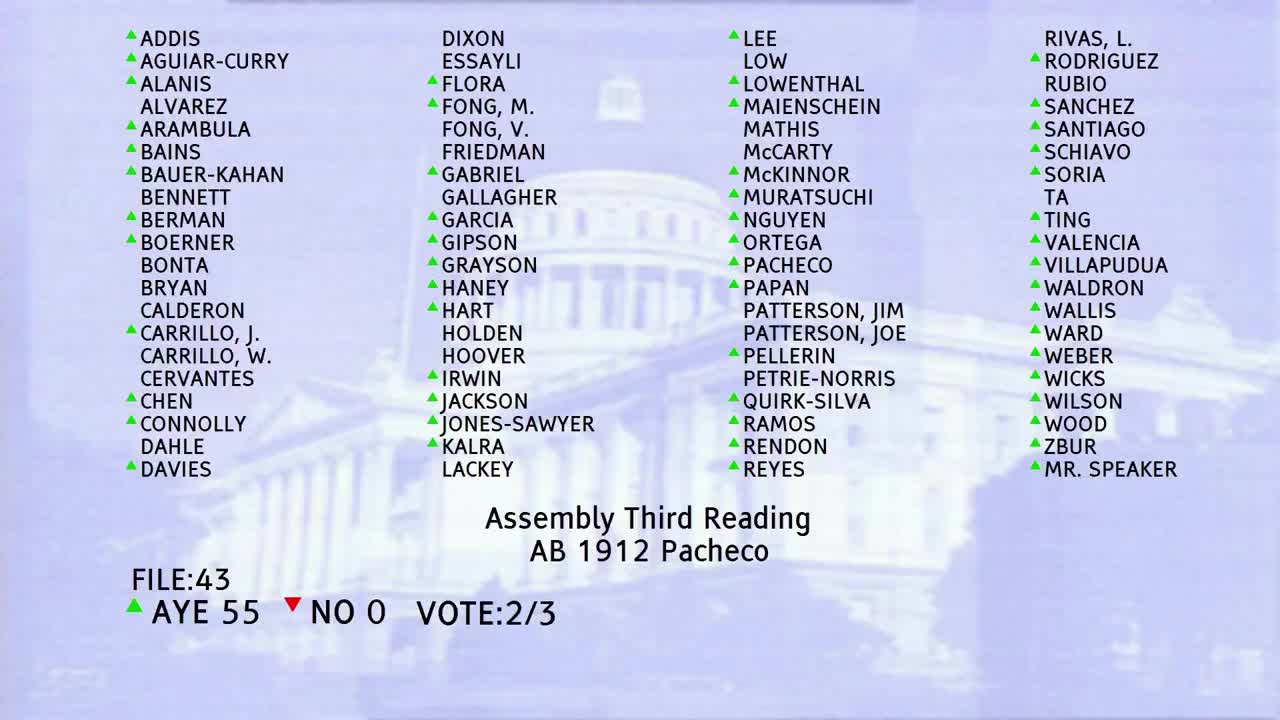 1MIN
Assembly Floor
 42MIN
Assembly Standing Committee on Utilities and Energy
Bill Author

Bill Co-Author(s):