AB 2085: Planning and zoning: permitted use: community clinic.
- Session Year: 2023-2024
- House: Assembly
- Latest Version Date: 2024-09-28
Current Status:
Passed
(2024-09-28: Chaptered by Secretary of State - Chapter 820, Statutes of 2024.)
Introduced
In Committee
First Chamber
In Committee
Second Chamber
Enacted
The Planning and Zoning Law, among other things, authorizes a development proponent to submit an application for a housing development that is subject to a specified streamlined, ministerial approval process not subject to a conditional use permit, if the development satisfies certain objective planning standards.
The California Environmental Quality Act (CEQA) requires a lead agency, as defined, to prepare, or cause to be prepared, and certify the completion of, an environmental impact report on a project that it proposes to carry out or approve that may have a significant effect on the environment or to adopt a negative declaration if it finds that the project will not have that effect. CEQA does not apply to the approval of ministerial projects.
This bill would make a development that meets specified objective planning standards, including that, among other things, it is on a parcel that is within a zone where office, retail, health care, or parking are a principally permitted use, a permitted use and would require a local agency to review an application for that development on an administrative, nondiscretionary basis. The bill would require a local agency, within 60 calendar days of receiving an application pursuant to these provisions, to approve or deny the application subject to specified requirements, including that, among other things, if the local agency determines that the development is in conflict with any of the above-described standards, the local agency is required to provide the development proponent written documentation of which standard or standards the development conflicts with, as specified.
The bill would provide that a development eligible for approval pursuant to this process is not a project for purposes of CEQA, thereby expanding the exemption for ministerial approval of projects under CEQA. By increasing duties on local governments in reviewing and approving these developments, the bill would impose a state-mandated local program.
The bill would authorize a development proponent to bring an action to enforce the bills provisions, as specified, and would make its provisions enforceable by the Attorney General and provide the Attorney General an unconditional right to intervene to enforce the bills provisions. The bill would define various terms for these purposes.
The California Constitution requires the state to reimburse local agencies and school districts for certain costs mandated by the state. Statutory provisions establish procedures for making that reimbursement.
This bill would provide that no reimbursement is required by this act for a specified reason.
The bill would include findings that changes proposed by this bill address a matter of statewide concern rather than a municipal affair and, therefore, apply to all cities, including charter cities.
The Planning and Zoning Law, among other things, authorizes a development proponent to submit an application for a housing development that is subject to a specified streamlined, ministerial approval process not subject to a conditional use permit, if the development satisfies certain objective planning standards.
The California Environmental Quality Act (CEQA) requires a lead agency, as defined, to prepare, or cause to be prepared, and certify the completion of, an environmental impact report on a project that it proposes to carry out or approve that may have a significant effect on the environment or to adopt a negative declaration if it finds that the project will not have that effect. CEQA does not apply to the approval of ministerial projects.
This bill would authorize a development proponent to submit to a local agency an application for a licensed community clinic that is located in a zone where office, retail, health care, or parking are a principally permitted use. The bill would make the development subject to a streamlined, ministerial approval process where the development is not subject to a conditional use permit or any other nonlegislative discretionary approval, as described. The make a development that meets specified objective planning standards, including that, among other things, it is on a parcel that is within a zone where office, retail, health care, or parking are a principally permitted use, a permitted use and would require a local agency to review an application for that development on an administrative, nondiscretionary basis. The bill would require a local agency, within 60 calendar days of receiving an application pursuant to these provisions, to approve or deny the application subject to specified requirements, including that, among other things, if the local agency determines that the development is in conflict with any of the above-described standards, the local agency is required to provide the development proponent written documentation of which standard or standards the development conflicts with, as specified.
The bill would provide that a development eligible for approval pursuant to this process is not a project for purposes of CEQA, thereby expanding the exemption for ministerial approval of projects under CEQA. By establishing the streamlined, ministerial approval process for these developments, increasing duties on local governments in reviewing and approving these developments, the bill would impose a state-mandated local program.
ThisThe bill would authorize a development proponent to bring an action to enforce the bills provisions, as specified, and would make its provisions enforceable by the Attorney General and would provide the Attorney General an unconditional right to intervene to enforce the bills provisions. The bill would define various terms for these purposes.
The California Constitution requires the state to reimburse local agencies and school districts for certain costs mandated by the state. Statutory provisions establish procedures for making that reimbursement.
This bill would provide that no reimbursement is required by this act for a specified reason.
The bill would include findings that changes proposed by this bill address a matter of statewide concern rather than a municipal affair and, therefore, apply to all cities, including charter cities.
The Planning and Zoning Law, among other things, authorizes a development proponent to submit an application for a housing development that is subject to a specified streamlined, ministerial approval process not subject to a conditional use permit, if the development satisfies certain objective planning standards.
The California Environmental Quality Act (CEQA) requires a lead agency, as defined, to prepare, or cause to be prepared, and certify the completion of, an environmental impact report on a project that it proposes to carry out or approve that may have a significant effect on the environment or to adopt a negative declaration if it finds that the project will not have that effect. CEQA does not apply to the approval of ministerial projects.
This bill would authorize a development proponent to submit to a local agency an application for a licensed community clinic that is located in a zone where office, retail, health care, or parking are a principally permitted use. The bill would make the development subject to a streamlined, ministerial approval process where the development is not subject to a conditional use permit or any other nonlegislative discretionary approval, as described. The bill would provide that a development eligible for approval pursuant to this process is not a project for purposes of CEQA, thereby expanding the exemption for ministerial approval of projects under CEQA. By establishing the streamlined, ministerial approval process for these developments, the bill would impose a state-mandated local program.
This bill would make its provisions enforceable by the Attorney General and would provide the Attorney General an unconditional right to intervene to enforce the bills provisions.
The California Constitution requires the state to reimburse local agencies and school districts for certain costs mandated by the state. Statutory provisions establish procedures for making that reimbursement.
This bill would provide that no reimbursement is required by this act for a specified reason.
The bill would include findings that changes proposed by this bill address a matter of statewide concern rather than a municipal affair and, therefore, apply to all cities, including charter cities.
(a)Notwithstanding any law affecting local permitting, a development shall be a permitted use and a local agency shall review an application for the development on an administrative, nondiscretionary basis if it meets all of the following objective planning standards:
(1)The development is on a parcel that is within a zone where office, retail, health care, or parking are a principally permitted use.
(2)The development is for a community clinic licensed pursuant to Section 1204 of the Health and Safety Code that provides reproductive health services as defined in subdivision (f) of Section 423.1 of the Penal Code.
(3)(A)The development complies with the applicable minimum construction standards of adequacy and safety for the physical plant of primary care clinics found in the latest edition of the California Building Standards Code, as described in subdivision (b) of Section 1226 of the Health and Safety Code.
(B)A primary care clinic may establish compliance with the minimum construction standards of adequacy and safety for the physical plant described in subdivision (b) of Section 1226 of the Health and Safety Code by submitting a written certification, as described in Section 5536.26 of the Business and Professions Code, from a licensed architect or a written statement from a local building department that the development is in compliance with these standards.
(4)The development meets all of the local agencys objective design review standards.
(5)The development would not require the demolition of a historic structure that was placed on a national, state, or local historic register.
(6)The development is not located on a site described in paragraph (6) of subdivision (a) of Section 65913.4.
(7)The project is not likely to result in adverse impacts to tribal cultural resources, as defined in subdivision (a) of Section 21074 of the Public Resources Code.
(8)The development would not require the demolition of housing.
(b)In determining whether a development submitted pursuant to this section is consistent with the objective standards specified in subdivision (a), the development shall be subject only to the plans, ordinances, policies, regulations, and standards adopted and in effect when the application is submitted.
(c)A local agency that receives an application submitted pursuant to this section shall approve or deny the application within 60 days of submission of the application, subject to all of the following:
(1)If the local agency determines that the development is in conflict with any of the objective planning standards specified in subdivision (a), then all of the following apply:
(A)The local agency shall provide the development proponent written documentation of the standard or standards with which the development conflicts, and an explanation for the reason or reasons the development conflicts with that standard or standards.
(B)The development proponent may submit materials to the local agency to address and resolve the conflict identified pursuant to subparagraph (A).
(C)Within 60 calendar days after the local agency has received the materials submitted pursuant to subparagraph (B), the local agency shall determine whether the development as supplemented or amended is consistent with the objective planning standards specified in subdivision (a).
(2)(A)If the local agency denies the application, the local agency shall provide a process for the development proponent to appeal that decision in writing to the governing body of the local agency.
(B)The local agency shall provide final written determination on the appeal no later than 60 calendar days after receipt of the development proponents written appeal.
(3)Nothing in this subdivision precludes a development proponent and a local agency from mutually agreeing to an extension of any time limit provided by this subdivision.
(d)Notwithstanding any other law, approval of a development that is eligible for approval pursuant to the streamlined, ministerial process set forth by this section shall not be considered a project for purposes of Division 13 (commencing with Section 21000) of the Public Resources Code.
(e)(1)The development proponent may bring an action to enforce this section. The court shall grant a prevailing plaintiff under this paragraph reasonable attorneys fees and costs, except the court shall not award reasonable attorneys fees if the court finds, under extraordinary circumstances, that awarding reasonable attorneys fees would not further the purposes of this section.
(2)(A)The Attorney General shall have the unconditional right to bring an enforcement action against a local agency that is in violation of this section.
(B)In any suit brought to enforce this section, the Attorney General shall have the unconditional right to intervene under subparagraph (A) of paragraph (1) of subdivision (d) of Section 387 of the Code of Civil Procedure.
(f)For purposes of this section, the following definitions apply:
(1)Development includes the construction, change or modification in construction or building services equipment, or the reconstruction or renewal of any part of an existing building, structure, or building service equipment for the purpose of operating a community clinic licensed pursuant to Section 1204 of the Health and Safety Code that provides reproductive health services as defined in subdivision (f) of Section 423.1 of the Penal Code.
(2)Development proponent means an applicant who submits an application to a local agency for a development under this section.
(3)Local agency means a city, including a charter city, a county, or a city and county, including a charter city and county.
(4)Objective design review standards means standards that involve no personal or subjective judgment by a public official and are uniformly verifiable by reference to an external and uniform benchmark or criterion available and knowable by both the development proponent and the public official before submission.
SEC. 2.No reimbursement is required by this act pursuant to Section 6 of Article XIII B of the California Constitution because a local agency or school district has the authority to levy service charges, fees, or assessments sufficient to pay for the program or level of service mandated by this act, within the meaning of Section 17556 of the Government Code.
SEC. 3.The Legislature finds and declares that reproductive freedom, including the right to abortion and contraception, is a fundamental constitutional right. Protecting this right and ensuring access to reproductive health services, as set forth in this act, is a matter of statewide concern and is not a municipal affair as that term is used in Section 5 of Article XI of the California Constitution. Therefore, Section 1 of this act adding Chapter 4.2.5 (commencing with Section 65914.900) to Division 1 of Title 7 of the Government Code applies to all cities, including charter cities.
(a)Notwithstanding any law affecting local permitting, a development shall be a permitted use and a local agency shall review an application for the development on an administrative, nondiscretionary basis if it meets all of the following objective planning standards:
(1)The development is on a parcel that is within a zone where office, retail, health care, or parking are a principally permitted use.
(2)The development is for a community clinic licensed pursuant to Section 1204 of the Health and Safety Code that provides reproductive health services as defined in subdivision (f) of Section 423.1 of the Penal Code.
(3)(A)The development complies with the applicable minimum construction standards of adequacy and safety for the physical plant of primary care clinics found in the latest edition of the California Building Standards Code, as described in subdivision (b) of Section 1226 of the Health and Safety Code.
(B)A primary care clinic may establish compliance with the minimum construction standards of adequacy and safety for the physical plant described in subdivision (b) of Section 1226 of the Health and Safety Code by submitting a written certification, as described in Section 5536.26 of the Business and Professions Code, from a licensed architect or a written statement from a local building department that the development is in compliance with these standards.
(4)The development meets all of the local agencys objective design review standards.
(5)The development would not require the demolition of a historic structure that was placed on a national, state, or local historic register.
(6)The development is not located on a site described in paragraph (6) of subdivision (a) of Section 65913.4.
(7)The project is not likely to result in adverse impacts to tribal cultural resources, as defined in subdivision (a) of Section 21074 of the Public Resources Code.
(8)The development would not require the demolition of housing.
(b)In determining whether a development submitted pursuant to this section is consistent with the objective standards specified in subdivision (a), the development shall be subject only to the plans, ordinances, policies, regulations, and standards adopted and in effect when the application is submitted.
(c)A local agency that receives an application submitted pursuant to this section shall approve or deny the application within 60 days of submission of the application, subject to all of the following:
(1)If the local agency determines that the development is in conflict with any of the objective planning standards specified in subdivision (a), then all of the following apply:
(A)The local agency shall provide the development proponent written documentation of which the standard or standards with which the development conflicts with, conflicts, and an explanation for the reason or reasons the development conflicts with that standard or standards.
(B)The development proponent may submit materials to the local agency to address and resolve the conflict identified pursuant to subparagraph (A).
(C)Within 60 calendar days after the local agency has received the materials submitted pursuant to subparagraph (B), the local agency shall determine whether the development as supplemented or amended is consistent with the objective planning standards specified in subdivision (a).
(2)(A)If the local agency denies the application, the local agency shall provide a process for the development proponent to appeal that decision in writing to the governing body of the local agency.
(B)The local agency shall provide final written determination on the appeal no later than 60 calendar days after receipt of the development proponents written appeal.
(3)Nothing in this subdivision precludes a development proponent and a local agency from mutually agreeing to an extension of any time limit provided by this subdivision.
(d)Notwithstanding any other law, approval of a development that is eligible for approval pursuant to the streamlined, ministerial process set forth by this section shall not be considered a project for purposes of Division 13 (commencing with Section 21000) of the Public Resources Code.
(e)(1)The development proponent may bring an action to enforce this section. The court shall grant a prevailing plaintiff under this paragraph reasonable attorneys fees and costs, except the court shall not award reasonable attorneys fees if the court finds, under extraordinary circumstances, that awarding reasonable attorneys fees would not further the purposes of this section.
(2)(A)The Attorney General shall have the unconditional right to bring an enforcement action against a local agency that is in violation of this section.
(B)In any suit brought to enforce this section, the Attorney General shall have the unconditional right to intervene under subparagraph (A) of paragraph (1) of subdivision (d) of Section 387 of the Code of Civil Procedure.
(f)For purposes of this section, the following definitions apply:
(1)Development includes the construction, change or modification in construction or building services equipment, or the reconstruction or renewal of any part of an existing building, structure, or building service equipment for the purpose of operating a community clinic licensed pursuant to Section 1204 of the Health and Safety Code that provides reproductive health services as defined in subdivision (f) of Section 423.1 of the Penal Code.
(2)Development proponent means an applicant who submits an application to a local agency for a development under this section.
(3)Local agency means a city, including a charter city, a county, or a city and county, including a charter city and county.
(4)Objective design review standards means standards that involve no personal or subjective judgment by a public official and are uniformly verifiable by reference to an external and uniform benchmark or criterion available and knowable by both the development proponent and the public official before submission.
SEC. 2.No reimbursement is required by this act pursuant to Section 6 of Article XIII B of the California Constitution because a local agency or school district has the authority to levy service charges, fees, or assessments sufficient to pay for the program or level of service mandated by this act, within the meaning of Section 17556 of the Government Code.
SEC. 3.The Legislature finds and declares that reproductive freedom, including the right to abortion and contraception, is a fundamental constitutional right. Protecting this right and ensuring access to reproductive health services, as set forth in this act, is a matter of statewide concern and is not a municipal affair as that term is used in Section 5 of Article XI of the California Constitution. Therefore, Section 1 of this act adding Chapter 4.2.5 (commencing with Section 65914.900) to Division 1 of Title 7 of the Government Code applies to all cities, including charter cities.
(a)Notwithstanding any law affecting local permitting, a development shall be a permitted use and a local agency shall review an application for the development on an administrative, nondiscretionary basis if it meets all of the following objective planning standards:
(1)The development is on a parcel that is within a zone where office, retail, health care, or parking are a principally permitted use.
(2)The development is for a community clinic licensed pursuant to Section 1204 of the Health and Safety Code that provides reproductive health services as defined in subdivision (f) of Section 423.1 of the Penal Code.
(3)(A)The development complies with the applicable minimum construction standards of adequacy and safety for the physical plant of primary care clinics found in the latest edition of the California Building Standards Code, as described in subdivision (b) of Section 1226 of the Health and Safety Code.
(B)A primary care clinic may establish compliance with the minimum construction standards of adequacy and safety for the physical plant described in subdivision (b) of Section 1226 of the Health and Safety Code by submitting a written certification, as described in Section 5536.26 of the Business and Professions Code, from a licensed architect or a written statement from a local building department that the development is in compliance with these standards.
(4)The development meets all of the local agencys objective design review standards.
(5)The development would not require the demolition of a historic structure that was placed on a national, state, or local historic register.
(6)The development is not located on a site described in paragraph (6) of subdivision (a) of Section 65913.4.
(7)The project is not likely to result in adverse impacts to tribal cultural resources, as defined in subdivision (a) of Section 21074 of the Public Resources Code.
(6)(8)The development would not require the demolition of housing.
(b)In determining whether a development submitted pursuant to this section is consistent with the objective standards specified in subdivision (a), the development shall be subject only to the plans, ordinances, policies, regulations, and standards adopted and in effect when the application is submitted.
(c)A local agency that receives an application submitted pursuant to this section shall approve or deny the application within 60 days of submission of the application, subject to all of the following:
(1)If the local agency determines that the development is in conflict with any of the objective planning standards specified in subdivision (a), then all of the following apply:
(A)The local agency shall provide the development proponent written documentation of which standard or standards the development conflicts with, and an explanation for the reason or reasons the development conflicts with that standard or standards.
(B)The development proponent may submit materials to the local agency to address and resolve the conflict identified pursuant to subparagraph (A).
(C)Within 60 calendar days after the local agency has received the materials submitted pursuant to subparagraph (B), the local agency shall determine whether the development as supplemented or amended is consistent with the objective planning standards specified in subdivision (a).
(2)(A)If the local agency denies the application, the local agency shall provide a process for the development proponent to appeal that decision in writing to the governing body of the local agency.
(B)The local agency shall provide final written determination on the appeal no later than 60 calendar days after receipt of the development proponents written appeal.
(3)Nothing in this subdivision precludes a development proponent and a local agency from mutually agreeing to an extension of any time limit provided by this subdivision.
(d)Notwithstanding any other law, approval of a development that is eligible for approval pursuant to the streamlined, ministerial process set forth by this section shall not be considered a project for purposes of Division 13 (commencing with Section 21000) of the Public Resources Code.
(e)(1)The development proponent may bring an action to enforce this section. The court shall grant a prevailing plaintiff under this paragraph reasonable attorneys attorneys fees and costs, except the court shall not award reasonable attorneys attorneys fees if the court finds, under extraordinary circumstances, that awarding reasonable attorneys attorneys fees would not further the purposes of this section.
(2)(A)The Attorney General shall have the unconditional right to bring an enforcement action against a local agency that is in violation of this section.
(B)In any suit brought to enforce this section, the Attorney General shall have the unconditional right to intervene under subparagraph (A) of paragraph (1) of subdivision (d) of Section 387 of the Code of Civil Procedure.
(f)For purposes of this section, the following definitions apply:
(1)Development includes the construction, change or modification in construction or building services equipment, or the reconstruction or renewal of any part of an existing building, structure, or building service equipment for the purpose of operating a community clinic licensed pursuant to Section 1204 of the Health and Safety Code that provides reproductive health services as defined in subdivision (f) of Section 423.1 of the Penal Code.
(2)Development proponent means an applicant who submits an application to a local agency for a development under this section.
(3)Local agency means a city, including a charter city, a county, or a city and county, including a charter city and county.
(4)Objective design review standards means standards that involve no personal or subjective judgment by a public official and are uniformly verifiable by reference to an external and uniform benchmark or criterion available and knowable by both the development proponent and the public official before submission.
SEC. 2.No reimbursement is required by this act pursuant to Section 6 of Article XIII B of the California Constitution because a local agency or school district has the authority to levy service charges, fees, or assessments sufficient to pay for the program or level of service mandated by this act, within the meaning of Section 17556 of the Government Code.
SEC. 3.The Legislature finds and declares that reproductive freedom, including the right to abortion and contraception, is a fundamental constitutional right. Protecting this right and ensuring access to reproductive health services, as set forth in this act, is a matter of statewide concern and is not a municipal affair as that term is used in Section 5 of Article XI of the California Constitution. Therefore, Section 1 of this act adding Chapter 4.2.5 (commencing with Section 65914.900) to Division 1 of Title 7 of the Government Code applies to all cities, including charter cities.
(a)Notwithstanding any law affecting local permitting, a development shall be a permitted use and a local agency shall review an application for the development on an administrative, nondiscretionary basis if it meets all of the following objective planning standards:
(1)The development is on a parcel that is within a zone where office, retail, health care, or parking are a principally permitted use.
(2)The development is for a community clinic licensed pursuant to Section 1204 of the Health and Safety Code that provides reproductive health services as defined in subdivision (f) of Section 423.1 of the Penal Code.
(3)(A)The development complies with the applicable minimum construction standards of adequacy and safety for the physical plant of primary care clinics found in the latest edition of the California Building Standards Code, as described in subdivision (b) of Section 1226 of the Health and Safety Code.
(B)A primary care clinic may establish compliance with the minimum construction standards of adequacy and safety for the physical plant described in subdivision (b) of Section 1226 of the Health and Safety Code by submitting a written certification, as described in Section 5536.26 of the Business and Professions Code, from a licensed architect or a written statement from a local building department that the development is in compliance with these standards.
(4)The development meets all of the local agencys objective design review standards in effect at the time that the development application is submitted to the local agency pursuant to this section. standards.
(5)The development would not require the demolition of a historic structure that was placed on a national, state, or local historic register.
(6)The development would not require the demolition of housing.
(b)In determining whether a development submitted pursuant to this section is consistent with the objective standards specified in subdivision (a), the development shall be subject only to the plans, ordinances, policies, regulations, and standards adopted and in effect when the application is submitted.
(c)A local agency that receives an application submitted pursuant to this section shall approve or deny the application within 60 days of submission of the application, subject to all of the following:
(1)If the local agency determines that the development is in conflict with any of the objective planning standards specified in subdivision (a), then all of the following apply:
(A)The local agency shall provide the development proponent written documentation of which standard or standards the development conflicts with, and an explanation for the reason or reasons the development conflicts with that standard or standards.
(B)The development proponent may submit materials to the local agency to address and resolve the conflict identified pursuant to subparagraph (A).
(C)Within 60 calendar days after the local agency has received the materials submitted pursuant to subparagraph (B), the local agency shall determine whether the development as supplemented or amended is consistent with the objective planning standards specified in subdivision (a).
(2)(A)If the local agency denies the application, the local agency shall provide a process for the development proponent to appeal that decision in writing to the governing body of the local agency.
(B)The local agency shall provide final written determination on the appeal no later than 60 calendar days after receipt of the development proponents written appeal.
(3)This section does not preclude Nothing in this subdivision precludes a development proponent and a local agency from mutually agreeing to an extension of any time limit provided by this subdivision.
(d)Notwithstanding any other law, approval of a development that is eligible for approval pursuant to the streamlined, ministerial process set forth by this section shall not be considered a project for purposes of Division 13 (commencing with Section 21000) of the Public Resources Code.
(e)(1)The development proponent may bring an action to enforce this section. The court shall grant a prevailing plaintiff under this paragraph reasonable attorneys fees and costs, except the court shall not award reasonable attorneys fees if the court finds, under extraordinary circumstances, that awarding reasonable attorneys fees would not further the purposes of this section.
(2)(A)The Attorney General shall have the unconditional right to bring an enforcement action against a local agency that is in violation of this section.
(B)In any suit brought to enforce this section, the Attorney General shall have the unconditional right to intervene under subparagraph (A) of paragraph (1) of subdivision (d) of Section 387 of the Code of Civil Procedure.
(f)For purposes of this section, the following definitions apply:
(1)Development includes the construction, change or modification in construction or building services equipment, or the reconstruction or renewal of any part of an existing building, structure, or building service equipment for the purpose of operating a community clinic licensed pursuant to Section 1204 of the Health and Safety Code that provides reproductive health services as defined in subdivision (f) of Section 423.1 of the Penal Code.
(2)Development proponent means an applicant who submits an application to a local agency for a development under this section.
(3)Local agency has the same meaning as in Section 66000. means a city, including a charter city, a county, or a city and county, including a charter city and county.
(4)Objective design review standards means standards that involve no personal or subjective judgment by a public official and are uniformly verifiable by reference to an external and uniform benchmark or criterion available and knowable by both the development proponent and the public official before submission.
SEC. 2.No reimbursement is required by this act pursuant to Section 6 of Article XIII B of the California Constitution because a local agency or school district has the authority to levy service charges, fees, or assessments sufficient to pay for the program or level of service mandated by this act, within the meaning of Section 17556 of the Government Code.
SEC. 3.The Legislature finds and declares that reproductive freedom, including the right to abortion and contraception, is a fundamental constitutional right. Protecting this right and ensuring access to reproductive health services, as set forth in this act, is a matter of statewide concern and is not a municipal affair as that term is used in Section 5 of Article XI of the California Constitution. Therefore, Section 1 of this act adding Chapter 4.2.5 (commencing with Section 65914.900) to Division 1 of Title 7 of the Government Code applies to all cities, including charter cities.
(a)Notwithstanding any law affecting local permitting, a development shall be a permitted use and a local agency shall review an application for the development on an administrative, nondiscretionary basis if it meets all of the following objective planning standards:
(1)The development is on a parcel that is within a zone where office, retail, health care, or parking are a principally permitted use.
(2)The development is for a community clinic licensed pursuant to Section 1204 of the Health and Safety Code that provides reproductive health services as defined in subdivision (f) of Section 423.1 of the Penal Code.
(3)(A)The development complies with the applicable minimum construction standards of adequacy and safety for the physical plant of primary care clinics found in the latest edition of the California Building Standards Code, as described in subdivision (b) of Section 1226 of the Health and Safety Code.
(B)A primary care clinic may establish compliance with the minimum construction standards of adequacy and safety for the physical plant described in subdivision (b) of Section 1226 of the Health and Safety Code by submitting a written certification, as described in Section 5536.26 of the Business and Professions Code, from a licensed architect or a written statement from a local building department that the development is in compliance with these standards.
(4)The development meets all of the local agencys objective design review standards in effect at the time that the development application is submitted to the local agency pursuant to this section.
(5)The development would not require the demolition of a historic structure that was placed on a national, state, or local historic register.
(6)The development would not require the demolition of housing.
(b)In determining whether a development submitted pursuant to this section is consistent with the objective standards specified in subdivision (a), the development shall be subject only to the plans, ordinances, policies, regulations, and standards adopted and in effect when the application is submitted.
(c)A local agency that receives an application submitted pursuant to this section shall approve or deny the application within 60 days of submission of the application, subject to all of the following:
(1)If the local agency determines that the development is in conflict with any of the objective planning standards specified in subdivision (a), then all of the following apply:
(A)The local agency shall provide the development proponent written documentation of which standard or standards the development conflicts with, and an explanation for the reason or reasons the development conflicts with that standard or standards.
(B)The development proponent may submit materials to the local agency to address and resolve the conflict identified pursuant to subparagraph (A).
(C)Within 60 calendar days after the local agency has received the materials submitted pursuant to subparagraph (B), the local agency shall determine whether the development as supplemented or amended is consistent with the objective planning standards specified in subdivision (a).
(2)(A)If the local agency denies the application, the local agency shall provide a process for the development proponent to appeal that decision in writing to the governing body of the local agency.
(B)The local agency shall provide final written determination on the appeal no later than 60 calendar days after receipt of the development proponents written appeal.
(3)This section does not preclude a development proponent and a local agency from mutually agreeing to an extension of any time limit provided by this subdivision.
(c)(d)Notwithstanding any other law, approval of a development that is eligible for approval pursuant to the streamlined, ministerial process set forth by this section shall not be considered a project for purposes of Division 13 (commencing with Section 21000) of the Public Resources Code.
(e)(1)The development proponent may bring an action to enforce this section. The court shall grant a prevailing plaintiff under this paragraph reasonable attorneys fees and costs, except the court shall not award reasonable attorneys fees if the court finds, under extraordinary circumstances, that awarding reasonable attorneys fees would not further the purposes of this section.
(d)(1)(2)(A)The Attorney General shall have the unconditional right to bring an enforcement action against a local agency that is in violation of this section.
(2)(B)In any suit brought to enforce this section, the Attorney General shall have the unconditional right to intervene under subparagraph (A) of paragraph (1) of subdivision (d) of Section 387 of the Code of Civil Procedure.
(f)For purposes of this section, the following definitions apply:
(1)Development includes the construction, change or modification in construction or building services equipment, or the reconstruction or renewal of any part of an existing building, structure, or building service equipment for the purpose of operating a community clinic licensed pursuant to Section 1204 of the Health and Safety Code that provides reproductive health services as defined in subdivision (f) of Section 423.1 of the Penal Code.
(2)Development proponent means an applicant who submits an application to a local agency for a development under this section.
(e)For purposes of this section, local(3)Local agency has the same meaning as in Section 66000.
(4)Objective design review standards means standards that involve no personal or subjective judgment by a public official and are uniformly verifiable by reference to an external and uniform benchmark or criterion available and knowable by both the development proponent and the public official before submission.
SEC. 2.No reimbursement is required by this act pursuant to Section 6 of Article XIII B of the California Constitution because a local agency or school district has the authority to levy service charges, fees, or assessments sufficient to pay for the program or level of service mandated by this act, within the meaning of Section 17556 of the Government Code.
SEC. 3.The Legislature finds and declares that the lack of access to community clinics due to barriers to development at a local level reproductive freedom, including the right to abortion and contraception, is a fundamental constitutional right. Protecting this right and ensuring access to reproductive health services, as set forth in this act, is a matter of statewide concern and is not a municipal affair as that term is used in Section 5 of Article XI of the California Constitution. Therefore, Section 1 of this act adding Chapter 4.2.5 (commencing with Section 65914.900) to Division 1 of Title 7 of the Government Code applies to all cities, including charter cities.
REVISIONS: HeadingLine 3.(a)Notwithstanding any inconsistent provision of a local agencys general plan, specific plan, zoning ordinance, or regulation, a development proponent may submit to a local agency an application for a development that shall be subject to the streamlined, ministerial approval process provided in subdivision (b) and that is not subject to a conditional use permit or any other nonlegislative discretionary approval if the development satisfies all of the following objective planning standards:
(1)The development is for a community clinic licensed pursuant to Section 1204 of the Health and Safety Code.
(2)The development is located in a zone where office, retail, health care, or parking are a principally permitted use.
(b)(1)If a local agency determines that a development submitted pursuant to this section is consistent with the objective planning standards specified in subdivision (a), it shall approve the development. If a local agency determines that a development submitted pursuant to this section is in conflict with any of the objective planning standards specified in subdivision (a), it shall provide the development proponent written documentation of which standard or standards the development conflicts with, and an explanation for the reason or reasons the development conflicts with that standard or standards.
(2)Approval or the documentation described in paragraph (1) shall be provided to the development proponent within 90 days of submittal of the application. If the local agency fails to provide the required documentation pursuant to paragraph (1), the development shall be deemed to satisfy the objective planning standards specified in subdivision (a).
(c)Notwithstanding any law, a development that is eligible for approval pursuant to the streamlined, ministerial process set forth by this section shall not be considered a project for purposes of Division 13 (commencing with Section 21000) of the Public Resources Code.
(d)(1)The Attorney General shall have the unconditional right to bring an enforcement action against a local agency that is in violation of this section.
(2)In any suit brought to enforce this section, the Attorney General shall have the unconditional right to intervene under subparagraph (A) of paragraph (1) of subdivision (d) of Section 387 of the Code of Civil Procedure.
(e)For purposes of this section, local agency has the same meaning as in Section 66000.
SEC. 2.No reimbursement is required by this act pursuant to Section 6 of Article XIII B of the California Constitution because a local agency or school district has the authority to levy service charges, fees, or assessments sufficient to pay for the program or level of service mandated by this act, within the meaning of Section 17556 of the Government Code.
SEC. 3.The Legislature finds and declares that the lack of access to community clinics due to barriers to development at a local level is a matter of statewide concern and is not a municipal affair as that term is used in Section 5 of Article XI of the California Constitution. Therefore, Section 1 of this act adding Chapter 4.2.5 (commencing with Section 65914.900) to Division 1 of Title 7 of the Government Code applies to all cities, including charter cities.
|
Date
|
Status
|
|---|---|
| Sep 28, 2024 | Chaptered by Secretary of State - Chapter 820, Statutes of 2024. |
| Sep 28, 2024 | Approved by the Governor. |
| Sep 11, 2024 | Enrolled and presented to the Governor at 4 p.m. |
| Aug 29, 2024 | Senate amendments concurred in. To Engrossing and Enrolling. (Ayes 62. Noes 6.). |
| Aug 29, 2024 | Assembly Rule 77 suspended. |
| Aug 28, 2024 | In Assembly. Concurrence in Senate amendments pending. May be considered on or after August 30 pursuant to Assembly Rule 77. |
| Aug 28, 2024 | Read third time. Passed. Ordered to the Assembly. (Ayes 31. Noes 8.). |
| Aug 21, 2024 | Read second time. Ordered to third reading. |
| Aug 20, 2024 | Read third time and amended. Ordered to second reading. |
| Aug 19, 2024 | Read second time. Ordered to third reading. |
| Aug 15, 2024 | From committee: Do pass. (Ayes 5. Noes 2.) (August 15). |
| Aug 5, 2024 | In committee: Referred to APPR suspense file. |
| Jul 3, 2024 | Read second time and amended. Re-referred to Com. on APPR. |
| Jul 3, 2024 | From committee: Amend, and do pass as amended and re-refer to Com. on APPR. (Ayes 5. Noes 2.) (July 3). |
| Jun 11, 2024 | Read second time and amended. Re-referred to Com. on E.Q. |
| Jun 10, 2024 | From committee: Amend, and do pass as amended and re-refer to Com. on E.Q. (Ayes 5. Noes 2.) (June 5). |
| May 29, 2024 | Referred to Coms. on L. GOV. and E.Q. |
| May 22, 2024 | In Senate. Read first time. To Com. on RLS. for assignment. |
| May 21, 2024 | Read third time. Passed. Ordered to the Senate. (Ayes 60. Noes 8. Page 5414.) |
| May 20, 2024 | Read second time. Ordered to third reading. |
| May 16, 2024 | From committee: Do pass. (Ayes 11. Noes 3.) (May 16). |
| May 8, 2024 | In committee: Set, first hearing. Referred to APPR. suspense file. |
| Apr 25, 2024 | Coauthors revised. |
| Apr 23, 2024 | From committee: Do pass and re-refer to Com. on APPR. (Ayes 7. Noes 1.) (April 22). Re-referred to Com. on APPR. |
| Apr 23, 2024 | Coauthors revised. |
| Apr 18, 2024 | From committee: Do pass and re-refer to Com. on NAT. RES. (Ayes 8. Noes 1.) (April 17). Re-referred to Com. on NAT. RES. |
| Apr 15, 2024 | (Pending re-refer to Com. on NAT. RES.) |
| Apr 15, 2024 | Assembly Rule 56 suspended. (Page 4775.) |
| Apr 10, 2024 | Re-referred to Com. on L. GOV. |
| Apr 9, 2024 | From committee chair, with author's amendments: Amend, and re-refer to Com. on L. GOV. Read second time and amended. |
| Apr 2, 2024 | In committee: Set, first hearing. Hearing canceled at the request of author. |
| Mar 4, 2024 | Referred to Coms. on L. GOV. and NAT. RES. |
| Feb 6, 2024 | From printer. May be heard in committee March 7. |
| Feb 5, 2024 | Read first time. To print. |
|
Date
|
Description
|
Location
|
Votes
|
|
|---|---|---|---|---|
| Aug 29, 2024 | AB 2085 Bauer-Kahan Concurrence in Senate Amendments | Assembly Floor |
Passed |
|
| Aug 28, 2024 | Assembly 3rd Reading AB2085 Bauer-Kahan et al. By Atkins | Senate Floor |
Passed |
|
| Aug 15, 2024 | Do pass | Senate Standing Committee on Appropriations |
Passed |
|
| Aug 5, 2024 | Placed on suspense file | Senate Standing Committee on Appropriations |
Passed |
|
| Jul 3, 2024 | Do pass as amended, but first amend, and re-refer to the Committee on [Appropriations] | Senate Standing Committee on Environmental Quality |
Passed |
|
| Jun 5, 2024 | Do pass as amended, but first amend, and re-refer to the Committee on [Environmental Quality] | Senate Standing Committee on Local Government |
Passed |
|
| May 21, 2024 | AB 2085 Bauer-Kahan Assembly Third Reading | Assembly Floor |
Passed |
|
| May 16, 2024 | Do pass. | Assembly Standing Committee on Appropriations |
Passed |
|
| Apr 22, 2024 | Do pass and be re-referred to the Committee on [Appropriations] | Assembly Standing Committee on Natural Resources |
Passed |
|
| Apr 17, 2024 | Do pass and be re-referred to the Committee on [Natural Resources] | Assembly Standing Committee on Local Government |
Passed |
This list shows positions taken on this bill by organizations on the date displayed, which is linked to the original source.
Positions by individuals are not included.
|
Organization
|
Position
|
Date
|
|---|---|---|
| American College Of Obstetricians And Gynecologists District Ix | ** Support | |
| American Nurses Association/California | ** Support | |
| Associated General Contractors | ** Support | |
| Attorney General Rob Bonta | ** Support | |
| California Catholic Conference | ** Against | |
| California Family Council | ** Against | |
| California Right to Life Educational Fund | ** Against | |
| County Of San Diego | ** Support | |
| CPCA Advocates, Subsidiary of The California Primary Care Association | ** Support | |
| Equal Rights Advocates | ** Support | |
| Essential Access Health | ** Support | |
| International Interior Design Association Northern California Chapter Inc | ** Support | |
| International Interior Design Association Southern California Chapter | ** Support | |
| Life Legal Defense Foundation | ** Against | |
| National Health Law Program | ** Support | |
| Office of Lieutenant Governor Eleni Kounalakis | ** Support | |
| Planned Parenthood Affiliates Of California | ** Support | |
| Positions reflect letters received by noon one week prior to the hearing. | ** Against | |
| Reproductive Freedom for All | ** Support | |
| Reproductive Freedom for All California | ** Support | |
| Right to Life League of Southern California | ** Against | |
| SF Black and Jewish Unity Coalition | ** Support | |
| Training In Early Abortion For Comprehensive Healthcare | ** Support | |
| Women'S Foundation California | ** Support |
CONCURRENCE IN SENATE AMENDMENTS
CSA1 Bill Id:AB 2085
Author:(Bauer-Kahan)
As Amended Ver:August 20, 2024
Majority vote
SUMMARY
Requires ministerial approval of a permit for development of a community clinic that provides reproductive health services in a zone where office, retail, parking, or health care is a permitted use.
Senate Amendments
- Change the requirement that a development meets all of the local agency's object design review standards.
- Exclude from the requirement that local agency approve developments in the coastal zone, farmland, wetlands, very high fire hazard severity zones, hazardous waste sites, earthquake fault zones, special flood hazard areas, floodways, lands for conservation within a community conservation plan, and a habitat fro protected species.
- Require approval of a development that will not likely result in adverse impacts to tribal cultural resources as one of the conditions for ministerial approval.
- Define a "local agency" to mean a city, charter city, county, charter county, city and county, and a charter city and county.
- Technical and clarifying changes.
COMMENTS
- Planning and Zoning Law. State law provides powers and duties for cities and counties regarding land use. Each city and county must prepare and periodically update a comprehensive, long-range general plan to guide future planning decisions. The general plan has seven mandatory elements: land use, circulation, housing, conservation, open-space, noise, and safety. General plans must also either include an eighth element on environmental justice, or incorporate environmental justice concerns throughout the other elements. Cities and counties may adopt optional elements that address issues of their choosing, and once adopted, those elements have the same legal force as the mandatory elements. The general plan must be "internally consistent," which means the various elements cannot have conflicting information or assumptions.
Although state law spells out the plans' minimum contents, it also says local officials can address these topics to the extent to which they exist in their cities and counties, and with a specificity and level of detail reflecting local circumstances. Similarly, state law doesn't require cities and counties to regularly revise their general plans (except for the housing element, which must generally be revised every eight years).
Local governments have broad authority to define the specific approval processes needed to satisfy these considerations. Some housing projects can be permitted by city or county planning staff "ministerially" or without further approval from elected officials, but most large housing projects require "discretionary" approvals from local governments, such as a conditional use permit or a change in zoning laws. This process requires hearings by the local planning commission and public notice and may require additional approvals.
The Planning and Zoning Law also establishes a planning agency in each city and county, which may be a separate planning commission, administrative body, or the legislative body of the city or county itself. Public notice must be given at least 10 days in advance of hearings where most permitting decisions will be made. The law also allows residents to appeal permitting decisions and other actions to either a board of appeals or the legislative body of the city or county. Cities and counties may adopt ordinances governing the appeals process, which can entail appeals of decisions by planning officials to the planning commission and the city council or county board of supervisors.
Local land use policies and decisions, including zoning, specific plans, development agreements, and subdivision map approvals, of general law cities (and counties) must be consistent with their general plan. However, charter cities are exempt from many provisions in law that apply to local planning and zoning ordinances, except where state law specifically states it applies to charter cities. Charter cities may also adopt an ordinance or charter amendment that requires compliance with state planning and zoning laws, including the requirement for consistency. Approximately one-quarter of charter cities have adopted such a requirement.
City or county zoning ordinances, including charter cities, must be consistent with the general plan. To comply with this requirement, a county or city must adopt a general plan, and ensure the various land uses the ordinance authorizes are compatible with the objectives, policies, general land uses, and programs the plan specifies. Any resident or property owner in the city or county can bring an action in superior court to enforce compliance within 90 days of a new zoning ordinance or amendment's enactment. If a zoning ordinance becomes inconsistent with a general plan due to an amendment to the general plan, or any of its elements, the city or county must amend the zoning ordinance in a reasonable time so it is consistent with the amended general plan.
- By-Right Approval. Historically, the ministerial approval process has been used to aid the approval of affordable housing projects or emergency shelters by limiting local government's land use discretion and requiring their approval of eligible projects. Recently, the Legislature passed and the Governor signed AB 531 (Irwin), Chapter 789, Statutes of 2023, which allowed permanent supportive housing developments funded by the Behavioral Health Infrastructure Bond Act of 2024 be subject to a streamlined ministerial approval process. These types of projects are intended to serve Californians experiencing homelessness or at risk of homelessness with severe behavioral challenges. A subset of developments that fall under the category of a behavioral health treatment and residential setting – including children's residential crisis programs, peer respite, children's and adult substance use disorder residential programs, recovery housing, short-term residential therapeutic programs, and social rehabilitation programs – are also eligible for by right streamlining and are exempt from CEQA on residential, office, parking, and retail sites.
- Access to reproductive health services. Article I, Section 1.1 of the California Constitution, added by Proposition 1 (2022) provides "the state shall not deny or interfere with an individual's reproductive freedom in their most intimate decisions, which includes their fundamental right to choose to have an abortion and their fundamental right to choose or refuse contraceptives." Under existing law, reproductive health services includes medical, surgical, counseling, or referral services relating to the human reproductive system, including services relating to pregnancy or the termination of a pregnancy.
To build a new reproductive health clinic, a health care provider must apply for a permit from the city or county where the project will be located. According to news reports, reproductive health care providers have recently had difficulty securing local approval in at least three cities in California:
- In March 2022, a developer who proposed leasing a site to a Planned Parenthood clinic in the City of Visalia dropped the project. Although the city's planning commission approved the clinic, that decision was appealed to the city council, which postponed a hearing on the clinic several times following controversy regarding the project.
- In July 2023, the City of Fontana imposed a moratorium on new business activity in part of the central city. At the time, the only pending proposal within the area was a Planned Parenthood clinic. The Planned Parenthood affiliate seeking to develop the clinic has since sued the city.
- In June 2024, Douglas Emmett, a real estate investment trust, cancelled a lease with DuPont Clinic, a reproductive health clinic that provides abortions in all trimesters. DuPont sued the city and the property owner alleging the city colluded with Douglas Emmett to halt the opening of the clinic. While the city had issued the needed permits for the site, DuPont alleges city officials pressured Douglas Emmett to rescind the lease in response to protests against the clinic.
According to the Author
"Reproductive healthcare is desperately needed, especially in healthcare deserts. It is challenging enough to build them, and we are seeing local opposition delay and block clinic construction without justification. To effectively protect reproductive care, we must ensure our legal protections are accompanied by physical access. AB 2085 creates streamlining for development of community clinics in areas already zoned for commercial or medical facilities. This care is desperately needed, and these providers will deliver a range of medical services outside of normal business hours and primarily to medical patients. This is an equity issue and a reproductive rights issue. Our state cannot promise abortion rights on the one hand but deny access on the other. AB 2085 will make our values a reality."
Arguments in Support
California Attorney General Rob Bonta wrote in support of a prior version of the bill, "State law provides powers and duties for cities and counties regarding land use. There have been instances where localities have used their land use authority to delay or halt reproductive health care clinics from opening. AB 2085 establishes a streamlined, objective process for reproductive health care clinics to be approved, avoiding discretionary delays at the local level and creating a CEQA exemption, making it easier for such clinics to open.
"As we continue to confront the fallout from the U.S. Supreme Court decision in Dobbs v. Jackson, which ended the federal constitutional protections for abortion enshrined in Roe v. Wade, it is more important than ever that California continue to make reproductive rights a top priority. Research data from Guttmacher Institute shows that nearly 180,000 abortions were performed in California in 2023, which is 19 percent more than in 2019. We must do what we can to ensure there is infrastructure in place to account for this increase so that California can provide a safe haven for anyone seeking these vital health care services. For these reasons, Attorney General Bonta supports AB 2085."
Arguments in Opposition
The California Catholic Conference wrote in opposition of a previous version of the bill, " We are also always opposed to the violence of abortion. However, this bill seeks to force municipalities to open abortion facilities as a right, circumventing local control and discriminating against every other kind of reproductive care by exclusion. Duly elected city councils should be able to decide the kinds of businesses permitted within their borders based on their merits, whether that be a coal mine, casino, tobacco or gun store, or abortion facility. The state mandate significantly overreaches the state's power, permitting applicants and the State Attorney General to sue a city simply for following the will and values of its citizens.
"Furthermore, it is absurd to claim a right to access abortion and force the building of such a clinic when there is no mutual right to access maternity care. Women in maternity care deserts and HRSA's cannot find enough doctors to safely monitor them through pregnancy and deliver their infants. For the state to force local jurisdictions to open an unwanted abortion facility when women in that community have no doctors who will provide prenatal care or deliver their infant is completely unacceptable. This is exploitative and reproductive coercion."
FISCAL COMMENTS
According to the Senate Appropriations Committee:
- "Unknown court workload cost pressures for superior courts to hear and adjudicate cases brought by development proponents or the Attorney General under the provisions of this bill. See Staff Comments [in Senate Appropriations Committee Analysis]. (Trial Court Trust Fund, General Fund).
- "The Department of Justice does not anticipate that the Attorney General would incur significant costs that would require additional resources as a result of the bill. (General Fund).
- "Unknown local mandated costs. While the bill could impose new costs on local agencies to revise planning requirements for certain developments, and providing for streamlined and expedited review of those projects, these costs are not state-reimbursable because local agencies have general authority to charge and adjust planning and permitting fees to cover their administrative expenses associated with new planning mandates. (local funds)"
VOTES:
ASM LOCAL GOVERNMENT: 8-1-0
YES: Juan Carrillo, Alanis, Haney, Kalra, Pacheco, Ramos, Ward, Wilson
NO: Waldron
ASM NATURAL RESOURCES: 7-1-3
YES: Bryan, Friedman, Kalra, Muratsuchi, Pellerin, Wicks, Wood
NO: Joe Patterson
ABS, ABST OR NV: Flora, Bauer-Kahan, Hoover
ASM APPROPRIATIONS: 11-3-1
YES: Wicks, Arambula, Bryan, Calderon, Wendy Carrillo, Mike Fong, Grayson, Haney, Hart, Pellerin, Villapudua
NO: Sanchez, Dixon, Ta
ABS, ABST OR NV: Jim Patterson
ASSEMBLY FLOOR: 60-8-12
YES: Addis, Aguiar-Curry, Alanis, Alvarez, Arambula, Bains, Bauer-Kahan, Bennett, Berman, Boerner, Bonta, Bryan, Calderon, Juan Carrillo, Wendy Carrillo, Connolly, Davies, Mike Fong, Garcia, Gipson, Grayson, Haney, Hart, Irwin, Jackson, Jones-Sawyer, Kalra, Lee, Low, Lowenthal, Maienschein, McCarty, McKinnor, Muratsuchi, Stephanie Nguyen, Ortega, Pacheco, Papan, Pellerin, Petrie-Norris, Quirk-Silva, Ramos, Rendon, Reyes, Rodriguez, Blanca Rubio, Santiago, Schiavo, Soria, Ting, Valencia, Villapudua, Wallis, Ward, Weber, Wicks, Wilson, Wood, Zbur, Robert Rivas
NO: Dixon, Essayli, Vince Fong, Gallagher, Joe Patterson, Sanchez, Ta, Waldron
ABS, ABST OR NV: Cervantes, Chen, Megan Dahle, Flora, Friedman, Gabriel, Holden, Hoover, Lackey, Mathis, Jim Patterson, Luz Rivas
SENATE FLOOR: 31-8-1
YES: Allen, Archuleta, Ashby, Atkins, Becker, Blakespear, Bradford, Caballero, Cortese, Dodd, Durazo, Eggman, Glazer, Gonzalez, Hurtado, Laird, Limón, McGuire, Menjivar, Min, Newman, Padilla, Portantino, Roth, Rubio, Skinner, Smallwood-Cuevas, Stern, Umberg, Wahab, Wiener
NO: Dahle, Grove, Jones, Nguyen, Niello, Ochoa Bogh, Seyarto, Wilk
ABS, ABST OR NV: Alvarado-Gil
UPDATED
VERSION: August 20, 2024
CONSULTANT: Linda Rios / L. GOV. / (916) 319-3958 FN: 0004724
SENATE RULES COMMITTEE Office of Senate Floor Analyses (916) 651-1520 Fax: (916) 327-4478 | AB 2085 |
THIRD READING
Bill No: AB 2085
Author: Bauer-Kahan (D), et al.
Amended: 8/20/24 in Senate
Vote: 21
SENATE LOCAL GOVERNMENT COMMITTEE: 5-2, 6/5/24
AYES: Durazo, Glazer, Skinner, Wahab, Wiener
NOES: Seyarto, Dahle
SENATE ENVIRONMENTAL QUALITY COMMITTEE: 5-2, 7/3/24
AYES: Allen, Gonzalez, Hurtado, Menjivar, Skinner
NOES: Dahle, Nguyen
SENATE APPROPRIATIONS COMMITTEE: 5-2, 8/15/24
AYES: Caballero, Ashby, Becker, Bradford, Wahab
NOES: Jones, Seyarto
ASSEMBLY FLOOR: 60-8, 5/21/24 - See last page for vote
SUBJECT: Planning and zoning: permitted use: community clinic
SOURCE: Planned Parenthood Affiliates of California
Reproductive Freedom for All
Training in Early Abortion for Comprehensive Health Care
DIGEST:
This bill requires ministerial approval of a permit for a community clinic that provides reproductive health services in a zone where office, retail, parking, or health care is a permitted use.
Senate Floor Amendments of 8/20/24 add a co-author and make a technical change.
ANALYSIS:
Existing law:
- Pursuant to the California Constitution:
- Prohibits the state from denying or interfering with an individual’s reproductive freedom in their decisions, which includes the fundamental right to choose to have an abortion and their fundamental right to choose or refuse contraceptives.
- Allows cities and counties to “make and enforce within its limits, all local, police, sanitary and other ordinances and regulations not in conflict with general laws.”
- Defines “reproductive health services” as reproductive health services provided in a hospital, clinic, physician’s office, or other facility and includes medical, surgical, counseling, or referral services relating to the human reproductive system, including services relating to pregnancy or the termination of a pregnancy.
- Establishes regulations that prescribe the kinds of services that may be provided by clinics in each category of licensure and minimum standards of adequacy, safety, and sanitation of the physical plant and equipment, minimum standards for staffing with duly qualified personnel, and minimum standards for providing the services offered. These minimum standards shall be based on the type of facility, the needs of the patients served, and the types and levels of services provided.
This bill:
- Specifies that a development for a licensed community clinic that provides reproductive health services is a permitted use reviewed on a nondiscretionary basis if the development meets all of the following:
- The development is within a zone where office, retail, health care, or parking are a principally permitted use.
- The development complies with the applicable minimum construction standards in the latest edition of the California Building Standards Code.
- The development meets all of the local agency’s objective design review standards in effect at the time that the development application is submitted.
- The development would not require the demolition of a historic structure that was placed on a national, state, or local historic register.
- The development would not require the demolition of housing.
- Requires a local agency, as defined to include charter cities, to approve or deny the application within 60 days.
- Provides that, if the local agency determines that the development does not meet the criteria above:
- The local agency must provide the development proponent written documentation of which standard or standards the development conflicts with and why.
- The development proponent may submit materials to the local agency to resolve the conflict identified by the local agency.
- Within 60 calendar days after the local agency has received the materials submitted by the proponent, the local agency shall determine whether the development as supplemented or amended is consistent with the objective planning standards.
- Requires the local agency, if it denies the application, to provide a process for the development proponent to appeal that decision in writing to the governing body of the local agency, and to provide a final written determination on the appeal no later than 60 calendar days after receipt of the development proponent’s written appeal.
- Authorizes the development proponent, and the Attorney General, to bring an action to enforce this section. Requires the court to grant a prevailing plaintiff reasonable attorneys’ fees and costs, unless the court finds that awarding reasonable attorneys’ fees would not further the purposes of the bill.
- Defines its terms.
- Includes findings and declarations to support its purposes.
Background
- Local governments. Local governments use their police power to enact zoning ordinances that shape development, including where particular uses are allowed within the community, the maximum size of new buildings, distance between various kinds of uses, requirements for minimum numbers of parking spaces, and others. These ordinances can also include conditions on development to address aesthetics, community or environmental impacts, or other particular site-specific considerations.
Local governments have broad authority to define the specific approval processes needed to satisfy these considerations. Some local ordinances provide “ministerial” processes for approving projects that are permitted “by right”—the zoning ordinance clearly states a particular use is a “permitted use,” and a local government does not have any discretion regarding approval of the permit if the application is complete. Projects reviewed ministerially require only an administrative review designed to ensure they are consistent with existing general plan and zoning rules, as well as meet standards for building quality, health, and safety. Ministerial approval is relatively rare. Instead, projects are usually vetted through both public hearings and administrative review, including design review and appeals processes. Most projects that require discretionary review and approval are subject to California Environmental Quality Act (CEQA) review, while projects permitted ministerially are not.
- Access to reproductive health services. Article I, Section 1.1 of the California Constitution, added by Proposition 1 (2022) provides “the state shall not deny or interfere with an individual’s reproductive freedom in their most intimate decisions, which includes their fundamental right to choose to have an abortion and their fundamental right to choose or refuse contraceptives.” Under existing law, reproductive health services includes medical, surgical, counseling, or referral services relating to the human reproductive system, including services relating to pregnancy or the termination of a pregnancy.
To build a new reproductive health clinic, a health care provider must apply for a permit from the city or county where the project will be located. According to news reports, reproductive health care providers have recently had difficulty securing local approval in at least three cities in California:
- In March 2022, a developer who proposed leasing a site to a Planned Parenthood clinic in the City of Visalia dropped the project. Although the city’s planning commission approved the clinic, that decision was appealed to the city council, which postponed a hearing on the clinic several times following controversy regarding the project.
- In July 2023, the City of Fontana imposed a moratorium on new business activity in part of the central city. At the time, the only pending proposal within the area was a Planned Parenthood clinic. The Planned Parenthood affiliate seeking to develop the clinic has since sued the city.
- In June 2024, Douglas Emmett, a real estate investment trust, cancelled a lease with DuPont Clinic, a reproductive health clinic that provides abortions in all trimesters. DuPont sued the city and the property owner alleging the city colluded with Douglas Emmett to halt the opening of the clinic. While the city had issued the needed permits for the site, DuPont alleges city officials pressured Douglas Emmett to rescind the lease in response to protests against the clinic.
Planned Parenthood, Training in Early Abortion for Comprehensive Healthcare, and Reproductive Freedom for All want the Legislature to make it easier to construct reproductive health clinics.
Comments
- Purpose of the bill. According to the author, “Reproductive healthcare is desperately needed, especially in healthcare deserts. It is challenging enough to build them, and we are seeing local opposition delay and block clinic construction without justification. To effectively protect reproductive care, we must ensure our legal protections are accompanied by physical access. AB 2085 creates streamlining for development of community clinics in areas already zoned for commercial or medical facilities. This care is desperately needed, and these providers will deliver a range of medical services outside of normal business hours and primarily to medical patients. This is an equity issue and a reproductive rights issue. Our state cannot promise abortion rights on the one hand but deny access on the other. AB 2085 will make our values a reality.”
- Home rule. City councils and boards of supervisors are charged by the California Constitution with protecting their citizens’ welfare. They must balance competing priorities when determining where to allow particular types of developments, and the conditions attached to them. Cities look at the potential impacts on the community that result from any new development, such as compatibility with neighboring uses, whether any uses are overly concentrated in one area, effects on nearby homes or businesses, and environmental impacts. Some cities and counties have adopted more involved processes for permitting particular kinds of projects to allow important factors to be considered. Where appropriate, officials enact ordinances to shape their communities based on local conditions and desires. By making community clinics a use by right in many areas and prohibiting discretionary approvals, this bill prevents local governments from determining where to locate clinics that provide reproductive services and limits the conditions local agencies can impose on them to address community impacts. Without some discretion, elected local leaders will be limited in their ability to weigh the tradeoffs between the need for increased access to reproductive services and any community impacts they create.
FISCAL EFFECT: Appropriation: No Fiscal Com.: Yes Local: Yes
According to the Senate Appropriations Committee:
- Unknown court workload cost pressures for superior courts to hear and adjudicate cases brought by development proponents or the Attorney General under the provisions of this bill. See Staff Comments. (Trial Court Trust Fund, General Fund).
- The Department of Justice does not anticipate that the Attorney General would incur significant costs that would require additional resources as a result of the bill. (General Fund).
- Unknown local mandated costs. While the bill could impose new costs on local agencies to revise planning requirements for certain developments, and providing for streamlined and expedited review of those projects, these costs are not state-reimbursable because local agencies have general authority to charge and adjust planning and permitting fees to cover their administrative expenses associated with new planning mandates. (local funds)
SUPPORT: (Verified 8/21/24)
Planned Parenthood Affiliates of California (co-source)
Reproductive Freedom for All (co-source)
Training in Early Abortion for Comprehensive Health Care (co-source)
Office of Lieutenant Governor Eleni Kounalakis
American College of Obstetricians and Gynecologists District Ix
American Nurses Association/california
Associated General Contractors
Attorney General Rob Bonta
County of San Diego
Cpca Advocates, Subsidiary of The California Primary Care Association
Equal Rights Advocates
Essential Access Health
International Interior Design Association Northern California Chapter
International Interior Design Association Southern California Chapter
National Health Law Program
Reproductive Freedom for All California
Sf Black and Jewish Unity Coalition
Women's Foundation California
OPPOSITION: (Verified 8/21/24)
California Catholic Conference
California Family Council
California Right to Life Educational Fund
Life Legal Defense Foundation
Right to Life League of Southern California
ARGUMENTS IN SUPPORT:
ARGUMENTS IN OPPOSITION:
ASSEMBLY FLOOR: 60-8, 5/21/24
AYES: Addis, Aguiar-Curry, Alanis, Alvarez, Arambula, Bains, Bauer-Kahan, Bennett, Berman, Boerner, Bonta, Bryan, Calderon, Juan Carrillo, Wendy Carrillo, Connolly, Davies, Mike Fong, Garcia, Gipson, Grayson, Haney, Hart, Irwin, Jackson, Jones-Sawyer, Kalra, Lee, Low, Lowenthal, Maienschein, McCarty, McKinnor, Muratsuchi, Stephanie Nguyen, Ortega, Pacheco, Papan, Pellerin, Petrie-Norris, Quirk-Silva, Ramos, Rendon, Reyes, Rodriguez, Blanca Rubio, Santiago, Schiavo, Soria, Ting, Valencia, Villapudua, Wallis, Ward, Weber, Wicks, Wilson, Wood, Zbur, Robert Rivas
NOES: Dixon, Essayli, Vince Fong, Gallagher, Joe Patterson, Sanchez, Ta, Waldron
NO VOTE RECORDED: Cervantes, Chen, Megan Dahle, Flora, Friedman, Gabriel, Holden, Hoover, Lackey, Mathis, Jim Patterson, Luz Rivas
Prepared by: Anton Favorini-Csorba / L. GOV. / (916) 651-4119
8/21/24 16:12:26
**** END ****
SENATE RULES COMMITTEE Office of Senate Floor Analyses (916) 651-1520 Fax: (916) 327-4478 | AB 2085 |
THIRD READING
Bill No: AB 2085
Author: Bauer-Kahan (D), et al.
Amended: 7/3/24 in Senate
Vote: 21
SENATE LOCAL GOVERNMENT COMMITTEE: 5-2, 6/5/24
AYES: Durazo, Glazer, Skinner, Wahab, Wiener
NOES: Seyarto, Dahle
SENATE ENVIRONMENTAL QUALITY COMMITTEE: 5-2, 7/3/24
AYES: Allen, Gonzalez, Hurtado, Menjivar, Skinner
NOES: Dahle, Nguyen
SENATE APPROPRIATIONS COMMITTEE: 5-2, 8/15/24
AYES: Caballero, Ashby, Becker, Bradford, Wahab
NOES: Jones, Seyarto
ASSEMBLY FLOOR: 60-8, 5/21/24 - See last page for vote
SUBJECT: Planning and zoning: permitted use: community clinic
SOURCE: Planned Parenthood Affiliates of California
Reproductive Freedom for All
Training in Early Abortion for Comprehensive Health Care
DIGEST:
This bill requires ministerial approval of a permit for a community clinic that provides reproductive health services in a zone where office, retail, parking, or health care is a permitted use.
ANALYSIS:
Existing law:
- Pursuant to the California Constitution:
- Prohibits the state from denying or interfering with an individual’s reproductive freedom in their decisions, which includes the fundamental right to choose to have an abortion and their fundamental right to choose or refuse contraceptives.
- Allows cities and counties to “make and enforce within its limits, all local, police, sanitary and other ordinances and regulations not in conflict with general laws.”
- Defines “reproductive health services” as reproductive health services provided in a hospital, clinic, physician’s office, or other facility and includes medical, surgical, counseling, or referral services relating to the human reproductive system, including services relating to pregnancy or the termination of a pregnancy.
- Establishes regulations that prescribe the kinds of services that may be provided by clinics in each category of licensure and minimum standards of adequacy, safety, and sanitation of the physical plant and equipment, minimum standards for staffing with duly qualified personnel, and minimum standards for providing the services offered. These minimum standards shall be based on the type of facility, the needs of the patients served, and the types and levels of services provided.
This bill:
- Specifies that a development for a licensed community clinic that provides reproductive health services is a permitted use reviewed on a nondiscretionary basis if the development meets all of the following:
- The development is within a zone where office, retail, health care, or parking are a principally permitted use.
- The development complies with the applicable minimum construction standards in the latest edition of the California Building Standards Code.
- The development meets all of the local agency’s objective design review standards in effect at the time that the development application is submitted.
- The development would not require the demolition of a historic structure that was placed on a national, state, or local historic register.
- The development would not require the demolition of housing.
- Requires a local agency, as defined to include charter cities, to approve or deny the application within 60 days.
- Provides that, if the local agency determines that the development does not meet the criteria above:
- The local agency must provide the development proponent written documentation of which standard or standards the development conflicts with and why.
- The development proponent may submit materials to the local agency to resolve the conflict identified by the local agency.
- Within 60 calendar days after the local agency has received the materials submitted by the proponent, the local agency shall determine whether the development as supplemented or amended is consistent with the objective planning standards.
- Requires the local agency, if it denies the application, to provide a process for the development proponent to appeal that decision in writing to the governing body of the local agency, and to provide a final written determination on the appeal no later than 60 calendar days after receipt of the development proponent’s written appeal.
- Authorizes the development proponent, and the Attorney General, to bring an action to enforce this section. Requires the court to grant a prevailing plaintiff reasonable attorneys’ fees and costs, unless the court finds that awarding reasonable attorneys’ fees would not further the purposes of the bill.
- Defines its terms.
- Includes findings and declarations to support its purposes.
Background
- Local governments. Local governments use their police power to enact zoning ordinances that shape development, including where particular uses are allowed within the community, the maximum size of new buildings, distance between various kinds of uses, requirements for minimum numbers of parking spaces, and others. These ordinances can also include conditions on development to address aesthetics, community or environmental impacts, or other particular site-specific considerations.
Local governments have broad authority to define the specific approval processes needed to satisfy these considerations. Some local ordinances provide “ministerial” processes for approving projects that are permitted “by right”—the zoning ordinance clearly states a particular use is a “permitted use,” and a local government does not have any discretion regarding approval of the permit if the application is complete. Projects reviewed ministerially require only an administrative review designed to ensure they are consistent with existing general plan and zoning rules, as well as meet standards for building quality, health, and safety. Ministerial approval is relatively rare. Instead, projects are usually vetted through both public hearings and administrative review, including design review and appeals processes. Most projects that require discretionary review and approval are subject to California Environmental Quality Act (CEQA) review, while projects permitted ministerially are not.
- Access to reproductive health services. Article I, Section 1.1 of the California Constitution, added by Proposition 1 (2022) provides “the state shall not deny or interfere with an individual’s reproductive freedom in their most intimate decisions, which includes their fundamental right to choose to have an abortion and their fundamental right to choose or refuse contraceptives.” Under existing law, reproductive health services includes medical, surgical, counseling, or referral services relating to the human reproductive system, including services relating to pregnancy or the termination of a pregnancy.
To build a new reproductive health clinic, a health care provider must apply for a permit from the city or county where the project will be located. According to news reports, reproductive health care providers have recently had difficulty securing local approval in at least three cities in California:
- In March 2022, a developer who proposed leasing a site to a Planned Parenthood clinic in the City of Visalia dropped the project. Although the city’s planning commission approved the clinic, that decision was appealed to the city council, which postponed a hearing on the clinic several times following controversy regarding the project.
- In July 2023, the City of Fontana imposed a moratorium on new business activity in part of the central city. At the time, the only pending proposal within the area was a Planned Parenthood clinic. The Planned Parenthood affiliate seeking to develop the clinic has since sued the city.
- In June 2024, Douglas Emmett, a real estate investment trust, cancelled a lease with DuPont Clinic, a reproductive health clinic that provides abortions in all trimesters. DuPont sued the city and the property owner alleging the city colluded with Douglas Emmett to halt the opening of the clinic. While the city had issued the needed permits for the site, DuPont alleges city officials pressured Douglas Emmett to rescind the lease in response to protests against the clinic.
Planned Parenthood, Training in Early Abortion for Comprehensive Healthcare, and Reproductive Freedom for All want the Legislature to make it easier to construct reproductive health clinics.
Comments
- Purpose of the bill. According to the author, “Reproductive healthcare is desperately needed, especially in healthcare deserts. It is challenging enough to build them, and we are seeing local opposition delay and block clinic construction without justification. To effectively protect reproductive care, we must ensure our legal protections are accompanied by physical access. AB 2085 creates streamlining for development of community clinics in areas already zoned for commercial or medical facilities. This care is desperately needed, and these providers will deliver a range of medical services outside of normal business hours and primarily to medical patients. This is an equity issue and a reproductive rights issue. Our state cannot promise abortion rights on the one hand but deny access on the other. AB 2085 will make our values a reality.”
- Home rule. City councils and boards of supervisors are charged by the California Constitution with protecting their citizens’ welfare. They must balance competing priorities when determining where to allow particular types of developments, and the conditions attached to them. Cities look at the potential impacts on the community that result from any new development, such as compatibility with neighboring uses, whether any uses are overly concentrated in one area, effects on nearby homes or businesses, and environmental impacts. Some cities and counties have adopted more involved processes for permitting particular kinds of projects to allow important factors to be considered. Where appropriate, officials enact ordinances to shape their communities based on local conditions and desires. By making community clinics a use by right in many areas and prohibiting discretionary approvals, this bill prevents local governments from determining where to locate clinics that provide reproductive services and limits the conditions local agencies can impose on them to address community impacts. Without some discretion, elected local leaders will be limited in their ability to weigh the tradeoffs between the need for increased access to reproductive services and any community impacts they create.
FISCAL EFFECT: Appropriation: No Fiscal Com.: Yes Local: Yes
According to the Senate Appropriations Committee:
- Unknown court workload cost pressures for superior courts to hear and adjudicate cases brought by development proponents or the Attorney General under the provisions of this bill. See Staff Comments. (Trial Court Trust Fund, General Fund).
- The Department of Justice does not anticipate that the Attorney General would incur significant costs that would require additional resources as a result of the bill. (General Fund).
- Unknown local mandated costs. While the bill could impose new costs on local agencies to revise planning requirements for certain developments, and providing for streamlined and expedited review of those projects, these costs are not state-reimbursable because local agencies have general authority to charge and adjust planning and permitting fees to cover their administrative expenses associated with new planning mandates. (local funds)
SUPPORT: (Verified 8/15/24)
Planned Parenthood Affiliates of California (co-source)
Reproductive Freedom for All (co-source)
Training in Early Abortion for Comprehensive Health Care (co-source)
Office of Lieutenant Governor Eleni Kounalakis
American College of Obstetricians and Gynecologists District Ix
American Nurses Association/california
Associated General Contractors
Attorney General Rob Bonta
County of San Diego
Cpca Advocates, Subsidiary of The California Primary Care Association
Equal Rights Advocates
Essential Access Health
International Interior Design Association Northern California Chapter
International Interior Design Association Southern California Chapter
National Health Law Program
Reproductive Freedom for All California
Sf Black and Jewish Unity Coalition
Women's Foundation California
OPPOSITION: (Verified 8/15/24)
California Catholic Conference
California Family Council
California Right to Life Educational Fund
Life Legal Defense Foundation
Right to Life League of Southern California
ASSEMBLY FLOOR: 60-8, 5/21/24
AYES: Addis, Aguiar-Curry, Alanis, Alvarez, Arambula, Bains, Bauer-Kahan, Bennett, Berman, Boerner, Bonta, Bryan, Calderon, Juan Carrillo, Wendy Carrillo, Connolly, Davies, Mike Fong, Garcia, Gipson, Grayson, Haney, Hart, Irwin, Jackson, Jones-Sawyer, Kalra, Lee, Low, Lowenthal, Maienschein, McCarty, McKinnor, Muratsuchi, Stephanie Nguyen, Ortega, Pacheco, Papan, Pellerin, Petrie-Norris, Quirk-Silva, Ramos, Rendon, Reyes, Rodriguez, Blanca Rubio, Santiago, Schiavo, Soria, Ting, Valencia, Villapudua, Wallis, Ward, Weber, Wicks, Wilson, Wood, Zbur, Robert Rivas
NOES: Dixon, Essayli, Vince Fong, Gallagher, Joe Patterson, Sanchez, Ta, Waldron
NO VOTE RECORDED: Cervantes, Chen, Megan Dahle, Flora, Friedman, Gabriel, Holden, Hoover, Lackey, Mathis, Jim Patterson, Luz Rivas
Prepared by: Anton Favorini-Csorba / L. GOV. / (916) 651-4119
8/18/24 8:51:25
**** END ****
SENATE COMMITTEE ON APPROPRIATIONS
Senator Anna Caballero, Chair
2023 - 2024 Regular Session
AB 2085 (Bauer-Kahan) - Planning and zoning: permitted use: community clinic
Version: July 3, 2024 | Policy Vote: L. GOV. 5 - 2, E.Q. 5 - 2 |
Urgency: No | Mandate: Yes |
Hearing Date: August 5, 2024 | Consultant: Mark McKenzie |
Bill Summary:
AB 2085 would require cities and counties to review a development application for a licensed community clinic that provides reproductive health services on an administrative, non-discretionary basis, subject to specified conditions.
Fiscal Impact:
- Unknown court workload cost pressures for superior courts to hear and adjudicate cases brought by development proponents or the Attorney General under the provisions of this bill. See Staff Comments. (Trial Court Trust Fund, General Fund).
- The Department of Justice does not anticipate that the Attorney General would incur significant costs that would require additional resources as a result of the bill. (General Fund).
- Unknown local mandated costs. While the bill could impose new costs on local agencies to revise planning requirements for certain developments, and providing for streamlined and expedited review of those projects, these costs are not state-reimbursable because local agencies have general authority to charge and adjust planning and permitting fees to cover their administrative expenses associated with new planning mandates. (local funds)
Background:
The Planning and Zoning Law requires every county and city to adopt a general plan, which must include seven specified mandatory elements, that sets out planned uses for all of the area covered by the plan. Cities’ and counties’ major land use decisions, including most zoning ordinances and other aspects of development permitting, must be consistent with their general plans. Zoning ordinances establish the type of land uses that are authorized in a designated area, often identifying a primary use for parcels in an area, or “principally permitted uses,” as well as other uses that may be allowed if they meet conditions imposed by the local agency to address aesthetics, community impacts, or other site-specific considerations.
Some local ordinances provide “ministerial” processes for approving projects that are permitted “by right,” meaning that the zoning ordinance clearly states that a particular use is permitted, and the local agency does not have discretion regarding approval of the permit if the application is complete. Projects reviewed ministerially require only an administrative review designed to ensure they are consistent with existing general plan and zoning rules, and that they meet standards for building quality, health, and safety. While numerous statutes have been enacted in recent years to require ministerial approval of certain affordable housing projects that meet specified conditions, most development projects are vetted through both public hearings and administrative review, including design review and appeals processes. Most projects that require discretionary review and approval are subject to California Environmental Quality Act (CEQA) review, while projects permitted ministerially are not.
Existing law, Article I, Section 1.1 of the California Constitution, provides “the state shall not deny or interfere with an individual’s reproductive freedom in their most intimate decisions, which includes their fundamental right to choose to have an abortion and their fundamental right to choose or refuse contraceptives.” Under existing law, reproductive health services include medical, surgical, counseling, or referral services relating to the human reproductive system, including services relating to pregnancy or the termination of a pregnancy.
Proposed Law:
AB 2085 would specify that a development project proposing to operate a licensed community clinic that provides reproductive health services is a permitted use, and require cities and counties to review an application for such a development on an administrative, nondiscretionary basis if it meets all of the following objective planning standards:
- The development is within a zone where office, retail, health care, or parking are a principally permitted use.
- The development complies with the applicable minimum construction standards in the latest edition of the California Building Standards Code, as specified.
- The development meets all of the local agency’s objective design review standards in effect at the time that the development application is submitted.
- The development would not require the demolition of a historic structure that was placed on a national, state, or local historic register.
- The development is not located on a specified environmentally sensitive site, such as prime agricultural land, floodplains, high and very high fire hazard severity zones, and lands with conservation easements.
- The project is not likely to result in adverse impacts to tribal cultural resources.
- The development would not require the demolition of housing.
The bill would require a local agency to approve or deny a development application for clinic within 60 days of submission of the application. If the local agency determines the development is in conflict with the specified objective planning standards, it must notify the applicant, with written documentation of the conflicting standards and reasons for the conflicts. The applicant may submit materials to address the conflicts and the local agency must determine whether the project, as amended, is consistent with the specified development standards within 60 days. If the application is denied, the local agency must allow an appeal to the local agency governing body, which must make a final determination within 60 days of receiving the appeal.
The bill would also authorize a development proponent to bring an action to enforce the bill’s requirements, and provide the Attorney General with the unconditional right to bring an enforcement action against a local agency that violates these requirements, and to intervene in any suit brought by a development proponent.
Staff Comments:
It is unknown how many additional actions will be brought in superior court by development proponents or the Attorney General to challenge local agency violations of the bill’s requirements. It generally costs about $8,000 to operate a courtroom for one eight-hour day. If civil cases brought as a result of this bill take an additional 50 hours of court time in the aggregate in a given year, the cost pressures to the courts would surpass the Suspense File threshold. Although courts are not funded on the basis of workload, increased staff time and resources may create a need for increased funding for courts from the General Fund to perform existing duties. Numerous trial court operations are funded through the imposition and collection of criminal fines and fees. However, the Legislature has reduced and eliminated criminal fines and fees over the past decade. As a result, the 2024-25 Budget includes an ongoing annual allocation of $37.3 million from the General Fund to backfill declining revenue to the Trial Court Trust Fund.
The bill’s mandated local costs related to streamlined and ministerial approvals would not be subject to state reimbursement because local agencies have the authority to charge and adjust planning and permitting fees as necessary to cover administrative costs. Existing law authorizes planning and zoning fees to “include the costs reasonably necessary to prepare and revise the plans and policies that a local agency is required to adopt before it can make any necessary findings and determinations.” Case law and previous decisions by the Commission on State Mandates support the position that local governments’ planning costs are not reimbursable when the state imposes new planning mandates.
-- END --
In
SENATE COMMITTEE ON ENVIRONMENTAL QUALITY
Senator Allen, Chair
2023 - 2024 Regular
Bill No. | AB 2085 | Hearing Date: | 7/3/2024 |
Author: | Bauer-Kahan | ||
Version: | 6/11/2024 | ||
Urgency: | No | Fiscal: | Yes |
Consultant: | Brynn Cook | ||
SUBJECT: Planning and zoning: permitted use: community clinic
DIGEST: Requires that reproductive health clinics that meet certain planning standards be a ‘permitted use’ subject to ministerial review (i.e., not a discretionary project subject to review under the California Environmental Quality Act (CEQA)).
ANALYSIS:
Existing law:
- CEQA requires lead agencies with the principal responsibility for carrying out or approving a project to prepare a negative declaration (ND), mitigated negative declaration (MND), or environmental impact report (EIR) for the project unless the project is exempt from CEQA. (Public Resources Code (PRC) §21000 et seq.)
- CEQA applies to discretionary projects proposed to be carried out or approved by public agencies, including, but not limited to, the enactment and amendment of zoning ordinances, the issuance of zoning variances, the issuance of conditional use permits, and the approval of tentative subdivision maps, unless the project is exempt from CEQA. CEQA does not apply to ministerial projects proposed to be carried out or approved by public agencies. (PRC 21080)
- Establishes a ministerial approval process (i.e., not subject to CEQA) for certain multifamily affordable housing projects that are proposed in local jurisdictions that have not met regional housing needs. Requires eligible projects to meet specified standards, including paying prevailing wage to construction workers and use of a skilled and trained workforce. (GC 65913.4, added by SB 35 (Wiener), Chapter 366, Statutes of 2017; expanded and modified in SB 423 (Wiener), Chapter 778, Statutes of 2023).
- Establishes a ministerial approval process for affordable housing projects in commercial zones. Requires eligible projects to pay prevailing wage to construction workers and requires projects of 50 units or more to participate in an apprenticeship program and make specified healthcare contributions for construction workers. (GC 65912.100 et seq., added by AB 2011).
This bill:
- Specifies that a development for a licensed community clinic that provides reproductive health services is a permitted use reviewed on a nondiscretionary basis if the development meets all of the following:
- The development is within a zone where office, retail, health care, or parking are a principally permitted use.
- The development complies with the applicable minimum construction standards in the latest edition of the California Building Standards Code.
- The development meets all of the local agency’s objective design review standards in effect at the time that the development application is submitted.
- The development would not require the demolition of a historic structure that was placed on a national, state, or local historic register.
- The development would not require the demolition of housing.
- Requires a local agency, as defined to include charter cities, to approve or deny the application within 60 days, if all the following are met:
- If the local agency determines that the development does not meet the criteria above, then:
- The local agency shall provide the development proponent written documentation of which standard or standards the development conflicts with and why.
- The development proponent may submit materials to the local agency to resolve the conflict identified by the local agency.
- Within 60 calendar days after the local agency has received the materials submitted by the proponent, the local agency shall determine whether the development as supplemented or amended is consistent with the objective planning standards.
- Requires the local agency, if it denies the application, to provide a process for the development proponent to appeal that decision in writing to the governing body of the local agency, and to provide a final written determination on the appeal no later than 60 calendar days after receipt of the development proponent’s written appeal.
- If the local agency determines that the development does not meet the criteria above, then:
- Authorizes the development proponent, and the Attorney General, to bring an action to enforce this section. Requires the court to grant a prevailing plaintiff reasonable attorneys’ fees and costs, unless the court finds that awarding reasonable attorneys’ fees would not further the purposes of the bill.
Background
- The A, B, C’s of CEQA. CEQA is designed to (a) make government agencies and the public aware of the environmental impacts of a proposed project, (b) ensure the public can take part in the review process, and (c) identify and implement measures to mitigate or eliminate any negative impact the project may have on the environment. CEQA is enforced by civil lawsuits that can challenge any project’s environmental review. Nonprofits, private individuals, public agencies, advocacy groups, and other organizations can all file lawsuits under CEQA.
Under CEQA, projects (unless they have a specific exemption) must undergo environmental analysis. This process starts with an initial study which determines what level of further environmental review is needed for a given project. If a project has no significant effects on the environment, or if those effects can be fully mitigated, the project can move forward with a negative declaration (ND) or mitigated negative declaration (MND). If the initial study finds that the project has potential significant effects on the environment, then a full EIR is conducted. An EIR provides thorough environmental review of a proposed project, analyzing the significant direct and indirect environmental impacts of a proposed project on water quality, transportation, air quality and greenhouse gas emissions, terrestrial and aquatic biological resources, surface and subsurface hydrology, land use and agricultural resources, aesthetics, geology and soils, recreation, public services and utilities such as water supply and wastewater disposal, and cultural resources, among other factors. The EIR also includes proposed mitigation measures for any significant effects that it identifies and considers alternatives to the proposed project.
- Ministerial process and CEQA. Projects are only subject to CEQA if they are discretionary and have a direct or foreseeable indirect impact on the environment. Projects that are ministerial are not discretionary, and so are not subject to CEQA. Projects reviewed ministerially or through a by-right process require only an administrative review designed to ensure they are consistent with existing general plan and zoning rules, as well as meet standards for building quality, health, and safety: they do not require further approval from elected officials.
Current law has established multiple ministerial processes for housing projects, including AB 2011 (Wicks, Chapter 647, Statutes of 2022) and SB 35 (Wiener, Chapter 366, Statutes of 2017), which was most recently updated and expanded in SB 423 (Wiener, Chapter 778, Statutes of 2023). In order to be eligible for the by-right process established through this legislation, projects must achieve high labor standards and must be located outside of specified sensitive sites.
Comments
- Purpose of Bill. According to the author, “Reproductive healthcare is desperately needed, especially in healthcare deserts. It is challenging enough to build them, and we are seeing local opposition delay and block clinic construction without justification. To effectively protect reproductive care, we must ensure our legal protections are accompanied by physical access. AB 2085 creates streamlining for development of community clinics in areas already zoned for commercial or medical facilities. This care is desperately needed, and these providers will deliver a range of medical services outside of normal business hours and primarily to medical patients. This is an equity issue and a reproductive rights issue. Our state cannot promise abortion rights on the one hand but deny access on the other. AB 2085 will make our values a reality.”
- Reproductive health clinics and local discretion. Building a reproductive health clinic requires a permit from the city or county where the clinic will be located. According to news reports, reproductive health care providers have recently faced challenges securing local approval in at least three cities in California:
- In March 2022, a developer who proposed leasing a site to a Planned Parenthood clinic in the City of Visalia dropped the project. Although the city’s planning commission approved the clinic, that decision was appealed to the city council, which postponed a hearing on the clinic several times following controversy regarding the project.
- In July 2023, the City of Fontana imposed a moratorium on new business activity in part of the central city. At the time, the only pending proposal within the area was a Planned Parenthood clinic. The Planned Parenthood affiliate seeking to develop the clinic has since sued the city.
- In June 2024, Douglas Emmett, a real estate investment trust, canceled a lease with DuPont Clinic, a reproductive health clinic that provides abortions in all trimesters. DuPont sued the city and the property owner alleging the city colluded with Douglas Emmett to halt the opening of the clinic. While the city had issued the needed permits for the site, DuPont alleges city officials pressured Douglas Emmett to rescind the lease in response to protests against the clinic.
In addition to these more recent cases, in 2015, Respect Life South San Francisco v. City of South San Francisco, No. A145992, (Cal. Ct. App., Sept. 18, 2017) (Respect Life) caused a stir when Respect Life South San Francisco challenged the City of South San Francisco's approval of a conditional use permit to convert an office building into a medical clinic for use by Planned Parenthood. Respect Life South San Francisco asserted that the city did not consider the environmental impacts that would result from protest activities at the facility, such as traffic, noise, public safety, and business disruption. Essentially, Respect Life argued that their protests would cause significant environmental impacts. While California's First District Court of Appeal rejected the petitioners' arguments that protests to a Planned Parenthood Clinic would cause significant environmental impacts under the fair argument standard, the case did cause delays in construction of the project.
AB 2085 proposes to circumnavigate this kind of opposition by making construction of reproductive health clinics a by-right process. Removing discretionary decision-making around construction of these facilities may remove obstacles to their deployment, but could come at the cost of losing out on some important aspects of planning, such as considering the impacts of new construction on the environment and community.
- Excluding sensitive sites. Existing legislation that creates by-right processes for housing projects establishes a list of sensitive sites where projects cannot be located. This recognizes that the by-right process removes any environmental review from the project, and further recognizes that environmental review and additional planning is especially critical on sensitive areas, like wetlands, prime farmlands, or high fire hazard severity zones.
The author and committee may wish to consider adding parameters that, in order to move through this by-right process and waive CEQA review, reproductive health clinics cannot be located on certain sensitive sites, such as wetlands or high fire severity zones. In addition, the author and committee may wish to specify that the project is unlikely to have potential impacts on tribal resources.
- Committee amendments. Staff recommends the committee adopt the bolded amendments contained in comment 3.
DOUBLE REFERRAL:
This measure was heard in Senate Local Government Committee on June 10, 2024, and passed out of committee with a vote of 5 Ayes to 2 Noes.
Related/Prior Legislation
SB 423 (Wiener, Chapter 778, Statutes of 2023) extends and expands by right approval (i.e., not subject to the CEQA) for both affordable and market-rate multifamily housing projects pursuant to SB 35 (Wiener, Chapter 366, Statutes of 2017) and changes the labor criteria to allow more projects to move forward under prevailing wage requirements instead of skilled and trained workforce requirements.
AB 2011 (Wicks, Chapter 647, Statutes of 2022) enacts the "Affordable Housing and High Road Jobs Act of 2022" to create a ministerial, streamlined approval process for 100% affordable housing projects in commercial zones and mixed-income housing projects along commercial corridors, as specified. The bill would also impose specified labor standards on those projects, including requirements that contractors pay prevailing wages, participate in apprenticeship programs, and make specified healthcare expenditures.
SOURCE:
Planned Parenthood Affiliates of California
TEACH
Reproductive Freedom for All
SUPPORT:
American College of Obstetricians and Gynecologists District Ix
Cpca Advocates
Cpca Advocates, Subsidiary of The California Primary Care Association
Equal Rights Advocates
International Interior Design Association Northern California Chapter
International Interior Design Association Southern California Chapter
Office of Lieutenant Governor Eleni Kounalakis
Reproductive Freedom for All California
OPPOSITION:
California Catholic Conference
California Family Council
California Right to Life Educational Fund
Life Legal Defense Foundation
Positions reflect letters received by noon one week prior to the hearing.
-- END --
SENATE COMMITTEE ON LOCAL GOVERNMENT
Senator María Elena Durazo, Chair
2023 - 2024 Regular
Bill No: | AB 2085 | Hearing Date: | 6/5/24 |
Author: | Bauer-Kahan | Fiscal: | Yes |
Version: | 4/9/24 | Consultant: | Favorini-Csorba |
Planning and zoning: permitted use: community clinic
Requires ministerial approval of a permit for a community clinic that provides reproductive health services in a zone where office, retail, parking, or health care is a permitted use.
Background
The California Constitution allows cities and counties to “make and enforce within its limits, all local, police, sanitary and other ordinances and regulations not in conflict with general laws.” It is from this fundamental power (commonly called the police power) that cities and counties derive their authority to regulate behavior to preserve the health, safety, and welfare of the public—including land use authority.
Planning and Zoning Law. State law provides additional powers and duties for cities and counties regarding land use. The Planning and Zoning Law requires every county and city to adopt a general plan that sets out planned uses for all of the area covered by the plan. A general plan must include specified mandatory “elements,” including a housing element that establishes the locations and densities of housing, among other requirements. Cities’ and counties’ major land use decisions—including most zoning ordinances and other aspects of development permitting—must be consistent with their general plans. The Planning and Zoning Law also establishes a planning agency in each city and county, which may be a separate planning commission, administrative body, or the legislative body of the city or county itself. Cities and counties must provide a path to appeal a decision to the planning commission and/or the city council or county board of supervisors.
Zoning and approval processes. Local governments use their police power to enact zoning ordinances that shape development, including where particular uses are allowed within the community, the maximum size of new buildings, distance between various kinds of uses, requirements for minimum numbers of parking spaces, and others. These ordinances can also include conditions on development to address aesthetics, community or environmental impacts, or other particular site-specific considerations.
Local governments have broad authority to define the specific approval processes needed to satisfy these considerations. Some local ordinances provide “ministerial” processes for approving projects that are permitted “by right”—the zoning ordinance clearly states a particular use is a “permitted use,” and a local government does not have any discretion regarding approval of the permit if the application is complete. Projects reviewed ministerially require only an administrative review designed to ensure they are consistent with existing general plan and zoning rules, as well as meet standards for building quality, health, and safety. Ministerial approval is relatively rare. Instead, projects are usually vetted through both public hearings and administrative review, including design review and appeals processes. Most projects that require discretionary review and approval are subject to California Environmental Quality Act (CEQA) review, while projects permitted ministerially are not.
Access to reproductive health services. Article I, Section 1.1 of the California Constitution, added by Proposition 1 (2022) provides “the state shall not deny or interfere with an individual’s reproductive freedom in their most intimate decisions, which includes their fundamental right to choose to have an abortion and their fundamental right to choose or refuse contraceptives.” Under existing law, reproductive health services includes medical, surgical, counseling, or referral services relating to the human reproductive system, including services relating to pregnancy or the termination of a pregnancy.
To build a new reproductive health clinic, a health care provider must apply for a permit from the city or county where the project will be located. According to news reports, reproductive health care providers have recently had difficulty securing local approval in at least three cities in California:
- In March 2022, a developer who proposed leasing a site to a Planned Parenthood clinic in the City of Visalia dropped the project. Although the city’s planning commission approved the clinic, that decision was appealed to the city council, which postponed a hearing on the clinic several times following controversy regarding the project.
- In July 2023, the City of Fontana imposed a moratorium on new business activity in part of the central city. At the time, the only pending proposal within the area was a Planned Parenthood clinic. The Planned Parenthood affiliate seeking to develop the clinic has since sued the city.
- In June 2024, Douglas Emmett, a real estate investment trust, cancelled a lease with DuPont Clinic, a reproductive health clinic that provides abortions in all trimesters. DuPont sued the city and the property owner alleging the city colluded with Douglas Emmett to halt the opening of the clinic. While the city had issued the needed permits for the site, DuPont alleges city officials pressured Douglas Emmett to rescind the lease in response to protests against the clinic.
Planned Parenthood, Training in Early Abortion for Comprehensive Healthcare, and Reproductive Freedom for All want the Legislature to make it easier to construct reproductive health clinics.
Proposed Law
Assembly Bill 2085 establishes a community clinic that provides reproductive services as a permitted use in any zone where office, retail, healthcare or parking is a principally permitted use, and requires a local agency to review an application for such a clinic on an administrative, nondiscretionary basis if the clinic:
- Complies with the applicable minimum construction standards for primary care clinics in the building code;
- Meets all of the local agency’s objective design review standards in effect at the time the application is submitted;
- Would not require the demolition of a historic structure that was placed on a national, state, or local historic register; and
- Would not require the demolition of housing.
AB 2085 allows a clinic to establish compliance with the applicable building standards by submitting a written certification from a licensed architect or a written statement from a local building department that the development is in compliance with these standards.
When determining whether a clinic is consistent with the objective standards required by the bill, the local agency can only apply the plans, ordinances, policies, regulations, and standards adopted and in effect when the application is submitted.
A local agency that receives an application for a clinic must approve or deny the application within 60 days of submission of the application. If the local agency determines the development is in conflict with any objective planning standards, it must notify the applicant in writing of the standards the development conflicts with, and explain how the development conflicts with the standards. After the applicant submits new information, the local agency has an additional 60 days to approve or deny the project. The local agency must allow an appeal to the governing body if it denies an application, and a decision must be issued within 60 days of the appeal. The applicant and the local agency may mutually agree to extend these timelines.
AB 2085 provides that approval of a clinic under the bill is not a project under CEQA.
AB 2085 establishes several requirements related to litigation, specifically that:
- A development proponent or the Attorney General may bring an action to enforce the bill, and the AG may intervene in an action, as specified; and
- The court must grant a prevailing plaintiff reasonable attorneys’ fees and costs, except the court cannot award those fees if the court finds, under extraordinary circumstances, that doing so would not further the purposes of the bill.
AB 2085 defines its terms and includes findings and declarations to support its purposes.
Comments
1. Purpose of the bill. According to the author, “Reproductive healthcare is desperately needed, especially in healthcare deserts. It is challenging enough to build them, and we are seeing local opposition delay and block clinic construction without justification. To effectively protect reproductive care, we must ensure our legal protections are accompanied by physical access. AB 2085 creates streamlining for development of community clinics in areas already zoned for commercial or medical facilities. This care is desperately needed, and these providers will deliver a range of medical services outside of normal business hours and primarily to medical patients. This is an equity issue and a reproductive rights issue. Our state cannot promise abortion rights on the one hand but deny access on the other. AB 2085 will make our values a reality.”
2. Home rule. City councils and boards of supervisors are charged by the California Constitution with protecting their citizens’ welfare. They must balance competing priorities when determining where to allow particular types of developments, and the conditions attached to them. Cities look at the potential impacts on the community that result from any new development, such as compatibility with neighboring uses, whether any uses are overly concentrated in one area, effects on nearby homes or businesses, and environmental impacts. Some cities and counties have adopted more involved processes for permitting particular kinds of projects to allow important factors to be considered. Where appropriate, officials enact ordinances to shape their communities based on local conditions and desires. By making community clinics a use by right in many areas and prohibiting discretionary approvals, AB 2085 prevents local governments from determining where to locate clinics that provide reproductive services and limits the conditions local agencies can impose on them to address community impacts. Without some discretion, elected local leaders will be limited in their ability to weigh the tradeoffs between the need for increased access to reproductive services and any community impacts they create.
3. Let’s be clear. To ensure AB 2085 provides clear direction to local governments on how to permit facilities subject to the bill, the Committee may wish to consider amending AB 2085 to:
- Define “local agency” to mean a city or county. Currently, AB 2085 applies to all local agencies, but only cities and counties have development approval authority under the California Constitution and state law;
- Provide the timelines in the bill only begin after a complete application is submitted and require a local agency to provide an exhaustive list of items which do not meet applicable objective standards and the manner in which the application can be made compliant. AB 2085 currently requires a local agency to identify standards that the application conflicts with, but if the application is incomplete, there are no standards to identify as conflicting. Additionally, it is unclear whether the local agency could subsequently identify additional conflicts and thereby potentially delay the application without providing a method to remedy the conflict. Adding these provisions would mirror the existing Permit Streamlining Act, which requires local agencies to act promptly and fairly on development permits generally, but does not apply to ministerial approvals, such as the projects authorized by this bill; and
- Delete a duplicative requirement that a local agency may only apply standards in effect at the time the application is submitted. AB 2085 provides that a local agency must only evaluate projects based on objective standards in effect at the time when the application is submitted, but also repeats this requirement specifically as it pertains to design review standards. Deleting the latter reference clarifies that the bill uniformly requires local agencies to only apply standards in effect when an application is submitted.
4. Mandate. The California Constitution requires the state to reimburse local governments for the costs of new or expanded state mandated local programs. Because AB 2085 imposes new duties on local governments when approving these developments, Legislative Counsel says that it imposes a new state mandate. AB 2085 disclaims the state's responsibility for providing reimbursement by citing local governments’ authority to charge for the costs of implementing the bill’s provisions.
5. Charter city. The California Constitution allows cities that adopt charters to control their own “municipal affairs.” In all other matters, charter cities must follow the general, statewide laws. Because the Constitution doesn’t define “municipal affairs,” the courts determine whether a topic is a municipal affair or whether it’s an issue of statewide concern. AB 2085 says its statutory provisions apply to charter cities. To support this assertion, the bill includes a legislative finding and declaration that protecting the Constitutional right to reproductive freedom and ensuring access to reproductive health services is a matter of statewide concern and is not a municipal affair.
6. Coming and going. The Senate Rules Committee has ordered a double referral of AB 2085: first to the Committee on Local Government to hear issues related to local government permitting authority, and second to the Committee on Environmental Quality.
Assembly Actions
Assembly Local Government Committee: 8-1
Assembly Natural Resources Committee: 7-1
Assembly Appropriations Committee: 11-3
Assembly Floor: 60-8
Support and Opposition
(5/31/24)
Support: Planned Parenthood Affiliates of California (Sponsor)
Reproductive Freedom for All (Co-Sponsor)
Training in Early Abortion for Comprehensive Health Care (Co-Sponsor)
Office of Lieutenant Governor Eleni Kounalakis
American College of Obstetricians and Gynecologists District IX
American Nurses Association/california
Associated General Contractors
CPCA Advocates, Subsidiary of The California Primary Care Association
Essential Access Health
National Health Law Program
Sf Black and Jewish Unity Coalition
Women's Foundation California
Opposition: California Catholic Conference
California Right to Life Educational Fund
Life Legal Defense Foundation
-- END --
ASSEMBLY THIRD READING
ATR Bill Id:AB 2085
Author:(Bauer-Kahan)
As Amended Ver:April 9, 2024
Majority vote
SUMMARY
Requires local governments to ministerially approve an application for a community clinic that provides reproductive health services and meets specified criteria. Establishes that the development of a community clinic shall not be considered a "project" for purposes of the California Environmental Quality Act.
Major Provisions
- Defines the following terms:
- "Development" means the construction, change or modification in construction or building services equipment, or the reconstruction or renewal of any part of an existing building, structure, or building service equipment for the purpose of operating a community clinic that provides reproductive health services, as specified.
- "Development proponent" means an applicant who submits an application to a local agency for a development as defined by this bill.
- "Local agency" means a county, city, whether general law or chartered, city and county, school district, special district, authority, agency, any other municipal public corporation or district, or other political subdivision of the state.
- "Objective design review standards" means standards that involve no personal or subjective judgment by a public official and are uniformly verifiable by reference to an external and uniform benchmark or criterion available and knowable by both the development proponent and the public official before submission.
- Requires that the development of a community clinic that provides reproductive health services shall be a permitted use and requires a local agency to review an application for the development of the community clinic on an administrative, nondiscretionary basis if it meets all of the following:
- The development is on a parcel within a zone where office, retail, health care, or parking are a principally permitted use.
- The development is for a community clinic licensed pursuant to Section 1204 of the Health and Safety Code that provides reproductive health services, as defined.
- The development complies with the applicable minimum construction standards of adequacy and safety for the physical plant of primary care clinics found in the latest edition of the California Building Standards Code, as specified.
- A primary care clinic may establish compliance with this requirement by submitting written certification, as specified, from a licensed architect or a written statement from a local building department that the development is in compliance with these standards.
- The development meets all of the local agency's objective design review standards in effect at the time that the development application is submitted to the local agency.
- The development would not require the demolition of a historic structure that was placed on a national, state, or local historic register.
- The development would not require the demolition of housing.
- Requires, in determining whether a development is consistent with the objective standards specified in 2) above, the development to be subject only to the plans, ordinances, policies, regulations, and standards adopted and in effect when the application is submitted.
- Requires a local agency that receives an application for a development under this bill to approve or deny the application within 60 days of submission of the application, subject to all of the following:
- If the local agency determines that the development is in conflict with any of the objective planning standards specified in 2) above, then all of the following apply:
- The local agency shall provide the development proponent written documentation of which standard or standards the development conflicts with, and an explanation for the reason or reasons the development conflicts with that standard or standards.
- The development proponent may submit materials to the local agency to address and resolve the conflict identified pursuant to this bill.
- Within 60 calendar days after the local agency has received the materials submitted address the conflict identified in ii) above, the local agency shall determine whether the development as supplemented or amended is consistent with the objective planning standards.
- If the local agency denies the application, the local agency shall provide a process for the development proponent to appeal that decision in writing to the governing body of the local agency. The local agency shall provide final written determination on the appeal no later than 60 calendar days after receipt of the development proponent's written appeal.
- The timeline outlined in this bill does not preclude a development proponent and a local agency from agreeing to an extension of any time limit provided by the bill.
- If the local agency determines that the development is in conflict with any of the objective planning standards specified in 2) above, then all of the following apply:
- Provides that the approval of a development subject to ministerial approval under this bill shall not be considered a "project' for purposes of the California Environmental Quality Act (CEQA).
- Provides, for purposes of enforcing the provision of the bill, the following:
- The development proponent may bring an action to enforce this bill. The court shall grant a prevailing plaintiff under this paragraph reasonable attorneys' fees and costs, except the court shall not award reasonable attorneys' fees if the court finds, under extraordinary circumstances, that awarding reasonable attorneys' fees would not further the purposes of this bill.
- The Attorney General shall have the unconditional right to bring an enforcement action against a local agency that is in violation of this bill. In any suit brought to enforce this section, the Attorney General shall have the unconditional right to intervene, as specified.
- Provides that no reimbursement is required by this bill pursuant to Section 6 of Article XIII B of the California Constitution because a local agency or school district has the authority to levy service charges, fees, or assessments sufficient to pay for the program or level of service mandated by this bill.
. - Makes findings and declarations that reproductive freedom, including the right to abortion and contraception, is a fundamental constitutional right. Protecting this right and ensuring access to reproductive health services, as set forth in this bill, is a matter of statewide concern and is not a municipal affair and applies to all cities, including charter cities.
COMMENTS
Planning and Zoning Law. State law provides powers and duties for cities and counties regarding land use. Each city and county must prepare and periodically update a comprehensive, long-range general plan to guide future planning decisions. The general plan has seven mandatory elements: land use, circulation, housing, conservation, open-space, noise, and safety. General plans must also either include an eighth element on environmental justice, or incorporate environmental justice concerns throughout the other elements. Cities and counties may adopt optional elements that address issues of their choosing, and once adopted, those elements have the same legal force as the mandatory elements. The general plan must be "internally consistent," which means the various elements cannot have conflicting information or assumptions.
Although state law spells out the plans' minimum contents, it also says local officials can address these topics to the extent to which they exist in their cities and counties, and with a specificity and level of detail reflecting local circumstances. Similarly, state law doesn't require cities and counties to regularly revise their general plans (except for the housing element, which must generally be revised every eight years).
Local governments have broad authority to define the specific approval processes needed to satisfy these considerations. Some housing projects can be permitted by city or county planning staff "ministerially" or without further approval from elected officials, but most large housing projects require "discretionary" approvals from local governments, such as a conditional use permit or a change in zoning laws. This process requires hearings by the local planning commission and public notice and may require additional approvals.
The Planning and Zoning Law also establishes a planning agency in each city and county, which may be a separate planning commission, administrative body, or the legislative body of the city or county itself. Public notice must be given at least 10 days in advance of hearings where most permitting decisions will be made. The law also allows residents to appeal permitting decisions and other actions to either a board of appeals or the legislative body of the city or county. Cities and counties may adopt ordinances governing the appeals process, which can entail appeals of decisions by planning officials to the planning commission and the city council or county board of supervisors.
Local land use policies and decisions, including zoning, specific plans, development agreements, and subdivision map approvals, of general law cities (and counties) must be consistent with their general plan. However, charter cities are exempt from many provisions in law that apply to local planning and zoning ordinances, except where state law specifically states it applies to charter cities. Charter cities may also adopt an ordinance or charter amendment that requires compliance with state planning and zoning laws, including the requirement for consistency. Approximately one-quarter of charter cities have adopted such a requirement.
City or county zoning ordinances, including charter cities, must be consistent with the general plan. To comply with this requirement, a county or city must adopt a general plan, and ensure the various land uses the ordinance authorizes are compatible with the objectives, policies, general land uses, and programs the plan specifies. Any resident or property owner in the city or county can bring an action in superior court to enforce compliance within 90 days of a new zoning ordinance or amendment's enactment. If a zoning ordinance becomes inconsistent with a general plan due to an amendment to the general plan, or any of its elements, the city or county must amend the zoning ordinance in a reasonable time so it is consistent with the amended general plan.
By-Right Approval. Historically, the ministerial approval process has been used to aid the approval of affordable housing projects or emergency shelters by limiting local government's land use discretion and requiring their approval of eligible projects. Recently, the Legislature passed and the Governor signed AB 531 (Irwin), Chapter 789, Statutes of 2023, which allowed permanent supportive housing developments funded by the Behavioral Health Infrastructure Bond Act of 2024 be subject to a streamlined ministerial approval process. These types of projects are intended to serve Californians experiencing homelessness or at risk of homelessness with severe behavioral challenges. A subset of developments that fall under the category of a behavioral health treatment and residential setting – including children's residential crisis programs, peer respite, children's and adult substance use disorder residential programs, recovery housing, short-term residential therapeutic programs, and social rehabilitation programs – are also eligible for by right streamlining and are exempt from CEQA on residential, office, parking, and retail sites.
AB 2085 would require a by-right approval for community clinic projects that provide reproductive health services. The by-right approval process would ensure that community clinics are approved in communities that have been resistant or are opposed to allowing this specific type of development.
According to the Author
"Reproductive healthcare is desperately needed, especially in healthcare deserts. It is challenging enough to build them, and we are seeing local opposition delay and block clinic construction without justification. To effectively protect reproductive care, we must ensure our legal protections are accompanied by physical access. AB 2085 creates streamlining for development of community clinics in areas already zoned for commercial or medical facilities. This care is desperately needed, and these providers will deliver a range of medical services outside of normal business hours and primarily to medical patients. This is an equity issue and a reproductive rights issue. Our state cannot promise abortion rights on the one hand but deny access on the other. AB 2085 will make our values a reality."
Arguments in Support
Planned Parenthood writes in support, "The right to access health care is increasingly determined by where someone lives. This is particularly true in the realm of reproductive care. States across the country are taking unprecedented steps to penalize and bar access to abortion. With Roe now fully overturned, abortion access for 25 million people has been either criminalized or limited. Many people are and will continue to travel to California, increasing demand for abortion access and putting pressure on existing access to care. Though California has enacted extensive protections for abortion within the state, there are still major gaps when people come to California or when Californians themselves seek health care. A key barrier to care is access to a clinic. In many health care deserts, clinics are more than hour away, with limited availability for appointments. While the demand for reproductive care and family planning is increasing, clinic permitting and construction is being blocked without justification, further limiting access to care. While providers, like Planned Parenthood, try to keep up with the demand for services by building new health centers, they are facing local opposition and unnecessary regulatory hurdles from their local jurisdiction.
Arguments in Opposition
None on file.
FISCAL COMMENTS
According the Assembly Appropriation Committee, "Ongoing cost pressures (General Fund, Trial Court Trust Fund) to the courts of an unknown amount in additional workload. This bill allows a development proponent and the Attorney General to bring a civil cause of action to enforce its provisions and grants a prevailing plaintiff reasonable attorney fees and costs. It generally costs approximately $1,000 to operate a courtroom for one hour. If five cases are filed statewide resulting 40 hours of court time for each case, costs would be approximately $200,000. Actual costs will depend on the number of new cases filed.
"Although courts are not funded on the basis of workload, increased pressure on the Trial Court Trust Fund may create a need for increased funding for courts from the GF. The Governor's 2024-25 budget proposes $83.1 million ongoing from the GF to backfill declining revenue to the Trial Court Trust Fund.
"Local costs resulting from this bill are not reimbursable by the state because local agencies have general authority to charge and adjust planning and permitting fees to cover their administrative expenses associated with new planning mandates.
"According to the Legislative Analyst's Office, the General Fund faces a structural deficit in the tens of billions of dollars over the next several fiscal years."
VOTES
ASM LOCAL GOVERNMENT: 8-1-0
YES: Juan Carrillo, Alanis, Haney, Kalra, Pacheco, Ramos, Ward, Wilson
NO: Waldron
ASM NATURAL RESOURCES: 7-1-3
YES: Bryan, Friedman, Kalra, Muratsuchi, Pellerin, Wicks, Wood
NO: Joe Patterson
ABS, ABST OR NV: Flora, Bauer-Kahan, Hoover
ASM APPROPRIATIONS: 11-3-1
YES: Wicks, Arambula, Bryan, Calderon, Wendy Carrillo, Mike Fong, Grayson, Haney, Hart, Pellerin, Villapudua
NO: Sanchez, Dixon, Ta
ABS, ABST OR NV: Jim Patterson
UPDATED
VERSION: April 9, 2024
CONSULTANT: Linda Rios / L. GOV. / (916) 319-3958 FN: 0002989
Date of Hearing: May 8, 2024
ASSEMBLY COMMITTEE ON APPROPRIATIONS
Buffy Wicks, Chair
ABPCA Bill Id:AB 2085
Author:(Bauer-Kahan) – As Amended Ver:April 9, 2024
Policy Committee: | Local Government | Vote: | 8 - 1 |
Natural Resources | 7 - 1 | ||
|
|
Urgency: No State Mandated Local Program: Yes Reimbursable: No
SUMMARY:
This bill requires a reproductive health clinic that meets specified objective planning standards to be a permitted use subject to ministerial review (i.e., not a discretionary project subject to review under the California Environmental Quality Act (CEQA)).
Specifically, this bill:
- Requires a development to be a permitted use, reviewed on an administrative, nondiscretionary basis if it meets all of the following objective planning standards:
- The development is on a parcel that is within a zone where office, retail, health care, or parking are a principally permitted use.
- The development is for a licensed community clinic that provides reproductive health services, as defined.
- The development complies with the applicable minimum construction standards in the latest edition of the California Building Standards Code.
- The development meets all of the local agency’s objective design review standards in effect at the time that the development application is submitted.
- The development would not require the demolition of a historic structure that was placed on a national, state, or local historic register.
- The development would not require the demolition of housing.
- Requires a local agency to approve or deny the application within 60 days of submission of the application, as specified.
- Authorizes the development proponent, and the Attorney General, to bring an action to enforce this section. Requires the court to grant a prevailing plaintiff reasonable attorneys’ fees and costs, unless the court finds that awarding reasonable attorneys’ fees would not further the purposes of the bill.
FISCAL EFFECT:
- Ongoing cost pressures (General Fund, Trial Court Trust Fund) to the courts of an unknown amount in additional workload. This bill allows a development proponent and the Attorney General to bring a civil cause of action to enforce its provisions and grants a prevailing plaintiff reasonable attorney fees and costs. It generally costs approximately $1,000 to operate a courtroom for one hour. If five cases are filed statewide resulting 40 hours of court time for each case, costs would be approximately $200,000. Actual costs will depend on the number of new cases filed.
Although courts are not funded on the basis of workload, increased pressure on the Trial Court Trust Fund may create a need for increased funding for courts from the GF. The Governor’s 2024-25 budget proposes $83.1 million ongoing from the GF to backfill declining revenue to the Trial Court Trust Fund.
- Local costs resulting from this bill are not reimbursable by the state because local agencies have general authority to charge and adjust planning and permitting fees to cover their administrative expenses associated with new planning mandates.
According to the Legislative Analyst’s Office, the General Fund faces a structural deficit in the tens of billions of dollars over the next several fiscal years.
COMMENTS:
- Purpose. According to the author:
Reproductive healthcare is desperately needed, especially in healthcare deserts. It is challenging enough to build them, and we are seeing local opposition delay and block clinic construction without justification. To effectively protect reproductive care, we must ensure our legal protections are accompanied by physical access. [This bill] creates streamlining for development of community clinics in areas already zoned for commercial or medical facilities. This care is desperately needed, and these providers will deliver a range of medical services outside of normal business hours and primarily to medical patients. This is an equity issue and a reproductive rights issue. Our state cannot promise abortion rights on the one hand but deny access on the other.
- Background. Historically, the ministerial approval process has been used to aid the approval of affordable housing projects or emergency shelters by limiting land use discretion and requiring approval of eligible projects. Recently, AB 531 (Irwin), Chapter 789, Statutes of 2023, allowed permanent supportive housing developments funded by the Behavioral Health Infrastructure Bond Act of 2024, to be subject to a streamlined ministerial approval process. These types of projects serve Californians experiencing homelessness or who are at risk of homelessness with severe behavioral challenges. A subset of developments under the category of a behavioral health treatment and residential setting – including children’s residential crisis programs, peer respite, children’s and adult substance use disorder residential programs, recovery housing, short-term residential therapeutic programs, and social rehabilitation programs – are also eligible for by-right streamlining and are exempt from CEQA on residential, office, parking, and retail sites. This bill requires a by-right approval for community clinic projects in order to expand access to reproductive health services in California.
Analysis Prepared by: Jennifer Swenson / APPR. / (916) 319-2081
Date of Hearing: April 22, 2024
ASSEMBLY COMMITTEE ON NATURAL RESOURCES
Isaac G. Bryan, Chair
ABPCA Bill Id:AB 2085 (
Author:Bauer-Kahan) – As Amended Ver:April 9, 2024
SUBJECT: Planning and zoning: permitted use: community clinic
SUMMARY: Requires a reproductive health clinic that meets specified objective planning standards to be a permitted use subject to ministerial review (i.e., not a discretionary project subject to review under the California Environmental Quality Act (CEQA)).
EXISTING LAW:
- CEQA requires lead agencies with the principal responsibility for carrying out or approving a proposed project to prepare a negative declaration, mitigated negative declaration, or environmental impact report (EIR) for this action. (Public Resources Code (PRC) 21000 et seq.)
- CEQA applies to discretionary projects proposed to be carried out or approved by public agencies, including, but not limited to, the enactment and amendment of zoning ordinances, the issuance of zoning variances, the issuance of conditional use permits, and the approval of tentative subdivision maps, unless the project is exempt from CEQA. CEQA does not apply to ministerial projects proposed to be carried out or approved by public agencies. (PRC 21080)
THIS BILL:
- Requires, notwithstanding any law affecting local permitting, a development to be a permitted use, reviewed on an administrative, nondiscretionary basis if it meets all of the following objective planning standards:
- The development is on a parcel that is within a zone where office, retail, health care, or parking are a principally permitted use.
- The development is for a licensed community clinic that provides reproductive health services, as defined.
- The development complies with the applicable minimum construction standards in the latest edition of the California Building Standards Code.
- The development meets all of the local agency’s objective design review standards in effect at the time that the development application is submitted.
- The development would not require the demolition of a historic structure that was placed on a national, state, or local historic register.
- The development would not require the demolition of housing.
- Requires a local agency to approve or deny the application within 60 days of submission of the application, subject to all of the following:
- If the local agency determines that the development is in conflict with any of the objective planning standards specified above, then:
- The local agency shall provide the development proponent written documentation of which standard or standards the development conflicts with, and an explanation for the reason or reasons the development conflicts with that standard or standards.
- The development proponent may submit materials to the local agency to address and resolve the conflict identified by the local agency.
- Within 60 calendar days after the local agency has received the materials submitted by the proponent, the local agency shall determine whether the development as supplemented or amended is consistent with the objective planning standards.
- Requires the local agency, if it denies the application, to provide a process for the development proponent to appeal that decision in writing to the governing body of the local agency, and to provide a final written determination on the appeal no later than 60 calendar days after receipt of the development proponent’s written appeal.
- If the local agency determines that the development is in conflict with any of the objective planning standards specified above, then:
- Authorizes the development proponent, and the Attorney General, to bring an action to enforce this section. Requires the court to grant a prevailing plaintiff reasonable attorneys’ fees and costs, unless the court finds that awarding reasonable attorneys’ fees would not further the purposes of the bill.
FISCAL EFFECT: Unknown
COMMENTS:
- Author’s statement:
Reproductive healthcare is desperately needed, especially in healthcare deserts. It is challenging enough to build them, and we are seeing local opposition delay and block clinic construction without justification. To effectively protect reproductive care, we must ensure our legal protections are accompanied by physical access. AB 2085 creates streamlining for development of community clinics in areas already zoned for commercial or medical facilities. This care is desperately needed, and these providers will deliver a range of medical services outside of normal business hours and primarily to medical patients. This is an equity issue and a reproductive rights issue. Our state cannot promise abortion rights on the one hand but deny access on the other. AB 2085 will make our values a reality.
- Double referral. This bill was approved by the Local Government Committee on April 17 by a vote of 8-1.
REGISTERED SUPPORT / OPPOSITION:
Support
Planned Parenthood Affiliates of California (co-sponsor)
Reproductive Freedom for All California (co-sponsor)
Training in Early Abortion for Comprehensive Healthcare (co-sponsor)
American College of Obstetricians and Gynecologists District IX
American Nurses Association\California
Associated General Contractors
Essential Access Health
National Health Law Program
San Francisco Black and Jewish Unity Coalition
Women's Foundation of California
Opposition
None on file
Analysis Prepared by: Lawrence Lingbloom / NAT. RES. /
Date of Hearing: April 17, 2024
ASSEMBLY COMMITTEE ON LOCAL GOVERNMENT
Juan Carrillo, Chair
ABPCA Bill Id:AB 2085 (
Author:Bauer-Kahan) – As Amended Ver:April 9, 2024
SUBJECT: Planning and zoning: permitted use: community clinic
SUMMARY: Requires local governments to ministerially approve an application for a community clinic that provides reproductive health services and meets specified criteria. Establishes that the development of a community clinic shall not be considered a “project” for purposes of the California Environmental Quality Act. Specifically, this bill:
- For purposes of this bill, defines the following terms:
- “Development” means the construction, change or modification in construction or building services equipment, or the reconstruction or renewal of any part of an existing building, structure, or building service equipment for the purpose of operating a community clinic that provides reproductive health services, as specified.
- “Development proponent” means an applicant who submits an application to a local agency for a development as defined by this bill.
- “Local agency” means a county, city, whether general law or chartered, city and county, school district, special district, authority, agency, any other municipal public corporation or district, or other political subdivision of the state.
- “Objective design review standards” means standards that involve no personal or subjective judgment by a public official and are uniformly verifiable by reference to an external and uniform benchmark or criterion available and knowable by both the development proponent and the public official before submission.
- Requires that the development of a community clinic that provides reproductive health services shall be a permitted use and requires a local agency to review an application for the development of the community clinic on an administrative, nondiscretionary basis if it meets all of the following:
- The development is on a parcel within a zone where office, retail, health care, or parking are a principally permitted use.
- The development is for a community clinic licensed pursuant to Section 1204 of the Health and Safety Code that provides reproductive health services, as defined.
- The development complies with the applicable minimum construction standards of adequacy and safety for the physical plant of primary care clinics found in the latest edition of the California Building Standards Code, as specified.
- A primary care clinic may establish compliance with this requirement by submitting written certification, as specified, from a licensed architect or a written statement from a local building department that the development is in compliance with these standards.
- The development meets all of the local agency’s objective design review standards in effect at the time that the development application is submitted to the local agency.
- The development would not require the demolition of a historic structure that was placed on a national, state, or local historic register.
- The development would not require the demolition of housing.
- Requires, in determining whether a development is consistent with the objective standards specified in 2) above, the development to be subject only to the plans, ordinances, policies, regulations, and standards adopted and in effect when the application is submitted.
- Requires a local agency that receives an application for a development under this bill to approve or deny the application within 60 days of submission of the application, subject to all of the following:
- If the local agency determines that the development is in conflict with any of the objective planning standards specified in 2) above, then all of the following apply:
- The local agency shall provide the development proponent written documentation of which standard or standards the development conflicts with, and an explanation for the reason or reasons the development conflicts with that standard or standards.
- The development proponent may submit materials to the local agency to address and resolve the conflict identified pursuant to this bill.
- Within 60 calendar days after the local agency has received the materials submitted address the conflict identified in ii) above, the local agency shall determine whether the development as supplemented or amended is consistent with the objective planning standards.
- If the local agency denies the application, the local agency shall provide a process for the development proponent to appeal that decision in writing to the governing body of the local agency. The local agency shall provide final written determination on the appeal no later than 60 calendar days after receipt of the development proponent’s written appeal.
- The timeline outlined in this bill does not preclude a development proponent and a local agency from agreeing to an extension of any time limit provided by the bill.
- If the local agency determines that the development is in conflict with any of the objective planning standards specified in 2) above, then all of the following apply:
- Provides that the approval of a development subject to ministerial approval under this bill shall not be considered a “project’ for purposes of the California Environmental Quality Act (CEQA).
- Provides, for purposes of enforcing the provision of the bill, the following:
- The development proponent may bring an action to enforce this bill. The court shall grant a prevailing plaintiff under this paragraph reasonable attorneys’ fees and costs, except the court shall not award reasonable attorneys’ fees if the court finds, under extraordinary circumstances, that awarding reasonable attorneys’ fees would not further the purposes of this bill.
- The Attorney General shall have the unconditional right to bring an enforcement action against a local agency that is in violation of this bill. In any suit brought to enforce this section, the Attorney General shall have the unconditional right to intervene, as specified.
- Provides that no reimbursement is required by this bill pursuant to Section 6 of Article XIII B of the California Constitution because a local agency or school district has the authority to levy service charges, fees, or assessments sufficient to pay for the program or level of service mandated by this bill.
. - Makes findings and declarations that reproductive freedom, including the right to abortion and contraception, is a fundamental constitutional right. Protecting this right and ensuring access to reproductive health services, as set forth in this bill, is a matter of statewide concern and is not a municipal affair and applies to all cities, including charter cities.
EXISTING LAW:
- Prohibits the state from denying or interfering with an individual’s reproductive freedom in their decisions, which includes the fundamental right to choose to have an abortion and their fundamental right to choose or refuse contraceptives. [California Constitutions (CONS) § 1.1]
- Defines a “local agency” as a county, city, whether general law or chartered, city and county, school district, special district, authority, agency, any other municipal public corporation or district, or other political subdivision of the state. [Government Code (GOV) § 6600]
- Defines “reproductive health services” as reproductive health services provided in a hospital, clinic, physician’s office, or other facility and includes medical, surgical, counseling, or referral services relating to the human reproductive system, including services relating to pregnancy or the termination of a pregnancy. [Penal Code (PEN) § 423.1]
- Establishes regulations that prescribe the kinds of services that may be provided by clinics in each category of licensure and minimum standards of adequacy, safety, and sanitation of the physical plant and equipment, minimum standards for staffing with duly qualified personnel, and minimum standards for providing the services offered. These minimum standards shall be based on the type of facility, the needs of the patients served, and the types and levels of services provided. [Health and Safety (HSC) § 1226]
- Requires the Office of Statewide Health Planning and Development, in consultation with the Community Clinics Advisory Committee, to prescribe minimum construction standards of adequacy and safety for the physical plant of clinics as found in the California Building Standards Code. (HSC § 1226)
- Defines “community clinic” to means a clinic operated by a tax-exempt nonprofit corporation that is supported and maintained in whole or in part by donations, bequests, gifts, grants, government funds or contributions, that may be in the form of money, goods, or services. In a community clinic, any charges to the patient shall be based on the patient’s ability to pay, utilizing a sliding fee scale. No corporation other than a 501(c)(3) nonprofit corporation shall operate a community clinic. No natural person or persons shall operate a community clinic. (HSC § 1204)
- Establishes that projects approved on a ministerial basis by public agencies are not subject to the California Environmental Quality Act. (PRC §21080)
- Establishes that the use of the words “certify” or “certification” by a licensed architect constitutes an expression of professional opinion regarding those facts or findings that are the subject of the certification, and does not constitute a warranty or guarantee, either expressed or implied. This section of law is not intended to alter the standard of care ordinarily exercised by a licensed architect. [Business and Professions Code (BPC) § 5536.26]
- Requires the court to permit a nonparty to intervene in the action or proceeding if either the provision of law confers unconditional right to intervene or the person seeking intervention claims an interest relating to the property or transaction that is the subject of the action and that person is so situated that the disposition of the action may impair or impede that person’s ability to protect that interest, unless that person’s interest is adequately represented by one or more of the existing parties. [Code of Civil Procedure (CCP) § 387]
- Authorizes specified housing development projects to be a use by right on specified sites zoned for retail, office, or parking, pursuant to AB 2011. (Government Code Section 65912.100)
- Provides that real estate assets that receive a grant from the Behavioral Health Continuum Infrastructure Program shall be deemed consistent and in conformity with any applicable local plan, standard, or requirement, and allowed as a permitted use within the zone in which the structure is located, and shall not be subject to a conditional use permit, discretionary permit, or to any other discretionary reviews or approvals. [Welfare and Institutions Code (WIC) § 5960.3)
FISCAL EFFECT: This bill is keyed fiscal and contains a state-mandated local program.
COMMENTS:
- Bill Summary. This bill requires a local government to ministerially approve a development that construct a community clinic that provides reproductive health services, under specified circumstances. To be eligible for ministerial approval, the development must comply with all of the following:
- Is located in a zone where office, retail, health care, or parking are a principally permitted use;
- Meets minimum construction standards;
- Meets objective design review standards at the time the application is submitted; and,
- Would not require the demolition of a historic structure or the demolition of housing.
These types of development shall not be considered “projects” for the purposes of CEQA.
Upon receiving an application to develop a community clinic providing reproductive health services, the local agency shall have 60 days to approve or deny the application. If the local agency denies the application, the local agency shall provide written documentation that explains which standard or standard the development conflicts with and the reasons why the development conflicts with that standard. The development proponent may submit materials to the local agency to address and resolve the conflict. The local agency then has 60 days to review the supplemented or amended development to determine if it is consistent with the objective planning standards at the time of application.
If after providing material to address the conflicts with the objective planning standards the city or county still denies the development, the local agency shall provide a process for the development proponent to appeal that decision. The local agency shall provide a final written determination on the appeal no later than 60 days after the receipt of the development proponent’s written appeal.
The development proponent and the Attorney General may bring an action against a local agency that is in violation of this bill. The court shall grant a prevailing plaintiff reasonable attorneys’ fees and costs, unless awarding reasonable attorneys’ fees would not further the purposes of this bill.
The bill is sponsored Planned Parenthood, Training in Early Abortion for Comprehensive Healthcare, and Reproductive Freedom for All.
- Author’s Statement. According to the author, “Reproductive healthcare is desperately needed, especially in healthcare deserts. It is challenging enough to build them, and we are seeing local opposition delay and block clinic construction without justification. To effectively protect reproductive care, we must ensure our legal protections are accompanied by physical access. AB 2085 creates streamlining for development of community clinics in areas already zoned for commercial or medical facilities. This care is desperately needed, and these providers will deliver a range of medical services outside of normal business hours and primarily to medical patients. This is an equity issue and a reproductive rights issue. Our state cannot promise abortion rights on the one hand but deny access on the other. AB 2085 will make our values a reality.”
- Planning and Zoning Law. State law provides powers and duties for cities and counties regarding land use. Each city and county must prepare and periodically update a comprehensive, long-range general plan to guide future planning decisions. The general plan has seven mandatory elements: land use, circulation, housing, conservation, open-space, noise, and safety. General plans must also either include an eighth element on environmental justice, or incorporate environmental justice concerns throughout the other elements. Cities and counties may adopt optional elements that address issues of their choosing, and once adopted, those elements have the same legal force as the mandatory elements. The general plan must be “internally consistent,” which means the various elements cannot have conflicting information or assumptions.
Although state law spells out the plans’ minimum contents, it also says local officials can address these topics to the extent to which they exist in their cities and counties, and with a specificity and level of detail reflecting local circumstances. Similarly, state law doesn’t require cities and counties to regularly revise their general plans (except for the housing element, which must generally be revised every eight years).
Local governments have broad authority to define the specific approval processes needed to satisfy these considerations. Some housing projects can be permitted by city or county planning staff “ministerially” or without further approval from elected officials, but most large housing projects require “discretionary” approvals from local governments, such as a conditional use permit or a change in zoning laws. This process requires hearings by the local planning commission and public notice and may require additional approvals.
The Planning and Zoning Law also establishes a planning agency in each city and county, which may be a separate planning commission, administrative body, or the legislative body of the city or county itself. Public notice must be given at least 10 days in advance of hearings where most permitting decisions will be made. The law also allows residents to appeal permitting decisions and other actions to either a board of appeals or the legislative body of the city or county. Cities and counties may adopt ordinances governing the appeals process, which can entail appeals of decisions by planning officials to the planning commission and the city council or county board of supervisors.
Local land use policies and decisions, including zoning, specific plans, development agreements, and subdivision map approvals, of general law cities (and counties) must be consistent with their general plan. However, charter cities are exempt from many provisions in law that apply to local planning and zoning ordinances, except where state law specifically states it applies to charter cities. Charter cities may also adopt an ordinance or charter amendment that requires compliance with state planning and zoning laws, including the requirement for consistency. Approximately one-quarter of charter cities have adopted such a requirement.
City or county zoning ordinances, including charter cities, must be consistent with the general plan. To comply with this requirement, a county or city must adopt a general plan, and ensure the various land uses the ordinance authorizes are compatible with the objectives, policies, general land uses, and programs the plan specifies. Any resident or property owner in the city or county can bring an action in superior court to enforce compliance within 90 days of a new zoning ordinance or amendment’s enactment. If a zoning ordinance becomes inconsistent with a general plan due to an amendment to the general plan, or any of its elements, the city or county must amend the zoning ordinance in a reasonable time so it is consistent with the amended general plan. - By-Right Approval. Historically, the ministerial approval process has been used to aid the approval of affordable housing projects or emergency shelters by limiting local government’s land use discretion and requiring their approval of eligible projects. Recently, the Legislature passed and the Governor signed AB 531 (Irwin), Chapter 789, Statutes of 2023, which allowed permanent supportive housing developments funded by the Behavioral Health Infrastructure Bond Act of 2024 be subject to a streamlined ministerial approval process. These types of projects are intended to serve Californians experiencing homelessness or at risk of homelessness with severe behavioral challenges. A subset of developments that fall under the category of a behavioral health treatment and residential setting – including children’s residential crisis programs, peer respite, children’s and adult substance use disorder residential programs, recovery housing, short-term residential therapeutic programs, and social rehabilitation programs – are also eligible for by right streamlining and are exempt from CEQA on residential, office, parking, and retail sites.
AB 2085 would require a by-right approval for community clinic projects that provide reproductive health services. The by-right approval process would ensure that community clinics are approved in communities that have been resistant or are opposed to allowing this specific type of development.
- Policy Considerations. AB 2085 requires that a community clinic be a permitted use and a local agency review an application for the development. The bill includes school districts, special districts, authorities, agencies, and other municipal corporations in the definition of “local agency.” However, the aforementioned agencies rarely, if ever, have land use authority. The author may wish to consider refining the definition of “local agency” to mean a county, a city, whether general law or chartered, or a city and county.
- Related Legislation. AB 1801 (Jackson) allows a supportive housing development utilizing the by-right process in current law to include administrative office space in the nonresidential floor area of the development, up to certain limits. This bill is pending in this Committee.
AB 2314 (Lee) deems a tribal housing development that is located on a site owned in fee simple by the tribe an allowable use if it satisfies specified requirements, including that it is located on an infill lot and it is not located on an environmentally sensitive site, as specified. The bill would authorize a tribal housing development subject to these provisions to be eligible for the streamlined, ministerial approval process, as specified, and would prohibit a local government from imposing a maximum density requirement on a development subject to these provisions. This bill is in the Assembly Committee on Housing and Community Development. - Previous Legislation. AB 531 (Irwin), Chapter 789, Statutes of 2023, creates the Behavioral Health Infrastructure Bond Act of 2024 (Bond) to, subject to voter approval, authorize $6.380 billion in general obligation (GO) bonds to finance permanent supportive housing for veterans and others, as well as, unlocked and locked behavioral health treatment and residential settings for individuals experiencing homelessness or at risk of homelessness with severe behavioral health challenges. Allows for by right streamlined, ministerial review for capital projects funded by the bond.
SB 423 (Wiener), Chapter 778, Statutes of 2023, extends the sunset, amends the labor standards, and makes other changes to SB 35 (Wiener), Chapter 366, Statutes of 2017.
AB 2011 (Wicks), Chapter 647, Statutes of 2022 required housing development projects to be a use by right on specified sites zoned for retail, office, or parking.
AB 2162 (Chiu), Chapter 753, Statutes of 2018 created a by right approval process for developments that are 100% affordable to lower income households that restrict at least 20% of the units to supportive housing for people experiencing homelessness.
SB 35 (Wiener), Chapter 366, Statutes of 2017 created a streamlined approval process for infill projects with two or more residential units in localities that have failed to produce sufficient housing to meet regional housing allocation numbers.
- Arguments in Support. Training in Early Abortion for Comprehensive Healthcare writes in support, “The right to access healthcare is increasingly determined by where someone lives. This is particularly true in the realm of reproductive care. States across the country are taking unprecedented steps to penalize and bar access to abortion. With Roe now fully overturned, abortion access for 25 million women is either criminalized or limited. Many of these people will travel to California, increasing demand for abortion access and putting pressure on the existing access to care. Though California has enacted extensive protections for abortion within the state, there are still major gaps when people come to California or when Californians themselves seek healthcare.
“One of the key barriers is access to a clinic. In many healthcare deserts, clinics are an hour or more away, with limited availability for appointments. While the demand for reproductive care, family planning, and the basic healthcare these clinics provide is only increasing, clinic construction is being blocked without justification, thus limiting access to basic healthcare and reproductive care. Health organizations are trying to keep up with the demand by expanding, but are often blocked by local opposition, bad faith lawsuits, and unnecessary regulatory hurdles.
“AB 2085 streamlines the development of needed community clinics. By streamlining the process for development, the bill will expand healthcare access in California for our most vulnerable communities.”
- Arguments in Opposition. None on file.
- Double-Referral. This bill is double-referred to the Assembly Natural Resources Committee.
REGISTERED SUPPORT / OPPOSITION:
Support
American College of Obstetricians and Gynecologists District Ix
American Nurses Association/California
Associated General Contractors
Essential Access Health
National Health Law Program
Planned Parenthood Affiliates of California
Reproductive Freedom for All
SF Black and Jewish Unity Coalition
Training in Early Abortion for Comprehensive Health Care
Women's Foundation California
Opposition
None on file.
Analysis Prepared by: Linda Rios / L. GOV. / (916) 319-3958
Discussed in Hearing
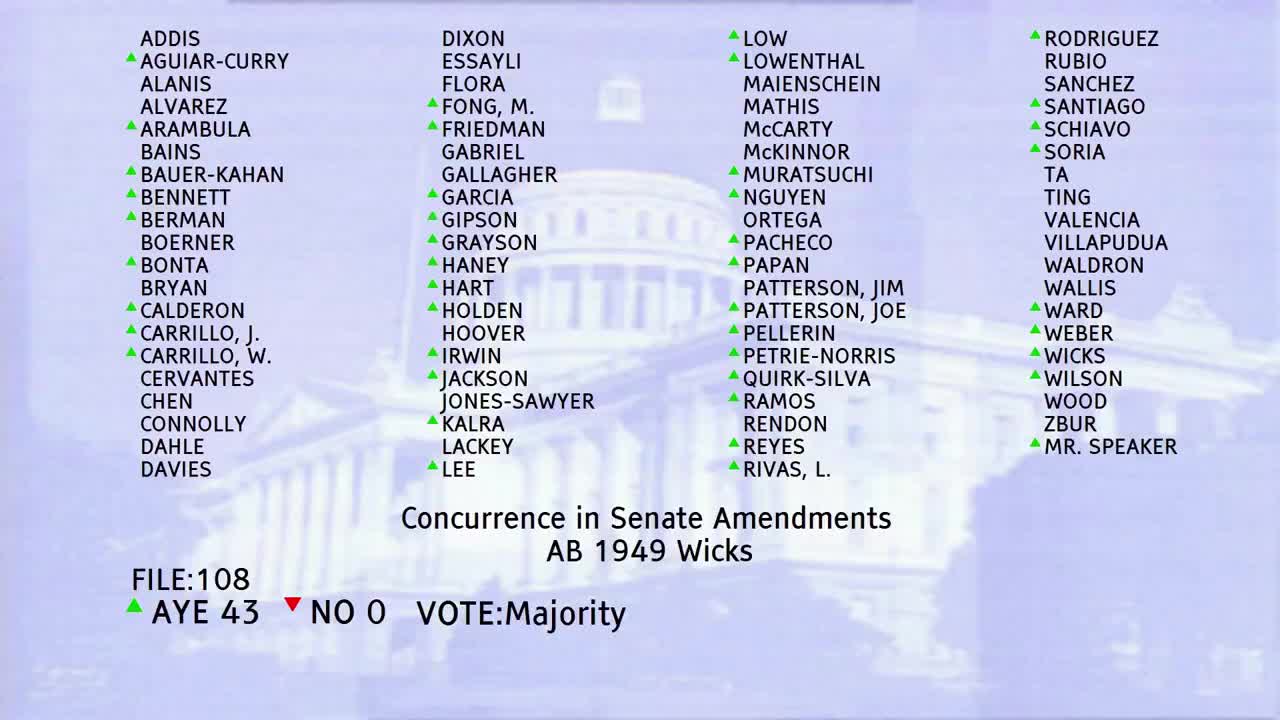 39SEC
Assembly Floor
 2MIN
Senate Floor
 34SEC
Senate Standing Committee on Appropriations
 13MIN
Senate Standing Committee on Environmental Quality
 11MIN
Senate Standing Committee on Local Government
 1MIN
Assembly Floor
 4MIN
Assembly Standing Committee on Natural Resources
1MIN
Assembly Standing Committee on Natural Resources
Bill Author

Bill Co-Author(s):








