AB 2091: California Environmental Quality Act: exemption: public access: nonmotorized recreation.
- Session Year: 2023-2024
- House: Assembly
- Latest Version Date: 2024-09-22
Current Status:
Passed
(2024-09-22: Chaptered by Secretary of State - Chapter 377, Statutes of 2024.)
Introduced
In Committee
First Chamber
In Committee
Second Chamber
Enacted
The California Environmental Quality Act (CEQA) requires a lead agency, as defined, to prepare, or cause to be prepared, and certify the completion of an environmental impact report on a project that it proposes to carry out or approve that may have a significant effect on the environment or to adopt a negative declaration if it finds that the project will not have that effect.
This bill would exempt from CEQA a change in use approved by a lead agency that is a park district or the Great Redwood Trail Agency to allow public access to preexisting paved and natural surface roads, preexisting trails, preexisting pathways, preexisting disturbed areas for vehicle parking, as specified, and rail lines converted by the Great Redwood Trail Agency into trails known as the Great Redwood Trail, in areas used exclusively for nonmotorized recreation, if certain conditions are met. The bill would require the lead agency to post notice of, and hold, a public meeting to consider and solicit public input on the change in use under consideration before making a determination to approve or carry out the change in use, as specified. The bill would require the lead agency, if the lead agency determines that a change in use is not subject to CEQA pursuant to this provision and determines to approve or carry out the activity, to file a notice with the State Clearinghouse in the Office of Planning and Research and with the county clerk of the county in which the land is located, as provided. By imposing duties on public agencies related to the exemption, this bill would create a state-mandated local program. The bill would repeal these provisions on January 1, 2030.
This bill would make legislative findings and declarations as to the necessity of a special statute for the Great Redwood Trail Agency.
The California Constitution requires the state to reimburse local agencies and school districts for certain costs mandated by the state. Statutory provisions establish procedures for making that reimbursement.
This bill would provide that no reimbursement is required by this act for a specified reason.
The California Environmental Quality Act (CEQA) requires a lead agency, as defined, to prepare, or cause to be prepared, and certify the completion of an environmental impact report on a project that it proposes to carry out or approve that may have a significant effect on the environment or to adopt a negative declaration if it finds that the project will not have that effect.
This bill would exempt from CEQA a change in use approved by a lead agency that is a park district or the Great Redwood Trail Agency to allow public access to preexisting paved and natural surface roads, preexisting trails, preexisting pathways, and preexisting disturbed areas for vehicle parking, as specified, and rail lines converted by the Great Redwood Trail Agency into trails known as the Great Redwood Trail, in areas used exclusively for nonmotorized recreation, if certain conditions are met. The bill would require the lead agency to post notice of, and hold, a public meeting to consider and solicit public input on the change in use under consideration before making a determination to approve or carry out the change in use, as specified. The bill would require the lead agency, if the lead agency determines that a change in use is not subject to CEQA pursuant to this provision and determines to approve or carry out the activity, to file a notice with the State Clearinghouse in the Office of Planning and Research and with the county clerk of the county in which the land is located, as provided. By imposing duties on public agencies related to the exemption, this bill would create a state-mandated local program. The bill would repeal these provisions on January 1, 2030.
This bill would make legislative findings and declarations as to the necessity of a special statute for the Great Redwood Trail Agency.
The California Constitution requires the state to reimburse local agencies and school districts for certain costs mandated by the state. Statutory provisions establish procedures for making that reimbursement.
This bill would provide that no reimbursement is required by this act for a specified reason.
The California Environmental Quality Act (CEQA) requires a lead agency, as defined, to prepare, or cause to be prepared, and certify the completion of an environmental impact report on a project that it proposes to carry out or approve that may have a significant effect on the environment or to adopt a negative declaration if it finds that the project will not have that effect.
This bill would exempt from CEQA a change in use approved by a public agency lead agency that is a park district to allow public access, as provided, exclusively for nonmotorized recreation, as defined, in areas acquired or managed by a public agency for open space or park purposes. access to preexisting paved and natural surface roads, preexisting trails, preexisting pathways, and preexisting disturbed areas for vehicle parking, as specified, in areas used exclusively for nonmotorized recreation, if certain conditions are met. The bill would require the lead agency to post notice of, and hold, a public meeting to consider and solicit public input on the change in use under consideration before making a determination to approve or carry out the change in use, as specified. The bill would require the lead agency, if the lead agency determines that an activity a change in use is not subject to CEQA pursuant to this provision and determines to approve or carry out the activity, to file a notice with the State Clearinghouse in the Office of Planning and Research and with the county clerk of the county in which the land is located, as provided. By imposing duties on public agencies related to the exemption, this bill would create a state-mandated local program. The bill would repeal these provisions on January 1, 2030.
The California Constitution requires the state to reimburse local agencies and school districts for certain costs mandated by the state. Statutory provisions establish procedures for making that reimbursement.
This bill would provide that no reimbursement is required by this act for a specified reason.
The California Environmental Quality Act (CEQA) requires a lead agency, as defined, to prepare, or cause to be prepared, and certify the completion of an environmental impact report on a project that it proposes to carry out or approve that may have a significant effect on the environment or to adopt a negative declaration if it finds that the project will not have that effect.
This bill would exempt from CEQA a change in use approved by a public agency to allow public access, as provided, exclusively for nonmotorized recreation, as defined, in areas acquired or managed by a public agency for open space or park purposes. The bill would require the lead agency, if the lead agency determines that an activity is not subject to CEQA pursuant to this provision and determines to approve or carry out the activity, to file a notice with the State Clearinghouse in the Office of Planning and Research and with the county clerk of the county in which the land is located, as provided. By imposing duties on public agencies related to the exemption, this bill would create a state-mandated local program. The bill would repeal these provisions on January 1, 2030.
The California Constitution requires the state to reimburse local agencies and school districts for certain costs mandated by the state. Statutory provisions establish procedures for making that reimbursement.
This bill would provide that no reimbursement is required by this act for a specified reason.
The California Environmental Quality Act (CEQA) requires a lead agency, as defined, to prepare, or cause to be prepared, and certify the completion of an environmental impact report on a project that it proposes to carry out or approve that may have a significant effect on the environment or to adopt a negative declaration if it finds that the project will not have that effect.
This bill would exempt from CEQA a change in use to allow public access, as provided, for nonmotorized recreation, as defined, in areas acquired for open space or park purposes. The bill would require the lead agency, if the lead agency determines that an activity is not subject to CEQA pursuant to this provision and determines to approve or carry out the activity, to file a notice with the State Clearinghouse in the Office of Planning and Research and with the county clerk of the county in which the land is located, as provided. By imposing duties on public agencies related to the exemption, this bill would create a state-mandated local program. The bill would repeal these provisions on January 1, 2030.
The California Constitution requires the state to reimburse local agencies and school districts for certain costs mandated by the state. Statutory provisions establish procedures for making that reimbursement.
This bill would provide that no reimbursement is required by this act for a specified reason.
The California Environmental Quality Act (CEQA) requires a lead agency, as defined, to prepare, or cause to be prepared, and certify the completion of an environmental impact report on a project that it proposes to carry out or approve that may have a significant effect on the environment or to adopt a negative declaration if it finds that the project will not have that effect. CEQA also requires a lead agency to prepare a mitigated negative declaration for a project that may have a significant effect on the environment if revisions in the project would avoid or mitigate that effect and there is no substantial evidence that the project, as revised, would have a significant effect on the environment. CEQA exempts from its requirement the acquisition, sale, or other transfer of interest in land by a public agency for certain purposes.This bill would additionally exempt from CEQA the acquisition, sale, or other transfer of interest in land by a public agency for the purpose of changing the use of roads from agricultural to public trail purposes.The California Environmental Quality Act (CEQA) requires a lead agency, as defined, to prepare, or cause to be prepared, and certify the completion of an environmental impact report on a project that it proposes to carry out or approve that may have a significant effect on the environment or to adopt a negative declaration if it finds that the project will not have that effect. CEQA also requires a lead agency to prepare a mitigated negative declaration for a project that may have a significant effect on the environment if revisions in the project would avoid or mitigate that effect and there is no substantial evidence that the project, as revised, would have a significant effect on the environment.
CEQA exempts from its requirement the acquisition, sale, or other transfer of interest in land by a public agency for certain purposes.
This bill would additionally exempt from CEQA the acquisition, sale, or other transfer of interest in land by a public agency for the purpose of changing the use of roads from agricultural to public trail purposes.
(a)It is the intent of the Legislature in enacting this section to clarify the applicability of this division to the provision of public access within a park or open space area by a park district or the Great Redwood Trail Agency in a manner that causes no physical alteration to the area affected. This section is not intended to otherwise alter the applicability of this division to an action that may cause a physical change in the environment or provide relief from any other law, regulation, or responsibility.
(b)(1)Subject to paragraph (2), this division does not apply to a change in use approved by a lead agency to allow public access to any of the following in an area used exclusively for nonmotorized recreation:
(A)Preexisting paved and natural surface roads.
(B)Preexisting trails.
(C)Preexisting pathways.
(D)Preexisting disturbed areas for vehicle parking, such as driveways, when the change of use does not involve new paving or grading.
(E)Rail lines converted by the Great Redwood Trail Agency into trails known as the Great Redwood Trail.
(2)The exemption in paragraph (1) only applies if all of the following criteria are met:
(A)The lead agency is a park district or the Great Redwood Trail Agency.
(B)The area used for nonmotorized recreation is owned or managed by a park district or the Great Redwood Trail Agency.
(C)The change in use is to provide public access for nonmotorized recreation.
(D)The change in use is consistent with a plan adopted by the park district or the Great Redwood Trail Agency, as applicable.
(E)The change in use does not involve a physical alteration of the affected area.
(F)The change in use is not likely to result in either of the following:
(i)Significant adverse impacts to tribal cultural resources.
(ii)Significant adverse impacts to endangered, threatened, rare, or special status plant or animal species.
(c)Before making a determination to approve or carry out a change in use that is determined to be exempt from this division pursuant to subdivision (b), the lead agency shall do all of the following:
(1)Hold a public meeting to consider and solicit public input on the change in use under consideration. The lead agency shall offer remote public participation during the meeting in a manner prescribed by the Ralph M. Brown Act (Chapter 9 (commencing with Section 54950) of Part 1 of Division 2 of Title 5 of the Government Code).
(2)Post a written notice of the public meeting on the public agencys internet website and at the project site at least 30 days before the public meeting. The written notice shall include a project description and the location and date of the public meeting.
(3)Make a finding that all of the criteria specified in paragraph (2) of subdivision (b) are met.
(d)If the lead agency determines that a change in use is not subject to this division pursuant to this section, and the lead agency determines to approve or carry out the activity, the lead agency shall file a notice with the State Clearinghouse in the Office of Planning and Research and with the county clerk of the county in which the land is located in accordance with subdivisions (b), (c), and (d) of Section 21152.
(e)For purposes of this section, the following definitions apply:
(1)Nonmotorized recreation means low-impact recreational activities, including hiking, walking, bike riding, equestrian use, and nature viewing.
(2)Park district means a district, as defined in Section 5500, that is governed by an independent board.
(3)Public access means allowing visitors on public agency-managed park and open space in a manner that is consistent with the underlying conservation or park purposes for those lands.
(f)This section does not affect any land covenants, such as grant agreements, conservation easements, or deed restrictions, or a long-term management plan or habitat conservation plan, or alters any conditions of acquisition.
(g)This section shall remain in effect only until January 1, 2030, and as of that date is repealed.
SEC. 2.The Legislature finds and declares that a special statute is necessary and that a general statute cannot be made applicable within the meaning of Section 16 of Article IV of the California Constitution because of the need to streamline environmental review in order to expedite public access to the Great Redwood Trail, a unique nonmotorized trail that is being developed by the Great Redwood Trail Agency within an existing rail right-of-way.
SEC. 3.No reimbursement is required by this act pursuant to Section 6 of Article XIIIB of the California Constitution because a local agency or school district has the authority to levy service charges, fees, or assessments sufficient to pay for the program or level of service mandated by this act, within the meaning of Section 17556 of the Government Code.
(a)It is the intent of the Legislature in enacting this section to clarify the applicability of this division to the provision of public access within a park or open space area by a park district or the Great Redwood Trail Agency in a manner that causes no physical alteration to the area affected. This section is not intended to otherwise alter the applicability of this division to an action that may cause a physical change in the environment or provide relief from any other law, regulation, or responsibility.
(b)(1)Subject to paragraph (2), this division does not apply to a change in use approved by a lead agency to allow public access to any of the following in an area used exclusively for nonmotorized recreation:
(A)Preexisting paved and natural surface roads.
(B)Preexisting trails.
(C)Preexisting pathways.
(D)Preexisting disturbed areas for vehicle parking, such as driveways, when the change of use does not involve new paving or grading.
(E)Rail lines converted by the Great Redwood Trail Agency into trails known as the Great Redwood Trail.
(2)The exemption in paragraph (1) only applies if all of the following criteria are met:
(A)The lead agency is a park district. district or the Great Redwood Trail Agency.
(B)The area used for nonmotorized recreation is owned or managed by a park district. district or the Great Redwood Trail Agency.
(C)The change in use is to provide public access for nonmotorized recreation.
(D)The change in use is consistent with a plan adopted by the park district, district or the Great Redwood Trail Agency, as applicable.
(E)The change in use does not involve a physical alteration of the affected area.
(F)The change in use is not likely to result in either of the following:
(i)Significant adverse impacts to tribal cultural resources.
(ii)Significant adverse impacts to endangered, threatened, rare, or special status plant or animal species.
(c)Before making a determination to approve or carry out a change in use that is determined to be exempt from this division pursuant to subdivision (b), the lead agency shall do all of the following:
(1)Hold a public meeting to consider and solicit public input on the change in use under consideration. The lead agency shall offer remote public participation during the meeting in a manner prescribed by the Ralph M. Brown Act (Chapter 9 (commencing with Section 54950) of Part 1 of Division 2 of Title 5 of the Government Code).
(2)Post a written notice of the public meeting on the public agencys internet website and at the project site at least 30 days before the public meeting. The written notice shall include a project description and the location and date of the public meeting.
(3)Make a finding that all of the criteria specified in paragraph (2) of subdivision (b) are met.
(d)If the lead agency determines that a change in use is not subject to this division pursuant to this section, and the lead agency determines to approve or carry out the activity, the lead agency shall file a notice with the State Clearinghouse in the Office of Planning and Research and with the county clerk of the county in which the land is located in accordance with subdivisions (b), (c), and (d) of Section 21152.
(e)For purposes of this section, the following definitions apply:
(1)Nonmotorized recreation means low-impact recreational activities, including hiking, walking, bike riding, equestrian use, and nature viewing.
(2)Park district means a district, as defined in Section 5500, that is governed by an independent board.
(3)Public access means allowing visitors on public agency-managed park and open space in a manner that is consistent with the underlying conservation or park purposes for those lands.
(f)This section does not affect any land covenants, such as grant agreements, conservation easements, or deed restrictions, or a long-term management plan or habitat conservation plan, or alters any conditions of acquisition.
(g)This section shall remain in effect only until January 1, 2030, and as of that date is repealed.
SEC. 2.The Legislature finds and declares that a special statute is necessary and that a general statute cannot be made applicable within the meaning of Section 16 of Article IV of the California Constitution because of the need to streamline environmental review in order to expedite public access to the Great Redwood Trail, a unique nonmotorized trail that is being developed by the Great Redwood Trail Agency within an existing rail right-of-way.
SEC. 2.SEC. 3.No reimbursement is required by this act pursuant to Section 6 of Article XIIIB of the California Constitution because a local agency or school district has the authority to levy service charges, fees, or assessments sufficient to pay for the program or level of service mandated by this act, within the meaning of Section 17556 of the Government Code.
(a)It is the intent of the Legislature in enacting this section to clarify the timing of the environmental review required pursuant to applicability of this division where a public agency is involved in creating to the provision of public access within a park or open space and only when there is area by a park district in a manner that causes no physical alteration to the area affected. This section is not intended to otherwise alter the applicability of this division to an action that may cause a physical change in the environment or provide relief from any other law, regulation, or responsibility.
(b)This division shall (1)Subject to paragraph (2), this division does not apply to a change in use approved by a public lead agency to allow public access exclusively for nonmotorized recreation in areas acquired or managed by a public agency for open space or park purposes where public access is limited to the following: to any of the following in an area used exclusively for nonmotorized recreation:
(1)(A)Preexisting paved and natural surface roads.
(2)(B)Preexisting trails.
(3)(C)Preexisting pathways.
(4)Use of(D)Preexisting disturbed areas for vehicle parking, such as driveways, involving no new paving or grading, as access points for park and open space. driveways, when the change of use does not involve new paving or grading.
(2)The exemption in paragraph (1) only applies if all of the following criteria are met:
(A)The lead agency is a park district.
(B)The area used for nonmotorized recreation is owned or managed by a park district.
(C)The change in use is to provide public access for nonmotorized recreation.
(D)The change in use is consistent with a plan adopted by the park district, as applicable.
(E)The change in use does not involve a physical alteration of the affected area.
(F)The change in use is not likely to result in either of the following:
(i)Significant adverse impacts to tribal cultural resources.
(ii)Significant adverse impacts to endangered, threatened, rare, or special status plant or animal species.
(c)Before making a determination to approve or carry out a change in use that is determined to be exempt from this division pursuant to subdivision (b), the lead agency shall do all of the following:
(1)Hold a public meeting to consider and solicit public input on the change in use under consideration. The lead agency shall offer remote public participation during the meeting in a manner prescribed by the Ralph M. Brown Act (Chapter 9 (commencing with Section 54950) of Part 1 of Division 2 of Title 5 of the Government Code).
(2)Post a written notice of the public meeting on the public agencys internet website and at the project site at least 30 days before the public meeting. The written notice shall include a project description and the location and date of the public meeting.
(3)Make a finding that all of the criteria specified in paragraph (2) of subdivision (b) are met.
(c)(d)If the lead agency determines that an activity a change in use is not subject to this division pursuant to this section, and the lead agency determines to approve or carry out the activity, the lead agency shall file a notice with the State Clearinghouse in the Office of Planning and Research and with the county clerk of the county in which the land is located pursuant to in accordance with subdivisions (b), (c), and (d) of Section 21152.
(d)(e)For purposes of this section, the following definitions apply:
(1)Public access means allowing visitors on public agency-managed park and open space in a manner that is consistent with the underlying conservation or park purposes for those lands, and is not likely to result in significant impacts to endangered, threatened, rare, or special status plant or animal species, or to tribal cultural resources.(2)(1)Nonmotorized recreation means low-impact recreational activities, including hiking, walking, bike riding, equestrian use, and nature viewing.
(2)Park district means a district, as defined in Section 5500, that is governed by an independent board.
(3)Public access means allowing visitors on public agency-managed park and open space in a manner that is consistent with the underlying conservation or park purposes for those lands.
(e)Nothing in this section affects(f)This section does not affect any land covenants, such as grant agreements, conservation easements, or deed restrictions, or a long-term management plan or habitat conservation plan, or alters any conditions of acquisition.
(f)(g)This section shall remain in effect only until January 1, 2030, and as of that date is repealed.
SEC. 2.No reimbursement is required by this act pursuant to Section 6 of Article XIIIB of the California Constitution because a local agency or school district has the authority to levy service charges, fees, or assessments sufficient to pay for the program or level of service mandated by this act, within the meaning of Section 17556 of the Government Code.
(a)This It is the intent of the Legislature in enacting this section to clarify the timing of the environmental review required pursuant to this division where a public agency is involved in creating public access within open space and only when there is no physical alteration to the area affected. This section is not intended to otherwise alter the applicability of this division to an action that may cause a physical change in the environment or provide relief from any other law, regulation, or responsibility.
(b)This division shall not apply to a change in use approved by a public agency to allow public access exclusively for nonmotorized recreation in areas acquired or managed by a public agency for open space or park purposes. This includes purposes where public access on is limited to the following:
(1)Preexisting paved and natural surface roads.
(2)Preexisting trails.
(3)Preexisting pathways.
(4)Use of disturbed areas for vehicle parking, such as driveways, involving no new paving or grading, as access points for park and open space.
(b)For purposes of this section, a change in use to allow public access on preexisting roads, trails, and pathways and disturbed areas is not a physical change in the environment requiring environmental review. Subdivision (a) applies even if physical changes to the environment requiring future environmental review are reasonably foreseeable consequences of the change in use to allow public access for nonmotorized recreation.(c)If the lead agency determines that an activity is not subject to this division pursuant to this section, and the lead agency determines to approve or carry out the activity, the lead agency shall file a notice with the State Clearinghouse in the Office of Planning and Research and with the county clerk of the county in which the land is located pursuant to subdivisions (b), (c), and (d) of Section 21152.
(d)For purposes of this section, the following definitions apply:
(1)Public access means allowing visitors on public agency-managed park and open space. space in a manner that is consistent with the underlying conservation or park purposes for those lands, and is not likely to result in significant impacts to endangered, threatened, rare, or special status plant or animal species, or to tribal cultural resources.
(2)Nonmotorized recreation means low-impact recreational activities, including, but not limited to, including hiking, walking, bike riding, equestrian use, and nature viewing.
(e)Nothing in this section affects any land covenants, such as grant agreements, conservation easements, or deed restrictions, or a long-term management plan or habitat conservation plan, or alters any conditions of acquisition.
(e)(f)This section shall remain in effect only until January 1, 2030, and as of that date is repealed.
SEC. 3.SEC. 2.No reimbursement is required by this act pursuant to Section 6 of Article XIIIB of the California Constitution because a local agency or school district has the authority to levy service charges, fees, or assessments sufficient to pay for the program or level of service mandated by this act, within the meaning of Section 17556 of the Government Code.
It is the intent of the Legislature in enacting this act to clarify the timing of the environmental review required pursuant to the California Environmental Quality Act (Division 13 (commencing with Section 21000) of the Public Resources Code) where a public agency is involved in creating public access within open space and only when there is no physical alteration to the area affected. This act is not intended to otherwise alter the applicability of the California Environmental Quality Act to an action that may cause a physical change in the environment.
SEC. 2.Section 21080.28.5 is added to the Public Resources Code, to read:21080.28.5.(a)This division shall not apply to a change in use to allow public access for nonmotorized recreation in areas acquired for open space or park purposes. This includes public access on the following:
(1)Preexisting paved and natural surface roads.
(2)Preexisting trails.
(3)Preexisting pathways.
(4)Use of disturbed areas for vehicle parking, such as driveways, involving no new paving or grading, as access points for park and open space.
(b)For purposes of this section, a change in use to allow public access on preexisting roads, trails, and pathways and disturbed areas is not a physical change in the environment requiring environmental review. Subdivision (a) applies even if physical changes to the environment requiring future environmental review are reasonably foreseeable consequences of the change in use to allow public access for nonmotorized recreation.
(c)If the lead agency determines that an activity is not subject to this division pursuant to this section, and the lead agency determines to approve or carry out the activity, the lead agency shall file a notice with the State Clearinghouse in the Office of Planning and Research and with the county clerk of the county in which the land is located pursuant to subdivisions (b), (c), and (d) of Section 21152.
(d)For purposes of this section, the following definitions apply:
(1)Public access means allowing visitors on public agency-managed park and open space.
(2)Nonmotorized recreation means low-impact recreational activities, including, but not limited to, hiking, walking, bike riding, equestrian use, and nature viewing.
(e)This section shall remain in effect only until January 1, 2030, and as of that date is repealed.
SEC. 3.No reimbursement is required by this act pursuant to Section 6 of Article XIIIB of the California Constitution because a local agency or school district has the authority to levy service charges, fees, or assessments sufficient to pay for the program or level of service mandated by this act, within the meaning of Section 17556 of the Government Code.
SECTION 1.Section 21080.28 of the Public Resources Code is amended to read:21080.28.(a)This division does not apply to either of the following:(1)The acquisition, sale, or other transfer of interest in land by a public agency for any of the following purposes:(A)Preservation of natural conditions existing at the time of transfer, including plant and animal habitats.(B)Restoration of natural conditions, including plant and animal habitats.(C)Continuing agricultural use of the land.(D)Prevention of encroachment of development into flood plains.(E)Preservation of historical resources.(F)Preservation of open space or lands for park purposes.(G)Changing the use of roads from agricultural to public trail purposes.(2)The granting or acceptance of funding by a public agency for purposes of paragraph (1).(b)Subdivision (a) applies even if physical changes to the environment or changes in the use of the land are a reasonably foreseeable consequence of the acquisition, sale, or other transfer of the interests in land, or of the granting or acceptance of funding, provided that environmental review otherwise required by this division occurs before any project approval that would authorize physical changes being made to that land.(c)If the lead agency determines that an activity is not subject to this division pursuant to this section and the lead agency determines to approve or carry out the activity, the lead agency shall file a notice with the Office of Planning and Research and with the county clerk in the county in which the land is located in the manner specified in subdivisions (b) and (c) of Section 21152.(a)This division does not apply to either of the following:
(1)The acquisition, sale, or other transfer of interest in land by a public agency for any of the following purposes:
(A)Preservation of natural conditions existing at the time of transfer, including plant and animal habitats.
(B)Restoration of natural conditions, including plant and animal habitats.
(C)Continuing agricultural use of the land.
(D)Prevention of encroachment of development into flood plains.
(E)Preservation of historical resources.
(F)Preservation of open space or lands for park purposes.
(G)Changing the use of roads from agricultural to public trail purposes.
(2)The granting or acceptance of funding by a public agency for purposes of paragraph (1).
(b)Subdivision (a) applies even if physical changes to the environment or changes in the use of the land are a reasonably foreseeable consequence of the acquisition, sale, or other transfer of the interests in land, or of the granting or acceptance of funding, provided that environmental review otherwise required by this division occurs before any project approval that would authorize physical changes being made to that land.
(c)If the lead agency determines that an activity is not subject to this division pursuant to this section and the lead agency determines to approve or carry out the activity, the lead agency shall file a notice with the Office of Planning and Research and with the county clerk in the county in which the land is located in the manner specified in subdivisions (b) and (c) of Section 21152.
|
Date
|
Status
|
|---|---|
| Sep 22, 2024 | Chaptered by Secretary of State - Chapter 377, Statutes of 2024. |
| Sep 22, 2024 | Approved by the Governor. |
| Sep 11, 2024 | Enrolled and presented to the Governor at 4 p.m. |
| Aug 29, 2024 | Senate amendments concurred in. To Engrossing and Enrolling. (Ayes 73. Noes 0.). |
| Aug 29, 2024 | Assembly Rule 77 suspended. |
| Aug 28, 2024 | In Assembly. Concurrence in Senate amendments pending. May be considered on or after August 30 pursuant to Assembly Rule 77. |
| Aug 28, 2024 | Read third time. Passed. Ordered to the Assembly. (Ayes 39. Noes 0.). |
| Aug 20, 2024 | Read second time and amended. Ordered to third reading. |
| Aug 19, 2024 | From committee: Amend, and do pass as amended. (Ayes 5. Noes 0.) (August 15). |
| Aug 5, 2024 | In committee: Referred to APPR suspense file. |
| Jun 27, 2024 | Read second time and amended. Re-referred to Com. on APPR. |
| Jun 26, 2024 | From committee: Amend, and do pass as amended and re-refer to Com. on APPR. (Ayes 9. Noes 0.) (June 25). |
| Jun 19, 2024 | From committee: Do pass and re-refer to Com. on N.R. & W. (Ayes 7. Noes 0.) (June 19). Re-referred to Com. on N.R. & W. |
| May 22, 2024 | Referred to Coms. on E.Q. and N.R. & W. |
| May 9, 2024 | In Senate. Read first time. To Com. on RLS. for assignment. |
| May 9, 2024 | Read third time. Passed. Ordered to the Senate. (Ayes 65. Noes 0. Page 5158.) |
| May 2, 2024 | Read second time. Ordered to Consent Calendar. |
| May 1, 2024 | From committee: Do pass. To Consent Calendar. (Ayes 14. Noes 0.) (May 1). |
| Apr 23, 2024 | From committee: Do pass and re-refer to Com. on APPR. (Ayes 14. Noes 0.) (April 23). Re-referred to Com. on APPR. |
| Apr 1, 2024 | Re-referred to Com. on W., P., & W. |
| Mar 21, 2024 | Read second time and amended. |
| Mar 20, 2024 | From committee: Amend, and do pass as amended and re-refer to Com. on W., P., & W. (Ayes 11. Noes 0.) (March 19). |
| Feb 29, 2024 | Re-referred to Com. on NAT. RES. |
| Feb 28, 2024 | From committee chair, with author's amendments: Amend, and re-refer to Com. on NAT. RES. Read second time and amended. |
| Feb 20, 2024 | Referred to Coms. on NAT. RES. and W., P., & W. |
| Feb 6, 2024 | From printer. May be heard in committee March 7. |
| Feb 5, 2024 | Read first time. To print. |
|
Date
|
Description
|
Location
|
Votes
|
|
|---|---|---|---|---|
| Aug 29, 2024 | AB 2091 Grayson Concurrence in Senate Amendments | Assembly Floor |
Passed |
|
| Aug 28, 2024 | Assembly 3rd Reading AB2091 Grayson By Glazer | Senate Floor |
Passed |
|
| Aug 15, 2024 | Do pass as amended | Senate Standing Committee on Appropriations |
Passed |
|
| Aug 5, 2024 | Placed on suspense file | Senate Standing Committee on Appropriations |
Passed |
|
| Jun 25, 2024 | Do pass as amended, but first amend, and re-refer to the Committee on [Appropriations] | Senate Standing Committee on Natural Resources and Water |
Passed |
|
| Jun 19, 2024 | Do pass, but first be re-referred to the Committee on [Natural Resources and Water] | Senate Standing Committee on Environmental Quality |
Passed |
|
| May 9, 2024 | AB 2091 Grayson Consent Calendar Second Day Regular Session | Assembly Floor |
Passed |
|
| May 1, 2024 | Do pass. To Consent Calendar. | Assembly Standing Committee on Appropriations |
Passed |
|
| Apr 23, 2024 | Do pass and be re-referred to the Committee on [Appropriations] | Assembly Standing Committee on Water, Parks, and Wildlife |
Passed |
|
| Mar 19, 2024 | Do pass as amended and be re-referred to the Committee on [Water, Parks, and Wildlife] | Assembly Standing Committee on Natural Resources |
Passed |
This list shows positions taken on this bill by organizations on the date displayed, which is linked to the original source.
Positions by individuals are not included.
|
Organization
|
Position
|
Date
|
|---|---|---|
| Arroyos & Foothills Conservancy | ** Against | |
| Bay Area Ridge Trail Council | ** Support | |
| Bear Yuba Land Trust | ** Support | |
| California Association Of Recreation & Park Districts | ** Support | |
| California Native Plant Society - San Diego Chapter | ** Against | |
| California Outdoor Recreation Partnership | ** Support | |
| California Special Districts Association | ** Support | |
| California Trails Foundation | ** Support | |
| california wildlife foundation | ** Against | |
| California Wildlife Foundation/California Oaks | ** Against | |
| City of Pico Rivera | ** Support | |
| Conservation Biology Institute | ** Against | |
| County of Nevada | ** Support | |
| County Of Placer | ** Support | |
| East Bay Regional Park District | ** Support | |
| Eastern Sierra Land Trust | ** Support | |
| Endangered Habitats League | ** Against | |
| Feather River Land Trust | ** Support | |
| Friends of Harbors, Beaches and Parks | ** Against | |
| Friends of Hedionda Creek | ** Against | |
| Friends of Rose Canyon | ** Against | |
| Friends of Rose Creek | ** Against | |
| Hills for Everyone | ** Against | |
| John Muir Land Trust | ** Support | |
| Kay Stewart Landscape Architect | ** Against | |
| Los Cerritos Wetlands Land Trust | ** Against | |
| Midpeninsula Regional Open Space District | ** Support | |
| National Wildlife Federation | ** Against | |
| Nevada County Of | ** Support | |
| Pasadena Audubon Society | ** Against | |
| Placer Land Trust | ** Support | |
| Planning And Conservation League | ** Against | |
| Preserve Wild Poway | ** Against | |
| Robert Redford Conservancy At Pitzer College | ** Against | |
| San Diego Audubon Society | ** Against | |
| Save Mount Diablo | ** Support | |
| Sea And Sage Audubon Society | ** Against | |
| Sierra Business Council | ** Support | |
| Sierra Club California | ** Against | |
| Sierra County Land Trust | ** Support | |
| Sierra Foothill Conservancy | ** Support | |
| Sierra Nevada Alliance | ** Support | |
| Sonoma County Regional Parks | ** Support | |
| The Chaparral Lands Conservancy | ** Against | |
| The Escondido Creek Conservancy | ** Against | |
| Truckee Donner Land Trust | ** Support | |
| Tubb Canyon Desert Conservancy | ** Against |
CONCURRENCE IN SENATE AMENDMENTS
CSA1 Bill Id:AB 2091
Author:(Grayson)
As Amended Ver:August 20, 2024
Majority vote
SUMMARY
Establishes an exemption from the California Environmental Quality Act (CEQA) for a change in use approved by a park district to allow public access for non-motorized recreation on preexisting roads, trails, and pathways owned or managed by the park district, as well as for specified "rails to trails" projects approved by the Great Redwood Trail Agency (GRTA).
Senate Amendments
- Add conversion of rail lines to trails by the GRTA.
- Add public meeting, notice, and finding requirements for the lead agency.
- Make other technical and clarifying changes.
COMMENTS
CEQA provides a process for evaluating the environmental effects of applicable projects undertaken or approved by public agencies. If a project is not exempt from CEQA, an initial study is prepared to determine whether the project may have a significant effect on the environment. If the initial study shows that the project would not have a significant effect on the environment, the lead agency must prepare a negative declaration. If the initial study shows that the project may have a significant effect, the lead agency must prepare an EIR.
This bill stems from the question whether CEQA applies in the first instance to a public agency action to provide public access to existing open space, where no other physical changes are involved in the agency's action. Though such an action seems insignificant, controversy and questions of environmental impacts could arise, e.g., from neighbors concerned about an increase in traffic or the access introducing recreational activities that cause impacts on protected species or tribal cultural resources. The bill establishes a relatively narrow exemption, confirming that minor actions to provide public access for non-motorized recreation are not subject to CEQA.
According to the Author
AB 2091 is a narrowly tailored bill that would facilitate public access to open space in a more expeditious manner by allow a public agency, such as a park district, to open up acquired land that has existing roads and trails for non-motorized recreational uses, without requiring additional CEQA analysis. Recent legislation has made it easier for park agencies to acquire land for the preservation of open space and recreational purposes by granting an exemption under CEQA, but in some cases, additional consideration must be taken before the land can be opened up for public use – even if the acquired land had pre-existing roads and trails. The additional considerations can often be used by project opponents to delay public access through the CEQA process, costing agencies thousands of dollars and denying the public access to nature acquired by public agencies. AB 2091 will help public agencies save time and resources, and allow the public to access open space and non-motorized recreational opportunities in a more expeditious manner.
Arguments in Support
According to bill sponsor East Bay Regional Park District, (AB 2091) stipulates this CEQA exemption will only be applicable to roads and other disturbed areas which existed before public agency acquisition, and in cases where no significant capital improvements are necessary for public access to the open space or park lands. We applaud how this targeted approach ensures the exemption is appropriately limited to scenarios which do not pose significant environmental concerns…If the state intends to meet its ambitious 30x30 goals, it must consider every opportunity to appropriately expand access to nature. AB 2091 plays a pivotal role in achieving this objective by streamlining the process for opening acquired land for non-motorized public recreational use, aligning with the principles of 30x30 and facilitating responsible land use.
Arguments in Opposition
According to a coalition of environmental conservation groups, the elimination of CEQA review as proposed by this bill is counterproductive to the goal of compatible recreational use. It would eliminate the opportunity to properly study and establish what likely effects new and increased recreational usage would have on the native ecosystem of an area. Public participation and engagement with Indigenous communities would be removed, and decision-makers would be denied information about impacts, alternatives, and mitigation measures that could avoid impacts and create win-win outcomes for recreation and wildlife.
FISCAL COMMENTS
According to the Senate Appropriations Committee:
- Potential cost pressures of an unknown but potentially significant amount to California Department of Parks and Recreation local assistance programs due to grant applications and funding requests for local and regional park projects exempted under CEQA as a result of this bill such as trail development.
- Potential cost pressures of an unknown but potentially significant amount to provide funding related to impacts from opening areas up to public access absent review or appropriate mitigation measures, which could affect infrastructure, habitat, water quality, native and invasive species, and wildfire risk.
VOTES:
ASM NATURAL RESOURCES: 11-0-0
YES: Bryan, Flora, Bauer-Kahan, Friedman, Hoover, Kalra, Mathis, Muratsuchi, Pellerin, Wicks, Wood
ASM WATER, PARKS, AND WILDLIFE: 14-0-1
YES: Papan, Addis, Alanis, Alvarez, Bennett, Bonta, Gallagher, Davies, Garcia, Hart, Luz Rivas, Schiavo, Villapudua, Weber
ABS, ABST OR NV: Mathis
ASM APPROPRIATIONS: 14-0-1
YES: Wicks, Sanchez, Arambula, Bryan, Calderon, Wendy Carrillo, Dixon, Mike Fong, Grayson, Haney, Hart, Pellerin, Ta, Villapudua
ABS, ABST OR NV: Jim Patterson
ASSEMBLY FLOOR: 65-0-15
YES: Addis, Aguiar-Curry, Alanis, Alvarez, Arambula, Bauer-Kahan, Bennett, Berman, Boerner, Bonta, Bryan, Calderon, Juan Carrillo, Wendy Carrillo, Chen, Connolly, Davies, Dixon, Essayli, Mike Fong, Vince Fong, Friedman, Gallagher, Garcia, Gipson, Hart, Holden, Hoover, Irwin, Jackson, Jones-Sawyer, Kalra, Lackey, Lee, Lowenthal, Maienschein, McCarty, McKinnor, Muratsuchi, Ortega, Pacheco, Papan, Jim Patterson, Joe Patterson, Pellerin, Quirk-Silva, Ramos, Rendon, Reyes, Rodriguez, Blanca Rubio, Sanchez, Santiago, Soria, Ta, Valencia, Villapudua, Waldron, Ward, Weber, Wicks, Wilson, Wood, Zbur, Robert Rivas
ABS, ABST OR NV: Bains, Cervantes, Megan Dahle, Flora, Gabriel, Grayson, Haney, Low, Mathis, Stephanie Nguyen, Petrie-Norris, Luz Rivas, Schiavo, Ting, Wallis
SENATE FLOOR: 39-0-1
YES: Allen, Archuleta, Ashby, Atkins, Becker, Blakespear, Bradford, Caballero, Cortese, Dahle, Dodd, Durazo, Eggman, Glazer, Gonzalez, Grove, Hurtado, Jones, Laird, Limón, McGuire, Menjivar, Min, Newman, Nguyen, Niello, Ochoa Bogh, Padilla, Portantino, Roth, Rubio, Seyarto, Skinner, Smallwood-Cuevas, Stern, Umberg, Wahab, Wiener, Wilk
ABS, ABST OR NV: Alvarado-Gil
UPDATED
VERSION: August 20, 2024
CONSULTANT: Lawrence Lingbloom / NAT. RES. / (916) 319-2092 FN: 0004963
SENATE RULES COMMITTEE Office of Senate Floor Analyses (916) 651-1520 Fax: (916) 327-4478 | AB 2091 |
THIRD READING
Bill No: AB 2091
Author: Grayson (D)
Amended: 8/20/24 in Senate
Vote: 21
SENATE ENVIRONMENTAL QUALITY COMMITTEE: 7-0, 6/19/24
AYES: Allen, Dahle, Gonzalez, Hurtado, Menjivar, Nguyen, Skinner
SENATE NATURAL RES. & WATER COMMITTEE: 9-0, 6/25/24
AYES: Min, Seyarto, Allen, Dahle, Eggman, Grove, Hurtado, Laird, Padilla
NO VOTE RECORDED: Limón, Stern
SENATE APPROPRIATIONS COMMITTEE: 5-0, 8/15/24
AYES: Caballero, Ashby, Becker, Bradford, Wahab
NO VOTE RECORDED: Jones, Seyarto
ASSEMBLY FLOOR: 65-0, 5/9/24 (Consent) - See last page for vote
SUBJECT: California Environmental Quality Act: exemption: public access: nonmotorized recreation
SOURCE: Author
DIGEST:
This bill exempts from the California Environmental Quality Act (CEQA), until January 1, 2030, a change in use approved by a lead agency that is a park district to allow public access exclusively for nonmotorized recreation to preexisting roads, trails, pathways, and disturbed areas, as specified.
ANALYSIS:
Existing law:
- Under CEQA, a lead agency determines whether a project is exempt from CEQA, or if it must do an initial study to determine if a project will have significant effects on the environment. If a project has no effect on the environment or effects that can be mitigated, the lead agency prepares a negative declaration (ND) or mitigated ND (MND). If the project will have significant impacts, the lead agency prepares an environmental impact report (EIR) to evaluate and propose mitigation measures for any effects on the environment, including impacts or likely impacts to land, air, water, minerals, flora, fauna, ambient noise, and historic or aesthetic significance. (Public Resources Code (PRC) §§21000 et seq.)
- Establishes numerous CEQA exemptions, including categorical exemptions developed in the California Code of Regulations (CEQA guidelines). This includes the Class 1 Categorical exemption for existing facilities which includes repair, maintenance, or minor alteration to pedestrian trails and similar facilities.
- Establishes statutory exemptions from CEQA, including:
- The acquisition, sale, or other transfer of land by a public agency for specified purposes, including the preservation of open space or lands for park purposes. PRC §21080.28. i
- Until January 1, 2025, a project to restore or provide habitat for California native fish and wildlife. PRC §21080.56.
- Establishes the Equitable Outdoor Access Act, which sets forth the state’s commitment to ensuring all Californians can benefit from, and have meaningful and sustainable access to, the state’s rich cultural and natural resources. This act identifies multiple barriers to access, including a lack of local, quality outdoor spaces and amenities, including parks, greenways, and trails, among others. (Public Resources Code (PRC) §1000 and §1001. 2)
- Authorizes the creation of regional park districts, regional park and open-space districts, and regional open-space districts, as specified. Generally, these districts may plan, develop, operate, and maintain a system of public parks, playgrounds, golf courses, beaches, trails, natural areas, ecological and open space preserves, parkways, scenic drives, boulevards, and other facilities for public recreation, as specified.( PRC §5501 and §5541.)
This bill:
- Creates an exemption from CEQA for a change in use to provide access to open space and park areas for nonmotorized recreation along preexisting trails, pathways, and roads; as well as use of disturbed areas for vehicle parking, and rail lines converted by the Great Redwood Trail Agency into trails known as the Great Redwood Trail. Specifically, this bill would:
- Provide that a change in use approved by a lead agency that is a park district to allow for public access to any of the following in an area used exclusively for nonmotorized recreation:
- Preexisting paved and natural surface roads.
- Preexisting trails.
- Preexisting pathways.
- Prexisting disturbed areas for vehicle parking, such as driveways, when the change of use does not involve new paving or grading.
- Requires as a condition of this exemption that:
- The area used for nonmotorized recreation is owned or managed by a park district.
- The change in use is to provide public access for nonmotorized recreation.
- The change in use is consistent with a plan adopted by the park district, as applicable.
- The change in use does not involve a physical alteration of the affected area.
- The change in use is not likely to result in either of the following:
- Significant adverse impacts to tribal cultural resources.
- Significant adverse impacts to endangered, threatened, rare, or special status plant or animal species.
- Requires the lead agency, before making a determination to approve or carry out a change in use that is determined to be exempt, to do all of the following:
- Hold a public meeting to consider and solicit public input on the change in use under consideration, as specified.
- Post a written notice of the public meeting on the public agency’s internet website and at the project site at least 30 days before the public meeting. The written notice shall include a project description and the location and date of the public meeting.
- Make a finding that all specified criteria are met.
Background
- The A, B, C’s of CEQA. CEQA is designed to (a) make government agencies and the public aware of the environmental impacts of a proposed project, (b) ensure the public can take part in the review process, and (c) identify and implement measures to mitigate or eliminate any negative impact the project may have on the environment. CEQA is enforced by civil lawsuits that can challenge any project’s environmental review. Nonprofits, private individuals, public agencies, advocacy groups, and other organizations can all file lawsuits under CEQA.
- CEQA exemptions. A project is exempt from CEQA if it is ministerial (i.e., it does not involve discretionary decisions), or if there is a specific statutory or categorical exemption that applies to the project. Statutory exemptions are created by the Legislature and apply even if a project has the potential to significantly affect the environment. In contrast, categorical exemptions, which are listed in the CEQA guidelines, generally do not apply if there are significant environmental impacts associated with the project, including if (1) there is a reasonable possibility of a significant effect on the environment due to unusual circumstances; (2) significant cumulative impacts from projects of the same type will result; or (3) the project will have impacts on a uniquely sensitive environment.
There are over 120 statutory CEQA exemptions in the Public Resources Code, Water Code, Government Code, Health and Safety Code. There are also 33 categorical CEQA exemptions listed in the CEQA guidelines. This includes a Class 1 Categorical CEQA exemption for existing facilities.
- Access to parks is a state priority. Use of parks and open spaces is correlated with a number of health benefits, including decreased risk of stress, anxiety, and depression, lessened symptoms of ADD/ADHD, and reduced risk of psychiatric illness for those with childhood exposure to open or green spaces. California has undertaken numerous efforts in recent years to increase access to parks and open spaces and to redress some of the historic inequities in access to parks. Some of these initiatives include:
- The State Parks’ Statewide Park Development and Community Revitalization Program has provided $1.16 billion to California’s communities in four grant rounds to create new parks and new recreation opportunities in underserved communities.
- The Outdoor Equity Grants Program at State Parks is intended to increase the ability of underserved and at-risk populations to participate in outdoor environmental educational experiences at state parks and other public lands where outdoor environmental education programs take place.
- The Youth Community Access Program at Natural Resources Agency provides grant awards to expand access to parks, nature, and places of cultural and historic significance for youth in underserved communities.
- The 2021-2022 budget included a $9.1 million one-time General Fund investment was included in the budget to launch a state parks pilot to expand free parks pass distribution, especially for youth in disadvantaged communities. The pilot includes the California State Park Adventure Pass for fourth graders, placement of physical passes at every public library in the state for checkout by library patrons, and a revamped Golden Bear Pass Program for families receiving CalWORKs.
- Park planning and permits. A number of different, but interrelated and often overlapping environmental laws and regulations apply to increasing access in parks through the planning, construction, and operation of trails and surface roads. Land managers are tasked with analyzing resource impacts and obtaining necessary environmental review and clearance before taking discretionary action that could have environmental impacts in the park. In general, specific trail projects in parks can trigger CEQA and occasionally the federal National Environmental Policy Act (NEPA). Projects may also require permits from relevant state regulatory agencies. In addition to trail development, the preparation and adoption of a trail plan constitutes a discretionary action undertaken by a governmental agency that would trigger CEQA review.
According to a 2011 study by the East Bay Regional Park District, the sponsor, entitled, Narrow Natural Surface Trails Study: Managing Multiple, it is common for the agency managing the park to create management plans for the entire park trail systems prior to allowing any public access at new parks or making changes within existing parks. This approach allows the agency to fully plan and design facilities for the intended use, construct or improve new trails of all types specifically for intended use, and be able to properly dismantle routes recommended for closure or restoration.
Comments
- Purpose of the bill. According to the author, “AB 2091 is a narrowly tailored bill that would facilitate public access to open space in a more expeditious manner by allowing a public agency, such as a park district, to open up acquired land that has existing roads and trails for non-motorized recreational uses, without requiring additional CEQA analysis. Recent legislation has made it easier for park agencies to acquire land for the preservation of open space and recreational purposes by granting an exemption under CEQA, but in some cases, additional consideration must be taken before the land can be opened up for public use – even if the acquired land had pre-existing roads and trails. The additional considerations can often be used by project opponents to delay public access through the CEQA process, costing agencies thousands of dollars and denying the public access to nature acquired by public agencies. AB 2091 will help public agencies save time and resources, and allow the public to access open space and non-motorized recreational opportunities in a more expeditious manner.”
- Humans and habitat in harmony? Public agencies that manage parks must balance two directives: ensure that public parks are accessible, and manage the natural resources in the parks in a way that minimizes human impact. According to information provided by the author, the CEQA exemption created in AB 2091 was driven by a concern that opening up existing trails to pedestrian or other non-motorized access for a specific newly procured park would trigger CEQA environmental review. The exemption also encompasses other changes in use beyond allowing public access and includes parking in already disturbed areas. Opening the park to the public and allowing parking in already-disturbed areas would increase the accessibility of the park. At the same time, allowing people on trails would likely have impacts on the natural resources that would, under a CEQA exemption, not necessarily be known either to the public agency or the public.
- User friendly? By creating a CEQA exemption for change in use on existing trails and roads, this bill not only opens the gates to recently acquired and unused parks, it would also exempt changes in what activities are allowed on these trails, such as pedestrians, bicycles, and horses.
Allowable uses may be determined differently for different trails, different parks, or established at a regional level. Each use is likely to have different impacts on the environment. One use that stands out for its potential impacts is the allowance of dogs on trails. A study conducted in a park outside of Sydney, Australia, compared 45 sites where dog walking was allowed with 45 sites where dog walking was prohibited found that dog walking caused a 41% reduction in the number of birds detected and a 35% reduction in species richness.
- Trail transparency. CEQA serves three primary roles: it provides transparent environmental review, and, as appropriate, includes public comment and proposes mitigation measures for any significant impacts of a project. A CEQA exemption can speed projects forward and reduce costs associated with CEQA review, but the environmental impacts of the project may go unidentified and the public may not have an opportunity to weigh in or even learn about the project. Opening up trails in a park or changing how existing trails can be used in those parks may impact the local community. For instance, opening a park to the public will likely result in increased traffic to the area and potentially increased parking in surrounding areas.
Mitigating this concern, AB 2091 has specific transparency measures, including requiring that the lead agency hold a public meeting to consider and solicit input on the change in use under consideration, post a notice of the public meeting 30 days before that meeting, and make a specific finding that all the criteria for eligibility for the CEQA exemption are met.
Related/Prior Legislation
AB 782 (Berman, Chapter 181, Statutes of 2019), codified the CEQA categorical exemption for transfers of ownership of interests in land in order to preserve open space, habitat, or historical resources, thereby eliminating the exceptions for project-specific effects that apply to a categorical exemption.
FISCAL EFFECT: Appropriation: No Fiscal Com.: Yes Local: Yes
According to the Senate Appropriations Committee:
• Potential cost pressures of an unknown but potentially significant amount to California Department of Parks and Recreation (State Parks) local assistance programs due to grant applications and funding requests for local and regional park projects exempted under CEQA as a result of this bill such as trail development.
• Potential cost pressures of an unknown but potentially significant amount to provide funding related to impacts from opening areas up to public access absent review or appropriate mitigation measures, which could affect infrastructure, habitat, water quality, native and invasive species, and wildfire risk.
SUPPORT: (Verified 8/15/24)
Bay Area Ridge Trail Council
Bear Yuba Land Trust
California Association of Recreation & Park Districts
California Outdoor Recreation Partnership
California Outdoors Recreation Partnership (CORP)
California Special Districts Association
California Trails Foundation
County of Nevada
County of Placer
East Bay Regional Park District
Eastern Sierra Land Trust
Feather River Land Trust
John Muir Land Trust
Midpeninsula Regional Open Space District
Nevada; County of
Placer Land Trust
Save Mount Diablo
Sierra Business Council
Sierra County Land Trust
Sierra Foothill Conservancy
Sierra Nevada Alliance
Sonoma County Regional Parks
Truckee Donner Land Trust
OPPOSITION: (Verified 8/15/24)
Arroyos & Foothills Conservancy
California Native Plant Society - San Diego Chapter
California Wildlife Foundation
California Wildlife Foundation/california Oaks
Conservation Biology Institute
Endangered Habitats League
Friends of Harbors, Beaches and Parks
Friends of Hedionda Creek
Friends of Rose Canyon
Friends of Rose Creek
Hills for Everyone
Kay Stewart Landscape Architect
Los Cerritos Wetlands Land Trust
National Wildlife Federation
Pasadena Audubon Society
Preserve Wild Poway
Robert Redford Conservancy At Pitzer College
San Diego Audubon Society
Sea and Sage Audubon Society
Sierra Club California
The Chaparral Lands Conservancy
The Escondido Creek Conservancy
Tubb Canyon Desert Conservancy
ARGUMENTS IN SUPPORT: East Bay Regional Park District writes in support “The provisions outlined in AB 2091 seek to provide clarity on the nonmotorized public recreational use of existing roads and trails on land acquired for the preservation of open space or park purposes. The bill stipulates this CEQA exemption will only be applicable to roads and other disturbed areas which existed before public agency acquisition, and in cases where no significant capital improvements are necessary for public access to the open space or park lands. We applaud how this targeted approach ensures the exemption is appropriately limited to scenarios which do not pose significant environmental concerns.
While the statutory CEQA exemption provided in Public Resources Code Section 21080.28 (AB 782, Berman) has been useful for public agencies in acquiring land for preservation as open space, additional consideration is needed for the process of opening property acquired for the purpose of managed public access. Often, this process faces unnecessary delays through CEQA review, costing thousands of dollars and, more importantly, denying the public access to nature acquired by public agencies.
If the state intends to meet its ambitious 30x30 goals, it must consider every opportunity to appropriately expand access to nature. AB 2091 plays a pivotal role in achieving this objective by streamlining the process for opening acquired land for nonmotorized public recreational use, aligning with the principles of 30x30 and facilitating responsible land use.”
ARGUMENTS IN OPPOSITION: A coalition of conservation organizations writes in opposition stating, “AB 2091 establishes an exemption from the California Environmental Quality Act (CEQA) for a change in use to allow public access for non-motorized recreation in areas acquired for open space or park purposes. We, the undersigned organizations, oppose this bill because its passage would lead to negative and irreversible effects on California wildlife and sensitive lands. Our organizations have a diverse array of expertise: conservation science, acquiring land to benefit wildlife, creating and enhancing wildlife corridors, restoring native habitat, installing and maintaining trails, and managing land, and we are united in our deep concern for the adverse (albeit unintended) consequences this rule change could have on native populations of plants, mammals, birds, reptiles, and other wildlife across the state. Our organizations support recreational trails that are properly sited and managed. However, the elimination of CEQA review as proposed by this bill is counterproductive to the goal of compatible recreational use. It would eliminate the opportunity to properly study and establish what likely effects new and increased recreational usage would have on the native ecosystem of an area. Public participation would be removed, and decision-makers would be denied information about impacts, alternatives, and mitigation measures that could avoid impacts and create win-win outcomes for recreation and wildlife. Furthermore, this bill is functionally a solution to one locale’s very specific set of challenges which - although an issue for the agency in question - should not set policy for the entire state”
ASSEMBLY FLOOR: 65-0, 5/9/24
AYES: Addis, Aguiar-Curry, Alanis, Alvarez, Arambula, Bauer-Kahan, Bennett, Berman, Boerner, Bonta, Bryan, Calderon, Juan Carrillo, Wendy Carrillo, Chen, Connolly, Davies, Dixon, Essayli, Mike Fong, Vince Fong, Friedman, Gallagher, Garcia, Gipson, Hart, Holden, Hoover, Irwin, Jackson, Jones-Sawyer, Kalra, Lackey, Lee, Lowenthal, Maienschein, McCarty, McKinnor, Muratsuchi, Ortega, Pacheco, Papan, Jim Patterson, Joe Patterson, Pellerin, Quirk-Silva, Ramos, Rendon, Reyes, Rodriguez, Blanca Rubio, Sanchez, Santiago, Soria, Ta, Valencia, Villapudua, Waldron, Ward, Weber, Wicks, Wilson, Wood, Zbur, Robert Rivas
NO VOTE RECORDED: Bains, Cervantes, Megan Dahle, Flora, Gabriel, Grayson, Haney, Low, Mathis, Stephanie Nguyen, Petrie-Norris, Luz Rivas, Schiavo, Ting, Wallis
Prepared by: Brynn Cook / E.Q. / (916) 651-4108
8/21/24 11:30:02
**** END ****
SENATE RULES COMMITTEE Office of Senate Floor Analyses (916) 651-1520 Fax: (916) 327-4478 | AB 2091 |
THIRD READING
Bill No: AB 2091
Author: Grayson (D)
Amended: 8/20/24 in Senate
Vote: 21
SENATE ENVIRONMENTAL QUALITY COMMITTEE: 7-0, 6/19/24
AYES: Allen, Dahle, Gonzalez, Hurtado, Menjivar, Nguyen, Skinner
SENATE NATURAL RES. & WATER COMMITTEE: 9-0, 6/25/24
AYES: Min, Seyarto, Allen, Dahle, Eggman, Grove, Hurtado, Laird, Padilla
NO VOTE RECORDED: Limón, Stern
SENATE APPROPRIATIONS COMMITTEE: 5-0, 8/15/24
AYES: Caballero, Ashby, Becker, Bradford, Wahab
NO VOTE RECORDED: Jones, Seyarto
ASSEMBLY FLOOR: 65-0, 5/9/24 (Consent) - See last page for vote
SUBJECT: California Environmental Quality Act: exemption: public access: nonmotorized recreation
SOURCE: Author
DIGEST:
This bill exempts from the California Environmental Quality Act (CEQA), until January 1, 2030, a change in use approved by a lead agency that is a park district to allow public access exclusively for nonmotorized recreation to preexisting roads, trails, pathways, and disturbed areas, as specified.
ANALYSIS:
Existing law:
- Under CEQA, a lead agency determines whether a project is exempt from CEQA, or if it must do an initial study to determine if a project will have significant effects on the environment. If a project has no effect on the environment or effects that can be mitigated, the lead agency prepares a negative declaration (ND) or mitigated ND (MND). If the project will have significant impacts, the lead agency prepares an environmental impact report (EIR) to evaluate and propose mitigation measures for any effects on the environment, including impacts or likely impacts to land, air, water, minerals, flora, fauna, ambient noise, and historic or aesthetic significance. (Public Resources Code (PRC) §§21000 et seq.)
- Establishes numerous CEQA exemptions, including categorical exemptions developed in the California Code of Regulations (CEQA guidelines). This includes the Class 1 Categorical exemption for existing facilities which includes repair, maintenance, or minor alteration to pedestrian trails and similar facilities.
- Establishes statutory exemptions from CEQA, including:
- The acquisition, sale, or other transfer of land by a public agency for specified purposes, including the preservation of open space or lands for park purposes. PRC §21080.28. i
- Until January 1, 2025, a project to restore or provide habitat for California native fish and wildlife. PRC §21080.56.
- Establishes the Equitable Outdoor Access Act, which sets forth the state’s commitment to ensuring all Californians can benefit from, and have meaningful and sustainable access to, the state’s rich cultural and natural resources. This act identifies multiple barriers to access, including a lack of local, quality outdoor spaces and amenities, including parks, greenways, and trails, among others. (Public Resources Code (PRC) §1000 and §1001. 2)
- Authorizes the creation of regional park districts, regional park and open-space districts, and regional open-space districts, as specified. Generally, these districts may plan, develop, operate, and maintain a system of public parks, playgrounds, golf courses, beaches, trails, natural areas, ecological and open space preserves, parkways, scenic drives, boulevards, and other facilities for public recreation, as specified.( PRC §5501 and §5541.)
This bill:
- Creates an exemption from CEQA for a change in use to provide access to open space and park areas for nonmotorized recreation along preexisting trails, pathways, and roads; as well as use of disturbed areas for vehicle parking, and rail lines converted by the Great Redwood Trail Agency into trails known as the Great Redwood Trail. Specifically, this bill would:
- Provide that a change in use approved by a lead agency that is a park district to allow for public access to any of the following in an area used exclusively for nonmotorized recreation:
- Preexisting paved and natural surface roads.
- Preexisting trails.
- Preexisting pathways.
- Prexisting disturbed areas for vehicle parking, such as driveways, when the change of use does not involve new paving or grading.
- Requires as a condition of this exemption that:
- The area used for nonmotorized recreation is owned or managed by a park district.
- The change in use is to provide public access for nonmotorized recreation.
- The change in use is consistent with a plan adopted by the park district, as applicable.
- The change in use does not involve a physical alteration of the affected area.
- The change in use is not likely to result in either of the following:
- Significant adverse impacts to tribal cultural resources.
- Significant adverse impacts to endangered, threatened, rare, or special status plant or animal species.
- Requires the lead agency, before making a determination to approve or carry out a change in use that is determined to be exempt, to do all of the following:
- Hold a public meeting to consider and solicit public input on the change in use under consideration, as specified.
- Post a written notice of the public meeting on the public agency’s internet website and at the project site at least 30 days before the public meeting. The written notice shall include a project description and the location and date of the public meeting.
- Make a finding that all specified criteria are met.
Background
- The A, B, C’s of CEQA. CEQA is designed to (a) make government agencies and the public aware of the environmental impacts of a proposed project, (b) ensure the public can take part in the review process, and (c) identify and implement measures to mitigate or eliminate any negative impact the project may have on the environment. CEQA is enforced by civil lawsuits that can challenge any project’s environmental review. Nonprofits, private individuals, public agencies, advocacy groups, and other organizations can all file lawsuits under CEQA.
- CEQA exemptions. A project is exempt from CEQA if it is ministerial (i.e., it does not involve discretionary decisions), or if there is a specific statutory or categorical exemption that applies to the project. Statutory exemptions are created by the Legislature and apply even if a project has the potential to significantly affect the environment. In contrast, categorical exemptions, which are listed in the CEQA guidelines, generally do not apply if there are significant environmental impacts associated with the project, including if (1) there is a reasonable possibility of a significant effect on the environment due to unusual circumstances; (2) significant cumulative impacts from projects of the same type will result; or (3) the project will have impacts on a uniquely sensitive environment.
There are over 120 statutory CEQA exemptions in the Public Resources Code, Water Code, Government Code, Health and Safety Code. There are also 33 categorical CEQA exemptions listed in the CEQA guidelines. This includes a Class 1 Categorical CEQA exemption for existing facilities.
- Access to parks is a state priority. Use of parks and open spaces is correlated with a number of health benefits, including decreased risk of stress, anxiety, and depression, lessened symptoms of ADD/ADHD, and reduced risk of psychiatric illness for those with childhood exposure to open or green spaces. California has undertaken numerous efforts in recent years to increase access to parks and open spaces and to redress some of the historic inequities in access to parks. Some of these initiatives include:
- The State Parks’ Statewide Park Development and Community Revitalization Program has provided $1.16 billion to California’s communities in four grant rounds to create new parks and new recreation opportunities in underserved communities.
- The Outdoor Equity Grants Program at State Parks is intended to increase the ability of underserved and at-risk populations to participate in outdoor environmental educational experiences at state parks and other public lands where outdoor environmental education programs take place.
- The Youth Community Access Program at Natural Resources Agency provides grant awards to expand access to parks, nature, and places of cultural and historic significance for youth in underserved communities.
- The 2021-2022 budget included a $9.1 million one-time General Fund investment was included in the budget to launch a state parks pilot to expand free parks pass distribution, especially for youth in disadvantaged communities. The pilot includes the California State Park Adventure Pass for fourth graders, placement of physical passes at every public library in the state for checkout by library patrons, and a revamped Golden Bear Pass Program for families receiving CalWORKs.
- Park planning and permits. A number of different, but interrelated and often overlapping environmental laws and regulations apply to increasing access in parks through the planning, construction, and operation of trails and surface roads. Land managers are tasked with analyzing resource impacts and obtaining necessary environmental review and clearance before taking discretionary action that could have environmental impacts in the park. In general, specific trail projects in parks can trigger CEQA and occasionally the federal National Environmental Policy Act (NEPA). Projects may also require permits from relevant state regulatory agencies. In addition to trail development, the preparation and adoption of a trail plan constitutes a discretionary action undertaken by a governmental agency that would trigger CEQA review.
According to a 2011 study by the East Bay Regional Park District, the sponsor, entitled, Narrow Natural Surface Trails Study: Managing Multiple, it is common for the agency managing the park to create management plans for the entire park trail systems prior to allowing any public access at new parks or making changes within existing parks. This approach allows the agency to fully plan and design facilities for the intended use, construct or improve new trails of all types specifically for intended use, and be able to properly dismantle routes recommended for closure or restoration.
Comments
- Purpose of the bill. According to the author, “AB 2091 is a narrowly tailored bill that would facilitate public access to open space in a more expeditious manner by allowing a public agency, such as a park district, to open up acquired land that has existing roads and trails for non-motorized recreational uses, without requiring additional CEQA analysis. Recent legislation has made it easier for park agencies to acquire land for the preservation of open space and recreational purposes by granting an exemption under CEQA, but in some cases, additional consideration must be taken before the land can be opened up for public use – even if the acquired land had pre-existing roads and trails. The additional considerations can often be used by project opponents to delay public access through the CEQA process, costing agencies thousands of dollars and denying the public access to nature acquired by public agencies. AB 2091 will help public agencies save time and resources, and allow the public to access open space and non-motorized recreational opportunities in a more expeditious manner.”
- Humans and habitat in harmony? Public agencies that manage parks must balance two directives: ensure that public parks are accessible, and manage the natural resources in the parks in a way that minimizes human impact. According to information provided by the author, the CEQA exemption created in AB 2091 was driven by a concern that opening up existing trails to pedestrian or other non-motorized access for a specific newly procured park would trigger CEQA environmental review. The exemption also encompasses other changes in use beyond allowing public access and includes parking in already disturbed areas. Opening the park to the public and allowing parking in already-disturbed areas would increase the accessibility of the park. At the same time, allowing people on trails would likely have impacts on the natural resources that would, under a CEQA exemption, not necessarily be known either to the public agency or the public.
- User friendly? By creating a CEQA exemption for change in use on existing trails and roads, this bill not only opens the gates to recently acquired and unused parks, it would also exempt changes in what activities are allowed on these trails, such as pedestrians, bicycles, and horses.
Allowable uses may be determined differently for different trails, different parks, or established at a regional level. Each use is likely to have different impacts on the environment. One use that stands out for its potential impacts is the allowance of dogs on trails. A study conducted in a park outside of Sydney, Australia, compared 45 sites where dog walking was allowed with 45 sites where dog walking was prohibited found that dog walking caused a 41% reduction in the number of birds detected and a 35% reduction in species richness.
- Trail transparency. CEQA serves three primary roles: it provides transparent environmental review, and, as appropriate, includes public comment and proposes mitigation measures for any significant impacts of a project. A CEQA exemption can speed projects forward and reduce costs associated with CEQA review, but the environmental impacts of the project may go unidentified and the public may not have an opportunity to weigh in or even learn about the project. Opening up trails in a park or changing how existing trails can be used in those parks may impact the local community. For instance, opening a park to the public will likely result in increased traffic to the area and potentially increased parking in surrounding areas.
Mitigating this concern, AB 2091 has specific transparency measures, including requiring that the lead agency hold a public meeting to consider and solicit input on the change in use under consideration, post a notice of the public meeting 30 days before that meeting, and make a specific finding that all the criteria for eligibility for the CEQA exemption are met.
Related/Prior Legislation
AB 782 (Berman, Chapter 181, Statutes of 2019), codified the CEQA categorical exemption for transfers of ownership of interests in land in order to preserve open space, habitat, or historical resources, thereby eliminating the exceptions for project-specific effects that apply to a categorical exemption.
FISCAL EFFECT: Appropriation: No Fiscal Com.: Yes Local: Yes
According to the Senate Appropriations Committee:
• Potential cost pressures of an unknown but potentially significant amount to California Department of Parks and Recreation (State Parks) local assistance programs due to grant applications and funding requests for local and regional park projects exempted under CEQA as a result of this bill such as trail development.
• Potential cost pressures of an unknown but potentially significant amount to provide funding related to impacts from opening areas up to public access absent review or appropriate mitigation measures, which could affect infrastructure, habitat, water quality, native and invasive species, and wildfire risk.
SUPPORT: (Verified 8/15/24)
Bay Area Ridge Trail Council
Bear Yuba Land Trust
California Association of Recreation & Park Districts
California Outdoor Recreation Partnership
California Outdoors Recreation Partnership (CORP)
California Special Districts Association
California Trails Foundation
County of Nevada
County of Placer
East Bay Regional Park District
Eastern Sierra Land Trust
Feather River Land Trust
John Muir Land Trust
Midpeninsula Regional Open Space District
Nevada; County of
Placer Land Trust
Save Mount Diablo
Sierra Business Council
Sierra County Land Trust
Sierra Foothill Conservancy
Sierra Nevada Alliance
Sonoma County Regional Parks
Truckee Donner Land Trust
OPPOSITION: (Verified 8/15/24)
Arroyos & Foothills Conservancy
California Native Plant Society - San Diego Chapter
California Wildlife Foundation
California Wildlife Foundation/california Oaks
Conservation Biology Institute
Endangered Habitats League
Friends of Harbors, Beaches and Parks
Friends of Hedionda Creek
Friends of Rose Canyon
Friends of Rose Creek
Hills for Everyone
Kay Stewart Landscape Architect
Los Cerritos Wetlands Land Trust
National Wildlife Federation
Pasadena Audubon Society
Planning and Conservation League
Preserve Wild Poway
Robert Redford Conservancy At Pitzer College
San Diego Audubon Society
Sea and Sage Audubon Society
Sierra Club California
The Chaparral Lands Conservancy
The Escondido Creek Conservancy
Tubb Canyon Desert Conservancy
ARGUMENTS IN SUPPORT: East Bay Regional Park District writes in support “The provisions outlined in AB 2091 seek to provide clarity on the nonmotorized public recreational use of existing roads and trails on land acquired for the preservation of open space or park purposes. The bill stipulates this CEQA exemption will only be applicable to roads and other disturbed areas which existed before public agency acquisition, and in cases where no significant capital improvements are necessary for public access to the open space or park lands. We applaud how this targeted approach ensures the exemption is appropriately limited to scenarios which do not pose significant environmental concerns.
While the statutory CEQA exemption provided in Public Resources Code Section 21080.28 (AB 782, Berman) has been useful for public agencies in acquiring land for preservation as open space, additional consideration is needed for the process of opening property acquired for the purpose of managed public access. Often, this process faces unnecessary delays through CEQA review, costing thousands of dollars and, more importantly, denying the public access to nature acquired by public agencies.
If the state intends to meet its ambitious 30x30 goals, it must consider every opportunity to appropriately expand access to nature. AB 2091 plays a pivotal role in achieving this objective by streamlining the process for opening acquired land for nonmotorized public recreational use, aligning with the principles of 30x30 and facilitating responsible land use.”
ARGUMENTS IN OPPOSITION: A coalition of conservation organizations writes in opposition stating, “AB 2091 establishes an exemption from the California Environmental Quality Act (CEQA) for a change in use to allow public access for non-motorized recreation in areas acquired for open space or park purposes. We, the undersigned organizations, oppose this bill because its passage would lead to negative and irreversible effects on California wildlife and sensitive lands. Our organizations have a diverse array of expertise: conservation science, acquiring land to benefit wildlife, creating and enhancing wildlife corridors, restoring native habitat, installing and maintaining trails, and managing land, and we are united in our deep concern for the adverse (albeit unintended) consequences this rule change could have on native populations of plants, mammals, birds, reptiles, and other wildlife across the state. Our organizations support recreational trails that are properly sited and managed. However, the elimination of CEQA review as proposed by this bill is counterproductive to the goal of compatible recreational use. It would eliminate the opportunity to properly study and establish what likely effects new and increased recreational usage would have on the native ecosystem of an area. Public participation would be removed, and decision-makers would be denied information about impacts, alternatives, and mitigation measures that could avoid impacts and create win-win outcomes for recreation and wildlife. Furthermore, this bill is functionally a solution to one locale’s very specific set of challenges which - although an issue for the agency in question - should not set policy for the entire state”
ASSEMBLY FLOOR: 65-0, 5/9/24
AYES: Addis, Aguiar-Curry, Alanis, Alvarez, Arambula, Bauer-Kahan, Bennett, Berman, Boerner, Bonta, Bryan, Calderon, Juan Carrillo, Wendy Carrillo, Chen, Connolly, Davies, Dixon, Essayli, Mike Fong, Vince Fong, Friedman, Gallagher, Garcia, Gipson, Hart, Holden, Hoover, Irwin, Jackson, Jones-Sawyer, Kalra, Lackey, Lee, Lowenthal, Maienschein, McCarty, McKinnor, Muratsuchi, Ortega, Pacheco, Papan, Jim Patterson, Joe Patterson, Pellerin, Quirk-Silva, Ramos, Rendon, Reyes, Rodriguez, Blanca Rubio, Sanchez, Santiago, Soria, Ta, Valencia, Villapudua, Waldron, Ward, Weber, Wicks, Wilson, Wood, Zbur, Robert Rivas
NO VOTE RECORDED: Bains, Cervantes, Megan Dahle, Flora, Gabriel, Grayson, Haney, Low, Mathis, Stephanie Nguyen, Petrie-Norris, Luz Rivas, Schiavo, Ting, Wallis
Prepared by: Brynn Cook / E.Q. / (916) 651-4108
8/20/24 16:01:45
**** END ****
SENATE COMMITTEE ON
Senator Anna Caballero, Chair
2023 - 2024 Regular Session
AB 2091 (Grayson) - California Environmental Quality Act: exemption: public access: nonmotorized recreation
Version: | Policy Vote: |
Urgency: | Mandate: |
Hearing Date: | Consultant: |
Bill Summary:
This bill would exempt from the California Environmental Quality Act (CEQA), until January 1, 2030, a change in use approved by a lead agency that is a park district to allow public access exclusively for nonmotorized recreation to preexisting roads, trails, pathways, and disturbed areas, as specified.
*********** ANALYSIS ADDENDUM – SUSPENSE FILE ***********
The following information is revised to reflect amendments
adopted by the committee on August 15, 2024
Fiscal Impact:
- Potential cost pressures of an unknown but potentially significant amount (various funds) to California Department of Parks and Recreation (State Parks) local assistance programs due to grant applications and funding requests for local and regional park projects related to use changes exempted under CEQA as a result of this bill, such as the maintenance or development of trails and infrastructure.
- Potential cost pressures of an unknown but potentially significant amount (various funds) to provide funding related to impacts from opening areas up to public access absent review or appropriate mitigation measures, which could affect infrastructure, habitat, water quality, native and invasive species, and wildfire risk.
Committee Amendments:
These amendments would make provisions of this bill applicable to the conversion of pre-existing rail lines, as specified.
-- END --
SENATE COMMITTEE ON
Senator Anna Caballero, Chair
2023 - 2024 Regular Session
AB 2091 (Grayson) - California Environmental Quality Act: exemption: public access: nonmotorized recreation
Version: | Policy Vote: |
Urgency: | Mandate: |
Hearing Date: | Consultant: |
Bill Summary:
This bill would exempt from the California Environmental Quality Act (CEQA), until January 1, 2030, a change in use approved by a lead agency that is a park district to allow public access exclusively for nonmotorized recreation to preexisting roads, trails, pathways, and disturbed areas, as specified.
Fiscal Impact:
- Potential cost pressures of an unknown but potentially significant amount to California Department of Parks and Recreation (State Parks) local assistance programs due to grant applications and funding requests for local and regional park projects exempted under CEQA as a result of this bill such as trail development.
- Potential cost pressures of an unknown but potentially significant amount to provide funding related to impacts from opening areas up to public access absent review or appropriate mitigation measures, which could affect infrastructure, habitat, water quality, native and invasive species, and wildfire risk.
Background:
A number of different, but interrelated and often overlapping environmental laws and regulations apply to increasing access in parks through the planning, construction, and operation of trails and surface roads. Land managers are tasked with analyzing resource impacts and obtaining necessary environmental review and clearance before taking discretionary action that could have environmental impacts in the park. In general, specific trail projects in parks can trigger CEQA and occasionally the federal National Environmental Policy Act (NEPA). Projects may also require permits from relevant state regulatory agencies. In addition to trail development, the preparation and adoption of a trail plan constitutes a discretionary action undertaken by a governmental agency that would trigger CEQA review.
CEQA is designed to (a) make government agencies and the public aware of the environmental impacts of a proposed project, (b) ensure the public can take part in the review process, and (c) identify and implement measures to mitigate or eliminate any negative impact the project may have on the environment.
East Bay Regional Park District (EBRPD or district), the bill sponsor, provided multiple examples of instances where the district had acquired new land for parks and open space purposes, but could not open the areas up to the public in a timely fashion using existing trails within those lands due to challenges from local groups. For example, EBRPD acquired land between 1988 and 2016 within the Southern Las Trampas area for park and open space purposes. The district intended to open up this property upon completion of the acquisitions that would complete the connection of the Calaveras Ridge Regional Trail to the communities of Danville and San Ramon. Existing roads traverse the property that are accessible from public roadways.
In 2017, the EBRPD initiated the development of a Land Use Plan Amendment to open the lands and evaluate the development of a 25-car staging area. Neighbor concerns over development of the staging area and explicit threats of litigation led to the preparation of an EIR for the entire area, not just the staging area development. The EIR process necessitated multiple community meetings focused on the development of the staging area and detailed analysis of alternative staging area locations. Public use of existing roads was delayed pending the staging area analysis. The EIR cost over $250,000 and many hours of staff time. It was ultimately adopted in 2023.
This bill would create an exemption from CEQA for a change in use to provide access to open space and park areas for nonmotorized recreation along preexisting trails, pathways, and roads; as well as use of disturbed areas for vehicle parking, as specified.
Proposed Law:
This bill would create an exemption from CEQA for a change in use to provide access to open space and park areas for nonmotorized recreation along preexisting trails, pathways, and roads; as well as use of disturbed areas for vehicle parking. Specifically, this bill would:
- Provide that a change in use approved by a lead agency that is a park district to allow for public access to any of the following in an area used exclusively for nonmotorized recreation:
- Preexisting paved and natural surface roads.
- Preexisting trails.
- Preexisting pathways.
- Prexisting disturbed areas for vehicle parking, such as driveways, when the change of use does not involve new paving or grading.
- Require as a condition of this exemption that:
- The area used for nonmotorized recreation is owned or managed by a park district.
- The change in use is to provide public access for nonmotorized recreation.
- The change in use is consistent with a plan adopted by the park district, as applicable.
- The change in use does not involve a physical alteration of the affected area.
- The change in use is not likely to result in either of the following:
- Significant adverse impacts to tribal cultural resources.
- Significant adverse impacts to endangered, threatened, rare, or special status plant or animal species.
- Require the lead agency, before making a determination to approve or carry out a change in use that is determined to be exempt, to do all of the following:
- Hold a public meeting to consider and solicit public input on the change in use under consideration, as specified.
- Post a written notice of the public meeting on the public agency’s internet website and at the project site at least 30 days before the public meeting. The written notice shall include a project description and the location and date of the public meeting.
- Make a finding that all specified criteria are met.
Related Legislation:
AB 782 (Berman, Chapter 181, Statutes of 2019) codified a categorical exemption from CEQA to create a statutory exemption for the acquisition, sale, or other transfer of land by a public agency for specified purposes, including preservation of open space or lands for park purposes.
Staff Comments:
AB 2091 would provide for a change in use of existing trails, pathways, and paved and natural surface roads, as specified. This would exempt from CEQA review changes in what activities are allowed on these trails, such as pedestrians, bicycles, and horses. Opening these areas up to public access without first doing a review and instituting appropriate mitigations could significantly increase the amount of people driving through or traversing an area and could potentially:
- Lead to erosion, potentially from trails or parking areas that were not designed for that level of use, that could affect adjacent infrastructure, downstream water quality, and critical habitat.
- Increase the spread of invasive species to new areas, which could have impacts to habitat.
- Increase wildfire risk. The biggest source of fire is people, and nearly 90% of wildfires are caused by humans. Increased foot and vehicle traffic in areas already susceptible to wildfire due to drought, invasive species, pests, and/or a history of poor management, could increase the likelihood of starting a fire that could quickly overtake an area and spread to other areas, including critical habitat, timberland, and adjoining communities. According to the California Association of Recreation and Park Districts, the only park districts that would meet the definition in the bill are the East Bay Regional Park District, Monterey Peninsula Regional Park District, Midpeninsula Open Space District, and Napa County Regional Park & Open Space District. These are all located in areas in or adjoining very urbanized communities and where the wildfire risks for the neighboring communities are likely to be significant.
-- END --
SENATE COMMITTEE ON NATURAL RESOURCES AND WATER
Senator Dave Min, Chair
2023 - 2024 Regular
Bill No: AB 2091 Hearing Date: June 25, 2024
Author: | |||
Version: | Amended | ||
Urgency: | Fiscal: | ||
Consultant: | |||
Subject: California Environmental Quality Act: exemption: public access: nonmotorized recreation
SUMMARY
This bill would exempt from the California Environmental Quality Act (CEQA), until January 1, 2030, a change in use to allow public access exclusively for nonmotorized recreation on preexisting paved and natural surface roads, preexisting trails and pathways, and preexisting disturbed areas for vehicle parking, as specified. The exemption is limited to areas acquired or managed by a public agency for open space or park purposes. Further, the public access provided by the change in use cannot likely result in significant impacts to certain species or tribal cultural resources.
BACKGROUND AND EXISTING LAW
Local parks. Nearly 1,000 local governments own, operate, or maintain approximately 12,000 parks and other outdoor spaces for recreation by the public across California, according to the Department of Parks and Recreation’s (State Parks’) 2015 Statewide Comprehensive Outdoor Recreation Plan. These local governments include cities, counties, recreation and park districts, community services districts, irrigation districts, water districts, and utility districts.
Local Government | Number of Parks | Acreage |
Cities | 9,000 | 316,000 |
Counties | 1,200 | 238,000 |
Special Districts | 1,700 | 445,000 |
Inequitable access. “Access” embodies both physical (e.g., distance to a park) and social (e.g., language and safety) aspects and varies widely throughout California. The Center for American Progress recently published a report examining ethnic, racial, economic, and other demographic disparities in the current distribution of natural areas in the United States by comparing satellite and census data. The study found that communities of color are three times more likely than white communities to live in areas with a high proportion of natural area lost to human activity. The study identifies these areas as “nature-deprived” places. The report also found that 70% of low-income communities live in nature-deprived areas. The report noted that this inequitable distribution is the result of a long history of systemic racism and economic discrimination, including redlining, forced migration, and economic segregation.
These national findings have been reflected at the state level, with research showing that there are unfair park and outdoor access disparities based on race, ethnicity, income, poverty, youth, and access to cars. In Southern California, for instance, children of color disproportionately live in communities of concentrated poverty without enough places to play in parks and schools, and without access to cars or an adequate transit system to reach parks and school fields in other neighborhoods. According to the Trust for Public Land (TPL), one in three Californians do not live within a 10-minute walk to a quality park. Further, according to a recent Hispanic Access Foundation report, 55% of Latinos in California lack access to open space, and significantly fewer acres of green space are present in many Black and Latino neighborhoods when compared to predominantly white neighborhoods.
Historical and continuing inequities, intersecting roadways, less acreage, lack of access to transportation, lack of safety, and physical condition/maintenance of spaces are just some of the barriers to parks and open space access. The COVID-19 pandemic also appears to have exacerbated existing inequities in access to parks and open spaces. In particular, efforts were made to limit access to these spaces to the communities in which parks were located in order to limit the spread of COVID between communities. Further, many parks have limited parking, ensuring that only those who lived nearby could access these areas and public transit options were curtailed. Those without parks and greenspace, typically low income and marginalized communities, were left with significantly fewer options to access nature and recreate outside.
Benefits of access. Parks and open/green spaces provide numerous benefits to the community, environment, and economy. Use of parks and open spaces is correlated with a number of mental and physical health benefits, including decreased risk of stress, anxiety, and depression, lessened symptoms of ADD/ADHD, as well as reduced risk of psychiatric illness for those with childhood exposure to open/green space. The American Public Health Association’s policy statement on Improving Health and Wellness through Access to Nature states: “People of all ages and abilities enjoy higher levels of health and well-being when they have nature nearby in parks, gardens, greenways, naturalized schoolyards and playgrounds, and natural landscaping around homes and workplaces. Access to nature has been related to lower levels of mortality and illness, higher levels of outdoor physical activity, restoration from stress, a greater sense of well-being, and greater social capital.”
Additionally, parks and open spaces provide environmental benefits as they can remove pollution and filter air, provide shade to reduce the urban heat island effect, attenuate noise, absorb water as an alternative to storm water control systems, and replenish local groundwater aquifers. Parks and open space are also highly valued as economic drivers, as they have been found to increase property values and subsequent tax revenues by as much as 20%, draw new businesses and visitors to cities, and are reported to be among the top amenities sought after for people choosing a place to live.
Recent access initiatives. The state has made numerous efforts in recent years to increase access to parks and open space. For example, AB 1150 (Committee on Water, Parks, and Wildlife, Chapter 831, Statutes of 2023) authorizes State Parks to enter into community access agreements with specified entities to provide interpretive services and visitor services to underserved park users in state parks. AB 30 (Kalra, Chapter 939, Statutes of 2022) codified the state’s commitment to ensuring all Californians can benefit from, and have meaningful access to, the state’s rich cultural and natural resources.
AB 209 (Limón, Chapter 675, Statutes of 2019) directs State Parks to create an Outdoor Equity Grants Program to connect underserved and at-risk populations to outdoor environmental educational experiences at state parks and other public lands where outdoor environmental education programs take place. State Parks’ Statewide Park Development and Community Revitalization Program has provided $1.16 billion in four grant rounds to create new parks and new recreation opportunities in underserved communities. In addition, the Youth Community Access Program at the California Natural Resources Agency (CNRA), which receives funding from Proposition 64, provides grants to expand access to parks, nature, and places of cultural and historic significance for youth in underserved communities.
The state has also invested in pass programs to remove barriers to access for certain populations. In particular, the State Library Parks Pass allows library patrons to check out state park passes from local libraries. The California State Park Adventure Pass program gives fourth graders and their families a free pass to access selected state parks for a year. The Golden Bear Pass makes it easier for families who receive CalWORKs to receive a free annual, vehicle day-use pass valid at over 200 state parks. People with permanent disabilities can receive a 50 percent discount for state parks facilities through the Disabled Discount Pass program.
Outdoors for All initiative. This initiative seeks to expand parks and access to nature in communities with little outdoor space, support programs to connect people who lack access, and foster a sense of belonging for all Californians in the outdoors, among other things. The Outdoors for All strategy, released in November 2023, reports progress on equitable outdoor access, summarizes work underway, and identifies priorities and actions to achieve the goals of the initiative. The strategy notes that regional conservancies, the Department of Forestry and Fire Protection, and CNRA are deploying grants to create multi-modal, accessible, and multi-benefit green trails, allowing residents to walk, run, and roll to get to work and school – or simply just for fun. There are numerous actions related to trails, including:
- 1.1.2. Creating priorities for park-poor communities and disability accessibility within existing funding sources for open space acquisition, development, enhancement, and/or maintenance, including trails and community infrastructure that support healthy, safe, frequent, and culturally relevant recreation for all ages and abilities.
- 1.4.1. Seeking opportunities to leverage available funding to acquire and/or restore land which creates access to nature for underserved communities, preserves biodiversity, protects waterways, and provides nature-based solutions for climate resilience. For example, construct trails and other features that integrate best with natural environments and locate them to minimize wildlife impacts.
- 1.7.1. Supporting local, regional, and federal planning efforts to improve various types of trail connections, including greenways with distance markers and seating, between outdoor spaces to encourage depth of experience and different activities for users who range from limited mobility to intensive physical recreation.
The state’s 30x30 strategy also includes a priority to increase access points and trails within existing natural areas.
Park planning and permits. A number of different, but interrelated and often overlapping environmental laws and regulations apply to increasing access in parks through the planning, construction, and operation of trails and surface roads. Land managers are tasked with analyzing resource impacts and obtaining necessary environmental review and clearance before taking discretionary action that could have environmental impacts in the park. In general, specific trail projects in parks can trigger CEQA and occasionally the federal National Environmental Policy Act (NEPA). Projects may also require permits from relevant state regulatory agencies. In addition to trail development, the preparation and adoption of a trail plan constitutes a discretionary action undertaken by a governmental agency that would trigger CEQA review.
According to a 2011 report by the East Bay Regional Park District, the sponsor, entitled, Narrow Natural Surface Trails Study: Managing Multiple Use, it is common for the agency managing the park to prepare a management plan for entire park trail systems prior to allowing any public access at new parks or making changes within existing parks. This approach allows the agency to fully plan and design facilities for the intended uses, construct or improve new trails of all types specifically for intended uses, and be able to properly dismantle routes recommended for closure or restoration.
The A, B, Cs of CEQA. CEQA is designed to (a) make government agencies and the public aware of the environmental impacts of a proposed project, (b) ensure the public can take part in the review process, and (c) identify and implement measures to mitigate or eliminate any negative impact the project may have on the environment. CEQA is enforced by civil lawsuits that can challenge any project’s environmental review. Nonprofits, private individuals, public agencies, advocacy groups, and other organizations can all file lawsuits under CEQA.
Under CEQA, a project must undergo an environmental analysis unless it qualifies for a specific exemption. This process starts with an initial study, which determines what level of further environmental review is needed for a given project. If a project has no significant effects on the environment, or if those effects can be fully mitigated, the project can move forward with a negative declaration or mitigated negative declaration. If the initial study finds that the project has potential significant effects on the environment, then a full environmental impact report is conducted.
CEQA exemptions: statutory vs. categorical. A project is exempt from CEQA if it is ministerial (i.e., it does not involve a discretionary decision), or if there is a specific statutory or categorical exemption that applies to the project. Statutory exemptions are created by the Legislature and apply even if a project has the potential to significantly affect the environment. In contrast, categorical exemptions, which are listed in the CEQA guidelines, generally do not apply if there are significant environmental impacts associated with the project. Categorical exemptions are developed by the Governor’s Office of Planning and Research as part of the CEQA guideline process, and become part of the CEQA guidelines when they are certified and adopted by the CNRA secretary. There are over 120 statutory CEQA exemptions in the Public Resources Code, Water Code, Government Code, and Health and Safety Code. There are also 33 categorical CEQA exemptions listed in the CEQA guidelines.
Existing law:
- Establishes the Equitable Outdoor Access Act, which sets forth the state’s commitment to ensuring all Californians can benefit from, and have meaningful and sustainable access to, the state’s rich cultural and natural resources. This act identifies multiple barriers to access, including a lack of local, quality outdoor spaces and amenities, including parks, greenways, and trails, among others. Public Resources Code (PRC) §1000 and §1001.
- Authorizes the creation of regional park districts, regional park and open-space districts, and regional open-space districts, as specified. Generally, these districts may plan, develop, operate, and maintain a system of public parks, playgrounds, golf courses, beaches, trails, natural areas, ecological and open space preserves, parkways, scenic drives, boulevards, and other facilities for public recreation, as specified. PRC §5501 and §5541.
- Establishes CEQA, which requires a lead agency with the principal responsibility for carrying out or approving a project to prepare a negative declaration, mitigated negative declaration, or environmental impact report (EIR) for the project, unless the project is exempt from CEQA. PRC §§21000 et seq..
- A lead agency determines whether a project is exempt from CEQA, or if it must prepare an initial study to determine if a project will have significant effects on the environment. If a project has no effect on the environment or effects that can be mitigated, the lead agency prepares a negative declaration or mitigated negative declaration. If the project will have significant impacts, the lead agency prepares an EIR to evaluate and propose mitigation measures for any effects on the environment, including impacts or likely impacts to land, air, water, minerals, flora, fauna, ambient noise, and historic or aesthetic significance.
- Establishes statutory exemptions from CEQA, including:
- The acquisition, sale, or other transfer of land by a public agency for specified purposes, including the preservation of open space or lands for park purposes. PRC §21080.28.
- Until January 1, 2025, a project to restore or provide habitat for California native fish and wildlife. PRC §21080.56.
Existing regulation:
- Establishes categorical exemptions from CEQA, which are classes of projects which have been determined not to have a significant effect on the environment. This includes the Class 1 exemption, which consists of the operation, repair, maintenance, permitting, leasing, licensing, or minor alteration of existing public or private structures, facilities, mechanical equipment, or topographical features, involving negligible or no expansion of existing or former use. This includes existing bicycle and pedestrian trails. Title 14, California Code of Regulations (14 CCR) §15300 and §15301.
PROPOSED LAW
This bill would:
- Exempt from CEQA, until January 1, 2030, a change in use approved by a public agency to allow public access exclusively for nonmotorized recreation in areas acquired or managed by a public agency for open space or park purposes where public access is limited to the following:
- Preexisting paved and natural surface roads.
- Preexisting trails.
- Preexisting pathways.
- Use of disturbed areas for vehicle parking, such as driveways, involving no new paving or grading, as access points for park and open space.
- If the lead agency determines that an activity is not subject to CEQA pursuant to this bill, and the lead agency determines to approve or carry out the activity, require the lead agency to file a notice with the Office of Planning and Research’s (OPR’s) State Clearinghouse and with the county clerk of the subject county, as specified.
- Provide that this bill does not affect any land covenants, such as grant agreements, conservation easements, or deed restrictions, or a long-term management plan or habitat conservation plan, or alter any conditions of acquisition.
- Define the following terms:
- “Public access” means allowing visitors on public agency-managed park and open space in a manner that is consistent with the underlying conservation or park purposes for those lands, and is not likely to result in significant impacts to endangered, threatened, rare, or special status plant or animal species, or to tribal cultural resources.
- “Nonmotorized recreation” means low-impact recreational activities, including hiking, walking, bike riding, equestrian use, and nature viewing.
- State that the Legislature’s intent for this bill is to clarify the timing of the CEQA review for a public agency involved in creating public access within open space when there is no physical alteration to the affected area. Further, provide that this bill is not intended to otherwise alter the applicability of CEQA to an action that may cause a physical change in the environment or provide relief from any other law, regulation, or responsibility.
- Provide that no reimbursement is required by this bill for a specified reason.
ARGUMENTS IN SUPPORT
According to the author, “AB 2091 is a narrowly tailored bill that would facilitate public access to open space in a more expeditious manner by allow[ing] a public agency, such as a park district, to open up acquired land that has existing roads and trails for non-motorized recreational uses, without requiring additional CEQA analysis. Recent legislation has made it easier for park agencies to acquire land for the preservation of open space and recreational purposes by granting an exemption under CEQA, but in some cases, additional consideration must be taken before the land can be opened up for public use – even if the acquired land had pre-existing roads and trails. The additional considerations can often be used by project opponents to delay public access through the CEQA process, costing agencies thousands of dollars and denying the public access to nature acquired by public agencies. AB 2091 will help public agencies save time and resources, and allow the public to access open space and non-motorized recreational opportunities in a more expeditious manner.”
A coalition of supporters argues that “The provisions outlined in AB 2091 seek to provide clarity on the nonmotorized public recreational use of existing roads and trails on land acquired for the preservation of open space or park purposes. The bill stipulates this CEQA exemption will only be applicable to roads and other disturbed areas [that] existed before public agency acquisition, and in cases where no significant capital improvements are necessary for public access to the open space or park lands. We applaud how this targeted approach ensures the exemption is appropriately limited to scenarios which do not pose significant environmental concerns.”
“Moreover, AB 2091 aligns seamlessly with the state’s overarching environmental goals, including those outlined in Executive Order N-82-20 issued by Governor Newsom in 2020. As you are familiar, the 30x30 initiative promotes the conservation and restoration of biodiversity, expands equitable access to nature and mitigates for and provides resilience to the changing climate - the three main objectives of this proposal.”
“While the statutory CEQA exemption provided in Public Resources Code Section 21080.28 (AB 782, Berman [Chapter 181, Statutes of 2019]) has been useful for public agencies in acquiring land for preservation as open space, additional consideration is needed for the process of opening property acquired for the purpose of managed public access. Often, this process faces unnecessary delays through CEQA review, costing thousands of dollars and, more importantly, denying the public access to nature acquired by public agencies.”
ARGUMENTS IN OPPOSITION
A coalition writes in opposition, noting that “this bill is functionally a solution to one locale’s very specific set of challenges which - although an issue for the agency in question - should not set policy for the entire state, particularly when that policy will do harm to wildlife species and already fragile ecosystems.” Further this coalition argues the following:
“CEQA review identifies impacts on critical biological resources and focuses on opportunities to avoid them (for example, through trail siting that is mindful of wildlife), and mitigates impacts (such as limiting hours of operation, prohibiting dogs or restricting to hiking only). Introducing new recreational uses cannot be assumed to be [‘]low impact.[’] Once established, such uses are very difficult to reverse. In contrast, well-considered public access builds awareness, affords Indigenous communities input on their cultural resources, and promotes support for conservation.”
“Using the CEQA process, park districts and other public agencies can produce comprehensive management plans, or amend existing such plans, to include new trails and protect the environment. This is exactly what the law is for; the bill’s proposed exemptions strike at a central and wholly legitimate function of CEQA.”
“It is inadvisable to make statewide policy with such far-reaching consequences and impacts on sensitive lands, habitat, and wildlife based on select examples of challenges to the EIR process from a few land managers. There are many more examples of how the CEQA process helped land managers implement beneficial management and trail plans for recreational and public land use.”
“AB 2091 ignores the science of recreation ecology and, in regards to public recreation, would remove the unique opportunity CEQA provides to ensure compatible recreation from the start. Working from the assumption that the proposed activities are by definition [‘]low impact[’] simply does not align with the science; assessing the unique ecological and habitat needs of an area must be done via careful analysis, as currently envisioned under the CEQA review process.”
COMMENTS
Dual referral. This bill was referred to the Senate Environmental Quality Committee, which passed the bill on June 19, 2024, and this Committee. Given the dual referral and limited timing, amendments proposed by the Senate Environmental Quality Committee will be adopted in this Committee. These amendments are discussed below. Elements of the bill under that Senate Environmental Quality Committee’s jurisdiction were discussed before that Committee and are included here for completeness and context only.
Need for the bill. East Bay Regional Park District (EBRPD or district) provided multiple examples of instances where the district had acquired new land for parks and open space purposes, but could not open the areas up to the public in a timely fashion using existing trails within those lands due to challenges from local groups. For example, EBRPD acquired land between 1988 and 2016 within the Southern Las Trampas area for park and open space purposes. The district intended to open up this property upon completion of the acquisitions that would complete the connection of the Calaveras Ridge Regional Trail to the communities of Danville and San Ramon. Existing roads traverse the property that are accessible from public roadways.
In 2017, the EBRPD initiated the development of a Land Use Plan Amendment to open the lands and evaluate the development of a 25-car staging area. Neighbor concerns over development of the staging area and explicit threats of litigation led to the preparation of an EIR for the entire area, not just the staging area development. The EIR process necessitated multiple community meetings focused on the development of the staging area and detailed analysis of alternative staging area locations. Public use of existing roads was delayed pending the staging area analysis.
The EIR cost over $250,000 and many hours of staff time. It was ultimately adopted in 2023. If access to existing trails and fire roads were exempt from CEQA, the Park District could have approved the public use of existing roads expeditiously and opened up approximately 4 miles of multi-use trails six years earlier, while project level CEQA analysis of the proposed staging area proceeded independently.
This bill would create an exemption from CEQA for a change in use to provide access to open space and park areas for nonmotorized recreation along preexisting trails, pathways, and roads; as well as use of disturbed areas for vehicle parking, as specified.
Changing state law for one entity? AB 2091 is primarily driven to address concerns raised by EBRPD, although multiple organizations have signed on in support. The opposition argues that the Legislature should not change policy for the entire state to address one entity’s concerns.
Increased and expanded use. AB 2091 provides for a change in use of existing trails, pathways, and paved and natural surface roads, as long as the change does not involved a physical alteration of the area. This would exempt from CEQA review changes in what activities are allowed on these trails, such as pedestrians, bicycles, and horses.
Allowable uses may be determined differently for different trails, different parks, or established at a regional level. Each use is likely to have different impacts on the environment. One example is the allowance of dogs on trails. A study conducted in a park outside of Sydney, Australia, compared 45 sites where dog walking was allowed with 45 sites where dog walking was prohibited found that dog walking caused a 41% reduction in the number of birds detected and a 35% reduction in species richness. Additionally, while one type of use may not have a significant impact on park area or open space, that same use could have a significant impact in another park. Without CEQA, park areas and open spaces will be treated the same with no consideration given to their unique circumstances.
This bill recognizes that some uses may be more impactful than others. In particular, the bill requires that that access is not likely to result in significant impacts to endangered, threatened, rare, or special status plant or animal species, or to tribal cultural resources. Further, amendments proposed in the Senate Environmental Quality Committee, which will be adopted in this Committee, require that the change in use be consistent with existing plans adopted by the district.
Committee amendments. The Senate Environmental Quality Committee proposed the following amendments, which the author accepted, to be taken up in this Committee due to the limited time between the two hearings:
- Narrow the scope of the exemption to regional park districts, regional park and open-space districts, and regional open-space districts, as specified.
- Specify that the change in use has to be consistent with a park district plan.
- Specify that the change in use cannot entail any physical alteration to the affected area.
- Specify that the change in use is not likely to harm tribal resources.
- Add in a requirement for a public notice and hearing for the use of the CEQA exemption.
Staff for the Senate Natural Resources and Water Committee also recommends adoption of the following amendments:
- Clarify the stated intent for this bill. In particular, it is the Legislature’s intent to clarify the applicability of CEQA to the proposed changes in use, not the timing of the CEQA review.
- Clarify the order of steps that the lead agency must take to utilize the proposed exemption.
- Require the lead agency to adopt a finding that all of the required criteria for use of the proposed exemption are met before using the exemption.
- Consolidate the requirements for the use of the exemption under the required criteria provisions of the bill.
- Other technical, minor, or conforming changes.
[See amendments]
Related legislation.
AB 782 (Berman, Chapter 181, Statutes of 2019) codified a categorical exemption from CEQA to create a statutory exemption for the acquisition, sale, or other transfer of land by a public agency for specified purposes, including preservation of open space or lands for park purposes.
SUGGESTED AMENDMENTS
Amend proposed Section 21080.28.5, as follows:
21080.28.5. (a) It is the intent of the Legislature in enacting this section to clarify the timing of the environmental review required pursuant to applicability of this division where a public agency is involved in creating to the provision of public access within a park and open space area by a park district and only when there is in a manner that causes no physical alteration to the area affected. This section is not intended to otherwise alter the applicability of this division to an action that may cause a physical change in the environment or provide relief from any other law, regulation, or responsibility.
(b)(1) This division shall not apply to a change in use approved by a public lead agency to allow public access exclusively for nonmotorized recreation in areas acquired or managed by a public agency for open space or park purposes where public access is limited to the following: to any of the following in an area used exclusively for nonmotorized recreation:
(1) (A) Preexisting paved and natural surface roads.
(2) (B) Preexisting trails.
(3) (C) Preexisting pathways.
(4) (D) Use of Preexisting disturbed areas for vehicle parking, such as driveways, involving no when the change of use does not involve new paving or grading, as access points for park and open space. grading.
(2) The exemption in paragraph (1) shall only apply if all of the following criteria are met:
(A) The lead agency is a park district.
(B) The area used for nonmotorized recreation is owned or managed by a park district.
(C) The change in use is to provide public access for nonmotorized recreation.
(D) The change in use is consistent with a plan adopted by the park district, as applicable.
(E) The change in use does not entail a physical alteration of the affected area.
(F) The change in use is not likely to result in any of the following:
(i) Significant adverse impacts to tribal cultural resources.
(ii) Significant adverse impacts to endangered, threatened, rare, or special status plant or animal species.
(c)(1) Prior to making a determination to approve or carry out a change in use described in subdivision (b), the lead agency shall do all of the following:
(A) Hold a public meeting to consider and solicit public input on the change in use under consideration. The lead agency shall offer remote public participation during the meeting in a manner prescribed by the Ralph M. Brown Act (Chapter 9 (commencing with Section 54950) of Part 1 of Division 2 of Title 5 of the Government Code).
(B) Post written notice of the public meeting on the public agency’s website and at the project site at least 30 days before the public meeting. The written notice shall include a project description and the location and date of the public meeting.
(2) The lead agency shall not approve or carry out a change in use unless the lead agency makes a finding that the criteria in paragraph (2) of subdivision (b) are met.
(3) If the lead agency determines that an activity a change in use is not subject to this division pursuant to this section, and the lead agency determines to approve or carry out the activity, the lead agency shall file a notice with the State Clearinghouse in the Office of Planning and Research and with the county clerk of the county in which the land is located pursuant to subdivisions (b), (c), and (d) of Section 21152.
(d) For purposes of this section, the following definitions apply:
(1) “Public access” means allowing visitors on public agency-managed park and open space in a manner that is consistent with the underlying conservation or park purposes for those lands, and is not likely to result in significant impacts to endangered, threatened, rare, or special status plant or animal species, or to tribal cultural resources.
(2) “Nonmotorized recreation” means low-impact recreational activities, including hiking, walking, bike riding, equestrian use, and nature viewing.
(2) Park district means a district, as defined in Section 5500, and is governed by an independent board.
(3) “Public access” means allowing visitors on public agency-managed park and open space in a manner that is consistent with the underlying conservation or park purposes for those lands.
(e) Nothing in this section affects any land covenants, such as grant agreements, conservation easements, or deed restrictions, or a long-term management plan or habitat conservation plan, or alters any conditions of acquisition.
(f) This section shall remain in effect only until January 1, 2030, and as of that date is repealed.
SUPPORT
East Bay Regional Park District (sponsor)
Bay Area Ridge Trail Council
Bear Yuba Land Trust
California Association of Recreation & Park Districts
California Outdoor Recreation Partnership
California Special Districts Association
California Trails Foundation
City of Pico Rivera
County of Nevada
County of Placer
Eastern Sierra Land Trust
Feather River Land Trust
John Muir Land Trust
Midpeninsula Regional Open Space District
Placer Land Trust
Save Mount Diablo
Sierra Business Council
Sierra County Land Trust
Sierra Foothill Conservancy
Sierra Nevada Alliance
Sonoma County Regional Parks
Truckee Donner Land Trust
OPPOSITION
Arroyos & Foothills Conservancy
California Native Plant Society - San Diego Chapter
California Wildlife Foundation/California Oaks
Conservation Biology Institute
Endangered Habitats League
Friends of Harbors, Beaches and Parks
Friends of Hedionda Creek
Friends of Rose Canyon
Friends of Rose Creek
Hills for Everyone
Los Cerritos Wetlands Land Trust
National Wildlife Federation
Pasadena Audubon Society
Planning and Conservation League
Preserve Wild Poway
Robert Redford Conservancy at Pitzer College
San Diego Audubon Society
Sea and Sage Audubon Society
Sierra Club California
The Chaparral Lands Conservancy
The Escondido Creek Conservancy
Tubb Canyon Desert Conservancy
One individual
-- END --
SENATE COMMITTEE ON ENVIRONMENTAL QUALITY
Senator Allen, Chair
2023 - 2024 Regular
Bill No. | AB 2091 | Hearing Date: | 6/19/2024 |
Author: | Grayson | ||
Version: | 3/21/2024 | ||
Urgency: | No | Fiscal: | Yes |
Consultant: | Brynn Cook | ||
SUBJECT: California Environmental Quality Act: exemption: public access: nonmotorized recreation
DIGEST: This bill creates, until January 1, 2030, an exemption from the California Environmental Quality Act (CEQA) for changes in use on existing trails, surface roads, and disturbed areas for non-motorized recreation areas.
ANALYSIS:
Existing law:
- Under CEQA, a lead agency determines whether a project is exempt from CEQA, or if it must do an initial study to determine if a project will have significant effects on the environment. If a project has no effect on the environment or effects that can be mitigated, the lead agency prepares a negative declaration (ND) or mitigated ND (MND). If the project will have significant impacts, the lead agency prepares an environmental impact report (EIR) to evaluate and propose mitigation measures for any effects on the environment, including impacts or likely impacts to land, air, water, minerals, flora, fauna, ambient noise, and historic or aesthetic significance. (Public Resources Code (PRC) §§21000 et seq.)
- Establishes numerous CEQA exemptions, including categorical exemptions developed in the California Code of Regulations (CEQA guidelines). This includes the Class 1 Categorical exemption for existing facilities which includes repair, maintenance, or minor alteration to pedestrian trails and similar facilities.
- Defines independent special park districts. (PRC 5550)
This bill:
- Creates a CEQA exemption until January 1, 2030, for changes in use in a park or open space that is approved by a public agency to allow public access into nonmotorized recreation in areas where public access is limited to the following:
- Preexisting paved and natural surface roads, trails, and pathways; and
- Use of disturbed areas for vehicle parking, such as driveways, involving no new paving or grading, as access points for park and open space.
- Requires the lead agency to file a notice with the State Clearinghouse in the Office of Planning and Research and with the county clerk of the county in which the land is located.
- Establishes the following definitions:
- “Public access” means allowing visitors on public agency-managed parks and open spaces in a manner that is consistent with the purposes of those lands and not likely to result in significant impacts to sensitive species or tribal cultural resources.
- “Nonmotorized recreation” means low-impact recreational activities, including, but not limited to, hiking, walking, bike riding, equestrian use, and nature viewing.
Background
- The A, B, C’s of CEQA. CEQA is designed to (a) make government agencies and the public aware of the environmental impacts of a proposed project, (b) ensure the public can take part in the review process, and (c) identify and implement measures to mitigate or eliminate any negative impact the project may have on the environment. CEQA is enforced by civil lawsuits that can challenge any project’s environmental review. Nonprofits, private individuals, public agencies, advocacy groups, and other organizations can all file lawsuits under CEQA.
- CEQA exemptions. A project is exempt from CEQA if it is ministerial (i.e., it does not involve discretionary decisions), or if there is a specific statutory or categorical exemption that applies to the project. Statutory exemptions are created by the Legislature and apply even if a project has the potential to significantly affect the environment. In contrast, categorical exemptions, which are listed in the CEQA guidelines, generally do not apply if there are significant environmental impacts associated with the project, including if (1) there is a reasonable possibility of a significant effect on the environment due to unusual circumstances; (2) significant cumulative impacts from projects of the same type will result; or (3) the project will have impacts on a uniquely sensitive environment.
There are over 120 statutory CEQA exemptions in the Public Resources Code, Water Code, Government Code, Health and Safety Code. There are also 33 categorical CEQA exemptions listed in the CEQA guidelines. This includes a Class 1 Categorical CEQA exemption for existing facilities.
- Access to parks is a state priority. Use of parks and open spaces is correlated with a number of health benefits, including decreased risk of stress, anxiety, and depression, lessened symptoms of ADD/ADHD, and reduced risk of psychiatric illness for those with childhood exposure to open or green spaces. California has undertaken numerous efforts in recent years to increase access to parks and open spaces and to redress some of the historic inequities in access to parks. Some of these initiatives include:
- The State Parks’ Statewide Park Development and Community Revitalization Program has provided $1.16 billion to California’s communities in four grant rounds to create new parks and new recreation opportunities in underserved communities.
- The Outdoor Equity Grants Program at State Parks is intended to increase the ability of underserved and at-risk populations to participate in outdoor environmental educational experiences at state parks and other public lands where outdoor environmental education programs take place.
- The Youth Community Access Program at Natural Resources Agency provides grant awards to expand access to parks, nature, and places of cultural and historic significance for youth in underserved communities.
- The 2021-2022 budget included a $9.1 million one-time General Fund investment was included in the budget to launch a state parks pilot to expand free parks pass distribution, especially for youth in disadvantaged communities. The pilot includes the California State Park Adventure Pass for fourth graders, placement of physical passes at every public library in the state for checkout by library patrons, and a revamped Golden Bear Pass Program for families receiving CalWORKs.
- Park planning and permits. A number of different, but interrelated and often overlapping environmental laws and regulations apply to increasing access in parks through the planning, construction, and operation of trails and surface roads. Land managers are tasked with analyzing resource impacts and obtaining necessary environmental review and clearance before taking discretionary action that could have environmental impacts in the park. In general, specific trail projects in parks can trigger CEQA and occasionally the federal National Environmental Policy Act (NEPA). Projects may also require permits from relevant state regulatory agencies. In addition to trail development, the preparation and adoption of a trail plan constitutes a discretionary action undertaken by a governmental agency that would trigger CEQA review.
According to a 2011 study on Narrow Natural Surface Trails, it is common for the agency managing the park to create management plans for the entire park trail systems prior to allowing any public access at new parks or making changes within existing parks. This approach allows the agency to fully plan and design facilities for the intended use, construct or improve new trails of all types specifically for intended use, and be able to properly dismantle routes recommended for closure or restoration.
Comments
- Purpose of Bill. According to the author, “AB 2091 is a narrowly tailored bill that would facilitate public access to open space in a more expeditious manner by allowing a public agency, such as a park district, to open up acquired land that has existing roads and trails for non-motorized recreational uses, without requiring additional CEQA analysis. Recent legislation has made it easier for park agencies to acquire land for the preservation of open space and recreational purposes by granting an exemption under CEQA, but in some cases, additional consideration must be taken before the land can be opened up for public use – even if the acquired land had pre-existing roads and trails. The additional considerations can often be used by project opponents to delay public access through the CEQA process, costing agencies thousands of dollars and denying the public access to nature acquired by public agencies. AB 2091 will help public agencies save time and resources, and allow the public to access open space and non-motorized recreational opportunities in a more expeditious manner.”
- Humans and habitat in harmony? Public agencies that manage parks must balance two directives: ensure that public parks are accessible, and manage the natural resources in the parks in a way that minimizes human impact. According to information provided by the author, the CEQA exemption created in AB 2091 was driven by a concern that opening up existing trails to pedestrian or other non-motorized access for a specific newly procured park would trigger CEQA environmental review. The exemption also encompasses other changes in use beyond allowing public access and includes parking in already disturbed areas. Opening the park to the public and allowing parking in already-disturbed areas would increase the accessibility of the park. At the same time, allowing people on trails would likely have impacts on the natural resources that would, under a CEQA exemption, not necessarily be known either to the public agency or the public.
Since AB 2091 is driven primarily to address opening a new park in the Marin Independent Special Park district, the author and committee may wish to narrow the application of this CEQA exemption only to independent special park districts, which include: Napa County Regional Parks and Open Space District, East Bay Regional Parks District, Mid-Peninsula Regional Parks and Open Space District, and the Marin County Open Space District.
- User friendly? By creating a CEQA exemption for change in use on existing trails and roads, AB 2091 not only opens the gates to recently acquired and unused parks, it would also exempt changes in what activities are allowed on these trails, such as pedestrians, bicycles, and horses.
Allowable uses may be determined differently for different trails, different parks, or established at a regional level. Each use is likely to have different impacts on the environment. One use that stands out for its potential impacts is the allowance of dogs on trails. A study conducted in a park outside of Sydney, Australia, compared 45 sites where dog walking was allowed with 45 sites where dog walking was prohibited found that dog walking caused a 41% reduction in the number of birds detected and a 35% reduction in species richness.
Recognizing that some trail use are likely to be more impactful than others, an additional guardrail in exempting change in use from CEQA review may be to ensure that change in use is consistent with existing environmental planning at parks. The author and committee may wish to specify that in order to receive a CEQA exemption for changes in use, those changes must be consistent with an existing regional plan, as applicable. In addition, the author and committee may wish to specify that the change in use is unlikely to impact tribal resources in order to be eligible for this CEQA exemption.
- Trail transparency. CEQA serves three primary roles: it provides transparent environmental review, and, as appropriate, includes public comment and proposes mitigation measures for any significant impacts of a project. A CEQA exemption can speed projects forward and reduce costs associated with CEQA review, but the environmental impacts of the project may go unidentified and the public may not have an opportunity to weigh in or even learn about the project. Opening up trails in a park or changing how existing trails can be used in those parks may impact the local community. For instance, opening a park to the public will likely result in increased traffic to the area and potentially increased parking in surrounding areas. To preserve some of the transparency of CEQA while creating this exemption, the author and committee may wish to specify that use of the CEQA exemption and a statement of the project shall be publically posted at the site in advance of the use of the exemption and that the CEQA exemption will be considerd at a public hearing that allows for remote participation for the public.
- Committee amendments. Staff recommends the committee adopt the bolded amendments contained in comments 2, 3, and 4 above.
DOUBLE REFERRAL:
If this measure is approved by the Senate Environmental Quality Committee, the do pass motion must include the action to re-refer the bill to the Senate Natural Resources and Water Committee.
Related/Prior Legislation
AB 782 (Berman), Chapter 181, Statutes of 2019, codifies the CEQA categorical exemption for transfers of ownership of interests in land in order to preserve open space, habitat, or historical resources, thereby eliminating the exceptions for project-specific effects that apply to a categorical exemption.
ARGUMENTS IN SUPPORT:
East Bay Regional Park District writes in support “The provisions outlined in AB 2091 seek to provide clarity on the nonmotorized public recreational use of existing roads and trails on land acquired for the preservation of open space or park purposes. The bill stipulates this CEQA exemption will only be applicable to roads and other disturbed areas which existed before public agency acquisition, and in cases where no significant capital improvements are necessary for public access to the open space or park lands. We applaud how this targeted approach ensures the exemption is appropriately limited to scenarios which do not pose significant environmental concerns.
While the statutory CEQA exemption provided in Public Resources Code Section 21080.28 (AB 782, Berman) has been useful for public agencies in acquiring land for preservation as open space, additional consideration is needed for the process of opening property acquired for the purpose of managed public access. Often, this process faces unnecessary delays through CEQA review, costing thousands of dollars and, more importantly, denying the public access to nature acquired by public agencies.
If the state intends to meet its ambitious 30x30 goals, it must consider every opportunity to appropriately expand access to nature. AB 2091 plays a pivotal role in achieving this objective by streamlining the process for opening acquired land for nonmotorized public recreational use, aligning with the principles of 30x30 and facilitating responsible land use.”
ARGUMENTS IN OPPOSITION:
A coalition of conservation organizations writes in opposition stating, “AB 2091 establishes an exemption from the California Environmental Quality Act (CEQA) for a change in use to allow public access for non-motorized recreation in areas acquired for open space or park purposes. We, the undersigned organizations, oppose this bill because its passage would lead to negative and irreversible effects on California wildlife and sensitive lands. Our organizations have a diverse array of expertise: conservation science, acquiring land to benefit wildlife, creating and enhancing wildlife corridors, restoring native habitat, installing and maintaining trails, and managing land, and we are united in our deep concern for the adverse (albeit unintended) consequences this rule change could have on native populations of plants, mammals, birds, reptiles, and other wildlife across the state. Our organizations support recreational trails that are properly sited and managed. However, the elimination of CEQA review as proposed by this bill is counterproductive to the goal of compatible recreational use. It would eliminate the opportunity to properly study and establish what likely effects new and increased recreational usage would have on the native ecosystem of an area. Public participation would be removed, and decision-makers would be denied information about impacts, alternatives, and mitigation measures that could avoid impacts and create win-win outcomes for recreation and wildlife. Furthermore, this bill is functionally a solution to one locale’s very specific set of challenges which - although an issue for the agency in question - should not set policy for the entire state”
SUPPORT:
Bay Area Ridge Trail Council
Bear Yuba Land Trust
California Association of Recreation & Park Districts
California Outdoor Recreation Partnership
California Outdoors Recreation Partnership (CORP)
California Special Districts Association
California Trails Foundation
County of Nevada
County of Placer
East Bay Regional Park District
Eastern Sierra Land Trust
Feather River Land Trust
John Muir Land Trust
Midpeninsula Regional Open Space District
Nevada; County of
Placer Land Trust
Save Mount Diablo
Sierra Business Council
Sierra County Land Trust
Sierra Foothill Conservancy
Sierra Nevada Alliance
Sonoma County Regional Parks
Truckee Donner Land Trust
OPPOSITION:
Arroyos & Foothills Conservancy
California Native Plant Society - San Diego Chapter
California Wildlife Foundation
California Wildlife Foundation/california Oaks
Conservation Biology Institute
Endangered Habitats League
Friends of Harbors, Beaches and Parks
Friends of Hedionda Creek
Friends of Rose Canyon
Friends of Rose Creek
Hills for Everyone
Kay Stewart Landscape Architect
Los Cerritos Wetlands Land Trust
National Wildlife Federation
Pasadena Audubon Society
Planning and Conservation League
Preserve Wild Poway
Robert Redford Conservancy At Pitzer College
San Diego Audubon Society
Sea and Sage Audubon Society
Sierra Club California
The Chaparral Lands Conservancy
The Escondido Creek Conservancy
Tubb Canyon Desert Conservancy
-- END –
Date of Hearing: May 1, 2024
ASSEMBLY COMMITTEE ON APPROPRIATIONS
Buffy Wicks, Chair
ABPCA Bill Id:AB 2091
Author:(Grayson) – As Amended Ver:March 21, 2024
Policy Committee: | Natural Resources | Vote: | 11 - 0 |
Water, Parks and Wildlife | 14 - 0 | ||
|
|
Urgency: No State Mandated Local Program: Yes Reimbursable: No
SUMMARY:
This bill establishes, until January 1, 2030, an exemption from the California Environmental Quality Act (CEQA) for a change in use approved by a public agency to allow public access exclusively for nonmotorized recreation in areas acquired or managed by a public agency for open space or park purposes where public access is limited to preexisting paved and natural surface roads, trails, and pathways, and the use of disturbed areas for vehicle parking involving no new paving or grading as access points for park and open space.
This bill also requires the lead agency claiming a CEQA exemption to file a notice with the State Clearinghouse in the Office of Planning and Research and with the county clerk of the county in which the land is located.
FISCAL EFFECT:
Negligible, if any, state costs.
COMMENTS:
1) Purpose. According to the author:
Recent legislation has made it easier for park agencies to acquire land for the preservation of open space and recreational purposes by granting an exemption under CEQA, but in some cases, additional consideration must be taken before the land can be opened up for public use – even if the acquired land had pre-existing roads and trails. The additional considerations can often be used by project opponents to delay public access through the CEQA process, costing agencies thousands of dollars and denying the public access to nature acquired by public agencies. [This bill] will help public agencies save time and resources, and allow the public to access open space and nonmotorized recreational opportunities in a more expeditious manner.
2) Background. CEQA provides a process for evaluating the environmental effects of applicable projects undertaken or approved by public agencies. If a project is not exempt from CEQA, the lead agency prepares an initial study to determine whether the project may have a significant effect on the environment. If the initial study shows the project would not have a significant effect on the environment, the lead agency must prepare a negative declaration. If the initial study shows that project may have a significant effect, the lead agency must prepare an environmental impact report (EIR).
Generally, an EIR must accurately describe the proposed project, identify and analyze each significant environmental impact expected to result from the proposed project, identify mitigation measures to reduce those impacts to the extent feasible, and evaluate a range of reasonable alternatives to the proposed project. Prior to approving any project that has received environmental review, the lead agency must make certain findings. If mitigation measures are required or incorporated into a project, the lead agency must adopt a reporting or monitoring program to ensure compliance with those measures.
East Bay Regional Park District and a number of conservation organizations and recreation agencies write in support of this bill:
While the statutory CEQA exemption provided in Public Resources Code Section 21080.28 (AB 782, Berman) has been useful for public agencies in acquiring land for preservation as open space, additional consideration is needed for the process of opening property acquired for the purpose of managed public access. Often, this process faces unnecessary delays through CEQA review, costing thousands of dollars and, more importantly, denying the public access to nature acquired by public agencies. If the state intends to meet its ambitious 30x30 goals, it must consider every opportunity to appropriately expand access to nature.
This bill provides that it is the intent of the Legislature in enacting this bill to clarify the timing of the environmental review required under CEQA where a public agency is involved in creating public access within open space and only when there is no physical alteration to the affected area.
Analysis Prepared by: Nikita Koraddi / APPR. / (916) 319-2081
Date of Hearing: April 23, 2024
ASSEMBLY COMMITTEE ON WATER, PARKS, AND WILDLIFE
Diane Papan, Chair
ABPCA Bill Id:AB 2091 (
Author:Grayson) – As Amended Ver:March 21, 2024
SUBJECT: California Environmental Quality Act: exemption: public access: nonmotorized recreation
SUMMARY: Establishes an exemption from the California Environmental Quality Act (CEQA) for a change in use to allow public access for nonmotorized recreation in areas acquired for open space or park purposes. Specifically, this bill:
- Provides that CEQA does not apply to a change in use to allow public access for nonmotorized recreation in areas acquired for open space or park purposes where public access is limited to the following:
- Preexisting paved and natural surface roads;
- Preexisting trails;
- Preexisting pathways; and
- Use of disturbed areas for vehicle parking, such as driveways, involving no new paving or grading, as access points for park and open space.
- Requires the lead agency claiming exemption to file a notice with the State Clearinghouse in the Office of Planning and Research and with the county clerk of the county in which the land is located.
- Establishes the following definitions:
- “Public access” means allowing visitors on public agency-managed park and open space in a manner that is consistent with the purposes of those lands and not likely to result in significant impacts to sensitive species or tribal cultural resources.
- “Nonmotorized recreation” means low-impact recreational activities, including, but not limited to, hiking, walking, bike riding, equestrian use, and nature viewing.
- Sunsets the exemption January 1, 2030.
EXISTING LAW: Requires lead agencies with the principal responsibility for carrying out or approving a proposed project to prepare a negative declaration, mitigated negative declaration, or environmental impact report (EIR) for this action, unless the project is exempt from CEQA. CEQA includes various statutory exemptions, as well as categorical exemptions in the CEQA Guidelines (Public Resources Code § 21000, et seq.).
FISCAL EFFECT: Unknown. This bill is keyed fiscal.
COMMENTS:
- Purpose of this bill. This bill establishes a relatively narrow exemption, confirming that minor actions to provide public access for nonmotorized recreation are not subject to CEQA.
It stems from the question whether CEQA applies in the first instance to a public agency action to provide public access to existing open space, where no other physical changes are involved in the agency’s action. Though such an action seems insignificant, controversy and questions of environmental impacts could arise, e.g., from neighbors concerned about an increase in traffic or the access introducing recreational activities that cause impacts on protected species or tribal cultural resources.
According to the author, “[This bill] is a narrowly tailored bill that would facilitate public access to open space in a more expeditious manner by allowing a public agency, such as a park district, to open up acquired land that has existing roads and trails for nonmotorized recreational uses, without requiring additional CEQA analysis. Recent legislation has made it easier for park agencies to acquire land for the preservation of open space and recreational purposes by granting an exemption under CEQA, but in some cases, additional consideration must be taken before the land can be opened up for public use – even if the acquired land had pre-existing roads and trails. The additional considerations can often be used by project opponents to delay public access through the CEQA process, costing agencies thousands of dollars and denying the public access to nature acquired by public agencies. [This bill] will help public agencies save time and resources, and allow the public to access open space and nonmotorized recreational opportunities in a more expeditious manner.” - Background. Spending time outdoors is understood to benefit mental and physical health, but outdoor access is not equitably distributed to all communities. A history of discriminatory policies and exclusionary zoning have led to long-term disinvestment, fewer parks and outdoor spaces, and less coastal access for many communities. The practice of redlining led to neighborhoods with far fewer trees and parks and more paved surfaces that for lower-income residents and communities of color. Given the benefits of being outside, expanding access to open space and recreational areas is a statewide priority for many years. One example of this is the Outdoors for All initiative initiated by the California Natural Resources Agency that is intended to expand access to parks and nature for communities with little outdoor space.
- Arguments in support. East Bay Regional Park District (EBRPD) and a number of conservation organizations and recreation agencies support this bill noting that the existing CEQA exemption for the acquisition of open space, while useful, does not apply to the process of opening up open space to public access. EBRPD argues that this bill is necessary “for the process of opening property acquired for the purpose of managed public access” and the existing process “faces unnecessary delays through CEQA review, costing thousands of dollars and, more importantly, denying public access to nature acquired by public agencies.” EBRPD contends that this bill will help the state achieve its 30x30 and Outdoors for All goals.
- Arguments in opposition. The Sierra Club opposes this bill and argues that it precludes an evaluation under CEQA “that is needed to determine whether there may be impacts to wildlife or cultural resources, and eliminates this critical opportunity for public transparency and disclosure.” Furthermore, Sierra Club asserts “CEQA is an essential environmental protection and public disclosure law, and already contains off-ramps for projects that will not have significant environmental impacts” and that this bill is, therefore, unnecessary.
- Double referral. This bill was also referred to the Assembly Natural Resources Committee where it passed 11-0 on March 19, 2024.
- Related legislation. AB 782 (Berman), Chapter 181, Statutes of 2019, codifies the CEQA categorical exemption for transfers of ownership of interests in land in order to preserve open space, habitat, or historical resources, thereby eliminating the exceptions for project-specific effects which apply to a categorical exemption.
REGISTERED SUPPORT / OPPOSITION:
Support
East Bay Regional Park District (co-sponsor)
Midpeninsula Regional Open Space District (co-sponsor)
Bay Area Ridge Trail Council
Bear Yuba Land Trust
California Association of Recreation & Park Districts
California Outdoor Recreation Partnership
California Special Districts Association
California Trails Foundation
City of Pico Rivera
County of Nevada
County of Placer
Eastern Sierra Land Trust
Feather River Land Trust
John Muir Land Trust
Placer Land Trust
Save Mount Diablo
Sierra Business Council
Sierra County Land Trust
Sierra Foothill Conservancy
Sierra Nevada Alliance
Sonoma County Regional Parks
Truckee Donner Land Trust
Opposition
Sierra Club
Analysis Prepared by: Pablo Garza / W., P., & W. / (916) 319-2096
Date of Hearing: April 23, 2024
ASSEMBLY COMMITTEE ON WATER, PARKS, AND WILDLIFE
Diane Papan, Chair
ABPCA Bill Id:AB 2091 (
Author:Grayson) – As Amended Ver:March 21, 2024
SUBJECT: California Environmental Quality Act: exemption: public access: nonmotorized recreation
SUMMARY: Establishes an exemption from the California Environmental Quality Act (CEQA) for a change in use to allow public access for nonmotorized recreation in areas acquired for open space or park purposes. Specifically, this bill:
- Provides that CEQA does not apply to a change in use to allow public access for nonmotorized recreation in areas acquired for open space or park purposes where public access is limited to the following:
- Preexisting paved and natural surface roads;
- Preexisting trails;
- Preexisting pathways; and
- Use of disturbed areas for vehicle parking, such as driveways, involving no new paving or grading, as access points for park and open space.
- Specifies that such a change in use is not a physical change in the environment requiring environmental review, even if physical changes to the environment requiring future environmental review are reasonably foreseeable consequences of the change in use to allow public access for nonmotorized recreation.
- Requires the lead agency claiming exemption to file a notice with the State Clearinghouse in the Office of Planning and Research and with the county clerk of the county in which the land is located.
- Establishes the following definitions:
- “Public access” means allowing visitors on public agency-managed park and open space in a manner that is consistent with the purposes of those lands and not likely to result in significant impacts to sensitive species or tribal cultural resources.
- “Nonmotorized recreation” means low-impact recreational activities, including, but not limited to, hiking, walking, bike riding, equestrian use, and nature viewing.
- Sunsets the exemption January 1, 2030.
EXISTING LAW: Requires lead agencies with the principal responsibility for carrying out or approving a proposed project to prepare a negative declaration, mitigated negative declaration, or environmental impact report (EIR) for this action, unless the project is exempt from CEQA. CEQA includes various statutory exemptions, as well as categorical exemptions in the CEQA Guidelines (Public Resources Code § 21000, et seq.).
FISCAL EFFECT: Unknown. This bill is keyed fiscal.
COMMENTS:
- Purpose of this bill. This bill establishes a relatively narrow exemption, confirming that minor actions to provide public access for nonmotorized recreation are not subject to CEQA.
It stems from the question whether CEQA applies in the first instance to a public agency action to provide public access to existing open space, where no other physical changes are involved in the agency’s action. Though such an action seems insignificant, controversy and questions of environmental impacts could arise, e.g., from neighbors concerned about an increase in traffic or the access introducing recreational activities that cause impacts on protected species or tribal cultural resources.
According to the author, “[This bill] is a narrowly tailored bill that would facilitate public access to open space in a more expeditious manner by allowing a public agency, such as a park district, to open up acquired land that has existing roads and trails for nonmotorized recreational uses, without requiring additional CEQA analysis. Recent legislation has made it easier for park agencies to acquire land for the preservation of open space and recreational purposes by granting an exemption under CEQA, but in some cases, additional consideration must be taken before the land can be opened up for public use – even if the acquired land had pre-existing roads and trails. The additional considerations can often be used by project opponents to delay public access through the CEQA process, costing agencies thousands of dollars and denying the public access to nature acquired by public agencies. [This bill] will help public agencies save time and resources, and allow the public to access open space and nonmotorized recreational opportunities in a more expeditious manner.” - Background. Spending time outdoors is understood to benefit mental and physical health, but outdoor access is not equitably distributed to all communities. A history of discriminatory policies and exclusionary zoning have led to long-term disinvestment, fewer parks and outdoor spaces, and less coastal access for many communities. The practice of redlining led to neighborhoods with far fewer trees and parks and more paved surfaces that for lower-income residents and communities of color. Given the benefits of being outside, expanding access to open space and recreational areas is a statewide priority for many years. One example of this is the Outdoors for All initiative initiated by the California Natural Resources Agency that is intended to expand access to parks and nature for communities with little outdoor space.
- Arguments in support. East Bay Regional Park District (EBRPD) and a number of conservation organizations and recreation agencies support this bill noting that the existing CEQA exemption for the acquisition of open space, while useful, does not apply to the process of opening up open space to public access. EBRPD argues that this bill is necessary “for the process of opening property acquired for the purpose of managed public access” and the existing process “faces unnecessary delays through CEQA review, costing thousands of dollars and, more importantly, denying public access to nature acquired by public agencies.” EBRPD contends that this bill will help the state achieve its 30x30 and Outdoors for All goals.
- Arguments in opposition. The Sierra Club opposes this bill and argues that it precludes an evaluation under CEQA “that is needed to determine whether there may be impacts to wildlife or cultural resources, and eliminates this critical opportunity for public transparency and disclosure.” Furthermore, Sierra Club asserts “CEQA is an essential environmental protection and public disclosure law, and already contains off-ramps for projects that will not have significant environmental impacts” and that this bill is, therefore, unnecessary.
- Double referral. This bill was also referred to the Assembly Natural Resources Committee where it passed 11-0 on March 19, 2024.
- Related legislation. AB 782 (Berman), Chapter 181, Statutes of 2019, codifies the CEQA categorical exemption for transfers of ownership of interests in land in order to preserve open space, habitat, or historical resources, thereby eliminating the exceptions for project-specific effects which apply to a categorical exemption.
REGISTERED SUPPORT / OPPOSITION:
Support
East Bay Regional Park District (co-sponsor)
Midpeninsula Regional Open Space District (co-sponsor)
Bay Area Ridge Trail Council
Bear Yuba Land Trust
California Association of Recreation & Park Districts
California Outdoor Recreation Partnership
California Special Districts Association
California Trails Foundation
City of Pico Rivera
County of Nevada
County of Placer
Eastern Sierra Land Trust
Feather River Land Trust
John Muir Land Trust
Placer Land Trust
Save Mount Diablo
Sierra Business Council
Sierra County Land Trust
Sierra Foothill Conservancy
Sierra Nevada Alliance
Sonoma County Regional Parks
Truckee Donner Land Trust
Opposition
Sierra Club
Analysis Prepared by: Pablo Garza / W., P., & W. / (916) 319-2096
Date of Hearing: March 19, 2024
ASSEMBLY COMMITTEE ON NATURAL RESOURCES
Isaac G. Bryan, Chair
ABPCA Bill Id:AB 2091 (
Author:Grayson) – As Amended Ver:February 28, 2024
SUBJECT: California Environmental Quality Act: exemption: public access: nonmotorized recreation
SUMMARY: Establishes an exemption from the California Environmental Quality Act (CEQA) for a change in use to allow public access for nonmotorized recreation in areas acquired for open space or park purposes.
EXISTING LAW requires lead agencies with the principal responsibility for carrying out or approving a proposed project to prepare a negative declaration, mitigated negative declaration, or environmental impact report (EIR) for this action, unless the project is exempt from CEQA. (CEQA includes various statutory exemptions, as well as categorical exemptions in the CEQA Guidelines.) (Public Resources Code 21000, et seq.)
THIS BILL:
- Provides that CEQA does not apply to a change in use to allow public access for nonmotorized recreation in areas acquired for open space or park purposes, including public access on the following:
- Preexisting paved and natural surface roads.
- Preexisting trails.
- Preexisting pathways.
- Use of disturbed areas for vehicle parking, such as driveways, involving no new paving or grading, as access points for park and open space.
- Specifies that such a change in use is not a physical change in the environment requiring environmental review, even if physical changes to the environment requiring future environmental review are reasonably foreseeable consequences of the change in use to allow public access for nonmotorized recreation.
- Requires the lead agency claiming exemption to file a notice with the State Clearinghouse in the Office of Planning and Research and with the county clerk of the county in which the land is located.
- Establishes the following definitions:
- “Public access” means allowing visitors on public agency-managed park and open space.
- “Nonmotorized recreation” means low-impact recreational activities, including, but not limited to, hiking, walking, bike riding, equestrian use, and nature viewing.
- Sunsets the exemption January 1, 2030.
FISCAL EFFECT: Unknown
COMMENTS:
- Background. CEQA provides a process for evaluating the environmental effects of applicable projects undertaken or approved by public agencies. If a project is not exempt from CEQA, an initial study is prepared to determine whether the project may have a significant effect on the environment. If the initial study shows that the project would not have a significant effect on the environment, the lead agency must prepare a negative declaration. If the initial study shows that the project may have a significant effect, the lead agency must prepare an EIR.
Generally, an EIR must accurately describe the proposed project, identify and analyze each significant environmental impact expected to result from the proposed project, identify mitigation measures to reduce those impacts to the extent feasible, and evaluate a range of reasonable alternatives to the proposed project. Prior to approving any project that has received environmental review, an agency must make certain findings. If mitigation measures are required or incorporated into a project, the agency must adopt a reporting or monitoring program to ensure compliance with those measures.
This bill stems from the question whether CEQA applies in the first instance to a public agency action to provide public access to existing open space, where no other physical changes are involved in the agency’s action. Though such an action seems insignificant, controversy and questions of environmental impacts could arise, e.g., from neighbors concerned about an increase in traffic or the access introducing recreational activities that cause impacts on protected species or tribal cultural resources. The bill establishes a relatively narrow exemption, confirming that minor actions to provide public access for non-motorized recreation are not subject to CEQA.
- Author’s statement:
AB 2091 is a narrowly tailored bill that would facilitate public access to open space in a more expeditious manner by allow a public agency, such as a park district, to open up acquired land that has existing roads and trails for non-motorized recreational uses, without requiring additional CEQA analysis. Recent legislation has made it easier for park agencies to acquire land for the preservation of open space and recreational purposes by granting an exemption under CEQA, but in some cases, additional consideration must be taken before the land can be opened up for public use – even if the acquired land had pre-existing roads and trails. The additional considerations can often be used by project opponents to delay public access through the CEQA process, costing agencies thousands of dollars and denying the public access to nature acquired by public agencies. AB 2091 will help public agencies save time and resources, and allow the public to access open space and non-motorized recreational opportunities in a more expeditious manner.
- Proposed exemption is broader than necessary to accomplish the stated purpose, which may risk public investments in conservation lands. While the bill is relatively narrow, it still goes a bit beyond the stated purpose and may include activities and impacts that are inconsistent with conservation purposes for which lands have been acquired and managed. For example, if a public agency introduces mountain bikes, dogs or horses to properties that may include protected species or tribal cultural resources, an exemption with no consideration of environmental impacts and no tribal consultation may not be appropriate. The author and the committee may wish to consider amendments to clarify and narrow the bill to assure public access is consistent with conservation objectives and isn’t provided in areas likely to contain endangered, threatened, rare, or special status species, or tribal cultural resources.
- Double referral. This bill has been double-referred to the Water, Parks and Wildlife Committee.
REGISTERED SUPPORT / OPPOSITION:
Support
Bear Yuba Land Trust
California Association of Recreation & Park Districts
California Outdoor Recreation Partnership
California Trails Foundation
County of Nevada
County of Placer
East Bay Regional Park District
Eastern Sierra Land Trust
Feather River Land Trust
John Muir Land Trust
Midpeninsula Regional Open Space District
Placer Land Trust
Save Mount Diablo
Sierra Business Council
Sierra County Land Trust
Sierra Foothill Conservancy
Sierra Nevada Alliance
Sonoma County Regional Parks
Truckee Donner Land Trust
Opposition
None on file
Analysis Prepared by: Lawrence Lingbloom / NAT. RES. /
Discussed in Hearing
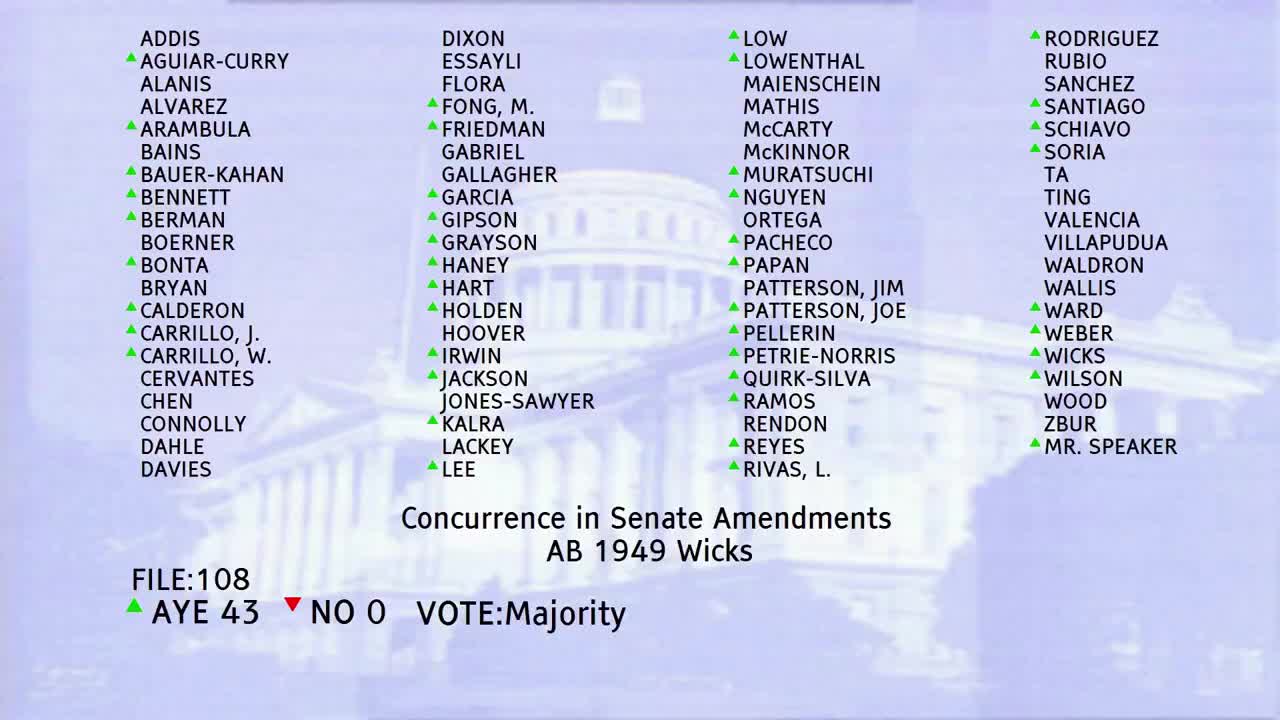 44SEC
Assembly Floor
 1MIN
Senate Floor
 7MIN
Senate Standing Committee on Natural Resources and Water
 7MIN
Senate Standing Committee on Environmental Quality
 7MIN
Assembly Standing Committee on Water, Parks, and Wildlife
 4MIN
Assembly Standing Committee on Natural Resources
Bill Author

Bill Co-Author(s):