AB 2104: Community colleges: Baccalaureate Degree in Nursing Pilot Program.
- Session Year: 2023-2024
- House: Assembly
- Latest Version Date: 2024-09-05
Current Status:
Failed
(2024-09-27: Vetoed by Governor.)
Introduced
In Committee
First Chamber
In Committee
Second Chamber
Enacted
Existing law establishes the California Community Colleges, under the administration of the Board of Governors of the California Community Colleges. Existing law establishes community college districts throughout the state, under the administration of community college district governing boards, and authorizes these districts to provide instruction at the community college campuses they operate. Existing law establishes a statewide baccalaureate degree program that authorizes up to a total of 30 baccalaureate degree programs at community college districts to be approved per academic year, as provided.
This bill would require the Chancellor of the California Community Colleges to develop a Baccalaureate Degree in Nursing Pilot Program that authorizes select community college districts to offer a Bachelor of Science in Nursing degree. The bill would limit the pilot program to 10 community college districts statewide and would require the chancellor to identify eligible community college districts based on specified criteria. The bill would require the Legislative Analysts Office to conduct an evaluation of the pilot program on or before January 1, 2030, to determine the effectiveness of the program and the need to continue or expand the program. The bill would repeal these provisions as of January 1, 2031.
Existing law establishes the California Community Colleges, under the administration of the Board of Governors of the California Community Colleges. Existing law establishes community college districts throughout the state, under the administration of community college district governing boards, and authorizes these districts to provide instruction at the community college campuses they operate. Existing law establishes a statewide baccalaureate degree program that authorizes up to a total of 30 baccalaureate degree programs at community college districts to be approved per academic year, as provided.
This bill would require the Chancellor of the California Community Colleges to develop a Baccalaureate Degree in Nursing Pilot Program that authorizes select community college districts to offer a Bachelor of Science in Nursing degree. The bill would limit the pilot program to 15 10 community college districts statewide and would require the chancellor to identify eligible community college districts based on specified criteria. The bill would require the Legislative Analysts Office to conduct an evaluation of the pilot program on or before January 1, 2030, to determine the effectiveness of the program and the need to continue or expand the program. The bill would repeal these provisions as of January 1, 2031.
Existing law establishes the California Community Colleges, under the administration of the Board of Governors of the California Community Colleges. Existing law establishes community college districts throughout the state, under the administration of community college district governing boards, and authorizes these districts to provide instruction at the community college campuses they operate. Existing law establishes a statewide baccalaureate degree program that authorizes up to a total of 30 baccalaureate degree programs at community college districts to be approved per academic year, as provided.
This bill would require the Chancellor of the California Community Colleges to develop a Baccalaureate Degree in Nursing Pilot Program that authorizes select community college districts to offer a Bachelor of Science in Nursing degree. The bill would limit the pilot program to 15 community college districts statewide and would require the chancellor to identify eligible community college districts based on specified criteria. The bill would require the Legislative Analysts Office to conduct an evaluation of the pilot program to determine the effectiveness of the program and the need to continue or expand the program. The bill would repeal these provisions as of January 1, 2031.
(a)Notwithstanding Section 66010.4, the Chancellor of the California Community Colleges shall develop a Baccalaureate Degree in Nursing Pilot Program that authorizes select community college districts to offer a Bachelor of Science in Nursing degree.
(b)(1)The pilot program shall be limited to 10 community college districts statewide. The chancellor shall identify eligible community college districts based on at least two of the following criteria:
(A)Community college districts that demonstrate equitable access to the pilot program, with a particular focus on regions showing a need for healthcare professionals. This includes regions with a projected significant growth rate above 7 percent over the years 2025 to 2030, inclusive, and regions encompassing northern, central, and southern parts of the state.
(B)Priority is given to community college districts that are located in broadly recognized underserved nursing areas.
(C)Priority is given to community college districts where the service area of the community college district includes communities with persistent poverty.
(2)The total number of participants in a pilot program at a community college district shall be limited to 25 percent of the community college districts associate degree in nursing class size. For community college districts located in persistent poverty communities this limit may be increased to up to 75 percent of the community college districts associate degree in nursing class size.
(c)(1)The Legislative Analysts Office shall conduct an evaluation of the pilot program on or before January 1, 2030, to determine the effectiveness of the program and the need to continue or expand the program.
(2)The results of the evaluation shall be submitted to the Legislature in compliance with Section 9795 of the Government Code.
(d)This article shall remain in effect only until January 1, 2031, and as of that date is repealed.
(a)Notwithstanding Section 66010.4, the Chancellor of the California Community Colleges shall develop a Baccalaureate Degree in Nursing Pilot Program that authorizes select community college districts to offer a Bachelor of Science in Nursing degree.
(b)(1)The pilot program shall be limited to 15 10 community college districts statewide. The chancellor shall identify eligible community college districts that apply based on at least two of the following criteria:
(A)Community college districts that demonstrate equitable access to the pilot program, with a particular focus on regions showing a need for healthcare professionals. This includes regions with a projected significant growth rate above 7 percent over the years 2025 to 2030, inclusive, and regions encompassing northern, central, and southern parts of the state.
(B)Priority is given to community college districts that are located in broadly recognized underserved nursing areas.
(C)Priority is given to community college districts where the service area of the community college district includes communities with persistent poverty.
(2)The total number of participants in a pilot program at a community college district shall be limited to 25 percent of the community college districts associate degree in nursing class size. For community college districts located in persistent poverty communities this limit may be increased to up to 75 percent of the community college districts associate degree in nursing class size.
(c)(1)The Legislative Analysts Office shall conduct an evaluation of the pilot program on or before January 1, 2030, to determine the effectiveness of the program and the need to continue or expand the program.
(2)The results of the evaluation shall be submitted to the Legislature in compliance with Section 9795 of the Government Code.
(d)This article shall remain in effect only until January 1, 2031, and as of that date is repealed.
(a)Notwithstanding Section 66010.4, the Chancellor of the California Community Colleges shall develop a Baccalaureate Degree in Nursing Pilot Program that authorizes select community college districts to offer a Bachelor of Science in Nursing degree.
(b)(1)The pilot program shall be limited to 15 community college districts statewide. The chancellor shall identify eligible community college districts that apply based on at least two of the following criteria:
(A)Community college districts that demonstrate equitable access to the pilot program, with a particular focus on regions showing a need for healthcare professionals. This includes regions with a projected significant growth rate above 7 percent over the years 2025 to 2030, inclusive, and regions encompassing northern, central, and southern parts of the state.
(B)Priority is given to community college districts that are located in broadly recognized underserved nursing areas.
(C)Priority is given to community college districts where the service area of the community college district includes communities with persistent poverty.
(2)The total number of participants in a pilot program at a community college district shall be limited to 25 percent of the community college districts associate degree in nursing class size. For community college districts located in persistent poverty communities this limit may be increased to up to 75 percent of the community college districts associate degree in nursing class size.
(c)(1)The Legislative Analysts Office shall conduct an evaluation of the pilot program to determine the effectiveness of the program and the need to continue or expand the program.
(2)The results of the evaluation shall be submitted to the Legislature in compliance with Section 9795 of the Government Code.
(d)This article shall remain in effect only until January 1, 2031, and as of that date is repealed.
REVISIONS: HeadingLine 2.|
Date
|
Status
|
|---|---|
| Sep 27, 2024 | Vetoed by Governor. |
| Sep 12, 2024 | Enrolled and presented to the Governor at 4 p.m. |
| Aug 31, 2024 | In Assembly. Ordered to Engrossing and Enrolling. |
| Aug 30, 2024 | Read third time. Passed. Ordered to the Assembly. (Ayes 31. Noes 1.). |
| Aug 19, 2024 | Read second time. Ordered to third reading. |
| Aug 15, 2024 | From committee: Do pass. (Ayes 7. Noes 0.) (August 15). |
| Aug 5, 2024 | In committee: Referred to APPR suspense file. |
| Jul 3, 2024 | From committee: Do pass and re-refer to Com. on APPR. (Ayes 6. Noes 1.) (July 3). Re-referred to Com. on APPR. |
| Jun 5, 2024 | Referred to Com. on ED. |
| May 23, 2024 | In Senate. Read first time. To Com. on RLS. for assignment. |
| May 22, 2024 | Read third time. Passed. Ordered to the Senate. (Ayes 65. Noes 1. Page 5565.) |
| May 20, 2024 | Read second time. Ordered to third reading. |
| May 16, 2024 | Read second time and amended. Ordered returned to second reading. |
| May 16, 2024 | From committee: Amend, and do pass as amended. (Ayes 12. Noes 3.) (May 16). |
| May 16, 2024 | Assembly Rule 63 suspended. |
| May 8, 2024 | In committee: Set, first hearing. Referred to APPR. suspense file. |
| Apr 17, 2024 | From committee: Do pass and re-refer to Com. on APPR. (Ayes 10. Noes 0.) (April 16). Re-referred to Com. on APPR. |
| Apr 17, 2024 | Coauthors revised. |
| Feb 20, 2024 | Referred to Com. on HIGHER ED. |
| Feb 6, 2024 | From printer. May be heard in committee March 7. |
| Feb 5, 2024 | Read first time. To print. |
|
Date
|
Description
|
Location
|
Votes
|
|
|---|---|---|---|---|
| Aug 30, 2024 | Assembly 3rd Reading AB2104 Soria et al. By Hurtado | Senate Floor |
Passed |
|
| Aug 15, 2024 | Do pass | Senate Standing Committee on Appropriations |
Passed |
|
| Aug 5, 2024 | Placed on suspense file | Senate Standing Committee on Appropriations |
Passed |
|
| Jul 3, 2024 | Do pass, but first be re-referred to the Committee on [Appropriations] | Senate Standing Committee on Education |
Passed |
|
| May 22, 2024 | AB 2104 Soria Assembly Third Reading | Assembly Floor |
Passed |
|
| May 16, 2024 | Do pass as amended. | Assembly Standing Committee on Appropriations |
Passed |
|
| Apr 16, 2024 | Do pass and be re-referred to the Committee on [Appropriations] | Assembly Standing Committee on Higher Education |
Passed |
This list shows positions taken on this bill by organizations on the date displayed, which is linked to the original source.
Positions by individuals are not included.
|
Organization
|
Position
|
Date
|
|---|---|---|
| Academic Senate, Cal Poly San Luis Obispo | ** Against | |
| Academic Senate Executive Committee, California State University, Bakersfield | ** Against | |
| Academic Senate of the California State University | ** Against | |
| Antelope Valley Community College District | ** Support | |
| Association of Independent California Colleges Universities | ** Against | |
| Aveanna Healthcare | ** Support | |
| Azusa Pacific University | ** Against | |
| California Assisted Living Association | ** Support | |
| California Association For Health Services At Home | ** Support | |
| California Association of Colleges of Nursing | ** Against | |
| California Association Of Health Facilities | ** Support | |
| California Baptist University | ** Against | |
| California Baptist University College of Nursing | ** Against | |
| California Hospital Association | ** Support | |
| California Legislative Women's Caucus | ** Support | |
| California Polytechnic State University, San Luis Obispo | ** Against | |
| California State Association Of Counties | ** Support | |
| California State Polytechnic University, Humboldt | ** Against | |
| California State University Alumni Council | ** Against | |
| California State University Bakersfield | ** Against | |
| California State University Channel Islands | ** Against | |
| California State University, Chico | ** Against | |
| California State University, Dominguez Hills | ** Against | |
| California State University, East Bay | ** Against | |
| California State University, Fresno | ** Against | |
| California State University, Fullerton | ** Against | |
| California State University, Long Beach | ** Against | |
| California State University, Los Angeles | ** Against | |
| California State University, Monterey Bay | ** Against | |
| California State University, Northridge | ** Against | |
| California State University Office of the Chancellor | ** Against | |
| California State University, Pomona | ** Against | |
| California State University, Sacramento | ** Against | |
| California State University, San Bernardino | ** Against | |
| California State University, Stanislaus | ** Against | |
| Cal Poly Humboldt Nursing | ** Against | |
| Central Valley Community College CEO Caucus | ** Support | |
| Citrus College | ** Support | |
| Coast Community College District | ** Support | |
| Community College League of California | ** Support | |
| Concordia University Irvine | ** Against | |
| Contra Costa Community College District | ** Support | |
| County Health Executives Association Of California | ** Support | |
| CSU Dominguez Hills - School of Nursing | ** Against | |
| Csulb School of Nursing | ** Against | |
| Dominican University of California | ** Against | |
| Faculty Association Of California Community Colleges | ** Support | |
| Grossmont-Cuyamaca Community College District | ** Support | |
| Long Beach Community College District | ** Support | |
| Los Angeles Unified School District | ** Support | |
| Moorpark College | ** Support | |
| Mt. San Antonio College | ** Support | |
| North Orange County Community College District | ** Support | |
| Rio Hondo College | ** Support | |
| Riverside Community College District | ** Support | |
| Rural County Representatives of California | ** Support | |
| Sacramento County Young Democrats | ** Support | |
| San Diego State University | ** Against | |
| San Diego Unified School District | ** Support | |
| San Francisco State University | ** Against | |
| San Jose-Evergreen Community College District | ** Support | |
| San José State University | ** Against | |
| Santa Clarita Community College District - College of the Canyons | ** Support | |
| School of Nursing, Sacramento State University | ** Against | |
| Sharp Healthcare | ** Support | |
| Sonoma State University | ** Against | |
| State Center Community College District | ** Support | |
| Urban Counties of California | ** Support | |
| Valley Children's Healthcare | ** Support | |
| Westhillscollege.com | ** Support | |
| Yuba Community College District | ** Support |
GOVERNOR'S VETO
GV Bill Id:AB 2104
Author:(Soria)
As Enrolled Ver:September 5, 2024
2/3 vote
SUMMARY
Requires the Chancellor of the California Community Colleges (CCC) to develop a Baccalaureate Degree in Nursing (BSN) Pilot Program that authorizes select community college districts to offer a BSN degree.
- Requires the Chancellor of the CCC to develop a BSN Program that authorizes select community college districts to offer a BSN degree.
- Specifies that the pilot program will be limited to 10 community college districts (CCD) statewide. Requires the chancellor to identify eligible CCDs that apply based on at least two of the following criteria:
- CCDs that demonstrate equitable access to the pilot program, with a particular focus on regions showing a need for healthcare professionals. This includes regions with a projected significant growth rate above 7% over the years 2025 to 2030, inclusive, and regions encompassing northern, central, and southern parts of the state.
- Priority is given to CCDs that are located in broadly recognized underserved nursing areas.
- Priority is given to CCDs where the service area of the community college district includes communities with persistent poverty.
- Specifies that the total number of participants in a pilot program at a CCD will be limited to 25% of the community college district's associate degree in nursing class size. For community college districts located in persistent poverty communities this limit may be increased to up to 75% of the community college district's associate degree in nursing class size.
- Requires the Legislative Analyst's Office to conduct an evaluation of the pilot program on or before January 1, 2030, to determine the effectiveness of the program and the need to continue or expand the program.
- The results of the evaluation must be submitted to the Legislature, as specified.
- Sunsets the bill's provision on January 1, 2031.
Governor’s Veto Message
This bill requires the California Community Colleges (CCC) Chancellor's Office to establish, until January 1, 2031, a Community College Baccalaureate Degree in Nursing Pilot Program for purposes of authorizing 10 community college districts' (CCDs) nursing programs to offer a Bachelor of Science in Nursing degree.
I support the author's intent to expand access to baccalaureate nursing degree programs in underserved communities. The 2024 Budget Agreement included $60 million per year, from 2025-26 to 2028-29, for the Rebuilding Nursing Infrastructure Grant Program, which may be used to develop or expand Bachelor of Science in Nursing (BSN) partnerships with higher education institutions. These types of partnerships have proven successful in expanding BSN access for community college students and increasing the number of BSN degree recipients. All segments of higher education should continue to focus on building these programs together, and I am concerned this bill could inadvertently undermine that collaboration.
Additionally, in recent years, both the CCC and the CSU have been provided with expanded authority to offer independent programs. Given these major changes, a pause should be taken to understand their full impact before additional authorities are granted.
COMMENTS
Master Plan for Higher Education. As outlined in the Master Plan for Higher Education and by state statute, the CCCs are designated to have an open admission policy and bear the most extensive responsibility for lower-division undergraduate instruction. Its three primary areas of mission include education leading to associates degrees and university transfer, career technical education, and basic skills. The primary mission of the CSU is undergraduate and graduate instruction through the master's degree. The UC was granted the sole authority to independently offer doctoral degrees.
Notwithstanding the differentiation of the mission envisioned by the Master Plan, as and outlined in statute, the Legislature authorized the CSU to go beyond its original mission to offer six professional doctoral degrees which include the Au.D, Ed.D, D.P.T., DNP, OTD, and Dr.PH. Each program was individually approved through legislation. Fees were capped at the rate charged at the UC, no additional funding was provided by the state, and these programs were to be implemented without diminishing or reducing enrollment in undergraduate programs. Additionally, the CSU programs that offer applied doctorates were not duplicative of degrees offered by UC.
Parallel expansion. SB 850 (Block), Chapter 747, Statutes of 2014, authorized the CCC BOG, in consultation with the CSU and the UC, to establish a baccalaureate degree pilot program. The pilot program allowed up to 15 participating community college districts to offer one baccalaureate degree program each to meet local workforce needs as long as it was not duplicating a baccalaureate degree program already offered by the CSU or the UC. The Legislative Analyst's Office (LAO) conducted interim and final evaluations of the pilot program.
Assembly Bill 927 (Medina and Choi), Chapter 565, Statutes of 2021 made the SB 850 (Block) pilot program permanent, perpetually approving the original pilot programs and authorizing as many as 30 new baccalaureate degrees per year. As of publication of this analysis there are a total of 39 approved programs. Most participating campuses currently offer one program, while seven campus offer two baccalaureate degree programs. Consistent with the provisions of SB 850 (Block), AB 927 (Medina and Choi) mandates that none of the CCC baccalaureate degree programs can duplicate programs offered by the CSU or UC.
AB 656 (McCarty), Chapter 663, Statutes of 2023, authorizes the CSU to award professional or applied doctoral degrees statewide that do not duplicate UC doctoral degrees and satisfy certain requirements.
Nursing programs in California. Graduates of associate and BSN degree programs may sit for nurse licensure exams and become licensed registered nurses. The state's Board of Registered Nursing (BRN) approves all of California's pre-licensure nursing programs offered by public and private colleges and makes decisions about the number of students that new and existing nursing programs are allowed to enroll. The number of nursing programs in the state totals 152, with
101 public, 91 associate degrees in nursing, 48 BSN, and 13 Entry Level Master's (ELM) programs.
According to the most recent BRN annual school report (2021-2022), California graduated about 13,300 students in 2021-22 from registered nursing programs, which represents an 18% increase in student completions since 2012. Associate's degree completions decreased while bachelor's degrees and ELM nursing completions increased. The number of joint associate degrees in nursing and bachelor's programs has increased over the last 10 years. The time it takes a student to graduate from a program varies by degree. An associate degree in nursing prepares students for registered nursing care in a variety of settings in two-three years, whereas a bachelor's degree takes about four years to train students for registered nursing care as well as administrative and leadership positions. An ELM is a one- to two- year program for baccalaureate degree holders in other fields seeking to become registered nurses. All schools are required to provide clinical instruction with clinical placement in a health care facility in each phase of the educational process. Students must pass a national licensure examination to earn a license. The BRN projects enrollment to increase for the 2023-2024 academic year to about 18,500.
Is this an appropriate solution? If it is the desire of the Legislature to expand BSN degree programs, arguably more effective and efficient alternatives exist that do not require a departure from the CCC's traditional mission to expand and streamline BSN pathways.
Improving alignment between CCC and the universities could increase the number of CCC students who ultimately obtain a bachelor's degree and reduce the amount of time students take to obtain their degree. For example, the Tri- County Nursing Pathway is a partnership between Riverside City College and two CSU campuses (Fullerton and San Bernardino) that allows associate degree nursing students to concurrently obtain their bachelor's degrees. Students can enroll in CSU courses while still completing their associate degree requirements, allowing them to obtain their BSN degree with only six additional months of coursework. The following policy questions should be considered:
- Could this bill undermine any incentives for similar collaborations across the public education segments to address regional workforce needs like nursing?
- Can the process for developing collaborative efforts to address workforce needs be modified to facilitate greater proliferation of these programs?
- Should a community college be required to demonstrate that existing avenues for partnership with other institutions are not possible or viable before seeking authorization to offer an independent baccalaureate degree?
- Should additional support be provided to the other segments with primary jurisdiction for granting baccalaureate degrees to increase the number of degree slots available in high-demand areas?
Higher education coordination. All of California's public education institutions share a commitment to work together to ensure that parts of the system work for all Californians. Since the defunding of the California Postsecondary Education Commission (CPEC) in 2011, California has not had a statewide coordinating entity for higher education. Prior to its demise, the role of the CPEC included academic program review to coordinate the long-range planning of the state's public higher education systems as a means to ensure that the segments were working together to carry out their individual missions while serving the state's long-range workforce and economic needs.
The absence of a higher education coordinating entity has hindered the state's ability to review degree programs to align with state and workforce needs. In its place, changes to higher education's blueprint are being made one legislative proposal at a time in a piecemeal way, which could result in an uncoordinated and fragmented system. Although this bill is limited to one community college baccalaureate degree program, it establishes a precedent for permitting duplication of degree programs and expands CCC's ability to establish baccalaureate degrees independent from California's other public universities. The following policy questions should be considered:
- What relationship is there among the different missions of California's higher education segments and their differential ways in which they offer education?
- Is it appropriate to rely solely on the legislative process to implement significant programmatic changes to higher education without any coordination or long-range plan to guide the conversation? Does the legislative process allow for consideration of priority relative to other demands in higher education?
- How should the legislature leverage the strength of each segment to address regional or statewide workforce needs? What is the expectation for collaboration among the segments?
- The delineation of missions serves as a guide for how and where to allocate state resources. If there is a lack of clarity about institutional missions, what will guide the future of higher education?
According to the Author
According to the author, "California's current healthcare workforce development apparatus is not equipped to handle the growing nursing needs of the state, especially in disadvantaged communities in more rural parts of the state. While California's Community College system can reach these communities and does offer associates degrees in nursing, the needs of the healthcare workforce more frequently demand a bachelor's degree. This level of degree is exclusive in California to private institutions that are prohibitively expensive or the UC and CSU systems that have limited capacity and difficulty serving areas of the state with the highest need."
"In order to meet our nursing workforce needs and extend these career opportunities to Californians throughout the state, we must expand the role of our community college system. AB 2104 will take the first steps in this process by allowing a limited number of campuses to expand their nursing programs to offer Bachelors of Science in nursing degree."
Arguments in Support
State Center CCD, the sponsor of AB 2104 (Soria), writes that "the San Joaquin Valley faces a significant nursing shortage in a population that is medically underserve and has growing healthcare needs. Addressing the nursing crisis head-on by providing affordable, quality education locally is a crucial step towards providing our diverse student body with greater access to advanced healthcare training. By enabling our community colleges, which already play a crucial role in training the majority of the state's RNs, this bill will allow us to meet unfilled demand and significantly enhance our capacity to meet local and statewide healthcare needs."
State Center CCD also notes that "AB 2104 represents a significant opportunity to empower community colleges to provide advanced nursing education and training, thereby addressing immediate workforce needs and promoting economic mobility. By prioritizing underserved populations and creating pathways to high-demand, well-paying careers in healthcare, this legislation aligns with our collective goal of fostering social equity and improving health outcomes for all Californians."
The Community College League of California writes that "hospitals are increasingly preferring to hire BSN-educated nurses, which hurts underrepresented students. A 2021 Health Impact report found that 18% of California hospitals surveyed stated that a BSN was required for employment – twice the percentage noted in 2017 – and 54.3% reported a preference for hiring BSN nurses. Additionally, 31.5% of the ADN-holding nurses surveyed stated that the lack of a BSN degree was given as the reason for their failure to be hired. As California faces a nursing shortage, public nursing schools simply cannot keep up with the high student demand for nursing."
The Community College League also wrote that, "currently, when students are not admitted into a public nursing program, they turn to for-profit and private institutions. While this may be a good option for some students, it is an unnecessarily expensive option when the local community college could offer the program at a fraction of the cost. Many capable students are priced out of the option to attend a private university or are forced to take out significant loans, creating generational debt. AB 2104 represents an opportunity to utilize California community colleges' existing ADN infrastructure to give students an accessible and affordable option to earn their BSN degree."
Arguments in Opposition
The CSU Chancellor's Office wrote in opposition, stating that "limited clinical placements and regulatory challenges have been the main challenges facing the state in its effort to increase the number of nurses. Nursing school capacity is limited not by the number of enrollment spots, but rather the number of clinical placements. Nursing programs cannot enroll students if they cannot meet the requirements to provide clinical placements for students. Therefore, policies seeking to increase the number of nurses should first evaluate the clinical placements available to public and private nursing programs."
CSU also noted that "further, the Legislature has maintained, with the passage of [AB] 927 (Medina), that community college baccalaureate programs shall not duplicate existing CSU and UC programs since they result in the inefficient use of state resources. Building BSN programs at community colleges sets a precedent for duplication of CSU and UC baccalaureate degrees in not only nursing programs but in every field. Nursing programs would require significant infusions of funding to replicate established high-quality programs and such an expansion would not guarantee increased enrollment. It would result in increased competition for limited clinical placements and qualified faculty, further complicating the problem that already exists. The CSU believes the most appropriate and proven path forward to achieve an increase in the number of nursing students is through partnership and online programs. CSU universities offer several online associate degrees in nursing (ADN) to BSN programs which serve rural students and allow them to fulfill all upper division coursework remotely…CSU universities [also] offer concurrent enrollment partnership programs for incoming freshmen with nearby community colleges that offer all coursework online…[these] programs are very effective in serving students in rural areas and in increasing the pace at which students can matriculate through the nursing program."
The Association of Independent California Colleges and Universities (AICCU) also wrote that AB 2104 (Soria) "will not add a single additional nurse to the state workforce beyond the number that would exist under current law. In fact, we are concerned that the bill will exacerbate existing challenges in hiring nursing faculty, since community college programs will likely need to seek out more faculty to teach the additional courses required as part of baccalaureate degree programs. Rather than compound the existing challenges in the nursing educator pipeline, we believe that the Legislature should instead look to incentivize and promote collaborative, intersegmental partnerships through models such as concurrent enrollment and accelerated pathways. The Newsom Administration signaled its support for partnerships in the January budget with a proposal of $60 million to the [BOG] of the [CCC] 'to expand nursing programs and bachelor of science in nursing partnerships to grow, educate, and maintain the next generation of registered nurses.'"
FISCAL COMMENTS
According to the Assembly Committee on Appropriations:
- One-time Proposition 98 General Fund costs in the low hundreds of thousands of dollars per pilot CCD to create and implement a BSN degree program.
- Ongoing Proposition 98 General Fund costs, potentially in the hundreds of thousands of dollars annually per pilot CCD, to offer upper division programing. These costs are associated with increased operational expenses, staff salaries, and annual accreditation fees. Costs associated with staff salaries would be lower to the extent pilot CCDs can redirect existing nursing faculty to teach upper division curriculum.
- One-time General Fund workload costs between $32,500 and $53,000 for the CCC Chancellor's Office to develop the application for the pilot program, issue guidance, and provide technical assistance.
VOTES
ASM HIGHER EDUCATION: 10-0-1
YES: Mike Fong, Ta, Arambula, Boerner, Chen, Alanis, Jackson, Addis, Muratsuchi, Quirk-Silva
ABS, ABST OR NV: Irwin
ASM APPROPRIATIONS: 12-3-0
YES: Wicks, Arambula, Bryan, Calderon, Wendy Carrillo, Mike Fong, Grayson, Haney, Hart, Pellerin, Ta, Villapudua
NO: Sanchez, Dixon, Jim Patterson
ASSEMBLY FLOOR: 65-1-14
YES: Addis, Aguiar-Curry, Alanis, Alvarez, Bains, Bauer-Kahan, Bennett, Berman, Boerner, Bonta, Bryan, Juan Carrillo, Wendy Carrillo, Chen, Connolly, Davies, Dixon, Flora, Mike Fong, Gabriel, Garcia, Gipson, Grayson, Haney, Hart, Hoover, Jackson, Kalra, Lackey, Lee, Low, Lowenthal, Maienschein, McCarty, McKinnor, Muratsuchi, Stephanie Nguyen, Ortega, Pacheco, Papan, Jim Patterson, Pellerin, Petrie-Norris, Quirk-Silva, Ramos, Rendon, Reyes, Rodriguez, Blanca Rubio, Santiago, Schiavo, Soria, Ta, Ting, Valencia, Villapudua, Waldron, Wallis, Ward, Weber, Wicks, Wilson, Wood, Zbur, Robert Rivas
NO: Sanchez
ABS, ABST OR NV: Arambula, Calderon, Cervantes, Megan Dahle, Essayli, Vince Fong, Friedman, Gallagher, Holden, Irwin, Jones-Sawyer, Mathis, Joe Patterson, Luz Rivas
SENATE FLOOR: 32-1-7
YES: Alvarado-Gil, Archuleta, Atkins, Becker, Blakespear, Bradford, Caballero, Cortese, Dahle, Dodd, Durazo, Eggman, Glazer, Gonzalez, Grove, Hurtado, Jones, Laird, Limón, McGuire, Menjivar, Nguyen, Niello, Ochoa Bogh, Padilla, Rubio, Seyarto, Skinner, Smallwood-Cuevas, Umberg, Wahab, Wiener
NO: Wilk
ABS, ABST OR NV: Allen, Ashby, Min, Newman, Portantino, Roth, Stern
UPDATED
VERSION: September 5, 2024
CONSULTANT: Kevin Powers / HIGHER ED. / (916) 319-3960 FN: 0005186
SENATE RULES COMMITTEE Office of Senate Floor Analyses (916) 651-1520 Fax: (916) 327-4478 | AB 2104 |
THIRD READING
Bill No: AB 2104
Author: Soria (D), et al.
Amended: 5/16/24 in Assembly
Vote: 21
SENATE EDUCATION COMMITTEE: 6-1, 7/3/24
AYES: Newman, Ochoa Bogh, Cortese, Glazer, Gonzalez, Smallwood-Cuevas
NOES: Wilk
SENATE APPROPRIATIONS COMMITTEE: 7-0, 8/15/24
AYES: Caballero, Jones, Ashby, Becker, Bradford, Seyarto, Wahab
ASSEMBLY FLOOR: 65-1, 5/22/24 - See last page for vote
SUBJECT: Community colleges: Baccalaureate Degree in Nursing Pilot Program
SOURCE: Author
DIGEST:
This bill requires the California Community College (CCC) Chancellor’s Office to establish, until January 1, 2031, a Community College Baccalaureate Degree in Nursing Pilot Program for purposes of authorizing 10 community college districts (CCDs) nursing programs to offer a Bachelor of Science in Nursing Degree. The bill further requires the Legislative Analyst’s Office (LAO) to conduct and submit to the Legislature an evaluation of the pilot program, as specified.
ANALYSIS:
Existing law:
- Differentiates the missions and functions of public and independent institutions of higher education. Under these provisions:
- The primary mission of the California State University (CSU) is to offer undergraduate and graduate instruction through the master’s degree in the liberal arts and sciences and professional education including teacher education. The CSU is authorized to establish two-year programs only when mutually agreed upon by the Trustees and the CCC Board of Governors. The CSU is also authorized to jointly award the doctoral degree with the University of California (UC) and with one or more independent institutions of higher education.
- The UC is authorized to provide undergraduate and graduate instruction and has exclusive jurisdiction in public higher education over graduate instruction in the professions of law, medicine, dentistry, and veterinary medicine. The UC is also the primary state-supported academic agency for research.
- The independent institutions of higher education are required to provide undergraduate and graduate instruction and research in accordance with their respective missions.
- The mission and function of the CCC is the offering of academic and vocational instruction at the lower division level, and the CCC are authorized to grant the Associate in Arts and the Associate in Science degrees. The community colleges are also required to offer learning supports to close learning gaps, English as a Second Language instruction, and adult noncredit instruction, and support services which help students succeed at the postsecondary level. (Education Code (EC) § 66010.4)
- Authorizes the CCC Board of Governors, in consultation with the CSU and the UC, to establish baccalaureate degree programs that do not duplicate a baccalaureate degree program offered by the CSU or UC. Allows for the approval of 30 community college baccalaureate degree programs per academic year. Current law further requires the CCC Chancellor to consult with and seek feedback from the CSU Chancellor, the UC President and the President of the Association of Independent California Colleges and Universities on proposed baccalaureate degree programs, as specified, and establishes a mechanism for the assessment, consultation, and approval of programs where duplication is identified, as specified. (EC § 78040 et seq.)
This bill:
- Requires the Chancellor of the CCC to develop a BSN Program that authorizes select CCDs to offer a BSN degree.
- Limits the pilot program to 10 CCDs statewide and requires the chancellor to identify eligible CCDs on at least two of the following criteria:
- CCDs that demonstrate equitable access to the pilot program, with a
particular focus on regions showing a need for healthcare professionals. This includes regions with a projected significant growth rate above 7 percent over the years 2025 to 2030, inclusive, and regions encompassing northern, central, and southern parts of the state.
- Priority be given to CCDs that are located in broadly recognized
underserved nursing areas.
- Priority be given to CCDs where the service area of the community
college district includes communities with persistent poverty.
- Specifies that the total number of participants in a pilot program at a CCD will be limited to 25 percent of the CCD’s associate degree in nursing class size. For CCDs located in persistent poverty communities this limit may be increased to up to 75 percent of the community college district’s associate degree in nursing class size.
- Requires the LAO, by January 1, 2030, to conduct an evaluation of the pilot program to determine the effectiveness of the program and the need to continue or expand the program.
- The results of the evaluation must be submitted to the Legislature, as specified.
- Sunsets the bill’s provision on January 1, 2031.
Comments
- Need for the bill. According to the author, “California’s current healthcare workforce development apparatus is not equipped to handle the growing nursing needs of the state, especially in disadvantaged communities in more rural parts of the state. While California’s Community College system can reach these communities and does offer associates degrees in nursing, the needs of the healthcare workforce more frequently demand a bachelor’s degree. This level of degree is exclusive in California to private institutions that are prohibitively expensive or the UC and CSU systems that have limited capacity and difficulty serving areas of the state with the highest need. In order to meet our nursing workforce needs and extend these career opportunities to Californians throughout the state, we must expand the role of our community college system. AB 2104 will take the first steps in this process by allowing a limited number of campuses to expand their nursing programs to offer Bachelors of Science in nursing degree.”
- CCCs original mission. The state has four segments of higher education: three public and one private. Each plays a vital and unique role for the state. Their mission statements are outlined in the Master Plan for Higher Education and by state statute. The CCCs are to have an open admission policy and bear the most extensive responsibility for lower-division undergraduate instruction. Its primary areas of mission include instruction leading to associate degrees and university transfer, vocational instruction, and remedial education. Despite the differentiation of mission, the Legislature has authorized the CSU and CCCs to go beyond their original mission to offer doctoral degree and baccalaureate degree programs, respectively, so long as programs do not duplicate those offered by the other segments with primary jurisdiction. Further expansion of CCC baccalaureate degrees as proposed in this bill would signal the Legislature’s willingness to allow CCCs to deviate further from their institutional mission, duplicate programs offered by the other segments with primary jurisdiction, and bypass the existing CCC baccalaureate approval process.
- Is this the appropriate solution? If it is the desire of the Legislature to expand BSN degree programs, arguably more effective and efficient alternatives do not require a departure from the CCC’s mission to expand and streamline BSN pathways. In its recommendation for alternatives to the original baccalaureate degree pilot program, the LAO’s analysis notes that some CCCs have agreements with baccalaureate degree-granting institutions. Improving alignment between CCC and the universities could increase the number of CCC students who ultimately obtain a bachelor’s degree and reduce the amount of time students take to obtain their degree. For example, the Tri-County Nursing Pathway is a partnership between Riverside City College and two CSU campuses (Fullerton and San Bernardino) that allows associate degree nursing students to concurrently obtain their bachelor’s degrees. Students can enroll in CSU courses while still completing their associate degree requirements, allowing them to obtain their bachelor’s degree with only six additional months of coursework. The LAO report further asserts that such partnerships could not only be more cost-effective but also benefit more students (including place-bound students), thereby having a more widespread impact.
- State investment in CCC associate degree in nursing programs. Of California’s three public higher education segments, only the community colleges offer associate degrees in nursing. According to the CCC Chancellor’s Office 2020-2022 legislative report on Community Colleges Nursing Educational Programs, associate degrees in nursing programs account for 55.4% of programs in the state. Numerous legislative efforts and investments have been made to expand community college associate degree in nursing enrollments and improve retention to facilitate the expansion of associate degree in nursing programs. The Budget Act of 2015 provided additional nursing program support to expand community college nursing enrollments and improve student retention in associate degree nursing programs. Since 2009-10, the Legislature has provided ongoing funding ($13.4 million) through grants to CCC associate degree in nursing programs in recognition of the relatively high cost of educating nurses. The Department of Health Care Access and Information, which administers a state program to help, among other things, increase support for nursing education programs, awarded a total of $17 million to 34 nursing programs in 2023, including 17 community college associate degree in nursing programs. These investments demonstrate the state’s willingness to invest in associate degrees and demonstrate a recognition of their value to the state.
- Segments competing for students. A key issue highlighted in a recent 2024 report issued by the Legislative Analyst’s Office, Trends in Higher Education Student Access, is that as the high school graduate and college-age populations decline in this state, the segments are likely to begin competing more for students. The Legislature will continue to face key decisions about how much enrollment to fund at each of the public segments. Such decisions could have important implications for the size of each segment in the years to come. Further, with the segments competing more intensely with one another for students, the Legislature is likely to face fundamental decisions about each segment’s mission, including which programs and degrees each segment offers. As with enrollment growth decisions, these decisions could have important implications for the size and cost of each segment in the years to come.
- Tuition fees and potential program costs. Current law allows CCCs to raise tuition up to the same amount as a CSU baccalaureate degree program, for CCC baccalaureate degree programs that are approved under the existing process to the same amount as a CSU. For example, the West Los Angeles Community College 2-year dental hygiene baccalaureate program charges $130 per unit plus $7,000 for equipment and fees. Enrollment fees for CCC lower division coursework are currently $46 per credit. Without statutory authorization, it is unclear if CCC districts can charge higher rates for a more advanced degree. Potential CCC program costs, as projected by the CSU in comparison to its programs, community colleges that choose to add upper division course curriculum placement and develop these baccalaureate degree nursing programs may see costs for faculty salaries, support staff salaries, operational expenses, facilitating community clinical placements, equipment, and supplies. By using figures derived from a typical CSU nursing program, the CSU estimates at $5,000 per student per year for the upper division program.
- National accreditation not required. According to the CCC Chancellor’s Office, of the 77 associate degree for nursing programs, 28 are nationally accredited 27 by the Accreditation Commission for Education on Nursing (ACEN) and one by the Commission for Nursing Education Accreditation. Nine are candidates for national accreditation by ACEN. All programs have Board of Registered Nursing (BRN) approval. BRN approval ensures compliance with statutory and regulatory requirements whereas accreditation provides a baseline measure of program quality and supports transferability of credits for students seeking an advanced degree. This bill does not condition participation in the pilot program on whether a program is nationally accredited.
- Nursing programs in California. Graduates of associate and bachelor nursing degree programs may sit for nurse licensure exams and become licensed registered nurses. The state’s BRN approves all of California’s pre-licensure nursing programs offered by public and private colleges and makes decisions about the number of students that new and existing nursing programs are allowed to enroll. The number of nursing programs in the state totals 152, with 101 public, 91 associate degrees in nursing, 48 bachelor of science in nursing, and 13 Entry Level Master’s (ELM) programs. According to the most recent BRN annual school report (2021-2022), California graduated about 13,300 students in 2021-22 from registered nursing programs, which represents an 18 percent increase in student completions since 2012. Associate’s degree completions decreased while bachelor’s degrees and ELM nursing completions increased. The number of joint associate degrees in nursing and bachelor’s programs has increased over the last 10 years. The time it takes a student to graduate from a program varies by degree. An associate degree in nursing prepares students for registered nursing care in a variety of settings in two-three years, whereas a bachelor’s degree takes about four years to train students for registered nursing care as well as administrative and leadership positions. An ELM is a one- to two-year program for baccalaureate degree holders in other fields seeking to become registered nurses. All schools are required to provide clinical instruction with clinical placement in a health care facility in each phase of the educational process. Students must pass a national licensure examination to earn a license. The BRN projects enrollment to increase for the 2023-2024 academic year to about 18,500. www.rn.ca.gov/forms/rnsurvey201718.shtml
- Enrollment decisions controlled by BRN. The BRN is one of a few licensing boards that continues to actively approve educational programs and make enrollment decisions. According to a recent state audit of the BRN, two of the key factors that should be included in the BRN’s enrollment decisions are the forecasted supply of nurses that the state will need to fulfill demand and the available number of clinical placement slots. The audit found that the BRN has failed to gather and use sufficient data related to both of these factors to appropriately inform its enrollment decisions. Should the BRN continue to approve RN educational programs? Shouldn’t institutions play a greater role in determining enrollment decisions?
- Nursing shortage projected to close within a few years. According to a 2022 University of California, San Francisco (UCSF) study, “Forecasts of the Registered Nurse Workforce in California,” data shows consistent employment rates for RNs since 2018, but decreasing rates for older RNs. It further warns that a greater number of RNs plan to retire or quit within two years compared to 2018. The pandemic also had an impact on retention rates. RN education programs experienced fewer enrollments and graduates during the 2018-2019 academic year. Combined, these changes have reduced the supply of RNs relative to previous forecasts. However, circumstances are improving. RN education enrollments are expected to surpass pre-pandemic levels starting with the 2021-22 academic year. It is projected that the supply of new RNs will match demand by 2029, thereby filling unfilled positions. According to UCSF’s updated 2024 forecast (unpublished), there is a statewide supply-demand gap of 17,000 full-time equivalent nurses, which is projected to close within four years (2028), one year earlier than the 2022 report indicated. Notably, retention of new and experienced nurses is key. www.rn.ca.gov/pdfs/forms/forecast2022.pdf
- California could benefit from improved intersegmental coordination as duplication of programs leads to increased tension. All of California’s public education institutions share a commitment to work together to ensure that parts of the system work for all Californians. Since the defunding of the California Postsecondary Education Commission (CPEC) in 2011, California has not had a statewide coordinating entity for higher education. Prior to its demise, the role of the CPEC included academic program review to coordinate the long-range planning of the state’s public higher education systems as a means to ensure that the segments were working together to carry out their individual missions while serving the state’s long-range workforce and economic needs. The absence of a higher education coordinating entity has hindered the state’s ability to review degree programs to align with state and workforce needs. In its place, changes to higher education’s blueprint are being made one legislative proposal at a time in a piecemeal way, which could result in an uncoordinated and fragmented system. Although this bill is limited to one community college baccalaureate degree program, it establishes a precedent for permitting duplication of degree programs and expands CCC’s ability to establish baccalaureate degrees independent from California’s other public universities.
- Related legislation. SB 895 (Roth, 2024), similar to this bill, would require the Chancellor’s Office to develop a Baccalaureate Degree in Nursing Pilot Program that authorizes 15 community college districts to offer a Bachelor of Science in Nursing degree. SB 895 was still pending in the Assembly Appropriations Committee at the time this analysis was written.
FISCAL EFFECT: Appropriation: No Fiscal Com.: Yes Local: No
According to the Senate Appropriations Committee analysis, this bill would have the following fiscal impact:
- The Chancellor’s Office indicates that there could be one-time Proposition 98 General Fund costs for each pilot district to create and implement a Bachelor of Science of Nursing degree program, ranging from $75,000 to $130,000 per district. These costs would encompass any updates to the design of new nursing academic standards, student learning outcomes, updates to existing curriculum that would be needed to satisfy the program, and implementation of other coursework. However, the Chancellor’s Office believes these costs are consistent with recent state budget actions to implement new academic programs and curriculum and therefore and could be absorbed within existing resources.
- The Chancellor’s office estimates one-time General Fund workload costs of between $33,000 and $53,000 to develop the application for the pilot program, issue guidance, and provide technical assistance.
- This bill could result in additional, unknown General Fund costs for the LAO to conduct an evaluation of the pilot program and submit a report to the Legislature. The bill may also impact the ability of the LAO to fulfill other existing or future legislative mandates and requests, as the LAO’s budget is subject to the Legislature’s constitutional spending cap.
SUPPORT: (Verified 8/15/24)
Aveanna Healthcare
California Assisted Living Association
California Association for Health Services at Home
California Association of Health Facilities
California Hospital Association
California Legislative Women's Caucus
California State Association of Counties
Citrus College
Community College League of California
County Health Executives Association of California
Faculty Association of California Community Colleges
Long Beach Community College District
Los Angeles Unified School District
Mt. San Antonio College
North Orange County Community College District
Rural County Representatives of California
Sacramento County Young Democrats
San Diego Unified School District
San Jose-Evergreen Community College District
Sharp Healthcare
Urban Counties of California
OPPOSITION: (Verified 8/15/24)
Academic Senate Executive Committee, California State University, Bakersfield
Academic Senate of the California State University
Academic Senate, Cal Poly San Luis Obispo
Association of Independent California Colleges & Universities
Cal Poly Humboldt Nursing
California Association of Colleges of Nursing
California Baptist University College of Nursing
California Polytechnic State University, San Luis Obispo
California State Polytechnic University, Humboldt
California State University Alumni Council
California State University Bakersfield
California State University Channel Islands
California State University Office of the Chancellor
California State University, Chico
California State University, Dominguez Hills
California State University, East Bay
California State University, Fresno
California State University, Fullerton
California State University, Long Beach
California State University, Los Angeles
California State University, Monterey Bay
California State University, Northridge
California State University, Pomona
California State University, Sacramento
California State University, San Bernardino
California State University, Stanislaus
CSU Dominguez Hills - School of Nursing
CSULB School of Nursing
San Diego State University
San Francisco State University
San José State University
School of Nursing, Sacramento State University
Sonoma State University
ARGUMENTS IN SUPPORT: According to the letter of support submitted to the Committee from the Community College League, it states in part, “AB 2104 directly responds to a national trend of hospitals requiring and preferring to hire BSN-educated nurses, which disadvantages community college nursing students. A 2021 Health Impact report found that 18% of California hospitals surveyed stated that a BSN was required for employment – double the percentage from 2017 – and 54.3% reported a preference for hiring BSN nurses. Additionally, 31.5% of nurses with an Associate Degree in Nursing (ADN) stated that the lack of a BSN degree was given as the reason for their failure to be hired. AB 2104 utilizes California’s community colleges to create an affordable and accessible pathway toward a BSN degree.
“According to the Board of Registered Nursing, the California State University (CSU) and the University of California (UC) produce around 25% of the total BSN graduates. The remaining 75% of BSN graduates come from private institutions, which have established a hold on nursing education. While private universities may be a good option for some students, it is an unnecessarily expensive option when the local community college could offer the program at a fraction of the cost. Many capable students are priced out of attending private universities or are forced to take out significant loans, creating generational debt. AB 2104 represents an opportunity to utilize California community colleges’ existing ADN infrastructure to give students an accessible and affordable option to earn their BSN degree.
“While the League strongly supports this legislation, we are disappointed at the amendments taken by the Assembly Appropriations Committee on 05/16/24 that reduced the pilot program from 15 districts to 10. We firmly believe 15 districts strikes a balanced approach, given that the original legislation authorizing community college baccalaureate degrees (SB 850, Block) established a pilot program with 15 districts. We are hopeful that the bill could be restored to the author’s original intent.”
ARGUMENTS IN OPPOSITION: The California State University argues, in part, in their opposition letter, “The CSU is the most diverse public university in the nation and serves nursing students from all regions and backgrounds at 20 of 23 campuses. As a leader in nursing education, the CSU provides excellent Baccalaureate of Science in Nursing (BSN) programs with a strong record of students success. National Council Licensure Examination (NCLEX) passage rates for CSU nursing graduates are consistently high.
“Nursing school capacity is limited not by the number of programs but by the number of clinical placements. Nursing programs cannot enroll students if they cannot provide clinical placements for them. Ab 2104, by allowing 10 CCDs to build BSN programs, will use significant state resources to develop new programs when current programs already exist and there would be no increase in the number of nurses.
“CSU campuses have worked diligently over the years to develop programs and pathways to serve nursing students at all levels whether they come to us as a community college, first-year, or nontraditional students. Over 30 current CSU/community college partnerships have been developed to streamline curriculum, enrollment programs and subsequent clinical placement coordination. These initiatives increase capacity and reduce the time to graduation from a an average of five or six years to three or four years, increasing the pace at which the CSU can produce nurses serving California and its communities. CSU also offers several fully online and flexible learning nursing programs which can serve students in any area of the state.”
ASSEMBLY FLOOR: 65-1, 5/22/24
AYES: Addis, Aguiar-Curry, Alanis, Alvarez, Bains, Bauer-Kahan, Bennett, Berman, Boerner, Bonta, Bryan, Juan Carrillo, Wendy Carrillo, Chen, Connolly, Davies, Dixon, Flora, Mike Fong, Gabriel, Garcia, Gipson, Grayson, Haney, Hart, Hoover, Jackson, Kalra, Lackey, Lee, Low, Lowenthal, Maienschein, McCarty, McKinnor, Muratsuchi, Stephanie Nguyen, Ortega, Pacheco, Papan, Jim Patterson, Pellerin, Petrie-Norris, Quirk-Silva, Ramos, Rendon, Reyes, Rodriguez, Blanca Rubio, Santiago, Schiavo, Soria, Ta, Ting, Valencia, Villapudua, Waldron, Wallis, Ward, Weber, Wicks, Wilson, Wood, Zbur, Robert Rivas
NOES: Sanchez
NO VOTE RECORDED: Arambula, Calderon, Cervantes, Megan Dahle, Essayli, Vince Fong, Friedman, Gallagher, Holden, Irwin, Jones-Sawyer, Mathis, Joe Patterson, Luz Rivas
Prepared by: Olgalilia Ramirez / ED. / (916) 651-4105
8/18/24 8:51:28
**** END ****
SENATE COMMITTEE ON
Senator Anna Caballero, Chair
2023 - 2024 Regular Session
AB 2104 (Soria) - Community colleges: Baccalaureate Degree in Nursing Pilot Program
Version: | Policy Vote: |
Urgency: | Mandate: |
Hearing Date: | Consultant: |
Bill Summary:
This bill requires the California Community College (CCC) Chancellor’s Office to establish a Community College Baccalaureate Degree in Nursing Pilot Program that would authorize 10 community college districts (CCDs) to offer a Bachelor of Science in nursing degree.
Fiscal Impact:
- The Chancellor’s Office indicates that there could be one-time Proposition 98 General Fund costs for each pilot district to create and implement a Bachelor of Science of Nursing degree program, ranging from $75,000 to $130,000 per district. These costs would encompass any updates to the design of new nursing academic standards, student learning outcomes, updates to existing curriculum that would be needed to satisfy the program, and implementation of other coursework. However, the Chancellor’s Office believes these costs are consistent with recent state budget actions to implement new academic programs and curriculum and therefore and could be absorbed within existing resources.
- The Chancellor’s office estimates one-time General Fund workload costs of between $33,000 and $53,000 to develop the application for the pilot program, issue guidance, and provide technical assistance.
- This bill could result in additional, unknown General Fund costs for the LAO to conduct an evaluation of the pilot program and submit a report to the Legislature. The bill may also impact the ability of the LAO to fulfill other existing or future legislative mandates and requests, as the LAO’s budget is subject to the Legislature’s constitutional spending cap.
Background:
Under existing law, the primary mission of the California State University (CSU) is to offer undergraduate and graduate instruction through the master’s degree in the liberal arts and sciences and professional education including teacher education. The CSU is authorized to establish two-year programs only when mutually agreed upon by the Trustees and the CCC Board of Governors. The CSU is also authorized to jointly award the doctoral degree with the University of California (UC) and with one or more independent institutions of higher education.
The UC is authorized to provide undergraduate and graduate instruction and has exclusive jurisdiction in public higher education over graduate instruction in the professions of law, medicine, dentistry and veterinary medicine. The UC is also the primary state-supported academic agency for research.
Under existing law, the mission and function of the CCC is the offering of academic and vocational instruction at the lower division level, and the CCC are authorized to grant the Associate in Arts and the Associate in Science degrees. The community colleges are also required to offer learning supports to close learning gaps, English as a Second Language instruction, and adult noncredit instruction, and support services which help students succeed at the postsecondary level.
Proposed Law:
This bill requires the Chancellor’s Office to develop a BSN Program that authorizes select CCDs to offer a BSN degree. It limits the pilot program to 10 CCDs statewide and requires the Chancellor to identify eligible CCDs on at least two of the following criteria:
- CCDs that demonstrate equitable access to the pilot program, with a particular focus on regions showing a need for healthcare professionals. This includes regions with a projected significant growth rate above 7 percent over the years 2025 to 2030, inclusive, and regions encompassing northern, central, and southern parts of the state.
- Priority be given to CCDs that are located in broadly recognized underserved nursing areas.
- Priority be given to CCDs where the service area of the community college district includes communities with persistent poverty.
This bill specifies that the total number of participants in a pilot program at a CCD will be limited to 25 percent of the CCD’s associate degree in nursing class size. For CCDs located in persistent poverty communities this limit may be increased to up to 75 percent of the community college district’s associate degree in nursing class size.
This bill requires the LAO, by January 1, 2030, to conduct an evaluation of the pilot program to determine the effectiveness of the program and the need to continue or expand the program. The results of the evaluation shall be submitted to the Legislature, as specified.
The bill’s provisions would sunset on January 1, 2031.
Related Legislation:
SB 895 (Roth, 2024), similar to this bill, would require the Chancellor’s Office to develop a Baccalaureate Degree in Nursing Pilot Program that authorizes select community college districts to offer a Bachelor of Science in Nursing degree. SB 895 is pending in the Assembly Appropriations Committee.
Staff Comments:
The Chancellor’s Office indicates there could be one-time Proposition 98 General Fund costs for each pilot district to create and implement a Bachelor of Science of Nursing degree program. The costs would encompass any updates to the design of new nursing academic standards, student learning outcomes, any updates to existing curriculum that would be needed to satisfy the program, and implement other coursework. However, the Chancellor’s Office indicates that these costs are consistent with recent state budget actions to implement new academic programs and curriculum and could be absorbable. For example, the 2021 State Budget included $5.6 million for the California Community Colleges to implement the California State University ethnic studies graduation requirement and 115 colleges received an allocation of approximately $48,000.
The Chancellor’s Office also indicates that the bill’s costs could be lower if the pilot districts can develop a shared BSN curriculum that is consistent with the Bureau of Registered Nursing (BSN) standards. Additionally, because class sizes are limited and based on existing Associate Degree for Nursing (ADN) enrollment, the pilot colleges will not need to hire new faculty for this program and can instead redirect existing nursing faculty to teach the required curriculum (75 percent of nursing students will be enrolled in the ADN program, and 25 percent of nursing students will be enrolled in the BSN).
-- END --
SENATE COMMITTEE ON EDUCATION
Senator Josh Newman, Chair
2023 - 2024 Regular
Bill No: AB 2104 Hearing Date: July 3, 2024
Author: | |||
Version: | May 16, 2024 | ||
Urgency: | No | Fiscal: | Yes |
Consultant: | Olgalilia Ramirez | ||
Subject: Community colleges: Baccalaureate Degree in Nursing Pilot Program.
SUMMARY
This bill requires the California Community College (CCC) Chancellor’s Office to establish, until January 1, 2031, a Community College Baccalaureate Degree in Nursing Pilot Program for purposes of authorizing 10 community college districts (CCDs) nursing programs to offer a Bachelor of Science in Nursing Degree. The bill further requires the Legislative Analyst’s Office (LAO) to conduct and submit to the Legislature an evaluation of the pilot program, as specified.
BACKGROUND
Existing law:
- Differentiates the missions and functions of public and independent institutions of higher education. Under these provisions:
- The primary mission of the California State University (CSU) is to offer undergraduate and graduate instruction through the master’s degree in the liberal arts and sciences and professional education including teacher education. The CSU is authorized to establish two-year programs only when mutually agreed upon by the Trustees and the CCC Board of Governors. The CSU is also authorized to jointly award the doctoral degree with the University of California (UC) and with one or more independent institutions of higher education.
- The UC is authorized to provide undergraduate and graduate instruction and has exclusive jurisdiction in public higher education over graduate instruction in the professions of law, medicine, dentistry, and veterinary medicine. The UC is also the primary state-supported academic agency for research.
- The independent institutions of higher education are required to provide undergraduate and graduate instruction and research in accordance with their respective missions.
- The mission and function of the CCC is the offering of academic and vocational instruction at the lower division level, and the CCC are authorized to grant the Associate in Arts and the Associate in Science degrees. The community colleges are also required to offer learning supports to close learning gaps, English as a Second Language instruction, and adult noncredit instruction, and support services which help students succeed at the postsecondary level. (Education Code (EC) § 66010.4)
- Authorizes the CCC Board of Governors, in consultation with the CSU and the UC, to establish baccalaureate degree programs that do not duplicate a baccalaureate degree program offered by the CSU or UC. Allows for the approval of 30 community college baccalaureate degree programs per academic year. Current law further requires the CCC Chancellor to consult with and seek feedback from the CSU Chancellor, the UC President and the President of the Association of Independent California Colleges and Universities on proposed baccalaureate degree programs, as specified, and establishes a mechanism for the assessment, consultation, and approval of programs where duplication is identified, as specified. (EC § 78040 et seq.)
ANALYSIS
This bill:
- Requires the Chancellor of the CCC to develop a BSN Program that authorizes select CCDs to offer a BSN degree.
- Limits the pilot program to 10 CCDs statewide and requires the chancellor to identify eligible CCDs on at least two of the following criteria:
- CCDs that demonstrate equitable access to the pilot program, with a
particular focus on regions showing a need for healthcare professionals. This includes regions with a projected significant growth rate above 7 percent over the years 2025 to 2030, inclusive, and regions encompassing northern, central, and southern parts of the state.
- Priority be given to CCDs that are located in broadly recognized
underserved nursing areas.
- Priority be given to CCDs where the service area of the community college
district includes communities with persistent poverty.
- Specifies that the total number of participants in a pilot program at a CCD will be limited to 25 percent of the CCD’s associate degree in nursing class size. For CCDs located in persistent poverty communities this limit may be increased to up to 75 percent of the community college district’s associate degree in nursing class size.
- Requires the LAO, by January 1, 2030, to conduct an evaluation of the pilot program to determine the effectiveness of the program and the need to continue or expand the program.
- The results of the evaluation must be submitted to the Legislature, as specified.
- Sunsets the bill’s provision on January 1, 2031.
STAFF COMMENTS
- Need for the bill. According to the author, “California’s current healthcare workforce development apparatus is not equipped to handle the growing nursing needs of the state, especially in disadvantaged communities in more rural parts of the state. While California’s Community College system can reach these communities and does offer associates degrees in nursing, the needs of the healthcare workforce more frequently demand a bachelor’s degree. This level of degree is exclusive in California to private institutions that are prohibitively expensive or the UC and CSU systems that have limited capacity and difficulty serving areas of the state with the highest need. In order to meet our nursing workforce needs and extend these career opportunities to Californians throughout the state, we must expand the role of our community college system. AB 2104 will take the first steps in this process by allowing a limited number of campuses to expand their nursing programs to offer Bachelors of Science in nursing degree.”
- CCCs original mission. The state has four segments of higher education: three public and one private. Each plays a vital and unique role for the state. Their mission statements are outlined in the Master Plan for Higher Education and by state statute. The CCCs are to have an open admission policy and bear the most extensive responsibility for lower-division undergraduate instruction. Its primary areas of mission include instruction leading to associate degrees and university transfer, vocational instruction, and remedial education. Despite the differentiation of mission, the Legislature has authorized the CSU and CCCs to go beyond their original mission to offer doctoral degree and baccalaureate degree programs, respectively, so long as programs do not duplicate those offered by the other segments with primary jurisdiction. Further expansion of CCC baccalaureate degrees as proposed in this bill would signal the Legislature’s willingness to allow CCCs to deviate further from their institutional mission, duplicate programs offered by the other segments with primary jurisdiction, and bypass the existing CCC baccalaureate approval process.
- Is this the appropriate solution? If it is the desire of the Legislature to expand BSN degree programs, arguably more effective and efficient alternatives do not require a departure from the CCC’s mission to expand and streamline BSN pathways. In its recommendation for alternatives to the original baccalaureate degree pilot program, the LAO’s analysis notes that some CCCs have agreements with baccalaureate degree-granting institutions. Improving alignment between CCC and the universities could increase the number of CCC students who ultimately obtain a bachelor’s degree and reduce the amount of time students take to obtain their degree. For example, the Tri-County Nursing Pathway is a partnership between Riverside City College and two CSU campuses (Fullerton and San Bernardino) that allows associate degree nursing students to concurrently obtain their bachelor’s degrees. Students can enroll in CSU courses while still completing their associate degree requirements, allowing them to obtain their bachelor’s degree with only six additional months of coursework. The LAO report further asserts that such partnerships could not only be more cost-effective but also benefit more students (including place-bound students), thereby having a more widespread impact. This Committee may wish to consider all of the following:
- Could this bill undermine any incentives for similar collaborations across the public higher education segments to address regional workforce needs like nursing?
- Can the process for developing collaborative efforts to address workforce needs be modified to facilitate greater proliferation of these programs?
- Should a community college be required to demonstrate that existing avenues for partnership with other institutions are not possible or viable before seeking authorization to offer an independent baccalaureate degree?
- Should additional support be provided to the other segments with primary jurisdiction in granting baccalaureate degrees to increase the number of degree slots available in high-demand areas?
- State investment in CCC associate degree in nursing programs. Of California’s three public higher education segments, only the community colleges offer associate degrees in nursing. According to the CCC Chancellor’s Office 2020-2022 legislative report on Community Colleges Nursing Educational Programs, associate degrees in nursing programs account for 55.4% of programs in the state. Numerous legislative efforts and investments have been made to expand community college associate degree in nursing enrollments and improve retention to facilitate the expansion of associate degree in nursing programs. The Budget Act of 2015 provided additional nursing program support to expand community college nursing enrollments and improve student retention in associate degree nursing programs. Since 2009-10, the Legislature has provided ongoing funding ($13.4 million) through grants to CCC associate degree in nursing programs in recognition of the relatively high cost of educating nurses. The Department of Health Care Access and Information, which administers a state program to help, among other things, increase support for nursing education programs, awarded a total of $17 million to 34 nursing programs in 2023, including 17 community college associate degree in nursing programs. These investments demonstrate the state’s willingness to invest in associate degrees and demonstrate a recognition of their value to the state.
- Segments competing for students. A key issue highlighted in a recent 2024 report issued by the Legislative Analyst’s Office, Trends in Higher Education Student Access, is that as the high school graduate and college-age populations decline in this state, the segments are likely to begin competing more for students. The Legislature will continue to face key decisions about how much enrollment to fund at each of the public segments. Such decisions could have important implications for the size of each segment in the years to come. Further, with the segments competing more intensely with one another for students, the Legislature is likely to face fundamental decisions about each segment’s mission, including which programs and degrees each segment offers. As with enrollment growth decisions, these decisions could have important implications for the size and cost of each segment in the years to come.
- Tuition fees and potential program costs. Current law allows CCCs to raise tuition up to the same amount as a CSU baccalaureate degree program, for CCC baccalaureate degree programs that are approved under the existing process to the same amount as a CSU. For example, the West Los Angeles Community College 2-year dental hygiene baccalaureate program charges $130 per unit plus $7,000 for equipment and fees. Enrollment fees for CCC lower division coursework are currently $46 per credit. Without statutory authorization, it is unclear if CCC districts can charge higher rates for a more advanced degree. Potential CCC program costs, as projected by the CSU in comparison to its programs, community colleges that choose to add upper division course curriculum placement and develop these baccalaureate degree nursing programs may see costs for faculty salaries, support staff salaries, operational expenses, facilitating community clinical placements, equipment, and supplies. By using figures derived from a typical CSU nursing program, the CSU estimates at $5,000 per student per year for the upper division program.
- National accreditation not required. According to the CCC Chancellor’s Office, of the 77 associate degree for nursing programs, 28 are nationally accredited 27 by the Accreditation Commission for Education on Nursing (ACEN) and one by the Commission for Nursing Education Accreditation. Nine are candidates for national accreditation by ACEN. All programs have Board of Registered Nursing (BRN) approval. BRN approval ensures compliance with statutory and regulatory requirements whereas accreditation provides a baseline measure of program quality and supports transferability of credits for students seeking an advanced degree. This bill does not condition participation in the pilot program on whether a program is nationally accredited.
- Nursing programs in California. Graduates of associate and bachelor nursing degree programs may sit for nurse licensure exams and become licensed registered nurses. The state’s BRN approves all of California’s pre-licensure nursing programs offered by public and private colleges and makes decisions about the number of students that new and existing nursing programs are allowed to enroll. The number of nursing programs in the state totals 152, with 101 public, 91 associate degrees in nursing, 48 bachelor of science in nursing, and 13 Entry Level Master’s (ELM) programs. According to the most recent BRN annual school report (2021-2022), California graduated about 13,300 students in 2021-22 from registered nursing programs, which represents an 18 percent increase in student completions since 2012. Associate’s degree completions decreased while bachelor’s degrees and ELM nursing completions increased. The number of joint associate degrees in nursing and bachelor’s programs has increased over the last 10 years. The time it takes a student to graduate from a program varies by degree. An associate degree in nursing prepares students for registered nursing care in a variety of settings in two-three years, whereas a bachelor’s degree takes about four years to train students for registered nursing care as well as administrative and leadership positions. An ELM is a one- to two-year program for baccalaureate degree holders in other fields seeking to become registered nurses. All schools are required to provide clinical instruction with clinical placement in a health care facility in each phase of the educational process. Students must pass a national licensure examination to earn a license. The BRN projects enrollment to increase for the 2023-2024 academic year to about 18,500. www.rn.ca.gov/forms/rnsurvey201718.shtml
- Enrollment decisions controlled by BRN. The BRN is one of a few licensing boards that continues to actively approve educational programs and make enrollment decisions. According to a recent state audit of the BRN, two of the key factors that should be included in the BRN’s enrollment decisions are the forecasted supply of nurses that the state will need to fulfill demand and the available number of clinical placement slots. The audit found that the BRN has failed to gather and use sufficient data related to both of these factors to appropriately inform its enrollment decisions. Should the BRN continue to approve RN educational programs? Shouldn’t institutions play a greater role in determining enrollment decisions?
- Nursing shortage projected to close within a few years. According to a 2022 University of California, San Francisco (UCSF) study, “Forecasts of the Registered Nurse Workforce in California,” data shows consistent employment rates for RNs since 2018, but decreasing rates for older RNs. It further warns that a greater number of RNs plan to retire or quit within two years compared to 2018. The pandemic also had an impact on retention rates. RN education programs experienced fewer enrollments and graduates during the 2018-2019 academic year. Combined, these changes have reduced the supply of RNs relative to previous forecasts. However, circumstances are improving. RN education enrollments are expected to surpass pre-pandemic levels starting with the 2021-22 academic year. It is projected that the supply of new RNs will match demand by 2029, thereby filling unfilled positions. According to UCSF’s updated 2024 forecast (unpublished), there is a statewide supply-demand gap of 17,000 full-time equivalent nurses, which is projected to close within four years (2028), one year earlier than the 2022 report indicated. Notably, retention of new and experienced nurses is key. Below is a graph from the UCSF 2022 forecast report. www.rn.ca.gov/pdfs/forms/forecast2022.pdf

- California could benefit from improved intersegmental coordination as duplication of programs leads to increased tension. All of California’s public education institutions share a commitment to work together to ensure that parts of the system work for all Californians. Since the defunding of the California Postsecondary Education Commission (CPEC) in 2011, California has not had a statewide coordinating entity for higher education. Prior to its demise, the role of the CPEC included academic program review to coordinate the long-range planning of the state’s public higher education systems as a means to ensure that the segments were working together to carry out their individual missions while serving the state’s long-range workforce and economic needs. The absence of a higher education coordinating entity has hindered the state’s ability to review degree programs to align with state and workforce needs. In its place, changes to higher education’s blueprint are being made one legislative proposal at a time in a piecemeal way, which could result in an uncoordinated and fragmented system. Although this bill is limited to one community college baccalaureate degree program, it establishes a precedent for permitting duplication of degree programs and expands CCC’s ability to establish baccalaureate degrees independent from California’s other public universities. This Committee may wish to consider all of the following:
- What relationship is there among the different missions of California’s higher education segments and their differential ways in which they offer education?
- Is it appropriate to rely solely on the legislative process to implement significant programmatic changes to higher education without any coordination or long-range plan to guide the conversation? Does the legislative process allow for consideration of priority relative to other demands in higher education?
- How should the Legislature leverage the strength of each segment to address regional or statewide workforce needs? What is the expectation for collaboration among the segments?
- The delineation of missions serves as a guide for how and where to allocate state resources. If there is a lack of clarity about institutional missions, what will guide the future of higher education?
- Two bills on the same subject. According to the rules adopted by this Committee, “the Committee, to the greatest extent possible, will not approve more than one bill on the same subject.” On April 24, 2024, this Committee heard and approved SB 895 (Roth), which is almost identical to this bill. Both SB 895 and this bill add Education Code § 78045, which would require the Community College Chancellor’s Office to establish a community college Baccalaureate degree pilot program. Unlike SB 895, this bill does not include a number of the reporting elements, national accreditation requirements, or a definition of underserved nursing areas. This bill includes provisions for prioritizing CCDs in persistent poverty areas and permits larger class sizes for pilot programs in those areas. Each author has made a commitment to collaborate on an agreement in order to prevent any potential conflicts that may arise from approving two bills on the same subject.
- Arguments in support. According to the letter of support submitted to the Committee from the Community College League, it states in part, “AB 2104 directly responds to a national trend of hospitals requiring and preferring to hire BSN-educated nurses, which disadvantages community college nursing students. A 2021 Health Impact report found that 18% of California hospitals surveyed stated that a BSN was required for employment – double the percentage from 2017 – and 54.3% reported a preference for hiring BSN nurses. Additionally, 31.5% of nurses with an Associate Degree in Nursing (ADN) stated that the lack of a BSN degree was given as the reason for their failure to be hired. AB 2104 utilizes California’s community colleges to create an affordable and accessible pathway toward a BSN degree.
“According to the Board of Registered Nursing, the California State University (CSU) and the University of California (UC) produce around 25% of the total BSN graduates. The remaining 75% of BSN graduates come from private institutions, which have established a hold on nursing education. While private universities may be a good option for some students, it is an unnecessarily expensive option when the local community college could offer the program at a fraction of the cost. Many capable students are priced out of attending private universities or are forced to take out significant loans, creating generational debt. AB 2104 represents an opportunity to utilize California community colleges’ existing ADN infrastructure to give students an accessible and affordable option to earn their BSN degree.
“While the League strongly supports this legislation, we are disappointed at the amendments taken by the Assembly Appropriations Committee on 05/16/24 that reduced the pilot program from 15 districts to 10. We firmly believe 15 districts strikes a balanced approach, given that the original legislation authorizing community college baccalaureate degrees (SB 850, Block) established a pilot program with 15 districts. We are hopeful that the bill could be restored to the author’s original intent.”
- Arguments in opposition. The California State University argues, in part, in their opposition letter, “The CSU is the most diverse public university in the nation and serves nursing students from all regions and backgrounds at 20 of 23 campuses. As a leader in nursing education, the CSU provides excellent Baccalaureate of Science in Nursing (BSN) programs with a strong record of students success. National Council Licensure Examination (NCLEX) passage rates for CSU nursing graduates are consistently high.
“Nursing school capacity is limited not by the number of programs but by the number of clinical placements. Nursing programs cannot enroll students if they cannot provide clinical placements for them. Ab 2104, by allowing 10 CCDs to build BSN programs, will use significant state resources to develop new programs when current programs already exist and there would be no increase in the number of nurses.
“CSU campuses have worked diligently over the years to develop programs and pathways to serve nursing students at all levels whether they come to us as a community college, first-year, or nontraditional students. Over 30 current CSU/community college partnerships have been developed to streamline curriculum, enrollment programs and subsequent clinical placement coordination. These initiatives increase capacity and reduce the time to graduation from a an average of five or six years to three or four years, increasing the pace at which the CSU can produce nurses serving California and its communities. CSU also offers several fully online and flexible learning nursing programs which can serve students in any area of the state.”
- Related legislation.
SB 895 (Roth, 2024) nearly identical to this bill would require the CCC Chancellor’s Office to establish, until January 1, 2031, a CCC Baccalaureate Degree in Nursing Pilot Program for purposes of authorizing 15 CCDs with nationally accredited nursing programs selected by the CCC Chancellor’s Office to offer a BSN degree. The bill further requires the LAO to conduct and submit to the Legislature an evaluation of the pilot program, as specified. The Assembly Higher Education Committee will hear SB 895 July 2, 2024.
SUPPORT
California Assisted Living Association
California Association for Health Services At Home
California Association of Health Facilities
California Hospital Association
California Legislative Women's Caucus
California State Association of Counties
Citrus College
Community College League of California
County Health Executives Association of California
Faculty Association of California's Community Colleges
Long Beach Community College District
Los Angeles Unified School District
Mt. San Antonio College
North Orange County Community College District
Rural County Representatives of California
Sacramento County Young Democrats
San Diego Unified School District
San Jose-Evergreen Community College District
Urban Counties of California
OPPOSITION
Academic Senate Executive Committee, California State University, Bakersfield
Academic Senate of the California State University
Association of Independent California Colleges & Universities
Cal Poly Humboldt Nursing
California Association of Colleges of Nursing
California Baptist University College of Nursing
California Polytechnic State University, San Luis Obispo
California State Polytechnic University, Humboldt
California State University Alumni Council
California State University Office of the Chancellor
California State University, Bakersfield
California State University, Channel Islands
California State University, Chico
California State University, Dominguez Hills
California State University, East Bay
California State University, Fresno
California State University, Fullerton
California State University, Long Beach
California State University, Los Angeles
California State University, Monterey Bay
California State University, Northridge
California State University, Pomona
California State University, Sacramento
California State University, San Bernardino
California State University, Stanislaus
CSU Dominguez Hills - School of Nursing
CSULB School of Nursing
San Diego State University
San Francisco State University
San José State University
School of Nursing, Sacramento State University
Sonoma State University
8 individuals
-- END --
SENATE COMMITTEE ON EDUCATION
Senator Josh Newman, Chair
2023 - 2024 Regular
Bill No: Hearing Date: July 3, 2024
Author: | Soria | ||
Version: |
| ||
Urgency: | Fiscal: | ||
Consultant: | |||
Subject: .
SUMMARY
This bill requires the California Community College (CCC) Chancellor’s Office to establish, until January 1, 2031, a Community College Baccalaureate Degree in Nursing Pilot Program for purposes of authorizing 10 community college districts (CCDs) nursing programs to offer a Bachelor of Science in Nursing Degree. The bill further requires the Legislative Analyst’s Office (LAO) to conduct and submit to the Legislature an evaluation of the pilot program, as specified.
BACKGROUND
Existing law:
- Differentiates the missions and functions of public and independent institutions of higher education. Under these provisions:
- The primary mission of the California State University (CSU) is to offer undergraduate and graduate instruction through the master’s degree in the liberal arts and sciences and professional education including teacher education. The CSU is authorized to establish two-year programs only when mutually agreed upon by the Trustees and the CCC Board of Governors. The CSU is also authorized to jointly award the doctoral degree with the University of California (UC) and with one or more independent institutions of higher education.
- The UC is authorized to provide undergraduate and graduate instruction and has exclusive jurisdiction in public higher education over graduate instruction in the professions of law, medicine, dentistry, and veterinary medicine. The UC is also the primary state-supported academic agency for research.
- The independent institutions of higher education are required to provide undergraduate and graduate instruction and research in accordance with their respective missions.
- The mission and function of the CCC is the offering of academic and vocational instruction at the lower division level, and the CCC are authorized to grant the Associate in Arts and the Associate in Science degrees. The community colleges are also required to offer learning supports to close learning gaps, English as a Second Language instruction, and adult noncredit instruction, and support services which help students succeed at the postsecondary level. (Education Code (EC) § 66010.4)
- Authorizes the CCC Board of Governors, in consultation with the CSU and the UC, to establish baccalaureate degree programs that do not duplicate a baccalaureate degree program offered by the CSU or UC. Allows for the approval of 30 community college baccalaureate degree programs per academic year. Current law further requires the CCC Chancellor to consult with and seek feedback from the CSU Chancellor, the UC President and the President of the Association of Independent California Colleges and Universities on proposed baccalaureate degree programs, as specified, and establishes a mechanism for the assessment, consultation, and approval of programs where duplication is identified, as specified. (EC § 78040 et seq.)
ANALYSIS
This bill:
- Requires the Chancellor of the CCC to develop a BSN Program that authorizes select CCDs to offer a BSN degree.
- Limits the pilot program to 10 CCDs statewide and requires the chancellor to identify eligible CCDs on at least two of the following criteria:
- CCDs that demonstrate equitable access to the pilot program, with a
particular focus on regions showing a need for healthcare professionals. This includes regions with a projected significant growth rate above 7 percent over the years 2025 to 2030, inclusive, and regions encompassing northern, central, and southern parts of the state.
- Priority be given to CCDs that are located in broadly recognized
underserved nursing areas.
- Priority be given to CCDs where the service area of the community college
district includes communities with persistent poverty.
- Specifies that the total number of participants in a pilot program at a CCD will be limited to 25 percent of the CCD’s associate degree in nursing class size. For CCDs located in persistent poverty communities this limit may be increased to up to 75 percent of the community college district’s associate degree in nursing class size.
- Requires the LAO, by January 1, 2030, to conduct an evaluation of the pilot program to determine the effectiveness of the program and the need to continue or expand the program.
- The results of the evaluation must be submitted to the Legislature, as specified.
- Sunsets the bill’s provision on January 1, 2031.
STAFF COMMENTS
- Need for the bill. According to the author, “California’s current healthcare workforce development apparatus is not equipped to handle the growing nursing needs of the state, especially in disadvantaged communities in more rural parts of the state. While California’s Community College system can reach these communities and does offer associates degrees in nursing, the needs of the healthcare workforce more frequently demand a bachelor’s degree. This level of degree is exclusive in California to private institutions that are prohibitively expensive or the UC and CSU systems that have limited capacity and difficulty serving areas of the state with the highest need. In order to meet our nursing workforce needs and extend these career opportunities to Californians throughout the state, we must expand the role of our community college system. AB 2104 will take the first steps in this process by allowing a limited number of campuses to expand their nursing programs to offer Bachelors of Science in nursing degree.”
- CCCs original mission. The state has four segments of higher education: three public and one private. Each plays a vital and unique role for the state. Their mission statements are outlined in the Master Plan for Higher Education and by state statute. The CCCs are to have an open admission policy and bear the most extensive responsibility for lower-division undergraduate instruction. Its primary areas of mission include instruction leading to associate degrees and university transfer, vocational instruction, and remedial education. Despite the differentiation of mission, the Legislature has authorized the CSU and CCCs to go beyond their original mission to offer doctoral degree and baccalaureate degree programs, respectively, so long as programs do not duplicate those offered by the other segments with primary jurisdiction. Further expansion of CCC baccalaureate degrees as proposed in this bill would signal the Legislature’s willingness to allow CCCs to deviate further from their institutional mission, duplicate programs offered by the other segments with primary jurisdiction, and bypass the existing CCC baccalaureate approval process.
- Is this the appropriate solution? If it is the desire of the Legislature to expand BSN degree programs, arguably more effective and efficient alternatives do not require a departure from the CCC’s mission to expand and streamline BSN pathways. In its recommendation for alternatives to the original baccalaureate degree pilot program, the LAO’s analysis notes that some CCCs have agreements with baccalaureate degree-granting institutions. Improving alignment between CCC and the universities could increase the number of CCC students who ultimately obtain a bachelor’s degree and reduce the amount of time students take to obtain their degree. For example, the Tri-County Nursing Pathway is a partnership between Riverside City College and two CSU campuses (Fullerton and San Bernardino) that allows associate degree nursing students to concurrently obtain their bachelor’s degrees. Students can enroll in CSU courses while still completing their associate degree requirements, allowing them to obtain their bachelor’s degree with only six additional months of coursework. The LAO report further asserts that such partnerships could not only be more cost-effective but also benefit more students (including place-bound students), thereby having a more widespread impact. This Committee may wish to consider all of the following:
- Could this bill undermine any incentives for similar collaborations across the public higher education segments to address regional workforce needs like nursing?
- Can the process for developing collaborative efforts to address workforce needs be modified to facilitate greater proliferation of these programs?
- Should a community college be required to demonstrate that existing avenues for partnership with other institutions are not possible or viable before seeking authorization to offer an independent baccalaureate degree?
- Should additional support be provided to the other segments with primary jurisdiction in granting baccalaureate degrees to increase the number of degree slots available in high-demand areas?
- State investment in CCC associate degree in nursing programs. Of California’s three public higher education segments, only the community colleges offer associate degrees in nursing. According to the CCC Chancellor’s Office 2020-2022 legislative report on Community Colleges Nursing Educational Programs, associate degrees in nursing programs account for 55.4% of programs in the state. Numerous legislative efforts and investments have been made to expand community college associate degree in nursing enrollments and improve retention to facilitate the expansion of associate degree in nursing programs. The Budget Act of 2015 provided additional nursing program support to expand community college nursing enrollments and improve student retention in associate degree nursing programs. Since 2009-10, the Legislature has provided ongoing funding ($13.4 million) through grants to CCC associate degree in nursing programs in recognition of the relatively high cost of educating nurses. The Department of Health Care Access and Information, which administers a state program to help, among other things, increase support for nursing education programs, awarded a total of $17 million to 34 nursing programs in 2023, including 17 community college associate degree in nursing programs. These investments demonstrate the state’s willingness to invest in associate degrees and demonstrate a recognition of their value to the state.
- Segments competing for students. A key issue highlighted in a recent 2024 report issued by the Legislative Analyst’s Office, Trends in Higher Education Student Access, is that as the high school graduate and college-age populations decline in this state, the segments are likely to begin competing more for students. The Legislature will continue to face key decisions about how much enrollment to fund at each of the public segments. Such decisions could have important implications for the size of each segment in the years to come. Further, with the segments competing more intensely with one another for students, the Legislature is likely to face fundamental decisions about each segment’s mission, including which programs and degrees each segment offers. As with enrollment growth decisions, these decisions could have important implications for the size and cost of each segment in the years to come.
- Tuition fees and potential program costs. Current law allows CCCs to raise tuition up to the same amount as a CSU baccalaureate degree program, for CCC baccalaureate degree programs that are approved under the existing process to the same amount as a CSU. For example, the West Los Angeles Community College 2-year dental hygiene baccalaureate program charges $130 per unit plus $7,000 for equipment and fees. Enrollment fees for CCC lower division coursework are currently $46 per credit. Without statutory authorization, it is unclear if CCC districts can charge higher rates for a more advanced degree. Potential CCC program costs, as projected by the CSU in comparison to its programs, community colleges that choose to add upper division course curriculum placement and develop these baccalaureate degree nursing programs may see costs for faculty salaries, support staff salaries, operational expenses, facilitating community clinical placements, equipment, and supplies. By using figures derived from a typical CSU nursing program, the CSU estimates at $500 per student per year for the upper division program.
- National accreditation not required. According to the CCC Chancellor’s Office, of the 77 associate degree for nursing programs, 28 are nationally accredited 27 by the Accreditation Commission for Education on Nursing (ACEN) and one by the Commission for Nursing Education Accreditation. Nine are candidates for national accreditation by ACEN. All programs have Board of Registered Nursing (BRN) approval. BRN approval ensures compliance with statutory and regulatory requirements whereas accreditation provides a baseline measure of program quality and supports transferability of credits for students seeking an advanced degree. This bill does not condition participation in the pilot program on whether a program is nationally accredited.
- Nursing programs in California. Graduates of associate and bachelor nursing degree programs may sit for nurse licensure exams and become licensed registered nurses. The state’s BRN approves all of California’s pre-licensure nursing programs offered by public and private colleges and makes decisions about the number of students that new and existing nursing programs are allowed to enroll. The number of nursing programs in the state totals 152, with 101 public, 91 associate degrees in nursing, 48 bachelor of science in nursing, and 13 Entry Level Master’s (ELM) programs. According to the most recent BRN annual school report (2021-2022), California graduated about 13,300 students in 2021-22 from registered nursing programs, which represents an 18 percent increase in student completions since 2012. Associate’s degree completions decreased while bachelor’s degrees and ELM nursing completions increased. The number of joint associate degrees in nursing and bachelor’s programs has increased over the last 10 years. The time it takes a student to graduate from a program varies by degree. An associate degree in nursing prepares students for registered nursing care in a variety of settings in two-three years, whereas a bachelor’s degree takes about four years to train students for registered nursing care as well as administrative and leadership positions. An ELM is a one- to two-year program for baccalaureate degree holders in other fields seeking to become registered nurses. All schools are required to provide clinical instruction with clinical placement in a health care facility in each phase of the educational process. Students must pass a national licensure examination to earn a license. The BRN projects enrollment to increase for the 2023-2024 academic year to about 18,500. www.rn.ca.gov/forms/rnsurvey201718.shtml
- Enrollment decisions controlled by BRN. The BRN is one of a few licensing boards that continues to actively approve educational programs and make enrollment decisions. According to a recent state audit of the BRN, two of the key factors that should be included in the BRN’s enrollment decisions are the forecasted supply of nurses that the state will need to fulfill demand and the available number of clinical placement slots. The audit found that the BRN has failed to gather and use sufficient data related to both of these factors to appropriately inform its enrollment decisions. Should the BRN continue to approve RN educational programs? Shouldn’t institutions play a greater role in determining enrollment decisions?
- Nursing shortage projected to close within a few years. According to a 2022 University of California, San Francisco (UCSF) study, “Forecasts of the Registered Nurse Workforce in California,” data shows consistent employment rates for RNs since 2018, but decreasing rates for older RNs. It further warns that a greater number of RNs plan to retire or quit within two years compared to 2018. The pandemic also had an impact on retention rates. RN education programs experienced fewer enrollments and graduates during the 2018-2019 academic year. Combined, these changes have reduced the supply of RNs relative to previous forecasts. However, circumstances are improving. RN education enrollments are expected to surpass pre-pandemic levels starting with the 2021-22 academic year. It is projected that the supply of new RNs will match demand by 2029, thereby filling unfilled positions. According to UCSF’s updated 2024 forecast (unpublished), there is a statewide supply-demand gap of 17,000 full-time equivalent nurses, which is projected to close within four years (2028), one year earlier than the 2022 report indicated. Notably, retention of new and experienced nurses is key. Below is a graph from the UCSF 2022 forecast report. www.rn.ca.gov/pdfs/forms/forecast2022.pdf
- California could benefit from improved intersegmental coordination as duplication of programs leads to increased tension. All of California’s public education institutions share a commitment to work together to ensure that parts of the system work for all Californians. Since the defunding of the California Postsecondary Education Commission (CPEC) in 2011, California has not had a statewide coordinating entity for higher education. Prior to its demise, the role of the CPEC included academic program review to coordinate the long-range planning of the state’s public higher education systems as a means to ensure that the segments were working together to carry out their individual missions while serving the state’s long-range workforce and economic needs. The absence of a higher education coordinating entity has hindered the state’s ability to review degree programs to align with state and workforce needs. In its place, changes to higher education’s blueprint are being made one legislative proposal at a time in a piecemeal way, which could result in an uncoordinated and fragmented system. Although this bill is limited to one community college baccalaureate degree program, it establishes a precedent for permitting duplication of degree programs and expands CCC’s ability to establish baccalaureate degrees independent from California’s other public universities. This Committee may wish to consider all of the following:
- What relationship is there among the different missions of California’s higher education segments and their differential ways in which they offer education?
- Is it appropriate to rely solely on the legislative process to implement significant programmatic changes to higher education without any coordination or long-range plan to guide the conversation? Does the legislative process allow for consideration of priority relative to other demands in higher education?
- How should the Legislature leverage the strength of each segment to address regional or statewide workforce needs? What is the expectation for collaboration among the segments?
- The delineation of missions serves as a guide for how and where to allocate state resources. If there is a lack of clarity about institutional missions, what will guide the future of higher education?
- Two bills on the same subject. According to the rules adopted by this Committee, “the Committee, to the greatest extent possible, will not approve more than one bill on the same subject.” On April 24, 2024, this Committee heard and approved SB 895 (Roth), which is almost identical to this bill. Both SB 895 and this bill add Education Code § 78045, which would require the Community College Chancellor’s Office to establish a community college Baccalaureate degree pilot program. Unlike SB 895, this bill does not include a number of the reporting elements, national accreditation requirements, or a definition of underserved nursing areas. This bill includes provisions for prioritizing CCDs in persistent poverty areas and permits larger class sizes for pilot programs in those areas. Each author has made a commitment to collaborate on an agreement in order to prevent any potential conflicts that may arise from approving two bills on the same subject.
- Arguments in support. According to the letter of support submitted to the Committee from the Community College League, it states in part, “AB 2104 directly responds to a national trend of hospitals requiring and preferring to hire BSN-educated nurses, which disadvantages community college nursing students. A 2021 Health Impact report found that 18% of California hospitals surveyed stated that a BSN was required for employment – double the percentage from 2017 – and 54.3% reported a preference for hiring BSN nurses. Additionally, 31.5% of nurses with an Associate Degree in Nursing (ADN) stated that the lack of a BSN degree was given as the reason for their failure to be hired. AB 2104 utilizes California’s community colleges to create an affordable and accessible pathway toward a BSN degree.
“According to the Board of Registered Nursing, the California State University (CSU) and the University of California (UC) produce around 25% of the total BSN graduates. The remaining 75% of BSN graduates come from private institutions, which have established a hold on nursing education. While private universities may be a good option for some students, it is an unnecessarily expensive option when the local community college could offer the program at a fraction of the cost. Many capable students are priced out of attending private universities or are forced to take out significant loans, creating generational debt. AB 2104 represents an opportunity to utilize California community colleges’ existing ADN infrastructure to give students an accessible and affordable option to earn their BSN degree.
“While the League strongly supports this legislation, we are disappointed at the amendments taken by the Assembly Appropriations Committee on 05/16/24 that reduced the pilot program from 15 districts to 10. We firmly believe 15 districts strikes a balanced approach, given that the original legislation authorizing community college baccalaureate degrees (SB 850, Block) established a pilot program with 15 districts. We are hopeful that the bill could be restored to the author’s original intent.”
- Arguments in opposition. The California State University argues, in part, in their opposition letter, “The CSU is the most diverse public university in the nation and serves nursing students from all regions and backgrounds at 20 of 23 campuses. As a leader in nursing education, the CSU provides excellent Baccalaureate of Science in Nursing (BSN) programs with a strong record of students success. National Council Licensure Examination (NCLEX) passage rates for CSU nursing graduates are consistently high.
“Nursing school capacity is limited not by the number of programs but by the number of clinical placements. Nursing programs cannot enroll students if they cannot provide clinical placements for them. Ab 2104, by allowing 10 CCDs to build BSN programs, will use significant state resources to develop new programs when current programs already exist and there would be no increase in the number of nurses.
“CSU campuses have worked diligently over the years to develop programs and pathways to serve nursing students at all levels whether they come to us as a community college, first-year, or nontraditional students. Over 30 current CSU/community college partnerships have been developed to streamline curriculum, enrollment programs and subsequent clinical placement coordination. These initiatives increase capacity and reduce the time to graduation from a an average of five or six years to three or four years, increasing the pace at which the CSU can produce nurses serving California and its communities. CSU also offers several fully online and flexible learning nursing programs which can serve students in any area of the state.”
- Related legislation.
SB 895 (Roth, 2024) nearly identical to this bill would require the CCC Chancellor’s Office to establish, until January 1, 2031, a CCC Baccalaureate Degree in Nursing Pilot Program for purposes of authorizing 15 CCDs with nationally accredited nursing programs selected by the CCC Chancellor’s Office to offer a BSN degree. The bill further requires the LAO to conduct and submit to the Legislature an evaluation of the pilot program, as specified. The Assembly Higher Education Committee will hear SB 895 July 2, 2024.
SUPPORT
California Assisted Living Association
California Association for Health Services At Home
California Association of Health Facilities
California Hospital Association
California Legislative Women's Caucus
California State Association of Counties
Citrus College
Community College League of California
County Health Executives Association of California
Faculty Association of California's Community Colleges
Long Beach Community College District
Los Angeles Unified School District
Mt. San Antonio College
North Orange County Community College District
Rural County Representatives of California
Sacramento County Young Democrats
San Diego Unified School District
San Jose-Evergreen Community College District
Urban Counties of California
OPPOSITION
Academic Senate Executive Committee, California State University, Bakersfield
Academic Senate of the California State University
Association of Independent California Colleges & Universities
Cal Poly Humboldt Nursing
California Association of Colleges of Nursing
California Baptist University College of Nursing
California Polytechnic State University, San Luis Obispo
California State Polytechnic University, Humboldt
California State University Alumni Council
California State University Office of the Chancellor
California State University, Bakersfield
California State University, Channel Islands
California State University, Chico
California State University, Dominguez Hills
California State University, East Bay
California State University, Fresno
California State University, Fullerton
California State University, Long Beach
California State University, Los Angeles
California State University, Monterey Bay
California State University, Northridge
California State University, Pomona
California State University, Sacramento
California State University, San Bernardino
California State University, Stanislaus
CSU Dominguez Hills - School of Nursing
CSULB School of Nursing
San Diego State University
San Francisco State University
San José State University
School of Nursing, Sacramento State University
Sonoma State University
8 individuals
-- END --
ASSEMBLY THIRD READING
ATR Bill Id:AB 2104
Author:(Soria)
As Amended Ver:May 16, 2024
Majority vote
SUMMARY
Requires the Chancellor of the California Community Colleges (CCC) to develop a Baccalaureate Degree in Nursing (BSN) Pilot Program that authorizes select community college districts to offer a BSN degree.
Major Provisions
- Requires the Chancellor of the CCC to develop a BSN Program that authorizes select community college districts to offer a BSN degree.
- Specifies that the pilot program will be limited to 10 community college districts (CCD) statewide. Requires the chancellor to identify eligible CCDs that apply based on at least two of the following criteria:
- CCDs that demonstrate equitable access to the pilot program, with a particular focus on regions showing a need for healthcare professionals. This includes regions with a projected significant growth rate above 7% over the years 2025 to 2030, inclusive, and regions encompassing northern, central, and southern parts of the state.
- Priority is given to CCDs that are located in broadly recognized underserved nursing areas.
- Priority is given to CCDs where the service area of the community college district includes communities with persistent poverty.
- Specifies that the total number of participants in a pilot program at a CCD will be limited to 25% of the community college district's associate degree in nursing class size. For community college districts located in persistent poverty communities this limit may be increased to up to 75% of the community college district's associate degree in nursing class size.
- Requires the Legislative Analyst's Office to conduct an evaluation of the pilot program on or before January 1, 2030, to determine the effectiveness of the program and the need to continue or expand the program.
- The results of the evaluation must be submitted to the Legislature, as specified.
- Sunsets the bill's provision on January 1, 2031.
COMMENTS
Master Plan for Higher Education. As outlined in the Master Plan for Higher Education and by state statute, the CCCs are designated to have an open admission policy and bear the most extensive responsibility for lower-division undergraduate instruction. Its three primary areas of mission include education leading to associates degrees and university transfer, career technical education, and basic skills. The primary mission of the CSU is undergraduate and graduate instruction through the master's degree. The UC was granted the sole authority to independently offer doctoral degrees.
Notwithstanding the differentiation of the mission envisioned by the Master Plan, as and outlined in statute, the Legislature authorized the CSU to go beyond its original mission to offer six professional doctoral degrees which include the Au.D, Ed.D, D.P.T., DNP, OTD, and Dr.PH. Each program was individually approved through legislation. Fees were capped at the rate charged at the UC, no additional funding was provided by the state, and these programs were to be implemented without diminishing or reducing enrollment in undergraduate programs. Additionally, the CSU programs that offer applied doctorates were not duplicative of degrees offered by UC.
Parallel expansion. SB 850 (Block), Chapter 747, Statutes of 2014, authorized the CCC BOG, in consultation with the CSU and the UC, to establish a baccalaureate degree pilot program. The pilot program allowed up to 15 participating community college districts to offer one baccalaureate degree program each to meet local workforce needs as long as it was not duplicating a baccalaureate degree program already offered by the CSU or the UC. The Legislative Analyst's Office (LAO) conducted interim and final evaluations of the pilot program.
Assembly Bill 927 (Medina and Choi), Chapter 565, Statutes of 2021 made the SB 850 (Block) pilot program permanent, perpetually approving the original pilot programs and authorizing as many as 30 new baccalaureate degrees per year. As of publication of this analysis there are a total of 39 approved programs. Most participating campuses currently offer one program, while seven campus offer two baccalaureate degree programs. Consistent with the provisions of SB 850 (Block), AB 927 (Medina and Choi) mandates that none of the CCC baccalaureate degree programs can duplicate programs offered by the CSU or UC.
AB 656 (McCarty), Chapter 663, Statutes of 2023, authorizes the CSU to award professional or applied doctoral degrees statewide that do not duplicate UC doctoral degrees and satisfy certain requirements.
Nursing programs in California. Graduates of associate and BSN degree programs may sit for nurse licensure exams and become licensed registered nurses. The state's Board of Registered Nursing (BRN) approves all of California's pre-licensure nursing programs offered by public and private colleges and makes decisions about the number of students that new and existing nursing programs are allowed to enroll. The number of nursing programs in the state totals 152, with
101 public, 91 associate degrees in nursing, 48 BSN, and 13 Entry Level Master's (ELM) programs.
According to the most recent BRN annual school report (2021-2022), California graduated about 13,300 students in 2021-22 from registered nursing programs, which represents an 18% increase in student completions since 2012. Associate's degree completions decreased while bachelor's degrees and ELM nursing completions increased. The number of joint associate degrees in nursing and bachelor's programs has increased over the last 10 years. The time it takes a student to graduate from a program varies by degree. An associate degree in nursing prepares students for registered nursing care in a variety of settings in two-three years, whereas a bachelor's degree takes about four years to train students for registered nursing care as well as administrative and leadership positions. An ELM is a one- to two- year program for baccalaureate degree holders in other fields seeking to become registered nurses. All schools are required to provide clinical instruction with clinical placement in a health care facility in each phase of the educational process. Students must pass a national licensure examination to earn a license. The BRN projects enrollment to increase for the 2023-2024 academic year to about 18,500.
Is this an appropriate solution? If it is the desire of the Legislature to expand BSN degree programs, arguably more effective and efficient alternatives exist that do not require a departure from the CCC's traditional mission to expand and streamline BSN pathways.
Improving alignment between CCC and the universities could increase the number of CCC students who ultimately obtain a bachelor's degree and reduce the amount of time students take to obtain their degree. For example, the Tri- County Nursing Pathway is a partnership between Riverside City College and two CSU campuses (Fullerton and San Bernardino) that allows associate degree nursing students to concurrently obtain their bachelor's degrees. Students can enroll in CSU courses while still completing their associate degree requirements, allowing them to obtain their BSN degree with only six additional months of coursework. The following policy questions should be considered:
- Could this bill undermine any incentives for similar collaborations across the public education segments to address regional workforce needs like nursing?
- Can the process for developing collaborative efforts to address workforce needs be modified to facilitate greater proliferation of these programs?
- Should a community college be required to demonstrate that existing avenues for partnership with other institutions are not possible or viable before seeking authorization to offer an independent baccalaureate degree?
- Should additional support be provided to the other segments with primary jurisdiction for granting baccalaureate degrees to increase the number of degree slots available in high-demand areas?
Higher education coordination. All of California's public education institutions share a commitment to work together to ensure that parts of the system work for all Californians. Since the defunding of the California Postsecondary Education Commission (CPEC) in 2011, California has not had a statewide coordinating entity for higher education. Prior to its demise, the role of the CPEC included academic program review to coordinate the long-range planning of the state's public higher education systems as a means to ensure that the segments were working together to carry out their individual missions while serving the state's long-range workforce and economic needs.
The absence of a higher education coordinating entity has hindered the state's ability to review degree programs to align with state and workforce needs. In its place, changes to higher education's blueprint are being made one legislative proposal at a time in a piecemeal way, which could result in an uncoordinated and fragmented system. Although this bill is limited to one community college baccalaureate degree program, it establishes a precedent for permitting duplication of degree programs and expands CCC's ability to establish baccalaureate degrees independent from California's other public universities. The following policy questions should be considered:
- What relationship is there among the different missions of California's higher education segments and their differential ways in which they offer education?
- Is it appropriate to rely solely on the legislative process to implement significant programmatic changes to higher education without any coordination or long-range plan to guide the conversation? Does the legislative process allow for consideration of priority relative to other demands in higher education?
- How should the legislature leverage the strength of each segment to address regional or statewide workforce needs? What is the expectation for collaboration among the segments?
- The delineation of missions serves as a guide for how and where to allocate state resources. If there is a lack of clarity about institutional missions, what will guide the future of higher education?
According to the Author
According to the author, "California's current healthcare workforce development apparatus is not equipped to handle the growing nursing needs of the state, especially in disadvantaged communities in more rural parts of the state. While California's Community College system can reach these communities and does offer associates degrees in nursing, the needs of the healthcare workforce more frequently demand a bachelor's degree. This level of degree is exclusive in California to private institutions that are prohibitively expensive or the UC and CSU systems that have limited capacity and difficulty serving areas of the state with the highest need."
"In order to meet our nursing workforce needs and extend these career opportunities to Californians throughout the state, we must expand the role of our community college system. AB 2104 will take the first steps in this process by allowing a limited number of campuses to expand their nursing programs to offer Bachelors of Science in nursing degree."
Arguments in Support
State Center CCD, the sponsor of AB 2104 (Soria), writes that "the San Joaquin Valley faces a significant nursing shortage in a population that is medically underserve and has growing healthcare needs. Addressing the nursing crisis head-on by providing affordable, quality education locally is a crucial step towards providing our diverse student body with greater access to advanced healthcare training. By enabling our community colleges, which already play a crucial role in training the majority of the state's RNs, this bill will allow us to meet unfilled demand and significantly enhance our capacity to meet local and statewide healthcare needs."
State Center CCD also notes that "AB 2104 represents a significant opportunity to empower community colleges to provide advanced nursing education and training, thereby addressing immediate workforce needs and promoting economic mobility. By prioritizing underserved populations and creating pathways to high-demand, well-paying careers in healthcare, this legislation aligns with our collective goal of fostering social equity and improving health outcomes for all Californians."
The Community College League of California writes that "hospitals are increasingly preferring to hire BSN-educated nurses, which hurts underrepresented students. A 2021 Health Impact report found that 18% of California hospitals surveyed stated that a BSN was required for employment – twice the percentage noted in 2017 – and 54.3% reported a preference for hiring BSN nurses. Additionally, 31.5% of the ADN-holding nurses surveyed stated that the lack of a BSN degree was given as the reason for their failure to be hired. As California faces a nursing shortage, public nursing schools simply cannot keep up with the high student demand for nursing."
The Community College League also wrote that, "currently, when students are not admitted into a public nursing program, they turn to for-profit and private institutions. While this may be a good option for some students, it is an unnecessarily expensive option when the local community college could offer the program at a fraction of the cost. Many capable students are priced out of the option to attend a private university or are forced to take out significant loans, creating generational debt. AB 2104 represents an opportunity to utilize California community colleges' existing ADN infrastructure to give students an accessible and affordable option to earn their BSN degree."
Arguments in Opposition
The CSU Chancellor's Office wrote in opposition, stating that "limited clinical placements and regulatory challenges have been the main challenges facing the state in its effort to increase the number of nurses. Nursing school capacity is limited not by the number of enrollment spots, but rather the number of clinical placements. Nursing programs cannot enroll students if they cannot meet the requirements to provide clinical placements for students. Therefore, policies seeking to increase the number of nurses should first evaluate the clinical placements available to public and private nursing programs."
CSU also noted that "further, the Legislature has maintained, with the passage of [AB] 927 (Medina), that community college baccalaureate programs shall not duplicate existing CSU and UC programs since they result in the inefficient use of state resources. Building BSN programs at community colleges sets a precedent for duplication of CSU and UC baccalaureate degrees in not only nursing programs but in every field. Nursing programs would require significant infusions of funding to replicate established high-quality programs and such an expansion would not guarantee increased enrollment. It would result in increased competition for limited clinical placements and qualified faculty, further complicating the problem that already exists. The CSU believes the most appropriate and proven path forward to achieve an increase in the number of nursing students is through partnership and online programs. CSU universities offer several online associate degrees in nursing (ADN) to BSN programs which serve rural students and allow them to fulfill all upper division coursework remotely…CSU universities [also] offer concurrent enrollment partnership programs for incoming freshmen with nearby community colleges that offer all coursework online…[these] programs are very effective in serving students in rural areas and in increasing the pace at which students can matriculate through the nursing program."
The Association of Independent California Colleges and Universities (AICCU) also wrote that AB 2104 (Soria) "will not add a single additional nurse to the state workforce beyond the number that would exist under current law. In fact, we are concerned that the bill will exacerbate existing challenges in hiring nursing faculty, since community college programs will likely need to seek out more faculty to teach the additional courses required as part of baccalaureate degree programs. Rather than compound the existing challenges in the nursing educator pipeline, we believe that the Legislature should instead look to incentivize and promote collaborative, intersegmental partnerships through models such as concurrent enrollment and accelerated pathways. The Newsom Administration signaled its support for partnerships in the January budget with a proposal of $60 million to the [BOG] of the [CCC] 'to expand nursing programs and bachelor of science in nursing partnerships to grow, educate, and maintain the next generation of registered nurses.'"
FISCAL COMMENTS
According to the Assembly Committee on Appropriations:
- One-time Proposition 98 General Fund costs in the low hundreds of thousands of dollars per pilot CCD to create and implement a BSN degree program.
- Ongoing Proposition 98 General Fund costs, potentially in the hundreds of thousands of dollars annually per pilot CCD, to offer upper division programing. These costs are associated with increased operational expenses, staff salaries, and annual accreditation fees. Costs associated with staff salaries would be lower to the extent pilot CCDs can redirect existing nursing faculty to teach upper division curriculum.
- One-time General Fund workload costs between $32,500 and $53,000 for the CCC Chancellor's Office to develop the application for the pilot program, issue guidance, and provide technical assistance.
VOTES
ASM HIGHER EDUCATION: 10-0-1
YES: Mike Fong, Ta, Arambula, Boerner, Chen, Alanis, Jackson, Addis, Muratsuchi, Quirk-Silva
ABS, ABST OR NV: Irwin
ASM APPROPRIATIONS: 12-3-0
YES: Wicks, Arambula, Bryan, Calderon, Wendy Carrillo, Mike Fong, Grayson, Haney, Hart, Pellerin, Ta, Villapudua
NO: Sanchez, Dixon, Jim Patterson
UPDATED
VERSION: May 16, 2024
CONSULTANT: Kevin J. Powers / HIGHER ED. / (916) 319-3960 FN: 0003390
Date of Hearing: May 8, 2024
ASSEMBLY COMMITTEE ON APPROPRIATIONS
Buffy Wicks, Chair
ABPCA Bill Id:AB 2104
Author:(Soria) – As Introduced Ver:February 5, 2024
Policy Committee: | Higher Education | Vote: | 10 - 0 |
|
| ||
|
|
Urgency: No State Mandated Local Program: No Reimbursable: No
SUMMARY:
This bill requires the Chancellor of the California Community Colleges (CCC) to develop a Baccalaureate Degree in Nursing (BSN) Pilot Program that authorizes select community college districts (CCD) to offer a BSN degree.
Specifically, this bill specifies that the pilot program will be limited to 15 CCDs statewide. The bill further specifies that the total number of participants in a pilot program at a CCD will be limited to 25% of the CCD’s associate degree in nursing (ADN) class size. For CCDs located in persistent poverty communities, this limit may be increased to up to 75% of the CCD’s ADN class size.
The bill also requires the Legislative Analyst’s Office (LAO) to conduct an evaluation of the program. The bill sunsets its provisions January 1, 2031.
FISCAL EFFECT:
- One-time Proposition 98 General Fund costs in the low hundreds of thousands of dollars per pilot CCD to create and implement a BSN degree program. These costs would encompass updates to the design of new nursing academic standards, updates to existing curriculum that would be needed to satisfy the BSN, implementation of other coursework requirements, and initial accreditation fees.
- Ongoing Proposition 98 General Fund costs, potentially in the hundreds of thousands of dollars annually per pilot CCD, to offer upper division programing. These costs are associated with increased operational expenses, staff salaries, and annual accreditation fees. Costs associated with staff salaries would be lower to the extent pilot CCDs can redirect existing nursing faculty to teach upper division curriculum.
- One-time General Fund workload costs between $32,500 and $53,000 for the CCC Chancellor’s Office to develop the application for the pilot program, issue guidance, and provide technical assistance.
COMMENTS:
- Purpose. According to the author:
California’s current healthcare workforce development apparatus is not equipped to handle the growing nursing needs of the state, especially in disadvantaged communities in more rural parts of the state. While California’s Community College system can reach these communities and does offer associates degrees in nursing, the needs of the healthcare workforce more frequently demand a bachelor’s degree. This level of degree is exclusive in California to private institutions that are prohibitively expensive or the UC and CSU systems that have limited capacity and difficulty serving areas of the state with the highest need.
In order to meet our nursing workforce needs and extend these career opportunities to Californians throughout the state, we must expand the role of our community college system. AB 2104 will take the first steps in this process by allowing a limited number of campuses to expand their nursing programs to offer Bachelors of Science in nursing degree.
- Background. SB 850 (Block), Chapter 747, Statutes of 2014, authorized the CCC Board of Governors, in consultation with the California State University (CSU) and the University of California (UC), to establish a baccalaureate degree pilot program. AB 927 (Medina), Chapter 565, Statutes of 2021, made the CCC baccalaureate program permanent. Under existing law, baccalaureate degree programs are to be approved by the CCC Chancellor’s Office and are not to duplicate existing UC or CSU baccalaureate programs. Currently, CCCs operate 39 approved baccalaureate programs.
CCCs currently offer ADNs. However, hospitals often times prefer to hire nurses with a BSN and hospitals are increasingly requiring a BSN for employment. To address this, CSU and UC are increasingly partnering with CCCs to transition CCC students with an ADN to a UC or CSU to complete their BSN.
Recent legislation provided funding for these partnership efforts and other CCC nursing programs. Specifically, according to the LAO, the 2023 budget act trailer legislation, (SB 117, Committee on Budget and Fiscal Review, Chapter 50, Statutes of 2023), included a five‑year plan to provide additional funding for CCC nursing programs. The legislation appropriated a total of $300 million Proposition 98 General Fund over five years ($60 million annually from the 2024‑25 fiscal year through the 2028‑29 fiscal year) to “expand nursing programs and bachelor of science in nursing partnerships to grow, educate, and maintain the next generation of registered nurses through the community college system, subject to future legislation.”
AB 1311 (Soria), Chapter 126, Statutes of 2023, requires the LAO, January 1, 2025, to conduct an assessment evaluating the efficacy of existing programs in allied health jointly offered between campuses of the CCC, UC, and CSU.
This bill creates a BSN pilot program until January 1, 2031, at up to 15 CCDs and requires LAO evaluate the program.
- Support and Opposition. This bill is supported by various organizations, including the Community College League of California, who indicate that when students are not admitted into public nursing programs, they turn to private programs which cost a student more.
This bill is opposed several organizations, including the CSU Chancellor’s Office, who indicate the number of BSNs in the state is not limited by enrollment, but rather a lack of clinical placements, which are required to complete a BSN. In addition, CSU points to the prohibition in current law that CCC baccalaureate programs not duplicate existing CSU and UC programs and that this bill could set a precedent for duplicating more baccalaureate degrees offered by UC and CSU.
- Related Legislation. AB 2305 (Mike Fong) revises the existing submission and approval process for California Community College (CCC) baccalaureate program proposals by reducing the submission cycle to once per year and lengthening the review timeline. The bill is pending in the Senate Rules Committee.
Analysis Prepared by: Natasha Collins / APPR. / (916) 319-2081
Date of Hearing: April 16, 2024
ASSEMBLY COMMITTEE ON HIGHER EDUCATION
Mike Fong, Chair
ABPCA Bill Id:AB 2104 (
Author:Soria) – As Introduced Ver:February 5, 2024
SUBJECT: Community colleges: Baccalaureate Degree in Nursing Pilot Program
SUMMARY: Requires the Chancellor of the California Community Colleges (CCC) to develop a Baccalaureate Degree in Nursing (BSN) Pilot Program that authorizes select community college districts to offer a BSN degree. Specifically, this bill:
- Requires the Chancellor of the CCC to develop a BSN Program that authorizes select community college districts to offer a BSN degree.
- Specifies that the pilot program will be limited to 15 community college districts (CCD) statewide. Requires the chancellor to identify eligible CCDs that apply based on at least two of the following criteria:
- CCDs that demonstrate equitable access to the pilot program, with a particular focus on regions showing a need for healthcare professionals. This includes regions with a projected significant growth rate above 7% over the years 2025 to 2030, inclusive, and regions encompassing northern, central, and southern parts of the state.
- Priority is given to CCDs that are located in broadly recognized underserved nursing areas.
- Priority is given to CCDs where the service area of the community college district includes communities with persistent poverty.
- Specifies that the total number of participants in a pilot program at a CCD will be limited to 25% of the community college district’s associate degree in nursing class size. For community college districts located in persistent poverty communities this limit may be increased to up to 75% of the community college district’s associate degree in nursing class size.
- Requires the Legislative Analyst’s Office to conduct an evaluation of the pilot program to determine the effectiveness of the program and the need to continue or expand the program.
- The results of the evaluation must be submitted to the Legislature, as specified.
- Sunsets the bill’s provision on January 1, 2031.
EXISTING LAW:
- Differentiates the missions and functions of public and independent institutions of higher education. Under these provisions:
- The primary mission of the California State University (CSU) is to offer undergraduate and graduate instruction through the master’s degree in the liberal arts and sciences and professional education including teacher education. The CSU is authorized to establish two-year programs only when mutually agreed upon by the Trustees and the CCC Board of Governors (BOG). The CSU is also authorized to jointly award the doctoral degree with the University of California (UC) and with one or more independent institutions of higher education.
- The UC is authorized to provide undergraduate and graduate instruction and has exclusive jurisdiction in public higher education over graduate instruction in the professions of law, medicine, dentistry and veterinary medicine. The UC is also the primary state-supported academic agency for research.
- The independent institutions of higher education are required to provide undergraduate and graduate instruction and research in accordance with their respective missions.
- The mission and function of the CCC is the offering of academic and vocational instruction at the lower division level, and the CCC are authorized to grant the Associate in Arts and the Associate in Science degrees. The community colleges are also required to offer learning supports to close learning gaps, English as a Second Language instruction, and adult noncredit instruction, and support services which help students succeed at the postsecondary level. (Education Code (EDC) Section 66010.4)
- Authorizes the BOG of the CCC to establish permanent district baccalaureate degree programs, and provided that only 15 baccalaureate degree programs are approved during each application period allowing for a total of 30 baccalaureate degree programs per academic year. Additionally, existing law:
- Specifies that CCDs, as part of the baccalaureate degree program, will have the additional mission to provide high-quality undergraduate education at an affordable price for students and the state.
- Requires the Chancellor of the CCC to consult with and seek feedback from the Chancellor of the CSU, the President of the University of California (UC), and the President of the Association of Independent California Colleges and Universities (AICCU) on proposed baccalaureate degree programs, as specified, and establishes a mechanism for the assessment, consultation, and approval of programs where duplication is identified, as specified;
- Requires a CCD to continue to offer an associate degree program in the same academic subject for which baccalaureate degree program has been approved, unless the CCD has received approval from the CCC Chancellor to eliminate the associate degree program, and requires the CCC Chancellor to evaluate both changes to the labor market viability of an associate degree and changes to the minimum education required to maintain program accreditation when making a decision to authorize the elimination of an associate degree program; and,
- Specifies that the total number of baccalaureate degree programs offered by a CCD, at any time, does not exceed 25% of the total number of associate degree programs offered by the CCD, including associate degrees for transfer. (EDC Section 78040, et seq.)
- Authorizes the CSU to award professional or applied doctoral degrees statewide that do not duplicate University of California (UC) doctoral degrees and satisfy certain requirements. Requires a CSU campus seeking authorization to offer a professional or applied doctoral degree to submit specified information on the proposed doctoral degree for review by the office of the Chancellor of the CSU, and approval by the CSU Board of Trustees (BOT), as provided. Authorizes a proposed doctoral degree that is approved for implementation by the BOT to be implemented at the CSU systemwide, but would limit the number of doctoral degree programs that may be offered at a California State University campus.
- Authorizes the CSU to independently award the Doctor of Education (Ed.D.) degree focused solely on preparing administrative leaders for California public elementary and secondary schools and community colleges and on the knowledge and skills needed by administrators to be effective leaders in California public schools and community colleges. (EDC Section 66040, et seq.)
- Authorizes the CSU to offer the Doctor of Audiology (Au.D) degree; and, specifies that the Au.D degree programs at the CSU will focus on preparing audiologists to provide health care services and shall be consistent with the standards for accreditation set forth by the Council on Academic Accreditation in Audiology and Speech-Language Pathology. (EDC Section 66041, et seq.)
- Authorizes the CSU to offer the Doctor of Physical Therapy (D.P.T.) degree, and specifies that the D.P.T. degree programs at the CSU will focus on preparing physical therapists to provide health care services, and be consistent with meeting the requirements of the Commission on Accreditation in Physical Therapy Education. (EDC Section 66042, et seq.)
- Authorizes CSU to offer the Doctor of Nursing Practice (DNP) degree programs, and specifies that the DNP offered by the CSU will focus on the preparation of nursing faculty to teach in postsecondary nursing education programs and may also train nurses for advanced nursing practice or nurse leadership. (EDC Section 89280, et seq.)
- Authorizes CSU to offer the Doctor of Occupational Therapy (OTD) degree, and specifies that OTD degree programs offered by the CSU will focus on preparing occupational therapists to provide health care services and to be consistent with the standards for accreditation set forth by the appropriate accrediting body. (EDC Section 66043, et seq.)
- Authorizes CSU to offer the Doctor of Public Health (Dr.PH) degree, and specifies that DrPH degree programs offered by the CSU will focus on health and scientific knowledge translation and transformative community leadership, and will be designed to address the community public health workforce needs of California and prepare qualified professionals to be leaders and experienced practitioners who apply their advanced knowledge in service to California’s diverse communities in areas such as community health administration, health education and promotion, and public health advocacy. (EDC Section 66044, et seq.)
FISCAL EFFECT: Unknown
COMMENTS: Purpose. According to the author, “California’s current healthcare workforce development apparatus is not equipped to handle the growing nursing needs of the state, especially in disadvantaged communities in more rural parts of the state. While California’s Community College system can reach these communities and does offer associates degrees in nursing, the needs of the healthcare workforce more frequently demand a bachelor’s degree. This level of degree is exclusive in California to private institutions that are prohibitively expensive or the UC and CSU systems that have limited capacity and difficulty serving areas of the state with the highest need.”
“In order to meet our nursing workforce needs and extend these career opportunities to Californians throughout the state, we must expand the role of our community college system. AB 2104 will take the first steps in this process by allowing a limited number of campuses to expand their nursing programs to offer Bachelors of Science in nursing degree.”
Master Plan for Higher Education. As outlined in the Master Plan for Higher Education and by state statute, the CCCs are designated to have an open admission policy and bear the most extensive responsibility for lower-division undergraduate instruction. Its three primary areas of mission include education leading to associates degrees and university transfer, career technical education, and basic skills. The primary mission of the CSU is undergraduate and graduate instruction through the master’s degree. The UC was granted the sole authority to independently offer doctoral degrees.
Notwithstanding the differentiation of the mission envisioned by the Master Plan, as and outlined in statute, the Legislature authorized the CSU to go beyond its original mission to offer six professional doctoral degrees which include the Au.D, Ed.D, D.P.T., DNP, OTD, and Dr.PH. Each program was individually approved through legislation. Fees were capped at the rate charged at the UC, no additional funding was provided by the state, and these programs were to be implemented without diminishing or reducing enrollment in undergraduate programs. Additionally, the CSU programs that offer applied doctorates were not duplicative of degrees offered by UC.
Parallel expansion. SB 850 (Block), Chapter 747, Statutes of 2014, authorized the CCC BOG, in consultation with the CSU and the UC, to establish a baccalaureate degree pilot program. The pilot program allowed up to 15 participating community college districts to offer one baccalaureate degree program each to meet local workforce needs as long as it was not duplicating a baccalaureate degree program already offered by the CSU or the UC. The Legislative Analyst's Office (LAO) conducted interim and final evaluations of the pilot program.
Assembly Bill 927 (Medina and Choi), Chapter 565, Statutes of 2021 made the SB 850 (Block) pilot program permanent, perpetually approving the original pilot programs and authorizing as many as 30 new baccalaureate degrees per year. As of publication of this analysis there are a total of 39 approved programs. Most participating campuses currently offer one program, while seven campus offer two baccalaureate degree programs. Consistent with the provisions of SB 850 (Block), AB 927 (Medina and Choi) mandates that none of the CCC baccalaureate degree programs can duplicate programs offered by the CSU or UC.
AB 656 (McCarty), Chapter 663, Statutes of 2023, authorizes the CSU to award professional or applied doctoral degrees statewide that do not duplicate UC doctoral degrees and satisfy certain requirements.
Nursing programs in California. Graduates of associate and BSN degree programs may sit for nurse licensure exams and become licensed registered nurses. The state’s Board of Registered Nursing (BRN) approves all of California’s pre-licensure nursing programs offered by public and private colleges and makes decisions about the number of students that new and existing nursing programs are allowed to enroll. The number of nursing programs in the state totals 152, with
101 public, 91 associate degrees in nursing, 48 BSN, and 13 Entry Level Master’s (ELM) programs.
According to the most recent BRN annual school report (2021-2022), California graduated about 13,300 students in 2021-22 from registered nursing programs, which represents an 18% increase in student completions since 2012. Associate’s degree completions decreased while bachelor’s degrees and ELM nursing completions increased. The number of joint associate degrees in nursing and bachelor’s programs has increased over the last 10 years. The time it takes a student to graduate from a program varies by degree. An associate degree in nursing prepares students for registered nursing care in a variety of settings in two-three years, whereas a bachelor’s degree takes about four years to train students for registered nursing care as well as administrative and leadership positions. An ELM is a one- to two- year program for baccalaureate degree holders in other fields seeking to become registered nurses. All schools are required to provide clinical instruction with clinical placement in a health care facility in each phase of the educational process. Students must pass a national licensure examination to earn a license. The BRN projects enrollment to increase for the 2023-2024 academic year to about 18,500.
Arguments in support. State Center CCD, the sponsor of AB 2104 (Soria), writes that “the San Joaquin Valley faces a significant nursing shortage in a population that is medically underserve and has growing healthcare needs. Addressing the nursing crisis head-on by providing affordable, quality education locally is a crucial step towards providing our diverse student body with greater access to advanced healthcare training. By enabling our community colleges, which already play a crucial role in training the majority of the state's RNs, this bill will allow us to meet unfilled demand and significantly enhance our capacity to meet local and statewide healthcare needs.”
State Center CCD also notes that “AB 2104 represents a significant opportunity to empower community colleges to provide advanced nursing education and training, thereby addressing immediate workforce needs and promoting economic mobility. By prioritizing underserved populations and creating pathways to high-demand, well-paying careers in healthcare, this legislation aligns with our collective goal of fostering social equity and improving health outcomes for all Californians.”
The Community College League of California writes that “hospitals are increasingly preferring to hire BSN-educated nurses, which hurts underrepresented students. A 2021 Health Impact report found that 18% of California hospitals surveyed stated that a BSN was required for employment – twice the percentage noted in 2017 – and 54.3% reported a preference for hiring BSN nurses. Additionally, 31.5% of the ADN-holding nurses surveyed stated that the lack of a BSN degree was given as the reason for their failure to be hired. As California faces a nursing shortage, public nursing schools simply cannot keep up with the high student demand for nursing.”
The Community College League also wrote that, “currently, when students are not admitted into a public nursing program, they turn to for-profit and private institutions. While this may be a good option for some students, it is an unnecessarily expensive option when the local community college could offer the program at a fraction of the cost. Many capable students are priced out of the option to attend a private university or are forced to take out significant loans, creating generational debt. AB 2104 represents an opportunity to utilize California community colleges’ existing ADN infrastructure to give students an accessible and affordable option to earn their BSN degree.”
Arguments in opposition. The CSU Chancellor’s Office wrote in opposition, stating that “limited clinical placements and regulatory challenges have been the main challenges facing the state in its effort to increase the number of nurses. Nursing school capacity is limited not by the number of enrollment spots, but rather the number of clinical placements. Nursing programs cannot enroll students if they cannot meet the requirements to provide clinical placements for students. Therefore, policies seeking to increase the number of nurses should first evaluate the clinical placements available to public and private nursing programs.”
CSU also noted that “further, the Legislature has maintained, with the passage of [AB] 927 (Medina), that community college baccalaureate programs shall not duplicate existing CSU and UC programs since they result in the inefficient use of state resources. Building BSN programs at community colleges sets a precedent for duplication of CSU and UC baccalaureate degrees in not only nursing programs but in every field. Nursing programs would require significant infusions of funding to replicate established high-quality programs and such an expansion would not guarantee increased enrollment. It would result in increased competition for limited clinical placements and qualified faculty, further complicating the problem that already exists. The CSU believes the most appropriate and proven path forward to achieve an increase in the number of nursing students is through partnership and online programs. CSU universities offer several online associate degrees in nursing (ADN) to BSN programs which serve rural students and allow them to fulfill all upper division coursework remotely…CSU universities [also] offer concurrent enrollment partnership programs for incoming freshmen with nearby community colleges that offer all coursework online…[these] programs are very effective in serving students in rural areas and in increasing the pace at which students can matriculate through the nursing program.”
The Association of Independent California Colleges and Universities (AICCU) also wrote that AB 2104 (Soria) “will not add a single additional nurse to the state workforce beyond the number that would exist under current law. In fact, we are concerned that the bill will exacerbate existing challenges in hiring nursing faculty, since community college programs will likely need to seek out more faculty to teach the additional courses required as part of baccalaureate degree programs. Rather than compound the existing challenges in the nursing educator pipeline, we believe that the Legislature should instead look to incentivize and promote collaborative, intersegmental partnerships through models such as concurrent enrollment and accelerated pathways. The Newsom Administration signaled its support for partnerships in the January budget with a proposal of $60 million to the [BOG] of the [CCC] ‘to expand nursing programs and bachelor of science in nursing partnerships to grow, educate, and maintain the next generation of registered nurses.’”
Is this an appropriate solution? If it is the desire of the Legislature to expand BSN degree programs, arguably more effective and efficient alternatives exist that do not require a departure from the CCC’s traditional mission to expand and streamline BSN pathways.
Improving alignment between CCC and the universities could increase the number of CCC students who ultimately obtain a bachelor’s degree and reduce the amount of time students take to obtain their degree. For example, the Tri- County Nursing Pathway is a partnership between Riverside City College and two CSU campuses (Fullerton and San Bernardino) that allows associate degree nursing students to concurrently obtain their bachelor’s degrees. Students can enroll in CSU courses while still completing their associate degree requirements, allowing them to obtain their BSN degree with only six additional months of coursework. The Committee may wish to consider all of the following:
- Could this bill undermine any incentives for similar collaborations across the public education segments to address regional workforce needs like nursing?
- Can the process for developing collaborative efforts to address workforce needs be modified to facilitate greater proliferation of these programs?
- Should a community college be required to demonstrate that existing avenues for partnership with other institutions are not possible or viable before seeking authorization to offer an independent baccalaureate degree?
- Should additional support be provided to the other segments with primary jurisdiction for granting baccalaureate degrees to increase the number of degree slots available in high-demand areas?
Premature? AB 1311 (Soria), Chapter 126, Statutes of 2023, requires the LAO to conduct an assessment evaluating existing programs in allied health jointly offered between campuses of the CCC, the CSU, and the UC. This assessment could be a significant tool in planning how best to develop and scale collective nursing education efforts.
The Committee may wish to consider if it is prudent to develop a new nursing pathway before receiving a legislatively-mandated assessment of existing efforts, especially given the State’s finite fiscal resources and lack of clinical placements.
Higher education coordination. All of California’s public education institutions share a commitment to work together to ensure that parts of the system work for all Californians. Since the defunding of the California Postsecondary Education Commission (CPEC) in 2011, California has not had a statewide coordinating entity for higher education. Prior to its demise, the role of the CPEC included academic program review to coordinate the long-range planning of the state’s public higher education systems as a means to ensure that the segments were working together to carry out their individual missions while serving the state’s long-range workforce and economic needs.
The absence of a higher education coordinating entity has hindered the state’s ability to review degree programs to align with state and workforce needs. In its place, changes to higher education’s blueprint are being made one legislative proposal at a time in a piecemeal way, which could result in an uncoordinated and fragmented system. Although this bill is limited to one community college baccalaureate degree program, it establishes a precedent for permitting duplication of degree programs and expands CCC’s ability to establish baccalaureate degrees independent from California’s other public universities. The Committee may wish to consider all of the following:
- What relationship is there among the different missions of California’s higher education segments and their differential ways in which they offer education?
- Is it appropriate to rely solely on the legislative process to implement significant programmatic changes to higher education without any coordination or long-range plan to guide the conversation? Does the legislative process allow for consideration of priority relative to other demands in higher education?
- How should the legislature leverage the strength of each segment to address regional or statewide workforce needs? What is the expectation for collaboration among the segments?
- The delineation of missions serves as a guide for how and where to allocate state resources. If there is a lack of clarity about institutional missions, what will guide the future of higher education?
Budget action. As noted by the CSU, the Governor’s budget contains $60 million one‑time Proposition 98 General Fund to expand CCC BSN partnerships. Last year, the state adopted a five‑year funding plan totaling $300 million to expand CCC nursing education, with the programmatic details of the initiative to be subject to future legislation. The Governor has also issued an Executive Order regarding a new Master Plan for Career Education. Given that the details of these proposals are forthcoming, and the Governor has signaled a desire to dedicate resources to partnerships, the Committee may wish to reevaluate if this proposal is premature.
Prior legislation. AB 656 (McCarty), Chapter 663, Statutes of 2023, authorized the CSU to award professional or applied doctoral degrees statewide that do not duplicate UC doctoral degrees and satisfy certain requirements. Required a CSU campus seeking authorization to offer a professional or applied doctoral degree to submit specified information on the proposed doctoral degree for review by the office of the Chancellor of the CSU, and approval by the CSU Board of Trustees, as provided.
AB 1311 (Soria), Chapter 126, Statutes of 2023, required the LAO to conduct an assessment, on or before January 1, 2025, evaluating the efficacy of existing programs in allied health jointly offered between campuses of the California Community Colleges, the California State University, and the University of California. Required the final assessment to be reported, in writing, to the Legislature and the Governor on or before January 1, 2025, as specified.
SB 684 (Hueso), Chapter 936, Statutes of 2022, authorized CSU to offer the DrPH degree, and specified that DrPH degree programs offered by the CSU will focus on health and scientific knowledge translation and transformative community leadership.
AB 927 (Medina and Choi), Chapter 565, Statutes of 2021, removed the cap on the total number of baccalaureate degree programs allowed within the CCC system and eliminates the January 1, 2027, sunset date of the statewide baccalaureate degree pilot program, thereby permanently authorizing the offering of baccalaureate degree programs at CCCs.
SB 874 (Hill) of 2020, would have extended the operation of the statewide baccalaureate degree pilot program indefinitely. The bill would have removed the requirements that the program consist of a maximum of 15 community college district programs and for a student to commence a program by the end of the 2022–23 academic year. SB 874 was held in the Senate Committee on Education due to bill restrictions from COVID-19.
AB 829 (Bloom), Chapter 183, Statutes of 2019, authorized CSU to offer the OTD degree, and specifies that OTD degree programs offered by the CSU will focus on preparing occupational therapists to provide health care services and to be consistent with the standards for accreditation set forth by the appropriate accrediting body.
SB 577 (Dodd), Chapter 603, Statutes of 2018, established the CCC Teacher Credentialing Partnership Pilot Program, awarding grants to collaboratives of one or more teacher-credentialing higher education institutions partnering with one or more community colleges for the purpose of offering teacher credentialing programs at community colleges.
AB 422 (Arambula), Chapter 702, Statutes of 2017, authorized CSU to offer the DNP degree programs, and specified that the DNP offered by the CSU shall focus on the preparation of nursing faculty to teach in postsecondary nursing education programs and may also train nurses for advanced nursing practice or nurse leadership.
SB 769 (Hill) of 2017, would have extended the operation of the statewide baccalaureate degree pilot program until July 1, 2028. SB 769 was held in the Assembly Committee on Appropriations.
AB 2317 (Mullin), Chapter 267, Statutes of 2016, authorized the CSU to offer the Au.D degree, and specifies that the Au.D degree programs at the CSU shall be focused on preparing audiologists to provide health care services and shall be consistent with the standards for accreditation set forth by the Council on Academic Accreditation in Audiology and Speech-Language Pathology.
SB 850 (Block), Chapter 747, Statutes of 2014, authorized the CCC BOG, in consultation with the CSU and the UC, to establish a baccalaureate degree pilot program. The pilot program allows up to 15 participating community college districts to offer one baccalaureate degree program each to meet local workforce needs as long as it does not duplicate a baccalaureate degree program already offered by the CSU or the UC.
AB 661 (Block, 2011) authorized Grossmont-Cuyamaca and the San Mateo Community College districts to offer one baccalaureate degree pilot program per campus. AB 661 was heard and passed in the Assembly Higher Education Committee by a vote of 6-0 but was moved to the inactive file on the Assembly Floor.
AB 2400 (Block, 2010) authorized the San Diego, Grossmont-Cuyamaca and San Mateo Community College districts to establish baccalaureate degree pilot programs. No vote was taken and AB 2400 was held in the Assembly Higher Education Committee.
AB 2382 (Blumenfield), Chapter 425, Statutes of 2010, authorized the CSU to offer the D.P.T. degree, and specified that the D.P.T. degree programs at the CSU shall be focused on preparing physical therapists to provide health care services, and shall be consistent with meeting the requirements of the Commission on Accreditation in Physical Therapy Education.
SB 724 (Scott), Chapter 269, Statutes of 2005, authorized the CSU to independently award the Ed.D degree focused solely on preparing administrative leaders for California public K-14 schools.
REGISTERED SUPPORT / OPPOSITION:
Support
Antelope Valley Community College District
Aveanna Healthcare
California Assisted Living Association
California Association for Health Services At Home
Central Valley Community College CEO Caucus
Citrus College
Coast Community College District
Community College League of California
Contra Costa Community College District
County Health Executives Association of California (CHEAC)
Faculty Association of California Community College
Grossmont-Cuyamaca Community College District
Moorpark College
Mt. San Antonio College
North Orange County Community College District
Rio Hondo College
Riverside Community College District
Rural County Representatives of California (RCRC)
San Diego Unified School District
San Jose-evergreen Community College District
Santa Clarita Community College District - College of The Canyons
State Center Community College District
Valley Children's Healthcare
Westhillscollege.com
Yuba Community College District
Oppose
Association of Independent California Colleges & Universities (AICCU)
Azusa Pacific University
California Association of Colleges of Nursing
California Baptist University
California State University, Office of The Chancellor
Concordia University Irvine
Dominican University of California
Analysis Prepared by: Kevin J. Powers / HIGHER ED. / (916) 319-3960
Discussed in Hearing
 3MIN
Senate Floor
 38MIN
Senate Standing Committee on Education
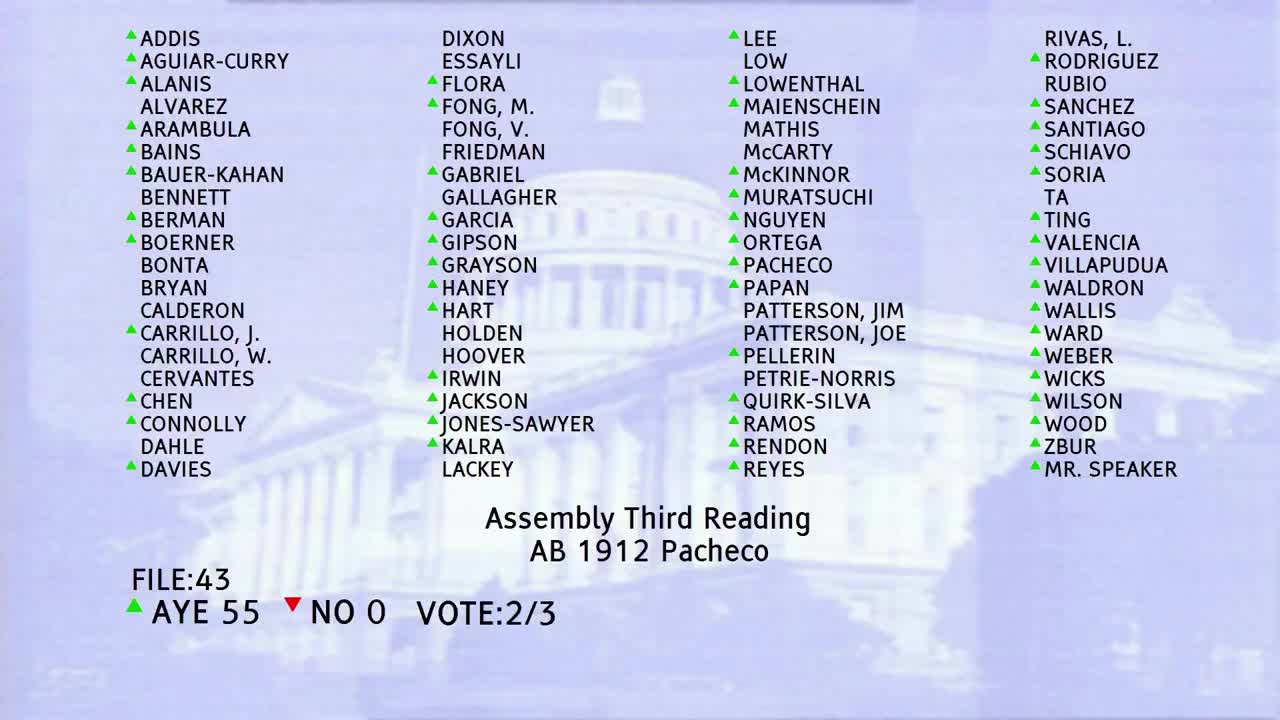 3MIN
Assembly Floor
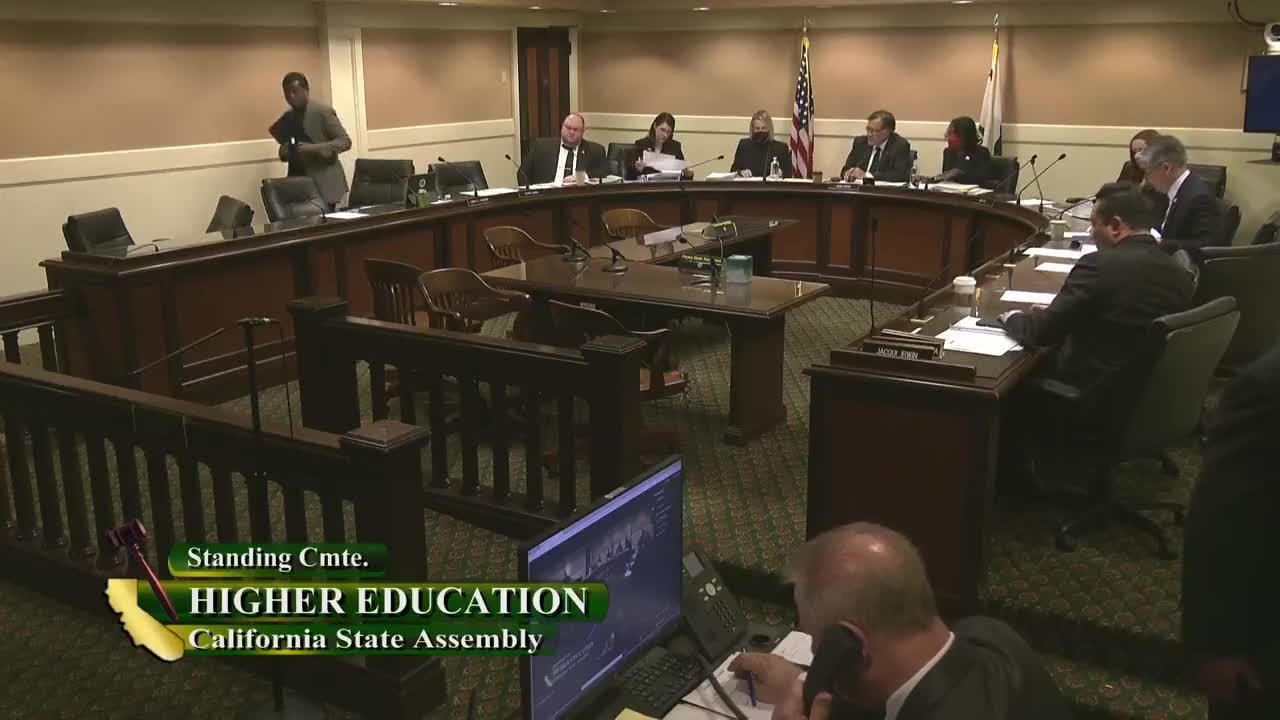 30MIN
Assembly Standing Committee on Higher Education
Bill Author