AB 2120: Trespass.
- Session Year: 2023-2024
- House: Assembly
- Latest Version Date: 2024-09-03
Current Status:
Failed
(2024-09-22: Vetoed by Governor.)
Introduced
In Committee
First Chamber
In Committee
Second Chamber
Enacted
Existing law makes it a misdemeanor to willfully commit a trespass by engaging in specified acts, including driving a vehicle upon real property belonging to, or lawfully occupied by, another and known not to be open to the general public, without the consent of the owner, the owners agent, or the person in lawful possession, except as specified, including making a lawful service of process, as prescribed.
This bill would provide that the above-specified trespass provision does not apply to a repossession agency licensed by the Department of Consumer Affairs and its employees when they are on private property searching for collateral or repossessing collateral, and, upon completing that search or repossession, leave the private property within a reasonable amount of time.
Existing law makes it a misdemeanor to willfully commit a trespass by engaging in specified acts, including driving a vehicle upon real property belonging to, or lawfully occupied by, another and known not to be open to the general public, without the consent of the owner, the owners agent, or the person in lawful possession, except as specified, including making a lawful service of process, as prescribed.
This bill would provide that the above-specified trespass provision does not apply to a repossession agency licensed by the Department of Consumer Affairs and its employees when they are on private property searching for collateral or repossessing collateral, and, upon completing that search, search or repossession, leave the private property within one minute. a reasonable amount of time.
Existing law makes it a misdemeanor to willfully commit a trespass by engaging in specified acts, including driving a vehicle upon real property belonging to, or lawfully occupied by, another and known not to be open to the general public, without the consent of the owner, the owners agent, or the person in lawful possession, except as specified, including making a lawful service of process, as prescribed.
This bill would provide that the above-specified trespass provision does not apply to a repossession agency licensed by the Department of Consumer Affairs and its employees when they are on private property searching for collateral or repossessing collateral, and, upon completing that search, leave the private property within one minute.
Except as provided in subdivisions (u), (v), and (x), and Section 602.8, a person who willfully commits a trespass by any of the following acts is guilty of a misdemeanor:
(a)Cutting down, destroying, or injuring any kind of wood or timber standing or growing upon the lands of another.
(b)Carrying away any kind of wood or timber lying on those lands.
(c)Maliciously injuring or severing from the freehold of another anything attached to it, or its produce.
(d)Digging, taking, or carrying away from a lot situated within the limits of an incorporated city, without the license of the owner or legal occupant, any earth, soil, or stone.
(e)Digging, taking, or carrying away from land in a city or town laid down on the map or plan of the city, or otherwise recognized or established as a street, alley, avenue, or park, without the license of the proper authorities, any earth, soil, or stone.
(f)Maliciously tearing down, damaging, mutilating, or destroying a sign, signboard, or notice placed upon, or affixed to, a property belonging to the state, or to a city, county, city and county, town, or village, or upon the property of a person, by the state or by an automobile association, which sign, signboard, or notice is intended to indicate or designate a road or a highway, or is intended to direct travelers from one point to another, or relates to fires, fire control, or any other matter involving the protection of the property, or putting up, affixing, fastening, printing, or painting upon any property belonging to the state, or to any city, county, town, or village, or dedicated to the public, or upon the property of a person, without license from the owner, a notice, advertisement, or designation of, or a name for a commodity, whether for sale or otherwise, or a picture, sign, or device intended to call attention to it.
(g)Entering upon lands owned by another person whereon oysters or other shellfish are planted or growing; or injuring, gathering, or carrying away oysters or other shellfish planted, growing, or on any of those lands, whether covered by water or not, without the license of the owner or legal occupant; or damaging, destroying, or removing, or causing to be removed, damaged, or destroyed, any stakes, marks, fences, or signs intended to designate the boundaries and limits of those lands.
(h)(1)Entering upon lands or buildings owned by another person without the license of the owner or legal occupant, where signs forbidding trespass are displayed, and whereon cattle, goats, pigs, sheep, fowl, or any other animal is being raised, bred, fed, or held for the purpose of food for human consumption; or injuring, gathering, or carrying away any animal being housed on any of those lands, without the license of the owner or legal occupant; or damaging, destroying, or removing, or causing to be removed, damaged, or destroyed, any stakes, marks, fences, or signs intended to designate the boundaries and limits of those lands.
(2)In order for there to be a violation of this subdivision, the trespass signs under paragraph (1) shall be displayed at intervals not less than three per mile along all exterior boundaries and at all roads and trails entering the land.
(3)This subdivision does not preclude prosecution or punishment under any other law, including, but not limited to, grand theft or any provision that provides for a greater penalty or longer term of imprisonment.
(i)Willfully opening, tearing down, or otherwise destroying a fence on the enclosed land of another, or opening a gate, bar, or fence of another and willfully leaving it open without the written permission of the owner, or maliciously tearing down, mutilating, or destroying a sign, signboard, or other notice forbidding shooting on private property.
(j)Building fires upon lands owned by another where signs forbidding trespass are displayed at intervals not greater than one mile along the exterior boundaries and at all roads and trails entering the lands, without first having obtained written permission from the owner of the lands or the owners agent, or the person in lawful possession.
(k)Entering lands, whether unenclosed or enclosed by fence, for the purpose of injuring property or property rights or with the intention of interfering with, obstructing, or injuring a lawful business or occupation carried on by the owner of the land, the owners agent, or the person in lawful possession.
(l)Entering lands under cultivation or enclosed by fence, belonging to, or occupied by, another, or entering upon uncultivated or unenclosed lands where signs forbidding trespass are displayed at intervals not less than three to the mile along all exterior boundaries and at all roads and trails entering the lands without the written permission of the owner of the land, the owners agent, or the person in lawful possession, and any of the following:
(1)Refusing or failing to leave the lands immediately upon being requested by the owner of the land, the owners agent, or by the person in lawful possession to leave the lands.
(2)Tearing down, mutilating, or destroying a sign, signboard, or notice forbidding trespass or hunting on the lands.
(3)Removing, injuring, unlocking, or tampering with a lock on a gate on or leading into the lands.
(4)Discharging a firearm.
(m)Entering and occupying real property or structures of any kind without the consent of the owner, the owners agent, or the person in lawful possession.
(n)Driving a vehicle, as defined in Section 670 of the Vehicle Code, upon real property belonging to, or lawfully occupied by, another and known not to be open to the general public, without the consent of the owner, the owners agent, or the person in lawful possession.
(1)This subdivision does not apply to a person described in Section 22350 of the Business and Professions Code who is making a lawful service of process, provided that upon exiting the vehicle, the person proceeds immediately to attempt the service of process, and leaves immediately upon completing the service of process or upon the request of the owner, the owners agent, or the person in lawful possession.
(2)This subdivision does not apply to a repossession agency, as defined in Section 7500.2 of the Business and Professions Code, and its employees, when they are on private property searching for collateral or repossessing collateral, and, upon completing that search or repossession, leave the private property within a reasonable amount of time. This paragraph does not restrict the authority of the Director of Consumer Affairs to penalize conduct prohibited under Section 7508.2 of the Business and Professions Code.
(o)(1)Refusing or failing to leave land, real property, or structures belonging to, or lawfully occupied by, another and not open to the general public, upon being requested to leave by (1) a peace officer at the request of the owner, the owners agent, or the person in lawful possession, and upon being informed by the peace officer that they are acting at the request of the owner, the owners agent, or the person in lawful possession, or (2) the owner, the owners agent, or the person in lawful possession. The owner, the owners agent, or the person in lawful possession shall make a separate request to the peace officer on each occasion when the peace officers assistance in dealing with a trespass is requested. However, a single request for a peace officers assistance, made in a notarized writing on a form provided by the law enforcement agency, may be made to cover a limited period of time not to exceed a time period determined by local ordinance or 12 months, whichever is shorter, and identified by specific dates, during which there is a fire hazard or the owner, owners agent, or person in lawful possession is absent from the premises or property. In addition, a single request for a peace officers assistance, made in a notarized writing on a form provided by the law enforcement agency, may be made for a period not to exceed 12 months when the premises or property is closed to the public and posted as being closed. The requestor shall inform the law enforcement agency to which the request was made, in writing, when the assistance is no longer desired, before the period not exceeding 12 months expires. However, this subdivision does not apply to persons engaged in lawful labor union activities that are permitted to be carried out on the property by the Alatorre-Zenovich-Dunlap-Berman Agricultural Labor Relations Act of 1975 (Part 3.5 (commencing with Section 1140) of Division 2 of the Labor Code) or by the federal National Labor Relations Act. For purposes of this section, land, real property, or structures owned or operated by a housing authority for tenants, as defined in Section 34213.5 of the Health and Safety Code, constitutes property not open to the general public; however, this subdivision does not apply to persons on the premises who are engaging in activities protected by the California or United States Constitution, or to persons who are on the premises at the request of a resident or management and who are not loitering or otherwise suspected of violating or actually violating a law or ordinance.
(2)A request for a peace officers assistance shall expire upon transfer of ownership of the property or upon a change in the person in lawful possession.
(3)A request for a peace officers assistance in dealing with a trespass may be submitted electronically. A local government may accept electronic submissions of requests pursuant to this subdivision.
(p)Entering upon lands declared closed to entry, as provided in Section 4256 of the Public Resources Code, if the closed areas have been posted with notices declaring the closure, at intervals not greater than one mile along the exterior boundaries or along roads and trails passing through the lands.
(q)Refusing or failing to leave a public building of a public agency during those hours of the day or night when the building is regularly closed to the public upon being requested to do so by a regularly employed guard, watchperson, or custodian of the public agency owning or maintaining the building or property, if the surrounding circumstances would indicate to a reasonable person that the person has no apparent lawful business to pursue.
(r)Knowingly skiing in an area or on a ski trail that is closed to the public and that has signs posted indicating the closure.
(s)Refusing or failing to leave a hotel or motel, where the person has obtained accommodations and has refused to pay for those accommodations, upon request of the proprietor or manager and the occupancy is exempt, pursuant to subdivision (b) of Section 1940 of the Civil Code, from Chapter 2 (commencing with Section 1940) of Title 5 of Part 4 of Division 3 of the Civil Code. For purposes of this subdivision, occupancy at a hotel or motel for a continuous period of 30 days or less shall, in the absence of a written agreement to the contrary, or other written evidence of a periodic tenancy of indefinite duration, be exempt from Chapter 2 (commencing with Section 1940) of Title 5 of Part 4 of Division 3 of the Civil Code.
(t)(1)Entering upon private property, including contiguous land, real property, or structures thereon belonging to the same owner, whether or not generally open to the public, after having been informed by a peace officer at the request of the owner, the owners agent, or the person in lawful possession, and upon being informed by the peace officer that the peace officer is acting at the request of the owner, the owners agent, or the person in lawful possession, that the property is not open to the particular person; or refusing or failing to leave the property upon being asked to leave the property in the manner provided in this subdivision.
(2)This subdivision applies only to a person who has been convicted of a crime committed upon the particular private property.
(3)A single notification or request to the person as set forth above shall be valid and enforceable under this subdivision unless and until rescinded by the owner, the owners agent, or the person in lawful possession of the property.
(4)Where the person has been convicted of a violent felony, as described in subdivision (c) of Section 667.5, this subdivision applies without time limitation. Where the person has been convicted of any other felony, this subdivision applies for no more than five years from the date of conviction. Where the person has been convicted of a misdemeanor, this subdivision applies for no more than two years from the date of conviction. Where the person was convicted for an infraction pursuant to Section 490.1, this subdivision applies for no more than one year from the date of conviction. This subdivision does not apply to convictions for any other infraction.
(u)(1)Knowingly entering, by an unauthorized person, upon an airport operations area, passenger vessel terminal, or public transit facility if the area has been posted with notices restricting access to authorized personnel only and the postings occur not greater than every 150 feet along the exterior boundary, to the extent, in the case of a passenger vessel terminal, as defined in subparagraph (B) of paragraph (3), that the exterior boundary extends shoreside. To the extent that the exterior boundary of a passenger vessel terminal operations area extends waterside, this prohibition applies if notices have been posted in a manner consistent with the requirements for the shoreside exterior boundary, or in any other manner approved by the captain of the port.
(2)A person convicted of a violation of paragraph (1) shall be punished as follows:
(A)By a fine not exceeding one hundred dollars ($100).
(B)By imprisonment in a county jail not exceeding six months, or by a fine not exceeding one thousand dollars ($1,000), or by both that fine and imprisonment, if the person refuses to leave the airport or passenger vessel terminal after being requested to leave by a peace officer or authorized personnel.
(C)By imprisonment in a county jail not exceeding six months, or by a fine not exceeding one thousand dollars ($1,000), or by both that fine and imprisonment, for a second or subsequent offense.
(3)As used in this subdivision, the following definitions shall control:
(A)Airport operations area means that part of the airport used by aircraft for landing, taking off, surface maneuvering, loading and unloading, refueling, parking, or maintenance, where aircraft support vehicles and facilities exist, and which is not for public use or public vehicular traffic.
(B)Passenger vessel terminal means only that portion of a harbor or port facility, as described in Section 105.105(a)(2) of Title 33 of the Code of Federal Regulations, with a secured area that regularly serves scheduled commuter or passenger operations. For the purposes of this section, passenger vessel terminal does not include any area designated a public access area pursuant to Section 105.106 of Title 33 of the Code of Federal Regulations.
(C)Public transit facility has the same meaning as specified in Section 171.7.
(D)(i)Authorized personnel means a person who has a valid airport identification card issued by the airport operator or has a valid airline identification card recognized by the airport operator, or any person not in possession of an airport or airline identification card who is being escorted for legitimate purposes by a person with an airport or airline identification card.
(ii)Authorized personnel also means a person who has a valid port identification card issued by the harbor operator, or who has a valid company identification card issued by a commercial maritime enterprise recognized by the harbor operator, or any other person who is being escorted for legitimate purposes by a person with a valid port or qualifying company identification card.
(iii)Authorized personnel also means a person who has a valid public transit employee identification card.
(E)Airport means a facility whose function is to support commercial aviation.
(v)(1)Except as permitted by federal law, intentionally avoiding submission to the screening and inspection of ones person and accessible property in accordance with the procedures being applied to control access when entering or reentering a sterile area of an airport, passenger vessel terminal, as defined in subdivision (u), or public transit facility, as defined in Section 171.7, if the sterile area is posted with a statement providing reasonable notice that prosecution may result from a trespass described in this subdivision, is a violation of this subdivision, punishable by a fine of not more than five hundred dollars ($500) for the first offense. A second and subsequent violation is a misdemeanor, punishable by imprisonment in a county jail for a period of not more than one year, or by a fine not to exceed one thousand dollars ($1,000), or by both that fine and imprisonment.
(2)Notwithstanding paragraph (1), if a first violation of this subdivision is responsible for the evacuation of an airport terminal, passenger vessel terminal, or public transit facility and is responsible in any part for delays or cancellations of scheduled flights or departures, it is punishable by imprisonment of not more than one year in a county jail.
(w)Refusing or failing to leave the location of a domestic violence shelter-based program at any time after being requested to leave by a managing authority of the shelter.
(1)A person who is convicted of violating this subdivision shall be punished by imprisonment in a county jail for not more than one year.
(2)The court may order a defendant who is convicted of violating this subdivision to make restitution to a victim of domestic violence in an amount equal to the relocation expenses of the victim of domestic violence and the victims children if those expenses are incurred as a result of trespass by the defendant at the location of a domestic violence shelter-based program.
(x)(1)Knowingly entering or remaining in a neonatal unit, maternity ward, or birthing center located in a hospital or clinic without lawful business to pursue therein, if the area has been posted so as to give reasonable notice restricting access to those with lawful business to pursue therein and the surrounding circumstances would indicate to a reasonable person that the person has no lawful business to pursue therein. Reasonable notice is that which would give actual notice to a reasonable person, and is posted, at a minimum, at each entrance into the area.
(2)A person convicted of a violation of paragraph (1) shall be punished as follows:
(A)As an infraction, by a fine not exceeding one hundred dollars ($100).
(B)By imprisonment in a county jail not exceeding one year, or by a fine not exceeding one thousand dollars ($1,000), or by both that fine and imprisonment, if the person refuses to leave the posted area after being requested to leave by a peace officer or other authorized person.
(C)By imprisonment in a county jail not exceeding one year, or by a fine not exceeding two thousand dollars ($2,000), or by both that fine and imprisonment, for a second or subsequent offense.
(D)If probation is granted or the execution or imposition of sentencing is suspended for a person convicted under this subdivision, it shall be a condition of probation that the person participate in counseling, as designated by the court, unless the court finds good cause not to impose this requirement. The court shall require the person to pay for this counseling, if ordered, unless good cause not to pay is shown.
(y)Except as permitted by federal law, intentionally avoiding submission to the screening and inspection of ones person and accessible property in accordance with the procedures being applied to control access when entering or reentering a courthouse or a city, county, city and county, or state building if entrances to the courthouse or the city, county, city and county, or state building have been posted with a statement providing reasonable notice that prosecution may result from a trespass described in this subdivision.
Except as provided in subdivisions (u), (v), and (x), and Section 602.8, a person who willfully commits a trespass by any of the following acts is guilty of a misdemeanor:
(a)Cutting down, destroying, or injuring any kind of wood or timber standing or growing upon the lands of another.
(b)Carrying away any kind of wood or timber lying on those lands.
(c)Maliciously injuring or severing from the freehold of another anything attached to it, or its produce.
(d)Digging, taking, or carrying away from a lot situated within the limits of an incorporated city, without the license of the owner or legal occupant, any earth, soil, or stone.
(e)Digging, taking, or carrying away from land in a city or town laid down on the map or plan of the city, or otherwise recognized or established as a street, alley, avenue, or park, without the license of the proper authorities, any earth, soil, or stone.
(f)Maliciously tearing down, damaging, mutilating, or destroying a sign, signboard, or notice placed upon, or affixed to, a property belonging to the state, or to a city, county, city and county, town, or village, or upon the property of a person, by the state or by an automobile association, which sign, signboard, or notice is intended to indicate or designate a road or a highway, or is intended to direct travelers from one point to another, or relates to fires, fire control, or any other matter involving the protection of the property, or putting up, affixing, fastening, printing, or painting upon any property belonging to the state, or to any city, county, town, or village, or dedicated to the public, or upon the property of a person, without license from the owner, a notice, advertisement, or designation of, or a name for a commodity, whether for sale or otherwise, or a picture, sign, or device intended to call attention to it.
(g)Entering upon lands owned by another person whereon oysters or other shellfish are planted or growing; or injuring, gathering, or carrying away oysters or other shellfish planted, growing, or on any of those lands, whether covered by water or not, without the license of the owner or legal occupant; or damaging, destroying, or removing, or causing to be removed, damaged, or destroyed, any stakes, marks, fences, or signs intended to designate the boundaries and limits of those lands.
(h)(1)Entering upon lands or buildings owned by another person without the license of the owner or legal occupant, where signs forbidding trespass are displayed, and whereon cattle, goats, pigs, sheep, fowl, or any other animal is being raised, bred, fed, or held for the purpose of food for human consumption; or injuring, gathering, or carrying away any animal being housed on any of those lands, without the license of the owner or legal occupant; or damaging, destroying, or removing, or causing to be removed, damaged, or destroyed, any stakes, marks, fences, or signs intended to designate the boundaries and limits of those lands.
(2)In order for there to be a violation of this subdivision, the trespass signs under paragraph (1) shall be displayed at intervals not less than three per mile along all exterior boundaries and at all roads and trails entering the land.
(3)This subdivision does not preclude prosecution or punishment under any other law, including, but not limited to, grand theft or any provision that provides for a greater penalty or longer term of imprisonment.
(i)Willfully opening, tearing down, or otherwise destroying a fence on the enclosed land of another, or opening a gate, bar, or fence of another and willfully leaving it open without the written permission of the owner, or maliciously tearing down, mutilating, or destroying a sign, signboard, or other notice forbidding shooting on private property.
(j)Building fires upon lands owned by another where signs forbidding trespass are displayed at intervals not greater than one mile along the exterior boundaries and at all roads and trails entering the lands, without first having obtained written permission from the owner of the lands or the owners agent, or the person in lawful possession.
(k)Entering lands, whether unenclosed or enclosed by fence, for the purpose of injuring property or property rights or with the intention of interfering with, obstructing, or injuring a lawful business or occupation carried on by the owner of the land, the owners agent, or the person in lawful possession.
(l)Entering lands under cultivation or enclosed by fence, belonging to, or occupied by, another, or entering upon uncultivated or unenclosed lands where signs forbidding trespass are displayed at intervals not less than three to the mile along all exterior boundaries and at all roads and trails entering the lands without the written permission of the owner of the land, the owners agent, or the person in lawful possession, and any of the following:
(1)Refusing or failing to leave the lands immediately upon being requested by the owner of the land, the owners agent, or by the person in lawful possession to leave the lands.
(2)Tearing down, mutilating, or destroying a sign, signboard, or notice forbidding trespass or hunting on the lands.
(3)Removing, injuring, unlocking, or tampering with a lock on a gate on or leading into the lands.
(4)Discharging a firearm.
(m)Entering and occupying real property or structures of any kind without the consent of the owner, the owners agent, or the person in lawful possession.
(n)Driving a vehicle, as defined in Section 670 of the Vehicle Code, upon real property belonging to, or lawfully occupied by, another and known not to be open to the general public, without the consent of the owner, the owners agent, or the person in lawful possession.
(1)This subdivision does not apply to a person described in Section 22350 of the Business and Professions Code who is making a lawful service of process, provided that upon exiting the vehicle, the person proceeds immediately to attempt the service of process, and leaves immediately upon completing the service of process or upon the request of the owner, the owners agent, or the person in lawful possession.
(2)This subdivision does not apply to a repossession agency, as defined in Section 7500.2 of the Business and Professions Code, and its employees, when they are on private property searching for collateral or repossessing collateral, and, upon completing that search, search or repossession, leave the private property within one minute. a reasonable amount of time. This paragraph does not restrict the authority of the Director of Consumer Affairs to penalize conduct prohibited under Section 7508.2 of the Business and Professions Code.
(o)(1)Refusing or failing to leave land, real property, or structures belonging to, or lawfully occupied by, another and not open to the general public, upon being requested to leave by (1) a peace officer at the request of the owner, the owners agent, or the person in lawful possession, and upon being informed by the peace officer that they are acting at the request of the owner, the owners agent, or the person in lawful possession, or (2) the owner, the owners agent, or the person in lawful possession. The owner, the owners agent, or the person in lawful possession shall make a separate request to the peace officer on each occasion when the peace officers assistance in dealing with a trespass is requested. However, a single request for a peace officers assistance, made in a notarized writing on a form provided by the law enforcement agency, may be made to cover a limited period of time not to exceed a time period determined by local ordinance or 12 months, whichever is shorter, and identified by specific dates, during which there is a fire hazard or the owner, owners agent, or person in lawful possession is absent from the premises or property. In addition, a single request for a peace officers assistance, made in a notarized writing on a form provided by the law enforcement agency, may be made for a period not to exceed 12 months when the premises or property is closed to the public and posted as being closed. The requestor shall inform the law enforcement agency to which the request was made, in writing, when the assistance is no longer desired, before the period not exceeding 12 months expires. However, this subdivision does not apply to persons engaged in lawful labor union activities that are permitted to be carried out on the property by the Alatorre-Zenovich-Dunlap-Berman Agricultural Labor Relations Act of 1975 (Part 3.5 (commencing with Section 1140) of Division 2 of the Labor Code) or by the federal National Labor Relations Act. For purposes of this section, land, real property, or structures owned or operated by a housing authority for tenants, as defined in Section 34213.5 of the Health and Safety Code, constitutes property not open to the general public; however, this subdivision does not apply to persons on the premises who are engaging in activities protected by the California or United States Constitution, or to persons who are on the premises at the request of a resident or management and who are not loitering or otherwise suspected of violating or actually violating a law or ordinance.
(2)A request for a peace officers assistance shall expire upon transfer of ownership of the property or upon a change in the person in lawful possession.
(3)A request for a peace officers assistance in dealing with a trespass may be submitted electronically. A local government may accept electronic submissions of requests pursuant to this subdivision.
(p)Entering upon lands declared closed to entry, as provided in Section 4256 of the Public Resources Code, if the closed areas have been posted with notices declaring the closure, at intervals not greater than one mile along the exterior boundaries or along roads and trails passing through the lands.
(q)Refusing or failing to leave a public building of a public agency during those hours of the day or night when the building is regularly closed to the public upon being requested to do so by a regularly employed guard, watchperson, or custodian of the public agency owning or maintaining the building or property, if the surrounding circumstances would indicate to a reasonable person that the person has no apparent lawful business to pursue.
(r)Knowingly skiing in an area or on a ski trail that is closed to the public and that has signs posted indicating the closure.
(s)Refusing or failing to leave a hotel or motel, where the person has obtained accommodations and has refused to pay for those accommodations, upon request of the proprietor or manager and the occupancy is exempt, pursuant to subdivision (b) of Section 1940 of the Civil Code, from Chapter 2 (commencing with Section 1940) of Title 5 of Part 4 of Division 3 of the Civil Code. For purposes of this subdivision, occupancy at a hotel or motel for a continuous period of 30 days or less shall, in the absence of a written agreement to the contrary, or other written evidence of a periodic tenancy of indefinite duration, be exempt from Chapter 2 (commencing with Section 1940) of Title 5 of Part 4 of Division 3 of the Civil Code.
(t)(1)Entering upon private property, including contiguous land, real property, or structures thereon belonging to the same owner, whether or not generally open to the public, after having been informed by a peace officer at the request of the owner, the owners agent, or the person in lawful possession, and upon being informed by the peace officer that the peace officer is acting at the request of the owner, the owners agent, or the person in lawful possession, that the property is not open to the particular person; or refusing or failing to leave the property upon being asked to leave the property in the manner provided in this subdivision.
(2)This subdivision applies only to a person who has been convicted of a crime committed upon the particular private property.
(3)A single notification or request to the person as set forth above shall be valid and enforceable under this subdivision unless and until rescinded by the owner, the owners agent, or the person in lawful possession of the property.
(4)Where the person has been convicted of a violent felony, as described in subdivision (c) of Section 667.5, this subdivision applies without time limitation. Where the person has been convicted of any other felony, this subdivision applies for no more than five years from the date of conviction. Where the person has been convicted of a misdemeanor, this subdivision applies for no more than two years from the date of conviction. Where the person was convicted for an infraction pursuant to Section 490.1, this subdivision applies for no more than one year from the date of conviction. This subdivision does not apply to convictions for any other infraction.
(u)(1)Knowingly entering, by an unauthorized person, upon an airport operations area, passenger vessel terminal, or public transit facility if the area has been posted with notices restricting access to authorized personnel only and the postings occur not greater than every 150 feet along the exterior boundary, to the extent, in the case of a passenger vessel terminal, as defined in subparagraph (B) of paragraph (3), that the exterior boundary extends shoreside. To the extent that the exterior boundary of a passenger vessel terminal operations area extends waterside, this prohibition applies if notices have been posted in a manner consistent with the requirements for the shoreside exterior boundary, or in any other manner approved by the captain of the port.
(2)A person convicted of a violation of paragraph (1) shall be punished as follows:
(A)By a fine not exceeding one hundred dollars ($100).
(B)By imprisonment in a county jail not exceeding six months, or by a fine not exceeding one thousand dollars ($1,000), or by both that fine and imprisonment, if the person refuses to leave the airport or passenger vessel terminal after being requested to leave by a peace officer or authorized personnel.
(C)By imprisonment in a county jail not exceeding six months, or by a fine not exceeding one thousand dollars ($1,000), or by both that fine and imprisonment, for a second or subsequent offense.
(3)As used in this subdivision, the following definitions shall control:
(A)Airport operations area means that part of the airport used by aircraft for landing, taking off, surface maneuvering, loading and unloading, refueling, parking, or maintenance, where aircraft support vehicles and facilities exist, and which is not for public use or public vehicular traffic.
(B)Passenger vessel terminal means only that portion of a harbor or port facility, as described in Section 105.105(a)(2) of Title 33 of the Code of Federal Regulations, with a secured area that regularly serves scheduled commuter or passenger operations. For the purposes of this section, passenger vessel terminal does not include any area designated a public access area pursuant to Section 105.106 of Title 33 of the Code of Federal Regulations.
(C)Public transit facility has the same meaning as specified in Section 171.7.
(D)(i)Authorized personnel means a person who has a valid airport identification card issued by the airport operator or has a valid airline identification card recognized by the airport operator, or any person not in possession of an airport or airline identification card who is being escorted for legitimate purposes by a person with an airport or airline identification card.
(ii)Authorized personnel also means a person who has a valid port identification card issued by the harbor operator, or who has a valid company identification card issued by a commercial maritime enterprise recognized by the harbor operator, or any other person who is being escorted for legitimate purposes by a person with a valid port or qualifying company identification card.
(iii)Authorized personnel also means a person who has a valid public transit employee identification card.
(E)Airport means a facility whose function is to support commercial aviation.
(v)(1)Except as permitted by federal law, intentionally avoiding submission to the screening and inspection of ones person and accessible property in accordance with the procedures being applied to control access when entering or reentering a sterile area of an airport, passenger vessel terminal, as defined in subdivision (u), or public transit facility, as defined in Section 171.7, if the sterile area is posted with a statement providing reasonable notice that prosecution may result from a trespass described in this subdivision, is a violation of this subdivision, punishable by a fine of not more than five hundred dollars ($500) for the first offense. A second and subsequent violation is a misdemeanor, punishable by imprisonment in a county jail for a period of not more than one year, or by a fine not to exceed one thousand dollars ($1,000), or by both that fine and imprisonment.
(2)Notwithstanding paragraph (1), if a first violation of this subdivision is responsible for the evacuation of an airport terminal, passenger vessel terminal, or public transit facility and is responsible in any part for delays or cancellations of scheduled flights or departures, it is punishable by imprisonment of not more than one year in a county jail.
(w)Refusing or failing to leave the location of a domestic violence shelter-based program at any time after being requested to leave by a managing authority of the shelter.
(1)A person who is convicted of violating this subdivision shall be punished by imprisonment in a county jail for not more than one year.
(2)The court may order a defendant who is convicted of violating this subdivision to make restitution to a victim of domestic violence in an amount equal to the relocation expenses of the victim of domestic violence and the victims children if those expenses are incurred as a result of trespass by the defendant at the location of a domestic violence shelter-based program.
(x)(1)Knowingly entering or remaining in a neonatal unit, maternity ward, or birthing center located in a hospital or clinic without lawful business to pursue therein, if the area has been posted so as to give reasonable notice restricting access to those with lawful business to pursue therein and the surrounding circumstances would indicate to a reasonable person that the person has no lawful business to pursue therein. Reasonable notice is that which would give actual notice to a reasonable person, and is posted, at a minimum, at each entrance into the area.
(2)A person convicted of a violation of paragraph (1) shall be punished as follows:
(A)As an infraction, by a fine not exceeding one hundred dollars ($100).
(B)By imprisonment in a county jail not exceeding one year, or by a fine not exceeding one thousand dollars ($1,000), or by both that fine and imprisonment, if the person refuses to leave the posted area after being requested to leave by a peace officer or other authorized person.
(C)By imprisonment in a county jail not exceeding one year, or by a fine not exceeding two thousand dollars ($2,000), or by both that fine and imprisonment, for a second or subsequent offense.
(D)If probation is granted or the execution or imposition of sentencing is suspended for a person convicted under this subdivision, it shall be a condition of probation that the person participate in counseling, as designated by the court, unless the court finds good cause not to impose this requirement. The court shall require the person to pay for this counseling, if ordered, unless good cause not to pay is shown.
(y)Except as permitted by federal law, intentionally avoiding submission to the screening and inspection of ones person and accessible property in accordance with the procedures being applied to control access when entering or reentering a courthouse or a city, county, city and county, or state building if entrances to the courthouse or the city, county, city and county, or state building have been posted with a statement providing reasonable notice that prosecution may result from a trespass described in this subdivision.
Except as provided in subdivisions (u), (v), and (x), and Section 602.8, a person who willfully commits a trespass by any of the following acts is guilty of a misdemeanor:
(a)Cutting down, destroying, or injuring any kind of wood or timber standing or growing upon the lands of another.
(b)Carrying away any kind of wood or timber lying on those lands.
(c)Maliciously injuring or severing from the freehold of another anything attached to it, or its produce.
(d)Digging, taking, or carrying away from a lot situated within the limits of an incorporated city, without the license of the owner or legal occupant, any earth, soil, or stone.
(e)Digging, taking, or carrying away from land in a city or town laid down on the map or plan of the city, or otherwise recognized or established as a street, alley, avenue, or park, without the license of the proper authorities, any earth, soil, or stone.
(f)Maliciously tearing down, damaging, mutilating, or destroying a sign, signboard, or notice placed upon, or affixed to, a property belonging to the state, or to a city, county, city and county, town, or village, or upon the property of a person, by the state or by an automobile association, which sign, signboard, or notice is intended to indicate or designate a road or a highway, or is intended to direct travelers from one point to another, or relates to fires, fire control, or any other matter involving the protection of the property, or putting up, affixing, fastening, printing, or painting upon any property belonging to the state, or to any city, county, town, or village, or dedicated to the public, or upon the property of a person, without license from the owner, a notice, advertisement, or designation of, or a name for a commodity, whether for sale or otherwise, or a picture, sign, or device intended to call attention to it.
(g)Entering upon lands owned by another person whereon oysters or other shellfish are planted or growing; or injuring, gathering, or carrying away oysters or other shellfish planted, growing, or on any of those lands, whether covered by water or not, without the license of the owner or legal occupant; or damaging, destroying, or removing, or causing to be removed, damaged, or destroyed, any stakes, marks, fences, or signs intended to designate the boundaries and limits of those lands.
(h)(1)Entering upon lands or buildings owned by another person without the license of the owner or legal occupant, where signs forbidding trespass are displayed, and whereon cattle, goats, pigs, sheep, fowl, or any other animal is being raised, bred, fed, or held for the purpose of food for human consumption; or injuring, gathering, or carrying away any animal being housed on any of those lands, without the license of the owner or legal occupant; or damaging, destroying, or removing, or causing to be removed, damaged, or destroyed, any stakes, marks, fences, or signs intended to designate the boundaries and limits of those lands.
(2)In order for there to be a violation of this subdivision, the trespass signs under paragraph (1) shall be displayed at intervals not less than three per mile along all exterior boundaries and at all roads and trails entering the land.
(3)This subdivision does not preclude prosecution or punishment under any other law, including, but not limited to, grand theft or any provision that provides for a greater penalty or longer term of imprisonment.
(i)Willfully opening, tearing down, or otherwise destroying a fence on the enclosed land of another, or opening a gate, bar, or fence of another and willfully leaving it open without the written permission of the owner, or maliciously tearing down, mutilating, or destroying a sign, signboard, or other notice forbidding shooting on private property.
(j)Building fires upon lands owned by another where signs forbidding trespass are displayed at intervals not greater than one mile along the exterior boundaries and at all roads and trails entering the lands, without first having obtained written permission from the owner of the lands or the owners agent, or the person in lawful possession.
(k)Entering lands, whether unenclosed or enclosed by fence, for the purpose of injuring property or property rights or with the intention of interfering with, obstructing, or injuring a lawful business or occupation carried on by the owner of the land, the owners agent, or the person in lawful possession.
(l)Entering lands under cultivation or enclosed by fence, belonging to, or occupied by, another, or entering upon uncultivated or unenclosed lands where signs forbidding trespass are displayed at intervals not less than three to the mile along all exterior boundaries and at all roads and trails entering the lands without the written permission of the owner of the land, the owners agent, or the person in lawful possession, and any of the following:
(1)Refusing or failing to leave the lands immediately upon being requested by the owner of the land, the owners agent, or by the person in lawful possession to leave the lands.
(2)Tearing down, mutilating, or destroying a sign, signboard, or notice forbidding trespass or hunting on the lands.
(3)Removing, injuring, unlocking, or tampering with a lock on a gate on or leading into the lands.
(4)Discharging a firearm.
(m)Entering and occupying real property or structures of any kind without the consent of the owner, the owners agent, or the person in lawful possession.
(n)Driving a vehicle, as defined in Section 670 of the Vehicle Code, upon real property belonging to, or lawfully occupied by, another and known not to be open to the general public, without the consent of the owner, the owners agent, or the person in lawful possession. This
(1)This subdivision does not apply to a person described in Section 22350 of the Business and Professions Code who is making a lawful service of process, provided that upon exiting the vehicle, the person proceeds immediately to attempt the service of process, and leaves immediately upon completing the service of process or upon the request of the owner, the owners agent, or the person in lawful possession.
(2)This subdivision does not apply to a repossession agency, as defined in Section 7500.2 of the Business and Professions Code, and its employees, when they are on private property searching for collateral or repossessing collateral, and, upon completing that search, leave the private property within one minute.
(o)(1)Refusing or failing to leave land, real property, or structures belonging to, or lawfully occupied by, another and not open to the general public, upon being requested to leave by (1) a peace officer at the request of the owner, the owners agent, or the person in lawful possession, and upon being informed by the peace officer that they are acting at the request of the owner, the owners agent, or the person in lawful possession, or (2) the owner, the owners agent, or the person in lawful possession. The owner, the owners agent, or the person in lawful possession shall make a separate request to the peace officer on each occasion when the peace officers assistance in dealing with a trespass is requested. However, a single request for a peace officers assistance, made in a notarized writing on a form provided by the law enforcement agency, may be made to cover a limited period of time not to exceed a time period determined by local ordinance or 12 months, whichever is shorter, and identified by specific dates, during which there is a fire hazard or the owner, owners agent, or person in lawful possession is absent from the premises or property. In addition, a single request for a peace officers assistance, made in a notarized writing on a form provided by the law enforcement agency, may be made for a period not to exceed 12 months when the premises or property is closed to the public and posted as being closed. The requestor shall inform the law enforcement agency to which the request was made, in writing, when the assistance is no longer desired, before the period not exceeding 12 months expires. However, this subdivision does not apply to persons engaged in lawful labor union activities that are permitted to be carried out on the property by the Alatorre-Zenovich-Dunlap-Berman Agricultural Labor Relations Act of 1975 (Part 3.5 (commencing with Section 1140) of Division 2 of the Labor Code) or by the federal National Labor Relations Act. For purposes of this section, land, real property, or structures owned or operated by a housing authority for tenants, as defined in Section 34213.5 of the Health and Safety Code, constitutes property not open to the general public; however, this subdivision does not apply to persons on the premises who are engaging in activities protected by the California or United States Constitution, or to persons who are on the premises at the request of a resident or management and who are not loitering or otherwise suspected of violating or actually violating a law or ordinance.
(2)A request for a peace officers assistance shall expire upon transfer of ownership of the property or upon a change in the person in lawful possession.
(3)A request for a peace officers assistance in dealing with a trespass may be submitted electronically. A local government may accept electronic submissions of requests pursuant to this subdivision.
(p)Entering upon lands declared closed to entry, as provided in Section 4256 of the Public Resources Code, if the closed areas have been posted with notices declaring the closure, at intervals not greater than one mile along the exterior boundaries or along roads and trails passing through the lands.
(q)Refusing or failing to leave a public building of a public agency during those hours of the day or night when the building is regularly closed to the public upon being requested to do so by a regularly employed guard, watchperson, or custodian of the public agency owning or maintaining the building or property, if the surrounding circumstances would indicate to a reasonable person that the person has no apparent lawful business to pursue.
(r)Knowingly skiing in an area or on a ski trail that is closed to the public and that has signs posted indicating the closure.
(s)Refusing or failing to leave a hotel or motel, where the person has obtained accommodations and has refused to pay for those accommodations, upon request of the proprietor or manager and the occupancy is exempt, pursuant to subdivision (b) of Section 1940 of the Civil Code, from Chapter 2 (commencing with Section 1940) of Title 5 of Part 4 of Division 3 of the Civil Code. For purposes of this subdivision, occupancy at a hotel or motel for a continuous period of 30 days or less shall, in the absence of a written agreement to the contrary, or other written evidence of a periodic tenancy of indefinite duration, be exempt from Chapter 2 (commencing with Section 1940) of Title 5 of Part 4 of Division 3 of the Civil Code.
(t)(1)Entering upon private property, including contiguous land, real property, or structures thereon belonging to the same owner, whether or not generally open to the public, after having been informed by a peace officer at the request of the owner, the owners agent, or the person in lawful possession, and upon being informed by the peace officer that the peace officer is acting at the request of the owner, the owners agent, or the person in lawful possession, that the property is not open to the particular person; or refusing or failing to leave the property upon being asked to leave the property in the manner provided in this subdivision.
(2)This subdivision applies only to a person who has been convicted of a crime committed upon the particular private property.
(3)A single notification or request to the person as set forth above shall be valid and enforceable under this subdivision unless and until rescinded by the owner, the owners agent, or the person in lawful possession of the property.
(4)Where the person has been convicted of a violent felony, as described in subdivision (c) of Section 667.5, this subdivision applies without time limitation. Where the person has been convicted of any other felony, this subdivision applies for no more than five years from the date of conviction. Where the person has been convicted of a misdemeanor, this subdivision applies for no more than two years from the date of conviction. Where the person was convicted for an infraction pursuant to Section 490.1, this subdivision applies for no more than one year from the date of conviction. This subdivision does not apply to convictions for any other infraction.
(u)(1)Knowingly entering, by an unauthorized person, upon an airport operations area, passenger vessel terminal, or public transit facility if the area has been posted with notices restricting access to authorized personnel only and the postings occur not greater than every 150 feet along the exterior boundary, to the extent, in the case of a passenger vessel terminal, as defined in subparagraph (B) of paragraph (3), that the exterior boundary extends shoreside. To the extent that the exterior boundary of a passenger vessel terminal operations area extends waterside, this prohibition applies if notices have been posted in a manner consistent with the requirements for the shoreside exterior boundary, or in any other manner approved by the captain of the port.
(2)A person convicted of a violation of paragraph (1) shall be punished as follows:
(A)By a fine not exceeding one hundred dollars ($100).
(B)By imprisonment in a county jail not exceeding six months, or by a fine not exceeding one thousand dollars ($1,000), or by both that fine and imprisonment, if the person refuses to leave the airport or passenger vessel terminal after being requested to leave by a peace officer or authorized personnel.
(C)By imprisonment in a county jail not exceeding six months, or by a fine not exceeding one thousand dollars ($1,000), or by both that fine and imprisonment, for a second or subsequent offense.
(3)As used in this subdivision, the following definitions shall control:
(A)Airport operations area means that part of the airport used by aircraft for landing, taking off, surface maneuvering, loading and unloading, refueling, parking, or maintenance, where aircraft support vehicles and facilities exist, and which is not for public use or public vehicular traffic.
(B)Passenger vessel terminal means only that portion of a harbor or port facility, as described in Section 105.105(a)(2) of Title 33 of the Code of Federal Regulations, with a secured area that regularly serves scheduled commuter or passenger operations. For the purposes of this section, passenger vessel terminal does not include any area designated a public access area pursuant to Section 105.106 of Title 33 of the Code of Federal Regulations.
(C)Public transit facility has the same meaning as specified in Section 171.7.
(D)(i)Authorized personnel means a person who has a valid airport identification card issued by the airport operator or has a valid airline identification card recognized by the airport operator, or any person not in possession of an airport or airline identification card who is being escorted for legitimate purposes by a person with an airport or airline identification card.
(ii)Authorized personnel also means a person who has a valid port identification card issued by the harbor operator, or who has a valid company identification card issued by a commercial maritime enterprise recognized by the harbor operator, or any other person who is being escorted for legitimate purposes by a person with a valid port or qualifying company identification card.
(iii)Authorized personnel also means a person who has a valid public transit employee identification card.
(E)Airport means a facility whose function is to support commercial aviation.
(v)(1)Except as permitted by federal law, intentionally avoiding submission to the screening and inspection of ones person and accessible property in accordance with the procedures being applied to control access when entering or reentering a sterile area of an airport, passenger vessel terminal, as defined in subdivision (u), or public transit facility, as defined in Section 171.7, if the sterile area is posted with a statement providing reasonable notice that prosecution may result from a trespass described in this subdivision, is a violation of this subdivision, punishable by a fine of not more than five hundred dollars ($500) for the first offense. A second and subsequent violation is a misdemeanor, punishable by imprisonment in a county jail for a period of not more than one year, or by a fine not to exceed one thousand dollars ($1,000), or by both that fine and imprisonment.
(2)Notwithstanding paragraph (1), if a first violation of this subdivision is responsible for the evacuation of an airport terminal, passenger vessel terminal, or public transit facility and is responsible in any part for delays or cancellations of scheduled flights or departures, it is punishable by imprisonment of not more than one year in a county jail.
(w)Refusing or failing to leave the location of a domestic violence shelter-based program at any time after being requested to leave by a managing authority of the shelter.
(1)A person who is convicted of violating this subdivision shall be punished by imprisonment in a county jail for not more than one year.
(2)The court may order a defendant who is convicted of violating this subdivision to make restitution to a victim of domestic violence in an amount equal to the relocation expenses of the victim of domestic violence and the victims children if those expenses are incurred as a result of trespass by the defendant at the location of a domestic violence shelter-based program.
(x)(1)Knowingly entering or remaining in a neonatal unit, maternity ward, or birthing center located in a hospital or clinic without lawful business to pursue therein, if the area has been posted so as to give reasonable notice restricting access to those with lawful business to pursue therein and the surrounding circumstances would indicate to a reasonable person that the person has no lawful business to pursue therein. Reasonable notice is that which would give actual notice to a reasonable person, and is posted, at a minimum, at each entrance into the area.
(2)A person convicted of a violation of paragraph (1) shall be punished as follows:
(A)As an infraction, by a fine not exceeding one hundred dollars ($100).
(B)By imprisonment in a county jail not exceeding one year, or by a fine not exceeding one thousand dollars ($1,000), or by both that fine and imprisonment, if the person refuses to leave the posted area after being requested to leave by a peace officer or other authorized person.
(C)By imprisonment in a county jail not exceeding one year, or by a fine not exceeding two thousand dollars ($2,000), or by both that fine and imprisonment, for a second or subsequent offense.
(D)If probation is granted or the execution or imposition of sentencing is suspended for a person convicted under this subdivision, it shall be a condition of probation that the person participate in counseling, as designated by the court, unless the court finds good cause not to impose this requirement. The court shall require the person to pay for this counseling, if ordered, unless good cause not to pay is shown.
(y)Except as permitted by federal law, intentionally avoiding submission to the screening and inspection of ones person and accessible property in accordance with the procedures being applied to control access when entering or reentering a courthouse or a city, county, city and county, or state building if entrances to the courthouse or the city, county, city and county, or state building have been posted with a statement providing reasonable notice that prosecution may result from a trespass described in this subdivision.
|
Date
|
Status
|
|---|---|
| Sep 22, 2024 | Vetoed by Governor. |
| Sep 11, 2024 | Enrolled and presented to the Governor at 4 p.m. |
| Aug 29, 2024 | Senate amendments concurred in. To Engrossing and Enrolling. (Ayes 75. Noes 0.). |
| Aug 29, 2024 | Assembly Rule 77 suspended. |
| Aug 28, 2024 | In Assembly. Concurrence in Senate amendments pending. May be considered on or after August 30 pursuant to Assembly Rule 77. |
| Aug 28, 2024 | Read third time. Passed. Ordered to the Assembly. (Ayes 40. Noes 0.). |
| Aug 19, 2024 | Read second time. Ordered to third reading. |
| Aug 15, 2024 | From committee: Do pass. (Ayes 7. Noes 0.) (August 15). |
| Jun 17, 2024 | In committee: Referred to suspense file. |
| Jun 4, 2024 | From committee: Do pass and re-refer to Com. on APPR. (Ayes 5. Noes 0.) (June 4). Re-referred to Com. on APPR. |
| May 22, 2024 | From committee chair, with author's amendments: Amend, and re-refer to committee. Read second time, amended, and re-referred to Com. on PUB S. |
| May 20, 2024 | In committee: Hearing postponed by committee. |
| May 1, 2024 | Referred to Com. on PUB S. |
| Apr 18, 2024 | In Senate. Read first time. To Com. on RLS. for assignment. |
| Apr 18, 2024 | Read third time. Passed. Ordered to the Senate. (Ayes 72. Noes 0.) |
| Apr 11, 2024 | Read second time. Ordered to Consent Calendar. |
| Apr 10, 2024 | From committee: Do pass. To Consent Calendar. (Ayes 14. Noes 0.) (April 10). |
| Mar 19, 2024 | From committee: Do pass and re-refer to Com. on APPR. with recommendation: To Consent Calendar. (Ayes 8. Noes 0.) (March 19). Re-referred to Com. on APPR. |
| Feb 20, 2024 | Referred to Com. on PUB. S. |
| Feb 7, 2024 | From printer. May be heard in committee March 8. |
| Feb 6, 2024 | Read first time. To print. |
|
Date
|
Description
|
Location
|
Votes
|
|
|---|---|---|---|---|
| Aug 29, 2024 | AB 2120 Chen Concurrence in Senate Amendments | Assembly Floor |
Passed |
|
| Aug 28, 2024 | Assembly 3rd Reading AB2120 Chen By Seyarto | Senate Floor |
Passed |
|
| Aug 15, 2024 | Do pass | Senate Standing Committee on Appropriations |
Passed |
|
| Jun 17, 2024 | Placed on suspense file | Senate Standing Committee on Appropriations |
Passed |
|
| Jun 4, 2024 | Do pass, but first be re-referred to the Committee on [Appropriations] | Senate Standing Committee on Public Safety |
Passed |
|
| Apr 18, 2024 | AB 2120 Chen Consent Calendar Second Day Regular Session | Assembly Floor |
Passed |
|
| Apr 10, 2024 | Do pass. To Consent Calendar. | Assembly Standing Committee on Appropriations |
Passed |
|
| Mar 19, 2024 | Do pass and be re-referred to the Committee on [Appropriations] with recommendation: To Consent Calendar | Assembly Standing Committee on Public Safety |
Passed |
This list shows positions taken on this bill by organizations on the date displayed, which is linked to the original source.
Positions by individuals are not included.
|
Organization
|
Position
|
Date
|
|---|---|---|
| California Association Of Licensed Repossessors | ** Support | |
| Consumer Federation Of California | ** Against | |
| Consumers For Auto Reliability And Safety | ** Against | |
| Elder Law And Advocacy | ** Against |
GOVERNOR'S VETO
GV Bill Id:AB 2120
Author:(Chen)
As Enrolled Ver:September 3, 2024
2/3 vote
SUMMARY
Allows a licensed repossession agency and its employees to enter upon real property, not open to the public and without the consent of the owner, when they are searching for collateral or repossessing collateral, and upon completing the search or repossession, leave the private property within a reasonable amount of time.
Senate Amendments
- Clarifies that a repossession agency must leave private property upon completing a search for collateral or repossessing collateral within a reasonable amount of time, rather than within one minute.
- Provides that the exemption from criminal liability for trespass for a repossession agency in specified circumstances does not restrict the authority of the Director of Consumer Affairs from issuing administrative fines for prohibited conduct, as specified.
Governor's Veto Message
This bill would provide that the crime of trespass does not apply to a repossession agency and its employees when they are on private property searching for or repossessing collateral, provided they leave the property within a reasonable amount of time afterward.
In 2021, I vetoed a substantially similar bill, due to concerns that allowing a repossessor virtually unfettered access to a person's private property could result in confusion and possibly violent confrontations between property owners and repossessors. I remain concerned with these provisions.
COMMENTS
As passed by the Assembly, this bill: Allowed a licensed repossession agency and its employees to enter upon real property, not open to the public and without the consent of the owner, when they are searching for collateral or repossessing collateral, and upon completing the search, leave the private property within one minute.
According to the Author
"AB 2120 addresses the problem that occurs when a debtor who calls the police claiming that a repossessor is trespassing when they have completed a repossession. This is an ongoing occurrence when a vehicle has been repossessed or other collateral such as solar panels has been repossessed. The debtor calls the police and claims that the repossessor is trespassing. This often takes an hour-long discussion with the police to clarify that the repossessor is not trespassing, and at times it has resulted in the repossessor being arrested for trespassing. Even though the charges will be dismissed by a judge, the trouble with the unnecessary arrest wastes time and money for both the police and for the repossessor. This bill makes the common sense clarification that a repossessor is not trespassing when they come on to private property to search for collateral under a lawful repossession order and leaves immediately upon completing the search or repossessing the collateral."
Arguments in Support
Arguments in Opposition
FISCAL COMMENTS
According to the Senate Appropriations Committee, "Potentially significant ongoing costs (Special Fund) to the Department of Consumer Affairs (DCA). DCA indicates that the Bureau of Security and Investigative Services within the department estimates increase annual cost ranging from $137,000 to $129,000 to enforce complaints and to hire an analyst to review and investigate new complaints related to this bill. The Office of Information Services within the department notes an estimated IT impact of $1,000 related to additional enforcement codes, which can be absorbed through existing maintenance resources."
VOTES
ASM PUBLIC SAFETY: 8-0-0
YES: McCarty, Alanis, Lackey, Stephanie Nguyen, Reyes, Ting, Wilson, Zbur
ASM APPROPRIATIONS: 14-0-1
YES: Wicks, Sanchez, Arambula, Bryan, Calderon, Dixon, Mike Fong, Grayson, Haney, Hart, Jim Patterson, Pellerin, Ta, Villapudua
ABS, ABST OR NV: Wendy Carrillo
ASSEMBLY FLOOR: 72-0-8
YES: Addis, Aguiar-Curry, Alanis, Alvarez, Bains, Bauer-Kahan, Bennett, Berman, Calderon, Juan Carrillo, Wendy Carrillo, Chen, Connolly, Davies, Dixon, Flora, Mike Fong, Vince Fong, Friedman, Gabriel, Gallagher, Garcia, Gipson, Grayson, Haney, Hart, Holden, Hoover, Irwin, Jackson, Jones-Sawyer, Kalra, Lackey, Lee, Low, Lowenthal, Maienschein, McCarty, McKinnor, Muratsuchi, Stephanie Nguyen, Ortega, Pacheco, Papan, Jim Patterson, Joe Patterson, Pellerin, Petrie-Norris, Quirk-Silva, Ramos, Rendon, Reyes, Luz Rivas, Rodriguez, Blanca Rubio, Sanchez, Santiago, Schiavo, Soria, Ta, Ting, Valencia, Villapudua, Waldron, Wallis, Ward, Weber, Wicks, Wilson, Wood, Zbur, Robert Rivas
ABS, ABST OR NV: Arambula, Boerner, Bonta, Bryan, Cervantes, Megan Dahle, Essayli, Mathis
SENATE FLOOR: 40-0-0
YES: Allen, Alvarado-Gil, Archuleta, Ashby, Atkins, Becker, Blakespear, Bradford, Caballero, Cortese, Dahle, Dodd, Durazo, Eggman, Glazer, Gonzalez, Grove, Hurtado, Jones, Laird, Limón, McGuire, Menjivar, Min, Newman, Nguyen, Niello, Ochoa Bogh, Padilla, Portantino, Roth, Rubio, Seyarto, Skinner, Smallwood-Cuevas, Stern, Umberg, Wahab, Wiener, Wilk
ASSEMBLY FLOOR: 75-0-4
YES: Addis, Aguiar-Curry, Alanis, Alvarez, Arambula, Bains, Bauer-Kahan, Bennett, Berman, Boerner, Bonta, Bryan, Calderon, Juan Carrillo, Wendy Carrillo, Chen, Connolly, Megan Dahle, Davies, Dixon, Essayli, Flora, Mike Fong, Friedman, Gabriel, Gallagher, Garcia, Gipson, Grayson, Haney, Hart, Holden, Hoover, Irwin, Jackson, Jones-Sawyer, Kalra, Lackey, Lee, Low, Lowenthal, Maienschein, Mathis, McCarty, McKinnor, Muratsuchi, Stephanie Nguyen, Pacheco, Papan, Jim Patterson, Joe Patterson, Pellerin, Petrie-Norris, Quirk-Silva, Ramos, Rendon, Reyes, Luz Rivas, Rodriguez, Blanca Rubio, Sanchez, Santiago, Schiavo, Soria, Ta, Ting, Valencia, Villapudua, Waldron, Wallis, Ward, Wicks, Wilson, Wood, Robert Rivas
ABS, ABST OR NV: Cervantes, Ortega, Weber, Zbur
UPDATED
VERSION: September 3, 2024
CONSULTANT: Andrew Ironside / PUB. S. / (916) 319-3744 FN: 0005086
CONCURRENCE IN SENATE AMENDMENTS
CSA1 Bill Id:AB 2120
Author:(Chen)
As Amended Ver:May 22, 2024
Majority vote
SUMMARY
Allows a licensed repossession agency and its employees to enter upon real property, not open to the public and without the consent of the owner, when they are searching for collateral or repossessing collateral, and upon completing the search or repossession, leave the private property within a reasonable amount of time.
Senate Amendments
- Clarifies that a repossession agency must leave private property upon completing a search for collateral or repossessing collateral within a reasonable amount of time, rather than within one minute.
- Provides that the exemption from criminal liability for trespass for a repossession agency in specified circumstances does not restrict the authority of the Director of Consumer Affairs from issuing administrative fines for prohibited conduct, as specified.
COMMENTS
- As passed by the Assembly, this bill: Allowed a licensed repossession agency and its employees to enter upon real property, not open to the public and without the consent of the owner, when they are searching for collateral or repossessing collateral, and upon completing the search, leave the private property within one minute.
- Effect of the Bill: Existing law makes it unlawful to willfully commit a trespass by driving a vehicle on to another person's property, not open to the general public, without that person's consent. (Pen. Code, Section 602, subd. (n).) A violation of this statute is a misdemeanor punishable by up to six months in county jail, a fine of up to $1,000, or both. (Pen. Code, § 19.) Under existing law, process servers are exempt from the vehicular trespass statute provided that, upon existing the vehicle when making a lawful service of process, the person proceeds immediately to attempt the service of process, and leaves immediately upon completing service or upon the request of the owner of the lawful possessor of the property. (Pen. Code, Section 602, subd. (n).) No similar exemption currently exists for repossessing agencies lawfully recovering collateral from private property. This bill would apply the same exemption to repossessing agencies that currently exist for process servers.
- AB 515 Governor's Veto Message: This bill is substantially similar to AB 515 (Chen), of the 2021-2022 Legislative Session. AB 515 passed through both the Assembly and the Senate without opposition. Despite near unanimous support, the Governor vetoed the bill and issued the following veto message.
This bill would provide that the crime of trespass does not apply to a repossession agency and its employees when they are on private property searching for or repossessing collateral.
An earlier version of this bill included a cross-reference to repossessor licensing requirements that makes it clear that repossessors are not allowed to go into secured or locked areas. Unfortunately, that language was removed from the bill. I am concerned that allowing a repossessor virtually unfettered access to a person's private property could result in confusion and possibly violent confrontations between property owners and repossessors. For these reasons, I am returning this bill without my signature.
The cross-reference to which the governor's veto message refers is Business and Profession Code section 7508.2, which identifies repossessing agency conduct for which the Director of Consumer Affairs may assess administrative fines. For example, that statute provides that a repossessing agency may be fined $500 for unlawfully entering a private building or secured area, without the consent of the owner or lawful possessor of the property.
This bill does not address the concerns raised by the governor in his veto message.
According to the Author
"AB 2120 addresses the problem that occurs when a debtor who calls the police claiming that a repossessor is trespassing when they have completed a repossession. This is an ongoing occurrence when a vehicle has been repossessed or other collateral such as solar panels has been repossessed. The debtor calls the police and claims that the repossessor is trespassing. This often takes an hour-long discussion with the police to clarify that the repossessor is not trespassing, and at times it has resulted in the repossessor being arrested for trespassing. Even though the charges will be dismissed by a judge, the trouble with the unnecessary arrest wastes time and money for both the police and for the repossessor. This bill makes the common sense clarification that a repossessor is not trespassing when they come on to private property to search for collateral under a lawful repossession order and leaves immediately upon completing the search or repossessing the collateral."
Arguments in Support
Arguments in Opposition
FISCAL COMMENTS
According to the Assembly Appropriations Committee, "No significant fiscal impact to the state."
VOTES:
ASM PUBLIC SAFETY: 8-0-0
YES: McCarty, Alanis, Lackey, Stephanie Nguyen, Reyes, Ting, Wilson, Zbur
ASM APPROPRIATIONS: 14-0-1
YES: Wicks, Sanchez, Arambula, Bryan, Calderon, Dixon, Mike Fong, Grayson, Haney, Hart, Jim Patterson, Pellerin, Ta, Villapudua
ABS, ABST OR NV: Wendy Carrillo
ASSEMBLY FLOOR: 72-0-8
YES: Addis, Aguiar-Curry, Alanis, Alvarez, Bains, Bauer-Kahan, Bennett, Berman, Calderon, Juan Carrillo, Wendy Carrillo, Chen, Connolly, Davies, Dixon, Flora, Mike Fong, Vince Fong, Friedman, Gabriel, Gallagher, Garcia, Gipson, Grayson, Haney, Hart, Holden, Hoover, Irwin, Jackson, Jones-Sawyer, Kalra, Lackey, Lee, Low, Lowenthal, Maienschein, McCarty, McKinnor, Muratsuchi, Stephanie Nguyen, Ortega, Pacheco, Papan, Jim Patterson, Joe Patterson, Pellerin, Petrie-Norris, Quirk-Silva, Ramos, Rendon, Reyes, Luz Rivas, Rodriguez, Blanca Rubio, Sanchez, Santiago, Schiavo, Soria, Ta, Ting, Valencia, Villapudua, Waldron, Wallis, Ward, Weber, Wicks, Wilson, Wood, Zbur, Robert Rivas
ABS, ABST OR NV: Arambula, Boerner, Bonta, Bryan, Cervantes, Megan Dahle, Essayli, Mathis
SENATE FLOOR: 40-0-0
YES: Allen, Alvarado-Gil, Archuleta, Ashby, Atkins, Becker, Blakespear, Bradford, Caballero, Cortese, Dahle, Dodd, Durazo, Eggman, Glazer, Gonzalez, Grove, Hurtado, Jones, Laird, Limón, McGuire, Menjivar, Min, Newman, Nguyen, Niello, Ochoa Bogh, Padilla, Portantino, Roth, Rubio, Seyarto, Skinner, Smallwood-Cuevas, Stern, Umberg, Wahab, Wiener, Wilk
UPDATED
VERSION: May 22, 2024
CONSULTANT: Andrew Ironside / PUB. S. / (916) 319-3744 FN: 0004896
SENATE RULES COMMITTEE Office of Senate Floor Analyses (916) 651-1520 Fax: (916) 327-4478 | AB 2120 |
THIRD READING
Bill No: AB 2120
Author: Chen (R)
Amended: 5/22/24 in Senate
Vote: 21
SENATE PUBLIC SAFETY COMMITTEE: 5-0, 6/4/24
AYES: Wahab, Seyarto, Bradford, Skinner, Wiener
SENATE APPROPRIATIONS COMMITTEE: 7-0, 8/15/24
AYES: Caballero, Jones, Ashby, Becker, Bradford, Seyarto, Wahab
ASSEMBLY FLOOR: 72-0, 4/18/24 (Consent) - See last page for vote
SUBJECT: Trespass
SOURCE: California Association of Licensed Repossessors
DIGEST:
This bill authorizes a licensed repossession agency and its employees to drive a vehicle upon private property that is known to be private without the consent of the owner, the owner’s agent or the person in lawful possession of the property when they are searching for or repossessing collateral, provided that upon completing that search or repossession, they leave the property within a reasonable amount of time.
ANALYSIS:
Existing law:
- Defines “repossession agency” to mean any person who, for any consideration whatsoever, engages in business, or accepts employment to locate or recover collateral, whether voluntarily or involuntarily, including, but not limited to collateral registered under the provisions of the Vehicle Code, which is subject to a security agreement, except as specified. (Bus. & Prof. Code, § 7500.2.)
- States that no person shall engage in the activities of a repossession agency unless the person holds a valid repossession agency license or is exempt from licensure, as provided. (Bus. & Prof. Code, § 7502.)
- Requires a licensee to serve a debtor with notice of seizure as soon as possible within specified time periods and requires specified information to be included in the notice such as contact information of the legal owner and the repossession agency. (Bus. & Prof. Code, § 7507.10.)
- Authorizes the Director of Consumer Affairs to assess administrative fines for a number of enumerated prohibited acts, including unlawfully entering any private building or secured area without the consent of the owner, or of the person in legal possession thereof, at the time of repossession. The fine for such a violation is $500 for each violation. (Bus. & Prof. Code, § 7508.2)
- Defines “private building” as any dwelling, outbuilding or other enclosed structure. (Bus. & Prof. Code, § 7500.1, subd. (s).)
- Provides that “secured area” means and includes any fenced and locked area. (Bus. & Prof. Code, § 7500.1, subd. (x).)
- Provides that, except in cases where a different punishment is prescribed by any law of this state, every offense declared to be a misdemeanor is punishable by imprisonment in the county jail not exceeding six months, or by fine not exceeding $1,000, or by both. (Pen. Code, § 19.)
- Provides that a person willfully commits a trespass by entering and occupying real property or structures of any kind without the consent of the owner, the owner’s agent, or the person in lawful possession of the property, punishable as a misdemeanor. (Pen. Code, § 602, subd. (m).)
- Provides that a person willfully commits a trespass by driving a vehicle, as defined, upon real property belonging to, or lawfully occupied by, another and known not to be open to the general public, without the consent of the owner, the owner’s agent or the person in lawful possession. (Pen. Code, § 602, subd. (n).)
- Exempts from the prohibition above a process server who is making lawful service of process, provided that upon exiting the vehicle, the person proceeds immediately to attempt the service of process, and leaves immediately upon completing the service of process or upon the request of the owner or owner’s agent. (Pen. Code, § 602, subd. (n).)
- Exempts registered process servers from trespass laws when entering any land under cultivation, or enclosed by fence, belonging to, or occupied by another, or unenclosed land where signs forbid trespassing. (Pen. Code, § 602.8, subd. (c)(3).)
- Authorizes registered process servers access to a gated community for a reasonable period of time for the purpose of performing lawful service of process. (Code Civ. Proc., § 415.21.)
This bill:
- Provides that the prohibition against trespassing by driving upon real property belonging to or lawfully occupied by another without the consent of the owner or person in lawful possession does not apply to a repossession agency and its employees when they are on private property searching for collateral or repossessing collateral, and, upon completing that search or repossession, leave the property within a reasonable amount of time.
- Specifies that it does not restrict the authority of the Director of Consumer Affairs to penalize conduct prohibited under specified provisions of the Business and Professions Code that prohibit repossessors from entering certain private property.
Comments
According to the Author, “AB 2120 addresses the problem that occurs when a debtor who calls the police claiming that a repossessor is trespassing when they have completed a repossession. This is an ongoing occurrence when a vehicle has been repossessed or other collateral such as solar panels has been repossessed. The debtor calls the police and claims that the repossessor is trespassing. This often takes an hour-long discussion with the police to clarify that the repossessor is not trespassing, and at times it has resulted in the repossessor being arrested for trespassing. Even though the charges will be dismissed by a judge, the trouble with the unnecessary arrest wastes time and money for both the police and for the repossessor. This bill makes the common sense clarification that a repossessor is not trespassing when they come on to private property to search for collateral under a lawful repossession order and leaves immediately upon completing the search or repossessing the collateral.”
Existing law requires property repossession agencies to be licensed by the Department of Consumer Affairs and defines repossession agency as any person who, for any consideration whatsoever, engages in business, or accepts employment to locate or recover collateral, whether voluntarily or involuntarily, including, but not limited to collateral registered under the Vehicle Code and subject to a security agreement. Put more simply, repossesses are individuals or entities legally authorized to recover property (also known as “collateral”) from someone who has not met their financial obligations, usually in the context of loans and credit. Although repossessors in California are generally authorized to recover collateral from public property and publicly accessible private property, they are prohibited from unlawfully entering any private building or secured area without consent of the owner, where private building is defined as “any dwelling, outbuilding, or other enclosed structure.”
Separate provisions of law make it unlawful to willfully commit a trespass by driving a vehicle on to another person’s property, not open to the general public, without that person’s consent, a violation punishable as a misdemeanor. Under existing law, only process servers are exempt from that provision, provided that, upon existing the vehicle when making a lawful service of process, the person proceeds immediately to attempt the service of process, and leaves immediately upon completing service or upon the request of the owner of the lawful possessor of the property.
This bill seeks to extend the exemption to this vehicular trespass statute to include repossession agencies, provided that when they are finished with their search or repossession, they leave the property within a reasonable amount of time. It is worthwhile to note that the exemption contained in the bill relates explicitly to “driving a vehicle” on private property without consent of the owner – a separate provision of existing law imposes criminal liability for “entering and occupying real property or structures of any kind without the consent of the owner.” Accordingly, it appears that this bill would only apply to situations where collateral may be repossessed without the need for the repossession agent to exit their vehicle.
FISCAL EFFECT: Appropriation: No Fiscal Com.: Yes Local: No
According to the Senate Appropriations Committee:
Potentially significant ongoing costs (Special Fund) to the Department of Consumer Affairs (DCA). DCA indicates that the Bureau of Security and Investigative Services within the department estimates increase annual cost ranging from $137,000 to $129,000 to enforce complaints and to hire an analyst to review and investigate new complaints related to this bill. The Office of Information Services within the department notes an estimated IT impact of $1,000 related to additional enforcement codes, which can be absorbed through existing maintenance resources.
SUPPORT: (Verified 8/15/24)
California Association of Licensed Repossessors (Source)
OPPOSITION: (Verified 8/15/24)
Consumers for Auto Reliability and Safety
Consumer Federation of California
Elder Law and Advocacy
ASSEMBLY FLOOR: 72-0, 4/18/24
AYES: Addis, Aguiar-Curry, Alanis, Alvarez, Bains, Bauer-Kahan, Bennett, Berman, Calderon, Juan Carrillo, Wendy Carrillo, Chen, Connolly, Davies, Dixon, Flora, Mike Fong, Vince Fong, Friedman, Gabriel, Gallagher, Garcia, Gipson, Grayson, Haney, Hart, Holden, Hoover, Irwin, Jackson, Jones-Sawyer, Kalra, Lackey, Lee, Low, Lowenthal, Maienschein, McCarty, McKinnor, Muratsuchi, Stephanie Nguyen, Ortega, Pacheco, Papan, Jim Patterson, Joe Patterson, Pellerin, Petrie-Norris, Quirk-Silva, Ramos, Rendon, Reyes, Luz Rivas, Rodriguez, Blanca Rubio, Sanchez, Santiago, Schiavo, Soria, Ta, Ting, Valencia, Villapudua, Waldron, Wallis, Ward, Weber, Wicks, Wilson, Wood, Zbur, Robert Rivas
NO VOTE RECORDED: Arambula, Boerner, Bonta, Bryan, Cervantes, Megan Dahle, Essayli, Mathis
Prepared by: Alex Barnett / PUB. S. /
8/18/24 8:51:31
**** END ****
SENATE COMMITTEE ON APPROPRIATIONS
Senator Anna Caballero, Chair
2023 - 2024 Regular Session
AB 2120 (Chen) - Trespass
Version: May 22, 2024 | Policy Vote: PUB. S. 5 - 0 |
Urgency: No | Mandate: No |
Hearing Date: June 17, 2024 | Consultant: Liah Burnley |
Bill Summary:
AB 2120 states that the crime of vehicular trespass does not apply when a licensed repossession agency or its employee is on private property searching for collateral or repossessing collateral and, upon completing the search, leaves the property within one minute.
Fiscal Impact:
Potentially significant ongoing costs (Special Fund) to the Department of Consumer Affairs (DCA). DCA indicates that the Bureau of Security and Investigative Services within the department estimates increase annual cost ranging from $137,000 to $129,000 to enforce complaints and to hire an analyst to review and investigate new complaints related to this bill. The Office of Information Services within the department notes an estimated IT impact of $1,000 related to additional enforcement codes, which can be absorbed through existing maintenance resources.
Background:
Existing law requires property repossession agencies to be licensed by the DCA and defines repossession agency as any person who, for any consideration whatsoever, engages in business, or accepts employment to locate or recover collateral, whether voluntarily or involuntarily, including, but not limited to collateral registered under the Vehicle Code and subject to a security agreement. Repossessors are individuals or entities legally authorized to recover property (“collateral”) from someone who has not met their financial obligations, usually in the context of loans and credit. Although repossessors in California are generally authorized to recover collateral from public property and publicly accessible private property, they are prohibited from unlawfully entering any private building or secured area without consent of the owner, where private building is defined as “any dwelling, outbuilding, or other enclosed structure.”
Under existing law, it is a criminal offense to willfully commit a trespass by driving a vehicle onto another person’s property that is not open to the general public, without the person’s consent. This offense, misdemeanor vehicular trespassing, is punishable by up to six months in county jail, a fine of up to $1,000, or both. The law currently contains an exemption that allows a process server to enter private property to facilitate service without committing vehicular trespassing, as long as the process server leaves the property immediately after completing service. This bill adds a similar exemption for repossession agencies.
Proposed Law:
This bill provides that a repossession agency may enter private property to identify or retrieve property eligible for repossession without committing vehicular trespassing. This bill also specifies that it does not restrict the authority of the DCA to penalize conduct prohibited under specified provisions of the Business and Professions Code that prohibit repossessors from entering certain private property.
Related Legislation:
AB 515 (Chen), of the 2021-2022 Legislative Session, was substantially the same as this bill. AB 515 was vetoed. Governor Newsom’s veto message of AB 515 provides:
An earlier version of this bill included a cross-reference to repossessor licensing requirements that makes it clear that repossessors are not allowed to go into secured or locked areas. Unfortunately, that language was removed from the bill. I am concerned that allowing a repossessor virtually unfettered access to a person’s private property could result in confusion and possibly violent confrontations between property owners and repossessors. For these reasons, I am returning this bill without my signature.
This bill does contain the cross-reference identified in Governor Newsom’s veto message, which clarifies that DCA can penalize prohibited conduct.
Staff Comments:
DCA indicates that the Boards and Bureaus within the department derive their funding from fees charged to licensees. Generally speaking, licensee fees can only be adjusted by legislation. Increases in operating costs resulting from the implementation of new legislative mandates may place pressure on existing fee structures that, in totality, may necessitate legislation to raise licensee fees.
-- END --
SENATE COMMITTEE ON PUBLIC SAFETY
Senator Aisha Wahab, Chair
2023 - 2024 Regular
Bill No: AB 2120 Hearing Date: June 4, 2024
Author: | Chen | ||
Version: | May 22, 2024 | ||
Urgency: | No | Fiscal: | Yes |
Consultant: | AB | ||
Subject: Trespass
HISTORY
Source: California Association of Licensed Repossessors
Prior Legislation: AB 515 (Chen, 2021), vetoed by the Governor
AB 913 (Smith, Ch. 416, Stats. of 2021)
AB 1787 (Maddox, Ch. 149, Stats. of 2000)
Support: Unknown
Opposition: Consumers for Auto Reliability and Safety; Consumer Federation of California
Assembly Floor Vote: 72 - 0
PURPOSE
The purpose of this bill is to authorize a licensed repossession agency and its employees to drive a vehicle upon private property that is known to be private without the consent of the owner, the owner’s agent or the person in lawful possession of the property when they are searching for or repossessing collateral, provided that upon completing that search or repossession, they leave the property within a reasonable amount of time.
Existing law defines “repossession agency” to mean any person who, for any consideration whatsoever, engages in business, or accepts employment to locate or recover collateral, whether voluntarily or involuntarily, including, but not limited to collateral registered under the provisions of the Vehicle Code, which is subject to a security agreement, except as specified. (Bus. & Prof. Code, § 7500.2.)
Existing law states that no person shall engage in the activities of a repossession agency unless the person holds a valid repossession agency license or is exempt from licensure, as provided. (Bus. & Prof. Code, § 7502.)
Existing law requires a licensee to serve a debtor with notice of seizure as soon as possible within specified time periods and requires specified information to be included in the notice such as contact information of the legal owner and the repossession agency. (Bus. & Prof. Code, § 7507.10.)
Existing law authorizes the Director of Consumer Affairs to assess administrative fines for a number of enumerated prohibited acts, including unlawfully entering any private building or secured area without the consent of the owner, or of the person in legal possession thereof, at the time of repossession. The fine for such a violation is $500 for each violation. (Bus. & Prof. Code, § 7508.2)
Existing law defines “private building” as any dwelling, outbuilding or other enclosed structure. (Bus. & Prof. Code, § 7500.1, subd. (s).)
Existing law provides that “secured area” means and includes any fenced and locked area. (Bus. & Prof. Code, § 7500.1, subd. (x).)
Existing law provides that, except in cases where a different punishment is prescribed by any law of this state, every offense declared to be a misdemeanor is punishable by imprisonment in the county jail not exceeding six months, or by fine not exceeding $1,000, or by both. (Pen. Code, § 19.)
Existing law provides that a person willfully commits a trespass by entering and occupying real property or structures of any kind without the consent of the owner, the owner’s agent, or the person in lawful possession of the property, punishable as a misdemeanor. (Pen. Code, § 602, subd. (m).)
Existing law provides that a person willfully commits a trespass by driving a vehicle, as defined, upon real property belonging to, or lawfully occupied by, another and known not to be open to the general public, without the consent of the owner, the owner’s agent or the person in lawful possession. (Pen. Code, § 602, subd. (n).)
Existing law exempts from the prohibition above a process server who is making lawful service of process, provided that upon exiting the vehicle, the person proceeds immediately to attempt the service of process, and leaves immediately upon completing the service of process or upon the request of the owner or owner’s agent. (Pen. Code, § 602, subd. (n).)
Existing law exempts registered process servers from trespass laws when entering any land under cultivation, or enclosed by fence, belonging to, or occupied by another, or unenclosed land where signs forbid trespassing. (Pen. Code, § 602.8, subd. (c)(3).)
Existing law authorizes registered process servers access to a gated community for a reasonable period of time for the purpose of performing lawful service of process. (Code Civ. Proc., § 415.21.)
This bill provides that the prohibition against trespassing by driving upon real property belonging to or lawfully occupied by another without the consent of the owner or person in lawful possession does not apply to a repossession agency and its employees when they are on private property searching for collateral or repossessing collateral, and, upon completing that search or repossession, leave the property within a reasonable amount of time.
This bill specifies that it does not restrict the authority of the Director of Consumer Affairs to penalize conduct prohibited under specified provisions of the Business and Professions Code that prohibit repossessors from entering certain private property.
COMMENTS
- Need for This Bill
According to the Author:
AB 2120 addresses the problem that occurs when a debtor who calls the police claiming that a repossessor is trespassing when they have completed a repossession. This is an ongoing occurrence when a vehicle has been repossessed or other collateral such as solar panels has been repossessed. The debtor calls the police and claims that the repossessor is trespassing. This often takes an hour-long discussion with the police to clarify that the repossessor is not trespassing, and at times it has resulted in the repossessor being arrested for trespassing. Even though the charges will be dismissed by a judge, the trouble with the unnecessary arrest wastes time and money for both the police and for the repossessor. This bill makes the common sense clarification that a repossessor is not trespassing when they come on to private property to search for collateral under a lawful repossession order and leaves immediately upon completing the search or repossessing the collateral.
- Effect of this Bill
Existing law requires property repossession agencies to be licensed by the Department of Consumer Affairs and defines repossession agency as any person who, for any consideration whatsoever, engages in business, or accepts employment to locate or recover collateral, whether voluntarily or involuntarily, including, but not limited to collateral registered under the Vehicle Code and subject to a security agreement.[1] Put more simply, repossesses are individuals or entities legally authorized to recover property (also known as “collateral”) from someone who has not met their financial obligations, usually in the context of loans and credit. Although repossessors in California are generally authorized to recover collateral from public property and publicly accessible private property, they are prohibited from unlawfully entering any private building or secured area without consent of the owner, where private building is defined as “any dwelling, outbuilding, or other enclosed structure.”[2]
Separate provisions of law make it unlawful to willfully commit a trespass by driving a vehicle on to another person’s property, not open to the general public, without that person’s consent, a violation punishable as a misdemeanor.[3] Under existing law, only process servers are exempt from that provision, provided that, upon existing the vehicle when making a lawful service of process, the person proceeds immediately to attempt the service of process, and leaves immediately upon completing service or upon the request of the owner of the lawful possessor of the property. This bill seeks to extend the exemption to this vehicular trespass statute to include repossession agencies, provided that when they are finished with their search or repossession, they leave the property within a reasonable amount of time. It is worthwhile to note that the exemption contained in the bill relates explicitly to “driving a vehicle” on private property without consent of the owner – a separate provision of existing law imposes criminal liability for “entering and occupying real property or structures of any kind without the consent of the owner.”[4] Accordingly, it appears that this bill would only apply to situations where collateral may be repossessed without the need for the repossession agent to exit their vehicle.
- Veto of Substantially Similar Legislation – AB 515 (Chen, 2021)
This bill is nearly identical to AB 515 (Chen) of the 2021-2022 Legislative Session, which passed through this committee by a vote of 4-0, but was ultimately vetoed by Governor Newsom, who issued the following veto message:
This bill would provide that the crime of trespass does not apply to a repossession agency and its employees when they are on private property searching for or repossessing collateral.
An earlier version of this bill included a cross-reference to repossessor licensing requirements that makes it clear that repossessors are not allowed to go into secured or locked areas. Unfortunately, that language was removed from the bill. I am concerned that allowing a repossessor virtually unfettered access to a person's private property could result in confusion and possibly violent confrontations between property owners and repossessors. For these reasons, I am returning this bill without my signature.
The cross reference cited by the Governor was a reference to Section 7508.2 of the Business and Professions Code, which enumerates various prohibited acts and grants enforcement authority to the Director of Consumer Affairs, who may assess a fine for their commission. One such prohibition involves unlawfully entering any private building or secured area without the consent of the owner, or of the person in legal possession thereof, at the time of repossession, the fine for which is $500 per violation. This bill includes the cross reference to Section 7508.2 that was removed from an earlier version of AB 515, albeit worded somewhat differently. In any event, it does not appear that the intent and effect of the exemption to criminal trespass liability included in the bill is to authorize any conduct prohibited by Business and Professions Code Section 7508.2.
- Argument in Opposition
According to Consumers for Auto Reliability and Safety:
We appreciate the author’s recent amendments, restoring the provisions in Business and Professions Code section 7508.2, which identifies repossessing agency conduct for which the Director of the Department of Consumer Affairs may assess administrative fines of $500 for unlawfully entering a private building or secured area without the consent of the owner of lawful possessor of the property. That is certainly an improvement to the bill and addresses one of the major concerns we had raised, citing the Governor’s prior veto message regarding a similar bill, AB 515 (Chen). However, CARS continues to opposes AB 2120 (Chen) because, even with the newly amended language, it would still significantly increase the risks of potentially violent altercations between vehicle owners and repossession agents who trespass on the vehicle owners’ private property in order to seize their motor vehicles – even in circumstances where the property is not in a garage, other private building, or other secured area – for example, when the vehicle is parked in a private driveway adjacent to a home.
Most Californians need their vehicles in order to keep their jobs, access medical care, drive children to and from day care and / or school, and otherwise survive and function in California, where public transportation is woefully inadequate and most Californians rely on private vehicles as a necessity of life. In addition, their vehicles may contain personal items such as life-sustaining medication, purses or wallets, backpacks, cell phones, computers, child safety seats, or other valuables or irreplaceable property. Therefore, allowing repossessors access to drive their tow trucks onto private property and tow away personal vehicles with little or no notice to the owners – often in the dark of night – would pose a serious threat to the economic viability of the owners and their families, and to their very survival, and would make violent altercations almost inevitable.
In sum, reasonable restrictions on repossessors that enhance public safety may also help discourage unscrupulous car dealers and predatory auto lenders from engaging in widespread illegal activity, secure in the knowledge their affiliated repossessors may seize their victims’ only means of transportation even when it is legally parked in their own driveway.
-- END –
Date of Hearing: April 10, 2024
ASSEMBLY COMMITTEE ON APPROPRIATIONS
Buffy Wicks, Chair
ABPCA Bill Id:AB 2120
Author:(Chen) – As Introduced Ver:February 6, 2024
Policy Committee: | Public Safety | Vote: | 8 - 0 |
|
| ||
|
|
Urgency: No State Mandated Local Program: No Reimbursable: No
SUMMARY:
This bill states that the crime of vehicular trespassing does not apply when a licensed repossession agency or its employee is on private property searching for collateral or repossessing collateral and, upon completing the search, leaves the property within one minute.
FISCAL EFFECT:
No significant fiscal impact to the state.
COMMENTS:
- Purpose. According to the author:
AB 2120 addresses the problem that occurs when a debtor who calls the police claiming that a repossessor is trespassing when they have completed a repossession. This is an ongoing occurrence when a vehicle has been repossessed or other collateral such as solar panels has been repossessed. The debtor calls the police and claims that the repossessor is trespassing. This often takes an hour-long discussion with the police to clarify that the repossessor is not trespassing, and at times it has resulted in the repossessor being arrested for trespassing. Even though the charges will be dismissed by a judge, the trouble with the unnecessary arrest wastes time and money for both the police and for the repossessor.
- Background. Under existing law, it is a criminal offense to willfully commit a trespass by driving a vehicle onto another person’s property that is not open to the general public, without the person’s consent. This offense, misdemeanor vehicular trespassing, is punishable by up to six months in county jail, a fine of up to $1,000, or both. The law currently contains an exemption that allows a process server to enter private property to facilitate service without committing vehicular trespassing, as long as the process server leaves the property immediately after completing service. This bill adds a similar exemption for repossession agencies. Under the bill, a repossession agency may enter private property to identify or retrieve property eligible for repossession without committing vehicular trespassing.
- Prior Legislation. AB 515 (Chen), of the 2021-2022 Legislative Session, was substantially the same as this bill. AB 515 was vetoed by Governor Newsom, who wrote:
An earlier version of this bill included a cross-reference to repossessor licensing requirements that makes it clear that repossessors are not allowed to go into secured or locked areas. Unfortunately, that language was removed from the bill. I am concerned that allowing a repossessor virtually unfettered access to a person’s private property could result in confusion and possibly violent confrontations between property owners and repossessors. For these reasons, I am returning this bill without my signature.
This bill does not contain the cross-reference identified in or otherwise address Governor Newsom’s veto message.
Analysis Prepared by: Annika Carlson / APPR. / (916) 319-2081
Date of Hearing: March 19, 2024
Counsel: Andrew Ironside
ASSEMBLY COMMITTEE ON
Kevin McCarty, Chair
ABPCA Bill Id:
Author:() – As Ver:
SUMMARY:
Allows a licensed repossession agency and its employees to enter upon real property, not open to the public and without the consent of the owner, when they are searching for collateral or repossessing collateral, and upon completing the search, leave the private property within one minute.
EXISTING LAW:
- Defines “repossession agency” to mean and includes any person who, for any consideration whatsoever, engages in business, or accepts employment to locate or recover collateral, whether voluntarily or involuntarily, including, but not limited to collateral registered under the provisions of the Vehicle Code, which is subject to a security agreement, except as specified. (Bus. & Prof. Code, § 7500.2.)
- Provides that it is a misdemeanor to willfully commit a trespass by driving a vehicle on to another person’s property, not open to the general public, without that person’s consent. (Pen. Code, § 602, subd. (n).)
- Provides that, except in cases where a different punishment is prescribed by any law of this state, every offense declared to be a misdemeanor is punishable by imprisonment in the county jail not exceeding six months, or by fine not exceeding $1,000, or by both. (Pen. Code, § 19.)
- Exempts registered process servers from vehicular trespass laws when driving any vehicle upon real property belonging to, or lawfully occupied by, another and known not to be open to the general public, without the consent of the owner, or the person in lawful possession, as long as the process server leaves immediately upon completion of the service of process. (Pen. Code § 602, subd. (n).)
- Exempts registered process servers from trespass laws when entering any land under cultivation, or enclosed by fence, belonging to, or occupied by another, or unenclosed land where signs forbid trespassing. (Pen. Code, § 602.8, subd. (c)(3).)
- Allows registered process servers access to a gated community for a reasonable period of time for the purpose of performing lawful service of process. (Code Civ. Proc., § 415.21.)
FISCAL EFFECT:
Unknown
COMMENTS:
- Author's Statement: According to the author, “AB 2120 addresses the problem that occurs when a debtor who calls the police claiming that a repossessor is trespassing when they have completed a repossession. This is an ongoing occurrence when a vehicle has been repossessed or other collateral such as solar panels has been repossessed. The debtor calls the police and claims that the repossessor is trespassing. This often takes an hour-long discussion with the police to clarify that the repossessor is not trespassing, and at times it has resulted in the repossessor being arrested for trespassing. Even though the charges will be dismissed by a judge, the trouble with the unnecessary arrest wastes time and money for both the police and for the repossessor. This bill makes the common sense clarification that a repossessor is not trespassing when they come on to private property to search for collateral under a lawful repossession order and leaves immediately upon completing the search or repossessing the collateral.”
- Effect of the Bill: Existing law makes it unlawful to willfully commit a trespass by driving a vehicle on to another person’s property, not open to the general public, without that person’s consent. (Pen. Code, § 602, subd. (n).) A violation of this statute is a misdemeanor punishable by up to six months in county jail, a fine of up to $1,000, or both. (Pen. Code, § 19.) Under existing law, process servers are exempt from the vehicular trespass statute provided that, upon existing the vehicle when making a lawful service of process, the person proceeds immediately to attempt the service of process, and leaves immediately upon completing service or upon the request of the owner of the lawful possessor of the property. (Pen. Code, § 602, subd. (n).) No similar exemption currently exists for repossessing agencies lawfully recovering collateral from private property. This bill would apply the same exemption to repossessing agencies that currently exist for process servers.
- AB 515 Governor’s Veto Message: This bill is substantially similar to AB 515 (Chen), of the 2021-2022 Legislative Session. AB 515 passed through both the Assembly and the Senate without opposition. Despite near unanimous support, the Governor vetoed the bill and issued the following veto message.
This bill would provide that the crime of trespass does not apply to a repossession agency and its employees when they are on private property searching for or repossessing collateral.
An earlier version of this bill included a cross-reference to repossessor licensing requirements that makes it clear that repossessors are not allowed to go into secured or locked areas. Unfortunately, that language was removed from the bill. I am concerned that allowing a repossessor virtually unfettered access to a person's private property could result in confusion and possibly violent confrontations between property owners and repossessors. For these reasons, I am returning this bill without my signature.
The cross-reference to which the governor’s veto message refers is Business and Profession Code section 7508.2, which identifies repossessing agency conduct for which the Director of Consumer Affairs may assess administrative fines. For example, that statute provides that a repossessing agency may be fined $500 for unlawfully entering a private building or secured area, without the consent of the owner or lawful possessor of the property.
This bill does not address the concerns raised by the governor in his veto message.
- Considerations: The exception to the vehicular trespass law under this bill would apply to repossessing agencies so long as they exit property within one minute after completing the search of the property for collateral. That language is the same as that of AB 515 (Chen) as introduced. However, the version of AB 515 that reached the governor’s desk in 2021 required repossessing agencies to exit the property immediately, as opposed to “within one minute.” That language reflects the requirement that a process server “leaves immediately” upon completing service or being asked to leave by the owner or lawful possessor of the property.
There are perhaps practical reasons for a less definite requirement. A repossessing agency may be unable to exit property within one minute of completing a search if, for example, one or more vehicles enter a single-lane drive on private property after the repossessing agency. In this situation, more than a minute may pass before those vehicles clear and the repossessing agency leaves, placing the repossessing agency in technical violation of the statute.
Similarly, the version of AB 515 that made it to the governor’s desk required a repossessing agency to leave immediately after completing the search or completing repossession. As introduced, this bill would require a repossessing agency to leave within one minute of completing just the search. However, depending on the circumstances, the time between completing the search and actually acquiring possession of the collateral may take more than a minute. Thus, language clarifying that the clock starts running once repossession is complete may be warranted. - Argument in Support: None submitted.
- Argument in Opposition: None submitted.
- Prior Legislation:
- AB 515 (Chen), of the 2021-2022 Legislative Session, was substantially similar to this bill. The Governor vetoed AB 515.
- AB 1787 (Maddox), Chapter 149, Statutes of 2000, provided an exemption for a registered process server, while on the real property of another person, to exit their vehicle in order to attempt the service of process.
- AB 515 (Chen), of the 2021-2022 Legislative Session, was substantially similar to this bill. The Governor vetoed AB 515.
REGISTERED SUPPORT / OPPOSITION:
Support
None
Opposition
None
Analysis Prepared by:
Discussed in Hearing
 42SEC
Assembly Floor
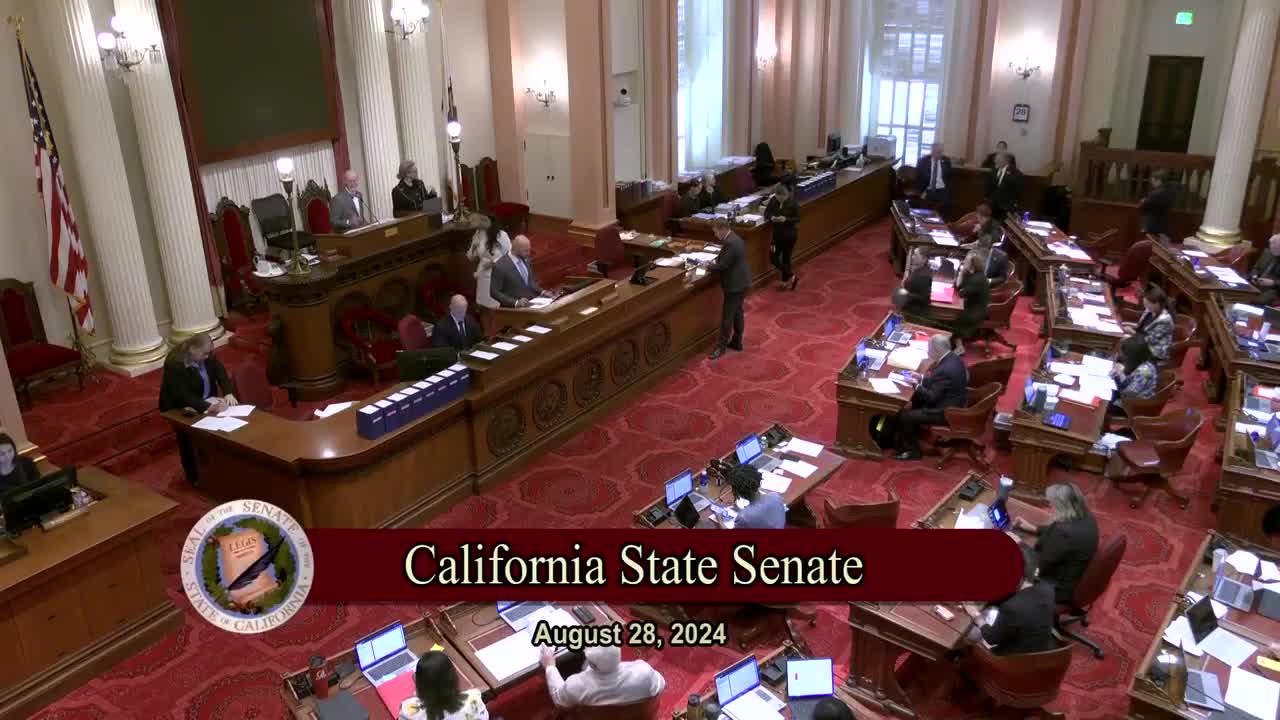 1MIN
Senate Floor
 1MIN
Senate Standing Committee on Appropriations
 12MIN
Senate Standing Committee on Public Safety
Bill Author

Bill Co-Author(s):