AB 2136: Controlled substances: analyzing and testing.
- Session Year: 2023-2024
- House: Assembly
- Latest Version Date: 2024-09-27
Current Status:
Passed
(2024-09-27: Chaptered by Secretary of State - Chapter 701, Statutes of 2024.)
Introduced
In Committee
First Chamber
In Committee
Second Chamber
Enacted
Existing law, the California Uniform Controlled Substances Act, categorizes controlled substances into 5 schedules and places the greatest restrictions on those substances contained in Schedule I. Existing law also defines drug paraphernalia and prohibits, among other things, the manufacture, sale, and possession, as specified, of drug paraphernalia. Existing law excludes from these prohibitions any testing equipment that is designed, marketed, used, or intended to be used to analyze a substance for the presence of fentanyl, ketamine, gamma hydroxybutyric acid, or any analog of fentanyl.
This bill would additionally exclude from the definition of drug paraphernalia equipment, any equipment for testing a substance for the presence of contaminants, toxic substances, hazardous compounds, or other adulterants, as specified. The bill would exclude from the criminal liability of possessing drug paraphernalia those individuals obtaining controlled substance checking services and would state that it is lawful to use, possess, or distribute equipment intended for use or designed for use in identifying, or in analyzing the strength, effectiveness, or purity of a controlled substance. The bill would authorize specified entities to provide controlled substance checking services and would define those services as the process of identifying or analyzing a substance to determine its chemical composition. The bill would provide a person engaged in providing or using those services immunity from detention, arrest, criminal prosecution, and civil liability, among other things. The bill would require a controlled substance service provider, as defined, to destroy personally identifiable information from service users and would prohibit them from providing that information to law enforcement, as specified.
Existing law, the California Uniform Controlled Substances Act, categorizes controlled substances into 5 schedules and places the greatest restrictions on those substances contained in Schedule I. Existing law also defines drug paraphernalia and prohibits, among other things, the manufacture, sale, and possession, as specified, of drug paraphernalia. Existing law excludes from these prohibitions any testing equipment that is designed, marketed, used, or intended to be used to analyze a substance for the presence of fentanyl, ketamine, gamma hydroxybutyric acid, or any analog of fentanyl.
This bill would instead additionally exclude from the definition of drug paraphernalia equipment, products, and materials that are designed for use or marketed for use in testing or analyzing a controlled substance. any equipment for testing a substance for the presence of contaminants, toxic substances, hazardous compounds, or other adulterants, as specified. The bill would exclude from the criminal liability of possessing drug paraphernalia those individuals obtaining controlled substance checking services and would state that it is lawful to use, possess, or distribute equipment intended for use or designed for use in identifying, or in analyzing the strength, effectiveness, or purity of a controlled substance. The bill would authorize the provision of specified entities to provide controlled substance checking services and would define those services as the process of identifying or analyzing a substance to determine its chemical composition. The bill would provide a person engaged in providing or using those services immunity from detention, arrest, criminal prosecution, and civil liability, among other things. The bill would prohibit require a controlled substance service provider or harm reduction service provider, as defined, from retaining to destroy personally identifiable information from service users and would prohibit them from providing that information to law enforcement. enforcement, as specified.
Existing law, the California Uniform Controlled Substances Act, categorizes controlled substances into 5 schedules and places the greatest restrictions on those substances contained in Schedule I. Existing law also defines drug paraphernalia and prohibits, among other things, the manufacture, sale, and possession, as specified, of drug paraphernalia. Existing law excludes from these prohibitions any testing equipment that is designed, marketed, used, or intended to be used to analyze a substance for the presence of fentanyl, ketamine, gamma hydroxybutyric acid, or any analog of fentanyl.
This bill would instead exclude from the definition of drug paraphernalia equipment, products, and materials that are designed for use or marketed for use in testing or analyzing a controlled substance. The bill would exclude from the criminal liability of possessing drug paraphernalia those individuals obtaining drug checking services controlled substance checking services and would state that it is lawful to use, possess, or distribute equipment intended for use or designed for use in identifying, or in analyzing the strength, effectiveness, or purity of a controlled substance. The bill would authorize the provision of controlled substance checking services and define those services as the process of identifying or analyzing a substance to determine its chemical composition. The bill would provide a person engaged in providing or using those services immunity from arrest, criminal prosecution, and civil liability, among other things. The bill would prohibit a controlled substance service provider or harm reduction service provider, as defined, from retaining personally identifiable information from service users and from providing that information to law enforcement.
Existing law, the California Uniform Controlled Substances Act, categorizes controlled substances into 5 schedules and places the greatest restrictions on those substances contained in Schedule I. Existing law also defines drug paraphernalia and prohibits, among other things, the manufacture, sale, and possession, as specified, of drug paraphernalia. Existing law excludes from these prohibitions any testing equipment that is designed, marketed, used, or intended to be used to analyze a substance for the presence of fentanyl, ketamine, gamma hydroxybutyric acid, or any analog of fentanyl.
This bill would state the intent of the Legislature to reduce drug overdoses by ensuring the safe and legal access to testing and analyzing of illicit substances. instead exclude from the definition of drug paraphernalia equipment, products, and materials that are designed for use or marketed for use in testing or analyzing a controlled substance. The bill would exclude from the criminal liability of possessing drug paraphernalia those individuals obtaining drug checking services and would state that it is lawful to use, possess, or distribute equipment intended for use or designed for use in identifying, or in analyzing the strength, effectiveness, or purity of a controlled substance.
Existing law, the California Uniform Controlled Substances Act, categorizes controlled substances into 5 schedules and places the greatest restrictions on those substances contained in Schedule I. Existing law also defines drug paraphernalia and prohibits, among other things, the manufacture, sale, and possession, as specified, of drug paraphernalia. Existing law excludes from these prohibitions any testing equipment that is designed, marketed, used, or intended to be used to analyze a substance for the presence of fentanyl, ketamine, gamma hydroxybutyric acid, or any analog of fentanyl.
This bill would state the intent of the Legislature to reduce drug overdoses by ensuring the safe and legal access to testing and analyzing of illicit substances.
(a)Drug paraphernalia means all equipment, products, and materials of any kind that are designed for use or marketed for use, in planting, propagating, cultivating, growing, harvesting, manufacturing, compounding, converting, producing, processing, preparing, packaging, repackaging, storing, containing, concealing, injecting, ingesting, inhaling, or otherwise introducing into the human body a controlled substance in violation of this division. It includes, but is not limited to:
(1)Kits designed for use or marketed for use in planting, propagating, cultivating, growing, or harvesting of any species of plant that is a controlled substance or from which a controlled substance can be derived.
(2)Kits designed for use or marketed for use in manufacturing, compounding, converting, producing, processing, or preparing controlled substances.
(3)Isomerization devices designed for use or marketed for use in increasing the potency of any species of plant that is a controlled substance.
(4)Scales and balances designed for use or marketed for use in weighing or measuring controlled substances.
(5)Containers and other objects designed for use or marketed for use in storing or concealing controlled substances.
(6)Hypodermic syringes, needles, and other objects designed for use or marketed for use in parenterally injecting controlled substances into the human body.
(7)Objects designed for use or marketed for use in ingesting, inhaling, or otherwise introducing cannabis, cocaine, hashish, or hashish oil into the human body, such as:
(A)Carburetion tubes and devices.
(B)Smoking and carburetion masks.
(C)Roach clips, meaning objects used to hold burning material, such as a cannabis cigarette, that has become too small or too short to be held in the hand.
(D)Miniature cocaine spoons, and cocaine vials.
(E)Chamber pipes.
(F)Carburetor pipes.
(G)Electric pipes.
(H)Air-driven pipes.
(I)Chillums.
(J)Bongs.
(K)Ice pipes or chillers.
(8)Testing equipment designed for use or marketed for use in identifying, or in analyzing the strength, effectiveness, or purity of, controlled substances, except as otherwise provided in subdivision (d).
(b)For the purposes of this section, the phrase marketed for use means advertising, distributing, offering for sale, displaying for sale, or selling in a manner that promotes the use of equipment, products, or materials with controlled substances.
(c)In determining whether an object is drug paraphernalia, a court or other authority may consider, in addition to all other logically relevant factors, the following:
(1)Statements by an owner or by anyone in control of the object concerning its use.
(2)Instructions, oral or written, provided with the object concerning its use for ingesting, inhaling, or otherwise introducing a controlled substance into the human body.
(3)Descriptive materials accompanying the object that explain or depict its use.
(4)National and local advertising concerning its use.
(5)The manner in which the object is displayed for sale.
(6)Whether the owner or anyone in control of the object is a legitimate supplier of like or related items to the community, such as a licensed distributor or dealer of tobacco products.
(7)Expert testimony concerning its use.
(d)Notwithstanding paragraph (8) of subdivision (a), drug paraphernalia does not include any testing equipment designed, marketed, intended to be used, or used, to test a substance for the presence of contaminants, toxic substances, hazardous compounds, or other adulterants, or controlled substances that include, without limitation, fentanyl, ketamine, gamma hydroxybutyric acid, or any analog of fentanyl.
(e)If any provision of this section or the application thereof to any person or circumstance is held invalid, it is the intent of the Legislature that the invalidity shall not affect other provisions or applications of the section that can be given effect without the invalid provision or application and to this end the provisions of this section are severable.
SEC. 2.Article 5 (commencing with Section 11300) is added to Chapter 5 of Division 10 of the Health and Safety Code, to read:5.Controlled Substance Checking Services11300.For the purposes of this article, the following terms shall have the following meanings:
(a)Controlled substance analog has the same meaning as described in Section 11041.
(b)Controlled substance checking means the process of identifying, analyzing, or testing a substance, controlled or otherwise, or residue on drug paraphernalia or controlled substance packaging, to determine its chemical composition to assist in determining whether the substance contains contaminants, toxic substances, hazardous compounds, or other adulterants within a substance.
(c)Controlled substance checking equipment means equipment, products, technologies, or materials used, designed for use, or intended for use to perform chemical analysis of controlled substances or controlled substance analogs, including materials and items used by the person operating the equipment or products to store, measure, or process samples for analysis. Controlled substance checking equipment includes, but is not limited to, fentanyl test strips, other controlled substance or controlled substance analog immunoassay strips, colorimetric reagents, spectrometers such as Fourier transform infrared and Raman spectrometers, and equipment that uses high-performance liquid chromatography, gas chromatography, mass spectrometry, or nuclear magnetic resonance techniques.
(d)Controlled substance checking service provider means an eligible entity that provides the service of controlled substance checking. For purposes of this section, the following entities are eligible entities:
(1)An entity that provides syringe exchange services as defined in Section 121349.
(2)A research institution, college, or university.
(3)A community-based organization or nonprofit organization working in collaboration with public health departments, entities that provide syringe exchange services, or research institutions, colleges, and universities to reduce the potential harms associated with the use of controlled substances.
(e)Controlled substance packaging means the materials or items used by persons selling, buying, or ingesting controlled substances or controlled substance analogs to store, contain, cover, or transport small amounts of one or more controlled substances or controlled substance analogs.
(f)Harm reduction has the same meaning as described in subdivision (a) of Section 1954.08 of the Civil Code.
(g)Person means an individual, corporation, partnership, association, cooperative, limited liability company, trust, joint venture, government, political subdivision, or any other legal, commercial, or informal entity or group.
11301.Notwithstanding any other law, it is not a violation of this division for a controlled substance checking service provider to do any of the following solely for the purpose of providing controlled substance checking services:
(a)Receive voluntarily provided samples of substances potentially containing controlled substances or controlled substance analogs.
(b)Possess, transport, transfer, or store a sample of a controlled substance or a controlled substance analog solely for the purpose of analyzing the substance to determine its chemical composition.
(c)Use available technologies to analyze the contents of samples to obtain timely and accurate information regarding the composition of controlled substances or controlled substance analogs.
(d)Provide results of analysis obtained from controlled substance checking equipment to the person requesting controlled substance checking services.
(e)Provide information and harm reduction services and advice to help individuals make informed decisions about use of controlled substances and controlled substance analogs.
(f)Disseminate data containing only the results of analysis and containing no personally identifiable information to community members at risk of overdose.
(g)If necessary, arrange for a sample of a substance to be tested by a laboratory for secondary verification, including transportation of samples.
(h)Purchase, obtain, possess, provide, transport, distribute, use, or evaluate the use of controlled substance checking equipment.
(i)Provide training and technical assistance concerning controlled substance checking equipment, the process of controlled substance checking, and the purpose of controlled substance checking.
(j)Work in collaboration with a local health officer, the State Department of Public Health, or a research institution to conduct or engage in any activities authorized by this article.
11302.Notwithstanding Section 11306, in operating a controlled substance checking service, personally identifiable information may be collected from a service user providing a controlled substance or a controlled substance analog to a controlled substance checking service provider only as necessary to communicate controlled substance checking results to the service user. Personally identifiable information collected solely for the purposes of communicating controlled substance checking results shall be destroyed after delivery of results.
11303.(a)A program, employee, contractor, volunteer, owner, or other person acting in the good faith provision of controlled substance checking services and acting in accordance with established protocols shall not be subject to any of the following:
(1)Detention, arrest, or prosecution for a violation of this division, including for attempting to, aiding and abetting in, or conspiracy to commit a violation of this division.
(2)Forfeiture of property.
(3)Any civil or administrative penalty or liability of any kind, including disciplinary action by a professional licensing board, credentialing restrictions, contractual or civil liability, or employment action.
(4)Denial of a right or privilege for actions, conduct, or omissions relating to the operation of a controlled substance checking service in compliance with this article and any rules adopted pursuant to this article.
(b)The exemption provided in this section shall not apply to a party acting as a controlled substance checking service in a negligent manner or in bad faith.
11304.(a)An individual possessing a controlled substance or a controlled substance analog who is engaged in obtaining controlled substances checking services from a controlled substance checking service provider pursuant to this section shall not be subject to any criminal or civil penalty or investigation based solely on the individuals utilization of a controlled substance checking service or actions authorized by this act, including, but not limited to, any of the following:
(1)Detention or arrest.
(2)Criminal prosecution, including a violation or revocation of a grant of probation, parole, pretrial release, or any other form of community supervision.
(3)Civil, disciplinary, or administrative action.
(4)Forfeiture of property.
(5)Referral or transfer to, or detention or investigation for the purpose of referral or transfer to, United States Immigration and Customs Enforcement or any immigration authority or joint law enforcement task force as those terms are defined in Section 7284.4 of the Government Code.
(b)The exemption provided in this section shall not apply to any party utilizing a controlled substance checking service in bad faith.
11305.Utilizing a controlled substance checking service shall not serve as the basis for, or a fact contributing to the existence of, reasonable suspicion or probable cause for a law enforcement officer to conduct a search or seizure.
11306.(a)A government agency, controlled substances checking service provider, or agent thereof, shall not collect, maintain, use, or disclose any personal information relating to an individual from whom the agency receives a controlled substance or controlled substance analog for checking or disposal and shall not provide this information to law enforcement.
(b)Notwithstanding subdivision (a), collection and disclosure of aggregate information that is not linked to an individual and does not contain a personal identifier may be released to clinicians, public health officials, researchers, or other local and state agencies as requested and may be stored or uploaded onto an internet website.
SEC. 3.Section 11364 of the Health and Safety Code is amended to read:11364.(a)It is unlawful to possess an opium pipe or any device, contrivance, instrument, or paraphernalia used for unlawfully injecting or smoking (1) a controlled substance specified in subdivision (b), (c), or (e) or paragraph (1) of subdivision (f) of Section 11054, specified in paragraph (14), (15), or (20) of subdivision (d) of Section 11054, specified in subdivision (b) or (c) of Section 11055, or specified in paragraph (2) of subdivision (d) of Section 11055, or (2) a controlled substance that is a narcotic drug classified in Schedule III, IV, or V.
(b)This section shall not apply to hypodermic needles or syringes that have been containerized for safe disposal in a container that meets state and federal standards for disposal of sharps waste.
(c)This section does not apply to an individual obtaining controlled substance checking services, as described in Article 5 (commencing with Section 11300) of Chapter 5.
(d)Until January 1, 2026, as a public health measure intended to prevent the transmission of HIV, viral hepatitis, and other bloodborne diseases among persons who use syringes and hypodermic needles, and to prevent subsequent infection of sexual partners, newborn children, or other persons, this section shall not apply to the possession solely for personal use of hypodermic needles or syringes.
SEC. 4.Section 11364.5 of the Health and Safety Code is amended to read:11364.5.(a)Except as authorized by law, a person shall not maintain or operate a place of business in which drug paraphernalia is kept, displayed, or offered in any manner, sold, furnished, transferred, or given away unless that drug paraphernalia is completely and wholly kept, displayed, or offered within a separate room or enclosure to which persons under 18 years of age who are not accompanied by a parent or legal guardian are excluded. Each entrance to such a room or enclosure shall be signposted in reasonably visible and legible words to the effect that drug paraphernalia is kept, displayed, or offered in the room or enclosure and that minors, unless accompanied by a parent or legal guardian, are excluded.
(b)Except as authorized by law, an owner, manager, proprietor, or other person in charge of a room or enclosure, within a place of business, in which drug paraphernalia is kept, displayed, or offered in any manner, sold, furnished, transferred, or given away shall not permit or allow a person under 18 years of age to enter, be in, remain in, or visit the room or enclosure unless that minor person is accompanied by their parent or legal guardian.
(c)Unless authorized by law, a person under 18 years of age shall not enter, be in, remain in, or visit a room or enclosure in a place of business in which drug paraphernalia is kept, displayed, or offered in any manner, sold, furnished, transferred, or given away unless accompanied by their parent or legal guardian.
(d)As used in this section, drug paraphernalia means all equipment, products, and materials of any kind which are intended for use or designed for use, in planting, propagating, cultivating, growing, harvesting, manufacturing, compounding, converting, producing, processing, preparing, packaging, repackaging, storing, containing, concealing, injecting, ingesting, inhaling, or otherwise introducing into the human body a controlled substance. Drug paraphernalia includes, but is not limited to, all of the following:
(1)Kits intended for use or designed for use in planting, propagating, cultivating, growing, or harvesting of any species of plant that is a controlled substance or from which a controlled substance can be derived.
(2)Kits intended for use or designed for use in manufacturing, compounding, converting, producing, processing, or preparing controlled substances.
(3)Isomerization devices intended for use or designed for use in increasing the potency of any species of plant that is a controlled substance.
(4)Scales and balances intended for use or designed for use in weighing or measuring controlled substances.
(5)Diluents and adulterants, such as quinine hydrochloride, mannitol, mannite, dextrose, and lactose, intended for use or designed for use in cutting controlled substances.
(6)Separation gins and sifters intended for use or designed for use in removing twigs and seeds from, or in otherwise cleaning or refining, cannabis.
(7)Blenders, bowls, containers, spoons, and mixing devices intended for use or designed for use in compounding controlled substances.
(8)Capsules, balloons, envelopes, and other containers intended for use or designed for use in packaging small quantities of controlled substances.
(9)Containers and other objects intended for use or designed for use in storing or concealing controlled substances.
(10)Hypodermic syringes, needles, and other objects intended for use or designed for use in parenterally injecting controlled substances into the human body.
(11)Objects intended for use or designed for use in ingesting, inhaling, or otherwise introducing cannabis, cocaine, hashish, or hashish oil into the human body, such as the following:
(A)Metal, wooden, acrylic, glass, stone, plastic, or ceramic pipes with or without screens, permanent screens, hashish heads, or punctured metal bowls.
(B)Water pipes.
(C)Carburetion tubes and devices.
(D)Smoking and carburetion masks.
(E)Roach clips, meaning objects used to hold burning material, such as a cannabis cigarette that has become too small or too short to be held in the hand.
(F)Miniature cocaine spoons, and cocaine vials.
(G)Chamber pipes.
(H)Carburetor pipes.
(I)Electric pipes.
(J)Air-driven pipes.
(K)Chillums.
(L)Bongs.
(M)Ice pipes or chillers.
(12)Testing equipment designed for use or marketed for use in identifying, or in analyzing the strength, effectiveness, or purity of, controlled substances, except as otherwise provided in subdivision (g).
(e)In determining whether an object is drug paraphernalia, a court or other authority may consider, in addition to all other logically relevant factors, the following:
(1)Statements by an owner or by anyone in control of the object concerning its use.
(2)Prior convictions, if any, of an owner, or of anyone in control of the object, under any state or federal law relating to any controlled substance.
(3)Direct or circumstantial evidence of the intent of an owner, or of anyone in control of the object, to deliver it to persons whom they know, or should reasonably know, intend to use the object to facilitate a violation of this section. The innocence of an owner, or of anyone in control of the object, as to a direct violation of this section shall not prevent a finding that the object is intended for use, or designed for use, as drug paraphernalia.
(4)Instructions, oral or written, provided with the object concerning its use.
(5)Descriptive materials, accompanying the object which explain or depict its use.
(6)National and local advertising concerning its use.
(7)The manner in which the object is displayed for sale.
(8)Whether the owner or anyone in control of the object is a legitimate supplier of like or related items to the community, such as a licensed distributor or dealer of tobacco products.
(9)The existence and scope of legitimate uses for the object in the community.
(10)Expert testimony concerning its use.
(f)This section shall not apply to any of the following:
(1)Any pharmacist or other authorized person who sells or furnishes drug paraphernalia described in paragraph (10) of subdivision (d) upon the prescription of a physician, dentist, podiatrist, or veterinarian.
(2)Any physician, dentist, podiatrist, or veterinarian who furnishes or prescribes drug paraphernalia described in paragraph (10) of subdivision (d) to a patient.
(3)Any manufacturer, wholesaler, or retailer licensed by the California State Board of Pharmacy to sell or transfer drug paraphernalia described in paragraph (10) of subdivision (d).
(g)Notwithstanding paragraph (12) of subdivision (a), drug paraphernalia does not include any testing equipment designed, marketed, intended to be used, or used, to test a substance for the presence of contaminants, toxic substances, hazardous compounds, or other adulterants, or controlled substances that include, without limitation, fentanyl, ketamine, gamma hydroxybutyric acid, or any analog of fentanyl.
(h)Notwithstanding any other law, including Section 11374, violation of this section shall not constitute a criminal offense, but operation of a business in violation of the provisions of this section shall be grounds for revocation or nonrenewal of any license, permit, or other entitlement previously issued by a city, county, or city and county for the privilege of engaging in such business and shall be grounds for denial of any future license, permit, or other entitlement authorizing the conduct of such business or any other business, if the business includes the sale of drug paraphernalia.
SEC. 5.Section 11364.7 of the Health and Safety Code is amended to read:11364.7.(a)(1)Except as authorized by law, a person who delivers, furnishes, or transfers, possesses with intent to deliver, furnish, or transfer, or manufactures with the intent to deliver, furnish, or transfer, drug paraphernalia, knowing, or under circumstances where one reasonably should know, that it will be used to plant, propagate, cultivate, grow, harvest, compound, convert, produce, process, prepare, test, analyze, pack, repack, store, contain, conceal, inject, ingest, inhale, or otherwise introduce into the human body a controlled substance, except as provided in subdivision (b), in violation of this division, is guilty of a misdemeanor.
(2)A public entity, its agents, or employees shall not be subject to criminal prosecution for distribution of hypodermic needles or syringes or any materials deemed by a local or state health department to be necessary to prevent the spread of communicable diseases, or to prevent drug overdose, injury, or disability to participants in clean needle and syringe exchange projects authorized by the public entity pursuant to Chapter 18 (commencing with Section 121349) of Part 4 of Division 105.
(b)Except as authorized by law, a person who manufactures with intent to deliver, furnish, or transfer drug paraphernalia knowing, or under circumstances where one reasonably should know, that it will be used to plant, propagate, cultivate, grow, harvest, manufacture, compound, convert, produce, process, prepare, test, analyze, pack, repack, store, contain, conceal, inject, ingest, inhale, or otherwise introduce into the human body cocaine, cocaine base, heroin, phencyclidine, or methamphetamine in violation of this division shall be punished by imprisonment in a county jail for not more than one year, or in the state prison.
(c)Except as authorized by law, a person, 18 years of age or over, who violates subdivision (a) by delivering, furnishing, or transferring drug paraphernalia to a person under 18 years of age who is at least three years their junior, or who, upon the grounds of a public or private elementary, vocational, junior high, or high school, possesses a hypodermic needle, as defined in Section 11014.5, with the intent to deliver, furnish, or transfer the hypodermic needle, knowing, or under circumstances where one reasonably should know, that it will be used by a person under 18 years of age to inject into the human body a controlled substance, is guilty of a misdemeanor and shall be punished by imprisonment in a county jail for not more than one year, by a fine of not more than one thousand dollars ($1,000), or by both that imprisonment and fine.
(d)The violation, or the causing or the permitting of a violation, of subdivision (a), (b), or (c) by a holder of a business or liquor license issued by a city, county, or city and county, or by the State of California, and in the course of the licensees business shall be grounds for the revocation of that license.
(e)All drug paraphernalia defined in Section 11014.5 is subject to forfeiture and may be seized by any peace officer pursuant to Section 11471 unless its distribution has been authorized pursuant to subdivision (a).
(f)If any provision of this section or the application thereof to any person or circumstance is held invalid, it is the intent of the Legislature that the invalidity shall not affect other provisions or applications of this section that can be given effect without the invalid provision or application and to this end the provisions of this section are severable.
SEC. 6.The provisions of this act are severable. If any provision of this act or its application is held invalid, that invalidity shall not affect other provisions or applications that can be given effect without the invalid provision or application.
(a)Drug paraphernalia means all equipment, products, and materials of any kind that are designed for use or marketed for use, in planting, propagating, cultivating, growing, harvesting, manufacturing, compounding, converting, producing, processing, preparing, packaging, repackaging, storing, containing, concealing, injecting, ingesting, inhaling, or otherwise introducing into the human body a controlled substance in violation of this division. It includes, but is not limited to:
(1)Kits designed for use or marketed for use in planting, propagating, cultivating, growing, or harvesting of any species of plant that is a controlled substance or from which a controlled substance can be derived.
(2)Kits designed for use or marketed for use in manufacturing, compounding, converting, producing, processing, or preparing controlled substances.
(3)Isomerization devices designed for use or marketed for use in increasing the potency of any species of plant that is a controlled substance.
(4)Scales and balances designed for use or marketed for use in weighing or measuring controlled substances.
(5)Containers and other objects designed for use or marketed for use in storing or concealing controlled substances.
(6)Hypodermic syringes, needles, and other objects designed for use or marketed for use in parenterally injecting controlled substances into the human body.
(7)Objects designed for use or marketed for use in ingesting, inhaling, or otherwise introducing cannabis, cocaine, hashish, or hashish oil into the human body, such as:
(A)Carburetion tubes and devices.
(B)Smoking and carburetion masks.
(C)Roach clips, meaning objects used to hold burning material, such as a cannabis cigarette, that has become too small or too short to be held in the hand.
(D)Miniature cocaine spoons, and cocaine vials.
(E)Chamber pipes.
(F)Carburetor pipes.
(G)Electric pipes.
(H)Air-driven pipes.
(I)Chillums.
(J)Bongs.
(K)Ice pipes or chillers.
(8)Testing equipment designed for use or marketed for use in identifying, or in analyzing the strength, effectiveness, or purity of, controlled substances, except as otherwise provided in subdivision (d).
(b)For the purposes of this section, the phrase marketed for use means advertising, distributing, offering for sale, displaying for sale, or selling in a manner that promotes the use of equipment, products, or materials with controlled substances.
(c)In determining whether an object is drug paraphernalia, a court or other authority may consider, in addition to all other logically relevant factors, the following:
(1)Statements by an owner or by anyone in control of the object concerning its use.
(2)Instructions, oral or written, provided with the object concerning its use for ingesting, inhaling, or otherwise introducing a controlled substance into the human body.
(3)Descriptive materials accompanying the object that explain or depict its use.
(4)National and local advertising concerning its use.
(5)The manner in which the object is displayed for sale.
(6)Whether the owner or anyone in control of the object is a legitimate supplier of like or related items to the community, such as a licensed distributor or dealer of tobacco products.
(7)Expert testimony concerning its use.
(d)Notwithstanding paragraph (8) of subdivision (a), drug paraphernalia does not include any testing equipment designed, marketed, intended to be used, or used, to test a substance for the presence of contaminants, toxic substances, hazardous compounds, or other adulterants, or controlled substances that include, without limitation, fentanyl, ketamine, gamma hydroxybutyric acid, or any analog of fentanyl.
(e)If any provision of this section or the application thereof to any person or circumstance is held invalid, it is the intent of the Legislature that the invalidity shall not affect other provisions or applications of the section that can be given effect without the invalid provision or application and to this end the provisions of this section are severable.
SEC. 2.Article 5 (commencing with Section 11300) is added to Chapter 5 of Division 10 of the Health and Safety Code, to read:5.Controlled Substance Checking Services11300.For the purposes of this article, the following terms shall have the following meanings:
(a)Controlled substance analog has the same meaning as described in Section 11041.
(b)Controlled substance checking means the process of identifying, analyzing, or testing a substance, controlled or otherwise, or residue on drug paraphernalia or controlled substance packaging, to determine its chemical composition to assist in determining whether the substance contains contaminants, toxic substances, hazardous compounds, or other adulterants within a substance.
(c)Controlled substance checking equipment means equipment, products, technologies, or materials used, designed for use, or intended for use to perform chemical analysis of controlled substances or controlled substance analogs, including materials and items used by the person operating the equipment or products to store, measure, or process samples for analysis. Controlled substance checking equipment includes, but is not limited to, fentanyl test strips, other controlled substance or controlled substance analog immunoassay strips, colorimetric reagents, spectrometers such as Fourier transform infrared and Raman spectrometers, and equipment that uses high-performance liquid chromatography, gas chromatography, mass spectrometry, or nuclear magnetic resonance techniques.
(d)Controlled substance checking service provider means an eligible entity that provides the service of controlled substance checking. For purposes of this section, the following entities are eligible entities:
(1)An entity that provides syringe exchange services as defined in Section 121349.
(2)A research institution, college, or university.
(3)A community-based organization or nonprofit organization working in collaboration with public health departments, entities that provide syringe exchange services, or research institutions, colleges, and universities to reduce the potential harms associated with the use of controlled substances.
(e)Controlled substance packaging means the materials or items used by persons selling, buying, or ingesting controlled substances or controlled substance analogs to store, contain, cover, or transport small amounts of one or more controlled substances or controlled substance analogs.
(f)Harm reduction has the same meaning as described in subdivision (a) of Section 1954.08 of the Civil Code.
(g)Person means an individual, corporation, partnership, association, cooperative, limited liability company, trust, joint venture, government, political subdivision, or any other legal, commercial, or informal entity or group.
11301.Notwithstanding any other law, it is not a violation of this division for a controlled substance checking service provider to do any of the following solely for the purpose of providing controlled substance checking services:
(a)Receive voluntarily provided samples of substances potentially containing controlled substances or controlled substance analogs.
(b)Possess, transport, transfer, or store a sample of a controlled substance or a controlled substance analog solely for the purpose of analyzing the substance to determine its chemical composition.
(c)Use available technologies to analyze the contents of samples to obtain timely and accurate information regarding the composition of controlled substances or controlled substance analogs.
(d)Provide results of analysis obtained from controlled substance checking equipment to the person requesting controlled substance checking services.
(e)Provide information and harm reduction services and advice to help individuals make informed decisions about use of controlled substances and controlled substance analogs.
(f)Disseminate data containing only the results of analysis and containing no personally identifiable information to community members at risk of overdose.
(g)If necessary, arrange for a sample of a substance to be tested by a laboratory for secondary verification, including transportation of samples.
(h)Purchase, obtain, possess, provide, transport, distribute, use, or evaluate the use of controlled substance checking equipment.
(i)Provide training and technical assistance concerning controlled substance checking equipment, the process of controlled substance checking, and the purpose of controlled substance checking.
(j)Work in collaboration with a county local health officer, the State Department of Public Health, or a research institution to conduct or engage in any activities authorized by this article.
11302.Notwithstanding Section 11306, in operating a controlled substance checking service, personally identifiable information may be collected from a service user providing a controlled substance or a controlled substance analog to a controlled substance checking service provider only as necessary to communicate controlled substance checking results to the service user. Personally identifiable information collected solely for the purposes of communicating controlled substance checking results shall be destroyed after delivery of results.
11303.(a)A program, employee, contractor, volunteer, owner, or other person acting in the good faith provision of controlled substance checking services and acting in accordance with established protocols shall not be subject to any of the following:
(1)Detention, arrest, or prosecution for a violation of this division, including for attempting to, aiding and abetting in, or conspiracy to commit a violation of this division.
(2)Forfeiture of property.
(3)Any civil or administrative penalty or liability of any kind, including disciplinary action by a professional licensing board, credentialing restrictions, contractual or civil liability, or employment action.
(4)Denial of a right or privilege for actions, conduct, or omissions relating to the operation of a controlled substance checking service in compliance with this article and any rules adopted pursuant to this article.
(b)The exemption provided in this section shall not apply to a party acting as a controlled substance checking service in a negligent manner or in bad faith.
11304.(a)An individual possessing a controlled substance or a controlled substance analog who is engaged in obtaining controlled substances checking services from a controlled substance checking service provider pursuant to this section shall not be subject to any criminal or civil penalty or investigation based solely on the individuals utilization of a controlled substance checking service or actions authorized by this act, including, but not limited to, any of the following:
(1)Detention or arrest.
(2)Criminal prosecution, including a violation or revocation of a grant of probation, parole, pretrial release, or any other form of community supervision.
(3)Civil, disciplinary, or administrative action.
(4)Forfeiture of property.
(5)Referral or transfer to, or detention or investigation for the purpose of referral or transfer to, United States Immigration and Customs Enforcement or any immigration authority or joint law enforcement task force as those terms are defined in Section 7284.4 of the Government Code.
(b)The exemption provided in this section shall not apply to any party utilizing a controlled substance checking service in bad faith.
11305.Utilizing a controlled substance checking service shall not serve as the basis for, or a fact contributing to the existence of, reasonable suspicion or probable cause for a law enforcement officer to conduct a search or seizure.
11306.(a)A government agency, controlled substances checking service provider, or agent thereof, shall not collect, maintain, use, or disclose any personal information relating to an individual from whom the agency receives a controlled substance or controlled substance analog for checking or disposal and shall not provide this information to law enforcement.
(b)Notwithstanding subdivision (a), collection and disclosure of aggregate information that is not linked to an individual and does not contain a personal identifier may be released to clinicians, public health officials, researchers, or other local and state agencies as requested and may be stored or uploaded onto an internet website.
SEC. 3.Section 11364 of the Health and Safety Code is amended to read:11364.(a)It is unlawful to possess an opium pipe or any device, contrivance, instrument, or paraphernalia used for unlawfully injecting or smoking (1) a controlled substance specified in subdivision (b), (c), or (e) or paragraph (1) of subdivision (f) of Section 11054, specified in paragraph (14), (15), or (20) of subdivision (d) of Section 11054, specified in subdivision (b) or (c) of Section 11055, or specified in paragraph (2) of subdivision (d) of Section 11055, or (2) a controlled substance that is a narcotic drug classified in Schedule III, IV, or V.
(b)This section shall not apply to hypodermic needles or syringes that have been containerized for safe disposal in a container that meets state and federal standards for disposal of sharps waste.
(c)This section does not apply to an individual obtaining controlled substance checking services, as described in Article 5 (commencing with Section 11300) of Chapter 5.
(d)Until January 1, 2026, as a public health measure intended to prevent the transmission of HIV, viral hepatitis, and other bloodborne diseases among persons who use syringes and hypodermic needles, and to prevent subsequent infection of sexual partners, newborn children, or other persons, this section shall not apply to the possession solely for personal use of hypodermic needles or syringes.
SEC. 4.Section 11364.5 of the Health and Safety Code is amended to read:11364.5.(a)Except as authorized by law, a person shall not maintain or operate a place of business in which drug paraphernalia is kept, displayed, or offered in any manner, sold, furnished, transferred, or given away unless that drug paraphernalia is completely and wholly kept, displayed, or offered within a separate room or enclosure to which persons under 18 years of age who are not accompanied by a parent or legal guardian are excluded. Each entrance to such a room or enclosure shall be signposted in reasonably visible and legible words to the effect that drug paraphernalia is kept, displayed, or offered in the room or enclosure and that minors, unless accompanied by a parent or legal guardian, are excluded.
(b)Except as authorized by law, an owner, manager, proprietor, or other person in charge of a room or enclosure, within a place of business, in which drug paraphernalia is kept, displayed, or offered in any manner, sold, furnished, transferred, or given away shall not permit or allow a person under 18 years of age to enter, be in, remain in, or visit the room or enclosure unless that minor person is accompanied by their parent or legal guardian.
(c)Unless authorized by law, a person under 18 years of age shall not enter, be in, remain in, or visit a room or enclosure in a place of business in which drug paraphernalia is kept, displayed, or offered in any manner, sold, furnished, transferred, or given away unless accompanied by their parent or legal guardian.
(d)As used in this section, drug paraphernalia means all equipment, products, and materials of any kind which are intended for use or designed for use, in planting, propagating, cultivating, growing, harvesting, manufacturing, compounding, converting, producing, processing, preparing, packaging, repackaging, storing, containing, concealing, injecting, ingesting, inhaling, or otherwise introducing into the human body a controlled substance. Drug paraphernalia includes, but is not limited to, all of the following:
(1)Kits intended for use or designed for use in planting, propagating, cultivating, growing, or harvesting of any species of plant that is a controlled substance or from which a controlled substance can be derived.
(2)Kits intended for use or designed for use in manufacturing, compounding, converting, producing, processing, or preparing controlled substances.
(3)Isomerization devices intended for use or designed for use in increasing the potency of any species of plant that is a controlled substance.
(4)Scales and balances intended for use or designed for use in weighing or measuring controlled substances.
(5)Diluents and adulterants, such as quinine hydrochloride, mannitol, mannite, dextrose, and lactose, intended for use or designed for use in cutting controlled substances.
(6)Separation gins and sifters intended for use or designed for use in removing twigs and seeds from, or in otherwise cleaning or refining, cannabis.
(7)Blenders, bowls, containers, spoons, and mixing devices intended for use or designed for use in compounding controlled substances.
(8)Capsules, balloons, envelopes, and other containers intended for use or designed for use in packaging small quantities of controlled substances.
(9)Containers and other objects intended for use or designed for use in storing or concealing controlled substances.
(10)Hypodermic syringes, needles, and other objects intended for use or designed for use in parenterally injecting controlled substances into the human body.
(11)Objects intended for use or designed for use in ingesting, inhaling, or otherwise introducing cannabis, cocaine, hashish, or hashish oil into the human body, such as the following:
(A)Metal, wooden, acrylic, glass, stone, plastic, or ceramic pipes with or without screens, permanent screens, hashish heads, or punctured metal bowls.
(B)Water pipes.
(C)Carburetion tubes and devices.
(D)Smoking and carburetion masks.
(E)Roach clips, meaning objects used to hold burning material, such as a cannabis cigarette that has become too small or too short to be held in the hand.
(F)Miniature cocaine spoons, and cocaine vials.
(G)Chamber pipes.
(H)Carburetor pipes.
(I)Electric pipes.
(J)Air-driven pipes.
(K)Chillums.
(L)Bongs.
(M)Ice pipes or chillers.
(12)Testing equipment designed for use or marketed for use in identifying, or in analyzing the strength, effectiveness, or purity of, controlled substances, except as otherwise provided in subdivision (g).
(e)In determining whether an object is drug paraphernalia, a court or other authority may consider, in addition to all other logically relevant factors, the following:
(1)Statements by an owner or by anyone in control of the object concerning its use.
(2)Prior convictions, if any, of an owner, or of anyone in control of the object, under any state or federal law relating to any controlled substance.
(3)Direct or circumstantial evidence of the intent of an owner, or of anyone in control of the object, to deliver it to persons whom they know, or should reasonably know, intend to use the object to facilitate a violation of this section. The innocence of an owner, or of anyone in control of the object, as to a direct violation of this section shall not prevent a finding that the object is intended for use, or designed for use, as drug paraphernalia.
(4)Instructions, oral or written, provided with the object concerning its use.
(5)Descriptive materials, accompanying the object which explain or depict its use.
(6)National and local advertising concerning its use.
(7)The manner in which the object is displayed for sale.
(8)Whether the owner or anyone in control of the object is a legitimate supplier of like or related items to the community, such as a licensed distributor or dealer of tobacco products.
(9)The existence and scope of legitimate uses for the object in the community.
(10)Expert testimony concerning its use.
(f)This section shall not apply to any of the following:
(1)Any pharmacist or other authorized person who sells or furnishes drug paraphernalia described in paragraph (10) of subdivision (d) upon the prescription of a physician, dentist, podiatrist, or veterinarian.
(2)Any physician, dentist, podiatrist, or veterinarian who furnishes or prescribes drug paraphernalia described in paragraph (10) of subdivision (d) to a patient.
(3)Any manufacturer, wholesaler, or retailer licensed by the California State Board of Pharmacy to sell or transfer drug paraphernalia described in paragraph (10) of subdivision (d).
(g)Notwithstanding paragraph (12) of subdivision (a), drug paraphernalia does not include any testing equipment designed, marketed, intended to be used, or used, to test a substance for the presence of contaminants, toxic substances, hazardous compounds, or other adulterants, or controlled substances that include, without limitation, fentanyl, ketamine, gamma hydroxybutyric acid, or any analog of fentanyl.
(h)Notwithstanding any other law, including Section 11374, violation of this section shall not constitute a criminal offense, but operation of a business in violation of the provisions of this section shall be grounds for revocation or nonrenewal of any license, permit, or other entitlement previously issued by a city, county, or city and county for the privilege of engaging in such business and shall be grounds for denial of any future license, permit, or other entitlement authorizing the conduct of such business or any other business, if the business includes the sale of drug paraphernalia.
SEC. 5.Section 11364.7 of the Health and Safety Code is amended to read:11364.7.(a)(1)Except as authorized by law, a person who delivers, furnishes, or transfers, possesses with intent to deliver, furnish, or transfer, or manufactures with the intent to deliver, furnish, or transfer, drug paraphernalia, knowing, or under circumstances where one reasonably should know, that it will be used to plant, propagate, cultivate, grow, harvest, compound, convert, produce, process, prepare, test, analyze, pack, repack, store, contain, conceal, inject, ingest, inhale, or otherwise introduce into the human body a controlled substance, except as provided in subdivision (b), in violation of this division, is guilty of a misdemeanor.
(2)A public entity, its agents, or employees shall not be subject to criminal prosecution for distribution of hypodermic needles or syringes or any materials deemed by a local or state health department to be necessary to prevent the spread of communicable diseases, or to prevent drug overdose, injury, or disability to participants in clean needle and syringe exchange projects authorized by the public entity pursuant to Chapter 18 (commencing with Section 121349) of Part 4 of Division 105.
(b)Except as authorized by law, a person who manufactures with intent to deliver, furnish, or transfer drug paraphernalia knowing, or under circumstances where one reasonably should know, that it will be used to plant, propagate, cultivate, grow, harvest, manufacture, compound, convert, produce, process, prepare, test, analyze, pack, repack, store, contain, conceal, inject, ingest, inhale, or otherwise introduce into the human body cocaine, cocaine base, heroin, phencyclidine, or methamphetamine in violation of this division shall be punished by imprisonment in a county jail for not more than one year, or in the state prison.
(c)Except as authorized by law, a person, 18 years of age or over, who violates subdivision (a) by delivering, furnishing, or transferring drug paraphernalia to a person under 18 years of age who is at least three years their junior, or who, upon the grounds of a public or private elementary, vocational, junior high, or high school, possesses a hypodermic needle, as defined in Section 11014.5, with the intent to deliver, furnish, or transfer the hypodermic needle, knowing, or under circumstances where one reasonably should know, that it will be used by a person under 18 years of age to inject into the human body a controlled substance, is guilty of a misdemeanor and shall be punished by imprisonment in a county jail for not more than one year, by a fine of not more than one thousand dollars ($1,000), or by both that imprisonment and fine.
(d)The violation, or the causing or the permitting of a violation, of subdivision (a), (b), or (c) by a holder of a business or liquor license issued by a city, county, or city and county, or by the State of California, and in the course of the licensees business shall be grounds for the revocation of that license.
(e)All drug paraphernalia defined in Section 11014.5 is subject to forfeiture and may be seized by any peace officer pursuant to Section 11471 unless its distribution has been authorized pursuant to subdivision (a).
(f)If any provision of this section or the application thereof to any person or circumstance is held invalid, it is the intent of the Legislature that the invalidity shall not affect other provisions or applications of this section that can be given effect without the invalid provision or application and to this end the provisions of this section are severable.
SEC. 6.The provisions of this act are severable. If any provision of this act or its application is held invalid, that invalidity shall not affect other provisions or applications that can be given effect without the invalid provision or application.
(a)Drug paraphernalia means all equipment, products, and materials of any kind that are designed for use or marketed for use, in planting, propagating, cultivating, growing, harvesting, manufacturing, compounding, converting, producing, processing, preparing, packaging, repackaging, storing, containing, concealing, injecting, ingesting, inhaling, or otherwise introducing into the human body a controlled substance in violation of this division. It includes, but is not limited to:
(1)Kits designed for use or marketed for use in planting, propagating, cultivating, growing, or harvesting of any species of plant that is a controlled substance or from which a controlled substance can be derived.
(2)Kits designed for use or marketed for use in manufacturing, compounding, converting, producing, processing, or preparing controlled substances.
(3)Isomerization devices designed for use or marketed for use in increasing the potency of any species of plant that is a controlled substance.
(4)Scales and balances designed for use or marketed for use in weighing or measuring controlled substances.
(5)Containers and other objects designed for use or marketed for use in storing or concealing controlled substances.
(6)Hypodermic syringes, needles, and other objects designed for use or marketed for use in parenterally injecting controlled substances into the human body.
(7)Objects designed for use or marketed for use in ingesting, inhaling, or otherwise introducing cannabis, cocaine, hashish, or hashish oil into the human body, such as:
(A)Carburetion tubes and devices.
(B)Smoking and carburetion masks.
(C)Roach clips, meaning objects used to hold burning material, such as a cannabis cigarette, that has become too small or too short to be held in the hand.
(D)Miniature cocaine spoons, and cocaine vials.
(E)Chamber pipes.
(F)Carburetor pipes.
(G)Electric pipes.
(H)Air-driven pipes.
(I)Chillums.
(J)Bongs.
(K)Ice pipes or chillers.
(8)Testing equipment designed for use or marketed for use in identifying, or in analyzing the strength, effectiveness, or purity of, controlled substances, except as otherwise provided in subdivision (d).
(b)For the purposes of this section, the phrase marketed for use means advertising, distributing, offering for sale, displaying for sale, or selling in a manner that promotes the use of equipment, products, or materials with controlled substances.
(c)In determining whether an object is drug paraphernalia, a court or other authority may consider, in addition to all other logically relevant factors, the following:
(1)Statements by an owner or by anyone in control of the object concerning its use.
(2)Instructions, oral or written, provided with the object concerning its use for ingesting, inhaling, or otherwise introducing a controlled substance into the human body.
(3)Descriptive materials accompanying the object that explain or depict its use.
(4)National and local advertising concerning its use.
(5)The manner in which the object is displayed for sale.
(6)Whether the owner or anyone in control of the object is a legitimate supplier of like or related items to the community, such as a licensed distributor or dealer of tobacco products.
(7)Expert testimony concerning its use.
(d)Notwithstanding paragraph (8) of subdivision (a), drug paraphernalia does not include any testing equipment designed, marketed, intended to be used, or used, to test a substance for the presence of contaminants, toxic substances, hazardous compounds, or other adulterants, or controlled substances that include, without limitation, fentanyl, ketamine, gamma hydroxybutyric acid, or any analog of fentanyl.
(e)If any provision of this section or the application thereof to any person or circumstance is held invalid, it is the intent of the Legislature that the invalidity shall not affect other provisions or applications of the section that can be given effect without the invalid provision or application and to this end the provisions of this section are severable.
SEC. 2.Article 5 (commencing with Section 11300) is added to Chapter 5 of Division 10 of the Health and Safety Code, to read:5.Controlled Substance Checking Services11300.For the purposes of this article, the following terms shall have the following meanings:
(a)Controlled substance analog has the same meaning as described in Section 11041.
(b)Controlled substance checking means the process of identifying, analyzing, or testing a substance, controlled or otherwise, or residue on drug paraphernalia or controlled substance packaging, to determine its chemical composition to assist in determining whether the substance contains contaminants, toxic substances, hazardous compounds, or other adulterants within a substance.
(c)Controlled substance checking equipment means equipment, products, technologies, or materials used, designed for use, or intended for use to perform chemical analysis of controlled substances or controlled substance analogs, including materials and items used by the person operating the equipment or products to store, measure, or process samples for analysis. Controlled substance checking equipment includes, but is not limited to, fentanyl test strips, other controlled substance or controlled substance analog immunoassay strips, colorimetric reagents, spectrometers such as Fourier transform infrared and Raman spectrometers, and equipment that uses high-performance liquid chromatography, gas chromatography, mass spectrometry, or nuclear magnetic resonance techniques.
(d)Controlled substance checking service provider means an eligible entity that provides the service of controlled substance checking. For purposes of this section, the following entities are eligible entities:
(1)An entity that provides syringe exchange services as defined in Section 121349.
(2)A research institution, college, or university.
(3)A community-based organization or nonprofit organization working in collaboration with public health departments, entities that provide syringe exchange services, or research institutions, colleges, and universities to reduce the potential harms associated with the use of controlled substances.
(e)Controlled substance packaging means the materials or items used by persons selling, buying, or ingesting controlled substances or controlled substance analogs to store, contain, cover, or transport small amounts of one or more controlled substances or controlled substance analogs.
(f)Harm reduction has the same meaning as described in subdivision (a) of Section 1954.08 of the Civil Code.
(g)Person means an individual, corporation, partnership, association, cooperative, limited liability company, trust, joint venture, government, political subdivision, or any other legal, commercial, or informal entity or group.
11301.Notwithstanding any other law, it is not a violation of this division for a controlled substance checking service provider to do any of the following solely for the purpose of providing controlled substance checking services:
(a)Receive voluntarily provided samples of substances potentially containing controlled substances or controlled substance analogs.
(b)Possess, transport, transfer, or store a sample of a controlled substance or a controlled substance analog solely for the purpose of analyzing the substance to determine its chemical composition.
(c)Use available technologies to analyze the contents of samples to obtain timely and accurate information regarding the composition of controlled substances or controlled substance analogs.
(d)Provide results of analysis obtained from controlled substance checking equipment to the person requesting controlled substance checking services.
(e)Provide information and harm reduction services and advice to help individuals make informed decisions about use of controlled substances and controlled substance analogs.
(f)Disseminate data containing only the results of analysis and containing no personally identifiable information to community members at risk of overdose.
(g)If necessary, arrange for a sample of a substance to be tested by a laboratory for secondary verification, including transportation of samples.
(h)Purchase, obtain, possess, provide, transport, distribute, use, or evaluate the use of controlled substance checking equipment.
(i)Provide training and technical assistance concerning controlled substance checking equipment, the process of controlled substance checking, and the purpose of controlled substance checking.
(j)Work in collaboration with a county health officer, the State Department of Public Health, or a research institution to conduct or engage in any activities authorized by this article.
11302.Notwithstanding Section 11306, in operating a controlled substance checking service, personally identifiable information may be collected from a service user providing a controlled substance or a controlled substance analog to a controlled substance checking service provider only as necessary to communicate controlled substance checking results to the service user. Personally identifiable information collected solely for the purposes of communicating controlled substance checking results shall be destroyed after delivery of results.
11303.(a)A program, employee, contractor, volunteer, owner, or other person acting in the good faith provision of controlled substance checking services and acting in accordance with established protocols shall not be subject to any of the following:
(1)Detention, arrest, or prosecution for a violation of this division, including for attempting to, aiding and abetting in, or conspiracy to commit a violation of this division.
(2)Forfeiture of property.
(3)Any civil or administrative penalty or liability of any kind, including disciplinary action by a professional licensing board, credentialing restrictions, contractual or civil liability, or employment action.
(4)Denial of a right or privilege for actions, conduct, or omissions relating to the operation of a controlled substance checking service in compliance with this article and any rules adopted pursuant to this article.
(b)The exemption provided in this section shall not apply to a party acting as a controlled substance checking service in a negligent manner or in bad faith.
11304.(a)An individual possessing a controlled substance or a controlled substance analog who is engaged in obtaining controlled substances checking services from a controlled substance checking service provider pursuant to this section shall not be subject to any criminal or civil penalty or investigation based solely on the individuals utilization of a controlled substance checking service or actions authorized by this act, including, but not limited to, any of the following:
(1)Detention or arrest.
(2)Criminal prosecution, including a violation or revocation of a grant of probation, parole, pretrial release, or any other form of community supervision.
(3)Civil, disciplinary, or administrative action.
(4)Forfeiture of property.
(5)Referral or transfer to, or detention or investigation for the purpose of referral or transfer to, United States Immigration and Customs Enforcement or any immigration authority or joint law enforcement task force as those terms are defined in Section 7284.4 of the Government Code.
(b)The exemption provided in this section shall not apply to any party utilizing a controlled substance checking service in bad faith.
11305.Utilizing a controlled substance checking service shall not serve as the basis for, or a fact contributing to the existence of, reasonable suspicion or probable cause for a law enforcement officer to conduct a search or seizure.
11306.(a)A government agency, controlled substances checking service provider, or agent thereof, shall not collect, maintain, use, or disclose any personal information relating to an individual from whom the agency receives a controlled substance or controlled substance analog for checking or disposal and shall not provide this information to law enforcement.
(b)Notwithstanding subdivision (a), collection and disclosure of aggregate information that is not linked to an individual and does not contain a personal identifier may be released to clinicians, public health officials, researchers, or other local and state agencies as requested and may be stored or uploaded onto an internet website.
SEC. 3.Section 11364 of the Health and Safety Code is amended to read:11364.(a)It is unlawful to possess an opium pipe or any device, contrivance, instrument, or paraphernalia used for unlawfully injecting or smoking (1) a controlled substance specified in subdivision (b), (c), or (e) or paragraph (1) of subdivision (f) of Section 11054, specified in paragraph (14), (15), or (20) of subdivision (d) of Section 11054, specified in subdivision (b) or (c) of Section 11055, or specified in paragraph (2) of subdivision (d) of Section 11055, or (2) a controlled substance that is a narcotic drug classified in Schedule III, IV, or V.
(b)This section shall not apply to hypodermic needles or syringes that have been containerized for safe disposal in a container that meets state and federal standards for disposal of sharps waste.
(c)This section does not apply to an individual obtaining controlled substance checking services, as described in Article 5 (commencing with Section 11300) of Chapter 5.
(d)Until January 1, 2026, as a public health measure intended to prevent the transmission of HIV, viral hepatitis, and other bloodborne diseases among persons who use syringes and hypodermic needles, and to prevent subsequent infection of sexual partners, newborn children, or other persons, this section shall not apply to the possession solely for personal use of hypodermic needles or syringes.
SEC. 4.Section 11364.5 of the Health and Safety Code is amended to read:11364.5.(a)Except as authorized by law, a person shall not maintain or operate a place of business in which drug paraphernalia is kept, displayed, or offered in any manner, sold, furnished, transferred, or given away unless that drug paraphernalia is completely and wholly kept, displayed, or offered within a separate room or enclosure to which persons under 18 years of age who are not accompanied by a parent or legal guardian are excluded. Each entrance to such a room or enclosure shall be signposted in reasonably visible and legible words to the effect that drug paraphernalia is kept, displayed, or offered in the room or enclosure and that minors, unless accompanied by a parent or legal guardian, are excluded.
(b)Except as authorized by law, an owner, manager, proprietor, or other person in charge of a room or enclosure, within a place of business, in which drug paraphernalia is kept, displayed, or offered in any manner, sold, furnished, transferred, or given away shall not permit or allow a person under 18 years of age to enter, be in, remain in, or visit the room or enclosure unless that minor person is accompanied by their parent or legal guardian.
(c)Unless authorized by law, a person under 18 years of age shall not enter, be in, remain in, or visit a room or enclosure in a place of business in which drug paraphernalia is kept, displayed, or offered in any manner, sold, furnished, transferred, or given away unless accompanied by their parent or legal guardian.
(d)As used in this section, drug paraphernalia means all equipment, products, and materials of any kind which are intended for use or designed for use, in planting, propagating, cultivating, growing, harvesting, manufacturing, compounding, converting, producing, processing, preparing, testing, packaging, repackaging, storing, containing, concealing, injecting, ingesting, inhaling, or otherwise introducing into the human body a controlled substance. Drug paraphernalia includes, but is not limited to, all of the following:
(1)Kits intended for use or designed for use in planting, propagating, cultivating, growing, or harvesting of any species of plant that is a controlled substance or from which a controlled substance can be derived.
(2)Kits intended for use or designed for use in manufacturing, compounding, converting, producing, processing, or preparing controlled substances.
(3)Isomerization devices intended for use or designed for use in increasing the potency of any species of plant that is a controlled substance.
(4)Scales and balances intended for use or designed for use in weighing or measuring controlled substances.
(5)Diluents and adulterants, such as quinine hydrochloride, mannitol, mannite, dextrose, and lactose, intended for use or designed for use in cutting controlled substances.
(6)Separation gins and sifters intended for use or designed for use in removing twigs and seeds from, or in otherwise cleaning or refining, cannabis.
(7)Blenders, bowls, containers, spoons, and mixing devices intended for use or designed for use in compounding controlled substances.
(8)Capsules, balloons, envelopes, and other containers intended for use or designed for use in packaging small quantities of controlled substances.
(9)Containers and other objects intended for use or designed for use in storing or concealing controlled substances.
(10)Hypodermic syringes, needles, and other objects intended for use or designed for use in parenterally injecting controlled substances into the human body.
(11)Objects intended for use or designed for use in ingesting, inhaling, or otherwise introducing cannabis, cocaine, hashish, or hashish oil into the human body, such as the following:
(A)Metal, wooden, acrylic, glass, stone, plastic, or ceramic pipes with or without screens, permanent screens, hashish heads, or punctured metal bowls.
(B)Water pipes.
(C)Carburetion tubes and devices.
(D)Smoking and carburetion masks.
(E)Roach clips, meaning objects used to hold burning material, such as a cannabis cigarette that has become too small or too short to be held in the hand.
(F)Miniature cocaine spoons, and cocaine vials.
(G)Chamber pipes.
(H)Carburetor pipes.
(I)Electric pipes.
(J)Air-driven pipes.
(K)Chillums.
(L)Bongs.
(M)Ice pipes or chillers.
(12)Testing equipment designed for use or marketed for use in identifying, or in analyzing the strength, effectiveness, or purity of, controlled substances, except as otherwise provided in subdivision (g).
(e)In determining whether an object is drug paraphernalia, a court or other authority may consider, in addition to all other logically relevant factors, the following:
(1)Statements by an owner or by anyone in control of the object concerning its use.
(2)Prior convictions, if any, of an owner, or of anyone in control of the object, under any state or federal law relating to any controlled substance.
(3)Direct or circumstantial evidence of the intent of an owner, or of anyone in control of the object, to deliver it to persons whom they know, or should reasonably know, intend to use the object to facilitate a violation of this section. The innocence of an owner, or of anyone in control of the object, as to a direct violation of this section shall not prevent a finding that the object is intended for use, or designed for use, as drug paraphernalia.
(4)Instructions, oral or written, provided with the object concerning its use.
(5)Descriptive materials, accompanying the object which explain or depict its use.
(6)National and local advertising concerning its use.
(7)The manner in which the object is displayed for sale.
(8)Whether the owner or anyone in control of the object is a legitimate supplier of like or related items to the community, such as a licensed distributor or dealer of tobacco products.
(9)The existence and scope of legitimate uses for the object in the community.
(10)Expert testimony concerning its use.
(f)This section shall not apply to any of the following:
(1)Any pharmacist or other authorized person who sells or furnishes drug paraphernalia described in paragraph (10) of subdivision (d) upon the prescription of a physician, dentist, podiatrist, or veterinarian.
(2)Any physician, dentist, podiatrist, or veterinarian who furnishes or prescribes drug paraphernalia described in paragraph (10) of subdivision (d) to a patient.
(3)Any manufacturer, wholesaler, or retailer licensed by the California State Board of Pharmacy to sell or transfer drug paraphernalia described in paragraph (10) of subdivision (d).
(g)Notwithstanding paragraph (12) of subdivision (a), drug paraphernalia does not include any testing equipment designed, marketed, intended to be used, or used, to test a substance for the presence of contaminants, toxic substances, hazardous compounds, or other adulterants, or controlled substances that include, without limitation, fentanyl, ketamine, gamma hydroxybutyric acid, or any analog of fentanyl.
(h)Notwithstanding any other law, including Section 11374, violation of this section shall not constitute a criminal offense, but operation of a business in violation of the provisions of this section shall be grounds for revocation or nonrenewal of any license, permit, or other entitlement previously issued by a city, county, or city and county for the privilege of engaging in such business and shall be grounds for denial of any future license, permit, or other entitlement authorizing the conduct of such business or any other business, if the business includes the sale of drug paraphernalia.
SEC. 5.Section 11364.7 of the Health and Safety Code is amended to read:11364.7.(a)(1)Except as authorized by law, a person who delivers, furnishes, or transfers, possesses with intent to deliver, furnish, or transfer, or manufactures with the intent to deliver, furnish, or transfer, drug paraphernalia, knowing, or under circumstances where one reasonably should know, that it will be used to plant, propagate, cultivate, grow, harvest, compound, convert, produce, process, prepare, test, analyze, pack, repack, store, contain, conceal, inject, ingest, inhale, or otherwise introduce into the human body a controlled substance, except as provided in subdivision (b), in violation of this division, is guilty of a misdemeanor.
(2)A public entity, its agents, or employees shall not be subject to criminal prosecution for distribution of hypodermic needles or syringes or any materials deemed by a local or state health department to be necessary to prevent the spread of communicable diseases, or to prevent drug overdose, injury, or disability to participants in clean needle and syringe exchange projects authorized by the public entity pursuant to Chapter 18 (commencing with Section 121349) of Part 4 of Division 105.
(b)Except as authorized by law, a person who manufactures with intent to deliver, furnish, or transfer drug paraphernalia knowing, or under circumstances where one reasonably should know, that it will be used to plant, propagate, cultivate, grow, harvest, manufacture, compound, convert, produce, process, prepare, test, analyze, pack, repack, store, contain, conceal, inject, ingest, inhale, or otherwise introduce into the human body cocaine, cocaine base, heroin, phencyclidine, or methamphetamine in violation of this division shall be punished by imprisonment in a county jail for not more than one year, or in the state prison.
(c)Except as authorized by law, a person, 18 years of age or over, who violates subdivision (a) by delivering, furnishing, or transferring drug paraphernalia to a person under 18 years of age who is at least three years their junior, or who, upon the grounds of a public or private elementary, vocational, junior high, or high school, possesses a hypodermic needle, as defined in Section 11014.5, with the intent to deliver, furnish, or transfer the hypodermic needle, knowing, or under circumstances where one reasonably should know, that it will be used by a person under 18 years of age to inject into the human body a controlled substance, is guilty of a misdemeanor and shall be punished by imprisonment in a county jail for not more than one year, by a fine of not more than one thousand dollars ($1,000), or by both that imprisonment and fine.
(d)The violation, or the causing or the permitting of a violation, of subdivision (a), (b), or (c) by a holder of a business or liquor license issued by a city, county, or city and county, or by the State of California, and in the course of the licensees business shall be grounds for the revocation of that license.
(e)All drug paraphernalia defined in Section 11014.5 is subject to forfeiture and may be seized by any peace officer pursuant to Section 11471 unless its distribution has been authorized pursuant to subdivision (a).
(f)If any provision of this section or the application thereof to any person or circumstance is held invalid, it is the intent of the Legislature that the invalidity shall not affect other provisions or applications of this section that can be given effect without the invalid provision or application and to this end the provisions of this section are severable.
SEC. 6.The provisions of this act are severable. If any provision of this act or its application is held invalid, that invalidity shall not affect other provisions or applications that can be given effect without the invalid provision or application.
(a)Drug paraphernalia means all equipment, products, and materials of any kind that are designed for use or marketed for use, in planting, propagating, cultivating, growing, harvesting, manufacturing, compounding, converting, producing, processing, preparing, packaging, repackaging, storing, containing, concealing, injecting, ingesting, inhaling, or otherwise introducing into the human body a controlled substance in violation of this division. It includes, but is not limited to:
(1)Kits designed for use or marketed for use in planting, propagating, cultivating, growing, or harvesting of any species of plant that is a controlled substance or from which a controlled substance can be derived.
(2)Kits designed for use or marketed for use in manufacturing, compounding, converting, producing, processing, or preparing controlled substances.
(3)Isomerization devices designed for use or marketed for use in increasing the potency of any species of plant that is a controlled substance.
(4)Scales and balances designed for use or marketed for use in weighing or measuring controlled substances.
(5)Containers and other objects designed for use or marketed for use in storing or concealing controlled substances.
(6)Hypodermic syringes, needles, and other objects designed for use or marketed for use in parenterally injecting controlled substances into the human body.
(7)Objects designed for use or marketed for use in ingesting, inhaling, or otherwise introducing cannabis, cocaine, hashish, or hashish oil into the human body, such as:
(A)Carburetion tubes and devices.
(B)Smoking and carburetion masks.
(C)Roach clips, meaning objects used to hold burning material, such as a cannabis cigarette, that has become too small or too short to be held in the hand.
(D)Miniature cocaine spoons, and cocaine vials.
(E)Chamber pipes.
(F)Carburetor pipes.
(G)Electric pipes.
(H)Air-driven pipes.
(I)Chillums.
(J)Bongs.
(K)Ice pipes or chillers.
(8)Testing equipment designed for use or marketed for use in identifying, or in analyzing the strength, effectiveness, or purity of, controlled substances, except as otherwise provided in subdivision (d).
(b)For the purposes of this section, the phrase marketed for use means advertising, distributing, offering for sale, displaying for sale, or selling in a manner that promotes the use of equipment, products, or materials with controlled substances.
(c)In determining whether an object is drug paraphernalia, a court or other authority may consider, in addition to all other logically relevant factors, the following:
(1)Statements by an owner or by anyone in control of the object concerning its use.
(2)Instructions, oral or written, provided with the object concerning its use for ingesting, inhaling, or otherwise introducing a controlled substance into the human body.
(3)Descriptive materials accompanying the object that explain or depict its use.
(4)National and local advertising concerning its use.
(5)The manner in which the object is displayed for sale.
(6)Whether the owner or anyone in control of the object is a legitimate supplier of like or related items to the community, such as a licensed distributor or dealer of tobacco products.
(7)Expert testimony concerning its use.
(d)Notwithstanding paragraph (8) of subdivision (a), drug paraphernalia does not include any testing equipment designed, marketed, intended to be used, or used, to test a substance for the presence of contaminants, toxic substances, hazardous compounds, or other adulterants, or controlled substances that include, without limitation, fentanyl, ketamine, gamma hydroxybutyric acid, or any analog of fentanyl.
(e)If any provision of this section or the application thereof to any person or circumstance is held invalid, it is the intent of the Legislature that the invalidity shall not affect other provisions or applications of the section that can be given effect without the invalid provision or application and to this end the provisions of this section are severable.
SEC. 2.Article 5 (commencing with Section 11300) is added to Chapter 5 of Division 10 of the Health and Safety Code, to read:5.Controlled Substance Checking Services11300.For the purposes of this article, the following terms shall have the following meanings:
(a)Controlled substance analog has the same meaning as described in Section 11041.
(b)Controlled substance checking means the process of identifying, analyzing, or testing a substance, controlled or otherwise, or residue on drug paraphernalia or controlled substance packaging, to determine its chemical composition to assist in determining whether the substance contains contaminants, toxic substances, hazardous compounds, or other adulterants within a substance.
(c)Controlled substance checking equipment means equipment, products, technologies, or materials used, designed for use, or intended for use to perform chemical analysis of controlled substances or controlled substance analogs, including materials and items used by the person operating the equipment or products to store, measure, or process samples for analysis. Controlled substance checking equipment includes, but is not limited to, fentanyl test strips, other controlled substance or controlled substance analog immunoassay strips, colorimetric reagents, spectrometers such as Fourier transform infrared and Raman spectrometers, and equipment that uses high-performance liquid chromatography, gas chromatography, mass spectrometry, or nuclear magnetic resonance techniques.
(d)Controlled substance checking service provider means an eligible entity that provides the service of controlled substance checking. For purposes of this section, the following entities are eligible entities:
(1)An entity that provides syringe exchange services as defined in Section 121349.
(2)A research institution, college, or university.
(3)A community-based organization or nonprofit organization working in collaboration with public health departments, entities that provide syringe exchange services, or research institutions, colleges, and universities to reduce the potential harms associated with the use of controlled substances.
(e)Controlled substance packaging means the materials or items used by persons selling, buying, or ingesting controlled substances or controlled substance analogs to store, contain, cover, or transport small amounts of one or more controlled substances or controlled substance analogs.
(f)Harm reduction has the same meaning as described in subdivision (a) of Section 1954.08 of the Civil Code.
(g)Person means an individual, corporation, partnership, association, cooperative, limited liability company, trust, joint venture, government, political subdivision, or any other legal, commercial, or informal entity or group.
11301.Notwithstanding any other law, it is not a violation of this division for a controlled substance checking service provider to do any of the following solely for the purpose of providing controlled substance checking services:
(a)Receive voluntarily provided samples of substances potentially containing controlled substances or controlled substance analogs.
(b)Possess, transport, transfer, or store a sample of a controlled substance or a controlled substance analog solely for the purpose of analyzing the substance to determine its chemical composition.
(c)Use available technologies to analyze the contents of samples to obtain timely and accurate information regarding the composition of controlled substances or controlled substance analogs.
(d)Provide results of analysis obtained from controlled substance checking equipment to the person requesting controlled substance checking services.
(e)Provide information and harm reduction services and advice to help individuals make informed decisions about use of controlled substances and controlled substance analogs.
(f)Disseminate data containing only the results of analysis and containing no personally identifiable information to community members at risk of overdose.
(g)If necessary, arrange for a sample of a substance to be tested by a laboratory for secondary verification, including transportation of samples.
(h)Purchase, obtain, possess, provide, transport, distribute, use, or evaluate the use of controlled substance checking equipment.
(i)Provide training and technical assistance concerning controlled substance checking equipment, the process of controlled substance checking, and the purpose of controlled substance checking.
(j)Work in collaboration with a county health officer, the State Department of Public Health, or a research institution to conduct or engage in any activities authorized by this article.
11302.Notwithstanding Section 11306, in operating a controlled substance checking service, personally identifiable information may be collected from a service user providing a controlled substance or a controlled substance analog to a controlled substance checking service provider only as necessary to communicate controlled substance checking results to the service user. Personally identifiable information collected solely for the purposes of communicating controlled substance checking results shall be destroyed after delivery of results.
11303.(a)A program, employee, contractor, volunteer, owner, or other person acting in the good faith provision of controlled substance checking services and acting in accordance with established protocols shall not be subject to any of the following:
(1)Detention, arrest, or prosecution for a violation of this division, including for attempting to, aiding and abetting in, or conspiracy to commit a violation of this division.
(2)Forfeiture of property.
(3)Any civil or administrative penalty or liability of any kind, including disciplinary action by a professional licensing board, credentialing restrictions, contractual or civil liability, or employment action.
(4)Denial of a right or privilege for actions, conduct, or omissions relating to the operation of a controlled substance checking service in compliance with this article and any rules adopted pursuant to this article.
(b)The exemption provided in this section shall not apply to a party acting as a controlled substance checking service in a grossly negligent manner or in bad faith.
11304.(a)An individual possessing a controlled substance or a controlled substance analog who is engaged in obtaining controlled substances checking services from a controlled substance checking service provider pursuant to this section shall not be subject to any criminal or civil penalty or investigation based solely on the individuals utilization of a controlled substance checking service or actions authorized by this act, including, but not limited to, any of the following:
(1)Detention or arrest.
(2)Criminal prosecution, including a violation or revocation of a grant of probation, parole, pretrial release, or any other form of community supervision.
(3)Civil, disciplinary, or administrative action.
(4)Forfeiture of property.
(5)Referral or transfer to, or detention or investigation for the purpose of referral or transfer to, United States Immigration and Customs Enforcement or any immigration authority or joint law enforcement task force as those terms are defined in Section 7284.4 of the Government Code.
(b)The exemption provided in this section shall not apply to any party utilizing a controlled substance checking service in bad faith.
11305.Utilizing a controlled substance checking service shall not serve as the basis for, or a fact contributing to the existence of, reasonable suspicion or probable cause for a law enforcement officer to conduct a search or seizure.
11306.(a)A government agency, controlled substances checking service provider, or agent thereof, shall not collect, maintain, use, or disclose any personal information relating to an individual from whom the agency receives a controlled substance or controlled substance analog for checking or disposal and shall not provide this information to law enforcement.
(b)Notwithstanding subdivision (a), collection and disclosure of aggregate information that is not linked to an individual and does not contain a personal identifier may be released to clinicians, public health officials, researchers, or other local and state agencies as requested and may be stored or uploaded onto an internet website.
SEC. 3.Section 11364 of the Health and Safety Code is amended to read:11364.(a)It is unlawful to possess an opium pipe or any device, contrivance, instrument, or paraphernalia used for unlawfully injecting or smoking (1) a controlled substance specified in subdivision (b), (c), or (e) or paragraph (1) of subdivision (f) of Section 11054, specified in paragraph (14), (15), or (20) of subdivision (d) of Section 11054, specified in subdivision (b) or (c) of Section 11055, or specified in paragraph (2) of subdivision (d) of Section 11055, or (2) a controlled substance that is a narcotic drug classified in Schedule III, IV, or V.
(b)This section shall not apply to hypodermic needles or syringes that have been containerized for safe disposal in a container that meets state and federal standards for disposal of sharps waste.
(c)This section does not apply to an individual obtaining controlled substance checking services, as described in Article 5 (commencing with Section 11300) of Chapter 5.
(d)Until January 1, 2026, as a public health measure intended to prevent the transmission of HIV, viral hepatitis, and other bloodborne diseases among persons who use syringes and hypodermic needles, and to prevent subsequent infection of sexual partners, newborn children, or other persons, this section shall not apply to the possession solely for personal use of hypodermic needles or syringes.
SEC. 4.Section 11364.5 of the Health and Safety Code is amended to read:11364.5.(a)Except as authorized by law, a person shall not maintain or operate a place of business in which drug paraphernalia is kept, displayed, or offered in any manner, sold, furnished, transferred, or given away unless that drug paraphernalia is completely and wholly kept, displayed, or offered within a separate room or enclosure to which persons under 18 years of age who are not accompanied by a parent or legal guardian are excluded. Each entrance to such a room or enclosure shall be signposted in reasonably visible and legible words to the effect that drug paraphernalia is kept, displayed, or offered in the room or enclosure and that minors, unless accompanied by a parent or legal guardian, are excluded.
(b)Except as authorized by law, an owner, manager, proprietor, or other person in charge of a room or enclosure, within a place of business, in which drug paraphernalia is kept, displayed, or offered in any manner, sold, furnished, transferred, or given away shall not permit or allow a person under 18 years of age to enter, be in, remain in, or visit the room or enclosure unless that minor person is accompanied by their parent or legal guardian.
(c)Unless authorized by law, a person under 18 years of age shall not enter, be in, remain in, or visit a room or enclosure in a place of business in which drug paraphernalia is kept, displayed, or offered in any manner, sold, furnished, transferred, or given away unless accompanied by their parent or legal guardian.
(d)As used in this section, drug paraphernalia means all equipment, products, and materials of any kind which are intended for use or designed for use, in planting, propagating, cultivating, growing, harvesting, manufacturing, compounding, converting, producing, processing, preparing, testing, repackaging, storing, containing, concealing, injecting, ingesting, inhaling, or otherwise introducing into the human body a controlled substance. Drug paraphernalia includes, but is not limited to, all of the following:
(1)Kits intended for use or designed for use in planting, propagating, cultivating, growing, or harvesting of any species of plant that is a controlled substance or from which a controlled substance can be derived.
(2)Kits intended for use or designed for use in manufacturing, compounding, converting, producing, processing, or preparing controlled substances.
(3)Isomerization devices intended for use or designed for use in increasing the potency of any species of plant that is a controlled substance.
(4)Scales and balances intended for use or designed for use in weighing or measuring controlled substances.
(5)Diluents and adulterants, such as quinine hydrochloride, mannitol, mannite, dextrose, and lactose, intended for use or designed for use in cutting controlled substances.
(6)Separation gins and sifters intended for use or designed for use in removing twigs and seeds from, or in otherwise cleaning or refining, cannabis.
(7)Blenders, bowls, containers, spoons, and mixing devices intended for use or designed for use in compounding controlled substances.
(8)Capsules, balloons, envelopes, and other containers intended for use or designed for use in packaging small quantities of controlled substances.
(9)Containers and other objects intended for use or designed for use in storing or concealing controlled substances.
(10)Hypodermic syringes, needles, and other objects intended for use or designed for use in parenterally injecting controlled substances into the human body.
(11)Objects intended for use or designed for use in ingesting, inhaling, or otherwise introducing cannabis, cocaine, hashish, or hashish oil into the human body, such as the following:
(A)Metal, wooden, acrylic, glass, stone, plastic, or ceramic pipes with or without screens, permanent screens, hashish heads, or punctured metal bowls.
(B)Water pipes.
(C)Carburetion tubes and devices.
(D)Smoking and carburetion masks.
(E)Roach clips, meaning objects used to hold burning material, such as a cannabis cigarette that has become too small or too short to be held in the hand.
(F)Miniature cocaine spoons, and cocaine vials.
(G)Chamber pipes.
(H)Carburetor pipes.
(I)Electric pipes.
(J)Air-driven pipes.
(K)Chillums.
(L)Bongs.
(M)Ice pipes or chillers.
(12)Testing equipment designed for use or marketed for use in identifying, or in analyzing the strength, effectiveness, or purity of, controlled substances, except as otherwise provided in subdivision (g).
(e)In determining whether an object is drug paraphernalia, a court or other authority may consider, in addition to all other logically relevant factors, the following:
(1)Statements by an owner or by anyone in control of the object concerning its use.
(2)Prior convictions, if any, of an owner, or of anyone in control of the object, under any state or federal law relating to any controlled substance.
(3)Direct or circumstantial evidence of the intent of an owner, or of anyone in control of the object, to deliver it to persons whom they know, or should reasonably know, intend to use the object to facilitate a violation of this section. The innocence of an owner, or of anyone in control of the object, as to a direct violation of this section shall not prevent a finding that the object is intended for use, or designed for use, as drug paraphernalia.
(4)Instructions, oral or written, provided with the object concerning its use.
(5)Descriptive materials, accompanying the object which explain or depict its use.
(6)National and local advertising concerning its use.
(7)The manner in which the object is displayed for sale.
(8)Whether the owner or anyone in control of the object is a legitimate supplier of like or related items to the community, such as a licensed distributor or dealer of tobacco products.
(9)The existence and scope of legitimate uses for the object in the community.
(10)Expert testimony concerning its use.
(f)This section shall not apply to any of the following:
(1)Any pharmacist or other authorized person who sells or furnishes drug paraphernalia described in paragraph (10) of subdivision (d) upon the prescription of a physician, dentist, podiatrist, or veterinarian.
(2)Any physician, dentist, podiatrist, or veterinarian who furnishes or prescribes drug paraphernalia described in paragraph (10) of subdivision (d) to a patient.
(3)Any manufacturer, wholesaler, or retailer licensed by the California State Board of Pharmacy to sell or transfer drug paraphernalia described in paragraph (10) of subdivision (d).
(g)Notwithstanding paragraph (12) of subdivision (a), drug paraphernalia does not include any testing equipment designed, marketed, intended to be used, or used, to test a substance for the presence of contaminants, toxic substances, hazardous compounds, or other adulterants, or controlled substances that include, without limitation, fentanyl, ketamine, gamma hydroxybutyric acid, or any analog of fentanyl.
(h)Notwithstanding any other law, including Section 11374, violation of this section shall not constitute a criminal offense, but operation of a business in violation of the provisions of this section shall be grounds for revocation or nonrenewal of any license, permit, or other entitlement previously issued by a city, county, or city and county for the privilege of engaging in such business and shall be grounds for denial of any future license, permit, or other entitlement authorizing the conduct of such business or any other business, if the business includes the sale of drug paraphernalia.
SEC. 5.Section 11364.7 of the Health and Safety Code is amended to read:11364.7.(a)(1)Except as authorized by law, a person who delivers, furnishes, or transfers, possesses with intent to deliver, furnish, or transfer, or manufactures with the intent to deliver, furnish, or transfer, drug paraphernalia, knowing, or under circumstances where one reasonably should know, that it will be used to plant, propagate, cultivate, grow, harvest, compound, convert, produce, process, prepare, test, analyze, pack, repack, store, contain, conceal, inject, ingest, inhale, or otherwise introduce into the human body a controlled substance, except as provided in subdivision (b), in violation of this division, is guilty of a misdemeanor.
(2)A public entity, its agents, or employees shall not be subject to criminal prosecution for distribution of hypodermic needles or syringes or any materials deemed by a local or state health department to be necessary to prevent the spread of communicable diseases, or to prevent drug overdose, injury, or disability to participants in clean needle and syringe exchange projects authorized by the public entity pursuant to Chapter 18 (commencing with Section 121349) of Part 4 of Division 105.
(b)Except as authorized by law, a person who manufactures with intent to deliver, furnish, or transfer drug paraphernalia knowing, or under circumstances where one reasonably should know, that it will be used to plant, propagate, cultivate, grow, harvest, manufacture, compound, convert, produce, process, prepare, test, analyze, pack, repack, store, contain, conceal, inject, ingest, inhale, or otherwise introduce into the human body cocaine, cocaine base, heroin, phencyclidine, or methamphetamine in violation of this division shall be punished by imprisonment in a county jail for not more than one year, or in the state prison.
(c)Except as authorized by law, a person, 18 years of age or over, who violates subdivision (a) by delivering, furnishing, or transferring drug paraphernalia to a person under 18 years of age who is at least three years their junior, or who, upon the grounds of a public or private elementary, vocational, junior high, or high school, possesses a hypodermic needle, as defined in Section 11014.5, with the intent to deliver, furnish, or transfer the hypodermic needle, knowing, or under circumstances where one reasonably should know, that it will be used by a person under 18 years of age to inject into the human body a controlled substance, is guilty of a misdemeanor and shall be punished by imprisonment in a county jail for not more than one year, by a fine of not more than one thousand dollars ($1,000), or by both that imprisonment and fine.
(d)The violation, or the causing or the permitting of a violation, of subdivision (a), (b), or (c) by a holder of a business or liquor license issued by a city, county, or city and county, or by the State of California, and in the course of the licensees business shall be grounds for the revocation of that license.
(e)All drug paraphernalia defined in Section 11014.5 is subject to forfeiture and may be seized by any peace officer pursuant to Section 11471 unless its distribution has been authorized pursuant to subdivision (a).
(f)If any provision of this section or the application thereof to any person or circumstance is held invalid, it is the intent of the Legislature that the invalidity shall not affect other provisions or applications of this section that can be given effect without the invalid provision or application and to this end the provisions of this section are severable.
SEC. 6.The provisions of this act are severable. If any provision of this act or its application is held invalid, that invalidity shall not affect other provisions or applications that can be given effect without the invalid provision or application.
(a)Drug paraphernalia means all equipment, products, and materials of any kind that are designed for use or marketed for use, in planting, propagating, cultivating, growing, harvesting, manufacturing, compounding, converting, producing, processing, preparing, packaging, repackaging, storing, containing, concealing, injecting, ingesting, inhaling, or otherwise introducing into the human body a controlled substance in violation of this division. It includes, but is not limited to:
(1)Kits designed for use or marketed for use in planting, propagating, cultivating, growing, or harvesting of any species of plant that is a controlled substance or from which a controlled substance can be derived.
(2)Kits designed for use or marketed for use in manufacturing, compounding, converting, producing, processing, or preparing controlled substances.
(3)Isomerization devices designed for use or marketed for use in increasing the potency of any species of plant that is a controlled substance.
(4)Scales and balances designed for use or marketed for use in weighing or measuring controlled substances.
(5)Containers and other objects designed for use or marketed for use in storing or concealing controlled substances.
(6)Hypodermic syringes, needles, and other objects designed for use or marketed for use in parenterally injecting controlled substances into the human body.
(7)Objects designed for use or marketed for use in ingesting, inhaling, or otherwise introducing cannabis, cocaine, hashish, or hashish oil into the human body, such as:
(A)Carburetion tubes and devices.
(B)Smoking and carburetion masks.
(C)Roach clips, meaning objects used to hold burning material, such as a cannabis cigarette, that has become too small or too short to be held in the hand.
(D)Miniature cocaine spoons, and cocaine vials.
(E)Chamber pipes.
(F)Carburetor pipes.
(G)Electric pipes.
(H)Air-driven pipes.
(I)Chillums.
(J)Bongs.
(K)Ice pipes or chillers.
(8)Testing equipment designed for use or marketed for use in identifying, or in analyzing the strength, effectiveness, or purity of, controlled substances, except as otherwise provided in subdivision (d).
(b)For the purposes of this section, the phrase marketed for use means advertising, distributing, offering for sale, displaying for sale, or selling in a manner that promotes the use of equipment, products, or materials with controlled substances.
(c)In determining whether an object is drug paraphernalia, a court or other authority may consider, in addition to all other logically relevant factors, the following:
(1)Statements by an owner or by anyone in control of the object concerning its use.
(2)Instructions, oral or written, provided with the object concerning its use for ingesting, inhaling, or otherwise introducing a controlled substance into the human body.
(3)Descriptive materials accompanying the object that explain or depict its use.
(4)National and local advertising concerning its use.
(5)The manner in which the object is displayed for sale.
(6)Whether the owner or anyone in control of the object is a legitimate supplier of like or related items to the community, such as a licensed distributor or dealer of tobacco products.
(7)Expert testimony concerning its use.
(d)Notwithstanding paragraph (8) of subdivision (a), drug paraphernalia does not include any testing equipment designed, marketed, intended to be used, or used, to test a substance for the presence of contaminants, toxic substances, hazardous compounds, or other adulterants, or controlled substances that include, without limitation, fentanyl, ketamine, gamma hydroxybutyric acid, or any analog of fentanyl.
(d)(e)If any provision of this section or the application thereof to any person or circumstance is held invalid, it is the intent of the Legislature that the invalidity shall not affect other provisions or applications of the section that can be given effect without the invalid provision or application and to this end the provisions of this section are severable.
SEC. 2.Article 5 (commencing with Section 11300) is added to Chapter 5 of Division 10 of the Health and Safety Code, to read:5.Controlled Substance Checking Services11300.For the purposes of this article, the following terms shall have the following meanings:
(a)Controlled substance analog has the same meaning as described in Section 11041.
(b)Controlled substance checking means the process of identifying, analyzing, or testing a substance, controlled or otherwise, or residue on drug paraphernalia or controlled substance packaging, to determine its chemical composition to assist in determining whether the substance contains contaminants, toxic substances, hazardous compounds, or other adulterants within a substance.
(c)Controlled substance checking equipment means equipment, products, technologies, or materials used, designed for use, or intended for use to perform chemical analysis of controlled substances or controlled substance analogs, including materials and items used by the person operating the equipment or products to store, measure, or process samples for analysis. Controlled substance checking equipment includes, but is not limited to, fentanyl test strips, other controlled substance or controlled substance analog immunoassay strips, colorimetric reagents, spectrometers such as Fourier transform infrared and Raman spectrometers, and equipment that uses high-performance liquid chromatography, gas chromatography, mass spectrometry, or nuclear magnetic resonance techniques.
(d)Controlled substance checking service provider means an individual or group that provides controlled substance checking services. eligible entity that provides the service of controlled substance checking. For purposes of this section, the following entities are eligible entities:
(1)An entity that provides syringe exchange services as defined in Section 121349.
(2)A research institution, college, or university.
(3)A community-based organization or nonprofit organization working in collaboration with public health departments, entities that provide syringe exchange services, or research institutions, colleges, and universities to reduce the potential harms associated with the use of controlled substances.
(e)Controlled substance packaging means the materials or items used by persons selling, buying, or ingesting controlled substances or controlled substance analogs to store, contain, cover, or transport small amounts of one or more controlled substances or controlled substance analogs.
(f)Harm reduction has the same meaning as described in subdivision (a) of Section 1954.08 of the Civil Code.
(g)Harm reduction service provider means a community-based organization, nonprofit organization, homeless service organization, mutual aid group, harm reduction organization, or outreach worker that works with individuals who use controlled substances or controlled substance analogs.(h)(g)Person means an individual, corporation, partnership, association, cooperative, limited liability company, trust, joint venture, government, political subdivision, or any other legal, commercial, or informal entity or group.
11301.Notwithstanding any other law, it is not a violation of this division for a controlled substance checking service provider or a harm reduction service provider to do any of the following solely for the purpose of providing controlled substance checking services:
(a)Receive voluntarily provided samples of substances potentially containing controlled substances or controlled substance analogs.
(b)Possess, transport, transfer, or store a sample of a controlled substance or a controlled substance analog solely for the purpose of analyzing the substance to determine its chemical composition.
(c)Use available technologies to analyze the contents of samples to obtain timely and accurate information regarding the composition of controlled substances or controlled substance analogs.
(d)Provide results of analysis obtained from controlled substance checking equipment to the person requesting controlled substance checking services.
(e)Provide information and harm reduction services and advice to help individuals make informed decisions about use of controlled substances and controlled substance analogs.
(f)Disseminate data containing only the results of analysis and containing no personally identifiable information to community members at risk of overdose.
(g)If necessary, arrange for a sample of a substance to be tested by a laboratory for secondary verification, including transportation of samples.
(h)Purchase, obtain, possess, provide, transport, distribute, use, or evaluate the use of controlled substance checking equipment.
(i)Provide training and technical assistance concerning controlled substance checking equipment, the process of controlled substance checking, and the purpose of controlled substance checking.
(j)Work in collaboration with a county health officer, the State Department of Public Health, or a research institution to conduct or engage in any activities authorized by this article.
11302.In Notwithstanding Section 11306, in operating a controlled substance checking service, personally identifiable information may be collected from a service user providing a controlled substance or a controlled substance analog to a controlled substance checking service provider or harm reduction service provider only as necessary to communicate controlled substance checking results to the service user. Personally identifiable information collected solely for the purposes of communicating controlled substance checking results shall not be retained be destroyed after delivery of results.
11303.(a)A program, employee, contractor, volunteer, owner, or other person acting in the good faith provision of controlled substance checking services and acting in accordance with established protocols shall not be subject to any of the following:
(a)Arrest(1)Detention, arrest, or prosecution for a violation of this division, including for attempting to, aiding and abetting in, or conspiracy to commit a violation of this division.
(b)(2)Forfeiture of property.
(c)(3)Any civil or administrative penalty or liability of any kind, including disciplinary action by a professional licensing board, credentialing restrictions, contractual or civil liability, or employment action.
(d)(4)Denial of a right or privilege for actions, conduct, or omissions relating to the operation of a controlled substance checking service in compliance with this article and any rules adopted pursuant to this article.
(b)The exemption provided in this section shall not apply to a party acting as a controlled substance checking service in a grossly negligent manner or in bad faith.
11304.(a)An individual possessing a controlled substance or a controlled substance analog who provides any portion of the substance to is engaged in obtaining controlled substances checking services from a controlled substance checking service provider or harm reduction service provider pursuant to this section for the purpose of obtaining controlled substance checking services shall not be subject to any criminal or civil penalty, forfeiture of property, penalty or investigation based solely on the individuals utilization of a controlled substance checking service or actions authorized by this act, including, but not limited to, any of the following:
(a)Arrest.(1)Detention or arrest.
(b)(2)Criminal prosecution, including a violation or revocation of a grant of probation, parole, pretrial release, or any other form of community supervision.
(c)(3)Civil, disciplinary, or administrative action.
(d)Detention, referral, or transfer to United States Immigration and Customs Enforcement.(4)Forfeiture of property.
(5)Referral or transfer to, or detention or investigation for the purpose of referral or transfer to, United States Immigration and Customs Enforcement or any immigration authority or joint law enforcement task force as those terms are defined in Section 7284.4 of the Government Code.
(b)The exemption provided in this section shall not apply to any party utilizing a controlled substance checking service in bad faith.
11305.Utilizing a controlled substance checking service shall not serve as the basis for, or a fact contributing to the existence of, reasonable suspicion or probable cause for a law enforcement officer to conduct a search or seizure.
11305.11306.(a)A government agency agency, controlled substances checking service provider, or agent thereof, shall not collect, maintain, use, or disclose any personal information relating to an individual from whom the agency receives a controlled substance or controlled substance analog for checking or disposal and shall not provide this information to law enforcement.
(b)Notwithstanding subdivision (a), collection and disclosure of aggregate information that is not linked to an individual and does not contain a personal identifier may be released to clinicians, public health officials, researchers, or other local and state agencies as requested and may be stored or uploaded onto an internet website.
SEC. 3.Section 11364 of the Health and Safety Code is amended to read:11364.(a)It is unlawful to possess an opium pipe or any device, contrivance, instrument, or paraphernalia used for unlawfully injecting or smoking (1) a controlled substance specified in subdivision (b), (c), or (e) or paragraph (1) of subdivision (f) of Section 11054, specified in paragraph (14), (15), or (20) of subdivision (d) of Section 11054, specified in subdivision (b) or (c) of Section 11055, or specified in paragraph (2) of subdivision (d) of Section 11055, or (2) a controlled substance that is a narcotic drug classified in Schedule III, IV, or V.
(b)This section shall not apply to hypodermic needles or syringes that have been containerized for safe disposal in a container that meets state and federal standards for disposal of sharps waste.
(c)This section does not apply to an individual obtaining controlled substance checking services, as described in Article 5 (commencing with Section 11300) of Chapter 5.
(d)Until January 1, 2026, as a public health measure intended to prevent the transmission of HIV, viral hepatitis, and other bloodborne diseases among persons who use syringes and hypodermic needles, and to prevent subsequent infection of sexual partners, newborn children, or other persons, this section shall not apply to the possession solely for personal use of hypodermic needles or syringes.
SEC. 4.Section 11364.5 of the Health and Safety Code is amended to read:11364.5.(a)Except as authorized by law, a person shall not maintain or operate a place of business in which drug paraphernalia is kept, displayed, or offered in any manner, sold, furnished, transferred, or given away unless that drug paraphernalia is completely and wholly kept, displayed, or offered within a separate room or enclosure to which persons under 18 years of age who are not accompanied by a parent or legal guardian are excluded. Each entrance to such a room or enclosure shall be signposted in reasonably visible and legible words to the effect that drug paraphernalia is kept, displayed, or offered in the room or enclosure and that minors, unless accompanied by a parent or legal guardian, are excluded.
(b)Except as authorized by law, an owner, manager, proprietor, or other person in charge of a room or enclosure, within a place of business, in which drug paraphernalia is kept, displayed, or offered in any manner, sold, furnished, transferred, or given away shall not permit or allow a person under 18 years of age to enter, be in, remain in, or visit the room or enclosure unless that minor person is accompanied by their parent or legal guardian.
(c)Unless authorized by law, a person under 18 years of age shall not enter, be in, remain in, or visit a room or enclosure in a place of business in which drug paraphernalia is kept, displayed, or offered in any manner, sold, furnished, transferred, or given away unless accompanied by their parent or legal guardian.
(d)As used in this section, drug paraphernalia means all equipment, products, and materials of any kind which are intended for use or designed for use, in planting, propagating, cultivating, growing, harvesting, manufacturing, compounding, converting, producing, processing, preparing, testing, repackaging, storing, containing, concealing, injecting, ingesting, inhaling, or otherwise introducing into the human body a controlled substance. Drug paraphernalia includes, but is not limited to, all of the following:
(1)Kits intended for use or designed for use in planting, propagating, cultivating, growing, or harvesting of any species of plant that is a controlled substance or from which a controlled substance can be derived.
(2)Kits intended for use or designed for use in manufacturing, compounding, converting, producing, processing, or preparing controlled substances.
(3)Isomerization devices intended for use or designed for use in increasing the potency of any species of plant that is a controlled substance.
(4)Scales and balances intended for use or designed for use in weighing or measuring controlled substances.
(5)Diluents and adulterants, such as quinine hydrochloride, mannitol, mannite, dextrose, and lactose, intended for use or designed for use in cutting controlled substances.
(6)Separation gins and sifters intended for use or designed for use in removing twigs and seeds from, or in otherwise cleaning or refining, cannabis.
(7)Blenders, bowls, containers, spoons, and mixing devices intended for use or designed for use in compounding controlled substances.
(8)Capsules, balloons, envelopes, and other containers intended for use or designed for use in packaging small quantities of controlled substances.
(9)Containers and other objects intended for use or designed for use in storing or concealing controlled substances.
(10)Hypodermic syringes, needles, and other objects intended for use or designed for use in parenterally injecting controlled substances into the human body.
(11)Objects intended for use or designed for use in ingesting, inhaling, or otherwise introducing cannabis, cocaine, hashish, or hashish oil into the human body, such as the following:
(A)Metal, wooden, acrylic, glass, stone, plastic, or ceramic pipes with or without screens, permanent screens, hashish heads, or punctured metal bowls.
(B)Water pipes.
(C)Carburetion tubes and devices.
(D)Smoking and carburetion masks.
(E)Roach clips, meaning objects used to hold burning material, such as a cannabis cigarette that has become too small or too short to be held in the hand.
(F)Miniature cocaine spoons, and cocaine vials.
(G)Chamber pipes.
(H)Carburetor pipes.
(I)Electric pipes.
(J)Air-driven pipes.
(K)Chillums.
(L)Bongs.
(M)Ice pipes or chillers.
(12)Testing equipment designed for use or marketed for use in identifying, or in analyzing the strength, effectiveness, or purity of, controlled substances, except as otherwise provided in subdivision (g).
(e)In determining whether an object is drug paraphernalia, a court or other authority may consider, in addition to all other logically relevant factors, the following:
(1)Statements by an owner or by anyone in control of the object concerning its use.
(2)Prior convictions, if any, of an owner, or of anyone in control of the object, under any state or federal law relating to any controlled substance.
(3)Direct or circumstantial evidence of the intent of an owner, or of anyone in control of the object, to deliver it to persons whom they know, or should reasonably know, intend to use the object to facilitate a violation of this section. The innocence of an owner, or of anyone in control of the object, as to a direct violation of this section shall not prevent a finding that the object is intended for use, or designed for use, as drug paraphernalia.
(4)Instructions, oral or written, provided with the object concerning its use.
(5)Descriptive materials, accompanying the object which explain or depict its use.
(6)National and local advertising concerning its use.
(7)The manner in which the object is displayed for sale.
(8)Whether the owner or anyone in control of the object is a legitimate supplier of like or related items to the community, such as a licensed distributor or dealer of tobacco products.
(9)The existence and scope of legitimate uses for the object in the community.
(10)Expert testimony concerning its use.
(f)This section shall not apply to any of the following:
(1)Any pharmacist or other authorized person who sells or furnishes drug paraphernalia described in paragraph (10) of subdivision (d) upon the prescription of a physician, dentist, podiatrist, or veterinarian.
(2)Any physician, dentist, podiatrist, or veterinarian who furnishes or prescribes drug paraphernalia described in paragraph (10) of subdivision (d) to a patient.
(3)Any manufacturer, wholesaler, or retailer licensed by the California State Board of Pharmacy to sell or transfer drug paraphernalia described in paragraph (10) of subdivision (d).
(g)Notwithstanding any other law, it is lawful to use, possess, or distribute equipment intended for use or designed for use in identifying, or in analyzing the strength, effectiveness, or purity of a controlled substance.(g)Notwithstanding paragraph (12) of subdivision (a), drug paraphernalia does not include any testing equipment designed, marketed, intended to be used, or used, to test a substance for the presence of contaminants, toxic substances, hazardous compounds, or other adulterants, or controlled substances that include, without limitation, fentanyl, ketamine, gamma hydroxybutyric acid, or any analog of fentanyl.
(h)Notwithstanding any other law, including Section 11374, violation of this section shall not constitute a criminal offense, but operation of a business in violation of the provisions of this section shall be grounds for revocation or nonrenewal of any license, permit, or other entitlement previously issued by a city, county, or city and county for the privilege of engaging in such business and shall be grounds for denial of any future license, permit, or other entitlement authorizing the conduct of such business or any other business, if the business includes the sale of drug paraphernalia.
SEC. 5.Section 11364.7 of the Health and Safety Code is amended to read:11364.7.(a)(1)Except as authorized by law, a person who delivers, furnishes, or transfers, possesses with intent to deliver, furnish, or transfer, or manufactures with the intent to deliver, furnish, or transfer, drug paraphernalia, knowing, or under circumstances where one reasonably should know, that it will be used to plant, propagate, cultivate, grow, harvest, compound, convert, produce, process, prepare, test, analyze, pack, repack, store, contain, conceal, inject, ingest, inhale, or otherwise introduce into the human body a controlled substance, except as provided in subdivision (b), in violation of this division, is guilty of a misdemeanor.
(2)A public entity, its agents, or employees shall not be subject to criminal prosecution for distribution of hypodermic needles or syringes or any materials deemed by a local or state health department to be necessary to prevent the spread of communicable diseases, or to prevent drug overdose, injury, or disability to participants in clean needle and syringe exchange projects authorized by the public entity pursuant to Chapter 18 (commencing with Section 121349) of Part 4 of Division 105.
(b)Except as authorized by law, a person who manufactures with intent to deliver, furnish, or transfer drug paraphernalia knowing, or under circumstances where one reasonably should know, that it will be used to plant, propagate, cultivate, grow, harvest, manufacture, compound, convert, produce, process, prepare, test, analyze, pack, repack, store, contain, conceal, inject, ingest, inhale, or otherwise introduce into the human body cocaine, cocaine base, heroin, phencyclidine, or methamphetamine in violation of this division shall be punished by imprisonment in a county jail for not more than one year, or in the state prison.
(c)Except as authorized by law, a person, 18 years of age or over, who violates subdivision (a) by delivering, furnishing, or transferring drug paraphernalia to a person under 18 years of age who is at least three years their junior, or who, upon the grounds of a public or private elementary, vocational, junior high, or high school, possesses a hypodermic needle, as defined in Section 11014.5, with the intent to deliver, furnish, or transfer the hypodermic needle, knowing, or under circumstances where one reasonably should know, that it will be used by a person under 18 years of age to inject into the human body a controlled substance, is guilty of a misdemeanor and shall be punished by imprisonment in a county jail for not more than one year, by a fine of not more than one thousand dollars ($1,000), or by both that imprisonment and fine.
(d)The violation, or the causing or the permitting of a violation, of subdivision (a), (b), or (c) by a holder of a business or liquor license issued by a city, county, or city and county, or by the State of California, and in the course of the licensees business shall be grounds for the revocation of that license.
(e)All drug paraphernalia defined in Section 11014.5 is subject to forfeiture and may be seized by any peace officer pursuant to Section 11471 unless its distribution has been authorized pursuant to subdivision (a).
(f)If any provision of this section or the application thereof to any person or circumstance is held invalid, it is the intent of the Legislature that the invalidity shall not affect other provisions or applications of this section that can be given effect without the invalid provision or application and to this end the provisions of this section are severable.
SEC. 6.The provisions of this act are severable. If any provision of this act or its application is held invalid, that invalidity shall not affect other provisions or applications that can be given effect without the invalid provision or application.
(a)Drug paraphernalia means all equipment, products, and materials of any kind that are designed for use or marketed for use, in planting, propagating, cultivating, growing, harvesting, manufacturing, compounding, converting, producing, processing, preparing, packaging, repackaging, storing, containing, concealing, injecting, ingesting, inhaling, or otherwise introducing into the human body a controlled substance in violation of this division. It includes, but is not limited to:
(1)Kits designed for use or marketed for use in planting, propagating, cultivating, growing, or harvesting of any species of plant that is a controlled substance or from which a controlled substance can be derived.
(2)Kits designed for use or marketed for use in manufacturing, compounding, converting, producing, processing, or preparing controlled substances.
(3)Isomerization devices designed for use or marketed for use in increasing the potency of any species of plant that is a controlled substance.
(4)Scales and balances designed for use or marketed for use in weighing or measuring controlled substances.
(5)Containers and other objects designed for use or marketed for use in storing or concealing controlled substances.
(6)Hypodermic syringes, needles, and other objects designed for use or marketed for use in parenterally injecting controlled substances into the human body.
(7)Objects designed for use or marketed for use in ingesting, inhaling, or otherwise introducing cannabis, cocaine, hashish, or hashish oil into the human body, such as:
(A)Carburetion tubes and devices.
(B)Smoking and carburetion masks.
(C)Roach clips, meaning objects used to hold burning material, such as a cannabis cigarette, that has become too small or too short to be held in the hand.
(D)Miniature cocaine spoons, and cocaine vials.
(E)Chamber pipes.
(F)Carburetor pipes.
(G)Electric pipes.
(H)Air-driven pipes.
(I)Chillums.
(J)Bongs.
(K)Ice pipes or chillers.
(b)For the purposes of this section, the phrase marketed for use means advertising, distributing, offering for sale, displaying for sale, or selling in a manner that promotes the use of equipment, products, or materials with controlled substances.
(c)In determining whether an object is drug paraphernalia, a court or other authority may consider, in addition to all other logically relevant factors, the following:
(1)Statements by an owner or by anyone in control of the object concerning its use.
(2)Instructions, oral or written, provided with the object concerning its use for ingesting, inhaling, or otherwise introducing a controlled substance into the human body.
(3)Descriptive materials accompanying the object that explain or depict its use.
(4)National and local advertising concerning its use.
(5)The manner in which the object is displayed for sale.
(6)Whether the owner or anyone in control of the object is a legitimate supplier of like or related items to the community, such as a licensed distributor or dealer of tobacco products.
(7)Expert testimony concerning its use.
(d)If any provision of this section or the application thereof to any person or circumstance is held invalid, it is the intent of the Legislature that the invalidity shall not affect other provisions or applications of the section that can be given effect without the invalid provision or application and to this end the provisions of this section are severable.
SEC. 2.Article 5 (commencing with Section 11300) is added to Chapter 5 of Division 10 of the Health and Safety Code, to read:5.Controlled Substance Checking Services11300.For the purposes of this article, the following terms shall have the following meanings:
(a)Controlled substance analog has the same meaning as described in Section 11041.
(b)Controlled substance checking means the process of identifying, analyzing, or testing a substance, controlled or otherwise, or residue on drug paraphernalia or controlled substance packaging, to determine its chemical composition to assist in determining whether the substance contains contaminants, toxic substances, hazardous compounds, or other adulterants within a substance.
(c)Controlled substance checking equipment means equipment, products, technologies, or materials used, designed for use, or intended for use to perform chemical analysis of controlled substances or controlled substance analogs, including materials and items used by the person operating the equipment or products to store, measure, or process samples for analysis. Controlled substance checking equipment includes, but is not limited to, fentanyl test strips, other controlled substance or controlled substance analog immunoassay strips, colorimetric reagents, spectrometers such as Fourier transform infrared and Raman spectrometers, and equipment that uses high-performance liquid chromatography, gas chromatography, mass spectrometry, or nuclear magnetic resonance techniques.
(d)Controlled substance checking service provider means an individual or group that provides controlled substance checking services.
(e)Controlled substance packaging means the materials or items used by persons selling, buying, or ingesting controlled substances or controlled substance analogs to store, contain, cover, or transport small amounts of one or more controlled substances or controlled substance analogs.
(f)Harm reduction has the same meaning as described in subdivision (a) of Section 1954.08 of the Civil Code.
(g)Harm reduction service provider means a community-based organization, nonprofit organization, homeless service organization, mutual aid group, harm reduction organization, or outreach worker that works with individuals who use controlled substances or controlled substance analogs.
(h)Person means an individual, corporation, partnership, association, cooperative, limited liability company, trust, joint venture, government, political subdivision, or any other legal, commercial, or informal entity or group.
11301.Notwithstanding any other law, it is not a violation of this division for a controlled substance checking service provider or a harm reduction service provider to do any of the following solely for the purpose of providing controlled substance checking services:
(a)Receive voluntarily provided samples of substances potentially containing controlled substances or controlled substance analogs.
(b)Possess, transport, transfer, or store a sample of a controlled substance or a controlled substance analog solely for the purpose of analyzing the substance to determine its chemical composition.
(c)Use available technologies to analyze the contents of samples to obtain timely and accurate information regarding the composition of controlled substances or controlled substance analogs.
(d)Provide results of analysis obtained from controlled substance checking equipment to the person requesting controlled substance checking services.
(e)Provide information and harm reduction services and advice to help individuals make informed decisions about use of controlled substances and controlled substance analogs.
(f)Disseminate data containing only the results of analysis and containing no personally identifiable information to community members at risk of overdose.
(g)If necessary, arrange for a sample of a substance to be tested by a laboratory for secondary verification, including transportation of samples.
(h)Purchase, obtain, possess, provide, transport, distribute, use, or evaluate the use of controlled substance checking equipment.
(i)Provide training and technical assistance concerning controlled substance checking equipment, the process of controlled substance checking, and the purpose of controlled substance checking.
(j)Work in collaboration with a county health officer, the State Department of Public Health, or a research institution to conduct or engage in any activities authorized by this article.
11302.In operating a controlled substance checking service, personally identifiable information may be collected from a service user providing a controlled substance or a controlled substance analog to a controlled substance checking service provider or harm reduction service provider only as necessary to communicate controlled substance checking results to the service user. Personally identifiable information collected solely for the purposes of communicating controlled substance checking results shall not be retained after delivery of results.
11303.A program, employee, contractor, volunteer, owner, or other person acting in the good faith provision of controlled substance checking services and acting in accordance with established protocols shall not be subject to any of the following:
(a)Arrest or prosecution for a violation of this division, including for attempting to, aiding and abetting in, or conspiracy to commit a violation of this division.
(b)Forfeiture of property.
(c)Any civil or administrative penalty or liability of any kind, including disciplinary action by a professional licensing board, credentialing restrictions, contractual or civil liability, or employment action.
(d)Denial of a right or privilege for actions, conduct, or omissions relating to the operation of a controlled substance checking service in compliance with this article and any rules adopted pursuant to this article.
11304.An individual possessing a controlled substance or a controlled substance analog who provides any portion of the substance to a controlled substance checking service provider or harm reduction service provider pursuant to this section for the purpose of obtaining controlled substance checking services shall not be subject to any criminal or civil penalty, forfeiture of property, or investigation based solely on the individuals utilization of a controlled substance checking service or actions authorized by this act, including, but not limited to, any of the following:
(a)Arrest.
(b)Criminal prosecution, including a violation or revocation of a grant of probation, parole, pretrial release, or any other form of community supervision.
(c)Civil, disciplinary, or administrative action.
(d)Detention, referral, or transfer to United States Immigration and Customs Enforcement.
11305.(a)A government agency shall not collect, maintain, use, or disclose any personal information relating to an individual from whom the agency receives a controlled substance or controlled substance analog for checking or disposal and shall not provide this information to law enforcement.
(b)Notwithstanding subdivision (a), collection and disclosure of aggregate information that is not linked to an individual and does not contain a personal identifier may be released to clinicians, public health officials, researchers, or other local and state agencies as requested and may be stored or uploaded onto an internet website.
SEC. 2.SEC. 3.Section 11364 of the Health and Safety Code is amended to read:11364.(a)It is unlawful to possess an opium pipe or any device, contrivance, instrument, or paraphernalia used for unlawfully injecting or smoking (1) a controlled substance specified in subdivision (b), (c), or (e) or paragraph (1) of subdivision (f) of Section 11054, specified in paragraph (14), (15), or (20) of subdivision (d) of Section 11054, specified in subdivision (b) or (c) of Section 11055, or specified in paragraph (2) of subdivision (d) of Section 11055, or (2) a controlled substance that is a narcotic drug classified in Schedule III, IV, or V.
(b)This section shall not apply to hypodermic needles or syringes that have been containerized for safe disposal in a container that meets state and federal standards for disposal of sharps waste.
(c)This section does not apply to an individual obtaining drug checking services. controlled substance checking services, as described in Article 5 (commencing with Section 11300) of Chapter 5.
(d)Until January 1, 2026, as a public health measure intended to prevent the transmission of HIV, viral hepatitis, and other bloodborne diseases among persons who use syringes and hypodermic needles, and to prevent subsequent infection of sexual partners, newborn children, or other persons, this section shall not apply to the possession solely for personal use of hypodermic needles or syringes.
SEC. 3.SEC. 4.Section 11364.5 of the Health and Safety Code is amended to read:11364.5.(a)Except as authorized by law, a person shall not maintain or operate any a place of business in which drug paraphernalia is kept, displayed, or offered in any manner, sold, furnished, transferred, or given away unless that drug paraphernalia is completely and wholly kept, displayed, or offered within a separate room or enclosure to which persons under 18 years of age who are not accompanied by a parent or legal guardian are excluded. Each entrance to such a room or enclosure shall be signposted in reasonably visible and legible words to the effect that drug paraphernalia is kept, displayed, or offered in the room or enclosure and that minors, unless accompanied by a parent or legal guardian, are excluded.
(b)Except as authorized by law, an owner, manager, proprietor, or other person in charge of a room or enclosure, within a place of business, in which drug paraphernalia is kept, displayed, or offered in any manner, sold, furnished, transferred, or given away shall not permit or allow a person under 18 years of age to enter, be in, remain in, or visit the room or enclosure unless that minor person is accompanied by their parent or legal guardian.
(c)Unless authorized by law, a person under 18 years of age shall not enter, be in, remain in, or visit a room or enclosure in a place of business in which drug paraphernalia is kept, displayed, or offered in any manner, sold, furnished, transferred, or given away unless accompanied by their parent or legal guardian.
(d)As used in this section, drug paraphernalia means all equipment, products, and materials of any kind which are intended for use or designed for use, in planting, propagating, cultivating, growing, harvesting, manufacturing, compounding, converting, producing, processing, preparing, testing, repackaging, storing, containing, concealing, injecting, ingesting, inhaling, or otherwise introducing into the human body a controlled substance. Drug paraphernalia includes, but is not limited to, all of the following:
(1)Kits intended for use or designed for use in planting, propagating, cultivating, growing, or harvesting of any species of plant that is a controlled substance or from which a controlled substance can be derived.
(2)Kits intended for use or designed for use in manufacturing, compounding, converting, producing, processing, or preparing controlled substances.
(3)Isomerization devices intended for use or designed for use in increasing the potency of any species of plant that is a controlled substance.
(4)Scales and balances intended for use or designed for use in weighing or measuring controlled substances.
(5)Diluents and adulterants, such as quinine hydrochloride, mannitol, mannite, dextrose, and lactose, intended for use or designed for use in cutting controlled substances.
(6)Separation gins and sifters intended for use or designed for use in removing twigs and seeds from, or in otherwise cleaning or refining, cannabis.
(7)Blenders, bowls, containers, spoons, and mixing devices intended for use or designed for use in compounding controlled substances.
(8)Capsules, balloons, envelopes, and other containers intended for use or designed for use in packaging small quantities of controlled substances.
(9)Containers and other objects intended for use or designed for use in storing or concealing controlled substances.
(10)Hypodermic syringes, needles, and other objects intended for use or designed for use in parenterally injecting controlled substances into the human body.
(11)Objects intended for use or designed for use in ingesting, inhaling, or otherwise introducing cannabis, cocaine, hashish, or hashish oil into the human body, such as the following:
(A)Metal, wooden, acrylic, glass, stone, plastic, or ceramic pipes with or without screens, permanent screens, hashish heads, or punctured metal bowls.
(B)Water pipes.
(C)Carburetion tubes and devices.
(D)Smoking and carburetion masks.
(E)Roach clips, meaning objects used to hold burning material, such as a cannabis cigarette that has become too small or too short to be held in the hand.
(F)Miniature cocaine spoons, and cocaine vials.
(G)Chamber pipes.
(H)Carburetor pipes.
(I)Electric pipes.
(J)Air-driven pipes.
(K)Chillums.
(L)Bongs.
(M)Ice pipes or chillers.
(e)In determining whether an object is drug paraphernalia, a court or other authority may consider, in addition to all other logically relevant factors, the following:
(1)Statements by an owner or by anyone in control of the object concerning its use.
(2)Prior convictions, if any, of an owner, or of anyone in control of the object, under any state or federal law relating to any controlled substance.
(3)Direct or circumstantial evidence of the intent of an owner, or of anyone in control of the object, to deliver it to persons whom they know, or should reasonably know, intend to use the object to facilitate a violation of this section. The innocence of an owner, or of anyone in control of the object, as to a direct violation of this section shall not prevent a finding that the object is intended for use, or designed for use, as drug paraphernalia.
(4)Instructions, oral or written, provided with the object concerning its use.
(5)Descriptive materials, accompanying the object which explain or depict its use.
(6)National and local advertising concerning its use.
(7)The manner in which the object is displayed for sale.
(8)Whether the owner or anyone in control of the object is a legitimate supplier of like or related items to the community, such as a licensed distributor or dealer of tobacco products.
(9)The existence and scope of legitimate uses for the object in the community.
(10)Expert testimony concerning its use.
(f)This section shall not apply to any of the following:
(1)Any pharmacist or other authorized person who sells or furnishes drug paraphernalia described in paragraph (10) of subdivision (d) upon the prescription of a physician, dentist, podiatrist, or veterinarian.
(2)Any physician, dentist, podiatrist, or veterinarian who furnishes or prescribes drug paraphernalia described in paragraph (10) of subdivision (d) to a patient.
(3)Any manufacturer, wholesaler, or retailer licensed by the California State Board of Pharmacy to sell or transfer drug paraphernalia described in paragraph (10) of subdivision (d).
(g)Notwithstanding any other law, it is lawful to use, possess, or distribute equipment intended for use or designed for use in identifying, or in analyzing the strength, effectiveness, or purity of a controlled substance.
(h)Notwithstanding any other law, including Section 11374, violation of this section shall not constitute a criminal offense, but operation of a business in violation of the provisions of this section shall be grounds for revocation or nonrenewal of any license, permit, or other entitlement previously issued by a city, county, or city and county for the privilege of engaging in such business and shall be grounds for denial of any future license, permit, or other entitlement authorizing the conduct of such business or any other business, if the business includes the sale of drug paraphernalia.
SEC. 4.SEC. 5.Section 11364.7 of the Health and Safety Code is amended to read:11364.7.(a)(1)Except as authorized by law, a person who delivers, furnishes, or transfers, possesses with intent to deliver, furnish, or transfer, or manufactures with the intent to deliver, furnish, or transfer, drug paraphernalia, knowing, or under circumstances where one reasonably should know, that it will be used to plant, propagate, cultivate, grow, harvest, compound, convert, produce, process, prepare, test, analyze, pack, repack, store, contain, conceal, inject, ingest, inhale, or otherwise introduce into the human body a controlled substance, except as provided in subdivision (b), in violation of this division, is guilty of a misdemeanor.
(2)A public entity, its agents, or employees shall not be subject to criminal prosecution for distribution of hypodermic needles or syringes or any materials deemed by a local or state health department to be necessary to prevent the spread of communicable diseases, or to prevent drug overdose, injury, or disability to participants in clean needle and syringe exchange projects authorized by the public entity pursuant to Chapter 18 (commencing with Section 121349) of Part 4 of Division 105.
(b)Except as authorized by law, a person who manufactures with intent to deliver, furnish, or transfer drug paraphernalia knowing, or under circumstances where one reasonably should know, that it will be used to plant, propagate, cultivate, grow, harvest, manufacture, compound, convert, produce, process, prepare, test, analyze, pack, repack, store, contain, conceal, inject, ingest, inhale, or otherwise introduce into the human body cocaine, cocaine base, heroin, phencyclidine, or methamphetamine in violation of this division shall be punished by imprisonment in a county jail for not more than one year, or in the state prison.
(c)Except as authorized by law, a person, 18 years of age or over, who violates subdivision (a) by delivering, furnishing, or transferring drug paraphernalia to a person under 18 years of age who is at least three years their junior, or who, upon the grounds of a public or private elementary, vocational, junior high, or high school, possesses a hypodermic needle, as defined in Section 11014.5, with the intent to deliver, furnish, or transfer the hypodermic needle, knowing, or under circumstances where one reasonably should know, that it will be used by a person under 18 years of age to inject into the human body a controlled substance, is guilty of a misdemeanor and shall be punished by imprisonment in a county jail for not more than one year, by a fine of not more than one thousand dollars ($1,000), or by both that imprisonment and fine.
(d)The violation, or the causing or the permitting of a violation, of subdivision (a), (b), or (c) by a holder of a business or liquor license issued by a city, county, or city and county, or by the State of California, and in the course of the licensees business shall be grounds for the revocation of that license.
(e)All drug paraphernalia defined in Section 11014.5 is subject to forfeiture and may be seized by any peace officer pursuant to Section 11471 unless its distribution has been authorized pursuant to subdivision (a).
(f)If any provision of this section or the application thereof to any person or circumstance is held invalid, it is the intent of the Legislature that the invalidity shall not affect other provisions or applications of this section that can be given effect without the invalid provision or application and to this end the provisions of this section are severable.
SEC. 6.The provisions of this act are severable. If any provision of this act or its application is held invalid, that invalidity shall not affect other provisions or applications that can be given effect without the invalid provision or application.
(a)Drug paraphernalia means all equipment, products products, and materials of any kind which that are designed for use or marketed for use, in planting, propagating, cultivating, growing, harvesting, manufacturing, compounding, converting, producing, processing, preparing, testing, analyzing, packaging, repackaging, storing, containing, concealing, injecting, ingesting, inhaling, or otherwise introducing into the human body a controlled substance in violation of this division. It includes, but is not limited to:
(1)Kits designed for use or marketed for use in planting, propagating, cultivating, growing, or harvesting of any species of plant which that is a controlled substance or from which a controlled substance can be derived.
(2)Kits designed for use or marketed for use in manufacturing, compounding, converting, producing, processing, or preparing controlled substances.
(3)Isomerization devices designed for use or marketed for use in increasing the potency of any species of plant which that is a controlled substance.
(4)Testing equipment designed for use or marketed for use in identifying, or in analyzing the strength, effectiveness, or purity of controlled substances, except as otherwise provided in subdivision (d). (5)(4)Scales and balances designed for use or marketed for use in weighing or measuring controlled substances.
(6)(5)Containers and other objects designed for use or marketed for use in storing or concealing controlled substances.
(7)(6)Hypodermic syringes, needles, and other objects designed for use or marketed for use in parenterally injecting controlled substances into the human body.
(8)(7)Objects designed for use or marketed for use in ingesting, inhaling, or otherwise introducing cannabis, cocaine, hashish, or hashish oil into the human body, such as:
(A)Carburetion tubes and devices.
(B)Smoking and carburetion masks.
(C)Roach clips, meaning objects used to hold burning material, such as a cannabis cigarette, that has become too small or too short to be held in the hand.
(D)Miniature cocaine spoons, and cocaine vials.
(E)Chamber pipes.
(F)Carburetor pipes.
(G)Electric pipes.
(H)Air-driven pipes.
(I)Chillums.
(J)Bongs.
(K)Ice pipes or chillers.
(b)For the purposes of this section, the phrase marketed for use means advertising, distributing, offering for sale, displaying for sale, or selling in a manner which that promotes the use of equipment, products, or materials with controlled substances.
(c)In determining whether an object is drug paraphernalia, a court or other authority may consider, in addition to all other logically relevant factors, the following:
(1)Statements by an owner or by anyone in control of the object concerning its use.
(2)Instructions, oral or written, provided with the object concerning its use for ingesting, inhaling, or otherwise introducing a controlled substance into the human body.
(3)Descriptive materials accompanying the object which that explain or depict its use.
(4)National and local advertising concerning its use.
(5)The manner in which the object is displayed for sale.
(6)Whether the owner, owner or anyone in control of the object, object is a legitimate supplier of like or related items to the community, such as a licensed distributor or dealer of tobacco products.
(7)Expert testimony concerning its use.
(d)Notwithstanding paragraph (4) of subdivision (a), drug paraphernalia does not include any testing equipment designed, marketed, intended to be used, or used, to test a substance for the presence of fentanyl, ketamine, gamma hydroxybutyric acid, or any analog of fentanyl. (e)(d)If any provision of this section or the application thereof to any person or circumstance is held invalid, it is the intent of the Legislature that the invalidity shall not affect other provisions or applications of the section which that can be given effect without the invalid provision or application and to this end the provisions of this section are severable.
SEC. 2.Section 11364 of the Health and Safety Code is amended to read:11364.(a)It is unlawful to possess an opium pipe or any device, contrivance, instrument, or paraphernalia used for unlawfully injecting or smoking (1) a controlled substance specified in subdivision (b), (c), or (e) or paragraph (1) of subdivision (f) of Section 11054, specified in paragraph (14), (15), or (20) of subdivision (d) of Section 11054, specified in subdivision (b) or (c) of Section 11055, or specified in paragraph (2) of subdivision (d) of Section 11055, or (2) a controlled substance that is a narcotic drug classified in Schedule III, IV, or V.
(b)This section shall not apply to hypodermic needles or syringes that have been containerized for safe disposal in a container that meets state and federal standards for disposal of sharps waste.
(c)This section does not apply to an individual obtaining drug checking services.
(c)(d)Until January 1, 2026, as a public health measure intended to prevent the transmission of HIV, viral hepatitis, and other bloodborne diseases among persons who use syringes and hypodermic needles, and to prevent subsequent infection of sexual partners, newborn children, or other persons, this section shall not apply to the possession solely for personal use of hypodermic needles or syringes.
SEC. 3.Section 11364.5 of the Health and Safety Code is amended to read:11364.5.(a)Except as authorized by law, no a person shall not maintain or operate any a place of business in which drug paraphernalia is kept, displayed displayed, or offered in any manner, sold, furnished, transferred transferred, or given away unless such that drug paraphernalia is completely and wholly kept, displayed displayed, or offered within a separate room or enclosure to which persons under the age of 18 years of age who are not accompanied by a parent or legal guardian are excluded. Each entrance to such a room or enclosure shall be signposted in reasonably visible and legible words to the effect that drug paraphernalia is kept, displayed displayed, or offered in such the room or enclosure and that minors, unless accompanied by a parent or legal guardian, are excluded.
(b)Except as authorized by law, no an owner, manager, proprietor proprietor, or other person in charge of any a room or enclosure, within any a place of business, in which drug paraphernalia is kept, displayed displayed, or offered in any manner, sold, furnished, transferred transferred, or given away shall not permit or allow any a person under the age of 18 years of age to enter, be in, remain in in, or visit such the room or enclosure unless that minor person is accompanied by their parent or legal guardian.
(c)Unless authorized by law, no a person under the age of 18 years of age shall not enter, be in, remain in, or visit any a room or enclosure in any a place of business in which drug paraphernalia is kept, displayed displayed, or offered in any manner, sold, furnished, transferred, or given away unless accompanied by their parent or legal guardian.
(d)As used in this section, drug paraphernalia means all equipment, products, and materials of any kind which are intended for use or designed for use, in planting, propagating, cultivating, growing, harvesting, manufacturing, compounding, converting, producing, processing, preparing, testing, analyzing, packaging, repackaging, storing, containing, concealing, injecting, ingesting, inhaling, or otherwise introducing into the human body a controlled substance. Drug paraphernalia includes, but is not limited to, all of the following:
(1)Kits intended for use or designed for use in planting, propagating, cultivating, growing, or harvesting of any species of plant which that is a controlled substance or from which a controlled substance can be derived.
(2)Kits intended for use or designed for use in manufacturing, compounding, converting, producing, processing, or preparing controlled substances.
(3)Isomerization devices intended for use or designed for use in increasing the potency of any species of plant which that is a controlled substance.
(4)Testing equipment intended for use or designed for use in identifying, or in analyzing the strength, effectiveness, or purity of controlled substances, except as otherwise provided in subdivision (g).(5)(4)Scales and balances intended for use or designed for use in weighing or measuring controlled substances.
(6)(5)Diluents and adulterants, such as quinine hydrochloride, mannitol, mannite, dextrose, and lactose, intended for use or designed for use in cutting controlled substances.
(7)(6)Separation gins and sifters intended for use or designed for use in removing twigs and seeds from, or in otherwise cleaning or refining, cannabis.
(8)(7)Blenders, bowls, containers, spoons, and mixing devices intended for use or designed for use in compounding controlled substances.
(9)(8)Capsules, balloons, envelopes, and other containers intended for use or designed for use in packaging small quantities of controlled substances.
(10)(9)Containers and other objects intended for use or designed for use in storing or concealing controlled substances.
(11)(10)Hypodermic syringes, needles, and other objects intended for use or designed for use in parenterally injecting controlled substances into the human body.
(12)(11)Objects intended for use or designed for use in ingesting, inhaling, or otherwise introducing cannabis, cocaine, hashish, or hashish oil into the human body, such as the following:
(A)Metal, wooden, acrylic, glass, stone, plastic, or ceramic pipes with or without screens, permanent screens, hashish heads, or punctured metal bowls.
(B)Water pipes.
(C)Carburetion tubes and devices.
(D)Smoking and carburetion masks.
(E)Roach clips, meaning objects used to hold burning material, such as a cannabis cigarette that has become too small or too short to be held in the hand.
(F)Miniature cocaine spoons, and cocaine vials.
(G)Chamber pipes.
(H)Carburetor pipes.
(I)Electric pipes.
(J)Air-driven pipes.
(K)Chillums.
(L)Bongs.
(M)Ice pipes or chillers.
(e)In determining whether an object is drug paraphernalia, a court or other authority may consider, in addition to all other logically relevant factors, the following:
(1)Statements by an owner or by anyone in control of the object concerning its use.
(2)Prior convictions, if any, of an owner, or of anyone in control of the object, under any state or federal law relating to any controlled substance.
(3)Direct or circumstantial evidence of the intent of an owner, or of anyone in control of the object, to deliver it to persons whom they know, or should reasonably know, intend to use the object to facilitate a violation of this section. The innocence of an owner, or of anyone in control of the object, as to a direct violation of this section shall not prevent a finding that the object is intended for use, or designed for use, as drug paraphernalia.
(4)Instructions, oral or written, provided with the object concerning its use.
(5)Descriptive materials, accompanying the object which explain or depict its use.
(6)National and local advertising concerning its use.
(7)The manner in which the object is dis played for sale.
(8)Whether the owner, owner or anyone in control of the object, object is a legitimate supplier of like or related items to the community, such as a licensed distributor or dealer of tobacco products.
(9)The existence and scope of legitimate uses for the object in the community.
(10)Expert testimony concerning its use.
(f)This section shall not apply to any of the following:
(1)Any pharmacist or other authorized person who sells or furnishes drug paraphernalia described in paragraph (11) (10) of subdivision (d) upon the prescription of a physician, dentist, podiatrist, or veterinarian.
(2)Any physician, dentist, podiatrist, or veterinarian who furnishes or prescribes drug paraphernalia described in paragraph (11) (10) of subdivision (d) to a patient.
(3)Any manufacturer, wholesaler, or retailer licensed by the California State Board of Pharmacy to sell or transfer drug paraphernalia described in paragraph (11) (10) of subdivision (d).
(g)Notwithstanding paragraph (4) of subdivision (d), drug paraphernalia does not include any testing equipment designed, marketed, intended to be used, or used, to test a substance for the presence of fentanyl, ketamine, gamma hydroxybutyric acid, or any analog of fentanyl. any other law, it is lawful to use, possess, or distribute equipment intended for use or designed for use in identifying, or in analyzing the strength, effectiveness, or purity of a controlled substance.
(h)Notwithstanding any other provision of law, including Section 11374, violation of this section shall not constitute a criminal offense, but operation of a business in violation of the provisions of this section shall be grounds for revocation or nonrenewal of any license, permit, or other entitlement previously issued by a city, county, or city and county for the privilege of engaging in such business and shall be grounds for denial of any future license, permit, or other entitlement authorizing the conduct of such business or any other business, if the business includes the sale of drug paraphernalia.
SEC. 4.Section 11364.7 of the Health and Safety Code is amended to read:11364.7.(a)(1)Except as authorized by law, any a person who delivers, furnishes, or transfers, possesses with intent to deliver, furnish, or transfer, or manufactures with the intent to deliver, furnish, or transfer, drug paraphernalia, knowing, or under circumstances where one reasonably should know, that it will be used to plant, propagate, cultivate, grow, harvest, compound, convert, produce, process, prepare, test, analyze, pack, repack, store, contain, conceal, inject, ingest, inhale, or otherwise introduce into the human body a controlled substance, except as provided in subdivision (b), in violation of this division, is guilty of a misdemeanor.
(2)A public entity, its agents, or employees shall not be subject to criminal prosecution for distribution of hypodermic needles or syringes or any materials deemed by a local or state health department to be necessary to prevent the spread of communicable diseases, or to prevent drug overdose, injury, or disability to participants in clean needle and syringe exchange projects authorized by the public entity pursuant to Chapter 18 (commencing with Section 121349) of Part 4 of Division 105.
(b)Except as authorized by law, any a person who manufactures with intent to deliver, furnish, or transfer drug paraphernalia knowing, or under circumstances where one reasonably should know, that it will be used to plant, propagate, cultivate, grow, harvest, manufacture, compound, convert, produce, process, prepare, test, analyze, pack, repack, store, contain, conceal, inject, ingest, inhale, or otherwise introduce into the human body cocaine, cocaine base, heroin, phencyclidine, or methamphetamine in violation of this division shall be punished by imprisonment in a county jail for not more than one year, or in the state prison.
(c)Except as authorized by law, any a person, 18 years of age or over, who violates subdivision (a) by delivering, furnishing, or transferring drug paraphernalia to a person under 18 years of age who is at least three years his or her their junior, or who, upon the grounds of a public or private elementary, vocational, junior high, or high school, possesses a hypodermic needle, as defined in paragraph (7) of subdivision (a) of Section 11014.5, with the intent to deliver, furnish, or transfer the hypodermic needle, knowing, or under circumstances where one reasonably should know, that it will be used by a person under 18 years of age to inject into the human body a controlled substance, is guilty of a misdemeanor and shall be punished by imprisonment in a county jail for not more than one year, by a fine of not more than one thousand dollars ($1,000), or by both that imprisonment and fine.
(d)The violation, or the causing or the permitting of a violation, of subdivision (a), (b), or (c) by a holder of a business or liquor license issued by a city, county, or city and county, or by the State of California, and in the course of the licensees business shall be grounds for the revocation of that license.
(e)All drug paraphernalia defined in Section 11014.5 is subject to forfeiture and may be seized by any peace officer pursuant to Section 11471 unless its distribution has been authorized pursuant to subdivision (a).
(f)If any provision of this section or the application thereof to any person or circumstance is held invalid, it is the intent of the Legislature that the invalidity shall not affect other provisions or applications of this section which that can be given effect without the invalid provision or application and to this end the provisions of this section are severable.
SECTION 1.It is the intent of the Legislature to reduce drug overdoses by ensuring the safe and legal access to testing and analyzing of illicit substances.It is the intent of the Legislature to reduce drug overdoses by ensuring the safe and legal access to testing and analyzing of illicit substances.
|
Date
|
Status
|
|---|---|
| Sep 27, 2024 | Chaptered by Secretary of State - Chapter 701, Statutes of 2024. |
| Sep 27, 2024 | Approved by the Governor. |
| Sep 11, 2024 | Enrolled and presented to the Governor at 4 p.m. |
| Aug 30, 2024 | Senate amendments concurred in. To Engrossing and Enrolling. (Ayes 59. Noes 5.). |
| Aug 30, 2024 | In Assembly. Concurrence in Senate amendments pending. |
| Aug 29, 2024 | Read third time. Passed. Ordered to the Assembly. (Ayes 30. Noes 10.). |
| Aug 26, 2024 | Read second time. Ordered to third reading. |
| Aug 23, 2024 | Read third time and amended. Ordered to second reading. |
| Aug 22, 2024 | Read second time. Ordered to third reading. |
| Aug 21, 2024 | Read third time and amended. Ordered to second reading. |
| Aug 6, 2024 | Read second time. Ordered to third reading. |
| Aug 5, 2024 | From committee: Be ordered to second reading pursuant to Senate Rule 28.8. |
| Jul 3, 2024 | Read second time and amended. Re-referred to Com. on APPR. |
| Jul 3, 2024 | From committee: Amend, and do pass as amended and re-refer to Com. on APPR. (Ayes 9. Noes 2.) (July 2). |
| Jun 24, 2024 | From committee chair, with author's amendments: Amend, and re-refer to committee. Read second time, amended, and re-referred to Com. on JUD. |
| Jun 18, 2024 | From committee: Do pass and re-refer to Com. on JUD. (Ayes 4. Noes 1.) (June 18). Re-referred to Com. on JUD. |
| Jun 5, 2024 | Referred to Coms. on PUB S. and JUD. |
| May 23, 2024 | In Senate. Read first time. To Com. on RLS. for assignment. |
| May 22, 2024 | Read third time. Passed. Ordered to the Senate. (Ayes 46. Noes 5. Page 5554.) |
| May 9, 2024 | Read second time. Ordered to third reading. |
| May 8, 2024 | From committee: Do pass. (Ayes 10. Noes 3.) (May 8). |
| Apr 24, 2024 | From committee: Do pass and re-refer to Com. on APPR. (Ayes 7. Noes 0.) (April 23). Re-referred to Com. on APPR. |
| Apr 16, 2024 | In committee: Set, first hearing. Hearing canceled at the request of author. |
| Apr 16, 2024 | Re-referred to Com. on PUB. S. |
| Apr 15, 2024 | From committee chair, with author's amendments: Amend, and re-refer to Com. on PUB. S. Read second time and amended. |
| Mar 19, 2024 | Re-referred to Com. on PUB. S. |
| Mar 18, 2024 | From committee chair, with author's amendments: Amend, and re-refer to Com. on PUB. S. Read second time and amended. |
| Mar 18, 2024 | Referred to Com. on PUB. S. |
| Feb 7, 2024 | From printer. May be heard in committee March 8. |
| Feb 6, 2024 | Read first time. To print. |
|
Date
|
Description
|
Location
|
Votes
|
|
|---|---|---|---|---|
| Aug 30, 2024 | AB 2136 Jones-Sawyer Concurrence in Senate Amendments | Assembly Floor |
Passed |
|
| Aug 29, 2024 | Assembly 3rd Reading AB2136 Jones-Sawyer By Eggman | Senate Floor |
Passed |
|
| Jul 2, 2024 | Do pass as amended, but first amend, and re-refer to the Committee on [Appropriations] | Senate Standing Committee on Judiciary |
Passed |
|
| Jun 18, 2024 | Do pass, but first be re-referred to the Committee on [Judiciary] | Senate Standing Committee on Public Safety |
Passed |
|
| May 22, 2024 | AB 2136 Jones-Sawyer Assembly Third Reading | Assembly Floor |
Passed |
|
| May 8, 2024 | Do pass. | Assembly Standing Committee on Appropriations |
Passed |
|
| Apr 23, 2024 | Do pass and be re-referred to the Committee on [Appropriations] | Assembly Standing Committee on Public Safety |
Passed |
This list shows positions taken on this bill by organizations on the date displayed, which is linked to the original source.
Positions by individuals are not included.
|
Organization
|
Position
|
Date
|
|---|---|---|
| Aclu California Action | ** Support | |
| All of Us or None Los Angeles | ** Support | |
| any positive change inc. | ** Support | |
| APLA Health | ** Support | |
| Arcadia Police Officers' Association | ** Against | |
| Balanced Imperfection | ** Support | |
| Bienestar Human Services | ** Support | |
| Burbank Police Officers' Association | ** Against | |
| California Association Of Alcohol And Drug Program Executives, Inc. | ** Support | |
| California Consortium of Addiction Programs and Professionals | ** Support | |
| California Narcotic Officers' Association | ** Against | |
| Californians United for a Responsible Budget | ** Support | |
| California Public Defenders Association | ** Support | |
| California Reserve Peace Officers Association | ** Against | |
| California Women’s Foundation | ** Support | |
| CLAREMONT POLICE OFFICERS ASSOCIATION | ** Against | |
| Community Health Project LA | ** Support | |
| Community Health Project Los Angeles | ** Support | |
| Corona Police Officers Association | ** Against | |
| Culver City Police Officers' Association | ** Against | |
| Deputy Sheriffs Association of Monterey County | ** Against | |
| Drug Policy Alliance | ** Support | |
| Drug User Health Advisory Committee of Santa Clara County | ** Support | |
| Drug User Health Advisory Committee of South Alameda County | ** Support | |
| Ella Baker Center For Human Rights | ** Support | |
| Equality California | ** Support | |
| face to face | ** Support | |
| Felony Murder Elimination Project | ** Support | |
| Friends Committee On Legislation Of California | ** Support | |
| Fullerton Police Officers' Association | ** Against | |
| Glide | ** Support | |
| Harm Reduction Institute | ** Support | |
| HealthRight 360 | ** Support | |
| HIV Education and Prevention Project of Alameda County | ** Support | |
| Hotties of Harm Reduction | ** Support | |
| Initiate Justice | ** Support | |
| Initiate Justice Action | ** Support | |
| Legal Aid At Work | ** Support | |
| Legal Services for Prisoners with Children | ** Support | |
| Multidisciplinary Association of Psychedelic Studies | ** Support | |
| Murrieta Police Officers' Association | ** Against | |
| National Harm Reduction Coalition | ** Support | |
| Newport Beach Police Association | ** Against | |
| Novato Police Officers Association | ** Against | |
| Palos Verdes Police Officers Association | ** Against | |
| PLACER COUNTY DEPUTY SHERIFFS ASSOCIATION | ** Against | |
| Pomona Police Officers' Association | ** Against | |
| PRC/Black Leadership Council | ** Support | |
| RIVERSIDE POLICE OFFICERS ASSOCIATION | ** Against | |
| Riverside Sheriffs' Association | ** Against | |
| R Street Institute | ** Support | |
| San Francisco Public Defender | ** Support | |
| Santa Ana Police Officers Association | ** Against | |
| Sister Warriors Freedom Coalition | ** Support | |
| Slo Bangers Syringe Exchange and Overdose Prevention | ** Support | |
| Smart Justice California | ** Support | |
| Tenderloin Neighborhood Development Corporation | ** Support | |
| The Gubbio Project | ** Support | |
| The Sidewalk Project | ** Support | |
| Treatment on Demand Coalition | ** Support | |
| Upland Police Officers Association | ** Against | |
| Vera Institute Of Justice | ** Support | |
| Women's Foundation of California, Dr. Beatriz Maria Solis Policy Institute | ** Support | |
| Young Women's Freedom Center | ** Support |
CONCURRENCE IN SENATE AMENDMENTS
CSA1 Bill Id:AB 2136
Author:(Jones-Sawyer)
As Amended Ver:August 23, 2024
Majority vote
SUMMARY
Makes it lawful for controlled substance checking service providers, as defined, to provide controlled substance checking services, and prohibits arrest and criminal prosecution for the use of those services.
Senate Amendments
- Provide that "drug paraphernalia" includes testing equipment designed for use or marketed for use in identifying, or in analyzing the strength, effectiveness, or purity of, controlled substances, except as specified.
- Provide that "drug paraphernalia" does not include any testing equipment designed, marketed, intended to be used, or used, to test a substance for the presence of contaminants, toxic substances, hazardous compounds, or other adulterants, or controlled substances that include, without limitation, fentanyl, ketamine, gamma hydroxybutyric acid, or any analog of fentanyl.
- Change the definition of "controlled substance checking service provider" to mean the following eligible entities that provides the service of controlled substance checking:
- An entity that provides syringe exchange services, as specified;
- A research institution, college, or university; and,
- A community-based organization or nonprofit organization working in collaboration with public health departments, entities that provide syringe exchange services, or research institutions, colleges, and universities to reduce the potential harms associated with the use of controlled substances.
- Clarify that personally identifiable information collected by a controlled substance checking service for the purpose of communicating controlled substance checking results shall be destroyed after delivery of the results.
- Provide that a program, employee, contractor, volunteer, owner, or other person acting in the good faith provision of controlled substance checking services and acting in accordance with established protocols shall not be detained.
- Provide that protections for programs, employees, contractors, volunteers, owners and other persons providing controlled substance checking services do not apply to parties acting in a negligent manner or in bad faith.
- State that a person possessing a controlled substance or controlled substance analog who is engaged in obtaining controlled substance checking services, as specified, shall not be subject to detention based solely on their engagement with the checking services; or referred or transferred to U.S. Immigration and Customs Enforcement or any immigration authority or joint law enforcement task force, as specified.
- Provide that a person may be subject to specified criminal or civil penalties or investigation if utilizing the controlled substance checking services in bad faith.
- Prohibit the use of a controlled substance checking service from serving as the basis for, or a fact contributing to the existence of, reasonable suspicion or probable cause for a law enforcement officer to conduct a search or seizure.
- Clarify that controlled substance checking service providers, in addition to government agencies, are prohibited from collecting, maintaining, using, or disclosing any personal information relating to an individual from whom it receives a controlled substance or controlled substance analog for checking or disposal and from providing this information to law enforcement.
- Delete the definition of "harm reduction service provider."
- Make technical and conforming changes.
COMMENTS
As passed by the Assembly, this bill:
- Provided that it is not a violation of this division for a controlled substance checking service provider or a harm reduction service provider to do any of the following solely for the purpose of providing controlled substance checking services:
- Receive voluntarily provided samples of substance potentially containing controlled substances or controlled substance analogs;
- Possess, transport, transfer, or store a sample of a controlled substance or a controlled substance analog solely for the purpose of analyzing the substance to determine its chemical composition;
- Use available technologies to analyze the contents of samples to obtain timely and accurate information regarding the composition of controlled substances or controlled substance analogs;
- Provide results of analysis obtained from controlled substance checking equipment to the person requesting controlled substance checking services;
- Provide information and harm reduction services and advice to help individuals make informed decisions about use of controlled substances and controlled substance analogs;
- Disseminate data containing only the results of analysis and containing no personally identifiable information to community members at risk of overdose;
- If necessary, arrange for a sample of a substance to be tested by a laboratory for secondary verification, including transportation of samples;
- Purchase, obtain, possess, provide, transport, distribute, use, or evaluate the use of controlled substance checking equipment;
- Provide training and technical assistance concerning controlled substance checking equipment, the process of controlled substance checking, and the purpose of controlled substance checking; and,
- Work in collaboration with a county health officer, the state Department of Public Health, or a research institution to conduct or engage in the above activities.
- Provided that, in operating a controlled substance checking service, personally identifiable information may be collected from a service user providing a controlled substance or a controlled substance analog to a controlled substance checking service provider or harm reduction service provider only as necessary to communicate controlled substance checking results to the user. Personally identifiable information collected solely for the purposes of communicating controlled substance checking results shall not be retained after delivery of results.
- Provided that a program, employee, contractor, volunteer, owner, or other person acting in the good faith provision of controlled substance checking services and acting in accordance with established protocols shall not be subject to any of the following:
- Arrest or prosecution for a violation of this division, including for attempting to, aiding and abetting in, or conspiracy to commit a violation of this division.
- Forfeiture of property.
- Any civil or administrative penalty or liability of any kind, including disciplinary action by a professional licensing board, credentialing restrictions, contractual or civil liability, or employment action.
- Denial of a right or privilege for actions, conduct, or omissions relating to the operation of a controlled substance checking service in compliance with this article and any rules adopted pursuant to this article.
- Provided that an individual possessing a controlled substance or a controlled substance analog who provides any portion of the substance to a controlled substance checking service provider or harm reduction service provider pursuant to this section for the purpose of obtaining controlled substance checking services shall not be subject to any criminal or civil penalty, forfeiture of property, or investigation based solely on the individual's utilization of a controlled substance checking service or actions authorized by this act, including, but not limited to, any of the following:
- Arrest.
- Criminal prosecution, including a violation or revocation of a grant of probation, parole, pretrial release, or any other form of community supervision.
- Civil, disciplinary, or administrative action.
- Detention, referral, or transfer to United States Immigration and Customs Enforcement.
- Prohibited a government agency from collecting, maintaining, using, or disclosing any personal information relating to an individual from whom the agency receives a controlled substance or controlled substance analog for checking or disposal and from providing such information to law enforcement.
- Provided that collection and disclosure of aggregate information that is not linked to an individual and does not contain a person identifier may be released to clinicians, public health officials, researchers, or other local and state agencies as requested and may be stored or uploaded onto an internal website.
- Defined "controlled substance checking" as the process of identifying, analyzing, or testing a substance, controlled or otherwise or residue on drug paraphernalia or controlled substance packaging, to determine its chemical composition to assist in determining whether the substance contains contaminants, toxic substances, hazardous compounds, or other adulterants within a substance.
- "Controlled substance checking equipment" means equipment, products, technologies, or materials used, designed for use, or intended for use to perform chemical analysis of controlled substances or controlled substance analogs, including materials and items used by the person operating the equipment or products to store, measure, or process samples for analysis. Controlled substance checking equipment includes, but is not limited to, fentanyl test strips, other controlled substance or controlled substance analog immunoassay strips, colorimetric reagents, spectrometers such as Fourier transform infrared and Raman spectrometers, and equipment that uses high-performance liquid chromatography, gas chromatography, mass spectrometry, or nuclear magnetic resonance techniques.
- "Controlled substance checking service provider" means an individual or group that provides controlled substance checking services.
- "Controlled substance packaging" means the materials or items used by persons selling, buying, or ingesting controlled substances or controlled substance analogs to store, contain, cover, or transport small amounts of one or more controlled substances or controlled substance analogs.
- "Harm reduction service provider" as a community-based organization, nonprofit organization, homeless service organization, mutual aid group, harm reduction organization, or outreach worker that works with individuals who use controlled substances or controlled substance analogs.
- Defined "person" as an individual, corporation, partnership, association, cooperative, limited liability company, trust, joint venture, government, political subdivision, or any other legal, commercial, or informal entity or group.
- Made conforming changes.
Need for the Bill: The number of deaths involving opioids, and fentanyl in particular, has increased significantly over the course of the last decade. In California, between 2019 and 2022, the number of opioid-related deaths in the state increased by 121 percent. (Ibarra et al., California's opioid deaths increased 121% in 3 years. What's driving the crisis?, CalMatters.org (July 25, 2023) <https://calmatters.org/explainers/california-opioid-crisis/> [last visited Feb. 21, 2024].) In 2022, the year for which the most recent data is available, there were 21,316 emergency room visits resulting from an opioid overdose, 7,385 opioid-related overdose deaths, and 6,473 overdose deaths from fentanyl. (CDPH, Overdose Surveillance Dashboard <https://skylab.cdph.ca.gov/ODdash/?tab=Home> [last visited Feb. 21, 2024].)
This bill seeks to reduce the number of overdoses and overdose deaths by authorizing access to controlled substance checking services, giving people who use drugs valuable information about the contents of the substances they consume. Controlled substance checking services can also serve a vital link between people who use drugs and health care and social service providers.
According to the Author
"AB 2136 would clarify existing law to protect individuals obtaining or providing drug checking services. Drug checking refers to the use of technology to gain insight into the chemical composition of a controlled substance in order to determine whether the substance contains contaminants.
"As the state continues to address the unprecedented fentanyl crisis, our response must be guided by evidence, and AB 2136 clears the path for a proven strategy to help us reduce drug related mortality and other harmful consequences related to the adulterated drug supply. Drug checking will lead to long-term public health monitoring to continue informing our response to the ongoing overdose crisis that continues to claim the lives of members of our community at an alarming rate."
Arguments in Support
According to the Harm Reduction Institute, "HRI is a community-based harm reduction organization in Orange County. Every day we are out in the streets providing naloxone, naloxone training, fentanyl test strips, and xylazine test strips to people who use drugs. However, being able to implement a more robust drug checking initiative to our program would be incredibly helpful in keeping people from overdosing. Since January 2024, we have recorded over 500 overdose reversals from the naloxone that we've distributed. Overdoses in our community have skyrocketed, and increasing access to drug checking is another tool that we could use to keep people safe and alive.
"Across the country, approximately more than 150 people die every single day from issues related to synthetic substances like fentanyl. In the state of California, this number has skyrocketed due to an increase in adulterants found in the drug supply, such as fentanyl, and the emergence of xylazine. Since 2017, fentanyl-related deaths have increased 1,027% with 2021 overseeing one of the highest fentanyl overdose-related deaths, resulting in the deaths of about 6,054 Californians. The impact of the overdose falls across racial lines, African Americans, Hispanics/Latinos, and Native Americans have experienced 208%, 201%, and 150% increases in overdose mortality rate since 2017, respectively. These disparities demonstrate the urgency to increase low barrier access to life saving interventions in communities of color. This demonstrates a clear disparity and urgency for a health-based approach to the overdose crisis that could eliminate barriers to proven interventions to reduce the risk of an unregulated drug market.
"Drug checking is integral to developing a public health response to the overdose crisis. Fentanyl testing strips which are now commonly used fail to provide a complete picture of the substance, active ingredients or contaminants. In contrast, drug checking through a spectrometer, for instance, can provide a more complete picture of the substance and identify active ingredients. These services can complement and enhance public health approaches, so substance users can test their drugs to lower the risk of unintentional overdose and mitigate other harms associated with drug use. Studies have found that accessibility to drug checking services is associated with positive changes in overdose risk behaviors. AB 2136 seeks to codify legal protections for drug checking services so more individuals and entities across California can engage in these services to increase accurate and timely information about local drug supplies and keep people alive and communities safe.
"California must lead on adopting evidence-based public health measures proven to reduce the impacts of the ever-changing drug supply in real time."
Arguments in Opposition
According to the California Narcotic Officers' Association, "Recent legislation exempted drug testing kits/strips enacted for the purpose of preventing accidental overdose deaths related to the unintentional ingestion of fentanyl. People using illicit substances would be able to check to make sure there is no fentanyl in their drugs. "AB 2136 seeks to legalize product and quality control testing equipment for all controlled substances, not simply for determining if a specific deadly poison like fentanyl has been added to the drug. "This bill allows dealers to improve their sales and increase the purity and potency of their illegal drugs by permitting such legal testing. "One dealer could show their product was 80% pure while another could show 90% purity with similar pricing. The legislature, in effect, would giving their stamp of approval while helping drug dealers increase their sales and profits. "We are also concerned about the potential conflict in law that may occur where our officers encounter this testing equipment and it's covered with controlled substances. What result? If there is controlled substance residue on the equipment, can the owner/possessor be found in violation of current law? Does owning such equipment permit it to be used as evidence of drug sales?"
FISCAL COMMENTS
According to the Assembly Appropriations Committee, "Likely no significant state costs. Possible future cost savings to the courts and counties to the extent this bill eliminates future prosecutions and convictions for performing services or possession of devices now authorized under this bill."
VOTES:
ASM PUBLIC SAFETY: 7-0-1
YES: McCarty, Alanis, Stephanie Nguyen, Reyes, Ting, Wilson, Zbur
ABS, ABST OR NV: Lackey
ASM APPROPRIATIONS: 10-3-2
YES: Wicks, Arambula, Bryan, Wendy Carrillo, Mike Fong, Friedman, Haney, Hart, Pellerin, Villapudua
NO: Sanchez, Dixon, Jim Patterson
ABS, ABST OR NV: Calderon, Ta
ASSEMBLY FLOOR: 46-5-29
YES: Addis, Aguiar-Curry, Alanis, Alvarez, Arambula, Bains, Bauer-Kahan, Berman, Bonta, Bryan, Juan Carrillo, Wendy Carrillo, Connolly, Mike Fong, Gabriel, Garcia, Gipson, Haney, Hart, Jackson, Jones-Sawyer, Kalra, Lee, Low, Lowenthal, Maienschein, McCarty, McKinnor, Ortega, Papan, Pellerin, Petrie-Norris, Quirk-Silva, Rendon, Reyes, Santiago, Schiavo, Ting, Waldron, Ward, Weber, Wicks, Wilson, Wood, Zbur, Robert Rivas
NO: Davies, Dixon, Vince Fong, Jim Patterson, Sanchez
ABS, ABST OR NV: Bennett, Boerner, Calderon, Cervantes, Chen, Megan Dahle, Essayli, Flora, Friedman, Gallagher, Grayson, Holden, Hoover, Irwin, Lackey, Mathis, Muratsuchi, Stephanie Nguyen, Pacheco, Joe Patterson, Ramos, Luz Rivas, Rodriguez, Blanca Rubio, Soria, Ta, Valencia, Villapudua, Wallis
SENATE FLOOR: 30-10-0
YES: Allen, Archuleta, Ashby, Atkins, Becker, Blakespear, Bradford, Caballero, Cortese, Dodd, Durazo, Eggman, Glazer, Gonzalez, Laird, Limón, McGuire, Menjivar, Min, Newman, Padilla, Portantino, Roth, Rubio, Skinner, Smallwood-Cuevas, Stern, Umberg, Wahab, Wiener
NO: Alvarado-Gil, Dahle, Grove, Hurtado, Jones, Nguyen, Niello, Ochoa Bogh, Seyarto, Wilk
UPDATED
VERSION: August 23, 2024
CONSULTANT: Andrew Ironside / PUB. S. / (916) 319-3744 FN: 0005002
SENATE RULES COMMITTEE Office of Senate Floor Analyses (916) 651-1520 Fax: (916) 327-4478 | AB 2136 |
THIRD READING
Bill No: AB 2136
Author: Jones-Sawyer (D)
Amended: 8/23/24 in Senate
Vote: 21
SENATE PUBLIC SAFETY COMMITTEE: 4-1, 6/18/24
AYES: Wahab, Bradford, Skinner, Wiener
NOES: Seyarto
SENATE JUDICIARY COMMITTEE: 9-2, 7/2/24
AYES: Umberg, Allen, Ashby, Caballero, Durazo, Laird, Roth, Stern, Wahab
NOES: Wilk, Niello
SENATE APPROPRIATIONS COMMITTEE: Senate Rule 28.8
ASSEMBLY FLOOR: 46-5, 5/22/24 - See last page for vote
SUBJECT: Controlled substances: analyzing and testing
SOURCE: California Women’s Foundation
Drug Policy Alliance
DIGEST:
This bill authorizes drug checking services and provides immunity from criminal prosecution and civil liability to a person engaged in providing or using those services.
Senate Floor Amendments of 8/23/24 change the term “county health officer” to “local health officer.”
Senate Floor Amendments of 8/21/24 fix a drafting error.
ANALYSIS:
Existing law:
- Establishes the California Uniform Controlled Substances Act which regulates controlled substances. (Health & Saf. Code, § 11000 et seq.)
- Classifies controlled substances into five schedules according to their danger and potential for abuse. Provides that Schedule I controlled substances have the greatest restrictions and penalties, including prohibiting the prescribing of a Schedule I controlled substance. (Health & Saf. Code, §§ 11054-11058.)
- Defines “drug paraphernalia” as all equipment, products and materials of any kind which are designed for use or marketed for use, in planting, propagating, cultivating, growing, harvesting, manufacturing, compounding, converting, producing, processing, preparing, testing, analyzing, packaging, repackaging, storing, containing, concealing, injecting, ingesting, inhaling, or otherwise introducing into the human a body a controlled substance. (Health & Saf. Code, §§ 11014.5, subd. (a), 11364.5, subd. (a).)
- Provides that drug paraphernalia includes testing equipment designed for use or marketed for use in identifying, or in analyzing the strength, effectiveness, or purity of controlled substances. (Health & Saf. Code, §§ 11014.5, subd. (a)(4), 11364.5, subd. (d)(4).)
- Provides that “drug paraphernalia” does not include any testing equipment designed, marketed, intended to be used, or used, to test a substance for the presence of fentanyl, ketamine, gamma hydroxybutyric acid, or any analog of fentanyl. (Health & Saf. Code, §§ 11014.5, subd. (d), 11364.5, subd. (g).)
- Prohibits a person from maintaining or operating any place of business in which drug paraphernalia is kept, displayed or offered in any manner, sold, furnished, transferred or given away unless such drug paraphernalia is completely and wholly kept, displayed or offered within a separate room or enclosure to which persons under the age of 18 years not accompanied by a parent or legal guardian are excluded. (Health & Saf. Code, §11364.5, subd. (a).)
- Defines “controlled substance analog” as either of the following:
- A substance the chemical structure of which is substantially similar to the chemical structure of a controlled substance classified in Section 11054 or 11055 or a synthetic cannabinoid compound defined in Section 11357.5.
- A substance that has, is represented as having, or is intended to have a stimulant, depressant, or hallucinogenic effect on the central nervous system that is substantially similar to, or greater than, the stimulant, depressant, or hallucinogenic effect on the central nervous system of a controlled substance classified in Section 11054 or 11055 or a synthetic cannabinoid compound defined in Section 11357.5. (Health & Saf. Code, §11401, subd. (b).)
This bill:
- Removes testing equipment from the list of equipment and products included in the definition of “drug paraphernalia.” Removes analyzing and testing from the definition of drug paraphernalia.
- Removes analyzing and packaging from a separate codified definition of drug paraphernalia.
- Includes the following definitions:
- “Controlled substance analog” has the same meaning as described in Section 11041.
- “Controlled substance checking” means the process of identifying, analyzing, or testing a substance, controlled or otherwise, or residue on drug paraphernalia or controlled substance packaging, to determine its chemical composition to assist in determining whether the substance contains contaminants, toxic substances, hazardous compounds, or other adulterants within a substance.
- “Controlled substance checking equipment” means equipment, products, technologies, or materials used, designed for use, or intended for use to perform chemical analysis of controlled substances or controlled substance analogs, including materials and items used by the person operating the equipment or products to store, measure, or process samples for analysis. Includes, but is not limited to, fentanyl test strips, other controlled substance or controlled substance analog immunoassay strips, colorimetric reagents, spectrometers such as Fourier transform infrared and Raman spectrometers, and equipment that uses high-performance liquid chromatography, gas chromatography, mass spectrometry, or nuclear magnetic resonance techniques.
- “Controlled substance checking service provider” means an individual or group that provides controlled substance checking services.
- “Controlled substance packaging” means the materials or items used by persons selling, buying, or ingesting controlled substances or controlled substance analogs to store, contain, cover, or transport small amounts of one or more controlled substances or controlled substance analogs.
- “Harm reduction” has the same meaning as described in subdivision (a) of Section 1954.08 of the Civil Code.
- “Harm reduction service provider” means a community-based organization, nonprofit organization, homeless service organization, mutual aid group, harm reduction organization, or outreach worker that works with individuals who use controlled substances or controlled substance analogs.
- “Person” means an individual, corporation, partnership, association, cooperative, limited liability company, trust, joint venture, government, political subdivision, or any other legal, commercial, or informal entity or group.
- Provides that it is not a violation for a controlled substance checking service provider or a harm reduction service provider to do any of the following solely for the purpose of providing controlled substance checking services:
- Receive voluntarily provided samples of substances potentially containing controlled substances or controlled substance analogs.
- Possess, transport, transfer, or store a sample of a controlled substance or a controlled substance analog solely for the purpose of analyzing the substance to determine its chemical composition.
- Use available technologies to analyze the contents of samples to obtain timely and accurate information regarding the composition of controlled substances or controlled substance analogs.
- Provide results of analysis obtained from controlled substance checking equipment to the person requesting controlled substance checking services.
- Provide information and harm reduction services and advice to help individuals make informed decisions about use of controlled substances and controlled substance analogs.
- Disseminate data containing only the results of analysis and containing no personally identifiable information to community members at risk of overdose.
- Arrange for a sample of a substance to be tested by a laboratory for secondary verification, including transportation of samples, if necessary.
- Purchase, obtain, possess, provide, transport, distribute, use, or evaluate the use of controlled substance checking equipment.
- Provide training and technical assistance concerning controlled substance checking equipment, the process of controlled substance checking, and the purpose of controlled substance checking.
- Work in collaboration with a county health officer, the State Department of Public Health, or a research institution to conduct or engage in any activities authorized by the provisions of this bill.
- Provides that in operating a controlled substance checking service, personally identifiable information may be collected from a service user providing a controlled substance or a controlled substance analog to a controlled substance checking service provider or harm reduction service provider only as necessary to communicate controlled substance checking results to the service user. Prohibits personally identifiable information collected solely for the purposes of communicating controlled substance checking results from being retained after delivery of results.
- Prohibits a program, employee, contractor, volunteer, owner, or other person acting in the good faith provision of controlled substance checking services and acting in accordance with established protocols from being subjected to any of the following: arrest or prosecution for a violation of the provisions of this bill, including for attempting to, aiding and abetting in, or conspiracy to commit a violation of those provisions; forfeiture of property; any civil or administrative penalty or liability of any kind, including disciplinary action by a professional licensing board, credentialing restrictions, contractual or civil liability, or employment action; and denial of a right or privilege for actions, conduct, or omissions relating to the operation of a controlled substance checking service and any rules adopted pursuant to the provisions of this bill.
- Prohibits an individual possessing a controlled substance or a controlled substance analog who provides any portion of the substance to a controlled substance checking service provider or harm reduction service provider for the purpose of obtaining controlled substance checking services from being subject to any criminal or civil penalty, forfeiture of property, or investigation based solely on the individual’s utilization of a controlled substance checking service or actions authorized by this act, including, but not limited to, any of the following: arrest; criminal prosecution, including a violation or revocation of a grant of probation, parole, pretrial release, or any other form of community supervision; civil, disciplinary, or administrative action; and detention, referral, or transfer to United States Immigration and Customs Enforcement.
- Prohibits a government agency from collecting, maintaining, using, or disclosing any personal information relating to an individual from whom the agency receives a controlled substance or controlled substance analog for checking or disposal and prohibits the agency from providing this information to law enforcement.
- Authorizes the collection and disclosure of aggregate information that is not linked to an individual and does not contain a personal identifier and its released to clinicians, public health officials, researchers, or other local and state agencies as requested and may be stored or uploaded onto an internet website.
Background
Initially developed for adults with substance use disorders for whom abstinence was not feasible, harm reduction is a public heath strategy in which the primary objective is to minimize the adverse consequences of the problematic behavior. Examples of harm reduction strategies employed by the state to address the ongoing opioid epidemic include the expansion of access to medication-assisted treatment services and the naloxone distribution program. The legalization of pharmacists to furnish hypodermic needles and syringes without a prescription or a permit to a person who is 18 or older as well as the legalization of a person who is 18 or older to obtain hypodermic needles and syringes from a physician or pharmacist without a prescription or license are additional examples of harm reduction strategies designed to minimize the spread of HIV, hepatitis B, and hepatitis C among people who inject drugs.
Fentanyl test strips (FTS), used to detect fentanyl in illicit or unregulated drugs, are another harm reduction strategy that can reduce the risk of overdose. FTS can be used to test injectable drugs, powders, and pills. (https://harmreduction.org/issues/fentanyl/) Their use has become more common in recent years as drug overdose deaths, often attributable to fentanyl, have increased significantly. In 2021, the CDC and Substance Abuse and Mental Health Services Administration announced that federal funding could be used by grantees, including state, county, and city health departments, to purchase FTS. (https://www.cdc.gov/media/releases/2021/p0407-Fentanyl-Test-Strips.html)
FTS have historically been prohibited under drug paraphernalia laws although many states have recently legalized them. Similar products exist to test for the presence of other controlled substances. In 2022, AB 1598 (Davies, Chapter 201, Statutes of 2022), was enacted which excluded from the definition of “drug paraphernalia” any testing equipment that is designed, marketed, used, or intended to be used, to test for the presence of fentanyl or any fentanyl analog. AB 1598 also applied to testing equipment that is designed, marketed, used, or intended to be used, to test for the presence of ketamine and GHB which are often surreptitiously placed into a person’s drink.
Recently, providers of harm reduction services to drug users, such as needle exchange programs, have started offering drug checking services as well. For example, Community Health Project Los Angeles and UCLA have partnered to offer weekly drug checking services at two sites in Los Angeles. (Emily Alpert Reyes, What’s in illegal drugs?: A UCLA team takes testing to the streets to find out (Jul. 24, 2023) available at <https://www.latimes.com/california/story/2023-07-24/drug-checking .) In order to test and analyze drugs, the team uses a machine that employs a technique called Fourier-transform infrared spectroscopy. (Ibid.) The machines uses light which results in wavelengths produced by chemicals within the sample, and a computer programs offers suggestions for the closest matches. (Ibid.) This method allows the analyst to check the substance against multiple drugs for matches. (Ibid.) Because the machine cannot detect substances that are present in amounts of 5% or less, the team also uses testing trips to check the samples. (Ibid.) Testing a sample with the machine and testing strips takes around 10 minutes. (Ibid.)
Current law includes testing equipment designed for use or marketed for use in identifying, or in analyzing the strength, effectiveness, or purity of controlled substances in the definition of drug paraphernalia. (Health & Saf. Code, §§ 11014.5, 11364.5.) However, if the drug testing equipment is designed, marketed, and intended to be used to test for ketamine, GHB, or fentanyl and its analogues, it is not considered drug paraphernalia. (Ibid.) This bill removes drug testing equipment from the definition of drug paraphernalia altogether rather than keep it within the definition of drug paraphernalia with the above described exemption.
This bill also authorizes a controlled substance checking service provider or a harm reduction service provider to engage in specified conduct for the purpose of providing controlled substance checking services, including receiving voluntarily provided samples of substances potentially containing controlled substances or controlled substance analogs; possessing, transporting, transferring, or storing a sample of a controlled substance or a controlled substance analog solely for the purpose of analyzing the substance to determine its chemical composition; and using available technologies to analyze the contents of samples to obtain timely and accurate information regarding the composition of controlled substances or controlled substance analogs, among others. In other words, these organizations would be exempt from prosecution for any drug offenses for the conduct delineated in this bill if done for the purposes of providing drug checking services. This bill additionally limits criminal and civil liability for individuals working or volunteering for, or contracting with, one of these organizations to provide drug checking services as well as for individuals utilizing these organizations’ drug checking services.
FISCAL EFFECT: Appropriation: No Fiscal Com.: Yes Local: No
SUPPORT: (Verified 8/23/24)
California Women’s Foundation (co-source)
Drug Policy Alliance (co-source)
ACLU California Action
All of Us or None Los Angeles
Balanced Imperfection
Bienestar Human Services
California Consortium of Addiction Programs and Professionals
California Public Defenders Association
Californians United for a Responsible Budget
Community Health Project LA
Drug User Health Advisory Committee of Santa Clara County
Drug User Health Advisory Committee of South Alameda County
Ella Baker Center for Human Rights
Equality California
Felony Murder Elimination Project
Friends Committee on Legislation of California
GLIDE
Healthright 360
Hotties of Harm Reduction
Initiate Justice
Initiate Justice Action
Legal Services for Prisoners With Children
Multidisciplinary Association for Psychedelic Studies
Smart Justice California
Tenderloin Neighborhood Development Corporation
The Gubbio Project
Treatment on Demand Coalition
Women’s Foundation of California, Dr. Beatriz Maria Solis Policy Institute
OPPOSITION: (Verified 8/23/24)
None received
ASSEMBLY FLOOR: 46-5, 5/22/24
AYES: Addis, Aguiar-Curry, Alanis, Alvarez, Arambula, Bains, Bauer-Kahan, Berman, Bonta, Bryan, Juan Carrillo, Wendy Carrillo, Connolly, Mike Fong, Gabriel, Garcia, Gipson, Haney, Hart, Jackson, Jones-Sawyer, Kalra, Lee, Low, Lowenthal, Maienschein, McCarty, McKinnor, Ortega, Papan, Pellerin, Petrie-Norris, Quirk-Silva, Rendon, Reyes, Santiago, Schiavo, Ting, Waldron, Ward, Weber, Wicks, Wilson, Wood, Zbur, Robert Rivas
NOES: Davies, Dixon, Vince Fong, Jim Patterson, Sanchez
NO VOTE RECORDED: Bennett, Boerner, Calderon, Cervantes, Chen, Megan Dahle, Essayli, Flora, Friedman, Gallagher, Grayson, Holden, Hoover, Irwin, Lackey, Mathis, Muratsuchi, Stephanie Nguyen, Pacheco, Joe Patterson, Ramos, Luz Rivas, Rodriguez, Blanca Rubio, Soria, Ta, Valencia, Villapudua, Wallis
Prepared by: Stephanie Jordan / PUB. S. /
8/25/24 12:49:35
**** END ****
SENATE RULES COMMITTEE Office of Senate Floor Analyses (916) 651-1520 Fax: (916) 327-4478 | AB 2136 |
THIRD READING
Bill No: AB 2136
Author: Jones-Sawyer (D)
Amended: 8/21/24 in Senate
Vote: 21
SENATE PUBLIC SAFETY COMMITTEE: 4-1, 6/18/24
AYES: Wahab, Bradford, Skinner, Wiener
NOES: Seyarto
SENATE JUDICIARY COMMITTEE: 9-2, 7/2/24
AYES: Umberg, Allen, Ashby, Caballero, Durazo, Laird, Roth, Stern, Wahab
NOES: Wilk, Niello
SENATE APPROPRIATIONS COMMITTEE: Senate Rule 28.8
ASSEMBLY FLOOR: 46-5, 5/22/24 - See last page for vote
SUBJECT: Controlled substances: analyzing and testing
SOURCE: Drug Policy Alliance
California Women’s Foundation
DIGEST:
This bill authorizes drug checking services and provides immunity from criminal prosecution and civil liability to a person engaged in providing or using those services.
Senate Floor Amendments of 8/21/24 fix a drafting error.
ANALYSIS:
Existing law:
- Establishes the California Uniform Controlled Substances Act which regulates controlled substances. (Health & Saf. Code, § 11000 et seq.)
- Classifies controlled substances into five schedules according to their danger and potential for abuse. Provides that Schedule I controlled substances have the greatest restrictions and penalties, including prohibiting the prescribing of a Schedule I controlled substance. (Health & Saf. Code, §§ 11054-11058.)
- Defines “drug paraphernalia” as all equipment, products and materials of any kind which are designed for use or marketed for use, in planting, propagating, cultivating, growing, harvesting, manufacturing, compounding, converting, producing, processing, preparing, testing, analyzing, packaging, repackaging, storing, containing, concealing, injecting, ingesting, inhaling, or otherwise introducing into the human a body a controlled substance. (Health & Saf. Code, §§ 11014.5, subd. (a), 11364.5, subd. (a).)
- Provides that drug paraphernalia includes testing equipment designed for use or marketed for use in identifying, or in analyzing the strength, effectiveness, or purity of controlled substances. (Health & Saf. Code, §§ 11014.5, subd. (a)(4), 11364.5, subd. (d)(4).)
- Provides that “drug paraphernalia” does not include any testing equipment designed, marketed, intended to be used, or used, to test a substance for the presence of fentanyl, ketamine, gamma hydroxybutyric acid, or any analog of fentanyl. (Health & Saf. Code, §§ 11014.5, subd. (d), 11364.5, subd. (g).)
- Prohibits a person from maintaining or operating any place of business in which drug paraphernalia is kept, displayed or offered in any manner, sold, furnished, transferred or given away unless such drug paraphernalia is completely and wholly kept, displayed or offered within a separate room or enclosure to which persons under the age of 18 years not accompanied by a parent or legal guardian are excluded. (Health & Saf. Code, §11364.5, subd. (a).)
- Defines “controlled substance analog” as either of the following:
- A substance the chemical structure of which is substantially similar to the chemical structure of a controlled substance classified in Section 11054 or 11055 or a synthetic cannabinoid compound defined in Section 11357.5.
- A substance that has, is represented as having, or is intended to have a stimulant, depressant, or hallucinogenic effect on the central nervous system that is substantially similar to, or greater than, the stimulant, depressant, or hallucinogenic effect on the central nervous system of a controlled substance classified in Section 11054 or 11055 or a synthetic cannabinoid compound defined in Section 11357.5. (Health & Saf. Code, §11401, subd. (b).)
This bill:
- Removes testing equipment from the list of equipment and products included in the definition of “drug paraphernalia.” Removes analyzing and testing from the definition of drug paraphernalia.
- Removes analyzing and packaging from a separate codified definition of drug paraphernalia.
- Includes the following definitions:
- “Controlled substance analog” has the same meaning as described in Section 11041.
- “Controlled substance checking” means the process of identifying, analyzing, or testing a substance, controlled or otherwise, or residue on drug paraphernalia or controlled substance packaging, to determine its chemical composition to assist in determining whether the substance contains contaminants, toxic substances, hazardous compounds, or other adulterants within a substance.
- “Controlled substance checking equipment” means equipment, products, technologies, or materials used, designed for use, or intended for use to perform chemical analysis of controlled substances or controlled substance analogs, including materials and items used by the person operating the equipment or products to store, measure, or process samples for analysis. Includes, but is not limited to, fentanyl test strips, other controlled substance or controlled substance analog immunoassay strips, colorimetric reagents, spectrometers such as Fourier transform infrared and Raman spectrometers, and equipment that uses high-performance liquid chromatography, gas chromatography, mass spectrometry, or nuclear magnetic resonance techniques.
- “Controlled substance checking service provider” means an individual or group that provides controlled substance checking services.
- “Controlled substance packaging” means the materials or items used by persons selling, buying, or ingesting controlled substances or controlled substance analogs to store, contain, cover, or transport small amounts of one or more controlled substances or controlled substance analogs.
- “Harm reduction” has the same meaning as described in subdivision (a) of Section 1954.08 of the Civil Code.
- “Harm reduction service provider” means a community-based organization, nonprofit organization, homeless service organization, mutual aid group, harm reduction organization, or outreach worker that works with individuals who use controlled substances or controlled substance analogs.
- “Person” means an individual, corporation, partnership, association, cooperative, limited liability company, trust, joint venture, government, political subdivision, or any other legal, commercial, or informal entity or group.
- Provides that it is not a violation for a controlled substance checking service provider or a harm reduction service provider to do any of the following solely for the purpose of providing controlled substance checking services:
- Receive voluntarily provided samples of substances potentially containing controlled substances or controlled substance analogs.
- Possess, transport, transfer, or store a sample of a controlled substance or a controlled substance analog solely for the purpose of analyzing the substance to determine its chemical composition.
- Use available technologies to analyze the contents of samples to obtain timely and accurate information regarding the composition of controlled substances or controlled substance analogs.
- Provide results of analysis obtained from controlled substance checking equipment to the person requesting controlled substance checking services.
- Provide information and harm reduction services and advice to help individuals make informed decisions about use of controlled substances and controlled substance analogs.
- Disseminate data containing only the results of analysis and containing no personally identifiable information to community members at risk of overdose.
- Arrange for a sample of a substance to be tested by a laboratory for secondary verification, including transportation of samples, if necessary.
- Purchase, obtain, possess, provide, transport, distribute, use, or evaluate the use of controlled substance checking equipment.
- Provide training and technical assistance concerning controlled substance checking equipment, the process of controlled substance checking, and the purpose of controlled substance checking.
- Work in collaboration with a county health officer, the State Department of Public Health, or a research institution to conduct or engage in any activities authorized by the provisions of this bill.
- Provides that in operating a controlled substance checking service, personally identifiable information may be collected from a service user providing a controlled substance or a controlled substance analog to a controlled substance checking service provider or harm reduction service provider only as necessary to communicate controlled substance checking results to the service user. Prohibits personally identifiable information collected solely for the purposes of communicating controlled substance checking results from being retained after delivery of results.
- Prohibits a program, employee, contractor, volunteer, owner, or other person acting in the good faith provision of controlled substance checking services and acting in accordance with established protocols from being subjected to any of the following: arrest or prosecution for a violation of the provisions of this bill, including for attempting to, aiding and abetting in, or conspiracy to commit a violation of those provisions; forfeiture of property; any civil or administrative penalty or liability of any kind, including disciplinary action by a professional licensing board, credentialing restrictions, contractual or civil liability, or employment action; and denial of a right or privilege for actions, conduct, or omissions relating to the operation of a controlled substance checking service and any rules adopted pursuant to the provisions of this bill.
- Prohibits an individual possessing a controlled substance or a controlled substance analog who provides any portion of the substance to a controlled substance checking service provider or harm reduction service provider for the purpose of obtaining controlled substance checking services from being subject to any criminal or civil penalty, forfeiture of property, or investigation based solely on the individual’s utilization of a controlled substance checking service or actions authorized by this act, including, but not limited to, any of the following: arrest; criminal prosecution, including a violation or revocation of a grant of probation, parole, pretrial release, or any other form of community supervision; civil, disciplinary, or administrative action; and detention, referral, or transfer to United States Immigration and Customs Enforcement.
- Prohibits a government agency from collecting, maintaining, using, or disclosing any personal information relating to an individual from whom the agency receives a controlled substance or controlled substance analog for checking or disposal and prohibits the agency from providing this information to law enforcement.
- Authorizes the collection and disclosure of aggregate information that is not linked to an individual and does not contain a personal identifier and its released to clinicians, public health officials, researchers, or other local and state agencies as requested and may be stored or uploaded onto an internet website.
Background
Initially developed for adults with substance use disorders for whom abstinence was not feasible, harm reduction is a public heath strategy in which the primary objective is to minimize the adverse consequences of the problematic behavior. Examples of harm reduction strategies employed by the state to address the ongoing opioid epidemic include the expansion of access to medication-assisted treatment services and the naloxone distribution program. The legalization of pharmacists to furnish hypodermic needles and syringes without a prescription or a permit to a person who is 18 or older as well as the legalization of a person who is 18 or older to obtain hypodermic needles and syringes from a physician or pharmacist without a prescription or license are additional examples of harm reduction strategies designed to minimize the spread of HIV, hepatitis B, and hepatitis C among people who inject drugs.
Fentanyl test strips (FTS), used to detect fentanyl in illicit or unregulated drugs, are another harm reduction strategy that can reduce the risk of overdose. FTS can be used to test injectable drugs, powders, and pills. (https://harmreduction.org/issues/fentanyl/) Their use has become more common in recent years as drug overdose deaths, often attributable to fentanyl, have increased significantly. In 2021, the CDC and Substance Abuse and Mental Health Services Administration announced that federal funding could be used by grantees, including state, county, and city health departments, to purchase FTS. (https://www.cdc.gov/media/releases/2021/p0407-Fentanyl-Test-Strips.html)
FTS have historically been prohibited under drug paraphernalia laws although many states have recently legalized them. Similar products exist to test for the presence of other controlled substances. In 2022, AB 1598 (Davies, Chapter 201, Statutes of 2022), was enacted which excluded from the definition of “drug paraphernalia” any testing equipment that is designed, marketed, used, or intended to be used, to test for the presence of fentanyl or any fentanyl analog. AB 1598 also applied to testing equipment that is designed, marketed, used, or intended to be used, to test for the presence of ketamine and GHB which are often surreptitiously placed into a person’s drink.
Recently, providers of harm reduction services to drug users, such as needle exchange programs, have started offering drug checking services as well. For example, Community Health Project Los Angeles and UCLA have partnered to offer weekly drug checking services at two sites in Los Angeles. (Emily Alpert Reyes, What’s in illegal drugs?: A UCLA team takes testing to the streets to find out (Jul. 24, 2023) available at <https://www.latimes.com/california/story/2023-07-24/drug-checking .) In order to test and analyze drugs, the team uses a machine that employs a technique called Fourier-transform infrared spectroscopy. (Ibid.) The machines uses light which results in wavelengths produced by chemicals within the sample, and a computer programs offers suggestions for the closest matches. (Ibid.) This method allows the analyst to check the substance against multiple drugs for matches. (Ibid.) Because the machine cannot detect substances that are present in amounts of 5% or less, the team also uses testing trips to check the samples. (Ibid.) Testing a sample with the machine and testing strips takes around 10 minutes. (Ibid.)
Current law includes testing equipment designed for use or marketed for use in identifying, or in analyzing the strength, effectiveness, or purity of controlled substances in the definition of drug paraphernalia. (Health & Saf. Code, §§ 11014.5, 11364.5.) However, if the drug testing equipment is designed, marketed, and intended to be used to test for ketamine, GHB, or fentanyl and its analogues, it is not considered drug paraphernalia. (Ibid.) This bill removes drug testing equipment from the definition of drug paraphernalia altogether rather than keep it within the definition of drug paraphernalia with the above described exemption.
This bill also authorizes a controlled substance checking service provider or a harm reduction service provider to engage in specified conduct for the purpose of providing controlled substance checking services, including receiving voluntarily provided samples of substances potentially containing controlled substances or controlled substance analogs; possessing, transporting, transferring, or storing a sample of a controlled substance or a controlled substance analog solely for the purpose of analyzing the substance to determine its chemical composition; and using available technologies to analyze the contents of samples to obtain timely and accurate information regarding the composition of controlled substances or controlled substance analogs, among others. In other words, these organizations would be exempt from prosecution for any drug offenses for the conduct delineated in the bill if done for the purposes of providing drug checking services. This bill additionally limits criminal and civil liability for individuals working or volunteering for, or contracting with, one of these organizations to provide drug checking services as well as for individuals utilizing these organizations’ drug checking services.
FISCAL EFFECT: Appropriation: No Fiscal Com.: Yes Local: No
SUPPORT: (Verified 8/21/24)
Drug Policy Alliance (co-source)
California Women’s Foundation (co-source)
ACLU California Action
All of Us or None Los Angeles
Balanced Imperfection
Bienestar Human Services
California Consortium of Addiction Programs and Professionals
California Public Defenders Association
Californians United for a Responsible Budget
Community Health Project LA
Drug User Health Advisory Committee of Santa Clara County
Drug User Health Advisory Committee of South Alameda County
Ella Baker Center for Human Rights
Equality California
Felony Murder Elimination Project
Friends Committee on Legislation of California
GLIDE
Healthright 360
Hotties of Harm Reduction
Initiate Justice
Initiate Justice Action
Legal Services for Prisoners With Children
Multidisciplinary Association for Psychedelic Studies
Smart Justice California
Tenderloin Neighborhood Development Corporation
The Gubbio Project
Treatment on Demand Coalition
Women’s Foundation of California, Dr. Beatriz Maria Solis Policy Institute
OPPOSITION: (Verified 8/21/24)
None received
ASSEMBLY FLOOR: 46-5, 5/22/24
AYES: Addis, Aguiar-Curry, Alanis, Alvarez, Arambula, Bains, Bauer-Kahan, Berman, Bonta, Bryan, Juan Carrillo, Wendy Carrillo, Connolly, Mike Fong, Gabriel, Garcia, Gipson, Haney, Hart, Jackson, Jones-Sawyer, Kalra, Lee, Low, Lowenthal, Maienschein, McCarty, McKinnor, Ortega, Papan, Pellerin, Petrie-Norris, Quirk-Silva, Rendon, Reyes, Santiago, Schiavo, Ting, Waldron, Ward, Weber, Wicks, Wilson, Wood, Zbur, Robert Rivas
NOES: Davies, Dixon, Vince Fong, Jim Patterson, Sanchez
NO VOTE RECORDED: Bennett, Boerner, Calderon, Cervantes, Chen, Megan Dahle, Essayli, Flora, Friedman, Gallagher, Grayson, Holden, Hoover, Irwin, Lackey, Mathis, Muratsuchi, Stephanie Nguyen, Pacheco, Joe Patterson, Ramos, Luz Rivas, Rodriguez, Blanca Rubio, Soria, Ta, Valencia, Villapudua, Wallis
Prepared by: Stephanie Jordan / PUB. S. /
8/22/24 16:10:27
**** END ****
SENATE RULES COMMITTEE Office of Senate Floor Analyses (916) 651-1520 Fax: (916) 327-4478 | AB 2136 |
THIRD READING
Bill No: AB 2136
Author: Jones-Sawyer (D)
Amended: 7/3/24 in Senate
Vote: 21
SENATE PUBLIC SAFETY COMMITTEE: 4-1, 6/18/24
AYES: Wahab, Bradford, Skinner, Wiener
NOES: Seyarto
SENATE JUDICIARY COMMITTEE: 9-2, 7/2/24
AYES: Umberg, Allen, Ashby, Caballero, Durazo, Laird, Roth, Stern, Wahab
NOES: Wilk, Niello
SENATE APPROPRIATIONS COMMITTEE: Senate Rule 28.8
ASSEMBLY FLOOR: 46-5, 5/22/24 - See last page for vote
SUBJECT: Controlled substances: analyzing and testing
SOURCE: Drug Policy Alliance
California Women’s Foundation
DIGEST:
This bill authorizes drug checking services and provides immunity from criminal prosecution and civil liability to a person engaged in providing or using those services.
ANALYSIS:
Existing law:
- Establishes the California Uniform Controlled Substances Act which regulates controlled substances. (Health & Saf. Code, § 11000 et seq.)
- Classifies controlled substances into five schedules according to their danger and potential for abuse. Provides that Schedule I controlled substances have the greatest restrictions and penalties, including prohibiting the prescribing of a Schedule I controlled substance. (Health & Saf. Code, §§ 11054-11058.)
- Defines “drug paraphernalia” as all equipment, products and materials of any kind which are designed for use or marketed for use, in planting, propagating, cultivating, growing, harvesting, manufacturing, compounding, converting, producing, processing, preparing, testing, analyzing, packaging, repackaging, storing, containing, concealing, injecting, ingesting, inhaling, or otherwise introducing into the human a body a controlled substance. (Health & Saf. Code, §§ 11014.5, subd. (a), 11364.5, subd. (a).)
- Provides that drug paraphernalia includes testing equipment designed for use or marketed for use in identifying, or in analyzing the strength, effectiveness, or purity of controlled substances. (Health & Saf. Code, §§ 11014.5, subd. (a)(4), 11364.5, subd. (d)(4).)
- Provides that “drug paraphernalia” does not include any testing equipment designed, marketed, intended to be used, or used, to test a substance for the presence of fentanyl, ketamine, gamma hydroxybutyric acid, or any analog of fentanyl. (Health & Saf. Code, §§ 11014.5, subd. (d), 11364.5, subd. (g).)
- Prohibits a person from maintaining or operating any place of business in which drug paraphernalia is kept, displayed or offered in any manner, sold, furnished, transferred or given away unless such drug paraphernalia is completely and wholly kept, displayed or offered within a separate room or enclosure to which persons under the age of 18 years not accompanied by a parent or legal guardian are excluded. (Health & Saf. Code, §11364.5, subd. (a).)
- Defines “controlled substance analog” as either of the following:
- A substance the chemical structure of which is substantially similar to the chemical structure of a controlled substance classified in Section 11054 or 11055 or a synthetic cannabinoid compound defined in Section 11357.5.
- A substance that has, is represented as having, or is intended to have a stimulant, depressant, or hallucinogenic effect on the central nervous system that is substantially similar to, or greater than, the stimulant, depressant, or hallucinogenic effect on the central nervous system of a controlled substance classified in Section 11054 or 11055 or a synthetic cannabinoid compound defined in Section 11357.5. (Health & Saf. Code, §11401, subd. (b).)
This bill:
- Removes testing equipment from the list of equipment and products included in the definition of “drug paraphernalia.” Removes analyzing and testing from the definition of drug paraphernalia.
- Removes analyzing and packaging from a separate codified definition of drug paraphernalia.
- Includes the following definitions:
- “Controlled substance analog” has the same meaning as described in Section 11041.
- “Controlled substance checking” means the process of identifying, analyzing, or testing a substance, controlled or otherwise, or residue on drug paraphernalia or controlled substance packaging, to determine its chemical composition to assist in determining whether the substance contains contaminants, toxic substances, hazardous compounds, or other adulterants within a substance.
- “Controlled substance checking equipment” means equipment, products, technologies, or materials used, designed for use, or intended for use to perform chemical analysis of controlled substances or controlled substance analogs, including materials and items used by the person operating the equipment or products to store, measure, or process samples for analysis. Includes, but is not limited to, fentanyl test strips, other controlled substance or controlled substance analog immunoassay strips, colorimetric reagents, spectrometers such as Fourier transform infrared and Raman spectrometers, and equipment that uses high-performance liquid chromatography, gas chromatography, mass spectrometry, or nuclear magnetic resonance techniques.
- “Controlled substance checking service provider” means an individual or group that provides controlled substance checking services.
- “Controlled substance packaging” means the materials or items used by persons selling, buying, or ingesting controlled substances or controlled substance analogs to store, contain, cover, or transport small amounts of one or more controlled substances or controlled substance analogs.
- “Harm reduction” has the same meaning as described in subdivision (a) of Section 1954.08 of the Civil Code.
- “Harm reduction service provider” means a community-based organization, nonprofit organization, homeless service organization, mutual aid group, harm reduction organization, or outreach worker that works with individuals who use controlled substances or controlled substance analogs.
- “Person” means an individual, corporation, partnership, association, cooperative, limited liability company, trust, joint venture, government, political subdivision, or any other legal, commercial, or informal entity or group.
- Provides that it is not a violation for a controlled substance checking service provider or a harm reduction service provider to do any of the following solely for the purpose of providing controlled substance checking services:
- Receive voluntarily provided samples of substances potentially containing controlled substances or controlled substance analogs.
- Possess, transport, transfer, or store a sample of a controlled substance or a controlled substance analog solely for the purpose of analyzing the substance to determine its chemical composition.
- Use available technologies to analyze the contents of samples to obtain timely and accurate information regarding the composition of controlled substances or controlled substance analogs.
- Provide results of analysis obtained from controlled substance checking equipment to the person requesting controlled substance checking services.
- Provide information and harm reduction services and advice to help individuals make informed decisions about use of controlled substances and controlled substance analogs.
- Disseminate data containing only the results of analysis and containing no personally identifiable information to community members at risk of overdose.
- Arrange for a sample of a substance to be tested by a laboratory for secondary verification, including transportation of samples, if necessary.
- Purchase, obtain, possess, provide, transport, distribute, use, or evaluate the use of controlled substance checking equipment.
- Provide training and technical assistance concerning controlled substance checking equipment, the process of controlled substance checking, and the purpose of controlled substance checking.
- Work in collaboration with a county health officer, the State Department of Public Health, or a research institution to conduct or engage in any activities authorized by the provisions of this bill.
- Provides that in operating a controlled substance checking service, personally identifiable information may be collected from a service user providing a controlled substance or a controlled substance analog to a controlled substance checking service provider or harm reduction service provider only as necessary to communicate controlled substance checking results to the service user. Prohibits personally identifiable information collected solely for the purposes of communicating controlled substance checking results from being retained after delivery of results.
- Prohibits a program, employee, contractor, volunteer, owner, or other person acting in the good faith provision of controlled substance checking services and acting in accordance with established protocols from being subjected to any of the following: arrest or prosecution for a violation of the provisions of this bill, including for attempting to, aiding and abetting in, or conspiracy to commit a violation of those provisions; forfeiture of property; any civil or administrative penalty or liability of any kind, including disciplinary action by a professional licensing board, credentialing restrictions, contractual or civil liability, or employment action; and denial of a right or privilege for actions, conduct, or omissions relating to the operation of a controlled substance checking service and any rules adopted pursuant to the provisions of this bill.
- Prohibits an individual possessing a controlled substance or a controlled substance analog who provides any portion of the substance to a controlled substance checking service provider or harm reduction service provider for the purpose of obtaining controlled substance checking services from being subject to any criminal or civil penalty, forfeiture of property, or investigation based solely on the individual’s utilization of a controlled substance checking service or actions authorized by this act, including, but not limited to, any of the following: arrest; criminal prosecution, including a violation or revocation of a grant of probation, parole, pretrial release, or any other form of community supervision; civil, disciplinary, or administrative action; and detention, referral, or transfer to United States Immigration and Customs Enforcement.
- Prohibits a government agency from collecting, maintaining, using, or disclosing any personal information relating to an individual from whom the agency receives a controlled substance or controlled substance analog for checking or disposal and prohibits the agency from providing this information to law enforcement.
- Authorizes the collection and disclosure of aggregate information that is not linked to an individual and does not contain a personal identifier and its released to clinicians, public health officials, researchers, or other local and state agencies as requested and may be stored or uploaded onto an internet website.
Background
Initially developed for adults with substance use disorders for whom abstinence was not feasible, harm reduction is a public heath strategy in which the primary objective is to minimize the adverse consequences of the problematic behavior. Examples of harm reduction strategies employed by the state to address the ongoing opioid epidemic include the expansion of access to medication-assisted treatment services and the naloxone distribution program. The legalization of pharmacists to furnish hypodermic needles and syringes without a prescription or a permit to a person who is 18 or older as well as the legalization of a person who is 18 or older to obtain hypodermic needles and syringes from a physician or pharmacist without a prescription or license are additional examples of harm reduction strategies designed to minimize the spread of HIV, hepatitis B, and hepatitis C among people who inject drugs.
Fentanyl test strips (FTS), used to detect fentanyl in illicit or unregulated drugs, are another harm reduction strategy that can reduce the risk of overdose. FTS can be used to test injectable drugs, powders, and pills. (https://harmreduction.org/issues/fentanyl/) Their use has become more common in recent years as drug overdose deaths, often attributable to fentanyl, have increased significantly. In 2021, the CDC and Substance Abuse and Mental Health Services Administration announced that federal funding could be used by grantees, including state, county, and city health departments, to purchase FTS. (https://www.cdc.gov/media/releases/2021/p0407-Fentanyl-Test-Strips.html)
FTS have historically been prohibited under drug paraphernalia laws although many states have recently legalized them. Similar products exist to test for the presence of other controlled substances. In 2022, AB 1598 (Davies, Chapter 201, Statutes of 2022), was enacted which excluded from the definition of “drug paraphernalia” any testing equipment that is designed, marketed, used, or intended to be used, to test for the presence of fentanyl or any fentanyl analog. AB 1598 also applied to testing equipment that is designed, marketed, used, or intended to be used, to test for the presence of ketamine and GHB which are often surreptitiously placed into a person’s drink.
Recently, providers of harm reduction services to drug users, such as needle exchange programs, have started offering drug checking services as well. For example, Community Health Project Los Angeles and UCLA have partnered to offer weekly drug checking services at two sites in Los Angeles. (Emily Alpert Reyes, What’s in illegal drugs?: A UCLA team takes testing to the streets to find out (Jul. 24, 2023) available at <https://www.latimes.com/california/story/2023-07-24/drug-checking .) In order to test and analyze drugs, the team uses a machine that employs a technique called Fourier-transform infrared spectroscopy. (Ibid.) The machines uses light which results in wavelengths produced by chemicals within the sample, and a computer programs offers suggestions for the closest matches. (Ibid.) This method allows the analyst to check the substance against multiple drugs for matches. (Ibid.) Because the machine cannot detect substances that are present in amounts of 5% or less, the team also uses testing trips to check the samples. (Ibid.) Testing a sample with the machine and testing strips takes around 10 minutes. (Ibid.)
Current law includes testing equipment designed for use or marketed for use in identifying, or in analyzing the strength, effectiveness, or purity of controlled substances in the definition of drug paraphernalia. (Health & Saf. Code, §§ 11014.5, 11364.5.) However, if the drug testing equipment is designed, marketed, and intended to be used to test for ketamine, GHB, or fentanyl and its analogues, it is not considered drug paraphernalia. (Ibid.) This bill removes drug testing equipment from the definition of drug paraphernalia altogether rather than keep it within the definition of drug paraphernalia with the above described exemption.
This bill also authorizes a controlled substance checking service provider or a harm reduction service provider to engage in specified conduct for the purpose of providing controlled substance checking services, including receiving voluntarily provided samples of substances potentially containing controlled substances or controlled substance analogs; possessing, transporting, transferring, or storing a sample of a controlled substance or a controlled substance analog solely for the purpose of analyzing the substance to determine its chemical composition; and using available technologies to analyze the contents of samples to obtain timely and accurate information regarding the composition of controlled substances or controlled substance analogs, among others. In other words, these organizations would be exempt from prosecution for any drug offenses for the conduct delineated in the bill if done for the purposes of providing drug checking services. This bill additionally limits criminal and civil liability for individuals working or volunteering for, or contracting with, one of these organizations to provide drug checking services as well as for individuals utilizing these organizations’ drug checking services.
FISCAL EFFECT: Appropriation: No Fiscal Com.: Yes Local: No
SUPPORT: (Verified 8/5/24)
Drug Policy Alliance (co-source)
California Women’s Foundation (co-source)
ACLU California Action
All of Us or None Los Angeles
Balanced Imperfection
Bienestar Human Services
California Consortium of Addiction Programs and Professionals
California Public Defenders Association
Californians United for a Responsible Budget
Community Health Project LA
Drug User Health Advisory Committee of Santa Clara County
Drug User Health Advisory Committee of South Alameda County
Ella Baker Center for Human Rights
Equality California
Felony Murder Elimination Project
Friends Committee on Legislation of California
GLIDE
Healthright 360
Hotties of Harm Reduction
Initiate Justice
Initiate Justice Action
Legal Services for Prisoners With Children
Multidisciplinary Association for Psychedelic Studies
Smart Justice California
Tenderloin Neighborhood Development Corporation
The Gubbio Project
Treatment on Demand Coalition
Women’s Foundation of California, Dr. Beatriz Maria Solis Policy Institute
OPPOSITION: (Verified 8/5/24)
None received
ASSEMBLY FLOOR: 46-5, 5/22/24
AYES: Addis, Aguiar-Curry, Alanis, Alvarez, Arambula, Bains, Bauer-Kahan, Berman, Bonta, Bryan, Juan Carrillo, Wendy Carrillo, Connolly, Mike Fong, Gabriel, Garcia, Gipson, Haney, Hart, Jackson, Jones-Sawyer, Kalra, Lee, Low, Lowenthal, Maienschein, McCarty, McKinnor, Ortega, Papan, Pellerin, Petrie-Norris, Quirk-Silva, Rendon, Reyes, Santiago, Schiavo, Ting, Waldron, Ward, Weber, Wicks, Wilson, Wood, Zbur, Robert Rivas
NOES: Davies, Dixon, Vince Fong, Jim Patterson, Sanchez
NO VOTE RECORDED: Bennett, Boerner, Calderon, Cervantes, Chen, Megan Dahle, Essayli, Flora, Friedman, Gallagher, Grayson, Holden, Hoover, Irwin, Lackey, Mathis, Muratsuchi, Stephanie Nguyen, Pacheco, Joe Patterson, Ramos, Luz Rivas, Rodriguez, Blanca Rubio, Soria, Ta, Valencia, Villapudua, Wallis
Prepared by: Stephanie Jordan / PUB. S. /
8/6/24 16:10:45
**** END ****
Senator Thomas Umberg, Chair
2023-2024 Regular Session
Bill No: AB 2136 (Author:Jones-Sawyer)
Version: June 24, 2024
Hearing Date: July 2, 2024
Fiscal: Yes
Urgency: No
Consultant: AM
SUBJECT
Controlled substances: analyzing and testing
DIGEST
The bill provides that it is not a violation of existing law for a controlled substance checking service to do specified acts solely for the purpose of providing controlled substance checking services, and would grant immunity from criminal and civil liability for doing those acts, except if the person is grossly negligent or acts in bad faith.
EXECUTIVE SUMMARY
Harm reduction is a public health policy that provides services to alleviate the negative consequences of recreational drug use, such as overdoes or the transmission of disease, without requiring abstinence in recognition that people who are unable or unwilling to stop using recreation drugs can still lessen the risk of adverse outcomes that can occur from using drugs. An example of this is California’s existing syringe exchange projects. Another example of harm reduction services is providing testing of residual samples of drugs in order to provide the user with accurate information about what chemicals and substances are actually in the drugs they possess. This bill seeks to provide protections from both criminal and civil liability for persons providing controlled substance checking services in the state in order to close existing gaps in state law to encourage more jurisdictions to engage in offering these services in collaboration with community-based organizations and research institutions. The bill is sponsored by the Drug Policy Alliance and the California Women’s Foundation. The bill is supported by numerous public health advocacy organizations and other advocacy groups. No timely opposition was received by the Committee.
PROPOSED CHANGES TO THE LAW
Existing law:
- Establishes the California Uniform Controlled Substances Act, which regulates controlled substances. (Health & Saf. Code, § 11000 et seq.)
- Classifies controlled substances into five schedules according to their danger and potential for abuse.
- Provides that Schedule I controlled substances have the greatest restrictions and penalties, including prohibiting the prescribing of a Schedule I controlled substance. (Health & Saf. Code, §§ 11054-11058.)
- Defines “drug paraphernalia” as all equipment, products and materials of any kind which are designed for use or marketed for use, in planting, propagating, cultivating, growing, harvesting, manufacturing, compounding, converting, producing, processing, preparing, testing, analyzing, packaging, repackaging, storing, containing, concealing, injecting, ingesting, inhaling, or otherwise introducing into the human body a controlled substance. (Health & Saf. Code, §§ 11014.5(a) & 11364.5(a).)
- Provides that drug paraphernalia includes testing equipment designed for use or marketed for use in identifying, or in analyzing the strength, effectiveness, or purity of controlled substances. (Health & Saf. Code, §§ 11014.5 (a)(4) & 11364.5(d)(4).)
- Provides that “drug paraphernalia” does not include any testing equipment designed, marketed, intended to be used, or used, to test a substance for the presence of fentanyl, ketamine, gamma hydroxybutyric acid, or any analog of fentanyl. (Health & Saf. Code §§ 11014.5 (d) & 11364.5(g).)
- Prohibits a person from maintaining or operating any place of business in which drug paraphernalia is kept, displayed or offered in any manner, sold, furnished, transferred or given away unless such drug paraphernalia is completely and wholly kept, displayed or offered within a separate room or enclosure to which persons under the age of 18 years not accompanied by a parent or legal guardian are excluded. (Health & Saf. Code § 11364.5(a).)
- Defines “controlled substance analog” as either of the following:
- A substance the chemical structure of which is substantially similar to the chemical structure of a controlled substance classified in Section 11054 or 11055 or a synthetic cannabinoid compound defined in Section 11357.5.
- A substance that has, is represented as having, or is intended to have a stimulant, depressant, or hallucinogenic effect on the central nervous system that is substantially similar to, or greater than, the stimulant, depressant, or hallucinogenic effect on the central nervous system of a controlled substance classified in Section 11054 or 11055 or a synthetic cannabinoid compound defined in Section 11357.5. (Health & Saf. Code § 11401(b).)
- Authorizes a clean needle and syringe exchange project (SEP) in any city, county, or city and county upon the action of a county board of supervisors and the local health officer or health commission of that county, or upon the action of the city council, the mayor, and the local health officer of a city with a health department, or upon the action of the city council and the mayor of a city without a health department. (Health & Saf. Code §121349 (b).)
This bill:
- Provides that drug paraphernalia does not include any testing equipment designed, marketed, intended to be used, or used, to test a substance for the presence of contaminants, toxic substances, hazardous compounds, or other adulterants, or controlled substances that include, without limitation, fentanyl, ketamine, gamma hydroxybutyric acid, or any analog of fentanyl.
- Authorizes a controlled substance checking service provider to engage in specified conduct for the purpose of providing controlled substance checking services, including:
- receiving voluntarily provided samples of substances potentially containing controlled substances or controlled substance analogs;
- possessing, transporting, transferring, or storing a sample of a controlled substance or a controlled substance analog solely for the purpose of analyzing the substance to determine its chemical composition; and
- using available technologies to analyze the contents of samples to obtain timely and accurate information regarding the composition of controlled substances or controlled substance analogs, among others.
- Provides that a program, employee, contractor, volunteer, owner, or other person acting in the good faith provision of controlled substance checking services and acting in accordance with established protocols is not subject to any of the following:
- detention, arrest, or prosecution for a violation of California Uniform Controlled Substances Act;
- forfeiture of property;
- any civil or administrative penalty or liability of any kind; or
- denial of a right or privilege for actions, conduct, or omissions relating to the operation of a controlled substance checking service in compliance with existing law.
- Provides that the exemption in 3), above, does not apply to a party acting as a controlled substance checking service in a grossly negligent manner or in bad faith.
- Defines “controlled substance checking service provider” to mean an entity that provides the service of controlled substance checking. The following entities are eligible entities:
- an entity that provides syringe exchange services under existing law;
- a research institution, college, or university; or
- a community-based organization or nonprofit organization working in collaboration with public health departments, entities that provide syringe exchange services, or research institutions, colleges, and universities to reduce the potential harms associated with the use of controlled substances.
- Defines “controlled substance checking” as the process of identifying, analyzing, or testing a substance, controlled or otherwise, or residue on drug paraphernalia or controlled substance packaging, to determine its chemical composition to assist in determining whether the substance contains contaminants, toxic substances, hazardous compounds, or other adulterants within a substance.
- Defines “controlled substance checking equipment” as equipment, products, technologies, or materials used, designed for use, or intended for use to perform chemical analysis of controlled substances or controlled substance analogs, including materials and items used by the person operating the equipment or products to store, measure, or process samples for analysis. Includes, but is not limited to, fentanyl test strips, other controlled substance or controlled substance analog immunoassay strips, colorimetric reagents, spectrometers such as Fourier transform infrared and Raman spectrometers, and equipment that uses high-performance liquid chromatography, gas chromatography, mass spectrometry, or nuclear magnetic resonance techniques.
COMMENTS
- Stated need for the bill
The author writes:
As the state continues to address the unprecedented fentanyl crisis, our response must be guided by evidence, and AB 2136 clears the path for a proven strategy to help us reduce drug related mortality and other harmful consequences related to the adulterated drug supply. Drug checking will lead to long-term public health monitoring to continue informing our response to the ongoing overdose crisis that continues to claim the lives of members of our community at an alarming rate.
- Background on harm reduction services
The number of deaths involving opioids, and in particular fentanyl, has increased significantly over the course of the last decade. Between 2019 and 2022, the number of opioid-related deaths in the state increased by 121 percent.[1] The Senate Public Safety Committee analysis notes that “[i]n 2022, the year for which the most recent data is available, there were 21,316 emergency room visits resulting from an opioid overdose, 7,385 opioid-related overdose deaths, and 6,473 overdose deaths from fentanyl.”[2] That Committee further noted:
Initially developed for adults with substance use disorders for whom abstinence was not feasible, harm reduction is a public heath strategy in which the primary objective is to minimize the adverse consequences of the problematic behavior. Examples of harm reduction strategies employed by the state to address the ongoing opioid epidemic include the expansion of access to medication-assisted treatment services and the naloxone distribution program. The legalization of pharmacists to furnish hypodermic needles and syringes without a prescription or a permit to a person who is 18 or older as well as the legalization of a person who is 18 or older to obtain hypodermic needles and syringes from a physician or pharmacist without a prescription or license are additional examples of harm reduction strategies designed to minimize the spread of HIV, hepatitis B, and hepatitis C among people who inject drugs.
Fentanyl test strips (FTS), used to detect fentanyl in illicit or unregulated drugs, are another harm reduction strategy that can reduce the risk of overdose. FTS can be used to test injectable drugs, powders, and pills. (https://harmreduction.org/issues/fentanyl/) Their use has become more common in recent years as drug overdose deaths, often attributable to fentanyl, have increased significantly. In 2021, the CDC and Substance Abuse and Mental Health Services Administration announced that federal funding could be used by grantees, including state, county, and city health departments, to purchase FTS.[3]
AB 1598 (Davies, Ch. 201, Stats. 2022) excluded from the definition of “drug paraphernalia” any testing equipment that is designed, marketed, used, or intended to be used, to test for the presence of fentanyl or any fentanyl analog, and also excluded testing equipment that is designed, marketed, used, or intended to be used, to test for the presence of ketamine and GHB which are often surreptitiously placed into a person’s drink.
- SEPs
SEPs have been operating in California since the late 1980s. They provide sterile syringes, collect used ones, and serve as a point of access to health education and provide assistance for people who inject drugs. California SEPs provide a wide range of services in addition to sterile syringes, including HIV testing, overdose prevention training, and referrals to drug treatment, housing, and mental health services. Additionally, many SEPs also provide first aid and basic supplies, such as clean socks and bottled water, to meet the needs of homeless clients. In California, SEPs operate in a variety of settings, including health clinics, mobile vans, storefronts, and churches. Some offer street-based services in multiple locations, with services being offered daily during standard business hours while others may provide home delivery services.
- SAMHSA's Harm Reduction Grant Program
According to the federal Centers for Disease Control (CDC), the purpose of SAMHSA’s Harm Reduction Grant Program (hereafter SAMSHA) is to support community-based overdose prevention programs, syringe services programs, and other harm reduction services. The CDC notes:
Funding will be used to enhance overdose and other types of prevention activities to help control the spread of infectious diseases and the consequences of such diseases for individuals with, or at risk of developing substance use disorders (SUD), support distribution of FDA-approved overdose reversal medication to individuals at risk of overdose, build connections for individuals at risk for, or with, a SUD to overdose education, counseling, and health education, refer individuals to treatment for infectious diseases such as HIV, sexually transmitted infections (STIs), and viral hepatitis, and encourage such individuals to take steps to reduce the negative personal and public health impacts of substance use or misuse. This will include supporting capacity development to strengthen harm reduction programs as part of the continuum of care. Recipients will also establish processes, protocols, and mechanisms for referral to appropriate treatment and recovery support services. Grantees will also provide overdose prevention education to their target populations regarding the consumption of substances including but not limited to opioids and their synthetic analogs. Funds may also be used to help address the stigma often associated with substance use and participation in harm reduction activities.[4]
Several universities in the state have received funding under SAMSHA and are currently providing controlled substance checking services in their communities with this funding.
- Bill seeks to address gaps in existing law to encourage more controlled substance checking services across the state
The bill seeks to address gaps in existing law to encourage more jurisdictions to engage in offering these services in collaboration with community-based organizations and research institutions. First, the bill provides that drug paraphernalia does not include any testing equipment designed, marketed, intended to be used, or used, to test a substance for the presence of contaminants, toxic substances, hazardous compounds, or other adulterants, or controlled substances that include, without limitation, fentanyl, ketamine, gamma hydroxybutyric acid, or any analog of fentanyl.
Second, the bill authorizes a controlled substance checking service provider to engage in specified conduct for the purpose of providing controlled substance checking services, including receiving voluntarily provided samples of substances potentially containing controlled substances or controlled substance analogs; possessing, transporting, transferring, or storing a sample of a controlled substance or a controlled substance analog solely for the purpose of analyzing the substance to determine its chemical composition; and using available technologies to analyze the contents of samples to obtain timely and accurate information regarding the composition of controlled substances or controlled substance analogs, among others. In essence, the bill provides immunity for a controlled substance checking service provider from prosecution for any drug offenses for the conduct specifically authorized in the bill if done for the sole purpose of providing drug checking services.
Additionally, the bill provides that a program, employee, contractor, volunteer, owner, or other person acting in the good faith provision of controlled substance checking services and acting in accordance with established protocols is not subject to any of the following:
- detention, arrest, or prosecution for a violation of California Uniform Controlled Substances Act;
- forfeiture of property;
- any civil or administrative penalty or liability of any kind; or
- denial of a right or privilege for actions, conduct, or omissions relating to the operation of a controlled substance checking service in compliance existing law.
The bill provides that this exemption does not apply to a party acting as a controlled substance checking service in a grossly negligent manner or in bad faith.
Lastly, the bill provides that an individual possessing a controlled substance or a controlled substance analog who is engaged in obtaining controlled substances checking services from a controlled substance checking service provider is not subject to any criminal or civil penalty or investigation based solely on the individual’s utilization of a controlled substance checking service or actions authorized by this bill.
The bill was recently amended to specify that entities eligible to be controlled substance checking service providers for purposes of the bill are entities that provides the service of controlled substance checking and are:
- an entity that provides syringe exchange services under existing law;
- a research institution, college, or university; or
- a community-based organization or nonprofit organization working in collaboration with public health departments, entities that provide syringe exchange services, or research institutions, colleges, and universities to reduce the potential harms This was done to ensure that entities afforded the limitation on liability are ones that are legitimately providing controlled substance checking services associated with the use of controlled substances.
This was done to ensure that entities afforded the limitation on liability are ones that are legitimately providing controlled substance checking services.
- Immunity under the bill
Liability has the primary effect of ensuring that some measure of recourse exists for those persons injured by the negligent or willful acts of others; the risk of that liability has the primary effect of ensuring parties act reasonably to avoid harm to those to whom they owe a duty. As a general rule, California law provides that everyone is responsible, not only for the result of their willful acts, but also for an injury occasioned to another by their want of ordinary care or skill in the management of their property or person, except so far as the latter has, willfully or by lack of ordinary care, caused their own injury. (Civ. Code § 1714(a).)
Blanket immunity provisions are generally disfavored as a matter of public policy because they, by their nature, prevent an injured party from seeking a particular type of recovery. However, the Legislature has in limited circumstances allowed for measured immunity from liability to promote other policy goals that could benefit the public. Immunity provisions are sometimes allowed when necessary to ensure the willingness of individuals to continue taking on certain roles that may involve some risk.
The bill currently provides that a program, employee, contractor, volunteer, owner, or other person acting in the good faith provision of controlled substance checking services and acting in accordance with established protocols is not subject to criminal or civil liability. However, the bill provides that this exemption does not apply to a party acting as a controlled substance checking service in a grossly negligent manner or in bad faith. The author has agreed to amend the bill to instead apply a negligent standard instead of grossly negligent.
The specific amendment is as follows:
Amendment[5]
Section 11303 as added to the Health and Safety Code is amended to read:
- A program, employee, contractor, volunteer, owner, or other person acting in the good faith provision of controlled substance checking services and acting in accordance with established protocols shall not be subject to any of the following: […]
- The exemption provided in this section shall not apply to a party acting as a controlled substance checking service in a
grosslynegligent manner or in bad faith.
SUPPORT
Drug Policy Alliance (sponsor)
Women's Foundation of California (sponsor)
ACLU California Action
All of Us or None Los Angeles
Balanced Imperfection
Bienestar Human Services
California Association of Alcohol and Drug Program Executives, Inc.
California Consortium of Addiction Programs and Professionals
Californians United for a Responsible Budget
Community Health Project LA
Community Health Project Los Angeles
Drug User Health Advisory Committee of Santa Clara County
Drug User Health Advisory Committee of South Alameda County
Ella Baker Center for Human Rights
Equality California
Felony Murder Elimination Project
Friends Committee on Legislation of California
Glide
Healthright 360
Hotties of Harm Reduction
Initiate Justice
Initiate Justice Action
Legal Services for Prisoners With Children
Multidisciplinary Association for Psychedelic Studies
San Francisco Public Defender
Smart Justice California, a Project of Tides Advocacy
Tenderloin Neighborhood Development Corporation
The Gubbio Project
Treatment on Demand Coalition
OPPOSITION
None received
RELATED LEGISLATION
Pending Legislation: None known.
Prior Legislation: AB 1598 (Davies, Ch. 201, Stats. 2022) see Comment 2), above.
PRIOR VOTES
Senate Public Safety Committee (Ayes 4, Noes 1)
Assembly Floor (Ayes 46, Noes 5)
Assembly Appropriations Committee (Ayes 10, Noes 3)
Assembly Public Safety Committee (Ayes 7, Noes 0)
**************
Ibarra et al., California’s opioid deaths increased 121% in 3 years. What’s driving the crisis?, CalMatters.org (July 25, 2023), available at https://calmatters.org/explainers/california-opioid-crisis/.) ↑
Sen. Pub. Safety Comm. analysis of Ab 2136 (2023-24 reg. sess.) as amended June 14, 2024 at p. 5. ↑
Ibid. ↑
SAMHSA's Harm Reduction Grant Program (SP-22-001), CDC, (Mar. 10, 2023), available at https://harmreductionhelp.cdc.gov/s/article/SAMHSA-s. ↑
The amendments may also include technical, nonsubstantive changes recommended by the Office of Legislative Counsel. ↑
SENATE COMMITTEE ON PUBLIC SAFETY
Senator Aisha Wahab, Chair
2023 - 2024 Regular
Bill No: AB 2136 Hearing Date: June 18, 2024
Author: | Jones-Sawyer | ||
Version: | April 15, 2024 | ||
Urgency: | No | Fiscal: | Yes |
Consultant: | SJ | ||
Subject: Controlled substances: analyzing and testing
HISTORY
Source: Drug Policy Alliance
California Women’s Foundation
Prior Legislation: AB 1598 (Davies), Ch. 201, Stats. 2022
Support: ACLU California Action; Balanced Imperfection; Bienestar Human Services; California Consortium of Addiction Programs and Professionals; California Public Defenders Association; Californians United for a Responsible Budget; Drug User Health Advisory Committee of Santa Clara County; Drug User Health Advisory Committee of South Alameda County; Ella Baker Center for Human Rights; Felony Murder Elimination Project; Friends Committee on Legislation of California; GLIDE; Healthright 360; Hotties of Harm Reduction; Initiate Justice; Initiate Justice Action; Smart Justice California; Tenderloin Neighborhood Development Corporation; The Gubbio Project; Treatment on Demand Coalition; Women’s Foundation of California, Dr. Beatriz Maria Solis Policy Institute
Opposition: None known
Assembly Floor Vote: 46 - 5
PURPOSE
The purpose of this bill is to authorize drug checking services, and provide immunity from criminal prosecution and civil liability to a person engaged in providing or using those services.
Existing law establishes the California Uniform Controlled Substances Act, which regulates controlled substances. (Health & Saf. Code, § 11000 et seq.)
Existing law classifies controlled substances into five schedules according to their danger and potential for abuse. Provides that Schedule I controlled substances have the greatest restrictions and penalties, including prohibiting the prescribing of a Schedule I controlled substance. (Health & Saf. Code, §§ 11054-11058.)
Existing law defines “drug paraphernalia” as all equipment, products and materials of any kind which are designed for use or marketed for use, in planting, propagating, cultivating, growing, harvesting, manufacturing, compounding, converting, producing, processing, preparing, testing, analyzing, packaging, repackaging, storing, containing, concealing, injecting, ingesting, inhaling, or otherwise introducing into the human a body a controlled substance. (Health & Saf. Code, §§ 11014.5, subd. (a), 11364.5, subd. (a).)
Existing law provides that drug paraphernalia includes testing equipment designed for use or marketed for use in identifying, or in analyzing the strength, effectiveness, or purity of controlled substances. (Health & Saf. Code, §§ 11014.5, subd. (a)(4), 11364.5, subd. (d)(4).)
Existing law provides that “drug paraphernalia” does not include any testing equipment designed, marketed, intended to be used, or used, to test a substance for the presence of fentanyl, ketamine, gamma hydroxybutyric acid, or any analog of fentanyl. (Health & Saf. Code, §§ 11014.5, subd. (d), 11364.5, subd. (g).)
Existing law prohibits a person from maintaining or operating any place of business in which drug paraphernalia is kept, displayed or offered in any manner, sold, furnished, transferred or given away unless such drug paraphernalia is completely and wholly kept, displayed or offered within a separate room or enclosure to which persons under the age of 18 years not accompanied by a parent or legal guardian are excluded. (Health & Saf. Code, §11364.5, subd. (a).)
Existing law defines “controlled substance analog” as either of the following:
- A substance the chemical structure of which is substantially similar to the chemical structure of a controlled substance classified in Section 11054 or 11055 or a synthetic cannabinoid compound defined in Section 11357.5.
- A substance that has, is represented as having, or is intended to have a stimulant, depressant, or hallucinogenic effect on the central nervous system that is substantially similar to, or greater than, the stimulant, depressant, or hallucinogenic effect on the central nervous system of a controlled substance classified in Section 11054 or 11055 or a synthetic cannabinoid compound defined in Section 11357.5. (Health & Saf. Code, §11401, subd. (b).)
This bill removes testing equipment from the list of equipment and products included in the definition of “drug paraphernalia.” Removes analyzing and testing from the definition of drug paraphernalia.
This bill removes analyzing and packaging from a separate codified definition of drug paraphernalia.
This bill includes the following definitions:
- “Controlled substance analog” has the same meaning as described in Section 11041.
- “Controlled substance checking” means the process of identifying, analyzing, or testing a substance, controlled or otherwise, or residue on drug paraphernalia or controlled substance packaging, to determine its chemical composition to assist in determining whether the substance contains contaminants, toxic substances, hazardous compounds, or other adulterants within a substance.
- “Controlled substance checking equipment” means equipment, products, technologies, or materials used, designed for use, or intended for use to perform chemical analysis of controlled substances or controlled substance analogs, including materials and items used by the person operating the equipment or products to store, measure, or process samples for analysis. Includes, but is not limited to, fentanyl test strips, other controlled substance or controlled substance analog immunoassay strips, colorimetric reagents, spectrometers such as Fourier transform infrared and Raman spectrometers, and equipment that uses high-performance liquid chromatography, gas chromatography, mass spectrometry, or nuclear magnetic resonance techniques.
- “Controlled substance checking service provider” means an individual or group that provides controlled substance checking services.
- “Controlled substance packaging” means the materials or items used by persons selling, buying, or ingesting controlled substances or controlled substance analogs to store, contain, cover, or transport small amounts of one or more controlled substances or controlled substance analogs.
- “Harm reduction” has the same meaning as described in subdivision (a) of Section 1954.08 of the Civil Code.
- “Harm reduction service provider” means a community-based organization, nonprofit organization, homeless service organization, mutual aid group, harm reduction organization, or outreach worker that works with individuals who use controlled substances or controlled substance analogs.
- “Person” means an individual, corporation, partnership, association, cooperative, limited liability company, trust, joint venture, government, political subdivision, or any other legal, commercial, or informal entity or group.
This bill provides that it is not a violation for a controlled substance checking service provider or a harm reduction service provider to do any of the following solely for the purpose of providing controlled substance checking services:
- Receive voluntarily provided samples of substances potentially containing controlled substances or controlled substance analogs.
- Possess, transport, transfer, or store a sample of a controlled substance or a controlled substance analog solely for the purpose of analyzing the substance to determine its chemical composition.
- Use available technologies to analyze the contents of samples to obtain timely and accurate information regarding the composition of controlled substances or controlled substance analogs.
- Provide results of analysis obtained from controlled substance checking equipment to the person requesting controlled substance checking services.
- Provide information and harm reduction services and advice to help individuals make informed decisions about use of controlled substances and controlled substance analogs.
- Disseminate data containing only the results of analysis and containing no personally identifiable information to community members at risk of overdose.
- Arrange for a sample of a substance to be tested by a laboratory for secondary verification, including transportation of samples, if necessary.
- Purchase, obtain, possess, provide, transport, distribute, use, or evaluate the use of controlled substance checking equipment.
- Provide training and technical assistance concerning controlled substance checking equipment, the process of controlled substance checking, and the purpose of controlled substance checking.
- Work in collaboration with a county health officer, the State Department of Public Health, or a research institution to conduct or engage in any activities authorized by the provisions of this bill.
This bill provides that in operating a controlled substance checking service, personally identifiable information may be collected from a service user providing a controlled substance or a controlled substance analog to a controlled substance checking service provider or harm reduction service provider only as necessary to communicate controlled substance checking results to the service user. Prohibits personally identifiable information collected solely for the purposes of communicating controlled substance checking results from being retained after delivery of results.
This bill prohibits a program, employee, contractor, volunteer, owner, or other person acting in the good faith provision of controlled substance checking services and acting in accordance with established protocols from being subjected to any of the following:
- Arrest or prosecution for a violation of the provisions of this bill, including for attempting to, aiding and abetting in, or conspiracy to commit a violation of those provisions.
- Forfeiture of property.
- Any civil or administrative penalty or liability of any kind, including disciplinary action by a professional licensing board, credentialing restrictions, contractual or civil liability, or employment action.
- Denial of a right or privilege for actions, conduct, or omissions relating to the operation of a controlled substance checking service and any rules adopted pursuant to the provisions of this bill.
This bill prohibits an individual possessing a controlled substance or a controlled substance analog who provides any portion of the substance to a controlled substance checking service provider or harm reduction service provider for the purpose of obtaining controlled substance checking services from being subject to any criminal or civil penalty, forfeiture of property, or investigation based solely on the individual’s utilization of a controlled substance checking service or actions authorized by this act, including, but not limited to, any of the following:
- Arrest.
- Criminal prosecution, including a violation or revocation of a grant of probation, parole, pretrial release, or any other form of community supervision.
- Civil, disciplinary, or administrative action.
- Detention, referral, or transfer to United States Immigration and Customs Enforcement.
This bill prohibits a government agency from collecting, maintaining, using, or disclosing any personal information relating to an individual from whom the agency receives a controlled substance or controlled substance analog for checking or disposal and prohibits the agency from providing this information to law enforcement.
This bill authorizes the collection and disclosure of aggregate information that is not linked to an individual and does not contain a personal identifier and its released to clinicians, public health officials, researchers, or other local and state agencies as requested and may be stored or uploaded onto an internet website.
COMMENTS
- Need For This Bill
According to the author:
AB 2136 would clarify existing law to protect individuals obtaining or providing drug checking services. Drug checking refers to the use of technology to gain insight into the chemical composition of a controlled substance in order to determine whether the substance contains contaminants.
As the state continues to address the unprecedented fentanyl crisis, our response must be guided by evidence, and AB 2136 clears the path for a proven strategy to help us reduce drug related mortality and other harmful consequences related to the adulterated drug supply. Drug checking will lead to long-term public health monitoring to continue informing our response to the ongoing overdose crisis that continues to claim the lives of members of our community at an alarming rate.
- Overdose Deaths
The number of deaths involving opioids, and fentanyl in particular, has increased significantly over the course of the last decade. In California, between 2019 and 2022, the number of opioid-related deaths in the state increased by 121 percent. (Ibarra et al., California’s opioid deaths increased 121% in 3 years. What’s driving the crisis?, CalMatters.org (July 25, 2023) <https://calmatters.org/explainers/california-opioid-crisis/>.) In 2022, the year for which the most recent data is available, there were 21,316 emergency room visits resulting from an opioid overdose, 7,385 opioid-related overdose deaths, and 6,473 overdose deaths from fentanyl. (CDPH, Overdose Surveillance Dashboard <https://skylab.cdph.ca.gov/ODdash/?tab=Home>.)
- Harm Reduction Approach to Drug Use
Initially developed for adults with substance use disorders for whom abstinence was not feasible, harm reduction is a public heath strategy in which the primary objective is to minimize the adverse consequences of the problematic behavior. Examples of harm reduction strategies employed by the state to address the ongoing opioid epidemic include the expansion of access to medication-assisted treatment services and the naloxone distribution program. The legalization of pharmacists to furnish hypodermic needles and syringes without a prescription or a permit to a person who is 18 or older as well as the legalization of a person who is 18 or older to obtain hypodermic needles and syringes from a physician or pharmacist without a prescription or license are additional examples of harm reduction strategies designed to minimize the spread of HIV, hepatitis B, and hepatitis C among people who inject drugs.
Fentanyl test strips (FTS), used to detect fentanyl in illicit or unregulated drugs, are another harm reduction strategy that can reduce the risk of overdose. FTS can be used to test injectable drugs, powders, and pills. (https://harmreduction.org/issues/fentanyl/) Their use has become more common in recent years as drug overdose deaths, often attributable to fentanyl, have increased significantly. In 2021, the CDC and Substance Abuse and Mental Health Services Administration announced that federal funding could be used by grantees, including state, county, and city health departments, to purchase FTS. (https://www.cdc.gov/media/releases/2021/p0407-Fentanyl-Test-Strips.html)
FTS have historically been prohibited under drug paraphernalia laws although many states have recently legalized them. Similar products exist to test for the presence of other controlled substances. In 2022, AB 1598, Chapter 201, Statutes of 2022, was enacted which excluded from the definition of “drug paraphernalia” any testing equipment that is designed, marketed, used, or intended to be used, to test for the presence of fentanyl or any fentanyl analog. AB 1598 also applied to testing equipment that is designed, marketed, used, or intended to be used, to test for the presence of ketamine and GHB which are often surreptitiously placed into a person’s drink.
Recently, providers of harm reduction services to drug users, such as needle exchange programs, have started offering drug checking services as well. For example, Community Health Project Los Angeles and UCLA have partnered to offer weekly drug checking services at two sites in Los Angeles. (Emily Alpert Reyes, What’s in illegal drugs?: A UCLA team takes testing to the streets to find out (Jul. 24, 2023) available at <https://www.latimes.com/california/story/2023-07-24/drug-checking>.) In order to test and analyze drugs, the team uses a machine that employs a technique called Fourier-transform infrared spectroscopy. (Ibid.) The machines uses light which results in wavelengths produced by chemicals within the sample, and a computer programs offers suggestions for the closest matches. (Ibid.) This method allows the analyst to check the substance against multiple drugs for matches. (Ibid.) Because the machine cannot detect substances that are present in amounts of 5% or less, the team also uses testing trips to check the samples. (Ibid.) Testing a sample with the machine and testing strips takes around 10 minutes. (Ibid.)
- Effect of This Bill
Current law includes testing equipment designed for use or marketed for use in identifying, or in analyzing the strength, effectiveness, or purity of controlled substances in the definition of drug paraphernalia. (Health & Saf. Code, §§ 11014.5, 11364.5.) However, if the drug testing equipment is designed, marketed, and intended to be used to test for ketamine, GHB, or fentanyl and its analogues, it is not considered drug paraphernalia. (Ibid.) This bill would remove drug testing equipment from the definition of drug paraphernalia altogether rather than keep it within the definition of drug paraphernalia but with the above described exemption.
This bill creates authorizes a controlled substance checking service provider or a harm reduction service provider to engage in specified conduct for the purpose of providing controlled substance checking services, including receiving voluntarily provided samples of substances potentially containing controlled substances or controlled substance analogs; possessing, transporting, transferring, or storing a sample of a controlled substance or a controlled substance analog solely for the purpose of analyzing the substance to determine its chemical composition; and using available technologies to analyze the contents of samples to obtain timely and accurate information regarding the composition of controlled substances or controlled substance analogs, among others. In other words, a controlled substance checking service provider would be provided exempt from prosecution for any drug offenses for the conduct delineated in the bill if done for the purposes of providing drug checking services.
With respect to a program, employee, contractor, volunteer, owner, or other person acting in the good faith provision of controlled substance checking services, the entity or individual would not be subject to arrest or prosecution for violating any drug offense, forfeiture of property, any civil or administrative penalty or liability of any kind. With respect to a person possessing a controlled substance or a controlled substance analog who provides any portion of the substance to a controlled substance checking service provider or harm reduction service provider for the purpose of obtaining controlled substance checking services, the person would not be subject to any criminal or civil penalty, forfeiture of property, or investigation based solely on the individual’s utilization of a controlled substance checking service, including, but not limited to, arrest, criminal prosecution, including a violation or revocation of a grant of probation, parole, pretrial release, or any other form of community supervision, civil, disciplinary, or administrative action, or immigration detention.
- Argument in Support
The California Consortium of Addiction Programs and Professionals writes:
Treating drug testing equipment as paraphernalia perpetuates a punitive approach toward drug policy that has long proven to be ineffective and have deadly consequences. With contaminants and toxic substances becoming increasingly ubiquitous in the illicit drug supply, the criminalization of drug testing equipment merely serves to propel overdose morbidity rates to new highs. …
AB 2136 will decriminalize all drug testing equipment by excluding testing equipment from the definition of drug paraphernalia. It also explicitly provides immunity for individuals and organizations providing testing services to protect those offering the opportunity to test substances for potential dangers.
As the previous sponsors of a similar measure to remove fentanyl testing equipment from the definition of drug paraphernalia, we believe AB 2316 is the next logical step in moving towards a harm reduction response in our ongoing drug epidemic.
-- END --
ASSEMBLY THIRD READING
ATR Bill Id:AB 2136
Author:(Jones-Sawyer)
As Amended Ver:April 15, 2024
Majority vote
SUMMARY
Makes it lawful for controlled substance checking service providers and harm reduction service providers to provide controlled substance checking services, and prohibits arrest and criminal prosecution for the use of those services.
Major Provisions
- Provides that it is not a violation of this division for a controlled substance checking service provider or a harm reduction service provider to do any of the following solely for the purpose of providing controlled substance checking services:
- Receive voluntarily provided samples of substance potentially containing controlled substances or controlled substance analogs;
- Possess, transport, transfer, or store a sample of a controlled substance or a controlled substance analog solely for the purpose of analyzing the substance to determine its chemical composition;
- Use available technologies to analyze the contents of samples to obtain timely and accurate information regarding the composition of controlled substances or controlled substance analogs;
- Provide results of analysis obtained from controlled substance checking equipment to the person requesting controlled substance checking services;
- Provide information and harm reduction services and advice to help individuals make informed decisions about use of controlled substances and controlled substance analogs;
- Disseminate data containing only the results of analysis and containing no personally identifiable information to community members at risk of overdose;
- If necessary, arrange for a sample of a substance to be tested by a laboratory for secondary verification, including transportation of samples;
- Purchase, obtain, possess, provide, transport, distribute, use, or evaluate the use of controlled substance checking equipment;
- Provide training and technical assistance concerning controlled substance checking equipment, the process of controlled substance checking, and the purpose of controlled substance checking; and,
- Work in collaboration with a county health officer, the state Department of Public Health, or a research institution to conduct or engage in the above activities.
- Provides that, in operating a controlled substance checking service, personally identifiable information may be collected from a service user providing a controlled substance or a controlled substance analog to a controlled substance checking service provider or harm reduction service provider only as necessary to communicate controlled substance checking results to the user. Personally identifiable information collected solely for the purposes of communicating controlled substance checking results shall not be retained after delivery of results.
- Provides that a program, employee, contractor, volunteer, owner, or other person acting in the good faith provision of controlled substance checking services and acting in accordance with established protocols shall not be subject to any of the following:
- Arrest or prosecution for a violation of this division, including for attempting to, aiding and abetting in, or conspiracy to commit a violation of this division.
- Forfeiture of property.
- Any civil or administrative penalty or liability of any kind, including disciplinary action by a professional licensing board, credentialing restrictions, contractual or civil liability, or employment action.
- Denial of a right or privilege for actions, conduct, or omissions relating to the operation of a controlled substance checking service in compliance with this article and any rules adopted pursuant to this article.
- Provides that an individual possessing a controlled substance or a controlled substance analog who provides any portion of the substance to a controlled substance checking service provider or harm reduction service provider pursuant to this section for the purpose of obtaining controlled substance checking services shall not be subject to any criminal or civil penalty, forfeiture of property, or investigation based solely on the individual's utilization of a controlled substance checking service or actions authorized by this act, including, but not limited to, any of the following:
- Arrest.
- Criminal prosecution, including a violation or revocation of a grant of probation, parole, pretrial release, or any other form of community supervision.
- Civil, disciplinary, or administrative action.
- Detention, referral, or transfer to United States Immigration and Customs Enforcement.
- Prohibits a government agency from collecting, maintaining, using, or disclosing any personal information relating to an individual from whom the agency receives a controlled substance or controlled substance analog for checking or disposal and from providing such information to law enforcement.
- Provides that collection and disclosure of aggregate information that is not linked to an individual and does not contain a person identifier may be released to clinicians, public health officials, researchers, or other local and state agencies as requested and may be stored or uploaded onto an internal website.
- Defines "controlled substance checking" as the process of identifying, analyzing, or testing a substance, controlled or otherwise or residue on drug paraphernalia or controlled substance packaging, to determine its chemical composition to assist in determining whether the substance contains contaminants, toxic substances, hazardous compounds, or other adulterants within a substance.
- "Controlled substance checking equipment" means equipment, products, technologies, or materials used, designed for use, or intended for use to perform chemical analysis of controlled substances or controlled substance analogs, including materials and items used by the person operating the equipment or products to store, measure, or process samples for analysis. Controlled substance checking equipment includes, but is not limited to, fentanyl test strips, other controlled substance or controlled substance analog immunoassay strips, colorimetric reagents, spectrometers such as Fourier transform infrared and Raman spectrometers, and equipment that uses high-performance liquid chromatography, gas chromatography, mass spectrometry, or nuclear magnetic resonance techniques.
- "Controlled substance checking service provider" means an individual or group that provides controlled substance checking services.
- "Controlled substance packaging" means the materials or items used by persons selling, buying, or ingesting controlled substances or controlled substance analogs to store, contain, cover, or transport small amounts of one or more controlled substances or controlled substance analogs.
- "Harm reduction service provider" as a community-based organization, nonprofit organization, homeless service organization, mutual aid group, harm reduction organization, or outreach worker that works with individuals who use controlled substances or controlled substance analogs.
- Defines "person" as an individual, corporation, partnership, association, cooperative, limited liability company, trust, joint venture, government, political subdivision, or any other legal, commercial, or informal entity or group.
- Makes conforming changes.
COMMENTS
Need for the Bill: The number of deaths involving opioids, and fentanyl in particular, has increased significantly over the course of the last decade. In California, between 2019 and 2022, the number of opioid-related deaths in the state increased by 121%. (Ibarra et al., California's opioid deaths increased 121% in 3 years. What's driving the crisis?, CalMatters.org (July 25, 2023) <https://calmatters.org/explainers/california-opioid-crisis/> [last visited Feb. 21, 2024].) In 2022, the year for which the most recent data is available, there were 21,316 emergency room visits resulting from an opioid overdose, 7,385 opioid-related overdose deaths, and 6,473 overdose deaths from fentanyl. (CDPH, Overdose Surveillance Dashboard <https://skylab.cdph.ca.gov/ODdash/?tab=Home> [last visited Feb. 21, 2024].)
This bill seeks to reduce the number of overdoses and overdose deaths by authorizing access to controlled substance checking services, giving people who use drugs valuable information about the contents of the substances they consume. Controlled substance checking services can also serve a vital link between people who use drugs and health care and social service providers.
According to the Author
"AB 2136 would clarify existing law to protect individuals obtaining or providing drug checking services. Drug checking refers to the use of technology to gain insight into the chemical composition of a controlled substance in order to determine whether the substance contains contaminants.
"As the state continues to address the unprecedented fentanyl crisis, our response must be guided by evidence, and AB 2136 clears the path for a proven strategy to help us reduce drug related mortality and other harmful consequences related to the adulterated drug supply. Drug checking will lead to long-term public health monitoring to continue informing our response to the ongoing overdose crisis that continues to claim the lives of members of our community at an alarming rate."
Arguments in Support
According to the Harm Reduction Institute, "HRI is a community-based harm reduction organization in Orange County. Every day we are out in the streets providing naloxone, naloxone training, fentanyl test strips, and xylazine test strips to people who use drugs. However, being able to implement a more robust drug checking initiative to our program would be incredibly helpful in keeping people from overdosing. Since January 2024, we have recorded over 500 overdose reversals from the naloxone that we've distributed. Overdoses in our community have skyrocketed, and increasing access to drug checking is another tool that we could use to keep people safe and alive.
"Across the country, approximately more than 150 people die every single day from issues related to synthetic substances like fentanyl. In the state of California, this number has skyrocketed due to an increase in adulterants found in the drug supply, such as fentanyl, and the emergence of xylazine. Since 2017, fentanyl-related deaths have increased 1,027% with 2021 overseeing one of the highest fentanyl overdose-related deaths, resulting in the deaths of about 6,054 Californians. The impact of the overdose falls across racial lines, African Americans, Hispanics/Latinos, and Native Americans have experienced 208%, 201%, and 150% increases in overdose mortality rate since 2017, respectively. These disparities demonstrate the urgency to increase low barrier access to life saving interventions in communities of color. This demonstrates a clear disparity and urgency for a health-based approach to the overdose crisis that could eliminate barriers to proven interventions to reduce the risk of an unregulated drug market.
"Drug checking is integral to developing a public health response to the overdose crisis. Fentanyl testing strips which are now commonly used fail to provide a complete picture of the substance, active ingredients or contaminants. In contrast, drug checking through a spectrometer, for instance, can provide a more complete picture of the substance and identify active ingredients. These services can complement and enhance public health approaches, so substance users can test their drugs to lower the risk of unintentional overdose and mitigate other harms associated with drug use. Studies have found that accessibility to drug checking services is associated with positive changes in overdose risk behaviors. AB 2136 seeks to codify legal protections for drug checking services so more individuals and entities across California can engage in these services to increase accurate and timely information about local drug supplies and keep people alive and communities safe.
"California must lead on adopting evidence-based public health measures proven to reduce the impacts of the ever-changing drug supply in real time."
Arguments in Opposition
According to the California Narcotic Officers' Association, "Recent legislation exempted drug testing kits/strips enacted for the purpose of preventing accidental overdose deaths related to the unintentional ingestion of fentanyl. People using illicit substances would be able to check to make sure there is no fentanyl in their drugs.
"AB 2136 seeks to legalize product and quality control testing equipment for all controlled substances, not simply for determining if a specific deadly poison like fentanyl has been added to the drug.
"This bill allows dealers to improve their sales and increase the purity and potency of their illegal drugs by permitting such legal testing.
"One dealer could show their product was 80% pure while another could show 90% purity with similar pricing. The legislature, in effect, would giving their stamp of approval while helping drug dealers increase their sales and profits.
"We are also concerned about the potential conflict in law that may occur where our officers encounter this testing equipment and it's covered with controlled substances. What result? If there is controlled substance residue on the equipment, can the owner/possessor be found in violation of current law? Does owning such equipment permit it to be used as evidence of drug sales?"
FISCAL COMMENTS
According to the Assembly Appropriations Committee, "Likely no significant state costs. Possible future cost savings to the courts and counties to the extent this bill eliminates future prosecutions and convictions for performing services or possession of devices now authorized under this bill."
VOTES
ASM PUBLIC SAFETY: 7-0-1
YES: McCarty, Alanis, Stephanie Nguyen, Reyes, Ting, Wilson, Zbur
ABS, ABST OR NV: Lackey
ASM APPROPRIATIONS: 10-3-2
YES: Wicks, Arambula, Bryan, Wendy Carrillo, Mike Fong, Friedman, Haney, Hart, Pellerin, Villapudua
NO: Sanchez, Dixon, Jim Patterson
ABS, ABST OR NV: Calderon, Ta
UPDATED
VERSION: April 15, 2024
CONSULTANT: Andrew Ironside / PUB. S. / (916) 319-3744 FN: 0002905
Date of Hearing: May 8, 2024
ASSEMBLY COMMITTEE ON APPROPRIATIONS
Buffy Wicks, Chair
ABPCA Bill Id:AB 2136
Author:(Jones-Sawyer) – As Amended Ver:April 15, 2024
Policy Committee: | Public Safety | Vote: | 7 - 0 |
|
| ||
|
|
Urgency: No State Mandated Local Program: No Reimbursable: No
SUMMARY:
This bill permits specified service providers to provide controlled substance checking services and prohibits arrest and criminal prosecution for the use of those services and possession of testing equipment designed for identifying or analyzing the strength, effectiveness, or purity of controlled substances.
FISCAL EFFECT:
Likely no significant state costs. Possible future cost savings to the courts and counties to the extent this bill eliminates future prosecutions and convictions for performing services or possession of devices now authorized under this bill.
COMMENTS:
- Purpose. According to the author:
AB 2136 would clarify existing law to protect individuals obtaining or providing drug checking services. Drug checking refers to the use of technology to gain insight into the chemical composition of a controlled substance in order to determine whether the substance contains contaminants. As the state continues to address the unprecedented fentanyl crisis, our response must be guided by evidence, and AB 2136 clears the path for a proven strategy to help us reduce drug related mortality and other harmful consequences related to the adulterated drug supply.
- Background. This bill authorizes controlled substance checking service providers and harm reduction service providers to perform controlled substance checking services without risking arrest and criminal prosecution. Under current law, in certain circumstances, possession or sale of drug paraphernalia is unlawful. The bill also removes from the definition of “drug paraphernalia” specified testing equipment designed for identifying or analyzing the strength, effectiveness, or purity of controlled substances. In practice, this means that community organizations and others can perform drug checking services using devices currently classified as drug paraphernalia for members of the public without being arrested or prosecuted for doing so. As described in more detail in the analysis of this bill by the Assembly Committee on Public Safety, drug checking is a harm reduction strategy that can reduce overdose deaths resulting from people using drugs when they don’t know what substances they drugs actually contain.
- Support and Opposition. In support of this measure, the Drug Policy Alliance writes:
Drug checking is integral to developing a public health response to the overdose crisis. Fentanyl testing strips which are now commonly used fail to provide a complete picture of the substance, active ingredients or contaminants. In contrast, drug checking through a spectrometer, for instance, can provide a more complete picture of the substance and identify active ingredients…AB 2136 seeks to codify legal protections for drug checking services so more individuals and entities across California can engage in these services to increase accurate and timely information about local drug supplies and keep people alive and communities safe. California must lead on adopting evidence-based public health measures proven to reduce the impacts of the ever-changing drug supply in real time.
In opposition, a coalition of law enforcement agencies writes:
AB 2136 seeks to legalize product and quality control testing equipment for all controlled substances, not simply for determining if a specific deadly poison like fentanyl has been added to the drug. This bill allows dealers to improve their sales and increase the purity and potency of their illegal drugs by permitting such legal testing…The legislature, in effect, would giving their stamp of approval while helping drug dealers increase their sales and profits. We are also concerned about the potential conflict in law that may occur where our officers encounter this testing equipment and it’s covered with controlled substances. What result? If there is controlled substance residue on the equipment, can the owner/possessor be found in violation of current law? Does owning such equipment permit it to be used as evidence of drug sales?
Analysis Prepared by: Annika Carlson / APPR. / (916) 319-2081
Date of Hearing: April 23, 2024
Counsel: Andrew Ironside
ASSEMBLY COMMITTEE ON
Kevin McCarty, Chair
ABPCA Bill Id:
Author:() – As Ver:
SUMMARY:
Makes it lawful for controlled substance checking service providers and harm reduction service providers to provide controlled substance checking services, and prohibits arrest and criminal prosecution for the use of those services. Specifically, this bill:
- Provides that it is not a violation of this division for a controlled substance checking service provider or a harm reduction service provider to do any of the following solely for the purpose of providing controlled substance checking services:
- Receive voluntarily provided samples of substance potentially containing controlled substances or controlled substance analogs;
- Possess, transport, transfer, or store a sample of a controlled substance or a controlled substance analog solely for the purpose of analyzing the substance to determine its chemical composition;
- Use available technologies to analyze the contents of samples to obtain timely and accurate information regarding the composition of controlled substances or controlled substance analogs;
- Provide results of analysis obtained from controlled substance checking equipment to the person requesting controlled substance checking services;
- Provide information and harm reduction services and advice to help individuals make informed decisions about use of controlled substances and controlled substance analogs;
- Disseminate data containing only the results of analysis and containing no personally identifiable information to community members at risk of overdose;
- If necessary, arrange for a sample of a substance to be tested by a laboratory for secondary verification, including transportation of samples;
- Purchase, obtain, possess, provide, transport, distribute, use, or evaluate the use of controlled substance checking equipment;
- Provide training and technical assistance concerning controlled substance checking equipment, the process of controlled substance checking, and the purpose of controlled substance checking; and,
- Work in collaboration with a county health officer, the state Department of Public Health, or a research institution to conduct or engage in the above activities.
- Receive voluntarily provided samples of substance potentially containing controlled substances or controlled substance analogs;
- Provides that, in operating a controlled substance checking service, personally identifiable information may be collected from a service user providing a controlled substance or a controlled substance analog to a controlled substance checking service provider or harm reduction service provider only as necessary to communicate controlled substance checking results to the user. Personally identifiable information collected solely for the purposes of communicating controlled substance checking results shall not be retained after delivery of results.
- Provides that a program, employee, contractor, volunteer, owner, or other person acting in the good faith provision of controlled substance checking services and acting in accordance with established protocols shall not be subject to any of the following:
- Arrest or prosecution for a violation of this division, including for attempting to, aiding and abetting in, or conspiracy to commit a violation of this division.
- Forfeiture of property.
- Any civil or administrative penalty or liability of any kind, including disciplinary action by a professional licensing board, credentialing restrictions, contractual or civil liability, or employment action.
- Denial of a right or privilege for actions, conduct, or omissions relating to the operation of a controlled substance checking service in compliance with this article and any rules adopted pursuant to this article.
- Provides that an individual possessing a controlled substance or a controlled substance analog who provides any portion of the substance to a controlled substance checking service provider or harm reduction service provider pursuant to this section for the purpose of obtaining controlled substance checking services shall not be subject to any criminal or civil penalty, forfeiture of property, or investigation based solely on the individual’s utilization of a controlled substance checking service or actions authorized by this act, including, but not limited to, any of the following:
- Arrest.
- Criminal prosecution, including a violation or revocation of a grant of probation, parole, pretrial release, or any other form of community supervision.
- Civil, disciplinary, or administrative action.
- Detention, referral, or transfer to United States Immigration and Customs Enforcement.
- Prohibits a government agency from collecting, maintaining, using, or disclosing any personal information relating to an individual from whom the agency receives a controlled substance or controlled substance analog for checking or disposal and from providing such information to law enforcement.
- Provides that collection and disclosure of aggregate information that is not linked to an individual and does not contain a person identifier may be released to clinicians, public health officials, researchers, or other local and state agencies as requested and may be stored or uploaded onto an internal website.
- Defines “controlled substance checking” as the process of identifying, analyzing, or testing a substance, controlled or otherwise or residue on drug paraphernalia or controlled substance packaging, to determine its chemical composition to assist in determining whether the substance contains contaminants, toxic substances, hazardous compounds, or other adulterants within a substance.
- “Controlled substance checking equipment” means equipment, products, technologies, or materials used, designed for use, or intended for use to perform chemical analysis of controlled substances or controlled substance analogs, including materials and items used by the person operating the equipment or products to store, measure, or process samples for analysis. Controlled substance checking equipment includes, but is not limited to, fentanyl test strips, other controlled substance or controlled substance analog immunoassay strips, colorimetric reagents, spectrometers such as Fourier transform infrared and Raman spectrometers, and equipment that uses high-performance liquid chromatography, gas chromatography, mass spectrometry, or nuclear magnetic resonance techniques.
- “Controlled substance checking service provider” means an individual or group that provides controlled substance checking services.
- “Controlled substance packaging” means the materials or items used by persons selling, buying, or ingesting controlled substances or controlled substance analogs to store, contain, cover, or transport small amounts of one or more controlled substances or controlled substance analogs.
- “Harm reduction service provider” as a community-based organization, nonprofit organization, homeless service organization, mutual aid group, harm reduction organization, or outreach worker that works with individuals who use controlled substances or controlled substance analogs.
- Defines “person” as an individual, corporation, partnership, association, cooperative, limited liability company, trust, joint venture, government, political subdivision, or any other legal, commercial, or informal entity or group.
- Makes conforming changes.
EXISTING LAW:
- Defines “Drug paraphernalia” as all equipment, products and materials of any kind which are designed for use or marketed for use, in planting, propagating, cultivating, growing, harvesting, manufacturing, compounding, converting, producing, processing, preparing, testing, analyzing, packaging, repackaging, storing, containing, concealing, injecting, ingesting, inhaling, or otherwise introducing into the human a body a controlled substance. (Health & Saf. Code, §§ 11014.5, subd. (a), & 11364.5, subd. (a).)
- Provides that drug paraphernalia includes, but is not limited to:
- Kits designed for use or marketed to use in planting, propagating, cultivating, growing, or harvesting of any species of plant which is a controlled substance or from which a controlled substance can be derived;
- Kits designed for use or marketed for use in manufacturing, compounding, converting, producing, processing, or preparing controlled substances;
- Isomerization devices designed for use or marketed for use in increasing the potency of any species of plant which is a controlled substance;
- Testing equipment designed for use or marketed for use in identifying, or in analyzing the strength, effectiveness, or purity of controlled substances;
- Scales and balances designed for use or marketed for use in weighing or measuring controlled substances;
- Containers and other objects designed for use or marketed for use in storing or concealing controlled substances;
- Hypodermic syringes, needles, and other objects designed for use or marketed for use in parenterally injecting controlled substances into the human body; or
- Objects designed for use or markets for use in ingesting, inhaling, or otherwise introducing cannabis, cocaine, hashish, or hashish oil into the human body, such as:
- Carburetion tubes and devices;
- Smoking and carburation masks;
- Roach Clips, meaning objects used to hold burning material, such as a cannabis cigarette, that has become too small or too short to be held I the hand;
- Miniature cocaine spoons, and cocaine vials;
- Chamber pipes;
- Carburetor pipes;
- Electric pipes;
- Air-driven pipes;
- Chillums;
- Bongs; or,
- Ice pipes or chillers. (Health &Saf. Code, § 11014.5, subd. (a).)
- Carburetion tubes and devices;
- Kits designed for use or marketed to use in planting, propagating, cultivating, growing, or harvesting of any species of plant which is a controlled substance or from which a controlled substance can be derived;
- States that no person shall maintain or operate any place of business in which drug paraphernalia is kept, displayed or offered in any manner, sold, furnished, transferred or given away unless such drug paraphernalia is completely and wholly kept, displayed or offered within a separate room or enclosure to which persons under the age of 18 years not accompanied by a parent or legal guardian are excluded. (Health &Saf. Code, §11364.5. subd. (a).)
- Provides that drug paraphernalia also includes, but is not limited to:
- Kits designed for use or marketed to use in planting, propagating, cultivating, growing, or harvesting of any species of plant which is a controlled substance or from which a controlled substance can be derived;
- Kits designed for use or marketed for use in manufacturing, compounding, converting, producing, processing, or preparing controlled substances;
- Isomerization devices designed for use or marketed for use in increasing the potency of any species of plant which is a controlled substance;
- Testing equipment designed for use or marketed for use in identifying, or in analyzing the strength, effectiveness, or purity of controlled substances;
- Scales and balances designed for use or marketed for use in weighing or measuring controlled substances;
- Diluents and adulterants, such as quinine hydrochloride, mannitol, mannite, dextrose, and lactose, intended for use or designed for use in cutting controlled substances;
- Separation gins and sifters intended for use or designed for use in removing twigs and seeds from or in otherwise cleaning or refining, cannabis;
- Blenders, bowls, containers, spoons, and mixing devices intended for use or designed for use in compounding controlled substances;
- Capsules, balloons, envelopes, and other containers intended for use or designed for use in packaging small quantities of controlled substances.;
- Containers and other objects intended for use or designed for use in storing or
concealing controlled substances; - Hypodermic syringes, needles, and other objects intended for use or designed for use in parenterally injecting controlled substances into the human body;
- Objects intended for use or designed for use in ingesting, inhaling, or otherwise introducing cannabis, cocaine, hashish, or hashish oil into the human body , such as the following:
- Metal, wooden, acrylic, glass, stone, plastic, or ceramic pipes with or without screens, permanent screens, hashish heads, or punctured metal bowls;
- Water pipes’
- Carburation tubes and devices;
- Smoking and carburation masks;
- Roach Clips, meaning objects used to hold burning material, such as a cannabis cigarette, that has become too small or too short to be held I the hand;
- Miniature cocaine spoons, and cocaine vials;
- Chamber pipes;
- Carburetor pipes;
- Electric pipes;
- Air-driven pipes;
- Chillums;
- Bongs; or,
- Ice pipes or chillers. (Health &Saf. Code, §11364.5, subd. (d).)
- Metal, wooden, acrylic, glass, stone, plastic, or ceramic pipes with or without screens, permanent screens, hashish heads, or punctured metal bowls;
- Kits designed for use or marketed to use in planting, propagating, cultivating, growing, or harvesting of any species of plant which is a controlled substance or from which a controlled substance can be derived;
- Makes it unlawful to possess an opium pipe or any device, contrivance, instrument, or paraphernalia used for unlawfully injecting or smoking a controlled substance as specified. (Health &Saf. Code, §11364.)
FISCAL EFFECT:
Unknown
COMMENTS:
- Author's Statement: According to the author, “AB 2136 would clarify existing law to protect individuals obtaining or providing drug checking services. Drug checking refers to the use of technology to gain insight into the chemical composition of a controlled substance in order to determine whether the substance contains contaminants.
“As the state continues to address the unprecedented fentanyl crisis, our response must be guided by evidence, and AB 2136 clears the path for a proven strategy to help us reduce drug related mortality and other harmful consequences related to the adulterated drug supply. Drug checking will lead to long-term public health monitoring to continue informing our response to the ongoing overdose crisis that continues to claim the lives of members of our community at an alarming rate.” - Need for the Bill: The number of deaths involving opioids, and fentanyl in particular, has increased significantly over the course of the last decade. In California, between 2019 and 2022, the number of opioid-related deaths in the state increased by 121 percent. (Ibarra et al., California’s opioid deaths increased 121% in 3 years. What’s driving the crisis?, CalMatters.org (July 25, 2023) <https://calmatters.org/explainers/california-opioid-crisis/> [last visited Feb. 21, 2024].) In 2022, the year for which the most recent data is available, there were 21,316 emergency room visits resulting from an opioid overdose, 7,385 opioid-related overdose deaths, and 6,473 overdose deaths from fentanyl. (CDPH, Overdose Surveillance Dashboard <https://skylab.cdph.ca.gov/ODdash/?tab=Home> [last visited Feb. 21, 2024].)
This bill seeks to reduce the number of overdoses and overdose deaths by authorizing access to controlled substance checking services, giving people who use drugs valuable information about the contents of the substances they consume. Controlled substance checking services can also serve a vital link between people who use drugs and health care and social service providers. - Prevention and Public Health Concerns: Prevention of the harmful results of drug use has changed much over the last 20 years. The most recent example is in the use of clean needles. In 2020, AB 2077 (Ting) authorized physicians or pharmacists to furnish hypodermic needles and syringes to those 18 years of age or older, and for those 18 years of age and older to obtain hypodermic needles and syringes without a prescription or license solely for personal use permanent. The goal of the needle program was to prevent the spread diseases. The concern for public health pushed this legislation forward. According to the Centers for Disease Control (CDC) “Nearly 30 years of research has shown that comprehensive Syringe Services Programs (SSPs) are safe, effective, and cost-saving, do not increase illegal drug use or crime, and play an important role in reducing the transmission of viral hepatitis, HIV and other infections.”
To that end, this bill would authorize controlled substance checking service providers and harm reduction service providers to provide services that give people who use drugs potentially life-saving information about the drugs they use. - Harm Reduction Approach to Drug Use: Initially developed for adults with substance use disorders for whom abstinence was not feasible, harm reduction is a public heath strategy in which the primary objective is to minimize the adverse consequences of the c behavior. Examples of harm reduction strategies employed by the state to address the ongoing opioid epidemic include the expansion of access to medication-assisted treatment services and the naloxone distribution program. The legalization of pharmacists to furnish hypodermic needles and syringes without a prescription or a permit to a person who is 18 or older as well as the legalization of a person who is 18 or older to obtain hypodermic needles and syringes from a physician or pharmacist without a prescription or license are additional examples of harm reduction strategies designed to minimize the spread of HIV, hepatitis B, and hepatitis C among people who inject drugs.
Fentanyl test strips (FTS), used to detect fentanyl in illicit or unregulated drugs, are another harm reduction strategy that can reduce the risk of overdose. FTS can be used to test injectable drugs, powders, and pills. (https://harmreduction.org/issues/fentanyl/) Their use has become more common in recent years as drug overdose deaths, often attributable to fentanyl, have increased significantly. In 2021, the CDC and Substance Abuse and Mental Health Services Administration announced that federal funding could be used by grantees, including state, county, and city health departments, to purchase FTS. (https://www.cdc.gov/media/releases/2021/p0407-Fentanyl-Test-Strips.html) - Argument in Support: According to the Harm Reduction Institute, “HRI is a community-based harm reduction organization in Orange County. Every day we are out in the streets providing naloxone, naloxone training, fentanyl test strips, and xylazine test strips to people who use drugs. However, being able to implement a more robust drug checking initiative to our program would be incredibly helpful in keeping people from overdosing. Since January 2024, we have recorded over 500 overdose reversals from the naloxone that we’ve distributed. Overdoses in our community have skyrocketed, and increasing access to drug checking is another tool that we could use to keep people safe and alive.
“Across the country, approximately more than 150 people die every single day from issues related to synthetic substances like fentanyl. In the state of California, this number has skyrocketed due to an increase in adulterants found in the drug supply, such as fentanyl, and the emergence of xylazine. Since 2017, fentanyl-related deaths have increased 1,027% with 2021 overseeing one of the highest fentanyl overdose-related deaths, resulting in the deaths of about 6,054 Californians. The impact of the overdose falls across racial lines, African Americans, Hispanics/Latinos, and Native Americans have experienced 208%, 201%, and 150% increases in overdose mortality rate since 2017, respectively. These disparities demonstrate the urgency to increase low barrier access to life saving interventions in communities of color. This demonstrates a clear disparity and urgency for a health-based approach to the overdose crisis that could eliminate barriers to proven interventions to reduce the risk of an unregulated drug market.
“Drug checking is integral to developing a public health response to the overdose crisis. Fentanyl testing strips which are now commonly used fail to provide a complete picture of the substance, active ingredients or contaminants. In contrast, drug checking through a spectrometer, for instance, can provide a more complete picture of the substance and identify active ingredients. These services can complement and enhance public health approaches, so substance users can test their drugs to lower the risk of unintentional overdose and mitigate other harms associated with drug use. Studies have found that accessibility to drug checking services is associated with positive changes in overdose risk behaviors. AB 2136 seeks to codify legal protections for drug checking services so more individuals and entities across California can engage in these services to increase accurate and timely information about local drug supplies and keep people alive and communities safe.
“California must lead on adopting evidence-based public health measures proven to reduce the impacts of the ever-changing drug supply in real time.” - Argument in Opposition: According to the California Narcotic Officers’ Association, “Recent legislation exempted drug testing kits/strips enacted for the purpose of preventing accidental overdose deaths related to the unintentional ingestion of fentanyl. People using illicit substances would be able to check to make sure there is no fentanyl in their drugs.
“AB 2136 seeks to legalize product and quality control testing equipment for all controlled substances, not simply for determining if a specific deadly poison like fentanyl has been added to the drug.
“This bill allows dealers to improve their sales and increase the purity and potency of their illegal drugs by permitting such legal testing.
“One dealer could show their product was 80% pure while another could show 90% purity with similar pricing. The legislature, in effect, would giving their stamp of approval while helping drug dealers increase their sales and profits.
“We are also concerned about the potential conflict in law that may occur where our officers encounter this testing equipment and it’s covered with controlled substances. What result? If there is controlled substance residue on the equipment, can the owner/possessor be found in violation of current law? Does owning such equipment permit it to be used as evidence of drug sales?” - Prior Legislation:
- AB 1598 (Davies), Chapter 201, Statutes of 2022, excluded from the definition of “drug paraphernalia” any testing equipment that is designed, marketed, used, or intended to be used, to analyze for the presence of fentanyl or any analog of fentanyl, ketamine, or gamma hydroxybutyric acid.
- SB 94 (Committee on Budget & Fiscal Review), Chapter 27, Statutes of 2017, created the framework for the Uniform Controlled Substances Act in the Health and Safety Code, which includes the regulations for testing equipment designed for use or marketed for use in identifying, or in analyzing the strength, effectiveness, or purity of controlled substances.
- AB 1598 (Davies), Chapter 201, Statutes of 2022, excluded from the definition of “drug paraphernalia” any testing equipment that is designed, marketed, used, or intended to be used, to analyze for the presence of fentanyl or any analog of fentanyl, ketamine, or gamma hydroxybutyric acid.
REGISTERED SUPPORT / OPPOSITION:
Support
ACLU California Action
Any Positive Change INC.
Apla Health
Bienestar Human Services
California Public Defenders Association
Californians United for A Responsible Budget
Drug Policy Alliance
Ella Baker Center for Human Rights
Face to Face
Friends Committee on Legislation of California
Glide
Harm Reduction Institute
Healthright 360
Hiv Education and Prevention Project of Alameda County (HEPPAC)
Initiate Justice
Initiate Justice Action
Legal Aid At Work
National Harm Reduction Coalition
Prc/black Leadership Council
R Street Institute
San Francisco Public Defender
Sister Warriors Freedom Coalition
Slo Bangers Syringe Exchange and Overdose Prevention
Smart Justice California, a Project of Tides Advocacy
Tenderloin Neighborhood Development Corporation
The Gubbio Project
The Sidewalk Project
Treatment on Demand Coalition
Vera Institute of Justice
Young Women's Freedom Center
11 Private Individuals
Opposition
Arcadia Police Officers' Association
Burbank Police Officers' Association
California Narcotic Officers' Association
California Reserve Peace Officers Association
Claremont Police Officers Association
Corona Police Officers Association
Culver City Police Officers' Association
Deputy Sheriffs' Association of Monterey County
Fullerton Police Officers' Association
Murrieta Police Officers' Association
Newport Beach Police Association
Novato Police Officers Association
Palos Verdes Police Officers Association
Placer County Deputy Sheriffs' Association
Pomona Police Officers' Association
Riverside Police Officers Association
Riverside Sheriffs' Association
Santa Ana Police Officers Association
Upland Police Officers Association
Analysis Prepared by:
Discussed in Hearing
 1MIN
Assembly Floor
 8MIN
Senate Floor
 7MIN
Senate Standing Committee on Judiciary
 14MIN
Senate Standing Committee on Public Safety
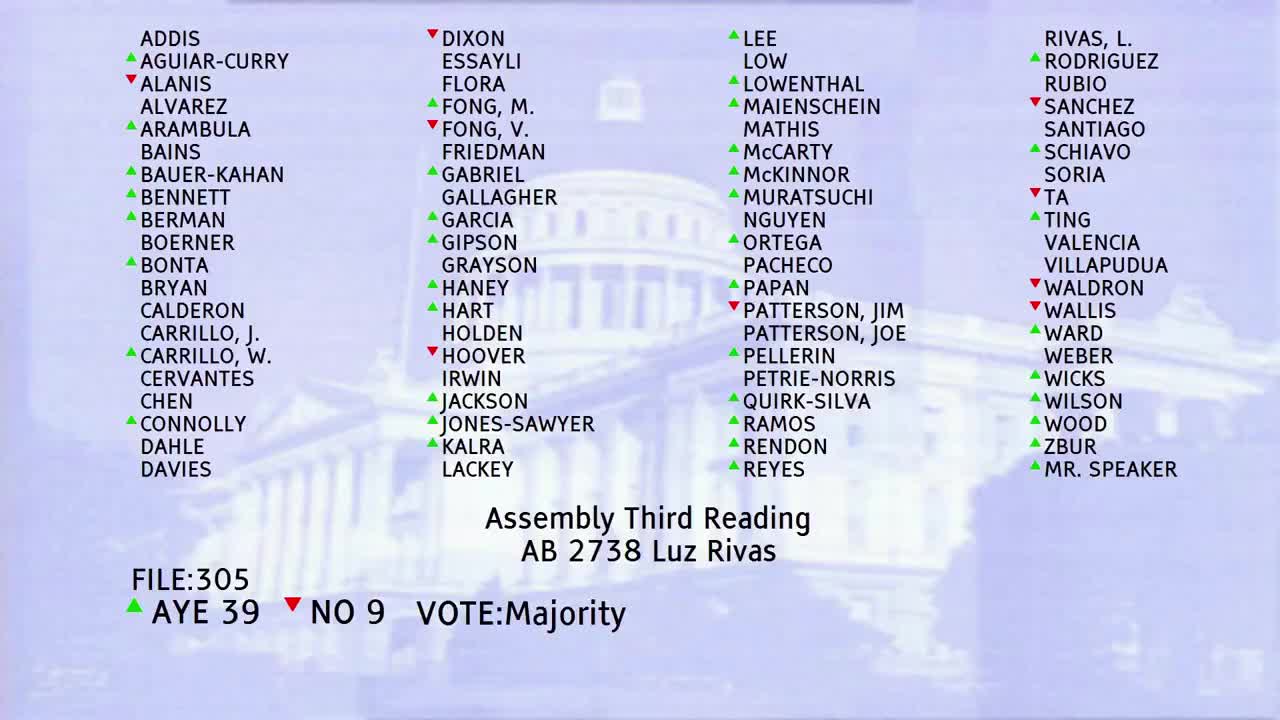 2MIN
Assembly Floor
 2MIN
Assembly Standing Committee on Appropriations
 12MIN
Assembly Standing Committee on Public Safety
Bill Author

Bill Co-Author(s):