AB 2141: Cash assistance programs: direct deposit.
- Session Year: 2023-2024
- House: Assembly
- Latest Version Date: 2024-04-08
Current Status:
Failed
(2024-05-16: In committee: Held under submission.)
Introduced
In Committee
First Chamber
In Committee
Second Chamber
Enacted
Existing law establishes the State Department of Social Services, which implements various public social service programs, including the Cash Assistance Program for Aged, Blind, and Disabled Legal Immigrants, the California Work Opportunity and Responsibility to Kids (CalWORKS) program, and general assistance aid, under which each county provides cash assistance and other benefits to qualified low-income families and individuals. Existing law requires counties to annually or periodically redetermine eligibility or benefits under public social service programs.
Existing law provides for the establishment of a statewide electronic benefits transfer (EBT) system, administered by the department, for the purpose of providing financial and food assistance benefits and requires certain benefit payments, including payments under CalWORKs, that are directly deposited into an account of the recipients choice to be deposited into a qualifying account.
This bill would include general assistance benefits among the cash assistance benefits that may be delivered by direct deposit. The bill would also require the applications for programs providing cash assistance benefits to include information on the application regarding the applicants right to choose to have their funds directly deposited. deposited or to be issued an EBT card. The bill would also require each county to inform the recipient of that right during their redetermination for eligibility. By increasing county duties, this bill would impose a state-mandated local program.
The California Constitution requires the state to reimburse local agencies and school districts for certain costs mandated by the state. Statutory provisions establish procedures for making that reimbursement.
This bill would provide that, if the Commission on State Mandates determines that the bill contains costs mandated by the state, reimbursement for those costs shall be made pursuant to the statutory provisions noted above.
Existing law establishes the State Department of Social Services, which implements various public social service programs, including the Cash Assistance Program for Aged, Blind, and Disabled Legal Immigrants, the California Work Opportunity and Responsibility to Kids (CalWORKS) program, and general assistance aid, under which each county provides cash assistance and other benefits to qualified low-income families and individuals. Existing law requires counties to annually or periodically redetermine eligibility or benefits under public social service programs.
Existing law provides for the establishment of a statewide electronic benefits transfer (EBT) system, administered by the department, for the purpose of providing financial and food assistance benefits and requires certain benefit payments, including payments under CalWORKs, that are directly deposited into an account of the recipients choice to be deposited into a qualifying account.
This bill would include general assistance benefits among the cash assistance benefits that may be delivered by direct deposit. The bill would also require the applications for programs providing cash assistance benefits to include information on the application regarding the applicants right to have their funds directly deposited. The bill would also require each county to inform the recipient of that right during their redetermination for eligibility. By increasing county duties, this bill would impose a state-mandated local program.
The California Constitution requires the state to reimburse local agencies and school districts for certain costs mandated by the state. Statutory provisions establish procedures for making that reimbursement.
This bill would provide that, if the Commission on State Mandates determines that the bill contains costs mandated by the state, reimbursement for those costs shall be made pursuant to the statutory provisions noted above.
(a)(1)The department may provide for the delivery of public assistance payments, including benefits issued under Section 17000, at any time during the month.
(2)The application for a cash assistance program, including, but not limited to, the Cash Assistance Program for Aged, Blind, and Disabled Legal Immigrants, the California Work Opportunity and Responsibility to Kids program, and and, provided that the county permits direct deposit, general assistance aid provided under Section 17000, shall include information regarding the applicants right to choose to have their funds directly deposited. deposited or to be issued an EBT card. The county providing the benefits shall also inform the recipient of the right to direct deposit of their cash assistance benefits at the recipients annual redetermination of eligibility.
(b)(1)Notwithstanding any other law, any person entitled to the receipt of public assistance payments may authorize payment to be directly deposited by electronic fund transfer into the persons qualifying account at the insured depository financial institution of the persons choice under a program for direct deposit by electronic transfer as established in this section. The direct deposit to a qualifying account shall discharge the departments obligation with respect to the payment.
(2)Each county treasurer shall make an agreement with one or more insured depository financial institutions participating in the Automated Clearing House pursuant to the local rules, and shall, by December 1, 2001, establish a program for the direct deposit by electronic fund transfer of payments to any person entitled to the receipt of public assistance benefits who authorizes the direct deposit of the benefits into the persons qualifying account at the insured depository financial institution of the persons choice. Each county treasurer has no obligation to determine whether the account at the insured depository financial institution of the persons choice is a qualifying account, as defined in paragraph (3).
(3)For purposes of this section, a qualifying account is one of the following:
(A)A demand deposit or savings account at an insured depository financial institution that is offered directly by the insured depository financial institution on its internet website or through its branches and that is in the name of the person entitled to receipt of public assistance payments.
(B)A prepaid account, or a demand deposit or savings account offered by or through an entity other than an insured depository financial institution, that meets all of the following:
(i)The account is held at an insured depository financial institution.
(ii)The account is set up to meet the requirements for direct or passthrough deposit or share insurance payable to the person entitled to the receipt of public assistance payments by the Federal Deposit Insurance Corporation in accordance with Part 330 of Title 12 of the Code of Federal Regulations, or the National Credit Union Share Insurance Fund in accordance with Part 745 of Title 12 of the Code of Federal Regulations.
(iii)The account is not attached to a credit or overdraft feature that is automatically repaid from the account unless the credit or overdraft feature has no fee, charge, or cost, whether direct, required, voluntary, or involuntary, or the credit or overdraft feature complies with the requirements for credit offered in connection with a prepaid account under the federal Truth in Lending Act (15 U.S.C. Sec. 1601 et seq.) and its implementing regulations.
(iv)The account complies with all of the requirements, and provides the holder of the account with all of the consumer protections, that apply to an account under the rules implementing the Electronic Fund Transfer Act (EFTA) (15 U.S.C. Sec. 1693 et seq.).
(4)A person or entity that is not an insured depository financial institution that offers, maintains, or manages an account that does not comply with paragraph (3) shall not solicit, accept, or facilitate the direct deposit of public assistance payments to the account.
(5)For purposes of this section, each county treasurer and county welfare department shall not be held liable for authorizing a direct deposit of public assistance payments into an account, designated by the person entitled to receipt of public assistance benefits, that does not comply with paragraph (3).
(6)This subdivision shall apply in each county that offers a program for direct deposit by electronic funds transfer to some or all of its employees.
(c)For the purposes of this section, the following definitions shall apply:
(1)Insured depository financial institution means a state or national bank, a state or federal savings and loan association, a mutual savings bank, or a state or federal credit union that holds deposits insured by the Federal Deposit Insurance Corporation or the National Credit Union Administration.
(2)Prepaid account has the same meaning as that term is defined in regulations under the EFTA.
(d)(1)Notwithstanding the rulemaking provisions of the Administrative Procedure Act (Chapter 3.5 (commencing with Section 11340) of Part 1 of Division 3 of Title 2 of the Government Code), the department may implement, administer, interpret, or make specific this section by means of all-county letters or similar written instructions from the department. These all-county letters or similar instructions shall have the same force and effect as regulations.
(2)Any all-county letters or similar written instructions that the department elects to issue pursuant to paragraph (1) shall be issued no later than October 1, 2022.
SEC. 2.If the Commission on State Mandates determines that this act contains costs mandated by the state, reimbursement to local agencies and school districts for those costs shall be made pursuant to Part 7 (commencing with Section 17500) of Division 4 of Title 2 of the Government Code.
(a)(1)The department may provide for the delivery of public assistance payments payments, including benefits issued under Section 17000, at any time during the month.
(2)The application for a cash assistance program, including, but not limited to, the Cash Assistance Program for Aged, Blind, and Disabled Legal Immigrants, the California Work Opportunity and Responsibility to Kids program, and general assistance aid provided under Section 17000, shall include information regarding the applicants right to have their funds directly deposited. The county providing the benefits shall also inform the recipient of the right to direct deposit of their cash assistance benefits at the recipients annual redetermination of eligibility.
(b)(1)Notwithstanding any other law, any person entitled to the receipt of public assistance payments may authorize payment to be directly deposited by electronic fund transfer into the persons qualifying account at the insured depository financial institution of the persons choice under a program for direct deposit by electronic transfer as established in this section. The direct deposit to a qualifying account shall discharge the departments obligation with respect to the payment.
(2)Each county treasurer shall make an agreement with one or more insured depository financial institutions participating in the Automated Clearing House pursuant to the local rules, and shall, by December 1, 2001, establish a program for the direct deposit by electronic fund transfer of payments to any person entitled to the receipt of public assistance benefits who authorizes the direct deposit of the benefits into the persons qualifying account at the insured depository financial institution of the persons choice. Each county treasurer has no obligation to determine whether the account at the insured depository financial institution of the persons choice is a qualifying account, as defined in paragraph (3).
(3)For purposes of this section, a qualifying account is one of the following:
(A)A demand deposit or savings account at an insured depository financial institution that is offered directly by the insured depository financial institution on its internet website or through its branches and that is in the name of the person entitled to receipt of public assistance payments.
(B)A prepaid account, or a demand deposit or savings account offered by or through an entity other than an insured depository financial institution, that meets all of the following:
(i)The account is held at an insured depository financial institution.
(ii)The account is set up to meet the requirements for direct or passthrough deposit or share insurance payable to the person entitled to the receipt of public assistance payments by the Federal Deposit Insurance Corporation in accordance with Part 330 of Title 12 of the Code of Federal Regulations, or the National Credit Union Share Insurance Fund in accordance with Part 745 of Title 12 of the Code of Federal Regulations.
(iii)The account is not attached to a credit or overdraft feature that is automatically repaid from the account unless the credit or overdraft feature has no fee, charge, or cost, whether direct, required, voluntary, or involuntary, or the credit or overdraft feature complies with the requirements for credit offered in connection with a prepaid account under the federal Truth in Lending Act (15 U.S.C. Sec. 1601 et seq.) and its implementing regulations.
(iv)The account complies with all of the requirements, and provides the holder of the account with all of the consumer protections, that apply to an account under the rules implementing the Electronic Fund Transfer Act (EFTA) (15 U.S.C. Sec. 1693 et seq.).
(4)A person or entity that is not an insured depository financial institution that offers, maintains, or manages an account that does not comply with paragraph (3) shall not solicit, accept, or facilitate the direct deposit of public assistance payments to the account.
(5)For purposes of this section, each county treasurer and county welfare department shall not be held liable for authorizing a direct deposit of public assistance payments into an account, designated by the person entitled to receipt of public assistance benefits, that does not comply with paragraph (3).
(6)This subdivision shall apply in each county that offers a program for direct deposit by electronic funds transfer to some or all of its employees.
(c)For the purposes of this section, the following definitions shall apply:
(1)Insured depository financial institution means a state or national bank, a state or federal savings and loan association, a mutual savings bank, or a state or federal credit union that holds deposits insured by the Federal Deposit Insurance Corporation or the National Credit Union Administration.
(2)Prepaid account has the same meaning as that term is defined in regulations under the EFTA.
(d)(1)Notwithstanding the rulemaking provisions of the Administrative Procedure Act (Chapter 3.5 (commencing with Section 11340) of Part 1 of Division 3 of Title 2 of the Government Code), the department may implement, administer, interpret, or make specific this section by means of all-county letters or similar written instructions from the department. These all-county letters or similar instructions shall have the same force and effect as regulations.
(2)Any all-county letters or similar written instructions that the department elects to issue pursuant to paragraph (1) shall be issued no later than October 1, 2022.
SEC. 2.If the Commission on State Mandates determines that this act contains costs mandated by the state, reimbursement to local agencies and school districts for those costs shall be made pursuant to Part 7 (commencing with Section 17500) of Division 4 of Title 2 of the Government Code.
|
Date
|
Status
|
|---|---|
| May 16, 2024 | In committee: Held under submission. |
| Apr 24, 2024 | In committee: Set, first hearing. Referred to APPR. suspense file. |
| Apr 9, 2024 | Re-referred to Com. on APPR. |
| Apr 8, 2024 | Read second time and amended. |
| Apr 4, 2024 | From committee: Amend, and do pass as amended and re-refer to Com. on APPR. (Ayes 7. Noes 0.) (April 2). |
| Feb 20, 2024 | Referred to Com. on HUM. S. |
| Feb 7, 2024 | From printer. May be heard in committee March 8. |
| Feb 6, 2024 | Read first time. To print. |
|
Date
|
Description
|
Location
|
Votes
|
|
|---|---|---|---|---|
| Apr 2, 2024 | Do pass as amended and be re-referred to the Committee on [Appropriations] | Assembly Standing Committee on Human Services |
Passed |
This list shows positions taken on this bill by organizations on the date displayed, which is linked to the original source.
Positions by individuals are not included.
|
Organization
|
Position
|
Date
|
|---|---|---|
| California Council Of The Blind | ** Support | |
| California Family Resource Association | ** Support | |
| Coalition of California Welfare Rights Organizations | ** Support | |
| Community Legal Aid SoCal | ** Support | |
| County Welfare Directors Association of California | ** Against | |
| Family Violence Appellate Project | ** Support | |
| Grace Institute - End Child Poverty in Ca | ** Support | |
| Legal Aid Society of San Diego | ** Support | |
| Public Law Center | ** Support | |
| Rural County Representatives of California | ** Against | |
| The Child Abuse Prevention Center And Its Affiliates Safe Kids California Prevent Child Abuse California And The California Family Resource Association | ** Support | |
| Urban Counties of California | ** Against | |
| western center on law & poverty | ** Support |
Date of Hearing: April 24, 2024
ASSEMBLY COMMITTEE ON APPROPRIATIONS
Buffy Wicks, Chair
ABPCA Bill Id:AB 2141
Author:(Gipson) – As Amended Ver:April 8, 2024
Policy Committee: | Human Services | Vote: | 7 - 0 |
|
| ||
|
|
Urgency: No State Mandated Local Program: Yes Reimbursable: Yes
SUMMARY:
This bill requires an application for a cash assistance program to include information regarding the applicant’s option to choose to have their funds directly deposited or be issued on an electronic benefits (EBT) card. The bill also codifies an existing regulatory requirement that a county, during a recipient’s annual cash assistance redetermination, inform the recipient of the right to direct deposit of their cash assistance benefits.
Specifically, this bill:
- Requires the application for a cash assistance program, including, but not limited to the Cash Assistance Program for Immigrants (CAPI), the California Work Opportunity and Responsibility to Kids (CalWORKs) program, and, provided the county permits direct deposit, general assistance aid, to include information regarding the applicant’s right to choose to have their funds directly deposited or be issued on an EBT card.
- Requires a county, during a recipient’s annual cash assistance redetermination of eligibility, to inform the recipient of the right to direct deposit of their cash assistance benefits.
FISCAL EFFECT:
CDSS estimates one-time General Fund (GF) automation costs of approximately $722,000 for changes to the California statewide automated welfare system (CalSAWS) and approximately $359,000 (GF) for updates to BenefitsCal, the portal used to apply for and manage benefits online, for updates to cash assistance program applications.
According to the Legislative Analyst’s Office, the General Fund faces a structural deficit in the tens of billions of dollars over the next several fiscal years.
COMMENTS:
- Purpose. According to the author:
Since 2019, California has lost nearly $2 million a month to EBT thieves. As we face an unprecedented budget shortfall it is imperative that we do what we can to stop this skimming from occurring. By educating recipients there is a safer way to receive their cash aid we will cut down on fraud and ensure that funds will be used by those who need it most.
- Background. Cash Assistance Programs. Existing state and federal laws establish several programs providing benefits in the form of cash assistance to qualified low-income individuals and families. Counties typically administer these programs on behalf of the state, including determining initial eligibility and periodically, usually annually, re-determining eligibility or benefits. Among the cash assistance programs:
- CalWORKs is the state’s primary cash assistance program, using federal and state funds to provide eligible low-income families with cash grants and supportive services aimed at helping them secure education, training, and employment.
- CAPI is a state-funded program aimed at providing monthly cash assistance to aged, blind, or disabled non-citizens who are present legally, but are ineligible for Supplemental Security Income/State Supplementary Payments (SSI/SSP) due solely to their immigration status.
- General Assistance/General Relief (GA/GR) is county-operated and funded. Each county has flexibility to determine eligibility requirements, time limits, benefits, and payment levels. Some counties provide cash grants or in-kind benefits to individuals and families. Other counties consider benefits as a loan and require recipients to pay the county back for benefits received. GA/GR benefit levels are typically very low. Not all counties provide for direct deposit of GA/GR benefits.
Direct Deposit. In California, recipients of CalWORKs cash aid receive their benefits on an EBT card and use the card as they would any other debit card for ATM withdrawals and purchases to meet their families' basic needs. CalWORKs and other cash assistance benefits may also be directly deposited into a personal bank account at the request of a CalWORKs recipient at a financial institution of their choosing. Cardholders are permitted to switch to direct deposit at any time or vice versa.
In recent years, EBT users have experienced an increase in stolen benefits as a result of criminal enterprises specifically targeting social safety net funds. Because EBT cards lack a security chip that many non-EBT credit and debit cards have, EBT users must swipe their cards at point-of-sales (POS) devices. This makes EBT card users particularly vulnerable to “skimming,” which occurs when thieves attached illegal devices onto card readers that, when swiped, copy a person’s information from the EBT card’s magnetic strip. In this regard, recipients utilizing direct deposit as opposed to an EBT card are less vulnerable to inadvertent disclosure of their EBT card information. The 2023-24 budget act provided funding to add security chips and tap features to EBT cards. This work is expected to be completed later this year.
To ensure recipients can use the entire cash award on necessary expenses, funds deposited onto EBT cards are protected from bank fees and withdrawals. However, funds directly deposited into a bank account do not have the same protections. For example, if a cash assistance recipient has overdrawn their bank account and their CalWORKs benefit is then deposited, their cash aid will likely be used to cover the overdraft bank fees.
To ensure a cash-aid recipient is aware they may to choose to receive their cash benefit on an EBT card or through a direct deposit into their bank account, this bill requires information about this choice to be included on applications for programs providing cash assistance. The bill also requires a county to inform the recipient of the right to direct deposit at the recipient’s annual redetermination of eligibility.
Analysis Prepared by: Jennifer Swenson / APPR. / (916) 319-2081
Date of Hearing: April 2, 2024
ASSEMBLY COMMITTEE ON HUMAN SERVICES
Alex Lee, Chair
ABPCA Bill Id:AB 2141 (
Author:Gipson) – As Introduced Ver:February 6, 2024
SUBJECT: Cash assistance programs: direct deposit
SUMMARY: Requires the application for cash assistance programs, including, but not limited to Cash Assistance Program for Aged, Blind, and Disabled Legal Immigrants (CAPI), the California Work Opportunity and Responsibility to Kids (CalWORKs) program, and general assistance aid, to include information regarding the applicant’s right to have their funds directly deposited; and requires counties during annual cash assistance redeterminations to inform the recipient of the right to direct deposit of their cash assistance benefits.
EXISTING LAW:
State law:
- Permits any person entitled to the receipt of public assistance payments to authorize payment to be directly deposited by electronic fund transfer into the person’s qualifying account at the insured depository financial institution of the person’s choice under a program for direct deposit by electronic transfer. (Welfare and Intuitions Code [WIC] §11006.2)
- Defines “qualifying account” as:
- A demand deposit or savings account at an insured depository financial institution that is offered directly by the insured depository financial institution on its internet website or through its branches and that is in the name of the person entitled to receipt of child support, unemployment compensation, and CalWORKs payments; or,
- A prepaid account or a demand deposit or savings account offered by, or through, an entity other than an insured depository financial institution, that meets all of the following:
- The account is held at an insured depository financial institution;
- The account is set up to meet the requirements of direct or passthrough deposit or share insurance payable to the person entitled to the receipt of public assistance payments, as specified;
- The account is not attached to a credit or overdraft feature that is automatically repaid from the account unless the credit or overdraft feature has no fee, charge, or cost, whether direct, required, voluntary, or involuntary, or the credit or overdraft feature complies with the requirements for credit offered in connection with a prepaid account under the federal Truth in Lending Act and its implementing regulations; and,
- The account complies with all of the requirements and provides the holder of the account with all of the consumer protections that apply to account under Electronic Funds Transfer Act (EFTA) federal law, as specified. (WIC § 11006.2 (b) (3))
- Requires counties to notify recipients of the option to receive benefits by direct deposit at the time of application or redetermination. (California Department of Social Services (CDSS) Manual of Policies and Procedures, Division 44 -032.11)
- Establishes in state law the “CalWORKs” program to provide cash assistance and other social services for low-income families through TANF. Under CalWORKs, each county provides assistance through a combination of state, county, and federal TANF funds. (WIC § 11120 et seq.)
- Requires every county and every city and county to relieve and support all incompetent, poor, indigent persons, and those incapacitated by age, disease, or accident, lawfully resident therein, when such persons are not supported and relieved by their relatives or friends, by their own means, or by state hospitals or other state or private institutions. (WIC § 17000)
- Requires the board of supervisors of every county as a board, or by committee or by any person or society as it may authorize to investigate every application for relief from the funds of the county, to supervise by periodic visitation every person receiving that relief, to devise ways and means for bringing persons unable to maintain themselves to self-support, and to keep full and complete records of the investigation, supervision, relief, and rehabilitation, as specified. These records are to be confidential and to not be open to examination or inspection, except by the grant jury of the county or by a board or an officer of the state or the county charged with the supervision or direction of that relief or with the control or expenditure of funds applicable to that relief. (WIC § 17006(a))
- Requires CDSS to establish and supervise a county- or county consortia-administered program to provide cash assistance to the Cash Assistance Program for Aged, Blind, and Disabled Legal Immigrants that are not eligible for Supplemental Security Income/State Supplementary Payments (SSI/SSP). (WIC § 18937-18944)
Federal law:
- Establishes the federal “Temporary Assistance for Needy Families” (TANF) program, which permits states to implement the program under a state plan. (42 United States Code [U.S.C.] § 601 et seq.)
- Establishes the EFTA for the purpose of providing a basic framework establishing the rights, liabilities, and responsibilities of participants in electronic fund and remittance transfer systems. The primary objective of this subchapter, however, is the provision of individual consumer rights. (15 U.S.C. 1693 §§ et seq.)
FISCAL EFFECT: Unknown, this bill has not been analyzed by a fiscal committee.
COMMENTS:
Background: Cash Assistance Programs. Using state and federal funds, the state uses several cash assistance programs that serve low-income populations:
CalWORKs is the state’s primary cash assistance program. More specifically, CalWORKs implements the federal TANF program and provides eligible low-income families with cash grants and supportive services aimed at helping them to secure education, training, and employment. Among others, the supportive services include mental health counseling, substance use disorder treatment, or domestic violence services; job skills training; attendance in a secondary school or a course leading to a certificate of general educational development.
CAPI is a state-funded program that provides monthly cash aid to blind or disabled non-citizens 65 years or older who are not eligible for SSI/SSP based solely on their immigration status. In 1996, the Personal Responsibility and Work Opportunity Act excluded non-citizens from SSI/SSP eligibility. The SSI Program is a federally funded program administered by the Social Security Administration (SSA), which provides income support to eligible individuals who are 65 years or older, blind or disabled. The SSP Program is the state program that augments SSI. Eligibility for both programs is determined and administered by the SSA using federal criteria. If an eligible individual qualifies for SSI, they qualify for SSP. The following are CAPI requirements:
- 65 years or older, blind or disabled.
- A non-citizen and meets the immigration status criteria in effect for SSI/SSP as of August 21, 1996.
- Ineligible for SSI/SSP solely due to their immigration status.
- California resident.
- Their income must be less than the CAPI standards.
• Resources must be below $2,000 for an individual or $3,000 for a couple.
General Assistance/General Relief (GA/GR) is county-operated which means that eligibility and benefits amounts vary from county to county. Counties are authorized to establish further assistance to bridge any gap in public assistance needs. Pursuant to current law, each county is required to establish and fund a GA/GR program by its own Board of Supervisors to provide aid to disadvantaged adults who are not supported by their own means, other public funds, or other assistance programs.
As the state is not involved, each county has flexibility in how it chooses to administer the program, including determining eligibility requirements, time limits, its own benefits, and payment levels. Since the program varies among each of California’s 58 counties, there is no statewide standard. The populations GA/GR programs serve vary by locality.
Some counties provide cash grants (a gift with no strings attached) or in-kind benefits to individuals and families, such as direct payments for housing, utilities, or medical expenses, or a combination of cash grants and in-kind grants to meet general needs. Other counties, like Colusa, Marin, Napa, and Orange, consider benefits as a “loan” and require recipients to pay the county back for benefits received if the recipient has enough income to do so, gets a job, or gets approved for Social Security Disability Insurance or SSI disability benefits. For example, Sacramento County requires all GA/GR applicants to sign a Repayment Agreement and Lien on Real Property to reimburse the county for all GA/GR benefits received. Some counties have opted to waive repayment as a condition of receiving GA/GR benefits, including Santa Clara County. Other benefits may include transportation costs, substance use disorder treatment referrals, emergency food, and cash or vouchers, and are typically available for individuals not otherwise eligible for state and federal assistance programs.
GA/GR benefit levels are typically very low and are calculated based on a person’s marital status, housing situation, disabilities, ability to work, and ability to apply for other public benefits programs. According to a 2020 report by the Center on Budget and Policy Priorities, while benefit levels vary by county, California’s maximum monthly allowance is $221 for those deemed “unemployable” or “employable,” which has not changed in at least a decade and has significantly depreciated in value over time.
Refugee Cash Assistance (RCA) provides federal cash payments to refugee single adults and/or families for up to 12 months from the refugee’s date of entry into the US. RCA follows most of the CalWORKs regulations including those of properties and income. Unlike CalWORKs, eligibility for RCA does not require a child to be in a home that is deprived of parental support or care. Refugees eligible for CalWORKs cannot choose to be aided under RCA. RCA recipients receive cash assistance based on the CalWORKs Maximum Aid Payment values.
Electronic Benefits Transfer (EBT). AB 1542 (Ducheny), Chapter 270, Statutes of 1997, which implemented federal welfare reform and established the CalWORKs program, also conformed to federal law in establishing the Electronic Benefits Transfer Act, which makes the following declarations:
- The development of incompatible systems for electronic benefits transfer will create significant hardships on recipients of public social services and businesses that accept electronic transactions as payment for goods and services; and,
- The goals of electronic benefits transfer are to reduce the cost of delivering benefits to recipients, to ensure that all systems within California are compatible, and to afford public social services recipients the opportunity to better and more securely manage their financial affairs.
California's official move from a paper-based system to an electronic system for the distribution and use of public assistance benefits occurred in 2002. This shift was essential in helping the CalWORKs and CalFresh (then Food Stamps) programs keep pace with technological advances in point-of-sale (POS) and automated teller systems.
The Unbanked Population. According to the Federal Deposit Insurance Corporation’s (FDIC) 2020 survey of household use of banking and financial services, between 5.6% and 7.6% of Californians are considered unbanked, which means that no one in the household has a checking or savings account. That percentage increases significantly when filtered for income level (low-income, 24%), ethnicity (Black households, 15.2%; Latino, 14%), and disability (disabled, 15%)
The FDIC survey broke down the main reasons households do not have a bank account to include the following:
- Don’t have enough money to meet minimum balance requirements (48.9%)
- Don’t trust banks (36.3%)
- Avoiding a bank gives more privacy (36%)
- Bank account fees are too high (34.2%)
- Bank account fees are too unpredictable (31.3%)
A 2023 study conducted by Bankrate, a print publisher for the banking industry, now in its 26th year, surveyed banks in each of 25 large national markets regarding checking accounts and ATM fee policies. The study found that while the average cost of an overdraft fee has fallen, it is still hovering at $26.61 and can run as high as $38. The study also found that among the banks surveyed, overdraft fees are charged by 91% of accounts. The average monthly fee on an interest checking account is $15.33, with the average minimum balance required to avoid the fee being $8,684.
A 2004 research brief published by The Brookings Institution, Banking the Poor: Policies to Bring Low-Income Americans into the Financial Mainstream, notes that another barrier the low-income population experiences when accessing banks comes from difficulties that many unbanked persons may have in qualifying for conventional bank accounts because of past problems with the banking system. ChexSystems, a bank account screening consumer reporting agency that most banks use to decide whether to open accounts for potential customers, records that individuals have had their accounts closed for prior problems, such as writing checks with insufficient funds or failing to pay overdraft fees. The brief also points out that in some low-income neighborhoods, banks, thrifts, and credit unions are not as readily accessible to potential customers as they are in higher-income areas.
Because a disproportionate number of families receiving cash assistance are also unbanked, some counties may not be considering the direct deposit option to be feasible for the majority of their clients.
EBT Cards versus Direct Deposit. In California, recipients of CalWORKs cash aid often receive their benefits on an EBT card and use the card as they would any other debit card for ATM withdrawals and purchases to meet their families' basic needs. Unlike CalFresh benefits, which can only be accessed through the use of an EBT card and are not eligible for cash withdrawal or purchase of basic necessities that don't qualify as food, CalWORKs and other cash assistance benefits can also be directly deposited into a personal bank account at the request of a CalWORKs recipient via EBT at a financial institution of their choosing for the entire duration of their aid. Cardholders are permitted to switch to direct deposit at any time or vice versa. According to All County Information Notice No. I-23-23 (ACL 2323) issued by CDSS, “Recipients utilizing direct deposit as opposed to an EBT card are much less vulnerable to inadvertent disclosure of their EBT card information to bad actors.”
Electronic Benefits Transfer Theft on the Rise in the Country. In recent years, EBT users in California, but also across the nation, have experienced an uptick in stolen benefits as a result of organized criminal enterprises specifically targeting social safety net funds. A January 2023 article from CalMatters states that from July 2021 through September 2022, “Californians reported $29.7 million in cash welfare stolen, and $4.7 million in food aid [was] stolen…[CDSS] estimates that an average of $6 million a month will be stolen this fiscal year, rising to $8 million a month in the year that begins in July.”
A key security feature that EBT cards lack is the security chip that many non-EBT credit and debit cards have. Because this missing component requires EBT users to swipe their cards at POS devices, EBT card users are particularly vulnerable to “skimming,” which occurs when thieves attached illegal devices onto card readers that, when swiped, copy a person’s information from the EBT card’s magnetic strip. Thieves can then create counterfeit EBT cards to access funds almost immediately after they are deposited. The 2023-24 Budget provided funding for California to add security chips and tap features to EBT cards. This is anticipated to be complete in Summer 2024. A February 8, 2023, Los Angeles Times article states,
“They strike early in the morning on the first few days of every month – hours, sometimes minutes after the state deposits funds onto the cards. They do the same with food stamps, which the state also deposits on EBT cards, then rack up mammoth bills at grocery stores. Some of the county’s poorest residents will wake up to discover a month of food or rent money they were relying on has vanished – even though their EBT card never left their wallet.”
CalMatters reported that roughly $10 million a month has been stolen in public benefits in 2023. Recipients can get up to two months of replacement benefits if benefits have been “skimmed.” A recipient must file a claim to the county using a state form (EBT 2259) within 90 days of thefts and the county has ten business days to replace the benefits.
Author’s Statement: According to the Author, “Since 2019, California has lost nearly $2 million a month to EBT thieves. As we face an unprecedented budget shortfall it is imperative that we do what we can to stop this skimming from occurring. By educating recipients that there is a safer way to receive their cash aid we will cut down on fraud and ensure that funds will be used by those who need it most.”
Equity Implications: Cash assistance programs all serve vulnerable individuals who benefit from the assistance these programs provide by allowing recipients to meet their basic needs, which allows them to seek stability. These programs are vital to California’s safety net. Current law as described above allows for cash assistance recipients to choose how they receive their benefits – EBT card or direct deposit. It is important to continue to allow choice for recipients so recipients can make decisions that best serve their lives. This bill requires the application to contain information about direct deposit rather than the current status quo of a county worker simply notifying recipients. Adding this information to the application might increase awareness of this option and take the burden off county staff to notify recipients verbally and also has the potential to increase the number of low-income unbanked individuals as well as decrease the incidences of fraud.
Policy Considerations: EBT cards are protected from fees and withdrawals to ensure recipients can use the awarded assistance on necessary expenses. Bank accounts do not have the same protections. For example, if a cash assistance recipient has overdrafted their account and their CalWORKs is deposited, then their cash aid will go to bank fees. It is crucial to ensure that recipients have the choice, and are aware of their choice, to choose an EBT card that is protected from bank fees or automatic withdrawals, or a direct deposit into their bank account. Adding direct deposit to the application for cash assistance is well intended; however, it is imperative that recipients are also informed of their choices.
Should this bill move forward, the author may wish to clarify cash aid recipients may choose their preferred method to receive the aid.
As described above, GA varies widely between all 58 counties and is not uniformly offered to recipients. Direct deposit is not a current requirement for GA like other state cash assistance programs.
Should this bill move forward, the author may wish to clarify that only in counties that permit GA to be directly deposited should this requirement be added.
Proposed Amendments:
The Committee proposes amendments to address policy considerations stated above to do the following:
- Add EBT card as an option on the application and clarify a recipient has a choice.
- Only requires counties that permit GA to be deposited via direct deposit to include it on their application.
RELATED AND PRIOR LEGISLATION:
AB 2540 (Berman) of 2022, would have allowed an otherwise qualified prepaid or nonbank account to be eligible for the direct deposit of certain public benefit payments even if the account contained a voluntary fee, charge, or cost in connection to a credit or overdraft feature, provided that the voluntary fee, charge, or cost option met specified standards. AB 2540 was set to be heard by the Senate Banking and Financial Institutions Committee but the hearing was cancelled at the request of the author.
SB 497 (Limon), Chapter 546, Statutes of 2021, revised the definition of qualifying accounts that can receive direct deposits related to unemployment compensation, child support, and other public assistance payments
AB 1519 (Committee on Judiciary), Chapter 416, Statutes of 2015, adopted protections for accounts eligible to receive direct deposit of child support payments collected and distributed by the state.
AB 2252 (Pérez), Chapter 180, Statutes of 2014, adopted protections for accounts eligible to receive direct deposit of child support payments collected and distributed by the state.
AB 1280 (Pérez), Chapter 557, Statutes of 2013, adopted protections for recipients of cash assistance and unemployed workers from fees that drain funds by setting requirements for “qualifying accounts” to be eligible to receive direct deposit of unemployment compensation. To qualify, an account must either be a bank account at an insured financial institution, or a prepaid card account that meets certain standards, including deposit insurance, compliance with rules under the federal Electronic Fund Transfer Act, and lack of overdraft fees.
AB 2035 (Bradford), Chapter 319, Statutes of 2012, protected against electronic theft of benefits delivered electronically.
SB 962 (Escutia), Chapter 795, Statutes of 2000, required counties that offer direct deposit to county employees to offer an electronically-based direct deposit system to recipients of public assistance.
AB 1542 (Ducheny), Chapter 270, Statutes of 1997, implemented federal welfare reform and conformed to federal law in establishing the electronic benefits transfer system to deliver CalWORKs and CalFresh (then Food Stamps) benefits.
REGISTERED SUPPORT / OPPOSITION:
Support
Coalition of California Welfare Rights Organizations (Sponsor)
California Council of The Blind
California Family Resource Association
Child Abuse Prevention Center and Its Affiliates Safe Kids California, Prevent Child Abuse California and The California Family Resource Association; the
Community Legal Aid Socal
Family Violence Appellate Project
Grace Institute - End Child Poverty in CA
Legal Aid Society of San Diego
Public Law Center
Western Center on Law & Poverty
Opposition
County Welfare Directors Association of California
Rural County Representatives of California (RCRC)
Urban Counties of California (UCC)
Analysis Prepared by: Alexandria Smith / HUM. S. / (916) 319-2089
Discussed in Hearing
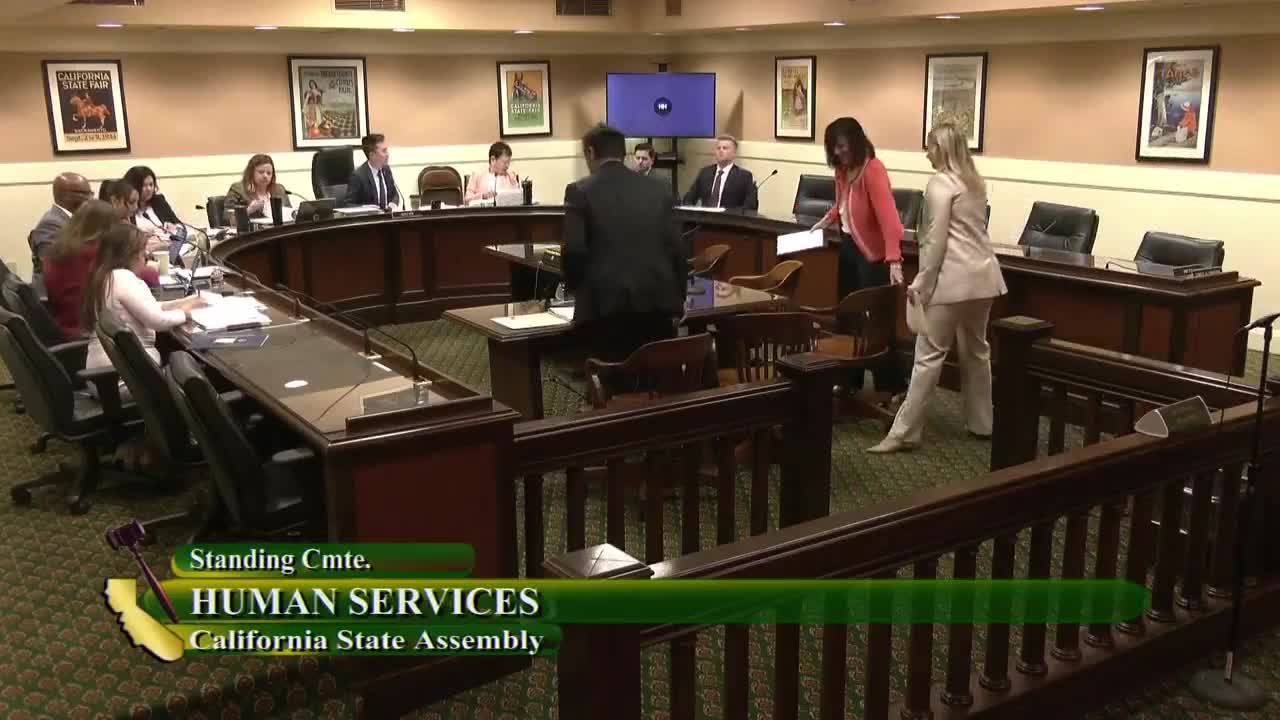 5MIN
Assembly Standing Committee on Human Services
Bill Author

Bill Co-Author(s):