AB 528: San Francisco Bay Area Rapid Transit District: strikes: prohibition.
- Session Year: 2015-2016
- House: Assembly
- Latest Version Date: 2015-02-23
Existing law creates the San Francisco Bay Area Rapid Transit District and establishes provisions regulating the collective bargaining of the employees and the board of directors of that district. Existing law prescribes procedures specifically relating to the collective bargaining of transit districts, and authorizes the Governor, when it appears a strike will significantly disrupt transportation services and endanger public health, safety, and welfare, to appoint a board to investigate issues in connection with these labor negotiations and make a report. Existing law prohibits a strike during the period of investigation and permits the Governor, upon receiving a report from a board of investigation, to request the Attorney General to petition a court to enjoin the strike, as specified.
This bill would prohibit employees of the San Francisco Bay Area Rapid Transit District from engaging in a strike or work stoppage if the transit district board maintains the compensation and benefit provisions of an expired contract and an employee or employee organization has agreed to a provision prohibiting strikes in the expired or previous written labor contract. The bill would provide that an employee whom the transit district employer finds willfully engaged in a strike or work stoppage in violation of these provisions is subject to dismissal if that finding is sustained upon conclusion of the appropriate proceedings necessary for the imposition of a disciplinary action.
Except as expressly provided by subdivision (b) of Section 3612 and Section 3614, 3612, and Sections 3614 and 3616.1, nothing in this chapter shall be construed to grant or deprive employees of a right to strike.
SEC. 2.Section 3616.1 is added to the Government Code, to read:3616.1.(a)This section shall apply to employees of the San Francisco Bay Area Rapid Transit District as created in Section 28600 of the Public Utilities Code.
(b)Notwithstanding any other law, if the Board of Directors of the San Francisco Bay Area Rapid Transit District maintains the compensation and benefit provisions of an expired contract, and an employee or employee organization has agreed to a provision prohibiting strikes in the expired or previous written labor contract, then a strike or work stoppage by employees of the district is hereby deemed contrary to the public interest and is prohibited.
(c)An employee whom the transit district employer finds willfully engaged in a strike or work stoppage in violation of subdivision (b) by failing to report for work shall be subject to dismissal from his or her employment if that finding is sustained upon conclusion of the appropriate proceedings necessary for the imposition of disciplinary action upon the employee.
|
Date
|
Status
|
|---|---|
| Feb 1, 2016 | From committee: Filed with the Chief Clerk pursuant to Joint Rule 56. |
| Jan 31, 2016 | Died pursuant to Article IV, Sec. 10(c) of the Constitution. |
| Jan 6, 2016 | In committee: Set, first hearing. Failed passage. |
| May 6, 2015 | In committee: Testimony taken. Hearing postponed by committee. |
| Apr 9, 2015 | Referred to Com. on P.E., R., & S.S. |
| Feb 24, 2015 | From printer. May be heard in committee March 26. |
| Feb 23, 2015 | Read first time. To print. |
|
Date
|
Description
|
Location
|
Votes
|
|
|---|---|---|---|---|
| Jan 6, 2016 | Do pass. | Assembly Standing Committee on Public Employees, Retirement, and Social Security |
Failed |
This list shows positions taken on this bill by organizations on the date displayed, which is linked to the original source.
Positions by individuals are not included.
Date of Hearing: January 6, 2016
ASSEMBLY COMMITTEE ON PUBLIC EMPLOYEES, RETIREMENT, AND SOCIAL SECURITY
Jim Cooper, Chair
ABPCA Bill Id:AB 528
Author:(Baker) – As Introduced Ver:February 23, 2015
SUBJECT: San Francisco Bay Area Rapid Transit District: strikes: prohibition
SUMMARY: Prohibits employees of the San Francisco Bay Area Rapid Transit District (BART) from striking if the transit district board maintains the compensation and benefit provisions of an expired contract and that contract or previous contract includes provisions prohibiting strikes. Specifically, this bill:
- Prohibits BART employees from striking or engaging in a work stoppage as long as the BART board of directors maintains the compensation and benefit provisions of an expired contract and the expired contract or previous contract includes an agreed upon provision prohibiting strikes.
- Provides that if the transit district employer finds that an employee willfully engaged in a strike or work stoppage in violation of the above, the employee may be dismissed, upon the conclusion of appropriate proceedings, if that finding is sustained.
EXISTING LAW:
- Establishes the Public Employment Relations Board (PERB), which houses the State Mediation and Conciliation Service, and has legal jurisdiction over labor relations between most state and local public employers and their employees.
- Specifically defines how to resolve disputes between public transportation employers and employee organizations, including timeframes for the exchange of contract proposals and collective bargaining, and the assignment of a conciliator from the State Mediation and Conciliation Service, as specified.
- Allows the Governor, whenever he or she determines that a threatened strike or lockout, if permitted to occur, would significantly disrupt the public's health, safety, or welfare, to appoint a board to investigate the issues involved in the dispute and submit a report to the Governor within 7 days.
- Requires that the report include statements of fact with regard to the dispute, be public, and not contain recommendations.
- Prohibits any strike or walkout during the period of investigation by the board.
- Requires the board to consist of no more than 5 members, defines per diem and reimbursements for board members, and allows the board to hold public hearings, subpoena witnesses, require the production of documents, and to use all necessary means to compel witnesses and obtain testimony.
- Allows the Governor, upon receiving the report from the board, to request the Attorney General to petition any court of competent jurisdiction to enjoin the strike or lockout for a period of 60 days, and requires the court to issue the enjoining order if the court finds that the strike or lockout, if permitted, would significantly disrupt public transportation or endanger public health, safety, or welfare.
- Specifies that if the local agency has a charter or establishing legislation that establishes a time period for negotiating or meeting and conferring that is shorter than 60 days, then these provisions do not apply to disputes arising in that agency between the employer and exclusive bargaining representative.
- Clarifies that, except as expressly provided, nothing in these laws shall be construed either to expressly grant or deprive employees of the right to strike.
FISCAL EFFECT: Unknown. This bill is keyed non-fiscal by the Legislative Counsel.
COMMENTS: According to the author, "The San Francisco Bay Area Rapid Transit District (BART) was formed by the state legislature in 1957, and has established provisions regulating collective bargaining of the employees and the board of directors. Over 400,000 riders rely daily on BART to get to work, go to school, see the doctor, visit family and friends, and engage in their communities. BART transit services are essential to Bay Area residents and commuters, and must be protected. There have been five labor strikes in BART history. Two strikes in 2013 created havoc for riders, jammed Bay Area roads, and caused environmental damage with greater carbon emissions impacting air quality. The 2013 strikes brought transportation to a grinding halt in the Bay Area and cost over $73 million dollars a day to the Bay Area economy. These 2013 strikes occurred even though BART workers had a no-strike clause in their most recent contract.'
"In past and current labor contracts for BART, strikes and work stoppages are prohibited by no-strike clauses. Strikes and work stoppages are also prohibited during times of investigation that are called by the Governor. A loophole, however, was made glaringly apparent when BART workers twice went on strike in 2013. The workers went on strike anyway, because the contract with a no-strike clause had expired. They went on strike even though they continued to receive wages and benefits under the expired contract."
The author concludes, "This bill closes the loophole and ensures public safety, health, and welfare are protected by declaring that if BART employees continue to receive pay and other benefits provided by BART management under the expired contract, the worker must abide by the no-strike clause of that contract."
Opponents state, "The right to strike – as codified into law in 1935 via the National Labor Relations Act (NLRA) – is a longstanding, federally-protected action and cornerstone from workers' rights in the workplace, and is part of the collective bargaining process. Ultimately,
AB 528 is punitive and does not consider the intricacies of the collective bargaining process, the history and underlying rationale of how or why a strike might be considered, nor the careful considerations given by represented public employees in public transportation agencies prior to calling a strike."
Additionally, opponents believe that, "…this bill may run afoul of the provisions of section 13(c) of the Federal Urban Mass Transit Act of 1966, which prohibits states and local governments from eroding employee collective bargaining rights. Consequently, passage of this bill could result in a withholding of federal funding for BART."
Existing federal law protects the collective bargaining rights of specified transit workers employed in certain transit agencies and districts that were, mostly in the 1960's through the 1970's, converted from private to public agencies. Federal Transit Law Section 13(c) requires that these employee protections, commonly referred to as "protective arrangements" or "Section 13(c) arrangements" must be certified by the United States Department of Labor (USDOL) and in place before federal transit funds can be released to a mass transit employer subject to the Federal Transit Law.
Section 13(c) requires, among other things, the continuation of collective bargaining rights, and protection of transit employees' wages, working conditions, pension benefits, seniority, vacation, sick and personal leave, travel passes, and other conditions of employment.
SB 423 (Huff) of last year would have repealed various statutes governing public transportation labor disputes, including requirements governing labor relations when a strike is threatened; added new laws to prohibit public transportation workers from striking; and proscribed penalties and sanctions for employees and recognized labor organizations that participate in, cause, encourage, or condone strikes. This bill failed passage in the Senate Public Employment and Retirement Committee.
REGISTERED SUPPORT / OPPOSITION:
Support
Bay Area Council
Innovation Tri-Valley Leadership Group
Jerry T. Thorne, Mayor, City of Pleasanton
Moraga Town Council
Opposition
American Federation of State, County and Municipal Employees
California Conference Board of the Amalgamated Transit Union
California Conference of Machinists
California Federation of Teachers
California Labor Federation
California Nurses Association
California Professional Firefighters
California School Employees Association
California State Council of the Service Employees International Union
California Teamsters Public Affairs Council
Engineers & Scientists of CA, IFPTE Local 20, AFL-CIO
International Longshore & Warehouse Union
Organization of SMUD Employees
Peace Officers Research Association of California
Professional & Technical Engineers, IFPTE Local 21, AFL-CIO
Service Employees International Union, Local 1000
San Diego County Court Employees Association
San Luis Obispo County Employees Association
UNITE-HERE, AFL-CIO
Utility Workers Union of America
Analysis Prepared by: Karon Green / P.E.,R., & S.S. / (916) 319-3957
AB 528
Page 3
Date of Hearing: May 6, 2015
ASSEMBLY COMMITTEE ON PUBLIC EMPLOYEES, RETIREMENT, AND SOCIAL SECURITY
Rob Bonta, Chair
AB 528
(Baker) – As Introduced February 23, 2015
SUBJECT: San Francisco Bay Area Rapid Transit District: strikes: prohibition
SUMMARY: Prohibits employees of the San Francisco Bay Area Rapid Transit District (BART) from striking if the transit district board maintains the compensation and benefit provisions of an expired contract and that contract or previous contract includes provisions prohibiting strikes. Specifically, this bill:
Prohibits BART employees from striking or engaging in a work stoppage as long as the BART board of directors maintains the compensation and benefit provisions of an expired contract and the expired contract or previous contract includes an agreed upon provision prohibiting strikes.
Provides that if the transit district employer finds that an employee willfully engaged in a strike or work stoppage in violation of the above, the employee may be dismissed, upon the conclusion of appropriate proceedings, if that finding is sustained.
EXISTING LAW:
Establishes the Public Employment Relations Board (PERB), which houses the State Mediation and Conciliation Service, and has legal jurisdiction over labor relations between most state and local public employers and their employees.
Specifically defines how to resolve disputes between public transportation employers and employee organizations, including timeframes for the exchange of contract proposals and collective bargaining, and the assignment of a conciliator from the State Mediation and Conciliation Service, as specified.
Allows the Governor, whenever he or she determines that a threatened strike or lockout, if permitted to occur, would significantly disrupt the public's health, safety, or welfare, to appoint a board to investigate the issues involved in the dispute and submit a report to the Governor within 7 days.
Requires that the report include statements of fact with regard to the dispute, be public, and not contain recommendations.
Prohibits any strike or walkout during the period of investigation by the board.
Requires the board to consist of no more than 5 members, defines per diem and reimbursements for board members, and allows the board to hold public hearings, subpoena witnesses, require the production of documents, and to use all necessary means to compel witnesses and obtain testimony.
Allows the Governor, upon receiving the report from the board, to request the Attorney General to petition any court of competent jurisdiction to enjoin the strike or lockout for a period of 60 days, and requires the court to issue the enjoining order if the court finds that the strike or lockout, if permitted, would significantly disrupt public transportation or endanger public health, safety, or welfare.
Specifies that if the local agency has a charter or establishing legislation that establishes a time period for negotiating or meeting and conferring that is shorter than 60 days, then these provisions do not apply to disputes arising in that agency between the employer and exclusive bargaining representative.
Clarifies that, except as expressly provided, nothing in these laws shall be construed either to expressly grant or deprive employees of the right to strike.
FISCAL EFFECT: Unknown. This bill is keyed non-fiscal by the Legislative Counsel.
COMMENTS: According to the author, "The San Francisco Bay Area Rapid Transit District (BART) was formed by the state legislature in 1957, and has established provisions regulating collective bargaining of the employees and the board of directors. Over 400,000 riders rely daily on BART to get to work, go to school, see the doctor, visit family and friends, and engage in their communities. BART transit services are essential to Bay Area residents and commuters, and must be protected. There have been five labor strikes in BART history. Two strikes in 2013 created havoc for riders, jammed Bay Area roads, and caused environmental damage with greater carbon emissions impacting air quality. The 2013 strikes brought transportation to a grinding halt in the Bay Area and cost over $73 million dollars a day to the Bay Area economy. These 2013 strikes occurred even though BART workers had a no-strike clause in their most recent contract.'
"In past and current labor contracts for BART, strikes and work stoppages are prohibited by no-strike clauses. Strikes and work stoppages are also prohibited during times of investigation that are called by the Governor. A loophole, however, was made glaringly apparent when BART workers twice went on strike in 2013. The workers went on strike anyway, because the contract with a no-strike clause had expired. They went on strike even though they continued to receive wages and benefits under the expired contract."
The author concludes, "This bill closes the loophole and ensures public safety, health, and welfare are protected by declaring that if BART employees continue to receive pay and other benefits provided by BART management under the expired contract, the worker must abide by the no-strike clause of that contract."
Opponents state,
"The right to strike – as codified into law in 1935 via the
National Labor Relations Act (NLRA) – is a longstanding,
federally-protected action and cornerstone from workers' rights in
the workplace, and is part of the collective bargaining process.
Ultimately,
AB 528 is punitive and does not consider the
intricacies of the collective bargaining process, the history and
underlying rationale of how or why a strike might be considered, nor
the careful considerations given by represented public employees in
public transportation agencies prior to calling a strike."
Additionally, opponents believe that, "…this bill may run afoul of the provisions of section 13(c) of the Federal Urban Mass Transit Act of 1966, which prohibits states and local governments from eroding employee collective bargaining rights. Consequently, passage of this bill could result in a withholding of federal funding for BART."
Existing federal law
protects the collective bargaining rights of specified transit
workers employed in certain transit agencies and districts that were,
mostly in the 1960's through the 1970's, converted from private to
public agencies. Federal Transit Law Section 13(c) requires that
these employee protections, commonly referred to as "protective
arrangements" or "Section 13(c) arrangements" must be
certified by the United States Department of Labor (USDOL) and in
place before federal transit funds can be released to a mass transit
employer subject to the Federal Transit Law.
Section 13(c)
requires, among other things, the continuation of collective
bargaining rights, and protection of transit employees' wages,
working conditions, pension benefits, seniority, vacation, sick and
personal leave, travel passes, and other conditions of employment.
SB 423 (Huff) of
last year would have repealed various statutes governing public
transportation labor disputes, including requirements governing labor
relations when a strike is threatened; added new laws to prohibit
public transportation workers from striking; and proscribed penalties
and sanctions for employees and recognized labor organizations that
participate in, cause, encourage, or condone strikes. This bill
failed passage in the Senate Public Employment and Retirement
Committee.
REGISTERED SUPPORT / OPPOSITION:
Support
Innovation Tri-Valley Leadership Group
Jerry T. Thorne, Mayor, City of Pleasanton
Moraga Town Council
Opposition
American Federation of State, County and Municipal Employees
California Conference Board of the Amalgamated Transit Union
California Conference of Machinists
California Federation of Teachers
California Labor Federation
California Professional Firefighters
California State Council of the Service Employees International Union
California Teamsters Public Affairs Council
Engineers & Scientists of CA, IFPTE Local 20, AFL-CIO
International Longshore & Warehouse Union
Professional & Technical Engineers, IFPTE Local 21, AFL-CIO
UNITE-HERE, AFL-CIO
Utility Workers Union of America
Analysis Prepared by: Karon Green / P.E.,R., & S.S. / (916) 319-3957
Discussed in Hearing
 1MIN
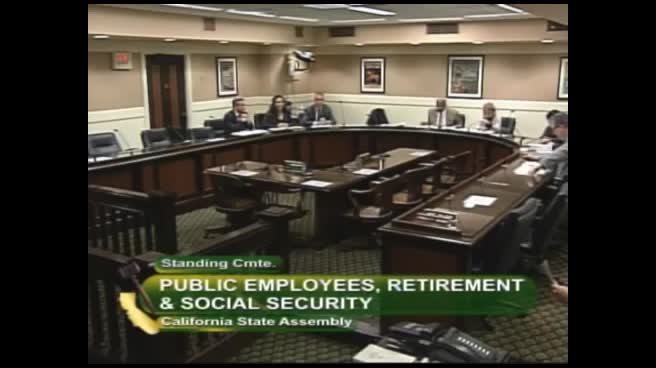
Assembly Standing Committee on Public Employees, Retirement, and Social Security
Bill Author

Bill Co-Author(s):