AB 2209: California Values Act: exception.
- Session Year: 2023-2024
- House: Assembly
- Latest Version Date: 2024-02-07
Current Status:
Failed
(2024-04-30: From committee: Without further action pursuant to Joint Rule 62(a).)
Introduced
In Committee
First Chamber
In Committee
Second Chamber
Enacted
Existing law, the California Values Act, generally prohibits California law enforcement agencies from investigating, interrogating, detaining, detecting, or arresting persons for immigration enforcement purposes. Existing law provides certain limited exceptions to this prohibition, including transfers of persons pursuant to a judicial warrant and providing certain information to federal authorities regarding serious and violent felons in custody.
This bill would additionally except, for purposes of the act, any California law enforcement agency performing any responsibilities under the scope of its jurisdiction regarding any person who is alleged to have violated, or who has been previously convicted of violating, specified provisions relating to fentanyl.
(a)California law enforcement agencies shall not:
(1)Use agency or department moneys or personnel to investigate, interrogate, detain, detect, or arrest persons for immigration enforcement purposes, including any of the following:
(A)Inquiring into an individuals immigration status.
(B)Detaining an individual on the basis of a hold request.
(C)Providing information regarding a persons release date or responding to requests for notification by providing release dates or other information unless that information is available to the public, or is in response to a notification request from immigration authorities in accordance with Section 7282.5. Responses are never required, but are permitted under this subdivision, provided that they do not violate any local law or policy.
(D)Providing personal information, as defined in Section 1798.3 of the Civil Code, about an individual, including, but not limited to, the individuals home address or work address unless that information is available to the public.
(E)Making or intentionally participating in arrests based on civil immigration warrants.
(F)Assisting immigration authorities in the activities described in Section 1357(a)(3) of Title 8 of the United States Code.
(G)Performing the functions of an immigration officer, whether pursuant to Section 1357(g) of Title 8 of the United States Code or any other law, regulation, or policy, whether formal or informal.
(2)Place peace officers under the supervision of federal agencies or employ peace officers deputized as special federal officers or special federal deputies for purposes of immigration enforcement. All peace officers remain subject to California law governing conduct of peace officers and the policies of the employing agency.
(3)Use immigration authorities as interpreters for law enforcement matters relating to individuals in agency or department custody.
(4)Transfer an individual to immigration authorities unless authorized by a judicial warrant or judicial probable cause determination, or in accordance with Section 7282.5.
(5)Provide office space exclusively dedicated for immigration authorities for use within a city or county law enforcement facility.
(6)Contract with the federal government for use of California law enforcement agency facilities to house individuals as federal detainees for purposes of civil immigration custody, except pursuant to Chapter 17.8 (commencing with Section 7310).
(b)Notwithstanding the limitations in subdivision (a), this section does not prevent any California law enforcement agency from doing any of the following that does not violate any policy of the law enforcement agency or any local law or policy of the jurisdiction in which the agency is operating:
(1)Investigating, enforcing, or detaining upon reasonable suspicion of, or arresting for a violation of, Section 1326(a) of Title 8 of the United States Code that may be subject to the enhancement specified in Section 1326(b)(2) of Title 8 of the United States Code and that is detected during an unrelated law enforcement activity. Transfers to immigration authorities are permitted under this subsection only in accordance with paragraph (4) of subdivision (a).
(2)Responding to a request from immigration authorities for information about a specific persons criminal history, including previous criminal arrests, convictions, or similar criminal history information accessed through the California Law Enforcement Telecommunications System (CLETS), where otherwise permitted by state law.
(3)Conducting enforcement or investigative duties associated with a joint law enforcement task force, including the sharing of confidential information with other law enforcement agencies for purposes of task force investigations, so long as the following conditions are met:
(A)The primary purpose of the joint law enforcement task force is not immigration enforcement, as defined in subdivision (f) of Section 7284.4.
(B)The enforcement or investigative duties are primarily related to a violation of state or federal law unrelated to immigration enforcement.
(C)Participation in the task force by a California law enforcement agency does not violate any local law or policy to which it is otherwise subject.
(4)Making inquiries into information necessary to certify an individual who has been identified as a potential crime or trafficking victim for a T or U Visa pursuant to Section 1101(a)(15)(T) or 1101(a)(15)(U) of Title 8 of the United States Code or to comply with Section 922(d)(5) of Title 18 of the United States Code.
(5)Giving immigration authorities access to interview an individual in agency or department custody. All interview access shall comply with requirements of the TRUTH Act (Chapter 17.2 (commencing with Section 7283)).
(6)Performing any responsibilities under the scope of its jurisdiction, including, but not limited to, conducting enforcement or investigative duties, regarding any person who is alleged to have violated, or who has been previously convicted of violating, Section 11351 or 11352 of the Health and Safety Code relating to fentanyl.
(c)(1)If a California law enforcement agency chooses to participate in a joint law enforcement task force, for which a California law enforcement agency has agreed to dedicate personnel or resources on an ongoing basis, it shall submit a report annually to the Department of Justice, as specified by the Attorney General. The law enforcement agency shall report the following information, if known, for each task force of which it is a member:
(A)The purpose of the task force.
(B)The federal, state, and local law enforcement agencies involved.
(C)The total number of arrests made during the reporting period.
(D)The number of people arrested for immigration enforcement purposes.
(2)All law enforcement agencies shall report annually to the Department of Justice, in a manner specified by the Attorney General, the number of transfers pursuant to paragraph (4) of subdivision (a), and the offense that allowed for the transfer pursuant to paragraph (4) of subdivision (a).
(3)All records described in this subdivision shall be public records for purposes of the California Public Records Act (Division 10 (commencing with Section 7920.000)), including the exemptions provided by that act and, as permitted under that act, personal identifying information may be redacted prior to public disclosure. To the extent that disclosure of a particular item of information would endanger the safety of a person involved in an investigation, or would endanger the successful completion of the investigation or a related investigation, that information shall not be disclosed.
(4)If more than one California law enforcement agency is participating in a joint task force that meets the reporting requirement pursuant to this section, the joint task force shall designate a local or state agency responsible for completing the reporting requirement.
(d)The Attorney General, by March 1, 2019, and annually thereafter, shall report on the total number of arrests made by joint law enforcement task forces, and the total number of arrests made for the purpose of immigration enforcement by all task force participants, including federal law enforcement agencies. To the extent that disclosure of a particular item of information would endanger the safety of a person involved in an investigation, or would endanger the successful completion of the investigation or a related investigation, that information shall not be included in the Attorney Generals report. The Attorney General shall post the reports required by this subdivision on the Attorney Generals internet website.
(e)This section does not prohibit or restrict any government entity or official from sending to, or receiving from, federal immigration authorities, information regarding the citizenship or immigration status, lawful or unlawful, of an individual, or from requesting from federal immigration authorities immigration status information, lawful or unlawful, of any individual, or maintaining or exchanging that information with any other federal, state, or local government entity, pursuant to Sections 1373 and 1644 of Title 8 of the United States Code.
(f)Nothing in this section shall prohibit a California law enforcement agency from asserting its own jurisdiction over criminal law enforcement matters.
|
Date
|
Status
|
|---|---|
| Apr 30, 2024 | From committee: Without further action pursuant to Joint Rule 62(a). |
| Apr 9, 2024 | In committee: Reconsideration refused. |
| Apr 9, 2024 | In committee: Set, final hearing. Failed passage. |
| Apr 2, 2024 | In committee: Set, second hearing. Hearing canceled at the request of author. |
| Mar 12, 2024 | In committee: Set, first hearing. Hearing canceled at the request of author. |
| Feb 26, 2024 | Referred to Com. on PUB. S. |
| Feb 8, 2024 | From printer. May be heard in committee March 9. |
| Feb 7, 2024 | Read first time. To print. |
|
Date
|
Description
|
Location
|
Votes
|
|
|---|---|---|---|---|
| Apr 9, 2024 | Reconsideration. | Assembly Standing Committee on Public Safety |
Failed |
|
| Apr 9, 2024 | Do pass and be re-referred to the Committee on [Appropriations] | Assembly Standing Committee on Public Safety |
Failed |
This list shows positions taken on this bill by organizations on the date displayed, which is linked to the original source.
Positions by individuals are not included.
|
Organization
|
Position
|
Date
|
|---|---|---|
| Aclu California Action | ** Against | |
| Alianza | ** Against | |
| Alliance San Diego | ** Against | |
| any positive change inc. | ** Against | |
| Arcadia Police Officers' Association | ** Support | |
| Asian Americans Advancing Justice - Asian Law Caucus | ** Against | |
| Asian Americans Advancing Justice Southern California | ** Against | |
| Asian Pacific Islander Re-entry and Inclusion Through Support and Empowerment | ** Against | |
| Bienestar Human Services | ** Against | |
| Buen Vecino | ** Against | |
| Burbank Police Officers' Association | ** Support | |
| California Alliance for Youth and Community Justice | ** Against | |
| California Attorneys For Criminal Justice | ** Against | |
| California Coalition for Women Prisoners | ** Against | |
| California Coalition of School Safety Professionals | ** Support | |
| California for Safety and Justice | ** Against | |
| California Immigrant Policy Center | ** Against | |
| California Narcotic Officers' Association | ** Support | |
| Californians United for a Responsible Budget | ** Against | |
| California Public Defenders Association | ** Against | |
| California Reserve Peace Officers Association | ** Support | |
| California State Sheriffs' Association | ** Support | |
| Center for Empowering Refugees and Immigrants | ** Against | |
| CLAREMONT POLICE OFFICERS ASSOCIATION | ** Support | |
| Communities United for Restorative Youth Justice | ** Against | |
| Corona Police Officers Association | ** Support | |
| Culver City Police Officers' Association | ** Support | |
| Deputy Sheriffs Association of Monterey County | ** Support | |
| Drug Policy Alliance | ** Against | |
| Ella Baker Center For Human Rights | ** Against | |
| Fullerton Police Officers' Association | ** Support | |
| Glide | ** Against | |
| Harbor Institute for Immigrant and Economic Justice | ** Against | |
| HealthRight 360 | ** Against | |
| Human Impact Partners | ** Against | |
| Immigrant Legal Resource Center | ** Against | |
| Initiate Justice | ** Against | |
| Inland Coalition for Immigrant Justice | ** Against | |
| Interfaith Movement for Human Integrity | ** Against | |
| LA Defensa | ** Against | |
| Law Enforcement Action Partnership | ** Against | |
| Lawyers' Committee for Civil Rights of the San Francisco Bay Area | ** Against | |
| Legal Services for Children | ** Against | |
| Legal Services for Prisoners with Children | ** Against | |
| Los Angeles School Police Management Association | ** Support | |
| los angeles school police officers association | ** Support | |
| Murrieta Police Officers' Association | ** Support | |
| National Day Laborer Organizing Network | ** Against | |
| National Harm Reduction Coalition | ** Against | |
| Newport Beach Police Association | ** Support | |
| Norcal Resist | ** Against | |
| Novato Police Officers Association | ** Support | |
| Oakland Privacy | ** Against | |
| Orale: Organizing Rooted in Abolition, Liberation, and Empowerment | ** Against | |
| Orange County Equality Coalition | ** Against | |
| Orange County Rapid Response Network | ** Against | |
| Orange County Sheriff's Department | ** Support | |
| pacifica social justice | ** Against | |
| Pacific Juvenile Defender Center | ** Against | |
| Palos Verdes Police Officers Association | ** Support | |
| PLACER COUNTY DEPUTY SHERIFFS ASSOCIATION | ** Support | |
| Pomona Police Officers' Association | ** Support | |
| Public Health Institute | ** Against | |
| RIVERSIDE POLICE OFFICERS ASSOCIATION | ** Support | |
| Riverside Sheriffs' Association | ** Support | |
| Sacramento Area Congregations Together | ** Against | |
| San Diego Immigrant Rights Consortium | ** Against | |
| San Francisco Gray Panthers | ** Against | |
| San Francisco Pretrial Diversion Project | ** Against | |
| San Francisco Public Defender | ** Against | |
| San Mateo County Participatory Defense Hub | ** Against | |
| Santa Ana Police Officers Association | ** Support | |
| Santa Cruz Barrios Unidos | ** Against | |
| Senior and Disability Action | ** Against | |
| Services, Immigrant Rights, & Education Network | ** Against | |
| Smart Justice California, a project of Tides Advocacy | ** Against | |
| south bay people power | ** Against | |
| Southeast Asia Resource Action Center | ** Against | |
| Surj San Mateo | ** Against | |
| The Black Alliance for Just Immigration | ** Against | |
| The Gubbio Project | ** Against | |
| transitions clinic network | ** Against | |
| Uncommon Law | ** Against | |
| Universidad Popular | ** Against | |
| Upland Police Officers Association | ** Support | |
| Ventura County Clergy and Laity United for Economic Justice | ** Against | |
| Vera Institute Of Justice | ** Against | |
| VietRise | ** Against |
Date of Hearing:
Chief Counsel: Sandy Uribe
ASSEMBLY COMMITTEE ON PUBLIC SAFETY
Kevin McCarty, Chair
ABPCA Bill Id:AB 2209
Author:(Sanchez) – As Introduced Ver:February 7, 2024
SUMMARY:
States that the California Values Act does not prohibit a law enforcement agency (LEA) from performing any responsibilities under the scope of its jurisdiction, including, but not limited to, conducting enforcement or investigative duties regarding any person who is alleged to have violated, or who has been previously convicted of, possession of fentanyl for sale or selling, furnishing, administering, giving away or transporting fentanyl.
EXISTING LAW:
- Prohibits LEAs from using resources to investigate, interrogate, detain, detect, or arrest people for immigration enforcement purposes. These provisions are commonly known as the Values Act. Restrictions include:
- Inquiring into an individual's immigration status;
- Detaining a person based on a hold request from ICE;
- Providing information regarding a person’s release date or responding to requests for notification by providing release dates or other information unless that information is available to the public;
- Providing personal information, as specified, including, but not limited to, name, social security number, home or work addresses, unless that information is “available to the public;”
- Arresting a person based on a civil immigration warrant;
- Participating in border patrol activities, including warrantless searches;
- Performing the functions of an immigration agent whether through agreements known as 287(g) agreements, or any program that deputizes police as immigration agents;
- Using ICE agents as interpreters;
- Transfering an individual to immigration authorities unless authorized by a judicial warrant or judicial probable cause determination, or except as otherwise specified;
- Providing office space exclusively for immigration authorities in a city or county law enforcement facility; and,
- Entering into a contract, after June 15, 2017, with the federal government to house or detain adult or minor non-citizens in a locked detention facility for purposes of immigration custody. (Gov. Code, § 7284.6, subd. (a).)
- Contains limited exceptions allowing LEAs to cooperate with immigration authorities, including: responding to a request from immigration authorities for information about a specific person’s criminal history; giving immigration authorities access to interview an individual in their custody; and conducting enforcement or investigative duties associated with a joint law enforcement task force, as specified. (Gov. Code, § 7284.6, subd. (b).)
- Provides that LEAs are able to participate in joint taskforces with the federal government only if the primary purpose of the joint task force is not immigration enforcement. Participating agencies must annually report to the California Department of Justice (DOJ) if there were immigration arrests as a result of task force operations. (Gov. Code, § 7284.6, subds. (b) & (c).)
- Describes the circumstances under which a LEA has discretion to respond to transfer and notification requests from immigration authorities. These provisions are known as the TRUST Act. LEAs cannot honor transfer and notification requests unless one of the following apply:
- The individual has been convicted of a serious or violent felony, as specified;
- The individual has been convicted of any felony which is punishable by imprisonment in state prison;
- The individual has been convicted within the last five years of a misdemeanor for a crime that is punishable either as a felony or misdemeanor (a wobbler);
- The individual has been convicted within the past 15 years for any one of a list of specified felonies, including an offense involving the felony possession, sale, distribution, manufacture, or trafficking of controlled substances;
- The individual is a current registrant on the California Sex and Arson Registry;
- The individual has been convicted of a federal crime that meets the definition of an aggravated felony as specified in the federal Immigration and Nationality Act;
- The individual is identified by ICE as the subject of an outstanding federal felony arrest warrant for any federal crime; or,
- The individual is arrested on a charge involving a serious or violent felony, as specified, or a felony that is punishable by imprisonment in state prison, and a magistrate makes a finding of probable cause as to that charge. (Gov. Code, § 7282.5.)
- The individual has been convicted of a serious or violent felony, as specified;
- Provides individuals who are in the custody of local LEAs with information about their procedural and legal rights in the event that immigration authorities want to contact them. These provisions are commonly referred to as the TRUTH Act. (Gov. Code, §§ 7283, 7283.1, & 7283.2.)
EXISTING FEDERAL LAW:
- Prohibits the federal government from “conscripting” the states to enforce federal regulatory programs. (U.S. Const. Tenth Amend.)
- Authorizes the Secretary of DHS to enter into agreements that delegate immigration powers to local police. The negotiated agreements between ICE and the local police are documented in memorandum of agreements (MOAs). (8 U.S.C. § 1357(g).)
FISCAL EFFECT:
Unknown
COMMENTS:
- Author's Statement: According to the author, “Californians have been hit hard by the fentanyl crisis. In 2022, the California Department of Public Health recorded over 6,000 deaths related to fentanyl. International cartels are exploiting our border crisis and dumping fentanyl into our communities with the aid of undocumented drug dealers. That’s why I’ve introduced AB 2209 to end sanctuary state protections for felony fentanyl dealers that are poisoning our loved ones. We can’t continue prioritizing the livelihoods of drug dealers over the lives of Californians.”
- Cooperation with Immigration Authorities: The Values Act, which became effective on January 1, 2018, limits the involvement of state and local law enforcement agencies in federal immigration enforcement. It prohibits law enforcement agencies (including school police and security departments) from using resources to investigate, interrogate, detain, detect, or arrest people for immigration enforcement purposes. It also places limitations on the ways in which law enforcement agencies can collaborate with federal task forces that involve elements of immigration enforcement.
The Values Act was an expansion of prior state law, the TRUST Act which prohibited law enforcement from honoring federal immigration holds unless the detainee had a criminal history involving a serious or violent felony.
The Values Act contains some exceptions that allows law enforcement agencies to cooperate with immigration authorities. Under the Values Act, law enforcement is allowed to engage with immigration authorities in the following circumstances:- Provide a person’s release date or personal information, as specified, if such information is available to the public;
- Respond to notification and transfer requests when the individual had been convicted of specified crimes which reflected a higher public safety danger and are on the serious end of the criminal spectrum. Specifically, those crimes include serious and violent felonies, as well as offenses requiring an individual to register as a sex offender;
- Make inquiries into information necessary to certify an individual for a visa for a victim of domestic violence and human trafficking;
- Respond to a request from immigration authorities for information about a person’s criminal history;
- Participate with a joint law enforcement task force, as long as the primary purpose of the task force is not immigration enforcement; or,
- Give immigration authorities access to interview an individual in agency custody as long as the interview access complied with the requirements of the TRUTH Act.
- Provide a person’s release date or personal information, as specified, if such information is available to the public;
This bill would create an additional exemption allowing LEA cooperation with immigration authorities. It would allow an LEA to “perform[] any responsibilities under the scope of its jurisdiction, including, but not limited to, conducting enforcement or investigative duties regarding any person who is alleged to have violated, or who has previously been convicted of violating” specified controlled substances offenses relating to fentanyl. (emphasis added.)
Arguably, this is an exception that swallows the rule. While containing specific language about violations of law related to fentanyl, the preceding phrases say that an LEA can perform any responsibilities under the scope of its jurisdiction. Fentanyl sales is just one example. Moreover, LEAs can already conduct enforcement and investigative duties involving fentanyl crimes with immigration authorities as part of a joint task force. (See Gov. Code, § 7284.6, subd. (b)(3).)
Additionally, while this bill appears to be premised on the notion that the majority of fentanyl dealers are undocumented immigrants, that is not what the data reflects. Most of the illicit fentanyl consumed in the United States originates in China, “a major pipeline of the building blocks of fentanyl, known as fentanyl precursors, according to U.S. officials.” (John et al., The US sanctioned Chinese companies to fight illicit fentanyl. But the drug’s ingredients keep coming, CNN.com (Mar. 30, 2023) < https://www.cnn.com/2023/03/30/americas/fentanyl-us-china-mexico-precursor-intl/index.html > [last visited Mar. 25, 2024].). Chemical manufactures in China ship fentanyl precursors to Mexico where drug cartels make fentanyl and arrange for it to be transported across the U.S./Mexico border. (Rappeport, U.S. Moves to Crack Down on Money Behind Fentanyl Trade, New York Times (Dec. 4, 2023) < U.S. Moves to Crack Down on Money Behind Fentanyl Trade - The New York Times (nytimes.com)> [last visited Mar. 25, 2024].) The vast majority of the fentanyl seizures in the U.S. occur at legal ports of entry or interior vehicle checkpoints, and U.S. citizens are primarily the ones trafficking fentanyl. (Bier, Fentanyl Is Smuggled for U.S. Citizens By U.S. Citizens, Not Asylum Seekers, Cato.org (Sept. 14, 2022) < Fentanyl Is Smuggled for U.S. Citizens By U.S. Citizens, Not Asylum Seekers | Cato at Liberty Blog > [last visited Mar. 25, 2024].) According to the Cato Institute, in 2021, 86.3% of convicted fentanyl traffickers were U.S. citizens. (Ibid.)
- Responding to Transfer or Notification Requests: LEAs are never required to respond to immigration requests for transfer of custody or for notification of a person’s release information (transfer or notification requests). However, under the Values Act, LEAs have discretion to honor these requests if certain conditions are satisfied. These conditions include convictions for specified criminal offenses, or arrests for other specified criminal offenses in which a magistrate has made a finding of probable cause as to the charge. (Gov. Code, § 7282.5.)
As it pertains to this bill, under existing law LEAs have discretion to cooperate with immigration authorities if an individual has been convicted within the past 15 years of “[a]n offense involving the felony possession, sale, distribution, manufacture, or trafficking of controlled substances.” (Gov. Code, § 7282.5, subd. (a)(3)(M).) In other words, LEAs already have the discretion to cooperate with immigration authorities of a person has been convicted of the above offenses with regards to fentanyl. - ICE Involvement Can Impede Cooperation Between Law Enforcement and the Community: A study by the University of Illinois – Chicago sought to assess how police involvement in immigration enforcement impacted public safety and police-community relations. Latinos in Cook (Chicago), Harris (Houston), Los Angeles, and Maricopa (Phoenix) counties were surveyed on their perception of local law enforcement when there is police involvement in immigration enforcement. The results showed that “a substantial number of Latinos are less likely to voluntarily contact the police if they are a victim of a crime, or to provide information about a crime, because they are afraid the police will ask them or persons they know about their immigration status.” (Insecure Communities: Latino Perceptions of Police Involvement in Immigration Enforcement, Nik Theodore et al., (May 2013), p. 1 http://www.policylink.org/sites/default/files/INSECURE_COMMUNITIES_REPORT_FINAL.PDF)
Specifically, the study found that 44 percent of Latinos surveyed reported they are less likely to contact police officers if they have been the victim of a crime because they fear that police officers will use this interaction as an opportunity to inquire into their immigration status or that of people they know. (Id. at p. 6.) Likewise, 45 percent of Latinos surveyed stated that they are less likely to voluntarily offer information about crimes, and 45 percent are less likely to report a crime because they are afraid the police will ask them or people they know about their immigration status. And while undocumented immigrants are particularly fearful to contact law enforcement authorities if they were victims of a crime or to offer information relating to a crime; fear of police contact is not confined to immigrants; but rather, it is shared by US-born Latinos. (Ibid.) - Argument in Support: According to the Orange County Sheriff’s Department, “The California Values Act (SB 54) … restricted the ability of local law enforcement to fully communicate with immigration authorities. I, along with my law enforcement colleagues, opposed this measure because it violated the important best practice of open communication amongst law enforcement at all levels. This principle is fundamental to ensuring we are aware of and addressing shared threats like the fentanyl epidemic. …
“Beyond the limits on a communication in a custody setting, the limitations chill our ability to collaborate fully with our partners in an operational and investigative setting. This is particularly concerning with regard to our effort to combat fentanyl. To stop the flow of fentanyl into our community it is imperative that local law enforcement work hand in hand with our federal partners. Such collaboration maximizes resources and intelligence sharing. While there are great partnerships in our region among local and federal agencies, the unnecessary limitations imposed by SB 54 prevent full sharing of information on fentanyl traffickers, handing the cartels and additional advantage. Your bill would remove this barrier by making clear in the law our ability to communicate with federal partners regarding any person who is alleged to have violated, or has been previously convicted of violating, laws related [sic] the selling and distribution of fentanyl.
“My support for AB 2209 and desire to work with federal authorities to keep drug traffickers out of the community should not be construed to mean my department and I have any interest in enforcing immigration law. To be clear local law enforcement does not engage in immigration enforcement. Enforcement of immigration law is the responsibility of the federal government. As deputies patrol our communities, they are focues on criminal violations of state and local law. We enforce these laws equally, without bias, and without regard for one’s immigration status. In carrying out our duties, we do not ask the immigration status of suspects, witnesses, or those who call to report crimes. The Sheriff’s Department provides for the safety of all residents and responds to all calls for service without concern for immigration status.
“Notifying federal authorities of the pending release of a fentanyl trafficker is not the enforcement of immigration law. These offenders perpetuate the fentanyl crisis in our communities and removing them is consistent with my department’s mission to enhance public safety for all Orange County residents.” - Argument in Opposition: According to the Immigrant Legal Resource Center, “AB 2209 …cynically and unfairly scapegoats immigrants for the tragic fentanyl overdose crisis. AB 2209 encourages unequal treatment, racial profiling, pretextual stops and arrests, and wrongful referrals of brown and Black Californians to immigration enforcement even before establishing probable cause for a lawful arrest….
“Under current state and federal law, immigrants already face harsh consequences, including indefinite detention and permanent separation from their families and homes, for drug convictions. Notably, under the California Values Act, local law enforcement already has the discretion to notify ICE and transfer individuals who have a conviction for violation of Section 11351 or 11352 of the Health and Safety Code (as it relates to fentanyl and other controlled substances in the statute). Moreover, federal immigration laws already impose severe immigration penalties for even a minor controlled substance offense. A California state conviction of simple possession, possession of paraphernalia, or being under the influence can subject an immigrant to ICE detention without the possibility of bond, ineligibility for lawful status, and permanent deportation to the home country - regardless of hardship to the person or to the U.S. family they leave behind.
“The Values Act ensures that the civil rights of all individuals, regardless of immigration status, are protected during the investigation, arrest, and court processes, and immigrants and refugees are not subject to pretextual stops, arrests, or wrongfully turned over to ICE based on racist policing. AB 2209 would undercut these protections for immigrant and refugee Californians. It targets Black and brown communities, copying racist tactics currently employed by Texas Governor Greg Abbott, and stokes distrust among immigrant and refugee community members of local and state agencies.
“To seriously address the fentanyl overdose crisis, we need to prioritize a health approach and increase access and funding to evidence-based approaches. California must also uphold and expand existing policies like the Values Act that allow immigrant Californians to participate in our communities and access care and support - such as going to the hospital and appearing for court hearings - without fear of discrimination based on the color of their skin or being subjected to traumatic ICE detention or deportation.
“Moreover, AB 2209 will contribute to increased overdose rates and preventable deaths. The fear of arrest may prevent witnesses of drug overdoses from seeking medical help. A study conducted with over 100 Latino substance users in San Francisco found that a significant percentage of participants did not access drug treatment services due to fears of being arrested by police or immigration authorities. Evidence also demonstrates that deportations can have a harmful impact on drug use rates. For example, Latinos with family members who have been deported or detained are nearly four times more likely to misuse prescription drugs. AB 2209 will exacerbate health inequities among immigrant communities who already face barriers getting the medical support they need. Studies have shown that policing and fear of deportation deter undocumented Latino communities from seeking health services.
“In addition, targeting immigrants for fentanyl or other drugs ignores the realities of the drug trade or overdose mortality rates across the country. Nearly 9 in 10 of those convicted of trafficking fentanyl are U.S. citizens driving cars and commercial vehicles through legal ports of entry, not undocumented immigrants or asylum seekers. In addition, the presence of immigrant residents in our communities has nothing to do with overdose mortality rates. In 2021, West Virginia had the lowest percentage of immigrant residents in the country, yet suffered the worst overdose mortality rate in the country.
“The fentanyl overdose crisis needs immediate action and all Californians deserve a robust public health response to fentanyl, not more criminalization. Instead of scapegoating vulnerable communities, the state must continue to build a health approach that includes expanding voluntary substance use services and social support systems. This includes evidence-based treatment and greater access to naloxone to reverse overdoses as well as drug-testing tools to reduce the harms of the tainted illicit drug supply.
“Scapegoating legislation like AB 2209 and the war on drugs have only bolstered mass incarceration and racism in our justice system while failing to meaningfully address overdose mortality rates or drug sales. To curb the fentanyl overdose crisis, California must urgently invest in comprehensive, health and evidence-based approaches grounded in science not xenophobia.” - Prior Legislation:
- AB 2948 (Allen), of the 2017-2018 Legislative Session, would have repealed the California Values Act. AB 2948 failed passage in this committee.
- AB 2931 (Patterson), of the 2017-2018 Legislative Session, would have expanded the list of qualifying criminal convictions which permit law enforcement to cooperate with federal immigration authorities. AB 2931 failed passage in this committee.
- AB 298 (Gallagher), of the 2017-2018 Legislative Session, would have repealed the TRUST Act and required law enforcement to cooperate with federal immigration by detaining an individual convicted of a felony for up to 48 hours on an immigration hold, as specified, after the person became eligible for release from custody. AB 298 failed passage in this committee.
- AB 1252 (Allen), of the 2017-2018 Legislative Session, would have repealed the TRUST Act and prohibited state grants to county and local “sanctuary jurisdictions.” AB 1252 failed passage in this committee.
- SB 54 (De Leon), Chapter 495, Statutes of 2017, limited the involvement of state and local law enforcement agencies in federal immigration enforcement.
- AB 2792 (Bonta), Chapter 768, Statutes of 2016, requires local law enforcement agencies to provide copies of specified documentation received from ICE to the individual in custody and to notify the individual regarding the intent of the agency to comply with ICE requests.
- AB 4 (Ammiano), Chapter 570, Statutes of 2013, prohibits a law enforcement official from detaining an individual on the basis of an ICE hold after that individual becomes eligible for release from custody, unless, at the time that the individual becomes eligible for release from custody, certain conditions are met, including, among other things, that the individual has been convicted of specified crimes.
- AB 2948 (Allen), of the 2017-2018 Legislative Session, would have repealed the California Values Act. AB 2948 failed passage in this committee.
REGISTERED SUPPORT / OPPOSITION:
Support
Arcadia Police Officers' Association
Burbank Police Officers' Association
California Coalition of School Safety Professionals
California Narcotic Officers' Association
California Reserve Peace Officers Association
California State Sheriffs' Association
Claremont Police Officers Association
Corona Police Officers Association
Culver City Police Officers' Association
Deputy Sheriffs' Association of Monterey County
Fullerton Police Officers' Association
Los Angeles School Police Management Association
Los Angeles School Police Officers Association
Murrieta Police Officers' Association
Newport Beach Police Association
Novato Police Officers Association
Orange County Sheriff's Department
Palos Verdes Police Officers Association
Placer County Deputy Sheriffs' Association
Pomona Police Officers' Association
Riverside Police Officers Association
Riverside Sheriffs' Association
Santa Ana Police Officers Association
Upland Police Officers Association
Oppose
ACLU California Action
Alianza
Alliance San Diego
Any Positive Change INC.
Asian Americans Advancing Justice - Asian Law Caucus
Asian Americans Advancing Justice-southern California
Asian Pacific Islander Re-entry and Inclusion Through Support and Empowerment
Bienestar Human Services
Buen Vecino
California Alliance for Youth and Community Justice
California Attorneys for Criminal Justice
California Coalition for Women Prisoners
California for Safety and Justice
California Immigrant Policy Center
California Public Defenders Association
Californians United for A Responsible Budget
Center for Empowering Refugees and Immigrants
Communities United for Restorative Youth Justice (CURYJ)
Drug Policy Alliance
Ella Baker Center for Human Rights
Glide
Harbor Institute for Immigrant and Economic Justice
Healthright 360
Human Impact Partners
Immigrant Legal Resource Center
Initiate Justice
Inland Coalition for Immigrant Justice
Interfaith Movement for Human Integrity
LA Defensa
Law Enforcement Action Partnership
Lawyers' Committee for Civil Rights of The San Francisco Bay Area
Legal Services for Children
Legal Services for Prisoners With Children
National Day Laborer Organizing Network (NDLON)
National Harm Reduction Coalition
Norcal Resist
Oakland Privacy
Orale: Organizing Rooted in Abolition Liberation and Empowerment
Orange County Equality Coalition
Orange County Rapid Response Network
Pacific Juvenile Defender Center
Pacifica Social Justice
Public Health Institute
Sacramento Area Congregations Together
San Diego Immigrant Rights Consortium
San Francisco Gray Panthers
San Francisco Pretrial Diversion Project
San Francisco Public Defender
San Mateo County Participatory Defense Hub
Santa Cruz Barrios Unidos
Senior and Disability Action
Services, Immigrant Rights, & Education Network
Smart Justice California, a Project of Tides Advocacy
South Bay People Power
Southeast Asia Resource Action Center
Surj San Mateo
The Black Alliance for Just Immigration
The Gubbio Project
Transitions Clinic Network
Uncommon Law
Universidad Popular
Ventura County Clergy and Laity United for Economic Justice
Vera Institute of Justice
Vietrise
Analysis Prepared by:
Sandy Uribe / PUB. S. / (916) 319-3744
Discussed in Hearing
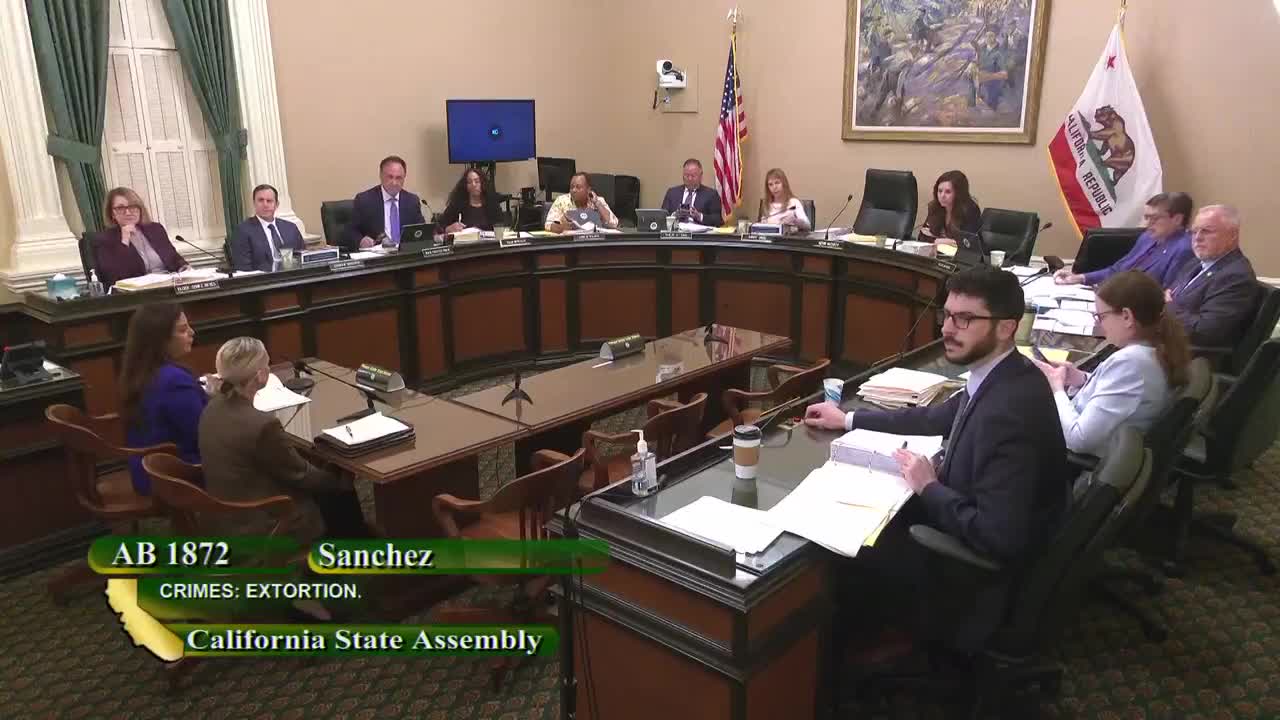 29MIN
Assembly Standing Committee on Public Safety
Bill Author

Bill Co-Author(s):