AB 2245: Certificated school employees: permanent status: regional occupational centers or programs operated by single school districts.
- Session Year: 2023-2024
- House: Assembly
- Latest Version Date: 2024-09-29
Current Status:
Passed
(2024-09-29: Chaptered by Secretary of State - Chapter 956, Statutes of 2024.)
Introduced
In Committee
First Chamber
In Committee
Second Chamber
Enacted
Existing law authorizes the establishment of regional occupational centers or programs to provide career technical education and technical training to pupils. Existing law requires instruction in those centers or programs to be given only by a qualified teacher holding a certificate, as provided, but prohibits service by a person as an instructor in classes conducted at regional occupational centers or programs from being included in computing the service required as a prerequisite to attainment of, or eligibility for, classification as a permanent employee of a school district.
This bill would, notwithstanding that prohibition and commencing July 1, 2025, require service by a person as an instructor in classes conducted at a regional occupational center or program operated by a single school district to be included in computing the service required as a prerequisite to attainment of, or eligibility for, classification as a permanent employee of a single school district.
Existing law authorizes the establishment of regional occupational centers or programs to provide career technical education and technical training to pupils. Existing law requires instruction in those centers or programs to be given only by a qualified teacher holding a certificate, as provided, but prohibits service by a person as an instructor in classes conducted at regional occupational centers or programs from being included in computing the service required as a prerequisite to attainment of, or eligibility for, classification as a permanent employee of a school district.
This bill would, notwithstanding that prohibition and commencing July 1, 2025, repeal that prohibition and instead require service by a person as an instructor in classes conducted at a regional occupational centers or programs center or program operated by a single school district to be included in computing the service required as a prerequisite to attainment of, or eligibility for, classification as a permanent employee of a single school district.
Existing law authorizes the establishment of regional occupational centers or programs to provide career technical education and technical training to pupils. Existing law requires instruction in those centers or programs to be given only by a qualified teacher holding a certificate, as provided, but prohibits service by a person as an instructor in classes conducted at regional occupational centers or programs from being included in computing the service required as a prerequisite to attainment of, or eligibility for, classification as a permanent employee of a school district.
This bill would, commencing July 1, 2025, repeal that prohibition and instead require service by a person as an instructor in classes conducted at regional occupational centers or programs to be included in computing the service required as a prerequisite to attainment of, or eligibility for, classification as a permanent employee of a school district.
(a)(1)Service by a person as an instructor in classes conducted at regional occupational centers or programs, as authorized pursuant to Section 52301, shall not be included in computing the service required as a prerequisite to attainment of, or eligibility for, classification as a permanent employee of a school district.
(2)This subdivision shall not be construed to apply to any regularly credentialed teacher who has been employed to teach in the regular educational programs of the school district and subsequently assigned as an instructor in regional occupational centers or programs, nor shall it affect the status of regional occupational center teachers classified as permanent or probationary at the time this section becomes effective.
(b)Notwithstanding the prohibition prescribed in subdivision (a), commencing July 1, 2025, service by a person as an instructor in classes conducted at a regional occupational center or program operated by a single school district, as authorized pursuant to Section 52301, shall be included in computing the service required as a prerequisite to attainment of, or eligibility for, classification as a permanent employee of a single school district.
(a)(1)Service by a person as an instructor in classes conducted at regional occupational centers or programs, as authorized pursuant to Section 52301, shall not be included in computing the service required as a prerequisite to attainment of, or eligibility for, classification as a permanent employee of a school district.
(b)This section(2)This subdivision shall not be construed to apply to any regularly credentialed teacher who has been employed to teach in the regular educational programs of the school district and subsequently assigned as an instructor in regional occupational centers or programs, nor shall it affect the status of regional occupational center teachers classified as permanent or probationary at the time this section becomes effective.
(c)This section shall become inoperative on July 1, 2025, and, as of January 1, 2026, is repealed.(b)Notwithstanding the prohibition prescribed in subdivision (a), commencing July 1, 2025, service by a person as an instructor in classes conducted at a regional occupational center or program operated by a single school district, as authorized pursuant to Section 52301, shall be included in computing the service required as a prerequisite to attainment of, or eligibility for, classification as a permanent employee of a single school district.
SEC. 2.Section 44910 is added to the Education Code, to read:44910.(a)Service by a person as an instructor in classes conducted at regional occupational centers or programs, as authorized pursuant to Section 52301, shall be included in computing the service required as a prerequisite to attainment of, or eligibility for, classification as a permanent employee of a school district.(b)This section shall become operative on July 1, 2025.(a)Service by a person as an instructor in classes conducted at regional occupational centers or programs, as authorized pursuant to Section 52301, shall not be included in computing the service required as a prerequisite to attainment of, or eligibility to, for, classification as a permanent employee of a school district.
This(b)This section shall not be construed to apply to any regularly credentialed teacher who has been employed to teach in the regular educational programs of the school district and subsequently assigned as an instructor in regional occupational centers or programs, nor shall it affect the status of regional occupational center teachers classified as permanent or probationary at the time this section becomes effective.
(c)This section shall become inoperative on July 1, 2025, and, as of January 1, 2026, is repealed.
SEC. 2.Section 44910 is added to the Education Code, to read:44910.(a)Service by a person as an instructor in classes conducted at regional occupational centers or programs, as authorized pursuant to Section 52301, shall be included in computing the service required as a prerequisite to attainment of, or eligibility for, classification as a permanent employee of a school district.
(b)This section shall become operative on July 1, 2025.
|
Date
|
Status
|
|---|---|
| Sep 29, 2024 | Chaptered by Secretary of State - Chapter 956, Statutes of 2024. |
| Sep 29, 2024 | Approved by the Governor. |
| Sep 11, 2024 | Enrolled and presented to the Governor at 4 p.m. |
| Aug 29, 2024 | Senate amendments concurred in. To Engrossing and Enrolling. (Ayes 60. Noes 11.). |
| Aug 29, 2024 | Assembly Rule 77 suspended. |
| Aug 28, 2024 | In Assembly. Concurrence in Senate amendments pending. May be considered on or after August 30 pursuant to Assembly Rule 77. |
| Aug 28, 2024 | Read third time. Passed. Ordered to the Assembly. (Ayes 28. Noes 9.). |
| Aug 26, 2024 | Read second time. Ordered to third reading. |
| Aug 23, 2024 | Read third time and amended. Ordered to second reading. |
| Aug 19, 2024 | Read second time. Ordered to third reading. |
| Aug 15, 2024 | From committee: Do pass. (Ayes 5. Noes 2.) (August 15). |
| Jul 1, 2024 | In committee: Referred to suspense file. |
| Jun 19, 2024 | From committee: Do pass and re-refer to Com. on APPR. (Ayes 4. Noes 2.) (June 19). Re-referred to Com. on APPR. |
| May 29, 2024 | Referred to Coms. on ED. and APPR. |
| May 22, 2024 | In Senate. Read first time. To Com. on RLS. for assignment. |
| May 21, 2024 | Read third time. Passed. Ordered to the Senate. (Ayes 55. Noes 4. Page 5433.) |
| May 20, 2024 | Read second time. Ordered to third reading. |
| May 16, 2024 | From committee: Do pass. (Ayes 11. Noes 4.) (May 16). |
| Apr 17, 2024 | In committee: Set, first hearing. Referred to APPR. suspense file. |
| Apr 4, 2024 | From committee: Do pass and re-refer to Com. on APPR. (Ayes 5. Noes 1.) (April 3). Re-referred to Com. on APPR. |
| Mar 20, 2024 | In committee: Hearing postponed by committee. |
| Feb 26, 2024 | Referred to Com. on ED. |
| Feb 9, 2024 | From printer. May be heard in committee March 10. |
| Feb 8, 2024 | Read first time. To print. |
|
Date
|
Description
|
Location
|
Votes
|
|
|---|---|---|---|---|
| Aug 29, 2024 | AB 2245 Juan Carrillo Concurrence in Senate Amendments | Assembly Floor |
Passed |
|
| Aug 28, 2024 | Assembly 3rd Reading AB2245 Juan Carrillo By Cortese | Senate Floor |
Passed |
|
| Aug 15, 2024 | Do pass | Senate Standing Committee on Appropriations |
Passed |
|
| Jul 1, 2024 | Placed on suspense file | Senate Standing Committee on Appropriations |
Passed |
|
| Jun 19, 2024 | Do pass, but first be re-referred to the Committee on [Appropriations] | Senate Standing Committee on Education |
Passed |
|
| May 21, 2024 | AB 2245 Juan Carrillo Assembly Third Reading | Assembly Floor |
Passed |
|
| May 16, 2024 | Do pass. | Assembly Standing Committee on Appropriations |
Passed |
|
| Apr 3, 2024 | Do pass and be re-referred to the Committee on [Appropriations] | Assembly Standing Committee on Education |
Passed |
This list shows positions taken on this bill by organizations on the date displayed, which is linked to the original source.
Positions by individuals are not included.
|
Organization
|
Position
|
Date
|
|---|---|---|
| Alameda County Office Of Education | ** Against | |
| Association Of California School Administrators | ** Against | |
| California Association Of Regional Occupational Centers And Programs | ** Against | |
| California Association Of School Business Officials | ** Against | |
| California Association Of Suburban School Districts | ** Against | |
| California Federation Of Teachers | ** Support | |
| California Teachers Association | ** Support | |
| Career Technical Education Joint Powers Authority Coalition | ** Against | |
| CAROCP - the Association of Career and College Readiness Organizations | ** Against | |
| Central Valley Education Coalition | ** Against | |
| Coastline Rop | ** Against | |
| College and Career Advantage, a Jpa Rop | ** Against | |
| COLTON-REDLANDS-YUCAIPA REGIONAL OCCUPATION PROGRAM | ** Against | |
| Cutler-Orosi Joint Unified School District | ** Against | |
| Dinuba Unified School District | ** Against | |
| Eden Area ROP | ** Against | |
| Kings Canyon Unified School District | ** Against | |
| Mission Valley Rop | ** Against | |
| North Orange County Regional Occupational Program | ** Against | |
| Office of the Riverside County Superintendent of Schools | ** Against | |
| Orange County Department Of Education | ** Against | |
| Parlier Unified School District | ** Against | |
| Riverside County Public K-12 School District Superintendents | ** Against | |
| Sanger Unified School District | ** Against | |
| School Employers Association Of California | ** Against | |
| Selma Unified School District | ** Against | |
| Small School Districts Association | ** Against | |
| Tri-Cities Regional Occupational Program | ** Against | |
| Valley Regional Occupational Program | ** Against |
CONCURRENCE IN SENATE AMENDMENTS
CSA1 Bill Id:AB 2245
Author:(Juan Carrillo)
As Amended Ver:August 23, 2024
Majority vote
SUMMARY
Requires, commencing July 1, 2025, service as an instructor in classes conducted at a regional occupational center or program (ROCP) operated by a single school district to be included in computing the service required to attain permanent employee status at a school district.
Senate Amendments
State that only service as an instructor at a ROCP operated by a single district counts towards attaining permanent employee status.
COMMENTS
What does this bill do? This bill makes changes regarding which credentialed employees can attain permanent employee status at a single school district operated ROCP. The bill requires school district ROCP instructors to attain permanent employee status after completing a probationary period.
What protections does "permanent employee" status offer to these employees? "Permanent employee" status guarantees the specific employees listed in the bill due process rights if they are dismissed. In the case of dismissal, "permanent employee" status allows employees to request a hearing before a Commission on Professional Competence to decide whether their dismissal was appropriate. Further, a "permanent employee" has the right to request a hearing before an administrative law judge during a reduction in force.
ROCP teachers. This bill eliminates the prohibition on service as an ROCP teacher at an ROCP operated by a single school district, as counting toward attaining permanent employee status. With the implementation of the Local Control Funding Formula (LCFF), ROCPs no longer receive categorical program funding. Instead, funding for ROCPs has been rolled into the funding that is allocated to local educational agencies (LEAs) through the LCFF, increasing the LCFF base rate for high schools by 2.6%.
The state budget provides $150 million in ongoing funding to the Career Technical Education Incentive Grant (CTEIG) program at the CDE, and an additional $150 million for the K-12 component of the Strong Workforce Program through the Chancellor of the Community Colleges. In 2021, the annual funding for CTEIG was increased to $300 million. Prior to the adoption of the LCFF funding model, CTE programs were funded at up to $400 million per year to meet the needs of students
Generally, ROCP teachers have not been given permanent employee status due to the volatile nature of ROCP grant funding and the regional industry changes that mandate specific courses be offered through those programs. LEAs are required to offer CTE career pathways in the industry sectors with demonstrated workforce needs in their region. As these industry demands change, the courses offered are required to change. A change in curriculum is an authorized reason for a school district to implement a reduction in force, and ROCP teachers with permanent status would then be entitled to request a reduction in force hearing.
This bill requires ROCP CTE teachers to earn permanent status after a probationary period. It is unclear if school district CTE teachers who are not affiliated with an ROCP would earn permanent status.
Timing of ROCP grant funding. According to various ROCPs:
- In the 2022-23 and the 2023-24 funding cycles, the State Board of Education (SBE) approved the CTE Incentive Grant awardees on March 9 and March 6 respectively. Because of this late notice for grant awards, making the CTE instructors permanent would mean we would have to hand out notices every year to all CTE instructors just to be safe. Obviously, that would have an impact on morale, keeping quality CTE staff, and hiring new staff when needed.
- For the 2019-20 round of CTEIG funding, Baldy View ROP was not awarded a grant, and the grants were approved by the SBE at the March 2020 hearing. This was especially difficult for Baldy View ROP because, in prior years, Baldy View ROP received approximately $2.5 million each year in CTEIG funds. Luckily, Baldy View ROP did not have to lay off any of its teachers that year despite the loss of CTEIG funds because the ROP had enough funds from other sources. However, Baldy View ROP would not have been able to sustain this had the ROP not received other grants that fiscal year or in subsequent years. Even though layoffs were not an outcome for Baldy View ROP, this illustrates the volatility of funding for ROCPs. $2.5 million was a considerable loss for Baldy View ROP, and each year ROCPs have to cross their fingers that they will be approved for grants such as CTEIG and the K-12 Strong Workforce Program that comprise a large part of their local budgets.
Layoff procedures. According to the Legislative Analyst Office:
State law requires that districts lay off teachers in inverse seniority order. That is, the last teachers hired in the district—those having the least seniority—are first to be laid off. The state also specifies that no junior employee can be retained if a more senior employee is 'certificated or competent' to teach in that position. Though the state requires inverse–seniority order as the primary criteria for laying off staff, it allows districts to deviate from seniority for three specified reasons.
- If two or more employees started with the district on the exact same date, the district has the right to develop standard criteria solely based on the district's and student's needs.
- If the district demonstrates a need for specialized services that require a specific course of study, special training or experience (such as special education or speech pathologists), it may develop a system that gives higher priorities to teachers with these credentials or types of experience.
- The state also allows deviating from seniority for 'maintaining or achieving compliance with constitutional requirements related to equal protection of the laws.'
According to the California Federation of Teachers:
Legal precedent (Bledsoe v. Biggs, 2009) allows a district to choose to retain a more junior employee despite a more senior employee having the same "qualifications," so long as the district can demonstrate:
- A specific need for an employee to teach a specific course or course of study; an
- That the more junior employee has the "special training and experience necessary" to teach the course.
Competence is the threshold inquiry regarding bumping rights. If a permanent teacher "is certificated and competent to render" a service provided by a more junior teacher, the senior teacher is entitled to bump into that position and not be laid off. (EDC 44955(b). However, the district can adopt competencies, including minimum experience standards, to determine if an employee is competent to render services, as found in Duax v. Kern CCD (1987).
Thus, AB 2245 does not limit a district's flexibility to change their CTE classes to respond to workforce demand. Even if a CTE teacher has permanent status, the layoff process allows for the reduction of staff if a particular kind of service is reduced or discontinued. Furthermore, there are exceptions to seniority-based layoffs when a less senior employee has specific qualifications or competencies necessary to teach the class. Providing CTE teachers a path to attain permanent status will simply ensure that they have due process rights and that these exceptions to seniority layoffs are fair.
According to the Author
"Career Technical Education is a significant lifeline for many students in California – one that provides pathways outside of higher academia that yield living-wage jobs. Many students who take CTE classes gain valuable skills which are often directly applicable to the industries in the areas they live in. People may take CTE classes to get their foot in the door of a specific vocation, or build upon an existing skillset. CTE is often students' first exposure to various kinds of vocational work in their local industries.
This is especially important for rural districts like mine – where building a local workforce is imperative to job creation and economic growth in the region. CTE is a unique kind of learning in that students have the opportunity to build skills they may otherwise never come into contact with. Given the life-changing opportunities that can be provided via CTE, retaining this workforce is especially important.
Unfortunately, instructors who teach these vital classes are unable to rely on their employment, knowing instead that their position may be eliminated at any moment without due process. In order for California to provide students the opportunities that will launch them into success, we must simultaneously invest in the workforce that serves them by allowing CTE teachers at Regional Occupational Centers/Programs the ability to obtain permanent status."
Arguments in Support
The California Federation of Teachers states, "Unfortunately, the California Education Code specifically denies the energy, time, and effort of ROC/P instructors from counting towards obtaining permanent status. This means, rather than have the safe due process rights as other teachers, ROC/P instructors work in an "at-will" environment and may be terminated at any time without cause. This has a chilling effect in many ways on retaining productive, high-quality educators. For example, feedback from instructors to their supervisors on the quality of the program, facilities, or materials, or when asking for assistance to provide the best outcomes for students can present conflict at the worksite. The dynamic of at-will employment causes employees to remain silent, rather than provide critique that could yield better outcomes for students for fear of retaliation or termination. Additionally, instructors are unable to rely on their employment, knowing that their position may be eliminated at any moment without due process. Due to this obstruction to permanent status, high-quality CTE teachers are harder to retain in our education system."
Arguments in Opposition
The Association of California School Administrators states, "AB 2245 would, as of July 1, 2025, require service as an ROC/P instructor to count toward classification as a permanent employee of a local educational agency (LEA). ACSA has previously shared concerns with similar proposals because of the nature of the programs and the funding structure. Flexibility is at the center of both issues. Programs need to reflect current industry demand, which may not reflect the sector represented by the instructors' designated subject area. In addition, from a fiscal perspective, ROC/P programs do not have a dedicated state funding source and rely on competitive grant funding. As such, ROC/Ps may need to modify service levels and coursework to reflect their current or anticipated funding levels. AB 2245 also creates new costs for LEAs by applying the lengthy dismissal process in place for other teaching positions to ROC/P instructors who have gained permanent status."
FISCAL COMMENTS
According to the Senate Appropriations Committee, to the extent that additional permanent employees seek due process related to dismissal, this bill could result in unknown, but potentially significant Proposition 98 General Fund costs to local educational agencies (LEAs). A precise amount would largely depend on the number of dismissal proceedings. The costs associated with due process hearings or other dismissal proceedings can range from $10,000 to potentially over $100,000 per case, depending on the scope.
VOTES:
ASM EDUCATION: 5-1-1
YES: Addis, Alvarez, Bonta, Flora, McCarty
NO: Hoover
ABS, ABST OR NV: Muratsuchi
ASM APPROPRIATIONS: 11-4-0
YES: Wicks, Arambula, Bryan, Calderon, Wendy Carrillo, Mike Fong, Grayson, Haney, Hart, Pellerin, Villapudua
NO: Sanchez, Dixon, Jim Patterson, Ta
ASSEMBLY FLOOR: 55-4-21
YES: Addis, Aguiar-Curry, Alanis, Alvarez, Arambula, Bains, Bauer-Kahan, Berman, Boerner, Bonta, Bryan, Calderon, Juan Carrillo, Wendy Carrillo, Connolly, Mike Fong, Garcia, Gipson, Grayson, Haney, Hart, Irwin, Jones-Sawyer, Kalra, Lee, Low, Lowenthal, Maienschein, McCarty, McKinnor, Stephanie Nguyen, Ortega, Pacheco, Papan, Pellerin, Petrie-Norris, Quirk-Silva, Rendon, Reyes, Rodriguez, Blanca Rubio, Santiago, Schiavo, Soria, Ting, Valencia, Villapudua, Waldron, Ward, Weber, Wicks, Wilson, Wood, Zbur, Robert Rivas
NO: Dixon, Hoover, Joe Patterson, Sanchez
ABS, ABST OR NV: Bennett, Cervantes, Chen, Megan Dahle, Davies, Essayli, Flora, Vince Fong, Friedman, Gabriel, Gallagher, Holden, Jackson, Lackey, Mathis, Muratsuchi, Jim Patterson, Ramos, Luz Rivas, Ta, Wallis
SENATE FLOOR: 29-9-2
YES: Allen, Archuleta, Ashby, Atkins, Becker, Blakespear, Bradford, Caballero, Cortese, Dodd, Durazo, Eggman, Gonzalez, Hurtado, Laird, Limón, McGuire, Menjivar, Min, Newman, Padilla, Portantino, Roth, Rubio, Skinner, Smallwood-Cuevas, Stern, Umberg, Wiener
NO: Dahle, Glazer, Grove, Jones, Nguyen, Niello, Ochoa Bogh, Seyarto, Wilk
ABS, ABST OR NV: Alvarado-Gil, Wahab
UPDATED
VERSION: August 23, 2024
CONSULTANT: Chelsea Kelley / ED. / (916) 319-2087 FN: 0004902
SENATE RULES COMMITTEE Office of Senate Floor Analyses (916) 651-1520 Fax: (916) 327-4478 | AB 2245 |
THIRD READING
Bill No: AB 2245
Author: Juan Carrillo (D)
Introduced: 8/23/24 in Senate
Vote: 21
SENATE EDUCATION COMMITTEE: 4-2, 6/19/24
AYES: Newman, Cortese, Gonzalez, Smallwood-Cuevas
NOES: Ochoa Bogh, Glazer
NO VOTE RECORDED: Wilk
SENATE APPROPRIATIONS COMMITTEE: 5-2, 8/15/24
AYES: Caballero, Ashby, Becker, Bradford, Wahab
NOES: Jones, Seyarto
ASSEMBLY FLOOR: 55-4, 5/21/24 - See last page for vote
SUBJECT: Certificated school employees: permanent status: regional occupational centers or programs operated by single school districts
SOURCE: California Federation of Teachers
California Teachers Association
DIGEST:
This bill requires service as an instructor at specified regional occupational centers or programs (ROC/Ps) to be included in computing the service required to attain permanent employee status at a school district.
Senate Floor Amendments of 8/23/24 clarify that only service as an instructor at a single district-run ROC/P counts towards attaining permanent employee status.
ANALYSIS:
Existing law:
- Specifies that service by a person as an instructor in classes conducted at ROC/Ps may not be included in computing the service required as a prerequisite to attainment of, or eligibility to, classification as a permanent employee of a school district. (Education Code (EC) 44910)
- Requires no later than March 15 and before an employee is given notice by the governing board that his or her services will not be required for the ensuing year for the reasons specified in EC 44955, the governing board and the employee must be given written notice that it has been recommended that the notice be given to the employee, and stating the reasons therefor. (EC 44949)
- Prohibits a permanent employee from being deprived of his or her position for causes other than those specified, and prohibits a probationary employee from being deprived of his or her position for cause other than as specified. States that whenever in any school year the average daily attendance (ADA) in all of the schools of a district for the first six months in which school is in session have declined below the corresponding period of either of the previous two school years, whenever the governing board determines that attendance in a district will decline in the following year as a result of the termination of an interdistrict tuition agreement, whenever a particular kind of service is to be reduced or discontinued not later than the beginning of the following school year, or whenever the amendment of state law requires the modification of curriculum, and when in the opinion of the governing board of the district it has become necessary by reason of any of these conditions to decrease the number of permanent employees in the district, the governing board may terminate the services of not more than a corresponding percentage of the certificated employees of the district, permanent as well as probationary, at the close of the school year. States that the services of no permanent employee may be terminated while any probationary employee, or any other employee with less seniority, is retained to render a service which said permanent employee is certificated and competent to render. (EC 44955)
- Requires a governing board to make assignments and reassignments in such a manner that employees are retained to render any service which their seniority and qualifications entitle them to render. However, prior to assigning or reassigning any certificated employee to teach a subject which he or she has not previously taught, and for which he or she does not have a teaching credential or which is not within the employee’s major area of postsecondary study or the equivalent thereof, requires the governing board to require the employee to pass a subject matter competency test in the appropriate subject. (EC 44955)
- Authorizes a school district to deviate from terminating a certificated employee in order of seniority for either of the following reasons:
- The district demonstrates a specific need for personnel to teach a specific course or course of study, or to provide services authorized by a services credential with a specialization in either pupil personnel services or health for a school nurse, and that the certificated employee has special training and experience necessary to teach that course or course of study or to provide those services, which others with more seniority do not possess.
- For purposes of maintaining or achieving compliance with constitutional requirements related to equal protection of the laws. (EC 44955)
- Authorizes the governing board of any school district to employ persons possessing an appropriate credential as certificated employees in programs and projects to perform services conducted under contract with public or private agencies, or categorically funded projects which are not required by federal or state statutes. Requires the terms and conditions under which such persons are employed to be mutually agreed upon by the employee and the governing board and such agreement must be reduced to writing. States that service may not be included in computing the service required as a prerequisite to attainment of, or eligibility for, classification as a permanent employee unless such person has served for at least 75 percent of the number of days the regular schools of the district by which he is employed are maintained and such person is subsequently employed as a probationary employee in a position requiring certification qualifications. (EC 44909)
This bill deletes the prohibition on counting service as an instructor at ROC/Ps toward the service required to attain permanent employee status; and, instead requires service as an instructor at ROC/Ps to be included in computing the service required to attain permanent employee status at a school district.
Comments
- Need for the bill. According to the author, “Career Technical Education is a significant lifeline for many students in California – one that provides pathways outside of higher academia that yield living-wage jobs. Many students who take CTE classes gain valuable skills which are often directly applicable to the industries in the areas they live in. People may take CTE classes to get their foot in the door of a specific vocation, or build upon an existing skillset. CTE is often students’ first exposure to various kinds of vocational work in their local industries.
“This is especially important for rural districts like mine – where building a local workforce is imperative to job creation and economic growth in the region. CTE is a unique kind of learning in that students have the opportunity to build skills they may otherwise never come into contact with. Given the life-changing opportunities that can be provided via CTE, retaining this workforce is especially important.
“Unfortunately, instructors who teach these vital classes are unable to rely on their employment, knowing instead that their position may be eliminated at any moment without due process. In order for California to provide students the opportunities that will launch them into success, we must simultaneously invest in the workforce that serves them by allowing CTE teachers at Regional Occupational Centers/Programs the ability to obtain permanent status.”
- Regional Occupational Centers and Programs. This bill eliminates the prohibition on service as an ROC/P teacher counting toward attaining permanent employee status. With the implementation of the Local Control Funding Formula (LCFF), ROC/Ps no longer receive categorical program funding. Instead, funding for ROC/Ps has been rolled into the funding that is allocated via the LCFF. Generally, ROC/P teachers have not been given permanent employee status due to the volatile nature of ROC/P funding and industry changes regarding specific courses offered through those programs.
Those representing ROC/Ps have expressed concerns that the provisions of this bill will make it impossible for their programs to keep up with industry and market demands. This claim is based on the fact that the process for laying off teachers with permanent status is usually—but not always—driven by seniority rather than program demand. Given that ROC/Ps have a need to evolve and change along with the labor market, the ability to drop outdated courses and create new courses in industries where jobs are available is critical. As a result, the need to layoff teachers with outdated expertise and bring on new teachers is also an unfortunate reality.
Further, while existing law allows districts to deviate from laying off permanent status teachers in order of seniority if there is a specific need for personnel to teach a specific course of study, Career Technical Education (CTE) teaching credentials are assigned by industry sectors that are quite broad. This means that individuals with the same credential oftentimes have very different skills and expertise. For example, the Health Science and Medical Technology CTE credential encompasses individuals teaching dentistry, biotechnology, sports medicine, phlebotomy, screen printing, and more. The ROC/Ps community has expressed concerns that any attempt to lay off a permanent status instructor and replace them with a less senior instructor holding the same CTE credential will be successfully challenged, even if there is a demonstrated programmatic need to do so.
- What protections does “permanent employee” status offer to these employees? “Permanent employee” status guarantees the specific employees listed in the bill due process rights if they are dismissed. In the case of dismissal, “permanent employee” status allows employees to request a hearing before a Commission on Professional Competence to decide whether their dismissal was appropriate. Further, a “permanent employee” has the right to request a hearing before an administrative law judge during a reduction in force.
- Balancing seniority and specialized skills in CTE teacher layoffs. According to the Legislative Analyst’s Office, “State law requires that districts lay off teachers in inverse seniority order. That is, the last teachers hired in the district—those having the least seniority—are first to be laid off. The state also specifies that no junior employee can be retained if a more senior employee is ‘certificated or competent’ to teach in that position. Though the state requires inverse–seniority order as the primary criteria for laying off staff, it allows districts to deviate from seniority for three specified reasons:
- If two or more employees started with the district on the exact same date, the district has the right to develop standard criteria solely based on the district's and student’s needs.
- If the district demonstrates a need for specialized services that require a specific course of study, special training or experience (such as special education or speech pathologists), it may develop a system that gives higher priorities to teachers with these credentials or types of experience.
- The state also allows deviating from seniority for ‘maintaining or achieving compliance with constitutional requirements related to equal protection of the laws.”
Therefore, staff notes that this bill does not eliminate a district’s ability to modify their CTE classes in response to workforce demands. Even with a CTE teacher’s permanent status, staff reductions are still possible if certain services are reduced or discontinued. Additionally, seniority-based layoffs can be bypassed if a less senior employee possesses the specific qualifications or skills needed to teach a particular class. However, granting CTE teachers a route to permanent status ensures they have due process rights and that the exceptions to seniority-based layoffs are applied fairly.
- Navigating Layoff Notification Challenges and Funding Timing. In the 2022-23 and 2023-24 funding cycles, the State Board of Education (SBE) approved the CTE Incentive Grant awardees in March, resulting in delayed notifications that negatively impact the morale and stability of CTE staff. Those representing ROC/Ps argue that this situation underscores the financial instability and uncertainty their programs face, relying heavily on grants like the CTE Incentive Grant and the K-12 Strong Workforce Program for their operational budgets.
Staff notes that all school districts in California navigate challenges related to the timeline for teacher layoff notifications. Districts must issue preliminary layoff notices by March 15 and final notices by May 15, even though state budget decisions aren't finalized until June. This requires districts to make staffing decisions based on uncertain financial information, which can lead to potential disruptions. Therefore, it is important to consider whether the unique circumstances of ROC/Ps justify a different approach to their staffing policies or if their situation is sufficiently similar to school districts such that standard practices, including granting permanent status to employees, should apply.
FISCAL EFFECT: Appropriation: No Fiscal Com.: No Local: No
According to the Senate Appropriations Committee, to the extent that additional permanent employees seek due process related to dismissal, this bill could result in unknown, but potentially significant Proposition 98 General Fund costs to local educational agencies (LEAs). A precise amount would largely depend on the number of dismissal proceedings. The costs associated with due process hearings or other dismissal proceedings can range from $10,000 to potentially over $100,000 per case, depending on the scope.
SUPPORT: (Verified 8/23/24)
California Federation of Teachers (co-source)
California Teachers Association (co-source)
OPPOSITION: (Verified 8/23/24)
Alameda County Office of Education
Association of California School Administrators
California Association of Regional Occupational Centers and Programs
California Association of Suburban School Districts
Career Technical Education Joint Powers Authority Coalition
Central Valley Education Coalition
North Orange County Regional Occupational Program
Office of the Riverside County Superintendent of Schools
Orange County Department of Education
Riverside County Public K-12 School District Superintendents
School Employers Association of California
Small School Districts Association
ASSEMBLY FLOOR: 55-4, 5/21/24
AYES: Addis, Aguiar-Curry, Alanis, Alvarez, Arambula, Bains, Bauer-Kahan, Berman, Boerner, Bonta, Bryan, Calderon, Juan Carrillo, Wendy Carrillo, Connolly, Mike Fong, Garcia, Gipson, Grayson, Haney, Hart, Irwin, Jones-Sawyer, Kalra, Lee, Low, Lowenthal, Maienschein, McCarty, McKinnor, Stephanie Nguyen, Ortega, Pacheco, Papan, Pellerin, Petrie-Norris, Quirk-Silva, Rendon, Reyes, Rodriguez, Blanca Rubio, Santiago, Schiavo, Soria, Ting, Valencia, Villapudua, Waldron, Ward, Weber, Wicks, Wilson, Wood, Zbur, Robert Rivas
NOES: Dixon, Hoover, Joe Patterson, Sanchez
NO VOTE RECORDED: Bennett, Cervantes, Chen, Megan Dahle, Davies, Essayli, Flora, Vince Fong, Friedman, Gabriel, Gallagher, Holden, Jackson, Lackey, Mathis, Muratsuchi, Jim Patterson, Ramos, Luz Rivas, Ta, Wallis
Prepared by: Ian Johnson / ED. / (916) 651-4105
8/25/24 12:49:37
**** END ****
SENATE RULES COMMITTEE Office of Senate Floor Analyses (916) 651-1520 Fax: (916) 327-4478 | AB 2245 |
THIRD READING
Bill No: AB 2245
Author: Juan Carrillo (D)
Introduced: 2/8/24
Vote: 21
SENATE EDUCATION COMMITTEE: 4-2, 6/19/24
AYES: Newman, Cortese, Gonzalez, Smallwood-Cuevas
NOES: Ochoa Bogh, Glazer
NO VOTE RECORDED: Wilk
SENATE APPROPRIATIONS COMMITTEE: 5-2, 8/15/24
AYES: Caballero, Ashby, Becker, Bradford, Wahab
NOES: Jones, Seyarto
ASSEMBLY FLOOR: 55-4, 5/21/24 - See last page for vote
SUBJECT: Certificated school employees: permanent status: regional occupational centers or programs
SOURCE: California Federation of Teachers
California Teachers Association
DIGEST:
This bill requires service as an instructor at regional occupational centers or programs (ROC/Ps) to be included in computing the service required to attain permanent employee status at a school district.
ANALYSIS:
Existing law:
- Specifies that service by a person as an instructor in classes conducted at ROC/Ps may not be included in computing the service required as a prerequisite to attainment of, or eligibility to, classification as a permanent employee of a school district. (Education Code (EC) 44910)
- Requires no later than March 15 and before an employee is given notice by the governing board that his or her services will not be required for the ensuing year for the reasons specified in EC 44955, the governing board and the employee must be given written notice that it has been recommended that the notice be given to the employee, and stating the reasons therefor. (EC 44949)
- Prohibits a permanent employee from being deprived of his or her position for causes other than those specified, and prohibits a probationary employee from being deprived of his or her position for cause other than as specified. States that whenever in any school year the average daily attendance (ADA) in all of the schools of a district for the first six months in which school is in session have declined below the corresponding period of either of the previous two school years, whenever the governing board determines that attendance in a district will decline in the following year as a result of the termination of an interdistrict tuition agreement, whenever a particular kind of service is to be reduced or discontinued not later than the beginning of the following school year, or whenever the amendment of state law requires the modification of curriculum, and when in the opinion of the governing board of the district it has become necessary by reason of any of these conditions to decrease the number of permanent employees in the district, the governing board may terminate the services of not more than a corresponding percentage of the certificated employees of the district, permanent as well as probationary, at the close of the school year. States that the services of no permanent employee may be terminated while any probationary employee, or any other employee with less seniority, is retained to render a service which said permanent employee is certificated and competent to render. (EC 44955)
- Requires a governing board to make assignments and reassignments in such a manner that employees are retained to render any service which their seniority and qualifications entitle them to render. However, prior to assigning or reassigning any certificated employee to teach a subject which he or she has not previously taught, and for which he or she does not have a teaching credential or which is not within the employee’s major area of postsecondary study or the equivalent thereof, requires the governing board to require the employee to pass a subject matter competency test in the appropriate subject. (EC 44955)
- Authorizes a school district to deviate from terminating a certificated employee in order of seniority for either of the following reasons:
- The district demonstrates a specific need for personnel to teach a specific course or course of study, or to provide services authorized by a services credential with a specialization in either pupil personnel services or health for a school nurse, and that the certificated employee has special training and experience necessary to teach that course or course of study or to provide those services, which others with more seniority do not possess.
- For purposes of maintaining or achieving compliance with constitutional requirements related to equal protection of the laws. (EC 44955)
- Authorizes the governing board of any school district to employ persons possessing an appropriate credential as certificated employees in programs and projects to perform services conducted under contract with public or private agencies, or categorically funded projects which are not required by federal or state statutes. Requires the terms and conditions under which such persons are employed to be mutually agreed upon by the employee and the governing board and such agreement must be reduced to writing. States that service may not be included in computing the service required as a prerequisite to attainment of, or eligibility for, classification as a permanent employee unless such person has served for at least 75 percent of the number of days the regular schools of the district by which he is employed are maintained and such person is subsequently employed as a probationary employee in a position requiring certification qualifications. (EC 44909)
This bill deletes the prohibition on counting service as an instructor at ROC/Ps toward the service required to attain permanent employee status; and, instead requires service as an instructor at ROC/Ps to be included in computing the service required to attain permanent employee status at a school district.
Comments
- Need for the bill. According to the author, “Career Technical Education is a significant lifeline for many students in California – one that provides pathways outside of higher academia that yield living-wage jobs. Many students who take CTE classes gain valuable skills which are often directly applicable to the industries in the areas they live in. People may take CTE classes to get their foot in the door of a specific vocation, or build upon an existing skillset. CTE is often students’ first exposure to various kinds of vocational work in their local industries.
“This is especially important for rural districts like mine – where building a local workforce is imperative to job creation and economic growth in the region. CTE is a unique kind of learning in that students have the opportunity to build skills they may otherwise never come into contact with. Given the life-changing opportunities that can be provided via CTE, retaining this workforce is especially important.
“Unfortunately, instructors who teach these vital classes are unable to rely on their employment, knowing instead that their position may be eliminated at any moment without due process. In order for California to provide students the opportunities that will launch them into success, we must simultaneously invest in the workforce that serves them by allowing CTE teachers at Regional Occupational Centers/Programs the ability to obtain permanent status.”
- Regional Occupational Centers and Programs. This bill eliminates the prohibition on service as an ROC/P teacher counting toward attaining permanent employee status. With the implementation of the Local Control Funding Formula (LCFF), ROC/Ps no longer receive categorical program funding. Instead, funding for ROC/Ps has been rolled into the funding that is allocated via the LCFF. Generally, ROC/P teachers have not been given permanent employee status due to the volatile nature of ROC/P funding and industry changes regarding specific courses offered through those programs.
Those representing ROC/Ps have expressed concerns that the provisions of this bill makes it impossible for their programs to keep up with industry and market demands. This claim is based on the fact that the process for laying off teachers with permanent status is usually—but not always—driven by seniority rather than program demand. Given that ROC/Ps have a need to evolve and change along with the labor market, the ability to drop outdated courses and create new courses in industries where jobs are available is critical. As a result, the need to layoff teachers with outdated expertise and bring on new teachers is also an unfortunate reality.
Further, while existing law allows districts to deviate from laying off permanent status teachers in order of seniority if there is a specific need for personnel to teach a specific course of study, Career Technical Education (CTE) teaching credentials are assigned by industry sectors that are quite broad. This means that individuals with the same credential oftentimes have very different skills and expertise. For example, the Health Science and Medical Technology CTE credential encompasses individuals teaching dentistry, biotechnology, sports medicine, phlebotomy, screen printing, and more. The ROC/Ps community has expressed concerns that any attempt to lay off a permanent status instructor and replace them with a less senior instructor holding the same CTE credential will be successfully challenged, even if there is a demonstrated programmatic need to do so.
- What protections does "permanent employee" status offer to these employees? "Permanent employee" status guarantees the specific employees listed in the bill due process rights if they are dismissed. In the case of dismissal, "permanent employee" status allows employees to request a hearing before a Commission on Professional Competence to decide whether their dismissal was appropriate. Further, a "permanent employee" has the right to request a hearing before an administrative law judge during a reduction in force.
- Balancing seniority and specialized skills in CTE teacher layoffs. According to the Legislative Analyst’s Office, “State law requires that districts lay off teachers in inverse seniority order. That is, the last teachers hired in the district—those having the least seniority—are first to be laid off. The state also specifies that no junior employee can be retained if a more senior employee is ‘certificated or competent’ to teach in that position. Though the state requires inverse–seniority order as the primary criteria for laying off staff, it allows districts to deviate from seniority for three specified reasons:
- If two or more employees started with the district on the exact same date, the district has the right to develop standard criteria solely based on the district's and student’s needs.
- If the district demonstrates a need for specialized services that require a specific course of study, special training or experience (such as special education or speech pathologists), it may develop a system that gives higher priorities to teachers with these credentials or types of experience.
- The state also allows deviating from seniority for ‘maintaining or achieving compliance with constitutional requirements related to equal protection of the laws.”
Therefore, staff notes that this bill does not eliminate a district's ability to modify their CTE classes in response to workforce demands. Even with a CTE teacher's permanent status, staff reductions are still possible if certain services are reduced or discontinued. Additionally, seniority-based layoffs can be bypassed if a less senior employee possesses the specific qualifications or skills needed to teach a particular class. However, granting CTE teachers a route to permanent status ensures they have due process rights and that the exceptions to seniority-based layoffs are applied fairly.
- Navigating Layoff Notification Challenges and Funding Timing. In the 2022-23 and 2023-24 funding cycles, the State Board of Education (SBE) approved the CTE Incentive Grant awardees in March, resulting in delayed notifications that negatively impact the morale and stability of CTE staff. Those representing ROC/Ps argue that this situation underscores the financial instability and uncertainty their programs face, relying heavily on grants like the CTE Incentive Grant and the K-12 Strong Workforce Program for their operational budgets.
Staff notes that all school districts in California navigate challenges related to the timeline for teacher layoff notifications. Districts must issue preliminary layoff notices by March 15 and final notices by May 15, even though state budget decisions aren't finalized until June. This requires districts to make staffing decisions based on uncertain financial information, which can lead to potential disruptions. Therefore, it is important to consider whether the unique circumstances of ROC/Ps justify a different approach to their staffing policies or if their situation is sufficiently similar to school districts such that standard practices, including granting permanent status to employees, should apply.
FISCAL EFFECT: Appropriation: No Fiscal Com.: No Local: No
According to the Senate Appropriations Committee, to the extent that additional permanent employees seek due process related to dismissal, this bill could result in unknown, but potentially significant Proposition 98 General Fund costs to local educational agencies (LEAs). A precise amount would largely depend on the number of dismissal proceedings. The costs associated with due process hearings or other dismissal proceedings can range from $10,000 to potentially over $100,000 per case, depending on the scope.
SUPPORT: (Verified 8/15/24)
California Federation of Teachers (co-source)
California Teachers Association (co-source)
OPPOSITION: (Verified 8/15/24)
Alameda County Office of Education
Association of California School Administrators
California Association of Regional Occupational Centers and Programs
California Association of Suburban School Districts
Career Technical Education Joint Powers Authority Coalition
Central Valley Education Coalition
North Orange County Regional Occupational Program
Office of the Riverside County Superintendent of Schools
Orange County Department of Education
Riverside County Public K-12 School District Superintendents
School Employers Association of California
Small School Districts Association
ASSEMBLY FLOOR: 55-4, 5/21/24
AYES: Addis, Aguiar-Curry, Alanis, Alvarez, Arambula, Bains, Bauer-Kahan, Berman, Boerner, Bonta, Bryan, Calderon, Juan Carrillo, Wendy Carrillo, Connolly, Mike Fong, Garcia, Gipson, Grayson, Haney, Hart, Irwin, Jones-Sawyer, Kalra, Lee, Low, Lowenthal, Maienschein, McCarty, McKinnor, Stephanie Nguyen, Ortega, Pacheco, Papan, Pellerin, Petrie-Norris, Quirk-Silva, Rendon, Reyes, Rodriguez, Blanca Rubio, Santiago, Schiavo, Soria, Ting, Valencia, Villapudua, Waldron, Ward, Weber, Wicks, Wilson, Wood, Zbur, Robert Rivas
NOES: Dixon, Hoover, Joe Patterson, Sanchez
NO VOTE RECORDED: Bennett, Cervantes, Chen, Megan Dahle, Davies, Essayli, Flora, Vince Fong, Friedman, Gabriel, Gallagher, Holden, Jackson, Lackey, Mathis, Muratsuchi, Jim Patterson, Ramos, Luz Rivas, Ta, Wallis
Prepared by: Ian Johnson / ED. / (916) 651-4105
8/18/24 9:07:29
**** END ****
SENATE COMMITTEE ON APPROPRIATIONS
Senator Anna Caballero, Chair
2023 - 2024 Regular Session
AB 2245 (Juan Carrillo) - Certificated school employees: permanent status: regional occupational centers or programs
Version: February 8, 2024 | Policy Vote: ED. 4 - 2 |
Urgency: No | Mandate: No |
Hearing Date: July 1, 2024 | Consultant: Lenin Del Castillo |
Bill Summary:
This bill allows certificated instructors at regional occupational centers or programs (ROC/Ps) to attain permanent employee status.
Fiscal Impact:
To the extent that additional permanent employees seek due process related to dismissal, this bill could result in unknown, but potentially significant Proposition 98 General Fund costs to local educational agencies (LEAs). A precise amount would largely depend on the number of dismissal proceedings. The costs associated with due process hearings or other dismissal proceedings can range from $10,000 to potentially over $100,000 per case, depending on the scope.
Background:
Existing law specifies that service by a person as an instructor in classes conducted at ROC/Ps may not be included in computing the service required as a prerequisite to attainment of, or eligibility to, classification as a permanent employee of a school district.
Existing law requires no later than March 15 and before an employee is given notice by the governing board that his or her services will not be required for the ensuing year for the reasons specified in EC 44955, the governing board and the employee must be given written notice that it has been recommended that the notice be given to the employee, and stating the reasons therefor.
Existing law prohibits a permanent employee from being deprived of his or her position for causes other than those specified, and prohibits a probationary employee from being deprived of his or her position for cause other than as specified. The law states that whenever in any school year the average daily attendance (ADA) in all of the schools of a district for the first six months in which school is in session have declined below the corresponding period of either of the previous two school years, whenever the governing board determines that attendance in a district will decline in the following year as a result of the termination of an interdistrict tuition agreement, whenever a particular kind of service is to be reduced or discontinued not later than the beginning of the following school year, or whenever the amendment of state law requires the modification of curriculum, and when in the opinion of the governing board of the district it has become necessary by reason of any of these conditions to decrease the number of permanent employees in the district, the governing board may terminate the services of not more than a corresponding percentage of the certificated employees of the district, permanent as well as probationary, at the close of the school year. Existing law also states that the services of no permanent employee may be terminated while any probationary employee, or any other employee with less seniority, is retained to render a service which said permanent employee is certificated and competent to render.
Proposed Law:
This bill deletes, as of July 1, 2025, the prohibition on counting service as an instructor at ROC/Ps toward the service required to attain permanent employee status; and, instead requires service as an instructor at ROC/Ps to be included in computing the service required to attain permanent employee status at a school district.
Related Legislation:
AB 897 (McCarty, Chapter 548, Statutes of 2023), requires adult education teachers to earn permanent status after a two-year probationary period; and, requires employees hired using "categorical" or restricted state funding to be notified of the following at the time of hire: the expected end date of employment, the source of funding, and the nature of the categorically funded program or project.
AB 2573 (McCarty, 2022) would have made changes regarding which credentialed employees can attain permanent employee status, and deleted sections that differentiate employment practices for school districts with less than 250 average daily attendance (ADA) and employees who were in their probationary period prior to the 1983-84 fiscal year. This bill was held in the Senate Appropriations Committee.
Staff Comments:
This bill eliminates the prohibition on service as an ROC/P teacher counting toward attaining permanent employee status. With the implementation of the Local Control Funding Formula (LCFF), ROC/Ps no longer receive categorical program funding. Instead, funding for ROC/Ps has been rolled into the funding that is allocated via the LCFF. Generally, ROC/P teachers have not been given permanent employee status due to the volatile nature of ROC/P funding and industry changes regarding specific courses offered through those programs. "Permanent employee" status would guarantee ROC/P teachers due process rights if they are dismissed. In the case of dismissal, "permanent employee" status allows employees to request a hearing before a Commission on Professional Competence to decide whether their dismissal was appropriate. Further, a "permanent employee" has the right to request a hearing before an administrative law judge during a reduction in force.
-- END --
SENATE COMMITTEE ON EDUCATION
Senator Josh Newman, Chair
2023 - 2024 Regular
Bill No: Hearing Date: June 19, 2024
Author: | Juan Carrillo | ||
Version: |
| ||
Urgency: | Fiscal: | ||
Consultant: | |||
Subject: .
NOTE: This bill has been referred to the Committees on Education and Appropriations. A "do pass" motion should include referral to the Committee on Appropriations.
SUMMARY
This bill allows certificated instructors at regional occupational centers or programs (ROC/Ps) to attain permanent employee status.
BACKGROUND
Existing law:
- Specifies that service by a person as an instructor in classes conducted at ROC/Ps may not be included in computing the service required as a prerequisite to attainment of, or eligibility to, classification as a permanent employee of a school district. (Education Code (EC) 44910)
- Requires no later than March 15 and before an employee is given notice by the governing board that his or her services will not be required for the ensuing year for the reasons specified in EC 44955, the governing board and the employee must be given written notice that it has been recommended that the notice be given to the employee, and stating the reasons therefor. (EC 44949)
- Prohibits a permanent employee from being deprived of his or her position for causes other than those specified, and prohibits a probationary employee from being deprived of his or her position for cause other than as specified. States that whenever in any school year the average daily attendance (ADA) in all of the schools of a district for the first six months in which school is in session have declined below the corresponding period of either of the previous two school years, whenever the governing board determines that attendance in a district will decline in the following year as a result of the termination of an interdistrict tuition agreement, whenever a particular kind of service is to be reduced or discontinued not later than the beginning of the following school year, or whenever the amendment of state law requires the modification of curriculum, and when in the opinion of the governing board of the district it has become necessary by reason of any of these conditions to decrease the number of permanent employees in the district, the governing board may terminate the services of not more than a corresponding percentage of the certificated employees of the district, permanent as well as probationary, at the close of the school year. States that the services of no permanent employee may be terminated while any probationary employee, or any other employee with less seniority, is retained to render a service which said permanent employee is certificated and competent to render. (EC 44955)
- Requires a governing board to make assignments and reassignments in such a manner that employees are retained to render any service which their seniority and qualifications entitle them to render. However, prior to assigning or reassigning any certificated employee to teach a subject which he or she has not previously taught, and for which he or she does not have a teaching credential or which is not within the employee’s major area of postsecondary study or the equivalent thereof, requires the governing board to require the employee to pass a subject matter competency test in the appropriate subject. (EC 44955)
- Authorizes a school district to deviate from terminating a certificated employee in order of seniority for either of the following reasons:
- The district demonstrates a specific need for personnel to teach a specific course or course of study, or to provide services authorized by a services credential with a specialization in either pupil personnel services or health for a school nurse, and that the certificated employee has special training and experience necessary to teach that course or course of study or to provide those services, which others with more seniority do not possess.
- For purposes of maintaining or achieving compliance with constitutional requirements related to equal protection of the laws. (EC 44955)
- Authorizes the governing board of any school district to employ persons possessing an appropriate credential as certificated employees in programs and projects to perform services conducted under contract with public or private agencies, or categorically funded projects which are not required by federal or state statutes. Requires the terms and conditions under which such persons are employed to be mutually agreed upon by the employee and the governing board and such agreement must be reduced to writing. States that service may not be included in computing the service required as a prerequisite to attainment of, or eligibility for, classification as a permanent employee unless such person has served for at least 75 percent of the number of days the regular schools of the district by which he is employed are maintained and such person is subsequently employed as a probationary employee in a position requiring certification qualifications. (EC 44909)
ANALYSIS
This bill deletes, as of July 1, 2025, the prohibition on counting service as an instructor at ROC/Ps toward the service required to attain permanent employee status; and, instead requires service as an instructor at ROC/Ps to be included in computing the service required to attain permanent employee status at a school district.
STAFF COMMENTS
- Need for the bill. According to the author, “Career Technical Education is a significant lifeline for many students in California – one that provides pathways outside of higher academia that yield living-wage jobs. Many students who take CTE classes gain valuable skills which are often directly applicable to the industries in the areas they live in. People may take CTE classes to get their foot in the door of a specific vocation, or build upon an existing skillset. CTE is often students’ first exposure to various kinds of vocational work in their local industries.
“This is especially important for rural districts like mine – where building a local workforce is imperative to job creation and economic growth in the region. CTE is a unique kind of learning in that students have the opportunity to build skills they may otherwise never come into contact with. Given the life-changing opportunities that can be provided via CTE, retaining this workforce is especially important.
“Unfortunately, instructors who teach these vital classes are unable to rely on their employment, knowing instead that their position may be eliminated at any moment without due process. In order for California to provide students the opportunities that will launch them into success, we must simultaneously invest in the workforce that serves them by allowing CTE teachers at Regional Occupational Centers/Programs the ability to obtain permanent status.”
- Regional Occupational Centers and Programs. This bill eliminates the prohibition on service as an ROC/P teacher counting toward attaining permanent employee status. With the implementation of the Local Control Funding Formula (LCFF), ROC/Ps no longer receive categorical program funding. Instead, funding for ROC/Ps has been rolled into the funding that is allocated via the LCFF. Generally, ROC/P teachers have not been given permanent employee status due to the volatile nature of ROC/P funding and industry changes regarding specific courses offered through those programs.
Those representing ROC/Ps have expressed concerns that the provisions of this bill will make it impossible for their programs to keep up with industry and market demands. This claim is based on the fact that the process for laying off teachers with permanent status is usually—but not always—driven by seniority rather than program demand. Given that ROC/Ps have a need to evolve and change along with the labor market, the ability to drop outdated courses and create new courses in industries where jobs are available is critical. As a result, the need to layoff teachers with outdated expertise and bring on new teachers is also an unfortunate reality.
Further, while existing law allows districts to deviate from laying off permanent status teachers in order of seniority if there is a specific need for personnel to teach a specific course of study, Career Technical Education (CTE) teaching credentials are assigned by industry sectors that are quite broad. This means that individuals with the same credential oftentimes have very different skills and expertise. For example, the Health Science and Medical Technology CTE credential encompasses individuals teaching dentistry, biotechnology, sports medicine, phlebotomy, screen printing, and more. The ROC/Ps community has expressed concerns that any attempt to lay off a permanent status instructor and replace them with a less senior instructor holding the same CTE credential will be successfully challenged, even if there is a demonstrated programmatic need to do so.
- What protections does "permanent employee" status offer to these employees? "Permanent employee" status guarantees the specific employees listed in the bill due process rights if they are dismissed. In the case of dismissal, "permanent employee" status allows employees to request a hearing before a Commission on Professional Competence to decide whether their dismissal was appropriate. Further, a "permanent employee" has the right to request a hearing before an administrative law judge during a reduction in force.
- Balancing seniority and specialized skills in CTE teacher layoffs. According to the Legislative Analyst’s Office, “State law requires that districts lay off teachers in inverse seniority order. That is, the last teachers hired in the district—those having the least seniority—are first to be laid off. The state also specifies that no junior employee can be retained if a more senior employee is ‘certificated or competent’ to teach in that position. Though the state requires inverse–seniority order as the primary criteria for laying off staff, it allows districts to deviate from seniority for three specified reasons:
- If two or more employees started with the district on the exact same date, the district has the right to develop standard criteria solely based on the district's and student’s needs.
- If the district demonstrates a need for specialized services that require a specific course of study, special training or experience (such as special education or speech pathologists), it may develop a system that gives higher priorities to teachers with these credentials or types of experience.
- The state also allows deviating from seniority for ‘maintaining or achieving compliance with constitutional requirements related to equal protection of the laws.”
According to the California Federation of Teachers:
Legal precedent (Bledsoe v. Biggs, 2009) allows a district to choose to retain a more junior employee despite a more senior employee having the same “qualifications,” so long as the district can demonstrate:
- A specific need for an employee to teach a specific course or course of study; and
- That the more junior employee has the “special training and experience necessary” to teach the course.
Competence is the threshold inquiry regarding bumping rights. If a permanent teacher “is certificated and competent to render” a service provided by a more junior teacher, the senior teacher is entitled to bump into that position and not be laid off (EC 44955(b). However, the district can adopt competencies, including minimum experience standards, to determine if an employee is competent to render services, as found in Duax v. Kern CCD (1987).
Therefore, staff notes that this bill does not eliminate a district's ability to modify their CTE classes in response to workforce demands. Even with a CTE teacher's permanent status, staff reductions are still possible if certain services are reduced or discontinued. Additionally, seniority-based layoffs can be bypassed if a less senior employee possesses the specific qualifications or skills needed to teach a particular class. However, granting CTE teachers a route to permanent status ensures they have due process rights and that the exceptions to seniority-based layoffs are applied fairly.
- Navigating Layoff Notification Challenges and Funding Timing. In the 2022-23 and 2023-24 funding cycles, the State Board of Education (SBE) approved the CTE Incentive Grant awardees in March, resulting in delayed notifications that negatively impact the morale and stability of CTE staff. Those representing ROC/Ps argue that this situation underscores the financial instability and uncertainty their programs face, relying heavily on grants like the CTE Incentive Grant and the K-12 Strong Workforce Program for their operational budgets.
Staff notes that all school districts in California navigate challenges related to the timeline for teacher layoff notifications. Districts must issue preliminary layoff notices by March 15 and final notices by May 15, even though state budget decisions aren't finalized until June. This requires districts to make staffing decisions based on uncertain financial information, which can lead to potential disruptions. Therefore, the Committee should consider whether the unique circumstances of ROC/Ps justify a different approach to their staffing policies or if their situation is sufficiently similar to school districts such that standard practices, including granting permanent status to employees, should apply.
- Arguments in support. The California Federation of Teachers states, “Unfortunately, the California Education Code specifically denies the energy, time, and effort of ROC/P instructors from counting towards obtaining permanent status. This means, rather than have the safe due process rights as other teachers, ROC/P instructors work in an “at-will” environment and may be terminated at any time without cause. This has a chilling effect in many ways on retaining productive, high-quality educators. For example, feedback from instructors to their supervisors on the quality of the program, facilities, or materials, or when asking for assistance to provide the best outcomes for students can present conflict at the worksite. The dynamic of at-will employment causes employees to remain silent, rather than provide critique that could yield better outcomes for students for fear of retaliation or termination. Additionally, instructors are unable to rely on their employment, knowing that their position may be eliminated at any moment without due process. Due to this obstruction to permanent status, high-quality CTE teachers are harder to retain in our education system.”
- Arguments in opposition. Coastline ROP states, “AB 2245 would force ROC/Ps to retain teachers who may not be properly trained for the courses that are needed in our programs. For example, a teacher with a CTE credential in Health Science and Medical Technology may be trained in dentistry. If there is a demand for Sports Medicine or Pharmacy Technology, which would require the same CTE credential in Health Science and Medical Technology but with a vastly different work experience, our ROP would not be able to effectively adjust if AB 2245 were in place.
“It is not hyperbole to say that if Education Code Section 44910 is amended by AB 2245, it will likely mean the end of ROC/Ps in just a matter of years because it would remove our ability to properly respond to the needs of the labor market and industry. Furthermore, our joint power authorities are consortia that provide CTE pathways and courses for our students, but we do not receive direct state funding for our programs. We rely on the competitive CTE Incentive Grant and K-12 Strong Workforce Program for much of our funding, and as a result, the flexibility in the current statute is also needed so that we may adjust the level of services and coursework we offer to conform with our funding level in any given year. The current flexibility in statute is what allows our programs, and more importantly, our students, to thrive.”
- Prior legislation.
AB 897 (McCarty, Chapter 548, Statutes of 2023), requires adult education teachers to earn permanent status after a two-year probationary period; and, requires employees hired using "categorical" or restricted state funding to be notified of the following at the time of hire: the expected end date of employment, the source of funding, and the nature of the categorically funded program or project.
AB 388 (Medina, 2021) would have made changes regarding which credentialed employees could attain permanent employee status, and deleted sections that differentiate employment practices for school districts with less than 250 ADA and employees who were in their probationary period prior to the 1983-84 fiscal year. This bill was held in the Senate Appropriations Committee.
SUPPORT
California Federation of Teachers (co-sponsor)
California Teachers Association (co-sponsor)
OPPOSITION
Alameda County Office of Education
Association of California School Administrators
North Orange County Regional Occupational Program
Office of the Riverside County Superintendent of Schools
Riverside County Public K-12 School District Superintendents
School Employers Association of California
Small School Districts Association
-- END --
ASSEMBLY THIRD READING
ATR Bill Id:AB 2245
Author:(Juan Carrillo)
As Introduced Ver:February 8, 2024
Majority vote
SUMMARY
Deletes, as of July 1, 2025, the prohibition on counting service as an instructor at regional occupational centers or programs (ROCPs) toward the service required to attain permanent employee status; and, instead requires service as an instructor at ROCPs to be included in computing the service required to attain permanent employee status at a school district.
Major Provisions
COMMENTS
What does this bill do? This bill makes changes regarding which credentialed employees can attain permanent employee status at a school district. The bill requires school district ROCP instructors to attain permanent employee status after completing a probationary period.
What protections does "permanent employee" status offer to these employees? "Permanent employee" status guarantees the specific employees listed in the bill due process rights if they are dismissed. In the case of dismissal, "permanent employee" status allows employees to request a hearing before a Commission on Professional Competence to decide whether their dismissal was appropriate. Further, a "permanent employee" has the right to request a hearing before an administrative law judge during a reduction in force.
ROCP teachers. This bill eliminates the prohibition on service as an ROCP teacher as counting toward attaining permanent employee status. With the implementation of the Local Control Funding Formula (LCFF), ROCPs no longer receive categorical program funding. Instead, funding for ROCPs has been rolled into the funding that is allocated to local educational agencies (LEAs) through the LCFF, increasing the LCFF base rate for high schools by 2.6%.
The state budget provides $150 million in ongoing funding to the Career Technical Education Incentive Grant (CTEIG) program at the CDE, and an additional $150 million for the K-12 component of the Strong Workforce Program through the Chancellor of the Community Colleges. In 2021, the annual funding for CTEIG was increased to $300 million. Prior to the adoption of the LCFF funding model, CTE programs were funded at up to $400 million per year to meet the needs of students.
Generally, ROCP teachers have not been given permanent employee status due to the volatile nature of ROCP grant funding and the regional industry changes that mandate specific courses be offered through those programs. LEAs are required to offer CTE career pathways in the industry sectors with demonstrated workforce needs in their region. As these industry demands change, the courses offered are required to change. A change in curriculum is an authorized reason for a school district to implement a reduction in force, and ROCP teachers with permanent status would then be entitled to request a reduction in force hearing.
This bill requires ROCP CTE teachers to earn permanent status after a probationary period. It is unclear if school district CTE teachers who are not affiliated with an ROCP would earn permanent status.
Timing of ROCP grant funding. According to various ROCPs:
- In the 2022-23 and the 2023-24 funding cycles, the State Board of Education (SBE) approved the CTE Incentive Grant awardees on March 9th and March 6th respectively. Because of this late notice for grant awards, making the CTE instructors permanent would mean we would have to hand out notices every year to all CTE instructors just to be safe. Obviously, that would have an impact on morale, keeping quality CTE staff and hiring new staff when needed.
- For the 2019-20 round of CTEIG funding, Baldy View ROP was not awarded a grant, and the grants were approved by the SBE at the March 2020 hearing. This was especially difficult for Baldy View ROP because, in prior years, Baldy View ROP received approximately $2.5 million each year in CTEIG funds. Luckily Baldy View ROP did not have to lay off any of its teachers that year despite the loss of CTEIG funds because the ROP had enough funds from other sources. However, Baldy View ROP would not have been able to sustain this had the ROP not received other grants that fiscal year or in subsequent years. Even though layoffs were not an outcome for Baldy View ROP, this illustrates the volatility of funding for ROCPs. $2.5 million was a considerable loss for Baldy View ROP, and each year ROCPs have to cross their fingers that they will be approved for grants such as CTEIG and the K-12 Strong Workforce Program that comprise a large part of their local budgets.
Layoff procedures. According to the Legislative Analyst Office:
State law requires that districts lay off teachers in inverse seniority order. That is, the last teachers hired in the district—those having the least seniority—are first to be laid off. The state also specifies that no junior employee can be retained if a more senior employee is '"certificated or competent"' to teach in that position. Though the state requires inverse–seniority order as the primary criteria for laying off staff, it allows districts to deviate from seniority for three specified reasons.
- If two or more employees started with the district on the exact same date, the district has the right to develop standard criteria solely based on the district's and student's needs.
- If the district demonstrates a need for specialized services that require a specific course of study, special training or experience (such as special education or speech pathologists), it may develop a system that gives higher priorities to teachers with these credentials or types of experience.
- The state also allows deviating from seniority for 'maintaining or achieving compliance with constitutional requirements related to equal protection of the laws.'
According to the California Federation of Teachers:
Legal precedent (Bledsoe v. Biggs, 2009) allows a district to choose to retain a more junior employee despite a more senior employee having the same "qualifications," so long as the district can demonstrate:
- A specific need for an employee to teach a specific course or course of study; and
- That the more junior employee has the "special training and experience necessary" to teach the course.
Competence is the threshold inquiry regarding bumping rights. If a permanent teacher "is certificated and competent to render" a service provided by a more junior teacher, the senior teacher is entitled to bump into that position and not be laid off. (Education Code Section 44955(b)). However, the district can adopt competencies, including minimum experience standards, to determine if an employee is competent to render services, as found in Duax v. Kern CCD (1987).
Thus, AB 2245 does not limit a district's flexibility to change their CTE classes to respond to workforce demand. Even if a CTE teacher has permanent status, the layoff process allows for the reduction of staff if a particular kind of service is reduced or discontinued. Furthermore, there are exceptions to seniority-based layoffs when a less senior employee has specific qualifications or competencies necessary to teach the class. Providing CTE teachers a path to attain permanent status will simply ensure that they have due process rights and that these exceptions to seniority layoffs are fair.
According to the Author
"Career Technical Education (CTE) is a significant lifeline for many students in California – one that provides pathways outside of higher academia that yield living-wage jobs. Many students who take CTE classes gain valuable skills which are often directly applicable to the industries in the areas they live in. People may take CTE classes to get their foot in the door of a specific vocation, or build upon an existing skillset. CTE is often students' first exposure to various kinds of vocational work in their local industries.
This is especially important for rural districts like mine – where building a local workforce is imperative to job creation and economic growth in the region. CTE is a unique kind of learning in that students have the opportunity to build skills they may otherwise never come into contact with. Given the life-changing opportunities that can be provided via CTE, retaining this workforce is especially important.
Unfortunately, instructors who teach these vital classes are unable to rely on their employment, knowing instead that their position may be eliminated at any moment without due process. In order for California to provide students the opportunities that will launch them into success, we must simultaneously invest in the workforce that serves them by allowing CTE teachers at Regional Occupational Centers/Programs the ability to obtain permanent status."
Arguments in Support
The California Federation of Teachers states, "Unfortunately, the California Education Code specifically denies the energy, time, and effort of ROC/P instructors from counting towards obtaining permanent status. This means, rather than have the safe due process rights as other teachers, ROC/P instructors work in an "at-will" environment and may be terminated at any time without cause. This has a chilling effect in many ways on retaining productive, high-quality educators. For example, feedback from instructors to their supervisors on the quality of the program, facilities, or materials, or when asking for assistance to provide the best outcomes for students can present conflict at the worksite. The dynamic of at-will employment causes employees to remain silent, rather than provide critique that could yield better outcomes for students for fear of retaliation or termination. Additionally, instructors are unable to rely on their employment, knowing that their position may be eliminated at any moment without due process. Due to this obstruction to permanent status, high-quality CTE teachers are harder to retain in our education system."
Arguments in Opposition
Coastline ROP states, "AB 2245 would force ROC/Ps to retain teachers who may not be properly trained for the courses that are needed in our programs. For example, a teacher with a CTE credential in Health Science and Medical Technology may be trained in dentistry. If there is a demand for Sports Medicine or Pharmacy Technology, which would require the same CTE credential in Health Science and Medical Technology but with a vastly different work experience, our ROP would not be able to effectively adjust if AB 2245 were in place.
It is not hyperbole to say that if Education Code Section 44910 is amended by AB 2245, it will likely mean the end of ROC/Ps in just a matter of years because it would remove our ability to properly respond to the needs of the labor market and industry. Furthermore, our joint power authorities are consortia that provide CTE pathways and courses for our students, but we do not receive direct state funding for our programs. We rely on the competitive CTE Incentive Grant and K-12 Strong Workforce Program for much of our funding, and as a result, the flexibility in the current statute is also needed so that we may adjust the level of services and coursework we offer to conform with our funding level in any given year. The current flexibility in statute is what allows our programs, and more importantly, our students, to thrive."
FISCAL COMMENTS
According to the Appropriations Committee:
- Ongoing Proposition 98 General Fund costs of an unknown, but potentially significant amount, to LEAs to the extent newly permanent employees seek due process related to dismissal. Costs associated with due process hearings or other dismissal proceedings can range from $10,000 to over $100,000 per case, depending on the scope.
- According to the California Department of Education website, the state has about 7,000 full-time equivalent teachers assigned to career technical education (CTE) courses. A portion of these teachers likely teach or have taught at ROCPs. This bill would count that time teaching at ROCPs toward classification as a permanent employee.
VOTES
ASM EDUCATION: 4-1-1
YES: Addis, Alvarez, Bonta, McCarty
NO: Hoover
ABS, ABST OR NV: Muratsuchi
ASM APPROPRIATIONS: 11-4-0
YES: Wicks, Arambula, Bryan, Calderon, Wendy Carrillo, Mike Fong, Grayson, Haney, Hart, Pellerin, Villapudua
NO: Sanchez, Dixon, Jim Patterson, Ta
UPDATED
VERSION: February 8, 2024
CONSULTANT: Chelsea Kelley / ED. / (916) 319-2087 FN: 0003364
Date of Hearing: April 17, 2024
ASSEMBLY COMMITTEE ON APPROPRIATIONS
Buffy Wicks, Chair
ABPCA Bill Id:AB 2245
Author:(Juan Carrillo) – As Introduced Ver:February 8, 2024
Policy Committee: | Education | Vote: | 5 - 1 |
|
| ||
|
|
Urgency: No State Mandated Local Program: No Reimbursable: No
SUMMARY:
This bill requires, commencing July 1, 2025, time spent as an instructor in a class conducted at a regional occupational center or program (ROCP) to count towards a teacher’s service credit toward classification as a permanent employee of a local educational agencies (LEAs). Existing law does not allow such time to count for this purpose.
FISCAL EFFECT:
Ongoing Proposition 98 General Fund costs of an unknown, but potentially significant amount, to LEAs to the extent newly permanent employees seek due process related to dismissal. Costs associated with due process hearings or other dismissal proceedings can range from $10,000 to over $100,000 per case, depending on the scope.
According to the California Department of Education website, the state has about 7,000 full-time equivalent teachers assigned to career technical education (CTE) courses. A portion of these teachers likely teach or have taught at ROCPs. This bill would count that time teaching at ROCPs toward classification as a permanent employee.
COMMENTS:
- Purpose. According to the author:
Career Technical Education is a significant lifeline for many students in California – one that provides pathways outside of higher academia that yield living-wage jobs…Unfortunately, instructors who teach these vital classes are unable to rely on their employment, knowing instead that their position may be eliminated at any moment without due process. In order for California to provide students the opportunities that will launch them into success, we must simultaneously invest in the workforce that serves them by allowing CTE teachers at Regional Occupational Centers/Programs the ability to obtain permanent status.
- Background. ROCPs offer CTE courses to high school students 16 years of age and older, and some adults. ROCPs most often are located on high school campuses and, in some cases, at separate learning centers. Courses are most often offered during regular school hours, but are sometimes offered after school or during the summer. According to CDE, about 470,000 students enroll in an ROCP courses annually. ROCPs are typically funded in two ways: (a) directly through CTE grant programs and (b) indirectly through per-student funding an LEA receives from the state to educate a student generally, which an LEA then passes through to an ROCP to provide instruction to that student.
A credentialed teacher typically must accumulate a certain amount of service credit as a teacher before gaining “permanent status” as an employee. An employee with permanent status has certain layoff and dismissal rights that a teacher without permanent status does not, such as a right to layoff and dismissal hearings.
Generally, ROCP teachers have not been given permanent employee status due to sometimes rapid changes to regional CTE needs which lead to changes in what courses are offered at ROCPs. In addition, recent CTE program funding volatility has likely hampered permanent status for CTE teachers.
Current law does not provide service credit toward permanent status to ROCP teachers. This bill would provide service credit toward permanent status to ROCP teachers.
- Support and Opposition. This bill is supported by the California Federation of Teachers (CFT) and others. CFT argues that the lack of a permanent status for CTE instructors “has a chilling effect in many ways on retaining productive, high-quality educators.”
This bill is opposed by Coastline Regional Occupational Center and others, who argue this bill “would remove our ability to properly respond to the needs of the labor market and industry.”
- Related Legislation. AB 897 (McCarty), Chapter 548, Statutes of 2023, requires adult education teachers to earn permanent status after a two-year probationary period and requires employees hired using "categorical" or restricted state funding to receive certain notifications at the time of hire.
Analysis Prepared by: Natasha Collins / APPR. / (916) 319-2081
Date of Hearing: April 3, 2024
ASSEMBLY COMMITTEE ON EDUCATION
Al Muratsuchi, Chair
ABPCA Bill Id:AB 2245 (
Author:Juan Carrillo) – As Introduced Ver:February 8, 2024
SUBJECT: Certificated school employees: permanent status: regional occupational centers or programs
SUMMARY: Deletes, as of July 1, 2025, the prohibition on counting service as an instructor at regional occupational centers or programs (ROCPs) toward the service required to attain permanent employee status; and, instead requires service as an instructor at ROCPs to be included in computing the service required to attain permanent employee status at a school district.
EXISTING LAW:
- Specifies that service by a person as an instructor in classes conducted at ROCPs may not be included in computing the service required as a prerequisite to attainment of, or eligibility to, classification as a permanent employee of a school district. (Education Code (EC) 44910)
- Requires no later than March 15 and before an employee is given notice by the governing board that his or her services will not be required for the ensuing year for the reasons specified in EC 44955, the governing board and the employee must be given written notice that it has been recommended that the notice be given to the employee, and stating the reasons therefor. (EC 44949)
- Prohibits a permanent employee from being deprived of his or her position for causes other than those specified, and prohibits a probationary employee from being deprived of his or her position for cause other than as specified. States that whenever in any school year the average daily attendance (ADA) in all of the schools of a district for the first six months in which school is in session have declined below the corresponding period of either of the previous two school years, whenever the governing board determines that attendance in a district will decline in the following year as a result of the termination of an interdistrict tuition agreement, whenever a particular kind of service is to be reduced or discontinued not later than the beginning of the following school year, or whenever the amendment of state law requires the modification of curriculum, and when in the opinion of the governing board of the district it has become necessary by reason of any of these conditions to decrease the number of permanent employees in the district, the governing board may terminate the services of not more than a corresponding percentage of the certificated employees of the district, permanent as well as probationary, at the close of the school year. States that the services of no permanent employee may be terminated while any probationary employee, or any other employee with less seniority, is retained to render a service which said permanent employee is certificated and competent to render. (EC 44955)
- Requires a governing board to make assignments and reassignments in such a manner that employees are retained to render any service which their seniority and qualifications entitle them to render. However, prior to assigning or reassigning any certificated employee to teach a subject which he or she has not previously taught, and for which he or she does not have a teaching credential or which is not within the employee’s major area of postsecondary study or the equivalent thereof, requires the governing board to require the employee to pass a subject matter competency test in the appropriate subject. (EC 44955)
- Authorizes a school district to deviate from terminating a certificated employee in order of seniority for either of the following reasons:
- The district demonstrates a specific need for personnel to teach a specific course or course of study, or to provide services authorized by a services credential with a specialization in either pupil personnel services or health for a school nurse, and that the certificated employee has special training and experience necessary to teach that course or course of study or to provide those services, which others with more seniority do not possess.
- For purposes of maintaining or achieving compliance with constitutional requirements related to equal protection of the laws. (EC 44955)
- Authorizes the governing board of any school district to employ persons possessing an appropriate credential as certificated employees in programs and projects to perform services conducted under contract with public or private agencies, or categorically funded projects which are not required by federal or state statutes. Requires the terms and conditions under which such persons are employed to be mutually agreed upon by the employee and the governing board and such agreement must be reduced to writing. States that service may not be included in computing the service required as a prerequisite to attainment of, or eligibility for, classification as a permanent employee unless such person has served for at least 75% of the number of days the regular schools of the district by which he is employed are maintained and such person is subsequently employed as a probationary employee in a position requiring certification qualifications. (EC 44909)
FISCAL EFFECT: This bill was keyed non-fiscal by the Office of Legislative Counsel.
COMMENTS:
What does this bill do? This bill makes changes regarding which credentialed employees can attain permanent employee status at a school district. The bill requires school district ROCP instructors to attain permanent employee status after completing a probationary period.
Need for the bill. According to the author, “Career Technical Education is a significant lifeline for many students in California – one that provides pathways outside of higher academia that yield living-wage jobs. Many students who take CTE classes gain valuable skills which are often directly applicable to the industries in the areas they live in. People may take CTE classes to get their foot in the door of a specific vocation, or build upon an existing skillset. CTE is often students’ first exposure to various kinds of vocational work in their local industries.
“This is especially important for rural districts like mine – where building a local workforce is imperative to job creation and economic growth in the region. CTE is a unique kind of learning in that students have the opportunity to build skills they may otherwise never come into contact with. Given the life-changing opportunities that can be provided via CTE, retaining this workforce is especially important.
“Unfortunately, instructors who teach these vital classes are unable to rely on their employment, knowing instead that their position may be eliminated at any moment without due process. In order for California to provide students the opportunities that will launch them into success, we must simultaneously invest in the workforce that serves them by allowing CTE teachers at Regional Occupational Centers/Programs the ability to obtain permanent status.”
Regional occupational centers and programs (ROCPs). According to the California Department of Education (CDE), California's 74 ROCPs provide high school students 16 years of age and older, and also adult students, with valuable CTE so students can (1) enter the workforce with skills and competencies to be successful, (2) pursue advanced training in postsecondary educational institutions, or (3) upgrade existing skills and knowledge.
Approximately 470,000 students enroll in ROCPs each year. Students receive training at a variety of venues from regular classrooms on high school campuses to actual businesses and industry facilities, such as automotive dealerships and hospitals. In most ROCPs, courses are offered during the regular school day throughout the school year, in the late afternoon and evening, and sometimes during the summer months. ROCPs provide rigorous and high-quality programs which contribute to students' academic and career achievement which, in turn, support the economic development of the state. Students gain a unique edge in the workforce by successfully completing ROCP training. Student enrollment in ROCPs varies from small numbers in rural northern California to thousands in large urban areas.
What protections does "permanent employee" status offer to these employees? "Permanent employee" status guarantees the specific employees listed in the bill due process rights if they are dismissed. In the case of dismissal, "permanent employee" status allows employees to request a hearing before a Commission on Professional Competence to decide whether their dismissal was appropriate. Further, a "permanent employee" has the right to request a hearing before an administrative law judge during a reduction in force.
ROCP teachers. This bill eliminates the prohibition on service as an ROCP teacher as counting toward attaining permanent employee status. With the implementation of the Local Control Funding Formula (LCFF), ROCPs no longer receive categorical program funding. Instead, funding for ROCPs has been rolled into the funding that is allocated to local educational agencies (LEAs) through the LCFF, increasing the LCFF base rate for high schools by 2.6%.
The state budget provides $150 million in ongoing funding to the Career Technical Education Incentive Grant (CTEIG) program at the CDE, and an additional $150 million for the K-12 component of the Strong Workforce Program through the Chancellor of the Community Colleges. In 2021, the annual funding for CTEIG was increased to $300 million. Prior to the adoption of the LCFF funding model, CTE programs were funded at up to $400 million per year to meet the needs of students.
Generally, ROCP teachers have not been given permanent employee status due to the volatile nature of ROCP grant funding and the regional industry changes that mandate specific courses be offered through those programs. LEAs are required to offer CTE career pathways in the industry sectors with demonstrated workforce needs in their region. As these industry demands change, the courses offered are required to change. A change in curriculum is an authorized reason for a school district to implement a reduction in force, and ROCP teachers with permanent status would then be entitled to request a reduction in force hearing.
This bill requires ROCP CTE teachers to earn permanent status after a probationary period. It is unclear if school district CTE teachers who are not affiliated with an ROCP would earn permanent status.
Timing of ROCP grant funding. According to various ROCPs:
- In the 2022-23 and the 2023-24 funding cycles, the State Board of Education (SBE) approved the CTE Incentive Grant awardees on March 9 and March 6th respectively. Because of this late notice for grant awards, making the CTE instructors permanent would mean we would have to hand out notices every year to all CTE instructors just to be safe. Obviously, that would have an impact on morale, keeping quality CTE staff and hiring new staff when needed.
- For the 2019-20 round of CTEIG funding, Baldy View ROP was not awarded a grant, and the grants were approved by the SBE at the March 2020 hearing. This was especially difficult for Baldy View ROP because, in prior years, Baldy View ROP received approximately $2.5 million each year in CTEIG funds. Luckily Baldy View ROP did not have to lay off any of its teachers that year despite the loss of CTEIG funds because the ROP had enough funds from other sources. However, Baldy View ROP would not have been able to sustain this had the ROP not received other grants that fiscal year or in subsequent years. Even though layoffs were not an outcome for Baldy View ROP, this illustrates the volatility of funding for ROCPs. $2.5 million was a considerable loss for Baldy View ROP, and each year ROCPs have to cross their fingers that they will be approved for grants such as CTEIG and the K-12 Strong Workforce Program that comprise a large part of their local budgets.
Layoff procedures. According to the Legislative Analyst Office:
State law requires that districts lay off teachers in inverse seniority order. That is, the last teachers hired in the district—those having the least seniority—are first to be laid off. The state also specifies that no junior employee can be retained if a more senior employee is ‘certificated or competent’ to teach in that position. Though the state requires inverse–seniority order as the primary criteria for laying off staff, it allows districts to deviate from seniority for three specified reasons.
- If two or more employees started with the district on the exact same date, the district has the right to develop standard criteria solely based on the district's and student’s needs.
- If the district demonstrates a need for specialized services that require a specific course of study, special training or experience (such as special education or speech pathologists), it may develop a system that gives higher priorities to teachers with these credentials or types of experience.
- The state also allows deviating from seniority for ‘maintaining or achieving compliance with constitutional requirements related to equal protection of the laws.’
According to the California Federation of Teachers:
Legal precedent (Bledsoe v. Biggs, 2009) allows a district to choose to retain a more junior employee despite a more senior employee having the same “qualifications,” so long as the district can demonstrate:
- A specific need for an employee to teach a specific course or course of study; and
- That the more junior employee has the “special training and experience necessary” to teach the course.
Competence is the threshold inquiry regarding bumping rights. If a permanent teacher “is certificated and competent to render” a service provided by a more junior teacher, the senior teacher is entitled to bump into that position and not be laid off. (EDC 44955(b). However, the district can adopt competencies, including minimum experience standards, to determine if an employee is competent to render services, as found in Duax v. Kern CCD (1987).
Thus, AB 2245 does not limit a district’s flexibility to change their CTE classes to respond to workforce demand. Even if a CTE teacher has permanent status, the layoff process allows for the reduction of staff if a particular kind of service is reduced or discontinued. Furthermore, there are exceptions to seniority-based layoffs when a less senior employee has specific qualifications or competencies necessary to teach the class. Providing CTE teachers a path to attain permanent status will simply ensure that they have due process rights and that these exceptions to seniority layoffs are fair.
Arguments in support. The California Federation of Teachers states, “Unfortunately, the California Education Code specifically denies the energy, time, and effort of ROC/P instructors from counting towards obtaining permanent status. This means, rather than have the safe due process rights as other teachers, ROC/P instructors work in an “at-will” environment and may be terminated at any time without cause. This has a chilling effect in many ways on retaining productive, high-quality educators. For example, feedback from instructors to their supervisors on the quality of the program, facilities, or materials, or when asking for assistance to provide the best outcomes for students can present conflict at the worksite. The dynamic of at-will employment causes employees to remain silent, rather than provide critique that could yield better outcomes for students for fear of retaliation or termination. Additionally, instructors are unable to rely on their employment, knowing that their position may be eliminated at any moment without due process. Due to this obstruction to permanent status, high-quality CTE teachers are harder to retain in our education system.”
Arguments in opposition. Coastline ROP states, “AB 2245 would force ROC/Ps to retain teachers who may not be properly trained for the courses that are needed in our programs. For example, a teacher with a CTE credential in Health Science and Medical Technology may be trained in dentistry. If there is a demand for Sports Medicine or Pharmacy Technology, which would require the same CTE credential in Health Science and Medical Technology but with a vastly different work experience, our ROP would not be able to effectively adjust if AB 2245 were in place.
“It is not hyperbole to say that if Education Code Section 44910 is amended by AB 2245, it will likely mean the end of ROC/Ps in just a matter of years because it would remove our ability to properly respond to the needs of the labor market and industry. Furthermore, our joint power authorities are consortia that provide CTE pathways and courses for our students, but we do not receive direct state funding for our programs. We rely on the competitive CTE Incentive Grant and K-12 Strong Workforce Program for much of our funding, and as a result, the flexibility in the current statute is also needed so that we may adjust the level of services and coursework we offer to conform with our funding level in any given year. The current flexibility in statute is what allows our programs, and more importantly, our students, to thrive.”
Related legislation. AB 897 (McCarty), Chapter 548, Statutes of 2023, requires adult education teachers to earn permanent status after a two-year probationary period; and, requires employees hired using "categorical" or restricted state funding to be notified of the following at the time of hire: the expected end date of employment, the source of funding, and the nature of the categorically funded program or project.
AB 388 (Medina) of the 2021-22 Session would have made changes regarding which credentialed employees could attain permanent employee status, and deleted sections that differentiate employment practices for school districts with less than 250 ADA and employees who were in their probationary period prior to the 1983-84 fiscal year. This bill was held in the Senate Appropriations Committee.
AB 2682 (Medina) of the 2019-20 Session would have extended permanent employee status to all nonsupervisory, non-management employees who work in positions requiring certification in school districts and COEs. This bill was held in the Assembly Education Committee.
AB 753 (Medina) of the 2015-16 Session would have extended permanent employee status to all nonsupervisory, non-management employees who work in positions requiring certification in school districts and COEs. This bill was held in the Assembly Appropriations Committee.
AB 1619 (Gonzalez) of the 2013-14 Session would have made changes, as of July 1, 2015, regarding which credentialed employees could attain permanent employee status. This bill was held passaged in the Senate Education Committee.
AB 165 (Cohn) of the 2001-02 Session would have required COEs serving at least 250 ADA, to grant permanent status to non-supervisory, nonmanagement employees who work in positions requiring certification, if the individual works two consecutive school years and is rehired for the next (third) year. This bill was held in the Assembly Appropriations Committee.
REGISTERED SUPPORT / OPPOSITION:
Support
California Federation of Teachers
California Teachers Association
Opposition
Association of California School Administrators
California Association of School Business Officials (CASBO)
Career Technical Education Joint Powers Authority Coalition
Carocp - the Association of Career and College Readiness Organizations
Coastline Rop
College and Career Advantage, a Jpa Rop
Colton-redlands-yucaipa Regional Occupational Program
Cutler-orosi Joint Unified School District
Dinuba Unified School District
Eden Area Rop
Kings Canyon Unified School District
Mission Valley Rop
Office of The Riverside County Superintendent of Schools
Orange County Department of Education
Parlier Unified School District
Riverside County Public K-12 School District Superintendents
Sanger Unified School District
Selma Unified School District
Tri-cities Regional Occupational Program
Valley Regional Occupational Program
Analysis Prepared by: Chelsea Kelley / ED. / (916) 319-2087
Date of Hearing: March 20, 2024
ASSEMBLY COMMITTEE ON EDUCATION
Al Muratsuchi, Chair
ABPCA Bill Id:AB 2245 (
Author:Juan Carrillo) – As Introduced Ver:February 8, 2024
SUBJECT: Certificated school employees: permanent status: regional occupational centers or programs
SUMMARY: Deletes, as of July 1, 2025, the prohibition on counting service as an instructor at regional occupational centers or programs (ROCPs) toward the service required to attain permanent employee status; and, instead requires service as an instructor at ROCPs to be included in computing the service required to attain permanent employee status at a school district.
EXISTING LAW:
- Specifies that service by a person as an instructor in classes conducted at ROCPs may not be included in computing the service required as a prerequisite to attainment of, or eligibility to, classification as a permanent employee of a school district. (Education Code (EC) 44910)
- Requires no later than March 15 and before an employee is given notice by the governing board that his or her services will not be required for the ensuing year for the reasons specified in EC 44955, the governing board and the employee must be given written notice that it has been recommended that the notice be given to the employee, and stating the reasons therefor. (EC 44949)
- Prohibits a permanent employee from being deprived of his or her position for causes other than those specified, and prohibits a probationary employee from being deprived of his or her position for cause other than as specified. States that whenever in any school year the average daily attendance (ADA) in all of the schools of a district for the first six months in which school is in session have declined below the corresponding period of either of the previous two school years, whenever the governing board determines that attendance in a district will decline in the following year as a result of the termination of an interdistrict tuition agreement, whenever a particular kind of service is to be reduced or discontinued not later than the beginning of the following school year, or whenever the amendment of state law requires the modification of curriculum, and when in the opinion of the governing board of the district it has become necessary by reason of any of these conditions to decrease the number of permanent employees in the district, the governing board may terminate the services of not more than a corresponding percentage of the certificated employees of the district, permanent as well as probationary, at the close of the school year. States that the services of no permanent employee may be terminated while any probationary employee, or any other employee with less seniority, is retained to render a service which said permanent employee is certificated and competent to render. (EC 44955)
- Requires a governing board to make assignments and reassignments in such a manner that employees are retained to render any service which their seniority and qualifications entitle them to render. However, prior to assigning or reassigning any certificated employee to teach a subject which he or she has not previously taught, and for which he or she does not have a teaching credential or which is not within the employee’s major area of postsecondary study or the equivalent thereof, requires the governing board to require the employee to pass a subject matter competency test in the appropriate subject. (EC 44955)
- Authorizes a school district to deviate from terminating a certificated employee in order of seniority for either of the following reasons:
- The district demonstrates a specific need for personnel to teach a specific course or course of study, or to provide services authorized by a services credential with a specialization in either pupil personnel services or health for a school nurse, and that the certificated employee has special training and experience necessary to teach that course or course of study or to provide those services, which others with more seniority do not possess.
- For purposes of maintaining or achieving compliance with constitutional requirements related to equal protection of the laws. (EC 44955)
- Authorizes the governing board of any school district to employ persons possessing an appropriate credential as certificated employees in programs and projects to perform services conducted under contract with public or private agencies, or categorically funded projects which are not required by federal or state statutes. Requires the terms and conditions under which such persons are employed to be mutually agreed upon by the employee and the governing board and such agreement must be reduced to writing. States that service may not be included in computing the service required as a prerequisite to attainment of, or eligibility for, classification as a permanent employee unless such person has served for at least 75% of the number of days the regular schools of the district by which he is employed are maintained and such person is subsequently employed as a probationary employee in a position requiring certification qualifications. (EC 44909)
FISCAL EFFECT: This bill was keyed non-fiscal by the Office of Legislative Counsel.
COMMENTS:
What does this bill do? This bill makes changes regarding which credentialed employees can attain permanent employee status at a school district. The bill requires school district ROCP instructors to attain permanent employee status after completing a probationary period.
Need for the bill. According to the author, “Career Technical Education is a significant lifeline for many students in California – one that provides pathways outside of higher academia that yield living-wage jobs. Many students who take CTE classes gain valuable skills which are often directly applicable to the industries in the areas they live in. People may take CTE classes to get their foot in the door of a specific vocation, or build upon an existing skillset. CTE is often students’ first exposure to various kinds of vocational work in their local industries.
“This is especially important for rural districts like mine – where building a local workforce is imperative to job creation and economic growth in the region. CTE is a unique kind of learning in that students have the opportunity to build skills they may otherwise never come into contact with. Given the life-changing opportunities that can be provided via CTE, retaining this workforce is especially important.
“Unfortunately, instructors who teach these vital classes are unable to rely on their employment, knowing instead that their position may be eliminated at any moment without due process. In order for California to provide students the opportunities that will launch them into success, we must simultaneously invest in the workforce that serves them by allowing CTE teachers at Regional Occupational Centers/Programs the ability to obtain permanent status.”
Regional occupational centers and programs (ROCPs). According to the California Department of Education (CDE), California's 74 ROCPs provide high school students 16 years of age and older, and also adult students, with valuable CTE so students can (1) enter the workforce with skills and competencies to be successful, (2) pursue advanced training in postsecondary educational institutions, or (3) upgrade existing skills and knowledge.
Approximately 470,000 students enroll in ROCPs each year. Students receive training at a variety of venues from regular classrooms on high school campuses to actual businesses and industry facilities, such as automotive dealerships and hospitals. In most ROCPs, courses are offered during the regular school day throughout the school year, in the late afternoon and evening, and sometimes during the summer months. ROCPs provide rigorous and high-quality programs which contribute to students' academic and career achievement which, in turn, support the economic development of the state. Students gain a unique edge in the workforce by successfully completing ROCP training. Student enrollment in ROCPs varies from small numbers in rural northern California to thousands in large urban areas.
What protections does "permanent employee" status offer to these employees? "Permanent employee" status guarantees the specific employees listed in the bill due process rights if they are dismissed. In the case of dismissal, "permanent employee" status allows employees to request a hearing before a Commission on Professional Competence to decide whether their dismissal was appropriate. Further, a "permanent employee" has the right to request a hearing before an administrative law judge during a reduction in force.
ROCP teachers. This bill eliminates the prohibition on service as an ROCP teacher as counting toward attaining permanent employee status. With the implementation of the Local Control Funding Formula (LCFF), ROCPs no longer receive categorical program funding. Instead, funding for ROCPs has been rolled into the funding that is allocated to local educational agencies (LEAs) through the LCFF, increasing the LCFF base rate for high schools by 2.6%.
The state budget provides $150 million in ongoing funding to the Career Technical Education Incentive Grant (CTEIG) program at the CDE, and an additional $150 million for the K-12 component of the Strong Workforce Program through the Chancellor of the Community Colleges. In 2021, the annual funding for CTEIG was increased to $300 million. Prior to the adoption of the LCFF funding model, CTE programs were funded at up to $400 million per year to meet the needs of students.
Generally, ROCP teachers have not been given permanent employee status due to the volatile nature of ROCP grant funding and the regional industry changes that mandate specific courses be offered through those programs. LEAs are required to offer CTE career pathways in the industry sectors with demonstrated workforce needs in their region. As these industry demands change, the courses offered are required to change. A change in curriculum is an authorized reason for a school district to implement a reduction in force, and ROCP teachers with permanent status would then be entitled to request a reduction in force hearing.
This bill requires ROCP CTE teachers to earn permanent status after a probationary period. It is unclear if school district CTE teachers who are not affiliated with an ROCP would earn permanent status.
Timing of ROCP grant funding. According to various ROCPs:
- In the 2022-23 and the 2023-24 funding cycles, the State Board of Education (SBE) approved the CTE Incentive Grant awardees on March 9 and March 6th respectively. Because of this late notice for grant awards, making the CTE instructors permanent would mean we would have to hand out notices every year to all CTE instructors just to be safe. Obviously, that would have an impact on morale, keeping quality CTE staff and hiring new staff when needed.
- For the 2019-20 round of CTEIG funding, Baldy View ROP was not awarded a grant, and the grants were approved by the SBE at the March 2020 hearing. This was especially difficult for Baldy View ROP because, in prior years, Baldy View ROP received approximately $2.5 million each year in CTEIG funds. Luckily Baldy View ROP did not have to lay off any of its teachers that year despite the loss of CTEIG funds because the ROP had enough funds from other sources. However, Baldy View ROP would not have been able to sustain this had the ROP not received other grants that fiscal year or in subsequent years. Even though layoffs were not an outcome for Baldy View ROP, this illustrates the volatility of funding for ROCPs. $2.5 million was a considerable loss for Baldy View ROP, and each year ROCPs have to cross their fingers that they will be approved for grants such as CTEIG and the K-12 Strong Workforce Program that comprise a large part of their local budgets.
Layoff procedures. According to the Legislative Analyst Office:
State law requires that districts lay off teachers in inverse seniority order. That is, the last teachers hired in the district—those having the least seniority—are first to be laid off. The state also specifies that no junior employee can be retained if a more senior employee is ‘certificated or competent’ to teach in that position. Though the state requires inverse–seniority order as the primary criteria for laying off staff, it allows districts to deviate from seniority for three specified reasons.
- If two or more employees started with the district on the exact same date, the district has the right to develop standard criteria solely based on the district's and student’s needs.
- If the district demonstrates a need for specialized services that require a specific course of study, special training or experience (such as special education or speech pathologists), it may develop a system that gives higher priorities to teachers with these credentials or types of experience.
- The state also allows deviating from seniority for ‘maintaining or achieving compliance with constitutional requirements related to equal protection of the laws.’
According to the California Federation of Teachers:
Legal precedent (Bledsoe v. Biggs, 2009) allows a district to choose to retain a more junior employee despite a more senior employee having the same “qualifications,” so long as the district can demonstrate:
- A specific need for an employee to teach a specific course or course of study; and
- That the more junior employee has the “special training and experience necessary” to teach the course.
Competence is the threshold inquiry regarding bumping rights. If a permanent teacher “is certificated and competent to render” a service provided by a more junior teacher, the senior teacher is entitled to bump into that position and not be laid off. (EDC 44955(b). However, the district can adopt competencies, including minimum experience standards, to determine if an employee is competent to render services, as found in Duax v. Kern CCD (1987).
Thus, AB 2245 does not limit a district’s flexibility to change their CTE classes to respond to workforce demand. Even if a CTE teacher has permanent status, the layoff process allows for the reduction of staff if a particular kind of service is reduced or discontinued. Furthermore, there are exceptions to seniority-based layoffs when a less senior employee has specific qualifications or competencies necessary to teach the class. Providing CTE teachers a path to attain permanent status will simply ensure that they have due process rights and that these exceptions to seniority layoffs are fair.
Arguments in support. The California Federation of Teachers states, “Unfortunately, the California Education Code specifically denies the energy, time, and effort of ROC/P instructors from counting towards obtaining permanent status. This means, rather than have the safe due process rights as other teachers, ROC/P instructors work in an “at-will” environment and may be terminated at any time without cause. This has a chilling effect in many ways on retaining productive, high-quality educators. For example, feedback from instructors to their supervisors on the quality of the program, facilities, or materials, or when asking for assistance to provide the best outcomes for students can present conflict at the worksite. The dynamic of at-will employment causes employees to remain silent, rather than provide critique that could yield better outcomes for students for fear of retaliation or termination. Additionally, instructors are unable to rely on their employment, knowing that their position may be eliminated at any moment without due process. Due to this obstruction to permanent status, high-quality CTE teachers are harder to retain in our education system.”
Arguments in opposition. Coastline ROP states, “AB 2245 would force ROC/Ps to retain teachers who may not be properly trained for the courses that are needed in our programs. For example, a teacher with a CTE credential in Health Science and Medical Technology may be trained in dentistry. If there is a demand for Sports Medicine or Pharmacy Technology, which would require the same CTE credential in Health Science and Medical Technology but with a vastly different work experience, our ROP would not be able to effectively adjust if AB 2245 were in place.
“It is not hyperbole to say that if Education Code Section 44910 is amended by AB 2245, it will likely mean the end of ROC/Ps in just a matter of years because it would remove our ability to properly respond to the needs of the labor market and industry. Furthermore, our joint power authorities are consortia that provide CTE pathways and courses for our students, but we do not receive direct state funding for our programs. We rely on the competitive CTE Incentive Grant and K-12 Strong Workforce Program for much of our funding, and as a result, the flexibility in the current statute is also needed so that we may adjust the level of services and coursework we offer to conform with our funding level in any given year. The current flexibility in statute is what allows our programs, and more importantly, our students, to thrive.”
Related legislation. AB 897 (McCarty), Chapter 548, Statutes of 2023, requires adult education teachers to earn permanent status after a two-year probationary period; and, requires employees hired using "categorical" or restricted state funding to be notified of the following at the time of hire: the expected end date of employment, the source of funding, and the nature of the categorically funded program or project.
AB 388 (Medina) of the 2021-22 Session would have made changes regarding which credentialed employees could attain permanent employee status, and deleted sections that differentiate employment practices for school districts with less than 250 ADA and employees who were in their probationary period prior to the 1983-84 fiscal year. This bill was held in the Senate Appropriations Committee.
AB 2682 (Medina) of the 2019-20 Session would have extended permanent employee status to all nonsupervisory, non-management employees who work in positions requiring certification in school districts and COEs. This bill was held in the Assembly Education Committee.
AB 753 (Medina) of the 2015-16 Session would have extended permanent employee status to all nonsupervisory, non-management employees who work in positions requiring certification in school districts and COEs. This bill was held in the Assembly Appropriations Committee.
AB 1619 (Gonzalez) of the 2013-14 Session would have made changes, as of July 1, 2015, regarding which credentialed employees could attain permanent employee status. This bill was held passaged in the Senate Education Committee.
AB 165 (Cohn) of the 2001-02 Session would have required COEs serving at least 250 ADA, to grant permanent status to non-supervisory, nonmanagement employees who work in positions requiring certification, if the individual works two consecutive school years and is rehired for the next (third) year. This bill was held in the Assembly Appropriations Committee.
REGISTERED SUPPORT / OPPOSITION:
Support
California Federation of Teachers
California Teachers Association
Opposition
California Association of School Business Officials (CASBO)
Career Technical Education Joint Powers Authority Coalition
Carocp - the Association of Career and College Readiness Organizations
Coastline Rop
College and Career Advantage, a Jpa Rop
Colton-redlands-yucaipa Regional Occupational Program
Cutler-orosi Joint Unified School District
Dinuba Unified School District
Eden Area Rop
Kings Canyon Unified School District
Mission Valley Rop
Office of The Riverside County Superintendent of Schools
Parlier Unified School District
Riverside County Public K-12 School District Superintendents
Sanger Unified School District
Selma Unified School District
Tri-cities Regional Occupational Program
Valley Regional Occupational Program
Analysis Prepared by: Chelsea Kelley / ED. / (916) 319-2087
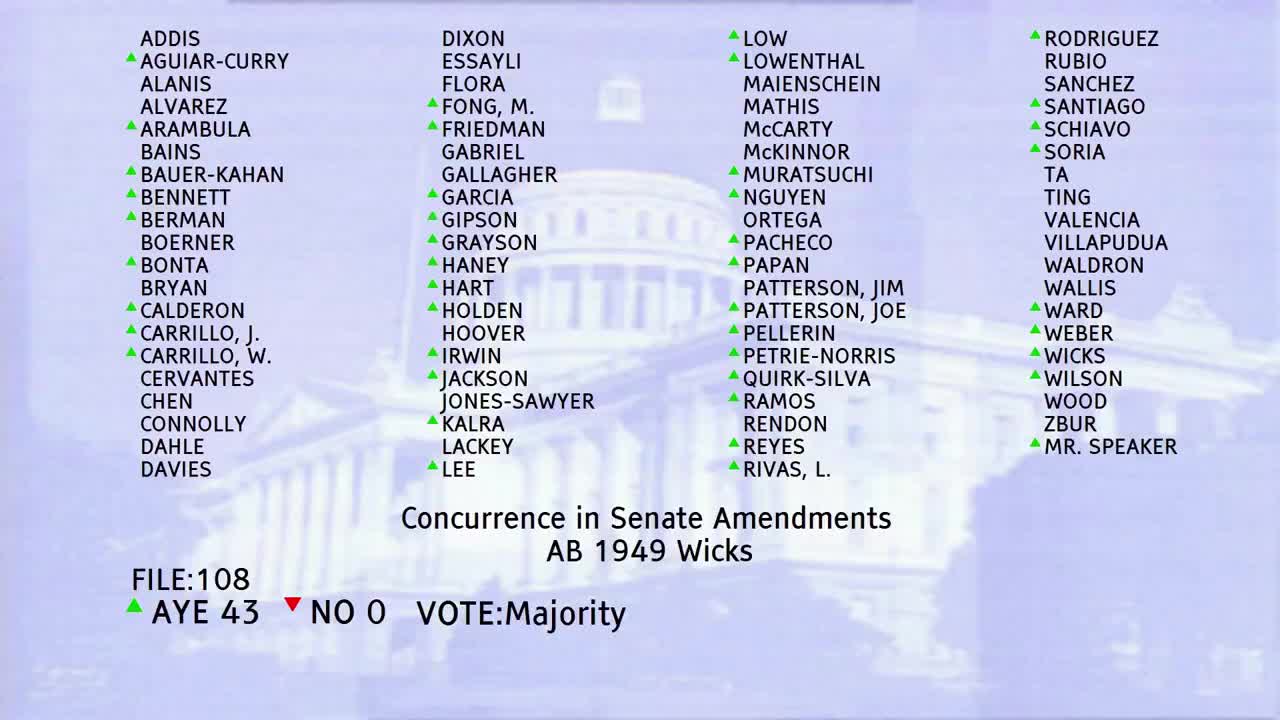


Bill Author

Bill Co-Author(s):