AB 2257: Local government: property-related water and sewer fees and assessments: remedies.
- Session Year: 2023-2024
- House: Assembly
- Latest Version Date: 2024-09-25
Current Status:
Passed
(2024-09-25: Chaptered by Secretary of State - Chapter 561, Statutes of 2024.)
Introduced
In Committee
First Chamber
In Committee
Second Chamber
Enacted
The California Constitution specifies various requirements with respect to the levying of assessments and property-related fees and charges by a local agency, including notice, hearing, and protest procedures, depending on the character of the assessment, fee, or charge.
Existing law, known as the Proposition 218 Omnibus Implementation Act, prescribes specific procedures and parameters for local jurisdictions to comply with these requirements.
This bill would prohibit, if a local agency complies with specified procedures, a person or entity from bringing a judicial action or proceeding alleging noncompliance with the constitutional provisions for any new, increased, or extended fee or assessment, as defined, unless that person or entity has timely submitted to the local agency a written objection to that fee or assessment that specifies the grounds for alleging noncompliance, as specified.
This bill would provide that local agency responses to the timely submitted written objections shall go to the weight of the evidence supporting the agencys compliance with the substantive limitations on fees and assessments imposed by the constitutional provisions. The bill would also prohibit an independent cause of action as to the adequacy of the local agencys responses.
This bill would, if the local agency complies with the specified procedures, provide that in any judicial action or proceeding to review, invalidate, challenge, set aside, rescind, void, or annul the fee or assessment for failure to comply with the procedural and substantive requirements of specified constitutional provisions in the fee or assessment setting process, the courts review is limited to a record of proceedings containing specified documents, except as otherwise provided. The bill would provide that this limitation does not preclude any civil action related to a local agencys failure to implement a fee or assessment in compliance with the manner adopted by the local agency. The bill would make related findings and declarations.
The California Constitution specifies various requirements with respect to the levying of assessments and property-related fees and charges by a local agency. The California Constitution includes a public notice and a majority protest procedure in the case of assessments and procedures for submitting property-related fees and charges for approval by property owners subject to the fee or charge or to the electorate residing in the affected area following a public hearing. agency, including notice, hearing, and protest procedures, depending on the character of the assessment, fee, or charge.
Existing law, known as the Proposition 218 Omnibus Implementation Act, prescribes specific procedures and parameters for local jurisdictions to comply with these requirements.
This bill would prohibit, if a local agency complies with specified procedures, a person or entity from bringing a judicial action or proceeding alleging noncompliance with the constitutional provisions for any new, increased, or extended fee or assessment, as defined, unless that person or entity has timely submitted to the local agency a written objection to that fee or assessment that specifies the grounds for alleging noncompliance, as specified.
This bill would provide that local agency responses to the timely submitted written objections shall go to the weight of the evidence supporting the agencys compliance with the substantive limitations on fees and assessments imposed by the constitutional provisions. The bill would also prohibit an independent cause of action as to the adequacy of the local agencys responses.
This bill would, if the local agency complies with the specified procedures, provide that in any judicial action or proceeding to review, invalidate, challenge, set aside, rescind, void, or annul the fee or assessment for failure to comply with the procedural and substantive requirements of specified constitutional provisions, provisions in the fee or assessment setting process, the courts review is limited to a record of proceedings containing specified documents, except as otherwise provided. The bill would provide that this limitation does not preclude any civil action related to a local agencys failure to implement a fee or assessment in compliance with the manner adopted by the local agency. The bill would make related findings and declarations.
The California Constitution specifies various requirements with respect to the levying of assessments and property-related fees and charges by a local agency. The California Constitution includes a public notice and a majority protest procedure in the case of assessments and procedures for submitting property-related fees and charges for approval by property owners subject to the fee or charge or to the electorate residing in the affected area following a public hearing.
Existing law, known as the Proposition 218 Omnibus Implementation Act, prescribes specific procedures and parameters for local jurisdictions to comply with these requirements.
This bill would prohibit, if a local agency complies with specified procedures, a person or entity from bringing a judicial action or proceeding alleging noncompliance with the constitutional provisions for any new, increased, or extended fee or assessment, as defined, unless that person or entity has timely submitted to the local agency a written objection to that fee or assessment that specifies the grounds for alleging noncompliance, as specified.
This bill would provide that local agency responses to the timely submitted written objections shall go to the weight of the evidence supporting the agencys compliance with the substantive limitations on fees and assessments imposed by the constitutional provisions. The bill would also prohibit an independent cause of action as to the adequacy of the local agencys responses.
This bill would, if the local agency complies with the specified procedures, provide that in any judicial action or proceeding to review, invalidate, challenge, set aside, rescind, void, or annul the fee or assessment for failure to comply with the constitutional provisions, the courts review is limited to a record of proceedings containing specified documents, except as otherwise provided. The bill would make related findings and declarations.
The Legislature finds and declares all of the following:
(a)The purpose of this act is to create an exhaustion of administrative remedies procedure that, if a local agency chooses to implement it, requires ratepayers to bring an objection regarding a proposed property-related water or sewer fee or charge, or any special assessment to the local public agency governing bodys attention prior to the deadline established by the local public agency as part of the rate or assessment consideration process. The purpose of the act is also to provide an opportunity for the local public agency to address or resolve the objection or objections before its governing body makes a final decision on whether to establish a new, or amend a current, property-related fee or special assessment pursuant to Proposition 218.
(b)The procedure created by this act is intended to provide a meaningful opportunity for a ratepayer to present an objection to a proposed new or amended property-related water or sewer fee or charge, or any special assessment, and allow the local agency the opportunity to resolve the objection, before resorting to litigation after the new or amended rate or special assessment is approved (see Plantier v. Ramona Municipal Water Dist. (2019) 7 Cal.5th 372, 383). Even if such an objection is not fully resolved, the local agency considering and responding to the objection can narrow the dispute and will create a better evidentiary record for court review in deciding any later litigation (see id.).
(c)This act establishes a clearly defined machinery for the submission, evaluation, and resolution of complaints by aggrieved parties (see Plantier v. Ramona Municipal Water Dist., supra, 7 Cal.5th at p. 384, citing Rosenfield v. Malcom (1967) 65 Cal.2d 559, 566).
SEC. 2.Section 53759.1 is added to the Government Code, to read:53759.1.(a)For purposes of this section, the following definitions apply:
(1)Exhaustion of remedies requirement means the written objection requirement under subdivision (b).
(2)Fee or assessment means the amount of any property-related water or sewer fee or charge, or any special assessment levied or the methodology used to develop and levy the fee, charge, or assessment.
(3)Sewer includes systems, all real estate, fixtures, and personal property owned, controlled, operated, or managed in connection with or to facilitate sewage collection, treatment, or disposition for sanitary or drainage purposes, including lateral and connecting sewers, interceptors, trunk and outfall lines, sanitary sewage treatment or disposal plants or works, drains, conduits, outlets for surface or storm waters, and any and all other works, property, or structures necessary or convenient for the collection or disposal of sewage, industrial waste, or surface or storm waters. Sewer system shall not include a sewer system that merely collects sewage on the property of a single owner.
(4)Water means any system of public improvements intended to provide for the production, storage, supply, treatment, or distribution of water from any source.
(b)For purposes of any fee or assessment adopted by a local agency pursuant to Section 4 or 6 of Article XIIID of the California Constitution, if the local agency complies with the procedures described in subdivision (c), a person or entity shall be prohibited from bringing a judicial action or proceeding alleging noncompliance with Article XIII D of the California Constitution for any new, increased, or extended fee or assessment, unless that person or entity has timely submitted to the local agency a written objection to that fee or assessment that specifies the grounds for alleging noncompliance.
(c)The exhaustion of remedies requirement authorized by subdivision (b) applies only if the local agency does all of the following:
(1)Makes available to the public a proposed fee or assessment no less than 45 days prior to the deadline for a ratepayer to submit an objection, as established by the local agency pursuant to paragraph (4).
(2)Posts on its internet website a written basis for the fee or assessment and includes a link to the internet website in the written notice, sent pursuant to subdivision (c) of Section 4 or paragraph (1) of subdivision (a) of Section 6 of Article XIII D of the California Constitution.
(3)Mails the written basis described in paragraph (2) to a property owner upon request.
(4)Provides at least 45 days for a property owner to review the proposed fee or assessment and to timely submit to the local agency a written objection to that fee or assessment that specifies the grounds for alleging noncompliance. To be considered timely, any written objection shall be submitted by a deadline established by the local agency, which shall be no less than 45 days after notice is provided pursuant to subdivision (c) of Section 4 or paragraph (1) of subdivision (a) of Section 6 of Article XIII D of the California Constitution, as applicable.
(5)Considers and responds in writing, including the grounds for which a challenge is not resulting in amendments to the proposed fee or assessment, to any timely submitted written objections prior to the close of the protest hearing or ballot tabulation hearing required under Section 4 or 6 of Article XIIID of the California Constitution. The agencys response shall explain the substantive basis for retaining or altering the proposed fee or assessment in response to the written objection. Timely submitted written objections and agency responses required by this subdivision shall be presented to the local agencys governing body for consideration prior to or during a protest hearing or ballot tabulation hearing required under Section 4 or 6 of Article XIIID of the California Constitution.
(6)Includes in the written notice, sent pursuant to subdivision (c) of Section 4 or paragraph (1) of subdivision (a) of Section 6 of Article XIIID of the California Constitution, a prominently displayed statement that contains the following information:
(A)That all written objections must be submitted within the written objection period set by the local agency pursuant to paragraph (4) and that a failure to timely object in writing bars any right to challenge that fee or assessment through a legal proceeding.
(B)All substantive and procedural requirements for submitting an objection to the proposed fee or assessment.
(7)Completes the procedures described in paragraphs (1) to (6), inclusive, prior to the completion of the protest hearing and ballot tabulating hearing required by Section 4 or 6 of Article XIIID of the California Constitution.
(d)The local agencys governing body, in exercising its legislative discretion, shall determine any of the following:
(1)Whether the written objections and the agencys response warrant clarifications to the proposed fee or assessment.
(2)Whether to reduce the proposed fee or assessment.
(3)Whether to further review before making a determination on whether clarification or reduction is needed.
(4)Whether to proceed with the protest hearing or ballot tabulation hearing required under Section 4 or 6 of Article XIIID of the California Constitution.
(e)The local agencys response to timely submitted written objections, as required under paragraph (5) of subdivision (c), shall go to the weight of the evidence supporting the agencys compliance with the substantive limitations on fees and assessments imposed by Section 4 or 6 of Article XIIID of the California Constitution. There shall be no independent cause of action as to the adequacy of a local agencys response pursuant to paragraph (5) of subdivision (c).
SEC. 3.Section 53759.2 is added to the Government Code, to read:53759.2.(a)For purposes of this section, fee or assessment means any property-related water or sewer fee or charge, or any special assessment levied or the methodology used to develop and levy the fee, charge, or assessment.
(b)Notwithstanding any law, if a local agency adopts a fee or assessment and complies with subdivision (c) of Section 53759.1, any judicial action or proceeding to review, invalidate, challenge, set aside, rescind, void, or annul the fee or assessment for failure to comply with the procedural and substantive requirements of Section 4 or 6 of Article XIIID of the California Constitution in the fee or assessment setting process shall be subject to the following requirements:
(1)Except as provided in paragraph (2), the courts review shall be limited to the record of proceedings before the local agency for that fee or assessment as follows:
(A)Any cost-of-service or rate study or report, any engineers report, agency staff reports, and related documents prepared by the local agency with respect to the fee or assessment.
(B)Any transcript or minutes of the proceedings at which the decisionmaking body of the local agency heard testimony or public comment on the fee or assessment, and any transcript or minutes of the proceedings before any advisory body to the local agency that were presented to the decisionmaking body before action on the fee or assessment.
(C)All notices issued by the local agency for purposes of complying with subdivision (c) of Section 53759.1, to comply with the requirements of Section 4 or 6 of Article XIIID of the California Constitution, or with any other law requiring notice.
(D)All timely submitted written objections and any local agency responses to those objections made pursuant to Section 53759.1.
(E)All written evidence or correspondence related to the fee or assessment submitted to, or transmitted from, the local agency prior to the completion of the protest hearing or ballot tabulation hearing required under Section 4 or 6 of Article XIIID of the California Constitution.
(F)Documentation of the local agencys final decision on the fee or assessment, including any ordinance, resolution, rule, regulation, meeting minutes, or other record of the local agencys decision.
(G)All protests, ballots, and records of the tabulation, protests, or ballots made in connection with the fee or assessment.
(H)All written evidence or documentation supporting the fee or assessment in the local agencys files prior to completion of the protest hearing or ballot tabulation hearing required under Section 4 or 6 of Article XIIID of the California Constitution.
(2)Evidence outside the record of proceedings before the local agency may be admitted under the following circumstances:
(A)Where the evidence is relevant to issues other than the validity of the fee or assessment, such as a petitioners standing and capacity to sue.
(B)Where the evidence is relevant to affirmative defenses, including, but not limited to, laches, estoppel, and res judicata.
(C)Where the evidence is relevant to the accuracy and completeness of the administrative record certified by the local agency.
(D)Where the evidence is relevant to the local agencys compliance with the procedures set forth in subdivision (c) of Section 53759.1.
(E)Where the evidence is necessary to explain information in the administrative record on the issue of compliance with Section 4 or subdivision (a) of Section 6 of Article XIIID of the California Constitution.
(c)Nothing in this section shall preclude any civil action related to a local agencys failure to implement a fee or assessment in compliance with the manner adopted by the local agency.
The Legislature finds and declares all of the following:
(a)The purpose of this act is to create an exhaustion of administrative remedies procedure that, if a local agency chooses to implement it, requires ratepayers to bring an objection regarding a proposed property-related water or sewer fee or charge, or any special assessment to the local public agency governing bodys attention prior to the deadline established by the local public agency as part of the rate or assessment consideration process. The purpose of the act is also to provide an opportunity for the local public agency to address or resolve the objection or objections before its governing body makes a final decision on whether to establish a new, or amend a current, property-related fee or special assessment pursuant to Proposition 218.
(b)The procedure created by this act is intended to provide a meaningful opportunity for a ratepayer to present an objection to a proposed new or amended property-related water or sewer fee or charge, or any special assessment, and allow the local agency the opportunity to resolve the objection, before resorting to litigation after the new or amended rate or special assessment is approved (see Plantier v. Ramona Municipal Water Dist. (2019) 7 Cal.5th 372, 383). Even if such an objection is not fully resolved, the local agency considering and responding to the objection can narrow the dispute and will create a better evidentiary record for court review in deciding any later litigation (see id.).
(c)This act establishes a clearly defined machinery for the submission, evaluation, and resolution of complaints by aggrieved parties (see Plantier v. Ramona Municipal Water Dist., supra, 7 Cal.5th at p. 384, citing Rosenfield v. Malcom (1967) 65 Cal.2d 559, 566).
SEC. 2.Section 53759.1 is added to the Government Code, to read:53759.1.(a)For purposes of this section, the following definitions apply:
(1)Exhaustion of remedies requirement means the written objection requirement under subdivision (b).
(2)Fee or assessment means the amount of any property-related water or sewer fee or charge, or any special assessment levied or the methodology used to develop and levy the fee, charge, or assessment.
(3)Sewer includes systems, all real estate, fixtures, and personal property owned, controlled, operated, or managed in connection with or to facilitate sewage collection, treatment, or disposition for sanitary or drainage purposes, including lateral and connecting sewers, interceptors, trunk and outfall lines, sanitary sewage treatment or disposal plants or works, drains, conduits, outlets for surface or storm waters, and any and all other works, property, or structures necessary or convenient for the collection or disposal of sewage, industrial waste, or surface or storm waters. Sewer system shall not include a sewer system that merely collects sewage on the property of a single owner.
(4)Water means any system of public improvements intended to provide for the production, storage, supply, treatment, or distribution of water from any source.
(b)For purposes of any fee or assessment adopted by a local agency pursuant to Section 4 or 6 of Article XIIID of the California Constitution, if the local agency complies with the procedures described in subdivision (c), a person or entity shall be prohibited from bringing a judicial action or proceeding alleging noncompliance with Article XIII D of the California Constitution for any new, increased, or extended fee or assessment, unless that person or entity has timely submitted to the local agency a written objection to that fee or assessment that specifies the grounds for alleging noncompliance.
(c)The exhaustion of remedies requirement authorized by subdivision (b) applies only if the local agency does all of the following:
(1)Makes available to the public a proposed fee or assessment no less than 45 days prior to the deadline for a ratepayer to submit an objection, as established by the local agency pursuant to paragraph (4).
(2)Posts on its internet website a written basis for the fee or assessment and includes a link to the internet website in the written notice, sent pursuant to paragraph subdivision (c) of Section 4 or paragraph (1) of subdivision (a) of Section 6 of Article XIII D of the California Constitution.
(3)Mails the written basis described in paragraph (2) to a property owner upon request.
(4)Provides at least 45 days for a property owner to review the proposed fee or assessment and to timely submit to the local agency a written objection to that fee or assessment that specifies the grounds for alleging noncompliance. To be considered timely, any written objection shall be submitted by a deadline established by the local agency, which shall be no less than 45 days after notice is provided pursuant to subdivision (c) of Section 4 or paragraph (1) of subdivision (a) of Section 6 of Article XIII D of the California Constitution, as applicable.
(5)Considers and responds in writing, including the grounds for which a challenge is not resulting in amendments to the proposed fee or assessment, to any timely submitted written objections prior to the close of the protest hearing or ballot tabulation hearing required under Section 4 or 6 of Article XIIID of the California Constitution. The agencys response shall explain the substantive basis for retaining or altering the proposed fee or assessment in response to the written objection. Timely submitted written objections and agency responses required by this subdivision shall be presented to the local agencys governing body for consideration prior to or during a protest hearing or ballot tabulation hearing required under Section 4 or 6 of Article XIIID of the California Constitution.
(6)Includes in the written notice, sent pursuant to paragraph subdivision (c) of Section 4 or paragraph (1) of subdivision (a) of Section 6 of Article XIIID of the California Constitution, a prominently displayed statement that contains the following information:
(A)That all written objections must be submitted within the written objection period set by the local agency pursuant to paragraph (4) and that a failure to timely object in writing bars any right to challenge that fee or assessment through a legal proceeding.
(B)All substantive and procedural requirements for submitting an objection to the proposed fee or assessment.
(7)Completes the procedures described in paragraphs (1) to (6), inclusive, prior to the completion of the protest hearing and ballot tabulating hearing required by Section 4 or 6 of Article XIIID of the California Constitution.
(d)The local agencys governing body, in exercising its legislative discretion, shall determine whether any of the following:
(1)Whether the written objections and the agencys response warrant clarifications to the proposed fee or assessment, a reduction in assessment.
(2)Whether to reduce the proposed fee or assessment, assessment.
(3)Whether to further review before making a determination on whether clarification or reduction is needed, or whether needed.
(4)Whether to proceed with the protest hearing or ballot tabulation hearing required under Section 4 or 6 of Article XIIID of the California Constitution.
(e)The local agencys response to timely submitted written objections, as required under paragraph (5) of subdivision (c), shall go to the weight of the evidence supporting the agencys compliance with the substantive limitations on fees and assessments imposed by Section 4 or 6 of Article XIIID of the California Constitution. There shall be no independent cause of action as to the adequacy of a local agencys response pursuant to paragraph (5) of subdivision (c).
SEC. 3.Section 53759.2 is added to the Government Code, to read:53759.2.(a)For purposes of this section, fee or assessment means any property-related water or sewer fee or charge, or any special assessment levied or the methodology used to develop and levy the fee, charge, or assessment.
(b)Notwithstanding any law, if a local agency adopts a fee or assessment and complies with subdivision (c) of Section 53759.1, any judicial action or proceeding to review, invalidate, challenge, set aside, rescind, void, or annul the fee or assessment for failure to comply with the procedural and substantive requirements of Section 4 or 6 of Article XIIID of the California Constitution in the fee or assessment setting process shall be subject to the following requirements:
(1)Except as provided in paragraph (2), the courts review shall be limited to the record of proceedings before the local agency for that fee or assessment as follows:
(A)Any cost-of-service or rate study or report, any engineers report, agency staff reports, and related documents prepared by the local agency with respect to the fee or assessment.
(B)Any transcript or minutes of the proceedings at which the decisionmaking body of the local agency heard testimony or public comment on the fee or assessment, and any transcript or minutes of the proceedings before any advisory body to the local agency that were presented to the decisionmaking body before action on the fee or assessment.
(C)All notices issued by the local agency for purposes of complying with subdivision (c) of Section 53759.1, to comply with the requirements of Section 4 or 6 of Article XIIID of the California Constitution, or with any other law requiring notice.
(D)All timely submitted written objections and any local agency responses to those objections made pursuant to Section 53759.1.
(E)All written evidence or correspondence related to the fee or assessment submitted to, or transmitted from, the local agency prior to the completion of the protest hearing or ballot tabulation hearing required under Section 4 or 6 of Article XIIID of the California Constitution.
(F)Documentation of the local agencys final decision on the fee or assessment, including any ordinance, resolution, rule, regulation, meeting minutes, or other record of the local agencys decision.
(G)All protests, ballots, and records of the tabulation, protests, or ballots made in connection with the fee or assessment.
(H)All written evidence or documentation supporting the fee or assessment in the local agencys files prior to completion of the protest hearing or ballot tabulation hearing required under Section 4 or 6 of Article XIIID of the California Constitution.
(2)Evidence outside the record of proceedings before the local agency may be admitted under the following circumstances:
(A)Where the evidence is relevant to issues other than the validity of the fee or assessment, such as a petitioners standing and capacity to sue.
(B)Where the evidence is relevant to affirmative defenses, including, but not limited to, laches, estoppel, and res judicata.
(C)Where the evidence is relevant to the accuracy and completeness of the administrative record certified by the local agency.
(D)Where the evidence is relevant to the local agencys compliance with the procedures set forth in subdivision (c) of Section 53759.1.
(E)Where the evidence is necessary to explain information in the administrative record on the issue of compliance with Section 4 or subdivision (a) of Section 6 of Article XIIID of the California Constitution.
(c)Nothing in this section shall preclude any civil action related to a local agencys failure to implement a fee or assessment in compliance with the manner adopted by the local agency.
The Legislature finds and declares all of the following:
(a)The purpose of this act is to create an exhaustion of administrative remedies procedure that, if a local agency chooses to implement it, requires ratepayers to bring an objection regarding a proposed property-related water or sewer fee or charge, or any special assessment to the local public agency governing bodys attention prior to the deadline established by the local public agency as part of the rate or assessment consideration process. The purpose of the act is also to provide an opportunity for the local public agency to address or resolve the objection or objections before its governing body makes a final decision on whether to establish a new, or amend a current, property-related fee or special assessment pursuant to Proposition 218.
(b)The procedure created by this act is intended to provide a meaningful opportunity for a ratepayer to present an objection to a proposed new or amended property-related water or sewer fee or charge, or any special assessment, and allow the local agency the opportunity to resolve the objection, before resorting to litigation after the new or amended rate or special assessment is approved (see Plantier v. Ramona Municipal Water Dist. (2019) 7 Cal.5th 372, 383). Even if such an objection is not fully resolved, the local agency considering and responding to the objection can narrow the dispute and will create a better evidentiary record for court review in deciding any later litigation (see id.).
(c)This act establishes a clearly defined machinery for the submission, evaluation, and resolution of complaints by aggrieved parties (see Plantier v. Ramona Municipal Water Dist., supra, 7 Cal.5th at p. 384, citing Rosenfield v. Malcom (1967) 65 Cal.2d 559, 566) and is consistent with the intent of Proposition 218, which is to enhance communication between ratepayers and agencies (Morgan v. Imperial Irrigation Dist. (2014) 223 Cal.App.4th 892, 911; see also Bighorn-Desert View Water Agency v. Virjil (2006) 39 Cal.4th 205, 220). 566).
SEC. 2.Section 53759.1 is added to the Government Code, to read:53759.1.(a)For purposes of this section, the following definitions apply:
(1)Exhaustion of remedies requirement means the written objection requirement under subdivision (b).
(2)Fee or assessment means the amount of any property-related water or sewer fee or charge, or any special assessment levied or the methodology used to develop and levy the fee, charge, or assessment.
(3)Sewer includes systems, all real estate, fixtures, and personal property owned, controlled, operated, or managed in connection with or to facilitate sewage collection, treatment, or disposition for sanitary or drainage purposes, including lateral and connecting sewers, interceptors, trunk and outfall lines, sanitary sewage treatment or disposal plants or works, drains, conduits, outlets for surface or storm waters, and any and all other works, property, or structures necessary or convenient for the collection or disposal of sewage, industrial waste, or surface or storm waters. Sewer system shall not include a sewer system that merely collects sewage on the property of a single owner.
(4)Water means any system of public improvements intended to provide for the production, storage, supply, treatment, or distribution of water from any source.
(b)For purposes of any fee or assessment adopted by a local agency pursuant to Section 4 or 6 of Article XIIID of the California Constitution, if the local agency complies with the procedures described in subdivision (c), a person or entity shall be prohibited from bringing a judicial action or proceeding alleging noncompliance with Article XIII D of the California Constitution for any new, increased, or extended fee or assessment, unless that person or entity has timely submitted to the local agency a written objection to that fee or assessment that specifies the grounds for alleging noncompliance.
(c)The exhaustion of remedies requirement authorized by subdivision (b) applies only if the local agency does all of the following:
(1)Makes available to the public a proposed fee or assessment no less than 45 days prior to the deadline for a ratepayer to submit an objection, as established by the local agency pursuant to paragraph (4).
(2)Posts on its internet website a written basis for the fee or assessment. assessment and includes a link to the internet website in the written notice, sent pursuant to paragraph (c) of Section 4 or paragraph (1) of subdivision (a) of Section 6 of Article XIII D of the California Constitution.
(3)Mails the written basis described in paragraph (2) to a property owner upon request.
(4)Provides at least 45 days for a property owner to review the proposed fee or assessment and to timely submit to the local agency a written objection to that fee or assessment that specifies the grounds for alleging noncompliance. To be considered timely, any written objection shall be submitted by a deadline established by the local agency, which shall be no less than 45 days after notice is provided pursuant to subdivision (c) of Section 4 or paragraph (1) of subdivision (a) of Section 6 of Article XIII D of the California Constitution, as applicable.
(5)Considers and responds in writing, including the grounds for which a challenge is not resulting in amendments to the proposed fee or assessment, to any timely submitted written objections prior to the close of the protest hearing or ballot tabulation hearing required under Section 4 or 6 of Article XIIID of the California Constitution. The agencys response shall explain the substantive basis for retaining or altering the proposed fee or assessment in response to the written objection. Timely submitted written objections and agency responses required by this subdivision shall be presented to the local agencys governing body for consideration prior to or during a protest hearing or ballot tabulation hearing required under Section 4 or 6 of Article XIIID of the California Constitution.
(6)Includes in the written notice, sent pursuant to paragraph (c) of Section 4 or paragraph (1) of subdivision (a) of Section 6 of Article XIIID of the California Constitution, a prominently displayed statement that contains the following information:
(A)That all written objections must be submitted within the written objection period set by the local agency pursuant to paragraph (4) and that a failure to timely object in writing bars any right to challenge that fee or assessment through a legal proceeding.
(B)All substantive and procedural requirements for submitting an objection to the proposed fee or assessment.
(7)Completes the procedures described in paragraphs (1) to (6), inclusive, prior to the completion of the protest hearing and ballot tabulating hearing required by Section 4 or 6 of Article XIIID of the California Constitution.
(d)The local agencys governing body, in exercising its legislative discretion, shall determine whether the written objections and the agencys response warrant clarifications to the proposed fee or assessment, a reduction in the proposed fee or assessment, further review before making a determination on whether clarification or reduction is needed, or whether to proceed with the protest hearing or ballot tabulation hearing required under Section 4 or 6 of Article XIIID of the California Constitution.
(e)The local agencys response to timely submitted written objections, as required under paragraph (5) of subdivision (c), shall go to the weight of the evidence supporting the agencys compliance with the substantive limitations on fees and assessments imposed by Section 4 or 6 of Article XIIID of the California Constitution. There shall be no independent cause of action as to the adequacy of a local agencys response pursuant to paragraph (5) of subdivision (c).
SEC. 3.Section 53759.2 is added to the Government Code, to read:53759.2.(a)For purposes of this section, fee or assessment means any property-related water or sewer fee or charge, or any special assessment. assessment levied or the methodology used to develop and levy the fee, charge, or assessment.
(b)Notwithstanding any law, if a local agency adopts a fee or assessment and complies with subdivision (c) of Section 53759.1, any judicial action or proceeding to review, invalidate, challenge, set aside, rescind, void, or annul the fee or assessment for failure to comply with the procedural and substantive requirements of Section 4 or 6 of Article XIIID of the California Constitution in the fee or assessment setting process shall be subject to the following requirements:
(1)Except as provided in paragraph (2), the courts review shall be limited to the record of proceedings before the local agency for that fee or assessment as follows:
(A)Any cost-of-service or rate study or report, any engineers report, agency staff reports, and related documents prepared by the local agency with respect to the fee or assessment.
(B)Any transcript or minutes of the proceedings at which the decisionmaking body of the local agency heard testimony or public comment on the fee or assessment, and any transcript or minutes of the proceedings before any advisory body to the local agency that were presented to the decisionmaking body before action on the fee or assessment.
(C)All notices issued by the local agency for purposes of complying with subdivision (c) of Section 53759.1, to comply with the requirements of Section 4 or 6 of Article XIIID of the California Constitution, or with any other law requiring notice.
(D)All timely submitted written objections and any local agency responses to those objections made pursuant to Section 53759.1.
(E)All written evidence or correspondence related to the fee or assessment submitted to, or transmitted from, the local agency prior to the completion of the protest hearing or ballot tabulation hearing required under Section 4 or 6 of Article XIIID of the California Constitution.
(F)Documentation of the local agencys final decision on the fee or assessment, including any ordinance, resolution, rule, regulation, meeting minutes, or other record of the local agencys decision.
(G)All protests, ballots, and records of the tabulation, protests, or ballots made in connection with the fee or assessment.
(H)All written evidence or documentation supporting the fee or assessment in the local agencys files prior to completion of the protest hearing or ballot tabulation hearing required under Section 4 or 6 of Article XIIID of the California Constitution.
(2)Evidence outside the record of proceedings before the local agency may be admitted under the following circumstances:
(A)Where the evidence is relevant to issues other than the validity of the fee or assessment, such as a petitioners standing and capacity to sue.
(B)Where the evidence is relevant to affirmative defenses, including, but not limited to, laches, estoppel, and res judicata.
(C)Where the evidence is relevant to the accuracy and completeness of the administrative record certified by the local agency.
(D)Where the evidence is relevant to the local agencys compliance with the procedures set forth in subdivision (c) of Section 53759.1.
(E)Where the evidence is necessary to explain information in the administrative record to demonstrate on the issue of compliance with Section 4 or subdivision (a) of Section 6 of Article XIIID of the California Constitution.
(c)Nothing in this section shall preclude any civil action related to a local agencys failure to implement a fee or assessment in compliance with the manner adopted by the local agency.
The Legislature finds and declares all of the following:
(a)The purpose of this act is to create an exhaustion of administrative remedies procedure that, if implemented by a local agency, a local agency chooses to implement it, requires ratepayers to bring an objection regarding a proposed property-related water or sewer fee or charge, or any special assessment to the local public agency governing bodys attention prior to the deadline established by the local public agency as part of the rate or assessment consideration process. The purpose of the act is also to provide an opportunity for the local public agency to address or resolve the objection or objections before its governing body makes a final decision on whether to establish a new, or amend a current, property-related fee or special assessment pursuant to Proposition 218.
(b)The procedure created by this act is intended to provide a meaningful opportunity for a ratepayer to resolve present an objection to a proposed new or amended property-related water or sewer fee or charge, or any special assessment assessment, and allow the local agency the opportunity to resolve the objection, before resorting to litigation after the new or amended rate or special assessment is approved (see Plantier v. Ramona Municipal Water Dist. (2019) 7 Cal.5th 372, 383). Even if such an objection is not fully resolved, the local agencys agency considering and responding to the objection can narrow the dispute and will create a better evidentiary record for court review in deciding any later litigation (see id.).
(c)This act establishes a clearly defined machinery for the submission, evaluation, and resolution of complaints by aggrieved parties (see Plantier v. Ramona Municipal Water Dist., supra, 7 Cal.5th at p. 384, citing Rosenfield v. Malcom (1967) 65 Cal.2d 559, 566) and is consistent with the intent of Proposition 218, which is to enhance communication between ratepayers and agencies (Morgan v. Imperial Irrigation Dist. (2014) 223 Cal.App.4th 892, 911; see also Bighorn-Desert View Water Agency v. Virjil (2006) 39 Cal.4th 205, 220).
SEC. 2.Section 53759.1 is added to the Government Code, to read:53759.1.(a)For purposes of this section, the following definitions apply:
(1)Exhaustion of remedies requirement means the written objection requirement under subdivision (b).
(2)Fee or assessment means the amount of any property-related water or sewer fee or charge, or any special assessment. assessment levied or the methodology used to develop and levy the fee, charge, or assessment.
(3)Sewer includes systems, all real estate, fixtures, and personal property owned, controlled, operated, or managed in connection with or to facilitate sewage collection, treatment, or disposition for sanitary or drainage purposes, including lateral and connecting sewers, interceptors, trunk and outfall lines, sanitary sewage treatment or disposal plants or works, drains, conduits, outlets for surface or storm waters, and any and all other works, property, or structures necessary or convenient for the collection or disposal of sewage, industrial waste, or surface or storm waters. Sewer system shall not include a sewer system that merely collects sewage on the property of a single owner.
(4)Water means any system of public improvements intended to provide for the production, storage, supply, treatment, or distribution of water from any source.
(b)For purposes of any fee or assessment adopted by a local agency pursuant to Section 4 or 6 of Article XIIID of the California Constitution, if the local agency complies with the procedures described in subdivision (c), a person or entity shall be prohibited from bringing a judicial action or proceeding alleging noncompliance with Article XIII D of the California Constitution for any new, increased, or extended fee or assessment, unless that person or entity has timely submitted to the local agency a written objection to that fee or assessment that specifies the grounds for alleging noncompliance.
(c)The exhaustion of remedies requirement authorized by subdivision (b) applies only if the local agency does all of the following:
(1)Posts on its internet website and makes Makes available to the public a proposed fee or assessment and a written basis for the fee or assessment no less than 45 days prior to the protest hearing required by Article XIII D of the California Constitution. deadline for a ratepayer to submit an objection, as established by the local agency pursuant to paragraph (4).
(2)Posts on its internet website a written basis for the fee or assessment.
(3)Mails the written basis described in paragraph (2) to a property owner upon request.
(2)(4)Provides at least 45 days for a property owner to review the proposed fee or assessment and to timely submit to the local agency a written objection to that fee or assessment that specifies the grounds for alleging noncompliance. To be considered timely, any written objection shall be submitted by a deadline established by the local agency, which shall be no less than 45 days after the local agency complies with paragraph (1). notice is provided pursuant to subdivision (c) of Section 4 or paragraph (1) of subdivision (a) of Section 6 of Article XIII D of the California Constitution, as applicable.
(3)(5)Considers and responds in writing, including the grounds for which a challenge is not resulting in amendments to the proposed fee or assessment, to any timely submitted written objections prior to the close of the protest hearing or ballot tabulation hearing required under Section 4 or 6 of Article XIIID of the California Constitution. The agencys response shall explain the substantive basis for retaining or altering the proposed fee or assessment in response to the written objection. Timely submitted written objections and agency responses required by this subdivision shall be presented to the local agencys governing body for consideration prior to or during a protest hearing or ballot tabulation hearing required under Section 4 or 6 of Article XIIID of the California Constitution.
(4)(6)Includes in the written notice, sent pursuant to paragraph (c) of Section 4 or paragraph (1) of subdivision (a) of Section 6 of Article XIIID of the California Constitution, a statement that contains the following information:
(A)That all written objections must be submitted within the written objection period set by the local agency pursuant to paragraph (2) (4) and that a failure to timely object in writing bars any right to challenge that fee or assessment through a legal proceeding.
(B)All substantive and procedural requirements for submitting an objection to the proposed fee or assessment.
(5)(7)Completes the procedures described in paragraphs (1) to (4), (6), inclusive, prior to the completion of the protest hearing and ballot tabulating hearing required by Section 4 or 6 of Article XIIID of the California Constitution.
(d)The local agencys governing body, in exercising its legislative discretion, shall determine whether the written objections and the agencys response warrant clarifications to the proposed fee or assessment, a reduction in the proposed fee or assessment, further review before making a determination on whether clarification or reduction is needed, or whether to proceed with the protest hearing or ballot tabulation hearing required under Section 4 or 6 of Article XIIID of the California Constitution.
(e)The local agencys response to timely submitted written objections, as required under paragraph (3) (5) of subdivision (c), shall go to the weight of the evidence supporting the agencys compliance with the substantive limitations on fees and assessments imposed by Section 4 or 6 of Article XIIID of the California Constitution. There shall be no independent cause of action as to the adequacy of a local agencys response pursuant to paragraph (3) (5) of subdivision (c).
SEC. 3.Section 53759.2 is added to the Government Code, to read:53759.2.(a)For purposes of this section, fee or assessment means any property-related water or sewer fee or charge, or any special assessment.
(b)Notwithstanding any law, if a local agency adopts a fee or assessment and complies with subdivision (c) of Section 53759.1, any judicial action or proceeding to review, invalidate, challenge, set aside, rescind, void, or annul the fee or assessment for failure to comply with the procedural and substantive requirements of Section 4 or 6 of Article XIIID of the California Constitution in the fee or assessment setting process shall be subject to the following requirements:
(1)Except as provided in paragraph (2), the courts review shall be limited to the record of proceedings before the local agency for that fee or assessment as follows:
(A)Any cost-of-service or rate study or report, any engineers report, agency staff reports, and related documents prepared by the local agency with respect to the fee or assessment.
(B)Any transcript or minutes of the proceedings at which the decisionmaking body of the local agency heard testimony or public comment on the fee or assessment, and any transcript or minutes of the proceedings before any advisory body to the local agency that were presented to the decisionmaking body before action on the fee or assessment.
(C)All notices issued by the local agency for purposes of complying with subdivision (c) of Section 53759.1, to comply with the requirements of Section 4 or 6 of Article XIIID of the California Constitution, or with any other law requiring notice.
(D)All timely submitted written objections and any local agency responses to those objections made pursuant to Section 53759.1.
(E)All written evidence or correspondence related to the fee or assessment submitted to, or transmitted from, the local agency prior to the completion of the protest hearing or ballot tabulation hearing required under Section 4 or 6 of Article XIIID of the California Constitution.
(F)Documentation of the local agencys final decision on the fee or assessment, including any ordinance, resolution, rule, regulation, meeting minutes, or other record of the local agencys decision.
(G)All protests, ballots, and records of the tabulation, protests, or ballots made in connection with the fee or assessment.
(H)All written evidence or documentation supporting the fee or assessment in the local agencys files prior to completion of the protest hearing or ballot tabulation hearing required under Section 4 or 6 of Article XIIID of the California Constitution.
(2)Evidence outside the record of proceedings before the local agency may be admitted under the following circumstances:
(A)Where the evidence is relevant to issues other than the validity of the fee or assessment, such as a petitioners standing and capacity to sue.
(B)Where the evidence is relevant to affirmative defenses, including, but not limited to, laches, estoppel, and res judicata.
(C)Where the evidence is relevant to the accuracy and completeness of the administrative record certified by the local agency.
(D)Where the evidence is relevant to the local agencys compliance with the procedures set forth in subdivision (c) of Section 53759.1.
(E)Where the evidence is necessary to explain information in the administrative record to demonstrate compliance with Section 4 or subdivision (a) of Section 6 of Article XIIID of the California Constitution.
(c)Nothing in this section shall preclude any civil action related to a local agencys failure to implement a fee or assessment in compliance with the manner adopted by the local agency.
The Legislature finds and declares all of the following:
(a)State law requires that establishing or making certain changes to property-related fees, like water service rates, occur in accordance with procedures outlined in Section 6 of Article XIII D of the California Constitution, commonly referred to as Proposition 218. Establishing or making certain changes to special assessments is governed by Section 4 of Article XIII D of the California Constitution.(b)The exhaustion of remedies principle is a fundamental concept of administrative law governing the relationship between agencies and courts. It requires individuals to raise concerns about proposed agency actions to the agencies themselves, in the first instance, rather than to the courts. Individuals that disagree with agency actions must pursue available agency procedures for addressing those concerns before they may sue the agency in court (Plantier v. City of Ramona Municipal Water Dist. (2019) 7 Cal.5th 372, 382-383, citing Coachella Valley Mosquito & Vector Control Dist. v. California Public Employment Relations Bd. (2005) 35 Cal.4th 1072, 1080; see Abelleira v. District Court of Appeal, Third Dist. (1941) 17 Cal.2d 280, 292293).(c)(a)The purpose of this act is to create an exhaustion of administrative remedies procedure that, if implemented by a local agency, requires ratepayers to bring an objection regarding a proposed property-related water or sewer fee or charge, or any special assessment to the local public agency governing bodys attention prior to the deadline established by the local public agency as part of the rate or assessment consideration process. The purpose of the act is also to provide an opportunity for the local public agency to address or resolve the objection or objections before its governing body makes a final decision on whether to establish a new, or amend a current, property-related fee or special assessment pursuant to Proposition 218.
(d)(b)The procedure created by this act is intended to provide a meaningful opportunity for a ratepayer to resolve an objection to a proposed new or amended property-related water or sewer fee or charge, or any special assessment before resorting to litigation after the new or amended rate or special assessment is approved (see Plantier v. Ramona Municipal Water Dist., supra, Dist. (2019) 7 Cal.5th at p. 338). 372, 383). Even if such an objection is not fully resolved, the local agencys considering and responding to the objection can narrow the dispute and will create a better evidentiary record for court review in deciding any later litigation (see id.).
(e)(c)This act establishes a clearly defined machinery for the submission, evaluation, and resolution of complaints by aggrieved parties(see parties (see Plantier v. Ramona Municipal Water Dist., supra, 7 Cal. 5th Cal.5th at p. 384 384, citing Rosenfield v. Malcom (1967) 65 Cal.2d 559, 566) and is consistent with the intent of Proposition 218, which is to enhance communication between ratepayers and agencies (Morgan v. Imperial Irrigation Dist. (2014) 223 Cal.App.4th 892, 911; see also Bighorn-Desert View Water Agency v. Virjil (2006) 39 Cal.4th 205, 220).
SEC. 2.Section 53759.1 is added to the Government Code, to read:53759.1.(a)For purposes of this section, the following definitions apply:
(1)Exhaustion of remedies requirement means the written objection requirement under subdivision (b).
(2)Fee or assessment means any property-related water or sewer fee or charge, or any special assessment.
(b)For purposes of any fee or assessment adopted by a local agency pursuant to Section 4 or 6 of Article XIII D of the California Constitution, if the local agency complies with the procedures described in subdivision (c), a person or entity shall be prohibited from bringing a judicial action or proceeding alleging noncompliance with Article XIII D of the California Constitution for any new, increased, or extended fee or assessment, unless that person or entity has timely submitted to the local agency a written objection to that fee or assessment that specifies the grounds for alleging noncompliance, and shall be subject to the requirements of Section 53759.2. noncompliance.
(c)The exhaustion of remedies requirement authorized by subdivision (b) applies only if the local agency does all of the following:
(1)Posts on its internet website and makes available to the public a proposed fee or assessment and a written basis for the fee or assessment no less than 45 days prior to the protest hearing required by Article XIII D of the California Constitution.
(2)Provides at least 45 days for a property owner to review the proposed fee or assessment and to timely submit to the local agency a written objection to that fee or assessment that specifies the grounds for alleging noncompliance. To be considered timely, any written objection shall be submitted by a deadline established by the local agency, which shall be no less than 45 days after the local agency complies with paragraph (1).
(3)Considers and responds in writing writing, including the grounds for which a challenge is not resulting in amendments to the proposed fee or assessment, to any timely submitted written objections prior to the close of the protest hearing or ballot tabulating tabulation hearing required under Section 4 or 6 of Article XIII D of the California Constitution. The agencys response shall explain the substantive basis for retaining or altering the proposed fee or assessment in response to the written objection. Timely submitted written objections and agency responses required by this subdivision shall be presented to the local agencys governing body for consideration prior to or during a protest hearing or ballot tabulation hearing required under Section 4 or 6 of Article XIII D of the California Constitution.
(4)Includes in the written notice, sent pursuant to paragraph (c) of Section 4 or paragraph (1) of subdivision (a) of Section 6 of Article XIII D of the California Constitution, a statement that written contains the following information:
(A)That all written objections must be submitted within the written objection period set by the local agency pursuant to paragraph (2) to preserve (2) and that a failure to timely object in writing bars any right to challenge that fee or assessment. assessment through a legal proceeding.
(B)All substantive and procedural requirements for submitting an objection to the proposed fee or assessment.
(5)Concludes Completes the procedures described in paragraphs (1) to (4), inclusive, prior to the completion of the protest hearing and ballot tabulating hearing required by Section 4 or 6 of Article XIII D of the California Constitution.
(d)The local agencys governing body, in exercising its legislative discretion, shall determine whether the written objections and the agencys response warrant clarifications to the proposed fee or assessment, a reduction in the proposed fee or assessment, further review before making a determination on whether clarification or reduction is needed, or whether to proceed with the protest hearing or ballot tabulation hearing required under Section 4 or 6 of Article XIII D of the California Constitution.
(e)The local agencys response to timely submitted written objections, as required under paragraph (3) of subdivision (c), shall go to the weight of the evidence supporting the agencys compliance with the substantive limitations on fees and assessments imposed by Section 4 or 6 of Article XIII D of the California Constitution. There shall be no independent cause of action as to the adequacy of a local agencys response pursuant to paragraph (3) of subdivision (c).
SEC. 3.Section 53759.2 is added to the Government Code, to read:53759.2.(a)For purposes of this section, fee or assessment means any property-related water or sewer fee or charge, or any special assessment.
(b)Notwithstanding any law, if a local agency adopts a fee or assessment and complies with subdivision (c) of Section 53759.1, any judicial action or proceeding to review, invalidate, challenge, set aside, rescind, void, or annul the fee or assessment for failure to comply with the procedural and substantive requirements of Section 4 or 6 of Article XIII D of the California Constitution in the fee or assessment setting process shall be subject to the following requirements:
(1)Except as provided in paragraph (2), the courts review shall be limited to the record of proceedings before the local agency for that fee or assessment as follows:
(A)Any cost-of-service or rate study or report, any engineers report, agency staff reports, and related documents prepared by the local agency with respect to the fee or assessment.
(B)Any transcript or minutes of the proceedings at which the decisionmaking body of the local agency heard testimony or public comment on the fee or assessment, and any transcript or minutes of the proceedings before any advisory body to the local agency that were presented to the decisionmaking body before action on the fee or assessment.
(C)All notices issued by the local agency for purposes of complying with subdivision (c) of Section 53759.1, to comply with the requirements of Section 4 or 6 of Article XIII D of the California Constitution, or with any other law requiring notice.
(D)All timely submitted written objections and any local agency responses to those objections made pursuant to Section 53759.1.
(E)All written evidence or correspondence related to the fee or assessment submitted to, or transmitted from, the local agency prior to the completion of the protest hearing or ballot tabulation hearing required under Section 4 or 6 of Article XIII D of the California Constitution.
(F)Documentation of the local agencys final decision on the fee or assessment, including any ordinance, resolution, rule, regulation, meeting minutes, or other record of the local agencys decision.
(G)All protests, ballots, and records of the tabulation, protests, or ballots made in connection with the fee or assessment.
(H)All written evidence or documentation supporting the fee or assessment in the local agencys files prior to completion of the protest hearing or ballot tabulation hearing required under Section 4 or 6 of Article XIII D of the California Constitution.
(2)Evidence outside the record of proceedings before the local agency may be admitted under the following circumstances:
(A)Where the evidence is relevant to issues other than the validity of the fee or assessment, such as a petitioners standing and capacity to sue.
(B)Where the evidence is relevant to affirmative defenses, including, but not limited to, laches, estoppel, and res judicata.
(C)Where the evidence is relevant to the accuracy and completeness of the administrative record certified by the local agency.
(D)Where the evidence is relevant to the local agencys compliance with the procedures set forth in subdivision (c) of Section 53759.1.
(E)Where the evidence is necessary to explain information in the administrative record to demonstrate compliance with Section 4 or 6 of Article XIII D of the California Constitution.
(c)Nothing in this section shall preclude any civil action related to a local agencys failure to implement a fee or assessment in compliance with the manner adopted by the local agency.
The Legislature finds and declares all of the following:
(a)State law requires that establishing or making certain changes to property-related fees, like water service rates, occur in accordance with procedures outlined in Section 6 of Article XIII D of the California Constitution, commonly referred to as Proposition 218. Establishing or making certain changes to special assessments is governed by Section 4 of Article XIII D of the California Constitution.
(b)The exhaustion of remedies principle is a fundamental concept of administrative law governing the relationship between agencies and courts. It requires individuals to raise concerns about proposed agency actions to the agencies themselves, in the first instance, rather than to the courts. Individuals that disagree with agency actions must pursue available agency procedures for addressing those concerns before they may sue the agency in court (Plantier v. City of Ramona Municipal Water Dist. (2019) 7 Cal.5th 372, 382-383, citing Coachella Valley Mosquito & Vector Control Dist. v. California Public Employment Relations Bd. (2005) 35 Cal.4th 1072, 1080; see Abelleira v. District Court of Appeal, Third Dist. (1941) 17 Cal.2d 280, 292293).
(c)The purpose of this act is to create an exhaustion of administrative remedies procedure that, if implemented by a local agency, requires ratepayers to bring an objection regarding a proposed property-related water or sewer fee or charge, or any special assessment to the local public agency governing bodys attention prior to the deadline established by the local public agency as part of the rate or assessment consideration process. The purpose of the act is also to provide an opportunity for the local public agency to address or resolve the objection or objections before its governing body makes a final decision on whether to establish a new, or amend a current, property-related fee or special assessment pursuant to Proposition 218.
(d)The procedure created by this act is intended to provide a meaningful opportunity for a ratepayer to resolve an objection to a proposed new or amended property-related water or sewer fee or charge, or any special assessment before resorting to litigation after the new or amended rate or special assessment is approved (see Plantier v. Ramona Municipal Water Dist., supra, 7 Cal.5th at p. 338). Even if such an objection is not fully resolved, the local agencys considering and responding to the objection can narrow the dispute and will create a better evidentiary record for court review in deciding any later litigation (see id.).
(e)This act establishes a clearly defined machinery for the submission, evaluation, and resolution of complaints by aggrieved parties(see Plantier v. Ramona Municipal Water Dist., supra, 7 Cal. 5th at p. 384 citing Rosenfield v. Malcom (1967) 65 Cal.2d 559, 566) and is consistent with the intent of Proposition 218, which is to enhance communication between ratepayers and agencies (Morgan v. Imperial Irrigation Dist. (2014) 223 Cal.App.4th 892, 911; see also Bighorn-Desert View Water Agency v. Virjil (2006) 39 Cal.4th 205, 220).
SEC. 2.Section 53759.1 is added to the Government Code, to read:53759.1.(a)For purposes of this section, the following definitions apply:
(1)Exhaustion of remedies requirement means the written objection requirement under subdivision (b).
(2)Fee or assessment means any property-related water or sewer fee or charge, or any special assessment.
(b)For purposes of any fee or assessment adopted by a local agency pursuant to Section 4 or 6 of Article XIII D of the California Constitution, if the local agency complies with the procedures described in subdivision (c), a person or entity shall be prohibited from bringing a judicial action or proceeding alleging noncompliance with Article XIII D of the California Constitution for any new, increased, or extended fee or assessment, unless that person or entity has timely submitted to the local agency a written objection to that fee or assessment that specifies the grounds for alleging noncompliance, and shall be subject to the requirements of Section 53759.2.
(c)The exhaustion of remedies requirement authorized by subdivision (b) applies only if the local agency does all of the following:
(1)Posts on its internet website and makes available to the public a proposed fee or assessment and a written basis for the fee or assessment no less than 45 days prior to the protest hearing required by Article XIII D of the California Constitution.
(2)Provides at least 45 days for a property owner to review the proposed fee or assessment and to timely submit to the local agency a written objection to that fee or assessment that specifies the grounds for alleging noncompliance. To be considered timely, any written objection shall be submitted by a deadline established by the local agency, which shall be no less than 45 days after the local agency complies with paragraph (1).
(3)Considers and responds in writing to any timely submitted written objections prior to the close of the protest hearing or ballot tabulating hearing required under Section 4 or 6 of Article XIII D of the California Constitution. Timely submitted written objections and agency responses required by this subdivision shall be presented to the local agencys governing body for consideration prior to or during a protest hearing or ballot tabulation hearing required under Section 4 or 6 of Article XIII D of the California Constitution.
(4)Includes in the written notice, sent pursuant to paragraph (c) of Section 4 or paragraph (1) of subdivision (a) of Section 6 of Article XIII D of the California Constitution, a statement that written objections must be submitted within the written objection period set by the local agency pursuant to paragraph (2) to preserve any right to challenge that fee or assessment.
(5)Concludes the procedures described in paragraphs (1) to (4), inclusive, prior to the completion of the protest hearing and ballot tabulating hearing required by Section 4 or 6 of Article XIII D of the California Constitution.
(d)The local agencys governing body, in exercising its legislative discretion, shall determine whether the written objections and the agencys response warrant clarifications to the proposed fee or assessment, a reduction in the proposed fee or assessment, further review before making a determination on whether clarification or reduction is needed, or whether to proceed with the protest hearing or ballot tabulation hearing required under Section 4 or 6 of Article XIII D of the California Constitution.
(e)The local agencys response to timely submitted written objections, as required under paragraph (3) of subdivision (c), shall go to the weight of the evidence supporting the agencys compliance with the substantive limitations on fees and assessments imposed by Section 4 or 6 of Article XIII D of the California Constitution. There shall be no independent cause of action as to the adequacy of a local agencys response pursuant to paragraph (3) of subdivision (c).
SEC. 3.Section 53759.2 is added to the Government Code, to read:53759.2.(a)For purposes of this section, fee or assessment means any property-related water or sewer fee or charge, or any special assessment.
(b)Notwithstanding any law, if a local agency adopts a fee or assessment and complies with subdivision (c) of Section 53759.1, any judicial action or proceeding to review, invalidate, challenge, set aside, rescind, void, or annul the fee or assessment for failure to comply with Section 4 or 6 of Article XIII D of the California Constitution shall be subject to the following requirements:
(1)Except as provided in paragraph (2), the courts review shall be limited to the record of proceedings before the local agency for that fee or assessment as follows:
(A)Any cost-of-service or rate study or report, any engineers report, agency staff reports, and related documents prepared by the local agency with respect to the fee or assessment.
(B)Any transcript or minutes of the proceedings at which the decisionmaking body of the local agency heard testimony or public comment on the fee or assessment, and any transcript or minutes of the proceedings before any advisory body to the local agency that were presented to the decisionmaking body before action on the fee or assessment.
(C)All notices issued by the local agency for purposes of complying with subdivision (c) of Section 53759.1, to comply with the requirements of Section 4 or 6 of Article XIII D of the California Constitution, or with any other law requiring notice.
(D)All timely submitted written objections and any local agency responses to those objections made pursuant to Section 53759.1.
(E)All written evidence or correspondence related to the fee or assessment submitted to, or transmitted from, the local agency prior to the completion of the protest hearing or ballot tabulation hearing required under Section 4 or 6 of Article XIII D of the California Constitution.
(F)Documentation of the local agencys final decision on the fee or assessment, including any ordinance, resolution, rule, regulation, meeting minutes, or other record of the local agencys decision.
(G)All protests, ballots, and records of the tabulation, protests, or ballots made in connection with the fee or assessment.
(H)All written evidence or documentation supporting the fee or assessment in the local agencys files prior to completion of the protest hearing or ballot tabulation hearing required under Section 4 or 6 of Article XIII D of the California Constitution.
(2)Evidence outside the record of proceedings before the local agency may be admitted under the following circumstances:
(A)Where the evidence is relevant to issues other than the validity of the fee or assessment, such as a petitioners standing and capacity to sue.
(B)Where the evidence is relevant to affirmative defenses, including, but not limited to, laches, estoppel, and res judicata.
(C)Where the evidence is relevant to the accuracy and completeness of the administrative record certified by the local agency.
(D)Where the evidence is relevant to the local agencys compliance with the procedures set forth in subdivision (c) of Section 53759.1.
(E)Where the evidence is necessary to explain information in the administrative record to demonstrate compliance with Section 4 or 6 of Article XIII D of the California Constitution.
|
Date
|
Status
|
|---|---|
| Sep 25, 2024 | Chaptered by Secretary of State - Chapter 561, Statutes of 2024. |
| Sep 25, 2024 | Approved by the Governor. |
| Sep 5, 2024 | Enrolled and presented to the Governor at 4 p.m. |
| Aug 27, 2024 | Senate amendments concurred in. To Engrossing and Enrolling. (Ayes 53. Noes 17.). |
| Aug 20, 2024 | In Assembly. Concurrence in Senate amendments pending. May be considered on or after August 22 pursuant to Assembly Rule 77. |
| Aug 20, 2024 | Read third time. Passed. Ordered to the Assembly. (Ayes 29. Noes 11. Page 5230.). |
| Aug 5, 2024 | Read second time and amended. Ordered to third reading. |
| Jul 3, 2024 | From committee: Amend, and do pass as amended. (Ayes 5. Noes 2.) (July 3). |
| Jun 20, 2024 | Read second time and amended. Re-referred to Com. on L. GOV. |
| Jun 19, 2024 | From committee: Amend, and do pass as amended and re-refer to Com. on L. GOV. (Ayes 8. Noes 2.) (June 18). |
| May 29, 2024 | Referred to Coms. on JUD. and L. GOV. |
| May 16, 2024 | In Senate. Read first time. To Com. on RLS. for assignment. |
| May 16, 2024 | Read third time. Passed. Ordered to the Senate. (Ayes 52. Noes 12.) |
| May 2, 2024 | Read second time. Ordered to third reading. |
| May 1, 2024 | From committee: Do pass. (Ayes 7. Noes 2.) (May 1). |
| Apr 24, 2024 | Re-referred to Com. on L. GOV. |
| Apr 23, 2024 | From committee chair, with author's amendments: Amend, and re-refer to Com. on L. GOV. Read second time and amended. |
| Mar 21, 2024 | Re-referred to Com. on L. GOV. |
| Mar 20, 2024 | Read second time and amended. |
| Mar 19, 2024 | From committee: Amend, and do pass as amended and re-refer to Com. on L. GOV. (Ayes 7. Noes 1.) (March 19). |
| Feb 26, 2024 | Referred to Coms. on JUD. and L. GOV. |
| Feb 9, 2024 | From printer. May be heard in committee March 10. |
| Feb 8, 2024 | Read first time. To print. |
|
Date
|
Description
|
Location
|
Votes
|
|
|---|---|---|---|---|
| Aug 27, 2024 | AB 2257 Wilson Concurrence in Senate Amendments | Assembly Floor |
Passed |
|
| Aug 20, 2024 | Assembly 3rd Reading AB2257 Wilson By Caballero | Senate Floor |
Passed |
|
| Jul 3, 2024 | Do pass as amended | Senate Standing Committee on Local Government |
Passed |
|
| Jun 18, 2024 | Do pass as amended, but first amend, and re-refer to the Committee on [Local Government] | Senate Standing Committee on Judiciary |
Passed |
|
| May 16, 2024 | AB 2257 Wilson Assembly Third Reading | Assembly Floor |
Passed |
|
| May 1, 2024 | Do pass. | Assembly Standing Committee on Local Government |
Passed |
|
| Mar 19, 2024 | Do pass as amended and be re-referred to the Committee on [Local Government] | Assembly Standing Committee on Judiciary |
Passed |
This list shows positions taken on this bill by organizations on the date displayed, which is linked to the original source.
Positions by individuals are not included.
|
Organization
|
Position
|
Date
|
|---|---|---|
| Alta Irrigation District | ** Support | |
| Amador Water Agency | ** Support | |
| Apartment Owners Association of California | ** Against | |
| Association Of California Water Agencies | ** Support | |
| Bella Vista Water District | ** Support | |
| Brooktrails Township Community Services District | ** Support | |
| California Alliance for Jobs | ** Support | |
| California Association Of Sanitation Agencies | ** Support | |
| California Business Roundtable | ** Against | |
| California Central Valley Flood Control Association | ** Support | |
| California Council For Environmental And Economic Balance | ** Support | |
| California Farm Bureau Federation | ** Against | |
| California Farm Workers and Families | ** Against | |
| California Municipal Utilities Association | ** Support | |
| California Special Districts Association | ** Support | |
| California State Association Of Counties | ** Support | |
| California Stormwater Quality Association | ** Support | |
| California Taxpayer Protection Committee | ** Against | |
| California Taxpayers Association | ** Against | |
| Calleguas Municipal Water District | ** Support | |
| Camrosa Water District | ** Support | |
| Central Coast Taxpayers Association | ** Against | |
| Central Valley BizFed | ** Against | |
| Central Valley Taxpayers Association | ** Against | |
| City of Camarillo | ** Support | |
| city of carlsbad | ** Support | |
| City of Corona | ** Support | |
| City Of Pleasanton | ** Support | |
| City of Rancho Cucamonga | ** Support | |
| City Of Sacramento | ** Support | |
| City of Santa Rosa | ** Support | |
| Coastside County Water District | ** Support | |
| Contra Costa Water District | ** Support | |
| Crescenta Valley Water District | ** Support | |
| Crescenta Water District | ** Support | |
| Crestline-Lake Arrowhead Water Agency | ** Support | |
| Cucamonga Valley Water District | ** Support | |
| Desert Water Agency | ** Support | |
| Diablo Water District | ** Support | |
| Dublin San Ramon Services District | ** Support | |
| East Bay Municipal Utility District | ** Support | |
| Eastern Municipal Water District | ** Support | |
| El Dorado Irrigation District | ** Support | |
| El Toro Water District | ** Support | |
| Environmental Defense Fund | ** Support | |
| Fallbrook Public Utilities District | ** Support | |
| Florin Resource Conservation District/elk Grove Water District | ** Support | |
| Georgetown Divide Public Utility District | ** Support | |
| Helix Water District | ** Support | |
| Hidden Valley Lake Community Services District | ** Support | |
| Howard Jarvis Taxpayers Association | ** Against | |
| Irvine Ranch Water District | ** Support | |
| Katie Valenzuela, City of Sacramento, Councilmember | ** Support | |
| LA County Taxpayers Association | ** Against | |
| Las Virgenes Municipal Water District | ** Support | |
| Los Angeles County Sanitation Districts | ** Support | |
| Los Angeles County Taxpayers Association | ** Against | |
| Marin Municipal Water District | ** Support | |
| McKinleyville Community Services District | ** Support | |
| McMullin Area Groundwater Sustainability Agency | ** Support | |
| Mendocino County Russian River Flood Control & Water Conservation | ** Support | |
| Metropolitan Water District Of Southern California | ** Support | |
| Mid-Peninsula Water District | ** Support | |
| montecito water district | ** Support | |
| Monterey County Farm Bureau | ** Against | |
| Monte Vista Water District | ** Support | |
| Nevada Irrigation District | ** Support | |
| Olivenhain Municipal Water District | ** Support | |
| Otay Water District | ** Support | |
| Padre Dam Municipal Water District | ** Support | |
| Pajaro Valley Water Management Agency | ** Support | |
| Palmdale Water District | ** Support | |
| Placer County Taxpayers Association | ** Against | |
| Placer County Water Agency | ** Support | |
| Rosedale-Rio Bravo Water Storage District | ** Support | |
| Rowland Water District | ** Support | |
| San Bernardino Valley Water Conservation District | ** Support | |
| San Diego County Water Authority | ** Support | |
| San Diego Tax Fighters | ** Against | |
| San Gabriel Valley Water Association | ** Support | |
| San Juan Water District | ** Support | |
| Santa Clara Valley Water District | ** Support | |
| Santa Clarita Valley Water Agency | ** Support | |
| santa fe irrigation district | ** Support | |
| Silicon Valley Taxpayers Association | ** Against | |
| Solano County Taxpayers Association | ** Against | |
| South San Joaquin Irrigation District | ** Support | |
| Stockton East Water District | ** Support | |
| Sweetwater Authority | ** Support | |
| Tahoe City Public Utility District | ** Support | |
| Three Valleys Municipal Water District | ** Support | |
| Town of Hillsborough | ** Support | |
| Tri-County Water Authority | ** Support | |
| Tuolumne Utilities District | ** Support | |
| Union Public Utilities District | ** Support | |
| Upper San Gabriel Valley Municipal Water District | ** Support | |
| Vallejo Flood And Wastewater District | ** Support | |
| Valley Center Municipal Water District | ** Support | |
| Valley Sanitary District | ** Support | |
| Walnut Valley Water District | ** Support | |
| Water Replenishment District Of Southern California | ** Support | |
| Western Manufactured Housing Communities Association | ** Against | |
| Western Municipal Water District | ** Support | |
| Yorba Linda Water District | ** Support |
CONCURRENCE IN SENATE AMENDMENTS
CSA1 Bill Id:AB 2257
Author:(Wilson)
As Amended Ver:August 5, 2024
Majority vote
SUMMARY
Establishes a procedure whereby a ratepayer must exhaust all administrative remedies to contest a new or increased fee or assessment in order for that ratepayer to be eligible to bring a lawsuit contesting the fee or assessment.
Major Provisions
Provides that for the purposes of any fee or assessment adopted by a local agency pursuant to Section 4 or 6 of Article XIII D of the California Constitution (hereinafter described as "Proposition 218") if the local agency complies with the procedures described in 2) a person or entity is prohibited from bringing a judicial action or proceeding alleging noncompliance with the substantive and procedural aspects of Proposition 218 unless that person or entity has timely submitted to the local agency a written objection to that fee or assessment that specifies the grounds for alleging noncompliance.
- Provides that the exhaustion of remedies provided for in 1) applies only if a local agencies complies with all of the following:
- Makes available to the public a proposed fee or assessment and a written basis for the fee or assessment no less than 45 days prior to deadline for a ratepayer to submit an objection;
- Provides at least 45 days for a property owner to review the proposed fee or assessment and to submit to the local agency a written objection to that fee or assessment that specifies the grounds for alleging noncompliance, as specified;
- Posts the notice on the agency website and mails a paper copy to ratepayers which includes a link to the agency's website in the paper notice, if requested;
- Considers and responds in writing, including the grounds for which a challenge is not resulting in amendments to the proposed fee or assessment, to any timely submitted written objections prior to the close of the protest hearing or ballot tabulating hearing required pursuant to Proposition 218;
- The local agencies responses to the objections described in c) explain the substantive basis for retaining or altering the proposed fee or assessment in response to the written objection;
- Includes in the written notice to ratepayers required pursuant to Proposition 218 a statement noting that all written objections must be submitted within the written objection period set by the local agency pursuant to b) above, a statement noting that a failure to timely object in writing bars any right to challenge that fee or assessment through a legal proceeding, and a statement outlining the substantive and procedural requirements for submitting an objection to the proposed fee or assessment; and
- Completes the procedures described in a) through f) prior to the conclusion of the protest hearing and ballot tabulating hearing required by Proposition 218.
- Requires, as a part of a local agency's legislative discretion, the agency to determine whether the written objections and the agency's response warrant clarifications to the proposed fee or assessment, a reduction in the proposed fee or assessment, further review before making a determination on whether clarification or reduction is needed, or whether to proceed with the protest hearing or ballot tabulation hearing required by Proposition 218.
- Requires the local agency's responses to timely submitted objections to fees or assessments to go to the weight of the evidence supporting the agency's compliance with the substantive limitations on fees and assessments imposed by Proposition 218.
- Requires any judicial action or proceeding to review, invalidate, challenge, set aside, rescind, void, or annul the fee or assessment for failure to comply with the procedural and substantive requirements of Proposition 218 related to the fee or assessment setting process, so long as a local agency adopts a fee or assessment in accordance with the procedures described in 2), to be subject to the following:
- The courts review is to be limited to the record of proceedings before the local agency for that fee or assessment as described in 7); and
- Notwithstanding a), evidence outside the record of proceedings before the local agency may be admitted, as specified.
- Provides that nothing in this bill prohibits any civil action related to a local agency's failure to implement a fee or assessment in compliance with the rate structure adopted by the local agency.
- Specifies the contents of the record of local agency proceedings that may be reviewed by a court.
Limits the admission of evidence outside of the official record of local agency proceedings.
Senate Amendments
- Revise the definition of "fee or assessment."
- Clarify the requirements of the notice sent to ratepayers.
- Make minor technical and clarifying corrections.
COMMENTS
Recognizing the importance of early public input on new fees or assessments, as well as the need for finality in the ratemaking process, this bill seeks to develop an exhaustion of remedies procedures for fees and assessments regulated by Proposition 218. First, this measure enhances the notices that are provided to residents that will be subject to a new fee. The enhanced notice includes information about how to lodge objections to new assessments or fees, as well as information clarifying that a failure to do so will impact one's right to litigate the fees at a later date. Additionally, the bill specifies that residents must be given a minimum of 45 days to review proposed assessment or fee increases. The bill also requires the local agencies to respond in writing as to why an agency is not adjusting its proposed rate structure in response to public comment. Seeking to provide the agency finality in the ratemaking process the bill would prohibit a party from suing an agency about the rate structure if the plaintiff did not file a timely objection. These procedures should restore some of the confidence in the legality and stability of an approved rate structure that was undermined by the California Supreme Court's recent decision in Plantier v. City of Ramona Municipal Water District (2019) 7 Cal.5th 372, 384.)
This bill also seeks to clarify the record that may be utilized by a court when examining a case involving objections to fees or assessments. The bill would, generally, limit the court's review to evidence in the official administrative record (including rate studies, the public comments and agency responses, and minutes of meetings held by the local body about the fee or assessment) unless outside evidence is needed to address issues beyond the validity of the rate structure or addresses issues like standing or affirmative defenses. Finally, the bill clarifies that the exhaustion of remedies procedures only apply to litigation surrounding the initial ratemaking process and that nothing in this bill precludes litigation about substantive violations of Proposition 218 in the implementation of an otherwise valid rate structure, for example the misuse of a fee or assessment for activities other than its intended purpose.
According to the Author
This bill would authorize public agencies to adopt procedures for the submittal and consideration of public comments regarding proposed water or sewer rates or assessments. If an agency elects to adopt exhaustion procedures, a person would be required to timely submit written comments that specify the grounds for alleging that the fees do not comply with Proposition 218 in order to challenge the fees in court. This bill would place new obligations on public agencies during the ratemaking process, by requiring agencies to provide written responses to all comments received before acting on the proposed fees. This bill would also detail documents that would comprise the administrative record in the event of litigation.
This bill would build upon Proposition 218's existing procedural requirements by creating a clear and robust mechanism for customers to raise questions, concerns, comments, and criticisms of a proposed rate structure. The agency's governing body would have the benefit of hearing the evidence, which would include objections and the agency's responses, and apply its reasoned discretion and expertise. This is especially valuable in ratemaking cases in which evidence and policies are highly technical. The process would serve to foster better-informed administrative decisions, which benefit the objector, the public agency, and ratepayers that the agency serves. It would also help agencies develop more defensible rates and build rapport and trust with their ratepayers.
Arguments in Support
This bill is sponsored by the Association of California Water Agencies and is supported by over two-dozen public utilities, special districts, and municipal governments. In support of this measure the coalition writes:
[This bill] would build upon Proposition 218's existing procedural requirements by creating an exhaustion of administrative remedies procedure, that, if a public agency elected to follow, would require the timely submittal of written objections during an agency's ratemaking process. Ratepayers would be required to state the particular Proposition 218 compliance concern, and public agencies would be required to provide their board and the public with written responses to each comment received prior to acting on the proposed rate or assessment. Ratepayers would be required to participate in this process in order to challenge the agency's adopted rates or assessments in court.
With a greater understanding of potential concerns and the agency's responses, the agency's board would have the opportunity to abandon its ratemaking/assessment proposal, change it (reduce it), or to better explain why it complies with Proposition 218's substantive limitations, before having to defend it in litigation. Additionally, if a public agency complies with the exhaustion procedures, the bill would specify documents that could be included in the administrative record, subject to certain exceptions, in the event of litigation.
[This bill] would bolster the financial stability of public water and sewer agencies by creating a clear and robust public process that facilitates dialogue, transparency, and the opportunity to resolve issues and avoid costly litigation. Codifying a procedure that requires issue exhaustion in Proposition 218 litigation would protect both legislative and adjudicative functions by allowing a legislative body to hear the evidence, apply its reasoned discretion and expertise, and create an administrative record to facilitate judicial review. This would also foster better-informed administrative decisions, which benefit the objector, the public agency, and members of the public within the public agency's jurisdiction. This is especially valuable in ratemaking cases in which evidence and policies are highly technical. It would also help agencies develop more defensible rates and build rapport and trust with their ratepayers.
Arguments in Opposition
This bill is opposed by a coalition of taxpayer advocates, including the Howard Jarvis Taxpayers Association. In opposition to this bill the coalition writes:
The protest procedure set forth in this bill is separate from the notice required by Proposition 218 and appears merely to layer on additional – and superfluous – requirements for the sole purpose of hindering taxpayers' constitutional ability to approve or reject taxes.
For example, under this bill, if the agency posts on its website and "makes available to the public" the proposed fee/assessment and a "written basis" 3 months prior to a public hearing, the 45-day deadline will have passed by the time Proposition 218 notices are even mailed.
It is also questionable what constitutes a "written basis" for proposed charges. Nothing in this bill suggests an engineer's report, or any other documentation that would allow a ratepayer to infer the charges might be invalid, will be required. How are they supposed to determine, even theoretically, what might be wrong with the proposed rates in the absence of a detailed analysis?
Further, 45 days is an unreasonably short period of time for: (1) a customer to schedule a consultation with an attorney; (2) the attorney to research whether there is a violation; (3) the attorney to find and retain an expert witness; (4) the expert to prepare a report; and (5) the attorney to draft and submit a thorough objection preserving all legal theories. Not to mention the cost of such an undertaking.
To add insult to injury, Section 1 of [this bill] proclaims that these requirements are "consistent with the intent of Proposition 218." As the principal drafter of Prop. 218, I can assure you, it isn't. The reality is additional byzantine remedies are an intentional trap for the inexperienced.
FISCAL COMMENTS
None.
VOTES:
ASM JUDICIARY: 7-1-4
YES: Kalra, Connolly, Haney, Maienschein, McKinnor, Pacheco, Reyes
NO: Sanchez
ABS, ABST OR NV: Dixon, Bauer-Kahan, Bryan, Waldron
ASM LOCAL GOVERNMENT: 7-2-0
YES: Juan Carrillo, Haney, Kalra, Pacheco, Ramos, Ward, Wilson
NO: Waldron, Essayli
ASSEMBLY FLOOR: 52-12-16
YES: Aguiar-Curry, Alvarez, Arambula, Bennett, Berman, Boerner, Bonta, Bryan, Calderon, Juan Carrillo, Connolly, Mike Fong, Friedman, Gabriel, Garcia, Grayson, Haney, Hart, Holden, Jones-Sawyer, Kalra, Lee, Low, Lowenthal, Maienschein, McCarty, McKinnor, Muratsuchi, Stephanie Nguyen, Ortega, Pacheco, Papan, Pellerin, Petrie-Norris, Quirk-Silva, Ramos, Rendon, Reyes, Luz Rivas, Rodriguez, Blanca Rubio, Santiago, Ting, Valencia, Villapudua, Ward, Weber, Wicks, Wilson, Wood, Zbur, Robert Rivas
NO: Bauer-Kahan, Chen, Davies, Essayli, Gallagher, Hoover, Lackey, Jim Patterson, Joe Patterson, Sanchez, Ta, Waldron
ABS, ABST OR NV: Addis, Alanis, Bains, Wendy Carrillo, Cervantes, Megan Dahle, Dixon, Flora, Vince Fong, Gipson, Irwin, Jackson, Mathis, Schiavo, Soria, Wallis
UPDATED
VERSION: August 5, 2024
CONSULTANT: Nicholas Liedtke / JUD. / (916) 319-2334 FN: 0004255
SENATE RULES COMMITTEE Office of Senate Floor Analyses (916) 651-1520 Fax: (916) 327-4478 | AB 2257 |
THIRD READING
Bill No: AB 2257
Author: Wilson (D)
Amended: 8/5/24 in Senate
Vote: 21
SENATE JUDICIARY COMMITTEE: 8-2, 6/18/24
AYES: Umberg, Allen, Ashby, Caballero, Durazo, Roth, Stern, Wahab
NOES: Wilk, Niello
NO VOTE RECORDED: Laird
SENATE LOCAL GOVERNMENT COMMITTEE: 5-2, 7/3/24
AYES: Durazo, Glazer, Skinner, Wahab, Wiener
NOES: Seyarto, Dahle
ASSEMBLY FLOOR: 52-12, 5/16/24 - See last page for vote
SUBJECT: Local government: property-related water and sewer fees and assessments: remedies
SOURCE: Association of California Water Agencies
DIGEST:
This bill provides that if a local agency complies with specified exhaustion of remedies procedures for purposes of any fee of assessment adopted by that local agency pursuant to Section 4 or 6 of Article XIII D of the California Constitution (Proposition 218) then a person or entity that has not timely submitted to that local agency a written objection, as specified, is prohibited from bringing a judicial action or proceeding alleging noncompliance with those constitutional provisions and limits a record of proceedings in court to containing specified documents, except specified.
ANALYSIS:
Existing law:
- Established, through Proposition 218, a category of property related fees and charges that can only be enacted if certain procedural requirements are met. (Cal. Const. Art. XIII D.) Prohibits a fee or charge from being extended, imposed, or increased by any agency unless it meets specified requirements. (Cal. Const. art. XIID Section 6 (b).)
- Enacts implementing statutes for the notice requirement under 2), above, including that an agency must provide a minimum of 45 days’ notice of an increase to a fee or charge, as specified.(Gov. Code § 53755.)
This bill:
- Provides that for the purposes of any fee or assessment adopted by a local agency pursuant to Section 4 or 6 of Article XIII D of the California Constitution, if the local agency complies with the exhaustion of remedies procedures described in 2), below, a person or entity is prohibited from bringing a judicial action or proceeding alleging noncompliance with Article XIII D of the California Constitution, for any new, increased, or extended fee or assessment, unless that person or entity has timely submitted to the local agency a written objection to that fee or assessment that specifies the ground for alleging noncompliance.
- Specifies that for the prohibition in 1), above, to apply a local agency must meet specified provisions, including:
- Makes available to the public a proposed fee or assessment no less than 45 days prior to the deadline for a ratepayer to submit an objection.
- Posts on its internet website a written basis for the fee or assessment.
- Mails the written basis to a property owner upon request.
- Considers and responds in writing, including the grounds for which a challenge is not resulting in amendments to the proposed fee or assessment, to any timely submitted written objections prior to the close of the protest hearing or ballot tabulation hearing required under Section 4 or 6 of Article XIII D of the California Constitution, as provided.
- Completes the procedures described in paragraphs above prior to the completion of the required protest hearing and ballot tabulating hearing.
- Requires a local agency’s response to timely submitted written objections to go to the weight of the evidence supporting the agency’s compliance with the substantive limitations on fees and assessments imposed by Section 4 or 6 of Article XIII D of the California Constitution. There shall be no independent cause of action as to the adequacy of a local agency’s response. Specifies that this provision only applies to a fee or charge for water or sewer service that has been adopted, modified, or amended after January 1, 2022.
- Defines terms for purposes of the above provisions:
- Provides that, if a local agency adopts a fee or assessment and complies with the exhaustion of remedies procedures described above, any judicial action or proceeding to review, invalidate, challenge, set aside, rescind, void, or annul the fee or assessment for failure to comply with the procedural and substantive requirements of Section 4 or 6 of Article XIII D of the California Constitution in the fee or assessment setting process is limited to the record of proceedings before the local agency for that fee or assessment as specified.
- Authorizes evidence outside the record of proceedings before the local agency to be admitted under certain circumstances.
- Makes various legislative findings and declarations.
Comment[1]
Proposition 218, the Right to Vote on Taxes Act, was enacted by the voters in 1996 (gen. elec., (Nov. 5, 1996).) provides for, among other things, procedural and substantive requirements for the imposition of property-related fees. (Cal. Const. art. XIIID § 6(a), (b).) To impose a new fee, a local agency must identify parcels subject to the fee, calculate the amount, and provide notice by mail to affected property owners of the proposed fee. (Id. at § 6(a)(1).) The local agency must conduct a public hearing and consider all written protests filed by the affected property owners. (Id. at § 6(a)(2).) If a majority of the property owners present written protests against the fee, the fee may not be imposed. (Id.) These are generally understood to be procedural requirements. (Planiter v. Ramona Municipal Water Dist. (2019) 7 Cal5th 372, 381 [hereafter Plantier].)
The fees or assessments are also subject to various requirements related to the amount charged and the purposes for which the money may be used. (Cal. Const. art. XIIID § 6(b).) The courts have referred to these requirements as substantive limitations. (Plantier at 382; Cal. Const. art. XIIID § 6(b)(1)-(5).) As a general matter, a fee must also receive voter approval; however, this requirement does not apply to sewer and water fees. (Id. at (c).) The courts have held that the stated intent of Proposition 218 is that its provisions are to be liberally construed to effectuate its purposes of limiting local government revenue and enhancing taxpayer consent. (Hill RHF Housing Partner, L.P. v. City of Los Angeles (2021) 12 Cal.5th 458 at 475 [hereafter Hill].) In regards to judicial review under the proposition, the courts have consistently held that courts should exercise their independent judgment in reviewing whether assessments that local agencies impose violate article XIII D instead of using a deferential standard of review. (Ibid.)
As a general proposition, the courts have held that a party is required to exhaust administrative remedies before pursing an action in the courts. (Planiter at 382-83.) An administrative remedy has been exhausted once all available and distinctive administrative review procedures have been concluded. (Id. at 383.) The California Supreme Court has held in two recent cases that the public hearing requirement under Proposition 218, as it applied to the petitioners in those cases, did not provide an adequate remedy to resolve the petitioners’ challenges and, therefore, they were not required to make an objection at the public hearing in order to challenge a fee or assessment. An exhaustion of remedies requirement can be required by statute or inferred based upon the statutory and regulatory scheme involved. (Hill at 478.) In both Plantier and Hill the courts stated that Proposition 218 did not expressly require an exhaustion of remedies, and the court declined to infer one was required under the circumstances. The court did note that in Plantier if was not deciding or expressing a view “on the broader question of whether a Proposition 218 hearing could ever be considered an administrative remedy that must be exhausted before challenging the substantive propriety of a fee in court.” (Id. at 388.) In a footnote in Hill the court commented that “[g]iven the other considerations behind our holding, we need not decide whether an exhaustion requirement of some kind could be reconciled with Proposition 218 under materially different circumstances.” (Hill at 488, see fn. 8.)
This bill seeks to build upon dicta in the above cases and establish a statutory requirement to exhaust administrative remedies before bringing a challenge under Proposition 218, and establish an administrative remedy that provides for submission, evaluation, and resolution of complaints. As the court has not definitively ruled out exhaustion of remedies under Proposition 218, enacting such a statutory requirement does not appear wholly impermissible. The bill provides that if a local agency elects to use the administrative remedy provided for in this bill, then a person or entity would be required to submit a written complaint before bringing a cause of action under Proposition 218 in the courts to challenge a fee or assessment. If they do not, they would be barred from bringing a legal challenge.
This bill seeks to be responsive to the courts by providing a mechanism for the submission, evaluation, and resolution of complaints. The provisions of this bill would not address a situation where an existing fee or assessment is challenged as described in Plantier.
FISCAL EFFECT: Appropriation: No Fiscal Com.: No Local: No
SUPPORT: (Verified 8/8/24)
Association of California Water Agencies (source)
Alta Irrigation District
Amador Water Agency
Bella Vista Water District
Brooktrails Township Community Services District
California Alliance for Jobs
California Association of Sanitation Agencies
California Central Valley Flood Control Association
California Council for Environmental and Economic Balance
California Municipal Utilities Association
California Special Districts Association
California State Association of Counties
Calleguas Municipal Water District
Camrosa Water District
City of Camarillo
City of Carlsbad
City of Corona
City of Rancho Cucamonga
City of Pleasanton
City of Sacramento
City of Santa Rosa
Coastside County Water District
Contra Costa Water District
Crescenta Valley Water District
Crestline-lake Arrowhead Water Agency
Cucamonga Valley Water District
Diablo Water District
Dublin San Ramon Services District
East Bay Municipal Utility District
Eastern Municipal Water District
El Dorado Irrigation District
El Toro Water District
Environmental Defense Fund
Fallbrook Public Utilities District
Florin Resource Conservation District/elk Grove Water District
Georgetown Divide Public Utility District
Helix Water District
Hidden Valley Lake Community Services District
Irvine Ranch Water District
Las Virgenes Municipal Water District
Los Angeles County Sanitation Districts
Marin Municipal Water District
Mckinleyville Community Service District
Mcmullin Area Groundwater Sustainability Agency
Mendocino County Russian River Flood Control & Water Conservation
Metropolitan Water District of Southern California
Mid-peninsula Water District
Monte Vista Water District
Montecito Water District
Nevada Irrigation District
Olivenhain Municipal Water District
Padre Dam Municipal Water District
Pajaro Valley Water Management Agency
Palmdale Water District
Placer County Water Agency
Rosedale-rio Bravo Water Storage District
Rowland Water District
San Bernardino Valley Water Conservation District
Santa Calra Valley Water District
San Juan Water District
Santa Clarita Valley Water Agency
Santa Fe Irrigation District
South San Joaquin Irrigation District
Stockton East Water District
Sweetwater Authority
Tahoe City Public Utility District
Three Valleys Municipal Water District
Town of Hillsborough
Tri-county Water Authority
Union Public Utilities District
Vallejo Flood and Wastewater District
Valley Center Municipal Water District
Walnut Valley Water District
Water Replenishment District of Southern California
Western Municipal Water District
Yorba Linda Water District
OPPOSITION: (Verified 8/8/24)
California Business Roundtable
California Taxpayers Association
California Farm Workers and Families
California Taxpayer Protection Committee
Central Coast Taxpayers Association
Central Valley BizFed
Central Valley Taxpayers Association
Howard Jarvis Taxpayers Association
LA County Taxpayers Association
Monterey County Farm Bureau
Placer County Taxpayers Association
Solano County Taxpayers Association
ARGUMENTS IN SUPPORT: The author writes:
AB 2257 would authorize public agencies to adopt procedures for the submittal and consideration of public comments regarding proposed water or sewer rates or assessments. If an agency elects to adopt exhaustion procedures, a person would be required to timely submit written comments that specify the grounds for alleging that the fees do not comply with Proposition 218 in order to challenge the fees in court. AB 2257 would place new obligations on public agencies during the ratemaking process, by requiring agencies to provide written responses to all comments received before acting on the proposed fees. AB 2257 would also detail documents that would comprise the administrative record in the event of litigation.
AB 2257 would build upon Proposition 218’s existing procedural requirements by creating a clear and robust mechanism for customers to raise questions, concerns, comments, and criticisms of a proposed rate structure. The agency’s governing body would have the benefit of hearing the evidence, which would include objections and the agency’s responses, and apply its reasoned discretion and expertise. This is especially valuable in ratemaking cases in which evidence and policies are highly technical. The process would serve to foster better-informed administrative decisions, which benefit the objector, the public agency, and ratepayers that the agency serves. It would also help agencies develop more defensible rates and build rapport and trust with their ratepayers.
ARGUMENTS IN OPPOSITION: A coalition of various business associations and taxpayer advocacy groups, including the Howard Jarvis Taxpayers Association and the California Business Roundtable, write in opposition, stating:
The protest procedure set forth in this bill is separate from the notice required by Proposition 218 and merely layers on additional – and superfluous – requirements for the sole purpose of eliminating any meaningful ability of customers to evaluate and challenge property-related fees and assessments.
It is also questionable what constitutes a “written basis” for proposed charges. Nothing in this bill requires that an engineer’s report, rate study (or any other documentation that would allow a ratepayer to specify grounds upon which proposed rates might be invalid) to be available for review during the notice period, and current law does not require these materials to be available prior to adoption of new rates. How are they supposed to determine, even theoretically, what might be wrong with the proposed rates in the absence of a detailed analysis?
The upshot is that this bill requires nothing more of the agency than mailing the notice that is already required under Prop. 218, stating the amount of the charge and the basis of computation, and then forecloses litigation for any property owner or ratepayer who fails to raise specific objections during a time when the rate study and methodology are not even available for review. For example, if the rate study contains an indefensible arithmetic error, that fact would not be disclosed in the Prop. 218 notice, and yet the customer would be barred from legal recourse based on their inability to identify grounds for objection during the 45-day notice period.
Further, 45 days is an impossible time for: (1) a customer to schedule a consultation with an attorney; (2) the attorney to research whether there is a violation; (3) the attorney to find and retain an expert witness; (4) the expert to prepare a report; and (5) the attorney to draft and submit a thorough objection preserving all legal theories. Not to mention such cost a customer is expected to incur before knowing if the rates will even pass. It is wasteful (and further offensive) that the customer may not introduce expert testimony after the public hearing.
ASSEMBLY FLOOR: 52-12, 5/16/24
AYES: Aguiar-Curry, Alvarez, Arambula, Bennett, Berman, Boerner, Bonta, Bryan, Calderon, Juan Carrillo, Connolly, Mike Fong, Friedman, Gabriel, Garcia, Grayson, Haney, Hart, Holden, Jones-Sawyer, Kalra, Lee, Low, Lowenthal, Maienschein, McCarty, McKinnor, Muratsuchi, Stephanie Nguyen, Ortega, Pacheco, Papan, Pellerin, Petrie-Norris, Quirk-Silva, Ramos, Rendon, Reyes, Luz Rivas, Rodriguez, Blanca Rubio, Santiago, Ting, Valencia, Villapudua, Ward, Weber, Wicks, Wilson, Wood, Zbur, Robert Rivas
NOES: Bauer-Kahan, Chen, Davies, Essayli, Gallagher, Hoover, Lackey, Jim Patterson, Joe Patterson, Sanchez, Ta, Waldron
NO VOTE RECORDED: Addis, Alanis, Bains, Wendy Carrillo, Cervantes, Megan Dahle, Dixon, Flora, Vince Fong, Gipson, Irwin, Jackson, Mathis, Schiavo, Soria, Wallis
Prepared by: Amanda Mattson / JUD. / (916) 651-4113
8/8/24 10:01:58
**** END ****
For a more thorough analysis please see the Senate Judiciary Committee and Senate Local Government Committee analysis of this bill. ↑
SENATE COMMITTEE ON LOCAL GOVERNMENT
Senator María Elena Durazo, Chair
2023 - 2024 Regular
Bill No: | AB 2257 | Hearing Date: | 7/3/24 |
Author: | Wilson | Fiscal: | No |
Version: | 6/20/24 | Consultant: | Peterson |
Local government: property-related water and sewer fees and assessments: remedies
Creates an exhaustion of administrative remedies procedure that, if a local agency chooses to implement it, requires ratepayers to bring an objection regarding a proposed property-related water or sewer fee or charge, prior to specified deadlines.
Background
Proposition 218 procedures. Proposition 218 (1996) imposed constitutional limits on local officials’ ability to impose, increase, and extend fees, including property-related fees. Proposition 218 defined a property-related fee as any levy other than an ad valorem tax, a special tax, or an assessment imposed by an agency on a parcel or on a person as an incident of property ownership, including a user fee for a property-related service. The Legislature enacted the Proposition 218 Omnibus Implementation Act to translate many of Proposition 218's requirements into statutory definitions and procedures (SB 919, Rainey, 1997).
Before a local government can charge a new property-related fee, or increase an existing one, Proposition 218 requires local officials to:
- Identify the parcels to be charged;
- Calculate the fee for each parcel;
- Notify the parcels’ owners in writing about the fee, the reason for imposing or increasing it, the basis for calculating the fee, and the date of a public hearing on the proposed fee;
- Hold a public hearing to consider and count protests at least 45 days after mailing the notice; and
- Abandon the fees if a majority of the parcels’ owners protest.
Requirements on fees. New or increased property-related fees cannot exceed the proportional cost of service to each parcel. They also generally require a majority-vote of the affected property owners, two-thirds registered voter approval, or weighted ballot approval by the affected property owners.
However, Proposition 218—subsequently clarified by Proposition 26 (2010)—exempts various local fees from some or all of its requirements, including to:
- Exclude fees for electric and gas service from the definition of property-related fees. These fees are still subject to Proposition 26’s requirements that fees be limited to the reasonable cost of providing the service and bear a fair or reasonable relationship to the benefits received;
- Establish development fees, such as the fees that water and sewer agencies charge when a new user connects to their systems (known as “connection fees” and “capacity charges”) as a separate category of fee not subject to Proposition 218’s requirements on fees or taxes; and
- Exempt property-related fees for sewer, water, or refuse collection services from Proposition 218’s voter approval requirements. However, all the other procedural requirements in Proposition 218 and the Omnibus Implementation Act apply to fees for water, sewer, and refuse collection services.
Recent water rate litigation. Water rates have been fertile ground for lawsuits since voters approved Proposition 218 in 1996. In February 2020, a class action lawsuit was filed against 81 water agencies throughout the state alleging their practice of charging ratepayers for the costs associated with supplying water for fire protection violates Proposition 218. This case prompted legislative action to clarify that fire hydrants and the water provided by them are a component of water service (SB 1386, Moorlach, 2020). Some ordinances under the class action lawsuit date back to 2016, meaning the plaintiffs did not initiate litigation until four years after the rates were adopted in some cases.
In 2021, the Legislature enacted SB 323 (Caballero), which required local agencies to include a statement that water and sewer rates have a 120-day statute of limitations in any written notice of a rate increase, clarify that the 120-day period doesn’t apply to billing errors or similar incorrect charges, and provide that the 120-day period commences after final action on or the effective date of the rate increase, whichever is later.
In 2019, the California Supreme Court ruled challenges to the methodology used to determine rates are by their nature “substantive” as the existing law provides no “clearly defined machinery for the submission, evaluation, and resolution of complaints by aggrieved parties” (Plantier v. City of Ramona Municipal Water District (2019) 7 Cal.5th 372, 384.). The Court opened its ruling by saying, “The question here is a narrow one. When an agency considers increasing a property-related fee, must a fee payor challenging the method of fee allocation first exhaust ‘administrative remedies’ by participating in a Proposition 218 hearing that addresses only a proposed rate increase? The answer is no.” In other words, a ratepayer could challenge a local agency’s fees or charges regardless of whether or not they raised issues during the local agency’s ratemaking process. In other contexts outside of Proposition 218, claimants must exhaust administrative remedies before pursuing judicial remedies.
The Association of California Water Agencies wants to establish an exhaustion of remedies process for Proposition 218 property-related fees and charges.
Proposed Law
Assembly Bill 2257 (1) creates an exhaustion of remedies process for Proposition 218 property-related water or sewer fees, charges, and assessments; and (2) limits judicial actions available to claimants if the local agency goes through that process.
Exhaustion of remedies process. If a local agency complies with the following exhaustion of remedies procedures, a person or entity cannot bring a judicial action alleging noncompliance with Proposition 218 unless they have submitted a written objection that specifies the grounds for alleging noncompliance within 45 days of receiving notice of the fee or charge from the local agency.
To benefit from the exhaustion of remedies process, a local agency must comply with all the following:
- Make available to the public a proposed fee or assessment no less than 45 days prior to the deadline for a ratepayer to submit an objection;
- Post on its internet website a written basis for the fee or assessment, and include a link to the website in the written notice it must send;
- Mail the written basis to a property owner upon request;
- Provide at least 45 days for a property owner to review the proposed fee or assessment, and timely submit a written objection specifying the grounds for alleging noncompliance. To be considered timely, the property owner must submit the written objection by a deadline the local agency establishes, which cannot be less than 45 days after the property owner receives notice;
- Consider and respond in writing to any timely submitted written objections prior to the close of the Proposition 218 protest hearing or ballot tabulation. The response must explain the substantive basis for retaining or altering the proposed fee or assessment. Timely objections and agency responses must be presented to the local agency’s governing body prior to, or during, the Proposition 218 protest process;
- Include in the written notice a prominently displayed statement that all written objections must be submitted within the written objection period, and a failure to timely object in writing bars any right to challenge the fee or assessment through a legal proceeding. This notice must also include all substantive and procedural requirements for submitting an objection to the proposed fee or assessment; and
- Complete all of the above prior to the completion of the protest hearing and ballot tabulating process under Proposition 218.
The local agency must determine whether:
- The written objections and the agency’s response warrant clarifications to the proposed fee or assessment;
- To reduce the proposed fee or assessment;
- To conduct further review before making a determination whether clarification or reduction is needed; or
- To proceed with the protest hearing or ballot tabulation.
The local agency’s response must go to the weight of the evidence supporting the agency’s compliance with Proposition 218. However, there can be no independent cause of action as to the adequacy of a local agency’s response.
Limits to judicial action. If a local agency adopts a fee or assessment in compliance with the above requirements, the court’s review is limited to:
- Any cost-of-service or rate study or report, any engineer’s report, agency staff reports, and related documents prepared by the local agency with respect to the fee or assessment;
- Any transcript or minutes of the proceedings at which the decision-making body of the local agency heard testimony or public comment on the fee or assessment, and any transcript or minutes of the proceedings before any advisory body to the local agency that were presented to the decision-making body before action on the fee or assessment;
- All notices issued by the local agency;
- All timely submitted written objections and any local agency responses to those objections;
- All written evidence or correspondence related to the fee or assessment submitted to, or transmitted from, the local agency prior to the completion of the protest hearing or ballot tabulation hearing;
- Documentation of the local agency’s final decision on the fee or assessment, including any ordinance, resolution, rule, regulation, meeting minutes, or other record of the local agency’s decision;
- All protests, ballots, and records of the tabulation, protests, or ballots made in connection with the fee or assessment; and
- All written evidence or documentation supporting the fee or assessment in the local agency’s files prior to completion of the protest hearing or ballot tabulation hearing.
AB 2257 provides some exceptions for evidence outside the record as specified. The measure specifies that it does not preclude civil action related to a local agency’s failure to implement a fee or assessment in compliance with the manner adopted by the local agency.
The bill makes findings and declarations to support its intent and purposes, and defines its terms.
Comments
1. Purpose of the bill. According to the author, “AB 2257 would authorize public agencies to adopt procedures for the submittal and consideration of public comments regarding proposed water or sewer rates or assessments. If an agency elects to adopt exhaustion procedures, a person would be required to timely submit written comments that specify the grounds for alleging that the fees do not comply with Proposition 218 in order to challenge the fees in court. AB 2257 would place new obligations on public agencies during the ratemaking process, by requiring agencies to provide written responses to all comments received before acting on the proposed fees. AB 2257 would also detail documents that would comprise the administrative record in the event of litigation.
“AB 2257 would build upon Proposition 218’s existing procedural requirements by creating a clear and robust mechanism for customers to raise questions, concerns, comments, and criticisms of a proposed rate structure. The agency’s governing body would have the benefit of hearing the evidence, which would include objections and the agency’s responses, and apply its reasoned discretion and expertise. This is especially valuable in ratemaking cases in which evidence and policies are highly technical. The process would serve to foster better-informed administrative decisions, which benefit the objector, the public agency, and ratepayers that the agency serves. It would also help agencies develop more defensible rates and build rapport and trust with their ratepayers.”
2. “The lady doth protest too much, methinks.” Proposition 218 gives ratepayers various opportunities to weigh in against rate increases for property related fees and charges. Before the local agency enacts or increases the fee or charge, it must notify ratepayers 45 days before holding a hearing on the fee and give them an opportunity to protest fees. If a majority protest, the local agency cannot move forward. After that point, ratepayers can challenge rates in court if they feel the local agency did not adequately comply with Proposition 218. To help ensure challenges are timely, SB 323 imposed a 120-day statute of limitation for Proposition 218 challenges. This gives local agencies more certainty that after the 120 days elapse, they can move forward with their new rates and begin financing necessary public improvements.
Despite the new statute of limitations, local agencies continue to report challenges with Proposition 218 litigation. According to the Association of California Water Agencies, the sponsor of the legislation, “Oftentimes, these suits are filed without first having raised concerns with the public agency during the public notice-and-comment process leading up to the decision to adopt rates or assessment. When litigants avoid raising concerns with proposed rates or assessments during the ratemaking process, the public agencies cannot endeavor to resolve the dispute and avoid litigation.”
Under AB 2257, if a local agency complies with the exhaustion of remedies procedures, if ratepayers do not submit a timely objection, ratepayers lose the opportunity bring a judicial action alleging noncompliance with Proposition 218 for new, increased, or extended fees or assessments. While this may help local agencies avoid litigation that can result in financial consequences, opponents of the measure, like the California Business Roundtable, claim, “This restrictive timeframe could prevent many ratepayers from gathering the necessary information and preparing thorough objections. Instead of enhancing public input, this provision would likely limit ratepayers’ ability to contest unjust fees.”
While AB 2257 outlines several steps a local agency must take for remedies to be exhausted, it still creates the possibility that a well-intentioned ratepayer may miss an opportunity to challenge fees they believe are unjust. For example, 45 days may or may not be enough time for a ratepayer to analyze any materials the local agency provides to justify a rate increase, and hire an attorney or expert to draft the written objection. If the ratepayer cannot complete the steps within the 45-day window, they would lose the opportunity to bring a judicial action alleging noncompliance. If the Legislature were to pass AB 2257, do ratepayers continue to have sufficient opportunities to protest rates?
3. Let’s be clear. AB 2257 requires a local agency to review objections before determining whether to proceed to the Proposition 218 protest hearing. However, the drafting of this provision does not clearly enumerate the steps in the process. To avoid confusion, the Committee may wish to consider amending the bill to more clearly list the steps a local agency must take before determining whether to move forward to the protest hearing.
4. Incoming! The Senate Judiciary Committee approved AB 2257 at its June 18th hearing on a vote of 8-2. The Senate Local Government Committee is hearing AB 2257 as the committee of second reference.
Assembly Actions
Assembly Judiciary Committee: 7-1
Assembly Local Government Committee: 7-2
Assembly Floor: 52-12
Support and Opposition
(6/28/24)
Support: Katie Valenzuela, City of Sacramento, Councilmember
Alta Irrigation District
Amador Water Agency
Association of California Water Agencies (ACWA)
Bella Vista Water District
Brooktrails Township Community Services District
California Alliance for Jobs
California Association of Sanitation Agencies
California Central Valley Flood Control Association
California Council for Environmental & Economic Balance (CCEEB)
California Municipal Utilities Association (CMUA)
California Special Districts Association
California State Association of Counties
California Stormwater Quality Association (CASQA)
Calleguas Municipal Water District
Camrosa Water District
City of Camarillo
City of Carlsbad
City of Corona
City of Pleasanton
City of Rancho Cucamonga
City of Santa Rosa
Coastside County Water District
Contra Costa Water District
Crescenta Valley Water District
Crestline-lake Arrowhead Water Agency
Cucamonga Valley Water District
Desert Water Agency
Diablo Water District
Dublin San Ramon Services District
East Bay Municipal Utility District
Eastern Municipal Water District
El Dorado Irrigation District
El Toro Water District
Environmental Defense Fund
Fallbrook Public Utilities District
Florin Resource Conservation District/elk Grove Water District
Georgetown Divide Public Utility District
Helix Water District
Hidden Valley Lake Community Services District
Irvine Ranch Water District
Las Virgenes Municipal Water District
Los Angeles County Sanitation Districts
Marin Municipal Water District
Mckinleyville Community Service District
Mckinleyville Community Services District
Mcmullin Area Groundwater Sustainability Agency
Mendocino County Russian River Flood Control & Water Conservation
Metropolitan Water District of Southern California
Mid-peninsula Water District
Monte Vista Water District
Montecito Water District
Nevada Irrigation District
Olivenhain Municipal Water District
Otay Water District
Padre Dam Municipal Water District
Pajaro Valley Water Management Agency
Palmdale Water District
Placer County Water Agency
Rosedale-rio Bravo Water Storage District
Rowland Water District
San Bernardino Valley Water Conservation District
San Juan Water District
Santa Clara Valley Water District
Santa Clarita Valley Water Agency
Santa Fe Irrigation District
South San Joaquin Irrigation District
Stockton East Water District
Sweetwater Authority
Tahoe City Public Utility District
Three Valleys Municipal Water District
Town of Hillsborough
Tri-county Water Authority
Tuolumne Utilities District
Union Public Utilities District
Vallejo Flood and Wastewater District
Valley Center Municipal Water District
Walnut Valley Water District
Water Replenishment District of Southern California
Western Municipal Water District
Opposition: California Business Roundtable
California Farm Workers and Families
California Taxpayer Protection Committee
California Taxpayers Association
Central Coast Taxpayers Association
Central Valley BizFed
Central Valley Taxpayers Association
Howard Jarvis Taxpayers Association (HJTA)
LA County Taxpayers Association
Monterey County Farm Bureau
Placer County Taxpayers Association
Solano County Taxpayers Association
-- END --
Senator Thomas Umberg, Chair
2023-2024 Regular Session
Bill No: AB 2257 (Author:Wilson)
Version: April 23, 2024
Hearing Date: June 18, 2024
Fiscal: No
Urgency: No
Consultant: AM
SUBJECT
Local government: property-related water and sewer fees and assessments: remedies
DIGEST
This bill provides that if a local agency complies with specified exhaustion of remedies procedures for purposes of any fee of assessment adopted by that local agency pursuant to Section 4 or 6 of Article XIII D of the California Constitution (Proposition 218) then a person or entity that has not timely submitted to that local agency a written objection, as specified, is prohibited from bringing a judicial action or proceeding alleging noncompliance with those constitutional provisions. The bill specifies that a court’s review of any challenge of a fee or assessment for failure to comply with the procedural and substantive requirements of Proposition 218 is to be limited to a record of proceedings containing specified documents, except specified.
EXECUTIVE SUMMARY
The courts have held that a party is generally required to exhaust administrative remedies before pursuing an action in the courts, either explicitly by statute or as inferred by the courts. Neither Proposition 218 nor its implementing statutes contain an express requirement to exhaust administrative remedies, and the California Supreme Court has declined to infer an exhaustion requirement in two recent cases. This bill seeks to address this issue by enacting an exhaustion of remedies procedure that a person or entity would have to comply with in order to bring a judicial action under Proposition 218, if a local agency elects to use it, otherwise they would be prohibited from challenging that fee or assessment. The bill also limits the administrative record to certain documents for purposes of judicial review. The author has agreed to take several amendments, which are contained in a mock-up at the end of the analysis. The bill is sponsored by the Association of California Water Agencies and supported by numerous water districts. The bill is opposed by various business associations and taxpayer advocacy groups, including the Howard Jarvis Taxpayers Association and the California Business Roundtable. Should this bill pass this Committee, it will next be heard in the Senate Local Government Committee.
PROPOSED CHANGES TO THE LAW
Existing law:
- Established, through Proposition 218, voter approval requirements for general and special taxes and granted the initiative power to voters to reduce or repeal any local tax, assessment, fee, or charge. (Cal. Const. Art. XIII C)
- Established, through Proposition 218, a category of property related fees and charges that can only be enacted if certain procedural requirements are met. (Cal. Const. Art. XIII D.)
- Requires a local agency to provide written notice by mail of any proposed fee or charge to the record owner of each identified parcel upon which the fee or charge is proposed for imposition, the amount of the fee or charge proposed to be imposed upon each parcel, the basis upon which the amount of the proposed fee or charge was calculated, the reason for the fee or charge, and the date, time, and location of a public hearing on the proposed fee or charge.
- Requires a public hearing to be conducted on the proposed fee or charge not less than 45 days after mailing the notice of the proposed fee or charge to the record owners of each identified parcel upon which the fee or charge is proposed for imposition.
- At the public hearing, the agency is required to consider all protests against the proposed fee or charge.
- If written protests against the proposed fee or charge are presented by a majority of owners of the identified parcels, the agency is prohibited from imposing the fee or charge. (Cal. Const. art XIIID Section 6(a).)
- Prohibits a fee or charge from being extended, imposed, or increased by any agency unless it meets all of the following requirements:
- revenues derived from the fee or charge do not exceed the funds required to provide the property related service;
- revenues derived from the fee or charge are not to be used for any purpose other than that for which the fee or charge was imposed;
- the amount of a fee or charge imposed upon any parcel or person as an incident of property ownership does not exceed the proportional cost of the service attributable to the parcel;
- no fee or charge may be imposed for a service unless that service is actually used by, or immediately available to, the owner of the property in question and that fees or charges based on potential or future use of a service are not permitted; and
- no fee or charge may be imposed for general governmental services including, but not limited to, police, fire, ambulance or library services, where the service is available to the public at large in substantially the same manner as it is to property owners. (Cal. Const. art. XIID Section 6 (b).)
- Enacts implementing statutes for the notice requirement under 2), above, including that an agency must provide a minimum of 45 days’ notice of an increase to a fee or charge, as specified.(Gov. Code § 53755.)
- Authorizes the notice required to be included in the agency’s regular billing statement for the fee or charge or by any other mailing by the agency to the address to which the agency customarily mails the billing statement for the fee or charge, but if an agency desires to preserve any authority it may have to record or enforce a lien on the parcel to which service is provided, the agency is required to also mail notice to the record owner’s address shown on the last equalized assessment roll if that address is different than the billing or service address. (Id. at (a).)
- Requires any judicial action or proceeding to attack, review, set aside, void, validate, or annul an ordinance, resolution, or motion adopting a fee or charge for water or sewer service, or modifying or amending an existing fee or charge for water or sewer service, to be commenced within 120 days of the effective date or of the date of the final passage, adoption, or approval of the ordinance, resolution, or motion, whichever is later. (Gov. Code § 53759.)
- This provisions applies only to a fee or charge for water or service that has been adopted, modified, or amended after January 1, 2022. (Id. at (f).)
This bill:
- Provides that for the purposes of any fee or assessment adopted by a local agency pursuant to Section 4 or 6 of Article XIII D of the California Constitution, if the local agency complies with the exhaustion of remedies procedures described in 2), below, a person or entity is prohibited from bringing a judicial action or proceeding alleging noncompliance with Article XIII D of the California Constitution, for any new, increased, or extended fee or assessment, unless that person or entity has timely submitted to the local agency a written objection to that fee or assessment that specifies the ground for alleging noncompliance.
- Specifies that for the prohibition in 1), above, to apply a local agency must meet all of the below specified provisions.
- Makes available to the public a proposed fee or assessment no less than 45 days prior to the deadline for a ratepayer to submit an objection.
- Posts on its internet website a written basis for the fee or assessment.
- Mails the written basis to a property owner upon request.
- Provides at least 45 days for a property owner to review the proposed fee or assessment and to timely submit to the local agency a written objection to that fee or assessment that specifies the grounds for alleging noncompliance.
- In order to be considered timely, any written objection must be submitted by a deadline established by the local agency, which shall be no less than 45 days after notice is provided pursuant to subdivision (c) of Section 4 or paragraph (1) of subdivision (a) of Section 6 of Article XIII D of the California Constitution, as applicable.
- Considers and responds in writing, including the grounds for which a challenge is not resulting in amendments to the proposed fee or assessment, to any timely submitted written objections prior to the close of the protest hearing or ballot tabulation hearing required under Section 4 or 6 of Article XIII D of the California Constitution.
- The agency’s response must explain the substantive basis for retaining or altering the proposed fee or assessment in response to the written objection.
- Timely submitted written objections and agency responses required by this subdivision are to be presented to the local agency’s governing body for consideration prior to or during a protest hearing or ballot tabulation hearing required under Section 4 or 6 of Article XIII D of the California Constitution.
- Includes in the written notice, sent pursuant to paragraph (c) of Section 4 or paragraph (1) of subdivision (a) of Section 6 of Article XIII D of the California Constitution, a statement that contains the following information:
- That all written objections must be submitted within the written objection period set by the local agency and that a failure to timely object in writing bars any right to challenge that fee or assessment through a legal proceeding.
- All substantive and procedural requirements for submitting an objection to the proposed fee or assessment.
- Completes the procedures described in paragraphs (a) to (f), above, prior to the completion of the required protest hearing and ballot tabulating hearing.
- Requires a local agency’s governing body, in exercising its legislative discretion, to determine whether the written objections and the agency’s response warrant clarifications to the proposed fee or assessment, a reduction in the proposed fee or assessment, further review before making a determination on whether clarification or reduction is needed, or whether to proceed with a protest hearing or ballot tabulation hearing.
- Requires a local agency’s response to timely submitted written objections to go to the weight of the evidence supporting the agency’s compliance with the substantive limitations on fees and assessments imposed by Section 4 or 6 of Article XIII D of the California Constitution. There shall be no independent cause of action as to the adequacy of a local agency’s response.
- Specifies that this provision only applies to a fee or charge for water or sewer service that has been adopted, modified, or amended after January 1, 2022.
- Defines the following terms for purposes of the above provisions:
- “Exhaustion of remedies requirement” means the written objection requirement under 1), above.
- “Fee or assessment” means the amount of any property-related water or sewer fee or charge, or any special assessment levied or the methodology used to develop any levy fee, charge, or assessment.
- “Sewer” includes systems, all real estate, fixtures, and personal property owned, controlled, operated, or managed in connection with or to facilitate sewage collection, treatment, or disposition for sanitary or drainage purposes, including lateral and connecting sewers, interceptors, trunk and outfall lines, sanitary sewage treatment or disposal plants or works, drains, conduits, outlets for surface or storm waters, and any and all other works, property, or structures necessary or convenient for the collection or disposal of sewage, industrial waste, or surface or storm waters. “Sewer system” shall not include a sewer system that merely collects sewage on the property of a single owner.
- “Water” means any system of public improvements intended to provide for the production, storage, supply, treatment, or distribution of water from any source.
- Provides that, if a local agency adopts a fee or assessment and complies with the exhaustion of remedies procedures described above, any judicial action or proceeding to review, invalidate, challenge, set aside, rescind, void, or annul the fee or assessment for failure to comply with the procedural and substantive requirements of Section 4 or 6 of Article XIII D of the California Constitution in the fee or assessment setting process is limited to the record of proceedings before the local agency for that fee or assessment as follows:
- Any cost-of-service or rate study or report, any engineer’s report, agency staff reports, and related documents prepared by the local agency with respect to the fee or assessment.
- Any transcript or minutes of the proceedings at which the decisionmaking body of the local agency heard testimony or public comment on the fee or assessment, and any transcript or minutes of the proceedings before any advisory body to the local agency that were presented to the decisionmaking body before action on the fee or assessment.
- All notices issued by the local agency for purposes of complying with subdivision (c) of Section 53759.1, to comply with the requirements of Section 4 or 6 of Article XIII D of the California Constitution, or with any other law requiring notice.
- All timely submitted written objections and any local agency responses to those objections made pursuant to Section 53759.1.
- All written evidence or correspondence related to the fee or assessment submitted to, or transmitted from, the local agency prior to the completion of the protest hearing or ballot tabulation hearing required under Section 4 or 6 of Article XIII D of the California Constitution.
- Documentation of the local agency’s final decision on the fee or assessment, including any ordinance, resolution, rule, regulation, meeting minutes, or other record of the local agency’s decision.
- All protests, ballots, and records of the tabulation, protests, or ballots made in connection with the fee or assessment.
- All written evidence or documentation supporting the fee or assessment in the local agency’s files prior to completion of the protest hearing or ballot tabulation hearing required under Section 4 or 6 of Article XIII D of the California Constitution.
- Authorizes evidence outside the record of proceedings before the local agency to be admitted under the following circumstances:
- where the evidence is relevant to issues other than the validity of the fee or assessment, such as a petitioner’s standing and capacity to sue;
- where the evidence is relevant to affirmative defenses, including, but not limited to, laches, estoppel, and res judicata;
- where the evidence is relevant to the accuracy and completeness of the administrative record certified by the local agency;
- where the evidence is relevant to the local agency’s compliance with the exhaustion of remedies procedures;
- where the evidence is necessary to explain information in the administrative record to demonstrate compliance with Section 4 or subdivision (a) of Section 6 of Article XIII D of the California Constitution.
- Makes various legislative findings and declarations including:
- The procedure created by this act is intended to provide a meaningful opportunity for a ratepayer to present an objection to a proposed new or amended property-related water or sewer fee or charge, or any special assessment, and allow the local agency the opportunity to resolve the objection, before resorting to litigation after the new or amended rate or special assessment is approved.
- Even if such an objection is not fully resolved, the local agency considering and responding to the objection can narrow the dispute and will create a better evidentiary record for court review in deciding any later litigation.
- This act is consistent with the intent of Proposition 218, which is to enhance communication between ratepayers and agencies.
COMMENTS
- Stated need for the bill
The author writes:
AB 2257 would authorize public agencies to adopt procedures for the submittal and consideration of public comments regarding proposed water or sewer rates or assessments. If an agency elects to adopt exhaustion procedures, a person would be required to timely submit written comments that specify the grounds for alleging that the fees do not comply with Proposition 218 in order to challenge the fees in court. AB 2257 would place new obligations on public agencies during the ratemaking process, by requiring agencies to provide written responses to all comments received before acting on the proposed fees. AB 2257 would also detail documents that would comprise the administrative record in the event of litigation.
AB 2257 would build upon Proposition 218’s existing procedural requirements by creating a clear and robust mechanism for customers to raise questions, concerns, comments, and criticisms of a proposed rate structure. The agency’s governing body would have the benefit of hearing the evidence, which would include objections and the agency’s responses, and apply its reasoned discretion and expertise. This is especially valuable in ratemaking cases in which evidence and policies are highly technical. The process would serve to foster better-informed administrative decisions, which benefit the objector, the public agency, and ratepayers that the agency serves. It would also help agencies develop more defensible rates and build rapport and trust with their ratepayers.
- Proposition 218
Proposition 218, the Right to Vote on Taxes Act, was enacted by the voters in 1996 (gen. elec., (Nov. 5, 1996).) provides for, among other things, procedural and substantive requirements for the imposition of property-related fees. (Cal. Const. art. XIIID § 6(a), (b).) To impose a new fee, a local agency must identify parcels subject to the fee, calculate the amount, and provide notice by mail to affected property owners of the proposed fee. (Id. at § 6(a)(1).) The local agency must conduct a public hearing and consider all written protests filed by the affected property owners. (Id. at § 6(a)(2).) If a majority of the property owners present written protests against the fee, the fee may not be imposed. (Id.) These are generally understood to be procedural requirements. (Planiter v. Ramona Municipal Water Dist. (2019) 7 Cal5th 372, 381 [hereafter Plantier].)
The fees or assessments are also subject to various requirements related to the amount charged and the purposes for which the money may be used. (Cal. Const. art. XIIID § 6(b).) The courts have referred to these requirements as substantive limitations. (Plantier at 382.) Under these limitations, revenues derived from the fee may not exceed the cost of providing the property-related service, those revenues may not be used for any purpose other than the one for which the fee was imposed, the amount of the fee cannot exceed the proportional cost of the service attributable to the property, and a fee may not be imposed for a service unless that service is available to the property owner. Cal. Const. art. XIIID § 6(b)(1)-(5).) Agencies have the burden to demonstrate the lawfulness of the fee or assessment, if challenged. (Id. at § 6(b)(5).) As a general matter, a fee must also receive voter approval; however, this requirement does not apply to sewer and water fees. (Id. at (c).)
The Proposition 218 Omnibus Implementation Act (Gov. Code § 53750 et seq.) further delineates the procedural requirements for notice and hearing applicable to changes in property-related fees and charges (Gov. Code § 53755). In 2021, SB 323 (Caballero, Ch. 216, Stats. 2021) enacted a 120-day limitations period for any judicial challenge to water and sewer fees and charges that were adopted, modified, or amended after January 1, 2022, and applied existing validation action procedures to these fees. SB 323 passed this Committee on a vote of 10 to 0.
The courts have held that the stated intent of Proposition 218 is that its provisions are to be liberally construed to effectuate its purposes of limiting local government revenue and enhancing taxpayer consent. (Hill RHF Housing Partner, L.P. v. City of Los Angeles (2021) 12 Cal.5th 458 at 475 [hereafter Hill].) In regards to judicial review under the proposition, the courts have consistently held that courts should exercise their independent judgment in reviewing whether assessments that local agencies impose violate article XIII D instead of using a deferential standard of review. (Ibid.)
- Exhaustion of administrative remedies
As a general proposition, the courts have held that a party is required to exhaust administrative remedies before pursing an action in the courts. (Planiter at 382-83.) An administrative remedy has been exhausted once all available and distinctive administrative review procedures have been concluded. (Id. at 383.) This rule is not a matter of judicial discretion but a fundamental rule of procedure grounded on policy concerns related to administrative autonomy and judicial efficiency. (Ibid.) The courts also point to the fact that requiring an administrative remedy to be pursued allows for a factual record to be created for the court’s consideration. (Ibid.)
The California Supreme Court has held in two recent cases that the public hearing requirement under Proposition 218, as it applied to the petitioners in those cases, did not provide an adequate remedy to resolve the petitioners’ challenges and, therefore, they were not required to make an objection at the public hearing in order to challenge a fee or assessment. In Plantier the petitioner objected to a sewer charge arguing that the assignment method of the charge violates Proposition 218’s proportionality requirement. (Id. at 385.) In Hill petitioners were objecting to assessments on a business improvement district (BID) on the grounds that the assessment exceeds the reasonable cost of the proportional special benefits conferred on petitioner’s parcels and that the city erroneously declared a general benefit as a special benefit. (Hill at 475.)
An exhaustion of remedies requirement can be required by statute or inferred based upon the statutory and regulatory scheme involved. (Hill at 478.) In both Plantier and Hill the courts stated that Proposition 218 did not expressly require an exhaustion of remedies, and the court declined to infer one was required under the circumstances. In Plantier, the court concluded that “the Proposition 218 hearings held by the District were inadequate because they did not allow the District to resolve plaintiffs’ particular dispute. Even if the District had considered the substance of plaintiffs’ proportionality objection and concluded it had merit, the District would not have been able to address the matter in the context of the” public hearing to address a general rate increase. (Plantier at 387.) The court did note that if was not deciding or expressing a view “on the broader question of whether a Proposition 218 hearing could ever be considered an administrative remedy that must be exhausted before challenging the substantive propriety of a fee in court.” (Id. at 388.)
Two years later, the court again addressed the issue of exhaustion of remedies under Proposition 218 in Hill. Unlike in Plantier, the court determined that had the petitioner in Hill participated in the public hearing it is plausible that the city could have resolved the objections to the assessment. (Hill at 481.) The court then analyzed the constitutional and statutory scheme of Proposition 218 and concluded that the public hearing was not structured for the submission, evaluation, and resolution of complaints. (Id. at 482.) In contrast, the court referred to prior cases where an exhaustion requirement was inferred and provided that the process in that case included “an evidentiary hearing, exchanges of information between the taxpayer and the government, examinations under oath, and the collection and introduction of evidence;” however, the court stated that it was not implying all of these procedures are required to have a valid administrative remedy, but merely illustrative of why the public hearing in Hill was an inadequate remedy. (Id. at 482-83.)
Additionally, the court in Hill looked to the purpose and aims of Proposition 218 and concluded that there were no “especially compelling policy justifications” for expanding the exhaustion doctrine to encompass the public comment remedy provided in the present circumstance. However, in a footnote the court commented that “[g]iven the other considerations behind our holding, we need not decide whether an exhaustion requirement of some kind could be reconciled with Proposition 218 under materially different circumstances.” (Hill at 488, see fn. 8.)
- This bill seeks to establish an adequate process for the exhaustion of administrative remedies under Proposition 218
This bill seeks to build upon dicta in the above cases and establish a statutory requirement to exhaust administrative remedies before bringing a challenge under Proposition 218, and establish an administrative remedy that provides for submission, evaluation, and resolution of complaints. As the court has not definitively ruled out exhaustion of remedies under Proposition 218, enacting such a statutory requirement does not appear wholly impermissible. The bill provides that if a local agency elects to use the administrative remedy provided for in this bill, then a person or entity would be required to submit a written complaint before bringing a cause of action under Proposition 218 in the courts to challenge a fee or assessment. If they do not, they would be barred from bringing a legal challenge.
This bill seeks to be responsive to the courts explanation in Plantier and Hill regarding why the existing public comment requirement in those circumstances were inadequate—mainly a lack a mechanism for the submission, evaluation, and resolution of complaints. The procedures in this bill are not as robust to provide an evidentiary hearing, exchanges of information between the payer and the government, examinations under oath, and the collection and introduction of evidence. However, they seem to provide an ability for particularized complaints to be addressed and potentially resolved before needing to resort to litigation, which the court identified in Plantier as lacking and why the remedy in that case was inadequate.
In order for the exhaustion remedy under the bill to apply, a local agency must do all of the following:
- Make available to the public a proposed fee or assessment no less than 45 days prior to the deadline for a ratepayer to submit an objection.
- Posts on its internet website a written basis for the fee or assessment and mail the written basis to a property owner upon request.
- Provide a minimum of 45 days for a property owner to review the proposed fee or assessment and to timely submit to the local agency a written objection that specifies the grounds for alleging noncompliance.
- Consider and respond in writing, including the grounds for which a challenge is not resulting in amendments to the proposed fee or assessment, to any timely submitted written objections prior to the close of the protest hearing or ballot tabulation hearing required under Proposition 218.
- Requires timely submitted objections and agency responses to be presented to the local agency’s governing body for consideration prior to or during a protest hearing or ballot tabulation.
The bill requires the written notice to include a statement that contains the following information:
- that all written objections must be submitted within the written objection period set by the local agency;
- that a failure to timely object in writing bars any right to challenge that fee or assessment through a legal proceeding; and
- explain all substantive and procedural requirements for submitting an objection to the proposed fee or assessment.
It is unclear how the exhaustion of remedies procedure under this bill is intended to interact with the public comment hearing required under Proposition 218. Would they be two separate procedures or would they be combined? There seems to be some incongruity between the requirements under the implementing statutes and the exhaustion of remedies procedure. For instance, Section 5375 of the Government Code requires that the notice of intent to levy a new or increased assessment must include, among other things, the reason for the assessment and the basis upon which the amount of the proposed assessment was calculated. Under the bill, the agency is only required to post this information on its website and mail it to the property owner of a parcel affected upon request. It is also unclear what would happen if a public hearing was delayed or the proposal modified. Would a new exhaustion of remedies procedure need to be instituted? Would the time period to submit a timely written objection still apply or would it be extended to coincide with the delay of the public hearing? Additionally, since failure to comply with the remedy would bar a legal challenge, it is necessary that this information is prominently displayed on any notice provided so the public is clearly informed of the ramifications of their action or inaction.
In light of the above, the author may wish to make the following amendments:
- Require the notice to prominently display the statement regarding the requirement of a written objection, including all substantive and procedural requirements, and that failure to submit a written objection will bar any right to challenge that fee or assessment through a legal proceeding.
- Require a link to written basis for the fee or assessment to be included in the notice.
These specific amendments are included in the mock-up at the end of the analysis.
As the bill moves through the legislative process, the author also may wish to consider clarifying how the exhaustion of remedy procedure and the existing public comment procedure are intended to interact, and what affect a delayed hearing or proposal modification would have on the exhaustion remedy under the bill.
- This bill would not provide an exhaustion of remedies procedure for all types of Proposition 218 cases
A coalition of numerous water agencies, including the sponsor of the bill, write that there has been a rise in Proposition 218 litigation, which is making it increasingly difficult to ensure agencies can pass fair and reasonable rates to cover the costs of operations and investments and maintain stable budgets. They stress this is especially harmful when these agencies are trying to address the unprecedented challenges presented by climate change. They write:
Oftentimes, these suits are filed without first having raised these alleged violations with the public agency during the public notice-and-comment process leading up to the decision to adopt rates or assessment. When litigants avoid raising concerns with proposed rates or assessments during the ratemaking process, the public agencies cannot endeavor to resolve the dispute and avoid litigation. The financial consequences of these lawsuits can be severe, as it is not uncommon for litigants to seek tens of millions of dollars in damages. Surprise lawsuits have the potential to undermine an agency’s ability to maintain stable budgets necessary to operate effectively.
However, it should be noted that this bill would not be able to completely address the concerns raised by the author and proponents, as highlighted by the Plantier case. In Plantier, the petitioner sought to challenge the existing allocation method used by the local agency, not the increase in the rate of the fee that was the subject of the public comment notice. The court explained that the purpose of the notice and hearing procedures in Proposition 218 is to provide property owners an opportunity to protest a “proposed fee or charge.” (Plantier at 386-87 (emphasis in original); Cal. Const. art. XIII D § 6(a)(2).) In contrast, the substantive requirements apply to “existing as well as proposed fees.” (Id. at 387 (emphasis in original).) The court rejected the argument of the water district that the method for allocating a fee is reenacted when the rate of the fee is increased. (Ibid.) The provisions of this bill would not address a situation similar to Plantier where an existing fee or assessment is challenged.
- This bill limits the judicial record for challenging a fee or assessment under Proposition 218
The bill provides that, if a local agency complies with the exhaustion of remedies procedures when adopting a fee or assessment, then any judicial action or proceeding to review, invalidate, challenge, set aside, rescind, void, or annul the fee or assessment for failure to comply with the procedural and substantive requirements of Proposition 218 is limited to the record of proceedings before the local agency for that fee or assessment to the following:
- any cost-of-service or rate study or report, any engineer’s report, agency staff reports, and related documents prepared by the local agency with respect to the fee or assessment;
- any transcript or minutes of the proceedings at which the decisionmaking body of the local agency heard testimony or public comment on the fee or assessment, and any transcript or minutes of the proceedings before any advisory body to the local agency that were presented to the decisionmaking body before action on the fee or assessment;
- all notices issued by the local agency for purposes of complying with this bill, Proposition 218, or with any other law requiring notice;
- all timely submitted written objections and any local agency responses;
- all written evidence or correspondence related to the fee or assessment submitted to, or transmitted from, the local agency prior to the completion of the protest hearing or ballot tabulation hearing ;
- documentation of the local agency’s final decision on the fee or assessment, including any ordinance, resolution, rule, regulation, meeting minutes, or other record of the local agency’s decision;
- all protests, ballots, and records of the tabulation, protests, or ballots made in connection with the fee or assessment; and
- all written evidence or documentation supporting the fee or assessment in the local agency’s files prior to completion of the protest hearing or ballot tabulation.
The bill provides specified limited circumstances when evidence outside the record of proceedings before the local agency can be admitted to the following:
- where the evidence is relevant to issues other than the validity of the fee or assessment, such as a petitioner’s standing and capacity to sue;
- where the evidence is relevant to affirmative defenses;
- where the evidence is relevant to the accuracy and completeness of the administrative record certified by the local agency;
- where the evidence is relevant to the local agency’s compliance with the exhaustion of remedies procedures; and
- where the evidence is necessary to explain information in the administrative record to demonstrate compliance with Proposition 218.
As stated above, the courts have held that Proposition 218 places the burden on agencies to demonstrate the lawfulness of a challenged fee or assessment, and courts are to exercise their independent judgment when examining the evidence. (Silicon Valley Taxpayers’ Assn. v Santa Clara County Open Space Authority (2008) 44 Cal.4th 431, at 450 [hereafter Silicon Valley].) This bill does not change that standard of review. It does; however, limit the evidence that can be reviewed by a court when making its decision. It is important to note that even in cases where the standard of review is a deferential one and limited to the administrative record, evidence outside the record can be admitted where the court finds that, in the exercise of reasonable diligence, the relevant evidence could not have been produced or that it was improperly excluded at the hearing before the respondent. (Code of Civ. Proc. § 1094.5(e).) This exact situation occurred in Malott v. Summelrand Sanitary District, where the appeals court stated that admitting evidence at the trial court via declaration that was outside the administrative record was permissible under Section 1094.5 of the Code of Civil Procedure in a proposition 218 challenge. (Malott v. Summelrand Sanitary District (2020) 55 Cal.App.5th 1102, at 1110-11.)
The bill’s provisions do not contain any similar language. In fact, it specifically allows evidence outside the record to be admitted to demonstrate compliance with the requirements of Proposition 218, but does not specify that evidence to demonstrate noncompliance can be admitted. The author may wish to amend the bill to specify that this authority to admit evidence outside the record is for evidence on the issue of compliance. Additionally, the author may wish to amend the definition of “fee or assessment” under these provisions to mirror the definition under the exhaustion of administrative remedies provision, described above. These specific amendments are included in the mock-up at the end of the analysis.
- It is unclear if bill’s provisions are consistent with the purpose and intent of Proposition 218
The court in Silicon Valley noted that Proposition 218 specifically states that its provisions are to be liberally construed to effectuate its purposes of limiting local government revenue and enhancing taxpayer consent. (Ibid.) They explicated that the ballot materials explained to the voters the design of the proposition was to: constrain local governments' ability to impose assessments; place extensive requirements on local governments charging assessments; shift the burden of demonstrating assessments' legality to local government; make it easier for taxpayers to win lawsuits; and limit the methods by which local governments exact revenue from taxpayers without their consent. (Ibid.)
In Silicon Valley the court declared that after the enactment of Proposition 218 the validity of an assessment, including the substantive requirements, is a constitutional question. (Id. at 449.) The court stated that the Legislature is limited in its power to regulate the exercise of a constitutional right and that legislation must further it purpose and not attempt ‘to narrow or embarrass it’ in any particular way.
As described above, the courts left open the question of whether an exhaustion or remedies provision would be appropriate as applied to Proposition 218. From this, it can be inferred that having a limited administrative record for any legal challenges is also an open question. It is unclear if this bill will be viewed by the court as narrowing the constitutional provisions of Proposition 218 in a way that frustrates its purpose as opposed to furthering it.
In light of the above, the author also may wish to amend the findings and declarations to comport with the cases above. The specific amendment is included in the mock-up at the end of the analysis.
- Statements in support
The California Special Districts Association writes in support stating:
Unfortunately, litigation commenced after the local agency has fulfilled its substantive and procedural obligations under the terms of Proposition 218 deprives local agencies of the opportunity to resolve disputes before adopting rate structures. Further complicating matters is the fact that litigation commenced after the Proposition 218 process has not been affirmatively limited to raising issues within the scope of the record of proceedings conducted by the local agency; a general rule of case law known as the “record-review rule” typically limits the scope of admissible evidence only to that evidence found within the record of proceedings before the legislative body of the local agency. This bill resolves these issues two ways: first, by creating an optional issue-exhaustion procedure, that, if a local agency elects to follow, would require litigants to raise specific Proposition 218 compliance issues during the Proposition 218 rate-setting process. Second, the bill would also codify the record[-]review rule and specified exceptions to apply to Proposition 218 litigation, preventing new evidence in court without an opportunity for a local agency to review and consider it during the ratemaking process. In these ways, AB 2257 ensures local agency boards are making fully-informed decisions and are not subject to surprise litigation that alleges issues not previously raised during the protest process.
- Statements in opposition
A coalition of various business associations and taxpayer advocacy groups, including the Howard Jarvis Taxpayers Association and the California Business Roundtable, write in opposition, stating:
The protest procedure set forth in this bill is separate from the notice required by Proposition 218 and merely layers on additional – and superfluous – requirements for the sole purpose of eliminating any meaningful ability of customers to evaluate and challenge property-related fees and assessments.
It is also questionable what constitutes a “written basis” for proposed charges. Nothing in this bill requires that an engineer’s report, rate study (or any other documentation that would allow a ratepayer to specify grounds upon which proposed rates might be invalid) to be available for review during the notice period, and current law does not require these materials to be available prior to adoption of new rates. How are they supposed to determine, even theoretically, what might be wrong with the proposed rates in the absence of a detailed analysis?
The upshot is that this bill requires nothing more of the agency than mailing the notice that is already required under Prop. 218, stating the amount of the charge and the basis of computation, and then forecloses litigation for any property owner or ratepayer who fails to raise specific objections during a time when the rate study and methodology are not even available for review. For example, if the rate study contains an indefensible arithmetic error, that fact would not be disclosed in the Prop. 218 notice, and yet the customer would be barred from legal recourse based on their inability to identify grounds for objection during the 45-day notice period.
Further, 45 days is an impossible time for: (1) a customer to schedule a consultation with an attorney; (2) the attorney to research whether there is a violation; (3) the attorney to find and retain an expert witness; (4) the expert to prepare a report; and (5) the attorney to draft and submit a thorough objection preserving all legal theories. Not to mention such cost a customer is expected to incur before knowing if the rates will even pass. It is wasteful (and further offensive) that the customer may not introduce expert testimony after the public hearing.
SUPPORT
Association of California Water Agencies (sponsor)
Alta Irrigation District
Amador Water Agency
Bella Vista Water District
Brooktrails Township Community Services District
California Alliance for Jobs
California Association of Sanitation Agencies
California Central Valley Flood Control Association
California Municipal Utilities Association
California Special Districts Association
California State Association of Counties
Calleguas Municipal Water District
Camrosa Water District
City of Camarillo
City of Carlsbad
City of Corona
City of Rancho Cucamonga
City of Sacramento City of Santa Rosa
City of Santa Rosa
Coastside County Water District
Contra Costa Water District
Crescenta Valley Water District
Crestline-lake Arrowhead Water Agency
Cucamonga Valley Water District
Diablo Water District
Dublin San Ramon Services District
East Bay Municipal Utility District
Eastern Municipal Water District
El Dorado Irrigation District
El Toro Water District
Environmental Defense Fund
Fallbrook Public Utilities District
Florin Resource Conservation District/elk Grove Water District
Georgetown Divide Public Utility District
Helix Water District
Hidden Valley Lake Community Services District
Irvine Ranch Water District
Las Virgenes Municipal Water District
Los Angeles County Sanitation Districts
Marin Municipal Water District
Mckinleyville Community Service District
Mcmullin Area Groundwater Sustainability Agency
Mendocino County Russian River Flood Control & Water Conservation
Metropolitan Water District of Southern California
Mid-peninsula Water District
Monte Vista Water District
Montecito Water District
Nevada Irrigation District
Olivenhain Municipal Water District
Padre Dam Municipal Water District
Pajaro Valley Water Management Agency
Palmdale Water District
Placer County Water Agency
Rosedale-rio Bravo Water Storage District
Rowland Water District
San Bernardino Valley Water Conservation District
San Juan Water District
Santa Clarita Valley Water Agency
Santa Fe Irrigation District
South San Joaquin Irrigation District
Stockton East Water District
Sweetwater Authority
Tahoe City Public Utility District
Three Valleys Municipal Water District
Town of Hillsborough
Tri-county Water Authority
Union Public Utilities District
Vallejo Flood and Wastewater District
Valley Center Municipal Water District
Walnut Valley Water District
Water Replenishment District of Southern California
Western Municipal Water District
OPPOSITION
California Business Roundtable
California Taxpayers Association
California Farm Workers and Families
California Taxpayer Protection Committee
Central Coast Taxpayers Association
Central Valley BizFed
Central Valley Taxpayers Association
Howard Jarvis Taxpayers Association
LA County Taxpayers Association
Monterey County Farm Bureau
Placer County Taxpayers Association
Solano County Taxpayers Association
RELATED LEGISLATION
Pending Legislation: None known.
Prior Legislation: SB 323 (Caballero, Ch. 216, Stats. 2021) enacted a 120-day limitations period for any judicial challenge to water and sewer fees and charges that were adopted, modified, or amended after January 1, 2022, and applied existing validation action procedures to these fees.
PRIOR VOTES
Assembly Floor (Ayes 52, Noes 12)
Assembly Local Government Committee (Ayes 7, Noes 2)
Assembly Judiciary Committee (Ayes 7, Noes 1)
**************
MOCK-UP OF AMENDMENTS FOR AB 2257 (WILSON, 2024)[1]
SECTION 1. The Legislature finds and declares all of the following:
(a) The purpose of this act is to create an exhaustion of administrative remedies procedure that, if a local agency chooses to implement it, requires ratepayers to bring an objection regarding a proposed property-related water or sewer fee or charge, or any special assessment to the local public agency governing body’s attention prior to the deadline established by the local public agency as part of the rate or assessment consideration process. The purpose of the act is also to provide an opportunity for the local public agency to address or resolve the objection or objections before its governing body makes a final decision on whether to establish a new, or amend a current, property-related fee or special assessment pursuant to Proposition 218.
(b) The procedure created by this act is intended to provide a meaningful opportunity for a ratepayer to present an objection to a proposed new or amended property-related water or sewer fee or charge, or any special assessment, and allow the local agency the opportunity to resolve the objection, before resorting to litigation after the new or amended rate or special assessment is approved (see Plantier v. Ramona Municipal Water Dist. (2019) 7 Cal.5th 372, 383). Even if such an objection is not fully resolved, the local agency considering and responding to the objection can narrow the dispute and will create a better evidentiary record for court review in deciding any later litigation (see id.).
(c) This act establishes a “clearly defined machinery for the submission, evaluation, and resolution of complaints by aggrieved parties” (see Plantier v. Ramona Municipal Water Dist., supra, 7 Cal.5th at p. 384, citing Rosenfield v. Malcom (1967) 65 Cal.2d 559, 566) and is consistent with the intent of Proposition 218, which is to enhance communication between ratepayers and agencies (Morgan v. Imperial Irrigation Dist. (2014) 223 Cal.App.4th 892, 911; see also Bighorn-Desert View Water Agency v. Virjil (2006) 39 Cal.4th 205, 220). 556).
SEC. 2. Section 53759.1 is added to the Government Code, to read:
53759.1. (a) For purposes of this section, the following definitions apply:
(1) “Exhaustion of remedies requirement” means the written objection requirement under subdivision (b).
(2) “Fee or assessment” means the amount of any property-related water or sewer fee or charge, or any special assessment levied or the methodology used to develop and levy the fee, charge, or assessment.
(3) “Sewer” includes systems, all real estate, fixtures, and personal property owned, controlled, operated, or managed in connection with or to facilitate sewage collection, treatment, or disposition for sanitary or drainage purposes, including lateral and connecting sewers, interceptors, trunk and outfall lines, sanitary sewage treatment or disposal plants or works, drains, conduits, outlets for surface or storm waters, and any and all other works, property, or structures necessary or convenient for the collection or disposal of sewage, industrial waste, or surface or storm waters. “Sewer system” shall not include a sewer system that merely collects sewage on the property of a single owner.
(4) “Water” means any system of public improvements intended to provide for the production, storage, supply, treatment, or distribution of water from any source.
(b) For purposes of any fee or assessment adopted by a local agency pursuant to Section 4 or 6 of Article XIII D of the California Constitution, if the local agency complies with the procedures described in subdivision (c), a person or entity shall be prohibited from bringing a judicial action or proceeding alleging noncompliance with Article XIII D of the California Constitution for any new, increased, or extended fee or assessment, unless that person or entity has timely submitted to the local agency a written objection to that fee or assessment that specifies the grounds for alleging noncompliance.
(c) The exhaustion of remedies requirement authorized by subdivision (b) applies only if the local agency does all of the following:
(1) Makes available to the public a proposed fee or assessment no less than 45 days prior to the deadline for a ratepayer to submit an objection, as established by the local agency pursuant to paragraph (4).
(2) Posts on its internet website a written basis for the fee or assessment. assessment and include a link to the internet website in the in the written notice, sent pursuant to paragraph (c) of Section 4 or paragraph (1) of subdivision (a) of Section 6 of Article XIII D of the California Constitution.
(3) Mails the written basis described in paragraph (2) to a property owner upon request.
(4) Provides at least 45 days for a property owner to review the proposed fee or assessment and to timely submit to the local agency a written objection to that fee or assessment that specifies the grounds for alleging noncompliance. To be considered timely, any written objection shall be submitted by a deadline established by the local agency, which shall be no less than 45 days after notice is provided pursuant to subdivision (c) of Section 4 or paragraph (1) of subdivision (a) of Section 6 of Article XIII D of the California Constitution, as applicable.
(5) Considers and responds in writing, including the grounds for which a challenge is not resulting in amendments to the proposed fee or assessment, to any timely submitted written objections prior to the close of the protest hearing or ballot tabulation hearing required under Section 4 or 6 of Article XIII D of the California Constitution. The agency’s response shall explain the substantive basis for retaining or altering the proposed fee or assessment in response to the written objection. Timely submitted written objections and agency responses required by this subdivision shall be presented to the local agency’s governing body for consideration prior to or during a protest hearing or ballot tabulation hearing required under Section 4 or 6 of Article XIII D of the California Constitution.
(6) Includes in the written notice, sent pursuant to paragraph (c) of Section 4 or paragraph (1) of subdivision (a) of Section 6 of Article XIII D of the California Constitution, a prominently displayed statement that contains the following information:
(A) That all written objections must be submitted within the written objection period set by the local agency pursuant to paragraph (4) and that a failure to timely object in writing bars any right to challenge that fee or assessment through a legal proceeding.
(B) All substantive and procedural requirements for submitting an objection to the proposed fee or assessment.
(7) Completes the procedures described in paragraphs (1) to (6), inclusive, prior to the completion of the protest hearing and ballot tabulating hearing required by Section 4 or 6 of Article XIII D of the California Constitution.
(d) The local agency’s governing body, in exercising its legislative discretion, shall determine whether the written objections and the agency’s response warrant clarifications to the proposed fee or assessment, a reduction in the proposed fee or assessment, further review before making a determination on whether clarification or reduction is needed, or whether to proceed with the protest hearing or ballot tabulation hearing required under Section 4 or 6 of Article XIII D of the California Constitution.
(e) The local agency’s response to timely submitted written objections, as required under paragraph (5) of subdivision (c), shall go to the weight of the evidence supporting the agency’s compliance with the substantive limitations on fees and assessments imposed by Section 4 or 6 of Article XIII D of the California Constitution. There shall be no independent cause of action as to the adequacy of a local agency’s response pursuant to paragraph (5) of subdivision (c).
SEC. 3. Section 53759.2 is added to the Government Code, to read:
53759.2. (a) For purposes of this section, “fee or assessment” means any property-related water or sewer fee or charge, or any special assessment levied or the methodology used to develop and levy the fee, charge, or assessment.
(b) Notwithstanding any law, if a local agency adopts a fee or assessment and complies with subdivision (c) of Section 53759.1, any judicial action or proceeding to review, invalidate, challenge, set aside, rescind, void, or annul the fee or assessment for failure to comply with the procedural and substantive requirements of Section 4 or 6 of Article XIII D of the California Constitution in the fee or assessment setting process shall be subject to the following requirements:
(1) Except as provided in paragraph (2), the court’s review shall be limited to the record of proceedings before the local agency for that fee or assessment as follows:
(A) Any cost-of-service or rate study or report, any engineer’s report, agency staff reports, and related documents prepared by the local agency with respect to the fee or assessment.
(B) Any transcript or minutes of the proceedings at which the decisionmaking body of the local agency heard testimony or public comment on the fee or assessment, and any transcript or minutes of the proceedings before any advisory body to the local agency that were presented to the decisionmaking body before action on the fee or assessment.
(C) All notices issued by the local agency for purposes of complying with subdivision (c) of Section 53759.1, to comply with the requirements of Section 4 or 6 of Article XIII D of the California Constitution, or with any other law requiring notice.
(D) All timely submitted written objections and any local agency responses to those objections made pursuant to Section 53759.1.
(E) All written evidence or correspondence related to the fee or assessment submitted to, or transmitted from, the local agency prior to the completion of the protest hearing or ballot tabulation hearing required under Section 4 or 6 of Article XIII D of the California Constitution.
(F) Documentation of the local agency’s final decision on the fee or assessment, including any ordinance, resolution, rule, regulation, meeting minutes, or other record of the local agency’s decision.
(G) All protests, ballots, and records of the tabulation, protests, or ballots made in connection with the fee or assessment.
(H) All written evidence or documentation supporting the fee or assessment in the local agency’s files prior to completion of the protest hearing or ballot tabulation hearing required under Section 4 or 6 of Article XIII D of the California Constitution.
(2) Evidence outside the record of proceedings before the local agency may be admitted under the following circumstances:
(A) Where the evidence is relevant to issues other than the validity of the fee or assessment, such as a petitioner’s standing and capacity to sue.
(B) Where the evidence is relevant to affirmative defenses, including, but not limited to, laches, estoppel, and res judicata.
(C) Where the evidence is relevant to the accuracy and completeness of the administrative record certified by the local agency.
(D) Where the evidence is relevant to the local agency’s compliance with the procedures set forth in subdivision (c) of Section 53759.1.
(E) Where the evidence is necessary to explain information in the administrative record to demonstrate on the issue of compliance with Section 4 or subdivision (a) of Section 6 of Article XIII D of the California Constitution.
(c) Nothing in this section shall preclude any civil action related to a local agency’s failure to implement a fee or assessment in compliance with the manner adopted by the local agency.
The amendments may also include technical, nonsubstantive changes recommended by the Office of Legislative Counsel. ↑
ASSEMBLY THIRD READING
ATR Bill Id:AB 2257
Author:(Wilson)
As Amended Ver:April 23, 2024
Majority vote
SUMMARY
Establishes a procedure whereby a ratepayer must exhaust all administrative remedies to contest a new or increased fee or assessment in order for that ratepayer to be eligible to bring a lawsuit contesting the fee or assessment.
Major Provisions
- Provides that for the purposes of any fee or assessment adopted by a local agency pursuant to Section 4 or 6 of Article XIII D of the California Constitution (hereinafter described as "Proposition 218") if the local agency complies with the procedures described in 2) a person or entity is prohibited from bringing a judicial action or proceeding alleging noncompliance with the substantive and procedural aspects of Proposition 218 unless that person or entity has timely submitted to the local agency a written objection to that fee or assessment that specifies the grounds for alleging noncompliance.
- Provides that the exhaustion of remedies provided for in 1) applies only if a local agencies complies with all of the following:
- Makes available to the public a proposed fee or assessment and a written basis for the fee or assessment no less than 45 days prior to deadline for a ratepayer to submit an objection;
- Provides at least 45 days for a property owner to review the proposed fee or assessment and to submit to the local agency a written objection to that fee or assessment that specifies the grounds for alleging noncompliance, as specified;
- Posts the notice on the agency website and mails a paper copy to ratepayers, if requested;
- Considers and responds in writing, including the grounds for which a challenge is not resulting in amendments to the proposed fee or assessment, to any timely submitted written objections prior to the close of the protest hearing or ballot tabulating hearing required pursuant to Proposition 218;
- The local agencies responses to the objections described in c) explain the substantive basis for retaining or altering the proposed fee or assessment in response to the written objection;
- Includes in the written notice to ratepayers required pursuant to Proposition 218 a statement noting that all written objections must be submitted within the written objection period set by the local agency pursuant to b) above, a statement noting that a failure to timely object in writing bars any right to challenge that fee or assessment through a legal proceeding, and a statement outlining the substantive and procedural requirements for submitting an objection to the proposed fee or assessment; and
- Completes the procedures described in a) through f) prior to the conclusion of the protest hearing and ballot tabulating hearing required by Proposition 218.
- Requires, as a part of a local agency's legislative discretion, the agency to determine whether the written objections and the agency's response warrant clarifications to the proposed fee or assessment, a reduction in the proposed fee or assessment, further review before making a determination on whether clarification or reduction is needed, or whether to proceed with the protest hearing or ballot tabulation hearing required by Proposition 218.
- Requires the local agency's responses to timely submitted objections to fees or assessments to go to the weight of the evidence supporting the agency's compliance with the substantive limitations on fees and assessments imposed by Proposition 218.
- Requires any judicial action or proceeding to review, invalidate, challenge, set aside, rescind, void, or annul the fee or assessment for failure to comply with the procedural and substantive requirements of Proposition 218 related to the fee or assessment setting process, so long as a local agency adopts a fee or assessment in accordance with the procedures described in 2), to be subject to the following:
- The courts review is to be limited to the record of proceedings before the local agency for that fee or assessment as described in 7); and
- Notwithstanding a), evidence outside the record of proceedings before the local agency may be admitted, as specified.
- Provides that nothing in this bill prohibits any civil action related to a local agency's failure to implement a fee or assessment in compliance with the rate structure adopted by the local agency.
- Specifies the contents of the record of local agency proceedings that may be reviewed by a court.
- Limits the admission of evidence outside of the official record of local agency proceedings.
COMMENTS
Recognizing the importance of early public input on new fees or assessments, as well as the need for finality in the ratemaking process, this bill seeks to develop an exhaustion of remedies procedures for fees and assessments regulated by Proposition 218. First, this measure enhances the notices that are provided to residents that will be subject to a new fee. The enhanced notice includes information about how to lodge objections to new assessments or fees, as well as information clarifying that a failure to do so will impact one's right to litigate the fees at a later date. Additionally, the bill specifies that residents must be given a minimum of 45 days to review proposed assessment or fee increases. The bill also requires the local agencies to respond in writing as to why an agency is not adjusting its proposed rate structure in response to public comment. Seeking to provide the agency finality in the ratemaking process the bill would prohibit a party from suing an agency about the rate structure if the plaintiff did not file a timely objection. These procedures should restore some of the confidence in the legality and stability of an approved rate structure that was undermined by the California Supreme Court's recent decision in Plantier v. City of Ramona Municipal Water District (2019) 7 Cal.5th 372, 384.)
This bill also seeks to clarify the record that may be utilized by a court when examining a case involving objections to fees or assessments. The bill would, generally, limit the court's review to evidence in the official administrative record (including rate studies, the public comments and agency responses, and minutes of meetings held by the local body about the fee or assessment) unless outside evidence is needed to address issues beyond the validity of the rate structure or addresses issues like standing or affirmative defenses. Finally, the bill clarifies that the exhaustion of remedies procedures only apply to litigation surrounding the initial ratemaking process and that nothing in this bill precludes litigation about substantive violations of Proposition 218 in the implementation of an otherwise valid rate structure, for example the misuse of a fee or assessment for activities other than its intended purpose.
According to the Author
This bill would authorize public agencies to adopt procedures for the submittal and consideration of public comments regarding proposed water or sewer rates or assessments. If an agency elects to adopt exhaustion procedures, a person would be required to timely submit written comments that specify the grounds for alleging that the fees do not comply with Proposition 218 in order to challenge the fees in court. This bill would place new obligations on public agencies during the ratemaking process, by requiring agencies to provide written responses to all comments received before acting on the proposed fees. This bill would also detail documents that would comprise the administrative record in the event of litigation.
This bill would build upon Proposition 218's existing procedural requirements by creating a clear and robust mechanism for customers to raise questions, concerns, comments, and criticisms of a proposed rate structure. The agency's governing body would have the benefit of hearing the evidence, which would include objections and the agency's responses, and apply its reasoned discretion and expertise. This is especially valuable in ratemaking cases in which evidence and policies are highly technical. The process would serve to foster better-informed administrative decisions, which benefit the objector, the public agency, and ratepayers that the agency serves. It would also help agencies develop more defensible rates and build rapport and trust with their ratepayers.
Arguments in Support
This bill is sponsored by the Association of California Water Agencies and is supported by over two-dozen public utilities, special districts, and municipal governments. In support of this measure the coalition writes:
[This bill] would build upon Proposition 218's existing procedural requirements by creating an exhaustion of administrative remedies procedure, that, if a public agency elected to follow, would require the timely submittal of written objections during an agency's ratemaking process. Ratepayers would be required to state the particular Proposition 218 compliance concern, and public agencies would be required to provide their board and the public with written responses to each comment received prior to acting on the proposed rate or assessment. Ratepayers would be required to participate in this process in order to challenge the agency's adopted rates or assessments in court.
With a greater understanding of potential concerns and the agency's responses, the agency's board would have the opportunity to abandon its ratemaking/assessment proposal, change it (reduce it), or to better explain why it complies with Proposition 218's substantive limitations, before having to defend it in litigation. Additionally, if a public agency complies with the exhaustion procedures, the bill would specify documents that could be included in the administrative record, subject to certain exceptions, in the event of litigation.
[This bill] would bolster the financial stability of public water and sewer agencies by creating a clear and robust public process that facilitates dialogue, transparency, and the opportunity to resolve issues and avoid costly litigation. Codifying a procedure that requires issue exhaustion in Proposition 218 litigation would protect both legislative and adjudicative functions by allowing a legislative body to hear the evidence, apply its reasoned discretion and expertise, and create an administrative record to facilitate judicial review. This would also foster better-informed administrative decisions, which benefit the objector, the public agency, and members of the public within the public agency's jurisdiction. This is especially valuable in ratemaking cases in which evidence and policies are highly technical. It would also help agencies develop more defensible rates and build rapport and trust with their ratepayers.
Arguments in Opposition
This bill is opposed by a coalition of taxpayer advocates, including the Howard Jarvis Taxpayers Association. In opposition to this bill the coalition writes:
The protest procedure set forth in this bill is separate from the notice required by Proposition 218 and appears merely to layer on additional – and superfluous – requirements for the sole purpose of hindering taxpayers' constitutional ability to approve or reject taxes.
For example, under this bill, if the agency posts on its website and "makes available to the public" the proposed fee/assessment and a "written basis" 3 months prior to a public hearing, the 45-day deadline will have passed by the time Proposition 218 notices are even mailed.
It is also questionable what constitutes a "written basis" for proposed charges. Nothing in this bill suggests an engineer's report, or any other documentation that would allow a ratepayer to infer the charges might be invalid, will be required. How are they supposed to determine, even theoretically, what might be wrong with the proposed rates in the absence of a detailed analysis?
Further, 45 days is an unreasonably short period of time for: (1) a customer to schedule a consultation with an attorney; (2) the attorney to research whether there is a violation; (3) the attorney to find and retain an expert witness; (4) the expert to prepare a report; and (5) the attorney to draft and submit a thorough objection preserving all legal theories. Not to mention the cost of such an undertaking.
To add insult to injury, Section 1 of [this bill] proclaims that these requirements are "consistent with the intent of Proposition 218." As the principal drafter of Prop. 218, I can assure you, it isn't. The reality is additional byzantine remedies are an intentional trap for the inexperienced.
FISCAL COMMENTS
None.
VOTES
ASM JUDICIARY: 7-1-4
YES: Kalra, Connolly, Haney, Maienschein, McKinnor, Pacheco, Reyes
NO: Sanchez
ABS, ABST OR NV: Dixon, Bauer-Kahan, Bryan, Waldron
ASM LOCAL GOVERNMENT: 7-2-0
YES: Juan Carrillo, Haney, Kalra, Pacheco, Ramos, Ward, Wilson
NO: Waldron, Essayli
UPDATED
VERSION: April 23, 2024
CONSULTANT: Nicholas Liedtke / JUD. / (916) 319-2334 FN: 0002841
Date of Hearing: May 1, 2024
ASSEMBLY COMMITTEE ON LOCAL GOVERNMENT
Juan Carrillo, Chair
ABPCA Bill Id:AB 2257 (
Author:Wilson) – As Amended April 23, 2024Ver:April 23, 2024A
SUBJECT: Local government: property-related water and sewer fees and assessments: remedies.
SUMMARY: Establishes a procedure whereby a ratepayer for water or sewer services must exhaust specified administrative remedies to contest a new or increased fee or assessment in order for that ratepayer to be eligible to bring a lawsuit contesting the fee or assessment. Specifically, this bill:
- Defines the following terms:
- “Exhaustion of remedies requirement” as the written objection requirement under 2) below.
- “Fee or assessment” as the amount of any property-related water or sewer fee or charge, or any special assessment levied or the methodology used to develop and levy the fee, charge, or assessment.
- “Sewer” to include systems, all real estate, fixtures, and personal property owned, controlled, operated, or managed in connection with or to facilitate sewage collection, treatment, or disposition for sanitary or drainage purposes, including lateral and connecting sewers, interceptors, trunk and outfall lines, sanitary sewage treatment or disposal plants or works, drains, conduits, outlets for surface or storm waters, and any and all other works, property, or structures necessary or convenient for the collection or disposal of sewage, industrial waste, or surface or storm waters. “Sewer system” shall not include a sewer system that merely collects sewage on the property of a single owner.
- “Water” means any system of public improvements intended to provide for the production, storage, supply, treatment, or distribution of water from any source.
- Provides that for the purposes of any fee or assessment adopted by a local agency pursuant to Section 4 or 6 of Article XIII D of the California Constitution, if the local agency complies with the procedures described in 3) below, a person or entity shall be prohibited from bringing a judicial action or proceeding alleging noncompliance with Article XIII D of the California Constitution, for any new, increased, or extended fee or assessment, unless that person or entity has timely submitted to the local agency a written objection to that fee or assessment that specifies the ground for alleging noncompliance.
- Specifies that that the exhaustion of remedies requirement authorized by 2) above, applies only if the local agency does all of the following:
- Makes available to the public a proposed fee or assessment no less than 45 days prior to the deadline for a ratepayer to submit an objection, as established by the local agency pursuant to d) below.
- Posts on its internet website a written basis for the fee or assessment.
- Mails the written basis described in b) above, to a property owner upon request.
- Provides at least 45 days for a property owner to review the proposed fee or assessment and to timely submit to the local agency a written objection to that fee or assessment that specifies the grounds for alleging noncompliance. To be considered timely, any written objection shall be submitted by a deadline established by the local agency, which shall be no less than 45 days after notice is provided pursuant to Section 4 or 6 of Article XIII D of the California Constitution, as applicable.
- Considers and responds in writing, including the grounds for which a challenge is not resulting in amendments to the proposed fee or assessment, to any timely submitted written objections prior to the close of the protest hearing or ballot tabulation hearing required under Section 4 or 6 of Article XIII D of the California Constitution. The agency’s response shall explain the substantive basis for retaining or altering the proposed fee or assessment in response to the written objection. Timely submitted written objections and agency responses shall be presented to the local agency’s governing body for consideration prior to or during a protest hearing or ballot tabulation hearing required under Section 4 or 6 of Article XIII D of the California Constitution.
- Includes in the written notice, sent pursuant to Article XIII D of the California Constitution, a statement that contains all of the following information:
- That all written objections must be submitted within the written objection period set by the local agency and that a failure to timely object in writing bars any right to challenge that fee or assessment through a legal proceeding.
- All substantive and procedural requirements for submitting an objection to the proposed fee or assessment.
- Complete the procedures described in a) through f) above, inclusive, prior to the completion of the protest hearing and ballot tabulating hearing required by Article XIII D of the California Constitution.
- Provides that the local agency’s governing body, in exercising its legislative discretion, shall determine whether the written objections and the agency’s response warrant clarification to the proposed fee or assessment, a reduction in the proposed fee or assessment, further review before making a determination on whether clarification or the reduction is needed, or whether to proceed with the protest hearing or ballot tabulation required under Article XIII D of the California Constitution.
- Requires the local agency’s response to the timely submitted written objections, as specified, to go to the weight of the evidence supporting the agency’s compliance with the substantive limitations on fees and assessments imposed by Article XIII D of the California Constitution. There shall be no independent cause of action as to the adequacy of a local agency’s response.
- Provides that, notwithstanding any law, if a local agency adopts a fee or assessment and complies with 3) above, any judicial action or proceeding to review, invalidate, challenge, set aside, rescind, void, or annul the fee or assessment for failure to comply with the procedural and substantive requirements of Section 4 or 6 of Article XIII D of the California Constitution in the fee or assessment setting process shall be subject to the following requirements:
- Except as provided in b) below, the court’s review shall be limited to the record of proceedings before the local agency for that fee or assessment as follows:
- Any cost-of-service or rate study or report, any engineer’s report, agency staff reports, and related documents prepared by the local agency with respect to the fee or assessment.
- Any transcript or minutes of the proceedings at which the decisionmaking body of the local agency heard testimony or public comment on the fee or assessment, and any transcript or minutes of the proceeding before any advisory body to the local agency that were presented to the decisionmaking body before action on the fee or assessment.
- All notices issued by the local agency for purposes of complying with this bill, to comply with the requirements of Article XIII D of the California Constitution, or with any other law requiring notice.
- All timely submitted written objections and any local agency responses on those objections, as specified.
- All written evidence or correspondence related to the fee or assessment submitted to, or transmitted from, the local agency prior to the completion of the protest hearing or ballot tabulation hearing required by Article XIII D of the California Constitution.
- Documentation of the local agency’s final decision on the fee or assessment, including any ordinance, resolution, rule, regulation, meeting minutes, or other record of the local agency’s decision.
- All protests, ballots, and records of the tabulation, protests, or ballots made in connection with the fee or assessment.
- All written evidence or documentation supporting the fee or assessment in the local agency’s files prior to the completion of the protest hearing or ballot tabulation hearing required by Article XIII D of the California Constitution.
- Evidence outside the record of proceedings before the local agency may be submitted under the following circumstances:
- Where evidence is relevant to issues other than the validity of the fee or assessment, such as a petitioner’s standing and capacity to sue.
- Where the evidence is relevant to affirmative defenses, including, but not limited to, laches, estoppel, and res judicata.
- Where evidence is relevant to the accuracy and completeness of the administrative record certified by the local agency.
- Where evidence is relevant to the local agency’s compliance with the procedures set forth in this bill.
- Where evidence is necessary to explain information in the administrative record to demonstrate compliance with Article XIII D of the California Constitution.
- Specifies that nothing in 6) above shall preclude any civil action related to a local agency’s failure to implement a fee or assessment in compliance with the manner adopted by the local agency.
- Contains findings and declarations to support its purposes.
- Except as provided in b) below, the court’s review shall be limited to the record of proceedings before the local agency for that fee or assessment as follows:
EXISTING LAW:
- Provides that no tax, assessment, fee, or charge shall be assessed by any agency upon any parcel of property or upon any person as an incident of property ownership except:
- Ad valorem property tax imposed, as specified.
- Any special tax receiving a two-thirds vote, as specified.
- Assessments, as specified.
- Fees or charges for property related services, as specified. (Cal. Const. art. XIII D § 3 (a).)
- Provides that an agency which proposes to levy an assessment shall identify all parcels which will have a special benefit conferred upon them and upon which an assessment will be imposed. The proportionate special benefit derived by each identified parcel shall be determined in relationship to the entirety of the capital cost of a public improvement, the maintenance and operation expenses of a public improvement, or the cost of the property related service being provided. No assessment shall be imposed on any parcel which exceeds the reasonable cost of the proportional special benefit conferred on that parcel. Only special benefits are assessable, and an agency shall separate the general benefits from the special benefits conferred on a parcel. (Cal. Const. art. XIIID § 4 (a).)
- Specifies that all assessments shall be supported by a detailed engineer’s report prepared by a registered professional engineer certified by the State of California. (Cal. Const. art. XIII D § 4 (b).)
- Provides that the amount of the proposed assessment for each identified parcel shall be calculated and the record owner of each parcel shall be given written notice by mail of the proposed assessment, the total amount thereof chargeable to the entire district, the amount chargeable to the owner’s particular parcel, the duration of the payments, the reason for the assessment and the basis upon which the amount of the proposed assessment was calculated, together with the date, time, and location of a public hearing on the proposed assessment. (Cal. Const. art. XIII D § 4 (c).)
- Specifies that the agency shall conduct a public hearing upon the proposed assessment not less than 45 days after mailing the notice of the proposed assessment to record owners of each identified parcel. At the public hearing, the agency shall consider all protests against the proposed assessment and tabulate the ballots. The agency shall not impose an assessment if there is a majority protest. A majority protest exists if, upon the conclusion of the hearing, ballots submitted in opposition to the assessment exceed the ballots submitted in favor of the assessment. In tabulating the ballots, the ballots shall be weighted according to the proportional financial obligation of the affected property. (Cal. Const. art. XIII D § 4 (e).)
- Provides that an agency must adhere to the following procedures prior to imposing or increasing any fee or charge:
- Provide written notice by mail of the proposed fee or charge to the record owner of each identified parcel upon which the fee or charge is proposed for imposition, the amount of the fee or charge proposed to be imposed upon each, the basis upon which the amount of the proposed fee or charge was calculated, the reason for the fee or charge, together with the date, time, and location of a public hearing on the proposed fee or charge.
- Conduct a public hearing upon the proposed fee or charge not less than 45 days after mailing the notice of the proposed fee or charge to the record owners of each identified parcel upon which the fee or charge is proposed for imposition. At the public hearing, the agency shall consider all protests against the proposed fee or charge. If written protests against the proposed fee or charge are presented by a majority of owners of the identified parcels, the agency shall not impose the fee or charge. (Cal. Const. art XIII D § 6 (a).)
- Prohibits a fee or charge from being extended, imposed, or increased by any agency unless it meets all of the following requirements:
- Revenues derived from the fee or charge do not exceed the funds required to provide the property related service.
- Revenues derived from the fee or charge are not to be used for any purpose other than that for which the fee or charge was imposed.
- The amount of a fee or charge imposed upon any parcel or person as an incident of property ownership does not exceed the proportional cost of the service attributable to the parcel.
- No fee or charge may be imposed for a service unless that service is actually used by, or immediately available to, the owner of the property in question and that fees or charges based on potential or future use of a service are not permitted.
- No fee or charge may be imposed for general governmental services including, but not limited to, police, fire, ambulance or library services, where the service is available to the public at large in substantially the same manner as it is to property owners. (Cal. Const. art. XII D § 6 (b).)
- Provides that the notice required by 6) may be given by including it in the agency’s regular billing statement for the fee or charge or by any other mailing by the agency to the address to which the agency customarily mails the billing statement for the fee or charge, but if an agency desires to preserve any authority it may have to record or enforce a lien on the parcel to which service is provided, the agency must also mail notice to the recordowner’s address shown on the last equalized assessment roll if that address is different than the billing or service address. (Government Code § 53755 (a).)
- Requires any judicial action or proceeding to attack, review, set aside, void, validate, or annul an ordinance, resolution, or motion adopting a fee or charge for water or sewer service, or modifying or amending an existing fee or charge for water or sewer service, to be commenced within 120 days of the effective date or of the date of the final passage, adoption, or approval of the ordinance, resolution, or motion, whichever is later. (Government Code § 53759 (a).)
FISCAL EFFECT: None.
COMMENTS:
- Financing Water Infrastructure. Local governments in California provide most water related services in the state which include water service, sewer service, flood control, and storm water management. A 2014 Public Policy Institute of California (PPIC) report, Paying for Water in California, outlines four sources of funding currently used for water in California: a) Fees, which include water and waste water bills, property assessments or fees, developer or connection fees, and permitting fees; b) Taxes, which include both general and special taxes, including parcel taxes; c) Fines and penalties, which include excessive pumping on groundwater or directly to customers in violation of rationing restrictions during drought emergencies; and, d) Bonds, which include general obligation and revenue bonds. Local agencies frequently point to the series of constitutional reforms, Proposition 13 (1978), Proposition 218 (1996), and Proposition 26 (2010), that have made it increasingly more difficult to generate the necessary revenue to fund the costs of providing water and other essential services.
- Property-Related Fees. The California Constitution requires voter approval for taxes and many other fees and charges. Proposition 218 (Article XIII D of the California Constitution) distinguishes among taxes, assessments, and fees for property-related revenues, and requires certain actions before such revenues may be collected. Proposition 218 (1996) imposed voter approval requirements for most “property-related fees”—any levy other than an ad valorem tax, a special tax, or an assessment imposed by an agency on a parcel or on a person as an incident of property ownership, including a user fee or charge for a property-related service.
Before a local government can charge a new property-related fee, or increase an existing one, Proposition 218 requires local officials to:
- Identify the parcels to be charged.
- Calculate the fee for each parcel.
- Notify the parcels’ owners in writing about the fees and the hearing.
- Hold a public hearing to consider and count protests.
- Abandon the fees if a majority of the parcels’ owners protest.
New, increased, or extended property-related fees generally require voter approval by one of the following: a majority-vote of the affected property owners; two-thirds registered voter approval; or weighted ballot approval by the affected property owners.
Fees or charges for property related services cannot exceed the proportional cost of providing service to the parcel and must be used only for the purposes for which they were collected. Property-related fees must also only fund services actually used by or immediately available to the property owner, not based on potential or future use. Finally, Proposition 218 prohibits local governments from imposing property-related fees or charges for general governmental services—including fire, police, ambulance, or library services—if the service is available to the public at large in substantially the same manner as it is to property owners.
Water, sewer, and refuse collection services are exempt from Proposition 218’s voter approval requirements, but must meet all other procedural and substantive requirements in Proposition 218, including the requirement to hold a protest hearing not less than 45 days after mailing a notice of new or increased rates to affected property owners. If a majority protest the fee, based on the proportional obligation of the affected property, then the local agency cannot impose the fee.
- Assessments. Post-Proposition 13, assessments gained momentum as a new source of funding. Most assessments are levied against real property, and are generally collected on the property tax roll, secured by a lien against the assessed property, and subject to Proposition 218. Proposition 218 includes requirements to determine which properties will have a special benefit conferred upon them and the apportionment of each assessment. Local agencies must determine the special benefit for each identified parcel and separate the general benefits, because only special benefits are assessable. The cost of the assessment cannot exceed the reasonable cost of the proportional special benefit that a parcel receives.
Property-based assessment notice, protest, and hearing requirements for new, extended, or increased assessments are governed by Proposition 218, which involves mailed protest ballots to all assessed property owners, a 45-day protest period, and a public hearing at which protests are counted and the presence or absence of a majority protest is determined. After complying with notice, protest, and hearing requirements, if a majority protest is not received from property owners, the legislative body may adopt a resolution to establish the assessment. All assessments shall be supported by a detailed engineer’s report prepared by a registered professional engineer certified by the State of California.
- Exhaustion of Remedies. Of importance to this measure, in 2019 the California Supreme Court ruled that challenges to the methodology utilized to determine rates are by their nature “substantive” as the existing law provides no, “clearly defined machinery for the submission, evaluation, and resolution of complaints by aggrieved parties.” (Plantier v. City of Ramona Municipal Water District (2019) 7 Cal.5th 372, 384.). The Court opened its ruling by saying, “The question here is a narrow one. When an agency considers increasing a property-related fee, must a fee payor challenging the method of fee allocation first exhaust ‘administrative remedies’ by participating in a Proposition 218 hearing that addresses only a proposed rate increase? The answer is no.”
According to the Assembly Judiciary Committee analysis for this bill, “As noted this bill’s exhaustion of remedies provisions seek to promote public participation in the early stages of a fee or assessment being considered by a local agency. The proponents of this bill note that it is modeled after provisions regarding litigation under the California Environmental Quality Act as well as the state’s General Plan laws, both of which require a party to have commented on the matter in order to subsequently bring suit challenging a local agency decision. It should be noted that this bill does not permit a local agency to adopt rates that violate Proposition 218, rather it simply requires that a party seeking to litigate a rate structure must have previously objected to the rates before the public agency renders its final decision. For example, should this bill become law, a property owner could still sue an agency contending that a water rate was set at a level in excess of the actual cost of service. This bill would simply have required that property owner to have first objected through the public comment process described above. In this sense this bill appears to strike a reasonable balance between public participation, public enforcement of Proposition 218, and local agencies need for certainty in the ratemaking process.”
- Bill Summary. This bill would prohibit, if a local agency complies with specified procedures, a person or entity from bringing a judicial action or proceeding alleging noncompliance with the constitutional provisions for any new, increased, or extended fee or assessment, as defined, unless that person or entity has timely submitted to the local agency a written objection to that fee or assessment that specifies the grounds for alleging noncompliance. To be considered timely, any written objection must be submitted by a deadline established by the local agency, which must not be less than 45 days after the notice required by Proposition 218 is provided.
Additionally, this bill would provide that in any judicial action or proceeding to review, invalidate, or challenge the fee or assessment for failure to comply with the requirements of specified constitutional provisions, the court’s review is limited to a record of proceedings containing specified documents, except as otherwise provided. The Association of California Water Agencies is the sponsor of this bill.
- Author’s Statement. According to the author, “AB 2257 would authorize public agencies to adopt procedures for the submittal and consideration of public comments regarding proposed water or sewer rates or assessments. If an agency elects to adopt exhaustion procedures, a person would be required to timely submit written comments that specify the grounds for alleging that the fees do not comply with Proposition 218 in order to challenge the fees in court. AB 2257 would place new obligations on public agencies during the ratemaking process, by requiring agencies to provide written responses to all comments received before acting on the proposed fees. AB 2257 would also detail documents that would comprise the administrative record in the event of litigation.
“AB 2257 would build upon Proposition 218’s existing procedural requirements by creating a clear and robust mechanism for customers to raise questions, concerns, comments, and criticisms of a proposed rate structure. The agency’s governing body would have the benefit of hearing the evidence, which would include objections and the agency’s responses, and apply its reasoned discretion and expertise. This is especially valuable in ratemaking cases in which evidence and policies are highly technical. The process would serve to foster better-informed administrative decisions, which benefit the objector, the public agency, and ratepayers that the agency serves. It would also help agencies develop more defensible rates and build rapport and trust with their ratepayers.”
- Arguments in Support. According to the Association of California Water Agencies, the sponsor of this bill, and a coalition of supporters, “The revenue necessary for public agencies to fulfill their essential government functions and adapt to a changing climate predominantly comes from service rates and assessments. While these agencies require financial stability to meet increasing demands, a rise in Proposition 218 litigation is making it increasingly difficult to ensure agencies can pass fair and reasonable rates to cover the costs of operations and investments. Oftentimes, these suits are filed without first having raised concerns with the public agency during the public notice-and-comment process leading up to the decision to adopt rates or assessment. When litigants avoid raising concerns with proposed rates or assessments during the ratemaking process, the public agencies cannot endeavor to resolve the dispute and avoid litigation. The financial consequences of these lawsuits can be severe, as it is not uncommon for litigants to seek tens of millions of dollars in damages. Surprise lawsuits have the potential to undermine an agency’s ability to maintain stable budgets necessary to operate effectively.
“...AB 2257 would bolster the financial stability of public water and sewer agencies by creating a clear and robust public process that facilitates dialogue, transparency, and the opportunity to resolve issues and avoid costly litigation. Codifying a procedure that requires issue exhaustion in Proposition 218 litigation would protect both legislative and adjudicative functions by allowing a legislative body to hear the evidence, apply its reasoned discretion and expertise, and create an administrative record to facilitate judicial review. This would also foster better-informed administrative decisions, which benefit the objector, the public agency, and members of the public within the public agency’s jurisdiction. This is especially valuable in ratemaking cases in which evidence and policies are highly technical. It would also help agencies develop more defensible rates and build rapport and trust with their ratepayers.”
- Arguments in Opposition. According to the Howard Jarvis Taxpayers Association and a coalition in opposition to a prior version of this bill, “The protest procedure set forth in this bill is separate from the notice required by Proposition 218 and appears merely to layer on additional – and superfluous – requirements for the sole purpose of hindering taxpayers’ constitutional ability to approve or reject taxes. For example, under this bill, if the agency posts on its website and ‘makes available to the public’ the proposed fee/assessment and a ‘written basis’ three months prior to a public hearing, the 45-day deadline will have passed by the time Proposition 218 notices are even mailed.
“It is also questionable what constitutes a ‘written basis’ for proposed charges. Nothing in this bill suggests an engineer’s report, or any other documentation that would allow a ratepayer to infer the charges might be invalid, will be required. How are they supposed to determine, even theoretically, what might be wrong with the proposed rates in the absence of a detailed analysis? Further, 45 days is an unreasonably short period of time for: (1) a customer to schedule a consultation with an attorney; (2) the attorney to research whether there is a violation; (3) the attorney to find and retain an expert witness; (4) the expert to prepare a report; and (5) the attorney to draft and submit a thorough objection preserving all legal theories. Not to mention the cost of such an undertaking. To add insult to injury, Section 1 of AB 2257 proclaims that these requirements are ‘consistent with the intent of Proposition 218.’ As the principal drafter of Prop. 218, I can assure you, it isn’t. The reality is additional byzantine remedies are an intentional trap for the inexperienced. At what point do these obstacles become a due process violation?”
- Double-Referral. This bill was double-referred to the Assembly Judiciary Committee, where it passed on 7-1 vote on March 19, 2024.
REGISTERED SUPPORT / OPPOSITION:
Support
Association of California Water Agencies (ACWA) [SPONSOR]
Alta Irrigation District
Bella Vista Water District
Brooktrails Township Community Services District
California Alliance for Jobs
California Council for Environmental & Economic Balance (CCEEB)
California Municipal Utilities Association (CMUA)
California Special Districts Association
California State Association of Counties
Calleguas Municipal Water District
Camrosa Water District
City of Rancho Cucamonga
City of Santa Rosa
Coastside County Water District
Contra Costa Water District
Crescenta Water District
Crestline-Lake Arrowhead Water Agency
Cucamonga Valley Water District
Diablo Water District
Dublin San Ramon Services District
Eastern Municipal Water District
Environmental Defense Fund
Fallbrook Public Utilities District
Florin Resource Conservation District/Elk Grove Water District
Georgetown Divide Public Utility District
Helix Water District
Hidden Valley Lake Community Services District
Irvine Ranch Water District
Las Virgenes Municipal Water District
McKinleyville Community Services District
McMullin Area Groundwater Sustainability Agency
Mendocino County Russian River Flood Control & Water Conservation
Mid-Peninsula Water District
Monte Vista Water District
Montecito Water District
Nevada Irrigation District
Olivenhain Municipal Water District
Padre Dam Municipal Water District
Placer County Water Agency
Rosedale-Rio Bravo Water Storage District
San Bernardino Valley Water Conservation District
San Diego County Water Authority
San Gabriel Valley Water Association
San Juan Water District
Santa Clara Valley Water District
Santa Clarita Valley Water Agency
South San Joaquin Irrigation District
Stockton East Water District
Sweetwater Authority
Tahoe City Public Utility District
Three Valleys Municipal Water District
Town of Hillsborough
Tri-County Water Authority
Upper San Gabriel Valley Municipal Water District
Valley Center Municipal Water District
Valley Sanitary District
Walnut Valley Water District
Western Municipal Water District
Opposition
Apartment Owners Association of California,
California Taxpayer Protection Committee
California Taxpayers Association
Central Coast Taxpayers Association
Central Valley Taxpayers Association
Howard Jarvis Taxpayers Association (HJTA)
Los Angeles County Taxpayers Association
Placer County Taxpayers Association
San Diego Tax Fighters
Silicon Valley Taxpayers Association
Solano County Taxpayers Association
Western Manufactured Housing Communities Association
Concerns
California Farm Bureau Federation
Analysis Prepared by: Jimmy MacDonald / L. GOV. / (916) 319-3958
Date of Hearing: March 19, 2024
ASSEMBLY COMMITTEE ON JUDICIARY
Ash Kalra, Chair
ABPCA Bill Id:AB 2257
Author:(Wilson) – As Introduced Ver:February 8, 2024
As Proposed to be Amended
SUBJECT: Local government: property-related water and sewer fees and assessments: remedies
KEY ISSUE: should an exhaustion of remedies procedure be adopted for the rate setting process utilized by local agencies to set assessments and fees?
SYNOPSIS
The recent climate change driven cycles of extreme drought followed by recording setting winter precipitation is placing significant stress on California’s water infrastructure. Seeking to protect the water supply that is vital to this state’s 40 million residents and mitigate the impacts of climate change, California’s water agencies are facing billions of dollars of needed infrastructure improvements over the next several decades. Pursuant to existing state constitutional provisions, enacted by Proposition 218 in 1996, most California water agencies are severely limited in the manner by which they can fund these necessary infrastructure projects. Pursuant to Proposition 218, while the cost of these projects can be billed to ratepayers, these rates cannot exceed the actual cost of delivering the water services and paying for essential maintenance and infrastructure work. In order to set legally sufficient rate structures, local water agencies must go through a comprehensive study of the adequacy of all proposed fees and assessments then permit the public to object to these rates. After a series of court cases in recent years, ratepayers unhappy with their water rates can file suit to challenge the legality of a rate structure even if the rates have been in place for years. This ongoing legal uncertainty surrounding the legality of a water-related fee or assessment is making it nearly impossible for local agencies to market the government-backed bonds needed to finance infrastructure projects as investors are weary about the certainty of the revenue needed to pay back the bonds in light of the above described litigation risk.
Seeking to give local water agencies greater certainty in the stability of their rate structures and protect their ongoing ability to collect fees and assessments, this bill adopts an exhaustion of remedies procedure to promote public participation and discussion during water rates’ initial development in lieu of litigation after a rate structure has been approved. This measure, modeled after existing laws related to local planning and the California Environmental Quality Act, require a ratepayer to file an objection during the public comment period on a rate in order to retain the right to challenge the rates in court. Seeking to ensure that the public is better informed about water rates, this bill adopts new notice provisions and requires a local water agency to respond to all written objections to the proposed fee or assessment. If a person objects during the public comment period, they retain all legal rights to challenge a fee or assessment. This bill also establishes the evidentiary standard for review of a fee or assessment by a court. Finally, proposed amendments clarify that this bill only applies to initial challenges to a rate structure and does not preclude any litigation related to a subsequent violation of Proposition 218 in the implementation of the rate structure, including but not limited to lawsuits for misuse of fee or assessment revenues.
This measure is sponsored by the Association of California Water Agencies and is supported by over two dozen local governments and utility providers. The proponents of this measure highlight the need for certainty in rate structures and promote the new avenues for greater public participation in the initial rate making process. The bill is opposed by the Howard Jarvis Taxpayers Association and a coalition of local taxpayer advocate organizations. The opponents contend that this bill is seeking to bypass Proposition 218 and violates taxpayers’ due process, despite the fact that similar exhaustion of remedy statutes have been upheld for decades. Should this Committee approve this measure it would be referred to the Assembly Committee on Local Government who has primary jurisdiction over the local water agencies.
SUMMARY: Establishes a procedure whereby a ratepayer must exhaust all administrative remedies to contest a new or increased fee or assessment in order for that ratepayer to be eligible to bring a lawsuit contesting the fee or assessment. Specifically, this bill:
- Provides that for the purposes of any fee or assessment adopted by a local agency pursuant to Section 4 or 6 of Article XIII D of the California Constitution (hereinafter described as “Proposition 218”) if the local agency complies with the procedures described in 2) a person or entity is prohibited from bringing a judicial action or proceeding alleging noncompliance with the substantive and procedural aspects of Proposition 218 unless that person or entity has timely submitted to the local agency a written objection to that fee or assessment that specifies the grounds for alleging noncompliance.
- Provides that the exhaustion of remedies provided for in 1) applies only if a local agencies complies with all of the following:
- Posts on its internet website and makes available to the public a proposed fee or assessment and a written basis for the fee or assessment no less than 45 days prior to the protest hearing required by Proposition 218;
- Provides at least 45 days for a property owner to review the proposed fee or assessment and to submit to the local agency a written objection to that fee or assessment that specifies the grounds for alleging noncompliance, as specified;
- Considers and responds in writing, including the grounds for which a challenge is not resulting in amendments to the proposed fee or assessment, to any timely submitted written objections prior to the close of the protest hearing or ballot tabulating hearing required pursuant to Proposition 218;
- The local agencies responses to the objections described in c) explain the substantive basis for retaining or altering the proposed fee or assessment in response to the written objection;
- Includes in the written notice to ratepayers required pursuant to Proposition 218 a statement noting that all written objections must be submitted within the written objection period set by the local agency pursuant to b) above, a statement noting that a failure to timely object in writing bars any right to challenge that fee or assessment through a legal proceeding, and a statement outlining the substantive and procedural requirements for submitting an objection to the proposed fee or assessment; and
- Completes the procedures described in a) through e) prior to the conclusion of the protest hearing and ballot tabulating hearing required by Proposition 218.
- Requires, as a part of a local agency’s legislative discretion, the agency to determine whether the written objections and the agency’s response warrant clarifications to the proposed fee or assessment, a reduction in the proposed fee or assessment, further review before making a determination on whether clarification or reduction is needed, or whether to proceed with the protest hearing or ballot tabulation hearing required by Proposition 218.
- Requires the local agency’s responses to timely submitted objections to fees or assessments to go to the weight of the evidence supporting the agency’s compliance with the substantive limitations on fees and assessments imposed by Proposition 218.
- Provides that there is no independent cause of action related to the adequacy of an agency’s written responses to timely submitted objections to a proposed fee or assessment.
- Requires any judicial action or proceeding to review, invalidate, challenge, set aside, rescind, void, or annul the fee or assessment for failure to comply with the procedural and substantive requirements of Proposition 218 related to the fee or assessment setting process, so long as a local agency adopts a fee or assessment in accordance with the procedures described in 2), to be subject to the following:
- The courts review is to be limited to the record of proceedings before the local agency for that fee or assessment as described in 8); and
- Notwithstanding a), evidence outside the record of proceedings before the local agency may be admitted under the circumstance described in 9).
- Provides that nothing in this bill prohibits any civil action related to a local agency’s failure to implement a fee or assessment in compliance with the rate structure adopted by the local agency.
- Provides that for the purposes of a) of 6) the record of proceeding of a local agency includes the following:
- Any cost-of-service or rate study or report, any engineer’s report, agency staff reports, and related documents prepared by the local agency with respect to the fee or assessment;
- Any transcript or minutes of the proceedings at which the decisionmaking body of the local agency heard testimony or public comment on the fee or assessment, and any transcript or minutes of the proceedings before any advisory body to the local agency that were presented to the decisionmaking body before action on the fee or assessment;
- All notices issued by the local agency for purposes of complying with 2) and existing law related to Proposition 218;
- All timely submitted written objections and any local agency responses to those objections made pursuant to 2);
- All written evidence or correspondence related to the fee or assessment submitted to, or transmitted from, the local agency prior to the completion of the protest hearing or ballot tabulation hearing required by Proposition 218;
- Documentation of the local agency’s final decision on the fee or assessment, including any ordinance, resolution, rule, regulation, meeting minutes, or other record of the local agency’s decision;
- All protests, ballots, and records of the tabulation, protests, or ballots made in connection with the fee or assessment; and
- All written evidence or documentation supporting the fee or assessment in the local agency’s files prior to completion of the protest hearing or ballot tabulation hearing required by Proposition 218.
- Permits evidence outside of the record to be admitted in a judicial action or proceeding pursuant to 6) in the following circumstances:
- Where the evidence is relevant to issues other than the validity of the fee or assessment, such as a petitioner’s standing and capacity to sue;
- Where the evidence is relevant to affirmative defenses, including, but not limited to, laches, estoppel, and res judicata;
- Where the evidence is relevant to the accuracy and completeness of the administrative record certified by the local agency;
- Where the evidence is relevant to the local agency’s compliance with the procedures set forth in 2); and
- Where the evidence is necessary to explain information in the administrative record to demonstrate compliance with Proposition 218.
- Defines the following:
- “Exhaustion of remedies requirement” means the written objection requirement described in 2); and
- “Fee or assessment” means any property-related water or sewer fee or charge, or any special assessment.
- Makes various findings and declarations related to the need for this measure, recent case law regarding Proposition 218, and the intent of the exhaustion of remedies procedure set forth in this bill.
EXISTING LAW:
- Provides that no tax, assessment, fee, or charge shall be assessed by any agency upon any parcel of property or upon any person as an incident of property ownership except:
- Ad valorem property tax imposed, as specified;
- Any special tax receiving a two-thirds vote, as specified;
- Assessments, as specified; and
- Fees or charges for property related services, as specified. (Cal. Const. art. XIIID Section 3 (a).)
- Provides that an agency must adhere to the following procedures prior to imposing or increasing any fee or charge:
- Provide written notice by mail of the proposed fee or charge to the record owner of each identified parcel upon which the fee or charge is proposed for imposition, the amount of the fee or charge proposed to be imposed upon each, the basis upon which the amount of the proposed fee or charge was calculated, the reason for the fee or charge, together with the date, time, and location of a public hearing on the proposed fee or charge; and
- Conduct a public hearing upon the proposed fee or charge not less than 45 days after mailing the notice of the proposed fee or charge to the record owners of each identified parcel upon which the fee or charge is proposed for imposition. At the public hearing, the agency shall consider all protests against the proposed fee or charge. If written protests against the proposed fee or charge are presented by a majority of owners of the identified parcels, the agency shall not impose the fee or charge. (Cal. Const. art XIIID Section 6 (a).)
- Prohibits a fee or charge from being extended, imposed, or increased by any agency unless it meets all of the following requirements:
- Revenues derived from the fee or charge do not exceed the funds required to provide the property related service;
- Revenues derived from the fee or charge are not to be used for any purpose other than that for which the fee or charge was imposed;
- The amount of a fee or charge imposed upon any parcel or person as an incident of property ownership does not exceed the proportional cost of the service attributable to the parcel;
- No fee or charge may be imposed for a service unless that service is actually used by, or immediately available to, the owner of the property in question and that fees or charges based on potential or future use of a service are not permitted; and
- No fee or charge may be imposed for general governmental services including, but not limited to, police, fire, ambulance or library services, where the service is available to the public at large in substantially the same manner as it is to property owners. (Cal. Const. art. XIID Section 6 (b).)
- Provides that the notice required by 2) may be given by including it in the agency’s regular billing statement for the fee or charge or by any other mailing by the agency to the address to which the agency customarily mails the billing statement for the fee or charge, but if an agency desires to preserve any authority it may have to record or enforce a lien on the parcel to which service is provided, the agency must also mail notice to the recordowner’s address shown on the last equalized assessment roll if that address is different than the billing or service address. (Government Code Section 53755 (a).)
- Establishes the notice, protest, and hearing requirements imposed on public agencies seeking to increase fees or charges, including but not limited to the requirement that an agency must provide a minimum of 45 days’ notice of an increase to a fee or charge, as specified. (Government Code Section 53753.)
- Requires any judicial action or proceeding to attack, review, set aside, void, validate, or annul an ordinance, resolution, or motion adopting a fee or charge for water or sewer service, or modifying or amending an existing fee or charge for water or sewer service, to be commenced within 120 days of the effective date or of the date of the final passage, adoption, or approval of the ordinance, resolution, or motion, whichever is later. (Government Code Section 53759 (a).)
FISCAL EFFECT: As currently in print this bill is keyed non-fiscal.
COMMENTS: As California continues to grapple with the impacts of climate change, local water providers as well as wastewater management agencies are facing significant challenges adapting their aging infrastructure to the realities of California’s modern weather patterns. In order to face the growing challenges of both providing water to California consumers and managing water runoff, these agencies must invest billions of dollars into new infrastructure across the state. In order to pay for these investments in California’s future water infrastructure, California’s water agencies are seeking new and increased fees and assessments on California water users. Understandably, although necessary, these rate increases are not popular with Californians. Existing law, Proposition 218 and its enacting statutes, provides procedures for citizens to object to changes in fees and assessments. However, a series of court decisions have enabled parties to repeatedly challenge fees and assessments years after they have been adopted. Given that water rates help fund the bonds required to pay for infrastructure projects, untimely challenges to rates undermine local agencies ability to finance critical infrastructure and weaken the state’s ability to address climate change. This bill would enact a procedure that ratepayers must follow for objecting to fees and assessments at the time they are proposed or risk losing the ability to challenge the rates at a later time. In support of this measure the author states:
AB 2257 would authorize public agencies to adopt procedures for the submittal and consideration of public comments regarding proposed water or sewer rates or assessments. If an agency elects to adopt exhaustion procedures, a person would be required to timely submit written comments that specify the grounds for alleging that the fees do not comply with Proposition 218 in order to challenge the fees in court. AB 2257 would place new obligations on public agencies during the ratemaking process, by requiring agencies to provide written responses to all comments received before acting on the proposed fees. AB 2257 would also detail documents that would comprise the administrative record in the event of litigation.
AB 2257 would build upon Proposition 218’s existing procedural requirements by creating a clear and robust mechanism for customers to raise questions, concerns, comments, and criticisms of a proposed rate structure. The agency’s governing body would have the benefit of hearing the evidence, which would include objections and the agency’s responses, and apply its reasoned discretion and expertise. This is especially valuable in ratemaking cases in which evidence and policies are highly technical. The process would serve to foster better-informed administrative decisions, which benefit the objector, the public agency, and ratepayers that the agency serves. It would also help agencies develop more defensible rates and build rapport and trust with their ratepayers.
Proposition 218 and local agency fees. As public entities that provide a service to a property (i.e. delivering water to a home or business), water agencies are subject to the substantive and procedural requirements of Proposition 218. That ballot measure, which was approved by voters in 1996, sets forth both procedural and substantive requirements for the imposition of property-related fees. The Legislative Analyst’s Office estimates that Proposition 218 imposes requirements on upwards of 7,000 local agencies across California. (Legislative Analysts Office, Understanding Proposition 218 (Dec. 1996) available at: https://lao.ca.gov/1996/120196_prop_218/understanding_prop218_1296.html.) For the purpose of this bill, Proposition 218 dictates the procedures a water district must use when setting water and sewer rates.
In accordance with Proposition 218, in order to impose a new or increased fee, a local agency must identify parcels subject to the fee, calculate the amount of the fee, and provide notice by mail to affected property owners of the proposed fee. The local agency must then conduct a public hearing and consider all written protests filed by the affected property owners prior to making any decisions regarding rates. If a majority of impacted property owners object to a rate increase, the increase is prohibited from taking effect. Violations of these procedures are deemed procedural violations of Proposition 218. Additionally, any revenue generated through the rates cannot exceed the actual cost of providing the service and the fees imposed on property owners cannot be utilized for any purpose other than the purpose for which the fee or charge was imposed. Any rate that exceeds the actual cost of providing the service or is redirected to other purposes would be deemed a substantive violation of Proposition 218 and could lead to a rate being struck down even if all procedures for adopting the original rate were followed.
Unsurprisingly, Proposition 218 has been the subject of a significant body of litigation over the past 25 years. Specifically, related to water districts, courts have had to address a broad-array of Proposition 218 related topics. Since 1996, litigation has held that water rates are not subject to voter approval (Howard Jarvis Taxpayers Assn. v. City of Roseville (2002) 97 Cal. App. 4th 637); water agencies may build into rates the cost of infrastructure (Capistrano Taxpayers Assn., Inc. v. City of San Juan Capistrano, (2015)235 Cal. App. 4th 1493); and groundwater augmentation fees are lawful (Griffith v. Pajaro Valley Water Management Agency (2013)220 Cal. App. 4th 586). Given the diversity of these cases, it is unsurprising that water rate and Proposition 218 litigation continues across California courts. (See, e.g. Kessner et al v. City of Santa Clara et al. Santa Clara County Superior Court Case No. 20CV364054.)
Of importance to this measure, in 2019 the California Supreme Court ruled that challenges to the methodology utilized to determine rates are by their nature “substantive” as the existing law provides no, “clearly defined machinery for the submission, evaluation, and resolution of complaints by aggrieved parties.” (Plantier v. City of Ramona Municipal Water Distict (2019) 7 Cal.5th 372, 384.) Thus after the Plantier decision, even though the rate setting process is largely a procedural requirement of Proposition 218, the underlying rate calculation can now be repeatedly challenged resulting in significant uncertainty for local agencies.
Establishing appropriate fees and assessments is not an exact science. Water rates in California are typically set for a period between three and five years, with potential increases being built into the rate during that period. Because Proposition 218 limits rates to the actual cost of delivering the service, significant research and financial calculations are required to determine a rate structure. A rate must take into account the cost of procuring water, anticipate the amount of funds needed for maintenance, and determine how much money will be needed for capital improvements over the duration of the period in which the rate structure will be in place. Given that aspects these rates are predicting future conditions, these rates by nature are estimates, even if those estimates are well reasoned and based on the best available information. For example, give the inflationary pressures and high interest rates currently impacting the economy, a rate structure set in 2019 almost certainly would have underestimated costs and built a rate structure that was inadequate. Similarly, a rate structure being proposed now would have to anticipate future interest rates when calculating the cost of selling bonds for capital improvements. One could easily envision interest rates being significantly lower than anticipated five years from now. To account for potential variances in costs, utility agencies conduct various predictive scenario planning exercises to determine how best to set rates.
In 2016, the Public Policy Institute of California noted how difficult it can be to properly set and justify water rates. (Chappelle & Hanak, Paying for Water in California, Public Policy Institute of California (2016) available at: https://www.ppic.org/publication/water-affordability/.) The study noted that in order to ensure that rates are set adequately and can be defended, it is imperative that water agencies openly share all, “water management studies, economic analyses, cost accounting, environmental review, and other materials that constitute the administrative record.” (Id. at 20.) Nonetheless, as the proponents of this bill note and the Plantier decision highlights, due to the inexact nature of determining rates, significant and delayed litigation can plague water agencies for years after they have adopted a rate structure.
Seeking to provide stability for local agencies and their bonding authority, this bill establishes an exhaustion of remedies procedure for Proposition 218 rate setting. Recognizing the importance of early public input on new fees or assessments, as well as the need for finality in the ratemaking process, this bill seeks to develop an exhaustion of remedies procedures for fees and assessments regulated by Proposition 218. First, this measure enhances the notices that are provided to residents that will be subject to a new fee. The enhanced notice includes information about how to lodge objections to new assessments or fees, as well as information clarifying that a failure to do so will impact one’s right to litigate the fees at a later date. Additionally, the bill specifies that residents must be given a minimum of 45 days to review proposed assessment or fee increases. The bill also requires the local agencies to respond in writing as to why an agency is not adjusting its proposed rate structure in response to public comment. Seeking to provide the agency finality in the ratemaking process the bill would prohibit a party from suing an agency about the rate structure if the plaintiff did not file a timely objection. These procedures should restore some of the confidence in the legality and stability of an approved rate structure that was undermined by the Plantier decision.
This bill also seeks to clarify the record that may be utilized by a court when examining a case involving objections to fees or assessments. The bill would, generally, limit the court’s review to evidence in the official administrative record (including rate studies, the public comments and agency responses, and minutes of meetings held by the local body about the fee or assessment) unless outside evidence is needed to address issues beyond the validity of the rate structure or addresses issues like standing or affirmative defenses. Finally, the bill clarifies that the exhaustion of remedies procedures only apply to litigation surrounding the initial ratemaking process and that nothing in this bill precludes litigation about substantive violations of Proposition 218 in the implementation of an otherwise valid rate structure, for example the misuse of a fee or assessment for activities other than its intended purpose.
This bill seeks to reestablish a clear distinction between procedural objections to rates and ongoing substantive issues with the implementation of a ratemaking. As noted this bill’s exhaustion of remedies provisions seek to promote public participation in the early stages of a fee or assessment being considered by a local agency. The proponents of this bill note that it is modeled after provisions regarding litigation under the California Environmental Quality Act as well as the state’s General Plan laws, both of which require a party to have commented on the matter in order to subsequently bring suit challenging a local agencies decision. It should be noted that this bill does not permit a local agency to adopt rates that violate Proposition 218, rather it simply requires that a party seeking to litigate a rate structure must have previously objected to the rates before the public agency renders its final decision. For example, should this bill become law, a property owner could still sue an agency contending that a water rate was set at a level in excess of the actual cost of service. This bill would simply have required that property owner to have first objected through the public comment process described above. In this sense this bill appears to strike a reasonable balance between public participation, public enforcement of Proposition 218, and local agencies need for certainty in the ratemaking process.
After discussions with various stakeholders, the author is proposing several amendments to further strengthen the procedural requirements contained in the bill. Proposed amendments will clarify that agencies must respond to comments in writing, and that notices about proposed fees or assessments must clearly state that a person needs to object in order to preserve their legal rights. Accordingly, the following amendments will be made to subdivision (c) of the proposed Government Code Section 53759.1 to enhance the bill’s notice provisions:
c) The exhaustion of remedies requirement authorized by subdivision (b) applies only if the local agency does all of the following:
(1) Posts on its internet website and makes available to the public a proposed fee or assessment and a written basis for the fee or assessment no less than 45 days prior to the protest hearing required by Article XIII D of the California Constitution.
(2) Provides at least 45 days for a property owner to review the proposed fee or assessment and to timely submit to the local agency a written objection to that fee or assessment that specifies the grounds for alleging noncompliance. To be considered timely, any written objection shall be submitted by a deadline established by the local agency, which shall be no less than 45 days after the local agency complies with paragraph (1).
(3) Considers and responds in writing, including the grounds for which a challenge is not resulting in amendments to the proposed fee or assessment, to any timely submitted written objections prior to the close of the protest hearing or ballot tabulating hearing required under Section 4 or 6 of Article XIII D of the California Constitution. The agency’s response should explain the substantive basis for retaining or altering the proposed fee or assessment in response to the written objection. Timely submitted written objections and agency responses required by this subdivision shall be presented to the local agency’s governing body for consideration prior to or during a protest hearing or ballot tabulation hearing required under Section 4 or 6 of Article XIII D of the California Constitution.
(4) Includes in the written notice, sent pursuant to paragraph (c) of Section 4 or paragraph (1) of subdivision (a) of Section 6 of Article XIII D of the California Constitution, a statement that containing the following information:
(A) That all written objections must be submitted within the written objection period set by the local agency pursuant to paragraph (2) and that a failure to timely object in writing bars preserve any right to challenge that fee or assessment through a legal proceeding.
(B) All substantive and procedural requirements for submitting an objection to the proposed fee or assessment.
(5)Completes Concludes the procedures described in paragraphs (1) to (4), inclusive, prior to the completion of the protest hearing and ballot tabulating hearing required by Section 4 or 6 of Article XIII D of the California Constitution.
As noted above this bill also protects ratepayer’s rights to litigate an ongoing failure of a local agency to properly implement a rate structure in compliance with the substantive requirements of Proposition 218. For example, if a city government were found to be reallocating revenue from its water utility department to assist in funding new vehicles for its police department, such an action would be a clear-cut violation of Proposition 218’s prohibition on fees or assessments being utilized for anything other than their stated purpose. If such an instance were to occur nothing in this bill would prohibit a ratepayer from suing the local agency, whether or not that person engaged in the initial rate making process. To make this abundantly clear, the author is proposing two additional amendments. First subdivision (b) of the proposed Government Code Section 5379.2 will now read:
(b) Notwithstanding any law, if a local agency adopts a fee or assessment and complies with subdivision (c) of Section 53759.1, any judicial action or proceeding to review, invalidate, challenge, set aside, rescind, void, or annul the fee or assessment for failure to comply with the procedural and substantive requirements Section 4 or 6 of Article XIII D of the California Constitution in the fee or assessment setting process shall be subject to the following requirements:
Additionally, a new subdivision (c) will be added to that section to read:
(c) Nothing in this section shall preclude any civil action related to a local agency’s failure to implement a fee or assessment in compliance with the manner adopted by the local agency.
Additional technical amendments. In addition to the above-described amendment the author is proposing two clarifying amendments to the bill. First, to avoid unnecessary and potentially confusing references to case law, the author is proposing to delete the first two findings, subdivisions (a) and (b), declared in Section 1 of the bill. Additionally, the author is proposing to delete an unnecessary cross reference to Government Code Section 53759.2 in subdivision (b) of Government Code Section 53759.1.
Despite opposition’s contention that the procedures adopted by this bill are “superfluous” this bill adopts a model used in numerous government proceedings. This bill is opposed by a coalition of taxpayer organizations who claim that the exhaustion of remedies process proposed by this bill is superfluous and a violation of due process. The opposition, however, does not address the fact that the bill largely models the exhaustion of remedies process found in the California Environmental Quality Act. Rather than being superfluous, this bill actually improves the protections Proposition 218 by requiring agencies to respond to public comments and build a significantly stronger administrative record than that is simply required by Proposition 218. As to the opponents due process concerns, as discussed at length above nothing prevents a person from filing a lawsuit, so long as they participated in the public discussion of a proposed fee or assessment. This exhaustion of remedies scheme has been in place for other aspects of local agency decision making for decades and has not been found to violate due process rights.
Finally, the opposition objects to the 45 day time period for evaluating the merits of a fee or assessment and filing an objection. While this Committee does note that other exhaustion of remedies statutes do provide for longer public comment periods, it should be noted that the 45 day timeline was adopted from other aspects of Proposition 218. Given that the opponents to this bill were some of the original drafters of Proposition 218, this Committee sees no reason to second guess the adequacy of a timeline originally proposed by those now opposing this measure.
ARGUMENTS IN SUPPORT: This bill is sponsored by the Association of California Water Agencies and is supported by over two-dozen public utilities, special districts, and municipal governments. In support of this measure the coalition writes:
Public water and sewer agencies provide essential government services for the benefit of communities, agriculture, industries, and the environment. The revenue necessary for public agencies to fulfill their essential government functions and adapt to a changing climate predominantly comes from service rates and assessments. While these agencies require financial stability to meet increasing demands, a rise in Proposition 218 litigation is making it increasingly difficult to ensure agencies can pass fair and reasonable rates to cover the costs of operations and investments.
Oftentimes, these suits are filed without first having raised concerns with the public agency during the public notice-and-comment process leading up to the decision to adopt rates or assessment. When litigants avoid raising concerns with proposed rates or assessments during the ratemaking process, the public agencies cannot endeavor to resolve the dispute and avoid litigation. The financial consequences of these lawsuits can be severe, as it is not uncommon for litigants to seek tens of millions of dollars in damages. Surprise lawsuits have the potential to undermine an agency’s ability to maintain stable budgets necessary to operate effectively.
AB 2257 would build upon Proposition 218’s existing procedural requirements by creating an exhaustion of administrative remedies procedure, that, if a public agency elected to follow, would require the timely submittal of written objections during an agency’s ratemaking process. Ratepayers would be required to state the particular Proposition 218 compliance concern, and public agencies would be required to provide their board and the public with written responses to each comment received prior to acting on the proposed rate or assessment. Ratepayers would be required to participate in this process in order to challenge the agency’s adopted rates or assessments in court.
With a greater understanding of potential concerns and the agency's responses, the agency's board would have the opportunity to abandon its ratemaking/assessment proposal, change it (reduce it), or to better explain why it complies with Proposition 218's substantive limitations, before having to defend it in litigation. Additionally, if a public agency complies with the exhaustion procedures, the bill would specify documents that could be included in the administrative record, subject to certain exceptions, in the event of litigation.
AB 2257 would bolster the financial stability of public water and sewer agencies by creating a clear and robust public process that facilitates dialogue, transparency, and the opportunity to resolve issues and avoid costly litigation. Codifying a procedure that requires issue exhaustion in Proposition 218 litigation would protect both legislative and adjudicative functions by allowing a legislative body to hear the evidence, apply its reasoned discretion and expertise, and create an administrative record to facilitate judicial review. This would also foster better-informed administrative decisions, which benefit the objector, the public agency, and members of the public within the public agency’s jurisdiction. This is especially valuable in ratemaking cases in which evidence and policies are highly technical. It would also help agencies develop more defensible rates and build rapport and trust with their ratepayers.
ARGUMENTS IN OPPOSITION: As noted this bill is opposed by a coalition of taxpayer advocates, including the Howard Jarvis Taxpayers Association. In opposition to this bill the coalition writes:
The protest procedure set forth in this bill is separate from the notice required by Proposition 218 and appears merely to layer on additional – and superfluous – requirements for the sole purpose of hindering taxpayers’ constitutional ability to approve or reject taxes.
For example, under this bill, if the agency posts on its website and “makes available to the public” the proposed fee/assessment and a “written basis” three months prior to a public hearing, the 45-day deadline will have passed by the time Proposition 218 notices are even mailed.
It is also questionable what constitutes a “written basis” for proposed charges. Nothing in this bill suggests an engineer’s report, or any other documentation that would allow a ratepayer to infer the charges might be invalid, will be required. How are they supposed to determine, even theoretically, what might be wrong with the proposed rates in the absence of a detailed analysis?
Further, 45 days is an unreasonably short period of time for: (1) a customer to schedule a consultation with an attorney; (2) the attorney to research whether there is a violation; (3) the attorney to find and retain an expert witness; (4) the expert to prepare a report; and (5) the attorney to draft and submit a thorough objection preserving all legal theories. Not to mention the cost of such an undertaking.
To add insult to injury, Section 1 of AB 2257 proclaims that these requirements are “consistent with the intent of Proposition 218.” As the principal drafter of Prop. 218, I can assure you, it isn’t. The reality is additional byzantine remedies are an intentional trap for the inexperienced.
REGISTERED SUPPORT / OPPOSITION:
Support
Association of California Water Agencies (sponsor)
Bella Vista Water District
California Special Districts Association
Calleguas Municipal Water District
City of Santa Rosa
Coastside County Water District
Contra Costa Water District
Crestline-lake Arrowhead Water Agency
Cucamonga Valley Water District
Diablo Water District
Dublin San Ramon Services District
Eastern Municipal Water District
Fallbrook Public Utilities District
Helix Water District
Hidden Valley Lake Community Services District
Irvine Ranch Water District
McKinleyville Community Services District
McMullin Area Groundwater Sustainability Agency
Mendocino County Russian River Flood Control & Water Conservation
Monte Vista Water District
Montecito Water District
Olivenhain Municipal Water District
Placer County Water Agency
Rosedale-Rio Bravo Water Storage District
San Bernardino Valley Water Conservation District
San Juan Water District
Santa Clarita Valley Water Agency
South San Joaquin Irrigation District
Stockton East Water District
Tahoe City Public Utility District
Tri-County Water Authority
Valley Center Municipal Water District
Walnut Valley Water District
Western Municipal Water District
Opposition
Apartment Owners Association of California
California Taxpayer Protection Committee
California Taxpayers Association
Central Coast Taxpayers Association
Central Valley Taxpayers Association
Howard Jarvis Taxpayers Association
Los Angeles County Taxpayers Association
Placer County Taxpayers Association
San Diego Tax Fighters
Silicon Valley Taxpayers Association
Solano County Taxpayers Association
Western Manufactured Housing Communities Association
Analysis Prepared by: Nicholas Liedtke / JUD. / (916) 319-2334
Discussed in Hearing
 1MIN
Assembly Floor
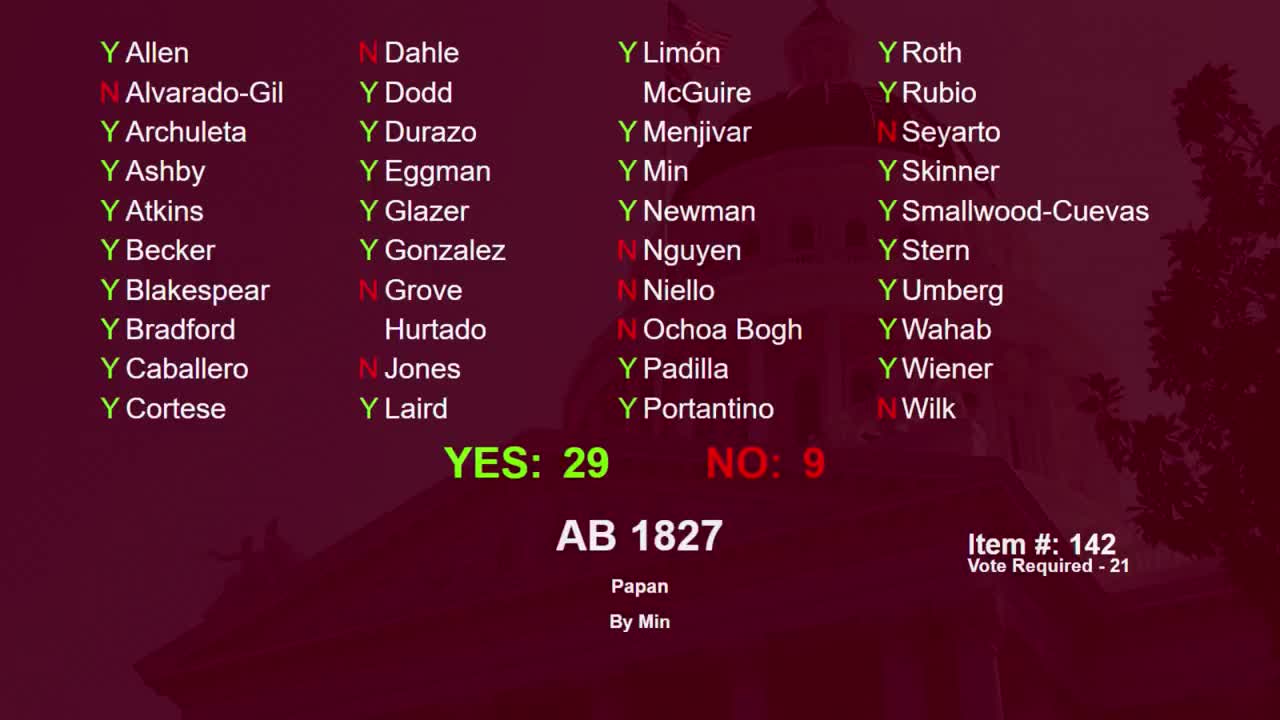 4MIN
Senate Floor
 7MIN
Senate Standing Committee on Local Government
 13MIN
Senate Standing Committee on Judiciary
 8MIN
Assembly Floor
 20MIN
Assembly Standing Committee on Local Government
 17MIN
Assembly Standing Committee on Judiciary
Bill Author

Bill Co-Author(s):