AB 2293: Joint powers agreements: health care services.
- Session Year: 2023-2024
- House: Assembly
- Latest Version Date: 2024-09-27
Current Status:
Passed
(2024-09-27: Chaptered by Secretary of State - Chapter 710, Statutes of 2024.)
Introduced
In Committee
First Chamber
In Committee
Second Chamber
Enacted
(1)Existing law, the Joint Exercise of Powers Act, authorizes 2 or more public agencies by agreement to exercise any power common to the contracting parties, subject to meeting certain conditions with respect to that agreement. Existing law authorizes a private, nonprofit corporation, until January 1, 2032, formed for the purposes of providing services to zero-emission transportation systems or facilities, to join a joint powers authority or enter into a joint powers agreement with a public agency to facilitate the development, construction, and operation of zero-emission transportation systems or facilities that lower greenhouse gases, reduce vehicle congestion and vehicle miles traveled, and improve public transit connections.
This bill, until January 1, 2034, would authorize one or more private, nonprofit mutual benefit corporations formed for purposes of providing health care services to join a joint powers authority or enter into a joint powers agreement with one or more public entities established under the act, as specified. The bill would deem any joint powers authority formed pursuant to this provision to be a public entity, except that the authority would not have the power to incur debt or to engage in specified other acts, including employing physicians and surgeons or charging for professional services rendered by physicians and surgeons. The bill would require an authority formed to be governed by a board of directors, composed as determined by the participating public agency or agencies. The bill would prohibit the representation of private, nonprofit mutual benefit corporations on the board of directors from exceeding 50%. The bill would define terms for its purposes.
(2)Existing law sets forth requirements for the solicitation and evaluation of bids and the awarding of contracts by public entities, including requirements applicable if the public entity is required by statute or regulation to obtain an enforceable commitment that a bidder, contractor, or other entity will use a skilled and trained workforce, as defined, to complete a contract or project. Except as specified, existing law requires that, for workers employed on public works, as defined, not less than the general prevailing rate of per diem wages, determined as provided by the Director of Industrial Relations, for work of a similar character in the locality in which the public work is performed be paid to those workers, as provided.
This bill, except as specified, would require a joint powers authority formed pursuant to the bill, when undertaking a project applicable to the construction or refurbishment of health facilities, to obtain an enforceable commitment that any entity undertaking the project will use a skilled and trained workforce. The bill would require a private entity performing the work on a project for the joint powers authority to certify, in writing and under penalty of perjury, that prevailing wages will be paid to workers on the project, as provided, and that a skilled and trained workforce will be used to perform all construction work on the project. By requiring private entities performing work on a project under these provisions to certify this information, thereby expanding the scope of the crime of perjury, the bill would impose a state-mandated local program.
(3)The California Constitution requires the state to reimburse local agencies and school districts for certain costs mandated by the state. Statutory provisions establish procedures for making that reimbursement.
This bill would provide that no reimbursement is required by this act for a specified reason.
(1)Existing law, the Joint Exercise of Powers Act, authorizes 2 or more public agencies by agreement to exercise any power common to the contracting parties, subject to meeting certain conditions with respect to that agreement. Existing law authorizes a private, nonprofit corporation, until January 1, 2032, formed for the purposes of providing services to zero-emission transportation systems or facilities, to join a joint powers authority or enter into a joint powers agreement with a public agency to facilitate the development, construction, and operation of zero-emission transportation systems or facilities that lower greenhouse gases, reduce vehicle congestion and vehicle miles traveled, and improve public transit connections.
This bill, until January 1, 2034, would authorize one or more private, nonprofit mutual benefit corporations formed for purposes of providing health care services to join a joint powers authority or enter into a joint powers agreement with one or more public entities established under the act. act, as specified. The bill would deem any joint powers authority formed pursuant to this provision to be a public entity, except that the authority would not have the power to incur debt or to engage in specified other acts, including employing physicians and surgeons or charging for professional services rendered by physicians and surgeons. The bill would require an authority formed to be governed by a board of directors, composed as determined by the participating public agency or agencies. The bill would prohibit the representation of private, nonprofit mutual benefit corporations on the board of directors from exceeding 50%. The bill would define terms for its purposes.
(2)Existing law sets forth requirements for the solicitation and evaluation of bids and the awarding of contracts by public entities, including requirements applicable if the public entity is required by statute or regulation to obtain an enforceable commitment that a bidder, contractor, or other entity will use a skilled and trained workforce, as defined, to complete a contract or project. Except as specified, existing law requires that, for workers employed on public works, as defined, not less than the general prevailing rate of per diem wages, determined as provided by the Director of Industrial Relations, for work of a similar character in the locality in which the public work is performed be paid to those workers, as provided.
This bill, except as specified, would require a joint powers authority formed pursuant to the bill, when undertaking a project applicable to the construction or refurbishment of existing health facilities, to obtain an enforceable commitment that any entity undertaking the project will use a skilled and trained workforce. The bill would require a private entity performing the work on a project for the joint powers authority to certify, in writing and under penalty of perjury, that prevailing wages will be paid to workers on the project, as provided, and that a skilled and trained workforce will be used to perform all construction work on the project. By requiring private entities performing work on a project under these provisions to certify this information, thereby expanding the scope of the crime of perjury, the bill would impose a state-mandated local program.
(3)The California Constitution requires the state to reimburse local agencies and school districts for certain costs mandated by the state. Statutory provisions establish procedures for making that reimbursement.
This bill would provide that no reimbursement is required by this act for a specified reason.
(1)Existing law, the Joint Exercise of Powers Act, authorizes 2 or more public agencies by agreement to exercise any power common to the contracting parties, subject to meeting certain conditions with respect to that agreement. Existing law authorizes a private, nonprofit corporation, until January 1, 2023, 2032, formed for the purposes of providing services to zero-emission transportation systems or facilities, to join a joint powers authority or enter into a joint powers agreement with a public agency to facilitate the development, construction, and operation of zero-emission transportation systems or facilities that lower greenhouse gases, reduce vehicle congestion and vehicle miles traveled, and improve public transit connections.
This bill, until January 1, 2034, would authorize one or more private, nonprofit mutual benefit corporations formed for purposes of providing health care services to join a joint powers authority or enter into a joint powers agreement with one or more public entities established under the act. The bill would deem any joint powers authority formed pursuant to this provision to be a public entity, except that the authority would not have the power to incur debt. debt or to engage in specified other acts, including employing physicians and surgeons or charging for professional services rendered by physicians and surgeons. The bill would require an authority formed to be governed by a board of directors, composed as determined by the participating public agency or agencies. The bill would prohibit the representation of private, nonprofit mutual benefit corporations on the board of directors from exceeding 50%. The bill would define terms for its purposes.
(2)Existing law sets forth requirements for the solicitation and evaluation of bids and the awarding of contracts by public entities, including requirements applicable if the public entity is required by statute or regulation to obtain an enforceable commitment that a bidder, contractor, or other entity will use a skilled and trained workforce, as defined, to complete a contract or project. Except as specified, existing law requires that, for workers employed on public works, as defined, not less than the general prevailing rate of per diem wages, determined as provided by the Director of Industrial Relations, for work of a similar character in the locality in which the public work is performed be paid to those workers, as provided.
This bill, except as specified, would require a joint powers authority formed pursuant to the bill, when undertaking a project applicable to the construction or refurbishment of existing health facilities, to obtain an enforceable commitment that any entity undertaking the project will use a skilled and trained workforce. The bill would require a private entity performing the work on a project for the joint powers authority to certify, in writing and under penalty of perjury, that prevailing wages will be paid to workers on the project, as provided, and that a skilled and trained workforce will be used to perform all construction work on the project. By requiring private entities performing work on a project under these provisions to certify this information, thereby expanding the scope of the crime of perjury, the bill would impose a state-mandated local program.
(3)The California Constitution requires the state to reimburse local agencies and school districts for certain costs mandated by the state. Statutory provisions establish procedures for making that reimbursement.
This bill would provide that no reimbursement is required by this act for a specified reason.
(1)Existing law, the Joint Exercise of Powers Act, authorizes 2 or more public agencies by agreement to exercise any power common to the contracting parties, subject to meeting certain conditions with respect to that agreement. Existing law authorizes a private, nonprofit corporation, until January 1, 2023, formed for the purposes of providing services to zero-emission transportation systems or facilities, to join a joint powers authority or enter into a joint powers agreement with a public agency to facilitate the development, construction, and operation of zero-emission transportation systems or facilities that lower greenhouse gases, reduce vehicle congestion and vehicle miles traveled, and improve public transit connections.
This bill bill, until January 1, 2034, would authorize one or more private, nonprofit mutual benefit corporations formed for purposes of providing health care services to join a joint powers authority or enter into a joint powers agreement with one or more public entities established under the act. The bill would deem any joint powers authority formed pursuant to this provision to be a public entity, except that the authority would not have the power to incur debt. The bill would require an authority formed to be governed by a board of directors, composed as determined by the participating public agency or agencies. The bill would prohibit the representation of private, nonprofit mutual benefit corporations on the board of directors from exceeding 50%. The bill would define terms for its purposes.
(2)Existing law sets forth requirements for the solicitation and evaluation of bids and the awarding of contracts by public entities, including requirements applicable if the public entity is required by statute or regulation to obtain an enforceable commitment that a bidder, contractor, or other entity will use a skilled and trained workforce, as defined, to complete a contract or project. Except as specified, existing law requires that, for workers employed on public works, as defined, not less than the general prevailing rate of per diem wages, determined as provided by the Director of Industrial Relations, for work of a similar character in the locality in which the public work is performed be paid to those workers, as provided.
This bill, except as specified, would require a joint powers authority formed pursuant to the bill, when undertaking a project applicable to the construction or refurbishment of existing health facilities, to obtain an enforceable commitment that any entity undertaking the project will use a skilled and trained workforce. The bill would require a private entity performing the work on a project for the joint powers authority to certify, in writing and under penalty of perjury, that prevailing wages will be paid to workers on the project, as provided, and that a skilled and trained workforce will be used to perform all construction work on the project. By requiring private entities performing work on a project under these provisions to certify this information, thereby expanding the scope of the crime of perjury, the bill would impose a state-mandated local program.
(3)The California Constitution requires the state to reimburse local agencies and school districts for certain costs mandated by the state. Statutory provisions establish procedures for making that reimbursement.
This bill would provide that no reimbursement is required by this act for a specified reason.
Existing law, the Joint Exercise of Powers Act, authorizes 2 or more public agencies by agreement to exercise any power common to the contracting parties, subject to meeting certain conditions with respect to that agreement. Existing law authorizes a private, nonprofit corporation, until January 1, 2023, formed for the purposes of providing services to zero-emission transportation systems or facilities, to join a joint powers authority or enter into a joint powers agreement with a public agency to facilitate the development, construction, and operation of zero-emission transportation systems or facilities that lower greenhouse gases, reduce vehicle congestion and vehicle miles traveled, and improve public transit connections.
This bill would authorize one or more private, nonprofit mutual benefit corporations formed for purposes of providing health care services to join a joint powers authority or enter into a joint powers agreement with one or more public entities established under the act. The bill would deem any joint powers authority formed pursuant to this provision to be a public entity, except that the authority would not have the power to incur debt.
(a)Notwithstanding any other provision of this chapter, one or more private, nonprofit mutual benefit corporations that are organized pursuant to Section 501(c)(3) of the Internal Revenue Code, formed for purposes of providing health care services, may join a joint powers authority or enter into a joint powers agreement with one or more public agencies otherwise established pursuant to this chapter formed for purposes of providing health care services. Any joint powers authority formed pursuant to a joint powers agreement as described in this section shall be deemed a public entity, as described in Section 6507, except that, notwithstanding any other law, the authority shall not have the power to incur debt or the power to employ physicians and surgeons, charge for professional services rendered by physicians and surgeons, or otherwise engage in the practice of medicine.
(b)An authority formed pursuant to subdivision (a) shall be governed by a board of directors, the composition of which shall be determined by the participating public agency or agencies. The representation of private, nonprofit mutual benefit corporations on the board of directors shall not exceed 50 percent.
(c)(1)(A)When applicable to the construction or refurbishment of health facilities, a project undertaken by a joint powers authority formed pursuant to a joint powers agreement as described in this section, the joint powers authority shall obtain an enforceable commitment that any bidder, contractor, or other entity undertaking the project will use a skilled and trained workforce to complete the project.
(B)Subparagraph (A) does not apply if either of the following are met:
(i)The joint powers authority has entered into a project labor agreement that will bind all contractors and subcontractors performing work on the project to use a skilled and trained workforce.
(ii)The bidder, contractor, or other entity has entered into a project labor agreement that will bind all contractors and subcontractors at every tier performing work on the project to use a skilled and trained workforce.
(2)For a project undertaken by a bidder, contractor, or other entity that is a private entity under contract to or otherwise performing the work for a joint powers authority formed pursuant to a joint powers agreement as described in this section, the private entity shall do both of the following:
(A)Certify, in writing and under penalty of perjury, to the joint powers authority that either of the following is true:
(i)The entirety of the project is a public work for purposes of Chapter 1 (commencing with Section 1720) of Part 7 of Division 2 of the Labor Code.
(ii)If the project is not in its entirety a public work and the project applicant is not required to pay prevailing wages to all construction workers under Article 1 (commencing with Section 1720) of Chapter 1 of Part 7 of Division 2 of the Labor Code, all construction workers employed on construction of the project will be paid at least the general prevailing rate of per diem wages for the type of work and geographic area, as determined by the Director of Industrial Relations pursuant to Sections 1773 and 1773.9 of the Labor Code, except that apprentices registered in programs approved by the Chief of the Division of Apprenticeship Standards may be paid at least the applicable apprentice prevailing rate. If the project is subject to this clause, then for those portions of the project that are not a public work all of the following shall apply:
(I)The joint powers authority shall ensure that the prevailing wage requirement is included in all contracts for the performance of all construction work.
(II)All contractors and subcontractors at every tier shall pay to all construction workers employed in the execution of the work at least the general prevailing rate of per diem wages, except that apprentices registered in programs approved by the Chief of the Division of Apprenticeship Standards may be paid at least the applicable apprentice prevailing rate.
(III)Except as provided in subclause (V), all contractors and subcontractors at every tier shall maintain and verify payroll records pursuant to Section 1776 of the Labor Code and make those records available for inspection and copying by the joint powers authority and the public as provided by Section 1776 of the Labor Code.
(IV)Except as provided in subclause (V), the obligation of the contractors and subcontractors at every tier to pay prevailing wages may be enforced by the Labor Commissioner through the issuance of a civil wage and penalty assessment pursuant to Section 1741 of the Labor Code, which may be reviewed pursuant to Section 1742 of the Labor Code, within 18 months after the completion of the project, or by an underpaid worker through an administrative complaint or civil action, or by a joint labor-management committee through a civil action under Section 1771.2 of the Labor Code. If a civil wage and penalty assessment is issued, the contractor, subcontractor, and surety on a bond or bonds issued to secure the payment of wages covered by the assessment shall be liable for liquidated damages pursuant to Section 1742.1 of the Labor Code.
(V)Subclauses (III) and (IV) do not apply if all contractors and subcontractors at every tier performing work on the project are subject to a project labor agreement that requires the payment of prevailing wages to all construction workers employed in the execution of the project and provides for enforcement of that obligation through an arbitration procedure.
(VI)Notwithstanding subdivision (c) of Section 1773.1 of the Labor Code, the requirement that employer payments not reduce the obligation to pay the hourly straight time or overtime wages found to be prevailing shall not apply if otherwise provided in a bona fide collective bargaining agreement covering the worker. The requirement to pay at least the general prevailing rate of per diem wages does not preclude use of an alternative workweek schedule adopted pursuant to Section 511 or 514 of the Labor Code.
(B)Certify, in writing and under penalty of perjury, to the joint powers authority that a skilled and trained workforce will be used to perform all construction work on the project. All of the following requirements shall apply to the project:
(i)The joint powers authority shall require in all contracts for the performance of work that every contractor and subcontractor at every tier will individually use a skilled and trained workforce to construct the project.
(ii)Every contractor and subcontractor shall use a skilled and trained workforce to construct the project.
(iii)(I)Except as provided in subclause (II), the private entity shall provide to the joint powers authority, on a monthly basis while the project or contract is being performed, a report demonstrating compliance with Chapter 2.9 (commencing with Section 2600) of Part 1 of Division 2 of the Public Contract Code. A monthly report provided to the joint powers authority pursuant to this subclause shall be a public record under the California Public Records Act (Division 10 (commencing with Section 7920.000)) and shall be open to public inspection. A private entity that fails to provide a monthly report demonstrating compliance with Chapter 2.9 (commencing with Section 2600) of Part 1 of Division 2 of the Public Contract Code shall be subject to a civil penalty of ten thousand dollars ($10,000) per month for each month for which the report has not been provided. Any contractor or subcontractor that fails to use a skilled and trained workforce shall be subject to a civil penalty of two hundred dollars ($200) per day for each worker employed in contravention of the skilled and trained workforce requirement. Penalties may be assessed by the Labor Commissioner within 18 months of completion of the project using the same procedures for issuance of civil wage and penalty assessments pursuant to Section 1741 of the Labor Code, and may be reviewed pursuant to the same procedures in Section 1742 of the Labor Code. Penalties shall be paid to the State Public Works Enforcement Fund.
(II)Subclause (I) shall not apply if all contractors and subcontractors performing work on the project are subject to a project labor agreement that requires compliance with the skilled and trained workforce requirement and provides for enforcement of that obligation through an arbitration procedure.
(d)For purposes of this section, the following terms shall have the following definitions:
(1)Health facilities has the same meaning as in Section 1250 of the Health and Safety Code.
(2)Health care services has the same meaning as in Section 234(d)(2) of Title 42 of the United States Code.
(3)Project means any health facilities that are developed, constructed, or operated by a joint powers authority formed pursuant to subdivision (a).
(4)Project labor agreement has the same meaning as defined in paragraph (1) of subdivision (b) of Section 2500 of the Public Contract Code.
(5)Skilled and trained workforce has the same meaning as defined in subdivision (d) of Section 2601 of the Public Contract Code and as described in Chapter 2.9 (commencing with Section 2600) of Part 1 of Division 2 of the Public Contract Code.
(e)This section shall remain in effect only until January 1, 2034, and as of that date is repealed.
SEC. 2.No reimbursement is required by this act pursuant to Section 6 of Article XIIIB of the California Constitution because the only costs that may be incurred by a local agency or school district will be incurred because this act creates a new crime or infraction, eliminates a crime or infraction, or changes the penalty for a crime or infraction, within the meaning of Section 17556 of the Government Code, or changes the definition of a crime within the meaning of Section 6 of Article XIIIB of the California Constitution.
(a)Notwithstanding any other provision of this chapter, one or more private, nonprofit mutual benefit corporations that are organized pursuant to Section 501(c)(3) of the Internal Revenue Code, formed for purposes of providing health care services, may join a joint powers authority or enter into a joint powers agreement with one or more public agencies otherwise established pursuant to this chapter. chapter formed for purposes of providing health care services. Any joint powers authority formed pursuant to a joint powers agreement as described in this section shall be deemed a public entity, as described in Section 6507, except that, notwithstanding any other law, the authority shall not have the power to incur debt or the power to employ physicians and surgeons, charge for professional services rendered by physicians and surgeons, or otherwise engage in the practice of medicine.
(b)An authority formed pursuant to subdivision (a) shall be governed by a board of directors, the composition of which shall be determined by the participating public agency or agencies. The representation of private, nonprofit mutual benefit corporations on the board of directors shall not exceed 50 percent.
(c)(1)(A)When applicable to the construction or refurbishment of existing health facilities, a project undertaken by a joint powers authority formed pursuant to a joint powers agreement as described in this section, the joint powers authority shall obtain an enforceable commitment that any bidder, contractor, or other entity undertaking the project will use a skilled and trained workforce to complete the project.
(B)Subparagraph (A) does not apply if either of the following are met:
(i)The joint powers authority has entered into a project labor agreement that will bind all contractors and subcontractors performing work on the project to use a skilled and trained workforce.
(ii)The bidder, contractor, or other entity has entered into a project labor agreement that will bind all contractors and subcontractors at every tier performing work on the project to use a skilled and trained workforce.
(2)For a project undertaken by a bidder, contractor, or other entity that is a private entity under contract to or otherwise performing the work for a joint powers authority formed pursuant to a joint powers agreement as described in this section, the private entity shall do both of the following:
(A)Certify, in writing and under penalty of perjury, to the joint powers authority that either of the following is true:
(i)The entirety of the project is a public work for purposes of Chapter 1 (commencing with Section 1720) of Part 7 of Division 2 of the Labor Code.
(ii)If the project is not in its entirety a public work and the project applicant is not required to pay prevailing wages to all construction workers under Article 1 (commencing with Section 1720) of Chapter 1 of Part 7 of Division 2 of the Labor Code, all construction workers employed on construction of the project will be paid at least the general prevailing rate of per diem wages for the type of work and geographic area, as determined by the Director of Industrial Relations pursuant to Sections 1773 and 1773.9 of the Labor Code, except that apprentices registered in programs approved by the Chief of the Division of Apprenticeship Standards may be paid at least the applicable apprentice prevailing rate. If the project is subject to this clause, then for those portions of the project that are not a public work all of the following shall apply:
(I)The joint powers authority shall ensure that the prevailing wage requirement is included in all contracts for the performance of all construction work.
(II)All contractors and subcontractors at every tier shall pay to all construction workers employed in the execution of the work at least the general prevailing rate of per diem wages, except that apprentices registered in programs approved by the Chief of the Division of Apprenticeship Standards may be paid at least the applicable apprentice prevailing rate.
(III)Except as provided in subclause (V), all contractors and subcontractors at every tier shall maintain and verify payroll records pursuant to Section 1776 of the Labor Code and make those records available for inspection and copying by the joint powers authority and the public as provided by Section 1776 of the Labor Code.
(IV)Except as provided in subclause (V), the obligation of the contractors and subcontractors at every tier to pay prevailing wages may be enforced by the Labor Commissioner through the issuance of a civil wage and penalty assessment pursuant to Section 1741 of the Labor Code, which may be reviewed pursuant to Section 1742 of the Labor Code, within 18 months after the completion of the project, or by an underpaid worker through an administrative complaint or civil action, or by a joint labor-management committee through a civil action under Section 1771.2 of the Labor Code. If a civil wage and penalty assessment is issued, the contractor, subcontractor, and surety on a bond or bonds issued to secure the payment of wages covered by the assessment shall be liable for liquidated damages pursuant to Section 1742.1 of the Labor Code.
(V)Subclauses (III) and (IV) do not apply if all contractors and subcontractors at every tier performing work on the project are subject to a project labor agreement that requires the payment of prevailing wages to all construction workers employed in the execution of the project and provides for enforcement of that obligation through an arbitration procedure.
(VI)Notwithstanding subdivision (c) of Section 1773.1 of the Labor Code, the requirement that employer payments not reduce the obligation to pay the hourly straight time or overtime wages found to be prevailing shall not apply if otherwise provided in a bona fide collective bargaining agreement covering the worker. The requirement to pay at least the general prevailing rate of per diem wages does not preclude use of an alternative workweek schedule adopted pursuant to Section 511 or 514 of the Labor Code.
(B)Certify, in writing and under penalty of perjury, to the joint powers authority that a skilled and trained workforce will be used to perform all construction work on the project. All of the following requirements shall apply to the project:
(i)The joint powers authority shall require in all contracts for the performance of work that every contractor and subcontractor at every tier will individually use a skilled and trained workforce to construct the project.
(ii)Every contractor and subcontractor shall use a skilled and trained workforce to construct the project.
(iii)(I)Except as provided in subclause (II), the private entity shall provide to the joint powers authority, on a monthly basis while the project or contract is being performed, a report demonstrating compliance with Chapter 2.9 (commencing with Section 2600) of Part 1 of Division 2 of the Public Contract Code. A monthly report provided to the joint powers authority pursuant to this subclause shall be a public record under the California Public Records Act (Division 10 (commencing with Section 7920.000)) and shall be open to public inspection. A private entity that fails to provide a monthly report demonstrating compliance with Chapter 2.9 (commencing with Section 2600) of Part 1 of Division 2 of the Public Contract Code shall be subject to a civil penalty of ten thousand dollars ($10,000) per month for each month for which the report has not been provided. Any contractor or subcontractor that fails to use a skilled and trained workforce shall be subject to a civil penalty of two hundred dollars ($200) per day for each worker employed in contravention of the skilled and trained workforce requirement. Penalties may be assessed by the Labor Commissioner within 18 months of completion of the project using the same procedures for issuance of civil wage and penalty assessments pursuant to Section 1741 of the Labor Code, and may be reviewed pursuant to the same procedures in Section 1742 of the Labor Code. Penalties shall be paid to the State Public Works Enforcement Fund.
(II)Subclause (I) shall not apply if all contractors and subcontractors performing work on the project are subject to a project labor agreement that requires compliance with the skilled and trained workforce requirement and provides for enforcement of that obligation through an arbitration procedure.
(d)For purposes of this section, the following terms shall have the following definitions:
(1)Health facilities has the same meaning as in Section 1250 of the Health and Safety Code.
(2)Health care services has the same meaning as in Section 234(d)(2) of Title 42 of the United States Code.
(3)Project means any health facilities that are developed, constructed, or operated by a joint powers authority formed pursuant to subdivision (a).
(4)Project labor agreement has the same meaning as defined in paragraph (1) of subdivision (b) of Section 2500 of the Public Contract Code.
(5)Skilled and trained workforce has the same meaning as defined in subdivision (d) of Section 2601 of the Public Contract Code and as described in Chapter 2.9 (commencing with Section 2600) of Part 1 of Division 2 of the Public Contract Code.
(e)This section shall remain in effect only until January 1, 2034, and as of that date is repealed.
SEC. 2.No reimbursement is required by this act pursuant to Section 6 of Article XIIIB of the California Constitution because the only costs that may be incurred by a local agency or school district will be incurred because this act creates a new crime or infraction, eliminates a crime or infraction, or changes the penalty for a crime or infraction, within the meaning of Section 17556 of the Government Code, or changes the definition of a crime within the meaning of Section 6 of Article XIIIB of the California Constitution.
(a)Notwithstanding any other provision of this chapter, one or more private, nonprofit mutual benefit corporations that are organized pursuant to Section 501(c)(3) of the Internal Revenue Code, formed for purposes of providing health care services, may join a joint powers authority or enter into a joint powers agreement with one or more public agencies otherwise established pursuant to this chapter. Any joint powers authority formed pursuant to a joint powers agreement as described in this section shall be deemed a public entity, as described in Section 6507, except that, notwithstanding any other law, the authority shall not have the power to incur debt. debt or the power to employ physicians and surgeons, charge for professional services rendered by physicians and surgeons, or otherwise engage in the practice of medicine.
(b)An authority formed pursuant to subdivision (a) shall be governed by a board of directors, the composition of which shall be determined by the participating public agency or agencies. The representation of private, nonprofit mutual benefit corporations on the board of directors shall not exceed 50 percent.
(c)(1)(A)When applicable to the construction or refurbishment of existing health facilities, a project undertaken by a joint powers authority formed pursuant to a joint powers agreement as described in this section, the joint powers authority shall obtain an enforceable commitment that any bidder, contractor, or other entity undertaking the project will use a skilled and trained workforce to complete the project.
(B)Subparagraph (A) does not apply if either of the following are met:
(i)The joint powers authority has entered into a project labor agreement that will bind all contractors and subcontractors performing work on the project to use a skilled and trained workforce.
(ii)The bidder, contractor, or other entity has entered into a project labor agreement that will bind all contractors and subcontractors at every tier performing work on the project to use a skilled and trained workforce.
(2)For a project undertaken by a bidder, contractor, or other entity that is a private entity under contract to or otherwise performing the work for a joint powers authority formed pursuant to a joint powers agreement as described in this section, the private entity shall do both of the following:
(A)Certify, in writing and under penalty of perjury, to the joint powers authority that either of the following is true:
(i)The entirety of the project is a public work for purposes of Chapter 1 (commencing with Section 1720) of Part 7 of Division 2 of the Labor Code.
(ii)If the project is not in its entirety a public work and the project applicant is not required to pay prevailing wages to all construction workers under Article 1 (commencing with Section 1720) of Chapter 1 of Part 7 of Division 2 of the Labor Code, all construction workers employed on construction of the project will be paid at least the general prevailing rate of per diem wages for the type of work and geographic area, as determined by the Director of Industrial Relations pursuant to Sections 1773 and 1773.9 of the Labor Code, except that apprentices registered in programs approved by the Chief of the Division of Apprenticeship Standards may be paid at least the applicable apprentice prevailing rate. If the project is subject to this clause, then for those portions of the project that are not a public work all of the following shall apply:
(I)The joint powers authority shall ensure that the prevailing wage requirement is included in all contracts for the performance of all construction work.
(II)All contractors and subcontractors at every tier shall pay to all construction workers employed in the execution of the work at least the general prevailing rate of per diem wages, except that apprentices registered in programs approved by the Chief of the Division of Apprenticeship Standards may be paid at least the applicable apprentice prevailing rate.
(III)Except as provided in subclause (V), all contractors and subcontractors at every tier shall maintain and verify payroll records pursuant to Section 1776 of the Labor Code and make those records available for inspection and copying by the joint powers authority and the public as provided by Section 1776 of the Labor Code.
(IV)Except as provided in subclause (V), the obligation of the contractors and subcontractors at every tier to pay prevailing wages may be enforced by the Labor Commissioner through the issuance of a civil wage and penalty assessment pursuant to Section 1741 of the Labor Code, which may be reviewed pursuant to Section 1742 of the Labor Code, within 18 months after the completion of the project, or by an underpaid worker through an administrative complaint or civil action, or by a joint labor-management committee through a civil action under Section 1771.2 of the Labor Code. If a civil wage and penalty assessment is issued, the contractor, subcontractor, and surety on a bond or bonds issued to secure the payment of wages covered by the assessment shall be liable for liquidated damages pursuant to Section 1742.1 of the Labor Code.
(V)Subclauses (III) and (IV) do not apply if all contractors and subcontractors at every tier performing work on the project are subject to a project labor agreement that requires the payment of prevailing wages to all construction workers employed in the execution of the project and provides for enforcement of that obligation through an arbitration procedure.
(VI)Notwithstanding subdivision (c) of Section 1773.1 of the Labor Code, the requirement that employer payments not reduce the obligation to pay the hourly straight time or overtime wages found to be prevailing shall not apply if otherwise provided in a bona fide collective bargaining agreement covering the worker. The requirement to pay at least the general prevailing rate of per diem wages does not preclude use of an alternative workweek schedule adopted pursuant to Section 511 or 514 of the Labor Code.
(B)Certify, in writing and under penalty of perjury, to the joint powers authority that a skilled and trained workforce will be used to perform all construction work on the project. All of the following requirements shall apply to the project:
(i)The joint powers authority shall require in all contracts for the performance of work that every contractor and subcontractor at every tier will individually use a skilled and trained workforce to construct the project.
(ii)Every contractor and subcontractor shall use a skilled and trained workforce to construct the project.
(iii)(I)Except as provided in subclause (II), the private entity shall provide to the joint powers authority, on a monthly basis while the project or contract is being performed, a report demonstrating compliance with Chapter 2.9 (commencing with Section 2600) of Part 1 of Division 2 of the Public Contract Code. A monthly report provided to the joint powers authority pursuant to this subclause shall be a public record under the California Public Records Act (Division 10 (commencing with Section 7920.000)) and shall be open to public inspection. A private entity that fails to provide a monthly report demonstrating compliance with Chapter 2.9 (commencing with Section 2600) of Part 1 of Division 2 of the Public Contract Code shall be subject to a civil penalty of ten thousand dollars ($10,000) per month for each month for which the report has not been provided. Any contractor or subcontractor that fails to use a skilled and trained workforce shall be subject to a civil penalty of two hundred dollars ($200) per day for each worker employed in contravention of the skilled and trained workforce requirement. Penalties may be assessed by the Labor Commissioner within 18 months of completion of the project using the same procedures for issuance of civil wage and penalty assessments pursuant to Section 1741 of the Labor Code, and may be reviewed pursuant to the same procedures in Section 1742 of the Labor Code. Penalties shall be paid to the State Public Works Enforcement Fund.
(II)Subclause (I) shall not apply if all contractors and subcontractors performing work on the project are subject to a project labor agreement that requires compliance with the skilled and trained workforce requirement and provides for enforcement of that obligation through an arbitration procedure.
(d)For purposes of this section, the following terms shall have the following definitions:
(1)Health facilities has the same meaning as in Section 1250 of the Health and Safety Code.
(2)Health care services has the same meaning as in Section 234(d)(2) of Title 42 of the United States Code.
(3)Project means any health facilities that are developed, constructed, or operated by a joint powers authority formed pursuant to subdivision (a).
(4)Project labor agreement has the same meaning as defined in paragraph (1) of subdivision (b) of Section 2500 of the Public Contract Code.
(5)Skilled and trained workforce has the same meaning as defined in subdivision (d) of Section 2601 of the Public Contract Code and as described in Chapter 2.9 (commencing with Section 2600) of Part 1 of Division 2 of the Public Contract Code.
(e)This section shall remain in effect only until January 1, 2034, and as of that date is repealed.
SEC. 2.No reimbursement is required by this act pursuant to Section 6 of Article XIIIB of the California Constitution because the only costs that may be incurred by a local agency or school district will be incurred because this act creates a new crime or infraction, eliminates a crime or infraction, or changes the penalty for a crime or infraction, within the meaning of Section 17556 of the Government Code, or changes the definition of a crime within the meaning of Section 6 of Article XIIIB of the California Constitution.
(a)Notwithstanding any other provision of this chapter, one or more private, nonprofit mutual benefit corporations that are organized pursuant to Section 501(c)(3) of the Internal Revenue Code, formed for purposes of providing health care services, may join a joint powers authority or enter into a joint powers agreement with one or more public agencies otherwise established pursuant to this chapter. Any joint powers authority formed pursuant to a joint powers agreement as described in this section shall be deemed a public entity, as described in Section 6507, except that, notwithstanding any other law, the authority shall not have the power to incur debt.
(b)An authority formed pursuant to subdivision (a) shall be governed by a board of directors, the composition of which shall be determined by the participating public agency or agencies. The representation of private, nonprofit mutual benefit corporations on the board of directors shall not exceed 50 percent.
(c)(1)(A)When applicable to the construction or refurbishment of existing health facilities, a project undertaken by a joint powers authority formed pursuant to a joint powers agreement as described in this section, the joint powers authority shall obtain an enforceable commitment that any bidder, contractor, or other entity undertaking the project will use a skilled and trained workforce to complete the project.
(B)Subparagraph (A) does not apply if either of the following are met:
(i)The joint powers authority has entered into a project labor agreement that will bind all contractors and subcontractors performing work on the project to use a skilled and trained workforce.
(ii)The bidder, contractor, or other entity has entered into a project labor agreement that will bind all contractors and subcontractors at every tier performing work on the project to use a skilled and trained workforce.
(2)For a project undertaken by a bidder, contractor, or other entity that is a private entity under contract to or otherwise performing the work for a joint powers authority formed pursuant to a joint powers agreement as described in this section, the private entity shall do both of the following:
(A)Certify, in writing and under penalty of perjury, to the joint powers authority that either of the following is true:
(i)The entirety of the project is a public work for purposes of Chapter 1 (commencing with Section 1720) of Part 7 of Division 2 of the Labor Code.
(ii)If the project is not in its entirety a public work and the project applicant is not required to pay prevailing wages to all construction workers under Article 1 (commencing with Section 1720) of Chapter 1 of Part 7 of Division 2 of the Labor Code, all construction workers employed on construction of the project will be paid at least the general prevailing rate of per diem wages for the type of work and geographic area, as determined by the Director of Industrial Relations pursuant to Sections 1773 and 1773.9 of the Labor Code, except that apprentices registered in programs approved by the Chief of the Division of Apprenticeship Standards may be paid at least the applicable apprentice prevailing rate. If the project is subject to this clause, then for those portions of the project that are not a public work all of the following shall apply:
(I)The joint powers authority shall ensure that the prevailing wage requirement is included in all contracts for the performance of all construction work.
(II)All contractors and subcontractors at every tier shall pay to all construction workers employed in the execution of the work at least the general prevailing rate of per diem wages, except that apprentices registered in programs approved by the Chief of the Division of Apprenticeship Standards may be paid at least the applicable apprentice prevailing rate.
(III)Except as provided in subclause (V), all contractors and subcontractors at every tier shall maintain and verify payroll records pursuant to Section 1776 of the Labor Code and make those records available for inspection and copying by the joint powers authority and the public as provided by Section 1776 of the Labor Code.
(IV)Except as provided in subclause (V), the obligation of the contractors and subcontractors at every tier to pay prevailing wages may be enforced by the Labor Commissioner through the issuance of a civil wage and penalty assessment pursuant to Section 1741 of the Labor Code, which may be reviewed pursuant to Section 1742 of the Labor Code, within 18 months after the completion of the project, or by an underpaid worker through an administrative complaint or civil action, or by a joint labor-management committee through a civil action under Section 1771.2 of the Labor Code. If a civil wage and penalty assessment is issued, the contractor, subcontractor, and surety on a bond or bonds issued to secure the payment of wages covered by the assessment shall be liable for liquidated damages pursuant to Section 1742.1 of the Labor Code.
(V)Subclauses (III) and (IV) do not apply if all contractors and subcontractors at every tier performing work on the project are subject to a project labor agreement that requires the payment of prevailing wages to all construction workers employed in the execution of the project and provides for enforcement of that obligation through an arbitration procedure.
(VI)Notwithstanding subdivision (c) of Section 1773.1 of the Labor Code, the requirement that employer payments not reduce the obligation to pay the hourly straight time or overtime wages found to be prevailing shall not apply if otherwise provided in a bona fide collective bargaining agreement covering the worker. The requirement to pay at least the general prevailing rate of per diem wages does not preclude use of an alternative workweek schedule adopted pursuant to Section 511 or 514 of the Labor Code.
(B)Certify, in writing and under penalty of perjury, to the joint powers authority that a skilled and trained workforce will be used to perform all construction work on the project. All of the following requirements shall apply to the project:
(i)The joint powers authority shall require in all contracts for the performance of work that every contractor and subcontractor at every tier will individually use a skilled and trained workforce to construct the project.
(ii)Every contractor and subcontractor shall use a skilled and trained workforce to construct the project.
(iii)(I)Except as provided in subclause (II), the private entity shall provide to the joint powers authority, on a monthly basis while the project or contract is being performed, a report demonstrating compliance with Chapter 2.9 (commencing with Section 2600) of Part 1 of Division 2 of the Public Contract Code. A monthly report provided to the joint powers authority pursuant to this subclause shall be a public record under the California Public Records Act (Division 10 (commencing with Section 7920.000)) and shall be open to public inspection. A private entity that fails to provide a monthly report demonstrating compliance with Chapter 2.9 (commencing with Section 2600) of Part 1 of Division 2 of the Public Contract Code shall be subject to a civil penalty of ten thousand dollars ($10,000) per month for each month for which the report has not been provided. Any contractor or subcontractor that fails to use a skilled and trained workforce shall be subject to a civil penalty of two hundred dollars ($200) per day for each worker employed in contravention of the skilled and trained workforce requirement. Penalties may be assessed by the Labor Commissioner within 18 months of completion of the project using the same procedures for issuance of civil wage and penalty assessments pursuant to Section 1741 of the Labor Code, and may be reviewed pursuant to the same procedures in Section 1742 of the Labor Code. Penalties shall be paid to the State Public Works Enforcement Fund.
(II)Subclause (I) shall not apply if all contractors and subcontractors performing work on the project are subject to a project labor agreement that requires compliance with the skilled and trained workforce requirement and provides for enforcement of that obligation through an arbitration procedure.
(d)For purposes of this section, the following terms shall have the following definitions:
(1)Health facilities has the same meaning as in Section 1250 of the Health and Safety Code.
(2)Health care services has the same meaning as in Section 234(d)(2) of Title 42 of the United States Code.
(3)Project means any health facilities that are developed, constructed, or operated by a joint powers authority formed pursuant to subdivision (a).
(4)Project labor agreement has the same meaning as defined in paragraph (1) of subdivision (b) of Section 2500 of the Public Contract Code.
(5)Skilled and trained workforce has the same meaning as defined in subdivision (d) of Section 2601 of the Public Contract Code and as described in Chapter 2.9 (commencing with Section 2600) of Part 1 of Division 2 of the Public Contract Code.
(e)This section shall remain in effect only until January 1, 2034, and as of that date is repealed.
SEC. 2.No reimbursement is required by this act pursuant to Section 6 of Article XIIIB of the California Constitution because the only costs that may be incurred by a local agency or school district will be incurred because this act creates a new crime or infraction, eliminates a crime or infraction, or changes the penalty for a crime or infraction, within the meaning of Section 17556 of the Government Code, or changes the definition of a crime within the meaning of Section 6 of Article XIIIB of the California Constitution.
Notwithstanding any other provision of this chapter, one or more private, nonprofit mutual benefit corporations that are organized pursuant to Section 501(c)(3) of the Internal Revenue Code, formed for purposes of providing health care services, may join a joint powers authority or enter into a joint powers agreement with one or more public agencies otherwise established pursuant to this chapter. Any joint powers authority formed pursuant to a joint powers agreement as described in this section shall be deemed a public entity, as described in Section 6507, except that, notwithstanding any other law, the authority shall not have the power to incur debt.
|
Date
|
Status
|
|---|---|
| Sep 27, 2024 | Chaptered by Secretary of State - Chapter 710, Statutes of 2024. |
| Sep 27, 2024 | Approved by the Governor. |
| Sep 11, 2024 | Enrolled and presented to the Governor at 4 p.m. |
| Aug 29, 2024 | Senate amendments concurred in. To Engrossing and Enrolling. (Ayes 76. Noes 0.). |
| Aug 29, 2024 | Assembly Rule 77 suspended. |
| Aug 28, 2024 | In Assembly. Concurrence in Senate amendments pending. May be considered on or after August 30 pursuant to Assembly Rule 77. |
| Aug 28, 2024 | Read third time. Passed. Ordered to the Assembly. (Ayes 40. Noes 0.). |
| Aug 6, 2024 | Read second time. Ordered to third reading. |
| Aug 5, 2024 | From committee: Be ordered to second reading pursuant to Senate Rule 28.8. |
| Jul 3, 2024 | Read second time and amended. Re-referred to Com. on APPR. |
| Jul 3, 2024 | From committee: Amend, and do pass as amended and re-refer to Com. on APPR. (Ayes 7. Noes 0.) (July 3). |
| Jun 25, 2024 | From committee chair, with author's amendments: Amend, and re-refer to committee. Read second time, amended, and re-referred to Com. on L. GOV. |
| Jun 6, 2024 | In committee: Hearing postponed by committee. |
| May 29, 2024 | Referred to Com. on L. GOV. |
| May 22, 2024 | In Senate. Read first time. To Com. on RLS. for assignment. |
| May 21, 2024 | Read third time. Passed. Ordered to the Senate. (Ayes 71. Noes 0. Page 5444.) |
| May 16, 2024 | Read second time. Ordered to Consent Calendar. |
| May 15, 2024 | From committee: Do pass. To Consent Calendar. (Ayes 15. Noes 0.) (May 15). |
| May 6, 2024 | Re-referred to Com. on APPR. pursuant to Joint Rule 10.5. |
| May 6, 2024 | Read second time. Ordered to Consent Calendar. |
| May 2, 2024 | Read second time and amended. Ordered returned to second reading. |
| May 1, 2024 | From committee: Amend, and do pass as amended. To Consent Calendar. (Ayes 9. Noes 0.) (May 1). |
| Feb 26, 2024 | Referred to Com. on L. GOV. |
| Feb 13, 2024 | From printer. May be heard in committee March 14. |
| Feb 12, 2024 | Read first time. To print. |
|
Date
|
Description
|
Location
|
Votes
|
|
|---|---|---|---|---|
| Aug 29, 2024 | AB 2293 Mathis Concurrence in Senate Amendments | Assembly Floor |
Passed |
|
| Aug 28, 2024 | Assembly 3rd Reading AB2293 Mathis By Durazo | Senate Floor |
Passed |
|
| Jul 3, 2024 | Do pass as amended, but first amend, and re-refer to the Committee on [Appropriations] | Senate Standing Committee on Local Government |
Passed |
|
| May 21, 2024 | AB 2293 Mathis Consent Calendar Second Day Regular Session | Assembly Floor |
Passed |
|
| May 15, 2024 | Do pass. To Consent Calendar. | Assembly Standing Committee on Appropriations |
Passed |
|
| May 1, 2024 | Do pass as amended. To Consent Calendar. | Assembly Standing Committee on Local Government |
Passed |
This list shows positions taken on this bill by organizations on the date displayed, which is linked to the original source.
Positions by individuals are not included.
CONCURRENCE IN SENATE AMENDMENTS
CSA1 Bill Id:AB 2293
Author:(Mathis)
As Amended Ver:July 3, 2024
Majority vote
SUMMARY
Allows nonprofits formed to provide health care services to join a joint powers authority (JPA) or enter into a joint powers agreement with one or more public agencies.
Senate Amendments
- Specify that any JPA formed pursuant to the bill’s provisions shall not have the power to employ physicians and surgeons, charge for professional services rendered by physicians and surgeons, or otherwise engage in the practice of medicine.
- Clarify that JPAs specified in the bill must be formed for purposes of providing health care services.
COMMENTS
Joint powers are exercised when public officials of two or more agencies agree to establish a joint approach or create another legal entity to work on a common problem, fund a project, or act as a representative body for a specific activity. All manner of federal, state and local public agencies can agree to exercise joint powers. A California agency can even share joint powers with an agency in another state. The common thread is that a confederation of governments work together and share resources for mutual support or common actions. The government agencies that participate in joint powers are called member agencies, and a JPA can only exercise powers that each member agency independently possesses.
A joint powers agreement is a formal, legal agreement between two or more public agencies that wish to exercise joint powers. Some joint powers agreements are administered by one of the participating agencies. Others are administered by a new, legally independent government entity (called a JPA or a joint powers authority) that the member agencies create. The new entity need not even call itself a JPA. JPAs are not special districts, although such agencies can enter into joint powers agreements.
As tools for collaboration, JPAs are used for a variety of purposes. By sharing resources and combining services, the member agencies – and their taxpayers – save time and money. There are no official categories for the types of JPAs, but their services fall into five broad groups: general public services, financial services, insurance pooling and purchasing discounts, planning services, and regulatory enforcement.
Public agencies authorized to enter into joint powers agreements include "the federal government or any federal department or agency, this state, another state or any state department or agency, a county, county board of education, county superintendent of schools, city, public corporation, public district, regional transportation commission of this state or another state, a federally recognized Indian tribe, or any joint powers authority…"
State law generally limits membership in JPAs to public agencies (federal, state, and local governments). However, legislation has authorized some types of private entities to enter into joint powers agreements with public agencies for specified purposes. For example, state law allows a mutual water company to enter into a joint powers agreement with any public agency for the purpose of jointly exercising any power common to the contracting parties provided that the agreement ensures that no participating public agency becomes responsible for the underlying debts or liabilities of the JPA AB 2014 (Cortese), Chapter 250, Statutes of 1994. Similarly, state law allows nonprofit hospitals to enter into JPAs to provide health care services in Fresno County AB 1785 (Reyes), Chapter 55, Statutes of 2002; Contra Costa County (AB 3097 (Campbell) Chapter 148, Statutes of 1996; Tulare, Kings, and San Diego Counties SB 850, (Kelley) Chapter 432, Statutes of 1997; and Tuolumne County (AB 2717, (House) Chapter 227, Statutes of 2000. These hospital JPAs specify that a nonprofit hospital that participates in one these JPAs cannot levy any tax or assessment.
More recently, the Legislature enacted SB 1403 (Maienschein), Chapter 188, Statutes of 2015. SB 1403 allows, until January 1, 2024, one or more private, nonprofit 501(c)(3) corporations that provide services to homeless persons for the prevention of homelessness to form a JPA, or enter into a joint powers agreement with one or more public agencies. The JPA must be a public entity, but cannot have the power to incur debt. JPAs formed under this provision are to encourage and ease information sharing between public agencies and nonprofit corporations to identify the most costly and frequent users of publicly funded emergency services, provide frequent user coordinated care housing services, and prevent homelessness. The participating public agencies must determine the composition of the board of directors, but the representation of nonprofit 501(c)(3) corporations cannot exceed 50% of the board membership.
SB 1226 (Durazo), Chapter 423, Statutes of 2022, allowed, until January 1, 2032, private, nonprofit corporations that provide services to zero-emission transportation systems or facilities to join a joint powers agency or enter into a joint powers agreement with one or more public agencies to facilitate the development, construction, and operation of zero-emission transportation systems or facilities that lower greenhouse gases, reduce vehicle congestion and vehicle miles traveled, and improve public transit connections. SB 1226 contained many of the provisions of SB 1403. For example: any JPA formed under the bill is not allowed to incur debt; the participating public agencies must determine the composition of the board of directors; and, the representation of nonprofit 501(c)(3) corporations on the board cannot exceed 50% of the board membership. SB 1226 also contained substantially similar labor provisions as those proposed to be amended into this bill.
This bill is, in turn, modeled after SB 1226.
According to the Author
AB 2293 replicates an existing and proven mechanism that allows a 501(c) (3) organization to partner with a JPA when providing services to zero-emission transportation systems, and applies it to healthcare services. In doing so, this bill provides a flexible solution to increase healthcare services within the state.
Arguments in Support
None on file.
Arguments in Opposition
None on file.
FISCAL COMMENTS
According to the Senate Appropriations Committee, pursuant to Senate Rule 28.8, negligible state costs.
VOTES:
ASM LOCAL GOVERNMENT: 9-0-0
YES: Juan Carrillo, Waldron, Essayli, Haney, Kalra, Pacheco, Ramos, Ward, Wilson
ASM APPROPRIATIONS: 15-0-0
YES: Wicks, Sanchez, Arambula, Bryan, Calderon, Wendy Carrillo, Dixon, Mike Fong, Grayson, Haney, Hart, Jim Patterson, Pellerin, Ta, Villapudua
ASSEMBLY FLOOR: 71-0-9
YES: Addis, Aguiar-Curry, Alanis, Alvarez, Arambula, Bains, Bauer-Kahan, Bennett, Berman, Boerner, Bonta, Bryan, Juan Carrillo, Wendy Carrillo, Chen, Connolly, Davies, Dixon, Essayli, Flora, Mike Fong, Vince Fong, Gallagher, Garcia, Gipson, Grayson, Haney, Hart, Hoover, Irwin, Jackson, Jones-Sawyer, Kalra, Lackey, Lee, Low, Lowenthal, Maienschein, McCarty, McKinnor, Muratsuchi, Stephanie Nguyen, Ortega, Pacheco, Jim Patterson, Joe Patterson, Pellerin, Petrie-Norris, Quirk-Silva, Ramos, Rendon, Reyes, Rodriguez, Blanca Rubio, Sanchez, Santiago, Schiavo, Soria, Ta, Ting, Valencia, Villapudua, Waldron, Wallis, Ward, Weber, Wicks, Wilson, Wood, Zbur, Robert Rivas
ABS, ABST OR NV: Calderon, Cervantes, Megan Dahle, Friedman, Gabriel, Holden, Mathis, Papan, Luz Rivas
SENATE FLOOR: 40-0-0
YES: Allen, Alvarado-Gil, Archuleta, Ashby, Atkins, Becker, Blakespear, Bradford, Caballero, Cortese, Dahle, Dodd, Durazo, Eggman, Glazer, Gonzalez, Grove, Hurtado, Jones, Laird, Limón, McGuire, Menjivar, Min, Newman, Nguyen, Niello, Ochoa Bogh, Padilla, Portantino, Roth, Rubio, Seyarto, Skinner, Smallwood-Cuevas, Stern, Umberg, Wahab, Wiener, Wilk
UPDATED
VERSION: July 3, 2024
CONSULTANT: Angela Mapp / L. GOV. / (916) 319-3958 FN: 0003876
CONCURRENCE IN SENATE AMENDMENTS
CSA1 Bill Id:AB 2293
Author:(Mathis)
As Amended Ver:July 3, 2024
Majority vote
SUMMARY
Allows nonprofits formed to provide health care services to join a joint powers authority (JPA) or enter into a joint powers agreement with one or more public agencies.
Senate Amendments
- Specify that any JPA formed pursuant to the bill’s provisions shall not have the power to employ physicians and surgeons, charge for professional services rendered by physicians and surgeons, or otherwise engage in the practice of medicine.
- Clarify that JPAs specified in the bill must be formed for purposes of providing health care services.
COMMENTS
Joint powers are exercised when public officials of two or more agencies agree to establish a joint approach or create another legal entity to work on a common problem, fund a project, or act as a representative body for a specific activity. All manner of federal, state and local public agencies can agree to exercise joint powers. A California agency can even share joint powers with an agency in another state. The common thread is that a confederation of governments work together and share resources for mutual support or common actions. The government agencies that participate in joint powers are called member agencies, and a JPA can only exercise powers that each member agency independently possesses.
A joint powers agreement is a formal, legal agreement between two or more public agencies that wish to exercise joint powers. Some joint powers agreements are administered by one of the participating agencies. Others are administered by a new, legally independent government entity (called a JPA or a joint powers authority) that the member agencies create. The new entity need not even call itself a JPA. JPAs are not special districts, although such agencies can enter into joint powers agreements.
As tools for collaboration, JPAs are used for a variety of purposes. By sharing resources and combining services, the member agencies – and their taxpayers – save time and money. There are no official categories for the types of JPAs, but their services fall into five broad groups: general public services, financial services, insurance pooling and purchasing discounts, planning services, and regulatory enforcement.
Public agencies authorized to enter into joint powers agreements include "the federal government or any federal department or agency, this state, another state or any state department or agency, a county, county board of education, county superintendent of schools, city, public corporation, public district, regional transportation commission of this state or another state, a federally recognized Indian tribe, or any joint powers authority…"
State law generally limits membership in JPAs to public agencies (federal, state, and local governments). However, legislation has authorized some types of private entities to enter into joint powers agreements with public agencies for specified purposes. For example, state law allows a mutual water company to enter into a joint powers agreement with any public agency for the purpose of jointly exercising any power common to the contracting parties provided that the agreement ensures that no participating public agency becomes responsible for the underlying debts or liabilities of the JPA AB 2014 (Cortese), Chapter 250, Statutes of 1994. Similarly, state law allows nonprofit hospitals to enter into JPAs to provide health care services in Fresno County AB 1785 (Reyes), Chapter 55, Statutes of 2002; Contra Costa County (AB 3097 (Campbell) Chapter 148, Statutes of 1996; Tulare, Kings, and San Diego Counties SB 850, (Kelley) Chapter 432, Statutes of 1997; and Tuolumne County (AB 2717, (House) Chapter 227, Statutes of 2000. These hospital JPAs specify that a nonprofit hospital that participates in one these JPAs cannot levy any tax or assessment.
More recently, the Legislature enacted SB 1403 (Maienschein), Chapter 188, Statutes of 2015. SB 1403 allows, until January 1, 2024, one or more private, nonprofit 501(c)(3) corporations that provide services to homeless persons for the prevention of homelessness to form a JPA, or enter into a joint powers agreement with one or more public agencies. The JPA must be a public entity, but cannot have the power to incur debt. JPAs formed under this provision are to encourage and ease information sharing between public agencies and nonprofit corporations to identify the most costly and frequent users of publicly funded emergency services, provide frequent user coordinated care housing services, and prevent homelessness. The participating public agencies must determine the composition of the board of directors, but the representation of nonprofit 501(c)(3) corporations cannot exceed 50% of the board membership.
SB 1226 (Durazo), Chapter 423, Statutes of 2022, allowed, until January 1, 2032, private, nonprofit corporations that provide services to zero-emission transportation systems or facilities to join a joint powers agency or enter into a joint powers agreement with one or more public agencies to facilitate the development, construction, and operation of zero-emission transportation systems or facilities that lower greenhouse gases, reduce vehicle congestion and vehicle miles traveled, and improve public transit connections. SB 1226 contained many of the provisions of SB 1403. For example: any JPA formed under the bill is not allowed to incur debt; the participating public agencies must determine the composition of the board of directors; and, the representation of nonprofit 501(c)(3) corporations on the board cannot exceed 50% of the board membership. SB 1226 also contained substantially similar labor provisions as those proposed to be amended into this bill.
This bill is, in turn, modeled after SB 1226.
According to the Author
AB 2293 replicates an existing and proven mechanism that allows a 501(c) (3) organization to partner with a JPA when providing services to zero-emission transportation systems, and applies it to healthcare services. In doing so, this bill provides a flexible solution to increase healthcare services within the state.
Arguments in Support
None on file.
Arguments in Opposition
None on file.
FISCAL COMMENTS
According to the Senate Appropriations Committee, pursuant to Senate Rule 28.8, negligible state costs.
VOTES:
ASM LOCAL GOVERNMENT: 9-0-0
YES: Juan Carrillo, Waldron, Essayli, Haney, Kalra, Pacheco, Ramos, Ward, Wilson
ASM APPROPRIATIONS: 15-0-0
YES: Wicks, Sanchez, Arambula, Bryan, Calderon, Wendy Carrillo, Dixon, Mike Fong, Grayson, Haney, Hart, Jim Patterson, Pellerin, Ta, Villapudua
ASSEMBLY FLOOR: 71-0-9
YES: Addis, Aguiar-Curry, Alanis, Alvarez, Arambula, Bains, Bauer-Kahan, Bennett, Berman, Boerner, Bonta, Bryan, Juan Carrillo, Wendy Carrillo, Chen, Connolly, Davies, Dixon, Essayli, Flora, Mike Fong, Vince Fong, Gallagher, Garcia, Gipson, Grayson, Haney, Hart, Hoover, Irwin, Jackson, Jones-Sawyer, Kalra, Lackey, Lee, Low, Lowenthal, Maienschein, McCarty, McKinnor, Muratsuchi, Stephanie Nguyen, Ortega, Pacheco, Jim Patterson, Joe Patterson, Pellerin, Petrie-Norris, Quirk-Silva, Ramos, Rendon, Reyes, Rodriguez, Blanca Rubio, Sanchez, Santiago, Schiavo, Soria, Ta, Ting, Valencia, Villapudua, Waldron, Wallis, Ward, Weber, Wicks, Wilson, Wood, Zbur, Robert Rivas
ABS, ABST OR NV: Calderon, Cervantes, Megan Dahle, Friedman, Gabriel, Holden, Mathis, Papan, Luz Rivas
UPDATED
VERSION: July 3, 2024
CONSULTANT: Angela Mapp / L. GOV. / (916) 319-3958 FN: 0003876
SENATE RULES COMMITTEE Office of Senate Floor Analyses (916) 651-1520 Fax: (916) 327-4478 | AB 2293 |
THIRD READING
Bill No: AB 2293
Author: Mathis (R)
Amended: 7/3/24 in Senate
Vote: 21
SENATE LOCAL GOVERNMENT COMMITTEE: 7-0, 7/3/24
AYES: Durazo, Seyarto, Dahle, Glazer, Skinner, Wahab, Wiener
SENATE APPROPRIATIONS COMMITTEE: Senate Rule 28.8
ASSEMBLY FLOOR: 71-0, 5/21/24 (Consent) - See last page for vote
SUBJECT: Joint powers agreements: health care services
SOURCE: Author
DIGEST:
This bill allows nonprofits formed to provide health care services to join a joint powers authority or enter into a joint powers agreement with one or more public agencies.
ANALYSIS:
Existing law:
- Authorizes, under the Joint Exercise of Powers Act, two or more public agencies to use their powers in common if they sign a joint powers agreement. Such an agreement may create a new, separate government called a joint powers agency (JPA). Agencies that may exercise joint powers include federal agencies, state departments, counties, cities, special districts, school districts, federally recognized Indian tribes, and even other JPAs.
- Authorizes public agencies to use the JPA law and the related Marks-Roos Local Bond Pooling Act to form bond pools to finance public works, working capital, insurance needs, and other public benefit projects. Bond pooling saves money on interest rates and finance charges, and allows smaller local agencies to enter the bond market. Because a JPA is an entity separate from its members, bonds issued by JPAs do not have to be approved by voters.
This bill:
- Allows, until January 1, 2034, one or more private, nonprofit mutual benefit corporations formed to provide health care services, to join a JPA or enter into a joint powers agreement with one or more public agencies for the purpose of providing health care services. Any such JPA must be deemed a public agency, except that it cannot:
- Incur debt;
- Employ physicians and surgeons;
- Charge for professional services rendered by physicians and surgeons; or
- Otherwise engage in the practice of medicine.
- Provides that these JPAs must have a board of directors where the representation of private, nonprofit mutual benefit corporations does not exceed 50 percent.
- Provides that, if the JPA constructs or refurbishes health facilities, it must ensure a skilled and trained workforce does the work and all workers receive prevailing wages. Failure to comply with these requirements can trigger fines or civil actions.
Background
State law generally limits membership in JPAs to public agencies: federal, state, and local governments. However, legislation has authorized some types of private entities to enter into joint powers agreements with public agencies for specified purposes. For example, state law allows a mutual water company to enter into a joint powers agreement with any public agency for the purpose of jointly exercising any power common to the contracting parties provided that the agreement ensures that no participating public agency becomes responsible for the underlying debts or liabilities of the joint powers agency (AB 2014, Cortese, Chapter 250, Statutes of 1994). Similarly, state law allows nonprofit hospitals to enter into JPAs to provide health care services in Fresno County (AB 1785, Reyes, Chapter 55, Statutes of 2002); Contra Costa County (AB 3097, Campbell, Chapter 148, Statutes of 1996); Tulare, Kings, and San Diego Counties (SB 850, Kelley, Chapter 432, Statutes of 1997); and Tuolumne County (AB 2717, House, Chapter 227, Statutes of 2000). These hospital JPAs specify that a nonprofit hospital that participates in one these JPAs cannot levy any tax or assessment.
The Legislature enacted SB 1403 (Maienschein, Chapter 188, Statutes of 2015), which, until January 1, 2024, allows one or more private, nonprofit 501(c)(3) corporations that provide services to homeless persons for the prevention of homelessness to form a JPA, or enter into a joint powers agreement with one or more public agencies. The JPA must be a public entity, but cannot have the power to incur debt. JPAs formed under this provision are to encourage and ease information sharing between public agencies and nonprofit corporations to identify the most costly and frequent users of publicly funded emergency services, provide frequent user coordinated care housing services, and prevent homelessness. The participating public agencies must determine the composition of the board of directors, but the representation of nonprofit 501(c)(3) corporations cannot exceed 50% of the board membership.
In recent years, the Legislature has also created five new JPAs for funding the development of housing for homeless and low-income individuals and families in different regions of the state. Following these efforts, SB 20 (Rubio, Chapter 147, Statutes of 2023) generally authorized any two or more local agencies to enter into an agreement to create a regional housing trust to fund housing for people experiencing homelessness and persons and families of extremely low-, very low-, and low-income within their jurisdictions.
Comments
- Purpose of the bill. According to the author, “AB 2293 replicates an existing and proven mechanism that allows a 501(c) (3) organization to partner with a JPA when providing services to zero-emission transportation systems, and applies it to healthcare services. In doing so, this bill provides a flexible solution to increase healthcare services within the state.”
- A well-trodden path. Current law generally authorizes two or more public agencies to form a JPA to jointly exercise common powers of the agencies. Allowing private entities to participate in a JPA must be legislatively authorized for specific purposes. Current law does not allow public agencies and private nonprofits to form JPAs to provide health care services. AB 2293 authorizes private, nonprofit 501(c)(3) corporations that provide health care services to enter into a joint powers agreement with public agencies. AB 2293 models its provisions after previous legislation that allowed nonprofits to join JPAs that provide homelessness services (SB 1403), and providing services to zero-emission transportation systems or facilities (SB 1226, Durazo, Chapter 423, Statutes of 2022). Like these measures, this bill does not allow its JPAs to incur debt, and limits the representation of nonprofit 501(c)(3) corporations to 50 percent of the JPA board.
Prior\Related Legislation
AB 2593 (McCarty, 2024) would allow the County of Sacramento and any cities in the county with populations of at least 50,000 to create a JPA to assist the homeless population, coordinate their homelessness response, and develop and manage a comprehensive strategy to address homelessness.
AB 2735 (Blanca Rubio, 2024) would allow private water corporations to have the same authority as mutual water companies to enter into a risk-pooling JPA or agreement.
AB 3198 (Garcia, 2024) would allow a public agency that can provide retail electric services to enter into a JPA with one or more public agencies within the Coachella Valley Service Area to jointly exercise the authority to provide retail electric services notwithstanding an inability of a party to the joint powers agreement to exercise that power independently.
FISCAL EFFECT: Appropriation: No Fiscal Com.: Yes Local: Yes
SUPPORT: (Verified 8/5/24)
None received
OPPOSITION: (Verified 8/5/24)
None received
ASSEMBLY FLOOR: 71-0, 5/21/24
AYES: Addis, Aguiar-Curry, Alanis, Alvarez, Arambula, Bains, Bauer-Kahan, Bennett, Berman, Boerner, Bonta, Bryan, Juan Carrillo, Wendy Carrillo, Chen, Connolly, Davies, Dixon, Essayli, Flora, Mike Fong, Vince Fong, Gallagher, Garcia, Gipson, Grayson, Haney, Hart, Hoover, Irwin, Jackson, Jones-Sawyer, Kalra, Lackey, Lee, Low, Lowenthal, Maienschein, McCarty, McKinnor, Muratsuchi, Stephanie Nguyen, Ortega, Pacheco, Jim Patterson, Joe Patterson, Pellerin, Petrie-Norris, Quirk-Silva, Ramos, Rendon, Reyes, Rodriguez, Blanca Rubio, Sanchez, Santiago, Schiavo, Soria, Ta, Ting, Valencia, Villapudua, Waldron, Wallis, Ward, Weber, Wicks, Wilson, Wood, Zbur, Robert Rivas
NO VOTE RECORDED: Calderon, Cervantes, Megan Dahle, Friedman, Gabriel, Holden, Mathis, Papan, Luz Rivas
Prepared by: Jonathan Peterson / L. GOV. / (916) 651-4119
8/6/24 16:10:49
**** END ****
SENATE COMMITTEE ON LOCAL GOVERNMENT
Senator María Elena Durazo, Chair
2023 - 2024 Regular
Bill No: | AB 2293 | Hearing Date: | 7/3/24 |
Author: | Mathis | Fiscal: | Yes |
Version: | 6/25/24 | Consultant: | Peterson |
Joint powers agreements: health care services
Allows nonprofits formed to provide health care services to join a joint powers authority or enter into a joint powers agreement with one or more public agencies.
Background
Joint Exercise of Powers Act. The Joint Exercise of Powers Act allows two or more public agencies to use their powers in common if they sign a joint powers agreement. Each public agency must independently possess the authority to perform the activity that is to be performed jointly pursuant to a joint powers agreement. Sometimes an agreement creates a new, separate government called a joint powers authority (JPA). Public agencies can also use the JPA law and the related Marks-Roos Local Bond Pooling Act to form bond pools to finance public works, working capital, insurance needs, and other public benefit projects. JPAs can issue one large Marks-Roos Act bond and then loan the capital to local agencies, thus creating a “bond pool.” Bond pooling saves money on interest rates and finance charges. It also lets smaller local agencies enter the bond market. Because JPAs are entities separate from its members, and are not bound by the same limitations on debt issuance, voters need not approve bonds JPAs issue.
State law generally limits membership in JPAs to public agencies: federal, state, and local governments. However, legislation has authorized some types of private entities to enter into joint powers agreements with public agencies for specified purposes. For example, state law allows a mutual water company to enter into a joint powers agreement with any public agency for the purpose of jointly exercising any power common to the contracting parties provided that the agreement ensures that no participating public agency becomes responsible for the underlying debts or liabilities of the joint powers agency (AB 2014, Cortese, 1994). However mutual water companies do not have the independent power to offer insurance, so they could not join a JPA for insurance purposes. AB 656 (Cristina Garcia, 2015) addressed this issue by allowing mutual water companies to form a JPA for risk-pooling and providing technical support, continuing education, safety engineering, and operational and managerial advisory assistance to JPA members for the purpose of reducing risk liabilities. This measure also allowed mutual water companies to form a JPA to provide insurance, and be coinsured under a master policy and to prorate the total premium among JPA members
Similarly, state law allows nonprofit hospitals to enter into JPAs to provide health care services in Fresno County (AB 1785, 2002); Contra Costa County (AB 3097, Campbell, 1996); Tulare, Kings, and San Diego Counties (SB 850, Kelley, 1997); and Tuolumne County (AB 2717, House, 2000). These hospital JPAs specify a nonprofit hospital that participates in one these JPAs cannot levy any tax or assessment.
More recently, the Legislature enacted AB 1403 (Maienschein, 2015), which, until January 1, 2024, allows one or more private, nonprofit 501(c)(3) corporations that provide services to homeless persons to form a JPA, or enter into a joint powers agreement with one or more public agencies. The JPA must be a public entity, but cannot have the power to incur debt. JPAs formed under this provision are to encourage and ease information sharing between public agencies and nonprofit corporations to identify the most costly and frequent users of publicly funded emergency services, provide frequent user coordinated care housing services, and prevent homelessness. The participating public agencies must determine the composition of the board of directors, but the representation of nonprofit 501(c)(3) corporations cannot exceed 50 percent of the board membership.
Using the model of AB 1403, SB 1226 (Durazo, 2022), allows, until January 1, 2032, a private, non-profit corporation that provides services for zero-emission transportation to enter into a joint powers agreement with a public agency to facilitate the development, construction, and operation of zero-emission transportation systems or facilities. Like AB 1403, these JPAs cannot incur debt, and nonprofit representation on the board must not exceed 50 percent. These JPA’s projects also must use a skilled-and-trained workforce.
The author wants to allow nonprofits to join JPAs formed to provide health care services.
Proposed Law
Assembly Bill 2293 allows, until January 1, 2034, one or more private, nonprofit mutual benefit corporations formed to provide health care services, to join a JPA or enter into a joint powers agreement with one or more public agencies. Any such JPA must be deemed a public agency, except that it cannot:
- Incur debt;
- Employ physicians and surgeons;
- Charge for professional services rendered by physicians and surgeons; or
- Otherwise engage in the practice of medicine.
These JPAs must have a board of directors where the representation of private, nonprofit mutual benefit corporations does not exceed 50 percent.
If the JPA constructs or refurbishes existing health facilities, it must ensure a skilled and trained workforce does the work and all workers receive prevailing wages. Failure to comply with these requirements can trigger fines or civil actions.
The measure defines its terms.
Comments
1. Purpose of the bill. According to the author, “AB 2293 replicates an existing and proven mechanism that allows a 501(c) (3) organization to partner with a JPA when providing services to zero-emission transportation systems, and applies it to healthcare services. In doing so, this bill provides a flexible solution to increase healthcare services within the state.”
2. A well-trodden path. Current law generally authorizes two or more public agencies to form a JPA to jointly exercise common powers of the agencies. Allowing private entities to participate in a JPA must be legislatively authorized for specific purposes. Current law does not allow public agencies and private nonprofits to form JPAs to provide health care services. AB 2293 authorizes private, nonprofit 501(c)(3) corporations that provide health care services to enter into a joint powers agreement with public agencies. AB 2293 models its provisions after previous legislation that allowed nonprofits to join JPAs that provide homelessness services (AB 1403, Maienschein, 2015) and providing services to zero-emission transportation systems or facilities (SB 1226, Durazo, 2022). Like these measures, AB 2293 does not allow its JPAs to incur debt, and limits the representation of nonprofit 501(c)(3) corporations to 50 percent of the JPA board.
3. Let’s be clear. Committee staff recommend the following amendments to help clarify how to implement AB 2293’s provisions:
- AB 2293 allows any nonprofit corporation formed to provide health care services to join a JPA, but does not specify that the JPA also has to provide health care services. Without clarification, this would appear to allow a healthcare nonprofit to join a JPA regarding any topic, like zero-emission vehicles. The Committee may wish to consider amending the bill to clarify the JPA the nonprofit joins must also provide healthcare services.
- AB 2293 requires, if the JPA constructs or refurbishes existing health facilities, it must ensure a skilled and trained workforce does the work and all workers receive prevailing wages. However, the bill does not address what labor standards apply if the JPA were to build a new health facility. The Committee may wish to consider amending the bill to clarify that the same labor standards apply when the JPA constructs or refurbishes any health facility.
4. Mandate. The California Constitution requires the state to reimburse local governments for the costs of new or expanded state mandated local programs. Because AB 2293 expands the definition of a crime, Legislative Counsel says that the bill imposes a new state mandate. AB 2293 disclaims the state’s responsibility for providing reimbursement because the costs are due to expanding a crime.
5. Related legislation. The Legislature is considering various measures dealing with JPAs:
- AB 2593 (McCarty), which the Committee approved on a vote of 7-0 at its June 5th hearing, allows the County of Sacramento and any cities in the county with populations of at least 50,000 to create a JPA to assist the homeless population, coordinate their homelessness response, and develop and manage a comprehensive strategy to address homelessness. The measure is currently pending in the Senate Housing Committee.
- AB 2735 (Blanca Rubio) allows private water corporations to have the same authority as mutual water companies to enter into a risk-pooling JPA or agreement. The measure is also scheduled for the Committee’s July 3rd hearing.
- AB 3198 (Garcia) allows a public agency that can provide retail electric services to enter into a JPA with one or more public agencies within the Coachella Valley Service Area to jointly exercise the authority to provide retail electric services notwithstanding an inability of a party to the joint powers agreement to exercise that power independently. The measure is also scheduled for the Committee’s July 3rd hearing.
Assembly Actions
Assembly Local Government Committee: 9-0
Assembly Appropriations Committee: 15-0
Assembly Floor: 71-0
Support and Opposition
(6/28/24)
Support: None submitted.
Opposition: None submitted.
-- END --
Date of Hearing: May 15, 2024
ASSEMBLY COMMITTEE ON APPROPRIATIONS
Buffy Wicks, Chair
ABPCA Bill Id:AB 2293
Author:(Mathis) – As Amended Ver:May 2, 2024
Policy Committee: | Local Government | Vote: | 9 - 0 |
|
| ||
|
|
Urgency: No State Mandated Local Program: Yes Reimbursable: No
SUMMARY:
This bill allows one or more private, nonprofit mutual benefit corporations, formed to provide health care services, to join a joint powers authority (JPA) or enter into a joint powers agreement with one or more public agencies otherwise established pursuant to the Joint Exercise of Powers Act (JPA Act).
Specifically, this bill:
- Allows, until January 1, 2034, one or more private, nonprofit mutual benefit corporations organized pursuant to Section 501(c)(3) of the Internal Revenue Code, formed for purposes of providing health care services, to join a JPA or enter into a joint powers agreement with one or more public agencies otherwise established pursuant to the JPA Act.
- Provides that a JPA formed pursuant to this bill is deemed a public entity, as specified, except that the authority may not incur debt.
- Requires a JPA formed pursuant to this bill be governed by a board of directors, the composition of which is determined by the participating public agency or agencies. The representation of private, nonprofit mutual benefit corporations on the board of directors may not exceed 50%.
- Requires, when applicable to the construction or refurbishment of existing healthcare facilities, a project undertaken by a JPA formed pursuant this bill, the JPA to obtain an enforceable commitment that a bidder, contractor, or other entity undertaking the project will use a skilled and trained workforce to complete the project, among other labor provisions.
FISCAL EFFECT:
No state costs.
COMMENTS:
- Purpose. According to the author:
[This bill] replicates an existing and proven mechanism that allows a 501(c) (3) organization to partner with a JPA when providing services to zero-emission transportation systems, and applies it to healthcare services. In doing so, this bill provides a flexible solution to increase healthcare services within the state.
- Background. Joint powers are exercised when public officials of two or more agencies agree to establish a joint approach or create another legal entity to work on a common problem, fund a project, or act as a representative body for a specific activity. All manner of federal, state and local public agencies can agree to exercise joint powers. A JPA can only exercise powers that each member agency independently possesses.
SB 1226 (Durazo), Chapter 423, Statutes of 2022, allowed, until January 1, 2032, private, nonprofit corporations that provide services to zero-emission transportation systems or facilities to join a JPA or enter into a joint powers agreement with one or more public agencies to facilitate the development, construction, and operation of zero-emission transportation systems or facilities that lower greenhouse gases, reduce vehicle congestion and vehicle miles traveled, and improve public transit connections.
This bill is modeled after SB 1226 to allow jurisdictions to join a JPA for purposes of providing health care services.
- Related Legislation. AB 2735 (Blanca Rubio) allows a water corporation to enter into a joint powers agreement with a public agency for the purpose of insurance risk pooling. AB 2735 is pending on the Assembly Floor.
Analysis Prepared by: Jennifer Swenson / APPR. / (916) 319-2081
Date of Hearing: May 1, 2024
ASSEMBLY COMMITTEE ON LOCAL GOVERNMENT
Juan Carrillo, Chair
ABPCA Bill Id:AB 2293 (
Author:Mathis) – As Introduced Ver:February 12, 2024
As Proposed to be Amended
SUBJECT: Joint powers agreements: health care services.
SUMMARY: Allows one of more private, nonprofit mutual benefit corporations formed for purposes of providing health care services to join a joint powers authority or enter into a joint powers agreement with one or more public agencies otherwise established pursuant to the Joint Exercise of Powers Act (JPA Act). Specifically, this bill:
- Allows one or more private, nonprofit mutual benefit corporations that are organized pursuant to Section 501(c)(3) of the Internal Revenue Code, formed for purposes of providing health care services, may join a joint powers authority or enter into a joint powers agreement with one or more public agencies otherwise established pursuant to the JPA Act.
- Provides that any joint powers authority formed pursuant to a joint powers agreement as described in this bill shall be deemed a public entity, as specified, except that, notwithstanding any other law, the authority shall not have the power to incur debt.
- Provides that an authority formed pursuant to this bill shall be governed by a board of directors, the composition of which shall be determined by the participating public agency or agencies. The representation of private, nonprofit mutual benefit corporations on the board of directors shall not exceed 50 percent.
- Requires, when applicable to the construction or refurbishment of existing healthcare facilities, a project undertaken by a joint powers authority formed pursuant to a joint powers agreement as described in this bill, the joint powers authority to obtain an enforceable commitment that any bidder, contractor, or other entity undertaking the project will use a skilled and trained workforce to complete the project.
- Provides that the provision specified in 4), above, does not apply if either of the following are met:
- The joint powers authority has entered into a project labor agreement that will bind all contractors and subcontractors performing work on the project to use a skilled and trained workforce.
- The bidder, contractor, or other entity has entered into a project labor agreement that will bind all contractors and subcontractors at every tier performing work on the project to use a skilled and trained workforce.
- Requires, for a project undertaken by a bidder, contractor, or other entity that is a private entity under contract to or otherwise performing the work for a joint powers authority formed pursuant to a joint powers agreement as described in this bill, the private entity to do both of the following:
- Certify, in writing and under penalty of perjury, to the joint powers authority that either of the following is true:
- The entirety of the project is a public work for purposes of Chapter 1 (commencing with Section 1720) of Part 7 of Division 2 of the Labor Code.
- If the project is not in its entirety a public work and the project applicant is not required to pay prevailing wages to all construction workers under Article 1 (commencing with Section 1720) of Chapter 1 of Part 7 of Division 2 of the Labor Code, all construction workers employed on construction of the project will be paid at least the general prevailing rate of per diem wages for the type of work and geographic area, as determined by the Director of Industrial Relations pursuant to Sections 1773 and 1773.9 of the Labor Code, except that apprentices registered in programs approved by the Chief of the Division of Apprenticeship Standards may be paid at least the applicable apprentice prevailing rate. If the project is subject to this requirement, then for those portions of the project that are not a public work all of the following shall apply:
- The joint powers authority shall ensure that the prevailing wage requirement is included in all contracts for the performance of all construction work.
- All contractors and subcontractors at every tier shall pay to all construction workers employed in the execution of the work at least the general prevailing rate of per diem wages, except that apprentices registered in programs approved by the Chief of the Division of Apprenticeship Standards may be paid at least the applicable apprentice prevailing rate.
- Except as provided in (5), below, all contractors and subcontractors at every tier shall maintain and verify payroll records pursuant to Section 1776 of the Labor Code and make those records available for inspection and copying by the joint powers authority and the public as provided by Section 1776 of the Labor Code.
- Except as provided in (5), below, the obligation of the contractors and subcontractors at every tier to pay prevailing wages may be enforced by the Labor Commissioner through the issuance of a civil wage and penalty assessment pursuant to Section 1741 of the Labor Code, which may be reviewed pursuant to Section 1742 of the Labor Code, within 18 months after the completion of the project, or by an underpaid worker through an administrative complaint or civil action, or by a joint labor-management committee through a civil action under Section 1771.2 of the Labor Code. If a civil wage and penalty assessment is issued, the contractor, subcontractor, and surety on a bond or bonds issued to secure the payment of wages covered by the assessment shall be liable for liquidated damages pursuant to Section 1742.1 of the Labor Code.
- The provisions of (3) and (4), above, do not apply if all contractors and subcontractors at every tier performing work on the project are subject to a project labor agreement that requires the payment of prevailing wages to all construction workers employed in the execution of the project and provides for enforcement of that obligation through an arbitration procedure.
- Notwithstanding subdivision (c) of Section 1773.1 of the Labor Code, the requirement that employer payments not reduce the obligation to pay the hourly straight time or overtime wages found to be prevailing shall not apply if otherwise provided in a bona fide collective bargaining agreement covering the worker. The requirement to pay at least the general prevailing rate of per diem wages does not preclude use of an alternative workweek schedule adopted pursuant to Section 511 or 514 of the Labor Code.
- Certify, in writing under penalty of perjury, to the joint powers authority that a skilled and trained workforce will be used to perform all construction work on the project. All of the following requirements shall apply to the project:
- The joint powers authority shall require in all contracts for the performance of work that every contractor and subcontractor at every tier will individually use a skilled and trained workforce to construct the project.
- Every contractor and subcontractor shall use a skilled and trained workforce to construct the project.
- Except as provided in ii), above, the private entity shall provide to the joint powers authority, on a monthly basis while the project or contract is being performed, a report demonstrating compliance with Chapter 2.9 (commencing with Section 2600) of Part 1 of Division 2 of the Public Contract Code. A monthly report provided to the joint powers authority pursuant to this provision shall be a public record under the California Public Records Act, as specified, and shall be open to public inspection. A private entity that fails to provide a monthly report as required by this provision shall be subject to a civil penalty of $10,000 per month for each month for which the report has not been provided. Any contractor or subcontractor that fails to use a skilled and trained workforce shall be subject to a civil penalty of $200 per day for each worker employed in contravention of the skilled and trained workforce requirement. Penalties may be assessed by the Labor Commissioner within 18 months of completion of the project using the same procedures for issuance of civil wage and penalty assessments pursuant to Section 1741 of the Labor Code, and may be reviewed pursuant to the same procedures in Section 1742 of the Labor Code. Penalties shall be paid to the State Public Works Enforcement Fund. This provision shall not apply if all contractors and subcontractors performing work on the project are subject to a project labor agreement that requires compliance with the skilled and trained workforce requirement and provides for enforcement of that obligation through an arbitration procedure.
- Certify, in writing and under penalty of perjury, to the joint powers authority that either of the following is true:
- Provides the following definitions for the purposes of this bill:
- “Health facilities” has the same meaning as in Section 1250 of the Health and Safety Code.
- “Health care services” has the same meaning as in Section 234(d)(2) of Title 42 of the United States Code.
- “Project” means any health facilities that are developed, constructed, or operated by a joint powers authority formed pursuant to this bill.
- “Project labor agreement” has the same meaning as defined in paragraph (1) of subdivision (b) of Section 2500 of the Public Contract Code.
- “Skilled and trained workforce” has the same meaning as defined in subdivision (d) of Section 2601 of the Public Contract Code and as described in Chapter 2.9 (commencing with Section 2600) of Part 1 of Division 2 of the Public Contract Code.
- Provides that this bill shall remain in effect only until January 1, 2034, and as of that date is repealed.
- Provides that no reimbursement is required by this bill pursuant to Section 6 of Article XIII B of the California Constitution because the only costs that may be incurred by a local agency or school district will be incurred because this act creates a new crime or infraction, eliminates a crime or infraction, or changes the penalty for a crime or infraction, within the meaning of Section 17556 of the Government Code, or changes the definition of a crime within the meaning of Section 6 of Article XIII B of the California Constitution.
EXISTING LAW:
- Allows, pursuant to the JPA Act, two or more public agencies by agreement to jointly exercise any power common to the contracting parties, as specified, if authorized by their legislative or other governing bodies. (GOV § 6500 et seq.)
- Defines, for purposes of the JPA Act, public agency to mean “the federal government or any federal department or agency, this state, another state or any state department or agency, a county, county board of education, county superintendent of schools, city, public corporation, public district, regional transportation commission of this state or another state, a federally recognized Indian tribe, or any joint powers authority formed pursuant to the JPA Act by any of these agencies.” (GOV § 6500)
- Authorizes some private entities to enter into joint powers agreements with public agencies for specified purposes. (GOV § 6500 et seq.)
FISCAL EFFECT: Unknown. This bill is presently keyed non-fiscal, but proposed amendments are keyed fiscal.
COMMENTS:
- Bill Summary and Author’s Statement. This bill allows one of more private, nonprofit mutual benefit corporations formed for purposes of providing health care services to join a joint powers authority or enter into a joint powers agreement with one or more public agencies. This bill prohibits such a JPA from having the power to incur debt, and requires it to be governed by a board of directors to be determined by the participating public agency or agencies. The representation of private, nonprofit mutual benefit corporations on the board of directors shall not exceed 50%.
This bill requires a JPA formed pursuant to the bill to obtain an enforceable commitment that any bidder, contractor, or other entity undertaking a project on behalf of the JPA to use a skilled and trained workforce to complete the project, and contains additional labor provisions. This bill sunsets on January 1, 2034.
According to the author, “AB 2293 replicates an existing and proven mechanism that allows a 501(c) (3) organization to partner with a JPA when providing services to zero-emission transportation systems, and applies it to healthcare services. In doing so, this bill provides a flexible solution to increase healthcare services within the state.”
This bill is sponsored by the author.
- Joint Exercise of Powers Act. Joint powers are exercised when public officials of two or more agencies agree to establish a joint approach or create another legal entity to work on a common problem, fund a project, or act as a representative body for a specific activity. All manner of federal, state and local public agencies can agree to exercise joint powers. A California agency can even share joint powers with an agency in another state. The common thread is that a confederation of governments work together and share resources for mutual support or common actions. The government agencies that participate in joint powers are called member agencies, and a JPA can only exercise powers that each member agency independently possesses.
A joint powers agreement is a formal, legal agreement between two or more public agencies that wish to exercise joint powers. Some joint powers agreements are administered by one of the participating agencies. Others are administered by a new, legally independent government entity (called a JPA or a joint powers authority) that the member agencies create. The new entity need not even call itself a JPA. JPAs are not special districts, although such agencies can enter into joint powers agreements.
As tools for collaboration, JPAs are used for a variety of purposes. By sharing resources and combining services, the member agencies – and their taxpayers – save time and money. There are no official categories for the types of JPAs, but their services fall into five broad groups: general public services, financial services, insurance pooling and purchasing discounts, planning services, and regulatory enforcement.
Public agencies authorized to enter into joint powers agreements include "the federal government or any federal department or agency, this state, another state or any state department or agency, a county, county board of education, county superintendent of schools, city, public corporation, public district, regional transportation commission of this state or another state, a federally recognized Indian tribe, or any joint powers authority…"
State law generally limits membership in JPAs to public agencies (federal, state, and local governments). However, legislation has authorized some types of private entities to enter into joint powers agreements with public agencies for specified purposes. For example, state law allows a mutual water company to enter into a joint powers agreement with any public agency for the purpose of jointly exercising any power common to the contracting parties provided that the agreement ensures that no participating public agency becomes responsible for the underlying debts or liabilities of the JPA (AB 2014, Cortese, 1994). Similarly, state law allows nonprofit hospitals to enter into JPAs to provide health care services in Fresno County (AB 1785, Reyes, Chapter 55, Statutes of 2002); Contra Costa County (AB 3097, Campbell, Chapter 148, Statutes of 1996); Tulare, Kings, and San Diego Counties (SB 850, Kelley, Chapter 432, Statutes of 1997); and Tuolumne County (AB 2717, House, Chapter 227, Statutes of 2000). These hospital JPAs specify that a nonprofit hospital that participates in one these JPAs cannot levy any tax or assessment.
More recently, the Legislature enacted SB 1403 (Maienschein), Chapter 188, Statutes of 2015. SB 1403 allows, until January 1, 2024, one or more private, nonprofit 501(c)(3) corporations that provide services to homeless persons for the prevention of homelessness to form a JPA, or enter into a joint powers agreement with one or more public agencies. The JPA must be a public entity, but cannot have the power to incur debt. JPAs formed under this provision are to encourage and ease information sharing between public agencies and nonprofit corporations to identify the most costly and frequent users of publicly funded emergency services, provide frequent user coordinated care housing services, and prevent homelessness. The participating public agencies must determine the composition of the board of directors, but the representation of nonprofit 501(c)(3) corporations cannot exceed 50% of the board membership.
SB 1226 (Durazo), Chapter 423, Statutes of 2022, allowed, until January 1, 2032, private, nonprofit corporations that provide services to zero-emission transportation systems or facilities to join a joint powers agency or enter into a joint powers agreement with one or more public agencies to facilitate the development, construction, and operation of zero-emission transportation systems or facilities that lower greenhouse gases, reduce vehicle congestion and vehicle miles traveled, and improve public transit connections. SB 1226 contained many of the provisions of SB 1403. For example: any JPA formed under the bill is not allowed to incur debt; the participating public agencies must determine the composition of the board of directors; and, the representation of nonprofit 501(c)(3) corporations on the board cannot exceed 50% of the board membership. SB 1226 also contained substantially similar labor provisions as those proposed to be amended into this bill.
This bill is, in turn, modeled after SB 1226.
- Related Legislation. AB 2735 (Blanca Rubio) allows a water corporation to enter into a joint powers agreement (JPA) with a public agency for the purpose of insurance risk pooling. AB 2735 is pending in the Assembly Appropriations Committee.
- Previous Legislation. SB 1226 (Durazo), Chapter 423, Statutes of 2022, allowed, until January 1, 2032, private, nonprofit corporations that provide services to zero-emission transportation systems or facilities to join a joint powers agency or enter into a joint powers agreement with one or more public agencies to facilitate the development, construction, and operation of zero-emission transportation systems or facilities that lower greenhouse gases, reduce vehicle congestion and vehicle miles traveled, and improve public transit connections.
- Arguments in Support. None on file.
- Arguments in Opposition. None on file.
REGISTERED SUPPORT / OPPOSITION:
Support
None on file
Opposition
None on file
Analysis Prepared by: Angela Mapp / L. GOV. / (916) 319-3958
Discussed in Hearing
 1MIN
Assembly Floor
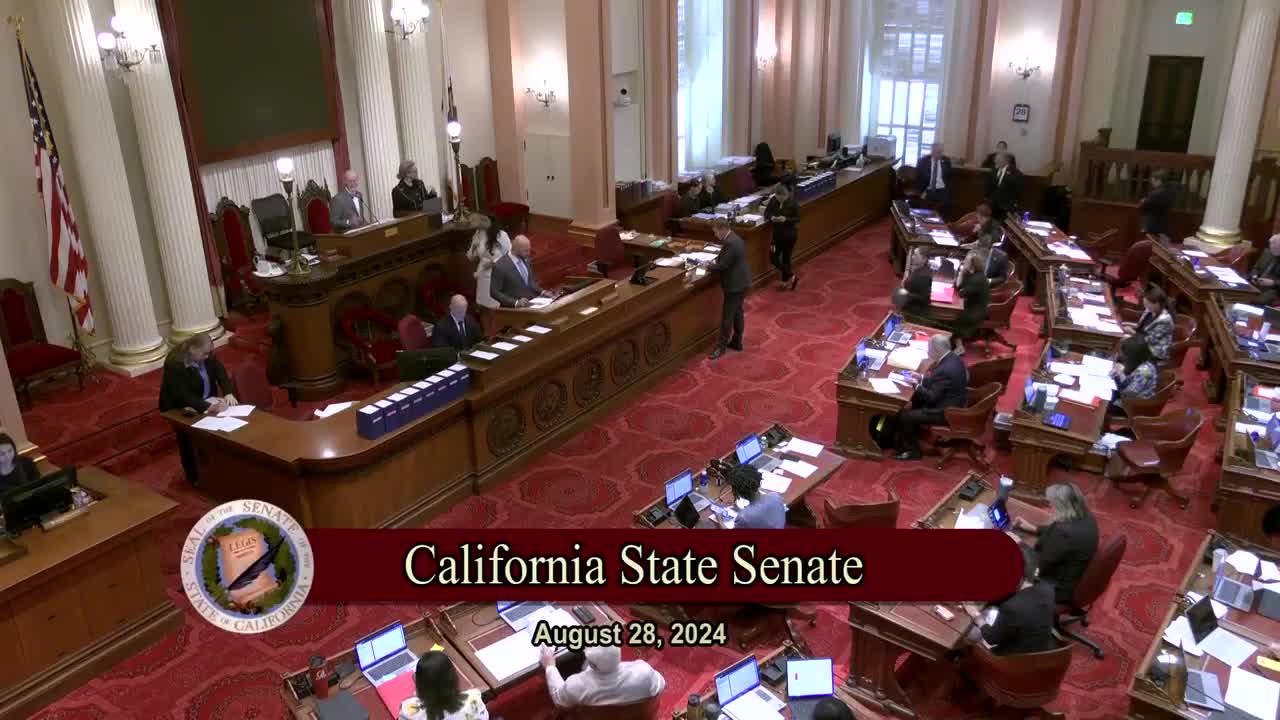 1MIN
Senate Floor
 4MIN
Senate Standing Committee on Local Government
Bill Author

Bill Co-Author(s):