AB 2306: Sensitive military land: foreign ownership and interests: prohibited foreign actors.
- Session Year: 2023-2024
- House: Assembly
- Latest Version Date: 2024-04-16
Current Status:
Failed
(2024-05-16: In committee: Held under submission.)
Introduced
In Committee
First Chamber
In Committee
Second Chamber
Enacted
Existing law provides that all property has an owner, whether that owner is the state, and the property is public, or the owner is an individual, and the property is private. Existing law establishes the California National Guard and regulates the operation of that force. The United States Constitution authorizes Congress to provide for the common defense and general welfare of the United States.
This bill would require the Military Department to develop a statewide policy recommendations regarding prohibited foreign actors owning ownership and use of real property on sensitive land, as specified. The bill would require the department to submit its recommendations to the Governor and the Legislature, as specified. The bill would repeal its provisions on January 1, 2026.
Existing law provides that all property has an owner, whether that owner is the state, and the property is public, or the owner is an individual, and the property is private. Existing law establishes the California National Guard and regulates the operation of that force. The United States Constitution authorizes Congress to provide for the common defense and general welfare of the United States.
This bill would require the Military Department to develop a statewide policy regarding prohibited foreign actors owning property on sensitive land, as specified.
For purposes of this chapter, the following definitions apply:
(a)Controlling interest means either of the following:
(1)Possession of 51 percent or more of the ownership interests in an entity.
(2)A percentage ownership interest in an entity of less than 51 percent, if the prohibited foreign actor has the contractual right and power to direct the business and affairs of the entity without the requirement or consent of any other party.
(b)Fiduciary means an agent, trustee, or any person acting in a fiduciary capacity for a business or government.
(c)Interest means any estate, remainder, or reversion enumerated in Chapter 1 (commencing with Section 761) of Title 2 of Part 2, or portion of the estate, remainder, or reversion, or an option pursuant to which one party has a right to cause legal or equitable title to agricultural land to be transferred.
(d)Prohibited foreign actor means a government, state-controlled enterprise, or fiduciary from a country that is either of the following:
(1)Designated as a nonmarket economy country pursuant to paragraph 18 of Section 771 of the Tariff Act of 1930 (19 U.S.C. Sec. 1677).
(2)Identified as a country that poses a risk to the national security of the United States in the most recent annual report on worldwide threats issued by the Director of National Intelligence pursuant to Section 108B of the National Security Act of 1947 (50 U.S.C. Sec. 3043b), commonly known as the Annual Threat Assessment.
(e)Sensitive land means any land within the state that is located within 50 miles of a United States Military base or California National Guard base.
(f)State-controlled enterprise means a business enterprise, however denominated, in which the government of another country has a controlling interest.
747.5.(a)On or before January 1, 2026, the747.11.(a)The Military Department shall develop a statewide policy regarding prohibited foreign actors owning recommendations regarding ownership and use of real property on sensitive land.
(b)In developing the statewide policy its recommendations, the Military Department shall consider the following:
(1)The potential risk to national security posed by the ownership of sensitive land by a foreign actor and its representatives.
(2)Use of the prohibited foreign actor designation to restrict ownership of sensitive land and the criteria used for that designation.
(3)Ownership and use of sensitive land by another party, including, but not limited to, another foreign state, private interest, and nongovernmental organization.
(1)(4)The potential impact on international trade and commerce. foreign relations.
(2)(5)The economic impact to California-based businesses and the statewide economy, including potential job losses stemming from the policy.
(3)(6)Whether or not the policy shall be made prospective or retroactive.
(c)In developing the statewide policy, the Military Department shall consult with the following entities:
(1)The United States Department of Defense.
(2)The United States Department of State.
(3)The United States Department of Commerce.
(4)The United States Department of Labor.
(5)The California Department of Justice.
(6)At least ten county recorders from regionally diverse areas of the state.
(d)(1)On or before December 31, 2025, the department shall submit its recommendations to the Governor, the Legislature, the Senate Committee on Military and Veterans Affairs, and the Assembly Committee on Military and Veterans Affairs.
(2)The report to be submitted pursuant to paragraph (1) shall be submitted in compliance with Section 9795 of the Government Code.
747.12.This chapter shall remain in effect only until January 1, 2026, and as of that date is repealed.
For purposes of this chapter, the following definitions apply:
(a)Controlling interest means either of the following:
(1)Possession of 51 percent or more of the ownership interests in an entity.
(2)A percentage ownership interest in an entity of less than 51 percent, if the prohibited foreign actor has the contractual right and power to direct the business and affairs of the entity without the requirement or consent of any other party.
(b)Fiduciary means an agent, trustee, or any person acting in a fiduciary capacity for a business or government.
(c)Interest means any estate, remainder, or reversion enumerated in Chapter 1 (commencing with Section 761) of Title 2 of Part 2, or portion of the estate, remainder, or reversion, or an option pursuant to which one party has a right to cause legal or equitable title to agricultural land to be transferred.
(d)Prohibited foreign actor means a government, state-controlled enterprise, or fiduciary from a country that is either of the following:
(1)Designated as a nonmarket economy country pursuant to Section 771(18) paragraph 18 of Section 771 of the Tariff Act of 1930 (19 U.S.C. Sec. 1677(18)). 1677).
(2)Identified as a country that poses a risk to the national security of the United States in the most recent annual report on worldwide threats issued by the Director of National Intelligence pursuant to Section 108B of the National Security Act of 1947 (50 U.S.C. Sec. 3043b), commonly known as the Annual Threat Assessment.
(e)Sensitive land means any land within the state that is located within 50 miles of a United States Military base or California National Guard base.
(f)State-controlled enterprise means a business enterprise, however denominated, in which the government of another country has a controlling interest.
747.5.(a)On or before January 1, 2026, the Military Department shall develop a statewide policy regarding prohibited foreign actors owning property on sensitive land.
(b)In developing the statewide policy the Military Department shall consider the following:
(1)The impact on international trade and commerce.
(2)The economic impact to California-based businesses and the statewide economy, including potential job losses stemming from the policy.
(3)Whether or not the policy shall be made prospective or retroactive.
(c)In developing the statewide policy, the Military Department shall consult with the following entities:
(1)The United States Department of Defense.
(2)The United States Department of State.
(3)The United States Department of Commerce.
(4)The United States Department of Labor.
(5)The California Department of Justice.
(6)At least ten county recorders from regionally diverse areas of the state.
For purposes of this chapter, the following definitions apply:
(a)Controlling interest means either of the following:
(1)Possession of 51 percent or more of the ownership interests in an entity.
(2)A percentage ownership interest in an entity of less than 51 percent, if the prohibited foreign actor has the contractual right and power to direct the business and affairs of the entity without the requirement or consent of any other party.
(b)Fiduciary means an agent, trustee, or any person acting in a fiduciary capacity for a business or government.
(c)Interest means any estate, remainder, or reversion enumerated in Chapter 1 (commencing with Section 761) of Title 2 of Part 2, or portion of the estate, remainder, or reversion, or an option pursuant to which one party has a right to cause legal or equitable title to agricultural land to be transferred.
(d)Prohibited foreign actor means a government, state-controlled enterprise, or fiduciary from a country that is either of the following:
(1)Designated as a nonmarket economy country pursuant to Section 771(18) of the Tariff Act of 1930 (19 U.S.C. Sec. 1677(18)).
(2)Identified as a country that poses a risk to the national security of the United States in the most recent annual report on worldwide threats issued by the Director of National Intelligence pursuant to Section 108B of the National Security Act of 1947 (50 U.S.C. Sec. 3043b), commonly known as the Annual Threat Assessment.
(e)Sensitive land means any land within the state that is located within 50 miles of a United States Military base or California National Guard base.
(f)State-controlled enterprise means a business enterprise, however denominated, in which the government of another country has a controlling interest.
747.5.(a)On or before January 1, 2026 the Military Department shall develop a statewide policy regarding prohibited foreign actors owning property on sensitive land.
(b)In developing the statewide policy the Military Department shall consider the following:
(1)The impact on international trade and commerce.
(2)The economic impact to California-based businesses and the statewide economy, including potential job losses stemming from the policy.
(3)Whether or not the policy shall be made prospective or retroactive.
(c)In developing the statewide policy, the Military Department shall consult with the following entities:
(1)The United States Department of Defense.
(2)The United States Department of State.
(3)The United States Department of Commerce.
(4)The United States Department of Labor.
(5)The California Department of Justice.
|
Date
|
Status
|
|---|---|
| May 16, 2024 | In committee: Held under submission. |
| May 8, 2024 | In committee: Set, first hearing. Referred to APPR. suspense file. |
| Apr 24, 2024 | From committee: Do pass and re-refer to Com. on APPR. (Ayes 9. Noes 0.) (April 23). Re-referred to Com. on APPR. |
| Apr 17, 2024 | Re-referred to Com. on M. & V.A. |
| Apr 16, 2024 | From committee chair, with author's amendments: Amend, and re-refer to Com. on M. & V.A. Read second time and amended. |
| Mar 21, 2024 | Re-referred to Com. on M. & V.A. |
| Mar 20, 2024 | Read second time and amended. |
| Mar 19, 2024 | From committee: Amend, and do pass as amended and re-refer to Com. on M. & V.A. with recommendation: To Consent Calendar. (Ayes 12. Noes 0.) (March 19). |
| Feb 26, 2024 | Referred to Coms. on JUD. and M. & V.A. |
| Feb 13, 2024 | From printer. May be heard in committee March 14. |
| Feb 12, 2024 | Read first time. To print. |
|
Date
|
Description
|
Location
|
Votes
|
|
|---|---|---|---|---|
| Apr 23, 2024 | Do pass and be re-referred to the Committee on [Appropriations] | Assembly Standing Committee on Military and Veterans Affairs |
Passed |
|
| Mar 19, 2024 | Do pass as amended, and be re-referred to the Committee on [Military and Veterans Affairs] with recommendation: To Consent Calendar | Assembly Standing Committee on Judiciary |
Passed |
This list shows positions taken on this bill by organizations on the date displayed, which is linked to the original source.
Positions by individuals are not included.
|
Organization
|
Position
|
Date
|
|---|---|---|
| California Association Of Realtors | ** Against | |
| California Land Title Association | ** Against | |
| California State Grange | ** Support |
Date of Hearing: May 8, 2024
ASSEMBLY COMMITTEE ON APPROPRIATIONS
Buffy Wicks, Chair
ABPCA Bill Id:AB 2306
Author:(Mathis) – As Amended Ver:April 16, 2024
Policy Committee: | Judiciary | Vote: | 12 - 0 |
Military and Veterans Affairs | 9 - 0 | ||
|
|
Urgency: No State Mandated Local Program: No Reimbursable: No
SUMMARY:
This bill requires the California Military Department (CMD) to develop statewide policy recommendations regarding the ownership and use of real property near military facilities and to submit its recommendations to the Governor and the Legislature.
Specifically, this bill:
- Requires the CMD to develop statewide policy recommendations regarding ownership and use of real property on sensitive land, defined as any land within the state that is located within 50 miles of a United States Military base or California National Guard base.
- Requires, in developing the statewide policy, CMD to consider the following:
- The potential risk to national security posed by the ownership of sensitive land by a foreign actor and its representatives.
- Use of the “prohibited foreign actor” designation to restrict ownership of sensitive land and the criteria used for that designation.
- Ownership and use of sensitive land by another party, including, but not limited to, another foreign state, private interest, and nongovernmental organization.
- The potential impact on international trade and foreign relations.
- The economic impact to California-based businesses and the statewide economy, including potential job losses stemming from the policy.
- Whether or not the policy is to be made prospective or retroactive.
- Requires CMD, in developing the statewide policy to consult with the specified entities, including the United States (U.S.) Department of Defense, the U.S. Department of State, and at least ten county recorders from regionally diverse areas of the state, among others.
- Requires CMD, by December 31, 2025, to submit its recommendations to the Governor, the Legislature, the Senate Committee on Military and Veterans Affairs, and the Assembly Committee on Military and Veterans Affairs.
FISCAL EFFECT:
CMD estimates one-time General Fund costs of approximately $777,000 for four positions to conduct the necessary research, analyze impacts, and provide the recommendations to the state. CMD indicates it is still reviewing the policy impacts of this legislation and the appropriateness of CMD as the lead agency in this effort.
According to the Legislative Analyst’s Office, the General Fund faces a structural deficit in the tens of billions of dollars over the next several fiscal years.
COMMENTS:
- Purpose and Background. The bill was introduced in response to increasing fears that Chinese activities in the U.S., including land purchases, technology sales and balloon flights, represent a deliberate attempt to gather intelligence in the U.S. and undermine its domestic security. The author seeks to answer whether and how California should devise policies and legislation to better secure military installations located in the state from foreign threats. It does so by requiring the CMD to develop policy recommendations in consultation with appropriate federal and state departments, and to report those recommendations to the legislature and governor. According the Assembly Committee on Military and Veterans Affairs’ policy analysis:
In 2023, the Inspector General of the United States Department of Defense (DoD) issued a memo directing the undersecretaries of the various branches of the United States military to develop policies to mitigate the impact of foreign land investment near United States military instillations.
It should be noted that one of the reasons the DoD is likely not seeking to immediately ban all foreign land investment near military bases is the potential impact to international trade and the importation and exportation of goods. For example, significant trade from China comes through California’s ports. To the extent that a Chinese exporter needs a physical presence in the United States, it would make sense for that company to own property near the port. However, as a major hub for the United States Navy and Coast Guard, California’s ports are also close to significant military assets. Accordingly, addressing foreign landownership near United States military installations presents complex legal and logistical issues.
- Related Legislation. AB 475 (Mathis), of this legislative session, prohibits a foreign actor, as defined, from purchasing, acquiring, leasing, or holding an interest in any land located within 50 miles of a United States military base or California National Guard base within the State of California. AB 475 was referred to the Assembly Judiciary Committee, but did not receive a hearing.
Analysis Prepared by: Jennifer Swenson / APPR. / (916) 319-2081
Date of Hearing: April 23, 2024
ASSEMBLY COMMITTEE ON MILITARY AND VETERANS AFFAIRS
Pilar Schiavo, Chair
ABPCA Bill Id:AB 2306 (
Author:Mathis) – As Amended Ver:April 16, 2024
SUBJECT: Sensitive military land: foreign ownership and interests: prohibited foreign actors
SUMMARY: This bill would require the Military Department (CMD) to develop statewide policy recommendations regarding ownership and use of real property on sensitive land, as specified, and require the department to submit its recommendations to the Governor and the Legislature. Specifically, this bill:
- Requires the Military Department to develop statewide policy recommendations regarding ownership and use of real property on sensitive land.
- Requires, in developing the statewide policy pursuant to 1), the Military Department to consider the following:
- The potential risk to national security posed by the ownership of sensitive land by a foreign actor and its representatives;
- Use of the “prohibited foreign actor” designation to restrict ownership of sensitive land and the criteria used for that designation;
- Ownership and use of sensitive land by another party, including, but not limited to, another foreign state, private interest, and nongovernmental organization;
- The potential impact on international trade and foreign relations.
- The economic impact to California-based businesses and the statewide economy, including potential job losses stemming from the policy;
- Whether or not the policy is to be made prospective or retroactive.
- Requires, in developing the statewide policy pursuant to 1), the Military Department to consult with the following entities:
- The United States Department of Defense;
- The United States Department of State;
- The United States Department of Commerce;
- The United States Department of Labor;
- The California Department of Justice; and
- At least ten county recorders from regionally diverse areas of the state.
- Requires the department on or before December 31, 2025, to submit its recommendations to the Governor, the Legislature, the Senate Committee on Military and Veterans Affairs, and the Assembly Committee on Military and Veterans Affairs.
- Requires the report to be submitted in compliance with Section 9795 of the Government Code.
- Is repealed on January 1, 2026.
- Defines the following terms:
- “Controlling interest” means either possession of 51 percent or more of the ownership interests in an entity or percentage ownership interest in an entity of less than 51 percent, if the prohibited foreign actor has the contractual right and power to direct the business and affairs of the entity without the requirement or consent of any other party;
- “Fiduciary” means an agent, trustee, or any person acting in a fiduciary capacity for a business or government;
- “Interest” means any estate, remainder, or reversion enumerated in existing law or portion of the estate, remainder, or reversion, or an option pursuant to which one party has a right to cause legal or equitable title to agricultural land to be transferred;
- “Prohibited foreign actor” means a government, state-controlled enterprise, or fiduciary from a country that is either designated as a nonmarket economy country or identified as a country that poses a risk to the national security of the United States in the most recent annual report on worldwide threats issued by the Director of National Intelligence;
- “Sensitive land” means any land within the state that is located within 50 miles of a United States Military base or California National Guard base; and
- “State-controlled enterprise” means a business enterprise, however denominated, in which the government of another country has a controlling interest.
EXISTING LAW:
- Establishes the California Military Department to oversee the California National Guard, the State Guard, the California Cadet Corps, and the Naval Militia. (Military and Veterans Code (MVC) Sections 50 and 51)
- Establishes the position of Adjutant General to oversee the Military Department. (MVC Sec. 52)
- Establishes the Governor’s Military Council within the Military Department to advise the Governor on efforts to retain military installations and operations within this state that are necessary for the defense of the nation, and to coordinate and focus those efforts. (MVC Sec. 59)
- Provides that estates in real property, in respect to the duration of their enjoyment, are either:
- Estates of inheritance or perpetual estates;
- Estates for life;
- Estates for years; or
- Estates at will. (Civil Code (CIV) Section 761)
- Provides that real property within the State is governed by the law of this State, except where the title is in the United States. (CIV Sec. 755)
- Provides that private property may be taken or damaged for a public use and only when just compensation is first paid to the owner of the property. (Cal. Const. art. I Sec. 19)
- Requires, pursuant to federal law, the Director of National Intelligence to identify any country that poses a risk to the national security of the United States annually as a part of the Annual Threat Assessment. (50 U.S.C. Sec. 3043b)
FISCAL EFFECT: This bill is fiscal, but has not been analyzed by a fiscal committee.
COMMENTS: The purpose of this bill is to answer whether and how California should devise policies and legislation to better secure military installations located in the state from foreign threats. It does so by requiring the CMD to develop policy recommendations in consultation with appropriate federal and state departments, and to report those recommendations to the legislature and governor.
According to the author:
“In tasking the California Military Department to develop a statewide policy regarding prohibited foreign actors owning property on sensitive land, AB 2306 will prevent hostile foreign actors from easily intercepting U.S. military communications, and keep Californians and our service members safe while remaining in accordance with federal law.”
The bill was introduced in response to increasing fears that Chinese activities in the U.S., including land purchases, technology sales and balloon flights, represent a deliberate attempt to gather intelligence in the U.S. and undermine its domestic security in and ongoing great power struggle between the two countries.
Who’s buying the land, and where?
In 2022, the purchase of 300 acres of farmland in rural North Dakota by the Fufeng Group of Shandong, China raised significant concerns with the Department of Defense.[1] While Chinese interests buying property in the United States, including farmland, is nothing new, the North Dakota purchase raised alarms because the land was 20 miles from the Grand Forks Air Force Base, where some of the United States most sophisticated drone technologies are located.
When in 2023 an unidentified buyer scooped up 50,000 acres of land next to Travis Air Force Base, many feared Chinese government involvement, due to the apparent secrecy around the sale and the land’s proximity to some of the U.S. military’s largest transportation and logistics operations.[2] Though it was later revealed that the land purchase was the brainchild of a group of Silicon Valley billionaires who want to build their own Galt’s Gulch, the concern it stirred up about the use and ownership of land adjacent to Travis has hardly quieted.
According to the U.S. Department of Agriculture (USDA), as of December 2020, Chinese interests (not the People’s Republic of China, itself) owned more than 352,000 acres of U.S. agricultural land, slightly less than one percent of all foreign-held acreage. Some reporting, citing the USDA’s reliance on voluntary self-reporting, indicates the data may not be completely reliable.[3]
These conditions, among others, as well as the well-publicized spectacle of a Chinese spy balloon flying over the United States in the spring of 2023, have contributed to an increasing amount of heat and light on foreign ownership of U.S. land. Several states have passed or are considering legislation to limit land purchases by foreign interests. What this bill asks is, “Should California do so, too, and if so, how?”
What are defense and intelligence agencies saying?
In 2023, the Inspector General of the United States Department of Defense (DoD) issued a memo directing the undersecretaries of the various branches of the United States military to develop policies to mitigate the impact of foreign land investment near United States military instillations.
It should be noted that one of the reasons that the United States Department of Defense is likely not seeking to immediately ban all foreign land investment near military bases is the potential impact to international trade and the importation and exportation of goods. For example, significant trade from China comes through California’s ports. To the extent that a Chinese exporter needs a physical presence in the United States, it would make sense for that company to own property near the port. However, as a major hub for the United States Navy and Coast Guard, California’s ports are also close to significant military assets. Accordingly, addressing foreign landownership near United States military installations presents complex legal and logistical issues.
Striking a balance.
This bill doesn’t impose a policy on the state, doesn’t prohibit any ownership of land by any party, and introduces definitions that are only operative for the purpose of drafting policy recommendations, and which then self-repeal. Other states have been more aggressive in restricting ownership of land by foreign states and even their citizens. This bill merely asks a question, and directs the CMD to answer it through consultation with appropriate federal military, diplomatic, trade and commerce, as well as employment agencies. As well, the bill requires consultation with the California Department of Justice and a minimum of ten county recorders who would be forced to handle all land transactions stemming from a potential policy forcing the sale of certain properties. One may quibble with the framing of the question, but the bill doesn’t tell the CMD how to answer it.
Whose job is it, anyway?
Matters of state, both diplomatic and military, are properly federal. As the state agency managing the California National Guard, the Military Department is unique among state agencies in that aspects of the Department’s jurisdiction are under control of the federal government, namely the National Guard Bureau, and above that, the Department of Defense. State National Guards have some localized, state autonomy, strictly under the authority of governors, but that authority derives from federal law, and is limited in scope. Likewise, the source of funding for National Guard operations limits their activities. This is relevant in answering whether the CMD is an appropriate agency for the development of the recommendations required by this bill. It is uniquely placed to consult with the DoD, for one.
The Assembly Committee Judiciary commented on the uniquely federal-state hybrid nature of the California Military Department, and deferred questions on federalism and the appropriate division of responsibilities to this committee. In collaboration with the author’s office, committee staff drafted significant amendments to the bill to address those matters. These amendments made the following changes:
- Require the CMD to develop policy recommendations, not policy itself.
- Require CMD to report its recommendations to the Governor and the State Legislature.
- Require CMD to consider the effect on foreign relations that any policy forbidding specified actors from owning sensitive land in California may have.
Prohibited foreign actors
This bill derives from AB 475 (Mathis, 2023) which shared with this bill the definitions of “sensitive land” and “prohibited foreign actor,” but expressly prohibited ownership of sensitive land by prohibited foreign actors. This bill does not prohibit ownership, but retains the nomenclature and definitions. To account for this, the bill requires CMD to consider those definitions in developing its recommendations. One thing worth further consideration is the inclusion among “prohibited foreign actors” of states designated nonmarket economies under the Tariff Act. It’s not clear that designation as a nonmarket economy is linked to posing a threat to the national security of the U.S. At the time of this analysis, for example, the Republic of Armenia is a designated nonmarket economy, but has had normal, even close diplomatic relations with the U.S. since 1992.
Related legislation
AB 475 (Mathis, 2023) would have prohibited a prohibited foreign actor, as defined, from purchasing, acquiring, leasing, or holding an interest, as defined, in any land located within 50 miles of a United States military base or California National Guard base within the State of California. Died pursuant to Art. IV, Sec. 10(c) of the Constitution.
REGISTERED SUPPORT / OPPOSITION:
Support
California State Grange
Opposition
None on file.
Analysis Prepared by: Christian Burkin / M. & V.A. / (916) 319-3550
Eamon Jones, Chinese company’s purchase of North Dakota farmland raises national security concerns in Washington, CNBC (Jul. 1, 2022) ↑
Jonathan Ayestas & Andrea Flores, California Forever CEO gives 1st tour of land purchased in Solano County, KCRA News (Nov. 10, 2023) ↑
Jonathan Hettinger, States mull limits on foreign ownership of farmland, Investigate Midwest, (Nov. 13, 2022) ↑
Date of Hearing: March 19, 2024
ASSEMBLY COMMITTEE ON JUDICIARY
Ash Kalra, Chair
ABPCA Bill Id:AB 2306
Author:(Mathis) – As Introduced Ver:February 12, 2024
PROPOSED CONSENT (As Proposed to be Amended)
SUBJECT: Sensitive military land: foreign ownership and interests: prohibited foreign actors
KEY ISSUE: should the Military Department be required to develop a statewide policy regarding foreign actors owning property on land near military facilities?
SYNOPSIS
Ongoing global conflicts, from the war in Ukraine to China’s ongoing aggression in the Taiwan Strait, have placed the United States in an unstable geopolitical environment not seen since the end of the Cold War. Even more concerning to the national security of the United States are recent land purchases by some of America’s geopolitical adversaries near American military installments. Although no such land acquisitions have occurred in California, the author of this measure notes that California must be prepared to act should a foreign adversary seek to acquire property near military installations in this state.
Seeking to proactively address the risk of foreign adversaries purchasing land in California near military bases, this bill directs the California Military Department to development a statewide policy regarding foreign ownership of such land. Due to the complexities of this issue, the bill tasks the Military Department with consulting with state and federal authorities with expertise in foreign affairs, trade and commerce, and national security in the development of the policy. It should be noted that nothing in this bill compels the sale (or prohibits the sale) of any property, or has any retroactive effect on land sales. Such mandates would certainly require additional legislative approval before they could be implemented.
This author-sponsored measure has no known support or opposition. However, the California Association of Realtors and the California Land Title Association wrote to the Committee, expressing concerns about the potential impact of the bill on property transactions that may occur should the policy promote the forced sale of foreign-owned land. Seeking to address some of these concerns, as proposed to be amended, the bill also would require the Military Department to consult with at least ten county recorders to ensure that the policy can be implemented as efficiently as possible and without unduly impacting the chain of title of properties. Should this bill be approved by this Committee, it would be referred to the Assembly Committee on Military and Veterans Affairs.
SUMMARY: Requires the Military Department to develop a statewide policy regarding foreign actors owning property near military facilities. Specifically, this bill:
- Requires, on or before January 1, 2026, the Military Department to develop a statewide policy regarding prohibited foreign actors owning property on sensitive land.
- Requires, in developing the statewide policy pursuant to 1), the Military Department to consider the following:
- The impact on international trade and commerce;
- The economic impact to California-based businesses and the statewide economy, including potential job losses stemming from the policy; and
- Whether or not the policy is to be made prospective or retroactive.
- Requires, in developing the statewide policy pursuant to 1), the Military Department to consult with the following entities:
- The United States Department of Defense;
- The United States Department of State;
- The United States Department of Commerce;
- The United States Department of Labor;
- The California Department of Justice; and
- At least ten county recorders from regionally diverse areas of the state.
- Defines the following terms:
- “Controlling interest” means either possession of 51 percent or more of the ownership interests in an entity or percentage ownership interest in an entity of less than 51 percent, if the prohibited foreign actor has the contractual right and power to direct the business and affairs of the entity without the requirement or consent of any other party;
- “Fiduciary” means an agent, trustee, or any person acting in a fiduciary capacity for a business or government;
- “Interest” means any estate, remainder, or reversion enumerated in existing law or portion of the estate, remainder, or reversion, or an option pursuant to which one party has a right to cause legal or equitable title to agricultural land to be transferred;
- “Prohibited foreign actor” means a government, state-controlled enterprise, or fiduciary from a country that is either designated as a nonmarket economy country or identified as a country that poses a risk to the national security of the United States in the most recent annual report on worldwide threats issued by the Director of National Intelligence;
- “Sensitive land” means any land within the state that is located within 50 miles of a United States Military base or California National Guard base; and
- “State-controlled enterprise” means a business enterprise, however denominated, in which the government of another country has a controlling interest.
EXISTING LAW:
- Establishes the California Military Department to oversee the California National Guard, the State Guard, the California Cadet Corps, and the Naval Militia. (Military and Veterans Code Sections 50 and 51.)
- Establishes the position of Adjutant General to oversee the Military Department. (Military and Veterans Code Section 52.)
- Establishes the Governor’s Military Council within the Military Department to advise the Governor on efforts to retain military installations and operations within this state that are necessary for the defense of the nation, and to coordinate and focus those efforts. (Military and Veterans Code Section 59.)
- Provides that estates in real property, in respect to the duration of their enjoyment, are either:
- Estates of inheritance or perpetual estates;
- Estates for life;
- Estates for years; or
- Estates at will. (Civil Code Section 761.)
- Provides that real property within the State is governed by the law of this State, except where the title is in the United States. (Civil Code Section 755.)
- Provides that private property may be taken or damaged for a public use and only when just compensation is first paid to the owner of the property. (Cal. Const. art. I Sec. 19.)
- Requires, pursuant to federal law, the Director of National Intelligence to identify any country that poses a risk to the national security of the United States annually as a part of the Annual Threat Assessment. (50 U.S.C. Sec. 3043b.)
FISCAL EFFECT: As currently in print this bill is keyed fiscal.
COMMENTS: Between Russia’s ongoing invasion of Ukraine, Israel’s invasion of the Gaza Strip, and the ongoing tension between China and Taiwan, America’s national security is being tested by a host of geopolitical challenges. In this climate of international tension, the author of this bill suggests that it is time to reexamine the wisdom of permitting foreign actors from America’s geopolitical foes to own property near United States military installments. However, recognizing that these actors may also own property for legitimate purposes, for example international trade and shipping, this bill seeks to balance national security and economic interests by tasking the Military Department with establishing a statewide policy regarding foreign land ownership near military sites. In support of this measure, the author states:
AB 2306 would require that by January 1, 2026, the California Military Department to develop a statewide policy regarding prohibited foreign actors owning property on sensitive land. The policy established by AB 2306 is directed specifically towards land within 50 miles of a United States Military base or California National Guard base and which is owned by a government, state-controlled enterprise, or fiduciary from a country that is either as a nonmarket economy country pursuant to Section 771(18) of the Tariff Act of 1930, or identified as a country that poses a risk to the national security of the United States in the most recent annual report on worldwide threats issued by the Director of National Intelligence.
The policy shall include considerations on the impact of international trade and commerce, the economic impact to California-based businesses, and the statewide economy, and whether or not the policy shall be made prospective or retroactive.
To ensure the effectiveness of the statewide policy, the Military Department must consult with a number of key stakeholders, including representatives from the United States Department of Defense, the United States Department of State, the United States Department of Commerce, the United States Department of Labor, and the California Department of Justice.
In tasking the California Military Department to develop such a policy, AB 2306 will prevent prohibited foreign actors from easily intercepting U.S. military communications, and keep Californians and our service members safe while remaining in accordance with federal law.
Recent land purchases by foreign governments have raised security concerns for United States military facilities. In 2022, the purchase of 300 acres of farmland in rural North Dakota by the Fufeng Group of Shandong, China raised significant concerns with the Department of Defense. (Eamon Jones, Chinese company’s purchase of North Dakota farmland raises national security concerns in Washington, CNBC (Jul. 1, 2022) available at: https://www.cnbc.com/2022/07/01/chinese-purchase-of-north-dakota-farmland-raises-national-security-concerns-in-washington.html.) While Chinese interests buying property in the United States, including farmland, is nothing new, the North Dakota purchase raised alarms because the land was 20 miles from the Grand Forks Air Force Base, where some of the United States most sophisticated drone technologies are located. (Ibid.) Similarly, before being unmasked as the brainchild of a group of Silicon Valley billionaires, the “California Forever” project and 50,000 acre land purchase raised questions due to the projects secrecy and the land’s proximity to Travis Air Force Base, home to some of America’s largest military transportation and logistics operations. (Jonathan Ayestas & Andrea Flores, California Forever CEO gives 1st tour of land purchased in Solano County, KCRA News (Nov. 10, 2023), available at: https://www.kcra.com/article/solano-county-california-forever-ceo-jan-sramek/45798458#:~:text=For%20the%20first%20time%20since,50%2C000%20acres%20of%20land%20between.)
As a result of the above-mentioned land purchases, as well as the well-publicized incident of a Chinese spy balloon flying over the United States in the spring of 2023, the question of how to protect against foreign surveillance on United States soil is gaining a new sense of urgency. According to documents provided to the Committee by the author, in 2023, the Inspector General of the United States Department of Defense issued a memo directing the undersecretaries of the various branches of the United States military to develop policies to mitigate the impact of foreign land investment near United States military instillations.
It should be noted that one of the reasons that the United States Department of Defense is likely not seeking to immediately ban all foreign land investment near military bases is the potential impact to international trade and the importation and exportation of goods. For example, significant trade from China comes through California’s ports. To the extent that a Chinese exporter needs a physical presence in the United States, it would make sense for that company to own property near the port. However, as a major hub for the United States Navy and Coast Guard, California’s ports are also close to significant military assets. Accordingly, addressing foreign landownership near United States military installations presents complex legal and logistical issues.
This bill balances national and economic security by tasking the Military Department with developing a comprehensive plan for foreign land ownership near military facilities. Seeking to balance the complicated issues surrounding foreign land ownership near United States military facilities, and recognizing that the Legislature may not be the most appropriate venue too address the specifics of this issue at this time, this bill tasks the California Military Department (which oversee the various branches of the California National Guard) with developing a statewide policies regarding foreign land ownership near state and federal military installations. This bill defines several terms to focus the development of the state’s foreign landownership policy on those foreign nations that pose the greatest geopolitical threat to the United States. The bill also prudently recognizes the various factors that must be considered when developing a policy on such a sensitive topic. It therefore directs the Military Department to consult with federal military, diplomatic, trade and commerce, as well as employment agencies. The bill also requires local consultation with the California Department of Justice and a minimum of ten county recorders who would be forced to handle all land transactions stemming from a potential policy forcing the sale of certain properties. Reflecting the time and detail that developing such a policy would require, the bill provides the Military Department with one year to develop the policy.
Potential federalism concerns. As the state agency managing the California National Guard, the Military Department is unique among state agencies in that aspects of the Department’s jurisdiction are under control of the federal government, namely the United States Department of Defense. Thanks to various federal regulations and funding allocations, state guards give some command and control authority to the federal government. Although the pending case of Abbott v. Biden (United States District Court for the Eastern District of Texas, Case No. 6:22-cv-3.) is currently challenging federal control, existing law vests significant control of the California National Guard in the hands of the federal government. While this Committee typically weighs in on issues of federalism, given that this bill is double referred to the Committee on Military and Veterans Affairs, which has expertise on the specific issue of military affairs, this Committee is deferring any amendments necessary to address this unique relationship to that Committee.
Proposed amendments seek to lessen concerns related to the bill’s impact on property transfers. As currently in print, this bill requires the Military Department to coordinate with a host of agencies involved in foreign affairs, economic policy, and civil rights. Writing to express concerns about this measure, the California Association of Realtors and the California Land Title Association note that the bill does not direct the Military Department to develop procedures dealing with any mandated property sales that may result from the development of a statewide policy on foreign ownership on land near military bases. Indeed, while the agencies the bill directs the Military Department have a great deal of subject-matter expertise, property transactions are not their forte. Although this bill does not mandate any property transactions, the author acknowledges the concerns raised by the California Association of Realtors and the California Land Title Association. Thus, in order to ensure the Military Department takes into account the intricacies of property transactions in California, the author is proposing to require consultation with county recorders, the government actors who process such transactions, as a part of the development of the statewide policy on foreign ownership of land near military bases. Accordingly, the bill will be amended, specifically the proposed Section 747.5 of the Civil Code, to read as follows:
(c) In developing the statewide policy, the Military Department shall consult with the following entities:
(1) The United States Department of Defense.
(2) The United States Department of State.
(3) The United States Department of Commerce.
(4) The United States Department of Labor.
(5) The California Department of Justice.
(6) At least ten county recorders from regionally diverse areas of the state.
ARGUMENTS OF CONCERNS: As noted, the California Association of Realtors and the California Land Title Association expressed concerns about the potential impacts of this measure. While recognizing that the bill does not directly implicate property sales, they state:
Given that AB 2306 does not seek to enact the process proposed by AB 475 (Mathis) as introduced last year – in which a prohibited property transfer could have been found void, even retroactively – we take no issue with the bill moving through the legislative process at this time, and appreciate that it was drafted in an effort to avoid unintended disruption to California real estate transactions.
However, while AB 2306 does not prescribe specific practices and remedies with respect to the conveyance of real property, it does give substantial deference to the California Military Department in crafting a policy on this issue, and leaves open the question of whether the Department could ultimately seek to enact the same, or similarly disruptive, policies as originally found in AB 475.
For that reason, we continue to evaluate whether AB 2306 could benefit from clarifying amendments that make the limitations on any Military Department policy on this issue more clear, and look forward to continued conversations with the author’s office with that in mind.
REGISTERED SUPPORT / OPPOSITION:
Support
None on file
Opposition
None on file
Concerns
California Association of Realtors
California Land Title Association
Analysis Prepared by: Nicholas Liedtke / JUD. / (916) 319-2334
Discussed in Hearing
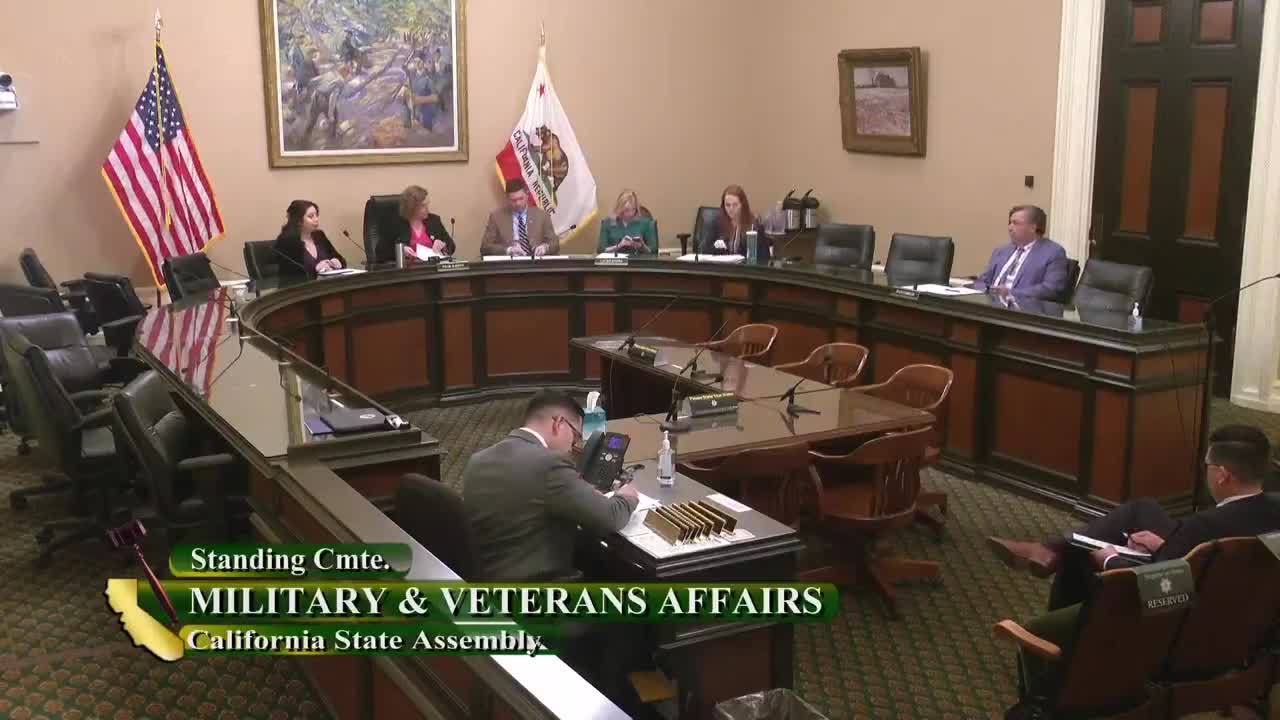 57SEC
Assembly Standing Committee on Military and Veterans Affairs
Bill Author

Bill Co-Author(s):