AB 2346: Organic waste reduction regulations: procurement of recovered organic waste products.
- Session Year: 2023-2024
- House: Assembly
- Latest Version Date: 2024-09-27
Current Status:
Passed
(2024-09-27: Chaptered by Secretary of State - Chapter 712, Statutes of 2024.)
Introduced
In Committee
First Chamber
In Committee
Second Chamber
Enacted
Existing law requires the State Air Resources Board to complete, approve, and implement a comprehensive strategy to reduce emissions of short-lived climate pollutants in the state to reduce the statewide methane emissions by 40% below 2013 levels by 2030. Existing law requires the Department of Resources Recycling and Recovery, in consultation with the state board, to adopt regulations that achieve specified targets for reducing organic waste in landfills, as provided. The departments organic waste regulations require local jurisdictions to annually procure a quantity of recovered organic waste products and to comply with their procurement targets by directly procuring recovered organic waste products for use or giveaway or by requiring, through a written agreement, that a direct service provider to the jurisdiction procure recovered organic waste products, or both. Those regulations specify the types of recovered organic waste products that a jurisdiction may procure, including compost that is produced at a compostable material handling operation or facility, or a specified digestion facility that composts onsite. Other regulations of the department require all compostable materials handling activities to obtain a facility permit from the department prior to commencing operations and meet other specified requirements, but exclude from those requirements certain activities that the regulations state do not constitute a compostable material handling operation or facility, including the composting of green material, agricultural material, food material, and vegetative food material, and the handling of compostable materials under certain conditions, as provided.
This bill would authorize local jurisdictions to count towards their procurement targets compost produced and procured from specified compost operations and specified investments and expenditures related to meeting its procurement target, as provided. The bill would authorize a local jurisdiction to determine a local per capita procurement target using information from a local waste characterization study, as specified. The bill would authorize a local jurisdiction to satisfy its annual procurement obligations by procuring a quantity of recovered organic waste products that meets or exceeds a 5-year procurement target, as specified. The bill would authorize the department, in adopting and revising regulations, to consider other pathways to prioritize local use of compost, as specified.
This bill would incorporate additional changes to Section 42652.5 of the Public Resources Code proposed by AB 2514 and AB 2902 to be operative only if this bill and any or all of the other bills are enacted and this bill is enacted last.
Existing law requires the State Air Resources Board to complete, approve, and implement a comprehensive strategy to reduce emissions of short-lived climate pollutants in the state to reduce the statewide methane emissions by 40% below 2013 levels by 2030. Existing law requires the Department of Resources Recycling and Recovery, in consultation with the state board, to adopt regulations that achieve specified targets for reducing organic waste in landfills, as provided. The departments organic waste regulations require local jurisdictions to annually procure a quantity of recovered organic waste products and to comply with their procurement targets by directly procuring recovered organic waste products for use or giveaway or by requiring, through a written agreement, that a direct service provider to the jurisdiction procure recovered organic waste products, or both. Those regulations specify the types of recovered organic waste products that a jurisdiction may procure, including compost that is produced at a compostable material handling operation or facility, or a specified digestion facility that composts onsite. Other regulations of the department require all compostable materials handling activities to obtain a facility permit from the department prior to commencing operations and meet other specified requirements, but exclude from those requirements certain activities that the regulations state do not constitute a compostable material handling operation or facility, including the composting of green material, agricultural material, food material, and vegetative food material, and the handling of compostable materials under certain conditions, as provided.
This bill would authorize local jurisdictions to be credited for the procurement of recovered organic waste products through an agreement with a direct service provider, as defined, and would allow the direct service provider agreement to include the procurement of recovered organic waste products on a prospective basis as long as the purchase of those products occurs during the year for which the local jurisdiction seeks credit, and under other specified circumstances. The This bill would also authorize local jurisdictions to count towards their procurement targets, targets compost produced and procured from specified compost operations, as defined, and, operations and specified investments and expenditures related to meeting its procurement target, as provided. The bill would allow the department, on or before January 1, 2027, to reevaluate, on a regular basis as determined by the department, the per capita procurement target calculation. The bill would authorize a local jurisdiction to determine a local per capita procurement target using information from a local jurisdiction waste characterization study, as specified. The bill would authorize a local jurisdiction to procure satisfy its annual procurement obligations by procuring a quantity of recovered organic waste products that meets or exceeds a 5-year procurement target, as specified. The bill would require authorize the department, in adopting and revising regulations, to consider other pathways to prioritize local use of compost and to consider developing and adopting methods to prioritize local use of compost, as specified.
Existing law requires the State Air Resources Board to complete, approve, and implement a comprehensive strategy to reduce emissions of short-lived climate pollutants in the state to reduce the statewide methane emissions by 40% below 2013 levels by 2030. Existing law requires the Department of Resources Recycling and Recovery, in consultation with the state board, to adopt regulations that achieve specified targets for reducing organic waste in landfills, as provided. The departments organic waste regulations require local jurisdictions to annually procure a quantity of recovered organic waste products and to comply with their procurement targets by directly procuring recovered organic waste products for use or giveaway or by requiring, through a written agreement, that a direct service provider to the jurisdiction procure recovered organic waste products, or both. Those regulations specify the types of recovered organic waste products that a jurisdiction may procure, including compost that is produced at a compostable material handling operation or facility, or a specified digestion facility that composts onsite. Other regulations of the department require all compostable materials handling activities to obtain a facility permit from the department prior to commencing operations and meet other specified requirements, but exclude from those requirements certain activities that the regulations state do not constitute a compostable material handling operation or facility, including the composting of green material, agricultural material, food material, and vegetative food material, and the handling of compostable materials under certain conditions, as provided.
This bill would authorize local jurisdictions to be credited for the procurement of recovered organic waste products through an agreement with a direct service provider, as defined, and would allow the direct service provider agreement to include the procurement of recovered organic waste products on a prospective or retrospective basis as long as the purchase of those products occurs during the year for which the local jurisdiction seeks credit, and under other specified circumstances. The bill would also authorize local jurisdictions to count towards their procurement targets, compost and mulch produced and procured from specified compost and mulch operations, as defined, and, specified investments and expenditures related to meeting its procurement target, as provided. The bill would require allow the department, on or before January 1, 2027, and every 5 years thereafter, to calculate a per capita procurement target, as specified. to reevaluate, on a regular basis as determined by the department, the per capita procurement target calculation. The bill would authorize a local jurisdiction to determine a local per capita procurement target, as provided. target using information from a local jurisdiction waste characterization study, as specified. The bill would authorize a local jurisdiction to procure a quantity of recovered organic waste products that meets or exceeds a 5-year procurement target, as specified. The bill would require the department, in adopting and revising regulations, to consider other pathways to prioritize local use of compost and to consider developing and adopting methods to prioritize local use of compost, as specified.
Existing law requires the State Air Resources Board to complete, approve, and implement a comprehensive strategy to reduce emissions of short-lived climate pollutants in the state to reduce the statewide methane emissions by 40% below 2013 levels by 2030. Existing law requires the Department of Resources Recycling and Recovery, in consultation with the state board, to adopt regulations that achieve specified targets for reducing organic waste in landfills, as provided. The departments organic waste regulations require local jurisdictions to annually procure a quantity of recovered organic waste products and to comply with their procurement targets by directly procuring recovered organic waste products for use or giveaway or by requiring, through a written agreement, that a direct service provider to the jurisdiction procure recovered organic waste products, or both. Those regulations specify the types of recovered organic waste products that a jurisdiction may procure, including compost that is produced at a compostable material handling operation or facility, or a specified digestion facility that composts onsite. Other regulations of the department require all compostable materials handling activities to obtain a facility permit from the department prior to commencing operations and meet other specified requirements, but exclude from those requirements certain activities that the regulations state do not constitute a compostable material handling operation or facility, including the composting of green material, agricultural material, food material, and vegetative food material, and the handling of compostable materials under certain conditions, as provided.
This bill would authorize local jurisdictions to be credited for the procurement of recovered organic waste products through an agreement with a direct service provider, as defined, and would allow the direct service provider agreement to include the procurement of recovered organic waste products on a prospective or retrospective basis as long as the purchase of those products occurs during the year for which the local jurisdiction seeks credit. credit, and under other specified circumstances. The bill would also authorize local jurisdictions to count towards their procurement targets, compost and mulch produced and procured from specified compost and mulch operations, as defined, and, until 2030, investments made for the expansion of the capacity of compostable materials handling operations or community composting operations, specified investments and expenditures related to meeting its procurement target, as provided. The bill would require the department, on or before January 1, 2027, and every 5 years thereafter, to calculate a per capita procurement target, as specified. The bill would authorize a local jurisdiction to determine a local per capita procurement target, as provided. The bill would authorize a local jurisdiction to procure a quantity of recovered organic waste products that meets or exceeds a 5-year procurement target, as specified.
Existing law requires the State Air Resources Board to complete, approve, and implement a comprehensive strategy to reduce emissions of short-lived climate pollutants in the state to reduce the statewide methane emissions by 40% below 2013 levels by 2030. Existing law requires the Department of Resources Recycling and Recovery, in consultation with the state board, to adopt regulations that achieve specified targets for reducing organic waste in landfills, as provided. The departments organic waste regulations require local jurisdictions to annually procure a quantity of recovered organic waste products and to comply with their procurement targets by directly procuring recovered organic waste products for use or giveaway or by requiring, through a written agreement, that a direct service provider to the jurisdiction procure recovered organic waste products, or both. Those regulations specify the types of recovered organic waste products that a jurisdiction may procure, including compost that is produced at a compostable material handling operation or facility, or a specified digestion facility that composts onsite. Other regulations of the department require all compostable materials handling activities to obtain a facility permit from the department prior to commencing operations and meet other specified requirements, but exclude from those requirements certain activities that the regulations state do not constitute a compostable material handling operation or facility, including the composting of green material, agricultural material, food material, and vegetative food material, and the handling of compostable materials under certain conditions, as provided.
This bill would authorize local jurisdictions to be credited for the procurement of recovered organic waste products through an agreement with a direct service provider, as defined, and would allow the direct service provider agreement to include the procurement of recovered organic waste products on a prospective or retrospective basis as long as the purchase of those products occurs during the year for which the local jurisdiction seeks credit. The bill would also authorize local jurisdictions to count towards their procurement targets, compost produced and procured from specified compost operations, as defined, and, until 2030, investments made for the expansion of the capacity of compostable materials handling operations or community composting operations, as provided.
(a)The department, in consultation with the State Air Resources Board, shall adopt regulations to achieve the organic waste reduction goals for 2020 and 2025 established in Section 39730.6 of the Health and Safety Code. The regulations shall comply with all of the following:
(1)May require local jurisdictions to impose requirements on generators or other relevant entities within their jurisdiction and may authorize local jurisdictions to impose penalties on generators for noncompliance.
(2)Shall include requirements intended to meet the goal that not less than 20 percent of edible food that is currently disposed of is recovered for human consumption by 2025.
(3)Shall not establish a numeric organic waste disposal limit for individual landfills.
(4)May include different levels of requirements for local jurisdictions and phased timelines based upon their progress in meeting the organic waste reduction goals for 2020 and 2025 established in Section 39730.6 of the Health and Safety Code. The department shall base its determination of progress on relevant factors, including, but not limited to, reviews conducted pursuant to Section 41825, the amount of organic waste disposed compared to the 2014 level, per capita disposal rates, the review required by Section 42653, and other relevant information provided by a local jurisdiction.
(5)(A)May include penalties to be imposed by the department for noncompliance. If penalties are included, they shall not exceed the amount authorized pursuant to Section 41850.
(B)Notwithstanding any other law, administrative civil penalties for a local jurisdiction that fails to procure a quantity of recovered organic waste products that meets or exceeds its recovered organic waste product procurement target established by the department pursuant to Section 18993.1 of Title 14 of the California Code of Regulations shall be imposed pursuant to the following schedule:
(i)On or after January 1, 2023, each jurisdiction shall procure a quantity of recovered organic waste products that meets or exceeds 30 percent of its recovered organic waste product procurement target.
(ii)On or after January 1, 2024, each jurisdiction shall procure a quantity of recovered organic waste products that meets or exceeds 65 percent of its recovered organic waste product procurement target.
(iii)On or after January 1, 2025, each jurisdiction shall procure a quantity of recovered organic waste products that meets or exceeds 100 percent of its recovered organic waste product procurement target.
(6)Shall take effect on or after January 1, 2022, except the imposition of penalties pursuant to paragraph (1) shall not take effect until two years after the effective date of the regulations.
(7)Jurisdictions in possession of a rural exemption pursuant to subdivision (c) of Section 18984.12 of Title 14 of the California Code of Regulations, as that section read on January 1, 2022, are exempt from the procurement requirement of this subdivision until December 31, 2026. Beginning January 1, 2027, the department may, in its discretion, provide rural counties and jurisdictions located within rural counties that are exempt from organic waste collection requirements an extended recovered organic waste product procurement target schedule similar to the schedule set forth in this subdivision, which shall be exempt from the Administrative Procedure Act (Chapter 3.5 (commencing with Section 11340) of Part 1 of Division 3 of Title 2 of the Government Code).
(8)The department may, in its discretion, create an adjusted recovered organic waste product procurement target schedule, not to exceed the requirements of the schedule set forth in this subdivision, which shall be exempt from the Administrative Procedure Act (Chapter 3.5 (commencing with Section 11340) of Part 1 of Division 3 of Title 2 of the Government Code).
(b)A local jurisdiction may charge and collect fees to recover the local jurisdictions costs incurred in complying with the regulations adopted pursuant to this section.
(c)A local jurisdiction facing continuing violations of the regulations adopted pursuant to subdivision (a) that commence during the 2022 calendar year may submit to the department a notification of intent to comply, as described in this section. Upon approval by the department, and implementation by the local jurisdiction, of a notification of intent to comply that meets the requirements of subdivision (e), a local jurisdiction may be eligible for both of the following:
(1)Administrative civil penalty relief for the 2022 calendar year pursuant to subdivision (d).
(2)A corrective action plan pursuant to Section 18996.2 of Title 14 of the California Code of Regulations.
(d)(1)For violations of the regulations that are disclosed in a notification of intent to comply that is approved by the department as meeting the requirements of subdivision (e), the department shall waive administrative civil penalties under paragraph (5) of subdivision (a) during the 2022 calendar year if, and administrative civil penalties shall not accrue under paragraph (5) of subdivision (a) during the 2022 calendar year if, the local jurisdiction implements the proposed actions according to the schedule proposed pursuant to paragraph (4) of subdivision (e).
(2)For violations that commence during the 2022 calendar year and continue into the 2023 calendar year, administrative civil penalties may begin accruing as of January 1, 2023. Those administrative civil penalties accruing on and after January 1, 2023, shall be waived upon complete compliance with the terms of a corrective action plan pursuant to Section 18996.2 of Title 14 of the California Code of Regulations.
(3)If a local jurisdiction fails to adhere to the proposed actions and schedule described in a notification of intent to comply pursuant to paragraph (4) of subdivision (e), the department may revoke its approval of the notification of intent to comply and impose administrative civil penalties for violations occurring during the 2022 calendar year retroactive to the date of violation.
(4)Notwithstanding any proposed actions and schedule provided by a local jurisdiction in an approved notification of intent to comply pursuant to paragraph (4) of subdivision (e), the department may instead address through a corrective action plan any violations disclosed in that notification that may take more than 180 days to correct. Under those circumstances, the proposed actions and schedule provided pursuant to an approved notification of intent to comply pursuant to paragraph (4) of subdivision (e) shall control until a corrective action plan is finalized.
(e)The department shall approve a notification of intent to comply if the department determines the notification meets the requirements of this subdivision. A notification of intent to comply shall be in writing, adopted by formal resolution by the governing body of the local jurisdiction, and filed with the department no later than March 1, 2022. The notification of intent to comply shall include, at a minimum, all of the following:
(1)A description, with specificity, of the continuing violations.
(2)A detailed explanation of the reasons, supported by documentation, why the local jurisdiction is unable to comply.
(3)A description of the impacts of the COVID-19 pandemic on compliance.
(4)A description of the proposed actions the local jurisdiction will take to remedy the violations within the timelines established in Section 18996.2 of Title 14 of the California Code of Regulations with a proposed schedule for doing so. The proposed actions shall be tailored to remedy the violations in a timely manner.
(f)The department shall respond in writing to a local jurisdiction within 45 business days of receiving a notification of intent to comply with an approval, disapproval, request for additional information, or timeline for a decision on approval or disapproval. If the department disapproves the notification of intent to comply due to the notification not meeting the requirements of subdivision (e), the department shall include in the response a justification for the disapproval.
(g)Notwithstanding Section 18996.2 of Title 14 of the California Code of Regulations, the department may establish any maximum compliance deadline in a corrective action plan that it determines to be necessary and appropriate under the circumstances for the correction of a violation of the regulations adopted pursuant to subdivision (a).
(h)A local jurisdiction may be credited for the procurement of recovered organic waste products without executing a direct service provider agreement with end users of recovered organic waste products if all of the following conditions are met:
(1)The use of the recovered organic waste product by any entity is a result of the jurisdictions adoption or enforcement of ordinances, regulations, resolutions, or policies.
(2)The jurisdiction complied with all other recordkeeping and reporting requirements related to procurement targets, including verification, as determined by the department, that an entity is procuring on behalf of the jurisdiction.
(3)The recovered organic waste product is not applied to the recovered organic waste product procurement target of another jurisdiction.
(i)(1)A local jurisdiction may count compost produced and procured from the following compost operations, as described in Section 17852 of Title 14 of the California Code of Regulations, as it read on January 1, 2024, towards its recovered organic waste procurement target:
(A)Vermicomposting operations.
(B)Operations composting green material, agricultural material, food material, and vegetative food material, if the total amount of feedstock and compost onsite at any one time does not exceed 100 cubic yards and 750 square feet.
(C)Mushroom compost. Mushroom compost means the composted growing substrate that remains after a crop has been harvested to completion.
(2)Paragraph (1) applies if a local jurisdiction adopts an ordinance or other enforceable mechanism requiring compost and vermicompost procured by the jurisdiction to comply with this subdivision and to be used in a manner that meets the definition of land application in subparagraph (A) of paragraph (24.5) of subdivision (a) of Section 17852 of Title 14 of the California Code of Regulations and that meets the pathogen, metals, and physical contamination limits that apply to existing composting facilities.
(j)A local jurisdiction may count up to 10 percent of its recovered organic waste product procurement target with both of the following recovered organic waste products:
(1)Mulch produced from tree trimming operations conducted by the jurisdiction or a service provider operating under contract to the jurisdiction when applied to landscape areas owned or managed by the jurisdiction or given away to residents, if the local jurisdiction does both of the following:
(A)The local jurisdiction provides documentation of the amount of mulch used and distributed, and where it was applied.
(B)The local jurisdiction adopts an ordinance or other enforceable mechanism requiring that mulch be used in a manner that meets the definition of land application in subparagraph (A) of paragraph (24.5) of subdivision (a) of Section 17852 of Title 14 of the California Code of Regulations and that meets the pathogen, metals, and physical contamination limits that apply to existing composting facilities.
(2)Edible food recovered in compliance with Section 18991.1 of Title 14 of the California Code of Regulations generated from a commercial food generator located within the jurisdiction. The conversion factor to be used to convert tonnage in the annual recovered organic waste product procurement target for each jurisdiction to equivalent amounts of recovered organic waste product shall be one ton of edible food for each ton of organic waste in a recovered organic waste product procurement target.
(3)Nothing in this paragraph shall be construed to limit the proportion of recovered organic waste products described in subdivision (f) of Section 18993.1 of Title 14 of the California Code of Regulations, as it read on January 1, 2024, that a jurisdiction can count toward its recovered organic waste procurement target.
(k)To count recovered organic waste products listed in subdivisions (i) and (j) toward its recovered organic waste product procurement target, a local jurisdiction shall comply with applicable regulations.
(l)(1)Subject to paragraph (2), and until December 31, 2035, the following direct expenditures by a local jurisdiction may count towards its recovered organic waste product procurement target:
(A)Investments for community composting operations serving the jurisdiction, including, but not limited to, an investment made to establish or expand a compostable materials handling operation or community composting operation.
(B)Equipment that is used only to apply compost or mulch, including, and limited to, compost spreaders, drag harrows, chippers, stump grinders, and blowers, if the jurisdiction uses the equipment to spread compost or mulch in compliance with procurement requirements during the same year that the purchase expense is applied toward its recovered organic waste product procurement target.
(C)Development of compost or mulch distribution sites to make free compost and mulch accessible and available to residents.
(2)(A)The department may determine, in regulations, the appropriate conversion factors for the direct expenditures in paragraph (1). The expenditures may count for up to 10 percent of a jurisdictions total procurement target.
(B)Prior to the departments adoption of regulations to implement this section, the conversion factor shall be twenty-one dollars and thirty-eight cents ($21.38) for each ton of organic waste in a product procurement target.
(m)(1)One or more local jurisdictions within the same county may determine a local per capita procurement target using information from a local waste characterization study for a period not to exceed five years after the completion of the study. A waste characterization study shall be performed by the local jurisdiction or jurisdictions, which shall apply the results of a study to the total amount of landfill disposal attributed to the local jurisdiction or jurisdictions by the departments Recycling and Disposal Reporting System.
(2)A waste characterization study may be used if it meets all of the following criteria:
(A)It was performed within the prior five years. This subparagraph does not require a jurisdiction to conduct a local waste characterization study within a specified five-year cycle or to wait for a recalculation of the annual recovered organic waste product procurement target pursuant to subdivision (b) of Section 18993.1 of Title 14 of the California Code of Regulations.
(B)It includes all categories of organic waste used in the departments most recent waste characterization study that was available at the time the waste characterization local study was performed.
(C)It includes a statistically significant sampling of solid waste disposed by the local jurisdiction or jurisdictions for which the local per capita procurement target will be determined.
(D)The geographic boundaries within which the study is conducted shall match the geographic boundaries of the jurisdiction or jurisdictions the local per capita procurement target will be applied to.
(E)It uses the most recent formula for the per capita procurement target developed by the department.
(F)The results of the study are submitted to the department in a form and manner determined by the department.
(3)The department may establish in regulations criteria for approving the methodology of a local waste characterization study.
(n)Commencing January 1, 2027, a local jurisdiction may procure a quantity of recovered organic waste products that meets or exceeds a five-year recovered organic waste product procurement target if the following conditions are met:
(1)On or before January 1, 2027, and on or before January 1 every five years thereafter, the jurisdictions five-year recovered organic waste procurement requirement target is calculated by multiplying the annual procurement target by five. The department may grant a jurisdiction approval to begin the five-year period on any January 1 after January 1, 2027.
(2)On or before January 1, 2027, the jurisdiction has notified the department that it intends to comply using a five-year target.
(o)In adopting and revising regulations to implement this section, the department may consider both of the following:
(1)The development and adoption of a conversion factor for one ton of organic waste and one ton of compost applied locally to count towards a local jurisdictions organic waste procurement target.
(2)Other pathways to prioritize local use of compost.
(p)(1)The department may adopt regulations it determines to be necessary to implement and enforce the changes made to this section by Chapter 508 of the Statutes of 2021 as emergency regulations.
(2)Emergency regulations adopted pursuant to paragraph (1) shall be adopted in accordance with Chapter 3.5 (commencing with Section 11340) of Part 1 of Division 3 of Title 2 of the Government Code, and for purposes of that chapter, including Section 11349.6 of the Government Code, the adoption of these regulations is an emergency and shall be considered by the Office of Administrative Law as necessary for the immediate preservation of the public peace, health, safety, and general welfare. Notwithstanding Chapter 3.5 (commencing with Section 11340) of Part 1 of Division 3 of Title 2 of the Government Code, emergency regulations adopted by the department pursuant to paragraph (1) shall be filed with, but not be repealed by, the Office of Administrative Law and shall remain in effect until January 1, 2024.
SEC. 1.1.Section 42652.5 of the Public Resources Code is amended to read:42652.5.(a)The department, in consultation with the State Air Resources Board, shall adopt regulations to achieve the organic waste reduction goals for 2020 and 2025 established in Section 39730.6 of the Health and Safety Code. The regulations shall comply with all of the following:
(1)May require local jurisdictions to impose requirements on generators or other relevant entities within their jurisdiction and may authorize local jurisdictions to impose penalties on generators for noncompliance.
(2)Shall include requirements intended to meet the goal that not less than 20 percent of edible food that is currently disposed of is recovered for human consumption by 2025.
(3)Shall not establish a numeric organic waste disposal limit for individual landfills.
(4)May include different levels of requirements for local jurisdictions and phased timelines based upon their progress in meeting the organic waste reduction goals for 2020 and 2025 established in Section 39730.6 of the Health and Safety Code. The department shall base its determination of progress on relevant factors, including, but not limited to, reviews conducted pursuant to Section 41825, the amount of organic waste disposed of compared to the 2014 level, per capita disposal rates, the review required by Section 42653, and other relevant information provided by a local jurisdiction.
(5)(A)May include penalties to be imposed by the department for noncompliance. If penalties are included, they shall not exceed the amount authorized pursuant to Section 41850.
(B)Notwithstanding any other law, administrative civil penalties for a local jurisdiction that fails to procure a quantity of recovered organic waste products that meets or exceeds its recovered organic waste product procurement target established by the department pursuant to Section 18993.1 of Title 14 of the California Code of Regulations shall be imposed pursuant to the following schedule:
(i)On or after January 1, 2023, each jurisdiction shall procure a quantity of recovered organic waste products that meets or exceeds 30 percent of its recovered organic waste product procurement target.
(ii)On or after January 1, 2024, each jurisdiction shall procure a quantity of recovered organic waste products that meets or exceeds 65 percent of its recovered organic waste product procurement target.
(iii)On or after January 1, 2025, each jurisdiction shall procure a quantity of recovered organic waste products that meets or exceeds 100 percent of its recovered organic waste product procurement target.
(6)Shall take effect on or after January 1, 2022, except the imposition of penalties pursuant to paragraph (1) shall not take effect until two years after the effective date of the regulations.
(7)Jurisdictions in possession of a rural exemption pursuant to subdivision (c) of Section 18984.12 of Title 14 of the California Code of Regulations, as that section read on January 1, 2022, are exempt from the procurement requirement of this subdivision until December 31, 2026. Beginning January 1, 2027, the department may, in its discretion, provide rural counties and jurisdictions located within rural counties that are exempt from organic waste collection requirements an extended recovered organic waste product procurement target schedule similar to the schedule set forth in this subdivision, which shall be exempt from the Administrative Procedure Act (Chapter 3.5 (commencing with Section 11340) of Part 1 of Division 3 of Title 2 of the Government Code).
(8)The department may, in its discretion, create an adjusted recovered organic waste product procurement target schedule, not to exceed the requirements of the schedule set forth in this subdivision, which shall be exempt from the Administrative Procedure Act (Chapter 3.5 (commencing with Section 11340) of Part 1 of Division 3 of Title 2 of the Government Code).
(9)No later than January 1, 2026, the department shall amend subdivision (f) of Section 18993.1 of Title 14 of the California Code of Regulations to include in the recovered organic waste products that a jurisdiction may procure to comply with Article 12 (commencing with Section 18993.1) of Chapter 12 of Division 7 of Title 14 of the California Code of Regulations pipeline biomethane converted exclusively from organic waste, as defined and described in Article 10 (commencing with Section 650) of Chapter 3 of Part 1 of Division 1 of the Public Utilities Code.
(b)A local jurisdiction may charge and collect fees to recover the local jurisdictions costs incurred in complying with the regulations adopted pursuant to this section.
(c)A local jurisdiction facing continuing violations of the regulations adopted pursuant to subdivision (a) that commence during the 2022 calendar year may submit to the department a notification of intent to comply, as described in this section. Upon approval by the department, and implementation by the local jurisdiction, of a notification of intent to comply that meets the requirements of subdivision (e), a local jurisdiction may be eligible for both of the following:
(1)Administrative civil penalty relief for the 2022 calendar year pursuant to subdivision (d).
(2)A corrective action plan pursuant to Section 18996.2 of Title 14 of the California Code of Regulations.
(d)(1)For violations of the regulations that are disclosed in a notification of intent to comply that is approved by the department as meeting the requirements of subdivision (e), the department shall waive administrative civil penalties under paragraph (5) of subdivision (a) during the 2022 calendar year if, and administrative civil penalties shall not accrue under paragraph (5) of subdivision (a) during the 2022 calendar year if, the local jurisdiction implements the proposed actions according to the schedule proposed pursuant to paragraph (4) of subdivision (e).
(2)For violations that commence during the 2022 calendar year and continue into the 2023 calendar year, administrative civil penalties may begin accruing as of January 1, 2023. Those administrative civil penalties accruing on and after January 1, 2023, shall be waived upon complete compliance with the terms of a corrective action plan pursuant to Section 18996.2 of Title 14 of the California Code of Regulations.
(3)If a local jurisdiction fails to adhere to the proposed actions and schedule described in a notification of intent to comply pursuant to paragraph (4) of subdivision (e), the department may revoke its approval of the notification of intent to comply and impose administrative civil penalties for violations occurring during the 2022 calendar year retroactive to the date of violation.
(4)Notwithstanding any proposed actions and schedule provided by a local jurisdiction in an approved notification of intent to comply pursuant to paragraph (4) of subdivision (e), the department may instead address through a corrective action plan any violations disclosed in that notification that may take more than 180 days to correct. Under those circumstances, the proposed actions and schedule provided pursuant to an approved notification of intent to comply pursuant to paragraph (4) of subdivision (e) shall control until a corrective action plan is finalized.
(e)The department shall approve a notification of intent to comply if the department determines the notification meets the requirements of this subdivision. A notification of intent to comply shall be in writing, adopted by formal resolution by the governing body of the local jurisdiction, and filed with the department no later than March 1, 2022. The notification of intent to comply shall include, at a minimum, all of the following:
(1)A description, with specificity, of the continuing violations.
(2)A detailed explanation of the reasons, supported by documentation, why the local jurisdiction is unable to comply.
(3)A description of the impacts of the COVID-19 pandemic on compliance.
(4)A description of the proposed actions the local jurisdiction will take to remedy the violations within the timelines established in Section 18996.2 of Title 14 of the California Code of Regulations with a proposed schedule for doing so. The proposed actions shall be tailored to remedy the violations in a timely manner.
(f)The department shall respond in writing to a local jurisdiction within 45 business days of receiving a notification of intent to comply with an approval, disapproval, request for additional information, or timeline for a decision on approval or disapproval. If the department disapproves the notification of intent to comply due to the notification not meeting the requirements of subdivision (e), the department shall include in the response a justification for the disapproval.
(g)Notwithstanding Section 18996.2 of Title 14 of the California Code of Regulations, the department may establish any maximum compliance deadline in a corrective action plan that it determines to be necessary and appropriate under the circumstances for the correction of a violation of the regulations adopted pursuant to subdivision (a).
(h)A local jurisdiction may be credited for the procurement of recovered organic waste products without executing a direct service provider agreement with end users of recovered organic waste products if all of the following conditions are met:
(1)The use of the recovered organic waste product by any entity is a result of the jurisdictions adoption or enforcement of ordinances, regulations, resolutions, or policies.
(2)The jurisdiction complied with all other recordkeeping and reporting requirements related to procurement targets, including verification, as determined by the department, that an entity is procuring on behalf of the jurisdiction.
(3)The recovered organic waste product is not applied to the recovered organic waste product procurement target of another jurisdiction.
(i)(1)A local jurisdiction may count compost produced and procured from the following compost operations, as described in Section 17852 of Title 14 of the California Code of Regulations, as it read on January 1, 2024, towards its recovered organic waste procurement target:
(A)Vermicomposting operations.
(B)Operations composting green material, agricultural material, food material, and vegetative food material, if the total amount of feedstock and compost onsite at any one time does not exceed 100 cubic yards and 750 square feet.
(C)Mushroom compost. Mushroom compost means the composted growing substrate that remains after a crop has been harvested to completion.
(2)Paragraph (1) applies if a local jurisdiction adopts an ordinance or other enforceable mechanism requiring compost and vermicompost procured by the jurisdiction to comply with this subdivision and to be used in a manner that meets the definition of land application in subparagraph (A) of paragraph (24.5) of subdivision (a) of Section 17852 of Title 14 of the California Code of Regulations and that meets the pathogen, metals, and physical contamination limits that apply to existing composting facilities.
(j)A local jurisdiction may count up to 10 percent of its recovered organic waste product procurement target with both of the following recovered organic waste products:
(1)Mulch produced from tree trimming operations conducted by the jurisdiction or a service provider operating under contract to the jurisdiction when applied to landscape areas owned or managed by the jurisdiction or given away to residents, if the local jurisdiction does both of the following:
(A)The local jurisdiction provides documentation of the amount of mulch used and distributed, and where it was applied.
(B)The local jurisdiction adopts an ordinance or other enforceable mechanism requiring that mulch be used in a manner that meets the definition of land application in subparagraph (A) of paragraph (24.5) of subdivision (a) of Section 17852 of Title 14 of the California Code of Regulations and that meets the pathogen, metals, and physical contamination limits that apply to existing composting facilities.
(2)Edible food recovered in compliance with Section 18991.1 of Title 14 of the California Code of Regulations generated from a commercial food generator located within the jurisdiction. The conversion factor to be used to convert tonnage in the annual recovered organic waste product procurement target for each jurisdiction to equivalent amounts of recovered organic waste product shall be one ton of edible food for each ton of organic waste in a recovered organic waste product procurement target.
(3)Nothing in this paragraph shall be construed to limit the proportion of recovered organic waste products described in subdivision (f) of Section 18993.1 of Title 14 of the California Code of Regulations, as it read on January 1, 2024, that a jurisdiction can count toward its recovered organic waste procurement target.
(k)To count recovered organic waste products listed in subdivisions (i) and (j) toward its recovered organic waste product procurement target, a local jurisdiction shall comply with applicable regulations.
(l)(1)Subject to paragraph (2), and until December 31, 2035, the following direct expenditures by a local jurisdiction may count towards its recovered organic waste product procurement target:
(A)Investments for community composting operations serving the jurisdiction, including, but not limited to, an investment made to establish or expand a compostable materials handling operation or community composting operation.
(B)Equipment that is used only to apply compost or mulch, including, and limited to, compost spreaders, drag harrows, chippers, stump grinders, and blowers, if the jurisdiction uses the equipment to spread compost or mulch in compliance with procurement requirements during the same year that the purchase expense is applied toward its recovered organic waste product procurement target.
(C)Development of compost or mulch distribution sites to make free compost and mulch accessible and available to residents.
(2)(A)The department may determine, in regulations, the appropriate conversion factors for the direct expenditures in paragraph (1). The expenditures may count for up to 10 percent of a jurisdictions total procurement target.
(B)Prior to the departments adoption of regulations to implement this section, the conversion factor shall be twenty-one dollars and thirty-eight cents ($21.38) for each ton of organic waste in a product procurement target.
(m)(1)One or more local jurisdictions within the same county may determine a local per capita procurement target using information from a local waste characterization study for a period not to exceed five years after the completion of the study. A waste characterization study shall be performed by the local jurisdiction or jurisdictions, which shall apply the results of a study to the total amount of landfill disposal attributed to the local jurisdiction or jurisdictions by the departments Recycling and Disposal Reporting System.
(2)A waste characterization study may be used if it meets all of the following criteria:
(A)It was performed within the prior five years. This subparagraph does not require a jurisdiction to conduct a local waste characterization study within a specified five-year cycle or to wait for a recalculation of the annual recovered organic waste product procurement target pursuant to subdivision (b) of Section 18993.1 of Title 14 of the California Code of Regulations.
(B)It includes all categories of organic waste used in the departments most recent waste characterization study that was available at the time the waste characterization local study was performed.
(C)It includes a statistically significant sampling of solid waste disposed by the local jurisdiction or jurisdictions for which the local per capita procurement target will be determined.
(D)The geographic boundaries within which the study is conducted shall match the geographic boundaries of the jurisdiction or jurisdictions the local per capita procurement target will be applied to.
(E)It uses the most recent formula for the per capita procurement target developed by the department.
(F)The results of the study are submitted to the department in a form and manner determined by the department.
(3)The department may establish in regulations criteria for approving the methodology of a local waste characterization study.
(n)Commencing January 1, 2027, a local jurisdiction may procure a quantity of recovered organic waste products that meets or exceeds a five-year recovered organic waste product procurement target if the following conditions are met:
(1)On or before January 1, 2027, and on or before January 1 every five years thereafter, the jurisdictions five-year recovered organic waste procurement requirement target is calculated by multiplying the annual procurement target by five. The department may grant a jurisdiction approval to begin the five-year period on any January 1 after January 1, 2027.
(2)On or before January 1, 2027, the jurisdiction has notified the department that it intends to comply using a five-year target.
(o)In adopting and revising regulations to implement this section, the department may consider both of the following:
(1)The development and adoption of a conversion factor for one ton of organic waste and one ton of compost applied locally to count towards a local jurisdictions organic waste procurement target.
(2)Other pathways to prioritize local use of compost.
(p)(1)The department may adopt regulations it determines to be necessary to implement and enforce the changes made to this section by Chapter 508 of the Statutes of 2021 as emergency regulations.
(2)Emergency regulations adopted pursuant to paragraph (1) shall be adopted in accordance with Chapter 3.5 (commencing with Section 11340) of Part 1 of Division 3 of Title 2 of the Government Code, and for purposes of that chapter, including Section 11349.6 of the Government Code, the adoption of these regulations is an emergency and shall be considered by the Office of Administrative Law as necessary for the immediate preservation of the public peace, health, safety, and general welfare. Notwithstanding Chapter 3.5 (commencing with Section 11340) of Part 1 of Division 3 of Title 2 of the Government Code, emergency regulations adopted by the department pursuant to paragraph (1) shall be filed with, but not be repealed by, the Office of Administrative Law and shall remain in effect until January 1, 2024.
SEC. 1.2.Section 42652.5 of the Public Resources Code is amended to read:42652.5.(a)The department, in consultation with the State Air Resources Board, shall adopt regulations to achieve the organic waste reduction goals for 2020 and 2025 established in Section 39730.6 of the Health and Safety Code. The regulations shall comply with all of the following:
(1)May require local jurisdictions to impose requirements on generators or other relevant entities within their jurisdiction and may authorize local jurisdictions to impose penalties on generators for noncompliance.
(2)(A)Shall include requirements intended to meet the goal that not less than 20 percent of edible food that is currently disposed of is recovered for human consumption by 2025.
(B)The department shall evaluate ways to maximize the local benefits of edible food recovery programs, and explore circumstances in which recovered food may be more suitable for use in local animal feed operations.
(3)Shall not establish a numeric organic waste disposal limit for individual landfills.
(4)Shall evaluate ways to incentivize carbon farming that advances healthy soils.
(5)May include different levels of requirements for local jurisdictions and phased timelines based upon their progress in meeting the organic waste reduction goals for 2020 and 2025 established in Section 39730.6 of the Health and Safety Code. The department shall base its determination of progress on relevant factors, including, but not limited to, reviews conducted pursuant to Section 41825, the amount of organic waste disposed compared to the 2014 level, per capita disposal rates, the review required by Section 42653, and other relevant information provided by a local jurisdiction.
(6)(A)May include penalties to be imposed by the department for noncompliance. If penalties are included, they shall not exceed the amount authorized pursuant to Section 41850.
(B)Notwithstanding any other law, administrative civil penalties for a local jurisdiction that fails to procure a quantity of recovered organic waste products that meets or exceeds its recovered organic waste product procurement target established by the department pursuant to Section 18993.1 of Title 14 of the California Code of Regulations shall be imposed pursuant to the following schedule:
(i)On or after January 1, 2023, each jurisdiction shall procure a quantity of recovered organic waste products that meets or exceeds 30 percent of its recovered organic waste product procurement target.
(ii)On or after January 1, 2024, each jurisdiction shall procure a quantity of recovered organic waste products that meets or exceeds 65 percent of its recovered organic waste product procurement target.
(iii)On or after January 1, 2025, each jurisdiction shall procure a quantity of recovered organic waste products that meets or exceeds 100 percent of its recovered organic waste product procurement target.
(7)Shall take effect on or after January 1, 2022, except the imposition of penalties pursuant to paragraph (1) shall not take effect until two years after the effective date of the regulations.
(8)For purposes of determining a jurisdictions recovered organic waste procurement target pursuant to Section 18993.1 of Title 14 of the California Code of Regulations, the jurisdictions population shall not include the number of residents included in low population or elevation waivers granted by the department pursuant to Section 18984.12 of Title 14 of the California Code of Regulations.
(9)Recognizing the continued economic and logistical challenges of organic waste recycling and procurement in rural jurisdictions, a jurisdiction in possession of a rural exemption pursuant to subdivision (c) of Section 18984.12 of Title 14 of the California Code of Regulations, as that section read on January 1, 2024, shall remain exempt from complying with the organic waste collection services requirements specified in Article 3 (commencing with Section 18984) of, and the procurement requirements specified in Article 12 (commencing with Section 18993.1) of, Chapter 12 of Division 7 of Title 14 of the California Code of Regulations until January 1, 2037. The department shall adopt regulations to establish a process to renew the exemptions after that date for periods of up to five years.
(10)Specify that bear bins are not required to comply with the lid color requirements established by Chapter 12 (commencing with Section 18981.1) of Division 7 of Title 14 of the California Code of Regulations.
(11)The department may, in its discretion, create an adjusted recovered organic waste product procurement target schedule, not to exceed the requirements of the schedule set forth in this subdivision, which shall be exempt from the Administrative Procedure Act (Chapter 3.5 (commencing with Section 11340) of Part 1 of Division 3 of Title 2 of the Government Code).
(b)A local jurisdiction may charge and collect fees to recover the local jurisdictions costs incurred in complying with the regulations adopted pursuant to this section.
(c)A local jurisdiction facing continuing violations of the regulations adopted pursuant to subdivision (a) that commence during the 2022 calendar year may submit to the department a notification of intent to comply, as described in this section. Upon approval by the department, and implementation by the local jurisdiction, of a notification of intent to comply that meets the requirements of subdivision (e), a local jurisdiction may be eligible for both of the following:
(1)Administrative civil penalty relief for the 2022 calendar year pursuant to subdivision (d).
(2)A corrective action plan pursuant to Section 18996.2 of Title 14 of the California Code of Regulations.
(d)(1)For violations of the regulations that are disclosed in a notification of intent to comply that is approved by the department as meeting the requirements of subdivision (e), the department shall waive administrative civil penalties under paragraph (6) of subdivision (a) during the 2022 calendar year if, and administrative civil penalties shall not accrue under paragraph (6) of subdivision (a) during the 2022 calendar year if, the local jurisdiction implements the proposed actions according to the schedule proposed pursuant to paragraph (4) of subdivision (e).
(2)For violations that commence during the 2022 calendar year and continue into the 2023 calendar year, administrative civil penalties may begin accruing as of January 1, 2023. Those administrative civil penalties accruing on and after January 1, 2023, shall be waived upon complete compliance with the terms of a corrective action plan pursuant to Section 18996.2 of Title 14 of the California Code of Regulations.
(3)If a local jurisdiction fails to adhere to the proposed actions and schedule described in a notification of intent to comply pursuant to paragraph (4) of subdivision (e), the department may revoke its approval of the notification of intent to comply and impose administrative civil penalties for violations occurring during the 2022 calendar year retroactive to the date of violation.
(4)Notwithstanding any proposed actions and schedule provided by a local jurisdiction in an approved notification of intent to comply pursuant to paragraph (4) of subdivision (e), the department may instead address through a corrective action plan any violations disclosed in that notification that may take more than 180 days to correct. Under those circumstances, the proposed actions and schedule provided pursuant to an approved notification of intent to comply pursuant to paragraph (4) of subdivision (e) shall control until a corrective action plan is finalized.
(e)The department shall approve a notification of intent to comply if the department determines the notification meets the requirements of this subdivision. A notification of intent to comply shall be in writing, adopted by formal resolution by the governing body of the local jurisdiction, and filed with the department no later than March 1, 2022. The notification of intent to comply shall include, at a minimum, all of the following:
(1)A description, with specificity, of the continuing violations.
(2)A detailed explanation of the reasons, supported by documentation, why the local jurisdiction is unable to comply.
(3)A description of the impacts of the COVID-19 pandemic on compliance.
(4)A description of the proposed actions the local jurisdiction will take to remedy the violations within the timelines established in Section 18996.2 of Title 14 of the California Code of Regulations with a proposed schedule for doing so. The proposed actions shall be tailored to remedy the violations in a timely manner.
(f)The department shall respond in writing to a local jurisdiction within 45 business days of receiving a notification of intent to comply with an approval, disapproval, request for additional information, or timeline for a decision on approval or disapproval. If the department disapproves the notification of intent to comply due to the notification not meeting the requirements of subdivision (e), the department shall include in the response a justification for the disapproval.
(g)Notwithstanding Section 18996.2 of Title 14 of the California Code of Regulations, the department may establish any maximum compliance deadline in a corrective action plan that it determines to be necessary and appropriate under the circumstances for the correction of a violation of the regulations adopted pursuant to subdivision (a).
(h)A local jurisdiction may be credited for the procurement of recovered organic waste products without executing a direct service provider agreement with end users of recovered organic waste products if all of the following conditions are met:
(1)The use of the recovered organic waste product by any entity is a result of the jurisdictions adoption or enforcement of ordinances, regulations, resolutions, or policies.
(2)The jurisdiction complied with all other recordkeeping and reporting requirements related to procurement targets, including verification, as determined by the department, that an entity is procuring on behalf of the jurisdiction.
(3)The recovered organic waste product is not applied to the recovered organic waste product procurement target of another jurisdiction.
(i)(1)A local jurisdiction may count compost produced and procured from the following compost operations, as described in Section 17852 of Title 14 of the California Code of Regulations, as it read on January 1, 2024, towards its recovered organic waste procurement target:
(A)Vermicomposting operations.
(B)Operations composting green material, agricultural material, food material, and vegetative food material, if the total amount of feedstock and compost onsite at any one time does not exceed 100 cubic yards and 750 square feet.
(C)Mushroom compost. Mushroom compost means the composted growing substrate that remains after a crop has been harvested to completion.
(2)Paragraph (1) applies if a local jurisdiction adopts an ordinance or other enforceable mechanism requiring compost and vermicompost procured by the jurisdiction to comply with this subdivision and to be used in a manner that meets the definition of land application in subparagraph (A) of paragraph (24.5) of subdivision (a) of Section 17852 of Title 14 of the California Code of Regulations and that meets the pathogen, metals, and physical contamination limits that apply to existing composting facilities.
(j)A local jurisdiction may count up to 10 percent of its recovered organic waste product procurement target with both of the following recovered organic waste products:
(1)Mulch produced from tree trimming operations conducted by the jurisdiction or a service provider operating under contract to the jurisdiction when applied to landscape areas owned or managed by the jurisdiction or given away to residents, if the local jurisdiction does both of the following:
(A)The local jurisdiction provides documentation of the amount of mulch used and distributed, and where it was applied.
(B)The local jurisdiction adopts an ordinance or other enforceable mechanism requiring that mulch be used in a manner that meets the definition of land application in subparagraph (A) of paragraph (24.5) of subdivision (a) of Section 17852 of Title 14 of the California Code of Regulations and that meets the pathogen, metals, and physical contamination limits that apply to existing composting facilities.
(2)Edible food recovered in compliance with Section 18991.1 of Title 14 of the California Code of Regulations generated from a commercial food generator located within the jurisdiction. The conversion factor to be used to convert tonnage in the annual recovered organic waste product procurement target for each jurisdiction to equivalent amounts of recovered organic waste product shall be one ton of edible food for each ton of organic waste in a recovered organic waste product procurement target.
(3)Nothing in this paragraph shall be construed to limit the proportion of recovered organic waste products described in subdivision (f) of Section 18993.1 of Title 14 of the California Code of Regulations, as it read on January 1, 2024, that a jurisdiction can count toward its recovered organic waste procurement target.
(k)To count recovered organic waste products listed in subdivisions (i) and (j) toward its recovered organic waste product procurement target, a local jurisdiction shall comply with applicable regulations.
(l)(1)Subject to paragraph (2), and until December 31, 2035, the following direct expenditures by a local jurisdiction may count towards its recovered organic waste product procurement target:
(A)Investments for community composting operations serving the jurisdiction, including, but not limited to, an investment made to establish or expand a compostable materials handling operation or community composting operation.
(B)Equipment that is used only to apply compost or mulch, including, and limited to, compost spreaders, drag harrows, chippers, stump grinders, and blowers, if the jurisdiction uses the equipment to spread compost or mulch in compliance with procurement requirements during the same year that the purchase expense is applied toward its recovered organic waste product procurement target.
(C)Development of compost or mulch distribution sites to make free compost and mulch accessible and available to residents.
(2)(A)The department may determine, in regulations, the appropriate conversion factors for the direct expenditures in paragraph (1). The expenditures may count for up to 10 percent of a jurisdictions total procurement target.
(B)Prior to the departments adoption of regulations to implement this section, the conversion factor shall be twenty-one dollars and thirty-eight cents ($21.38) for each ton of organic waste in a product procurement target.
(m)(1)One or more local jurisdictions within the same county may determine a local per capita procurement target using information from a local waste characterization study for a period not to exceed five years after the completion of the study. A waste characterization study shall be performed by the local jurisdiction or jurisdictions, which shall apply the results of a study to the total amount of landfill disposal attributed to the local jurisdiction or jurisdictions by the departments Recycling and Disposal Reporting System.
(2)A waste characterization study may be used if it meets all of the following criteria:
(A)It was performed within the prior five years. This subparagraph does not require a jurisdiction to conduct a local waste characterization study within a specified five-year cycle or to wait for a recalculation of the annual recovered organic waste product procurement target pursuant to subdivision (b) of Section 18993.1 of Title 14 of the California Code of Regulations.
(B)It includes all categories of organic waste used in the departments most recent waste characterization study that was available at the time the waste characterization local study was performed.
(C)It includes a statistically significant sampling of solid waste disposed by the local jurisdiction or jurisdictions for which the local per capita procurement target will be determined.
(D)The geographic boundaries within which the study is conducted shall match the geographic boundaries of the jurisdiction or jurisdictions the local per capita procurement target will be applied to.
(E)It uses the most recent formula for the per capita procurement target developed by the department.
(F)The results of the study are submitted to the department in a form and manner determined by the department.
(3)The department may establish in regulations criteria for approving the methodology of a local waste characterization study.
(n)Commencing January 1, 2027, a local jurisdiction may procure a quantity of recovered organic waste products that meets or exceeds a five-year recovered organic waste product procurement target if the following conditions are met:
(1)On or before January 1, 2027, and on or before January 1 every five years thereafter, the jurisdictions five-year recovered organic waste procurement requirement target is calculated by multiplying the annual procurement target by five. The department may grant a jurisdiction approval to begin the five-year period on any January 1 after January 1, 2027.
(2)On or before January 1, 2027, the jurisdiction has notified the department that it intends to comply using a five-year target.
(o)In adopting and revising regulations to implement this section, the department may consider both of the following:
(1)The development and adoption of a conversion factor for one ton of organic waste and one ton of compost applied locally to count towards a local jurisdictions organic waste procurement target.
(2)Other pathways to prioritize local use of compost.
(p)(1)The department may adopt regulations it determines to be necessary to implement and enforce the changes made to this section by Chapter 508 of the Statutes of 2021 as emergency regulations.
(2)Emergency regulations adopted pursuant to paragraph (1) shall be adopted in accordance with Chapter 3.5 (commencing with Section 11340) of Part 1 of Division 3 of Title 2 of the Government Code, and for purposes of that chapter, including Section 11349.6 of the Government Code, the adoption of these regulations is an emergency and shall be considered by the Office of Administrative Law as necessary for the immediate preservation of the public peace, health, safety, and general welfare. Notwithstanding Chapter 3.5 (commencing with Section 11340) of Part 1 of Division 3 of Title 2 of the Government Code, emergency regulations adopted by the department pursuant to paragraph (1) shall be filed with, but not be repealed by, the Office of Administrative Law and shall remain in effect until January 1, 2024.
(q)In order to reduce emissions from solid waste facilities that may be a potential source of methane emissions, the department, in conjunction with the California Pollution Control Financing Authority and the California Infrastructure and Economic Development Bank, may provide information to the owners and operators of those facilities about financing that may be available to fund facility improvements to increase the capture, or reduce the escape, of methane emissions.
(r)Consistent with the decisions in Scott v. Bd. of Equalization (1996) 50 Cal.App.4th 1597 and Schettler v. County of Santa Clara (1977) 74 Cal.App.3d 990, the free provision, or granting of incentive payments for use, of compost or mulch by a jurisdiction constitutes a public purpose resulting in the public benefits of reducing greenhouse gas emissions, increasing soil productivity and water retention, and facilitating diversion of organic waste and so shall not be construed to be gifts of public funds in violation of Section 6 of Article XVI of the California Constitution. This subdivision does not constitute a change in, but is declaratory of, existing law.
SEC. 1.3.Section 42652.5 of the Public Resources Code is amended to read:42652.5.(a)The department, in consultation with the State Air Resources Board, shall adopt regulations to achieve the organic waste reduction goals for 2020 and 2025 established in Section 39730.6 of the Health and Safety Code. The regulations shall comply with all of the following:
(1)May require local jurisdictions to impose requirements on generators or other relevant entities within their jurisdiction and may authorize local jurisdictions to impose penalties on generators for noncompliance.
(2)(A)Shall include requirements intended to meet the goal that not less than 20 percent of edible food that is currently disposed of is recovered for human consumption by 2025.
(B)The department shall evaluate ways to maximize the local benefits of edible food recovery programs, and explore circumstances in which recovered food may be more suitable for use in local animal feed operations.
(3)Shall not establish a numeric organic waste disposal limit for individual landfills.
(4)Shall evaluate ways to incentivize carbon farming that advances healthy soils.
(5)May include different levels of requirements for local jurisdictions and phased timelines based upon their progress in meeting the organic waste reduction goals for 2020 and 2025 established in Section 39730.6 of the Health and Safety Code. The department shall base its determination of progress on relevant factors, including, but not limited to, reviews conducted pursuant to Section 41825, the amount of organic waste disposed of compared to the 2014 level, per capita disposal rates, the review required by Section 42653, and other relevant information provided by a local jurisdiction.
(6)(A)May include penalties to be imposed by the department for noncompliance. If penalties are included, they shall not exceed the amount authorized pursuant to Section 41850.
(B)Notwithstanding any other law, administrative civil penalties for a local jurisdiction that fails to procure a quantity of recovered organic waste products that meets or exceeds its recovered organic waste product procurement target established by the department pursuant to Section 18993.1 of Title 14 of the California Code of Regulations shall be imposed pursuant to the following schedule:
(i)On or after January 1, 2023, each jurisdiction shall procure a quantity of recovered organic waste products that meets or exceeds 30 percent of its recovered organic waste product procurement target.
(ii)On or after January 1, 2024, each jurisdiction shall procure a quantity of recovered organic waste products that meets or exceeds 65 percent of its recovered organic waste product procurement target.
(iii)On or after January 1, 2025, each jurisdiction shall procure a quantity of recovered organic waste products that meets or exceeds 100 percent of its recovered organic waste product procurement target.
(7)Shall take effect on or after January 1, 2022, except the imposition of penalties pursuant to paragraph (1) shall not take effect until two years after the effective date of the regulations.
(8)For purposes of determining a jurisdictions recovered organic waste procurement target pursuant to Section 18993.1 of Title 14 of the California Code of Regulations, the jurisdictions population shall not include the number of residents included in low population or elevation waivers granted by the department pursuant to Section 18984.12 of Title 14 of the California Code of Regulations.
(9)Recognizing the continued economic and logistical challenges of organic waste recycling and procurement in rural jurisdictions, a jurisdiction in possession of a rural exemption pursuant to subdivision (c) of Section 18984.12 of Title 14 of the California Code of Regulations, as that section read on January 1, 2024, shall remain exempt from complying with the organic waste collection services requirements specified in Article 3 (commencing with Section 18984) of, and the procurement requirements specified in Article 12 (commencing with Section 18993.1) of, Chapter 12 of Division 7 of Title 14 of the California Code of Regulations until January 1, 2037. The department shall adopt regulations to establish a process to renew the exemptions after that date for periods of up to five years.
(10)Specify that bear bins are not required to comply with the lid color requirements established by Chapter 12 (commencing with Section 18981.1) of Division 7 of Title 14 of the California Code of Regulations.
(11)The department may, in its discretion, create an adjusted recovered organic waste product procurement target schedule, not to exceed the requirements of the schedule set forth in this subdivision, which shall be exempt from the Administrative Procedure Act (Chapter 3.5 (commencing with Section 11340) of Part 1 of Division 3 of Title 2 of the Government Code).
(12)No later than January 1, 2026, the department shall amend subdivision (f) of Section 18993.1 of Title 14 of the California Code of Regulations to include in the recovered organic waste products that a jurisdiction may procure to comply with Article 12 (commencing with Section 18993.1) of Chapter 12 of Division 7 of Title 14 of the California Code of Regulations pipeline biomethane converted exclusively from organic waste, as defined and described in Article 10 (commencing with Section 650) of Chapter 3 of Part 1 of Division 1 of the Public Utilities Code.
(b)A local jurisdiction may charge and collect fees to recover the local jurisdictions costs incurred in complying with the regulations adopted pursuant to this section.
(c)A local jurisdiction facing continuing violations of the regulations adopted pursuant to subdivision (a) that commence during the 2022 calendar year may submit to the department a notification of intent to comply, as described in this section. Upon approval by the department, and implementation by the local jurisdiction, of a notification of intent to comply that meets the requirements of subdivision (e), a local jurisdiction may be eligible for both of the following:
(1)Administrative civil penalty relief for the 2022 calendar year pursuant to subdivision (d).
(2)A corrective action plan pursuant to Section 18996.2 of Title 14 of the California Code of Regulations.
(d)(1)For violations of the regulations that are disclosed in a notification of intent to comply that is approved by the department as meeting the requirements of subdivision (e), the department shall waive administrative civil penalties under paragraph (6) of subdivision (a) during the 2022 calendar year if, and administrative civil penalties shall not accrue under paragraph (6) of subdivision (a) during the 2022 calendar year if, the local jurisdiction implements the proposed actions according to the schedule proposed pursuant to paragraph (4) of subdivision (e).
(2)For violations that commence during the 2022 calendar year and continue into the 2023 calendar year, administrative civil penalties may begin accruing as of January 1, 2023. Those administrative civil penalties accruing on and after January 1, 2023, shall be waived upon complete compliance with the terms of a corrective action plan pursuant to Section 18996.2 of Title 14 of the California Code of Regulations.
(3)If a local jurisdiction fails to adhere to the proposed actions and schedule described in a notification of intent to comply pursuant to paragraph (4) of subdivision (e), the department may revoke its approval of the notification of intent to comply and impose administrative civil penalties for violations occurring during the 2022 calendar year retroactive to the date of violation.
(4)Notwithstanding any proposed actions and schedule provided by a local jurisdiction in an approved notification of intent to comply pursuant to paragraph (4) of subdivision (e), the department may instead address through a corrective action plan any violations disclosed in that notification that may take more than 180 days to correct. Under those circumstances, the proposed actions and schedule provided pursuant to an approved notification of intent to comply pursuant to paragraph (4) of subdivision (e) shall control until a corrective action plan is finalized.
(e)The department shall approve a notification of intent to comply if the department determines the notification meets the requirements of this subdivision. A notification of intent to comply shall be in writing, adopted by formal resolution by the governing body of the local jurisdiction, and filed with the department no later than March 1, 2022. The notification of intent to comply shall include, at a minimum, all of the following:
(1)A description, with specificity, of the continuing violations.
(2)A detailed explanation of the reasons, supported by documentation, why the local jurisdiction is unable to comply.
(3)A description of the impacts of the COVID-19 pandemic on compliance.
(4)A description of the proposed actions the local jurisdiction will take to remedy the violations within the timelines established in Section 18996.2 of Title 14 of the California Code of Regulations with a proposed schedule for doing so. The proposed actions shall be tailored to remedy the violations in a timely manner.
(f)The department shall respond in writing to a local jurisdiction within 45 business days of receiving a notification of intent to comply with an approval, disapproval, request for additional information, or timeline for a decision on approval or disapproval. If the department disapproves the notification of intent to comply due to the notification not meeting the requirements of subdivision (e), the department shall include in the response a justification for the disapproval.
(g)Notwithstanding Section 18996.2 of Title 14 of the California Code of Regulations, the department may establish any maximum compliance deadline in a corrective action plan that it determines to be necessary and appropriate under the circumstances for the correction of a violation of the regulations adopted pursuant to subdivision (a).
(h)A local jurisdiction may be credited for the procurement of recovered organic waste products without executing a direct service provider agreement with end users of recovered organic waste products if all of the following conditions are met:
(1)The use of the recovered organic waste product by any entity is a result of the jurisdictions adoption or enforcement of ordinances, regulations, resolutions, or policies.
(2)The jurisdiction complied with all other recordkeeping and reporting requirements related to procurement targets, including verification, as determined by the department, that an entity is procuring on behalf of the jurisdiction.
(3)The recovered organic waste product is not applied to the recovered organic waste product procurement target of another jurisdiction.
(i)(1)A local jurisdiction may count compost produced and procured from the following compost operations, as described in Section 17852 of Title 14 of the California Code of Regulations, as it read on January 1, 2024, towards its recovered organic waste procurement target:
(A)Vermicomposting operations.
(B)Operations composting green material, agricultural material, food material, and vegetative food material, if the total amount of feedstock and compost onsite at any one time does not exceed 100 cubic yards and 750 square feet.
(C)Mushroom compost. Mushroom compost means the composted growing substrate that remains after a crop has been harvested to completion.
(2)Paragraph (1) applies if a local jurisdiction adopts an ordinance or other enforceable mechanism requiring compost and vermicompost procured by the jurisdiction to comply with this subdivision and to be used in a manner that meets the definition of land application in subparagraph (A) of paragraph (24.5) of subdivision (a) of Section 17852 of Title 14 of the California Code of Regulations and that meets the pathogen, metals, and physical contamination limits that apply to existing composting facilities.
(j)A local jurisdiction may count up to 10 percent of its recovered organic waste product procurement target with both of the following recovered organic waste products:
(1)Mulch produced from tree trimming operations conducted by the jurisdiction or a service provider operating under contract to the jurisdiction when applied to landscape areas owned or managed by the jurisdiction or given away to residents, if the local jurisdiction does both of the following:
(A)The local jurisdiction provides documentation of the amount of mulch used and distributed, and where it was applied.
(B)The local jurisdiction adopts an ordinance or other enforceable mechanism requiring that mulch be used in a manner that meets the definition of land application in subparagraph (A) of paragraph (24.5) of subdivision (a) of Section 17852 of Title 14 of the California Code of Regulations and that meets the pathogen, metals, and physical contamination limits that apply to existing composting facilities.
(2)Edible food recovered in compliance with Section 18991.1 of Title 14 of the California Code of Regulations generated from a commercial food generator located within the jurisdiction. The conversion factor to be used to convert tonnage in the annual recovered organic waste product procurement target for each jurisdiction to equivalent amounts of recovered organic waste product shall be one ton of edible food for each ton of organic waste in a recovered organic waste product procurement target.
(3)Nothing in this paragraph shall be construed to limit the proportion of recovered organic waste products described in subdivision (f) of Section 18993.1 of Title 14 of the California Code of Regulations, as it read on January 1, 2024, that a jurisdiction can count toward its recovered organic waste procurement target.
(k)To count recovered organic waste products listed in subdivisions (i) and (j) toward its recovered organic waste product procurement target, a local jurisdiction shall comply with applicable regulations.
(l)(1)Subject to paragraph (2), and until December 31, 2035, the following direct expenditures by a local jurisdiction may count towards its recovered organic waste product procurement target:
(A)Investments for community composting operations serving the jurisdiction, including, but not limited to, an investment made to establish or expand a compostable materials handling operation or community composting operation.
(B)Equipment that is used only to apply compost or mulch, including, and limited to, compost spreaders, drag harrows, chippers, stump grinders, and blowers, if the jurisdiction uses the equipment to spread compost or mulch in compliance with procurement requirements during the same year that the purchase expense is applied toward its recovered organic waste product procurement target.
(C)Development of compost or mulch distribution sites to make free compost and mulch accessible and available to residents.
(2)(A)The department may determine, in regulations, the appropriate conversion factors for the direct expenditures in paragraph (1). The expenditures may count for up to 10 percent of a jurisdictions total procurement target.
(B)Prior to the departments adoption of regulations to implement this section, the conversion factor shall be twenty-one dollars and thirty-eight cents ($21.38) for each ton of organic waste in a product procurement target.
(m)(1)One or more local jurisdictions within the same county may determine a local per capita procurement target using information from a local waste characterization study for a period not to exceed five years after the completion of the study. A waste characterization study shall be performed by the local jurisdiction or jurisdictions, which shall apply the results of a study to the total amount of landfill disposal attributed to the local jurisdiction or jurisdictions by the departments Recycling and Disposal Reporting System.
(2)A waste characterization study may be used if it meets all of the following criteria:
(A)It was performed within the prior five years. This subparagraph does not require a jurisdiction to conduct a local waste characterization study within a specified five-year cycle or to wait for a recalculation of the annual recovered organic waste product procurement target pursuant to subdivision (b) of Section 18993.1 of Title 14 of the California Code of Regulations.
(B)It includes all categories of organic waste used in the departments most recent waste characterization study that was available at the time the waste characterization local study was performed.
(C)It includes a statistically significant sampling of solid waste disposed by the local jurisdiction or jurisdictions for which the local per capita procurement target will be determined.
(D)The geographic boundaries within which the study is conducted shall match the geographic boundaries of the jurisdiction or jurisdictions the local per capita procurement target will be applied to.
(E)It uses the most recent formula for the per capita procurement target developed by the department.
(F)The results of the study are submitted to the department in a form and manner determined by the department.
(3)The department may establish in regulations criteria for approving the methodology of a local waste characterization study.
(n)Commencing January 1, 2027, a local jurisdiction may procure a quantity of recovered organic waste products that meets or exceeds a five-year recovered organic waste product procurement target if the following conditions are met:
(1)On or before January 1, 2027, and on or before January 1 every five years thereafter, the jurisdictions five-year recovered organic waste procurement requirement target is calculated by multiplying the annual procurement target by five. The department may grant a jurisdiction approval to begin the five-year period on any January 1 after January 1, 2027.
(2)On or before January 1, 2027, the jurisdiction has notified the department that it intends to comply using a five-year target.
(o)In adopting and revising regulations to implement this section, the department may consider both of the following:
(1)The development and adoption of a conversion factor for one ton of organic waste and one ton of compost applied locally to count towards a local jurisdictions organic waste procurement target.
(2)Other pathways to prioritize local use of compost.
(p)(1)The department may adopt regulations it determines to be necessary to implement and enforce the changes made to this section by Chapter 508 of the Statutes of 2021 as emergency regulations.
(2)Emergency regulations adopted pursuant to paragraph (1) shall be adopted in accordance with Chapter 3.5 (commencing with Section 11340) of Part 1 of Division 3 of Title 2 of the Government Code, and for purposes of that chapter, including Section 11349.6 of the Government Code, the adoption of these regulations is an emergency and shall be considered by the Office of Administrative Law as necessary for the immediate preservation of the public peace, health, safety, and general welfare. Notwithstanding Chapter 3.5 (commencing with Section 11340) of Part 1 of Division 3 of Title 2 of the Government Code, emergency regulations adopted by the department pursuant to paragraph (1) shall be filed with, but not be repealed by, the Office of Administrative Law and shall remain in effect until January 1, 2024.
(q)In order to reduce emissions from solid waste facilities that may be a potential source of methane emissions, the department, in conjunction with the California Pollution Control Financing Authority and the California Infrastructure and Economic Development Bank, may provide information to the owners and operators of those facilities about financing that may be available to fund facility improvements to increase the capture, or reduce the escape, of methane emissions.
(r)Consistent with the decisions in Scott v. Bd. of Equalization (1996) 50 Cal.App.4th 1597 and Schettler v. County of Santa Clara (1977) 74 Cal.App.3d 990, the free provision, or granting of incentive payments for use, of compost or mulch by a jurisdiction constitutes a public purpose resulting in the public benefits of reducing greenhouse gas emissions, increasing soil productivity and water retention, and facilitating diversion of organic waste and so shall not be construed to be gifts of public funds in violation of Section 6 of Article XVI of the California Constitution. This subdivision does not constitute a change in, but is declaratory of, existing law.
SEC. 2.(a)Section 1.1 of this bill incorporates amendments to Section 42652.5 of the Public Resources Code proposed by both this bill and Assembly Bill 2514. That section of this bill shall only become operative if (1) both bills are enacted and become effective on or before January 1, 2025, (2) each bill amends Section 42652.5 of the Public Resources Code, (3) Assembly Bill 2902 is not enacted or as enacted does not amend that section, and (4) this bill is enacted after Assembly Bill 2514, in which case Sections 1, 1.2, and 1.3 of this bill shall not become operative.
(b)Section 1.2 of this bill incorporates amendments to Section 42652.5 of the Public Resources Code proposed by both this bill and Assembly Bill 2902. That section of this bill shall only become operative if (1) both bills are enacted and become effective on or before January 1, 2025, (2) each bill amends Section 42652.5 of the Public Resources Code, (3) Assembly Bill 2514 is not enacted or as enacted does not amend that section, and (4) this bill is enacted after Assembly Bill 2902 in which case Sections 1, 1.1, and 1.3 of this bill shall not become operative.
(c)Section 1.3 of this bill incorporates amendments to Section 42652.5 of the Public Resources Code proposed by this bill, Assembly Bill 2514, and Assembly Bill 2902. That section of this bill shall only become operative if (1) all three bills are enacted and become effective on or before January 1, 2025, (2) all three bills amend Section 42652.5 of the Public Resources Code, and (3) this bill is enacted after Assembly Bill 2514 and Assembly Bill 2902, in which case Sections 1, 1.1, and 1.2 of this bill shall not become operative.
(a)The department, in consultation with the State Air Resources Board, shall adopt regulations to achieve the organic waste reduction goals for 2020 and 2025 established in Section 39730.6 of the Health and Safety Code. The regulations shall comply with all of the following:
(1)May require local jurisdictions to impose requirements on generators or other relevant entities within their jurisdiction and may authorize local jurisdictions to impose penalties on generators for noncompliance.
(2)Shall include requirements intended to meet the goal that not less than 20 percent of edible food that is currently disposed of is recovered for human consumption by 2025.
(3)Shall not establish a numeric organic waste disposal limit for individual landfills.
(4)May include different levels of requirements for local jurisdictions and phased timelines based upon their progress in meeting the organic waste reduction goals for 2020 and 2025 established in Section 39730.6 of the Health and Safety Code. The department shall base its determination of progress on relevant factors, including, but not limited to, reviews conducted pursuant to Section 41825, the amount of organic waste disposed compared to the 2014 level, per capita disposal rates, the review required by Section 42653, and other relevant information provided by a local jurisdiction.
(5)(A)May include penalties to be imposed by the department for noncompliance. If penalties are included, they shall not exceed the amount authorized pursuant to Section 41850.
(B)Notwithstanding any other law, administrative civil penalties for a local jurisdiction that fails to procure a quantity of recovered organic waste products that meets or exceeds its recovered organic waste product procurement target established by the department pursuant to Section 18993.1 of Title 14 of the California Code of Regulations shall be imposed pursuant to the following schedule:
(i)On or after January 1, 2023, each jurisdiction shall procure a quantity of recovered organic waste products that meets or exceeds 30 percent of its recovered organic waste product procurement target.
(ii)On or after January 1, 2024, each jurisdiction shall procure a quantity of recovered organic waste products that meets or exceeds 65 percent of its recovered organic waste product procurement target.
(iii)On or after January 1, 2025, each jurisdiction shall procure a quantity of recovered organic waste products that meets or exceeds 100 percent of its recovered organic waste product procurement target.
(6)Shall take effect on or after January 1, 2022, except the imposition of penalties pursuant to paragraph (1) shall not take effect until two years after the effective date of the regulations.
(7)Jurisdictions in possession of a rural exemption pursuant to subdivision (c) of Section 18984.12 of Title 14 of the California Code of Regulations, as that section read on January 1, 2022, are exempt from the procurement requirement of this subdivision until December 31, 2026. Beginning January 1, 2027, the department may, in its discretion, provide rural counties and jurisdictions located within rural counties that are exempt from organic waste collection requirements an extended recovered organic waste product procurement target schedule similar to the schedule set forth in this subdivision, which shall be exempt from the Administrative Procedure Act (Chapter 3.5 (commencing with Section 11340) of Part 1 of Division 3 of Title 2 of the Government Code).
(8)The department may, in its discretion, create an adjusted recovered organic waste product procurement target schedule, not to exceed the requirements of the schedule set forth in this subdivision, which shall be exempt from the Administrative Procedure Act (Chapter 3.5 (commencing with Section 11340) of Part 1 of Division 3 of Title 2 of the Government Code).
(b)A local jurisdiction may charge and collect fees to recover the local jurisdictions costs incurred in complying with the regulations adopted pursuant to this section.
(c)A local jurisdiction facing continuing violations of the regulations adopted pursuant to subdivision (a) that commence during the 2022 calendar year may submit to the department a notification of intent to comply, as described in this section. Upon approval by the department, and implementation by the local jurisdiction, of a notification of intent to comply that meets the requirements of subdivision (e), a local jurisdiction may be eligible for both of the following:
(1)Administrative civil penalty relief for the 2022 calendar year pursuant to subdivision (d).
(2)A corrective action plan pursuant to Section 18996.2 of Title 14 of the California Code of Regulations.
(d)(1)For violations of the regulations that are disclosed in a notification of intent to comply that is approved by the department as meeting the requirements of subdivision (e), the department shall waive administrative civil penalties under paragraph (5) of subdivision (a) during the 2022 calendar year if, and administrative civil penalties shall not accrue under paragraph (5) of subdivision (a) during the 2022 calendar year if, the local jurisdiction implements the proposed actions according to the schedule proposed pursuant to paragraph (4) of subdivision (e).
(2)For violations that commence during the 2022 calendar year and continue into the 2023 calendar year, administrative civil penalties may begin accruing as of January 1, 2023. Those administrative civil penalties accruing on and after January 1, 2023, shall be waived upon complete compliance with the terms of a corrective action plan pursuant to Section 18996.2 of Title 14 of the California Code of Regulations.
(3)If a local jurisdiction fails to adhere to the proposed actions and schedule described in a notification of intent to comply pursuant to paragraph (4) of subdivision (e), the department may revoke its approval of the notification of intent to comply and impose administrative civil penalties for violations occurring during the 2022 calendar year retroactive to the date of violation.
(4)Notwithstanding any proposed actions and schedule provided by a local jurisdiction in an approved notification of intent to comply pursuant to paragraph (4) of subdivision (e), the department may instead address through a corrective action plan any violations disclosed in that notification that may take more than 180 days to correct. Under those circumstances, the proposed actions and schedule provided pursuant to an approved notification of intent to comply pursuant to paragraph (4) of subdivision (e) shall control until a corrective action plan is finalized.
(e)The department shall approve a notification of intent to comply if the department determines the notification meets the requirements of this subdivision. A notification of intent to comply shall be in writing, adopted by formal resolution by the governing body of the local jurisdiction, and filed with the department no later than March 1, 2022. The notification of intent to comply shall include, at a minimum, all of the following:
(1)A description, with specificity, of the continuing violations.
(2)A detailed explanation of the reasons, supported by documentation, why the local jurisdiction is unable to comply.
(3)A description of the impacts of the COVID-19 pandemic on compliance.
(4)A description of the proposed actions the local jurisdiction will take to remedy the violations within the timelines established in Section 18996.2 of Title 14 of the California Code of Regulations with a proposed schedule for doing so. The proposed actions shall be tailored to remedy the violations in a timely manner.
(f)The department shall respond in writing to a local jurisdiction within 45 business days of receiving a notification of intent to comply with an approval, disapproval, request for additional information, or timeline for a decision on approval or disapproval. If the department disapproves the notification of intent to comply due to the notification not meeting the requirements of subdivision (e), the department shall include in the response a justification for the disapproval.
(g)Notwithstanding Section 18996.2 of Title 14 of the California Code of Regulations, the department may establish any maximum compliance deadline in a corrective action plan that it determines to be necessary and appropriate under the circumstances for the correction of a violation of the regulations adopted pursuant to subdivision (a).
(h)A local jurisdiction may be credited for the procurement of recovered organic waste products without executing a direct service provider agreement with end users of recovered organic waste products if all of the following conditions are met:
(1)The use of the recovered organic waste product by any entity is a result of the jurisdictions adoption or enforcement of ordinances, regulations, resolutions, or policies.
(2)The jurisdiction complied with all other recordkeeping and reporting requirements related to procurement targets, including verification, as determined by the department, that an entity is procuring on behalf of the jurisdiction.
(3)The recovered organic waste product is not applied to the recovered organic waste product procurement target of another jurisdiction through a direct service provider agreement. jurisdiction.
(i)(1)A local jurisdiction may count compost produced and procured from the following compost operations, as described in Section 17852 of Title 14 of the California Code of Regulations, as it read on January 1, 2024, towards its recovered organic waste procurement target:
(A)Vermicomposting operations.
(B)Operations composting green material, agricultural material, food material, and vegetative food material, if the total amount of feedstock and compost onsite at any one time does not exceed 100 cubic yards and 750 square feet.
(C)Mushroom compost. Mushroom compost means the composted growing substrate that remains after a crop has been harvested to completion.
(2)Paragraph (1) applies if a local jurisdiction adopts an ordinance or other enforceable mechanism requiring compost and vermicompost procured by the jurisdiction to comply with this subdivision and to be used in a manner that meets the definition of land application in subparagraph (A) of paragraph (24.5) of subdivision (a) of Section 17852 of Title 14 of the California Code of Regulations and that meets the pathogen, metals, and physical contamination limits that apply to existing composting facilities.
(j)A local jurisdiction may count up to 10 percent of its recovered organic waste product procurement target with both of the following recovered organic waste products:
(1)Mulch produced from tree trimming operations conducted by the jurisdiction or a service provider operating under contract to the jurisdiction when applied to landscape areas owned or managed by the jurisdiction or given away to residents, if the local jurisdiction does both of the following:
(A)The local jurisdiction provides documentation of the amount of mulch used and distributed, and where it was applied.
(B)The local jurisdiction adopts an ordinance or other enforceable mechanism requiring that mulch be used in a manner that meets the definition of land application in subparagraph (A) of paragraph (24.5) of subdivision (a) of Section 17852 of Title 14 of the California Code of Regulations and that meets the pathogen, metals, and physical contamination limits that apply to existing composting facilities.
(2)Edible food recovered in compliance with Section 18991.1 of Title 14 of the California Code of Regulations generated from a commercial food generator located within the jurisdiction. The conversion factor to be used to convert tonnage in the annual recovered organic waste product procurement target for each jurisdiction to equivalent amounts of recovered organic waste product shall be one ton of edible food for each ton of organic waste in a recovered organic waste product procurement target.
(3)Nothing in this paragraph shall be construed to limit the proportion of recovered organic waste products described in subdivision (f) of Section 18993.1 of Title 14 of the California Code of Regulations, as it read on January 1, 2024, that a jurisdiction can count toward its recovered organic waste procurement target.
(k)To count recovered organic waste products listed in subdivisions (i) and (j) toward its recovered organic waste product procurement target, a local jurisdiction shall comply with applicable regulations.
(l)(1)Subject to paragraph (2), and until December 31, 2035, the following direct expenditures by a local jurisdiction may count towards its recovered organic waste product procurement target:
(A)Investments for community composting operations serving the jurisdiction, including, but not limited to, an investment made to establish or expand a compostable materials handling operation or community composting operation.
(B)Equipment that is used only to apply compost or mulch, including, and limited to, compost spreaders, drag harrows, chippers, stump grinders, and blowers, if the jurisdiction uses the equipment to spread compost or mulch in compliance with procurement requirements during the same year that the purchase expense is applied toward its recovered organic waste product procurement target.
(C)Development of compost or mulch distribution sites to make free compost and mulch accessible and available to residents.
(2)(A)The department may determine, in regulations, the appropriate conversion factors for the direct expenditures in paragraph (1). The expenditures may count for up to 10 percent of a jurisdictions total procurement target.
(B)Prior to the departments adoption of regulations to implement this section, the conversion factor shall be twenty-one dollars and thirty-eight cents ($21.38) for each ton of organic waste in a product procurement target.
(m)(1)One or more local jurisdictions within the same county may determine a local per capita procurement target using information from a local waste characterization study for a period not to exceed five years after the completion of the study. A waste characterization study shall be performed by the local jurisdiction or jurisdictions, which shall apply the results of a study to the total amount of landfill disposal attributed to the local jurisdiction or jurisdictions by the departments Recycling and Disposal Reporting System.
(2)A waste characterization study may be used if it meets all of the following criteria:
(A)It was performed within the prior five years. This subparagraph does not require a jurisdiction to conduct a local waste characterization study within a specified five-year cycle or to wait for a recalculation of the annual recovered organic waste product procurement target pursuant to subdivision (b) of Section 18993.1 of Title 14 of the California Code of Regulations.
(B)It includes all categories of organic waste used in the departments most recent waste characterization study that was available at the time the waste characterization local study was performed.
(C)It includes a statistically significant sampling of solid waste disposed by the local jurisdiction or jurisdictions for which the local per capita procurement target will be determined.
(D)The geographic boundaries within which the study is conducted shall match the geographic boundaries of the jurisdiction or jurisdictions the local per capita procurement target will be applied to.
(E)It uses the most recent formula for the per capita procurement target developed by the department.
(F)The results of the study are submitted to the department in a form and manner determined by the department.
(3)The department may establish in regulations criteria for approving the methodology of a local waste characterization study.
(n)Commencing January 1, 2027, a local jurisdiction may procure a quantity of recovered organic waste products that meets or exceeds a five-year recovered organic waste product procurement target if the following conditions are met:
(1)On or before January 1, 2027, and on or before January 1 every five years thereafter, the jurisdictions five-year recovered organic waste procurement requirement target is calculated by multiplying the annual procurement target by five. The department may grant a jurisdiction approval to begin the five-year period on any January 1 after January 1, 2027.
(2)On or before January 1, 2027, the jurisdiction has notified the department that it intends to comply using a five-year target.
(o)In adopting and revising regulations to implement this section, the department may consider both of the following:
(1)The development and adoption of a conversion factor for one ton of organic waste and one ton of compost applied locally to count towards a local jurisdictions organic waste procurement target.
(2)Other pathways to prioritize local use of compost.
(p)(1)The department may adopt regulations it determines to be necessary to implement and enforce the changes made to this section by Chapter 508 of the Statutes of 2021 as emergency regulations.
(2)Emergency regulations adopted pursuant to paragraph (1) shall be adopted in accordance with Chapter 3.5 (commencing with Section 11340) of Part 1 of Division 3 of Title 2 of the Government Code, and for purposes of that chapter, including Section 11349.6 of the Government Code, the adoption of these regulations is an emergency and shall be considered by the Office of Administrative Law as necessary for the immediate preservation of the public peace, health, safety, and general welfare. Notwithstanding Chapter 3.5 (commencing with Section 11340) of Part 1 of Division 3 of Title 2 of the Government Code, emergency regulations adopted by the department pursuant to paragraph (1) shall be filed with, but not be repealed by, the Office of Administrative Law and shall remain in effect until January 1, 2024.
SEC. 1.1.Section 42652.5 of the Public Resources Code is amended to read:42652.5.(a)The department, in consultation with the State Air Resources Board, shall adopt regulations to achieve the organic waste reduction goals for 2020 and 2025 established in Section 39730.6 of the Health and Safety Code. The regulations shall comply with all of the following:
(1)May require local jurisdictions to impose requirements on generators or other relevant entities within their jurisdiction and may authorize local jurisdictions to impose penalties on generators for noncompliance.
(2)Shall include requirements intended to meet the goal that not less than 20 percent of edible food that is currently disposed of is recovered for human consumption by 2025.
(3)Shall not establish a numeric organic waste disposal limit for individual landfills.
(4)May include different levels of requirements for local jurisdictions and phased timelines based upon their progress in meeting the organic waste reduction goals for 2020 and 2025 established in Section 39730.6 of the Health and Safety Code. The department shall base its determination of progress on relevant factors, including, but not limited to, reviews conducted pursuant to Section 41825, the amount of organic waste disposed of compared to the 2014 level, per capita disposal rates, the review required by Section 42653, and other relevant information provided by a local jurisdiction.
(5)(A)May include penalties to be imposed by the department for noncompliance. If penalties are included, they shall not exceed the amount authorized pursuant to Section 41850.
(B)Notwithstanding any other law, administrative civil penalties for a local jurisdiction that fails to procure a quantity of recovered organic waste products that meets or exceeds its recovered organic waste product procurement target established by the department pursuant to Section 18993.1 of Title 14 of the California Code of Regulations shall be imposed pursuant to the following schedule:
(i)On or after January 1, 2023, each jurisdiction shall procure a quantity of recovered organic waste products that meets or exceeds 30 percent of its recovered organic waste product procurement target.
(ii)On or after January 1, 2024, each jurisdiction shall procure a quantity of recovered organic waste products that meets or exceeds 65 percent of its recovered organic waste product procurement target.
(iii)On or after January 1, 2025, each jurisdiction shall procure a quantity of recovered organic waste products that meets or exceeds 100 percent of its recovered organic waste product procurement target.
(6)Shall take effect on or after January 1, 2022, except the imposition of penalties pursuant to paragraph (1) shall not take effect until two years after the effective date of the regulations.
(7)Jurisdictions in possession of a rural exemption pursuant to subdivision (c) of Section 18984.12 of Title 14 of the California Code of Regulations, as that section read on January 1, 2022, are exempt from the procurement requirement of this subdivision until December 31, 2026. Beginning January 1, 2027, the department may, in its discretion, provide rural counties and jurisdictions located within rural counties that are exempt from organic waste collection requirements an extended recovered organic waste product procurement target schedule similar to the schedule set forth in this subdivision, which shall be exempt from the Administrative Procedure Act (Chapter 3.5 (commencing with Section 11340) of Part 1 of Division 3 of Title 2 of the Government Code).
(8)The department may, in its discretion, create an adjusted recovered organic waste product procurement target schedule, not to exceed the requirements of the schedule set forth in this subdivision, which shall be exempt from the Administrative Procedure Act (Chapter 3.5 (commencing with Section 11340) of Part 1 of Division 3 of Title 2 of the Government Code).
(9)No later than January 1, 2026, the department shall amend subdivision (f) of Section 18993.1 of Title 14 of the California Code of Regulations to include in the recovered organic waste products that a jurisdiction may procure to comply with Article 12 (commencing with Section 18993.1) of Chapter 12 of Division 7 of Title 14 of the California Code of Regulations pipeline biomethane converted exclusively from organic waste, as defined and described in Article 10 (commencing with Section 650) of Chapter 3 of Part 1 of Division 1 of the Public Utilities Code.
(b)A local jurisdiction may charge and collect fees to recover the local jurisdictions costs incurred in complying with the regulations adopted pursuant to this section.
(c)A local jurisdiction facing continuing violations of the regulations adopted pursuant to subdivision (a) that commence during the 2022 calendar year may submit to the department a notification of intent to comply, as described in this section. Upon approval by the department, and implementation by the local jurisdiction, of a notification of intent to comply that meets the requirements of subdivision (e), a local jurisdiction may be eligible for both of the following:
(1)Administrative civil penalty relief for the 2022 calendar year pursuant to subdivision (d).
(2)A corrective action plan pursuant to Section 18996.2 of Title 14 of the California Code of Regulations.
(d)(1)For violations of the regulations that are disclosed in a notification of intent to comply that is approved by the department as meeting the requirements of subdivision (e), the department shall waive administrative civil penalties under paragraph (5) of subdivision (a) during the 2022 calendar year if, and administrative civil penalties shall not accrue under paragraph (5) of subdivision (a) during the 2022 calendar year if, the local jurisdiction implements the proposed actions according to the schedule proposed pursuant to paragraph (4) of subdivision (e).
(2)For violations that commence during the 2022 calendar year and continue into the 2023 calendar year, administrative civil penalties may begin accruing as of January 1, 2023. Those administrative civil penalties accruing on and after January 1, 2023, shall be waived upon complete compliance with the terms of a corrective action plan pursuant to Section 18996.2 of Title 14 of the California Code of Regulations.
(3)If a local jurisdiction fails to adhere to the proposed actions and schedule described in a notification of intent to comply pursuant to paragraph (4) of subdivision (e), the department may revoke its approval of the notification of intent to comply and impose administrative civil penalties for violations occurring during the 2022 calendar year retroactive to the date of violation.
(4)Notwithstanding any proposed actions and schedule provided by a local jurisdiction in an approved notification of intent to comply pursuant to paragraph (4) of subdivision (e), the department may instead address through a corrective action plan any violations disclosed in that notification that may take more than 180 days to correct. Under those circumstances, the proposed actions and schedule provided pursuant to an approved notification of intent to comply pursuant to paragraph (4) of subdivision (e) shall control until a corrective action plan is finalized.
(e)The department shall approve a notification of intent to comply if the department determines the notification meets the requirements of this subdivision. A notification of intent to comply shall be in writing, adopted by formal resolution by the governing body of the local jurisdiction, and filed with the department no later than March 1, 2022. The notification of intent to comply shall include, at a minimum, all of the following:
(1)A description, with specificity, of the continuing violations.
(2)A detailed explanation of the reasons, supported by documentation, why the local jurisdiction is unable to comply.
(3)A description of the impacts of the COVID-19 pandemic on compliance.
(4)A description of the proposed actions the local jurisdiction will take to remedy the violations within the timelines established in Section 18996.2 of Title 14 of the California Code of Regulations with a proposed schedule for doing so. The proposed actions shall be tailored to remedy the violations in a timely manner.
(f)The department shall respond in writing to a local jurisdiction within 45 business days of receiving a notification of intent to comply with an approval, disapproval, request for additional information, or timeline for a decision on approval or disapproval. If the department disapproves the notification of intent to comply due to the notification not meeting the requirements of subdivision (e), the department shall include in the response a justification for the disapproval.
(g)Notwithstanding Section 18996.2 of Title 14 of the California Code of Regulations, the department may establish any maximum compliance deadline in a corrective action plan that it determines to be necessary and appropriate under the circumstances for the correction of a violation of the regulations adopted pursuant to subdivision (a).
(h)A local jurisdiction may be credited for the procurement of recovered organic waste products without executing a direct service provider agreement with end users of recovered organic waste products if all of the following conditions are met:
(1)The use of the recovered organic waste product by any entity is a result of the jurisdictions adoption or enforcement of ordinances, regulations, resolutions, or policies.
(2)The jurisdiction complied with all other recordkeeping and reporting requirements related to procurement targets, including verification, as determined by the department, that an entity is procuring on behalf of the jurisdiction.
(3)The recovered organic waste product is not applied to the recovered organic waste product procurement target of another jurisdiction.
(i)(1)A local jurisdiction may count compost produced and procured from the following compost operations, as described in Section 17852 of Title 14 of the California Code of Regulations, as it read on January 1, 2024, towards its recovered organic waste procurement target:
(A)Vermicomposting operations.
(B)Operations composting green material, agricultural material, food material, and vegetative food material, if the total amount of feedstock and compost onsite at any one time does not exceed 100 cubic yards and 750 square feet.
(C)Mushroom compost. Mushroom compost means the composted growing substrate that remains after a crop has been harvested to completion.
(2)Paragraph (1) applies if a local jurisdiction adopts an ordinance or other enforceable mechanism requiring compost and vermicompost procured by the jurisdiction to comply with this subdivision and to be used in a manner that meets the definition of land application in subparagraph (A) of paragraph (24.5) of subdivision (a) of Section 17852 of Title 14 of the California Code of Regulations and that meets the pathogen, metals, and physical contamination limits that apply to existing composting facilities.
(j)A local jurisdiction may count up to 10 percent of its recovered organic waste product procurement target with both of the following recovered organic waste products:
(1)Mulch produced from tree trimming operations conducted by the jurisdiction or a service provider operating under contract to the jurisdiction when applied to landscape areas owned or managed by the jurisdiction or given away to residents, if the local jurisdiction does both of the following:
(A)The local jurisdiction provides documentation of the amount of mulch used and distributed, and where it was applied.
(B)The local jurisdiction adopts an ordinance or other enforceable mechanism requiring that mulch be used in a manner that meets the definition of land application in subparagraph (A) of paragraph (24.5) of subdivision (a) of Section 17852 of Title 14 of the California Code of Regulations and that meets the pathogen, metals, and physical contamination limits that apply to existing composting facilities.
(2)Edible food recovered in compliance with Section 18991.1 of Title 14 of the California Code of Regulations generated from a commercial food generator located within the jurisdiction. The conversion factor to be used to convert tonnage in the annual recovered organic waste product procurement target for each jurisdiction to equivalent amounts of recovered organic waste product shall be one ton of edible food for each ton of organic waste in a recovered organic waste product procurement target.
(3)Nothing in this paragraph shall be construed to limit the proportion of recovered organic waste products described in subdivision (f) of Section 18993.1 of Title 14 of the California Code of Regulations, as it read on January 1, 2024, that a jurisdiction can count toward its recovered organic waste procurement target.
(k)To count recovered organic waste products listed in subdivisions (i) and (j) toward its recovered organic waste product procurement target, a local jurisdiction shall comply with applicable regulations.
(l)(1)Subject to paragraph (2), and until December 31, 2035, the following direct expenditures by a local jurisdiction may count towards its recovered organic waste product procurement target:
(A)Investments for community composting operations serving the jurisdiction, including, but not limited to, an investment made to establish or expand a compostable materials handling operation or community composting operation.
(B)Equipment that is used only to apply compost or mulch, including, and limited to, compost spreaders, drag harrows, chippers, stump grinders, and blowers, if the jurisdiction uses the equipment to spread compost or mulch in compliance with procurement requirements during the same year that the purchase expense is applied toward its recovered organic waste product procurement target.
(C)Development of compost or mulch distribution sites to make free compost and mulch accessible and available to residents.
(2)(A)The department may determine, in regulations, the appropriate conversion factors for the direct expenditures in paragraph (1). The expenditures may count for up to 10 percent of a jurisdictions total procurement target.
(B)Prior to the departments adoption of regulations to implement this section, the conversion factor shall be twenty-one dollars and thirty-eight cents ($21.38) for each ton of organic waste in a product procurement target.
(m)(1)One or more local jurisdictions within the same county may determine a local per capita procurement target using information from a local waste characterization study for a period not to exceed five years after the completion of the study. A waste characterization study shall be performed by the local jurisdiction or jurisdictions, which shall apply the results of a study to the total amount of landfill disposal attributed to the local jurisdiction or jurisdictions by the departments Recycling and Disposal Reporting System.
(2)A waste characterization study may be used if it meets all of the following criteria:
(A)It was performed within the prior five years. This subparagraph does not require a jurisdiction to conduct a local waste characterization study within a specified five-year cycle or to wait for a recalculation of the annual recovered organic waste product procurement target pursuant to subdivision (b) of Section 18993.1 of Title 14 of the California Code of Regulations.
(B)It includes all categories of organic waste used in the departments most recent waste characterization study that was available at the time the waste characterization local study was performed.
(C)It includes a statistically significant sampling of solid waste disposed by the local jurisdiction or jurisdictions for which the local per capita procurement target will be determined.
(D)The geographic boundaries within which the study is conducted shall match the geographic boundaries of the jurisdiction or jurisdictions the local per capita procurement target will be applied to.
(E)It uses the most recent formula for the per capita procurement target developed by the department.
(F)The results of the study are submitted to the department in a form and manner determined by the department.
(3)The department may establish in regulations criteria for approving the methodology of a local waste characterization study.
(n)Commencing January 1, 2027, a local jurisdiction may procure a quantity of recovered organic waste products that meets or exceeds a five-year recovered organic waste product procurement target if the following conditions are met:
(1)On or before January 1, 2027, and on or before January 1 every five years thereafter, the jurisdictions five-year recovered organic waste procurement requirement target is calculated by multiplying the annual procurement target by five. The department may grant a jurisdiction approval to begin the five-year period on any January 1 after January 1, 2027.
(2)On or before January 1, 2027, the jurisdiction has notified the department that it intends to comply using a five-year target.
(o)In adopting and revising regulations to implement this section, the department may consider both of the following:
(1)The development and adoption of a conversion factor for one ton of organic waste and one ton of compost applied locally to count towards a local jurisdictions organic waste procurement target.
(2)Other pathways to prioritize local use of compost.
(h)(p)(1)The department may adopt regulations it determines to be necessary to implement and enforce the changes made to this section by Chapter 508 of the Statutes of 2021 as emergency regulations.
(2)Emergency regulations adopted pursuant to paragraph (1) shall be adopted in accordance with Chapter 3.5 (commencing with Section 11340) of Part 1 of Division 3 of Title 2 of the Government Code, and for purposes of that chapter, including Section 11349.6 of the Government Code, the adoption of these regulations is an emergency and shall be considered by the Office of Administrative Law as necessary for the immediate preservation of the public peace, health, safety, and general welfare. Notwithstanding Chapter 3.5 (commencing with Section 11340) of Part 1 of Division 3 of Title 2 of the Government Code, emergency regulations adopted by the department pursuant to paragraph (1) shall be filed with, but not be repealed by, the Office of Administrative Law and shall remain in effect until January 1, 2024.
SEC. 1.2.Section 42652.5 of the Public Resources Code is amended to read:42652.5.(a)The department, in consultation with the State Air Resources Board, shall adopt regulations to achieve the organic waste reduction goals for 2020 and 2025 established in Section 39730.6 of the Health and Safety Code. The regulations shall comply with all of the following:
(1)May require local jurisdictions to impose requirements on generators or other relevant entities within their jurisdiction and may authorize local jurisdictions to impose penalties on generators for noncompliance.
(2)(A)Shall include requirements intended to meet the goal that not less than 20 percent of edible food that is currently disposed of is recovered for human consumption by 2025.
(B)The department shall evaluate ways to maximize the local benefits of edible food recovery programs, and explore circumstances in which recovered food may be more suitable for use in local animal feed operations.
(3)Shall not establish a numeric organic waste disposal limit for individual landfills.
(4)Shall evaluate ways to incentivize carbon farming that advances healthy soils.
(4)(5)May include different levels of requirements for local jurisdictions and phased timelines based upon their progress in meeting the organic waste reduction goals for 2020 and 2025 established in Section 39730.6 of the Health and Safety Code. The department shall base its determination of progress on relevant factors, including, but not limited to, reviews conducted pursuant to Section 41825, the amount of organic waste disposed compared to the 2014 level, per capita disposal rates, the review required by Section 42653, and other relevant information provided by a local jurisdiction.
(5)(6)(A)May include penalties to be imposed by the department for noncompliance. If penalties are included, they shall not exceed the amount authorized pursuant to Section 41850.
(B)Notwithstanding any other law, administrative civil penalties for a local jurisdiction that fails to procure a quantity of recovered organic waste products that meets or exceeds its recovered organic waste product procurement target established by the department pursuant to Section 18993.1 of Title 14 of the California Code of Regulations shall be imposed pursuant to the following schedule:
(i)On or after January 1, 2023, each jurisdiction shall procure a quantity of recovered organic waste products that meets or exceeds 30 percent of its recovered organic waste product procurement target.
(ii)On or after January 1, 2024, each jurisdiction shall procure a quantity of recovered organic waste products that meets or exceeds 65 percent of its recovered organic waste product procurement target.
(iii)On or after January 1, 2025, each jurisdiction shall procure a quantity of recovered organic waste products that meets or exceeds 100 percent of its recovered organic waste product procurement target.
(6)(7)Shall take effect on or after January 1, 2022, except the imposition of penalties pursuant to paragraph (1) shall not take effect until two years after the effective date of the regulations.
(8)For purposes of determining a jurisdictions recovered organic waste procurement target pursuant to Section 18993.1 of Title 14 of the California Code of Regulations, the jurisdictions population shall not include the number of residents included in low population or elevation waivers granted by the department pursuant to Section 18984.12 of Title 14 of the California Code of Regulations.
(7)Jurisdictions(9)Recognizing the continued economic and logistical challenges of organic waste recycling and procurement in rural jurisdictions, a jurisdiction in possession of a rural exemption pursuant to subdivision (c) of Section 18984.12 of Title 14 of the California Code of Regulations, as that section read on January 1, 2022, are exempt from the procurement requirement of this subdivision until December 31, 2026. Beginning January 1, 2027, the department may, in its discretion, provide rural counties and jurisdictions located within rural counties that are exempt from organic waste collection requirements an extended recovered organic waste product procurement target schedule similar to the schedule set forth in this subdivision, which shall be exempt from the Administrative Procedure Act (Chapter 3.5 (commencing with Section 11340) of Part 1 of Division 3 of Title 2 of the Government Code). 2024, shall remain exempt from complying with the organic waste collection services requirements specified in Article 3 (commencing with Section 18984) of, and the procurement requirements specified in Article 12 (commencing with Section 18993.1) of, Chapter 12 of Division 7 of Title 14 of the California Code of Regulations until January 1, 2037. The department shall adopt regulations to establish a process to renew the exemptions after that date for periods of up to five years.
(10)Specify that bear bins are not required to comply with the lid color requirements established by Chapter 12 (commencing with Section 18981.1) of Division 7 of Title 14 of the California Code of Regulations.
(8)(11)The department may, in its discretion, create an adjusted recovered organic waste product procurement target schedule, not to exceed the requirements of the schedule set forth in this subdivision, which shall be exempt from the Administrative Procedure Act (Chapter 3.5 (commencing with Section 11340) of Part 1 of Division 3 of Title 2 of the Government Code).
(b)A local jurisdiction may charge and collect fees to recover the local jurisdictions costs incurred in complying with the regulations adopted pursuant to this section.
(c)A local jurisdiction facing continuing violations of the regulations adopted pursuant to subdivision (a) that commence during the 2022 calendar year may submit to the department a notification of intent to comply, as described in this section. Upon approval by the department, and implementation by the local jurisdiction, of a notification of intent to comply that meets the requirements of subdivision (e), a local jurisdiction may be eligible for both of the following:
(1)Administrative civil penalty relief for the 2022 calendar year pursuant to subdivision (d).
(2)A corrective action plan pursuant to Section 18996.2 of Title 14 of the California Code of Regulations.
(d)(1)For violations of the regulations that are disclosed in a notification of intent to comply that is approved by the department as meeting the requirements of subdivision (e), the department shall waive administrative civil penalties under paragraph (5) (6) of subdivision (a) during the 2022 calendar year if, and administrative civil penalties shall not accrue under paragraph (5) (6) of subdivision (a) during the 2022 calendar year if, the local jurisdiction implements the proposed actions according to the schedule proposed pursuant to paragraph (4) of subdivision (e).
(2)For violations that commence during the 2022 calendar year and continue into the 2023 calendar year, administrative civil penalties may begin accruing as of January 1, 2023. Those administrative civil penalties accruing on and after January 1, 2023, shall be waived upon complete compliance with the terms of a corrective action plan pursuant to Section 18996.2 of Title 14 of the California Code of Regulations.
(3)If a local jurisdiction fails to adhere to the proposed actions and schedule described in a notification of intent to comply pursuant to paragraph (4) of subdivision (e), the department may revoke its approval of the notification of intent to comply and impose administrative civil penalties for violations occurring during the 2022 calendar year retroactive to the date of violation.
(4)Notwithstanding any proposed actions and schedule provided by a local jurisdiction in an approved notification of intent to comply pursuant to paragraph (4) of subdivision (e), the department may instead address through a corrective action plan any violations disclosed in that notification that may take more than 180 days to correct. Under those circumstances, the proposed actions and schedule provided pursuant to an approved notification of intent to comply pursuant to paragraph (4) of subdivision (e) shall control until a corrective action plan is finalized.
(e)The department shall approve a notification of intent to comply if the department determines the notification meets the requirements of this subdivision. A notification of intent to comply shall be in writing, adopted by formal resolution by the governing body of the local jurisdiction, and filed with the department no later than March 1, 2022. The notification of intent to comply shall include, at a minimum, all of the following:
(1)A description, with specificity, of the continuing violations.
(2)A detailed explanation of the reasons, supported by documentation, why the local jurisdiction is unable to comply.
(3)A description of the impacts of the COVID-19 pandemic on compliance.
(4)A description of the proposed actions the local jurisdiction will take to remedy the violations within the timelines established in Section 18996.2 of Title 14 of the California Code of Regulations with a proposed schedule for doing so. The proposed actions shall be tailored to remedy the violations in a timely manner.
(f)The department shall respond in writing to a local jurisdiction within 45 business days of receiving a notification of intent to comply with an approval, disapproval, request for additional information, or timeline for a decision on approval or disapproval. If the department disapproves the notification of intent to comply due to the notification not meeting the requirements of subdivision (e), the department shall include in the response a justification for the disapproval.
(g)Notwithstanding Section 18996.2 of Title 14 of the California Code of Regulations, the department may establish any maximum compliance deadline in a corrective action plan that it determines to be necessary and appropriate under the circumstances for the correction of a violation of the regulations adopted pursuant to subdivision (a).
(h)A local jurisdiction may be credited for the procurement of recovered organic waste products without executing a direct service provider agreement with end users of recovered organic waste products if all of the following conditions are met:
(1)The use of the recovered organic waste product by any entity is a result of the jurisdictions adoption or enforcement of ordinances, regulations, resolutions, or policies.
(2)The jurisdiction complied with all other recordkeeping and reporting requirements related to procurement targets, including verification, as determined by the department, that an entity is procuring on behalf of the jurisdiction.
(3)The recovered organic waste product is not applied to the recovered organic waste product procurement target of another jurisdiction.
(i)(1)A local jurisdiction may count compost produced and procured from the following compost operations, as described in Section 17852 of Title 14 of the California Code of Regulations, as it read on January 1, 2024, towards its recovered organic waste procurement target:
(A)Vermicomposting operations.
(B)Operations composting green material, agricultural material, food material, and vegetative food material, if the total amount of feedstock and compost onsite at any one time does not exceed 100 cubic yards and 750 square feet.
(C)Mushroom compost. Mushroom compost means the composted growing substrate that remains after a crop has been harvested to completion.
(2)Paragraph (1) applies if a local jurisdiction adopts an ordinance or other enforceable mechanism requiring compost and vermicompost procured by the jurisdiction to comply with this subdivision and to be used in a manner that meets the definition of land application in subparagraph (A) of paragraph (24.5) of subdivision (a) of Section 17852 of Title 14 of the California Code of Regulations and that meets the pathogen, metals, and physical contamination limits that apply to existing composting facilities.
(j)A local jurisdiction may count up to 10 percent of its recovered organic waste product procurement target with both of the following recovered organic waste products:
(1)Mulch produced from tree trimming operations conducted by the jurisdiction or a service provider operating under contract to the jurisdiction when applied to landscape areas owned or managed by the jurisdiction or given away to residents, if the local jurisdiction does both of the following:
(A)The local jurisdiction provides documentation of the amount of mulch used and distributed, and where it was applied.
(B)The local jurisdiction adopts an ordinance or other enforceable mechanism requiring that mulch be used in a manner that meets the definition of land application in subparagraph (A) of paragraph (24.5) of subdivision (a) of Section 17852 of Title 14 of the California Code of Regulations and that meets the pathogen, metals, and physical contamination limits that apply to existing composting facilities.
(2)Edible food recovered in compliance with Section 18991.1 of Title 14 of the California Code of Regulations generated from a commercial food generator located within the jurisdiction. The conversion factor to be used to convert tonnage in the annual recovered organic waste product procurement target for each jurisdiction to equivalent amounts of recovered organic waste product shall be one ton of edible food for each ton of organic waste in a recovered organic waste product procurement target.
(3)Nothing in this paragraph shall be construed to limit the proportion of recovered organic waste products described in subdivision (f) of Section 18993.1 of Title 14 of the California Code of Regulations, as it read on January 1, 2024, that a jurisdiction can count toward its recovered organic waste procurement target.
(k)To count recovered organic waste products listed in subdivisions (i) and (j) toward its recovered organic waste product procurement target, a local jurisdiction shall comply with applicable regulations.
(l)(1)Subject to paragraph (2), and until December 31, 2035, the following direct expenditures by a local jurisdiction may count towards its recovered organic waste product procurement target:
(A)Investments for community composting operations serving the jurisdiction, including, but not limited to, an investment made to establish or expand a compostable materials handling operation or community composting operation.
(B)Equipment that is used only to apply compost or mulch, including, and limited to, compost spreaders, drag harrows, chippers, stump grinders, and blowers, if the jurisdiction uses the equipment to spread compost or mulch in compliance with procurement requirements during the same year that the purchase expense is applied toward its recovered organic waste product procurement target.
(C)Development of compost or mulch distribution sites to make free compost and mulch accessible and available to residents.
(2)(A)The department may determine, in regulations, the appropriate conversion factors for the direct expenditures in paragraph (1). The expenditures may count for up to 10 percent of a jurisdictions total procurement target.
(B)Prior to the departments adoption of regulations to implement this section, the conversion factor shall be twenty-one dollars and thirty-eight cents ($21.38) for each ton of organic waste in a product procurement target.
(m)(1)One or more local jurisdictions within the same county may determine a local per capita procurement target using information from a local waste characterization study for a period not to exceed five years after the completion of the study. A waste characterization study shall be performed by the local jurisdiction or jurisdictions, which shall apply the results of a study to the total amount of landfill disposal attributed to the local jurisdiction or jurisdictions by the departments Recycling and Disposal Reporting System.
(2)A waste characterization study may be used if it meets all of the following criteria:
(A)It was performed within the prior five years. This subparagraph does not require a jurisdiction to conduct a local waste characterization study within a specified five-year cycle or to wait for a recalculation of the annual recovered organic waste product procurement target pursuant to subdivision (b) of Section 18993.1 of Title 14 of the California Code of Regulations.
(B)It includes all categories of organic waste used in the departments most recent waste characterization study that was available at the time the waste characterization local study was performed.
(C)It includes a statistically significant sampling of solid waste disposed by the local jurisdiction or jurisdictions for which the local per capita procurement target will be determined.
(D)The geographic boundaries within which the study is conducted shall match the geographic boundaries of the jurisdiction or jurisdictions the local per capita procurement target will be applied to.
(E)It uses the most recent formula for the per capita procurement target developed by the department.
(F)The results of the study are submitted to the department in a form and manner determined by the department.
(3)The department may establish in regulations criteria for approving the methodology of a local waste characterization study.
(n)Commencing January 1, 2027, a local jurisdiction may procure a quantity of recovered organic waste products that meets or exceeds a five-year recovered organic waste product procurement target if the following conditions are met:
(1)On or before January 1, 2027, and on or before January 1 every five years thereafter, the jurisdictions five-year recovered organic waste procurement requirement target is calculated by multiplying the annual procurement target by five. The department may grant a jurisdiction approval to begin the five-year period on any January 1 after January 1, 2027.
(2)On or before January 1, 2027, the jurisdiction has notified the department that it intends to comply using a five-year target.
(o)In adopting and revising regulations to implement this section, the department may consider both of the following:
(1)The development and adoption of a conversion factor for one ton of organic waste and one ton of compost applied locally to count towards a local jurisdictions organic waste procurement target.
(2)Other pathways to prioritize local use of compost.
(h)(p)(1)The department may adopt regulations it determines to be necessary to implement and enforce the changes made to this section by Chapter 508 of the Statutes of 2021 as emergency regulations.
(2)Emergency regulations adopted pursuant to paragraph (1) shall be adopted in accordance with Chapter 3.5 (commencing with Section 11340) of Part 1 of Division 3 of Title 2 of the Government Code, and for purposes of that chapter, including Section 11349.6 of the Government Code, the adoption of these regulations is an emergency and shall be considered by the Office of Administrative Law as necessary for the immediate preservation of the public peace, health, safety, and general welfare. Notwithstanding Chapter 3.5 (commencing with Section 11340) of Part 1 of Division 3 of Title 2 of the Government Code, emergency regulations adopted by the department pursuant to paragraph (1) shall be filed with, but not be repealed by, the Office of Administrative Law and shall remain in effect until January 1, 2024.
(q)In order to reduce emissions from solid waste facilities that may be a potential source of methane emissions, the department, in conjunction with the California Pollution Control Financing Authority and the California Infrastructure and Economic Development Bank, may provide information to the owners and operators of those facilities about financing that may be available to fund facility improvements to increase the capture, or reduce the escape, of methane emissions.
(r)Consistent with the decisions in Scott v. Bd. of Equalization (1996) 50 Cal.App.4th 1597 and Schettler v. County of Santa Clara (1977) 74 Cal.App.3d 990, the free provision, or granting of incentive payments for use, of compost or mulch by a jurisdiction constitutes a public purpose resulting in the public benefits of reducing greenhouse gas emissions, increasing soil productivity and water retention, and facilitating diversion of organic waste and so shall not be construed to be gifts of public funds in violation of Section 6 of Article XVI of the California Constitution. This subdivision does not constitute a change in, but is declaratory of, existing law.
SEC. 1.3.Section 42652.5 of the Public Resources Code is amended to read:42652.5.(a)The department, in consultation with the State Air Resources Board, shall adopt regulations to achieve the organic waste reduction goals for 2020 and 2025 established in Section 39730.6 of the Health and Safety Code. The regulations shall comply with all of the following:
(1)May require local jurisdictions to impose requirements on generators or other relevant entities within their jurisdiction and may authorize local jurisdictions to impose penalties on generators for noncompliance.
(2)(A)Shall include requirements intended to meet the goal that not less than 20 percent of edible food that is currently disposed of is recovered for human consumption by 2025.
(B)The department shall evaluate ways to maximize the local benefits of edible food recovery programs, and explore circumstances in which recovered food may be more suitable for use in local animal feed operations.
(3)Shall not establish a numeric organic waste disposal limit for individual landfills.
(4)Shall evaluate ways to incentivize carbon farming that advances healthy soils.
(4)(5)May include different levels of requirements for local jurisdictions and phased timelines based upon their progress in meeting the organic waste reduction goals for 2020 and 2025 established in Section 39730.6 of the Health and Safety Code. The department shall base its determination of progress on relevant factors, including, but not limited to, reviews conducted pursuant to Section 41825, the amount of organic waste disposed of compared to the 2014 level, per capita disposal rates, the review required by Section 42653, and other relevant information provided by a local jurisdiction.
(5)(6)(A)May include penalties to be imposed by the department for noncompliance. If penalties are included, they shall not exceed the amount authorized pursuant to Section 41850.
(B)Notwithstanding any other law, administrative civil penalties for a local jurisdiction that fails to procure a quantity of recovered organic waste products that meets or exceeds its recovered organic waste product procurement target established by the department pursuant to Section 18993.1 of Title 14 of the California Code of Regulations shall be imposed pursuant to the following schedule:
(i)On or after January 1, 2023, each jurisdiction shall procure a quantity of recovered organic waste products that meets or exceeds 30 percent of its recovered organic waste product procurement target.
(ii)On or after January 1, 2024, each jurisdiction shall procure a quantity of recovered organic waste products that meets or exceeds 65 percent of its recovered organic waste product procurement target.
(iii)On or after January 1, 2025, each jurisdiction shall procure a quantity of recovered organic waste products that meets or exceeds 100 percent of its recovered organic waste product procurement target.
(6)(7)Shall take effect on or after January 1, 2022, except the imposition of penalties pursuant to paragraph (1) shall not take effect until two years after the effective date of the regulations.
(8)For purposes of determining a jurisdictions recovered organic waste procurement target pursuant to Section 18993.1 of Title 14 of the California Code of Regulations, the jurisdictions population shall not include the number of residents included in low population or elevation waivers granted by the department pursuant to Section 18984.12 of Title 14 of the California Code of Regulations.
(7)Jurisdictions(9)Recognizing the continued economic and logistical challenges of organic waste recycling and procurement in rural jurisdictions, a jurisdiction in possession of a rural exemption pursuant to subdivision (c) of Section 18984.12 of Title 14 of the California Code of Regulations, as that section read on January 1, 2022, are exempt from the procurement requirement of this subdivision until December 31, 2026. Beginning January 1, 2027, the department may, in its discretion, provide rural counties and jurisdictions located within rural counties that are exempt from organic waste collection requirements an extended recovered organic waste product procurement target schedule similar to the schedule set forth in this subdivision, which shall be exempt from the Administrative Procedure Act (Chapter 3.5 (commencing with Section 11340) of Part 1 of Division 3 of Title 2 of the Government Code). 2024, shall remain exempt from complying with the organic waste collection services requirements specified in Article 3 (commencing with Section 18984) of, and the procurement requirements specified in Article 12 (commencing with Section 18993.1) of, Chapter 12 of Division 7 of Title 14 of the California Code of Regulations until January 1, 2037. The department shall adopt regulations to establish a process to renew the exemptions after that date for periods of up to five years.
(10)Specify that bear bins are not required to comply with the lid color requirements established by Chapter 12 (commencing with Section 18981.1) of Division 7 of Title 14 of the California Code of Regulations.
(8)(11)The department may, in its discretion, create an adjusted recovered organic waste product procurement target schedule, not to exceed the requirements of the schedule set forth in this subdivision, which shall be exempt from the Administrative Procedure Act (Chapter 3.5 (commencing with Section 11340) of Part 1 of Division 3 of Title 2 of the Government Code).
(12)No later than January 1, 2026, the department shall amend subdivision (f) of Section 18993.1 of Title 14 of the California Code of Regulations to include in the recovered organic waste products that a jurisdiction may procure to comply with Article 12 (commencing with Section 18993.1) of Chapter 12 of Division 7 of Title 14 of the California Code of Regulations pipeline biomethane converted exclusively from organic waste, as defined and described in Article 10 (commencing with Section 650) of Chapter 3 of Part 1 of Division 1 of the Public Utilities Code.
(b)A local jurisdiction may charge and collect fees to recover the local jurisdictions costs incurred in complying with the regulations adopted pursuant to this section.
(c)A local jurisdiction facing continuing violations of the regulations adopted pursuant to subdivision (a) that commence during the 2022 calendar year may submit to the department a notification of intent to comply, as described in this section. Upon approval by the department, and implementation by the local jurisdiction, of a notification of intent to comply that meets the requirements of subdivision (e), a local jurisdiction may be eligible for both of the following:
(1)Administrative civil penalty relief for the 2022 calendar year pursuant to subdivision (d).
(2)A corrective action plan pursuant to Section 18996.2 of Title 14 of the California Code of Regulations.
(d)(1)For violations of the regulations that are disclosed in a notification of intent to comply that is approved by the department as meeting the requirements of subdivision (e), the department shall waive administrative civil penalties under paragraph (5) (6) of subdivision (a) during the 2022 calendar year if, and administrative civil penalties shall not accrue under paragraph (5) (6) of subdivision (a) during the 2022 calendar year if, the local jurisdiction implements the proposed actions according to the schedule proposed pursuant to paragraph (4) of subdivision (e).
(2)For violations that commence during the 2022 calendar year and continue into the 2023 calendar year, administrative civil penalties may begin accruing as of January 1, 2023. Those administrative civil penalties accruing on and after January 1, 2023, shall be waived upon complete compliance with the terms of a corrective action plan pursuant to Section 18996.2 of Title 14 of the California Code of Regulations.
(3)If a local jurisdiction fails to adhere to the proposed actions and schedule described in a notification of intent to comply pursuant to paragraph (4) of subdivision (e), the department may revoke its approval of the notification of intent to comply and impose administrative civil penalties for violations occurring during the 2022 calendar year retroactive to the date of violation.
(4)Notwithstanding any proposed actions and schedule provided by a local jurisdiction in an approved notification of intent to comply pursuant to paragraph (4) of subdivision (e), the department may instead address through a corrective action plan any violations disclosed in that notification that may take more than 180 days to correct. Under those circumstances, the proposed actions and schedule provided pursuant to an approved notification of intent to comply pursuant to paragraph (4) of subdivision (e) shall control until a corrective action plan is finalized.
(e)The department shall approve a notification of intent to comply if the department determines the notification meets the requirements of this subdivision. A notification of intent to comply shall be in writing, adopted by formal resolution by the governing body of the local jurisdiction, and filed with the department no later than March 1, 2022. The notification of intent to comply shall include, at a minimum, all of the following:
(1)A description, with specificity, of the continuing violations.
(2)A detailed explanation of the reasons, supported by documentation, why the local jurisdiction is unable to comply.
(3)A description of the impacts of the COVID-19 pandemic on compliance.
(4)A description of the proposed actions the local jurisdiction will take to remedy the violations within the timelines established in Section 18996.2 of Title 14 of the California Code of Regulations with a proposed schedule for doing so. The proposed actions shall be tailored to remedy the violations in a timely manner.
(f)The department shall respond in writing to a local jurisdiction within 45 business days of receiving a notification of intent to comply with an approval, disapproval, request for additional information, or timeline for a decision on approval or disapproval. If the department disapproves the notification of intent to comply due to the notification not meeting the requirements of subdivision (e), the department shall include in the response a justification for the disapproval.
(g)Notwithstanding Section 18996.2 of Title 14 of the California Code of Regulations, the department may establish any maximum compliance deadline in a corrective action plan that it determines to be necessary and appropriate under the circumstances for the correction of a violation of the regulations adopted pursuant to subdivision (a).
(h)A local jurisdiction may be credited for the procurement of recovered organic waste products without executing a direct service provider agreement with end users of recovered organic waste products if all of the following conditions are met:
(1)The use of the recovered organic waste product by any entity is a result of the jurisdictions adoption or enforcement of ordinances, regulations, resolutions, or policies.
(2)The jurisdiction complied with all other recordkeeping and reporting requirements related to procurement targets, including verification, as determined by the department, that an entity is procuring on behalf of the jurisdiction.
(3)The recovered organic waste product is not applied to the recovered organic waste product procurement target of another jurisdiction.
(i)(1)A local jurisdiction may count compost produced and procured from the following compost operations, as described in Section 17852 of Title 14 of the California Code of Regulations, as it read on January 1, 2024, towards its recovered organic waste procurement target:
(A)Vermicomposting operations.
(B)Operations composting green material, agricultural material, food material, and vegetative food material, if the total amount of feedstock and compost onsite at any one time does not exceed 100 cubic yards and 750 square feet.
(C)Mushroom compost. Mushroom compost means the composted growing substrate that remains after a crop has been harvested to completion.
(2)Paragraph (1) applies if a local jurisdiction adopts an ordinance or other enforceable mechanism requiring compost and vermicompost procured by the jurisdiction to comply with this subdivision and to be used in a manner that meets the definition of land application in subparagraph (A) of paragraph (24.5) of subdivision (a) of Section 17852 of Title 14 of the California Code of Regulations and that meets the pathogen, metals, and physical contamination limits that apply to existing composting facilities.
(j)A local jurisdiction may count up to 10 percent of its recovered organic waste product procurement target with both of the following recovered organic waste products:
(1)Mulch produced from tree trimming operations conducted by the jurisdiction or a service provider operating under contract to the jurisdiction when applied to landscape areas owned or managed by the jurisdiction or given away to residents, if the local jurisdiction does both of the following:
(A)The local jurisdiction provides documentation of the amount of mulch used and distributed, and where it was applied.
(B)The local jurisdiction adopts an ordinance or other enforceable mechanism requiring that mulch be used in a manner that meets the definition of land application in subparagraph (A) of paragraph (24.5) of subdivision (a) of Section 17852 of Title 14 of the California Code of Regulations and that meets the pathogen, metals, and physical contamination limits that apply to existing composting facilities.
(2)Edible food recovered in compliance with Section 18991.1 of Title 14 of the California Code of Regulations generated from a commercial food generator located within the jurisdiction. The conversion factor to be used to convert tonnage in the annual recovered organic waste product procurement target for each jurisdiction to equivalent amounts of recovered organic waste product shall be one ton of edible food for each ton of organic waste in a recovered organic waste product procurement target.
(3)Nothing in this paragraph shall be construed to limit the proportion of recovered organic waste products described in subdivision (f) of Section 18993.1 of Title 14 of the California Code of Regulations, as it read on January 1, 2024, that a jurisdiction can count toward its recovered organic waste procurement target.
(k)To count recovered organic waste products listed in subdivisions (i) and (j) toward its recovered organic waste product procurement target, a local jurisdiction shall comply with applicable regulations.
(l)(1)Subject to paragraph (2), and until December 31, 2035, the following direct expenditures by a local jurisdiction may count towards its recovered organic waste product procurement target:
(A)Investments for community composting operations serving the jurisdiction, including, but not limited to, an investment made to establish or expand a compostable materials handling operation or community composting operation.
(B)Equipment that is used only to apply compost or mulch, including, and limited to, compost spreaders, drag harrows, chippers, stump grinders, and blowers, if the jurisdiction uses the equipment to spread compost or mulch in compliance with procurement requirements during the same year that the purchase expense is applied toward its recovered organic waste product procurement target.
(C)Development of compost or mulch distribution sites to make free compost and mulch accessible and available to residents.
(2)(A)The department may determine, in regulations, the appropriate conversion factors for the direct expenditures in paragraph (1). The expenditures may count for up to 10 percent of a jurisdictions total procurement target.
(B)Prior to the departments adoption of regulations to implement this section, the conversion factor shall be twenty-one dollars and thirty-eight cents ($21.38) for each ton of organic waste in a product procurement target.
(m)(1)One or more local jurisdictions within the same county may determine a local per capita procurement target using information from a local waste characterization study for a period not to exceed five years after the completion of the study. A waste characterization study shall be performed by the local jurisdiction or jurisdictions, which shall apply the results of a study to the total amount of landfill disposal attributed to the local jurisdiction or jurisdictions by the departments Recycling and Disposal Reporting System.
(2)A waste characterization study may be used if it meets all of the following criteria:
(A)It was performed within the prior five years. This subparagraph does not require a jurisdiction to conduct a local waste characterization study within a specified five-year cycle or to wait for a recalculation of the annual recovered organic waste product procurement target pursuant to subdivision (b) of Section 18993.1 of Title 14 of the California Code of Regulations.
(B)It includes all categories of organic waste used in the departments most recent waste characterization study that was available at the time the waste characterization local study was performed.
(C)It includes a statistically significant sampling of solid waste disposed by the local jurisdiction or jurisdictions for which the local per capita procurement target will be determined.
(D)The geographic boundaries within which the study is conducted shall match the geographic boundaries of the jurisdiction or jurisdictions the local per capita procurement target will be applied to.
(E)It uses the most recent formula for the per capita procurement target developed by the department.
(F)The results of the study are submitted to the department in a form and manner determined by the department.
(3)The department may establish in regulations criteria for approving the methodology of a local waste characterization study.
(n)Commencing January 1, 2027, a local jurisdiction may procure a quantity of recovered organic waste products that meets or exceeds a five-year recovered organic waste product procurement target if the following conditions are met:
(1)On or before January 1, 2027, and on or before January 1 every five years thereafter, the jurisdictions five-year recovered organic waste procurement requirement target is calculated by multiplying the annual procurement target by five. The department may grant a jurisdiction approval to begin the five-year period on any January 1 after January 1, 2027.
(2)On or before January 1, 2027, the jurisdiction has notified the department that it intends to comply using a five-year target.
(o)In adopting and revising regulations to implement this section, the department may consider both of the following:
(1)The development and adoption of a conversion factor for one ton of organic waste and one ton of compost applied locally to count towards a local jurisdictions organic waste procurement target.
(2)Other pathways to prioritize local use of compost.
(h)(p)(1)The department may adopt regulations it determines to be necessary to implement and enforce the changes made to this section by Chapter 508 of the Statutes of 2021 as emergency regulations.
(2)Emergency regulations adopted pursuant to paragraph (1) shall be adopted in accordance with Chapter 3.5 (commencing with Section 11340) of Part 1 of Division 3 of Title 2 of the Government Code, and for purposes of that chapter, including Section 11349.6 of the Government Code, the adoption of these regulations is an emergency and shall be considered by the Office of Administrative Law as necessary for the immediate preservation of the public peace, health, safety, and general welfare. Notwithstanding Chapter 3.5 (commencing with Section 11340) of Part 1 of Division 3 of Title 2 of the Government Code, emergency regulations adopted by the department pursuant to paragraph (1) shall be filed with, but not be repealed by, the Office of Administrative Law and shall remain in effect until January 1, 2024.
(q)In order to reduce emissions from solid waste facilities that may be a potential source of methane emissions, the department, in conjunction with the California Pollution Control Financing Authority and the California Infrastructure and Economic Development Bank, may provide information to the owners and operators of those facilities about financing that may be available to fund facility improvements to increase the capture, or reduce the escape, of methane emissions.
(r)Consistent with the decisions in Scott v. Bd. of Equalization (1996) 50 Cal.App.4th 1597 and Schettler v. County of Santa Clara (1977) 74 Cal.App.3d 990, the free provision, or granting of incentive payments for use, of compost or mulch by a jurisdiction constitutes a public purpose resulting in the public benefits of reducing greenhouse gas emissions, increasing soil productivity and water retention, and facilitating diversion of organic waste and so shall not be construed to be gifts of public funds in violation of Section 6 of Article XVI of the California Constitution. This subdivision does not constitute a change in, but is declaratory of, existing law.
SEC. 2.(a)Section 1.1 of this bill incorporates amendments to Section 42652.5 of the Public Resources Code proposed by both this bill and Assembly Bill 2514. That section of this bill shall only become operative if (1) both bills are enacted and become effective on or before January 1, 2025, (2) each bill amends Section 42652.5 of the Public Resources Code, (3) Assembly Bill 2902 is not enacted or as enacted does not amend that section, and (4) this bill is enacted after Assembly Bill 2514, in which case Sections 1, 1.2, and 1.3 of this bill shall not become operative.
(b)Section 1.2 of this bill incorporates amendments to Section 42652.5 of the Public Resources Code proposed by both this bill and Assembly Bill 2902. That section of this bill shall only become operative if (1) both bills are enacted and become effective on or before January 1, 2025, (2) each bill amends Section 42652.5 of the Public Resources Code, (3) Assembly Bill 2514 is not enacted or as enacted does not amend that section, and (4) this bill is enacted after Assembly Bill 2902 in which case Sections 1, 1.1, and 1.3 of this bill shall not become operative.
(c)Section 1.3 of this bill incorporates amendments to Section 42652.5 of the Public Resources Code proposed by this bill, Assembly Bill 2514, and Assembly Bill 2902. That section of this bill shall only become operative if (1) all three bills are enacted and become effective on or before January 1, 2025, (2) all three bills amend Section 42652.5 of the Public Resources Code, and (3) this bill is enacted after Assembly Bill 2514 and Assembly Bill 2902, in which case Sections 1, 1.1, and 1.2 of this bill shall not become operative.
(a)The department, in consultation with the State Air Resources Board, shall adopt regulations to achieve the organic waste reduction goals for 2020 and 2025 established in Section 39730.6 of the Health and Safety Code. The regulations shall comply with all of the following:
(1)May require local jurisdictions to impose requirements on generators or other relevant entities within their jurisdiction and may authorize local jurisdictions to impose penalties on generators for noncompliance.
(2)Shall include requirements intended to meet the goal that not less than 20 percent of edible food that is currently disposed of is recovered for human consumption by 2025.
(3)Shall not establish a numeric organic waste disposal limit for individual landfills.
(4)May include different levels of requirements for local jurisdictions and phased timelines based upon their progress in meeting the organic waste reduction goals for 2020 and 2025 established in Section 39730.6 of the Health and Safety Code. The department shall base its determination of progress on relevant factors, including, but not limited to, reviews conducted pursuant to Section 41825, the amount of organic waste disposed compared to the 2014 level, per capita disposal rates, the review required by Section 42653, and other relevant information provided by a local jurisdiction.
(5)(A)May include penalties to be imposed by the department for noncompliance. If penalties are included, they shall not exceed the amount authorized pursuant to Section 41850.
(B)Notwithstanding any other law, administrative civil penalties for a local jurisdiction that fails to procure a quantity of recovered organic waste products that meets or exceeds its recovered organic waste product procurement target established by the department pursuant to Section 18993.1 of Title 14 of the California Code of Regulations shall be imposed pursuant to the following schedule:
(i)On or after January 1, 2023, each jurisdiction shall procure a quantity of recovered organic waste products that meets or exceeds 30 percent of its recovered organic waste product procurement target.
(ii)On or after January 1, 2024, each jurisdiction shall procure a quantity of recovered organic waste products that meets or exceeds 65 percent of its recovered organic waste product procurement target.
(iii)On or after January 1, 2025, each jurisdiction shall procure a quantity of recovered organic waste products that meets or exceeds 100 percent of its recovered organic waste product procurement target.
(6)Shall take effect on or after January 1, 2022, except the imposition of penalties pursuant to paragraph (1) shall not take effect until two years after the effective date of the regulations.
(7)Jurisdictions in possession of a rural exemption pursuant to subdivision (c) of Section 18984.12 of Title 14 of the California Code of Regulations, as that section read on January 1, 2022, are exempt from the procurement requirement of this subdivision until December 31, 2026. Beginning January 1, 2027, the department may, in its discretion, provide rural counties and jurisdictions located within rural counties that are exempt from organic waste collection requirements an extended recovered organic waste product procurement target schedule similar to the schedule set forth in this subdivision, which shall be exempt from the Administrative Procedure Act (Chapter 3.5 (commencing with Section 11340) of Part 1 of Division 3 of Title 2 of the Government Code).
(8)The department may, in its discretion, create an adjusted recovered organic waste product procurement target schedule, not to exceed the requirements of the schedule set forth in this subdivision, which shall be exempt from the Administrative Procedure Act (Chapter 3.5 (commencing with Section 11340) of Part 1 of Division 3 of Title 2 of the Government Code).
(b)A local jurisdiction may charge and collect fees to recover the local jurisdictions costs incurred in complying with the regulations adopted pursuant to this section.
(c)A local jurisdiction facing continuing violations of the regulations adopted pursuant to subdivision (a) that commence during the 2022 calendar year may submit to the department a notification of intent to comply, as described in this section. Upon approval by the department, and implementation by the local jurisdiction, of a notification of intent to comply that meets the requirements of subdivision (e), a local jurisdiction may be eligible for both of the following:
(1)Administrative civil penalty relief for the 2022 calendar year pursuant to subdivision (d).
(2)A corrective action plan pursuant to Section 18996.2 of Title 14 of the California Code of Regulations.
(d)(1)For violations of the regulations that are disclosed in a notification of intent to comply that is approved by the department as meeting the requirements of subdivision (e), the department shall waive administrative civil penalties under paragraph (5) of subdivision (a) during the 2022 calendar year if, and administrative civil penalties shall not accrue under paragraph (5) of subdivision (a) during the 2022 calendar year if, the local jurisdiction implements the proposed actions according to the schedule proposed pursuant to paragraph (4) of subdivision (e).
(2)For violations that commence during the 2022 calendar year and continue into the 2023 calendar year, administrative civil penalties may begin accruing as of January 1, 2023. Those administrative civil penalties accruing on and after January 1, 2023, shall be waived upon complete compliance with the terms of a corrective action plan pursuant to Section 18996.2 of Title 14 of the California Code of Regulations.
(3)If a local jurisdiction fails to adhere to the proposed actions and schedule described in a notification of intent to comply pursuant to paragraph (4) of subdivision (e), the department may revoke its approval of the notification of intent to comply and impose administrative civil penalties for violations occurring during the 2022 calendar year retroactive to the date of violation.
(4)Notwithstanding any proposed actions and schedule provided by a local jurisdiction in an approved notification of intent to comply pursuant to paragraph (4) of subdivision (e), the department may instead address through a corrective action plan any violations disclosed in that notification that may take more than 180 days to correct. Under those circumstances, the proposed actions and schedule provided pursuant to an approved notification of intent to comply pursuant to paragraph (4) of subdivision (e) shall control until a corrective action plan is finalized.
(e)The department shall approve a notification of intent to comply if the department determines the notification meets the requirements of this subdivision. A notification of intent to comply shall be in writing, adopted by formal resolution by the governing body of the local jurisdiction, and filed with the department no later than March 1, 2022. The notification of intent to comply shall include, at a minimum, all of the following:
(1)A description, with specificity, of the continuing violations.
(2)A detailed explanation of the reasons, supported by documentation, why the local jurisdiction is unable to comply.
(3)A description of the impacts of the COVID-19 pandemic on compliance.
(4)A description of the proposed actions the local jurisdiction will take to remedy the violations within the timelines established in Section 18996.2 of Title 14 of the California Code of Regulations with a proposed schedule for doing so. The proposed actions shall be tailored to remedy the violations in a timely manner.
(f)The department shall respond in writing to a local jurisdiction within 45 business days of receiving a notification of intent to comply with an approval, disapproval, request for additional information, or timeline for a decision on approval or disapproval. If the department disapproves the notification of intent to comply due to the notification not meeting the requirements of subdivision (e), the department shall include in the response a justification for the disapproval.
(g)Notwithstanding Section 18996.2 of Title 14 of the California Code of Regulations, the department may establish any maximum compliance deadline in a corrective action plan that it determines to be necessary and appropriate under the circumstances for the correction of a violation of the regulations adopted pursuant to subdivision (a).
(h)(1)A local jurisdiction may be credited for the procurement of recovered organic waste products through an agreement with a direct service provider. The direct service provider agreement may include the procurement of recovered organic waste products on a prospective basis, as long as the purchase of recovered organic waste products occurs during the year for which the local jurisdiction seeks procurement credit. For purposes of this subdivision, direct service provider has the same meaning as provided in Section 18982 of Title 14 of the California Code of Regulations.(2)(h)A local jurisdiction may be credited for the procurement of recovered organic waste products pursuant to paragraph (1) without executing a direct service provider agreement with end users of recovered organic waste products if all of the following conditions are met:
(A)(1)The use of the recovered organic waste product by any entity is a result of the jurisdictions adoption or enforcement of ordinances, regulations, resolutions, or policies.
(B)(2)The jurisdiction complied with all other recordkeeping and reporting requirements related to procurement targets. targets, including verification, as determined by the department, that an entity is procuring on behalf of the jurisdiction.
(C)(3)The recovered organic waste product is not applied to the recovered organic waste product procurement target of another jurisdiction through a direct service provider agreement.
(i)(1)A local jurisdiction may count compost produced and procured from the following compost operations operations, as described in Section 17852 of Title 14 of the California Code of Regulations, as it read on January 1, 2024, towards its recovered organic waste procurement target:
(A)On-farm compost operations. On-farm compost operation means an operation located on an agricultural operation that composts organic material collected from the farm in which it is located. Agricultural operation has the same meaning as agricultural activity, operation, or facility, or appurtenances thereof, as defined in subdivision (e) of Section 3482.5 of the Civil Code.(B)(A)Vermicomposting operations.
(C)(B)Operations composting green material, agricultural material, food material, and vegetative food material, if the total amount of feedstock and compost onsite at any one time does not exceed 100 cubic yards and 750 square feet.
(C)Mushroom compost. Mushroom compost means the composted growing substrate that remains after a crop has been harvested to completion.
(2)Paragraph (1) applies if a local jurisdiction adopts an ordinance or other enforceable mechanism requiring compost and vermicompost procured by the jurisdiction to comply with this subdivision and to be used in a manner that meets the definition of land application in subparagraph (A) of paragraph (24.5) of subdivision (a) of Section 17852 of Title 14 of the California Code of Regulations and that meets the pathogen, metals, and physical contamination requirements limits that apply to existing composting facilities pursuant to Chapter 3.1 (commencing with Section 17850) of Title 14 of the California Code of Regulations. facilities.
(j)A local jurisdiction may count toward up to 10 percent of its recovered organic waste product procurement target with both of the following recovered organic waste products:
(1)Mulch produced from tree trimming operations conducted by the jurisdiction or contractor when applied to the jurisdictions landscape areas or a service provider operating under contract to the jurisdiction when applied to landscape areas owned or managed by the jurisdiction or given away to residents residents, if the local jurisdiction does both of the following. following:
(A)The local jurisdiction provides evidence documentation of the amount of mulch used and distributed, and where it was applied.
(B)The local jurisdiction adopts an ordinance or other enforceable mechanism requiring that mulch be used in a manner that meets the definition of land application in subparagraph (A) of paragraph (24.5) of subdivision (a) of Section 17852 of Title 14 of the California Code of Regulations and that meets the pathogen, metals, and physical contamination requirements limits that apply to existing composting facilities pursuant to Chapter 3.1 (commencing with Section 17850) of Title 14 of the California Code of Regulations. facilities.
(2)Edible food recovered in compliance with Section 18991.1 of Title 14 of the California Code of Regulations. The department shall determine the conversion factor between edible food recovered and tons of organic waste for procurement targets. Regulations generated from a commercial food generator located within the jurisdiction. The conversion factor to be used to convert tonnage in the annual recovered organic waste product procurement target for each jurisdiction to equivalent amounts of recovered organic waste product shall be one ton of edible food for each ton of organic waste in a recovered organic waste product procurement target.
(3)Nothing in this paragraph shall be construed to limit the proportion of recovered organic waste products described in subdivision (f) of Section 18993.1 of Title 14 of the California Code of Regulations, as it read on January 1, 2024, that a jurisdiction can count toward its recovered organic waste procurement target.
(k)To count recovered organic waste products listed in subdivisions (i) and (j) toward its recovered organic waste product procurement target, a local jurisdiction shall comply with applicable regulations.
(l)(1)Subject to paragraph (2), and until December 31, 2035, the following direct expenditures by a local jurisdiction may count towards its recovered organic waste product procurement target:
(A)Investments for the expansion of the capacity of compostable materials handling operations or community composting operations serving the jurisdiction toward its recovered organic waste procurement target, jurisdiction, including, but not limited to, an investment made to establish or expand a compostable materials handling operation or community composting operation.
(B)Equipment that is used only to apply compost or mulch, including tractors, turf tires, including, and limited to, compost spreaders, drag harrows, loaders, chippers, stump grinders, and blowers, if the jurisdiction uses the equipment to spread compost or mulch in compliance with procurement requirements during the same year that the purchase expense is applied toward its recovered organic waste product procurement target.
(C)Development of compost or mulch distribution sites to make free compost and mulch accessible and available to residents.
(D)Investments in infrastructure, including milling and storage, within the jurisdiction for deconstructed and urban wood generated within the jurisdiction.(E)Creation of a food hub. For the purposes of this subparagraph, food hub means a facility that engages in accepting food for the purpose of repackaging or reprocessing items through a commercial kitchen, where that food is distributed to a network of food recovery agencies or directly to individuals who are food insecure.(2)Investments made pursuant to paragraph (1) shall be applied to a jurisdiction recovered organic waste product procurement target as follows:(A)If the local jurisdiction makes the expenditure, and a direct service provider does not make an expenditure on behalf of the jurisdiction.(B)The department may adopt a dollar value for converting expenditures to tons of organic waste in a recovered organic waste procurement target. Prior to the adoption by the department of a dollar value for converting expenditures to tons of organic waste, seventeen dollars and forty cents ($17.40) shall equal one ton of organic waste in a recovered organic waste procurement target.(C)Expenditures may be applied to the recovered organic waste product procurement target for a local jurisdiction as follows:(i)On and after January 1, 2022, through December 31, 2026, a maximum of 50 percent of the annual procurement target or three hundred thousand dollars ($300,000), whichever is less.(ii)On and after January 1, 2027, through December 31, 2029, a maximum of 25 percent of the annual procurement target or one hundred thousand dollars ($100,000), whichever is less.(D)For investments in equipment or composting facilities that exceed the caps in subparagraph (C), the total expenditure may be incrementally applied to the target over multiple years to meet the conditions in subparagraph (C).(E)A local jurisdiction shall use the equipment for compliance with this section during the reporting year to apply the partial expenditure to the recovered organic waste product procurement target.(F)A compostable materials handling facility, community composting operation, or onsite composting operation shall be in operation and serving the jurisdiction during the reporting year to apply the partial investment to the recovered organic waste product procurement target.(3)For purposes of this subdivision, compostable materials handling operation has the same meaning as defined in paragraph (12) of subdivision (a) of Section 18982 of Title 14 of the California Code of Regulations, community composting has the same meaning as defined in paragraph (8) of subdivision (a) of Section 18982 of Title 14 of the California Code of Regulations, and onsite composting operation means a composting operation that generates compost from organic materials generated onsite.(m)On or before January 1, 2027, the department may reevaluate, on a regular basis as determined by the department, the per capita procurement target calculation, including considering the materials included in the total tonnage of organic waste disposed that is used to calculate the per capita procurement target.(2)(A)The department may determine, in regulations, the appropriate conversion factors for the direct expenditures in paragraph (1). The expenditures may count for up to 10 percent of a jurisdictions total procurement target.
(B)Prior to the departments adoption of regulations to implement this section, the conversion factor shall be twenty-one dollars and thirty-eight cents ($21.38) for each ton of organic waste in a product procurement target.
(n)(m)(1)One or more local jurisdictions within the same county may determine a local per capita procurement target using information from a local jurisdiction waste characterization study for a period not to exceed five years after the completion of the study. A waste characterization study shall be performed by the local jurisdiction located within the county and jurisdiction or jurisdictions, which shall apply the results of a study to the total amount of landfill disposal attributed to the local jurisdiction jurisdiction or jurisdictions by the departments Recycling and Disposal Reporting System.
(2)A waste characterization study may be used if it meets all of the following criteria:
(A)It was performed within the prior five years. This subparagraph does not require a jurisdiction to conduct a local waste characterization study within a specified five-year cycle or to wait for a recalculation of the annual recovered organic waste product procurement target pursuant to subdivision (b) of Section 18993.1 of Title 14 of the California Code of Regulations.
(B)It includes all categories of organic waste used in the departments most recent waste characterization study that was available at the time the waste characterization local study was performed.
(C)It includes a statistically significant sampling of solid waste disposed by the jurisdiction conducting the study. local jurisdiction or jurisdictions for which the local per capita procurement target will be determined.
(D)The geographic boundaries within which the study is conducted shall match the geographic boundaries of the jurisdiction or jurisdictions the local per capita procurement target will be applied to.
(D)(E)It uses the most recent calculation formula for the per capita procurement target developed by the department.
(F)The results of the study are submitted to the department in a form and manner determined by the department.
(3)The department may establish in regulations criteria for approving the methodology of a local waste characterization study.
(o)(n)Commencing January 1, 2026, 2027, a local jurisdiction may procure a quantity of recovered organic waste products that meets or exceeds a five-year recovered organic waste product procurement target if the following conditions are met:
(1)On or before January 1, 2026, 2027, and on or before January 1 every five years thereafter, the jurisdictions five-year recovered organic waste procurement requirement target is calculated by multiplying the annual procurement target by five. The department may grant a jurisdiction approval to begin the five-year period on any January 1 after January 1, 2027.
(2)On or before January 1, 2026, 2027, the jurisdiction has notified the department that it intends to comply using a five-year target.
(p)(o)In adopting and revising regulations to implement this section, the department shall may consider both of the following:
(1)The development and adoption of a conversion factor for one ton of organic waste and one ton of compost applied locally to count towards a local jurisdictions organic waste procurement target.
(2)Other pathways to prioritize local use of compost.
(q)(p)(1)The department may adopt regulations it determines to be necessary to implement and enforce the changes made to this section by Chapter 508 of the Statutes of 2021 as emergency regulations.
(2)Emergency regulations adopted pursuant to paragraph (1) shall be adopted in accordance with Chapter 3.5 (commencing with Section 11340) of Part 1 of Division 3 of Title 2 of the Government Code, and for purposes of that chapter, including Section 11349.6 of the Government Code, the adoption of these regulations is an emergency and shall be considered by the Office of Administrative Law as necessary for the immediate preservation of the public peace, health, safety, and general welfare. Notwithstanding Chapter 3.5 (commencing with Section 11340) of Part 1 of Division 3 of Title 2 of the Government Code, emergency regulations adopted by the department pursuant to paragraph (1) shall be filed with, but not be repealed by, the Office of Administrative Law and shall remain in effect until January 1, 2024.
(a)The department, in consultation with the State Air Resources Board, shall adopt regulations to achieve the organic waste reduction goals for 2020 and 2025 established in Section 39730.6 of the Health and Safety Code. The regulations shall comply with all of the following:
(1)May require local jurisdictions to impose requirements on generators or other relevant entities within their jurisdiction and may authorize local jurisdictions to impose penalties on generators for noncompliance.
(2)Shall include requirements intended to meet the goal that not less than 20 percent of edible food that is currently disposed of is recovered for human consumption by 2025.
(3)Shall not establish a numeric organic waste disposal limit for individual landfills.
(4)May include different levels of requirements for local jurisdictions and phased timelines based upon their progress in meeting the organic waste reduction goals for 2020 and 2025 established in Section 39730.6 of the Health and Safety Code. The department shall base its determination of progress on relevant factors, including, but not limited to, reviews conducted pursuant to Section 41825, the amount of organic waste disposed compared to the 2014 level, per capita disposal rates, the review required by Section 42653, and other relevant information provided by a local jurisdiction.
(5)(A)May include penalties to be imposed by the department for noncompliance. If penalties are included, they shall not exceed the amount authorized pursuant to Section 41850.
(B)Notwithstanding any other law, administrative civil penalties for a local jurisdiction that fails to procure a quantity of recovered organic waste products that meets or exceeds its recovered organic waste product procurement target established by the department pursuant to Section 18993.1 of Title 14 of the California Code of Regulations shall be imposed pursuant to the following schedule:
(i)On or after January 1, 2023, each jurisdiction shall procure a quantity of recovered organic waste products that meets or exceeds 30 percent of its recovered organic waste product procurement target.
(ii)On or after January 1, 2024, each jurisdiction shall procure a quantity of recovered organic waste products that meets or exceeds 65 percent of its recovered organic waste product procurement target.
(iii)On or after January 1, 2025, each jurisdiction shall procure a quantity of recovered organic waste products that meets or exceeds 100 percent of its recovered organic waste product procurement target.
(6)Shall take effect on or after January 1, 2022, except the imposition of penalties pursuant to paragraph (1) shall not take effect until two years after the effective date of the regulations.
(7)Jurisdictions in possession of a rural exemption pursuant to subdivision (c) of Section 18984.12 of Title 14 of the California Code of Regulations, as that section read on January 1, 2022, are exempt from the procurement requirement of this subdivision until December 31, 2026. Beginning January 1, 2027, the department may, in its discretion, provide rural counties and jurisdictions located within rural counties that are exempt from organic waste collection requirements an extended recovered organic waste product procurement target schedule similar to the schedule set forth in this subdivision, which shall be exempt from the Administrative Procedure Act (Chapter 3.5 (commencing with Section 11340) of Part 1 of Division 3 of Title 2 of the Government Code).
(8)The department may, in its discretion, create an adjusted recovered organic waste product procurement target schedule, not to exceed the requirements of the schedule set forth in this subdivision, which shall be exempt from the Administrative Procedure Act (Chapter 3.5 (commencing with Section 11340) of Part 1 of Division 3 of Title 2 of the Government Code).
(b)A local jurisdiction may charge and collect fees to recover the local jurisdictions costs incurred in complying with the regulations adopted pursuant to this section.
(c)A local jurisdiction facing continuing violations of the regulations adopted pursuant to subdivision (a) that commence during the 2022 calendar year may submit to the department a notification of intent to comply, as described in this section. Upon approval by the department, and implementation by the local jurisdiction, of a notification of intent to comply that meets the requirements of subdivision (e), a local jurisdiction may be eligible for both of the following:
(1)Administrative civil penalty relief for the 2022 calendar year pursuant to subdivision (d).
(2)A corrective action plan pursuant to Section 18996.2 of Title 14 of the California Code of Regulations.
(d)(1)For violations of the regulations that are disclosed in a notification of intent to comply that is approved by the department as meeting the requirements of subdivision (e), the department shall waive administrative civil penalties under paragraph (5) of subdivision (a) during the 2022 calendar year if, and administrative civil penalties shall not accrue under paragraph (5) of subdivision (a) during the 2022 calendar year if, the local jurisdiction implements the proposed actions according to the schedule proposed pursuant to paragraph (4) of subdivision (e).
(2)For violations that commence during the 2022 calendar year and continue into the 2023 calendar year, administrative civil penalties may begin accruing as of January 1, 2023. Those administrative civil penalties accruing on and after January 1, 2023, shall be waived upon complete compliance with the terms of a corrective action plan pursuant to Section 18996.2 of Title 14 of the California Code of Regulations.
(3)If a local jurisdiction fails to adhere to the proposed actions and schedule described in a notification of intent to comply pursuant to paragraph (4) of subdivision (e), the department may revoke its approval of the notification of intent to comply and impose administrative civil penalties for violations occurring during the 2022 calendar year retroactive to the date of violation.
(4)Notwithstanding any proposed actions and schedule provided by a local jurisdiction in an approved notification of intent to comply pursuant to paragraph (4) of subdivision (e), the department may instead address through a corrective action plan any violations disclosed in that notification that may take more than 180 days to correct. Under those circumstances, the proposed actions and schedule provided pursuant to an approved notification of intent to comply pursuant to paragraph (4) of subdivision (e) shall control until a corrective action plan is finalized.
(e)The department shall approve a notification of intent to comply if the department determines the notification meets the requirements of this subdivision. A notification of intent to comply shall be in writing, adopted by formal resolution by the governing body of the local jurisdiction, and filed with the department no later than March 1, 2022. The notification of intent to comply shall include, at a minimum, all of the following:
(1)A description, with specificity, of the continuing violations.
(2)A detailed explanation of the reasons, supported by documentation, why the local jurisdiction is unable to comply.
(3)A description of the impacts of the COVID-19 pandemic on compliance.
(4)A description of the proposed actions the local jurisdiction will take to remedy the violations within the timelines established in Section 18996.2 of Title 14 of the California Code of Regulations with a proposed schedule for doing so. The proposed actions shall be tailored to remedy the violations in a timely manner.
(f)The department shall respond in writing to a local jurisdiction within 45 business days of receiving a notification of intent to comply with an approval, disapproval, request for additional information, or timeline for a decision on approval or disapproval. If the department disapproves the notification of intent to comply due to the notification not meeting the requirements of subdivision (e), the department shall include in the response a justification for the disapproval.
(g)Notwithstanding Section 18996.2 of Title 14 of the California Code of Regulations, the department may establish any maximum compliance deadline in a corrective action plan that it determines to be necessary and appropriate under the circumstances for the correction of a violation of the regulations adopted pursuant to subdivision (a).
(h)(1)A local jurisdiction may be credited for the procurement of recovered organic waste products through an agreement with a direct service provider. The direct service provider agreement may include the procurement of recovered organic waste products on a prospective or retrospective basis, as long as the purchase of recovered organic waste products occurs during the year for which the local jurisdiction seeks procurement credit. For purposes of this subdivision, direct service provider has the same meaning as provided in Section 18982 of Title 14 of the California Code of Regulations.
(2)A local jurisdiction may be credited for the procurement of recovered organic waste products pursuant to paragraph (1) without executing a direct service provider agreement with end users of recovered organic waste products if all of the following conditions are met:
(A)The use of the recovered organic waste product by any entity is a result of the jurisdictions adoption or enforcement of ordinances, regulations, resolutions, or policies.
(B)The jurisdiction complied with all other recordkeeping and reporting requirements related to procurement targets.
(C)The recovered organic waste product is not applied to the recovered organic waste product procurement target of another jurisdiction through a direct service provider agreement.
(i)(1)A local jurisdiction may count compost and mulch produced and procured from the following compost and mulch operations towards its recovered organic waste procurement target:
(A)On-farm compost operations. On-farm compost operation means an operation located on an agricultural operation that composts organic material collected from the farm in which it is located. Agricultural operation has the same meaning as agricultural activity, operation, or facility, or appurtenances thereof, as defined in subdivision (e) of Section 3482.5 of the Civil Code.
(B)Vermicomposting operations.
(C)Operations composting green material, agricultural material, food material, and vegetative food material, if the total amount of feedstock and compost onsite at any one time does not exceed 100 cubic yards and 750 square feet.
(2)Paragraph (1) applies if a local jurisdiction adopts an ordinance or other enforceable mechanism requiring compost and vermicompost procured by the jurisdiction to comply with this subdivision and to be used in a manner that meets the definition of land application in paragraph (24.5) of subdivision (a) of Section 17852 of Title 14 of the California Code of Regulations and that meets the pathogen, metals, and physical contamination requirements that apply to existing composting facilities pursuant to Chapter 3.1 (commencing with Section 17850) of Title 14 of the California Code of Regulations.
(3)One ton of organic waste in a recovered organic waste product procurement target shall constitute 0.12 tons of compost or 0.29 cubic yards of compost.(j)A local jurisdiction may count toward its recovered organic waste product procurement target both of the following recovered organic waste products:
(1)Mulch produced from tree trimming operations conducted by the jurisdiction or contractor when applied to the jurisdictions landscape areas or given away to residents if the local jurisdiction does both of the following.
(A)The local jurisdiction provides evidence of the amount of mulch used and distributed, and where it was applied.
(B)The local jurisdiction adopts an ordinance or other enforceable mechanism requiring that mulch be used in a manner that meets the definition of land application in paragraph (24.5) of subdivision (a) of Section 17852 of Title 14 of the California Code of Regulations and that meets the pathogen, metals, and physical contamination requirements that apply to existing composting facilities pursuant to Chapter 3.1 (commencing with Section 17850) of Title 14 of the California Code of Regulations.
(2)Lumber from deconstruction used on jurisdiction projects as part of participation in a program administered by the jurisdiction with a conversion factor of one ton lumber equals one ton recovered organic waste product.(3)(2)Edible food recovered in compliance with Section 18991.1 of Title 14 of the California Code of Regulations. One ton of organic waste in a recovered organic waste procurement target shall equal 21 meals of edible food recovered. The department shall determine the conversion factor between edible food recovered and tons of organic waste for procurement targets.
(k)To count recovered organic waste products listed in subdivisions (i) and (j) toward its recovered organic waste product procurement target, a local jurisdiction shall comply with applicable regulations.
(l)(1)Subject to paragraph (2), the following direct expenditures by a local jurisdiction may count towards its recovered organic waste product procurement target:
(A)Investments for the expansion of the capacity of compostable materials handling operations, onsite composting, operations or community composting operations serving the jurisdiction toward its recovered organic waste procurement target, including, but not limited to, an investment made to establish or expand a compostable materials handling operation, operation or community composting operation, or onsite composting operation. operation.
(B)Equipment that is used to apply compost or mulch, including tractors, turf tires, compost spreaders, drag harrows, loaders, and blowers, if the jurisdiction uses the equipment to spread compost or mulch in compliance with procurement requirements during the same year that the purchase expense is applied toward its recovered organic waste product procurement target.
(C)Spreading costs, including labor, equipment rental, and spreading services provided within the jurisdiction.(D)Training for landscape staff or contractors who provide landscape services to the jurisdiction on the specification and use of compost and mulch.(E)Education to home gardeners about use of compost and mulch by a jurisdiction that results in an increase in compost or mulch use.(F)Home composting programs that offer compost bins or training to build bins and composting training to residents. (G)(C)Development of compost or mulch distribution sites to make free compost and mulch accessible and available to residents.
(H)(D)Investments in infrastructure, including milling and storage, within the jurisdiction for deconstructed and urban wood generated within the jurisdiction.
(I)Additional technical assistance to generators, that exceeds the requirements of Section 18985.1 of Title 14 of the California Code of Regulations, to reduce contamination of organic waste.(J)Development of a procurement plan that meets the following requirements:(i)Maximizes compost and mulch use within the jurisdiction by identifying all landscape areas where compost and mulch can be applied as part of construction or maintenance at application rates recommended by a soil report.(ii)Includes training of landscape staff and contractors maintaining city landscapes.(iii)Includes annual use goals for volumes of compost and mulch.(iv)Includes a plan to meet infrastructure and equipment needs.(v)Includes a purchasing policy that prioritizes the purchase of compost and mulch produced from locally generated organic waste.(K)The following expenses to facilitate compliance with Article 10 (commencing with Section 18991.1) of Chapter 12 of Division 7 of Title 14 of the California Code of Regulations, edible food recovery, and the prevention of wasted food:(i)(E)Creation of a food hub that food hub. For the purposes of this subparagraph, food hub means a facility that engages in accepting food for the purpose of repackaging or reprocessing items through a commercial kitchen, where that food is distributed to a network of food recovery agencies or directly to individuals who are food insecure.
(ii)Payment for a food recovery logistic service that collects recovered food from generators and distributes that food to food recovery agencies for the purpose of feeding people.(2)Investments made pursuant to paragraph (1) shall be applied to a jurisdiction recovered organic waste product procurement target as follows:
(A)If the local jurisdiction makes the expenditure, and a direct service provider does not make an expenditure on behalf of the jurisdiction.
(B)For the purposes of converting expenditures to tons of organic waste, The department may adopt a dollar value for converting expenditures to tons of organic waste in a recovered organic waste procurement target. Prior to the adoption by the department of a dollar value for converting expenditures to tons of organic waste, seventeen dollars and forty cents ($17.40) shall equal one ton of organic waste in a recovered organic waste procurement target.
(C)Expenditures may be applied to the recovered organic waste product procurement target for a local jurisdiction as follows:
(i)On and after January 1, 2022, through December 31, 2029, 2026, a maximum of 50 percent of the annual procurement target or three hundred thousand dollars ($300,000), whichever is less.
(ii)On and after January 1, 2030, 2027, through December 31, 2039, 2029, a maximum of 30 25 percent of the annual procurement target or one hundred thousand dollars ($100,000), whichever is less.
(iii)On and after January 1, 2040, a maximum of 15 percent of the annual procurement target or fifteen thousand dollars ($15,000), whichever is less.(D)For investments in equipment or composting facilities that exceed the caps in subparagraph (C), the total expenditure may be incrementally applied to the target over multiple years to meet the conditions in subparagraph (C).
(E)A local jurisdiction shall use the equipment for compliance with this section during the reporting year to apply the partial expenditure to the recovered organic waste product procurement target.
(F)A compostable materials handling facility, community composting operation, or onsite composting operation shall be in operation and serving the jurisdiction during the reporting year to apply the partial investment to the recovered organic waste product procurement target.
(3)For purposes of this subdivision, compostable materials handling operation has the same meaning as defined in paragraph (12) of subdivision (a) of Section 18982 of Title 14 of the California Code of Regulations, community composting has the same meaning as defined in paragraph (8) of subdivision (a) of Section 18982 of Title 14 of the California Code of Regulations, and onsite composting operation means a composting operation that generates compost from organic materials generated onsite.
(m)On or before January 1, 2027, and every five years thereafter, the department shall use findings from its most recent statewide waste characterization study to calculate the per capita procurement target as follows:(1)The per capita procurement target shall be the result of three-quarters of the tons of organics disposed divided by the state population and then multiplying that product by 13 percent.(2)For the purposes of this subdivision, the tons of organic waste disposed shall be limited to food, green material, landscape and pruning waste, untreated wood and lumber, biosolids, manure, and food-soiled paper.(m)On or before January 1, 2027, the department may reevaluate, on a regular basis as determined by the department, the per capita procurement target calculation, including considering the materials included in the total tonnage of organic waste disposed that is used to calculate the per capita procurement target.
(n)(1)One or more local jurisdictions within the same county may determine a local per capita procurement target to use in calculating their annual recovered organic waste product procurement target by doing all of the following:
(1)Using a using information from a local jurisdiction waste characterization study. A waste characterization study shall be performed by the local jurisdiction located within the county and applying apply the results of a study to the total amount of landfill disposal attributed to the local jurisdiction by the departments Recycling and Disposal Reporting System. A
(2)A waste characterization study may be used if it meets all of the following criteria:
(A)It was performed within the prior five years.
(B)It includes all categories of organic waste used in the departments most recent waste characterization study that was available at the time the waste characterization local study was performed.
(C)It includes a statistically significant sampling of solid waste disposed by the jurisdiction conducting the study.
(2)The local per capita procurement target shall be the result of three-quarters of the tons of organics disposed divided by the population of the local jurisdiction and then multiplying that product by 13 percent. Tons of organics disposed shall be determined by the waste characterization study described in paragraph (1).(3)For the purposes of this subdivision, the tons of organic waste disposed shall be limited to food, green material, landscape and pruning waste, untreated wood, biosolids, manure, and food-soiled paper.(D)It uses the most recent calculation for the per capita procurement target developed by the department.
(o)Commencing January 1, 2026, a local jurisdiction may procure a quantity of recovered organic waste products that meets or exceeds a five-year recovered organic waste product procurement target if the following conditions are met:
(1)On or before January 1, 2026, and on or before January 1 every five years thereafter, the jurisdictions five-year recovered organic waste procurement requirement target is calculated by multiplying the annual procurement target by five.
(2)On or before January 1, 2026, the jurisdiction has notified the department that it intends to comply using a five-year target.
(p)In adopting and revising regulations to implement this section, the department shall consider both of the following:
(1)The development and adoption of a conversion factor for one ton of organic waste and one ton of compost applied locally to count towards a local jurisdictions organic waste procurement target.
(2)Other pathways to prioritize local use of compost.
(p)(q)(1)The department may adopt regulations it determines to be necessary to implement and enforce the changes made to this section by Chapter 508 of the Statutes of 2021 as emergency regulations.
(2)Emergency regulations adopted pursuant to paragraph (1) shall be adopted in accordance with Chapter 3.5 (commencing with Section 11340) of Part 1 of Division 3 of Title 2 of the Government Code, and for purposes of that chapter, including Section 11349.6 of the Government Code, the adoption of these regulations is an emergency and shall be considered by the Office of Administrative Law as necessary for the immediate preservation of the public peace, health, safety, and general welfare. Notwithstanding Chapter 3.5 (commencing with Section 11340) of Part 1 of Division 3 of Title 2 of the Government Code, emergency regulations adopted by the department pursuant to paragraph (1) shall be filed with, but not be repealed by, the Office of Administrative Law and shall remain in effect until January 1, 2024.
(a)The department, in consultation with the State Air Resources Board, shall adopt regulations to achieve the organic waste reduction goals for 2020 and 2025 established in Section 39730.6 of the Health and Safety Code. The regulations shall comply with all of the following:
(1)May require local jurisdictions to impose requirements on generators or other relevant entities within their jurisdiction and may authorize local jurisdictions to impose penalties on generators for noncompliance.
(2)Shall include requirements intended to meet the goal that not less than 20 percent of edible food that is currently disposed of is recovered for human consumption by 2025.
(3)Shall not establish a numeric organic waste disposal limit for individual landfills.
(4)May include different levels of requirements for local jurisdictions and phased timelines based upon their progress in meeting the organic waste reduction goals for 2020 and 2025 established in Section 39730.6 of the Health and Safety Code. The department shall base its determination of progress on relevant factors, including, but not limited to, reviews conducted pursuant to Section 41825, the amount of organic waste disposed compared to the 2014 level, per capita disposal rates, the review required by Section 42653, and other relevant information provided by a local jurisdiction.
(5)(A)May include penalties to be imposed by the department for noncompliance. If penalties are included, they shall not exceed the amount authorized pursuant to Section 41850.
(B)Notwithstanding any other law, administrative civil penalties for a local jurisdiction that fails to procure a quantity of recovered organic waste products that meets or exceeds its recovered organic waste product procurement target established by the department pursuant to Section 18993.1 of Title 14 of the California Code of Regulations shall be imposed pursuant to the following schedule:
(i)On or after January 1, 2023, each jurisdiction shall procure a quantity of recovered organic waste products that meets or exceeds 30 percent of its recovered organic waste product procurement target.
(ii)On or after January 1, 2024, each jurisdiction shall procure a quantity of recovered organic waste products that meets or exceeds 65 percent of its recovered organic waste product procurement target.
(iii)On or after January 1, 2025, each jurisdiction shall procure a quantity of recovered organic waste products that meets or exceeds 100 percent of its recovered organic waste product procurement target.
(6)Shall take effect on or after January 1, 2022, except the imposition of penalties pursuant to paragraph (1) shall not take effect until two years after the effective date of the regulations.
(7)Jurisdictions in possession of a rural exemption pursuant to subdivision (c) of Section 18984.12 of Title 14 of the California Code of Regulations, as that section read on January 1, 2022, are exempt from the procurement requirement of this subdivision until December 31, 2026. Beginning January 1, 2027, the department may, in its discretion, provide rural counties and jurisdictions located within rural counties that are exempt from organic waste collection requirements an extended recovered organic waste product procurement target schedule similar to the schedule set forth in this subdivision, which shall be exempt from the Administrative Procedure Act (Chapter 3.5 (commencing with Section 11340) of Part 1 of Division 3 of Title 2 of the Government Code).
(8)The department may, in its discretion, create an adjusted recovered organic waste product procurement target schedule, not to exceed the requirements of the schedule set forth in this subdivision, which shall be exempt from the Administrative Procedure Act (Chapter 3.5 (commencing with Section 11340) of Part 1 of Division 3 of Title 2 of the Government Code).
(b)A local jurisdiction may charge and collect fees to recover the local jurisdictions costs incurred in complying with the regulations adopted pursuant to this section.
(c)A local jurisdiction facing continuing violations of the regulations adopted pursuant to subdivision (a) that commence during the 2022 calendar year may submit to the department a notification of intent to comply, as described in this section. Upon approval by the department, and implementation by the local jurisdiction, of a notification of intent to comply that meets the requirements of subdivision (e), a local jurisdiction may be eligible for both of the following:
(1)Administrative civil penalty relief for the 2022 calendar year pursuant to subdivision (d).
(2)A corrective action plan pursuant to Section 18996.2 of Title 14 of the California Code of Regulations.
(d)(1)For violations of the regulations that are disclosed in a notification of intent to comply that is approved by the department as meeting the requirements of subdivision (e), the department shall waive administrative civil penalties under paragraph (5) of subdivision (a) during the 2022 calendar year if, and administrative civil penalties shall not accrue under paragraph (5) of subdivision (a) during the 2022 calendar year if, the local jurisdiction implements the proposed actions according to the schedule proposed pursuant to paragraph (4) of subdivision (e).
(2)For violations that commence during the 2022 calendar year and continue into the 2023 calendar year, administrative civil penalties may begin accruing as of January 1, 2023. Those administrative civil penalties accruing on and after January 1, 2023, shall be waived upon complete compliance with the terms of a corrective action plan pursuant to Section 18996.2 of Title 14 of the California Code of Regulations.
(3)If a local jurisdiction fails to adhere to the proposed actions and schedule described in a notification of intent to comply pursuant to paragraph (4) of subdivision (e), the department may revoke its approval of the notification of intent to comply and impose administrative civil penalties for violations occurring during the 2022 calendar year retroactive to the date of violation.
(4)Notwithstanding any proposed actions and schedule provided by a local jurisdiction in an approved notification of intent to comply pursuant to paragraph (4) of subdivision (e), the department may instead address through a corrective action plan any violations disclosed in that notification that may take more than 180 days to correct. Under those circumstances, the proposed actions and schedule provided pursuant to an approved notification of intent to comply pursuant to paragraph (4) of subdivision (e) shall control until a corrective action plan is finalized.
(e)The department shall approve a notification of intent to comply if the department determines the notification meets the requirements of this subdivision. A notification of intent to comply shall be in writing, adopted by formal resolution by the governing body of the local jurisdiction, and filed with the department no later than March 1, 2022. The notification of intent to comply shall include, at a minimum, all of the following:
(1)A description, with specificity, of the continuing violations.
(2)A detailed explanation of the reasons, supported by documentation, why the local jurisdiction is unable to comply.
(3)A description of the impacts of the COVID-19 pandemic on compliance.
(4)A description of the proposed actions the local jurisdiction will take to remedy the violations within the timelines established in Section 18996.2 of Title 14 of the California Code of Regulations with a proposed schedule for doing so. The proposed actions shall be tailored to remedy the violations in a timely manner.
(f)The department shall respond in writing to a local jurisdiction within 45 business days of receiving a notification of intent to comply with an approval, disapproval, request for additional information, or timeline for a decision on approval or disapproval. If the department disapproves the notification of intent to comply due to the notification not meeting the requirements of subdivision (e), the department shall include in the response a justification for the disapproval.
(g)Notwithstanding Section 18996.2 of Title 14 of the California Code of Regulations, the department may establish any maximum compliance deadline in a corrective action plan that it determines to be necessary and appropriate under the circumstances for the correction of a violation of the regulations adopted pursuant to subdivision (a).
(h)(1)A local jurisdiction may be credited for the procurement of recovered organic waste products, pursuant to Section 18993.1 of Title 14 of the California Code of Regulations, products through an agreement with a direct service provider, as defined in Section 18982 of Title 14 of the California Code of Regulations. provider. The direct service provider agreement may include the procurement of recovered organic waste products on a prospective or retrospective basis, as long as the purchase of recovered organic waste products occurs during the year for which the local jurisdiction seeks procurement credit. For purposes of this subdivision, direct service provider has the same meaning as provided in Section 18982 of Title 14 of the California Code of Regulations.
(2)A local jurisdiction may be credited for the procurement of recovered organic waste products pursuant to paragraph (1) without executing a direct service provider agreement with end users of recovered organic waste products if all of the following conditions are met:
(A)The use of the recovered organic waste product by any entity is a result of the jurisdictions adoption or enforcement of ordinances, regulations, resolutions, or policies.
(B)The jurisdiction complied with all other recordkeeping and reporting requirements related to procurement targets.
(C)The recovered organic waste product is not applied to the recovered organic waste product procurement target of another jurisdiction through a direct service provider agreement.
(i)Notwithstanding the excluded activities listed in Section 17855 of Title 14 of the California Code of Regulations, in addition to the compostable material handling operation or facilities listed in paragraph (1) of subdivision (f) of Section 18993.1 of Title 14 of the California Code of Regulations, a local jurisdiction may count compost produced and procured from the following compost operations towards its procurement target established pursuant to Section 18993.1 of Title 14 of the California Code of Regulations:(1)Community composting operations. Community composting has the same meaning as defined in Section 18982 of Title 14 of the California Code of Regulations.(i)(1)A local jurisdiction may count compost and mulch produced and procured from the following compost and mulch operations towards its recovered organic waste procurement target:
(2)(A)On-farm compost operations. On-farm compost operation means an operation located on an agricultural operation that composts organic material collected from the farm in which it is located. Agricultural operation has the same meaning as agricultural activity, operation, or facility, or appurtenances thereof, as defined in subdivision (e) of Section 3482.5 of the Civil Code.
(B)Vermicomposting operations.
(C)Operations composting green material, agricultural material, food material, and vegetative food material, if the total amount of feedstock and compost onsite at any one time does not exceed 100 cubic yards and 750 square feet.
(2)Paragraph (1) applies if a local jurisdiction adopts an ordinance or other enforceable mechanism requiring compost and vermicompost procured by the jurisdiction to comply with this subdivision and to be used in a manner that meets the definition of land application in paragraph (24.5) of subdivision (a) of Section 17852 of Title 14 of the California Code of Regulations.
(3)One ton of organic waste in a recovered organic waste product procurement target shall constitute 0.12 tons of compost or 0.29 cubic yards of compost.
(j)A local jurisdiction may count toward its recovered organic waste product procurement target the following recovered organic waste products:
(1)Mulch produced from tree trimming operations conducted by the jurisdiction or contractor when applied to the jurisdictions landscape areas or given away to residents if the local jurisdiction does both of the following.
(A)The local jurisdiction provides evidence of the amount of mulch used and distributed, and where it was applied.
(B)The local jurisdiction adopts an ordinance or other enforceable mechanism requiring that mulch be used in a manner that meets the definition of land application in paragraph (24.5) of subdivision (a) of Section 17852 of Title 14 of the California Code of Regulations.
(2)Lumber from deconstruction used on jurisdiction projects as part of participation in a program administered by the jurisdiction with a conversion factor of one ton lumber equals one ton recovered organic waste product.
(3)Edible food recovered in compliance with Section 18991.1 of Title 14 of the California Code of Regulations. One ton of organic waste in a recovered organic waste procurement target shall equal 21 meals of edible food recovered.
(k)To count recovered organic waste products listed in subdivisions (i) and (j) toward its recovered organic waste product procurement target, a local jurisdiction shall comply with applicable regulations.
(j)(1)Until 2030, a local jurisdiction may count an investment made within the jurisdictions geographic boundaries for(l)(1)Subject to paragraph (2), the following direct expenditures by a local jurisdiction may count towards its recovered organic waste product procurement target:
(A)Investments for the expansion of the capacity of compostable materials handling operations operations, onsite composting, or community composting operations serving the jurisdiction toward its recovered organic waste procurement target established pursuant to Section 18993.1 of Title 14 of the California Code of Regulations, target, including, but not limited to, an investment made to establish or expand a compostable materials handling operation, community composting operation, or onsite composting operation.
(2)For an investment made pursuant to paragraph (1), a local jurisdiction may obtain procurement credit using the following conversion factors, as applicable:(A)If the local jurisdiction invests in the creation of a new compostable materials handling operation, community composting operation, or onsite composting operation, for the year in which the investment was made, the local jurisdiction may claim procurement credit based on the percentage of the total cost of the project that the local jurisdiction funded, multiplied by the estimated annual compost production capacity.(B)If the local jurisdiction invests in the expansion of an existing compostable materials handling operation, community composting operation, or onsite composting operation, for the year in which the investment was made, the local jurisdiction may claim procurement credit based on the percentage of the total cost of the project that the local jurisdiction funded, multiplied by the estimated additional annual compost production capacity.(B)Equipment that is used to apply compost or mulch, including tractors, turf tires, compost spreaders, drag harrows, loaders, and blowers, if the jurisdiction uses the equipment to spread compost or mulch in compliance with procurement requirements during the same year that the purchase expense is applied toward its recovered organic waste product procurement target.
(C)Spreading costs, including labor, equipment rental, and spreading services provided within the jurisdiction.
(D)Training for landscape staff or contractors who provide landscape services to the jurisdiction on the specification and use of compost and mulch.
(E)Education to home gardeners about use of compost and mulch by a jurisdiction that results in an increase in compost or mulch use.
(F)Home composting programs that offer compost bins or training to build bins and composting training to residents.
(G)Development of compost or mulch distribution sites to make free compost and mulch accessible and available to residents.
(H)Investments in infrastructure, including milling and storage, within the jurisdiction for deconstructed and urban wood generated within the jurisdiction.
(I)Additional technical assistance to generators, that exceeds the requirements of Section 18985.1 of Title 14 of the California Code of Regulations, to reduce contamination of organic waste.
(J)Development of a procurement plan that meets the following requirements:
(i)Maximizes compost and mulch use within the jurisdiction by identifying all landscape areas where compost and mulch can be applied as part of construction or maintenance at application rates recommended by a soil report.
(ii)Includes training of landscape staff and contractors maintaining city landscapes.
(iii)Includes annual use goals for volumes of compost and mulch.
(iv)Includes a plan to meet infrastructure and equipment needs.
(v)Includes a purchasing policy that prioritizes the purchase of compost and mulch produced from locally generated organic waste.
(K)The following expenses to facilitate compliance with Article 10 (commencing with Section 18991.1) of Chapter 12 of Division 7 of Title 14 of the California Code of Regulations, edible food recovery, and the prevention of wasted food:
(i)Creation of a food hub that engages in accepting food for the purpose of repackaging or reprocessing items through a commercial kitchen, where that food is distributed to a network of food recovery agencies or directly to individuals who are food insecure.
(ii)Payment for a food recovery logistic service that collects recovered food from generators and distributes that food to food recovery agencies for the purpose of feeding people.
(2)Investments made pursuant to paragraph (1) shall be applied to a jurisdiction recovered organic waste product procurement target as follows:
(A)If the local jurisdiction makes the expenditure, and a direct service provider does not make an expenditure on behalf of the jurisdiction.
(B)For the purposes of converting expenditures to tons of organic waste, seventeen dollars and forty cents ($17.40) shall equal one ton of organic waste in a recovered organic waste procurement target.
(C)Expenditures may be applied to the recovered organic waste product procurement target for a local jurisdiction as follows:
(i)On and after January 1, 2022, through December 31, 2029, a maximum of 50 percent of the annual procurement target or three hundred thousand dollars ($300,000), whichever is less.
(ii)On and after January 1, 2030, through December 31, 2039, a maximum of 30 percent of the annual procurement target or one hundred thousand dollars ($100,000), whichever is less.
(iii)On and after January 1, 2040, a maximum of 15 percent of the annual procurement target or fifteen thousand dollars ($15,000), whichever is less.
(D)For investments in equipment or composting facilities that exceed the caps in subparagraph (C), the total expenditure may be incrementally applied to the target over multiple years to meet the conditions in subparagraph (C).
(E)A local jurisdiction shall use the equipment for compliance with this section during the reporting year to apply the partial expenditure to the recovered organic waste product procurement target.
(F)A compostable materials handling facility, community composting operation, or onsite composting operation shall be in operation and serving the jurisdiction during the reporting year to apply the partial investment to the recovered organic waste product procurement target.
(3)For purposes of this subdivision, compostable materials handling operation has the same meaning as defined in paragraph (12) of subdivision (a) of Section 18982 of Title 14 of the California Code of Regulations, community composting has the same meaning as defined in paragraph (8) of subdivision (a) of Section 18982 of Title 14 of the California Code of Regulations, and onsite composting operation means a composting operation that generates compost from organic materials generated onsite.
(m)On or before January 1, 2027, and every five years thereafter, the department shall use findings from its most recent statewide waste characterization study to calculate the per capita procurement target as follows:
(1)The per capita procurement target shall be the result of three-quarters of the tons of organics disposed divided by the state population and then multiplying that product by 13 percent.
(2)For the purposes of this subdivision, the tons of organic waste disposed shall be limited to food, green material, landscape and pruning waste, untreated wood and lumber, biosolids, manure, and food-soiled paper.
(n)One or more local jurisdictions within the same county may determine a local per capita procurement target to use in calculating their annual recovered organic waste product procurement target by doing all of the following:
(1)Using a waste characterization study performed by the local jurisdiction located within the county and applying the results of a study to the total amount of landfill disposal attributed to the local jurisdiction by the departments Recycling and Disposal Reporting System. A waste characterization study may be used if it meets all of the following criteria:
(A)It was performed within the prior five years.
(B)It includes all categories of organic waste used in the departments most recent waste characterization study that was available at the time the waste characterization local study was performed.
(C)It includes a statistically significant sampling of solid waste disposed by the jurisdiction conducting the study.
(2)The local per capita procurement target shall be the result of three-quarters of the tons of organics disposed divided by the population of the local jurisdiction and then multiplying that product by 13 percent. Tons of organics disposed shall be determined by the waste characterization study described in paragraph (1).
(3)For the purposes of this subdivision, the tons of organic waste disposed shall be limited to food, green material, landscape and pruning waste, untreated wood, biosolids, manure, and food-soiled paper.
(o)Commencing January 1, 2026, a local jurisdiction may procure a quantity of recovered organic waste products that meets or exceeds a five-year recovered organic waste product procurement target if the following conditions are met:
(1)On or before January 1, 2026, and on or before January 1 every five years thereafter, the jurisdictions five-year recovered organic waste procurement requirement target is calculated by multiplying the annual procurement target by five.
(2)On or before January 1, 2026, the jurisdiction has notified the department that it intends to comply using a five-year target.
(k)(p)(1)The department may adopt regulations it determines to be necessary to implement and enforce the changes made to this section by Chapter 508 of the Statutes of 2021 as emergency regulations.
(2)Emergency regulations adopted pursuant to paragraph (1) shall be adopted in accordance with Chapter 3.5 (commencing with Section 11340) of Part 1 of Division 3 of Title 2 of the Government Code, and for purposes of that chapter, including Section 11349.6 of the Government Code, the adoption of these regulations is an emergency and shall be considered by the Office of Administrative Law as necessary for the immediate preservation of the public peace, health, safety, and general welfare. Notwithstanding Chapter 3.5 (commencing with Section 11340) of Part 1 of Division 3 of Title 2 of the Government Code, emergency regulations adopted by the department pursuant to paragraph (1) shall be filed with, but not be repealed by, the Office of Administrative Law and shall remain in effect until January 1, 2024.
(a)The department, in consultation with the State Air Resources Board, shall adopt regulations to achieve the organic waste reduction goals for 2020 and 2025 established in Section 39730.6 of the Health and Safety Code. The regulations shall comply with all of the following:
(1)May require local jurisdictions to impose requirements on generators or other relevant entities within their jurisdiction and may authorize local jurisdictions to impose penalties on generators for noncompliance.
(2)Shall include requirements intended to meet the goal that not less than 20 percent of edible food that is currently disposed of is recovered for human consumption by 2025.
(3)Shall not establish a numeric organic waste disposal limit for individual landfills.
(4)May include different levels of requirements for local jurisdictions and phased timelines based upon their progress in meeting the organic waste reduction goals for 2020 and 2025 established in Section 39730.6 of the Health and Safety Code. The department shall base its determination of progress on relevant factors, including, but not limited to, reviews conducted pursuant to Section 41825, the amount of organic waste disposed compared to the 2014 level, per capita disposal rates, the review required by Section 42653, and other relevant information provided by a local jurisdiction.
(5)(A)May include penalties to be imposed by the department for noncompliance. If penalties are included, they shall not exceed the amount authorized pursuant to Section 41850.
(B)Notwithstanding any other law, administrative civil penalties for a local jurisdiction that fails to procure a quantity of recovered organic waste products that meets or exceeds its recovered organic waste product procurement target established by the department pursuant to Section 18993.1 of Title 14 of the California Code of Regulations shall be imposed pursuant to the following schedule:
(i)On or after January 1, 2023, each jurisdiction shall procure a quantity of recovered organic waste products that meets or exceeds 30 percent of its recovered organic waste product procurement target.
(ii)On or after January 1, 2024, each jurisdiction shall procure a quantity of recovered organic waste products that meets or exceeds 65 percent of its recovered organic waste product procurement target.
(iii)On or after January 1, 2025, each jurisdiction shall procure a quantity of recovered organic waste products that meets or exceeds 100 percent of its recovered organic waste product procurement target.
(6)Shall take effect on or after January 1, 2022, except the imposition of penalties pursuant to paragraph (1) shall not take effect until two years after the effective date of the regulations.
(7)Jurisdictions in possession of a rural exemption pursuant to subdivision (c) of Section 18984.12 of Title 14 of the California Code of Regulations, as that section read on January 1, 2022, are exempt from the procurement requirement of this subdivision until December 31, 2026. Beginning January 1, 2027, the department may, in its discretion, provide rural counties and jurisdictions located within rural counties that are exempt from organic waste collection requirements an extended recovered organic waste product procurement target schedule similar to the schedule set forth in this subdivision, which shall be exempt from the Administrative Procedure Act (Chapter 3.5 (commencing with Section 11340) of Part 1 of Division 3 of Title 2 of the Government Code).
(8)The department may, in its discretion, create an adjusted recovered organic waste product procurement target schedule, not to exceed the requirements of the schedule set forth in this subdivision, which shall be exempt from the Administrative Procedure Act (Chapter 3.5 (commencing with Section 11340) of Part 1 of Division 3 of Title 2 of the Government Code).
(b)A local jurisdiction may charge and collect fees to recover the local jurisdictions costs incurred in complying with the regulations adopted pursuant to this section.
(c)A local jurisdiction facing continuing violations of the regulations adopted pursuant to subdivision (a) that commence during the 2022 calendar year may submit to the department a notification of intent to comply, as described in this section. Upon approval by the department, and implementation by the local jurisdiction, of a notification of intent to comply that meets the requirements of subdivision (e), a local jurisdiction may be eligible for both of the following:
(1)Administrative civil penalty relief for the 2022 calendar year pursuant to subdivision (d).
(2)A corrective action plan pursuant to Section 18996.2 of Title 14 of the California Code of Regulations.
(d)(1)For violations of the regulations that are disclosed in a notification of intent to comply that is approved by the department as meeting the requirements of subdivision (e), the department shall waive administrative civil penalties under paragraph (5) of subdivision (a) during the 2022 calendar year if, and administrative civil penalties shall not accrue under paragraph (5) of subdivision (a) during the 2022 calendar year if, the local jurisdiction implements the proposed actions according to the schedule proposed pursuant to paragraph (4) of subdivision (e).
(2)For violations that commence during the 2022 calendar year and continue into the 2023 calendar year, administrative civil penalties may begin accruing as of January 1, 2023. Those administrative civil penalties accruing on and after January 1, 2023, shall be waived upon complete compliance with the terms of a corrective action plan pursuant to Section 18996.2 of Title 14 of the California Code of Regulations.
(3)If a local jurisdiction fails to adhere to the proposed actions and schedule described in a notification of intent to comply pursuant to paragraph (4) of subdivision (e), the department may revoke its approval of the notification of intent to comply and impose administrative civil penalties for violations occurring during the 2022 calendar year retroactive to the date of violation.
(4)Notwithstanding any proposed actions and schedule provided by a local jurisdiction in an approved notification of intent to comply pursuant to paragraph (4) of subdivision (e), the department may instead address through a corrective action plan any violations disclosed in that notification that may take more than 180 days to correct. Under those circumstances, the proposed actions and schedule provided pursuant to an approved notification of intent to comply pursuant to paragraph (4) of subdivision (e) shall control until a corrective action plan is finalized.
(e)The department shall approve a notification of intent to comply if the department determines the notification meets the requirements of this subdivision. A notification of intent to comply shall be in writing, adopted by formal resolution by the governing body of the local jurisdiction, and filed with the department no later than March 1, 2022. The notification of intent to comply shall include, at a minimum, all of the following:
(1)A description, with specificity, of the continuing violations.
(2)A detailed explanation of the reasons, supported by documentation, why the local jurisdiction is unable to comply.
(3)A description of the impacts of the COVID-19 pandemic on compliance.
(4)A description of the proposed actions the local jurisdiction will take to remedy the violations within the timelines established in Section 18996.2 of Title 14 of the California Code of Regulations with a proposed schedule for doing so. The proposed actions shall be tailored to remedy the violations in a timely manner.
(f)The department shall respond in writing to a local jurisdiction within 45 business days of receiving a notification of intent to comply with an approval, disapproval, request for additional information, or timeline for a decision on approval or disapproval. If the department disapproves the notification of intent to comply due to the notification not meeting the requirements of subdivision (e), the department shall include in the response a justification for the disapproval.
(g)Notwithstanding Section 18996.2 of Title 14 of the California Code of Regulations, the department may establish any maximum compliance deadline in a corrective action plan that it determines to be necessary and appropriate under the circumstances for the correction of a violation of the regulations adopted pursuant to subdivision (a).
(h)A local jurisdiction may be credited for the procurement of recovered organic waste products, pursuant to Section 18993.1 of Title 14 of the California Code of Regulations, through an agreement with a direct service provider, as defined in Section 18982 of Title 14 of the California Code of Regulations. The direct service provider agreement may include the procurement of recovered organic waste products on a prospective or retrospective basis, as long as the purchase of recovered organic waste products occurs during the year for which the local jurisdiction seeks procurement credit.
(i)Notwithstanding the excluded activities listed in Section 17855 of Title 14 of the California Code of Regulations, in addition to the compostable material handling operation or facilities listed in paragraph (1) of subdivision (f) of Section 18993.1 of Title 14 of the California Code of Regulations, a local jurisdiction may count compost produced and procured from the following compost operations towards its procurement target established pursuant to Section 18993.1 of Title 14 of the California Code of Regulations:
(1)Community composting operations. Community composting has the same meaning as defined in Section 18982 of Title 14 of the California Code of Regulations.
(2)On-farm compost operations. On-farm compost operation means an operation located on an agricultural operation that composts organic material collected from the farm in which it is located. Agricultural operation has the same meaning as agricultural activity, operation, or facility, or appurtenances thereof, as defined in subdivision (e) of Section 3482.5 of the Civil Code.
(3)Home compost operations. Home compost operation means an operation that composts organic material from the residence on which it is located.(j)(1)Until 2030, a local jurisdiction may count an investment made within the jurisdictions geographic boundaries for the expansion of the capacity of compostable materials handling operations or community composting operations toward its recovered organic waste procurement target established pursuant to Section 18993.1 of Title 14 of the California Code of Regulations, including, but not limited to, an investment made to establish or expand a compostable materials handling operation, community composting operation, or onsite composting operation.
(2)For an investment made pursuant to paragraph (1), a local jurisdiction may obtain procurement credit using the following conversion factors, as applicable:
(A)If the local jurisdiction invests in the creation of a new compostable materials handling operation, community composting operation, or onsite composting operation, for the year in which the investment was made, the local jurisdiction may claim procurement credit based on the percentage of the total cost of the project that the local jurisdiction funded, multiplied by the estimated annual compost production capacity.
(B)If the local jurisdiction invests in the expansion of an existing compostable materials handling operation, community composting operation, or onsite composting operation, for the year in which the investment was made, the local jurisdiction may claim procurement credit based on the percentage of the total cost of the project that the local jurisdiction funded, multiplied by the estimated additional annual compost production capacity.
(3)For purposes of this subdivision, compostable materials handling operation has the same meaning as defined in paragraph (12) of subdivision (a) of Section 18982 of Title 14 of the California Code of Regulations, community composting has the same meaning as defined in paragraph (8) of subdivision (a) of Section 18982 of Title 14 of the California Code of Regulations, and onsite composting operation means a composting operation that generates compost from organic materials generated onsite.
(k)(1)The department may adopt regulations it determines to be necessary to implement and enforce the changes made to this section by Chapter 508 of the Statutes of 2021 as emergency regulations.
(2)Emergency regulations adopted pursuant to paragraph (1) shall be adopted in accordance with Chapter 3.5 (commencing with Section 11340) of Part 1 of Division 3 of Title 2 of the Government Code, and for purposes of that chapter, including Section 11349.6 of the Government Code, the adoption of these regulations is an emergency and shall be considered by the Office of Administrative Law as necessary for the immediate preservation of the public peace, health, safety, and general welfare. Notwithstanding Chapter 3.5 (commencing with Section 11340) of Part 1 of Division 3 of Title 2 of the Government Code, emergency regulations adopted by the department pursuant to paragraph (1) shall be filed with, but not be repealed by, the Office of Administrative Law and shall remain in effect until January 1, 2024.
(a)The department, in consultation with the State Air Resources Board, shall adopt regulations to achieve the organic waste reduction goals for 2020 and 2025 established in Section 39730.6 of the Health and Safety Code. The regulations shall comply with all of the following:
(1)May require local jurisdictions to impose requirements on generators or other relevant entities within their jurisdiction and may authorize local jurisdictions to impose penalties on generators for noncompliance.
(2)Shall include requirements intended to meet the goal that not less than 20 percent of edible food that is currently disposed of is recovered for human consumption by 2025.
(3)Shall not establish a numeric organic waste disposal limit for individual landfills.
(4)May include different levels of requirements for local jurisdictions and phased timelines based upon their progress in meeting the organic waste reduction goals for 2020 and 2025 established in Section 39730.6 of the Health and Safety Code. The department shall base its determination of progress on relevant factors, including, but not limited to, reviews conducted pursuant to Section 41825, the amount of organic waste disposed compared to the 2014 level, per capita disposal rates, the review required by Section 42653, and other relevant information provided by a local jurisdiction.
(5)(A)May include penalties to be imposed by the department for noncompliance. If penalties are included, they shall not exceed the amount authorized pursuant to Section 41850.
(B)Notwithstanding any other law, administrative civil penalties for a local jurisdiction that fails to procure a quantity of recovered organic waste products that meets or exceeds its recovered organic waste product procurement target established by the department pursuant to Section 18993.1 of Title 14 of the California Code of Regulations shall be imposed pursuant to the following schedule:
(i)On or after January 1, 2023, each jurisdiction shall procure a quantity of recovered organic waste products that meets or exceeds 30 percent of its recovered organic waste product procurement target.
(ii)On or after January 1, 2024, each jurisdiction shall procure a quantity of recovered organic waste products that meets or exceeds 65 percent of its recovered organic waste product procurement target.
(iii)On or after January 1, 2025, each jurisdiction shall procure a quantity of recovered organic waste products that meets or exceeds 100 percent of its recovered organic waste product procurement target.
(6)Shall take effect on or after January 1, 2022, except the imposition of penalties pursuant to paragraph (1) shall not take effect until two years after the effective date of the regulations.
(7)Jurisdictions in possession of a rural exemption pursuant to subdivision (c) of Section 18984.12 of Title 14 of the California Code of Regulations, as that section read on January 1, 2022, are exempt from the procurement requirement of this subdivision until December 31, 2026. Beginning January 1, 2027, the department may, in its discretion, provide rural counties and jurisdictions located within rural counties that are exempt from organic waste collection requirements an extended recovered organic waste product procurement target schedule similar to the schedule set forth in this subdivision, which shall be exempt from the Administrative Procedure Act (Chapter 3.5 (commencing with Section 11340) of Part 1 of Division 3 of Title 2 of the Government Code).
(8)The department may, in its discretion, create an adjusted recovered organic waste product procurement target schedule, not to exceed the requirements of the schedule set forth in this subdivision, which shall be exempt from the Administrative Procedure Act (Chapter 3.5 (commencing with Section 11340) of Part 1 of Division 3 of Title 2 of the Government Code).
(b)A local jurisdiction may charge and collect fees to recover the local jurisdictions costs incurred in complying with the regulations adopted pursuant to this section.
(c)A local jurisdiction facing continuing violations of the regulations adopted pursuant to subdivision (a) that commence during the 2022 calendar year may submit to the department a notification of intent to comply, as described in this section. Upon approval by the department, and implementation by the local jurisdiction, of a notification of intent to comply that meets the requirements of subdivision (e), a local jurisdiction may be eligible for both of the following:
(1)Administrative civil penalty relief for the 2022 calendar year pursuant to subdivision (d).
(2)A corrective action plan pursuant to Section 18996.2 of Title 14 of the California Code of Regulations.
(d)(1)For violations of the regulations that are disclosed in a notification of intent to comply that is approved by the department as meeting the requirements of subdivision (e), the department shall waive administrative civil penalties under paragraph (5) of subdivision (a) during the 2022 calendar year if, and administrative civil penalties shall not accrue under paragraph (5) of subdivision (a) during the 2022 calendar year if, the local jurisdiction implements the proposed actions according to the schedule proposed pursuant to paragraph (4) of subdivision (e).
(2)For violations that commence during the 2022 calendar year and continue into the 2023 calendar year, administrative civil penalties may begin accruing as of January 1, 2023. Those administrative civil penalties accruing on and after January 1, 2023, shall be waived upon complete compliance with the terms of a corrective action plan pursuant to Section 18996.2 of Title 14 of the California Code of Regulations.
(3)If a local jurisdiction fails to adhere to the proposed actions and schedule described in a notification of intent to comply pursuant to paragraph (4) of subdivision (e), the department may revoke its approval of the notification of intent to comply and impose administrative civil penalties for violations occurring during the 2022 calendar year retroactive to the date of violation.
(4)Notwithstanding any proposed actions and schedule provided by a local jurisdiction in an approved notification of intent to comply pursuant to paragraph (4) of subdivision (e), the department may instead address through a corrective action plan any violations disclosed in that notification that may take more than 180 days to correct. Under those circumstances, the proposed actions and schedule provided pursuant to an approved notification of intent to comply pursuant to paragraph (4) of subdivision (e) shall control until a corrective action plan is finalized.
(e)The department shall approve a notification of intent to comply if the department determines the notification meets the requirements of this subdivision. A notification of intent to comply shall be in writing, adopted by formal resolution by the governing body of the local jurisdiction, and filed with the department no later than March 1, 2022. The notification of intent to comply shall include, at a minimum, all of the following:
(1)A description, with specificity, of the continuing violations.
(2)A detailed explanation of the reasons, supported by documentation, why the local jurisdiction is unable to comply.
(3)A description of the impacts of the COVID-19 pandemic on compliance.
(4)A description of the proposed actions the local jurisdiction will take to remedy the violations within the timelines established in Section 18996.2 of Title 14 of the California Code of Regulations with a proposed schedule for doing so. The proposed actions shall be tailored to remedy the violations in a timely manner.
(f)The department shall respond in writing to a local jurisdiction within 45 business days of receiving a notification of intent to comply with an approval, disapproval, request for additional information, or timeline for a decision on approval or disapproval. If the department disapproves the notification of intent to comply due to the notification not meeting the requirements of subdivision (e), the department shall include in the response a justification for the disapproval.
(g)Notwithstanding Section 18996.2 of Title 14 of the California Code of Regulations, the department may establish any maximum compliance deadline in a corrective action plan that it determines to be necessary and appropriate under the circumstances for the correction of a violation of the regulations adopted pursuant to subdivision (a).
(h)A local jurisdiction may be credited for the procurement of recovered organic waste products, pursuant to Section 18993.1 of Title 14 of the California Code of Regulations, through an agreement with a direct service provider, as defined in Section 18982 of Title 14 of the California Code of Regulations. The direct service provider agreement may include the procurement of recovered organic waste products on a prospective or retrospective basis, as long as the purchase of recovered organic waste products occurs during the year for which the local jurisdiction seeks procurement credit.
(i)Notwithstanding the excluded activities listed in Section 17855 of Title 14 of the California Code of Regulations, in addition to the compostable material handling operation or facilities listed in paragraph (1) of subdivision (f) of Section 18993.1 of Title 14 of the California Code of Regulations, a local jurisdiction may count compost produced and procured from the following compost operations towards its procurement target established pursuant to Section 18993.1 of Title 14 of the California Code of Regulations:
(1)Community composting operations. Community composting has the same meaning as defined in Section 18982 of Title 14 of the California Code of Regulations.
(2)On-farm compost operations. On-farm compost operation means an operation located on an agricultural operation that composts organic material collected from the farm in which it is located. Agricultural operation has the same meaning as agricultural activity, operation, or facility, or appurtenances thereof, as defined in subdivision (e) of Section 3482.5 of the Civil Code.
(3)Home compost operations. Home compost operation means an operation that composts organic material from the residence on which it is located.
(j)(1)Until 2030, a local jurisdiction may count an investment made within the jurisdictions geographic boundaries for the expansion of the capacity of compostable materials handling operations or community composting operations toward its recovered organic waste procurement target established pursuant to Section 18993.1 of Title 14 of the California Code of Regulations, including, but not limited to, an investment made to establish or expand a compostable materials handling operation, community composting operation, or onsite composting operation.
(2)For an investment made pursuant to paragraph (1), a local jurisdiction may obtain procurement credit using the following conversion factors, as applicable:
(A)If the local jurisdiction invests in the creation of a new compostable materials handling operation, community composting operation, or onsite composting operation, for the year in which the investment was made, the local jurisdiction may claim procurement credit based on the percentage of the total cost of the project that the local jurisdiction funded, multiplied by the estimated annual compost production capacity.
(B)If the local jurisdiction invests in the expansion of an existing compostable materials handling operation, community composting operation, or onsite composting operation, for the year in which the investment was made, the local jurisdiction may claim procurement credit based on the percentage of the total cost of the project that the local jurisdiction funded, multiplied by the estimated additional annual compost production capacity.
(3)For purposes of this subdivision, compostable materials handling operation has the same meaning as defined in paragraph (12) of subdivision (a) of Section 18982 of Title 14 of the California Code of Regulations, community composting has the same meaning as defined in paragraph (8) of subdivision (a) of Section 18982 of Title 14 of the California Code of Regulations, and onsite composting operation means a composting operation that generates compost from organic materials generated onsite.
(h)(k)(1)The department may adopt regulations it determines to be necessary to implement and enforce the changes made to this section by Chapter 508 of the Statutes of 2021 as emergency regulations.
(2)Emergency regulations adopted pursuant to paragraph (1) shall be adopted in accordance with Chapter 3.5 (commencing with Section 11340) of Part 1 of Division 3 of Title 2 of the Government Code, and for purposes of that chapter, including Section 11349.6 of the Government Code, the adoption of these regulations is an emergency and shall be considered by the Office of Administrative Law as necessary for the immediate preservation of the public peace, health, safety, and general welfare. Notwithstanding Chapter 3.5 (commencing with Section 11340) of Part 1 of Division 3 of Title 2 of the Government Code, emergency regulations adopted by the department pursuant to paragraph (1) shall be filed with, but not be repealed by, the Office of Administrative Law and shall remain in effect until January 1, 2024.
|
Date
|
Status
|
|---|---|
| Sep 27, 2024 | Chaptered by Secretary of State - Chapter 712, Statutes of 2024. |
| Sep 27, 2024 | Approved by the Governor. |
| Sep 11, 2024 | Enrolled and presented to the Governor at 4 p.m. |
| Aug 29, 2024 | Senate amendments concurred in. To Engrossing and Enrolling. (Ayes 75. Noes 0.). |
| Aug 29, 2024 | Assembly Rule 77 suspended. |
| Aug 28, 2024 | In Assembly. Concurrence in Senate amendments pending. May be considered on or after August 30 pursuant to Assembly Rule 77. |
| Aug 28, 2024 | Read third time. Passed. Ordered to the Assembly. (Ayes 38. Noes 0.). |
| Aug 26, 2024 | Read second time. Ordered to third reading. |
| Aug 23, 2024 | Read third time and amended. Ordered to second reading. |
| Aug 19, 2024 | Read second time. Ordered to third reading. |
| Aug 15, 2024 | Read second time and amended. Ordered returned to second reading. |
| Aug 15, 2024 | From committee: Amend, and do pass as amended. (Ayes 7. Noes 0.) (August 15). |
| Aug 5, 2024 | In committee: Referred to APPR suspense file. |
| Jul 3, 2024 | Read second time and amended. Re-referred to Com. on APPR. |
| Jul 3, 2024 | From committee: Amend, and do pass as amended and re-refer to Com. on APPR. (Ayes 7. Noes 0.) (July 3). |
| Jun 20, 2024 | From committee chair, with author's amendments: Amend, and re-refer to committee. Read second time, amended, and re-referred to Com. on E.Q. |
| May 15, 2024 | Referred to Com. on E.Q. |
| May 2, 2024 | In Senate. Read first time. To Com. on RLS. for assignment. |
| May 2, 2024 | Read third time. Passed. Ordered to the Senate. (Ayes 73. Noes 0. Page 5088.) |
| Apr 25, 2024 | Read second time. Ordered to Consent Calendar. |
| Apr 24, 2024 | From committee: Do pass. To Consent Calendar. (Ayes 14. Noes 0.) (April 24). |
| Apr 11, 2024 | Re-referred to Com. on APPR. |
| Apr 10, 2024 | Read second time and amended. |
| Apr 9, 2024 | From committee: Amend, and do pass as amended and re-refer to Com. on APPR. (Ayes 11. Noes 0.) (April 8). |
| Feb 26, 2024 | Referred to Com. on NAT. RES. |
| Feb 13, 2024 | From printer. May be heard in committee March 14. |
| Feb 12, 2024 | Read first time. To print. |
|
Date
|
Description
|
Location
|
Votes
|
|
|---|---|---|---|---|
| Aug 29, 2024 | AB 2346 Lee Concurrence in Senate Amendments | Assembly Floor |
Passed |
|
| Aug 28, 2024 | Assembly 3rd Reading AB2346 Lee By Ashby | Senate Floor |
Passed |
|
| Aug 15, 2024 | Do pass as amended | Senate Standing Committee on Appropriations |
Passed |
|
| Aug 5, 2024 | Placed on suspense file | Senate Standing Committee on Appropriations |
Passed |
|
| Jul 3, 2024 | Do pass as amended, but first amend, and re-refer to the Committee on [Appropriations] | Senate Standing Committee on Environmental Quality |
Passed |
|
| May 2, 2024 | AB 2346 Lee Consent Calendar Second Day Regular Session | Assembly Floor |
Passed |
|
| Apr 24, 2024 | Do pass. To Consent Calendar. | Assembly Standing Committee on Appropriations |
Passed |
|
| Apr 8, 2024 | Do pass as amended and be re-referred to the Committee on [Appropriations] | Assembly Standing Committee on Natural Resources |
Passed |
This list shows positions taken on this bill by organizations on the date displayed, which is linked to the original source.
Positions by individuals are not included.
|
Organization
|
Position
|
Date
|
|---|---|---|
| Alameda County Board of Supervisors | ** Support | |
| California Chapters of The Solid Waste Association of North America's Legislative Task Force | ** Support | |
| California Compost Coalition | ** Support | |
| California Environmental Voters | ** Support | |
| California Food Recovery Coalition | ** Support | |
| Californians Against Waste | ** Support | |
| Chino Hills City Of | ** Support | |
| City and County of San Francisco | ** Support | |
| City of Alameda | ** Support | |
| City of Albany | ** Support | |
| City of Berkeley | ** Support | |
| City of Dublin | ** Support | |
| City of Fremont | ** Support | |
| City Of Livermore | ** Support | |
| City of Long Beach | ** Support | |
| City Of Newark | ** Support | |
| City Of Oakland | ** Support | |
| City Of Palmdale | ** Support | |
| City of Piedmont | ** Support | |
| City Of San Diego | ** Support | |
| City of San Jose | ** Support | |
| City of Santa Rosa | ** Support | |
| City of Thousand Oaks | ** Support | |
| County of Los Angeles Board of Supervisors | ** Support | |
| County of San Mateo | ** Support | |
| Daily Bowl | ** Support | |
| David Haubert, Alameda County Supervisor | ** Support | |
| Emeryville; City Of | ** Support | |
| General Services Agency, County of Alameda | ** Support | |
| Leaf | ** Support | |
| League Of California Cities | ** Support | |
| Little Hoover Commission | ** Support | |
| Local Ecology and Agriculture Fremont | ** Support | |
| Los Angeles County | ** Support | |
| Los Angeles County Sanitation Districts | ** Support | |
| Mojave Desert and Mountain Recycling Authority | ** Support | |
| ORANGE; COUNTY OF | ** Support | |
| Palmdale City Of | ** Support | |
| Recyclemore | ** Support | |
| Recyclesmart | ** Support | |
| Republic Services - Western Region | ** Support | |
| Rethinkwaste | ** Support | |
| Rural County Representatives of California | ** Support | |
| San Mateo; County Of | ** Support | |
| Soiland Co., INC. | ** Support | |
| South Bayside Waste Management Authority Dba Rethinkwaste | ** Support | |
| StopWaste | ** Support | |
| Visalia; City of | ** Support | |
| Zero Foodprint | ** Support | |
| Zero Waste Sonoma | ** Support |
CONCURRENCE IN SENATE AMENDMENTS
CSA1 Bill Id:AB 2346
Author:(Lee)
As Amended Ver:August 23, 2024
Majority vote
SUMMARY
Revises the organic materials procurement requirements established by SB 1383 (Lara) Chapter 395, Statutes of 2016, including authorizing local jurisdictions to invest in specified activities related to organic materials recycling in lieu of procuring recovered organics, expanding the types of products that are eligible for procurement credit, and making other changes to the calculations used to establish procurement credits and targets.
Senate Amendments
- Authorize local jurisdictions to claim organic materials procurement credit without executing a direct service provider agreement with end users of the organic waste products if:
- The use of the recovered organic waste product by any entity is a result of the jurisdiction's adoption or enforcement of ordinances, regulations, resolutions, or policies;
- The jurisdiction complied with all other recordkeeping and reporting requirements; and,
- The recovered organic waste product is not applies to the procurement target of another jurisdiction.
- Authorize local jurisdictions to count compost produced from the following operations toward its recovered organic waste procurement target:
- Vermicomposting operations;
- Operations composting green material, agricultural material, food material, and vegetative food material, if the total amount of feedstock and compost onsite and any one time does not exceed 100 cubic yards or 750 square feet; and,
- Mushroom compost.
- Authorize local jurisdictions to count up to 10% of its recovered organic waste product procurement target with mulch and recovered edible food, as specified.
- Allow local jurisdictions to claim investments in composting operations toward their recovered organic waste product procurement target, as specified, until 2035 rather than 2030.
- Specify that investments in equipment that is used to apply compost or mulch, the development of compost or mulch distribution sites can be counted toward a local jurisdiction's recovered organic waste product procurement target.
- Specify that unless or until the Department of Resources Recycling and Recovery (CalRecycle) adopts regulations to establish the conversion factors for direct expenditures in composting operations, the conversion factor is $21.38 per ton of organic waste.
- Authorize one or more local jurisdictions within the same county to determine a local per capita procurement target using information from a local waste characterization study for up to five years from the completion of the study, as specified.
- Specify that commencing January 1, 2027, a local jurisdiction may procure a quantity of recovered organic waste products that meet or exceed a five-year recovered organic waste product procurement target if specified conditions are met.
- Require CalRecycle to consider the development or adoption of a conversion factor for organic waste and organic compost applied locally to count toward a jurisdiction's organic waste product procurement target and other pathways to prioritize the local use of compost.
- Include language to avoid chaptering out issues with related bills.
COMMENTS
Organic waste recycling. An estimated 35 million tons of waste are disposed of in California's landfills annually. More than half of the materials landfilled are organics. CalRecycle's 2021 waste characterization study, found that 34% of disposed waste is organic waste. According to University of California Los Angeles Center for Health Policy Research, more than a third of Californians (39%) can't afford enough food. In spite of widespread food insecurity, 11.2 billion pounds of food is disposed of annually in the state.
SB 1383 requires the Air Resources Board (ARB) to approve and implement a comprehensive short-lived climate pollutant strategy to achieve, from 2013 levels, a 40% reduction in methane, a 40% reduction in hydrofluorocarbon gases, and a 50% reduction in anthropogenic black carbon, by 2030. In order to accomplish these goals, the law specifies that the methane emission reduction goals include targets to reduce the landfill disposal of organic waste, including food, 50% by 2020 and 75% by 2025 from the 2014 level. SB 1383 also requires that by 2025, 20% of edible food that would otherwise be sent to landfills is redirected to feed people. Specifically, the law requires: jurisdictions to establish food recovery programs and strengthen existing food recovery networks; food donors to arrange to recover the maximum amount of edible food; and, food recovery organizations and services that participate in SB 1383 to maintain specified records.
To achieve this, California's waste management infrastructure is going to have to process and recycle much higher quantities of organic materials, involving significant investments in additional processing infrastructure. Organic waste is primarily recycled by composting the material, which generates compost that can be used in gardening and agriculture as a soil amendment and engineering purposes for things like slope stabilization. Anaerobic digestion is also widely used to recycle organic wastes. This technology uses bacteria to break down the material in the absence of oxygen and produces biogas, which can be used as fuel, and digestate, which can also be used as a soil amendment. Tree trimmings and prunings can also be mulched.
In order to ensure that there are adequate markets for the state's increasing quantities of products made from organic waste, like mulch, compost, and digestate, CalRecycle established procurement requirements for local jurisdictions. The procurement targets are based on the average amount of organic waste generated by Californians annually multiplied by the population of a jurisdiction. Jurisdictions can meet the target by procuring, giving away, or arranging for the use of the material through contracts with direct service providers. Eligible materials include compost, mulch, biomass electricity, or renewable gas, as specified.
This bill is intended to make it easier for locals to procure enough recycled organic material to meet their SB 1383 goals by expanding the options available to local jurisdictions to reach their procurement targets. This includes accepting organic material from more types of facilities, like vermicomposting facilities (composting with worms), mushroom composting facilities, and community composting operations. This bill also allows new uses for procurement credit, including procuring recovered edible food and mulch.
In addition to identifying new sources of organic material that can count towards procurement credit, this bill proposes to substitute procurement credit with investments in infrastructure to advance organics diversion. Allowing investments to generate organic waste products instead of procuring those products during the initial years of the SB 1383 rollout may help close the gap between the demand for products and their availability. Currently, there is not be enough recycled organic material available for local jurisdictions to easily meet the procurement targets.
According to the Author
In order to continue California's pioneering efforts to combat climate change, the Legislature enacted SB 1383 in 2016 and [CalRecycle] subsequently adopted regulations to reduce short-lived climate pollutants and organic waste in landfills. These are critical programs that must be supported. This bill seeks to provide local governments more flexibility to meet the requirements of this program in order to improve administrative efficiency without stepping back from our climate goals."
Arguments in Support
According to a coalition of supporters:
This measure represents a significant collaborative effort with local jurisdictions and industry stakeholders to identify simple and effective common-sense fixes to the procurement requirements of recovered organics (compost/mulch). AB 2346 will provide flexibility to local governments in how they comply with this aspect of SB 1383, which will reduce costs for jurisdictions and advance the objectives of the law. The goal is to develop both mature and emerging markets for compost, resulting in significant reductions in greenhouse gas emissions. Ultimately, this bill will help the state achieve its goals through effective and practical SB 1383 implementation.
Arguments in Opposition
None on file.
FISCAL COMMENTS
According to the Senate Appropriations Committee, the bill has one-time costs in the hundreds of thousands of dollars each year from fiscal year 2025-26 to 2027-28 (Greenhouse Gas Reduction Fund) for CalRecycle to develop regulations, provide technical assistance, conduct stakeholder outreach, review local waste characterization studies, support the rulemaking process, and support implementation and future updates.
VOTES:
ASM NATURAL RESOURCES: 11-0-0
YES: Bryan, Flora, Connolly, Friedman, Hoover, Kalra, Joe Patterson, Muratsuchi, Pellerin, Wicks, Wood
ASM APPROPRIATIONS: 14-0-1
YES: Wicks, Sanchez, Arambula, Bryan, Calderon, Wendy Carrillo, Dixon, Mike Fong, Grayson, Haney, Hart, Jim Patterson, Pellerin, Ta
ABS, ABST OR NV: Villapudua
ASSEMBLY FLOOR: 73-0-7
YES: Addis, Aguiar-Curry, Alanis, Alvarez, Arambula, Bains, Bauer-Kahan, Bennett, Berman, Boerner, Bonta, Bryan, Juan Carrillo, Wendy Carrillo, Cervantes, Chen, Connolly, Davies, Dixon, Essayli, Mike Fong, Vince Fong, Friedman, Gabriel, Gallagher, Garcia, Gipson, Grayson, Haney, Hart, Holden, Hoover, Irwin, Jackson, Jones-Sawyer, Kalra, Lackey, Lee, Lowenthal, Maienschein, McCarty, McKinnor, Muratsuchi, Stephanie Nguyen, Ortega, Pacheco, Papan, Jim Patterson, Joe Patterson, Pellerin, Petrie-Norris, Quirk-Silva, Ramos, Rendon, Reyes, Luz Rivas, Rodriguez, Blanca Rubio, Sanchez, Santiago, Schiavo, Soria, Ta, Ting, Valencia, Villapudua, Waldron, Wallis, Ward, Wicks, Wilson, Wood, Zbur
ABS, ABST OR NV: Calderon, Megan Dahle, Flora, Low, Mathis, Weber, Robert Rivas
SENATE FLOOR: 39-0-1
YES: Allen, Archuleta, Ashby, Atkins, Becker, Blakespear, Bradford, Caballero, Cortese, Dahle, Dodd, Durazo, Eggman, Glazer, Gonzalez, Grove, Hurtado, Jones, Laird, Limón, McGuire, Menjivar, Min, Newman, Nguyen, Niello, Ochoa Bogh, Padilla, Portantino, Roth, Rubio, Seyarto, Skinner, Smallwood-Cuevas, Stern, Umberg, Wahab, Wiener, Wilk
ABS, ABST OR NV: Alvarado-Gil
UPDATED
VERSION: August 23, 2024
CONSULTANT: Elizabeth MacMillan / NAT. RES. / (916) 319-2092 FN: 0004962
CONCURRENCE IN SENATE AMENDMENTS
CSA1 Bill Id:AB 2346
Author:(Lee)
As Amended Ver:August 23, 2024
Majority vote
SUMMARY
Revises the organic materials procurement requirements established by SB 1383 (Lara) Chapter 395, Statutes of 2016, including authorizing local jurisdictions to invest in specified activities related to organic materials recycling in lieu of procuring recovered organics, expanding the types of products that are eligible for procurement credit, and making other changes to the calculations used to establish procurement credits and targets.
Senate Amendments
- Authorize local jurisdictions to claim organic materials procurement credit without executing a direct service provider agreement with end users of the organic waste products if:
- The use of the recovered organic waste product by any entity is a result of the jurisdiction's adoption or enforcement of ordinances, regulations, resolutions, or policies;
- The jurisdiction complied with all other recordkeeping and reporting requirements; and,
- The recovered organic waste product is not applies to the procurement target of another jurisdiction.
- Authorize local jurisdictions to count compost produced from the following operations toward its recovered organic waste procurement target:
- Vermicomposting operations;
- Operations composting green material, agricultural material, food material, and vegetative food material, if the total amount of feedstock and compost onsite and any one time does not exceed 100 cubic yards or 750 square feet; and,
- Mushroom compost.
- Authorize local jurisdictions to count up to 10% of its recovered organic waste product procurement target with mulch and recovered edible food, as specified.
- Allow local jurisdictions to claim investments in composting operations toward their recovered organic waste product procurement target, as specified, until 2035 rather than 2030.
- Specify that investments in equipment that is used to apply compost or mulch, the development of compost or mulch distribution sites can be counted toward a local jurisdiction's recovered organic waste product procurement target.
- Specify that unless or until the Department of Resources Recycling and Recovery (CalRecycle) adopts regulations to establish the conversion factors for direct expenditures in composting operations, the conversion factor is $21.38 per ton of organic waste.
- Authorize one or more local jurisdictions within the same county to determine a local per capita procurement target using information from a local waste characterization study for up to five years from the completion of the study, as specified.
- Specify that commencing January 1, 2027, a local jurisdiction may procure a quantity of recovered organic waste products that meet or exceed a five-year recovered organic waste product procurement target if specified conditions are met.
- Require CalRecycle to consider the development or adoption of a conversion factor for organic waste and organic compost applied locally to count toward a jurisdiction's organic waste product procurement target and other pathways to prioritize the local use of compost.
- Include language to avoid chaptering out issues with related bills.
COMMENTS
Organic waste recycling. An estimated 35 million tons of waste are disposed of in California's landfills annually. More than half of the materials landfilled are organics. CalRecycle's 2021 waste characterization study, found that 34% of disposed waste is organic waste. According to University of California Los Angeles Center for Health Policy Research, more than a third of Californians (39%) can't afford enough food. In spite of widespread food insecurity, 11.2 billion pounds of food is disposed of annually in the state.
SB 1383 requires the Air Resources Board (ARB) to approve and implement a comprehensive short-lived climate pollutant strategy to achieve, from 2013 levels, a 40% reduction in methane, a 40% reduction in hydrofluorocarbon gases, and a 50% reduction in anthropogenic black carbon, by 2030. In order to accomplish these goals, the law specifies that the methane emission reduction goals include targets to reduce the landfill disposal of organic waste, including food, 50% by 2020 and 75% by 2025 from the 2014 level. SB 1383 also requires that by 2025, 20% of edible food that would otherwise be sent to landfills is redirected to feed people. Specifically, the law requires: jurisdictions to establish food recovery programs and strengthen existing food recovery networks; food donors to arrange to recover the maximum amount of edible food; and, food recovery organizations and services that participate in SB 1383 to maintain specified records.
To achieve this, California's waste management infrastructure is going to have to process and recycle much higher quantities of organic materials, involving significant investments in additional processing infrastructure. Organic waste is primarily recycled by composting the material, which generates compost that can be used in gardening and agriculture as a soil amendment and engineering purposes for things like slope stabilization. Anaerobic digestion is also widely used to recycle organic wastes. This technology uses bacteria to break down the material in the absence of oxygen and produces biogas, which can be used as fuel, and digestate, which can also be used as a soil amendment. Tree trimmings and prunings can also be mulched.
In order to ensure that there are adequate markets for the state's increasing quantities of products made from organic waste, like mulch, compost, and digestate, CalRecycle established procurement requirements for local jurisdictions. The procurement targets are based on the average amount of organic waste generated by Californians annually multiplied by the population of a jurisdiction. Jurisdictions can meet the target by procuring, giving away, or arranging for the use of the material through contracts with direct service providers. Eligible materials include compost, mulch, biomass electricity, or renewable gas, as specified.
This bill is intended to make it easier for locals to procure enough recycled organic material to meet their SB 1383 goals by expanding the options available to local jurisdictions to reach their procurement targets. This includes accepting organic material from more types of facilities, like vermicomposting facilities (composting with worms), mushroom composting facilities, and community composting operations. This bill also allows new uses for procurement credit, including procuring recovered edible food and mulch.
In addition to identifying new sources of organic material that can count towards procurement credit, this bill proposes to substitute procurement credit with investments in infrastructure to advance organics diversion. Allowing investments to generate organic waste products instead of procuring those products during the initial years of the SB 1383 rollout may help close the gap between the demand for products and their availability. Currently, there is not be enough recycled organic material available for local jurisdictions to easily meet the procurement targets.
According to the Author
In order to continue California's pioneering efforts to combat climate change, the Legislature enacted SB 1383 in 2016 and [CalRecycle] subsequently adopted regulations to reduce short-lived climate pollutants and organic waste in landfills. These are critical programs that must be supported. This bill seeks to provide local governments more flexibility to meet the requirements of this program in order to improve administrative efficiency without stepping back from our climate goals."
Arguments in Support
According to a coalition of supporters:
This measure represents a significant collaborative effort with local jurisdictions and industry stakeholders to identify simple and effective common-sense fixes to the procurement requirements of recovered organics (compost/mulch). AB 2346 will provide flexibility to local governments in how they comply with this aspect of SB 1383, which will reduce costs for jurisdictions and advance the objectives of the law. The goal is to develop both mature and emerging markets for compost, resulting in significant reductions in greenhouse gas emissions. Ultimately, this bill will help the state achieve its goals through effective and practical SB 1383 implementation.
Arguments in Opposition
None on file.
FISCAL COMMENTS
According to the Senate Appropriations Committee, the bill has one-time costs in the hundreds of thousands of dollars each year from fiscal year 2025-26 to 2027-28 (Greenhouse Gas Reduction Fund) for CalRecycle to develop regulations, provide technical assistance, conduct stakeholder outreach, review local waste characterization studies, support the rulemaking process, and support implementation and future updates.
VOTES:
ASM NATURAL RESOURCES: 11-0-0
YES: Bryan, Flora, Connolly, Friedman, Hoover, Kalra, Joe Patterson, Muratsuchi, Pellerin, Wicks, Wood
ASM APPROPRIATIONS: 14-0-1
YES: Wicks, Sanchez, Arambula, Bryan, Calderon, Wendy Carrillo, Dixon, Mike Fong, Grayson, Haney, Hart, Jim Patterson, Pellerin, Ta
ABS, ABST OR NV: Villapudua
ASSEMBLY FLOOR: 73-0-7
YES: Addis, Aguiar-Curry, Alanis, Alvarez, Arambula, Bains, Bauer-Kahan, Bennett, Berman, Boerner, Bonta, Bryan, Juan Carrillo, Wendy Carrillo, Cervantes, Chen, Connolly, Davies, Dixon, Essayli, Mike Fong, Vince Fong, Friedman, Gabriel, Gallagher, Garcia, Gipson, Grayson, Haney, Hart, Holden, Hoover, Irwin, Jackson, Jones-Sawyer, Kalra, Lackey, Lee, Lowenthal, Maienschein, McCarty, McKinnor, Muratsuchi, Stephanie Nguyen, Ortega, Pacheco, Papan, Jim Patterson, Joe Patterson, Pellerin, Petrie-Norris, Quirk-Silva, Ramos, Rendon, Reyes, Luz Rivas, Rodriguez, Blanca Rubio, Sanchez, Santiago, Schiavo, Soria, Ta, Ting, Valencia, Villapudua, Waldron, Wallis, Ward, Wicks, Wilson, Wood, Zbur
ABS, ABST OR NV: Calderon, Megan Dahle, Flora, Low, Mathis, Weber, Robert Rivas
UPDATED
VERSION: August 23, 2024
CONSULTANT: Elizabeth MacMillan / NAT. RES. / (916) 319-2092 FN: 0004962
SENATE RULES COMMITTEE Office of Senate Floor Analyses (916) 651-1520 Fax: (916) 327-4478 | AB 2346 |
THIRD READING
Bill No: AB 2346
Author: Lee (D)
Amended: 8/23/24 in Senate
Vote: 21
SENATE ENVIRONMENTAL QUALITY COMMITTEE: 7-0, 7/3/24
AYES: Allen, Dahle, Gonzalez, Hurtado, Menjivar, Nguyen, Skinner
SENATE APPROPRIATIONS COMMITTEE: 7-0, 8/15/24
AYES: Caballero, Jones, Ashby, Becker, Bradford, Seyarto, Wahab
ASSEMBLY FLOOR: 73-0, 5/2/24 (Consent) - See last page for vote
SUBJECT: Organic waste reduction regulations: procurement of recovered organic waste products
SOURCE: Author
DIGEST:
This bill makes numerous changes to recovered organic procurement requirements established through SB 1383 (Lara, 2016, Chapter 395, Statutes of 2016), including authorizing local jurisdictions to invest in various activities related to organic materials in lieu of procuring recovered organics, expanding what products are eligible for procurement credit, and making various other changes to the calculations used to establish procurement credits and targets.
Senate Floor Amendments of 8/23/24. took chaptering amendments to conform with AB 2902 (Wood) and AB 2514 (Aguiar-Curry), both of which also make changes to SB 1383 procurement requirements.
ANALYSIS:
Existing law:
- Requires the California Air Resources Board (CARB) to develop a comprehensive strategy to reduce the emissions of short-lived climate pollutants (SLCP) to achieve a 40% reduction in methane emissions, a 40% reduction in hydrofluorocarbon gases, and a 50% reduction in anthropogenic black carbon below 2013 levels by 2030. (Health and Safety Code (HSC) 39730-39730.5)
- Requires the state to reduce the disposal of organic waste by 40% from the 2014 level by 2020 and 75% by 2025 to help achieve the state’s methane reduction goal. (HSC 39730.6)
- Requires the Department of Resource Recovery and Recycling (CalRecycle), in consultation with CARB, to adopt regulations to achieve the state’s organic waste reduction requirements. Specifies that the regulations, in part:
- May require jurisdictions to impose requirements on generators or other relevant entities within their jurisdiction and may authorize local jurisdictions to impose penalties on generators for noncompliance.
- Include requirements intended to meet the goal that not less than 20% of edible food is recovered for human consumption by 2025.
- May include penalties for noncompliance, as specified.
- Specify that penalties for the organic waste procurement target established by CalRecycle shall be imposed on the following schedule:
- On or after January 1, 2023, each jurisdiction shall procure a quantity of recovered organic waste products that meet or exceed 30% of its recovered organic waste procurement target;
- On or after January 1, 2024, each jurisdiction shall procure a quantity of recovered organic waste products that meet or exceed 65% of its recovered organic waste procurement target; and,
- On and after January 1, 2025, each jurisdiction shall procure a quantity of recovered organic waste products that meet or exceed 100% of its recovered organic waste procurement target.
- Beginning January 1, 2022, requires jurisdictions to annually procure a specified quantity of recovered organic waste products that meets or exceeds its annual organic waste procurement target. Specifies that the organic waste procurement target is calculated by multiplying the per capita procurement target (0.8 tons per resident per year) by the jurisdiction’s population. (California Code of Regulations (CCR) 18993.1)
- Specifies that the organic waste procurement target may be met by procuring:
- Compost from a compost facility or in-vessel digestion facility;
- Renewable gas used for transportation, electricity, or hearing applications;
- Electricity from biomass conversion; and,
- Mulch, as specified. (CCR 18993.1)
- Defines “direct service provider” as a person, company, agent, district, or other entity that provides a service or services
This bill:
- Authorizes jurisdictions to count organics procured from a number of facilities and products not currently identified in regulations, towards their organic waste procurement targets. These new additions to procurement-eligible products include:
- Compost from vermicomposting operations.
- Compost from mushroom operations.
- Compost from facilities composting green material, agricultural material, food material, and vegetative food material, if the total amount of feedstock and compost on-site at any one time does not exceed 100 cubic yards and 750 square feet.
- Mulch and mulch produced from tree trimming operations conducted by the jurisdiction or contractor when applied to jurisdiction landscape areas or given away to residents.
- Edible food recovered in compliance with Section 18991 of Title 14 of the California Code of Regulations.
- Authorizes local jurisdictions to use up to 10% of funds that would have been expended to procure recycled organic materials to instead fund investments in producing and using recycled organic materials until January 1, 2035.
- Specifies that CalRecycle will develop in regulations, the appropriate conversion factors for the direct expenditures, and that prior to the department developing this conversation factor, the conversion factor shall be $21.38 for each ton of organic waste in a product procurement target.
- Specifies what activities and uses count as investments in advancing the production and use of recovered organic materials that can be substituted for procurement credit as described above. These include:
- Investments for the expansion of the capacity of compostable materials handling operations, or community composting operations serving the jurisdiction toward its recovered organic waste procurement target.
- Equipment used only to apply compost and mulch. Spreading costs, including labor, equipment rental, and spreading services provided within the jurisdiction.
- Development of compost and/or mulch distribution sites.
- Authorizes local jurisdictions to calculate their own per capita procurement target based on either a state or local jurisdiction waste characterization study that is performed at least every five years and includes a statistically significant sampling of solid waste disposed by the jurisdiction. The local jurisdiction must report their study to CalRecycle.
- Authorizes local jurisdiction to meet annual or five-year procurement targets commencing January 1, 2027.
- Authorizes CalRecycle to develop and adopt a conversion factor for one ton of organic waste and one ton of compost applied locally to count towards a local jurisdiction’s organic waste procurement target.
- Authorizes local jurisdiction to receive procurement credit even if they do not execute a direct service agreement with end uses of recovered organic waste if they certain criteria and reporting requirements.
Background
- Organic Waste and Short-Lived Climate Pollutants. Organic material accounts for more than a third of California’s waste stream: the nearly 6 million tons of food waste that Californians dispose of alone accounts for approximately 18% of landfilled material, and yard waste accounts for another seven percent of the total waste stream. CalRecycle reports that 2.5 billion meals worth of potentially donatable food is landfilled in a year. Organic waste is not only a high volume problem in landfills— it also has an oversized impact on climate. According to CalRecycle, methane emissions from decomposing organic waste in landfills account for approximately 20% of the State’s total methane emissions. Methane is a climate “super pollutant” that is 84 times more potent than carbon dioxide over a 20-year timescale.
- Organic waste and methane emission reduction goals (SB 1383 Regulations). In 2016, California passed SB 1383 (Lara, Chapter 395, Statutes of 2016) to reduce emissions of short-lived climate pollutants (SLCP’s), and specifically to reduce methane emissions by 40% relative to 2014 levels by 2030. SB 1383 targets SLCP emissions from organic material decomposing in landfills
When food and other organic material are discarded in a landfill, bacteria break down the material aerobically (without oxygen), a process that releases methane and other climate pollutants. While modern landfills have systems in place to capture this methane, significant amounts of SLCPs continue to escape from landfills into the atmosphere. According to CalRecycle, landfills are the third largest source of methane in California, and organic waste in landfills emits 20% of the state's methane. Approximately 8.5 million tons of carbon dioxide equivalent were released by landfills in 2020. Compost facilities, in contrast to landfills, have significantly fewer emissions from organic waste, as composting primarily breaks material down aerobically (with oxygen), which does not produce methane
To reduce emissions from landfills, SB 1383 set a target of reducing the landfill disposal of organic waste 50% by 2020 and 75% by 2025 relative to the 2014 disposal level. Under SB 1383, the organic waste diverted from landfills must go to organics recovery facilities to make products like compost, fertilizer, fuel, or energy. In addition to these goals, at least 20% of the edible food in the organic waste stream must be recovered to feed people by 2025.
- Progress towards SB 1383 goals. The ambitious waste diversion goals established in SB 1383 have necessitated significant changes to California’s organic waste management infrastructure. Though California has made significant progress towards achieving the goals laid out in SB 1383, there is still some way to go; according to a report by the Little Hoover Commission in 2023, the state failed to reach its 2020 targets and is not on track to reach its 2025 goals. However, since its January 2022 implementation, 75% of California communities (464 out of 616 jurisdictions) report that they have residential organic waste collection in place. According to CalRecycle, California now has 206 organic waste processing facilities and is building 20 more. CalRecycle reports having invested over $220 million in grants and loans for SB 1383 infrastructure.
- Infrastructure and procurement targets: how SB 1383 goals are reached. Broadly, SB 1383 operates by requiring every jurisdiction to provide organic waste collection services to all residents and businesses and by creating a destination for that stream of recovered organics by setting annual recovered organic waste procurement targets for jurisdictions.
Organic waste can be recycled into several useful products, including composting the material, which generates compost that can be used in gardening and agriculture as a soil amendment. Anaerobic digestion is also widely used to recycle organic wastes. This technology uses bacteria to break down the material in the absence of oxygen and produces biogas, which can be used as fuel, and digestate, which can also be used as a soil amendment. Some organic material, like tree trimmings and pruning, can be chipped up into mulch.
To make sure that there are adequate markets for the state’s increasing quantities of products made from diverted organic waste under SB 1383, CalRecycle has established organic material procurement requirements for local jurisdictions as part of the SB 1383 regulations. The procurement targets are based on the average amount of organic waste generated by Californians annually multiplied by the population of a jurisdiction. Jurisdictions can meet the target by procuring, giving away, or arranging for the use of the material through contracts with direct service providers. Eligible materials include compost, mulch, biomass electricity, or renewable gas, as specified.
Comments
- Purpose of the bill. According to the author, “In order to continue California’s pioneering efforts to combat climate change, the Legislature enacted SB 1383 in 2016 and the California Department of Resources Recycling and Recovery (CalRecycle) subsequently adopted regulations to reduce short-lived climate pollutants and organic waste in landfills. These are critical programs that must be supported. This bill seeks to provide local governments more flexibility to meet the requirements of this program in order to improve administrative efficiency without stepping back from our climate goals.”
- Flexibility vs. transparency: procurement additions and subbing production or procurement. To make it easier for locals to procure enough recycled organic material to meet their SB 1383 goals, this bill expands the products that locals can procure to reach their procurement targets. This includes accepting organic material from more types of facilities, like vermicomposting facilities (composting with worms), mushroom composting facilities, and community composting operations. This bill also allows new uses for procurement credit, including procuring recovered edible food new types of mulch.
Adding new kinds of compost facilities and types of mulch can add flexibility for local governments looking to reach their SB 1383 goals. However, counting recovered edible food towards procurement credit, while advancing edible food recovery, may result in less overall organic diversion. SB 1383 already establishes an edible food recovery goal that at least 20% of the edible food in the organic waste stream must be recovered to feed people by 2025. These edible food recovery goals are separate from procurement requirements. Including edible food recovery as procurement would “double count” edible food recovery under SB 1383.
In addition to identifying new sources of organic material that can count towards procurement credit, this bill also proposes to substitute procurement credit with investments in infrastructure to advance organics diversion. As discussed in the background, the state is lagging behind its infrastructure goals to process recovered organics and turn them into useful products. CalRecycle estimates 50 to 100 new or expanded anaerobic digestion facilities must come online to support SB 1383 organics waste reduction targets. Moving investments away from procuring recycled organic products to generation of those products (moving investments from procurement at the end of the organic waste diversion pipeline to generation and infrastructure at its start) during the initial years of the SB 1383 rollout may help close the gap between the demand for products and their availability. Currently, there may not be enough recycled organic material available for local jurisdictions to easily meet the demand of the procurement targets established in law.
Investing money in generating more recycled organic products may advance the state’s SB 1383 goals, but is not interchangeable with procuring recycled organic material. Equating organic processing infrastructure with procurement requirements introduces many questions on how this apples-to-oranges equivalency is set, and may introduce challenges to transparency and planning.
Recognizing the technical expertise needed to establish such equivalencies, this bill directs CalRecycle to develop conversion factors for procurement credit and the various new investments that would be allowed to count towards procurement credit under this bill. In addition, this bill caps the percentage of procurement credit that can be accounted for by these other methods to 10% and sunsets this provision in 2035.
- Local waste characterization: recognizing good work. Under SB 1383, CalRecycle conducts a waste characterization study to determine the amount and types of organic waste that end up in landfills. This waste characterization study is the basis on which SB 1383 goals and progress are evaluated. This bill authorizes local jurisdictions to conduct their own waste characterization study to inform their SB 1383 goals. This approach recognizes that some local jurisdictions, which are already diverting significant amounts of organic material from landfills, will have to work harder to achieve the same gains, given that the “low hanging fruit” or easily diverted organic material has already been taken out of the waste stream. This bill addresses this issue and allow local jurisdictions to use more granular data that is reflective of the actual waste diversion policies already established by some local jurisdictions.
Related/Prior Legislation
AB 2514 (Aguiar Curry, 2024) would establish a definition of pyrolysis, requires CalRecycle to include pipeline biomethane converted from organic waste as eligible for procurement credit by local jurisdictions and authorizes projects by the Town of Windsor to be eligible for CalRecycle grant funding. This bill has passed through Senate Appropriations Committee and is awaiting hearing on the floor.
SB 1046 (Laird, 2024) would require CalRecycle to prepare a program environmental impact report that streamlines the California Environmental Quality Act process for small and medium-sized compost facilities. This bill is awaiting hearing on the Senate floor.
FISCAL EFFECT: Appropriation: No Fiscal Com.: Yes Local: No
According to the Senate Appropriations Committee, the bill has:
• One-time costs in the hundreds of thousands of dollars each year from fiscal year 2025-26 to 2027-28 (Greenhouse Gas Reduction Fund) for CalRecycle to develop regulations, provide technical assistance, conduct stakeholder outreach, review local waste characterization studies, support the rulemaking process, and support implementation and future updates.
SUPPORT: (Verified 8/26/24)
Alameda County Board of Supervisors
California Chapters of The Solid Waste Association of North America's Legislative Task Force
California Environmental Voters (formerly Clcv)
California Food Recovery Coalition
Californians Against Waste
Chino Hills; City of
City of Alameda
City of Long Beach
City of Oakland
City of Palmdale
City of San Diego
City of San Jose
City of Santa Rosa
City of Thousand Oaks
County of San Mateo
Daily Bowl
Emeryville; City of
General Services Agency, County of Alameda
Leaf
League of California Cities
Los Angeles County
Los Angeles County Sanitation Districts
Mojave Desert and Mountain Recycling Authority
Orange; County of
Palmdale; City of
Recyclemore
Recyclesmart
Republic Services - Western Region
Rethinkwaste
Rural County Representatives of California (RCRC)
San Mateo; County of
Soiland Co., INC.
South Bayside Waste Management Authority (sbwma ) Dba Rethinkwaste
Stopwaste
Visalia; City of
Zero Foodprint
Zero Waste Sonoma
OPPOSITION: (Verified 8/26/24)
None received
ASSEMBLY FLOOR: 73-0, 5/2/24
AYES: Addis, Aguiar-Curry, Alanis, Alvarez, Arambula, Bains, Bauer-Kahan, Bennett, Berman, Boerner, Bonta, Bryan, Juan Carrillo, Wendy Carrillo, Cervantes, Chen, Connolly, Davies, Dixon, Essayli, Mike Fong, Vince Fong, Friedman, Gabriel, Gallagher, Garcia, Gipson, Grayson, Haney, Hart, Holden, Hoover, Irwin, Jackson, Jones-Sawyer, Kalra, Lackey, Lee, Lowenthal, Maienschein, McCarty, McKinnor, Muratsuchi, Stephanie Nguyen, Ortega, Pacheco, Papan, Jim Patterson, Joe Patterson, Pellerin, Petrie-Norris, Quirk-Silva, Ramos, Rendon, Reyes, Luz Rivas, Rodriguez, Blanca Rubio, Sanchez, Santiago, Schiavo, Soria, Ta, Ting, Valencia, Villapudua, Waldron, Wallis, Ward, Wicks, Wilson, Wood, Zbur
NO VOTE RECORDED: Calderon, Megan Dahle, Flora, Low, Mathis, Weber, Robert Rivas
Prepared by: Brynn Cook / E.Q. / (916) 651-4108
8/26/24 17:01:08
**** END ****
SENATE RULES COMMITTEE Office of Senate Floor Analyses (916) 651-1520 Fax: (916) 327-4478 | AB 2346 |
THIRD READING
Bill No: AB 2346
Author: Lee (D)
Amended: 8/15/24 in Senate
Vote: 21
SENATE ENVIRONMENTAL QUALITY COMMITTEE: 7-0, 7/3/24
AYES: Allen, Dahle, Gonzalez, Hurtado, Menjivar, Nguyen, Skinner
SENATE APPROPRIATIONS COMMITTEE: 7-0, 8/15/24
AYES: Caballero, Jones, Ashby, Becker, Bradford, Seyarto, Wahab
ASSEMBLY FLOOR: 73-0, 5/2/24 (Consent) - See last page for vote
SUBJECT: Organic waste reduction regulations: procurement of recovered organic waste products
SOURCE: Author
DIGEST:
This bill makes numerous changes to recovered organic procurement requirements established through SB 1383 (Lara, 2016, Chapter 395, Statutes of 2016), including authorizing local jurisdictions to invest in various activities related to organic materials in lieu of procuring recovered organics, expanding what products are eligible for procurement credit, and making various other changes to the calculations used to establish procurement credits and targets.
ANALYSIS:
Existing law:
- Requires the California Air Resources Board (CARB) to develop a comprehensive strategy to reduce the emissions of short-lived climate pollutants (SLCP) to achieve a 40% reduction in methane emissions, a 40% reduction in hydrofluorocarbon gases, and a 50% reduction in anthropogenic black carbon below 2013 levels by 2030. (Health and Safety Code (HSC) §39730-39730.5)
- Requires the state to reduce the disposal of organic waste by 40% from the 2014 level by 2020 and 75% by 2025 to help achieve the state’s methane reduction goal. (HSC §39730.6)
- Requires the Department of Resource Recovery and Recycling (CalRecycle), in consultation with CARB, to adopt regulations to achieve the state’s organic waste reduction requirements. Specifies that the regulations, in part:
- May require jurisdictions to impose requirements on generators or other relevant entities within their jurisdiction and may authorize local jurisdictions to impose penalties on generators for noncompliance.
- Include requirements intended to meet the goal that not less than 20% of edible food is recovered for human consumption by 2025.
- May include penalties for noncompliance, as specified.
- Specify that penalties for the organic waste procurement target established by CalRecycle shall be imposed on the following schedule:
- On or after January 1, 2023, each jurisdiction shall procure a quantity of recovered organic waste products that meet or exceed 30% of its recovered organic waste procurement target;
- On or after January 1, 2024, each jurisdiction shall procure a quantity of recovered organic waste products that meet or exceed 65% of its recovered organic waste procurement target; and,
- On and after January 1, 2025, each jurisdiction shall procure a quantity of recovered organic waste products that meet or exceed 100% of its recovered organic waste procurement target.
- Beginning January 1, 2022, requires jurisdictions to annually procure a specified quantity of recovered organic waste products that meets or exceeds its annual organic waste procurement target. Specifies that the organic waste procurement target is calculated by multiplying the per capita procurement target (0.8 tons per resident per year) by the jurisdiction’s population. (California Code of Regulations (CCR) §18993.1)
- Specifies that the organic waste procurement target may be met by procuring:
- Compost from a compost facility or in-vessel digestion facility;
- Renewable gas used for transportation, electricity, or hearing applications;
- Electricity from biomass conversion; and,
- Mulch, as specified. (CCR §18993.1)
- Defines “direct service provider” as a person, company, agent, district, or other entity that provides a service or services
This bill:
- Authorizes jurisdictions to count organics procured from a number of facilities and products not currently identified in regulations, towards their organic waste procurement targets. These new additions to procurement-eligible products include:
- Compost from vermicomposting operations.
- Compost from mushroom operations.
- Compost from facilities composting green material, agricultural material, food material, and vegetative food material, if the total amount of feedstock and compost on-site at any one time does not exceed 100 cubic yards and 750 square feet.
- Mulch and mulch produced from tree trimming operations conducted by the jurisdiction or contractor when applied to jurisdiction landscape areas or given away to residents.
- Edible food recovered in compliance with Section 18991 of Title 14 of the California Code of Regulations.
- Authorizes local jurisdictions to use up to 10% of funds that would have been expended to procure recycled organic materials to instead fund investments in producing and using recycled organic materials until January 1, 2035.
- Specifies that CalRecycle will develop in regulations, the appropriate conversion factors for the direct expenditures, and that prior to the department developing this conversation factor, the conversion factor shall be $21.38 for each ton of organic waste in a product procurement target.
- Specifies what activities and uses count as investments in advancing the production and use of recovered organic materials that can be substituted for procurement credit as described above. These include:
- Investments for the expansion of the capacity of compostable materials handling operations, or community composting operations serving the jurisdiction toward its recovered organic waste procurement target.
- Equipment used only to apply compost and mulch. Spreading costs, including labor, equipment rental, and spreading services provided within the jurisdiction.
- Development of compost and/or mulch distribution sites.
- Authorizes local jurisdictions to calculate their own per capita procurement target based on either a state or local jurisdiction waste characterization study that is performed at least every five years and includes a statistically significant sampling of solid waste disposed by the jurisdiction. The local jurisdiction must report their study to CalRecycle.
- Authorizes local jurisdiction to meet annual or five-year procurement targets commencing January 1, 2027.
- Authorizes CalRecycle to develop and adopt a conversion factor for one ton of organic waste and one ton of compost applied locally to count towards a local jurisdiction’s organic waste procurement target.
- Authorizes local jurisdiction to receive procurement credit even if they do not execute a direct service agreement with end uses of recovered organic waste if they certain criteria and reporting requirements.
Background
- Organic Waste and Short-Lived Climate Pollutants. Organic material accounts for more than a third of California’s waste stream: the nearly 6 million tons of food waste that Californians dispose of alone accounts for approximately 18% of landfilled material, and yard waste accounts for another seven percent of the total waste stream. CalRecycle reports that 2.5 billion meals worth of potentially donatable food is landfilled in a year. Organic waste is not only a high volume problem in landfills— it also has an oversized impact on climate. According to CalRecycle, methane emissions from decomposing organic waste in landfills account for approximately 20% of the State’s total methane emissions. Methane is a climate “super pollutant” that is 84 times more potent than carbon dioxide over a 20-year timescale.
- Organic waste and methane emission reduction goals (SB 1383 Regulations). In 2016, California passed SB 1383 (Lara, Chapter 395, Statutes of 2016) to reduce emissions of short-lived climate pollutants (SLCP’s), and specifically to reduce methane emissions by 40% relative to 2014 levels by 2030. SB 1383 targets SLCP emissions from organic material decomposing in landfills
When food and other organic material are discarded in a landfill, bacteria break down the material aerobically (without oxygen), a process that releases methane and other climate pollutants. While modern landfills have systems in place to capture this methane, significant amounts of SLCPs continue to escape from landfills into the atmosphere. According to CalRecycle, landfills are the third largest source of methane in California, and organic waste in landfills emits 20% of the state's methane. Approximately 8.5 million tons of carbon dioxide equivalent were released by landfills in 2020. Compost facilities, in contrast to landfills, have significantly fewer emissions from organic waste, as composting primarily breaks material down aerobically (with oxygen), which does not produce methane
To reduce emissions from landfills, SB 1383 set a target of reducing the landfill disposal of organic waste 50% by 2020 and 75% by 2025 relative to the 2014 disposal level. Under SB 1383, the organic waste diverted from landfills must go to organics recovery facilities to make products like compost, fertilizer, fuel, or energy. In addition to these goals, at least 20% of the edible food in the organic waste stream must be recovered to feed people by 2025.
- Progress towards SB 1383 goals. The ambitious waste diversion goals established in SB 1383 have necessitated significant changes to California’s organic waste management infrastructure. Though California has made significant progress towards achieving the goals laid out in SB 1383, there is still some way to go; according to a report by the Little Hoover Commission in 2023, the state failed to reach its 2020 targets and is not on track to reach its 2025 goals. However, since its January 2022 implementation, 75% of California communities (464 out of 616 jurisdictions) report that they have residential organic waste collection in place. According to CalRecycle, California now has 206 organic waste processing facilities and is building 20 more. CalRecycle reports having invested over $220 million in grants and loans for SB 1383 infrastructure.
- Infrastructure and procurement targets: how SB 1383 goals are reached. Broadly, SB 1383 operates by requiring every jurisdiction to provide organic waste collection services to all residents and businesses and by creating a destination for that stream of recovered organics by setting annual recovered organic waste procurement targets for jurisdictions.
Organic waste can be recycled into several useful products, including composting the material, which generates compost that can be used in gardening and agriculture as a soil amendment. Anaerobic digestion is also widely used to recycle organic wastes. This technology uses bacteria to break down the material in the absence of oxygen and produces biogas, which can be used as fuel, and digestate, which can also be used as a soil amendment. Some organic material, like tree trimmings and pruning, can be chipped up into mulch.
To make sure that there are adequate markets for the state’s increasing quantities of products made from diverted organic waste under SB 1383, CalRecycle has established organic material procurement requirements for local jurisdictions as part of the SB 1383 regulations. The procurement targets are based on the average amount of organic waste generated by Californians annually multiplied by the population of a jurisdiction. Jurisdictions can meet the target by procuring, giving away, or arranging for the use of the material through contracts with direct service providers. Eligible materials include compost, mulch, biomass electricity, or renewable gas, as specified.
Comments
- Purpose of Bill. According to the author, “In order to continue California’s pioneering efforts to combat climate change, the Legislature enacted SB 1383 in 2016 and the California Department of Resources Recycling and Recovery (CalRecycle) subsequently adopted regulations to reduce short-lived climate pollutants and organic waste in landfills. These are critical programs that must be supported. This bill seeks to provide local governments more flexibility to meet the requirements of this program in order to improve administrative efficiency without stepping back from our climate goals.”
- Flexibility vs. transparency: procurement additions and subbing production or procurement. To make it easier for locals to procure enough recycled organic material to meet their SB 1383 goals, this bill expands the products that locals can procure to reach their procurement targets. This includes accepting organic material from more types of facilities, like vermicomposting facilities (composting with worms), mushroom composting facilities, and community composting operations. This bill also allows new uses for procurement credit, including procuring recovered edible food new types of mulch.
Adding new kinds of compost facilities and types of mulch can add flexibility for local governments looking to reach their SB 1383 goals. However, counting recovered edible food towards procurement credit, while advancing edible food recovery, may result in less overall organic diversion. SB 1383 already establishes an edible food recovery goal that at least 20% of the edible food in the organic waste stream must be recovered to feed people by 2025. These edible food recovery goals are separate from procurement requirements. Including edible food recovery as procurement would “double count” edible food recovery under SB 1383.
In addition to identifying new sources of organic material that can count towards procurement credit, this bill also proposes to substitute procurement credit with investments in infrastructure to advance organics diversion. As discussed in the background, the state is lagging behind its infrastructure goals to process recovered organics and turn them into useful products. CalRecycle estimates 50 to 100 new or expanded anaerobic digestion facilities must come online to support SB 1383 organics waste reduction targets. Moving investments away from procuring recycled organic products to generation of those products (moving investments from procurement at the end of the organic waste diversion pipeline to generation and infrastructure at its start) during the initial years of the SB 1383 rollout may help close the gap between the demand for products and their availability. Currently, there may not be enough recycled organic material available for local jurisdictions to easily meet the demand of the procurement targets established in law.
Investing money in generating more recycled organic products may advance the state’s SB 1383 goals, but is not interchangeable with procuring recycled organic material. Equating organic processing infrastructure with procurement requirements introduces many questions on how this apples-to-oranges equivalency is set, and may introduce challenges to transparency and planning.
Recognizing the technical expertise needed to establish such equivalencies, this bill directs CalRecycle to develop conversion factors for procurement credit and the various new investments that would be allowed to count towards procurement credit under this bill. In addition, this bill caps the percentage of procurement credit that can be accounted for by these other methods to 10% and sunsets this provision in 2035.
- Local waste characterization: recognizing good work. Under SB 1383, CalRecycle conducts a waste characterization study to determine the amount and types of organic waste that end up in landfills. This waste characterization study is the basis on which SB 1383 goals and progress are evaluated. This bill authorizes local jurisdictions to conduct their own waste characterization study to inform their SB 1383 goals. This approach recognizes that some local jurisdictions, which are already diverting significant amounts of organic material from landfills, will have to work harder to achieve the same gains, given that the “low hanging fruit” or easily diverted organic material has already been taken out of the waste stream. This bill would address this issue and allow local jurisdictions to use more granular data that is reflective of the actual waste diversion policies already established by some local jurisdictions.
Related/Prior Legislation
AB 2514 (Aguiar Curry, 2024) establishes a definition of pyrolysis, requires CalRecycle to include pipeline biomethane converted from organic waste as eligible for procurement credit by local jurisdictions and authorizes projects by the Town of Windsor to be eligible for CalRecycle grant funding. The bill has passed through Senate Appropriations Committee and is awaiting hearing on the floor.
SB 1046 (Laird, 2024) requires CalRecycle to prepare a program environmental impact report that streamlines the California Environmental Quality Act process for small and medium-sized compost facilities. The bill is awaiting hearing on the Senate floor.
FISCAL EFFECT: Appropriation: No Fiscal Com.: Yes Local: No
According to the Senate Appropriations Committee, the bill has:
• One-time costs in the hundreds of thousands of dollars each year from fiscal year 2025-26 to 2027-28 (Greenhouse Gas Reduction Fund) for CalRecycle to develop regulations, provide technical assistance, conduct stakeholder outreach, review local waste characterization studies, support the rulemaking process, and support implementation and future updates.
SUPPORT: (Verified 8/16/24)
California Environmental Voters
California Food Recovery Coalition
Chino Hills; City of
City of Alameda
City of Long Beach
City of Palmdale
City of Santa Rosa
City of Thousand Oaks
Emeryville; City of
Los Angeles County
Orange; County of
Palmdale; City of
Recyclesmart
Republic Services - Western Region
San Mateo; County of
South Bayside Waste Management Authority Dba Rethinkwaste
Stopwaste
Visalia; City of
OPPOSITION: (Verified 8/16/24)
None received
ASSEMBLY FLOOR: 73-0, 5/2/24
AYES: Addis, Aguiar-Curry, Alanis, Alvarez, Arambula, Bains, Bauer-Kahan, Bennett, Berman, Boerner, Bonta, Bryan, Juan Carrillo, Wendy Carrillo, Cervantes, Chen, Connolly, Davies, Dixon, Essayli, Mike Fong, Vince Fong, Friedman, Gabriel, Gallagher, Garcia, Gipson, Grayson, Haney, Hart, Holden, Hoover, Irwin, Jackson, Jones-Sawyer, Kalra, Lackey, Lee, Lowenthal, Maienschein, McCarty, McKinnor, Muratsuchi, Stephanie Nguyen, Ortega, Pacheco, Papan, Jim Patterson, Joe Patterson, Pellerin, Petrie-Norris, Quirk-Silva, Ramos, Rendon, Reyes, Luz Rivas, Rodriguez, Blanca Rubio, Sanchez, Santiago, Schiavo, Soria, Ta, Ting, Valencia, Villapudua, Waldron, Wallis, Ward, Wicks, Wilson, Wood, Zbur
NO VOTE RECORDED: Calderon, Megan Dahle, Flora, Low, Mathis, Weber, Robert Rivas
Prepared by: Brynn Cook / E.Q. / (916) 651-4108
8/19/24 12:35:52
**** END ****
SENATE COMMITTEE ON
Senator Anna Caballero, Chair
2023 - 2024 Regular Session
AB 2346 (Lee) - Organic waste reduction regulations: procurement of recovered organic waste products
Version: | Policy Vote: |
Urgency: | Mandate: |
Hearing Date: | Consultant: |
Bill Summary:
This bill would make numerous changes to recovered organic procurement requirements established through SB 1383 (Lara, 2016, Chapter 395, Statutes of 2016) to provide additional compliance options for local governments and change calculations used for establishing procurement credits and targets, among other things.
*********** ANALYSIS ADDENDUM – SUSPENSE FILE ***********
The following information is revised to reflect amendments
adopted by the committee on August 15, 2024
Fiscal Impact:
- One-time costs in the hundreds of thousands of dollars each year from fiscal year 2025-26 to 2027-28 (Greenhouse Gas Reduction Fund) for the Department of Resources Recycling and Recovery (CalRecycle) to develop regulations, provide technical assistance, conduct stakeholder outreach, review local waste characterization studies, support the rulemaking process, and support implementation and future updates.
Author Amendments:
These amendments would narrow the bill’s changes to the program. They would strike authorization for local jurisdictions to be credited for the procurement of recovered organic waste products through an agreement with a direct service provider, as defined, and would allow the direct service provider agreement to include the procurement of recovered organic waste products on a prospective basis as long as the purchase of those products occurs during the year for which the local jurisdiction seeks credit, and under other specified circumstances. They would also strike allowing CalRecycle to reevaluate the per capita procurement target calculation on a regular basis. Lastly, these amendments would strike the option for CalRecycle to consider developing and adopting methods to prioritize local use of compost.
The author amendments would also strike certain definitions and make other changes.
-- END --
SENATE COMMITTEE ON
Senator Anna Caballero, Chair
2023 - 2024 Regular Session
AB 2346 (Lee) - Organic waste reduction regulations: procurement of recovered organic waste products
Version: | Policy Vote: |
Urgency: | Mandate: |
Hearing Date: | Consultant: |
Bill Summary:
This bill would make numerous changes to recovered organic procurement requirements established through SB 1383 (Lara, 2016, Chapter 395, Statutes of 2016) to provide additional compliance options for local governments and change calculations used for establishing procurement credits and targets, among other things.
Fiscal Impact:
- The Department of Resources Recycling and Recovery (CalRecycle) estimates one-time costs of $312,000 each year from fiscal year 2025-26 to 2027-28 (Greenhouse Gas Reduction Fund) to develop regulations, provide technical assistance, conduct stakeholder outreach, review local waste characterization studies, support the rulemaking process, and support implementation and future updates.
Background:
In 2016, California passed SB 1383 (Lara, Chapter 395, Statutes of 2016) to reduce emissions of short-lived climate pollutants (SLCP’s), and specifically to reduce methane emissions by 40% relative to 2014 levels by 2030. SB 1383 targets SLCP emissions from organic material decomposing in landfills
When food and other organic material are discarded in a landfill, bacteria break down the material aerobically (without oxygen), a process that releases methane and other climate pollutants. While modern landfills have systems in place to capture this methane, significant amounts of SLCPs continue to escape from landfills into the atmosphere. According to CalRecycle, landfills are the third largest source of methane in California, and organic waste in landfills emits 20% of the state's methane. Approximately 8.5 million tons of carbon dioxide equivalent were released by landfills in 2020.
Compost facilities, in contrast to landfills, have significantly fewer emissions from organic waste, as composting primarily breaks material down aerobically (with oxygen), which does not produce methane
To reduce emissions from landfills, SB 1383 set a target of reducing the landfill disposal of organic waste 50% by 2020 and 75% by 2025 relative to the 2014 disposal level. Under SB 1383, the organic waste diverted from landfills must go to organics recovery facilities to make products like compost, fertilizer, fuel, or energy. In addition to these goals, at least 20% of the edible food in the organic waste stream must be recovered to feed people by 2025.
CalRecycle reports that meeting the goals of SB 1383 would be equivalent to removing 3 million cars worth of climate pollution. CalRecycle was given the authority to adopt regulations that would achieve these organic waste reduction requirements. After significant public engagement and workshopping over the course of several years, in 2020, CalRecycle adopted its regulations for Short-lived Climate Pollutants (SB 1383 Regulations).
The ambitious waste diversion goals established in SB 1383 have necessitated significant changes to California’s organic waste management infrastructure. Though California has made significant progress towards achieving the goals laid out in SB 1383, there is still some way to go; according to a report by the Little Hoover Commission in 2023, the state failed to reach its 2020 targets and is not on track to reach its 2025 goals. However, since its January 2022 implementation, 75% of California communities (464 out of 616 jurisdictions) report that they have residential organic waste collection in place. According to CalRecycle, California now has 206 organic waste processing facilities and is building 20 more. CalRecycle reports having invested over $220 million in grants and loans for SB 1383 infrastructure.
Broadly, SB 1383 operates by requiring every jurisdiction to provide organic waste collection services to all residents and businesses and by creating a destination for that stream of recovered organics by setting annual recovered organic waste procurement targets for jurisdictions.
Organic waste can be recycled into several useful products, including composting the material, which generates compost that can be used in gardening and agriculture as a soil amendment. Anaerobic digestion is also widely used to recycle organic wastes. This technology uses bacteria to break down the material in the absence of oxygen and produces biogas, which can be used as fuel, and digestate, which can also be used as a soil amendment. Some organic material, like tree trimmings and pruning, can be chipped up into mulch.
To make sure that there are adequate markets for the state’s increasing quantities of products made from diverted organic waste under SB 1383, CalRecycle has established organic material procurement requirements for local jurisdictions as part of the SB 1383 regulations. The procurement targets are based on the average amount of organic waste generated by Californians annually multiplied by the population of a jurisdiction. Jurisdictions can meet the target by procuring, giving away, or arranging for the use of the material through contracts with direct service providers. Eligible materials include compost, mulch, biomass electricity, or renewable gas, as specified.
Proposed Law:
This bill would make numerous changes to recovered organic procurement requirements established through SB 1383 (Lara).Specifically, it would:
- Authorize local jurisdictions to be credited for the procurement of recovered organic waste products, pursuant to CCR 18993.1, through an agreement with a direct service provider, including on a prospective or retroactive basis, as long as the purchase occurs during the year for which the jurisdiction seeks procurement credit.
- Authorize jurisdictions to count organics procured from a number of facilities and products not currently identified in regulations, towards their organic waste procurement targets.
- Authorize local jurisdictions to use funds that would have been expended to procure recycled organic materials to instead fund investments in producing and using recycled organic materials.
- Sets a value of $17.40 per ton of organic waste for procurement credit.
- Caps the amount of procurement credit that can be converted to other investments in this manner:
- At 50% of the annual procurement target or $300,000, whichever is less, from January 1, 2022, through December 31, 2029.
- At 30% between January 1, 2030 - December 31, 2039.
- At 15% after January 1, 2040.
- Specify what activities and uses count as investments in advancing the production and use of recovered organic materials that can be substituted for procurement credit as described above. Changes the definition of organic waste used to calculate the procurement requirements for local jurisdictions by using a subset of the organic waste identified in SB 1383.
- Decrease the SB 1383 organic waste conversion factor for locally applied compost to give locally applied compost nearly five times the procurement credit value of other compost.
- Authorize local jurisdictions to calculate their own per capita procurement target based on either a state or local jurisdiction waste characterization study that is performed at least every five years and includes a statistically significant sampling of solid waste disposed by the jurisdiction.
- Authorize local jurisdictions to meet annual or five-year procurement targets.
- Require CalRecycle, in adopting and revising regulations, to consider other pathways to prioritize local use of compost as well as developing and adopting methods for the same purpose, as specified.
Related Legislation:
AB 2514 (Aguiar Curry) would establish a definition of pyrolysis, require CalRecycle to include hydrogen and pipeline biomethane converted from organic waste as eligible for procurement credit by local jurisdictions and require CalRecycle to consider “life-cycle” analysis when providing incentives to facilitate progress toward the organic waste reduction targets.
SB 1046 (Laird) would require CalRecycle to prepare a program environmental impact report that streamlines the California Environmental Quality Act process for small and medium-sized compost facilities.
SB 1175 (Ochoa Bogh) would require CalRecycle to consider alternatives to census tracts when establishing the boundaries for a low-population or elevation waiver from the state’s organic waste reduction requirements.
SB 972 (Min) would direct CalRecycle to develop procedures for local jurisdictions to request technical assistance from the department on SB 1383 implementation. Requires the department to submit two reports to the Legislature on SB 1383 implementation. This bill passed out of Senate and is pending hearing in the Assembly Natural Resources Committee.
-- END --
SENATE COMMITTEE ON ENVIRONMENTAL QUALITY
Senator Allen, Chair
2023 - 2024 Regular
Bill No. | AB 2346 | Hearing Date: | 7/03/2024 |
Author: | Lee | ||
Version: | 6/20/2024 | ||
Urgency: | No | Fiscal: | Yes |
Consultant: | Brynn Cook | ||
SUBJECT: Organic waste reduction regulations: procurement of recovered organic waste products
DIGEST: This bill makes numerous changes to recovered organic procurement requirements established through SB 1383 (Lara, 2016, Chapter 395, Statutes of 2016), including authorizing local jurisdictions to invest in various activities related to organic materials in lieu of procuring recovered organics, expanding what products are eligible for procurement credit, and making various other changes to the calculations used to establish procurement credits and targets.
ANALYSIS:
Existing law:
- Requires the California Air Resources Board (CARB) to develop a comprehensive strategy to reduce the emissions of short-lived climate pollutants (SLCP) to achieve a 40% reduction in methane emissions, a 40% reduction in hydrofluorocarbon gases, and a 50% reduction in anthropogenic black carbon below 2013 levels by 2030. (Health and Safety Code (HSC) 39730-39730.5)
- Requires the state to reduce the disposal of organic waste by 40% from the 2014 level by 2020 and 75% by 2025 to help achieve the state’s methane reduction goal. (HSC 39730.6)
- Requires the Department of Resource Recovery and Recycling (CalRecycle), in consultation with CARB, to adopt regulations to achieve the state’s organic waste reduction requirements. Specifies that the regulations, in part:
- May require jurisdictions to impose requirements on generators or other relevant entities within their jurisdiction and may authorize local jurisdictions to impose penalties on generators for noncompliance.
- Include requirements intended to meet the goal that not less than 20% of edible food is recovered for human consumption by 2025.
- May include penalties for noncompliance, as specified.
- Specify that penalties for the organic waste procurement target established by CalRecycle shall be imposed on the following schedule:
- On or after January 1, 2023, each jurisdiction shall procure a quantity of recovered organic waste products that meet or exceed 30% of its recovered organic waste procurement target;
- On or after January 1, 2024, each jurisdiction shall procure a quantity of recovered organic waste products that meet or exceed 65% of its recovered organic waste procurement target; and,
- On and after January 1, 2025, each jurisdiction shall procure a quantity of recovered organic waste products that meet or exceed 100% of its recovered organic waste procurement target.
- Beginning January 1, 2022, requires jurisdictions to annually procure a specified quantity of recovered organic waste products that meets or exceeds its annual organic waste procurement target. Specifies that the organic waste procurement target is calculated by multiplying the per capita procurement target (0.8 tons per resident per year) by the jurisdiction’s population. (California Code of Regulations (CCR) 18993.1)
- Specifies that the organic waste procurement target may be met by procuring:
- Compost from a compost facility or in-vessel digestion facility;
- Renewable gas used for transportation, electricity, or hearing applications;
- Electricity from biomass conversion; and,
- Mulch, as specified. (CCR 18993.1)
- Defines “direct service provider” as a person, company, agent, district, or other entity that provides a service or services
This bill:
- Authorizes local jurisdictions to be credited for the procurement of recovered organic waste products, pursuant to CCR 18993.1, through an agreement with a direct service provider, including on a prospective or retroactive basis, as long as the purchase occurs during the year for which the jurisdiction seeks procurement credit.
- Authorizes jurisdictions to count organics procured from a number of facilities and products not currently identified in regulations, towards their organic waste procurement targets. These new additions to procurement-eligible products include:
- Compost from on-farm compost operations.
- Compost from vermicomposting operations.
- Compost from facilities composting green material, agricultural material, food material, and vegetative food material, if the total amount of feedstock and compost on-site at any one time does not exceed 100 cubic yards and 750 square feet.
- Mulch and mulch produced from tree trimming operations conducted by the jurisdiction or contractor when applied to jurisdiction landscape areas or given away to residents.
- Lumber from deconstruction used on jurisdiction projects as part of participation in a program administered by the jurisdiction.
- Establishes a conversion factor of one ton lumber equivalent to one ton recovered organic waste product.
- Edible food recovered in compliance with Section 18991 of Title 14 of the California Code of Regulations.
- Specifies that one ton of organic waste in a recovered organic waste procurement target shall constitute 21 meals of edible food recovered.
- Authorizes local jurisdictions to use funds that would have been expended to procure recycled organic materials to instead fund investments in producing and using recycled organic materials.
- Sets a value of $17.40 per ton of organic waste for procurement credit.
- Caps the amount of procurement credit that can be converted to other investments in this manner:
- At 50% of the annual procurement target or $300,000, whichever is less, from January 1, 2022, through December 31, 2029.
- At 30% between January 1, 2030 - December 31, 2039.
- At 15% after January 1, 2040.
- Specifies what activities and uses count as investments in advancing the production and use of recovered organic materials that can be substituted for procurement credit as described above. These include:
- Investments for the expansion of the capacity of compostable materials handling operations, on-site composting, or community composting operations serving the jurisdiction toward its recovered organic waste procurement target.
- Equipment, such as tractors, turf tires, compost spreaders, drag harrows, loaders, and blowers, that is used to apply compost or mulch.
- Spreading costs, including labor, equipment rental, and spreading services provided within the jurisdiction.
- Training for landscape staff or contractors who provide landscape services to the jurisdiction on the specification and use of compost and mulch.
- Education to home gardeners about use of compost and mulch by jurisdictions that results in an increase in compost or mulch use.
- Home composting programs that offer compost bins or training to build bins, and composting training to residents.
- Development of compost and/or mulch distribution sites.
- Investments in infrastructure, including milling and storage, within the jurisdiction for deconstructed and urban wood generated within the jurisdiction.
- Additional technical assistance to Generators.
- Development of a procurement plan.
- Creation of a “food hub” that accepts food to be distributed to a network of food recovery agencies or directly to individuals who are food insecure.
- Payment for a food recovery logistic service that collects recovered food from Generators and distributes that food to food recovery agencies for the purpose of feeding people.
- Changes the definition of organic waste used to calculate the procurement requirements for local jurisdictions by using a subset of the organic waste identified in SB 1383.
- Decreases the SB 1383 organic waste conversion factor for locally applied compost to give locally applied compost nearly five times the procurement credit value of other compost.
- Authorizes local jurisdictions to calculate their own per capita procurement target based on either a state or local jurisdiction waste characterization study that is performed at least every five years and includes a statistically significant sampling of solid waste disposed by the jurisdiction.
- Authorizes local jurisdiction to meet annual or five-year procurement targets.
Background
- Organic Waste and Short-Lived Climate Pollutants. Organic material accounts for more than a third of California’s waste stream: the nearly 6 million tons of food waste that Californians dispose of alone accounts for approximately 18% of landfilled material, and yard waste accounts for another seven percent of the total waste stream. CalRecycle reports that 2.5 billion meals worth of potentially donatable food is landfilled in a year. Organic waste is not only a high volume problem in landfills— it also has an oversized impact on climate. According to CalRecycle, methane emissions from decomposing organic waste in landfills account for approximately 20% of the State’s total methane emissions. Methane is a climate “super pollutant” that is 84 times more potent than carbon dioxide over a 20-year timescale.
- Organic waste and methane emission reduction goals (SB 1383 Regulations). In 2016, California passed SB 1383 (Lara, Chapter 395, Statutes of 2016) to reduce emissions of short-lived climate pollutants (SLCP’s), and specifically to reduce methane emissions by 40% relative to 2014 levels by 2030. SB 1383 targets SLCP emissions from organic material decomposing in landfills
When food and other organic material are discarded in a landfill, bacteria break down the material aerobically (without oxygen), a process that releases methane and other climate pollutants. While modern landfills have systems in place to capture this methane, significant amounts of SLCPs continue to escape from landfills into the atmosphere. According to CalRecycle, landfills are the third largest source of methane in California, and organic waste in landfills emits 20% of the state's methane. Approximately 8.5 million tons of carbon dioxide equivalent were released by landfills in 2020.
Compost facilities, in contrast to landfills, have significantly fewer emissions from organic waste, as composting primarily breaks material down aerobically (with oxygen), which does not produce methane
To reduce emissions from landfills, SB 1383 set a target of reducing the landfill disposal of organic waste 50% by 2020 and 75% by 2025 relative to the 2014 disposal level. Under SB 1383, the organic waste diverted from landfills must go to organics recovery facilities to make products like compost, fertilizer, fuel, or energy. In addition to these goals, at least 20% of the edible food in the organic waste stream must be recovered to feed people by 2025.
CalRecycle reports that meeting the goals of SB 1383 would be equivalent to removing 3 million cars worth of climate pollution. CalRecycle was given the authority to adopt regulations that would achieve these organic waste reduction requirements. After significant public engagement and workshopping over the course of several years, in 2020, CalRecycle adopted its regulations for Short-lived Climate Pollutants (SB 1383 Regulations).
- Progress towards SB 1383 goals. The ambitious waste diversion goals established in SB 1383 have necessitated significant changes to California’s organic waste management infrastructure. Though California has made significant progress towards achieving the goals laid out in SB 1383, there is still some way to go; according to a report by the Little Hoover Commission in 2023, the state failed to reach its 2020 targets and is not on track to reach its 2025 goals. However, since its January 2022 implementation, 75% of California communities (464 out of 616 jurisdictions) report that they have residential organic waste collection in place. According to CalRecycle, California now has 206 organic waste processing facilities and is building 20 more. CalRecycle reports having invested over $220 million in grants and loans for SB 1383 infrastructure.
- Infrastructure and procurement targets: how SB 1383 goals are reached. Broadly, SB 1383 operates by requiring every jurisdiction to provide organic waste collection services to all residents and businesses and by creating a destination for that stream of recovered organics by setting annual recovered organic waste procurement targets for jurisdictions.
Organic waste can be recycled into several useful products, including composting the material, which generates compost that can be used in gardening and agriculture as a soil amendment. Anaerobic digestion is also widely used to recycle organic wastes. This technology uses bacteria to break down the material in the absence of oxygen and produces biogas, which can be used as fuel, and digestate, which can also be used as a soil amendment. Some organic material, like tree trimmings and pruning, can be chipped up into mulch.
To make sure that there are adequate markets for the state’s increasing quantities of products made from diverted organic waste under SB 1383, CalRecycle has established organic material procurement requirements for local jurisdictions as part of the SB 1383 regulations. The procurement targets are based on the average amount of organic waste generated by Californians annually multiplied by the population of a jurisdiction. Jurisdictions can meet the target by procuring, giving away, or arranging for the use of the material through contracts with direct service providers. Eligible materials include compost, mulch, biomass electricity, or renewable gas, as specified.
Comments
- Purpose of Bill. According to the author, “In order to continue California’s pioneering efforts to combat climate change, the Legislature enacted SB 1383 in 2016 and the California Department of Resources Recycling and Recovery (CalRecycle) subsequently adopted regulations to reduce short-lived climate pollutants and organic waste in landfills. These are critical programs that must be supported. This bill seeks to provide local governments more flexibility to meet the requirements of this program in order to improve administrative efficiency without stepping back from our climate goals.”
- Recalculating procurement. CalRecycle has established that a jurisdiction's procurement target is calculated by multiplying the per capita procurement target (0.08 tons of organic waste per CA resident) by the jurisdiction population. The 0.08 factor is calculated by multiplying 0.75 by the tons of organics disposed, divided by the state population, and multiplied by 13%. This 13% is CalRecycle’s estimate of the proportion of the total waste that local jurisdictions should be held responsible for (hence it is added to the calculation of what local jurisdictions are required to procure).
To calculate the per capita procurement target, CalRecycle must estimate the total tons of organic waste disposed of in California. In this estimate, CalRecycle included textile waste. However, nearly 60% of textiles are made of synthetic material and are not organic. Textiles are a large and increasing portion of the waste stream. In 2018, Californians disposed of nearly 1.2 million metric tons of textiles, which is 3% of the total waste stream. In comparison, California generates 5-6 million tons of food waste per year according to CalRecycle.
Removing textiles from the organic waste disposal estimate used to calculate the state’s per capita procurement target, as AB 2346 does, may make good sense given that over half of these textiles are synthetic. Alternatively, nearly half of these textiles are made of organic material and will (eventually) decompose in landfills, and removing textiles entirely from the calculation will significantly reduce the total amount of procurement credit that local jurisdictions are required to meet.
In effect, while AB 2346 makes an important adjustment to correct for the inclusion of synthetic textiles in the procurement target calculation, it may overshoot the mark by excluding all textiles, and will certainly have a significant impact in lowering the procurement targets required for local jurisdictions.
Given that textiles are a mix of organic and synthetic material, simply removing textiles from the organic waste disposal calculation would have profound impacts on procurement requirements. The author and committee may wish to direct CalRecycle to determine a new calculation for per capita procurement targets that better reflects the actual volume of the organic waste stream.
- Procurement additions: how much is too much? To make it easier for locals to procure enough recycled organic material to meet their SB 1383 goals, AB 2346 expands the products that locals can procure to reach their targets. This includes accepting organic material from more facilities, like vermicomposting (composting with worms) operations, on-farm composting, and community composting operations. It also opens the door to include lumber from deconstruction, new types of mulch and recovered edible food.
While expanding the list of facilities from which diverted organics can be procured seems to be a logical step to support existing and small-scale infrastructure, including these new products for procurement introduces some significant concerns.
Firstly, local jurisdictions may already have requirements to reuse lumber from deconstruction: giving procurement credits for this lumber would, in that scenario, potentially not divert any organic waste, and instead spend procurement credits on activities that are already ongoing. Because lumber is large and AB 2346 sets a 1:1 conversion factor for lumber and tons of organic waste procured, this could significantly reduce the amount of organics that are actually being diverted from landfills to meet the SB 1383 requirements. In addition, lumber from construction sites may introduce contaminants into composting or energy facilities should it be used for these procurement-eligible pathways.
Second, SB 1383 already establishes an edible food recovery goal that at least 20% of the edible food in the organic waste stream must be recovered to feed people by 2025. These edible food recovery goals are separate from procurement requirements. Including edible food recovery as procurement would “double count” edible food recovery under SB 1383. While there may be more straightforward ways to prioritize edible food recovery than double counting it, this policy steers a clear path to advancing edible food recovery which, in addition to diverting organic waste, has many important co-benefits.
The conversion between recovered meals and tons of organic waste that count towards procurement is another space to determine the relative prioritization of edible food recovery. AB 2346 equates 21 recovered meals with one ton of diverted organic material. Is that the right number? The California Farm Bureau estimates that meals weigh about 1.2 lbs apiece, so one ton of food waste would be equivalent to 1,667 meals.
The difference between the actual scrap weight of food and the conversion value placed on edible food recovery in AB 2346 may overshoot the value of co-benefits of edible food recovery in advancing SB 1383 goals, especially when considering that edible food recovery is already required under SB 1383 and that additionally allowing edible food recovery to count towards procurement is purely an addition to sweeten the deal.
The author and committee may wish to consider removing lumber from the materials that can count towards SB 1383 procurement goals and tasking CalRecycle with developing an edible food recovery conversion to tons of organic waste for procurement credits.
What counts as organic recycling infrastructure anyway? As discussed in the background, the state is lagging behind its infrastructure to process recovered organics and turn them into useful products. CalRecycle estimating that CalRecycle estimates 50 to 100 new or expanded anaerobic digestion facilities must come online to support SB 1383 organics waste reduction targets. Moving investments away from procuring recycled organic products to generation of those products (moving investments from procurement at the end of the organic waste diversion pipeline to generation and infrastructure at its start) during the initial years of SB 1383 rollout may help close the gap between the demand for products and their availability. Currently, there may not be enough recycled organic material available for local jurisdictions to easily meet the demand of the procurement targets established in law. However, AB 2346 includes a very expansive list of actions that could potentially help generate more recycled organic products and makes those actions eligible for procurement credit in lieu of actually procuring recycled organic material. Some actions that would be eligible for converted procurement credit under AB 2346 clearly support development of organic processing infrastructure, like investments for the expansion of the capacity of compostable materials handling operations or community composting. However, the connection is less clear for many other eligible actions, including training landscape staff on how to use compost and mulch, educating home gardeners, and offering training on building home compost bins or developing a procurement plan. Given the broad nature of actions that could be substituted for procurement credit, it is easy to envision an outcome where it becomes increasingly challenging to determine if actions are advancing organic waste diversion or are distinct from other existing projects ongoing in local jurisdictions. In that scenario, allowing procurement credit to sub in for “organic infrastructure” does not jumpstart infrastructure to support SB 1383 goals—it simply delays progress towards SB 1383.
Notably, home composting, while playing an important role in education and keeping some organic waste out of landfills, does not advance organic waste processing infrastructure and does not count as procurement towards SB 1383 goals: an amendment that was taken in Assembly Natural Resources Committee specifically struck inclusion of home composting as an eligible procurement source in an earlier version of this bill.
The author and committee may wish to consider removing activities that include education, planning, or training, or other actions that are not related to physical infrastructure, from eligible activities to count towards procurement credit.
- Opening alternatives, or creative math? Investing money in generating more recycled organic products may advance the state’s SB 1383 goals, but is clearly not interchangeable with procuring recycled organic material. Equating organic processing infrastructure with procurement requirements introduces many questions on how this apples-to-oranges equivalency is set, and may introduce challenges to transparency and planning.
In substituting investments in production of recycled organic products with procurement requirements, AB 2346 may inadvertently make it more challenging for local jurisdictions and the state to evaluate progress towards SB 1383 goals. Understanding how much diverted organic material is actually being procured (and the type of recycled organic material that is most in demand) in each local jurisdiction is important to understanding the current and future market for recycled organics.
Secondly, swapping out infrastructure and generation of recycled organic material for procurement targets only makes sense if the pinch-point in creating a closed loop for organic materials is in generating procurable products. As discussed in the background section, there is a clear need to increase organics recycling infrastructure to meet SB 1383 goals. At the same time, having procurement targets in place is important to driving the markets that support organic material diversion. In order to strike a balance between these two push-pull drivers, the bill sets limits, which ratchet down over time, for the amount of procurement credit that can be allocated to generating or using recycled organic products. Specifically, the bill allows up to 50% of procurement credit, or $300,000 (the financial equivalent of 5.22 million tons or organic waste with the $17.40 per ton value established in this bill) to go towards various projects that are intended to support organic waste recycling. This value ratchets down to 30% in 2030, and then finally down to 15% after January 1, 2040. After that time, 15% of procurement credit can go towards these other allowable activities indefinitely.
Allowing 50% of current procurement credits (half of the demand for recycled organic products) to be spent on other activities will add flexibility for local governments in meeting their procurement targets. However, it may also overshoot the mark and diminish drive to create markets for recycled organic material, which ultimately will be essential for local jurisdictions generating this material and is essential for reaching SB 1383 goals.
The author and committee may wish to adjust the limits on the amount of procurement credit that can be used for other activities to be set at 25%, rather than 50%, and then sunset this provision on January 1, 2030.
- Mulch ado about nothing. Under SB 1383, mulch can count towards organic waste procurement, with one ton of mulch being equivalent to one ton of compost if the mulch is produced at certain facilities. Mulch and compost differ in some key ways: mulch is simply ground-up organic material: it has not gone through the decomposition process that compost must go through. As a result, mulch is not a soil amendment and does not offer the same soil-nutrition benefits as compost. Generating compost is significantly more intensive than generating mulch, and compost facilities above a certain size are required to comply with regulatory and permitting standards to ensure the quality of the compost remains high.
Given the relative value of compost as a product compared to mulch, current SB 1383 regulations only allows mulch processed at certain permitted facilities to count towards SB 1383 procurement targets. AB 2346 removes that distinction and would allow mulch generated at smaller facilities and collected and applied locally to count towards procurement credits.
The author and committee may wish to remove the expanded inclusion of mulch, other than mulch that is generated and applied locally, for procurement.
- Tipping the scales towards local compost: away from overall procurement. SB 1383 regulations set ‘conversion’ factors between one ton of recovered organic waste and other recycled organic products, like renewable gas or mulch. AB 2346 creates a new specific conversion factor for compost that is used locally. This new conversion factor would equate to 0.12 tons of compost with one ton of recovered organic waste. This conversion factor is nearly five times lower than the conversion factor for other (i.e. non-locally applied) compost.
AB 2346 would give locally used compost five times more “bang for the buck” than compost that is sent out of the jurisdiction. Prioritizing local use of compost has many benefits, including potentially reducing emissions from transporting that material. However, decreasing the amount of compost that is required to meet the same amount of procurement credit would result in lowering the overall amount of recovered organic material required to reach the same procurement goal. In effect, this would reduce the procurement targets that locals have to reach and could do so in a significant way. Consider the unlikely but possible scenario where a local jurisdiction applies all its procurement credits towards local compost application; the amount of recycled organic waste they would need to procure would be five times less than it would have been prior to this new law.
To find the right balance of incentivizing local application of compost and maintaining demand for recycled organic products, which is the goal of procurement credits, the author and committee may wish to strike the conversion reduction for locally applied compost in the bill and task CalRecycle with developing an appropriate conversion factor for locally applied compost.
- Committee amendments. Staff recommends the committee adopt the bolded amendments contained in comments 2, 3, 4, 5, 6 and 7 above.
Related/Prior Legislation
AB 2514 (Aguiar Curry) establishes a definition of pyrolysis, requires CalRecycle to include hydrogen and pipeline biomethane converted from organic waste as eligible for procurement credit by local jurisdictions and requires CalRecycle to consider “life-cycle” analysis when providing incentives to facilitate progress toward the organic waste reduction targets. This bill has passed through the Assembly and is pending hearing in the Senate Environmental Quality Committee.
SB 1046 (Laird) requires CalRecycle to prepare a program environmental impact report that streamlines the California Environmental Quality Act process for small and medium-sized compost facilities. This bill passed out of Senate and is pending hearing in the Assembly Natural Resources Committee.
SB 1175 (Ochoa Bogh) requires CalRecycle to consider alternatives to census tracts when establishing the boundaries for a low-population or elevation waiver from the state’s organic waste reduction requirements. This bill passed out of Senate and is pending hearing in the Assembly Natural Resources Committee.
SB 972 directs CalRecycle to develop procedures for local jurisdictions to request technical assistance from the department on SB 1383 implementation. Requires the department to submit two reports to the Legislature on SB 1383 implementation. This bill passed out of Senate and is pending hearing in the Assembly Natural Resources Committee.
SOURCE:
SUPPORT:
California Environmental Voters (formerly Clcv)
California Food Recovery Coalition
Chino Hills; City of
City of Alameda
City of Long Beach
City of Palmdale
City of Santa Rosa
City of Thousand Oaks
Emeryville; City of
Los Angeles County
Orange; County of
Palmdale; City of
Recyclesmart
Republic Services - Western Region
San Mateo; County of
South Bayside Waste Management Authority (sbwma ) Dba Rethinkwaste
Stopwaste
Visalia; City of
OPPOSITION:
None received
Positions reflect letters received by noon one week prior to the hearing.
-- END --
Date of Hearing: April 24, 2024
ASSEMBLY COMMITTEE ON APPROPRIATIONS
Buffy Wicks, Chair
ABPCA Bill Id:AB 2346
Author:(Lee) – As Amended Ver:April 10, 2024
Policy Committee: | Natural Resources | Vote: | 11 - 0 |
|
| ||
|
|
Urgency: No State Mandated Local Program: No Reimbursable: No
SUMMARY:
This bill provides additional compliance options for local governments to meet the state’s organic waste procurement requirements.
Specifically, this bill, among other things:
- Authorizes a local jurisdiction to be credited for the procurement of recovered organic waste products, pursuant to specified regulations, through an agreement with a direct service provider, on a prospective or retroactive basis, as long as the purchase occurs during the year for which the jurisdiction seeks procurement credit.
- Authorizes a local jurisdiction to count compost produced or procured from community composting operations and on-farm compost operations, as defined, towards its procurement target established pursuant to specified regulations.
- Authorizes, until 2030, a jurisdiction to count an investment made within the jurisdiction’s geographic boundaries for the expansion of the capacity of compostable materials handling operations or community composting operations toward its organic waste procurement target.
- Authorizes a local jurisdiction, for an investment made pursuant to 3, above, to obtain procurement credit using specified conversion factors.
FISCAL EFFECT:
One-time costs of an unknown amount, likely in the tens of thousands of dollars, for CalRecycle to make changes to the regulations implementing SB 1383 (Lara), Chapter 395, Statutes of 2016, to include additional compliance pathways for procurement credit and clarify recordkeeping requirements (Integrated Waste Management Account).
CalRecycle notes there are numerous bills being considered this session that will require CalRecycle to reopen and amend its SB 1383 regulations. If some or all of these bills are enacted, CalRecycle notes it will incur costs, likely around $150,000 in fiscal years 2024-25 and 2025-26 for one limited-term position.
COMMENTS:
1) Purpose. According to the author:
In order to continue California’s pioneering efforts to combat climate change, the Legislature enacted SB 1383 in 2016 and the California Department of Resources Recycling and Recovery (CalRecycle) subsequently adopted regulations to reduce short-lived climate pollutants and organic waste in landfills. These are critical programs that must be supported. This bill seeks to provide local governments more flexibility to meet the requirements of this program in order to improve administrative efficiency without stepping back from our climate goals.
2) Background.
Organic Waste. Organic material accounts for more than a third of California’s disposed waste stream. As this material decomposes in the state’s landfills, it generates significant quantities of methane. Methane is a powerful short-lived climate pollutant (SLCP) that is 84 times more potent than carbon dioxide over a 20-year timescale. According to CalRecycle, landfills emit approximately 20% of the state’s total methane emissions.
SB 1383 requires the Air Resources Board to approve and implement a comprehensive SLCP strategy to achieve, by 2030, the following reductions from 2013 levels: a 40% reduction in methane, a 40% reduction in hydrofluorocarbon gases, and a 50% reduction in anthropogenic black carbon. In order to accomplish these goals, the law specifies that the methane emission reduction goals include the following targets to reduce the landfill disposal of organic waste, including food: 50% from the 2014 level by 2020 and 75% from the 2014 level by 2025. The law also requires that by 2025, 20% of edible food that would otherwise be sent to landfills be redirected to feed people.
Procurement Requirements for Local Jurisdictions. As detailed in the Assembly Natural Resources Committee analysis of this bill, to achieve the aforementioned targets, California’s waste management infrastructure will need to process and recycle much higher quantities of organic materials, involving significant investments in additional processing infrastructure. In order to ensure there are adequate markets for the state’s increasing quantities of products made from organic waste, like mulch, compost, and digestate, CalRecycle established procurement requirements for local jurisdictions. The procurement targets are based on the average amount of organic waste generated by Californians annually multiplied by the population of a jurisdiction. Jurisdictions may meet the target by procuring, giving away, or arranging for the use of the material through contracts with direct service providers.
The organic materials procurement targets are a critical component of the state’s SLCP reduction program; however, numerous local governments throughout the state contend that the lack of flexibility in the current program hinders their ability to achieve the targets. Some of the concerns that have been raised include:
- The lack of organic materials processing in the state, even in jurisdictions with established composting programs.
- In some urban areas, there are limited green areas to apply the quantities of organic materials necessary, in which case jurisdictions have to contract with direct service providers to use the materials on their behalf.
- Rural areas struggle to comply with the procurement requirements given the lack of local infrastructure and distance from organics recycling facilities.
This Bill is Intended to Address Barriers Identified by Local Governments. This bill is intended to address some of the barriers local governments have identified to achieving the state’s organic materials procurement targets. It does so by expanding the list of eligible materials to include compost produced by community and on-farm composting operations. This bill also allows local governments to get procurement credit for investments made to create or expand new organic waste processing capacity, pursuant to a formula prescribed in the bill. Finally, this bill allows materials procured by direct service providers operating under an agreement with a local government to be included in a local government’s procurement target. For instance, if a city has a contract with a landscaping company, mulch and compost purchased by the company pursuant to the contract would count toward the city’s procurement target.
Analysis Prepared by: Nikita Koraddi / APPR. / (916) 319-2081
Date of Hearing: April 8, 2024
ASSEMBLY COMMITTEE ON NATURAL RESOURCES
Isaac G. Bryan, Chair
ABPCA Bill Id:AB 2346 (
Author:Lee) – As Introduced Ver:February 12, 2024
SUBJECT: Organic waste reduction regulations: procurement of recovered organic waste products
SUMMARY: Provides additional compliance options for local governments to meet the state’s organic waste procurement requirements.
EXISTING LAW:
- Requires the Air Resources Board (ARB) to develop a comprehensive strategy to reduce the emissions of short-lived climate pollutants (SLCP) to achieve a 40% reduction in methane emissions, 40% reduction in hydrofluorocarbon gases, and 50% reduction in anthropogenic black carbon below 2013 levels by 2030. (Health and Safety Code (HSC) 39730-39730.5)
- Requires the state to reduce the disposal of organic waste by 40% from the 2014 level by 2020 and 75% by 2025 to help achieve the state’s methane reduction goal. (HSC 39730.6)
- Requires the Department of Resource Recovery and Recycling (CalRecycle), in consultation with ARB, to adopt regulations to achieve the state’s organic waste reduction requirements. Specifies that the regulations, in part:
- May require jurisdictions to impose requirements on generators or other relevant entities within their jurisdiction and may authorize local jurisdictions to impose penalties on generators for noncompliance.
- Include requirements intended to meet the goal that not less than 20% of edible food is recovered for human consumption by 2025.
- May include penalties for noncompliance, as specified.
- Specify that penalties for the organic waste procurement target established by CalRecycle shall be imposed on the following schedule:
- On or after January 1, 2023, each jurisdiction shall procure a quantity of recovered organic waste products that meet or exceed 30% of its recovered organic waste procurement target;
- On or after January 1, 2024, each jurisdiction shall procure a quantity of recovered organic waste products that meet or exceed 65% of its recovered organic waste procurement target; and,
- On and after January 1, 2025, each jurisdiction shall procure a quantity of recovered organic waste products that meet or exceed 100% of its recovered organic waste procurement target.
- Exempt rural jurisdictions in possession of a rural exemption from the organic procurement targets until January 1, 2026, and authorize CalRecycle to provide rural counties an extended organic procurement schedule on and after January 1, 2027. (Public Resources Code (PRC) 42652.5)
- Beginning January 1, 2022, requires jurisdictions to annually procure a specified quantity of recovered organic waste products that meets or exceeds its annual organic waste procurement target. Specifies that the organic waste procurement target is calculated by multiplying the per capita procurement target (0.8 tons per resident per year) by the jurisdiction’s population. (California Code of Regulations (CCR) 18993.1)
- Specifies that the organic waste procurement target may be met by procuring:
- Compost from a compost facility or in-vessel digestion facility;
- Renewable gas used for transportation, electricity, or hearing applications;
- Electricity from biomass conversion; and,
- Mulch, as specified. (CCR 18993.1)
- Defines “direct service provider” as a person, company, agent, district, or other entity that provides a service or services to a jurisdiction pursuant to a contract or other written agreement. (CCR 18982)
THIS BILL:
- Authorize local jurisdictions to be credited for the procurement of recovered organic waste products, pursuant to CCR 18993.1, through an agreement with a direct service provider, including on a prospective or retroactive basis, as long as the purchase occurs during the year for which the jurisdiction seeks procurement credit.
- Authorizes jurisdictions to count organics procured from the following toward their organic waste procurement target:
- Community compost operations;
- On-farm compost operations; and,
- Home compost operations.
- Authorizes jurisdictions to count investments made within the jurisdictions’ geographic boundaries for the expansion of the capacity of compostable materials handling operations or community composting operations toward its organic waste procurement target.
- Specifies conversion factors for calculating investments made by jurisdictions:
- For the creation of new compostable materials handling operations, community composting operations, or onsite composting operations, for the year in which the investment was made, authorizes the jurisdiction to claim procurement credit based on the percentage of the total cost of the project that the jurisdiction funded, multiplied by the estimated annual compost production capacity.
- For the expansion of existing compostable materials handling operations, community composting operations, or onsite composting operations, for the year in which the investment was made, authorizes the jurisdiction to claim procurement credit based on the percentage of the total cost of the project that the jurisdiction funded, multiplied by the estimated annual compost production capacity.
FISCAL EFFECT: Unknown
COMMENTS:
- Organic waste recycling. An estimated 35 million tons of waste are disposed of in California's landfills annually. More than half of the materials landfilled are organics. CalRecycle’s 2021 waste characterization study, found that 34% of disposed waste is organic waste. According to University of California Los Angeles Center for Health Policy Research, more than a third of Californians (39%) can’t afford enough food. In spite of widespread food insecurity, 11.2 billion pounds of food is disposed of annually in the state.
SB 1383 (Lara), Chapter 395, Statutes of 2016, requires ARB to approve and implement a comprehensive SLCP strategy to achieve, from 2013 levels, a 40% reduction in methane, a 40% reduction in hydrofluorocarbon gases, and a 50% reduction in anthropogenic black carbon, by 2030. In order to accomplish these goals, the law specifies that the methane emission reduction goals include targets to reduce the landfill disposal of organic waste, including food, 50% by 2020 and 75% by 2025 from the 2014 level. SB 1383 also requires that by 2025, 20% of edible food that would otherwise be sent to landfills is redirected to feed people. Specifically, the law requires: jurisdictions to establish food recovery programs and strengthen existing food recovery networks; food donors to arrange to recover the maximum amount of edible food; and, food recovery organizations and services that participate in SB 1383 to maintain specified records.
To achieve this, California’s waste management infrastructure is going to have to process and recycle much higher quantities of organic materials, involving significant investments in additional processing infrastructure. Organic waste is primarily recycled by composting the material, which generates compost that can be used in gardening and agriculture as a soil amendment and engineering purposes for things like slope stabilization. Anaerobic digestion is also widely used to recycle organic wastes. This technology uses bacteria to break down the material in the absence of oxygen and produces biogas, which can be used as fuel, and digestate, which can also be used as a soil amendment. Tree trimmings and prunings can also be mulched.
In order to ensure that there are adequate markets for the state’s increasing quantities of products made from organic waste, like mulch, compost, and digestate, CalRecycle established procurement requirements for local jurisdictions. The procurement targets are based on the average amount of organic waste generated by Californians annually multiplied by the population of a jurisdiction. Jurisdictions can meet the target by procuring, giving away, or arranging for the use of the material through contracts with direct service providers. Eligible materials include compost, mulch, biomass electricity, or renewable gas, as specified. According to Stopwaste, the sponsor of this bill, costs to meet the target for a city of 100,000 people using compost range from $400,000 to $1.2 million per year.
The organic materials procurement targets are a critical component of the state’s SLCP reduction program; however, numerous local jurisdictions throughout the state have raised concerns about the lack of flexibility in the current program hinders their ability to achieve the targets. Some of the concerns that have been raised include the lack of organic materials processing in the state, even in jurisdictions with established composting programs. In some urban areas, there are limited green areas to apply the quantities of organic materials necessary, in which case they have to contract with direct service providers to use the materials on their behalf. Alternatively, rural areas struggle to comply with the procurement requirements given the lack of local infrastructure and distance from organics recycling facilities.
- This bill. This bill is intended to remove some of the barriers local governments have identified to achieving the state’s organic materials procurement targets. This bill does so by expanding the list of eligible materials to include compost produced by community compost, on-farm, and home compost operations.
This bill also allows jurisdictions to get procurement credit for investments made to create or expand new organic waste processing capacity, pursuant to a formula prescribed by the bill. For example, under the bill, a jurisdiction that invests $500,000 in a facility with a total cost of $5 million (10% of the total cost) that is estimated to produce 45,000 tons of organic materials (e.g., compost, mulch) would receive credit for 4,500 tons (10%) for the year in which the jurisdiction made the investment.
Finally, this bill allows materials procured by direct service providers operating under an agreement with a jurisdiction to be included in a jurisdiction’s procurement target. For instance, if a city has a contract with a landscaping company, mulch and compost purchased by the company pursuant to the contract would count toward the city’s procurement target.
- Author’s statement:
In order to continue California’s pioneering efforts to combat climate change, the Legislature enacted SB 1383 in 2016 and the California Department of Resources Recycling and Recovery (CalRecycle) subsequently adopted regulations to reduce short-lived climate pollutants and organic waste in landfills. These are critical programs that must be supported. This bill seeks to provide local governments more flexibility to meet the requirements of this program in order to improve administrative efficiency without stepping back from our climate goals.
- Suggested amendment. Given the challenges associated with quantifying and verifying materials generated in home compost operations, the committee may wish to amend the bill to remove this provision.
- Related legislation:
AB 2311 (Bennett) adds edible food recovery activities to the activities eligible for funding from CalRecycle’s grant program that provides financial assistance to promote the development of organic waste infrastructure and waste reduction programs. This bill has been referred to the Assembly Appropriations Committee.
AB 2514 (Aguiar Curry) exempts small counties with a population under 70,000 from the state’s organic waste reduction requirements. This bill defines pyrolysis as the thermal decomposition of organic material at elevated temperatures in the absence of oxygen. This bill also requires CalRecycle to include hydrogen and pipeline biomethane converted from organic waste as eligible for procurement credit by local jurisdictions and requires CalRecycle to consider “life-cycle carbon intensity” when providing incentives to facilitate progress toward the organic waste reduction targets. Finally, this bill requires CalRecycle, in consultation with ARB, to report to the Legislature on the amount of methane emissions leaked from “different recovered organic waste product procurement target compliance pathways” and measures to reduce methane leakage. This bill has been referred to the Assembly Natural Resources Committee.
AB 2577 (Irwin) requires the regulations adopted by CalRecycle to meet the state’s edible food recovery goal to include product labeling requirements that reduce food waste. This bill has been referred to the Assembly Appropriations Committee.
AB 2658 (Bains) exempts food processing establishments that do not “divert organic waste to landfills” from the state’s organic waste diversion targets. This bill has been referred to the Assembly Natural Resources Committee.
AB 2902 (Wood) indefinitely extends the exemption for small rural counties with a population below 70,000 from the state’s organic waste reduction requirements, as specified. This bill provides additional compliance flexibility for small counties that produce less than 200,000 tons of solid waste annually. This bill also provides a process by which jurisdictions located at higher altitudes may receive an exemption from CalRecycle where food waste collection bins pose a threat to public health or animal safety due to bears. This bill has been referred to the Assembly Natural Resources Committee.
SB 972 (Min) requires CalRecycle, ARB, and the California Environmental Protection Agency to hold at least two joint meetings each calendar year to coordinate the implementation of policies that affect organic waste reduction targets. This bill has been referred to the Senate Environmental Quality Committee.
SB 1045 (Blakespear) requires the Office of Planning and Research, in consultation with CalRecycle, to develop a model zoning ordinance that facilitates the siting of compost facilities and requires local jurisdictions, when amending a zoning ordinance to also amend an appropriate zoning ordinance based on the model ordinance. This bill also requires district or regional water boards to act on permits for compost facilities within 30 days. This bill has been referred to the Senate Local Government Committee.
SB 1046 (Laird) requires CalRecycle to prepare a program environmental impact report that streamlines the California Environmental Quality Act process for small and medium sized compost facilities. This bill has been referred to the Senate Appropriations Committee.
SB 1175 (Ochoa Bogh) requires CalRecycle to consider alternatives to census tracts when establishing the boundaries for a low-population or elevation waiver from the state’s organic waste reduction requirements and extends the length of the waivers to 10 years. This bill has been referred to the Senate Appropriations Committee.
SB 1232 (Grove) exempts a portion of a county from the state’s organic waste collection requirements if the county proposed a fee for the collection and it was rejected by property owners. This bill has been referred to the Senate Local Government Committee.
REGISTERED SUPPORT / OPPOSITION:
Support
Alameda County Board of Supervisors
California Compost Coalition
Californians Against Waste
City and County of San Francisco
City of Alameda
City of Albany
City of Berkeley
City of Dublin
City of Fremont
City of Livermore
City of Newark
City of Piedmont
County of Los Angeles Board of Supervisors
David Haubert, Alameda County Supervisor
League of California Cities
Little Hoover Commission
Local Ecology and Agriculture Fremont
Opposition
None on file
Analysis Prepared by: Elizabeth MacMillan / NAT. RES. /
Discussed in Hearing
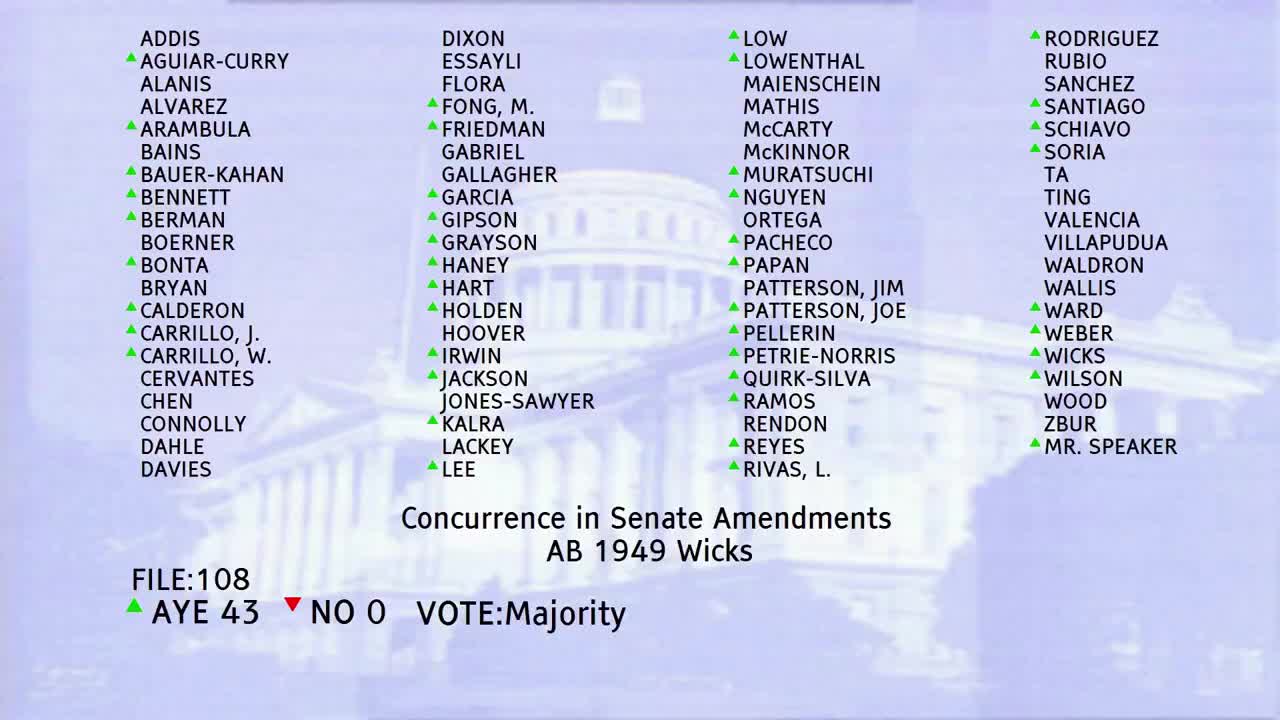 1MIN
Assembly Floor
 57SEC
Senate Floor
 9MIN
Assembly Standing Committee on Natural Resources
Bill Author

Bill Co-Author(s):