AB 2354: Criminal procedure: sentencing.
- Session Year: 2023-2024
- House: Assembly
- Latest Version Date: 2024-03-18
Current Status:
Failed
(2024-05-16: In committee: Held under submission.)
Introduced
In Committee
First Chamber
In Committee
Second Chamber
Enacted
Existing law allows a person who was arrested or convicted of a nonviolent offense while they were a victim of human trafficking, intimate partner violence, or sexual violence, to petition the court, under penalty of perjury, for vacatur relief. Existing law requires, to receive that relief, that the crime for which the person was arrested or convicted was a nonviolent offense and that the person establish, by clear and convincing evidence, that the arrest or conviction was the direct result of being a victim of human trafficking, intimate partner violence, or sexual violence. Existing law authorizes the court to vacate the conviction if it concludes that the petitioner was a victim of one of those crimes at the time of the alleged commission of the offense, the arrest was a direct result of being a victim of that offense, and the vacatur is in the best interest of justice.
This bill would allow that relief for a person arrested or convicted of any offense. The bill would also authorize relief for a person whose offense was related, rather than directly related, to being a victim of human trafficking, intimate partner violence, or sexual violence. The bill would remove the requirement that the court find that vacating the conviction is in the best interest of justice in order to vacate the arrest or conviction. Because this bill would authorize more petitions to be filed under penalty of perjury, by expanding the scope of the crime of perjury, this bill would impose a state-mandated local program.
If a court issues an order for a person who was arrested or convicted of an offense while they were a victim of intimate partner violence or sexual violence, existing law requires the court to order the law enforcement agency having jurisdiction over the offense, the Department of Justice, and any law enforcement agency that arrested the petitioner or participated in the arrest of the petitioner to seal their records of the arrest and the court order to seal and destroy the records within 3 years from the date of the arrest, or within one year after the court order is granted, whichever occurs later, and thereafter to destroy their records of the arrest and the court order to seal and destroy those records.
This bill would require the court to also order any law enforcement agency that has taken action or maintains records related to or because of the offense, including, but not limited to, departments of probation, rehabilitation, corrections, and parole, to seal and destroy their records. The bill would require those agencies to seal their records of arrest and the court order to seal and destroy the records within one year from the date of arrest, or within 90 days after the court order is granted, whichever occurs later. The bill would require the agencies to destroy these records within one year of the date of the court order. The bill would also require the Department of Justice to notify the petitioner and the petitioners counsel that the department has complied with the order to seal the arrest records by the applicable deadline.
The California Constitution requires the state to reimburse local agencies and school districts for certain costs mandated by the state. Statutory provisions establish procedures for making that reimbursement.
This bill would provide that no reimbursement is required by this act for a specified reason.
Existing law prescribes the method by which terms of imprisonment are calculated, including when a person is convicted of 2 or more felonies.This bill would make technical, nonsubstantive changes to this provision.Existing law prescribes the method by which terms of imprisonment are calculated, including when a person is convicted of 2 or more felonies.
This bill would make technical, nonsubstantive changes to this provision.
(a)(1)If a person was arrested for or convicted of any nonviolent an offense committed while they were a victim of human trafficking, including, but not limited to, prostitution as described in subdivision (b) of Section 647, the person may petition the court for vacatur relief of their convictions, arrests, and adjudications under this section. The
(2)In order to establish eligibility for vacatur, the petitioner shall establish, by clear and convincing evidence, that the arrest or conviction was the direct result of being a victim of human trafficking that demonstrates that establishes that the person lacked the requisite intent to commit the offense. Upon this showing, the court shall find that the person lacked the requisite intent to commit the offense and shall therefore vacate the conviction as invalid due to legal defect at the time of the arrest or conviction.
(b)The petition for relief shall be submitted under penalty of perjury and shall describe all of the available grounds and evidence that the petitioner was a victim of human trafficking and the arrest or conviction of a nonviolent an offense was the direct result of being a victim of human trafficking.
(c)The petition for relief and supporting documentation shall be served on the state or local prosecutorial agency that obtained the conviction for which vacatur is sought or with jurisdiction over charging decisions with regard to the arrest. The state or local prosecutorial agency shall have 45 days from the date of receipt of service to respond to the petition for relief.
(d)If opposition to the petition is not filed by the applicable state or local prosecutorial agency, the court shall deem the petition unopposed and may grant the petition. shall grant the petition and issue an order of vacatur.
(e)The court may, with the agreement of the petitioner and all of the involved state or local prosecutorial agencies, consolidate into one hearing a petition with multiple convictions from different jurisdictions.
(f)If the petition is opposed or if the court otherwise deems it necessary, the court shall schedule a hearing on the petition. The hearing may consist of the following:
(1)Testimony by the petitioner, which may be required in support of the petition.
(2)Evidence and supporting documentation in support of the petition.
(3)Opposition evidence presented by any of the involved state or local prosecutorial agencies that obtained the conviction.
(g)After considering the totality of the evidence presented, the court may shall vacate the conviction and the arrests and issue an order if it finds all both of the following:
(1)That the petitioner was a victim of human trafficking at the time of the alleged commission of the qualifying crime. offense.
(2)The arrest for or conviction of the crime offense was a direct result of being a victim of human trafficking.
(3)It is in the best interest of justice.(h)An order of vacatur shall do all of the following:
(1)Set forth a finding that the petitioner was a victim of human trafficking at the time of the alleged commission of the qualifying crime and therefore offense and lacked the requisite intent to commit the offense.
(2)Set aside the arrest, finding of guilt, or the adjudication and dismiss the accusation or information against the petitioner as invalid due to a legal defect at the time of arrest or conviction.
(3)Notify the Department of Justice that the petitioner was a victim of human trafficking when they committed the crime at the time of the alleged commission of the offense and of the relief that has been ordered.
(i)Notwithstanding this section, a petitioner shall not be relieved of any financial restitution order that directly benefits the victim of a nonviolent crime unless it has already been paid. With the exception of restitution, the collection of fines imposed as a result of a nonviolent offense that is the subject of the petition shall be stayed while the petition is pending.(i)(1)The collection of restitution, fines, and fees imposed as a result of an offense that is the subject of the petition shall be stayed while the petition is pending.
(2)If the petition is granted, unpaid restitution, fines, and fees shall be vacated.
(j)A person who was arrested as, or found to be, a person described in Section 602 of the Welfare and Institutions Code because they committed a qualifying nonviolent are alleged to have committed an offense while they were a victim of human trafficking, including, but not limited to, prostitution, as described in subdivision (b) of Section 647, may petition the court for relief under this section. If the petitioner establishes that the arrest or adjudication was the direct result of being a victim of human trafficking, the petitioner is entitled to a rebuttable presumption that the requirements for relief have been met.
(k)(1)If the court issues an order as described in subdivision (a) or (j), pursuant to this section, the court shall also order all of the following agencies to seal and destroy their records:
(A)Any law enforcement agency having jurisdiction over the offense.
(B)The Department of Justice.
(C)Any law enforcement agency that arrested the petitioner.
(D)Any law enforcement agency that participated in the arrest of the petitioner.
(E)Any law enforcement agency that has taken action or maintains records related to or because of the offense, including, but not limited to, departments a department of probation, rehabilitation, corrections, and or parole.
(2)Any government agency described in paragraph (1) shall seal its records of arrest and the court order to seal and destroy the records within one year from the date of arrest or within 90 days after the court order is granted, whichever occurs later. The agency shall thereafter destroy their records of the arrest and court order to seal and destroy those records within one year of the date of the court order.
(3)If requested by the petitioner, the court shall file as confidential the final court order granting the petition.
(3)(4)The court shall provide the petitioner a certified copy of any court order concerning the sealing and destruction of the arrest records. The court shall provide the petitioner and petitioners counsel a copy of any form that the court submits to any agency, including the Department of Justice, related to the sealing and destruction of the arrest records.
(4)(5)The Department of Justice shall notify the petitioner and the petitioners counsel that the department has complied with the order to seal the arrest records by the applicable deadline.
(l)A petition pursuant to this section shall be made and heard at any time after the person has ceased to be a victim of human trafficking or at any time after the petitioner has sought services for being a victim of human trafficking, whichever occurs later, subject to reasonable concerns for the safety of the petitioner, family members of the petitioner, or other victims of human trafficking who may be jeopardized by the bringing of the application or for other reasons consistent with the purposes of this section. time. The right to petition for relief pursuant to this section does not expire with the passage of time and may be made at any time after the time specified in this subdivision. time. A court shall not refuse to hear a petition that was properly made pursuant to this section on the basis of the petitioners outstanding fines and fees fines, fees, or restitution, or the petitioners failure to meet the conditions of probation.
(m)(1)For the purposes of this section, official documentation of a petitioners status as a victim of human trafficking may be introduced as evidence that their alleged participation in the offense was the result of their status as a victim of human trafficking.
(2)For the purposes of this subdivision, official documentation means any documentation issued by a federal, state, or local agency that tends to show the petitioners status as a victim of human trafficking. Official documentation shall not be required for the issuance of an order described in subdivision (a). issued pursuant to this section.
(n) If the petition is unopposed, the petitioner may appear at all hearings on the petition, if any, by counsel. If the petition is opposed and the court orders a hearing for relief on the petition, the petitioner shall appear in person unless the court finds a compelling reason why the petitioner cannot attend the hearing, in which case the petitioner may appear by telephone, videoconference, or by other electronic means established by the court.
(o)Notwithstanding any other law, a petitioner who has obtained an order pursuant to this section may lawfully deny or refuse to acknowledge an arrest, conviction, or adjudication that is set aside pursuant to the order. order and may lawfully state that they were not arrested, adjudicated, or convicted of any charge vacated pursuant to the order.
(p)Notwithstanding any other law, the records of the arrest, conviction, or adjudication shall not be distributed to any state licensing board.
(q)The record of a proceeding related to a petition pursuant to this section that is accessible by the public shall not disclose the petitioners full name.
(r)A court that grants relief pursuant to this section may take additional action as appropriate under the circumstances to carry out the purposes of this section.(r)A court that grants relief pursuant to this section, a state or local prosecutorial agency, any law enforcement agency that arrested or participated in the arrest of the petitioner, or any law enforcement agency that has taken action or maintains records related to or because of the offense being vacated pursuant to this section, including, but not limited to, a department of probation, rehabilitation, corrections, or parole, shall take additional action as appropriate under the circumstances to carry out the purposes of this section.
(s)If the court denies the application because the evidence is insufficient to establish grounds for vacatur, the denial may be without prejudice. The court may state the reasons for its denial in writing or on the record that is memorialized by transcription, audiotape, or videotape, and, if those reasons are based on curable deficiencies in the application, allow the applicant a reasonable time period to cure the deficiencies upon which the court based the denial.
(t)For the purposes of this section, the following terms apply:(1)Nonviolent offense means any offense not listed in subdivision (c) of Section 667.5.(t)The court shall provide the petitioner with a copy of an order issued pursuant to this section, as applicable, and inform the petitioner that they may thereafter state that they were not arrested for the charge, or adjudicated or convicted of the charge, that was vacated.
(2)Vacate(u)(1)For the purposes of this section, vacate means that the arrest and any adjudications or convictions suffered by the petitioner are deemed not to have occurred and that all records in the case are sealed and destroyed pursuant to this section. The court shall provide the petitioner with a copy of the orders described in subdivisions (a), (j), and (k), as applicable, and inform the petitioner that they may thereafter state that they were not arrested for the charge, or adjudicated or convicted of the charge, that was vacated.
(3)(2)Victim of human trafficking means the victim of a crime described in subdivisions (a), (b), and (c) of Section 236.1.
SEC. 2.Section 236.15 of the Penal Code is amended to read:236.15.(a)(1)If a person was arrested for or convicted of any nonviolent an offense committed while the person was a victim of intimate partner violence or sexual violence, the person may petition the court for vacatur relief of their convictions, arrests, and adjudications under this section.
The(2)The petitioner shall establish, by clear and convincing evidence, that the arrest or conviction was the direct result of being a victim of intimate partner violence or sexual violence that demonstrates establishes that the person lacked the requisite intent to commit the offense. Upon this showing, the court shall find that the person lacked the requisite intent to commit the offense and shall therefore vacate the conviction as invalid due to legal defect at the time of the arrest or conviction.
(b)The petition for relief shall be submitted under penalty of perjury and shall describe all of the available grounds and evidence that the petitioner was a victim of intimate partner violence or sexual violence and the arrest or conviction of a nonviolent an offense was the direct result of being a victim of intimate partner violence or sexual violence.
(c)The petition for relief and supporting documentation shall be served on the state or local prosecutorial agency that obtained the conviction for which vacatur is sought or with jurisdiction over charging decisions with regard to the arrest. The state or local prosecutorial agency shall have 45 days from the date of receipt of service to respond to the petition for relief.
(d)If opposition to the petition is not filed by the applicable state or local prosecutorial agency, the court shall deem the petition unopposed and may grant the petition. shall grant the petition and issue an order of vacatur.
(e)The court may, with the agreement of the petitioner and all of the involved state or local prosecutorial agencies, consolidate into one hearing a petition with multiple convictions from different jurisdictions.
(f)If the petition is opposed or if the court otherwise deems it necessary, the court shall schedule a hearing on the petition. The hearing may consist of the following:
(1)Testimony by the petitioner, which may be required in support of the petition.
(2)Evidence and supporting documentation in support of the petition.
(3)Opposition evidence presented by any of the involved state or local prosecutorial agencies that obtained the conviction.
(g)After considering the totality of the evidence presented, the court may shall vacate the conviction and expunge the arrests and issue an order if it finds all both of the following:
(1)That the petitioner was a victim of intimate partner violence or sexual violence at the time of the alleged commission of the qualifying crime. offense.
(2)The arrest or conviction of the crime was a direct result of being a victim of intimate partner violence or sexual violence.
(3)It is in the best interest of justice.(h)An order of vacatur shall do all of the following:
(1)Set forth a finding that the petitioner was a victim of intimate partner violence or sexual violence at the time of the alleged commission of the qualifying crime offense and therefore lacked the requisite intent to commit the offense.
(2)Set aside the arrest, finding of guilt, or the adjudication and dismiss the accusation or information against the petitioner as invalid due to a legal defect at the time of the arrest or conviction.
(3)Notify the Department of Justice that the petitioner was a victim of intimate partner violence or sexual violence when they committed the crime at the time of the alleged commission of the offense and of the relief that has been ordered.
(i)Notwithstanding this section, a petitioner shall not be relieved of any financial restitution order that directly benefits the victim of a nonviolent offense unless it has already been paid.(i)(1)The collection of restitution, fines, and fees imposed as a result of an offense that is the subject of the petition shall be stayed while the petition is pending.
(2)If the petition is granted, unpaid restitution, fines, and fees shall be vacated.
(j)A person who was arrested as, or found to be, a person described in Section 602 of the Welfare and Institutions Code because they committed a qualifying nonviolent are alleged to have committed an offense while they were a victim of intimate partner violence or sexual violence may petition the court for relief under this section. If the petitioner establishes that the arrest or adjudication was the direct result of being a victim of intimate partner violence or sexual violence, the petitioner is entitled to a rebuttable presumption that the requirements for relief have been met.
(k)If the court issues an order as described in subdivision (a) or (j), the court shall also order the law enforcement agency having jurisdiction over the offense, the Department of Justice, and any law enforcement agency that arrested the petitioner or participated in the arrest of the petitioner to seal their records of the arrest and the court order to seal and destroy the records within three years from the date of the arrest or within one year after the court order is granted, whichever occurs later and thereafter to destroy their records of the arrest and the court order to seal and destroy those records. The court shall provide the petitioner a copy of any court order concerning the destruction of the arrest records.(l)A petition pursuant to this section shall be made and heard within a reasonable time after the person has ceased to be a victim of intimate partner violence or sexual violence or within a reasonable time after the petitioner has sought services for being a victim of intimate partner violence or sexual violence, whichever occurs later, subject to reasonable concerns for the safety of the petitioner, family members of the petitioner, or other victims of intimate partner violence or sexual violence who may be jeopardized by the bringing of the application or for other reasons consistent with the purposes of this section.(k)(1)If the court issues an order pursuant to this section, the court shall also order all of the following agencies to seal and destroy their records:
(A)Any law enforcement agency having jurisdiction over the offense.
(B)The Department of Justice.
(C)Any law enforcement agency that arrested the petitioner.
(D)Any law enforcement agency that participated in the arrest of the petitioner.
(E)Any law enforcement agency that has taken action or maintains records related to or because of the offense, including, but not limited to, a department of probation, rehabilitation, corrections, or parole.
(2)Any government agency described in paragraph (1) shall seal its records of arrest and the court order to seal and destroy the records within one year from the date of arrest or within 90 days after the court order is granted, whichever occurs later. The agency shall thereafter destroy their records of the arrest and court order to seal and destroy those records within one year of the date of the court order.
(3)If requested by the petitioner, the court shall file as confidential the final court order granting the petition.
(4)The court shall provide the petitioner a certified copy of any court order concerning the sealing and destruction of the arrest records. The court shall provide the petitioner and petitioners counsel a copy of any form that the court submits to any agency, including the Department of Justice, related to the sealing and destruction of the arrest records.
(5)The Department of Justice shall notify the petitioner and the petitioners counsel that the department has complied with the order to seal the arrest records by the applicable deadline.
(l)A petition pursuant to this section shall be made and heard at any time. The right to petition for relief pursuant to this section does not expire with the passage of time. A court shall not refuse to hear a petition that was properly made pursuant to this section on the basis of the petitioners outstanding fines, fees, or restitution, or the petitioners failure to meet the conditions of probation.
(m)(1)For the purposes of this section, official documentation of a petitioners status as a victim of intimate partner violence or sexual violence may be introduced as evidence that their alleged participation in the offense was the result of their status as a victim of intimate partner violence or sexual violence. For
(2)For the purposes of this subdivision, official documentation means any documentation issued by a federal, state, or local agency that tends to show the petitioners status as a victim of intimate partner violence or sexual violence. Official documentation shall not be required for the issuance of an order described in subdivision (a). issued pursuant to this section.
(n)A petitioner, or their attorney, may be excused from appearing in person at a hearing for relief pursuant to this section only if the court finds a compelling reason why the petitioner cannot attend the hearing, in which case the petitioner may appear telephonically, via videoconference, or by other electronic means established by the court.(n)If the petition is unopposed, the petitioner may appear at all hearings on the petition, if any, by counsel. If the petition is opposed and the court orders a hearing for relief on the petition, the petitioner shall appear in person unless the court finds a compelling reason why the petitioner cannot attend the hearing, in which case the petitioner may appear by telephone, videoconference, or by other electronic means established by the court.
(o)Notwithstanding any other law, a petitioner who has obtained an order pursuant to this section may lawfully deny or refuse to acknowledge an arrest, conviction, or adjudication that is set aside pursuant to the order. order and may lawfully state that they were not arrested, adjudicated, or convicted of any charge vacated pursuant to the order.
(p)Notwithstanding any other law, the records of the arrest, conviction, or adjudication shall not be distributed to any state licensing board.
(q)The record of a proceeding related to a petition pursuant to this section that is accessible by the public shall not disclose the petitioners full name.
(r)A court that grants relief pursuant to this section may take additional action as appropriate under the circumstances to carry out the purposes of this section.(r)A court that grants relief pursuant to this section, a state or local prosecutorial agency, any law enforcement agency that arrested or participated in the arrest of the petitioner, or any law enforcement agency that has taken action or maintains records related to or because of the offense being vacated pursuant to this section, including, but not limited to, a department of probation, rehabilitation, corrections, or parole, shall take additional action as appropriate under the circumstances to carry out the purposes of this section.
(s)If the court denies the application because the evidence is insufficient to establish grounds for vacatur, the denial may be without prejudice. The court may state the reasons for its denial in writing or on the record that is memorialized by transcription, audiotape, or videotape, and if those reasons are based on curable deficiencies in the application, allow the applicant a reasonable time period to cure the deficiencies upon which the court based the denial.
(t)For the purposes of this section, the following terms apply:(1)Nonviolent offense means any offense not listed in subdivision (c) of Section 667.5.(t)The court shall provide the petitioner with a copy of an order issued pursuant to this section, as applicable, and inform the petitioner that they may thereafter state that they were not arrested for the charge, or adjudicated or convicted of the charge, that was vacated.
(2)Vacate(u)For the purposes of this section, vacate means that the arrest and any adjudications or convictions suffered by the petitioner are deemed not to have occurred and that all records in the case are sealed and destroyed pursuant to this section. The court shall provide the petitioner with a copy of the orders described in subdivisions (a), (j), and (k), as applicable, and inform the petitioner that they may thereafter state that they were not arrested for the charge, or adjudicated or convicted of the charge, that was vacated.
SEC. 3.No reimbursement is required by this act pursuant to Section 6 of Article XIIIB of the California Constitution because the only costs that may be incurred by a local agency or school district will be incurred because this act creates a new crime or infraction, eliminates a crime or infraction, or changes the penalty for a crime or infraction, within the meaning of Section 17556 of the Government Code, or changes the definition of a crime within the meaning of Section 6 of Article XIIIB of the California Constitution.
SECTION 1.Section 1170.1 of the Penal Code is amended to read:1170.1.(a)Except as otherwise provided by law, and subject to Section 654, when any person is convicted of two or more felonies, whether in the same proceeding or court or in different proceedings or courts, and whether by judgment rendered by the same or by a different court, and a consecutive term of imprisonment is imposed under Sections 669 and 1170, the aggregate term of imprisonment for all these convictions shall be the sum of the principal term, the subordinate term, and any additional term imposed for applicable enhancements for prior convictions, prior prison terms, and Section 12022.1. The principal term shall consist of the greatest term of imprisonment imposed by the court for any of the crimes, including any term imposed for applicable specific enhancements. The subordinate term for each consecutive offense shall consist of one-third of the middle term of imprisonment prescribed for each other felony conviction for which a consecutive term of imprisonment is imposed, and shall include one-third of the term imposed for any specific enhancements applicable to those subordinate offenses. Whenever a court imposes a term of imprisonment in the state prison, whether the term is a principal or subordinate term, the aggregate term shall be served in the state prison, regardless as to whether or not one of the terms specifies imprisonment in a county jail pursuant to subdivision (h) of Section 1170.(b)If a person is convicted of two or more violations of kidnapping, as defined in Section 207, involving separate victims, the subordinate term for each consecutive offense of kidnapping shall consist of the full middle term and shall include the full term imposed for specific enhancements applicable to those subordinate offenses.(c)In the case of a person convicted of one or more felonies committed while the person is confined in the state prison or is subject to reimprisonment for escape from custody and the law either requires the terms to be served consecutively or the court imposes consecutive terms, the term of imprisonment for all the convictions that the person is required to serve consecutively shall commence from the time the person would otherwise have been released from prison. If the new offenses are consecutive with each other, the principal and subordinate terms shall be calculated as provided in subdivision (a). This subdivision shall be applicable in cases of convictions of more than one offense in the same or different proceedings.(d)(1)When the court imposes a sentence for a felony pursuant to Section 1170 or subdivision (b) of Section 1168, the court shall also impose, in addition and consecutive to the offense of which the person has been convicted, the additional terms provided for any applicable enhancements. If an enhancement is punishable by one of three terms, the court shall, in its sound discretion, order imposition of a sentence not to exceed the middle term, except as otherwise provided in paragraph (2).(2)The court may impose a sentence exceeding the middle term only when there are circumstances in aggravation that justify the imposition of a term of imprisonment exceeding the middle term, and the facts underlying those circumstances have been stipulated to by the defendant, or have been found true beyond a reasonable doubt at trial by the jury or by the judge in a court trial.(3)The court shall also impose any other additional term that the court determines in its discretion or as required by law shall run consecutive to the term imposed under Section 1170 or subdivision (b) of Section 1168. In considering the imposition of the additional term, the court shall apply the sentencing rules of the Judicial Council.(e)All enhancements shall be alleged in the accusatory pleading and either admitted by the defendant in open court or found to be true by the trier of fact.(f)When two or more enhancements may be imposed for being armed with or using a dangerous or deadly weapon or a firearm in the commission of a single offense, only the greatest of those enhancements shall be imposed for that offense. This subdivision shall not limit the imposition of any other enhancements applicable to that offense, including an enhancement for the infliction of great bodily injury.(g)When two or more enhancements may be imposed for the infliction of great bodily injury on the same victim in the commission of a single offense, only the greatest of those enhancements shall be imposed for that offense. This subdivision shall not limit the imposition of any other enhancements applicable to that offense, including an enhancement for being armed with or using a dangerous or deadly weapon or a firearm.(h)For any violation of an offense specified in Section 667.6, the number of enhancements that may be imposed shall not be limited, regardless of whether the enhancements are pursuant to this section, Section 667.6, or some other law. Each of the enhancements shall be a full and separately served term. REVISIONS: HeadingLine 2.(a)Except as otherwise provided by law, and subject to Section 654, when any person is convicted of two or more felonies, whether in the same proceeding or court or in different proceedings or courts, and whether by judgment rendered by the same or by a different court, and a consecutive term of imprisonment is imposed under Sections 669 and 1170, the aggregate term of imprisonment for all these convictions shall be the sum of the principal term, the subordinate term, and any additional term imposed for applicable enhancements for prior convictions, prior prison terms, and Section 12022.1. The principal term shall consist of the greatest term of imprisonment imposed by the court for any of the crimes, including any term imposed for applicable specific enhancements. The subordinate term for each consecutive offense shall consist of one-third of the middle term of imprisonment prescribed for each other felony conviction for which a consecutive term of imprisonment is imposed, and shall include one-third of the term imposed for any specific enhancements applicable to those subordinate offenses. Whenever a court imposes a term of imprisonment in the state prison, whether the term is a principal or subordinate term, the aggregate term shall be served in the state prison, regardless as to whether or not one of the terms specifies imprisonment in a county jail pursuant to subdivision (h) of Section 1170.
(b)If a person is convicted of two or more violations of kidnapping, as defined in Section 207, involving separate victims, the subordinate term for each consecutive offense of kidnapping shall consist of the full middle term and shall include the full term imposed for specific enhancements applicable to those subordinate offenses.
(c)In the case of any a person convicted of one or more felonies committed while the person is confined in the state prison or is subject to reimprisonment for escape from custody and the law either requires the terms to be served consecutively or the court imposes consecutive terms, the term of imprisonment for all the convictions that the person is required to serve consecutively shall commence from the time the person would otherwise have been released from prison. If the new offenses are consecutive with each other, the principal and subordinate terms shall be calculated as provided in subdivision (a). This subdivision shall be applicable in cases of convictions of more than one offense in the same or different proceedings.
(d)(1)When the court imposes a sentence for a felony pursuant to Section 1170 or subdivision (b) of Section 1168, the court shall also impose, in addition and consecutive to the offense of which the person has been convicted, the additional terms provided for any applicable enhancements. If an enhancement is punishable by one of three terms, the court shall, in its sound discretion, order imposition of a sentence not to exceed the middle term, except as otherwise provided in paragraph (2).
(2)The court may impose a sentence exceeding the middle term only when there are circumstances in aggravation that justify the imposition of a term of imprisonment exceeding the middle term, and the facts underlying those circumstances have been stipulated to by the defendant, or have been found true beyond a reasonable doubt at trial by the jury or by the judge in a court trial.
(3)The court shall also impose any other additional term that the court determines in its discretion or as required by law shall run consecutive to the term imposed under Section 1170 or subdivision (b) of Section 1168. In considering the imposition of the additional term, the court shall apply the sentencing rules of the Judicial Council.
(e)All enhancements shall be alleged in the accusatory pleading and either admitted by the defendant in open court or found to be true by the trier of fact.
(f)When two or more enhancements may be imposed for being armed with or using a dangerous or deadly weapon or a firearm in the commission of a single offense, only the greatest of those enhancements shall be imposed for that offense. This subdivision shall not limit the imposition of any other enhancements applicable to that offense, including an enhancement for the infliction of great bodily injury.
(g)When two or more enhancements may be imposed for the infliction of great bodily injury on the same victim in the commission of a single offense, only the greatest of those enhancements shall be imposed for that offense. This subdivision shall not limit the imposition of any other enhancements applicable to that offense, including an enhancement for being armed with or using a dangerous or deadly weapon or a firearm.
(h)For any violation of an offense specified in Section 667.6, the number of enhancements that may be imposed shall not be limited, regardless of whether the enhancements are pursuant to this section, Section 667.6, or some other provision of law. Each of the enhancements shall be a full and separately served term.
|
Date
|
Status
|
|---|---|
| May 16, 2024 | In committee: Held under submission. |
| May 16, 2024 | Coauthors revised. |
| May 1, 2024 | In committee: Set, first hearing. Referred to APPR. suspense file. |
| Apr 17, 2024 | From committee: Do pass and re-refer to Com. on APPR. (Ayes 6. Noes 0.) (April 16). Re-referred to Com. on APPR. |
| Mar 19, 2024 | Re-referred to Com. on PUB. S. |
| Mar 18, 2024 | Referred to Com. on PUB. S. |
| Mar 18, 2024 | From committee chair, with author's amendments: Amend, and re-refer to Com. on PUB. S. Read second time and amended. |
| Feb 13, 2024 | From printer. May be heard in committee March 14. |
| Feb 12, 2024 | Read first time. To print. |
|
Date
|
Description
|
Location
|
Votes
|
|
|---|---|---|---|---|
| Apr 16, 2024 | Do pass and be re-referred to the Committee on [Appropriations] | Assembly Standing Committee on Public Safety |
Passed |
This list shows positions taken on this bill by organizations on the date displayed, which is linked to the original source.
Positions by individuals are not included.
|
Organization
|
Position
|
Date
|
|---|---|---|
| AAPI Equity Alliance | ** Support | |
| Aclu California Action | ** Support | |
| Alliance for Boys and Men of Color | ** Support | |
| Alliance for Childrens Rights | ** Support | |
| Alliance for Girls | ** Support | |
| A New Way of Life Reentry Project | ** Support | |
| Buen Vecino | ** Support | |
| California Coalition for Women Prisoners | ** Support | |
| California District Attorneys Association | ** Against | |
| California Immigrant Policy Center | ** Support | |
| Californians for Safety and Justice | ** Support | |
| California Public Defenders Association | ** Support | |
| Children’s Defense Fund – CA | ** Support | |
| Coalition to Abolish Slavery & Trafficking | ** Support | |
| Communities United for Restorative Youth Justice | ** Support | |
| Community Legal Services in East Palo Alto | ** Support | |
| Crime Survivors for Safety and Justice | ** Support | |
| Ella Baker Center For Human Rights | ** Support | |
| Felony Murder Elimination Project | ** Support | |
| Freedom 4 Youth | ** Support | |
| Free to Thrive | ** Support | |
| Friends Committee On Legislation Of California | ** Support | |
| Immigrant Legal Resource Center | ** Support | |
| Initiate Justice | ** Support | |
| Initiate Justice Action | ** Support | |
| Inland Coalition for Immigrant Justice | ** Support | |
| John Burton Advocates for Youth | ** Support | |
| Journey Out | ** Support | |
| Justice At Last | ** Support | |
| Legal Services for Prisoners with Children | ** Support | |
| Los Angeles Center for Law and Justice | ** Support | |
| Messaging for Success | ** Support | |
| National Center for Youth Law | ** Support | |
| Parenting for Liberation | ** Support | |
| Rainbow Services, Ltd. | ** Support | |
| San Francisco Public Defenders Office | ** Support | |
| Shared Hope International | ** Support | |
| Sister Warriors Freedom Coalition | ** Support | |
| Smart Justice California | ** Support | |
| Survived & Punished | ** Support | |
| Valor | ** Support | |
| Women'S Foundation California | ** Support | |
| Young Women’s Freedom Center | ** Support |
Date of Hearing: May 1, 2024
ASSEMBLY COMMITTEE ON APPROPRIATIONS
Buffy Wicks, Chair
ABPCA Bill Id:AB 2354
Author:(Bonta) – As Amended Ver:March 18, 2024
Policy Committee: | Public Safety | Vote: | 6 - 0 |
|
| ||
|
|
Urgency: No State Mandated Local Program: Yes Reimbursable: No
SUMMARY:
This bill expands eligibility for vacatur relief and requires a court to grant relief in specified circumstances.
Specifically, among other provisions, this bill:
- Authorizes a person who was arrested for or convicted of an offense committed while they were a victim of human trafficking, intimate partner violence, or sexual violence (a “qualifying victim”) to petition the court for vacatur relief of their convictions, arrests, and adjudications.
- Requires a court to grant a petition for vacatur relief and issue an order of vacatur if opposition to the petition is not filed.
- Requires a court to grant a petition for vacatur relief if the court finds that the petitioner was a qualifying victim at the time of the alleged commission of the offense and the arrest for or conviction of the offense was a result of being a qualifying victim.
- Requires collection of unpaid restitution, fines, and fees to be stayed pending adjudication of a petition for vacatur relief.
- Requires a court to vacate unpaid restitution, fines, and fees if the court grants a petition for vacatur relief.
- Requires a law enforcement agency to, upon court order, seal and destroy additional records related to an offense for which vacatur relief is granted.
FISCAL EFFECT:
- Costs (Trial Court Trust Fund, General Fund) to the courts to adjudicate additional petitions for vacatur relief authorized by this bill. Actual costs will depend on the number of petitions filed and the amount of court time needed to adjudicate each petition. It generally costs approximately $1,000 to operate a courtroom for one hour. If 150 petitions are filed and each requires one hour of court time to resolve, total workload cost to the courts would be about $150,000. Although courts are not funded on the basis of workload, increased pressure on the Trial Court Trust Fund may create a need for increased funding for courts from the General Fund. The Governor’s 2024-25 budget proposes $83.1 million ongoing from the General Fund to backfill declining revenue to the Trial Court Trust Fund.
- Possible future cost savings to the counties and the California Department of Corrections and Rehabilitation, to the extent this bill reduces incarceration by vacating convictions.
According to the Legislative Analyst’s Office, the General Fund faces a structural deficit in the tens of billions of dollars over the next several fiscal years.
COMMENTS:
- Purpose. According to the author:
Every Californian deserves the opportunity to live a life free of trauma and violence, and to receive protection, healing, and care when they are victims of violence. AB 2354 embodies this goal and offers a vital lifeline to those who’ve endured unimaginable hardships. By granting all survivors of human trafficking, intimate partner violence, and other forms of violence the opportunity to clear their records through vacatur, we dismantle barriers to essential resources, such as housing, job training, and employment, and pave the way for true healing. AB 2354 ensures every individual can rebuild their life unencumbered by the shadows of their past.
- Background. Vacatur relief is a process through which a qualifying victim can petition a court to vacate and seal arrests, convictions, or juvenile adjudications that were a direct result of being a victim. In California, victims of human trafficking, intimate partner violence, or sexual violence are qualifying victims who may petition for vacatur relief. Under existing law, vacatur relief may be granted only for nonviolent offenses.
As described above and in more detail in the analysis of this bill by the Assembly Committee on Public Safety, this bill makes several changes to the vacatur relief statutes to expand eligibility for relief and require the court to grant relief in more circumstances. The bill allows vacatur relief for offenses on the violent felony list and removes the requirement that an offense be “directly” related to the person’s status as a victim to qualify for relief. The bill also requires a court to grant a petition for vacatur relief that is unopposed, and requires, rather than permits, a court to grant a petition for vacatur relief if the court finds the petitioner was a qualifying victim at the time of the offense and the offense was a result of being a qualifying victim.
- Support and Opposition. In support of this bill, Californians for Safety and Justice writes:
Too often, victims and survivors of violence are blocked from the opportunity to heal because their trauma is used against them, ignored, or not accounted for during legal proceedings. Vacatur – a process that allows survivors to petition the court for the records to be cleared – can provide a form of relief for survivors who carry records created as a result of their abuse. AB 2354 would recognize the trauma and coercion many survivors face, offering a path to justice by recognizing their victimization and clearing those arrests and convictions from their records if their criminalization was a result of their experience of intimate partner violence, human trafficking, or sexual violence. It empowers survivors to rebuild their lives without the burden of a record tied to their abuse.
In opposition, the California District Attorneys Association writes:
AB 2354 both removes the exclusion for violent offenses and takes discretion away from judges. The bill provides that vacatur relief is available for any offense, including violent offenses. Thus, convicted murderers, rapists, and kidnappers, among other violent offenders, would be eligible for relief. Furthermore, the bill makes relief mandatory and takes discretion away from judges to grant relief only when in the interest of justice. And, if relief is granted, AB 2354 would also require that any victim restitution order be vacated and that the arrest or conviction be deemed never to have occurred with all records sealed.
- Related Legislation. AB 1497 (Haney), of this legislative session, authorized vacatur relief for violent felony offenses, among other provisions. AB 1497 was held on this committee’s suspense file.
Analysis Prepared by: Annika Carlson / APPR. / (916) 319-2081
Date of Hearing: April 16, 2024
Counsel: Shaun Naidu
ASSEMBLY COMMITTEE ON PUBLIC SAFETY
Kevin McCarty, Chair
ABPCA Bill Id:AB 2354
Author:(Bonta) – As Amended Ver:March 18, 2024
SUMMARY:
Expands vacatur relief to a victim of human trafficking, intimate partner violence, or sexual violence who was arrested for, or convicted (or adjudicated through juvenile court) of, a violent offense. Specifically, this bill:
- Makes human trafficking, intimate partner violence, and sexual violence vacatur relief applicable to all crimes the petitioner lacked the requisite intent to commit, by striking provisions that exclude crimes on the violent felonies list.
- Allows for the vacation of the arrest or conviction if the commission of the offense was a result of the petitioner being a victim of human trafficking, intimate partner violence, or sexual violence, by striking the requirement that the commission of the offense be a direct result of the petitioner as a victim.
- Changes from discretionary authority of the court to mandatory that the court vacate an arrest or conviction if the petitioner was a victim of human trafficking, intimate partner violence, or sexual violence at the time of the alleged offense and the offense for which the petitioner was arrested for or convicted of was a result of being a victim of human trafficking, intimate partner violence, or sexual violence.
- Requires the court issue an order of vacatur if the applicable prosecutorial agency does not file an opposition to the petition.
- Requires the vacation of unpaid restitution, fines, and fees if the petition is granted.
- Requires the court to file as confidential the final court order granting the petition if requested by the petitioner.
- Allows a human trafficking, intimate partner violence, or sexual violence vacatur petition to be heard at any time, by striking the requirement that the petition be heard after the later of the person ceasing to be a victim or the person seeking services for being a victim.
- Prohibits a court from refusing to hear a properly-made petition on the basis of the petitioner’s outstanding restitution.
- Specifies the sealing and destruction of records related to the offense maintained by the Department of Justice (DOJ) and other law enforcement agencies.
- Reduces, as specified, the amount of time within which the court, DOJ, and any law enforcement agency that arrested or participated in the arrest of the petitioner must seal and destroy their records of the arrest, if the court issues a vacatur order.
EXISTING LAW:
- Authorizes a person who was arrested for, or convicted of, any nonviolent offense, as defined, committed while they were a victim of human trafficking, intimate partner violence, or sexual violence, to petition the court for vacatur relief of their convictions, adjudications, and/or arrests. (Pen. Code, §§ 236.14 & 236.15.)
- Requires the petitioner to establish, by clear and convincing evidence, that the arrest or conviction was the direct result of being a victim of human trafficking, intimate partner violence, or sexual violence which demonstrates that the person lacked the requisite intent to commit the offense. (Pen. Code, §§ 236.14, subd. (a); 236.15, subd. (a).)
- Authorizes the court, after considering the totality of the evidence presented, to vacate the conviction and/or arrest and issue an order, if it all of the following:
- The petitioner was a human trafficking, intimate partner violence, or sexual violence victim at the time of the alleged commission of the qualifying;
- The arrest for or conviction of the crime was a direct result of being a victim; and
- It is in the best interest of justice. (Pen. Code, §§ 236.14, subd. (g); 236.15, subd. (g).)
- Specifies that the human trafficking, intimate partner violence, and sexual violence vacatur laws do not relieve a petitioner of any financial restitution order that directly benefits the victim of a nonviolent crime unless it has been paid already. (Pen. Code, §§ 236.14, subd. (i); 236.15, subd. (i).)
- Requires, if the court issues a vacatur order, the court, DOJ, and any law enforcement agency that arrested or participated in the arrest of the petitioner to seal and destroy their records of the arrest, and the court order, within the later of either of the following:
- Three years from the date of the arrest; or
- One year after the court order is granted. (Pen. Code, §§ 236.14, subd. (k); 236.15, subd. (k).)
- Permits a human trafficking, intimate partner violence, and sexual violence vacatur petition to be made and heard any time after the later of either of the following, subject to reasonable concerns for the safety of the petitioner, family members of the petitioner, or other victims who may be jeopardized by the bringing of the application or for other reasons consistent with the vacatur laws:
- The person has ceased to be a victim of human trafficking; or,
- The petitioner has sought services for being a victim of human trafficking. (Pen. Code, §§ 236.14, subd. (l); 236.15, subd. (l).)
- Defines “nonviolent offense,” for the purposes of human trafficking, intimate partner violence, or sexual violence vacatur relief to mean any offense not listed as a violent felony. ((Pen. Code, §§ 236.14, subd. (t)(1); 236.15, subd. (t)(1).)
FISCAL EFFECT:
Unknown
COMMENTS:
- Author's Statement: According to the author, "Every Californian deserves the opportunity to live a life free of trauma and violence, and to receive protection, healing, and care when they are victims of violence. AB 2354 embodies this goal and offers a vital lifeline to those who've endured unimaginable hardships. By granting all survivors of human trafficking, intimate partner violence, and other forms of violence the opportunity to clear their records through vacatur, we dismantle barriers to essential resources, such as housing, job training, and employment, and pave the way for true healing. AB 2354 ensures every individual can rebuild their life unencumbered by the shadows of their past.”
- Vacatur Relief: Penal Code section 236.14 provides post-conviction relief to human trafficking victims by vacating nonviolent arrests, juvenile adjudications, and convictions that were a direct result of human trafficking. Penal Code section 236.15 extends the same form of post-conviction relief to intimate partner violence and/or sexual violence victims by vacating nonviolent arrests, juvenile adjudications, and convictions that were a direct result of the intimate partner or sexual violence. "Vacate" means that the arrest and any adjudications or convictions suffered by the petitioner are deemed not to have occurred and that all records in the case are sealed and destroyed. (Pen. Code, §§ 236.14, subd. (t)(2), 236.15, subd. (t)(2).) The purpose of these laws is to provide relief for individuals who have criminal records as a result of their exploitation, by vacating nonviolent criminal offenses that were committed by human trafficking victims at the behest of their traffickers. (See, Assembly Public Safety Analysis for SB 823 (Block), Chapter 650, Statutes of 2016.)
This bill would extend the human trafficking, intimate partner violence, and sexual violence vacatur relief to any crime listed as a violent felony. Crimes currently listed as a violent felony include murder, voluntary manslaughter, mayhem, specified sex crimes, robbery, arson, kidnapping, carjacking, and first-degree burglary, among other offenses. (Pen. Code, § 667.5, subd. (c).) According to information provided by the author’s office, while California does not extend vacatur relief to violent felonies, some states do not have such categorical exemptions. (See, e.g., Wyo. Stat. Ann. § 6-2-708.)
In addition to expanding vacatur relief to arrests for and convictions of violent felonies, AB 2354 would remove the courts discretion to grant this relief if it is in the best interest of justice. Specifically, this bill would make this relief mandatory by the court if the petition for relief is unopposed by the applicable prosecuting agency or, after considering the totality of the evidence presented, the court finds that the petitioner was a victim of human trafficking, intimate partner violence, or sexual violence at the time of the alleged commission of the qualifying offense and the arrest or conviction of the offense was a result (no longer a direct result) of being such a victim.
- Argument in Support: According to the California Coalition for Women Prisoners and the other co-sponsors, “In California, 34% of women will experience domestic violence in their lifetimes (National Center for Injury Prevention and Control, Division of Violence Prevention, The National Intimate Partner and Sexual Violence Survey 2010-2012 State Report). Gender-based violence – including domestic violence, human trafficking, and sexual violence – impacts all communities, but Black, brown, and indigenous women and queer and trans people are disproportionately impacted. Black women are almost three times more likely than white women to die at the hands of a current or former partner (Everytown for Gun Safety, Guns and Violence Against Women: America’s Uniquely Lethal Intimate Partner Violence Problem). More than 80% of American Indian and Alaska Native women had experienced violence in their lifetime, and one in three had experienced violence within the past year (Andre B. Rosay, ‘Violence Against American Indian and Alaska Native Women and Men’). Transgender and gender non-conforming people are more likely to be sexually assaulted as children, have a greater risk of sexual violence across their lifetimes, and are vastly overrepresented in prisons (Office for Victims of Crime, ‘Responding to Transgender Victims of Sexual Assault’; Brian C. Thoma, Taylor L. Rezeppa, Sophia Choukas-Bradley, Rachel H. Salk, and Michael P. Marshal, ‘Disparities in Childhood Abuse Between Transgender and Cisgender Adolescents’; Lambda Legal, ‘Transgender Incarcerated People in Crisis’).
“A horrifying reality of our current legal system is that over 90% of human trafficking victims are criminalized while being trafficked (National Survivor Network, ‘National Survivor Network Survey: Impact on Criminal Arrest and Detention on Survivors of Human Trafficking’). Survivors are often arrested and punished simply for protecting their or their family’s lives (Yasmin Vafa & Rebecca Epstein, Criminalized Survivors: Today’s Abuse to Prison Pipeline for Girls). The criminalization of victims by California’s legal system leaves survivors without access to resources for survival, like housing, employment, education, and financial independence, and subjects them to continued cycles of violence, homelessness, and poverty (Polaris, In Harm’s Way: How Systems Fail Human Trafficking Survivors Survey Results from the First National Survivor Study).
“Too often, victims and survivors of violence are blocked from the opportunity to heal because their trauma is used against them, ignored, or not accounted for during legal proceedings. Vacatur – a process that allows survivors to petition the court for the records to be cleared – can provide a form of relief for survivors who carry records created as a result of their abuse.
“AB 2354 would recognize the trauma and coercion many survivors face, offering a path to justice by recognizing their victimization and clearing those arrests and convictions from their records if their criminalization was a result of their experience of intimate partner violence, human trafficking, or sexual violence. It empowers survivors to rebuild their lives without the burden of a record tied to their abuse.” (Hyperlinks omitted.)
- Argument in Opposition: According to the California District Attorneys Association, “This bill would amend the vacatur relief statutes to expand the provisions to include violent offenses and also take discretion away from judges.
“The vacatur relief provisions – Penal Code section 236.14 and 236.15 – were enacted in 2016 and 2021, respectively. The statutes provide that individuals arrested or convicted of a nonviolent offense while they were a victim of human trafficking, intimate partner violence, or sexual violence may petition the court for relief. Importantly, both provisions specifically exclude violent offenders such as murderers, rapists, kidnappers, and other serious offenders who committed offenses listed in Penal Code section 667.5(c). In addition, both provisions also specifically give the court the discretion to grant relief, but only when in the interests of justice.
“AB 2354 both removes the exclusion for violent offenses and takes discretion away from judges. The bill provides that vacatur relief is available for any offense, including violent offenses. Thus, convicted murderers, rapists, and kidnappers, among other violent offenders, would be eligible for relief. Furthermore, the bill makes relief mandatory and takes discretion away from judges to grant relief only when in the interest of justice. And, if relief is granted, AB 2354 would also require that any victim restitution order be vacated and that the arrest or conviction be deemed never to have occurred with all records sealed.”
- Prior Legislation:
- AB 1497 (Haney), of the 2023-2024 Legislative Session, would have, among other things, expanded vacatur relief to violent felony offenses for victims of human trafficking, intimate partner violence, and sexual violence. AB 1497 was held on the Suspense File of the Assembly Committee on Appropriations.
- AB 2169 (Gipson), Chapter 776, Statutes of 2022, clarified that vacatur relief for offenses committed while the petitioner was a victim of human trafficking, intimate partner violence, or sexual violence demonstrates that the petitioner lacked the requisite intent to commit the offense and that the conviction is invalid due to legal defect.
- AB 124 (Kamlager), Chapter 695, Statutes of 2021, required courts to consider if specified trauma to a defendant and other factors contributed to the commission of an offense when making sentencing and resentencing determinations and expanded the affirmative defense of coercion for human trafficking victims and extended it and vacatur relief to victims of intimate partner violence and sexual violence.
- AB 262 (Patterson), Chapter 193, Statutes of 2021, provided additional legal rights when a victim of human trafficking petitions the court to vacate a conviction for a non-violent crime that was committed while the petitioner was a victim of human trafficking. It allowed a person, when petitioning to vacate a non-violent conviction because the petitioner was a victim of human trafficking and the conviction was a direct result of being a victim of human trafficking, to appear at the court hearings by counsel and removed time limitations to bring the petitions.
- AB 2868 (Patterson), of the 2019-2020 Legislative Session, would have provided additional legal rights in the judicial process when a victim of human trafficking petitions the court to vacate a conviction for a non-violent crime that was committed while the petitioner was a victim of human trafficking. AB 2868 was not heard in this committee.
- AB 2869 (Patterson), of the 2019-2020 Legislative Session, would have allowed a petitioner, on a petition to vacate a non-violent conviction because the petitioner was victim of human trafficking and the conviction that was a direct result of being a victim of human trafficking, to appear at the court hearings by counsel. AB 2869 was not heard in this committee.
- SB 823 (Block), Chapter 650, Statutes of 2016, allowed a person arrested for or convicted of a non-violent crime while they were a human trafficking victim to apply to the court to vacate the conviction and seal and destroy records of arrest.
- SB 799 (Karnette), Chapter 858, Statutes of 2001, allowed women who were convicted of homicide prior to the enactment of the Evidence Code provision providing for the admissibility of evidence relating to battered women's syndrome to bring a writ of habeas corpus when there is a reasonable probability that the result of the case may have been different had evidence of battered women's syndrome been admissible in the original trial.
REGISTERED SUPPORT / OPPOSITION:
Support
California Coalition for Women Prisoners (Co-Sponsor)
Californians for Safety and Justice (Co-Sponsor)
Crime Survivors for Safety and Justice (Co-Sponsor)
Coalition to Abolish Slavery & Trafficking (Co-Sponsor)
Felony Murder Elimination Project (Co-Sponsor)
Free to Thrive (Co-Sponsor)
Immigrant Legal Resource Center (Co-Sponsor)
Los Angeles Center for Law and Justice (Co-Sponsor)
National Center for Youth Law (Co-Sponsor)
Rainbow Services, Ltd. (Co-Sponsor)
San Francisco Public Defender’s Office (Co-Sponsor)
Sister Warriors Freedom Coalition (Co-Sponsor)
Survived & Punished (Co-Sponsor)
A New Way of Life Reentry Project
AAPI Equity Alliance
ACLU California Action
Alliance for Boys and Men of Color
Alliance for Children’s Rights
Alliance for Girls
Buen Vecino
California Immigrant Policy Center
California Public Defenders Association
Children’s Defense Fund – CA
Communities United for Restorative Youth Justice (CURYJ)
Community Legal Services in East Palo Alto
Ella Baker Center for Human Rights
Freedom 4 Youth
Friends Committee on Legislation of California
Initiate Justice
Initiate Justice Action
Inland Coalition for Immigrant Justice
John Burton Advocates for Youth
Journey Out
Justice At Last
Legal Services for Prisoners with Children
Messaging for Success
Parenting for Liberation
Shared Hope International
Smart Justice California
VALOR
Women’s Foundation California
Young Women’s Freedom Center
Opposition
California District Attorneys Association
Analysis Prepared by:
Shaun Naidu / PUB. S. / (916) 319-3744
Discussed in Hearing
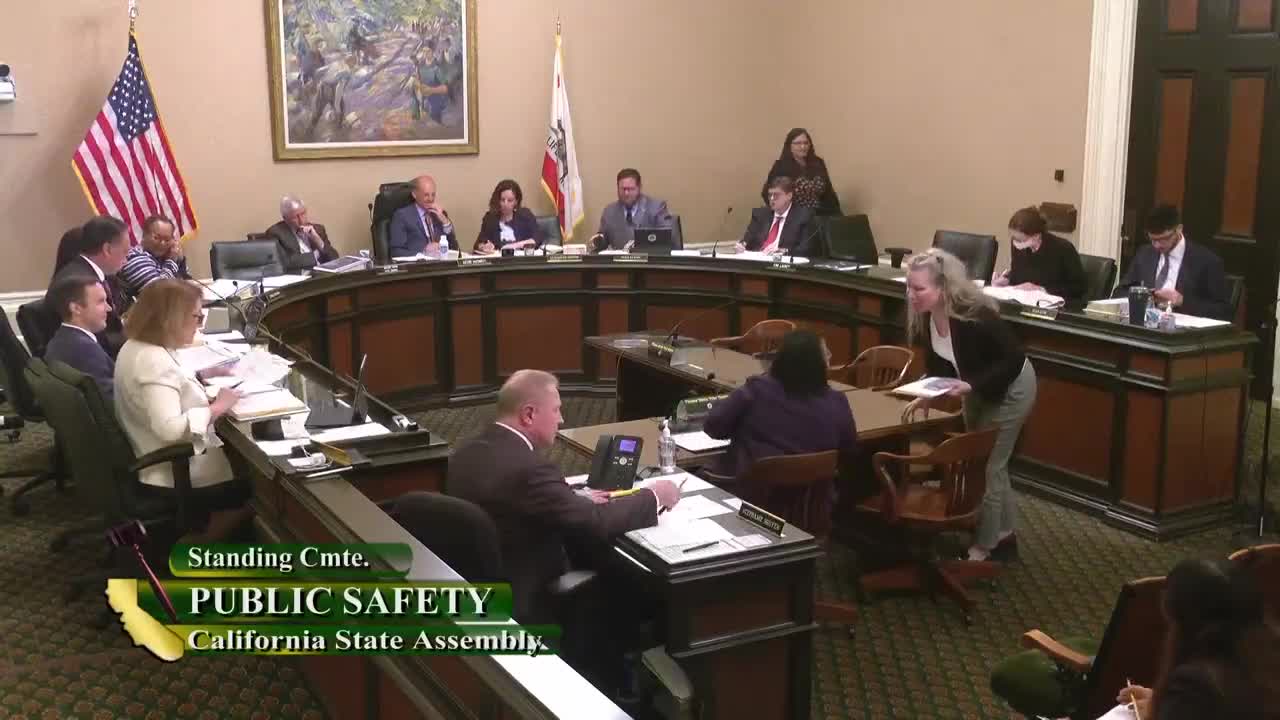 28MIN
Assembly Standing Committee on Public Safety
Bill Author