AB 2374: Displaced janitors.
- Session Year: 2023-2024
- House: Assembly
- Latest Version Date: 2024-05-20
Current Status:
Failed
(2024-08-15: In committee: Held under submission.)
Introduced
In Committee
First Chamber
In Committee
Second Chamber
Enacted
Existing law, the Displaced Janitor Opportunity Act, requires contractors and subcontractors, as defined, that are awarded contracts or subcontracts, on and after January 1, 2002, for janitorial or building maintenance services at a particular job site or sites, to retain, for a period of 60 days, certain employees who were employed at that site by the previous contractor or subcontractor. Under the act, a contractor means any person that employees 25 or more individuals and that enters into a service contract with the awarding authority. Existing law requires employees retained for that 60-day period to be offered continued employment if their performance during that 60-day period is satisfactory.
This bill would, instead, define the term contractor to mean any person that employs janitor employees and that enters into a service contract with the awarding authority. The bill would make related changes to various definitions used in the act.
This bill would extend the above-described timeframe for which a successor contractor or subcontractor is required to retain employees of a terminated contractor or subcontractor to 90 days. The bill would require the successor contractor or subcontractor, during the 90-day transition period, to maintain a preferential hiring list of eligible covered employees by seniority within job classifications. The bill would also require employees retained for the 90-day period to be offered continued employment if their performance during that 90-day period is satisfactory. The bill would require that offer to be contemporaneously shared with the union representing the employees, if applicable.
Among other changes, the bill would require an awarding authority that enters into contracts or subcontracts for janitorial or building services to provide written notification to the union that represents the employees and the employees both the contractor and the union, if the employees are represented by a union, within 5 days of making the decision to terminate a service contract, and contract and to post a notice in a conspicuous location at the worksite. The bill would prescribe specified elements to be included in that notification, those notices, including the termination date of the service contract. Additionally, the bill would require a successor contractor or subcontractor to maintain the same work schedules number of hours and pay the same wages and benefits as those of the prior contractor or subcontractor. The bill would further provide that a successor contractor would be bound by the collective bargaining agreement of the former contractor.
Existing law authorizes an employee who was not offered employment or was discharged in violation of these provisions to bring an enforcement action against a successor contractor or successor subcontractor in a court of competent jurisdiction. Existing law requires a court to award backpay to an employee if the court finds that the contractor or subcontractor has violated the act, in addition to other specified remedies.
The bill would also authorize a union representing janitors under the act to bring an enforcement action pursuant to these provisions. TheThis bill would require a court to award treble damages for a violation, if it finds that a partys violation of the act was willful. The bill would additionally authorize the Labor Commissioner to enforce these provisions and to recover specified remedies on behalf of an aggrieved employee, including hiring and reinstatement rights. The bill would make an employer, agent of any employer, or other person who violates these provisions subject to specified civil penalties and liquidated damages, and would require the liquidated damages to be deposited into the Labor and Workforce Development Fund and paid to the employee as compensatory damages. The bill would authorize the Labor Commissioner to promulgate and enforce rules and regulations and to issue determinations and interpretations.
Existing law, the Displaced Janitor Opportunity Act, requires contractors and subcontractors, as defined, that are awarded contracts or subcontracts, on and after January 1, 2002, for janitorial or building maintenance services at a particular job site or sites, to retain, for a period of 60 days, certain employees who were employed at that site by the previous contractor or subcontractor. Under the act, a contractor means any person that employees 25 or more individuals and that enters into a service contract with the awarding authority. Existing law requires employees retained for that 60-day period to be offered continued employment if their performance during that 60-day period is satisfactory.
This bill would, instead, define the term contractor to mean any person that employs janitor employees and that enters into a service contract with the awarding authority. The bill would make related changes to various definitions used in the act.
This bill would extend the above-described timeframe for which a successor contractor or subcontractor is required to retain employees of a terminated contractor or subcontractor to 90 days. The bill would require the successor contractor or subcontractor, during the 90-day transition period, to maintain a preferential hiring list of eligible covered employees by seniority within job classifications. The bill would also require employees retained for the 90-day period to be offered continued employment if their performance during that 90-day period is satisfactory. The bill would require that offer to be contemporaneously shared with the union representing the employees, if applicable.
Among other changes, the bill would require an awarding authority that enters into contracts or subcontracts for janitorial or building services to provide written notification to the union that represents the employees and the employees within 5 days of making the decision to terminate a service contract, and would prescribe specified elements to be included in that notification, including the termination date of the service contract. Additionally, the bill would require a successor contractor or subcontractor to maintain the same work schedules and pay the same wages and benefits as those of the prior contractor or subcontractor. The bill would further provide that a successor contractor would be bound by the collective bargaining agreement of the former contractor.
Existing law authorizes an employee who was not offered employment or was discharged in violation of these provisions to bring an enforcement action against a successor contractor or successor subcontractor in a court of competent jurisdiction. Existing law requires a court to award backpay to an employee if the court finds that the contractor or subcontractor has violated the act, in addition to other specified remedies.
The bill would also authorize a union representing janitors under the act to bring an enforcement action pursuant to these provisions. The bill would require a court to award treble damages for a violation, if it finds that a partys violation of the act was willful. The bill would additionally authorize the Labor Commissioner to enforce these provisions and to recover specified remedies on behalf of an aggrieved employee, including hiring and reinstatement rights. The bill would make an employer, agent of any employer, or other person who violates these provisions subject to specified civil penalties and liquidated damages, and would require the liquidated damages to be deposited into the Labor and Workforce Development Fund and paid to the employee as compensatory damages. The bill would authorize the Labor Commissioner to promulgate and enforce rules and regulations and to issue determinations and interpretations.
The following definitions shall apply throughout this chapter:
(a)Awarding authority means any person that awards or otherwise enters into contracts for janitorial or building maintenance services performed within the State of California, including any subcontracts for janitorial or building maintenance services.
(b)Contractor means any person that employs janitor employees and that enters into a service contract with the awarding authority.
(c)Employee means any person employed as a service employee of a contractor, subcontractor, or in house janitorial service whose primary place of employment is in the State of California under a contract or agreement to provide janitorial or building maintenance services. Employee does not include a person who is a managerial, supervisory, or confidential employee, including those employees who would be so defined under the federal Fair Labor Standards Act.
(d)Person means any individual, proprietorship, partnership, joint venture, corporation, limited liability company, trust, association, or other entity that may employ individuals or enter into contracts.
(e)Service contract means any contract that has the principal purpose of providing services through the use of service employees, including in-house janitorial services.
(f)Subcontractor means any person who is not an employee who enters into a contract with a contractor to assist the contractor in performing a service contract.
(g)Successor service contract means a service contract for the performance of essentially the same services as were previously performed pursuant to a different service contract at the same facility that terminated within the previous 30 days. A service contract entered into more than 30 days after the termination of a predecessor service contract shall be considered a successor service contract if its execution was delayed for the purpose of avoiding application of this chapter.
(h)Union means any union that represents janitors or maintenance workers.
SEC. 2.Section 1061 of the Labor Code is amended to read:1061.(a)(1)An awarding authority shall notify in writing the contractor, the union that represents the employees, and the employees contractor and the union, if the employees are represented by a union, within five days of making the decision to terminate a service contract. The notice Before the service contract is terminated, the awarding authority shall also post a notice in a conspicuous location frequented by employees at the worksite within five days of making that decision to terminate. Both notices shall specify the date the service contract shall terminate, the date the successor contractor starts, and the identity and contact information for the successor contractor. The terminated contractor shall, within three working days after receiving that notification, provide to the representing union and successor contractor identified by the awarding authority, the name, phone number, date of hire, and job classification of each employee currently employed at the site or sites covered by the terminated service contract.
(2)If the terminated contractor has not learned the identity of the successor contractor, if any, the terminated contractor shall provide the name, phone number, date of hire, and job classification of each employee currently employed at the site or sites covered by the terminating service contract to the awarding authority, which shall provide that information to the successor contractor and, if the janitors are represented by a union, to that union, as soon as that successor contractor has been selected.
(3)The requirements of this section shall be equally applicable to all subcontractors of a terminated contractor.
(b)(1)A successor contractor or successor subcontractor shall retain, for a 90-day transition employment period, employees who have been employed by the terminated contractor or its subcontractors, if any, for the preceding four months or longer at the site or sites covered by the successor service contract unless the successor contractor or successor subcontractor has reasonable and substantiated cause not to hire a particular employee based on that employees performance or conduct while working under the terminated contract. This requirement shall be stated by awarding authorities in all initial bid packages that are governed by this chapter.
(2)The successor contractor or successor subcontractor shall make a written offer of employment to each employee, as required by this section, in the employees primary language or another language in which the employee is literate. That offer shall state the time within which the employee must accept that offer, but in no case may that time be less than 10 days. The successor contractor or successor subcontractor shall maintain the same work schedules, number of hours, and pay the same wages and benefits as were provided by the prior contractor or prior subcontractor. The offer shall be contemporaneously shared with the union representing those employees, if applicable.
(3)If at any time the successor contractor or successor subcontractor determines that fewer employees are needed to perform services under the successor service contract or successor subcontract than were required by the terminated contractor under the terminated contract or terminated subcontract, the successor contractor or successor subcontractor shall retain employees by seniority within the job classification at the site.
(c)The successor contractor or successor subcontractor, upon commencing service under the successor service contract, shall provide a list of its employees and a list of employees of its subcontractors providing services at the site or sites covered under that contract to the awarding authority and to the union representing those employees, if applicable. These lists shall indicate which of these employees were employed at the site or sites by the terminated contractor or terminated subcontractor. The successor contractor or successor subcontractor shall also provide a list of any of the terminated contractors employees who were not retained either by the successor contractor or successor subcontractor, stating the reason these employees were not retained.
(d)During the 90-day transition employment period, the successor contractor or successor subcontractor shall maintain a preferential hiring list of eligible covered employees by seniority within job classifications, not retained by the successor contractor or successor subcontractor from which the successor contractor or successor subcontractor shall hire additional employees until such time as all of the terminated contractors or terminated subcontractors employees have been offered employment with the successor contractor or successor subcontractor.
(e)During the initial 90-day transition employment period, the successor contractor or successor subcontractor shall not discharge without cause an employee retained pursuant to this chapter. Cause shall be based only on the performance or conduct of the particular employee.
(f)At the end of the 90-day transition employment period, a successor contractor or successor subcontractor shall provide a written performance evaluation to each employee retained pursuant to this chapter. If the employees performance during that 90-day period is satisfactory, the successor contractor or successor subcontractor shall offer the employee continued employment. Any employment after the 90-day transition employment period shall be at-will employment under which the employee may be terminated without cause.
(g)Any successor contractor shall be bound by the collective bargaining agreement of the former contractor.SEC. 3.Section 1062 of the Labor Code is amended to read:1062.(a)(1)The Labor Commissioner may enforce this chapter, including investigating an alleged violation and ordering appropriate temporary relief to mitigate the violation pending the completion of an investigation or hearing, through the procedures set forth in Section 98.3, 98.7, 98.74, or 1197.1, including by issuing a citation against an employer who violates employer, an awarding authority, or both, for a violation of this section or by filing a civil action.
(2)The Labor Commissioner may recover any of the following remedies on behalf of an aggrieved employee:
(A)Hiring and reinstatement rights pursuant to this chapter.
(B)Front pay or back pay for each day during which the violation continues.
(C)The value of the benefits the employee would have received under any benefit plans.
(3)A person who violates this chapter may be subject to a civil penalty of five hundred dollars ($500) for each employee whose rights under these provisions are violated. An additional amount payable as liquidated damages in the amount of five hundred dollars ($500) per employee, for each day the rights of an employee under this chapter are violated and continuing until the violation is cured, not to exceed ten thousand dollars ($10,000) per employee, which may be recovered by the Labor Commissioner, deposited into the Labor and Workforce Development Fund, and paid to the employee as compensatory damages.
(4)Citation procedures for issuing, contesting, and enforcing judgments for citations and civil penalties issued by the Labor Commissioner shall be the same as those set forth in Section 98.74 or 1197.1, as appropriate.
(5)In a civil action, the Labor Commissioner may also recover all remedies set forth in subdivision (d). In an administrative or civil action brought under this section, the Labor Commissioner or court shall award interest on all amounts due and unpaid at the rate of interest specified in subdivision (b) of Section 3289 of the Civil Code.
(b)A union representing janitors Janitors who have not been offered employment or who have been discharged, or an employee, who was not offered employment or who has been discharged in violation of this chapter by a successor contractor or successor subcontractor, or an agent of the employee may bring an action against a successor contractor, successor subcontractor, or in-house provider, or the awarding authority provider. Those individuals may also bring an action against the awarding authority for a violation of the awarding authoritys obligations under this chapter. An action may be brought in any superior court of the State of California having jurisdiction over the action. matter. Upon finding a violation of this chapter, the court shall award backpay, including the value of benefits, for each day during which the violation has occurred and continues to occur. Upon finding that a partys violation of this chapter was willful, the court shall award treble damages. The amount of backpay shall be calculated as the greater of either of the following:
(1) The average regular rate of pay received by the employee during the last three years of the employees employment in the same occupation classification multiplied by the average hours worked during the last three years of the employees employment.
(2) The final regular rate of pay received by the employee at the time of termination of the predecessor contract multiplied by the number of hours usually worked by the employee.
(c)The court may order a preliminary or permanent injunction to stop the continued violation of this chapter.
(d)If the employee is the prevailing party in the legal action, the court shall award the employee reasonable attorneys fees and costs as part of the costs recoverable.
(e)In the absence of a claim by an employee that they were terminated in violation of this chapter, an employee may not maintain a cause of action under this chapter solely for the failure of an employer to provide a written performance evaluation.
(f)The remedies, penalties, and procedures provided under this section are cumulative.
(g)The Labor Commissioner may promulgate and enforce rules and regulations and issue determinations and interpretations consistent with and necessary for the implementation of this section.
The following definitions shall apply throughout this chapter:
(a)Awarding authority means any person that awards or otherwise enters into contracts for janitorial or building maintenance services performed within the State of California, including any subcontracts for janitorial or building maintenance services.
(b)Contractor means any person that employs 25 or more individuals and janitor employees and that enters into a service contract with the awarding authority.
(c)Employee means any person employed as a service employee of a contractor or subcontractor who works at least 15 hours per week and contractor, subcontractor, or in house janitorial service whose primary place of employment is in the State of California under a contract or agreement to provide janitorial or building maintenance services. Employee does not include a person who is a managerial, supervisory, or confidential employee, including those employees who would be so defined under the federal Fair Labor Standards Act.
(d)Person means any individual, proprietorship, partnership, joint venture, corporation, limited liability company, trust, association, or other entity that may employ individuals or enter into contracts.
(e)Service contract means any contract that has the principal purpose of providing services through the use of service employees. employees, including in-house janitorial services.
(f)Subcontractor means any person who is not an employee who enters into a contract with a contractor to assist the contractor in performing a service contract.
(g)Successor service contract means a service contract for the performance of essentially the same services as were previously performed pursuant to a different service contract at the same facility that terminated within the previous 30 days. A service contract entered into more than 30 days after the termination of a predecessor service contract shall be considered a successor service contract if its execution was delayed for the purpose of avoiding application of this chapter.
(h)Union means any union that represents janitors or maintenance workers.
SEC. 2.Section 1061 of the Labor Code is amended to read:1061.(a)(1)If an An awarding authority notifies a contractor that the service contract between the awarding authority and the contractor has been terminated or will be terminated, the awarding authority shall indicate in that notification whether a successor service contract has been or will be awarded in its place and, if so, shall identify the name and address of the successor contractor. shall notify in writing the contractor, the union that represents the employees, and the employees within five days of making the decision to terminate a service contract. The notice shall specify the date the service contract shall terminate, the date the successor contractor starts, and the identity and contact information for the successor contractor. The terminated contractor shall, within three working days after receiving that notification, provide to the representing union and successor contractor identified by the awarding authority, the name, phone number, date of hire, and job classification of each employee currently employed at the site or sites covered by the terminated service contract at the time of the contract termination. contract.
(2)If the terminated contractor has not learned the identity of the successor contractor, if any, the terminated contractor shall provide that information to the awarding authority, which shall be responsible for providing that information to the successor contractor as soon as that the name, phone number, date of hire, and job classification of each employee currently employed at the site or sites covered by the terminating service contract to the awarding authority, which shall provide that information to the successor contractor and, if the janitors are represented by a union, to that union, as soon as that successor contractor has been selected.
(3)The requirements of this section shall be equally applicable to all subcontractors of a terminated contractor.
(b)(1)A successor contractor or successor subcontractor shall retain, for a 60-day 90-day transition employment period, employees who have been employed by the terminated contractor or its subcontractors, if any, for the preceding four months or longer at the site or sites covered by the successor service contract unless the successor contractor or successor subcontractor has reasonable and substantiated cause not to hire a particular employee based on that employees performance or conduct while working under the terminated contract. This requirement shall be stated by awarding authorities in all initial bid packages that are governed by this chapter.
(2)The successor contractor or successor subcontractor shall make a written offer of employment to each employee, as required by this section, in the employees primary language or another language in which the employee is literate. That offer shall state the time within which the employee must accept that offer, but in no case may that time be less than 10 days. Nothing in this section requires the The successor contractor or successor subcontractor to shall maintain the same work schedules, and pay the same wages or offer the same and benefits as were provided by the prior contractor or prior subcontractor. The offer shall be contemporaneously shared with the union representing those employees, if applicable.
(3)If at any time the successor contractor or successor subcontractor determines that fewer employees are needed to perform services under the successor service contract or successor subcontract than were required by the terminated contractor under the terminated contract or terminated subcontract, the successor contractor or successor subcontractor shall retain employees by seniority within the job classification. classification at the site.
(c)The successor contractor or successor subcontractor, upon commencing service under the successor service contract, shall provide a list of its employees and a list of employees of its subcontractors providing services at the site or sites covered under that contract to the awarding authority. authority and to the union representing those employees, if applicable. These lists shall indicate which of these employees were employed at the site or sites by the terminated contractor or terminated subcontractor. The successor contractor or successor subcontractor shall also provide a list of any of the terminated contractors employees who were not retained either by the successor contractor or successor subcontractor, stating the reason these employees were not retained.
(d)During the 60-day 90-day transition employment period, the successor contractor or successor subcontractor shall maintain a preferential hiring list of eligible covered employees by seniority within job classifications, not retained by the successor contractor or successor subcontractor from which the successor contractor or successor subcontractor shall hire additional employees until such time as all of the terminated contractors or terminated subcontractors employees have been offered employment with the successor contractor or successor subcontractor.
(e)During the initial 60-day 90-day transition employment period, the successor contractor or successor subcontractor shall not discharge without cause an employee retained pursuant to this chapter. Cause shall be based only on the performance or conduct of the particular employee.
(f)At the end of the 60-day 90-day transition employment period, a successor contractor or successor subcontractor shall provide a written performance evaluation to each employee retained pursuant to this chapter. If the employees performance during that 60-day 90-day period is satisfactory, the successor contractor or successor subcontractor shall offer the employee continued employment. Any employment after the 60-day 90-day transition employment period shall be at-will employment under which the employee may be terminated without cause.
(g)Any successor contractor shall be bound by the collective bargaining agreement of the former contractor.
SEC. 3.Section 1062 of the Labor Code is amended to read:1062.(a)An (1)The Labor Commissioner may enforce this chapter, including investigating an alleged violation and ordering appropriate temporary relief to mitigate the violation pending the completion of an investigation or hearing, through the procedures set forth in Section 98.3, 98.7, 98.74, or 1197.1, including by issuing a citation against an employer who violates this section or by filing a civil action.
(2)The Labor Commissioner may recover any of the following remedies on behalf of an aggrieved employee:
(A)Hiring and reinstatement rights pursuant to this chapter.
(B)Front pay or back pay for each day during which the violation continues.
(C)The value of the benefits the employee would have received under any benefit plans.
(3)A person who violates this chapter may be subject to a civil penalty of five hundred dollars ($500) for each employee whose rights under these provisions are violated. An additional amount payable as liquidated damages in the amount of five hundred dollars ($500) per employee, for each day the rights of an employee under this chapter are violated and continuing until the violation is cured, not to exceed ten thousand dollars ($10,000) per employee, which may be recovered by the Labor Commissioner, deposited into the Labor and Workforce Development Fund, and paid to the employee as compensatory damages.
(4)Citation procedures for issuing, contesting, and enforcing judgments for citations and civil penalties issued by the Labor Commissioner shall be the same as those set forth in Section 98.74 or 1197.1, as appropriate.
(5)In a civil action, the Labor Commissioner may also recover all remedies set forth in subdivision (d). In an administrative or civil action brought under this section, the Labor Commissioner or court shall award interest on all amounts due and unpaid at the rate of interest specified in subdivision (b) of Section 3289 of the Civil Code.
(b)A union representing janitors who have not been offered employment or who have been discharged, or an employee, who was not offered employment or who has been discharged in violation of this chapter by a successor contractor or successor subcontractor, or an agent of the employee may bring an action against a successor contractor or contractor, successor subcontractor subcontractor, in-house provider, or the awarding authority in any superior court of the State of California having jurisdiction over the successor contractor or successor subcontractor. action. Upon finding a violation of this chapter, the court shall award backpay, including the value of benefits, for each day during which the violation has occurred and continues to occur. Upon finding that a partys violation of this chapter was willful, the court shall award treble damages. The amount of backpay shall be calculated as the greater of either of the following:
(1) The average regular rate of pay received by the employee during the last three years of the employees employment in the same occupation classification multiplied by the average hours worked during the last three years of the employees employment.
(2) The final regular rate of pay received by the employee at the time of termination of the predecessor contract multiplied by the number of hours usually worked by the employee.
(b)(c)The court may order a preliminary or permanent injunction to stop the continued violation of this chapter.
(c)(d)If the employee is the prevailing party in the legal action, the court shall award the employee reasonable attorneys fees and costs as part of the costs recoverable.
(d)(e)In the absence of a claim by an employee that he or she was they were terminated in violation of this chapter, an employee may not maintain a cause of action under this chapter solely for the failure of an employer to provide a written performance evaluation.
(f)The remedies, penalties, and procedures provided under this section are cumulative.
(g)The Labor Commissioner may promulgate and enforce rules and regulations and issue determinations and interpretations consistent with and necessary for the implementation of this section.
|
Date
|
Status
|
|---|---|
| Aug 15, 2024 | In committee: Held under submission. |
| Aug 5, 2024 | In committee: Referred to APPR suspense file. |
| Jul 3, 2024 | From committee: Do pass and re-refer to Com. on APPR. (Ayes 9. Noes 2.) (July 2). Re-referred to Com. on APPR. |
| Jun 19, 2024 | From committee: Do pass and re-refer to Com. on JUD. (Ayes 4. Noes 1.) (June 19). Re-referred to Com. on JUD. |
| Jun 5, 2024 | Referred to Coms. on L., P.E. & R. and JUD. |
| May 23, 2024 | In Senate. Read first time. To Com. on RLS. for assignment. |
| May 22, 2024 | Read third time. Passed. Ordered to the Senate. (Ayes 52. Noes 11. Page 5562.) |
| May 21, 2024 | Read second time. Ordered to third reading. |
| May 20, 2024 | Read second time and amended. Ordered returned to second reading. |
| May 20, 2024 | From committee: Amend, and do pass as amended. (Ayes 10. Noes 2.) (May 16). |
| May 1, 2024 | In committee: Set, first hearing. Referred to APPR. suspense file. |
| Apr 16, 2024 | From committee: Do pass and re-refer to Com. on APPR. (Ayes 9. Noes 0.) (April 16). Re-referred to Com. on APPR. |
| Apr 4, 2024 | From committee: Do pass and re-refer to Com. on JUD. (Ayes 5. Noes 1.) (April 3). Re-referred to Com. on JUD. |
| Feb 26, 2024 | Referred to Coms. on L. & E. and JUD. |
| Feb 13, 2024 | From printer. May be heard in committee March 14. |
| Feb 12, 2024 | Read first time. To print. |
|
Date
|
Description
|
Location
|
Votes
|
|
|---|---|---|---|---|
| Aug 5, 2024 | Placed on suspense file | Senate Standing Committee on Appropriations |
Passed |
|
| Jul 2, 2024 | Do pass, but first be re-referred to the Committee on [Appropriations] | Senate Standing Committee on Judiciary |
Passed |
|
| Jun 19, 2024 | Do pass, but first be re-referred to the Committee on [Judiciary] | Senate Standing Committee on Labor, Public Employment and Retirement |
Passed |
|
| May 22, 2024 | AB 2374 Haney Assembly Third Reading | Assembly Floor |
Passed |
|
| May 16, 2024 | Do pass as amended. | Assembly Standing Committee on Appropriations |
Passed |
|
| Apr 16, 2024 | Do pass and be re-referred to the Committee on [Appropriations] | Assembly Standing Committee on Judiciary |
Passed |
|
| Apr 3, 2024 | Do pass and be re-referred to the Committee on [Judiciary] | Assembly Standing Committee on Labor and Employment |
Passed |
This list shows positions taken on this bill by organizations on the date displayed, which is linked to the original source.
Positions by individuals are not included.
|
Organization
|
Position
|
Date
|
|---|---|---|
| Acclamation Insurance Management Services | ** Against | |
| Allied Managed Care | ** Against | |
| Brea Chamber of Commerce | ** Against | |
| Building Owners and Managers Association | ** Against | |
| California Association Of Health Facilities | ** Against | |
| California Association Of Winegrape Growers | ** Against | |
| California Business Properties Association | ** Against | |
| California Business Roundtable | ** Against | |
| California Chamber Of Commerce | ** Against | |
| California Hospital Association | ** Against | |
| California Labor Federation | ** Support | |
| California League of Food Producers | ** Against | |
| California Restaurant Association | ** Against | |
| California Retailers Association | ** Against | |
| California School Employees Association | ** Support | |
| California Travel Association | ** Against | |
| Carlsbad Chamber of Commerce | ** Against | |
| Chino Valley Chamber of Commerce | ** Against | |
| Civil Justice Association Of California | ** Against | |
| Coalition of Small and Disabled Veteran Businesses | ** Against | |
| Corona Chamber of Commerce | ** Against | |
| Cupertino Chamber of Commerce | ** Against | |
| El Dorado County Chamber of Commerce | ** Against | |
| El Dorado Hills Chamber of Commerce | ** Against | |
| Elk Grove Chamber Of Commerce | ** Against | |
| Fairfield-Suisun Chamber of Commerce | ** Against | |
| Flasher Barricade Association | ** Against | |
| Folsom Chamber Of Commerce | ** Against | |
| Fontana Chamber of Commerce | ** Against | |
| Greater Coachella Valley Chamber of Commerce | ** Against | |
| Greater Conejo Valley Chamber of Commerce | ** Against | |
| Greater High Desert Chamber of Commerce | ** Against | |
| Institute of Real Estate Management | ** Against | |
| LA Canada Flintridge Chamber of Commerce | ** Against | |
| La Verne Chamber of Commerce | ** Against | |
| lincoln area chamber of commerce | ** Against | |
| Long Beach Area Chamber of Commerce | ** Against | |
| Los Angeles Area Chamber Of Commerce | ** Against | |
| Naiop California | ** Against | |
| National Federation Of Independent Business | ** Against | |
| Oceanside Chamber of Commerce | ** Against | |
| Pacific Association Of Building Service Contractors | ** Against | |
| Paso Robles & Templeton Chamber of Commerce | ** Against | |
| Rancho Cordova Chamber of Commerce | ** Against | |
| Rocklin Area Chamber of Commerce | ** Against | |
| Roseville Area Chamber Of Commerce | ** Against | |
| Sacramento Metropolitan Chamber of Commerce | ** Against | |
| San Manuel Band Of Mission Indians | ** Against | |
| Santa Maria Valley Chamber of Commerce | ** Against | |
| Service Employees International Union Local 1877 | ** Support | |
| Shingle Springs/cameron Park Chamber of Commerce | ** Against | |
| Simi Valley Chamber of Commerce | ** Against | |
| Tri County Chamber of Commerce | ** Against | |
| Tulare Chamber of Commerce | ** Against | |
| West Hollywood Chamber of Commerce | ** Against | |
| West Ventura County Business Alliance | ** Against | |
| Yorba Linda Chamber of Commerce | ** Against | |
| Yuba Sutter Chamber of Commerce | ** Against |
SENATE COMMITTEE ON APPROPRIATIONS
Senator Anna Caballero, Chair
2023 - 2024 Regular Session
AB 2374 (Haney) - Displaced janitors
Version: May 20, 2024 | Policy Vote: L., P.E. & R. 4 - 1, JUD. 9 - 2 |
Urgency: No | Mandate: No |
Hearing Date: August 5, 2024 | Consultant: Robert Ingenito |
Bill Summary:
AB 2374 would revise and expand the Displaced Janitor Opportunity Act to (1) apply to contractors employing one or more janitors, (2) increase the employee retention period from 60 to 90 days, (3) provide that the successor contractor shall maintain the same work schedules and pay the same wages and benefits as were provided by the prior contractor, and (4) enhance the Act’s existing enforcement mechanisms.
Fiscal Impact:
- The Department of Industrial Relations (DIR) indicates that it would minimally incur first-year costs of $3.4 million, and $3.3 million annually thereafter, to implement the provisions of the bill. (Labor Enforcement and Compliance Fund). DIR notes that these figures do not reflect costs related to potential litigation concerning the bill’s scope and intent.
- By expanding who has standing to file a civil claim, who the claim may be filed against, and the type of damages that may be awarded, this bill could result in an increased number of civil actions. Consequently, the bill could result in potentially significant cost pressures to the courts; the magnitude is unknown (Trial Court Trust Fund (TCTF)). The specific number of new actions that could be filed under the bill also is unknown; however, it generally costs about $1,000 to operate a courtroom for one hour. Courts are not funded on the basis of workload, and increased pressure on TCTF may create a need for increased funding for courts from the General Fund. The enacted 2024-25 budget includes $37 million in ongoing support from the General Fund to continue to backfill TCTF for revenue declines.
- The bill could result in an increase in penalty revenue. The amount is unknown, but probably minor (Labor and Workforce Development Fund).
Background:
The Displaced Janitors Opportunity Act in 2002 by SB 20 (Alarcon, Chapter 795, Statutes of 2001). The Act imposes certain notice requirements on awarding authorities with contracts for janitorial services, specifically requiring them to share information with successor contractors about the employees of the terminated contractor(s). Specifically, the Act requires a successor contractor or subcontractor to retain, for a 60-day transition employment period, the employees of the previous contractor or subcontractor and at the end of that period, offer employment to any employee who provided satisfactory employment. However, after the 60 days, any retained worker’s employment becomes at-will and they may be terminated without cause. The Act also establishes a private right of action for employees against a successor contractor or successor contractor whose rights under the statute were violated. The employee is authorized to recover backpay for each day of the violation, injunctive relief, and reasonable attorney’s fees and costs.
Proposed Law:
This bill would, among other things, do the following:
- Remove the requirement that a contractor covered by the Act have more than 25 employees, and instead apply its provisions to all contractors that employ janitorial employees and enters into a service contract with the awarding authority.
- Expand the definition of employee by removing the requirement that an employee must work at least 15 hours a week and adding that the employee may be employed by an in-house janitorial service.
- Specify that a “service contract” includes a contract that has the principal purpose of providing services through the use of service employees, including in-house janitorial services.
- Require the awarding authority to notify the contractor and the union (as defined), if the employees are represented by one, in writing within five days of making a decision to terminate the service contract, and provide specified information about the termination and the successor contractor or subcontractor.
- Require the awarding authority to post a notice (as specified) in a conspicuous location frequented by employees at the worksite within five days of making that decision to terminate, providing specified information about the termination and the successor contractor or subcontractor.
- Expand the information the terminated contractor must provide to the successor contractor to include the phone number, in addition to the name and job classification already required, of each employee currently employed by the terminated contractor for the work site. Also require the information to be provided to the representing union.
- Require the terminated contractor, if it has not learned the identity of the successor contractor, to provide the name, phone number, date of hire, and job classification of each employee currently employed at the site or sites covered by the terminating service contract to the awarding authority, and requires the awarding authority to provide that information to the successor contractor and, if the janitors are represented by a union, to that union, as soon as that successor contractor has been selected.
- Increase from 60 to 90 days the transition employment period by which a successor contractor or successor subcontractor shall retain employees who have been employed by the terminated contractor or subcontractor, as specified.
- Require the written offer of employment to each employee made by the successor contractor or successor subcontractor pursuant to the 90-day period to be contemporaneously shared with the union, if applicable, and require the successor contractor or subcontractor to maintain the same number of hours and pay the same wages and benefits as were provided by the prior contractor or prior subcontractor.
- Require the preferential hiring list of eligible covered employees not retained by the successor contractor or successor subcontractor to be by seniority within job classifications.
- Authorize the Labor Commissioner to enforce the Act, including by investigating an alleged violation and ordering appropriate temporary relief to mitigate the violation pending the completion of an investigation or hearing, per existing labor laws, and by issuing a citation against an awarding authority or employer who violates the Act, or by filing a civil action.
- Authorize the Labor Commissioner to recover any of the following remedies on behalf of an aggrieved employee: (1) hiring and reinstatement rights pursuant to the Act, (2) front pay or back pay for each day during which the violation continues, and (3) the value of the benefits the employee would have received under any benefit plans.
- Provide that a person who violates the Act may be subject to a $500 civil penalty for each employee whose rights were violated, and that an additional $500 per employee payable as liquidated damages for each day the rights of an employee under the Act are violated, not to exceed $10,000 per employee, may be recovered by the Labor Commissioner. Specify that these liquidated damages be deposited into the Labor and Workforce Development Fund, and paid to the employee as compensatory damages.
- Specify that, in a civil action, the Commissioner may also recover reasonable attorney’s fees and costs, and that, in a civil or administrative action, the Commissioner or the court shall award interest on all amounts due and unpaid at the rate, as specified.
- Authorize janitors to bring an action against an in-house janitorial services provider for violations of the Act (in addition to their existing authority to bring an action against a successor contractor or subcontractor), as well as against the awarding authority for a violation of the awarding authority’s obligations under the Act.
- Authorize the court, upon finding that a party’s violation was willful, to award treble damages.
- Provide that the remedies, penalties, and procedures provided above are cumulative.
- Authorize the Commissioner to promulgate and enforce rules and regulations, as specified.
Related Legislation:
- AB 2364 (Haney): would (1) require the Division of Labor Standards Enforcement (DLSE) to establish an advisory committee to approve a comprehensive set of recommended regulations establishing janitorial standards that protect the health and safety of workers; (2) makes changes to the registration requirements for certain janitorial employers; and (3) increases the amount per participant that janitorial employers must pay to qualified organizations providing required sexual violence and harassment prevention training sessions. The bill is currently pending in this Committee.
- AB 350 (Solorio, 2011) would have extended the 60 days of transitional employment to 90 days and extended the Displaced Janitors Act to also cover security, landscapers, window cleaning and food cafeteria services. The bill failed passage on the Senate floor.
- SB 1521 (Alarcon, 2004) would, among other things, have extended the 60 days of transitional employment to 90 days. The bill was vetoed by the Governor.
- SB 20 (Alarcon, Chapter 795, Statutes of 2001) enacted the Displaced Janitors Opportunity Act.
Staff Comments:
The $37 million in General Fund support for TCTF in 2024-25 is down sharply (over 50 percent) from previous years. The comparative figure was $74 million in 2023-24, $72 million in 2022-23, and $84 million in 2021-22.
-- END --
Senator Thomas Umberg, Chair
2023-2024 Regular Session
Bill No: AB 2374 (Author:Haney)
Version: May 20, 2024
Hearing Date: July 2, 2024
Fiscal: Yes
Urgency: No
Consultant: ID
SUBJECT
Displaced janitors
DIGEST
This bill amends various provisions of the Displaced Janitor Opportunity Act to require awarding authorities of contracts for janitorial services to provide specified notices to the contractor, any union of the displaced workers, and to the workers within five days of terminating the service contract, and extends the transition period during which a successor contractor must retain displaced janitorial workers of the previous contractor from 60 to 90 days, among other changes.
EXECUTIVE SUMMARY
The Displaced Janitor Opportunities Act (Act) requires that, when a contractor or subcontractor of janitorial or maintenance services at a particular job site has its service contract terminated by the awarding entity, the successor contractor or subcontractor must retain the janitorial or maintenance workers for a 60-day period, with limited exceptions. The Act requires that, at the end of the 60-day period, a successor contractor or subcontractor must provide a written performance evaluation for all retained employees, and that any employee with satisfactory performance during the 60-day period must be offered continued employment. The Act only applies to contractors or subcontractors with 25 or more employees. An employee who was not offered employment or was discharged in violation of the Act by a successor contractor or subcontractor may bring an action against the successor contractor or subcontractor. This bill expands the Displaced Janitor Opportunities Act by eliminating the 25 employee requirement for a covered contractor or subcontractor, requiring awarding authorities to provide specified notices to the contractor, any union of the displaced workers, and to the workers within five days of terminating the service contract, and by extending the transition period during which a successor contractor must retain displaced janitorial workers of the previous contractor from 60 to 90 days. AB 2374 is sponsored by the Service Employees International Union, Local 38, and is supported by a number of other labor organizations. It is opposed by the California Chamber of Commerce and a coalition of business associations. AB 2374 previously passed the Senate Labor, Public Employment and Retirement Committee by a vote of 4 to 1.
PROPOSED CHANGES TO THE LAW
Existing law:
- Establishes the Displaced Janitor Opportunity Act (the Act), requiring contractors and subcontractors, as defined, that are awarded contracts for janitorial or building maintenance services to retain, for a period of 60 days, certain employees who were employed at that site by the previous contractor or subcontractor. (Lab. Code § 1060 et seq.)
- Defines “contractor” to mean any person that employs 25 or more individuals and that enters into a service contract with the awarding authority. (Lab. Code § 1060(b).)
- Defines “employee” to mean any person employed as a service employee of a contractor or subcontractor who works at least 15 hours per week and whose primary place of employment is in the state under a contract to provide janitorial or building maintenance services. Specifies that “employee” does not include a person who is a managerial, supervisory, or confidential employee, including those employees who would be so defined under the federal Fair Labor Standards Act. (Lab. Code §1060(c).)
- Requires, if an awarding authority notifies a contractor that the service contract between the awarding authority and the contractor has been terminated or will be terminated, the awarding authority to indicate in that notification whether a successor service contract has been or will be awarded in its place and, if so, to identify the name and address of the successor contractor. (Lab. Code § 1061(a).)
- Requires a successor contractor or subcontractor to retain, for a 60-day transition employment period, employees who were employed by the terminated contractor or its subcontractors, if any, for the preceding four months or longer, unless there is reasonable and substantiated cause not to hire a particular employee based on that employee’s performance or conduct while working under the terminated contract, as specified. (Lab. Code § 1061(b).)
- Requires the successor contractor or successor subcontractor, for the transition employment period, to make a written offer of employment to each employee in the employee’s primary language or another language in which the employee is literate. That offer shall state the time within which the employee must accept that offer, but in no case may that time be less than 10 days. (Lab. Code §1061(b).)
- Specifies that the successor contractor or successor subcontractor is not required to pay the same wages or offer the same benefits as were provided by the prior contractor or subcontractor. (Lab. Code § 1061(b).)
- An employee, who was not offered employment or who has been discharged in violation of the Act by a successor contractor or successor subcontractor, or an agent of the employee, may bring an action against a successor contractor or subcontractor in any superior court of the state having jurisdiction over the successor contractor or successor subcontractor. Provides that, upon a finding of a violation of this Act, the court shall award back pay, including the value of benefits, for each day during which the violation has occurred and continues to occur. (Lab. Code § 1062(a).)
- Establishes the Department of Industrial Relations (DIR) in the Labor and Workforce Development Agency (LWDA) and vests it with various powers and duties to foster, promote, and develop the welfare of the wage earners of California, to improve their working conditions, and to advance their opportunities for profitable employment. (Lab. Code § 50.5.)
- Establishes within the DIR, various entities including the Division of Labor Standards Enforcement (DLSE) under the direction of the Labor Commissioner (Commissioner), and empowers the Commissioner with ensuring a just day’s pay in every workplace through the robust enforcement of labor laws. (Lab. Code §§ 79-107.)
This bill:
- Removes the requirement that a contractor covered by the Act have more than 25 employees, and instead applies its provisions to all contractors that employ janitorial employees and enters into a service contract with the awarding authority.
- Expands the definition of employee by removing the requirement that an employee must work at least 15 hours a week and adding that the employee may be employed by an in-house janitorial service.
- Defines “union” to mean any union that represents janitors or maintenance workers.
- Specifies that a “service contract” includes a contract that has the principal purpose of providing services through the use of service employees, including in-house janitorial services.
- Requires the awarding authority to notify the contractor and the union, if the employees are represented by one, in writing within five days of making a decision to terminate the service contract, and provide specified information about the termination and the successor contractor or subcontractor.
- Requires the awarding authority to post a notice in a conspicuous location frequented by employees at the worksite within five days of making that decision to terminate, providing specified information about the termination and the successor contractor or subcontractor.
- Requires that both notices in 5) and 6), above, specify the date the service contract shall terminate, the date the successor contractor starts, and the identity and contact information for the successor contractor.
- Expands the information the terminated contractor must provide to the successor contractor to include the phone number, in addition to the name and job classification already required, of each employee currently employed by the terminated contractor for the work site. Also requires the information to be provided to the representing union.
- Requires the terminated contractor, if it has not learned the identity of the successor contractor, to provide the name, phone number, date of hire, and job classification of each employee currently employed at the site or sites covered by the terminating service contract to the awarding authority, and requires the awarding authority to provide that information to the successor contractor and, if the janitors are represented by a union, to that union, as soon as that successor contractor has been selected.
- Increases from 60 to 90 days the transition employment period by which a successor contractor or successor subcontractor shall retain employees who have been employed by the terminated contractor or subcontractor, as specified.
- Requires the written offer of employment to each employee made by the successor contractor or successor subcontractor pursuant to the 90-day period to be contemporaneously shared with the union, if applicable, and requires the successor contractor or subcontractor to maintain the same number of hours and pay the same wages and benefits as were provided by the prior contractor or prior subcontractor.
- Requires the preferential hiring list of eligible covered employees not retained by the successor contractor or successor subcontractor to be by seniority within job classifications.
- Authorizes the Commissioner to enforce the Act, including by investigating an alleged violation and ordering appropriate temporary relief to mitigate the violation pending the completion of an investigation or hearing, per existing labor laws, and by issuing a citation against an awarding authority or employer who violates the Act, or by filing a civil action.
- Authorizes the Commissioner to recover any of the following remedies on behalf of an aggrieved employee:
- hiring and reinstatement rights pursuant to the Act;
- front pay or back pay for each day during which the violation continues; and
- the value of the benefits the employee would have received under any benefit plans.
- Provides that a person who violates the Act may be subject to a $500 civil penalty for each employee whose rights were violated, and that an additional $500 per employee payable as liquidated damages for each day the rights of an employee under the Act are violated, not to exceed $10,000 per employee, may be recovered by the Commissioner.
- Specifies that these liquidated damages be deposited into the Labor and Workforce Development Fund, and paid to the employee as compensatory damages.
- Specifies that, in a civil action, the Commissioner may also recover reasonable attorney’s fees and costs, and that, in a civil or administrative action, the Commissioner or the court shall award interest on all amounts due and unpaid at the rate, as specified.
- Authorizes janitors to bring an action against an in-house janitorial services provider for violations of the Act (in addition to their existing authority to bring an action against a successor contractor or subcontractor), as well as against the awarding authority for a violation of the awarding authority’s obligations under the Act.
- Authorizes the court, upon finding that a party’s violation was willful, to award treble damages.
- Provides that the remedies, penalties, and procedures provided above are cumulative.
- Authorizes the Commissioner to promulgate and enforce rules and regulations and issue determinations and interpretations consistent with and necessary for the implementation of this bill.
COMMENTS
- Author’s statement
According to the author:
When the mass tech worker layoffs were happening in 2022, many janitors at tech companies were also laid off. Some of these janitors had been working at the same location for more than a decade and current law is supposed to protect them when a mass lay off happens. Unfortunately, companies like X have shown us that this law can be exploited. 2374 is a much needed update to the Displaced Janitors Act that protects more janitors during a mass layoff and provides more time for laid of janitors to transition their jobs.
- California’s Janitorial workers and the Displaced Janitors Opportunity Act
Janitorial workers provide essential services for many businesses and the California economy. However, despite this, most are low paid, and often experience labor code violations like wage theft or misclassification as independent contractors. Almost two-thirds of private sector janitorial workers are low-wage earners, and 40% have household incomes below 200% of the federal poverty line.[1] Female janitorial workers have significantly lower wages than their male counterparts. Moreover, janitorial workers are primarily workers of color, with 84% being Latinx, Asian, America or Pacific Islander, or African American.[2]
Many janitorial workers are provided to businesses through staffing agency subcontractors. In fact, 37% of private sector janitorial workers work for subcontractors, rather than being hired directly by the business or building owners.[3] Subcontracted janitorial workers tend to have worse working conditions and benefits, and may be subject to significant labor law violations without the contracting business or building taking any responsibility for such violations. Additionally, in a subcontracting arrangement, a building or business may change subcontractors without notice, effectively putting those workers out of a job.
In response to these issues and to bring more stability for janitorial workers, the Legislature enacted the Displaced Janitor Opportunity Act (Act) through SB 20. (SB 20, Alarcón, Ch. 795, Stats. 2002.) SB 20 was modeled after local ordinances adopted in San Francisco and Washington, D.C. It required that, when a contractor or subcontractor of janitorial or maintenance services at a particular job site has its service contract terminated by the awarding entity, the successor contractor or subcontractor must retain the janitorial or maintenance workers for a 60-day period, with limited exceptions. (Lab. Code § 1061.) The Act requires that, at the end of the 60-day period, a successor contractor or subcontractor must provide a written performance evaluation for all retained employees, and that any employee with satisfactory performance during the 60-day period must be offered continued employment. (Lab. Code § 1061(f).) The Act also requires the awarding entity to provide the contractor, if it notifies the contractor of the termination of the contract, to provide the contractor with information on whether a successor contractor has been identified, and the name and address of the successor contractor, if known. (Lab. Code § 1061(a).) The terminated contractor must provide the successor contractor with the names, date of hire, and job classifications of employees employed at the job site within three working days of being notified by the awarding entity. The Act only applies to contractors or subcontractors with 25 or more employees. (Lab. Code § 1060(b).)
The Act also includes provisions allowing for enforcement of some of its provisions. An employee who was not offered employment or was discharged in violation of the Act by a successor contractor or subcontractor may bring an action against the successor contractor or subcontractor. (Lab. Code § 1062.) If the court finds that the Act was violated, it must award back pay, including for the value of lost benefits, for each day during which a violation occurred. (Id.) The court may also order a preliminary or permanent injunction, and must award reasonable attorney’s fees and costs to a prevailing employee. (Id.) However, an employee may not sue solely for a successor contractor or subcontractor’s failure to provide a written performance review at the end of the 60-day period.
- AB 2374 expands protections in the Displaced Janitors Opportunity Act
AB 2374 makes various changes to the Act to further protect janitorial workers and their job security. The bill comes as a response to a particular incident in late 2022 when X, the company formerly known as Twitter, abruptly terminated its contract for janitorial services with the contractor that had been providing it those services for its San Francisco office.[4] X provided the contractor and its unionized employees no advance warning of the termination, and did not retain the janitorial workers. As a result of this incident, the fired workers protested and marched in front of city hall, and San Francisco ultimately passed an ordinance expanding the transition period for fired janitorial workers from 60 to 90 days, and allowing the City Attorney to bring a civil action to enforce the city’s ordinance.[5]
AB 2374 makes similar changes as the San Francisco ordinance to expand and strengthen the Act. It first strengthens the notice requirements in the Act to ensure that workers and their union are notified ahead of the termination of the contract. Specifically, it requires that an awarding authority notify in writing both the contractor and any union that represents the janitorial workers within five days of making the decision to terminate the service contract. It also specifies that the awarding authority must also post a notice in a conspicuous location in the worksite within five days of making the decision to terminate the contract. AB 2374 specifies that these notices must specify the date the service contract will terminate, the date the successor contract will start, and the identity and contact information for the successor contractor. AB 2374 additionally requires that the terminated contractor provide additional information on each current employee at the job site covered by the termination to the successor contractor and the employee’s union.
AB 2374 also makes changes to the guaranteed transition period for displaced janitorial workers. It extends the period during which the successor contractor must retain the displaced janitorial workers from 60 to 90 days. In addition, it specifies that the successor contractor shall maintain the hours, wages, and benefits that were provided by the prior contractor or subcontractor. AB 2371 expands the applicability of the Act to any contractor that employs janitorial workers for janitorial services contracts with an awarding authority, thereby removing the 25 employee requirement for covered contractors.
- AB 2374 provides for expanded enforcement
AB 2374 also alters the enforcement authorities and provisions of the Act. It provides the Commissioner with the authority to enforce its provisions, including through investigation of an alleged violation and the ordering of appropriate temporary relief. This bill allows the Commissioner to pursue a number of remedies, including: hiring and reinstatement of displaced workers; front and back pay for each day a violation continues; and the value of the benefits the employee would have received under any benefit plan. AB 2374 provides that a person who violates the Act’s provisions may be subject to a civil penalty of $500 for each employee whose rights were violated, with additional liquidated damages of $500 per employee per day of violation, not to exceed $10,000 per employee, available to be recovered by the Commissioner. This bill also allows the Commissioner to obtain reasonable attorney’s fees and costs in an action in which it prevails.
Lastly, AB 2374 makes changes to the Act’s current enforcement provisions that provide a cause of action for an employee not provided employment or wrongfully discharged by the successor contractor or subcontractor. This bill allows the action to be brought against an in-house provider of janitorial services in addition to the successor contractor or subcontractor, and allows the action to also be brought against the awarding authority if it violates any of its obligations under the Act (which are primarily related to the required notice of the termination of the contract). If the court finds that the violations of the Act were willful, the court shall award treble damages.
The Labor Code also provides for a few mechanisms through which the Displaced Janitor Opportunity Act currently may be enforced. Specifically, the Commissioner has authority over the Act, as the Commissioner generally has authority to enforce violations of the Labor Code. In addition, under Labor Code Section 181, a public prosecutor may bring an enforcement action for a violation of the Act’s requirements. However, the Act is not included as one of the provisions of the Labor Code which can be enforced by an employee or representative action under the Private Attorneys’ General Act (PAGA). (See Lab. Code § 2699.5.)
- Arguments in support
According to the Service Employees International Union Local 78, which is the sponsor of AB 2374:
The Displaced Janitors Opportunity Act was crucial legislation that has helped our janitors during mass layoffs events. However, there are loopholes that companies can exploit when a layoff occurs, including how they help with a transition between the two staffing agencies. Additionally, under the current law, staffing agencies with less than 25 janitors are exempt from these protections.
While the Displaced Janitors Opportunity Act requires laid off janitors to be provided transitional employment for 60 days, a third of Californians don’t have enough savings to cover basic necessities in the event of an unexpected job loss. Two months’ pay is often not enough for an individual to cover their rent, utilities, food, and other necessities while looking for a job.
The recent mass layoffs across the tech industry also exposed some of the shortcomings in the Act. For example, on December 5, 2022, X, formerly known as Twitter, ended its twelve year contract with a janitorial agency. This decision left janitors without a job for the holidays. X was able to exploit the loopholes in the current law to not provide the adequate transitional employment period to the laid off janitors.
This prompted San Francisco to enhance the Act locally by requiring that the newly hired janitorial staffing agency hold on to the laid off janitors for 90 days. San Francisco also requires that the company helps with the transition by connecting the old staffing agency with the new staffing agency within three days of deciding to terminate their contract.
Additionally, it is currently the responsibility of the company deciding to end its contract with a janitorial staffing agency to provide the information for the newly hired staffing agency to the terminated staffing agency. However, there is no timeline requirement on the companies, which often results in this information never getting transferred over.
To update the California Displaced Janitors Opportunity Act and ensure our janitors are not being exploited by large companies, AB 2374 will: require a newly hired janitorial staffing agency to retain laid off janitors for 90 days, instead of 60 days; close loopholes in the Act by removing the exemption for janitorial staffing agencies with less than 25 employees; and require companies to relay information about their newly hired janitorial staffing agency to the terminated agency within 5 days.
- Arguments in opposition
According to the California Chamber of Commerce, which opposes AB 2374:
Presently, the Displaced Janitor Opportunity Act places certain responsibilities on a contractor and “successor” contractor when a client company transitions to a new contractor for janitorial services. The successor contractor is required to extend employment offers to workers who were employed by the prior contractor and follow a technical process as laid out in the statute.
AB 2374 imposes new obligations on the awarding authority, which is the contractor’s client. One of the new obligations is that the client company must notify any union representing the contractor’s employees of its decision to end an existing contract and other information. It can be sued in civil court if it fails to do so, even if the client does not regularly have any contact with that union.
We believe that this notice obligation should fall on the contractor, which is the janitorial employees’ employer and the entity that bargains directly with the union. A client should not be subject to litigation for failing to notify an entity with which it has no relationship.
SUPPORT
Service Employees International Union, Local 87 (sponsor)
California Labor Federation
California School Employees Association
OPPOSITION
Acclamation Insurance Management Services
Allied Managed Care
Brea Chamber of Commerce
Building Owners and Managers Association
California Association of Health Facilities
California Association of Winegrape Growers
California Business Properties Association
California Business Roundtable
California Chamber of Commerce
California Hospital Association
California League of Food Producers
California Restaurant Association
California Retailers Association
Carlsbad Chamber of Commerce
Chino Valley Chamber of Commerce
Civil Justice Association of California
Coalition of Small and Disabled Veteran Businesses
Corona Chamber of Commerce
Cupertino Chamber of Commerce
El Dorado County Chamber of Commerce
El Dorado Hills Chamber of Commerce
Elk Grove Chamber of Commerce
Fairfield-Suisun Chamber of Commerce
Flasher Barricade Association
Folsom Chamber of Commerce
Fontana Chamber of Commerce
Greater Coachella Valley Chamber of Commerce
Greater Conejo Valley Chamber of Commerce
Greater High Desert Chamber of Commerce
Institute of Real Estate Management (IREM)
LA Canada Flintridge Chamber of Commerce
LA Verne Chamber of Commerce
Lincoln Area Chamber of Commerce
Long Beach Area Chamber of Commerce
Los Angeles Area Chamber of Commerce
Naiop California
National Federation of Independent Business
Oceanside Chamber of Commerce
Pacific Association of Building Service Contractors
Paso Robles Templeton Chamber of Commerce
Rancho Cordova Chamber of Commerce
Rocklin Area Chamber of Commerce
Roseville Area Chamber of Commerce
Sacramento Metropolitan Chamber of Commerce
San Manuel Band of Mission Indians
Santa Maria Valley Chamber of Commerce
Shingle Springs/Cameron Park Chamber of Commerce
Simi Valley Chamber of Commerce
Tri County Chamber of Commerce
Tulare Chamber of Commerce
West Hollywood Chamber of Commerce
West Ventura County Business Alliance
Yorba Linda Chamber of Commerce
Yuba Sutter Chamber of Commerce
RELATED LEGISLATION
Pending Legislation: AB 2364 (Haney, 2024) requires DLSE to establish an advisory committee to approve a comprehensive set of recommended regulations establishing janitorial standards that protect the health and safety of workers; makes changes to the registration requirements for certain janitorial employers; and increases the amount per participant that janitorial employers must pay to qualified organizations providing required sexual violence and harassment prevention trainings. AB 2364 is currently before the Senate Appropriations Committee.
Prior Legislation:
SB 646 (Hertzberg, Ch. 337, Stats. 2021) exempted from PAGA certain janitorial employees represented by a labor organization that has represented janitors since before January 1, 2021, and who are employed by a janitorial contractor registered with the Commissioner. Required the janitorial contractor to provide specified information regarding an agreement for services to DLSE within 60 days of entering into the agreement.
SB 93 (Committee on Budget and Fiscal Review, Ch. 16, Stats. 2021) required, until December 31, 2024, an employer to offer its laid-off employees specified information on job positions and to offer positions to those employees based on preference, and also prohibited an employer from refusing to employ, terminating, or reducing compensation for a laid-off employee for seeking to enforce their rights under the bill.
AB 1074 (Lorena Gonzalez, 2021) would have renamed the Displaced Janitors Opportunity Act and would have extended its provisions to hotel workers. AB 1074 was vetoed by Governor Newsom under the explanation that the bill had significant overlap with SB 93, which the Governor signed earlier in the year.
SB 71 (Committee on Budget and Fiscal Review, Ch. 28, Stats. 2013) applied the Displaced Janitor Opportunity Act to contractors that provide food and beverage services at a publicly owned entertainment venue, until December 31, 2014.
AB 350 (Solorio, 2011) would have extended the 60 days of transitional employment to 90 days and extended the Displaced Janitors Act to also cover security, landscapers, window cleaning and food cafeteria services. AB 350 failed passage on the Senate floor.
SB 1521 (Alarcón, 2004) would have, among other things, extended the 60-day transitional employment period in the Displaced Janitors Opportunity Act to 90 days. AB 1521 was vetoed by Governor Schwarzenegger under the explanation that extending the period would create disparities with other industries and “further delay an employer from exercising [their] rights under California’s at-will employment doctrine.”
SB 20 (Alarcón, Ch. 795, Stats. 2001) enacted the Displaced Janitors Opportunity Act, as described in Comment 2, above.
PRIOR VOTES:
Senate Labor, Public Employment and Retirement Committee (Ayes 4, Noes 1)
Assembly Floor (Ayes 52, Noes 11)
Assembly Appropriations Committee (Ayes 10, Noes 2)
Assembly Judiciary Committee (Ayes 9, Noes 0)
Assembly Labor and Employment Committee (Ayes 5, Noes 1)
**************
Paul Hayes et al., Profile of Janitorial Workers in California, UCLA Labor Center and Maintenance Cooperation Trust Fund (Aug. 2022), available at https://labor.ucla.edu/publications/profile-of-janitorial-workers-in-california/. ↑
Id. ↑
Id. ↑
Alex Woodward, “’Thrown out like the trash’: Twitter’s janitorial staff are fighting back after they were abruptly fired,” The Independent (Jan. 2023), https://www.independent.co.uk/news/world/americas/twitter-new-york-layoffs-elon-musk-b2269330.html. ↑
Bay City News, “Twitter abruptly fired 48 janitors. SF can now sue companies that do the same,” The San Francisco Standard (Apr. 6, 2023), https://sfstandard.com/2023/04/06/twitter-abruptly-fired-48-janitors-sf-can-now-sue-companies-that-do-the-same/. ↑
SENATE COMMITTEE ON LABOR, PUBLIC EMPLOYMENT AND RETIREMENT
Senator Lola Smallwood-Cuevas, Chair
2023 - 2024 Regular
Bill No: AB 2374 Hearing Date: June 19, 2024
Author: | Haney | ||
Version: | May 20, 2024 | ||
Urgency: | No | Fiscal: | Yes |
Consultant: | Alma Perez-Schwab | ||
SUBJECT: Displaced janitors
KEY ISSUE
This bill revises and expands the Displaced Janitor Opportunity Act to (1) apply to contractors employing one or more janitors; (2) increase the employee retention period from 60 to 90 days; (3) provide that the successor contractor shall maintain the same work schedules and pay the same wages and benefits as were provided by the prior contractor; and (4) enhances the Act’s existing enforcement mechanisms.
ANALYSIS
Existing law:
- Under the Displaced Janitor Opportunity Act (Act), requires contractors and subcontractors, as defined, that are awarded contracts for janitorial or building maintenance services to retain, for a period of 60 days, certain employees who were employed at that site by the previous contractor or subcontractor. (Labor Code §1060-1065).
- Defines “contractor” to mean any person that employs 25 or more individuals and that enters into a service contract with the awarding authority. (Labor Code §1060(b))
- Defines “employee” to mean any person employed as a service employee of a contractor or subcontractor who works at least 15 hours per week and whose primary place of employment is in the state under a contract to provide janitorial or building maintenance services. “Employee” does not include a person who is a managerial, supervisory, or confidential employee, including those employees who would be so defined under the federal Fair Labor Standards Act. (Labor Code §1060(c))
- Requires, if an awarding authority notifies a contractor that the service contract between the awarding authority and the contractor has been terminated or will be terminated, the awarding authority to indicate in that notification whether a successor service contract has been or will be awarded in its place and, if so, to identify the name and address of the successor contractor. (Labor Code §1061(a)).
- Requires a successor contractor or successor subcontractor to retain, for a 60-day transition employment period, employees who have been employed by the terminated contractor or its subcontractors, if any, for the preceding four months or longer unless there is reasonable and substantiated cause not to hire a particular employee based on that employee’s performance or conduct while working under the terminated contract, as specified. (Labor Code §1061(b))
- Requires the successor contractor or successor subcontractor, during the transition employment period, to make a written offer of employment to each employee in the employee’s primary language or another language in which the employee is literate. That offer shall state the time within which the employee must accept that offer, but in no case may that time be less than 10 days. (Labor Code §1061(b))
- Specifies that the successor contractor or successor subcontractor is not required to pay the same wages or offer the same benefits as were provided by the prior contractor or prior subcontractor. (Labor Code §1061(b))
- An employee, who was not offered employment or who has been discharged in violation of the Act by a successor contractor or successor subcontractor, or an agent of the employee may bring an action against a successor contractor or successor subcontractor in any superior court of the state having jurisdiction over the successor contractor or successor subcontractor. Upon finding a violation of this Act, the court shall award backpay, including the value of benefits, for each day during which the violation has occurred and continues to occur. Labor Code §1062(a).
- Establishes the Department of Industrial Relations (DIR) in the Labor and Workforce Development Agency (LWDA) and vests it with various powers and duties to foster, promote, and develop the welfare of the wage earners of California, to improve their working conditions, and to advance their opportunities for profitable employment. (Labor Code §50.5)
- Establishes within the DIR, various entities including the Division of Labor Standards Enforcement (DLSE) under the direction of the Labor Commissioner (LC), and empowers the LC with ensuring a just day’s pay in every workplace through robust enforcement of labor laws. (Labor Code §79-107)
This bill:
Expands the Displaced Janitors Opportunity Act in a number of ways:
- Removes the size threshold (25 +) under the definition of contractor to now apply the provisions of the act to a contractor employing any number of janitorial employees.
- Expands the definition of employee by removing the requirement that an employee must work at least 15 hours a week and adding that the employee may be employed by an in-house janitorial service.
- Defines “union” to mean any union that represents janitors or maintenance workers.
- Adds to existing law that a contract for in-house janitorial services is also covered by the Act.
- Changes an awarding authority’s contract termination notification requirements to:
- Require the awarding authority to notify the contractor and the union, if the employees are represented by one, in writing within five days of making the decision to terminate a service contract.
- Requires the awarding authority to post a notice in a conspicuous location frequented by employees at the worksite within five days of making that decision to terminate.
- Require that both notices specify the date the service contract shall terminate, the date the successor contractor starts, and the identity and contact information for the successor contractor.
- Expands the information the terminated contractor must provide to the successor contractor to include the phone number, in addition to name and job classification already required, of each employee currently employed by the terminated contract. Also requires the information to be provided to the representing union.
- Requires the terminated contractor, if it has not learned the identity of the successor contractor, to provide the name, phone number, date of hire, and job classification of each employee currently employed at the site or sites covered by the terminating service contract to the awarding authority, and requires the awarding authority to provide that information to the successor contractor and, if the janitors are represented by a union, to that union, as soon as that successor contractor has been selected.
- Increases from 60 to 90 days the transition employment period by which a successor contractor or successor subcontractor shall retain employees who have been employed by the terminated contractor or its subcontractors, as specified.
- Requires the written offer of employment to each employee made by the successor contractor or successor subcontractor to be contemporaneously shared with the union, if applicable, and requires the successor contractor or successor subcontractor to maintain the same number of hours and pay the same wages and benefits as were provided by the prior contractor or prior subcontractor.
- Requires the preferential hiring list of eligible covered employees not retained by the successor contractor or successor subcontractor to be by seniority within job classifications.
- Authorizes the Labor Commissioner (LC) to enforce the Act, including investigating an alleged violation and ordering appropriate temporary relief to mitigate the violation pending the completion of an investigation or hearing, per existing labor laws, including by issuing a citation against an employer who violates this section or by filing a civil action.
- Authorizes the LC to recover any of the following remedies on behalf of an aggrieved employee:
- Hiring and reinstatement rights pursuant to the Act.
- Front pay or back pay for each day during which the violation continues.
- The value of the benefits the employee would have received under any benefit plans.
- Provides that a person who violates this Act may be subject to a civil penalty of five hundred dollars ($500) for each employee whose rights are violated and an additional amount payable as liquidated damages in the amount of five hundred dollars ($500) per employee, for each day the rights of an employee under this chapter are violated and continuing until the violation is cured, not to exceed ten thousand dollars ($10,000) per employee.
- Authorizes liquidated damages to be recovered by the LC, deposited into the Labor and Workforce Development Fund, and paid to the employee as compensatory damages.
- Authorizes, in a civil action, the LC to also recover reasonable attorney’s fees and costs. In an administrative or civil action, requires the LC or court to award interest on all amounts due and unpaid at the rate of interest specified in the janitorial contract or at a rate of 10 percent if not specified, pursuant to subdivision (b) of Section 3289 of the Civil Code.
- Authorizes janitors to bring an action against in-house janitorial services providers for violations of the Act (in addition to their existing authority to bring an action against a successor contractor or subcontractor), as well as the awarding authority for a violation of the awarding authority’s obligations under the Act.
- Authorizes the court, upon finding that a party’s violation was willful, to award treble damages.
- Provides that the remedies, penalties, and procedures provided above are cumulative.
- Authorizes the LC to promulgate and enforce rules and regulations and issue determinations and interpretations consistent with and necessary for the implementation of this section.
COMMENTS
1. Background:
Janitorial workers serve an essential function to the operations of many businesses, both private and public. Unfortunately, janitors face many challenges on the job including low wages, misclassification, exposure to high rates of occupational injuries and illnesses, and threats of sexual harassment on the job. The private sector janitorial industry is composed primarily of immigrant workers of color. According to the American Community Survey (ACS), in 2019, there were approximately 278,000 janitors in California.[1] According to a study by the UCLA Labor Center and the Maintenance Cooperation Trust Fund (MCTF), Profile of Janitorial Workers in California, about 83 percent of private sector janitors are Latinx, Asian American/Pacific Islander, or Black. Women make up over one-third (35 percent) of the private sector janitorial workforce. The proportion of women is much larger among subcontracted janitors, at 48 percent.[2] Additionally, 37 percent of these private sector janitors work for subcontractors and 62 percent are low-wage earners.[3]
The UCLA report further finds that almost two-thirds (62 percent) of private sector janitors are low-wage workers. The median wage for private sector janitors in 2022 was $13.51 per hour, lagging far behind the median hourly wage for all private sector workers in California at $19.32. Additionally, the report finds that 37 percent of private sector janitors work for subcontractors, which can create some challenges for workers seeking to enforce their employment rights and increase instability as contracts are terminated or transferred. According to the report:
“Subcontracting distances the property managers, owners, and tenants with the power to
set prices for janitorial services from the janitorial company that is the actual employer of
record. This means that the building owners, managers, and tenants who have the power to set labor conditions in the industry have traditionally not been the entities held liable for labor violations that occur. Instead, it is the smaller janitorial companies, who are under intense competitive pressure and thus have limited ability to increase labor costs that they are held liable for. In fact, many janitorial firms will purposefully set up subcontracting relationships in a way that shields them from any legal liability resulting from the sub-standard employment conditions that they help create.[4]”
Displaced Janitors Opportunity Act:
The problems noted above have been a reality for decades leading to the enactment of the Displaced Janitors Opportunity Act in 2002 by SB 20 (Alarcon, Chapter 795, Statutes of 2001). The Act was intended to provide a degree of stability in the janitorial services sector by imposing certain notice requirements on awarding authorities with contracts for janitorial services, specifically requiring them to share information with successor contractors about the employees of the terminated contractor(s). Most notably, the law requires a successor contractor or subcontractor to retain, for a 60-day transition employment period, the employees of the previous contractor or subcontractor and at the end of that period, offer employment to any employee who provided satisfactory employment. However, after the 60 days, any retained worker’s employment becomes at-will and they may be terminated without cause. The Act also establishes a private right of action for employees against a successor contractor or successor contractor whose rights under the statute were violated. The employee is authorized to recover backpay for each day of the violation, injunctive relief, and reasonable attorney’s fees and costs.
This bill seeks to expand the Displaced Janitors Opportunity Act by extending retention periods for workers under terminated contracts from 60 to 90 days, expanding notice requirements imposed on awarding authorities, including in-house janitors under the Act, and building out the Act’s existing enforcement mechanisms.
2. Need for this bill?
According to the author:
“The Displaced Janitors Opportunity Act was crucial legislation that has helped our janitors during mass layoffs events. However, there are loopholes that companies can exploit when a layoff occurs, including how they help with a transition between the two staffing agencies. Additionally, under the current law, staffing agencies with less than 25 janitors are exempt from these protections.
While the Displaced Janitors Opportunity Act requires laid off janitors to be provided transitional employment for 60 days, a third of Californians don’t have enough savings to cover basic necessities in the event of an unexpected job loss. Two months’ pay is often not enough for an individual to cover their rent, utilities, food and other necessities while looking for a job.”
The author notes that this bill will “update the California Displaced Janitors Opportunity Act and ensure our janitors are not being exploited by large companies.”
3. Proponent Arguments:
The sponsors of the measure, SEIU Local 87, writes:
“The recent mass layoffs across the tech industry also exposed some of the shortcomings in the Act. For example, on December 5, 2022, X, formerly known as Twitter, ended its twelve year contract with a janitorial agency. This decision left janitors without a job overnight right before the holidays. X was able to exploit the loopholes in the current law to not provide the adequate transitional employment period to the laid off janitors.
This prompted San Francisco to enhance the Act locally by requiring that the newly hired janitorial staffing agency hold on to the laid off janitors for 90 days. San Francisco also requires that the company helps with the transition by connecting the old staffing agency with the new staffing agency within three days of deciding to terminate their contract.
Additionally, it is currently the responsibility of the company deciding to end its contract with a janitorial staffing agency to provide the information for the newly hired staffing agency to the terminated staffing agency. However, there is no timeline requirement on the companies, which often results in this information never getting transferred over.
To update the California Displaced Janitors Opportunity Act and ensure our janitors are not being exploited by large companies, AB 2374 will: Require a newly hired janitorial staffing agency to retain laid off janitors for 90 days, instead of 60 days; close loopholes in the Act by removing the exemption for janitorial staffing agencies with less than 25 employees; and require companies to relay information about their newly hired janitorial staffing agency to the terminated agency within 5 days.”
4. Opponent Arguments:
A coalition of employer organizations, including the California Chamber of Commerce, are opposed to the measure and argue that:
“Presently, the Displaced Janitor Opportunity Act places certain responsibilities on a contractor and ‘successor’ contractor when a client company transitions to a new contractor for janitorial services. The successor contractor is required to extend employment offers to workers who were employed by the prior contractor and follow a technical process as laid out in the statute. AB 2374 imposes new obligations on the awarding authority, which is the contractor’s client. One of the new obligations is that the client company must notify any union representing the contractor’s employees of its decision to end an existing contract and other information. It can be sued in civil court if it fails to do so, even if the client does not regularly have any contact with that union.
We believe that this notice obligation should fall on the contractor, which is the janitorial employees’ employer and the entity that bargains directly with the union. A client should not be subject to litigation for failing to notify an entity with which it has no relationship.”
5. Double Referral:
This bill has been double referred and if approved by our committee today, will be sent to Senate Judiciary Committee for a hearing.
6. Staff Comment:
This bill proposes amendments to section 1062 of the Labor Code, including the following:
(a) (b) An Janitors who have not been offered employment or who have been discharged, or an employee, who was not offered employment or who has been discharged in violation of this chapter by a successor contractor or successor subcontractor, or an agent of the employee may bring an action against a successor contractor or successor subcontractor contractor, successor subcontractor, or in-house provider.
Janitors are the employees under the Act; therefore, this section of the bill is repetitive and could create confusion. The author may wish to amend the bill to correct this drafting error.
7. Prior/Related Legislation:
AB 2364 (Haney, 2024): would (1) require the Division of Labor Standards Enforcement (DLSE) to establish an advisory committee to approve a comprehensive set of recommended regulations establishing janitorial standards that protect the health and safety of workers; (2) makes changes to the registration requirements for certain janitorial employers; and (3) increases the amount per participant that janitorial employers must pay to qualified organizations providing required sexual violence and harassment prevention training sessions. AB 2364 was previously heard and passed by this Committee and is now pending in Senate Appropriations Committee.
AB 350 (Solorio, 2011) would have extended the 60 days of transitional employment to 90 days and extended the Displaced Janitors Act to also cover security, landscapers, window cleaning and food cafeteria services. AB 350 failed passage on the Senate floor.
SB 1521 (Alarcon, 2004, Vetoed) would, among other things, have extended the 60 days of transitional employment to 90 days. AB 1521 was vetoed by Governor Schwarzenegger.
SB 20 (Alarcon, Chapter 795, Statutes of 2001) enacted the Displaced Janitors Opportunity Act, as described above.
SUPPORT
SEIU Local 87 (Sponsor)
California Labor Federation
California School Employees Association
OPPOSITION
Acclamation Insurance Management Services
Allied Managed Care
Brea Chamber of Commerce
Building Owners and Managers Association of California
California Association of Health Facilities
California Association of Winegrape Growers
California Business Properties Association
California Business Roundtable
California Chamber of Commerce
California Hospital Association
California League of Food Producers
California Restaurant Association
California Retailers Association
Carlsbad Chamber of Commerce
Chino Valley Chamber of Commerce
Civil Justice Association of California
Coalition of Small and Disabled Veteran Businesses
Corona Chamber of Commerce
Cupertino Chamber of Commerce
El Dorado County Chamber of Commerce
El Dorado Hills Chamber of Commerce
Elk Grove Chamber of Commerce
Fairfield-Suisun Chamber of Commerce
Flasher Barricade Association
Folsom Chamber of Commerce
Fontana Chamber of Commerce
Greater Coachella Valley Chamber of Commerce
Greater Conejo Valley Chamber of Commerce
Greater High Desert Chamber of Commerce
Institute of Real Estate Management (IREM)
La Cañada Flintridge Chamber of Commerce
La Verne Chamber of Commerce
Lincoln Area Chamber of Commerce
Long Beach Area Chamber of Commerce
Los Angeles Area Chamber of Commerce
NAIOP California
National Federation of Independent Business
Oceanside Chamber of Commerce
Pacific Association of Building Service Contractors
Paso Robles Templeton Chamber of Commerce
Rancho Cordova Chamber of Commerce
Rocklin Chamber of Commerce
Roseville Area Chamber of Commerce
Sacramento Metropolitan Chamber of Commerce
San Manuel Band of Mission Indians
Santa Maria Valley Chamber of Commerce
Shingle Springs/Cameron Park Chamber of Commerce
Simi Valley Chamber of Commerce
Tri County Chamber of Commerce
Tulare Chamber of Commerce
West Hollywood Chamber of Commerce
West Ventura County Business Alliance
Yorba Linda Chamber of Commerce
Yuba-Sutter Chamber of Commerce
-- END --
UCLA Labor Center and The Maintenance Cooperation Trust Fund, 2022, Profile of Janitorial Workers in California, https://labor.ucla.edu/publications/profile-of-janitorial-workers-in-california/ ↑
Ibid. ↑
Ibid. ↑
Ibid. ↑
ASSEMBLY THIRD READING
ATR Bill Id:AB 2374
Author:(Haney)
As Amended Ver:May 20, 2024
Majority vote
SUMMARY
Revises the Displaced Janitor Opportunity Act ("Act") to apply to contractors employing one or more janitors, increase the employee retention period from 60 to 90 days, and provide that the successor contractor shall maintain the same number of hours and pay the same wages and benefits as were provided by the prior contractor.
Major Provisions
- Expands the definition of contractor to mean a person employing any number of janitorial employees.
- Expands the definition of employee for purposes of the Act by removing the requirement that an employee must work at least 15 hours a week and adding that the employee may be employed by an in-house janitorial service.
- Adds that a contract for in-house janitorial services is also covered by the Act.
- Changes an awarding authority's contract termination notification to require that it:
- Be in writing and made to the contractor and the union if the employees are represented by a union within five days of making the decision to terminate a service contract.
- Specify the date the service contract shall terminate, the date the successor contractor starts, and the identity and contact information for the successor contractor.
- Be also posted in a conspicuous location frequented by employees at the worksite within five days of making the decision to terminate.
- Expands the information the terminated contractor must provide to the successor contractor to include the phone number of each currently employed employee. The information shall also be provided to the representing union.
- Requires the terminated contractor, if it has not learned the identity of the successor contractor, to provide the name, phone number, date of hire, and job classification of each employee currently employed at the site or sites covered by the terminating service contract to the awarding authority, which shall provide that information to the successor contractor and, if the janitors are represented by a union, to that union, as soon as that successor contractor has been selected.
- Increases from 60 to 90 days the transition employment period by which a successor contractor or successor subcontractor shall retain employees who have been employed by the terminated contractor or its subcontractors, as specified.
- Requires the written offer of employment to each employee made by the successor contractor or successor subcontractor to be contemporaneously shared with the union, if applicable, and to provide that the successor contractor or successor subcontractor shall maintain the same number of hours and pay the same wages and benefits as were provided by the prior contractor or prior subcontractor.
- Provides that the preferential hiring list of eligible covered employees not retained by the successor contractor or successor subcontractor shall be by seniority within job classifications.
- Authorizes the Labor Commissioner (LC) to enforce the Act, including investigating an alleged violation and ordering appropriate temporary relief to mitigate the violation pending the completion of an investigation or hearing, including by issuing a citation against an employer, an awarding authority, or both, for a violation of this section or by filing a civil action.
- Authorizes the LC to recover any of the following remedies on behalf of an aggrieved employee:
- Hiring and reinstatement rights pursuant to the Act.
- Front pay or back pay for each day during which the violation continues.
- The value of the benefits the employee would have received under any benefit plans.
- Provides that a person who violates this Act may be subject to a civil penalty of five hundred dollars ($500) for each employee whose rights are violated and an additional amount payable as liquidated damages in the amount of five hundred dollars ($500) per employee, for each day the rights of an employee under this chapter are violated and continuing until the violation is cured, not to exceed 10 thousand dollars ($10,000) per employee.
- The liquidated damages may be recovered by the LC, deposited into the Labor and Workforce Development Fund, and paid to the employee as compensatory damages.
- Authorizes, in a civil action, the LC to also recover reasonable attorney's fees and costs. In an administrative or civil action brought under this section, the LC or court shall award interest on all amounts due and unpaid at the rate of interest specified in the janitorial contract or at a rate of 10% if not specified.
- Authorizes janitors to bring a civil action for a violation of the Act. The lawsuit may be filed against a successor contractor, successor subcontractor, and an in-house provider. The lawsuit may also be against the awarding authority for a violation of the awarding authority's obligations under this Act.
- Authorizes the court, upon finding that a party's violation was willful, to award treble damages.
- Provides that the remedies, penalties, and procedures provided above are cumulative.
COMMENTS
As mentioned by the author, this measure is largely a response to the firing with little notice of 48 custodians at Twitter headquarters in San Francisco in 2022. These workers, who are unionized, immediately went on strike to protest the layoffs. When new janitorial staff were hired, their employment was restricted to the graveyard-shift and long hours.[1] Months later, the San Francisco Board of Supervisors unanimously passed an ordinance to give the City Attorney more enforcement authority when janitorial retention policies are violated. Under the ordinance, the local Office of Labor Standards Enforcement is "permitted to investigate violations, order relief like backpay and penalties"[2] and file suit against successor contractors.
According to the Author
According to the author, "When the mass tech worker layoffs were happening in 2022, many janitors at tech companies were also laid off. Some of these janitors had been working at the same location for more than a decade and current law is supposed to protect them when a mass lay off happens. Unfortunately, companies like X have shown us that this law can be exploited. AB 2374 is a much needed update to the Displaced Janitors Act that protects more janitors during a mass layoff and provides more time for laid of janitors to transition their jobs."
The author further states that "People of color are overwhelmingly represented in the janitorial services industry. Immigrant workers, especially, who have little to no formal education also comprise a large majority of this industry. This bill makes sure that workers have adequate transitional employment after they get laid off so that they can continue to pay their rent, utilities and buy food while they look for a new job."
Arguments in Support
SEIU Local 87, sponsor of the bill, states, "Many janitors are employed through staffing agencies – and many companies hire janitors through these staffing agencies. In 2002, California passed the Displaced Janitors Opportunity Act to prevent mass layoffs of janitors when there is achange in staffing agency at the same facility (i.e.: the company terminates their contract with one staffing agency and decides to contract with a different staffing agency). If a janitorial services contract is terminated, the Act currently allows the laid off janitors to continue working in the same position under the new janitorial staffing agency for 60 days.
The Displaced Janitors Opportunity Act was crucial legislation that has helped our janitors during mass layoffs events. However, there are loopholes that companies can exploit when a layoff occurs, including how they help with a transition between the two staffing agencies. Additionally, under the current law, staffing agencies with less than 25 janitors are exempt from these protections.
While the Displaced Janitors Opportunity Act requires laid off janitors to be provided transitional employment for 60 days, a third of Californians don't have enough savings to cover basic necessities in the event of an unexpected job loss. Two months' pay is often not enough for an individual to cover their rent, utilities, food, and other necessities while looking for a job."
Arguments in Opposition
A coalition of building property groups, including the California Business Properties Association, are opposed on the following grounds, "Expanded Definition of "Contractor": By broadening the definition to include any person employing janitorial staff under a service contract, without the current threshold of 25 employees, AB 2374 imposes unwarranted burdens on smaller entities. This sweeping inclusion risks overwhelming smaller businesses with regulatory requirements meant for much larger organizations.
Extended Retention Period: The requirement for companies to retain employees for 90 days, up from the current 60, coupled with the obligation to offer continued employment based on satisfactory performance, restricts operational flexibility. This mandate fails to consider the dynamic needs of businesses, especially in scenarios where efficiencies and adjustments are necessary.
Preferential Hiring List: Mandating a preferential hiring list based on seniority restricts a new employer's ability to manage its workforce according to business needs and operational realities. While aiming to protect employee rights, this requirement could inadvertently stifle operational efficiency and innovation.
Increased Operating Costs: The combined effect of these provisions is a significant increase in operating costs for businesses engaged in janitorial services. These costs will inevitably be passed onto property owners and, subsequently, tenants, creating a ripple effect that could harm the broader economy. The requirement to retain extra employees, even when fewer could suffice, exemplifies how the bill may lead to inefficiencies and increased financial strain."
FISCAL COMMENTS
According to the Assembly Appropriations Committee,
- Costs of an unknown, but potentially significant amount, in excess of $150,000, to the LC to enforce the expanded provisions of the Act (Labor and Enforcement Compliance Fund).
- By expanding who has standing to file a civil claim, who the claim may be filed against, and the type of damages that may be awarded, this bill may result in an increased number of civil claims under the Act, resulting in potentially significant cost pressures of an unknown amount to the state (Trial Court Trust Fund (TCTF)). It is unclear how many new actions may be filed statewide, but one hour of court time is estimated to cost $1,000 in workload. Although courts are not funded on the basis of workload, increased pressure on staff and the TCTF may create a need for increased court funding from the GF to perform existing duties. The Budget Act of 2023 provided $105.14 million ongoing GF to backfill the TCTF.
According to the Legislative Analyst's Office, the GF faces a structural deficit in the tens of billions of dollars over the next several fiscal years.
VOTES
ASM LABOR AND EMPLOYMENT: 5-1-1
YES: Ortega, Wendy Carrillo, Kalra, Ward, Zbur
NO: Flora
ABS, ABST OR NV: Alanis
ASM JUDICIARY: 9-0-3
YES: Kalra, Bryan, Connolly, Haney, Maienschein, McKinnor, Pacheco, Reyes, Waldron
ABS, ABST OR NV: Dixon, Bauer-Kahan, Sanchez
ASM APPROPRIATIONS: 10-2-3
YES: Wicks, Arambula, Bryan, Calderon, Wendy Carrillo, Mike Fong, Grayson, Haney, Hart, Pellerin
NO: Sanchez, Ta
ABS, ABST OR NV: Dixon, Jim Patterson, Villapudua
UPDATED
VERSION: May 20, 2024
CONSULTANT: Megan Lane / L. & E. / (916) 319-2091 FN: 0003299
Date of Hearing: May 1, 2024
ASSEMBLY COMMITTEE ON APPROPRIATIONS
Buffy Wicks, Chair
ABPCA Bill Id:AB 2374
Author:(Haney) – As Introduced Ver:February 12, 2024
Policy Committee: | Labor and Employment | Vote: | 5 - 1 |
Judiciary | 9 - 0 | ||
|
|
Urgency: No State Mandated Local Program: No Reimbursable: No
SUMMARY:
This bill expands the Displaced Janitor Opportunity Act (Act).
Specifically, this bill:
- Modifies the definition of a “contractor” under the Act to reference employment of any number of “janitor employees,” rather than “25 or more individuals.”
- Requires an awarding authority to provide written notification with specified information to the contractor, the union representing the contractor’s employees, and the employees within five days of making the decision to terminate a service contract.
- Imposes new requirements for a successor contractor (or subcontractor), including:
- Extending, from 60 days to 90 days, the time period for which a successor contractor must retain the employees of the terminated contractor.
- Maintaining the same work schedules and paying the same wages and benefits of the terminated contractor.
- Binding the successor contractor to the collective bargaining agreement (CBA) of the terminated contractor.
- Authorizes the Labor Commissioner (LC) to enforce these provisions by issuing a citation against an employer or filing a civil action. The LC may recover, on behalf of the aggrieved employee, hiring and reinstatement rights, front and back pay for each day of the violation, and the value of benefits the employee would have received. The LC may also subject a person in violation to a civil penalty of $500 for each employee whose rights are violated, as well as to liquidated damages of $500 per employee for each day of the violation, not to exceed $10,000.
- Authorizes a union representing an employee not offered employment or discharged, in addition to the employee, to file a civil action and allows the action to be brought against an in-house provider or the awarding authority, in addition to the successor contractor. The court may award treble damages if it finds the employer willfully violated the law.
FISCAL EFFECT:
- Costs of an unknown, but potentially significant amount, in excess of $150,000, to the LC to enforce the expanded provisions of the Act (Labor and Enforcement Compliance Fund).
- By expanding who has standing to file a civil claim, who the claim may be filed against, and the type of damages that may be awarded, this bill may result in an increased number of civil claims under the Act, resulting in potentially significant cost pressures of an unknown amount to the state (Trial Court Trust Fund (TCTF)). It is unclear how many new actions may be filed statewide, but one hour of court time is estimated to cost $1,000 in workload. Although courts are not funded on the basis of workload, increased pressure on staff and the TCTF may create a need for increased court funding from the GF to perform existing duties. The Budget Act of 2023 provided $105.14 million ongoing GF to backfill the TCTF.
According to the Legislative Analyst’s Office, the GF faces a structural deficit in the tens of billions of dollars over the next several fiscal years.
COMMENTS:
- Purpose. According to the author:
When the mass tech worker layoffs were happening in 2022, many janitors at tech companies were also laid off. Some of these janitors had been working at the same location for more than a decade and current law is supposed to protect them when a mass lay off happens. Unfortunately, companies like X have shown us that this law can be exploited. [AB] 2374 is a much needed update to the Displaced Janitors Act that protects more janitors during a mass layoff and provides more time for laid [off] janitors to transition their jobs.
- Support and Opposition. This bill is sponsored by SEIU Local 87, which argues “there are loopholes that companies can exploit when a layoff occurs” under the Act, and while the Act “requires laid off janitors to be provided transitional employment for 60 days, a third of Californians don’t have enough savings to cover basic necessities in the event of an unexpected job loss.” This bill is also supported by other labor organizations.
This bill is opposed by a large coalition of business organizations led by the California Chamber of Commerce, which argues this bill transforms the Act “into a joint liability statute under which any size company in California becomes liable for the failure of a contractor to comply with the Act and is now responsible for new notice and scheduling obligations for workers who are not its employees.”
- The Act. The Act was enacted in 2002 to provide a degree of stability in what is one of the lowest-earning sectors in the state. Existing law imposes certain notice requirements on awarding authorities that contract for janitorial services and retention requirements on successor contractors inheriting the contract for janitorial services. The successor contractor must retain employees from the terminated contractor for a 60-day transition employment period, with discharge only for cause, and offer employment to any employee who provided satisfactory employment during that period. An employee whose rights were violated may seek back pay, injunctive relief, and reasonable attorney’s fees and costs via a private right of action.
This bill expands the Act by applying the law to a contractor with any number of janitorial employees, not just contractors with 25 or more employees, mandating existing and new notice requirements, extending the employee-retention period to 90 days, and requiring the successor contractor to maintain the same work schedules, pay, and benefits provided by the terminated contractor.
This bill also binds a successor contractor to the previous CBA of the terminated contractor. As noted in the Assembly Labor and Employment Committee’s analysis of this bill, “this provision may be preempted by the National Labor Relations Act (NLRA), which governs private sector labor law. Under the NLRA’s successorship doctrine, a successor contractor is generally not obligated to follow the terms of a CBA reached by the predecessor employer.”
Finally, this bill authorizes the LC to enforce the Act through specified administrative procedures or a civil claim, and grants standing to a union representing a janitor who has not been offered employment or discharged to bring a civil claim against a contractor, subcontractor, in-house provider, or awarding authority, thus extending liability to any person when there is a violation of the Act. The Assembly Judiciary Committee’s analysis of this bill acknowledges “the bill proposes to impose civil liability against parties for violations of obligations outside that party’s control, the author may wish to consider limiting liability against parties only for a failure to abide by the obligations imposed on them by the bill’s provisions.”
Analysis Prepared by: Irene Ho / APPR. / (916) 319-2081
Date of Hearing: April 16, 2024
ASSEMBLY COMMITTEE ON JUDICIARY
Ash Kalra, Chair
ABPCA Bill Id:AB 2374
Author:(Haney) – As Introduced Ver:February 12, 2024
SUBJECT: Displaced janitors
KEY ISSUES:
- SHOULD THE DISPLACED JANITORS OPPORTUNITY ACT BE EXPANDED TO, AMONG OTHER THINGS, MODIFY THE CONTRACT AWARDING AUTHORITY’S NOTICE REQUIREMENTS TO INCLUDE EMPLOYEES AND THE EMPLOYEES’ UNION, AND AUTHORIZE A CIVIL CAUSE OF ACTION FOR THE LABOR COMMISSIONER AND EMPLOYEES’ UNION?
- SHOULD AN AWARDING AUTHORITY, SUCCESSOR CONTRACTOR, SUCCESSOR SUBCONTRACTOR, OR AWARDING AUTHORITY BE LIABLE FOR A VIOLATION OF ANY OF THE ACT’S REQUIREMENTS?
SYNOPSIS
The Displaced Janitors Opportunity Act (Act), was enacted in 2002 by SB 20 (Alarcon) Chap. 795, Stats. 2002, to provide a degree of stability to janitorial workers in what is one of the lowest-earning sectors in California. This bill seeks to expand the Act in a number of ways, including by extending retention periods for workers under terminated contracts from 60 to 90 days, expanding notice requirements imposed on janitorial contract awarding authorities, and building out the Act’s existing enforcement mechanisms.
This bill is sponsored by SEIU Local 87, and is supported by the California Labor Federation (CLF) and the California School Employees Association (CSEA). It is opposed by a large coalition of business industry advocates and local chambers of commerce. This bill was previously heard in the Assembly Committee on Labor and Employment and passed out on a vote of 5-1.
SUMMARY: Expands the Displaced Janitors Opportunity Act. Specifically, this bill:
- Expands the definition of contractor to mean a person employing any number of janitorial employees.
- Expands the definition of employee for purposes of the Act by removing the requirement that an employee must work at least 15 hours a week and adding that the employee may be employed by an in-house janitorial service.
- Adds to existing law that a contract for in-house janitorial services is also covered by the Act.
- Changes an awarding authority’s contract termination notification to require that it:
- Be in writing and made to the union and the employees within five days of making the decision to terminate a service contract.
- Specify the date the service contract shall terminate, the date the successor contractor starts, and the identity and contact information for the successor contractor.
- Expands the information the terminated contractor must provide to the successor contractor to include the phone number of each currently employed employee. Also requires information to be provided to the representing union.
- Requires the terminated contractor, if it has not learned the identity of the successor contractor, to provide the name, phone number, date of hire, and job classification of each employee currently employed at the site or sites covered by the terminating service contract to the awarding authority, and requires the awarding authority to provide that information to the successor contractor and, if the janitors are represented by a union, to that union, as soon as that successor contractor has been selected.
- Increases from 60 to 90 days the transition employment period by which a successor contractor or successor subcontractor shall retain employees who have been employed by the terminated contractor or its subcontractors, as specified.
- Requires the written offer of employment to each employee made by the successor contractor or successor subcontractor to be contemporaneously shared with the union, if applicable, and to provide that the successor contractor or successor subcontractor shall maintain the same work schedules and pay the same wages and benefits as were provided by the prior contractor or prior subcontractor.
- Requires the preferential hiring list of eligible covered employees not retained by the successor contractor or successor subcontractor to be by seniority within job classifications.
- Requires any successor contractor to be bound by the collective bargaining agreement of the former contractor.
- Authorizes the Labor Commissioner (LC) to enforce the Act, including investigating an alleged violation and ordering appropriate temporary relief to mitigate the violation pending the completion of an investigation or hearing, including by issuing a citation against an employer who violates this section or by filing a civil action.
- Authorizes the LC to recover any of the following remedies on behalf of an aggrieved employee:
- Hiring and reinstatement rights pursuant to the Act.
- Front pay or back pay for each day during which the violation continues.
- The value of the benefits the employee would have received under any benefit plans.
- Provides that a person who violates this Act may be subject to a civil penalty of five hundred dollars ($500) for each employee whose rights are violated and an additional amount payable as liquidated damages in the amount of five hundred dollars ($500) per employee, for each day the rights of an employee under this chapter are violated and continuing until the violation is cured, not to exceed ten thousand dollars ($10,000) per employee.
- Authorizes liquidated damages to be recovered by the LC, deposited into the Labor and Workforce Development Fund, and paid to the employee as compensatory damages.
- Authorizes, in a civil action, the LC to also recover reasonable attorney’s fees and costs. In an administrative or civil action brought under this section, requires the LC or court to award interest on all amounts due and unpaid at the rate of interest specified in the janitorial contract or at a rate of 10 percent if not specified.
- Authorizes a union representing janitors to bring a civil action for a violation of the Act. The civil action may be filed against an in-house provider or the awarding authority in addition to a successor contractor and successor subcontractor.
- Authorizes the court, upon finding that a party’s violation was willful, to award treble damages.
- Provides that the remedies, penalties, and procedures provided above are cumulative.
EXISTING LAW:
- Defines “contractor” to mean any person that employs 25 or more individuals and enters into a service contract with the awarding authority. (Labor Code Section 1060 (b). Unless otherwise specified all further statutory references are to the Labor Code.)
- Defines “employee” to mean any person employed as a service employee of a contractor or subcontractor who works at least 15 hours per week and whose primary place of employment is in the state under a contract to provide janitorial or building maintenance services. “Employee” does not include a person who is a managerial, supervisory, or confidential employee, including those employees who would be so defined under the federal Fair Labor Standards Act. (Section 1060 (c).)
- Requires, if an awarding authority notifies a contractor that the service contract between the awarding authority and the contractor has been terminated or will be terminated, the awarding authority to indicate in that notification whether a successor service contract has been or will be awarded in its place and, if so, to identify the name and address of the successor contractor. (Section 1061 (a)(1).)
- Requires a successor contractor or successor subcontractor to retain, for a 60-day transition employment period, employees who have been employed by the terminated contractor or its subcontractors, as described. (Section 1061 (b)(1).)
- Requires the successor contractor or successor subcontractor during the transition employment period to make a written offer of employment to each employee in the employee’s primary language or another language in which the employee is literate. That offer must state the time within which the employee must accept that offer, but in no case may that time be less than 10 days.
- The successor contractor or successor subcontractor is not required to pay the same wages or offer the same benefits as were provided by the prior contractor or prior subcontractor. (Section 1061 (b)(2).)
- Authorizes an employee, who was not offered employment or who has been discharged in violation of the Act by a successor contractor or successor subcontractor, or an agent of the employee to bring an action against a successor contractor or successor subcontractor in any superior court of the state having jurisdiction over the successor contractor or successor subcontractor. (Section 1062 (a).)
- Requires, upon finding a violation of this Act, the court must award backpay, including the value of benefits, for each day during which the violation has occurred and continues to occur. (Ibid.)
FISCAL EFFECT: As currently in print this bill is keyed fiscal.
COMMENTS: This bill follows a progression of legislation during the past several years designed to provide workers an additional degree of stability during their employers’ transitional periods. (See eg., AB 853 (Maienschein, 2023) AB 657 (Holden, 2023), SB 627 (Smallwood-Cuevas, 2023).) Specifically, this bill seeks to expand the Displaced Janitors Opportunity Act by extending retention periods for workers under terminated contracts from 60 to 90 days, expanding notice requirements imposed on awarding authorities (often client-employers), and building out the Act’s existing enforcement mechanisms. According to the author:
When the mass tech worker layoffs were happening in 2022, many janitors at tech companies were also laid off. Some of these janitors had been working at the same location for more than a decade and current law is supposed to protect them when a mass lay off happens. Unfortunately, companies like X have shown us that this law can be exploited. 2374 is a much needed update to the Displaced Janitors Act that protects more janitors during a mass layoff and provides more time for laid of janitors to transition their jobs.
A brief summary of the Displaced Janitors Opportunity Act. The Displaced Janitors Opportunity Act, enacted in 2002 by SB 20 (Alarcon, Chap. 795, Stats. 2001), was designed to provide a degree of stability in what is one of the lowest-earning sectors in California. According to a UCLA Labor Center report, over 60% of private sector janitors are low-wage workers. The study, published in 2022, reported a median hourly wage for private sector workers of $13.51. (Profile of Janitorial Workers in California – UCLA Labor Center.) This number is just above California’s 2021 minimum wage of $13.00/hour for employers with 25 or fewer employees and below the $14.00/hour requirement for employers with 26 or more employees. (Minimum Wage Frequently Asked Questions (ca.gov).) According to the same study, janitorial workers face a myriad of other challenges including misclassification, wage theft, and sexual harassment and assault. (Profile of Janitorial Workers in California, supra.) The relative prevalence of subcontracting throughout the industry (nearly 40% as of 2022) can create challenges for workers seeking to enforce their rights in the workplace and increase instability as contracts are terminated or transferred, and concurrently creates a “race to the bottom” as subcontractors vie to offer the lowest prices. (Ibid.) These challenges have been present since the introduction of the original Act.
The Act imposes certain notice requirements on awarding authorities (or a party that contracts for janitorial or building maintenance services), requirements to provide specified information to successor contractors on terminated contractors, and retention requirements on successor contractors (or the party that inherits the contract for janitorial services). Under existing law, if an awarding authority notifies a contractor that their contract is terminated or will be terminated, they are required to also provide information regarding a replacement contract including the name and address of the successor contractor. (Labor Code Section 161 (a).) Section 161 (a) also requires the terminated contractor to provide specified information to the successor contractor including the name, date of hire, and job classification of each employee at each site covered by the terminated contract.
Subdivision (b) of Section 161 requires the successor contractor to retain certain employees who were covered under the terminated contract for a 60-day transition employment period during which time an employee may only be discharged for cause. At the end of the 60 days, a successor contractor is required to offer employment to any employee who provided satisfactory employment. However, after the 60 days, any retained worker’s employment becomes at-will and they may be terminated without cause.
Existing law also establishes a private right of action for employees against a successor contractor or successor contractor whose rights under the statute were violated. The employee is authorized to recover backpay for each day of the violation, injunctive relief, and reasonable attorney’s fees and costs.
This bill seeks to expand the Act in a number of ways. First, the bill modifies existing definitions. While existing law applies only to contractors with 25 or more employees, the bill extends the scope of the act to cover any contractor with one or more janitorial employees. Additionally, the bill extends the definition of “employee” under the act to include any individual employed by an in house janitorial service.
Second, the bill modifies the awarding authority’s notice obligations to require the awarding authority to give notice to the union that represents the employees and the employees within 5 days of deciding to terminate the contract, and expands the type of information needed in the notice. Opponents of the measure contend this proposed change is troublesome. They argue “[a]ny notice obligations should fall on the employees’ employer. […] The awarding authority may not have contact information for those workers. […] Any notices should be coming from the employer to be consistent with existing law and so as not to create any confusion for the workers.” It is unclear why providing the required notice to the workers, who presumably appear for work to provide janitorial services at sites controlled by the awarding entity, would be onerous. While requiring the terminated contractor to provide notices to the affected employees of a change that is likely to impact their daily schedules also seems a reasonable step to take to promote stability for the workers, it does not seem unreasonable to require the awarding entity to provide such notice and ensure workers are made aware. The bill does not specify how the notice should be provided, merely that it specify 1) the date the contract is to terminate, 2) the date the successor contractor begins, and 3) the identity and contact information of the successor contractor. This obligation could apparently be satisfied by posting notices in communal spaces at affected job sites where the terminated contractor’s employees would see it.
Third, the bill requires the successor contractor to maintain the same work schedules, pay, and benefits provided by the terminated contractor. Opponents argue that this requirement is impractical, “[t]he successor contractor will have its own existing employees who it also needs to consider in scheduling. It would be hypocritical to force an employer to change its existing workers’ schedules in the name of consistency for other, new workers.” Additionally, they argue that the requirement “restricts the client’s ability to ever change its contract. In negotiating a new contract, it is possible the client may want different hours or days for the service.”
Presumably, a successor contractor or subcontractor would be aware of the Act’s obligations and thus factor its impact into contract negotiations with the awarding authority. Nothing in the bill’s provisions prohibit a successor contractor or subcontractor from negotiating a higher price in their contract with the awarding authority to accommodate their obligation to retain the impacted workers. It seems the intent of this language is, in keeping with the overall intent of the Act, to maintain the greatest degree of stability possible for impacted workers.
Additionally, the bill includes a provision that binds a successor contractor to abide by a previously existing collective bargaining agreement of the terminated contractor. The analysis of this bill from the Labor and Employment Committee addresses the potential preemption concerns raised by this new requirement:
Committee staff believes this provision may be preempted by the National Labor Relations Act (NLRA) which governs private sector labor law. Under the NLRA’s successorship doctrine, a successor contractor is generally not obligated to follow the terms of a CBA reached by the predecessor employer. In NLRB v. Burns International Security Services, Inc., the Supreme Court held that a successor employer is not bound by the substantive terms of a CBA negotiated by the predecessor and is ordinarily free to set initial terms and conditions. The Court explained that the duty to bargain will not normally arise before the successor sets initial terms because it is not usually evident that the union will retain majority status in the new workforce until the successor has hired a full complement of employees.” A successor employer, however, could be obligated to meet with the union representing the former contractor’s employees if “it is perfectly clear that the new employer plans to retain all of the employees in the unit and in which it will be appropriate to have him initially consult with the employees’ bargaining representative before he fixes terms.” (Citations omitted)
Finally, the bill modifies the Act’s enforcement provision to 1) authorize the Labor Commissioner to enforce the Act’s requirements either through specified administrative procedures or in a civil claim, 2) extend liability to any person who violates any of the bills requirements and 3) grant standing to unions representing janitors who have not been offered employment or who have been discharged to bring civil claims against a contractor, subcontractor, in-house provider, or awarding authority. The bill also authorizes the Labor Commissioner to recover specified remedies on behalf of the aggrieved employee, including 1) hiring and reinstatement rights, front and back pay for each day of the violation, and the value of benefits the employee would have been entitled to, 2) civil penalties of $500 per employee and an additional amount of liquidated damages of $500 for each employee for each day violations are ongoing up to $10,000 per employee, and 3) treble damages, if the court finds that a party’s violation was willful.
The opposition argues that the bill unfairly imposes liability on an awarding entity for failures of contractors or subcontractors to abide by their obligations. The opposition contends that the bill “provides that the ‘awarding authority’ can now be sued where a janitorial employee has not been offered employment by the successor contractor or has been discharged by one of its contractors. […] This means that a company that did not contribute to the violations of Section 1061 and has no control over the hiring or firing decisions of the contractors is liable[.]” In other words, an awarding entity may adhere to all of the new obligations imposed by this bill, but still be unable to avoid liability if the successor contractor or subcontractor fails to do the same. Acknowledging that the bill proposes to impose civil liability against parties for violations of obligations outside that party’s control, the author may wish to consider limiting liability against parties only for a failure to abide by the obligations imposed on them by the bill’s provisions.
ARGUMENTS IN SUPPORT: This bill is sponsored by Service Employees International Union Local 87. It is supported by the California Labor Federation and the California School Employees Association. In support of the measure, the sponsors submit the following:
The Displaced Janitors Opportunity Act was crucial legislation that has helped our janitors during mass layoffs events. However, there are loopholes that companies can exploit when a layoff occurs, including how they help with a transition between the two staffing agencies. Additionally, under the current law, staffing agencies with less than 25 janitors are exempt from these protections.
While the Displaced Janitors Opportunity Act requires laid off janitors to be provided transitional employment for 60 days, a third of Californians don’t have enough savings to cover basic necessities in the event of an unexpected job loss. Two months’ pay is often not enough for an individual to cover their rent, utilities, food, and other necessities while looking for a job.
The recent mass layoffs across the tech industry also exposed some of the shortcomings in the Act. For example, on December 5, 2022, X, formerly known as Twitter, ended its twelve year contract with a janitorial agency. This decision left janitors without a job overnight right before the holidays. X was able to exploit the loopholes in the current law to not provide the adequate transitional employment period to the laid off janitors.
This prompted San Francisco to enhance the Act locally by requiring that the newly hired janitorial staffing agency hold on to the laid off janitors for 90 days. San Francisco also requires that the company helps with the transition by connecting the old staffing agency with the new staffing agency within three days of deciding to terminate their contract.
Additionally, it is currently the responsibility of the company deciding to end its contract with a janitorial staffing agency to provide the information for the newly hired staffing agency to the terminated staffing agency. However, there is no timeline requirement on the companies, which often results in this information never getting transferred over.
To update the California Displaced Janitors Opportunity Act and ensure our janitors are not being exploited by large companies, AB 2374 will: Require a newly hired janitorial staffing agency to retain laid off janitors for 90 days, instead of 60 days; close loopholes in the Act by removing the exemption for janitorial staffing agencies with less than 25 employees; and require companies to relay information about their newly hired janitorial staffing agency to the terminated agency within 5 days.
ARGUMENTS IN OPPOSITION: This bill is opposed by the California Chamber of Commerce and a coalition of business advocates and local chambers of commerce. They submit the following:
AB 2374 Holds Companies of Any Size Liable for Another Employer’s Actions
Any size company in California that contracts out for janitorial services would be liable for the failure of a contractor or successor contractor to comply with Labor Code Section 1061. Specifically, AB 2374 provides that the “awarding authority”1 can now be sued where a janitorial employee has not been offered employment by the successor contractor or has been discharged by one of the contractors. Not only can the awarding authority be sued by the employee, but AB 2374 also gives unions standing to sue them in civil court. This means that a company that did not contribute to the violations of Section 1061 and has no control over the hiring or firing decisions of the contractors is liable for back pay, benefits, and any applicable penalties under the Labor Code, including PAGA penalties.
Employees already have the power to hold an entity jointly liable for employment claims where a third party exerts control over the working conditions of a contractor’s employees. See, e.g., Bradley v. California Dept. of Corrections and Rehabilitation, 158 Cal. App. 4th 1612 (2008); Martinez v. Combs, 49 Cal. 4th 35 (2010).
AB 2374 completely ignores this long-standing analysis and imposes liability regardless of any control on the part of the awarding authority or opportunity to prevent the violation. This statutorily mandated expansion of liability is unreasonable and unnecessary.
[…]
AB 2374 Inappropriately Binds an Employee’s New Employer to the Terms of a Collective Bargaining Agreement
AB 2374 requires a successor contractor to be bound by the collective bargaining agreement of the former contractor. The successor contractor was not a signatory to that agreement and not involved in its formation or the bargaining process at all. The Legislature should not require entities that had nothing to do with a collective bargaining agreement to be bound by its terms. Worse, AB 2374 does not specify whether that collective bargaining agreement now applies to all of the successor contractor’s employees.
REGISTERED SUPPORT / OPPOSITION:
Support
SEIU Local 87 (sponsor)
California Labor Federation, AFL-CIO
California School Employees Association
Opposition
Acclamation Insurance Management Services
Allied Managed Care
Boma California
Brea Chamber of Commerce
Building Owners and Managers Association
California Association of Health Facilities
California Association of Winegrape Growers
California Business Properties Association
California Chamber of Commerce
California Hospital Association
California League of Food Producers
California Restaurant Association
California Retailers Association
California Travel Association
Carlsbad Chamber of Commerce
Chino Valley Chamber of Commerce
Civil Justice Association of California
Coalition of Small and Disabled Veteran Businesses
Corona Chamber of Commerce
Cupertino Chamber of Commerce
Fairfield-Suisun Chamber of Commerce
Flasher Barricade Association
Fontana Chamber of Commerce
Greater Coachella Valley Chamber of Commerce
Greater High Desert Chamber of Commerce
Institute of Real Estate Management (IREM)
LA Canada Flintridge Chamber of Commerce
LA Verne Chamber of Commerce
Long Beach Area Chamber of Commerce
Los Angeles Area Chamber of Commerce
Naiop California
National Federation of Independent Business
Oceanside Chamber of Commerce
Paso Robles Templeton Chamber of Commerce
Sacramento Metropolitan Chamber of Commerce
San Manuel Band of Mission Indians
Santa Maria Valley Chamber of Commerce
Simi Valley Chamber of Commerce
Tri County Chamber of Commerce
Tulare Chamber of Commerce
West Hollywood Chamber of Commerce
West Ventura County Business Alliance
Yorba Linda Chamber of Commerce
Analysis Prepared by: Manuela Boucher-de la Cadena / JUD. / (916) 319-2334
Date of Hearing: April 3, 2024
ASSEMBLY COMMITTEE ON LABOR AND EMPLOYMENT
Liz Ortega, Chair
ABPCA Bill Id:AB 2374 (
Author:Haney) – As Introduced Ver:February 12, 2024
SUBJECT: Displaced janitors
SUMMARY: Revises the Displaced Janitor Opportunity Act (“Act”) to apply to contractors employing one or more janitors, increase the employee retention period from 60 to 90 days, and provide that the successor contractor shall maintain the same work schedules and pay the same wages and benefits as were provided by the prior contractor. Specifically, this bill:
- Expands the definition of contractor to mean a person employing any number of janitorial employees.
- Expands the definition of employee for purposes of the Act by removing the requirement that an employee must work at least 15 hours a week and adding that the employee may be employed by an in-house janitorial service.
- Adds that a contract for in-house janitorial services is also covered by the Act.
- Changes an awarding authority’s contract termination notification to require that it:
- Be in writing and made to the union and the employees within five days of making the decision to terminate a service contract.
- Specify the date the service contract shall terminate, the date the successor contractor starts, and the identity and contact information for the successor contractor.
- Expands the information the terminated contractor must provide to the successor contractor to include the phone number of each currently employed employee. The information shall also be provided to the representing union.
- Requires the terminated contractor, if it has not learned the identity of the successor contractor, to provide the name, phone number, date of hire, and job classification of each employee currently employed at the site or sites covered by the terminating service contract to the awarding authority, which shall provide that information to the successor contractor and, if the janitors are represented by a union, to that union, as soon as that successor contractor has been selected.
- Increases from 60 to 90 days the transition employment period by which a successor contractor or successor subcontractor shall retain employees who have been employed by the terminated contractor or its subcontractors, as specified.
- Requires the written offer of employment to each employee made by the successor contractor or successor subcontractor to be contemporaneously shared with the union, if applicable, and to provide that the successor contractor or successor subcontractor shall maintain the same work schedules and pay the same wages and benefits as were provided by the prior contractor or prior subcontractor.
- Provides that the preferential hiring list of eligible covered employees not retained by the successor contractor or successor subcontractor shall be by seniority within job classifications.
- Requires any successor contractor to be bound by the collective bargaining agreement of the former contractor.
- Authorizes the Labor Commissioner (LC) to enforce the Act, including investigating an alleged violation and ordering appropriate temporary relief to mitigate the violation pending the completion of an investigation or hearing, including by issuing a citation against an employer who violates this section or by filing a civil action.
- Authorizes the LC to recover any of the following remedies on behalf of an aggrieved employee:
- Hiring and reinstatement rights pursuant to the Act.
- Front pay or back pay for each day during which the violation continues.
- The value of the benefits the employee would have received under any benefit plans.
- Provides that a person who violates this Act may be subject to a civil penalty of five hundred dollars ($500) for each employee whose rights are violated and an additional amount payable as liquidated damages in the amount of five hundred dollars ($500) per employee, for each day the rights of an employee under this chapter are violated and continuing until the violation is cured, not to exceed ten thousand dollars ($10,000) per employee.
- The liquidated damages may be recovered by the LC, deposited into the Labor and Workforce Development Fund, and paid to the employee as compensatory damages.
- Authorizes, in a civil action, the LC to also recover reasonable attorney’s fees and costs. In an administrative or civil action brought under this section, the LC or court shall award interest on all amounts due and unpaid at the rate of interest specified in the janitorial contract or at a rate of 10 percent if not specified.
- Authorizes a union representing janitors to bring a civil action for a violation of the Act. The civil action may be filed against an in-house provider or the awarding authority in addition to a successor contractor and successor subcontractor.
- Authorizes the court, upon finding that a party’s violation was willful, to award treble damages.
- Provides that the remedies, penalties, and procedures provided above are cumulative.
EXISTING LAW:
- Defines “contractor” to mean any person that employs 25 or more individuals and that enters into a service contract with the awarding authority. Labor Code §1060(b).
- Defines “employee” to mean any person employed as a service employee of a contractor or subcontractor who works at least 15 hours per week and whose primary place of employment is in the state under a contract to provide janitorial or building maintenance services. “Employee” does not include a person who is a managerial, supervisory, or confidential employee, including those employees who would be so defined under the federal Fair Labor Standards Act. Labor Code §1060(c).
- Requires, if an awarding authority notifies a contractor that the service contract between the awarding authority and the contractor has been terminated or will be terminated, the awarding authority to indicate in that notification whether a successor service contract has been or will be awarded in its place and, if so, to identify the name and address of the successor contractor. Labor Code §1061(a)(1).
- Requires a successor contractor or successor subcontractor to retain, for a 60-day transition employment period, employees who have been employed by the terminated contractor or its subcontractors, as described. Labor Code §1061(b)(1).
- Requires the successor contractor or successor subcontractor during the transition employment period to make a written offer of employment to each employee in the employee’s primary language or another language in which the employee is literate. That offer shall state the time within which the employee must accept that offer, but in no case may that time be less than 10 days.
- The successor contractor or successor subcontractor is not required to pay the same wages or offer the same benefits as were provided by the prior contractor or prior subcontractor. Labor Code §1061(b)(2).
- An employee, who was not offered employment or who has been discharged in violation of the Act by a successor contractor or successor subcontractor, or an agent of the employee may bring an action against a successor contractor or successor subcontractor in any superior court of the state having jurisdiction over the successor contractor or successor subcontractor. Upon finding a violation of this Act, the court shall award backpay, including the value of benefits, for each day during which the violation has occurred and continues to occur. Labor Code §1062(a).
FISCAL EFFECT: Unknown
COMMENTS: Note: This bill is double referred to the Assembly Judiciary Committee upon passage out of this Committee.
As mentioned by the author, this measure is largely a response to the firing with little notice of 48 custodians at Twitter headquarters in San Francisco in 2022. These workers, who are unionized, immediately went on strike to protest the layoffs. When new janitorial staff were hired, their employment was restricted to the graveyard-shift and long hours.[1] Months later, the San Francisco Board of Supervisors unanimously passed an ordinance to give the City Attorney more enforcement authority when janitorial retention policies are violated. Under the ordinance, the local Office of Labor Standards Enforcement is “permitted to investigate violations, order relief like backpay and penalties”[2] and file suit against successor contractors.
According to the author, “When the mass tech worker layoffs were happening in 2022, many janitors at tech companies were also laid off. Some of these janitors had been working at the same location for more than a decade and current law is supposed to protect them when a mass lay off happens. Unfortunately, companies like X have shown us that this law can be exploited. 2374 is a much needed update to the Displaced Janitors Act that protects more janitors during a mass layoff and provides more time for laid of janitors to transition their jobs.”
The author further states that “People of color are overwhelmingly represented in the janitorial services industry. Immigrant workers, especially, who have little to no formal education also comprise a large majority of this industry. This bill makes sure that workers have adequate transitional employment after they get laid off so that they can continue to pay their rent, utilities and buy food while they look for a new job.”
Committee Comments
This bill provides that a successor contractor shall be bound by the collective bargaining agreement (CBA) of the former contractor (Labor Code §1061(g)). Committee staff believes this provision may be preempted by the National Labor Relations Act (NLRA) which governs private sector labor law. Under the NLRA’s successorship doctrine, a successor contractor is generally not obligated to follow the terms of a CBA reached by the predecessor employer. In NLRB v. Burns International Security Services, Inc.,[3] the Supreme Court held that a successor employer is not bound by the substantive terms of a CBA negotiated by the predecessor and is ordinarily free to set initial terms and conditions. The Court explained that the duty to bargain will not normally arise before the successor sets initial terms because it is not usually evident that the union will retain majority status in the new workforce until the successor has hired a full complement of employees.”[4] A successor employer, however, could be obligated to meet with the union representing the former contractor’s employees if “it is perfectly clear that the new employer plans to retain all of the employees in the unit and in which it will be appropriate to have him initially consult with the employees’ bargaining representative before he fixes terms.”[5]
Arguments in Support
SEIU Local 87, sponsor of the bill, states, “Many janitors are employed through staffing agencies – and many companies hire janitors through these staffing agencies. In 2002, California passed the Displaced Janitors Opportunity Act to prevent mass layoffs of janitors when there is a
change in staffing agency at the same facility (i.e.: the company terminates their contract with one staffing agency and decides to contract with a different staffing agency). If a janitorial services contract is terminated, the Act currently allows the laid off janitors to continue working in the same position under the new janitorial staffing agency for 60 days.
The Displaced Janitors Opportunity Act was crucial legislation that has helped our janitors during mass layoffs events. However, there are loopholes that companies can exploit when a layoff occurs, including how they help with a transition between the two staffing agencies. Additionally, under the current law, staffing agencies with less than 25 janitors are exempt from these protections.
While the Displaced Janitors Opportunity Act requires laid off janitors to be provided transitional employment for 60 days, a third of Californians don’t have enough savings to cover basic necessities in the event of an unexpected job loss. Two months’ pay is often not enough for an individual to cover their rent, utilities, food, and other necessities while looking for a job.”
Arguments in Opposition
A coalition of employer organizations, including the California Chamber of Commerce, is opposed and states, “AB 2374 transforms the Displaced Janitor Opportunity Act into a joint liability statute under which any size company in California becomes liable for the failure of a contractor to comply with the Act and is now responsible for new notice and scheduling obligations for workers who are not its employees. The Act already provides robust, job retention protections for janitorial workers and there is no need to now expand liability and unnecessary obligations to clients.
Further, AB 2374 would set a troubling precedent by binding an employer to a collective bargaining agreement that its new employee was previously under even though that employer had no role whatsoever in the bargaining process.”
Prior Legislation
AB 350 (Solorio) of 2011 would have extended the 60 days of transitional employment to 90 days and extended the Displaced Janitors Act to also cover security, landscapers, window cleaning and food cafeteria services. This bill died on the Senate floor.
SB 1521 (Alarcon) of 2004 would have extended the 60 days of transitional employment to 90 days. This bill was vetoed by Governor Schwarzenegger.
SB 20 (Alarcon) Chapter 795, Statutes of 2001 permits janitors to keep their jobs with a successor maintenance contractor up to 60 days when their employer of 25 or more employees has lost a janitorial contract.
REGISTERED SUPPORT / OPPOSITION:
Support
SEIU Local 87 (Sponsor)
California Labor Federation
California School Employees Association
Opposition
Acclamation Insurance Management Services
Allied Managed Care
Brea Chamber of Commerce
Building Owners and Managers Association
California Association of Health Facilities
California Association of Winegrape Growers
California Business Properties Association
California Chamber of Commerce
California Hospital Association
California League of Food Producers
California Restaurant Association
California Retailers Association
California Travel Association
Carlsbad Chamber of Commerce
Chino Valley Chamber of Commerce
Civil Justice Association of California
Coalition of Small and Disabled Veteran Businesses
Commercial Real Estate Development Association, NAIOP of California
Corona Chamber of Commerce
Cupertino Chamber of Commerce
Fairfield-Suisun Chamber of Commerce
Flasher Barricade Association
Fontana Chamber of Commerce
Greater High Desert Chamber of Commerce
Institute of Real Estate Management
LA Canada Flintridge Chamber of Commerce
LA Verne Chamber of Commerce
Long Beach Area Chamber of Commerce
Los Angeles Area Chamber of Commerce
National Federation of Independent Business
Oceanside Chamber of Commerce
Sacramento Metropolitan Chamber of Commerce
San Manuel Band of Mission Indians
Santa Maria Valley Chamber of Commerce
Simi Valley Chamber of Commerce
Tulare Chamber of Commerce
West Hollywood Chamber of Commerce
West Ventura County Business Alliance
Yorba Linda Chamber of Commerce
Analysis Prepared by: Megan Lane / L. & E. /
Teddy Ostrow, “Elon Musk’s Takeover Through the Eyes of Twitter’s Janitors,” In These Times, December 12, 2022. ↑
“Twitter abruptly fired 48 janitors. SF can now sue companies that do the same,” The San Francisco Standard, April 6, 2023. ↑
406 U.S. 272 (1972). ↑
“The NLRB’s Successorship Doctrine, Perfectly Clear Successors, Executive Order 13495, and Worker Retention Laws: What the Trump Administration Has Inherited,” Kenneth A. Jenero, ABA JOURNAL OF LABOR & EMPLOYMENT LAW 353:355-56 (2017). ↑
406 U.S. 272 (1972) at 294-295. ↑
Discussed in Hearing
 46SEC
Senate Standing Committee on Appropriations
 8MIN
Senate Standing Committee on Judiciary
 9MIN
Senate Standing Committee on Labor, Public Employment and Retirement
 1MIN
Assembly Floor
 14MIN
Assembly Standing Committee on Judiciary
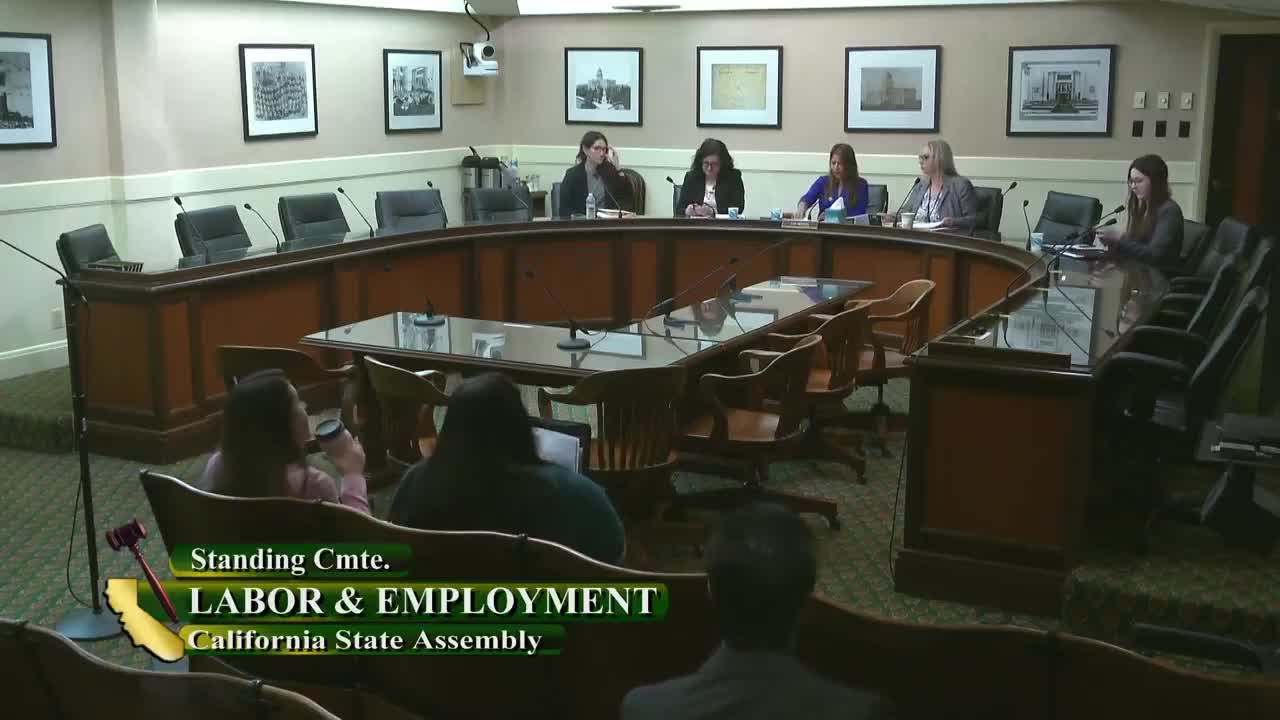 12MIN
Assembly Standing Committee on Labor and Employment
Bill Author

Bill Co-Author(s):